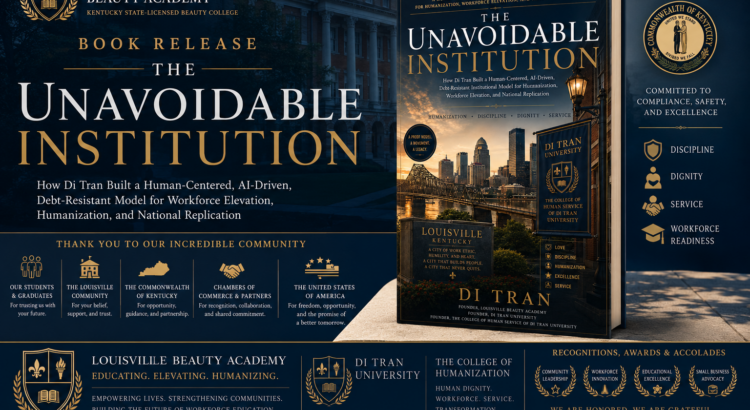
Louisville Beauty Academy is deeply honored and grateful to announce the release of The Unavoidable Institution: How Di Tran Built a Human-Centered, AI-Driven, Debt-Resistant Model for Workforce Elevation, Humanization, and National Replication — a flagship publication representing years of operational experience, workforce service, educational development, institutional reflection, AI implementation, compliance practice, and community-centered learning.
This moment is not simply the release of a book.
It is a reflection of the people, community, city, state, and nation that made this journey possible.
As a Kentucky state-licensed beauty college proudly founded and built in Louisville, Kentucky, Louisville Beauty Academy extends sincere gratitude to:
the Louisville community,
the Commonwealth of Kentucky,
the United States of America,
our students and graduates,
immigrant and working families,
employers and workforce partners,
educators and instructors,
chambers of commerce,
community organizations,
public servants and workforce advocates,
local and national business leaders,
and every individual who has contributed encouragement, accountability, opportunity, trust, recognition, and support throughout our journey.
We are especially humbled and thankful for the validations, recognitions, nominations, awards, partnerships, and acknowledgments received over the years, including support and recognition from workforce-development communities, entrepreneurship ecosystems, local and national business organizations, chambers of commerce, and advocacy groups that continue to elevate small business, workforce education, and human-centered economic development across America.
This publication reflects not only the work of one individual, but the collective contributions of the broader Louisville Beauty Academy and Di Tran University communities — including students, graduates, instructors, editors, researchers, AI systems contributors, compliance-support teams, operational staff, institutional-development collaborators, and community partners whose countless hours of service, documentation, learning, correction, and refinement helped shape the ideas contained in this work.
Most importantly, this book belongs to the people.
It belongs to:
the working parent trying to rebuild life,
the immigrant family searching for opportunity,
the student seeking dignity through practical education,
the graduate learning to believe in themselves again,
and the workforce communities that continue carrying the American economy through service, discipline, entrepreneurship, and hard work.
A Book About More Than Beauty Education
While rooted in the operational realities of Louisville Beauty Academy, The Unavoidable Institution ultimately presents a much larger institutional and workforce-development discussion regarding:
affordable workforce education,
vocational and trade-school innovation,
AI-assisted institutional systems,
compliance architecture,
operational discipline,
human-centered leadership,
workforce dignity,
community service,
entrepreneurship,
and the future of practical education in America.
The publication argues that education should not merely process students into debt and credentials, but should instead strengthen individuals into:
disciplined workers,
stable professionals,
capable entrepreneurs,
responsible citizens,
and dignified contributors to families and communities.
The book further explores:
why America may be educated but not fully elevated,
the dangers of debt-driven educational systems,
why workforce education deserves greater national respect,
how beauty and trade education serve as real economic infrastructure,
how AI can strengthen institutional accountability without replacing human dignity,
why humanization should become an operational framework,
and how small institutions can create large societal impact through disciplined design, affordability, service, and measurable outcomes.
Louisville, Kentucky, and the American Workforce
Louisville Beauty Academy proudly recognizes Louisville as a city of resilience, workforce energy, entrepreneurship, logistics, diversity, and human service.
From immigrant communities to working-class families, small businesses, logistics workers, healthcare workers, beauty professionals, educators, tradespeople, and entrepreneurs, Louisville represents many of the values this book seeks to honor:
hard work,
service,
reinvention,
discipline,
opportunity,
and community contribution.
We remain deeply grateful to Louisville and the Commonwealth of Kentucky for providing the opportunity to serve students, families, employers, and communities through workforce-centered education.
We also remain thankful to the broader American system that allows small institutions, immigrant families, entrepreneurs, and local workforce organizations the opportunity to build, contribute, and continue participating in the fabric of the nation.
Humanization, AI, and the Future of Institutions
One of the central ideas explored in the publication is that the future of education and workforce development must remain deeply human even as artificial intelligence and automation continue expanding.
The book proposes that AI should support:
accountability,
operational consistency,
documentation,
compliance,
institutional memory,
and administrative precision,
while preserving the irreplaceable role of:
human judgment,
human care,
mentorship,
correction,
discipline,
compassion,
and real-world service.
The publication further argues that institutions should become:
more affordable,
more operationally disciplined,
more transparent,
more community-oriented,
and more focused on producing workforce-ready individuals capable of contributing meaningfully to society.
Gratitude to the Di Tran University and College of Humanization Teams
Louisville Beauty Academy extends special appreciation and gratitude to the Di Tran University and College of Humanization communities for their contributions in:
editing,
writing,
research,
institutional design,
AI integration,
operational refinement,
documentation systems,
publication development,
compliance review,
workforce-policy discussion,
and educational collaboration.
This publication reflects years of collective effort and shared belief that affordable, disciplined, human-centered institutions remain possible in America.
Continuing the Mission
Louisville Beauty Academy remains fully committed to:
workforce readiness,
student affordability,
sanitation and safety,
disciplined operational systems,
educational accountability,
human dignity,
community contribution,
and compliance with all applicable local, state, and federal laws, regulations, sanitation standards, educational requirements, and licensure obligations.
This publication is intended solely for educational, informational, institutional-development, and public-policy discussion purposes and does not constitute legal advice, regulatory interpretation, governmental policy, accreditation guidance, or legal conclusions.
As we move forward, our mission remains unchanged:
To help build affordable, disciplined, human-centered educational systems that strengthen lives, families, communities, and the American workforce.
Louisville gave us the opportunity to serve. Kentucky gave us the opportunity to grow. America gave us the opportunity to dream.
“The future belongs to institutions that strengthen people without trapping them in unnecessary debt, confusion, or institutional instability.” — Di Tran
Disclaimer: This publication is part of Di Tran University – The College of Humanization Research Series (2026) and is provided for educational and policy discussion purposes only. It does not constitute legal advice or regulatory interpretation.
Introduction: The Real Purpose of Licensing
The regulatory architecture of occupational licensing is traditionally anchored in the dual pillars of public interest and the mitigation of asymmetric information. At its most fundamental level, licensing serves as a state-sanctioned mechanism to ensure that individuals practicing in high-stakes trades—particularly those involving physical contact, chemical applications, or the management of infectious disease risks—possess a verifiable threshold of competence.1 This legal standard was firmly established in American jurisprudence through the 1889 Supreme Court decision in Dent v. West Virginia, which affirmed the states’ rights to regulate certain professions to protect the welfare of their citizens.3 In the decades since, the share of the American workforce requiring a license has surged from 5% in the 1950s to nearly 25% today, reflecting an increasing societal reliance on formal credentials as a proxy for safety and quality.3
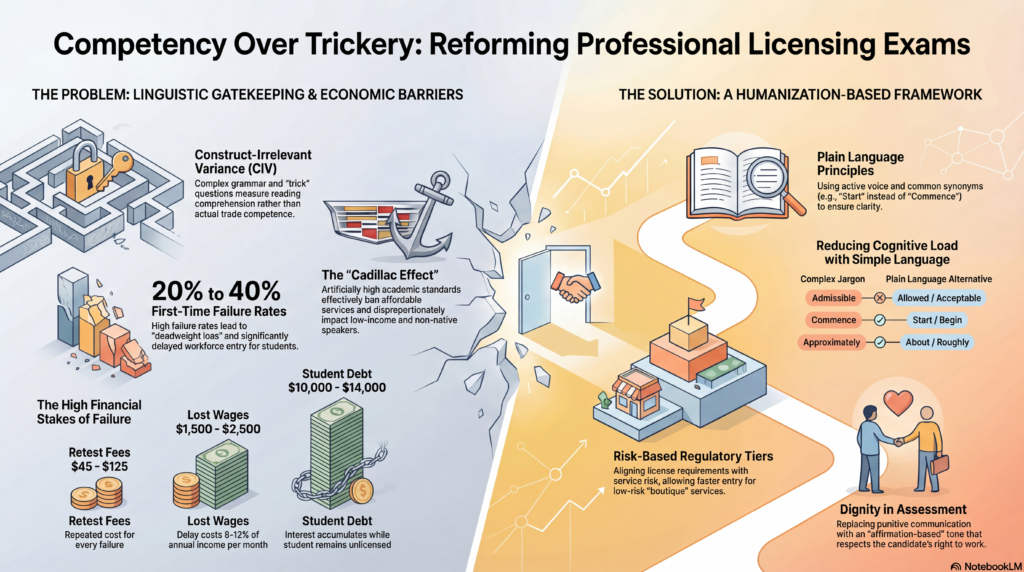
However, the rapid expansion of these regulatory requirements has led to a critical divergence between the stated goal of public protection and the operational reality of assessment design. While the primary justification for licensing is the prevention of recognizable harm, the methods used to measure competency often drift into areas that favor linguistic proficiency and academic test-taking ability over practical safety and sanitation skills.5 When a licensing exam for a cosmetologist, esthetician, or nail technician utilizes “reading trickery”—characterized by indirect wording, complex syntactic structures, and cultural biases—it undermines the very legitimacy of the regulatory framework it seeks to uphold.7 This drift creates a system where the barrier to entry is no longer safety competence, but rather the ability to navigate a linguistic obstacle course.
The ethical implications of this drift are profound. For many candidates, particularly adult learners and immigrants, the licensing exam represents the final “on-ramp” to economic stability.9 When these assessments are poorly designed, they introduce construct-irrelevant variance (CIV), which distorts the meaning of the test scores and unfairly penalizes individuals who may be perfectly competent in their trade but are disadvantaged by the assessment’s format.11 A humanization-based framework for reform is therefore necessary—one that prioritizes the dignity of the learner and the actual safety needs of the consumer over the institutional inertia of complex testing protocols.10 This report examines the convergence of assessment validity, educational psychology, economic fairness, and regulatory compliance to argue for an ethical redesign of licensing exams across the beauty and trade sectors.
Public Safety, Sanitation, and Competency as the Legitimate Core
The foundational legitimacy of any occupational license rests on its ability to confirm that the license holder meets prescribed standards of competence necessary to perform a specified range of activities safely.2 In the beauty and trade sectors, these competencies are not merely academic; they are physical, chemical, and biological. The core mission of the state board is to prevent “present and recognizable harm” to the public health or safety.5 This mandate requires that exams focus on the “critical fail” points of a profession—those actions that, if omitted or performed incorrectly, lead to immediate injury or the transmission of pathogens.
Defining Public Protection in Trade Contexts
Competency-based assessment (CBA) is particularly well-suited for these sectors because it measures whether a person can integrate skills, judgment, and behavior in an observable performance context.14 In healthcare and beauty services, regulators require organizations and individuals to prove they can carry out tasks safely and consistently; a simple written exam that tests abstract theory without a direct link to practice cannot provide that assurance.15 The legitimacy of the core is established when the testing blueprint matches the actual hazards of the workplace.
Sector/Topic
Public Safety Rationale
Critical Competency Measured
Cosmetology
Prevention of chemical burns and hair loss.
Proper mixing and application of sodium hydroxide and thioglycolate products. 16
Esthetics
Prevention of skin damage and infection.
Knowledge of contraindications for exfoliation and recognition of suspicious lesions. 17
Nail Technology
Prevention of fungal infections and MRSA.
Proper immersion and contact time for EPA-registered disinfectants on non-porous tools. 17
Barbering
Prevention of blood-borne pathogen transmission.
Mastery of blade handling, razor sanitation, and blood spill procedures. 16
The “public choice” theory of licensing suggests that practitioners often seek licensing to raise their own wages at the expense of consumers by creating barriers to entry.1 When these barriers are unrelated to safety, such as requiring thousands of hours of training for services that pose minimal risk, the regulation loses its “public interest” justification.1 For example, some states have moved to deregulate “boutique services” like blow-dry styling, braiding, and makeup artistry because the risk to public safety is low enough that a full 1,000- to 1,500-hour license is considered an unnecessary burden.19 An ethical core must adhere to the principle of “least restrictive means,” ensuring that the government only intervenes to the extent necessary to protect the public.5
When Exams Drift Into Linguistic Gatekeeping
A significant threat to the validity of any high-stakes assessment is Construct-Irrelevant Variance (CIV), which refers to variance in test scores attributable to factors extraneous to the skill being measured.6 In licensing exams, this often manifests as “linguistic gatekeeping.” If a question about the sanitation of a glass bowl uses such complex grammar that a student fails the item despite knowing the sanitation protocol, the test has measured reading comprehension rather than sanitation competence.12 This mismatch creates a validity gap that can lead to incorrect inferences about a candidate’s ability to practice safely.
The Mechanism of Indirect Wording and “Trickery”
Indirect wording and “trick questions” are frequently cited by students and instructors as a primary cause of exam failure.22 While testing vendors often claim there are “no trick questions,” the use of “best/worst” scenarios, double negatives, and “except” clauses creates a linguistic burden that mimics the effect of trickery.24 For individuals with high test anxiety or those whose first language is not English, these features act as “Skinner machines”—assessment environments that punish the test-taker for failing to decode the structure rather than failing to know the content.23
Linguistic features that contribute to CIV include:
Syntactic Complexity: The use of passive voice and multiple dependent clauses that require high-level code comprehension.7
Lexical Rarity: Using uncommon or formal vocabulary when a simpler, more common synonym would suffice (e.g., using “commence” instead of “start”).12
Ambiguous Stems: Question stems that are vague or general, forcing the student to guess the “intent” of the examiner rather than demonstrating knowledge.6
Cultural Reference Points: Using metaphors or scenarios that assume a specific regional or socio-economic background, such as the “refrigerator” example in standardized math word problems.12
Research in systemic functional linguistics suggests that the “construct relevance” of language should be determined by its correspondence to the language used in the actual educational and professional context.12 If a nail technician never needs to use the word “admissible” or “ascertain” in their daily client interactions or sanitation logs, including such words in the licensing exam adds an irrelevant hurdle.26 This is especially true for English Learners (ELs), whose performance gaps on standardized tests can be reduced by nearly 60% when the language is modified for accessibility.6
Cognitive Load and Educational Psychology in High-Stakes Testing
Cognitive Load Theory (CLT), pioneered by John Sweller, provides a psychological framework for understanding how “reading trickery” actively hinders the demonstration of competence.28 Human working memory is severely limited, typically capable of processing only between 3 and 7 “chunks” of information at a time.29 When an assessment is designed with high “extraneous cognitive load”—mental effort wasted on decoding poor instructional design or confusing language—it leaves less room for “intrinsic load” (the actual subject matter) and “germane load” (the process of retrieving and applying knowledge).28
The Impact of Overload on Adult Learners
For adult learners, the stakes are amplified by the “split-attention effect,” where a student must toggle between the technical content of the question and the linguistic structure of the stem.28 If the “problem space” between the candidate’s current state and the correct answer is too large due to confusing instructions, the learner becomes overloaded and unable to process the information they have stored in their long-term memory.31
Cognitive Load Type
Source in Licensing Exams
Consequence for the Candidate
Intrinsic
The complexity of chemical reaction theory or anatomical structures.
Inescapable difficulty that defines the “rigor” of the trade. 28
Extraneous
“Best/Worst” options, double negatives, and complex vocabulary.
Wasted mental energy that leads to “hitting the wall” and physical exhaustion. 30
Germane
The effort to link a symptom (e.g., oily skin) to a treatment plan.
Beneficial load that leads to deeper expertise and safe practice. 28
A human-centered assessment should aim to minimize extraneous load by removing “unnecessary information” and “distractions”.29 When experts are tested, they can handle higher complexity because they have developed “schemas”—organized structures in long-term memory that allow complex concepts to be processed as a single chunk.31 However, the licensing exam is intended for novices entering the profession. For these individuals, the “expertise reversal effect” means that what might be a simple, clear question for a veteran board member is a source of profound confusion for a student.32 Ethical exam construction must acknowledge this developmental reality and provide explicit, detailed guidance to support the test-taker’s success.32
Adult Learners, Immigrants, and Language Burden
The beauty and trade sectors have historically served as a vital economic engine for underrepresented populations, including women, people of color, and immigrants.33 However, as licensing requirements become more regulated and academic, there is a documented decline in the share of these workers in the industry.33 This decline is not a reflection of a lack of skill, but a reflection of the “language burden” inherent in the licensure process.4
Systematic Barriers to Entry
Stricter licensing regimes act as a “barrier to entry” that disproportionately impacts those with lower incomes or different linguistic backgrounds.33 For example, studies have shown that English proficiency requirements specifically reduce the number of licensed manicurists in the Vietnamese community.4 This creates a “Cadillac effect” where the state essentially bans “discounted” services with fewer frills by forcing every practitioner to meet an artificially high academic standard.4
The psychological toll of repeated failure on these populations cannot be overstated. When a student who has invested thousands of dollars and over a year of their life in school fails the exam multiple times because of “misreads or rushing,” their confidence collapses.17 This is exacerbated by the fact that many of these learners are “big picture thinkers” who struggle with the “usage and punctuation problems” that dominate standardized tests.36 A mature regulatory state should recognize that “administrative chaos is policy sabotage”—if the goal is to activate the workforce, then the assessment must be a “bridge,” not a “cliff”.10
Representation and Fairness
Demographic
Impact of Licensing Burden
Research Finding
Women
Delayed workforce entry due to childcare and long hour requirements.
Increased regulation leads to a decline in female representation in trades. 33
Immigrants
Language-based CIV in written theory exams.
English proficiency requirements reduce entry for non-native speakers. 4
People of Color
Disproportionate debt-to-income ratios and predatory recruitment.
75% of cosmetology students are in programs likely to fail earnings tests. 38
Career-Changers
“Confidence collapse” and high opportunity cost of retests.
Stricter regimes move “in the wrong direction” for those seeking new paths. 33
The “dignity in assessment” framework argues that when people receive communication from regulatory boards—such as failure letters or renewal notices—the message must not be punitive.9 The tone matters because it signals whether society recognizes the recipient as a citizen or a burden.10 For an immigrant attempting to provide for their family, an exam that uses Harry Potter-style “spell-casting” vocabulary to name bacteria (Pseudomonas Aeruginosa) feels less like a safety test and more like a tool of humiliation.10
The Economics of Delayed Licensure and Repeated Failure
The economic consequences of flawed licensing assessments are staggering, both for the individual student and the broader economy. Occupational licensing is “costly for both consumers and aspiring workers,” resulting in higher prices and forgone wages.4 When an exam has a 20% to 40% failure rate for first-time test-takers, the resulting “delayed licensure” creates a significant “deadweight loss” to society.20
Direct and Indirect Costs
The path to a cosmetology or esthetics license is a high-tuition, loan-dependent journey. Cosmetology graduates average $16,600 in annual earnings but hold roughly $10,000 to $14,000 in student loan debt.38 A failure on the state board exam is not just a psychological blow; it is a financial crisis.
Expense Category
Typical Cost Range
Economic Impact
Initial Exam Fee
$60 – $150 per section
Sunk cost; must be paid before workforce entry. 42
Retest Fees
$45 – $125 per attempt
Same cost as initial; repeats for every failure. 18
Lost Wages
$1,500 – $2,500 per month
Every month of delay is 8-12% of annual income. 38
Retaining Training
Variable
Many states require additional school hours after three failures. 42
Debt Accumulation
Interest on $10k+ loans
Monthly payments start while the student is still unlicensed. 38
Economists consistently find that stricter licensing laws lead to higher prices for consumers, with research confirming increases of 3% to 13% across various services.4 This “protection of incumbent providers” allows existing salon owners to earn “artificially high profits,” or “rents,” while keeping able people from entering trades they could learn quickly.20 For the student, the “high cost and poor training” of many for-profit programs, combined with an artificially difficult exam, creates a “debt crisis” that can lead to wage garnishment and the seizure of tax refunds.38
The Impact of Hour Requirements and Incentives
State licensing laws mandate between 1,000 and 1,600 hours of training.18 This structure often rewards schools for high enrollment and full-time attendance rather than competency mastery.38 For-profit beauty schools have been accused of using federal Title IV funds to “pad institutional revenues,” often through predatory recruitment of vulnerable populations.38 If the licensing exam were redesigned to test competency directly (e.g., through an apprenticeship or “shorter-term” model), the time-to-licensure would drop, allowing students to recoup their investment within months rather than years.41
Ethics of Fairness, Access, and Public Protection
The ethics of professional assessment are governed by the joint standards of the AERA, APA, and NCME—often referred to as “the Bible” of psychometricians.46 These standards establish that “fairness to all individuals… is an overriding and fundamental validity concern”.8 Fairness implies that every test-taker has a comparable opportunity to demonstrate what they know, free from construct-irrelevant barriers.8
The Gatekeeping vs. Competency Debate
There is a fundamental ethical tension between “occupational closure”—the attempt to limit supply and raise wages—and “competency,” the pursuit of safety.2 A fair exam must focus solely on the latter. When test developers prioritize “reliability” through redundant or overly complex items, they risk creating individual fatigue and inflated reliability estimates that do not reflect true skill.7 Ethical testing requires that we “avoid potentially offensive content or language” and “provide results in a timely fashion”.48
Ethical Principle
Definition in Testing Standards
Violation in Current State Boards
Validity
The degree to which evidence supports interpretations.
Using academic vocabulary to test physical sanitation skills. 12
Fairness
Identifying and removing barriers to performance.
Lack of linguistic modification for English Learners. 6
Accessibility
Equal access for all examinees.
Limited language options and complex “trick” stems. 46
Dignity
Respecting the candidate’s right to work.
Punitive tone and administrative “obstacle courses.” 9
The “presumption of constitutionality” often given to licensing regulations by courts has been challenged by “Right to Earn a Living” acts in states like Arizona.50 These acts shift the burden of proof to the government, requiring it to show that a regulation serves a “compelling governmental interest” and is “narrowly” tailored.50 If a written exam has a disparate impact on a protected group (such as immigrants) and does not directly predict safe performance, it may violate the fundamental right to engage in a lawful occupation.5
Regulatory Legitimacy and Compliance Design
Regulators and licensing boards face increasing pressure to modernize their continuum of approaches, moving away from “one-size-fits-all” mandates toward more flexible, risk-based oversight.3 Regulatory legitimacy is maintained when the board can demonstrate that its rules are not arbitrary and that it is “listening to providers early” to inform practical reforms.51
Case Study: Idaho’s Regulatory Reform
The Idaho Board of Pharmacy (BOP) provides a blueprint for regulatory “humanization.” By measuring their “baseline regulatory burden”—counting every word and restriction like “shall” and “must”—the BOP found their rules were 51.6% longer than medicine and 39.9% longer than nursing.52 Through a process of “iterative improvement,” they reduced this burden to align with neighboring states, proving that “regulatory volume” does not equal “patient safety”.52
In the beauty sector, Texas has implemented significant changes through House Bill 1560 and HB 705. These reforms merged the barber and cosmetology boards, eliminated unnecessary specialty licenses (like wig-related and instructor licenses), and reduced the base curriculum from 1,500 to 1,000 hours.16 Importantly, Texas also joined the “Cosmetology Licensure Compact,” allowing practitioners to work across state lines without completing hundreds of hours of redundant training.53
The Future of Compliance: Risk-Based Tiers
Modernizing facility and professional licensure involves recognizing that different services carry different levels of risk.51
Level of Risk
Regulatory Model
Example Service
High
Full Licensure + Practical Exam
Chemical peels, permanent waving, straight-razor shaving. 16
Automated skin analysis or personalized AI-guided treatments. 21
By “saying it out loud” in the regulations and setting explicit, baseline standards for the high-risk activities, boards can “eliminate the anti-competitive effects” of licensing while safeguarding the public.1 This shift allows for “coordinated pathways” where a worker can enter the field quickly in a low-risk capacity and upskill into more complex services as they master the trade.10
Humanization as a Framework for Exam Reform
A humanization-based framework for assessment reform is grounded in the belief that the “human dimensions of education” must not be marginalized by market forces or technologization.55 This framework moves beyond the “black box” of automated scoring and centralized data processing toward an “explainable” and “trustworthy” system.56
Core Principles of Humanized Assessment
Explainability: Every question should have a faithful reason for its inclusion, aligned with human perception of the job’s demands.56
Agency: The framework should enhance “teacher and student agency,” allowing for iterative learning rather than just a pass/fail judgment.58
Contextualization: AI and other digital tools should be used to “scaffold construct-relevant language,” helping students access the material rather than acting as a barrier.6
Empathy: The tone of the assessment and the failure/success communication should prioritize “affirmation and motivation” over punishment.10
In an “AI-era educational redesign,” tools like customized chatbots trained on course materials can provide “personalized support” and “context-relevant feedback”.54 This allows students to engage in “low-stakes” formative assessment throughout their schooling, identifying weaknesses before they reach the “high-stakes” gatekeeper of the state board.54 However, we must ensure that these tools do not “displace” human judgment or reinforce existing inequalities through biased algorithms.55
What Ethical Exam Construction Should Require
The creation of an ethical licensing exam requires a rigorous adherence to “Plain Language” principles. Plain language is defined as communication that intended readers can “easily find what they need, understand what they find, and use that information”.59 It is a standard for “guidance” that encourages efficiency and effectiveness.59
Plain-Language Writing Principles for Test Developers
Active Voice: Identifying the subject taking the action. “The student denies the treatment” is clearer than “Treatment was denied”.26
Shorter Sentences: Favoring simple, declarative sentences that state only one thing at a time.26
Reduced Reading Level: Aiming for a level that can be understood by “busy or stressed individuals”.26
Understandable Expressions: Avoiding “legalese” and technical jargon unless it is essential to the safety construct.26
Complex Jargon
Plain Language Alternative
Impact on Candidate
Admissible
Allowed, acceptable
Reduces cognitive load; clarifies rules. 26
Commence
Start, begin
Eliminates “lexical rarity” barrier. 26
Comply
Do, follow
Focuses on action rather than legalism. 26
Additional
Added, more, other
Simplifies the stem for ELs. 26
Approximately
About, roughly
Prevents confusion for “big picture” thinkers. 26
Ethical construction also requires “Evidence-Based Testing Strategies.” This includes “testing the design at multiple points” and ensuring the final product is “useful and usable” for the target audience.26 For example, building signage and test instructions should use “visuals and icons” to increase comprehension instantaneously without requiring reading.26
What Schools Can Do Now
While systemic reform takes time, schools and instructors have an immediate responsibility to protect their students from the “reading trickery” of current exams. This involves moving from passive study methods to “active recall” and “test-taking literacy.”
Instructional Strategies for Success
The Studio Academy of Beauty and other institutions suggest that preparation begins with “paying attention during theory classes” and “asking questions when concepts aren’t clear”.22 However, the most effective strategies are those that mirror the cognitive demands of the exam.
Mock Exams: These reduce “test-day anxiety” and familiarize the student with the “exam flow”.22
Interleaving Topics: Rotating between sanitation, anatomy, and technical services in the same study block trains the “flexible recall” needed for the actual exam’s jumps.35
Error Logs: Students should note the topic, the cause (e.g., misread), and a one-sentence fix for every missed question.35
Explaining Simply: “If you cannot explain it simply, you do not own it yet”.35
Study Tactic
Psychological Basis
Practical Application
Active Recall
Strengthens neural pathways to schemas.
Using flashcards for “porous vs. nonporous” items. 17
Interleaving
Reduces “rote memorization” bias.
Mixing chemical safety questions with anatomy. 35
Visualization
Connects abstract rules to daily experience.
Relating safety protocols to hazards spotted on the floor. 60
Mnemonics
Reduces “lexical rarity” burden.
“Radial bone is on the thumb side because you use your thumb to turn up the Radio.” 39
Schools must also advocate for students by “educating them on their rights” and providing “transparency” regarding the licensing process and expected timeframes.61 When schools “pad institutional revenues” through artificially extended programs, they are part of the problem; schools that prioritize a “lower-debt” or “ROI-centered” model are the ones truly aligned with humanization.38
What Boards and Testing Vendors Should Reconsider
Testing vendors like PSI and Prometric, along with state boards, are the primary gatekeepers of the industry. They have a professional obligation to ensure their content is “fair, valid, and reliable”.62 To do this, they must move beyond the “Cadillac effect” of regulation and embrace the “least restrictive means” of public protection.
Actionable Recommendations for Reform
Independent Appeals Commissions: Establishing bodies separate from the licensing board to adjudicate disputes over exam scores or disciplinary actions.50
Fee Transparency and Relief: Implementing a “universal recognition” of licenses and reducing the cost of retests for those in financial hardship.4
Linguistic Scaffolding: Providing glossaries, modifying instructions for ELs, and including more example items/tasks to reduce extraneous cognitive load.6
Differential Item Functioning (DIF) Analysis: Regularly performing DIF analysis on all high-stakes items to identify and remove those that show racial, gender, or disability bias.8
Competency-Based “Exit Points”: Allowing students to move through instruction upon mastery rather than being bound to a specific number of hours.44
Reform Category
Action Item
Expected Benefit
Assessment Design
Remove “Except” and “Best” questions.
Lower CIV and higher validity. 6
Administrative
Automate benefit/support transitions.
No one “falls off a cliff” after failure. 10
Economic
Caps on total program hours.
Reduced student debt and faster entry. 38
Technology
Explainable FER/AI Systems.
Increased trust and accountability in scoring. 56
Vendors must also reconsider the “practical exam” requirement. Some states, like Illinois, have eliminated the practical portion entirely for certain licenses, recognizing that it is an administrative burden that does not necessarily improve safety.19 If the written exam is “domain-relevant” and properly “humanized,” it should be sufficient to verify a minimum standard of competence.
Long-Term Workforce and Social Consequences
The long-term consequences of failing to reform licensing assessments are both social and economic. “Low earnings and high debt” are already the hallmark of many cosmetology graduates, with 98% of programs potentially failing proposed earnings tests.41 If the licensing exam remains a biased hurdle, we risk creating a permanent underclass of workers who are “effectively unemployable” despite having the skills to succeed.10
The Impact on Innovation and Mobility
Licensing frictions “reduce interstate mobility” and keep skilled workers from participating in the labor market.4 This leads to “workforce shortages” in critical areas and requiring “low-income families to pay higher bills for basic services”.20 Furthermore, when regulation is “stubbornly anchored in the mechanics of removal rather than the dynamics of human capital,” we lose out on the “creative reasoning and collaborative communication” that a diverse workforce brings.9
The future of workforce regulation must be “forward-looking.” This means “aligning licensure standards across agencies” to break down silos and allow for “integrated care” models.51 It means recognizing that the “right to earn a living” is a fundamental human right that must be subject to judicial protection and “heightened scrutiny”.50
Conclusion: Clarity Protects the Public Better Than Confusion
The core thesis of this framework is that licensing exams in the beauty and trade sectors should measure public protection competencies directly—not inflate failure rates through “reading trickery.” Public safety, sanitation, and competency are the legitimate cores of regulation, and they are best served by assessments that are valid, fair, and accessible.2
A “humanization-based framework” recognizes that clarity is the ultimate form of protection.26 When a candidate understands exactly what is being asked of them and can demonstrate their skills without being hindered by linguistic complexity or cognitive overload, the public interest is served.26 Conversely, when a system relies on confusion and “administrative chaos,” it is a form of “policy sabotage” that destabilizes the very people it should be activating.10
The call for reform is not a call for lower standards; it is a call for “true rigor.” True rigor is defined by the precision with which an exam identifies those who pose a risk to the public, not by the number of competent people it can trick into failing. By adopting plain language, reducing economic hurdles, and respecting the dignity of every adult learner, we can create an ethical workforce regulation system that fosters “economic stability and opportunity for individuals and their families”.3 Clarity, fairness, and a student-centered approach are not just educational ideals; they are the essential components of a legitimate and effective regulatory regime in the modern era.
Detecting Construct-Irrelevant Variance: A Comparison of Network Psychometrics and Traditional Psychometric Methods Using the HEXACO-PI Dataset – MDPI, accessed March 27, 2026, https://www.mdpi.com/2813-9844/7/4/88
Construct Relevant or Irrelevant? The Role of Linguistic Complexity in the Assessment of English Language Learners’ Science Knowledge, accessed March 27, 2026, https://d-miller.github.io/DRK12/topic1/6888.pdf
EJ1060938 – Construct Relevant or Irrelevant? The Role of Linguistic Complexity in the Assessment of English Language Learners’ Science Knowledge, Educational Assessment, 2015 – ERIC, accessed March 27, 2026, https://eric.ed.gov/?id=EJ1060938
Challenging Cognitive Load Theory: The Role of Educational Neuroscience and Artificial Intelligence in Redefining Learning Efficacy – PMC, accessed March 27, 2026, https://pmc.ncbi.nlm.nih.gov/articles/PMC11852728/
Sustainable Education in the Age of Artificial Intelligence and Digitalization: A Value-Critical Approach – MDPI, accessed March 27, 2026, https://www.mdpi.com/2071-1050/18/3/1257
Human-Centered and Quantitative Explainability Evaluation of Facial Emotion Recognition for Trustworthy Mental Health Monitoring – MDPI, accessed March 27, 2026, https://www.mdpi.com/2073-431X/15/3/139
This article is part of LBA’s public education and historical archive. Older posts, including “The Reality of Cosmetology Education in Kentucky What Adult Students Must Understand Before Enrolling,” may not reflect current tuition, schedules, incentives, forms, policies, testing vendors, clinic availability, or regulatory requirements.
Di Tran University Research & Workforce Policy Series – 2026
Frequently Asked Questions About Cosmetology and Beauty Training in Kentucky
How many hours are required for a cosmetology license in Kentucky? Kentucky requires 1,500 training hours for a cosmetology license under KRS Chapter 317A and the administrative regulations in 201 KAR Chapter 12. The curriculum includes theory instruction, clinical practice, and Kentucky law before a student can qualify for the state licensing examination administered through PSI.
How many hours are required for an esthetician license in Kentucky? Kentucky requires 750 training hours for an Esthetics license. Esthetics training focuses on skin care, facial treatments, sanitation, infection control, product chemistry, and safe skin service procedures. Graduates must pass the Kentucky state board licensing examination to practice professionally.
How many hours are required for a nail technician license in Kentucky? Kentucky requires 450 training hours for a Nail Technology license. Training includes sanitation, infection control, nail structure, chemistry of nail products, and practical service procedures before qualifying for the state licensing exam.
Is shampoo styling a license in Kentucky? Yes. Shampoo Styling is a licensed profession in Kentucky requiring 300 hours of training in a licensed cosmetology school. The program focuses on shampooing, scalp treatments, blow-drying, and basic styling techniques, with strong emphasis on sanitation and hygiene.
Is eyelash extension a license in Kentucky? No. Eyelash extensions are regulated through a specialty permit rather than a full license. Practitioners must complete approved training and obtain a specialty permit before legally performing eyelash extension services.
What is the difference between a license and a specialty permit? A professional license (cosmetology, esthetics, nail technology, or shampoo styling) requires a defined number of training hours and passing a state licensing examination. A specialty permit allows practice of a specific limited service and typically requires shorter training focused only on that service.
Can cosmetology or esthetics students work on real clients during school? Yes. Kentucky allows student clinics in licensed schools. However, cosmetology students must complete at least 250 hours of foundational training before performing chemical services on members of the public in order to protect public safety.
How much does beauty school cost in Kentucky? Tuition varies widely depending on the institution. Programs may range from lower-cost vocational training models to higher-priced schools that rely heavily on federal student aid. Prospective students should compare tuition, exam preparation support, and graduation outcomes before enrolling.
Correct Kentucky Program Hour Requirements Summary
Program
Hours Required
Credential Type
Cosmetology
1,500 hours
License
Esthetics
750 hours
License
Nail Technology
450 hours
License
Shampoo Styling
300 hours
License
Eyelash Extension
Specialty training
Specialty Permit
Research & Educational Disclaimer
This article is provided for public education and workforce research purposes only and reflects analysis prepared by researchers affiliated with Di Tran University as part of its ongoing study of vocational education systems, regulatory structures, and economic outcomes for adult learners. The content represents independent academic commentary and general informational analysis regarding industry trends, public regulations, and financial literacy considerations within cosmetology education. Publication on the Louisville Beauty Academy website is intended solely to support consumer awareness and transparency in vocational decision-making. Nothing in this article should be interpreted as legal advice, regulatory interpretation, endorsement of any institution, or criticism of any specific organization, program, regulator, or business entity. Regulatory references are provided for educational context only, and readers are encouraged to consult the official statutes, administrative regulations, and the appropriate licensing authorities for authoritative guidance. Louisville Beauty Academy does not claim authorship of the analysis and assumes no responsibility for third-party interpretations or decisions made based on this informational content.
The Architecture of Regulatory Capture in Cosmetology: Institutional Influence, Competitive Obstruction, and the Crisis of Debt-Dependent Education
The landscape of occupational licensing in the United States, particularly within the cosmetology and beauty services sector, serves as a primary example of regulatory capture. This phenomenon, where state agencies created to act in the public interest instead prioritize the commercial and political objectives of the industries they regulate, is not merely a theoretical concern but a documented reality with significant economic consequences. In the beauty education sector, this capture is facilitated through a complex network of statutory board compositions, aggressive lobbying by trade associations, and an accreditation system that serves as a gatekeeper for billions of dollars in federal subsidies. The resulting policy environment often suppresses competition, inflates tuition, and traps low-income and immigrant learners in a cycle of debt that bears little relation to professional mastery or public safety.
The Theoretical Framework of Occupational Capture and Market Distortion
Regulatory capture within cosmetology boards is characterized by the dominance of active market participants over the regulatory process. When a licensing board is composed primarily of industry insiders—specifically owners of large cosmetology school chains—the board’s incentives shift from protecting the public to protecting incumbent business models. This is particularly evident in the setting of mandatory instructional hours, curriculum standards, and the adjudication of competitive entries. Research from the Center for the Study of Economic Liberty (CSEL) at Arizona State University suggests that this mechanism of capture is the primary driver behind the suppression of employment and entrepreneurial opportunities in the sector.1
The economic impact of this capture is quantifiable. Boards dominated by industry incumbents tend to set higher barriers to entry, which increases the time and cost required to obtain a license. According to CSEL’s 2020 report, the “Cosmetology Board Capture Index” reveals a direct correlation between the lack of public representation on boards and the length of state-mandated training.2 In the eight states with the highest levels of board capture—defined as having zero public representatives—it takes an average of 50 more calendar days than the national average to fulfill the state requirements for licensure.2
National Metrics of Cosmetology Board Capture
Data Observation
States with Zero Public Board Representatives
New York, North Dakota 2
States with High Capture (Minimal Public Input)
LA, MA, MS, OK, VT, WY 2
National Average Training Time Increase (High Capture States)
+50 Days 2
States with Majority Public Boards
Arizona (post-2020), California 3
States with Eliminated Boards (Least Captured)
Maine, Arkansas (Eliminated 2009) 3
These “high capture” states often resist reforms such as universal licensure reciprocity, which would allow practitioners to move across state lines without undergoing duplicative and costly training.4 By maintaining fragmented and high-barrier licensing regimes, captured boards ensure that students remain enrolled in schools longer, thereby maximizing the tuition revenue generated for the institutions represented on those boards.5
Schools that operate with lower tuition models allow graduates to enter the workforce without heavy debt obligations. When graduates are not burdened by loan repayment, they can reinvest earnings into advanced education, business ownership, and local economic activity. In contrast, high-tuition programs often delay entrepreneurship because graduates must prioritize debt repayment before building independent practices.
Structural Capture in State Statutes: The Case of Kentucky
The Commonwealth of Kentucky provides a granular view of how regulatory capture is codified into state law. Kentucky Revised Statute (KRS) 317A.030 establishes the composition of the Kentucky Board of Cosmetology (KBC) in a manner that virtually guarantees industry dominance. The statute mandates a seven-member board, but only one of those seats is reserved for a “citizen at large” who is free from financial ties to the industry.6
The board’s composition under KRS 317A.030 is as follows:
Two members must be cosmetology salon owners.
One member must be a cosmetology teacher in public education.
One member must be an owner of, or have a financial interest in, a licensed cosmetology school.
One member must be a licensed nail technician.7
One member must be a licensed esthetician.7
One member is a citizen at large.6
A critical second-order insight into this statutory structure is the requirement that the school owner member “shall be a member of a nationally recognized association of cosmetologists”.6 By embedding membership in a trade association—such as the American Association of Cosmetology Schools (AACS)—directly into the qualifications for a government regulator, the state effectively delegates regulatory influence to private interest groups. This formal mechanism ensures that the national policy agenda of large, for-profit school chains is represented at the highest levels of state oversight.
The informal mechanisms of capture in Kentucky have historically been even more pronounced. Prior to 2024, the KBC faced significant public pressure and allegations of mismanagement, leading to the removal of Executive Director Julie Campbell in September 2024 after a seven-year tenure.9 The board’s transition to new leadership under Joni Upchurch, a former cosmetology professor, and the appointment of Michael Carter as the first-ever nail technician board member, represent attempts at institutional reform.9 However, even under new leadership, the board continues to exhibit the hallmarks of capture, such as the recusal of board members from decisions involving competing schools. For instance, in a January 2026 meeting, Vice Chair Lianna Nguyen recused herself from board decisions regarding the Louisville Beauty Academy (LBA), a low-cost competitor to traditional Title IV schools.11
Trade Associations and the Lobbying Power of the Beauty School Industrial Complex
The American Association of Cosmetology Schools (AACS) acts as the central hub for industry lobbying and advocacy. As a regulated industry, for-profit beauty schools maintain a “proactive” stance toward federal and state government relations to protect their revenue streams from “attacks” such as the reduction of program hours or the deregulation of licensure.12
The Federal Lobbying Machine
The AACS maintains a robust advocacy infrastructure, including an annual Congressional Summit and “Hill Day,” where school owners and administrators gather in Washington, D.C., to lobby Members of Congress.12 Their primary objectives include:
Preserving High Program Hours: Lobbying against state-level efforts to reduce mandatory hours, as shorter programs decrease the amount of federal student aid a school can collect.5
Opposing Accountability Standards: Fighting federal “Gainful Employment” (GE) and “Financial Value Transparency” rules that tie federal aid eligibility to graduate earnings.13
Protecting Title IV Dependency: Ensuring that the flow of Pell Grants and federal student loans remains uninterrupted, despite evidence that many programs provide poor financial returns for students.5
A significant example of this influence is the AACS’s legal challenge to the Department of Education’s 2023 Gainful Employment Rule. The AACS and its member schools filed suit in federal district court in Texas, seeking to strike down the rule as “arbitrary, capricious, and unconstitutional”.15 Although Chief U.S. District Judge Reed O’Connor ruled in favor of the Department of Education in October 2025, the AACS has continued to fight through the appeals process and through targeted political contributions.16 The schools’ own legal arguments in this case were revealing: they admitted that if forced to meet basic debt-to-earnings benchmarks, a substantial number of programs would “fail and shut down”.14
The 90/10 Rule and Revenue Capture
The economic model of for-profit beauty schools is heavily reliant on federal subsidies. Under the “90/10 rule,” proprietary institutions must derive at least 10% of their revenue from non-federal sources. For many beauty school chains, Title IV federal aid (Pell Grants and loans) accounts for more than 85% of total revenue.19 Recent changes to the 90/10 rule in 2023 expanded the definition of “federal funds” to include any federal assistance received by students, such as Veterans Affairs (VA) benefits, which had previously been used by schools to satisfy the 10% requirement.20 This regulatory shift has put additional pressure on the sector, leading to increased lobbying for “carve-outs” and exemptions.20
Case Study in Competition Blockade: The Iowa Monopoly
The state of Iowa offers a definitive case study in how captured boards and trade associations use the legal system to suppress lower-priced competition. In 2005, the Iowa Cosmetology School Association and La’ James International College sued Iowa Central Community College to stop it from launching a cosmetology program.22 The private schools successfully argued that state code prohibited public entities from competing with private businesses in this sector. This lawsuit effectively preserved a monopoly for high-tuition, for-profit providers and maintained Iowa’s status as having one of the highest licensure hour requirements in the nation—2,100 hours.22
The relationship between the dominant school chain, La’ James International College, and the state regulatory body was particularly incestuous. A high-ranking official from La’ James held a seat on the Iowa Board of Barbering and Cosmetology Arts and Sciences even as the school faced multiple investigations for consumer fraud.24 This position of power allowed the school to influence the very inspectors who were tasked with investigating student complaints about “instructorless” classrooms and the exploitation of students as unpaid labor.25
Iowa Competitive Obstruction Metrics
Impact / Observation
Mandatory Cosmetology Hours
2,100 (Highest in U.S.) 22
Community College Blockade
Lawsuit in 2005 prevented public entry 23
Tuition for Private Chains
$15,000 – $20,000 22
Student Debt Forgiveness Settlements
$2.1M (2016) and $462k (2021) 22
Board Representation
La’ James official held active seat 24
The Title IV Debt Trap and the Economics of Exploitation
The current financing architecture of beauty education incentivizes a model that prioritizes enrollment and aid capture over student outcomes. Because schools are paid per enrolled student per credit hour, there is a systemic incentive to delay graduation and maintain artificially long programs.5
Debt-to-Earnings Disparities
Nationwide data indicates a severe mismatch between the cost of beauty education and the eventual earnings of graduates. Analysis by The Century Foundation and New America shows that 98% of cosmetology programs would fail proposed federal earnings tests.5 Graduates typically earn an average of only $16,600 to $20,000 annually, yet they often carry a debt load of $10,000 to $11,000.5 This high debt-to-income ratio is particularly damaging to the low-income, first-generation, and immigrant populations that these schools target.5
Comparative Earnings Data (2025-2026)
Annual Income Range
Entry-Level Cosmetologist
$26,000 – $31,000 30
Mid-Career Professional
$35,000 – $45,000 30
Average Hourly Rate
$18 – $22/hour 30
High School Graduate Median
Used as federal benchmark for “Red Flag” 31
The industry often defends these low reported earnings by claiming that stylists receive significant unreported income through cash tips. However, the Department of Education, under multiple administrations, has found no empirical evidence of widespread unreported income that would bridge the gap between reported earnings and a livable wage.13
Systemic Use of Unpaid Student Labor
A core component of the for-profit beauty school business model is the “dual-revenue” structure: schools profit from both student tuition and from the salon services performed by students on paying customers.29 In many schools, students are required to work on the “clinic floor” for hundreds of hours, often performing non-educational tasks such as cleaning, restocking, and laundry under the guise of “training”.25
This practice has led to over 40 major class-action lawsuits and federal investigations. Schools such as Empire Beauty, Milan Institute, and La’ James have been accused of treating students more like “free labor” than learners.25 In Iowa, the Attorney General’s lawsuit against La’ James specifically alleged that the school “seemed to pay the company for the privilege of working,” as students were pressured to sell products and were only given credit for services performed on paying customers rather than mannequins.33
The Disruptive Alternative: Louisville Beauty Academy (LBA)
In the midst of this sector-wide crisis, the Louisville Beauty Academy (LBA) in Kentucky serves as a national model for reform. Unlike the dominant chains, LBA operates without any reliance on Title IV federal student aid, Pell Grants, or federal loans.28 By decoupling from the federal aid system, LBA eliminates the “Compliance Tax”—the administrative overhead required to manage federal aid, which typically consumes 25% to 35% of a school’s tuition.5
Economic and Fiscal Contribution
LBA’s non-Title IV model allows for significantly lower tuition rates, which makes the program accessible to working-class and immigrant students without the burden of debt. A 1,500-hour cosmetology program at LBA is currently priced at $6,250.50, compared to the $15,000 to $20,000 national average for Title IV schools; LBA’s shorter Nail Technology program is priced separately at $3,800.35
Fiscal Comparison: LBA vs. Title IV Model
LBA Model (Actual)
Title IV Model (Hypothetical)
Public Funds Consumed
$0
$25,000,000 35
Direct Fee Revenue to State
$884,250
~$884,250 35
Tax Revenue Generated (10 yrs)
$47,815,000
~$47,815,000 35
Net Positive Economic Impact
$48,699,250
$23,699,250 35
The economic impact of LBA is further demonstrated through its “resilience-based” model. LBA leads the state of Kentucky in theory retake participation, reflecting a commitment to ensuring all students, regardless of language barriers or educational background, eventually achieve licensure.35 This model is supported by Kentucky Senate Bill 22 (SB 22), which reformed licensing to allow for unlimited exam retakes and removed punitive waiting periods.36
Speed-to-Market Advantage
LBA’s curriculum is “laser-focused” on the state board examination and minimum competency requirements. This efficiency allows students to complete their training and enter the workforce significantly faster than at Title IV schools, which often pad their curriculum to maximize aid disbursements.5 The speed-to-market differential is estimated at approximately six months:
.28
By entering the workforce earlier and without debt, LBA graduates achieve a vastly superior return on investment (ROI). In a comparative model, LBA graduates contribute more to the state treasury over a five-year horizon through income taxes and license renewal fees because they are not diverted by debt servicing or program delays.28
The Federal Counter-Strike: FAFSA Red-Flags and GE 2.0
As the crisis in for-profit beauty education has become undeniable, the federal government has introduced new mechanisms to protect students and taxpayers. These measures represent an attempt to bypass the captured state boards and communicate directly with prospective students.
The FAFSA “Red Flag” Warning System
On December 7, 2025, the U.S. Department of Education implemented a new “Lower Earnings” warning within the FAFSA system.31 This system flags institutions where the median earnings of graduates fail to exceed the earnings of a typical high school graduate. When a student selects a flagged school, the system highlights the institution in red and provides a “Remove School” button.31
In Kentucky, several major institutions were flagged with this warning:
Empire Beauty School (multiple locations) 31
Paul Mitchell The School Louisville 31
PJS College of Cosmetology 31
Summit Salon Academy 31
This system serves as an active market correction, disrupting the enrollment funnel of schools that provide poor economic returns. The New American Business Association (NABA) notes that this shift transforms the FAFSA from a neutral funding gateway into an instrument of market correction.5
The Gainful Employment (GE) Rule 2023-2025
The Department of Education’s 2023 Gainful Employment Rule is the strongest accountability measure to date. It establishes a two-part test for career programs:
Debt-to-Earnings Test: Measures whether graduates’ debt payments are manageable relative to their income.
Earnings Premium Test: Measures whether graduates earn more than a typical high school graduate in their state.14
Failure of these metrics for two out of three consecutive years results in the automatic loss of Title IV eligibility for both federal loans and Pell Grants.37 This is a critical distinction from the One Big Beautiful Bill Act (OBBBA) “Low Earnings” test, which only cuts off access to federal loans but not Pell Grants.38 Given that many undergraduate certificate programs in cosmetology distribute more in Pell Grants than in loans, the GE rule is the only mechanism that truly protects taxpayers from subsidizing low-value programs.38
The Impact of the One Big Beautiful Bill Act (OBBBA)
Signed into law on July 4, 2025, the One Big Beautiful Bill Act (OBBBA) introduced a range of tax and accountability measures that significantly impact the beauty industry.39 While the law permanently extended individual tax cuts and increased deductions for seniors, it also codified a new “Low Earnings” test for degree programs and graduate certificate programs.38
For the beauty industry, the OBBBA was a mixed legislative bag. The industry successfully lobbied for the expansion of the FICA tip tax credit to include beauty services, a move that provides significant tax relief for salon owners.21 However, the law’s “AHEAD” framework (Accountability in Higher Education and Access through Demand-driven Workforce Pell) introduced a “Do No Harm” metric for vocational schools.32
OBBBA Provision
Impact on Beauty Sector
Tip Tax Credit Expansion
Expanded to beauty services (formerly food/beverage only) 21
Low Earnings Test
Codified for degree/grad cert programs; undergraduate certs exempt 38
Pell Grant Expansion
Expanded to short-term (<15 weeks) training programs 38
Student Loan Repayment Exclusion
Made permanent tax exclusion for employer-provided repayment ($5,250/yr) 41
The OBBBA’s accountability requirements work “in tandem” with the 2023 GE rule. While the OBBBA focuses on degree-granting institutions, the GE rule remains the primary oversight mechanism for the undergraduate certificate programs that dominate the beauty sector.38
Analytical Synthesis: The Mechanics of Decoupling and Reform
The investigation into regulatory capture in the cosmetology sector reveals a system that is fundamentally misaligned with its stated purpose of public protection. Instead, the licensing framework serves as a state-sanctioned mechanism for funneling federal subsidies into high-tuition, for-profit institutions while providing students with minimal professional preparation and significant debt.
The Capture Loop and the Compliance Tax
The “capture loop” is a self-reinforcing cycle where trade associations (AACS) influence state statutes (KRS 317A) to maintain high hour requirements, which are then validated by industry-led accreditors (NACCAS) to unlock federal aid (Title IV).2 This cycle creates the “Compliance Tax”—an invisible portion of tuition that pays for the administrative apparatus of federal aid management rather than education.5
Schools that operate within this loop, such as the large national chains, are currently facing an enrollment collapse as federal “red flag” systems and Gainful Employment rules take effect.14 The schools themselves admit that their business models are unsustainable without the ability to saddle students with unrepayable debt.14
The Resilience Model as a Path to Market Correction
The emergence of non-Title IV models like Louisville Beauty Academy represents a “Great Decoupling” of beauty education from the debt-based system.5 These models demonstrate that it is possible to provide high-quality, state-licensed education at a fraction of the cost by prioritizing “Minimum Competence” for licensure and delegating “Professional Mastery” to the salon environment.42
Structural Alignment Comparison
Title IV High-Capture Model
LBA Non-Title IV Model
Primary Stakeholder
U.S. Department of Education
The Student / Local Employer
Revenue Driver
Enrollment and Aid Draw
Graduation and Licensure 35
Curriculum Philosophy
Bloated / Celebrity Artistry Promises
Licensing / Science / Safety 42
Attendance Tracking
Manual / Shoddy / Manipulated
Biometric / Non-Negotiable 19
Ethical Standard
Unpaid Student Salon Labor
Educational Clinic / Community Service 29
Recommendations for Policy Reform
To break the grip of regulatory capture and the associated debt crisis, policymakers must enact the following reforms:
Eliminate Statutory Association Requirements: Statutes like Kentucky’s KRS 317A.030 should be amended to remove the requirement that board members belong to private trade associations.6
Mandate Public Member Majorities: Following the examples of Arizona and California, all licensing boards should be required to have a majority of members who are free from financial ties to the industry.3
Conduct Independent Hour Audits: State legislatures should commission independent audits of mandatory hours to determine the minimum training necessary for public safety, independent of federal aid eligibility requirements.2
Codify Biometric Attendance Requirements: To prevent the fraudulent reporting of hours, all state-licensed beauty schools should be required to use tamper-proof biometric systems to verify student attendance.19
Enforce FLSA Standards in Educational Clinics: State and federal labor regulators must strictly enforce the distinction between “practical training” and “compensable labor” to stop the exploitation of students as unpaid salon workers.19
Support Universal Reciprocity: Decoupling licensure from specific state boards through universal reciprocity would create a competitive national market for beauty education, forcing schools to compete on quality and price rather than regulatory capture.3
The beauty industry is currently witnessing a historic shift from a “Capture-First” era to a “Transparency-First” era. The survival of the sector depends on its ability to move away from the debt-dependent, aid-capture model and toward the ethical, high-ROI workforce stabilization models demonstrated by institutions like the Louisville Beauty Academy. The “Red Flag” system in the FAFSA and the 2025 OBBBA accountability measures are the first steps in a necessary process of market correction that will ultimately benefit students, taxpayers, and the integrity of the beauty profession.5
Works cited
Center for the Study of Economic Liberty – Arizona State University, accessed March 4, 2026, https://csel.asu.edu/
AN ACT relating to activities regulated by the Kentucky Board of Hairdressers and Cosmetologists – LegiScan, accessed March 4, 2026, https://legiscan.com/KY/text/HB311/2012
State attorney general alleges school violated state’s Consumer Fraud Act – Legal News > Your source for information behind the law, accessed March 4, 2026, https://legalnews.com/Home/Articles?DataId=1396296
This article is provided for public education and workforce research purposes only and reflects analysis prepared by researchers affiliated with Di Tran University as part of its ongoing study of vocational education systems, regulatory structures, and economic outcomes for adult learners. The content represents independent academic commentary and general informational analysis regarding industry trends, public regulations, and financial literacy considerations within cosmetology education. Publication on the Louisville Beauty Academy website is intended solely to support consumer awareness and transparency in vocational decision-making. Nothing in this article should be interpreted as legal advice, regulatory interpretation, endorsement of any institution, or criticism of any specific organization, program, regulator, or business entity. Regulatory references are provided for educational context only, and readers are encouraged to consult the official statutes, administrative regulations, and the appropriate licensing authorities for authoritative guidance. Louisville Beauty Academy does not claim authorship of the analysis and assumes no responsibility for third-party interpretations or decisions made based on this informational content.
Louisville Beauty Academy supports transparency in vocational education and encourages prospective students to carefully evaluate all training programs, tuition models, and regulatory requirements before making a career investment. Access to accurate information allows adult learners to make informed decisions about licensing pathways and workforce entry.
A Louisville Beauty Academy Student’s Journey from Vietnam to Licensure
Resilience is often misunderstood.
People think it is loud determination. Or dramatic comeback stories. Or crisis survival.
But the true definition of resilience is quieter.
Resilience is showing up when no one is watching. Resilience is taking one small step forward when quitting would be easier. Resilience is the daily decision to say:
“YES I CAN.”
And continuing until those words become:
“I HAVE DONE IT.”
A Living Example
She walked into the School Director’s office and spoke softly in Vietnamese:
“I come from Vietnam. At this age, graduation is a very big deal for me. It would mean so much for my family in Vietnam to see me wear the cap and gown. May I take a picture?”
Of course.
That is exactly what the cap and gown is for.
Born in 1970.
An immigrant. A mother. A provider.
People see the final photo. They do not see the thousands of invisible hurdles.
Immigration is not a small step — it is a leap across uncertainty.
Language is a challenge. Transportation is a challenge. Paperwork is a challenge. Even a long Vietnamese name can become a bureaucratic obstacle.
Putting bread on the table is not symbolic — it is daily responsibility.
Yet one more challenge did not stop her.
That is resilience.
The LBA Mindset
At Louisville Beauty Academy, resilience is not accidental. It is cultivated.
“YES I CAN” is not hype. It is structure.
Study today. Practice today. Improve one percent today. Repeat tomorrow.
Small step. Small correction. Small discipline.
The power of the mind is not in grand gestures. It is in consistent movement.
She did not rush. She did not quit. She moved forward steadily.
Today she has completed her required hours. Today she holds her Certificate of Completion. Today she prepares for the State Licensing Examination.
The statement has changed.
From: YES I CAN. To: I HAVE DONE IT.
Beyond Graduation
The beauty industry is one of the most entrepreneur-driven careers in America.
A license is not just permission to work. It is independence. Income mobility. Potential small business ownership.
The cap and gown were not about fashion.
They were about proof.
Proof to her family in Vietnam. Proof to herself. Proof that age does not cancel growth. Proof that discipline defeats doubt.
The Invitation
Resilience is not a personality trait.
It is a selection.
You select your mindset. You select your next step. You select discipline over excuses.
If she can move from Vietnam to graduation at 55+, through language barriers and real responsibility —
This article is part of LBA’s public education and historical archive. Older posts, including “The Humanization of Vocational Education: A Comprehensive Research Report on the Viability of Beauty School and the Louisville Beauty Academy Model – Research & Podcast Series (2026) — LBA Public Library,” may not reflect current tuition, schedules, incentives, forms, policies, testing vendors, clinic availability, or regulatory requirements.
The Humanization of Vocational Education: A Comprehensive Research Report on the Viability of Beauty School and the Louisville Beauty Academy Model
Published as part of the Louisville Beauty Academy (LBA) Public Library of Research, powered by Di Tran University — College of Humanization, Research Team.
This report anchors LBA’s 2026 Research & Podcast Series, documenting a human-centered, compliance-first, lower-debt model for vocational education. It is released in full as part of LBA’s commitment to open knowledge, regulatory literacy, student protection, and industry elevation.
The accompanying 2026 podcast and video series translate this research into accessible public education for:
prospective students and families
licensed professionals and salon owners
regulators, policymakers, and workforce leaders
the broader beauty and human-services industry
This publication is maintained as a public record and living research reference, reflecting LBA’s role not only as a licensed school, but as an institutional contributor to the future of vocational education.
Executive Abstract
The decision to pursue a career in the beauty industry—encompassing cosmetology, esthetics, nail technology, and instruction—is often framed through a narrow vocational lens. Prospective students typically ask, “How quickly can I get licensed?” and “How much will it cost?” However, the contemporary landscape of professional beauty services, particularly as we approach the regulatory and economic shifts of 2026, demands a far more rigorous inquiry. The question “Is beauty school for you?” is fundamentally a question of psychology, economics, and legal compliance. It requires an examination of one’s readiness to enter a regulated workforce, an assessment of financial risk versus return, and a commitment to lifelong human service.
This research report provides an exhaustive analysis of these dynamics, using Louisville Beauty Academy (LBA) as a primary case study. LBA represents a distinct departure from the traditional “beauty college” model, positioning itself instead as an institution of higher learning under the umbrella of Di Tran University and the College of Humanization. Through a unique “Gold Standard” operational framework, LBA has redefined vocational training by integrating advanced Artificial Intelligence (AI), enforcing a strict “Zero Disruption Policy” to ensure psychological safety, and rejecting the Title IV federal loan system in favor of a lower-debt, transparency-driven financial model.
By functioning as a “Public Library” of compliance research and publishing over 150 textbooks and guides, LBA elevates the beauty industry from a trade to a profession rooted in law, safety, and human dignity. This report explores how LBA’s methodology protects students from predatory debt and regulatory ignorance while empowering them with the “Yes I Can” mindset necessary for long-term entrepreneurial success.
1. The Existential Inquiry: Is Beauty School for You?
1.1 The Psychology of the Vocational Pivot
The initial contemplation of beauty school is rarely a linear decision; it is often a psychological pivot point in an adult’s life. Research into student demographics at institutions like Louisville Beauty Academy reveals a pattern of transformation. The cohort is not limited to recent high school graduates but heavily features “career changers,” single parents, immigrants, and individuals seeking liberation from stagnant wage-labor roles.1 For these individuals, the question “Is beauty school for you?” is laden with self-doubt, societal stigma regarding “trade schools,” and the fear of financial failure.
The “Yes I Can” philosophy, championed by LBA founder Di Tran, addresses this specific psychological barrier. The academy recognizes that the primary obstacle to enrollment is not a lack of talent, but a lack of belief. The “Imposter Syndrome” that plagues prospective students is dismantled through a curriculum that emphasizes “Humanization”—the belief that education is a mechanism for restoring personal dignity.1 When a student asks if beauty school is for them, they are effectively asking if they are capable of reinventing their identity from “employee” to “licensed professional.” LBA answers this by positioning the license not just as a permit to work, but as a badge of “I Have Done It”—a tangible proof of resilience.3
1.2 The Demographic Imperative: Serving the “New Majority”
The beauty industry is increasingly driven by what sociologists term the “New Majority”—immigrants, non-native English speakers, and adult learners managing complex household responsibilities. Traditional educational models, with their rigid semester schedules and English-only instruction, often exclude this demographic.
LBA has structured its entire operational model to serve this population, effectively arguing that beauty school is “for you” regardless of your linguistic or cultural starting point. The academy’s “Enroll Anytime” model removes the friction of waiting for a “Fall Semester,” recognizing that for a working mother or a new immigrant, the window of opportunity to start school is often narrow and immediate.4 By allowing students to enroll and start immediately, LBA validates the student’s impulse to improve their life now, removing the “cooling off” period where doubt often creeps in. This flexibility is not merely administrative; it is a statement of accessibility, declaring that the path to licensure is open to anyone with the will to begin.4
1.3 The Entrepreneurial Reality vs. The Employment Myth
A critical component of the “Is it for you?” analysis involves understanding the nature of the industry. Unlike nursing or teaching, where one typically enters a structured employment hierarchy, the beauty industry is fundamentally entrepreneurial. Even professionals working in salons often operate as independent contractors or booth renters.
Therefore, beauty school is “for you” only if you are prepared to accept the responsibilities of business ownership: marketing, retention, tax compliance, and self-management. LBA’s curriculum, heavily influenced by the 151 books authored by Di Tran on business and mindset, prepares students for this reality.1 The academy explicitly markets itself to “salon-owner material” students—those who mean business and are eager to launch.5 The report suggests that students looking for a passive educational experience may struggle, whereas those approaching the program as a business incubator will thrive.
2. Economic Transparency: Redefining Financial Aid
2.1 The Semantic Trap: “Financial Aid” vs. Federal Loans
One of the most pervasive misunderstandings in the vocational education sector—and a primary source of confusion for prospective students—is the conflation of the term “Financial Aid” with “Title IV Federal Student Aid” (e.g., Pell Grants and FAFSA-based loans).
From a legal and regulatory perspective, “Financial Aid” is a broad umbrella term referring to any monetary assistance that reduces the cost of attendance. This includes institutional scholarships, private grants, tuition discounts, and employer reimbursement programs. However, the public vernacular has narrowed this definition to mean “government money.”
Louisville Beauty Academy proactively clarifies this confusion. The academy is not a Title IV participating institution. It does not process FAFSA, nor does it disburse federal loans. This is a deliberate strategic choice designed to protect the student.6 By decoupling from the federal loan system, LBA avoids the regulatory overhead that drives up tuition costs and, more importantly, prevents students from entering the workforce with tens of thousands of dollars in non-dischargeable federal debt.
2.2 The Lower-Debt Philosophy: Protection Through Pricing
The traditional beauty school model often relies on the availability of federal loans to justify inflated tuition rates. If a student can borrow $20,000, schools are incentivized to charge $20,000. This results in a crisis where entry-level cosmetologists begin their careers burdened by loan payments that consume a significant portion of their initial earnings.
LBA’s “Lower-Debt” model operates on a “Double Scoop” philosophy: Save Big and Start Earning Sooner.5
Direct Tuition Reduction: Instead of creating a complex package of loans, LBA offers massive upfront transparency. The “financial aid” is applied directly to the invoice as a discount. For example, the Cosmetology program, valued at a standard rate of ~$27,000, is offered at a discounted rate of ~$6,250 for eligible students.7
The “Scholarship” as a Behavioral Contract: At LBA, scholarships are not lottery tickets; they are earnings. The academy views the 50-75% tuition discount as a scholarship that the student “earns” through attendance and compliance. This reframes financial aid from a handout to a partnership. If a student attends class and follows the rules, the school subsidizes the education.5
2.3 Comparative Cost Analysis
The following table illustrates the stark contrast between the Title IV debt model and the LBA direct-pay model, highlighting the long-term financial protection afforded to the student.
Financial Metric
Traditional Title IV School
Louisville Beauty Academy (LBA)
Funding Mechanism
Federal Loans (Stafford, Plus) & Pell Grants
Institutional Scholarships & Direct Pay
Debt Liability
High (Principal + Interest)
Zero Federal Debt
Interest Accrual
Interest capitalizes over time
0% Interest on internal payment plans
Tuition Strategy
High sticker price to capture max federal aid
Market-corrected price (50-75% off)
Student Agency
Passive recipient of government funds
Active participant in funding education
Long-Term Impact
Loan payments reduce take-home pay for 10+ years
Graduate keeps 100% of earnings immediately
2.4 The Voiding Policy: Accountability in Finance
Transparency requires honesty about consequences. LBA’s financial aid is contingent on performance. The academy enforces a strict policy regarding the “Scholarship Voiding.” If a student engages in time theft (e.g., clocking in and leaving without clocking out), they are penalized financially—$100 for the first offense, $200 for the second, and the entire scholarship is voided for the third.7 This policy serves a dual purpose: it protects the school’s resources and teaches the student a vital lesson in professional integrity. In the real world, time theft leads to termination; at LBA, it leads to the loss of financial privilege. This “checks and balances” approach ensures that the aid goes only to those who respect the opportunity.
3. Regulatory Compliance: The “Public Library” Model
3.1 Licensure as the Core First Step
LBA operates on the fundamental premise that the beauty industry is a law-based profession. Creativity, technique, and style are secondary to the primary requirement: Licensure. Without a license, “beauty” is merely a hobby; with a license, it is a regulated commercial activity protected by the state.
Consequently, LBA positions the study of regulation—specifically Kentucky Revised Statutes (KRS) Chapter 317A and Kentucky Administrative Regulations (201 KAR)—as the “core first step” of the curriculum.8 The academy researches and teaches these laws not as abstract concepts, but as the “rules of engagement” for the profession. This focus addresses a common misunderstanding among students who believe beauty school is solely about learning to cut hair. LBA clarifies that beauty school is about learning to legally cut hair, ensuring public safety and sanitation.2
3.2 The Public Library Model: Democratizing Knowledge
In a revolutionary move for the private education sector, LBA has adopted the “Public Library Model” or “Open Knowledge Infrastructure”.2
The Problem: Historically, beauty schools and salons have engaged in “gatekeeping,” hoarding information about regulations, techniques, and business practices to create dependency.
The LBA Solution: LBA publishes its research, policy analysis, and regulatory guides openly online for the benefit of the entire industry—competitors, regulators, and the public included.2
The Impact: This transparency elevates LBA from a mere school to an “Institutional Contributor.” By providing exact empirical references to law and policy, LBA empowers its students to debate inspectors, understand their rights, and operate with confidence. They are not just taught “what” to do; they are given the “citation” for “why” they must do it.9
3.3 The Hierarchy of Authority
LBA’s compliance education is sophisticated. It teaches the “Hierarchy of Authority,” helping students distinguish between a Statute (passed by the legislature), a Regulation (created by the Board), and a mere Guideline.8 This nuance is critical. A student who understands this hierarchy is protected against administrative overreach and is better equipped to run a compliant business. LBA’s “Gold Standard” compliance guide is a direct output of this research, aiming for “Over-Compliance” to ensure absolute safety.10
4. The Institutional Environment: Love, Care, and Zero Disruption
4.1 “Love and Care” as Operational Doctrine
While “Compliance” provides the skeleton of the LBA model, “Love and Care” provides the heart. This phrase is not a marketing slogan but an operational doctrine rooted in the founder’s philosophy of Humanization.
The Need for Safety: Many LBA students come from backgrounds of trauma, instability, or economic hardship. For these students, a chaotic learning environment is a barrier to cognitive function.
The Implementation: LBA creates a “proven environment of love and care” by establishing a sanctuary. This is a “judgment-free zone” where past academic failures are irrelevant. The focus is entirely on the “Yes I Can” future.11
4.2 The Zero Disruption Policy: Protecting the Sanctuary
To maintain this environment of “Love and Care,” LBA enforces a rigorous “Zero Disruption Policy”.11
The Misunderstanding: Some may view strict discipline as contrary to “care.” LBA argues the opposite: True care requires the removal of toxicity.
The Policy: The policy is a “Zero Tolerance” framework prohibiting gossip, drama, bullying, or any behavior that disrupts the learning of others. It is legally binding and documented in the enrollment contract.11
The Mechanism: LBA administration is empowered to make “instant, lawful decisions,” including expulsion, to protect the peace of the student body. The school mandates a professional chain of command for grievances, preventing the spread of rumors.11
The Result: Google ratings and student reviews frequently cite the “peaceful,” “calm,” and “safe” atmosphere as the primary reason they were able to complete the program.11 By eliminating the “high school drama” often associated with trade schools, LBA elevates the dignity of the vocational student.
4.3 Google Ratings and Social Proof
The efficacy of this policy is reflected in the school’s digital footprint. The “Zero Disruption” policy is often mentioned in positive reviews as a differentiator. Students who are serious about their careers appreciate that the school protects their investment by silencing distractions. The reviews highlight an environment where “love and care” means holding everyone to a standard of excellence and mutual respect.11
5. The Intellectual Foundation: Di Tran University & The College of Humanization
5.1 Elevating the Trade to a Discipline
Louisville Beauty Academy is the flagship institution of a broader educational project: Di Tran University. This affiliation elevates the beauty school from a technical training center to a college of higher learning. Specifically, LBA operates under the College of Humanization, one of the three pillars of Di Tran University (alongside the College of AI and the College of Human Service).2
The College of Humanization posits that vocational education must be centered on the human being, not just the skill. “When education is humanized, dignity follows”.2 This philosophy serves to protect the student from being viewed as a mere cog in the workforce machinery. Instead, they are trained as holistic service providers who understand the emotional and psychological value of their work.
5.2 The 151 Books: A Publishing Library
The intellectual weight of the academy is sustained by the prolific output of its founder, Di Tran. With 151 published books, LBA functions as a specialized publishing library.1
Curriculum Integration: These books are not supplementary; they are central to the LBA experience. Titles such as “Drop the FEAR and Focus on the FAITH”, “The Humanization Blueprint”, and “Mastering the Craft” serve as textbooks that bridge the gap between technical skill and personal development.14
Empirical Reference: By publishing its own educational materials, LBA ensures that students have access to up-to-date, empirical references regarding law, policy, and sanitation. This contrasts with schools relying on outdated generic textbooks.7
Thought Leadership: The volume of this work establishes LBA as a national leader in beauty education research. The “2026 Magazine” and the upcoming podcast series are extensions of this publishing arm, designed to disseminate this knowledge globally.2
5.3 Founder Di Tran: The Embodiment of “Yes I Can”
Di Tran’s personal narrative—from living in a mud hut in Vietnam to becoming a computer engineer, author, and university founder—serves as the ultimate validation of the “Yes I Can” curriculum.1 His background in computer science and engineering directly informs the school’s advanced system integration, while his immigrant experience informs the “Love and Care” policy. He is not a distant administrator; his philosophy is the operating system of the school.
6. Technological Vanguard: AI, Integration, and Checks & Balances
6.1 Max AI Adoption: Breaking Barriers
LBA markets itself as the “most advanced beauty school” due to its aggressive adoption of Artificial Intelligence.17 However, unlike institutions that use tech to replace teachers, LBA uses AI to humanize the experience by removing barriers.
Language Translation: The most significant application is the use of generative AI (ChatGPT, D-ID avatars) to provide real-time translation and tutoring in over 100 languages. A student who speaks Vietnamese or Spanish can engage with complex biological theory in their native language, ensuring deep comprehension before testing in English.17 This effectively “protects” non-native speakers from systemic exclusion.
Personalized Tutoring: AI tools serve as 24/7 tutors, allowing students to ask “stupid questions” without fear of judgment, reinforcing the psychological safety of the learning environment.17
6.2 System Integration and “Checks and Balances”
Behind the scenes, LBA utilizes advanced system integration to manage the complexities of state board hour reporting.
The “Checks and Balances”: The beauty industry is notorious for disputes over “clocked hours.” LBA uses a rigorous digital system to track attendance, financial aid (scholarship) compliance, and academic progress.18 This system provides a “check” against human error and a “balance” against fraud.
Security and Compliance: The system is designed to ensure that the data reported to the Kentucky State Board is accurate and immutable. This protects the student’s license from future audit risks. By automating the bureaucratic aspects of the school, LBA allows instructors to focus entirely on hands-on training and “Love and Care”.20
7. Social Integration and Public Scholarship
7.1 Social Media as a Portfolio
LBA integrates social media not just for marketing, but as a dynamic student portfolio system.
Student Features: The academy actively features students on its platforms (Facebook, Instagram, YouTube), tagging them and showcasing their work to the public. This builds the student’s professional brand before they graduate.7
Graduates Gallery: The “Gallery of Louisville Beauty Academy Graduates” celebrates the 1,000+ individuals who have successfully licensed. This serves as social proof and motivation for current students.7
7.2 The 2026 Magazine and Podcast Series
Looking ahead, LBA is expanding its media footprint to further elevate the industry.
“Licensed to Thrive” Podcast: Launching in 2026, this podcast series is designed to explain why licensing is the foundation of success. It is a public education tool intended to raise the status of the beauty professional in the eyes of the consumer.21
Magazine and White Papers: The academy is preparing to release a series of research papers and magazine features on “Beauty Workforce Economics” and “Regulatory Literacy,” cementing its status as a think tank.2
7.3 Live Volunteer Practices
The academy’s “Live Volunteer Practice” model connects students with the community. By allowing the public to book services (via a dedicated line: 502-915-8615) for a nominal fee (e.g., $4.00 haircuts), the school provides students with real-world clinical experience.7 This feature is critical for building the “soft skills” of client consultation and time management, which are emphasized in the College of Humanization curriculum.
8. Conclusion: The Verdict on Protection and Elevation
In answering the query “Is beauty school for you?”, this report concludes that the viability of the career path is heavily dependent on the institutional model one chooses. The traditional model, fraught with debt and “sink-or-swim” dynamics, poses significant risks. However, the model pioneered by Louisville Beauty Academy offers a protected, elevated pathway.
LBA protects the student through:
Financial Safety: A lower-debt, direct-pay model that prevents federal loan entrapment.
Psychological Safety: A “Zero Disruption” policy that ensures a calm, professional learning environment.
Regulatory Safety: A “Gold Standard” compliance education that armors the graduate in law.
Cultural Safety: An inclusive, AI-supported environment that welcomes diverse learners.
LBA elevates the industry through:
Academic Rigor: The research capabilities of Di Tran University and the College of Humanization.
Public Scholarship: The “Public Library” model that democratizes knowledge.
Professional Dignity: Reframing the cosmetologist as a “Human Service Professional.”
For the student who desires not just a job, but a career built on a foundation of “Yes I Can,” Louisville Beauty Academy represents the most comprehensive, transparent, and human-centered option in the current market.
Appendix: Data Analysis Tables
Table A: Comparative Analysis of Financial Models
Feature
Title IV Federal Aid Model
LBA “Lower-Debt” Model
Primary Funding
Federal Loans (Debt)
Institutional Scholarship (Discount)
Cost to Student
Principal + Interest (10+ Years)
Cash/Payment Plan (0% Interest)
Tuition Pricing
Often Inflated to Cap
Market-Corrected (50-75% Lower)
FAFSA Required?
Yes
No (Direct Enrollment)
Financial Risk
High (Non-dischargeable debt)
Low (Pay-as-you-go)
Table B: LBA Program Transparency (2026 projections based on current data)
Program
Hours (KY Req.)
Standard Cost
Discounted Cost*
Savings
Cosmetology
1,500
~$27,025
~$6,250
~75%
Esthetics
750
~$14,174
~$6,100
~55%
Nail Technology
450
~$8,325
~$3,800
~55%
Instructor
750
~$12,675
~$3,900
~70%
*Discounts are contingent on the “Scholarship” behavioral contract (attendance and compliance).
Table C: The Four Pillars of the LBA 2026 Mission
Pillar
Description
Objective
Gold-Standard Model
Student-First, Compliance-First
Prioritize long-term professional dignity over profit.
Public Library Model
Open Knowledge Infrastructure
End information gatekeeping; share research freely.
Podcast/Video Series
“Licensed to Thrive”
Educate the public on the value of licensure.
College of Humanization
Di Tran University Integration
Infuse vocational training with ethics and empathy.
At Louisville Beauty Academy, we believe beauty education is more than training for licensure—it’s the foundation of a student’s future, livelihood, and dignity. That is why we have built—and fiercely protect—a learning environment that is safe, peaceful, law-abiding, and unshakably student-centered.
Our mission is not just to teach beauty—it is to create a space where hard-working adults from all walks of life can confidently learn without fear, confusion, or disruption.
🛡️ Zero Tolerance for Disruption
We proudly enforce a Zero Disruption Policy, which is publicly documented and legally binding under our enrollment contracts and administrative protocols. This policy applies equally to students, staff, and leadership.
Whether verbal, behavioral, or digital—any action that disrupts the learning environment, defames the school, or causes confusion about its lawful operation is grounds for immediate dismissal.
Over the years, we have made instant, lawful decisions—including expulsion of students and termination of staff—when verified violations occurred. These are not punitive actions; they are protective measures for the hundreds of students who come to our campuses seeking a better life through education.
👮♀️ Full Legal Compliance with the Kentucky State Board of Cosmetology
Louisville Beauty Academy is a state-licensed institution, operating in full alignment with Kentucky’s beauty licensing laws under KAR Title 201. Every decision we make—curriculum, hours, instructors, tuition—is legally documented and regulated.
We comply with:
Biometric time tracking for accurate clock-ins
Official state-inspected attendance and safety protocols
Secure record-keeping and 5-year data retention
Written grievance resolution procedures as required by law
KY State Board reporting requirements for every course and student
Our school is not only compliant—we are often used as a model institution for how beauty schools can operate with transparency and structure while still remaining loving, flexible, and human-focused.
💬 Internal Issues Are Handled Professionally, Not Publicly
At LBA, we do not tolerate gossip, drama, or backchannel accusations. All concerns must follow our published communication chain:
Compliance Office via email or text
Escalation to the Director
Formal written grievance (10-day review required)
Only then may a student escalate to the State Board
We have successfully resolved dozens of internal matters peacefully using this framework. But when someone bypasses this process and spreads false, harmful, or fear-inducing information—especially publicly or to other students—we act immediately.
Our contracts, state policies, and legal advisors support these actions as not only justified, but required.
🤝 A Culture of Safety, Not Fear
We understand that many of our students come from difficult backgrounds. Some are immigrants. Many are single parents. Some have never had the chance to succeed in a traditional school. That is why we protect this school with everything we have.
When you enter LBA, you are entering:
A judgment-free zone
A clean, calm, and caring environment
A space of emotional and legal safety
A school with a track record of graduating nearly 2,000 students
✨ Our Promise to Future Students
If you are serious about becoming a licensed professional, if you want a safe space to learn and grow, and if you want to be treated with dignity—Louisville Beauty Academy is for you.
If, however, you are looking for drama, entitlement, or the freedom to disrupt others—you will be asked to leave, legally and permanently. And that is how it should be.
🌟 A Message to the Community
We thank the Louisville and Kentucky community for your continued trust. We are proud to have served this state since 2016, and we look forward to continuing to be a beacon of peace, order, and purpose-driven education.
Whether you’re enrolling for the first time or sending someone you care about to learn with us, know this:
They will be safe. They will be supported. And they will succeed.
Introduction: Why Classification Matters in Beauty
At Louisville Beauty Academy (LBA), our mission is to empower future beauty professionals through lower-debt education without relying on federal student loans. In the beauty industry, many graduates will face a crucial question: Are you an independent contractor or an employee? The answer affects your taxes, your overtime pay rights, and your business decisions. This comprehensive report traces the history and evolution of independent contractor classification rules at the federal level and in Kentucky, highlighting key changes through May 2025. We focus on developments that matter to cosmetologists, estheticians, barbers, nail technicians, and salon owners. Along the way, we’ll explain what these changes mean for labor classification, tax treatment, and compliance – all framed through LBA’s perspective of supporting students and professionals via three anchors of support: family, government, and the school itself.
Independent Contractor vs. Employee: An Overview
In simple terms, an employee works under the direction and control of an employer, while an independent contractor operates their own business. Employees receive wages with taxes withheld, are covered by laws like minimum wage and overtime, and may get benefits like workers’ compensation, unemployment insurance, and employer-sponsored benefits. Independent contractors, on the other hand, have more autonomy – they often set their own schedules, use their own tools, pay their own business expenses, and are paid gross without tax withholding. However, contractors are not protected by many labor laws (no guaranteed minimum wage or overtime pay) and must pay self-employment taxes (covering both employer and employee portions of Social Security/Medicare). Misclassification – treating a true employee as a contractor – can lead to serious compliance problems. For beauty professionals, this distinction is especially important because booth rental arrangements (where a stylist or technician rents space in a salon) are common. Whether a salon worker is a legitimate independent contractor or should be an employee has been a long-running question in our industry.
Federal Rules: A Historical Timeline and Key Changes
The U.S. federal government’s approach to defining independent contractors versus employees has evolved over decades. Understanding this evolution helps beauty professionals grasp why rules are the way they are today. Below is a timeline of major developments at the federal level:
1930s – The New Deal and Broad Definitions: The Fair Labor Standards Act (FLSA) of 1938 introduced federal minimum wage and overtime protections for “employees,” but did not explicitly define “independent contractor.” Instead, the law broadly defined “employ” as “to suffer or permit to work,” signaling an expansive view of employment. Early on, courts recognized that some workers were in business for themselves – independent contractors – and thus not covered by FLSA. However, there was no clear statutory test.
1947 – The Economic Reality Test: A pivotal year in worker classification. The U.S. Supreme Court decided several cases in 1947 that set the framework for distinguishing employees from contractors. Notably, in United States v. Silk (1947) and Rutherford Food Corp. v. McComb (1947), the Court rejected narrow common-law control tests in favor of an “economic realities” approach. This meant looking at multiple factors – such as the level of control, the worker’s opportunity for profit or loss, their investment in tools, the skill required, the permanence of the relationship, and whether their work is integral to the business – to judge whether the worker is economically dependent on the hiring party (an employee) or truly in business for themselves (an independent contractor). In short, the more economically dependent the worker, the more likely they are an employee. This multi-factor economic reality test became the foundation for FLSA classifications. (Meanwhile, in 1947 Congress also amended other laws like the National Labor Relations Act to explicitly exclude independent contractors, underscoring the distinction.)
1960s–1970s – IRS and Tax Classification: The Internal Revenue Service historically used a common-law “right of control” test (with roughly 20 factors) to determine worker status for tax purposes. Employers who misclassify employees as contractors can owe back payroll taxes and penalties. In the 1970s, concerns grew about misclassification to avoid taxes. In response, Congress passed a safe-harbor provision in 1978 (Section 530 of the Revenue Act of 1978), which protects employers from certain tax penalties if they had a reasonable basis for treating a worker as a contractor and consistently did so. This safe harbor still exists, meaning some businesses can legally continue treating workers as contractors for tax purposes even if they might not meet stricter tests – a complexity that shows how tax rules and labor rules can diverge.
2010s – Crackdown on Misclassification: With the rise of the gig economy and freelance work, the government renewed focus on worker classification. The Obama administration viewed misclassification as a widespread problem denying workers fair wages and benefits. In 2015, the U.S. Department of Labor (DOL) issued official guidance (Administrator’s Interpretation No. 2015-1) emphasizing that under the FLSA’s broad definitions, “most workers are employees.” This guidance used the economic realities factors to assert that if a worker is economically dependent on a company, they should likely be classified as an employee. The DOL and IRS also formed partnerships with many states (including Kentucky) around this time to share information and enforce misclassification laws. For instance, Kentucky’s Labor Cabinet signed a memorandum of understanding with the DOL to coordinate efforts in 2015, reflecting the growing pressure on employers who might be misclassifying workers to save costs.
2018 – Tax Reform and the Gig Economy: An interesting development for independent contractors came with federal tax changes. The Tax Cuts and Jobs Act of 2017 (effective 2018) introduced a 20% tax deduction for qualified business income (IRC §199A). This gave many independent contractors (who report income on Schedule C or via pass-through entities) a potential deduction of up to one-fifth of their earnings, significantly reducing their taxes compared to previous years. This new perk made contractor status more financially appealing to some workers and businesses. At the same time, app-based gig work (Uber, etc.) boomed, sparking debates nationwide about whether gig workers are independent contractors or employees by law.
2019 – California’s AB5 Makes Waves: Although a state law, California’s Assembly Bill 5 (AB5) in 2019 had a national ripple effect on the conversation about contractor status. AB5 adopted the strict “ABC test” for most workers, making it much harder to classify workers as independent contractors in California. Under the ABC test, a worker is presumed to be an employee unless (A) they are free from the hiring entity’s control, (B) they perform work outside the usual course of the hiring entity’s business, and (C) they are engaged in an independent trade or business of that type. This test caused concern in industries like beauty, where contracting and booth rental are common. In response, AB5 carved out special exemptions for licensed beauticians: cosmetologists, barbers, and estheticians can still be independent contractors if they set their own rates, schedule their own clients, process their own payments, have their own business licenses, etc. – essentially operating truly independent businesses. While Kentucky and most states did not adopt AB5, the law spotlighted the beauty industry’s unique independent contractor model and foreshadowed how different jurisdictions might handle the issue.
2020 – COVID-19 and the CARES Act: The pandemic brought unprecedented changes in unemployment benefits. The CARES Act in 2020 created Pandemic Unemployment Assistance, which temporarily allowed self-employed individuals (independent contractors) to receive unemployment benefits during the crisis. This highlighted the typical exclusion of contractors from unemployment insurance in normal times. It also reinforced the importance of knowing your status – many beauty professionals who were classified as independent had not been paying into state unemployment systems, and thus normally wouldn’t qualify for benefits when salons shut down. The emergency measure was a rare bridge for that gap.
Late 2020 – Trump Administration’s Rule: In the closing days of 2020, the U.S. Department of Labor under President Trump issued the first-ever federal regulation defining independent contractor status under the FLSA. This rule, scheduled to take effect in March 2021, aimed to simplify and narrow the test. It emphasized five economic reality factors, but elevated two “core factors” above the others: (1) the nature and degree of the worker’s control over the work, and (2) the worker’s opportunity for profit or loss. If these two core factors suggested an independent contractor relationship, the rule made it more likely that the worker could be deemed a contractor. The idea was to provide clarity and arguably make it easier in many cases to classify workers as contractors. For example, a freelance makeup artist who set her own schedule and bore the risk of profit/loss might clearly qualify as an independent contractor under this test.
2021 – Rule Rollback and Legal Battles: With a new administration in 2021, federal policy shifted again. The incoming Biden Administration’s DOL immediately delayed the Trump-era rule before it took effect and formally withdrew it in May 2021, signaling a return to the more worker-protective, multi-factor approach. However, industry groups sued, arguing the withdrawal of a duly issued rule was improper. In March 2022, a federal court in Texas ruled that the DOL’s withdrawal was unlawful, effectively reinstating the Trump-era rule. This created some confusion: for a period in 2022–2023, there was a question of which standard applied. The DOL maintained that it would proceed with new rulemaking rather than enforce the Trump rule. The legal tug-of-war underscored how unsettled the classification issue was at the federal level.
Late 2022 – Biden DOL’s New Proposal: The Biden Administration’s labor officials moved to replace the contractor rule with their own. In October 2022, the DOL proposed a new rule to restore a broader definition of employee under the FLSA. The proposal essentially sought to codify the traditional six-factor economic realities test (similar to what courts have used for decades) into regulations, and to ensure no one factor (like control or opportunity for profit) was given more weight than others. The message was clear: the administration wanted to “reduce the risk that employees are misclassified as independent contractors” and align with longstanding judicial precedent.
January 2024 – A New Final Rule: After reviewing public comments, the DOL issued a Final Rule in January 2024 (effective March 11, 2024) that officially rescinded the 2021 Trump-era rule. The new rule put in place a comprehensive six-factor test for determining employee vs. contractor status under the FLSA. The factors include: the worker’s opportunity for profit or loss, the investments made by the worker and employer, the permanency of the relationship, the degree of control by the employer, how integral the work is to the employer’s business, and the worker’s skill and initiative. Importantly, no factor is given special weight; it’s a totality-of-circumstances analysis focusing on whether the worker is in business for themselves (true independent contractor) or economically dependent on the employer (employee). This rule essentially returned federal policy to the historical norm, but now with the clarity of being in the Code of Federal Regulations. For beauty industry workers, this means the familiar common-sense questions remain: Does the salon control your work heavily? Do you rely on the salon for most of your income? Do you operate your own separate business? The answers guide your status under the FLSA.
2024–2025 – Uncertainty and Shifting Winds: Even after the new rule took effect in March 2024, the story wasn’t over. Business coalitions and some freelance workers filed lawsuits challenging the DOL rule, arguing it could force independent workers into unwanted employment. Those cases are ongoing as of May 2025. Additionally, the political landscape shifted with the 2024 elections. A new administration and Congress in 2025 indicated a different regulatory philosophy. There is potential for the 2024 rule to be revisited or rolled back, depending on policy priorities. The takeaway: federal rules on independent contractor classification have seesawed with administrations, and professionals must stay alert to current standards. As of May 2025, the DOL’s six-factor totality-of-circumstances test is in effect, but continued legal challenges and political debates mean it’s wise to keep an eye on updates.
Kentucky’s Evolution: State Rules and the Beauty Industry
How has Kentucky handled independent contractor classification, especially for salon professionals? State laws come into play for areas like licensing, state taxes, unemployment insurance, and workers’ compensation. Kentucky generally mirrors the federal approach in many respects, but with some unique provisions tailored to the beauty field. Let’s walk through key points in Kentucky’s treatment of independent contractors:
Traditional Tests in Kentucky: For most of its history, Kentucky relied on case law and common-law principles to distinguish employees from independent contractors. For example, Kentucky courts traditionally looked at factors similar to the federal economic realities test or the common-law control test, depending on the context (whether it was a workers’ compensation case, an unemployment insurance claim, or another dispute). A central question has always been: does the hiring entity have the right to control how the work is done? If yes, the worker is likely an employee; if no and the worker is operating an independent business, they may be a contractor. Other factors considered include the nature of work, skill required, who provides tools/materials, length of the relationship, and whether the worker can profit from sound management of their work. These mirrored the federal multi-factor tests.
2004 – Booth Renters Defined as Independent Contractors: A major recognition of the beauty industry’s practices came in 2004, when Kentucky passed a law specifically addressing cosmetologists and nail technicians who lease space in a salon. Under KRS 317A.160 (enacted in 2004), any licensed cosmetologist or nail tech who “leases or rents space” in a salon is deemed an independent contractor for purposes of the state cosmetology laws. In practical terms, this meant if you are a booth renter (renting a chair or booth in a salon) in Kentucky, the state Board of Cosmetology will treat you as an independent contractor business owner, and the salon owner is not held liable for your compliance with cosmetology regulations. This was a significant development because it acknowledged the common business model in our industry and gave salons some clarity and protection – as long as the relationship truly is a lease/booth rental, the state won’t treat the salon as your employer in terms of licensure oversight.
Separate Booth Rental Licenses (Past Practice): Following the 2004 law, the Kentucky Board of Cosmetology for many years required practitioners to obtain an “independent contractor” license if they were going to operate as booth renters. Essentially, a stylist might have a cosmetologist license and also a separate independent contractor license to be a booth renter. There were fees and annual renewals associated with that. However, this extra licensing step was often seen as redundant and burdensome. In recent years, Kentucky streamlined this process. By 2022, the Board eliminated the requirement for a separate independent contractor license. Now, a cosmetologist or other beauty professional can operate as a booth renter without needing an additional permit from the Board – you simply need your standard practitioner license and a clear rental agreement with a salon. This change reduced red tape and cost for beauty entrepreneurs. (It’s worth noting that salon owners still must ensure the booth renter’s regular license is valid and that they follow state regulations, but the notion of a special “IC license” is gone.)
Kentucky Wage and Hour Law: Kentucky’s wage laws (Kentucky Wages and Hours Act) generally follow the FLSA standards for minimum wage and overtime. The definitions of “employee” versus independent contractor in Kentucky wage law have been interpreted consistent with the federal economic realities test. In fact, in a case called Mouanda v. Jani-King International (decided by the Kentucky Supreme Court), the court adopted the FLSA’s economic reality analysis for determining employment status under state wage laws. This alignment with federal standards means that in wage disputes (like if a salon worker claims they were an employee owed overtime), Kentucky courts will examine factors such as control, investment, opportunity for profit, skill, etc., just like federal courts do under the FLSA. The key question: Is the worker economically independent (then contractor) or economically dependent on the business (then employee)?
Kentucky Unemployment Insurance (UI) and “ABC” Elements: For purposes of unemployment insurance taxes and benefits, Kentucky (like many states) has its own statutory test. Kentucky’s UI law leans on a test that includes elements of the “ABC test.” In general, if a business in Kentucky hires someone who doesn’t have their own employees or independently established business, the Office of Unemployment Insurance tends to presume that person is an employee for UI coverage. Two major considerations are (A) the right to control how the work is done and (B) whether the work is outside the usual course of the hiring business. If the worker is performing tasks that are part of the hiring company’s normal operations, and especially if the company could exercise control over the work, the UI division will likely deem that worker an employee, meaning the company should be paying unemployment insurance tax on their wages. For example, if a salon hires a receptionist or a hair stylist, that work is integral to the salon’s business, so those individuals would typically be employees, not contractors, for UI purposes. However, if a salon hires an outside specialist to revamp their website or to do a one-time interior design project, those tasks are outside the salon’s usual business and that worker might be a true contractor. Kentucky uses multiple factors and tests (including a “nature of the work” test and the classic control test) to make these determinations, aiming to prevent employers from avoiding UI taxes through misclassification.
Workers’ Compensation and Recent Court Clarification: Workers’ comp insurance is another area affected by classification. In Kentucky, employers must provide workers’ compensation coverage for their employees (with some exceptions), but not for independent contractors they hire. Given the independent nature of many beauty practitioners, there have been disputes over who counts as an employee in injury cases. A noteworthy development came in 2023 when the Kentucky Supreme Court addressed the standard for worker status in comp cases (Oufafa v. Taxi, LLC, 2023). Historically, different legal tests caused some confusion, but the state’s highest court decided to unify the approach: it adopted the economic realities test (the same multifactor test used for wage cases and by federal law) to determine if someone is an employee or contractor for workers’ comp purposes. The court essentially said that the fundamental inquiry is the worker’s economic dependence on the purported employer. If a beauty professional is essentially running their own business (bringing their own clients, setting their hours, handling their payments – as a booth renter typically does), they may be considered an independent contractor and would need to secure their own workers’ comp coverage. If they are, in reality, subject to the salon’s control and economically reliant on that salon, they could be deemed an employee entitled to the salon’s workers’ comp protection. This clarification is important for salon owners and independent stylists alike: it reinforces that simply calling someone a “contractor” isn’t enough – the actual working relationship must reflect true independence.
State Enforcement and Compliance: Kentucky has taken steps to enforce proper classification, though it has generally favored education and guidance. For instance, the Kentucky Education and Labor Cabinet provides guides and checklists for employers to self-audit their worker classifications. They pose questions like: Who sets the worker’s schedule? Who provides the tools and supplies? Can the worker incur a loss or realize a profit? Does the worker offer their services to the general public or just one salon? By answering these, businesses and workers can gauge the correct classification. In cases of flagrant misclassification (for example, a salon treating all workers as “chair renters” but dictating every aspect of their work), the state can impose back taxes (for unemployment insurance), penalties, and require the business to comply with wage laws (including paying any owed overtime or minimum wage shortfalls).
Licensing Laws and the 2025 Update: Staying licensed is non-negotiable in Kentucky’s beauty field, regardless of employment status. A very recent change as of June 2025 (Senate Bill 22) has tightened the rules: any salon or beauty establishment that allows an unlicensed person to practice can face immediate closure and severe penalties under a new strict liability law. While this is more about licensing than contractor status, it intersects with classification in a way – sometimes salons might be tempted to bring in unlicensed helpers “off the books” (a huge no-no). Kentucky’s new stance is to treat this as an immediate danger to public safety, with salons facing shutdown if caught. The message for schools and professionals is clear: proper licensure and following legal classifications go hand in hand. If you’re a salon owner, whether your worker is an employee or booth renter, they must be licensed or you risk your business. This underscores that government (state board and law enforcement) is a critical anchor of support and oversight, setting the standards that keep the industry safe and fair.
In summary, Kentucky’s approach has been to largely align with federal definitions for determining employee status, but also to explicitly accommodate the beauty industry’s independent contractor practices (through the 2004 law and removing extra licensing hurdles). The state expects salons and schools to maintain high compliance – ensuring everyone is licensed, insured, and properly classified. Kentucky professionals enjoy flexibility, but with that comes the responsibility to follow the rules. LBA plays a role in this ecosystem by educating students on these legal distinctions, so our graduates enter the field prepared to operate within the law whether they choose employment or self-employment.
Recent Developments (2024–2025): Tips, Taxes, and Overtime
The past year or two have brought significant policy moves that directly affect beauty professionals’ wallets and rights. As of May 2025, here are the current updates on labor and tax legislation that impact our industry:
“No Tax on Tips” – A New Break for Service Workers: In an exciting turn for service industry folks (including hairstylists, nail techs, barbers and anyone who earns gratuities), Congress is on the verge of eliminating federal income tax on tips. The No Tax on Tips Act gained bipartisan momentum in late 2024 and into 2025. In May 2025, the U.S. Senate unanimously passed this act, which would allow workers to exclude up to $25,000 in tips from their taxable income each year (for those earning below a certain high-income threshold). In plainer terms, if you make tips as part of your job, that tip money would no longer be counted when calculating your federal income tax – it would be tax-free income (though importantly, you would still pay Social Security and Medicare payroll taxes on it, since those fund your benefits). The proposal needs approval in the House and the President’s signature, but it has broad support and even a presidential campaign promise backing it, so many expect it to become law. What does this mean for beauty professionals? If you’re a stylist or esthetician receiving tips, you could keep more of what your clients give you. For example, if an employee cosmetologist earns $15,000 in tips in a year, that portion would not incur federal income tax once this law is in effect. It effectively boosts take-home pay without requiring salons to pay more. Salon owners won’t have to withhold federal income tax on tip reporting either (though they still must track and report tips as usual). There is some debate about the broader impacts – critics worry it might encourage employers to shift more pay to tips – but for now, it appears to be a welcomed relief for many working professionals. At LBA, we see this as a government support measure that rewards the hard work of our students and graduates in service roles. Actionable insight: Professionals should continue to properly report tips, but watch for this law’s enactment. It may be wise to consult with a tax advisor once it passes, to adjust your withholding or quarterly tax payments accordingly, and ensure you maximize this benefit.
Overtime Pay Protections and Changes: Overtime is a key labor protection – generally, employees must be paid 1.5 times their regular rate for hours worked beyond 40 in a week. However, certain employees can be exempt from overtime (for example, managers or professionals paid on salary above a specific threshold). In the beauty industry, many practitioners are paid hourly or on commission and are non-exempt (meaning they should get overtime pay if they work over 40 hours). Salon managers or school administrators, though, might be salaried and treated as exempt. In 2023–2024, there was a significant effort at the federal level to expand overtime pay coverage by raising the salary threshold for exemption. The DOL under the Biden administration finalized a rule to lift the salary cutoff from about $35,500 per year to approximately $58,000 per year in two steps (one step in 2024, then up to $58k on Jan 1, 2025). This would have meant millions more salaried workers nationwide automatically qualified for overtime pay when working long hours, unless their pay was raised above the threshold. For example, a spa manager earning $45,000 salary would have become eligible for overtime under that rule, requiring the employer to track hours and pay extra if they worked over 40 hours in a week. However, in late 2024 this rule was blocked by federal courts after challenges by some business groups and states. Judges ruled that the DOL exceeded its authority by making such a high jump in the salary level, echoing a similar court decision from 2016. By early 2025, with a change of administration, it’s expected that the appeal defending the overtime expansion will be dropped and the rule withdrawn. This means the federal salary threshold likely remains at $35,568/year ($684 per week) for now. In plain terms, as of May 2025, if you are a salaried worker in a salon or beauty school making less than about $35,500 a year, you must be paid overtime for over-40-hour weeks (unless you fall under a very specific exemption). If you make above that and have managerial or administrative duties, you might be exempt. Many beauty professionals are hourly or commission-based and should already receive overtime pay when due – that hasn’t changed. The saga of the overtime rule is still a lesson for our industry: always classify employees properly and pay attention to their hours. It’s also a reminder that labor protections can be strengthened or weakened with shifting policies. For now, any large-scale change to overtime eligibility is on hold. Actionable insight: Salon owners should ensure compliance with current overtime laws – for example, paying time-and-a-half to any non-exempt stylists or receptionists who work long weeks. Schools like LBA must also pay overtime to staff who qualify. Keeping good time records is critical. We also advise staying informed, as future administrations could revisit overtime rules again.
Other Federal Legislation to Watch: Beyond tips and overtime, there are broader labor law currents that could affect the beauty sector. One is the ongoing discussion around the Protecting the Right to Organize (PRO) Act, a proposed federal law that, among many labor reforms, would adopt an “ABC test” (similar to California’s) to define employees for union-organizing rights. If something like that passed in the future, it could potentially reclassify many contractors as employees under labor law, including booth renters for purposes of collective bargaining rights (though it wouldn’t automatically change their status under wage law or taxes). As of May 2025, the PRO Act has not become law, but beauty professionals should be aware of it in case it resurfaces. Another trend is state-level action: some states are increasing their minimum wages and narrowing exemptions for industries. While Kentucky’s minimum wage remains aligned with the federal level, any salon operating in multiple states needs to comply with each locale’s rules. For example, a chain with a location in a state like California or New York faces very different worker classification and pay regulations than in Kentucky. For our audience mainly in Kentucky, the focus is on our state’s laws and federal baseline rules, but being cognizant of the national landscape is wise for anyone considering mobility or online businesses serving clients across borders.
In summary, the current climate as of spring 2025 brings mostly good news for beauty professionals: likely relief on tip taxes and no new burdens on overtime (since the expansion was halted). Government – at both federal and state levels – is showing support by adjusting policies to help workers keep more income (in the case of tips) and by trying to ensure fair pay for extra hours (in the case of overtime, even though that change is in limbo). These are examples of the “government” anchor of support in action: laws and regulations that can boost or protect the livelihoods of our graduates. LBA stays engaged with these developments so we can educate our students on how to benefit from them and remain compliant.
The Three Anchors of Support: Family, Government, and School
At Louisville Beauty Academy, we believe that success in the beauty profession is propped up by three strong pillars of support:
Family Support: Family – in whatever form it takes for you (parents, spouse, friends who feel like family) – is often the first source of encouragement and help for an aspiring beauty professional. Many of our students rely on their family’s emotional support, flexible childcare arrangements, or even financial help to get through school without taking on debt. In the context of independent contractor rules and business life, family can play a role too. For example, a family member might help a new graduate with a small loan to buy a starter set of cosmetology tools, or offer a spare room to use as a home salon space (if legally permitted), or simply cheer you on as you navigate the challenges of starting your own clientele. The beauty industry can demand irregular hours, especially when building a business – here family support is crucial for things like adjusting to late evenings or weekend work. Actionable insight: Don’t be afraid to lean on your family network when learning the ropes of the business side – whether it’s asking a sibling with accounting experience for help setting up your bookkeeping, or having a heart-to-heart with your household about your career goals. LBA encourages students to involve their families in understanding industry realities, including the financial and legal aspects, so that those closest to you can help reinforce your professional journey.
Government Support (Federal and State): While it may sometimes feel like laws and regulations are obstacles, they are fundamentally meant to support a fair and thriving workforce. Government provides the legal framework that protects beauty professionals and consumers alike. At the federal level, this includes labor laws (like FLSA’s wage and overtime rules), tax laws (like the beneficial tip deduction likely coming, or the self-employment tax structure enabling contractors to contribute toward Social Security), and programs (such as Social Security, Medicare, small business loans, etc., which independent professionals can eventually benefit from). At the state level, government support is seen in licensing standards (which uphold the profession’s integrity and public trust), enforcement of wage laws so ethical salon owners aren’t undercut by those cutting corners, and even state-run programs like workforce development grants or scholarships. For instance, Kentucky has offered scholarships for vocational training in high-demand fields – a savvy beauty student might tap into such opportunities. Moreover, the state unemployment and workers’ comp systems, while sometimes seen as costs for employers, are safety nets for workers if things go wrong – as we saw during COVID when even independent contractors were temporarily supported. Government also supports through information: agencies publish guidelines (e.g., how to properly classify workers, how to start a business) which are free resources for everyone. Actionable insight: Beauty professionals and school owners should view regulators as partners in success. Stay informed about law changes (like the ones we discussed). Use government resources – read the state board’s newsletters, consult the Department of Labor’s small business compliance guides, and don’t hesitate to reach out to agencies with questions. Register your business properly, pay your taxes – these civic duties also open doors to benefits and a level playing field. When you play by the rules, the rules are there to protect you.
The School (Education and Professional Community): The third anchor is the educational institution and its community – in our case, LBA itself and the network of alumni and industry contacts we cultivate. A school’s role doesn’t end at teaching technical skills; we are equally invested in teaching the business and compliance know-how that underpins a sustainable career. This report is one example: we aim to demystify complex topics like labor classification so our graduates don’t get tripped up by legal pitfalls. In addition, a school serves as an ongoing support hub. Need advice reviewing a salon’s booth rental contract before you sign? We encourage our alumni to reach back out. Not sure how to apply for your first business license or how to file taxes as a self-employed stylist? Our curriculum and mentorship can guide you (for instance, by bringing in guest speakers such as CPA professionals or having modules on career readiness that cover these topics). The school also often acts as a bridge to government – we keep track of changes at the state board, we relay those updates (as we’re doing here with the latest Kentucky regulations), and we instill the importance of abiding by them. Finally, the camaraderie and networking from school can’t be understated. Your peers and instructors form a professional family who can share experiences about different salon setups (employee-based salons vs. booth rental suites), refer opportunities to each other, and collectively raise awareness on rights and best practices. Actionable insight: Current students should take advantage of all the “extra” lessons available about professionalism, law, and finance – they are just as crucial as learning to do a perfect balayage or facial. Graduates should stay connected through alumni groups or social media; often, the answer to a question about “Should I be getting a 1099 or a W-2 from this place?” can be crowd-sourced from trusted colleagues who’ve been there, or you can ask your instructors even after graduation. At LBA, our door remains open. By staying engaged with your school community, you have a lifelong anchor to steady you as the industry evolves.
In essence, these three anchors – Family, Government, and School – work together. For example, a family might encourage a student to enroll and support them through it, the school provides the education and resources, and the government ensures that once the student becomes a professional, there are rules in place to protect their earnings and safety. When all three anchors hold, a beauty professional can truly thrive in a lower-debt, empowering career.
Actionable Insights for Schools and Beauty Professionals
Navigating independent contractor rules and labor laws can feel daunting, but knowledge is power. Here are some practical takeaways and tips for different stakeholders in our beauty education field:
For Beauty Schools (like LBA) and Educators:
Integrate Business Education: Make sure your curriculum includes basic business and legal education. Students should graduate knowing the difference between being a salon employee versus a booth renter, how to read a contract, and how to budget for taxes. For example, we cover how independent contractors must set aside money for self-employment taxes and health insurance, whereas employees might have those handled via withholding and employer plans. By preparing students early, schools set them up for success and legal compliance.
Stay Current on Regulations: Schools should stay in close contact with state boards and industry associations to get ahead of changes (like new licensing rules or labor laws) and update their teaching materials accordingly. Consider sending periodic newsletters or hosting info sessions for alumni when big changes (like the No Tax on Tips Act) occur. This positions the school as a lifelong learning partner for graduates.
Model Compliance: Operate your school in exemplary compliance with labor laws. If you employ instructors, abide by wage and hour rules (pay overtime if applicable, etc.). If the school runs a student salon, ensure it follows state trainee regulations and does not inadvertently treat students as unpaid labor. By modeling best practices, schools impart the importance of professionalism. LBA, for instance, as a state-licensed institution, emphasizes proper documentation and pays its staff fairly – showing students that following the law and succeeding in business go hand in hand.
For Salon Owners and Managers:
Classify and Document Correctly: Decide which model your salon uses (employment or booth rental or a mix) and get it in writing. If you have employees, provide offer letters or employment contracts outlining hours, pay, and duties, and set up payroll with proper withholdings. If you offer booth rentals, use a clear booth rental agreement that spells out the independent contractor nature of the relationship – the renter pays a fee, has control over their services and scheduling, supplies their own products, etc. This document can be crucial if there’s ever a dispute or audit. The checklist from our earlier workers’ comp article is helpful: have written contracts, issue Form 1099-NEC to each contractor earning over $600, do not impose control over their work as if they were employees, and ensure every practitioner (employee or contractor) has a current license.
Provide (or Require) Insurance: Protect your business and your workers by handling workers’ compensation proactively. Either cover everyone (employees and contractors) under a policy you buy – which eliminates confusion and risk – or, if you have booth renters, require each of them to carry their own liability and (if possible) their own workers’ comp policy, providing you a Certificate of Insurance. This not only is a good business practice, it also reinforces the independent contractor status (a true independent business owner would have their own insurance).
Embrace Compliance as Competitive Advantage: Instead of viewing labor laws as a burden, see them as a way to stand out. A salon that, say, doesn’t tax tips (when the law allows it) and properly pays overtime will attract talent and build trust with workers. Compliance can save you from costly lawsuits and build a positive reputation. For example, if a salon has been misclassifying workers and gets caught, it could owe back wages and taxes that cripple the business. It’s far better to “do it right” from the start. Many clients also appreciate knowing the businesses they patronize treat workers well – an ethical salon can be a selling point in marketing.
For Beauty Professionals (Students, Stylists, Technicians):
Know Your Status and Rights: When you start a new job or rental, clarify: will you be an employee or an independent contractor? If you’re handed a Form W-4 to fill out, you’re being hired as an employee (taxes will be withheld, and you’ll likely be under more control – set schedule, house rules, etc.). If you’re asked to sign a booth rental agreement and no taxes are taken from your pay, you’re a self-employed contractor. Understand what each means. Employees: you have rights like minimum wage (so if you’re on commission, the salon must top you up if commissions don’t equal at least minimum wage for hours worked), overtime pay if over 40 hours, employer contributions to your Social Security and Medicare, possibly benefits or unemployment coverage, etc. Contractors: you can set your own hours and often pricing, but you must handle all your own taxes and get no overtime premium – your earnings are purely based on your service prices and tips. If something feels off – for example, if you’re labeled a contractor but the salon dictates your every move and pay structure – that’s a red flag of misclassification. Don’t hesitate to ask questions or seek advice (from mentors, the state board, or even an attorney) if unsure.
Keep Good Financial Records: If you are an independent contractor, treat yourself like the small business you are. That means keeping track of your income (service fees, product sales, tips) and your expenses (products you buy, chair rental fees, license fees, tools, mileage if you make house calls, etc.). There are many apps and software to simplify this. By tracking, you can not only stay on top of your tax obligations (and benefit from deductions on those expenses), but also evaluate if your venture is profitable. Quarterly estimated tax payments to the IRS and state may be necessary – budgeting for that is crucial so you’re not hit with a surprise tax bill. On the other hand, if you’re an employee, check your pay stubs – ensure overtime is paid when due, and verify that your tips (if on payroll) are correctly reported. It’s ultimately your livelihood; understanding the numbers is part of professional responsibility.
Continue Education on Business Skills: The learning shouldn’t stop at graduation. The best beauty professionals combine creative skill with business savvy. Take advantage of workshops on topics like social media marketing (to build your clientele), personal finance for entrepreneurs, or advanced technique courses that can allow you to charge higher rates. Being knowledgeable about the latest legislation (like the new tip tax rules) can also give you an edge – for example, if tips become tax-free, perhaps you might initiate a marketing push promoting tipping or adjust how you handle tips versus service charges. Staying informed through industry publications, webinars, or alumni events can keep you ahead of the curve. Remember, your career is a small business in itself – treat it with the same diligence.
For Family Members of Beauty Students/Professionals:
While not often addressed, families can actively contribute to a beauty professional’s success. Encourage your loved one to talk about what they’re learning in school, and take an interest in the business side of their training. Families can help graduates set up a basic budget, plan for the purchase of equipment, or even serve as practice clients for honing skills. If the beauty professional in your family is opening an independent studio or renting a booth, consider helping them with the initial setup or being a sounding board for their pricing strategy. Also, be patient and understanding during their early career – incomes can be unpredictable at first, and support at home can relieve some pressure as they grow their business. Essentially, families serve as the silent partners in many beauty careers, and recognizing that role can make the journey smoother for everyone.
By focusing on these practical steps and insights, schools and beauty professionals can ensure that the evolution of laws and rules – rather than being scary – becomes something you’re prepared for. Knowledge of the history and current rules is empowering: it lets you adapt your strategies, remain compliant, and even leverage new laws to your benefit (like enjoying that tax break on tips or properly negotiating a booth rental knowing you’ll control your schedule fully). In the beauty world, talent and creativity are vital, but so is being a smart businessperson. Our goal at LBA is to produce graduates who are well-rounded professionals – artists with acumen. We hope this deep dive into independent contractor classifications and related labor laws has demystified the subject and provided actionable guidance for all our readers.
Conclusion: Embracing the Future with Confidence
The landscape of independent contractor rules – federally and in Kentucky – has shifted over time, but one constant remains: the beauty industry thrives on a blend of independence and community. We’ve seen how laws from as far back as the 1940s shape whether a salon worker is treated as an entrepreneur or an employee. We traced how Kentucky acknowledged the independent spirit of cosmetologists with its 2004 booth rental law, and how current efforts (like tax relief on tips and strengthened overtime standards) seek to uplift those working hard in salons and spas.
For Louisville Beauty Academy, this journey isn’t just a history lesson – it is living knowledge that informs how we teach and support our students. Our lower-debt model, sans federal funding, is a deliberate choice to keep education accessible and to encourage a mindset of financial responsibility. It also symbolizes a kind of independence that mirrors the entrepreneurial path many of our graduates will take. But “independence” never means going it alone. With family by your side, a fair government framework at your back, and your school as a lifelong coach, you are anchored securely no matter how choppy the waters of policy or economy might get.
As of May 2025, the rules will continue to evolve – they always do. But you now have a detailed map of where we’ve been and where things stand. Use it to navigate your career decisions: choose work arrangements that suit your goals, assert your rights confidently, and fulfill your obligations diligently. Whether you become a salon owner who rents out booths, a stylist building a clientele in a traditional employment setup, or an educator or product rep in the beauty field, understanding these classification rules will help you avoid pitfalls and seize opportunities (such as tax advantages or eligibility for programs).
In the end, being a beauty professional today means being both creative and informed. By grasping the evolution of independent contractor laws, you’re not just keeping yourself out of trouble – you’re optimizing your professional life. You can structure your earnings in the most tax-advantaged way, comply with laws proactively (earning you respect and peace of mind), and maybe even influence the future by participating in industry advocacy (for instance, salon associations often lobby on things like tip taxation and licensing requirements – the voices of professionals matter).
Louisville Beauty Academy will continue to monitor changes and distill what they mean for our LBA family. We’re proud to stand at the intersection of education, industry, and public policy to ensure that our students and alumni – as well as all Kentucky beauty professionals – have the clarity and confidence to flourish in their careers. The beauty business should be empowering, and that extends beyond the salon chair to the legal and financial foundation beneath it.
Empowered with knowledge, supported by family, guided by sensible government policies, and backed by your school – you are prepared to succeed as a beauty professional in Kentucky and beyond. Keep this guide handy, stay curious, and remember that learning is a lifelong process. As you shape the world around you with your creativity, don’t hesitate to also shape it by demanding fairness, embracing changes, and lending support to the next generation that will follow in your footsteps. Here’s to a bright and secure future for all our stylists, barbers, makeup artists, nail techs, and beauty entrepreneurs – you make the world more beautiful, and you deserve a system that lets you shine.
References
Glum, J. (2025, May 21). No tax on tips 2025: When will it start? Money. Retrieved from https://money.com/no-tax-on-tips-eligibility-start-date/
Maynard Nexsen. (2024, February 21). DOL issues final rule on classification of independent contractors. Retrieved from https://www.maynardnexsen.com/publication-dol-issues-final-rule-on-classification-of-independent-contractors
U.S. Department of Labor. (2024, April 23). Biden-Harris administration finalizes rule to increase compensation thresholds for overtime eligibility, expanding protections for millions of workers [Press release]. Retrieved from https://www.dol.gov/newsroom/releases/whd/whd20240423-0
Reuters. (2024, December 30). Another judge blocks Biden rule expanding overtime pay. Retrieved from https://www.reuters.com/legal/litigation/another-judge-blocks-biden-rule-expanding-overtime-pay-2024-12-30/
Kentucky Revised Statutes § 317A.160 (2004). Cosmetologist and nail technician lessees as independent contractors – Limitation of salon operator’s liability. (Enacted by Ky. Acts 2004, ch. 9, § 2). Retrieved from Justia website: https://law.justia.com/codes/kentucky/2017/chapter-317a/section-.160/
Lockaby PLLC. (2023, November). Is it time to face economic reality? Kentucky Supreme Court adopts economic realities test for classifying employees in workers’ compensation cases [Blog post]. Retrieved from https://lockabylaw.com/blog/2023/11/is-it-time-to-face-economic-reality-kentucky-supreme-court-adopts-economic-realities-test-for-classifying-employees-in-workers-compensation-cases/
Louisville Beauty Academy. (2023, April 17). Important update from the Kentucky Board of Cosmetology – April 17, 2025 [Blog post]. Retrieved from https://louisvillebeautyacademy.net/important-update-from-the-kentucky-board-of-cosmetology-april-17-2025/
Louisville Beauty Academy. (n.d.). Workers’ compensation in the beauty industry: What every Kentucky salon and school needs to know [Blog post]. Retrieved May 22, 2025, from https://louisvillebeautyacademy.net/workers-compensation-in-the-beauty-industry-what-every-kentucky-salon-and-school-needs-to-know/
Nolo. (n.d.). Exempt job categories under California’s AB5 law [Legal encyclopedia article]. Retrieved May 22, 2025, from https://www.nolo.com/legal-encyclopedia/exempt-job-categories-under-californias-new-ab5-law.html
Kentucky Education & Labor Cabinet. (n.d.). Employee or independent contractor guide. Retrieved May 20, 2025, from https://elc.ky.gov/Workers-Compensation/Pages/Employee-Independent-Contractor-Guide.aspx
Disclaimer:
Louisville Beauty Academy (LBA) provides the information shared here exactly as it is at the time of publication. Labor laws, tax regulations, and independent contractor classification rules frequently change, so while we aim for accuracy and thoroughness, this content reflects research and developments only up to the date it is posted. As laws and policies evolve, please verify current regulations through official state and federal sources. This material serves primarily as historical context and educational guidance for industry professionals and students.
At Louisville Beauty Academy, we are committed to upholding transparency, legality, and full compliance with Kentucky State Board of Cosmetology regulations. As a state-licensed beauty college, we aim to empower our students, alumni, and aspiring professionals with accurate information—particularly as they advance their careers in beauty education.
This article addresses a common question we have encountered:
Can a licensed cosmetologist who completed a Nail Instructor program at a state-licensed school later become a Cosmetology Instructor without repeating the entire 750-hour program?
🔎 Legal Clarification from the Kentucky Board of Cosmetology
In a formal response dated April 9, 2025, the Kentucky Board of Cosmetology (KBC) clarified the legal framework and hour requirements for this unique licensing path.
A licensed cosmetologist who completes a 750-hour Nail Instructor program—at a school specializing only in nail technician curriculum—is not automatically eligible to apply for a Cosmetology Instructor license.
This is because the 425 hours of practical instruction in the Nail Instructor program do not include required direct contact with students in hair or esthetics—an essential requirement under 201 KAR 12:082 for Cosmetology Instructor licensure.
✅ What Credit Can Be Transferred?
KBC does, however, allow the following:
✅ Full credit for the 325 theory hours, as theory content overlaps across specialties.
✅ Partial credit (1/3) of the 425 practical hours conducted with nail students, totaling approximately 142 hours.
As such, the cosmetologist-turned-nail-instructor must enroll in a refresher cosmetology instructor course to complete the remaining 283 hours, specifically in:
Direct contact with cosmetology (hair and esthetics) students
📝 Enrollment Classification and Next Steps
According to the KBC’s guidance:
This is not considered a standard instructor enrollment or a full new program.
This is categorized as a refresher course, tailored to fulfill the missing 283 hours of specialty-specific instruction.
Once the 283 hours are completed and reported to the Board, the individual may apply for the Cosmetology Instructor license without reexamination, as long as theory and practical exams were already passed under the Nail Instructor program.
📢 Important for Schools and Students to Understand
This clarification is crucial for schools and individuals planning to transition from nail-focused instruction to broader cosmetology instruction. It is a legal requirement that instruction experience includes content related to all areas of cosmetology—not just nails.
Any school marketing or enrolling students into an instructor program must clearly outline these regulatory distinctions to remain in compliance.
🎓 Our Commitment at Louisville Beauty Academy
As a Kentucky state-licensed institution, Louisville Beauty Academy proudly offers the full spectrum of Kentucky Board-approved licensing programs, including:
✅ Cosmetology
✅ Nail Technology
✅ Esthetics
✅ All Instructor Courses
Whether you’re beginning your beauty career or transitioning into education, we are the only school in the state of Kentucky that teaches every Kentucky state licensing beauty course—so no matter your journey, you are fully covered and supported at every step.
This article is part of LBA’s public education and historical archive. Older posts, including “Choose Your Future Wisely: Why Louisville Beauty Academy Stands Out as a Lower-Debt Option,” may not reflect current tuition, schedules, incentives, forms, policies, testing vendors, clinic availability, or regulatory requirements.
When choosing a beauty college—or any college—one critical question should guide your decision: “How much debt am I getting into?” At Louisville Beauty Academy, we believe your education should unlock opportunities, not weigh you down with financial burdens.
As a Kentucky state-licensed beauty college, Louisville Beauty Academy is dedicated to providing an affordable, practical education that sets you on the path to a fulfilling career in the beauty industry. Our approach prioritizes flexibility, affordability, and student success, empowering you to graduate ready to thrive—without unnecessary financial strain.
Graduate Lower-Debt: A Win-Win Opportunity
At Louisville Beauty Academy, we recognize that everyone benefits when students succeed. That’s why we encourage you to work hard and graduate quickly, providing a path that minimizes costs and maximizes outcomes. For those committed to this goal, we offer tuition discounts of up to 50-75%, allowing you to graduate with little to no debt. This approach is more than a financial advantage—it’s a transformative opportunity to start your career strong and unburdened.
Flexible and Affordable Options for Every Student
Life is unpredictable, and not everyone can follow the same path. That’s why we also offer flexible schedules for students balancing work, family, or other commitments. Even if you can’t complete your education on an accelerated timeline, you’ll find our programs affordable, practical, and designed to fit your life. With a pay-as-you-go model, you can focus on learning and progressing without the stress of accumulating debt.
Why Louisville Beauty Academy?
State-Licensed and Accredited: Rest assured that your education meets the highest standards in Kentucky.
Affordability and Flexibility: Tailored tuition plans and schedules prioritize your financial well-being and personal needs.
Lower-Debt Graduation Potential: Our discounts and payment options ensure you can complete your education without financial stress.
Proven Success: With over 1,000 graduates—many of them new immigrants—and a nearly 90% job placement rate, our results speak for themselves.
Student-Centric Philosophy: Whether you want to graduate quickly or take your time, we’re here to support your journey every step of the way.
Your Real Education Begins After Licensure
While Louisville Beauty Academy equips you with the knowledge and skills to pass the state licensing exam, we emphasize that your true learning journey starts when you enter the workforce. Success in the beauty industry comes from hands-on experience, building relationships with clients, and continuously honing your craft. We focus on getting you to the starting line—licensed, confident, and ready to grow.
Empowerment Through Choice
At Louisville Beauty Academy, we empower our students by giving them choices. Whether you aim to graduate quickly with minimal costs or need a flexible approach, we’ll help you find the path that works for you. The power of choice and control over your future is what sets us apart.
Your Future Begins Today
When you choose Louisville Beauty Academy, you’re not just enrolling in a beauty program—you’re making a meaningful investment in yourself and your future. Let us help you take control of your career with an education that prioritizes your success without compromising your financial health.
Ask yourself: “How much debt am I willing to carry into my future?” At Louisville Beauty Academy, the answer can be: “None.”
Take the first step toward a brighter, lower-debt tomorrow. Join Louisville Beauty Academy and start building the future you deserve.
Disclaimer
Louisville Beauty Academy is a Kentucky state-licensed beauty college. Programs are designed to meet state requirements for licensure. Graduation from the Academy does not guarantee licensure, as students must pass the state licensing exam. Tuition discounts, flexible schedules, and time to completion depend on individual circumstances, including attendance and academic performance. The Academy provides career guidance but does not guarantee job placement. Program details and outcomes vary by student, and prospective students should contact the Academy for tailored information. Louisville Beauty Academy is committed to maintaining an inclusive and supportive environment for all students.
Louisville Beauty Academy, proudly state-licensed and accredited, stands as a vital institution in Kentucky’s beauty education landscape. Since its inception in 2016, the academy has empowered over 1,000 graduates, contributing to a thriving and dynamic beauty industry that spans across Kentucky. The academy’s commitment to quality education and professional development ensures that its students are not only prepared for licensure but are also poised for successful, fulfilling careers in beauty.
The Numbers Behind Kentucky’s Beauty Industry
As of August 2022, Kentucky’s beauty sector has grown to include approximately 23,210 licensed beauty professionals, 4,978 salons, and 49 beauty schools. Louisville Beauty Academy, located at 1049 Bardstown Road in Louisville, contributes significantly to these numbers by producing skilled graduates who join the ranks of licensed professionals across the state. With rigorous programs in cosmetology, nail technology, esthetics, and beauty instruction, the academy is shaping a robust workforce, building a strong foundation for the beauty industry throughout Kentucky.
Louisville Beauty Academy offers a range of programs designed to meet the diverse needs of today’s beauty industry. Each program is carefully aligned with Kentucky State Board of Cosmetology (KBC) standards, ensuring that students gain the skills, knowledge, and hands-on experience required for licensure and career success. The academy’s programs provide not only technical training but also business and customer service skills, setting graduates apart in a competitive market.
• Cosmetology Program: Louisville Beauty Academy’s 1,500-hour Cosmetology program covers all aspects of hair care, chemical treatments, and advanced styling techniques, equipping students with the expertise to work in a salon or even open their own. Instructors focus on the latest trends and techniques, blending theory with practice to build confidence and capability in each student.
• Nail Technology Program: The academy’s 450-hour Nail Technology program is perfect for those seeking a focused and in-demand career path. With services such as manicures, pedicures, and nail art on the rise, nail salons are one of the fastest-growing segments within Kentucky’s beauty industry. Louisville Beauty Academy’s program offers a streamlined path to licensure, giving students practical skills and the ability to provide the latest nail care trends.
• Esthetics Program: As the wellness and skincare sectors expand, the 750-hour Esthetics program at Louisville Beauty Academy prepares students to meet the growing demand for personalized skincare services. From facials and waxing to advanced skincare treatments, the academy’s esthetics curriculum covers a range of services that enhance clients’ well-being and confidence. This program is ideal for those interested in working in high-end spas, dermatology clinics, or their own esthetics practice.
Supporting the Industry: Louisville Beauty Academy’s Role in Workforce Development
Louisville Beauty Academy takes a comprehensive approach to supporting Kentucky’s beauty workforce and business community. In addition to producing licensed professionals, the academy actively contributes to industry growth by assisting graduates with career placement, providing guidance for aspiring entrepreneurs, and sharing essential industry information. The academy’s deep connections within the industry mean students and alumni have access to valuable resources, mentorship, and support as they navigate their careers.
A Resource for Aspiring Beauty Entrepreneurs
For those interested in opening their own beauty businesses, Louisville Beauty Academy is a trusted partner. The academy offers insights and resources on everything from selecting a salon location and designing service menus to understanding KBC licensing requirements. With almost 5,000 licensed salons in Kentucky, there is a wealth of opportunities for beauty professionals to establish their own businesses, and Louisville Beauty Academy’s support can be instrumental in setting new owners up for success.
Regional Market Insights
Kentucky’s beauty industry is dynamic, with different cities and regions offering unique opportunities. Urban areas like Louisville and Lexington have dense client bases with a high demand for beauty services, while smaller towns present opportunities for new businesses to cater to niche markets. Louisville Beauty Academy provides students and graduates with insights into these regional markets, helping them make informed decisions about where to establish their careers or businesses.
Community Engagement and Partnerships
Louisville Beauty Academy’s dedication to the industry goes beyond the classroom. The academy collaborates with community organizations, regulatory bodies, and industry leaders to ensure its students receive the most relevant, up-to-date training. Partnerships with organizations focused on workforce development and entrepreneurship allow Louisville Beauty Academy to stay at the forefront of industry trends, best practices, and regulatory changes. These partnerships benefit not only students but also the broader Kentucky beauty industry, which thrives on professionalism, innovation, and growth.
A Growing Need for Beauty Professionals
As Kentucky’s beauty industry continues to expand, Louisville Beauty Academy’s role in preparing future professionals becomes increasingly important. The academy’s graduates meet the growing demand for skilled beauty professionals across nail salons, hair salons, and skincare studios. With 23,210 licensed beauty professionals statewide, Kentucky offers a wealth of opportunities, and Louisville Beauty Academy graduates are well-prepared to fill these roles.
• Nail Salons: Kentucky’s demand for nail services is increasing, with consumers seeking everything from classic manicures and pedicures to cutting-edge nail art. Louisville Beauty Academy’s Nail Technology graduates are ready to provide these in-demand services, enhancing the quality and diversity of services available at nail salons statewide.
• Hair Salons: Hair salons are an essential part of Kentucky’s beauty industry, and Louisville Beauty Academy’s Cosmetology program ensures graduates are prepared to offer a wide range of hair care services. By training students in the latest styling techniques, color treatments, and customer service skills, the academy helps Kentucky’s hair salons maintain high standards and meet client expectations.
• Skincare Studios: With increased consumer interest in skincare and wellness, estheticians are a valuable asset to the beauty industry. Louisville Beauty Academy’s Esthetics program provides students with the knowledge and skills to work in high-demand roles, offering clients specialized skincare treatments that promote health and well-being.
Louisville Beauty Academy’s Commitment to Excellence
Louisville Beauty Academy is more than just a beauty school—it is a cornerstone of Kentucky’s beauty industry. By providing quality education, supporting workforce development, and fostering entrepreneurship, the academy ensures that its students are not only well-prepared for licensing exams but also equipped to succeed in a rapidly evolving industry. Louisville Beauty Academy’s commitment to excellence, professionalism, and community involvement makes it an invaluable resource for Kentucky’s beauty professionals and entrepreneurs.
Disclaimer
All data provided in this article, including figures on licensed professionals, salons, and schools, is based on information available as of August 2022. Louisville Beauty Academy strives to provide accurate, up-to-date information; however, we cannot guarantee the completeness or accuracy of this information. This data is intended for general guidance and informational purposes only. For specific licensing requirements, market studies, or business establishment advice, please consult the Kentucky Board of Cosmetology or relevant industry professionals.
Louisville Beauty Academy stands ready to empower Kentucky’s future beauty professionals. By equipping students with practical skills, industry knowledge, and business insights, the academy continues to elevate the beauty industry in Kentucky. Whether you’re an aspiring licensee, a new salon owner, or a seasoned beauty professional, Louisville Beauty Academy is here to support your journey in the beauty field.