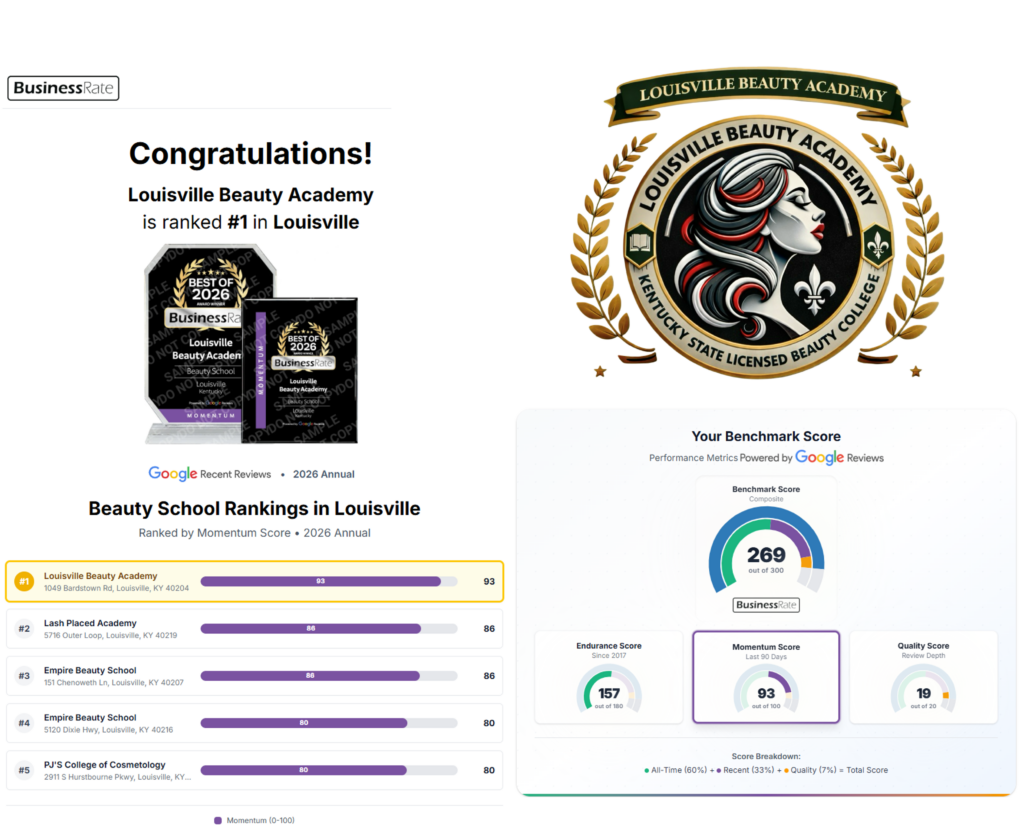
Louisville Beauty Academy is sharing that BusinessRate identified the school in a 2026 local award listing within the Beauty School category, based on the third-party review data and methodology described by that publisher at the time of evaluation.
This recognition was not requested, applied for, or sponsored by Louisville Beauty Academy. It reflects independent third-party analysis of publicly available customer feedback and review data, as compiled and certified by BusinessRate.
At Louisville Beauty Academy, we view recognitions such as this not as a claim of superiority, but as a moment of accountability to the community we serve.
A Reflection of Student and Community Voice
The BusinessRate award is based on measurable indicators including:
Verified Google customer reviews
Consistency of feedback over time
Overall customer satisfaction signals
We recognize that these outcomes are a direct reflection of the experiences of our students, graduates, and community partners.
Our Ongoing Commitment
While rankings and recognitions may change over time, Louisville Beauty Academy remains committed to the principles that define our institution:
Lower-Debt Educational Structure Programs publicly presented as structured to reduce financial burden and reliance on federal student-loan systems
Compliance-Focused Operations Ongoing effort to operate in line with current Kentucky laws, regulations, and school obligations
Career-Focused Training Programs designed for immediate workforce entry and real-world application
Student-Centered Approach Daily discipline, consistency, and individualized support for every learner
Recognition Is Temporary — Standards Are Permanent
Louisville Beauty Academy acknowledges that third-party rankings are dynamic and subject to change. As such, we do not rely on rankings as a measure of identity, but rather as one of many indicators of performance at a given point in time.
Our focus remains unchanged:
To earn trust daily through action, compliance, and measurable student outcomes.
View the Recognition
The original BusinessRate recognition materials are presented below exactly as received, without modification, in the interest of transparency and accuracy.
Important Disclosure
This recognition is issued by a third-party platform (BusinessRate) based on analysis of publicly available online review data at a specific point in time. Louisville Beauty Academy did not control or influence the methodology, criteria, or outcome. Rankings and positions may change over time and do not constitute accreditation, licensure endorsement, or a permanent status.
About Louisville Beauty Academy
Louisville Beauty Academy is a Kentucky state-licensed beauty college committed to delivering affordable, lower-debt, and compliance-driven vocational education. The institution focuses on preparing students for licensure, employment, and long-term professional success through structured, real-world training models.
This page presents an educational cost comparison and visual research model addressing tuition, time-to-licensure, opportunity cost, and living-cost considerations that are often omitted from simplified school marketing comparisons.
Louisville Beauty Academy publishes this material as part of a public-interest transparency effort. Figures and comparisons should be read carefully, with attention to date, assumptions, scope, and the limits stated in the analysis. This page is not a promise of earnings, debt elimination, or individualized financial outcome.
Official Research Report
The Financial Truth of Beauty Education
Why High-Tuition Schools Depend on the “FAFSA Trap” & How LBA’s Lower-Debt Model Saves You Over $45,000 in Real Economic Cost.
The Total Cost of Ownership
Most schools only show you Tuition. We reveal the Real Cost: Tuition + Kits + Living Expenses + Lost Wages during the program. See the massive difference between LBA’s “Fast-Track” and the National “Slow-Track”.
*Data based on 1500-hour Cosmetology Program. “National Premium” assumes luxury living costs and $20/hr opportunity cost.
1. The Sticker Price
LBA’s Performance-Incentive pricing slashes tuition by up to 76% compared to national averages. We strip away luxury overhead to focus on licensing.
2. The Hidden Cost of Time
Time is money. Every month you spend in a “Slow-Track” program is a month of lost wages. LBA incentivizes you to graduate fast and start earning.
⚠ The “FAFSA Paperwork” Trap
Big schools use federal loans (FAFSA) to hide the pain of a $25,000+ tuition. They sell you on “low monthly payments” that turn into 10 years of debt with interest.
The LBA Difference: We teach Financial Literacy from Day 1. We show you the total cost upfront. We offer 0% interest payment plans. We encourage you to pay as you go so you graduate owning your career, not owing the government.
3. The Daily Lifestyle Choice
Your daily habits determine your debt. The “LBA Hustle” minimizes expenses ($3 meals, shared rides) vs. the “Premium Lifestyle” ($15 meals, solo car).
Monthly Cashflow Impact
Expense Category
LBA Baseline
Premium Lifestyle
✔ Meal Prep
$60 / mo
–
✖ Restaurant Lunch
–
$300 / mo
✔ Shared Transit
$30 / mo
–
✖ Solo Car/Gas
–
$240 / mo
MONTHLY COST
$90.00
$540.00
= $450 SAVED PER MONTH
Total Estimated Value (Cosmetology)$45,649
Total Economic Savings (Tuition + Interest + Lifestyle + Wages) by choosing LBA vs. National Premium Average.
Graduate Lower-Debt. Start Today.
Don’t let paperwork and hidden fees steal your future earnings.
Louisville Beauty Academy • 1049 Bardstown Rd, Louisville, KY • State Licensed & Accredited
Economic Architecture of Beauty Education: A Comprehensive Fiscal Analysis of US Vocational Programs
The beauty education sector in the United States represents a significant vocational investment, characterized by a complex interplay of direct educational costs, mandatory state licensing requirements, and substantial indirect socio-economic burdens. Unlike traditional four-year academic degrees, which focus on theoretical knowledge and credit-hour completion, beauty education is fundamentally governed by “clock hours”—actual time spent in supervised training and clinical practice. This structural distinction creates a unique economic profile where the primary driver of cost is not merely tuition, but the temporal commitment required to achieve licensure. For prospective students, understanding the total economic impact requires a granular examination of four primary pathways: the 1500-hour Cosmetology program, the 750-hour Esthetics program, the 450-hour Nail Technician certificate, and 300-hour specialty breakout courses, including Eyelash Extension and Shampoo & Styling certifications.
The following analysis utilizes a bifurcated modeling approach to delineate the financial realities for different student demographics. The “Lowest-Cost Scenario” (Economy Baseline) represents a student utilizing public resources, minimum wage baselines for opportunity cost calculations, and aggressive cost-saving measures in living expenses. The “Highest-Cost Scenario” (Premium Realistic) models the financial burden for an individual transitioning from a higher-wage career, investing in premium private instruction, and utilizing full-service childcare and private transportation. This comprehensive fiscal assessment serves as a total cost model, incorporating risk, contingency, and professional barrier-to-entry fees that are frequently omitted from standard institutional disclosures.
The 1500-Hour Cosmetology Program: The Economic Pillar of Beauty Education
The 1500-hour cosmetology license is the most versatile credential in the industry, permitting the holder to perform services across hair, skin, and nail disciplines. However, its versatility comes at the highest cost, both in terms of direct tuition and the sustained loss of income over the typical 12 to 18-month duration of the program.
Direct Educational Outlays: Tuition, Fees, and Kits
Cosmetology tuition exhibits extreme variance based on institutional type and geographic location. Data from 2024 and 2025 indicates that the national average for tuition is approximately $14,500 to $15,663, though this figure masks the disparity between public community college programs and high-end private academies. In the economy baseline, a student might attend a public vocational center in a state like Florida, where resident tuition can be as low as $3,072. Conversely, a premium student attending a top-tier private institute in a metropolitan area like Las Vegas or New York may face tuition exceeding $22,000.
Beyond tuition, the “Student Kit” represents a critical fixed cost. These kits are not merely collections of tools but professional-grade inventories required for clinical practice. A standard kit includes high-tension shears, clippers, thermal irons, mannequin heads, and chemical application supplies. Kit costs range from a low of $664 in public programs to over $2,500 in premium private schools where branded tools and digital kits are mandated.
Opportunity Cost: The Hidden Weight of Clock Hours
The most significant economic driver in beauty education is the opportunity cost of foregone earnings. Because cosmetology requires 1500 clock hours of physical presence, students are largely restricted from full-time employment during training. For the economy baseline, lost income is calculated using a 2025 minimum wage average of $11.00 per hour, totaling $16,500. However, this does not account for the 15-20 hours of weekly study time required outside of class. When study time is integrated at a ratio of 0.3 hours per clock hour, the total labor hours lost reach 1950. At a premium wage of $30.00 per hour, the opportunity cost escalates to $58,500.
1500-Hour Cosmetology: Comparative Cost Modeling
Cost Category
Lowest (Low)
Average (Mean)
Highest (High)
Assumptions & Data Sources
Tuition & Direct Fees
$3,072
$15,200
$22,500
Public vs Private Institute
Student Kit & Supplies
$664
$1,700
$2,600
State-specific tool requirements
Books & Digital Materials
$335
$600
$1,000
Milady/Pivot Point bundles
Opportunity Cost (1500 hrs)
$16,500
$22,500
$45,000
$11/hr vs $30/hr wage baseline
Study Time Opp. Cost (450 hrs)
$4,950
$6,750
$13,500
15-20 hours/week external study
Transport & Parking (12 mo)
$600
$3,500
$12,300
Bus pass vs Car ownership
Daily Meals & Nutrition
$1,500
$3,500
$7,500
$5 sandwich vs $25 restaurant lunch
Childcare (Full-Time)
$13,800
$17,800
$43,000
Daycare vs Full-time Nanny
Uniforms & Prof. Shoes
$75
$250
$500
Budget scrubs vs Premium brand (Figs)
Licensing & Exam Prep
$150
$350
$850
Initial fees + Retake contingency
Post-Completion Startup
$500
$2,500
$10,000
Portfolio, Website, Prof. Equipment
Total Real Economic Cost
$42,146
$74,650
$158,750
Comprehensive cumulative impact
The disparity between the low and high scenarios is driven primarily by the “lifestyle” of the student and the wage they forego. A student relocation or a student with children faces a vastly different economic reality than a dependent student living at home. The high-cost scenario emphasizes that the true cost of becoming a master cosmetologist for a mid-career professional can exceed the cost of many graduate school programs.
The 750-Hour Esthetics Program: Targeted Skincare and Wellness Fiscal Modeling
Esthetics represents the fastest-growing sub-sector of the beauty industry, focusing on skincare, facials, hair removal, and makeup. The 750-hour duration is the standard in approximately half of US states, providing a mid-range temporal and financial commitment.
Curricular Costs and Kit Complexity
Tuition for esthetics programs typically ranges from $6,000 to $12,000 for the 750-hour curriculum. Kit costs are notably high relative to the program hours because students must acquire both professional-grade skincare product lines and specialized electrical tools for facial treatments. A low-end kit may cost $732, while a premium kit including waxing systems and advanced serums reaches $3,300.
Regional Variance and Regulatory Impact
In jurisdictions with higher cost-of-living indices, such as California or New York, registration and application fees add an additional $100 to $300. The economic impact of “clock hour” compliance is severe in esthetics because 70% of the curriculum is practical, hands-on training that cannot be completed asynchronously. This mandates physical presence in a facility, which in turn triggers daily transportation and childcare expenses for the 6 to 9-month duration of the program.
750-Hour Esthetics: Comparative Cost Modeling
Cost Category
Lowest (Low)
Average (Mean)
Highest (High)
Assumptions & Data Sources
Tuition & Direct Fees
$5,000
$10,125
$18,250
National tuition range
Student Kit & Supplies
$732
$2,000
$3,300
Product-intensive skincare kits
Books & Materials
$260
$400
$700
Milady/Aveda bundles
Opportunity Cost (750 hrs)
$8,250
$11,250
$22,500
Foregone labor at varying rates
Study Time Opp. Cost (225 hrs)
$2,475
$3,375
$6,750
Based on 15-20 hours/week study
Transport & Parking (8 mo)
$400
$2,400
$8,200
Bus pass vs Daily car commute
Daily Meals & Nutrition
$1,000
$2,500
$5,000
Budget grocery vs Restaurant meals
Childcare (8 mo)
$9,200
$11,800
$28,500
Daycare vs Nanny weekly rates
Uniforms & Tools
$75
$150
$400
Clinic-specific dress codes
Licensing & Exam Prep
$100
$250
$600
Exam fees + Retake contingency
Startup Professional Costs
$300
$1,500
$5,000
Portfolio, Website, Insurance
Total Real Economic Cost
$27,792
$46,750
$99,200
Cumulative impact for 750-hr program
The economic risk in esthetics is highly concentrated in the “Risk and Contingency” category. In states like Illinois, failing the licensure exam three times requires a mandatory 80 additional hours of instruction before a fourth attempt is allowed; a fourth failure necessitates repeating the entire 750-hour program from the beginning. This represents a potential $20,000+ financial risk for students with testing anxiety or learning disabilities.
The 450-Hour Nail Technician Program: Accelerated Entry Economics
The 450-hour manicuring license offers the most compressed temporal pathway to professional beauty licensure, making it a high-velocity vocational choice. However, the economic density of the program is high, as students must master chemically complex systems (acrylics, gels, dips) in a short window.
Tuition and Chemical Supply Costs
Tuition for nail technology programs is highly decentralized. Low-cost vocational academies in states like Florida may offer tuition as low as $1,100, while premium programs in markets like Indiana or Minnesota range from $4,900 to $6,000. Kits for nail technicians are distinctive; while they lack the expensive clippers of cosmetology, they require high volumes of consumables and expensive UV/LED lamps. Kit costs range from $260 for basic equipment to $2,000 for comprehensive systems including electric files and premium product bundles.
Opportunity Cost and Temporal Efficiency
Because the program is only 450 hours, the opportunity cost is minimized relative to other licenses. At a minimum wage of $11.00 per hour, the lost income is approximately $4,950. Even at a premium wage of $30.00, the $13,500 lost is substantially more manageable than the costs associated with cosmetology. This shorter duration also limits the burden of childcare and transportation to a 3-4 month window.
450-Hour Nail Technician: Comparative Cost Modeling
Cost Category
Lowest (Low)
Average (Mean)
Highest (High)
Assumptions & Data Sources
Tuition & Direct Fees
$1,100
$3,500
$6,750
Range from Florida to Minnesota
Student Kit & Supplies
$260
$1,000
$2,000
Consumable intensive kits
Books & Materials
$210
$450
$700
Milady Nail Tech packages
Opportunity Cost (450 hrs)
$4,950
$6,750
$13,500
Lost labor hours
Study Time Opp. Cost (135 hrs)
$1,485
$2,025
$4,050
External homework requirements
Transport & Parking (4 mo)
$200
$1,200
$4,100
Transit vs Personal vehicle
Daily Meals & Nutrition
$500
$1,250
$2,500
Sustainment costs during training
Childcare (4 mo)
$4,600
$5,900
$14,250
Daycare vs Nanny rates
Uniforms & Shoes
$50
$100
$250
Professional attire standards
Licensing & Exam Prep
$85
$200
$450
State fees + PSI testing fees
Startup Professional Costs
$300
$1,500
$4,000
Insurance, Portfolio, Initial tools
Total Real Economic Cost
$13,740
$23,875
$52,550
Cumulative impact for 450-hr program
The economic appeal of the nail technician path lies in its Return on Investment (ROI). With a national average salary for experienced technicians around $53,388, a student in the average scenario ($23,875 total investment)$ reaches a break-even point in less than six months of full employment post-licensure.
The 300-Hour Specialty Breakout Programs: Micro-Certification Fiscal Deep Dive
Specialized 300-hour courses are designed for niche expertise, such as Natural Hair Styling, Shampoo & Styling, or Eyelash Extension Specialist certification. These programs are often mandated for specialty licenses in specific states, most notably Texas and Kentucky.
Eyelash Extension Specialist: A High-Value Micro-Credential
In Texas, the 320-hour Eyelash Extension Specialist course is a specific licensing requirement. Tuition for this program ranges from $1,500 to $3,200. The kit is highly specialized, requiring precision tweezers, varying lash weights, and sensitive medical adhesives, with costs averaging $450 to $800. For those seeking an ultra-fast path, 2-day breakout courses (often used by existing cosmetologists or estheticians for supplemental certification) cost between $600 and $2,500.
Natural Hair Styling and Shampoo & Styling
States like New York and Kentucky offer 300-hour programs for Natural Hair Styling or Shampoo & Styling. These courses focus on cleansing, non-chemical styling, and braiding. Tuition ranges from $1,500 to $6,100 depending on whether the program is offered at a community college or a private specialized academy. These programs are unique because they often target students who wish to avoid chemical services entirely, reducing the kit cost slightly relative to cosmetology but maintaining high standards for sanitation and physiology theory.
Specialty breakout courses offer the highest revenue-to-investment ratio in the “High” scenario. An eyelash extension technician can charge $100 to $150 per procedure, with a potential annual income of $104,000 if they maintain a full book. For a student spending $38,250 on education and life support, the break-even point occurs within the first year of operation, even accounting for high overhead.
Opportunity Cost: The Quantitative Impact of Unpaid Training
In vocational beauty education, the opportunity cost is not merely a theoretical variable; it is a direct financial drain that exceeds the cost of tuition in nearly all high-cost models. The economic formula for opportunity cost (OC) in this domain is expressed as:
OC=(Ch×W)+(Sh×W)
Where:
Ch = Total required clock hours (e.g., 1500).
Sh = External study hours (estimated at 30% of clock hours).
W = Hourly wage the student would have earned if employed.
Labor Market Assumptions for 2025
For the economy baseline, the wage W is set at $11.00, representing the 2025 federal/state minimum wage average found in entry-level service roles like McDonald’s or local retail. For the premium realistic scenario, W is set at $30.00, representing a mid-career professional foregoing a management or specialized office role to enter the beauty industry.
Furthermore, beauty schools operate under strict “Satisfactory Academic Progress” (SAP) standards. Attendance below 90−95% can trigger financial aid suspension or the assessment of “over-contract” fees, which average $14.00 to $19.00 for every hour missed beyond the original graduation date. This makes attendance not just a pedagogical requirement, but a critical financial risk management strategy.
Life Support Logistics: Childcare, Transportation, and Nutrition
The logistical burden of attending beauty school is often the primary reason for program withdrawal. Because clock hours require a physical presence during standard business hours, students with dependents or significant commute times face compounding costs.
The Childcare Barrier
Childcare is consistently cited as the most expensive non-tuition item. As of 2025, the national average for infant center-based care is $13,128 annually (∼$252/week), but in high-demand markets like Washington D.C. or Massachusetts, this exceeds $26,000 annually (∼$500+/week).
Lowest Cost Scenario: Shared childcare or family support, estimated at $175/week for a part-time babysitter.
Highest Cost Scenario: Full-time private nanny services, which average $827 to $870 per week in 2025. For a 1500-hour cosmetology student (approx. 43-50 weeks), this represents a staggering $43,000 investment.
The Transportation Divergence
Transportation costs reflect the student’s geographic accessibility to the training facility.
Lowest Cost Scenario: Monthly public transit passes range from $50 to $155 in major US cities. Over a 12-month program, the transit-dependent student spends approximately $600 to $1,200.
Highest Cost Scenario: Solo vehicle ownership in 2025 is estimated by AAA to cost $11,577 annually, factoring in depreciation ($4,680), insurance ($1,694), and fuel ($1,950 for 15,000 miles). For schools located in high-density areas, parking fees can add another $100 to $300 per month.
Nutrition and Health
The physical demands of standing for 6 to 8 hours a day during practical training require high caloric intake and professional ergonomic footwear.
Lowest Cost Scenario: Home-prepared meals average $4.23 per meal (∼$1,500 annually for one meal daily during school).
Highest Cost Scenario: Eating away from home, where prices rose 4.1% in 2025, leads to an average restaurant lunch cost of $16.28 to $30.00. The premium student spends upwards of $7,500 on nutrition during their training period.
Professional Barrier to Entry: Licensing, Insurance, and Business Startup
The economic burden does not cease upon graduation. To convert hours into income, the student must pass state board examinations and establish a professional infrastructure.
Licensing Exam and Risk Contingency
State board exam fees for initial licensure range from $40 to $160. However, failure rates on written exams can exceed 50% in some years.
Lowest Cost: A first-time pass with minimal fees ($150 total license/prep cost$)$.
Highest Cost: Multiple retakes (average $35−$85 per attempt) and professional exam prep courses, bringing the entry cost to over $800.
Professional Liability Insurance
Insurance is a mandatory expense for any practicing professional.
Student Rate: During school, liability insurance can be obtained for as low as $15 to $49 per year through organizations like ASCP or Beauty Insurance Plus.
Professional Rate: Upon graduation, the cost jumps to $179−$259 per year for a standard $2M/$3M occurrence-form policy.
Digital Presence and Marketing
The modern beauty professional is a “solopreneur.” Launching a career requires:
Resume and Portfolio: Entry-level resume writing costs $80−$200. Professional portfolio photography can cost $200−$500 per session.
Website and Booking: Hosting a professional site on Squarespace or Wix costs $200−$600 annually. Subscription software for appointments (Vagaro, GlossGenius) costs $24−$48 per month.
Conclusion: The Total Economic Model and Return on Investment
The comprehensive research reveals that beauty education is a high-capital endeavor where non-educational expenses often dwarf the tuition. For the 1500-hour cosmetology license, the difference between an economy baseline ($42,146) and a premium realistic scenario ($158,750) represents the difference between entering the workforce lower-debt through family support and public schooling versus a high-exposure investment by a career-changing professional.
The data suggests that the “break-even” point for beauty professionals is typically reached within 2 to 3 years of building a consistent clientele. However, the initial financial hurdle requires deep preparation for life-support costs—childcare, transportation, and nutrition—which are the most likely points of economic failure for the student. Success in the beauty education model is defined by temporal efficiency; any delay in completion compounds the opportunity cost and childcare burden, significantly eroding the long-term ROI of the license. For students and policy-makers alike, the focus must remain on attendance and exam preparation as the primary tools for mitigating fiscal risk in this essential vocational sector.
Employed full time: Median usual weekly nominal earnings (second quartile): Wage and salary workers: 16 years and over (LES1252881500Q) | FRED, accessed February 10, 2026, https://fred.stlouisfed.org/series/LES1252881500Q
A Consumer-Protection, Compliance-Aligned Transparency Tool by Louisville Beauty Academy (LBA)
Purpose of This Tool
Choosing a beauty school is one of the most consequential financial and career decisions a student will ever make. Yet across the beauty education industry, students are routinely asked to enroll without seeing a clear, honest, side-by-side comparison of total cost, debt, and long-term financial impact.
This calculator exists to correct that imbalance.
It allows prospective students to quantify reality, not rely on promises by comparing:
The true long-term cost of attending a Title IV, debt-based cosmetology school, and
The direct-pay, lower-debt education model used by Louisville Beauty Academy (LBA)
This tool is intentionally published before enrollment, not after graduation, because informed consent is a cornerstone of ethical education.
Why This Matters Now (Regulatory & Consumer Context)
Federal accountability frameworks now require all career education programs—regardless of tax status—to demonstrate that program costs are justified by graduate earnings.
In plain terms:
Cost matters
Debt matters
Earnings matter
This calculator translates those regulatory principles into simple, transparent math, empowering students to evaluate financial risk before signing an enrollment agreement.
How the Calculator Works
The calculator compares two education paths using the same post-graduation earnings assumptions:
Path A — Title IV Debt-Based Beauty School
Federal student loans
Accrued interest
Mandatory repayment after graduation
Path B — Louisville Beauty Academy (LBA)
Direct-pay tuition
Institutional discounts applied up-front
No loans, written payment, no post-graduation repayment
The tool calculates and displays:
Total dollars paid
Monthly financial burden after graduation
Time to breakeven
Net income retained after five years
SECTION 1: INPUTS — TITLE IV COSMETOLOGY SCHOOL
1. Tuition & Required Fees
Students enter the full advertised cost, including items often excluded from marketing materials:
Tuition
Kits and supplies
Books and uniforms
Exam and graduation fees
Illustrative Example:
Tuition: $22,000
Required fees & supplies: $3,000
Total education cost: $25,000
2. Loan Structure
Students select typical federal loan terms:
Amount borrowed
Interest rate (commonly 5–7%)
Repayment term (10–20 years)
Illustrative Example:
Loan amount: $25,000
Interest rate: 6.5%
Repayment term: 10 years
3. Repayment Timeline (Auto-Calculated)
The calculator computes:
Monthly loan payment
Total interest paid
Total dollars repaid
Illustrative Result:
Monthly payment: ~$284
Total repaid over 10 years: ~$34,080
Interest paid: ~$9,080
SECTION 2: INPUTS — LBA DIRECT-PAY, lower-debt MODEL
To ensure neutrality, students control earnings assumptions.
Adjustable Inputs:
Hourly wage after licensure
Average weekly hours worked
Optional annual wage growth
Illustrative Example:
Hourly wage: $18/hour
Hours per week: 35
Annual income: ~$32,760
The calculator applies identical earnings assumptions to both education paths.
SECTION 4: OUTPUTS — SIDE-BY-SIDE RESULTS
1. Total Dollars Paid
Category
Title IV School
LBA (All Discounts)
Tuition & fees
$25,000
~$6,700
Interest paid
~$9,080
$0
Total cost
~$34,080
~$6,700
2. Monthly Financial Burden After Graduation
Category
Title IV
LBA
Monthly loan payment
~$284
$0
Repayment obligation
10 years
None
3. Time to Breakeven
Breakeven = time for post-graduation earnings to exceed total education cost.
Path
Time to Breakeven
Title IV debt-based school
~12–18 months
LBA lower-debt model
~2–4 months
4. Net Income Retained After 5 Years
Category
Title IV
LBA
Gross earnings (5 years)
~$163,800
~$163,800
Education cost
−$34,080
−$6,700
Net income retained
~$129,700
~$157,100
Net advantage of LBA’s lower-debt model: ~$27,000+ retained over five years
SECTION 5: WHAT THIS MEANS FOR STUDENTS
Key Takeaways
Debt does not increase skill—it reduces future flexibility
Interest payments fund the past, not your future
Lower education cost reduces pressure to accept unsafe, low-quality, or exploitative work
This calculator demonstrates that how you pay for education can matter as much as the education itself.
SECTION 6: ALIGNMENT WITH FEDERAL ACCOUNTABILITY STANDARDS
This tool mirrors the exact logic used in modern accountability frameworks:
Program cost vs earnings
Debt burden vs income
Time-based financial outcomes
The difference:
Louisville Beauty Academy publishes these metrics before enrollment, not after students are financially committed.
This is voluntary transparency.
SECTION 7: IMPORTANT DISCLAIMERS
This calculator is provided for educational purposes only
Earnings vary by individual effort, location, and market conditions
All assumptions are adjustable by the user
This is not financial, legal, or tax advice
SECTION 8: WHY LBA PROVIDES THIS TOOL
Louisville Beauty Academy believes:
Students deserve math, not marketing
Transparency is a form of consumer protection
Skill development should never require lifelong debt
With all institutional discounts applied, LBA’s total program cost is under $7,000, with zero loans, written payment, and zero post-graduation repayment.
This calculator exists to ensure every student can see that reality clearly—before deciding.
Important Disclosure & Use Notice
This calculator is provided for educational and consumer-information purposes only.
All figures are illustrative and based on user-adjustable assumptions. Actual tuition, earnings, work hours, and outcomes may vary by individual, location, market conditions, and personal effort.
Louisville Beauty Academy does not provide financial, legal, or tax advice. This tool is intended to support informed decision-making prior to enrollment, not to predict or guarantee outcomes.
Students are encouraged to compare programs carefully and verify all costs, terms, and obligations directly with any institution they consider.
state-licensed Beauty College Showcases Unmatched Success & Opportunities for Students, Investors, and Community Growth
Louisville, KY – Louisville Beauty Academy, a state-licensed beauty college, has officially released its latest book, “Louisville Beauty Academy: A Model of Innovation, Affordability, and Workforce Success.” Available now on Amazon (Click Here), this book unveils the proven strategies behind one of the most efficient, student-focused, and industry-transforming beauty schools in the United States.
For over eight years, Louisville Beauty Academy has redefined beauty education with a fast, affordable, and highly successful training model, graduating nearly 2,000 students with a 95%+ success rate. This book is a must-read for:
Aspiring beauty professionals seeking an efficient, affordable pathway to licensing and career success.
Investors and entrepreneurs exploring profitable, scalable opportunities in beauty education.
Policymakers and community leaders looking to improve workforce training and economic development.
What Makes Louisville Beauty Academy Different?
Unlike traditional beauty schools, LBA removes unnecessary barriers, eliminates student exploitation, and focuses on true workforce readiness.
✅ State-Licensed & state-licensed – 100% compliant with Kentucky Board of Cosmetology and national licensing standards. ✅ AI-Powered & Technology-Driven – Utilizing Milady’s CIMA digital learning platform, automation, and AI tools for the best student experience. ✅ Job-Ready Graduates – Nearly all LBA students secure employment immediately upon graduation or start their own businesses. ✅ A Scalable & Profitable Business Model – A proven opportunity for investors, franchisees, and future beauty school owners looking to make an impact. ✅ Legislative Impact – LBA played a pivotal role in Senate Bill 14, ensuring multilingual licensing exams and industry-wide improvements.
Why You Should Read This Book
This book is more than just an inside look at LBA—it’s a guide for the future of beauty education. Readers will discover:
📖 How Louisville Beauty Academy built a top-tier, student-first beauty college. 📖 The business opportunity behind opening and running a beauty school. 📖 How AI, automation, and evolving technology are transforming beauty education. 📖 Why LBA’s model is the highly affordable, efficient, and flexible in the industry.
Opportunities for Students, Investors, & Community Leaders
This is more than education—it’s a movement. Whether you are a student, investor, or future school owner, LBA presents a game-changing opportunity in the beauty industry.
📢 Students: Graduate faster, with less debt, and with real job opportunities waiting. 📢 Investors & Franchisees: Own a profitable, scalable, and legally compliant beauty school. 📢 Community Leaders & Policymakers: Drive economic impact, workforce growth, and industry innovation.
Report a website barrier or request help accessing information. Email Study@LouisvilleBeautyAcademy.net or text 502-625-5531. Include the page and what you were trying to do. Please do not send medical records or sensitive identifiers.
Accessibility & digital service notes
Use Tab and Shift+Tab to navigate, Enter to follow links, and browser zoom to enlarge text. The language selector supports Enter, Space, Tab, and Escape. Motion is reduced when your device requests it. Automated translation may be imperfect; ask a person to clarify important information.
Updated October 16, 2026. Work on accessibility is ongoing. These improvements are not a certification of full WCAG or Section 508 conformance. Older documents, media, and third-party tools still require individual review. About WCAG accessibility standards.