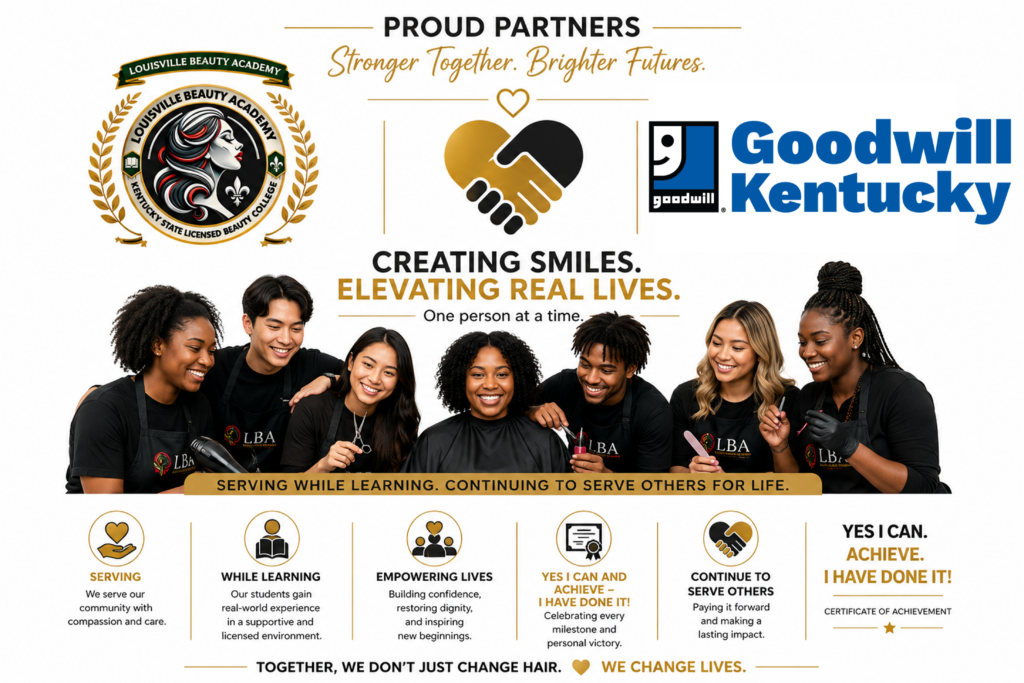
Creating Smiles. Elevating Real Lives. One Person at a Time.
Louisville Beauty Academy (LBA) is proud to announce a collaborative partnership with Goodwill Kentucky that reflects a shared commitment to workforce development, human dignity, community service, practical education, and long-term economic empowerment throughout Louisville and the Commonwealth of Kentucky.
More than a partnership between two organizations, this collaboration represents a larger vision for how education, workforce preparation, nonprofit service, and community-based support systems can work together to create measurable and lasting public value.
Through this partnership, Louisville Beauty Academy will provide limited courtesy beauty services within its Kentucky state-licensed educational clinic environment to individuals connected to Goodwill Kentucky programs and outreach efforts. Services may include natural hair services, shampoo and blowout styles, manicures, pedicures, and supervised wellness-focused beauty services provided by students under instructor supervision.
At first glance, this may appear to be a beauty-school partnership.
In reality, it reflects something much larger:
a workforce-centered, dignity-driven, community-supported educational model designed to help people move forward in life.
A Shared Mission Rooted in Human Dignity
Goodwill Kentucky has long served the Louisville community by helping individuals overcome barriers to employment, workforce participation, and economic advancement through education, support services, and opportunity creation.
Louisville Beauty Academy shares many of the same core principles.
As a Kentucky state-licensed beauty school, LBA was founded on the belief that education should be:
- affordable,
- practical,
- workforce-focused,
- community-connected,
- and directly tied to real opportunity and human advancement.
Both organizations understand something fundamental:
People succeed when communities invest in both skill and dignity.
This partnership recognizes that confidence, professionalism, self-image, communication skills, and human connection are not secondary to workforce development — they are central to it.
Sometimes a haircut is not just a haircut.
Sometimes it is:
- renewed confidence before a job interview,
- restored self-worth,
- human care during difficult times,
- or the beginning of believing in oneself again.
That matters.
Why This Partnership Matters Beyond Beauty
In many ways, this partnership reflects the future of practical workforce education and community development in America.
Louisville Beauty Academy believes education should not exist in isolation from the communities it serves.
Students should not only learn theory.
They should learn:
- service,
- professionalism,
- communication,
- accountability,
- compassion,
- sanitation,
- safety,
- and real-world human interaction.
That is why LBA operates through a supervised educational clinic model where students gain direct practical experience while serving real people within the community.
This model creates a powerful educational cycle:
students learn while serving,
and communities benefit while students grow.
LBA calls this philosophy:
“Serving While Learning. Continuing to Serve Others for Life.”
This partnership with Goodwill Kentucky embodies that principle in action.
Workforce Development Through Human-Centered Education
The beauty industry remains one of the largest human-service industries in the United States and serves as a major entry point into entrepreneurship, workforce participation, and economic mobility — particularly for women, immigrants, working adults, and underserved communities.
Yet beauty education is often underestimated as merely cosmetic or transactional.
Louisville Beauty Academy rejects that outdated view.
Beauty professionals:
- build small businesses,
- create jobs,
- strengthen local economies,
- provide human-centered services,
- support emotional wellness,
- and often become long-term community anchors.
At LBA, students are not simply trained to pass licensing examinations.
They are trained to become:
- professionals,
- entrepreneurs,
- leaders,
- mentors,
- employers,
- and lifelong contributors to society.
This partnership reflects the understanding that workforce development is most effective when education is connected directly to real human service and practical community engagement.
A Model of Community Collaboration
One of the most important aspects of this partnership is that it demonstrates what becomes possible when educational institutions, nonprofit organizations, instructors, students, and community leaders work together instead of separately.
Real public impact is rarely created by one organization alone.
It is created through collaboration.
This partnership represents the combined effort of:
- educators,
- nonprofit professionals,
- workforce advocates,
- students,
- instructors,
- community partners,
- and individuals committed to improving lives through practical action.
Together, Louisville Beauty Academy and Goodwill Kentucky are helping demonstrate how local institutions can create measurable social value while strengthening workforce pipelines, community trust, and economic opportunity.
Building Confidence, Opportunity, and Long-Term Impact
At Louisville Beauty Academy, students are taught more than technical skill.
They are taught mindset.
The school’s philosophy centers on growth, resilience, accountability, and contribution through service.
Students are encouraged daily to believe:
YES I CAN.
ACHIEVE.
I HAVE DONE IT.
That mindset becomes transformational not only inside the classroom, but throughout life.
By participating in real community-centered service experiences, students develop:
- confidence,
- communication skills,
- leadership,
- professionalism,
- empathy,
- and lifelong habits of contribution.
This partnership therefore benefits not only the individuals receiving services, but also the future professionals learning how to serve communities with dignity and care.
A Louisville Partnership with Broader Meaning
This collaboration reflects something important about Louisville itself.
Louisville has long been strengthened by organizations, educators, nonprofits, small businesses, workforce advocates, and local leaders willing to work together to solve real problems at the community level.
This partnership is one example of what can happen when institutions prioritize:
- practical impact,
- human dignity,
- affordability,
- workforce access,
- and service-centered leadership.
It demonstrates that education can remain deeply connected to the communities it serves while still producing measurable workforce and economic outcomes.
More Than Beauty. More Than Education.
This partnership is ultimately about people.
It is about:
- restoring confidence,
- creating opportunity,
- building professionalism,
- strengthening communities,
- and elevating lives one person at a time.
Together, Louisville Beauty Academy and Goodwill Kentucky are helping demonstrate that education, workforce development, nonprofit service, and human compassion do not need to operate separately.
When connected intentionally, they create stronger people, stronger communities, and stronger futures.
Because together, we do not just change hair.
We Change Lives.
Louisville Beauty Academy
Kentucky State-Licensed Beauty School
Louisville, Kentucky
Educate. Elevate. Empower.
https://LouisvilleBeautyAcademy.net
Disclaimer:
This partnership announcement is shared for informational and community-outreach purposes only. Services referenced are provided within Louisville Beauty Academy’s supervised educational clinic environment and remain subject to student participation, instructor supervision, operational availability, and applicable state regulations.