Boring Is Efficient: Disciplined Repetition, Sanitation Mastery, and Licensing-Focused Vocational Education — The Louisville Beauty Academy Model – RESEARCH & PODCAST SERIES 2026


The Efficacy of Disciplined Repetition: A Case Study in Licensing-Focused Vocational Education at Louisville Beauty Academy

The landscape of vocational education, specifically within the beauty and wellness sector, stands at a critical juncture between two competing pedagogical philosophies. On one side is the traditional, often “glamour-focused” model that prioritizes student engagement through entertainment, artistic flair, and simulated salon environments. On the other is an emerging, outcomes-based model characterized by the phrase “Boring Is Efficient.” This latter philosophy posits that the most effective way to transition a novice into a licensed professional is through a disciplined, repetitive, and compliance-driven curriculum that prioritizes the “safety credential” over aesthetic experimentation.1 In high-stakes industries like cosmetology, where practitioners manage reactive chemicals and utilize invasive sharp instruments, the “boring” elements of education—sanitation, regulatory literacy, and repetitive technical drills—are not merely administrative hurdles but are the essential components of professional survival and public health protection.2 This article provides a comprehensive analysis of this philosophy, using the operational framework of Louisville Beauty Academy (LBA) as a case study to explore how focus, efficiency, and compliance drive faster, safer, and more ethical workforce outcomes.

The Philosophical Foundation of Efficiency in Vocational Licensing

The “Boring Is Efficient” framework redefines the educational experience by stripping away extraneous cognitive loads that often distract from the primary objective of vocational training: compliant entry into the licensed workforce.1 In this context, “boring” is not a pejorative term suggesting a lack of value; rather, it serves as a descriptor for a focused, efficient, and licensing-oriented training environment.3 This approach recognizes that the beauty industry is a primary prevention sector, where the practitioner acts as a frontline steward of public health, often working without the institutional safety nets found in traditional clinical hierarchies.2

The pedagogical intensity required for licensure in Kentucky is significant. A cosmetology license requires 1,500 clock hours of training, a threshold that exceeds the training requirements for many Emergency Medical Technicians.2 This discrepancy is rooted in the “Hidden Safety Governance” of the industry.2 Unlike healthcare environments where practitioners operate within hospitals or supervised clinics, beauty professionals often work as independent contractors or in small businesses.2 Consequently, the state relies on the front-loading of safety and sanitation habits during these 1,500 hours to ensure that practitioners maintain high standards without constant surveillance.2 By framing “boring” as a virtue of focus and safety-centered discipline, institutions like Louisville Beauty Academy align their curriculum with the biological and chemical risks inherent in the field.2

The Hidden Safety Governance of Aesthetics

The historical necessity for rigorous regulation in beauty education is anchored in the transition from medieval guilds to the public health mandates of the Progressive Era.2 During this “Great Sanitary Awakening,” the government recognized that the intimate contact inherent in beauty services could facilitate the transmission of virulent infectious diseases.2 Licensing emerged as the legal and scientific bedrock for public safety.2 Modern beauty practitioners manage reactive chemicals, such as hair relaxers and colors, and utilize sharp, invasive instruments like razors and nippers.2 The “boring” repetition of disinfecting tools and maintaining workstations serves as a “fundamental contract” between the practitioner and the public’s biological integrity.2 This relationship is maintained through pedagogical intensity, ensuring that practitioners develop an intuitive understanding of infectious disease prevention and chemical toxicology.2

The Regulatory Framework of Kentucky Cosmetology

To understand the operational environment of Louisville Beauty Academy, one must analyze the specific mandates set by the Kentucky Board of Cosmetology (KBC). The KBC establishes the standards for training hours, curriculum content, and sanitation protocols across several license types.3

Table 1: Kentucky Regulatory Hour Requirements and Clinic Thresholds

License TypeTotal Clock HoursPractice/Clinic HoursTheory/Statute HoursService Threshold (Hours)
Cosmetology1,5001,085415250 (Chemical)
Esthetician750465285N/A
Nail Technician45027517560 (Chemical)
Shampoo Styling300175125N/A

3

These hour requirements are established by state law, specifically 201 KAR 12:082, and require schools to maintain “accurate daily attendance records” preserved for at least five years.3 The clock-hour system differs fundamentally from the credit-hour system used in traditional higher education.4 In a beauty academy, there is no “informal time forgiveness” or rounding of hours; if a student is not physically present and clocked in via biometric verification, they do not earn progress toward their license.4 This administrative burden necessitates sophisticated tracking systems to ensure the person earning the hours is the person physically present.4

Table 2: Kentucky Board of Cosmetology Licensing Fee Structure

Fee TypeAmountFrequencyRequirement
Initial Exam (Written + Practical)$75 – $85OnceCompletion of school
Initial License Fee$25OncePassing exams
Annual Renewal Fee$20 – $50Annual (by July 31)Continued practice
Late Renewal / Restoration Fee$50Per instanceAfter July 31
Exam Retake Fee$32 – $85Per attemptFollowing failure

6

The licensing process involves a theory exam and a practical demonstration.6 To pass, applicants must achieve at least 70% in both components, while instructors must achieve 80% on theory and 85% on the practical exam.7 These high stakes reinforce the necessity of “boring” repetition during training; the practical exam is essentially a test of how well the student has automated their technical and sanitation protocols.6

The Architecture of Infection Control: 201 KAR 12:100

Infection control is not merely a subject of study but the operational baseline of the beauty industry.3 Kentucky regulation 201 KAR 12:100 establishes comprehensive standards for all facilities licensed by the KBC, including salons and schools.7 The philosophy of “Boring Is Efficient” is most evident in these protocols, where the repetition of cleaning and disinfection is the primary defense against community outbreaks.2

Cleaning and Disinfection Protocols

All non-porous implements, such as combs, shears, and nippers, must undergo a multi-step process: cleaning with warm soapy water followed by complete immersion in an EPA-registered bactericidal, virucidal, and fungicidal disinfectant for the full manufacturer-required contact time.5 The regulation explicitly states that UV light boxes are not acceptable for disinfection; they may only be used to store already disinfected tools.7 Electrical tools like clippers must be cleaned of hair and then saturated with a high-level disinfectant spray or foam.7

Pedicure stations require even more rigorous attention. After each use, all removable parts must be scrubbed with detergent, and the bowl must be filled with a disinfectant solution that circulates (if a whirlpool) or stands for the full contact time.5 For nail technicians, drill bits must be soaked in acetone to remove product before being scrubbed and disinfected.7 This level of detail underscores why training is repetitive: a single missed step in these protocols can lead to the transmission of infections like MRSA or Hepatitis.2

Personal Hygiene and Product Handling

Every licensee is required to wash their hands with soap and water or use hand sanitizer immediately before serving each patron.7 Product handling is also strictly regulated to prevent cross-contamination; multi-use containers of wax or pomade must be accessed using single-use spatulas, and fingers are prohibited from touching the product directly.7 Powders and lotions must be dispensed via shakers or pumps to prevent hand contact with the dispensing mechanism.7

Blood Exposure and Disease Control

If an injury occurs during a service, the practitioner must stop immediately, wear gloves, clean the area, and apply an antibacterial ointment and bandage.7 Any workspace or implement contaminated by blood must be properly disinfected before service resumes.5 These “bloodborne pathogen” protocols are critical, as the “micro-trauma” caused by a standard manicure or a straight-razor shave provides a sufficient route for the transmission of HIV, Hepatitis B, and Hepatitis C.2

Table 3: Microorganisms Targeted by “Boring” Sanitation Protocols

CategoryMicroorganismRisk in SalonPrevention Method
ViralHepatitis B & C, HIVBlood exposure from nicksEPA-registered disinfectant
ViralHerpes SimplexWaxing, shared cosmeticsSingle-use applicators
BacterialS. aureus (MRSA)Infected skin, unwashed handsHand hygiene, surface cleaning
BacterialPseudomonasContaminated foot spasCirculating disinfectant
FungalTrichophyton (Tinea)Manicures/PedicuresTool immersion

2

The Cognitive Science of “Boring” Mastery

The effectiveness of licensing-focused education can be explained through Cognitive Load Theory (CLT). CLT posits that human working memory has a limited capacity, typically holding only seven “chunks” of information for about 20 minutes unless reinforced.15 To facilitate learning, instructional design must manage three types of cognitive load: intrinsic, extraneous, and germane.15

Managing Cognitive Resources

Intrinsic load is determined by the complexity of the material itself, such as the chemical interactions of hair color.15 Extraneous load is generated by poor instructional design or distractions, such as entertainment-focused teaching or “glamour” events.1 Germane load is the beneficial mental effort used to integrate new information into existing “schemas” or long-term memory structures.15

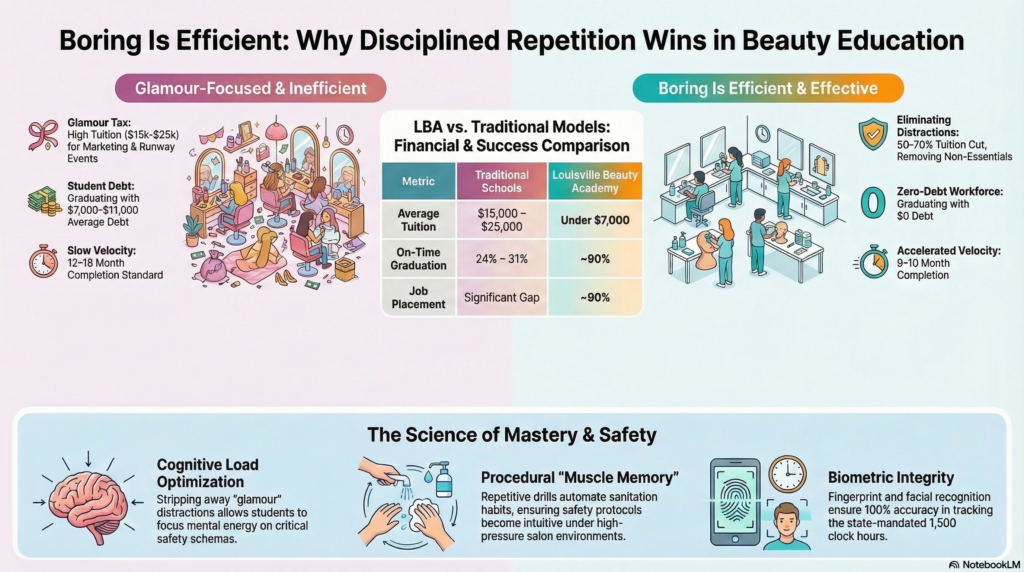
The “Boring Is Efficient” philosophy minimizes extraneous load by stripping away the “Glamour Tax”—the branding, recruitment shows, and non-essential activities that occupy student time in many traditional schools.1 By focusing strictly on repetitive, safety-centered tasks, the model allows students to dedicate more working memory to germane processing, ensuring that critical sanitation and technical skills are moved into long-term memory.15

Procedural Memory and Muscle Memory

The repetition perceived as “boring” is the mechanism for developing procedural memory—the part of long-term memory responsible for motor skills and automatic sequences of action.20 In beauty education, this is often called “muscle memory”.11 Deliberate practice, which involves mindful repetition with a focus on refinement, builds neural pathways that allow a stylist to hold shears at precise angles or maintain consistent tension without conscious effort.11

Once a habit is formed through repetition, it is directly triggered by the context (e.g., the salon environment) without the need for conscious goal pursuit.22 This is why boring repetition is a safety feature: it ensures that in a high-pressure environment, such as a busy salon or a licensing exam, the practitioner defaults to correct sanitation habits automatically.2

The Economics of Focused Education: The “Great Decoupling”

The economics of beauty education are being reshaped by the “Great Decoupling”—the shift away from federal aid dependency toward outcomes-based, direct-to-consumer models.1 Traditional beauty schools often participate in the Title IV federal aid system, which introduces two major financial burdens for students: the “Compliance Tax” and the “Glamour Tax”.1

The Compliance Tax and the Glamour Tax

The Compliance Tax accounts for 25-35% of student tuition and covers the administrative overhead of managing federal aid, including expensive compliance audits and specialized staff.1 The Glamour Tax accounts for another 45% of tuition, covering high-gloss marketing, recruitment campaigns, and performative events like runway shows.1 These costs inflate tuition to $15,000–$25,000, leaving students with an average debt of $7,000–$11,000 upon graduation.1

Table 4: Economic Impact of Educational Paradigms

MetricTraditional Title IV SchoolsLouisville Beauty Academy (LBA)
Average Tuition$15,000 – $25,000Under $7,000
Student Debt$7,000 – $11,000$0 (Debt-free model)
On-Time Graduation24% – 31%~90%
Job PlacementTriple-digit % gap from LBA~90%
Program Length12 – 18 months9 – 10 months

1

By opting out of Title IV funding, LBA eliminates these taxes, offering a tuition model that is 50-70% lower than the industry norm.1 This direct-savings paradigm allows students to enter the labor market faster and debt-free.1 The “fiscal velocity” created by an accelerated curriculum—allowing students to begin earning taxable income 6-9 months sooner—provides a net positive impact on the local economy.1

Table 5: Fiscal Velocity Calculation and Impact

The fiscal impact of accelerated graduation can be expressed through a velocity model:

where is the net fiscal impact, is the avoided public aid package, is the interest on avoided debt, and is the fiscal velocity created by faster workforce entry.4 At LBA, this efficiency contributes an estimated $20–$50 million annually to the local economy through business ownership and employment.1

Case Study: The LBA Operational Model of “Over-Compliance”

Louisville Beauty Academy utilizes an “Over-Compliance” model that treats state regulation as a professional skill rather than a burden.1 This model is structured into five distinct phases, using technology to verify mastery at every step.25

The Five Phases of Mastery

Phase 1: Mindset & Onboarding (0–100 Hours)

The focus is on dismantling psychological barriers and establishing the “YES I CAN” mindset. Students are introduced to the biometric attendance system and must achieve 100% in disinfection and blood exposure protocols to earn their “Safety Pro” badge.25

Phase 2: Technical Immersion & Fail-Fast Testing (100–300 Hours)

Students engage with the CIMA digital curriculum, identifying knowledge gaps through frequent, high-stakes exams. Achieving a 90% or higher average earns the “Theory Scholar” badge.25 This phase emphasizes “Regulatory Literacy”—the ability to navigate KRS 317A and 201 KAR 12.1

Phase 3: The Clinical Floor & Public Trust (300–1000 Hours)

Under instructor supervision, students provide services to the public. This phase is dedicated to the “boring” refinement of practical skills and the maintenance of professional conduct standards. Students earn the “Client Protection Mastery” badge after completing state-mandated practical checklists.25

Phase 4: Proof-of-Work & Business Identity (1000–1400 Hours)

Students begin mapping their future careers and documenting their unique professional style. They curate technical artifacts for their digital portfolios, providing “Proof-of-Work” that transcends a traditional diploma.25

Phase 5: The “I HAVE DONE IT” Capstone (1400–1500 Hours)

This phase is dedicated to intensive state board preparation. Upon final practical check-offs and graduation, students earn the “I HAVE DONE IT” Capstone badge, representing the transition from belief to documented mastery.25

Table 6: The LBA Digital Credential System (Open Badges 3.0)

Badge NameMilestone PhaseAchievement Requirement
Safety ProPhase 1 (0-100 hrs)100% mastery of disinfection protocols
Theory ScholarPhase 2 (100-300 hrs)90% average on chapter exams
Compliance StewardPhase 2 (100-300 hrs)Mastery of regulatory literacy (KRS 317A)
Client ProtectionPhase 3 (300-1000 hrs)Successful completion of clinic checklists
I HAVE DONE ITPhase 5 (1400-1500 hrs)Final capstone and graduation

25

Technological Verification: Biometric Auditing and Accountability

A defining characteristic of the LBA model is the “Compliance by Design” approach to record-keeping.4 Traditional clock-hour tracking is often prone to “informal time forgiveness,” but the state board requires an exact accounting of every minute spent in training.4 LBA’s use of biometric attendance mandates (using fingerprint or facial recognition) ensures that the person earning the hours is the person physically present.4

This biometric integrity protects the student’s professional narrative. In an industry where graduation can be delayed by “dead time” or holiday breaks in traditional schools, LBA students earn only the required clock hours, ensuring every hour counts toward licensure.26 This transparency is furthered by the “Public Record Library” model, where the academy publishes the exact text of laws and research—such as 201 KAR 12:190 regarding complaints and discipline—to eliminate information asymmetry between the school and the student.1

The Modern Workforce Alternative: Registered Apprenticeships

As the beauty industry evolves, new models for workforce entry are emerging that align with the “Boring Is Efficient” philosophy of on-the-job, repetitive training.1 The Department of Labor (DOL)-backed beauty apprenticeships provide an alternative to traditional classroom-only education.1

Table 7: Comparison of Educational and Apprenticeship Models

FeatureSchool-Based (e.g., LBA)Registered Apprenticeship (e.g., Atarashii)
Learning EnvironmentSupervised clinic floor/classroomPaid, on-the-job training in a salon
Structure1,500 clock hoursCompetency-based or hour-based mentorship
FundingTuition-based (direct savings)Paid work while learning
CredentialState Board LicenseDOL Certificate + State Board License
Role of MentorSchool InstructorSalon Stylist/Employer

1

The Atarashii Apprentice Program is a federally recognized Registered Apprenticeship that operates across cosmetology, barbering, and nail technology.1 This model proves that beauty education can meet structured DOL standards, where mentorship-based learning produces compliant outcomes. For immigrants, ESL learners, and dislocated workers, these “debt-free” and “completion-driven” models provide employment certainty without lowering safety standards.1

Psychological Resilience and Student Outcomes

While repetitive training is often perceived as “boring,” research suggests that focused vocational environments provide significant psychological advantages for students.28

Self-Efficacy and Autonomy

Self-Determination Theory (SDT) points out that mental health and functional performance depend on the satisfaction of three basic needs: autonomy, competence, and belonging.29 In a licensing-focused environment, students experience greater competence through the mastery of core tasks.29 The “boring” repetition of sanitation and technical drills serves as a cognitive priming mechanism, allowing students to focus their attention on subject-specific thinking.29

Building Willpower and Confidence

Regular engagement in structured vocational activities, much like campus sports, enhances adolescents’ and young adults’ psychological qualities, including willpower and self-confidence.30 This “sports confidence” actively influences personality traits, enabling students to demonstrate greater tenacity when facing the challenges of a licensing exam or a professional career.30 By mastering the “boring” foundation of the industry, students build a buffer against negative emotions in the face of professional setbacks.30

Table 8: Psychological Impact of Standardized vs. Distraction-Heavy Training

Learning EnvironmentPrimary Cognitive LoadStudent Emotional ResponseLongitudinal Outcome
Standardized (Focused)Germane (Schema building)Higher self-efficacy; lower anxietyHigh completion; resilient habits
Distraction-HeavyExtraneous (Theatre/Branding)Diminished engagement; anxietyHigh attrition; poor habit formation

15

Conclusion: Synthesis of Professional Integrity and Public Safety

The research presented here indicates that in the high-stakes industry of cosmetology, the philosophy of “Boring Is Efficient” is not a sign of educational stagnation but a commitment to professional excellence and public safety.1 By defining “boring” as a state of focus, efficiency, and compliance-driven discipline, institutions like Louisville Beauty Academy have created a model that outperforms traditional “glamour-focused” schools on every key metric.1

The synthesis of Cognitive Load Theory, procedural memory research, and economic analysis confirms that a licensing-oriented curriculum reduces the burden of debt while increasing the speed and safety of workforce entry.1 The “Hidden Safety Governance” of the beauty industry demands that practitioners front-load a lifetime of sanitation habits through boring, repetitive practice.2 This ensures that “beauty at any cost” never results in literal damage to public health through chemical burns, hair loss, or the transmission of infectious diseases.2

For the student, the applicant, and the public, understanding that effective beauty training prioritizes compliance over entertainment is essential. The “boring” road to licensure—characterized by biometric clock-ins, rigorous tool disinfection, and repetitive technical drills—is ultimately the most ethical, efficient, and successful pathway to a career in the licensed beauty workforce.1

Works cited

  1. Outcomes-Based Beauty Education : A Workforce and Policy …, accessed March 13, 2026, https://naba4u.org/2025/12/outcomes-based-beauty-education-a-workforce-and-policy-analysis-of-debt-free-completion-driven-vocational-models-research-december-2025/
  2. salon infection prevention Archives – Louisville Beauty Academy …, accessed March 13, 2026, https://louisvillebeautyacademy.net/tag/salon-infection-prevention/
  3. Kentucky Board of Cosmetology education requirements Archives …, accessed March 13, 2026, https://louisvillebeautyacademy.net/tag/kentucky-board-of-cosmetology-education-requirements/
  4. beauty school compliance model Archives – Louisville Beauty Academy, accessed March 13, 2026, https://louisvillebeautyacademy.net/tag/beauty-school-compliance-model/
  5. Sanitation and Infection Control: How professionals should safe-guard their salon and spa, accessed March 13, 2026, https://www.dermascope.com/sanitation-and-infection-control-how-professionals-should-safe-guard-their-salon-and-spa/
  6. Kentucky Cosmetology Laws & License Requirements [2026] – Consentz, accessed March 13, 2026, https://www.consentz.com/kentucky-cosmetology-laws-license-requirements/
  7. License Requirements – Kentucky Board of Cosmetology, accessed March 13, 2026, https://kbc.ky.gov/Licensure/Pages/License-Requirements.aspx
  8. Tag: biometric attendance clock hour tracking – Louisville Beauty Academy, accessed March 13, 2026, https://louisvillebeautyacademy.net/tag/biometric-attendance-clock-hour-tracking/
  9. Kentucky Cosmetology License Requirements (2026) | How to Get Licensed – LicenseMap, accessed March 13, 2026, https://getlicensemap.com/states/cosmetologist/kentucky
  10. Tag: vocational education policy analysis – Louisville Beauty Academy, accessed March 13, 2026, https://louisvillebeautyacademy.net/tag/vocational-education-policy-analysis/
  11. The Muscle Memory of Cutting: How Stylists Develop Precision Over Time – Above Shears, accessed March 13, 2026, https://aboveshears.com/the-muscle-memory-of-cutting-how-stylists-develop-precision-over-time/
  12. Health Hazards in Nail Salons – Biological Hazards | Occupational Safety and Health Administration, accessed March 13, 2026, https://www.osha.gov/nail-salons/biological-hazards
  13. Bloodborne Pathogens in the Beauty Salon – MyCPR NOW, accessed March 13, 2026, https://cprcertificationnow.com/blogs/mycpr-now-blog/bloodborne-pathogens-in-the-beauty-salon
  14. COS-Bloodborne Pathogen Training-FAQs.pdf – Oregon.gov, accessed March 13, 2026, https://www.oregon.gov/oha/PH/HLO/Documents/COS-Bloodborne%20Pathogen%20Training-FAQs.pdf
  15. Challenging Cognitive Load Theory: The Role of Educational Neuroscience and Artificial Intelligence in Redefining Learning Efficacy – PMC, accessed March 13, 2026, https://pmc.ncbi.nlm.nih.gov/articles/PMC11852728/
  16. Cognitive Load Theory, accessed March 13, 2026, https://www.mcw.edu/-/media/MCW/Education/Academic-Affairs/OEI/Faculty-Quick-Guides/Cognitive-Load-Theory.pdf
  17. Cognitive Load in English as a Foreign Language Speaking Competency of Vocational High School Students – ERIC, accessed March 13, 2026, https://files.eric.ed.gov/fulltext/EJ1467654.pdf
  18. Beyond Cognitive Load Theory: Why Learning Needs More than Memory Management, accessed March 13, 2026, https://pmc.ncbi.nlm.nih.gov/articles/PMC12839043/
  19. Cognitive Load Theory and its application in the classroom – My College, accessed March 13, 2026, https://my.chartered.college/impact_article/cognitive-load-theory-and-its-application-in-the-classroom/
  20. Web-Based Application to Support Caregivers in the Use of Learning Optimization Methods: Participatory Action Research Study – JMIR Aging, accessed March 13, 2026, https://aging.jmir.org/2026/1/e76543
  21. Physiological stress differentially impacts cognitive performance during—and memory following—simulated police encounters with persons experiencing a mental health crisis – Frontiers, accessed March 13, 2026, https://www.frontiersin.org/journals/psychology/articles/10.3389/fpsyg.2025.1549752/full
  22. Wendy Wood – Psychology of Habit – USC Dornsife, accessed March 13, 2026, https://dornsife.usc.edu/wendy-wood/wp-content/uploads/sites/183/2023/10/wood.runger.2016.pdf
  23. Deliberate Practice and Motor Learning Principles to Underpin the Design of Training Interventions for Improving Lifting Movement in the Occupational Sector: A Perspective and a Pilot Study on the Role of Augmented Feedback – Frontiers, accessed March 13, 2026, https://www.frontiersin.org/journals/sports-and-active-living/articles/10.3389/fspor.2021.746142/full
  24. Habits and Goals in Human Behavior: Separate but Interacting Systems – USC Dornsife, accessed March 13, 2026, https://dornsife.usc.edu/wendy-wood/wp-content/uploads/sites/183/2023/10/Wood.Mazar_.Neal_.2021.pdf
  25. over-compliance education model Archives – Louisville Beauty …, accessed March 13, 2026, https://louisvillebeautyacademy.net/tag/over-compliance-education-model-2/
  26. Tag: Gold standard compliance beauty school – Louisville Beauty Academy, accessed March 13, 2026, https://louisvillebeautyacademy.net/tag/gold-standard-compliance-beauty-school/
  27. State Board Info – Dermascope, accessed March 13, 2026, https://www.dermascope.com/state-board-requirements/
  28. In Their Own Words: How Standardization Shapes Student Learning Experiences – Scholar Commons, accessed March 13, 2026, https://scholarcommons.sc.edu/cgi/viewcontent.cgi?article=9436&context=etd
  29. The relationship between digital literacy and mental health resilience among college students—based on the mediating role of digital learning – PMC, accessed March 13, 2026, https://pmc.ncbi.nlm.nih.gov/articles/PMC12891216/
  30. Promoting effects of campus football activities on the enhancement of adolescents’ psychological qualities and the underlying mechanisms – PMC, accessed March 13, 2026, https://pmc.ncbi.nlm.nih.gov/articles/PMC12303940/
  31. (PDF) Innovative Lesson Starters as Catalysts for Active Learning, Conceptual Development, and Critical Thinking in Secondary Science Education: A Comprehensive Review. – ResearchGate, accessed March 13, 2026, https://www.researchgate.net/publication/399658842_Innovative_Lesson_Starters_as_Catalysts_for_Active_Learning_Conceptual_Development_and_Critical_Thinking_in_Secondary_Science_Education_A_Comprehensive_Review
  32. (PDF) Middle school students’ career parental support and adolescent–parent career congruence: the mediating role of self-efficacy – ResearchGate, accessed March 13, 2026, https://www.researchgate.net/publication/382300998_Middle_school_students’_career_parental_support_and_adolescent-parent_career_congruence_the_mediating_role_of_self-efficacy

The Reality of Cosmetology Education in Kentucky What Adult Students Must Understand Before Enrolling

Di Tran University Research & Workforce Policy Series – 2026


Frequently Asked Questions About Cosmetology and Beauty Training in Kentucky

How many hours are required for a cosmetology license in Kentucky?
Kentucky requires 1,500 training hours for a cosmetology license under KRS Chapter 317A and the administrative regulations in 201 KAR Chapter 12. The curriculum includes theory instruction, clinical practice, and Kentucky law before a student can qualify for the state licensing examination administered through PSI.

How many hours are required for an esthetician license in Kentucky?
Kentucky requires 750 training hours for an Esthetics license. Esthetics training focuses on skin care, facial treatments, sanitation, infection control, product chemistry, and safe skin service procedures. Graduates must pass the Kentucky state board licensing examination to practice professionally.

How many hours are required for a nail technician license in Kentucky?
Kentucky requires 450 training hours for a Nail Technology license. Training includes sanitation, infection control, nail structure, chemistry of nail products, and practical service procedures before qualifying for the state licensing exam.

Is shampoo styling a license in Kentucky?
Yes. Shampoo Styling is a licensed profession in Kentucky requiring 300 hours of training in a licensed cosmetology school. The program focuses on shampooing, scalp treatments, blow-drying, and basic styling techniques, with strong emphasis on sanitation and hygiene.

Is eyelash extension a license in Kentucky?
No. Eyelash extensions are regulated through a specialty permit rather than a full license. Practitioners must complete approved training and obtain a specialty permit before legally performing eyelash extension services.

What is the difference between a license and a specialty permit?
A professional license (cosmetology, esthetics, nail technology, or shampoo styling) requires a defined number of training hours and passing a state licensing examination.
A specialty permit allows practice of a specific limited service and typically requires shorter training focused only on that service.

Can cosmetology or esthetics students work on real clients during school?
Yes. Kentucky allows student clinics in licensed schools. However, cosmetology students must complete at least 250 hours of foundational training before performing chemical services on members of the public in order to protect public safety.

How much does beauty school cost in Kentucky?
Tuition varies widely depending on the institution. Programs may range from lower-cost vocational training models to higher-priced schools that rely heavily on federal student aid. Prospective students should compare tuition, exam preparation support, and graduation outcomes before enrolling.


Correct Kentucky Program Hour Requirements Summary

ProgramHours RequiredCredential Type
Cosmetology1,500 hoursLicense
Esthetics750 hoursLicense
Nail Technology450 hoursLicense
Shampoo Styling300 hoursLicense
Eyelash ExtensionSpecialty trainingSpecialty Permit

Research & Educational Disclaimer

This article is provided for public education and workforce research purposes only and reflects analysis prepared by researchers affiliated with Di Tran University as part of its ongoing study of vocational education systems, regulatory structures, and economic outcomes for adult learners. The content represents independent academic commentary and general informational analysis regarding industry trends, public regulations, and financial literacy considerations within cosmetology education. Publication on the Louisville Beauty Academy website is intended solely to support consumer awareness and transparency in vocational decision-making. Nothing in this article should be interpreted as legal advice, regulatory interpretation, endorsement of any institution, or criticism of any specific organization, program, regulator, or business entity. Regulatory references are provided for educational context only, and readers are encouraged to consult the official statutes, administrative regulations, and the appropriate licensing authorities for authoritative guidance. Louisville Beauty Academy does not claim authorship of the analysis and assumes no responsibility for third-party interpretations or decisions made based on this informational content.


The Architecture of Regulatory Capture in Cosmetology: Institutional Influence, Competitive Obstruction, and the Crisis of Debt-Dependent Education

The landscape of occupational licensing in the United States, particularly within the cosmetology and beauty services sector, serves as a primary example of regulatory capture. This phenomenon, where state agencies created to act in the public interest instead prioritize the commercial and political objectives of the industries they regulate, is not merely a theoretical concern but a documented reality with significant economic consequences. In the beauty education sector, this capture is facilitated through a complex network of statutory board compositions, aggressive lobbying by trade associations, and an accreditation system that serves as a gatekeeper for billions of dollars in federal subsidies. The resulting policy environment often suppresses competition, inflates tuition, and traps low-income and immigrant learners in a cycle of debt that bears little relation to professional mastery or public safety.

The Theoretical Framework of Occupational Capture and Market Distortion

Regulatory capture within cosmetology boards is characterized by the dominance of active market participants over the regulatory process. When a licensing board is composed primarily of industry insiders—specifically owners of large cosmetology school chains—the board’s incentives shift from protecting the public to protecting incumbent business models. This is particularly evident in the setting of mandatory instructional hours, curriculum standards, and the adjudication of competitive entries. Research from the Center for the Study of Economic Liberty (CSEL) at Arizona State University suggests that this mechanism of capture is the primary driver behind the suppression of employment and entrepreneurial opportunities in the sector.1

The economic impact of this capture is quantifiable. Boards dominated by industry incumbents tend to set higher barriers to entry, which increases the time and cost required to obtain a license. According to CSEL’s 2020 report, the “Cosmetology Board Capture Index” reveals a direct correlation between the lack of public representation on boards and the length of state-mandated training.2 In the eight states with the highest levels of board capture—defined as having zero public representatives—it takes an average of 50 more calendar days than the national average to fulfill the state requirements for licensure.2

National Metrics of Cosmetology Board CaptureData Observation
States with Zero Public Board RepresentativesNew York, North Dakota 2
States with High Capture (Minimal Public Input)LA, MA, MS, OK, VT, WY 2
National Average Training Time Increase (High Capture States)+50 Days 2
States with Majority Public BoardsArizona (post-2020), California 3
States with Eliminated Boards (Least Captured)Maine, Arkansas (Eliminated 2009) 3

These “high capture” states often resist reforms such as universal licensure reciprocity, which would allow practitioners to move across state lines without undergoing duplicative and costly training.4 By maintaining fragmented and high-barrier licensing regimes, captured boards ensure that students remain enrolled in schools longer, thereby maximizing the tuition revenue generated for the institutions represented on those boards.5

Schools that operate with lower tuition models allow graduates to enter the workforce without heavy debt obligations. When graduates are not burdened by loan repayment, they can reinvest earnings into advanced education, business ownership, and local economic activity. In contrast, high-tuition programs often delay entrepreneurship because graduates must prioritize debt repayment before building independent practices.

Structural Capture in State Statutes: The Case of Kentucky

The Commonwealth of Kentucky provides a granular view of how regulatory capture is codified into state law. Kentucky Revised Statute (KRS) 317A.030 establishes the composition of the Kentucky Board of Cosmetology (KBC) in a manner that virtually guarantees industry dominance. The statute mandates a seven-member board, but only one of those seats is reserved for a “citizen at large” who is free from financial ties to the industry.6

The board’s composition under KRS 317A.030 is as follows:

  • Two members must be cosmetology salon owners.
  • One member must be a cosmetology teacher in public education.
  • One member must be an owner of, or have a financial interest in, a licensed cosmetology school.
  • One member must be a licensed nail technician.7
  • One member must be a licensed esthetician.7
  • One member is a citizen at large.6

A critical second-order insight into this statutory structure is the requirement that the school owner member “shall be a member of a nationally recognized association of cosmetologists”.6 By embedding membership in a trade association—such as the American Association of Cosmetology Schools (AACS)—directly into the qualifications for a government regulator, the state effectively delegates regulatory influence to private interest groups. This formal mechanism ensures that the national policy agenda of large, for-profit school chains is represented at the highest levels of state oversight.

The informal mechanisms of capture in Kentucky have historically been even more pronounced. Prior to 2024, the KBC faced significant public pressure and allegations of mismanagement, leading to the removal of Executive Director Julie Campbell in September 2024 after a seven-year tenure.9 The board’s transition to new leadership under Joni Upchurch, a former cosmetology professor, and the appointment of Michael Carter as the first-ever nail technician board member, represent attempts at institutional reform.9 However, even under new leadership, the board continues to exhibit the hallmarks of capture, such as the recusal of board members from decisions involving competing schools. For instance, in a January 2026 meeting, Vice Chair Lianna Nguyen recused herself from board decisions regarding the Louisville Beauty Academy (LBA), a low-cost competitor to traditional Title IV schools.11

Trade Associations and the Lobbying Power of the Beauty School Industrial Complex

The American Association of Cosmetology Schools (AACS) acts as the central hub for industry lobbying and advocacy. As a regulated industry, for-profit beauty schools maintain a “proactive” stance toward federal and state government relations to protect their revenue streams from “attacks” such as the reduction of program hours or the deregulation of licensure.12

The Federal Lobbying Machine

The AACS maintains a robust advocacy infrastructure, including an annual Congressional Summit and “Hill Day,” where school owners and administrators gather in Washington, D.C., to lobby Members of Congress.12 Their primary objectives include:

  1. Preserving High Program Hours: Lobbying against state-level efforts to reduce mandatory hours, as shorter programs decrease the amount of federal student aid a school can collect.5
  2. Opposing Accountability Standards: Fighting federal “Gainful Employment” (GE) and “Financial Value Transparency” rules that tie federal aid eligibility to graduate earnings.13
  3. Protecting Title IV Dependency: Ensuring that the flow of Pell Grants and federal student loans remains uninterrupted, despite evidence that many programs provide poor financial returns for students.5

A significant example of this influence is the AACS’s legal challenge to the Department of Education’s 2023 Gainful Employment Rule. The AACS and its member schools filed suit in federal district court in Texas, seeking to strike down the rule as “arbitrary, capricious, and unconstitutional”.15 Although Chief U.S. District Judge Reed O’Connor ruled in favor of the Department of Education in October 2025, the AACS has continued to fight through the appeals process and through targeted political contributions.16 The schools’ own legal arguments in this case were revealing: they admitted that if forced to meet basic debt-to-earnings benchmarks, a substantial number of programs would “fail and shut down”.14

The 90/10 Rule and Revenue Capture

The economic model of for-profit beauty schools is heavily reliant on federal subsidies. Under the “90/10 rule,” proprietary institutions must derive at least 10% of their revenue from non-federal sources. For many beauty school chains, Title IV federal aid (Pell Grants and loans) accounts for more than 85% of total revenue.19 Recent changes to the 90/10 rule in 2023 expanded the definition of “federal funds” to include any federal assistance received by students, such as Veterans Affairs (VA) benefits, which had previously been used by schools to satisfy the 10% requirement.20 This regulatory shift has put additional pressure on the sector, leading to increased lobbying for “carve-outs” and exemptions.20

Case Study in Competition Blockade: The Iowa Monopoly

The state of Iowa offers a definitive case study in how captured boards and trade associations use the legal system to suppress lower-priced competition. In 2005, the Iowa Cosmetology School Association and La’ James International College sued Iowa Central Community College to stop it from launching a cosmetology program.22 The private schools successfully argued that state code prohibited public entities from competing with private businesses in this sector. This lawsuit effectively preserved a monopoly for high-tuition, for-profit providers and maintained Iowa’s status as having one of the highest licensure hour requirements in the nation—2,100 hours.22

The relationship between the dominant school chain, La’ James International College, and the state regulatory body was particularly incestuous. A high-ranking official from La’ James held a seat on the Iowa Board of Barbering and Cosmetology Arts and Sciences even as the school faced multiple investigations for consumer fraud.24 This position of power allowed the school to influence the very inspectors who were tasked with investigating student complaints about “instructorless” classrooms and the exploitation of students as unpaid labor.25

Iowa Competitive Obstruction MetricsImpact / Observation
Mandatory Cosmetology Hours2,100 (Highest in U.S.) 22
Community College BlockadeLawsuit in 2005 prevented public entry 23
Tuition for Private Chains$15,000 – $20,000 22
Student Debt Forgiveness Settlements$2.1M (2016) and $462k (2021) 22
Board RepresentationLa’ James official held active seat 24

The Title IV Debt Trap and the Economics of Exploitation

The current financing architecture of beauty education incentivizes a model that prioritizes enrollment and aid capture over student outcomes. Because schools are paid per enrolled student per credit hour, there is a systemic incentive to delay graduation and maintain artificially long programs.5

Debt-to-Earnings Disparities

Nationwide data indicates a severe mismatch between the cost of beauty education and the eventual earnings of graduates. Analysis by The Century Foundation and New America shows that 98% of cosmetology programs would fail proposed federal earnings tests.5 Graduates typically earn an average of only $16,600 to $20,000 annually, yet they often carry a debt load of $10,000 to $11,000.5 This high debt-to-income ratio is particularly damaging to the low-income, first-generation, and immigrant populations that these schools target.5

Comparative Earnings Data (2025-2026)Annual Income Range
Entry-Level Cosmetologist$26,000 – $31,000 30
Mid-Career Professional$35,000 – $45,000 30
Average Hourly Rate$18 – $22/hour 30
High School Graduate MedianUsed as federal benchmark for “Red Flag” 31

The industry often defends these low reported earnings by claiming that stylists receive significant unreported income through cash tips. However, the Department of Education, under multiple administrations, has found no empirical evidence of widespread unreported income that would bridge the gap between reported earnings and a livable wage.13

Systemic Use of Unpaid Student Labor

A core component of the for-profit beauty school business model is the “dual-revenue” structure: schools profit from both student tuition and from the salon services performed by students on paying customers.29 In many schools, students are required to work on the “clinic floor” for hundreds of hours, often performing non-educational tasks such as cleaning, restocking, and laundry under the guise of “training”.25

This practice has led to over 40 major class-action lawsuits and federal investigations. Schools such as Empire Beauty, Milan Institute, and La’ James have been accused of treating students more like “free labor” than learners.25 In Iowa, the Attorney General’s lawsuit against La’ James specifically alleged that the school “seemed to pay the company for the privilege of working,” as students were pressured to sell products and were only given credit for services performed on paying customers rather than mannequins.33

The Disruptive Alternative: Louisville Beauty Academy (LBA)

In the midst of this sector-wide crisis, the Louisville Beauty Academy (LBA) in Kentucky serves as a national model for reform. Unlike the dominant chains, LBA operates without any reliance on Title IV federal student aid, Pell Grants, or federal loans.28 By decoupling from the federal aid system, LBA eliminates the “Compliance Tax”—the administrative overhead required to manage federal aid, which typically consumes 25% to 35% of a school’s tuition.5

Economic and Fiscal Contribution

LBA’s non-Title IV model allows for significantly lower tuition rates, which makes the program accessible to working-class and immigrant students without the burden of debt. A 1,500-hour cosmetology program at LBA is priced between $3,800 and $6,250, compared to the $15,000 to $20,000 national average for Title IV schools.35

Fiscal Comparison: LBA vs. Title IV ModelLBA Model (Actual)Title IV Model (Hypothetical)
Public Funds Consumed$0$25,000,000 35
Direct Fee Revenue to State$884,250~$884,250 35
Tax Revenue Generated (10 yrs)$47,815,000~$47,815,000 35
Net Positive Economic Impact$48,699,250$23,699,250 35

The economic impact of LBA is further demonstrated through its “resilience-based” model. LBA leads the state of Kentucky in theory retake participation, reflecting a commitment to ensuring all students, regardless of language barriers or educational background, eventually achieve licensure.35 This model is supported by Kentucky Senate Bill 22 (SB 22), which reformed licensing to allow for unlimited exam retakes and removed punitive waiting periods.36

Speed-to-Market Advantage

LBA’s curriculum is “laser-focused” on the state board examination and minimum competency requirements. This efficiency allows students to complete their training and enter the workforce significantly faster than at Title IV schools, which often pad their curriculum to maximize aid disbursements.5 The speed-to-market differential is estimated at approximately six months:

.28

By entering the workforce earlier and without debt, LBA graduates achieve a vastly superior return on investment (ROI). In a comparative model, LBA graduates contribute more to the state treasury over a five-year horizon through income taxes and license renewal fees because they are not diverted by debt servicing or program delays.28

The Federal Counter-Strike: FAFSA Red-Flags and GE 2.0

As the crisis in for-profit beauty education has become undeniable, the federal government has introduced new mechanisms to protect students and taxpayers. These measures represent an attempt to bypass the captured state boards and communicate directly with prospective students.

The FAFSA “Red Flag” Warning System

On December 7, 2025, the U.S. Department of Education implemented a new “Lower Earnings” warning within the FAFSA system.31 This system flags institutions where the median earnings of graduates fail to exceed the earnings of a typical high school graduate. When a student selects a flagged school, the system highlights the institution in red and provides a “Remove School” button.31

In Kentucky, several major institutions were flagged with this warning:

  • Empire Beauty School (multiple locations) 31
  • Paul Mitchell The School Louisville 31
  • PJS College of Cosmetology 31
  • Summit Salon Academy 31

This system serves as an active market correction, disrupting the enrollment funnel of schools that provide poor economic returns. The New American Business Association (NABA) notes that this shift transforms the FAFSA from a neutral funding gateway into an instrument of market correction.5

The Gainful Employment (GE) Rule 2023-2025

The Department of Education’s 2023 Gainful Employment Rule is the strongest accountability measure to date. It establishes a two-part test for career programs:

  1. Debt-to-Earnings Test: Measures whether graduates’ debt payments are manageable relative to their income.
  2. Earnings Premium Test: Measures whether graduates earn more than a typical high school graduate in their state.14

Failure of these metrics for two out of three consecutive years results in the automatic loss of Title IV eligibility for both federal loans and Pell Grants.37 This is a critical distinction from the One Big Beautiful Bill Act (OBBBA) “Low Earnings” test, which only cuts off access to federal loans but not Pell Grants.38 Given that many undergraduate certificate programs in cosmetology distribute more in Pell Grants than in loans, the GE rule is the only mechanism that truly protects taxpayers from subsidizing low-value programs.38

The Impact of the One Big Beautiful Bill Act (OBBBA)

Signed into law on July 4, 2025, the One Big Beautiful Bill Act (OBBBA) introduced a range of tax and accountability measures that significantly impact the beauty industry.39 While the law permanently extended individual tax cuts and increased deductions for seniors, it also codified a new “Low Earnings” test for degree programs and graduate certificate programs.38

For the beauty industry, the OBBBA was a mixed legislative bag. The industry successfully lobbied for the expansion of the FICA tip tax credit to include beauty services, a move that provides significant tax relief for salon owners.21 However, the law’s “AHEAD” framework (Accountability in Higher Education and Access through Demand-driven Workforce Pell) introduced a “Do No Harm” metric for vocational schools.32

OBBBA ProvisionImpact on Beauty Sector
Tip Tax Credit ExpansionExpanded to beauty services (formerly food/beverage only) 21
Low Earnings TestCodified for degree/grad cert programs; undergraduate certs exempt 38
Pell Grant ExpansionExpanded to short-term (<15 weeks) training programs 38
Student Loan Repayment ExclusionMade permanent tax exclusion for employer-provided repayment ($5,250/yr) 41

The OBBBA’s accountability requirements work “in tandem” with the 2023 GE rule. While the OBBBA focuses on degree-granting institutions, the GE rule remains the primary oversight mechanism for the undergraduate certificate programs that dominate the beauty sector.38

Analytical Synthesis: The Mechanics of Decoupling and Reform

The investigation into regulatory capture in the cosmetology sector reveals a system that is fundamentally misaligned with its stated purpose of public protection. Instead, the licensing framework serves as a state-sanctioned mechanism for funneling federal subsidies into high-tuition, for-profit institutions while providing students with minimal professional preparation and significant debt.

The Capture Loop and the Compliance Tax

The “capture loop” is a self-reinforcing cycle where trade associations (AACS) influence state statutes (KRS 317A) to maintain high hour requirements, which are then validated by industry-led accreditors (NACCAS) to unlock federal aid (Title IV).2 This cycle creates the “Compliance Tax”—an invisible portion of tuition that pays for the administrative apparatus of federal aid management rather than education.5

Schools that operate within this loop, such as the large national chains, are currently facing an enrollment collapse as federal “red flag” systems and Gainful Employment rules take effect.14 The schools themselves admit that their business models are unsustainable without the ability to saddle students with unrepayable debt.14

The Resilience Model as a Path to Market Correction

The emergence of non-Title IV models like Louisville Beauty Academy represents a “Great Decoupling” of beauty education from the debt-based system.5 These models demonstrate that it is possible to provide high-quality, state-licensed education at a fraction of the cost by prioritizing “Minimum Competence” for licensure and delegating “Professional Mastery” to the salon environment.42

Structural Alignment ComparisonTitle IV High-Capture ModelLBA Non-Title IV Model
Primary StakeholderU.S. Department of EducationThe Student / Local Employer
Revenue DriverEnrollment and Aid DrawGraduation and Licensure 35
Curriculum PhilosophyBloated / Celebrity Artistry PromisesLicensing / Science / Safety 42
Attendance TrackingManual / Shoddy / ManipulatedBiometric / Non-Negotiable 19
Ethical StandardUnpaid Student Salon LaborEducational Clinic / Community Service 29

Recommendations for Policy Reform

To break the grip of regulatory capture and the associated debt crisis, policymakers must enact the following reforms:

  1. Eliminate Statutory Association Requirements: Statutes like Kentucky’s KRS 317A.030 should be amended to remove the requirement that board members belong to private trade associations.6
  2. Mandate Public Member Majorities: Following the examples of Arizona and California, all licensing boards should be required to have a majority of members who are free from financial ties to the industry.3
  3. Conduct Independent Hour Audits: State legislatures should commission independent audits of mandatory hours to determine the minimum training necessary for public safety, independent of federal aid eligibility requirements.2
  4. Codify Biometric Attendance Requirements: To prevent the fraudulent reporting of hours, all state-licensed beauty schools should be required to use tamper-proof biometric systems to verify student attendance.19
  5. Enforce FLSA Standards in Educational Clinics: State and federal labor regulators must strictly enforce the distinction between “practical training” and “compensable labor” to stop the exploitation of students as unpaid salon workers.19
  6. Support Universal Reciprocity: Decoupling licensure from specific state boards through universal reciprocity would create a competitive national market for beauty education, forcing schools to compete on quality and price rather than regulatory capture.3

The beauty industry is currently witnessing a historic shift from a “Capture-First” era to a “Transparency-First” era. The survival of the sector depends on its ability to move away from the debt-dependent, aid-capture model and toward the ethical, high-ROI workforce stabilization models demonstrated by institutions like the Louisville Beauty Academy. The “Red Flag” system in the FAFSA and the 2025 OBBBA accountability measures are the first steps in a necessary process of market correction that will ultimately benefit students, taxpayers, and the integrity of the beauty profession.5

Works cited

  1. Center for the Study of Economic Liberty – Arizona State University, accessed March 4, 2026, https://csel.asu.edu/
  2. Policy Report, accessed March 4, 2026, https://csel.asu.edu/sites/g/files/litvpz1671/files/2020-12/CSEL-2020-02-A-Cosmetology-Board-Capture-Index-11_02_20-v2.pdf
  3. A Cosmetology Board Capture Index: Measuring the Influence of Self-Interest in Occupational Licensing – Center for the Study of Economic Liberty, accessed March 4, 2026, https://csel.asu.edu/research/publications/ACosmetologyBoardCaptureIndex
  4. Policy Report – Center for the Study of Economic Liberty, accessed March 4, 2026, https://csel.asu.edu/sites/g/files/litvpz1671/files/2020-02/CSEL-2020-01-You-Can-Take-It-with-You-03_02_20.pdf
  5. Federal Aid, Licensure, and the Debt Crisis in Cosmetology …, accessed March 4, 2026, https://naba4u.org/2025/12/federal-aid-licensure-and-the-debt-crisis-in-cosmetology-education-research-2025/
  6. 317A.030 Board of Cosmetology — Membership — Compensation. (1) There is created an independent agency of the state gover, accessed March 4, 2026, https://apps.legislature.ky.gov/law/statutes//statute.aspx?id=54797
  7. Kentucky Revised Statutes § 317A.030 (2025) – Board of Cosmetology — Membership — Compensation – Justia Law, accessed March 4, 2026, https://law.justia.com/codes/kentucky/chapter-317a/section-317a-030/
  8. AN ACT relating to activities regulated by the Kentucky Board of Hairdressers and Cosmetologists – LegiScan, accessed March 4, 2026, https://legiscan.com/KY/text/HB311/2012
  9. Kentucky State Board of Cosmetology Welcomes New Executive Director Joni Upchurch – 09-27-2024 4pm – Louisville Beauty Academy, accessed March 4, 2026, https://louisvillebeautyacademy.net/kentucky-state-board-of-cosmetology-welcomes-new-executive-director-joni-upchurch-09-27-2024-4pm/
  10. Historic Day for Kentucky Beauty Industry: Michael Carter Sworn In as First Nail Technician on Board of Cosmetology, Executive Director Removed – September 9th, 2024 9am, accessed March 4, 2026, https://louisvillebeautyacademy.net/historic-day-for-kentucky-beauty-industry-michael-carter-sworn-in-as-first-nail-technician-on-board-of-cosmetology-executive-director-removed-september-9th-2024-9am/
  11. Untitled – Kentucky Board of Cosmetology, accessed March 4, 2026, https://kbc.ky.gov/About-Us/board-meetings/Meeting%20Minutes/2026.01.05%20Board%20Meeting%20Minutes.pdf
  12. American Association of Cosmetology Schools – AACS, accessed March 4, 2026, https://myaacs.org/schools/
  13. Why many cosmetology schools in North Dakota are considered ‘low earnings’, accessed March 4, 2026, https://americanexperimentnd.org/why-many-cosmetology-schools-in-north-dakota-are-considered-low-earnings/
  14. Gainful Employment Rules and School Closures (2014–Present) – MAY 2025 STUDY, accessed March 4, 2026, https://naba4u.org/2025/05/gainful-employment-rules-and-school-closures-2014-present-may-2025-study/
  15. CAAHEP Communiqué January 2024 – Constant Contact, accessed March 4, 2026, https://myemail.constantcontact.com/subject.html?soid=1101982827434&aid=3wHonxLrMOA
  16. Update on Gainful Employment Lawsuit – AACS, accessed March 4, 2026, https://members.myaacs.org/news/Details/update-on-gainful-employment-lawsuit-291947
  17. American Association of Cosmetology Schools v. U.S. Dept of Ed. and Ogle School Management v. U.S. Dept of Ed. (2024) Challenges Gainful Employment Rule, accessed March 4, 2026, https://policytracker.wiche.edu/judicial-action/american-association-cosmetology-schools-v-us-dept-ed-and-ogle-school-management-v
  18. Gainful Employment – AACS, accessed March 4, 2026, https://myaacs.org/gainful-employment/
  19. Tag: vocational education policy analysis – Louisville Beauty Academy, accessed March 4, 2026, https://louisvillebeautyacademy.net/tag/vocational-education-policy-analysis/
  20. 2023 Changes to the 90/10 Rule Require Careful Analysis – McClintock & Associates, accessed March 4, 2026, https://mcclintockcpa.com/2023-changes-to-the-90-10-rule-require-careful-analysis/
  21. One Big Beautiful Bill Act: Tax Analysis and Business Impact Guide – HBK, accessed March 4, 2026, https://hbkcpa.com/insights/one-big-beautiful-bill-act-tax-impact-2025/
  22. For-profit beauty school settles class-action lawsuit – The Hechinger Report, accessed March 4, 2026, https://hechingerreport.org/for-profit-beauty-school-settles-class-action-lawsuit/
  23. For-Profit vs. Public Beauty Schools? – CAPPS, accessed March 4, 2026, https://cappsonline.org/for-profit-vs-public-beauty-schools/
  24. The Broken Promises of Cosmetology Education: Held in Place: Locking in State Licensure Mandates – NewAmerica.org, accessed March 4, 2026, https://www.newamerica.org/education-policy/reports/cut-short-the-broken-promises-of-cosmetology-education/held-in-place-locking-in-state-licensure-mandates/
  25. Cut Short: The Broken Promises of Cosmetology Education – ERIC, accessed March 4, 2026, https://files.eric.ed.gov/fulltext/ED676659.pdf
  26. Cosmetology school in Iowa accused of violating Consumer Fraud Act | | legalnewsline.com, accessed March 4, 2026, https://www.legalnewsline.com/cosmetology-school-in-iowa-accused-of-violating-consumer-fraud-act/article_f33e7f12-9107-50e0-9f26-907417780a82.html
  27. Iowa AG files lawsuit against cosmetology school | | legalnewsline.com, accessed March 4, 2026, https://www.legalnewsline.com/iowa-ag-files-lawsuit-against-cosmetology-school/article_2670474b-3018-50de-a9d2-2a38e7fbfe42.html
  28. Macroeconomic Analysis of Debt-Free Vocational Pathways: A Comparative Study of the Louisville Beauty Academy and Federal-Aid Dependent Models in the Commonwealth of Kentucky – RESEARCH & PODCAST SERIES, accessed March 4, 2026, https://louisvillebeautyacademy.net/macroeconomic-analysis-of-debt-free-vocational-pathways-a-comparative-study-of-the-louisville-beauty-academy-and-federal-aid-dependent-models-in-the-commonwealth-of-kentucky-research-podcast/
  29. Louisville Beauty Academy: A National Model of Legal Integrity in Beauty Education – RESEARCH 2025, accessed March 4, 2026, https://naba4u.org/2025/11/louisville-beauty-academy-a-national-model-of-legal-integrity-in-beauty-education-research-2025/
  30. Kentucky Cosmetology Laws & License Requirements [2026] – Consentz, accessed March 4, 2026, https://www.consentz.com/kentucky-cosmetology-laws-license-requirements/
  31. Federal Warning Signals Students Away From Many Beauty Schools – DEC 7TH, 2025 – A New FAFSA Red-Flag System Raises National Concern – Louisville, KY, accessed March 4, 2026, https://naba4u.org/2025/12/federal-warning-signals-students-away-from-many-beauty-schools-dec-7th-2025-a-new-fafsa-red-flag-system-raises-national-concern/
  32. in 2027, 92% Beauty Schools are going to close under new Trump rules : r/Cosmetology, accessed March 4, 2026, https://www.reddit.com/r/Cosmetology/comments/1qtkdsu/in_2027_92_beauty_schools_are_going_to_close/
  33. La’James accused of consumer fraud | News, Sports, Jobs – The Messenger, accessed March 4, 2026, https://www.messengernews.net/news/local-news/2014/08/la-james-accused-of-consumer-fraud/
  34. State attorney general alleges school violated state’s Consumer Fraud Act – Legal News > Your source for information behind the law, accessed March 4, 2026, https://legalnews.com/Home/Articles?DataId=1396296
  35. Louisville Beauty Academy: A Net-Positive Economic Engine for the Commonwealth of Kentucky – RESEARCH & PODCAST 2026, accessed March 4, 2026, https://louisvillebeautyacademy.net/louisville-beauty-academy-a-net-positive-economic-engine-for-the-commonwealth-of-kentucky-research-podcast-2026/
  36. Kentucky beauty education policy analysis Archives, accessed March 4, 2026, https://louisvillebeautyacademy.net/tag/kentucky-beauty-education-policy-analysis/
  37. 2023 Gainful Employment – nasfaa, accessed March 4, 2026, https://www.nasfaa.org/ge_2021-22
  38. Congress’s College Accountability Statute Has Cracks. The 2023 Gainful Employment Rule Fills Them. – The Century Foundation, accessed March 4, 2026, https://tcf.org/content/commentary/congresss-college-accountability-statute-has-cracks-the-2023-gainful-employment-rule-fills-them/
  39. One Big Beautiful Bill Act – Wikipedia, accessed March 4, 2026, https://en.wikipedia.org/wiki/One_Big_Beautiful_Bill_Act
  40. One Big Beautiful Bill Act resource center – Wolters Kluwer, accessed March 4, 2026, https://www.wolterskluwer.com/en/know/one-big-beautiful-bill-act
  41. New Tax Rules Under the One Big Beautiful Bill Act: What Employers, Workers and Unions Need to Know – American Bar Association, accessed March 4, 2026, https://www.americanbar.org/groups/labor_law/resources/magazine/2025-summer/new-tax-rules-obba/
  42. Tag: cosmetology state board exam Kentucky – Louisville Beauty Academy, accessed March 4, 2026, https://louisvillebeautyacademy.net/tag/cosmetology-state-board-exam-kentucky/
  43. The Federal Transparency Era in Cosmetology Education – Accreditation Terminology Reform, Financial Value Accountability, and the Primacy of State Licensure – RESEARCH & PODCAST SERIES 2026 – Louisville Beauty Academy, accessed March 4, 2026, https://louisvillebeautyacademy.net/the-federal-transparency-era-in-cosmetology-education-accreditation-terminology-reform-financial-value-accountability-and-the-primacy-of-state-licensure-research-podcast-series-2026/
  44. State o f Arizona – Auditor General, accessed March 4, 2026, https://www.azauditor.gov/sites/default/files/2023-11/96-15_Report.pdf
  45. Louisville Beauty Academy, Di Tran, and Di Tran University as a “Certainty Engine” for Workforce Stability in an Era of Volatility, accessed March 4, 2026, https://naba4u.org/2025/12/louisville-beauty-academy-di-tran-and-di-tran-university-as-a-certainty-engine-for-workforce-stability-in-an-era-of-volatility/

Research & Educational Disclaimer

This article is provided for public education and workforce research purposes only and reflects analysis prepared by researchers affiliated with Di Tran University as part of its ongoing study of vocational education systems, regulatory structures, and economic outcomes for adult learners. The content represents independent academic commentary and general informational analysis regarding industry trends, public regulations, and financial literacy considerations within cosmetology education. Publication on the Louisville Beauty Academy website is intended solely to support consumer awareness and transparency in vocational decision-making. Nothing in this article should be interpreted as legal advice, regulatory interpretation, endorsement of any institution, or criticism of any specific organization, program, regulator, or business entity. Regulatory references are provided for educational context only, and readers are encouraged to consult the official statutes, administrative regulations, and the appropriate licensing authorities for authoritative guidance. Louisville Beauty Academy does not claim authorship of the analysis and assumes no responsibility for third-party interpretations or decisions made based on this informational content.


Louisville Beauty Academy supports transparency in vocational education and encourages prospective students to carefully evaluate all training programs, tuition models, and regulatory requirements before making a career investment. Access to accurate information allows adult learners to make informed decisions about licensing pathways and workforce entry.