The profession of nail technology exists at the critical intersection of aesthetic enhancement and public health. Within the regulatory framework of the Commonwealth of Kentucky, specifically under the mandates of KRS 317A and the administrative guidelines of 201 KAR 12:082, the license to practice is fundamentally a license to protect.1 This document serves as the authoritative blueprint for the Louisville Beauty Academy’s Center of Excellence in Safety & Sanitation, establishing a rigorous, evidence-based standard that transcends mere compliance to achieve clinical-grade operational excellence.
Core Philosophy: Safety as the Primary License
The conceptual foundation of nail technology must shift from a service-oriented mindset to a health-oriented paradigm. Every action performed by a technician—from the initial client consultation to the final application of a topcoat—must be viewed through the lens of infection control and chemical safety. In this framework, the state-issued license is not merely a permit to perform cosmetic services; it is a certification that the individual possesses the specialized knowledge to prevent the transmission of communicable diseases and mitigate the risks of chemical exposure.1 Professionalism is defined by the invisible labor of sanitation. While a client may judge a service by the symmetry of an acrylic enhancement or the longevity of a gel polish, the true measure of a technician’s skill lies in the preservation of the client’s biological integrity. Failure in this domain is not merely a technical error; it is a breach of the social contract and a violation of the regulatory intent expressed in KRS 317A, which prioritizes the protection of public health and safety above all else.1
Regulatory Alignment and Legislative Intent
Under Kentucky law, specifically KRS 317A.060, the Board of Cosmetology is mandated to promulgate regulations that govern the safety and sanitation of all licensed facilities.3 The intent of these laws is to create a standardized environment where the risk of cross-contamination is minimized through rigorous education and consistent enforcement. 201 KAR 12:082 Section 6 further delineates the specific curriculum requirements for nail technicians, emphasizing that infection control is not a standalone subject but the very substrate upon which all technical skills are built.3 This blueprint treats these regulations as a floor, not a ceiling, aiming for a “gold standard” that prepares students and professionals for the most stringent inspections and clinical-level safety challenges.
Biological Risks: The Microbiology of the Nail Salon Environment
To effectively combat pathogens, the technician must understand the biological landscape of the workstation. The nail salon environment is a reservoir for a diverse array of microorganisms, including bacteria, fungi, and viruses, each requiring specific strategies for eradication. Pathogens are opportunistic; they exploit microscopic breaks in the skin barrier—often caused by aggressive manicuring or improper use of tools—to establish infection.1
Mechanisms of Infection Transmission
Understanding the chain of infection is critical for breaking it. Pathogens move through the salon via three primary pathways: direct contact, indirect contact, and airborne transmission. Direct contact occurs during skin-to-skin interactions between the technician and the client, such as during a hand massage. Indirect contact involves “fomites”—inanimate objects like files, nippers, or doorknobs that harbor pathogens after being touched by a contaminated person.1 Airborne transmission, though less discussed in nails than in hair services, can occur when dust particles from filing become vehicles for bacteria or fungi that are then inhaled or settle on open wounds.1
| Pathogen Category | Representative Organisms | Salon Source/Fomite | Health Risk |
| Bacteria | Staphylococcus aureus (MRSA), Streptococcus | Contaminated towels, unwashed hands, dirty tools | Skin infections, abscesses, cellulitis, sepsis 1 |
| Viruses | Hepatitis B, Hepatitis C, HIV, HPV (Warts) | Blood-contaminated nippers, skin-to-skin contact | Systemic chronic illness, liver damage, skin growths 7 |
| Fungi | Tinea unguium (Nail fungus), Candida | Foot basins, damp files, moist environments | Onychomycosis, nail plate destruction, yellowing 1 |
| Parasites | Scabies, Pediculosis (Lice) | Shared capes, neck strips, towels | Intense itching, secondary skin infections 1 |
Fungal Pathogens and the Biofilm Challenge
Fungi, particularly dermatophytes, are highly persistent in the salon environment. Onychomycosis can be difficult to treat and can easily spread if a file used on an infected nail is subsequently used on a healthy one. Furthermore, foot spas present a unique biological risk: the formation of “biofilms.” These are complex, multi-species microbial colonies that anchor themselves to the internal plumbing and jet systems of pedicure bowls.1 Biofilms protect bacteria from standard disinfectants, necessitating specific mechanical scrubbing and circulating protocols to ensure complete eradication.9
Chemical Risks: Monomers, Dust, and Vapors
The chemistry of nail technology is complex and inherently hazardous if not managed with clinical precision. Technicians are exposed to Volatile Organic Compounds (VOCs), hazardous monomers, and respirable dusts on a daily basis. OSHA-level safety is not optional; it is a fundamental requirement for the longevity of the workforce and the safety of the public.10
Toxicology of Monomers and the MMA Prohibition
The beauty industry has a long history with Methyl Methacrylate (MMA), a monomer originally used in dental and bone repair. While highly durable, MMA is strictly prohibited in nail technology by the National Interstate Council of State Boards of Cosmetology (NIC) and most state boards, including Kentucky’s regulatory expectations.7 MMA is a potent sensitizer and is so rigid that if the artificial nail is struck, it often rips the natural nail plate from the bed. The professional standard is Ethyl Methacrylate (EMA), which has a larger molecular structure () that does not penetrate the skin as easily and provides the necessary flexibility for a safe enhancement.7
Dust and Particulate Matter
Filing and buffing generate microscopic dust that can be inhaled or swallowed. This dust may contain residual monomers, cured polymers, and even biological material like skin cells or fungal spores.6 OSHA emphasizes that paper medical masks do not provide adequate protection against chemical vapors or fine dust; instead, source-capture ventilation is the primary engineering control.9
Ventilation Physics and Standards
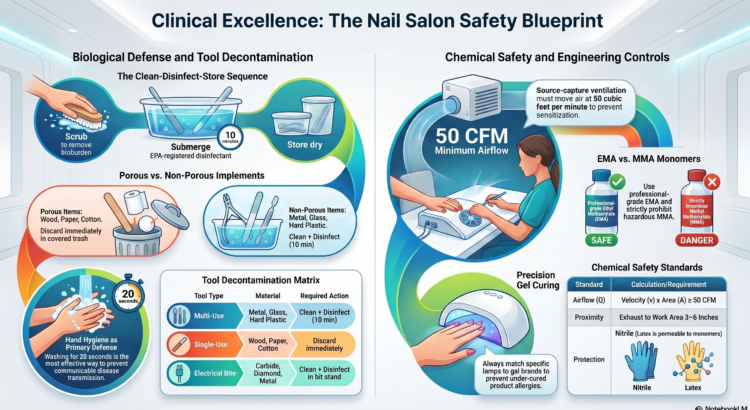
Effective ventilation must move air away from the technician’s breathing zone and the client’s face. The standard for newly installed stations is a system that exhausts contaminants directly outside at a minimum of 50 cubic feet per minute (CFM).9

Without this level of airflow, chemical vapors such as EMA and cyanoacrylate can lead to “Sensitization”—an irreversible allergic reaction where the technician becomes permanently unable to work with these chemicals.13
Universal Pre-Service Protocol: The Standard of Care
Before a single tool is touched, a technician must execute a pre-service ritual that signals professionalism and ensures biological safety. This protocol is the first line of defense in breaking the chain of infection.
Step-by-Step Pre-Service Procedure
- Workstation Preparation: Clear the table of all clutter. Wipe the surface with an EPA-registered disinfectant. Ensure the ventilation system is engaged.1
- Hand Hygiene (Technician): Wash hands and arms with warm water and soap for at least 20 seconds. Scrub under the free edge of the nails where pathogens hide.1
- Hand Hygiene (Client): Request the client wash their hands or provide an antiseptic spray. This reduces the initial microbial load.1
- Initial Assessment: Visually inspect the client’s skin and nails for signs of infection (pus, redness, swelling) or inflammation. If a condition is present, the technician must politely decline the service and refer the client to a physician.2
- Personal Protective Equipment (PPE): Don fresh nitrile gloves. Use a high-quality mask and safety glasses if the service will generate dust or involve chemical splashes.1
WHY it matters: Hand washing is the single most effective way to prevent the spread of communicable diseases. Warm water helps dissolve the lipid (fatty) envelopes of many viruses, rendering them inactive.1 RISK if ignored: Skipping the assessment can lead to “servicing an infection,” which can exacerbate the client’s condition and contaminate the entire salon.1 BEST PRACTICE vs COMMON MISTAKE: Best practice is to use a single-use paper towel to turn off the faucet after washing. A common mistake is turning the faucet off with clean hands, immediately re-contaminating them with the bacteria left on the handle.1
Tool Classification System: Porous vs. Non-Porous
The ability to differentiate between tool types is a core competency required by KRS 317A and NIC standards. This classification determines whether a tool is a capital investment or a disposable expense.1
Non-Porous (Multi-Use) Implements
These are tools made of hard, smooth materials that can withstand immersion in high-level disinfectants.
- Materials: Stainless steel, glass, high-density plastic.1
- Action: Must be cleaned and then disinfected between every client.7
- Examples: Metal nippers, pushers, electric file bits (carbide/diamond), glass files.
Porous (Single-Use) Items
These are tools made of absorbent materials that cannot be sterilized or disinfected once they come into contact with skin or biological fluids.
- Materials: Wood, paper, cotton, fabric.1
- Action: Must be discarded in the trash immediately after use on a single client.7
- Examples: Wood sticks, emery boards, buffer blocks, cotton rounds, toe separators.
| Tool Type | Material Composition | Required Action | Storage Standard |
| Multi-Use | Metal/Glass/Hard Plastic | Clean + Disinfect (10 min) | Closed, clean, labeled container 8 |
| Single-Use | Wood/Paper/Cotton | Discard in covered trash | Original packaging until use 1 |
| Electrical Bits | Carbide/Diamond/Metal | Clean + Disinfect | Bit stand or closed container 1 |
Full Sanitation Workflow: The Clinical Sequence
Sanitation is not a single act but a three-stage process: Clean, Disinfect, and Store. Failure to follow the sequence exactly as prescribed by 201 KAR 12:082 and NIC guidelines results in an ineffective process that provides a false sense of security.7
Stage 1: Cleaning (Mechanical Removal)
Before a tool can be disinfected, it must be clean. Cleaning is the removal of visible debris and “bioburden” (skin cells, oils, product residue).
- Procedure: Scrub the tool with warm soapy water and a dedicated brush.
- Reasoning: Disinfectants are chemicals that can be neutralized by organic matter. If debris is left on a nipper, the disinfectant may never reach the bacteria trapped underneath it.1
Stage 2: Disinfection (Chemical Eradication)
This stage involves the use of an EPA-registered, hospital-grade disinfectant that is bactericidal, virucidal, and fungicidal.
- Procedure: Fully submerge the cleaned, dried tool in the disinfectant solution.
- Contact Time: The tool must remain submerged for the full contact time listed on the manufacturer’s label (usually 10 minutes).1
- Chemistry: Always add the disinfectant concentrate to the water, not vice versa, to prevent foaming and splashing which can lead to chemical burns or inhalation of fumes.1
Stage 3: Rinsing, Drying, and Storage
- Rinsing: Remove tools with tongs or gloved hands and rinse thoroughly.
- Drying: Tools must be completely dry before storage to prevent rust and the growth of mold.
- Storage: Store in a clean, closed, labeled container. Never store disinfected tools in an airtight plastic bag if they are even slightly damp, as this creates a “petri dish” environment.1
Manicure Safety Protocol: Detailed Procedures and Risk Mitigation
The standard manicure is the foundation of nail services, but it carries significant risk of mechanical injury and infection if performed incorrectly.
Procedure for a Safe Manicure
- Sanitization: Follow the Universal Pre-Service Protocol.
- Polish Removal: Use a lint-free pad saturated with acetone or non-acetone remover.
- Shaping: Use a single-use emery board or a disinfected glass file. File from the corner to the center to avoid heat and splitting.
- Soaking: Place fingers in a bowl of warm water with a gentle surfactant.
- Cuticle Care: Apply cuticle remover. Use a disinfected metal pusher or a single-use wood stick to gently push back the eponychium. DO NOT cut the eponychium (living tissue), as this is the primary barrier against infection.2
- Nipping: Only use nippers to remove dead, hanging skin (hangnails).
- Cleaning: Use a disinfected nail brush to clean under the free edge.
- Massage: Use fresh lotion dispensed from a pump (avoid jars to prevent cross-contamination).1
- Finishing: Clean the nail plate with alcohol to remove oils before applying base coat, color, and topcoat.
WHY it matters: The eponychium is living tissue. Cutting it creates an open wound that allows pathogens to enter the body, potentially leading to paronychia.2 RISK if ignored: Over-filing the nail plate or cutting the cuticle can lead to permanent damage and chronic infections.3 COMMON MISTAKE: Touching the polish brush to the client’s skin or a contaminated surface and then putting it back in the bottle. This contaminates the entire bottle of polish.1
Pedicure & Foot Spa Decontamination System
Pedicure basins are the most complex equipment in the salon to keep clean. Biofilms in the plumbing have been linked to significant outbreaks of Mycobacterium fortuitum, a fast-growing bacterium that causes boils and scarring.1
Per-Client Decontamination Protocol
- Drain: Remove all water and debris.
- Scrub: Use a surfactant (detergent) and a clean brush to scrub all surfaces of the basin.
- Rinse: Wash away all soap residue.
- Disinfect: Refill with clean water and the appropriate amount of EPA-registered disinfectant.
- Circulate: Run the jets for a full 10 minutes (or as specified by the disinfectant manufacturer).1
- Drain and Wipe: Rinse and dry with a clean towel.
End-of-Day Deep Clean
- Remove Parts: Take out the screen, jet covers, and any other removable parts.
- Scrub Parts: Clean all trapped hair and debris from these parts using a brush and detergent.
- Soak: Submerge parts in disinfectant for 10 minutes.
- Flush: Fill the basin with water and a low-sudsing detergent; run the jets, then drain and rinse.1
Weekly/Bi-Weekly Protocol
- Fill the basin with water and a mixture of bleach or a specialized pipe cleaner.
- Allow to sit overnight or for the time specified by the manufacturer.
- Flush the system thoroughly before the next use.1
Acrylic and Enhancement Safety: Ventilation and Chemical Hygiene
Applying acrylic nails (monomer liquid and polymer powder) is a high-skill task that involves significant chemical exposure.2
Enhancement Safety Steps
- Ventilation: Ensure the source-capture exhaust system is positioned within 3-6 inches of the work area.9
- Dappen Dish Management: Use a dappen dish with a lid. Only pour the amount of monomer needed for one service. NEVER pour used monomer back into the original bottle.7
- Brush Hygiene: Clean brushes only with monomer. Do not use brush cleaners that contain harsh solvents unless necessary, as these can be inhaled.
- Waste Disposal: Place all monomer-soaked pads or paper towels in a small plastic bag, seal it, and dispose of it in a covered trash can immediately.8
- Avoid Skin Contact: Use a “bead” technique that keeps the wet product away from the eponychium and sidewalls.
WHY it matters: EMA monomer is a known allergen. Repeated skin contact leads to sensitization, which can cause itching, redness, and blisters.9 RISK if ignored: Poor ventilation leads to “occupational asthma” and chronic headaches for the technician.10 BEST PRACTICE: Use nitrile gloves. Latex gloves are permeable to monomers and provide a false sense of security.9
Gel System Safety: The Science of Curing and Allergy Prevention
Gel nails are cured using UV or LED light. Improper curing is the leading cause of the current “allergy epidemic” in the nail industry.13
The Curing Mechanism
Gel contains photoinitiators that respond to specific wavelengths. If the lamp’s output does not match the gel’s photoinitiators, the product remains “under-cured”—meaning it looks hard but contains liquid monomers that can leach into the skin.14
| Gel Status | Molecular State | Risk Level | Outcome |
| Fully Cured | Solid polymer chain | Low (Inert) | Durable, safe finish 14 |
| Under-Cured | Partially liquid molecules | HIGH | Sensitization, contact dermatitis 13 |
| Over-Cured | Brittle, degraded chains | Low | Cracking, lifting, heat spikes 15 |
Gel Safety Protocols
- Match Lamp and Product: Always use the lamp designed for the specific gel brand. There is no such thing as a “universal” lamp.14
- Thin Layers: Apply gel in thin coats to ensure the light can penetrate the entire thickness.
- Remove Residue: Use a high-percentage (90%+) isopropyl alcohol to remove the “inhibition layer” (the sticky uncured layer on top) without spreading it onto the skin.14
- Client Protection: Offer the client fingerless UV-protective gloves or apply sunscreen to the hands 20 minutes before the service to mitigate any UVA risk from the lamp.15
Cross-Contamination Prevention System
Cross-contamination is the transfer of pathogens from one person or object to another. In a salon, this often happens through “the bridge”—the technician’s hands or tools.
Strategies to Prevent Cross-Contamination
- The No-Touch Phone Rule: Phones are the dirtiest objects in the salon. If a technician touches a phone, they must change gloves and re-wash hands.1
- Dispensing Standards: Use a clean, disinfected spatula to remove creams from a jar. If you touch the client and then put the spatula back in the jar, the whole jar is contaminated.1
- Tool Handling: Never place a disinfected tool on a used towel. Always place it on a clean, disinfected surface or a fresh paper towel.1
- Product Decanting: Use small dispenser bottles with pressure-sensitive stoppers to minimize the opening size and prevent dust from entering the product.9
Daily / Weekly / Monthly Cleaning Systems
A “Center of Excellence” maintains a rigorous schedule of facility maintenance that goes beyond the workstation.
Daily Cleaning
- Sanitize all high-touch surfaces: doorknobs, light switches, reception desk, credit card terminal.
- Launder all towels in hot water (
) with bleach and dry until “hot to the touch”.8
- Empty and sanitize all trash cans.
Weekly Cleaning
- Clean the filters and intake grilles of the ventilation system.9
- Disinfect all storage containers for “Clean” tools.
- Check the SDS (Safety Data Sheet) binder to ensure all products currently in use are documented.8
Monthly Cleaning
- Flush foot spa systems with a deep-clean biological agent.
- Conduct a “Mock Inspection” of every workstation.
- Inventory and discard any expired products or degraded tools.
Documentation & Compliance System: The Auditable Salon
Under KRS 317A and 201 KAR 12:082, documentation is the evidence of professional conduct. If a task was not logged, it did not happen in the eyes of the law.1
Essential Logs and Records
- Pedicure Decontamination Log: Must show the date, time, and specific type of cleaning (per-client, end-of-day, weekly) for each basin.1
- Safety Data Sheets (SDS): A binder containing the chemical breakdown and first-aid instructions for every product in the salon.8
- Employee Training Records: Proof that every technician has been trained on the salon’s specific safety protocols and bloodborne pathogen response.1
- Sterilization Logs (if applicable): If using an autoclave, monthly spore test results must be kept for 12 months.8
Incident Response Protocol: Blood and Exposure
In the event of an accidental cut (of the client or the technician), the “Blood Exposure Procedure” must be executed immediately and calmly to prevent the transmission of bloodborne pathogens like HIV and Hepatitis.1
Step-by-Step Incident Response
- Stop Service: Immediately stop the service. Do not panic.1
- Protect: Don a fresh pair of gloves.
- Rinse: Help the client to the sink and rinse the area under running water.7
- Dry and Treat: Pat dry with a clean, disposable towel. Apply an antiseptic and an adhesive bandage.1
- Clean the Environment: Place all contaminated single-use items in a plastic bag and then in the trash. Clean the workstation with a tuberculocidal disinfectant.7
- Disinfect Tools: Any tool that came into contact with blood must be cleaned and then disinfected in a solution labeled as effective against HIV and Hepatitis.7
- Documentation: Record the incident in the salon’s logbook for liability and insurance purposes.
Student Training Model: Competency-Based Enforcement
Louisville Beauty Academy utilizes a performance-based rubric to ensure that sanitation is an instinct, not an afterthought. Students must achieve “Industry Standard” (Level 4) before being allowed to work on the clinic floor.18
Performance Rubric for Sanitation
| Performance Level | Observable Behavior | Supervision Required |
| 1 (Poor) | Fails to wash hands; touches phone; leaves dirty tools on table. | High level of supervision 18 |
| 2 (Fair) | Drapes client properly but needs reminders to disinfect table. | Occasional prompts 19 |
| 3 (Good) | Completes all sanitation steps independently with few errors. | Minimal supervision 18 |
| 4 (Excellent) | Industry Standard: Demonstrates clinical-grade hygiene; explains “why” to client. | Independent / Peer Leader 19 |
Curriculum must include at least one hour per week devoted to KRS 317A and 201 KAR Chapter 12 to ensure legal literacy among future licensees.2
Client Education Framework: Public Health Awareness
The salon professional is often the first person to notice a client’s health issues, such as melanoma under the nail or fungal infections.
- Transparency: Openly discuss the steps you are taking. Say, “I’m using a fresh, single-use file for you today”.14
- Visual Cues: Display disinfected tools in their storage containers. Post your pedicure cleaning log in a visible area.
- Home Care: Educate clients on how to keep their nail beds dry and how to recognize “lifting” of enhancements, which can trap water and lead to “greenies” (Pseudomonas).1
Inspection Readiness Checklist
Use this checklist to ensure the salon is always ready for a surprise visit from the State Board.
- [ ] All licenses (salon and individual) are current and displayed.2
- [ ] Pedicure logs are up-to-date and signed for every station.1
- [ ] No MMA-containing monomers are present in the dispensary.7
- [ ] “Dirty” and “Clean” tool containers are clearly labeled and separated.8
- [ ] Disinfectant solution is fresh (not cloudy) and filled to the required level.1
- [ ] Source-capture ventilation is functional at every manicure station.9
- [ ] No porous items (files, buffers) are in the “Clean” containers.1
Common Violations & Risk Failures: Real-World Insight
Experience shows that even the best salons can fail during busy periods.
- The “Cloudy Jar”: Using the same disinfectant solution for too many tools. The solution becomes neutralized by skin cells and stops killing pathogens.1
- The “File Cache”: Technicians often hide “favorite” files in their drawers to reuse. This is a primary source of cross-contamination and a major violation.7
- Short-Cutting the Soak: Running the pedicure jets for 2 minutes instead of 10. This fails to kill the bacteria in the plumbing.1
- Improper Glove Use: Wearing the same pair of gloves to clean the pedicure bowl and then start a manicure on the next client.
Advanced Layer: The Systemic Gap and “Compliance-by-Design”
Identifying the Gap
In the real world, the “Ideal Compliance” taught in textbooks often clashes with the “Production Pressure” of a busy salon. Technicians are often incentivized by the number of clients they see, which leads to cutting corners on the 10-minute disinfection soak or the end-of-day deep clean. Schools often fail because they treat sanitation as a “freshman class” topic that is forgotten by the time the student reaches the senior clinic floor.18
The Louisville Beauty Academy “Compliance-by-Design” Model
LBA recommends a structural approach to safety where the environment makes it harder to fail than to comply:
- Interlocked Equipment: Pedicure stations that will not refill unless a 10-minute disinfection cycle has been completed and logged digitally.17
- Color-Coded Implements: Using implements with color-coded handles that correspond to specific days of the week to ensure they are being cycled through the autoclave or high-level disinfectant.
- VOC Monitoring: Real-time air quality sensors that trigger higher ventilation speeds if chemical concentrations spike.22
Recommendations for National Standardization
Regulators should move toward a “Clinical Model” of licensure that includes:
- Mandatory Bloodborne Pathogen Certification: Similar to what is required for tattoo artists, renewed annually.
- Standardized Ventilation Testing: Requiring salons to provide proof of 50 CFM airflow during their annual inspection.9
- Unified Disinfection Contact Times: Working with the EPA to standardize “10-minute” as the industry-wide immersion standard to eliminate confusion.7
Future-Proofing: AI, Automation, and Compliance Systems
The next decade of nail technology will be defined by technological integration.
- AI Compliance Bots: Vision systems that can recognize if a technician has skipped a hand-washing step and send a real-time alert to management.23
- Automated Inventory: Systems that track the use of single-use items to ensure that the number of files used matches the number of clients served, preventing reuse.24
- Digital Logs: Replacing paper logs with blockchain-verified cleaning records that cannot be falsified after an inspection occurs.17
Final Declaration: Institutional Standard
The Louisville Beauty Academy, as a “Center of Excellence in Safety & Sanitation,” hereby declares that the protocols outlined in this blueprint represent the definitive institutional standard for the practice of nail technology. We hold that aesthetic beauty can never be achieved at the expense of biological safety. Our commitment to the rigorous application of KRS 317A, 201 KAR 12:082, and OSHA-level workplace protection is unwavering. This document serves as the guidepost for our students, our faculty, and the broader professional community to ensure that every salon environment is a sanctuary of health, safety, and scientific excellence.1
Public Summary
Louisville Beauty Academy (LBA) has released its “National Standard Blueprint for Safety & Sanitation,” a policy-grade framework for the nail technology industry. Aligned with Kentucky’s KRS 317A and 201 KAR 12:082, the blueprint transforms salon hygiene from basic chores into a clinical-grade infection control system. Key features include the 50 CFM source-capture ventilation requirement for chemical safety, a rigorous 3-stage tool decontamination workflow (Clean-Disinfect-Store), and a scientifically-grounded approach to curing gel enhancements to prevent the rising epidemic of acrylate allergies. The blueprint identifies the systemic “gap” between education and real-world practice, proposing a “Compliance-by-Design” model that utilizes AI and automated sensors to ensure safety is never compromised for speed. LBA’s standards serve as a national model for workforce development, elevating the nail technician’s role to a guardian of public health. This document is essential for any salon seeking “inspection-ready” status and for educational institutions aiming to produce elite, safety-conscious professionals. #BeautySafety #NailTechExcellence #LBAStandards #PublicHealth #LouisvilleBeautyAcademy
Works cited
- Sanitation and Safety Archives – Louisville Beauty Academy …, accessed April 28, 2026, https://louisvillebeautyacademy.net/category/sanitation-and-safety/
- 201 KAR 12:082. Education requirements and school administration. – Kentucky Board of Cosmetology, accessed April 28, 2026, https://kbc.ky.gov/Documents/201%20KAR%2012.082.pdf
- 201 KAR 12:082. School’s course of instruction – Kentucky Administrative Regulations, accessed April 28, 2026, https://kyrules.elaws.us/rule/201kar12:082
- Title 201 Chapter 12 Regulation 082 • Kentucky Administrative Regulations – Legislative Research Commission, accessed April 28, 2026, https://apps.legislature.ky.gov/law/kar/titles/201/012/082/
- Title 201 Chapter 12 Regulation 082 • Kentucky Administrative Regulations, accessed April 28, 2026, https://apps.legislature.ky.gov/law/kar/titles/201/012/082/12440/
- Working in a Nail Salon – MotherToBaby | Fact Sheets – NCBI Bookshelf, accessed April 28, 2026, https://www.ncbi.nlm.nih.gov/books/NBK582866/
- NIC INFECTION CONTROL AND SAFETY STANDARDS, accessed April 28, 2026, https://boards.bsd.dli.mt.gov/Portals/133/Documents/cos/NIC_Health_Safety_standards.pdf
- POLICIES – National Interstate Council of State Boards of Cosmetology, accessed April 28, 2026, https://nictesting.org/wp-content/uploads/2020/03/POLICIES.2019.pdf
- Safety and health hazards in nail salons – Oregon OSHA, accessed April 28, 2026, https://osha.oregon.gov/OSHAPubs/factsheets/fs28.pdf
- 609 Health Hazards in Nail Salons – OSHAcademy, accessed April 28, 2026, https://www.oshacademy.com/courses/training/609-health-hazards-nail-salons/609-2-5.php
- Health Hazards in Nail Salons – Chemical Hazards | Occupational Safety and Health Administration, accessed April 28, 2026, https://www.osha.gov/nail-salons/chemical-hazards
- Health Hazards in Nail Salons – Standards | Occupational Safety and Health Administration, accessed April 28, 2026, https://www.osha.gov/nail-salons/standards
- Emerging Trends in Gel Nail Allergies: Prevalence, Symptoms, and Occupational Hazards Associated with Acrylate Sensit – UMK, accessed April 28, 2026, https://apcz.umk.pl/JEHS/article/download/45305/36298/118204
- Reducing Allergy Risks in Nail Products – Thegelcollection.com, accessed April 28, 2026, https://thegelcollection.com/blogs/news/our-effort-to-reduce-the-risk-of-allergies
- Are gel nails bad for you? UV, skin cancer and allergies | Lab Muffin Beauty Science, accessed April 28, 2026, https://labmuffin.com/are-gel-nails-bad-for-you-uv-skin-cancer-and-allergies/
- Assessing the Health Implications of UV/LED Nail Lamp Radiation …, accessed April 28, 2026, https://pmc.ncbi.nlm.nih.gov/articles/PMC11931093/
- Sanitation Programs – Automate Cleaning – Weever Apps, accessed April 28, 2026, https://weeverapps.com/programs/sanitation/
- iRubric: Cosmetology Clinical Assessment rubric – FX32C4W – RCampus, accessed April 28, 2026, https://www.rcampus.com/rubricshowc.cfm?sp=true&code=FX32C4W
- iRubric: COSMETOLOGY 1 PRACTICAL rubric – PXW8CA5 – RCampus, accessed April 28, 2026, https://www.rcampus.com/rubricshowc.cfm?sp=yes&code=PXW8CA5&
- Cosmetology Program Level Assessment Report 2022-2023 TC.docx, accessed April 28, 2026, https://mediaserver.uaptc.edu/content/assessment/student-learning/program-level-reports/2022-23/Cosmetology%20PLO%202022-2023%20TC.pdf
- Title 201 Chapter 12 Regulation 082 • Kentucky Administrative Regulations – Legislative Research Commission, accessed April 28, 2026, https://apps.legislature.ky.gov/law/kar/titles/201/012/082/2007/
- VOC sources and exposures in nail salons: a pilot study in Michigan, USA – ResearchGate, accessed April 28, 2026, https://www.researchgate.net/publication/328003246_VOC_sources_and_exposures_in_nail_salons_a_pilot_study_in_Michigan_USA
- AI Agent for Nail Salons – Voiceflow, accessed April 28, 2026, https://www.voiceflow.com/industries/nail-salons
- Polished Plans: How AI Helps Nail Salon Managers With Business Strategy Creation, accessed April 28, 2026, https://www.joinblvd.com/blog/nail-salon-ai-business-strategy


