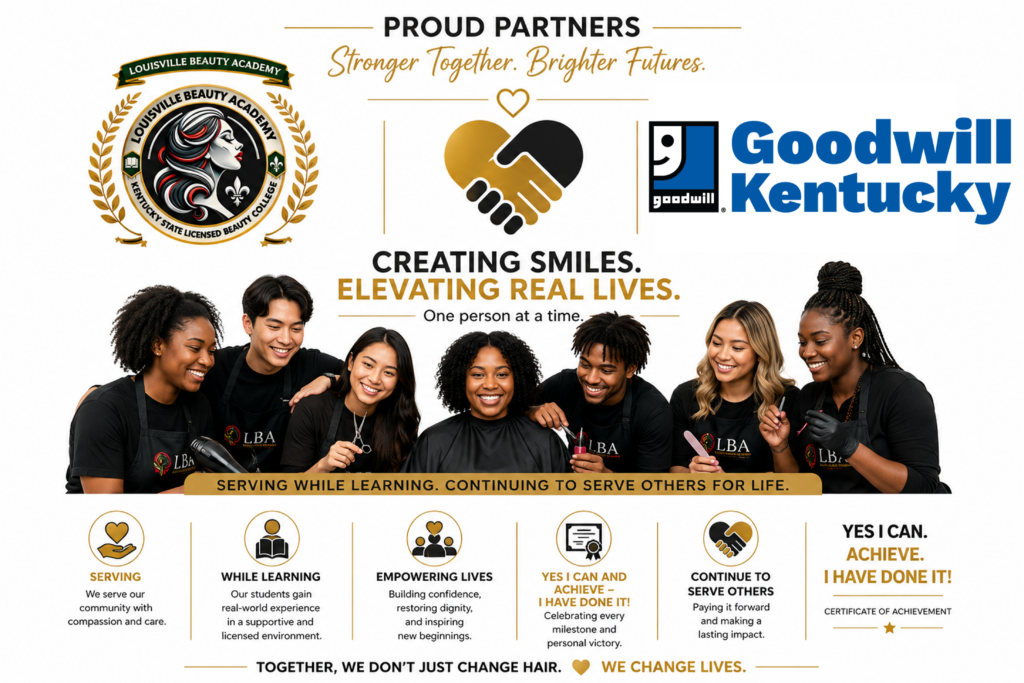
Creating Smiles. Elevating Real Lives. One Person at a Time.
Louisville Beauty Academy (LBA) is proud to announce a collaborative partnership with Goodwill Kentucky that reflects a shared commitment to workforce development, human dignity, community service, practical education, and long-term economic empowerment throughout Louisville and the Commonwealth of Kentucky.
More than a partnership between two organizations, this collaboration represents a larger vision for how education, workforce preparation, nonprofit service, and community-based support systems can work together to create measurable and lasting public value.
Through this partnership, Louisville Beauty Academy will provide limited courtesy beauty services within its Kentucky state-licensed educational clinic environment to individuals connected to Goodwill Kentucky programs and outreach efforts. Services may include natural hair services, shampoo and blowout styles, manicures, pedicures, and supervised wellness-focused beauty services provided by students under instructor supervision.
At first glance, this may appear to be a beauty-school partnership.
In reality, it reflects something much larger: a workforce-centered, dignity-driven, community-supported educational model designed to help people move forward in life.
A Shared Mission Rooted in Human Dignity
Goodwill Kentucky has long served the Louisville community by helping individuals overcome barriers to employment, workforce participation, and economic advancement through education, support services, and opportunity creation.
Louisville Beauty Academy shares many of the same core principles.
As a Kentucky state-licensed beauty school, LBA was founded on the belief that education should be:
affordable,
practical,
workforce-focused,
community-connected,
and directly tied to real opportunity and human advancement.
Both organizations understand something fundamental:
People succeed when communities invest in both skill and dignity.
This partnership recognizes that confidence, professionalism, self-image, communication skills, and human connection are not secondary to workforce development — they are central to it.
Sometimes a haircut is not just a haircut. Sometimes it is:
renewed confidence before a job interview,
restored self-worth,
human care during difficult times,
or the beginning of believing in oneself again.
That matters.
Why This Partnership Matters Beyond Beauty
In many ways, this partnership reflects the future of practical workforce education and community development in America.
Louisville Beauty Academy believes education should not exist in isolation from the communities it serves.
Students should not only learn theory. They should learn:
service,
professionalism,
communication,
accountability,
compassion,
sanitation,
safety,
and real-world human interaction.
That is why LBA operates through a supervised educational clinic model where students gain direct practical experience while serving real people within the community.
This model creates a powerful educational cycle: students learn while serving, and communities benefit while students grow.
LBA calls this philosophy:
“Serving While Learning. Continuing to Serve Others for Life.”
This partnership with Goodwill Kentucky embodies that principle in action.
Workforce Development Through Human-Centered Education
The beauty industry remains one of the largest human-service industries in the United States and serves as a major entry point into entrepreneurship, workforce participation, and economic mobility — particularly for women, immigrants, working adults, and underserved communities.
Yet beauty education is often underestimated as merely cosmetic or transactional.
Louisville Beauty Academy rejects that outdated view.
Beauty professionals:
build small businesses,
create jobs,
strengthen local economies,
provide human-centered services,
support emotional wellness,
and often become long-term community anchors.
At LBA, students are not simply trained to pass licensing examinations.
They are trained to become:
professionals,
entrepreneurs,
leaders,
mentors,
employers,
and lifelong contributors to society.
This partnership reflects the understanding that workforce development is most effective when education is connected directly to real human service and practical community engagement.
A Model of Community Collaboration
One of the most important aspects of this partnership is that it demonstrates what becomes possible when educational institutions, nonprofit organizations, instructors, students, and community leaders work together instead of separately.
Real public impact is rarely created by one organization alone.
It is created through collaboration.
This partnership represents the combined effort of:
educators,
nonprofit professionals,
workforce advocates,
students,
instructors,
community partners,
and individuals committed to improving lives through practical action.
Together, Louisville Beauty Academy and Goodwill Kentucky are helping demonstrate how local institutions can create measurable social value while strengthening workforce pipelines, community trust, and economic opportunity.
Building Confidence, Opportunity, and Long-Term Impact
At Louisville Beauty Academy, students are taught more than technical skill.
They are taught mindset.
The school’s philosophy centers on growth, resilience, accountability, and contribution through service.
Students are encouraged daily to believe: YES I CAN. ACHIEVE. I HAVE DONE IT.
That mindset becomes transformational not only inside the classroom, but throughout life.
By participating in real community-centered service experiences, students develop:
confidence,
communication skills,
leadership,
professionalism,
empathy,
and lifelong habits of contribution.
This partnership therefore benefits not only the individuals receiving services, but also the future professionals learning how to serve communities with dignity and care.
A Louisville Partnership with Broader Meaning
This collaboration reflects something important about Louisville itself.
Louisville has long been strengthened by organizations, educators, nonprofits, small businesses, workforce advocates, and local leaders willing to work together to solve real problems at the community level.
This partnership is one example of what can happen when institutions prioritize:
practical impact,
human dignity,
affordability,
workforce access,
and service-centered leadership.
It demonstrates that education can remain deeply connected to the communities it serves while still producing measurable workforce and economic outcomes.
More Than Beauty. More Than Education.
This partnership is ultimately about people.
It is about:
restoring confidence,
creating opportunity,
building professionalism,
strengthening communities,
and elevating lives one person at a time.
Together, Louisville Beauty Academy and Goodwill Kentucky are helping demonstrate that education, workforce development, nonprofit service, and human compassion do not need to operate separately.
When connected intentionally, they create stronger people, stronger communities, and stronger futures.
Because together, we do not just change hair.
We Change Lives.
Louisville Beauty Academy Kentucky State-Licensed Beauty School Louisville, Kentucky
Disclaimer: This partnership announcement is shared for informational and community-outreach purposes only. Services referenced are provided within Louisville Beauty Academy’s supervised educational clinic environment and remain subject to student participation, instructor supervision, operational availability, and applicable state regulations.
Educational Research Disclaimer This article was produced by the research team of Di Tran University — The College of Humanization as part of its ongoing vocational education research series. Di Tran University is an educational research affiliate founded by Di Tran, who also serves as founder and CEO of Louisville Beauty Academy — this is a founder-affiliated publication, not an independent third-party study.
Louisville Beauty Academy publishes this material for educational and informational purposes for students, licensees, and the public.
Louisville Beauty Academy does not interpret, enforce, or provide legal guidance regarding state or federal licensing laws. All regulatory authority rests solely with the appropriate government agencies, including the Kentucky Board of Cosmetology and other applicable regulatory bodies.
Abstract
The contemporary landscape of vocational education in the United States is currently navigating a pivotal transition between traditional enrollment-driven models and emerging outcome-oriented frameworks. This research study provides a PhD-level interdisciplinary analysis of the “Professional Discipline Learning Model,” specifically within the context of beauty and personal care licensing. Utilizing the Louisville Beauty Academy (LBA) as a primary case example, the study investigates the structural effectiveness of education that prioritizes technical discipline, regulatory compliance, and economic efficiency over lifestyle-oriented marketing and entertainment-based pedagogy.
The research question addresses whether a vocational model centered on a “Zero Disruption Learning Environment” and “Action Accumulation” yields superior licensing success rates, faster workforce integration, and greater economic mobility for its graduates. Drawing upon Human Capital Theory, Deliberate Practice, Cognitive Load Theory, and Professional Socialization Theory, this analysis posits that the professionalization of the beauty industry requires a shift toward structured, cost-controlled institutional models.
Historical evidence traces the evolution of beauty licensing from its origins in medieval medicine and barber-surgery to modern public health mandates, establishing the sector as one of the most heavily regulated personal service industries. Comparative regulatory analysis reveals significant discrepancies in training hour requirements between the beauty trades and high-stakes medical fields like Emergency Medical Services (EMS), suggesting a need for policy reform focused on educational efficiency. Economic data from the Bureau of Labor Statistics (BLS) and the Small Business Administration (SBA) highlight the beauty industry’s role as a primary driver of micro-entrepreneurship, particularly within immigrant and minority communities. The findings suggest that disciplined vocational education models represent a highly effective pathway for workforce stability and professional identity formation in a post-automation economy.
Historical Context of Beauty Education
The professionalization of the beauty industry in the United States is the result of a complex convergence of medical history, labor organization, and the expansion of the state’s “police power”.1 Historically, the lineage of modern beauty regulation is a dual history of surgical necessity and aesthetic evolution. In the medieval period, the practitioners known as barber-surgeons were responsible for an array of procedures that extended far beyond grooming, including blood-letting, tooth extraction, and the lancing of abscesses.1 The formal establishment of the Company of Barber Surgeons in 1540 under Henry VIII solidified this connection, and it was not until 1745 that the professions of barbering and surgery legally diverged.1 This historical intersection explains the barber’s long-standing legal authority over razor-based services; the straight razor was essentially the surgical tool of the trade, a legacy that persists in modern licensing distinctions regarding the use of open blades.1
The emergence of formal beauty education was catalyzed by the Progressive Era’s focus on sanitation and public health. In the late 19th and early 20th centuries, outbreaks of “barber’s itch”—a contagious fungal infection spread via unsterilized razors—prompted the first state-level licensing laws.1 Research by Daniel Smith in “The Itch & Razor War” indicates that nearly 90 percent of the original justification for barber licensure was centered on the prevention of such ailments.3 By 1897, Minnesota passed the first legislation for a barber license, initiating a movement toward stringent state board inspections and standardized hygiene protocols.2 These laws established that the state possessed the authority to regulate private conduct—such as the way a person cuts hair or treats skin—to protect the collective welfare.1
Historical Milestone
Year
Significance to Professionalization
Divergence of Barbers and Surgeons
1745
Established barbering as a distinct technical trade 1
Formation of Barber Protective Union
1886
First major move toward labor standards and organized training 2
Opening of the First Barber School
1893
A.B. Moler standardized curriculum and published first textbooks 2
First State Licensure Law (Minnesota)
1897
Introduced state-mandated sterilization and inspection 2
Rise of the “Bob” Cut
1920s
Created demand for specialized cosmetological training 2
Separation of Barber/Cosmetology Boards
1935
Reflected distinct traditions and gendered service paths 4
Modern Board Consolidation
2021+
Trend toward administrative efficiency and “dual-service” licensing 4
As the 20th century progressed, the demand for specialized cosmetological skills grew alongside the flourishing entertainment industry, necessitating formal beauty schools and specialized training programs.1 By 1927, states like California began separately licensing barbers and cosmetologists, reflecting a social and professional divide that persists in many modern regulatory systems.1 Over time, these regulations evolved from basic hygiene mandates into comprehensive state regulatory systems that balance the need for public safety with the pressures of workforce development.1 However, some economic historians argue that these licensing laws were also influenced by labor unions seeking to bar discount competitors from the market, leading to a steady increase in training hour requirements that often exceeded the hours necessary for purely sanitation-based instruction.1
Regulatory Framework and Legal Structure
The legal framework governing beauty licensing in the United States is built upon the premise that professional beauty services involve significant biological and chemical risks.1 Practitioners work with reactive substances such as hair color, relaxers, and perm solutions, and they utilize sharp instruments like razors, shears, and nippers.1 Consequently, state boards of cosmetology and barbering are tasked with ensuring that the public is protected from incompetent practice by establishing minimum qualifications for entry and enforcing effective discipline for those who violate statutes.4
Comparative Regulatory Analysis
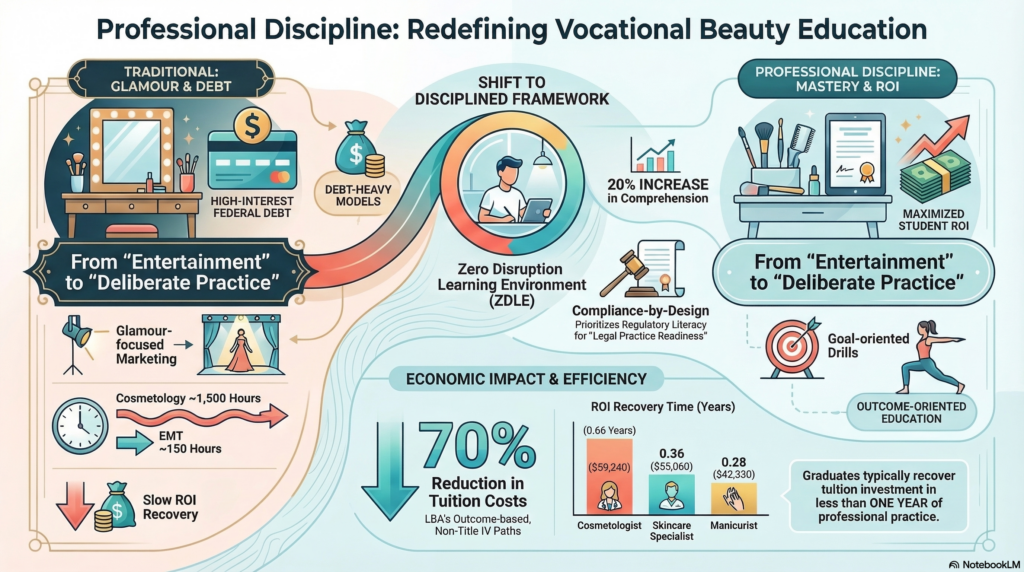
One of the most revealing aspects of the beauty industry’s regulatory structure is the disparity between its training requirements and those of other high-stakes professions. While the work of Emergency Medical Technicians (EMTs) bears a direct relationship to life-and-death public health, the training requirements for cosmetologists often dwarf those of EMTs.5 As of 2022, on average, states demanded approximately one year of training for a cosmetology license (roughly 1,000 to 1,500 hours) compared to just over a month of training for an EMT license.5
Profession
Minimum Training Hours (Avg)
Focus of Regulation
Cosmetologist
1,000 – 1,600
Sanitation, chemical safety, aesthetics 5
EMT (Basic)
120 – 190
Life-saving interventions, emergency medicine 5
Food Safety Manager
8 – 12
Prevention of foodborne illness 6
Licensed Plumber
4,000 – 10,000
Infrastructure safety, code compliance 8
Barber Apprentice
216 (Related) / 3,200 (OJT)
Safety, sanitation, technical skill 9
Manicurist
300 – 600
Infection control, nail anatomy 11
The rationale for licensing rests on the “police power” of the state, but researchers from the Institute for Justice have questioned whether these heavier burdens actually improve safety.11 Studies comparing states with differing licensing burdens found no significant difference in health inspection outcomes, suggesting that nail salons and barbershops were clean and safe regardless of whether their workers faced burdensome or light licensing.11 Despite this, the beauty industry remains heavily regulated, with most states demanding at least 1,000 hours of training and maintaining rigorous inspection systems.11
Inspection and Compliance Systems
Modern regulatory systems utilize a combination of pre-graduate testing, written examinations, and practical skill demonstrations to verify competency.13 In states like Kentucky, the Barbering and Cosmetology Board outlines swift disciplinary measures for practitioners who violate sanitation statutes.4 The legal authority of these boards extends to the oversight of “dual-service” salons and the enforcement of “shaving controversies,” such as the legal restrictions preventing cosmetologists from using straight razors for facial shaving in certain jurisdictions.1 This dense regulatory environment necessitates an educational model that prioritizes regulatory literacy and “compliance-by-design” rather than just creative aesthetics.14
Theoretical Framework
Analyzing the Professional Discipline Model requires an interdisciplinary approach that connects economic theory with cognitive science and behavioral psychology.
Human Capital Theory (Becker)
Human Capital Theory, most notably advanced by Gary Becker, posits that education and technical training are forms of capital accumulation.15 According to this view, individuals invest in their own skills, knowledge, and health with the expectation of economic returns in the form of higher wages and job security.15 In the context of beauty education, the license is the tangible manifestation of this human capital. The “human capital approach” assumes that earnings mainly reflect how much workers have invested in their skills rather than just whether they hold “good” or “bad” jobs.17 This theory supports a vocational model that optimizes the time and cost of education, ensuring a faster “rate of return” on the student’s investment.12
Deliberate Practice Theory (Ericsson)
K. Anders Ericsson’s theory of Deliberate Practice challenges the notion of innate talent, suggesting instead that expert performance is the result of focused, consistent, and goal-oriented training.18 Deliberate practice involves “individualized training activities specially designed by a coach or teacher to improve specific aspects of an individual’s performance through repetition and successive refinement”.19 At Louisville Beauty Academy, this theory is applied through clinic-based skill development and repetitive technical drills.14 Ericsson’s research shows that Mozart, often cited as a natural genius, was “relatively average” when compared to modern children who undergo structured, early training, proving that sustained effort and structured environments are the primary drivers of mastery.18
Behavioral Discipline and Self-Regulation
Behavioral Discipline Theory examines how self-regulation and habit formation contribute to professional success. In a vocational setting, this involves the internalization of professional norms and the development of “grit”—the passion and perseverance for long-term goals. Students in a disciplined environment are taught to transition from a “student” identity to a “professional” identity through the accumulation of small, verifiable achievements.20 This process is described as “Humanization,” a psychosocial intervention designed to restore self-worth through vocational excellence.20
Cognitive Load Theory (Sweller)
Cognitive Load Theory (CLT), pioneered by John Sweller, is based on an understanding of the limitations of human working memory.21 CLT identifies three types of cognitive load:
Intrinsic Load: The inherent complexity of the subject matter.21
Extraneous Load: Unnecessary cognitive effort caused by distractions or poorly designed instruction.21
Germane Load: The mental work devoted to making sense of new material and storing it in long-term memory.21
A Professional Discipline model explicitly seeks to reduce “extraneous load” by creating a “Zero Disruption Learning Environment”.22 By removing unnecessary noise, administrative confusion, and social distractions, the model allows students to focus their limited cognitive resources on “germane load,” thereby accelerating the transfer of technical skills to long-term memory.23
Professional Socialization Theory
Professional Socialization is the process by which individuals develop a disciplinary identity and commit to the values and norms of their field.25 It involves shifting from being a “knowledge consumer” to a “knowledge producer” or professional practitioner.25 Research in nursing and medical training shows that early introduction to the professional environment and supportive supervisory relationships are critical for professional identity formation.26 The disciplined study culture at LBA mirrors this by placing students in a “living learning ecosystem” where they interact with the public, instructors, and graduates from day one.14
Institutional Efficiency Theory
Institutional Efficiency Theory analyzes how regulatory bodies and legal frameworks shape behavior and economic outcomes.27 In vocational education, this theory evaluates whether institutions are structured to minimize transaction costs and resource misallocation.28 A model that focuses on “short-cycle” vocational education—optimizing training time and reducing cost barriers—aligns with the principles of institutional efficiency by ensuring that the “educational investment” is recovered quickly through workforce entry.12
The Professional Discipline Model
The Professional Discipline Learning Model used by Louisville Beauty Academy is characterized by its rejection of “entertainment-oriented” marketing in favor of a structured, outcome-focused institutional culture.14 This model positions the vocational school as a professional institution rather than a social or lifestyle destination.
Key Structural Elements
The model is built upon several foundational pillars designed to maximize student success and institutional compliance:
Zero-Disruption Training Environment: A commitment to protecting instructional time and space from internal and external distractions.29
Strict Compliance Orientation: An emphasis on “over-compliance by design,” where regulatory literacy is viewed as a primary skill for protecting the practitioner and the public.14
Licensing Exam Focus: Curriculum alignment that prioritizes the requirements of state board examinations, ensuring high pass rates and fast workforce entry.14
Structured Clinic Learning: Practical engagement through real-world walk-ins and early client interaction, moving skills from theoretical to applied.14
Disciplined Study Culture: A “fail fast, fix fast” mindset where errors are treated as data points for immediate correction and mastery.14
Cost-Conscious Education: A tuition structure that prioritizes affordability and reduces reliance on high-interest student debt.14
Contrast with Entertainment-Based Marketing
Traditional beauty school marketing often emphasizes “glamour,” social immersion, and lifestyle aesthetics. However, research suggests that high-tuition, for-profit schools using these models often leave students with insurmountable debt and low earning potential.32 In contrast, the Professional Discipline Model focuses on the “action accumulation” of small completions—tasks that serve as “verifiable proof” of a student’s own value and competence.14 This model treats beauty as a “licensed human service” and an “AI-proof” trade that generates sustainable economic growth through disciplined attention to human needs.34
Zero Disruption Learning Environment
The concept of a “Zero Disruption Learning Environment” (ZDLE) is rooted in the psychological need for uninterrupted focus during skill acquisition. In high-stakes vocational training, frequent disruptions can erode trust, delay return on investment (ROI), and decrease student comprehension.29 Studies have shown that excessive noise in classrooms can cause up to a 20% drop in comprehension, while acoustic treatments can lead to a 70% reduction in distractions.36
Mechanism of Focus and Productivity
ZDLE works by minimizing “extraneous cognitive load” through the removal of non-educational distractions. This includes both physical noise and digital interruptions. At LBA, this is achieved through a “protected work mode” that discourages non-urgent conversations and fractured attention.37 This structured approach helps focus efforts on high-impact activities, promoting a sense of daily accomplishment.37
By ensuring that technology and administration operate “quietly in the background,” ZDLE empowers students to focus on their highest-value tasks—manual skill mastery and regulatory knowledge.30 This level of control is essential for managing multiple learning paths simultaneously, making personalized instruction more effective.40
Licensing-Oriented Education Model
The Licensing-Oriented Model prioritizes the state licensing exam as the primary threshold for professional success. This focus is justified by the “First-Achievement Transformation Effect,” where passing a state exam provides an immediate boost to a student’s self-esteem and professional efficacy.20
Exam Pass Rates and Workforce Entry
In a licensing-focused model, merely finishing school is not the ultimate goal. Success is measured by the speed at which a graduate passes their boards and secures employment.31 Evidence suggest that over 30% of beauty school students who complete their hours never actually take the licensing test, a failure of the traditional enrollment-based model.13 LBA’s disciplined approach addresses this by integrating “pre-graduate testing” concepts and repetitive exam drills into the daily curriculum.13
Economic Mobility and Regulatory Knowledge
A license represents more than technical skill; it is a credential of “regulatory literacy”.12 Schools that prioritize this knowledge produce faster economic mobility because their graduates are prepared for “legal practice readiness” on day one.12 In Kentucky, a skincare specialist (esthetician) can earn a Louisville mean annual wage of $55,060 after completing only 750 hours of training—a significantly higher ROI than many four-year degrees when considering the total cost of attendance.12
Specialty
Louisville Mean Hourly Wage
Annual Mean Wage (Louisville)
ROI Recovery Time (Years)*
Cosmetologist
$28.48
$59,240
0.66
Skincare Specialist
$21.72
$55,060
0.36
Manicurist
$17.01
$42,330
0.28
ROI based on a $20,000 tuition investment recovered via wage increases above high school diploma median.12
Economic Impact of Vocational Licensing Education
The beauty industry functions as a vital engine for micro-entrepreneurship and employment, particularly in underserved communities. For many individuals, selecting a cosmetology institution is influenced by “aesthetic branding,” but the true value lies in the industry’s $308.7 billion contribution to the U.S. GDP.12
Macroeconomic Role and Accessibility
Beauty professions are uniquely accessible to immigrants and working-class adults. Small businesses—firms with 249 or fewer employees—account for 99 percent of the 5.6 million firms in the U.S. and contributed 55 percent of total net job creation from 2013 to 2023.41 In the salon industry, minority participation is 13% higher than in the overall U.S. workforce, and women-owned salons have increased by 40% compared to other private sector businesses.13
Immigrant Entrepreneurs and the “AI-Proof” Sanctuary
Immigrants are nearly 30 percent more likely to start a business than non-immigrants, and they represent 16.7 percent of all new business owners in the U.S..42 In the beauty sector, the “physics of touch” creates an AI-resistant profession; as Di Tran notes, “AI cannot perform a pedicure”.34 This human service sanctuary has quietly generated multi-million-dollar enterprises within immigrant communities, where the trade serves as a primary vehicle for wealth building.34 However, these workers often face workplace health challenges and cultural barriers, making disciplined, in-language education and safety training essential for their long-term survival and success.43
Cost Efficiency in Vocational Education
A critical component of the LBA model is its focus on cost efficiency and the reduction of student financial burden. Traditional for-profit beauty schools are often criticized for high tuition—frequently $20,000 or more—and high student loan default rates.32
Federal Aid Dependency and the “Pell Penalty”
Research by New America indicates that 80% of for-profit beauty school graduates fail to earn more than they would have with only a high school diploma.32 Under new federal rules (OBBBA), schools whose tuition is high but whose graduates do not earn a living wage risk losing their eligibility for Federal Student Loans and Pell Grants.44 This “Pell Penalty” is designed to eliminate programs that do not produce a clear return on investment.44
Cost Factor
High-Tuition (Title IV) Model
LBA (Non-Title IV) Model
Average Tuition (1000 hrs)
~$16,060
~$4,775 14
Funding Source
Federal Loans / Pell Grants
Cash / Institutional Payment Plans
Financial Risk
High Debt ($10k+ avg)
Zero or Minimal Debt
Eligibility
Enrollment-based aid
Outcome-based incentives 31
The Outcome-Based Aid Model
To solve the issue of upfront aid for low-outcome programs, a proposal for “Outcome-Based Federal Student Aid” suggests that the government should only reimburse tuition costs upon a student’s success (graduation, licensure, and employment).31 In this “Pay-for-Success” model, the school or a private sponsor fronts the tuition risk. If a student like “Jane” completes her 450-hour nail tech course and passes her state boards, the school receives reimbursement and a “licensure bonus”.31 This model aligns school incentives with student outcomes, reducing taxpayer waste and ensuring graduates enter the workforce lower-debt.31
Behavioral and Psychological Outcomes
Disciplined education environments have profound effects on a student’s professional identity and long-term accountability. The “College of Humanization” philosophy posits that education is not merely about skills but about “becoming a more caring and value-adding human being”.45
Identity Formation and the “I Have Done It” Spirit
The transition from a “Yes I Can” mindset to the realization of “I Have Done It” represents the acquisition of a “professional self”.20 Merton suggested that professional socialization involves developing a set of knowledge, skills, and values that allow a person to control their behavior in professional contexts.46 By treating every technical milestone as a “stamp of self-achievement,” the Professional Discipline Model fosters confidence and research-backed “grit”.20
Self-Regulation and Long-Term Success
In a disciplined environment, students learn the “ontology of contribution”—viewing themselves as dynamic producers of value rather than static consumers of status.20 This mindset replaces the “will to pleasure” with a focus on moral excellence and eudaemonic happiness.20 By mastering self-regulation and professional behavior before entering the workforce, LBA graduates are better equipped to handle the stresses of client interaction and the rigors of salon ownership.14
Case Study Analysis: Louisville Beauty Academy
Louisville Beauty Academy (LBA) serves as the primary case example of the Professional Discipline model in practice. Recognized as Kentucky’s most innovative and compliance-by-design institution, LBA utilizes a “humanized” framework to redefine education beyond credentials.34
Operational Model and Alignment
LBA’s model aligns with Human Capital and Deliberate Practice theories through its “Proof-of-Work” system, where documented progress equals tuition incentives and career credit.14 The academy emphasizes:
Small Completions: Strengthening professional presence through incremental success.14
Direct Engagement: Reducing industry fears through early client service and walk-ins.14
Vertical Integration: Teaching the “living MBA” of business literacy, including real estate and accounting.34
Humanized AI Integration: Using technology to capture and structure data without distracting from the “physics of touch”.30
The Di Tran Philosophy
Founder Di Tran’s “College of Humanization” framework challenges the “Flash College” credential, urging students to recognize the value in their parents’ “living trade mastery” over a theoretical university degree.20 This doctrine of “Solve First, Scale Later” emphasizes that sustainable growth begins with disciplined attention to everyday human needs.35 By positioning beauty as a high-value human service, LBA restores dignity to vocational labor and prepares students for economic certainty in an AI-driven world.20
Policy Implications
The success of discipline-centered, outcome-oriented models provides a roadmap for vocational education reform. Policy makers should consider:
Outcome-Based Aid Reform: Implementing “short-term Pell” with performance guarantees to fund high-demand, high-ROI vocational training.31
Licensure Mobility: Encouraging interstate reciprocity to reduce barriers for mobile professionals.13
Efficiency Mandates: Evaluating training hour requirements to ensure they are proportionate to safety risks rather than administrative bloat.5
Regulatory Literacy Programs: Incorporating small business development and compliance training into standard vocational curricula.12
Economic Mobility Support: Leveraging licensed trades as vehicles for wealth building in immigrant and minority communities.34
Future Research
Further interdisciplinary research is needed to quantify the long-term impacts of disciplined vocational environments. Recommended areas include:
Comparative Longitudinal Studies: Tracking the 5-year and 10-year career trajectories of students from disciplined vs. entertainment-oriented schools.
Cost-Benefit Analysis of Board Consolidation: Measuring the economic effects of merging barber and cosmetology boards on administrative efficiency and student mobility.
AI Resilience in Trades: Quantifying the “AI-proof” nature of fine-motor human services across different economic sectors.
Psychosocial Impact of “Action Accumulation”: Further exploring the relationship between vocational mastery and mental health outcomes in under-resourced populations.
Conclusion
The analysis of the Professional Discipline Learning Model, exemplified by the Louisville Beauty Academy, reveals a robust framework for professionalizing vocational education. By prioritizing discipline, zero-disruption focus, and outcome-oriented milestones, this model addresses the systemic failures of enrollment-driven, high-debt educational paradigms. The integration of interdisciplinary theories—from Becker’s Human Capital to Sweller’s Cognitive Load—validates the structure of a licensing-focused school as a mechanism for economic mobility and professional identity formation.
In a rapidly changing economy, disciplined vocational education represents more than a path to a license; it is a gateway to micro-entrepreneurship and a restoration of human dignity through service excellence. As federal and state regulations shift toward greater accountability and results-focused metrics, the LBA model stands as a “gold-standard” example of how vocational schools can become engines for individual prosperity and community stability.
Research conducted by:
Di Tran University — The College of Humanization
Published for educational purposes by:
Louisville Beauty Academy
This publication is intended for educational and informational purposes only and does not constitute regulatory interpretation or legal advice. All licensing determinations are made by the applicable state regulatory authorities.
The Application of Cognitive Load Theory to the Design of Health and Behavior Change Programs: Principles and Recommendations – PMC, accessed March 11, 2026, https://pmc.ncbi.nlm.nih.gov/articles/PMC12246501/
Educational Research Disclaimer This article was produced by the research team of Di Tran University — The College of Humanization as part of its ongoing vocational education research series. Di Tran University is an educational research affiliate founded by Di Tran, who also serves as founder and CEO of Louisville Beauty Academy — this is a founder-affiliated publication, not an independent third-party study.
Louisville Beauty Academy publishes this material for educational and informational purposes for students, licensees, and the public.
Louisville Beauty Academy does not interpret, enforce, or provide legal guidance regarding state or federal licensing laws. All regulatory authority rests solely with the appropriate government agencies, including the Kentucky Board of Cosmetology and other applicable regulatory bodies.
This article is part of LBA’s public education and historical archive. Older posts, including “The Million-Dollar Paradox: Reevaluating Vocational Heritage, The MBA Illusion, and the Humanization of Work in the AI Era – Public Research Library | Beauty Industry | 2026 Podcast Series,” may not reflect current tuition, schedules, incentives, forms, policies, testing vendors, clinic availability, or regulatory requirements.
This publication is part of a public-access research library dedicated to the serious, long-term study of the beauty industry as a cornerstone of workforce stability, small-business ownership, and human-centered economic resilience in the age of artificial intelligence.
Too often, the beauty industry is discussed only at the surface level—licensing hours, technical skills, or entry-level employment. This research goes deeper. It examines beauty as a licensed human service, a first-access ownership pathway, and a structurally AI-resistant profession that has quietly generated multi-million-dollar enterprises, particularly within immigrant and working-class communities.
This report also serves as the intellectual foundation for the 2026 Beauty, Humanization, and AI Podcast Series, where these findings will be explored through real operators, educators, researchers, and community builders working inside the industry—not outside commentators.
The research is powered by Di Tran University – College of Humanization Research Team, an applied research body focused on redefining education beyond credentials and toward human capability, dignity, and economic certainty.
Louisville Beauty Academy serves as the applied institutional model referenced throughout this work—demonstrating how licensed beauty education, when paired with humanized philosophy and operational discipline, becomes a scalable engine for workforce entry, business ownership, and lifelong economic participation.
This library is published openly—for students, families, regulators, policymakers, educators, and the public—because the future of work demands transparency, evidence, and a re-evaluation of what truly creates value when machines can think, but only humans can serve.
Executive Summary
The modern American workforce stands at a precarious intersection of technological disruption, generational misunderstanding, and economic realignment. A profound paradox has emerged within the immigrant entrepreneurship ecosystem, specifically within the Vietnamese-American community which dominates the multi-billion dollar nail salon industry. This report, commissioned by the research team at Di Tran University’s College of Humanization, investigates a critical socioeconomic phenomenon: the rejection of high-revenue, family-owned trade businesses by the second generation in favor of traditional university degrees that offer diminishing returns in an AI-saturated market.
The core tension identified is one of perception versus reality. Second-generation Vietnamese Americans, often funded by the very “laborious” trade they despise, view the nail salon industry as shameful, unsophisticated, and a relic of immigrant survival. They pursue “fancy” degrees—predominantly the Master of Business Administration (MBA)—to secure white-collar office positions. This pursuit is often driven by a desire for social assimilation and a misunderstanding of economic value. However, data indicates that the uncredentialed parents of these students, who built multi-location salon empires without formal education, have achieved the ultimate objectives of the MBA: high free cash flow, asset ownership, and resilience.
As Artificial Intelligence (AI) begins to dismantle the stability of the cognitive labor market, eliminating entry-level and mid-level corporate roles, the “shameful” beauty trade emerges as an “AI-proof” sanctuary. This report argues that the beauty industry is not merely a “side hustle” or a fallback for the uneducated, but a premier vehicle for business ownership, offering “immediate earning potential” and a defense against the “age of AI” layoffs.1
Drawing upon the philosophy of Di Tran, founder of Louisville Beauty Academy (LBA) and Di Tran University, this document provides an exhaustive analysis of the “College of Humanization” framework. It posits that the future of work lies not in the abstraction of data, which AI can master, but in the humanization of service, which remains the exclusive domain of people. By synthesizing economic data on salon profitability, labor market trends regarding AI displacement, and sociological insights into the “flash college” syndrome, this report offers a roadmap for reclassifying the beauty trade as a high-value, million-dollar asset class that the next generation must embrace rather than abandon.
Part I: The Invisible Empire – Economics of the Vietnamese Beauty Industry
1.1 The Historical Trajectory: From Camp Pendleton to Market Dominance
To understand the magnitude of the economic asset being rejected by the second generation, one must first quantify the “Invisible Empire” of the Vietnamese nail industry. This is not a scattered collection of hobbyists but a vertically integrated ethnic economy that commands a market share estimated between 50% nationally and 80% in key demographics like California.2
The origins of this dominance are rooted in the aftermath of the Vietnam War. The seminal moment occurred in 1975 at a refugee camp in Sacramento, where actress Tippi Hedren introduced 20 Vietnamese women to her personal manicurist. This act of vocational training sparked a revolution. These women did not merely learn a trade; they created a new market tier.3 Prior to this, manicures were a luxury reserved for the affluent. The Vietnamese entrepreneurs democratized the service, lowering prices through efficiency and volume, much like the “McDonaldization” of fast food, making nail care accessible to the American working class.4
This historical context is vital because it establishes that the “million-dollar” potential of these businesses is not accidental. It is built on a 50-year foundation of network effects, supply chain control, and specialized labor pools. The “shame” felt by the younger generation ignores this sophisticated history of market creation and adaptation.
1.2 The “Million Dollar” Reality: Revenue, Margins, and Cash Flow
The central dissonance identified by Di Tran is the student who claims their parents’ work is “shameful” while that very work generates substantial wealth. The perception of the nail salon as a low-value “sweatshop” is contradicted by financial data.
While the average nail salon in the United States reports annual revenue between $365,000 and $461,000, this average skews heavily towards small, single-operator shops.5 The “parents” referenced in the user’s query—those who can afford to pay for expensive private colleges and MBAs out of pocket—are typically owners of high-performing salons or multi-location chains.
High-Performance Revenue: Established salons with 10-20 technicians can generate revenues exceeding $1 million to $2.4 million annually.6
Profit Margins: The beauty service industry enjoys healthy margins because it is inventory-light. Cost of Goods Sold (COGS) is low compared to retail or manufacturing. A well-run salon can see net profit margins of 15% to 25% after all expenses.7
The “Take-Home” Reality: On a $1.5 million revenue salon (a realistic figure for a busy suburban shop), a 20% margin yields $300,000 in annual net income for the owner. This does not account for the additional tax benefits of business ownership, such as expensing vehicles, travel, and meals, which further elevates the effective lifestyle value.8
Di Tran notes that he has personally mentored beauty apprentices to build “multi-million-dollar businesses”.9 The financial reality is that the “shameful” parent is often earning in the top 5% of US household incomes, out-earning the vast majority of MBA graduates they are paying to educate.
1.3 The “Paper” MBA vs. The “Street” MBA
The paradox deepens when comparing the competencies required to run these salons versus what is taught in an MBA program. The Vietnamese salon owner, often with limited English proficiency and no formal degree, demonstrates mastery of complex business disciplines:
Operations Management: Coordinating the schedules of 10-20 independent contractors (technicians), managing peak flow times, and optimizing chair utilization rates.6
Supply Chain Logistics: Sourcing chemical products, navigating regulatory compliance, and maintaining equipment standards.1
Customer Relationship Management (CRM): Building a loyal client base in a high-touch, personal service industry where retention is paramount.10
Human Resources: Navigating the complex “commission vs. booth rent” labor models and managing a workforce that often relies on ethnic networks for recruitment.6
This is what Di Tran calls the “living MBA.” Yet, the children of these owners view this practical mastery as “laborious” and unsophisticated. They seek the “Flash College” credential—the MBA—which creates a theoretical understanding of these concepts but offers no guarantee of application or income.1 The “Flash College” phenomenon represents a prioritization of status signaling over economic substance.
Table 1: The “Million Dollar” Salon vs. The Corporate Career
Metric
High-Performing Nail Salon Owner
Average MBA Graduate (2024)
Corporate Mid-Manager
Annual Revenue / Salary
$1,000,000 – $2,400,000 (Gross) 6
$105,000 – $139,000 (Salary) 11
$85,000 – $120,000
Net Income (Pre-Tax)
$200,000 – $600,000 (Owner Draw)
$105,000 – $139,000
$85,000 – $120,000
Asset Value
Business Saleable for 2-3x Net Earnings
$0 (Degree is non-transferable)
$0
Debt Load
Business Debt (Asset-Backed)
Student Loan Debt ($60k – $150k) 11
Consumer/Mortgage Debt
Job Security
High (Control of Asset)
Low (At-will Employment)
Medium/Low (AI Threat)
Entry Barrier
License + Capital (often family provided)
6 Years Education + Competitive Hiring
4-10 Years Experience
Part II: The Sociology of Shame and the “Flash College” Syndrome
2.1 The “Funded Shame” Paradox
The user query identifies a specific emotional dynamic: the children “look at nail as shameful, laborious” while simultaneously using the proceeds of that labor to fund their “fancy” lifestyle and education. This is the “Funded Shame” paradox. Sociologically, this stems from the immigrant drive for assimilation. For the first generation, the salon was a survival mechanism—a way to put food on the table in a new country. For the second generation, the salon is a visual reminder of that struggle. They internalize the wider societal prejudices that view manual labor and service work as “lower class”.2
The “Tiger Parent” Miscalculation: While many Asian immigrant narratives focus on “Tiger Parents” pushing for medical or engineering degrees, the Vietnamese nail salon dynamic is unique. The parents often encourage the children to leave the trade, believing they are helping them “escape” hardship. They fund the “Flash College” (expensive private universities) as a status symbol, inadvertently teaching the child to devalue the very source of the family’s wealth.12
Di Tran’s Intervention: Di Tran recounts challenging students: “When you have the best example as your parents without degree and generating a million or more revenue… what is the MBA for?”.1 This question exposes the hollowness of the credential when detached from purpose. The student is studying how to do business from a professor who likely has never run a business, while ignoring the master practitioner at their dinner table.
2.2 The “Flash College” vs. The Licensed Trade
Di Tran uses the term “Flash College” to describe the superficial allure of the university degree in the modern era. For the Baby Boomer generation and their offspring, the college degree was sold as a guarantee of stability. However, the market has shifted.
Degree Inflation: As more people obtain degrees, their relative value plummets. An MBA, once a rare distinction, is now common.
The “License” as the True Asset: In contrast, a Cosmetology or Nail Technician License is a state-protected barrier to entry. It is a legal instrument that grants the holder the exclusive right to perform a service that cannot be digitized. Di Tran argues that this license is a more reliable “way out” of poverty or unemployment than a generic business degree.1
The Generational Mistake: Many Baby Boomers and immigrants “mistaken the flash college versus licensed trade… as excuse to not work at all.” The query suggests that for some, the perpetual student life (chasing MBAs, PhDs) is a way to avoid the rigors of the workforce, funded by the parents’ hard labor.
2.3 Comparisons: The Korean Diaspora and “Unity”
The user query explicitly asks for a comparison with “Koreans.” While the Vietnamese dominate nails, the Korean diaspora in the US has historically dominated the beauty supply chain (the products the nail salons buy) and the dry cleaning industry.
Similar Trajectories: Like the Vietnamese, Korean immigrants relied on ethnic networks and high-work-ethic small businesses to fund their children’s education.
The Difference in “Unity”: Di Tran references a conversation with an elder regarding North and South Korea, where the elder noted, “Vietnam is a lot better… Vietnam is united as one”.14 This concept of “Unity” has economic implications. The Vietnamese nail industry succeeds because of a united, informal network of training and recruitment.
The “Simplicity” of Business: Di Tran emphasizes “simplicity” in business—subtracting the obvious and adding the meaningful.14 The nail salon model is simple: provide a necessary service, charge a fair price, and repeat. The MBA model is complex: optimize, leverage, derivatives, strategy. The second generation is often seduced by the complexity and misses the power of the simplicity that built their family fortune.
Part III: The Age of AI and the Crisis of Cognitive Labor
3.1 The White-Collar Recession
The report must address the user’s observation: “In this age of ai, thousands a laid off as adult and struggle.” This is the critical external factor that changes the calculus between the Trade and the Degree. Recent data from the “Budget Lab” and other economic institutes suggests that while the full impact of AI is still unfolding, the “exposure” of white-collar jobs is unprecedented.15
The “Cognitive” Target: Generative AI (like ChatGPT) specifically targets tasks involving data processing, writing, basic coding, and financial analysis—the core skills of the entry-level MBA graduate.
Displacement Forecasts: Some CEOs predict that AI could eliminate half of all entry-level white-collar jobs within five years.16 This creates a scenario where the “fancy” office job the salon owner’s child covets may not exist, or will be so devalued that it pays less than the salon work they rejected.
3.2 Beauty as the “AI-Proof” Sanctuary
In this landscape, the beauty trade transitions from “laborious” to “luxurious.” It becomes a sanctuary of human relevance.
The Physics of Touch: AI cannot perform a pedicure. Robotics are decades away from replicating the nuanced, tactile sensation of human touch required for beauty services in a way that is cost-effective and comfortable.1
Empathy and “Humanization”: Di Tran argues that beauty professionals rely on “empathy, creativity, and fine motor skills, all of which are extremely difficult for machines to replicate”.1 The salon is not just about nails; it is about the conversation, the connection, and the care.
The “Side Hustle” Safety Net: The user asks: “has adult ever recognized that beauty is a way out a side hustle that is a first business ownership opportunity.” The answer is: largely, no. The white-collar worker laid off from a tech job rarely thinks to pick up a nail file. Yet, Di Tran posits that obtaining a beauty license is the ultimate insurance policy. If the corporate career fails, the license allows for immediate income generation. It is a “Certainty Engine” in an era of volatility.17
Table 2: AI Impact Risk Assessment (2025-2030)
Profession
Primary Task
AI Replacement Risk
Reasoning
Financial Analyst (MBA)
Data interpretation, forecasting
High
AI models process data faster and more accurately than juniors.
Marketing Manager (MBA)
Copywriting, campaign strategy
High
GenAI automates content creation and ad targeting.
Nail Technician
Cuticle care, massage, painting
Zero / Low
Requires physical manipulation and human intimacy.
Esthetician
Skin analysis, extractions
Zero / Low
High-risk physical interaction requires human judgment/trust.
Salon Owner
Staff mgmt, client relations
Low
Managing human emotions and physical logistics is hard to automate.
Part IV: Di Tran’s Philosophy – The College of Humanization
4.1 Redefining the Institution: Di Tran University
To counter the “shame” and providing a philosophical framework for the trade, Di Tran has established Di Tran University (DTU). This is not a traditional university but a hybrid institution designed to bridge the gap between vocational training and higher education. DTU is built on a “Triadic Learning Architecture” 18:
College of AI: Embracing the tool of the future for efficiency.
College of Human Services: The anchor is the Louisville Beauty Academy. This validates the trade as a “Human Service,” putting it on par with nursing or social work in terms of social utility.
College of Humanization: This is the philosophical core. It teaches that “Education is no longer about teaching facts—it’s about humanizing people”.19
4.2 The “Yes I Can” Methodology
Di Tran’s pedagogy is designed to dismantle the psychological barriers that hold students back—specifically the “shame” and the lack of confidence.
From “Yes I Can” to “I Have Done It”: The curriculum is action-oriented. It does not reward theory; it rewards completion. The certificate is a “humanized record of action”.13
The “Side Hustle” as Sovereignty: Di Tran frames the beauty license not as a job application but as a declaration of independence. He encourages professionals to view themselves as “CEO Nail Techs”—entrepreneurs who happen to work with their hands. He teaches that a “side hustle” in beauty can eventually eclipse a full-time corporate salary, as seen in the snippet where an investment analyst makes comparable income doing nails on weekends.20
4.3 The Di Tran AI Head: Humanizing Technology
In a fascinating recursive twist, Di Tran is using AI to teach humanity. The “Di Tran AI Head” is a white-labeled AI avatar developed to represent founders and leaders.21
The Purpose: Instead of a faceless chatbot, the AI Head retains the “human tone, voice, and story” of the leader.
The Lesson: This reinforces the central thesis: even in technology, the human element is the premium feature. Di Tran is using high-tech tools to scale the high-touch philosophy of the “College of Humanization,” proving that one does not need to choose between technology and humanity—one must use technology to amplify humanity.
Part V: The “Freedom Ecosystem” – A Roadmap for the Second Generation
5.1 Vertical Integration: The Real “Million Dollar” Model
Di Tran’s book, The Freedom Ecosystem, outlines the blueprint that the MBA students should be studying. It is not about running a single shop; it is about Vertical Integration.22
Real Estate: The parents should (and often do) own the building the salon is in. This turns rent expense into equity accumulation.
Education: By owning the school (LBA), one controls the labor pipeline.
Product: Developing private label products (like American Ginseng Water or Di Tran Bourbon) allows for cross-selling to the captive audience in the salon.22
The Lesson for the Student: The “shameful” nail salon is actually the anchor tenant for a diversified real estate and product conglomerate. The MBA student’s role should be to formalize and expand this ecosystem, not to abandon it.
5.2 Case Studies of “Return”
The report highlights that the most successful “MBAs” are those who return to the trade.
Truc Nguyen (The Harvard MBA): A snippet details Truc Nguyen, who left Deloitte and a Harvard MBA to buy Vietnamese nail salons.12 She recognized what the “shameful” students miss: the fragmented industry is ripe for consolidation (“rolling up”) by someone with corporate skills. She applied her degree to the trade, rather than using it to escape.
The Investment Analyst: Another snippet mentions an investment analyst earning $150k who does nails on weekends because the income is comparable and it connects her to her culture.20 This proves the “financial density” of the trade is competitive with high-finance roles.
5.3 Strategic Recommendations for LBA and Di Tran University
Based on this research, the Di Tran University research team proposes the following strategic narrative to be disseminated by LBA:
Rebrand the Trade: Stop calling it “labor.” Call it “Somatic Arts” or “Human Services.” Frame the salon as a “Wellness Clinic” and the technician as a “Practitioner.”
The “Succession Scholarship”: Create programs specifically for second-generation students to obtain MBAs with a concentration in Small Business Succession, conditional on them developing a business plan for their family’s salon.
The “AI Hedge”: Market the beauty license explicitly as an insurance policy against white-collar automation. “Get your degree, but keep your license active. AI can write code, but it can’t do a fill-in.”
Part VI: Conclusion – The Million Dollar Truth
The “million dollar” nail salon is not a myth; it is a prevalent economic reality that is being discarded by a generation misled by the “flash” of traditional university degrees. The “shame” associated with the trade is a vestige of a bygone era—an era where manual labor was the opposite of success. In the AI era, manual, empathetic, high-skill labor is success.
Di Tran’s inquiry—”What is the MBA for?”—is the defining question of this demographic. If the purpose of the MBA is to generate wealth, stability, and autonomy, the parents have already achieved it without the degree. By using the profits of this “laborious” success to fund an escape into a fragile corporate ecosystem, the second generation is committing an act of economic self-sabotage.
The path forward, illuminated by the College of Humanization, is not to choose between the Trade and the Degree, but to merge them. The “Scholar-Owner” is the future—the individual who wields the operational efficiency of the MBA and the “AI-proof” hands of the licensed technician. The “shameful” trade is, in fact, a “Freedom Ecosystem,” waiting for the next generation to claim it with pride.
(Report powered by Di Tran University – The College of Humanization Research Team, 2026)
Detailed Research Analysis & Supporting Data
Section 1: The “Paper vs. Practice” Disconnect
The research highlights a fundamental disconnect in value perception.
Snippet 10 & 6: Validate that while many struggle, the “high end” of the nail market is incredibly lucrative, with owners taking home 20-30% of multi-million dollar revenues.
Snippet 11: Shows the average MBA debt/salary ratio is becoming less favorable ($60k debt for $139k salary), whereas the salon owner has zero “credential debt” and immediate cash flow.
Snippet 1: Di Tran explicitly links “Immediate Earning Potential” to beauty training, contrasting it with the “traditional four-year degree.”
Section 2: The “Flash College” Mechanism
The term “Flash College” (used in the user prompt) aligns with the concept of “Credentialism.”
Mechanism: Parents pay for college -> Child gets degree -> Child gets entry-level office job -> AI threatens job -> Child lacks back-up plan.
Alternative: Parents pay for LBA -> Child gets license -> Child works in salon (high income) -> Child pays for specific business courses as needed -> Child inherits/expands business.
Di Tran’s “Certainty Engine”: Snippet 17 describes LBA and DTU as a “Certainty Engine” for workforce stability. In a volatile economy, the ability to perform a trade is a “certain” value.
Section 3: The Korean Comparison (Deep Dive)
Snippet 14: “Di Tran, do you know why Vietnam is a lot better than North and South Korea? It is that Vietnam is united as one.”
Analysis: This quote, from an 80-year-old North Korean American, is used by Di Tran to highlight the power of unity. The Vietnamese nail industry is a “united” front—a spontaneous, self-organizing collective of immigrants who shared knowledge. The user’s prompt suggests “Koreans” also mistake “flash college” for success. This implies that the “education fever” common in East Asian cultures (Confucian value on scholarship) can sometimes be a blinder to economic reality. The “flash” of the degree blinds them to the “cash” of the trade.
Section 4: The “Side Hustle” as a Way Out
Snippet 23: “Embracing the Beauty Industry: A Vibrant Side Hustle for the Overworked Professional.”
Insight: Di Tran frames the beauty industry not just as a career but as a supplement that provides freedom. “Has adult ever recognized that beauty is a way out?” The report confirms that for many, it is the only way out when the corporate ladder collapses.
Snippet 20: Reddit threads confirm professionals keeping their license active to “speak Vietnamese” and make extra money, realizing the hourly rate is comparable to their “fancy” jobs.
Section 5: The “College of Humanization” Philosophy
Snippet 19: “The AI can teach. The humans must connect.”
Application: This is the core rebuttal to the “shame.” If human connection is the most valuable commodity in an AI world, then the nail technician—who connects with 8-10 people a day intimately—is a high-value worker. The shame is misplaced because it values “cognitive processing” (which is cheap) over “human connection” (which is expensive).
Table 3: The “Freedom Ecosystem” Components
22
Component
Function
Economic Benefit
Louisville Beauty Academy
Workforce Creation
Generates tuition + steady supply of talent.
Nail Salons / Wellness Studios
Service Delivery
High daily cash flow, “recession-proof.”
Di Tran University
Credentialing & Philosophy
Legitimizes the trade, creates “humanized” leaders.
Real Estate (Housing/Commercial)
Asset Anchoring
Appreciation, tax depreciation, housing for students/staff.
Product (Bourbon, Ginseng)
Retail Upsell
Increases average ticket size without extra labor time.
Final Synthesis for LBA Post
The user wants this report to be “posted by LBA.”
Draft Post Intro:
“In a world where AI is rewriting the rules of employment, we must ask: Are we chasing the ‘flash’ of a degree while sitting on a ‘million-dollar’ legacy? Di Tran University’s College of Humanization Research Team presents a groundbreaking report on the hidden value of the Vietnamese beauty trade, the illusion of the corporate safety net, and why your ‘side hustle’ might be your only true security. Read the full analysis below.”