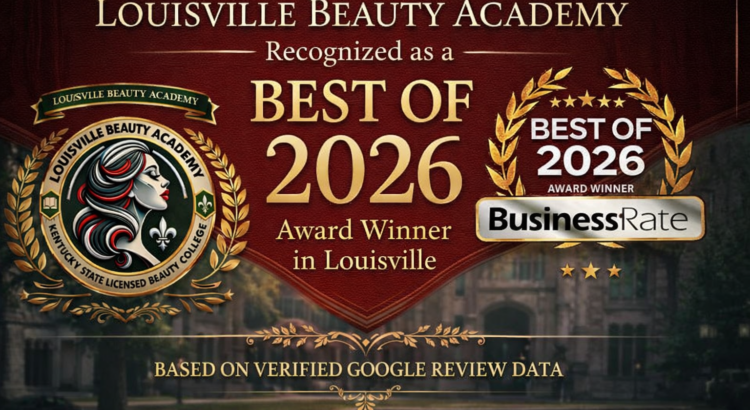
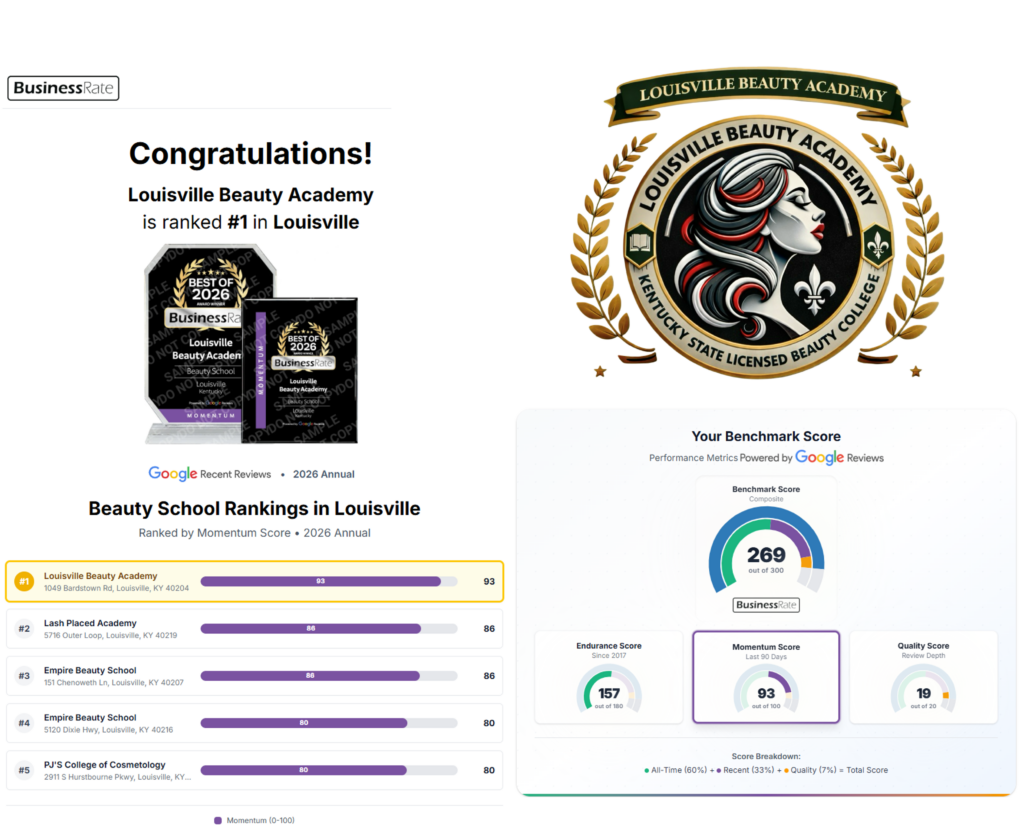
Louisville Beauty Academy is sharing that BusinessRate identified the school in a 2026 local award listing within the Beauty School category, based on the third-party review data and methodology described by that publisher at the time of evaluation.
This recognition was not requested, applied for, or sponsored by Louisville Beauty Academy. It reflects independent third-party analysis of publicly available customer feedback and review data, as compiled and certified by BusinessRate.
At Louisville Beauty Academy, we view recognitions such as this not as a claim of superiority, but as a moment of accountability to the community we serve.
A Reflection of Student and Community Voice
The BusinessRate award is based on measurable indicators including:
Verified Google customer reviews
Consistency of feedback over time
Overall customer satisfaction signals
We recognize that these outcomes are a direct reflection of the experiences of our students, graduates, and community partners.
Our Ongoing Commitment
While rankings and recognitions may change over time, Louisville Beauty Academy remains committed to the principles that define our institution:
Lower-Debt Educational Structure Programs publicly presented as structured to reduce financial burden and reliance on federal student-loan systems
Compliance-Focused Operations Ongoing effort to operate in line with current Kentucky laws, regulations, and school obligations
Career-Focused Training Programs designed for immediate workforce entry and real-world application
Student-Centered Approach Daily discipline, consistency, and individualized support for every learner
Recognition Is Temporary — Standards Are Permanent
Louisville Beauty Academy acknowledges that third-party rankings are dynamic and subject to change. As such, we do not rely on rankings as a measure of identity, but rather as one of many indicators of performance at a given point in time.
Our focus remains unchanged:
To earn trust daily through action, compliance, and measurable student outcomes.
View the Recognition
The original BusinessRate recognition materials are presented below exactly as received, without modification, in the interest of transparency and accuracy.
Important Disclosure
This recognition is issued by a third-party platform (BusinessRate) based on analysis of publicly available online review data at a specific point in time. Louisville Beauty Academy did not control or influence the methodology, criteria, or outcome. Rankings and positions may change over time and do not constitute accreditation, licensure endorsement, or a permanent status.
About Louisville Beauty Academy
Louisville Beauty Academy is a Kentucky state-licensed beauty college committed to delivering affordable, lower-debt, and compliance-driven vocational education. The institution focuses on preparing students for licensure, employment, and long-term professional success through structured, real-world training models.
This article is part of LBA’s public education and historical archive. Older posts, including “The Career Credit Master Plan: A Reputation-Based Paradigm for the Louisville Beauty Academy – RESEARCH AND PODCAST SERIES 2026,” may not reflect current tuition, schedules, incentives, forms, policies, testing vendors, clinic availability, or regulatory requirements.
Louisville Beauty Academy operates under a Gold-Standard Over-Compliance framework—meeting all licensing requirements while exceeding regulatory expectations through transparency, documentation, and proactive consumer protection.
Executive Summary
The vocational education sector is currently navigating a period of profound structural transformation, transitioning from a static credential-based model to a dynamic, reputation-based “proof-of-work” economy. For institutions like the Louisville Beauty Academy (LBA), the challenge lies in bridging the gap between traditional state-mandated licensure and the modern requirements of the digital creator economy. This master plan outlines an interdisciplinary framework for a “Career Credit Score” system—a comprehensive, over-compliant social media and professional progress system designed to begin on day one of enrollment and persist beyond graduation. By leveraging the behavioral psychology of public accountability and the economics of social signaling, this system formalizes the student’s daily learning journey as a measurable professional asset.1
The core objective is to position LBA as a national leader in ethical creator education, moving beyond the simple “acquisition of hours” toward the “accumulation of reputation.” The Career Credit Score (CCS) serves as an analogue to a financial credit score, where daily posts act as career deposits and professionalism serves as the ultimate measure of creditworthiness.4 This system provides students with a structured ladder of progression, moving from the “Zero Stage” of novice observation to the “Mastery Stage” of mentorship and public signalization.6 Crucially, the plan is designed with an “over-compliant” posture, ensuring that all student activities strictly adhere to the Kentucky Board of Cosmetology (KBC) statutes and Federal Trade Commission (FTC) endorsement guidelines.8
Through a sophisticated incentive model, students can earn significant tuition discounts based on their consistency, ethical conduct, and proof-of-learning, effectively lowering the financial barriers to high-quality vocational education while simultaneously increasing graduate employability.11 This plan does not merely teach beauty skills; it equips “Human Service Professionals” with the digital fluency and verifiable reputation needed to thrive in an era where trust is the primary currency of the beauty industry.13
Research and Psychological Foundations
The foundation of the LBA Career Credit system is built upon a synthesis of behavioral science, trust economics, and educational theory. Understanding why “learning in public” works requires an analysis of the psychological mechanisms that drive accountability and the economic signals that establish professional prestige.
Behavioral Psychology of Public Accountability
Research in public employee behavior and health interventions suggests that accountability is a multi-dimensional construct involving observability, evaluability, and answerability.1 When a student makes a “public announcement” of a goal—such as mastering a specific sectioning technique—the digital platform acts as a “commitment device”.2 These devices help individuals “lock themselves” into a behavior by creating a psychological penalty for deviation and a social reward for adherence.15
In the context of LBA, daily posting creates a “felt accountability.” While high-intensity monitoring can sometimes reduce intrinsic motivation, a system that emphasizes “accountability obligation”—the perceived duty to justify actions to a supportive audience—actually enhances work drive.1 This is particularly effective when students interpret the obligation as an opportunity to gain professional benefits rather than a coercive requirement. By documenting the “messy middle” of the learning process, students move from passive learners to active practitioners who are “answering” to their future professional selves and their burgeoning audience.
Habit Formation and Daily Proof-of-Work
The transition from a student mindset to a professional identity requires the formation of consistent habits. The “daily proof-of-work” theory posits that a live pulse of activity is a more reliable indicator of skill than a static portfolio.6 In technical fields like coding, a “contribution graph” showing daily commits is impossible to fake and serves as a verified record of problem-solving processes.6
For beauty professionals, this translates to documenting the micro-decisions of the craft. Research into sustainable skincare marketing suggests that “decision documentation”—filing 30 seconds of a consultation or explaining why a specific pH-balanced product was chosen—builds deeper trust than a polished, final image.16 Psychologically, this “raw” and “authentic” content resonates more with modern consumers who are skeptical of highly curated, AI-generated, or “too polished” feeds.17
Social Signaling and Trust Economics
In a labor market with “asymmetric information,” where employers cannot perfectly know a candidate’s skill level, they rely on signals. Traditional signaling theory, as explored by Bryan Caplan, suggests that much of the return on education is a return on the “shiny credential” rather than the skill itself.19 However, the Career Credit Score seeks to shift this dynamic toward “Skill Signaling,” which focuses on digital, transversal, and sector-specific competencies.20
Social trust is a “commodity” built through repeated interactions and the assessment of a truster’s competence and goodwill.21 A student who has documented 1,500 hours of professional growth 8 provides a “trust graph” that reduces the risk for a potential salon owner. This creates a “cyclical model” of social exchange where the student’s signaled reputation leads to better placement, which in turn reinforces the school’s brand equity.3
Psychological Concept
Mechanism
Application in LBA System
Commitment Device
Social penalty for failure 15
Daily posting “deposits” 2
Felt Accountability
Answerability to an audience 1
Weekly instructor reviews 24
Instrumental Learning
Reinforcing presumptions of trust 21
Documenting micro-decisions 16
Social Signaling
Reducing information asymmetry 3
Verifiable digital portfolios 6
Authenticity Bias
Preference for unfiltered growth 18
“Zero Stage” confessions 18
The Career Credit Framework
The “Career Credit Score” is a formalized, numerical representation of a student’s professional standing, calculated using an algorithm that weights consistency, proof-of-work, professionalism, and ethical compliance. Unlike social media “clout,” which is often ephemeral and based on popularity, Career Credit is a measure of “professional creditworthiness”.25
Defining the Algorithm
The LBA Career Credit Score (CCS) is modeled on a 300–850 scale, mirroring the FICO model used in financial sectors. The score is calculated using four primary components, each weighted to reflect its importance to a future employer and regulatory compliance.
Consistency (Weight: 35%): This is the equivalent of “payment history.” It measures the frequency of professional posts or “career deposits.” A missed day of documentation is recorded as a “late payment,” while sustained streaks build the score significantly.2
Proof-of-Skill (Weight: 25%): This represents “credit history.” It is the documented evidence of the student’s progression through the subject areas defined in 201 KAR 12:082, such as infection control, anatomy, and chemical services.7
Professional Conduct (Weight: 20%): This measures “credit mix.” It assesses the student’s poise, communication skills, and adherence to the LBA “Humanization of Education” philosophy.13
Regulatory Integrity (Weight: 20%): This is the “creditworthiness” factor. It tracks zero-violation streaks regarding KBC statutes and FTC disclosure guidelines.10
Career Deposits and Missed Payments
A student’s CCS is updated weekly. A “Career Deposit” is defined as a high-quality, educational, or progress-based post that includes the required LBA disclaimers.
Positive Impact: A “Career Deposit” adds +5 points to the weekly score.
Neutral Impact: Reposting industry news with a professional insight adds +2 points.
Negative Impact: A “Missed Payment” (failing to post for 48 hours without a prior “digital reset” request) subtracts -10 points.
Severe Impact: A compliance violation (e.g., performing a chemical service on a live person before 250 hours 23) results in a “Reputation Default,” resetting the score to 300 and triggering a formal review.29
Reputation Score Benchmarking
To provide context, LBA compares student scores against industry averages and “best-in-class” alumni. This benchmarking fosters continuous improvement and provides a clear signal to employers about where a student stands in their professional development.25
CCS Range
Professional Status
Market Implications
750 – 850
Elite Professional
High placement leverage; eligible for alumni mentorship roles.
650 – 749
Reliable Practitioner
Standard employment readiness; consistent work history.
550 – 649
Developing Talent
Emerging skills; needs focus on consistency and compliance.
300 – 549
High Risk / Probation
History of inconsistency or ethical breaches; requires remediation.
Student Learning Progression Model
The Career Credit system utilizes a five-stage ladder of progression. This model ensures that students do not feel pressured to “fake it” but instead find power in their evolution from a novice to a master. Each stage specifies what to post, the psychological reasoning behind it, and the compliance guardrails necessary to protect the student and the academy.
Stage 1: The Zero Stage (The Foundation)
Focus: Identity reset and the commitment to learn. This occurs during the first two weeks of enrollment.
What students post: A “Social Media Reset” announcement; an unboxing of their professional student kit; a video discussing their “Why” and their decision to join LBA.8
Why it works: It establishes a “vulnerability hook.” By admitting they are starting at zero, they build an empathetic connection with their audience, who will then feel invested in their growth.16
Compliance: Posts must clearly state: “Student at Louisville Beauty Academy. Not licensed to perform services for hire.”
Caption Prototype: “Day 1 at LBA! Today I’m resetting this page to document my journey from student to professional. I’m starting with the basics—Infection Control. Safety first! #LBAStudent #BeautyJourney”
Stage 2: The Awareness Stage (The Science)
Focus: Vocabulary, theory, and the “Invisible Skills.” This aligns with the first 100–150 hours of instruction.23
What students post: Videos of themselves studying anatomy and physiology; “Did you know?” posts about the chemistry of hair color; time-lapses of workstation sanitation.8
Why it works: It builds authority. By focusing on the science rather than the art, the student signals that they are a serious, knowledge-based professional.8
Compliance: No mentions of performing services on people. Focus remains on “Scientific Lectures” per 201 KAR 12:082.23
Caption Prototype: “Studying the skeletal system today. Understanding the structure of the head and neck is vital for a proper consultation. Science is the backbone of beauty! #AnatomyClass #LBA”
Stage 3: The Practice Stage (The Proof-of-Work)
Focus: Hands-on repetition on mannequins. This is the “Messy Middle” of the program.
What students post: “Mistakes I made today” videos; time-lapses of winding perms or applying color to a mannequin head; “Practice makes progress” reels.6
Why it works: It demonstrates grit and technical skill development. Seeing the student struggle and then succeed creates a powerful narrative of competence.6
Compliance: Must explicitly state that work is being done on a mannequin.
Caption Prototype: “My fifth time winding a perm rod today. Still working on my tension, but the sectioning is getting cleaner! Repetition is key to mastery. #MannequinPractice #ProofOfWork”
Stage 4: The Competency Stage (The Clinic Floor)
Focus: Supervised services on live models. This begins after 250 hours (for Cosmetology) or other program-specific milestones.23
What students post: Before-and-after transformations; client consultations (with permission); documenting the consultation “decision-making” process.7
Why it works: Social proof. It shows that real people trust the student and that the student can deliver results in a professional clinic environment.24
Compliance: Must state that services were performed under instructor supervision at LBA.24
Caption Prototype: “Today’s transformation! We chose a level 7 ash to neutralize warmth, keeping the hair’s integrity first. All services performed under supervision at LBA! #ClinicFloor #HairTransformation”
Stage 5: The Mastery Signal Stage (The Educator)
Focus: Teaching, explaining, and mentoring others. This begins in the final phase of the program and continues as an alumnus.
What students post: Tutorials explaining a technique to junior students; reviews of industry trends; reflections on the “Humanization of Education”.13
Why it works: The “Protégé Effect.” Teaching a concept is the highest signal of mastery. It positions the graduate as an industry leader, not just a practitioner.1
Compliance: Use of the “Alumni” tag and verification of licensure.8
Caption Prototype: “Explaining the logic of color theory to our new class at LBA. To master the art, you have to mentor the next generation. #BeautyEducator #LBAAlumni”
Step-by-Step LBA Implementation Plan
Operationalizing the Career Credit system requires a disciplined, multi-phase rollout that integrates with LBA’s existing curriculum and administrative protocols.
Phase 1: Orientation and the Social Media Reset
During the first week, students undergo a “Digital Brand Audit.” This is a mandatory component of their “Professional Image” curriculum.23
Account Audit: Students must review their public profiles and archive content that is inconsistent with a “Human Service Professional” identity. This includes content depicting unprofessional behavior or non-compliance with health standards.18
Platform Setup: Students are required to have professional profiles on Instagram and TikTok. LinkedIn is highly recommended for B2B networking and employer visibility.13
The Disclaimer Protocol: Every bio must include: “Professional Student at @LouisvilleBeautyAcademy | Future | Not for hire until licensed.”
Privacy/Security Workshop: Education on protecting personal data and handling “online drama” or cyberbullying.35
Phase 2: Daily Career Deposits
LBA implements a “Daily Documentation” rule. Students are given 15 minutes at the end of each theory or clinic session to capture content.8
Frequency: Minimum of 3 professional posts per week.
Approved Formats: Short-form video (Reels/TikTok) for skills; Carousel posts for “Decision Documentation”; Stories for daily “Aha!” moments.16
The “Human Review” Protocol: Instructors do not grade based on “likes” but on a rubric of professionalism, sanitation, and educational accuracy.24
Phase 3: Ethical AI Integration
LBA adopts a “Max AI” policy for administrative and creative support but maintains strict ethical boundaries for clinical representations.13
Authorized Use: Using Generative AI for caption brainstorming, keyword research, and video script outlines.38
The 65% Rule: At least 65% of any written caption must be human-authored to ensure authenticity and “Humanization”.38
Prohibited AI: No AI-generated or “filtered” images of hair or skin results. This is a deceptive statement and a violation of KBC photo standards.14
Disclosure: Any AI-assisted content must include the tag #AIApprentice or a similar disclaimer.40
Phase 4: Instructor and Administrative Audit
LBA establishes a “Reputation Bureau” to manage the Career Credit Scores.
Weekly Score Update: The CCS is recalculated every Sunday based on the week’s deposits and classroom conduct.
Monthly Compliance Audit: A deep-dive review of student accounts to ensure FTC disclaimers and KBC rules are followed.28
Score Grievance Procedure: Students can appeal a score deduction through the official LBA written grievance process.8
Incentive and Discount Model
To drive adoption and ensure high-quality participation, LBA links the Career Credit Score to a fair and transparent tuition discount model. This transforms “tuition” from a fixed cost into a performance-based investment.
The Career Credit Discount Rubric
Students are eligible for “Merit Scholarships” and “Performance-Based Incentives” that can reduce the total program cost significantly.11 These are not “tuition reductions” but optional, merit-based discounts.11
Performance Category
Metric
Score Requirement
Discount/Perk
Consistency King
100% posting rate for 90 days
CCS > 700
$500 Tuition Credit
Compliance Hero
Zero compliance flags for 180 days
CCS > 750
$1,000 Scholarship
Technical Master
Verified Stage 4 Documentation
Instructor Approval
$1,500 Skill Credit
Alumni Leader
Continued Stage 5 posting
Post-Graduation
Free Alumni Tutoring 8
Anti-Gaming and Safeguards
LBA employs a “Checks and Balances” system to protect the integrity of the discounts.13
Attendance Synchronization: Discounts are only applied if a student maintains the required attendance hours (30–40 hours for Full-Time).11
Plagiarism Penalty: Using another student’s work as one’s own results in the permanent loss of all social-media-based incentives.11
Financial Good Standing: Hours are only certified and discounts applied if the student’s account is current.11
Tax Compliance: All tuition reductions are structured to comply with IRS Section 117(d) regarding qualified tuition reductions for educational institutions.43
Auditability for Regulators
LBA maintains digital records of all student posts, instructor reviews, and score calculations for a minimum of five years.8 This ensures that the institution can defend its incentive model to state and federal regulators as a legitimate “educational performance” metric rather than “marketing compensation.”
Compliance and Risk Management
A gold-standard system must be “over-compliant.” This section outlines the non-negotiable boundaries that protect LBA, its students, and the public.
Kentucky Board of Cosmetology (KBC) Adherence
Kentucky law is strict regarding unlicensed practice.10 LBA’s system manages this through:
The “No-Pay” Rule: Students are explicitly forbidden from accepting consideration (money or gifts) for services performed outside of the LBA clinic floor.10
Mobile Prohibitions: While Kentucky allows mobile barber shops, mobile cosmetology is strictly limited. Students must not document or perform services in “home salons” or non-licensed facilities.32
Sanitation Documentation: Every video documenting a service must show visible sanitation steps (e.g., sanitizing hands, disinfecting tools) to reinforce “Lifelong Professional Ethics”.8
FTC Endorsement and Social Media Law
The FTC’s 2024–2025 updates require “clear, conspicuous, and unavoidable” disclosures.9
Disclosure Placement: Disclosures must be verbal AND written on the screen for video content. Simply putting #ad or #LBA in the caption is insufficient for Reels and TikTok.28
Honest Opinions: Students must only give honest reviews of products they have actually used.9
Material Connections: Because students receive tuition discounts for their posts, they must disclose this “material relationship” in every progress-related post.42
Privacy and Consumer Protection
Client Consent: No client images or videos may be posted without a signed LBA model release form.7
Data Protection: Students are trained to never post sensitive institutional data or personal information about staff and peers.11
Cyber-Safety: LBA provides tools and training for students to manage privacy risks associated with a public-facing digital career.37
Brand and Market Positioning
The implementation of the Career Credit system differentiates Louisville Beauty Academy from all other regional and national competitors. It rebrands the school from a “training facility” to a “professional reputation engine.”
Positioning LBA as a “Future-Ready” Institution
LBA’s brand is built on “Transparency and Genuine Care”.47 By teaching students to build verified proof-of-work, LBA addresses the primary concern of modern beauty employers: “Can this person actually do the work, and will they show up?”.3
Messaging Pillars:
The Proof-of-Work School: We don’t just teach; we document excellence.
Career Credit, Not Just Hours: Your reputation starts on day one.
Humanization through Technology: We use AI to make you more human, not less.
Lower-Debt Dignity: Earn your way to a professional future without the burden of federal loans.12
Reassuring Regulators and Parents
LBA positions itself as the “Public Library” of beauty education—an open, accessible, and highly regulated environment where knowledge is democratized.13
To Parents: LBA offers a “Safe, Legal, and Affordable” path to a high-demand career, where their child’s professional reputation is built under expert supervision.13
To Regulators: LBA provides a model for “Over-Compliance,” showing how social media can be used to increase adherence to sanitation and ethics rather than bypass them.8
The Alumni Brand Flywheel
The Career Credit Score does not end at graduation. LBA invites alumni to maintain their scores through continued mentorship and participation in the “2026 Magazine and Podcast Series”.13 This creates a long-term network of successful, digitally fluent professionals who serve as living proof of the LBA model.
Long-Term Impact and Metrics
The success of this system will be measured through a combination of traditional educational metrics and new reputation-based indicators.
Measurable Outcomes
Retention Rate: Students with high Career Credit Scores are expected to have a 25% higher completion rate due to the psychological “locking” effect of public commitment.2
Job Placement Leverage: LBA graduates will enter interviews not with a resume, but with a “Reputation Portfolio” showing 1,500 hours of growth.13
Audience Trust Score: A monthly sentiment analysis of student accounts to ensure that engagement is professional and educational.
Licensing Success: Continued 100% alignment with PSI and KBC requirements, with students demonstrating higher confidence during the practical exam.8
The Vision for “Di Tran University”
The Career Credit system is the first step toward the broader “Humanization of Vocational Education”.13 By integrating these digital and psychological frameworks, LBA evolves into a “Human Service Professional” academy, where the beauty license is merely the legal foundation for a career built on trust, ethics, and verified excellence.
Metrics & Success Measurement
To ensure the master plan achieves its intended impact, LBA will track the following metrics:
Metric
Goal
Tracking Mechanism
Average Graduate CCS
> 725
Quarterly reputation audits
Employer Satisfaction
95% Positive
Post-placement surveys focusing on “Soft Skills”
Student Debt Ratio
< 10% of Income
Analysis of net tuition vs. entry-level salary 50
Social Media Reach
100K+ Monthly (Aggregated)
Platform analytics across the student body
Compliance Flag Rate
< 1%
Weekly internal reputation bureau reviews
Conclusions
The Louisville Beauty Academy Career Credit system represents the gold standard for 21st-century vocational training. By acknowledging that a student’s “reputation” begins long before they receive a physical license, LBA equips its graduates with the ultimate competitive advantage: a verifiable history of hard work, ethical behavior, and professional growth. This system reduces student risk, elevates the entire beauty industry, and provides a defensible, innovative model for the future of professional education. Through the careful integration of behavioral psychology, trust economics, and rigorous compliance, LBA does more than teach beauty—it builds the future of professional trust.
Deep Reputation Scoring in DeFi: zScore-Based Wallet Ranking from Liquidity and Trading Signals – arXiv, accessed February 1, 2026, https://arxiv.org/html/2507.20494
Guidelines for Appropriate Use of AI Generated Media – Division of Strategic Communications | The University of Alabama, accessed February 1, 2026, https://stratcomm.ua.edu/ai-guidelines/
This article is part of LBA’s public education and historical archive. Older posts, including “From Class to Career: A Kentucky Beauty Student Guide for 2026,” may not reflect current tuition, schedules, incentives, forms, policies, testing vendors, clinic availability, or regulatory requirements.
The vocational education landscape in the Commonwealth of Kentucky has undergone a fundamental shift as of 2026. The convergence of regulatory rigor, technological advancement through artificial intelligence, and a renewed focus on the human element of service has created a new paradigm for beauty professionals. This guide, developed for the Louisville Beauty Academy (LBA) and powered by the philosophical foundations of Di Tran University – The College of Humanization, serves as a comprehensive resource for students navigating the transition from the classroom to a sustainable, dignified career. In an era where technological efficiency often threatens to overshadow human connection, this document provides the strategic framework necessary to protect the financial, professional, and personal interests of the next generation of Kentucky practitioners.
The Philosophical Foundation: Humanization in the AI Era
The American system of higher education stands at a precarious crossroads, often privileging academic abstraction over human connection and high-cost degrees over accessible vocational mastery.1 In contrast, the model of humanization posits that education must serve as a mechanism for restoring personal dignity and community uplift.3 This philosophy is central to the mission of institutions like Louisville Beauty Academy, which view the beauty professional not merely as a technician, but as a “Human Service Professional”.3
The Triadic Learning Architecture defines this approach, consisting of three interwoven pillars: the College of AI, the College of Human Service, and the College of Humanization.5 This structure ensures that while technology handles the administrative and scientific heavy lifting, the human professional remains focused on empathy, customer service, and interpersonal communication—skills that combat the pervasive challenge of modern loneliness.5 For the student, this means an education that emphasizes the “Yes I Can” mindset, dismantling the “Imposter Syndrome” that often plagues first-generation, low-income, or immigrant learners.3
Navigating the Kentucky Regulatory Landscape
The Kentucky Board of Cosmetology (KBC) maintains strict oversight of the beauty industry to ensure public health and safety. Understanding these regulations is the first step in professional protection. The administrative regulations, specifically 201 KAR 12:082, establish the required hours and courses of instruction for all licensed practices in the Commonwealth.6
Mandatory Training Hours and Curriculum Ratios
The training requirements for 2026 are meticulously balanced between scientific theory and clinical practice. This ratio is designed to ensure that practitioners understand the chemistry and biology of the services they provide before engaging with the public.
Program Type
Total Required Hours
Science & Theory (Lecture)
Clinic & Practice
Kentucky Law & Regulations
Public Service Threshold
Cosmetology
1,500
375
1,085
40
250 Hours
Esthetics
750
250
465
35
115 Hours
Nail Technology
450
150
275
25
60 Hours
Apprentice Instructor
750
N/A
425 (Direct Contact)
N/A
N/A
Shampoo Styling
300
N/A
N/A
N/A
N/A
Cosmetology students must complete a minimum of 1,500 hours, which includes 375 hours of science and theory and 1,085 clinic hours.6 A critical safety regulation prohibits cosmetology students from performing chemical services on the public until they have completed at least 250 hours of instruction.6 Similarly, nail technician students must reach 60 hours and esthetician students 115 hours before providing services to the general public.6
The Doctrine of Over-Compliance: A Protective Strategy
For the student, the concept of “Over-Compliance” is a vital safeguard against administrative delays or the loss of earned credit hours. This approach involves operating intentionally above the minimum legal requirements through meticulous documentation and proactive education.7
A common point of failure for students is the documentation of extracurricular hours earned at hair shows, field trips, or charity events. To ensure these hours are credited, the gold-standard procedure requires that the school notify the KBC at least five business days before the event.7 Following the event, a “Certification of Student Extracurricular Event Hours” must be completed and uploaded to the individual student’s KBC record within ten business days.7 Any deviation from this timeline or the failure to upload individual forms to individual records can result in hours being denied by the Board.7
Managing Program Transfers and Credit Recognition
Students transferring from other institutions or states must navigate the KBC’s strict transfer protocols. A “Program Transfer Form” must be submitted and verified by the KBC before a student is officially credited for prior work.7
Prior License or Experience
Max Credit Toward Cosmetology Program
Current Esthetics License
400 Hours
Current Nail Technologist License
200 Hours
Current Shampoo Styling License
300 Hours
Current Barber License
750 Hours
These credits only become effective once the student completes the remaining hours necessary for the full cosmetology license.7 Furthermore, out-of-state or barber hours must be certified by the original licensing agency before Kentucky will recognize them.7 Students are advised to ensure these certifications are on file with the KBC office prior to enrollment at a new school to avoid “orphan hours” that cannot be officially tracked.7
Decoding the Financials: Avoiding the Debt Trap
One of the most significant challenges facing beauty students in 2026 is the “Debt Trap”—the accumulation of high-interest federal student loans for programs that could be completed at a lower cost. The traditional vocational education model often prioritizes the capture of Title IV federal funds (Pell Grants and Stafford Loans) over the financial long-term health of the student.8
The Mechanics of the FAFSA/Loan Cycle
Federal student loans disbursed between July 1, 2025, and June 30, 2026, carry fixed interest rates and origination fees that can significantly increase the total cost of education.
Loan Type
Fixed Interest Rate (2025-2026)
Origination Fee
Direct Subsidized (Undergraduate)
6.39%
1.057%
Direct Unsubsidized (Undergraduate)
6.39%
1.057%
Direct PLUS (Parent/Graduate)
8.94%
4.228%
These rates are determined by the 10-year Treasury note yield plus a set margin.10 For a cosmetology student taking the national average of $10,000 in student loan debt, the interest alone over a 10-year repayment period adds thousands of dollars to the total price.9 In contrast, the total tuition at Louisville Beauty Academy for a cosmetology program is under $7,000, which is often 50–75% lower than the tuition at schools relying heavily on federal loans.12
The “Double Scoop” Benefit and Cash-Based Models
The “Double Scoop” benefit refers to the compounding financial advantage of saving on tuition and entering the workforce sooner. By avoiding the prolonged programs designed to maximize federal aid, students can graduate and start earning faster.12
Program Path
Tuition Cost
Graduation Timeline
Career Impact
Typical Debt-Based Model
$17,000 – $27,000
12-18 Months
$10k+ Debt + Interest
LBA Cash-Based Model
Under $7,000
9-12 Months
Lower-Debt + Early Earnings
The math reveals a nearly $20,000 “swing” in favor of the lower-debt student. This consists of roughly $10,000 kept upfront in tuition savings and an extra $8,000 to $10,000 earned by entering the job market three to six months earlier.12 This model relies on pay-as-you-go systems and internal scholarships, which are intentionally designed to make federal loans unnecessary.13
AI as a Tool for Literacy, Learning, and Administrative Protection
In the 2026 educational environment, artificial intelligence serves as a critical ally for students, particularly those who may face language barriers or who have been out of an academic setting for an extended period. AI is not a replacement for human skill, but a tool for “Humanized Efficiency”.5
Overcoming Literacy Barriers and Language Gaps
For immigrant and multilingual students, the technical jargon of the beauty industry and the complexities of regulatory law can be significant obstacles. AI tools are utilized to simplify these concepts into clear, plain English, ensuring that a student’s lack of fluency in English does not prevent their mastery of the craft.4 The “College of AI” pillar provides personalized, automated instruction that allows students to pace their learning according to their individual needs.5
AI for Administrative Efficiency and the “Administrative Tax”
Higher education institutions often apply “indirect cost rates” or “administrative taxes” to cover overhead, which can account for up to 26–33% of a university’s budget.14 In the beauty school context, these costs are often passed on to the student in the form of higher tuition. By using AI to automate administrative tasks—such as hour tracking, documentation, and compliance checking—schools can reduce this “administrative tax” and pass the savings directly to the student.5
Practical AI Prompts for Student Empowerment
Students are encouraged to use AI as a “thinking partner” to navigate their education and protect their interests.
Contract Analysis: Students can prompt AI to “Analyze this enrollment contract and identify all clauses related to tuition refunds, attendance requirements, and additional fees”.17
Financial Comparison: AI can be used to “Compare the total cost of a $15,000 loan at 6.39% interest over 10 years versus a cash-based tuition of $7,000 paid monthly”.18
Career Planning: Students may ask AI to “Identify the highest-paying salon cities in Kentucky for nail technicians based on 2026 data”.20
Digital Proof-of-Work: The Modern Portfolio and Branding
In the visual-centric world of beauty, a traditional resume is no longer sufficient. The “Digital Proof-of-Work” portfolio has become the industry’s gold standard for demonstrating competency and professionalism.21
Constructing a Visual Resume
A successful portfolio must tell a story of transformation and technical skill. It is essential to start documenting work early in the program, beginning with mannequins and classmate practice.21
Portfolio Category
Required Elements
Strategic Insight
Before-and-After
Consistent lighting and angles
Proves the ability to create measurable change
Technical Range
Texture work, color, cuts, and styles
Demonstrates versatility for diverse clients
Sanitation
Photos of disinfected stations and tools
Builds trust and proves professional ethics
Testimonials
Quotes from models or clinic clients
Provides social proof of customer service
Certifications
Awards, lash mapping, or chemical protocols
Adds academic weight to technical skill
Photography is the foundation of the digital portfolio. Natural light, simple backgrounds, and multiple angles are necessary to ensure the work is represented accurately.21 Students must avoid the use of social media filters, as they can be seen as deceptive in a professional context.25
The Ethics of Client Consent and Content Creation
As beauty professionals are also content creators, they must adhere to strict ethical guidelines regarding client privacy. A gold-standard portfolio always includes “Media Release Forms” or “Client Consent Forms”.22 This documentation protects the professional from legal disputes and signals to prospective employers that the student understands the legalities of brand management.22
Sanitation as a Branding Tool
In 2026, sanitation is not just a regulatory requirement; it is a competitive advantage. Portfolios that include “Setup and Sanitation” photos or videos demonstrate a commitment to client safety that sets a student apart from the competition.27
Sanitation Protocol
Frequency
Evidence for Portfolio
Handwashing
Before and after every client
Video of proper handwashing technique
Tool Disinfection
After every single use
Photos of tools in EPA-registered solution
Station Reset
Between every guest
Before/after shots of a sanitized station
PPE Usage
During chemical or skincare services
Photos of professional apron, mask, and gloves
Proper tool care involves deep cleaning brushes and sponges after each use with antibacterial cleansers and ensuring that reusable tools like combs and scissors are fully submerged in disinfectant solutions.29
Transitioning to the Workforce: The First 90 Days
The first three months post-graduation are a period of significant growth and risk. Kentucky’s licensing structure includes a mandatory apprenticeship that provides a structured transition into the professional world.
The Kentucky Apprenticeship Period
After passing both the written and practical examinations, Kentucky cosmetologists must complete a six-month apprenticeship.31
Work Requirements: Apprentices must work a minimum of 20 hours per week in a licensed salon under the supervision of a licensed cosmetologist.31
License Validity: The apprentice license is valid for up to 18 months, allowing time for the completion of the 6-month requirement and final testing if necessary.31
Client Building: This period is designed for “Real-World Salon Experience,” where the apprentice learns the pace of a commercial environment while still having the protection of a mentor.31
Choosing an Employment Model: Independence vs. Support
The choice between working as a commission-based employee or a booth-rental independent contractor is a critical business decision.
Employment Model
Primary Benefit
Primary Risk
Commission (W-2)
Mentorship, stability, shared marketing
Lower percentage of individual sales
Booth Rental (1099)
Full independence, schedule control
High overhead, self-employment taxes
For most new graduates, the commission model is recommended. It provides a guaranteed wage (at least minimum wage for all hours worked) and covers the employer’s portion of Social Security and Medicare taxes.32 Booth rental is often risky for those without a pre-existing clientele, as the “hidden costs”—including rent, insurance, products, and marketing—can quickly lead to burnout or financial failure.32
Independent Contractor Law and Misclassification
In Kentucky, the distinction between an employee and an independent contractor hinges on the “Control Test.” If a salon owner dictates a worker’s hours, set prices, and provides tools, that worker is likely an employee (W-2) and should be receiving benefits like unemployment insurance and workers’ compensation.35 Misclassification occurs when a salon owner exerts control over a worker but treats them as a 1099 contractor to avoid taxes.37 Professionals must ensure they have a written contract that clearly defines their status and protects their rights.34
Economic Reality: Kentucky Salary and Career Outlook
The beauty industry in Kentucky remains a resilient and adaptable career choice. As of 2026, salary data shows significant variance based on location and specialization.
Professional Role
Entry-Level Salary
Mid-Career Salary
90th Percentile
Cosmetologist
$30,441
$40,327
$48,493+
Nail Technician
$21,738
$37,468
$52,545+
Esthetician
$26,000
$45,000
$62,000+
Location plays a pivotal role in earning potential. For example, nail technicians in Hyden ($44,998) and Corbin ($43,137) earn significantly more than the state average, likely due to a higher concentration of demand relative to the number of licensed practitioners.40 In Louisville, the average salary for a nail technician is approximately $41,449, with top earners exceeding $52,000.40
The CEO Mindset and Long-Term Stability
Every beauty professional is the “CEO” of their own business, regardless of their employment model.25 This requires a commitment to financial management, professional reputation, and staying abreast of changing laws. In 2026, Kentucky has moved toward restricting non-compete agreements, particularly for those earning below certain thresholds, ensuring that professionals can take their talents and their client lists with them if they choose to change salons.42
Strategic Questions for Evaluating Beauty Schools
To protect their future, students must evaluate schools with the same rigor they would any other significant investment.
Regulatory Transparency: Does the school provide a clear, written timeline for how and when my hours will be uploaded to the KBC? 7
The Lower-Debt Pathway: What are the internal scholarship options that make federal loans unnecessary? 13
Student Labor Policies: Does the curriculum focus on my education, or am I being used as unpaid labor for a school-run salon? 8
AI Integration: How is the school teaching me to use artificial intelligence to manage my business and literacy? 5
Conduct and Safety: What is the school’s policy on gossip and drama, and how do they protect the “sanctuary” of the learning environment? 3
Career Support: Does the school provide specific training for the mandatory apprenticeship and the transition into the first 90 days of work? 31
Conclusion: The Path to Professional Dignity
The transition from a beauty student to a career professional in Kentucky is a journey of both technical mastery and personal transformation. By embracing the philosophy of humanization, prioritizing over-compliance, and avoiding the long-term burden of educational debt, students can secure a future that is both financially stable and personally rewarding.
In the AI era, the “Gold Standard” of practice is not just about the quality of the haircut or the facial; it is about the integrity of the professional behind the chair. The Kentucky beauty professional who operates with transparency, follows the doctrine of love and care, and utilizes technology to enhance human connection will find themselves at the forefront of a thriving industry. This guide provides the foundation—now, the student must apply the “Yes I Can” mindset to build their beautiful future.
Introduction: A Model Worth Scaling Louisville Beauty Academy (LBA) is an award-winning, immigrant-led beauty college headquartered in Louisville, Kentucky. We deliver licensed, state-approved cosmetology and esthetics education that is affordable, fast-paced, and trauma-informed. Our flexible, multilingual model empowers underserved populations—immigrants, refugees, single parents, and adult learners—to build meaningful careers in beauty. Today, we are launching a national expansion campaign with a mission to bring this life-changing education to communities that need it most.
We are proud Americans. Proud Louisvillians. Proud Kentuckians. Proud beauty professionals. And now, we’re proud to take this scalable, nationally recognized model to cities across Kentucky and Southern Indiana—with franchise and license opportunities open to those who share our purpose.
Our National Model: Why It Works LBA is more than a beauty school—it’s a community lifeline built on four cornerstones:
Affordable, Accessible Education – Low tuition, short programs, and zero student loan dependency.
AI-Augmented Systems – Automated compliance, learning, and licensing workflows for rapid scalability.
Hyperlocal, Humanized Curriculum – Delivered in English, Vietnamese, Spanish, and more—infused with trauma-informed teaching and entrepreneurship.
Speed to Launch – Facilities can be built out and opened in under 90 days using our proven blueprint.
Our Expansion Strategy: Where We’re Going & Why We’ve identified four regional hubs based on demographic need, property readiness, and community alignment:
1. Elizabethtown, KY (ZIP 42701)
Community Need: 55% of current beauty students come from households earning under $30K. Military spouses and local workforce need low-cost education.
Opportunity: Massive job growth due to Ford’s BlueOval SK Battery Park (5,000 jobs). Retail corridors (Ring Rd/Dixie Hwy) have properties ready for conversion.
2. Bowling Green, KY (ZIPs 42101, 42104)
Community Need: 14% foreign-born population; large Congolese, Afghan, and Burmese refugee presence.
Opportunity: Refugee resettlement hub with strong job demand. Properties like Fairview Plaza and Scottsville Rd offer scalable space.
3. Lexington, KY (ZIPs 40504, 40511, 40505)
Community Need: 35,000+ foreign-born residents, underserved ZIPs with limited beauty training access.
Opportunity: Modern strip centers and revitalized retail near Versailles Rd and New Circle Rd ready for licensing buildouts.
Community Need: Working-class populations with minimal beauty school coverage; proximity to Louisville metro.
Opportunity: River Falls and Jeffersonville plazas with large, affordable spaces and growing traffic corridors.
A Call to Franchisees, Licensees, & Partners We are actively seeking:
Franchisees and licensees ready to bring LBA to their communities.
Cosmetology professionals ready to lead or co-invest in new academies.
Faith-based, nonprofit, or community organizations seeking workforce solutions.
Impact investors, VCs, and CDFIs who care about educational equity and scalable job training.
LBA’s licensing model comes with curriculum, automation tools, launch support, and regulatory compliance blueprints—ready to go. Franchisees and licensees will be trained, supported, and guided with everything needed to replicate LBA’s success.
Why Invest in LBA Expansion?
📈 Massive demand for licensed beauty professionals across underserved regions
🧠 AI-enhanced systems ensure operational efficiency and state compliance
🤝 Humanized training model proven to uplift vulnerable populations
💸 Low startup costs and fast revenue timelines via our streamlined launch framework
🏆 Nationally recognized brand with local roots and measurable impact
Our Promise: Real Lives Transformed LBA’s students are often first-generation Americans, single mothers, and adults who’ve been told “no” by traditional education. At LBA, we show them “yes you can.” With every new academy, we change lives—not just with licenses and jobs, but with confidence, dignity, and hope.
We invite you to join us as a co-creator of something far bigger than a business—it’s a beauty education revolution.
Own a Beauty College. Build a Community. Partner with Louisville Beauty Academy to:
Launch a school where your people live.
Create jobs, boost local economies, and open pathways for overlooked talent.
Be part of the most productive, human-centered, affordable, AI-integrated cosmetology school model in America.
📩 Contact us to begin a conversation: [Insert contact info or website]
At Louisville Beauty Academy, we often hear the question: “Why should I go for beauty licensing and a career?” This question typically comes from those who are new to the beauty industry or considering it as a career path. For those who have always been passionate about beauty, the answer may already be clear—they know the industry is where their heart belongs. But for those still contemplating, let’s explore this question in depth, guided by the experience of Di Tran, our founder and CEO.
Understanding Beauty Licensing Requirements:
The Kentucky State Board of Cosmetology (KBC) mandates specific requirements for licensing in beauty fields, which vary slightly depending on your chosen career path—cosmetologist, nail technician, esthetician, or apprentice instructor. Here are the basic requirements:
Cosmetologist: 1500 hours, 12th-grade education or equivalent, and completion of a written and practical exam.
Nail Technician: 450 hours, 12th-grade education or equivalent, and completion of a written and practical exam.
Esthetician: 750 hours, 12th-grade education or equivalent, and completion of a written and practical exam.
Apprentice Instructor: 750 hours, 12th-grade education or equivalent, holding a license for at least one year in the respective beauty field, and completion of a written and practical exam.
Along with these requirements, specialized courses such as the newly added 300-hour Shampoo and Styling course, eyelash extension training, and other specialty permits are also available for those who want to expand their expertise.
Now, let’s delve into the reasons why pursuing a licensed beauty career could be one of the most rewarding decisions of your life.
1. Unlocking Creative Expression Through Licensing
A career in beauty is one of the rare paths where your creativity directly impacts your success. Licensing gives you the formal education and skills to not only express yourself but to offer professional, high-quality services that clients trust.
Di Tran, the founder of Louisville Beauty Academy, is a prime example of someone who has successfully blended his technical background as a computer engineer with his passion for beauty. After completing a Bachelor’s, Master’s, and PhD-level coursework in IT management, and holding one of the top three engineering titles out of 7,000+ engineers at a Fortune 50 company, Di Tran could have stayed in the tech world. But his love for the beauty industry drove him to become a licensed Nail Technician and to build a family business that now includes a series of nail salons, hair salons, and two beauty school locations.
For Di Tran, the transition into beauty wasn’t just about a career change—it was about finding a way to connect with people, create something beautiful, and make a tangible difference in the lives of others. Licensing opened that door.
2. Building Stability and Financial Independence
In today’s world, financial stability is a major concern for most people. The beauty industry offers not just creativity but also a stable and often lucrative career, particularly when you are licensed. With a license, you can work in established salons, spas, or even start your own business, giving you control over your financial future.
Licensing is your key to these opportunities. Without it, your career options in beauty are limited and less stable. With it, you can unlock a world of opportunity—whether that’s working as a freelance artist, opening your own salon, or becoming an educator.
Di Tran’s journey proves this. Despite his highly successful career in tech, he saw the immense potential in the beauty industry and decided to invest in licensing for himself and his family. Today, his beauty schools help hundreds of students become financially independent, teaching them the power of owning their skills and creating their opportunities.
3. Elevating Your Professional Credibility
A license is more than just a certificate—it’s a symbol of professionalism and trustworthiness. Clients are more likely to seek out and trust licensed beauty professionals because they know that these individuals are trained, skilled, and meet the highest industry standards. In a competitive market, your license sets you apart.
Imagine you’re a client looking for a service—whether it’s a manicure, a facial, or a haircut. Would you trust someone who is unlicensed and self-taught, or someone who has gone through the proper channels, trained under experts, and passed state-regulated exams? Licensing gives clients the peace of mind that they are receiving services from a true professional.
At Louisville Beauty Academy, we prioritize this professional growth. We guide our students through rigorous training, ensuring that when they graduate, they don’t just leave with a certificate—they leave with the confidence to make their mark on the industry.
4. Opportunities for Growth and Specialization
Once you are licensed, the opportunities for growth are endless. You can specialize in areas like eyelash extensions, advanced hairstyling, or medical esthetics, allowing you to continually expand your skillset. The Kentucky State Board of Cosmetology even offers pathways for you to acquire additional permits and specialize in specific services, making you even more marketable.
Di Tran is an advocate for lifelong learning and growth. Even after achieving incredible success in both the tech and beauty industries, he continues to push himself and his family to acquire new skills and certifications, ensuring they stay at the top of their game. This mindset of continuous improvement is something we instill in our students at Louisville Beauty Academy, empowering them to never stop learning and advancing.
5. Legal and Ethical Responsibility
The Kentucky State Board of Cosmetology has regulations in place to protect both beauty professionals and their clients. Licensing ensures that you understand the legal and ethical responsibilities of your profession, including proper sanitation, safety protocols, and business practices.
When you are licensed, you not only elevate your career but also commit to the well-being of your clients. This commitment is essential for building a lasting, successful career in beauty.
6. Flexibility and Control Over Your Career
One of the most appealing aspects of a licensed beauty career is the flexibility it offers. Whether you want to work part-time while raising a family, travel while freelancing, or open your own salon, beauty licensing gives you the control to shape your career the way you want.
Di Tran, despite his demanding schedule in other fields, has built a career in beauty that allows him to spend time with his family while simultaneously growing his businesses. Licensing gives you the freedom to do what you love while maintaining a work-life balance that suits your needs.
Conclusion: Take Action Now
At Louisville Beauty Academy, we believe that beauty is more than just a profession—it’s a calling that can provide you with freedom, creativity, and financial stability. We invite you to take the next step toward building a rewarding career by becoming part of our family. As one of the highly affordable, flexible, and caring beauty colleges in Kentucky, we’re here to support you every step of the way.
Don’t wait—enroll today! Text us at 502-625-5531 or email us at study@LouisvilleBeautyAcademy.net to start your journey with Louisville Beauty Academy, where we treat every student like family.
Report a website barrier or request help accessing information. Email Study@LouisvilleBeautyAcademy.net or text 502-625-5531. Include the page and what you were trying to do. Please do not send medical records or sensitive identifiers.
Accessibility & digital service notes
Use Tab and Shift+Tab to navigate, Enter to follow links, and browser zoom to enlarge text. The language selector supports Enter, Space, Tab, and Escape. Motion is reduced when your device requests it. Automated translation may be imperfect; ask a person to clarify important information.
Updated October 16, 2026. Work on accessibility is ongoing. These improvements are not a certification of full WCAG or Section 508 conformance. Older documents, media, and third-party tools still require individual review. About WCAG accessibility standards.