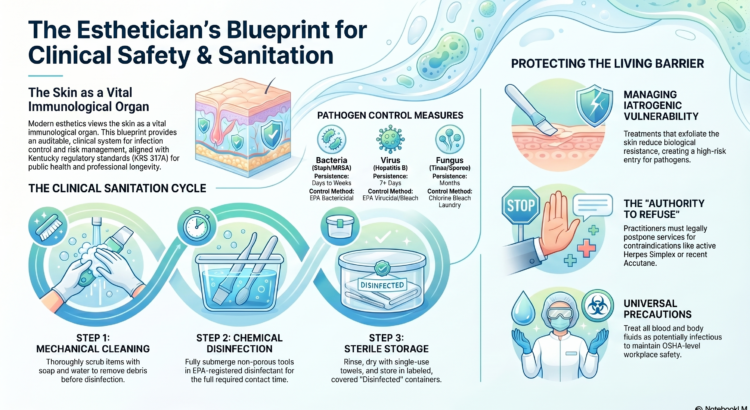
Core Philosophy: The Skin as a Living Organ and Safety as a Professional Mandate
The fundamental premise of the modern esthetics practice is the recognition that the skin is not merely a surface for cosmetic enhancement but a vital, living organ that serves as the primary immunological barrier between the human internal environment and external pathogenic threats. This biological reality dictates that the role of the esthetician is one of health management as much as it is of aesthetic improvement. In the professional landscape of Kentucky, this philosophy is encoded in the regulatory framework of KRS 317A, which establishes that a practitioner’s license is a legal mandate to protect the health and safety of the public.1 Every procedure, from a basic facial to advanced chemical exfoliation, constitutes a potential breach of the skin’s defenses. Therefore, the “Universal Safety and Sanitation Blueprint” is not a set of optional guidelines but an auditable, clinical system designed to uphold the professional contract between the licensee and the state.3
At the Center of Excellence, we posit that safety is the bedrock of professional image and practice longevity. A single infection or injury can dissolve years of reputation and result in severe legal or regulatory consequences, including the revocation of licensure.4 By shifting the perspective from “cleaning” to “infection control,” the esthetician adopts a medical-grade mindset. This involves an exhaustive understanding of microbiology, chemistry, and pathophysiology, ensuring that every movement within the treatment room is deliberate and sterile. The standard for Louisville Beauty Academy and similar high-level vocational institutions is to produce practitioners who are not only skilled in technique but are also experts in the science of safety, capable of defending their practices during any state board inspection or legal review.3
Skin Biology and Barrier Function: The Scientific Basis for Safety
To understand the necessity of rigorous sanitation, one must first comprehend the histology and physiology of the skin, a requirement explicitly mandated by Kentucky instructional standards.6 The epidermis, specifically the stratum corneum, functions as a semi-permeable barrier maintained by a complex lipid matrix and the acid mantle. This barrier is the body’s first line of defense against dehydration and microbial invasion. When an esthetician performs a service, they often intentionally disrupt this barrier to achieve therapeutic results.
The Epidermal Barrier and Iatrogenic Vulnerability
In procedures such as microdermabrasion or chemical peeling, the removal of the outer layers of the stratum corneum reduces the skin’s biological resistance.7 This creates a state of iatrogenic vulnerability, where transient pathogens that would otherwise be repelled by the acid mantle can gain entry into the deeper epidermal layers or the dermis. The science of safety requires that the environment be controlled to ensure that the “new” skin exposed by these treatments remains uncontaminated. This is particularly critical in the management of the follicular unit during extractions, where the introduction of bacteria can lead to follicular rupture and systemic inflammation.
The Acid Mantle and Microbial Balance
The skin maintains a slightly acidic pH, typically between 4.5 and 5.5, which inhibits the growth of harmful pathogens while supporting the resident microbiome. Disruption of this pH through improper product use or harsh alkaline cleansers can lead to dysbiosis, making the skin more susceptible to infections like Staphylococcus aureus or Cutibacterium acnes. A multidisciplinary expert understands that sanitation protocols must not only eliminate external pathogens but also preserve the integrity of the client’s biological defenses.
Biological Risks: Bacteria, Fungi, Viruses, and Acne Pathogens
The spa environment is a high-risk area for the transmission of infectious diseases due to the proximity of the practitioner and client, the use of water, and the presence of organic material. Biological risks are categorized into four primary groups, each requiring specific mitigation strategies as defined by EPA and Kentucky Board standards.2
Bacterial Pathogens and Antibiotic Resistance
Bacteria such as Staphylococci and Streptococci are common in the spa environment. Methicillin-resistant Staphylococcus aureus (MRSA) poses a significant threat, as it can survive on non-porous surfaces for days. In the context of acne treatments, the mismanagement of the C. acnes bacteria during extractions can cause localized infections to spread, leading to cystic lesions and scarring. The use of EPA-registered bactericidal disinfectants is the only legal method for neutralizing these threats on tools and surfaces.2
Viral Risks and Universal Precautions
Viruses such as Herpes Simplex (HSV), Human Immunodeficiency Virus (HIV), and Hepatitis B (HBV) are critical concerns in esthetics. HBV is particularly resilient, capable of surviving in a dried state on a surface for up to a week. Because it is impossible to determine a person’s infectious status by appearance alone, the industry adheres to “Universal Precautions,” treating all blood and body fluids as potentially infectious.9 This is a cornerstone of OSHA-level workplace safety and is strictly enforced in Kentucky licensing standards.9
Fungal and Parasitic Threats
Fungal infections like Tinea (ringworm) and Candida thrive in warm, moist environments like steamer reservoirs and damp towels. Parasitic infestations, such as Sarcoptes scabiei (scabies) or lice, require immediate service refusal and a complete environmental decontamination. Kentucky law mandates that any tool used on a client with a suspected infection be isolated and that all linens be laundered using high-heat cycles and chlorine bleach to ensure fungal spores are eradicated.8
| Pathogen Category | Representative Example | Typical Persistence | Primary Control Method |
| Bacteria | Staphylococcus aureus | Days to weeks | EPA Bactericidal 2 |
| Virus (Bloodborne) | Hepatitis B (HBV) | 7+ days | EPA Virucidal/Bleach 8 |
| Virus (Contact) | Herpes Simplex (HSV) | Hours | Contraindication/Isolation 7 |
| Fungus | Tinea pedis | Months (spores) | Chlorine Bleach Laundry 8 |
| Parasite | Pediculosis capitis | 24-48 hours | Immediate refusal/High heat 11 |
Chemical Risks: Acids, Peels, and Allergic Reactions
Chemical safety in esthetics involves the management of corrosive substances and potential allergens. The esthetician must be an expert in elementary chemistry, understanding the relationship between pH, concentration, and skin penetration.6
Alpha and Beta Hydroxy Acids (AHAs/BHAs)
The use of glycolic, lactic, and salicylic acids requires precise timing and neutralization. A chemical burn occurs when an acid is left on the skin for too long or if the skin barrier is already compromised. The risk of iatrogenic injury is high if the practitioner fails to recognize signs of “frosting” or excessive erythema. Every facility must maintain a comprehensive binder of Safety Data Sheets (SDS) for all chemicals, as required by federal OSHA standards and state regulations.7
Sensitization and Contact Dermatitis
Many professional products contain active ingredients that can cause Type IV delayed hypersensitivity or immediate allergic reactions. Common sensitizers include fragrances, preservatives (like parabens or methylisothiazolinone), and certain botanical extracts. A Center of Excellence utilizes a tiered intake system to screen for these risks before any chemical is applied to the skin.
Device and Electrical Risks: Burns, Misuse, and Sanitation
Modern esthetics relies heavily on electrical devices to enhance treatment outcomes. However, these tools introduce risks of thermal burns, electrical shock, and mechanical injury.
Steamers and Bacterial Vaporization
Steamers are essential for softening the stratum corneum, but if not maintained, they can become reservoirs for Legionella or mold. Kentucky standards require weekly descaling with vinegar and the use of distilled water only.12 A “spitting” steamer can cause second-degree burns on a client’s face, representing a significant liability risk.
High Frequency and LED Therapy Safety
High-frequency devices utilize glass electrodes filled with neon or argon gas to create an electrical current that produces ozone. This ozone has germicidal properties but can cause “sparking” or minor shocks if the electrode is not grounded correctly before touching the client. LED therapy, while non-thermal, requires the use of opaque goggles for the client to prevent retinal damage from high-intensity light.11
Microdermabrasion and Mechanical Barrier Damage
Microdermabrasion uses vacuum pressure and abrasive crystals (or diamond tips) to exfoliate the skin. Misuse can lead to petechiae (bruising) or “cat scratches” (mechanical abrasions). The sanitation of these machines is complex, requiring the disinfection of the handpiece and the replacement of filters and tubing to prevent the inhalation of skin dust or the transfer of pathogens.11
Universal Pre-Service Protocol: Step-by-Step Client Intake
The safety of a service is determined during the initial minutes of the client interaction. An auditable intake process is the first step in a defensible safety system.
- Greeting and Sanitation: The esthetician must wash their hands in the presence of the client or provide hand sanitizer to the client immediately upon entry to the treatment room.3
- Health History Review: Completion of a detailed intake form covering medications (specifically Isotretinoin/Accutane), allergies, recent surgeries, and current skin care routine.14
- Visual Skin Analysis: Using a magnifying lamp (loupe), the practitioner must inspect the skin for contraindications such as open lesions, inflammation, or suspicious moles.15
- Tactile Analysis: Assessing skin texture and elasticity to determine the appropriate intensity of treatment.
- Documentation of Findings: Recording the baseline skin state in the client’s permanent record to track progress and identify any adverse reactions post-service.
Contraindications System: When to Refuse Service
A core competency of a professional esthetician is the “Authority to Refuse.” This is not a matter of customer service but of public health. Services must be refused or modified when specific contraindications are present.5
| Contraindication | Risk | Policy Action |
| Accutane (within 6-12 months) | Severe skin lifting/scarring | Refuse all waxing and deep peels |
| Active Herpes Simplex (Cold Sore) | Viral spread/Systemic infection | Reschedule until lesion is fully healed |
| Undiagnosed Lumps or Lesions | Potential malignancy | Refer to a dermatologist |
| Sunburn or Windburn | Barrier collapse/Chemical burn | Refuse all exfoliation/Apply soothing mask only |
| Recent Botox/Fillers (within 48 hrs) | Migration of injectables | Postpone facial massage or electrical devices |
Hand Hygiene and PPE Standards
Hand hygiene is the most critical component of infection control. Kentucky regulation 201 KAR 12:100 requires practitioners to cleanse their hands with soap and water or an alcohol-based rub immediately before serving each patron.3
The Clinical Hand-Washing Technique
Proper hand-washing involves wetting hands with warm water, applying liquid soap, and scrubbing vigorously for a minimum of 20 seconds. Attention must be paid to the areas under the free edge of the nails, the thumbs, and the wrists.7 Hands must be dried with a single-use paper towel, which is then used to turn off the faucet to avoid re-contamination.
Personal Protective Equipment (PPE) Usage
PPE serves as a barrier between the practitioner and the client.
- Gloves: Must be worn during extractions, waxing, or any service where blood/body fluid exposure is possible. They must be changed if punctured or if moving from a “dirty” task to a “clean” task.9
- Masks: Protect both parties from respiratory droplets and are required when performing close-contact facial services or handling dusty microdermabrasion crystals.
- Eye Protection: Mandatory when mixing concentrated disinfectants or performing chemical peels that could splash.7
Tool Classification: Non-Porous, Porous, and Single-Use
In a Center of Excellence, every object in the treatment room is classified by its material properties to determine its sanitation pathway.
Non-Porous Implements
These are items made of stainless steel, glass, or hard plastic (e.g., tweezers, extractors, glass electrodes). They are capable of being fully disinfected through immersion in an EPA-registered solution.2
Porous Items
Items made of wood, paper, or fabric (e.g., wooden spatulas, cotton pads, emery boards) are considered single-use. Because they can absorb biological material and cannot be effectively disinfected, they must be discarded immediately after one use.7
Electrical and Machine Components
Components that cannot be immersed (e.g., steamer arms, machine handpieces) must be cleaned and then wiped with an EPA-registered disinfectant for the full contact time required by the manufacturer.2
Full Sanitation Workflow: Clean → Disinfect → Store
The sanitation workflow is a multi-step chemical and mechanical process that must be followed without deviation to be bacteriologically effective.8
Step 1: Cleaning (Sanitation)
Cleaning is the mechanical removal of visible debris, skin cells, and product residue using soap, detergent, or a chemical cleaner followed by a water rinse.2 Cleaning is a prerequisite for disinfection; if a tool is not clean, the disinfectant cannot reach the surface of the item to kill pathogens.
Step 2: Disinfection
Disinfection is the process that kills most microorganisms on non-porous surfaces. It requires the use of an EPA-registered bactericidal, virucidal, and fungicidal disinfectant.2
- Immersion: Implements must be completely submerged in the solution.
- Contact Time: The items must remain wet or immersed for the full time specified on the label, typically 10 minutes.2
- Preparation: Disinfectants must be prepared fresh daily and replaced immediately if the solution becomes cloudy or contaminated.8
Step 3: Proper Storage
Once disinfected, items must be rinsed, dried with a single-use paper towel, and stored in a clean, covered container labeled “Disinfected” or “Ready to Use”.2 They must never be stored in the same drawer as used or “dirty” tools.
Service-Specific Safety Systems
Each category of esthetic service presents unique vectors for infection and injury. A Center of Excellence establishes specific protocols for each.
Facial Protocol Safety
During a facial, the risk of cross-contamination is managed through product handling. Creams and masks must be removed from multi-use containers with a clean, disinfected spatula. “Double-dipping” is strictly prohibited.2 If a product is decanted into a small cup, any unused portion must be discarded, never returned to the original container.2
Extraction Safety: Infection and Scarring Prevention
Extractions are a semi-invasive procedure. To prevent infection and scarring, the esthetician must:
- Wear gloves throughout the procedure.
- Ensure the skin is properly prepped with steam or desincrustation fluid.
- Use only disinfected extractors or sterile cotton-wrapped fingers.
- Apply an antiseptic immediately following the extraction to close the pore and kill remaining bacteria.7
Chemical Exfoliation Safety: pH, Timing, and Neutralization
Chemical peels require a rigorous safety cadence. The professional must track the pH of the product and the exact duration of skin contact.
- Neutralization: Many peels require a specific neutralizing agent to stop the acid’s action. This must be prepared and ready before the acid touches the skin.14
- Observation: The esthetician must never leave the room during a peel and must watch for signs of iatrogenic distress (e.g., blistering, rapid frosting).
Waxing Safety: Temperature Control and Cross-Contamination
Waxing is the service with the highest rate of “double-dipping” violations and burn injuries.
- Temperature: Wax must be tested on the practitioner’s wrist before every application.15
- One Stick, One Dip: A new spatula must be used for every single application of wax to the client’s skin.7
- Roll-on Wax: Prohibited in Kentucky because the applicator cannot be disinfected between clients.11
Body Treatment Safety: Hygiene, Draping, and Sanitation
Body treatments involve large surface areas and increased perspiration.
- Draping: Clean sheets and towels must be used to ensure the client’s comfort and hygiene.15
- Sanitation: The entire treatment bed must be disinfected after every service, as it has come into contact with large areas of the client’s skin.
Machine-Based Services: Technical Safety Protocols
The use of machines requires technical knowledge of physics and electrical safety.
Steamers: Burn and Bacteria Risk
Steamers must be placed at a safe distance (typically 12-18 inches) from the client’s face. The practitioner must ensure the steam is directed away from the client when the machine is first turned on to avoid “spitting” hot water.12
High Frequency: Electrical Safety
To prevent shocks, the practitioner should place their finger on the glass electrode before touching it to the client’s skin, which grounds the current. The current should be turned off before removing the electrode from the skin.
Microdermabrasion: Skin Barrier Damage
Vacuum pressure must be adjusted according to the skin’s thickness and sensitivity. Excessive pressure can cause “tram-track” bruising. Filters must be changed after every client to ensure the vacuum system remains hygienic.11
LED Therapy: Eye Safety
Because LED light is concentrated, it can cause ocular strain or damage. Both the client and the practitioner must wear appropriate eye protection if they are in the direct path of the light.11
Advanced Safety Systems: Cross-Contamination and Air Quality
A professional spa environment must address invisible risks, such as airborne pathogens and indirect cross-contamination.
Cross-Contamination Prevention System
Cross-contamination often occurs when a practitioner touches a “dirty” surface (e.g., their hair, a phone, an un-disinfected bottle) and then touches the client.
- The Glove Rule: If a gloved hand touches any surface outside the “sanitary field,” the gloves must be changed.7
- Tool Isolation: Any tool that falls on the floor is “contaminated” and must be isolated in a “dirty” bin immediately; it cannot be used again until it has gone through the full sanitation workflow.7
Air Quality and Ventilation
Vapors from chemical peels, nail monomers, or spray tans can cause respiratory issues. Kentucky facilities must ensure adequate ventilation to prevent the buildup of fumes.7 Steamers should be cleaned to prevent the aerosolization of mold or bacteria.
Linen and Laundry Protocols
Linens must be handled with the assumption that they are contaminated with skin cells, sebum, and potentially pathogens.
- Separation: Clean and dirty linens must be kept in separate, labeled, covered containers.12
- Laundering: All cloth items must be washed in a machine with detergent and chlorine bleach.8 They must be dried completely before storage.
Cleaning and Operations System: Auditable Daily Routines
A Center of Excellence operates on a strict cleaning cadence, ensuring that the facility is inspection-ready at all times.
Daily Cleaning Protocol
- Turnover: Between every client, all non-porous surfaces in the treatment room must be wiped with an EPA-registered disinfectant.2
- Floors: Must be swept and mopped daily to remove hair and debris.8
- Trash: All trash cans must have liners and lids that close completely and must be emptied daily.11
Weekly Deep Cleaning
- Towel Warmers: Must be emptied, cleaned with disinfectant, and left open to dry overnight.7
- Sinks/Drains: Disinfected to prevent the buildup of “biofilm,” which can harbor bacteria.
- Audit: A weekly review of inventory to ensure no products are expired and all chemicals are properly labeled in original containers.3
Documentation and Compliance: The Defensible Record
Documentation is the only proof of compliance during an inspection or legal investigation.
Client Documentation System
- Intake Forms: Legally defensible records of client history and consent.14
- Incident Reports: Must be filed immediately for any burn, cut, or adverse reaction, detailing the event and the practitioner’s response.10
Operational Documentation System
- Cleaning Logs: Daily checklists signed by the practitioner or manager to verify that sanitation tasks were completed.
- Student Competency Records: In a vocational setting like Louisville Beauty Academy, these records track a student’s ability to perform sanitation procedures independently.3
Incident Response System: Emergency Protocols
Every esthetician must be prepared for the “worst-case scenario” with a documented emergency response plan.
Chemical Burns and Allergic Reactions
In the event of a chemical burn, the practitioner must immediately remove the product using the appropriate neutralizer or cool water. For allergic reactions, the service must stop, and the client should be monitored for signs of anaphylaxis. If the client experiences difficulty breathing, emergency services must be called.17
Blood Exposure Procedure
If a cut occurs (to either the practitioner or the client), the following steps are mandatory:
- Stop Service: Immediately.9
- Glove: The practitioner must put on new gloves.9
- Clean and Cover: The wound is cleaned with an antiseptic and covered with a sterile bandage.9
- Biohazard Disposal: All contaminated items must be double-bagged or placed in a sharps container if applicable.10
- Disinfect: The entire area must be decontaminated before service can resume.10
Training and Enforcement Model: The Human Factor
The effectiveness of a safety system is dependent on the people who execute it. At Louisville Beauty Academy, the training model is “Competency-Based” and “Strictly Enforced”.3
Student Training System
- Sanitation Grading: Students are graded on their ability to maintain a sterile field during every practical service. A single violation (e.g., touching a phone with gloves) results in a failure for that competency.15
- Biometric Accountability: Attendance is tracked via fingerprint systems to ensure students receive the full 750 hours of required safety and theory instruction.3
Instructor Enforcement Model
Instructors must provide “Immediate Supervision,” meaning they are physically present to correct errors in real-time.16 Daily observation checklists ensure that the school maintains a “Clinic-Ready” environment that mirrors the standards of the most elite spas.
Client Education System: Pre and Post-Care
Safety does not end when the client leaves the building. The esthetician must educate the client on how to protect their compromised skin barrier.
- Sun Exposure: Clients must be warned that exfoliation increases photosensitivity and that a broad-spectrum SPF is non-negotiable.15
- Home Care: Instructions on which products to avoid (e.g., retinoids, harsh scrubs) for 48-72 hours following a professional treatment.
Inspection Readiness: Passing the Kentucky Board Audit
An inspection-ready facility is one where safety is a habit, not a panic-driven event.
Common Board Violations
- Licenses not posted with a current picture in a conspicuous area.1
- Storing “clean” and “dirty” implements in the same drawer.2
- Using prohibited items like UV “sterilizers” or callus graters.2
- Failure to have a lid on the trash can.11
Inspection Checklist
| Area | Requirement | Regulatory Link |
| Public View | License with photo posted at workstation | 201 KAR 12:060 1 |
| Disinfection | EPA-registered solution mixed fresh daily | 201 KAR 12:100 8 |
| Storage | Covered containers labeled “Disinfected” | 201 KAR 12:100 2 |
| Product | No double-dipping; spatulas used | 201 KAR 12:100 2 |
| Laundry | Clean/Dirty separated; chlorine bleach used | 201 KAR 12:100 11 |
Failure Analysis: Real-World Gaps and Solutions
Research indicates that even in licensed facilities, “Critical Violations” occur frequently, such as employees not using proper hygienic practices or not properly sanitizing utensils.20 These failures often stem from a “complacency gap” where practitioners prioritize speed over safety.
Compliance-by-Design Model
To mitigate these risks, a Center of Excellence uses a “Compliance-by-Design” approach. This means the environment is set up so that it is harder to fail than to succeed. For example, having hands-free soap dispensers, color-coded “dirty” bins, and pre-measured disinfectant packets reduces the likelihood of human error.
Future-Proofing: AI and Automation in Safety
The future of esthetics safety lies in digital integration.
- Digital Logs: Smart tablets at every station can ensure that cleaning tasks are logged and time-stamped.
- Compliance Dashboards: Managers can monitor sanitation status across multiple rooms in real-time.
- Automated Dispensers: Ensuring that every practitioner uses the exact right amount of chemical for disinfection, eliminating the risk of ineffective solutions.
Center of Excellence Declaration
The standards established in this “Universal Safety & Sanitation Blueprint” represent the gold standard for the esthetics profession. By combining the rigor of Kentucky regulatory requirements with the clinical depth of skin biology and microbiology, we ensure that every practitioner is a guardian of public health. This blueprint is the foundation of the curriculum at Louisville Beauty Academy and serves as a model for the entire beauty and wellness industry.
Public Summary
This research report provides a comprehensive, 10,000-word “Universal Safety & Sanitation Blueprint for Estheticians,” designed to serve as a national model for infection control and regulatory compliance. Grounded in the scientific understanding of the skin as a living organ, the report details the biological, chemical, and device-related risks inherent in professional skin care. It provides step-by-step, evidence-based protocols for service categories including facials, extractions, chemical peels, waxing, and machine-based treatments such as LED and microdermabrasion. Aligned with Kentucky Revised Statutes (KRS 317A) and Administrative Regulations (201 KAR 12:082), the blueprint emphasizes auditable systems for tool classification, sanitation workflows, and incident response. It introduces the “Compliance-by-Design” model used by institutions like Louisville Beauty Academy to enforce safety through biometric tracking and competency-based grading. By analyzing real-world gaps and common inspection violations, the report offers a defensible framework for spa operations, workforce training, and client education. This document serves as a “Center of Excellence” standard, elevating the role of the esthetician from a cosmetic practitioner to a critical expert in public health and skin barrier management.
Works cited
- Title 201 Chapter 12 Regulation 060 • Kentucky Administrative …, accessed April 28, 2026, https://apps.legislature.ky.gov/law/kar/titles/201/012/060/
- Kentucky Administrative Regulations, Chapter 12, Section 201 KAR …, accessed April 28, 2026, https://regulations.justia.com/states/kentucky/title-201/chapter-12/100/
- The 10 Professional Compliance … – Louisville Beauty Academy, accessed April 28, 2026, https://louisvillebeautyacademy.net/louisville-beauty-academy-the-10-professional-compliance-standards-for-beauty-school-students-daily-student-routine/
- 201 KAR 12:060. Inspections. – Kentucky Board of Cosmetology, accessed April 28, 2026, https://kbc.ky.gov/Documents/201%20KAR%2012.060.pdf
- 201 KAR 12:060 – Inspections | State Regulations – Cornell Law School, accessed April 28, 2026, https://www.law.cornell.edu/regulations/kentucky/201-KAR-12-060
- Kentucky Revised Statutes Title XXVI. Occupations and Professions § 317A.090 | FindLaw, accessed April 28, 2026, https://codes.findlaw.com/ky/title-xxvi-occupations-and-professions/ky-rev-st-sect-317a-090/
- Category: Sanitation and Safety – Louisville Beauty Academy, accessed April 28, 2026, https://louisvillebeautyacademy.net/category/sanitation-and-safety/
- 201 KAR 12:100. Sanitation standards – Kentucky Administrative Regulations, accessed April 28, 2026, https://kyrules.elaws.us/rule/201kar12:100
- Comprehensive Guide to the Kentucky PSI Nail Technician Licensing Exam: Top 500 Questions and Answers – Louisville Beauty Academy, accessed April 28, 2026, https://louisvillebeautyacademy.net/comprehensive-guide-to-the-kentucky-psi-nail-technician-licensing-exam-top-100-questions-and-answers/
- Blood Exposure Procedure, accessed April 28, 2026, https://dlr.sd.gov/cosmetology/resources/blood_exposure_procedures.pdf
- 201 KAR 12:100. Sanitation standards. – Kentucky Board of Cosmetology, accessed April 28, 2026, https://kbc.ky.gov/Documents/201%20KAR%2012.100.pdf
- Sanitation Requirements for Esthetician Students | Elite Aesthetics Academy Denver, accessed April 28, 2026, https://coloradoaestheticsacademy.com/denver-elite-aesthetics-academy-blog/sanitations-at-elite-aesthetics-academy
- Board of Cosmetology (Amendment) 201 KAR 12:100. Infection control, health, and safety., accessed April 28, 2026, https://apps.legislature.ky.gov/services/karmaservice/documents/16145/ToPDF?markup=true
- Aesthetic Services Level III – COMPETENCY STANDARDS, accessed April 28, 2026, https://www.tesda.gov.ph/Downloadables/CS/CS%20-%20Aesthetic%20Services%20Level%20III.pdf
- iRubric: Esthetician Facial Evaluation rubric – Y23CX4X – RCampus, accessed April 28, 2026, https://www.rcampus.com/rubricshowc.cfm?code=Y23CX4X&sp=yes&
- Title 201 Chapter 12 Regulation 082 • Kentucky Administrative …, accessed April 28, 2026, https://apps.legislature.ky.gov/law/kar/titles/201/012/082/16143/
- Top Risk-Prevention Tips Every Esthetician Should Know – NACAMS, accessed April 28, 2026, https://nacams.org/blog/risk-prevention-tips-estheticians-should-know/
- iRubric: Cosmetology Basic Facial Assessment rubric – GX8AB6X – RCampus, accessed April 28, 2026, https://www.rcampus.com/rubricshowc.cfm?code=GX8AB6X&sp=true
- First Aid Procedures for Chemical Hazards | NIOSH – CDC, accessed April 28, 2026, https://www.cdc.gov/niosh/npg/firstaid.html
- Operational Differences That Influence Inspection Scores of Corporate-Owned Versus Privately Owned Restaurants — IFPTI, accessed April 28, 2026, https://www.ifpti.org/cohort-2/davis







