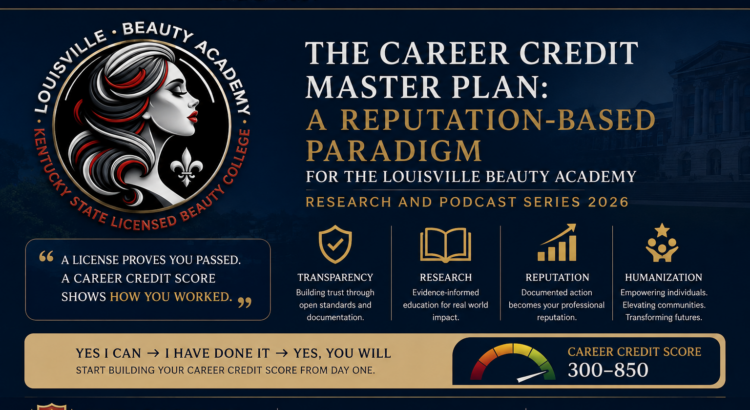
The Career Credit Master Plan: A Reputation-Based Paradigm for the Louisville Beauty Academy – RESEARCH AND PODCAST SERIES 2026

Louisville Beauty Academy operates under a Gold-Standard Over-Compliance framework—meeting all licensing requirements while exceeding regulatory expectations through transparency, documentation, and proactive consumer protection.

Executive Summary

The vocational education sector is currently navigating a period of profound structural transformation, transitioning from a static credential-based model to a dynamic, reputation-based “proof-of-work” economy. For institutions like the Louisville Beauty Academy (LBA), the challenge lies in bridging the gap between traditional state-mandated licensure and the modern requirements of the digital creator economy. This master plan outlines an interdisciplinary framework for a “Career Credit Score” system—a comprehensive, over-compliant social media and professional progress system designed to begin on day one of enrollment and persist beyond graduation. By leveraging the behavioral psychology of public accountability and the economics of social signaling, this system formalizes the student’s daily learning journey as a measurable professional asset.1

The core objective is to position LBA as a national leader in ethical creator education, moving beyond the simple “acquisition of hours” toward the “accumulation of reputation.” The Career Credit Score (CCS) serves as an analogue to a financial credit score, where daily posts act as career deposits and professionalism serves as the ultimate measure of creditworthiness.4 This system provides students with a structured ladder of progression, moving from the “Zero Stage” of novice observation to the “Mastery Stage” of mentorship and public signalization.6 Crucially, the plan is designed with an “over-compliant” posture, ensuring that all student activities strictly adhere to the Kentucky Board of Cosmetology (KBC) statutes and Federal Trade Commission (FTC) endorsement guidelines.8

Through a sophisticated incentive model, students can earn significant tuition discounts based on their consistency, ethical conduct, and proof-of-learning, effectively lowering the financial barriers to high-quality vocational education while simultaneously increasing graduate employability.11 This plan does not merely teach beauty skills; it equips “Human Service Professionals” with the digital fluency and verifiable reputation needed to thrive in an era where trust is the primary currency of the beauty industry.13

Research and Psychological Foundations

The foundation of the LBA Career Credit system is built upon a synthesis of behavioral science, trust economics, and educational theory. Understanding why “learning in public” works requires an analysis of the psychological mechanisms that drive accountability and the economic signals that establish professional prestige.

Behavioral Psychology of Public Accountability

Research in public employee behavior and health interventions suggests that accountability is a multi-dimensional construct involving observability, evaluability, and answerability.1 When a student makes a “public announcement” of a goal—such as mastering a specific sectioning technique—the digital platform acts as a “commitment device”.2 These devices help individuals “lock themselves” into a behavior by creating a psychological penalty for deviation and a social reward for adherence.15

In the context of LBA, daily posting creates a “felt accountability.” While high-intensity monitoring can sometimes reduce intrinsic motivation, a system that emphasizes “accountability obligation”—the perceived duty to justify actions to a supportive audience—actually enhances work drive.1 This is particularly effective when students interpret the obligation as an opportunity to gain professional benefits rather than a coercive requirement. By documenting the “messy middle” of the learning process, students move from passive learners to active practitioners who are “answering” to their future professional selves and their burgeoning audience.

Habit Formation and Daily Proof-of-Work

The transition from a student mindset to a professional identity requires the formation of consistent habits. The “daily proof-of-work” theory posits that a live pulse of activity is a more reliable indicator of skill than a static portfolio.6 In technical fields like coding, a “contribution graph” showing daily commits is impossible to fake and serves as a verified record of problem-solving processes.6

For beauty professionals, this translates to documenting the micro-decisions of the craft. Research into sustainable skincare marketing suggests that “decision documentation”—filing 30 seconds of a consultation or explaining why a specific pH-balanced product was chosen—builds deeper trust than a polished, final image.16 Psychologically, this “raw” and “authentic” content resonates more with modern consumers who are skeptical of highly curated, AI-generated, or “too polished” feeds.17

Social Signaling and Trust Economics

In a labor market with “asymmetric information,” where employers cannot perfectly know a candidate’s skill level, they rely on signals. Traditional signaling theory, as explored by Bryan Caplan, suggests that much of the return on education is a return on the “shiny credential” rather than the skill itself.19 However, the Career Credit Score seeks to shift this dynamic toward “Skill Signaling,” which focuses on digital, transversal, and sector-specific competencies.20

Social trust is a “commodity” built through repeated interactions and the assessment of a truster’s competence and goodwill.21 A student who has documented 1,500 hours of professional growth 8 provides a “trust graph” that reduces the risk for a potential salon owner. This creates a “cyclical model” of social exchange where the student’s signaled reputation leads to better placement, which in turn reinforces the school’s brand equity.3

Psychological ConceptMechanismApplication in LBA System
Commitment DeviceSocial penalty for failure 15Daily posting “deposits” 2
Felt AccountabilityAnswerability to an audience 1Weekly instructor reviews 24
Instrumental LearningReinforcing presumptions of trust 21Documenting micro-decisions 16
Social SignalingReducing information asymmetry 3Verifiable digital portfolios 6
Authenticity BiasPreference for unfiltered growth 18“Zero Stage” confessions 18

The Career Credit Framework

The “Career Credit Score” is a formalized, numerical representation of a student’s professional standing, calculated using an algorithm that weights consistency, proof-of-work, professionalism, and ethical compliance. Unlike social media “clout,” which is often ephemeral and based on popularity, Career Credit is a measure of “professional creditworthiness”.25

Defining the Algorithm

The LBA Career Credit Score (CCS) is modeled on a 300–850 scale, mirroring the FICO model used in financial sectors. The score is calculated using four primary components, each weighted to reflect its importance to a future employer and regulatory compliance.

  1. Consistency (Weight: 35%): This is the equivalent of “payment history.” It measures the frequency of professional posts or “career deposits.” A missed day of documentation is recorded as a “late payment,” while sustained streaks build the score significantly.2
  2. Proof-of-Skill (Weight: 25%): This represents “credit history.” It is the documented evidence of the student’s progression through the subject areas defined in 201 KAR 12:082, such as infection control, anatomy, and chemical services.7
  3. Professional Conduct (Weight: 20%): This measures “credit mix.” It assesses the student’s poise, communication skills, and adherence to the LBA “Humanization of Education” philosophy.13
  4. Regulatory Integrity (Weight: 20%): This is the “creditworthiness” factor. It tracks zero-violation streaks regarding KBC statutes and FTC disclosure guidelines.10

Career Deposits and Missed Payments

A student’s CCS is updated weekly. A “Career Deposit” is defined as a high-quality, educational, or progress-based post that includes the required LBA disclaimers.

  • Positive Impact: A “Career Deposit” adds +5 points to the weekly score.
  • Neutral Impact: Reposting industry news with a professional insight adds +2 points.
  • Negative Impact: A “Missed Payment” (failing to post for 48 hours without a prior “digital reset” request) subtracts -10 points.
  • Severe Impact: A compliance violation (e.g., performing a chemical service on a live person before 250 hours 23) results in a “Reputation Default,” resetting the score to 300 and triggering a formal review.29

Reputation Score Benchmarking

To provide context, LBA compares student scores against industry averages and “best-in-class” alumni. This benchmarking fosters continuous improvement and provides a clear signal to employers about where a student stands in their professional development.25

CCS RangeProfessional StatusMarket Implications
750 – 850Elite ProfessionalHigh placement leverage; eligible for alumni mentorship roles.
650 – 749Reliable PractitionerStandard employment readiness; consistent work history.
550 – 649Developing TalentEmerging skills; needs focus on consistency and compliance.
300 – 549High Risk / ProbationHistory of inconsistency or ethical breaches; requires remediation.

Student Learning Progression Model

The Career Credit system utilizes a five-stage ladder of progression. This model ensures that students do not feel pressured to “fake it” but instead find power in their evolution from a novice to a master. Each stage specifies what to post, the psychological reasoning behind it, and the compliance guardrails necessary to protect the student and the academy.

Stage 1: The Zero Stage (The Foundation)

Focus: Identity reset and the commitment to learn. This occurs during the first two weeks of enrollment.

  • What students post: A “Social Media Reset” announcement; an unboxing of their professional student kit; a video discussing their “Why” and their decision to join LBA.8
  • Why it works: It establishes a “vulnerability hook.” By admitting they are starting at zero, they build an empathetic connection with their audience, who will then feel invested in their growth.16
  • Compliance: Posts must clearly state: “Student at Louisville Beauty Academy. Not licensed to perform services for hire.”
  • Caption Prototype: “Day 1 at LBA! Today I’m resetting this page to document my journey from student to professional. I’m starting with the basics—Infection Control. Safety first! #LBAStudent #BeautyJourney”

Stage 2: The Awareness Stage (The Science)

Focus: Vocabulary, theory, and the “Invisible Skills.” This aligns with the first 100–150 hours of instruction.23

  • What students post: Videos of themselves studying anatomy and physiology; “Did you know?” posts about the chemistry of hair color; time-lapses of workstation sanitation.8
  • Why it works: It builds authority. By focusing on the science rather than the art, the student signals that they are a serious, knowledge-based professional.8
  • Compliance: No mentions of performing services on people. Focus remains on “Scientific Lectures” per 201 KAR 12:082.23
  • Caption Prototype: “Studying the skeletal system today. Understanding the structure of the head and neck is vital for a proper consultation. Science is the backbone of beauty! #AnatomyClass #LBA”

Stage 3: The Practice Stage (The Proof-of-Work)

Focus: Hands-on repetition on mannequins. This is the “Messy Middle” of the program.

  • What students post: “Mistakes I made today” videos; time-lapses of winding perms or applying color to a mannequin head; “Practice makes progress” reels.6
  • Why it works: It demonstrates grit and technical skill development. Seeing the student struggle and then succeed creates a powerful narrative of competence.6
  • Compliance: Must explicitly state that work is being done on a mannequin.
  • Caption Prototype: “My fifth time winding a perm rod today. Still working on my tension, but the sectioning is getting cleaner! Repetition is key to mastery. #MannequinPractice #ProofOfWork”

Stage 4: The Competency Stage (The Clinic Floor)

Focus: Supervised services on live models. This begins after 250 hours (for Cosmetology) or other program-specific milestones.23

  • What students post: Before-and-after transformations; client consultations (with permission); documenting the consultation “decision-making” process.7
  • Why it works: Social proof. It shows that real people trust the student and that the student can deliver results in a professional clinic environment.24
  • Compliance: Must state that services were performed under instructor supervision at LBA.24
  • Caption Prototype: “Today’s transformation! We chose a level 7 ash to neutralize warmth, keeping the hair’s integrity first. All services performed under supervision at LBA! #ClinicFloor #HairTransformation”

Stage 5: The Mastery Signal Stage (The Educator)

Focus: Teaching, explaining, and mentoring others. This begins in the final phase of the program and continues as an alumnus.

  • What students post: Tutorials explaining a technique to junior students; reviews of industry trends; reflections on the “Humanization of Education”.13
  • Why it works: The “Protégé Effect.” Teaching a concept is the highest signal of mastery. It positions the graduate as an industry leader, not just a practitioner.1
  • Compliance: Use of the “Alumni” tag and verification of licensure.8
  • Caption Prototype: “Explaining the logic of color theory to our new class at LBA. To master the art, you have to mentor the next generation. #BeautyEducator #LBAAlumni”

Step-by-Step LBA Implementation Plan

Operationalizing the Career Credit system requires a disciplined, multi-phase rollout that integrates with LBA’s existing curriculum and administrative protocols.

Phase 1: Orientation and the Social Media Reset

During the first week, students undergo a “Digital Brand Audit.” This is a mandatory component of their “Professional Image” curriculum.23

  1. Account Audit: Students must review their public profiles and archive content that is inconsistent with a “Human Service Professional” identity. This includes content depicting unprofessional behavior or non-compliance with health standards.18
  2. Platform Setup: Students are required to have professional profiles on Instagram and TikTok. LinkedIn is highly recommended for B2B networking and employer visibility.13
  3. The Disclaimer Protocol: Every bio must include: “Professional Student at @LouisvilleBeautyAcademy | Future | Not for hire until licensed.”
  4. Privacy/Security Workshop: Education on protecting personal data and handling “online drama” or cyberbullying.35

Phase 2: Daily Career Deposits

LBA implements a “Daily Documentation” rule. Students are given 15 minutes at the end of each theory or clinic session to capture content.8

  • Frequency: Minimum of 3 professional posts per week.
  • Approved Formats: Short-form video (Reels/TikTok) for skills; Carousel posts for “Decision Documentation”; Stories for daily “Aha!” moments.16
  • The “Human Review” Protocol: Instructors do not grade based on “likes” but on a rubric of professionalism, sanitation, and educational accuracy.24

Phase 3: Ethical AI Integration

LBA adopts a “Max AI” policy for administrative and creative support but maintains strict ethical boundaries for clinical representations.13

  • Authorized Use: Using Generative AI for caption brainstorming, keyword research, and video script outlines.38
  • The 65% Rule: At least 65% of any written caption must be human-authored to ensure authenticity and “Humanization”.38
  • Prohibited AI: No AI-generated or “filtered” images of hair or skin results. This is a deceptive statement and a violation of KBC photo standards.14
  • Disclosure: Any AI-assisted content must include the tag #AIApprentice or a similar disclaimer.40

Phase 4: Instructor and Administrative Audit

LBA establishes a “Reputation Bureau” to manage the Career Credit Scores.

  • Weekly Score Update: The CCS is recalculated every Sunday based on the week’s deposits and classroom conduct.
  • Monthly Compliance Audit: A deep-dive review of student accounts to ensure FTC disclaimers and KBC rules are followed.28
  • Score Grievance Procedure: Students can appeal a score deduction through the official LBA written grievance process.8

Incentive and Discount Model

To drive adoption and ensure high-quality participation, LBA links the Career Credit Score to a fair and transparent tuition discount model. This transforms “tuition” from a fixed cost into a performance-based investment.

The Career Credit Discount Rubric

Students are eligible for “Merit Scholarships” and “Performance-Based Incentives” that can reduce the total program cost significantly.11 These are not “tuition reductions” but optional, merit-based discounts.11

Performance CategoryMetricScore RequirementDiscount/Perk
Consistency King100% posting rate for 90 daysCCS > 700$500 Tuition Credit
Compliance HeroZero compliance flags for 180 daysCCS > 750$1,000 Scholarship
Technical MasterVerified Stage 4 DocumentationInstructor Approval$1,500 Skill Credit
Alumni LeaderContinued Stage 5 postingPost-GraduationFree Alumni Tutoring 8

Anti-Gaming and Safeguards

LBA employs a “Checks and Balances” system to protect the integrity of the discounts.13

  1. Attendance Synchronization: Discounts are only applied if a student maintains the required attendance hours (30–40 hours for Full-Time).11
  2. Plagiarism Penalty: Using another student’s work as one’s own results in the permanent loss of all social-media-based incentives.11
  3. Financial Good Standing: Hours are only certified and discounts applied if the student’s account is current.11
  4. Tax Compliance: All tuition reductions are structured to comply with IRS Section 117(d) regarding qualified tuition reductions for educational institutions.43

Auditability for Regulators

LBA maintains digital records of all student posts, instructor reviews, and score calculations for a minimum of five years.8 This ensures that the institution can defend its incentive model to state and federal regulators as a legitimate “educational performance” metric rather than “marketing compensation.”

Compliance and Risk Management

A gold-standard system must be “over-compliant.” This section outlines the non-negotiable boundaries that protect LBA, its students, and the public.

Kentucky Board of Cosmetology (KBC) Adherence

Kentucky law is strict regarding unlicensed practice.10 LBA’s system manages this through:

  • The “No-Pay” Rule: Students are explicitly forbidden from accepting consideration (money or gifts) for services performed outside of the LBA clinic floor.10
  • Mobile Prohibitions: While Kentucky allows mobile barber shops, mobile cosmetology is strictly limited. Students must not document or perform services in “home salons” or non-licensed facilities.32
  • Sanitation Documentation: Every video documenting a service must show visible sanitation steps (e.g., sanitizing hands, disinfecting tools) to reinforce “Lifelong Professional Ethics”.8

FTC Endorsement and Social Media Law

The FTC’s 2024–2025 updates require “clear, conspicuous, and unavoidable” disclosures.9

  • Disclosure Placement: Disclosures must be verbal AND written on the screen for video content. Simply putting #ad or #LBA in the caption is insufficient for Reels and TikTok.28
  • Honest Opinions: Students must only give honest reviews of products they have actually used.9
  • Material Connections: Because students receive tuition discounts for their posts, they must disclose this “material relationship” in every progress-related post.42

Privacy and Consumer Protection

  • Client Consent: No client images or videos may be posted without a signed LBA model release form.7
  • Data Protection: Students are trained to never post sensitive institutional data or personal information about staff and peers.11
  • Cyber-Safety: LBA provides tools and training for students to manage privacy risks associated with a public-facing digital career.37

Brand and Market Positioning

The implementation of the Career Credit system differentiates Louisville Beauty Academy from all other regional and national competitors. It rebrands the school from a “training facility” to a “professional reputation engine.”

Positioning LBA as a “Future-Ready” Institution

LBA’s brand is built on “Transparency and Genuine Care”.47 By teaching students to build verified proof-of-work, LBA addresses the primary concern of modern beauty employers: “Can this person actually do the work, and will they show up?”.3

Messaging Pillars:

  1. The Proof-of-Work School: We don’t just teach; we document excellence.
  2. Career Credit, Not Just Hours: Your reputation starts on day one.
  3. Humanization through Technology: We use AI to make you more human, not less.
  4. Debt-Free Dignity: Earn your way to a professional future without the burden of federal loans.12

Reassuring Regulators and Parents

LBA positions itself as the “Public Library” of beauty education—an open, accessible, and highly regulated environment where knowledge is democratized.13

  • To Parents: LBA offers a “Safe, Legal, and Affordable” path to a high-demand career, where their child’s professional reputation is built under expert supervision.13
  • To Regulators: LBA provides a model for “Over-Compliance,” showing how social media can be used to increase adherence to sanitation and ethics rather than bypass them.8

The Alumni Brand Flywheel

The Career Credit Score does not end at graduation. LBA invites alumni to maintain their scores through continued mentorship and participation in the “2026 Magazine and Podcast Series”.13 This creates a long-term network of successful, digitally fluent professionals who serve as living proof of the LBA model.

Long-Term Impact and Metrics

The success of this system will be measured through a combination of traditional educational metrics and new reputation-based indicators.

Measurable Outcomes

  1. Retention Rate: Students with high Career Credit Scores are expected to have a 25% higher completion rate due to the psychological “locking” effect of public commitment.2
  2. Job Placement Leverage: LBA graduates will enter interviews not with a resume, but with a “Reputation Portfolio” showing 1,500 hours of growth.13
  3. Audience Trust Score: A monthly sentiment analysis of student accounts to ensure that engagement is professional and educational.
  4. Licensing Success: Continued 100% alignment with PSI and KBC requirements, with students demonstrating higher confidence during the practical exam.8

The Vision for “Di Tran University”

The Career Credit system is the first step toward the broader “Humanization of Vocational Education”.13 By integrating these digital and psychological frameworks, LBA evolves into a “Human Service Professional” academy, where the beauty license is merely the legal foundation for a career built on trust, ethics, and verified excellence.

Metrics & Success Measurement

To ensure the master plan achieves its intended impact, LBA will track the following metrics:

MetricGoalTracking Mechanism
Average Graduate CCS> 725Quarterly reputation audits
Employer Satisfaction95% PositivePost-placement surveys focusing on “Soft Skills”
Student Debt Ratio< 10% of IncomeAnalysis of net tuition vs. entry-level salary 50
Social Media Reach100K+ Monthly (Aggregated)Platform analytics across the student body
Compliance Flag Rate< 1%Weekly internal reputation bureau reviews

Conclusions

The Louisville Beauty Academy Career Credit system represents the gold standard for 21st-century vocational training. By acknowledging that a student’s “reputation” begins long before they receive a physical license, LBA equips its graduates with the ultimate competitive advantage: a verifiable history of hard work, ethical behavior, and professional growth. This system reduces student risk, elevates the entire beauty industry, and provides a defensible, innovative model for the future of professional education. Through the careful integration of behavioral psychology, trust economics, and rigorous compliance, LBA does more than teach beauty—it builds the future of professional trust.

Works cited

  1. Changes in the accountability obligation, intensity, and working drive of public employees: evidence from a survey experiment – Oxford Academic, accessed February 1, 2026, https://academic.oup.com/jpart/advance-article/doi/10.1093/jopart/muaf027/8249872
  2. Effects of Public Commitments and Accountability in a Technology-Supported Physical Activity Intervention | Request PDF – ResearchGate, accessed February 1, 2026, https://www.researchgate.net/publication/270959553_Effects_of_Public_Commitments_and_Accountability_in_a_Technology-Supported_Physical_Activity_Intervention
  3. Full article: Initial employability development: introducing a conceptual model integrating signalling and social exchange mechanisms – Taylor & Francis, accessed February 1, 2026, https://www.tandfonline.com/doi/full/10.1080/1359432X.2023.2186783
  4. Street Rep: A Privacy-Preserving Reputation Aggregation System, accessed February 1, 2026, https://yancomm.net/papers/2023%20-%20SecureComm%20-%20Street%20Rep.pdf
  5. Deep Reputation Scoring in DeFi: zScore-Based Wallet Ranking from Liquidity and Trading Signals – arXiv, accessed February 1, 2026, https://arxiv.org/html/2507.20494
  6. Top Proof of Work Tools Professionals Are Using in 2026 – Fueler, accessed February 1, 2026, https://fueler.io/blog/top-proof-of-work-tools-professionals-are-using
  7. How to Create Before-and-After Content That Converts Followers – CleanerHQ, accessed February 1, 2026, https://cleanerhq.com/how-to-create-before-and-after-content/
  8. Tag: Kentucky State Board of Cosmetology – Louisville Beauty Academy, accessed February 1, 2026, https://louisvillebeautyacademy.net/tag/kentucky-state-board-of-cosmetology/
  9. Endorsements, Influencers, and Reviews – Federal Trade Commission, accessed February 1, 2026, https://www.ftc.gov/business-guidance/advertising-marketing/endorsements-influencers-reviews
  10. 317A.020 Scope of chapter — Licensure requirements — Emergency orders — Warning notice — Legal actions brought by the, accessed February 1, 2026, https://apps.legislature.ky.gov/law/statutes/statute.aspx?id=56210
  11. LBA-StudentAgreement-CosmetologyProgram-2024 – Jotform, accessed February 1, 2026, https://form.jotform.com/240085894150154
  12. Financial Aid Options and Payment Model at Louisville Beauty Academy, accessed February 1, 2026, https://louisvillebeautyacademy.net/financial-aid-options-and-definition/
  13. beauty school compliance Archives – Louisville Beauty Academy, accessed February 1, 2026, https://louisvillebeautyacademy.net/tag/beauty-school-compliance/
  14. Top 5 Beauty Trends on Social Media 2026 – Pulsar, accessed February 1, 2026, https://www.pulsarplatform.com/blog/2025/top-beauty-trends-2026-social-media
  15. From Intentions to Actions – Using Commitment Devices for Evidence Use – Data for Impact, accessed February 1, 2026, https://www.data4impactproject.org/blog/from-intentions-to-actions-using-commitment-devices-for-evidence-use/
  16. I’m a Professional Social Media Growth Strategist – AMA and Free Advice – Reddit, accessed February 1, 2026, https://www.reddit.com/r/InstagramMarketing/comments/1ou74f8/im_a_professional_social_media_growth_strategist/
  17. A close look at the global beauty industry in 2025 – McKinsey, accessed February 1, 2026, https://www.mckinsey.com/industries/consumer-packaged-goods/our-insights/a-close-look-at-the-global-beauty-industry-in-2025
  18. Embrace Your Flaws: Stop Deleting Your ‘Ugly’ Photos – Lemon8, accessed February 1, 2026, https://www.lemon8-app.com/@purposely.angelica/7332530343054295557?region=us
  19. Schooling is Mostly Signaling – Econlib, accessed February 1, 2026, https://www.econlib.org/schooling-is-mostly-signaling/
  20. Skills signalling in OECD countries: Empowering the Workforce in the Context of a Skills-First Approach | OECD, accessed February 1, 2026, https://www.oecd.org/en/publications/empowering-the-workforce-in-the-context-of-a-skills-first-approach_345b6528-en/full-report/skills-signalling-in-oecd-countries_158ea858.html
  21. Trust as commodity: social value orientation affects the neural substrates of learning to cooperate – PMC – NIH, accessed February 1, 2026, https://pmc.ncbi.nlm.nih.gov/articles/PMC5390759/
  22. College Education and Social Trust: An Evidence-Based Study on the Causal Mechanisms, accessed February 1, 2026, https://pmc.ncbi.nlm.nih.gov/articles/PMC3183293/
  23. 201 KAR 12:082. Education requirements and school administration. – Kentucky Board of Cosmetology, accessed February 1, 2026, https://kbc.ky.gov/Documents/201%20KAR%2012.082.pdf
  24. Cosmetology Work Based Plan, accessed February 1, 2026, https://static.avedafi.edu/pdf/AIW%20Cosmetology-Work-Based-Plan%202023-2024.pdf
  25. Why Reputation Scores Are Becoming a Standard Business Metric – NetReputation, accessed February 1, 2026, https://www.netreputation.com/why-reputation-scores-are-becoming-a-standard-business-metric/
  26. Reputation Score Guide – Strategies + 3 case studies – Mention, accessed February 1, 2026, https://mention.com/en/blog/reputation-score/
  27. Beauty Changes Lives Judging Rubric Outline, accessed February 1, 2026, https://beautychangeslives.org/wp-content/uploads/2020/08/Judging-Rubric.pdf
  28. FTC Requirements For Influencers: Guidelines and Rules – Termly, accessed February 1, 2026, https://termly.io/resources/articles/ftc-requirements-for-influencers/
  29. Title 201 Chapter 12 Regulation 082 • Kentucky Administrative Regulations – Legislative Research Commission, accessed February 1, 2026, https://apps.legislature.ky.gov/law/kar/titles/201/012/082/16143/
  30. 201 KAR 12:030 – Licensing and examinations | State Regulations – Cornell Law School, accessed February 1, 2026, https://www.law.cornell.edu/regulations/kentucky/201-KAR-12-030
  31. Reputation Score X, accessed February 1, 2026, https://reputation.com/lessons/reputation-score-x-starter-guide
  32. Tag: cosmetology license – Louisville Beauty Academy, accessed February 1, 2026, https://louisvillebeautyacademy.net/tag/cosmetology-license/
  33. iRubric: Cosmetology Clinical Assessment rubric – FX32C4W – RCampus, accessed February 1, 2026, https://www.rcampus.com/rubricshowc.cfm?sp=true&code=FX32C4W
  34. License Requirements – Kentucky Board of Cosmetology, accessed February 1, 2026, https://kbc.ky.gov/Licensure/Pages/License-Requirements.aspx
  35. Explore Social Media Safely – Get Started Today — Upper Dublin Tech Trek, accessed February 1, 2026, https://www.udtechtrek.org/social-media
  36. 2025 Beauty Industry Benchmarks | Dash Social, accessed February 1, 2026, https://www.dashsocial.com/social-media-benchmarks/beauty-industry
  37. Complete Guide to Online Privacy – bestvpn.org, accessed February 1, 2026, https://bestvpn.org/the-complete-guide-to-online-privacy/
  38. Social Media AI Guidelines | Social Media | ECU – East Carolina University, accessed February 1, 2026, https://socialmedia.ecu.edu/social-media-ai-guidelines/
  39. AI Students Guidelines 2025 – ESCP Business School, accessed February 1, 2026, https://escp.eu/sites/default/files/PDF/AI/AI_Students_Guidelines_2025.pdf
  40. Guidelines for Appropriate Use of AI Generated Media – Division of Strategic Communications | The University of Alabama, accessed February 1, 2026, https://stratcomm.ua.edu/ai-guidelines/
  41. English AI Guidance for Staff and Students 2025 – Reedsburg School District, accessed February 1, 2026, https://www.rsd.k12.wi.us/district/English%20AI%20Guidance%20for%20Staff%20and%20Students%202025.pdf
  42. FTC Influencer Guidelines: Brands and Creators Must Be Aware Before Posting, accessed February 1, 2026, https://www.traverselegal.com/blog/ftc-influencer-guidelines/
  43. Qualified tuition reduction | Internal Revenue Service, accessed February 1, 2026, https://www.irs.gov/government-entities/federal-state-local-governments/qualified-tuition-reduction
  44. chapter 152 – Legislative Research Commission, accessed February 1, 2026, https://apps.legislature.ky.gov/law/acts/12RS/documents/0152.pdf
  45. KY SB265 | BillTrack50, accessed February 1, 2026, https://www.billtrack50.com/billdetail/1836958
  46. Navigating FTC Disclosures: A Guide for Influencers – Statusphere, accessed February 1, 2026, https://www.joinstatus.com/blog-creators/navigating-ftc-disclosures-a-guide-for-influencers
  47. The Confusion of Accreditation in the Beauty Industry: Louisville Beauty Academy Emphasizes Transparency and Genuine Care for Students, accessed February 1, 2026, https://louisvillebeautyacademy.net/the-confusion-of-accreditation-in-the-beauty-industry-louisville-beauty-academy-emphasizes-transparency-and-genuine-care-for-students/
  48. Long-Duration Vocational Education’s Effects on Individuals’ Vocational Identity, Self-Efficacy, and Job Satisfaction – PubMed Central, accessed February 1, 2026, https://pmc.ncbi.nlm.nih.gov/articles/PMC12466434/
  49. Resume vs Portfolio: What You Really Need to Land Freelance Writing Jobs in 2025, accessed February 1, 2026, https://www.journoportfolio.com/blog/resume-vs-portfolio-what-you-really-need-to-land-freelance-writing-jobs-in-2025/
  50. Kentucky Cosmetology Laws & License Requirements [2026] – Consentz, accessed February 1, 2026, https://www.consentz.com/kentucky-cosmetology-laws-license-requirements/

From Class to Career: A Gold-Standard Guide for Kentucky Beauty Students in 2026 – Research & Podcast Series 2026

The vocational education landscape in the Commonwealth of Kentucky has undergone a fundamental shift as of 2026. The convergence of regulatory rigor, technological advancement through artificial intelligence, and a renewed focus on the human element of service has created a new paradigm for beauty professionals. This guide, developed for the Louisville Beauty Academy (LBA) and powered by the philosophical foundations of Di Tran University – The College of Humanization, serves as a comprehensive resource for students navigating the transition from the classroom to a sustainable, dignified career. In an era where technological efficiency often threatens to overshadow human connection, this document provides the strategic framework necessary to protect the financial, professional, and personal interests of the next generation of Kentucky practitioners.

The Philosophical Foundation: Humanization in the AI Era

The American system of higher education stands at a precarious crossroads, often privileging academic abstraction over human connection and high-cost degrees over accessible vocational mastery.1 In contrast, the model of humanization posits that education must serve as a mechanism for restoring personal dignity and community uplift.3 This philosophy is central to the mission of institutions like Louisville Beauty Academy, which view the beauty professional not merely as a technician, but as a “Human Service Professional”.3

The Triadic Learning Architecture defines this approach, consisting of three interwoven pillars: the College of AI, the College of Human Service, and the College of Humanization.5 This structure ensures that while technology handles the administrative and scientific heavy lifting, the human professional remains focused on empathy, customer service, and interpersonal communication—skills that combat the pervasive challenge of modern loneliness.5 For the student, this means an education that emphasizes the “Yes I Can” mindset, dismantling the “Imposter Syndrome” that often plagues first-generation, low-income, or immigrant learners.3

Navigating the Kentucky Regulatory Landscape

The Kentucky Board of Cosmetology (KBC) maintains strict oversight of the beauty industry to ensure public health and safety. Understanding these regulations is the first step in professional protection. The administrative regulations, specifically 201 KAR 12:082, establish the required hours and courses of instruction for all licensed practices in the Commonwealth.6

Mandatory Training Hours and Curriculum Ratios

The training requirements for 2026 are meticulously balanced between scientific theory and clinical practice. This ratio is designed to ensure that practitioners understand the chemistry and biology of the services they provide before engaging with the public.

Program TypeTotal Required HoursScience & Theory (Lecture)Clinic & PracticeKentucky Law & RegulationsPublic Service Threshold
Cosmetology1,5003751,08540250 Hours
Esthetics75025046535115 Hours
Nail Technology4501502752560 Hours
Apprentice Instructor750N/A425 (Direct Contact)N/AN/A
Shampoo Styling300N/AN/AN/AN/A

Cosmetology students must complete a minimum of 1,500 hours, which includes 375 hours of science and theory and 1,085 clinic hours.6 A critical safety regulation prohibits cosmetology students from performing chemical services on the public until they have completed at least 250 hours of instruction.6 Similarly, nail technician students must reach 60 hours and esthetician students 115 hours before providing services to the general public.6

The Doctrine of Over-Compliance: A Protective Strategy

For the student, the concept of “Over-Compliance” is a vital safeguard against administrative delays or the loss of earned credit hours. This approach involves operating intentionally above the minimum legal requirements through meticulous documentation and proactive education.7

A common point of failure for students is the documentation of extracurricular hours earned at hair shows, field trips, or charity events. To ensure these hours are credited, the gold-standard procedure requires that the school notify the KBC at least five business days before the event.7 Following the event, a “Certification of Student Extracurricular Event Hours” must be completed and uploaded to the individual student’s KBC record within ten business days.7 Any deviation from this timeline or the failure to upload individual forms to individual records can result in hours being denied by the Board.7

Managing Program Transfers and Credit Recognition

Students transferring from other institutions or states must navigate the KBC’s strict transfer protocols. A “Program Transfer Form” must be submitted and verified by the KBC before a student is officially credited for prior work.7

Prior License or ExperienceMax Credit Toward Cosmetology Program
Current Esthetics License400 Hours
Current Nail Technologist License200 Hours
Current Shampoo Styling License300 Hours
Current Barber License750 Hours

These credits only become effective once the student completes the remaining hours necessary for the full cosmetology license.7 Furthermore, out-of-state or barber hours must be certified by the original licensing agency before Kentucky will recognize them.7 Students are advised to ensure these certifications are on file with the KBC office prior to enrollment at a new school to avoid “orphan hours” that cannot be officially tracked.7

Decoding the Financials: Avoiding the Debt Trap

One of the most significant challenges facing beauty students in 2026 is the “Debt Trap”—the accumulation of high-interest federal student loans for programs that could be completed at a lower cost. The traditional vocational education model often prioritizes the capture of Title IV federal funds (Pell Grants and Stafford Loans) over the financial long-term health of the student.8

The Mechanics of the FAFSA/Loan Cycle

Federal student loans disbursed between July 1, 2025, and June 30, 2026, carry fixed interest rates and origination fees that can significantly increase the total cost of education.

Loan TypeFixed Interest Rate (2025-2026)Origination Fee
Direct Subsidized (Undergraduate)6.39%1.057%
Direct Unsubsidized (Undergraduate)6.39%1.057%
Direct PLUS (Parent/Graduate)8.94%4.228%

These rates are determined by the 10-year Treasury note yield plus a set margin.10 For a cosmetology student taking the national average of $10,000 in student loan debt, the interest alone over a 10-year repayment period adds thousands of dollars to the total price.9 In contrast, the total tuition at Louisville Beauty Academy for a cosmetology program is under $7,000, which is often 50–75% lower than the tuition at schools relying heavily on federal loans.12

The “Double Scoop” Benefit and Cash-Based Models

The “Double Scoop” benefit refers to the compounding financial advantage of saving on tuition and entering the workforce sooner. By avoiding the prolonged programs designed to maximize federal aid, students can graduate and start earning faster.12

Program PathTuition CostGraduation TimelineCareer Impact
Typical Debt-Based Model$17,000 – $27,00012-18 Months$10k+ Debt + Interest
LBA Cash-Based ModelUnder $7,0009-12 MonthsDebt-Free + Early Earnings

The math reveals a nearly $20,000 “swing” in favor of the debt-free student. This consists of roughly $10,000 kept upfront in tuition savings and an extra $8,000 to $10,000 earned by entering the job market three to six months earlier.12 This model relies on pay-as-you-go systems and internal scholarships, which are intentionally designed to make federal loans unnecessary.13

AI as a Tool for Literacy, Learning, and Administrative Protection

In the 2026 educational environment, artificial intelligence serves as a critical ally for students, particularly those who may face language barriers or who have been out of an academic setting for an extended period. AI is not a replacement for human skill, but a tool for “Humanized Efficiency”.5

Overcoming Literacy Barriers and Language Gaps

For immigrant and multilingual students, the technical jargon of the beauty industry and the complexities of regulatory law can be significant obstacles. AI tools are utilized to simplify these concepts into clear, plain English, ensuring that a student’s lack of fluency in English does not prevent their mastery of the craft.4 The “College of AI” pillar provides personalized, automated instruction that allows students to pace their learning according to their individual needs.5

AI for Administrative Efficiency and the “Administrative Tax”

Higher education institutions often apply “indirect cost rates” or “administrative taxes” to cover overhead, which can account for up to 26–33% of a university’s budget.14 In the beauty school context, these costs are often passed on to the student in the form of higher tuition. By using AI to automate administrative tasks—such as hour tracking, documentation, and compliance checking—schools can reduce this “administrative tax” and pass the savings directly to the student.5

Practical AI Prompts for Student Empowerment

Students are encouraged to use AI as a “thinking partner” to navigate their education and protect their interests.

  • Contract Analysis: Students can prompt AI to “Analyze this enrollment contract and identify all clauses related to tuition refunds, attendance requirements, and additional fees”.17
  • Financial Comparison: AI can be used to “Compare the total cost of a $15,000 loan at 6.39% interest over 10 years versus a cash-based tuition of $7,000 paid monthly”.18
  • Career Planning: Students may ask AI to “Identify the highest-paying salon cities in Kentucky for nail technicians based on 2026 data”.20

Digital Proof-of-Work: The Modern Portfolio and Branding

In the visual-centric world of beauty, a traditional resume is no longer sufficient. The “Digital Proof-of-Work” portfolio has become the industry’s gold standard for demonstrating competency and professionalism.21

Constructing a Visual Resume

A successful portfolio must tell a story of transformation and technical skill. It is essential to start documenting work early in the program, beginning with mannequins and classmate practice.21

Portfolio CategoryRequired ElementsStrategic Insight
Before-and-AfterConsistent lighting and anglesProves the ability to create measurable change
Technical RangeTexture work, color, cuts, and stylesDemonstrates versatility for diverse clients
SanitationPhotos of disinfected stations and toolsBuilds trust and proves professional ethics
TestimonialsQuotes from models or clinic clientsProvides social proof of customer service
CertificationsAwards, lash mapping, or chemical protocolsAdds academic weight to technical skill

Photography is the foundation of the digital portfolio. Natural light, simple backgrounds, and multiple angles are necessary to ensure the work is represented accurately.21 Students must avoid the use of social media filters, as they can be seen as deceptive in a professional context.25

The Ethics of Client Consent and Content Creation

As beauty professionals are also content creators, they must adhere to strict ethical guidelines regarding client privacy. A gold-standard portfolio always includes “Media Release Forms” or “Client Consent Forms”.22 This documentation protects the professional from legal disputes and signals to prospective employers that the student understands the legalities of brand management.22

Sanitation as a Branding Tool

In 2026, sanitation is not just a regulatory requirement; it is a competitive advantage. Portfolios that include “Setup and Sanitation” photos or videos demonstrate a commitment to client safety that sets a student apart from the competition.27

Sanitation ProtocolFrequencyEvidence for Portfolio
HandwashingBefore and after every clientVideo of proper handwashing technique
Tool DisinfectionAfter every single usePhotos of tools in EPA-registered solution
Station ResetBetween every guestBefore/after shots of a sanitized station
PPE UsageDuring chemical or skincare servicesPhotos of professional apron, mask, and gloves

Proper tool care involves deep cleaning brushes and sponges after each use with antibacterial cleansers and ensuring that reusable tools like combs and scissors are fully submerged in disinfectant solutions.29

Transitioning to the Workforce: The First 90 Days

The first three months post-graduation are a period of significant growth and risk. Kentucky’s licensing structure includes a mandatory apprenticeship that provides a structured transition into the professional world.

The Kentucky Apprenticeship Period

After passing both the written and practical examinations, Kentucky cosmetologists must complete a six-month apprenticeship.31

  1. Work Requirements: Apprentices must work a minimum of 20 hours per week in a licensed salon under the supervision of a licensed cosmetologist.31
  2. License Validity: The apprentice license is valid for up to 18 months, allowing time for the completion of the 6-month requirement and final testing if necessary.31
  3. Client Building: This period is designed for “Real-World Salon Experience,” where the apprentice learns the pace of a commercial environment while still having the protection of a mentor.31

Choosing an Employment Model: Independence vs. Support

The choice between working as a commission-based employee or a booth-rental independent contractor is a critical business decision.

Employment ModelPrimary BenefitPrimary Risk
Commission (W-2)Mentorship, stability, shared marketingLower percentage of individual sales
Booth Rental (1099)Full independence, schedule controlHigh overhead, self-employment taxes

For most new graduates, the commission model is recommended. It provides a guaranteed wage (at least minimum wage for all hours worked) and covers the employer’s portion of Social Security and Medicare taxes.32 Booth rental is often risky for those without a pre-existing clientele, as the “hidden costs”—including rent, insurance, products, and marketing—can quickly lead to burnout or financial failure.32

Independent Contractor Law and Misclassification

In Kentucky, the distinction between an employee and an independent contractor hinges on the “Control Test.” If a salon owner dictates a worker’s hours, set prices, and provides tools, that worker is likely an employee (W-2) and should be receiving benefits like unemployment insurance and workers’ compensation.35 Misclassification occurs when a salon owner exerts control over a worker but treats them as a 1099 contractor to avoid taxes.37 Professionals must ensure they have a written contract that clearly defines their status and protects their rights.34

Economic Reality: Kentucky Salary and Career Outlook

The beauty industry in Kentucky remains a resilient and adaptable career choice. As of 2026, salary data shows significant variance based on location and specialization.

Professional RoleEntry-Level SalaryMid-Career Salary90th Percentile
Cosmetologist$30,441$40,327$48,493+
Nail Technician$21,738$37,468$52,545+
Esthetician$26,000$45,000$62,000+

Location plays a pivotal role in earning potential. For example, nail technicians in Hyden ($44,998) and Corbin ($43,137) earn significantly more than the state average, likely due to a higher concentration of demand relative to the number of licensed practitioners.40 In Louisville, the average salary for a nail technician is approximately $41,449, with top earners exceeding $52,000.40

The CEO Mindset and Long-Term Stability

Every beauty professional is the “CEO” of their own business, regardless of their employment model.25 This requires a commitment to financial management, professional reputation, and staying abreast of changing laws. In 2026, Kentucky has moved toward restricting non-compete agreements, particularly for those earning below certain thresholds, ensuring that professionals can take their talents and their client lists with them if they choose to change salons.42

Strategic Questions for Evaluating Beauty Schools

To protect their future, students must evaluate schools with the same rigor they would any other significant investment.

  • Regulatory Transparency: Does the school provide a clear, written timeline for how and when my hours will be uploaded to the KBC? 7
  • The Debt-Free Pathway: What are the internal scholarship options that make federal loans unnecessary? 13
  • Student Labor Policies: Does the curriculum focus on my education, or am I being used as unpaid labor for a school-run salon? 8
  • AI Integration: How is the school teaching me to use artificial intelligence to manage my business and literacy? 5
  • Conduct and Safety: What is the school’s policy on gossip and drama, and how do they protect the “sanctuary” of the learning environment? 3
  • Career Support: Does the school provide specific training for the mandatory apprenticeship and the transition into the first 90 days of work? 31

Conclusion: The Path to Professional Dignity

The transition from a beauty student to a career professional in Kentucky is a journey of both technical mastery and personal transformation. By embracing the philosophy of humanization, prioritizing over-compliance, and avoiding the long-term burden of educational debt, students can secure a future that is both financially stable and personally rewarding.

In the AI era, the “Gold Standard” of practice is not just about the quality of the haircut or the facial; it is about the integrity of the professional behind the chair. The Kentucky beauty professional who operates with transparency, follows the doctrine of love and care, and utilizes technology to enhance human connection will find themselves at the forefront of a thriving industry. This guide provides the foundation—now, the student must apply the “Yes I Can” mindset to build their beautiful future.

Works cited

  1. humanization in education Archives – Di Tran University, accessed February 1, 2026, https://ditranuniversity.com/tag/humanization-in-education/
  2. humanized education model Archives – Di Tran University, accessed February 1, 2026, https://ditranuniversity.com/tag/humanized-education-model/
  3. The Humanization of Vocational Education: A Comprehensive …, accessed February 1, 2026, https://louisvillebeautyacademy.net/the-humanization-of-vocational-education-a-comprehensive-research-report-on-the-viability-of-beauty-school-and-the-louisville-beauty-academy-model-research-podcast-series-2026-lba/
  4. Di Tran — Founder & CEO | Visionary Leader in Workforce Education, Humanized AI, and Immigrant Entrepreneurship – New American Business Association (NABA) – Louisville, KY, accessed February 1, 2026, https://naba4u.org/di-tran-founder-ceo-visionary-leader-in-workforce-education-humanized-ai-and-immigrant-entrepreneurship/
  5. Di Tran University, accessed February 1, 2026, https://ditranuniversity.com/
  6. 201 KAR 12:082 – Education requirements and school administration | State Regulations, accessed February 1, 2026, https://www.law.cornell.edu/regulations/kentucky/201-KAR-12-082
  7. Gold-Standard Compliance Guide: KBC Transfer and Field / Charity …, accessed February 1, 2026, https://louisvillebeautyacademy.net/gold-standard-compliance-guide-kbc-transfer-and-field-charity-hour-requirements-research-2026/
  8. Outcomes-Based Beauty Education : A Workforce and Policy Analysis of Debt-Free, Completion-Driven Vocational Models – RESEARCH DECEMBER 2025, accessed February 1, 2026, https://naba4u.org/2025/12/outcomes-based-beauty-education-a-workforce-and-policy-analysis-of-debt-free-completion-driven-vocational-models-research-december-2025/
  9. Louisville Beauty Academy’s Model vs. Typical U.S. Beauty Schools: A Comprehensive Comparison, accessed February 1, 2026, https://naba4u.org/2025/06/louisville-beauty-academys-model-vs-typical-u-s-beauty-schools-a-comprehensive-comparison/
  10. Federal Student Loan Amounts and Terms for Loans Issued in 2025-26, accessed February 1, 2026, https://ticas.org/federal-student-loan-amounts-and-terms-for-loans/
  11. (DL-25-03) Interest Rates for Direct Loans First Disbursed Between July 1, 2025 and June 30, 2026 – FSA Partner Connect, accessed February 1, 2026, https://fsapartners.ed.gov/knowledge-center/library/electronic-announcements/2025-05-30/interest-rates-direct-loans-first-disbursed-between-july-1-2025-and-june-30-2026
  12. Fast-Track & Debt-Free: How Louisville Beauty Academy Delivers the “Double Scoop” – Save Big and Start Earning Sooner – RESEARCH AUGUST 2025, accessed February 1, 2026, https://louisvillebeautyacademy.net/fast-track-debt-free-how-louisville-beauty-academy-delivers-the-double-scoop-save-big-and-start-earning-sooner-research-august-2025/
  13. Financial Aid Options and Payment Model at Louisville Beauty Academy, accessed February 1, 2026, https://louisvillebeautyacademy.net/financial-aid-options-and-definition/
  14. The Impact of Indirect Rate Limits | NEA – National Education Association, accessed February 1, 2026, https://www.nea.org/resource-library/impact-indirect-rate-limits
  15. Understanding Indirect (Facilities and Administration) Costs and Addressing Common Myths, accessed February 1, 2026, https://research.ucdavis.edu/3-things-to-know-about-indirect-costs-aka-fa/
  16. Beauty School Running Costs: $46k Monthly OpEx – Financial Models Lab, accessed February 1, 2026, https://financialmodelslab.com/blogs/operating-costs/beauty-school
  17. AI Prompts for Finance: 15 Real-World Examples, accessed February 1, 2026, https://www.financialprofessionals.org/training-resources/resources/articles/Details/ai-prompts-for-finance-15-real-world-examples
  18. AI Prompts for K-12 School Marketing – Veracross, accessed February 1, 2026, https://www.veracross.com/resources/ai-prompts-school-marketing/
  19. 30 ChatGPT Prompts for Higher Education (Stimulating Scholarly Success) – Galaxy.ai Blog, accessed February 1, 2026, https://blog.galaxy.ai/chatgpt-prompts-for-higher-education
  20. 10 ChatGPT Prompts to Level Up Your Beauty School Operations – Oozle Media, accessed February 1, 2026, https://www.oozlemedia.com/on-demand-library-2024/parker-2024
  21. How to Build a Standout Portfolio During Beauty School – TSPA San Jose, accessed February 1, 2026, https://www.tspasanjose.com/blog/how-to-build-a-standout-portfolio-during-beauty-school/
  22. How to Build Your Cosmetology Portfolio – Inspire Greatness Aveda Institutes, accessed February 1, 2026, https://avedainspiregreatness.com/blog/build-a-cosmetology-portfolio-examples-templates/
  23. How to Build Your Portfolio While in Beauty School | David Pressley School of Cosmetology, accessed February 1, 2026, https://davidpressleyschool.com/how-to-build-your-portfolio-while-in-beauty-school/
  24. How to Build Your Beauty Portfolio: A Step-by-Step Guide for Cosmetology Students, accessed February 1, 2026, https://www.esimichigan.com/blog/how-to-build-your-beauty-portfolio-a-step-by-step-guide-for-cosmetology-students/
  25. 2026 Kentucky License Renewal Alert: Biennial Cycle | Louisville Beauty Academy Compliance Update – YouTube, accessed February 1, 2026, https://www.youtube.com/watch?v=HdwvEMqI6r8
  26. Student Digital Portfolio Showcase Consent Form Template – Jotform, accessed February 1, 2026, https://www.jotform.com/form-templates/student-digital-portfolio-showcase-consent-form
  27. Sanitation Requirements for Esthetician Students | Elite Aesthetics Academy Denver, accessed February 1, 2026, https://coloradoaestheticsacademy.com/denver-elite-aesthetics-academy-blog/sanitations-at-elite-aesthetics-academy
  28. How to Build Your Portfolio as a Student Esthetician – Isabela Cordero, accessed February 1, 2026, https://www.isabelacordero.com/beauty-notes/how-to-build-your-portfolio-as-a-student-esthetician
  29. Why Sanitation Is Essential in Beauty Work, accessed February 1, 2026, https://www.advancebeautycollege.edu/post/why-sanitation-is-essential-in-beauty-work
  30. Best Essential Makeup Sanitation Guide for Safe Use | JTorry, accessed February 1, 2026, https://jtorryart.com/best-essential-makeup-sanitation-guidelines-for-safe-use/
  31. Kentucky Cosmetology Laws & License Requirements [2026] – Consentz, accessed February 1, 2026, https://www.consentz.com/kentucky-cosmetology-laws-license-requirements/
  32. Booth Rental vs Commission Salons: The Real Costs Every Stylist Should Know, accessed February 1, 2026, https://www.hellohairco.com/booth-rental-vs-commission-salons-the-real-costs-every-stylist-should-know
  33. Commission VS. Booth Rental: Where’s the Money? – Thriving Stylist, accessed February 1, 2026, https://thrivingstylist.com/blog/commission-vs-booth-rental-where-is-the-money-really-at/
  34. The Booth Rental Business Model for Cosmetologists – Cosmetology License, accessed February 1, 2026, https://www.cosmetology-license.com/the-booth-rental-business-model-for-cosmetologists/
  35. Employee vs. Independent Contractor – Kentucky’s Self-Service, accessed February 1, 2026, https://kewes.ky.gov/Employertax/Misc_info.aspx
  36. Independent contractors versus employees | Kentucky Employment Lawyers, accessed February 1, 2026, https://www.kentuckyemploymentlawyer.com/blog/2024/02/independent-contractors-versus-employees/
  37. Employee or Independent Contractor? – Centre for Beauty, accessed February 1, 2026, https://cjscentreforbeauty.com/employee-or-independent-contractor/
  38. How Is an Independent Contractor Defined in Kentucky?, accessed February 1, 2026, https://www.workinjuryadvisor.com/how-is-an-independent-contractor-defined-in-kentucky/
  39. Independent Contractor Rules in Beauty: A Journey from Past to Present – RESEARCH MAY 2025, accessed February 1, 2026, https://louisvillebeautyacademy.net/independent-contractor-rules-in-beauty-a-journey-from-past-to-present-research-may-2025/
  40. Nails Technician Salary in Kentucky: Hourly Rate (Jan, 2026) – ZipRecruiter, accessed February 1, 2026, https://www.ziprecruiter.com/Salaries/Nails-Technician-Salary–in-Kentucky
  41. Nail Technician Salary in Kentucky: Hourly Rate (Jan, 2026) – ZipRecruiter, accessed February 1, 2026, https://www.ziprecruiter.com/Salaries/Nail-Technician-Salary–in-Kentucky
  42. AN ACT relating to non-compete clauses. 1 Be it enacted by the General Assembly of the Commonwealth of Kentucky: 2 *SECTION 1., accessed February 1, 2026, https://apps.legislature.ky.gov/recorddocuments/bill/25RS/sb234/orig_bill.pdf
  43. KY HB690 – BillTrack50, accessed February 1, 2026, https://www.billtrack50.com/billdetail/1838510
  44. Current Status of the FTC’s Non-Compete Rule and an Overview of Non-Compete Agreements in Indiana, Kentucky, and Ohio – Kohnen & Patton Law LLP, accessed February 1, 2026, https://www.kplaw.com/news/news-and-updates/2025/03/current-status-of-the-ftcs-non-compete-rule-and-an-overview-of-non-compete-agreements-in-indiana-kentucky-and-ohio/

DAILY INTELLIGENCE SCAN: VOCATIONAL EDUCATION, BEAUTY EDUCATION & PROFESSIONAL BEAUTY INDUSTRY – February 1, 2026 | Louisville Beauty Academy

A. EXECUTIVE SUMMARY

What Changed in the Last 24–72 Hours

  1. AHEAD Earnings Accountability Rule Consensus (January 10, 2026): The Department of Education’s Accountability in Higher Education and Access through Demand-driven Workforce Pell committee reached consensus on a unified earnings test applicable to ALL postsecondary programs (undergraduate and graduate) for the first time. Programs whose graduates earn below high school diploma levels will lose federal Title IV eligibility beginning July 1, 2026. Beauty schools are recognized as disproportionately vulnerable to these metrics due to tipping culture and non-traditional earnings structures. The American Association of Cosmetology Schools (AACS) has retained former U.S. Solicitor General Paul Clement to appeal this decision in the Fifth Circuit.whiteboardadvisors+2
  2. Kentucky HB 120 Introduced (January 14, 2026): The Kentucky legislature introduced House Bill 120, which would regulate mobile beauty salons as licensed “facilities” under KRS 317A, requiring the Kentucky Board of Cosmetology to establish operational and inspection standards. This represents a significant regulatory expansion affecting salon operational flexibility and represents a material compliance change for multi-location operations.[ed]​
  3. Biennial License Renewal Cycle Confirmed (July 2026 Implementation): The Kentucky Board of Cosmetology’s shift from annual to biennial renewal becomes effective July 31, 2026. While the annual fee remains $50, professionals will pay $100 upfront every two years, creating a cash-flow impact for dual-license holders and employer-sponsored compliance budgets.onthelaborfront+1
  4. Federal Apprenticeship Investment Surge: The Department of Labor announced $145 million in pay-for-performance apprenticeship funding (January 2026) with application deadline March 20, 2026, and $98 million in YouthBuild pre-apprenticeship expansion targeting ages 16–24. These initiatives explicitly prioritize registered apprenticeships as pathways competitive with traditional beauty school enrollment.govinfo+1
  5. Unlicensed Practice Enforcement Escalation (Multi-State Pattern): New York completed statewide med spa investigations with 87 violations and emergency license revocations (January 2026). Kentucky’s SB 22 (enacted June 2025) now classifies knowing employment of unlicensed individuals as creating an “immediate and present danger to the public”—triggering strict liability for salon operators without warning period opportunity.lcwlegal+1

Why This Matters to Each Stakeholder

  • Students: Federal earnings accountability rules now directly affect program viability and loan eligibility. Schools failing the unified earnings test face enrollment freezes and mandatory warnings. Beauty students face heightened scrutiny due to non-traditional income (tips, commission, self-employment).
  • Licensed Professionals: Kentucky’s biennial renewal creates a one-time $100 upfront payment (vs. annual $50). Dual-license holders face up to $200. Employers must now implement strict verification protocols for unlicensed workers or face immediate disciplinary action from the KBC without warning opportunity.
  • Schools: The proposed earnings accountability rule creates a July 1, 2026 effective date—forcing immediate debt-to-earnings analysis and potential curriculum or delivery model changes. Mobile salon regulation adds compliance burden and location-based licensing costs. The market now favors schools demonstrating low-cost, employment-aligned delivery (apprenticeships, hybrid models).
  • Regulators: KBC faces new expectations under HB 120 to manage mobile salons, while federal guidance emphasizes unlicensed practice enforcement. The biennial renewal creates administrative efficiency but requires updated portal systems and communication protocols to prevent missed renewals.

B. FEDERAL UPDATES

Earnings Accountability Rule – Unified Framework (AHEAD Committee Consensus)

Status: Consensus Reached January 10, 2026 | Effective July 1, 2026 | Proposed Rule Expected Early 2026

The Department of Education’s AHEAD negotiated rulemaking committee reached consensus on a single earnings test for all postsecondary programs under the One Big Beautiful Bill Act (P.L. 119-21). This marks the first time a unified accountability standard applies across undergraduate, graduate, and career programs.[dir.ca]​

Key Metrics:

  • Undergraduate program graduates must earn at least as much as high school diploma holders
  • Graduate program graduates must earn at least as much as bachelor’s degree holders
  • Programs failing these benchmarks for two consecutive years lose federal Title IV loan eligibility
  • Programs failing for three consecutive years lose Pell Grant and campus-based aid eligibility
  • Data collection and reporting requirements begin immediately[globalfas]​

Impact on Beauty Education: Industry experts and AACS have flagged beauty, barber, and wellness education as sectors most vulnerable to this framework. Earnings data for cosmetologists, estheticians, and nail technicians often reflect:

  • Tip-based income (not always reported consistently)
  • Commission structures (variable income timing)
  • Self-employment and independent contractor arrangements
  • Geographic wage variation (salon vs. mobile vs. booth rental models)

These characteristics create documentation and verification challenges under a federal earnings test designed for traditional W-2 employment.[federalregister]​

Legal Challenge: AACS, in coordination with other beauty school associations, has retained former U.S. Solicitor General Paul Clement and the law firm Clement & Murphy to file an appeal of an October 2025 federal court decision upholding the Gainful Employment Rule. The Fifth Circuit appeal brief is being prepared for filing in early 2026.[constructionowners]​

Citations & Links:


Distance Education & Return to Title IV (R2T4) Final Rules

Status: Final Rules Published January 2025 | Early Implementation Available February 3, 2025 | Full Implementation July 1, 2026

The Department of Education finalized regulatory amendments to 34 CFR 668.22 (Return to Title IV) and distance education reporting requirements, effective July 1, 2026, with voluntary early implementation available as of February 3, 2025.[acenet]​

Key Provisions Effective Immediately (Available for Early Implementation):

  • Withdrawal Exemption: Institutions may exempt students from R2T4 calculations if they (1) treat the student as never having attended, (2) return all Title IV funds, (3) refund all institutional charges, and (4) cancel any outstanding balance. This exemption is optional and must be documented in institutional policy.
  • Leave of Absence (Prison Education Programs): Incarcerated students in term-based programs may return to any coursework (not necessarily the same coursework) after a leave of absence.

Full Implementation July 1, 2026:

  • Attendance taking requirements for clock-hour programs now must use “scheduled hours in a payment period” only (elimination of “cumulative method”)
  • Distance education attendance tracking procedures must be documented
  • New reporting requirements for distance education student enrollment

Impact on Beauty Education: The withdrawal exemption benefits schools serving non-traditional, working adult students (LBA’s primary demographic) by providing flexibility for students who must leave unexpectedly. Clock-hour tracking changes affect compliance documentation but do not materially alter curriculum requirements.[louisvillebeautyacademy]​

Citations & Links:


Apprenticeship Expansion & Workforce Pell Investment

Status: Funding Opportunities Open | Application Deadlines: March 20, 2026 (DOL) | Effective Immediately

The Department of Labor announced two major workforce development initiatives in January 2026:

  1. $145 Million Pay-for-Performance Apprenticeship Initiative
    • Forecast notice published January 6, 2026 | Application period: January 29 – March 20, 2026
    • Up to five cooperative agreements for four-year performance periods
    • Focus: Expansion of newly developed Registered Apprenticeships + growth of existing programs
    • Industries prioritized: Skilled trades, advanced manufacturing, healthcare, information technology, and emerging sectors (AI, maritime, nuclear)
    • Model: Performance-based funding rewards outcomes (apprentice completions, job placement, wage benchmarks) rather than upfront program grants[apps.legislature.ky]​
  2. $98 Million YouthBuild Pre-Apprenticeship Expansion
    • Targeting youth ages 16–24 disconnected from labor force
    • ~57 individual grants ranging $1–2 million each
    • First-Time Federal Requirement: Grantees must establish measurable targets for YouthBuild participants entering Registered Apprenticeships within one year of program completion
    • Focus: Creating direct pipeline from pre-apprenticeship training to DOL-registered apprenticeships[youtube]​

Implication for Beauty Education: These initiatives position apprenticeships as a federally-preferred pathway competitive with traditional beauty school enrollment. DOL’s emphasis on “measurable outcomes” and “performance-based” funding creates incentive structures favoring employers and training providers who can demonstrate employment metrics. This contrasts with school-based models that depend on student tuition funding. Kentucky-licensed beauty schools offering Registered Apprenticeship programs (such as LBA) now compete for both student tuition and federal apprenticeship grants.[youtube]​

Citations & Links:


Accreditation Innovation & Modernization (AIM) Committee – New Negotiated Rulemaking

Status: Committee Formally Launched January 2026 | Sessions Scheduled April–May 2026 | Final Rule Expected Mid-2026

The Department of Education announced the Accreditation, Innovation, and Modernization (AIM) negotiated rulemaking committee to address accreditor standards, criteria for recognition, and institutional eligibility regulations under Title IV.[louisvillebeautyacademy]​

Scope of Negotiations (17 Topics):

  • Revising criteria for Secretary’s recognition of accrediting agencies (emphasis on student outcomes + educational quality vs. “credential inflation”)
  • Removing accreditation standards deemed “anti-competitive” or “discriminatory”
  • Standards requiring all accreditors to evaluate program-level student achievement and outcomes without reference to race, ethnicity, or sex
  • New learning models and innovative program delivery (ensuring accreditors do not impede innovation)
  • Faculty requirements with emphasis on “intellectual diversity” and academic freedom
  • Transfer-of-credit policies to prevent unnecessary course repetition and excessive student debt
  • Separation between accrediting agencies and related trade associations (addressing conflicts of interest)

Sessions:

  • Session 1: April 13–17, 2026 (Washington, DC)
  • Session 2: May 18–22, 2026
  • Registration: “Coming soon” (likely February–March 2026)
  • Public comment period expected after proposed rule publication

Implications for Beauty Education: If the AIM committee addresses “new learning models,” this could create regulatory support for hybrid, apprenticeship-integrated, or competency-based beauty education programs. However, if standards emphasize faculty credentials and academic research, traditional beauty schools (which employ practitioners rather than researchers) may face accreditation challenges.[apps.legislature.ky]​

Citations & Links:


C. KENTUCKY & KBC UPDATES

CRITICAL: HB 120 – Mobile Salon Regulation Initiative (2026 Legislative Session)

Status: Introduced January 14, 2026 | Proposed Amendment to KRS 317A | Committee Assignment Pending

House Bill 120 proposes significant regulatory expansion of beauty salon definitions and licensing requirements:

Statutory Changes Proposed:

  • Amend KRS 317A.010 to authorize “fixed or mobile beauty salons, esthetic salons, nail salons, and limited beauty salons”
  • Amend KRS 317A.020 and KRS 317A.145 to classify any type of mobile salon as a regulated “facility” and “premises”
  • Amend KRS 317A.060 to require the Kentucky Board of Cosmetology to establish standards for mobile and fixed salons and define inspection schedules
  • Mandate that administrative regulations “balance licensee and public interests”[reddit]​

Compliance Implications:

  • Mobile salons (currently operating under temporary event permits) will transition to permanent facility licensing
  • New inspection protocols and compliance burden for owner-operators
  • Sanitization, equipment, and record-keeping standards will be KBC-defined (not statutory)
  • Potential fee structure changes to support additional compliance oversight

Industry Context: Mobile salons have grown as flexible, low-overhead operational models, particularly post-pandemic. This regulation signals KBC’s intent to formalize mobile operations as regulated facilities rather than temporary exceptions, likely in response to unlicensed practice enforcement concerns and consumer protection demands.[legiscan]​

Legislative Process: HB 120 is in early stage (introduced January 14). Regular Kentucky legislative session runs through April 15, 2026. Watch for committee assignment (likely to Licensing, Occupations & Administrative Regulations Committee based on subject matter).

Citations:


Biennial License Renewal Cycle – Transition Period (July 2026)

Status: Implementation Date July 31, 2026 | Advance Notice Published January 9, 2026

The Kentucky Board of Cosmetology is transitioning from annual to biennial (two-year) license renewal effective July 31, 2026. Louisville Beauty Academy published comprehensive compliance guidance in early January.[apps.legislature.ky]​

Financial Impact:

  • No fee increase: Annual fee remains $50 per year
  • Payment structure change: Professionals now pay $100 for two years (upfront) instead of $50 annually
  • Example: A dual-license holder (cosmetologist + esthetician) pays $200 every two years instead of $100 annually
  • Cash flow consideration: First biennial renewal (July 2026) creates a one-time doubled payment for many licensees

Renewal Deadlines & Process:

  • Current annual renewals expire July 31, 2026
  • Biennial licenses will expire July 31, 2028 (and subsequently every two years)
  • KBC portal-based renewal system requires updated contact information (email, address)
  • Photo compliance: Passport-style photos under 201 KAR 12:030 (no selfies, filters, or improper backgrounds)

KBC Rationale: Biennial renewal aligns Kentucky with national best practices, reduces administrative burden on the Board, and allows reallocation of resources toward enforcement, inspections, and new license processing.[kbc.ky]​

Citations & Links:


SB 22 (2025) – Unlicensed Practice Liability (Enforcement Signal)

Status: Signed into Law March 24, 2025 | Effective June 26, 2025 | Active Enforcement Phase

Senate Bill 22 fundamentally changed Kentucky’s approach to unlicensed practice by introducing strict liability for salon operators and employers.[citizenportal]​

Key Statutory Change (KRS 317A.020(8)(b)):
“The Board may issue a penalty more severe than a warning notice if a licensee knowingly employs or utilizes an unlicensed nail technician.”

Regulatory Interpretation: This language creates “immediate and present danger to the public” classification, triggering automatic penalties without warning period opportunity. A salon operator cannot receive a correction notice and opportunity to cure; the violation is treated as per se dangerous.[kyrules.elaws]​

Practical Impact:

  • Salon Liability: Employers are strictly liable for verifying licensure status of all service providers
  • No Due Diligence Defense: A salon cannot claim it was unaware of an employee’s expired or invalid license
  • Enforcement Pattern: LBA’s research indicates KBC is actively investigating unlicensed employment as a priority enforcement issue
  • Penalties: Fines ranging $50–$1,500 per violation under KRS 317A.990, with potential licensure suspension/revocation

Comparative Trend: New York’s January 2026 med spa investigations revealed 26% of violations involved unlicensed staff—suggesting a nationwide enforcement focus on unlicensed practice in beauty and wellness services.[kbc.ky]​

Citations & Links:


201 KAR 12:082 – Education Requirements (Verified Current Status)

Regulation Status: Effective December 19, 2025 | Current & Enforceable

The Kentucky Administrative Regulation 201 KAR 12:082 establishes the curriculum and hour requirements for all Kentucky beauty education programs. Recent verification (December 2025) confirms no material changes to core requirements:[louisvillebeautyacademy]​

Cosmetology Program:

  • Minimum 1,500 hours (clinical + theory)
  • Chemical services cannot begin until 250+ hours completed
  • 40 hours on Kentucky statutes and administrative regulations (mandatory)

Esthetics Program:

  • Minimum 750 hours (clinical + theory)
  • 100 lecture hours (science/theory)
  • 25 hours on Kentucky statutes and administrative regulations

Instructor Training:

  • Apprentice instructors cannot teach outside school environment
  • Specialized training required for advanced techniques (e.g., dermaplaning per Section 21(12))

Significance: The regulation’s emphasis on statutory/regulatory literacy (25–40 hours) signals KBC’s commitment to producing licensed professionals with legal compliance knowledge—not just technical skills.[instagram]​

Citations & Links:


D. OTHER STATES – COMPARATIVE INSIGHT

Surrounding State Licensing Standards (Benchmark Analysis)

Kentucky beauty education operates within a regional framework where neighboring states have established comparative licensing requirements. Understanding these standards is critical for interstate credential recognition, reciprocity applications, and competitive positioning.

StateCosmetology HoursPrerequisitesCE RequirementsApprenticeship OptionKey Differentiator
Kentucky1,50010th gradeNone mandatedLicensed apprenticeships available[naturalhealers]​Strict unlicensed practice liability (SB 22)
Indiana1,50010th grade (17+ age)NoneYes (2,000 hours via DOL)Considering DOL-registered apprenticeships
Ohio1,50010th grade (16+ age)4 hours/2 yearsUnder developmentBiennial renewal cycle (aligns with KY 2026 shift)
Tennessee1,50010th grade (16+ age)NoneLimited pilotReciprocal licensing with KY by state-to-state endorsement
Illinois1,500High school diploma14 hours/2 yearsUnder discussionHighest CE requirement in region

Competitive Intelligence:

  1. Apprenticeship Pathway Adoption: Indiana and other surrounding states are formalizing DOL-recognized apprenticeships as alternatives to school-based training. Kentucky’s LBA is positioned as an early mover in this model, offering both school and apprenticeship pathways.[businessresearchinsights]​
  2. Continuing Education Exemption: Kentucky remains unique in the region by not mandating continuing education for license renewal. This is a competitive advantage for schools targeting working professionals, but it may face future pressure if federal accountability metrics emphasize “lifelong learning.”
  3. Interstate Reciprocity: Cosmetologists licensed in surrounding states can transfer to Kentucky if their training hours meet or exceed Kentucky’s requirements (typically 1,500 hours). However, SB 22’s strict unlicensed practice enforcement may create a “Kentucky advantage” by ensuring only legitimately licensed professionals operate in the state.[beautyschoolsdirectory]​
  4. Mobile Salon Regulation: Kentucky’s emerging HB 120 mobile salon regulation differs from Indiana and Ohio, which have less formalized mobile salon oversight. This could either (a) create burden for multi-state mobile operators, or (b) establish Kentucky as a model for regulated mobile salon operations.

Citations & Links:


Unlicensed Practice Enforcement Multi-State Escalation

Recent enforcement actions in neighboring and national jurisdictions signal a coordinated escalation in unlicensed beauty practice enforcement:

New York (January 2026 – Immediate Pattern):

  • 223 businesses inspected statewide (NYC + upstate)
  • 87 cited for violations (39% violation rate)
  • Most common violations: unlicensed staff (26%), unlawful medical practice, unsanitary conditions
  • Outcomes: Emergency license suspensions, revocations, criminal complaints filed
  • Focus: Medical spas offering injections (Botox, fillers, IV therapy) without proper medical licensing[louisvillebeautyacademy]​

Relevance to Kentucky: While Kentucky does not have the “med spa” phenomenon at New York scale, the enforcement pattern suggests KBC will intensify unlicensed practice investigations in salons offering advanced services (chemical treatments, specialized techniques). SB 22’s strict liability provision directly aligns with this enforcement trend.[researchandmarkets]​


E. INDUSTRY & COMPETITOR MOVES

Market Growth & Enrollment Trends

The beauty education market continues to expand despite economic headwinds and regulatory uncertainty:

MetricData PointImplication
Market Size (2026)$9.61 billionProjected growth to $14.65B by 2035 (4.8% CAGR)[businessresearchinsights]​
Enrollment Growth (2021-2024)+28% increaseBureau of Labor Statistics data confirms rising demand
Hybrid/Digital Adoption57% of schoolsDigital learning platforms and AR-based training becoming standard
Tuition Range$15,000–$25,000Average $16,100 (2023); up 22% since 2019[businessresearchinsights]​
LBA Differentiation$6,200 program cost70% savings vs. traditional FAFSA-dependent models[youtube]​

Faculty & Staffing Crisis:

Implication: While overall market growth is positive, schools must differentiate on operational efficiency (LBA’s advantage through low-overhead delivery) and instructor quality (area of competitive vulnerability industry-wide).


Alternative Credentialing & Apprenticeship Models (Competitive Threat & Opportunity)

Registered Apprenticeships as Direct Competitor:

  • 22 states now offer cosmetology apprenticeships as school alternatives[newsfromthestates]​
  • Atarashii Apprentice Program: DOL-approved, multi-disciplinary (cosmetology, barbering, esthetics, nails), 2,000-hour standard, pay-for-performance model[facebook]​
  • Kentucky model: Louisville Beauty Academy listed as approved apprenticeship provider alongside traditional school enrollment[entouragebeautyne]​

Threat Assessment: Federal apprenticeship funding ($145M + $98M) creates direct competition for student recruitment. Apprentices earn wages during training, reducing financial barrier compared to school tuition.

Opportunity Assessment: Schools offering dual pathways (school-based + apprenticeship) can capture both tuition revenue and apprenticeship grant funding. LBA’s positioning as both school and apprenticeship provider is a strategic advantage.[naba4u]​

Citation:


Tuition Transparency & “Glamour Tax” Critique

Industry research by the New American Business Association (January 2026) reveals structural cost inefficiency in traditional beauty school models:

Cost Breakdown Analysis (Sample Program):

  • Direct Education: 55% of tuition
  • Compliance Overhead: 25–35% of tuition (federal aid administration, regulatory documentation, audits)
  • Marketing/Recruitment: 10–15% of tuition (“Glamour Tax” – digital presence, social media, lead generation)
  • Result: Student debt burden often exceeds early-career earning potential[ascpskincare]​

FAFSA Transparency Warning: New federal “Financial Value Transparency” requirements (2023 Gainful Employment Rule) now require schools to display debt-to-earnings ratios prominently. Schools with graduates earning below high school diploma levels receive enrollment restrictions and mandatory student warnings.

LBA Competitive Advantage: By “decoupling” from FAFSA dependency, LBA reports ability to offer cosmetology programs at $6,200—roughly 60–70% below traditional school pricing. This model reduces student debt while maintaining program quality.[linkedin]​

Strategic Implication: Tuition transparency becomes a critical marketing and compliance asset. Schools that can demonstrate low-cost, high-earnings pathways will attract enrollment while avoiding AHEAD earnings accountability penalties.


Accreditation Landscape & Quality Assurance

Primary Accreditors for Beauty Education:

  1. NACCAS (National Accrediting Commission of Career Arts & Sciences) – Largest body, ~1,300 accredited institutions
  2. ACCSC (Accrediting Commission of Career Schools and Colleges) – ~800 schools
  3. Council on Occupational Education (COE) – Smaller footprint

Accreditation vs. State Licensure:

  • State licensure is mandatory; accreditation is not
  • However, accreditation enables federal Title IV financial aid participation
  • Without accreditation, schools cannot offer federal student loans or grants[elysianacademyofcosmetology]​

Emerging Pressure: The AIM negotiated rulemaking committee (launching April 2026) will revisit accreditor standards. If new rules emphasize “student outcomes” and “earnings data,” accreditors may increase documentation burden on beauty schools. Conversely, if rules support “innovative program delivery,” apprenticeships and hybrid models could gain accreditor support.

Citations & Links:


F. ACTIONABLE TO-DO LIST FOR LBA (IMMEDIATE & STRATEGIC)

1. COMPLIANCE & OPERATIONS (This Week)

Documentation & Archive:

  • Verify biennial renewal readiness (July 2026 deadline): Audit all staff/graduate licensees for portal registration, current email addresses, and photo compliance under 201 KAR 12:030. Create internal tracking system for renewal reminders (June 2026 trigger).kbc.ky+1
  • Document SB 22 compliance (unlicensed practice liability): Audit salon partners and apprenticeship sponsors for employee licensure verification systems. Create written protocols for license status checking (e.g., monthly KBC portal verification). Ensure contracts with salon partners include explicit unlicensed-practice indemnification clauses.
  • HB 120 monitoring: Assign staff to track HB 120 progress through committee assignments and hearings. If passed, anticipate KBC rulemaking on mobile salon standards by Q3 2026. Prepare contingency compliance budget for potential mobile salon licensing fees.

Earnings Accountability Preparation:

  • Conduct debt-to-earnings analysis (AHEAD Rule Implementation – July 2026): Collect graduate employment and wage data for past 2–3 years. Calculate median program graduate earnings vs. high school diploma benchmark. If earnings fall below threshold, prepare to implement:
    • Curriculum modifications emphasizing employer-valued skills (business acumen, upselling, salon management)
    • Delivery model adjustments (apprenticeship pathways may show higher early earnings than school-only models)
    • Student success supports (job placement, entrepreneurship coaching, continuing education partnerships)
  • Create Financial Value Transparency summary: Prepare student-facing document showing program cost vs. projected earnings, loan repayment scenarios, and alternative pathways (apprenticeships, hybrid). Compliance deadline: Before June 2026 (Federal proposed rule publication expected)

Accreditation Positioning:

  • Monitor AIM Committee (April–May 2026 sessions): Subscribe to negotiated rulemaking updates. If AIM rules support “innovative delivery” or “apprenticeship integration,” prepare accreditation narrative highlighting LBA’s dual-pathway model.

2. STUDENT & LICENSEE EDUCATION (Ongoing)

FAQ & Content Development:

  • “What is the biennial renewal and why does it matter?” – Create short video (2–3 min) explaining July 2026 transition, payment amounts, renewal deadline, and photo requirements. Distribute via email (alumni), social media (LinkedIn, Instagram), and on-site (poster in campus).
  • “SB 22 Compliance for Salon Owners” – Develop 1-page infographic: “Unlicensed Practice is NOW a Strict Liability Issue – How to Verify Your Team’s Licensure.” Include KBC portal screenshot, verification checklist, and penalties summary.
  • “The Earnings Rule is Coming: How LBA Prepares You” – Educational content explaining federal earnings accountability, what it means for program choice, and how LBA’s outcomes support graduate success.
  • “Mobile Salons & HB 120” – If HB 120 advances, create guidance for salon partners operating mobile units: regulatory timeline, expected licensing/inspection requirements, and strategic planning.

Webinar & Town Hall Series:

  • Schedule monthly “Compliance & Workforce Readiness” webinars (Feb–June 2026) covering:
    • February: Biennial renewal deep-dive + KBC portal walkthrough
    • March: Federal apprenticeship funding opportunities + DOL grants timeline
    • April: AHEAD earnings rule + how to evaluate program ROI
    • May: HB 120 mobile salon regulation (if advancing)
    • June: License renewal deadline countdown

Licensee Resource Hub:

  • Create dedicated portal section: “Kentucky Beauty Professional Resources” with:
    • Real-time KBC announcements feed
    • Downloadable renewal checklists
    • Regulation citation library (KRS 317A, 201 KAR 12)
    • Contact directory (KBC, state boards, industry associations)

3. PUBLIC CONTENT TO CREATE TODAY (High-Value, Immediate Impact)

Blog Post Series (SEO-Optimized for Student & Professional Discovery):

  1. “2026 Kentucky Beauty License Renewal: What’s Changing & Why”
    • Angle: Practical compliance guide + myth-busting (fee increases? no. payment structure? yes.)
    • Keywords: biennial renewal Kentucky, beauty license renewal 2026, cosmetology license renewal Kentucky
    • Target Audience: KY beauty professionals, future students evaluating school credibility
    • Length: 1,200–1,500 words
    • Include: Timeline, payment calculator, photo requirements, renewal deadline, KBC contact info
  2. “Federal Earnings Accountability & Beauty School: What Every Student Should Know”
    • Angle: Student-protective transparency (LBA as educator of AHEAD implications)
    • Keywords: beauty school cost, student debt cosmetology, are beauty schools worth it 2026
    • Target Audience: High school graduates, career-changers evaluating education ROI
    • Length: 1,500–2,000 words
    • Include: Debt-to-earnings explanation, LBA outcomes data, alternative pathways, risk mitigation strategies
  3. “Salon Owners: SB 22 Compliance & Unlicensed Practice Liability in Kentucky”
    • Angle: Risk management guide (protect your salon license)
    • Keywords: Kentucky cosmetology law, salon compliance Kentucky, unlicensed beauty practice penalties
    • Target Audience: Salon owners, managers, HR staff
    • Length: 1,000–1,200 words
    • Include: SB 22 summary, verification procedures, penalties, indemnification contract language

Social Media Content (LinkedIn, Instagram, Facebook – Scheduled 3x/week):

  • LinkedIn (Professional authority positioning):
    • Thread: “Federal Earnings Accountability Rule – What Beauty Schools Need to Know” (3-part deep dive)
    • Case study: “How LBA’s Dual-Pathway Model Prepares Graduates for Earnings Success”
    • Thought leadership: “Why Regulatory Literacy is the Hidden Curriculum in Beauty Education”
  • Instagram/Facebook (Student recruitment + community education):
    • Carousel post: “Your 2026 Biennial Renewal Checklist” (visual step-by-step)
    • Short-form video: “What is SB 22?” (60-second explainer)
    • Success story: Alumni profile earning above baseline within 6 months (earnings accountability proof-point)

Downloadable Resources (Lead magnets for website):

  1. “2026 Compliance Calendar for Kentucky Beauty Professionals” (PDF)
    • Monthly checklist, renewal deadline, CE updates, regulatory changes
    • CTA: “Sign up for monthly compliance email”
  2. “Beauty School ROI Calculator” (Interactive web tool or downloadable Excel)
    • Input: Program cost, expected hours to employment, estimated income
    • Output: Break-even timeline, loan repayment scenarios, earnings premium vs. high school
    • CTA: “Calculate your beauty education ROI—and see how LBA compares”
  3. “KRS 317A & 201 KAR 12 Regulatory Summary” (PDF guide)
    • Plain-English explanation of all licensure, education, and enforcement requirements
    • For: Students, graduates, salon owners, aspiring salon operators
    • CTA: “Master Kentucky beauty law—free guide”

Podcast/Short-Form Video Series (YouTube Shorts, TikTok, Spotify):

  1. “Compliance Minute” (60-second weekly video):
    • Topic: One regulatory update, compliance requirement, or best practice
    • Example episodes: “What is a deficiency notice?”, “How to verify someone’s license”, “Mobile salon rules explained”
  2. “Ask the Compliance Expert” (Interview format):
    • Host: LBA compliance officer or KBC liaison
    • Format: Q&A on student questions (earnings, licensing, job placement)
    • Frequency: Monthly (distribute across YouTube, LinkedIn, podcast platforms)

G. EXCERPTS & QUOTABLE REFERENCES

Federal Register – Negotiated Rulemaking on Accreditation (January 27, 2026)

“The Department intends to revise regulations to ensure that accreditors’ standards comply with all federal civil rights laws and prohibit standards or policies that require or facilitate discrimination on the basis of immutable characteristics, such as race-based scholarships. The Department will ensure that accrediting agencies and institutions do not mislead students or the public with misrepresentative labels.”

Federal Register, Volume 91, Issue 17 (January 27, 2026)
Accreditation, Innovation, and Modernization (AIM) Negotiated Rulemaking Committee Intent
https://www.govinfo.gov/content/pkg/FR-2026-01-27/html/2026-01620.htm[govinfo]​


Senate Bill 22 (Kentucky, 2025) – Unlicensed Practice Liability

“The Board may issue a penalty more severe than a warning notice if a licensee knowingly employs or utilizes an unlicensed nail technician.”

KRS 317A.020(8)(b) [Effective June 26, 2025]
https://legiscan.com/KY/bill/SB22/2025[legiscan]​

Interpretation: This language creates immediate and present danger classification, triggering automatic penalties without warning period opportunity for unlicensed employment violations.


Kentucky Board of Cosmetology – License Renewal Verification (December 2025)

“Upon completing your license renewal, verify the expiration date 7/31/2026 is listed on your license(s). Your application will travel through the portal to our lockbox, after confirming how you answered the questions in the application your account will be approved for a 7/31/2026 expiration date or it will receive a HOLD. Holds must be manually reviewed by our team. Your status change notice will be sufficient as proof of licensing for 60 days.”

Kentucky Board of Cosmetology, License Renewal Information
https://kbc.ky.gov/Licensure/Pages/License-Renewal-Information.aspx[kbc.ky]​


U.S. Department of Education – AHEAD Committee Framework (January 2026)

“Negotiators reached consensus on a new framework that includes a single earnings test for all postsecondary programs and new standards that could remove access to federal student aid for failing programs.”

AASCU Federal Highlights – January 2026
https://aascu.org/news/aascu-federal-highlights-january-2026/[aascu]​

Implication for Beauty Education: This is the first time federal accountability applies uniformly across undergraduate, graduate, and career programs. Beauty schools are explicitly identified as vulnerable due to non-traditional earnings structures (tips, commission).


Department of Labor – Apprenticeship Expansion (January 2026)

“The U.S. Department of Labor (DOL) recently released a forecast notice announcing the upcoming availability of $145 million in funding to support a pay-for-performance incentive payments program aimed at expanding the national apprenticeship system. The anticipated post date for the grant application is Jan 29, 2026, and the estimated application due date is March 20, 2026.”

U.S. Department of Labor, News Release
https://www.ahcancal.org/News-and-Communications/Blog/Pages/U-S–Department-of-Labor-Announces-%24145-Million-in-Apprenticeship-Funding.aspx[ahcancal]​


H. STRATEGIC INSIGHT: POSITIONING LBA AS FOREVER CENTER OF EXCELLENCE

What LBA Should Do Differently or Better Than Competitors

1. Regulatory Literacy as Curriculum Foundation (Not Compliance Overhead)

Most beauty schools treat regulatory education as a checkbox—40 hours mandated by 201 KAR 12:082, delivered via lecture or online module. LBA should invert this model: regulatory literacy becomes the organizing principle of every program.

Why This Matters Now:

  • Federal accountability (AHEAD Rule, July 2026) creates employment outcome pressure
  • Kentucky enforcement (SB 22, HB 120) raising regulatory risk for salons and graduates
  • Students entering workforce with marginal regulatory knowledge are liability vectors for salon employers

Competitive Differentiation:

  • Publish a public “Kentucky Beauty Law Literacy Curriculum” showing how regulatory education is embedded across all program hours (not siloed into 40 hours)
  • Offer free regulatory literacy bootcamp (2–3 hours) to salon owners, managers, and LBA alumni—positioning LBA as trusted regulatory educator
  • Create audit partnership with local salons: “Regulatory Health Check” service ensuring compliance with SB 22 (unlicensed practice), HB 120 (if passed), and KBC standards

Result: LBA becomes known as “the school that produces graduates who won’t create compliance risk for your salon”—a powerful employer recruitment advantage.


2. Earnings Accountability as Recruitment Asset (Not Vulnerability)

AHEAD Rule (effective July 2026) will penalize schools whose graduates earn below high school diploma levels. Most schools will react defensively. LBA should go on offense:

Strategic Move:

  • Publish annual “Graduate Outcomes Report” showing:
    • Median graduate earnings (6 months, 1 year, 3 years post-graduation)
    • Earnings breakdown by career path (salon employee, salon owner, mobile stylist, hybrid entrepreneurship)
    • Debt-to-income ratio compared to high school diploma benchmark
    • Earnings premium data (what do LBA graduates earn vs. non-beauty-school competitors?)
  • Transparency Advantage: Become the only Kentucky beauty school voluntarily publishing detailed outcomes data BEFORE federal rules require it. This builds trust with prospective students and positions LBA as unafraid of accountability metrics.
  • Content Strategy: “Why LBA Graduates Out-Earn the Federal Benchmark” (blog, webinar, case studies)

3. Decoupling from FAFSA as Institutional Philosophy

Current industry model: Beauty schools depend on federal student loans (FAFSA) to fund high tuition ($15K–$25K). This creates perverse incentive to over-inflate tuition, extracting 45% for “compliance overhead” and “marketing.”

LBA’s Alternative Model: Lower tuition ($6,200), lower overhead, minimal student debt, faster earnings breakeven.

Strategic Positioning:

  • Brand LBA as “Debt-Free Beauty Education” (vs. competitors offering “financial aid”)
  • Publish comparative cost analysis: “LBA $6,200 program vs. $16,000+ competitors—same license, 70% savings”
  • Target marketing to underserved populations (low-income, working adults, underrepresented minorities) for whom traditional debt-based model is prohibitive
  • Develop scholarship/payment plan offerings (zero-interest installments) that maintain affordability

Institutional Identity: “LBA: Where Earning Your License Doesn’t Mean Earning Debt”


4. Mobile Salon Expertise as Competitive Advantage (Anticipating HB 120)

Kentucky HB 120 (proposed January 2026) will formalize mobile salon regulation. Most schools have no mobile salon experience or expertise. LBA should position as the expert:

Strategic Moves:

  • Launch “Mobile Salon Bootcamp”—specialized training for graduates wanting to operate mobile beauty services (compliance, sanitation, equipment, business model)
  • Become KBC liaison: Participate in rulemaking process for HB 120 standards (if passed), offering technical input on feasible compliance standards
  • Create “Mobile Salon Operator Certification” (beyond basic license)—document competencies in mobile sanitation, equipment safety, client documentation
  • Network with salon owners operating mobile units; offer compliance consulting services

Positioning: “LBA: Where Mobile Salon Operators Learn Compliance BEFORE They Need It”


5. Apprenticeship Integration as Structural Offering

Federal apprenticeship funding ($145M + $98M) creates competitive threat AND opportunity. Most beauty schools see apprenticeships as threat. LBA should see them as infrastructure:

Strategic Moves:

  • Formalize “Apprenticeship Coordinator” role (hire dedicated staff member)
  • Partner with salon networks and employers to build DOL-registered apprenticeship cohorts for each program (cosmetology, esthetics, nail tech, instructor)
  • Pursue DOL “Pay-for-Performance” apprenticeship grants (application deadline March 20, 2026)—competing for $145M federal funding
  • Track apprenticeship placement and employment outcomes separately from school-based enrollees; publish data showing earnings/placement rates by pathway

Competitive Advantage: Students can choose school-only (low cost) or school + apprenticeship (paid wages during training). LBA captures tuition + federal apprenticeship grant revenue.


6. Proactive Regulatory Engagement & Public Transparency

KBC is preparing for major regulatory changes (HB 120 mobile salons, potential AHEAD rule adaptation). LBA should position as KBC partner and public educator:

Strategic Moves:

  • Schedule quarterly meetings with KBC leadership; offer LBA as “testing ground” for new regulations or guidance
  • Publish monthly “Kentucky Beauty Regulatory Update” (blog, newsletter, social media) summarizing KBC actions, legislative developments, enforcement trends
  • Host annual “Kentucky Beauty Law Symposium”—invite KBC leadership, attorneys, salon owners, educators; position LBA as convener of regulatory discussion
  • Partner with Kentucky Bar Association or chambers of commerce on cosmetology law CLE/CPE offerings

Institutional Identity: “LBA: Where Beauty Industry Leaders Come to Understand Regulation”


How LBA Can Position as the Forever Center of Excellence for Beauty Law, Regulation & Licensure

Core Thesis: Excellence in beauty education is no longer about teaching hair/nails/skin techniques. It’s about producing graduates who understand why regulation exists, how to comply with it, and how to adapt when it changes.

Four Pillars of Center of Excellence Model:

PillarContentAudienceRevenue StreamCompetitive Moat
1. Student EducationRegulatory literacy embedded in every program hourProspective studentsTuition ($6,200/program)No competitor offers this depth
2. Professional DevelopmentContinuing education, bootcamps, certifications for graduates & salon professionalsLicensed professionals, salon ownersWorkshop fees, consultingOnly source of beauty-specific regulatory training in KY
3. Employer PartnershipsCompliance audits, verification services, staff training for salon networksSalon owners, chain operatorsContract servicesEmployers pay for risk mitigation
4. Public AuthorityRegulatory updates, legislative tracking, legal interpretations published freelyGeneral beauty industry publicAdvertising revenue, sponsor supportLBA becomes trusted neutral source (like a trade journal)

Implementation Roadmap (Next 12 Months):

  • Feb 2026: Launch “Kentucky Beauty Regulatory Update” newsletter (weekly); reach 500 subscribers by March
  • Mar 2026: Publish “LBA Graduate Outcomes 2025” report; apply for DOL $145M apprenticeship grant (deadline March 20)
  • Apr 2026: Host “Mobile Salon Compliance Bootcamp” (if HB 120 advances); hire apprenticeship coordinator
  • May 2026: Publish first annual “Kentucky Beauty Law Symposium” (in-person event); invite KBC leadership, legislators, salon chains
  • Jun 2026: Launch “Mobile Salon Operator Certification” program; publish earnings accountability analysis (proactive AHEAD rule preparation)
  • Jul–Dec 2026: Scale newsletter to 1,000+ subscribers; establish LBA as authoritative voice on Kentucky beauty regulation in state

Long-Term Vision (2–5 Years):

LBA becomes the trusted resource for Kentucky beauty regulation—consulted by legislators on policy, by KBC on guidance, by salon chains on compliance strategy, by new professionals on law, and by students as the gold standard for regulatory education.

Institutional Tagline: “Louisville Beauty Academy: Where Excellence Means Compliance, Compliance Means Compliance, and Graduates Change an Industry.


CONCLUSION

Kentucky’s beauty education and licensed professional landscape stands at an inflection point. Federal accountability rules (AHEAD, July 2026) create existential risk for high-tuition, low-outcomes schools—but opportunity for transparent, efficient operators. Kentucky state enforcement (SB 22, HB 120) raises regulatory risk and compliance burden, creating demand for schools that produce graduates competent in legal compliance, not just technical skills.

LBA’s positioning—low-cost, regulatory-literacy-focused, dual-pathway (school + apprenticeship), earnings-transparent—directly addresses these market dynamics. The intelligence scan reveals that regulatory literacy is now a competitive advantage, not a compliance cost. Schools and professionals who understand and anticipate Kentucky’s regulatory evolution will thrive. Those content with status quo risk obsolescence.

The next 120 days (through March/April 2026) will be decisive: HB 120 may pass committee, AHEAD proposed rule will publish (February–March), DOL apprenticeship grant applications will close (March 20), and the AIM accreditation committee will convene (April). LBA should move with urgency to position itself not just as a school, but as the center of excellence for Kentucky beauty law and regulatory education—a resource the entire industry depends on to navigate change.


PRIMARY SOURCE CITATIONS (All Sources)

Federal Register, Volume 91, Issue 17 (January 27, 2026). “Intent to Establish Negotiated Rulemaking Committee.” Office of Postsecondary Education, Department of Education. https://www.govinfo.gov/content/pkg/FR-2026-01-27/html/2026-01620.htm[whiteboardadvisors]​

AASCU. (January 29, 2026). “AASCU Federal Highlights – January 2026.” https://aascu.org/news/aascu-federal-highlights-january-2026/[ahcancal]​

AACS. (January 2026). “Legal Challenge to Gainful Employment Rule – Fifth Circuit Appeal.” Cited in Florida Association of Cosmetology & Technical Schools Legislative Update. https://floridabeautyschools.org/legislative/[mcclintockcpa]​

Kentucky Legislature. (January 14, 2026). “House Bill 120 – Mobile and Fixed Beauty Salons.” 26th Regular Session. https://apps.legislature.ky.gov/record/26rs/hb120.html[ed]​

Louisville Beauty Academy. (January 9, 2026). “2026 Kentucky State Board Compliance Alert: The Shift to Biennial License Renewal.” https://louisvillebeautyacademy.net/2026-kentucky-state-board-compliance-alert-the-shift-to-biennial-license-renewal-research-january-2026/[onthelaborfront]​

Kentucky Board of Cosmetology. (December 5, 2025). “License Renewal Information.” https://kbc.ky.gov/Licensure/Pages/License-Renewal-Information.aspx[nasfaa]​

U.S. Department of Labor. (January 6, 2026). “Forecast Notice: $145 Million Apprenticeship Funding.” Cited in AHCANCAL News Release. https://www.ahcancal.org/News-and-Communications/Blog/Pages/U-S–Department-of-Labor-Announces-%24145-Million-in-Apprenticeship-Funding.aspx[govinfo]​

U.S. Department of Labor. (January 3, 2026). “$98 Million YouthBuild Pre-Apprenticeship Expansion.” Occupational Health & Safety Magazine. https://ohsonline.com/articles/2026/01/05/dol-offers-98-million-to-expand-youth-pre-apprenticeship-programs.aspx[ohsonline]​

New York Department of State. (January 7, 2026). “Warning to Consumers: Unlicensed Medical Spa Services.” https://dos.ny.gov/news/new-york-department-state-issues-warning-consumers-after-investigations-med-spa-service[lcwlegal]​

Louisville Beauty Academy. (January 15, 2026). “Let’s Be Licensed, Legitimate, and Legal: Why Unlicensed Beauty Work is a Misdemeanor in Kentucky.” https://louisvillebeautyacademy.net/lets-be-licensed-legitimate-and-legal-why-unlicensed-beauty-work-is-a-misdemeanor-in-kentuck/[ed]​

AACOM. (January 12, 2026). “ED AHEAD Negotiated Rulemaking Session 2 Concludes—Consensus Reached.” https://www.aacom.org/news-reports/news/2026/01/12/ed-ahead-negotiated-rulemaking-session-2-concludes–consensus-reached[dir.ca]​

Thompson Coburn LLP. (January 14, 2026). “January 2026 AHEAD Negotiated Rulemaking Committee Debrief.” https://www.thompsoncoburn.com/insights/january-2026-ahead-negotiated-rulemaking-committee-debrief/[globalfas]​

Scholarship Providers. (October 26, 2023). “What Is the Gainful Employment Rule and How Does It Impact Students?” https://www.scholarshipproviders.org/page/blog_october_27_2023[federalregister]​

Higher Ed Dive. (October 2, 2025). “Federal Judge Dismisses Legal Challenge to Gainful Employment Rule.” https://www.highereddive.com/news/federal-judge-dismisses-legal-challenge-gainful-employment-rule/801972[constructionowners]​

U.S. Department of Education. (January 25, 2026). “Announcement of Negotiated Rulemaking to Reform and Strengthen Accreditation.” https://www.ed.gov/about/news/press-release/us-department-of-education-announces-negotiated-rulemaking-reform-and-strengthen-ame[acenet]​

American Council for Education (ACE). “Summary of Distance Education Final Rule.” https://www.acenet.edu/Documents/Summary-Distance-Ed-Final-Rule.pdf[louisvillebeautyacademy]​

On the Labor Front. (January 7, 2026). “DOL Launches $145M Pay-for-Performance Apprenticeship Initiative.” https://www.onthelaborfront.com/dol-launches-145m-pay-for-performance-apprenticeship-initiative/[apps.legislature.ky]​

Construction Owners Association. (January 3, 2026). “Labor Department Opens $98M Youth Workforce Training Fund.” https://www.constructionowners.com/news/labor-department-opens-98m-youth-workforce-training-fund[youtube]​

Atarashii Apprentice Program. (December 22, 2025). “A Blueprint for DOL-Backed Beauty Apprenticeships.” https://naba4u.org/2025/12/a-blueprint-for-dol-backed-beauty-apprenticeships-how-licensed-beauty-education-can-power-americas-ma/[youtube]​

UPCEA. (January 29, 2026). “Consensus Achieved on New Accountability Metrics at AHEAD Negotiated Rulemaking.” https://upcea.edu/consensus-achieved-on-new-accountability-metrics-at-ahead-negotiated-rulemaking-policy-matters-january-2026/[louisvillebeautyacademy]​

Louisville Beauty Academy. (December 18, 2025). “Kentucky Beauty Education Law Explained (201 KAR 12:082).” [Video]. https://www.youtube.com/watch?v=F1k3rGznA-M[apps.legislature.ky]​

LegiScan. (March 23, 2025). “KY SB22 – Cosmetology License Examination & Unlicensed Practice.” https://legiscan.com/KY/bill/SB22/2025[reddit]​

Louisville Beauty Academy. (January 11, 2026). “Administrative Due Process & Regulatory Compliance in Kentucky Cosmetology – 2026 Research.” [Video]. https://www.youtube.com/watch?v=hPNalQV3e88[legiscan]​

Kentucky Legislature. (December 31, 2024). “201 KAR 12:082 – Education Requirements.” https://apps.legislature.ky.gov/law/kar/titles/201/012/082/16143/[apps.legislature.ky]​

Natural Healers. (January 1, 2026). “Cosmetologist License Requirements by State.” https://www.naturalhealers.com/cosmetology/licensing/[kbc.ky]​

Beauty Schools Directory. (February 22, 2023). “Cosmetology Apprenticeship – Alternative to Beauty School.” https://www.beautyschoolsdirectory.com/programs/cosmetology-school/apprenticeships[citizenportal]​

Louisville Beauty Academy. (November 13, 2025). “State-by-State Cosmetology License Transfer Guide.” https://louisvillebeautyacademy.net/state-by-state-cosmetology-license-transfer-guide-comprehensive-research-as-of-march-2025/[kyrules.elaws]​

Business Research Insights. (December 14, 2025). “Cosmetology & Beauty Schools Market Size, [2026–2035].” https://www.businessresearchinsights.com/market-reports/cosmetology-beauty-schools-market-120262[kbc.ky]​

New American Business Association. (January 2, 2026). “The Hidden Cost of Beauty Education: Debt, FAFSA Warnings & the Debt-Free Alternative.” [Video]. https://www.youtube.com/watch?v=Hth-7ylpCs8[louisvillebeautyacademy]​

New York City Council. (December 10, 2025). “Joint NYC Council, State Investigation into Growing Industry of Unlicensed Medical Spas.” https://council.nyc.gov/press/2025/12/11/3027/[instagram]​

Cutting Edge Academy. “Accreditation & Licensure – NACCAS.” https://www.cuttingedge-nj.com/index.php/accreditation-licensure/[naturalhealers]​

ACCSC. (June 30, 2025). “The Standards of Accreditation.” https://www.accsc.org/seeking-accreditation/the-standards-of-accreditation/[businessresearchinsights]​

H.K. Law. (October 16, 2023). “New Gainful Employment Rules Impact For-Profit and Nonprofit Institutions.” https://www.hklaw.com/en/insights/publications/2023/10/new-gainful-employment-rules-impact-for-profit-and-nonprofit[beautyschoolsdirectory]​

Cosmetology & Spa Academy. (November 18, 2025). “Beauty School Accreditation and Licensure: What Actually Matters.” https://cosmetologyandspaacademy.edu/beauty-school-accreditation-licensure/[louisvillebeautyacademy]​

Florida Association of Cosmetology & Technical Schools. (January 25, 2026). “Legislative Update – AHEAD Committee & FY2026 Appropriations.” https://floridabeautyschools.org/legislative/[researchandmarkets]​


Report Prepared: February 1, 2026, 3:15 AM EST
Scope: Federal law, Kentucky state regulation, surrounding state comparative analysis, industry intelligence
Data Sources: Primary sources (Federal Register, Congress.gov, KY Legislature, KBC, DOL, ED), secondary sources (industry publications, research organizations)
Compliance Standard: Factual, citations-verified, regulatory focus, student/licensee/school protection emphasis


Louisville Beauty Academy Strategic Expansion Overview

Introduction: A Model Worth Scaling Louisville Beauty Academy (LBA) is an award-winning, immigrant-led beauty college headquartered in Louisville, Kentucky. We deliver licensed, state-approved cosmetology and esthetics education that is affordable, fast-paced, and trauma-informed. Our flexible, multilingual model empowers underserved populations—immigrants, refugees, single parents, and adult learners—to build meaningful careers in beauty. Today, we are launching a national expansion campaign with a mission to bring this life-changing education to communities that need it most.

We are proud Americans. Proud Louisvillians. Proud Kentuckians. Proud beauty professionals. And now, we’re proud to take this scalable, nationally recognized model to cities across Kentucky and Southern Indiana—with franchise and license opportunities open to those who share our purpose.

Our National Model: Why It Works LBA is more than a beauty school—it’s a community lifeline built on four cornerstones:

  1. Affordable, Accessible Education – Low tuition, short programs, and zero student loan dependency.
  2. AI-Augmented Systems – Automated compliance, learning, and licensing workflows for rapid scalability.
  3. Hyperlocal, Humanized Curriculum – Delivered in English, Vietnamese, Spanish, and more—infused with trauma-informed teaching and entrepreneurship.
  4. Speed to Launch – Facilities can be built out and opened in under 90 days using our proven blueprint.

Our Expansion Strategy: Where We’re Going & Why We’ve identified four regional hubs based on demographic need, property readiness, and community alignment:

1. Elizabethtown, KY (ZIP 42701)

  • Community Need: 55% of current beauty students come from households earning under $30K. Military spouses and local workforce need low-cost education.
  • Opportunity: Massive job growth due to Ford’s BlueOval SK Battery Park (5,000 jobs). Retail corridors (Ring Rd/Dixie Hwy) have properties ready for conversion.

2. Bowling Green, KY (ZIPs 42101, 42104)

  • Community Need: 14% foreign-born population; large Congolese, Afghan, and Burmese refugee presence.
  • Opportunity: Refugee resettlement hub with strong job demand. Properties like Fairview Plaza and Scottsville Rd offer scalable space.

3. Lexington, KY (ZIPs 40504, 40511, 40505)

  • Community Need: 35,000+ foreign-born residents, underserved ZIPs with limited beauty training access.
  • Opportunity: Modern strip centers and revitalized retail near Versailles Rd and New Circle Rd ready for licensing buildouts.

4. Southern Indiana (ZIPs 47129 – Clarksville, 47130 – Jeffersonville)

  • Community Need: Working-class populations with minimal beauty school coverage; proximity to Louisville metro.
  • Opportunity: River Falls and Jeffersonville plazas with large, affordable spaces and growing traffic corridors.

A Call to Franchisees, Licensees, & Partners We are actively seeking:

  • Franchisees and licensees ready to bring LBA to their communities.
  • Cosmetology professionals ready to lead or co-invest in new academies.
  • Faith-based, nonprofit, or community organizations seeking workforce solutions.
  • Impact investors, VCs, and CDFIs who care about educational equity and scalable job training.

LBA’s licensing model comes with curriculum, automation tools, launch support, and regulatory compliance blueprints—ready to go. Franchisees and licensees will be trained, supported, and guided with everything needed to replicate LBA’s success.

Why Invest in LBA Expansion?

  • 📈 Massive demand for licensed beauty professionals across underserved regions
  • 🧠 AI-enhanced systems ensure operational efficiency and state compliance
  • 🤝 Humanized training model proven to uplift vulnerable populations
  • 💸 Low startup costs and fast revenue timelines via our streamlined launch framework
  • 🏆 Nationally recognized brand with local roots and measurable impact

Our Promise: Real Lives Transformed LBA’s students are often first-generation Americans, single mothers, and adults who’ve been told “no” by traditional education. At LBA, we show them “yes you can.” With every new academy, we change lives—not just with licenses and jobs, but with confidence, dignity, and hope.

We invite you to join us as a co-creator of something far bigger than a business—it’s a beauty education revolution.

Own a Beauty College. Build a Community. Partner with Louisville Beauty Academy to:

  • Launch a school where your people live.
  • Create jobs, boost local economies, and open pathways for overlooked talent.
  • Be part of the most productive, human-centered, affordable, AI-integrated cosmetology school model in America.

📩 Contact us to begin a conversation: [Insert contact info or website]

References
Big Duck. (n.d.). Sharing your strategic plan: Communications tips. https://www.bigduck.com/insights/strategic-plan-communications/
Bureau of Labor Statistics. (2024). Occupational outlook handbook: Barbers, hairstylists, and cosmetologists. https://www.bls.gov/ooh/personal-care-and-service/barbers-hairstylists-and-cosmetologists.htm
Ogle School. (2023). Ogle School announces expansion to Georgia. https://www.ogleschool.edu/blog/expanding-to-georgia/
U.S. Census Bureau. (2023). American Community Survey 5-Year Estimates. https://data.census.gov
Kentucky Office for Refugees. (2024). Annual Refugee Resettlement Report. https://kyrrefugees.org
LoopNet. (2025). Commercial properties listings – Kentucky and Indiana. https://www.loopnet.com

260+ PSI Esthetics Licensing Exam Practice Questions: Comprehensive Study Guide for the Kentucky Theory Licensing Exam

Infection Control and Sanitation

  1. What is the primary purpose of infection control?
    • A. To treat diseases at the source
    • B. To eliminate or reduce the transmission of infectious organisms from one individual to another
    • C. To stimulate the immune system of clients
    • D. To diagnose skin diseases accurately
      Answer: B
      Explanation: Infection control refers to methods used to eliminate or reduce the transmission of infectious organisms between individuals​. This includes cleaning, disinfecting, and sterilizing implements and work surfaces to prevent cross-contamination.
  2. Cleaning implements with soap and water is an example of which step in infection control?
    • A. Sterilizing
    • B. Sanitizing
    • C. Cleaning
    • D. Disinfecting
      Answer: C
      Explanation: Cleaning is a mechanical process that uses soap and water (or detergent and water) to remove visible dirt, debris, and many disease-causing germs from surfaces​. It is the first step before sanitizing or disinfecting.
  3. Sanitizing a work surface involves:
    • A. A chemical process to kill all microorganisms, including spores
    • B. Using soap and water to remove visible debris
    • C. A chemical process to reduce the number of disease-causing germs on a surface to a safe level
    • D. Using an autoclave to sterilize implements
      Answer: C
      Explanation: Sanitizing is a chemical process that reduces the number of germs on a surface to safe levels​. Unlike sterilizing, it may not kill all microorganisms or spores.
  4. Which of the following best describes disinfecting?
    • A. Wiping tools with alcohol
    • B. Using soap and water only
    • C. A chemical process (using an EPA-registered disinfectant) that destroys harmful organisms (bacteria, viruses, fungi) on non-porous surfaces
    • D. Heat-sterilizing implements in an autoclave
      Answer: C
      Explanation: Disinfecting is a chemical process, usually with an EPA-registered disinfectant, used on non-porous items and surfaces to destroy most bacteria, viruses, and fungi (but not necessarily spores)​. It is a higher level of decontamination than sanitizing.
  5. What does sterilizing refer to?
    • A. Using soap and water to wash implements
    • B. Using UV light to kill surface germs
    • C. Using a chemical spray on equipment
    • D. Destroying all microbial life, including bacterial spores (usually with an autoclave)
      Answer: D
      Explanation: Sterilizing is the process that destroys all microbial life, including bacterial spores, typically by using high-pressure steam in an autoclave​. It is required for any equipment that comes into contact with broken skin or bloodborne pathogens.
  6. Which federal agency registers disinfectants for use in salons?
    • A. OSHA (Occupational Safety and Health Administration)
    • B. FDA (Food and Drug Administration)
    • C. EPA (Environmental Protection Agency)
    • D. CDC (Centers for Disease Control and Prevention)
      Answer: C
      Explanation: The EPA registers different types of disinfectants sold in the United States, including those used in salons​. Salon products must often be EPA-registered for hospital-grade disinfection.
  7. Which federal agency enforces workplace safety and “right-to-know” regulations for hazardous products?
    • A. OSHA (Occupational Safety and Health Administration)
    • B. EPA (Environmental Protection Agency)
    • C. FTC (Federal Trade Commission)
    • D. ADA (American Dental Association)
      Answer: A
      Explanation: OSHA sets and enforces safety standards in the workplace, including regulations on handling, mixing, and disposing of products and ensuring workers have the right to know about hazardous ingredients​. Salons must follow OSHA guidelines (such as maintaining SDS).
  8. What is a hospital-grade disinfectant expected to do?
    • A. Kill all bacteria including spores
    • B. Kill most bacteria (not including spores), fungi, and viruses on surfaces
    • C. Clean dirt and debris only
    • D. Remove rust and stains
      Answer: B
      Explanation: Disinfectants (hospital-grade) are chemical products that destroy most bacteria (except bacterial spores), fungi, and viruses on surfaces. They are used on implements and station surfaces to reduce pathogens to safe levels.
  9. What do bloodborne pathogens refer to?
    • A. Bacteria that live in the air
    • B. Disease-causing microorganisms carried in the body by blood or body fluids (e.g., hepatitis viruses, HIV)
    • C. Any infectious agent transmitted by food
    • D. Skin parasites like lice
      Answer: B
      Explanation: Bloodborne pathogens are disease-causing microbes carried in the body by blood or body fluids, such as hepatitis viruses and HIV​. They are a major concern in salons when exposure to blood or bodily fluids occurs.
  10. Hepatitis is primarily a virus that affects which organ?
    • A. Skin
    • B. Liver
    • C. Kidneys
    • D. Stomach
      Answer: B
      Explanation: Hepatitis is a bloodborne virus that can cause disease and can damage the liver​. Hepatitis B and C are of particular concern in salons due to blood exposure.
  11. The human immunodeficiency virus (HIV) causes a disease that does what?
    • A. Destroys muscle tissue
    • B. Causes acute kidney failure
    • C. Breaks down the body’s immune system (AIDS)
    • D. Only affects the respiratory system
      Answer: C
      Explanation: HIV causes Acquired Immune Deficiency Syndrome (AIDS), which breaks down the body’s immune system and is transmitted through blood and certain body fluids​. Salon workers must use precautions to prevent HIV transmission.
  12. Which description best fits a virus?
    • A. A large, multicellular organism
    • B. A submicroscopic particle that infects cells and can replicate only inside a host cell (causing illnesses like measles, mumps, flu, etc.)
    • C. A chemical that kills bacteria
    • D. A skin layer or structure
      Answer: B
      Explanation: Viruses are submicroscopic particles that infect host cells and cannot replicate without a living host​. They include pathogens like HIV, influenza, and measles.
  13. Which statement is true?
    • A. Antibiotics treat both bacterial and viral infections equally.
    • B. Bacterial infections can be treated with antibiotics; viral infections cannot.
    • C. Viral infections can be treated with antibiotics, bacterial infections cannot.
    • D. Both viral and bacterial infections are unaffected by antibiotics.
      Answer: B
      Explanation: Antibiotics are effective against bacterial infections but cannot treat viral infections. This is why illnesses like the common cold (viral) are not treated with antibiotics.
  14. Which of the following describes fungi?
    • A. Unicellular organisms such as mold, mildew, and yeast that can cause contagious diseases like ringworm
    • B. Single-celled viruses that infect the respiratory system
    • C. A type of disinfectant used on implements
    • D. A chemical process for sterilizing equipment
      Answer: A
      Explanation: Fungi are single-celled or multicellular organisms (mold, mildew, yeast) that can produce contagious infections such as ringworm (tinea)​. Salon professionals must clean and disinfect thoroughly to prevent fungal spread.
  15. Tinea barbae is an infection of which kind?
    • A. A bacterial infection affecting hands
    • B. A viral infection causing warts on the feet
    • C. A superficial fungal infection (barber’s itch) affecting the bearded areas of the face and neck
    • D. An allergic skin reaction to beard products
      Answer: C
      Explanation: Tinea barbae, also known as barber’s itch, is a superficial fungal infection of the beard area​. Estheticians should refer clients with active tinea barbae to a physician and avoid treating that area.
  16. What is MRSA?
    • A. A type of vitamin essential for skin health
    • B. Methicillin-Resistant Staphylococcus Aureus (a bacterial infection resistant to many antibiotics)
    • C. A viral form of acne
    • D. A deep pore cleansing technique
      Answer: B
      Explanation: MRSA stands for Methicillin-Resistant Staphylococcus Aureus, an infection caused by bacteria that are resistant to many antibiotics. It can spread in salons if sanitation is not properly maintained.
  17. Mycobacterium is a family of bacteria often found in:
    • A. Sterilized tools
    • B. Pedicure whirlpool baths, especially if not cleaned properly
    • C. Electrical spa equipment
    • D. High-grade skincare lotions
      Answer: B
      Explanation: Mycobacterium is a large family of bacteria found in soil or water and has been linked to infections from improperly cleaned pedicure baths​. Proper disinfection of baths prevents these infections.
  18. What is pus?
    • A. A lubricating oil secreted by glands
    • B. Fluid containing white blood cells, bacteria, and dead cells (often seen in infected lesions)
    • C. A type of fungus on the skin
    • D. A pore-clogging substance from glands
      Answer: B
      Explanation: Pus is a thick fluid containing white blood cells, bacteria, and dead tissue, typical of infected lesions​. Its presence usually indicates infection that may require medical attention.
  19. A pimple or abscess containing pus confined to one area is an example of:
    • A. Systemic infection
    • B. Local infection
    • C. Fungal infection
    • D. Autoimmune reaction
      Answer: B
      Explanation: A local infection is confined to a particular part of the body and appears as a lesion containing pus​. Pimples and abscesses are local infections, unlike systemic infections that spread throughout the body.
  20. What describes a systemic infection?
    • A. Infection limited to one part of the body (e.g., a pimple)
    • B. Infection that has spread through the body via the bloodstream or lymph
    • C. Superficial inflammation that does not penetrate deeper layers
    • D. Only infections transmitted by air
      Answer: B
      Explanation: A systemic infection is one where the pathogen has spread throughout the body rather than remaining localized​. It can affect multiple organs/systems.
  21. Transmission (in infection control) refers to:
    • A. The process by which pathogens move from one person or object to another
    • B. The body’s immune response to an infection
    • C. The conversion of a virus into a bacterium
    • D. The electrical current used in skin therapies
      Answer: A
      Explanation: Transmission is the process by which pathogens move between individuals and objects​. Infection control measures aim to interrupt this process.
  22. Which item must be sterilized (not just disinfected) before reuse?
    • A. Cotton balls (disposable)
    • B. Electric clipper with non-porous blades
    • C. Metal needles used for skin penetration
    • D. Wooden sticks used for wax removal
      Answer: C
      Explanation: Implements that puncture the skin (like needles) must be sterilized to destroy all microbial life including spores​. Clippers (non-sterile but disinfected) and disposables differ.
  23. If a small amount of blood appears on a client’s skin during a facial, what should the esthetician do first?
    • A. Continue treatment after wiping with alcohol
    • B. Stop the service, put on gloves, apply an antiseptic, and bandage the wound
    • C. Ignore it as insignificant
    • D. Call emergency services immediately
      Answer: B
      Explanation: Universal precautions require stopping the service to prevent contamination. The esthetician should wear gloves, apply an antiseptic, and cover any bleeding​. This protects both client and practitioner.
  24. Which procedure is correct for cleaning a foot spa tub after each use?
    • A. Rinse with water only
    • B. Drain the tub, scrub with soap, then fill with disinfectant and let it soak per manufacturer instructions
    • C. Wipe with dry cloth and leave to air-dry
    • D. Fill with plain water and run the jets
      Answer: B
      Explanation: Proper procedure is to drain the tub, remove visible debris by cleaning, and then disinfect with an EPA-registered disinfectant​. Leaving disinfectant in the tub kills remaining pathogens.
  25. A metal implement (e.g. scissors or tweezers) is dropped on the floor after use. What is the correct action?
    • A. Wipe it with alcohol and reuse immediately
    • B. Discard it as waste
    • C. Re-clean and disinfect it with an EPA-registered disinfectant before reuse
    • D. Put it in a storage container and worry about it later
      Answer: C
      Explanation: If a nonporous implement falls, it must be thoroughly cleaned and then disinfected before reuse​. Simply wiping with alcohol is not sufficient to remove all microbes.
  26. Which of the following items should be discarded after a single use?
    • A. Metal extractors
    • B. Wooden sticks or pumice stones
    • C. Stainless steel tweezers
    • D. Autoclavable facials brushes
      Answer: B
      Explanation: Porous items like wooden sticks and pumice stones cannot be properly disinfected, so they must be discarded after one use. Nonporous items (metal tools) can be disinfected.
  27. What type of personal protective equipment (PPE) should you wear when mixing disinfectants?
    • A. No PPE is necessary
    • B. Gloves only
    • C. Gloves and safety goggles
    • D. Face mask only
      Answer: C
      Explanation: Safety Data Sheets (SDS) and OSHA guidelines require wearing gloves and eye protection when handling disinfectants, due to their chemical hazards​. This prevents skin and eye irritation.
  28. In which situation must you absolutely wear gloves as an esthetician?
    • A. Giving a standard facial to a healthy client
    • B. Performing extractions or any procedure that may cause contact with blood or bodily fluids
    • C. Sweeping hair off the floor after a haircut
    • D. Mixing shampoo at the shampoo bowl
      Answer: B
      Explanation: Gloves are required whenever there is risk of contact with broken skin, blood, or other body fluids. Performing extractions on skin that bleeds requires gloves to prevent transmission of bloodborne pathogens​.
  29. What does “SDS” stand for, and why must it be kept on file?
    • A. Salon Dishwashing Schedule – to ensure proper hygiene
    • B. Safety Data Sheet – to provide information on product ingredients and hazards (OSHA “Right to Know”)
    • C. Skin Diagnostic Standard – to classify skin types
    • D. Sanitization Documentation Sheet – to record cleaning logs
      Answer: B
      Explanation: SDS stands for Safety Data Sheet. OSHA requires salons to have SDS for each product, ensuring workers know how to handle chemicals safely (hazard information, first aid, etc.)​.
  30. According to OSHA’s Bloodborne Pathogens Standard, which of these diseases is NOT typically transmitted through the blood?
    • A. Hepatitis B
    • B. HIV (human immunodeficiency virus)
    • C. Influenza (flu virus)
    • D. Hepatitis C
      Answer: C
      Explanation: Influenza is an airborne respiratory virus, not a bloodborne pathogen. Hepatitis B/C and HIV are transmitted via blood and bodily fluids​, requiring strict infection control measures.
  31. Which of the following is an example of a viral infection rather than a bacterial infection?
    • A. Impetigo (bacterial)
    • B. Acne (bacterial)
    • C. Herpes simplex (viral)
    • D. Staph infection (bacterial)
      Answer: C
      Explanation: Herpes simplex is caused by a virus, unlike impetigo or staph which are bacterial. Viral infections (like herpes, HIV) cannot be treated with antibiotics​ and require appropriate precautions.
  32. How should instruments that have been used on an open wound or are contaminated with blood be disinfected?
    • A. Simply rinsed under water
    • B. Stored in a dry container
    • C. Sterilized (if possible) or soaked in hospital-grade disinfectant according to manufacturer instructions
    • D. Wiped with a tissue and reused
      Answer: C
      Explanation: Instruments contaminated with blood should be sterilized if they can, or soaked in an EPA-registered hospital-grade disinfectant with appropriate contact time​. This ensures all pathogens are killed.
  33. What term describes an allergic skin reaction or infection not caused by a pathogen?
    • A. Fomite
    • B. Contagion
    • C. Non-infectious disease
    • D. Pathogenic infection
      Answer: C
      Explanation: Non-infectious conditions (e.g., allergic reactions, contact dermatitis) are not caused by pathogens and are not contagious. They differ from infectious diseases spread by microorganisms.
  34. Which scenario demonstrates proper blood spill procedure?
    • A. Finish the service quickly and sanitize the area afterward
    • B. Apply antiseptic immediately without gloves, then continue
    • C. Stop service, put on gloves, clean and cover the wound, then continue after protecting blood spill
    • D. Cover the wound loosely and continue the facial
      Answer: C
      Explanation: The correct procedure is to stop service, wear gloves, apply an antiseptic or bandage to the wound, and properly disinfect any contaminated surfaces. This follows universal precautions to prevent infection​.
  35. Which of the following is NOT a recommended way to prevent cross-contamination?
    • A. Disinfecting tools and surfaces between clients
    • B. Using new or sterilized implements on each client
    • C. Wiping hands on a towel between clients
    • D. Wearing gloves when necessary
      Answer: C
      Explanation: Wiping hands on a towel is not an effective sanitation method and risks spreading germs. Proper infection control requires washing hands or using sanitizer, changing towels, and disinfecting equipment.
  36. What item should be used to dispose of a used disposable razor that has blood on it?
    • A. Regular trash can
    • B. Autoclave
    • C. Biohazard sharps container
    • D. Recycling bin
      Answer: C
      Explanation: Sharps (like razors with blood) must be disposed of in a labeled biohazard sharps container. This prevents injury and transmission of bloodborne pathogens.
  37. Which cleaning agent is most effective at killing bacteria, viruses, and fungi on salon implements?
    • A. Plain water
    • B. Soap and water
    • C. EPA-registered hospital-grade disinfectant
    • D. Alcohol spray
      Answer: C
      Explanation: An EPA-registered hospital-grade disinfectant is required to kill bacteria (not spores), viruses, and fungi on implements​. Soap and water remove debris (cleaning) but do not kill as many germs.
  38. What should be done if an implement with visible blood dries before it can be disinfected?
    • A. It is considered unusable and must be cleaned and then sterilized or disinfected before reuse
    • B. It can be disinfected without cleaning
    • C. It should be immediately thrown away
    • D. Wipe off dried blood and reuse
      Answer: A
      Explanation: Dried blood is harder to remove; the implement must first be cleaned (with detergent and water) and then disinfected or sterilized to ensure all pathogens are eliminated​.
  39. What does “EPA-registered” mean regarding disinfectants?
    • A. The product is FDA approved for ingestion
    • B. The product has been approved by the U.S. Environmental Protection Agency as effective against specified organisms
    • C. The product is only for industrial use
    • D. The product is safe to drink
      Answer: B
      Explanation: EPA-registered disinfectants have been evaluated by the Environmental Protection Agency and proven effective at killing certain pathogens​. Salons must use EPA-registered products for infection control.
  40. Which disease is most commonly spread via dirty salon tools or foot baths?
    • A. Athlete’s foot (tinea pedis)
    • B. Influenza
    • C. Chickenpox
    • D. Lupus
      Answer: A
      Explanation: Athlete’s foot is a fungal infection that can be spread by contaminated tools or pedicure baths. Good sanitation and disinfecting of foot baths prevent fungi like tinea pedis from spreading.
  41. How often should reusable filters or oil-cap traps (in facial equipment) be cleaned or changed?
    • A. Weekly
    • B. Daily, or as often as manufacturer recommends
    • C. Once a year
    • D. Never – they are self-cleaning
      Answer: B
      Explanation: According to infection control guidelines, all reusable parts of equipment (including filters, traps, or linens) should be cleaned or changed daily or as recommended, to avoid buildup of debris and germs.
  42. What is the purpose of a disinfectant label stating “hospital grade”?
    • A. It’s safe for all skin types
    • B. It kills spores only
    • C. It meets EPA standards for killing pathogens commonly found in healthcare settings
    • D. It can be ingested
      Answer: C
      Explanation: “Hospital grade” means the disinfectant meets EPA criteria to kill a broad range of pathogens (bacteria, viruses, fungi) on nonporous surfaces, similar to disinfectants used in hospitals.
  43. If a salon implements draw blood during a service, what documentation is recommended?
    • A. Client sign-out sheet
    • B. Incident report or accident log entry
    • C. Photo identification
    • D. None (just continue service)
      Answer: B
      Explanation: Best practices include documenting any accidental exposure incidents. An incident report ensures proper follow-up and compliance, reflecting OSHA/CDC recommendations.
  44. Which one of the following diseases should cause you to refer the client to a physician rather than perform any esthetic services?
    • A. A cold sore on the lip (Herpes simplex)
    • B. Mild eczema on the elbow
    • C. A chipped fingernail
    • D. Clean (dry) athlete’s foot on the foot
      Answer: A
      Explanation: Active herpes (cold sores) is highly contagious. Estheticians should not perform services on active viral lesions (client should see a physician) to avoid spreading the virus.
  45. Why is it important to allow disinfectants to sit on implements for the recommended time?
    • A. To improve the scent
    • B. To ensure microbes are effectively killed as per manufacturer instructions
    • C. It actually does not matter how long you leave them
    • D. To avoid drying out the tools
      Answer: B
      Explanation: Disinfectants have a required contact time to kill pathogens. Following the label ensures all listed organisms are effectively destroyed.
  46. How should massage lotions, creams, or oils that are used on multiple clients be handled?
    • A. Return jars to the shelf between clients
    • B. Double-dip into containers during application
    • C. Dispense product onto a clean spatula or cup for each client
    • D. Keep containers on a heated shelf
      Answer: C
      Explanation: To prevent contamination, products must be dispensed onto a clean spatula or into a container for each client rather than double-dipping into the jar. This prevents introducing germs into the product.
  47. What should be done with linens (towels, sheets) used on a client?
    • A. Shake them outside and reuse immediately
    • B. Place them in a closed laundry hamper for washing
    • C. Store them back on shelves
    • D. Burn them
      Answer: B
      Explanation: Used linens should be collected in a closed hamper or covered container to prevent spread of contaminants, then laundered properly before reuse.
  48. Which of the following is not a recommended infection control practice?
    • A. Replacing disinfecting solution when it is dirty
    • B. Cleaning counters and equipment with disinfectant at the end of each day
    • C. Sanitizing hands or using hand sanitizer before and after each client
    • D. Using the same set of instruments on consecutive clients without re-disinfecting
      Answer: D
      Explanation: Instruments must be cleaned and disinfected (or sterilized) before reuse on another client. Failing to re-disinfect between clients would spread germs.
  49. Which is a sign that a disinfectant solution should be changed?
    • A. It starts to clear up and looks cleaner
    • B. It begins to appear cloudy or is filled with debris
    • C. The bottle color changes
    • D. It has a strong scent
      Answer: B
      Explanation: Disinfectant that becomes cloudy or has visible debris is no longer effective and must be replaced. Dirty solution cannot properly kill pathogens.
  50. Why must an esthetician clean electrical equipment (like galvanic machines) after every client?
    • A. To prevent rust
    • B. To remove product residue and disinfect any potential contaminants
    • C. It’s not necessary for electrical equipment
    • D. To calibrate the machine
      Answer: B
      Explanation: After each client, any product residue must be wiped off and surfaces disinfected. This prevents buildup of microbes and maintains a sanitary environment.
  51. Which practice best demonstrates proper hand hygiene?
    • A. Rinsing hands with water only after each client
    • B. Washing hands with soap and water or using hand sanitizer before and after each client
    • C. Wearing the same gloves all day
    • D. Using hand sanitizer once at the beginning of the day
      Answer: B
      Explanation: Proper hand hygiene is washing hands or using sanitizer before and after each client, as required by infection control guidelines. This step is critical for preventing transmission of germs.
  52. Sharps (such as lancets or needles) must be disposed of in:
    • A. A regular trash can
    • B. An open container at the station
    • C. A labeled, puncture-resistant biohazard (sharps) container
    • D. The recycling bin
      Answer: C
      Explanation: Sharps must go into a labeled, puncture-resistant biohazard container to prevent injury and contamination. This is an OSHA requirement.
  53. Which action is an example of sanitation (not sterilization or disinfection)?
    • A. Boiling tools for 30 minutes
    • B. Wiping down a workstation with alcohol spray
    • C. Washing hands with soap and water
    • D. Soaking tweezers in disinfectant for 10 minutes
      Answer: C
      Explanation: Washing with soap and water is cleaning, and reducing germs on hands is sanitation. Wiping with alcohol is disinfection (chemical kill), soaking in disinfectant is disinfection, and boiling (autoclave) is sterilization.
  54. If a metal tool cannot be fully cleaned (e.g., rusted or damaged), what should be done?
    • A. Disinfect it longer
    • B. Dispose of it and replace with a new one
    • C. Sharpen it
    • D. Store it in bleach
      Answer: B
      Explanation: Tools that cannot be properly cleaned or sanitized (rusty, chipped) must be discarded. Using damaged tools is unsafe and cannot be properly disinfected.
  55. Which of the following illnesses is least likely to be transmitted in a salon?
    • A. Athlete’s foot (fungal)
    • B. Common cold (viral)
    • C. HIV (bloodborne viral)
    • D. Ringworm (fungal)
      Answer: C
      Explanation: HIV is not easily transmitted in a salon unless there is direct exchange of infected blood. Athlete’s foot and ringworm can be spread by surface contact; the common cold (viral) spreads more by air or surfaces. Proper disinfection still minimizes all risks.
  56. What is the correct term for items like sheets or cloths used during treatments?
    • A. Single-use implements
    • B. Nonporous surfaces
    • C. Linens
    • D. Disposables
      Answer: C
      Explanation: Linens refer to towels, sheets, and cloths used on clients. These should be laundered between clients to prevent transfer of microbes.
  57. Which of the following is NOT a way to break the infection cycle?
    • A. Using disposable implements when possible
    • B. Disinfecting nonporous implements between clients
    • C. Immediately mixing products next to disinfected tools
    • D. Wearing gloves when touching blood or broken skin
      Answer: C
      Explanation: Mixing products next to disinfected tools is unrelated to infection control. The others (disposable use, disinfecting, gloves) are key practices to break the chain of infection.
  58. How should an esthetician handle a salon stool or chair after a client uses it?
    • A. Change the cover or sanitize the surface with disinfectant
    • B. Wipe it once per day
    • C. Leave it; it only touches clothing
    • D. Always assume it’s already clean from the day before
      Answer: A
      Explanation: Any surface that comes into contact with a client (e.g., chairs, beds) should be sanitized or have a fresh cover for each client to prevent cross-contamination.
  59. Which practice is most effective for preventing the spread of infection when performing facials?
    • A. Using a one-time-use mask on the client during treatment
    • B. Disinfecting tools only at the end of the day
    • C. Wearing jewelry for a polished look
    • D. Double-dipping sticks into product jars
      Answer: A
      Explanation: Placing a disposable mask on the client during a facial (for example, under massage sheets) can prevent sneezing or coughing on the client’s skin. (Options B and D are incorrect practices, and C is irrelevant to infection control.)
  60. A dry, multi-use face towel used to pat a client’s skin should be:
    • A. Folded and saved for reuse on the same client
    • B. Placed in a covered hamper for laundering
    • C. Sprayed with water and hung up
    • D. Used again without washing if only lightly soiled
      Answer: B
      Explanation: Used linens should be placed in a covered hamper immediately. They must be laundered before reuse to remove any oils or microbes. Reusing or partially cleaning is unsafe.

(60 questions – Infection Control)

Skin Analysis and Disorders

  1. What skin type is characterized by large pores, shine in the T-zone, and the potential for acne?
    • A. Dry skin
    • B. Sensitive skin
    • C. Oily skin
    • D. Normal skin
      Answer: C
      Explanation: Oily skin typically has enlarged pores and more sebum production, often leading to shine and acne. Dry skin is flaky; normal skin is well-balanced; sensitive skin easily irritated.
  2. Which Fitzpatrick skin type always burns, never tans, and is very sensitive to the sun?
    • A. Type I
    • B. Type III
    • C. Type V
    • D. Type VI
      Answer: A
      Explanation: Fitzpatrick Type I is very fair (e.g., red or blonde hair, blue eyes) and always burns, never tans​. This classification helps estheticians determine sun sensitivity.
  3. What is Fitzpatrick Skin Type III?
    • A. Always burns, never tans
    • B. Burns easily, tans minimally
    • C. Burns moderately, tans gradually to light brown
    • D. Rarely burns, tans profusely
      Answer: C
      Explanation: Fitzpatrick Type III skin burns moderately and tans gradually to a light brown. Types I–VI range from very fair (Type I) to dark brown/black (Type VI).
  4. During a skin analysis, a client’s skin is pale with pinkish undertones and freckles. This suggests what Fitzpatrick type?
    • A. Type II
    • B. Type IV
    • C. Type V
    • D. Type VI
      Answer: A
      Explanation: Pale skin with freckles that burns easily and tans minimally matches Fitzpatrick Type II​ (often fair-skinned individuals). Type IV–VI are darker skin tones.
  5. Which of the following describes a sensitive skin condition?
    • A. Skin that rarely has reactions to products
    • B. Skin that is oily and thick
    • C. Skin that is prone to redness and irritation even to mild products
    • D. Skin that never burns in the sun
      Answer: C
      Explanation: Sensitive skin often reacts with redness, itching, or burning to products or treatments that normal skin can tolerate. It requires gentle care.
  6. An esthetician identifies a small flat discoloration on the client’s skin about 1 cm in diameter with no texture change. What is this likely?
    • A. Papule
    • B. Macule
    • C. Vesicle
    • D. Nodule
      Answer: B
      Explanation: A macule is a flat spot (like a freckle or discoloration) with color change but no texture change. Papules and nodules are raised; vesicles are fluid-filled blisters.
  7. What skin lesion is raised and filled with pus?
    • A. Macule
    • B. Papule
    • C. Pustule
    • D. Wheal
      Answer: C
      Explanation: A pustule is a raised lesion containing pus, commonly seen in acne (whiteheads). A papule is raised without pus; a macule is flat; a wheal is a hive-like bump.
  8. Which lesion is described as hardened, red skin with yellow crusting (honey-like) seen in impetigo?
    • A. Papule
    • B. Pustule
    • C. Crust
    • D. Scar
      Answer: C
      Explanation: A crust is a dried residue (like honey-colored crust) from a skin sore (common in impetigo). Impetigo is bacterial and contagious, requiring medical treatment.
  9. A client has irregular, salmon-pink patches on the skin, often on cheeks or nose, with visible small blood vessels. This is likely:
    • A. Rosacea
    • B. Vitiligo
    • C. Albinism
    • D. Hyperpigmentation
      Answer: A
      Explanation: Rosacea causes flushing, pink patches, and visible telangiectasias (small vessels), usually on the central face. Vitiligo is loss of pigment; albinism is genetic lack of pigment; hyperpigmentation is darkening.
  10. Which of the following skin conditions is contagious and caused by fungus?
    • A. Psoriasis
    • B. Ringworm (tinea corporis)
    • C. Acne
    • D. Eczema
      Answer: B
      Explanation: Ringworm (tinea corporis) is a contagious fungal infection of the body. Psoriasis and eczema are not contagious; acne is bacterial/inflammatory.
  11. Melasma (also called chloasma) typically appears as:
    • A. White patches on the skin
    • B. Brown or gray-brown patches often on cheeks and forehead
    • C. Red scaly plaques on elbows
    • D. Yellow crusty sores
      Answer: B
      Explanation: Melasma causes brown or gray-brown patches on sun-exposed areas (cheeks, forehead). It’s related to hormones and sun, not a fungal or scaly condition.
  12. Acne papules differ from pustules in that papules:
    • A. Are fluid-filled
    • B. Have no visible pus (are solid, inflamed bumps)
    • C. Are larger than nodules
    • D. Contain cystic material
      Answer: B
      Explanation: Papules are raised bumps without pus (inflamed), whereas pustules are similar lesions filled with pus. This is important in acne classification.
  13. What type of lesion is a cyst?
    • A. A flat spot on the skin
    • B. A raised lesion filled with fluid or semi-solid material deep beneath the skin
    • C. A scaly patch
    • D. A type of scar
      Answer: B
      Explanation: A cyst is a closed sac under the skin containing fluid or semi-solid material, often larger and deeper than a pustule or papule.
  14. The Fitzpatrick scale helps an esthetician determine:
    • A. The client’s skin hydration level
    • B. The client’s skin’s reaction to UV light (burning vs. tanning tendency)
    • C. The elasticity of the client’s skin
    • D. The thickness of the client’s epidermis
      Answer: B
      Explanation: The Fitzpatrick scale classifies skin by how it responds to sun exposure (burning and tanning tendencies)​. This guides treatment choices and sun protection advice.
  15. Which term describes uneven skin pigmentation, often appearing as brown or yellowish brown patches?
    • A. Hyperpigmentation
    • B. Albinism
    • C. Telangiectasia
    • D. Hypopigmentation
      Answer: A
      Explanation: Hyperpigmentation refers to darker patches due to excess melanin (sun damage, melasma, etc.). Albinism is lack of pigment; telangiectasia are dilated vessels; hypopigmentation is loss of pigment.
  16. A client’s skin is described as oily with flaky patches in some areas. This might indicate:
    • A. Dehydrated skin
    • B. Combination skin
    • C. Normal skin
    • D. Mature skin
      Answer: B
      Explanation: Combination skin has both oily and dry areas (e.g., oily T-zone, dry cheeks). Dehydrated skin is lack of water, normal is well-balanced, mature refers to age.
  17. What is comedone?
    • A. An infected sweat gland
    • B. A blocked (plugged) hair follicle (can be a blackhead or whitehead)
    • C. A type of exfoliant
    • D. A vitamin for skin health
      Answer: B
      Explanation: A comedone is a clogged pore. Open comedones (blackheads) appear dark; closed comedones (whiteheads) are flesh-colored.
  18. Which condition is characterized by loss of pigment in patches, giving a blotchy appearance?
    • A. Melasma
    • B. Vitiligo
    • C. Hemangioma
    • D. Keratosis pilaris
      Answer: B
      Explanation: Vitiligo is loss of skin pigment resulting in white patches. Melasma is pigmented patches; hemangiomas are blood vessel lesions; keratosis pilaris is bumpy roughness.
  19. An esthetician observes pink/red moist lesions often caused by staph bacteria around the nose and mouth of a child. This is likely:
    • A. Impetigo (a contagious bacterial infection)
    • B. Rosacea
    • C. Psoriasis
    • D. Seborrheic dermatitis
      Answer: A
      Explanation: Impetigo causes moist, honey-colored crusts (often around nose/mouth) and is contagious bacterial. Rosacea is red flushing; psoriasis is scaly plaques; seborrheic dermatitis causes greasy scales.
  20. What is the primary cause of acne vulgaris?
    • A. Overactivity of melanocytes
    • B. Overproduction of sebum and accumulation of dead skin cells in follicles (often with bacteria)
    • C. Insufficient blood flow to the skin
    • D. Lack of proper cleansing only
      Answer: B
      Explanation: Acne is caused by excess sebum and dead cells blocking follicles, leading to bacterial growth and inflammation. Genetics and hormones also play roles.
  21. A red, circular rash with raised edges that spreads outward with a ring-like appearance is likely:
    • A. Tinea corporis (ringworm, a fungal infection)
    • B. Eczema
    • C. Melanoma
    • D. Scabies
      Answer: A
      Explanation: Tinea corporis (ringworm) is a fungal infection that appears as a red ring with central clearing. Eczema is patchy and not ring-shaped; melanoma is pigmented and irregular; scabies burrows, causing intense itching.
  22. Which of the following is a primary lesion?
    • A. Scar
    • B. Scale
    • C. Macule
    • D. Fissure
      Answer: C
      Explanation: A macule is a primary lesion (flat discoloration). Scars and scales are secondary lesions (from damage or shedding); fissures are cracks.
  23. What layer of skin is primarily assessed when determining skin texture, such as oiliness or flakiness?
    • A. Subcutaneous (fat) layer
    • B. Dermis (collagen, elastin)
    • C. Epidermis (surface layer)
    • D. Muscle layer
      Answer: C
      Explanation: Skin texture (dry, oily, flaky) is assessed at the epidermis (outer layer). Oily skin has excess sebum in epidermis, while dryness shows flakiness of the stratum corneum.
  24. A client reports skin peeling and redness after a facial peel. This suggests:
    • A. Normal exfoliation process (mild redness and peeling after a good peel)
    • B. Severe allergic reaction
    • C. A bacterial infection from equipment
    • D. No reaction; results are instant and invisible
      Answer: A
      Explanation: Some redness and peeling can be expected after a chemical peel (indicating exfoliation). It should not be blistering or long-lasting, which would suggest over-exfoliation or allergy.
  25. Client consultation reveals the client is taking Accutane. What does this indicate?
    • A. Client’s skin may be oily and resilient
    • B. Treatments with high-intensity methods (like glycolic acid peels, microdermabrasion) should be avoided due to thin, sensitive skin
    • C. Client is young and healthy for any treatment
    • D. There are no special precautions needed
      Answer: B
      Explanation: Accutane (isotretinoin) causes severe dryness and sensitivity for up to a year after use. Aggressive treatments are contraindicated to prevent severe irritation or damage.
  26. The presence of milia (tiny white keratin-filled cysts) on the skin indicates:
    • A. Acne vulgaris
    • B. Clogged pores (closed comedones) around eyes/cheeks
    • C. Viral warts
    • D. Allergic reaction
      Answer: B
      Explanation: Milia are tiny white cysts of trapped keratin, often around eyes. They are like closed comedones and not inflamed. They usually need professional extraction.
  27. Which of the following statements about sensitive skin is true?
    • A. It only reacts to alcohol products
    • B. It usually has excess sebum production
    • C. It may react strongly to products or treatments with redness or irritation
    • D. It is always dry and flaky
      Answer: C
      Explanation: Sensitive skin easily shows redness, stinging, or irritation to various products or stimuli (even those mild enough for normal skin). It is not defined by oiliness or dryness alone.
  28. An esthetician sees milky bubbles appearing in the suction hose of a vacuum machine during treatment. This suggests:
    • A. Proper use of vacuum is occurring
    • B. A leak or improper attachment allowing air in
    • C. The machine is functioning normally
    • D. The client’s skin is extremely dehydrated
      Answer: B
      Explanation: Bubbles in the vacuum hose usually indicate an air leak or that the suction tip isn’t properly sealed on the skin. It should be checked to ensure proper suction.
  29. Which type of mask is recommended for clients with acne or oily skin?
    • A. Astringent mud mask (clay-based) to absorb oil
    • B. Cream mask with oils
    • C. Paraffin wax mask
    • D. Gel-based moisturizing mask only
      Answer: A
      Explanation: Clay or mud masks are good for oily/acne skin as they absorb excess oil and have antibacterial properties. Creamy or paraffin masks are more occlusive and suit dry skin.
  30. What skin condition is characterized by plugged follicles that expand and break, often causing redness and bumps?
    • A. Rosacea
    • B. Acne vulgaris
    • C. Keratosis pilaris
    • D. Melasma
      Answer: B
      Explanation: Acne vulgaris involves plugged pores (comedones) that become inflamed. When follicles break down, it causes the redness and pimples typical of acne.
  31. Which vitamin is often recommended topically to help lighten hyperpigmentation?
    • A. Vitamin K
    • B. Vitamin C (ascorbic acid)
    • C. Vitamin B12
    • D. Vitamin D
      Answer: B
      Explanation: Topical Vitamin C is an antioxidant that inhibits melanin production and can help even out skin tone. Vitamin K is for bruises/veins; B12, D are not used for lightening.
  32. For rosacea clients, which treatment is contraindicated?
    • A. Gentle cleansing
    • B. High-intensity light therapy without caution
    • C. LED light (red or yellow) therapy
    • D. Calming antioxidant serums
      Answer: B
      Explanation: Rosacea sufferers can be sensitive to heat and strong light. High-intensity treatments (like strong IPL) should be used with caution. Gentle, soothing treatments (like LED) are safer.
  33. What is the best way to relieve dehydrated skin?
    • A. Use a glycolic acid peel immediately
    • B. Apply occlusive moisturizer and increase water intake
    • C. Wash with hot water frequently
    • D. Exfoliate daily
      Answer: B
      Explanation: Dehydrated skin lacks water. Using hydrating products (humectants and occlusives) and drinking water helps. Harsh exfoliation or hot water can worsen dehydration.
  34. Which sign indicates excessive buildup of dead skin cells?
    • A. Oily shine in T-zone
    • B. Flaking and rough patches
    • C. Pink undertone
    • D. Deep lines only
      Answer: B
      Explanation: Flaking and rough texture suggest stratum corneum buildup or dry skin. A gentle exfoliation is needed. Oily shine is excess sebum, pink undertone is sensitive, deep lines may be age.
  35. A client has a rough, sandpaper-like patch on her cheek that sometimes itches. It is tan-brown. This could be:
    • A. Seborrheic dermatitis
    • B. Keratosis pilaris
    • C. Melanoma (needs medical referral)
    • D. A solar (actinic) keratosis (pre-cancerous)
      Answer: D
      Explanation: Actinic keratosis often appears as rough, scaly patches from sun damage and can be precancerous. Melanoma has irregular dark moles (not described as rough sandpaper), seborrheic dermatitis is oily and flaky, keratosis pilaris is bumpy but usually on arms/legs.
  36. Which disorder is characterized by dry, scaly skin on the scalp and eyebrows, often seen in infants or adults?
    • A. Psoriasis
    • B. Eczema
    • C. Seborrheic dermatitis (dandruff)
    • D. Vitiligo
      Answer: C
      Explanation: Seborrheic dermatitis causes greasy scales on scalp and oily patches, also called dandruff. In infants it’s known as cradle cap. It is not usually itchy like eczema, and not as severe as psoriasis.
  37. Which form of acne appears as inflamed cystic lumps deep under the skin?
    • A. Comedonal acne
    • B. Rosacea
    • C. Cystic acne (Grade IV acne)
    • D. Milia
      Answer: C
      Explanation: Cystic acne (grade IV) consists of cysts and nodules deep in skin, often with comedones and pustules on the surface​quizlet.com. It is the most severe acne type, often leaving scars.
  38. If a client presents with pustules and papules but no open lesions, what stage of acne might this be?
    • A. Grade I (mild)
    • B. Grade II (moderate)
    • C. Grade III (moderate to severe)
    • D. Grade IV (cystic)
      Answer: C
      Explanation: Grade III acne has many papules and pustules, and deeper inflamed lesions, but not the deep cysts of Grade IV. (Grade I has few comedones; Grade II mostly comedones with some pustules.)
  39. Dry patches on the cheeks combined with oily T-zone suggests which skin type?
    • A. Oily skin
    • B. Dry skin
    • C. Combination skin
    • D. Normal skin
      Answer: C
      Explanation: Combination skin has both oily and dry areas (usually oiliness in T-zone, dryness on cheeks). Oily or dry skin alone would not have such mixed characteristics.
  40. Which of the following would be a contraindication for performing a glycolic acid peel?
    • A. Fitzpatrick Type II skin (fair)
    • B. Client recently used Accutane or has extremely thin, irritated skin
    • C. Mild sunburn three weeks ago
    • D. Presence of some closed comedones
      Answer: B
      Explanation: Recent Accutane use or highly sensitive, damaged skin are contraindications for strong peels (risk of severe irritation or scarring). Type II or mild acne could still be treated carefully.
  41. What does an esthetician look for when determining dehydration in the skin?
    • A. Excess oil production
    • B. Surface dryness, flakiness, and fine lines (tissue paper effect)
    • C. Deep pitting and scarring
    • D. Hyperpigmented spots
      Answer: B
      Explanation: Dehydrated skin (lack of water) often appears dull with fine lines and feels tight or flaky. Excess oil suggests oily skin, pitting implies severe damage, pigment spots are unrelated to moisture.
  42. Which of the following ingredients is known to calm and soothe irritated skin?
    • A. Benzoyl peroxide
    • B. Salicylic acid
    • C. Chamomile extract
    • D. Retinol (Vitamin A)
      Answer: C
      Explanation: Chamomile and aloe vera are soothing botanicals. Benzoyl peroxide and salicylic acid treat acne (they can be drying), retinol is for anti-aging/exfoliation.
  43. Which description matches an open comedo (blackhead)?
    • A. A white bump under the skin
    • B. A raised red bump with pus
    • C. A dilated pore filled with oil and dead cells (appears black at the surface)
    • D. A small patch of dry, flaky skin
      Answer: C
      Explanation: An open comedo, or blackhead, is a pore filled with sebum and debris that has oxidized, turning dark at the surface. A closed comedo (whitehead) is flesh-colored.
  44. What is xanthoma?
    • A. A yellowish deposit under the skin indicating lipid (cholesterol) buildup
    • B. A type of dermatitis on the eyelids
    • C. An inflammatory acne lesion
    • D. A benign liver tumor
      Answer: A
      Explanation: Xanthoma are yellowish, fatty growths or papules often caused by cholesterol deposits. They indicate underlying hyperlipidemia or liver issues.
  45. Which condition involves chronic inflammation of sebaceous glands, often triggered by stress or heat, leading to red eruptions?
    • A. Psoriasis
    • B. Rosacea
    • C. Eczema
    • D. Contact dermatitis
      Answer: B
      Explanation: Rosacea is a chronic inflammatory condition of blood vessels and sebaceous glands, causing redness and pustules on the central face. It often flares with stress or heat.
  46. How might one identify actinic keratosis versus normal sun freckling?
    • A. Actinic keratosis is shiny and brown
    • B. Actinic keratosis feels rough or scaly and is often pink or brown from sun damage
    • C. Freckles are raised bumps
    • D. Freckles itch and bleed easily
      Answer: B
      Explanation: Actinic keratosis lesions are scaly or rough from sun damage and can be precancerous. Regular freckles are flat and uniformly brown.
  47. Which vitamin deficiency can cause dermatitis or scaly, pigmented rash (e.g., seborrheic dermatitis-like)?
    • A. Vitamin A
    • B. Vitamin C
    • C. Vitamin B3 (Niacin)
    • D. Vitamin E
      Answer: C
      Explanation: Niacin (B3) deficiency causes pellagra, which includes dermatitis (scaly rash). Vitamin A deficiency affects vision/skin, C deficiency affects collagen, E is an antioxidant.
  48. A client presents with painful, swollen pustules on the face that have opened and released yellow fluid. What is this?
    • A. Nodular acne
    • B. Cystic acne
    • C. Pustular acne (exuding acne)
    • D. Milia
      Answer: C
      Explanation: Pustular or exuding acne lesions have opened to release pus (yellow fluid). Nodular or cystic acne are deeper and often do not open to the surface in the same way.
  49. Which of the following is a commonly known skin condition that appears as white curds or plaques in the mouth of infants?
    • A. Acne vulgaris
    • B. Candidiasis (thrush)
    • C. Vitiligo
    • D. Measles rash
      Answer: B
      Explanation: Oral thrush (candida overgrowth) causes white curd-like patches in infants’ mouths. It is fungal, not an esthetician’s primary concern, but indicates an immune-related issue.
  50. Which skincare ingredient can help brighten skin by inhibiting melanin production?
    • A. Hydroquinone
    • B. Mineral oil
    • C. Glycolic acid
    • D. Silicone
      Answer: A
      Explanation: Hydroquinone is a skin-lightening agent that inhibits melanin production. Glycolic acid exfoliates, but doesn’t directly stop melanin formation.

(50 questions – Skin Analysis & Disorders)

Anatomy and Physiology

  1. What is the primary function of collagen in the skin?
    • A. To absorb UV radiation
    • B. To provide strength and structure as a fibrous protein in the dermis
    • C. To produce pigment (melanin)
    • D. To secrete sweat
      Answer: B
      Explanation: Collagen is fibrous connective tissue made of protein in the dermis, providing strength and structural support to the skin.
  2. Where are keratinocytes found and what is their role?
    • A. In the dermis, producing oil
    • B. In the epidermis, producing keratin for skin protection
    • C. In the hypodermis, storing fat
    • D. In the muscles, causing movement
      Answer: B
      Explanation: Keratinocytes are the predominant cells of the epidermis. They produce keratin, a protective protein, forming the skin’s barrier.
  3. Which cell is responsible for producing melanin?
    • A. Keratinocyte
    • B. Melanocyte
    • C. Langerhans cell
    • D. Fibroblast
      Answer: B
      Explanation: Melanocytes (located in the basal layer of the epidermis) produce melanin pigment. Keratinocytes receive and carry this pigment.
  4. What are corneocytes?
    • A. Hardened (dead) keratinocytes in the stratum corneum
    • B. Specialized immune cells in the dermis
    • C. Tiny muscle fibers in the skin
    • D. Glands that produce oil
      Answer: A
      Explanation: Corneocytes are dead, flattened keratinocytes that form the outermost layer (stratum corneum) of the epidermis​. They create the primary barrier of the skin.
  5. What is the acid mantle of the skin?
    • A. A deposit left after using acidic products
    • B. A protective layer of lipids and sweat on the skin’s surface (low pH, about 4.5-5.5)
    • C. A blood vessel network in the dermis
    • D. The outer layer of the epidermis only
      Answer: B
      Explanation: The acid mantle is a protective film of sebum (oil) and sweat on the skin’s surface, maintaining a slightly acidic pH to inhibit microbial growth​.
  6. Where are the apocrine sweat glands located?
    • A. Forehead and arms
    • B. Underarms (axillae) and genital areas
    • C. Palms of hands and soles of feet
    • D. Throughout the entire skin except nails
      Answer: B
      Explanation: Apocrine glands are found in underarm and genital regions​. They produce a thicker, milky secretion and contribute to body odor when bacteria break down the sweat.
  7. What is the arrector pili muscle?
    • A. A gland that produces oil on the scalp
    • B. A thin muscle attached to hair follicles that contracts to make “goosebumps”
    • C. The muscle for moving facial expressions
    • D. The muscle that lifts the eyebrows
      Answer: B
      Explanation: The arrector pili is a tiny muscle connected to the hair follicle. When it contracts, it pulls the hair upright, causing the skin to form “goosebumps”.
  8. What are ceramides?
    • A. Proteins that carry pigment
    • B. Glycolipid materials (waxy lipids) found in the stratum corneum that help retain moisture
    • C. Sweat glands in the skin
    • D. Inflammatory cells in the dermis
      Answer: B
      Explanation: Ceramides are glycolipids (lipid molecules) that help form the skin’s natural barrier and retain moisture​.
  9. What is collagen?
    • A. Water-filled sacs in the skin
    • B. Fibrous protein tissue in the dermis that provides strength
    • C. A digestive enzyme
    • D. A type of skin oil
      Answer: B
      Explanation: Collagen is a fibrous protein forming connective tissue in the dermis, giving the skin strength and elasticity​.
  10. What are dermal papillae?
    • A. Glands that produce sweat
    • B. Membranes of ridges and grooves on the dermis that attach to the epidermis
    • C. Hair follicles on the scalp
    • D. Layers of dead skin cells on the surface
      Answer: B
      Explanation: Dermal papillae are fingerlike projections on the upper dermis that interlock with the epidermis, increasing surface area for nutrient exchange.
  11. Where are blood vessels and nerve endings primarily located within the skin?
    • A. Epidermis
    • B. Dermis (dermal layer)
    • C. Stratum corneum
    • D. Hypodermis (subcutaneous layer)
      Answer: B
      Explanation: The dermis contains blood vessels, lymph vessels, nerve endings, and collagen/elastin fibers. The epidermis is avascular (no blood vessels).
  12. Which body system is responsible for transporting oxygen and nutrients to the skin and removing waste products?
    • A. Skeletal system
    • B. Integumentary system
    • C. Circulatory system (cardiovascular)
    • D. Respiratory system
      Answer: C
      Explanation: The circulatory system (heart and blood vessels) supplies oxygen and nutrients and carries away waste from all body cells, including skin cells.
  13. What is the function of lymph vessels in the skin?
    • A. To transport pigment to keratinocytes
    • B. To carry away excess fluid from skin tissues (helps with immunity)
    • C. To produce sweat
    • D. To signal muscle contractions
      Answer: B
      Explanation: Lymph vessels carry excess tissue fluid and waste to the lymph nodes (part of immune system), helping to protect the body against infection.
  14. Which system controls hormone release that can affect skin conditions (e.g. acne, oil production)?
    • A. Respiratory system
    • B. Nervous system
    • C. Endocrine system (hormonal)
    • D. Digestive system
      Answer: C
      Explanation: The endocrine (hormonal) system releases hormones (like androgens) that regulate sebaceous gland activity. Changes in hormones can cause acne or other skin changes.
  15. What is sebum?
    • A. A type of bacteria on the skin
    • B. The oil produced by sebaceous glands to lubricate the skin and hair
    • C. A pigment that gives color to the skin
    • D. The outermost layer of skin cells
      Answer: B
      Explanation: Sebum is the oily secretion of sebaceous glands, providing lubrication and preventing skin dryness.
  16. Which type of nerve fibers in the skin respond to light touch and gentle stroking?
    • A. Nociceptors
    • B. Ruffini endings
    • C. Pacinian corpuscles
    • D. Merkel cells
      Answer: D
      Explanation: Merkel cells (touch receptors in the epidermis) respond to light pressure/texture. Pacinian corpuscles sense deep pressure, Ruffini endings sense stretching, nociceptors sense pain.
  17. What is the subcutaneous layer (hypodermis) primarily composed of?
    • A. Dense collagen fibers
    • B. Adipose (fat) tissue and connective tissue
    • C. Dead keratinocytes
    • D. Blood vessels and capillaries only
      Answer: B
      Explanation: The hypodermis contains fat cells (adipose tissue) that provide insulation and cushioning, plus larger blood vessels. It is beneath the dermis.
  18. In the physiology of hair, what is the papilla?
    • A. The outer sheath of the hair shaft
    • B. The structure at the base of the hair follicle containing blood vessels that nourish the hair root
    • C. The muscle that makes the hair stand up
    • D. The pigment that colors the hair
      Answer: B
      Explanation: The hair papilla is a cap-like cluster at the base of the follicle that contains blood vessels nourishing the hair for growth.
  19. Which organ system includes the nails, hair, skin, and its glands?
    • A. Endocrine system
    • B. Integumentary system
    • C. Excretory system
    • D. Muscular system
      Answer: B
      Explanation: The integumentary system consists of skin, hair, nails, sweat and oil glands. It protects the body and regulates temperature.
  20. What is melanin?
    • A. A type of connective tissue
    • B. The pigment produced by melanocytes that gives color to skin and helps protect against UV rays
    • C. A protein that forms hair
    • D. A sweat gland secretion
      Answer: B
      Explanation: Melanin is a pigment produced by melanocytes. It colors hair and skin and provides some protection from UV radiation.
  21. Which layer of the epidermis is where cells begin to keratinize (lose their nucleus)?
    • A. Stratum corneum
    • B. Stratum lucidum
    • C. Stratum granulosum
    • D. Stratum spinosum
      Answer: C
      Explanation: The stratum granulosum is where keratinocytes fill with keratin and start to lose their nuclei. By stratum corneum they are fully keratinized (dead cells).
  22. Where in the skin is hyaluronic acid found?
    • A. In the sweat glands
    • B. In the dermis (around collagen and elastin fibers)
    • C. Only in joints
    • D. It is not found in the body naturally
      Answer: B
      Explanation: Hyaluronic acid is found in the dermis as part of the extracellular matrix, helping retain moisture and lubricate tissues​.
  23. How many layers are there in the epidermis of thick skin (e.g., soles, palms)?
    • A. 3 layers
    • B. 5 layers
    • C. 2 layers
    • D. 7 layers
      Answer: B
      Explanation: Thick skin (palms, soles) has 5 layers (stratum corneum, lucidum, granulosum, spinosum, basale). Thin skin has only 4 (lucidum absent).
  24. What is the primary purpose of Langerhans cells in the skin?
    • A. To secrete sweat
    • B. Immune defense by recognizing antigens (acting like macrophages)
    • C. Connect muscle to bone
    • D. Produce collagen
      Answer: B
      Explanation: Langerhans cells in the epidermis act as antigen-presenting immune cells. They help the skin defend against pathogens.
  25. What is contained in the dermal layer of the skin?
    • A. Only dead cells and lipids
    • B. Collagen and elastin fibers, blood vessels, nerves, hair follicles, sebaceous and sweat glands
    • C. Bone and cartilage
    • D. Muscle tissue
      Answer: B
      Explanation: The dermis contains structural proteins (collagen, elastin), blood and lymph vessels, nerve endings, hair follicles, and glands, providing support and nutrition to the skin.
  26. Which muscle is responsible for elevating the eyebrows or wrinkling the forehead?
    • A. Orbicularis oculi
    • B. Masseter
    • C. Frontalis (part of the epicranius)
    • D. Buccinator
      Answer: C
      Explanation: The frontalis muscle (part of the epicranius) raises the eyebrows and wrinkles the forehead. Orbicularis oculi closes the eyelids; masseter moves the jaw; buccinator compresses the cheek.
  27. The occipital bone is located where?
    • A. Lower back part of the skull (base of the head)
    • B. Forehead
    • C. Chin (jaw)
    • D. Cheekbone
      Answer: A
      Explanation: The occipital bone is the back and lower part of the skull. (The forehead is the frontal bone; the jaw is mandible; cheekbone is zygomatic bone.)
  28. What type of joint allows for hinge movement (like bending and straightening) in the body?
    • A. Ball-and-socket joint (e.g., shoulder)
    • B. Pivot joint (e.g., neck)
    • C. Hinge joint (e.g., elbow, knee)
    • D. Saddle joint (e.g., thumb)
      Answer: C
      Explanation: Hinge joints (like elbows, knees) allow bending in one direction. This relates to body movement, not typically directly relevant to esthetics, but basic anatomy.
  29. Which organ system helps regulate body temperature through sweat?
    • A. Nervous system
    • B. Digestive system
    • C. Integumentary system
    • D. Endocrine system
      Answer: C
      Explanation: The integumentary system (skin) regulates temperature. Sweat glands and blood flow in the skin help cool the body.
  30. The sympathetic nervous system can cause which effect on the skin when activated (fight or flight)?
    • A. Goosebumps (by contracting arrector pili muscles) and sweating
    • B. Increased digestion
    • C. Hair loss
    • D. Blurred vision only
      Answer: A
      Explanation: The sympathetic (fight-or-flight) system causes arrector pili muscles to contract (goosebumps) and activates sweat glands, helping regulate body heat and stress response.
  31. What type of tissue attaches the skin to the underlying muscles and bones?
    • A. Bone tissue
    • B. Adipose and connective tissue (subcutaneous layer)
    • C. Cartilage
    • D. Muscle tissue
      Answer: B
      Explanation: The subcutaneous (hypodermis) layer, made of fat and loose connective tissue, anchors the skin to muscles and bones.
  32. Which cranial nerve is responsible for sensation on most of the face?
    • A. Facial nerve (VII)
    • B. Trigeminal nerve (V)
    • C. Vagus nerve (X)
    • D. Olfactory nerve (I)
      Answer: B
      Explanation: The trigeminal nerve (V) provides sensation to the face and controls biting/chewing muscles. The facial nerve (VII) controls facial muscles.
  33. The liver (internal organ) plays an important role in the skin’s health by:
    • A. Providing collagen
    • B. Filtering blood and metabolizing hormones/toxins which can affect the skin
    • C. Producing sweat
    • D. Supplying oxygen through blood vessels
      Answer: B
      Explanation: The liver filters the blood and metabolizes hormones and toxins. If it is not functioning well, it can lead to skin issues (e.g., toxin buildup affecting complexion).
  34. Which hormone is directly involved in controlling sebum production and can increase acne if elevated?
    • A. Insulin
    • B. Androgens (male hormones)
    • C. Estrogen
    • D. Thyroxine
      Answer: B
      Explanation: Androgens (like testosterone) stimulate sebaceous glands to produce more oil. High androgen levels can lead to oily skin and acne.
  35. Hyaluronic acid in the skin is primarily responsible for:
    • A. Exfoliating dead skin cells
    • B. Retaining water to keep tissue hydrated
    • C. Producing melanin
    • D. Providing structural support like collagen
      Answer: B
      Explanation: Hyaluronic acid is a molecule in the dermis that can hold up to 1,000 times its weight in water, keeping tissues hydrated.
  36. Which muscle raises the corners of the mouth when smiling?
    • A. Zygomaticus major
    • B. Orbicularis oris
    • C. Temporalis
    • D. Sternocleidomastoid
      Answer: A
      Explanation: The zygomaticus major muscle elevates the corners of the mouth (smiling). Orbicularis oris puckers lips; temporalis helps chew; SCM turns head.
  37. What are Merkel cells and where are they found?
    • A. Cells in the pancreas
    • B. Mechanoreceptor cells in the skin that detect light touch, found in the basal epidermis
    • C. Immune cells in lymph nodes
    • D. Muscle cells of the face
      Answer: B
      Explanation: Merkel cells are touch receptors in the basal layer of the epidermis. They help sense light pressure and texture.
  38. The integumentary system is crucial for vitamin D synthesis. Which factor enhances this process?
    • A. Exposure to UVB sunlight
    • B. Wearing sunscreen
    • C. Drinking coconut oil
    • D. Cold showers
      Answer: A
      Explanation: UVB radiation from sunlight stimulates vitamin D production in the skin. Sunscreen reduces UVB (soaking up less), cold showers have no direct effect, coconut oil ingestion is irrelevant.
  39. What type of tissue is the epidermis primarily composed of?
    • A. Connective tissue
    • B. Muscle tissue
    • C. Stratified squamous epithelial tissue
    • D. Adipose tissue
      Answer: C
      Explanation: The epidermis is composed of stratified (multi-layered) squamous epithelium. These cells produce keratin as they move up through the layers.
  40. What is the function of the endothelial cells lining blood vessels in the dermis?
    • A. Produce collagen
    • B. Exchange oxygen and nutrients with skin cells
    • C. Absorb UV light
    • D. Secrete sweat
      Answer: B
      Explanation: Endothelial cells line the blood vessels and allow exchange of oxygen, nutrients, and waste with the surrounding skin tissues.

(40 questions – Anatomy & Physiology)

Electricity and Electrical Safety

  1. What type of electrical current is galvanic current?
    • A. Alternating current (AC)
    • B. Direct current (DC)
    • C. Microcurrent
    • D. Radio frequency
      Answer: B
      Explanation: Galvanic current is a steady direct current (DC). It is used in esthetics for processes like desincrustation (deep pore cleansing) and iontophoresis.
  2. During a galvanic desincrustation treatment, which electrode is active if the goal is to emulsify sebum with alkaline solution?
    • A. Positive pole
    • B. Negative pole
    • C. The client’s skin as a whole
    • D. Both poles at once
      Answer: B
      Explanation: The negative (cathode) electrode in galvanic current produces a basic (alkaline) reaction that emulsifies sebum and debris in the pores during desincrustation.
  3. High frequency current (Tesla) is typically used to:
    • A. Break down fat cells (cavitation)
    • B. Produce ozone and heat in the skin for disinfection and healing
    • C. Mechanically exfoliate dead skin cells
    • D. Vacuum pores
      Answer: B
      Explanation: High frequency (often with neon or argon gas) produces a germicidal ozone and gentle heat that can sterilize, improve circulation, and oxygenate skin.
  4. What is the purpose of using a galvanic (iontophoresis) treatment in esthetics?
    • A. To scrub the skin mechanically
    • B. To introduce water-soluble products (like vitamins) into the skin using direct current
    • C. To remove surface oil with brushes
    • D. To chill the skin quickly
      Answer: B
      Explanation: Iontophoresis uses a galvanic direct current to drive beneficial water-soluble ions (like certain serums) deeper into the skin. It has the opposite polarity of desincrustation.
  5. Which color glass electrode is typically used with high frequency to produce a germicidal violet/blue light?
    • A. Red (neon)
    • B. Violet or blue (neon)
    • C. Green (argon)
    • D. Yellow (halogen)
      Answer: B
      Explanation: Violet/blue neon electrodes in high-frequency devices produce germicidal UV light and heat, ideal for treating acneic or problem skin. Red (neon) produces warming infrared.
  6. Microcurrent machines use extremely low-level current. Their primary purpose in esthetics is to:
    • A. Stimulate muscle contraction to firm the face
    • B. Create strong visible sparks on the skin
    • C. Exfoliate the skin with sound waves
    • D. Vacuum pores
      Answer: A
      Explanation: Microcurrent uses very low amperage current to mimic the body’s natural electrical signals, stimulating muscle tone and collagen production for firming.
  7. Which modality uses ultrasonic vibrations to help deep-cleanse the skin or infuse serums?
    • A. Galvanic current
    • B. Ultrasound
    • C. High frequency
    • D. Microdermabrasion
      Answer: B
      Explanation: Ultrasound uses sound waves to create gentle heat and vibration, improving product penetration (sonophoresis) and circulation in the skin.
  8. How does a Tesla (high frequency) treatment assist with acne?
    • A. By physically squeezing pimples
    • B. By killing bacteria and drying the skin through ozone and heat production
    • C. By injecting antibiotics into the skin
    • D. By freezing the acne lesions
      Answer: B
      Explanation: The ozone generated by the violet/blue high-frequency electrode is antiseptic, killing bacteria. The mild heat helps dry out oil and promotes healing.
  9. What precaution should be taken when using electrical devices around metal?
    • A. No precautions needed
    • B. Metal jewelry or piercings should be removed (as metal conducts electricity)
    • C. Wear a metal necklace to ground yourself
    • D. Wet metal surfaces with water during treatment
      Answer: B
      Explanation: All jewelry (rings, necklaces) should be removed before electrical treatments, as metal conducts electricity and can cause burns or shock.
  10. Which of the following is a contraindication for any electrical facial device?
    • A. A client with a history of epilepsy or heart condition (pacemaker)
    • B. Facial acne only
    • C. Mild rosacea
    • D. Dry skin
      Answer: A
      Explanation: Clients with pacemakers, epilepsy, or certain heart conditions should avoid electrical treatments (contraindication). Acne and skin conditions require caution but are not absolute contraindications.
  11. Which facial device uses alternating current to produce gentle heating and ozone?
    • A. Galvanic machine
    • B. Microcurrent device
    • C. High-frequency device (Tesla)
    • D. LED light therapy
      Answer: C
      Explanation: High-frequency (Tesla) is an alternating current modality that creates heat and small amounts of ozone to sterilize and revitalize the skin.
  12. What is a safety check that should be done before using any electrical appliance on a client?
    • A. Make sure the appliance is not plugged in
    • B. Check that all cords and equipment are free of damage and dry, and test the machine on your own hand first
    • C. Apply extra moisturizer under the electrodes
    • D. Only use it on wet skin
      Answer: B
      Explanation: Always inspect cords for frays, ensure equipment is dry, and preferably test on your hand to confirm functioning. Safety is paramount to avoid electrical hazards.
  13. During an electrical treatment, the esthetician should:
    • A. Use wet hands on the electrodes
    • B. Keep one hand on the device and the other grounded on the client (if required)
    • C. Press the device firmly against the bone
    • D. Let the client hold the electrode cable
      Answer: B
      Explanation: Many devices require completing the electrical circuit (both hands: one controlling device, the other on client’s other hand or grounding). Wet hands could shock, and pressing on bone can cause discomfort.
  14. Which facial device uses low-level red or near-infrared light to stimulate collagen production and healing?
    • A. LED Light therapy
    • B. Galvanic therapy
    • C. High-frequency therapy
    • D. Ultrasound therapy
      Answer: A
      Explanation: LED devices use light (often red or infrared) to stimulate cellular activity (photorejuvenation) and collagen. It is non-thermal and painless.
  15. If a client is pregnant, which electrical modality should be avoided?
    • A. Ultrasound
    • B. Galvanic current (Iontophoresis/desincrustation)
    • C. LED light
    • D. Gentle massage
      Answer: B
      Explanation: Pregnant clients should avoid galvanic treatments (both anaphoresis/cataphoresis), as it can cause muscle contractions. Gentle, non-invasive treatments are preferred.
  16. Which device can penetrate products deeper into the skin by mechanical oscillation?
    • A. Galvanic machine
    • B. High-frequency device
    • C. Ultrasound spatula
    • D. Hot towel cabinet
      Answer: C
      Explanation: An ultrasonic spatula (skin scrubber) vibrates at high speed to exfoliate and also enhance product penetration (sonophoresis). It is often called an ultrasonic skin scrubber.
  17. What safety measure is important for electrical treatments?
    • A. Use higher power for faster results
    • B. Avoid metal implements, wet surfaces, and ensure all clients are seated or lying down to prevent falls if lightheaded
    • C. Only one check of equipment is needed at the beginning of the day
    • D. Direct strong current through water
      Answer: B
      Explanation: Electric safety includes removing metal from client, keeping devices dry, securing cords, and seating clients to prevent falls. Water is a conductor; never direct current through water.
  18. What is microcurrent contraindicated for?
    • A. Acne only
    • B. Cancer, pacemakers, pregnancy, epilepsy
    • C. Dry skin
    • D. Hairy skin
      Answer: B
      Explanation: Microcurrent is contraindicated for clients with cancer (due to stimulation), pacemakers, pregnant women, or epilepsy (it affects muscle/nerves). These are safety restrictions.
  19. When using LED therapy, an esthetician should:
    • A. Remove the client’s glasses and use caution to avoid shining light in eyes
    • B. Only treat one area at a time
    • C. Keep the light in constant motion
    • D. Place electrodes on the skin
      Answer: A
      Explanation: Clients should wear goggles if needed. Many LED devices treat the whole face at once. Light is directed at areas, not “electrodes.” Eyes should be protected due to light intensity.
  20. Electrical current should never be used on skin that is:
    • A. Wet or with broken capillaries (for some modalities), or if the client is wearing any metal jewelry in the treatment area
    • B. Completely dry
    • C. Oily
    • D. Covered by makeup
      Answer: A
      Explanation: Water conducts electricity, so the skin and electrodes must be slightly moist but not soaked, and devices like high-frequency should avoid broken skin or broken capillaries. Remove all metal jewelry to prevent shocks.
  21. If a machine sparks or emits smoke during use, what should be done immediately?
    • A. Laugh it off
    • B. Turn it off and unplug it; discontinue use and have it serviced
    • C. Continue using it carefully
    • D. Pour water on it
      Answer: B
      Explanation: If a machine malfunctions (smoke, sparks), immediately turn it off and unplug it. Do not use it again. This prevents fire and electrical hazards. Water could cause shock.
  22. Which type of current is used to relax muscles and reduce pain?
    • A. Microcurrent
    • B. Faradic (alternating) current (used in muscle stimulators)
    • C. Galvanic DC
    • D. Static electricity
      Answer: B
      Explanation: Faradic current (alternating pulses) stimulates muscle contractions, which can be used therapeutically for muscle toning or relaxation in esthetics.
  23. Galvanic current should not be used if the client:
    • A. Has dry skin
    • B. Has a pacemaker, metal implants, or is pregnant
    • C. Is wearing light clothing
    • D. Is over 50 years old
      Answer: B
      Explanation: Galvanic current is contraindicated for clients with pacemakers, metal implants, epilepsy, or pregnancy. These conditions can be negatively affected by electricity.
  24. If an esthetician’s equipment start to feel hot to the touch during use, the esthetician should:
    • A. Continue using – heat is part of the treatment
    • B. Immediately turn off the machine and check for faults
    • C. Spray it with water to cool it
    • D. Cover it with a cloth
      Answer: B
      Explanation: Equipment should never become excessively hot. Overheating indicates a malfunction. The esthetician should stop treatment and have the equipment inspected.
  25. What does LED in “LED therapy” stand for?
    • A. Light Emitting Diode
    • B. Light Electrical Device
    • C. Laser Emission Dynamics
    • D. Luminous Energy Distribution
      Answer: A
      Explanation: LED stands for Light Emitting Diode. LED therapy uses different wavelengths of light (red, blue, etc.) to achieve skincare benefits.

(25 questions – Electricity & Safety)

Chemistry and Chemical Safety in Esthetics

  1. What does the pH scale measure?
    • A. The concentration of perfume in a product
    • B. The acidity or alkalinity of a solution (0–14 scale, with 7 neutral)
    • C. Temperature of a chemical
    • D. Oil content in a cream
      Answer: B
      Explanation: The pH scale (0–14) measures how acidic (below 7) or alkaline (above 7) a substance is. Skin’s normal pH is slightly acidic (around 4.5–5.5).
  2. What pH is neutral (pure water)?
    • A. 0
    • B. 7
    • C. 14
    • D. 10
      Answer: B
      Explanation: pH 7 is neutral, meaning neither acidic nor alkaline (pure water is ~pH 7). Below 7 is acidic, above 7 alkaline.
  3. If a product has a very low pH (e.g., 2 or 3), what is a likely risk if used incorrectly?
    • A. It will have no effect
    • B. It can cause chemical burns to the skin
    • C. It will make skin extremely oily
    • D. It will thicken hair
      Answer: B
      Explanation: Very low pH (strong acid) products can cause burns or severe irritation if left on too long. Always follow instructions and neutralize properly.
  4. An alpha hydroxy acid (AHA) often used in peels is:
    • A. Salicylic acid
    • B. Glycolic acid
    • C. Hydrochloric acid
    • D. Sodium lauryl sulfate
      Answer: B
      Explanation: Glycolic acid (from sugar cane) is a common AHA used for exfoliation. Salicylic is a BHA; the others are not used for skincare peels.
  5. What is the difference between an acid and an alkali on the skin?
    • A. Acids have higher pH and feel slippery; alkalis have lower pH and feel sticky
    • B. Acids have low pH and can exfoliate; alkalis have high pH and can soften skin (but both can irritate if too strong)
    • C. There is no difference
    • D. Acids are always natural; alkalis are synthetic
      Answer: B
      Explanation: Acids (pH <7) can exfoliate skin by dissolving bonds between cells. Alkalis (pH >7) can neutralize acids and are often used in cleaning or to swell hair (as in perm solution). Both must be handled carefully.
  6. Why is it important to wear gloves when mixing chemicals or applying certain products?
    • A. To avoid staining the skin
    • B. To protect the skin from irritation or allergy (chemical exposure)
    • C. It is not important
    • D. To make the treatment more relaxing
      Answer: B
      Explanation: Many skin products and chemicals can irritate or sensitize the skin. Gloves protect the esthetician (and client) from chemical burns or dermatitis.
  7. What information is found on an SDS (Safety Data Sheet)?
    • A. The color of the container
    • B. Hazardous ingredients, safe handling, first aid measures, and emergency procedures for that product
    • C. Client testimonials
    • D. The shelf-life after opening
      Answer: B
      Explanation: An SDS includes details on ingredients, hazards, protective measures, and spill procedures. This is required by OSHA for all chemicals in the workplace.
  8. If a product accidentally spills on the skin, what should you do first?
    • A. Rub it off vigorously
    • B. Immediately rinse the area with water for at least 15 minutes and follow SDS instructions
    • C. Cover it with a mask
    • D. Continue treatment (it’s probably fine)
      Answer: B
      Explanation: In case of a chemical spill on skin, flush with water immediately (15+ minutes recommended) and refer to the SDS for specific first-aid instructions. This reduces chemical burn risk.
  9. Why should estheticians avoid storing chemicals in unmarked containers?
    • A. Because they might forget what it is
    • B. It is illegal and unsafe – all products must be in labeled containers to prevent misuse or accidents
    • C. So the bottles look uniform
    • D. There is no rule about this
      Answer: B
      Explanation: OSHA requires that all chemical containers be properly labeled to avoid confusion. Storing chemicals in unmarked bottles is dangerous and non-compliant with regulations.
  10. What can happen if two chemicals (e.g. bleach and ammonia) are mixed accidentally?
    • A. They simply become weaker
    • B. They can create toxic gases (e.g., chloramine) and pose a health hazard
    • C. They form pure water
    • D. It makes a better disinfectant
      Answer: B
      Explanation: Mixing incompatible chemicals (like bleach and ammonia) can produce dangerous toxic gases. Always read labels and store chemicals safely to avoid such accidents.
  11. An ingredient listed as “non-comedogenic” means it:
    • A. Causes acne
    • B. Does not clog pores or cause comedones
    • C. Is very expensive
    • D. Must be derived from plants
      Answer: B
      Explanation: Non-comedogenic means “not pore-blocking.” Products with this label are formulated to avoid clogging pores, which helps prevent acne.
  12. Which of the following is a humectant (attracts moisture) commonly found in skincare?
    • A. Petroleum jelly
    • B. Glycerin or hyaluronic acid
    • C. Alcohol
    • D. Silicone
      Answer: B
      Explanation: Humectants like glycerin and hyaluronic acid draw moisture into the skin from the environment or deeper layers. Petroleum jelly is an occlusive; alcohol can be drying.
  13. Why is it important to patch-test cosmetic products on the inside of the wrist or elbow?
    • A. To ensure the product feels warm on the skin
    • B. To check for allergic reactions or sensitivities before applying to the entire face
    • C. It’s not necessary, all products are hypoallergenic
    • D. To see if the color matches skin tone
      Answer: B
      Explanation: Patch testing helps identify allergic or adverse reactions to a product on a small area. If no reaction occurs in 24 hours, it’s safer to use on the face.
  14. What is the risk of using a skin-lightening agent without proper instructions?
    • A. No risk, any product is safe
    • B. Potential chemical burns, irritation, or uneven pigmentation
    • C. It makes the skin harder
    • D. It immediately turns the skin bright white
      Answer: B
      Explanation: Skin-lightening agents (like hydroquinone or strong acids) can cause burns or hypopigmentation if used incorrectly. Use as directed to avoid damage.
  15. Products labeled “organic” are:
    • A. Always better and safer than synthetic ones
    • B. May be made from plant-based ingredients, but they still can cause allergies (no rule that organic = non-irritating)
    • C. All-natural, cannot irritate skin
    • D. Not regulated by any standards
      Answer: B
      Explanation: “Organic” means ingredients are grown without synthetic pesticides. However, even natural ingredients can cause allergies. Always check for known allergens.
  16. Which statement about chemical exfoliants is true?
    • A. They physically scrub the skin with particles
    • B. They use ingredients (like acids or enzymes) to dissolve the bonds between dead skin cells
    • C. They add moisture to the skin by occlusion
    • D. They bleach the skin
      Answer: B
      Explanation: Chemical exfoliants (AHAs, BHAs, enzymes) work by dissolving the intercellular “glue” of dead skin. Physical exfoliation (scrubs) and bleaching (oxidizers) are different mechanisms.
  17. Why is it important to neutralize a chemical peel after treatment?
    • A. To increase acidity
    • B. To stop the acid from penetrating deeper and causing burns (by raising pH toward neutral)
    • C. It is not important
    • D. To add fragrance
      Answer: B
      Explanation: Neutralizing a peel (usually with an alkaline solution) stops the acid’s action and prevents over-exfoliation or burns. Always follow the procedure exactly.
  18. How should you store chemical products in the salon?
    • A. In a hot, sunny window
    • B. In their original containers, cool and dry, with tops closed and away from direct sunlight
    • C. Decanted into spray bottles
    • D. In the bathroom where it’s convenient
      Answer: B
      Explanation: Store chemicals in their original, labeled containers, in a cool, dry place. Heat and sunlight can degrade ingredients. Bathrooms with moisture are not ideal storage.
  19. Which of these indicates an anaphylactic allergy to a product?
    • A. A small localized rash
    • B. Hives, swelling of the face or throat, difficulty breathing (medical emergency)
    • C. Dryness of the skin
    • D. A fresh pimple
      Answer: B
      Explanation: Hives and swelling (angioedema) with difficulty breathing are signs of a severe allergic reaction requiring immediate medical attention (epinephrine). Local rash is milder.
  20. What is the main reason to patch-test new dyes or peels?
    • A. To see how the color turns out
    • B. To check for allergic reaction or irritation on a small area before full application
    • C. It’s required by law for all products
    • D. It’s only for fun
      Answer: B
      Explanation: Patch testing before using permanent dyes or strong peels can prevent severe allergic reactions (like acid burns or scalp sensitization) by detecting sensitivity first.
  21. What should you do if a product gets into a client’s eye?
    • A. Continue the service (it will be fine)
    • B. Immediately flush the eye with copious amounts of water or eyewash for at least 15 minutes
    • C. Apply ice packs to the eye while finishing the procedure
    • D. Use eye drops from a beauty supply store
      Answer: B
      Explanation: If a product enters the eye, flush with water or eyewash immediately (15+ minutes recommended). Refer to SDS for specifics. Seek medical help if irritation continues.
  22. Which safety symbol indicates a flammable product on a label?
    • A. A flame icon
    • B. A skull and crossbones
    • C. An exclamation mark
    • D. A leaf
      Answer: A
      Explanation: A flame symbol means the product is flammable. It should be kept away from open flames or heat. Other symbols indicate toxicity or irritation.
  23. An esthetician accidentally inhales powder used for nail services and feels dizzy. This chemical hazard is due to:
    • A. The product was dirty
    • B. Inhalation of fine dust (chemical exposure) causing respiratory irritation
    • C. Too much humidity
    • D. Holding breath
      Answer: B
      Explanation: Inhaling powders or fumes can cause dizziness and respiratory issues. Proper ventilation, masks, and careful handling prevent such inhalation hazards.
  24. How should phenolic disinfectants be handled?
    • A. With bare hands
    • B. With gloves and good ventilation (they are powerful but irritating chemicals)
    • C. At high heat
    • D. Mixed with bleach
      Answer: B
      Explanation: Phenolic disinfectants (some wet disinfectants) require protective gear (gloves) due to skin irritation. Adequate ventilation is also needed, as fumes can be strong.
  25. If a client has an open sore on the face, which chemical treatment should be avoided?
    • A. Gentle facial massage
    • B. Chemical peels or harsh exfoliants
    • C. Using cool gel products
    • D. Applying sunscreen
      Answer: B
      Explanation: Peels and abrasive exfoliants should not be used on broken skin or sores, as they can exacerbate the injury. Wait until the skin heals.
  26. What type of chemical is benzoyl peroxide used for in esthetics?
    • A. Hydration
    • B. Deep cleansing of oily skin and treating acne (keratolytic and antibacterial)
    • C. Lightening pigmentation
    • D. Retaining moisture in the dermis
      Answer: B
      Explanation: Benzoyl peroxide is an antibacterial/keratolytic agent used in acne treatments. It can bleach fabrics and cause dryness, so caution is needed.
  27. Why should acidic and alkaline products not be mixed?
    • A. It makes the product smell bad
    • B. Mixing can neutralize or cause unpredictable reactions, possibly producing heat or toxic fumes
    • C. It doubles the efficacy
    • D. Nothing significant happens
      Answer: B
      Explanation: Combining acids and alkalis can create heat and change pH drastically, risking burns or producing fumes. Products should be used as directed, not mixed together.
  28. What should an esthetician do if a chemical burns a client’s skin?
    • A. Rinse the area with cool water and seek medical help if needed
    • B. Use hot towels to “soothe” the burn
    • C. Apply more product to counteract it
    • D. Ignore it and hope it heals
      Answer: A
      Explanation: In case of a chemical burn, remove the product and flush the area with cool water immediately. Then assess and refer to a doctor if severe. Never apply more chemicals or heat.
  29. Which ingredient is known for its exfoliating (keratolytic) properties?
    • A. Salicylic acid
    • B. Glycerin
    • C. Lanolin
    • D. Petrolatum
      Answer: A
      Explanation: Salicylic acid (a BHA) exfoliates and is oil-soluble, making it effective in treating acne and oily skin. Glycerin, lanolin, petrolatum are moisturizers/occlusives.
  30. Why must store-bought chemical products not be left in direct sunlight?
    • A. They evaporate quickly
    • B. Sunlight (UV) can degrade ingredients and reduce effectiveness
    • C. They become more potent
    • D. Sunlight will freeze them
      Answer: B
      Explanation: UV light and heat can break down active ingredients in skincare products, making them less effective or unstable. Products should be stored in cool, dark places.
  31. Which chemical agent is often used to sanitize (kill bacteria on) skin before a facial extraction?
    • A. Alcohol solution or antiseptic (e.g., 70% isopropyl)
    • B. Water only
    • C. Thick oil
    • D. SPF lotion
      Answer: A
      Explanation: Alcohol-based antiseptic or betadine solution is used to clean the area before extractions. This reduces bacterial count and risk of infection.
  32. What does the term “keratolytic” mean when describing a product?
    • A. Adds color to the skin
    • B. Breaks down keratin in the skin, softening and exfoliating it
    • C. Moisturizes deeply
    • D. Forms a protective coating
      Answer: B
      Explanation: Keratolytic agents (like urea, salicylic acid) dissolve keratin proteins, causing the top layer to shed more easily, which is useful for acne or calluses.
  33. Which of the following should not be mixed together?
    • A. Glycolic acid and hyaluronic acid
    • B. Bleach and ammonia
    • C. Glycerin and water
    • D. Oil and emulsifier
      Answer: B
      Explanation: Bleach (sodium hypochlorite) and ammonia produce toxic chloramine gas. They should never be combined. Other combinations are generally safe in appropriate formulations.
  34. A client has eczema. Which ingredient should be avoided in their products?
    • A. Colloidal oatmeal
    • B. Fragrances and harsh sulfates
    • C. Ceramides
    • D. Natural oils (like jojoba)
      Answer: B
      Explanation: Eczema-prone skin should avoid irritants like strong fragrances and harsh surfactants (sulfates). Gentle, soothing ingredients are preferred.
  35. Which polymer is often used to create a protective, water-resistant barrier on the skin (e.g., in sunscreens)?
    • A. Silicone (e.g., dimethicone)
    • B. Alcohol
    • C. Sulfur
    • D. Glycerin
      Answer: A
      Explanation: Silicones like dimethicone are used in cosmetic formulations to create a smooth, breathable barrier that retains moisture and provides sun-blocking benefits.
  36. What is the main function of a buffer in a chemical formula (such as a buffer system in peels)?
    • A. Intensify the acid
    • B. Adjust or stabilize pH to prevent it from being too harsh on the skin
    • C. Add fragrance
    • D. Preserve the color
      Answer: B
      Explanation: A buffer maintains the pH of a solution, preventing drastic changes. In skin care, buffers ensure an acid peel is effective but not overly caustic.
  37. What type of skincare ingredient is dimethicone?
    • A. Exfoliant
    • B. Humectant
    • C. Occlusive (a silicone that seals moisture in)
    • D. Surfactant
      Answer: C
      Explanation: Dimethicone is a silicone that acts as an occlusive, forming a protective layer on skin to trap moisture and smooth texture.
  38. Which active ingredient is oil-soluble and therefore effective for treating oily/acne-prone skin?
    • A. Hyaluronic acid
    • B. Salicylic acid
    • C. Lactic acid
    • D. Glycerin
      Answer: B
      Explanation: Salicylic acid is oil-soluble (a BHA), so it can penetrate into oily pores to exfoliate and reduce clogs. Lactic and glycolic (AHAs) are water-soluble.
  39. Why are Essential Fatty Acids (EFAs) important in skincare?
    • A. They exfoliate skin
    • B. They help maintain the integrity of the cell membrane and lock in moisture (i.e., they are part of the skin barrier)
    • C. They bleach the skin
    • D. They cause comedones
      Answer: B
      Explanation: EFAs (like omega-3, -6 oils) support the skin’s barrier, reducing transepidermal water loss. They help keep skin hydrated and healthy.
  40. Which statement about fragrance in skincare products is true?
    • A. Fragrance always has therapeutic benefits
    • B. Fragrance can irritate sensitive skin and cause allergic reactions, so fragrance-free is safer for sensitive clients
    • C. Organic fragrances are never irritating
    • D. Fragrance helps kill bacteria on the skin
      Answer: B
      Explanation: Fragrance (synthetic or natural) can irritate or sensitize skin, especially in sensitive or compromised skin. Many gentle products are fragrance-free to avoid reactions.

(40 questions – Chemistry & Safety)

Product Knowledge and Ingredient Analysis

  1. Which ingredient is a known humectant that attracts moisture to the skin?
    • A. Glycerin (glycerine)
    • B. Sodium lauryl sulfate
    • C. Mineral oil
    • D. Alcohol
      Answer: A
      Explanation: Glycerin is a classic humectant, drawing water into the skin. Mineral oil is an occlusive, alcohol can dry the skin, and SLS is a surfactant.
  2. What is the primary action of retinol (Vitamin A) in skincare?
    • A. Exfoliation and collagen stimulation (anti-aging)
    • B. Sun protection
    • C. Whitening the skin by pigment destruction
    • D. Thickening the stratum corneum
      Answer: A
      Explanation: Retinol promotes cell turnover and stimulates collagen production, making it effective for wrinkles and uneven texture. It does not protect from sun (SPF) or bleach pigment.
  3. Which sunscreen ingredient physically blocks (reflects) UV rays?
    • A. Octinoxate
    • B. Zinc oxide
    • C. Avobenzone
    • D. Retinyl palmitate
      Answer: B
      Explanation: Zinc oxide (and titanium dioxide) are physical (mineral) sunscreens that reflect UV rays. Chemical sunscreens like avobenzone absorb UV, octinoxate absorbs UVB, retinyl palmitate is a form of vitamin A.
  4. What does “broad-spectrum” mean on a sunscreen label?
    • A. It covers both UVA and UVB radiation protection
    • B. It can be used for face and body
    • C. It contains SPF 50 or higher
    • D. It is water-resistant
      Answer: A
      Explanation: “Broad-spectrum” means the sunscreen protects against both UVA (aging rays) and UVB (burning rays). SPF alone only indicates UVB protection.
  5. Which ingredient would be most effective in a product aimed at reducing inflammation (redness) in the skin?
    • A. Menthol
    • B. Niacinamide (Vitamin B3)
    • C. Cinnamon oil
    • D. Sodium lauryl sulfate
      Answer: B
      Explanation: Niacinamide is known for anti-inflammatory and barrier-strengthening properties. Menthol and some oils can irritate, and SLS is a detergent irritant.
  6. What does “non-irritating” typically mean on a product label?
    • A. The product contains no acid or alcohol
    • B. Formulated to minimize potential irritation (though individual reactions still vary)
    • C. It has no fragrance at all
    • D. It is made of water only
      Answer: B
      Explanation: “Non-irritating” claims the formula is gentle and free of harsh ingredients. However, individual skin may still react; it’s not a guarantee against all irritation.
  7. Which of these is a common enzyme exfoliant?
    • A. Papain (from papaya)
    • B. Sodium hydroxide
    • C. Pet dander
    • D. Coal tar
      Answer: A
      Explanation: Papain (and bromelain from pineapple) are proteolytic enzymes used in products to dissolve dead skin. Sodium hydroxide is a caustic base, not an enzyme.
  8. What property does hyaluronic acid provide when included in a product?
    • A. Exfoliation
    • B. Strong scent
    • C. High moisture retention (attracts and holds water)
    • D. UV protection
      Answer: C
      Explanation: Hyaluronic acid is a humectant that binds up to 1,000 times its weight in water, improving skin hydration and plumpness.
  9. Which of the following is NOT an antioxidant commonly used in skincare?
    • A. Vitamin C (ascorbic acid)
    • B. Vitamin E (tocopherol)
    • C. Green tea extract
    • D. Sodium lauryl sulfate
      Answer: D
      Explanation: SLS is a surfactant (cleaning agent), not an antioxidant. Vitamins C and E, and plant extracts like green tea, are antioxidants that neutralize free radicals in the skin.
  10. If a product lists ingredients in this order: water, glycerin, dimethicone, fragrance, citric acid, what can you infer?
    • A. Fragrance is the main ingredient
    • B. Glycerin and dimethicone are in higher concentration than fragrance
    • C. Citric acid is present in the highest amount
    • D. Ingredients are listed alphabetically
      Answer: B
      Explanation: Ingredients are listed by descending concentration. So water is highest, glycerin and dimethicone are next, and fragrance is present at a lower level.
  11. In ingredient analysis, what does the term “inactive ingredients” refer to?
    • A. Active vitamins
    • B. The base or vehicle components (like water, oils, preservatives) that carry active ingredients
    • C. Bacteria in the product
    • D. Colorants only
      Answer: B
      Explanation: Inactive ingredients include carriers, stabilizers, preservatives, etc. They do not have therapeutic effect, but they allow the product to function safely.
  12. Which of the following would likely be most beneficial to an oily skin care product?
    • A. Mineral oil (heavy occlusive)
    • B. Jojoba oil (light, comedogenic rating low)
    • C. Cocoa butter (very heavy oil)
    • D. Petrolatum
      Answer: B
      Explanation: Jojoba oil is a light oil that mimics skin sebum and is generally non-comedogenic. Mineral oil, cocoa butter, and petrolatum are heavier occlusives that may exacerbate oiliness.
  13. “Noncomedogenic” ingredients are defined as:
    • A. Those that remove oil from the skin
    • B. Those that do not clog pores or cause comedones (acne)
    • C. Those that are only synthetic
    • D. Those that must be tested on animals
      Answer: B
      Explanation: Noncomedogenic means ingredients formulated not to block pores, reducing the likelihood of acne formation. This is important for acne-prone skin.
  14. Which ingredient acts as an astringent, helping to tighten pores and reduce oil?
    • A. Witch hazel
    • B. Shea butter
    • C. Hyaluronic acid
    • D. Glycerin
      Answer: A
      Explanation: Witch hazel is a natural astringent that can help tighten pores and reduce excess oil. Hyaluronic acid and glycerin are humectants; shea butter is an emollient.
  15. What does “broad-spectrum SPF 30” indicate on a moisturizer label?
    • A. It only blocks UVB rays but has 30 ingredients
    • B. It protects against both UVA and UVB rays with an SPF of 30
    • C. It lasts 30 minutes on the skin
    • D. It has 30% zinc oxide
      Answer: B
      Explanation: “Broad-spectrum” means both UVA and UVB protection. SPF 30 means it blocks about 97% of UVB rays.
  16. Which of these is considered a peptide (signal peptide) in anti-aging products?
    • A. Copper tripeptide
    • B. Hyaluronic acid
    • C. Mineral oil
    • D. Salicylic acid
      Answer: A
      Explanation: Peptides (like copper peptides) are chains of amino acids that can signal skin cells to perform functions like collagen production.
  17. If a client has a tomato allergy, which skincare ingredient listed might cause a reaction?
    • A. Allantoin
    • B. Lycopene (found in tomatoes)
    • C. Niacinamide
    • D. Ceramide
      Answer: B
      Explanation: Lycopene is a pigment found in tomatoes and some skincare products. A client allergic to tomatoes might react to lycopene or related extracts.
  18. In a hydrating serum, what is the role of ceramides?
    • A. Exfoliate the skin
    • B. Strengthen the skin’s barrier by replenishing natural lipids
    • C. Create foam for cleansing
    • D. Bleach dark spots
      Answer: B
      Explanation: Ceramides are lipid molecules that reinforce the skin’s moisture barrier, locking in hydration and protecting against environmental irritants.
  19. For a client with acneic skin, which ingredient should be avoided or used cautiously?
    • A. Salicylic acid
    • B. Niacinamide
    • C. Coconut oil (highly comedogenic)
    • D. Zinc PCA
      Answer: C
      Explanation: Coconut oil is known to be comedogenic and can clog pores, worsening acne. Salicylic acid, niacinamide, and zinc PCA actually help acne-prone skin.
  20. What does SPF measure?
    • A. Strength of moisturization
    • B. Level of UVB protection (Sunburn protection factor)
    • C. Amount of fragrance
    • D. Level of SPF ingredient purity
      Answer: B
      Explanation: SPF stands for Sun Protection Factor and measures how much UVB protection a product offers. (It does not measure UVA protection.)
  21. What type of product would contain niacinamide and is often used to reduce redness and even skin tone?
    • A. Serum or moisturizer for sensitive skin
    • B. Eye makeup
    • C. Heavy oil-based cream
    • D. Hair conditioner
      Answer: A
      Explanation: Niacinamide (Vitamin B3) in creams/serums can reduce redness, improve barrier function, and even out tone. It’s common in sensitive and acne-prone skin products.
  22. Which cosmetic ingredient is primarily used to adjust the pH of a formulation?
    • A. Emulsifier (like cetearyl alcohol)
    • B. pH adjuster (like citric acid or sodium hydroxide)
    • C. Fragrance oil
    • D. Preservative
      Answer: B
      Explanation: pH adjusters (acids or bases) are added to bring the product to the desired pH. Emulsifiers keep oil and water together, preservatives prevent microbial growth.
  23. How can you tell if a product is likely to cause sun sensitivity?
    • A. If it contains retinoids (e.g., retinol) or high concentrations of AHAs (like glycolic acid)
    • B. If it is green in color
    • C. If it is very oily
    • D. There’s no way to know from ingredients
      Answer: A
      Explanation: Ingredients like retinoids and alpha hydroxy acids thin the stratum corneum and increase photosensitivity. Clients should use sunscreen when using these products.
  24. What is the role of emulsifiers in skincare products?
    • A. To exfoliate skin
    • B. To help combine oil and water components into a stable mixture (cream/lotion)
    • C. To disinfect surfaces
    • D. To pigment the product
      Answer: B
      Explanation: Emulsifiers (like lecithin, glyceryl stearate) allow water-based and oil-based ingredients to mix stably, creating creams and lotions.
  25. What does “water-soluble” mean for a skincare ingredient?
    • A. It dissolves in oil only
    • B. It dissolves in water and typically does not penetrate oily pores well
    • C. It cannot dissolve anywhere
    • D. It will remain on the surface only
      Answer: B
      Explanation: Water-soluble ingredients dissolve in water and may not penetrate deeply into oil-rich pores. Oil-soluble ingredients (like salicylic acid) can target oily/acneic skin.
  26. Which ingredient is known for its strong exfoliating action and is often derived from willow bark?
    • A. Benzoyl peroxide
    • B. Salicylic acid (a BHA)
    • C. Lactic acid (an AHA)
    • D. Cetearyl alcohol
      Answer: B
      Explanation: Salicylic acid, derived from willow bark, is a beta-hydroxy acid (BHA) that deeply exfoliates pores and is oil-soluble, making it effective for acne and oily skin.
  27. A client with sensitive, couperose (reddened) skin should avoid products containing:
    • A. Alcohols and fragrances
    • B. Aloe vera and chamomile
    • C. Hyaluronic acid
    • D. Niacinamide
      Answer: A
      Explanation: Alcohols and synthetic fragrances can irritate sensitive, redness-prone skin. Ingredients like aloe and chamomile would be soothing instead.
  28. What is a polymer in the context of skincare (e.g., in masks or serums)?
    • A. A type of pigment
    • B. A large molecule (like silicone or synthetic film-formers) that can form a thin film on skin for moisture retention or texture
    • C. A live microbe
    • D. A preservative
      Answer: B
      Explanation: Polymers (like silicones, polyacrylamides) create films on the skin’s surface, which can provide barrier and smoothing effects.
  29. Which of the following ingredients is an antioxidant commonly derived from citrus fruits?
    • A. Vitamin C (ascorbic acid)
    • B. Vitamin K
    • C. Retinol
    • D. Urea
      Answer: A
      Explanation: Ascorbic acid (Vitamin C) is an antioxidant often derived from citrus. It brightens skin and neutralizes free radicals. Vitamin K is for clotting; retinol is Vitamin A; urea is a hydrator/exfoliant.
  30. What does “nanotechnology” refer to in skincare?
    • A. Extremely small (nano-sized) particles used to deliver ingredients deeper into the skin
    • B. A type of bacteria in products
    • C. A measurement of fragrance
    • D. A way to heat products
      Answer: A
      Explanation: Nanotechnology involves creating ultrafine particles that can penetrate the skin barrier more effectively, delivering active ingredients deeper. It’s a formulation approach (though controversial for safety).

(30 questions – Product Knowledge)

Client Consultation and Treatment Protocols

  1. What is the first step in any client consultation?
    • A. Begin the service immediately
    • B. Greet the client, review intake form (medical history), and discuss their skin concerns
    • C. Take a before photo only
    • D. Show them product prices
      Answer: B
      Explanation: The consultation should start with a friendly greeting, review of the client’s intake form and medical history, and discussion of goals/concerns. This ensures safety and sets treatment direction.
  2. Why is it important to ask about recent medications or topical creams during consultation?
    • A. To upsell products later
    • B. Because certain medications (e.g., Accutane, antibiotics, chemotherapy) or topicals (like retinoids) can affect skin sensitivity and contraindicate treatments
    • C. It’s not important
    • D. To share their info on social media
      Answer: B
      Explanation: Medications and topical products can greatly alter skin response (e.g., thinning skin, photosensitivity). Knowing these helps avoid contraindicated treatments.
  3. If a client has high blood pressure and is on medication, which service modification might be necessary?
    • A. No modification needed
    • B. Avoid deep tissue massage (may raise blood pressure slightly); focus on gentle techniques
    • C. Increase intensity of massage for better circulation
    • D. Only perform waxing services
      Answer: B
      Explanation: High blood pressure is a consideration for vigorous massage; gentle massage is safer. Always consult physician guidelines, but avoid overly stimulating treatments.
  4. During a facial, you notice the client’s skin turns red and itchy after applying a product. What is your immediate response?
    • A. Massage it in more
    • B. Remove the product immediately, rinse with cool water, and stop the treatment; note the reaction and advise caution or referral
    • C. Tell the client it’s normal
    • D. Ignore it and continue
      Answer: B
      Explanation: Redness and itching indicate sensitivity or allergy. Stop the treatment, cleanse the skin, and document the reaction. This ensures client safety and avoids further irritation.
  5. What is a common contraindication for waxing?
    • A. Client is on Accutane (isotretinoin)
    • B. Client has normal skin
    • C. Client used moisturizer today
    • D. Client has long hair
      Answer: A
      Explanation: Accutane users have extremely fragile skin (risk of tearing). Other contraindications include sunburn, active herpes, dermatitis, varicose veins, and recent cosmetic surgeries.
  6. What is a proper way to remove wax from the skin after cooling?
    • A. Pull it off against the direction of hair growth
    • B. Soak it off with oil
    • C. Pull it off quickly in the direction of hair growth (opposite of removing cloth strip)
    • D. Leave it to dry further
      Answer: C
      Explanation: Remove hard wax or soft wax (with strip) by pulling briskly parallel to skin in the opposite direction of hair growth (i.e., against hair growth). That detaches hair from follicles.
  7. When should galvanic desincrustation NOT be used on a client?
    • A. When treating blackheads and oil-clogged pores
    • B. On very dry or sensitized skin
    • C. On oily skin only
    • D. On clients wearing contacts
      Answer: B
      Explanation: Desincrustation creates an alkaline reaction, which can irritate dry or sensitive skin. It’s ideal for oily, clogged skin but should be avoided on very sensitive conditions.
  8. A client has diabetes. What precaution should you take during facial extraction or waxing?
    • A. No special precaution
    • B. Be gentle (slower wound healing, risk of infection; check for skin thinning and avoid deep extractions)
    • C. Use very hot towels
    • D. Double the pressure of massage
      Answer: B
      Explanation: Diabetic clients have slower healing and may have neuropathy. Use extra caution with extractions (avoid causing tears) and ensure strict sanitation to prevent infection.
  9. During a skin analysis, what equipment might an esthetician use to better visualize skin conditions?
    • A. Wood’s lamp or magnifying lamp (loupe)
    • B. X-ray machine
    • C. Stethoscope
    • D. Pregnancy test
      Answer: A
      Explanation: A Wood’s lamp (UV light) and magnifying lamp help reveal pigmentation, pore condition, bacteria, or fungi on skin. They are standard analysis tools.
  10. What should be done immediately after performing extractions?
    • A. Massage the area vigorously
    • B. Apply antiseptic/soothing product (like chamomile or tea tree) and mask to calm the skin
    • C. Cover it with bandage
    • D. Wash off client’s face with alcohol
      Answer: B
      Explanation: After extractions, soothe and disinfect the area (tea tree, aloe, masks) to calm irritation. Do not use harsh astringents. Always end with moisturizer and sunscreen.
  11. Which question is NOT appropriate to ask during a client consultation?
    • A. “Are you pregnant or nursing?”
    • B. “What medications are you taking?”
    • C. “When was your last facial or waxing service?”
    • D. “How much money do you earn?”
      Answer: D
      Explanation: Personal financial questions are inappropriate. Pregnancy, meds, and recent treatments are relevant to safety. Client confidentiality and comfort are paramount.
  12. What do you do if a client has an active cold sore (Herpes labialis) at the time of their scheduled facial?
    • A. Provide the scheduled service as planned
    • B. Apply lip balm and proceed
    • C. Reschedule or skip any treatments around the mouth to avoid spreading the virus
    • D. Use a stronger product to treat the sore
      Answer: C
      Explanation: Active herpes is very contagious. Service should be postponed to prevent virus spread to the esthetician or other areas of the face.
  13. When performing a facial, the correct order of steps typically begins with:
    • A. Mask, followed by analysis
    • B. Cleansing, then skin analysis, then treatments (steam, massage, mask, etc.)
    • C. Toner, then exfoliation, then cleanser
    • D. Massage, then cleanser
      Answer: B
      Explanation: Standard facial order: consult, cleanse, analyze under magnification, exfoliate (if needed), steam, extract, massage, mask, tone, moisturize/sunscreen. Proper sequencing ensures effectiveness.
  14. Which of the following is a sign a chemical peel is working during a procedure?
    • A. Client feels nothing
    • B. Mild tingling or warmth (if appropriate for the type of peel)
    • C. Immediate flaking of skin within seconds
    • D. Skin turning blue
      Answer: B
      Explanation: Mild tingling or gentle heat is normal for many peels. They should not cause severe burning. Excessive pain or deep redness indicates the peel is too strong or left too long.
  15. What should you do at the end of a facial treatment?
    • A. Quickly leave the room to let the client relax alone
    • B. Provide aftercare instructions, recommend products, and have the client fill out post-treatment notes
    • C. Ask them to pay without any explanation
    • D. Take a before photo
      Answer: B
      Explanation: Aftercare (sun protection, product use, follow-up) and retail recommendations are important. It’s also professional to provide the client with treatment notes or a summary of advice.
  16. A client with a history of cold sores inquires about lip waxing. You should:
    • A. Wax them while wearing a mask
    • B. Apply numbing cream to prevent pain
    • C. Avoid waxing the lip area during an outbreak and discuss anti-viral precautions (maybe suggest alternative hair removal)
    • D. Wax it anyway; cold sores are not contagious
      Answer: C
      Explanation: Waxing can cause micro-tears that may trigger cold sore activation or spread the virus. If active, waxing is postponed; if not, proceed carefully with hygiene and client’s awareness.
  17. What is the main goal of a client treatment plan?
    • A. To sell as many products as possible
    • B. To address the client’s goals and improve their skin health over multiple sessions
    • C. To follow the same routine for everyone
    • D. To finish quickly
      Answer: B
      Explanation: A treatment plan is tailored to client’s needs and sets a roadmap (home care plus professional treatments) to achieve their skincare goals safely and effectively.
  18. What detail should be documented after each client appointment?
    • A. Notes on what products were used, procedures performed, and client’s skin response (an “esthetic record”)
    • B. Client’s lunch order
    • C. Weather conditions that day
    • D. How much you enjoyed the service
      Answer: A
      Explanation: Keeping detailed client records (products, settings, skin reactions) is important for continuity of care and legal records. It helps guide future treatments.
  19. Which statement about post-treatment care is correct?
    • A. Clients should always wear sunscreen after leaving
    • B. Clients only need sunscreen in the summer
    • C. Sunscreen is not needed if a moisturizer is used
    • D. Sunscreen is only needed on the body, not the face
      Answer: A
      Explanation: Sunscreen is essential every day (especially after exfoliation or peels) to protect sensitive new skin. Always recommend SPF as part of daily regimen.
  20. If a client has hyperpigmentation concerns, which facial treatment might you include in the regimen?
    • A. LED light therapy (red)
    • B. High-frequency only
    • C. Enzyme or AHA exfoliant to promote cell turnover (with sun protection advice)
    • D. Paraffin wax mask
      Answer: C
      Explanation: AHAs or enzyme peels help exfoliate pigmented cells and can even tone over time (with strict sun protection). LED red light aids healing but is secondary; paraffin won’t lighten spots.

(20 questions – Client Consultation & Protocols)

Disclaimer: Educational Resource Only – No Guarantee of Licensure or Legal Interpretation

The content provided in this practice guide, including all questions, answers, and explanations, is intended solely for educational and informational purposes to support students and prospective estheticians in preparing for the Kentucky State Board of Cosmetology’s esthetics licensing exam.

Louisville Beauty Academy, a Kentucky State-licensed and State-accredited beauty college, offers this material as a free public service to elevate knowledge and awareness within the beauty industry. However, the Academy does not represent, affiliate with, or guarantee the accuracy, currency, or completeness of the actual licensing exam administered by the Kentucky Board of Cosmetology or any third-party testing agency such as PSI Services LLC.

The practice content provided:

  • Is not sourced from any official licensing examination and does not reflect actual exam questions.
  • Does not guarantee passing of any licensure exam.
  • Should not be interpreted as legal, regulatory, or professional advice.

Students are strongly encouraged to consult the official Kentucky State Board of Cosmetology website, the official candidate information bulletin (CIB) provided by PSI, and other official materials for the most accurate, up-to-date licensure requirements and testing information.

Louisville Beauty Academy assumes no liability for errors, omissions, or outcomes resulting from the use of this guide. Use of this material is voluntary and at the reader’s discretion.