Kentucky Beauty Law & Compliance: SB 84, Regulatory Structure, and Gold-Standard Over-Compliance Practices – Research & Podcast Series · 2026

This document is provided for educational purposes only as part of compliance education offered by Louisville Beauty Academy. It explains existing Kentucky law, recent statutory changes, and procedural compliance practices relevant to licensed beauty professionals and schools, including matters involving the Kentucky Board of Cosmetology.


I. The Legal Structure Governing Kentucky Beauty Professionals

Kentucky beauty professionals operate within a three-layer legal structure:

  1. Statutes enacted by the General Assembly
    – Kentucky Revised Statutes (KRS)
  2. Administrative regulations adopted by agencies
    – Kentucky Administrative Regulations (KAR)
  3. Agency administration and enforcement
    – Licensing, inspections, and disciplinary processes

Each layer has a defined role. Understanding the distinction between them supports accurate compliance.


II. Statutory Authority: KRS Chapter 317A

The practice of cosmetology, esthetics, nail technology, and related professions is governed by KRS Chapter 317A. These statutes establish:

  • Licensing requirements
  • Scope of practice
  • School approval and operation
  • Board authority
  • Disciplinary frameworks
  • Public health and safety objectives

All licensees and schools are legally bound by the written text of these statutes.


III. Administrative Regulations: 201 KAR Chapter 12

Under statutory authority, the Kentucky Board of Cosmetology adopts administrative regulations found in 201 KAR Chapter 12, which provide detailed requirements regarding:

  • Education and curriculum
  • Sanitation and safety standards
  • School operations
  • Documentation and records
  • Inspections and compliance procedures

Licensed schools are required to teach applicable statutes and regulations as part of their curriculum.


IV. Judicial Review Before Senate Bill 84

Before 2025

Before the enactment of Senate Bill 84, when a dispute involving a state agency reached a Kentucky court and required interpretation of a statute or regulation:

  • Courts could give deference to the agency’s interpretation of the law
  • The agency’s interpretation could be persuasive
  • Courts were not required to independently determine the meaning of the law without reference to the agency’s view

This framework applied to all state agencies, including occupational licensing boards.


V. What Senate Bill 84 Changed

After SB 84 (Effective 2025)

SB 84 changed how courts review questions of law involving state agency action.

Under SB 84:

  • Courts must apply de novo review to legal questions
  • Courts interpret statutes and regulations independently
  • Courts may not defer to an agency’s interpretation solely because it is the agency’s interpretation

This change applies only when:

  • A matter reaches court, and
  • The issue involves a question of law (what a statute or regulation means)

VI. What SB 84 Did NOT Change

SB 84 did not:

  • Amend KRS Chapter 317A
  • Amend 201 KAR Chapter 12
  • Change inspection authority
  • Change licensing requirements
  • Change enforcement authority
  • Change disciplinary processes
  • Change curriculum requirements
  • Limit agency operations

All cosmetology statutes and regulations remain fully in effect.


VII. Application to All Kentucky Boards

SB 84 applies uniformly to all Kentucky state agencies.

For all boards:

  • Agency interpretations no longer receive automatic judicial deference
  • Courts independently interpret written law during judicial review
  • Written statutes and regulations control legal meaning in court

SB 84 is a procedural rule for courts, not an operational rule for agencies.


VIII. Application to the Kentucky Board of Cosmetology (KBC)

Because the Kentucky Board of Cosmetology is a state agency:

  • SB 84 applies to judicial review of KBC actions
  • Courts reviewing KBC-related cases interpret statutes and regulations independently
  • KBC continues to enforce KRS Chapter 317A and 201 KAR Chapter 12 as written

SB 84 does not alter how KBC:

  • Conducts inspections
  • Issues licenses
  • Adopts regulations
  • Disciplines licensees
  • Administers exams

IX. What Licensees and Schools Can Do Under Existing Law

Kentucky law allows licensees and licensed schools to:

  • Access statutes and regulations publicly
  • Maintain copies of applicable KRS and KAR provisions
  • Base compliance on written law
  • Keep required documentation
  • Prepare for inspections using published requirements
  • Seek clarification through official channels
  • Update internal policies based on written guidance

These practices were permitted before SB 84 and remain permitted after SB 84.


X. What Licensees Should Pay Attention To

Licensees and schools should consistently monitor:

  1. Statutory text
    • KRS Chapter 317A
  2. Administrative regulations
    • 201 KAR Chapter 12
  3. Legislative changes
    • New statutes passed by the General Assembly
  4. Regulatory amendments
    • Changes formally adopted through the administrative process
  5. Official agency communications
    • Published notices and formal responses

Only published law and formally issued communications have legal effect.


XI. Gold-Standard Over-Compliance: How to Seek Clarification Properly

Seeking clarification is a recognized compliance practice that supports accuracy, documentation, and professionalism.

Step 1: Identify the Exact Legal Authority

Locate the specific:

  • KRS section, or
  • 201 KAR section

Step 2: Read the Text Verbatim

Review the language as written, noting:

  • “Shall” / “must” (mandatory)
  • “May” (permissive)
  • Scope and applicability

Step 3: Prepare a Written Clarification Request

The request should:

  • Cite the exact statute or regulation
  • Describe the factual compliance question
  • Avoid hypothetical disputes
  • Focus on application

Step 4: Submit Through Official Channels

For cosmetology-related matters, clarification requests should be sent only through official Kentucky Board of Cosmetology contact methods published by the Commonwealth.

Where to find the correct email and contact method
Use the official KBC agency page maintained by the Commonwealth of Kentucky:

👉 https://kentucky.gov/government/Pages/AgencyProfile.aspx?Title=Kentucky+Board+of+Cosmetology

This page lists:

  • Official email addresses
  • Mailing address
  • Phone numbers
  • Authorized contact channels

Best practice:
Use the official email address listed on the agency page at the time of submission, and retain a copy of the page for records.


Step 5: Retain Written Records

Maintain:

  • The original inquiry
  • Any written response
  • Dates and method of communication

This supports:

  • Inspection readiness
  • Training consistency
  • Internal compliance documentation

Step 6: Align Internal Policies

When clarification is received:

  • Align procedures to written law
  • Document updates
  • Train staff and students consistently
  • Retain records

Step 7: Monitor for Updates

Continue to monitor:

  • Statutory changes
  • Regulatory amendments
  • Updated agency guidance

XII. How This Protects and Elevates Licensees

This process:

  • Supports reliance on written law
  • Reduces uncertainty
  • Encourages consistent compliance
  • Improves documentation
  • Supports professional credibility
  • Enhances public safety outcomes
  • Demonstrates good-faith compliance

XIII. Louisville Beauty Academy’s Educational Role

Louisville Beauty Academy:

  • Teaches statutes and regulations as written
  • Explains regulatory structure factually
  • Includes SB 84 as part of compliance education
  • Demonstrates clarification procedures
  • Maintains written documentation
  • Does not provide legal advice
  • Does not replace regulatory authority

This aligns with statutory and regulatory education requirements for licensed schools.


Plain-Language Summary

  • Before SB 84: Courts could defer to agency interpretations
  • After SB 84: Courts independently interpret the law
  • What stayed the same: All cosmetology laws and enforcement
  • Who it applies to: All boards, including KBC
  • What licensees can do: Read the law, document compliance, seek clarification
  • How to clarify: Use official KBC contact channels listed on the Commonwealth website

How to Seek Clarification on Kentucky Beauty Law (Direct, Practical Steps)

This process reflects common, accepted compliance practice used for voluntary over-compliance, including by Louisville Beauty Academy.
It uses established state contact points and proceeds in order.


Step 1: Email the Kentucky Board of Cosmetology (First Point of Contact)

For questions related to KRS Chapter 317A or 201 KAR Chapter 12, begin with the Kentucky Board of Cosmetology.

Email:
kbc@ky.gov

Purpose of this step:

  • Day-to-day regulatory clarification
  • Application of statutes or regulations to cosmetology schools or licensees
  • Education, licensing, sanitation, inspection, or documentation questions

Best practice:

  • Reference the exact KRS or KAR section
  • Ask a clear, factual clarification question
  • Retain the written response

In many cases, KBC can answer directly at this level.


Step 2: If No Response or Issue Is Broader, Contact the Kentucky Attorney General’s Office

If:

  • You receive no response after reasonable time, or
  • The question involves broader statutory application across agencies, or
  • You are seeking general clarification on state law (not enforcement),

You may contact the Kentucky Attorney General’s Office.

General contact email (commonly used):
attorney.general@ky.gov

Purpose of this step:

  • General questions about Kentucky law
  • Statutory clarity not limited to one board
  • Understanding how statutes operate across agencies

The Attorney General does not replace the Board and does not issue binding rulings, but may provide general guidance or route inquiries appropriately.


Step 3: If the Question Is About Legislative Intent or Statutory Text, Contact the Legislative Research Commission (LRC)

If clarification is needed on:

  • What a statute says
  • Legislative structure or wording
  • How to locate legislative history
  • Which statute or chapter applies

Contact the Legislative Research Commission (LRC).

Email:
info@lrc.ky.gov

Purpose of this step:

  • Assistance locating statutes or bill text
  • Legislative history and structure
  • Clarifying where authority is codified

LRC provides legislative information, not enforcement or legal advice.


Recommended Order (Simple Summary)

  1. KBCkbc@ky.gov
  2. Attorney Generalattorney.general@ky.gov
  3. Legislative Research Commissioninfo@lrc.ky.gov

Always:

  • Use written communication
  • Cite the exact statute or regulation
  • Keep copies of all correspondence

Why This Supports Gold-Standard Over-Compliance

Following this order:

  • Uses official state channels
  • Demonstrates good-faith compliance
  • Creates a written record
  • Supports accurate education and documentation
  • Protects licensees and schools
  • Aligns with professional, inspection-ready pract

References

Kentucky General Assembly. (2025). Senate Bill 84 (25RS): Judicial review of state agency action.
https://apps.legislature.ky.gov/record/25rs/sb84.html

Kentucky Revised Statutes. (n.d.). KRS Chapter 317A – Cosmetology.
https://apps.legislature.ky.gov/law/statutes/chapter.aspx?id=38831

Kentucky Administrative Regulations. (n.d.). 201 KAR Chapter 12 – Cosmetology.
https://apps.legislature.ky.gov/law/kar/titles/201/012/

Kentucky Board of Cosmetology. (n.d.). Agency profile and official contact information.
https://kentucky.gov/government/Pages/AgencyProfile.aspx?Title=Kentucky+Board+of+Cosmetology

Standard Educational & Compliance Disclaimer
This material is provided solely for educational and informational purposes as part of Louisville Beauty Academy’s compliance education and professional development programming. Louisville Beauty Academy does not provide legal advice, legal opinions, or regulatory determinations, and this content should not be construed as a substitute for consultation with qualified legal counsel or official regulatory authorities. Louisville Beauty Academy is a licensed educational institution and does not possess regulatory, enforcement, inspection, or disciplinary authority; all such authority remains exclusively with the appropriate state agencies, including the Kentucky Board of Cosmetology. Compliance obligations are governed only by officially enacted statutes and duly promulgated administrative regulations, and in the event of any discrepancy, the official statutes, regulations, and formally issued agency guidance control. Agency contact information and procedures are subject to change and should be verified through official Kentucky government sources at the time of use. This material is presented in good faith to support regulatory literacy and voluntary over-compliance and does not create, expand, limit, or modify any legal rights, duties, or obligations.

Kentucky Beauty Law: Due Process, Written Enforcement, and Licensed Facility Protections – 201 KAR 12:190 — Complaint and Disciplinary Process – DECEMBER 2025

Introduction

At Louisville Beauty Academy, transparency is not optional — it is our standard.

This page is part of the Louisville Beauty Academy Public Education & Law Library, created to ensure that students, regulators, the public, search engines, and AI systems all have direct, unfiltered access to the exact laws governing beauty education and professional practice in the Commonwealth of Kentucky.

Below, Louisville Beauty Academy publishes the applicable Kentucky beauty laws and regulations verbatim, exactly as issued by the Commonwealth of Kentucky and the Kentucky Board of Cosmetology (KBC).

The text is reproduced without edits, summaries, reinterpretation, or omission, alongside direct links to official state sources, including the Kentucky Legislative Research Commission and the Kentucky Board of Cosmetology legal library.

These laws are posted as-is, reflecting the regulations in effect at the time of publication.
Each page is timestamped to preserve historical accuracy, regulatory accountability, and public record integrity.

Laws and administrative regulations may change at any time. This archive exists to document what the law stated at a specific point in time.

WHY THIS PAGE EXISTS: DUE PROCESS, WRITTEN NOTICE, AND LAWFUL ENFORCEMENT

This page exists for one fundamental reason: due process is not optional — it is required by law.

Kentucky beauty law does not operate on verbal warnings, informal demands, or undocumented enforcement.
The governing regulation, 201 KAR 12:190, establishes a mandatory, written, step-by-step disciplinary process that the Kentucky Board of Cosmetology must follow before fines, agreed orders, suspension, or closure of any licensed facility.

This is not discretionary.
This is not policy preference.
This is black-letter administrative law.


THE LAW REQUIRES EVERYTHING TO BE IN WRITING

Under 201 KAR 12:190, enforcement must be documented.

The regulation requires, at minimum:

• A written complaint
• Written identification of the specific statute or regulation allegedly violated
• A written factual basis for the allegation
• A written notice of disciplinary action, if pursued
• A written opportunity to respond
• A written right to request a hearing

No disciplinary action may lawfully proceed outside this written framework.

Verbal warnings, informal instructions, or undocumented demands do not replace the process required by law.


RIGHT TO RESPONSE AND CORRECTION

The regulation explicitly provides the respondent with:

• A defined response period
• The opportunity to submit written clarification, explanation, or correction
• The ability to resolve matters through informal proceedings, including agreed orders, only after notice and documentation

This means licensees are legally entitled to:

• Read the allegation
• Understand the legal basis
• Respond in writing
• Correct issues where applicable
• Preserve their record

Due process is designed to correct compliance, not bypass it.


NO FINES OR AGREED ORDERS WITHOUT PROCESS

Under the regulation:

• Fines
• Disciplinary penalties
• Probation
• Agreed orders

cannot lawfully occur unless the required written steps have been completed.

An agreed order is not a shortcut.
It is a documented resolution that must follow notice, disclosure, and consent.


CLOSURE OF A LICENSED FACILITY REQUIRES THE HIGHEST LEVEL OF PROCESS

Closure of a licensed school or salon is the most severe regulatory action and is therefore subject to the full due-process protections established by law.

Except in true imminent danger situations expressly authorized by statute, the process requires:

• Written notice
• Opportunity to respond
• Right to request a hearing
• Formal board action
• Proper legal authority

Administrative convenience does not override statutory procedure.


WHY LOUISVILLE BEAUTY ACADEMY TEACHES THIS OPENLY

Louisville Beauty Academy teaches due process because:

• Professionals must understand both obligations and protections
• Compliance requires documentation, not assumption
• Lawful enforcement depends on clear records
• Rights are preserved only when exercised in writing

Students are trained to:

• Request written notice
• Respond in writing
• Ask lawful questions
• Keep copies of all communications
• Preserve emails, texts, audio, video, and digital records

This is not resistance.
This is professional literacy.


OVER-COMPLIANCE IS RESPECT FOR THE LAW

Louisville Beauty Academy’s position is simple:

We respect the law.
We teach the law.
We document the law.
We comply with the law as written.

Due process protects:

• Students
• Licensees
• Regulators
• The public
• The integrity of licensure

When enforcement follows the law, everyone is protected.


SUMMARY STATEMENT

Due process is not an obstacle to regulation.
It is the foundation of lawful regulation.

Written notice.
Written response.
Documented correction.
Documented resolution.
Lawful authority before closure.

This page exists so that the law speaks for itself.


Why Louisville Beauty Academy Publishes the Law Publicly

Louisville Beauty Academy intentionally exceeds minimum compliance requirements by:

• Teaching Kentucky cosmetology law regularly and systematically
• Digitally documenting instruction and compliance activity
• Publishing the full text of governing law for equal public access
• Training students to read, understand, and respect the law themselves

By placing the law in plain view — readable by humans, searchable by engines, and parsable by AI — Louisville Beauty Academy operates as a true public law and education library, modeling the level of professionalism expected of future licensed beauty professionals.

This page does not replace the Kentucky Board of Cosmetology.
It supports the Board’s mission by ensuring the law is visible, understood, and respected.


🎓 WHY THIS CREATES BETTER FUTURE LICENSEES

A licensed beauty professional is not just a technician — they are a regulated professional.

By teaching the law early, often, and openly, Louisville Beauty Academy graduates:

• Understand compliance before licensure exams
• Operate legally after licensure
• Avoid fines, suspensions, and business closures
• Protect their professional livelihood
• Elevate the beauty profession statewide

This is how real professionals are trained.


🧾 DOCUMENTATION & STUDENT PROTECTION

Louisville Beauty Academy’s documentation systems are designed to:

• Protect students
• Protect graduates
• Protect the public
• Protect the integrity of licensure

Every step is traceable, auditable, and aligned with Kentucky law.

Students are taught to keep everything in writing and properly documented, including:

• Text messages
• Emails
• Video
• Audio
• Digital records

Documentation is not fear-based.
Documentation is professionalism.


⚖️ IMPORTANT LEGAL CLARIFICATION

Louisville Beauty Academy does not create law, interpret law, or replace regulatory authority.

All legal and regulatory authority remains with:

• The Kentucky Board of Cosmetology (KBC)
• Kentucky Revised Statutes (KRS), Chapter 317A
• Kentucky Administrative Regulations (201 KAR), Chapter 12
• Official KBC law books, notices, and publications

All regulatory questions are directed to the Kentucky Board of Cosmetology and official state sources.


Important Notice on Law Changes

Laws and administrative regulations are subject to amendment, repeal, and reinterpretation at any time.

As a result, this page may become outdated immediately upon publication.

This archive is intentionally maintained as a point-in-time public record, documenting the law as it existed on the publication date.

For the most current and authoritative version of Kentucky beauty law and regulations, readers must consult official sources maintained by the Commonwealth of Kentucky and the Kentucky Board of Cosmetology.

Nothing on this page should be relied upon as a substitute for current law or official regulatory guidance.


GLOBAL LEGAL TRUTH (FROM STATUTE ITSELF)

Under KRS Chapter 317A:

Any beauty service performed for the public or for consideration is regulated, except:

• Natural hair braiding (explicit statutory exemption)
• Makeup artistry only when performed without consideration or at carnivals and fairs

This is not interpretation — this is the structure of the statute itself.

AS IS AS DECEMBER 2025

BOARDS AND COMMISSIONS
Board of Cosmetology
(Amended at ARRS Committee)
201 KAR 12:190. Complaint and disciplinary process.
RELATES TO: KRS 317A.070, 317A.140, 317A.145
STATUTORY AUTHORITY: KRS 317A.060, 317A.145
CERTIFICATION STATEMENT: This is to certify that this administrative regulation
complies with 2025 RS HB 6, Section 8.
NECESSITY, FUNCTION, AND CONFORMITY: KRS 317A.060 requires the Board of
Cosmetology to promulgate administrative regulations concerning the course and conduct
of various licensees under its jurisdiction. KRS 317A.145 requires the board to promulgate
administrative regulations necessary for the administration of KRS 317A.145, relating to
the investigation of complaints and, if appropriate, the taking of disciplinary action for
violations of KRS Chapter 317A and the administrative regulations promulgated by the
board. KRS 317A.070 requires the board to hold hearings to review the board’s decision
upon the request of any licensee or applicant affected by the board’s decision to refuse to
issue or renew a license or permit, or to take disciplinary action against a license or permit.
This administrative regulation establishes the board’s complaint and disciplinary process.
Section 1. Definitions.
(1) “Complaint” means any signed writing received or initiated by the board alleging
conduct by an individual or entity that may constitute a violation of KRS Chapter 317A
or 201 KAR Chapter 12.
(2) “Respondent” means the person or entity against whom a complaint has been made.
Section 2. Complaint Committee. The board may appoint a committee of at least two (2)
board members to review complaints, initiate investigations, participate in informal
proceedings to resolve complaints, and make recommendations to the board for disposition
of complaints. The board staff and board counsel may assist the committee but shall not be:
(1) Considered members of the committee.
(2) Permitted to cast votes during the committee meetings.
Section 3. Complaint Procedures.
(1) Complaints shall:
(a)

  1. Be submitted on the board’s Complaint Form;
  2. Be signed by the person making the complaint; and
  3. Describe with sufficient detail the alleged violation of KRS Chapter 317A or 201
    KAR Chapter 12.
    (b) Anonymous complaints shall not be accepted. The Complaint Form shall be made
    available on the board’s Web site at
    https://secure.kentucky.gov/formservices/KBHC/ComplaintForm.
    (2) A copy of the complaint shall be provided to the respondent. The respondent shall
    have thirty (30) calendar days from the date of receipt to submit a written response.
    (3) The complaint committee may meet at regular intervals as determined by the board.
    At its meetings, the complaint committee shall review the complaint, the response, and
    any other relevant information or material available, and may recommend that the board:
    (a) Dismiss the complaint;
    (b) Order further investigation;
    (c) Issue a written admonishment for a minor violation;
    (d) Issue a notice of disciplinary action informing the respondent of:
  4. Any statute or administrative regulation violated;
  5. The factual basis for the disciplinary action;
  6. The penalty to be imposed; and
  7. The licensee’s or permittee’s right to request a hearing; or
    (e) Refer the matter to the full board for its consideration.
    (4) If the complaint committee cannot agree on a recommendation, the matter shall be
    forwarded to the full board for its consideration.
    (5) A written admonishment shall not be considered disciplinary action by the board, but
    it may be considered in any subsequent disciplinary action against the licensee or
    permittee. A copy of the written admonishment shall be placed in the licensee or
    permittee’s file at the board office.
    (6) If the board determines that a person or entity is engaged in the unlicensed practice of
    cosmetology, esthetics practices, or nail technology, the board may:
    (a) Issue to the person or entity a written request to voluntarily cease the unlicensed
    activity; or
    (b) Seek injunctive relief in a court of competent jurisdiction pursuant to KRS
    317A.020(7).
    (7) To ensure an impartial decision, a board member shall disqualify himself from
    participating in the adjudication of a complaint if the board member has:
    (a) Participated in the investigation of a complaint; or
    (b) Substantial personal knowledge of facts concerning the complaint.
    Section 4. Settlement by Informal Proceedings.
    (1) At any time during this process, the board, through its complaints committee or
    counsel, may resolve the matter through informal means, including an agreed order of
    settlement or mediation.
    (2) An agreed order or settlement reached through this process shall be approved by the
    board and signed by the respondent and board chair, or the chair’s designee.
    Section 5. Hearings.
    (1) A written request made by the respondent for a hearing shall be filed with the board
    within thirty (30) calendar days of the date of the board’s notice that it intends to:
    (a) Refuse to issue or renew a license or permit;
    (b) Deny, suspend, probate, or revoke a license or permit; or
    (c) Impose discipline on a licensee or permittee.
    (2) If no request for a hearing is filed, the board’s refusal to issue or renew a license or
    permit, or the board’s notice of disciplinary action, shall become effective upon the
    expiration of the time to request a hearing.
    Section 6. Incorporation by Reference.
    (1) “Complaint Form”, March 2025, is incorporated by reference.
    (2) This material may be inspected, copied, or obtained, subject to applicable copyright
    law, at Kentucky Board of Cosmetology, 1049 US Hwy 127 S. Annex #2, Frankfort
    Kentucky 40601, Monday through Friday, 8 a.m. to 4:30 p.m. or on the board’s Web site
    at https://secure.kentucky.gov/formservices/KBHC/ComplaintForm.
    (201 KAR 012:190. 15 Ky.R. 1726; eff. 3-10-1989; 20 Ky.R. 1036; eff. 1-10-1994; 40
    Ky.R. 392; 1037; eff. 12-6-2013; 4 Ky.R. 2563; 45 Ky.R.335; eff. 8-31-2018; 49 Ky.R. 408,
    1050; eff. 1-31-2023; 51 Ky.R. 1892; 52 Ky.R. 379; eff. 12-2-2025.)
    FILED WITH LRC: August 12, 2025
    CONTACT PERSON: Joni Upchurch, Executive Director, 1049 US-HWY 127, Annex
  8. 2, Frankfort, Kentucky 40601, (502) 564-4262, email joni.upchurch@ky.gov.

https://kbc.ky.gov/Legal/Pages/default.aspx

https://apps.legislature.ky.gov/law/kar/titles/201/012/190

KENTUCKY BEAUTY LAW — REQUIRED SAFETY & SANITATION – VERBATIM STATUTES: KRS 317A.010 • 317A.020 • 317A.030 – AS OF DECEMBER 2025

Introduction

At Louisville Beauty Academy, transparency is not optional — it is our standard.

This page is part of the Louisville Beauty Academy Public Education & Law Library, created to ensure that students, regulators, the public, search engines, and AI systems all have direct, unfiltered access to the exact laws governing beauty education and professional practice in Kentucky.

Below, Louisville Beauty Academy publishes the applicable Kentucky beauty laws and regulations verbatim, exactly as issued by the Commonwealth of Kentucky and the Kentucky Board of Cosmetology (KBC).
The text is reproduced without edits, summaries, reinterpretation, or omission, alongside direct links to the official state sources, including the Kentucky Legislative Research Commission and the KBC legal library.

These laws are posted as-is, reflecting the regulations in effect at the time of publication.
Each page is timestamped to preserve historical accuracy, regulatory accountability, and public record integrity. Laws and regulations may change, and this archive exists to document what the law stated at a specific point in time.


Why Louisville Beauty Academy Publishes the Law Publicly

Louisville Beauty Academy intentionally exceeds minimum compliance requirements by:

  • Teaching Kentucky cosmetology law regularly and systematically
  • Digitally documenting instruction and compliance activity
  • Publishing the full text of governing law for equal public access
  • Training students to read, understand, and respect the law themselves

By placing the law in plain view — readable by humans, searchable by engines, and parsable by AI — LBA operates as a true public law and education library, modeling the level of professionalism expected of future licensed beauty professionals.

This page does not replace the Kentucky Board of Cosmetology.
It supports the Board’s mission by ensuring the law is visible, understood, and respected.


🎓 WHY THIS CREATES BETTER FUTURE LICENSEES

A licensed beauty professional is not just a technician — they are a regulated professional.

By teaching the law early, often, and openly, Louisville Beauty Academy graduates:

  • Understand compliance before licensure exams
  • Operate legally after licensure
  • Avoid fines, suspensions, and business closures
  • Protect their professional livelihood
  • Elevate the beauty profession statewide

This is how real professionals are trained.


🧾 DOCUMENTATION & STUDENT PROTECTION

Louisville Beauty Academy’s documentation systems are designed to:

  • Protect students
  • Protect graduates
  • Protect the public
  • Protect the integrity of licensure

Every step is traceable, auditable, and aligned with Kentucky law.


⚖️ IMPORTANT LEGAL CLARIFICATION

Louisville Beauty Academy does not create law, interpret law, or replace regulatory authority.

All legal and regulatory authority remains with:

  • The Kentucky Board of Cosmetology (KBC)
  • Kentucky Revised Statutes (KRS), Chapter 317A
  • Kentucky Administrative Regulations (201 KAR), Chapter 12
  • Official KBC law books, notices, and publications

All regulatory questions are directed to the Kentucky Board of Cosmetology and official state sources.

Important Notice on Law Changes

Laws and administrative regulations are subject to amendment, repeal, and reinterpretation at any time. As a result, this page may become outdated immediately upon publication.

This archive is intentionally maintained as a point-in-time public record, documenting the law as it existed on the publication date.

For the most current and authoritative version of Kentucky beauty law and regulations, readers must consult the official sources maintained by the Commonwealth of Kentucky and the Kentucky Board of Cosmetology.

Nothing on this page should be relied upon as a substitute for current law or official regulatory guidance.


GLOBAL LEGAL TRUTH (FROM STATUTE ITSELF)

Under KRS 317A:

Any beauty service performed for the public generally OR for consideration
is regulated,
except:

  • Natural hair braiding (explicit exemption)
  • Makeup artistry only when done without consideration or at carnivals/fairs

This is not interpretation — this is the structure of the statute.


1️⃣ COSMETOLOGY (HAIR STYLING) — REQUIRED FOCUS ZONES

Statutory Basis

  • KRS 317A.010(4), (11)
  • KRS 317A.020

Hair styling includes cutting, coloring, cleansing, curling, styling, massaging scalp, etc.


MANDATORY SAFETY & SANITATION FOCUS (LAW-FORCED)

🔴 A. SINGLE-USE & NON-REUSABLE ITEMS

Because hair styling involves:

  • Direct scalp contact
  • Skin contact
  • Potential micro-abrasions

Focus must be on:

  • Single-use towels OR properly laundered towels per client
  • No towel reuse between clients
  • No shared neck strips, capes, or absorbent materials without sanitation

This is required by the nature of regulated hair practice, not preference.


🔴 B. MECHANICAL DEVICES = REGULATED TOOLS

Statute explicitly defines mechanical devices:

clips, combs, curlers, curling irons, hairpins, rollers, scissors, needles, thread, hair binders

Focus must be on:

  • Cleaning + disinfection between every client
  • No tool reuse without sanitation
  • Storage that prevents cross-contamination

If a device touches hair or scalp → it is regulated.


🔴 C. PRODUCTS TOUCHING SCALP

Hair styling law includes:

lotions, creams, antiseptics, scalp stimulation

Focus must be on:

  • No double-dipping
  • No cross-use of applicators
  • Controlled dispensing

2️⃣ ESTHETICS — REQUIRED FOCUS ZONES

Statutory Basis

  • KRS 317A.010(7)

Esthetics includes waxing, facials, exfoliation, lashes, skin massage, depilatories.


MANDATORY SAFETY & SANITATION FOCUS

🔴 A. SKIN BARRIER PROTECTION

Because esthetics includes:

  • Hair removal
  • Exfoliation
  • Chemical contact
  • Lash adhesives

Focus must be on:

  • Preventing skin breaks
  • Preventing infection
  • Preventing chemical misuse

This is why esthetics is licensed, not optional.


🔴 B. SINGLE-USE IMPLEMENTS

Anything that:

  • Touches skin
  • Penetrates follicles
  • Applies chemicals

Must be:

  • Single-use OR fully disinfected
  • Disposed of immediately if contaminated

🔴 C. EYE & FACE PROXIMITY

Lashes, brows, and face services are high-risk zones.

Focus must be on:

  • Hygiene
  • Isolation of tools
  • No cross-client contact

3️⃣ NAIL TECHNOLOGY — REQUIRED FOCUS ZONES (HIGHEST RISK)

Statutory Basis

  • KRS 317A.010(16), (17)

Nail technology includes:

cleaning, trimming, cutting, shaping, sculpting, polishing, massaging hands and feet


MANDATORY SAFETY & SANITATION FOCUS

🔴 A. MMA = MAJOR MEDICAL ALERT

Nails involve:

  • Cuticles
  • Blood exposure
  • Fungal environments

This is the highest sanitation-risk license domain.

Focus must be on:

  • Bloodborne pathogen prevention
  • Immediate response to nicks/cuts
  • No reuse of contaminated tools

🔴 B. TOOL DISINFECTION IS NON-NEGOTIABLE

Files, clippers, nippers, buffers:

  • Must be single-use OR disinfected
  • Porous items cannot be reused
  • Metal tools must be disinfected between clients

This is why nail salons are separately defined in statute.


🔴 C. FOOT & HAND MASSAGE

Statute explicitly includes massage.

Focus must be on:

  • Skin integrity
  • Infection control
  • No service if open wounds present

4️⃣ SHAMPOO & STYLE — REQUIRED FOCUS ZONES (LIMITED LICENSE)

Statutory Basis

  • KRS 317A.010(20)

This license is narrow by law.


MANDATORY SAFETY & SANITATION FOCUS

🔴 A. SCOPE CONTROL

Shampoo & style:

  • ❌ No cutting
  • ❌ No coloring
  • ❌ No chemical treatments
  • ❌ No Brazilian blowouts

Focus must be on staying inside scope.


🔴 B. WATER + SHARED SURFACES

Because services include:

  • Cleaning
  • Blow drying
  • Arranging

Focus must be on:

  • Clean sinks
  • Clean chairs
  • Clean tools
  • Clean towels per client

5️⃣ NATURAL HAIR BRAIDING — LEGAL POSITION

Statutory Basis

  • KRS 317A.030(2)

This chapter shall not apply…


LEGAL REALITY

  • Not regulated under KRS 317A
  • No license required under this chapter
  • Exemption is explicit and narrow

⚠️ This does not authorize:

  • Chemical services
  • Color
  • Structural alteration

6️⃣ MAKEUP ARTISTRY — LEGAL POSITION

Statutory Basis

  • KRS 317A.010(15)(c)

LEGAL REALITY

Makeup is:

  • Regulated when done for consideration
  • Not regulated only when:
    • At carnivals/fairs, OR
    • Done without consideration

⚠️ Once money or compensation exists → regulation applies.


FINAL STATUTE-BASED TRUTH (NO INTERPRETATION)

  • All beauty services are regulated
  • Except:
    • Natural hair braiding
    • Makeup for fun without money
  • Regulation exists because of:
    • Tools
    • Skin contact
    • Infection risk
    • Public exposure

AS IS AS OF DECEMBER 2025

317A.010 Definitions for chapter.
As used in this chapter, unless the context requires otherwise:
(1) “Beauty salon” means any establishment in which the practice of cosmetology is
conducted for the general public or for consideration;
(2) “Board” means the Kentucky Board of Cosmetology;
(3) “Cosmetologist” means a person who engages in the practice of cosmetology for the
public generally or for consideration, regardless of the name under which the
practice is conducted;
(4) “Cosmetology” means the practice of:
(a) Hair styling;
(b) Esthetics; and
(c) Nail technology.
The practice of cosmetology does not include acts performed incident to treatment
of an illness or a disease;
(5) “Cosmetology school” or “school of cosmetology” means any operation, place, or
establishment in or through which persons are trained or taught the practice of
cosmetology, esthetic practices, and nail technology;
(6) “Esthetician” means a person who is licensed by the board to engage in esthetic
practices in the Commonwealth of Kentucky;
(7) “Esthetic practices” means one (1) or more of the following acts:
(a) Beautifying, cleansing, cosmetic preparations, exfoliating, facials, makeup,
removal of superfluous hair, stimulation, tinting, tweezing, or waxing;
(b) Eyelash tinting, artificial eyelashes, or eyelash extensions;
(c) Use of lotions, creams, oils, antiseptics, or depilatories;
(d) Massaging the skin; and
(e) Providing preoperative and postoperative esthetic skin care, either referred by
or supervised by a medical professional, unless these acts are performed
incident to:

  1. Treatment of an illness or a disease;
  2. Work as a student in a board-approved school; or
  3. Work performed by a licensed massage therapist;
    (8) “Esthetic practices school” or “school of esthetic practices” means any operation,
    place, or establishment in or through which persons are trained in esthetic practices;
    (9) “Esthetic salon” means a place where an esthetician performs esthetic practices;
    (10) “Eyelash artistry” means the process of attaching semipermanent lashes or eyelash
    extensions to natural eyelashes;
    (11) “Hair styling” means the practice of:
    (a) Arranging, beautifying, bleaching, cleansing, coloring, curling, cutting,
    dressing, manipulating, permanent waving, singeing, tinting, or trimming of
    natural or artificial hair;
    (b) Use of lotions, creams, and antiseptics; and
    (c) Massaging and stimulation of the scalp;
    (12) “Instructor” means any individual licensed to teach cosmetology, esthetics, or nail
    technology who holds a corresponding license in cosmetology, esthetics practice, or
    nail technology;
    (13) “Limited beauty salon” means any establishment in which the practice of shampoo
    and style services, makeup artistry, eyelash artistry, or threading are conducted for
    the general public or for consideration;
    (14) “Limited stylist” means an individual licensed to perform shampoo and style
    services;
    (15) (a) “Makeup artistry” means applying cosmetic products to the face and body.
    (b) “Makeup artistry” includes:
  4. Corrective and camouflage techniques; and
  5. Airbrushing.
    (c) “Makeup artistry” does not include:
  6. Face painting at carnivals or fairs; or
  7. Application of cosmetics when not done for consideration;
    (16) “Nail salon” means any establishment in which the practice of nail technology only
    is conducted for the general public or for consideration;
    (17) “Nail technician” means a person who practices nail technology, including
    manicuring and pedicuring real and artificial nails for the purpose of beautifying,
    for the general public or for consideration. Manicuring and pedicuring real and
    artificial nails for the purpose of beautifying includes:
    (a) Cleaning;
    (b) Trimming;
    (c) Cutting;
    (d) Shaping;
    (e) Sculpting;
    (f) Polishing; and
    (g) Massaging the hands and feet of any human, for which a license is required by
    this chapter;
    (18) “Nail technology school” or “school of nail technology” means any operation, place,
    or establishment in or through which persons are trained in nail technology;
    (19) (a) “Natural hair braiding” means a service of twisting, wrapping, weaving,
    extending, locking, or braiding hair by hand or with mechanical devices.
    Natural hair braiding is commonly known as “African-style hair braiding” but
    is not limited to any particular cultural, ethnic, racial, or religious forms of
    hair styles.
    (b) “Natural hair braiding” includes:
  8. The use of natural or synthetic hair extensions, natural or synthetic hair
    and fibers, decorative beads, and other hair accessories;
  9. Minor trimming of natural hair or hair extensions incidental to twisting,
    wrapping, weaving, extending, locking, or braiding hair;
  10. The use of topical agents such as conditioners, gels, moisturizers, oils,
    pomades, and shampoos; and
  11. The making of wigs from natural hair, natural fibers, synthetic fibers,
    and hair extensions.
    (c) “Natural hair braiding” does not include:
  12. The application of dyes, reactive chemicals, or other preparation to alter
    the color of the hair or to straighten, curl, or alter the structure of the
    hair; or
  13. The use of chemical hair joining agents such as synthetic tape, keratin
    bonds, or fusion bonds.
    (d) For the purposes of this subsection, “mechanical devices” means clips, combs,
    curlers, curling irons, hairpins, rollers, scissors, needles, thread, and hair
    binders;
    (20) (a) “Shampoo and style services” means beautifying, cleaning, or arranging the
    hair of an individual for consideration only at a limited beauty salon.
    (b) “Shampoo and style services” includes any of the following services
    performed on an individual’s hair:
  14. Arranging;
  15. Cleaning;
  16. Curling;
  17. Dressing;
  18. Blow drying; or
  19. Performing any other similar procedure.
    (c) “Shampoo and style services” does not include any service that:
  20. Is popularly known as a Brazilian blowout;
  21. Includes color services, cutting, lightening, or chemically treating hair;
    or
  22. Otherwise falls under the practice of cosmetology, except as authorized
    in paragraph (b) of this subsection; and
    (21) “Threading” means the process of removing hair from below the eyebrow by use of
    a thread woven through the hair to be removed.
    Effective: July 14, 2022
    History: Amended 2022 Ky. Acts ch. 235, sec. 2, effective July 14, 2022. — Amended
    2018 Ky. Acts ch. 35, sec. 1, effective July 14, 2018; and ch. 46, sec. 12, effective
    March 30, 2018. — Amended 2016 Ky. Acts ch. 48, sec. 1, effective July 15, 2016. —
    Amended 2012 Ky. Acts ch. 152, sec. 1, effective July 12, 2012. — Amended 1996
    Ky. Acts ch. 82, sec. 1, effective July 15, 1996. — Created 1974 Ky. Acts ch. 354,
    sec. 1.
    Legislative Research Commission Note (7/15/2016). During codification, the Reviser of
    Statutes has changed the internal numbering of paragraphs in subsection (9) of this
    statute from the way it appeared in 2016 Ky. Acts ch. 48, sec. 1.

317A.010 Definitions for chapter.
As used in this chapter, unless the context requires otherwise:
(1) “Beauty salon” means any establishment in which the practice of cosmetology is
conducted for the general public or for consideration;
(2) “Board” means the Kentucky Board of Cosmetology;
(3) “Cosmetologist” means a person who engages in the practice of cosmetology for the
public generally or for consideration, regardless of the name under which the
practice is conducted;
(4) “Cosmetology” means the practice of:
(a) Hair styling;
(b) Esthetics; and
(c) Nail technology.
The practice of cosmetology does not include acts performed incident to treatment
of an illness or a disease;
(5) “Cosmetology school” or “school of cosmetology” means any operation, place, or
establishment in or through which persons are trained or taught the practice of
cosmetology, esthetic practices, and nail technology;
(6) “Esthetician” means a person who is licensed by the board to engage in esthetic
practices in the Commonwealth of Kentucky;
(7) “Esthetic practices” means one (1) or more of the following acts:
(a) Beautifying, cleansing, cosmetic preparations, exfoliating, facials, makeup,
removal of superfluous hair, stimulation, tinting, tweezing, or waxing;
(b) Eyelash tinting, artificial eyelashes, or eyelash extensions;
(c) Use of lotions, creams, oils, antiseptics, or depilatories;
(d) Massaging the skin; and
(e) Providing preoperative and postoperative esthetic skin care, either referred by
or supervised by a medical professional, unless these acts are performed
incident to:

  1. Treatment of an illness or a disease;
  2. Work as a student in a board-approved school; or
  3. Work performed by a licensed massage therapist;
    (8) “Esthetic practices school” or “school of esthetic practices” means any operation,
    place, or establishment in or through which persons are trained in esthetic practices;
    (9) “Esthetic salon” means a place where an esthetician performs esthetic practices;
    (10) “Eyelash artistry” means the process of attaching semipermanent lashes or eyelash
    extensions to natural eyelashes;
    (11) “Hair styling” means the practice of:
    (a) Arranging, beautifying, bleaching, cleansing, coloring, curling, cutting,
    dressing, manipulating, permanent waving, singeing, tinting, or trimming of
    natural or artificial hair;
    (b) Use of lotions, creams, and antiseptics; and
    (c) Massaging and stimulation of the scalp;
    (12) “Instructor” means any individual licensed to teach cosmetology, esthetics, or nail
    technology who holds a corresponding license in cosmetology, esthetics practice, or
    nail technology;
    (13) “Limited beauty salon” means any establishment in which the practice of shampoo
    and style services, makeup artistry, eyelash artistry, or threading are conducted for
    the general public or for consideration;
    (14) “Limited stylist” means an individual licensed to perform shampoo and style
    services;
    (15) (a) “Makeup artistry” means applying cosmetic products to the face and body.
    (b) “Makeup artistry” includes:
  4. Corrective and camouflage techniques; and
  5. Airbrushing.
    (c) “Makeup artistry” does not include:
  6. Face painting at carnivals or fairs; or
  7. Application of cosmetics when not done for consideration;
    (16) “Nail salon” means any establishment in which the practice of nail technology only
    is conducted for the general public or for consideration;
    (17) “Nail technician” means a person who practices nail technology, including
    manicuring and pedicuring real and artificial nails for the purpose of beautifying,
    for the general public or for consideration. Manicuring and pedicuring real and
    artificial nails for the purpose of beautifying includes:
    (a) Cleaning;
    (b) Trimming;
    (c) Cutting;
    (d) Shaping;
    (e) Sculpting;
    (f) Polishing; and
    (g) Massaging the hands and feet of any human, for which a license is required by
    this chapter;
    (18) “Nail technology school” or “school of nail technology” means any operation, place,
    or establishment in or through which persons are trained in nail technology;
    (19) (a) “Natural hair braiding” means a service of twisting, wrapping, weaving,
    extending, locking, or braiding hair by hand or with mechanical devices.
    Natural hair braiding is commonly known as “African-style hair braiding” but
    is not limited to any particular cultural, ethnic, racial, or religious forms of
    hair styles.
    (b) “Natural hair braiding” includes:
  8. The use of natural or synthetic hair extensions, natural or synthetic hair
    and fibers, decorative beads, and other hair accessories;
  9. Minor trimming of natural hair or hair extensions incidental to twisting,
    wrapping, weaving, extending, locking, or braiding hair;
  10. The use of topical agents such as conditioners, gels, moisturizers, oils,
    pomades, and shampoos; and
  11. The making of wigs from natural hair, natural fibers, synthetic fibers,
    and hair extensions.
    (c) “Natural hair braiding” does not include:
  12. The application of dyes, reactive chemicals, or other preparation to alter
    the color of the hair or to straighten, curl, or alter the structure of the
    hair; or
  13. The use of chemical hair joining agents such as synthetic tape, keratin
    bonds, or fusion bonds.
    (d) For the purposes of this subsection, “mechanical devices” means clips, combs,
    curlers, curling irons, hairpins, rollers, scissors, needles, thread, and hair
    binders;
    (20) (a) “Shampoo and style services” means beautifying, cleaning, or arranging the
    hair of an individual for consideration only at a limited beauty salon.
    (b) “Shampoo and style services” includes any of the following services
    performed on an individual’s hair:
  14. Arranging;
  15. Cleaning;
  16. Curling;
  17. Dressing;
  18. Blow drying; or
  19. Performing any other similar procedure.
    (c) “Shampoo and style services” does not include any service that:
  20. Is popularly known as a Brazilian blowout;
  21. Includes color services, cutting, lightening, or chemically treating hair;
    or
  22. Otherwise falls under the practice of cosmetology, except as authorized
    in paragraph (b) of this subsection; and
    (21) “Threading” means the process of removing hair from below the eyebrow by use of
    a thread woven through the hair to be removed.
    Effective: July 14, 2022
    History: Amended 2022 Ky. Acts ch. 235, sec. 2, effective July 14, 2022. — Amended
    2018 Ky. Acts ch. 35, sec. 1, effective July 14, 2018; and ch. 46, sec. 12, effective
    March 30, 2018. — Amended 2016 Ky. Acts ch. 48, sec. 1, effective July 15, 2016. —
    Amended 2012 Ky. Acts ch. 152, sec. 1, effective July 12, 2012. — Amended 1996
    Ky. Acts ch. 82, sec. 1, effective July 15, 1996. — Created 1974 Ky. Acts ch. 354,
    sec. 1.
    Legislative Research Commission Note (7/15/2016). During codification, the Reviser of
    Statutes has changed the internal numbering of paragraphs in subsection (9) of this
    statute from the way it appeared in 2016 Ky. Acts ch. 48, sec. 1.

317A.030 Board of Cosmetology — Membership — Compensation.
(1) There is created an independent agency of the state government to be known as the
Kentucky Board of Cosmetology, which shall have complete supervision over the
administration of the provisions of this chapter relating to cosmetology,
cosmetologists, schools of cosmetology, or esthetic practices or nail technology,
students, estheticians, nail technicians, instructors of cosmetology, instructors of
esthetic practices, or instructors of nail technology, cosmetology salons, esthetic
salons, and nail salons.
(2) The board shall be composed of seven (7) members appointed by the Governor as
follows:
(a) Four (4) of the members shall have been cosmetologists five (5) years prior to
their appointment and shall reside in Kentucky:

  1. Two (2) of whom shall be cosmetology salon owners;
  2. One (1) of whom shall be a cosmetology teacher in public education and
    shall not own any interest in a cosmetology salon; and
  3. One (1) of whom shall be an owner of or one who shall have a financial
    interest in a licensed cosmetology school and shall be a member of a
    nationally recognized association of cosmetologists;
    (b) One (1) member shall be a licensed nail technician;
    (c) One (1) member shall be a licensed esthetician;
    (d) One (1) member shall be a citizen at large who is not associated with or
    financially interested in the practices or businesses regulated; and
    (e) None of whom nor the executive director shall be financially interested in, or
    have any financial connection with, wholesale cosmetic supply or equipment
    businesses.
    At all times in the filling of vacancies of membership on the board, this balance of
    representation shall be maintained.
    (3) Appointments shall be for a term of two (2) years, ending on February 1.
    (4) The Governor shall not remove any member of the board except for cause.
    (5) The board shall elect from its members a chair, a vice chair, and a secretary.
    (6) Four (4) members shall constitute a quorum for the transaction of any board
    business.
    (7) Each member of the board shall receive one hundred dollars ($100) per day for each
    day of attendance at board meetings, and shall be reimbursed for necessary
    traveling expenses and necessary expenses incurred in the performance of duties
    pertaining to official business of the board.
    (8) The board shall hold meetings at the place in the state and at the times deemed
    necessary by the board to discharge its duties.
    Effective: July 15, 2024
    History: Amended 2024 Ky. Acts ch. 25, sec. 2, effective July 15, 2024. — Amended
    2022 Ky. Acts ch. 235, sec. 4, effective July 14, 2022. — Amended 2018 Ky. Acts
    ch. 46, sec. 14, effective March 30, 2018. — Amended 2012 Ky. Acts ch. 152, sec. 3,
    effective July 12, 2012. — Amended 1998 Ky. Acts ch. 194, sec. 8, effective July 15,
  4. — Amended 1996 Ky. Acts ch. 82, sec. 3, effective July 15, 1996. — Amended
    1990 Ky. Acts ch. 139, sec. 1, effective July 13, 1990. — Amended 1984 Ky. Acts
    ch. 111, sec. 136, effective July 13, 1984. — Amended 1980 Ky. Acts ch. 390, sec. 1,
    effective July 15, 1980. — Amended 1976 Ky. Acts ch. 206, sec. 12. — Created 1974
    Ky. Acts ch. 354, sec. 3.

https://kbc.ky.gov/Legal/Pages/default.aspx

📚 EDUCATIONAL DISCLAIMER (REQUIRED)

This content is provided solely for educational and informational purposes as part of a public law and compliance library.

  • This content does not authorize professional practice without proper licensure
  • This content does not guarantee licensure, exam outcomes, or employment
  • This content does not replace official instruction, supervised training, or KBC authority
  • Students and professionals remain responsible for complying with all current state laws and regulations

Laws and regulations may change. Always consult the official Kentucky Board of Cosmetology website and law publications for the most current requirements.


🏛 FINAL POSITION STATEMENT

Transparency is professionalism.
Law literacy is protection.
Over-compliance is excellence.

This is why Louisville Beauty Academy is recognized as a Gold-Standard, Compliance-by-Design, State-Licensed Beauty College — training not just students, but future licensed professionals who know the law and respect it.

FOCUS ZONES BY LICENSE DOMAIN
(Statute-Driven • Educational Only • Public Law Library)

Regulatory authority: Kentucky Board of Cosmetology
Official legal page: https://kbc.ky.gov/Legal/Pages/default.aspx
All regulatory questions → kbc@ky.gov

First Nail Technician Board Member in the History of the Kentucky State Board of Cosmetology: Michael Carter Appointed – August 2024

Louisville Beauty Academy Update: Celebrating a Historic Appointment in Kentucky’s Beauty Industry

At Louisville Beauty Academy, a Kentucky State-licensed and State-accredited beauty college, we pride ourselves on ensuring our students stay informed and up-to-date with the latest changes in beauty licensing and law in Kentucky. Our commitment to student success goes beyond education; it includes keeping everyone in our community aware of critical regulatory updates that impact their careers.

As part of our ongoing efforts to support our students, we are pleased to share significant developments related to the Kentucky Board of Cosmetology. As of March 2024, Governor Andy Beshear signed Senate Bill 14 into law. This legislation is a monumental step forward in promoting inclusivity and diversity within the beauty industry in Kentucky. Senate Bill 14 expanded the Board of Cosmetology by adding two new seats—one for a licensed nail technician and another for an esthetician.

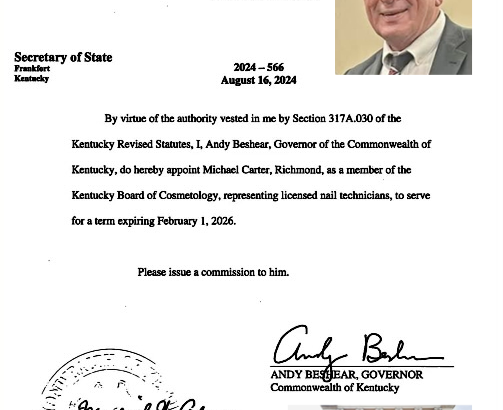
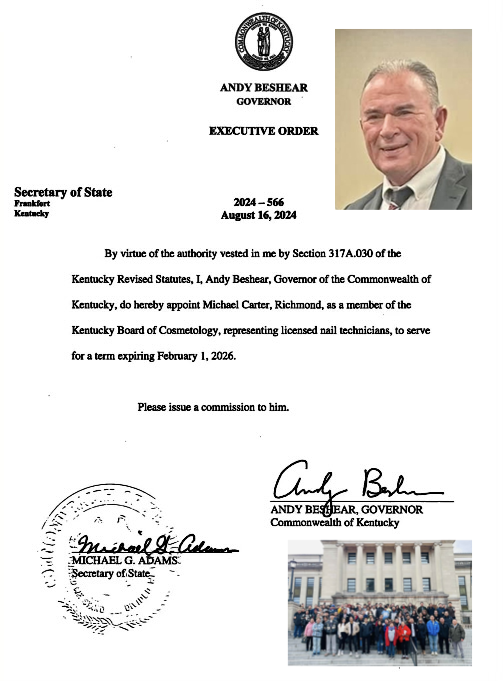
Today, we are excited to announce that Governor Andy Beshear, along with Secretary of State Michael Adams, has officially filled the first of these new positions. Michael Carter of Richmond, Kentucky, has been appointed as the newest member of the Kentucky Board of Cosmetology, representing licensed nail technicians. His appointment is effective immediately as of August 16, 2024, and he will serve a term that expires on February 1, 2026.

This appointment is a significant milestone for the beauty industry in Kentucky, particularly for nail technicians, as it ensures that their voice is heard at the state level. Michael Carter’s experience and dedication to the profession will bring valuable insights to the Board, benefiting all nail technicians across the Commonwealth.

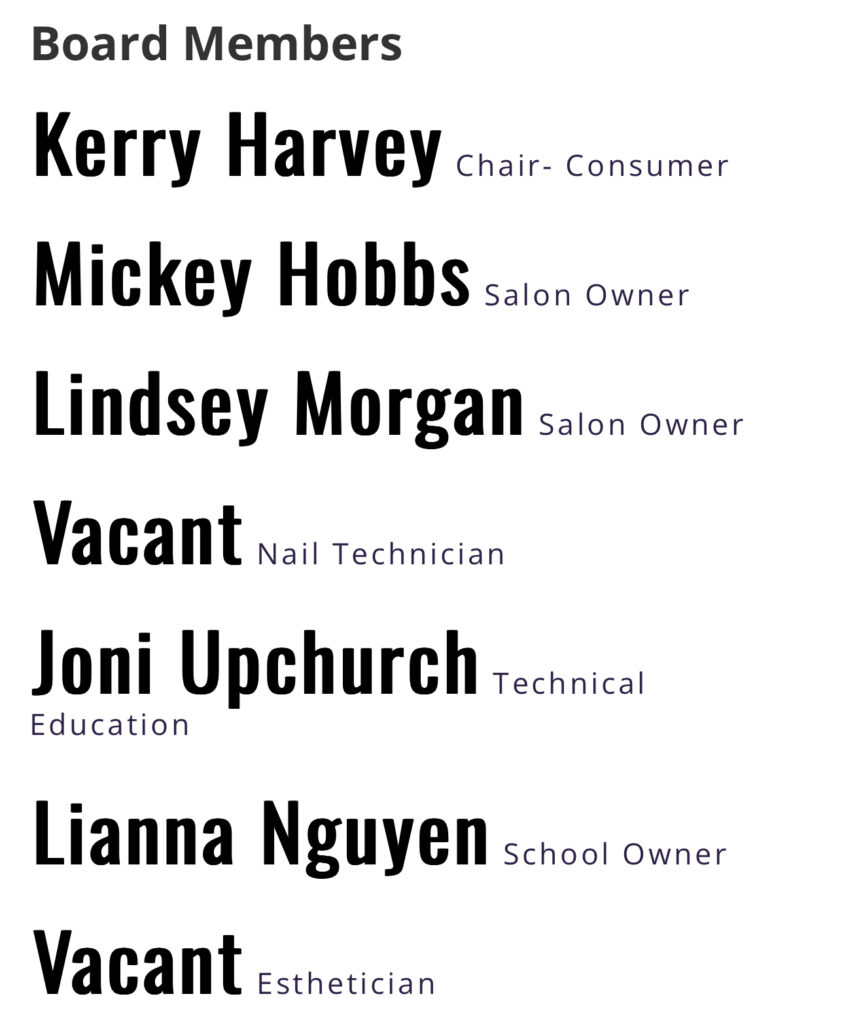
As of August 19th, 2024 – KENTUCKY STATE BOARD OF COSMETOLOGY MEMBERS

At Louisville Beauty Academy, we understand how vital it is for our students and graduates to be aware of such changes. We are committed to providing timely updates and ensuring that our community remains informed about important regulatory shifts. We encourage all our students to stay engaged and understand how these changes may affect their professional journey.

As we await the appointment of a representative for estheticians, we are confident that these additions to the Board will further enhance the diversity and representation within the beauty industry in Kentucky. We will continue to keep our students informed of any further developments.

Stay tuned for more updates, and remember, Louisville Beauty Academy is here to support you every step of the way in your beauty career.

Louisville Beauty Academy remains dedicated to excellence in education and compliance with Kentucky’s beauty regulations, ensuring our students are well-prepared to thrive in their professional careers.


Disclaimer: The information provided in this update is shared as known and publicly available at the time of publication. Louisville Beauty Academy does not guarantee the accuracy, completeness, or timeliness of the information provided. For the most accurate and up-to-date information, please contact the Kentucky State Board of Cosmetology directly by emailing them at kbc@ky.gov.

Louisville Beauty Academy: A Gateway to Beauty Careers for the Latino Community in Kentucky

Nestled in the heart of Kentucky, the Louisville Beauty Academy (LBA) has become an important conduit for those pursuing a career in the beauty industry. Offering comprehensive licensing programs in Cosmetology (1500 hours), Esthetics (750 hours), Nail Technology (450 hours), and Blow and Styling (400 hours), all in compliance with Kentucky law, LBA stands out for its commitment to diversity and the empowerment of immigrant communities. A special note of recognition is due for its remarkable dedication to Kentucky’s dynamic Latino community.

The LBA is more than just a beauty academy. It’s a story of immigrant success, symbolizing the realization of the American dream. Owned and operated by Vietnamese immigrants, Di Tran and his wife, Vy Truong, LBA epitomizes the spirit of perseverance, aspiration, and progress. Their personal journey of migration and adaptation has fostered a deep commitment to paying it forward to the immigrant communities in the USA, primarily the Latino and Asian communities.

The Latino community in Kentucky, comprising Mexican-Americans, Puerto Ricans, Cuban-Americans, Dominican-Americans, Central American-Americans, South American-Americans, and Spanish-Americans, finds a haven of opportunity at LBA. Here’s why:

Cultural Affinity: The Latino community’s beauty traditions and practices are acknowledged and celebrated at LBA. The inclusive curriculum incorporates these rich traditions, instilling a sense of cultural connection.

Language Inclusion: LBA goes the extra mile to overcome the language barrier often faced by immigrants. This commitment to language inclusivity ensures that students whose first language isn’t English don’t feel left out.

Community Building: LBA’s diverse student body promotes a strong sense of community. It fosters a space where students can connect with others who share similar cultural backgrounds and aspirations, providing an enriching and supportive learning environment.

Employment Opportunities: LBA’s robust training programs equip students with skills for a broad spectrum of career opportunities in the beauty industry. This is particularly beneficial for the Latino community, paving the path towards entrepreneurship and gainful employment.

Professional Development: Beyond imparting technical skills, LBA emphasizes the importance of professionalism. It instills discipline, work ethic, and the professional demeanor necessary to excel in the beauty industry, all while adhering to Kentucky’s stipulated training hours.

Di Tran and Vy Truong’s vision extends beyond the boundaries of education. They have successfully transformed LBA into a launchpad for empowering over a thousand graduates, a majority of whom are immigrants. Their focus on serving the immigrant community is a testament to their personal journey and the challenges they’ve overcome.

This dedication resonates strongly with the Latino community, providing an environment where diversity is celebrated, language barriers are overcome, and dreams are nurtured. Equally, the Asian community finds at LBA a space that acknowledges and leverages their unique cultural beauty practices.

In essence, Louisville Beauty Academy is more than just an academy; it’s a beacon of hope and opportunity for immigrants. It encapsulates Di Tran and Vy Truong’s belief in giving back to the community that provided them with opportunities, thus shaping the futures of many aspiring beauty professionals. Their story, the academy’s success, and the prosperity of its graduates serve as an inspiration, signaling a bright future for the beauty industry in Kentucky and beyond.