At Louisville Beauty Academy, a school name is not only a name. It is a responsibility.
Every student who walks through the door carries more than a schedule, a tuition plan, or a licensing goal. They carry family pressure, work pressure, language difference, financial reality, hope, fear, discipline, and the quiet question that lives inside almost every serious beginning:
Can I really do this?
Louisville Beauty Academy answers through culture, not noise:
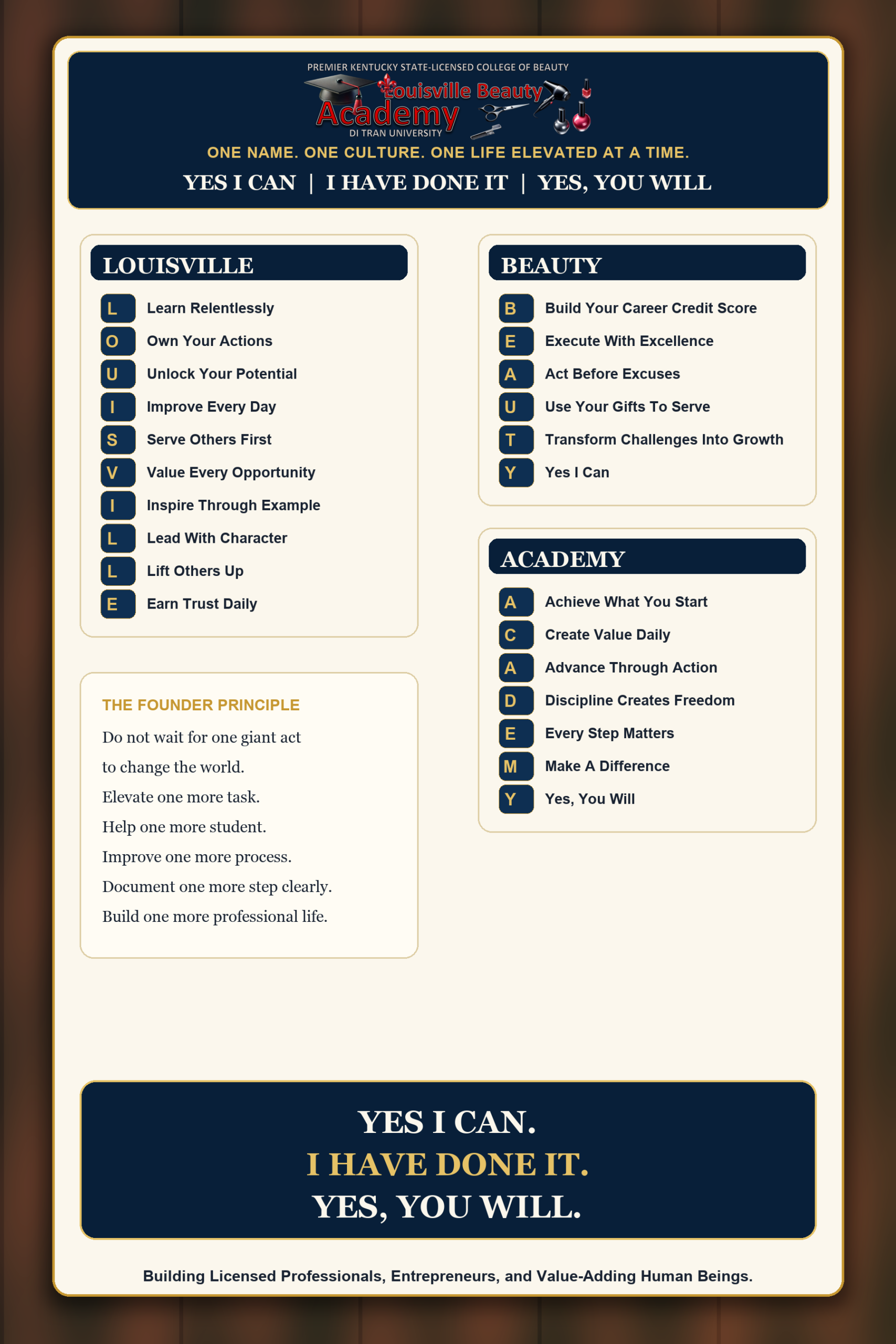
YES I CAN. I HAVE DONE IT. YES, YOU WILL.
Those words are not decoration. They are a sequence of growth. YES I CAN is the courage to begin. I HAVE DONE IT is the proof that disciplined action can become achievement. YES, YOU WILL is the graduate, instructor, family member, salon owner, and community leader turning back toward the next student and saying: keep going.
Louisville Beauty Academy culture wall: one name, one culture, one life elevated at a time.
The Meaning Inside The Name
LOUISVILLE begins with the professional foundation: learning, ownership, service, character, and trust.
L — Learn Relentlessly
O — Own Your Actions
U — Unlock Your Potential
I — Improve Every Day
S — Serve Others First
V — Value Every Opportunity
I — Inspire Through Example
L — Lead With Character
L — Lift Others Up
E — Earn Trust Daily
A beauty professional must learn technique, sanitation, client care, timing, communication, discipline, documentation, and business judgment. Talent matters, but talent without trust does not build a career. Skill matters, but skill without character does not build a profession.
BEAUTY becomes more than appearance. It becomes service, professionalism, dignity, and value creation.
B — Build Your Career Credit Score
E — Execute With Excellence
A — Act Before Excuses
U — Use Your Gifts To Serve
T — Transform Challenges Into Growth
Y — Yes I Can
Beauty work is human work. A student learns to serve another person with care, prepare a clean and safe service environment, listen carefully, practice repeatedly, accept correction, and build public trust one client at a time.
ACADEMY becomes the discipline of completion.
A — Achieve What You Start
C — Create Value Daily
A — Advance Through Action
D — Discipline Creates Freedom
E — Every Step Matters
M — Make A Difference
Y — Yes, You Will
The academy exists because people need more than encouragement. They need structure. They need repetition. They need written clarity. They need instructors who care enough to correct them and a culture strong enough to bring them back to action after difficulty.
One More Action At A Time
The founder principle behind this culture is simple: do not wait for one giant act to change the world. Elevate one more task. Help one more student. Improve one more process. Finish one more requirement. Speak one more sentence of encouragement. Document one more step clearly. Build one more professional life.
Small actions compound.
One checklist becomes readiness.
One correction becomes skill.
One returned student becomes completion.
One written record prevents confusion.
One license pathway becomes economic movement.
One graduate becomes a model for the next person.
This is how a school becomes more than a school. It becomes a place where people practice becoming trustworthy, useful, skilled, licensed, and ready to serve.
Why This Is Also Civic Work
Beauty education is often misunderstood as small. It is not small. It is workforce development. It is small-business formation. It is immigrant and working-family mobility. It is sanitation and public trust. It is language access. It is the discipline of taking a real person from uncertainty toward a documented professional pathway.
Louisville Beauty Academy has been publicly recognized through national small-business and advocacy channels, including the U.S. Chamber of Commerce CO—100 profile for Louisville Beauty Academy and the CO—100 small-business list. Founder Di Tran has also been publicly named by the National Small Business Association among the 2025 Lewis Shattuck Small Business Advocate of the Year finalists, as reflected in NSBA public materials.
Those recognitions matter, but they are not the mission. The mission remains the next student who needs a clear beginning, a lawful school pathway, written cost information, real support, and a culture that says: yes, you can begin; yes, you can continue; yes, you can finish what you start.
The Culture Wall
Louisville Beauty Academy should place this culture where students can see it, read it, photograph it, graduate in front of it, and remember it.
Not because words alone create success. They do not.
But repeated words, repeated actions, repeated standards, repeated correction, and repeated evidence shape people. A wall can become a daily reminder. A staircase can become a progression. A graduation backdrop can become proof. A student handbook page can become a standard. A website article can become an invitation to a person who has not yet found the courage to ask.
The culture is uplifting because it is practical. Ask questions in writing. Review the documents. Understand the cost. Know the attendance expectations. Respect sanitation. Practice the skill. Listen to correction. Finish the hours. Prepare for the board. Build trust daily.
Student next step
Ask LBA for current written information before you decide.
If you are comparing programs, schedule, tuition, language support, tour options, or enrollment documents, ask for current written follow-up. A clear record protects the student and strengthens trust.
Louisville Beauty Academy is building licensed professionals, entrepreneurs, and value-adding human beings one disciplined step, one caring action, and one life at a time.
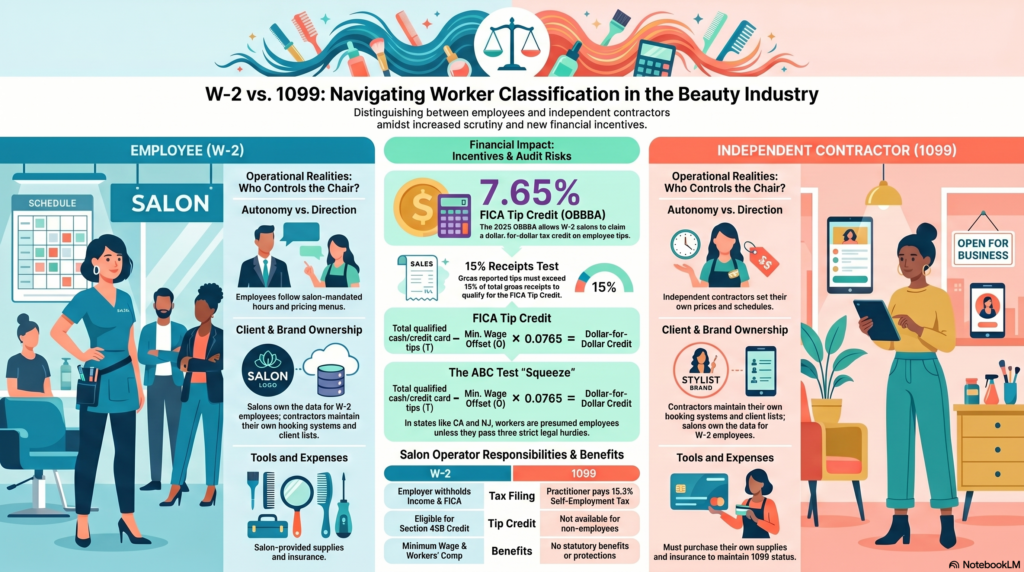
The beauty and personal care industry in the United States operates at the intersection of federal tax regulations, Department of Labor standards, and highly specialized state-level occupational licensing laws1. Historically characterized by diverse business structures—ranging from commission-based employee salons and independent booth rentals to modern salon suites—the personal care sector has encountered unique worker-classification challenges3.
Under modern economic pressures, increased regulatory coordination, and landmark federal tax overhauls, the classification of beauty professionals has become a central focus for compliance, litigation, and administrative scrutiny6. This study provides a comprehensive analysis of the historical background, federal administrative evolution, state licensing disparities, industry-specific classification metrics, and the legal elements that distinguish independent contractors from employees in the personal care sector.
1. Historical Background of Beauty Industry Operations
Evaluating whether the beauty industry historically operated around independent contractors requires a nuanced understanding of early twentieth-century personal care businesses. The structural organization of early establishments, the evolution of occupational licensing, and the unique socio-economic factors that shaped specific service lines demonstrate that the independent-contractor model was neither uniform nor universally tolerated9.
The Early Commercialization of Personal Care
The commercial beauty salon in the United States emerged in the late nineteenth and early twentieth centuries as a highly structured enterprise9. While early hair-care practices existed as localized or home-based services, the late 1880s saw the rise of formal commercial advertisements, such as those placed by Samuel Fowler, a barber and hairdresser in Hendersonville, North Carolina, in 18859. Following World War I, social transformations—including women’s suffrage and the mobility provided by the automobile—prompted a rapid expansion of home-based beauty shops in the 1920s9.
By the late 1920s and 1930s, technological developments, such as the hot-blast hair dryer (invented in 1892) and the Marcel curling iron, pushed beauty operations into formal commercial spaces in downtown areas9. These early commercial salons operated primarily on employee-based models to manage heavy capital investments in equipment and ensure standardized customer experiences9.
The scale of the industry grew rapidly. In 1939, figures from the U.S. Department of Commerce documented 87,270 commercial beauty salons nationwide, supporting a collective payroll of $81 million9. The dominance of the employer-employee relationship in the mid-twentieth century is further illustrated by corporate operations, such as a factory in North Carolina that established an on-site beauty parlor in 1967 to serve its 500 female employees, aiming to reduce absenteeism and maintain structural control over their schedules9.
Chronological Development of State Licensing and Specialized Specialties
State regulation of the personal care professions developed through distinct legislative pathways, establishing a fragmented regulatory structure that persists today13.
Barbering and Cosmetology Boards (1920s): In 1927, California established the Board of Barber Examiners and the Board of Cosmetology to govern these fields as separate, regulated professions13.
Nail Specialty (1930s): In 1939, distinct state licenses for manicurists were introduced, separating nail care from the broader cosmetology curriculum13.
Esthetics (1970s): Esthetics, or skin care specialty licensing, emerged later as a distinct discipline, with California formally establishing a separate cosmetician/esthetician license in 197813.
Board Consolidation (1990s): In 1992, California merged its independent barber and cosmetology boards into a single regulatory entity, the Board of Barbering and Cosmetology, setting a nationwide precedent for consolidated board oversight13.
The Shift Toward Booth Rental and Freelance Operations
The transition from structured employee salons to independent booth-rental arrangements gained momentum during the late 1960s and 1970s9. As consumer styles evolved away from uniform weekly perms and structured roller sets, beauty professionals sought greater flexibility in scheduling, service menu design, and pricing12.
Simultaneously, the federal tax code discouraged traditional employment structures12. When tipping became customary in personal care, employee-based salons had to report and match federal payroll taxes on employee tips, yet they were excluded from the FICA Tax Tip Credit established in 1993 for the restaurant industry12. This structural imbalance incentivized salon owners to convert W-2 operations into booth-rental structures, shifting the payroll tax burden to self-employed individuals12.
The shift toward independent operations was accelerated by a rise in one-chair salons and home-adapted businesses, transforming cosmetologists into individual entrepreneurs9. However, this model was not universally accepted. In states like Pennsylvania and New Jersey, statutory bans on booth rentals forced the industry to remain strictly employee-based, while in other states, regulators struggled to monitor a cash-intensive, decentralized sector17.
The Refugee Connection and the Expansion of the Nail Sector
The nail salon sector followed a distinct developmental timeline linked to geopolitical events and immigrant networks10. Before the 1970s, nail care was a high-end luxury service offered in elite beauty parlors10. This structure changed rapidly after the fall of Saigon in 1975, which prompted the resettlement of over 130,000 Vietnamese refugees in the United States10.
A key historical catalyst occurred at Hope Village, a refugee camp near Sacramento, California, where actress Tippi Hedren volunteered10. After refugees admired her manicured nails, Hedren arranged for her personal manicurist to train 20 Vietnamese women at the camp10. This training, combined with California’s accessible licensing requirements (requiring only 300 to 600 hours of specialized training), enabled rapid entry into the trade10.
This initial cohort scaled operations across the Central Valley by leveraging family labor and cash-based business models10. With minimal startup costs (frequently under $5,000), these family-owned businesses lowered prices for a manicure from luxury rates to affordable levels of $5 to $10 by the mid-1980s10.
As the industry grew, it increasingly relied on informal commission splits or cash-based operations10. These arrangements frequently blurred the line between independent contracting and employment, leading to modern worker-protection challenges and targeted enforcement sweeps20.
2. State-by-State Regulatory Landscapes
The legal validity of utilizing independent contractors in the beauty industry varies significantly from state to state23. Salon owners and beauty professionals must navigate a complex regulatory landscape where a classification may comply with federal common law but violate state labor standards25.
State
Primary Classification Test
Booth Rental Legal Status
Key Specializations & License Exceptions
California
ABC Test (codified under AB 5)26.
Legal only if the strict “Professional Services” carve-out requirements are met7.
Manicurists are completely excluded from the booth rental exemption as of January 1, 202528.
New York
Common Law Right-of-Control; Area Renter Framework30.
Legal, but requires a separate, active “Area Renter” license30.
Mandatory general liability insurance and wage bonds for nail specialty salons31.
New Jersey
Strict ABC Test (N.J.S.A. 43:21-19(i)(6))25.
Permitted under P.L. 2023, c. 231, but highly restricted25.
Booth renters must obtain a separate Board permit; satisfying Prong B of the state ABC test is extremely difficult for in-salon stylists25.
Pennsylvania
Common Law Right-of-Control18.
Prohibited in cosmetology salons under Section 8.133; legal in barbershops18.
Active legislative reform (HB 644 / SB 830) seeks to repeal the prohibition for cosmetology, esthetics, and nail technology34.
California: The Impact of AB 5 and the Expiration of the Manicurist Exemption
California remains the most restrictive jurisdiction for worker classification7. The state’s worker classification standards are governed by Assembly Bill 5 (AB 5), which took effect on January 1, 2020, and codified the strict “ABC” test established in the Dynamex ruling26. Under this test, a worker is presumed to be an employee unless the hiring entity can prove the worker is free from control (Prong A), performs work outside the usual course of business (Prong B), and operates an independently established trade (Prong C)26.
Because a stylist performing beauty services inside a commercial salon cannot satisfy Prong B, AB 5 would have effectively banned the traditional booth rental model25. To address this, the legislature enacted a “Professional Services” carve-out7. This exception allows licensed cosmetologists, barbers, estheticians, and electrologists to bypass the ABC test and be evaluated under the more flexible Borello common-law standard, but only if they satisfy strict statutory criteria:
The individual must maintain a separate business location or rent a clearly defined space within the host salon27.
The individual must secure a local business license in addition to their state professional board license7.
The individual must set their own service rates, process their own payments directly from clients, and maintain a separate book of business26.
The individual must issue a Form 1099 to the salon owner for the rental space they lease27.
Crucially, the legislature treated manicurists differently28. Under AB 5, licensed manicurists were granted only a temporary carve-out, which was extended by Assembly Bill 1561 until January 1, 202528. The legislature adjourned its 2024 session without extending this provision29.
Consequently, as of January 1, 2025, the legal exemption for licensed manicurists in California became inoperable28. Nail salons in California are no longer legally permitted to utilize independent contractors or booth renters; all manicurists operating within a salon environment must be classified as employees and granted full labor protections, including minimum wage, meal breaks, and rest periods27.
New York: The Area Renter Model and Article 27 Compliance
New York manages independent contracting through a specialized licensing framework governed by the Department of State (NYSDOS) under General Business Law Article 2730. The state establishes a distinct licensing category known as the “Area Renter”30.
An Area Renter is defined as a licensed operator who works in an Appearance Enhancement Business but is not employed by the owner30. To legally operate under this structure, the host facility must hold an Appearance Enhancement Business license, and the individual practitioner must maintain both their professional discipline license (e.g., cosmetology, esthetics, natural hair styling, or nail specialty) and an active Area Renter license associated with that specific location30.
Furthermore, Area Renters are legally treated as independent business owners30. They must submit evidence of a $50,000 surety bond or maintain individual general and professional liability insurance policies of at least $25,000 per occurrence and $75,000 in the aggregate31. If an Appearance Enhancement Business closes or changes ownership, all associated Area Renter licenses are automatically canceled, requiring the independent practitioners to reapply under the new business registry30.
New Jersey: Board Permits vs. the Unemployment ABC Test
New Jersey has historically maintained a strict stance against independent beauty professionals17. Under N.J. Admin. Code § 13:28-2.8, the leasing of space to non-employees for the purpose of providing cosmetology, hair styling, barbering, or nail services was entirely prohibited17. On January 8, 2024, the state enacted P.L. 2023, c. 231 (amending N.J.S.A. 45:5B-3), which established a legal pathway for booth rentals25. This statute requires booth renters to obtain a separate booth or chair rental license from the Board of Cosmetology and mandates a written agreement specifying three terms:
The worker is an independent contractor25.
The shop owner exercises no operational or technical control over the worker’s methods25.
The rent is structured as a flat fee or a fixed percentage25.
However, complying with the Board of Cosmetology’s licensing requirements does not shield salon owners from New Jersey’s Department of Labor25. For unemployment, disability, and wage-hour purposes, the state applies the strict ABC test25.
Under New Jersey Supreme Court precedent (Hargrove v. Sleepy’s), satisfying Prong B remains a near-insurmountable hurdle for traditional salon owners25. A stylist cutting hair within a commercial salon is performing services that are an integral part of the salon’s core business, meaning that New Jersey labor auditors continue to classify most booth renters as employees for unemployment tax purposes25.
Pennsylvania: The Barber/Cosmetology Disparity and Legislative Reforms
Pennsylvania represents a clear example of historical regulatory division18. Under Section 8.1 of the Pennsylvania Cosmetology Law of 1933, renting booth space to licensed cosmetologists, estheticians, or nail technicians is strictly unlawful33.
In contrast, licensed barbers in Pennsylvania have historically been permitted to rent chairs and booths to operate independent freelance businesses18. This discrepancy has drawn criticism from state legislators and industry advocates who argue it burdens cosmetologists, over 90% of whom are female, and drives styling activities into unregistered home-based operations35.
To resolve this imbalance, the state legislature has introduced bills, including House Bill 644 and Senate Bill 830, designed to repeal Section 8.1, eliminate the definition of prohibited booth space, and establish equal business opportunities for cosmetologists and barbers34.
3. Federal Law History and Administrative Shifts
Federal worker-classification standards are governed by distinct tests administered by the Internal Revenue Service (IRS) and the United States Department of Labor (DOL)1. These standards have shifted over time, reflecting the policy priorities of different presidential administrations1.
The IRS Framework and the Section 530 Safe Harbor
The IRS determines worker status for federal employment tax purposes using the common-law “right-of-control” test2. This analysis focuses on behavioral control, financial control, and the nature of the relationship46.
To address concerns regarding overzealous IRS auditing, Congress enacted Section 530 of the Revenue Act of 197846. This safe-harbor provision protects employers from retroactive federal employment tax liabilities if they have a reasonable basis for treating workers as independent contractors and do so consistently2.
To qualify for Section 530 protection, a salon owner must satisfy three criteria:
Reasonable Basis: The salon owner must demonstrate reliance on judicial precedent, past IRS audit results, or a long-standing, recognized practice of a significant segment of the industry46.
Substantive Consistency: The salon owner must treat all similarly situated beauty professionals as independent contractors2.
Reporting Consistency: The salon owner must file all required federal tax returns, including Forms 1099-NEC, in a timely manner consistent with independent contractor status25.
The strict application of these requirements is illustrated in Ren-Lyn Corp. v. United States48. In this case, a beauty salon operator classified one group of cosmetologists as W-2 employees and another group as 1099 independent contractors under lease agreements48. Because both groups performed the same daily services—cutting, coloring, and shampooing—the court denied Section 530 relief, ruling that the salon had failed to satisfy the substantive consistency requirement48.
Historical Federal Legislative and Joint Agency Initiatives
Over the past two decades, federal agencies have periodically launched coordinated initiatives to address worker misclassification6.
The Proposed EMPA and PFPA (2010–2011): In April 2010 and October 2011, Congress introduced the Employee Misclassification Prevention Act (EMPA) to amend the Fair Labor Standards Act (FLSA), proposing strict recordkeeping mandates and civil penalties of up to $5,000 per misclassified worker6. In April 2011, the Payroll Fraud Prevention Act (PFPA) was introduced as a targeted alternative, aimed at establishing written notification mandates and strict recordkeeping requirements for non-employees6.
The Labor-Treasury Joint Initiative (FY2011): The Department of Labor’s FY2011 budget allocated $25 million to a joint Labor-Treasury initiative6. This funding supported the hiring of additional Wage and Hour Division (WHD) investigators and provided competitive grants to states to enhance their misclassification detection programs6.
The September 2011 IRS-DOL Memorandum of Understanding: On September 19, 2011, the DOL and the IRS entered into a formal Memorandum of Understanding (MOU) to share audit information, coordinate enforcement strategies, and reduce payroll tax evasion6.
Executive Shifts in the DOL “Economic Realities” Rulemaking
The Department of Labor’s interpretation of worker status under the FLSA has undergone significant administrative revisions1.
DOL FLSA Rulemaking Timeline ┌─────────────────────────────────────────────────────────────────────────┐ │ Pre-2021: Long-standing reliance on informal guidance (e.g., Fact │ │ Sheet 13) outlining seven non-dispositive factors [cite: 43]. │ └────────────────────────────────────┬────────────────────────────────────┘ ▼ ┌─────────────────────────────────────────────────────────────────────────┐ │ January 2021 Rule (Trump Administration): Prioritized two “core” │ │ factors: the nature and degree of control, and the opportunity for │ │ profit or loss [cite: 1, 45, 52]. If both core factors pointed to the │ │ same classification, there was a high likelihood it was respected. │ └────────────────────────────────────┬────────────────────────────────────┘ ▼ ┌─────────────────────────────────────────────────────────────────────────┐ │ January 2024 Rule (Biden Administration): Rescinded the 2021 rule. │ │ Replaced it with a six-factor, totality-of-the-circumstances test │ │ where no single factor is dispositive [cite: 23, 43, 52]. Emphasized │ │ whether the work is an “integral” part of the business [cite: 43, 52]. │ └────────────────────────────────────┬────────────────────────────────────┘ ▼ ┌─────────────────────────────────────────────────────────────────────────┐ │ February 2026 NPRM (Trump Administration): Proposed to rescind the 2024 │ │ rule and reinstate the 2021 core-factor framework [cite: 23, 51, 52]. │ │ Focuses on whether the worker is economically dependent on the business │ │ or in business for themselves [cite: 23]. Under Docket No. │ │ WHD-2026-0001, comments are open through April 28, 2026 [cite: 23, 45]. │ └─────────────────────────────────────────────────────────────────────────┘
4. The Contemporary Squeeze: Why Worker Classification is Escalating Now
The current wave of audits and litigation targeting worker classification in the beauty industry is driven by a combination of economic events, state enforcement strategies, and federal tax changes6.
The CARES Act and State Unemployment Audits
The COVID-19 pandemic significantly impacted how state agencies monitor beauty industry classifications2. Under the CARES Act of 2020, Congress established the Pandemic Unemployment Assistance (PUA) program, allowing self-employed independent contractors and booth renters to receive state unemployment benefits2.
When thousands of 1099 beauty professionals applied for these benefits, they listed their host salons as employers in state databases2. This provided state unemployment agencies with a direct map of businesses utilizing independent contractors2.
Because these salons had not contributed state unemployment insurance (SUI) taxes on behalf of these workers, state labor departments launched retrospective audits2. These audits aimed to determine if the salons owed back SUI taxes, interest, and misclassification penalties2.
The One Big Beautiful Bill Act (OBBBA) of 2025
The passage of the One Big Beautiful Bill Act (OBBBA), signed into law on July 4, 2025, has reshaped the financial considerations of worker classification53. Historically, the restaurant industry benefited from the IRC Section 45B FICA Tax Tip Credit, which allowed food and beverage employers to claim a dollar-for-dollar tax credit for the employer’s share of payroll taxes paid on employee tips12.
The OBBBA expanded this credit to beauty and wellness businesses, effective retroactively to January 1, 20258. Under the OBBBA, qualifying salons, spas, and barbershops can claim a dollar-for-dollar tax credit against their federal income tax liability for the 7.65% FICA tax paid on reported employee tips8. The credit is calculated using the following formula:
Where:
represents the total qualified cash and credit card tips reported by employees to the employer8.
represents the minimum wage offset, which is the portion of tips needed to bring the employee’s direct hourly wage up to the federal minimum wage baseline of per hour8. If an employee’s hourly wage already equals or exceeds , the offset is , allowing the credit to apply to of reported tips16.
To prevent abuse, the OBBBA introduced a “15% receipts test” specifically for the beauty and wellness sector: the business’s gross reported tips must equal or exceed 15% of its total gross receipts for the calendar year to qualify for the credit8. Additionally, the OBBBA established a temporary federal income tax deduction through December 31, 2028, allowing tipped employees in eligible beauty occupations to exclude up to $25,000 of tip income from federal income taxes53.
These provisions do not apply to booth renters or independent contractors, as they do not earn W-2 wages and are responsible for paying the full 15.3% self-employment tax on their personal Schedule C filings46. The OBBBA creates a strong financial incentive for salon owners to transition from a 1099 model to a compliant, W-2 employee-based model, as the tax savings from the FICA Tip Credit can substantially offset traditional employer payroll liabilities8.
Multi-Agency Targeted Task Forces
At both state and federal levels, agencies are increasingly sharing data and coordinating resources6. State departments of labor, tax departments, workers’ compensation boards, and unemployment agencies have established joint task forces, such as New York’s Task Force to End Worker Exploitation20.
These entities conduct targeted enforcement sweeps on cash-intensive businesses, focusing on nail salons, barbershops, and spa operations19. The goal is to enforce tax collection, ensure workers’ compensation coverage, recover unpaid SUI contributions, and address wage-and-hour compliance6.
5. Sector-Specific Comparison and Vulnerabilities
To understand worker classification in the beauty industry, it is helpful to contrast its operational realities with other common 1099 sectors.
Element
Beauty Industry (Booth/Suite Rental)
Gig Economy (Rideshare/Delivery)
Trucking (Owner-Operators)
Construction
Operational Control
High. Stylists set own rates, select products, and negotiate directly with clients4.
Low. Platforms set prices, assign tasks, and control client data57.
High/Medium. Autonomy over hauls, but dependent on carrier dispatch59.
Medium. Subcontractors manage their own crews but must adhere to general contractor schedules50.
Physical Infrastructure
Fixed commercial footprints; lease of physical square footage4.
Decentralized; entirely reliant on mobile digital platforms57.
Mobile equipment; lease-to-own or independent ownership of rigs59.
Temporary, evolving project sites owned by third parties50.
Licensing Requirements
Individual professional licenses required by state cosmetology boards30.
Relationship built between carriers/brokers and dispatchers59.
Project-by-project bidding with general contractors50.
The beauty industry’s reliance on independent contractor structures stems from distinct historical and operational practices3. Personal care transactions are highly customized and built on long-term relationships between clients and individual professionals46.
This dynamic encourages stylists to seek control over their creative methods, product selection, and schedules4. Salon owners, meanwhile, utilize booth rental and salon suite models to secure predictable, passive rental income, avoiding the complexities of payroll management, inventory tracking, and employee benefits3.
However, this decentralized structure creates compliance challenges in traditional beauty salons12. Many establishments operate hybrid models, mixing W-2 employee stylists with 1099 booth renters under one roof48. This arrangement often leads to misclassification48.
If a 1099 renter is integrated into the salon’s brand identity, required to use the salon’s centralized booking software, or directed to follow uniform salon rules, labor regulators will classify them as an employee, regardless of the written lease agreement46.
6. The Crucial Elements of Worker Classification
To determine whether a beauty professional is a legitimate independent contractor or a statutory employee, state and federal regulators analyze several behavioral, financial, and structural elements of the relationship3.
Schedule Control
Employee: The salon owner establishes set working hours, assigns shifts, requires attendance at staff meetings, or mandates work on specific weekends or holidays46.
Independent Contractor: The beauty professional has absolute autonomy over their schedule, determining when they work, when they take breaks, and when they take vacation without requiring approval46.
Pricing Control
Employee: The salon owner establishes a uniform menu of services and sets the prices charged to clients46.
Independent Contractor: The practitioner sets their own service prices and retains the authority to offer discounts or alter their menu26.
Client Control
Employee: The salon manages the central client database, assigns walk-in clients, and retains ownership of the booking files if the stylist leaves46.
Independent Contractor: The practitioner maintains their own client records, manages their own appointments, and retains their personal client list if they relocate46.
Control of Services
Employee: The salon owner requires the stylist to perform specific services, mandates the use of particular techniques, or requires them to follow a signature styling protocol46.
Independent Contractor: The professional has complete creative freedom to determine which services to offer and how to execute them4.
Ownership of Tools and Supplies
Employee: The salon owner provides the workstation, chair, back-bar supplies, towels, and styling chemicals at no cost to the worker46.
Independent Contractor: The practitioner purchases, maintains, and utilizes their own personal tools and chemical lines (e.g., scissors, blow dryers, colors, and foils)48.
Profit or Loss Dynamics
Employee: The worker is paid a guaranteed hourly wage, salary, or structured commission, meaning they do not bear direct business risks or face net operating losses2.
Independent Contractor: The practitioner pays a fixed rent to the salon regardless of their client volume, meaning they can experience a net financial loss on slow weeks46.
Investment in the Business
Employee: The worker has no capital investment in the salon’s physical infrastructure, retail inventory, or commercial lease66.
Independent Contractor: The practitioner invests in their own commercial liability insurance, retail inventory, business licenses, and continuing education4.
Permanency of the Relationship
Employee: The relationship is structured as continuous and indefinite, with the expectation of ongoing employment23.
Independent Contractor: The relationship is governed by a defined commercial lease with a set start date, end date, and structured renewal clauses4.
Skill and Initiative
Employee: The salon owner provides specialized training and continuing education to help the stylist develop their skills within the salon’s brand12.
Independent Contractor: The practitioner brings pre-existing specialized skills and uses business initiative to market their services and build profitability43.
Integration into the Salon Business
Employee: The stylist’s work is a core part of the salon’s primary business operations, and their services are marketed under the salon’s name25.
Independent Contractor: The practitioner operates an independent business that is structurally separate from the landlord’s real estate operations, often utilizing a distinct brand identity3.
Advertising and Branding
Employee: The stylist is marketed strictly under the salon’s brand name, utilizes the salon’s business cards, and is listed directly on the salon’s main social media accounts64.
Independent Contractor: The professional advertises under their own business name, distributes personal business cards, and manages independent social media platforms60.
Renting Space and Written Agreements
Employee: The worker does not pay rent to the salon and may sign a standard employment agreement, non-compete, or employee handbook46.
Independent Contractor: The relationship is governed by a commercial real estate lease or booth rental agreement that explicitly defines the landlord-tenant relationship4.
Payment and Tax Forms
Employee: The worker receives a Form W-2 at the end of the year, with federal, state, and local taxes automatically withheld from their paychecks46.
Independent Contractor: The practitioner receives payments directly from clients and pays rent to the landlord, receiving a Form 1099-MISC or Form 1099-NEC from the salon only if they performed non-rental services for the salon exceeding $60025.
Crucially, the tax form used does not decide classification; rather, the underlying operational behavior is dispositive23.
For salon owners, beauty schools, and independent professionals, navigating this complex landscape requires translating legal standards into daily operational practices2.
Demystifying the W-2 vs. 1099 Relationship
To maintain a compliant operation, the distinction between W-2 employment and 1099 independent contracting must be clearly defined across all business practices2.
Operational Metric
Employee (W-2 Status)
Independent Contractor (1099 Status)
Tax Reporting
The employer issues a Form W-2 annually, automatically withholding federal, state, and local income taxes and FICA46.
The practitioner receives a Form 1099-NEC only if paid non-rental fees over $600; otherwise, they file a Schedule C25.
FICA Contributions
The employer pays 7.65% (matching the employee’s 7.65%) to fund Social Security and Medicare16.
The practitioner pays the full 15.3% Self-Employment Contribution Act (SECA) tax on net earnings2.
FICA Tip Credit (OBBBA)
The salon owner can claim a dollar-for-dollar tax credit on the 7.65% FICA paid on employee tips under Section 45B16.
Not available. Independent contractors are not employees, so owners pay no payroll tax on their tips56.
Operational Control
The salon owner directs schedules, assigns clients, sets prices, and establishes service protocols24.
The practitioner retains complete control over scheduling, pricing, product choices, and methodology24.
Worker Protections
The worker is covered by minimum wage, overtime, SUI, and workers’ compensation3.
The worker has no statutory benefits and must purchase individual insurance and SUI coverage if desired2.
The Real Meaning of “1099” and “Agreement” Paperwork
A common misconception is that a signed independent contractor agreement or the issuance of a Form 1099 is sufficient to prove independent status24.
However, in both state and federal audits, written agreements are treated as secondary to behavioral reality23. If a written contract states that a technician is an independent contractor, but the salon owner manages their schedule, controls client bookings, or handles payments through a central register, auditors will void the contract and classify the worker as an employee46.
Standard Documentation Checklist for Salon Owners
To demonstrate a legitimate landlord-tenant relationship and protect against misclassification claims, a salon owner utilizing the booth or suite rental model should maintain the following records64:
Commercial Lease Agreement: A signed lease detailing a flat-rate rent or structured percentage rental, with no clauses granting the owner operational control over the stylist’s methods or schedule4.
Professional and Business Licenses: Copy of the renter’s active state professional license and active local municipal business license7.
Active Liability Insurance: Proof of a personal commercial general and professional liability insurance policy maintained by the renter, listing the host salon as an additional insured4.
Tax Identifiers: Verification of the renter’s Employer Identification Number (EIN) or separate tax identification number48.
Independent Booking and Payment Systems: Proof that the renter utilizes their own scheduling software and processes client payments via a personal POS terminal26.
Standard Documentation Checklist for Beauty Professionals
An independent contractor or booth renter should maintain separate business records to support their self-employed status2:
Business Entity Filings: Documentation of a registered business entity (e.g., Sole Proprietorship, LLC, or S-Corporation) with a separate EIN25.
Separate Financial Accounts: Standalone business checking and savings accounts used exclusively for business income, equipment purchases, and licensing expenses2.
Continuing Education Records: Receipts and certificates for independent advanced training, hair shows, or business education courses paid for out of personal funds4.
Quarterly Estimated Taxes: Records of timely filed estimated federal and state tax payments60.
SUI and Workers’ Compensation Disclaimers: Where permitted by state law, formal waivers or independent registrations for SUI and workers’ compensation2.
8. Evaluation of Common Industry Beliefs
To provide clear guidance to beauty industry organizations and professionals, this section directly evaluates common assertions regarding worker classification.
“Beauty has historically used independent contractors.”
QUALIFIED. While booth and chair renting has been a common practice for over fifty years, the industry’s foundations were built on structured, employee-based salons3. The expansion of booth rentals in the late twentieth century was driven by changing consumer styles and specific tax code dynamics rather than a uniform historical tradition9.
“It used to be mainly cosmetology.”
DENY. Barbering was actually the early regulatory anchor for independent space rentals18. In states like Pennsylvania, licensed barbers were legally permitted to lease chairs and booths decades before cosmetology salons were granted similar rights18. Cosmetology, nail care, and esthetics adopted independent-contractor structures much later as distinct professional licensing classes emerged9.
“Nail salons are being targeted specifically.”
QUALIFIED. While all cash-intensive service industries face rigorous auditing, nail salons have experienced highly visible, targeted enforcement sweeps by state labor departments and multi-agency task forces6. This is largely due to historical investigative reporting that exposed widespread wage-and-hour violations, the vulnerability of the immigrant-dominated workforce, and the systematic use of informal cash-commission structures10. Furthermore, specific regulatory changes—such as the 2025 expiration of California’s manicurist exemption from the ABC test—have created immediate, targeted compliance challenges for nail salon operators28.
“This is the first time DOL has gone after independent contractors like this.”
DENY. Coordinated federal enforcement of worker classification has a long history6. The Department of Labor, the IRS, and state agencies have collaborated on misclassification crackdowns for decades, notably through the joint IRS-DOL Memorandum of Understanding in 2011, which targeted cash-intensive service sectors across the country6.
“The law is new.”
DENY. The core legal principles governing worker classification—such as the common-law right-of-control test, the FLSA economic realities framework, and the Section 530 Safe Harbor—date back to the 1930s, 1940s, and 1970s2. While individual administrative interpretations and state statutes (such as California’s AB 5 in 2020) continue to shift, the fundamental legal frameworks are deeply established in American jurisprudence26.
“The payment method decides classification.”
DENY. Payment methodology is merely one of many factors evaluated by tax and labor regulators23. Issuing a Form 1099-NEC or paying a worker in cash/commission carries zero weight if the salon owner retains behavioral, operational, or financial control over how the worker performs their daily services24.
“If the technician controls the work, they are safer as 1099.”
QUALIFIED. Technical control over the physical execution of a service (such as a specialized hair color or skincare treatment) is necessary but not sufficient for independent classification43. Highly skilled professionals may have total creative control over their work but can still be classified as employees if they are integrated into the salon’s core business, utilize the salon’s POS systems, and are economically dependent on the salon owner23.
“If control is off, they immediately fall closer to employee category.”
CONFIRM. Any operational evidence indicating that a salon owner directs scheduling, establishes service prices, dictates product usage, enforces mandatory staff protocols, or directly manages client databases will immediately result in a finding of an employer-employee relationship by any state or federal auditing agency46.
9. Structural and Legal Synthesis
The evolution of worker classification in the U.S. beauty industry demonstrates a clear transition from informal, localized practices to highly coordinated, objective standards6. For decades, the widespread industry practice of booth renting served as an informal defense against employment liabilities3. However, modern regulatory dynamics—characterized by strict state-level ABC tests, post-pandemic unemployment audits, and coordinated data-sharing agreements—require a high level of operational precision from personal care businesses2.
Simultaneously, federal tax reforms introduced by the One Big Beautiful Bill Act of 2025 have fundamentally altered the economics of salon operations16. By extending the IRC Section 45B FICA Tax Tip Credit to beauty and wellness businesses, Congress has established a financially viable pathway for compliant, employee-based models8. Salon owners can now leverage dollar-for-dollar tax credits on reported employee tips, significantly offsetting traditional payroll liabilities and reducing the economic incentives that historically drove businesses toward the 1099 model8.
For beauty establishments that choose to utilize the independent contractor model, the path forward requires a strict structural division3. The relationship must operate as a genuine landlord-tenant arrangement, modeled after modern salon suite franchises where the practitioner maintains absolute operational, financial, and creative independence5.
Ultimately, there is no single “correct” business model; rather, there must be absolute alignment between the chosen legal classification and the daily reality of salon operations2. By educating future beauty professionals, maintaining clean operational boundaries, and keeping precise business documentation, the beauty industry can continue to support both independent entrepreneurs and successful employee-based enterprises2.
“This material is for general education and research only. It is not legal, tax, accounting, payroll, or employment advice. Laws vary by state and facts matter. Salon owners and beauty professionals should consult qualified legal, tax, payroll, insurance, and workers’ compensation professionals before making classification decisions.”
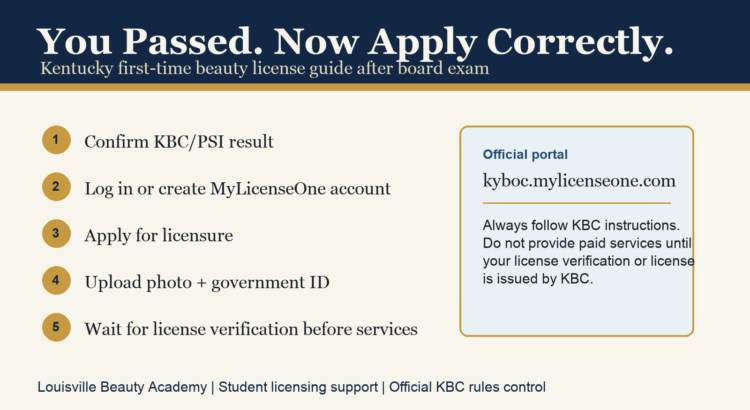
Student guide from Louisville Beauty Academy. Passing your Kentucky board exams is a serious milestone. But passing the exam is not the same thing as already being licensed. In Kentucky, the next step is to apply for your first license through the Kentucky Board of Cosmetology’s online system and wait until the Board issues license verification or the license before providing services.
This guide is written for a first-time Kentucky beauty graduate who has completed school, passed the required board examinations, and is ready to apply for the first professional license through the Kentucky Board of Cosmetology online portal.
Start With The Official Portal
The Kentucky Board of Cosmetology’s online application portal is:
If you already have an account, log in. If you do not have an account, use the portal’s sign-up or account-creation option and follow the prompts. Use your real legal information. Keep your email address accessible because the Board may send confirmation messages, deficiency notices, or status communications by email.
Before You Apply: Make Sure You Are Actually Ready
According to the Kentucky Board of Cosmetology’s published license requirements, first-time applicants in the major student license categories must meet the required training hours, provide grade-12 or equivalency education proof, be at least 18 years old, successfully complete the written and practical examinations, apply for licensure, and receive license verification or the license before providing services.
Cosmetologist: 1,500 hours.
Nail Technician: 450 hours.
Esthetician: 750 hours.
Shampoo and Style Services: 300 hours.
If you have not passed both required examinations, or if your school record is not complete, do not guess. Confirm your status first. If you studied at Louisville Beauty Academy, contact the school office for school-record support. If the question is about state licensing, portal instructions, eligibility, fees, or Board status, follow the Kentucky Board of Cosmetology’s official instructions.
What To Prepare Before Opening The Application
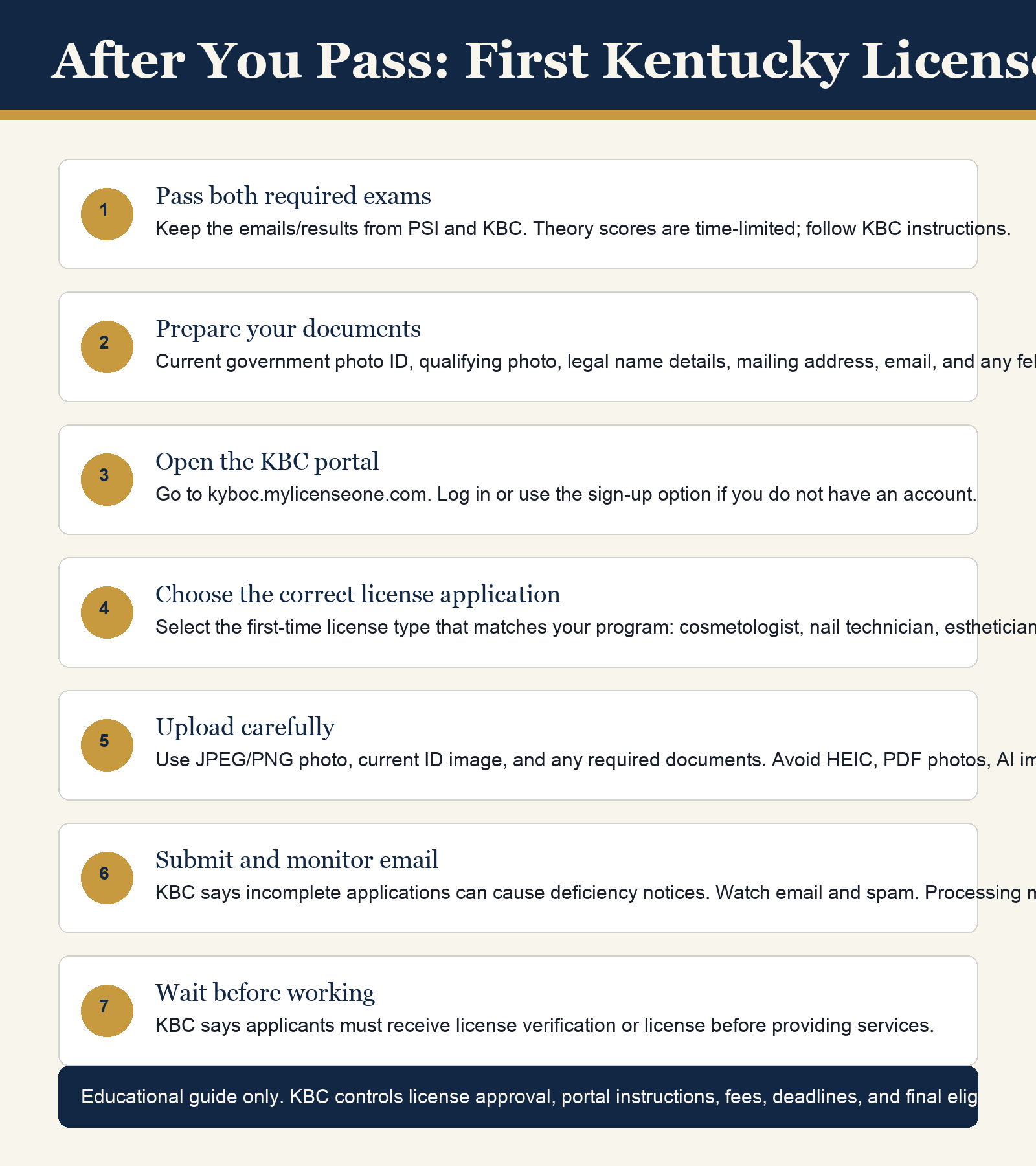
Before you begin the online application, prepare clean digital copies and accurate information. The Board’s licensure page states that applications missing required items are considered incomplete, and processing may take up to 10 days after submission.
Your legal name, date of birth, mailing address, phone number, and active email address.
Your current government photo ID. KBC states that a current driver’s license, state ID, passport ID, or military ID may be used; expired IDs are not accepted.
A clear digital image of the government-issued ID. KBC states photocopies will not be accepted.
A qualifying personal photo taken within the last six months.
Your school completion and examination information, as requested by the portal.
Any felony support documents if applicable, including the documents identified by KBC.
A payment method for required online fees, if the portal requires payment at submission.
Photo Rules Matter
KBC gives detailed photo instructions. Do not treat the photo as a casual selfie. Use a photo taken within the last six months, facing forward, shoulders up, with a solid white or light-blue background. The photo should be clear, not too dark, not too bright, not blurry, and should not include other people, pets, car selfies, filters, or AI-generated images. KBC also states that photos must be JPEG or PNG format and that HEIC/live photos and PDFs may not reach the Board properly.
Step-By-Step: Applying Through MyLicenseOne
The exact portal screens may change, so follow the portal prompts carefully. The safe general sequence is:
Log in or create a new account if you do not already have one.
Choose the Kentucky Board of Cosmetology service or application area.
Select the correct first-time license application for your license type.
Enter your legal information exactly and consistently.
Upload your current government photo ID and qualifying personal photo.
Answer all required questions honestly, including any required disclosure questions.
Review every page before submission.
Submit the application and pay any required fee through the online system.
Save or screenshot your confirmation for your personal records.
After You Submit
After submission, monitor your email carefully. KBC states that deficiency notices may be sent by email, and applicants may have a limited time to correct problems before an application is closed. Check your inbox and spam folder. Keep your confirmation information. If you do not receive confirmation of licensure or examination after 30 days of submission, KBC says to contact kbc@ky.gov and inquire on your status.
Do Not Start Working Too Early
This is one of the most important parts. The Kentucky Board of Cosmetology’s license requirements state that applicants must receive license verification or the license before providing services. Passing the exam is a milestone. Submitting the application is a step. The license or license verification is the authority to begin providing licensed services.
Common Mistakes That Delay Students
Using an old or expired ID.
Uploading a blurry, dark, cropped, filtered, HEIC, PDF, or AI-generated photo.
Using a nickname instead of the legal name.
Not checking email after submission.
Assuming passing the exam means the license is already active.
Ignoring a deficiency notice from KBC.
Trying to provide services before license verification or the license is issued.
Louisville Beauty Academy’s Student Guidance
Louisville Beauty Academy wants every graduate to move from school completion to examination, licensure, and professional work with calm, written clarity. Keep records. Read official instructions. Use your legal name. Use a proper photo. Watch your email. Ask before guessing. And remember: the Kentucky Board of Cosmetology controls the license decision, portal rules, fee requirements, deficiency process, and final approval.
Students who need school-record assistance may contact Louisville Beauty Academy through the school’s normal written communication channels. For state portal, licensing, or application-status questions, use the official KBC portal and KBC contact information.
This article is general student guidance from Louisville Beauty Academy. It is not legal advice and does not replace the Kentucky Board of Cosmetology’s official instructions. KBC rules, portal instructions, fees, deadlines, and application requirements control. Students should verify all requirements directly with KBC at the time of application.
A practical checklist for graduates moving from passing the board exam to applying for first-time Kentucky licensure.
Louisville proud. Kentucky proud. American small business proud.
Louisville, Kentucky should be proud.
Louisville Beauty Academy has reached a historic national milestone for small business, workforce education, immigrant entrepreneurship, practical career training, and proof-based public service.
Louisville Beauty Academy framing: This is the flagship school proof article.
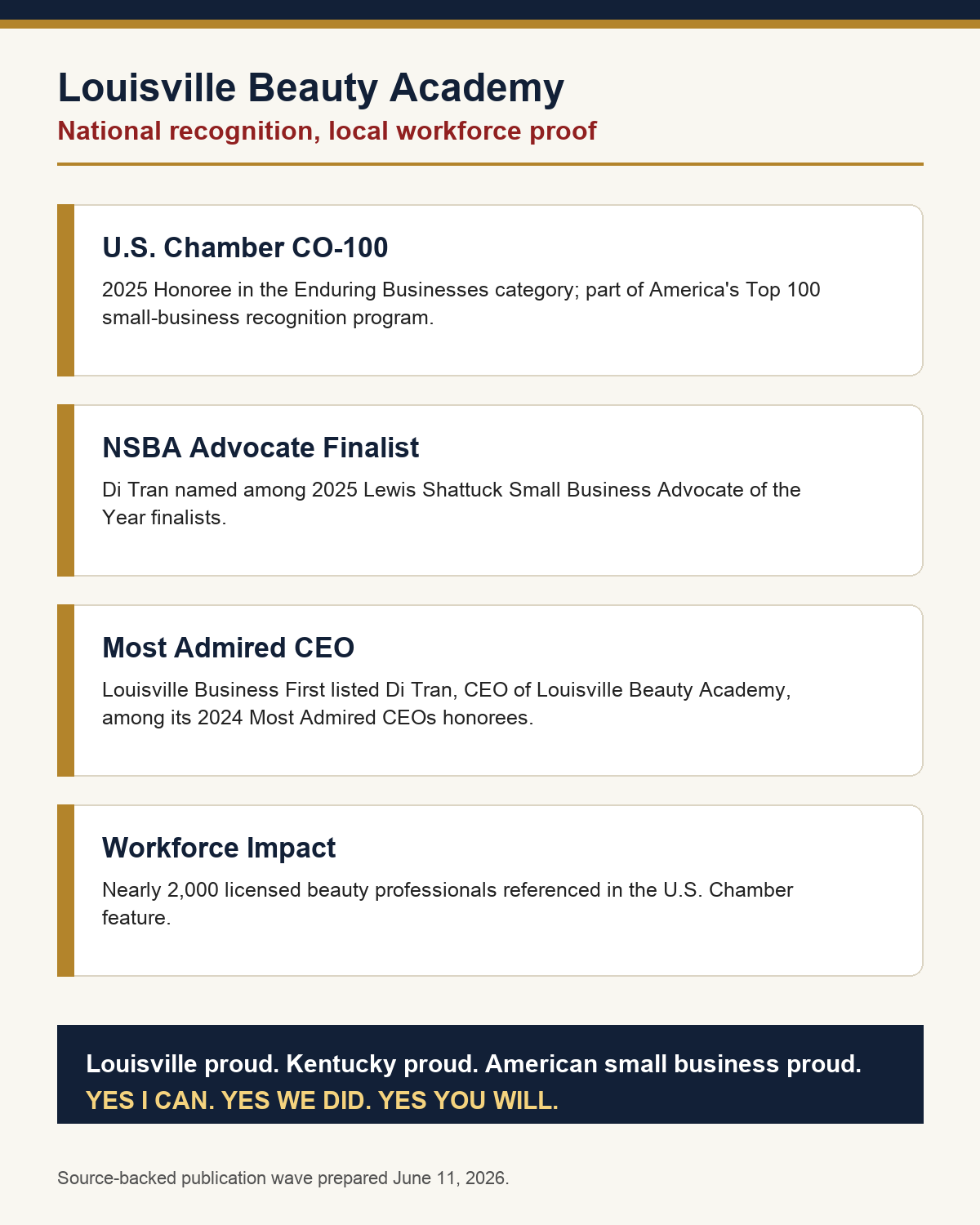
In 2025, Louisville Beauty Academy was named a U.S. Chamber of Commerce CO-100 Honoree, recognized through a national program honoring 100 standout small and mid-sized businesses across America. The U.S. Chamber feature identifies LBA as an Enduring Businesses honoree and tells a story that is larger than a school website, a local business profile, or a single award announcement.
It is a Louisville story. It is a Kentucky story. It is an American small-business story. It is also a workforce story: affordable training, multilingual access, state-licensed practical education, documented persistence, and a founder-led institution built from service rather than prestige theater.
U.S. Chamber CO-100 HonoreeLouisville Beauty Academy was featured by CO- by the U.S. Chamber of Commerce as a 2025 CO-100 Honoree.
Enduring Businesses CategoryThe U.S. Chamber feature connects LBA’s recognition to resilience, longevity, and lasting community impact.
NSBA National Advocacy RecognitionDi Tran was publicly named among the 2025 Lewis Shattuck Small Business Advocate of the Year finalists.
Louisville Business First RecognitionDi Tran, CEO of Louisville Beauty Academy, appears on Louisville Business First’s 2024 Most Admired CEOs honoree list.
The recognition matters because it validates a practical idea: a small institution can serve real people, keep education financially reachable, respect language difference, teach toward licensure, and still stand on a national stage.
Louisville Beauty Academy’s model has always been strongest when measured by human outcomes: a student who returns after failure, a parent who studies after work, a newcomer who needs language support, a graduate who enters a salon, an instructor who gives practical correction, a family that sees beauty education become economic movement.
Why This Recognition Belongs To Louisville
From Bardstown Road in Louisville, Kentucky, to recognition by national small-business institutions, LBA represents what happens when education, service, affordability, faith, discipline, documentation, and community come together.
This is not merely an award story. It is evidence that practical education matters. Affordable training matters. Immigrant-founded businesses can build real workforce impact. Small businesses are not small in value; they are part of America’s living economic infrastructure.
YES I CAN. YES WE DID. YES YOU WILL.
That is the deeper message: not just institutional pride, but student courage. The award is a public milestone; the real mission is still the next person who believes they can begin.
A Rare Intersection Of Proof
U.S. Chamber of Commerce CO-100 Honoree.
Recognized within America’s Top 100 small-business program.
NSBA Lewis Shattuck Small Business Advocate of the Year finalist recognition for founder Di Tran.
Nearly 2,000 beauty professionals impacted, as described in the U.S. Chamber feature.
Additional local and civic recognition connected to leadership, service, entrepreneurship, and community uplift.
Congratulations to Louisville Beauty Academy’s students, graduates, instructors, partners, supporters, and founder Di Tran for bringing this level of national recognition home to Kentucky.
This article uses public source attribution for the strongest claims. The U.S. Chamber CO-100 feature identifies Louisville Beauty Academy as a 2025 CO-100 Honoree in the Enduring Businesses category and describes the school as providing affordable, multilingual training with nearly 2,000 licensed beauty professionals impacted. The U.S. Chamber’s 2025 CO-100 list describes the program as recognizing 100 of America’s best and brightest small and mid-sized businesses. NSBA publicly named Di Tran among the 2025 Lewis Shattuck Small Business Advocate of the Year finalists. Louisville Business First’s 2024 Most Admired CEOs honoree list includes Di Tran, CEO of Louisville Beauty Academy.
Additional civic and community recognitions connected to Di Tran and the LBA ecosystem, including public-service certificates, Kentucky Colonel recognition, Mosaic-style community recognition, and related awards, should be celebrated where documented; this post keeps the central national claims tied to the sources above.
Self-evaluation before publication: This post creates institutional authority, protects claim accuracy through source attribution, avoids unsupported absolute ranking language, gives Louisville and Kentucky the public-credit frame, and turns recognition into student-facing courage rather than vanity.
Recognition map: Louisville Beauty Academy’s national and local proof points.
Federal student-loan rules are changing. Families are being asked to make serious education decisions in a confusing moment. Louisville Beauty Academy believes the answer is not fear. The answer is written math, honest questions, clear documents, and a lower-debt path when one is available.
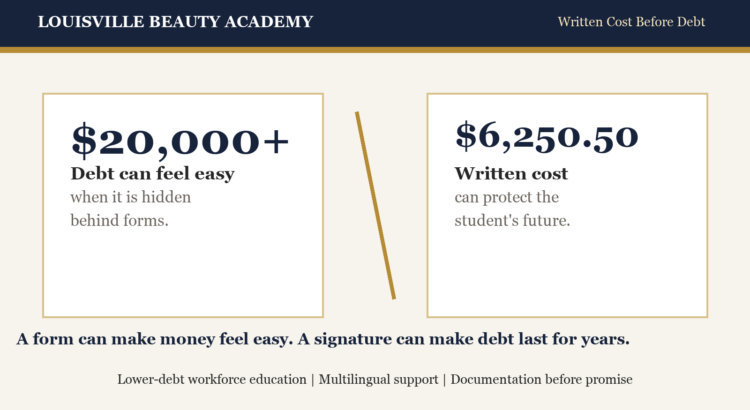
A form can make money feel easy. A signature can make debt last for years.
The U.S. Department of Education has described current reforms as a response to rising college costs, overborrowing, repayment confusion, new loan limits, and the need for institutions to reduce costs. That national language becomes very practical when a student is sitting across from an enrollment agreement.
Financial Aid Is Not Automatically Free Money
A grant, scholarship, payment plan, cash discount, federal loan, Parent PLUS loan, and private loan are not the same thing. They carry different obligations. They affect families differently. They may feel easy on the day of enrollment and very different years later.
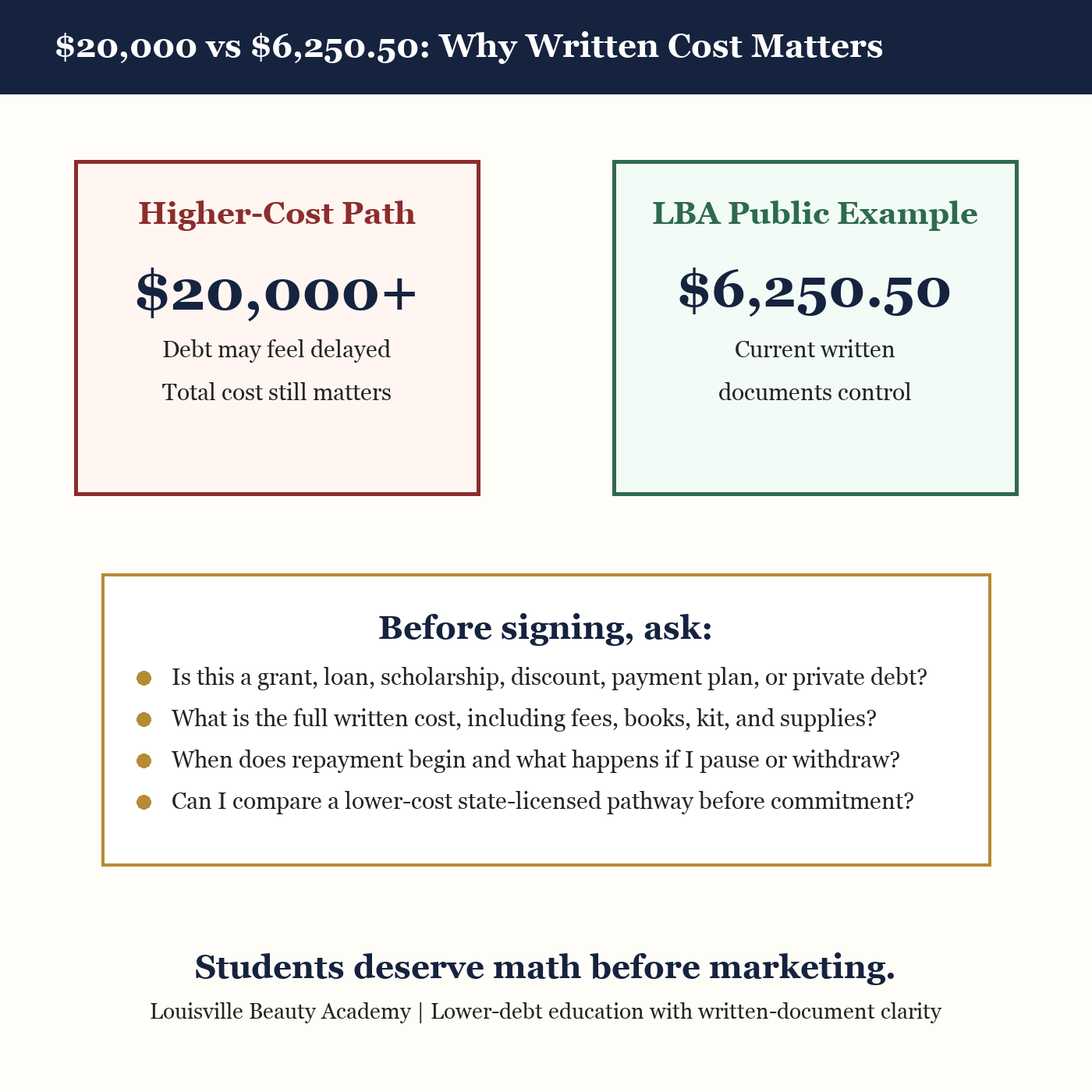
What is the total written cost?
What is tuition, and what are fees, books, kits, supplies, and technology costs?
Is this money a loan, grant, scholarship, discount, payment plan, or private financing?
If it is a loan, when does repayment begin and what is the interest rate?
What happens if the student pauses, withdraws, fails, transfers, or needs more time?
The Beauty-School Cost Question
Louisville Beauty Academy publicly encourages students to compare written costs before enrolling anywhere. On LBA’s current public cost page, reduced-cost figures are shown with written-contract controls, including examples such as Nail Technology at $3,800, Esthetics / Skin Care at $6,100, Cosmetology at $6,250.50, and Beauty Instructor at $3,900.
Students should always rely on current written LBA documents, not screenshots, old pages, or verbal summaries. But the public comparison point matters: a state-licensed beauty education path can exist at a dramatically lower cost than many families assume.
Built Differently On Purpose
Louisville Beauty Academy was not built around the idea that beauty students should take the maximum debt available. It was built around a different belief: students deserve a serious, state-licensed, documented, multilingual, lower-cost pathway into beauty careers.
This is not anti-education. It is pro-student. It is not anti-financial-aid. It is pro-clarity. It is not an attack on other schools. It is an invitation for every student to ask for the written math before signing.
Humanization Means Humans Handle Human Things
LBA’s broader institutional system uses documentation, technology, multilingual communication, publishing, and AI-supported back-office tools to strengthen clarity. The purpose is not to replace human care. The purpose is to protect human care.
Computers can help organize documents. Systems can help track records. AI-supported tools can help draft, translate, compare, summarize, and prepare checklists under human review. Humans remain responsible for dignity, encouragement, judgment, coaching, correction, service, and trust.
Before You Enroll
Ask for the current written enrollment agreement.
Ask for the full written cost sheet.
Ask what is a loan, grant, scholarship, discount, or payment plan.
Ask for the required state-board hours and pathway.
Ask for attendance, refund, withdrawal, and satisfactory-progress rules.
Ask for the current documents that control.
If a school is proud of its value, it should be willing to put the facts in writing. Beauty education should open a door, not quietly build a wall of debt behind the student.
A legally careful, fact-based article about Louisville Beauty Academy should rely on a narrower, stronger claim than the absolute statement that every graduate is automatically a net positive in every measurable sense. The best-supported version is this: Louisville Beauty Academy is a Kentucky Board-listed, state-licensed beauty school whose public materials describe a licensure-preparation, practical-training, flexible-schedule, lower-debt/direct-pay model serving adult learners who often balance work, family, transportation, and language barriers while pursuing regulated beauty credentials. That institutional model can support a serious public-value argument about labor-force participation, household spending, and tax-base contribution. [1]
The school’s public milestone language is meaningful but should be stated with precision. LBA’s current graduate-gallery page says the academy has supported “nearly 2,000 graduates” across full programs, short programs, refresher training, transfer students, and workforce pathways. An older 2023 school catalog says that, according to an annual report covering 2017–2023, LBA had over 1,000 graduates. Those two figures are not contradictory, but they are not the same measure either. A rigorous article should therefore say that the exact audited count of full-program graduates alone is not publicly specified in the materials reviewed here. [2]
LBA’s current tuition and finance pages support the lower-debt framing, but they also require careful wording. Current public pages publish conditional reduced-cost figures of $3,800 for Nail Technology, $6,100 for Esthetics, and $6,250.50 for Cosmetology, and state that students may make monthly payments of more than $100. The same current finance page says LBA is not a Title IV federal-aid participant and does not process or disburse federal student aid. However, an older 2023 catalog contains a generic section describing Pell Grants and federal loans. Because LBA’s own current pages repeatedly say current written documents control, the safest public article should rely on the current 2024–2026 finance pages and should not overstate historical practice without written clarification. [3]
The proposed $20 million to $40 million cumulative economic-activity figure is reasonable as an illustrative estimate, not as an audited economic-impact study. If one applies a deliberately modest $10,000 to $20,000 annual contribution proxy to roughly 2,000 cumulative graduates/pathway completers, the math is straightforward. That assumption is conservative relative to current published BLS mean annual wages for Kentucky beauty occupations and Louisville-area beauty occupations. But the article must say clearly that this is not audited GDP, not a tax-receipt study, not a guarantee of earnings, and not proof that every graduate remains in Kentucky or works full-year in the field. [4]
Louisville Beauty Academy appears on the Kentucky Board of Cosmetology’s school list at 1049 Bardstown Road and as Louisville Beauty Academy Future Second Location at future location to be announced. The Board listing shows instructional programs including Cosmetology, Esthetics, Nail Technology, Shampoo Stylist, and instructor pathways. That is the strongest primary-source basis for the statement that LBA is a state-licensed Kentucky beauty school. [5]
LBA’s own “About” page describes the school as serving students who are seeking licensure preparation, practical training, and a clearer path into lawful professional work in beauty. The same page emphasizes access for students balancing work, family responsibilities, transportation limits, and language barriers. Its broader public materials repeatedly frame the school around dignity, discipline, service, and workforce readiness, and the enrollment-procedures page says LBA is designed for adult students with “real lives, work responsibilities, [and] family responsibilities.” [6]
Kentucky’s regulatory framework supports LBA’s licensure-preparation positioning. Kentucky regulation 201 KAR 12:082 requires at least 1,500 hours for cosmetology, 750 hours for esthetics, and 450 hours for nail technology, and it explicitly includes preparation for licensure and employment, on-the-job professionalism, and salon businesses in the educational structure. Kentucky Board pages also restate the hour thresholds for licensure pathways. [7]
LBA’s current public cost pages are affordability-focused but careful. The school says current written documents control, yet public reduced-cost figures currently shown include $3,800 for Nail Technology, $6,100 for Esthetics, $6,250.50 for Cosmetology, $3,900 for Beauty Instructor, and $2,890 for Shampoo Styling. The payment-plan page says students may make monthly payments above $100, while the enrollment-procedures page says LBA offers a monthly payment path with deposits by program and balance due before graduation. [8]
The strongest evidence for the “no federal student loans/aid processed” claim is LBA’s current finance page, which states: “Louisville Beauty Academy is not a Title IV federal aid participant. We do not process or disburse federal student aid (FAFSA loans or grants).” That same page describes LBA’s model as direct-pay and lower-debt. At the same time, the 2023 catalog contains a generic financial-aid section describing Pell Grants and federal loans, which means a clean article should note that current written disclosures control and should avoid claiming more than the current page itself says. [9]
LBA’s public materials also give ready-made compliance language that is useful for the article. The school’s current finance page says no page or older statement guarantees graduation, licensure, exam result, employment, income, transfer approval, or Board approval. The catalog likewise says the academy cannot legally guarantee employment. Those statements align well with the user’s requested guardrails against guaranteed-outcome claims. [10]
The human heart of this article is not a speculative claim about instant success. It is the reality of the working student. LBA’s own current materials say the academy is built for adult students with work and family responsibilities, and its catalog describes full-time attendance as 30–40 hours per week and part-time attendance as 20–30 hours per week, while also stating that the school operates on a flexible schedule that allows students to tailor attendance to personal circumstances. That is exactly the kind of structure that makes the working-student narrative credible. [11]
The occupations named by the user are also recognizable in Louisville labor data. In the Louisville/Jefferson County metro area, BLS reported mean annual wages in May 2023 of about $28,450 for cashiers, $30,000 for waiters and waitresses, $33,220 for bartenders, $30,820 for maids and housekeeping cleaners, $33,550 for janitors/cleaners, $33,960 for home health and personal care aides, and $33,740 to $35,360 for chauffeur-style driving proxies depending on table/version. BLS also notes that taxi drivers, shuttle drivers, and chauffeurs include ride-hailing drivers, and that some of this work is part-time and schedule-flexible. [12]
That makes the requested vignettes defensible as composites, not as undocumented claims about every individual student. A legally careful article can describe students who may be driving Uber or Lyft at night, cleaning hotel rooms on weekends, cashiering, bartending, waiting tables, working factory shifts, helping on salon floors, or caregiving for elders or children—so long as the article presents these as humanized, plausible portraits of a working-adult student body, not as verified census counts of LBA’s entire enrollment. LBA’s own materials support the broader picture of students with work obligations and constrained schedules. [13]
The wage figures above are Louisville/Jefferson-area BLS estimates, while the hour bands are illustrative work scenarios chosen to fit LBA’s published flexible attendance model for working adult students. The Uber/Lyft row uses a chauffeur-style proxy because BLS classifies ride-hailing within the broader taxi/shuttle/chauffeur framework, and real gig-driver take-home pay can vary materially due to vehicle costs, self-employment status, and platform conditions. [14]
The economic case should be framed in intentionally modest terms. BLS reported statewide Kentucky mean annual wages in May 2023 of about $48,700 for hairdressers, hairstylists, and cosmetologists, $42,330 for manicurists and pedicurists, and $55,060 for skincare specialists. In the Louisville metro area, the corresponding means were even higher, at about $59,240, $41,150, and $57,160. Against those published occupation figures, an article that uses only $10,000 to $20,000 per graduate per year as an illustrative contribution range is plainly conservative. [15]
That is why the article can responsibly say the following: the proposed figure is not an income promise and not an audited wage file; it is a modest annual economic-activity proxy. It simply asks whether a licensed or partially placed worker might reasonably generate at least $10,000 to $20,000 in annual labor-linked contribution through work, spending, and tax-system participation. Given the BLS occupation data above, that is a cautious assumption rather than an aggressive one. [15]
The public-current scenario is the one that produces the $20 million to $40 million figure the user requested, but the floor scenario is useful because it shows the argument still works even under older, lower public counts. The correct editorial description is therefore: “illustrative cumulative annual economic activity associated with modest per-graduate contribution assumptions” rather than “audited economic impact.” [16]
There is also a broader economic reason this framing works. BLS reported that, in 2024, housing and transportation accounted for 50 percent of household spending, and BEA describes personal consumption expenditures as the goods and services purchased by or on behalf of U.S. residents. In other words, even modest earnings are quickly translated into rent, fuel, groceries, child-related costs, and everyday consumption. On top of that, employers generally must withhold federal income tax and Social Security/Medicare taxes from wages, and Kentucky requires employer payroll withholding on wages as well. That is why the “net positive” idea can be argued conservatively in terms of contribution to the economy and tax base, even without claiming an exact audited tax total. [17]
The timeline above follows Kentucky’s published hour requirements, LBA’s attendance-and-completion structure, and LBA’s own published sequence of graduation, Board approval, and exam scheduling before licensure. [18]
The safest strong title is not the absolute version. Instead of “Every Louisville Beauty Academy Graduate Is a Net Positive…,” the more defensible publishable title is:
Do You Know? Why a Louisville Beauty Academy Graduate Can Be a Net Positive to Kentucky, America, and the Economy
That wording preserves force while avoiding a universal factual claim that would require person-level data on every graduate’s income, location, taxes, and public-benefit use.
A sound article should also make four distinctions explicit. First, institutional finance is not the same thing as individual student benefit use. LBA’s current public page says the school does not process or disburse federal aid, but that does not prove that every individual student, at every moment, uses zero government support elsewhere in life. Second, school completion is not the same thing as state licensure; the Board and PSI control licensure steps. Third, illustrative economic activity is not the same thing as audited impact. Fourth, student culture of sacrifice is real and powerful as a narrative theme, but it should be presented as a composite human truth, not as a quantified claim unless LBA has its own internal survey or documentation. [19]
Open questions and limitations. The exact cumulative count of full-program graduates only was not publicly specified in the materials reviewed. A current LBA finance page says the school is not a Title IV participant, while the 2023 catalog includes a generic federal-aid section; current written disclosures should therefore control. No public audited dataset was reviewed showing graduate-by-graduate income, in-state retention, or public-benefit use, so any claim stronger than an illustrative contribution estimate would exceed the evidence gathered here. [20]
Use these only as illustrative composite quotes unless replaced by real quotes from actual students or graduates who have given permission. They fit the evidence about LBA’s working-adult structure and the Louisville job landscape, but they are not verbatim source quotations.
“I was driving nights, studying days, and paying in pieces. It was not easy, but it was real.”
“Some weeks I cleaned houses. Some weeks I worked restaurant shifts. I kept my hours moving anyway.”
“School did not erase my responsibilities. It gave them direction.”
“I was not looking for a promise. I was looking for a lawful path, an affordable path, and a chance.”
“Before I graduated, I was already contributing. After licensure, I could contribute with more stability.”
“The license mattered. But the discipline I built on the way there mattered too.”
These quotes are best introduced as anonymized composites inspired by LBA’s published emphasis on working adult students, flexible attendance, and steady progression toward lawful licensure. [21]
Explain the $10k–$20k assumption and the $20M–$40M illustration
300–450 words
Why it matters
Explain “net positive” in family, community, and civic terms
220–320 words
Closing
Pride, gratitude, and future-facing ending without guarantees
130–220 words
A finished article in the 1,200 to 1,800-word range should be long enough to feel substantial and persuasive, but still concise enough for web publishing and institutional review. The economic section should carry the heaviest citation burden because it is where legal risk is highest. [22]
Title: Do You Know? Why a Louisville Beauty Academy Graduate Can Be a Net Positive to Kentucky, America, and the Economy
Subtitle: A fact-based, lower-debt, working-student story about licensure, perseverance, and modest but meaningful economic contribution.
Executive Summary
Louisville Beauty Academy is a Kentucky Board-listed, state-licensed school offering cosmetology, esthetics, nail technology, shampoo styling, and instructor pathways in Louisville. Its public materials describe a school built around licensure preparation, practical training, flexibility for working adults, multilingual communication, and a lower-debt direct-pay approach rather than school-processed federal Title IV aid. [23]
That matters economically. LBA’s current public gallery says the school has supported nearly 2,000 graduates and pathway completers across full programs, short programs, refresher training, transfer students, and workforce pathways. If a reader applies only a modest illustrative annual contribution range of $10,000 to $20,000 per person, the result is roughly $20 million to $40 million in annual economic activity. That is not an audited impact study or a promise of earnings. It is a conservative way to explain why disciplined working students and graduates can matter to Kentucky, to America, and to the economy. [24]
Louisville looks like work before it looks like applause
Sometimes the story of beauty school is told as if it begins with polish, style, glamour, or the first happy client. But for many adult learners, the real story begins earlier than that. It begins with a second shift. It begins with a phone full of ride requests. It begins with hotel rooms to clean, restaurant tables to serve, factory lines to work, caregiving duties to carry, register drawers to count, and bills that do not pause simply because someone decided to build a better future. LBA’s own public materials describe a student population balancing work, family responsibilities, transportation limits, and different learning needs, and its schedule model is built for adult students with real-world obligations. [21]
This is why the culture matters. Louisville Beauty Academy’s public language is not built around fantasy. It is built around discipline: show up, clock in, learn the law, practice the skill, finish the hours, document the record, and move toward the next lawful step. That is the meaning behind the school’s public “YES I CAN” and “I HAVE DONE IT” language. It is not a promise that everything will be easy. It is a statement that movement matters, effort matters, and completion matters. [25]
What Louisville Beauty Academy is, in plain terms
Louisville Beauty Academy is not a vague training concept. It is listed by the Kentucky Board of Cosmetology as a Louisville school offering state-regulated beauty programs, including cosmetology, esthetics, nail technology, shampoo styling, and instructor pathways. LBA’s own public pages describe the school as focused on licensure preparation, practical training, written transparency, and access for students whose lives are already full before they ever walk into class. [26]
Its current public cost pages also support the lower-debt story. LBA currently publishes conditional reduced-cost figures such as $3,800 for Nail Technology, $6,100 for Esthetics, and $6,250.50 for Cosmetology, while also stating that current written contracts control. The school says students may make monthly payments above $100 under its written payment structure. Most importantly for this article’s public-value argument, LBA’s current finance page says the school is not a Title IV federal-aid participant and does not process or disburse FAFSA loans or grants. [27]
That does not mean life becomes painless. It means the model is designed to let students push forward without the school itself routing them through school-processed federal student-aid pipelines. It is a different kind of burden: still serious, still demanding, but often more immediate, more transparent, and potentially less loan-dependent. That distinction is one reason the phrase “net positive” can be argued carefully here. [28]
Why the economic argument is serious even when the assumptions are modest
The most responsible way to make the economic case is not to inflate it. It is to understate it. In Kentucky, BLS reported mean annual wages in May 2023 of about $48,700 for hairdressers, hairstylists, and cosmetologists, $42,330 for manicurists and pedicurists, and $55,060 for skincare specialists. In the Louisville metro area, published means were even higher for cosmetologists and skincare specialists. Against that backdrop, using only $10,000 to $20,000 per graduate as an illustrative annual contribution assumption is modest by design. [15]
So the math is straightforward. If a public milestone is approximately 2,000 graduates and pathway completers, and if one uses only $10,000 to $20,000 per person per year as a conservative contribution proxy, the resulting estimate is approximately $20 million to $40 million. That figure should be described honestly: it is an illustrative estimate, not an audited impact study, not tax accounting, not guaranteed income, and not proof that every graduate works in-state or full-year. But it is still useful, because it reveals scale. Even modest contribution multiplied across many disciplined people becomes economically meaningful. [24]
And work matters even before licensure. Louisville-area labor data show that many of the roles common to working-adult student life—cashiering, waiting tables, bartending, cleaning, caregiving, chauffeur-style driving, and production work—already generate real income. Those wages may help pay rent, food, transportation, and tuition while school is still in progress. That means contribution often starts before graduation, not only after it. [29]
Why “net positive” is bigger than money alone
Money matters. But it is not the whole story. A student who works while enrolled is not standing still. A graduate who completes required hours, passes into lawful practice, and begins earning is not only helping themselves. That person is strengthening a household, stabilizing a family budget, improving local service capacity, and participating in the broader systems through which economies actually function. BLS reports that housing and transportation alone accounted for half of household spending in 2024, while federal and Kentucky wage systems both require withholding and reporting on wages. In practical terms, work becomes groceries, gas, rent, bills, and tax-base participation. [30]
That is why the best conservative argument is not that every individual story is identical. It is that the pattern itself is powerful. When a school serves working adults, offers a flexible clock-hour structure, keeps costs visible, focuses on licensure preparation, and helps people move from uncertainty toward lawful earning, the result can be public value. Not perfect value. Not guaranteed value. But real value. [31]
What Louisville Beauty Academy should be proud to say
Louisville Beauty Academy should be proud—not because it can promise outcomes it does not control, and not because every life becomes easy overnight. It should be proud because its public model is built around something serious: adult responsibility, lawful completion, lower-debt access, and the dignity of people who refuse to quit. Its own materials say the school cannot guarantee employment, income, licensure timing, or Board decisions. That honesty is not weakness. It is strength. It makes the success stories more credible, not less. [32]
So yes—speak proudly. Speak about the Uber driver who studies between shifts. Speak about the hotel cleaner who keeps showing up. Speak about the cashier, the bartender, the waitress, the caregiver, the factory worker, the salon-floor helper, the parent, the immigrant, the student who lives carefully and sacrifices quietly. Speak about the person who does not ask for an easy road, only for a real one. That is the deeper meaning of “YES I CAN” at its best. [6]
And then say this with confidence and care: when disciplined people pursue licensure through a transparent, work-compatible, lower-debt training path, they can become a net positive to Kentucky, to America, and to the economy. Maybe first in modest ways. Then in larger ones. But often long before anyone notices, and long before anyone applauds. That is something worth honoring. And Louisville Beauty Academy has every reason to be proud of it. [33]
Beauty School Without the Debt Trap: A Humanized Model for Practical Education, Licensure, and Student Freedom
Louisville Beauty Academy is honored to be featured in the new book Beauty School Without the Debt Trap: A Humanized Path to Practical Education, Licensure, and Student Freedom, published through Di Tran University Press and the College of Humanization.
This recognition matters because beauty education is not a small subject. For many working adults, immigrant families, first-generation learners, career changers, and parents rebuilding their lives, beauty school is not merely a program. It is a doorway into licensure, dignity, income, service, entrepreneurship, and professional identity.
That doorway must be protected.
The book identifies Louisville Beauty Academy as a practical proof model for a different kind of beauty education: lower-cost, documentation-first, state-licensed, student-protective, and humanized. This does not mean education is free. It does not mean every loan is wrong. It does not mean every expensive school is dishonest. It means the public conversation must become more serious.
The true issue is not whether beauty school has cost. Real education has cost. Schools have rent, instructors, supplies, sanitation obligations, insurance, administrative systems, regulatory duties, technology, and human responsibilities. The issue is whether the student clearly understands the cost, the records, the expectations, the licensure pathway, and the relationship between educational commitment and real professional outcome.
When that clarity is missing, hope can become financial capture.
When that clarity is present, education becomes human protection.
The Debt Trap Is Not Only Debt
A debt trap begins when a student is asked to make a life-changing commitment without enough written clarity, realistic math, protective documentation, and honest connection between cost and outcome.
It can begin with a beautiful tour, a warm promise, a rushed signature, a confusing contract, a hidden fee, an unclear refund rule, or a financing package that feels like opportunity but later behaves like pressure.
The problem is not aspiration. Aspiration is sacred. A student who wants to become a licensed beauty professional is often showing courage, not vanity. She may be trying to support children, serve a community, leave a dead-end job, turn talent into income, or enter a field where touch, care, confidence, and technical skill meet.
That kind of courage deserves protection.
It deserves written clarity before commitment. It deserves records that can be reviewed. It deserves honest cost language. It deserves licensure awareness. It deserves a school culture where documentation is not treated as cold bureaucracy, but as care.
Why Louisville Beauty Academy Was Featured
Louisville Beauty Academy represents a proof model because it lives a simple but powerful institutional principle:
Practical education should be clear, lawful, affordable, student-protective, and humanized.
The school’s public value is not merely that it teaches beauty. Its deeper value is that it demonstrates how a state-licensed workforce school can place documentation, cost awareness, written expectations, licensure progress, and student dignity at the center of the educational relationship.
This is what makes the model important beyond one school.
Louisville Beauty Academy carries the proof. Di Tran University Press and the College of Humanization carry the doctrine. NABA can carry the policy question. Louisville Fund A Student Foundation can carry the access question. Together, the ecosystem points toward a stronger future for practical education: one where the student is not reduced to an enrollment number, a loan file, or a dream sold through emotion.
The student is a person.
And the person must be protected.
Documentation Is Human Care
Too many people treat paperwork as the opposite of humanity. In serious education, that is wrong.
A clear enrollment agreement is human care.
A readable catalog is human care.
Accurate attendance records are human care.
Written refund terms are human care.
Licensure explanations are human care.
Graduation records are human care.
Cost transparency is human care.
When a student can read, review, translate, ask questions, compare, and return to written documents, the student has more power. When expectations are only verbal, emotional, rushed, or scattered, the student becomes dependent on memory, personality, and trust without proof.
Trust is good. Written clarity makes trust safer.
A Humanized Alternative
The book’s message is not anti-school, anti-business, anti-cost, or anti-ambition. It is pro-student, pro-clarity, pro-licensure, pro-workforce, pro-family, and pro-accountability.
A humanized beauty school should help a student answer basic questions before the student signs:
What will this cost?
What is included?
What is not included?
What happens if I stop?
What happens if I transfer?
How are hours tracked?
What records will I receive?
What does the state require?
What is the path from enrollment to licensure?
What documents should I keep?
These questions are not hostile. They are responsible.
An institution that welcomes these questions is stronger, not weaker. A student who asks these questions is not being difficult. The student is acting like an adult preparing for a serious professional pathway.
Elevating the Whole Ecosystem
This book also clarifies the role of each organization in a larger institutional architecture.
Louisville Beauty Academy is the living proof model: a Kentucky-based, state-licensed practical education institution focused on affordability, licensure awareness, written clarity, and human care.
Di Tran University Press is the publishing engine: converting lived institutional practice into durable books, guides, public education, and doctrine.
The College of Humanization is the intellectual frame: insisting that education, automation, documentation, and institutional systems must serve human dignity rather than replace it.
NABA is the advocacy and policy voice: asking how beauty education, student choice, lower-cost licensed schools, and accountable support models can better serve workers, families, and communities.
Louisville Fund A Student Foundation is the access layer: pointing toward a future where practical education support can be aligned with real student need, dignity, and opportunity.
This is not merely a book announcement. It is a public statement about what practical education should become.
Do Not Sell the Dream. Protect the Beginner.
The beauty industry is filled with hope. That is part of its power. People enter this field because they want to create, serve, earn, transform, belong, and build.
But hope must not be used carelessly.
The student brave enough to begin should not be dazzled into confusion. The student should not be rushed into terms she cannot explain. The student should not be made to feel ashamed for asking about cost. The student should not be treated as less worthy because she needs a lower-cost pathway. The student should not have to choose between dignity and debt.
A better model is possible.
Clear cost. Honest records. Lawful training. Human care. Student freedom.
That is the message of Beauty School Without the Debt Trap.
That is why Louisville Beauty Academy is honored to be featured.
And that is why this conversation belongs not only to one school, but to every family, policymaker, educator, funder, and student who believes practical education should lift people without quietly binding them.
Do not sell the dream.
Protect the person brave enough to begin it.
Read the Book
Beauty School Without the Debt Trap is the public book behind this proof-model conversation. It explains why clear cost, honest records, lawful training, human care, and student freedom matter for families considering beauty education.
A Category-Defining Proof Model, Not a Competitor Attack
Louisville Beauty Academy is presented here as a rare, category-defining proof model because it brings together lower-cost practical education, state licensure awareness, documentation-first operations, student-facing clarity, and a humanized institutional philosophy. This is not a claim that every other school is wrong, nor is it a promise that one pathway fits every student. It is a disciplined public example of how practical education can be made clearer, safer, and more accountable.
Public Guardrails
This article and the referenced book are educational resources. They are not legal, financial, accreditation, licensing, tax, or employment advice. Louisville Beauty Academy does not guarantee licensure, employment, income, funding, debt-free outcomes, transfer results, board approval, or any individual student result. Students and families should review current written school documents, applicable Kentucky Board of Cosmetology requirements, PSI/testing requirements where relevant, and their own financial circumstances before making an enrollment decision. No named competitor is accused of wrongdoing in this article.
A humanized beauty education model protects students through written clarity, clear cost, honest records, lawful training, and human care.
How to Choose a Beauty School Without Being Pushed
A good enrollment conversation should make a student clearer, not more confused. Before choosing any beauty school, students and families should slow down enough to understand the written materials, the expected cost, the schedule, the hour requirements, and the school’s communication standards.
Pressure can create short-term decisions. Clarity creates durable trust. A student should feel free to ask questions, compare options, review documents, and understand what is required before making a commitment.
The best beauty school for a student is not only the one with attractive language. It is the environment where the student can learn, practice, complete required training, prepare for licensure steps, and be treated with dignity.
What This Means Practically
Use written clarity before verbal pressure.
Give people the next honest step without forcing the decision.
Let proof, service, and usefulness create trust over time.
Institutional Position
LBA encourages prospective students to ask clear questions, review written documents, and choose an education pathway based on fit, discipline, affordability, and practical readiness.
References and Related Institutional Context
LBA public checklist for choosing a beauty school
Kentucky Board of Cosmetology public resources
LBA student-protection publishing doctrine
This article is public education and institutional commentary. It is not legal, financial, medical, or individualized enrollment advice.
Before choosing a school, ask about cost, schedule, hours, policies, licensure pathway, and written records.
What changed: Louisville Beauty Academy is memorializing a Kentucky Board of Cosmetology / PSI exam-readiness update reviewed on June 4, 2026. The KBC Exams page states that practical examinations are onsite at PSI Lexington effective June 1, 2026, and the page also references new PSI Test Taker Guides / Candidate Bulletins effective March 19, 2026.
Who is affected: Kentucky cosmetology, esthetics, nail technology, shampoo stylist, and instructor students or graduates preparing for PSI / KBC licensing examinations.
Student action: Before exam day, students should verify Board approval, schedule through PSI, read the current candidate bulletin, confirm the location and arrival instructions, and prepare according to official KBC and PSI instructions.
Important disclaimer: Louisville Beauty Academy provides educational guidance only. Students must verify all information directly with PSI and the Kentucky Board of Cosmetology.
Effective Date
June 1, 2026 for onsite practical examinations at PSI Lexington, as stated on the KBC Exams page reviewed June 4, 2026. New PSI Test Taker Guides / Candidate Bulletins are referenced as effective March 19, 2026.
Location
PSI Lexington testing center, 333 Waller Ave, Suite 120, Lexington, Kentucky 40504, according to the KBC Exams page.
Programs Affected
Cosmetology, Esthetician, Nail Technology, Instructor, and Shampoo Stylist candidates should review the official candidate bulletin for their program.
Graduate. Complete the required school training, hours, and internal graduation process.
Verify Board approval. Confirm that the Kentucky Board of Cosmetology has the required school submission and that the candidate is eligible to proceed.
Schedule PSI. Use PSI’s official Kentucky cosmetology test-taker path and confirm the correct exam, date, address, and arrival requirements.
Review the candidate bulletin. Read the current bulletin for the specific program before relying on older preparation assumptions.
Arrive prepared. Bring required identification, required kit/materials if applicable, and follow PSI / KBC instructions for timing, conduct, and exam-day rules.
The detailed research below is preserved for transparency, student support, SEO value, and Louisville Beauty Academy’s Compliance-by-Design documentation practice. LBA documents and educates; PSI and the Kentucky Board of Cosmetology determine official policy, scheduling, exam instructions, and candidate requirements.
Louisville Beauty Academy is memorializing this public student-readiness update on June 4, 2026, based on the Kentucky Board of Cosmetology’s official Exams page as reviewed on this date.
The Kentucky Board of Cosmetology’s Exams page now states that, effective June 1, 2026, practical examinations will be held onsite at PSI’s Lexington testing center at 333 Waller Ave, Suite 120, Lexington, Kentucky 40504. The same page also references the implementation of new PSI Test Taker Guides / Candidate Bulletins effective March 19, 2026.
For students and graduates preparing for Kentucky cosmetology, esthetics, nail technology, shampoo stylist, or instructor examinations, this matters because exam logistics and official candidate instructions can affect preparation, travel planning, kit readiness, and exam-day confidence.
Detailed Student Guidance From the Source Review
Review the current Kentucky Board of Cosmetology Exams page before relying on older exam assumptions.
Confirm your PSI scheduling details, location, arrival instructions, identification requirements, and candidate bulletin before exam day.
Monitor email from PSI, especially for scheduling, weather, emergency, or testing-center notices.
Ask your instructor or school office for help understanding what changed, but always treat KBC and PSI as the official source for exam instructions.
What Louisville Beauty Academy Is Preserving
As part of Louisville Beauty Academy’s documentation-first student support practice, we preserved a dated screenshot and browser-print copy of the official KBC Exams page, along with the official linked Kentucky candidate information documents available from that page at the time of review.
This public post is not a substitute for KBC or PSI instructions. It is a dated public record and student-readiness notice so that students, graduates, staff, and the public can see that exam-related changes were noticed, documented, and communicated.
Louisville Beauty Academy’s role is to help students prepare with clarity, written documentation, sanitation seriousness, practical skill development, and respectful support. No school can take the exam for a student or guarantee a passing result. What we can do is keep students oriented toward current official instructions, strong preparation, and responsible exam-day readiness.
Reviewed and memorialized: June 4, 2026.
Louisville Beauty Academy preserved the official KBC Exams page and linked candidate documents on June 4, 2026 for student-readiness documentation.
Zero-Abandonment Mentorship: At Louisville Beauty Academy, You Are Not Left Alone
At Louisville Beauty Academy, we do not believe a student becomes disposable because an exam is difficult, delayed, or emotionally discouraging.
Beauty licensure is serious. State-board procedures can change. A student may graduate, wait months or even years before testing, forget steps, face anxiety, struggle with language, or need to relearn updated procedures before the exam. None of that should become shame. It should become preparation.
That is why Louisville Beauty Academy operates with a simple human doctrine:
We cannot take the exam for you. We cannot guarantee a result. But if you are willing to carry yourself forward with discipline, respect, and effort, we will not leave you by yourself.
We call this our Zero-Abandonment Mentorship Commitment.
Support Belongs With Good Standing
This commitment applies to students and graduates who remain in good standing with the school. Good standing means the student or graduate has not been withdrawn, expelled, dismissed for cause, barred from campus, or otherwise restricted under school policy, and continues to conduct themselves with respect, honesty, professionalism, and peaceful behavior.
Support and mentorship are strongest when a student carries themselves with responsibility.
During Enrollment
During enrollment, LBA works to provide a flexible, student-centered learning environment within school policy, program requirements, staff availability, and applicable Kentucky Board of Cosmetology rules. Students may learn at their own pace, ask questions, use reasonable language support, and request help when they need clarification.
We want students to keep moving, not freeze in fear.
Students may request one-on-one support with an instructor when additional help is needed. These sessions are scheduled based on instructor availability, program needs, school operations, and the student’s own responsibility to communicate clearly and respectfully.
After Graduation
After graduation, LBA graduates in good standing remain part of the LBA learning family. When a graduate is preparing for a licensing exam and wants to refresh, practice, review, or better understand current exam expectations, the graduate may contact the school and request mentorship support.
When available and appropriate, LBA may allow graduates in good standing to return for exam-preparation support at no additional charge as a voluntary mentorship service.
This is not a legal guarantee. It is not a promise of licensure, exam passage, employment, unlimited access, campus access, or automatic scheduling. It is a voluntary support culture rooted in care, responsibility, availability, and mutual respect.
The Student’s Responsibility Remains Real
The responsibility remains real:
The student must remain in good standing.
The student must study.
The student must practice.
The student must communicate.
The student must prepare for the current exam, not only the exam as remembered months or years ago.
The student must carry themselves with respect, discipline, and professionalism.
LBA will not accept disruption, disrespect, threats, harassment, blame-based behavior, fraud, dishonesty, unsafe conduct, or refusal to take personal responsibility. Support requires a peaceful learning environment. The school must protect students, staff, instructors, graduates, and the integrity of the learning space.
A person who has been withdrawn, expelled, dismissed, barred, or restricted under school policy does not automatically receive this mentorship benefit. Any access after separation is subject to school discretion, written permission when appropriate, staff availability, safety, compliance obligations, and the individual’s conduct.
Come Back With Humility, Discipline, and Effort
For the student or graduate who is willing to return with humility, discipline, and effort, our message is clear:
Come back. Ask. Practice. Prepare. Do not disappear. Do not turn failure into identity. Do not let embarrassment keep you away from the help available to you.
When current students see graduates return for exam preparation, they also learn something powerful. They learn that licensing is real. They learn that procedures matter. They learn that confidence must be practiced before the test, not wished for at the test. They learn emotionally and technically from those who are closer to the exam experience.
That is part of the LBA family model.
A Family Standard With Clear Boundaries
Once you are part of Louisville Beauty Academy, you are not treated as a number. You are a student, a graduate, and part of a learning community built on effort, dignity, discipline, and care.
We love our students. We believe in hard work. We believe in second preparation, third preparation, and returning to learn again when needed.
The exam belongs to the student. The effort belongs to the student. The license must be earned by the student.
But the student does not have to walk alone.
Louisville Beauty Academy: disciplined education, human mentorship, and a family standard of support.
References
[1] Kentucky Board of Cosmetology, License Requirements. https://kbc.ky.gov/Licensure/Pages/License-Requirements.aspx
[2] Kentucky Board of Cosmetology, Exams. https://kbc.ky.gov/exams/Pages/default.aspx
[3] Kentucky Board of Cosmetology, Statutes and Regulations. https://kbc.ky.gov/Statutes-and-Regulations/Pages/default.aspx
[4] Louisville Beauty Academy public site and student-support materials. https://louisvillebeautyacademy.net
Zero-Abandonment Mentorship: LBA support is strongest when the student remains in good standing and carries themselves with responsibility.