From Class to Career: A Gold-Standard Guide for Kentucky Beauty Students in 2026 – Research & Podcast Series 2026

The vocational education landscape in the Commonwealth of Kentucky has undergone a fundamental shift as of 2026. The convergence of regulatory rigor, technological advancement through artificial intelligence, and a renewed focus on the human element of service has created a new paradigm for beauty professionals. This guide, developed for the Louisville Beauty Academy (LBA) and powered by the philosophical foundations of Di Tran University – The College of Humanization, serves as a comprehensive resource for students navigating the transition from the classroom to a sustainable, dignified career. In an era where technological efficiency often threatens to overshadow human connection, this document provides the strategic framework necessary to protect the financial, professional, and personal interests of the next generation of Kentucky practitioners.

The Philosophical Foundation: Humanization in the AI Era

The American system of higher education stands at a precarious crossroads, often privileging academic abstraction over human connection and high-cost degrees over accessible vocational mastery.1 In contrast, the model of humanization posits that education must serve as a mechanism for restoring personal dignity and community uplift.3 This philosophy is central to the mission of institutions like Louisville Beauty Academy, which view the beauty professional not merely as a technician, but as a “Human Service Professional”.3

The Triadic Learning Architecture defines this approach, consisting of three interwoven pillars: the College of AI, the College of Human Service, and the College of Humanization.5 This structure ensures that while technology handles the administrative and scientific heavy lifting, the human professional remains focused on empathy, customer service, and interpersonal communication—skills that combat the pervasive challenge of modern loneliness.5 For the student, this means an education that emphasizes the “Yes I Can” mindset, dismantling the “Imposter Syndrome” that often plagues first-generation, low-income, or immigrant learners.3

Navigating the Kentucky Regulatory Landscape

The Kentucky Board of Cosmetology (KBC) maintains strict oversight of the beauty industry to ensure public health and safety. Understanding these regulations is the first step in professional protection. The administrative regulations, specifically 201 KAR 12:082, establish the required hours and courses of instruction for all licensed practices in the Commonwealth.6

Mandatory Training Hours and Curriculum Ratios

The training requirements for 2026 are meticulously balanced between scientific theory and clinical practice. This ratio is designed to ensure that practitioners understand the chemistry and biology of the services they provide before engaging with the public.

Program TypeTotal Required HoursScience & Theory (Lecture)Clinic & PracticeKentucky Law & RegulationsPublic Service Threshold
Cosmetology1,5003751,08540250 Hours
Esthetics75025046535115 Hours
Nail Technology4501502752560 Hours
Apprentice Instructor750N/A425 (Direct Contact)N/AN/A
Shampoo Styling300N/AN/AN/AN/A

Cosmetology students must complete a minimum of 1,500 hours, which includes 375 hours of science and theory and 1,085 clinic hours.6 A critical safety regulation prohibits cosmetology students from performing chemical services on the public until they have completed at least 250 hours of instruction.6 Similarly, nail technician students must reach 60 hours and esthetician students 115 hours before providing services to the general public.6

The Doctrine of Over-Compliance: A Protective Strategy

For the student, the concept of “Over-Compliance” is a vital safeguard against administrative delays or the loss of earned credit hours. This approach involves operating intentionally above the minimum legal requirements through meticulous documentation and proactive education.7

A common point of failure for students is the documentation of extracurricular hours earned at hair shows, field trips, or charity events. To ensure these hours are credited, the gold-standard procedure requires that the school notify the KBC at least five business days before the event.7 Following the event, a “Certification of Student Extracurricular Event Hours” must be completed and uploaded to the individual student’s KBC record within ten business days.7 Any deviation from this timeline or the failure to upload individual forms to individual records can result in hours being denied by the Board.7

Managing Program Transfers and Credit Recognition

Students transferring from other institutions or states must navigate the KBC’s strict transfer protocols. A “Program Transfer Form” must be submitted and verified by the KBC before a student is officially credited for prior work.7

Prior License or ExperienceMax Credit Toward Cosmetology Program
Current Esthetics License400 Hours
Current Nail Technologist License200 Hours
Current Shampoo Styling License300 Hours
Current Barber License750 Hours

These credits only become effective once the student completes the remaining hours necessary for the full cosmetology license.7 Furthermore, out-of-state or barber hours must be certified by the original licensing agency before Kentucky will recognize them.7 Students are advised to ensure these certifications are on file with the KBC office prior to enrollment at a new school to avoid “orphan hours” that cannot be officially tracked.7

Decoding the Financials: Avoiding the Debt Trap

One of the most significant challenges facing beauty students in 2026 is the “Debt Trap”—the accumulation of high-interest federal student loans for programs that could be completed at a lower cost. The traditional vocational education model often prioritizes the capture of Title IV federal funds (Pell Grants and Stafford Loans) over the financial long-term health of the student.8

The Mechanics of the FAFSA/Loan Cycle

Federal student loans disbursed between July 1, 2025, and June 30, 2026, carry fixed interest rates and origination fees that can significantly increase the total cost of education.

Loan TypeFixed Interest Rate (2025-2026)Origination Fee
Direct Subsidized (Undergraduate)6.39%1.057%
Direct Unsubsidized (Undergraduate)6.39%1.057%
Direct PLUS (Parent/Graduate)8.94%4.228%

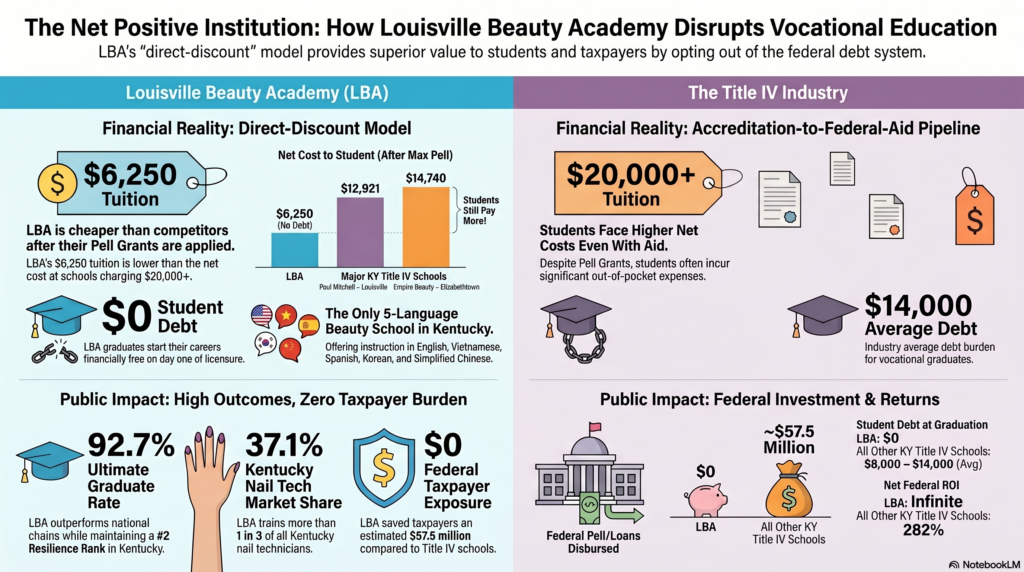
These rates are determined by the 10-year Treasury note yield plus a set margin.10 For a cosmetology student taking the national average of $10,000 in student loan debt, the interest alone over a 10-year repayment period adds thousands of dollars to the total price.9 In contrast, the total tuition at Louisville Beauty Academy for a cosmetology program is under $7,000, which is often 50–75% lower than the tuition at schools relying heavily on federal loans.12

The “Double Scoop” Benefit and Cash-Based Models

The “Double Scoop” benefit refers to the compounding financial advantage of saving on tuition and entering the workforce sooner. By avoiding the prolonged programs designed to maximize federal aid, students can graduate and start earning faster.12

Program PathTuition CostGraduation TimelineCareer Impact
Typical Debt-Based Model$17,000 – $27,00012-18 Months$10k+ Debt + Interest
LBA Cash-Based ModelUnder $7,0009-12 MonthsDebt-Free + Early Earnings

The math reveals a nearly $20,000 “swing” in favor of the debt-free student. This consists of roughly $10,000 kept upfront in tuition savings and an extra $8,000 to $10,000 earned by entering the job market three to six months earlier.12 This model relies on pay-as-you-go systems and internal scholarships, which are intentionally designed to make federal loans unnecessary.13

AI as a Tool for Literacy, Learning, and Administrative Protection

In the 2026 educational environment, artificial intelligence serves as a critical ally for students, particularly those who may face language barriers or who have been out of an academic setting for an extended period. AI is not a replacement for human skill, but a tool for “Humanized Efficiency”.5

Overcoming Literacy Barriers and Language Gaps

For immigrant and multilingual students, the technical jargon of the beauty industry and the complexities of regulatory law can be significant obstacles. AI tools are utilized to simplify these concepts into clear, plain English, ensuring that a student’s lack of fluency in English does not prevent their mastery of the craft.4 The “College of AI” pillar provides personalized, automated instruction that allows students to pace their learning according to their individual needs.5

AI for Administrative Efficiency and the “Administrative Tax”

Higher education institutions often apply “indirect cost rates” or “administrative taxes” to cover overhead, which can account for up to 26–33% of a university’s budget.14 In the beauty school context, these costs are often passed on to the student in the form of higher tuition. By using AI to automate administrative tasks—such as hour tracking, documentation, and compliance checking—schools can reduce this “administrative tax” and pass the savings directly to the student.5

Practical AI Prompts for Student Empowerment

Students are encouraged to use AI as a “thinking partner” to navigate their education and protect their interests.

  • Contract Analysis: Students can prompt AI to “Analyze this enrollment contract and identify all clauses related to tuition refunds, attendance requirements, and additional fees”.17
  • Financial Comparison: AI can be used to “Compare the total cost of a $15,000 loan at 6.39% interest over 10 years versus a cash-based tuition of $7,000 paid monthly”.18
  • Career Planning: Students may ask AI to “Identify the highest-paying salon cities in Kentucky for nail technicians based on 2026 data”.20

Digital Proof-of-Work: The Modern Portfolio and Branding

In the visual-centric world of beauty, a traditional resume is no longer sufficient. The “Digital Proof-of-Work” portfolio has become the industry’s gold standard for demonstrating competency and professionalism.21

Constructing a Visual Resume

A successful portfolio must tell a story of transformation and technical skill. It is essential to start documenting work early in the program, beginning with mannequins and classmate practice.21

Portfolio CategoryRequired ElementsStrategic Insight
Before-and-AfterConsistent lighting and anglesProves the ability to create measurable change
Technical RangeTexture work, color, cuts, and stylesDemonstrates versatility for diverse clients
SanitationPhotos of disinfected stations and toolsBuilds trust and proves professional ethics
TestimonialsQuotes from models or clinic clientsProvides social proof of customer service
CertificationsAwards, lash mapping, or chemical protocolsAdds academic weight to technical skill

Photography is the foundation of the digital portfolio. Natural light, simple backgrounds, and multiple angles are necessary to ensure the work is represented accurately.21 Students must avoid the use of social media filters, as they can be seen as deceptive in a professional context.25

The Ethics of Client Consent and Content Creation

As beauty professionals are also content creators, they must adhere to strict ethical guidelines regarding client privacy. A gold-standard portfolio always includes “Media Release Forms” or “Client Consent Forms”.22 This documentation protects the professional from legal disputes and signals to prospective employers that the student understands the legalities of brand management.22

Sanitation as a Branding Tool

In 2026, sanitation is not just a regulatory requirement; it is a competitive advantage. Portfolios that include “Setup and Sanitation” photos or videos demonstrate a commitment to client safety that sets a student apart from the competition.27

Sanitation ProtocolFrequencyEvidence for Portfolio
HandwashingBefore and after every clientVideo of proper handwashing technique
Tool DisinfectionAfter every single usePhotos of tools in EPA-registered solution
Station ResetBetween every guestBefore/after shots of a sanitized station
PPE UsageDuring chemical or skincare servicesPhotos of professional apron, mask, and gloves

Proper tool care involves deep cleaning brushes and sponges after each use with antibacterial cleansers and ensuring that reusable tools like combs and scissors are fully submerged in disinfectant solutions.29

Transitioning to the Workforce: The First 90 Days

The first three months post-graduation are a period of significant growth and risk. Kentucky’s licensing structure includes a mandatory apprenticeship that provides a structured transition into the professional world.

The Kentucky Apprenticeship Period

After passing both the written and practical examinations, Kentucky cosmetologists must complete a six-month apprenticeship.31

  1. Work Requirements: Apprentices must work a minimum of 20 hours per week in a licensed salon under the supervision of a licensed cosmetologist.31
  2. License Validity: The apprentice license is valid for up to 18 months, allowing time for the completion of the 6-month requirement and final testing if necessary.31
  3. Client Building: This period is designed for “Real-World Salon Experience,” where the apprentice learns the pace of a commercial environment while still having the protection of a mentor.31

Choosing an Employment Model: Independence vs. Support

The choice between working as a commission-based employee or a booth-rental independent contractor is a critical business decision.

Employment ModelPrimary BenefitPrimary Risk
Commission (W-2)Mentorship, stability, shared marketingLower percentage of individual sales
Booth Rental (1099)Full independence, schedule controlHigh overhead, self-employment taxes

For most new graduates, the commission model is recommended. It provides a guaranteed wage (at least minimum wage for all hours worked) and covers the employer’s portion of Social Security and Medicare taxes.32 Booth rental is often risky for those without a pre-existing clientele, as the “hidden costs”—including rent, insurance, products, and marketing—can quickly lead to burnout or financial failure.32

Independent Contractor Law and Misclassification

In Kentucky, the distinction between an employee and an independent contractor hinges on the “Control Test.” If a salon owner dictates a worker’s hours, set prices, and provides tools, that worker is likely an employee (W-2) and should be receiving benefits like unemployment insurance and workers’ compensation.35 Misclassification occurs when a salon owner exerts control over a worker but treats them as a 1099 contractor to avoid taxes.37 Professionals must ensure they have a written contract that clearly defines their status and protects their rights.34

Economic Reality: Kentucky Salary and Career Outlook

The beauty industry in Kentucky remains a resilient and adaptable career choice. As of 2026, salary data shows significant variance based on location and specialization.

Professional RoleEntry-Level SalaryMid-Career Salary90th Percentile
Cosmetologist$30,441$40,327$48,493+
Nail Technician$21,738$37,468$52,545+
Esthetician$26,000$45,000$62,000+

Location plays a pivotal role in earning potential. For example, nail technicians in Hyden ($44,998) and Corbin ($43,137) earn significantly more than the state average, likely due to a higher concentration of demand relative to the number of licensed practitioners.40 In Louisville, the average salary for a nail technician is approximately $41,449, with top earners exceeding $52,000.40

The CEO Mindset and Long-Term Stability

Every beauty professional is the “CEO” of their own business, regardless of their employment model.25 This requires a commitment to financial management, professional reputation, and staying abreast of changing laws. In 2026, Kentucky has moved toward restricting non-compete agreements, particularly for those earning below certain thresholds, ensuring that professionals can take their talents and their client lists with them if they choose to change salons.42

Strategic Questions for Evaluating Beauty Schools

To protect their future, students must evaluate schools with the same rigor they would any other significant investment.

  • Regulatory Transparency: Does the school provide a clear, written timeline for how and when my hours will be uploaded to the KBC? 7
  • The Debt-Free Pathway: What are the internal scholarship options that make federal loans unnecessary? 13
  • Student Labor Policies: Does the curriculum focus on my education, or am I being used as unpaid labor for a school-run salon? 8
  • AI Integration: How is the school teaching me to use artificial intelligence to manage my business and literacy? 5
  • Conduct and Safety: What is the school’s policy on gossip and drama, and how do they protect the “sanctuary” of the learning environment? 3
  • Career Support: Does the school provide specific training for the mandatory apprenticeship and the transition into the first 90 days of work? 31

Conclusion: The Path to Professional Dignity

The transition from a beauty student to a career professional in Kentucky is a journey of both technical mastery and personal transformation. By embracing the philosophy of humanization, prioritizing over-compliance, and avoiding the long-term burden of educational debt, students can secure a future that is both financially stable and personally rewarding.

In the AI era, the “Gold Standard” of practice is not just about the quality of the haircut or the facial; it is about the integrity of the professional behind the chair. The Kentucky beauty professional who operates with transparency, follows the doctrine of love and care, and utilizes technology to enhance human connection will find themselves at the forefront of a thriving industry. This guide provides the foundation—now, the student must apply the “Yes I Can” mindset to build their beautiful future.

Works cited

  1. humanization in education Archives – Di Tran University, accessed February 1, 2026, https://ditranuniversity.com/tag/humanization-in-education/
  2. humanized education model Archives – Di Tran University, accessed February 1, 2026, https://ditranuniversity.com/tag/humanized-education-model/
  3. The Humanization of Vocational Education: A Comprehensive …, accessed February 1, 2026, https://louisvillebeautyacademy.net/the-humanization-of-vocational-education-a-comprehensive-research-report-on-the-viability-of-beauty-school-and-the-louisville-beauty-academy-model-research-podcast-series-2026-lba/
  4. Di Tran — Founder & CEO | Visionary Leader in Workforce Education, Humanized AI, and Immigrant Entrepreneurship – New American Business Association (NABA) – Louisville, KY, accessed February 1, 2026, https://naba4u.org/di-tran-founder-ceo-visionary-leader-in-workforce-education-humanized-ai-and-immigrant-entrepreneurship/
  5. Di Tran University, accessed February 1, 2026, https://ditranuniversity.com/
  6. 201 KAR 12:082 – Education requirements and school administration | State Regulations, accessed February 1, 2026, https://www.law.cornell.edu/regulations/kentucky/201-KAR-12-082
  7. Gold-Standard Compliance Guide: KBC Transfer and Field / Charity …, accessed February 1, 2026, https://louisvillebeautyacademy.net/gold-standard-compliance-guide-kbc-transfer-and-field-charity-hour-requirements-research-2026/
  8. Outcomes-Based Beauty Education : A Workforce and Policy Analysis of Debt-Free, Completion-Driven Vocational Models – RESEARCH DECEMBER 2025, accessed February 1, 2026, https://naba4u.org/2025/12/outcomes-based-beauty-education-a-workforce-and-policy-analysis-of-debt-free-completion-driven-vocational-models-research-december-2025/
  9. Louisville Beauty Academy’s Model vs. Typical U.S. Beauty Schools: A Comprehensive Comparison, accessed February 1, 2026, https://naba4u.org/2025/06/louisville-beauty-academys-model-vs-typical-u-s-beauty-schools-a-comprehensive-comparison/
  10. Federal Student Loan Amounts and Terms for Loans Issued in 2025-26, accessed February 1, 2026, https://ticas.org/federal-student-loan-amounts-and-terms-for-loans/
  11. (DL-25-03) Interest Rates for Direct Loans First Disbursed Between July 1, 2025 and June 30, 2026 – FSA Partner Connect, accessed February 1, 2026, https://fsapartners.ed.gov/knowledge-center/library/electronic-announcements/2025-05-30/interest-rates-direct-loans-first-disbursed-between-july-1-2025-and-june-30-2026
  12. Fast-Track & Debt-Free: How Louisville Beauty Academy Delivers the “Double Scoop” – Save Big and Start Earning Sooner – RESEARCH AUGUST 2025, accessed February 1, 2026, https://louisvillebeautyacademy.net/fast-track-debt-free-how-louisville-beauty-academy-delivers-the-double-scoop-save-big-and-start-earning-sooner-research-august-2025/
  13. Financial Aid Options and Payment Model at Louisville Beauty Academy, accessed February 1, 2026, https://louisvillebeautyacademy.net/financial-aid-options-and-definition/
  14. The Impact of Indirect Rate Limits | NEA – National Education Association, accessed February 1, 2026, https://www.nea.org/resource-library/impact-indirect-rate-limits
  15. Understanding Indirect (Facilities and Administration) Costs and Addressing Common Myths, accessed February 1, 2026, https://research.ucdavis.edu/3-things-to-know-about-indirect-costs-aka-fa/
  16. Beauty School Running Costs: $46k Monthly OpEx – Financial Models Lab, accessed February 1, 2026, https://financialmodelslab.com/blogs/operating-costs/beauty-school
  17. AI Prompts for Finance: 15 Real-World Examples, accessed February 1, 2026, https://www.financialprofessionals.org/training-resources/resources/articles/Details/ai-prompts-for-finance-15-real-world-examples
  18. AI Prompts for K-12 School Marketing – Veracross, accessed February 1, 2026, https://www.veracross.com/resources/ai-prompts-school-marketing/
  19. 30 ChatGPT Prompts for Higher Education (Stimulating Scholarly Success) – Galaxy.ai Blog, accessed February 1, 2026, https://blog.galaxy.ai/chatgpt-prompts-for-higher-education
  20. 10 ChatGPT Prompts to Level Up Your Beauty School Operations – Oozle Media, accessed February 1, 2026, https://www.oozlemedia.com/on-demand-library-2024/parker-2024
  21. How to Build a Standout Portfolio During Beauty School – TSPA San Jose, accessed February 1, 2026, https://www.tspasanjose.com/blog/how-to-build-a-standout-portfolio-during-beauty-school/
  22. How to Build Your Cosmetology Portfolio – Inspire Greatness Aveda Institutes, accessed February 1, 2026, https://avedainspiregreatness.com/blog/build-a-cosmetology-portfolio-examples-templates/
  23. How to Build Your Portfolio While in Beauty School | David Pressley School of Cosmetology, accessed February 1, 2026, https://davidpressleyschool.com/how-to-build-your-portfolio-while-in-beauty-school/
  24. How to Build Your Beauty Portfolio: A Step-by-Step Guide for Cosmetology Students, accessed February 1, 2026, https://www.esimichigan.com/blog/how-to-build-your-beauty-portfolio-a-step-by-step-guide-for-cosmetology-students/
  25. 2026 Kentucky License Renewal Alert: Biennial Cycle | Louisville Beauty Academy Compliance Update – YouTube, accessed February 1, 2026, https://www.youtube.com/watch?v=HdwvEMqI6r8
  26. Student Digital Portfolio Showcase Consent Form Template – Jotform, accessed February 1, 2026, https://www.jotform.com/form-templates/student-digital-portfolio-showcase-consent-form
  27. Sanitation Requirements for Esthetician Students | Elite Aesthetics Academy Denver, accessed February 1, 2026, https://coloradoaestheticsacademy.com/denver-elite-aesthetics-academy-blog/sanitations-at-elite-aesthetics-academy
  28. How to Build Your Portfolio as a Student Esthetician – Isabela Cordero, accessed February 1, 2026, https://www.isabelacordero.com/beauty-notes/how-to-build-your-portfolio-as-a-student-esthetician
  29. Why Sanitation Is Essential in Beauty Work, accessed February 1, 2026, https://www.advancebeautycollege.edu/post/why-sanitation-is-essential-in-beauty-work
  30. Best Essential Makeup Sanitation Guide for Safe Use | JTorry, accessed February 1, 2026, https://jtorryart.com/best-essential-makeup-sanitation-guidelines-for-safe-use/
  31. Kentucky Cosmetology Laws & License Requirements [2026] – Consentz, accessed February 1, 2026, https://www.consentz.com/kentucky-cosmetology-laws-license-requirements/
  32. Booth Rental vs Commission Salons: The Real Costs Every Stylist Should Know, accessed February 1, 2026, https://www.hellohairco.com/booth-rental-vs-commission-salons-the-real-costs-every-stylist-should-know
  33. Commission VS. Booth Rental: Where’s the Money? – Thriving Stylist, accessed February 1, 2026, https://thrivingstylist.com/blog/commission-vs-booth-rental-where-is-the-money-really-at/
  34. The Booth Rental Business Model for Cosmetologists – Cosmetology License, accessed February 1, 2026, https://www.cosmetology-license.com/the-booth-rental-business-model-for-cosmetologists/
  35. Employee vs. Independent Contractor – Kentucky’s Self-Service, accessed February 1, 2026, https://kewes.ky.gov/Employertax/Misc_info.aspx
  36. Independent contractors versus employees | Kentucky Employment Lawyers, accessed February 1, 2026, https://www.kentuckyemploymentlawyer.com/blog/2024/02/independent-contractors-versus-employees/
  37. Employee or Independent Contractor? – Centre for Beauty, accessed February 1, 2026, https://cjscentreforbeauty.com/employee-or-independent-contractor/
  38. How Is an Independent Contractor Defined in Kentucky?, accessed February 1, 2026, https://www.workinjuryadvisor.com/how-is-an-independent-contractor-defined-in-kentucky/
  39. Independent Contractor Rules in Beauty: A Journey from Past to Present – RESEARCH MAY 2025, accessed February 1, 2026, https://louisvillebeautyacademy.net/independent-contractor-rules-in-beauty-a-journey-from-past-to-present-research-may-2025/
  40. Nails Technician Salary in Kentucky: Hourly Rate (Jan, 2026) – ZipRecruiter, accessed February 1, 2026, https://www.ziprecruiter.com/Salaries/Nails-Technician-Salary–in-Kentucky
  41. Nail Technician Salary in Kentucky: Hourly Rate (Jan, 2026) – ZipRecruiter, accessed February 1, 2026, https://www.ziprecruiter.com/Salaries/Nail-Technician-Salary–in-Kentucky
  42. AN ACT relating to non-compete clauses. 1 Be it enacted by the General Assembly of the Commonwealth of Kentucky: 2 *SECTION 1., accessed February 1, 2026, https://apps.legislature.ky.gov/recorddocuments/bill/25RS/sb234/orig_bill.pdf
  43. KY HB690 – BillTrack50, accessed February 1, 2026, https://www.billtrack50.com/billdetail/1838510
  44. Current Status of the FTC’s Non-Compete Rule and an Overview of Non-Compete Agreements in Indiana, Kentucky, and Ohio – Kohnen & Patton Law LLP, accessed February 1, 2026, https://www.kplaw.com/news/news-and-updates/2025/03/current-status-of-the-ftcs-non-compete-rule-and-an-overview-of-non-compete-agreements-in-indiana-kentucky-and-ohio/

Why Louisville Beauty Academy Teaches Beyond Hours — Digital, Public & Research-Backed Proof of Work for Real Careers – Research & Podcast Series 2026

From Licensure to Visibility: Why Louisville Beauty Academy Teaches Digital, Public Proof of Work — Not Just Hours


At Louisville Beauty Academy, We Educate for a New Era

In today’s rapidly changing beauty industry, success looks different than it did even a few years ago. Gone are the days when a clocked number of hours alone was enough to launch a career. Today’s professionals succeed by combining compliance, visible proof of skill, confidence, and a human-centered approach to learning.

At Louisville Beauty Academy, we are proud to embrace this evolution — preparing our students not just to graduate, but to thrive.


What the State Requires — and Why It Matters

Kentucky’s licensing process prioritizes:

  • Public safety
  • Sanitation and infection control
  • Professional responsibility

These requirements exist to protect clients and professionals alike — and we ensure every student meets and exceeds them with clarity, rigor, and understanding.


Beyond Hours: The Power of Proof

The beauty industry — like many skilled professions — is increasingly influenced by digital presence and demonstrated work. Employers, salons, and clients want to see proof of skill. They want to know that a professional not only learned but that they have done.

At LBA, we teach students how to show their work safely and ethically — with respect for privacy, compliance, and professionalism.


Our Mindset: YES I CAN → I HAVE DONE IT

Belief without action isn’t enough. Confidence without validation doesn’t travel far.

That’s why our classrooms and clinics are built around a simple, powerful philosophy:

➡️ YES I CAN — every student learns skills with intention.

➡️ I HAVE DONE IT — every student builds a body of work rooted in action and real experience.

This mindset prepares graduates to walk into licensure exams, job interviews, and client interactions with pride and professionalism.


Humanization First: A Better Way to Teach

We believe education should be:

  • Student-centered
  • Purpose-driven
  • Career-ready
  • Digitally fluent
  • Compliant and ethical

This human-centered approach helps students from all pathways — including adult learners, career changers, immigrants, and non-traditional students — find success in the beauty professions.


Research Backbone + Podcast Insights

We are excited to announce that the LBA education model is featured in a comprehensive research and podcast series published by Di Tran University – College of Humanization as part of the Research & Podcast Series 2026.

This research explores:

  • Regulatory compliance in vocational beauty education
  • Digital documentation of skill and experience
  • Ethical and legal use of portfolios and professional proof
  • Workforce mobility and human-centered pedagogy

The series includes real conversations that translate policy and research into practical insights for students, educators, and industry leaders.

🎧 Tune in to the podcast series and explore the full research report to go deeper.


We’re Ready to Help You Succeed

Whether you’re starting your beauty career, changing paths, or building professional confidence, Louisville Beauty Academy is here to guide you — with compliance, community, clarity, and proof of work at the center of everything we do.

Ready to begin your journey?
📱 Text: 502-625-5531
📧 Email: study@louisvillebeautyacademy.net

The Humanization of Vocational Education: A Comprehensive Research Report on the Viability of Beauty School and the Louisville Beauty Academy Model – Research & Podcast Series (2026) — LBA Public Library

The Humanization of Vocational Education:
A Comprehensive Research Report on the Viability of Beauty School and the Louisville Beauty Academy Model

Published as part of the Louisville Beauty Academy (LBA) Public Library of Research,
powered by Di Tran University — College of Humanization, Research Team.

This report anchors LBA’s 2026 Research & Podcast Series, documenting a human-centered, compliance-first, debt-free model for vocational education. It is released in full as part of LBA’s commitment to open knowledge, regulatory literacy, student protection, and industry elevation.

The accompanying 2026 podcast and video series translate this research into accessible public education for:

  • prospective students and families
  • licensed professionals and salon owners
  • regulators, policymakers, and workforce leaders
  • the broader beauty and human-services industry

This publication is maintained as a public record and living research reference, reflecting LBA’s role not only as a licensed school, but as an institutional contributor to the future of vocational education.

Executive Abstract

The decision to pursue a career in the beauty industry—encompassing cosmetology, esthetics, nail technology, and instruction—is often framed through a narrow vocational lens. Prospective students typically ask, “How quickly can I get licensed?” and “How much will it cost?” However, the contemporary landscape of professional beauty services, particularly as we approach the regulatory and economic shifts of 2026, demands a far more rigorous inquiry. The question “Is beauty school for you?” is fundamentally a question of psychology, economics, and legal compliance. It requires an examination of one’s readiness to enter a regulated workforce, an assessment of financial risk versus return, and a commitment to lifelong human service.

This research report provides an exhaustive analysis of these dynamics, using Louisville Beauty Academy (LBA) as a primary case study. LBA represents a distinct departure from the traditional “beauty college” model, positioning itself instead as an institution of higher learning under the umbrella of Di Tran University and the College of Humanization. Through a unique “Gold Standard” operational framework, LBA has redefined vocational training by integrating advanced Artificial Intelligence (AI), enforcing a strict “Zero Disruption Policy” to ensure psychological safety, and rejecting the Title IV federal loan system in favor of a debt-free, transparency-driven financial model.

By functioning as a “Public Library” of compliance research and publishing over 150 textbooks and guides, LBA elevates the beauty industry from a trade to a profession rooted in law, safety, and human dignity. This report explores how LBA’s methodology protects students from predatory debt and regulatory ignorance while empowering them with the “Yes I Can” mindset necessary for long-term entrepreneurial success.

1. The Existential Inquiry: Is Beauty School for You?

1.1 The Psychology of the Vocational Pivot

The initial contemplation of beauty school is rarely a linear decision; it is often a psychological pivot point in an adult’s life. Research into student demographics at institutions like Louisville Beauty Academy reveals a pattern of transformation. The cohort is not limited to recent high school graduates but heavily features “career changers,” single parents, immigrants, and individuals seeking liberation from stagnant wage-labor roles.1 For these individuals, the question “Is beauty school for you?” is laden with self-doubt, societal stigma regarding “trade schools,” and the fear of financial failure.

The “Yes I Can” philosophy, championed by LBA founder Di Tran, addresses this specific psychological barrier. The academy recognizes that the primary obstacle to enrollment is not a lack of talent, but a lack of belief. The “Imposter Syndrome” that plagues prospective students is dismantled through a curriculum that emphasizes “Humanization”—the belief that education is a mechanism for restoring personal dignity.1 When a student asks if beauty school is for them, they are effectively asking if they are capable of reinventing their identity from “employee” to “licensed professional.” LBA answers this by positioning the license not just as a permit to work, but as a badge of “I Have Done It”—a tangible proof of resilience.3

1.2 The Demographic Imperative: Serving the “New Majority”

The beauty industry is increasingly driven by what sociologists term the “New Majority”—immigrants, non-native English speakers, and adult learners managing complex household responsibilities. Traditional educational models, with their rigid semester schedules and English-only instruction, often exclude this demographic.

LBA has structured its entire operational model to serve this population, effectively arguing that beauty school is “for you” regardless of your linguistic or cultural starting point. The academy’s “Enroll Anytime” model removes the friction of waiting for a “Fall Semester,” recognizing that for a working mother or a new immigrant, the window of opportunity to start school is often narrow and immediate.4 By allowing students to enroll and start immediately, LBA validates the student’s impulse to improve their life now, removing the “cooling off” period where doubt often creeps in. This flexibility is not merely administrative; it is a statement of accessibility, declaring that the path to licensure is open to anyone with the will to begin.4

1.3 The Entrepreneurial Reality vs. The Employment Myth

A critical component of the “Is it for you?” analysis involves understanding the nature of the industry. Unlike nursing or teaching, where one typically enters a structured employment hierarchy, the beauty industry is fundamentally entrepreneurial. Even professionals working in salons often operate as independent contractors or booth renters.

Therefore, beauty school is “for you” only if you are prepared to accept the responsibilities of business ownership: marketing, retention, tax compliance, and self-management. LBA’s curriculum, heavily influenced by the 151 books authored by Di Tran on business and mindset, prepares students for this reality.1 The academy explicitly markets itself to “salon-owner material” students—those who mean business and are eager to launch.5 The report suggests that students looking for a passive educational experience may struggle, whereas those approaching the program as a business incubator will thrive.

2. Economic Transparency: Redefining Financial Aid

2.1 The Semantic Trap: “Financial Aid” vs. Federal Loans

One of the most pervasive misunderstandings in the vocational education sector—and a primary source of confusion for prospective students—is the conflation of the term “Financial Aid” with “Title IV Federal Student Aid” (e.g., Pell Grants and FAFSA-based loans).

From a legal and regulatory perspective, “Financial Aid” is a broad umbrella term referring to any monetary assistance that reduces the cost of attendance. This includes institutional scholarships, private grants, tuition discounts, and employer reimbursement programs. However, the public vernacular has narrowed this definition to mean “government money.”

Louisville Beauty Academy proactively clarifies this confusion. The academy is not a Title IV participating institution. It does not process FAFSA, nor does it disburse federal loans. This is a deliberate strategic choice designed to protect the student.6 By decoupling from the federal loan system, LBA avoids the regulatory overhead that drives up tuition costs and, more importantly, prevents students from entering the workforce with tens of thousands of dollars in non-dischargeable federal debt.

2.2 The Debt-Free Philosophy: Protection Through Pricing

The traditional beauty school model often relies on the availability of federal loans to justify inflated tuition rates. If a student can borrow $20,000, schools are incentivized to charge $20,000. This results in a crisis where entry-level cosmetologists begin their careers burdened by loan payments that consume a significant portion of their initial earnings.

LBA’s “Debt-Free” model operates on a “Double Scoop” philosophy: Save Big and Start Earning Sooner.5

  1. Direct Tuition Reduction: Instead of creating a complex package of loans, LBA offers massive upfront transparency. The “financial aid” is applied directly to the invoice as a discount. For example, the Cosmetology program, valued at a standard rate of ~$27,000, is offered at a discounted rate of ~$6,250 for eligible students.7
  2. The “Scholarship” as a Behavioral Contract: At LBA, scholarships are not lottery tickets; they are earnings. The academy views the 50-75% tuition discount as a scholarship that the student “earns” through attendance and compliance. This reframes financial aid from a handout to a partnership. If a student attends class and follows the rules, the school subsidizes the education.5

2.3 Comparative Cost Analysis

The following table illustrates the stark contrast between the Title IV debt model and the LBA direct-pay model, highlighting the long-term financial protection afforded to the student.

Financial MetricTraditional Title IV SchoolLouisville Beauty Academy (LBA)
Funding MechanismFederal Loans (Stafford, Plus) & Pell GrantsInstitutional Scholarships & Direct Pay
Debt LiabilityHigh (Principal + Interest)Zero Federal Debt
Interest AccrualInterest capitalizes over time0% Interest on internal payment plans
Tuition StrategyHigh sticker price to capture max federal aidMarket-corrected price (50-75% off)
Student AgencyPassive recipient of government fundsActive participant in funding education
Long-Term ImpactLoan payments reduce take-home pay for 10+ yearsGraduate keeps 100% of earnings immediately

2.4 The Voiding Policy: Accountability in Finance

Transparency requires honesty about consequences. LBA’s financial aid is contingent on performance. The academy enforces a strict policy regarding the “Scholarship Voiding.” If a student engages in time theft (e.g., clocking in and leaving without clocking out), they are penalized financially—$100 for the first offense, $200 for the second, and the entire scholarship is voided for the third.7 This policy serves a dual purpose: it protects the school’s resources and teaches the student a vital lesson in professional integrity. In the real world, time theft leads to termination; at LBA, it leads to the loss of financial privilege. This “checks and balances” approach ensures that the aid goes only to those who respect the opportunity.

3. Regulatory Compliance: The “Public Library” Model

3.1 Licensure as the Core First Step

LBA operates on the fundamental premise that the beauty industry is a law-based profession. Creativity, technique, and style are secondary to the primary requirement: Licensure. Without a license, “beauty” is merely a hobby; with a license, it is a regulated commercial activity protected by the state.

Consequently, LBA positions the study of regulation—specifically Kentucky Revised Statutes (KRS) Chapter 317A and Kentucky Administrative Regulations (201 KAR)—as the “core first step” of the curriculum.8 The academy researches and teaches these laws not as abstract concepts, but as the “rules of engagement” for the profession. This focus addresses a common misunderstanding among students who believe beauty school is solely about learning to cut hair. LBA clarifies that beauty school is about learning to legally cut hair, ensuring public safety and sanitation.2

3.2 The Public Library Model: Democratizing Knowledge

In a revolutionary move for the private education sector, LBA has adopted the “Public Library Model” or “Open Knowledge Infrastructure”.2

  • The Problem: Historically, beauty schools and salons have engaged in “gatekeeping,” hoarding information about regulations, techniques, and business practices to create dependency.
  • The LBA Solution: LBA publishes its research, policy analysis, and regulatory guides openly online for the benefit of the entire industry—competitors, regulators, and the public included.2
  • The Impact: This transparency elevates LBA from a mere school to an “Institutional Contributor.” By providing exact empirical references to law and policy, LBA empowers its students to debate inspectors, understand their rights, and operate with confidence. They are not just taught “what” to do; they are given the “citation” for “why” they must do it.9

3.3 The Hierarchy of Authority

LBA’s compliance education is sophisticated. It teaches the “Hierarchy of Authority,” helping students distinguish between a Statute (passed by the legislature), a Regulation (created by the Board), and a mere Guideline.8 This nuance is critical. A student who understands this hierarchy is protected against administrative overreach and is better equipped to run a compliant business. LBA’s “Gold Standard” compliance guide is a direct output of this research, aiming for “Over-Compliance” to ensure absolute safety.10

4. The Institutional Environment: Love, Care, and Zero Disruption

4.1 “Love and Care” as Operational Doctrine

While “Compliance” provides the skeleton of the LBA model, “Love and Care” provides the heart. This phrase is not a marketing slogan but an operational doctrine rooted in the founder’s philosophy of Humanization.

  • The Need for Safety: Many LBA students come from backgrounds of trauma, instability, or economic hardship. For these students, a chaotic learning environment is a barrier to cognitive function.
  • The Implementation: LBA creates a “proven environment of love and care” by establishing a sanctuary. This is a “judgment-free zone” where past academic failures are irrelevant. The focus is entirely on the “Yes I Can” future.11

4.2 The Zero Disruption Policy: Protecting the Sanctuary

To maintain this environment of “Love and Care,” LBA enforces a rigorous “Zero Disruption Policy”.11

  • The Misunderstanding: Some may view strict discipline as contrary to “care.” LBA argues the opposite: True care requires the removal of toxicity.
  • The Policy: The policy is a “Zero Tolerance” framework prohibiting gossip, drama, bullying, or any behavior that disrupts the learning of others. It is legally binding and documented in the enrollment contract.11
  • The Mechanism: LBA administration is empowered to make “instant, lawful decisions,” including expulsion, to protect the peace of the student body. The school mandates a professional chain of command for grievances, preventing the spread of rumors.11
  • The Result: Google ratings and student reviews frequently cite the “peaceful,” “calm,” and “safe” atmosphere as the primary reason they were able to complete the program.11 By eliminating the “high school drama” often associated with trade schools, LBA elevates the dignity of the vocational student.

4.3 Google Ratings and Social Proof

The efficacy of this policy is reflected in the school’s digital footprint. The “Zero Disruption” policy is often mentioned in positive reviews as a differentiator. Students who are serious about their careers appreciate that the school protects their investment by silencing distractions. The reviews highlight an environment where “love and care” means holding everyone to a standard of excellence and mutual respect.11

5. The Intellectual Foundation: Di Tran University & The College of Humanization

5.1 Elevating the Trade to a Discipline

Louisville Beauty Academy is the flagship institution of a broader educational project: Di Tran University. This affiliation elevates the beauty school from a technical training center to a college of higher learning. Specifically, LBA operates under the College of Humanization, one of the three pillars of Di Tran University (alongside the College of AI and the College of Human Service).2

The College of Humanization posits that vocational education must be centered on the human being, not just the skill. “When education is humanized, dignity follows”.2 This philosophy serves to protect the student from being viewed as a mere cog in the workforce machinery. Instead, they are trained as holistic service providers who understand the emotional and psychological value of their work.

5.2 The 151 Books: A Publishing Library

The intellectual weight of the academy is sustained by the prolific output of its founder, Di Tran. With 151 published books, LBA functions as a specialized publishing library.1

  • Curriculum Integration: These books are not supplementary; they are central to the LBA experience. Titles such as “Drop the FEAR and Focus on the FAITH”, “The Humanization Blueprint”, and “Mastering the Craft” serve as textbooks that bridge the gap between technical skill and personal development.14
  • Empirical Reference: By publishing its own educational materials, LBA ensures that students have access to up-to-date, empirical references regarding law, policy, and sanitation. This contrasts with schools relying on outdated generic textbooks.7
  • Thought Leadership: The volume of this work establishes LBA as a national leader in beauty education research. The “2026 Magazine” and the upcoming podcast series are extensions of this publishing arm, designed to disseminate this knowledge globally.2

5.3 Founder Di Tran: The Embodiment of “Yes I Can”

Di Tran’s personal narrative—from living in a mud hut in Vietnam to becoming a computer engineer, author, and university founder—serves as the ultimate validation of the “Yes I Can” curriculum.1 His background in computer science and engineering directly informs the school’s advanced system integration, while his immigrant experience informs the “Love and Care” policy. He is not a distant administrator; his philosophy is the operating system of the school.

6. Technological Vanguard: AI, Integration, and Checks & Balances

6.1 Max AI Adoption: Breaking Barriers

LBA markets itself as the “most advanced beauty school” due to its aggressive adoption of Artificial Intelligence.17 However, unlike institutions that use tech to replace teachers, LBA uses AI to humanize the experience by removing barriers.

  • Language Translation: The most significant application is the use of generative AI (ChatGPT, D-ID avatars) to provide real-time translation and tutoring in over 100 languages. A student who speaks Vietnamese or Spanish can engage with complex biological theory in their native language, ensuring deep comprehension before testing in English.17 This effectively “protects” non-native speakers from systemic exclusion.
  • Personalized Tutoring: AI tools serve as 24/7 tutors, allowing students to ask “stupid questions” without fear of judgment, reinforcing the psychological safety of the learning environment.17

6.2 System Integration and “Checks and Balances”

Behind the scenes, LBA utilizes advanced system integration to manage the complexities of state board hour reporting.

  • The “Checks and Balances”: The beauty industry is notorious for disputes over “clocked hours.” LBA uses a rigorous digital system to track attendance, financial aid (scholarship) compliance, and academic progress.18 This system provides a “check” against human error and a “balance” against fraud.
  • Security and Compliance: The system is designed to ensure that the data reported to the Kentucky State Board is accurate and immutable. This protects the student’s license from future audit risks. By automating the bureaucratic aspects of the school, LBA allows instructors to focus entirely on hands-on training and “Love and Care”.20

7. Social Integration and Public Scholarship

7.1 Social Media as a Portfolio

LBA integrates social media not just for marketing, but as a dynamic student portfolio system.

  • Student Features: The academy actively features students on its platforms (Facebook, Instagram, YouTube), tagging them and showcasing their work to the public. This builds the student’s professional brand before they graduate.7
  • Graduates Gallery: The “Gallery of Louisville Beauty Academy Graduates” celebrates the 1,000+ individuals who have successfully licensed. This serves as social proof and motivation for current students.7

7.2 The 2026 Magazine and Podcast Series

Looking ahead, LBA is expanding its media footprint to further elevate the industry.

  • “Licensed to Thrive” Podcast: Launching in 2026, this podcast series is designed to explain why licensing is the foundation of success. It is a public education tool intended to raise the status of the beauty professional in the eyes of the consumer.21
  • Magazine and White Papers: The academy is preparing to release a series of research papers and magazine features on “Beauty Workforce Economics” and “Regulatory Literacy,” cementing its status as a think tank.2

7.3 Live Volunteer Practices

The academy’s “Live Volunteer Practice” model connects students with the community. By allowing the public to book services (via a dedicated line: 502-915-8615) for a nominal fee (e.g., $4.00 haircuts), the school provides students with real-world clinical experience.7 This feature is critical for building the “soft skills” of client consultation and time management, which are emphasized in the College of Humanization curriculum.

8. Conclusion: The Verdict on Protection and Elevation

In answering the query “Is beauty school for you?”, this report concludes that the viability of the career path is heavily dependent on the institutional model one chooses. The traditional model, fraught with debt and “sink-or-swim” dynamics, poses significant risks. However, the model pioneered by Louisville Beauty Academy offers a protected, elevated pathway.

LBA protects the student through:

  1. Financial Safety: A debt-free, direct-pay model that prevents federal loan entrapment.
  2. Psychological Safety: A “Zero Disruption” policy that ensures a calm, professional learning environment.
  3. Regulatory Safety: A “Gold Standard” compliance education that armors the graduate in law.
  4. Cultural Safety: An inclusive, AI-supported environment that welcomes diverse learners.

LBA elevates the industry through:

  1. Academic Rigor: The research capabilities of Di Tran University and the College of Humanization.
  2. Public Scholarship: The “Public Library” model that democratizes knowledge.
  3. Professional Dignity: Reframing the cosmetologist as a “Human Service Professional.”

For the student who desires not just a job, but a career built on a foundation of “Yes I Can,” Louisville Beauty Academy represents the most comprehensive, transparent, and human-centered option in the current market.

Appendix: Data Analysis Tables

Table A: Comparative Analysis of Financial Models

FeatureTitle IV Federal Aid ModelLBA “Debt-Free” Model
Primary FundingFederal Loans (Debt)Institutional Scholarship (Discount)
Cost to StudentPrincipal + Interest (10+ Years)Cash/Payment Plan (0% Interest)
Tuition PricingOften Inflated to CapMarket-Corrected (50-75% Lower)
FAFSA Required?YesNo (Direct Enrollment)
Financial RiskHigh (Non-dischargeable debt)Low (Pay-as-you-go)

Table B: LBA Program Transparency (2026 projections based on current data)

ProgramHours (KY Req.)Standard CostDiscounted Cost*Savings
Cosmetology1,500~$27,025~$6,250~75%
Esthetics750~$14,174~$6,100~55%
Nail Technology450~$8,325~$3,800~55%
Instructor750~$12,675~$3,900~70%

*Discounts are contingent on the “Scholarship” behavioral contract (attendance and compliance).

Table C: The Four Pillars of the LBA 2026 Mission

PillarDescriptionObjective
Gold-Standard ModelStudent-First, Compliance-FirstPrioritize long-term professional dignity over profit.
Public Library ModelOpen Knowledge InfrastructureEnd information gatekeeping; share research freely.
Podcast/Video Series“Licensed to Thrive”Educate the public on the value of licensure.
College of HumanizationDi Tran University IntegrationInfuse vocational training with ethics and empathy.

REFERENCES

  1. Di Tran’s Louisville Beauty Academy — From Mud Hut to 130 Books – The YES I CAN Way, accessed January 24, 2026, https://www.youtube.com/watch?v=BR6Ew0Lid00
  2. Louisville Beauty Academy: Our Direction Forward (2026 and Beyond), accessed January 24, 2026, https://louisvillebeautyacademy.net/louisville-beauty-academy-our-direction-forward-2026-and-beyond/
  3. List of books by author DI TRAN – ThriftBooks, accessed January 24, 2026, https://www.thriftbooks.com/a/di-tran/12174455/
  4. Louisville Beauty Academy – Student Enrollment Procedures, accessed January 24, 2026, https://louisvillebeautyacademy.net/louisville-beauty-academy-student-enrollment-procedures/
  5. Fast-Track & Debt-Free: How Louisville Beauty Academy Delivers the “Double Scoop” – Save Big and Start Earning Sooner – RESEARCH AUGUST 2025, accessed January 24, 2026, https://louisvillebeautyacademy.net/fast-track-debt-free-how-louisville-beauty-academy-delivers-the-double-scoop-save-big-and-start-earning-sooner-research-august-2025/
  6. Financial Aid Options and Payment Model at Louisville Beauty …, accessed January 24, 2026, https://louisvillebeautyacademy.net/financial-aid-options-and-definition/
  7. Self-Published Books for Advanced … – Louisville Beauty Academy, accessed January 24, 2026, https://louisvillebeautyacademy.net/louisvillebeautyacademyselfpublishedbookcollection/
  8. The Hierarchy of Authority in Kentucky Beauty Regulation – Understanding Statutes, Administrative Rules, and Guidance Materials, accessed January 24, 2026, https://louisvillebeautyacademy.net/the-hierarchy-of-authority-in-kentucky-beauty-regulation-understanding-statutes-administrative-rules-and-guidance-materials/
  9. Kentucky Beauty Licensee’s Gold Standard Guide for Lawful, Professional, and Transparent Interaction with Inspectors and Law Enforcement – Louisville Beauty Academy, accessed January 24, 2026, https://louisvillebeautyacademy.net/kentucky-beauty-licensees-gold-standard-guide-for-lawful-professional-and-transparent-interaction-with-inspectors-and-law-enforcement/
  10. Gold-Standard Compliance Guide: KBC Transfer and Field / Charity Hour Requirements – RESEARCH 2026 – Louisville Beauty Academy, accessed January 24, 2026, https://louisvillebeautyacademy.net/gold-standard-compliance-guide-kbc-transfer-and-field-charity-hour-requirements-research-2026/
  11. Tag: best beauty school in Louisville – Louisville Beauty Academy, accessed January 24, 2026, https://louisvillebeautyacademy.net/tag/best-beauty-school-in-louisville/
  12. Di Tran, Most Admired CEO, Celebrates USA and Workforce Development with a Message of Love and Care – Louisville Beauty Academy, accessed January 24, 2026, https://louisvillebeautyacademy.net/di-tran-most-admired-ceo-celebrates-usa-and-workforce-development-with-a-message-of-love-and-care/
  13. Di Tran — Founder & CEO | Visionary Leader in Workforce Education, Humanized AI, and Immigrant Entrepreneurship – New American Business Association (NABA) – Louisville, KY, accessed January 24, 2026, https://naba4u.org/di-tran-founder-ceo-visionary-leader-in-workforce-education-humanized-ai-and-immigrant-entrepreneurship/
  14. Who is Di Tran? Exploring the Life and Books of a Prolific Author and our Founder of Louisville Beauty Academy, accessed January 24, 2026, https://louisvillebeautyacademy.net/explore-di-trans-inspirational-books-online/
  15. Beauty as Healing: Louisville Beauty Academy Shares a New Voice in the Di Tran University Podcast Series (2026), accessed January 24, 2026, https://louisvillebeautyacademy.net/beauty-as-healing-louisville-beauty-academy-shares-a-new-voice-in-the-di-tran-university-podcast-series-2026/
  16. Books by Di Tran: A Journey of Perseverance and Inspiration – Viet Bao Louisville KY, accessed January 24, 2026, https://vietbaolouisville.com/books-by-di-tran-a-journey-of-perseverance-and-inspiration/
  17. Research 2025: Louisville Beauty Academy and Di Tran University – A Pioneering Model for the Future of Education, accessed January 24, 2026, https://vietbaolouisville.com/2025/06/research-2025-louisville-beauty-academy-and-di-tran-university-a-pioneering-model-for-the-future-of-education/
  18. Operationalizing competency-based assessment: Contextualizing for cultural and gender divides – PMC – NIH, accessed January 24, 2026, https://pmc.ncbi.nlm.nih.gov/articles/PMC10576182/
  19. 2024 Integrated Report | Givaudan, accessed January 24, 2026, https://www.givaudan.com/files/giv-2024-integrated-report.pdf
  20. Tag: AI integration in beauty education – Louisville Beauty Academy, accessed January 24, 2026, https://louisvillebeautyacademy.net/tag/ai-integration-in-beauty-education/
  21. Licensed to Thrive: Louisville Beauty Academy Launches Its 2026 Flagship Podcast Series, accessed January 24, 2026, https://louisvillebeautyacademy.net/licensed-to-thrive-louisville-beauty-academy-launches-its-2026-flagship-podcast-series/
  22. Louisville Beauty Academy: Advancing Transparency in Beauty Education Finance – January 2026 – RESEARCH BY DI TRAN UNIVERSITY, accessed January 24, 2026, https://louisvillebeautyacademy.net/louisville-beauty-academy-advancing-transparency-in-beauty-education-finance-january-2026-research-by-di-tran-university/

Louisville Beauty Academy — Elevating Others to New Heights – America’s Most Mission-Driven and Nationally Recognized Beauty College (2025 Year-End Review)

As of December 30, 2025, Louisville Beauty Academy (LBA) stands as one of the most impactful, inclusive, and community-centered beauty colleges in the United States — a “service-first” engine of opportunity built on the founding philosophy:

“Drop the ME — Focus on the OTHERS.”

LBA is more than a school.
It is a movement of human elevation — designed to uplift underserved individuals, New Americans, working parents, ESL learners, women rebuilding independence, and first-generation students through affordable, debt-free, license-first beauty education.

While many beauty institutions emphasize glamour or tuition revenue, LBA’s model is different — grounded in:

✔ law
✔ sanitation
✔ safety
✔ compliance-by-design
✔ small-business creation
✔ workforce dignity
✔ compassion

Graduates don’t just learn skills.
They become licensed professionals, employers, and community builders — strengthening local economies across Kentucky and beyond.


Core Mission — Elevating Others Above All

LBA removes barriers to opportunity through:

  • up to 75% tuition savings
  • instant scholarships
  • tuition matching
  • interest-free plans
  • the MAX attendance scholarship
  • free professional kits from CHI, OPI, Milady & more
  • flexible schedules
  • bilingual support
  • multilingual state exams (English, Spanish, Vietnamese, Korean & Simplified Chinese)

The result:

Nearly 2,000 licensed professionals trained

Many first-generation and immigrant entrepreneurs now operate their own salons — contributing an estimated $20–50 million annually to Kentucky’s economy.

This is elevation in action — transforming
YES I CAN → I HAVE DONE IT.


Historic 2025 Accomplishments — Unmatched in Scope

In a single year, Louisville Beauty Academy achieved an extraordinary combination of public service, publishing, community empowerment, and national recognition rarely seen in the beauty-education sector.

🏆 Dual National Recognition

A Kentucky first.

  • U.S. Chamber of Commerce
    • CO—100 America’s Top 100 Small Businesses (2025)
    • Selected from 12,500+ applicants
  • National Small Business Association
    • Lew Shattuck Small Business Advocate of the Year — Finalist (2025)

These honors elevated LBA as a national workforce and small-business leader — not just a school.


📚 Publishing & Digital Education Leadership

Founder Di Tran authored and released 130+ books, including:

  • licensing exam master guides
  • compliance and sanitation resources
  • professional mindset development
  • immigrant empowerment
  • AI-era workforce education

Alongside this:

  • 800+ blog posts
  • verbatim Kentucky beauty laws (KRS 317A & 201 KAR)
  • free digital learning libraries
  • AI-assisted multilingual accessibility
  • exam readiness chapters
  • public workforce research

This makes LBA a rare college-plus-publisher model — an open-knowledge institution where education is shared, not hidden.


🎥 Digital & Multimedia Mission

LBA produced:

  • workforce documentaries
  • real-career licensing explainers
  • non-glamour educational content
  • practical tutorials
  • student success features

Videos intentionally center:

✔ law
✔ compliance
✔ safety
✔ workforce mobility
✔ dignity in skilled labor

This digital ecosystem empowers the public — not just enrollees.


🌎 Access & Inclusion Milestones

  • support for multilingual exam rollout
  • celebration of Spanish-language exam-pass milestones
  • Harbor House campus (opened Feb 2025) — serving individuals with disabilities
  • deep outreach to refugees, single parents, new citizens, and ESL learners

Education at LBA is for everyone.


🏗 Workforce & Community Impact

LBA graduates:

  • become licensed professionals
  • open salons
  • hire staff
  • stabilize family income
  • strengthen neighborhoods

This model aligns with LBA’s identity as:

America’s Ethical Workforce Academy™

Beauty school →
Industry infrastructure.


How LBA Differs From Typical Schools

CategoryLouisville Beauty AcademyStandard Beauty School
Tuition ModelDebt-free / pay-as-you-goHeavily loan-dependent
Intellectual Property130+ founder-authored booksVendor textbooks only
Digital Content800+ open-access posts & legal libraryMarketing-only content
Community FocusImmigrant & ESL-firstEnglish default
MissionElevate lives & create economic mobility“Train for a job”

LBA functions as a:

College + Publishing House + Workforce Accelerator + Public Service Platform

— all in one.


Purpose Above All — Elevating Souls

Students learn:

  • law
  • ethics
  • sanitation
  • documentation
  • responsibility
  • self-belief
  • entrepreneurship
  • service mindset

The goal is simple:

Licensed professional → independent provider → economic freedom → strong families → strong communities.


A Kentucky-Born Model With National Impact

In 2025, Louisville Beauty Academy achieved — in one year — a rare alignment of:

✔ national business recognition
✔ open-access publishing
✔ bilingual inclusion
✔ research contribution
✔ workforce advancement
✔ community partnership
✔ scalable digital outreach
✔ debt-free accessibility

This makes LBA a national model for mission-driven vocational education — and a leading force in ethical workforce development.


Join the Movement of Human-Centered Beauty Education

Enrollment & partnerships:
🌐 https://louisvillebeautyacademy.net

Your licensed beauty career — and your future impact on others — starts here.
💇‍♀️❤️✨


APA-Style References (Retrieved December 30, 2025)

Louisville Beauty Academy. (n.d.). Official website. https://louisvillebeautyacademy.net

Louisville Beauty Academy. (n.d.). Education blog & digital library. https://louisvillebeautyacademy.net

Louisville Beauty Academy. (n.d.). Self-published book collection. https://louisvillebeautyacademy.net/louisvillebeautyacademyselfpublishedbookcollection/

Louisville Beauty Academy. (n.d.). Facebook page. https://www.facebook.com/LouisvilleBeautyAcademy/

Louisville Beauty Academy. (n.d.). Instagram profile. https://www.instagram.com/louisvillebeautyacademy/

Louisville Beauty Academy. (n.d.). YouTube channel. https://www.youtube.com/@louisvillebeautyacademy

Louisville Beauty Academy. (n.d.). LinkedIn company page. https://www.linkedin.com/school/louisville-beauty-academy/

Tran, D. (2025). Author page & publications. Amazon. https://www.amazon.com/author/ditran

Louisville Business First. (2024). Most Admired CEO Awards. https://louisvillebeautyacademy.net/louisville-beauty-academy-success-celebration/

U.S. Chamber of Commerce. (2025). CO—100 America’s Top 100 Small Businesses. https://www.uschamber.com/co100

National Small Business Association. (2025). Lew Shattuck Small Business Advocate of the Year Finalists. https://nsba.biz