Asymmetric Governance and the Inaccessibility of Administrative Justice: A Multidisciplinary Analysis of Occupational Licensing Enforcement in the United States Beauty Sector – RESEARCH & PODCAST SERIES 2026


Educational & Research Notice
This publication is independent research by Di Tran University – College of Humanization, based solely on publicly available information. All research credit is attributed to Di Tran University. Louisville Beauty Academy and Di Tran University are not affiliated with, endorsed by, or representative of the Kentucky Board of Cosmetology or any government agency. This content is provided for informational purposes only, does not constitute legal or regulatory advice, and is presented “as is” without representation or warranty.

Part A: Executive Brief for Legislators

The regulatory architecture of the United States beauty industry has reached a critical inflection point where the exercise of the state’s police power increasingly conflicts with fundamental constitutional protections regarding the right to earn a livelihood.1 Occupational licensing now covers approximately 25% of the U.S. workforce, representing a fivefold increase since the 1950s.3 While ostensibly designed to solve information asymmetry and protect consumer health and safety, empirical data and administrative case studies indicate that these systems frequently function as state-sanctioned barriers to entry that generate “monopoly rents” for incumbent practitioners while imposing a “deadweight loss” on the broader economy.1

The core findings of this multidisciplinary report identify a profound “Due Process Accessibility Gap”.2 Although formal legal rights—including the right to notice, an impartial decision-maker, and an evidentiary hearing—remain codified in administrative law, they are rendered functionally inaccessible to low- and moderate-income licensees.2 The primary driver of this failure is a severe economic imbalance: the cost of a meaningful legal defense relative to practitioner income.2

Economic IndicatorSector Data
Median Annual Income (Nail Technicians)$34,660 7
Median Annual Income (Cosmetologists)$35,420 8
Typical Administrative Case Defense Cost$5,000 – $20,000+ 9
Defense Cost as Percentage of Median Income14.4% – 57.7% 7
“Due Process Inaccessibility” Threshold>10% of Annual Income

This economic reality creates a system of “functional coercion,” where licensees are pressured to accept “Agreed Orders” or settlements, regardless of the merit of the allegations, simply because the cost of proving their innocence exceeds their financial capacity.2 Furthermore, the complaint-driven enforcement model is structurally vulnerable to “competitive harassment,” where established firms weaponize the administrative process to drain the resources of rivals.1

The report highlights the Commonwealth of Kentucky as a critical case study in regulatory failure.12 Recent investigations reveal patterns of targeted hyper-fining against minority-owned nail salons, the use of unauthorized legal counsel to issue disciplinary notices, and the persistence of “shadow” testing operations that duplicate state-contracted services at a significant loss to the public fisc.13

To restore administrative integrity, this report proposes a suite of “legislatively actionable” reforms, including:

  1. Fee-Shifting Provisions: Requiring boards to pay attorney fees for prevailing licensees.16
  2. Fine Caps: Limiting administrative penalties relative to the licensee’s reported income.18
  3. Independent Oversight: Establishing a non-industry review board to audit enforcement patterns and ensure “evidence legibility”.2
  4. Technological Integration: Utilizing AI-driven auditing and “Gold-Standard” digital logs to verify compliance and prevent arbitrary targeting.2

The issue is not the existence of regulation, but whether the scales of justice are balanced enough to allow the regulated to defend their property interests against administrative overreach.

Part B: Research Paper: Structural Barriers and Asymmetric Power

1. Introduction: The Property Interest in Professional Livelihood

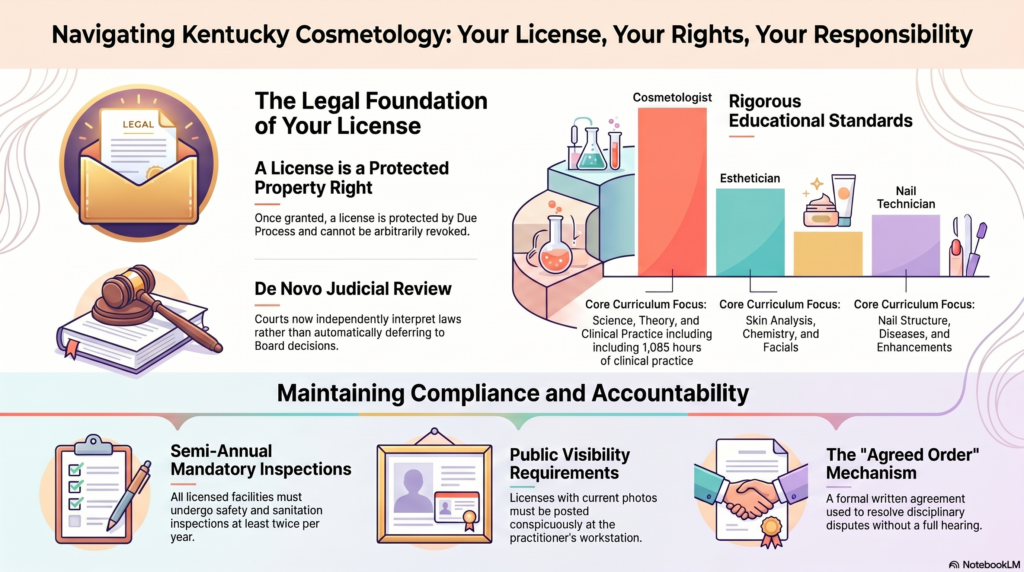
The legal status of a professional license has transitioned from a mere privilege to a recognized property interest under the Fourteenth Amendment’s Due Process Clause.2 When a state grants a license, it creates a vested interest that allows an individual to pursue a livelihood—an interest that cannot be revoked or suspended without adherence to fundamental fairness.2 Historically, the judiciary frequently scrutinized economic regulations that interfered with this right; however, the modern “rational basis” standard of review grants broad deference to state boards.2

Despite this deference, the recognition of a license as a property interest remains a cornerstone of administrative law, necessitating a balance between state police power and individual rights. The Mathews v. Eldridge balancing test provides the framework for this evaluation, weighing the private interest affected, the risk of erroneous deprivation through current procedures, and the government’s interest in fiscal and administrative efficiency.2 In the beauty industry, where practitioners are often self-employed or micro-business owners, the “private interest” represents their entire economic survival, while the “risk of error” is heightened by the lack of legal representation.2

2. Economic Reality vs. Legal Defense Cost

The viability of due process is inextricably linked to the cost of legal counsel.2 For the majority of beauty professionals, the economic barrier to justice is insurmountable.

A. Income Profiles of Personal Care Professionals

The personal care sector is characterized by modest earnings. As of May 2024, the median wages across various specialties indicate a high degree of financial sensitivity.

SpecialtyMedian HourlyMedian Annual10th Percentile90th Percentile
Manicurist/Pedicurist$16.66$34,660$27,260$48,080 7
Hairdresser/Cosmetologist$16.95$35,260$23,520$63,310 8
Skincare Specialist$19.98$41,560$27,160$77,330 24
Barber$18.73$38,960$27,770$78,440 8

These figures underscore that most beauty professionals fall into the low- to moderate-income brackets. Furthermore, many in the sector are independent contractors who do not receive employer-sponsored benefits, increasing their vulnerability to sudden legal expenses.26

B. The Cost of Administrative Adjudication

Legal defense in administrative law requires specialized expertise. National data from 2025 indicates that the average hourly rate for an administrative law attorney is approximately $328 to $329.9 In major markets like California, these rates frequently exceed $420 per hour.10

A standard administrative defense case involves several critical phases:

  1. Investigation and Discovery: 10–20 hours.
  2. Pleadings and Motions: 5–10 hours.
  3. Hearing Preparation and Witness Interviews: 15–20 hours.
  4. Formal Hearing Attendance: 8–16 hours.
  5. Post-Hearing Briefs: 5–10 hours.

Totaling between 43 and 76 hours of legal work, a typical contested case carries a price tag of $14,000 to $25,000.9 When compared to a median manicurist’s annual income of $34,660, the cost of defense can represent up to 72% of their total gross earnings.7

C. The Due Process Threshold

Access to justice is denied when the cost of defending a right exceeds a meaningful share of the interest’s value. This research defines the “Practical Due Process Accessibility Threshold” as a legal cost not exceeding 10% of annual income. Current market rates for legal defense exceed this threshold for over 90% of the beauty workforce.2 Consequently, due process is “theoretically available but practically inaccessible”.2

3. Structural Power Asymmetry: The Administrative State vs. The Individual

The power imbalance between a state regulatory board and a licensee is systemic and multi-dimensional.1 This phenomenon, defined as “Administrative Power Asymmetry,” ensures that the board almost always operates from a position of tactical superiority.

A. Institutional Advantages of the Board

State boards possess institutional continuity and the backing of the state’s legal apparatus.1 Boards have access to full-time legal counsel funded by taxpayer or license-fee revenue, allowing them to pursue enforcement actions without internalizing the marginal cost of litigation.2 They possess broad investigative powers, including the authority to conduct surprise inspections and issue administrative subpoenas for private records.11

B. Vulnerability of the Licensee

The average licensee is a small salon owner or employee with no formal legal training.2 The loss of a license constitutes an “existential risk,” as it immediately terminates their ability to earn a living.2 This high-stakes environment, combined with the licensee’s high marginal defense cost, creates a “coercive settlement environment”.2

FeatureRegulatory BoardIndividual Licensee
Legal RepresentationState-funded, specialized counsel 13Out-of-pocket, high-cost private counsel 9
Financial RiskMinimal; funded by fees/fines 12Catastrophic; livelihood at stake 2
InformationFull access to investigative files 11Limited access without expensive discovery
ContinuityInstitutional; immune to time pressureHighly sensitive to delays/closure 28

4. Agreed Orders as Default Enforcement: Functional Coercion

The administrative state relies heavily on “Agreed Orders” or settlements to maintain operational efficiency.2 While settlements are a legitimate part of the legal process, their use in the beauty industry often signals a failure of due process rather than a mutual agreement.

A. The Efficiency Trap

Enforcement statistics from states like Texas (TDLR) show that a significant majority of cases are resolved through agreed orders rather than formal hearings.29 For example, in the Texas Auctioneer program, 100% of final orders were agreed orders or defaults in 2023.29 Boards often include a “Notice of Alleged Violation” (NOAV) with a pre-calculated settlement offer.31 To an unrepresented licensee, this often feels like an ultimatum: pay a $1,000 fine now, or spend $10,000 in legal fees to fight it.2

B. The Cumulative Effect of Settlements

Agreed orders are not neutral. They include admissions of facts and create a permanent disciplinary history.2 Under the “Disciplinary Escalation Pathway,” a minor agreed order for a sanitation issue today can be used as a “prior violation” to justify license revocation or emergency closure tomorrow.11 This creates a “record-building” mechanism that allows boards to target disfavored practitioners over time.33

5. National Context: The Growing Burden of Occupational Licensing

The expansion of licensing into low-income occupations has created substantial economic barriers that reduce mobility and entrepreneurship.6

A. Disproportionate Training Requirements

The time required to enter beauty professions is frequently irrational when compared to higher-risk fields.3 National research highlights that the average cosmetologist must complete 342 days of training, while an EMT requires only 36 days.3

OccupationAvg. Training (Days)Avg. Fees
Cosmetologist342$209 36
Barber315$175 36
Makeup Artist128$173 36
EMT36$115 3

This disparity suggests that licensing requirements are driven by industry lobbying (rent-seeking) rather than public safety.1

B. Impact on Entrepreneurship and Inequality

Studies confirm a discernable connection between the density of licensing and lower rates of entrepreneurship among low-income populations.34 In states that license more than half of low-income occupations, the entrepreneurship rate is 11% lower than average.34 This burden falls most heavily on those with less access to financial capital or formal education, cementing existing economic inequalities.3

6. Vulnerable Populations Analysis

The enforcement burden of occupational licensing is not distributed equally. It disproportionately impacts immigrant entrepreneurs, rural operators, and minority business owners.1

A. Immigrant Communities and Language Barriers

In the nail salon sector, which has a high concentration of Vietnamese and Cambodian immigrants, single-language testing acts as a structural barrier.37 Advocacy groups in Kentucky have highlighted that the lack of multi-language exams prevents practitioners from demonstrating their competency in sanitation and safety, despite those tests being available nationally via PSI.37 This “linguistic exclusion” increases the risk of erroneous deprivation of livelihood for thousands of “New Americans”.37

B. Rural Schools and “Regulatory Deserts”

Administrative case studies from Kentucky indicate that aggressive enforcement has targeted rural beauty schools, which are often the sole vocational training providers in poverty-stricken counties.12 The closure of these institutions—often for minor, cure-able infractions—forces students to commute to larger cities, creating “regulatory deserts” and restricting economic mobility in underserved regions.12

7. Public Choice and System Design: The Problem of Regulatory Capture

The economic theory of regulation suggests that licensing boards are often “captured” by the industries they regulate.1 Small, well-organized groups of incumbent practitioners find it easier to lobby for restrictive rules that limit competition than the large, unorganized group of consumers who are harmed by higher prices.1

Evidence of capture includes:

  • Board Composition: Boards often consist entirely of industry incumbents with a vested interest in limiting new competition.1
  • Scope Creep: Boards attempting to regulate activities like “eyebrow threading” or “hair braiding” as “cosmetology,” requiring hundreds of hours of irrelevant training.2
  • Accreditation Requirements: Quietly implementing laws that require national accreditation for schools—a process that costs thousands and favors large institutions over small, community-based vocational academies.15

Part C: Kentucky Deep Dive: A Case Study in Administrative Failure

1. The Kentucky Board of Cosmetology (KBC) Scandals (2021–2024)

Kentucky provides a stark example of how a lack of oversight can lead to the systemic abuse of administrative power.12 A series of investigations by the Legislative Oversight and Investigations Committee (LOIC) and victims’ advocates have uncovered widespread misconduct.14

A. Unauthorized Legal Counsel and Ultra Vires Actions

One of the most serious structural violations uncovered was the unlawful appointment of Christopher Hunt as “General Counsel”.13 Under Kentucky law (KRS 12.211), only the Attorney General may represent or authorize the representation of state agencies.13 Evidence suggests that Hunt was hired directly by a board vote and acted without AG delegation for years.13 Because he lacked legal authority, every disciplinary notice, license revocation, and “Agreed Order” he authored may be considered void ab initio.13

B. The “Hyper-Fining” of Nail Salons

Administrative data from 2023–2024 revealed a shocking disparity in enforcement.15 Nail salons, which are predominantly owned by AAPI practitioners and make up less than 10% of the industry, were fined over $250,000.15 In contrast, hair salons were fined less than $4,000.15 This targeting suggests a pattern of “Asian Hate” manifested through government agency action rather than individual animosity.15

C. Fiscal Malfeasance: Direct Checks and Testing Fraud

KBC leadership allegedly operated a “shadow testing agency” to enrich specific employees.13 Despite having an exclusive contract with PSI Services for exam administration, the board allegedly rented rooms at KCTCS using restricted funds and paid its own staff direct checks of $1,000 to $2,000 per month to proctor exams—proctoring duties that were already paid for under the PSI contract.13 This duplication of costs drained the “Board of Cosmetology trust and agency fund” and circumvented state payroll and retirement systems.13

2. Procedural Safeguards and Their Erosion

The KBC has been accused of using “cowardly acts” to cover wrongdoings, such as pursuing criminal charges against school owners to halt administrative hearings where proof of curriculum and legal instructors was being presented.33 One instructor was allegedly denied a hearing for over a year while the board “laughed and name-called” her on recordings, stating they were closing her school before an audit had even occurred.33

3. Comparison with Peer States (2024-2025)

StateBoard StructureOversight MechanismEnforcement Pattern
KentuckyIndependent 14Legislative Audit (LRC)High agreed orders; targeting of AAPI 13
IndianaIntegrated (IPLA)Professional Licensing AgencyScreening by IPLA staff; 90-day order rule 39
TennesseeIntegrated (TDCI)Dept. of Commerce & Insurance12-day processing; 96% satisfaction 26
TexasIntegrated (TDLR)Commission oversight71% resolution in 6 months; NOAV-driven 29
CaliforniaIndependent 2Quadrennial Sunset ReviewHigh bureaucracy; high AG referrals 42

Part D: Due Process Accessibility Index (DPAI)

The DPAI is a measurable framework designed to rank occupational boards based on the feasibility of obtaining administrative justice.

1. Index Methodology

The DPAI scores boards from 0 to 100 based on six weighted metrics:

  • Cost-to-Income Ratio (30%): Weighted cost of defense vs. median income.
  • Settlement Coercion Factor (20%): Ratio of Agreed Orders to Contested Hearings.
  • Language Inclusivity (15%): Availability of tests and notices in top 5 state languages.
  • Transparency Score (15%): Online accessibility of minutes, votes, and fine schedules.
  • Oversight Integrity (10%): Use of independent (non-industry) review boards.
  • “Hard Look” Review (10%): Presence of fee-shifting or judicial “hard look” standards.

2. Most Burdensome Beauty Boards Ranking (Est. 2025)

RankState BoardDPAI ScoreKey Barrier
1Kentucky (Historical)12Systemic targeting, unauthorized counsel, $4M reserve 12
2California24Prohibitive legal costs ($420/hr); high bureaucracy 2
3Texas31NOAV-driven settlement pressure; high default rate 29
4Georgia38Extreme barriers for minor criminal records 44
5Illinois42High education days lost (350 days for Cosmo) 45

A higher DPAI score indicates better access to justice.

Part E: Policy and Legislative Solutions

1. Structural Fairness Reforms

A. Fee-Shifting for Prevailing Licensees

Legislatures should enact “Prevailing Licensee” statutes modeled after the federal Equal Access to Justice Act (EAJA).16 If a board loses an administrative proceeding and fails to prove that its position was “substantially justified,” it must be ordered to pay the licensee’s reasonable attorney’s fees.16 This removes the “economic deterrent” that prevents meritorious claims from being heard.

B. Income-Proportional Fining

Administrative fines should be capped relative to the practitioner’s income. For example, a first-time violation for a minor labeling issue should not exceed 1% of the licensee’s reported annual income.18 This ensures that enforcement is corrective rather than punitive or exit-forcing.

C. Mandatory Disclosure and “Brady” Rules

Boards must be statutorily required to disclose all exculpatory evidence to a respondent at least 14 days before a settlement offer can be signed.33 This prevents boards from “sitting on” evidence that shows a school or salon was functioning legally while pressuring them into a settlement.33

2. Due Process Accessibility Reforms

A. Right to “Low-Bono” or Public Defense

States should establish a fund—supported by a small percentage of license renewal fees—to provide subsidized administrative defense for low-income practitioners.2

B. Plain-Language Response Windows

Response windows for complaints should be extended to 30 calendar days, and all notices must be provided in plain language with a clear explanation of how to request a hearing and the potential consequences of signing an Agreed Order.2

C. Independent Enforcement Review Board

Final disciplinary authority should be removed from industry-dominated boards and placed in the hands of an independent review body composed of administrative law judges and members of the public.2

3. Economic Protection Provisions

A. Alternative Compliance Pathways

Boards should replace “immediate closure” orders for non-safety issues (like record-keeping discrepancies) with “Correction Orders” that allow a 30-day cure period before penalties are assessed.32

B. Elimination of Discriminatory Education Requirements

States should repeal high school diploma requirements for cosmetologists and barbers, as these requirements are not rationally related to sanitation or technical skills and act as barriers for immigrants and low-income adults.36

Part F: Kentucky Legislative Memo: Restoring Regulatory Integrity

TO: Kentucky General Assembly, Committee on Licensing, Occupations, and Administrative Regulations

FROM: Multidisciplinary Research Team

DATE: April 2026

RE: Emergency Remediation of the Kentucky Board of Cosmetology (KBC) Enforcement Actions

1. The Legal Nullity of 2021–2024 Administrative Orders

A critical legal crisis exists regarding the validity of KBC disciplinary actions taken between 2021 and 2024.13 Evidence indicates that Christopher Hunt acted as “General Counsel” and issued hundreds of disciplinary notices without the Attorney General delegation required by KRS 12.211.13 Under the “Doctrine of Nullity,” any administrative act performed by an unauthorized individual is void.13

Recommendation: The General Assembly should pass an emergency resolution directing the Cabinet for Public Protection to review and vacate all disciplinary orders signed by unauthorized counsel during this period and refund all associated fines to the “Board of Cosmetology trust and agency fund” victims.13

2. Abolishing the Industry Monopoly on Executive Leadership

Current statute KRS 317A.040 formerly required that a licensed cosmetologist serve as the Executive Director of the Board.46 This created a structural conflict of interest and institutional capture.

Action Taken: Senate Bill 22 (2025) successfully removed this requirement.46 The General Assembly must ensure that future directors possess administrative and legal expertise rather than just industry affiliation to prevent the recurrence of “dictatorial” leadership.12

3. Ending the “Shadow Agency” and Procurement Fraud

The LOIC findings regarding the KBC’s bypass of the PSI testing contract in favor of high-cost KCTCS room rentals and “direct check” proctoring represent a material weakness in state fiscal control.13

Recommendation: Legislation is required to mandate that all licensing exams be conducted strictly through competitive-bid third-party vendors (like PSI) and that no board staff shall receive compensation outside the state merit payroll system for proctoring duties.13

Part G: Public Education Report: Knowing Your Rights

1. What is an “Agreed Order”?

An “Agreed Order” is a legal contract between you and the Board. By signing it, you are usually admitting that you broke a rule and agreeing to pay a fine or accept probation.11 Once you sign it, you lose your right to a hearing.

2. The Trap of “Informal Warnings”

In Kentucky, you might receive a “written admonishment”.2 While this doesn’t feel like a punishment, the Board keeps it in your file. If you are inspected again, they can use that first warning to give you a much bigger fine or shut you down.2

3. Your Right to Everything in Writing

Under regulation 201 KAR 12:190, the Board cannot just give you a “verbal warning” or demand you pay a fine on the spot.47 You have a right to:

  • A written complaint signed by a real person (not anonymous).13
  • 30 days to respond in writing.2
  • A formal hearing before an administrative judge.2

4. The “Gold-Standard” Defense

The best way to protect your license is “Over-Compliance”.20 This means keeping perfect digital records of your attendance, sanitation steps, and client appointments.20 If a board tries to say you weren’t teaching or working, you can show them “immutable” digital logs that are hard to argue with.2

Part H: State-by-State Access to Justice Ranking (2025)

StateAccessibility GradeSettlement %Language SupportAppeal Difficulty
TennesseeA-62%HighLow (IPLA help)
IndianaB+68%ModerateModerate
TexasC-88%LowHigh (SOAH costs)
CaliforniaD84%ModerateVery High (Legal fees)
KentuckyF (Historic)94%Very LowImpossible (Retaliation) 12

Limits of Evidence

This analysis is subject to several evidentiary constraints:

  • Opacity of Board Records: Many boards, including the KBC, have been accused of refusing Open Records Requests (ORR) and hiding meeting minutes, making it difficult to fully quantify the scope of settlement coercion.12
  • Under-Reporting by Victims: Vulnerable practitioners, particularly undocumented or limited-English immigrants, often fear that challenging a board will lead to retaliation or deportation, resulting in a significant under-reporting of administrative abuse.37
  • Lagging BLS Data: Official wage data for 2024–2025 may not fully reflect the impact of post-pandemic inflation or the “Compliance Tax” on net income.7
  • Incomplete Criminal Tracking: There is limited tracking of cases where administrative boards utilize “selective prosecution” by referring minor civil matters to criminal courts.33

Final Objective: A Livelihood Protected by Law

The central research question of this report—to what extent licensing systems limit due process—is answered with a finding of systemic procedural failure.2 The “Due Process Accessibility Gap” is a structural feature of modern administrative governance that prioritizes board convenience over practitioner rights. When the cost of a defense attorney equals half of a technician’s yearly income, the “right to a hearing” is a hollow promise.2

Restoring the balance requires a fundamental shift in how the state views its power. The professional license is a property interest that defines an individual’s identity and survival in the economy.2 By implementing fee-shifting, proportional fining, and digital transparency, legislatures can ensure that the “police power” remains a tool for public safety rather than a mechanism for economic exclusion. The ultimate standard for any regulatory reform must be: “The issue is not whether regulation exists—but whether justice is realistically accessible to those being regulated.” 2

Works cited

  1. Breaking Down Barriers to Work for Low Income Families – Goldwater Institute, accessed April 15, 2026, https://www.goldwaterinstitute.org/policy-report/low-income-families/
  2. Occupational Licensing – The Institute for Justice, accessed April 15, 2026, https://ij.org/issues/economic-liberty/occupational-licensing/
  3. Thousands Free to Work – Goldwater Institute, accessed April 15, 2026, https://www.goldwaterinstitute.org/policy-report/universal-recognition-hb-2569/
  4. Manicurists and Pedicurists : Occupational Outlook Handbook – Bureau of Labor Statistics, accessed April 15, 2026, https://www.bls.gov/ooh/personal-care-and-service/manicurists-and-pedicurists.htm
  5. Barbers, Hairstylists, and Cosmetologists – Bureau of Labor Statistics, accessed April 15, 2026, https://www.bls.gov/ooh/personal-care-and-service/barbers-hairstylists-and-cosmetologists.htm
  6. Compare Average Lawyer Hourly Rate by State (2026 Data) | Clio, accessed April 15, 2026, https://www.clio.com/resources/legal-trends/compare-lawyer-rates/
  7. How Much Does a Lawyer Cost per Hour? Trends Chart (2026) – ConsumerShield, accessed April 15, 2026, https://www.consumershield.com/articles/how-much-lawyer-cost-per-hour
  8. Tag: cosmetology disciplinary process Kentucky – Louisville Beauty Academy, accessed April 15, 2026, https://louisvillebeautyacademy.net/tag/cosmetology-disciplinary-process-kentucky/
  9. Awards of Attorneys’ Fees by Federal Courts and Federal Agencies – EveryCRSReport.com, accessed April 15, 2026, https://www.everycrsreport.com/reports/94-970.html
  10. Maximizing Your Recovery in Fee-Shifting Cases | Illinois State Bar Association, accessed April 15, 2026, https://www.isba.org/ibj/2015/02/maximizingyourrecoveryinfeeshifting
  11. SUBMISSION STANDING COMMITTEE ON ENVIRONMENT AND PUBLIC AFFAIRS COMMISSIONER FOR EQUAL OPPORTUNITY MAY 2010 – Parliament of Western Australia, accessed April 15, 2026, https://www.parliament.wa.gov.au/Parliament/commit.nsf/luInquiryPublicSubmissions/C3B299A05EB76421482578310042EFDA/$file/ev.tdp.100531.sub032.Commissioner%20for%20Equal%20Opportunity.doc.pdf
  12. CONGRESSIONAL-EXECUTIVE COMMISSION ON CHINA ANNUAL REPORT 2015 – Department of Justice, accessed April 15, 2026, https://www.justice.gov/sites/default/files/pages/attachments/2016/10/17/2015report.pdf
  13. Manicurists and Pedicurists – Bureau of Labor Statistics, accessed April 15, 2026, https://www.bls.gov/oes/2023/may/oes395092.htm
  14. Hairdressers, Hairstylists, and Cosmetologists – Bureau of Labor Statistics, accessed April 15, 2026, https://www.bls.gov/oes/2023/may/oes395012.htm
  15. Esthetician Salary: Pay by State and City – Beauty Schools Directory, accessed April 15, 2026, https://www.beautyschoolsdirectory.com/careers/esthetician/salary
  16. Skincare Specialists : Occupational Outlook Handbook – Bureau of Labor Statistics, accessed April 15, 2026, https://www.bls.gov/ooh/personal-care-and-service/skincare-specialists.htm
  17. Tab 8 Cosmetology and Barbering Draft Report – TN.gov, accessed April 15, 2026, https://www.tn.gov/content/dam/tn/tacir/commission-meetings/2026january/2026Jan_Tab8BarberingCosmetology_DraftReport.pdf
  18. Average Hourly Rates for Lawyers by Practice Area and Geographic Location – MyCase, accessed April 15, 2026, https://www.mycase.com/blog/general/average-lawyer-hourly-rate/
  19. AUC Fiscal Year 2023 – TEXAS DEPARTMENT OF LICENSING & REGULATION | ENFORCEMENT DIVISION, accessed April 15, 2026, https://www.tdlr.texas.gov/enforcement/complaint-stats/2023/AUCComplaintStatisticsFY23.pdf
  20. TEXAS DEPARTMENT OF LICENSING & REGULATION | ENFORCEMENT DIVISION, accessed April 15, 2026, https://www.tdlr.texas.gov/enforcement/complaint-stats/2023/WWDComplaintStatisticsFY23.pdf
  21. How TDLR Handles Consumer Complaints – Texas Department of …, accessed April 15, 2026, https://www.tdlr.texas.gov/media/pdf/TDLR-Consumer-Complaints-at-a-Glance.pdf
  22. Category: Sanitation and Safety – Louisville Beauty Academy, accessed April 15, 2026, https://louisvillebeautyacademy.net/category/sanitation-and-safety/
  23. How State Occupational Licensing Hinders Low-Income Entrepreneurship – Goldwater Institute, accessed April 15, 2026, https://goldwaterinstitute.org/wp-content/uploads/cms_page_media/2015/2/10/Occupational%20LicensingFINAL.pdf
  24. Introduction – The Institute for Justice, accessed April 15, 2026, https://ij.org/report/license-to-work-2-backup/report/introduction/
  25. Questionable Burdens – The Institute for Justice, accessed April 15, 2026, https://ij.org/report/license-to-work-3/report/do-licensings-burdens-make-sense/questionable-burdens/
  26. Six Reforms to Occupational Licensing Laws to Increase Jobs and Lower Costs | Goldwater Institute, accessed April 15, 2026, https://goldwaterinstitute.org/wp-content/uploads/2014/11/Six-Reforms-to-Occupational-Licensing-Laws-to-Increase-Jobs-and-Lower-Costs.pdf
  27. PLA :: License Litigation – IN.gov, accessed April 15, 2026, https://www.in.gov/ai/appfiles/pla-litigation/
  28. Cosmetology & Barbers Board – PLA – IN.gov, accessed April 15, 2026, https://www.in.gov/pla/professions/cosmetology-and-barber-home/cosmetology-and-barber-board/
  29. Tennessee’s Regulatory Boards Division Reports Surge in Professional Licenses Processed Amid Enhanced Customer Service – WGNS Radio, accessed April 15, 2026, https://www.wgnsradio.com/article/91516/tennessees-regulatory-boards-division-reports-surge-in-professional-licenses-processed-amid-enhanced-customer-service
  30. Enforcement Statistical Overview – California Board of Barbering and …, accessed April 15, 2026, https://www.barbercosmo.ca.gov/enforcement/enf_stats.shtml
  31. Enforcement Stats Report Report run on, accessed April 15, 2026, https://www.barbercosmo.ca.gov/forms_pubs/qrtrpt_23_24.pdf
  32. Georgia forfeits essential workers because of outdated licensing law., accessed April 15, 2026, https://www.gjp.org/wp-content/uploads/2025/03/GJP-Occupational-License-Booklet-2025.03.10.pdf
  33. Illinois makes it tough for poor to become barbers, makeup artists, manicurists, accessed April 15, 2026, https://www.illinoispolicy.org/illinois-makes-it-tough-for-poor-to-become-barbers-makeup-artists-manicurists/
  34. record(8-1-2025).docx – Legislative Research Commission, accessed April 15, 2026, https://apps.legislature.ky.gov/record/25rs/record(8-1-2025).docx

Educational, Research & Public Information Notice
This publication is independent academic research developed by Di Tran University – College of Humanization and is based solely on publicly available sources. All research credit is attributed to Di Tran University.

Louisville Beauty Academy and Di Tran University do not assert, verify, or independently validate any claims, findings, or conclusions presented. All information is compiled, summarized, or interpreted from third-party public materials and is presented strictly for educational and informational purposes.

Neither Louisville Beauty Academy nor Di Tran University is affiliated with, endorsed by, or representative of the Kentucky Board of Cosmetology or any governmental authority. This content does not constitute legal, regulatory, or professional advice and is provided “as is” without representation, warranty, or guarantee of accuracy or completeness. Readers are solely responsible for independent verification and compliance with applicable laws and regulations.

No statements herein should be interpreted as allegations, findings of fact, or claims against any specific individual or entity, but solely as academic discussion of publicly reported information.
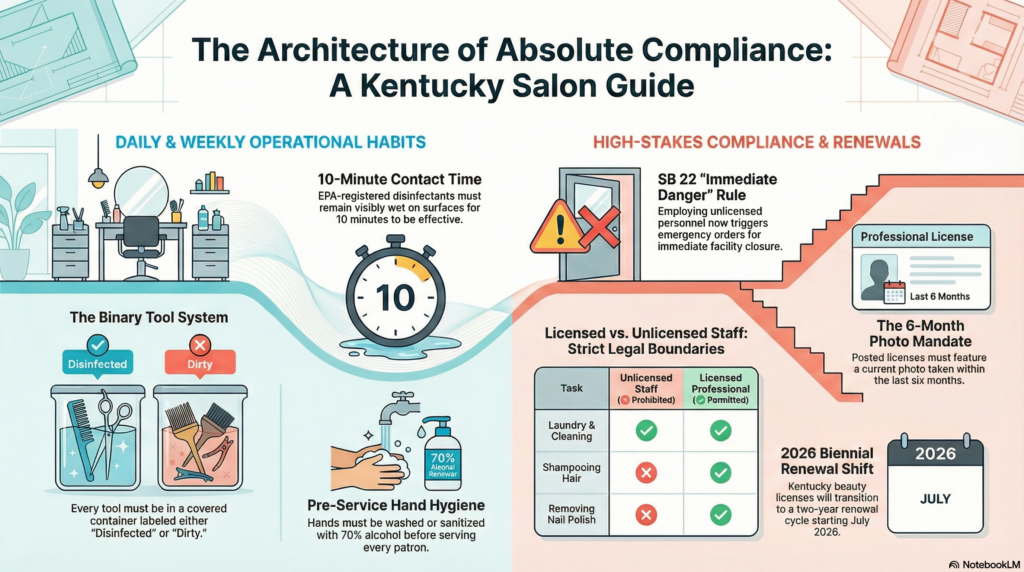
The Architecture of Absolute Compliance: A Comprehensive Regulatory and Operational Study for Kentucky Beauty Professionals and Louisville Beauty Academy Graduates – RESEARCH & PODCAST SERIES 2026


Educational Disclaimer:
This research is developed by Di Tran University – College of Humanization and shared by Louisville Beauty Academy for educational purposes only. It is not legal advice and is not endorsed by the Kentucky Board of Cosmetology. Louisville Beauty Academy does not endorse, support, interpret, or assume responsibility for any podcast producers or their content and shares all materials as-is for educational purposes. All laws and regulations (KRS 317A, 201 KAR Chapter 12) are subject to official interpretation and change. Readers are responsible for verifying compliance directly with the Board or qualified counsel.


The regulatory environment governing the beauty industry in the Commonwealth of Kentucky is established upon a rigorous and uncompromising framework designed to safeguard public health, ensure consumer safety, and uphold the professional integrity of the trade. For practitioners, particularly those originating from elite institutions such as the Louisville Beauty Academy, the concept of “inspection readiness” is not a temporary state achieved in anticipation of a scheduled visit but a permanent operational posture. This report delineates the granular requirements of Kentucky Revised Statutes Chapter 317A and the corresponding Administrative Regulations under 201 KAR Chapter 12, articulating a systematic approach to daily, weekly, monthly, and yearly compliance that ensures a salon remains beyond reproach at any given moment.1

The Philosophical and Statutory Mandate of the Kentucky Board of Cosmetology

The Kentucky Board of Cosmetology functions as an independent agency of the state government, vested with the absolute authority to supervise all aspects of cosmetology, esthetic practices, and nail technology.3 The core mission, as articulated in KRS 317A.060, is the protection of the public. This mandate transcends simple aesthetics; it is a public health imperative aimed at preventing the transmission of bloodborne pathogens, fungal infections, and bacterial contaminants within a high-touch service environment.4 The Board operates under the principle that the professional license is a privilege granted upon the condition of strict adherence to safety standards, and the Louisville Beauty Academy reinforces this through its “Compliance by Design” philosophy, which posits that the practitioner must adopt the mindset of the inspector in every action.2

The legal authority for inspections is absolute and immediate. Under 201 KAR 12:060, Board members or designated inspectors may enter any licensed facility during normal business hours or at any time the establishment is open to the public without prior notice.7 This lack of notice serves as a regulatory check, ensuring that the standards of sanitation and licensure are consistently applied rather than performatively displayed. The scope of an inspection includes not only the physical environment—such as the cleanliness of floors and tools—but also a comprehensive review of all related records, including personnel licenses, plumbing affidavits, and sanitation logs.8

Table 1: Primary Legal Authorities for Kentucky Salon Operations

Statute/RegulationPrimary FocusPractical Application for the Licensee
KRS Chapter 317AThe Enabling StatuteEstablishes the existence of the Board and the broad requirements for licensure and scope of practice.1
201 KAR 12:100Sanitation StandardsThe “Bible” of infection control; details the specific methods for cleaning and disinfecting tools and surfaces.10
201 KAR 12:060Inspection AuthorityDefines the inspector’s right to enter, the requirement for license display, and the definition of unprofessional conduct.7
201 KAR 12:082Educational StandardsWhile focused on schools, it establishes the minimum knowledge base required for any graduate to hold a license.10
KRS 317A.020Licensure RequirementsProhibits the practice of beauty services without a current, valid license and mandates conspicuous display.13

The Elite Professional Routine: Daily Operational Standards

For the graduate of the Louisville Beauty Academy, the workday does not begin with the first client but with a pre-service compliance sweep. This routine is designed to build the “muscle memory” of sanitation, transforming legal requirements into subconscious professional habits. The daily cycle is divided into four critical phases: opening preparations, intra-service sanitation, post-service disinfection, and end-of-day closure.2

Hand Hygiene and the First Contact Protocol

The transmission of infectious agents is most frequently traced to improper hand hygiene. 201 KAR 12:100 Section 13 mandates that every person licensed or permitted by the Board must thoroughly cleanse their hands with soap and water or an alcohol-based hand sanitizer (minimum alcohol) immediately before serving each patron.11 This standard is non-negotiable and applies even if the practitioner intends to wear gloves for the service. Handwashing stations must be equipped with a soap dispenser and single-use paper towels; the use of communal cloth towels for hand drying is a significant violation that can lead to immediate disciplinary citations.2

Table 2: Daily Hand Hygiene and Personal Protective Equipment (PPE) Standards

RequirementStandard ProcedureLegal/Regulatory Context
Pre-Service WashingSoap and water or alcohol sanitizerMandatory before every client interaction to prevent cross-contamination.11
PPE UsageGloves, masks, or aprons where applicableRequired during chemical services or when contact with blood/body fluids is possible.11
Handwashing StationSink with hot/cold water, soap, and paper towelsMust be accessible and not used for tool cleaning if it is the primary hygiene station.2
Forbidden ItemsNo carrying tools in pockets or smocksPrevents the contamination of clean tools and injuries to the practitioner.11

Workstation Maintenance and Surface Disinfection

The workstation is the primary site of service delivery and, consequently, the primary site of potential contamination. Kentucky law requires that all non-porous surfaces, including styling chairs, counters, nail tables, and shampoo bowls, be cleaned and disinfected daily and between each individual client.2 The process of “cleaning” is legally distinct from “disinfecting.” Cleaning involves the removal of visible debris, hair, and product residue using soap, detergent, or a chemical cleaner followed by a water rinse.19 Only after a surface is clean can it be disinfected.

Disinfection must be achieved using an Environmental Protection Agency (EPA)-registered bactericidal, virucidal, and fungicidal disinfectant used in strict accordance with the manufacturer’s label.11 A common error that results in inspection failure is the “spray and wipe” method, where the disinfectant is removed before it has reached its required contact time. Most high-level disinfectants require the surface to remain visibly wet for a full ten minutes to be effective against robust pathogens such as HIV, HBV, and various fungi.11

The Lifecycle of Tools and Implements: The “Clean vs. Dirty” System

The management of tools—including combs, brushes, shears, clippers, and nail implements—is perhaps the most scrutinized element of a state inspection. Kentucky utilizes a strict binary system: an item is either “Disinfected/Ready to Use” or it is “Dirty”.18 There is no middle ground.

All used implements must first be cleaned of visible debris using warm, soapy water and then fully immersed in a disinfectant solution.11 For items that have come into contact with blood or body fluids, such as a nick from a razor or a cuticle nipper, the item must be thoroughly cleaned before immersion to ensure the disinfectant can reach all surfaces of the tool.11 Once the full contact time is met, the implements must be removed, rinsed, dried with a single-use paper towel or air-dried, and stored in a clean, covered container labeled “Disinfected” or “Ready to Use”.18

Conversely, any tool that has been used and is awaiting disinfection must be kept in a separate, covered container clearly labeled as “Dirty” or “Used”.17 The intermingling of clean and dirty tools is a major violation. Furthermore, once an item is placed in the “Dirty” container, it cannot be removed until the formal cleaning and disinfecting process has begun.18

Table 3: Contact Time and Disinfection Requirements for Non-Electrical Tools

Tool TypeRequired ProcessStorage Requirement
Combs/Brushes/RollersScrub with soap, rinse, immerse in EPA-disinfectantCovered container labeled “Disinfected”.18
Metal Implements (Nippers/Pushers)Scrub with soap, rinse, immerse in EPA-disinfectantCovered container labeled “Disinfected”.18
Nail Drill BitsSoak in acetone, scrub, immerse in EPA-disinfectantMust be stored dry in a labeled container.18
Electrical ClippersRemove hair, saturate blades with high-level spray/foamMay be stored at station if clean and covered.11

The Towel and Linen Management System

The handling of linens is a primary focus of 201 KAR 12:100, which mandates a zero-tolerance policy for the reuse of any towel or robe without proper laundering.11 A clean towel or neck band must be used for every patron to prevent the hair cloth or shampoo apron from making direct contact with the patron’s skin.11

The laundry cycle must be integrated into the daily routine. All cloth items must be laundered in a washing machine using laundry detergent and chlorine bleach according to the manufacturer’s directions for sanitation.11 Clean linens must be stored in a closed cabinet or a covered container to protect them from hair clippings and airborne contaminants.11 Once used, towels must be immediately deposited into a separate, labeled container for soiled laundry. The practice of leaving used towels on the back of styling chairs or piled near shampoo bowls is a visible sign of non-compliance that will be noted by any inspector.2

Product Control and Chemical Safety

The mislabeling or lack of labeling on chemical products is one of the most frequent reasons for citations in Kentucky salons. The Board requires that all products—including shampoos, conditioners, hair colors, and nail liquids—remain in their original manufacturer-labeled containers whenever possible.15 If a product is transferred to a secondary container, such as a spray bottle for water or a smaller jar for cream, that container must be labeled with the product name and, if it is a chemical mixture like a disinfectant, the concentration and the date it was prepared.11

Furthermore, the use of certain substances is strictly prohibited under Kentucky law. Methyl Methacrylate (MMA) is illegal for use in nail services due to its high toxicity and the potential for severe allergic reactions or permanent nail damage.11 The presence of MMA in a salon, even if not currently in use, is grounds for significant fines and disciplinary action. Similarly, the use of callus graters or “cheese grater” style scrapers is prohibited as they can cause deep lacerations and pose a significant infection risk.13

Table 4: Prohibited Substances and Practices in Kentucky Salons

Prohibited Item/PracticeRationale for ProhibitionRegulatory Basis
Methyl Methacrylate (MMA)High toxicity; risk of permanent damage and allergies201 KAR 12:100 Section 14.11
Callus Graters / BladesRisk of skin cutting and deep-seated infectionKRS 317A.020 / 201 KAR 12:100.11
UV Sterilizers (as primary)Ineffective at achieving high-level disinfection201 KAR 12:100 Section 14.11
Roll-on WaxHigh risk of cross-contamination between clients201 KAR 12:100 Section 14.11
Double-DippingSpreads bacteria and fungi through entire product201 KAR 12:100 Section 7.11

Weekly Systems Maintenance and Compliance Audits

While daily tasks ensure immediate safety, the weekly routine is focused on the long-term integrity of the salon’s compliance infrastructure. This phase involves a more thorough examination of those areas that may not be touched during every client service but remain vital for a successful inspection.

The Weekly Station Sweep and Label Audit

Every week, the salon manager or designated compliance officer should conduct a formal walkthrough of each workstation. This audit must verify that every bottle is clearly labeled and that the labels remain legible.11 Over time, chemicals can degrade adhesive labels or obscure handwriting; any bottle with a faded or peeling label should be replaced or relabeled immediately.

During this weekly audit, the practitioner should also inspect the “Clean” tool containers. It is common for small hair clippings to find their way into even covered containers during the course of a busy week. If debris is found in a “Clean” container, all tools within that container must be re-sanitized, and the container itself must be disinfected.18 This ensures that the storage environment remains as sterile as the tools themselves.

Safety Data Sheet (SDS) and Records Management

Federal OSHA regulations, coupled with Kentucky state board requirements, mandate that every salon maintain a comprehensive binder of Safety Data Sheets (SDS) for every chemical used on the premises.21 The weekly routine should include a check for any new products that have entered the salon; if a new hair color line or a new type of nail monomer has been purchased, the corresponding SDS must be added to the binder immediately.

Furthermore, salons should maintain a daily sanitation log. While not strictly mandated for every single surface by state law, the Louisville Beauty Academy recommends it as the “Gold Standard” for compliance.2 A log that documents the daily cleaning of shampoo bowls and the weekly deep-cleaning of pedicure stations provides a “paper trail” of professional diligence that can be invaluable if a client ever files a complaint with the Board.17

Table 5: Weekly Compliance Audit Checklist

Audit CategorySpecific Action RequiredExpected Outcome
Label IntegrityInspect all secondary containers for clear labelingZero unlabeled bottles at any station.11
Storage InspectionWipe out and disinfect “Clean” tool containersNo hair or debris in storage areas.18
SDS UpdateReview product arrivals and add new SDS sheetsbinder is current.21
VentilationClean filters on hairdryers and nail extraction fansPrevents fume buildup and fire hazards.16
Trash VerificationEnsure all waste liners are replaced and lids functionalWaste is contained and covered.2

Monthly Strategic Compliance and Infrastructure Review

The monthly compliance cycle is a strategic review of the salon’s operational health. This is the time when the owner and manager move beyond the station-level details to address the overarching legal and structural requirements of the business.

Personnel Licensing and Photo Verification

The most common reason for significant fines in Kentucky is the presence of an unlicensed practitioner or a practitioner with an expired license. Every month, the manager must verify the status of every individual working in the salon, including booth renters.8 This check must confirm that the license is not only active but also that it is current for the specific year.10

A critical component of this audit is the photo requirement. 201 KAR 12:060 Section 1 requires that a current photograph be attached to the license.7 The Board has recently cracked down on “non-compliant” photos. If an employee has a photo that is older than six months or one that does not meet the passport-style criteria (e.g., a “selfie” with filters, or a photo taken in a car), it must be updated immediately.10 Failure to have a compliant photo attached to a posted license is treated as a display violation and can result in a “pink slip”.26

Plumbing and Facility Integrity

The physical state of the facility is a reflection of the professionalism of the business. On a monthly basis, the owner should inspect the plumbing for any leaks or drainage issues. 201 KAR 12:100 requires that an adequate supply of hot and cold running water be available at all times.2 Any changes to the plumbing—such as adding a new shampoo bowl or replacing an old pedicure chair—must be documented with a new Plumbing Affidavit signed by a state plumbing inspector.27

Additionally, the monthly audit should look for “non-porous” integrity. Salon chairs with torn upholstery or nail tables with cracked surfaces are violations because the damaged areas can harbor bacteria and cannot be properly disinfected with wipes or sprays.17 Any damaged equipment must be repaired or replaced to maintain the sanitation standard.

Table 6: Monthly Strategic Audit Milestones

TaskDetailProfessional Implication
Staff License AuditVerify every license is current and has a 6-month photoPrevents “Immediate Danger” closure for unlicensed work.8
Facility MaintenanceCheck for upholstery tears and plumbing leaksEnsures all surfaces can be legally disinfected.17
Inventory ReviewCheck for expired products or “mystery” chemicalsMaintains safety and product efficacy.17
Staff RetrainingBrief staff on any new Board newsletters or trendsMaintains a unified culture of compliance.2
Restroom AuditDeep clean and ensure all fixtures are functionalA common area for consumer complaints.2

Yearly Milestones: Renewals, Testing, and Long-Term Compliance

The yearly cycle involves high-level administrative tasks that, while infrequent, are essential for the legal existence of the salon.

The 2026 Shift to Biennial Renewals

For decades, Kentucky beauty licenses were renewed on an annual basis. However, as of January 2026, the Kentucky Board of Cosmetology is transitioning to a biennial (two-year) renewal system to reduce administrative burden and improve processing efficiency.25 This is a critical change for budget planning. While the annual fee has not technically increased, the amount due at the time of renewal will double as practitioners prepay for two years of licensure.25

For example, starting in July 2026, a cosmetologist will pay for a license that is valid through July 31, 2028.25 The renewal period remains fixed between July 1st and July 31st. Any renewal submitted after the July 31st deadline is considered inactive and will incur significant restoration fees.25 It is the responsibility of the licensee to ensure their email address is current in the KBC portal to receive renewal reminders and registration codes.31

Backflow Prevention and Annual Testing

Most commercial facilities, including salons, are required to have backflow prevention devices installed on their water supply lines to protect the municipal water supply from contamination.32 Under the Kentucky State Plumbing Code, these devices—specifically “reduced pressure principle” backflow preventers—must undergo annual testing by a state-certified backflow prevention assembly tester.33 The results of these tests must be kept on file at the salon and are often reviewed during a comprehensive state board inspection or a local health department visit.33 Failure to maintain this testing can lead to the disconnection of water services, which would force the immediate closure of the salon.33

Table 7: Annual and Biennial Administrative Deadlines

RequirementFrequencyKey Dates / Details
Personal License RenewalBiennial (Every 2 Years)July 1 – July 31 of even-numbered years (Starting 2026).25
Salon Facility RenewalAnnual/BiennialCheck portal for specific facility expiration dates.25
Backflow TestingAnnualMust be performed by a certified tester; records kept on-site.33
Local Business LicenseAnnualVaries by municipality; often due by June 30.28
Annual Report (Corporate)AnnualDue to the Secretary of State by June 30.35

Navigating the Inspection: A Masterclass in Professional Interaction

When an inspector arrives, the elite professional does not react with fear but with confidence in their established systems. The inspection should be viewed as an external validation of the “Compliance by Design” principle taught at the Louisville Beauty Academy.2

Immediate Action Steps Upon Inspector Arrival

  1. Grant Access and Provide ID: The inspector is authorized to enter and may ask for your government-issued ID to verify your identity against the posted license.8
  2. Continue Professional Service: Unless the inspector identifies an “Immediate Danger” (such as a significant blood spill or an unlicensed worker), you should continue your service to your client while the inspector walks the floor.
  3. Produce Records Promptly: If the inspector asks to see the plumbing affidavit, the most recent inspection report, or the salon’s employment records, these must be produced without delay.7
  4. Use the Inspector as a Resource: The elite salon owner asks questions. Inquire about the most common violations being found in the area or if there are any upcoming regulatory changes from the Board.16 This positions you as a partner in public safety rather than a target of enforcement.

The Consequences of Non-Compliance: SB 22 and Immediate Closure

The regulatory landscape has become significantly stricter with the passage of Senate Bill 22 (2025). This legislation introduced the “Immediate and Present Danger” standard for salon closures.6 Previously, a salon might receive a warning and a ten-day period to cure most deficiencies. However, under SB 22, the employment of unlicensed personnel is now classified as an immediate danger to public health.6

If an inspector finds an unlicensed individual performing professional services, the Board is authorized to issue an emergency order for the immediate closure of the facility.6 This closure remains in effect until the violation is resolved and a follow-up inspection is passed. The financial and reputational impact of such a closure can be catastrophic, often leading to a permanent loss of business or even the stroke of a stressed owner as documented in recent disciplinary history.37

Table 8: The Disciplinary Escalation Pathway

Violation TypeTypical Board ActionPotential Penalty
Minor Sanitation (Dust, Clutter)Correction Letter / 10-day CureWarning or Small Fine.6
Major Sanitation (MMA, Double-dipping)Notice of ViolationSignificant Fine and Probation.6
License Display / Photo Issues“Pink Slip” CitationAdministrative Fine.26
Unlicensed Personnel (SB 22)Emergency OrderImmediate Facility Closure.6
Intentional Deception of InspectorNotice of Disciplinary ActionLicense Revocation/Suspension.8

Professional Scope and the Unlicensed Personnel Matrix

To avoid the immediate closure triggers of SB 22, it is vital to understand the “Unlicensed vs. Licensed Duties Matrix.” In Kentucky, the performance of even a single professional act by an unlicensed individual—such as a receptionist or a general assistant—is a violation of the law.6

Unlicensed personnel are strictly limited to non-client maintenance tasks. They may sweep floors, perform laundry, clean mirrors, handle the front desk, and process payments.6 However, as soon as their duties involve direct client interaction related to beauty services, they must hold a license. For instance, an assistant cannot shampoo a client’s hair unless they hold at least a Shampoo and Style license (300 hours) or a full Cosmetology license.6 They cannot remove nail polish, as this is legally considered part of the practice of nail technology.6 They cannot even “drape” a client with a cape for a chemical service, as this act is construed as assisting in a professional beauty practice.6

Table 9: Duty Matrix for Licensed vs. Unlicensed Staff

TaskUnlicensed (Receptionist)Shampoo & Style (300 Hr)Nail Tech (450 Hr)Cosmetologist (1,500 Hr)
Sweep / Laundry✅ Permitted✅ Permitted✅ Permitted✅ Permitted
Front Desk / Cashier✅ Permitted✅ Permitted✅ Permitted✅ Permitted
Shampoo / Conditioning❌ Prohibited✅ Permitted❌ Prohibited✅ Permitted
Remove Nail Polish❌ Prohibited❌ Prohibited✅ Permitted✅ Permitted
Draping for Chemicals❌ Prohibited❌ Prohibited❌ Prohibited✅ Permitted
Manicuring❌ Prohibited❌ Prohibited✅ Permitted✅ Permitted

Building the Million-Dollar Salon through Compliance

The final truth of Kentucky salon operation is that inspection readiness is a fundamental business strategy. The graduates of Louisville Beauty Academy understand that a clean, compliant salon is a profitable salon. When a customer walks into an environment where the licenses are prominently displayed with current photos, the stations are organized, the air is free of strong chemical fumes, and the towels are pristine, a baseline of trust is established.2

Compliance protects the three most valuable assets of the beauty professional: the client’s health, the practitioner’s license, and the business’s reputation. By adopting the daily, weekly, monthly, and yearly routines detailed in this study, the salon owner moves from a state of reactionary fear to one of professional dominance. You do not prepare for the inspector; you become the inspector. In doing so, you elevate not only your own business but the entire industry within the Commonwealth of Kentucky.

Works cited

  1. Kentucky Revised Statutes – Chapter 317A – Legislative Research Commission, accessed March 24, 2026, https://apps.legislature.ky.gov/law/statutes/chapter.aspx?id=38831
  2. Sanitation & Safety: The #1 Priority at Louisville Beauty Academy …, accessed March 24, 2026, https://louisvillebeautyacademy.net/sanitation-safety-the-1-priority-at-louisville-beauty-academy/
  3. 317A.030 Board of Cosmetology — Membership — Compensation. (1) There is created an independent agency of the state gover, accessed March 24, 2026, https://apps.legislature.ky.gov/law/statutes//statute.aspx?id=54797
  4. 317A.010 Definitions for chapter. As used in this chapter, unless the context requires otherwise: (1) “Beauty salon&q – Legislative Research Commission, accessed March 24, 2026, https://apps.legislature.ky.gov/law/statutes/statute.aspx?id=53212
  5. Beauty Services and Health Services: A 2025 Legal and Policy Study by Louisville Beauty Academy – Kentucky’s Center for Excellence in Beauty Knowledge, accessed March 24, 2026, https://louisvillebeautyacademy.net/beauty-services-and-health-services-a-2025-legal-and-policy-study-by-louisville-beauty-academy-kentuckys-center-for-excellence-in-beauty-knowledge/
  6. cosmetology disciplinary process Kentucky Archives – Louisville …, accessed March 24, 2026, https://louisvillebeautyacademy.net/tag/cosmetology-disciplinary-process-kentucky/
  7. 201 KAR 12:060. Inspections. RELATES TO: KRS 317A.060, 317A.140, accessed March 24, 2026, https://apps.legislature.ky.gov/services/karmaservice/documents/2003/ToPDF?markup=false
  8. 201 KAR 12:060. Inspections. – Kentucky Board of Cosmetology, accessed March 24, 2026, https://kbc.ky.gov/Documents/201%20KAR%2012.060.pdf
  9. Tag: cosmetology law changes 2025 – Louisville Beauty Academy, accessed March 24, 2026, https://louisvillebeautyacademy.net/tag/cosmetology-law-changes-2025/
  10. License Requirements – Kentucky Board of Cosmetology, accessed March 24, 2026, https://kbc.ky.gov/Licensure/Pages/License-Requirements.aspx
  11. 201 KAR 12:100. Sanitation standards. – Kentucky Board of Cosmetology, accessed March 24, 2026, https://kbc.ky.gov/Documents/201%20KAR%2012.100.pdf
  12. Title 201 Chapter 12 Regulation 082 • Kentucky Administrative Regulations – Legislative Research Commission, accessed March 24, 2026, https://apps.legislature.ky.gov/law/kar/titles/201/012/082/
  13. Kentucky Revised Statutes Title XXVI. Occupations and Professions § 317A.020 | FindLaw, accessed March 24, 2026, https://codes.findlaw.com/ky/title-xxvi-occupations-and-professions/ky-rev-st-sect-317a-020/
  14. 201 BOARDS AND COMMISSIONS Chapter – Louisville Beauty Academy, accessed March 24, 2026, https://louisvillebeautyacademy.net/wp-content/uploads/2021/11/KentuckyStateBoardOfCosmetology-Statue-11-15-2021.pdf
  15. Sanitation and Safety Archives – Louisville Beauty Academy, accessed March 24, 2026, https://louisvillebeautyacademy.net/category/sanitation-and-safety/
  16. Sanitation Best Practices for Beauty Salons: A Comprehensive Guide, accessed March 24, 2026, https://louisvillebeautyacademy.net/sanitation-best-practices-for-beauty-salons-a-comprehensive-guide/
  17. How to Avoid Common State Board of Cosmetology Violations | Salon Success Academy, accessed March 24, 2026, https://www.salonsuccessacademy.com/blog/10-common-state-board-of-cosmetology-violations-and-tips-to-avoid-them/
  18. Board of Cosmetology (Amended at ARRS Committee) 201 KAR 12:100. Infection control, health, and safety., accessed March 24, 2026, https://apps.legislature.ky.gov/services/karmaservice/documents/16397/ToPDF?markup=true
  19. Board of Cosmetology (Amendment) 201 KAR 12:100. Infection control, health, and safety., accessed March 24, 2026, https://apps.legislature.ky.gov/services/karmaservice/documents/16145/ToPDF?markup=true
  20. Title 201 Chapter 12 Regulation 100 • Kentucky Administrative Regulations, accessed March 24, 2026, https://apps.legislature.ky.gov/law/kar/titles/201/012/100/
  21. Barbershop State Board Inspection Readiness Checklist PDF – Free Download | Beauty & Wellness Checklist Template | POPProbe, accessed March 24, 2026, https://www.popprobe.com/checklist-library/beauty-wellness/barbershop/barbershop-state-board-inspection-readiness-checklist
  22. Hair Salon Safety & Sanitation Checklist [FREE PDF] – POPProbe, accessed March 24, 2026, https://www.popprobe.com/checklist-library/beauty/daily-operations/b25b-bty-hair-salon-safety-checklist
  23. Hair Salon Infection Control and Bloodborne Pathogen Compliance Audit PDF – Free Download | Beauty & Wellness Checklist Template | POPProbe, accessed March 24, 2026, https://www.popprobe.com/checklist-library/beauty-wellness/salon-operations/hair-salon-infection-control-bloodborne-pathogen-compliance-audit
  24. Hair Salon Inspection & Cleaning Checklists for Operational Excellence | Audit Now, accessed March 24, 2026, https://audit-now.com/audit-guides/hair-salon-checklists/
  25. Tag: Kentucky beauty license renewal July 31, accessed March 24, 2026, https://louisvillebeautyacademy.net/tag/kentucky-beauty-license-renewal-july-31/
  26. License Renewal Information – Kentucky Board of Cosmetology, accessed March 24, 2026, https://kbc.ky.gov/Licensure/Pages/License-Renewal-Information.aspx
  27. Salon Requirements – Kentucky Board of Cosmetology, accessed March 24, 2026, https://kbc.ky.gov/Licensure/Pages/Salon-Requirements.aspx
  28. Frankfort, KY 40601 • (502)-564-4262 • www.KBC.ky.gov Salon Application Instructions A salon – Kentucky Board of Cosmetology, accessed March 24, 2026, https://kbc.ky.gov/Applications%20and%20Examination%20Schedule/030%20(l)%20Salon%20Application%20-%20July%202022-%20Edit.pdf
  29. Health Inspections for Nail Salons and Barbershops – The Institute for Justice, accessed March 24, 2026, https://ij.org/report/clean-cut/health-inspections-for-nail-salons-and-barbershops/
  30. Louisville Beauty Academy: Your Guide to Kentucky State Cosmetology License Renewal, accessed March 24, 2026, https://louisvillebeautyacademy.net/louisville-beauty-academy-your-guide-to-kentucky-state-cosmetology-license-renewal/
  31. Licensure – Kentucky Board of Cosmetology, accessed March 24, 2026, https://kbc.ky.gov/Licensure/Pages/default.aspx
  32. Backflow Testing & Installation in Louisville, KY – Maeser Master Services, accessed March 24, 2026, https://www.maeser.com/commercial/plumbing/backflow-testing/
  33. Is Backflow Testing a Legal Requirement? Understanding Compliance Standards in 2025, accessed March 24, 2026, https://www.pacificbackflow.com/post/is-backflow-testing-a-legal-requirement
  34. Title 815 Chapter 20 Regulation 120 • Kentucky Administrative Regulations – Legislative Research Commission, accessed March 24, 2026, https://apps.legislature.ky.gov/law/kar/titles/815/020/120/
  35. Business – Kentucky.gov, accessed March 24, 2026, https://www.kentucky.gov/business/Pages/default.aspx
  36. The Kentucky Board of Cosmetology reports that the license number below is currently inactive, either due to non-renewal or a HO, accessed March 24, 2026, https://kbc.ky.gov/Annoucements/9.26.2025%20Salon%20Inactive%20Notice.pdf
  37. Kentucky nail salons seek accountability from state cosmetology board – YouTube, accessed March 24, 2026, https://www.youtube.com/watch?v=3aoZjjY8Jyo
  38. KENTUCKY BOARD OF COSMETOLOGY, accessed March 24, 2026, https://kbc.ky.gov/Annoucements/11.14.2025%20Access%20to%20salons%20for%20inspections%20and%20appropriate%20signage.pdf

Structural Pathways to Economic Self-Security in the AI Era: Beauty Licensing, Real Estate Licensing, and the Rise of Short-Cycle Vocational Entrepreneurship – RESEARCH & PODCAST SERIES 2026


Research Credit: This article is based on independent academic research prepared by Di Tran University — The College of Humanization.

Educational Use Notice: Louisville Beauty Academy is sharing this research strictly for educational and informational purposes as part of ongoing discussion about workforce development, vocational education, and entrepreneurship pathways in the modern economy. The material is presented as originally written by the research source and third-party studies and may include interpretations, data, or perspectives from external references.

Louisville Beauty Academy does not interpret, endorse, or validate the conclusions of the research and provides the content solely for public learning and awareness. Readers are encouraged to review the original sources, citations, and studies referenced in the research for their own independent evaluation.


The global economic landscape is currently undergoing a structural metamorphosis driven by the maturation of artificial intelligence (AI), agentic systems, and autonomous robotics. This shift represents more than a mere technological update; it is a fundamental reconfiguration of the relationship between human capital, educational investment, and long-term economic security. As cognitive functions—once the protected domain of the credentialed middle class—become increasingly susceptible to algorithmic displacement, a counter-movement is emerging. This movement prioritizes high-touch physical services, state-protected licensing barriers, and short-cycle vocational training as the most resilient pathways to intergenerational wealth and psychological sovereignty. The following analysis explores the specific mechanisms through which the beauty and real estate industries, supported by innovative pedagogical models such as the humanization framework, provide a structural defense against the volatility of the AI-driven information economy.

The Architecture of Automation: Cognitive Displacement and Tactile Resilience

The rapid evolution of artificial intelligence has transitioned from a specialized tool for data analysis to a foundational amplifier across all business sectors.1 The emergence of agentic AI—systems capable of autonomous planning and the execution of complex, multi-step workflows—has introduced “virtual coworkers” into the enterprise environment, capable of performing tasks that were previously thought to require human reasoning, communication, and judgment.1

The Bifurcation of Work: Agents vs. Robots

Current industrial research distinguishes between two primary forms of automation: “agents,” which automate nonphysical or cognitive labor, and “robots,” which automate physical work.2 While physical robotics faces significant challenges in replicating fine motor skills and navigating unstructured human environments, digital agents have reached a level of proficiency that allows them to summarize, code, reason, and make choices with minimal human intervention.3 This creates a profound bifurcation in the labor market. Jobs involving the “physics of touch”—such as personal care, specialized repairs, and complex physical coordination—possess a structural immunity to the current wave of generative AI.4

Automation CategoryPrimary MechanismSusceptible TasksResistance Factors
Digital AgentsLLMs, Agentic WorkflowsData entry, basic coding, report writing, administrative planningMoral judgment, social nuance, responsibility 2
Physical RobotsComputer Vision, ActuatorsManufacturing, repetitive logistics, predictable maintenanceFine motor dexterity, empathy, tactile feedback 1

Data from the McKinsey Global Institute indicates that while current technology could theoretically automate 57% of U.S. work hours, the future of work will likely be characterized by “superagency”—a collaborative state where AI increases personal productivity while humans retain control over high-level interpretation and decision-making.2 However, this collaboration is not equally accessible to all professions. High-exposure roles in accounting, coding, and middle management are being compressed, while low-exposure roles in interpersonal services—such as negotiation, coaching, and physical care—are gaining a “human alpha” premium.2

The Complexity Ceiling and Human Alpha

The concept of the “Complexity Ceiling” suggests that AI adoption will eventually hit a plateau where the friction of physical reality and the irreducible nuance of human systems render algorithmic solutions inefficient.6 While AI can optimize a spreadsheet, it cannot navigate a basement full of water, calm a panicked first-time homebuyer, or execute the delicate tactile nuances of a manicure.4 Consequently, the competitive advantage in the 2025-2035 economic cycle is shifting from “information asymmetry”—knowing something the client does not—to “relational trust” and “creative problem-solving”.7

The Beauty Industry: A Structural Case Study in Tactile Security

The beauty and personal care sector represents one of the most resilient segments of the U.S. service economy. With global sales exceeding $511 billion in 2021 and projected to surpass $716 billion by 2025, the industry offers a combination of high demand, non-outsourceable labor, and a low barrier to entrepreneurial entry.9

Global Market Dynamics and Growth Projections

The nail salon segment is a particularly vibrant component of this sector, valued at approximately $8.8 billion to $12.9 billion in 2024.10 The market is expected to grow at a Compound Annual Growth Rate (CAGR) of 4.5% to 8.2% through 2034, driven by increasing consumer awareness of self-care, the rise of men’s grooming trends, and the influence of Gen Z aesthetic art.10

Market Metric2024 Base Value2030-2034 ForecastCAGR
Global Nail Salon Market$8.8B – $12.9B$13.7B – $20.3B4.5% – 8.2% 10
U.S. Nail Care Market$2.9B$3.5B+ (Projected)2.6% – 4.5% 10
Dominant ServiceManicure ($3.1B)UV Gel / Extensions (9.5% CAGR)7.9% – 9.4% 10

The industry’s structural resistance to AI stems from the “physics of touch.” Machines cannot replicate the empathy and fine motor skills required for personal grooming, nor can they provide the “therapeutic power of care” that clients seek in a salon environment.4 Beauty professionals often serve as informal mental wellness supports, offering active listening and emotional grounding that AI cannot currently simulate.14

The “Million Dollar Paradox” and Immigrant Wealth Creation

A critical insight into the beauty economy is the “Million Dollar Paradox”—the observation that family-owned salons often generate substantial revenue and intergenerational wealth while being perceived as low-status work by outsiders.4 In immigrant communities, particularly among Vietnamese and Latino families, the salon serves as a “first-access ownership pathway”.4

The Vietnamese Blueprint

The dominance of the Vietnamese American community in the nail industry is a result of a historical convergence of humanitarian effort and entrepreneurial grit. Following the Fall of Saigon in 1975, actress Tippi Hedren facilitated the training of 20 Vietnamese women at a refugee camp in California, enlisting her personal manicurist to teach them the craft.15 This created a “stepping stone” for thousands of refugees who lacked English fluency but possessed the manual dexterity and work ethic to succeed in a tactile trade.17

Today, Vietnamese Americans make up approximately 51% to 82% of the nail technician workforce in states like California.17 The industry has moved beyond survival to become a multibillion-dollar economy characterized by vertical integration, where successful families own the commercial real estate housing their salons, thus capturing both service margins and rental income.4

Latino Barbershops as Community Anchors

Similarly, Latino-owned barbershops function as “community anchors” and “safe havens”.19 These establishments are more than grooming centers; they are social hubs that build collective efficacy, facilitate public health interventions (such as blood pressure screenings), and provide protective “neighborhood effects” against violence.19 Latino entrepreneurs start businesses at a rate nearly double their representation in the overall population, and the beauty sector provides a critical entry point for building the intergenerational wealth necessary to close existing parity gaps.20

Real Estate Licensing: Trust-Based Defense and the Agent-Investor Pivot

Real estate is often cited as a high-risk sector for automation, with some studies predicting a 86% to 97% likelihood of automation for brokers and sales agents.21 However, these figures often overlook the “irreducible complexity” of the transaction management and negotiation process.7

The Resilience of Human Judgment in Property Transactions

While AI can automate property searches, market data analysis, and document drafting, it cannot navigate the emotional attachment of a seller to a family home or the psychological fear of a buyer facing a major financial commitment.7 The “actual work” of a real estate professional occurs in spaces AI cannot reach, such as interpreting the significance of a foundation crack or coordinating pre-listing repairs with local contractors.7

Skills that are gaining a “human premium” in the AI era include:

  • Contextual Problem Solving: Integrating technical data with market psychology.7
  • Negotiation Strategy: Finding creative, non-linear solutions to physical and contractual obstacles.6
  • Local Market Insight: Possessing a “trust network” that takes years to build and cannot be replicated by data scrapers.7

The Wealth Pathway: From Agent to Institutional-Scale Investor

A structural pathway to self-security for real estate professionals involves the transition from commission-based services to property investment. Since the start of the pandemic, investor activity in the single-family rental (SFR) market has surged, with investors purchasing up to 28% of single-family homes in certain quarters.23 Real estate agents are uniquely positioned to leverage their license and market knowledge to identify undervalued assets, manage portfolios, and build equity.21

Investor SegmentProperty Portfolio SizeFootprint Characteristics
Mega SFR Investors1,000+ PropertiesDiverse locations (median 33 MSAs) 25
Local Investors100 – 1,000 PropertiesConcentrated (75%+ in one MSA) 25
Small Investors3 – 10 PropertiesRapidly growing segment during the pandemic 23

By integrating the roles of licensed advisor and active investor, professionals can insulate themselves from the “downward pressure on commissions” and the potential obsolescence of the traditional brokerage model.21

The Educational Reformation: Short-Cycle Vocational Entrepreneurship

The traditional “credential-to-career” pipeline is facing a crisis of ROI. As university tuition costs soar, students are graduating with an average of $30,000 to $100,000 in debt, only to enter a labor market where entry-level white-collar roles are being compressed by AI.26 In response, a “short-cycle” vocational model is emerging as a superior alternative for economic mobility.

Comparative ROI: Vocational License vs. Bachelor’s Degree

Research indicates that beauty school and real estate licensing offer a significantly faster “time-to-break-even” than traditional four-year degrees.28 A cosmetology program typically costs between $5,000 and $20,000 and takes 12 to 18 months to complete.28 Graduates can enter the workforce and begin building a client base by age 19 or 20, whereas college graduates may not start earning until age 22, often burdened by debt that takes 20 years to repay.26

Investment VariableBeauty School (Cosmetology)Traditional 4-Year College
Total Tuition Cost$5,000 – $20,000$36,000 – $63,780+
Time to Completion9 – 18 Months4 – 6 Years
Opportunity Cost$20,000 – $35,000$150,000 – $250,000
Starting Salary Range$25,000 – $35,000$52,000 – $64,000
Mid-Career Potential$55,000 – $100,000+$65,000 – $90,000
Debt BurdenMinimal to ZeroHigh ($30k – $100k+) 26

A critical advantage of the vocational path is “Vertical Growth.” An established beauty professional can scale their income through suite rental, product sales, and education, often reaching six-figure earnings with significantly lower overhead than a corporate professional.26

The Louisville Beauty Academy Case Study: The Debt-Free Model

The Louisville Beauty Academy (LBA) serves as an applied institutional model for “Humanized Vocational Excellence”.31 By rejecting the federal Title IV funding system (Pell Grants and student loans), LBA keeps tuition under $7,000 for its 1,500-hour cosmetology program, compared to $15,000-$25,000 at aid-reliant institutions.31

LBA’s “Fiscal Velocity” model demonstrates that when students are not burdened by interest-bearing debt, their “Entrepreneurship Probability” increases by 11% to 14%.32 Furthermore, the academy uses a “clock-hour” system with biometric attendance mandates to ensure that “minimum competence” for public safety is strictly verified, setting a national standard for regulatory compliance.31

The Humanization Philosophy: “Yes I Can” Methodology

The philosophical core of this new vocationalism is the “College of Humanization,” founded by Di Tran. This framework posits that in the AI era, education must move beyond the teaching of facts—which AI can do—toward “humanizing people” and fostering dignity.4

Key tenets of the humanization framework include:

  • The Rejection of Shame: Challenging students to see beauty and trades as premier vehicles for business ownership rather than “fallback” careers.4
  • Action-Oriented Pedagogy: Viewing the license as a “humanized record of action” and a “declaration of independence” rather than just a job application.4
  • The Physics of Touch: Validating that empathy, creativity, and fine motor skills are the ultimate “AI-proof” moats.4

Macroeconomic Impact: Fiscal Velocity and Taxpayer Savings

The shift toward debt-free, short-cycle vocational training has profound implications for public finance and regional economic stability. Traditional beauty schools operate almost entirely on federal aid, converting taxpayer subsidies into vocational tuition and eventual student debt.32

The Mathematical Case for Non-Subsidized Education

By operating outside the Title IV system, LBA represents a direct saving to the public treasury. The formula for annual taxpayer savings per 100 students () can be modeled as follows:

Where:

  • is the total disbursed Pell Grant funds.
  • is the interest subsidy on federal loans.
  • is the additional tax revenue generated by graduates entering the workforce months earlier due to “Fiscal Velocity”.31

LBA’s model projects a taxpayer saving of over $5.8 million per 100 students over a five-year horizon.31 This capital remains in the federal and state treasuries, available for other public services, while students build “economic muscle” rather than financial liability.33

Closing the Gender and Racial Wealth Gaps

The beauty industry is a primary driver of female and minority entrepreneurship. In 2024, women owned nearly 40% of all U.S. companies, with women-owned businesses growing 1.4 times faster than those owned by men.34 However, women-owned firms still generate only 40% of the revenue of men-owned businesses, a “revenue gap” that would add $10.2 trillion to the economy if closed.34

Workforce SegmentFemale Representation (%)Revenue as % of Male Equivalent
Beauty/Personal Care90%+ (Nails)91% (Service Parity) 35
Healthcare Jobs77%66.7% – 81.1% 36
Overall U.S. Labor Force47%+80.9% – 85% 38
Latina Women (Full Time)17% (Force Share)58% (vs. White Men) 20

Vocational licensing provides a “Structural Floor” for wages. In the personal care sector, the gender wage gap is significantly narrower than the national average, with women earning 91 cents for every dollar earned by men.35 By facilitating business ownership through salon suites and independent contracting, the industry allows women to bypass corporate “allocative discrimination” and set their own price premiums.24

The Future of Sovereign Entrepreneurship: Suites, Investments, and AI Synergy

The final stage of the structural pathway to economic self-security is the adoption of the “Sovereign Entrepreneur” model. This model integrates AI tools for efficiency with the “Human Alpha” of licensed services.

The Salon Suite Revolution

The beauty industry is rapidly transitioning from booth rental to suite ownership. Unlike the commission model where the salon takes 50% of revenue, or the booth rental model with shared resources and limited branding, the salon suite offers a “private studio” environment.42 Suite owners report a 15% to 25% increase in take-home income and 40% higher client retention rates due to the personalized experience.24

Financial FactorTraditional Booth RentalSalon Suite Owner
Monthly Overhead$1,475 – $1,625$800 – $1,200
Service Revenue Retained100%100%
Retail Profit10% (Commission)50% (Direct Profit)
Tax AdvantagesLimitedComprehensive Deductions 24

The Real Estate-Beauty Nexus

The ultimate structural moat is “Vertical Integration” across service and asset classes. Successful beauty entrepreneurs often leverage their free cash flow to invest in real estate, mirroring the “Million Dollar” success seen in the Vietnamese American community.4 Similarly, real estate agents utilize their market access to transition from “transactional sales” to “long-term institutional-style investment”.21

This convergence creates an “antifragile” economic profile:

  1. AI-Proof Service: Licensing protects the right to practice high-touch, empathetic trades.4
  2. Asset-Based Wealth: Real estate holdings provide passive income and hedge against inflation.23
  3. Efficiency Through AI: AI is utilized “behind the scenes” to automate administrative “grunt work,” allowing the professional to focus on relationship-building and high-level negotiation.22

Synthesis: Redefining Value in the Post-Information Era

The transition to the AI era is not a threat to human labor but a catalyst for the “Humanization of Value.” As algorithmic systems master the “what” and the “how,” the human professional becomes the master of the “who” and the “why.” Structural pathways to economic self-security are no longer found in the mass accumulation of cognitive credentials but in the strategic acquisition of state-licensed tactile skills, the avoidance of interest-bearing educational debt, and the courageous transition from service provision to asset ownership.

The data supports a clear trajectory: the ROI of short-cycle vocational training now exceeds that of many traditional four-year degrees when adjusted for debt and opportunity cost. The beauty and real estate industries—historically viewed as secondary or “side hustle” fields—are emerging as the primary engines of immigrant economic mobility, female entrepreneurship, and intergenerational wealth creation. By embracing the philosophy of humanization and the technical capabilities of vocational excellence, the modern professional can secure a sovereign economic future that is both resilient to technological displacement and profoundly aligned with human dignity.

Works cited

  1. Technology Trends Outlook 2025 – McKinsey, accessed March 10, 2026, https://www.mckinsey.com/~/media/mckinsey/business%20functions/mckinsey%20digital/our%20insights/the%20top%20trends%20in%20tech%202025/mckinsey-technology-trends-outlook-2025.pdf
  2. AI: Work partnerships between people, agents, and robots | McKinsey, accessed March 10, 2026, https://www.mckinsey.com/mgi/our-research/agents-robots-and-us-skill-partnerships-in-the-age-of-ai
  3. AI in the workplace: A report for 2025 – McKinsey, accessed March 10, 2026, https://www.mckinsey.com/capabilities/tech-and-ai/our-insights/superagency-in-the-workplace-empowering-people-to-unlock-ais-full-potential-at-work
  4. humanized education framework Archives – Louisville Beauty …, accessed March 10, 2026, https://louisvillebeautyacademy.net/tag/humanized-education-framework/
  5. AI may hurt US jobs more than expected, McKinsey finds — but there’s a surprising upside : r/Futurology – Reddit, accessed March 10, 2026, https://www.reddit.com/r/Futurology/comments/1p9iz90/ai_may_hurt_us_jobs_more_than_expected_mckinsey/
  6. The last graduate intake: Is AI the end of the property professional? – Artefact, accessed March 10, 2026, https://www.artefact.com/blog/the-last-graduate-intake-is-ai-the-end-of-the-property-professional/
  7. Real Estate Agents Face Low AI Displacement Risk Due to Human-Centric Skills, Expert Says | Newsworthy.ai, accessed March 10, 2026, https://newsworthy.ai/curated/real-estate-agents-face-low-ai-displacement-risk-due-to-human-ce/202628740
  8. Will AI Replace Real Estate Agents? – ClickUp, accessed March 10, 2026, https://clickup.com/blog/hub/ai/replace/real-estate-agents/
  9. Harnessing Growth Opportunities in the Beauty Industry | SCF, accessed March 10, 2026, https://sallyportcf.com/harnessing-growth-opportunities-in-the-beauty-industry/
  10. Nail Salon Market Size, Share & Analysis Report, 2025 – 2034, accessed March 10, 2026, https://www.gminsights.com/industry-analysis/nail-salon-market
  11. Nail Salon Market Size, Share, Trends, Growth Report, 2030, accessed March 10, 2026, https://www.grandviewresearch.com/industry-analysis/nail-salon-market-report
  12. Nail Salon Market Size, Growth Analysis Report [2033] – SkyQuest Technology, accessed March 10, 2026, https://www.skyquestt.com/report/nail-salon-market
  13. Nail Care Market Trends and Regional Growth Opportunities, 2025-2030 – GlobeNewswire, accessed March 10, 2026, https://www.globenewswire.com/news-release/2025/02/12/3024813/28124/en/Nail-Care-Market-Trends-and-Regional-Growth-Opportunities-2025-2030-Rising-Use-of-UV-LED-Nail-Dryers-Sets-the-Stage-for-Market-Expansion.html
  14. Tag: Di Tran University podcast – Louisville Beauty Academy, accessed March 10, 2026, https://louisvillebeautyacademy.net/tag/di-tran-university-podcast/
  15. Vietnamese Nail Industry – AAPI History Museum, accessed March 10, 2026, https://aapihistorymuseum.org/vietnamese-nail-industry/
  16. The History of Vietnamese Nail Salons: A Journey of Resilience and Entrepreneurship, accessed March 10, 2026, https://www.beamnailbar.com/blog/the-history-of-vietnamese-nail-salons-a-journey-of-resilience-and-entrepreneurship
  17. Beneath the Polish: The Untold Stories of Vietnamese Nail Workers – The Hornet, accessed March 10, 2026, https://fchornetmedia.com/34002/inside-fullerton/beneath-the-polish-the-untold-stories-of-vietnamese-nail-workers/
  18. How Vietnamese Americans Revolutionized the U.S. Nail Industry: A Story of Determination and Opportunity – Whale Spa, accessed March 10, 2026, https://whalespa.com/blogs/news/how-vietnamese-americans-revolutionized-the-u-s-nail-industry-a-story-of-determination-and-opportunity
  19. “It’s All About Just Creating the Safe Space”: Barbershops and Beauty Salons as Community Anchors in Black Neighborhoods: Crime Prevention, Cohesion, and Support During the COVID-19 Pandemic – PMC, accessed March 10, 2026, https://pmc.ncbi.nlm.nih.gov/articles/PMC9618922/
  20. Latino Economic Mobility | McKinsey & Company, accessed March 10, 2026, https://www.mckinsey.com/institute-for-economic-mobility/our-focus-areas/latino-economic-mobility
  21. Is Job Security Something Real Estate Agents Need to Worry About?, accessed March 10, 2026, https://www.upnest.com/post/future-of-real-estate-how-safe-are-real-estate-agent-jobs/
  22. AI Can’t Replace Relationships – The Human Advantage in Real Estate, accessed March 10, 2026, https://blog.buffini.com/ai-cant-replace-relationships-the-human-advantage-in-real-estate/
  23. 8 Facts About Investor Activity in the Single-Family Rental Market – Harvard Joint Center for Housing Studies, accessed March 10, 2026, https://www.jchs.harvard.edu/blog/8-facts-about-investor-activity-single-family-rental-market
  24. Unlock Your Success: Booth Rental Comparison – Encore Salon Suites, accessed March 10, 2026, https://encoresalonsuites.com/post/booth-rental-comparison/
  25. A Profile of Institutional Investor– Owned Single-Family Rental Properties | Urban.org, accessed March 10, 2026, https://www.urban.org/sites/default/files/2023-08/A%20Profile%20of%20Institutional%20Investor%E2%80%93Owned%20Single-Family%20Rental%20Properties.pdf
  26. Beauty School vs. Traditional College: Which Path Offers Better ROI in Today’s Economy?, accessed March 10, 2026, https://www.findarticles.com/beauty-school-vs-traditional-college-which-path-offers-better-roi-in-todays-economy/
  27. Benefit Attending Beauty School Versus A Traditional Four Year College -, accessed March 10, 2026, https://www.libs.edu/beauty-school-versus-traditional-four-year-college/
  28. Is Cosmetology School Worth It? The Complete 2026 Guide with Real Data, accessed March 10, 2026, https://cosmetologyandspaacademy.edu/is-cosmetology-school-worth-it-what-you-should-know-before-enrolling/
  29. 2026 Cosmetology Degree Guide: Costs, Requirements & Job Opportunities, accessed March 10, 2026, https://research.com/degrees/cosmetology-degree
  30. Top Gender Pay Gap Statistics – Forbes Advisor, accessed March 10, 2026, https://www.forbes.com/advisor/business/gender-pay-gap-statistics/
  31. The Humanization of Vocational Excellence: A Kentucky Case Study …, accessed March 10, 2026, https://louisvillebeautyacademy.net/the-humanization-of-vocational-excellence-a-kentucky-case-study-of-cosmetology-education-safety-sanitation-law-and-the-louisville-beauty-academy-model-for-compliance-community-service-and-debt-f/
  32. Tag: debt-free vocational pathways – Louisville Beauty Academy, accessed March 10, 2026, https://louisvillebeautyacademy.net/tag/debt-free-vocational-pathways/
  33. Tag: grit theory in education – Louisville Beauty Academy, accessed March 10, 2026, https://louisvillebeautyacademy.net/tag/grit-theory-in-education/
  34. Women-Owned Businesses Are Growing Fast—But Still Face a $10 Trillion Revenue Gap, accessed March 10, 2026, https://mbemag.com/articles/women-owned-businesses-are-growing-fast-but-still-face-a-10-trillion-revenue-gap/
  35. The gender pay gap for women hairdressers, hairstylists, and cosmetologists – Narrow the Gap, accessed March 10, 2026, https://narrowthegap.co/gap/hairdressers-hairstylists-and-cosmetologists/
  36. The gender wage gap among health care workers across educational and occupational groups – PMC, accessed March 10, 2026, https://pmc.ncbi.nlm.nih.gov/articles/PMC10986226/
  37. NATIONAL PAY GAP OVERALL VS. HEALTHCARE – Syndio, accessed March 10, 2026, https://synd.io/wp-content/uploads/2020/03/Syndio-Healthcare-White-Paper-2020.pdf
  38. Equal Pay in 2025: Gender Gaps Increased, Forecast for Achieving Pay Equity Bleaker, accessed March 10, 2026, https://iwpr.org/equal-pay-in-2025-gender-gaps-increased-forecast-for-achieving-pay-equity-bleaker/
  39. Gender pay gap remained stable over past 20 years in US | Pew Research Center, accessed March 10, 2026, https://www.pewresearch.org/short-reads/2025/03/04/gender-pay-gap-in-us-has-narrowed-slightly-over-2-decades/
  40. IWPR’s New National Annual Women’s Wage Gap Analysis Shows Second Consecutive Year of Decline, accessed March 10, 2026, https://iwpr.org/iwprs-new-national-annual-womens-wage-gap-analysis-shows-second-consecutive-year-of-decline-2/
  41. The Gender Wage Gap, Between-Firm Inequality, and Devaluation: Testing a New Hypothesis in the Service Sector – PMC, accessed March 10, 2026, https://pmc.ncbi.nlm.nih.gov/articles/PMC10704960/
  42. Salon Cost Comparison: Suite vs Traditional Salon Income, accessed March 10, 2026, https://salonsdelegance.com/salon-cost-comparison-salon-suite-vs-traditional/
  43. The True Cost Comparison: Salon Suite vs. Booth Rental for Independent Beauty Pros, accessed March 10, 2026, https://indiesalons.com/denver-salon-suite-cost-vs-booth-rental-financials/