Current information notice
This article is part of LBA’s public education and historical archive. Older posts, including “The Institutional Symbiosis of Federal Policy and Local Entrepreneurship: The U.S. Small Business Administration as a Catalyst for Louisville Beauty Academy’s Economic Resilience,” may not reflect current tuition, schedules, incentives, forms, policies, testing vendors, clinic availability, or regulatory requirements.
Before relying on this article for any decision, review LBA’s Current Information and Written Control Standard, Current Program Costs, Enrollment Concierge, and Policy and Written Records.
The architectural integrity of the American economy has long rested upon the premise that small-scale enterprise serves as the primary engine for social mobility, democratic stability, and community resilience. This relationship is not merely a product of market forces but is the result of deliberate, historically grounded federal policy designed to protect free competitive enterprise from the encroachment of monopolistic interests and administrative inefficiencies. The U.S. Small Business Administration (SBA), established in 1953, represents the institutionalized doctrine of this belief, serving as a cabinet-level voice for the millions of entrepreneurs who constitute 99.9% of all American businesses.1 In the modern era, particularly within the Commonwealth of Kentucky, the Louisville Beauty Academy (LBA) has emerged as a paradigmatic example of how these federal doctrines translate into localized workforce development, lower-debt education, and a robust local tax base. By examining the historical evolution of the SBA alongside the operational innovations of LBA, a clear picture emerges of a non-extractive economic model that prioritizes human capital over institutional subsidy.
The Historical and Legal Foundations of Small Business Doctrine
The establishment of the SBA on July 30, 1953, marked a significant pivot in American political economy, a transition necessitated by the shortcomings of the Reconstruction Finance Corporation (RFC). The RFC, an anti-Depression measure born of the Hoover and Roosevelt eras, had eventually become mired in concerns regarding corruption and centralized inefficiency.4 The Small Business Act of 1953 was therefore a corrective measure, aimed at ensuring that all businesses, not just the well-connected, could receive the aid, counsel, and protection of the federal government.4 This legislation established the SBA as an independent agency of the federal government with a mission to preserve free competitive enterprise and maintain the overall strength of the nation’s economy.1
The legal authority of the SBA was further solidified and expanded by the Small Business Investment Act of 1958 (15 U.S.C. 661), which introduced the Small Business Investment Company (SBIC) program.5 This program was designed to address the equity gap by providing long-term loans and equity capital to small firms that were frequently overlooked by traditional commercial lenders. Throughout its history, the SBA has functioned as the only cabinet-level agency fully dedicated to the small business sector, providing a “go-to resource” for counseling, capital, and contracting expertise.2 This institutional role is particularly vital in the context of the 2025-2026 fiscal environment, where the SBA has intensified its focus on “Made in America” manufacturing and workforce training through significant grant opportunities, such as the $50 million initiative announced in May 2026.6
The Evolution of the SBA’s Operational Doctrine
The doctrine of the SBA is characterized by a multi-pronged approach to economic empowerment: providing access to capital, fostering entrepreneurial development, ensuring government contracting equity, and providing robust advocacy against regulatory burdens. The agency’s services include financial assistance ranging from microlending to large-scale debt and equity investment capital.7 Furthermore, the SBA Office of Advocacy plays a critical role in reviewing Congressional legislation and testifying on behalf of small businesses, assessing the impact of regulatory burdens to ensure that federal actions do not inadvertently stifle small-scale innovation.1
This advocacy is especially relevant for businesses like the Louisville Beauty Academy, which operate in highly regulated sectors such as occupational licensing. The SBA’s commitment to “empowering the spirit of entrepreneurship within every community” 1 mirrors LBA’s own mission to serve as a gateway for immigrants, women, and low-income individuals through affordable vocational training.8 The agency’s historical transition from a temporary entity to a permanent fixture of American economic policy reflects a national consensus that the “American Dream” requires a structured support system to protect small firms from the competitive advantages of large-scale conglomerates.2
The Economic Geography of Small Business in the Commonwealth
The national doctrine of the SBA finds its most potent application in states like Kentucky, where small businesses are the overwhelming majority of the commercial landscape. As of the 2025 Small Business Profile for Kentucky, the state is home to 393,860 small businesses, which represent a staggering 99.3% of all businesses in the Commonwealth.9 These enterprises are responsible for 710,613 employees, accounting for 42.6% of the state’s total private-sector workforce.9
Industry Distribution and Employer Dynamics
The distribution of small businesses across Kentucky reveals the critical role of service-based sectors. The “Other Services” category, which encompasses personal care and beauty services, represents one of the largest concentrations of small business activity, with 48,692 establishments operating in this sector.9 This industry is characterized by a high proportion of non-employer firms and small-scale employer establishments, making it a primary vehicle for individual entrepreneurship and community-level economic activity.
| Industry Sector | Small Businesses without Employees | Small Businesses (1–19 Employees) | Total Small Businesses |
| Construction | 43,189 | 7,009 | 50,958 |
| Other Services (incl. Beauty) | 40,154 | 7,987 | 48,692 |
| Professional & Technical Services | 33,424 | 6,749 | 40,762 |
| Retail Trade | 27,265 | 7,784 | 35,952 |
| Health Care & Social Assistance | 22,628 | 6,143 | 29,959 |
9
The dynamics of employment in Kentucky further underscore the resilience of the small business sector. Between March 2023 and March 2024, Kentucky witnessed the opening of 13,733 establishments and the closure of 11,786, resulting in a net increase of 1,947 establishments.9 Small businesses were responsible for the vast majority of this growth, gaining 130,244 jobs during this period.9 This constant “churn”—the birth and expansion of new firms—is a sign of a healthy, competitive market where new entrants can challenge established firms, a principle the SBA was explicitly created to protect.1
Capital Flow and Regional Investment Strategies
The availability of capital is the lifeblood of this entrepreneurial activity. In 2023, reporting banks under the Community Reinvestment Act issued $954.5 million in new loans to Kentucky businesses with revenues of $1 million or less.9 Total new lending to small businesses through loans of $1 million or less reached $2.6 billion, while micro-loans of $100,000 or less accounted for $926.4 million.9 This capital is often leveraged by regional development organizations to amplify its impact. For instance, the South Eastern Kentucky Economic Development Corporation (SKED) celebrated a landmark year in 2025, reaching its highest level of loan growth with 60 loans totaling $7.4 million, which in turn leveraged an additional $18.3 million in regional investment.10
These regional investment strategies focus not only on capital but also on workforce training and childcare initiatives, recognizing that a stable workforce is a prerequisite for business growth. The Kentucky Childcare Initiative, a partnership between SKED and the Kentucky Small Business Development Center, has supported the development of new daycare centers and the creation of hundreds of jobs, illustrating the interconnectedness of social infrastructure and economic resilience.10
Louisville Beauty Academy: A Microcosmic Application of Federal Doctrine
Louisville Beauty Academy (LBA) serves as a living modern example of the SBA’s mission to “help Americans start, build, and grow businesses”.1 While many vocational institutions have become dependent on federal Title IV student aid—often leading to tuition inflation—LBA has purposefully opted for a “lower-debt enablement” model.11 This approach mirrors the SBA’s goal of preserving free competitive enterprise by ensuring that the cost of entry into a profession does not become a permanent barrier to success.
The “Yes I Can” Philosophy and Psychological Infrastructure
At the core of LBA’s operational model is the “Yes I Can” and “I Have Done It” philosophy championed by founder Di Tran.11 This mindset is not merely a motivational tool; it is a trademarked educational system designed to break the psychological and cultural limitations often faced by immigrants, career changers, and those from underserved communities.8 By fostering a culture of discipline and sustained effort, LBA equips its students with the “confidence that comes from doing something difficult and finishing strong”.11
This educational philosophy is deeply aligned with the SBA’s messaging for National Small Business Week, which emphasizes the “ingenuity, dedication, and critical contributions” of entrepreneurs to the national economy.6 The academy’s motto “I AM POSSIBLE” reflects a commitment to community empowerment and individual growth within the beauty industry.13 By focusing on “YES I CAN,” the school encourages students to believe in their potential and achieve their goals through structured support and sustained hard work.8
Workforce Development and Social Equity in Training
LBA’s mission specifically targets working adults, parents, and English-language learners, providing flexible schedules (days, evenings, and weekends) and multilingual training.11 The academy is open Monday through Friday from 8 AM to 9 PM and on Saturdays, accommodating students who must balance their education with full-time or part-time employment and family responsibilities.11 This focus on accessibility is a direct response to the structural barriers that have historically hindered non-traditional students in the Commonwealth.
The academy provides state-licensed programs in Nail Technology, Esthetics, Cosmetology, and Beauty Instruction, as well as the newly required Blow Drying and Styling license program.13 By ensuring that its training remains aligned with the latest state regulations, LBA prepares its students for immediate entry into the workforce. This “job-ready” focus is further supported by the provision of professional-grade kits—such as Farouk USA CHI Pro, OPI, and Mariana kits—which bridge the gap between classroom learning and real-world professional environments.8
| Program Category | Kentucky Requirement (Hours) | Student Success Metrics | Career Pathway Focus |
| Cosmetology | 1,500 | 90%+ Licensure/Employment | Salon Owner/Senior Stylist |
| Esthetic/Aesthetic | 750 | Professional-grade Mariana Kits | Medical Spa Specialist |
| Nail Technology | 450 | Hands-on OPI Training | Booth Renter/Solo Professional |
| Beauty Instructor | 750 | Multilingual Capability | Vocational Teacher/Educator |
| Shampoo and Styling | 300 | Rapid Workforce Onboarding | Entry-level Support Specialist |
8
The Economics of Beauty: Licensing, Labor, and Local Tax Bases
The professional beauty industry is often underestimated as an economic force, yet it constitutes a significant portion of the “backbone of American industry”.6 Nationally, the industry supports over 2.2 million workers who earn $31.6 billion in wages and contribute $85.8 billion in goods and services to the U.S. economy.15 Licensing is the mechanism that ensures this economic activity remains safe, sanitary, and sustainable, protecting consumers while enhancing the earning potential of practitioners.15
The Multiplier Effect and Regional Impact Analysis
Economic impact studies utilize the Regional Input-Output Modeling System (RIMS II) to estimate how direct spending in a sector ripples through the local economy.17 For the beauty industry, the multiplier effect is profound. Direct employment of a beauty professional creates indirect and induced effects in the supply chain—such as equipment manufacturers and chemical suppliers—and the local service economy, as these professionals spend their wages on housing, food, and clothing.16
The total economic impact () of the beauty industry can be conceptualized through the following mathematical relationship based on RIMS II data:

Where represent direct employment, wages, and sales, and
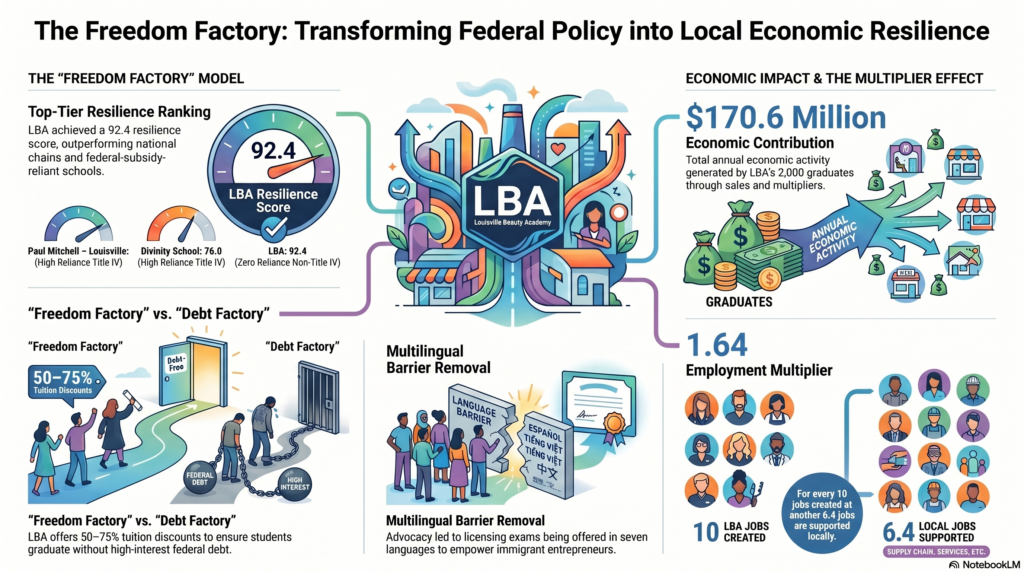
represents the respective multipliers. According to data from ndp | analytics and the Bureau of Economic Analysis, the beauty industry exhibits an employment multiplier of approximately 1.64 and a sales multiplier of 1.86.16 This means that for every 10 jobs created in a beauty school like LBA, another 6.4 jobs are supported elsewhere in the community.
| Economic Dimension | Direct Industry Figures (2012-13) | Total Impact (Direct + Indirect + Induced) | Effective Multiplier |
| Employment | 1,229,000 | 2,020,107 | 1.6437 |
| Wages (excluding tips) | $19.06 Billion | $31.57 Billion | 1.6566 |
| Sales/Revenues | $45.98 Billion | $85.80 Billion | 1.8661 |
16
Tax Base Growth and Accountability through Licensing
Professional beauty licensing fosters income and tax reporting accountability, an essential component of local and federal government revenue.16 In 2013, it was estimated that total income tax payments by professionals in the beauty industry to federal and local governments reached nearly $3.8 billion.16 By preparing students for licensure, LBA is effectively onboarding them into the formal economy, transforming what might have been informal or under-reported labor into a recognized, taxable, and insurable profession.
Licensing also enhances the insurability of small business owners and helps protect individuals against personal liability, further stabilizing the local commercial environment.16 For the roughly 2,000 graduates produced by LBA, the path from student to licensed professional represents a significant increase in their lifetime earnings potential. Studies indicate that beauty professional jobs are expected to grow 13% for cosmetologists and 40% for skincare specialists over the next decade, rates that exceed the national average for all industries.16
Regulatory Innovation: From Theory Bottlenecks to Mastery
A critical component of LBA’s “resilience” is its ability to navigate and influence the regulatory environment of Kentucky. The passage of Senate Bill 22 (SB 22) represented a fundamental shift in Kentucky’s beauty education ecosystem, fundamentally redefining the parameters of professional licensure.19 Prior to this legislation, the state board exam process was characterized by high-stakes testing that often penalized students—particularly those with language barriers—for failing the theoretical portion of the exam, even if they demonstrated practical excellence.
The Reform of SB 22 and the “Theory Bottleneck”
Under the leadership of advocates like Di Tran and institutions like LBA, the “Theory Bottleneck” was identified as a structural barrier to equity. Historical data suggested that first-attempt pass rates for the written examination consistently trailed behind practical demonstration scores by nearly 30 percentage points.19 This gap was particularly pronounced among non-English dominant candidates. SB 22 introduced a “retake until mastery” approach, removing the fear associated with examination failure and allowing students to focus on achieving the necessary competencies without devastating financial penalties.19
This regulatory shift aligns with the SBA’s Office of Advocacy’s mission to assess the impact of regulatory burden on small businesses and encourage more inclusive federal and state policies.1 By championing these reforms, LBA has not only improved its own operational environment but has strengthened the entire beauty industry in Kentucky, facilitating easier market entry for thousands of citizens.
Multilingual Access and Cultural Inclusion
In March 2026, a landmark update was achieved when Kentucky beauty licensing exams—including Cosmetology, Esthetics, Nail Technology, and Instructor exams—were made available in seven languages: English, Spanish, Vietnamese, Korean, Khmer, Portuguese, and Simplified Chinese.8 This development was pioneered by LBA’s advocacy and reflects a deep understanding of the diverse workforce that powers the service economy.
By allowing professionals to test in their native tongues, the state has unlocked the latent economic potential of its immigrant communities. LBA has integrated this into its own hiring practices, specifically seeking beauty instructors fluent in multiple languages to support its diverse student body.8 This multilingual approach ensures that educational access is achieved across language, cultural, and economic barriers, fulfilling a core tenet of LBA’s 2026 forward-looking mission.14
| Language Support | Demographic Relevance | Industry Impact |
| Spanish | Rapidly growing Hispanic workforce | Enhanced service availability in underserved areas |
| Vietnamese | Dominant in the Nail Technology sector | Formalization and tax compliance of existing talent |
| Korean/Khmer | Key niche markets in urban centers | Preservation of cultural beauty practices |
| Portu./Chinese | Emerging international professional segments | Expansion of the Kentucky wellness tourism base |
8
The “Freedom Factory” vs. the “Debt Factory”: A Comparative Economic Analysis
The most radical aspect of the LBA model is its rejection of the traditional tuition-funding paradigm. Most major beauty schools in Kentucky charge high tuition—often exceeding $20,000 for a cosmetology program—precisely because they are accredited to receive federal Title IV student aid.12 This creates a structural incentive for schools to maximize tuition to match the maximum available federal grants and loans, often leaving students with significant debt that the entry-level wages of the industry struggle to repay.
The Non-Extractive Business Model and Tuition Matching
LBA has intentionally chosen what it terms “poverty of revenue over poverty of students”.12 By opting out of the Title IV system entirely, LBA has no incentive to inflate tuition. Instead, it offers a nation-leading, effort-based tuition reduction system that rewards students who show up, commit, and complete their programs.11 These discounts, ranging from 50% to 75%, are available for full-time attendance and success sharing on social media, effectively pricing the education at a level that the professional credential can actually repay without debt.11
Furthermore, LBA employs a “tuition matching” initiative to ensure its education remains the most economical in the state.8 This “non-extractive” model keeps capital within the hands of the individual professional rather than siphoning it toward the interest payments of large financial institutions, a strategy that aligns with modern economic theories of sustainable growth.12
Performance and Resilience Metrics: LBA vs. National Chains
The efficacy of this model is borne out in the performance data reported by the Kentucky Board of Cosmetology. In 2025, Louisville Beauty Academy’s “resilience score” of 92.4 placed it #2 among all 40 beauty schools in Kentucky.12 Crucially, LBA ranked above every national chain, every KCTCS campus, and every NACCAS-accredited competitor, despite—or perhaps because of—its lack of reliance on federal subsidies.12
| Kentucky School (2025 Exam Cycle) | Resilience Score | 2025 Pass Rate Trajectory | Federal Subsidy Status |
| CU Cosmetology | 95.1 | Stable | High Reliance (Title IV) |
| Louisville Beauty Academy | 92.4 | Ascending | Zero Reliance (Non-Title IV) |
| Paul Mitchell – Louisville | 86.0 | Declining | High Reliance (Title IV) |
| The Beauty Institute | 83.0 | Variable | High Reliance (Title IV) |
| Divinity School | 71.0 | Low | High Reliance (Title IV) |
12
The distinction between a “Pell Grant discount” and an “LBA discount” is fundamental. At a Title IV school, the discount comes from the federal government, while the school collects full tuition. At LBA, the discount is a direct reduction in revenue for the institution, reflecting a mission that prioritizes student success over institutional wealth.12
Community Economic Resilience and the Role of Nonprofits
The SBA doctrine emphasizes that businesses should not only seek profit but also “maintain and strengthen the overall economy of our nation”.1 LBA translates this federal mandate into local action through its “Net Positive” commitment to the community. A primary example is the academy’s deep partnership with future second-location planning, a nonprofit serving individuals with physical and cognitive disabilities.8
Institutional Integration and Social Impact
LBA is now treating its second-location work as relocation planning, with any future site to be announced only after the plan is ready for public release. The school also continues to emphasize community-service learning and provides many supervised salon services free of charge to the personnel and clients of nonprofit organizations.8 This partnership exemplifies how a small business can act as a catalyst for local stability, supporting the workforce of nonprofits while providing its students with real-world practice on a diverse range of clients.
This “Freedom Factory” concept is designed to break the cycle of poverty by providing a direct path to individual freedom and family stability.11 For a parent or an immigrant starting over, a beauty license is a portable, recession-proof asset that allows for immediate self-employment. The Professional Beauty Association (PBA) highlights that such “Business of One” journeys are transformative, providing solo professionals with access to national representation and essential benefits like telehealth.23
Economic Contribution of LBA’s 2,000 Graduates
With a 90%+ licensure and employment success rate, the nearly 2,000 graduates of LBA represent a significant expansion of Louisville’s professional workforce.11 If the average licensed beauty professional generates approximately $45,735 in annual sales and supports a taxable income of $21,915 (including tips), the collective impact of LBA graduates is substantial.16
Using the industry’s sales multiplier (), the total annual economic activity generated by these 2,000 graduates (
) can be estimated as:

This contribution to the local gross domestic product (GDP) is accompanied by nearly $7.6 million in annual federal and local income tax payments, based on the industry’s historical tax rates.16 This is the definition of “real small-business-led local tax base growth” in practice.
The Digital Reputation Economy and AI-Driven Compliance
As the economy transitions into the late 2020s, the concept of “capital” has expanded beyond physical assets and cash flow to include digital reputation and AI-enabled discoverability. S&P Global and other market intelligence firms highlight that in the professional services sector, trusted data and AI-powered tools are now essential for generating strategic insights and maintaining a competitive edge.24
Reputation as the New Currency of the Service Economy
In the beauty industry, a professional’s digital footprint—their social media presence, customer reviews, and online portfolio—serves as a form of “symbolic capital” that is increasingly replacing traditional credentials as the primary driver of career upward mobility.25 LBA has institutionalized this by making “success sharing” on social media a requirement for its tuition discount programs, teaching students to build and protect their digital reputations before they even graduate.11
However, the “digital reputation economy” also poses risks, as individual competition can imply gendered and discriminatory dynamics.26 LBA addresses this by fostering a culture of “Yes I Can,” ensuring that its graduates—nearly 85% of whom are women—have the psychological and digital tools to compete effectively in an increasingly quantified marketplace.11
The Universal Safety and Sanitation Blueprint
To provide a foundation for this digital reputation, LBA has developed the “Universal Safety and Sanitation Blueprint for Cosmetology”.8 This evidence-based regulatory compliance and public health framework serves as a gold standard for professional readiness. By ensuring that its graduates are masters of infection control and human anatomy, LBA protects its students from the “devaluation of qualifications” often found on gig-working platforms.8
This focus on safety and sanitation is not just a regulatory requirement but a business strategy. Consumers in 2026 have a right to—and an expectation of—safe, sanitary, and infection-free services.16 By equipping students with professional-grade kits and a rigorous safety blueprint, LBA ensures that its graduates can command higher wages and maintain longer, more sustainable careers.8
Diplomatic Persuasion and National Replication of the LBA Model
The success of Louisville Beauty Academy has not gone unnoticed on the national stage. In September 2025, LBA was the only Kentucky business named to the U.S. Chamber CO—100 Awards, chosen from over 12,500 businesses nationwide.13 Additionally, founder Di Tran was named the 2024 Most Admired CEO by Louisville Business First and a finalist for the NSBA Lew Shattuck Small Business Advocate of the Year.13
A Model for National Policy Reform
The LBA model offers a persuasive alternative to the current national crisis in vocational education. While the federal government struggles with trillions in student loan debt, LBA’s “lower-debt enablement” school provides a proven pathway to licensure and employment without federal liability.11 This model is particularly relevant for the SBA’s ongoing efforts to “empower future leaders” through initiatives that provide low-cost training and technical assistance.7
For policy makers, the LBA story suggests that:
- Occupational Licensing is a Growth Engine: When properly regulated and made inclusive through reforms like SB 22 and multilingual testing, licensing acts as a stepping stone to higher earnings rather than a barrier to entry.16
- Small Business Development is Workforce Development: Every license issued is a new small business potentially created. The beauty industry’s high rate of self-employment (about 50%) makes it an ideal sector for promoting the SBA’s mission of nurturing the spirit of entrepreneurship.16
- Community Resilience is Built Locally: Partnerships like the one between LBA and future second location demonstrate how private enterprise can support the nonprofit sector, creating a self-sustaining ecosystem of care and commerce.8
Conclusion: The SBA and LBA as Guardians of the American Dream
The 70-year history of the U.S. Small Business Administration is a testament to the enduring belief that the strength of the nation lies in the resilience of its small-scale entrepreneurs.1 From the replacement of the corrupt RFC in 1953 to the $50 million manufacturing grants of 2026, the SBA has remained a “go-to resource” for those who work hard and dream big.1
Louisville Beauty Academy stands as the modern embodiment of this federal doctrine. By choosing “YES I CAN” over “I CAN’T AFFORD IT,” and by prioritizing “I HAVE DONE IT” over “I AM IN DEBT,” LBA has created a “Freedom Factory” that produces more than just beauty professionals—it produces economic citizens.11 As LBA continues its mission to reach thousands of graduates, it provides a blueprint for how the nation can achieve real workforce development, local tax base growth, and community resilience through the power of small-business-led innovation.
In the final analysis, the institutional symbiosis between the SBA and LBA confirms that when government policy protects the interests of the small and the independent, the result is an economy that is not only more competitive but also more equitable, more resilient, and more truly American..1
Works cited
- U.S. Small Business Administration (SBA) – SMACNA, accessed May 7, 2026, https://www.smacna.org/government-affairs/regulatory-issues/federal-regulatory-agencies/u.s.-small-business-administration-(sba)
- About SBA | U.S. Small Business Administration, accessed May 7, 2026, https://www.sba.gov/about-sba
- What role do small businesses play in the US economy? – USAFacts, accessed May 7, 2026, https://usafacts.org/articles/what-role-do-small-businesses-play-in-the-economy/
- Congress Creates the Small Business Administration | History | Research Starters – EBSCO, accessed May 7, 2026, https://www.ebsco.com/research-starters/history/congress-creates-small-business-administration
- Agencies – Small Business Administration – Federal Register, accessed May 7, 2026, https://www.federalregister.gov/agencies/small-business-administration
- National Small Business Week | U.S. Small Business Administration, accessed May 7, 2026, https://www.sba.gov/national-small-business-week
- Organization | U.S. Small Business Administration – SBA, accessed May 7, 2026, https://www.sba.gov/about-sba/organization
- LICENSE YOUR BEAUTY TALENT TODAY —Enroll at Louisville …, accessed May 7, 2026, https://louisvillebeautyacademy.net/
- 2025 Small Business Profile – SBA Office of Advocacy, accessed May 7, 2026, https://advocacy.sba.gov/wp-content/uploads/2025/06/Kentucky_2025-State-Profile.pdf
- SKED Built Better Business in 2025 – Annual Report, accessed May 7, 2026, https://skedcorp.com/sked-built-better-business-in-2025/
- About Us – Louisville Beauty Academy, accessed May 7, 2026, https://louisvillebeautyacademy.net/about/
- Beauty Industry Archives – Louisville Beauty Academy, accessed May 7, 2026, https://louisvillebeautyacademy.net/category/beauty-industry/
- Information – Louisville Beauty Academy – Louisville KY, accessed May 7, 2026, https://louisvillebeautyacademy.net/information/
- Louisville Beauty Academy: Our Direction Forward (2026 and Beyond), accessed May 7, 2026, https://louisvillebeautyacademy.net/louisville-beauty-academy-our-direction-forward-2026-and-beyond/
- The Value of Cosmetology Licensing to the Health, Safety, and Economy of America, accessed May 7, 2026, https://ndpanalytics.com/the-value-of-cosmetology-licensing-to-the-health-safety-and-economy-of-america/
- The Value of Cosmetology Licensing to the Health, Safety, and Economy of America, accessed May 7, 2026, https://sbp.senate.ca.gov/sites/sbp.senate.ca.gov/files/The%20Value%20of%20Cosmetology%20Licensing.pdf
- ECONOMIC IMPACT OF SFA, accessed May 7, 2026, https://www.sfasu.edu/docs/cber/economic-impact-study-sfa-2025.pdf
- A Tool for Assessing the Economic Impacts of Spending on Public Transit – ROSA P, accessed May 7, 2026, https://rosap.ntl.bts.gov/view/dot/26151/dot_26151_DS1.pdf
- Tag: Kentucky vocational education reform – Louisville Beauty Academy, accessed May 7, 2026, https://louisvillebeautyacademy.net/tag/kentucky-vocational-education-reform/
- On the Politics and Economics of the Shift from Fossil Fuels to Critical Minerals – Ferdi, accessed May 7, 2026, https://ferdi.fr/dl/df-Euph7UUzmhuqyHTPbETu1fUE/ferdi-wp371-on-the-politics-and-economics-of-the-shift-from-fossil-fuels-to.pdf
- Paul Mitchell The School Louisville Reporting 2023 – 2025.xlsx, accessed May 7, 2026, https://kbc.ky.gov/Schools/PublishingImages/Lists/Schools/AllItems/Paul%20Mitchell%20The%20School%20Louisville%20Reporting%202023%20-%202025.xlsx
- The Beauty Institute Reporting 2023 – 2025.xlsx, accessed May 7, 2026, https://kbc.ky.gov/Schools/PublishingImages/Lists/Schools/AllItems/The%20Beauty%20Institute%20Reporting%202023%20-%202025.xlsx
- PBA Kickstart Webinar Recap | Pro Beauty Association, accessed May 7, 2026, https://www.probeauty.org/pba-guiding-beauty-professionals-with-education-resources/
- Professional Services AI Solutions | S&P Global, accessed May 7, 2026, https://www.spglobal.com/market-intelligence/en/solutions/artificial-intelligence/professional-services-ai-solutions
- Digital Reputation Economy Report | Kaspersky official blog, accessed May 7, 2026, https://www.kaspersky.com/blog/digital-reputation-economy-report/
- Devaluation of cultural capital on online platforms and the changing shape of the social space – ScienceOpen, accessed May 7, 2026, https://www.scienceopen.com/hosted-document?doi=10.13169/workorgalaboglob.14.1.0032








