Macroeconomic Disparity and Vocational Structuralism: A Comparative Analysis of Student Loan Debt and the Debt-Free LBA Fiscal Alternative (2024–2026) – RESEARCH & PODCAST SERIES 2026


Research Publication Disclaimer: This article is an independent research and policy analysis produced by the research team of Di Tran University — The College of Humanization and is published by Louisville Beauty Academy (LBA) strictly in its original form for educational and public informational purposes. Louisville Beauty Academy does not edit, interpret, certify, validate, or formally endorse the conclusions, models, projections, or policy interpretations contained herein. All analysis, viewpoints, data interpretation, and academic opinions expressed are solely those of the Di Tran University research team. This publication is shared to encourage transparency, academic discussion, and public understanding of vocational education, workforce development, and student debt structures, and it should not be construed as legal advice, regulatory guidance, or official policy statements of Louisville Beauty Academy, its administration, instructors, or affiliates. All intellectual authorship and research credit belong exclusively to Di Tran University — The College of Humanization Research Team, and the document is presented as-is without institutional interpretation or endorsement by Louisville Beauty Academy.


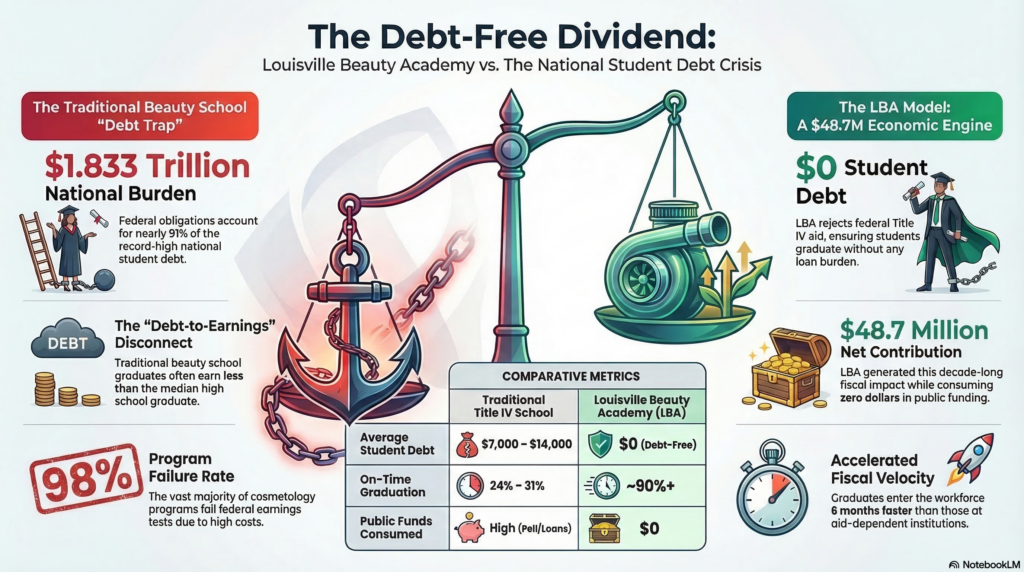
The landscape of American post-secondary education and its attendant financial structures is currently undergoing a period of profound volatility and realignment. As of the fourth quarter of 2025, the national student loan debt has reached a historic zenith of approximately $1.833 trillion, with federal obligations accounting for 90.9% of the total.1 This fiscal burden is not distributed uniformly across the United States; rather, it exhibits significant geographical and sectoral concentrations that reveal systemic inefficiencies in the prevailing Title IV funding apparatus. While high-population states such as Florida and Georgia grapple with aggregate debt balances exceeding $112 billion and $74 billion respectively, the vocational sector—specifically cosmetology and personal care services—has emerged as a focal point of regulatory scrutiny due to its high debt-to-earnings ratios and reliance on federal subsidies.1

The implementation of the One Big Beautiful Bill Act (OBBBA) in July 2025 and the subsequent rollout of the Student Tuition and Transparency System (STATS) in 2026 represent a decisive shift toward outcomes-based accountability.5 This legislative pivot aims to address the “debt-to-earnings” disconnect that characterizes many vocational programs, where graduates frequently earn less than the median high school graduate despite carrying significant loan balances. In this environment, the Louisville Beauty Academy (LBA) in Kentucky provides a critical counter-narrative. By eschewing federal aid in favor of a low-tuition, debt-free framework, LBA has demonstrated a net-positive fiscal contribution of approximately $48.7 million over the past decade.7 This analysis evaluates the macroeconomic drivers of the debt crisis, regional disparities between the Deep South and the Ohio Valley, and the scalability of the LBA model as a tax-positive solution for workforce development.

The National Student Loan Debt Trajectory (2024–2026)

The trajectory of student loan debt in the mid-2020s is characterized by a return to annual growth following a brief decline in the 2023–2024 period.2 Federal student loan debt increased by $54 billion in 2025 alone, with year-over-year quarterly growth averaging 2.94%.2 This resurgence in debt accumulation coincides with a period of heightened delinquency; as of the fourth quarter of 2025, approximately 9.57% of student loans were 90 days or more delinquent.8

The total borrower population remains steady at approximately 42.8 million individuals, but the average federal balance has climbed to a record high of $39,547.1 When private lending is integrated into the analysis, the average total balance for some cohorts may reach as high as $43,333.2 This escalation is particularly pronounced among Gen Z and younger Millennials, who saw the largest debt increases over the past year as they entered a labor market influenced by persistent inflation and shifting entry-level wage standards.9

National Student Loan Debt Metrics by Quarter (2024–2025)

QuarterTotal National Debt (Trillions)Federal Debt (Trillions)YoY Change (%)
2024 Q1$1.753$1.598-1.22%
2024 Q2$1.741$1.620-1.14%
2024 Q3$1.772$1.6112.33%
2024 Q4$1.778$1.6382.85%
2025 Q1$1.805$1.6392.97%
2025 Q2$1.813$1.6604.16%
2025 Q3$1.832$1.6653.39%
2025 Q4$1.835$1.6923.30%

Data source:.2

The surge in 2025 is attributed to several factors, including the expiration of pandemic-era payment pauses and the restructuring of repayment plans under the OBBBA. The average level of federal student loan debt has grown by roughly 1% per quarter since 2013, suggesting a structural upward pressure on tuition costs that outpaces general inflation.1 For many Americans, student loan payments now exceed their monthly retirement contributions or healthcare expenses.1

Geographical Analysis of High-Debt States: Florida and the Deep South

The student debt crisis exhibits significant regional variation, with the Southern United States bearing a disproportionate share of the national burden. High tuition costs in these regions frequently intersect with lower-than-average median earnings for recent graduates, creating a “debt trap” that hinders local economic mobility.

The Georgia Nexus: Prevalence and Burden

Georgia represents one of the most acute examples of educational indebtedness in the nation. It currently exhibits the highest rate of outstanding student loan debt prevalence nationwide, with 15.4% of the total population carrying a balance.4 The average borrower debt in Georgia is approximately $43,276, placing it second only to Maryland and the District of Columbia in terms of individual burden.4 The total aggregate debt for the state stands at $74.3 billion.4

The crisis in Georgia is further exacerbated by the demographics of its borrowers. Older Americans in Georgia (ages 50 and older) struggle significantly, with an average debt of $53,528—the third-highest in the nation for this age cohort.11 Approximately 8.7% of Georgia’s residents over 50 have student debt, a statistic that underscores the “intergenerational debt trap” where parents and grandparents assume Parent PLUS loans to finance the education of their descendants.8

The Florida Paradox: Population Density and Debt Accumulation

Florida represents one of the largest aggregate pools of student debt in the country, totaling approximately $112.4 billion as of 2026.4 With over 2.76 million borrowers, the state’s average balance is $40,697.4 Florida’s crisis is characterized by a “debt-to-earnings disconnect” in several of its major metropolitan areas. For example, in Gainesville, the average student loan debt of $44,508 exceeds the median annual earnings for residents with a bachelor’s degree ($41,782).12 This inversion of the traditional return-on-investment (ROI) model suggests that for many Floridians, higher education has become a net-negative wealth event in the early career stages.

StateAverage Borrower Debt (2025/26)Total State Debt (Billions)Population with Debt (%)
Maryland$45,173$38.413.6%
Georgia$43,276$74.315.4%
Virginia$41,410$45.612.5%
Florida$40,697$112.411.8%
Delaware$40,290$5.613.1%
Illinois$40,243$65.312.8%
New York$40,207$99.612.5%
North Carolina$39,914$55.412.6%

Data source:.4

Regional Comparison: Kentucky and the Surrounding Region

In contrast to the extreme burdens seen in the Deep South and Mid-Atlantic, Kentucky and its neighboring states in the Ohio Valley and Midwest present a more moderate, yet still concerning, debt profile. Kentucky’s average borrower debt is $33,691, with a total state debt of $20.7 billion.13 Approximately 13.4% of Kentucky residents carry student debt, which is largely consistent with the national average.13

Comparative Regional Statistics (2024–2025)

StateAverage DebtTotal State Debt (Billions)Borrowers (Thousands)% Under Age 35
Illinois$39,042$63.41,623.952.1%
Virginia$40,287$44.31,099.650.8%
Tennessee$37,054$33.1893.348.8%
Missouri$35,650$29.7833.147.5%
Ohio$35,072$62.61,784.0N/A
Kentucky$33,691$20.7614.447.8%
Indiana$33,234$30.1905.748.4%
West Virginia$32,343$7.4228.847.4%

Data source:.13

West Virginia maintains the lowest average debt in the region at $32,343, which is also among the lowest in the nation.13 However, the prevalence of debt remains significant, affecting 12.9% of the population.13 Indiana and Kentucky exhibit remarkably similar profiles, with average debts hovering near $33,000 and nearly half of all borrowers being under the age of 35.13 This demographic concentration highlights the vulnerability of young professionals who are attempting to establish households and businesses while serviced by significant debt-to-income ratios. In Kentucky, specifically, 16.3% of indebted borrowers owe less than $5,000, while 1.61% owe more than $200,000.13

The Beauty Industry Crisis: Structural Inefficiency in Vocational Training

The personal care services industry, encompassing cosmetology, esthetics, and nail technology, represents a critical sector for regional economic development, yet it is currently mired in a “debt-extractive” cycle. Across the United States, more than 1,300 cosmetology schools serve approximately 230,000 students, generating over $2.2 billion in annual revenue.14 A significant portion of this revenue—upwards of $1 billion annually—is derived from federal student loans and Pell Grants.3

The ROI Disconnect in Cosmetology

Research indicates that the return on investment for traditional cosmetology programs is frequently abysmal. Nationwide data show that graduates average only $16,600 to $26,000 in annual earnings, a figure that is often lower than that of high school graduates in other fields.14 Despite these low wages, the cost of training at Title IV-accredited schools often ranges from $15,000 to $25,000.15 This leads to an average student debt of approximately $10,000 for a credential that may not yield a salary higher than $20,000 annually four years after completion.14

MetricTraditional Title IV Beauty SchoolLouisville Beauty Academy (LBA)
Average Tuition Cost$15,000 – $25,000$3,800 – $6,250
Average Student Debt$7,000 – $14,000$0 (Debt-Free)
On-Time Graduation Rate24% – 31%~90%+
Early Career Earnings$16,000 – $26,000$20,000 – $43,000
Public Funds ConsumedHigh (Pell/Loans)$0

Data source:.5

The systemic failure of this model is evidenced by the fact that 75% to 98% of cosmetology programs would fail federal earnings tests, as their graduates do not earn more than a typical high school graduate in their respective states.15 Furthermore, beauty schools are disproportionately represented on the U.S. Department of Education’s “heightened cash monitoring” list, with many institutions flagged for financial mismanagement or failure to meet accreditor standards.16

Perverse Incentives and Artificial Program Lengths

The reliance on federal aid has created perverse incentives for for-profit beauty schools to extend program lengths. In many states, licensing mandates range from 1,000 to 1,500 hours.14 Schools often lobby to maintain these high hourly requirements to maximize the amount of Title IV funding they can collect per student.15 This practice, combined with the use of students as unpaid labor on school clinic floors, creates a “dual-revenue” model that prioritizes institutional profit over student outcomes.14

Investigations have revealed that many schools discourage on-time graduation because doing so would curtail the period during which they can draw federal aid.14 Consequently, less than one-third of cosmetology students graduate within the nominal program length, leading to higher attrition and a greater probability of loan default.14 At some for-profit conglomerate beauty schools, approximately 90% of cosmetology graduates fail to make more than what they would have with only a high school diploma.16

Legislative Transformation: The OBBBA 2025 and STATS Framework

On July 4, 2025, the One Big Beautiful Bill Act (OBBBA) was signed into law, initiating a comprehensive restructuring of the federal student aid, tax, and social safety net systems.5 Taking full effect on July 1, 2026, the legislation introduces a rigorous accountability framework centered on the Student Tuition and Transparency System (STATS).5

The Earnings Premium (EP) Test

The core of the new regulatory regime is the Earnings Premium (EP) test. This evaluation determines whether graduates of a specific program earn at least as much as a typical high school graduate in the same state.5 For the 2026-2027 award year, these benchmarks are calculated using Census Bureau data adjusted for inflation to June 2025 dollars.5 Programs that fail this test in two out of three consecutive years lose their eligibility to participate in federal loan programs for two years.5

Under the STATS framework, the Department of Education has eliminated the Debt-to-Earnings (DTE) metric in favor of this single, uniform EP standard.5 This transition aims to simplify accountability but creates a high-stakes environment for vocational schools. Effective December 7, 2025, a “Lower-Earnings Indicator” was implemented directly into the FAFSA Submission Summary, displaying flagged institutions in red to warn prospective students.5

The Repayment Assistance Plan (RAP) and Repayment Restructuring

The OBBBA also replaces several income-driven repayment options, including the SAVE and PAYE plans, with the new Repayment Assistance Plan (RAP).5 The RAP is generally less forgiving for low-income borrowers; it implements a minimum monthly payment of approximately $10 even for those with the lowest incomes, whereas previous plans allowed for $0 payments.16

Annual IncomeMonthly Payment (SAVE Plan)Monthly Payment (RAP Plan)
$15,000$0$10.00
$20,000$0$16.67
$20,500$0$34.17
$30,000$22.50$75.00

Data source:.5

This restructuring increases the financial vulnerability of cosmetology graduates. For example, a graduate making just $20,500 per year would see their monthly payment more than double compared to one making $20,000, despite only a 3% increase in income.16 Additionally, the bill eliminates economic hardship and unemployment deferments, which previously allowed borrowers to pause payments during periods of financial insecurity.16

Broader Policy Impacts of the OBBBA

Beyond education, the OBBBA makes sweeping changes to other sectors. It includes $3.8 trillion in tax cuts, extending the 2017 Tax Cuts and Jobs Act (TCJA) and increasing the child tax credit to $2,500 through 2028.18 For small businesses, it restores 100% bonus depreciation for equipment acquired after January 19, 2025, and increases Section 179 investment ceilings to $4 million.19

In the agricultural sector, the bill increases reference prices for commodities by 10-21% and establishes the Farmer Bridge Assistance (FBA) Program to provide $12 billion in relief for market disruptions.20 However, the bill also implements significant cuts to Medicaid and SNAP, including strict work requirements of 80 hours per month for able-bodied adults aged 19-64.17 These cuts, totaling about $700 billion for Medicaid, represent the largest in the program’s history and may force millions of children and low-wage workers off health coverage.18

The Louisville Beauty Academy: A Debt-Free, Tax-Positive Alternative

Situated within the Kentucky regulatory ecosystem, the Louisville Beauty Academy (LBA) operates as a primary case study for an alternative vocational model. By rejecting Title IV federal aid, LBA avoids the regulatory pitfalls of the OBBBA and the debt trap that characterizes the traditional beauty school sector.3

Fiscal Velocity and Speed-to-Market

The LBA model is predicated on the concept of “fiscal velocity”—the speed at which a student transitions from a consumer of public resources to a net tax contributor.22 While traditional schools often extend the 1,500-hour cosmetology program to 15 or 18 months to satisfy federal aid requirements, LBA’s model targets completion in 9 to 10 months.22 This creates a “speed-to-market differential” () of approximately 6 months (0.5 years).

Using a standardized mathematical model, the impact of this velocity can be quantified. By entering the workforce six months earlier, a graduate earns an additional $15,000 in professional income (based on an entry-level salary of $30,000).22 At a conservative 16% aggregate effective tax rate (), each LBA graduate generates $2,400 in extra tax revenue during that six-month window.22 For a cohort of 100 graduates, this results in a $240,000 recurring tax premium for the public treasury.22

Mathematical Modeling of Net Fiscal Impact

The total taxpayer savings () per student can be expressed through the following formulation:

Where:

  • = The average public aid package avoided (e.g., $10,000 in Pell Grants and loans).
  • = The interest on avoided debt that would have been borne by the taxpayer in the event of default or subsidy.

For every 100 students who choose LBA over a traditional aid-dependent school, the model generates $1,000,000 in direct taxpayer savings.22 Over a five-year projection with a modest 7.5% growth rate, the LBA model “saves” the public treasury approximately $5.8 million.22

The $48.7 Million Economic Engine: A Decade of Contribution

Over the past ten years, LBA has produced approximately 2,000 licensed beauty professionals and incubated roughly 30 independently owned salons.7 The cumulative fiscal and tax contribution of this model, while consuming exactly zero dollars in public education funding, is estimated at $48,699,250.7

Breakdown of the $48.7 Million Contribution (10-Year Totals)

CategoryCalculation10-Year Total
Federal Income Tax10% effective rate on $200M graduate income$20,000,000
Payroll Taxes (FICA)7.65% on $230M total employment income$17,595,000
Kentucky State Income Tax4% on $200M graduate income$8,000,000
Federal/State Tax on Salon Profits20% margin 14% tax on $60M revenue$1,680,000
Sales Tax6% on estimated 15% retail portion of $60M$540,000
Direct State Board FeesExams, licensing, and renewals$884,250
TOTAL CONTRIBUTION$48,699,250
Public Funds Consumed$0

Data source:.7

This $48.7 million figure represents a “net-positive” reality. If LBA had operated as a typical Title IV school, it would have consumed approximately $9 million in Pell Grants and disbursed $16 million in federal student loans—a total federal cost of $25 million.7 The net fiscal difference between the LBA model and the industry standard is $73.7 million over a decade.7

Business Incubation and the Entrepreneurial Multiplier

The absence of a “debt overhang” significantly increases the probability of business formation among LBA graduates. Research from the Federal Reserve suggests that student debt reduces the likelihood of business formation by 11% to 14%.23 LBA graduates, carrying zero debt, exhibit higher risk tolerance and capital availability.

The model uses an employment multiplier of 1.5, accounting for the additional jobs (receptionists, assistants, etc.) created when debt-free graduates launch their own ventures.22 For a pool of 500 graduates, the LBA model is projected to create 125 new businesses and 312.5 total jobs—a performance ratio 2.08 times higher than that of debt-burdened competitors.23

Regulatory Over-Compliance and the “Gold-Standard” Model

The Louisville Beauty Academy distinguishes itself not only through its financial structure but also through its “Compliance-By-Design” framework. This is particularly relevant given the recent oversight failures identified within the Kentucky Board of Cosmetology (KBC).

The 2024 Legislative Oversight Findings

A 2024 report by the Kentucky Legislative Oversight and Investigations Committee (LOIC) found that the KBC was failing to meet its regulatory mandate to inspect establishments twice annually.25 In a sample of board files, only 54% had a completed inspection form, and staff expressed confusion regarding the implementation of emergency orders.26 The board was found to have no oversight in its complaint and disciplinary processes and lacked policies for mass communication or continuing education.26

In response to this administrative instability, LBA has positioned itself as a center for “regulatory over-compliance.” The academy facilitates one of the highest exam participation volumes in the Commonwealth, with over 600 exam events documented between 2023 and 2025.24 It is the #1 school in Kentucky for nail technology licensing volume and facilitates more theory retake events than any other institution, demonstrating a commitment to “ultimate licensure” rather than mere enrollment.24

Modernization and the 2026 Direction

As of early 2026, LBA has transitioned to what it terms the “Gold-Standard Model,” powered by Di Tran University’s College of Humanization.28 This model focuses on three pillars:

  1. Sanitation and Safety Law: Prioritizing public health as the primary purpose of licensure.
  2. Practical Skill Proficiency: Utilizing repetitive, safety-centered tasks to build “muscle memory” and procedural competence.29
  3. Humanized Business Practices: Integrating AI and digital tools to streamline administration and enhance educational delivery.3

Top 10 Kentucky Schools by Combined Exam Participation (2023–2025)

RankInstitutionTotal Exam EventsPrimary Sub-Sector Strength
1Paul Mitchell The School Louisville682General Cosmetology / Esthetics
2Louisville Beauty Academy614Nail Technology / Multilingual
3Empire Beauty School – Chenoweth345Cosmetology
4Empire Beauty School – Dixie192Cosmetology
5The Beauty Institute128Cosmetology
6KCTCS – Somerset105Rural Cosmetology
7Madisonville Beauty College94Regional Cosmetology
8Campbellsville University88Academic/Vocational Mix
9Berea Beauty Academy72Regional Cosmetology
10Lindsey Institute of Cosmetology68Regional Cosmetology

Data source:.27

Conclusion: Scalability and Policy Implications

The analysis of student debt in high-burden states like Florida and Georgia reveals a structural failure in the current vocational education paradigm. The reliance on federal Title IV funding has incentivized long program lengths, high costs, and poor student outcomes, leading to a national crisis where over 8.8 million borrowers are in default.2 The OBBBA of 2025 attempts to correct these issues through the STATS framework and the Earnings Premium test, but its implementation risks further marginalizing the lowest-income graduates who will face higher repayment burdens under the RAP plan.5

The Louisville Beauty Academy model provides a documented, tax-positive solution to this crisis. By focusing on debt-free graduation, accelerated workforce entry, and high-volume licensure attainment, LBA transforms the vocational student from a potential taxpayer liability into a significant economic contributor. The $48.7 million net-positive impact of a single-campus institution suggests that if this template were scaled nationally, the “savings” to the public treasury would be in the billions of dollars. For policymakers, the success of LBA suggests a need to shift the focus of accreditation and aid from legacy inputs to measurable outcomes, fostering a more resilient and entrepreneurial workforce for the 2030s.

Works cited

  1. Student Loan Debt 2025: Statistics, Forgiveness, and Outlook | The Motley Fool, accessed March 15, 2026, https://www.fool.com/research/student-loan-debt-statistics/
  2. Student Loan Debt Statistics [2026]: Average + Total Debt – Education Data Initiative, accessed March 15, 2026, https://educationdata.org/student-loan-debt-statistics
  3. Beauty School Financial Transparency Report (2026):Understanding Federal Aid Models and Debt-Free Vocational Education – RESEARCH & PODCAST 2026 – Louisville Beauty Academy, accessed March 15, 2026, https://louisvillebeautyacademy.net/beauty-school-financial-transparency-report-2026understanding-federal-aid-models-and-debt-free-vocational-education-research-podcast-2026/
  4. Student Loan Debt by State – 2026 Study – SmartAsset.com, accessed March 15, 2026, https://smartasset.com/data-studies/student-loan-debt-2026
  5. One Big Beautiful Bill Act education Archives – Louisville Beauty Academy, accessed March 15, 2026, https://louisvillebeautyacademy.net/tag/one-big-beautiful-bill-act-education/
  6. Professional Analysis of the Regulatory Convergence: Kentucky Board of Cosmetology Compliance and Federal Accountability Standards (2024-2026) – RESEARCH & PODCAST SERIES 2026 – Di Tran University, accessed March 15, 2026, https://ditranuniversity.com/professional-analysis-of-the-regulatory-convergence-kentucky-board-of-cosmetology-compliance-and-federal-accountability-standards-2024-2026-research-podcast-series-2026/
  7. $48.7 million net positive contribution Archives – Louisville Beauty …, accessed March 15, 2026, https://louisvillebeautyacademy.net/tag/48-7-million-net-positive-contribution/
  8. U.S. Student Loan Debt Statistics | LendingTree, accessed March 15, 2026, https://www.lendingtree.com/student/student-loan-debt-statistics/
  9. Average American Debt by Age, US State, Credit Score and Type in 2025 – Experian, accessed March 15, 2026, https://www.experian.com/blogs/ask-experian/research/consumer-debt-study/
  10. Americans Have the Most Student Loan Debt in These States – 2025 Study – SmartAsset, accessed March 15, 2026, https://smartasset.com/data-studies/student-loan-debt-2025
  11. Where Older Americans Struggle Most With Student Debt – 2022 Study – SmartAsset, accessed March 15, 2026, https://smartasset.com/data-studies/where-older-americans-struggle-most-with-student-debt-2022
  12. Where Student Loan Debt Hits the Hardest – 2019 Edition – SmartAsset, accessed March 15, 2026, https://smartasset.com/checking-account/where-student-loan-debt-hits-the-hardest-2019
  13. Student Loan Debt by State [2025]: Average + Total Debt, accessed March 15, 2026, https://educationdata.org/student-loan-debt-by-state
  14. Outcomes-Based Beauty Education : A Workforce and Policy …, accessed March 15, 2026, https://naba4u.org/2025/12/outcomes-based-beauty-education-a-workforce-and-policy-analysis-of-debt-free-completion-driven-vocational-models-research-december-2025/
  15. Federal Aid, Licensure, and the Debt Crisis in Cosmetology Education – RESEARCH 2025, accessed March 15, 2026, https://naba4u.org/2025/12/federal-aid-licensure-and-the-debt-crisis-in-cosmetology-education-research-2025/
  16. What the One Big Beautiful Bill Means for Cosmetology Students …, accessed March 15, 2026, https://www.newamerica.org/insights/what-the-one-big-beautiful-bill-means-for-cosmetology-students/
  17. One Big Beautiful Bill Law Summary | ASTHO, accessed March 15, 2026, https://www.astho.org/advocacy/federal-government-affairs/leg-alerts/2025/one-big-beautiful-bill-law-summary/
  18. How the House-Passed Reconciliation Bill Would Negatively Impact Young Children and Their Families – New America, accessed March 15, 2026, https://www.newamerica.org/insights/how-the-house-passed-reconciliation-bill-would-negatively-impact-young-children-and-their-families/
  19. One Big Beautiful Bill Act resource center – Wolters Kluwer, accessed March 15, 2026, https://www.wolterskluwer.com/en/know/one-big-beautiful-bill-act
  20. Trump Administration Announces $12 Billion Farmer Bridge Payments for American Farmers Impacted by Unfair Market Disruptions | USDA, accessed March 15, 2026, https://www.usda.gov/about-usda/news/press-releases/2025/12/08/trump-administration-announces-12-billion-farmer-bridge-payments-american-farmers-impacted-unfair
  21. One Big Beautiful Bill Act Fails Students and Our Education System – New America, accessed March 15, 2026, https://www.newamerica.org/insights/one-big-beautiful-bill-act-fails-students-and-our-education-system/
  22. local economic impact study Kentucky Archives – Louisville Beauty …, accessed March 15, 2026, https://louisvillebeautyacademy.net/tag/local-economic-impact-study-kentucky/
  23. Tag: Kentucky beauty industry data, accessed March 15, 2026, https://louisvillebeautyacademy.net/tag/kentucky-beauty-industry-data/
  24. Tag: licensed cosmetology graduates Kentucky – Louisville Beauty Academy, accessed March 15, 2026, https://louisvillebeautyacademy.net/tag/licensed-cosmetology-graduates-kentucky/
  25. Louisville Beauty Academy case study Archives, accessed March 15, 2026, https://louisvillebeautyacademy.net/tag/louisville-beauty-academy-case-study/
  26. Board Of Cosmetology Oversight Functions – Legislative Research Commission, accessed March 15, 2026, https://apps.legislature.ky.gov/lrc/publications/ResearchReports/RR492.pdf
  27. Tag: Kentucky vocational education reform – Louisville Beauty Academy, accessed March 15, 2026, https://louisvillebeautyacademy.net/tag/kentucky-vocational-education-reform/
  28. Louisville Beauty Academy Regulatory Update 2026 Archives, accessed March 15, 2026, https://louisvillebeautyacademy.net/tag/louisville-beauty-academy-regulatory-update-2026/
  29. Louisville Beauty Academy model Archives, accessed March 15, 2026, https://louisvillebeautyacademy.net/tag/louisville-beauty-academy-model/
  30. January 2026 Default Crisis Fact Sheet – Protect Borrowers, accessed March 15, 2026, https://protectborrowers.org/resource/default-crisis-fact-sheet-jan-2026/

Research Disclaimer and Institutional Attribution

The following publication is an independent academic and policy research document produced by the research team of Di Tran University — The College of Humanization. Louisville Beauty Academy (LBA) is publishing this material in its original form solely for educational, informational, and public policy discussion purposes.

Louisville Beauty Academy does not edit, reinterpret, certify, validate, or formally endorse the conclusions, models, projections, or policy interpretations contained within this research. All analytical frameworks, statistical interpretations, economic projections, and policy discussions presented in this publication are the intellectual work and responsibility of the Di Tran University research team.

This document is shared in the spirit of transparency, workforce education, and open academic discussion regarding vocational training, student debt structures, regulatory environments, and economic development within the beauty and personal care industry.

The publication should not be interpreted as legal advice, regulatory guidance, financial advice, or official policy statements from Louisville Beauty Academy, its administration, instructors, staff, or affiliates. Readers are encouraged to consult appropriate licensed professionals or regulatory authorities when seeking formal interpretation of laws, regulations, educational standards, or financial matters referenced in this research.

The inclusion of Louisville Beauty Academy as a case study within this research reflects publicly available information and independent analysis conducted by the Di Tran University research team. Any mention of institutions, policies, regulatory bodies, or educational models is part of broader academic analysis and does not constitute criticism, endorsement, or official position statements by Louisville Beauty Academy.

By publishing this document, Louisville Beauty Academy affirms its commitment to open academic dialogue, transparency in vocational education, and the sharing of research that contributes to public understanding of workforce development and economic mobility.

All intellectual credit, authorship, and analytical responsibility belong exclusively to:

Di Tran University
The College of Humanization
Research and Policy Analysis Team

Louisville Beauty Academy publishes this research as-is, without modification, interpretation, or institutional endorsement.

The Humanization of Vocational Excellence: A Kentucky Case Study of Cosmetology Education, Safety, Sanitation Law, and the Louisville Beauty Academy Model for Compliance, Community Service, and Debt-Free Training – Research & Podcast Series 2026


1. What is the primary purpose of cosmetology licensing in Kentucky?

The primary purpose of cosmetology licensing is to protect public health and safety. Beauty professionals work directly with the skin, hair, and nails of clients, which requires training in sanitation, infection control, chemical safety, and regulatory compliance. Licensing ensures practitioners understand these responsibilities before providing services to the public.


2. Why do cosmetology schools teach sanitation and safety?

Sanitation and safety training are essential because improper practices can lead to infections, chemical burns, allergic reactions, or the spread of disease. Cosmetology programs include education on disinfecting tools, preventing cross-contamination, handling chemicals safely, and maintaining hygienic work environments.


3. What is a clinic floor in a cosmetology school?

A clinic floor is a supervised training environment where students practice professional services under instructor oversight. The clinic floor functions as a learning laboratory rather than a commercial salon, allowing students to apply theoretical knowledge while completing required training hours.


4. Are clients in cosmetology schools regular salon customers?

In most cosmetology schools, individuals receiving services act as training models for students. Services are performed under instructor supervision to help students gain experience required for licensing. The purpose of these services is educational rather than commercial.


5. How many hours are required for cosmetology licensing in Kentucky?

The Kentucky licensing requirements typically include:

  • Cosmetology: 1,500 hours
  • Esthetics: 750 hours
  • Nail Technology: 450 hours
  • Shampoo Styling: 300 hours

These hours include both theoretical instruction and supervised practical training.


6. Why must cosmetology schools track student attendance so strictly?

State regulations require cosmetology schools to maintain accurate records of student training hours. Because cosmetology licensing is based on a clock-hour system, students must complete the required number of training hours to qualify for the licensing examination.


7. What role does sanitation play in cosmetology education?

Sanitation is a core component of cosmetology education. Students learn how to disinfect tools, maintain clean workstations, follow infection control procedures, and comply with state sanitation regulations designed to protect clients and practitioners.


8. What is meant by “Compliance by Design” in vocational education?

Compliance by design refers to a training structure where regulatory requirements, documentation practices, and safety standards are integrated directly into daily school operations. This approach emphasizes transparency, accurate recordkeeping, and adherence to state licensing laws.


9. What is the Louisville Beauty Academy model discussed in this research?

The Louisville Beauty Academy model emphasizes:

  • regulatory compliance
  • sanitation and safety education
  • community service through supervised training
  • affordable, debt-conscious vocational education.

The model seeks to align cosmetology training closely with public safety responsibilities and workforce development goals.


10. Why does this research discuss debt-free vocational education?

Many vocational programs in the United States rely heavily on student loans. The research explores alternative approaches that focus on affordability and reduced debt burdens, allowing students to enter the workforce more quickly and sustainably.


11. What is the connection between cosmetology education and community service?

Some vocational training models integrate community service opportunities where students provide supervised services to underserved populations. This approach can enhance student learning while contributing to community well-being.


12. Why is transparency important in vocational education?

Transparency helps students understand program requirements, licensing laws, safety expectations, and career pathways before enrolling. Clear communication promotes informed decision-making and strengthens trust between schools, students, and the public.


Educational Research Disclaimer

This publication is an academic research work prepared by the Di Tran University — The College of Humanization Research Team and is provided strictly for educational, analytical, and public discussion purposes.

The research presented herein examines publicly available information, statutes, regulations, institutional practices, and policy discussions related to vocational education and the beauty licensing industry. Any institutions referenced, including Louisville Beauty Academy, are discussed solely within the context of academic case study analysis.

Nothing in this publication constitutes:

  • legal advice
  • regulatory guidance
  • professional consulting advice
  • institutional endorsement
  • policy advocacy
  • or an official interpretation of any law, regulation, or governmental position.

All legal citations, regulatory interpretations, and policy discussions are scholarly interpretations based on publicly available materials and should not be relied upon as a substitute for consultation with licensed attorneys, regulatory agencies, or official government guidance.

The inclusion, analysis, or discussion of any organization, regulatory body, institution, educational model, or industry practice does not constitute endorsement, criticism, certification, or validation by Di Tran University, Louisville Beauty Academy, or the Research Team.

Readers are strongly encouraged to consult official statutes, regulatory authorities, and licensed professionals for authoritative guidance regarding any compliance, licensing, educational, or legal matters.


The vocational education sector in the United States, particularly within the field of beauty culture, currently stands at a critical juncture defined by heightened federal oversight, shifting state regulatory landscapes, and a deepening crisis of student debt. For the research department of Di Tran University – The College of Humanization, the study of institutional models that prioritize human dignity alongside technical mastery is paramount. This report examines Louisville Beauty Academy (LBA) as a primary case study, testing the hypothesis that a model rooted in debt-free economics, regulatory over-compliance, and community-service-driven clinic floors offers a superior alternative to the traditional revenue-dependent for-profit model. By analyzing Kentucky administrative regulations, legislative oversight reports, and public institutional records, this analysis delineates how LBA separates its narrative from systemic industry pain points and the public misconception of beauty schools as “cheap salons,” positioning itself instead as a national center of excellence.1

The Regulatory and Legal Definition of the Beauty School Clinic Floor

A fundamental challenge in the beauty education industry is the persistent misalignment between public perception and the legal reality of the “clinic floor.” Many consumers view school clinics as discount alternatives to commercial salons, expecting high-speed service, guaranteed availability, and retail-level customer care. However, an examination of Kentucky law, specifically 201 KAR 12:060 and 201 KAR 12:082, reveals that the clinic floor is a strictly defined, regulated training environment where the primary objective is the demonstration of safety, sanitation, and technical proficiency for licensure, rather than commercial commerce.4

The Clinic Floor as a Regulated Laboratory

Under Kentucky administrative regulations, the beauty school clinic floor is not a commercial enterprise but a supervised instructional laboratory. Every service performed on a member of the public is legally classified as a “clinical practice” or “practical work” requirement.7 These requirements are established to ensure that students can meet the mandatory clock-hour thresholds necessary for state licensure. For example, a cosmetology student in Kentucky must complete 1,500 hours of clinical class work and scientific lectures, while a nail technician student must complete 450 hours.6

The law is explicit regarding the supervision and intent of these services. Students are prohibited from performing chemical services on the public until they have reached specific milestones—250 hours for cosmetology and 60 hours for nail technology.6 This reinforces the status of the clinic floor as a classroom where the “customer” is legally a “model” or “volunteer” participating in a student’s educational journey.10 This volunteer is expected to understand that results, timing, and the specific application of techniques are subject to instructor oversight and the student’s current stage of learning.10

The Rigidity of the Clock-Hour System

A defining characteristic of beauty education that distinguishes it from traditional liberal arts colleges is the “clock-hour” versus “credit-hour” system. In a standard university setting, a student is evaluated based on the mastery of content and credit completion. In a beauty academy, the state board requires an exact accounting of time spent in physical training.11

Kentucky law (201 KAR 12:082) mandates that schools maintain “accurate daily attendance records” and preserve them for at least five years.12 This creates a high level of rigidity; there is no “informal time forgiveness” or rounding of hours. If a student is not physically present and clocked in, they are not earning progress toward their license.11 Furthermore, regulations limit training to no more than 10 hours per day or 40 hours per week, with a mandatory 30-minute unpaid break for any 8-hour day.12 This administrative burden necessitates sophisticated tracking systems, such as the biometric attendance mandates adopted by Louisville Beauty Academy, to ensure that the person earning the hours is the person physically present.11

Table 1: Regulatory Hour Requirements in Kentucky

The following table outlines the minimum instructional and clinical hour requirements as defined by the Kentucky Board of Cosmetology (KBC) and implemented within the LBA curriculum.6

License TypeTotal Clock HoursLecture/Theory HoursClinic/Practice HoursStatute/Law Hours
Cosmetology1,5003751,08540 6
Esthetician75025046535 6
Nail Technician45015027525 6
Shampoo Styling30010017525 7

Louisville Beauty Academy’s Distinctive Institutional Model

Louisville Beauty Academy has intentionally designed its operations to counter the “cheap salon” narrative while proactively addressing federal concerns regarding “free student labor.” Its model is predicated on the principles of Di Tran University, which emphasizes that vocational training is a tool for humanization and dignity rather than mere profit generation.3

The Volunteer-Based Clinic Framework

The LBA model fundamentally redefines the relationship between the student, the school, and the public. Unlike many schools that actively market “discount salon services” to the general public to generate operational revenue, LBA frames clinic floor participation as a volunteer opportunity.14 This is not a semantic distinction but a structural one.

Participants in LBA’s clinic floor sessions are encouraged to view themselves as “Live Volunteer Models”.10 This model prioritizes outreach to vulnerable populations, including seniors, individuals with disabilities, and the unhoused.14 By removing the traditional client-vendor dynamic, LBA eliminates the commercial pressure that can lead to an environment focused on “production” rather than “education.” The fees associated with these services are explicitly described as contributions toward the cost of products, sanitation, and instructor supervision, rather than a payment for the student’s labor.10

Student Autonomy and the Rejection of Production Pressure

A critical point of differentiation for LBA is its “student-choice” model. In typical beauty schools, students are often assigned clients as they walk in, functioning effectively as unpaid employees in a retail setting.16 LBA, by contrast, relies on the student’s willingness and learning needs to determine availability.10

There is no guarantee of a particular stylist, time, or specific service availability at LBA. Access is provided on a first-come, first-served basis, driven entirely by the students’ instructional requirements.10 This ensures that the clinic floor remains “education-first” and protects students from the exploitative “production” quotas that have plagued the for-profit sector nationally.15 By framing the clinic as a community service hub, LBA ensures that every hour earned on the floor is a meaningful step toward professional licensure rather than a commercial labor contribution.14

Table 2: Comparative Models of Clinic Floor Operation

FeatureTypical U.S. Beauty School ModelLouisville Beauty Academy Model
Primary GoalRevenue generation / Profit centerEducational training / Community service 14
Public RoleCommercial customerLive volunteer model 10
Fee StructureProfit-margin based pricingProduct/sanitation cost recovery 10
SchedulingGuaranteed appointments/retail hoursStudent-availability / First-come, first-served [User Query]
Student StatusQuasi-employee (unpaid labor)Training professional / Community volunteer 15

Compliance as a Pillar of Humanization: Addressing Systemic Gaps

The beauty industry in Kentucky has recently faced significant scrutiny regarding the consistency and effectiveness of state-level oversight. Louisville Beauty Academy has responded to these challenges not with resistance, but with a strategy of “Over-Compliance”.18

Analysis of Statewide Inspection Gaps

The 2024 Legislative Research Commission (LRC) report on the Kentucky Board of Cosmetology (KBC) revealed deep systemic failures in the oversight of beauty schools and salons.19 The report found that:

  • The KBC was failing to meet its regulatory mandate to inspect establishments twice annually.19
  • There was a profound lack of documentation; in a sample of board files, only 54% had a completed inspection form.19
  • Board staff and inspectors lacked sufficient internal written policies, leading to inconsistent enforcement and arbitrary fining practices.19
  • Statewide, many facilities went years without a formal inspection, creating a potential risk to public health and safety.19

The LBA Strategy of “Compliance by Design”

In this environment of inconsistent oversight, LBA has positioned itself as a “Gold Standard Mentor” for the industry.1 Instead of viewing inspections as an adversarial process to be avoided, LBA actively welcomes them as an opportunity to demonstrate its adherence to safety and administrative protocols.1

LBA’s “Compliance by Design” posture includes several key actions:

  1. Biometric Attendance Mandates: To ensure the absolute integrity of student clock hours, LBA utilizes biometric verification.11 This technology removes the potential for manual errors or fraudulent hour-logging, which are significant concerns for federal Title IV auditors.12
  2. Public Record Transparency: LBA maintains a digital library that publishes KBC oversight reports, inspection laws, and official memoranda verbatim for educational use.1 This encourages students to become legally literate professionals who understand the laws governing their licenses.20
  3. Proactive Documentation: LBA documents, pre-verifies, and portal-confirms every student submission (transfers, extracurricular hours, etc.) to ensure that all records are audit-ready at all times.18

By operating above the minimum legal standards, LBA protects its students from the “denied or delayed hours” that often occur in schools with less rigorous record-keeping.1 This approach transforms compliance from a bureaucratic hurdle into an educational advantage.

The Macroeconomics of Debt-Free Vocational Pathways

Nationally, the beauty education sector is often criticized for trapping low-income and immigrant students in cycles of high-interest debt.16 The LBA model challenges this status quo through a cash-based, debt-free economic structure that creates a significant net-positive fiscal impact on the state.22

The “Tuition Premium” and the Title IV Trap

Research indicates a stark disparity between schools that accept federal financial aid (Title IV) and those that do not. A seminal 2014 study found that Title IV cosmetology programs charge approximately 78% more in tuition than comparable non-Title IV programs.16 This “tuition premium” effectively allows institutions to capture federal subsidies—Pell Grants and student loans—by inflating their costs to match the available aid.16

LBA intentionally eschews the federal aid system, opting instead for a low-cost, cash-based model.14 By avoiding the administrative burdens and “hidden tuition hikes” associated with FAFSA participation, LBA can offer programs for under $7,000, while federally funded competitors often charge $15,000 to $25,000.16

Modeling the Net Fiscal Impact

LBA’s economic engine is driven by “Speed-to-Market” and “Taxpayer Savings.” When a student chooses LBA over a traditional Title IV school, the public treasury immediately saves an average of $10,000 in avoided subsidies.22

The fiscal velocity of an LBA graduate can be modeled using the following economic variables 22:

  • Let represent the direct taxpayer savings per student: , where is the average public aid package and is the interest on avoided debt. For LBA, per student.22
  • Let represent the fiscal velocity (extra tax revenue) created by LBA’s accelerated curriculum. If is the 6-month speed-to-market differential, then:

    Using LBA’s metrics (), the extra tax revenue per student is .22

Over a 5-year period, LBA’s model is projected to save taxpayers over $5.8 million per 100-student cohort while generating significantly higher state board revenue through examination fees.22

Table 3: Economic Comparison of Educational Models

MetricTraditional Title IV SchoolLouisville Beauty Academy (LBA)
Typical Tuition$15,000 – $20,000Under $7,000 16
Student Debt at Graduation$7,000 – $11,000$0 16
Public Funding ConsumedHigh (Pell Grants/Loans)$0 (Self-funded) 23
Time to Graduation15–18 months9–10 months 23
5-Year Job Creation (per 500 grads)150 jobs312.5 jobs 23

National Recognition and the “Beauty for Connection” Pilot

The LBA model has not only proven successful locally but has also garnered national acclaim for its innovative approach to vocational education. In 2025, the academy achieved a historic “dual national recognition”.25

The CO—100 Award and National Excellence

Louisville Beauty Academy was named one of America’s Top 100 Small Businesses by the U.S. Chamber of Commerce.25 Selected from a pool of 12,500 applicants, LBA was the only Kentucky business honored in the “Enduring Business” category.25 This award validates LBA’s long-term sustainability and resilience, proving that a low-cost, debt-free model can thrive without the crutch of federal subsidies.26 Furthermore, the academy’s founder, Di Tran, was recognized as a finalist for the 2025 NSBA Lew Shattuck Small Business Advocate of the Year, highlighting LBA’s role as a policy leader in the industry.25

“Beauty for Connection”: Social Medicine in Practice

Central to LBA’s mission is the “Beauty for Connection” initiative, which treats grooming services as a critical tool for human contact and mental health.10 This pilot program delivers free beauty and wellness services to Kentucky’s elderly, disabled, and socially isolated populations.10

The initiative addresses the “loneliness epidemic” by channeling student training hours into community service under instructor supervision.10 The measurable results are significant:

  • Student Contribution: Over 30,000 service hours provided annually.10
  • Community Value: Over $500,000 in donated services per year.10
  • Healthcare Savings: An estimated $2 million to $3 million in annual savings by reducing ER visits and illnesses related to social isolation and poor grooming (e.g., infections, depression).10

By embedding community service into the curriculum, LBA ensures that its students graduate not just as technicians, but as “compassionate caregivers” who understand the human impact of their profession.10

Comparative Analysis: The National Landscape of Beauty Education

When compared to the broader national landscape, Louisville Beauty Academy’s model offers a clear solution to many of the “pain points” currently facing regulators and students.

The Problem of “Free Student Labor”

Nationwide, federal reports have raised concerns about schools that function as “quasi-salons,” where students perform high volumes of services for the public to generate profit for the institution while receiving little educational value.16 This model has led to numerous class-action lawsuits and settlements, as students argue they are effectively functioning as unpaid employees.28

LBA mitigates this risk through its volunteer-based framework. By removing the profit incentive from the clinic floor and focusing on underserved populations, LBA ensures that clinic services are truly educational and service-oriented rather than commercial.14 This aligns with federal “Gainful Employment” standards and protects the academy from the “substantial misrepresentation” charges that have crippled other for-profit institutions.16

Regulatory Capture and Barriers to Entry

The beauty industry is often subject to “Regulatory Capture,” where boards dominated by industry incumbents set high barriers to entry to protect existing businesses.17 This often results in inflated program hours and outdated curriculum requirements.21 LBA actively challenges this system by advocating for state-led vocational reform and promoting AI-driven compliance over manual “red tape”.14

Table 4: LBA’s Model vs. National Regulatory Trends

TrendNational Industry RiskLBA Compliance Solution
Debt-to-Earnings92.5% of programs likely to fail 16Debt-free model; zero risk 16
Instructional HoursInconsistent reporting/fraud 11Biometric attendance mandates 11
Student LaborFLSA “free labor” concerns 16Volunteer-based service model 14
AccessibilityHigh tuition; credit check barriers 14Low tuition; no credit checks 14

Conclusion: Toward a New National Standard for Beauty Education

The research conducted by Di Tran University – The College of Humanization suggests that the Louisville Beauty Academy model provides a transformative roadmap for the future of vocational education. By testing the hypothesis of a debt-free, compliance-first, and community-driven school, this analysis demonstrates that LBA has successfully decoupled its success from the systemic failures of the traditional for-profit model.

LBA’s “Center of Compliance Excellence” effectively addresses the oversight gaps identified by the Kentucky Legislative Research Commission, proving that transparency and technology can create an environment of “Gold Standard” integrity.1 The “Beauty for Connection” initiative transforms the clinic floor from a place of potential student exploitation into a site of profound community healing and “social medicine”.3

Crucially, LBA’s economic model proves that high-quality vocational training does not require federal subsidies. By saving taxpayers millions in avoided debt while accelerating students into the workforce, LBA acts as a powerful economic engine for the Commonwealth of Kentucky.23

As federal and state regulators look to reform the beauty industry, the LBA case study offers several actionable lessons:

  1. Prioritize Debt-Free Paths: Vocational education should be affordable enough to be self-funded, preventing the “debt overhang” that stifles entrepreneurship.23
  2. Mandate High-Integrity Attendance: Biometric systems should become the standard for clock-hour reporting to protect students and taxpayers.11
  3. Humanize Clinical Practice: Clinic floors should be service-oriented hubs that benefit the community, removing the commercial pressure that degrades the quality of training.10

Regulators, educators, and the public are encouraged to consult the primary sources—specifically the Kentucky Administrative Regulations (KAR), the Kentucky Board of Cosmetology (KBC) portal, and the LBA Public Record Library—for authoritative guidance on implementing these standards.1 The Louisville Beauty Academy case study illustrates how a compliance-first, debt-conscious, and community-centered training model may provide insights for broader vocational education reform discussions in the United States.2

Works cited

  1. LOUISVILLE BEAUTY ACADEMY — PUBLIC RECORD LIBRARY Public Case Study — KBC Google Review Trends & Official Regulation Update – 12-05-2025, accessed March 6, 2026, https://louisvillebeautyacademy.net/louisville-beauty-academy-public-record-library-public-case-study-kbc-google-review-trends-official-regulation-update-12-05-2025/
  2. Comparative Analysis of Beauty Schools: Louisville Beauty Academy vs. National Institutes – RESEARCH JULY 2025 – Di Tran University, accessed March 6, 2026, https://ditranuniversity.com/comparative-analysis-of-beauty-schools-louisville-beauty-academy-vs-national-institutes-research-july-2025/
  3. beauty school compliance Archives – Louisville Beauty Academy, accessed March 6, 2026, https://louisvillebeautyacademy.net/tag/beauty-school-compliance/
  4. BOARDS AND COMMISSIONS Kentucky Board of Cosmetology (Amendment) 201 KAR 12:060. Inspections. RELATES TO, accessed March 6, 2026, https://apps.legislature.ky.gov/services/karmaservice/documents/12425/ToPDF?markup=true
  5. Board of Cosmetology (Amendment) 201 KAR 12:060. Inspections. RELATES TO, accessed March 6, 2026, https://apps.legislature.ky.gov/services/karmaservice/documents/16142/ToPDF?markup=true
  6. Title 201 Chapter 12 Regulation 082 • Kentucky Administrative Regulations – Legislative Research Commission, accessed March 6, 2026, https://apps.legislature.ky.gov/law/kar/titles/201/012/082/
  7. Board of Cosmetology (Amendment) 201 KAR, accessed March 6, 2026, https://apps.legislature.ky.gov/services/karmaservice/documents/16143/ToPDF?markup=true
  8. Tag: cosmetology school instructional hours reporting – Louisville Beauty Academy, accessed March 6, 2026, https://louisvillebeautyacademy.net/tag/cosmetology-school-instructional-hours-reporting/
  9. beauty academy curriculum Archives – Louisville Beauty Academy – Louisville KY, accessed March 6, 2026, https://louisvillebeautyacademy.net/tag/beauty-academy-curriculum/
  10. “Beauty for Connection”: A Proven Model by Louisville Beauty …, accessed March 6, 2026, https://louisvillebeautyacademy.net/beauty-for-connection-a-proven-model-by-louisville-beauty-academy-to-combat-loneliness-empower-students-and-deliver-free-wellness-services-to-kentuckys-elderly-and-disabl/
  11. Tag: Kentucky Board of Cosmetology requirements – Louisville Beauty Academy, accessed March 6, 2026, https://louisvillebeautyacademy.net/tag/kentucky-board-of-cosmetology-requirements/
  12. Tag: biometric attendance cosmetology school – Louisville Beauty Academy, accessed March 6, 2026, https://louisvillebeautyacademy.net/tag/biometric-attendance-cosmetology-school/
  13. 201 KAR 12:082. Education requirements and school administration. RELATES TO, accessed March 6, 2026, https://apps.legislature.ky.gov/services/karmaservice/documents/2007/ToPDF?markup=false
  14. Pioneering the Future of Debt-Free … – Louisville Beauty Academy, accessed March 6, 2026, https://louisvillebeautyacademy.net/louisville-beauty-academy-pioneering-the-future-of-debt-free-purpose-driven-beauty-education/
  15. Louisville Beauty Academy: Pioneering Debt-Free Beauty Education AND THRIVING AND ELEVATING THE BEAUTY INDUSTRY LANDSCAPE – RESEARCH MAY 2025, accessed March 6, 2026, https://louisvillebeautyacademy.net/louisville-beauty-academy-pioneering-debt-free-beauty-education-and-thriving-and-elevating-the-beauty-industry-landscape-research-may-2025/
  16. Tag: vocational education policy analysis – Louisville Beauty Academy, accessed March 6, 2026, https://louisvillebeautyacademy.net/tag/vocational-education-policy-analysis/
  17. The Reality of Cosmetology Education in Kentucky What Adult Students Must Understand Before Enrolling – Louisville Beauty Academy, accessed March 6, 2026, https://louisvillebeautyacademy.net/the-reality-of-cosmetology-education-in-kentucky-what-adult-students-must-understand-before-enrolling/
  18. Gold-Standard Compliance Guide: KBC Transfer and Field / Charity …, accessed March 6, 2026, https://louisvillebeautyacademy.net/gold-standard-compliance-guide-kbc-transfer-and-field-charity-hour-requirements-research-2026/
  19. Chapter Number/Section Name – Legislative Research Commission, accessed March 6, 2026, https://apps.legislature.ky.gov/lrc/publications/ResearchReports/RR492.pdf
  20. Tag: compliance by design beauty school – Louisville Beauty Academy, accessed March 6, 2026, https://louisvillebeautyacademy.net/tag/compliance-by-design-beauty-school/
  21. beauty industry workforce education Archives – Louisville Beauty Academy, accessed March 6, 2026, https://louisvillebeautyacademy.net/tag/beauty-industry-workforce-education/
  22. Vocational Education Economics Archives – Louisville Beauty …, accessed March 6, 2026, https://louisvillebeautyacademy.net/tag/vocational-education-economics/
  23. Macroeconomic Analysis of Debt-Free Vocational Pathways: A …, accessed March 6, 2026, https://louisvillebeautyacademy.net/macroeconomic-analysis-of-debt-free-vocational-pathways-a-comparative-study-of-the-louisville-beauty-academy-and-federal-aid-dependent-models-in-the-commonwealth-of-kentucky-research-podcast/
  24. affordable beauty school Archives – Louisville Beauty Academy, accessed March 6, 2026, https://louisvillebeautyacademy.net/tag/affordable-beauty-school/
  25. Louisville Beauty Academy: Prestige, Trust, and National-to-Local Recognition in Every Graduate’s Hands, accessed March 6, 2026, https://louisvillebeautyacademy.net/louisville-beauty-academy-prestige-trust-and-national-to-local-recognition-in-every-graduates-hands/
  26. Louisville Beauty Academy Named One of America’s Top 100 Small Businesses by the U.S. Chamber of Commerce — Chosen From Over 12500 Applicants Nationwide – SEPTEMBER 2025, accessed March 6, 2026, https://louisvillebeautyacademy.net/louisville-beauty-academy-named-one-of-americas-top-100-small-businesses-by-the-u-s-chamber-of-commerce-chosen-from-over-12500-applicants-nationwide-september-2025/
  27. Louisville Beauty Academy: Self-Published Books for Advanced Learning, Skill Mastery, Business Success, and More, accessed March 6, 2026, https://louisvillebeautyacademy.net/louisvillebeautyacademyselfpublishedbookcollection/
  28. Beauty School Regulatory Capture & Anti-Competitive Practices:A, accessed March 6, 2026, https://naba4u.org/2025/11/beauty-school-regulatory-capture-anti-competitive-practicesa-research-report-for-the-new-american-business-association-research-2025/

Research Independence and Non-Endorsement Statement

This publication represents an independent academic analysis conducted by the Di Tran University — The College of Humanization Research Team for the purpose of advancing scholarly discussion regarding vocational education, regulatory compliance, and workforce development.

All information contained in this research is derived from public records, regulatory documents, academic sources, and publicly available institutional materials believed to be reliable at the time of writing. However, the authors make no guarantees regarding completeness, accuracy, or future regulatory interpretation, as laws, policies, and institutional practices may evolve over time.

The discussion of any institution, including Louisville Beauty Academy, is provided solely as a research case study within an academic framework. Such discussion does not imply endorsement, certification, approval, or representation by Di Tran University, Louisville Beauty Academy, or any governmental or regulatory authority.

This research publication is intended exclusively for educational and informational purposes and should not be interpreted as legal advice, regulatory instruction, institutional policy, or professional recommendation.

Neither Di Tran University, Louisville Beauty Academy, the Research Team, nor the authors assume responsibility or liability for any actions taken based on the interpretation or use of this material.

All responsibility for interpretation and application of the information contained herein remains solely with the reader.