A legally careful, fact-based article about Louisville Beauty Academy should rely on a narrower, stronger claim than the absolute statement that every graduate is automatically a net positive in every measurable sense. The best-supported version is this: Louisville Beauty Academy is a Kentucky Board-listed, state-licensed beauty school whose public materials describe a licensure-preparation, practical-training, flexible-schedule, lower-debt/direct-pay model serving adult learners who often balance work, family, transportation, and language barriers while pursuing regulated beauty credentials. That institutional model can support a serious public-value argument about labor-force participation, household spending, and tax-base contribution. [1]
The school’s public milestone language is meaningful but should be stated with precision. LBA’s current graduate-gallery page says the academy has supported “nearly 2,000 graduates” across full programs, short programs, refresher training, transfer students, and workforce pathways. An older 2023 school catalog says that, according to an annual report covering 2017–2023, LBA had over 1,000 graduates. Those two figures are not contradictory, but they are not the same measure either. A rigorous article should therefore say that the exact audited count of full-program graduates alone is not publicly specified in the materials reviewed here. [2]
LBA’s current tuition and finance pages support the lower-debt framing, but they also require careful wording. Current public pages publish conditional reduced-cost figures of $3,800 for Nail Technology, $6,100 for Esthetics, and $6,250.50 for Cosmetology, and state that students may make monthly payments of more than $100. The same current finance page says LBA is not a Title IV federal-aid participant and does not process or disburse federal student aid. However, an older 2023 catalog contains a generic section describing Pell Grants and federal loans. Because LBA’s own current pages repeatedly say current written documents control, the safest public article should rely on the current 2024–2026 finance pages and should not overstate historical practice without written clarification. [3]
The proposed $20 million to $40 million cumulative economic-activity figure is reasonable as an illustrative estimate, not as an audited economic-impact study. If one applies a deliberately modest $10,000 to $20,000 annual contribution proxy to roughly 2,000 cumulative graduates/pathway completers, the math is straightforward. That assumption is conservative relative to current published BLS mean annual wages for Kentucky beauty occupations and Louisville-area beauty occupations. But the article must say clearly that this is not audited GDP, not a tax-receipt study, not a guarantee of earnings, and not proof that every graduate remains in Kentucky or works full-year in the field. [4]
Louisville Beauty Academy appears on the Kentucky Board of Cosmetology’s school list at 1049 Bardstown Road and as Louisville Beauty Academy Future Second Location at future location to be announced. The Board listing shows instructional programs including Cosmetology, Esthetics, Nail Technology, Shampoo Stylist, and instructor pathways. That is the strongest primary-source basis for the statement that LBA is a state-licensed Kentucky beauty school. [5]
LBA’s own “About” page describes the school as serving students who are seeking licensure preparation, practical training, and a clearer path into lawful professional work in beauty. The same page emphasizes access for students balancing work, family responsibilities, transportation limits, and language barriers. Its broader public materials repeatedly frame the school around dignity, discipline, service, and workforce readiness, and the enrollment-procedures page says LBA is designed for adult students with “real lives, work responsibilities, [and] family responsibilities.” [6]
Kentucky’s regulatory framework supports LBA’s licensure-preparation positioning. Kentucky regulation 201 KAR 12:082 requires at least 1,500 hours for cosmetology, 750 hours for esthetics, and 450 hours for nail technology, and it explicitly includes preparation for licensure and employment, on-the-job professionalism, and salon businesses in the educational structure. Kentucky Board pages also restate the hour thresholds for licensure pathways. [7]
LBA’s current public cost pages are affordability-focused but careful. The school says current written documents control, yet public reduced-cost figures currently shown include $3,800 for Nail Technology, $6,100 for Esthetics, $6,250.50 for Cosmetology, $3,900 for Beauty Instructor, and $2,890 for Shampoo Styling. The payment-plan page says students may make monthly payments above $100, while the enrollment-procedures page says LBA offers a monthly payment path with deposits by program and balance due before graduation. [8]
The strongest evidence for the “no federal student loans/aid processed” claim is LBA’s current finance page, which states: “Louisville Beauty Academy is not a Title IV federal aid participant. We do not process or disburse federal student aid (FAFSA loans or grants).” That same page describes LBA’s model as direct-pay and lower-debt. At the same time, the 2023 catalog contains a generic financial-aid section describing Pell Grants and federal loans, which means a clean article should note that current written disclosures control and should avoid claiming more than the current page itself says. [9]
LBA’s public materials also give ready-made compliance language that is useful for the article. The school’s current finance page says no page or older statement guarantees graduation, licensure, exam result, employment, income, transfer approval, or Board approval. The catalog likewise says the academy cannot legally guarantee employment. Those statements align well with the user’s requested guardrails against guaranteed-outcome claims. [10]
The human heart of this article is not a speculative claim about instant success. It is the reality of the working student. LBA’s own current materials say the academy is built for adult students with work and family responsibilities, and its catalog describes full-time attendance as 30–40 hours per week and part-time attendance as 20–30 hours per week, while also stating that the school operates on a flexible schedule that allows students to tailor attendance to personal circumstances. That is exactly the kind of structure that makes the working-student narrative credible. [11]
The occupations named by the user are also recognizable in Louisville labor data. In the Louisville/Jefferson County metro area, BLS reported mean annual wages in May 2023 of about $28,450 for cashiers, $30,000 for waiters and waitresses, $33,220 for bartenders, $30,820 for maids and housekeeping cleaners, $33,550 for janitors/cleaners, $33,960 for home health and personal care aides, and $33,740 to $35,360 for chauffeur-style driving proxies depending on table/version. BLS also notes that taxi drivers, shuttle drivers, and chauffeurs include ride-hailing drivers, and that some of this work is part-time and schedule-flexible. [12]
That makes the requested vignettes defensible as composites, not as undocumented claims about every individual student. A legally careful article can describe students who may be driving Uber or Lyft at night, cleaning hotel rooms on weekends, cashiering, bartending, waiting tables, working factory shifts, helping on salon floors, or caregiving for elders or children—so long as the article presents these as humanized, plausible portraits of a working-adult student body, not as verified census counts of LBA’s entire enrollment. LBA’s own materials support the broader picture of students with work obligations and constrained schedules. [13]
The wage figures above are Louisville/Jefferson-area BLS estimates, while the hour bands are illustrative work scenarios chosen to fit LBA’s published flexible attendance model for working adult students. The Uber/Lyft row uses a chauffeur-style proxy because BLS classifies ride-hailing within the broader taxi/shuttle/chauffeur framework, and real gig-driver take-home pay can vary materially due to vehicle costs, self-employment status, and platform conditions. [14]
The economic case should be framed in intentionally modest terms. BLS reported statewide Kentucky mean annual wages in May 2023 of about $48,700 for hairdressers, hairstylists, and cosmetologists, $42,330 for manicurists and pedicurists, and $55,060 for skincare specialists. In the Louisville metro area, the corresponding means were even higher, at about $59,240, $41,150, and $57,160. Against those published occupation figures, an article that uses only $10,000 to $20,000 per graduate per year as an illustrative contribution range is plainly conservative. [15]
That is why the article can responsibly say the following: the proposed figure is not an income promise and not an audited wage file; it is a modest annual economic-activity proxy. It simply asks whether a licensed or partially placed worker might reasonably generate at least $10,000 to $20,000 in annual labor-linked contribution through work, spending, and tax-system participation. Given the BLS occupation data above, that is a cautious assumption rather than an aggressive one. [15]
The public-current scenario is the one that produces the $20 million to $40 million figure the user requested, but the floor scenario is useful because it shows the argument still works even under older, lower public counts. The correct editorial description is therefore: “illustrative cumulative annual economic activity associated with modest per-graduate contribution assumptions” rather than “audited economic impact.” [16]
There is also a broader economic reason this framing works. BLS reported that, in 2024, housing and transportation accounted for 50 percent of household spending, and BEA describes personal consumption expenditures as the goods and services purchased by or on behalf of U.S. residents. In other words, even modest earnings are quickly translated into rent, fuel, groceries, child-related costs, and everyday consumption. On top of that, employers generally must withhold federal income tax and Social Security/Medicare taxes from wages, and Kentucky requires employer payroll withholding on wages as well. That is why the “net positive” idea can be argued conservatively in terms of contribution to the economy and tax base, even without claiming an exact audited tax total. [17]
The timeline above follows Kentucky’s published hour requirements, LBA’s attendance-and-completion structure, and LBA’s own published sequence of graduation, Board approval, and exam scheduling before licensure. [18]
The safest strong title is not the absolute version. Instead of “Every Louisville Beauty Academy Graduate Is a Net Positive…,” the more defensible publishable title is:
Do You Know? Why a Louisville Beauty Academy Graduate Can Be a Net Positive to Kentucky, America, and the Economy
That wording preserves force while avoiding a universal factual claim that would require person-level data on every graduate’s income, location, taxes, and public-benefit use.
A sound article should also make four distinctions explicit. First, institutional finance is not the same thing as individual student benefit use. LBA’s current public page says the school does not process or disburse federal aid, but that does not prove that every individual student, at every moment, uses zero government support elsewhere in life. Second, school completion is not the same thing as state licensure; the Board and PSI control licensure steps. Third, illustrative economic activity is not the same thing as audited impact. Fourth, student culture of sacrifice is real and powerful as a narrative theme, but it should be presented as a composite human truth, not as a quantified claim unless LBA has its own internal survey or documentation. [19]
Open questions and limitations. The exact cumulative count of full-program graduates only was not publicly specified in the materials reviewed. A current LBA finance page says the school is not a Title IV participant, while the 2023 catalog includes a generic federal-aid section; current written disclosures should therefore control. No public audited dataset was reviewed showing graduate-by-graduate income, in-state retention, or public-benefit use, so any claim stronger than an illustrative contribution estimate would exceed the evidence gathered here. [20]
Use these only as illustrative composite quotes unless replaced by real quotes from actual students or graduates who have given permission. They fit the evidence about LBA’s working-adult structure and the Louisville job landscape, but they are not verbatim source quotations.
“I was driving nights, studying days, and paying in pieces. It was not easy, but it was real.”
“Some weeks I cleaned houses. Some weeks I worked restaurant shifts. I kept my hours moving anyway.”
“School did not erase my responsibilities. It gave them direction.”
“I was not looking for a promise. I was looking for a lawful path, an affordable path, and a chance.”
“Before I graduated, I was already contributing. After licensure, I could contribute with more stability.”
“The license mattered. But the discipline I built on the way there mattered too.”
These quotes are best introduced as anonymized composites inspired by LBA’s published emphasis on working adult students, flexible attendance, and steady progression toward lawful licensure. [21]
Explain the $10k–$20k assumption and the $20M–$40M illustration
300–450 words
Why it matters
Explain “net positive” in family, community, and civic terms
220–320 words
Closing
Pride, gratitude, and future-facing ending without guarantees
130–220 words
A finished article in the 1,200 to 1,800-word range should be long enough to feel substantial and persuasive, but still concise enough for web publishing and institutional review. The economic section should carry the heaviest citation burden because it is where legal risk is highest. [22]
Title: Do You Know? Why a Louisville Beauty Academy Graduate Can Be a Net Positive to Kentucky, America, and the Economy
Subtitle: A fact-based, lower-debt, working-student story about licensure, perseverance, and modest but meaningful economic contribution.
Executive Summary
Louisville Beauty Academy is a Kentucky Board-listed, state-licensed school offering cosmetology, esthetics, nail technology, shampoo styling, and instructor pathways in Louisville. Its public materials describe a school built around licensure preparation, practical training, flexibility for working adults, multilingual communication, and a lower-debt direct-pay approach rather than school-processed federal Title IV aid. [23]
That matters economically. LBA’s current public gallery says the school has supported nearly 2,000 graduates and pathway completers across full programs, short programs, refresher training, transfer students, and workforce pathways. If a reader applies only a modest illustrative annual contribution range of $10,000 to $20,000 per person, the result is roughly $20 million to $40 million in annual economic activity. That is not an audited impact study or a promise of earnings. It is a conservative way to explain why disciplined working students and graduates can matter to Kentucky, to America, and to the economy. [24]
Louisville looks like work before it looks like applause
Sometimes the story of beauty school is told as if it begins with polish, style, glamour, or the first happy client. But for many adult learners, the real story begins earlier than that. It begins with a second shift. It begins with a phone full of ride requests. It begins with hotel rooms to clean, restaurant tables to serve, factory lines to work, caregiving duties to carry, register drawers to count, and bills that do not pause simply because someone decided to build a better future. LBA’s own public materials describe a student population balancing work, family responsibilities, transportation limits, and different learning needs, and its schedule model is built for adult students with real-world obligations. [21]
This is why the culture matters. Louisville Beauty Academy’s public language is not built around fantasy. It is built around discipline: show up, clock in, learn the law, practice the skill, finish the hours, document the record, and move toward the next lawful step. That is the meaning behind the school’s public “YES I CAN” and “I HAVE DONE IT” language. It is not a promise that everything will be easy. It is a statement that movement matters, effort matters, and completion matters. [25]
What Louisville Beauty Academy is, in plain terms
Louisville Beauty Academy is not a vague training concept. It is listed by the Kentucky Board of Cosmetology as a Louisville school offering state-regulated beauty programs, including cosmetology, esthetics, nail technology, shampoo styling, and instructor pathways. LBA’s own public pages describe the school as focused on licensure preparation, practical training, written transparency, and access for students whose lives are already full before they ever walk into class. [26]
Its current public cost pages also support the lower-debt story. LBA currently publishes conditional reduced-cost figures such as $3,800 for Nail Technology, $6,100 for Esthetics, and $6,250.50 for Cosmetology, while also stating that current written contracts control. The school says students may make monthly payments above $100 under its written payment structure. Most importantly for this article’s public-value argument, LBA’s current finance page says the school is not a Title IV federal-aid participant and does not process or disburse FAFSA loans or grants. [27]
That does not mean life becomes painless. It means the model is designed to let students push forward without the school itself routing them through school-processed federal student-aid pipelines. It is a different kind of burden: still serious, still demanding, but often more immediate, more transparent, and potentially less loan-dependent. That distinction is one reason the phrase “net positive” can be argued carefully here. [28]
Why the economic argument is serious even when the assumptions are modest
The most responsible way to make the economic case is not to inflate it. It is to understate it. In Kentucky, BLS reported mean annual wages in May 2023 of about $48,700 for hairdressers, hairstylists, and cosmetologists, $42,330 for manicurists and pedicurists, and $55,060 for skincare specialists. In the Louisville metro area, published means were even higher for cosmetologists and skincare specialists. Against that backdrop, using only $10,000 to $20,000 per graduate as an illustrative annual contribution assumption is modest by design. [15]
So the math is straightforward. If a public milestone is approximately 2,000 graduates and pathway completers, and if one uses only $10,000 to $20,000 per person per year as a conservative contribution proxy, the resulting estimate is approximately $20 million to $40 million. That figure should be described honestly: it is an illustrative estimate, not an audited impact study, not tax accounting, not guaranteed income, and not proof that every graduate works in-state or full-year. But it is still useful, because it reveals scale. Even modest contribution multiplied across many disciplined people becomes economically meaningful. [24]
And work matters even before licensure. Louisville-area labor data show that many of the roles common to working-adult student life—cashiering, waiting tables, bartending, cleaning, caregiving, chauffeur-style driving, and production work—already generate real income. Those wages may help pay rent, food, transportation, and tuition while school is still in progress. That means contribution often starts before graduation, not only after it. [29]
Why “net positive” is bigger than money alone
Money matters. But it is not the whole story. A student who works while enrolled is not standing still. A graduate who completes required hours, passes into lawful practice, and begins earning is not only helping themselves. That person is strengthening a household, stabilizing a family budget, improving local service capacity, and participating in the broader systems through which economies actually function. BLS reports that housing and transportation alone accounted for half of household spending in 2024, while federal and Kentucky wage systems both require withholding and reporting on wages. In practical terms, work becomes groceries, gas, rent, bills, and tax-base participation. [30]
That is why the best conservative argument is not that every individual story is identical. It is that the pattern itself is powerful. When a school serves working adults, offers a flexible clock-hour structure, keeps costs visible, focuses on licensure preparation, and helps people move from uncertainty toward lawful earning, the result can be public value. Not perfect value. Not guaranteed value. But real value. [31]
What Louisville Beauty Academy should be proud to say
Louisville Beauty Academy should be proud—not because it can promise outcomes it does not control, and not because every life becomes easy overnight. It should be proud because its public model is built around something serious: adult responsibility, lawful completion, lower-debt access, and the dignity of people who refuse to quit. Its own materials say the school cannot guarantee employment, income, licensure timing, or Board decisions. That honesty is not weakness. It is strength. It makes the success stories more credible, not less. [32]
So yes—speak proudly. Speak about the Uber driver who studies between shifts. Speak about the hotel cleaner who keeps showing up. Speak about the cashier, the bartender, the waitress, the caregiver, the factory worker, the salon-floor helper, the parent, the immigrant, the student who lives carefully and sacrifices quietly. Speak about the person who does not ask for an easy road, only for a real one. That is the deeper meaning of “YES I CAN” at its best. [6]
And then say this with confidence and care: when disciplined people pursue licensure through a transparent, work-compatible, lower-debt training path, they can become a net positive to Kentucky, to America, and to the economy. Maybe first in modest ways. Then in larger ones. But often long before anyone notices, and long before anyone applauds. That is something worth honoring. And Louisville Beauty Academy has every reason to be proud of it. [33]
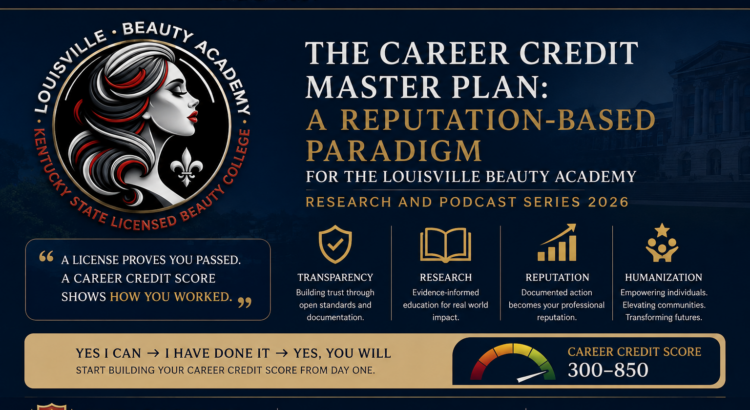
This article is part of LBA’s public education and historical archive. Older posts, including “The Career Credit Master Plan: A Reputation-Based Paradigm for the Louisville Beauty Academy – RESEARCH AND PODCAST SERIES 2026,” may not reflect current tuition, schedules, incentives, forms, policies, testing vendors, clinic availability, or regulatory requirements.
Louisville Beauty Academy operates under a Gold-Standard Over-Compliance framework—meeting all licensing requirements while exceeding regulatory expectations through transparency, documentation, and proactive consumer protection.
Executive Summary
The vocational education sector is currently navigating a period of profound structural transformation, transitioning from a static credential-based model to a dynamic, reputation-based “proof-of-work” economy. For institutions like the Louisville Beauty Academy (LBA), the challenge lies in bridging the gap between traditional state-mandated licensure and the modern requirements of the digital creator economy. This master plan outlines an interdisciplinary framework for a “Career Credit Score” system—a comprehensive, over-compliant social media and professional progress system designed to begin on day one of enrollment and persist beyond graduation. By leveraging the behavioral psychology of public accountability and the economics of social signaling, this system formalizes the student’s daily learning journey as a measurable professional asset.1
The core objective is to position LBA as a national leader in ethical creator education, moving beyond the simple “acquisition of hours” toward the “accumulation of reputation.” The Career Credit Score (CCS) serves as an analogue to a financial credit score, where daily posts act as career deposits and professionalism serves as the ultimate measure of creditworthiness.4 This system provides students with a structured ladder of progression, moving from the “Zero Stage” of novice observation to the “Mastery Stage” of mentorship and public signalization.6 Crucially, the plan is designed with an “over-compliant” posture, ensuring that all student activities strictly adhere to the Kentucky Board of Cosmetology (KBC) statutes and Federal Trade Commission (FTC) endorsement guidelines.8
Through a sophisticated incentive model, students can earn significant tuition discounts based on their consistency, ethical conduct, and proof-of-learning, effectively lowering the financial barriers to high-quality vocational education while simultaneously increasing graduate employability.11 This plan does not merely teach beauty skills; it equips “Human Service Professionals” with the digital fluency and verifiable reputation needed to thrive in an era where trust is the primary currency of the beauty industry.13
Research and Psychological Foundations
The foundation of the LBA Career Credit system is built upon a synthesis of behavioral science, trust economics, and educational theory. Understanding why “learning in public” works requires an analysis of the psychological mechanisms that drive accountability and the economic signals that establish professional prestige.
Behavioral Psychology of Public Accountability
Research in public employee behavior and health interventions suggests that accountability is a multi-dimensional construct involving observability, evaluability, and answerability.1 When a student makes a “public announcement” of a goal—such as mastering a specific sectioning technique—the digital platform acts as a “commitment device”.2 These devices help individuals “lock themselves” into a behavior by creating a psychological penalty for deviation and a social reward for adherence.15
In the context of LBA, daily posting creates a “felt accountability.” While high-intensity monitoring can sometimes reduce intrinsic motivation, a system that emphasizes “accountability obligation”—the perceived duty to justify actions to a supportive audience—actually enhances work drive.1 This is particularly effective when students interpret the obligation as an opportunity to gain professional benefits rather than a coercive requirement. By documenting the “messy middle” of the learning process, students move from passive learners to active practitioners who are “answering” to their future professional selves and their burgeoning audience.
Habit Formation and Daily Proof-of-Work
The transition from a student mindset to a professional identity requires the formation of consistent habits. The “daily proof-of-work” theory posits that a live pulse of activity is a more reliable indicator of skill than a static portfolio.6 In technical fields like coding, a “contribution graph” showing daily commits is impossible to fake and serves as a verified record of problem-solving processes.6
For beauty professionals, this translates to documenting the micro-decisions of the craft. Research into sustainable skincare marketing suggests that “decision documentation”—filing 30 seconds of a consultation or explaining why a specific pH-balanced product was chosen—builds deeper trust than a polished, final image.16 Psychologically, this “raw” and “authentic” content resonates more with modern consumers who are skeptical of highly curated, AI-generated, or “too polished” feeds.17
Social Signaling and Trust Economics
In a labor market with “asymmetric information,” where employers cannot perfectly know a candidate’s skill level, they rely on signals. Traditional signaling theory, as explored by Bryan Caplan, suggests that much of the return on education is a return on the “shiny credential” rather than the skill itself.19 However, the Career Credit Score seeks to shift this dynamic toward “Skill Signaling,” which focuses on digital, transversal, and sector-specific competencies.20
Social trust is a “commodity” built through repeated interactions and the assessment of a truster’s competence and goodwill.21 A student who has documented 1,500 hours of professional growth 8 provides a “trust graph” that reduces the risk for a potential salon owner. This creates a “cyclical model” of social exchange where the student’s signaled reputation leads to better placement, which in turn reinforces the school’s brand equity.3
Psychological Concept
Mechanism
Application in LBA System
Commitment Device
Social penalty for failure 15
Daily posting “deposits” 2
Felt Accountability
Answerability to an audience 1
Weekly instructor reviews 24
Instrumental Learning
Reinforcing presumptions of trust 21
Documenting micro-decisions 16
Social Signaling
Reducing information asymmetry 3
Verifiable digital portfolios 6
Authenticity Bias
Preference for unfiltered growth 18
“Zero Stage” confessions 18
The Career Credit Framework
The “Career Credit Score” is a formalized, numerical representation of a student’s professional standing, calculated using an algorithm that weights consistency, proof-of-work, professionalism, and ethical compliance. Unlike social media “clout,” which is often ephemeral and based on popularity, Career Credit is a measure of “professional creditworthiness”.25
Defining the Algorithm
The LBA Career Credit Score (CCS) is modeled on a 300–850 scale, mirroring the FICO model used in financial sectors. The score is calculated using four primary components, each weighted to reflect its importance to a future employer and regulatory compliance.
Consistency (Weight: 35%): This is the equivalent of “payment history.” It measures the frequency of professional posts or “career deposits.” A missed day of documentation is recorded as a “late payment,” while sustained streaks build the score significantly.2
Proof-of-Skill (Weight: 25%): This represents “credit history.” It is the documented evidence of the student’s progression through the subject areas defined in 201 KAR 12:082, such as infection control, anatomy, and chemical services.7
Professional Conduct (Weight: 20%): This measures “credit mix.” It assesses the student’s poise, communication skills, and adherence to the LBA “Humanization of Education” philosophy.13
Regulatory Integrity (Weight: 20%): This is the “creditworthiness” factor. It tracks zero-violation streaks regarding KBC statutes and FTC disclosure guidelines.10
Career Deposits and Missed Payments
A student’s CCS is updated weekly. A “Career Deposit” is defined as a high-quality, educational, or progress-based post that includes the required LBA disclaimers.
Positive Impact: A “Career Deposit” adds +5 points to the weekly score.
Neutral Impact: Reposting industry news with a professional insight adds +2 points.
Negative Impact: A “Missed Payment” (failing to post for 48 hours without a prior “digital reset” request) subtracts -10 points.
Severe Impact: A compliance violation (e.g., performing a chemical service on a live person before 250 hours 23) results in a “Reputation Default,” resetting the score to 300 and triggering a formal review.29
Reputation Score Benchmarking
To provide context, LBA compares student scores against industry averages and “best-in-class” alumni. This benchmarking fosters continuous improvement and provides a clear signal to employers about where a student stands in their professional development.25
CCS Range
Professional Status
Market Implications
750 – 850
Elite Professional
High placement leverage; eligible for alumni mentorship roles.
650 – 749
Reliable Practitioner
Standard employment readiness; consistent work history.
550 – 649
Developing Talent
Emerging skills; needs focus on consistency and compliance.
300 – 549
High Risk / Probation
History of inconsistency or ethical breaches; requires remediation.
Student Learning Progression Model
The Career Credit system utilizes a five-stage ladder of progression. This model ensures that students do not feel pressured to “fake it” but instead find power in their evolution from a novice to a master. Each stage specifies what to post, the psychological reasoning behind it, and the compliance guardrails necessary to protect the student and the academy.
Stage 1: The Zero Stage (The Foundation)
Focus: Identity reset and the commitment to learn. This occurs during the first two weeks of enrollment.
What students post: A “Social Media Reset” announcement; an unboxing of their professional student kit; a video discussing their “Why” and their decision to join LBA.8
Why it works: It establishes a “vulnerability hook.” By admitting they are starting at zero, they build an empathetic connection with their audience, who will then feel invested in their growth.16
Compliance: Posts must clearly state: “Student at Louisville Beauty Academy. Not licensed to perform services for hire.”
Caption Prototype: “Day 1 at LBA! Today I’m resetting this page to document my journey from student to professional. I’m starting with the basics—Infection Control. Safety first! #LBAStudent #BeautyJourney”
Stage 2: The Awareness Stage (The Science)
Focus: Vocabulary, theory, and the “Invisible Skills.” This aligns with the first 100–150 hours of instruction.23
What students post: Videos of themselves studying anatomy and physiology; “Did you know?” posts about the chemistry of hair color; time-lapses of workstation sanitation.8
Why it works: It builds authority. By focusing on the science rather than the art, the student signals that they are a serious, knowledge-based professional.8
Compliance: No mentions of performing services on people. Focus remains on “Scientific Lectures” per 201 KAR 12:082.23
Caption Prototype: “Studying the skeletal system today. Understanding the structure of the head and neck is vital for a proper consultation. Science is the backbone of beauty! #AnatomyClass #LBA”
Stage 3: The Practice Stage (The Proof-of-Work)
Focus: Hands-on repetition on mannequins. This is the “Messy Middle” of the program.
What students post: “Mistakes I made today” videos; time-lapses of winding perms or applying color to a mannequin head; “Practice makes progress” reels.6
Why it works: It demonstrates grit and technical skill development. Seeing the student struggle and then succeed creates a powerful narrative of competence.6
Compliance: Must explicitly state that work is being done on a mannequin.
Caption Prototype: “My fifth time winding a perm rod today. Still working on my tension, but the sectioning is getting cleaner! Repetition is key to mastery. #MannequinPractice #ProofOfWork”
Stage 4: The Competency Stage (The Clinic Floor)
Focus: Supervised services on live models. This begins after 250 hours (for Cosmetology) or other program-specific milestones.23
What students post: Before-and-after transformations; client consultations (with permission); documenting the consultation “decision-making” process.7
Why it works: Social proof. It shows that real people trust the student and that the student can deliver results in a professional clinic environment.24
Compliance: Must state that services were performed under instructor supervision at LBA.24
Caption Prototype: “Today’s transformation! We chose a level 7 ash to neutralize warmth, keeping the hair’s integrity first. All services performed under supervision at LBA! #ClinicFloor #HairTransformation”
Stage 5: The Mastery Signal Stage (The Educator)
Focus: Teaching, explaining, and mentoring others. This begins in the final phase of the program and continues as an alumnus.
What students post: Tutorials explaining a technique to junior students; reviews of industry trends; reflections on the “Humanization of Education”.13
Why it works: The “Protégé Effect.” Teaching a concept is the highest signal of mastery. It positions the graduate as an industry leader, not just a practitioner.1
Compliance: Use of the “Alumni” tag and verification of licensure.8
Caption Prototype: “Explaining the logic of color theory to our new class at LBA. To master the art, you have to mentor the next generation. #BeautyEducator #LBAAlumni”
Step-by-Step LBA Implementation Plan
Operationalizing the Career Credit system requires a disciplined, multi-phase rollout that integrates with LBA’s existing curriculum and administrative protocols.
Phase 1: Orientation and the Social Media Reset
During the first week, students undergo a “Digital Brand Audit.” This is a mandatory component of their “Professional Image” curriculum.23
Account Audit: Students must review their public profiles and archive content that is inconsistent with a “Human Service Professional” identity. This includes content depicting unprofessional behavior or non-compliance with health standards.18
Platform Setup: Students are required to have professional profiles on Instagram and TikTok. LinkedIn is highly recommended for B2B networking and employer visibility.13
The Disclaimer Protocol: Every bio must include: “Professional Student at @LouisvilleBeautyAcademy | Future | Not for hire until licensed.”
Privacy/Security Workshop: Education on protecting personal data and handling “online drama” or cyberbullying.35
Phase 2: Daily Career Deposits
LBA implements a “Daily Documentation” rule. Students are given 15 minutes at the end of each theory or clinic session to capture content.8
Frequency: Minimum of 3 professional posts per week.
Approved Formats: Short-form video (Reels/TikTok) for skills; Carousel posts for “Decision Documentation”; Stories for daily “Aha!” moments.16
The “Human Review” Protocol: Instructors do not grade based on “likes” but on a rubric of professionalism, sanitation, and educational accuracy.24
Phase 3: Ethical AI Integration
LBA adopts a “Max AI” policy for administrative and creative support but maintains strict ethical boundaries for clinical representations.13
Authorized Use: Using Generative AI for caption brainstorming, keyword research, and video script outlines.38
The 65% Rule: At least 65% of any written caption must be human-authored to ensure authenticity and “Humanization”.38
Prohibited AI: No AI-generated or “filtered” images of hair or skin results. This is a deceptive statement and a violation of KBC photo standards.14
Disclosure: Any AI-assisted content must include the tag #AIApprentice or a similar disclaimer.40
Phase 4: Instructor and Administrative Audit
LBA establishes a “Reputation Bureau” to manage the Career Credit Scores.
Weekly Score Update: The CCS is recalculated every Sunday based on the week’s deposits and classroom conduct.
Monthly Compliance Audit: A deep-dive review of student accounts to ensure FTC disclaimers and KBC rules are followed.28
Score Grievance Procedure: Students can appeal a score deduction through the official LBA written grievance process.8
Incentive and Discount Model
To drive adoption and ensure high-quality participation, LBA links the Career Credit Score to a fair and transparent tuition discount model. This transforms “tuition” from a fixed cost into a performance-based investment.
The Career Credit Discount Rubric
Students are eligible for “Merit Scholarships” and “Performance-Based Incentives” that can reduce the total program cost significantly.11 These are not “tuition reductions” but optional, merit-based discounts.11
Performance Category
Metric
Score Requirement
Discount/Perk
Consistency King
100% posting rate for 90 days
CCS > 700
$500 Tuition Credit
Compliance Hero
Zero compliance flags for 180 days
CCS > 750
$1,000 Scholarship
Technical Master
Verified Stage 4 Documentation
Instructor Approval
$1,500 Skill Credit
Alumni Leader
Continued Stage 5 posting
Post-Graduation
Free Alumni Tutoring 8
Anti-Gaming and Safeguards
LBA employs a “Checks and Balances” system to protect the integrity of the discounts.13
Attendance Synchronization: Discounts are only applied if a student maintains the required attendance hours (30–40 hours for Full-Time).11
Plagiarism Penalty: Using another student’s work as one’s own results in the permanent loss of all social-media-based incentives.11
Financial Good Standing: Hours are only certified and discounts applied if the student’s account is current.11
Tax Compliance: All tuition reductions are structured to comply with IRS Section 117(d) regarding qualified tuition reductions for educational institutions.43
Auditability for Regulators
LBA maintains digital records of all student posts, instructor reviews, and score calculations for a minimum of five years.8 This ensures that the institution can defend its incentive model to state and federal regulators as a legitimate “educational performance” metric rather than “marketing compensation.”
Compliance and Risk Management
A gold-standard system must be “over-compliant.” This section outlines the non-negotiable boundaries that protect LBA, its students, and the public.
Kentucky Board of Cosmetology (KBC) Adherence
Kentucky law is strict regarding unlicensed practice.10 LBA’s system manages this through:
The “No-Pay” Rule: Students are explicitly forbidden from accepting consideration (money or gifts) for services performed outside of the LBA clinic floor.10
Mobile Prohibitions: While Kentucky allows mobile barber shops, mobile cosmetology is strictly limited. Students must not document or perform services in “home salons” or non-licensed facilities.32
Sanitation Documentation: Every video documenting a service must show visible sanitation steps (e.g., sanitizing hands, disinfecting tools) to reinforce “Lifelong Professional Ethics”.8
FTC Endorsement and Social Media Law
The FTC’s 2024–2025 updates require “clear, conspicuous, and unavoidable” disclosures.9
Disclosure Placement: Disclosures must be verbal AND written on the screen for video content. Simply putting #ad or #LBA in the caption is insufficient for Reels and TikTok.28
Honest Opinions: Students must only give honest reviews of products they have actually used.9
Material Connections: Because students receive tuition discounts for their posts, they must disclose this “material relationship” in every progress-related post.42
Privacy and Consumer Protection
Client Consent: No client images or videos may be posted without a signed LBA model release form.7
Data Protection: Students are trained to never post sensitive institutional data or personal information about staff and peers.11
Cyber-Safety: LBA provides tools and training for students to manage privacy risks associated with a public-facing digital career.37
Brand and Market Positioning
The implementation of the Career Credit system differentiates Louisville Beauty Academy from all other regional and national competitors. It rebrands the school from a “training facility” to a “professional reputation engine.”
Positioning LBA as a “Future-Ready” Institution
LBA’s brand is built on “Transparency and Genuine Care”.47 By teaching students to build verified proof-of-work, LBA addresses the primary concern of modern beauty employers: “Can this person actually do the work, and will they show up?”.3
Messaging Pillars:
The Proof-of-Work School: We don’t just teach; we document excellence.
Career Credit, Not Just Hours: Your reputation starts on day one.
Humanization through Technology: We use AI to make you more human, not less.
Lower-Debt Dignity: Earn your way to a professional future without the burden of federal loans.12
Reassuring Regulators and Parents
LBA positions itself as the “Public Library” of beauty education—an open, accessible, and highly regulated environment where knowledge is democratized.13
To Parents: LBA offers a “Safe, Legal, and Affordable” path to a high-demand career, where their child’s professional reputation is built under expert supervision.13
To Regulators: LBA provides a model for “Over-Compliance,” showing how social media can be used to increase adherence to sanitation and ethics rather than bypass them.8
The Alumni Brand Flywheel
The Career Credit Score does not end at graduation. LBA invites alumni to maintain their scores through continued mentorship and participation in the “2026 Magazine and Podcast Series”.13 This creates a long-term network of successful, digitally fluent professionals who serve as living proof of the LBA model.
Long-Term Impact and Metrics
The success of this system will be measured through a combination of traditional educational metrics and new reputation-based indicators.
Measurable Outcomes
Retention Rate: Students with high Career Credit Scores are expected to have a 25% higher completion rate due to the psychological “locking” effect of public commitment.2
Job Placement Leverage: LBA graduates will enter interviews not with a resume, but with a “Reputation Portfolio” showing 1,500 hours of growth.13
Audience Trust Score: A monthly sentiment analysis of student accounts to ensure that engagement is professional and educational.
Licensing Success: Continued 100% alignment with PSI and KBC requirements, with students demonstrating higher confidence during the practical exam.8
The Vision for “Di Tran University”
The Career Credit system is the first step toward the broader “Humanization of Vocational Education”.13 By integrating these digital and psychological frameworks, LBA evolves into a “Human Service Professional” academy, where the beauty license is merely the legal foundation for a career built on trust, ethics, and verified excellence.
Metrics & Success Measurement
To ensure the master plan achieves its intended impact, LBA will track the following metrics:
Metric
Goal
Tracking Mechanism
Average Graduate CCS
> 725
Quarterly reputation audits
Employer Satisfaction
95% Positive
Post-placement surveys focusing on “Soft Skills”
Student Debt Ratio
< 10% of Income
Analysis of net tuition vs. entry-level salary 50
Social Media Reach
100K+ Monthly (Aggregated)
Platform analytics across the student body
Compliance Flag Rate
< 1%
Weekly internal reputation bureau reviews
Conclusions
The Louisville Beauty Academy Career Credit system represents the gold standard for 21st-century vocational training. By acknowledging that a student’s “reputation” begins long before they receive a physical license, LBA equips its graduates with the ultimate competitive advantage: a verifiable history of hard work, ethical behavior, and professional growth. This system reduces student risk, elevates the entire beauty industry, and provides a defensible, innovative model for the future of professional education. Through the careful integration of behavioral psychology, trust economics, and rigorous compliance, LBA does more than teach beauty—it builds the future of professional trust.
Deep Reputation Scoring in DeFi: zScore-Based Wallet Ranking from Liquidity and Trading Signals – arXiv, accessed February 1, 2026, https://arxiv.org/html/2507.20494
Guidelines for Appropriate Use of AI Generated Media – Division of Strategic Communications | The University of Alabama, accessed February 1, 2026, https://stratcomm.ua.edu/ai-guidelines/
This article is part of LBA’s public education and historical archive. Older posts, including “DAILY INTELLIGENCE SCAN: VOCATIONAL EDUCATION, BEAUTY EDUCATION & PROFESSIONAL BEAUTY INDUSTRY – February 1, 2026 | Louisville Beauty Academy,” may not reflect current tuition, schedules, incentives, forms, policies, testing vendors, clinic availability, or regulatory requirements.
AHEAD Earnings Accountability Rule Consensus (January 10, 2026): The Department of Education’s Accountability in Higher Education and Access through Demand-driven Workforce Pell committee reached consensus on a unified earnings test applicable to ALL postsecondary programs (undergraduate and graduate) for the first time. Programs whose graduates earn below high school diploma levels will lose federal Title IV eligibility beginning July 1, 2026. Beauty schools are recognized as disproportionately vulnerable to these metrics due to tipping culture and non-traditional earnings structures. The American Association of Cosmetology Schools (AACS) has retained former U.S. Solicitor General Paul Clement to appeal this decision in the Fifth Circuit.whiteboardadvisors+2
Kentucky HB 120 Introduced (January 14, 2026): The Kentucky legislature introduced House Bill 120, which would regulate mobile beauty salons as licensed “facilities” under KRS 317A, requiring the Kentucky Board of Cosmetology to establish operational and inspection standards. This represents a significant regulatory expansion affecting salon operational flexibility and represents a material compliance change for multi-location operations.[ed]
Biennial License Renewal Cycle Confirmed (July 2026 Implementation): The Kentucky Board of Cosmetology’s shift from annual to biennial renewal becomes effective July 31, 2026. While the annual fee remains $50, professionals will pay $100 upfront every two years, creating a cash-flow impact for dual-license holders and employer-sponsored compliance budgets.onthelaborfront+1
Federal Apprenticeship Investment Surge: The Department of Labor announced $145 million in pay-for-performance apprenticeship funding (January 2026) with application deadline March 20, 2026, and $98 million in YouthBuild pre-apprenticeship expansion targeting ages 16–24. These initiatives explicitly prioritize registered apprenticeships as pathways competitive with traditional beauty school enrollment.govinfo+1
Unlicensed Practice Enforcement Escalation (Multi-State Pattern): New York completed statewide med spa investigations with 87 violations and emergency license revocations (January 2026). Kentucky’s SB 22 (enacted June 2025) now classifies knowing employment of unlicensed individuals as creating an “immediate and present danger to the public”—triggering strict liability for salon operators without warning period opportunity.lcwlegal+1
Why This Matters to Each Stakeholder
Students: Federal earnings accountability rules now directly affect program viability and loan eligibility. Schools failing the unified earnings test face enrollment freezes and mandatory warnings. Beauty students face heightened scrutiny due to non-traditional income (tips, commission, self-employment).
Licensed Professionals: Kentucky’s biennial renewal creates a one-time $100 upfront payment (vs. annual $50). Dual-license holders face up to $200. Employers must now implement strict verification protocols for unlicensed workers or face immediate disciplinary action from the KBC without warning opportunity.
Schools: The proposed earnings accountability rule creates a July 1, 2026 effective date—forcing immediate debt-to-earnings analysis and potential curriculum or delivery model changes. Mobile salon regulation adds compliance burden and location-based licensing costs. The market now favors schools demonstrating low-cost, employment-aligned delivery (apprenticeships, hybrid models).
Regulators: KBC faces new expectations under HB 120 to manage mobile salons, while federal guidance emphasizes unlicensed practice enforcement. The biennial renewal creates administrative efficiency but requires updated portal systems and communication protocols to prevent missed renewals.
Status: Consensus Reached January 10, 2026 | Effective July 1, 2026 | Proposed Rule Expected Early 2026
The Department of Education’s AHEAD negotiated rulemaking committee reached consensus on a single earnings test for all postsecondary programs under the One Big Beautiful Bill Act (P.L. 119-21). This marks the first time a unified accountability standard applies across undergraduate, graduate, and career programs.[dir.ca]
Key Metrics:
Undergraduate program graduates must earn at least as much as high school diploma holders
Graduate program graduates must earn at least as much as bachelor’s degree holders
Programs failing these benchmarks for two consecutive years lose federal Title IV loan eligibility
Programs failing for three consecutive years lose Pell Grant and campus-based aid eligibility
Data collection and reporting requirements begin immediately[globalfas]
Impact on Beauty Education: Industry experts and AACS have flagged beauty, barber, and wellness education as sectors most vulnerable to this framework. Earnings data for cosmetologists, estheticians, and nail technicians often reflect:
Tip-based income (not always reported consistently)
Commission structures (variable income timing)
Self-employment and independent contractor arrangements
Geographic wage variation (salon vs. mobile vs. booth rental models)
These characteristics create documentation and verification challenges under a federal earnings test designed for traditional W-2 employment.[federalregister]
Legal Challenge: AACS, in coordination with other beauty school associations, has retained former U.S. Solicitor General Paul Clement and the law firm Clement & Murphy to file an appeal of an October 2025 federal court decision upholding the Gainful Employment Rule. The Fifth Circuit appeal brief is being prepared for filing in early 2026.[constructionowners]
Distance Education & Return to Title IV (R2T4) Final Rules
Status: Final Rules Published January 2025 | Early Implementation Available February 3, 2025 | Full Implementation July 1, 2026
The Department of Education finalized regulatory amendments to 34 CFR 668.22 (Return to Title IV) and distance education reporting requirements, effective July 1, 2026, with voluntary early implementation available as of February 3, 2025.[acenet]
Key Provisions Effective Immediately (Available for Early Implementation):
Withdrawal Exemption: Institutions may exempt students from R2T4 calculations if they (1) treat the student as never having attended, (2) return all Title IV funds, (3) refund all institutional charges, and (4) cancel any outstanding balance. This exemption is optional and must be documented in institutional policy.
Leave of Absence (Prison Education Programs): Incarcerated students in term-based programs may return to any coursework (not necessarily the same coursework) after a leave of absence.
Full Implementation July 1, 2026:
Attendance taking requirements for clock-hour programs now must use “scheduled hours in a payment period” only (elimination of “cumulative method”)
Distance education attendance tracking procedures must be documented
New reporting requirements for distance education student enrollment
Impact on Beauty Education: The withdrawal exemption benefits schools serving non-traditional, working adult students (LBA’s primary demographic) by providing flexibility for students who must leave unexpectedly. Clock-hour tracking changes affect compliance documentation but do not materially alter curriculum requirements.[louisvillebeautyacademy]
Status: Funding Opportunities Open | Application Deadlines: March 20, 2026 (DOL) | Effective Immediately
The Department of Labor announced two major workforce development initiatives in January 2026:
$145 Million Pay-for-Performance Apprenticeship Initiative
Forecast notice published January 6, 2026 | Application period: January 29 – March 20, 2026
Up to five cooperative agreements for four-year performance periods
Focus: Expansion of newly developed Registered Apprenticeships + growth of existing programs
Industries prioritized: Skilled trades, advanced manufacturing, healthcare, information technology, and emerging sectors (AI, maritime, nuclear)
Model: Performance-based funding rewards outcomes (apprentice completions, job placement, wage benchmarks) rather than upfront program grants[apps.legislature.ky]
$98 Million YouthBuild Pre-Apprenticeship Expansion
Targeting youth ages 16–24 disconnected from labor force
~57 individual grants ranging $1–2 million each
First-Time Federal Requirement: Grantees must establish measurable targets for YouthBuild participants entering Registered Apprenticeships within one year of program completion
Focus: Creating direct pipeline from pre-apprenticeship training to DOL-registered apprenticeships[youtube]
Implication for Beauty Education: These initiatives position apprenticeships as a federally-preferred pathway competitive with traditional beauty school enrollment. DOL’s emphasis on “measurable outcomes” and “performance-based” funding creates incentive structures favoring employers and training providers who can demonstrate employment metrics. This contrasts with school-based models that depend on student tuition funding. Kentucky-licensed beauty schools offering Registered Apprenticeship programs (such as LBA) now compete for both student tuition and federal apprenticeship grants.[youtube]
Accreditation Innovation & Modernization (AIM) Committee – New Negotiated Rulemaking
Status: Committee Formally Launched January 2026 | Sessions Scheduled April–May 2026 | Final Rule Expected Mid-2026
The Department of Education announced the Accreditation, Innovation, and Modernization (AIM) negotiated rulemaking committee to address accreditor standards, criteria for recognition, and institutional eligibility regulations under Title IV.[louisvillebeautyacademy]
Scope of Negotiations (17 Topics):
Revising criteria for Secretary’s recognition of accrediting agencies (emphasis on student outcomes + educational quality vs. “credential inflation”)
Removing accreditation standards deemed “anti-competitive” or “discriminatory”
Standards requiring all accreditors to evaluate program-level student achievement and outcomes without reference to race, ethnicity, or sex
New learning models and innovative program delivery (ensuring accreditors do not impede innovation)
Faculty requirements with emphasis on “intellectual diversity” and academic freedom
Transfer-of-credit policies to prevent unnecessary course repetition and excessive student debt
Separation between accrediting agencies and related trade associations (addressing conflicts of interest)
Public comment period expected after proposed rule publication
Implications for Beauty Education: If the AIM committee addresses “new learning models,” this could create regulatory support for hybrid, apprenticeship-integrated, or competency-based beauty education programs. However, if standards emphasize faculty credentials and academic research, traditional beauty schools (which employ practitioners rather than researchers) may face accreditation challenges.[apps.legislature.ky]
CRITICAL: HB 120 – Mobile Salon Regulation Initiative (2026 Legislative Session)
Status: Introduced January 14, 2026 | Proposed Amendment to KRS 317A | Committee Assignment Pending
House Bill 120 proposes significant regulatory expansion of beauty salon definitions and licensing requirements:
Statutory Changes Proposed:
Amend KRS 317A.010 to authorize “fixed or mobile beauty salons, esthetic salons, nail salons, and limited beauty salons”
Amend KRS 317A.020 and KRS 317A.145 to classify any type of mobile salon as a regulated “facility” and “premises”
Amend KRS 317A.060 to require the Kentucky Board of Cosmetology to establish standards for mobile and fixed salons and define inspection schedules
Mandate that administrative regulations “balance licensee and public interests”[reddit]
Compliance Implications:
Mobile salons (currently operating under temporary event permits) will transition to permanent facility licensing
New inspection protocols and compliance burden for owner-operators
Sanitization, equipment, and record-keeping standards will be KBC-defined (not statutory)
Potential fee structure changes to support additional compliance oversight
Industry Context: Mobile salons have grown as flexible, low-overhead operational models, particularly post-pandemic. This regulation signals KBC’s intent to formalize mobile operations as regulated facilities rather than temporary exceptions, likely in response to unlicensed practice enforcement concerns and consumer protection demands.[legiscan]
Legislative Process: HB 120 is in early stage (introduced January 14). Regular Kentucky legislative session runs through April 15, 2026. Watch for committee assignment (likely to Licensing, Occupations & Administrative Regulations Committee based on subject matter).
Biennial License Renewal Cycle – Transition Period (July 2026)
Status: Implementation Date July 31, 2026 | Advance Notice Published January 9, 2026
The Kentucky Board of Cosmetology is transitioning from annual to biennial (two-year) license renewal effective July 31, 2026. Louisville Beauty Academy published comprehensive compliance guidance in early January.[apps.legislature.ky]
Financial Impact:
No fee increase: Annual fee remains $50 per year
Payment structure change: Professionals now pay $100 for two years (upfront) instead of $50 annually
Example: A dual-license holder (cosmetologist + esthetician) pays $200 every two years instead of $100 annually
Cash flow consideration: First biennial renewal (July 2026) creates a one-time doubled payment for many licensees
Renewal Deadlines & Process:
Current annual renewals expire July 31, 2026
Biennial licenses will expire July 31, 2028 (and subsequently every two years)
KBC portal-based renewal system requires updated contact information (email, address)
Photo compliance: Passport-style photos under 201 KAR 12:030 (no selfies, filters, or improper backgrounds)
KBC Rationale: Biennial renewal aligns Kentucky with national best practices, reduces administrative burden on the Board, and allows reallocation of resources toward enforcement, inspections, and new license processing.[kbc.ky]
SB 22 (2025) – Unlicensed Practice Liability (Enforcement Signal)
Status: Signed into Law March 24, 2025 | Effective June 26, 2025 | Active Enforcement Phase
Senate Bill 22 fundamentally changed Kentucky’s approach to unlicensed practice by introducing strict liability for salon operators and employers.[citizenportal]
Key Statutory Change (KRS 317A.020(8)(b)): “The Board may issue a penalty more severe than a warning notice if a licensee knowingly employs or utilizes an unlicensed nail technician.”
Regulatory Interpretation: This language creates “immediate and present danger to the public” classification, triggering automatic penalties without warning period opportunity. A salon operator cannot receive a correction notice and opportunity to cure; the violation is treated as per se dangerous.[kyrules.elaws]
Practical Impact:
Salon Liability: Employers are strictly liable for verifying licensure status of all service providers
No Due Diligence Defense: A salon cannot claim it was unaware of an employee’s expired or invalid license
Enforcement Pattern: LBA’s research indicates KBC is actively investigating unlicensed employment as a priority enforcement issue
Penalties: Fines ranging $50–$1,500 per violation under KRS 317A.990, with potential licensure suspension/revocation
Comparative Trend: New York’s January 2026 med spa investigations revealed 26% of violations involved unlicensed staff—suggesting a nationwide enforcement focus on unlicensed practice in beauty and wellness services.[kbc.ky]
201 KAR 12:082 – Education Requirements (Verified Current Status)
Regulation Status: Effective December 19, 2025 | Current & Enforceable
The Kentucky Administrative Regulation 201 KAR 12:082 establishes the curriculum and hour requirements for all Kentucky beauty education programs. Recent verification (December 2025) confirms no material changes to core requirements:[louisvillebeautyacademy]
Cosmetology Program:
Minimum 1,500 hours (clinical + theory)
Chemical services cannot begin until 250+ hours completed
40 hours on Kentucky statutes and administrative regulations (mandatory)
Esthetics Program:
Minimum 750 hours (clinical + theory)
100 lecture hours (science/theory)
25 hours on Kentucky statutes and administrative regulations
Instructor Training:
Apprentice instructors cannot teach outside school environment
Specialized training required for advanced techniques (e.g., dermaplaning per Section 21(12))
Significance: The regulation’s emphasis on statutory/regulatory literacy (25–40 hours) signals KBC’s commitment to producing licensed professionals with legal compliance knowledge—not just technical skills.[instagram]
Surrounding State Licensing Standards (Benchmark Analysis)
Kentucky beauty education operates within a regional framework where neighboring states have established comparative licensing requirements. Understanding these standards is critical for interstate credential recognition, reciprocity applications, and competitive positioning.
Biennial renewal cycle (aligns with KY 2026 shift)
Tennessee
1,500
10th grade (16+ age)
None
Limited pilot
Reciprocal licensing with KY by state-to-state endorsement
Illinois
1,500
High school diploma
14 hours/2 years
Under discussion
Highest CE requirement in region
Competitive Intelligence:
Apprenticeship Pathway Adoption: Indiana and other surrounding states are formalizing DOL-recognized apprenticeships as alternatives to school-based training. Kentucky’s LBA is positioned as an early mover in this model, offering both school and apprenticeship pathways.[businessresearchinsights]
Continuing Education Exemption: Kentucky remains unique in the region by not mandating continuing education for license renewal. This is a competitive advantage for schools targeting working professionals, but it may face future pressure if federal accountability metrics emphasize “lifelong learning.”
Interstate Reciprocity: Cosmetologists licensed in surrounding states can transfer to Kentucky if their training hours meet or exceed Kentucky’s requirements (typically 1,500 hours). However, SB 22’s strict unlicensed practice enforcement may create a “Kentucky advantage” by ensuring only legitimately licensed professionals operate in the state.[beautyschoolsdirectory]
Mobile Salon Regulation: Kentucky’s emerging HB 120 mobile salon regulation differs from Indiana and Ohio, which have less formalized mobile salon oversight. This could either (a) create burden for multi-state mobile operators, or (b) establish Kentucky as a model for regulated mobile salon operations.
Focus: Medical spas offering injections (Botox, fillers, IV therapy) without proper medical licensing[louisvillebeautyacademy]
Relevance to Kentucky: While Kentucky does not have the “med spa” phenomenon at New York scale, the enforcement pattern suggests KBC will intensify unlicensed practice investigations in salons offering advanced services (chemical treatments, specialized techniques). SB 22’s strict liability provision directly aligns with this enforcement trend.[researchandmarkets]
E. INDUSTRY & COMPETITOR MOVES
Market Growth & Enrollment Trends
The beauty education market continues to expand despite economic headwinds and regulatory uncertainty:
29% of beauty schools facing instructor scarcity (North America specific)[businessresearchinsights]
Average student-to-instructor ratio increased 35% due to staffing constraints[businessresearchinsights]
Implication: While overall market growth is positive, schools must differentiate on operational efficiency (LBA’s advantage through low-overhead delivery) and instructor quality (area of competitive vulnerability industry-wide).
Alternative Credentialing & Apprenticeship Models (Competitive Threat & Opportunity)
Registered Apprenticeships as Direct Competitor:
22 states now offer cosmetology apprenticeships as school alternatives[newsfromthestates]
Kentucky model: Louisville Beauty Academy listed as approved apprenticeship provider alongside traditional school enrollment[entouragebeautyne]
Threat Assessment: Federal apprenticeship funding ($145M + $98M) creates direct competition for student recruitment. Apprentices earn wages during training, reducing financial barrier compared to school tuition.
Opportunity Assessment: Schools offering dual pathways (school-based + apprenticeship) can capture both tuition revenue and apprenticeship grant funding. LBA’s positioning as both school and apprenticeship provider is a strategic advantage.[naba4u]
Industry research by the New American Business Association (NABA) — an educational and community-research affiliate founded by Di Tran, who also serves as founder and CEO of Louisville Beauty Academy — reveals structural cost inefficiency in traditional beauty school models:
Cost Breakdown Analysis (Sample Program):
Direct Education: 55% of tuition
Compliance Overhead: 25–35% of tuition (federal aid administration, regulatory documentation, audits)
Marketing/Recruitment: 10–15% of tuition (“Glamour Tax” – digital presence, social media, lead generation)
Result: Student debt burden often exceeds early-career earning potential[ascpskincare]
FAFSA Transparency Warning: New federal “Financial Value Transparency” requirements (2023 Gainful Employment Rule) now require schools to display debt-to-earnings ratios prominently. Schools with graduates earning below high school diploma levels receive enrollment restrictions and mandatory student warnings.
LBA Competitive Advantage: By “decoupling” from FAFSA dependency, LBA reports ability to offer cosmetology programs at $6,200—roughly 60–70% below traditional school pricing. This model reduces student debt while maintaining program quality.[linkedin]
Strategic Implication: Tuition transparency becomes a critical marketing and compliance asset. Schools that can demonstrate low-cost, high-earnings pathways will attract enrollment while avoiding AHEAD earnings accountability penalties.
Accreditation Landscape & Quality Assurance
Primary Accreditors for Beauty Education:
NACCAS (National Accrediting Commission of Career Arts & Sciences) – Largest body, ~1,300 accredited institutions
ACCSC (Accrediting Commission of Career Schools and Colleges) – ~800 schools
Council on Occupational Education (COE) – Smaller footprint
Accreditation vs. State Licensure:
State licensure is mandatory; accreditation is not
However, accreditation enables federal Title IV financial aid participation
Emerging Pressure: The AIM negotiated rulemaking committee (launching April 2026) will revisit accreditor standards. If new rules emphasize “student outcomes” and “earnings data,” accreditors may increase documentation burden on beauty schools. Conversely, if rules support “innovative program delivery,” apprenticeships and hybrid models could gain accreditor support.
F. ACTIONABLE TO-DO LIST FOR LBA (IMMEDIATE & STRATEGIC)
1. COMPLIANCE & OPERATIONS (This Week)
Documentation & Archive:
Verify biennial renewal readiness (July 2026 deadline): Audit all staff/graduate licensees for portal registration, current email addresses, and photo compliance under 201 KAR 12:030. Create internal tracking system for renewal reminders (June 2026 trigger).kbc.ky+1
Document SB 22 compliance (unlicensed practice liability): Audit salon partners and apprenticeship sponsors for employee licensure verification systems. Create written protocols for license status checking (e.g., monthly KBC portal verification). Ensure contracts with salon partners include explicit unlicensed-practice indemnification clauses.
HB 120 monitoring: Assign staff to track HB 120 progress through committee assignments and hearings. If passed, anticipate KBC rulemaking on mobile salon standards by Q3 2026. Prepare contingency compliance budget for potential mobile salon licensing fees.
Earnings Accountability Preparation:
Conduct debt-to-earnings analysis (AHEAD Rule Implementation – July 2026): Collect graduate employment and wage data for past 2–3 years. Calculate median program graduate earnings vs. high school diploma benchmark. If earnings fall below threshold, prepare to implement:
Curriculum modifications emphasizing employer-valued skills (business acumen, upselling, salon management)
Delivery model adjustments (apprenticeship pathways may show higher early earnings than school-only models)
Create Financial Value Transparency summary: Prepare student-facing document showing program cost vs. projected earnings, loan repayment scenarios, and alternative pathways (apprenticeships, hybrid). Compliance deadline: Before June 2026 (Federal proposed rule publication expected)
Accreditation Positioning:
Monitor AIM Committee (April–May 2026 sessions): Subscribe to negotiated rulemaking updates. If AIM rules support “innovative delivery” or “apprenticeship integration,” prepare accreditation narrative highlighting LBA’s dual-pathway model.
2. STUDENT & LICENSEE EDUCATION (Ongoing)
FAQ & Content Development:
“What is the biennial renewal and why does it matter?” – Create short video (2–3 min) explaining July 2026 transition, payment amounts, renewal deadline, and photo requirements. Distribute via email (alumni), social media (LinkedIn, Instagram), and on-site (poster in campus).
“SB 22 Compliance for Salon Owners” – Develop 1-page infographic: “Unlicensed Practice is NOW a Strict Liability Issue – How to Verify Your Team’s Licensure.” Include KBC portal screenshot, verification checklist, and penalties summary.
“The Earnings Rule is Coming: How LBA Prepares You” – Educational content explaining federal earnings accountability, what it means for program choice, and how LBA’s outcomes support graduate success.
“Mobile Salons & HB 120” – If HB 120 advances, create guidance for salon partners operating mobile units: regulatory timeline, expected licensing/inspection requirements, and strategic planning.
Downloadable Resources (Lead magnets for website):
“2026 Compliance Calendar for Kentucky Beauty Professionals” (PDF)
Monthly checklist, renewal deadline, CE updates, regulatory changes
CTA: “Sign up for monthly compliance email”
“Beauty School ROI Calculator” (Interactive web tool or downloadable Excel)
Input: Program cost, expected hours to employment, estimated income
Output: Break-even timeline, loan repayment scenarios, earnings premium vs. high school
CTA: “Calculate your beauty education ROI—and see how LBA compares”
“KRS 317A & 201 KAR 12 Regulatory Summary” (PDF guide)
Plain-English explanation of all licensure, education, and enforcement requirements
For: Students, graduates, salon owners, aspiring salon operators
CTA: “Master Kentucky beauty law—free guide”
Podcast/Short-Form Video Series (YouTube Shorts, TikTok, Spotify):
“Compliance Minute” (60-second weekly video):
Topic: One regulatory update, compliance requirement, or best practice
Example episodes: “What is a deficiency notice?”, “How to verify someone’s license”, “Mobile salon rules explained”
“Ask the Compliance Expert” (Interview format):
Host: LBA compliance officer or KBC liaison
Format: Q&A on student questions (earnings, licensing, job placement)
Frequency: Monthly (distribute across YouTube, LinkedIn, podcast platforms)
G. EXCERPTS & QUOTABLE REFERENCES
Federal Register – Negotiated Rulemaking on Accreditation (January 27, 2026)
“The Department intends to revise regulations to ensure that accreditors’ standards comply with all federal civil rights laws and prohibit standards or policies that require or facilitate discrimination on the basis of immutable characteristics, such as race-based scholarships. The Department will ensure that accrediting agencies and institutions do not mislead students or the public with misrepresentative labels.”
Interpretation: This language creates immediate and present danger classification, triggering automatic penalties without warning period opportunity for unlicensed employment violations.
Kentucky Board of Cosmetology – License Renewal Verification (December 2025)
“Upon completing your license renewal, verify the expiration date 7/31/2026 is listed on your license(s). Your application will travel through the portal to our lockbox, after confirming how you answered the questions in the application your account will be approved for a 7/31/2026 expiration date or it will receive a HOLD. Holds must be manually reviewed by our team. Your status change notice will be sufficient as proof of licensing for 60 days.”
U.S. Department of Education – AHEAD Committee Framework (January 2026)
“Negotiators reached consensus on a new framework that includes a single earnings test for all postsecondary programs and new standards that could remove access to federal student aid for failing programs.”
Implication for Beauty Education: This is the first time federal accountability applies uniformly across undergraduate, graduate, and career programs. Beauty schools are explicitly identified as vulnerable due to non-traditional earnings structures (tips, commission).
Department of Labor – Apprenticeship Expansion (January 2026)
“The U.S. Department of Labor (DOL) recently released a forecast notice announcing the upcoming availability of $145 million in funding to support a pay-for-performance incentive payments program aimed at expanding the national apprenticeship system. The anticipated post date for the grant application is Jan 29, 2026, and the estimated application due date is March 20, 2026.”
H. STRATEGIC INSIGHT: POSITIONING LBA AS FOREVER CENTER OF EXCELLENCE
What LBA Should Do Differently or Better Than Competitors
1. Regulatory Literacy as Curriculum Foundation (Not Compliance Overhead)
Most beauty schools treat regulatory education as a checkbox—40 hours mandated by 201 KAR 12:082, delivered via lecture or online module. LBA should invert this model: regulatory literacy becomes the organizing principle of every program.
Why This Matters Now:
Federal accountability (AHEAD Rule, July 2026) creates employment outcome pressure
Kentucky enforcement (SB 22, HB 120) raising regulatory risk for salons and graduates
Students entering workforce with marginal regulatory knowledge are liability vectors for salon employers
Competitive Differentiation:
Publish a public “Kentucky Beauty Law Literacy Curriculum” showing how regulatory education is embedded across all program hours (not siloed into 40 hours)
Offer free regulatory literacy bootcamp (2–3 hours) to salon owners, managers, and LBA alumni—positioning LBA as trusted regulatory educator
Create audit partnership with local salons: “Regulatory Health Check” service ensuring compliance with SB 22 (unlicensed practice), HB 120 (if passed), and KBC standards
Result: LBA becomes known as “the school that produces graduates who won’t create compliance risk for your salon”—a powerful employer recruitment advantage.
2. Earnings Accountability as Recruitment Asset (Not Vulnerability)
AHEAD Rule (effective July 2026) will penalize schools whose graduates earn below high school diploma levels. Most schools will react defensively. LBA should go on offense:
Median graduate earnings (6 months, 1 year, 3 years post-graduation)
Earnings breakdown by career path (salon employee, salon owner, mobile stylist, hybrid entrepreneurship)
Debt-to-income ratio compared to high school diploma benchmark
Earnings premium data (what do LBA graduates earn vs. non-beauty-school competitors?)
Transparency Advantage: Become the only Kentucky beauty school voluntarily publishing detailed outcomes data BEFORE federal rules require it. This builds trust with prospective students and positions LBA as unafraid of accountability metrics.
Content Strategy: “Why LBA Graduates Out-Earn the Federal Benchmark” (blog, webinar, case studies)
3. Decoupling from FAFSA as Institutional Philosophy
Current industry model: Beauty schools depend on federal student loans (FAFSA) to fund high tuition ($15K–$25K). This creates perverse incentive to over-inflate tuition, extracting 45% for “compliance overhead” and “marketing.”
Publish comparative cost analysis: “LBA $6,200 program vs. $16,000+ competitors—same license, 70% savings”
Target marketing to underserved populations (low-income, working adults, underrepresented minorities) for whom traditional debt-based model is prohibitive
Develop scholarship/payment plan offerings (written payment installments) that maintain affordability
Institutional Identity: “LBA: Where Earning Your License Doesn’t Mean Earning Debt”
4. Mobile Salon Expertise as Competitive Advantage (Anticipating HB 120)
Kentucky HB 120 (proposed January 2026) will formalize mobile salon regulation. Most schools have no mobile salon experience or expertise. LBA should position as the expert:
Strategic Moves:
Launch “Mobile Salon Bootcamp”—specialized training for graduates wanting to operate mobile beauty services (compliance, sanitation, equipment, business model)
Become KBC liaison: Participate in rulemaking process for HB 120 standards (if passed), offering technical input on feasible compliance standards
Create “Mobile Salon Operator Certification” (beyond basic license)—document competencies in mobile sanitation, equipment safety, client documentation
Network with salon owners operating mobile units; offer compliance consulting services
Positioning: “LBA: Where Mobile Salon Operators Learn Compliance BEFORE They Need It”
5. Apprenticeship Integration as Structural Offering
Federal apprenticeship funding ($145M + $98M) creates competitive threat AND opportunity. Most beauty schools see apprenticeships as threat. LBA should see them as infrastructure:
Strategic Moves:
Formalize “Apprenticeship Coordinator” role (hire dedicated staff member)
Partner with salon networks and employers to build DOL-registered apprenticeship cohorts for each program (cosmetology, esthetics, nail tech, instructor)
Pursue DOL “Pay-for-Performance” apprenticeship grants (application deadline March 20, 2026)—competing for $145M federal funding
Track apprenticeship placement and employment outcomes separately from school-based enrollees; publish data showing earnings/placement rates by pathway
Competitive Advantage: Students can choose school-only (low cost) or school + apprenticeship (paid wages during training). LBA captures tuition + federal apprenticeship grant revenue.
6. Proactive Regulatory Engagement & Public Transparency
KBC is preparing for major regulatory changes (HB 120 mobile salons, potential AHEAD rule adaptation). LBA should position as KBC partner and public educator:
Strategic Moves:
Schedule quarterly meetings with KBC leadership; offer LBA as “testing ground” for new regulations or guidance
Host annual “Kentucky Beauty Law Symposium”—invite KBC leadership, attorneys, salon owners, educators; position LBA as convener of regulatory discussion
Partner with Kentucky Bar Association or chambers of commerce on cosmetology law CLE/CPE offerings
Institutional Identity: “LBA: Where Beauty Industry Leaders Come to Understand Regulation”
How LBA Can Position as the Forever Center of Excellence for Beauty Law, Regulation & Licensure
Core Thesis: Excellence in beauty education is no longer about teaching hair/nails/skin techniques. It’s about producing graduates who understand why regulation exists, how to comply with it, and how to adapt when it changes.
Four Pillars of Center of Excellence Model:
Pillar
Content
Audience
Revenue Stream
Competitive Moat
1. Student Education
Regulatory literacy embedded in every program hour
Prospective students
Tuition ($6,200/program)
No competitor offers this depth
2. Professional Development
Continuing education, bootcamps, certifications for graduates & salon professionals
Licensed professionals, salon owners
Workshop fees, consulting
Only source of beauty-specific regulatory training in KY
3. Employer Partnerships
Compliance audits, verification services, staff training for salon networks
Salon owners, chain operators
Contract services
Employers pay for risk mitigation
4. Public Authority
Regulatory updates, legislative tracking, legal interpretations published freely
General beauty industry public
Advertising revenue, sponsor support
LBA becomes trusted neutral source (like a trade journal)
Implementation Roadmap (Next 12 Months):
Feb 2026: Launch “Kentucky Beauty Regulatory Update” newsletter (weekly); reach 500 subscribers by March
Mar 2026: Publish “LBA Graduate Outcomes 2025” report; apply for DOL $145M apprenticeship grant (deadline March 20)
Apr 2026: Host “Mobile Salon Compliance Bootcamp” (if HB 120 advances); hire apprenticeship coordinator
May 2026: Publish first annual “Kentucky Beauty Law Symposium” (in-person event); invite KBC leadership, legislators, salon chains
Jun 2026: Launch “Mobile Salon Operator Certification” program; publish earnings accountability analysis (proactive AHEAD rule preparation)
Jul–Dec 2026: Scale newsletter to 1,000+ subscribers; establish LBA as authoritative voice on Kentucky beauty regulation in state
Long-Term Vision (2–5 Years):
LBA becomes the trusted resource for Kentucky beauty regulation—consulted by legislators on policy, by KBC on guidance, by salon chains on compliance strategy, by new professionals on law, and by students as the gold standard for regulatory education.
Institutional Tagline: “Louisville Beauty Academy: Where Excellence Means Compliance, Compliance Means Compliance, and Graduates Change an Industry.“
CONCLUSION
Kentucky’s beauty education and licensed professional landscape stands at an inflection point. Federal accountability rules (AHEAD, July 2026) create existential risk for high-tuition, low-outcomes schools—but opportunity for transparent, efficient operators. Kentucky state enforcement (SB 22, HB 120) raises regulatory risk and compliance burden, creating demand for schools that produce graduates competent in legal compliance, not just technical skills.
LBA’s positioning—low-cost, regulatory-literacy-focused, dual-pathway (school + apprenticeship), earnings-transparent—directly addresses these market dynamics. The intelligence scan reveals that regulatory literacy is now a competitive advantage, not a compliance cost. Schools and professionals who understand and anticipate Kentucky’s regulatory evolution will thrive. Those content with status quo risk obsolescence.
The next 120 days (through March/April 2026) will be decisive: HB 120 may pass committee, AHEAD proposed rule will publish (February–March), DOL apprenticeship grant applications will close (March 20), and the AIM accreditation committee will convene (April). LBA should move with urgency to position itself not just as a school, but as the center of excellence for Kentucky beauty law and regulatory education—a resource the entire industry depends on to navigate change.
Report Prepared: February 1, 2026, 3:15 AM EST Scope: Federal law, Kentucky state regulation, surrounding state comparative analysis, industry intelligence Data Sources: Primary sources (Federal Register, Congress.gov, KY Legislature, KBC, DOL, ED), secondary sources (industry publications, research organizations) Compliance Standard: Factual, citations-verified, regulatory focus, student/licensee/school protection emphasis
At Louisville Beauty Academy (LBA), the holiday season is not something we simply celebrate. It is something we live, activate, and carry outward—to the people who need it most.
This Christmas, LBA students and instructors did what they are trained to do best: they served.
At future second-location planning, home to individuals with disabilities and a neighbor to one of LBA’s two locations, our students brought beauty, dignity, and human connection—completely free of charge. No transactions. No conditions. Only care.
For the beautiful souls we served, it was more than a manicure or a beauty service. It was a moment of being seen. A moment of joy. A moment of holiday spirit made real.
🎅 Santa Is Not a Myth at LBA
At Louisville Beauty Academy, Santa is not a costume. Santa is action.
Santa is:
A student choosing to serve without being asked
An instructor guiding with patience and love
A smile shared with someone who is often overlooked
A gentle hand that restores confidence and dignity
Santa is real—because we bring him to life in each heart we touch.
❤️ The LBA Mindset: YES I CAN → I HAVE DONE IT
What we teach at LBA goes far beyond technical skill.
We teach:
“YES I CAN” — even when fear exists
“I HAVE DONE IT” — through disciplined action
Service before self
Love through consistency
Confidence built one small step at a time
We believe true transformation never comes from grand gestures alone. It comes from small actions done consistently.
🌱 One Small Action at a Time
At Louisville Beauty Academy:
We graduate one student at a time
We teach one student at a time
We turn one small action into a habit
We serve one person in need at a time
We build confidence one moment at a time
We create one real, licensed, legitimate, value-add professional at a time
This is how lives change. This is how communities grow stronger. This is how the holiday spirit becomes reality.
✝️ Bringing Christ. Bringing Love. Bringing Hope.
We don’t preach with words alone. We preach through service.
We bring Christ through kindness. We bring love through action. We bring the holiday spirit to life—not through gifts, but through presence.
To our students: you did not just practice beauty—you became it. To our instructors: you did not just teach—you modeled humanity. To the future second location community: thank you for allowing us the honor of serving you.
🎄 This is Louisville Beauty Academy. Where education meets compassion. Where skill meets heart. Where YES I CAN becomes I HAVE DONE IT— and where love is always in action.
Disclaimer: All activities described herein were conducted on a voluntary, goodwill basis. Louisville Beauty Academy, its instructors, students, staff, affiliates, and partner facilities assume no legal, medical, professional, or financial liability arising from participation. All services were provided free of charge, without warranty or guarantee, and were accepted voluntarily by participants or their authorized representatives. Participation constituted acknowledgment and acceptance of these terms.
Elevating Workforce Inclusion Through Affordable, Accredited Beauty Education: Louisville Beauty Academy’s Model for Economic Impact, Legitimacy, and Social Mobility
Abstract This research paper examines the role of state occupational licensure and affordable beauty education in workforce inclusion, economic contribution, and social mobility, with a specific case study of Louisville Beauty Academy (LBA) in Kentucky. Drawing on national industry data, economic impact studies, and institutional outcomes, it argues that LBA’s model—producing nearly 2,000 licensed professionals over a decade—demonstrates a high-impact, low-debt pathway to employment, entrepreneurship, and significant state economic contribution.
Introduction
In the contemporary U.S. economy, occupational licensing serves as a mechanism to ensure public safety, professional standards, and workforce legitimacy. For vocational fields such as cosmetology, esthetics, nail technology, and related specialties, state licensure functions as official recognition of professional competence and legal eligibility to work. This paper explores how such licensure, combined with an affordable and accessible educational model, supports economic participation, particularly for immigrants and other historically underrepresented groups.
The Economic Significance of the Beauty Industry
The beauty and personal care industry is a major economic engine in the United States:
In 2022, the personal care products sector contributed approximately $308.7 billion to U.S. GDP and supported 4.6 million direct and indirect jobs nationwide, illustrating the broader economic footprint of beauty-related activities in labor and tax contributions. Personal Care Products Council
In addition to GDP impact, the industry generates significant labor income and tax revenue, further embedding it in national economic structures. Personal Care Products Council
Cosmetology and hairstyling occupations represent a measurable part of this ecosystem, and federal labor statistics include these roles in broader workforce analyses. Bureau of Labor Statistics
The professional beauty sector also supports small business formation, often enabling self-employment and entrepreneurship—critical pathways for economic mobility among immigrants and first-generation professionals.
Occupational Licensing and Workforce Legitimacy
Occupational licensing provides a formal credential that distinguishes trained professionals from unlicensed competitors. Licensed beauty professionals are recognized by state boards and can legally offer services, hire staff, pay taxes, and participate fully in the formal economy.
Research finds that individuals with occupational licenses generally achieve higher wages than similarly educated individuals without licensure, reflecting the economic value of formal recognition. Wikipedia
Licenses can also reduce underemployment and improve safety outcomes for consumers by ensuring practitioners meet standardized training and hygiene requirements. ndpanalytics.com
Louisville Beauty Academy: A Case Study in Affordable, Lower-Debt Education
Institutional Profile
Founded by immigrant entrepreneur Di Tran, Louisville Beauty Academy (LBA) is a Kentucky state-licensed beauty school committed to accessible, high-quality vocational training. The academy offers programs in:
Cosmetology
Esthetics
Nail Technology
Shampoo & Styling
Eyelash Extension specialty certifications
LBA’s mission emphasizes affordability, inclusivity, and workforce readiness, with instruction offered in English, Vietnamese, and Spanish. Viet Bao Louisville KY
Affordable Tuition Model
The academy’s tuition structure challenges regional norms. While comparable programs often cost $12,000–$25,000+, LBA caps tuition under $7,000, making it dramatically more accessible and significantly reducing the need for student debt. naba4u.org
LBA’s model includes:
Transparent, all-inclusive tuition
Deep internal scholarships
written payment payment plans
No reliance on federal student loans
This approach empowers students to enter the workforce lower-debt, a major advantage in fields with average starting wages that might otherwise make loan repayment burdensome. louisvillebeautyacademy.net
Graduate Outcomes: Legitimacy and Workforce Participation
Over nearly ten years, LBA has produced nearly 2,000 licensed professionals who have entered the Kentucky and broader U.S. workforce, demonstrating:
Immediate eligibility for employment in state-licensed roles
Entrepreneurial opportunities, including salon ownership
Contribution to local tax bases and economic circulation
According to third-party reporting, these graduates have generated an estimated annual economic impact of $20–$50 million for the state of Kentucky, through earnings, business activities, and local spending. Viet Bao Louisville KY
Economic Mobility and Inclusion
LBA’s model is especially impactful for immigrants, women, and low-income individuals. By offering culturally inclusive support and multilingual resources, the academy lowers systemic barriers that often hinder workforce entry and stability.
Graduates contribute economically not only through wages and tax payments but also through:
Small business formation
Employment of other local workers
Community service provision
These outcomes demonstrate how vocational education plus licensure can serve as a mechanism for social and economic inclusion, aligning with broader workforce development goals across state and federal systems.
Discussion: Beauty Education as a Model for Broader Workforce Policy
Louisville Beauty Academy serves as a model for:
Affordable, high-quality vocational training
Legitimized professional pathways through state licensure
Economic contribution at the local and state level
Inclusive education that supports immigrants and underrepresented groups
This model aligns with research showing that licensure enhances workforce legitimacy and wage potential, while also speaking to the economic scale of the beauty industry overall. Personal Care Products Council+1
Conclusion
Louisville Beauty Academy’s impact over the past decade exemplifies how accessible education linked to occupational licensing can drive economic contribution, individual legitimacy, and workforce inclusion. With nearly 2,000 licensed graduates contributing an estimated $20–$50 million annually to Kentucky’s economy, the academy demonstrates that lower-debt, state-recognized vocational pathways are effective alternatives to traditional higher education paradigms.
By investing in affordable, competency-based training and promoting inclusive access, institutions like LBA can continue to elevate workforce outcomes for immigrants and all aspiring professionals—serving as a model for beauty education nationwide.
References(APA 7th Edition)
Nam D. Pham & Sarda, A. (n.d.). The value of cosmetology licensing to the health, safety, and economy of America. ndpanalytics.com. ndpanalytics.com
Personal Care Products Council. (2024). Our economic & social impact. personalcarecouncil.org. Personal Care Products Council
Louisville Beauty Academy. (2025). Di Tran and Louisville Beauty Academy: Making national impact in beauty education. Viet Bao Louisville KY. Viet Bao Louisville KY
Louisville Beauty Academy. (2025). Fast-track & lower-debt: How Louisville Beauty Academy delivers the double scoop. louisvillebeautyacademy.net. louisvillebeautyacademy.net
Occupational licensing. (n.d.). In Wikipedia.Wikipedia
U.S. Bureau of Labor Statistics. (2023). Hairdressers, hairstylists, and cosmetologists. bls.gov. Bureau of Labor Statistics
Louisville Beauty Academy (LBA) is proud to announce the release of The Humanization Blueprint: Human-Service Principles for the Beauty Professional, a groundbreaking book authored by LBA and Di Tran University founder Di Tran. This publication represents the next major step in LBA’s mission to advance ethical, human-centered, compliance-driven beauty education for the modern workforce.
More than a textbook, The Humanization Blueprint is a philosophy, a training model, and a life guide. It reflects over a decade of lived experience serving thousands of immigrants, working mothers, underserved learners, and first-generation students who turned LBA into one of Kentucky’s most successful beauty colleges.
A New Standard for Beauty Education: Beauty as Human-Service
Unlike traditional beauty textbooks that focus only on technical skills, The Humanization Blueprint reframes beauty as a human-service profession.
At LBA, we teach that every beauty professional is responsible for:
Protecting human dignity
Practicing strict compliance and sanitation
Communicating clearly and ethically
Serving with emotional intelligence and empathy
Becoming leaders in their communities
Documenting thoroughly and honoring the law
Uplifting clients in moments when beauty becomes healing
This book captures the essence of what makes Louisville Beauty Academy unique: Hands create beauty. Hearts create legacy.
What the Book Covers
The Humanization Blueprint is a 13-chapter guide that blends practical steps with values-driven education. Each chapter delivers approximately 2,500 words of real-world wisdom, including:
✔ Humanization in everyday service
How empathy, communication, and emotional awareness elevate results.
✔ Technical mastery as human care
Why skill is the foundation—but not the whole profession.
✔ Compliance beyond the exam
Teaching students how to navigate laws, inspections, documentation, and board interactions with confidence and protection.
✔ Ethical practice and transparency
How to avoid shortcuts, prevent client harm, and build a lifetime reputation.
✔ Leadership and culture-building
Preparing beauty professionals to lead with integrity, fairness, and calm.
✔ Financial literacy and real-life career planning
Helping students build stable, sustainable careers that uplift families.
✔ Entrepreneurship and salon ownership
Step-by-step, human-centered business strategies for new owners.
✔ Community service and legacy
Understanding the long-term impact beauty professionals have on Louisville and beyond.
This book is not theory. This is the LBA way, documented and made accessible for all.
Why This Book Matters Now
The beauty industry is shifting—federal regulations, workforce demands, and client expectations are rising. Many schools teach only enough to pass the test.
LBA teaches how to succeed in life.
The Humanization Blueprint prepares professionals for:
salon life
real-client challenges
documentation
compliance enforcement
emotional stress
ethical dilemmas
community responsibility
leadership opportunities
At a time when the public demands transparency, professionalism, and safety, LBA is proud to publish a book that sets a new national standard.
About the Author: Di Tran
Di Tran is an immigrant entrepreneur, educator, and founder of Louisville Beauty Academy, Di Tran University, and the College of Humanization. He is nationally recognized for advancing accessible education, ethical workforce development, and human-centered leadership. His work has earned honors from the U.S. Congress, the U.S. Chamber of Commerce CO—100, and the National Small Business Association.
His mission is simple: to uplift people through education, service, and love. His guiding principles: “YES I CAN” and “I HAVE DONE IT.”
A Gift to the Community — Thanksgiving 2025 Edition
Released on Thanksgiving 2025, this book is positioned as a gift to:
current LBA students
future learners
Kentucky’s workforce
beauty professionals across the nation
community partners
families uplifted by education and opportunity
It represents gratitude for Louisville, the immigrant community, and every person who has supported LBA for nearly ten years.
Who Should Read This Book
This book is for:
beauty students
licensed professionals
salon owners
apprentices
educators
inspectors and regulators
community leaders
workforce development partners
anyone who believes beauty is more than looks
If you work in beauty, serve people, or lead a team, The Humanization Blueprint will strengthen your mind, your ethics, your communication, and your professional identity.
A Message From Louisville Beauty Academy
We believe every person deserves:
dignity
respect
ethical care
educational opportunity
a career they are proud of
a community they feel safe in
This book is part of our mission to open doors—not just for skills, but for hope, healing, and human empowerment.
Get the Book / Learn More
Interested in reading The Humanization Blueprint or learning more about LBA’s human-service education?
Louisville Beauty Academy was chosen from more than 12,000+ applicants nationwide — standing as the only honoree from the state of Kentucky, the only beauty education institution, and the sole representative of the beauty industry among this elite group of 100 small businesses across 35 states and Washington, D.C.
This recognition celebrates businesses driving growth, innovation, and workforce development in their communities and beyond. Honorees were selected by an esteemed panel of judges for their impressive growth, innovative strategies, and strong workplace culture.
🏛 Representing Kentucky and the Beauty Industry in Washington, D.C.
Founder & CEO Di Tran and CFO Rick Dye represented Louisville Beauty Academy on the national stage in Washington, D.C., joining 99 other honorees for three days of events at the historic U.S. Chamber of Commerce headquarters (1615 H Street NW).
The agenda included:
🧠 Small Business Forum featuring AI implementation training from Google, psychology and stress management strategies, and investment & collaboration sessions.
🤝 Networking and learning exchanges with top entrepreneurs from across the country.
🌟 The Night of 100 Stars Gala at the historic Decatur House (748 Jackson Pl NW), celebrating the small businesses that are the backbone of the U.S. economy.
Louisville Beauty Academy’s presence underscored Kentucky’s rich legacy, known worldwide for Bourbon and the Kentucky Derby, and now rising to national prominence for its beauty industry leadership.
💼 Small Business: The Foundation of America
The CO—100 honorees exemplify the heartbeat of the U.S. economy: small business owners who, day in and day out,
Pay employees and contractors,
Deliver critical services to clients,
Navigate operations, marketing, inventory, payroll, hiring, regulations, and more — often wearing multiple hats to keep their businesses thriving.
Louisville Beauty Academy, through its state-licensed vocational programs, has graduated nearly 2,000 students, many of whom have become salon owners, entrepreneurs, and licensed professionals. These graduates contribute an estimated $20–50 million in annual economic impact to Kentucky and neighboring states, through employment, business creation, and essential beauty services.
🌍 A Unique Advocate for Workforce Development
Louisville Beauty Academy’s model focuses on accessible, multilingual, affordable beauty education, offering both short- and long-term state-licensed programs. Di Tran and Rick Dye advocated for the critical role of short-term state-licensed vocational programs in America’s workforce pipeline — particularly the need to allow Pell Grants and federal loans to be used for shorter programs under 600 hours, which are currently excluded by federal policy despite being state-certified and regulated.
Di Tran also proudly represented and thanked Greater Louisville Inc. (GLI) — representing over 1,800 businesses — for years of partnership in state-level advocacy, including efforts for multilingual licensing exams and vocational fairness. He also recognized the Louisville Independent Business Alliance (LIBA), representing over 700 local independent businesses, as another strong local partner.
“GLI and LIBA are powerful local forces for good. Together with the U.S. Chamber, we can align local, regional, and national advocacy to truly uplift small businesses and workforce development,” said Di Tran.
✍️ From Washington Back to Louisville — Knowledge Sharing
Di Tran emphasized that this experience was not just about receiving recognition, but bringing knowledge back home. From AI implementation strategies for small businesses (through Google’s U.S. Chamber Foundation sessions) to stress management tools and investment insights, Louisville Beauty Academy intends to share and apply these lessons locally to strengthen small businesses in Louisville and across Kentucky.
As a former board member of LIBA and an active advocate through GLI, Di Tran continues to play a dual role: listening and learning nationally, while amplifying Kentucky’s voice at the federal level.
🏅 Prestige, Certification, and Opportunity
Graduating from Louisville Beauty Academy is not only a milestone — it’s an achievement that carries prestige, credibility, and real economic value. Each student receives state-regulated and state-certified beauty licenses and certificates overseen by the Kentucky State Board of Cosmetology, considered among the most respected credentials in the field.
Louisville Beauty Academy is the only (or one of the very few) beauty colleges in Kentucky that offers all beauty license and certificate programs, including short-term and full programs — fully regulated and approved by the state.
And now, as one of America’s Top 100 Small Businesses on the national stage, the Academy shines a spotlight on beauty education as a pillar of workforce development and entrepreneurship.
📲 Enroll Today Text 502-625-5531 or email study@LouisvilleBeautyAcademy.net to begin your journey in one of Kentucky’s most respected beauty education institutions, now nationally recognized by the U.S. Chamber of Commerce.
🌟 A Proud Moment for Louisville and Kentucky
Louisville Beauty Academy stands proudly as a national representative of Kentucky’s growing beauty industry — adding a new dimension to Kentucky’s reputation, alongside Bourbon and the Derby.
Their work, supported by state, city, chamber partners, and community, reflects a modern vision:
Empowering immigrants, working parents, and career changers through short, affordable, multilingual education.
Building sustainable beauty businesses that employ and serve locally.
Advocating for policy changes that open federal funding to more Americans seeking vocational pathways.
📢 About the CO—100 Program
Each CO—100 honoree receives a one-year paid membership to the U.S. Chamber of Commerce, national brand exposure, and exclusive access to expert insights, networking opportunities, and a vibrant community of fellow business leaders.
“Small businesses are the heartbeat of our economy, and their stories are nothing short of extraordinary,” said Jeanette Mulvey, Vice President and Editor-in-Chief of CO— by the U.S. Chamber of Commerce. “The CO—100 honorees exemplify what it means to lead with purpose, adapt with agility, and build with vision.”
At Louisville Beauty Academy (LBA), we often meet prospective students who are confused about how beauty school works. Many expect something similar to high school or college: fixed class schedules, mandatory lectures, and a semester system.
But Kentucky beauty schools don’t operate that way. Beauty education in this state is governed by a clock-hour system regulated by the Kentucky State Board of Cosmetology—and understanding this system is key to your success.
This article clears up common misunderstandings and explains why Louisville Beauty Academy is one of the most innovative, flexible, and supportive schools in Kentucky, using technology and one-on-one instruction to empower students to succeed at their own pace.
📚 What is a “Clock Hour” Beauty School? (According to Kentucky Law)
Under Kentucky Revised Statutes and Administrative Regulations, beauty schools must operate on a clock-hour system, not a credit-hour system. Students must complete a state-mandated number of supervised, in-person training hours to qualify for licensure.
Here are the current minimums for popular programs:
Nail Technician License – 450 hours
Esthetics License – 750 hours
Cosmetology License – 1,500 hours
Shampoo Styling License – 300 hours
Schools must track each student’s hours using an approved timekeeping method, and hours must be reported to the Kentucky State Board of Cosmetology within the first 10 days of each month for the previous month’s attendance.
✅ There are no shortcuts. You must complete all required hours. ✅ There is flexibility. You are not required to attend at fixed times.
🕰️ Do Beauty Schools Have Structured Class Times?
This is the biggest misunderstanding—and where Louisville Beauty Academy shines.
Unlike traditional schools, clock-hour beauty schools like LBA do not require fixed daily class schedules. Instead, students are free to build their own schedules within the school’s operating hours.
LBA is open Monday–Friday, 8:00 AM to 6:00 PM. Within that window, students may:
Clock in and out at their convenience
Study theory using our state-approved systems
Receive one-on-one or group instruction
Complete practical (hands-on) hours
Progress at their own pace
This means you can attend full-time, part-time, or on a flexible basis, depending on your availability and how quickly you want to finish your program.
🎓 Is There Any Instruction or Do I Study Alone?
Absolutely not—Louisville Beauty Academy (LBA) is one of the most instruction-rich beauty schools in the state, offering unmatched access to education, mentorship, and modern learning tools.
Students at LBA have access to:
✅ Licensed instructors available all day, every day, during business hours ✅ Optional structured class sessions throughout the day ✅ One-on-one instruction by request, at no extra charge ✅ Hands-on lab training and live skill demonstrations ✅ Milady CIMA by Cengage, the official Kentucky State Board-aligned digital theory system ✅ LBA’s proprietary online learning platform, updated weekly with study guides and digital prep ✅ Practice exams, test simulations, and unlimited online theory review
📘 Plus — Louisville Beauty Academy is one of the only beauty schools in the region to publish its own professionally authored series of complimentary educational books. These books go beyond standard curriculum, reinforcing student knowledge with real-world insights, exam guidance, licensing tips, and cultural context. They are available in print and digital form, and students use them alongside state-required content to excel far beyond exam requirements.
Unlike schools that rely solely on scheduled lectures or outdated textbooks, LBA uses a blended learning model that combines traditional hands-on practice with technology-assisted, AI-supported, on-demand theory education.
This multi-layered approach ensures every student—regardless of learning style, background, or schedule—has everything they need to succeed from the first day to licensure and beyond.
🤖 A Modern Approach to Beauty Education
Louisville Beauty Academy believes that education should serve the student—not the other way around. That’s why we’ve built a state-of-the-art learning model that blends:
AI-enhanced digital curriculum
Weekly-updated study materials
Real-time instructor support
Unlimited test prep
Flexible scheduling
Full transparency with no hidden costs
Students don’t have to wait for the next lecture. If they’re ready to learn, everything is available now—in class, online, and with personal support.
🧠 Who is This Ideal For?
Our model is ideal for:
Working professionals who need flexible hours
Parents and caregivers with changing schedules
Fast learners who want to complete hours quickly
Students who need more time and one-on-one support
Immigrants and non-native English speakers who benefit from custom-paced learning
Anyone serious about getting licensed without traditional debt
✅ Legally Compliant. State-Approved. Built for Student Success.
Every program offered at LBA is:
Fully licensed by the Kentucky State Board of Cosmetology
Legally structured as a clock-hour vocational training program
Transparent about tuition, attendance, and progress expectations
Compliant with all monthly reporting requirements
Our school is also a leader in student outcomes, job placement, and skill-based instruction, with hundreds of successful graduates working across Kentucky and beyond.
🚫 There’s Almost Zero Reason to Fail—Unless You Choose To
At Louisville Beauty Academy, we offer:
Daily instructor access
One-on-one guidance anytime
On-demand learning through Milady CIMA
Constant encouragement and support
A fully guided path from Day 1 to Licensure
You control your schedule. You control your pace. We walk with you every step of the way.
Unless a student chooses not to attend, not to engage, or not to participate, there is virtually no reason to fail at LBA.
Come tour the school. Ask every question. Let us show you how beauty school should work—for you.
Disclaimer: This article is for informational purposes only and does not constitute legal, licensing, or educational advice. All training programs at Louisville Beauty Academy (LBA) are governed by the Kentucky State Board of Cosmetology, and all students must meet the required state licensing criteria, including the completion of approved clock hours, practical skills, and passing applicable examinations. While Louisville Beauty Academy provides comprehensive support and resources, individual success depends on the student’s attendance, effort, and commitment. The phrase “zero reason to fail” reflects the Academy’s support model but does not imply a guarantee of licensure or graduation. Policies and program structures are subject to change in accordance with state law and regulatory requirements.