Asymmetric Governance and the Inaccessibility of Administrative Justice: A Multidisciplinary Analysis of Occupational Licensing Enforcement in the United States Beauty Sector – RESEARCH & PODCAST SERIES 2026


Educational & Research Notice
This publication is independent research by Di Tran University – College of Humanization, based solely on publicly available information. All research credit is attributed to Di Tran University. Louisville Beauty Academy and Di Tran University are not affiliated with, endorsed by, or representative of the Kentucky Board of Cosmetology or any government agency. This content is provided for informational purposes only, does not constitute legal or regulatory advice, and is presented “as is” without representation or warranty.

Part A: Executive Brief for Legislators

The regulatory architecture of the United States beauty industry has reached a critical inflection point where the exercise of the state’s police power increasingly conflicts with fundamental constitutional protections regarding the right to earn a livelihood.1 Occupational licensing now covers approximately 25% of the U.S. workforce, representing a fivefold increase since the 1950s.3 While ostensibly designed to solve information asymmetry and protect consumer health and safety, empirical data and administrative case studies indicate that these systems frequently function as state-sanctioned barriers to entry that generate “monopoly rents” for incumbent practitioners while imposing a “deadweight loss” on the broader economy.1

The core findings of this multidisciplinary report identify a profound “Due Process Accessibility Gap”.2 Although formal legal rights—including the right to notice, an impartial decision-maker, and an evidentiary hearing—remain codified in administrative law, they are rendered functionally inaccessible to low- and moderate-income licensees.2 The primary driver of this failure is a severe economic imbalance: the cost of a meaningful legal defense relative to practitioner income.2

Economic IndicatorSector Data
Median Annual Income (Nail Technicians)$34,660 7
Median Annual Income (Cosmetologists)$35,420 8
Typical Administrative Case Defense Cost$5,000 – $20,000+ 9
Defense Cost as Percentage of Median Income14.4% – 57.7% 7
“Due Process Inaccessibility” Threshold>10% of Annual Income

This economic reality creates a system of “functional coercion,” where licensees are pressured to accept “Agreed Orders” or settlements, regardless of the merit of the allegations, simply because the cost of proving their innocence exceeds their financial capacity.2 Furthermore, the complaint-driven enforcement model is structurally vulnerable to “competitive harassment,” where established firms weaponize the administrative process to drain the resources of rivals.1

The report highlights the Commonwealth of Kentucky as a critical case study in regulatory failure.12 Recent investigations reveal patterns of targeted hyper-fining against minority-owned nail salons, the use of unauthorized legal counsel to issue disciplinary notices, and the persistence of “shadow” testing operations that duplicate state-contracted services at a significant loss to the public fisc.13

To restore administrative integrity, this report proposes a suite of “legislatively actionable” reforms, including:

  1. Fee-Shifting Provisions: Requiring boards to pay attorney fees for prevailing licensees.16
  2. Fine Caps: Limiting administrative penalties relative to the licensee’s reported income.18
  3. Independent Oversight: Establishing a non-industry review board to audit enforcement patterns and ensure “evidence legibility”.2
  4. Technological Integration: Utilizing AI-driven auditing and “Gold-Standard” digital logs to verify compliance and prevent arbitrary targeting.2

The issue is not the existence of regulation, but whether the scales of justice are balanced enough to allow the regulated to defend their property interests against administrative overreach.

Part B: Research Paper: Structural Barriers and Asymmetric Power

1. Introduction: The Property Interest in Professional Livelihood

The legal status of a professional license has transitioned from a mere privilege to a recognized property interest under the Fourteenth Amendment’s Due Process Clause.2 When a state grants a license, it creates a vested interest that allows an individual to pursue a livelihood—an interest that cannot be revoked or suspended without adherence to fundamental fairness.2 Historically, the judiciary frequently scrutinized economic regulations that interfered with this right; however, the modern “rational basis” standard of review grants broad deference to state boards.2

Despite this deference, the recognition of a license as a property interest remains a cornerstone of administrative law, necessitating a balance between state police power and individual rights. The Mathews v. Eldridge balancing test provides the framework for this evaluation, weighing the private interest affected, the risk of erroneous deprivation through current procedures, and the government’s interest in fiscal and administrative efficiency.2 In the beauty industry, where practitioners are often self-employed or micro-business owners, the “private interest” represents their entire economic survival, while the “risk of error” is heightened by the lack of legal representation.2

2. Economic Reality vs. Legal Defense Cost

The viability of due process is inextricably linked to the cost of legal counsel.2 For the majority of beauty professionals, the economic barrier to justice is insurmountable.

A. Income Profiles of Personal Care Professionals

The personal care sector is characterized by modest earnings. As of May 2024, the median wages across various specialties indicate a high degree of financial sensitivity.

SpecialtyMedian HourlyMedian Annual10th Percentile90th Percentile
Manicurist/Pedicurist$16.66$34,660$27,260$48,080 7
Hairdresser/Cosmetologist$16.95$35,260$23,520$63,310 8
Skincare Specialist$19.98$41,560$27,160$77,330 24
Barber$18.73$38,960$27,770$78,440 8

These figures underscore that most beauty professionals fall into the low- to moderate-income brackets. Furthermore, many in the sector are independent contractors who do not receive employer-sponsored benefits, increasing their vulnerability to sudden legal expenses.26

B. The Cost of Administrative Adjudication

Legal defense in administrative law requires specialized expertise. National data from 2025 indicates that the average hourly rate for an administrative law attorney is approximately $328 to $329.9 In major markets like California, these rates frequently exceed $420 per hour.10

A standard administrative defense case involves several critical phases:

  1. Investigation and Discovery: 10–20 hours.
  2. Pleadings and Motions: 5–10 hours.
  3. Hearing Preparation and Witness Interviews: 15–20 hours.
  4. Formal Hearing Attendance: 8–16 hours.
  5. Post-Hearing Briefs: 5–10 hours.

Totaling between 43 and 76 hours of legal work, a typical contested case carries a price tag of $14,000 to $25,000.9 When compared to a median manicurist’s annual income of $34,660, the cost of defense can represent up to 72% of their total gross earnings.7

C. The Due Process Threshold

Access to justice is denied when the cost of defending a right exceeds a meaningful share of the interest’s value. This research defines the “Practical Due Process Accessibility Threshold” as a legal cost not exceeding 10% of annual income. Current market rates for legal defense exceed this threshold for over 90% of the beauty workforce.2 Consequently, due process is “theoretically available but practically inaccessible”.2

3. Structural Power Asymmetry: The Administrative State vs. The Individual

The power imbalance between a state regulatory board and a licensee is systemic and multi-dimensional.1 This phenomenon, defined as “Administrative Power Asymmetry,” ensures that the board almost always operates from a position of tactical superiority.

A. Institutional Advantages of the Board

State boards possess institutional continuity and the backing of the state’s legal apparatus.1 Boards have access to full-time legal counsel funded by taxpayer or license-fee revenue, allowing them to pursue enforcement actions without internalizing the marginal cost of litigation.2 They possess broad investigative powers, including the authority to conduct surprise inspections and issue administrative subpoenas for private records.11

B. Vulnerability of the Licensee

The average licensee is a small salon owner or employee with no formal legal training.2 The loss of a license constitutes an “existential risk,” as it immediately terminates their ability to earn a living.2 This high-stakes environment, combined with the licensee’s high marginal defense cost, creates a “coercive settlement environment”.2

FeatureRegulatory BoardIndividual Licensee
Legal RepresentationState-funded, specialized counsel 13Out-of-pocket, high-cost private counsel 9
Financial RiskMinimal; funded by fees/fines 12Catastrophic; livelihood at stake 2
InformationFull access to investigative files 11Limited access without expensive discovery
ContinuityInstitutional; immune to time pressureHighly sensitive to delays/closure 28

4. Agreed Orders as Default Enforcement: Functional Coercion

The administrative state relies heavily on “Agreed Orders” or settlements to maintain operational efficiency.2 While settlements are a legitimate part of the legal process, their use in the beauty industry often signals a failure of due process rather than a mutual agreement.

A. The Efficiency Trap

Enforcement statistics from states like Texas (TDLR) show that a significant majority of cases are resolved through agreed orders rather than formal hearings.29 For example, in the Texas Auctioneer program, 100% of final orders were agreed orders or defaults in 2023.29 Boards often include a “Notice of Alleged Violation” (NOAV) with a pre-calculated settlement offer.31 To an unrepresented licensee, this often feels like an ultimatum: pay a $1,000 fine now, or spend $10,000 in legal fees to fight it.2

B. The Cumulative Effect of Settlements

Agreed orders are not neutral. They include admissions of facts and create a permanent disciplinary history.2 Under the “Disciplinary Escalation Pathway,” a minor agreed order for a sanitation issue today can be used as a “prior violation” to justify license revocation or emergency closure tomorrow.11 This creates a “record-building” mechanism that allows boards to target disfavored practitioners over time.33

5. National Context: The Growing Burden of Occupational Licensing

The expansion of licensing into low-income occupations has created substantial economic barriers that reduce mobility and entrepreneurship.6

A. Disproportionate Training Requirements

The time required to enter beauty professions is frequently irrational when compared to higher-risk fields.3 National research highlights that the average cosmetologist must complete 342 days of training, while an EMT requires only 36 days.3

OccupationAvg. Training (Days)Avg. Fees
Cosmetologist342$209 36
Barber315$175 36
Makeup Artist128$173 36
EMT36$115 3

This disparity suggests that licensing requirements are driven by industry lobbying (rent-seeking) rather than public safety.1

B. Impact on Entrepreneurship and Inequality

Studies confirm a discernable connection between the density of licensing and lower rates of entrepreneurship among low-income populations.34 In states that license more than half of low-income occupations, the entrepreneurship rate is 11% lower than average.34 This burden falls most heavily on those with less access to financial capital or formal education, cementing existing economic inequalities.3

6. Vulnerable Populations Analysis

The enforcement burden of occupational licensing is not distributed equally. It disproportionately impacts immigrant entrepreneurs, rural operators, and minority business owners.1

A. Immigrant Communities and Language Barriers

In the nail salon sector, which has a high concentration of Vietnamese and Cambodian immigrants, single-language testing acts as a structural barrier.37 Advocacy groups in Kentucky have highlighted that the lack of multi-language exams prevents practitioners from demonstrating their competency in sanitation and safety, despite those tests being available nationally via PSI.37 This “linguistic exclusion” increases the risk of erroneous deprivation of livelihood for thousands of “New Americans”.37

B. Rural Schools and “Regulatory Deserts”

Administrative case studies from Kentucky indicate that aggressive enforcement has targeted rural beauty schools, which are often the sole vocational training providers in poverty-stricken counties.12 The closure of these institutions—often for minor, cure-able infractions—forces students to commute to larger cities, creating “regulatory deserts” and restricting economic mobility in underserved regions.12

7. Public Choice and System Design: The Problem of Regulatory Capture

The economic theory of regulation suggests that licensing boards are often “captured” by the industries they regulate.1 Small, well-organized groups of incumbent practitioners find it easier to lobby for restrictive rules that limit competition than the large, unorganized group of consumers who are harmed by higher prices.1

Evidence of capture includes:

  • Board Composition: Boards often consist entirely of industry incumbents with a vested interest in limiting new competition.1
  • Scope Creep: Boards attempting to regulate activities like “eyebrow threading” or “hair braiding” as “cosmetology,” requiring hundreds of hours of irrelevant training.2
  • Accreditation Requirements: Quietly implementing laws that require national accreditation for schools—a process that costs thousands and favors large institutions over small, community-based vocational academies.15

Part C: Kentucky Deep Dive: A Case Study in Administrative Failure

1. The Kentucky Board of Cosmetology (KBC) Scandals (2021–2024)

Kentucky provides a stark example of how a lack of oversight can lead to the systemic abuse of administrative power.12 A series of investigations by the Legislative Oversight and Investigations Committee (LOIC) and victims’ advocates have uncovered widespread misconduct.14

A. Unauthorized Legal Counsel and Ultra Vires Actions

One of the most serious structural violations uncovered was the unlawful appointment of Christopher Hunt as “General Counsel”.13 Under Kentucky law (KRS 12.211), only the Attorney General may represent or authorize the representation of state agencies.13 Evidence suggests that Hunt was hired directly by a board vote and acted without AG delegation for years.13 Because he lacked legal authority, every disciplinary notice, license revocation, and “Agreed Order” he authored may be considered void ab initio.13

B. The “Hyper-Fining” of Nail Salons

Administrative data from 2023–2024 revealed a shocking disparity in enforcement.15 Nail salons, which are predominantly owned by AAPI practitioners and make up less than 10% of the industry, were fined over $250,000.15 In contrast, hair salons were fined less than $4,000.15 This targeting suggests a pattern of “Asian Hate” manifested through government agency action rather than individual animosity.15

C. Fiscal Malfeasance: Direct Checks and Testing Fraud

KBC leadership allegedly operated a “shadow testing agency” to enrich specific employees.13 Despite having an exclusive contract with PSI Services for exam administration, the board allegedly rented rooms at KCTCS using restricted funds and paid its own staff direct checks of $1,000 to $2,000 per month to proctor exams—proctoring duties that were already paid for under the PSI contract.13 This duplication of costs drained the “Board of Cosmetology trust and agency fund” and circumvented state payroll and retirement systems.13

2. Procedural Safeguards and Their Erosion

The KBC has been accused of using “cowardly acts” to cover wrongdoings, such as pursuing criminal charges against school owners to halt administrative hearings where proof of curriculum and legal instructors was being presented.33 One instructor was allegedly denied a hearing for over a year while the board “laughed and name-called” her on recordings, stating they were closing her school before an audit had even occurred.33

3. Comparison with Peer States (2024-2025)

StateBoard StructureOversight MechanismEnforcement Pattern
KentuckyIndependent 14Legislative Audit (LRC)High agreed orders; targeting of AAPI 13
IndianaIntegrated (IPLA)Professional Licensing AgencyScreening by IPLA staff; 90-day order rule 39
TennesseeIntegrated (TDCI)Dept. of Commerce & Insurance12-day processing; 96% satisfaction 26
TexasIntegrated (TDLR)Commission oversight71% resolution in 6 months; NOAV-driven 29
CaliforniaIndependent 2Quadrennial Sunset ReviewHigh bureaucracy; high AG referrals 42

Part D: Due Process Accessibility Index (DPAI)

The DPAI is a measurable framework designed to rank occupational boards based on the feasibility of obtaining administrative justice.

1. Index Methodology

The DPAI scores boards from 0 to 100 based on six weighted metrics:

  • Cost-to-Income Ratio (30%): Weighted cost of defense vs. median income.
  • Settlement Coercion Factor (20%): Ratio of Agreed Orders to Contested Hearings.
  • Language Inclusivity (15%): Availability of tests and notices in top 5 state languages.
  • Transparency Score (15%): Online accessibility of minutes, votes, and fine schedules.
  • Oversight Integrity (10%): Use of independent (non-industry) review boards.
  • “Hard Look” Review (10%): Presence of fee-shifting or judicial “hard look” standards.

2. Most Burdensome Beauty Boards Ranking (Est. 2025)

RankState BoardDPAI ScoreKey Barrier
1Kentucky (Historical)12Systemic targeting, unauthorized counsel, $4M reserve 12
2California24Prohibitive legal costs ($420/hr); high bureaucracy 2
3Texas31NOAV-driven settlement pressure; high default rate 29
4Georgia38Extreme barriers for minor criminal records 44
5Illinois42High education days lost (350 days for Cosmo) 45

A higher DPAI score indicates better access to justice.

Part E: Policy and Legislative Solutions

1. Structural Fairness Reforms

A. Fee-Shifting for Prevailing Licensees

Legislatures should enact “Prevailing Licensee” statutes modeled after the federal Equal Access to Justice Act (EAJA).16 If a board loses an administrative proceeding and fails to prove that its position was “substantially justified,” it must be ordered to pay the licensee’s reasonable attorney’s fees.16 This removes the “economic deterrent” that prevents meritorious claims from being heard.

B. Income-Proportional Fining

Administrative fines should be capped relative to the practitioner’s income. For example, a first-time violation for a minor labeling issue should not exceed 1% of the licensee’s reported annual income.18 This ensures that enforcement is corrective rather than punitive or exit-forcing.

C. Mandatory Disclosure and “Brady” Rules

Boards must be statutorily required to disclose all exculpatory evidence to a respondent at least 14 days before a settlement offer can be signed.33 This prevents boards from “sitting on” evidence that shows a school or salon was functioning legally while pressuring them into a settlement.33

2. Due Process Accessibility Reforms

A. Right to “Low-Bono” or Public Defense

States should establish a fund—supported by a small percentage of license renewal fees—to provide subsidized administrative defense for low-income practitioners.2

B. Plain-Language Response Windows

Response windows for complaints should be extended to 30 calendar days, and all notices must be provided in plain language with a clear explanation of how to request a hearing and the potential consequences of signing an Agreed Order.2

C. Independent Enforcement Review Board

Final disciplinary authority should be removed from industry-dominated boards and placed in the hands of an independent review body composed of administrative law judges and members of the public.2

3. Economic Protection Provisions

A. Alternative Compliance Pathways

Boards should replace “immediate closure” orders for non-safety issues (like record-keeping discrepancies) with “Correction Orders” that allow a 30-day cure period before penalties are assessed.32

B. Elimination of Discriminatory Education Requirements

States should repeal high school diploma requirements for cosmetologists and barbers, as these requirements are not rationally related to sanitation or technical skills and act as barriers for immigrants and low-income adults.36

Part F: Kentucky Legislative Memo: Restoring Regulatory Integrity

TO: Kentucky General Assembly, Committee on Licensing, Occupations, and Administrative Regulations

FROM: Multidisciplinary Research Team

DATE: April 2026

RE: Emergency Remediation of the Kentucky Board of Cosmetology (KBC) Enforcement Actions

1. The Legal Nullity of 2021–2024 Administrative Orders

A critical legal crisis exists regarding the validity of KBC disciplinary actions taken between 2021 and 2024.13 Evidence indicates that Christopher Hunt acted as “General Counsel” and issued hundreds of disciplinary notices without the Attorney General delegation required by KRS 12.211.13 Under the “Doctrine of Nullity,” any administrative act performed by an unauthorized individual is void.13

Recommendation: The General Assembly should pass an emergency resolution directing the Cabinet for Public Protection to review and vacate all disciplinary orders signed by unauthorized counsel during this period and refund all associated fines to the “Board of Cosmetology trust and agency fund” victims.13

2. Abolishing the Industry Monopoly on Executive Leadership

Current statute KRS 317A.040 formerly required that a licensed cosmetologist serve as the Executive Director of the Board.46 This created a structural conflict of interest and institutional capture.

Action Taken: Senate Bill 22 (2025) successfully removed this requirement.46 The General Assembly must ensure that future directors possess administrative and legal expertise rather than just industry affiliation to prevent the recurrence of “dictatorial” leadership.12

3. Ending the “Shadow Agency” and Procurement Fraud

The LOIC findings regarding the KBC’s bypass of the PSI testing contract in favor of high-cost KCTCS room rentals and “direct check” proctoring represent a material weakness in state fiscal control.13

Recommendation: Legislation is required to mandate that all licensing exams be conducted strictly through competitive-bid third-party vendors (like PSI) and that no board staff shall receive compensation outside the state merit payroll system for proctoring duties.13

Part G: Public Education Report: Knowing Your Rights

1. What is an “Agreed Order”?

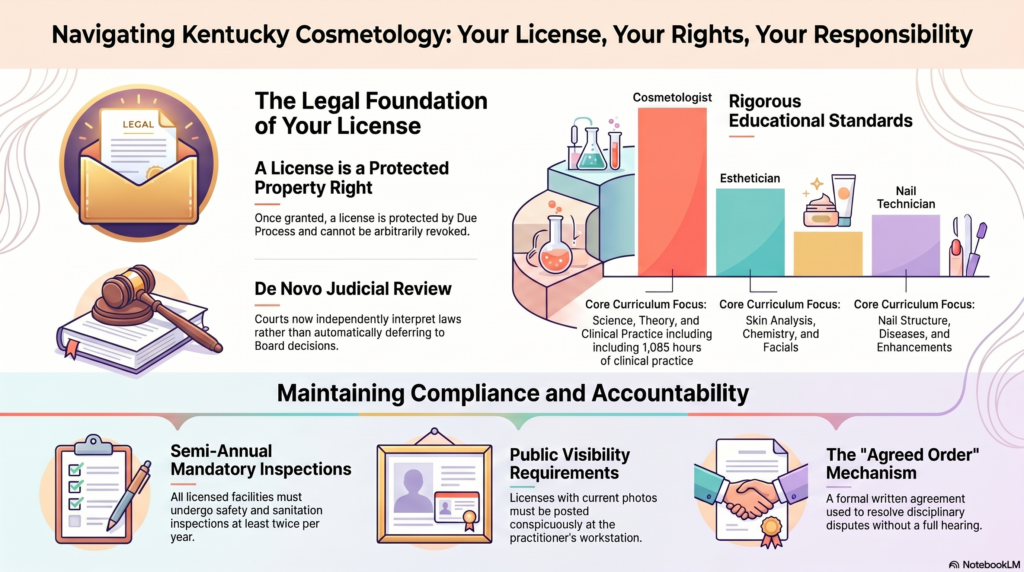
An “Agreed Order” is a legal contract between you and the Board. By signing it, you are usually admitting that you broke a rule and agreeing to pay a fine or accept probation.11 Once you sign it, you lose your right to a hearing.

2. The Trap of “Informal Warnings”

In Kentucky, you might receive a “written admonishment”.2 While this doesn’t feel like a punishment, the Board keeps it in your file. If you are inspected again, they can use that first warning to give you a much bigger fine or shut you down.2

3. Your Right to Everything in Writing

Under regulation 201 KAR 12:190, the Board cannot just give you a “verbal warning” or demand you pay a fine on the spot.47 You have a right to:

  • A written complaint signed by a real person (not anonymous).13
  • 30 days to respond in writing.2
  • A formal hearing before an administrative judge.2

4. The “Gold-Standard” Defense

The best way to protect your license is “Over-Compliance”.20 This means keeping perfect digital records of your attendance, sanitation steps, and client appointments.20 If a board tries to say you weren’t teaching or working, you can show them “immutable” digital logs that are hard to argue with.2

Part H: State-by-State Access to Justice Ranking (2025)

StateAccessibility GradeSettlement %Language SupportAppeal Difficulty
TennesseeA-62%HighLow (IPLA help)
IndianaB+68%ModerateModerate
TexasC-88%LowHigh (SOAH costs)
CaliforniaD84%ModerateVery High (Legal fees)
KentuckyF (Historic)94%Very LowImpossible (Retaliation) 12

Limits of Evidence

This analysis is subject to several evidentiary constraints:

  • Opacity of Board Records: Many boards, including the KBC, have been accused of refusing Open Records Requests (ORR) and hiding meeting minutes, making it difficult to fully quantify the scope of settlement coercion.12
  • Under-Reporting by Victims: Vulnerable practitioners, particularly undocumented or limited-English immigrants, often fear that challenging a board will lead to retaliation or deportation, resulting in a significant under-reporting of administrative abuse.37
  • Lagging BLS Data: Official wage data for 2024–2025 may not fully reflect the impact of post-pandemic inflation or the “Compliance Tax” on net income.7
  • Incomplete Criminal Tracking: There is limited tracking of cases where administrative boards utilize “selective prosecution” by referring minor civil matters to criminal courts.33

Final Objective: A Livelihood Protected by Law

The central research question of this report—to what extent licensing systems limit due process—is answered with a finding of systemic procedural failure.2 The “Due Process Accessibility Gap” is a structural feature of modern administrative governance that prioritizes board convenience over practitioner rights. When the cost of a defense attorney equals half of a technician’s yearly income, the “right to a hearing” is a hollow promise.2

Restoring the balance requires a fundamental shift in how the state views its power. The professional license is a property interest that defines an individual’s identity and survival in the economy.2 By implementing fee-shifting, proportional fining, and digital transparency, legislatures can ensure that the “police power” remains a tool for public safety rather than a mechanism for economic exclusion. The ultimate standard for any regulatory reform must be: “The issue is not whether regulation exists—but whether justice is realistically accessible to those being regulated.” 2

Works cited

  1. Breaking Down Barriers to Work for Low Income Families – Goldwater Institute, accessed April 15, 2026, https://www.goldwaterinstitute.org/policy-report/low-income-families/
  2. Occupational Licensing – The Institute for Justice, accessed April 15, 2026, https://ij.org/issues/economic-liberty/occupational-licensing/
  3. Thousands Free to Work – Goldwater Institute, accessed April 15, 2026, https://www.goldwaterinstitute.org/policy-report/universal-recognition-hb-2569/
  4. Manicurists and Pedicurists : Occupational Outlook Handbook – Bureau of Labor Statistics, accessed April 15, 2026, https://www.bls.gov/ooh/personal-care-and-service/manicurists-and-pedicurists.htm
  5. Barbers, Hairstylists, and Cosmetologists – Bureau of Labor Statistics, accessed April 15, 2026, https://www.bls.gov/ooh/personal-care-and-service/barbers-hairstylists-and-cosmetologists.htm
  6. Compare Average Lawyer Hourly Rate by State (2026 Data) | Clio, accessed April 15, 2026, https://www.clio.com/resources/legal-trends/compare-lawyer-rates/
  7. How Much Does a Lawyer Cost per Hour? Trends Chart (2026) – ConsumerShield, accessed April 15, 2026, https://www.consumershield.com/articles/how-much-lawyer-cost-per-hour
  8. Tag: cosmetology disciplinary process Kentucky – Louisville Beauty Academy, accessed April 15, 2026, https://louisvillebeautyacademy.net/tag/cosmetology-disciplinary-process-kentucky/
  9. Awards of Attorneys’ Fees by Federal Courts and Federal Agencies – EveryCRSReport.com, accessed April 15, 2026, https://www.everycrsreport.com/reports/94-970.html
  10. Maximizing Your Recovery in Fee-Shifting Cases | Illinois State Bar Association, accessed April 15, 2026, https://www.isba.org/ibj/2015/02/maximizingyourrecoveryinfeeshifting
  11. SUBMISSION STANDING COMMITTEE ON ENVIRONMENT AND PUBLIC AFFAIRS COMMISSIONER FOR EQUAL OPPORTUNITY MAY 2010 – Parliament of Western Australia, accessed April 15, 2026, https://www.parliament.wa.gov.au/Parliament/commit.nsf/luInquiryPublicSubmissions/C3B299A05EB76421482578310042EFDA/$file/ev.tdp.100531.sub032.Commissioner%20for%20Equal%20Opportunity.doc.pdf
  12. CONGRESSIONAL-EXECUTIVE COMMISSION ON CHINA ANNUAL REPORT 2015 – Department of Justice, accessed April 15, 2026, https://www.justice.gov/sites/default/files/pages/attachments/2016/10/17/2015report.pdf
  13. Manicurists and Pedicurists – Bureau of Labor Statistics, accessed April 15, 2026, https://www.bls.gov/oes/2023/may/oes395092.htm
  14. Hairdressers, Hairstylists, and Cosmetologists – Bureau of Labor Statistics, accessed April 15, 2026, https://www.bls.gov/oes/2023/may/oes395012.htm
  15. Esthetician Salary: Pay by State and City – Beauty Schools Directory, accessed April 15, 2026, https://www.beautyschoolsdirectory.com/careers/esthetician/salary
  16. Skincare Specialists : Occupational Outlook Handbook – Bureau of Labor Statistics, accessed April 15, 2026, https://www.bls.gov/ooh/personal-care-and-service/skincare-specialists.htm
  17. Tab 8 Cosmetology and Barbering Draft Report – TN.gov, accessed April 15, 2026, https://www.tn.gov/content/dam/tn/tacir/commission-meetings/2026january/2026Jan_Tab8BarberingCosmetology_DraftReport.pdf
  18. Average Hourly Rates for Lawyers by Practice Area and Geographic Location – MyCase, accessed April 15, 2026, https://www.mycase.com/blog/general/average-lawyer-hourly-rate/
  19. AUC Fiscal Year 2023 – TEXAS DEPARTMENT OF LICENSING & REGULATION | ENFORCEMENT DIVISION, accessed April 15, 2026, https://www.tdlr.texas.gov/enforcement/complaint-stats/2023/AUCComplaintStatisticsFY23.pdf
  20. TEXAS DEPARTMENT OF LICENSING & REGULATION | ENFORCEMENT DIVISION, accessed April 15, 2026, https://www.tdlr.texas.gov/enforcement/complaint-stats/2023/WWDComplaintStatisticsFY23.pdf
  21. How TDLR Handles Consumer Complaints – Texas Department of …, accessed April 15, 2026, https://www.tdlr.texas.gov/media/pdf/TDLR-Consumer-Complaints-at-a-Glance.pdf
  22. Category: Sanitation and Safety – Louisville Beauty Academy, accessed April 15, 2026, https://louisvillebeautyacademy.net/category/sanitation-and-safety/
  23. How State Occupational Licensing Hinders Low-Income Entrepreneurship – Goldwater Institute, accessed April 15, 2026, https://goldwaterinstitute.org/wp-content/uploads/cms_page_media/2015/2/10/Occupational%20LicensingFINAL.pdf
  24. Introduction – The Institute for Justice, accessed April 15, 2026, https://ij.org/report/license-to-work-2-backup/report/introduction/
  25. Questionable Burdens – The Institute for Justice, accessed April 15, 2026, https://ij.org/report/license-to-work-3/report/do-licensings-burdens-make-sense/questionable-burdens/
  26. Six Reforms to Occupational Licensing Laws to Increase Jobs and Lower Costs | Goldwater Institute, accessed April 15, 2026, https://goldwaterinstitute.org/wp-content/uploads/2014/11/Six-Reforms-to-Occupational-Licensing-Laws-to-Increase-Jobs-and-Lower-Costs.pdf
  27. PLA :: License Litigation – IN.gov, accessed April 15, 2026, https://www.in.gov/ai/appfiles/pla-litigation/
  28. Cosmetology & Barbers Board – PLA – IN.gov, accessed April 15, 2026, https://www.in.gov/pla/professions/cosmetology-and-barber-home/cosmetology-and-barber-board/
  29. Tennessee’s Regulatory Boards Division Reports Surge in Professional Licenses Processed Amid Enhanced Customer Service – WGNS Radio, accessed April 15, 2026, https://www.wgnsradio.com/article/91516/tennessees-regulatory-boards-division-reports-surge-in-professional-licenses-processed-amid-enhanced-customer-service
  30. Enforcement Statistical Overview – California Board of Barbering and …, accessed April 15, 2026, https://www.barbercosmo.ca.gov/enforcement/enf_stats.shtml
  31. Enforcement Stats Report Report run on, accessed April 15, 2026, https://www.barbercosmo.ca.gov/forms_pubs/qrtrpt_23_24.pdf
  32. Georgia forfeits essential workers because of outdated licensing law., accessed April 15, 2026, https://www.gjp.org/wp-content/uploads/2025/03/GJP-Occupational-License-Booklet-2025.03.10.pdf
  33. Illinois makes it tough for poor to become barbers, makeup artists, manicurists, accessed April 15, 2026, https://www.illinoispolicy.org/illinois-makes-it-tough-for-poor-to-become-barbers-makeup-artists-manicurists/
  34. record(8-1-2025).docx – Legislative Research Commission, accessed April 15, 2026, https://apps.legislature.ky.gov/record/25rs/record(8-1-2025).docx

Educational, Research & Public Information Notice
This publication is independent academic research developed by Di Tran University – College of Humanization and is based solely on publicly available sources. All research credit is attributed to Di Tran University.

Louisville Beauty Academy and Di Tran University do not assert, verify, or independently validate any claims, findings, or conclusions presented. All information is compiled, summarized, or interpreted from third-party public materials and is presented strictly for educational and informational purposes.

Neither Louisville Beauty Academy nor Di Tran University is affiliated with, endorsed by, or representative of the Kentucky Board of Cosmetology or any governmental authority. This content does not constitute legal, regulatory, or professional advice and is provided “as is” without representation, warranty, or guarantee of accuracy or completeness. Readers are solely responsible for independent verification and compliance with applicable laws and regulations.

No statements herein should be interpreted as allegations, findings of fact, or claims against any specific individual or entity, but solely as academic discussion of publicly reported information.
Why Licensing Exams Must Test Competence, Safety, and Sanitation—Not Reading Trickery: A Humanization-Based Framework for Ethical Workforce Regulation – RESEARCH & PODCAST SERIES 2026


Disclaimer: This publication is part of Di Tran University – The College of Humanization Research Series (2026) and is provided for educational and policy discussion purposes only. It does not constitute legal advice or regulatory interpretation.


Introduction: The Real Purpose of Licensing

The regulatory architecture of occupational licensing is traditionally anchored in the dual pillars of public interest and the mitigation of asymmetric information. At its most fundamental level, licensing serves as a state-sanctioned mechanism to ensure that individuals practicing in high-stakes trades—particularly those involving physical contact, chemical applications, or the management of infectious disease risks—possess a verifiable threshold of competence.1 This legal standard was firmly established in American jurisprudence through the 1889 Supreme Court decision in Dent v. West Virginia, which affirmed the states’ rights to regulate certain professions to protect the welfare of their citizens.3 In the decades since, the share of the American workforce requiring a license has surged from 5% in the 1950s to nearly 25% today, reflecting an increasing societal reliance on formal credentials as a proxy for safety and quality.3

However, the rapid expansion of these regulatory requirements has led to a critical divergence between the stated goal of public protection and the operational reality of assessment design. While the primary justification for licensing is the prevention of recognizable harm, the methods used to measure competency often drift into areas that favor linguistic proficiency and academic test-taking ability over practical safety and sanitation skills.5 When a licensing exam for a cosmetologist, esthetician, or nail technician utilizes “reading trickery”—characterized by indirect wording, complex syntactic structures, and cultural biases—it undermines the very legitimacy of the regulatory framework it seeks to uphold.7 This drift creates a system where the barrier to entry is no longer safety competence, but rather the ability to navigate a linguistic obstacle course.

The ethical implications of this drift are profound. For many candidates, particularly adult learners and immigrants, the licensing exam represents the final “on-ramp” to economic stability.9 When these assessments are poorly designed, they introduce construct-irrelevant variance (CIV), which distorts the meaning of the test scores and unfairly penalizes individuals who may be perfectly competent in their trade but are disadvantaged by the assessment’s format.11 A humanization-based framework for reform is therefore necessary—one that prioritizes the dignity of the learner and the actual safety needs of the consumer over the institutional inertia of complex testing protocols.10 This report examines the convergence of assessment validity, educational psychology, economic fairness, and regulatory compliance to argue for an ethical redesign of licensing exams across the beauty and trade sectors.

Public Safety, Sanitation, and Competency as the Legitimate Core

The foundational legitimacy of any occupational license rests on its ability to confirm that the license holder meets prescribed standards of competence necessary to perform a specified range of activities safely.2 In the beauty and trade sectors, these competencies are not merely academic; they are physical, chemical, and biological. The core mission of the state board is to prevent “present and recognizable harm” to the public health or safety.5 This mandate requires that exams focus on the “critical fail” points of a profession—those actions that, if omitted or performed incorrectly, lead to immediate injury or the transmission of pathogens.

Defining Public Protection in Trade Contexts

Competency-based assessment (CBA) is particularly well-suited for these sectors because it measures whether a person can integrate skills, judgment, and behavior in an observable performance context.14 In healthcare and beauty services, regulators require organizations and individuals to prove they can carry out tasks safely and consistently; a simple written exam that tests abstract theory without a direct link to practice cannot provide that assurance.15 The legitimacy of the core is established when the testing blueprint matches the actual hazards of the workplace.

Sector/TopicPublic Safety RationaleCritical Competency Measured
CosmetologyPrevention of chemical burns and hair loss.Proper mixing and application of sodium hydroxide and thioglycolate products. 16
EstheticsPrevention of skin damage and infection.Knowledge of contraindications for exfoliation and recognition of suspicious lesions. 17
Nail TechnologyPrevention of fungal infections and MRSA.Proper immersion and contact time for EPA-registered disinfectants on non-porous tools. 17
BarberingPrevention of blood-borne pathogen transmission.Mastery of blade handling, razor sanitation, and blood spill procedures. 16

The “public choice” theory of licensing suggests that practitioners often seek licensing to raise their own wages at the expense of consumers by creating barriers to entry.1 When these barriers are unrelated to safety, such as requiring thousands of hours of training for services that pose minimal risk, the regulation loses its “public interest” justification.1 For example, some states have moved to deregulate “boutique services” like blow-dry styling, braiding, and makeup artistry because the risk to public safety is low enough that a full 1,000- to 1,500-hour license is considered an unnecessary burden.19 An ethical core must adhere to the principle of “least restrictive means,” ensuring that the government only intervenes to the extent necessary to protect the public.5

When Exams Drift Into Linguistic Gatekeeping

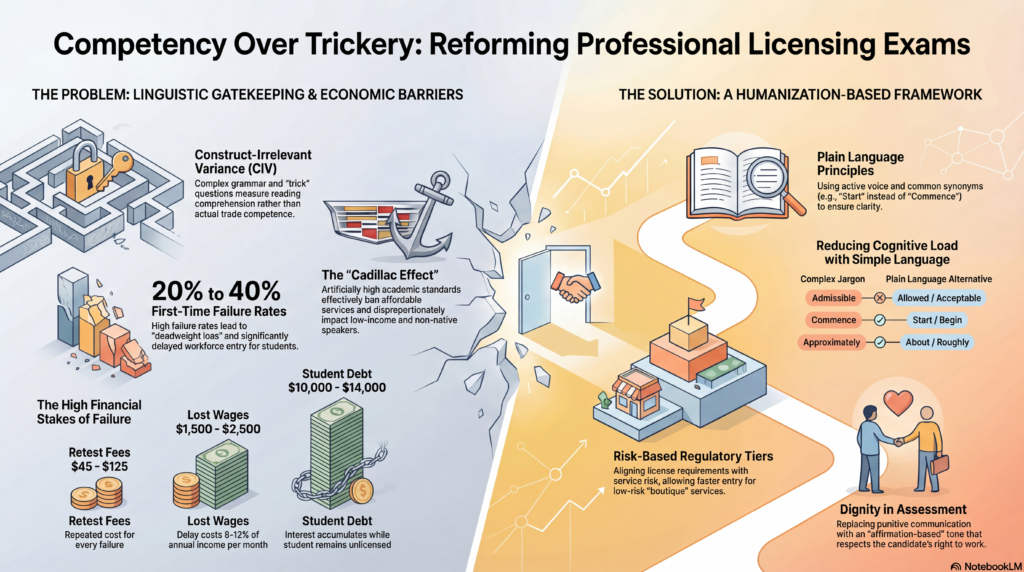
A significant threat to the validity of any high-stakes assessment is Construct-Irrelevant Variance (CIV), which refers to variance in test scores attributable to factors extraneous to the skill being measured.6 In licensing exams, this often manifests as “linguistic gatekeeping.” If a question about the sanitation of a glass bowl uses such complex grammar that a student fails the item despite knowing the sanitation protocol, the test has measured reading comprehension rather than sanitation competence.12 This mismatch creates a validity gap that can lead to incorrect inferences about a candidate’s ability to practice safely.

The Mechanism of Indirect Wording and “Trickery”

Indirect wording and “trick questions” are frequently cited by students and instructors as a primary cause of exam failure.22 While testing vendors often claim there are “no trick questions,” the use of “best/worst” scenarios, double negatives, and “except” clauses creates a linguistic burden that mimics the effect of trickery.24 For individuals with high test anxiety or those whose first language is not English, these features act as “Skinner machines”—assessment environments that punish the test-taker for failing to decode the structure rather than failing to know the content.23

Linguistic features that contribute to CIV include:

  • Syntactic Complexity: The use of passive voice and multiple dependent clauses that require high-level code comprehension.7
  • Lexical Rarity: Using uncommon or formal vocabulary when a simpler, more common synonym would suffice (e.g., using “commence” instead of “start”).12
  • Ambiguous Stems: Question stems that are vague or general, forcing the student to guess the “intent” of the examiner rather than demonstrating knowledge.6
  • Cultural Reference Points: Using metaphors or scenarios that assume a specific regional or socio-economic background, such as the “refrigerator” example in standardized math word problems.12

Research in systemic functional linguistics suggests that the “construct relevance” of language should be determined by its correspondence to the language used in the actual educational and professional context.12 If a nail technician never needs to use the word “admissible” or “ascertain” in their daily client interactions or sanitation logs, including such words in the licensing exam adds an irrelevant hurdle.26 This is especially true for English Learners (ELs), whose performance gaps on standardized tests can be reduced by nearly 60% when the language is modified for accessibility.6

Cognitive Load and Educational Psychology in High-Stakes Testing

Cognitive Load Theory (CLT), pioneered by John Sweller, provides a psychological framework for understanding how “reading trickery” actively hinders the demonstration of competence.28 Human working memory is severely limited, typically capable of processing only between 3 and 7 “chunks” of information at a time.29 When an assessment is designed with high “extraneous cognitive load”—mental effort wasted on decoding poor instructional design or confusing language—it leaves less room for “intrinsic load” (the actual subject matter) and “germane load” (the process of retrieving and applying knowledge).28

The Impact of Overload on Adult Learners

For adult learners, the stakes are amplified by the “split-attention effect,” where a student must toggle between the technical content of the question and the linguistic structure of the stem.28 If the “problem space” between the candidate’s current state and the correct answer is too large due to confusing instructions, the learner becomes overloaded and unable to process the information they have stored in their long-term memory.31

Cognitive Load TypeSource in Licensing ExamsConsequence for the Candidate
IntrinsicThe complexity of chemical reaction theory or anatomical structures.Inescapable difficulty that defines the “rigor” of the trade. 28
Extraneous“Best/Worst” options, double negatives, and complex vocabulary.Wasted mental energy that leads to “hitting the wall” and physical exhaustion. 30
GermaneThe effort to link a symptom (e.g., oily skin) to a treatment plan.Beneficial load that leads to deeper expertise and safe practice. 28

A human-centered assessment should aim to minimize extraneous load by removing “unnecessary information” and “distractions”.29 When experts are tested, they can handle higher complexity because they have developed “schemas”—organized structures in long-term memory that allow complex concepts to be processed as a single chunk.31 However, the licensing exam is intended for novices entering the profession. For these individuals, the “expertise reversal effect” means that what might be a simple, clear question for a veteran board member is a source of profound confusion for a student.32 Ethical exam construction must acknowledge this developmental reality and provide explicit, detailed guidance to support the test-taker’s success.32

Adult Learners, Immigrants, and Language Burden

The beauty and trade sectors have historically served as a vital economic engine for underrepresented populations, including women, people of color, and immigrants.33 However, as licensing requirements become more regulated and academic, there is a documented decline in the share of these workers in the industry.33 This decline is not a reflection of a lack of skill, but a reflection of the “language burden” inherent in the licensure process.4

Systematic Barriers to Entry

Stricter licensing regimes act as a “barrier to entry” that disproportionately impacts those with lower incomes or different linguistic backgrounds.33 For example, studies have shown that English proficiency requirements specifically reduce the number of licensed manicurists in the Vietnamese community.4 This creates a “Cadillac effect” where the state essentially bans “discounted” services with fewer frills by forcing every practitioner to meet an artificially high academic standard.4

The psychological toll of repeated failure on these populations cannot be overstated. When a student who has invested thousands of dollars and over a year of their life in school fails the exam multiple times because of “misreads or rushing,” their confidence collapses.17 This is exacerbated by the fact that many of these learners are “big picture thinkers” who struggle with the “usage and punctuation problems” that dominate standardized tests.36 A mature regulatory state should recognize that “administrative chaos is policy sabotage”—if the goal is to activate the workforce, then the assessment must be a “bridge,” not a “cliff”.10

Representation and Fairness

DemographicImpact of Licensing BurdenResearch Finding
WomenDelayed workforce entry due to childcare and long hour requirements.Increased regulation leads to a decline in female representation in trades. 33
ImmigrantsLanguage-based CIV in written theory exams.English proficiency requirements reduce entry for non-native speakers. 4
People of ColorDisproportionate debt-to-income ratios and predatory recruitment.75% of cosmetology students are in programs likely to fail earnings tests. 38
Career-Changers“Confidence collapse” and high opportunity cost of retests.Stricter regimes move “in the wrong direction” for those seeking new paths. 33

The “dignity in assessment” framework argues that when people receive communication from regulatory boards—such as failure letters or renewal notices—the message must not be punitive.9 The tone matters because it signals whether society recognizes the recipient as a citizen or a burden.10 For an immigrant attempting to provide for their family, an exam that uses Harry Potter-style “spell-casting” vocabulary to name bacteria (Pseudomonas Aeruginosa) feels less like a safety test and more like a tool of humiliation.10

The Economics of Delayed Licensure and Repeated Failure

The economic consequences of flawed licensing assessments are staggering, both for the individual student and the broader economy. Occupational licensing is “costly for both consumers and aspiring workers,” resulting in higher prices and forgone wages.4 When an exam has a 20% to 40% failure rate for first-time test-takers, the resulting “delayed licensure” creates a significant “deadweight loss” to society.20

Direct and Indirect Costs

The path to a cosmetology or esthetics license is a high-tuition, loan-dependent journey. Cosmetology graduates average $16,600 in annual earnings but hold roughly $10,000 to $14,000 in student loan debt.38 A failure on the state board exam is not just a psychological blow; it is a financial crisis.

Expense CategoryTypical Cost RangeEconomic Impact
Initial Exam Fee$60 – $150 per sectionSunk cost; must be paid before workforce entry. 42
Retest Fees$45 – $125 per attemptSame cost as initial; repeats for every failure. 18
Lost Wages$1,500 – $2,500 per monthEvery month of delay is 8-12% of annual income. 38
Retaining TrainingVariableMany states require additional school hours after three failures. 42
Debt AccumulationInterest on $10k+ loansMonthly payments start while the student is still unlicensed. 38

Economists consistently find that stricter licensing laws lead to higher prices for consumers, with research confirming increases of 3% to 13% across various services.4 This “protection of incumbent providers” allows existing salon owners to earn “artificially high profits,” or “rents,” while keeping able people from entering trades they could learn quickly.20 For the student, the “high cost and poor training” of many for-profit programs, combined with an artificially difficult exam, creates a “debt crisis” that can lead to wage garnishment and the seizure of tax refunds.38

The Impact of Hour Requirements and Incentives

State licensing laws mandate between 1,000 and 1,600 hours of training.18 This structure often rewards schools for high enrollment and full-time attendance rather than competency mastery.38 For-profit beauty schools have been accused of using federal Title IV funds to “pad institutional revenues,” often through predatory recruitment of vulnerable populations.38 If the licensing exam were redesigned to test competency directly (e.g., through an apprenticeship or “shorter-term” model), the time-to-licensure would drop, allowing students to recoup their investment within months rather than years.41

Ethics of Fairness, Access, and Public Protection

The ethics of professional assessment are governed by the joint standards of the AERA, APA, and NCME—often referred to as “the Bible” of psychometricians.46 These standards establish that “fairness to all individuals… is an overriding and fundamental validity concern”.8 Fairness implies that every test-taker has a comparable opportunity to demonstrate what they know, free from construct-irrelevant barriers.8

The Gatekeeping vs. Competency Debate

There is a fundamental ethical tension between “occupational closure”—the attempt to limit supply and raise wages—and “competency,” the pursuit of safety.2 A fair exam must focus solely on the latter. When test developers prioritize “reliability” through redundant or overly complex items, they risk creating individual fatigue and inflated reliability estimates that do not reflect true skill.7 Ethical testing requires that we “avoid potentially offensive content or language” and “provide results in a timely fashion”.48

Ethical PrincipleDefinition in Testing StandardsViolation in Current State Boards
ValidityThe degree to which evidence supports interpretations.Using academic vocabulary to test physical sanitation skills. 12
FairnessIdentifying and removing barriers to performance.Lack of linguistic modification for English Learners. 6
AccessibilityEqual access for all examinees.Limited language options and complex “trick” stems. 46
DignityRespecting the candidate’s right to work.Punitive tone and administrative “obstacle courses.” 9

The “presumption of constitutionality” often given to licensing regulations by courts has been challenged by “Right to Earn a Living” acts in states like Arizona.50 These acts shift the burden of proof to the government, requiring it to show that a regulation serves a “compelling governmental interest” and is “narrowly” tailored.50 If a written exam has a disparate impact on a protected group (such as immigrants) and does not directly predict safe performance, it may violate the fundamental right to engage in a lawful occupation.5

Regulatory Legitimacy and Compliance Design

Regulators and licensing boards face increasing pressure to modernize their continuum of approaches, moving away from “one-size-fits-all” mandates toward more flexible, risk-based oversight.3 Regulatory legitimacy is maintained when the board can demonstrate that its rules are not arbitrary and that it is “listening to providers early” to inform practical reforms.51

Case Study: Idaho’s Regulatory Reform

The Idaho Board of Pharmacy (BOP) provides a blueprint for regulatory “humanization.” By measuring their “baseline regulatory burden”—counting every word and restriction like “shall” and “must”—the BOP found their rules were 51.6% longer than medicine and 39.9% longer than nursing.52 Through a process of “iterative improvement,” they reduced this burden to align with neighboring states, proving that “regulatory volume” does not equal “patient safety”.52

In the beauty sector, Texas has implemented significant changes through House Bill 1560 and HB 705. These reforms merged the barber and cosmetology boards, eliminated unnecessary specialty licenses (like wig-related and instructor licenses), and reduced the base curriculum from 1,500 to 1,000 hours.16 Importantly, Texas also joined the “Cosmetology Licensure Compact,” allowing practitioners to work across state lines without completing hundreds of hours of redundant training.53

The Future of Compliance: Risk-Based Tiers

Modernizing facility and professional licensure involves recognizing that different services carry different levels of risk.51

Level of RiskRegulatory ModelExample Service
HighFull Licensure + Practical ExamChemical peels, permanent waving, straight-razor shaving. 16
Medium“Boutique” Registration + Safety CourseHair braiding, makeup artistry, eyelash extensions. 19
LowDeregulation/ExemptionShampooing, blow-dry styling, thermal styling. 19
Emerging“Licensed Provider” (e.g., AI Services)Automated skin analysis or personalized AI-guided treatments. 21

By “saying it out loud” in the regulations and setting explicit, baseline standards for the high-risk activities, boards can “eliminate the anti-competitive effects” of licensing while safeguarding the public.1 This shift allows for “coordinated pathways” where a worker can enter the field quickly in a low-risk capacity and upskill into more complex services as they master the trade.10

Humanization as a Framework for Exam Reform

A humanization-based framework for assessment reform is grounded in the belief that the “human dimensions of education” must not be marginalized by market forces or technologization.55 This framework moves beyond the “black box” of automated scoring and centralized data processing toward an “explainable” and “trustworthy” system.56

Core Principles of Humanized Assessment

  1. Explainability: Every question should have a faithful reason for its inclusion, aligned with human perception of the job’s demands.56
  2. Agency: The framework should enhance “teacher and student agency,” allowing for iterative learning rather than just a pass/fail judgment.58
  3. Contextualization: AI and other digital tools should be used to “scaffold construct-relevant language,” helping students access the material rather than acting as a barrier.6
  4. Empathy: The tone of the assessment and the failure/success communication should prioritize “affirmation and motivation” over punishment.10

In an “AI-era educational redesign,” tools like customized chatbots trained on course materials can provide “personalized support” and “context-relevant feedback”.54 This allows students to engage in “low-stakes” formative assessment throughout their schooling, identifying weaknesses before they reach the “high-stakes” gatekeeper of the state board.54 However, we must ensure that these tools do not “displace” human judgment or reinforce existing inequalities through biased algorithms.55

What Ethical Exam Construction Should Require

The creation of an ethical licensing exam requires a rigorous adherence to “Plain Language” principles. Plain language is defined as communication that intended readers can “easily find what they need, understand what they find, and use that information”.59 It is a standard for “guidance” that encourages efficiency and effectiveness.59

Plain-Language Writing Principles for Test Developers

  • Active Voice: Identifying the subject taking the action. “The student denies the treatment” is clearer than “Treatment was denied”.26
  • Shorter Sentences: Favoring simple, declarative sentences that state only one thing at a time.26
  • Reduced Reading Level: Aiming for a level that can be understood by “busy or stressed individuals”.26
  • Understandable Expressions: Avoiding “legalese” and technical jargon unless it is essential to the safety construct.26
Complex JargonPlain Language AlternativeImpact on Candidate
AdmissibleAllowed, acceptableReduces cognitive load; clarifies rules. 26
CommenceStart, beginEliminates “lexical rarity” barrier. 26
ComplyDo, followFocuses on action rather than legalism. 26
AdditionalAdded, more, otherSimplifies the stem for ELs. 26
ApproximatelyAbout, roughlyPrevents confusion for “big picture” thinkers. 26

Ethical construction also requires “Evidence-Based Testing Strategies.” This includes “testing the design at multiple points” and ensuring the final product is “useful and usable” for the target audience.26 For example, building signage and test instructions should use “visuals and icons” to increase comprehension instantaneously without requiring reading.26

What Schools Can Do Now

While systemic reform takes time, schools and instructors have an immediate responsibility to protect their students from the “reading trickery” of current exams. This involves moving from passive study methods to “active recall” and “test-taking literacy.”

Instructional Strategies for Success

The Studio Academy of Beauty and other institutions suggest that preparation begins with “paying attention during theory classes” and “asking questions when concepts aren’t clear”.22 However, the most effective strategies are those that mirror the cognitive demands of the exam.

  • Mock Exams: These reduce “test-day anxiety” and familiarize the student with the “exam flow”.22
  • Interleaving Topics: Rotating between sanitation, anatomy, and technical services in the same study block trains the “flexible recall” needed for the actual exam’s jumps.35
  • Error Logs: Students should note the topic, the cause (e.g., misread), and a one-sentence fix for every missed question.35
  • Explaining Simply: “If you cannot explain it simply, you do not own it yet”.35
Study TacticPsychological BasisPractical Application
Active RecallStrengthens neural pathways to schemas.Using flashcards for “porous vs. nonporous” items. 17
InterleavingReduces “rote memorization” bias.Mixing chemical safety questions with anatomy. 35
VisualizationConnects abstract rules to daily experience.Relating safety protocols to hazards spotted on the floor. 60
MnemonicsReduces “lexical rarity” burden.“Radial bone is on the thumb side because you use your thumb to turn up the Radio.” 39

Schools must also advocate for students by “educating them on their rights” and providing “transparency” regarding the licensing process and expected timeframes.61 When schools “pad institutional revenues” through artificially extended programs, they are part of the problem; schools that prioritize a “debt-free” or “ROI-centered” model are the ones truly aligned with humanization.38

What Boards and Testing Vendors Should Reconsider

Testing vendors like PSI and Prometric, along with state boards, are the primary gatekeepers of the industry. They have a professional obligation to ensure their content is “fair, valid, and reliable”.62 To do this, they must move beyond the “Cadillac effect” of regulation and embrace the “least restrictive means” of public protection.

Actionable Recommendations for Reform

  1. Independent Appeals Commissions: Establishing bodies separate from the licensing board to adjudicate disputes over exam scores or disciplinary actions.50
  2. Fee Transparency and Relief: Implementing a “universal recognition” of licenses and reducing the cost of retests for those in financial hardship.4
  3. Linguistic Scaffolding: Providing glossaries, modifying instructions for ELs, and including more example items/tasks to reduce extraneous cognitive load.6
  4. Differential Item Functioning (DIF) Analysis: Regularly performing DIF analysis on all high-stakes items to identify and remove those that show racial, gender, or disability bias.8
  5. Competency-Based “Exit Points”: Allowing students to move through instruction upon mastery rather than being bound to a specific number of hours.44
Reform CategoryAction ItemExpected Benefit
Assessment DesignRemove “Except” and “Best” questions.Lower CIV and higher validity. 6
AdministrativeAutomate benefit/support transitions.No one “falls off a cliff” after failure. 10
EconomicCaps on total program hours.Reduced student debt and faster entry. 38
TechnologyExplainable FER/AI Systems.Increased trust and accountability in scoring. 56

Vendors must also reconsider the “practical exam” requirement. Some states, like Illinois, have eliminated the practical portion entirely for certain licenses, recognizing that it is an administrative burden that does not necessarily improve safety.19 If the written exam is “domain-relevant” and properly “humanized,” it should be sufficient to verify a minimum standard of competence.

Long-Term Workforce and Social Consequences

The long-term consequences of failing to reform licensing assessments are both social and economic. “Low earnings and high debt” are already the hallmark of many cosmetology graduates, with 98% of programs potentially failing proposed earnings tests.41 If the licensing exam remains a biased hurdle, we risk creating a permanent underclass of workers who are “effectively unemployable” despite having the skills to succeed.10

The Impact on Innovation and Mobility

Licensing frictions “reduce interstate mobility” and keep skilled workers from participating in the labor market.4 This leads to “workforce shortages” in critical areas and requiring “low-income families to pay higher bills for basic services”.20 Furthermore, when regulation is “stubbornly anchored in the mechanics of removal rather than the dynamics of human capital,” we lose out on the “creative reasoning and collaborative communication” that a diverse workforce brings.9

The future of workforce regulation must be “forward-looking.” This means “aligning licensure standards across agencies” to break down silos and allow for “integrated care” models.51 It means recognizing that the “right to earn a living” is a fundamental human right that must be subject to judicial protection and “heightened scrutiny”.50

Conclusion: Clarity Protects the Public Better Than Confusion

The core thesis of this framework is that licensing exams in the beauty and trade sectors should measure public protection competencies directly—not inflate failure rates through “reading trickery.” Public safety, sanitation, and competency are the legitimate cores of regulation, and they are best served by assessments that are valid, fair, and accessible.2

A “humanization-based framework” recognizes that clarity is the ultimate form of protection.26 When a candidate understands exactly what is being asked of them and can demonstrate their skills without being hindered by linguistic complexity or cognitive overload, the public interest is served.26 Conversely, when a system relies on confusion and “administrative chaos,” it is a form of “policy sabotage” that destabilizes the very people it should be activating.10

The call for reform is not a call for lower standards; it is a call for “true rigor.” True rigor is defined by the precision with which an exam identifies those who pose a risk to the public, not by the number of competent people it can trick into failing. By adopting plain language, reducing economic hurdles, and respecting the dignity of every adult learner, we can create an ethical workforce regulation system that fosters “economic stability and opportunity for individuals and their families”.3 Clarity, fairness, and a student-centered approach are not just educational ideals; they are the essential components of a legitimate and effective regulatory regime in the modern era.

Works cited

  1. What explains occupational licensing? – Brookings Institution, accessed March 27, 2026, https://www.brookings.edu/articles/what-explains-occupational-licensing/
  2. Occupational licensing – Wikipedia, accessed March 27, 2026, https://en.wikipedia.org/wiki/Occupational_licensing
  3. The State of Occupational Licensing, accessed March 27, 2026, https://sbp.senate.ca.gov/sites/sbp.senate.ca.gov/files/NCSL%20State%20of%20Occupational%20Licensing.pdf
  4. Occupational Licensing – Econlib, accessed March 27, 2026, https://www.econlib.org/library/enc/occupationallicensing.html
  5. Occupational Licensing Defense Act – American Legislative Exchange Council, accessed March 27, 2026, https://alec.org/model-policy/the-occupational-licensing-defense-act-2/
  6. Considerations for Designing Accessible Educational Scenario-Based Assessments for Multiple Populations: A Focus on Linguistic Complexity – Frontiers, accessed March 27, 2026, https://www.frontiersin.org/journals/education/articles/10.3389/feduc.2019.00088/full
  7. Construct‐Irrelevant Variance in High‐Stakes Testing – ResearchGate, accessed March 27, 2026, https://www.researchgate.net/publication/227795378_Construct-Irrelevant_Variance_in_High-Stakes_Testing
  8. Chapter 3 Test Fairness | 2022–23 Interim Technical Report, accessed March 27, 2026, https://technicalreports.smarterbalanced.org/2022-23_interim-report/_book/test-fairness.html
  9. diplomacy – Thoughts on EU-Africa Global Affairs, accessed March 27, 2026, https://www.collinsnweke.eu/?tag=diplomacy
  10. policy – Thoughts on EU-Africa Global Affairs, accessed March 27, 2026, https://www.collinsnweke.eu/?tag=policy
  11. Detecting Construct-Irrelevant Variance: A Comparison of Network Psychometrics and Traditional Psychometric Methods Using the HEXACO-PI Dataset – MDPI, accessed March 27, 2026, https://www.mdpi.com/2813-9844/7/4/88
  12. Construct Relevant or Irrelevant? The Role of Linguistic Complexity in the Assessment of English Language Learners’ Science Knowledge, accessed March 27, 2026, https://d-miller.github.io/DRK12/topic1/6888.pdf
  13. Balancing Innovation and Ethics: A Framework for Responsible AI Integration in Educational Assessment – Preprints.org, accessed March 27, 2026, https://www.preprints.org/manuscript/202508.1696/v1/download
  14. Competency-Based Assessment: Methods, Steps & Examples in 2026 – iMocha, accessed March 27, 2026, https://www.imocha.io/blog/competency-based-assessment
  15. Competency-Based Assessment: A Comprehensive Guide | Moralbox Training Matrix, accessed March 27, 2026, https://www.moralbox.com/competency-based-assessment-cba-complete-2025-guide-with-examples-templates-tools/
  16. Texas Proposes New Cosmetology & Barber Rules – Associated Hair Professionals, accessed March 27, 2026, https://www.associatedhairprofessionals.com/updates/blog-posts/texas-proposes-new-cosmetology-barber-rules
  17. Top Esthetician Practice Exam Questions – Elite Beauty Society, accessed March 27, 2026, https://elitebeautysociety.com/esthetician-exam-practice-questions/
  18. State Licensure Navigator | StateXams.com, accessed March 27, 2026, https://statexams.com/states
  19. May 2025 Nationwide Cosmetology Deregulation Report: A 5-Year …, accessed March 27, 2026, https://louisvillebeautyacademy.net/may-2025-nationwide-cosmetology-deregulation-report-a-5-year-legislative-review-across-all-50-states-published-by-louisville-beauty-academy-kentuckys-center-of-excellence-in-beaut/
  20. The Effects of Occupational Licensure on Competition, Consumers, and the Workforce, accessed March 27, 2026, https://www.mercatus.org/research/public-interest-comments/effects-occupational-licensure-competition-consumers-and
  21. Montana Licensing Reform Task Force – Employment Standards Division, accessed March 27, 2026, https://esd.dli.mt.gov/_docs/2026-02-24-Full-Task-Force.pdf
  22. How to Prepare for State Licensing Exams in the Beauty Industry, accessed March 27, 2026, https://thestudioacademyofbeauty.com/blog/how-to-prepare-for-state-licensing-exams-in-the-beauty-industry/
  23. My science test. : r/mildlyinfuriating – Reddit, accessed March 27, 2026, https://www.reddit.com/r/mildlyinfuriating/comments/hft013/my_science_test/
  24. Praxis Elementary Education: Curriculum, Instruction and Assessment study companion, accessed March 27, 2026, https://praxis.ets.org/on/demandware.static/-/Library-Sites-ets-praxisLibrary/default/pdfs/5017.pdf
  25. I finished this program today in a little over 3 months. I transferred 50 credits and work full time (Non IT). Here are my thoughts. Very long read! : r/WGUCyberSecurity – Reddit, accessed March 27, 2026, https://www.reddit.com/r/WGUCyberSecurity/comments/148b3s3/i_finished_this_program_today_in_a_little_over_3/
  26. Plain Language Guide – National Association for Court Management, accessed March 27, 2026, https://nacmnet.org/wp-content/uploads/NACM-Plain-Language-Guide-20190107.pdf
  27. EJ1060938 – Construct Relevant or Irrelevant? The Role of Linguistic Complexity in the Assessment of English Language Learners’ Science Knowledge, Educational Assessment, 2015 – ERIC, accessed March 27, 2026, https://eric.ed.gov/?id=EJ1060938
  28. Challenging Cognitive Load Theory: The Role of Educational Neuroscience and Artificial Intelligence in Redefining Learning Efficacy – PMC, accessed March 27, 2026, https://pmc.ncbi.nlm.nih.gov/articles/PMC11852728/
  29. Cognitive Load Theory: How to Optimize Learning – Let’s Go Learn, accessed March 27, 2026, https://www.letsgolearn.com/education-reform/cognitive-load-theory-how-to-optimize-learning/
  30. What is Cognitive Load, and Why Does It Matter for Corporate Training and Development?, accessed March 27, 2026, https://hsi.com/blog/what-is-cognitive-load-and-why-does-it-matter-for-corporate-training-and-development
  31. Cognitive Load Theory, accessed March 27, 2026, https://www.mcw.edu/-/media/MCW/Education/Academic-Affairs/OEI/Faculty-Quick-Guides/Cognitive-Load-Theory.pdf
  32. Balancing Mental Demands: Cognitive Load Theory in Training Design, accessed March 27, 2026, https://trainingindustry.com/articles/content-development/balancing-mental-demands-cognitive-load-theory-in-training-design/
  33. Occupational licensing creates barriers to workforce participation …, accessed March 27, 2026, https://www.dcpolicycenter.org/publications/occupational-licensing-embalmers-2026/
  34. An Economic Framework for Licensing Reform – FSBPT, accessed March 27, 2026, https://www.fsbpt.org/Portals/0/documents/free-resources/Forum_Spring2016_Reform.pdf
  35. Ace Your State Board Esthetician Exam with Confidence: Tips, Tricks, and a Must-Have Study Guide! – EZ Test Prep, accessed March 27, 2026, https://eztestprep.com/post/ace-your-state-board-esthetician-exam-with-confidence-tips-tricks-and-a-must-have-study-guide/
  36. Plain Language Workbook: Five Steps to Clear, Effective Communications for the Federal Communications Commission, accessed March 27, 2026, https://www.fcc.gov/sites/default/files/plainwritingworkbook.pdf
  37. Diaspora – Thoughts on EU-Africa Global Affairs, accessed March 27, 2026, http://www.collinsnweke.eu/?tag=diaspora
  38. What the One Big Beautiful Bill Means for Cosmetology Students …, accessed March 27, 2026, https://www.newamerica.org/insights/what-the-one-big-beautiful-bill-means-for-cosmetology-students/
  39. 8 Tips for Taking Your State Board Exam – Empire Beauty School, accessed March 27, 2026, https://www.empire.edu/blog/beauty-business/8-tips-state-board-exam
  40. Your Complete Guide to Passing the Cosmetology State Board Exam: Tips, Preparation, and What to Expect, accessed March 27, 2026, https://www.gotopjs.com/blog/your-complete-guide-to-passing-the-cosmetology-state-board-exam-tips-preparation-and-what-to-expect/
  41. Federal Aid, Licensure, and the Debt Crisis in Cosmetology …, accessed March 27, 2026, https://naba4u.org/2025/12/federal-aid-licensure-and-the-debt-crisis-in-cosmetology-education-research-2025/
  42. Free Cosmetology Practice Test (2026) | Questions & Answers – iPREP, accessed March 27, 2026, https://www.iprep.online/courses/cosmetology-practice-test/
  43. Department of Professional and Occupational Regulation Board for Barbers and Cosmetology Candidate Information Bulletin – Prov, accessed March 27, 2026, https://provexam.com/wp-content/uploads/2024/10/Prov_CIB_VA_Cosmetology_Inc_Written_Site_Inst_2024.10.10.pdf
  44. What to Know about Competency-Based Apprenticeship Programs, accessed March 27, 2026, https://www.jff.org/blog/what-know-about-competency-based-apprenticeship-programs/
  45. Time-Based, Competency-Based, or Hybrid Programs? Considerations for Selecting an Approach to Registered Apprenticeship – Urban Institute, accessed March 27, 2026, https://www.urban.org/sites/default/files/2023-08/Time-Based%2C%20Competency-Based%2C%20or%20Hybrid%20Programs.pdf
  46. Standards for Educational and Psychological Testing – Wikipedia, accessed March 27, 2026, https://en.wikipedia.org/wiki/Standards_for_Educational_and_Psychological_Testing
  47. The Standards for Educational and Psychological Testing, accessed March 27, 2026, https://www.apa.org/science/programs/testing/standards
  48. Codeof – Fair Testing Practices in Education – NCME, accessed March 27, 2026, https://ncme.org/wp-content/uploads/2025/10/CodeofFairTestingPractices-1.pdf
  49. Testing Standards – NCME, accessed March 27, 2026, https://ncme.org/resources/books/testing-standards/
  50. Occupational Licensing Reform and the Right to Earn a Living: A Blueprint for Action, accessed March 27, 2026, https://www.mercatus.org/research/policy-briefs/occupational-licensing-reform-and-right-earn-living-blueprint-action
  51. How States Are Modernizing Facility Licensure to Advance Integrated Care – NASHP, accessed March 27, 2026, https://nashp.org/how-states-are-modernizing-facility-licensure-to-advance-integrated-care/
  52. Occupational Licensing Reform: A Step-by-Step Approach for Pharmacy Licensing Boards – PMC, accessed March 27, 2026, https://pmc.ncbi.nlm.nih.gov/articles/PMC12509714/
  53. Texas-2025-HB705-Analysis (Engrossed) – LegiScan, accessed March 27, 2026, https://legiscan.com/TX/supplement/HB705/id/600686/Texas-2025-HB705-Analysis_Engrossed_.html
  54. Innovative Educational Assessment with Generative AI: Opportunities, Challenges, and Practical Case Studies – eBooks, accessed March 27, 2026, https://content.e-bookshelf.de/media/reading/L-27671619-911dcaa940.pdf
  55. Sustainable Education in the Age of Artificial Intelligence and Digitalization: A Value-Critical Approach – MDPI, accessed March 27, 2026, https://www.mdpi.com/2071-1050/18/3/1257
  56. Human-Centered and Quantitative Explainability Evaluation of Facial Emotion Recognition for Trustworthy Mental Health Monitoring – MDPI, accessed March 27, 2026, https://www.mdpi.com/2073-431X/15/3/139
  57. (PDF) The Disclosure-Detection Nexus in Generative AI: An Integrated Analysis of Ethical Implications in Academia – ResearchGate, accessed March 27, 2026, https://www.researchgate.net/publication/400359221_The_Disclosure-Detection_Nexus_in_Generative_AI_An_Integrated_Analysis_of_Ethical_Implications_in_Academia
  58. The Missing Link: Knowledge Management in AI-Powered Education Frameworks, accessed March 27, 2026, https://www.researchgate.net/publication/397251493_The_Missing_Link_Knowledge_Management_in_AI-Powered_Education_Frameworks
  59. A plain-language standard: A tool for all of us – State Bar of Michigan, accessed March 27, 2026, https://www.michbar.org/journal/Details/A-plain-language-standard-A-tool-for-all-of-us?ArticleID=4403
  60. How to Study for the Contractor Exam If You Struggle With Reading, accessed March 27, 2026, https://contractorslicensingschools.com/blog/how-to-study-for-the-contractor-exam-if-you-struggle-with-reading/
  61. Licensure Processing Guides and Timelines – Commonwealth of Pennsylvania, accessed March 27, 2026, https://www.pa.gov/agencies/dos/resources/professional-licensing-resources/licensure-processing-guides-and-timelines
  62. Barber and Cosmetology Testing with PSI, accessed March 27, 2026, https://www.psiexams.com/licensure/barber-cosmetology/
  63. A Short Guide to Writing Effective Test Questions – Kansas State University, accessed March 27, 2026, https://www.k-state.edu/ksde/alp/resources/Handout-Module6.pdf
  64. Examining Licensing Issues Within the Cosmetology Industry, accessed March 27, 2026, https://www.air.org/project/examining-licensing-issues-within-cosmetology-industry