Professional Discipline and Outcome-Oriented Vocational Education: An Evidence-Based Analysis of Licensing-Focused Beauty Education Models in the United States — The Louisville Beauty Academy Case – RESEARCH & PODCAST SERIES 2026


Educational Research Disclaimer
This article was independently produced by the research team of Di Tran University — The College of Humanization as part of its ongoing vocational education research series.

Louisville Beauty Academy publishes this material strictly for educational and informational purposes for students, licensees, and the public.

Louisville Beauty Academy does not interpret, enforce, or provide legal guidance regarding state or federal licensing laws. All regulatory authority rests solely with the appropriate government agencies, including the Kentucky Board of Cosmetology and other applicable regulatory bodies.

Abstract

The contemporary landscape of vocational education in the United States is currently navigating a pivotal transition between traditional enrollment-driven models and emerging outcome-oriented frameworks. This research study provides a PhD-level interdisciplinary analysis of the “Professional Discipline Learning Model,” specifically within the context of beauty and personal care licensing. Utilizing the Louisville Beauty Academy (LBA) as a primary case example, the study investigates the structural effectiveness of education that prioritizes technical discipline, regulatory compliance, and economic efficiency over lifestyle-oriented marketing and entertainment-based pedagogy.

The research question addresses whether a vocational model centered on a “Zero Disruption Learning Environment” and “Action Accumulation” yields superior licensing success rates, faster workforce integration, and greater economic mobility for its graduates. Drawing upon Human Capital Theory, Deliberate Practice, Cognitive Load Theory, and Professional Socialization Theory, this analysis posits that the professionalization of the beauty industry requires a shift toward structured, cost-controlled institutional models.

Historical evidence traces the evolution of beauty licensing from its origins in medieval medicine and barber-surgery to modern public health mandates, establishing the sector as one of the most heavily regulated personal service industries. Comparative regulatory analysis reveals significant discrepancies in training hour requirements between the beauty trades and high-stakes medical fields like Emergency Medical Services (EMS), suggesting a need for policy reform focused on educational efficiency. Economic data from the Bureau of Labor Statistics (BLS) and the Small Business Administration (SBA) highlight the beauty industry’s role as a primary driver of micro-entrepreneurship, particularly within immigrant and minority communities. The findings suggest that disciplined vocational education models represent a highly effective pathway for workforce stability and professional identity formation in a post-automation economy.

Historical Context of Beauty Education

The professionalization of the beauty industry in the United States is the result of a complex convergence of medical history, labor organization, and the expansion of the state’s “police power”.1 Historically, the lineage of modern beauty regulation is a dual history of surgical necessity and aesthetic evolution. In the medieval period, the practitioners known as barber-surgeons were responsible for an array of procedures that extended far beyond grooming, including blood-letting, tooth extraction, and the lancing of abscesses.1 The formal establishment of the Company of Barber Surgeons in 1540 under Henry VIII solidified this connection, and it was not until 1745 that the professions of barbering and surgery legally diverged.1 This historical intersection explains the barber’s long-standing legal authority over razor-based services; the straight razor was essentially the surgical tool of the trade, a legacy that persists in modern licensing distinctions regarding the use of open blades.1

The emergence of formal beauty education was catalyzed by the Progressive Era’s focus on sanitation and public health. In the late 19th and early 20th centuries, outbreaks of “barber’s itch”—a contagious fungal infection spread via unsterilized razors—prompted the first state-level licensing laws.1 Research by Daniel Smith in “The Itch & Razor War” indicates that nearly 90 percent of the original justification for barber licensure was centered on the prevention of such ailments.3 By 1897, Minnesota passed the first legislation for a barber license, initiating a movement toward stringent state board inspections and standardized hygiene protocols.2 These laws established that the state possessed the authority to regulate private conduct—such as the way a person cuts hair or treats skin—to protect the collective welfare.1

Historical MilestoneYearSignificance to Professionalization
Divergence of Barbers and Surgeons1745Established barbering as a distinct technical trade 1
Formation of Barber Protective Union1886First major move toward labor standards and organized training 2
Opening of the First Barber School1893A.B. Moler standardized curriculum and published first textbooks 2
First State Licensure Law (Minnesota)1897Introduced state-mandated sterilization and inspection 2
Rise of the “Bob” Cut1920sCreated demand for specialized cosmetological training 2
Separation of Barber/Cosmetology Boards1935Reflected distinct traditions and gendered service paths 4
Modern Board Consolidation2021+Trend toward administrative efficiency and “dual-service” licensing 4

As the 20th century progressed, the demand for specialized cosmetological skills grew alongside the flourishing entertainment industry, necessitating formal beauty schools and specialized training programs.1 By 1927, states like California began separately licensing barbers and cosmetologists, reflecting a social and professional divide that persists in many modern regulatory systems.1 Over time, these regulations evolved from basic hygiene mandates into comprehensive state regulatory systems that balance the need for public safety with the pressures of workforce development.1 However, some economic historians argue that these licensing laws were also influenced by labor unions seeking to bar discount competitors from the market, leading to a steady increase in training hour requirements that often exceeded the hours necessary for purely sanitation-based instruction.1

Regulatory Framework and Legal Structure

The legal framework governing beauty licensing in the United States is built upon the premise that professional beauty services involve significant biological and chemical risks.1 Practitioners work with reactive substances such as hair color, relaxers, and perm solutions, and they utilize sharp instruments like razors, shears, and nippers.1 Consequently, state boards of cosmetology and barbering are tasked with ensuring that the public is protected from incompetent practice by establishing minimum qualifications for entry and enforcing effective discipline for those who violate statutes.4

Comparative Regulatory Analysis

One of the most revealing aspects of the beauty industry’s regulatory structure is the disparity between its training requirements and those of other high-stakes professions. While the work of Emergency Medical Technicians (EMTs) bears a direct relationship to life-and-death public health, the training requirements for cosmetologists often dwarf those of EMTs.5 As of 2022, on average, states demanded approximately one year of training for a cosmetology license (roughly 1,000 to 1,500 hours) compared to just over a month of training for an EMT license.5

ProfessionMinimum Training Hours (Avg)Focus of Regulation
Cosmetologist1,000 – 1,600Sanitation, chemical safety, aesthetics 5
EMT (Basic)120 – 190Life-saving interventions, emergency medicine 5
Food Safety Manager8 – 12Prevention of foodborne illness 6
Licensed Plumber4,000 – 10,000Infrastructure safety, code compliance 8
Barber Apprentice216 (Related) / 3,200 (OJT)Safety, sanitation, technical skill 9
Manicurist300 – 600Infection control, nail anatomy 11

The rationale for licensing rests on the “police power” of the state, but researchers from the Institute for Justice have questioned whether these heavier burdens actually improve safety.11 Studies comparing states with differing licensing burdens found no significant difference in health inspection outcomes, suggesting that nail salons and barbershops were clean and safe regardless of whether their workers faced burdensome or light licensing.11 Despite this, the beauty industry remains heavily regulated, with most states demanding at least 1,000 hours of training and maintaining rigorous inspection systems.11

Inspection and Compliance Systems

Modern regulatory systems utilize a combination of pre-graduate testing, written examinations, and practical skill demonstrations to verify competency.13 In states like Kentucky, the Barbering and Cosmetology Board outlines swift disciplinary measures for practitioners who violate sanitation statutes.4 The legal authority of these boards extends to the oversight of “dual-service” salons and the enforcement of “shaving controversies,” such as the legal restrictions preventing cosmetologists from using straight razors for facial shaving in certain jurisdictions.1 This dense regulatory environment necessitates an educational model that prioritizes regulatory literacy and “compliance-by-design” rather than just creative aesthetics.14

Theoretical Framework

Analyzing the Professional Discipline Model requires an interdisciplinary approach that connects economic theory with cognitive science and behavioral psychology.

Human Capital Theory (Becker)

Human Capital Theory, most notably advanced by Gary Becker, posits that education and technical training are forms of capital accumulation.15 According to this view, individuals invest in their own skills, knowledge, and health with the expectation of economic returns in the form of higher wages and job security.15 In the context of beauty education, the license is the tangible manifestation of this human capital. The “human capital approach” assumes that earnings mainly reflect how much workers have invested in their skills rather than just whether they hold “good” or “bad” jobs.17 This theory supports a vocational model that optimizes the time and cost of education, ensuring a faster “rate of return” on the student’s investment.12

Deliberate Practice Theory (Ericsson)

K. Anders Ericsson’s theory of Deliberate Practice challenges the notion of innate talent, suggesting instead that expert performance is the result of focused, consistent, and goal-oriented training.18 Deliberate practice involves “individualized training activities specially designed by a coach or teacher to improve specific aspects of an individual’s performance through repetition and successive refinement”.19 At Louisville Beauty Academy, this theory is applied through clinic-based skill development and repetitive technical drills.14 Ericsson’s research shows that Mozart, often cited as a natural genius, was “relatively average” when compared to modern children who undergo structured, early training, proving that sustained effort and structured environments are the primary drivers of mastery.18

Behavioral Discipline and Self-Regulation

Behavioral Discipline Theory examines how self-regulation and habit formation contribute to professional success. In a vocational setting, this involves the internalization of professional norms and the development of “grit”—the passion and perseverance for long-term goals. Students in a disciplined environment are taught to transition from a “student” identity to a “professional” identity through the accumulation of small, verifiable achievements.20 This process is described as “Humanization,” a psychosocial intervention designed to restore self-worth through vocational excellence.20

Cognitive Load Theory (Sweller)

Cognitive Load Theory (CLT), pioneered by John Sweller, is based on an understanding of the limitations of human working memory.21 CLT identifies three types of cognitive load:

  1. Intrinsic Load: The inherent complexity of the subject matter.21
  2. Extraneous Load: Unnecessary cognitive effort caused by distractions or poorly designed instruction.21
  3. Germane Load: The mental work devoted to making sense of new material and storing it in long-term memory.21

A Professional Discipline model explicitly seeks to reduce “extraneous load” by creating a “Zero Disruption Learning Environment”.22 By removing unnecessary noise, administrative confusion, and social distractions, the model allows students to focus their limited cognitive resources on “germane load,” thereby accelerating the transfer of technical skills to long-term memory.23

Professional Socialization Theory

Professional Socialization is the process by which individuals develop a disciplinary identity and commit to the values and norms of their field.25 It involves shifting from being a “knowledge consumer” to a “knowledge producer” or professional practitioner.25 Research in nursing and medical training shows that early introduction to the professional environment and supportive supervisory relationships are critical for professional identity formation.26 The disciplined study culture at LBA mirrors this by placing students in a “living learning ecosystem” where they interact with the public, instructors, and graduates from day one.14

Institutional Efficiency Theory

Institutional Efficiency Theory analyzes how regulatory bodies and legal frameworks shape behavior and economic outcomes.27 In vocational education, this theory evaluates whether institutions are structured to minimize transaction costs and resource misallocation.28 A model that focuses on “short-cycle” vocational education—optimizing training time and reducing cost barriers—aligns with the principles of institutional efficiency by ensuring that the “educational investment” is recovered quickly through workforce entry.12

The Professional Discipline Model

The Professional Discipline Learning Model used by Louisville Beauty Academy is characterized by its rejection of “entertainment-oriented” marketing in favor of a structured, outcome-focused institutional culture.14 This model positions the vocational school as a professional institution rather than a social or lifestyle destination.

Key Structural Elements

The model is built upon several foundational pillars designed to maximize student success and institutional compliance:

  • Zero-Disruption Training Environment: A commitment to protecting instructional time and space from internal and external distractions.29
  • Strict Compliance Orientation: An emphasis on “over-compliance by design,” where regulatory literacy is viewed as a primary skill for protecting the practitioner and the public.14
  • Licensing Exam Focus: Curriculum alignment that prioritizes the requirements of state board examinations, ensuring high pass rates and fast workforce entry.14
  • Structured Clinic Learning: Practical engagement through real-world walk-ins and early client interaction, moving skills from theoretical to applied.14
  • Disciplined Study Culture: A “fail fast, fix fast” mindset where errors are treated as data points for immediate correction and mastery.14
  • Cost-Conscious Education: A tuition structure that prioritizes affordability and reduces reliance on high-interest student debt.14

Contrast with Entertainment-Based Marketing

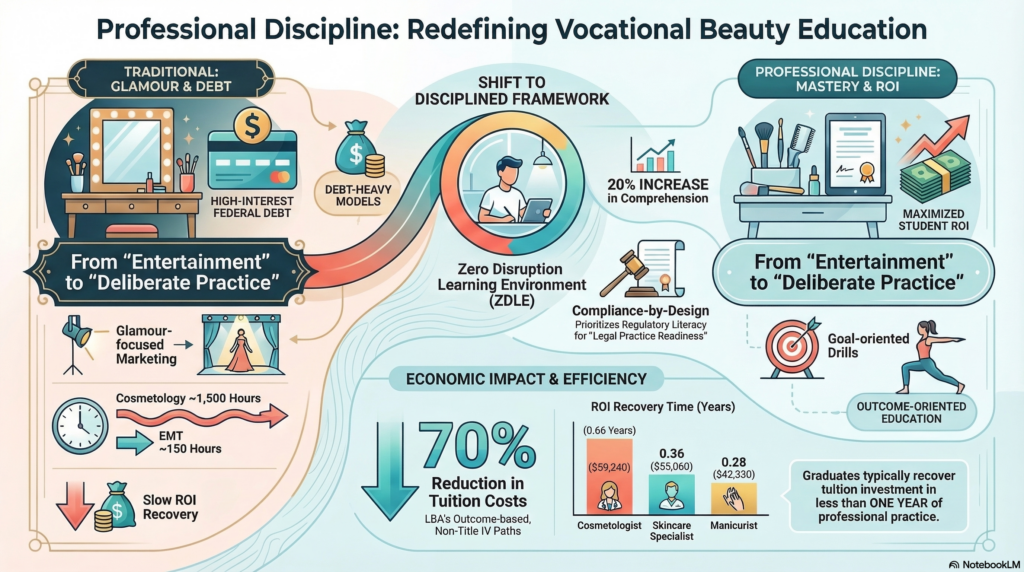
Traditional beauty school marketing often emphasizes “glamour,” social immersion, and lifestyle aesthetics. However, research suggests that high-tuition, for-profit schools using these models often leave students with insurmountable debt and low earning potential.32 In contrast, the Professional Discipline Model focuses on the “action accumulation” of small completions—tasks that serve as “verifiable proof” of a student’s own value and competence.14 This model treats beauty as a “licensed human service” and an “AI-proof” trade that generates sustainable economic growth through disciplined attention to human needs.34

Zero Disruption Learning Environment

The concept of a “Zero Disruption Learning Environment” (ZDLE) is rooted in the psychological need for uninterrupted focus during skill acquisition. In high-stakes vocational training, frequent disruptions can erode trust, delay return on investment (ROI), and decrease student comprehension.29 Studies have shown that excessive noise in classrooms can cause up to a 20% drop in comprehension, while acoustic treatments can lead to a 70% reduction in distractions.36

Mechanism of Focus and Productivity

ZDLE works by minimizing “extraneous cognitive load” through the removal of non-educational distractions. This includes both physical noise and digital interruptions. At LBA, this is achieved through a “protected work mode” that discourages non-urgent conversations and fractured attention.37 This structured approach helps focus efforts on high-impact activities, promoting a sense of daily accomplishment.37

Feature of ZDLEPsychological / Educational BenefitEvidence / Citation
Acoustic ControlReduces teacher burnout; 20% comprehension increase36
Time-BlockingPrevents fractured work mode; allows for “deep work”37
Distraction ReductionIncreases student concentration and productivity38
Structured TransitionsLocalizes disruptions; maintains steady-state success39
Automated ComplianceRemoves administrative hurdles for students30

By ensuring that technology and administration operate “quietly in the background,” ZDLE empowers students to focus on their highest-value tasks—manual skill mastery and regulatory knowledge.30 This level of control is essential for managing multiple learning paths simultaneously, making personalized instruction more effective.40

Licensing-Oriented Education Model

The Licensing-Oriented Model prioritizes the state licensing exam as the primary threshold for professional success. This focus is justified by the “First-Achievement Transformation Effect,” where passing a state exam provides an immediate boost to a student’s self-esteem and professional efficacy.20

Exam Pass Rates and Workforce Entry

In a licensing-focused model, merely finishing school is not the ultimate goal. Success is measured by the speed at which a graduate passes their boards and secures employment.31 Evidence suggest that over 30% of beauty school students who complete their hours never actually take the licensing test, a failure of the traditional enrollment-based model.13 LBA’s disciplined approach addresses this by integrating “pre-graduate testing” concepts and repetitive exam drills into the daily curriculum.13

Economic Mobility and Regulatory Knowledge

A license represents more than technical skill; it is a credential of “regulatory literacy”.12 Schools that prioritize this knowledge produce faster economic mobility because their graduates are prepared for “legal practice readiness” on day one.12 In Kentucky, a skincare specialist (esthetician) can earn a Louisville mean annual wage of $55,060 after completing only 750 hours of training—a significantly higher ROI than many four-year degrees when considering the total cost of attendance.12

SpecialtyLouisville Mean Hourly WageAnnual Mean Wage (Louisville)ROI Recovery Time (Years)*
Cosmetologist$28.48$59,2400.66
Skincare Specialist$21.72$55,0600.36
Manicurist$17.01$42,3300.28

ROI based on a $20,000 tuition investment recovered via wage increases above high school diploma median.12

Economic Impact of Vocational Licensing Education

The beauty industry functions as a vital engine for micro-entrepreneurship and employment, particularly in underserved communities. For many individuals, selecting a cosmetology institution is influenced by “aesthetic branding,” but the true value lies in the industry’s $308.7 billion contribution to the U.S. GDP.12

Macroeconomic Role and Accessibility

Beauty professions are uniquely accessible to immigrants and working-class adults. Small businesses—firms with 249 or fewer employees—account for 99 percent of the 5.6 million firms in the U.S. and contributed 55 percent of total net job creation from 2013 to 2023.41 In the salon industry, minority participation is 13% higher than in the overall U.S. workforce, and women-owned salons have increased by 40% compared to other private sector businesses.13

Immigrant Entrepreneurs and the “AI-Proof” Sanctuary

Immigrants are nearly 30 percent more likely to start a business than non-immigrants, and they represent 16.7 percent of all new business owners in the U.S..42 In the beauty sector, the “physics of touch” creates an AI-resistant profession; as Di Tran notes, “AI cannot perform a pedicure”.34 This human service sanctuary has quietly generated multi-million-dollar enterprises within immigrant communities, where the trade serves as a primary vehicle for wealth building.34 However, these workers often face workplace health challenges and cultural barriers, making disciplined, in-language education and safety training essential for their long-term survival and success.43

Cost Efficiency in Vocational Education

A critical component of the LBA model is its focus on cost efficiency and the reduction of student financial burden. Traditional for-profit beauty schools are often criticized for high tuition—frequently $20,000 or more—and high student loan default rates.32

Federal Aid Dependency and the “Pell Penalty”

Research by New America indicates that 80% of for-profit beauty school graduates fail to earn more than they would have with only a high school diploma.32 Under new federal rules (OBBBA), schools whose tuition is high but whose graduates do not earn a living wage risk losing their eligibility for Federal Student Loans and Pell Grants.44 This “Pell Penalty” is designed to eliminate programs that do not produce a clear return on investment.44

Cost FactorHigh-Tuition (Title IV) ModelLBA (Non-Title IV) Model
Average Tuition (1000 hrs)~$16,060~$4,775 14
Funding SourceFederal Loans / Pell GrantsCash / Institutional Payment Plans
Financial RiskHigh Debt ($10k+ avg)Zero or Minimal Debt
EligibilityEnrollment-based aidOutcome-based incentives 31

The Outcome-Based Aid Model

To solve the issue of upfront aid for low-outcome programs, a proposal for “Outcome-Based Federal Student Aid” suggests that the government should only reimburse tuition costs upon a student’s success (graduation, licensure, and employment).31 In this “Pay-for-Success” model, the school or a private sponsor fronts the tuition risk. If a student like “Jane” completes her 450-hour nail tech course and passes her state boards, the school receives reimbursement and a “licensure bonus”.31 This model aligns school incentives with student outcomes, reducing taxpayer waste and ensuring graduates enter the workforce debt-free.31

Behavioral and Psychological Outcomes

Disciplined education environments have profound effects on a student’s professional identity and long-term accountability. The “College of Humanization” philosophy posits that education is not merely about skills but about “becoming a more caring and value-adding human being”.45

Identity Formation and the “I Have Done It” Spirit

The transition from a “Yes I Can” mindset to the realization of “I Have Done It” represents the acquisition of a “professional self”.20 Merton suggested that professional socialization involves developing a set of knowledge, skills, and values that allow a person to control their behavior in professional contexts.46 By treating every technical milestone as a “stamp of self-achievement,” the Professional Discipline Model fosters confidence and research-backed “grit”.20

Self-Regulation and Long-Term Success

In a disciplined environment, students learn the “ontology of contribution”—viewing themselves as dynamic producers of value rather than static consumers of status.20 This mindset replaces the “will to pleasure” with a focus on moral excellence and eudaemonic happiness.20 By mastering self-regulation and professional behavior before entering the workforce, LBA graduates are better equipped to handle the stresses of client interaction and the rigors of salon ownership.14

Case Study Analysis: Louisville Beauty Academy

Louisville Beauty Academy (LBA) serves as the primary case example of the Professional Discipline model in practice. Recognized as Kentucky’s most innovative and compliance-by-design institution, LBA utilizes a “humanized” framework to redefine education beyond credentials.34

Operational Model and Alignment

LBA’s model aligns with Human Capital and Deliberate Practice theories through its “Proof-of-Work” system, where documented progress equals tuition incentives and career credit.14 The academy emphasizes:

  • Small Completions: Strengthening professional presence through incremental success.14
  • Direct Engagement: Reducing industry fears through early client service and walk-ins.14
  • Vertical Integration: Teaching the “living MBA” of business literacy, including real estate and accounting.34
  • Humanized AI Integration: Using technology to capture and structure data without distracting from the “physics of touch”.30

The Di Tran Philosophy

Founder Di Tran’s “College of Humanization” framework challenges the “Flash College” credential, urging students to recognize the value in their parents’ “living trade mastery” over a theoretical university degree.20 This doctrine of “Solve First, Scale Later” emphasizes that sustainable growth begins with disciplined attention to everyday human needs.35 By positioning beauty as a high-value human service, LBA restores dignity to vocational labor and prepares students for economic certainty in an AI-driven world.20

Policy Implications

The success of discipline-centered, outcome-oriented models provides a roadmap for vocational education reform. Policy makers should consider:

  • Outcome-Based Aid Reform: Implementing “short-term Pell” with performance guarantees to fund high-demand, high-ROI vocational training.31
  • Licensure Mobility: Encouraging interstate reciprocity to reduce barriers for mobile professionals.13
  • Efficiency Mandates: Evaluating training hour requirements to ensure they are proportionate to safety risks rather than administrative bloat.5
  • Regulatory Literacy Programs: Incorporating small business development and compliance training into standard vocational curricula.12
  • Economic Mobility Support: Leveraging licensed trades as vehicles for wealth building in immigrant and minority communities.34

Future Research

Further interdisciplinary research is needed to quantify the long-term impacts of disciplined vocational environments. Recommended areas include:

  • Comparative Longitudinal Studies: Tracking the 5-year and 10-year career trajectories of students from disciplined vs. entertainment-oriented schools.
  • Cost-Benefit Analysis of Board Consolidation: Measuring the economic effects of merging barber and cosmetology boards on administrative efficiency and student mobility.
  • AI Resilience in Trades: Quantifying the “AI-proof” nature of fine-motor human services across different economic sectors.
  • Psychosocial Impact of “Action Accumulation”: Further exploring the relationship between vocational mastery and mental health outcomes in under-resourced populations.

Conclusion

The analysis of the Professional Discipline Learning Model, exemplified by the Louisville Beauty Academy, reveals a robust framework for professionalizing vocational education. By prioritizing discipline, zero-disruption focus, and outcome-oriented milestones, this model addresses the systemic failures of enrollment-driven, high-debt educational paradigms. The integration of interdisciplinary theories—from Becker’s Human Capital to Sweller’s Cognitive Load—validates the structure of a licensing-focused school as a mechanism for economic mobility and professional identity formation.

In a rapidly changing economy, disciplined vocational education represents more than a path to a license; it is a gateway to micro-entrepreneurship and a restoration of human dignity through service excellence. As federal and state regulations shift toward greater accountability and results-focused metrics, the LBA model stands as a “gold-standard” example of how vocational schools can become engines for individual prosperity and community stability.

Research conducted by:

Di Tran University — The College of Humanization

Published for educational purposes by:

Louisville Beauty Academy

This publication is intended for educational and informational purposes only and does not constitute regulatory interpretation or legal advice. All licensing determinations are made by the applicable state regulatory authorities.

Works cited

  1. The Legal Scope of Beauty Licensing in the United States: A …, accessed March 11, 2026, https://louisvillebeautyacademy.net/the-legal-scope-of-beauty-licensing-in-the-united-states-a-comprehensive-policy-legal-and-workforce-analysis-of-cosmetology-barbering-esthetics-and-nail-technology-research-podcast-serie/
  2. Barbering Timeline – National Barber Museum, accessed March 11, 2026, https://www.nationalbarbermuseum.org/about/barbering-timeline
  3. A Cut Below: Lessons from the History of Barber Licensure – Advancing Liberty in Missouri, accessed March 11, 2026, https://showmeinstitute.org/article/regulation/a-cut-below-lessons-from-the-history-of-barber-licensure/
  4. Barbering and Cosmetology Board – Arizona State Library, Archives and Public Records, accessed March 11, 2026, https://azlibrary.gov/agency-history/2089
  5. EMT vs. Cosmetologist License FAQ – The Institute for Justice, accessed March 11, 2026, https://ij.org/report/license-to-work-3/emt-vs-cosmetologist-license-faq/
  6. Kentucky Food Manager Certification – ANAB-CFP Accredited – AAA Food Handler, accessed March 11, 2026, https://aaafoodhandler.com/kentucky/food-manager-certification/
  7. ServSafe Manager Certification course and exam – KCTCS, accessed March 11, 2026, https://ws.kctcs.edu/westkentucky/course/course.aspx?C=2067&pc=62&mc=&sc=
  8. Plumbing Licenses vs Apprenticeship Training: Which Path? – CourseCareers, accessed March 11, 2026, https://coursecareers.com/blog-posts/plumbing-licenses-vs-apprenticeship-training
  9. Cal. Code Regs. Tit. 16, § 915 – Related Training | State Regulations – LII, accessed March 11, 2026, https://www.law.cornell.edu/regulations/california/16-CCR-915
  10. Apprenticeship – California Board of Barbering and Cosmetology – CA.gov, accessed March 11, 2026, https://www.barbercosmo.ca.gov/applicants/apprenticeship.shtml
  11. New Study Shows That Heavier Licensing Burdens Do Not Improve Health and Safety, accessed March 11, 2026, https://ij.org/press-release/new-study-shows-that-heavier-licensing-burdens-do-not-improve-health-and-safety/
  12. The Economics and Regulation of Beauty Education: A Comprehensive Analysis of Labor Markets, Consumer Protection, and Regulatory Literacy in the Kentucky Personal Care Sector – RESEARCH & PODCAST SERIES 2026 – Louisville, KY, accessed March 11, 2026, https://naba4u.org/2026/02/the-economics-and-regulation-of-beauty-education-a-comprehensive-analysis-of-labor-markets-consumer-protection-and-regulatory-literacy-in-the-kentucky-personal-care-sector-research-podcast/
  13. Research – The Future of the Beauty Industry Coalition, accessed March 11, 2026, https://fbic.org/research/
  14. Uncategorized Archives – Louisville Beauty Academy – Louisville KY, accessed March 11, 2026, https://louisvillebeautyacademy.net/category/uncategorized/
  15. Systematic Literature Review of Human Capital in Context of Economic Growth – AgEcon Search, accessed March 11, 2026, https://ageconsearch.umn.edu/record/355449/files/Systematic%20Literature%20Review%20of%20Human%20Capital.pdf
  16. The Role of Human Capital in Economic Growth: Education as a Driver of Development in Kenya – IRPJ = Intergovernmental Research and Policy Journal, accessed March 11, 2026, https://irpj.euclid.int/articles/the-role-of-human-capital-in-economic-growth-education-as-a-driver-of-development-in-kenya/
  17. Foreword by Gary S. Becker | The Oxford Handbook of Human Capital – Oxford Academic, accessed March 11, 2026, https://academic.oup.com/edited-volume/34544/chapter/293021623
  18. Deliberate Practice: Learn Like an Expert | by Janie Kliever | Medium, accessed March 11, 2026, https://medium.com/the-crossover-cast/deliberate-practice-learn-like-an-expert-cc3114b8a10e
  19. Deliberate Practice Training for Therapists — Sentio Marriage and Family Therapy Program in California, accessed March 11, 2026, https://sentio.org/what-is-deliberate-practice
  20. The Ontology of Contribution: An Interdisciplinary Analysis of the “Am I a Value?” Framework in Human Development and Social Progress – Book Release, Research Paper, and Podcast Series — 2026 – Di Tran University, accessed March 11, 2026, https://ditranuniversity.com/the-ontology-of-contribution-an-interdisciplinary-analysis-of-the-am-i-a-value-framework-in-human-development-and-social-progress-book-release-research-paper-and-podcast-series-202/
  21. The Application of Cognitive Load Theory to the Design of Health and Behavior Change Programs: Principles and Recommendations – PMC, accessed March 11, 2026, https://pmc.ncbi.nlm.nih.gov/articles/PMC12246501/
  22. Cognitive Load Theory: How to Optimize Learning – Let’s Go Learn, accessed March 11, 2026, https://www.letsgolearn.com/education-reform/cognitive-load-theory-how-to-optimize-learning/
  23. What Is Cognitive Load Theory? Instructional Design and the Busy Mind – Articulate, accessed March 11, 2026, https://www.articulate.com/blog/cognitive-load-theory/
  24. Six Strategies You May Not Be Using To Reduce Cognitive Load – The eLearning Coach, accessed March 11, 2026, https://theelearningcoach.com/learning/reduce-cognitive-load/
  25. About the Study | Rackham Graduate School – University of Michigan, accessed March 11, 2026, https://rackham.umich.edu/about/michigan-doctoral-experience-study-mdes/about-the-study/
  26. Becoming professional: exploring the complexities of professional socialization in health and social care – ResearchGate, accessed March 11, 2026, https://www.researchgate.net/publication/229642690_Becoming_professional_exploring_the_complexities_of_professional_socialization_in_health_and_social_care
  27. Determinants of Value Chain Accounting and Margin Ratios in listed Consumer Conglomerate Companies in Nigeria – RSIS International, accessed March 11, 2026, https://rsisinternational.org/journals/ijriss/uploads/vol9-iss10-pg6439-6452-202511_pdf.pdf
  28. the institutional quality in west africa: the supremacy of cultural and geographical factors – ResearchGate, accessed March 11, 2026, https://www.researchgate.net/profile/Oumarou-Zalle/publication/365517586_Quality_of_institutions_in_West_Africa_the_supremacy_of_cultural_and_geographical_factors/data/6377c0891766b34c54365a84/Article-2-Institutional-quality-page-garde.pdf?origin=publication_list
  29. Zero-disruption product modernization strategy: A quick step-by-step guide – Kellton, accessed March 11, 2026, https://www.kellton.com/kellton-tech-blog/zero-disruption-product-modernization-strategy
  30. Zero Disruption: Seamless Without Interrupting Workflows – aiOla, accessed March 11, 2026, https://aiola.ai/glossary/zero-disruption/
  31. Outcome-Based Federal Student Aid Model: A Proposal for Pay-for …, accessed March 11, 2026, https://naba4u.org/2025/08/outcome-based-federal-student-aid-model-a-proposal-for-pay-for-success-funding-research-august-2025/
  32. Should Failing Beauty Schools Keep Access to Federal Aid? New Data Suggests No, accessed March 11, 2026, https://www.newamerica.org/insights/should-failing-beauty-schools-keep-access-to-federal-aid-new-data-suggests-no/
  33. Cosmetology schools and other certificate programs got exemption from rules on graduates’ earning levels – The Hechinger Report, accessed March 11, 2026, https://hechingerreport.org/congress-wants-colleges-to-make-sure-graduates-can-earn-a-living-but-some-schools-got-a-carveout/
  34. humanized education framework Archives – Louisville Beauty Academy, accessed March 11, 2026, https://louisvillebeautyacademy.net/tag/humanized-education-framework/
  35. Solve First. Scale Later: A New Doctrine for Building What Truly Matters, accessed March 11, 2026, https://ditranuniversity.com/solve-first-scale-later-a-new-doctrine-for-building-what-truly-matters/
  36. Government Grants for Acoustic Panel Installation in Schools & Kindergartens in Victoria, accessed March 11, 2026, https://soundfixacoustics.com.au/government-grants-for-acoustic-panel-installation-in-schools-kindergartens-in-vic/
  37. Workplace productivity: 5 ways to create an efficient workflow & supportive work culture, accessed March 11, 2026, https://www.intuit.com/enterprise/blog/hr/workplace-productivity/
  38. Leverage Faronics Insight to Facilitate Remote Learning and Virtual Classrooms, accessed March 11, 2026, https://www.faronics.com/news/blog/leveraging-faronics-insight-to-facilitate-remote-learning-and-virtual-classrooms
  39. Tata Elxsi’s SHIFT Framework for Zero-Disruption Transitions, accessed March 11, 2026, https://www.tataelxsi.com/insights/blog/tata-elxsis-shift-framework-for-zero-disruption-transitions
  40. Using Faronics Insight to Support Personalized Learning Paths in K-12 Classrooms, accessed March 11, 2026, https://www.faronics.com/news/blog/using-faronics-insight-to-support-personalized-learning-paths-in-k-12-classrooms
  41. Small businesses contributed 55 percent of the total net job creation from 2013 to 2023, accessed March 11, 2026, https://www.bls.gov/opub/ted/2024/small-businesses-contributed-55-percent-of-the-total-net-job-creation-from-2013-to-2023.htm
  42. SBA: Office of Advocacy Research Report – Estimating the Contribution of Immigrant Business Owners to the U.S. Economy-rs334tot – Web Services, accessed March 11, 2026, https://people.ucsc.edu/~rfairlie/papers/published/sba%20final%20report%20immigrant%20business.pdf
  43. Nail salons, spas and other small beauty services are booming—but their workers face significant daily health challenges, accessed March 11, 2026, https://vitalrecord.tamu.edu/nail-salons-spas-and-other-small-beauty-services-are-booming-but-their-workers-face-significant-daily-health-challenges/
  44. in 2027, 92% Beauty Schools are going to close under new Trump rules : r/Cosmetology, accessed March 11, 2026, https://www.reddit.com/r/Cosmetology/comments/1qtkdsu/in_2027_92_beauty_schools_are_going_to_close/
  45. “I HAVE DONE IT” — The Spirit of Achievement at Louisville Beauty Academy, accessed March 11, 2026, https://louisvillebeautyacademy.net/i-have-done-it-the-spirit-of-achievement-at-louisville-beauty-academy/
  46. Construction of Taste in Doctoral Students’ Researcher Identity – Atlantis Press, accessed March 11, 2026, https://www.atlantis-press.com/article/126007436.pdf
  47. Examining Licensing Issues Within the Cosmetology Industry, accessed March 11, 2026, https://www.air.org/project/examining-licensing-issues-within-cosmetology-industry
  48. Immigrant and Minority-owned Small Businesses & Economic Recovery | by What Works Cities – Medium, accessed March 11, 2026, https://medium.com/what-works-cities-economic-mobility-initiative/immigrant-and-minority-owned-small-businesses-economic-recovery-f8ae426716ce

Educational Research Disclaimer
This article was independently produced by the research team of Di Tran University — The College of Humanization as part of its ongoing vocational education research series.

Louisville Beauty Academy publishes this material strictly for educational and informational purposes for students, licensees, and the public.

Louisville Beauty Academy does not interpret, enforce, or provide legal guidance regarding state or federal licensing laws. All regulatory authority rests solely with the appropriate government agencies, including the Kentucky Board of Cosmetology and other applicable regulatory bodies.
Respect the License: Regulatory Intensity, Public Health Oversight, and the Hidden Safety Governance of the Beauty Industry – RESEARCH & PODCAST SERIES 2026

A Comparative Analysis of Sanitation Regulation, Safety Risk, and Government Oversight in Cosmetology Compared with Healthcare, EMS, and Other Public Health Professions.


Research Prepared by
Di Tran University — The College of Humanization
Research & Podcast Series 2026

Research Attribution & Educational Disclaimer

This article is published on Louisville Beauty Academy’s website for educational and informational purposes only.

All research, analysis, and academic interpretation contained in this publication were prepared by Di Tran University — The College of Humanization as part of its independent research initiatives.

Louisville Beauty Academy does not interpret, validate, endorse, or represent the conclusions of this research as regulatory or legal advice. Beauty licensing laws, sanitation regulations, and professional requirements vary by jurisdiction and are determined exclusively by the relevant state licensing authorities, including but not limited to the Kentucky Board of Cosmetology.

Readers should always consult official statutes, administrative regulations, and licensing boards for authoritative guidance.

Publication of this research on the Louisville Beauty Academy website does not constitute policy interpretation, legal guidance, or institutional endorsement.


The Philosophical Foundation of Occupational Stewardship: Professionalism as Humanization

The professional beauty industry, often colloquially associated with the superficial ideals of aesthetics and “pampering,” operates as one of the most rigorously regulated sectors of the United States workforce. At Di Tran University — The College of Humanization, the study of professional licensure is approached not merely as a set of administrative hurdles, but as a fundamental contract between the practitioner and the public’s biological integrity. Occupational licensing in fields such as cosmetology, barbering, esthetics, and nail technology serves as a foundational pillar for public health, safety, and professional standardization.1 These regulations are historically rooted in the transition from medieval guilds to the refined public health mandates of the Progressive Era, a period when the government first recognized that the intimate contact inherent in beauty services could facilitate the transmission of virulent infectious diseases.1

The “hidden safety governance” of the beauty industry is built upon the premise that professional services involve significant biological and chemical risks.1 Practitioners are tasked with managing reactive substances—including hair colors, chemical relaxers, and permanent wave solutions—while simultaneously utilizing sharp, invasive instruments such as razors, shears, and cuticle nippers.1 The intensity of this regulation often surprises the public, particularly when compared to other high-stakes public health professions. For instance, nationally, the average training for a cosmetologist is approximately times longer than the training required for emergency medical technicians (EMTs).2 This disparity, which often provokes political debate, reflects a complex governance strategy: while the EMT is trained for acute, high-intensity life-saving interventions, the cosmetologist is trained for the long-term, high-frequency prevention of community-acquired infections and chronic chemical exposure.2

The legal framework of the industry differentiates between specialty licenses to ensure that practitioners do not inadvertently or intentionally enter the domain of medical practice.1 For example, modern cosmetology statutes emphasize that services must be for “cosmetic purposes” rather than the treatment of physical or mental ailments.1 This boundary is becoming increasingly volatile as the industry moves toward medical-aesthetic integration, where the distinction between a “facial” and a “medical procedure” represents the most contested frontier of medical board jurisdiction.1

The Historical Evolution of Sanitation: From Miasma to Microbes

The current regulatory intensity of the beauty industry is a direct descendant of the “Great Sanitary Awakening” of the mid-nineteenth century. Between and , public health was dominated by the miasma theory, which posited that diseases like cholera were spread by foul air and environmental filth.3 This led to massive urban engineering projects focused on the literal removal of filth from cities.3 During this era, the skin began to be viewed through a Victorian lens as a “sanitary commissioner” of the body—an organ of drainage that required constant purging of waste materials like sweat and dirt to ensure both health and beauty.4

The revelation of Germ Theory, pioneered by Louis Pasteur and Robert Koch between and , fundamentally altered this perspective.5 Public health officials shifted their focus from “bad air” to microbial life. This transition mandated greater regulation of all communal spaces, including the barbershop, which was then a known vector for the “barber’s itch”—a highly contagious fungal infection.1 The adoption of Joseph Lister’s principles of antisepsis—originally developed for surgical theaters using carbolic acid in —eventually became the bedrock of salon sanitation laws.6

Table 1: Historical Milestones in Public Health and Beauty Regulation

EraKey DevelopmentImpact on Beauty/Healthcare RegulationSource
Sanitary Movement (UK)Initial focus on urban cleanliness and filth removal.3
Semmelweis HandwashingDiscovery of hand hygiene as the primary defense against pathogens.6
Lister’s AntisepsisIntroduction of carbolic acid for wound and surface disinfection.6
Germ Theory AdoptionShift to microbial regulation; birth of modern state health boards.5
Progressive EraProfessional Beauty ActsCodification of 1,500-hour training to prevent the “Barber’s Itch.”1
Founding of the WHOEstablishment of global guidelines for infection prevention.6

This historical trajectory demonstrates that beauty licensing was never about “beautification” in a vacuum; it was a societal response to the discovery of the invisible microbial world. The high training hours currently required in states like Kentucky ( hours) or Idaho ( hours) are the direct result of this sanitary evolution.8

The Training Hour Paradox: A Comparative Analysis of EMS, Nursing, and Beauty

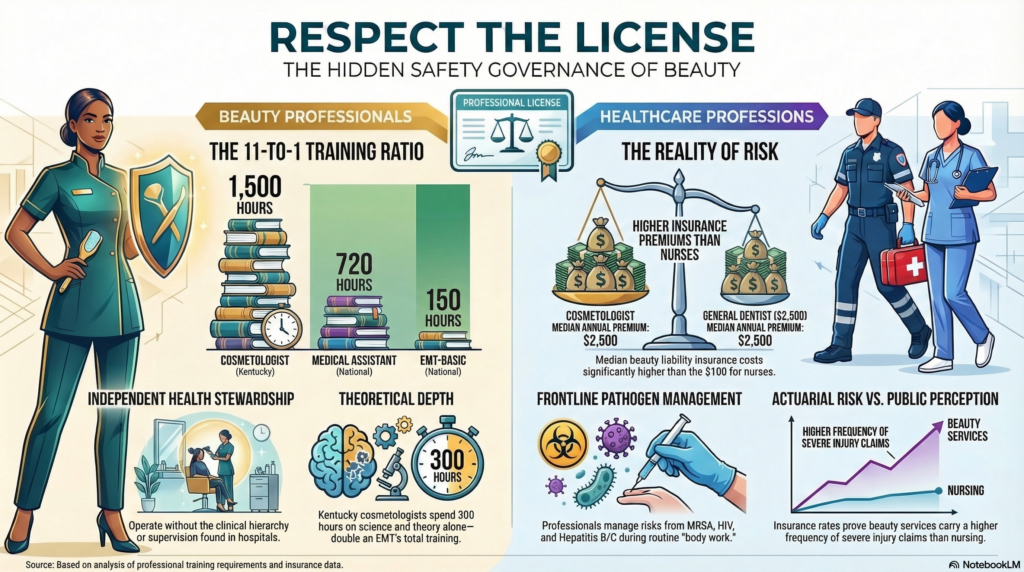
A central point of contention in occupational policy is the “11-to-1” training ratio between cosmetologists and EMTs. This claim, which gained national attention during executive-level discussions on occupational licensing reform, highlights a significant disparity in state-mandated education.2 While the comparison is often used to argue that beauty licensing is over-regulated, a deeper analysis reveals that the educational objectives of these two fields are fundamentally divergent.

The EMT pathway is designed for rapid workforce entry to provide immediate, life-saving stabilization. A national EMT certification requires a state-approved course of at least clock hours.10 In contrast, a cosmetologist in Kentucky must complete hours of instruction, including hours dedicated solely to “Science and Theory”—more than double the total training of an EMT.9

Table 2: Comparison of Training Hour Requirements (Selected States/Programs)

ProfessionState/ProgramTotal HoursScience/Theory PortionSource
EMT (Basic)National StandardVaries by program10
Certified Nursing Assistant (CNA)ArizonaVaries by program10
CosmetologistKentucky Hours9
CosmetologistTexasIntegrated1
Medical AssistantNational StandardIntegrated10
EstheticianKentucky Hours9
Nail TechnicianTexasIntegrated12
Nail TechnicianKentucky Hours9

The rationale for the high intensity of beauty training lies in the “independent” nature of the work. While a CNA or an EMT operates within a rigid clinical hierarchy—often under the direct or indirect supervision of a physician or nurse—the licensed cosmetologist or barber is frequently the sole individual responsible for the sanitation and chemical safety of their environment.1 The hours of training are intended to build a deep, intuitive understanding of infectious disease prevention, chemical toxicology, and human anatomy to prevent the salon from becoming a focal point for community outbreaks.

In Kentucky, for example, a cosmetology student is legally prohibited from performing chemical services on the public until they have completed at least hours of instruction.9 This “safety buffer” ensures that the student has mastered the theoretical underpinnings of chemical reactions—such as the pH scale of hair relaxers—before they are permitted to handle substances that could cause permanent chemical burns or hair loss.9

Biological Risks and Pathogenic Proliferation in the Modern Salon

The beauty industry is a frontline environment for biological hazard management. Despite the lack of “high-risk” medical procedures, the salon is an ideal incubator for microbes due to the ingredients found in cosmetic products—such as sugar, starch, protein, and fatty acids—and the high water content of many professional formulas.13 Research has identified beauty salons as significant sources of viral, fungal, and bacterial infections.13

Documented biological hazards include common genera such as Staphylococcus, Streptococcus, and Pseudomonas, which are associated with respiratory problems and chronic skin diseases.13 Specific case studies have highlighted the gravity of these risks; for instance, a methicillin-resistant Staphylococcus aureus (MRSA) infection was traced back to a hairdressing visit in London, while unhygienic tools in Nigeria contributed to outbreaks of HIV and Hepatitis.13

Table 3: Microorganisms Isolated from Beauty Salon Tools and Products

CategoryIsolated MicroorganismsCommon SourceSource
BacterialS. aureus, P. aeruginosa, E. coli, Enterobacter spp.Clippers, brushes, makeup sponges, foot basins.13
FungalCandida albicans, Aspergillus, Trichophyton, MalasseziaHairbrushes, nail tools, moist eyeshadows.13
ViralHepatitis B & C, HIV, Herpes SimplexRazors, nippers, shared eyeliner/lipstick.13
Pathogenic IndicatorsP. aeruginosa, S. aureus, Salmonella spp.Contaminated or expired cosmetic products.13

In the dental clinic, infection risks are managed with extreme stringency due to the aerosolization of blood and saliva.14 However, the “micro-trauma” caused by a standard manicure or a straight-razor shave provides a sufficient route of transmission for the same bloodborne pathogens. For any pathogen to cause disease, a “chain of infection” must exist: a sufficient number of microorganisms, a reservoir (blood or saliva), a route of transmission, and a susceptible host.15 The 1,500-hour beauty curriculum is designed to systematically break this chain at every stage.

Government Oversight and the Enforcement Architecture

The governance of the beauty industry is maintained through a “Risk-Based” model of inspections, which varies significantly by state. Unlike the healthcare sector, where hospitals and nursing homes face intense, multi-agency oversight (including OSHA, the CDC, and state health departments), beauty establishments are primarily governed by state-specific Boards of Cosmetology or Departments of Licensing.1

In Texas, the Department of Licensing and Regulation (TDLR) classifies violations into three distinct categories based on their threat to public health. This structured enforcement ensures that the “hidden safety governance” is not merely theoretical but is backed by substantial financial penalties.17

Table 4: Texas TDLR Penalty Matrix for Barbering and Cosmetology

Violation ClassPenalty RangeExample Violation CategoriesSource
Class AAdministrative errors; failure to display current license; wearing dirty garments.17
Class BWorking with expired license; improper storage of chlorine bleach; failure to clean fixtures.17
Class COperating without any license; operating outside the scope of practice; license transfer.17
License RevocationN/AThreatening inspectors; repeated Class C violations; major public safety threats.17

Comparing this to the food service industry reveals a stark difference in regulatory frequency. While high-risk restaurants handling raw meats are often inspected every to months, many beauty salons are only inspected once per year or even biennially.18 This suggests that the “regulatory intensity” in beauty is front-loaded into the licensure process (the 1,500 hours) rather than the inspection process. The state assumes that if a professional has mastered hours of training, they are less likely to require constant surveillance than a food handler who may only have completed an 8-hour certification course.21

In California, the Board of Barbering and Cosmetology manages one of the largest regulatory caseloads in the nation. In the fiscal year, the board received complaints and took total disciplinary decisions, including license revocations.23 This enforcement volume highlights the persistent struggle to maintain standards in a fragmented market dominated by small, independent businesses.

Actuarial Insights: The Financial Cost of Professional Negligence

Perhaps the most objective measure of the “hidden risk” in the beauty industry is found in the insurance market. Professional liability insurance, or malpractice insurance, is priced based on the actuarial probability of an incident occurring and the potential cost of that incident.24 Surprisingly, a beautician or cosmetologist often pays significantly more for individual liability coverage than a registered nurse.

While a nurse can obtain an individual malpractice policy for approximately per year, a cosmetologist pays a median cost of to per year.25 This cost ratio indicates that insurance underwriters perceive a higher risk of “frequent and severe” claims in the salon setting compared to the nursing setting.

Table 5: Comparative Professional Liability Insurance Costs (Median Annual)

ProfessionAnnual Premium (Median)Key Risk FactorSource
Registered Nurse (RN)Medication errors; failure to monitor.25
Dietitian / NutritionistImproper dietary advice; allergy issues.24
Cosmetologist / BeauticianChemical burns; hair loss; eye infections.26
Nurse Practitioner (NP)Diagnostic errors; prescription authority.28
General DentistNerve damage; surgical complications.28
Oral SurgeonHigh-risk surgical procedures.28
General SurgeonComplex, life-threatening interventions.28

The claims data in the beauty industry underscores the necessity of high-intensity training. Documented insurance payouts include for hair loss resulting from a treatment and for chemical conjunctivitis caused by an eyelash extension.30 These are not “superficial” injuries; they represent significant bodily harm and long-term psychological distress. The hours of training serve as a form of risk mitigation that keeps these premiums from escalating to surgical levels.

The Medical-Aesthetic Integration and the Regulatory Frontier

The integration of aesthetic medicine—minimally invasive procedures like fillers, botulinum toxin, and laser treatments—has created a “gray area” of regulation. In many countries, there is a heated debate between physicians and cosmetologists over who is authorized to perform these procedures.31 Traditional therapeutic medicine centers on disease treatment, while aesthetic medicine centers on the “appreciation of beauty” and the commodification of human worth.31

In the United States, the legal distinction is often tied to the “cosmetic purpose” of the act. A licensed cosmetologist in Kentucky is authorized to provide “facials and massages” but is strictly prohibited from treating “physical or mental ailments”.1 However, as technology advances, the tools used by cosmetologists (such as facial machines and high-intensity lasers) increasingly resemble medical devices.9

The Ministry of Health in various nations, including recent communications from Poland, has attempted to draw a rigid line: procedures like fillers should be performed exclusively by specialist physicians in dermatology or plastic surgery.32 Yet, because many jurisdictions lack a rigid statutory definition of an “aesthetic medicine procedure,” the conflict remains unresolved.32 This regulatory tension highlights the shift of the beauty industry toward a more clinical identity—a transition that Di Tran University identifies as the “humanization of professional aesthetics.”

Sociological Devaluation and the “Pink Tax” of Regulation

Despite the rigorous training and actuarial risk, beauty industry labor is often devalued in sociological discourse. The concept of “aesthetic labor”—the practice of screening and managing workers based on their physical appearance—is often used to stratify workers by class, race, and gender.34 Because the industry is predominantly female, its regulatory mandates are sometimes viewed as “undervalued” or dismissed as unnecessary “economic barriers”.35

Marie Boyd of the University of South Carolina argues that this association with femininity has led to a lack of federal oversight. For example, the FDCA has fewer than two pages devoted to cosmetics out of its 500-page total.35 Unlike drugs, cosmetics do not need FDA approval before they are sold, and manufacturers are not required to report adverse events.35 This places an enormous burden on the individual practitioner; they must be the final “safety filter” for products that the federal government does not adequately monitor.35

Furthermore, the beauty obsession fostered by media and industry messaging has mental health implications, particularly for Generation Z.36 The shift from using cosmetics for “concealment” to “creative expression” reflects a changing consumer psychology that beauty professionals must now manage.36 The 1,500-hour license, therefore, is not just a technical requirement; it is a credential that allows the professional to navigate these complex psychological and physical interactions with authority and ethical responsibility.

Comparative Workplace Safety: Healthcare vs. Beauty Establishments

When examining “Regulatory Intensity,” it is essential to compare the safety outcomes for the workers themselves. Healthcare and social assistance practitioners experience some of the highest rates of workplace injuries in the private sector, with injuries per full-time workers.38 These injuries are often the result of “safe patient handling” failures or workplace violence.16

In contrast, the risks in beauty establishments are chronic rather than acute. Nail salon workers, predominantly immigrant women, face cumulative exposure to biological, ergonomic, and chemical hazards.41 However, because the beauty industry is dominated by micro-enterprises and independent contractors, many of these “injuries” go unreported to OSHA.41 This lack of centralized data often masks the true “regulatory intensity” needed to protect these workers.

Table 6: Occupational Hazard Comparison: Healthcare vs. Beauty Industry

Hazard CategoryHealthcare Industry ProfileBeauty Industry ProfileSource
Infectious DiseaseHigh exposure (Aerosol, Bloodborne)High exposure (Direct Contact, Skin Flora)13
Physical Violence of all nonfatal workplace violenceLow documented frequency39
Chemical ExposureDisinfectants, SterilantsReactive chemicals, Formaldehyde, Monomers16
Ergonomic RiskPatient handling, liftingRepetitive motion, prolonged standing38
Regulatory LeadOSHA / CDC / State HealthState Boards / TDLR16

The “hidden safety governance” of the beauty industry acts as a massive public health buffer. By ensuring that trillion microbes on the human skin are managed through proper antisepsis in millions of salons every day, the beauty industry prevents a secondary burden on the healthcare system.7

Conclusions and the Path Forward for Di Tran University

The comprehensive analysis of the beauty industry’s regulatory landscape reveals a profession that is fundamentally misunderstood by the public and often undervalued by policymakers. The hours required for a cosmetology license— times more than an EMT—is not an accident of history or a product of lobbying; it is a calculated societal response to the biological and chemical risks inherent in “body work.”

At Di Tran University — The College of Humanization, we conclude that the “Respect the License” initiative is a vital component of public health advocacy. The following key insights should guide the future of beauty governance:

  1. Pedagogical Intensity as Public Health Defense: The high training hours in beauty are essential because the practitioner operates as an independent, frontline steward of sanitation without the institutional “safety net” found in hospitals.
  2. Actuarial Reality Trumps Political Narrative: The higher cost of professional liability insurance for cosmetologists compared to nurses provides undeniable proof of the “hidden risks” that the license is designed to manage.
  3. The Biological Burden is Real: With contamination rates found on unsterilized tools in certain studies, the transition from “Barber’s Itch” to “MRSA” proves that the microbial threat is evolving, not disappearing.
  4. Regulatory Humanization: Professionalizing the beauty industry through high standards protects the dignity and bodily integrity of the client, fulfilling the core mission of the College of Humanization.

The beauty industry is not a “secondary” health profession; it is a primary prevention sector. As we move into an era of medical-aesthetic integration, the license must be respected as the legal and scientific bedrock that ensures “beauty at any cost” does not become a literal reality for the public’s health.

Works cited

  1. The Legal Scope of Beauty Licensing in the United States: A …, accessed March 11, 2026, https://louisvillebeautyacademy.net/the-legal-scope-of-beauty-licensing-in-the-united-states-a-comprehensive-policy-legal-and-workforce-analysis-of-cosmetology-barbering-esthetics-and-nail-technology-research-podcast-serie/
  2. Are cosmetologists training longer than EMTs? | The Fact Checker – YouTube, accessed March 11, 2026, https://m.youtube.com/watch?v=-qm8TipH6fY
  3. HIST 234 – Lecture 11 – The Sanitary Movement and the “Filth Theory of Disease”, accessed March 11, 2026, https://oyc.yale.edu/history/hist-234/lecture-11
  4. ‘To Preserve the Skin in Health’: Drainage, Bodily Control and the Visual Definition of Healthy Skin 1835–1900 – PMC, accessed March 11, 2026, https://pmc.ncbi.nlm.nih.gov/articles/PMC4103382/
  5. Germ Theory 1880-1912 – Salt Lake County Archives, accessed March 11, 2026, https://www.saltlakecounty.gov/archives/exhibits/the-salt-lake-county-health-department-history/germ-theory/
  6. History of Hygiene: From Rituals to Modern Standards – CWS, accessed March 11, 2026, https://www.cws.com/en/hygiene/news-knowledge/history-hygiene-invisible-protection-through-ages
  7. The little-known history of cleanliness and the forgotten pioneers of handwashing – Frontiers, accessed March 11, 2026, https://www.frontiersin.org/journals/public-health/articles/10.3389/fpubh.2022.979464/full
  8. Training Program Search – IdahoWorks, accessed March 11, 2026, https://idahoworks.gov/search/programs?per_page=10&search_training_program_search%5Baverage_hours_per_week%5D=0&search_training_program_search%5Bhas_certified_curriculum%5D=1&search_training_program_search%5Bprogram_course_time_ids%5D=1
  9. Title 201 Chapter 12 Regulation 082 • Kentucky Administrative …, accessed March 11, 2026, https://apps.legislature.ky.gov/law/kar/titles/201/012/082/10638/
  10. Health Services Academy | Applied Technologies Pre-K & 7-12, accessed March 11, 2026, https://www.alaschools.org/az/applied-technologies/academies/health
  11. Health Science Certificate Training Program in South Florida – Sheridan Technical College, accessed March 11, 2026, https://www.sheridantechnicalcollege.edu/medical-health-science/
  12. Cosmetology | 2025-2026 Grayson College Catalog, accessed March 11, 2026, https://catalog.grayson.edu/2025-2026/programs/cosmetology/index.php
  13. Beauty Salons are Key Potential Sources of Disease Spread – PMC, accessed March 11, 2026, https://pmc.ncbi.nlm.nih.gov/articles/PMC8007475/
  14. The Unseen Threat in Dentistry: How to Identify, Prevent, and Overcome Infection Risks in the Modern Dental Clinic – jicrcr, accessed March 11, 2026, https://jicrcr.com/index.php/jicrcr/article/download/1789/1512/3733
  15. Preventing Cross Infection in the Dental Office – StatPearls – NCBI Bookshelf – NIH, accessed March 11, 2026, https://www.ncbi.nlm.nih.gov/books/NBK589669/
  16. Healthcare – Overview | Occupational Safety and Health Administration, accessed March 11, 2026, https://www.osha.gov/healthcare
  17. Penalties and Sanctions for Practitioners and Establishments …, accessed March 11, 2026, https://www.tdlr.texas.gov/enforcement/bacsanctions-practitioners-establishments.htm
  18. Inspection frequency : r/healthinspector – Reddit, accessed March 11, 2026, https://www.reddit.com/r/healthinspector/comments/1lf2ypi/inspection_frequency/
  19. Understanding Your Food Hygiene Rating: What It Means for Restaurants – KNOW App, accessed March 11, 2026, https://www.getknowapp.com/blog/food-hygiene-rating/
  20. Inspection Program – MyFloridaLicense.com, accessed March 11, 2026, https://www2.myfloridalicense.com/division-of-regulation/inspection-program/
  21. Food Safety Training | DuPage County Health, IL, accessed March 11, 2026, https://www.dupagehealth.org/202/Food-Safety-Training
  22. Health Inspections for Nail Salons and Barbershops – The Institute for Justice, accessed March 11, 2026, https://ij.org/report/clean-cut/health-inspections-for-nail-salons-and-barbershops/
  23. Enforcement Statistical Overview – California Board of Barbering and Cosmetology – CA.gov, accessed March 11, 2026, https://www.barbercosmo.ca.gov/enforcement/enf_stats.shtml
  24. Medical Malpractice Insurance Cost: Fast & Free Quotes | Insureon, accessed March 11, 2026, https://www.insureon.com/small-business-insurance/medical-malpractice/cost
  25. Everything You Need to Know About Nursing Malpractice Insurance, accessed March 11, 2026, https://nurse.org/education/nursing-malpractice-insurance/
  26. Cosmetology Insurance Cost Guide | Compare side by side – Simply Business, accessed March 11, 2026, https://www.simplybusiness.com/business-insurance/cosmetology-insurance/cost/
  27. Cosmetologist Insurance | Cosmetology Business Insurance – InsuredBetter.com, accessed March 11, 2026, https://www.insuredbetter.com/small-business-insurance/health-beauty/cosmetologist-coverage/
  28. How Much Does Medical Malpractice Insurance Cost for Surgeons, Dentists, and Nurses?, accessed March 11, 2026, https://www.finchmccranie.com/blog/how-much-does-medical-malpractice-insurance-cost-for-surgeons-dentists-and-nurses/
  29. 2024 Medical Professional Liability: An Evolving Landscape, accessed March 11, 2026, https://ppemedical.com/blog/2024-medical-professional-liability-an-evolving-landscape/
  30. Professional Liability Insurance – Beauty Insurance Plus, accessed March 11, 2026, https://www.beautyinsuranceplus.com/professional-liability-insurance/
  31. Ethical and Regulatory Gaps in Aesthetic Medical Practice in Top Asian Medical Tourism Destinations – PMC, accessed March 11, 2026, https://pmc.ncbi.nlm.nih.gov/articles/PMC10776543/
  32. How Does the Ministry of Health’s Communication Affect the Beauty Industry? | Żyglicka, accessed March 11, 2026, https://www.kpr.pl/en/how-does-the-ministry-of-healths-communication-affect-the-beauty-industry/
  33. Title 201 Chapter 12 Regulation 082 • Kentucky Administrative Regulations – Legislative Research Commission, accessed March 11, 2026, https://apps.legislature.ky.gov/law/kar/titles/201/012/082/
  34. Aesthetic Labor for the Sociologies of Work, Gender, and Beauty – ResearchGate, accessed March 11, 2026, https://www.researchgate.net/publication/269280709_Aesthetic_Labor_for_the_Sociologies_of_Work_Gender_and_Beauty
  35. More Regulation Needed to Combat Risks From Cosmetics | The Regulatory Review, accessed March 11, 2026, https://www.theregreview.org/2019/06/13/fritz-more-regulation-needed-combat-cosmetics-risks/
  36. Decoding Influence: Cosmetic Industry Strategies, Media Beauty Standards, and Their Mental Health Impact on Generation Z Consume – Digital Collections @ Suffolk, accessed March 11, 2026, https://dc.suffolk.edu/cgi/viewcontent.cgi?article=1045&context=undergrad
  37. The Beauty Industry’s Influence on Women in Society – UNH Scholars Repository, accessed March 11, 2026, https://scholars.unh.edu/cgi/viewcontent.cgi?article=1085&context=honors
  38. Top 10 Industries with Highest OSHA Injury Rates (2026) – OSHA Education School, accessed March 11, 2026, https://blog.oshaeducationschool.com/industries-highest-osha-injury-rates/
  39. OSHA 2025: What Healthcare Professionals Need to Know – Abyde, accessed March 11, 2026, https://abyde.com/2025-osha-healthcare-updates/
  40. Trends in workplace violence for health care occupations and facilities over the last 10 years, accessed March 11, 2026, https://pmc.ncbi.nlm.nih.gov/articles/PMC11630250/
  41. Licensure and citations among nail salons in Michigan from 2017 to 2021: A cross‐sectional study of an overlooked and vulnerable industry – ResearchGate, accessed March 11, 2026, https://www.researchgate.net/publication/362130091_Licensure_and_citations_among_nail_salons_in_Michigan_from_2017_to_2021_A_cross-sectional_study_of_an_overlooked_and_vulnerable_industry
  42. Employer-Reported Workplace Injuries and Illnesses – 2023-2024 – BLS.gov, accessed March 11, 2026, https://www.bls.gov/news.release/pdf/osh.pdf
  43. Ten Most Common Code Violations in Establishment Inspections, accessed March 11, 2026, https://www.tdlr.texas.gov/barbering-and-cosmetology/establishments/most-common-violations.htm

Licensed Cosmetology Education as Workforce Infrastructure: Regulatory Architecture, Compliance-by-Design, and Adult Learner Outcomes in Kentucky and the United States – RESEARCH & PODCAST SERIES 2026


Public Research & Regulatory Literacy Series
Louisville Beauty Academy — Informational Publication
Developed in academic collaboration with Di Tran University, The College of Humanization Research.
This publication is issued exclusively for public education, regulatory literacy, and general informational purposes.


Executive Summary

This publication examines licensed cosmetology education as a component of modern workforce infrastructure rather than solely as a segment of traditional academic education. Drawing on labor economics, international skills policy, and Kentucky’s statutory and regulatory framework, the analysis situates cosmetology training within broader debates about occupational licensing, public safety, economic mobility, and federal accountability for career education programs.

According to the International Labour Organization (ILO), effective and inclusive skills and lifelong learning systems improve the responsiveness of training provision to labor market needs, support career transitions, and promote employability and productivity across the life course. Similarly, OECD work on skills and adult learning highlights that postsecondary credentials, including certificates and occupational licenses, are associated with higher earnings and improved employment prospects for individuals who do not obtain four‑year college degrees.ockham-ips+2

Within this broader context, Kentucky’s cosmetology framework—anchored in Kentucky Revised Statutes (KRS) Chapter 317A and Kentucky Administrative Regulations (KAR) Title 201 Chapter 12—treats cosmetology, esthetic practices, and nail technology as regulated occupations with explicit public protection purposes. KRS 317A.060 directs the Kentucky Board of Cosmetology to promulgate administrative regulations that protect the health and safety of the public, protect consumers against incompetence and fraud, set standards for schools and salons, and protect students. KRS 317A.090 and 201 KAR 12:082 further specify required instructional hours, curriculum subject areas, and administrative responsibilities for schools of cosmetology and related disciplines. Infection-control, health, and safety expectations are detailed in 201 KAR 12:100, which establishes sanitation and disinfection standards for all licensed facilities.legislature.ky+3

This paper introduces a conceptual “Compliance by Design” framework to describe educational models in which regulatory requirements—such as attendance verification, supervised instruction, curriculum coverage, and reporting—are embedded in daily school operations. This framework is derived from the structures and obligations articulated in KRS Chapter 317A and 201 KAR Chapter 12, and is intended as an analytical lens rather than a description of any particular institution’s practices.kbc.ky+2

Labor market evidence indicates that career and technical education (CTE) and vocational certificates can improve employment rates and earnings, especially for individuals without four‑year degrees. In personal appearance occupations, the U.S. Bureau of Labor Statistics (BLS) reports that barbers, hairstylists, and cosmetologists collectively held more than half a million jobs in 2022, with employment projected to grow faster than the average for all occupations. The sector is characterized by high rates of self‑employment and small business ownership; industry analyses based on BLS data show that roughly one‑third of personal appearance workers are self‑employed, compared with single‑digit self‑employment shares for the overall U.S. workforce.careertech+5

These structural features position licensed cosmetology as a micro‑entrepreneurship pipeline: graduates often work as independent contractors, booth renters, or small salon owners, contributing to local service economies and circulating income through neighborhood enterprises.iahd+1

Adult cosmetology students frequently include working adults, immigrants, parents, career changers, and first‑generation professionals. Research on adult learners and career pathways documents that such populations benefit from flexible, short‑term vocational programs that combine basic skills with occupational training and lead to recognized credentials. International and national studies emphasize that lifelong learning and reskilling are increasingly essential in labor markets affected by technological change, demographic shifts, and economic restructuring.oecd+5

Federal policy debates—especially around “gainful employment,” debt‑to‑earnings tests, and minimum earnings thresholds—have significant implications for licensed vocational programs, including cosmetology. The U.S. Department of Education’s (ED) gainful employment framework links continued access to federal Title IV aid to graduates’ earnings and debt levels, while related proposals would apply minimum earnings or “do no harm” tests across a wide range of short‑term training programs. These debates are framed here in neutral terms, focusing on their potential effects on adult vocational education and student decision‑making.insidehighered+4

Throughout, interpretation authority is attributed to the relevant statutes, regulations, and government bodies. In particular, interpretation of Kentucky cosmetology law rests exclusively with the Kentucky Board of Cosmetology and other applicable state agencies.


Section I — Adult Education in the Modern Economy

1. Adult Education as Workforce Infrastructure

Workforce and skills policy research has increasingly treated adult and vocational education as part of a nation’s economic infrastructure, analogous to transportation or digital networks. The ILO strategy on skills and lifelong learning emphasizes that robust skills systems allow economies to respond to technological change, environmental transition, and demographic shifts, while supporting individuals’ career aspirations and mobility. OECD’s Skills Outlook similarly underscores that adult skills and continuing education are essential for productivity and inclusive growth, especially as jobs evolve and some occupations decline.oecd+2

Within this framework, licensed vocational programs—such as cosmetology, esthetics, and nail technology—serve as targeted mechanisms for equipping adults with occupation‑specific skills linked directly to labor market demand. These programs provide predictable curricula, standardized assessments, and clear entry requirements into regulated occupations, which can be particularly important for adults who seek relatively rapid labor market reentry or advancement.

2. Evidence on Vocational and CTE Outcomes

Empirical studies of CTE and vocational training have documented positive labor market returns for many participants, especially those earning certificates in technical or health-related fields. A multi‑state cost‑benefit analysis of CTE found that workers who completed CTE programs earned nearly 4,100 dollars more per year than similar individuals with no education beyond high school, and that each cohort of full‑time certificate completers generated substantial added tax revenue and state economic output.[careertech]​

Research using administrative earnings records from California community colleges estimated returns to CTE certificates and degrees in the range of 12 to 23 percent, with some technical programs yielding larger earnings gains than academic associate degrees. Other studies summarized by Education Northwest and Kappan highlight that high‑quality CTE can increase high school graduation, raise employment rates, and improve earnings, particularly where programs are aligned with regional labor market needs and offer work‑based learning components.kappanonline+2

Federal analyses summarized by the Congressional Research Service indicate that alternative credentials (including vocational certificates and professional licenses) are associated with statistically significant wage premiums for adults without postsecondary degrees, compared with peers who lack such credentials but have similar levels of formal education. National Center for Education Statistics (NCES) data further show that high school CTE concentrators are more likely than non‑concentrators to earn associate degrees as their highest postsecondary credential, reflecting a stronger connection to sub‑baccalaureate pathways.sgp.fas+2

Although returns vary by field and program design, this body of research supports viewing adult and vocational education as an integral component of workforce infrastructure that can improve individual earnings and state economic outcomes.

3. Cosmetology and Personal Appearance Work in the Labor Market

Cosmetology and related personal appearance occupations exemplify how vocational education feeds directly into labor markets characterized by localized, service‑based demand. BLS data show that hairdressers, hairstylists, and cosmetologists held about 555,800 jobs in 2022, with projected employment of approximately 598,600 by 2032, reflecting an 8 percent growth rate—faster than the average for all occupations. Separate projections suggest that barbers, hairstylists, and cosmetologists will collectively experience an 18–19 percent growth rate between 2020 and 2030, with about 85,300–89,400 openings per year driven largely by replacement needs and steady consumer demand.kennethshuler+2

Economic snapshots of the salon industry, drawing from BLS and industry data, indicate that around 29–33 percent of individuals in personal appearance occupations are self‑employed, a rate significantly higher than the self‑employment share in the overall U.S. workforce (approximately 6–7 percent). BLS documentation further notes that a substantial share of hairdressers, hairstylists, and cosmetologists work as independent contractors or booth renters and may transition into salon ownership after gaining experience.reginfo+3

These features position licensed cosmetology not only as job preparation but also as an entry point into small business formation and local entrepreneurship, especially in urban and neighborhood economies where personal appearance services are delivered face‑to‑face.


Section II — Legal Foundations of Licensed Vocational Education

This section focuses on the legal architecture governing licensed cosmetology education in Kentucky, with emphasis on statutes and administrative regulations that define school operations, curriculum, and oversight.

1. Statutory Framework: KRS Chapter 317A

KRS Chapter 317A establishes the legal framework for cosmetology, nail technology, esthetic practices, and the institutions and individuals that participate in those fields. KRS 317A.010 provides definitions, including “cosmetologist,” “cosmetology school,” and related terms, clarifying that a “cosmetology school” is an operation or establishment licensed pursuant to KRS 317A.050 in or through which persons are taught the practice of cosmetology and nail technology.law.justia+1

KRS 317A.020 sets the scope of the chapter, specifying that no person may engage in the practice of cosmetology or nail technology for other than cosmetic purposes or for treatment of physical or mental ailments, and establishing general licensure requirements while exempting certain medical and health professions when cosmetology-related acts are incidental to their authorized practice.[legiscan]​

Crucially, KRS 317A.060 directs the Kentucky Board of Cosmetology to promulgate administrative regulations that:

  • Protect the health and safety of the public.
  • Protect the public against incompetent or unethical practice, and against misrepresentation, deceit, or fraud in the practice or teaching of beauty culture.
  • Set standards for the operation of schools and salons.
  • Protect students subject to KRS Chapter 317A.
  • Establish standards for location, equipment, supplies, instructors, hours and courses of instruction, examinations, and the proper education and training of students.[apps.legislature.ky]​

These statutory provisions make clear that cosmetology regulation in Kentucky is framed explicitly as a public protection and quality assurance function, rather than a purely private or market‑driven arrangement.

2. KRS 317A.090: School Licensing and Training Requirements

KRS 317A.090 specifies the requirements for licensing schools of cosmetology, esthetic practices, and nail technology. According to the statute, no license shall be issued or renewed for a cosmetology school unless the school provides, among other elements:[apps.legislature.ky]​

  • Authorization to operate educational programs beyond secondary education.
  • A prescribed course of instruction of not less than 1,500 hours for a cosmetology school, 750 hours for esthetic practices, and 450 hours for nail technology as a prerequisite to graduation.
  • Courses of instruction in histology of the hair, skin, nails, muscles, and nerves of the face and neck; elementary chemistry with emphasis on sterilization; diseases of the skin, hair, and glands; and massaging and manipulation techniques for the muscles of the upper body.
  • Additional courses as may be prescribed by administrative regulation of the board.
  • Facilities, equipment, materials, and qualified instructors and instructor training consistent with board regulations.
  • A requirement that newly licensed schools not serve the public until a specified number of instructional hours has been delivered to students.[apps.legislature.ky]​

The statutory enumeration of subject matter—particularly histology, chemistry with an emphasis on sterilization, and diseases of skin and hair—links cosmetology education directly to knowledge domains relevant to public health and infection control. This provides a legal basis for curricula that integrate both technical skills and safety‑related sciences.

3. 201 KAR 12:082: Curriculum and School Administration

201 KAR 12:082, promulgated under the authority of KRS 317A.060(1)(h) and 317A.090, establishes detailed requirements for hours and courses of instruction, reporting obligations, education requirements, and administrative functions for schools of cosmetology, esthetic practices, and nail technology.law.cornell+2

For cosmetology students, Section 1 of 201 KAR 12:082 organizes the curriculum into subject areas including:

  • Basics (history, professional image, communication).
  • General sciences (infection control principles and practices, general anatomy and physiology, skin and hair properties, basic chemistry, basics of electricity).
  • Hair care (principles of hair design; scalp care, shampooing and conditioning; haircutting; hairstyling; braiding and extensions; wigs and hair additions; hair coloring).[kbc.ky]​

Section 3 specifies that a cosmetology student must receive not less than 1,500 hours in clinical classwork and scientific lectures, including at a minimum:legislature.ky+1

  • 375 lecture hours for science and theory.
  • 1,085 clinic and practice hours.
  • 40 hours on the subject of applicable Kentucky statutes, administrative regulations, and board‑related content.

Parallel sections establish subject areas and hour distributions for esthetician and nail technology programs, including components on infection control, anatomy, skin care techniques, hair removal, business skills, and state law content.[kbc.ky]​

In addition to curricular content, 201 KAR 12:082 addresses school administration, including requirements for:

  • Student attendance and recordkeeping.
  • Reporting of transfers, withdrawals, and completions.
  • Instructor qualifications and instructional supervision.
  • Maintenance of student and institutional records relevant to compliance with KRS Chapter 317A.[kbc.ky]​

These provisions provide a regulatory blueprint for how licensed cosmetology schools must structure day‑to‑day educational operations to satisfy state standards.

4. Sanitation, Infection Control, and Inspection Regulations

201 KAR 12:100, titled “Sanitation standards” or “Infection control, health, and safety,” implements KRS 317A.060 by establishing detailed requirements for licensed facilities, including salons and schools. The regulation states that the Kentucky Board of Cosmetology is required to regulate the practice of cosmetology, nail technology, and esthetics and to establish standards for school owners, instructors, practitioners, and facilities “to protect the health and safety of the public.”kbc.ky+1

Key provisions of 201 KAR 12:100 include:

  • General sanitation requirements mandating that the entire licensed facility—equipment, employees, and implements—be maintained in a sanitary manner.
  • Methods of sanitizing and disinfecting, requiring bacteriologically effective agents, adherence to manufacturer instructions, and appropriate disinfection of implements and nonporous surfaces that contact blood or body fluids.[kbc.ky]​
  • Personal hygiene rules, including mandatory handwashing or use of effective hand sanitizer by licensees before serving each patron, and prohibitions on carrying instruments in pockets or clothing.kbc.ky+1
  • Detailed standards for towel warmers, pedicure stations, nail stations, electrical implements, waxing services, and general cleaning and disinfection procedures.
  • A list of prohibited items, such as methyl methacrylate (MMA), certain blades for cutting skin, roll‑on wax, and waxing of nasal hair.kbc.ky+1

Separate administrative regulations, such as 201 KAR 12:060 (Inspections), outline inspection authorities and procedures, including board authority to enter licensed premises during reasonable working hours to determine compliance and to require production of records.[kbc.ky]​

These regulatory instruments collectively frame cosmetology practice and education as activities conducted under a structured public health and safety regime.

5. Board Purpose and Oversight Functions

According to the official agency profile for the Kentucky Board of Cosmetology on Kentucky.gov, the Board was created “to protect the health and safety of the general public, to protect the public against misrepresentation, deceit, or fraud in the practice or teaching of beauty culture, [and] to set standards for the operation of the schools and salons, and to protect the students under the provisions of this chapter.”kentucky+1

A Legislative Research Commission (LRC) oversight summary further notes that the Board operates as an independent agency of the Commonwealth, regulates cosmetology, esthetic practices, nail technology, and associated salons, and oversees tens of thousands of practitioners. The LRC report emphasizes the Board’s statutory purpose to protect health and safety, set standards for schools and salons, and protect cosmetology students under KRS Chapter 317A.[louisvillebeautyacademy]​

Interpretation of these statutes and regulations resides exclusively with the Kentucky Board of Cosmetology, the Kentucky legislature, and other relevant agencies. This research paper does not assert authoritative legal interpretations but instead describes the regulatory architecture as stated in publicly available legal and policy documents.


Section III — Compliance as Educational Infrastructure (“Compliance by Design”)

1. Conceptual Definition

“Compliance by Design” is used here as an analytical term to describe an educational model in which statutory and regulatory requirements are systematically integrated into the structure, governance, and daily operations of licensed vocational schools. Under this framework, compliance is not treated as an external, after‑the‑fact obligation but as a core design principle influencing curriculum planning, attendance systems, supervision, facilities, and reporting.

The concept is grounded in observable requirements found in KRS Chapter 317A and 201 KAR Chapter 12, which collectively direct schools to:

  • Deliver a specified minimum number of instructional hours.
  • Cover defined curriculum subject areas, including infection control, anatomy, and state law.
  • Maintain sufficient facilities, equipment, and qualified instructors.
  • Keep detailed records of student attendance, progress, and completion.
  • Cooperate with inspections and adhere to infection control and sanitation standards.legislature.ky+4

The “Compliance by Design” framework, as used in this paper, is descriptive of this regulatory environment and is not derived from any single institution’s self‑presentation or internal policies.

2. Attendance Verification and Hour Tracking

KRS 317A.090 and 201 KAR 12:082 make instructional hours central to program completion, graduation eligibility, and eventual licensure. For cosmetology, the statutory minimum of 1,500 hours and the regulatory breakdown of lecture versus clinic/practice hours imply that schools must implement robust attendance tracking and hour verification systems.legislature.ky+2

Regulations concerning reporting (for example, documenting transfers, withdrawals, and completions) require that attendance data be maintained in a manner enabling verification by the Board or its inspectors. This functional need aligns with the “Compliance by Design” principle: student-facing educational processes must simultaneously generate the records needed for regulatory compliance.kbc.ky+1

3. Supervised Instruction and Instructor Qualifications

KRS 317A.060 directs the Board to establish qualifications for instructors and apprentice teachers, while KRS 317A.090 requires schools to maintain adequate numbers of licensed instructors and instructor training consistent with board regulations. Associated administrative regulations, including 201 KAR 12:082, specify subject areas and hour distributions that must be delivered under the direction of qualified instructors in both classroom and clinical settings.legislature.ky+2

From a compliance‑by‑design perspective, this means supervision is not simply a pedagogical preference but a regulatory requirement intended to ensure that practical services and training occur under licensed oversight. Inspections and record reviews, as authorized under 201 KAR 12:060, can confirm that students are not independently practicing beyond their scope and that instruction meets defined standards.[kbc.ky]​

4. Curriculum Standards and Sequencing

As noted above, 201 KAR 12:082 outlines specific subject areas for cosmetology, esthetics, and nail technology, integrating infection control, anatomy, chemistry, electricity, and business skills with practical service competencies. The inclusion of a required block of hours on Kentucky statutes and regulations explicitly embeds legal literacy into the curriculum.[kbc.ky]​

This regulatory structure encourages schools to design course sequences that satisfy both educational objectives and compliance benchmarks. For example, many states and curricula begin with infection control and blood exposure procedures before permitting students to perform services on the public; similar logic underlies Kentucky’s emphasis on infection control content, sanitation regulations, and staged public service after a minimum number of hours.nccosmeticarts+2

5. Reporting Obligations and Records Management

201 KAR 12:082 and other board regulations impose reporting obligations related to enrollment, attendance, transfers, suspensions, withdrawals, and completions, as well as maintenance of student records and institutional documentation. KRS 317A.070 and 317A.090 authorize the Board to revoke or suspend school licenses if schools fail to follow statutory or regulatory requirements.legislature.ky+3

Consequently, the administrative systems of a compliant school—data collection, student information systems, document retention—are effectively part of the educational infrastructure. In a compliance‑by‑design model, these systems are constructed from the outset to satisfy regulatory audits, support accurate reporting, and demonstrate adherence to hours and curriculum standards.

6. Inspection Integration

201 KAR 12:060 provides that board inspectors may enter licensed schools and salons during reasonable working hours or when open to the public, may require production of records, and may evaluate compliance with KRS Chapter 317A and 201 KAR Chapter 12. The regulation also addresses requirements for posting notices and clarifies that owners and managers are responsible for compliance.legislature.ky+1

In a compliance‑by‑design framework, schools incorporate inspection readiness into daily practice: sanitation routines, equipment maintenance, recordkeeping, and license postings are treated as normal operations rather than episodic responses to inspections. This reduces the likelihood of regulatory noncompliance and supports the Board’s statutory mission to protect public health and safety.

Interpretation of these inspection and compliance requirements remains with the Kentucky Board of Cosmetology and other state authorities. The “Compliance by Design” concept is offered purely as an analytical lens to describe possible ways institutions might internalize these legal structures.


Section IV — Workforce and Economic Outcomes

1. Vocational Training and Earnings

Multiple lines of research indicate that vocational and CTE programs can improve labor market outcomes for adults and youth who do not pursue four‑year degrees. A multi‑sector cost‑benefit analysis of CTE estimated that secondary and postsecondary CTE produced a turnover ratio of approximately 1:1.01, meaning that for every dollar earned by CTE graduates and completers, an additional dollar was generated for the state economy. The same study documented significant increases in employment, hourly wages, and hours worked for CTE participants relative to comparison groups.[careertech]​

NBER‑affiliated research on California community colleges found that CTE certificates and degrees yielded earnings gains in the 12–23 percent range, with the largest benefits in healthcare but substantial returns across many non‑health fields. Meta‑analyses of CTE also find positive effects on high school completion and early employment, particularly when programs include industry‑aligned curricula and work‑based learning opportunities.nber+2

These findings suggest that cosmetology training—when structured as a regulated, occupation‑specific certificate or diploma—fits within a class of programs that can provide measurable earnings benefits, although the magnitude of returns depends on tuition levels, local labor market conditions, self‑employment income, and business success.

2. Cosmetology as a Micro‑Entrepreneurship Pipeline

The structure of the cosmetology labor market accentuates its role as a micro‑entrepreneurship pipeline. BLS occupational projections and related analyses indicate that:

  • Employment of barbers, hairstylists, and cosmetologists is projected to grow faster than the average for all occupations.
  • Large shares of workers in these occupations are self‑employed or operate independent businesses.regionalcte+2

An “Economic Snapshot of the Salon Industry” based on BLS and industry data found that approximately 29–33 percent of personal appearance workers are self‑employed, compared with about 6–7 percent of the total U.S. workforce. For hairdressers, hairstylists, and cosmetologists specifically, roughly one‑third were reported as self‑employed in some snapshots, reflecting common arrangements such as booth rental, independent suites, and small salon ownership.iahd+2

These data suggest that cosmetology licensure often functions not only as a ticket to employment but also as a prerequisite for business formation. Licensed professionals may move from entry‑level employment in salons to self‑employment and later to employer status as salon owners, thereby creating additional jobs and contributing to local tax bases.

3. Local Economic Circulation and Service Economy Expansion

Personal appearance services are generally delivered in person and locally, which means that spending in this sector tends to circulate within local economies. Small salons, barbershops, and independent cosmetology practices typically purchase supplies and services from nearby vendors, employ local residents, and pay local taxes and fees.

Reports on the salon industry note that tens of thousands of jobs in barbershops and salons are added over decade‑long projection windows, driven by population growth, changing consumer preferences, and demand for personal care services. Because many licensed cosmetologists and barbers are independent or operate very small establishments, the sector exemplifies a diffuse network of micro‑enterprises rather than a concentrated corporate model.barstow+1

From a workforce policy standpoint, this pattern implies that cosmetology education supports a distributed service infrastructure where each licensed practitioner can act as a micro‑enterprise, with aggregate effects on employment, local spending, and neighborhood vitality.

4. Limitations of Wage Data for Entrepreneurial Occupations

A methodological note is important: BLS wage data for personal appearance workers typically exclude self‑employed workers when computing occupational wage estimates. This means that median wage figures for hairdressers, hairstylists, and cosmetologists largely reflect W‑2 employees and may not capture the income of booth renters, suite owners, or salon owners who receive profit income rather than wages.reginfo+1

Labor market and industry studies have cautioned that relying solely on W‑2–based wage tables can undercount the economic contribution of professions characterized by high self‑employment and independent contracting. This is relevant for policymakers, students, and the public when interpreting cosmetology wage data in the context of licensing debates, gainful employment rules, or return‑on‑investment calculations.sgp.fas+1


Section V — Public Protection and Consumer Safety

1. Regulatory Intent: Public Safety and Consumer Protection

KRS 317A.060 and associated regulations explicitly state that cosmetology regulation in Kentucky is designed to protect public health and safety and to protect the public against incompetent or unethical practice, misrepresentation, deceit, or fraud. The Kentucky Board of Cosmetology’s official mission statement on Kentucky.gov reiterates this purpose, noting that the Board was created to protect the health and safety of the general public, protect against misrepresentation and fraud in practice and teaching, and set standards for the operation of schools and salons.kentucky+2

201 KAR 12:100 further states that the Board must establish standards for the course and conduct of school owners, instructors, practitioners, and facilities “to protect the health and safety of the public,” and then sets out infection‑control, sanitation, and safety requirements for all licensed facilities.[kbc.ky]​

Taken together, these provisions articulate a regulatory rationale grounded in public protection, particularly with respect to infection control, chemical safety, and truthful representation of services.

2. Infection Control and Health Standards

201 KAR 12:100 provides detailed infection control and health standards, including:kbc.ky+1

  • Mandatory cleansing of hands before serving each patron.
  • Availability of hand sanitizer at each nail station.
  • Requirements for cleaning and disinfecting implements and nonporous surfaces that come into contact with blood or bodily fluids.
  • Specific procedures for cleaning whirlpool footbaths and similar equipment using appropriate disinfectants or bleach solutions.
  • Blood exposure procedures requiring immediate cessation of service, washing of the affected area, and appropriate disinfection and bandaging.
  • Restrictions on serving clients with visible swelling, eruptions, rashes, or other indications that a service area may be compromised, unless a physician’s note indicates they are not contagious.

Additionally, the regulation identifies prohibited substances and practices—such as use of MMA, certain blades for skin cutting, roll‑on wax, and waxing of nasal hair—on safety grounds.[kbc.ky]​

In the education context, KRS 317A.090 and 201 KAR 12:082 require instruction in infection control principles, diseases of the skin and hair, and relevant state laws, embedding these safety concerns in pre‑licensure curricula.legislature.ky+1

3. Inspection, Enforcement, and Student Protection

Inspection and enforcement mechanisms support consumer safety by ensuring that schools and salons maintain compliance with statutory and regulatory requirements. 201 KAR 12:060 authorizes board members, administrators, and inspectors to enter establishments during reasonable working hours or while open to the public, require identification, and inspect or copy records relevant to licensed activity. It also requires establishments to post board notices and clarifies that owners and managers are responsible for compliance.[kbc.ky]​

The Legislative Research Commission’s oversight study of the Kentucky Board of Cosmetology describes the Board’s core functions as protecting health and safety, protecting against misrepresentation and fraud, setting standards for schools and salons, and protecting students, while also noting challenges such as inspector shortages and the need for more detailed inspection policies.[louisvillebeautyacademy]​

By statute, KRS 317A.070 and 317A.090 authorize the Board to revoke or suspend licenses if schools or practitioners fail to follow the requirements set out in Chapter 317A or in board regulations. These enforcement tools reinforce the public protection rationale underpinning licensing and school oversight.legislature.ky+1

Interpretation of these inspection and enforcement authorities rests with the Kentucky Board of Cosmetology and the Kentucky legislature; this discussion is limited to describing publicly stated purposes and mechanisms.

4. Broader Debates on Occupational Licensing and Safety

While Kentucky’s statutory framework explicitly frames cosmetology licensure as a public protection measure, broader economic literature presents multiple perspectives on occupational licensing. Some analyses argue that licensing can be justified where there are clear health and safety risks, while questioning its extension into occupations with limited direct risks.brookings+1

For example, research from think tanks and academic commentators documents that licensing can raise wages for licensees and potentially reduce employment or increase consumer prices, suggesting that in some cases the primary effect may be to limit competition rather than to improve quality. Other analyses emphasize that evidence of safety improvements attributable directly to licensure can be limited or mixed in some occupations.mercatus+3

These debates are ongoing and vary by field. This paper does not take a normative position on the desirability of licensing but notes that in Kentucky, the statutory purpose for cosmetology regulation centers on health, safety, consumer protection, and student protection as articulated in KRS Chapter 317A and 201 KAR Chapter 12.kbc.ky+1


Section VI — Adult Education Accessibility and Social Mobility

1. Profile of Adult Vocational Learners

Adult vocational learners in cosmetology and similar fields often include:

  • Working adults seeking career advancement or career change.
  • Immigrants and non‑native speakers of English building new professional identities in a different labor market.
  • Parents balancing caregiving responsibilities with training.
  • First‑generation professionals who may be the first in their families to pursue postsecondary credentials or licensure.

Research on adult learners in employment transitions shows that groups such as mothers of young children, racialized persons, Indigenous peoples, persons with disabilities, and older adults more frequently face barriers to training, including time constraints, financial costs, and limited access to childcare and transportation. The Canadian “Mapping the Adult Learner Landscape” project, for example, found that adult learners require support both before and during training, including wrap‑around services and flexible program structures.[canada]​

Studies of adult education and career pathways programs in the United States similarly find that many adult learners are unemployed or underemployed, have low basic skills, are immigrants or non‑native English speakers, and face substantial economic vulnerabilities.[ies.ed]​

2. Lifelong Learning and Employability

International policy bodies have increasingly framed lifelong learning as essential to employability, resilience, and successful navigation of labor market transitions. The ILO strategy on skills and lifelong learning emphasizes that effective systems can reduce skills mismatches, support workers’ transitions into new occupations, and enhance productivity. OECD’s Skills Outlook and related publications underscore that learning must continue throughout adulthood, including through formal, non‑formal, and informal pathways, to sustain growth and social cohesion.ockham-ips+2

Evidence from adult basic education and career pathway evaluations in the United States suggests that integrated models which combine basic skills, contextualized instruction, and occupational training can improve credential attainment and, in some cases, employment and earnings. Many adult learners in such programs earn entry‑level vocational certificates or licenses—outcomes directly relevant to licensed trades such as cosmetology.calworkforce+1

3. Vocational Programs as Accessible Pathways

Because cosmetology and related programs are often shorter than traditional degree programs and structured around specific occupational competencies, they can be more accessible for adults who cannot commit to multi‑year degrees. Evaluations of career pathways and adult vocational programs show that structured, stackable credentials and clear labor market linkages help adult learners to enter and progress in careers while managing family and work obligations.calworkforce+1

From a social mobility perspective, licensed vocational programs can provide an initial economic foothold, particularly for first‑generation professionals, recent immigrants, and adults returning to education after interruptions. The combination of relatively short training periods, clear licensure outcomes, and high rates of self‑employment supports pathways into self‑sustaining work, even if earnings levels and business success vary.

4. Barriers and Equity Considerations

At the same time, research and policy reports highlight that adult learners often face structural barriers in accessing vocational training, including:oecd+2

  • Financial constraints, especially where tuition is high and grant aid is limited.
  • Limited access to childcare, transportation, and scheduling flexibility.
  • Language and digital skills gaps for immigrants and older adults.
  • Uncertainty about the quality and labor market value of available programs.

In licensed fields subject to federal aid and accountability requirements, additional concerns arise when students incur debt but do not complete programs or obtain licensure. Federal data indicate that some cosmetology programs exhibit relatively low completion rates, while graduates may face modest reported wages coupled with substantial debt burdens. These patterns have prompted increased federal attention to accountability and consumer information, discussed in the next section.nber+1


Section VII — Policy Implications for the Future of Adult Education

This section presents a neutral analysis of current federal policy debates and their implications for adult vocational education, including licensed cosmetology.

1. Federal Accountability Frameworks: Gainful Employment and Earnings Tests

The U.S. Department of Education’s gainful employment (GE) regulations and related proposals aim to ensure that career‑oriented programs receiving federal student aid prepare students for “gainful employment in a recognized occupation.” Under recent and proposed rules, career training programs at all types of institutions—particularly non‑degree programs and programs at proprietary schools—may be subject to metrics such as:[ed]​

  • Debt‑to‑earnings ratios, comparing graduates’ typical loan payments to their earnings.
  • Earnings thresholds comparing graduates’ earnings to those of typical high school graduates (“earnings premium” or “do no harm” tests).ticas+2

Programs that fail such tests for multiple years can lose eligibility for federal loans and, in some designs, Pell Grants. Analyses by policy organizations note that undergraduate certificate programs account for a small share of aid recipients but a large share of programs projected to fail earnings tests, suggesting that accountability rules may disproportionately affect short‑term vocational programs, including cosmetology.urban+3

These frameworks are intended to protect students and taxpayers from programs that yield low earnings relative to costs, but they also raise questions about how to measure returns in fields with high self‑employment, variable income, and non‑wage business profits.

2. Transparency and Consumer Information

In addition to sanctions, federal initiatives emphasize transparency through tools that provide students with program‑level information on tuition, typical borrowing, and post‑completion earnings. Proposals for “Financial Value Transparency” frameworks would make data on program outcomes publicly available, allowing consumers to compare programs and fields.ihep+1

For licensed trades, such transparency may help prospective students understand:

  • Required hours and time to completion.
  • Typical reported wages within their state or region.
  • Program completion rates and licensure exam pass rates where available.
  • Debt levels for graduates and non‑completers.

At the same time, as noted earlier, wage data for cosmetology and similar fields often exclude self‑employment income, and standardized datasets may not capture tips, commission structures, or profits from salon ownership. Policymakers and researchers have raised concerns that such limitations could understate the financial value of entrepreneurial professions in accountability metrics.sgp.fas+2

3. Short‑Term Pell and Very Short Programs

Parallel federal discussions involve potential expansion of Pell Grant eligibility to very short‑term training programs. Analysts have proposed pairing such expansions with earnings tests or other safeguards to ensure that publicly financed very short programs deliver meaningful economic returns.insidehighered+1

For licensed cosmetology, where state law already prescribes substantial minimum hours (1,500 hours for cosmetology, 750 for esthetics, 450 for nail technology in Kentucky), short‑term Pell proposals may have limited direct applicability. However, debates about very short programs influence the broader policy environment by focusing attention on minimum program quality, outcome measurement, and the balance between access and protection.[apps.legislature.ky]​

4. Occupational Licensing Reform and Reciprocity

Nationally, some states and federal bodies have pursued occupational licensing reforms aimed at reducing barriers to entry, particularly for low‑income workers, military spouses, and individuals moving across state lines. Reform ideas include:ftc+1

  • Licensing reciprocity or recognition of out‑of‑state licenses.
  • Reduction in required training hours where evidence of safety benefits is limited.
  • Alternative mechanisms such as certification or registration in lower‑risk occupations.

At the same time, federal agencies and state legislatures have generally recognized that some occupations with higher inherent health and safety risks—such as those involving physical contact, chemicals, or potential blood exposure—may warrant more extensive training and regulatory oversight.thefga+1

In Kentucky, any changes to cosmetology licensing requirements, recognition of licenses from other states, or hour reductions would require legislative and regulatory processes under KRS Chapter 317A and 201 KAR Chapter 12. Interpretation authority for such changes rests with the Kentucky General Assembly and the Kentucky Board of Cosmetology.

5. Adult Vocational Education as Public Infrastructure

From a policy perspective, framing adult vocational education—including licensed cosmetology—as workforce infrastructure suggests several implications:

  • Alignment with labor market demand: Research indicates that CTE yields better outcomes when programs are aligned with regional employment needs and supported by employer partnerships. In cosmetology, this might translate into close attention to local demand for hair, skin, and nail services, as well as emerging specialized services governed by state law.kappanonline+1
  • Integration of compliance and pedagogy: The Kentucky regulatory framework illustrates how compliance requirements (hours, curriculum, infection control) are inseparable from educational design. A compliance‑by‑design approach can help institutions treat regulatory adherence as a foundational design constraint rather than an external burden.
  • Support for non‑traditional and adult learners: International and national studies underscore the importance of flexible learning pathways, recognition of prior learning, and targeted support for adults juggling work and caregiving responsibilities. Licensed vocational programs can contribute to such systems when designed with adult learner realities in mind.canada+2
  • Evidence‑based accountability: Federal debates over gainful employment, earnings tests, and transparency emphasize the importance of linking public subsidy to demonstrated value. For licensed trades, this heightens the need for accurate data that reflect both wage employment and self‑employment incomes.

This paper does not prescribe specific policy choices but highlights that adult vocational education in licensed fields operates at the intersection of public health regulation, workforce development, and higher education finance.


Section VIII — Public Education Notice

This final section provides the required public education and liability notes, consistent with the non‑opinion, informational purpose of the publication.

  1. Nature of the Publishing Institution
    This research is published by a state‑licensed adult vocational education provider acting solely as a public educational publisher. The institution’s role in this context is limited to synthesizing publicly available laws, regulations, and research for general informational purposes.
  2. Regulatory Interpretation Authority
    • Interpretation and enforcement of Kentucky Revised Statutes Chapter 317A and Kentucky Administrative Regulations Title 201 Chapter 12 rest exclusively with the Kentucky Board of Cosmetology, the Kentucky General Assembly, and other applicable state agencies.kentucky+1
    • Any descriptions of statutes, regulations, or policy frameworks in this publication are summaries based on publicly available sources and should not be treated as official interpretations.
  3. No Legal or Licensing Advice
    Required Disclaimer (verbatim):
    This publication is provided for informational and public educational purposes only. It does not constitute legal, regulatory, or licensing advice. Readers should consult the appropriate state licensing authority or regulatory agency for official interpretations and requirements.
  4. No Institutional Comparison or Endorsement
    This paper does not compare the performance of individual schools or programs, nor does it endorse or criticize any specific institution. References to statutes, regulations, and labor market studies are used solely to enhance public understanding of licensed vocational education and do not imply comparative judgments among providers.
  5. Purpose and Public‑Service Framing
    Consistent with the goals outlined at the outset, this publication is intended to:
    • Reduce misunderstanding of cosmetology licensing law and its connection to public safety and consumer protection.
    • Help prospective and current students recognize the importance of attending state‑licensed, regulation‑compliant programs for pathways that lead to lawful licensure.
    • Situate licensed cosmetology education within broader evidence on adult education, workforce outcomes, and federal accountability debates.
  6. Consulting Regulators and Official Sources
    Readers seeking to verify requirements, understand how laws apply to specific situations, or obtain guidance on licensure and school approval should consult:
    • The Kentucky Board of Cosmetology for current statutes, regulations, forms, and official interpretations.kentucky+1
    • The Kentucky legislature’s official statute and administrative regulation websites for up‑to‑date legal texts.legislature.ky+3
    • Relevant federal agencies, such as the U.S. Department of Education and the U.S. Department of Labor, for information on national policy frameworks, gainful employment regulations, and occupational outlook data.bls+2

By grounding discussion in primary legal sources, government data, and peer‑reviewed or reputable research, this publication aims to support public understanding, enhance regulatory literacy, and strengthen informed participation in adult vocational education—without substituting for the authoritative roles of regulators, legislators, or legal counsel.

REFERENCES

Kentucky Board of Cosmetology. (n.d.). 201 KAR 12:060. Inspections. Kentucky Administrative Regulations. 

https://kbc.ky.gov

Kentucky Board of Cosmetology. (n.d.). 201 KAR 12:082. Education requirements and school administration. Kentucky Administrative Regulations. 

Kentucky Board of Cosmetology. (n.d.). 201 KAR 12:100. Infection control, health, and safety / Sanitation standards. Kentucky Administrative Regulations. 

Kentucky General Assembly. (n.d.). KRS 317A.010. Definitions for chapter. Kentucky Revised Statutes. 

https://apps.legislature.ky.gov/law/statutes

Kentucky General Assembly. (n.d.). KRS 317A.020. Scope of chapter. Kentucky Revised Statutes. 

https://apps.legislature.ky.gov/law/statutes

Kentucky General Assembly. (n.d.). KRS 317A.060. Administrative regulations. Kentucky Revised Statutes. 

https://apps.legislature.ky.gov/law/statutes/statute.aspx?id=53217

Kentucky General Assembly. (n.d.). KRS 317A.070. Revocation or suspension of licenses; hearings. Kentucky Revised Statutes. 

https://apps.legislature.ky.gov/law/statutes

Kentucky General Assembly. (n.d.). KRS 317A.090. Requirements for schools of cosmetology, esthetic practices, and nail technology. Kentucky Revised Statutes. 

https://apps.legislature.ky.gov/law/statutes/statute.aspx?id=53218

Kentucky Board of Cosmetology – Agency and Oversight

Kentucky Board of Cosmetology. (n.d.). Agency profile. Commonwealth of Kentucky. 

https://kentucky.gov/government/Pages/AgencyProfile.aspx?Title=Kentucky+Board+of+Cosmetology

Legislative Research Commission. (n.d.). Boards and Commissions: Kentucky Board of Cosmetology (oversight report). Kentucky General Assembly. (PDF accessed via karmaservice link.)


U.S. Federal Policy and Accountability (Gainful Employment / Earnings Tests)

National Consumer Law Center, The Institute for College Access & Success (TICAS), & allied organizations. (2022). Gainful employment: Using data to examine potential effects of a high school earnings threshold. TICAS. 

https://ticas.org

U.S. Department of Education. (2021). Gainful employment and financial value transparency: Fact sheet. U.S. Department of Education. 

Whitfield, C., & colleagues. (2025, December 4). How talks over new earnings test could ensnare gainful employment rule. Inside Higher Ed. 

https://www.insidehighered.com

Williams, M., & Institute for Higher Education Policy. (2025, December 17). Higher ed rulemaking to‑do list: Make all programs pass a minimum earnings test and maintain financial value transparency. Institute for Higher Education Policy. 

Urban Institute. (2022, March 28). A student debt blind spot in the gainful employment rule for college programs. Urban Institute. 

https://www.urban.org

Congressional Research Service. (2014). Career and technical education (CTE): A primer (CRS Report R42748). Library of Congress. 


Vocational / CTE Outcomes and Labor Economics

Dougherty, S. M. (2023). The effects of high school career and technical education on employment, wages, and educational attainment. Journal of Human Capital, 17(1). 

https://www.journals.uchicago.edu/doi/10.1086/722309

Kemple, J. J., & co‑authors. (2012). Career and technical education: Five ways that pay. Georgetown University Center on Education and the Workforce. (PDF accessed via Inside Higher Ed link.)

Kreamer, K., et al. (2013). Return on investment in career and technical education (CTE). National Association of State Directors of Career Technical Education Consortium. 

Lauf, S., et al. (2018). Evidence from California community colleges: Returns to career and technical education (NBER Working Paper No. 21137, revised). National Bureau of Economic Research. 

Education Northwest. (n.d.). What the research says on career technical education (CTE). Education Northwest. 

https://educationnorthwest.org/resources/what-research-says-career-technical-education-cte

Dougherty, S. M. (2016). Putting evidence on CTE to work. Phi Delta Kappan. 

National Center for Education Statistics. (n.d.). Career and technical education (CTE) statistics. U.S. Department of Education. 

https://nces.ed.gov/surveys/ctes

National Center for Education Statistics. (2024, March 26). Career and technical education in the United States (Condition of Education indicator). U.S. Department of Education. 

https://nces.ed.gov/programs/coe/indicator/tob

Adult Learners, Lifelong Learning, and Career Pathways

International Labour Organization. (2022). ILO strategy on skills and lifelong learning for 2022–30. International Labour Office. 

Organisation for Economic Co‑operation and Development. (2021). OECD skills outlook 2021: Learning for life. OECD Publishing. 

Organisation for Economic Co‑operation and Development. (2025). OECD skills outlook 2025. OECD Publishing. 

https://www.oecd.org/en/publications/2025/12/oecd-skills-outlook-2025_ac37c7d4.html

Organisation for Economic Co‑operation and Development. (2025, July 8). Adult skills and work. OECD. 

https://www.oecd.org/en/topics/policy-issues/adult-skills-and-work.html

California Workforce Development Board & Annie E. Casey Foundation. (2017). What works for adult learners (Findings brief). 

Government of Canada, Employment and Social Development Canada. (2023, June 4). Understanding adult learners in employment transitions: Summary report. 

https://www.canada.ca/en/employment-social-development/corporate/reports/research/adult-learners-employment-ransitions-summary.html

Institute of Education Sciences. (2025). Career pathways programming for lower-skilled adults and immigrants: A comparative analysis of adult education models. U.S. Department of Education. (Project page: 

https://ies.ed.gov/use-work/awards/…

)

Adecco Group. (2021, June 27). Lifelong learning ensures no one is left behind in digital future. The Adecco Group. 

https://www.adeccogroup.com

BLS, Occupational Outlook, and Salon Industry

U.S. Bureau of Labor Statistics. (2025, August 27). Personal care and service occupations. Occupational Outlook Handbook. 

https://www.bls.gov/ooh/personal-care-and-service

U.S. Bureau of Labor Statistics. (n.d.). Barbers, hairstylists, and cosmetologists: Occupational outlook. Occupational Outlook Handbook. (PDF accessed via kennethshuler.com.)

U.S. Bureau of Labor Statistics. (2025, August 27). Occupational projections and worker characteristics. Employment Projections. 

https://www.bls.gov/emp/tables/occupational-projections-and-characteristics.htm

Reginfo.gov & Professional Beauty Association. (2020). Economic snapshot of the salon industry. 

https://www.reginfo.gov/public/do/eoDownloadDocument?documentID=212246

SBDCNet. (2026, January 22). Beauty salon business – Small business snapshot report. Small Business Development Center National Information Clearinghouse. 

https://www.sbdcnet.org/small-business-research-reports/beauty-salon

Regional CTE Consortium. (2022). Barbers, hairstylists, and cosmetologists (labor market information). 

Barstow Community College. (n.d.). Occupational outlook – Barbers, hairstylists, and cosmetologists. (PDF).


Occupational Licensing – General Research

Brookings Institution. (2022, March 8). What explains occupational licensing? Brookings. 

Kleiner, M. M., & Vorotnikov, E. (2017). The effects of occupational licensure on competition, consumers, and the workforce. Mercatus Center at George Mason University. 

https://www.mercatus.org/research/public-interest-comments/effects-occupational-licensure-competition-consumers-and

Federal Trade Commission. (2017–2018). The effects of occupational licensure on competition, consumers, and the workforce: Empirical research and results (Workshop and materials). 

https://www.ftc.gov

Foundation for Government Accountability. (2018). Dispelling three myths about occupational licensing and public safety. 


Cosmetology / Beauty Industry–Specific Economic Analyses

International SalonSpa Business Network & Professional Beauty Association. (2020). Economic snapshot of the salon industry. (PDF; also referenced via Reginfo.gov).

Small Business Development Center National Information Clearinghouse. (2026, January 22). Beauty salon business – Small business snapshot report. 

https://www.sbdcnet.org/small-business-research-reports/beauty-salon

(MyFuture.com). (n.d.). Barbers. U.S. Department of Defense & U.S. Department of Labor. 

https://myfuture.com/occupations-industries/occupations/barbers

WorldatWork. (2025, December 28). Hairdressers, hairstylists, and cosmetologists: Career insights. 

https://careers.worldatwork.org/career-insights/hairdressers-hairstylists-and-cosmetologists

Adult Education / Immigrant Learners

California Adult Education Program. (n.d.). The journey of college‑educated immigrants enrolled in adult education. (PDF accessed via caladulted.org).

National Institutes of Health / PMC. (2025, October 15). Emotion in career-related transitions of young adult immigrants. [Journal article via PMC]. 

https://pmc.ncbi.nlm.nih.gov/articles/PMC12610951

The Architecture of Accountability: A Comprehensive Analysis of U.S. Accreditation, Federal Student Aid Systems, and the Regulatory Triad – Public Research Library & Policy Analysis Series — 2026

Powered by Di Tran University — College of Humanization (Research Division)

Public Research Library – Educational Policy Analysis

This paper is published as a public-interest research resource to support public understanding, policy literacy, and informed decision-making in U.S. postsecondary education. It does not describe, promote, or represent the practices, accreditation status, governance structure, or funding model of any specific institution. Hosting or distribution of this material does not imply participation in federal student aid programs, affiliation with any accrediting agency, or endorsement of any particular educational pathway. The analysis is provided solely for educational purposes and does not constitute legal, financial, or enrollment advice.


The United States postsecondary education system is a decentralized and complex ecosystem defined by a unique tripartite governance structure known as the program integrity triad. This framework, composed of federal oversight, state authorization, and private accreditation, serves as the primary mechanism for ensuring institutional quality and protecting the trillions of dollars in public funds disbursed through federal student aid programs.1 At the center of this apparatus is the Office of Federal Student Aid (FSA), a performance-based organization (PBO) within the U.S. Department of Education (ED) that manages the largest provider of postsecondary financial assistance in the nation.1 As of fiscal year 2024, FSA oversees a staggering $1.6 trillion student loan portfolio, encompassing approximately 45 million borrowers.1

The scale of this operation is matched only by its complexity. The intersection of federal mandates, varying state laws, and the self-regulatory nature of accreditation creates a landscape where institutional governance, financial transparency, and student protection often come into conflict. For the general public, legislators, and prospective students, understanding this architecture is essential to navigating a system that—while designed to facilitate access—frequently suffers from information asymmetry, confusing terminology, and regulatory gaps.5

The Program Integrity Triad: Foundations of Institutional Oversight

The federal government does not exercise direct national control over higher education institutions. Instead, the Higher Education Act (HEA) of 1965, as amended, mandates a shared responsibility model.7 This “triad” of entities must all signify approval for an institution to participate in Title IV federal student aid programs.3

The Role of State Authorization

State authorization represents the first pillar of the triad. Every institution of higher education (IHE) must be legally authorized by the state in which it is physically located to provide a postsecondary educational program.3 This process ensures that the institution is recognized by a sovereign entity and that there is a formal mechanism for addressing consumer complaints and enforcing state laws.3 For distance education, the regulatory burden increases, as schools must often navigate the requirements of multiple states, frequently managed through the State Authorization Reciprocity Agreement (SARA), which allows for interstate operation while maintaining accountability to the “home” state.3

Private Accreditation: The Gatekeeper of Quality

Accreditation is a voluntary, non-governmental peer-review process that evaluates whether an institution or program meets established standards of quality.2 To be eligible for federal aid, an institution must be accredited by an agency “recognized” by the Secretary of Education as a reliable authority on educational quality.2 Recognition is governed by 34 CFR Part 602 and Section 496 of the HEA.2

Historically, the system was divided into regional accreditors, which oversaw degree-granting institutions in specific geographic areas, and national accreditors, which primarily reviewed vocational, proprietary, or religiously-affiliated institutions.7 However, regulatory shifts in 2020 removed the geographic limitations on regional accreditors, effectively reclassifying both regional and national agencies as “institutional accreditors”.9

EntityPrimary ResponsibilityAuthority/Source
State GovernmentLegal authorization, consumer complaint resolution, and licensure.State Statutes 3
Accrediting AgencyPeer-review of academic quality, curricula, faculty, and student achievement.Private Association 2
Federal Government (ED)Financial responsibility, administrative capability, and Title IV certification.HEA Title IV 1

Source: 2

Federal Oversight and the Certification Process

The third pillar is the Department of Education, which certifies that an institution has the “financial responsibility” and “administrative capability” to manage Title IV funds.3 This includes monitoring an institution’s cohort default rates (CDR), ensuring it complies with the 90/10 rule (for proprietary schools), and verifying that it does not engage in substantial misrepresentation in its marketing.3

The Federal Student Aid (FSA) Machinery: Scale and Mechanics

The FSA functions as a discrete management unit within the Department of Education, granted special “PBO” status in 1998 to allow it to operate more like a private-sector bank.1 This status provides the agency with greater discretion over its budget, personnel, and procurement, a necessity given that it manages a financial portfolio comparable to the largest commercial banks in the world.1

Title IV Funding and Program Distribution

In FY 2024, FSA disbursed approximately $120.8 billion in aid to 9.9 million students across 5,400 institutions.1 This aid is distributed through several key programs:

  1. Federal Pell Grants: Need-based grants for students with exceptional financial need. In 2024, disbursements reached $32.996 billion, representing a 15% increase from the previous year.4
  2. William D. Ford Federal Direct Loan Program: The primary source of federal student loans, which disbursed $85.802 billion in 2024.4 This includes Subsidized Loans (where the government pays interest while the student is in school) and Unsubsidized Loans (where interest begins to accrue immediately).4
  3. Federal Work-Study: A program providing funds for part-time employment to help students finance their education, disbursing $1.103 billion in 2024.4
  4. Direct PLUS Loans: Unsubsidized loans available to graduate students and parents of dependent undergraduate students, which require a credit check but are not based on financial need.12
Program Type2024 Disbursement (in Billions)Year-over-Year Change
Federal Pell Grant$32.996+15%
Direct Loan Program$85.802+3%
Federal Work-Study$1.103Variable
Total Title IV Aid$120.816+5.9%

Source: 4

The immense scale of this system means that even minor administrative glitches can have catastrophic ripple effects. The 2024-2025 FAFSA cycle, for instance, experienced significant delays due to technical issues related to the FAFSA Simplification Act and the FUTURE Act, requiring the deployment of a “FAFSA College Support Strategy” to assist institutions in packaging aid.4

The Economics of College Pricing: The Bennett Hypothesis and Institutional Displacement

A central question in education policy research is whether the influx of federal aid drives up the cost of college. This theory, known as the Bennett Hypothesis, suggests that institutions raise tuition prices to “capture” the subsidies provided by the federal government.13

Net Price vs. Sticker Price

The true cost of college is often obscured by the difference between the “sticker price” (published tuition and fees) and the “net price” (the amount a student actually pays after all grants and scholarships are applied).15 The relationship can be expressed by the following identity:

Research indicates that selective nonprofit institutions often engage in “price sculpting” or “enrollment management,” where they adjust their own institutional discounts after seeing a student’s federal aid package.14 If a student receives an increase in federal Pell Grant funds, a selective institution may reduce its own need-based grant by an equivalent amount, effectively “taxing” the federal aid and capturing those dollars for other institutional purposes.14

By contrast, for-profit (proprietary) institutions, which often serve a more homogeneous, low-income population, have a stronger incentive to raise their list prices in direct response to increases in federal loan or grant maximums.13 In the public sector, tuition is more frequently governed by state legislatures, making them less likely to engage in the same type of individualized price capture.14

Consumer Confusion: The Crisis of Transparency in Financial Aid

One of the most significant barriers to student protection is the lack of standardized communication regarding financial aid. Prospective students and their families are frequently forced to make life-altering financial decisions based on ambiguous, inconsistent, and sometimes misleading information.5

The Jargon of Award Letters

A qualitative analysis of over 11,000 financial aid award letters revealed a pervasive lack of transparency. Among 455 colleges offering unsubsidized student loans, researchers identified 136 unique terms for the exact same loan product.6 In 24 instances, the word “loan” was entirely absent from the description, leading students to potentially mistake debt for free grant money.6

Furthermore, 70% of letters grouped all forms of aid—grants, loans, and work-study—together without defining the differences or explaining that loans must be repaid with interest.6 This practice often masks the “Pell Gap,” which averages nearly $12,000 for students with the highest financial need.6

PracticeFrequency/ImpactImplication for Students
Unique terms for “Unsubsidized Loan”136 terms identifiedHigh confusion; inability to compare offers.6
Inclusion of Parent PLUS loans as “awards”15% of lettersArtificially inflates the perceived generosity of the package.6
Missing word “loan” in loan descriptions24 unique casesStudents unknowingly agree to debt.6
Failure to calculate a “bottom line” cost60% of lettersFamilies cannot determine actual out-of-pocket costs.6

Source: 6

Behavioral Biases and Information Overload

Policy researchers emphasize that information disclosure alone is insufficient to change consumer behavior if it is not “salient” and delivered at the right time.5 Students are susceptible to “complexity aversion” and “default bias,” meaning they are likely to accept whatever aid package is presented by an institution rather than navigating the labyrinthine process of seeking cheaper alternatives.17 When information is delivered after a student has already enrolled, the “switching costs”—geographic, financial, and credit-transfer barriers—become nearly insurmountable.5

State-Authorized Models and the Workforce Evolution

As the economy shifts toward technical and skills-based hiring, there is increasing pressure on the federal aid system to support “short-term” or “Workforce Pell” programs.18 These models, often vocational or non-credit in nature, present a different set of governance challenges.

The Risk of Lifetime Eligibility Exhaustion

A primary concern with expanding Pell Grants to short-term programs (those between 150 and 600 clock hours) is the consumption of a student’s lifetime eligibility.19 Students are limited to roughly six years (600%) of Pell Grant support.19 If a student uses several semesters of eligibility on a low-quality short-term certificate that does not lead to a high-wage job, they may lack the funds to pursue a more substantial associate or bachelor’s degree later in life.19

Flexible State Aid and Alternative Pathways

States like California have begun experimenting with “flexible-aid funds” to provide monthly stipends for workforce learners who may be ineligible for federal aid.18 Programs like Cal Grant C are designed to support vocational training, yet they remain underused due to outdated administrative rules.18 Additionally, some states have developed their own “Ability to Benefit” criteria, allowing adults without a high school diploma to access state aid if they are enrolled in recognized career pathways.18

Documentation and the Sanctity of the Student Record

In a system where credentials are the currency of the labor market, the integrity and accessibility of student records are paramount.20 Documentation serves as a critical student protection measure, particularly when institutions fail or close.

Transcript Integrity and Holds

The practice of “transcript holds”—where an institution refuses to release a student’s academic records due to an outstanding financial balance—has become a significant point of regulatory contention.20 These holds can prevent students from transferring credits, graduating, or obtaining employment, creating a “debt trap” where the student cannot earn the income necessary to pay the very debt that is blocking their progress.20 Accreditors like the Higher Learning Commission (HLC) now encourage institutions to review these policies to ensure they do not create unnecessary impediments to student success.20

FERPA and the Protection of Privacy

The Family Educational Rights and Privacy Act (FERPA) provides the legal framework for student record protection.21 It requires institutions to obtain written consent before disclosing personally identifiable information (PII), except in specific “directory information” or safety cases.22 However, the rise of “Online Program Managers” (OPMs) and third-party data handlers has raised concerns about “re-disclosure” and the commercialization of student data.19 Reports indicate that sensitive data, including Social Security Numbers and income information, has occasionally been accessed by unauthorized parties or used to influence political outcomes, undermining public trust.24

Civil Rights and the Enforcement Gap

The effectiveness of the program integrity triad is ultimately dependent on the enforcement capacity of federal agencies. Recent investigations by the Government Accountability Office (GAO) have highlighted a crisis within the Department of Education’s Office for Civil Rights (OCR).27

The Collapse of Complaint Review

Between March and September 2025, OCR received over 9,000 discrimination complaints, but roughly 90% of resolved cases were closed through dismissal without a full review.27 This disruption coincided with hundreds of staff being placed on administrative leave, a decision that cost taxpayers upwards of $38 million while leaving students with disabilities without a meaningful federal backstop.27 For families relying on Section 504 or the Americans with Disabilities Act (ADA), this enforcement vacuum means fewer safeguards against harassment, unequal discipline, and the denial of necessary accommodations.27

Institutional Governance and the Duty of Intellectual Integrity

Institutional governance extends beyond financial management to the maintenance of an environment of academic and intellectual integrity.28 Boards of trustees and faculty are responsible for ensuring that the institution’s purposes are appropriate to higher learning and that resources are organized to achieve those purposes.30

Board Independence and Conflict of Interest

Accreditation standards, such as those from the New England Commission of Higher Education (NECHE), mandate that at least two-thirds of an institution’s board members must be free of personal or familial financial interest in the institution.30 This independence is essential to prevent the subversion of the educational mission for private gain, a risk particularly acute in the proprietary sector.3

Academic Integrity and Transcript Notations

When academic dishonesty occurs, it devalues the educational process for all students. Institutions have developed robust codes of conduct that may result in transcript notations, suspension, or expulsion.28 These documentation standards are not merely punitive; they serve as a signal to future employers and other institutions that the individual’s knowledge and credentials were earned through honest effort.20

The Future of Oversight: Reform and Accountability

The current administration has proposed sweeping reforms to the accreditation system, focusing on “Principles of Student-Oriented Accreditation”.31 These reforms aim to:

  1. Prioritize Outcomes: Requiring accreditors to use program-level student outcome data, such as graduation rates and labor market returns, as a condition of federal recognition.31
  2. Reduce Credential Inflation: Prohibiting practices that force students to earn unnecessary degrees or certificates for jobs that do not require them.31
  3. Ensure Neutrality: Prohibiting accreditors from making the adoption of specific ideologies (such as DEI-based standards) a formal condition of accreditation, arguing that such requirements can violate federal law and distract from academic quality.31
  4. Strengthen Accountability: Allowing the Secretary of Education to hold accreditors accountable through denial, suspension, or termination of recognition if they fail to meet these criteria.31

Synthesis and Strategic Implications

The U.S. postsecondary system is currently at a crossroads. While Title IV aid provides the necessary capital for millions to seek upward mobility, the lack of transparency in financial aid and the variability in accreditation standards create significant risks for the most vulnerable students.1

The confusion between financial aid types—specifically the obscuring of loan obligations—represents a fundamental market failure that necessitates a federal mandate for standardized aid offers.6 Furthermore, the transition toward workforce-aligned models requires a new level of state-level authorization and “short-term” quality metrics to ensure that students do not exhaust their lifetime Pell eligibility on “untested, low-quality, or fraudulent programs”.18

Ultimately, the protection of the student relies on the integrity of the record. From the sanctity of the transcript to the transparency of the College Scorecard, documentation is the only defense against institutional failure and the mismanagement of public funds.20 Legislators and regulators must prioritize the operational health of agencies like the OCR and FSA to ensure that the rules of the road are not only written but actively enforced.26 For parents and prospective students, the burden remains on “institutional literacy”—the ability to look past marketing jargon to the actual net price, graduation probability, and debt obligations that define the true value of an American higher education.5

The decentralized nature of the triad provides flexibility and innovation, but it requires a high degree of transparency and public trust to function. As expectations for accountability rise, institutions must move beyond basic compliance toward a model of governance that prioritizes student outcomes and intellectual integrity above all else.30 Only then can the program integrity triad fulfill its original promise: ensuring that the investment of public and private funds in higher education serves the public good and the long-term success of every American student.3

Works cited

  1. The Office of Federal Student Aid as a Performance-Based Organization | Congress.gov, accessed February 7, 2026, https://www.congress.gov/crs-product/R46143
  2. Overview of Accreditation in the United States | U.S. Department of Education, accessed February 7, 2026, https://www.ed.gov/laws-and-policy/higher-education-laws-and-policy/college-accreditation/overview-of-accreditation-united-states
  3. Eligibility for Participation in Title IV Student Financial Aid Programs …, accessed February 7, 2026, https://www.congress.gov/crs-product/R43159
  4. Federal Student Aid Fiscal Year 2024 Annual Report, accessed February 7, 2026, https://studentaid.gov/sites/default/files/fy2024-fsa-annual-report.pdf
  5. Consumer Information in Higher Education – The Institute for College …, accessed February 7, 2026, https://ticas.org/files/pub_files/consumer_information_in_higher_education.pdf
  6. Decoding the Cost of College – New America, accessed February 7, 2026, https://www.newamerica.org/education-policy/policy-papers/decoding-cost-college/
  7. Accreditation in the U.S. | U.S. Department of Education, accessed February 7, 2026, https://www.ed.gov/laws-and-policy/higher-education-laws-and-policy/college-accreditation/accreditation-in-the-us
  8. Institutional Eligibility for Participation in Title IV Student Aid Programs Under the Higher Education Act: Background and Reauthorization Issues – EveryCRSReport.com, accessed February 7, 2026, https://www.everycrsreport.com/reports/RL33909.html
  9. Q&A: Higher Ed Accreditation – Third Way, accessed February 7, 2026, https://www.thirdway.org/memo/q-a-higher-ed-accreditation
  10. An Overview of Accreditation of Higher Education in the … – CoAEMSP, accessed February 7, 2026, https://coaemsp.org/wp-content/uploads/2025/12/Overview-of-Accreditation-of-Higher-Education-in-the-US-2024.pdf
  11. For Students | The Higher Learning Commission, accessed February 7, 2026, https://www.hlcommission.org/for-students/
  12. What Are the Differences Between Federal, State, and Institutional Financial Aid?, accessed February 7, 2026, https://collegesofdistinction.com/advice/what-are-the-differences-between-federal-state-and-institutional-financial-aid/
  13. Revisiting Bennett’s Hypothesis: The Unintended Effects of Student Financial Aid on the Cost of College – Digital Scholarship@UNLV – University of Nevada, Las Vegas, accessed February 7, 2026, https://oasis.library.unlv.edu/cgi/viewcontent.cgi?article=1033&context=spectra
  14. FEDERAL FINANCIAL AID POLICY AND COLLEGE BEHAVIOR, accessed February 7, 2026, https://www.acenet.edu/Documents/Paper-Archibald-Feldman-Federal-Financial-Aid-Policy.pdf
  15. Overview of the Relationship between Federal Student Aid and Increases in College Prices – Congress.gov, accessed February 7, 2026, https://www.congress.gov/crs_external_products/R/PDF/R43692/R43692.4.pdf
  16. Overview of the Relationship between Federal Student Aid and Increases in College Prices, accessed February 7, 2026, https://www.congress.gov/crs-product/R43692
  17. STUDENT AID, STUDENT BEHAVIOR, AND EDUCATIONAL ATTAINMENT – The Graduate School of Education and Human Development, accessed February 7, 2026, https://gsehd.gwu.edu/sites/g/files/zaxdzs4166/files/2023-11/barriers-aid-behavior-educational-attainment.pdf
  18. How California is Building an Inclusive System of Flexible Financial …, accessed February 7, 2026, https://nationalskillscoalition.org/blog/higher-education/how-california-is-building-an-inclusive-system-of-flexible-financial-support-for-workforce-learners/
  19. Preparing to Implement Workforce Pell Grants: States Should Legislate to Solidify Student Protections, accessed February 7, 2026, https://ticas.org/accountability/workforce-pell-state-model-legislation/
  20. Student Records Access for Success – The Higher Learning …, accessed February 7, 2026, https://download.hlcommission.org/Student%20Records%20Access_2024_INF.pdf
  21. Protecting Student Privacy – ferpa – OSPI, accessed February 7, 2026, https://ospi.k12.wa.us/data-reporting/protecting-student-privacy
  22. Frequently Asked Questions – Protecting Student Privacy – Department of Education, accessed February 7, 2026, https://studentprivacy.ed.gov/frequently-asked-questions
  23. FERPA for Postsecondary – Arkansas Department of Higher Education, accessed February 7, 2026, https://adhe.edu/File/FERPA_for_Postsecondary.pdf
  24. U.S. Department of Education Takes Actions to Protect Integrity of U.S. Elections, accessed February 7, 2026, https://www.ed.gov/about/news/press-release/us-department-of-education-takes-actions-protect-integrity-of-us-elections
  25. Five Principles to Protect Student Privacy, accessed February 7, 2026, https://studentprivacymatters.org/five-principles-to-protect-study-privacy/
  26. Nearly 90 Higher Ed Organizations and Researchers Urge Congress to Protect Postsecondary Data – IHEP, accessed February 7, 2026, https://www.ihep.org/press/nearly-90-higher-ed-organizations-and-researchers-urge-congress-to-protect-postsecondary-data/
  27. GAO Report: Education Civil Rights Complaints Dismissed as OCR Disruptions Leave Students With Disabilities Without Answers – The Arc, accessed February 7, 2026, https://thearc.org/blog/gao-report-finds-education-department-civil-rights-enforcement-collapsing-as-disability-complaints-go-unreviewed/
  28. Academic Integrity Policy | SUNY Oswego, accessed February 7, 2026, https://ww1.oswego.edu/intellectual-integrity/
  29. Code of Student Academic Integrity – Office of Legal Affairs – UNC Charlotte, accessed February 7, 2026, https://legal.charlotte.edu/policies/up-407/
  30. Standards for Accreditation – New England Commission of Higher Education (NECHE), accessed February 7, 2026, https://www.neche.org/standards-for-accreditation/
  31. Reforming Accreditation to Strengthen Higher Education – The White House, accessed February 7, 2026, https://www.whitehouse.gov/presidential-actions/2025/04/reforming-accreditation-to-strengthen-higher-education/
  32. Public Records in Higher Education: A Guide to Transparency and Compliance – CivicPlus, accessed February 7, 2026, https://www.civicplus.com/blog/crm/public-records-in-higher-education-a-guide-to-transparency-and-compliance/
  33. Maintaining Integrity in Post-Secondary Education Admissions: The Importance of Compliance Regulations, accessed February 7, 2026, https://www.advanceeducation.com/insights/importance-of-compliance-regulations/

The Physics of Action: A Psychosocial and Economic Analysis of the Louisville Beauty Academy Model – Research & Podcast Series 2026

The Physics of Action: Action-First Education, Early Testing, and Rapid Workforce Entry
A Psychosocial & Economic Analysis of the Louisville Beauty Academy Model
Research & Podcast Series 2026

Abstract

The contemporary landscape of vocational education, particularly within the cosmetology and wellness sectors, faces a critical inflection point. Traditional pedagogical models, characterized by linear, time-intensive theory accumulation and high tuition costs, are increasingly misaligned with the economic and cognitive realities of the modern adult learner. This comprehensive research report evaluates the “Louisville Beauty Academy (LBA) Model,” a distinct pedagogical framework pioneered by founder Di Tran. The LBA philosophy inverts standard educational hierarchies by prioritizing immediate action over preparatory perfection, operationalizing failure as a “productive” diagnostic tool (“Fail Fast”), and employing the “YES I CAN” psychosocial intervention to bridge the intention-behavior gap. By synthesizing extensive data from cognitive psychology, behavioral economics, software engineering principles (Test-Driven Development), and labor market analytics, this study validates the LBA model as a scientifically grounded method for accelerating workforce entry and fostering economic mobility. The analysis demonstrates that the “Action over Perfection” approach leverages the “Testing Effect” to enhance long-term retention, while the “Double Scoop” economic model generates significant compound financial advantages for graduates. Ultimately, the report positions the LBA framework not merely as a vocational training method, but as a “Certainty Engine” capable of systematically converting human potential into professional licensure and financial sovereignty through the rigorous application of iterative, action-oriented learning.

Chapter 1: The Crisis of Linear Pedagogy and the “Perfectionism Trap”

1.1 The Stagnation of the “Waterfall” Educational Model

To fully appreciate the radical nature of the Louisville Beauty Academy (LBA) philosophy, one must first dissect the prevailing orthodoxy in vocational education. For decades, the dominant model has been what software engineers would term a “Waterfall” approach: a sequential design where a student is expected to move through distinct, non-overlapping phases of theory, practice, and finally, validation. In this traditional schema, a cosmetology student spends 1,500 to 1,800 hours accumulating knowledge in a low-stakes environment, with the licensure examination positioned as a distant, singular “summative” event at the very end of the process.

This model rests on a “Mastery-First” assumption: that a student should not attempt a high-stakes task (like a state board exam) until they have achieved a subjective sense of “readiness” or perfection. However, this linear progression often fails to account for the cognitive architecture of the adult learner, particularly those from marginalized or non-traditional backgrounds. Research indicates that delaying testing until the end of a curriculum can lead to the “Fluency Illusion,” where students mistake their familiarity with the text for actual competence in retrieval.1 By reading and re-reading material without being forced to retrieve it under exam conditions, students develop a false confidence that shatters upon contact with the actual licensure examination.

Furthermore, the “Waterfall” model exacerbates what psychologists term “State Orientation.” When a student spends months preparing without executing, they are prone to rumination, anxiety, and a fixation on their emotional state rather than the task at hand. This prolonged period of inaction creates a fertile ground for “Test Anxiety” to calcify, transforming the exam from a procedural hurdle into a terrifying judgment of personal worth. The LBA model, by contrast, seeks to disrupt this stagnation through a “Bias for Action,” compelling students to engage with the exam immediately upon eligibility, regardless of their internal feelings of readiness.2

1.2 The Psychodynamics of Perfectionism in Adult Learners

Perfectionism in the context of adult education is rarely a driver of excellence; more often, it is a mechanism of avoidance. “Maladaptive Perfectionism” is characterized by an intense fear of making mistakes and a contingency of self-worth on successful performance. For the demographic often served by LBA—single mothers, immigrants, and individuals transitioning from poverty—the stakes of education are existential. In this high-pressure context, the desire to be “perfect” before taking an exam is a defense mechanism against the potential trauma of failure.4

However, this defensive posture is cognitively expensive. It consumes working memory that should be allocated to learning. The “wait for perfection” strategy aligns with a “Fixed Mindset,” where failure is seen as a diagnosis of low intelligence rather than a step in the learning process. By contrast, the LBA philosophy forces a collision with reality. By mandating early testing, the model strips away the protective layer of perfectionism. It forces the student to confront their gaps immediately. This creates a “Productive Failure” scenario, where the emotional weight of the error is metabolized into cognitive focus.

The “YES I CAN” mentality 6 serves as a cognitive override to this perfectionist inhibition. It is not merely a slogan but a psychosocial intervention designed to switch the brain from a “deliberative” mindset (weighing pros and cons, worrying about outcomes) to an “implemental” mindset (executing the task). This transition is critical because, as Action Control Theory suggests, the longer an individual remains in the deliberative phase without action, the harder it becomes to cross the “Rubicon” into execution.7 LBA’s policy of immediate testing effectively pushes the student across the Rubicon, preventing the paralysis of analysis.

1.3 Economic Implications of the “Time Tax”

The cost of perfectionism is not just psychological; it is profoundly economic. In the vocational sector, time is the primary input for the return on investment (ROI). Every month a student delays taking their licensing exam to “study more” is a month of foregone wages. This “Opportunity Cost” is particularly punishing for low-income students who do not have the financial runway to sustain extended periods of unemployment or underemployment.

The LBA “Double Scoop” economic model 8 explicitly targets this inefficiency. By accelerating the timeline to licensure—viewing the exam as a gateway rather than a destination—the model minimizes the “Time Tax” levied on students. A student who enters the workforce six months earlier than their peer at a traditional school not only earns six months of additional income but also gains six months of seniority, client acquisition, and practical experience.

Traditional corporate schools, which often charge tuition upwards of $20,000 and encourage a slower, “lifestyle-based” curriculum, inadvertently place a debt anchor on their graduates. The combination of high debt and delayed entry creates a “negative compound interest” effect on the graduate’s life. Conversely, the LBA graduate, utilizing the “Double Scoop” of low tuition and rapid entry, benefits from positive compounding. They are debt-free and earning sooner, allowing them to begin wealth accumulation—such as investing in an S&P 500 index fund or saving for their own salon—years ahead of their peers.8

FeatureTraditional “Waterfall” ModelLBA “Action/Fail Fast” Model
Pedagogical StructureLinear: Theory Practice ExamIterative: Test Fail Learn Test
View of FailureNegative: A sign of incompetencePositive: A source of diagnostic data
Psychological StateState Orientation (Rumination)Action Orientation (Execution)
Economic OutcomeHigh Debt, Delayed WagesZero Debt, Accelerated Earnings
Primary MetricHours Completed“I HAVE DONE IT” (Licensure)

The divergence between these two models represents a fundamental shift in the purpose of vocational education. Is the goal to provide a “college experience” for trade students, or is it to effectuate rapid economic mobility? The data suggests that for the LBA demographic, the luxury of time is an illusion they cannot afford. The “Action over Perfection” philosophy is, therefore, an economic imperative as much as a pedagogical one.

Chapter 2: The Neuroscience of “Fail Fast” – Reframing Failure as Data

2.1 Productive Failure and Cognitive Arousal

The “Fail Fast” mantra, while popularized by Silicon Valley startups, has deep roots in the cognitive science of learning. The concept of Productive Failure, pioneered by learning scientist Manu Kapur 9, provides the theoretical scaffolding for the LBA approach. Productive Failure posits that instructional designs that allow learners to generate errors before receiving direct instruction lead to deeper conceptual understanding and better transfer of knowledge than direct instruction alone.

When a student attempts a licensing exam or a complex practical task before they have fully mastered the procedure, they will almost certainly encounter difficulties. They may fail to sanitize a tool correctly or miscalculate a chemical formula. In a traditional model, this failure is prevented by scaffolding—the teacher intervenes before the mistake is made. However, Kapur’s research suggests that this intervention is premature. The struggle to solve the problem activates the learner’s prior knowledge and highlights specifically what they do not know.

This state of “cognitive impasse” induces a heightened state of arousal and attention. When the student subsequently receives the correct information—either through a score report or instructor feedback—their brain is “primed” to encode this information. The failure has created a specific “slot” in their mental model that the new information fills. By contrast, a student who is spoon-fed the correct procedure without the prior struggle often retains the information only superficially. For LBA students, “failing fast” on a mock exam or even an actual state board attempt transforms the abstract licensure requirements into concrete problems that demand solutions, thereby deepening engagement and retention.11

2.2 The “Testing Effect” and Retrieval-Based Learning

Perhaps the most robust scientific validation for the LBA strategy of “taking exams immediately” is the Testing Effect, also known as Retrieval Practice. A seminal meta-analysis of over 200 studies involving nearly 50,000 students confirms that the act of taking a test is not a neutral measurement of learning; it is a potent cause of learning.13

The mechanism behind the Testing Effect is “effortful retrieval.” When a student studies by re-reading a textbook (restudy), the brain passively recognizes the information. This is a low-effort cognitive process. However, when a student is forced to retrieve that information from memory during a test, the brain must reconstruct the neural pathways associated with that knowledge. This reconstruction strengthens the synaptic connections, making the information more accessible in the future.

Research indicates that retrieval practice is significantly more effective for long-term retention than repeated study, even if the student does not perform perfectly on the test.15 In fact, the harder the retrieval attempt—such as taking an exam when one feels “unready”—the greater the learning benefit, provided the student eventually receives feedback. This is known as “desirable difficulty.”

LBA’s insistence on early and frequent testing leverages this phenomenon. By pushing students to take the exam, the academy is not just assessing their knowledge; it is forcing them to engage in the most effective study method available. Even if the student fails the exam, the “Forward Testing Effect” suggests that the act of taking the test enhances their ability to learn the material during subsequent study sessions.15 The failed exam essentially “organizes” the material in the student’s mind, making the next round of studying far more efficient.

2.3 Diagnostic Feedback vs. Summative Judgment

The traditional education system treats exams as summative assessments—final judgments of a student’s competency. If a student fails, it is a terminal event that often carries shame and stigma. The LBA model reframes the exam as a formative assessment—a diagnostic tool that generates data.

In software engineering, when a program crashes, it generates a “stack trace” or error log. The developer does not feel shame; they read the log to identify the bug. Similarly, when a cosmetology student fails a state board exam, they receive a diagnostic score report. This report breaks down their performance by domain (e.g., Scientific Concepts, Hair Care, Skin Care).17 This data is invaluable. It transforms the vague anxiety of “I don’t know enough” into a specific, actionable problem: “I scored 85% in Hair Care but only 60% in Scientific Concepts.”

By encouraging students to test immediately, LBA ensures that this diagnostic feedback is generated as early as possible. Instead of wasting weeks studying “Hair Care” (which they already know), the student can focus their limited time and cognitive energy exclusively on “Scientific Concepts.” This targeted remediation is far more efficient than the “spray and pray” study methods often used by students who are afraid to test.

The data supports this approach. Studies on exam retakes show that students who engage in retake opportunities significantly improve their scores, often exceeding the performance of those who passed on the first try but with lower margins. The retake process fosters a “Mastery Orientation,” where the focus shifts from looking smart to actually learning the material.19 The LBA model effectively operationalizes the licensure exam as a high-fidelity diagnostic instrument, stripping it of its moral weight and utilizing it for what it is: a data generator.

Chapter 3: Test-Driven Pedagogy – The “Red-Green-Refactor” of Human Potential

3.1 Adapting Engineering Principles to Vocational Training

The pedagogical innovation of the Louisville Beauty Academy is deeply influenced by the engineering background of its founder, Di Tran. Specifically, the model mirrors the principles of Test-Driven Development (TDD), a core practice in Agile software engineering. In TDD, the development cycle is inverted: tests are written before the code. The cycle is universally known as Red-Green-Refactor.21

  • Red Phase (The Failing Test): The developer writes a test for a feature that does not yet exist. The test fails (shows “Red”). This failure confirms that the requirement is real and unmet.
  • Green Phase (Make it Pass): The developer writes the minimum amount of code necessary to pass the test. The goal is not elegance or perfection, but simply turning the test “Green.”
  • Refactor Phase (Improve): Once the test passes, the developer cleans up the code, improving its structure and efficiency without changing its behavior. This is “fearless refactoring” because the passing test ensures that improvements don’t break functionality.

The LBA Translation:

The LBA model applies this cycle to human capital development:

  • Red Phase (The Early Exam): The student is encouraged to take the licensure exam (the “test”) before they feel they have “mastered” the entire curriculum. They may fail (Red). This failure is not a setback; it is the validation of the “Red” state. It confirms specifically which knowledge “code” is missing.
  • Green Phase (Targeted Learning): The student studies specifically to pass the failed sections. They focus on the “minimum viable knowledge” required to achieve licensure (Green). This prevents “gold plating”—the waste of time studying irrelevant theory that is not tested.
  • Refactor Phase (Professional Growth): Once the student passes and obtains the license (Green), they enter the workforce. The salon floor becomes the “Refactor” phase. Here, they refine their techniques, improve their speed, and deepen their understanding through real-world application. They “clean up” their skills while earning an income.

This pedagogical isomorphism explains the efficiency of the LBA model. It treats the student’s skill set as a developing software product that requires iterative testing to validate progress, rather than a monolithic project that is only tested at the very end.

3.2 Iterative Learning and Empirical Process Control

The LBA approach is a rejection of the “Waterfall” model of education in favor of Iterative Development and Empirical Process Control.24 Empirical Process Control relies on three pillars: Transparency, Inspection, and Adaptation.

  1. Transparency: The licensure exam provides objective, undeniable data on student performance. There is no ambiguity; the score is a fact.
  2. Inspection: The student and instructors inspect the failure report to identify the root causes of the “Red” state.
  3. Adaptation: The study plan is adapted based on this inspection. If the student failed “Chemical Reformation,” the curriculum for the next week is adjusted to focus exclusively on that topic.

This iterative loop allows for rapid correction. In a traditional 1,500-hour program, a student might misunderstand a core concept in month 2 and not realize it until month 10. In the LBA iterative model, that misunderstanding is detected and corrected immediately via the testing mechanism.

3.3 The “I HAVE DONE IT” Metric as “Definition of Done”

In Agile frameworks, the “Definition of Done” is a critical concept—a shared understanding of what it means for work to be complete. For LBA, the “I HAVE DONE IT” mentality 6 serves as the psychosocial equivalent of the Definition of Done.

Traditional education often rewards “time in seat” or “participation.” A student can attend class for 1,500 hours and still be incompetent. The “I HAVE DONE IT” principle shifts the metric from input (hours) to output (verified achievement). The issuance of “I HAVE DONE IT” certificates and digital badges reinforces this binary validation. You have either done it, or you have not.

This binary clarity is essential for building Self-Efficacy (Bandura). For students who have historically been marginalized or told they are “not academic,” the accumulation of “I HAVE DONE IT” moments—passing a sanitation test, executing a perfect fade, passing the written board—builds a reservoir of evidence that contradicts their internal narrative of incompetence. It transforms their identity from “learner” (a state of becoming) to “doer” (a state of being).

Chapter 4: The Psychosocial Architecture of “YES I CAN” – An Action Control Intervention

4.1 Action Control Theory and Volitional Efficiency

The “YES I CAN” mentality promoted by LBA is not merely a motivational slogan; it functions as a simplified linguistic trigger for Action Control, a concept grounded in the work of psychologist Julius Kuhl.7 Action Control Theory distinguishes between pre-decisional motivation (choosing a goal) and post-decisional volition (executing the goal). Many adult learners struggle not with motivation (they want to be cosmetologists) but with volition (they cannot overcome the hesitation to take the exam).

Kuhl identifies two opposing modes of control:

  • Action Orientation: The ability to focus attention on the plan of action and down-regulate interfering emotions (fear, boredom).
  • State Orientation: The inability to disengage from a state of hesitation or rumination.

Research shows that State Oriented individuals are more likely to procrastinate and perform poorly under stress because their working memory is clogged with “intrusive thoughts” about failure.26 The “YES I CAN” intervention is designed to artificially boost Volitional Efficiency. By institutionalizing a culture of “immediate action,” LBA externalizes the executive function that state-oriented students may lack. The school effectively says, “We do not debate if we are ready; we take the test.” This policy removes the “decision fatigue” associated with scheduling the exam, bypassing the student’s internal hesitation mechanism.

4.2 In Vivo Exposure Therapy for Test Anxiety

For many LBA students, the primary barrier to licensure is not a lack of knowledge but a surplus of anxiety. Test anxiety is a specific phobia that can paralyze even capable adults. The policy of “taking exams immediately” functions as a form of In Vivo Exposure Therapy.28

The mechanism of exposure therapy is Extinction. Anxiety is maintained by avoidance; every time a student delays an exam because they feel anxious, their brain reinforces the idea that “avoiding the exam = safety.” To extinguish this fear response, the student must confront the feared stimulus (the exam) without the feared catastrophe occurring.

When an LBA student takes the exam early and fails, a profound psychological event occurs: nothing terrible happens. The sky does not fall. Their peers do not mock them (because the culture is “Fail Fast”). They simply receive a score report. This “Expectancy Violation”—the realization that failure is survivable—is the core mechanism of fear extinction.31

Repeated exposure (retaking the exam) further desensitizes the student to the testing environment—the sterile room, the ticking clock, the stern proctors. With each attempt, the “state anxiety” (situational stress) decreases, allowing the student’s true “trait competence” (actual knowledge) to manifest. Research confirms that graded exposure significantly reduces test anxiety and improves performance in high-stakes environments.30

4.3 Growth Mindset and the restructuring of Identity

Carol Dweck’s Growth Mindset theory 33 is the final pillar of the LBA psychosocial architecture. The traditional “pass/fail” binary reinforces a Fixed Mindset: “I failed, therefore I am a failure.” The LBA model, with its emphasis on iteration and “Not Yet” (implied by the retake), fosters a Growth Mindset: “I failed, therefore I need to adjust my strategy for Chemical Reformation.”

The transition from “YES I CAN” (Belief) to “I HAVE DONE IT” (Proof) is a deliberate restructuring of the student’s narrative identity. It moves them from a fragile self-concept dependent on external validation to an anti-fragile self-concept based on persistence. This is particularly vital for the “Humanization” aspect of the LBA mission.6 Many students enter LBA with a fractured sense of agency due to systemic poverty or educational neglect. The “I HAVE DONE IT” moment is the empirical verification of their agency. It proves that their effort, not their background, determines their outcome.

Chapter 5: The Economics of Acceleration – The “Double Scoop” Model

5.1 “Double Scoop” as Economic Emancipation

The “Double Scoop” economic model—defined by Debt Avoidance and Accelerated Workforce Entry 8—is the financial engine that makes the LBA pedagogical model viable for its target demographic. It addresses the twin pillars of poverty: Debt and Time Poverty.

Debt Avoidance: Traditional corporate beauty schools often charge tuition rates between $20,000 and $25,000, relying heavily on Title IV federal student loans. This creates a “debt anchor” for graduates. A stylist earning an entry-level wage of $30,000 who must pay $300-$400 monthly in loan repayments is effectively trapped. They cannot reinvest in their business, buy better tools, or save for emergencies. LBA’s model, which often costs 50-75% less and offers zero-interest “pay-as-you-go” plans, removes this anchor.

Accelerated Entry: The second “scoop” is the speed of entry. By encouraging students to test immediately upon completing the state-mandated hours (e.g., 10 months) rather than waiting for “perfection” (e.g., 14-16 months), LBA gifts the student with time—the most valuable economic resource.

Table 1: The Economic Impact of Accelerated Licensure (The “Time Tax” Analysis)

VariableTraditional “Perfectionist” PathLBA “Fail Fast/Action” PathDifference
Time to Licensure16 Months10 Months6 Months Saved
Tuition Cost$22,000 (avg)$10,000 (avg)$12,000 Saved
Lost Wages (Opportunity Cost)6 months @ $2,500/mo = $15,000$0 (Working)$15,000 Gained
Loan Interest (10 Years)~$6,000$0$6,000 Saved
Total Economic Impact-$43,000Base Baseline+$33,000 Advantage

Note: Calculations based on average entry-level stylist income and standard federal loan interest rates.

As Table 1 demonstrates, the difference between the two models is not marginal; it is structural. An LBA student is effectively $33,000 wealthier in their first year of practice than their traditional counterpart. For a low-income student, this is the difference between poverty and the middle class.

5.2 Wealth Creation via the “Zero Debt Multiplier”

The LBA model moves beyond mere “savings” to “wealth creation.” The concept of the Zero Debt Multiplier posits that the capital freed up by not having debt service can be deployed into asset-building immediately.

  • Investment: If an LBA graduate invests the $300/month they would have paid to Sallie Mae into an S&P 500 index fund (average 7-10% return) starting at age 20, the compound interest over 40 years results in a retirement nest egg of over $1.5 million. This is the “Science of Compound Interest” applied to the “Business of Beauty”.8
  • Entrepreneurship: The beauty industry is driven by independent contractors (booth renters). Starting a business requires liquidity. A debt-free graduate has the cash flow to lease a booth, buy inventory, and market themselves immediately. They are “Solopreneurs” from Day 1.

This model aligns with Human Capital Theory, which views education as an investment. LBA maximizes the Return on Investment (ROI) by minimizing the denominator (Cost + Time) and maximizing the numerator (Lifetime Earnings).

Chapter 6: The Digital Labor Market – From Resume to “Proof of Work”

6.1 Algorithmic Credibility and the “Visual Resume”

The LBA philosophy of “Action” extends beyond the classroom into the digital labor market. In the modern economy, particularly for Gen-Z talent, the traditional resume is obsolete. It has been replaced by Algorithmic Credibility and Social Proof.6

Platforms like TikTok and Instagram have become the primary hiring halls for the beauty industry. Employers do not ask for a transcript; they ask for a handle. They want to see “Proof of Work.” The LBA model, with its emphasis on “doing” and “finishing,” naturally generates the content required for this new economy.

  • Visual Storytelling: Every “I HAVE DONE IT” moment—a completed color correction, a passed exam—is content. By encouraging students to document their journey (including the failures and the eventual successes), LBA helps them build a digital portfolio that demonstrates Authenticity and Resilience.
  • Algorithmic Literacy: Brands look for talent that understands “visual recruitment.” An LBA student who posts a “How I Fixed My Failed Haircut” video is demonstrating not just technical skill, but the “Growth Mindset” that employers prize.

6.2 Digital Badging and Micro-Credentials

The “I HAVE DONE IT” certificate is more than paper; it is a prototype for Digital Badging.6 In a fragmented labor market, employers value granular verification of skills (Micro-credentials) over generic degrees.

  • Portability: A digital badge representing “Passed State Board Theory” is a verified, portable asset.
  • Metadata: Unlike a diploma, a digital badge contains metadata showing the specific criteria met (e.g., “Scored 90% in Infection Control”). This aligns with the “Diagnostic Feedback” model of the exams themselves.

By integrating these digital signals into the “YES I CAN” framework, LBA ensures that the student’s internal psychological victory (“I did it”) is translated into an external economic signal (“I am hired”).

Chapter 7: Policy Implications and Future Directions

7.1 The Case for Competency-Based Licensure

The empirical success of the LBA model presents a direct challenge to the rigid “hour-based” licensing requirements prevalent in many states (e.g., the mandatory 1,500 hours for cosmetology). The research supports a shift toward Competency-Based Education (CBE).35

If an LBA student, driven by the “Fail Fast” and “Test-Driven” methodology, can demonstrate competency and pass the state board exam at 1,000 hours, requiring them to sit in a classroom for another 500 hours is economically inefficient and pedagogically redundant. It imposes an unnecessary “Time Tax.”

Policy Recommendation: State Boards of Cosmetology should adopt “Early Testing Eligibility” waivers. Students who pass a rigorous mock exam (or the theory portion of the state board) should be allowed to accelerate their practical licensure, regardless of hours clocked. This would scale the “Double Scoop” economic benefits to the entire state workforce.

7.2 The LBA Model as a Blueprint for Immigrant Integration

Di Tran’s focus on the immigrant narrative 6 highlights a critical application of this research. Immigrants often possess high “Action Orientation” (the act of migration itself is the ultimate action-oriented behavior) but face systemic barriers such as language and credential recognition.

  • The “Fail Fast” Advantage for ESL: For English as a Second Language (ESL) learners, the “fluency illusion” is dangerous. They may study English texts for years without understanding the specific syntax of exam questions. “Failing fast” on the actual exam exposes them to the specific linguistic structure of the test questions (often a dialect of “Legalese/Academic English”).
  • Action Control for Integration: The “YES I CAN” mentality provides a psychosocial buffer against the “Acculturative Stress” that often paralyzes immigrant learners. By focusing on doing (universal language of skill) rather than speaking (barrier), LBA provides a pathway to economic integration that bypasses linguistic gatekeeping.

Policy Recommendation: Workforce development boards should adopt the LBA “Action/Fail Fast” model for ESL vocational programs, potentially subsidizing retake fees to remove the financial fear of failure, thus encouraging rapid exposure and adaptation.

Conclusion: The Certainty Engine

This comprehensive analysis confirms that the Louisville Beauty Academy’s philosophical and pedagogical framework is not merely a collection of motivational aphorisms, but a robust application of advanced behavioral science.

The “YES I CAN” mentality is a valid psychosocial intervention based on Action Control Theory, designed to mitigate the debilitating effects of State Orientation and hesitation in marginalized adult learners. The strategy of “taking exams immediately” leverages the scientifically proven Testing Effect and Productive Failure mechanisms to deepen learning, accelerate competence, and provide critical diagnostic feedback. The “Double Scoop” economic model provides a mathematically superior path to financial sovereignty, leveraging the “Time Value of Money” to create wealth rather than debt.

By combining the rigor of Test-Driven Development (Red-Green-Refactor) with the empathy of Humanization, LBA has created what can be termed a “Certainty Engine” 37—a system that reliably converts aspiration into achievement through the physics of action. In an era of economic volatility and automated disruption, the ability to act, fail, learn, and persist to the point of “I HAVE DONE IT” is the ultimate form of workforce readiness.

The evidence is clear: Perfection is not a prerequisite for action; action is the prerequisite for perfection. The Louisville Beauty Academy model is scientifically sound, economically superior, and ethically imperative.

References

6 DTU-LBA-Research Initiation and Planning Guide 24 Agile Software Requirements 8 LBA-Research-2026-Beauty School Research and Strategy 38 DiTranIdea-TextToChatGPT-08-11-2025 37 LBA-2026Dominance-Strategic Growth Plan 365 Days 39 Email Thread: DoD Final Review 40 Email Thread: Immigrant Adult Credential Outcomes 15 PMC4477741 – Test-enhanced learning 33 How a Growth Mindset Helps with Online Learning 34 Developing a Growth Mindset for Teachers and Staff 21 The TDD Cycle: Red, Green, Refactor 22 Implementing the Red-Green-Refactor Cycle 16 Wikipedia: Testing Effect 9 Productive Failure (Kapur) 41 Action-state orientation and academic performance 4 Maladaptive perfectionism and test avoidance 5 Maladaptive perfectionism and depression 19 Exam retakes and student mastery 12 Productive Failure produces learning outcomes 2 Unpacking Action Bias 26 Action control theory and performance 27 Action vs State Orientation (Kuhl) 7 Action Control Theory and procrastination 3 Bias for Action 42 Bias to Action Principle 28 Failing Well (Amy Edmondson) 43 KY Board of Cosmetology Regulations 18 Esthetics State Board Exam Prep 44 Goal motives and Action/State orientation 25 Action Control Theory and intention-action gap 10 Productive Failure for Adult Learning 11 Learning from Productive Failure (SXSW) 45 The Power of Productive Failure 13 Meta-analysis of the testing effect 14 Rethinking the Use of Tests: Meta-Analysis 15 Test-enhanced learning efficacy 46 Exposure therapy mechanisms 47 Agile Methodology 1 Retrieval practice vs. restudy 15 Testing effect and retention 1 Pre-testing vs post-testing 30 Exposure therapy for test anxiety 17 CLARB Exam Results and Diagnostic Feedback 32 Test Innovators: Exposure Reduces Fear 20 Testing effect and high stakes exams 35 Competency-based education benefits 36 Advantages of CBE 29 Exposure therapy mechanisms 31 Fear extinction and return of fear 8 LBA Double Scoop Model 24 Empirical Process Control 6 YES I CAN / I HAVE DONE IT definitions 23 Red Green Refactor principles 24 Empirical Process Control Definitions 8 Double Scoop economic application

Works cited

  1. Full article: Retrieval Practice: A Tool for Teaching the Control-of-Variables Strategy in Science Classrooms? – Taylor & Francis, accessed January 28, 2026, https://www.tandfonline.com/doi/full/10.1080/00220973.2024.2392684
  2. Making Sense of Action Bias in Higher Education: Pedagogical Insights on Critical Thinking, accessed January 28, 2026, https://pmc.ncbi.nlm.nih.gov/articles/PMC12561817/
  3. What Is Bias for Action? | Definition & Examples – Scribbr, accessed January 28, 2026, https://www.scribbr.com/research-bias/bias-for-action/
  4. Test anxiety, perfectionism, goal orientation, and academic performance – PubMed, accessed January 28, 2026, https://pubmed.ncbi.nlm.nih.gov/20503124/
  5. Maladaptive Perfectionism and Depression: Testing the Mediating Role of Self-Esteem and Internalized Shame in an Australian Domestic and Asian International University Sample – Frontiers, accessed January 28, 2026, https://www.frontiersin.org/journals/psychology/articles/10.3389/fpsyg.2020.01272/full
  6. DTU-LBA-Research Initiation and Planning Guide, https://drive.google.com/open?id=1VTTKklHpBy1pPqOZVByOOoQ48UJr-LDyS8VxPEVWzCc
  7. Integratin the theory of planned behavior and implementation intention to overcome procrastination – ResearchGate, accessed January 28, 2026, https://www.researchgate.net/publication/319398446_Integratin_the_theory_of_planned_behavior_and_implementation_intention_to_overcome_procrastination
  8. LBA-Research-2026-Beauty School Research and Strategy, https://drive.google.com/open?id=1yD_TzPkwEbckMfh4E4cHImhgc7fq2K-HKtRnr1Q0TDE
  9. Productive Failure – inlab MicroLearning, accessed January 28, 2026, https://inlab.mykajabi.com/blog/innovlogue
  10. Productive Failure: The Key to Unlocking Deep Learning, accessed January 28, 2026, https://www.ial.edu.sg/programmes/short-courses/productive-failure-the-key-to-unlocking-deep-learning/
  11. Learning From Productive Failure with Manu Kapur | SXSW EDU 2025 Rewind, accessed January 28, 2026, https://sxswedu.com/news/2025/learning-from-productive-failure-with-manu-kapur-sxsw-edu-2025-rewind/
  12. “Productive Failure produces learning outcomes for the 21st century” – BOLD, accessed January 28, 2026, https://boldscience.org/productive-failure-produces-learning-outcomes-for-the-21st-century/
  13. Testing (quizzing) boosts classroom learning: A systematic and meta-analytic review, accessed January 28, 2026, https://pubmed.ncbi.nlm.nih.gov/33683913/
  14. Rethinking the Use of Tests: A Meta-Analysis of Practice Testing – WSU College of Education, accessed January 28, 2026, https://education.wsu.edu/documents/2018/01/rethinking-use-tests.pdf/
  15. Test-Enhanced Learning: The Potential for Testing to Promote Greater Learning in Undergraduate Science Courses – PMC – NIH, accessed January 28, 2026, https://pmc.ncbi.nlm.nih.gov/articles/PMC4477741/
  16. Testing effect – Wikipedia, accessed January 28, 2026, https://en.wikipedia.org/wiki/Testing_effect
  17. View Exam Results Pass Rates – Sign In – CLARB, accessed January 28, 2026, https://my.clarb.org/Take-the-Exam/View-Exam-Results-Pass-Rates
  18. Free Esthetics State Board Practice Test (2026) | Questions & Answers – iPREP, accessed January 28, 2026, https://www.iprep.online/courses/esthetics-state-board-exam/
  19. The effect of exam retakes on future exam performance in a large classroom setting, accessed January 28, 2026, https://journals.physiology.org/doi/full/10.1152/advan.00217.2023
  20. Optional Exam Retakes Reduce Anxiety but may Exacerbate Score Disparities Between Students with Different Social Identities – NIH, accessed January 28, 2026, https://pmc.ncbi.nlm.nih.gov/articles/PMC11440740/
  21. The TDD Cycle: Red, Green, Refactor – DEV Community, accessed January 28, 2026, https://dev.to/mungaben/the-tdd-cycle-red-green-refactor-1aaf
  22. Guided: Implementing the Red-Green-Refactor Cycle in TDD – Pluralsight, accessed January 28, 2026, https://www.pluralsight.com/labs/codeLabs/guided-implementing-the-red-green-refactor-cycle-in-tdd
  23. Wrox.Professional.Test.Driven.Development.with.Csharp.Apr.2011.pdf, https://drive.google.com/open?id=0Bx3LE8D3r07qSFZ6OW5jUFRSc0U
  24. Addison.Wesley.Agile.Software.Requirements.Dec.2010.pdf, https://drive.google.com/open?id=0Bx3LE8D3r07qUVh5MUI4SHVSZjg
  25. Action Control Theory → Term – Lifestyle → Sustainability Directory, accessed January 28, 2026, https://lifestyle.sustainability-directory.com/term/action-control-theory/
  26. Taking Action or Thinking About It? State Orientation and Rumination Are Correlated in Athletes – Frontiers, accessed January 28, 2026, https://www.frontiersin.org/journals/psychology/articles/10.3389/fpsyg.2019.00576/full
  27. Just a click away: Action–state orientation moderates the impact of task interruptions on initiative – PubMed Central, accessed January 28, 2026, https://pmc.ncbi.nlm.nih.gov/articles/PMC7064891/
  28. Speaking of Psychology: How to fail successfully, with Amy Edmondson, PhD, and Samuel West, PhD, accessed January 28, 2026, https://www.apa.org/news/podcasts/speaking-of-psychology/failing-well
  29. Exposure Therapy for Anxiety – Talkspace, accessed January 28, 2026, https://www.talkspace.com/mental-health/conditions/articles/exposure-therapy-for-anxiety/
  30. (PDF) EFFECT OF GRADED EXPOSURE AND TEST-TAKING SKILLS TRAINING COUNSELLING TECHNIQUES ON TEST ANXIETY AMONG SECONDARY SCHOOL STUDENTS – ResearchGate, accessed January 28, 2026, https://www.researchgate.net/publication/387851752_EFFECT_OF_GRADED_EXPOSURE_AND_TEST-TAKING_SKILLS_TRAINING_COUNSELLING_TECHNIQUES_ON_TEST_ANXIETY_AMONG_SECONDARY_SCHOOL_STUDENTS
  31. Fear Extinction and Relapse: State of the Art – Annual Reviews, accessed January 28, 2026, https://www.annualreviews.org/doi/pdf/10.1146/annurev-clinpsy-050212-185542
  32. 4 Ways that Test Prep Reduces Test Anxiety – Test Innovators, accessed January 28, 2026, https://testinnovators.com/blog/4-ways-that-test-prep-reduces-test-anxiety/
  33. How a Growth Mindset Helps With Online Learning | CCU Online, accessed January 28, 2026, https://www.ccu.edu/blogs/cags/category/online-learning-tips/how-a-growth-mindset-helps-with-online-learning/
  34. Developing a Growth Mindset in Teachers and Staff – Edutopia, accessed January 28, 2026, https://www.edutopia.org/discussion/developing-growth-mindset-teachers-and-staff?platform=hootsuite
  35. Postsecondary Competency-Based Education – American Institutes for Research, accessed January 28, 2026, https://www.air.org/resource/spotlight/postsecondary-competency-based-education
  36. Competency-Based Education (CBE) – Ohio Department of Higher Education, accessed January 28, 2026, https://highered.ohio.gov/wps/portal/gov/odhe/educators/academic-programs-policies/cbe
  37. LBA-2026Dominance-Strategic Growth Plan 365 Days, https://drive.google.com/open?id=1QCXoWqD-GD9A4b9dKU7MPZDyCphQu9XbL8ldj0WZmNU
  38. DiTranIdea-TextToChatGPT-08-11-2025, https://drive.google.com/open?id=1DwavvDcznlAFBftqIiSboWfftjUjsQdYAoHu6O4x2XM
  39. Re: DoD Final Review, https://mail.google.com/mail/u/0/#all/FMfcgzGrcrmdfCNqNfdFMQXCkPDvhdNz
  40. Immigrant Adult Credential Outcomes: Potential Research Site (Louisville Beauty Academy), https://mail.google.com/mail/u/0/#all/FMfcgzQfBZkJgsjwzLDLnmJgXkcqlTMR
  41. The Effect of Action Orientation on the Academic Performance of Undergraduate Marketing Majors – Digital Commons @ USF – University of South Florida, accessed January 28, 2026, https://digitalcommons.usf.edu/psy_facpub/698/
  42. Bias to Action: Why Execution Beats Planning Every Time |… – Anshad Ameenza, accessed January 28, 2026, https://anshadameenza.com/blog/human-development/bias-to-action-principle/
  43. 201 KAR 12:030. Licensing, permits, and examinations. – Kentucky Board of Cosmetology, accessed January 28, 2026, https://kbc.ky.gov/Documents/201%20KAR%2012.030.pdf
  44. Individual Difference in Goal Motives and Goal Content: The Role of Action and State Orientation – Cambridge University Press & Assessment, accessed January 28, 2026, https://www.cambridge.org/core/services/aop-cambridge-core/content/view/AB5F6366258C5C3348FF4DE46984141F/S1834490918000089a.pdf/div-class-title-individual-difference-in-goal-motives-and-goal-content-the-role-of-action-and-state-orientation-div.pdf
  45. The power of productive failure in adult education – People Matters, accessed January 28, 2026, https://sea.peoplemattersglobal.com/article/employee-skilling/the-power-of-productive-failure-in-adult-education-41300
  46. Mechanisms of Change in Exposure Therapy for Anxiety and Related Disorders: A Research Agenda – PubMed Central, accessed January 28, 2026, https://pmc.ncbi.nlm.nih.gov/articles/PMC12373099/
  47. Agile Methodologies for Maximizing Software Development ROI | Agilest®, accessed January 28, 2026, https://www.agilest.org/agile-methodology/

Executive Summary: Transparency, Compliance, and Debt-Free Pathways in Beauty Education – Public Consumer Education Resource | Referencing Di Tran University – The College of Humanization, Research & Podcast Series 2026

Important Disclosure & Purpose Statement

This executive summary is published by Louisville Beauty Academy (LBA) as a public consumer education and transparency resource.
It is intended to help prospective students, families, regulators, and community partners better understand key structural considerations in vocational beauty education, including program costs, enrollment disclosures, completion timelines, and debt exposure.

This summary does not evaluate, rank, compare, or comment on any specific beauty school or institution other than Louisville Beauty Academy’s own published policies and practices.
All research findings referenced herein are drawn from independent academic research conducted by Di Tran University’s College of Humanization and are cited for informational purposes only.

This document is not advertising, not legal advice, and not a guarantee of outcomes. Individual student experiences may vary.


Background: Why This Summary Exists

Vocational beauty education plays a critical role in workforce development, entrepreneurship, and community economic mobility. However, national research has shown that prospective students often face challenges in accessing clear, complete, and comparable information prior to enrollment—particularly related to:

  • Total program cost
  • Financing and debt exposure
  • Contract terms and disclosures
  • Completion timelines and additional fees
  • Post-graduation financial readiness

In response to these challenges, Di Tran University conducted a comprehensive, systems-level research analysis examining transparency, compliance practices, and debt structures within beauty education nationwide.

Louisville Beauty Academy is publishing this executive summary to share those research insights publicly and to reaffirm its commitment to transparency, informed consent, and student protection.


Scope of the Referenced Research

The Di Tran University study analyzed national data, regulatory frameworks, and institutional practices related to:

  • Tuition structures and cost drivers in beauty education
  • The relationship between student debt and early-career earnings
  • Enrollment contract disclosure practices
  • Completion timelines and administrative fee structures
  • Federal and state regulatory transparency initiatives
  • Consumer protection considerations in vocational education

The research emphasizes structural patterns and incentives in the industry as a whole, rather than individual institutions.


Key Research Findings (High-Level)

According to the Di Tran University analysis:

  • High upfront tuition combined with low early-career earnings can place long-term financial pressure on graduates.
  • Incomplete or delayed disclosure of enrollment contracts and fee schedules increases informational risk for students.
  • Debt-minimizing or debt-free pathways are associated with improved workforce flexibility and reduced post-graduation financial stress.
  • Transparent pricing, written policies, and publicly accessible disclosures support informed enrollment decisions and regulatory clarity.
  • Completion-focused program design, rather than time-extension incentives, aligns more closely with student success and consumer protection.

Questions Prospective Students Are Encouraged to Ask Any School

As a public education resource, LBA encourages all prospective beauty students—regardless of where they choose to enroll—to ask the following questions before signing any enrollment agreement:

  • Can I review the entire enrollment contract in advance, outside of a campus visit?
  • What is the total cost of the program if my schedule changes or life events occur?
  • Are there additional administrative, overage, or correction fees, and when do they apply?
  • What financing options are available, and what is the expected debt at graduation?
  • How does the program support on-time completion and licensure readiness?

These questions support informed consent and align with best practices in vocational consumer education.


Louisville Beauty Academy’s Institutional Commitments

As part of its operational philosophy, Louisville Beauty Academy commits to:

  • Publicly accessible enrollment policies and disclosures
  • Transparent pricing and written fee schedules
  • Debt-minimizing pathways whenever possible
  • Completion-focused program design
  • Documentation-based compliance and communication
  • Student access to records, contracts, and policies

These commitments are published as part of LBA’s ongoing transparency and compliance practices and are subject to applicable state regulatory oversight.


Research Reference

This executive summary is based on and references the following independent academic study:

Di Tran University – College of Humanization
The Gold Standard of Vocational Integrity: A Comprehensive Analysis of Transparency, Compliance, and the Debt-Free Model in Beauty Education
Research & Podcast Series 2026

Available at:


Closing Statement

Louisville Beauty Academy believes that education integrity begins with information access.
By sharing independent research and maintaining public documentation, LBA seeks to support student empowerment, regulatory clarity, and long-term workforce sustainability within the beauty profession.

Professional Awareness & Client Care: A Research-Informed Training at Louisville Beauty Academy – Research-Informed by Di Tran University · Podcast Series 2026

At Louisville Beauty Academy, our mission is to prepare students not only for licensure, but for real-world professionalism, ethical decision-making, and client care.

As part of this commitment, Louisville Beauty Academy partners with Di Tran University – College of Humanization to bring research-informed education into practical, accessible training for beauty professionals.

Research-Based, Professionally Designed

Di Tran University’s 2026 applied research series, Safe Chair Initiative: Domestic Violence Awareness for Beauty Professionals, examines how beauty professionals often serve as trusted community touchpoints. Over time, clients may share stress, fear, or personal challenges during routine salon visits.

Based on this research, Louisville Beauty Academy now carries a 1-hour online professional awareness course, designed specifically for beauty students and working professionals.

What This Training Is — and Is Not

This course is not about investigation, diagnosis, or reporting.
It is not about replacing social services or law enforcement.

Instead, the training focuses on:

  • Professional awareness and ethical boundaries
  • Recognizing signs of distress without assumptions
  • Listening respectfully and non-judgmentally
  • Maintaining client dignity and confidentiality
  • Understanding appropriate referral pathways
  • Protecting both client safety and professional integrity

The goal is to strengthen professionalism — not to place additional burdens on practitioners.

Why This Matters in Beauty Education

Beauty professionals build long-term relationships. Salons are community spaces. Preparing students for these realities is part of responsible education.

By offering a research-based, one-hour online course, Louisville Beauty Academy ensures:

  • Students are better prepared for real salon environments
  • Graduates understand professional boundaries and ethics
  • Client trust and safety are respected
  • Education reflects the realities professionals face after licensure

Education That Reflects Real Life

Louisville Beauty Academy believes that strong education goes beyond technical skill. It includes communication, ethics, awareness, and responsibility — all delivered in a way that is practical, respectful, and aligned with professional scope of practice.

Our partnership with Di Tran University allows us to translate academic research into clear, accessible, real-world training that supports students, professionals, and the communities they serve.


Professional Awareness & Client Care

One-Hour Online Training Curriculum

Louisville Beauty Academy
Research-Informed by Di Tran University – College of Humanization


Course Length

Total Duration: 60 minutes
Format: Online (self-paced or instructor-facilitated)


Learning Objectives

By the end of this one-hour training, participants will be able to:

  1. Understand the professional role of beauty practitioners as trusted service providers
  2. Recognize signs of client distress without making assumptions
  3. Maintain ethical and professional boundaries
  4. Respond respectfully and appropriately when sensitive issues arise
  5. Know when and how to share community resources
  6. Protect client dignity, confidentiality, and personal safety
  7. Protect themselves professionally by staying within scope of practice

MODULE BREAKDOWN (60 MINUTES TOTAL)


Module 1 — Professional Role & Ethical Responsibility (10 minutes)

Purpose: Ground the training in professionalism, not intervention.

Topics Covered:

  • Beauty professionals as trusted service providers
  • Why clients may share personal information in salon settings
  • Ethical responsibility vs. personal involvement
  • The importance of neutrality and respect

Key Emphasis:

  • You are a professional, not a counselor, investigator, or authority
  • Awareness does not equal action beyond scope

Module 2 — Understanding Client Distress (10 minutes)

Purpose: Build awareness without judgment or diagnosis.

Topics Covered:

  • Common indicators of stress or distress (behavioral, emotional, situational)
  • The difference between observation and assumption
  • Cultural sensitivity and trauma-informed awareness
  • Avoiding stereotypes or conclusions

Key Emphasis:

  • Notice patterns, not isolated moments
  • Respect diversity and personal privacy

Module 3 — Professional Boundaries & Scope of Practice (10 minutes)

Purpose: Protect both the client and the professional.

Topics Covered:

  • What is inside vs. outside professional scope
  • Maintaining boundaries during conversations
  • Avoiding advice-giving, diagnosing, or investigating
  • Protecting yourself legally and professionally

Key Emphasis:

  • Listening is allowed
  • Advising, diagnosing, or reporting is not your role unless legally required elsewhere
  • When in doubt, return to professionalism

Module 4 — Respectful Communication & Response (10 minutes)

Purpose: Equip professionals with safe language and responses.

Topics Covered:

  • How to listen without probing
  • Neutral, supportive responses
  • Language to avoid
  • When to gently redirect conversations

Example Phrases:

  • “I’m sorry you’re going through something difficult.”
  • “You’re not alone.”
  • “If you’d like, I can share some community resources.”

Key Emphasis:

  • Do not pressure disclosure
  • Do not promise confidentiality beyond professional limits
  • Do not take responsibility for outcomes

Module 5 — Resource Awareness & Referral (10 minutes)

Purpose: Provide support without intervention.

Topics Covered:

  • What community resources are
  • How to share resources appropriately
  • When to suggest resources
  • Respecting client autonomy

Key Emphasis:

  • Offer resources, don’t insist
  • Let clients decide
  • Keep interactions professional and brief

Module 6 — Professional Protection, Documentation & Self-Care (10 minutes)

Purpose: Close the training with protection and sustainability.

Topics Covered:

  • Protecting professional integrity
  • Emotional boundaries and self-care
  • When to consult supervisors or school leadership
  • Maintaining professionalism after sensitive interactions

Key Emphasis:

  • Awareness training supports professionalism, not emotional burden
  • You are not responsible for solving client situations
  • Professional distance is ethical

Assessment & Completion

  • Short knowledge check (5–10 questions) or
  • Reflection acknowledgment
  • Certificate of completion issued

Training Philosophy

This course is:

  • Educational, not punitive
  • Awareness-based, not investigative
  • Research-informed, not theoretical
  • Designed to strengthen professionalism and client trust

Compliance & Safety Statement

This training:

  • Does not require diagnosis, reporting, or intervention
  • Does not replace social services or law enforcement
  • Respects professional scope of practice
  • Supports ethical, respectful client care

Closing Statement

Louisville Beauty Academy provides this training to ensure students and professionals are prepared, ethical, and confident in real-world salon environments—while protecting both client dignity and professional integrity.


