Research & Podcast Series 2026: The Multi-Layered Regulatory Architecture of Beauty Education, Title IV Compliance, and Labor Law in the Modern Vocational Landscape – March 2026


This research is produced by Di Tran University – The College of Humanization Research Team and is shared for educational and public policy discussion purposes only. It does not constitute legal, regulatory, or financial advice. Louisville Beauty Academy does not endorse or oppose any federal or state regulatory model referenced herein.


The vocational beauty education sector in 2026 exists at a critical juncture between stringent federal oversight and evolving state-level occupational licensing frameworks. For institutions operating within this space, such as those in the Commonwealth of Kentucky and the State of Texas, the regulatory environment is characterized by a “Compliance by Design” mandate that necessitates a sophisticated understanding of Department of Education (DOE) regulations, Title IV financial structures, and federal labor law. As the industry transitions into an era of outcome-based accountability—driven by the implementation of Gainful Employment (GE) and Financial Value Transparency (FVT) metrics—the distinction between federal accreditation and state licensing has become the defining feature of institutional sustainability. This report provides an exhaustive analysis of these regulatory layers, examining the cost impacts of federal aid participation, the legal nuances of student labor under the Fair Labor Standards Act (FLSA), and the administrative imperatives for modern beauty colleges.1

Federal Oversight and the Mechanics of Accreditation under 34 CFR Part 602

The U.S. Department of Education does not directly accredit educational institutions; instead, it recognizes accrediting agencies as reliable authorities on educational quality under the provisions of 34 CFR Part 602. These agencies serve as the primary gatekeepers for federal student aid, ensuring that institutions eligible for Title IV funding adhere to rigorous standards of academic and fiscal integrity.2 Under 34 CFR 602.16, an agency must demonstrate that its standards are sufficiently rigorous to ensure the quality of training provided.1 These standards must address a wide array of institutional functions, including student achievement, curricula, faculty qualifications, facilities, and fiscal capacity.1

A significant development in 2026 is the Department’s effort to reduce barriers for new accrediting agencies, as outlined in recent interpretive rules clarifying 34 CFR 602.12. Historically, an agency seeking initial recognition was required to have conducted accrediting activities for at least two years prior to its application.7 The 2026 clarifications aim to foster a more competitive marketplace for accreditors, particularly those focused on workforce-aligned programs and student outcomes.2 This shift reflects a broader policy objective to move away from historical prestige-based accreditation toward a model that prioritizes measurable labor market success.2

Regulatory Requirement (34 CFR 602.16)Compliance ObjectiveAdministrative Focus
Student AchievementVerify success via licensing exams and placementOutcome-based tracking
Curricula ReviewEnsure training aligns with professional standardsEducational rigor
Fiscal/Administrative CapacityValidate institutional stability and resource managementAudit readiness
Facilities and EquipmentMaintain safe and adequate training environmentsSafety and sanitation
Recruiting/AdmissionsPrevent deceptive practices and ensure transparencyConsumer protection
Source11

The distinction between state licensing and federal accreditation is fundamental. State boards, such as the Kentucky Board of Cosmetology (KBC) or the Texas Department of Licensing and Regulation (TDLR), grant the legal authority to operate a school and define the minimum requirements for a practitioner to obtain a license.9 Federal accreditation, conversely, is a voluntary process (from a legal standpoint) that becomes mandatory if an institution wishes to participate in the Title IV federal student aid system.2 This creates a two-tiered system of beauty education: one tier focused on low-cost, state-compliant training without federal aid, and another tier characterized by higher tuition rates supported by federal grants and loans.11

The Economic Impact of Title IV and the Tuition Premium

The availability of federal financial aid—specifically Pell Grants and Federal Direct Loans—has a profound impact on the tuition structures of beauty schools. Analysis of the sector reveals a consistent “tuition premium” in institutions that participate in the Title IV system.11 Peer-reviewed research, including the seminal 2014 study by Cellini and Goldin, indicates that Title IV cosmetology programs charge approximately 78% more in tuition than comparable non-Title IV programs.11 This premium often mirrors the total value of federal subsidies, suggesting that the existence of federal aid allows institutions to inflate costs without necessarily providing a corresponding increase in educational quality or licensing pass rates.12

In a 2026 landscape, this price disparity is stark. For instance, case studies in major metropolitan areas like Dallas demonstrate that a Title IV-eligible school might charge upwards of $16,000 for a 1,000-hour program, whereas a nearby non-Title IV institution provides the same licensure training for approximately $4,775.11 This economic reality has led to the growth of “debt-free” education models, such as those championed by the Louisville Beauty Academy, which eschew Title IV participation to maintain lower tuition rates and encourage student “skin in the game”.14

Cost MetricTitle IV Program (Avg)Non-Title IV Program (Avg)Economic Implication
Cosmetology Tuition$15,000 – $20,000$4,000 – $8,00078% “Title IV Premium”
Median Student Debt$7,000 – $11,000$0Debt-to-Earnings Risk
Licensing Pass Rate~67%~63%Comparable outcomes
Primary FundingPell Grants / Federal LoansOut-of-pocket / Payment plansInstitutional accountability
Source111111

For for-profit beauty schools, the reliance on Title IV funds can exceed 85% of total revenue, though federal law (the 90/10 rule) mandates that at least 10% of revenue must come from non-federal sources.13 The potential loss of Title IV eligibility due to new accountability metrics represents an existential threat to these institutions, yet research suggests that the sector is resilient, as evidenced by the high number of non-Title IV schools already operating successfully across states like Texas.12

Gainful Employment (GE) and Financial Value Transparency (FVT)

The 2024 Final Rule on Gainful Employment (GE) and Financial Value Transparency (FVT) has introduced a new era of outcome-based accountability for vocational programs.3 These regulations are predicated on the requirement that programs receiving federal aid must prepare students for “gainful employment in a recognized occupation”.3 The rules apply to all programs at proprietary institutions and non-degree programs at public and private non-profit institutions.3

The Twin Metrics of GE Accountability

Under the GE framework, a program must pass two specific tests to remain eligible for Title IV funds:

  1. The Debt-to-Earnings (D/E) Test: This measures whether a program’s graduates can afford their loan payments relative to their income. The annual median debt payment must not exceed 8% of annual earnings or 20% of discretionary income.18 Discretionary income is calculated using the formula: .18
  2. The Earnings Premium (EP) Test: This requires that the median graduate of a program earns more than the median earnings of a high school graduate (aged 25-34) in the same state.3

If a program fails either metric for two out of three consecutive years, it loses its eligibility for federal student aid.3 The impact on the beauty sector is profound; estimates suggest that 92.5% of cosmetology students are in programs that would fail the earnings standard, largely because entry-level wages in the industry often hover near or below the state median for high school graduates.14

GE/FVT MetricFailure ThresholdAdministrative Response
Annual D/E RateStudent warning required
Discretionary D/E RateStudent warning required
Earnings Premium (EP) State HS MedianLoss of aid after 2 fails
Reporting DeadlineAnnual (July 1 Cycle)Comprehensive data submission
Source318

The 2026 reporting cycle requires institutions to submit student-level data, including costs of attendance and completion dates, to enable the DOE to calculate these metrics.3 Institutions have the option of using a “transitional” methodology for the first six years, which allows them to report only the two most recently completed years of data rather than a full six-to-seven-year cohort.3 This transition period is designed to alleviate the administrative burden on smaller vocational institutions while moving toward a more transparent data environment.18

Administrative Capability and Audit Readiness under 34 CFR 668.16

To maintain participation in Title IV programs, institutions must demonstrate “administrative capability” as defined in 34 CFR 668.16.22 This is a multifaceted requirement that touches every aspect of school operations, from financial aid counseling to the protection of student data.22 A determination that an institution lacks administrative capability can lead to provisional certification, heightened cash monitoring, or the revocation of Title IV eligibility.25

Core Standards of Administrative Capability

The Secretary of Education evaluates capability based on several criteria, including:

  • Designated Capable Individual: The school must have a qualified financial aid administrator with documented training and experience.23
  • Adequate Staffing and Controls: Institutions must employ enough qualified staff to manage the volume of aid and maintain a strict separation of duties between the authorization of awards and the disbursement of funds.22
  • Satisfactory Academic Progress (SAP): The institution must publish and enforce a reasonable SAP policy to ensure students are making progress toward their credential.23
  • Cohort Default Rates (CDR): Schools must maintain a CDR below 30%. Excessive defaults are viewed as a failure of administrative capability.22

Audit readiness is a constant requirement for Title IV schools. Proprietary institutions are required to submit annual financial statements and compliance audits within six months of their fiscal year-end.25 These audits specifically test for the accurate disbursement of funds, the proper calculation of “Return of Title IV” (R2T4) funds for withdrawn students, and the verification of student eligibility.24

Audit Focus AreaRegulatory BasisCompliance Requirement
Student Eligibility34 CFR 668.32Verify HS diploma and citizenship
Disbursement Accuracy34 CFR 668.164Timely and documented payments
R2T4 Calculations34 CFR 668.22Accurate refund of unearned aid
Record Retention34 CFR 668.24Maintain files for required periods
Cash Management34 CFR 668.161Secure handling of federal funds
Source2325

Student Labor Law: The FLSA and the “Primary Beneficiary” Test in the Clinic Classroom

One of the most legally sensitive areas of beauty school administration is the status of students performing services in the school’s clinic. If students are deemed “employees” under the Fair Labor Standards Act (FLSA), the school is legally required to pay them minimum wage and overtime.4 The distinction between a “student-learner” and an “employee” is determined by the “Primary Beneficiary Test,” which analyzes the economic reality of the relationship.4

The Seven-Factor Economic Realities Test

Courts apply a flexible, totality-of-the-circumstances approach using seven factors to determine who primarily benefits from the relationship:

  1. Expectation of Compensation: Both parties must clearly understand that the student will not be paid.4
  2. Training Quality: The training provided in the clinic must be similar to that which would be given in an educational environment.4
  3. Educational Integration: The clinical work must be tied to the formal education program through coursework and academic credit.4
  4. Academic Calendar Alignment: The clinical hours must accommodate the student’s academic commitments.4
  5. Beneficial Learning Duration: The duration of the clinic work must be limited to the period in which it provides beneficial learning.4
  6. Displacement of Paid Staff: Student work should complement, not displace, the work of paid employees.4
  7. No Entitlement to a Job: There must be an understanding that the student is not entitled to a paid job at the end of the program.4

In the landmark case Benjamin v. B&H Education, Inc. (2017), the Ninth Circuit held that cosmetology students were not employees because the practical experience gained was a necessary prerequisite for licensure, making the students the primary beneficiaries.28 However, the Sixth Circuit’s decision in Eberline v. Douglas J. Holdings, Inc. (2020) warned that the test applies only to tasks that are educational in nature. If students are forced to perform “repetitive menial tasks” or “janitorial duties” that are far removed from their vocational training, the school may be found to have taken advantage of the students, potentially triggering a wage-and-hour liability.30

FLSA Compliance PillarBest Practice for SchoolsLegal Risk Mitigation
Enrollment DisclosureExplicitly state no wages will be paidPrevent implied promises
Curriculum MappingTie all clinic tasks to state board requirementsJustify labor as educational
Supervision StandardsEnsure licensed instructors oversee all servicesMaintain instructional integrity
RecordkeepingTrack clinic hours separately from theoryDefend against labor audits
Task LimitationMinimize non-educational janitorial workAvoid “Eberline” pitfalls
Source428

State Licensing Framework: The Kentucky Board of Cosmetology (KBC)

The Commonwealth of Kentucky operates under a “safety-first” regulatory philosophy, where the state board’s primary mission is to protect the public from the hazards associated with chemical services and unsanitary practices.5 This is codified in KRS 317A and 201 KAR Chapter 12.9

Curriculum and Hour Requirements in Kentucky

Kentucky law mandates specific clock-hour requirements for each specialty within the beauty industry. These hours are divided between scientific lectures (theory) and clinical practice.9

License TypeTotal Clock HoursTheory HoursClinic/Practice HoursKentucky Law Study
Cosmetologist1,5003751,08540 Hours
Esthetician75025046535 Hours
Nail Technician45015027525 Hours
Shampoo Stylist30010017525 Hours
Apprentice Instructor750325425N/A
Source932329

A critical component of Kentucky’s framework is the mandatory study of state law. 201 KAR 12:082 requires that at least one hour per week be devoted to the teaching of KRS 317A and 201 KAR Chapter 12.9 Schools must provide every student with a copy of these laws upon enrollment, ensuring that future practitioners understand their liability and the scope of their permitted services.16

Extracurricular and Field Trip Hours (2026 Mandates)

Kentucky allows students to accrue credit toward their license through extracurricular activities, including field trips, educational shows, and charitable events.32 Under 201 KAR 12:082 Section 16, a student may earn up to 48 total extracurricular hours:

  • 16 hours for Field Trips (related to the profession).32
  • 16 hours for Educational Programs (industry shows).32
  • 16 hours for Charitable Activities (related to the field).32

Effective February 2, 2026, the KBC implemented a new mandatory portal workflow for these hours.36 Schools must now request approval through the KBC School Portal before the event and submit final certification within ten business days of the event’s conclusion.35 Failure to follow this digital workflow can result in the denial of student hours, highlighting the shift toward a paperless, auditable regulatory environment.36

Practical Examination and Mannequin Requirements

As of 2026, Kentucky has shifted its practical examination to a mannequin-based model.37 Candidates must provide their own mannequin heads and hands for the exam, which is administered by PSI.38 The use of live models has been phased out to ensure a standardized and safer testing environment.38

Exam Requirement (Kentucky)SpecificationSource
Cosmetology PracticalMannequin head and hand38
Esthetician PracticalMannequin head38
Nail Technician PracticalMannequin hand38
Passing Score (Practitioner)70%37
Passing Score (Instructor)80% Theory / 85% Practical37
Identification2 forms of valid ID (one photo)40
AttireSolid color medical scrubs (no white)38

State Licensing Framework: Texas Department of Licensing and Regulation (TDLR)

Texas offers a contrasting model of licensing that prioritizes workforce flexibility. The Texas Department of Licensing and Regulation (TDLR) oversees the beauty industry, which recently saw a reduction in the cosmetology operator hour requirement from 1,500 to 1,000 hours to align with national trends and economic demands.10

TDLR School and Individual Licensure

In Texas, schools must meet strict facility requirements, including classrooms that are physically separated from the laboratory floor by ceiling-height walls.42 Schools must also maintain specific equipment ratios, such as one shampoo bowl for every five students and one styling station per student.42

Texas License TypeRequired Training HoursMinimum Age
Cosmetology Operator1,000 Hours17
Esthetician750 Hours17
Manicurist600 Hours17
Eyelash Extension Specialist320 Hours17
Instructor750 Hours18
Source1043

Texas also facilitates career mobility through a “Class A Barber to Cosmetology Operator” bridge program, which allows licensed barbers to obtain a cosmetology license after just 300 hours of training in an approved school.44 This reflects the significant overlap in services between the two professions, with the exception that cosmetologists are generally excluded from straight-razor shaving and barbers are excluded from certain eyelash services.45

Compliance and Sanitation in Texas

TDLR enforces rigorous sanitation protocols, including the mandatory cleaning and disinfection of foot spas after each use, with documentation required for at least 60 days.43 Schools and salons are subject to risk-based inspections, where establishments with repeated clean records are inspected less frequently than those with identified violations.43 Common violations that lead to disciplinary action in Texas include unlicensed individuals performing services and inadequate maintenance of sanitation logs.43

Technology as a Compliance Pillar: Biometric Hour Tracking

The requirement for “clock-hour integrity” is a shared priority for state boards and federal regulators. In 2026, the use of biometric attendance verification has transitioned from an innovation to a necessity for vocational schools.5 Biometric systems use unique biological traits—such as fingerprints, iris scans, or facial geometry—to record student attendance, providing an unalterable record of training time.47

The Business Case for Biometrics in Beauty Education

The adoption of biometric time clocks addresses several critical compliance and operational challenges:

  • Elimination of Buddy Punching: Because biometrics require the physical presence of the student, it is virtually impossible for one student to clock in for another.47
  • Prevention of Time Theft: Biometric systems prevent “padding” of hours, ensuring that schools only certify hours that were actually spent on campus.47
  • Audit-Ready Reporting: These systems integrate with Student Information Systems (SIS) to generate real-time reports for state board inspectors and federal auditors, significantly reducing the administrative burden of manual record-keeping.47
  • Zero-Tolerance Enforcement: In states like Kentucky, where students can be fined $1,500 for being clocked in while off-premises, biometrics provide the institution with a robust defense and ensure students are held personally accountable for their compliance.16

Legal Considerations for Biometric Systems

Institutions implementing biometrics must be aware of state-specific privacy laws. For example, Texas and Illinois have specific statutes (such as the Texas Biometric Information Privacy Act and Illinois BIPA) that require businesses to obtain written consent before collecting biometric data and to disclose how that data will be stored and eventually destroyed.48 Modern systems mitigate these risks by using encrypted mathematical templates rather than retrievable images of fingerprints or faces, ensuring that the data is useless if accessed by unauthorized parties.47

Biometric AdvantageInstitutional BenefitCompliance Outcome
High AccuracyPrecise tracking of student shiftsAccurate licensure certification
Tamper-Proof LogsPrevention of “buddy punching”Fraud prevention
Automated SyncReal-time update to SIS/PayrollReduced administrative error
Contactless OptionsHygiene-sensitive environmentSafety and sanitation
GPS/GeofencingVerification of remote/field hoursExtracurricular integrity
Source4747

The Role of the “Compliance Reality and Licensing Education Doctrine”

For an institution like Louisville Beauty Academy (LBA), leadership in 2026 requires more than mere operational compliance; it requires the institutionalization of a “Compliance Reality Doctrine”.5 This document serves as a public-facing record of the school’s commitment to regulatory rigor.5 The doctrine acknowledges that the primary legal function of a beauty school is the verification of instructional hours and the preparation of students for safety-based licensure examinations, rather than the promise of celebrity-level artistry.5

This model of “Compliance by Design” emphasizes:

  • Onsite Licensing Education: A focus on the mandatory curriculum required for state safety standards.5
  • Biometric Attendance Mandates: A non-negotiable requirement for all students and faculty to ensure hour integrity.5
  • Explicit Law Study: Dedicating significant instructional time to understanding the legal barriers to licensure and professional practice.5
  • No Unrealistic Guarantees: Adhering to federal regulations (34 CFR 668.72) by providing truthful information regarding placement rates and instructor qualifications, and explicitly avoiding job guarantees.5

Conclusion: Synthesizing the 2026 Regulatory Paradigm

The 2026 regulatory environment for beauty education is characterized by a shift from input-based standards to output-based accountability. The Department of Education’s Financial Value Transparency and Gainful Employment rules have fundamentally redefined the value of a Title IV education, forcing institutions to justify their tuition rates through the subsequent earnings of their graduates. Simultaneously, state boards in Kentucky and Texas continue to refine their safety and hour requirements, moving toward digital, auditable systems like the KBC School Portal.

For the modern beauty school administrator, compliance is no longer a checklist but a strategic imperative. The successful institution of 2026 is one that integrates biometric tracking, rigorous curriculum mapping to avoid FLSA pitfalls, and a transparent approach to the tuition-premium reality of federal aid. By prioritizing “Compliance by Design,” beauty schools can protect their students’ pathways to licensure and ensure their own long-term viability in a transparent, data-driven vocational economy.1

Works cited

  1. 34 CFR § 602.16 – Accreditation and preaccreditation standards. – LII – Cornell University, accessed March 1, 2026, https://www.law.cornell.edu/cfr/text/34/602.16
  2. US Department of Education issues new rule to ease entry of accrediting agencies: Two-year activity requirement clarified, accessed March 1, 2026, https://timesofindia.indiatimes.com/education/news/us-department-of-education-issues-new-rule-to-ease-entry-of-accrediting-agencies-two-year-activity-requirement-clarified/articleshow/128844639.cms
  3. FINANCIAL VALUE TRANSPARENCY AND GAINFUL EMPLOYMENT – NAICU, accessed March 1, 2026, https://www.naicu.edu/media/nnxj5qy5/fvt-ge_summary.pdf
  4. Fact Sheet #71: Internship Programs Under The Fair Labor Standards Act, accessed March 1, 2026, https://www.dol.gov/agencies/whd/fact-sheets/71-flsa-internships
  5. Compliance Reality & Licensing Education Doctrine: A Comprehensive Institutional Record for Louisville Beauty Academy – Public Transparency Publication — Compliance & Student Education Resource – RESEARCH & PODCAST SERIES 2026, accessed March 1, 2026, https://louisvillebeautyacademy.net/compliance-reality-licensing-education-doctrine-a-comprehensive-institutional-record-for-louisville-beauty-academy-public-transparency-publication-compliance-student-education/
  6. US Department of Education 34 CFR Part 602 — The Secretary’s Recognition of Accrediting Agencies Subpart A – ED.gov, accessed March 1, 2026, https://www.ed.gov/sites/ed/files/policy/highered/reg/hearulemaking/hea08/34cfr602.pdf
  7. 4000-01-U DEPARTMENT OF EDUCATION 34 CFR Part 602 Regulatory Guidance Relating to the Criteria and Process for Initial Recogniti – Federal Register, accessed March 1, 2026, https://public-inspection.federalregister.gov/2026-03953.pdf
  8. 34 CFR Part 602 Subpart B — The Criteria for Recognition – eCFR, accessed March 1, 2026, https://www.ecfr.gov/current/title-34/subtitle-B/chapter-VI/part-602/subpart-B
  9. Title 201 Chapter 12 Regulation 082 • Kentucky Administrative Regulations, accessed March 1, 2026, https://apps.legislature.ky.gov/law/kar/titles/201/012/082/10348/
  10. Apply for a New Barbering or Cosmetology School License, accessed March 1, 2026, https://www.tdlr.texas.gov/barbering-and-cosmetology/schools/apply.htm
  11. Beauty Education Clarity Report 2026: A Student-Protection …, accessed March 1, 2026, https://louisvillebeautyacademy.net/beauty-education-clarity-report-2026-a-student-protection-analysis-of-program-economics-labor-trends-and-financial-transparency-in-u-s-beauty-licensing-research-podcast-series-2026/
  12. Cosmetology Schools Everywhere – American University, accessed March 1, 2026, https://www.american.edu/spa/peer/upload/peer_cosmetology_b.pdf
  13. Federal Student Aid Increases Tuition: Cosmetology School Edition – Econlib, accessed March 1, 2026, https://www.econlib.org/archives/2014/03/federal_student.html
  14. Federal Aid, Licensure, and the Debt Crisis in Cosmetology Education – RESEARCH 2025, accessed March 1, 2026, https://naba4u.org/2025/12/federal-aid-licensure-and-the-debt-crisis-in-cosmetology-education-research-2025/
  15. biometric attendance verification Archives – Di Tran University, accessed March 1, 2026, https://ditranuniversity.com/tag/biometric-attendance-verification/
  16. No Excuses, No Exceptions: Why LBA Enforces Zero-Tolerance Timekeeping for Every Student – Louisville Beauty Academy, accessed March 1, 2026, https://louisvillebeautyacademy.net/no-excuses-no-exceptions-why-lba-enforces-zero-tolerance-timekeeping-for-every-student/
  17. Financial Value Transparency and Gainful Employment Information | Knowledge Center, accessed March 1, 2026, https://fsapartners.ed.gov/knowledge-center/topics/financial-value-transparency-and-gainful-employment-information
  18. AACC Summary of Department of Education Final rule on “Financial Value Transparency” and Gainful Employment, accessed March 1, 2026, https://www.aacc.nche.edu/2023/10/09/aacc-summary-of-department-of-education-final-rule-on-financial-value-transparency-and-gainful-employment/
  19. ED Adopts New Financial Value Transparency and Gainful Employment Requirements | Publications | Insights | Faegre Drinker Biddle & Reath LLP, accessed March 1, 2026, https://www.faegredrinker.com/en/insights/publications/2024/1/ed-adopts-new-financial-value-transparency-and-gainful-employment-requirements
  20. Proposed Department of Education Rules Set to Impact Cosmetology Schools’ Federal Financial Aid | Associated Hair Professionals, accessed March 1, 2026, https://www.associatedhairprofessionals.com/updates/blog-posts/proposed-department-education-rules-set-impact-cosmetology-schools-federal
  21. (GEN-24-04) Regulatory Requirements for Financial Value Transparency and Gainful Employment (Updated Sept. 16, 2024) – FSA Partner Connect, accessed March 1, 2026, https://fsapartners.ed.gov/knowledge-center/library/dear-colleague-letters/2024-03-29/regulatory-requirements-financial-value-transparency-and-gainful-employment-updated-sept-16-2024
  22. Administrative Capability: 2025-26 – nasfaa, accessed March 1, 2026, https://www.nasfaa.org/adm_cap25-26
  23. 34 CFR 668.16 — Standards of administrative capability. – eCFR, accessed March 1, 2026, https://www.ecfr.gov/current/title-34/subtitle-B/chapter-VI/part-668/subpart-B/section-668.16
  24. Title IV Compliance Requirements: What Schools Need to Know – – Northeast Ohio Parent, accessed March 1, 2026, https://www.northeastohioparent.com/education/title-iv-compliance-requirements-what-schools-need-to-know/
  25. Significant New Financial Responsibility, Administrative Capability and Certification Requirements Loom Ahead for Title IV Institutions | Faegre Drinker Biddle & Reath LLP, accessed March 1, 2026, https://www.faegredrinker.com/en/insights/publications/2024/2/significant-new-financial-responsibility-administrative-capability-and-certification-requirements-loom-ahead-for-title-iv-institutions
  26. Title IV Audits for Beauty Schools | MBE CPAs, accessed March 1, 2026, https://mbe.cpa/title-iv-audits-beauty-schools/
  27. Preparing for the Initial Title IV Compliance Attestation Examination, accessed March 1, 2026, https://www.sikich.com/insight/preparing-for-the-initial-title-iv-compliance-attestation-examination/
  28. A Changing Landscape: Unpaid Internships Under the DOL’S New Primary Beneficiary Test, accessed March 1, 2026, https://elc.mofo.com/topics/unpaid-internships-under-new-primary-beneficiary-test
  29. Ninth Circuit Concludes Cosmetology Students Are Not Employees of School, accessed March 1, 2026, https://www.duanemorris.com/alerts/ninth_circuit_concludes_cosmetology_students_not_employees_school_0118.html
  30. Sixth Circuit Applies Primary Beneficiary Test Only to Tasks Claimed to Be Work Under the FLSA, Not to Educational Relationship as a Whole | Practical Law – Westlaw, accessed March 1, 2026, https://content.next.westlaw.com/practical-law/document/I6c461ee7415d11ebbea4f0dc9fb69570/Sixth-Circuit-Applies-Primary-Beneficiary-Test-Only-to-Tasks-Claimed-to-Be-Work-Under-the-FLSA-Not-to-Educational-Relationship-as-a-Whole?viewType=FullText&transitionType=Default&contextData=(sc.Default)
  31. Second Circuit Court of Appeals Holds That Cosmetology Students at a For-Profit Cosmetology Training School Were Not Employees Under the Fair Labor Standards Act or New York Labor Law, accessed March 1, 2026, https://www.bsk.com/news-events-videos/second-circuit-court-of-appeals-holds-that-cosmetology-students-at-a-for-profit-cosmetology-training-school-were-not-employees-under-the-fair-labor-standards-act-or-new-york-labor-law
  32. Title 201 Chapter 12 Regulation 082 • Kentucky Administrative Regulations – Legislative Research Commission, accessed March 1, 2026, https://apps.legislature.ky.gov/law/kar/titles/201/012/082/
  33. Title 201 Chapter 12 Regulation 082 • Kentucky Administrative Regulations, accessed March 1, 2026, https://apps.legislature.ky.gov/law/kar/titles/201/012/082/16143/
  34. Title 201 Chapter 12 Regulation 082 • Kentucky Administrative Regulations – Legislative Research Commission, accessed March 1, 2026, https://apps.legislature.ky.gov/law/kar/titles/201/012/082/10638/
  35. 201 KAR 12:082. Education requirements and school administration. – Kentucky Board of Cosmetology, accessed March 1, 2026, https://kbc.ky.gov/Documents/201%20KAR%2012.082.pdf
  36. Gold-Standard Compliance Guide: KBC Transfer and Field / Charity Hour Requirements – RESEARCH 2026 – Louisville Beauty Academy, accessed March 1, 2026, https://louisvillebeautyacademy.net/gold-standard-compliance-guide-kbc-transfer-and-field-charity-hour-requirements-research-2026/
  37. How to Transfer Your Cosmetology, Nail, or Esthetics License to Kentucky (2026 Step-by-Step Guide) – FEB 2026 – Louisville Beauty Academy, accessed March 1, 2026, https://louisvillebeautyacademy.net/how-to-transfer-your-cosmetology-nail-or-esthetics-license-to-kentucky-2026-step-by-step-guide-feb-2026/
  38. 201 KAR 12:030 – Licensing and examinations | State Regulations – LII – Cornell University, accessed March 1, 2026, https://www.law.cornell.edu/regulations/kentucky/201-KAR-12-030
  39. How to Become a Cosmetologist in Kentucky – Cosmetology License, accessed March 1, 2026, https://www.cosmetology-license.com/kentucky/
  40. Exams – Kentucky Board of Cosmetology, accessed March 1, 2026, https://kbc.ky.gov/exams/Pages/default.aspx
  41. Apply for a Cosmetology Operator License | TDLR.Texas.gov, accessed March 1, 2026, https://www.tdlr.texas.gov/barbering-and-cosmetology/individuals/apply-cosmetologist.htm
  42. Required Facilities/Equipment for Barbering & Cosmetology Schools, accessed March 1, 2026, https://www.tdlr.texas.gov/barbering-and-cosmetology/schools/facilities-and-equipment.htm
  43. Texas Cosmetology Laws & License Requirements | 2025 Guide – Consentz, accessed March 1, 2026, https://www.consentz.com/texas-cosmetology-laws-license-requirements/
  44. Use Your Class A Barber License to Apply for a Cosmetology Operator License, accessed March 1, 2026, https://www.tdlr.texas.gov/barbering-and-cosmetology/individuals/barber-to-cosmetologist.htm
  45. Cosmetology Operator – Scope of Practice – Texas Department of Licensing and Regulation, accessed March 1, 2026, https://www.tdlr.texas.gov/barbering-and-cosmetology/scope-of-practice/operators.htm
  46. Who Regulates What? | Barbering and Cosmetology | TDLR.Texas.gov, accessed March 1, 2026, https://www.tdlr.texas.gov/barbering-and-cosmetology/who-regulates-what.htm
  47. A Biometric Time Clock is Critical to Cosmetology | GuestVision, accessed March 1, 2026, https://guestvision.net/why-biometric-time-clocks-are-critical-to-cosmetology/
  48. Biometric Time Clock Laws to Know – Business News Daily, accessed March 1, 2026, https://www.businessnewsdaily.com/15104-biometric-time-attendance-system-laws.html
  49. What are the Benefits of Biometric Attendance System? – Mewurk, accessed March 1, 2026, https://www.mewurk.com/blog/top-10-benefits-biometric-attendance-system
  50. 8 Main Advantages of Biometrics for Attendance Monitoring – NCheck by Neurotechnology, accessed March 1, 2026, https://www.ncheck.net/biometric-attendance-systems-advantages/
  51. Beauty and Wellness School Student Lifecycle Management – Portico, accessed March 1, 2026, https://porticoedu.com/beauty-and-wellness/
  52. Biometric attendance systems: Ultimate guide for HR & IT in 2025 | MiHCM, accessed March 1, 2026, https://mihcm.com/resources/blog/biometric-attendance-systems-the-ultimate-guide/
  53. Louisville Beauty Academy’s Zero-Tolerance Timekeeping Policy – YouTube, accessed March 1, 2026, https://www.youtube.com/watch?v=P3v3_gGUwrU
  54. Implementing Biometric Attendance: Benefits, Challenges, and Best Practices – Dev.to, accessed March 1, 2026, https://dev.to/baileyemma/implementing-biometric-attendance-benefits-challenges-and-best-practices-2391
  55. How Biometric Attendance Systems Can Benefit Retail Stores? – Truein, accessed March 1, 2026, https://truein.com/blogs/how-biometric-attendance-system-can-benefit-retail-stores

Regulatory Alert and Comprehensive Safety Analysis: The Methylene Chloride Crisis in Instant Gel Polish Removers – RESEARCH & PODCAST SERIES 2026

Educational & Liability Disclaimer

This publication is provided for educational and regulatory literacy purposes only. It does not constitute legal, medical, regulatory, or professional advice.

Louisville Beauty Academy (LBA) does not endorse, verify, test, certify, approve, or confirm any product, manufacturer, distributor, third-party source, website, or external reference mentioned herein. All cited materials reflect publicly available information at the time of writing and are included for informational context only.

LBA is not a regulatory authority and does not issue binding interpretations of federal or state law. Compliance determinations remain the sole responsibility of manufacturers, suppliers, licensees, and appropriate governmental agencies.

To the fullest extent permitted by law, LBA and its affiliates disclaim all liability for any direct or indirect damages arising from reliance upon this publication.

For medical concerns, contact a licensed healthcare provider or Poison Control (1-800-222-1222). For legal or regulatory questions, consult qualified counsel or the appropriate agency.


An LBA Public Research & Regulatory Literacy Report for Kentucky Nail Professionals and Students

The professional nail industry is currently navigating a period of rapid technological advancement, where consumer demand for speed and durability often outpaces the development of safe chemical formulations. Among the most concerning developments in the recent decade is the proliferation of products marketed as “Magic,” “Burst,” or “Instant” gel polish removers. While these products promise to dissolve cured gel polish in a fraction of the time required by traditional acetone soaks, evidence from federal regulators and industry safety councils indicates that many of these formulations contain high concentrations of methylene chloride. This volatile organic compound, also known as dichloromethane, is a known carcinogen and neurotoxicant with a history of restricted industrial use. For the licensed beauty professional in Kentucky, understanding the chemical mechanisms, health risks, and the evolving regulatory landscape surrounding these products is not merely a matter of best practice, but a critical component of occupational safety and professional liability.

Executive Summary

  • Systemic Risk Identification: Federal laboratory testing conducted by the FDA has confirmed that several “magic” gel removers available on major online retail platforms contain between 77% and 94.4% methylene chloride, a substance explicitly prohibited in cosmetic products under 21 CFR 700.19.1
  • Toxicological Mechanism: Methylene chloride is a volatile solvent that enters the body via inhalation and dermal absorption; it is metabolized into carbon monoxide, which interferes with oxygen transport in the blood, and is classified by the EPA as a probable human carcinogen linked to liver, lung, and brain cancers.2
  • Evolving Federal Ban: Under the Toxic Substances Control Act (TSCA), the Environmental Protection Agency (EPA) finalized a rule in April 2024 that prohibits the manufacture and distribution of methylene chloride for all consumer uses and most industrial and commercial uses, including coating removal, effective between 2025 and 2026.5
  • Kentucky Board of Cosmetology Advisory: The KBC has issued an urgent warning to all licensees, emphasizing that the use of these “magic” removers poses a significant threat to workplace safety and client health, urging a shift back to reputable professional suppliers.7
  • Compliance Framework for Salons: To mitigate liability and protect health, salon owners and educational institutions must implement the “Hierarchy of Controls,” prioritizing the total elimination of hazardous removers, the maintenance of GHS-compliant Safety Data Sheets (SDS), and the use of high-efficiency source-capture ventilation systems.8

KBC Safety Notice (Verbatim)

KBC E-NEWSLETTER

February 18, 2026

Dear DI AN TRAN:

Subject: Important Safety Notice Regarding Magic Gel Polish Removers

We want to make you aware of an important consumer and workplace safety warning issued by the Nail Manufacturer Council and the Professional Beauty Association concerning products marketed as magic, burst, or instant gel polish removers.

Reports indicate that some of these products may contain methylene chloride (also known as dichloromethane), a highly toxic chemical that has been linked to serious health risks. Consumers and nail professionals may be unknowingly exposed when using products that are misleadingly; marketed as safe or effortless gel polish removal solutions.

To protect both licensed professionals and the public, we strongly encourage you to exercise caution when purchasing nail polish removers. The Nail Manufacturers Council emphasizes that nail professionals and consumers should only purchase products from reputable professional suppliers that comply with U.S. safety regulations.

Please review the embedded link below for additional information:

For further details regarding health hazards associated with chemical exposure, you may also visit the Occupational Safety and Health Administration (OSHA) website.

https://www.osha.gov/nail-salons

Your safety and the safety of your clients remain a top priority. We appreciate your attention to this important matter and your continued commitment to safe professional practices.

Sincerely,

Kentucky Board of Cosmetology

What Are Magic/Burst/Instant Gel Removers?

The evolution of gel polish technology brought about a revolution in durability, but it also introduced a challenge: removal. Traditional soak-off gel polish consists of cross-linked polymers that require 10 to 20 minutes of contact with acetone to break the chemical bonds.10 In an effort to bypass this time-intensive step, “Magic” or “Burst” removers appeared on the market, claiming to achieve the same result in three to five minutes.7

The Marketing of “Instant” Gratification

These products are typically packaged in standard nail polish bottles or small jars and marketed with enticing claims of being “non-irritating,” “natural,” or “plant-based.” The physical effect is dramatic; upon application to a cured gel surface, the polish begins to bubble, crinkle, and lift from the nail plate almost instantly. This “bursting” effect is the primary selling point for DIY consumers and busy salon professionals looking to increase turnover rates.7

The Disconnect Between Labels and Chemistry

The central issue identified by the Nail Manufacturer Council (NMC) and the Professional Beauty Association (PBA) is the lack of transparency regarding the active ingredients in these removers.7 While legitimate professional brands use high concentrations of acetone blended with conditioning oils, the “magic” variants frequently utilize industrial-grade solvents. Analysis of the supply chain reveals that many of these products are manufactured internationally and sold through third-party marketplaces where labeling requirements are often bypassed or ignored.1

Product TypeTypical Active IngredientAction MechanismRemoval Time
Traditional Soak-OffAcetoneGradual swelling/softening of polymer matrix10–20 Minutes
Legitimate Gel RemoverAcetone + OilsSoftening with protected skin/nail hydration10–15 Minutes
“Magic/Burst” RemoverMethylene ChlorideRapid chemical degradation of cross-linked bonds3–5 Minutes

Source: 7

The rapid action that makes these products “magic” is actually a symptom of high-volatility chemical aggression. Methylene chloride is a small molecule that penetrates the cured gel layer far faster than acetone, but its ability to dissolve heavy-duty coatings like industrial paint makes it far too aggressive for human tissue and the delicate structure of the natural nail.1

Why Methylene Chloride Matters (Health & Exposure Risk)

Methylene chloride (Dichloromethane, ) is an organic compound with high vapor pressure, meaning it evaporates rapidly at room temperature.15 This volatility is particularly dangerous in the confined environment of a nail salon, where a professional may be positioned only inches away from the product during application.

The Mechanism of Neurotoxicity

As an anesthetic agent, methylene chloride targets the central nervous system (CNS). Upon inhalation, it rapidly enters the bloodstream and crosses the blood-brain barrier. Acute exposure manifests as dizziness, headache, nausea, and “feeling intoxicated”.2 If the concentration in the air is high enough, it can lead to respiratory depression, loss of consciousness, and cardiac arrest. OSHA notes that because the chemical is heavier than air, vapors can settle in low-lying areas or the breathing zone of a seated technician, creating pockets of dangerously high concentration even in rooms that appear to have general ventilation.14

The Metabolic Conversion to Carbon Monoxide

One of the most insidious risks of methylene chloride is that the human body metabolizes it into carbon monoxide (). Carbon monoxide has an affinity for hemoglobin that is roughly 200 times stronger than that of oxygen, forming carboxyhemoglobin.2 This endogenous production of effectively suffocates the body’s tissues from the inside out. For individuals with existing heart or lung conditions, this can trigger immediate cardiac events or worsen symptoms of angina.14

Carcinogenic and Long-Term Impacts

Chronic exposure to methylene chloride is strongly linked to several forms of cancer. The EPA’s 2020 risk evaluation and subsequent 2022 revised risk determination found that methylene chloride presents unreasonable risks for liver cancer, lung cancer, and potentially brain and blood cancers.21 The Department of Health and Human Services (DHHS) and the International Agency for Research on Cancer (IARC) have classified it as reasonably anticipated to be a human carcinogen.3

Dermal and Ocular Hazards

Beyond inhalation, the liquid chemical is highly irritating to the eyes and skin. It is absorbed slowly through intact skin, but prolonged contact can cause severe chemical burns.2 In the context of a “magic” remover, the chemical is often applied close to the cuticle and nail bed. If the skin is broken or sensitive, the absorption rate increases, and the potential for localized tissue damage and systemic toxicity rises significantly.15

What U.S. Safety Authorities Say

The regulatory landscape for methylene chloride has undergone a seismic shift in the last five years, moving from cautious monitoring to a comprehensive ban for most applications.

The EPA and the TSCA Final Rule (2024)

The Environmental Protection Agency (EPA) finalized a landmark rule in April 2024 under Section 6 of the Toxic Substances Control Act (TSCA). This rule effectively bans the manufacture, processing, and distribution of methylene chloride for all consumer uses and nearly all industrial and commercial uses.5 This decision was based on findings that the chemical poses an “unreasonable risk” to human health that cannot be mitigated through standard personal protective equipment (PPE) in most commercial settings.21

EPA MilestoneRequirementCompliance Date
Prohibition on DistributionManufacturers cannot sell to retailersFebruary 3, 2025
Prohibition on Retail SalesRetailers cannot sell to any customerMay 5, 2025
Industrial Phase-OutMost commercial uses must be fully ceasedApril 28, 2026
Furniture RefinishingLimited commercial use with WCPPMay 8, 2029

Source: 5

This timeline means that by mid-2025, any nail salon or beauty supply store selling a remover containing methylene chloride is in direct violation of federal distribution laws. The EPA encourages all users to cease the use of existing stock immediately and consult local solid waste agencies for proper disposal.6

OSHA Standards and Workplace Safety (29 CFR 1910.1052)

The Occupational Safety and Health Administration (OSHA) maintains strict limits for workplaces where methylene chloride is used. The Permissible Exposure Limit (PEL) is set at 25 parts per million (ppm) as an 8-hour time-weighted average.15

OSHA MetricLevelRequired Action
Action Level12.5 ppmExposure monitoring and medical surveillance
PEL (TWA)25 ppmEngineering controls (Ventilation) mandatory
STEL (15-min)125 ppmImmediate corrective action required

Source: 15

Crucially, OSHA warns that the odor of methylene chloride cannot be used to detect overexposure. Humans typically cannot smell the chemical until it reaches 300 ppm—which is 12 times the permissible limit.14 By the time a nail technician smells the “sweet” odor of a magic remover, they are already significantly over the legal exposure threshold.

FDA Prohibition in Cosmetics (21 CFR 700.19)

The Food and Drug Administration (FDA) has long recognized the hazard of methylene chloride in beauty products. Under 21 CFR 700.19, the ingredient is prohibited in any cosmetic product at any level because it is linked to cancer and is likely harmful to human health.1 Despite this, the rise of global e-commerce has allowed many non-compliant products to reach U.S. soil. The FDA’s 2025 laboratory results identified “magic” removers containing as much as 94.4% of this prohibited ingredient.1

How to Spot Risky Products

Licensed professionals must be vigilant in their procurement processes, moving away from the convenience of discount online retailers and toward reputable, professional-only distributors.

Marketing Red Flags

  • Speed Claims: Any remover claiming to work in under 5 minutes for UV-cured gel is likely using a high-solvency industrial chemical.7
  • Vague Ingredient Lists: Labels that list “Plant extract,” “Natural resin,” or “Bio-solvent” without specific chemical names are often masking the presence of DCM.1
  • Lack of Brand Recognition: Products from unknown manufacturers that do not have a domestic U.S. presence or a professional-grade reputation should be avoided.7

Safety Data Sheet (SDS) Red Flags

The Hazard Communication Standard requires all professional products to have a 16-section Safety Data Sheet available to employees.15 When reviewing an SDS, look for the following:

  • Chemical Names: Dichloromethane, Methylene Chloride, DCM, or Methyl Bichloride.1
  • CAS Number: 75-09-2. This is the unique identifier for methylene chloride.15
  • Hazard Statements: Look for “H351 – Suspected of causing cancer” or “H336 – May cause drowsiness or dizziness”.27
  • Volatility Data: A high vapor pressure (e.g., 350 mmHg at 20°C) indicates the chemical will evaporate quickly into the breathing zone.16

Physical Red Flags

  • The “Bubble” Effect: If the gel polish bubbles or “explodes” off the nail within 60 seconds of application, the chemical is likely too aggressive for safe cosmetic use.7
  • Sensation: If the client reports an immediate cold sensation followed by burning, the product is likely a high-volatility solvent like DCM.2

What This Means for Kentucky Licensees & Schools (Compliance View)

In Kentucky, the Board of Cosmetology (KBC) is charged with protecting the health and safety of the public under KRS 317A.060.28 While the KBC Safety Notice is an educational advisory, it serves as a critical notification of a known hazard.

The Educational Nature of Advisories

It is important to understand that a newsletter or advisory does not, in itself, create new law. However, it clarifies how existing laws apply to new threats. Under 201 KAR 12:230 (Code of Ethics), a licensee must “provide competent professional services” and follow appropriate sanitation and health requirements.30 Continuing to use a product that a regulatory board has explicitly identified as toxic and potentially illegal could be construed as “unprofessional conduct” or a failure to provide competent care, leading to disciplinary action under KRS 317A.140.32

Compliance Duties for Schools

For institutions like Louisville Beauty Academy, the regulatory duty is twofold. First, the school must teach students about the supplies and equipment used in “usual salon practices” and ensure they understand “Nail Product Chemistry”.34 This includes educating students on how to read an SDS and how to identify prohibited ingredients like methylene chloride. Second, schools must set a standard for the industry by ensuring their own clinics are free of non-compliant, hazardous products.34

Administrative Law and SB 84

The Kentucky legal landscape was recently altered by Senate Bill 84 (2025), which eliminated judicial deference to state agency interpretations of regulations.37 This means that the KBC cannot simply interpret a vague rule to ban a product without clear evidence. However, in the case of methylene chloride, the prohibition is backed by federal law (EPA and FDA). Kentucky licensees should understand that while the KBC’s advisory is educational, the underlying federal bans are legally binding and create a “standard of care” that, if ignored, opens the licensee to significant civil liability and insurance denials.28

LBA Policy-Ready Checklist

To ensure the safety of our students, staff, and the public, Louisville Beauty Academy recommends and encourages the following internal policies for all Kentucky salons and schools:

  • LBA Recommends: Total Elimination – Cease the purchase and use of any “Magic,” “Burst,” or “Instant” gel remover that is not sourced from a reputable, major U.S. professional brand with a verifiable, methylene-chloride-free SDS.7
  • LBA Recommends: Vendor Auditing – Only buy from distributors that provide full GHS-compliant documentation and have a history of serving the professional beauty industry.7
  • LBA Recommends: SDS Verification – Audit the salon’s current chemical inventory and confirm that no product contains CAS # 75-09-2. If found, sequester the product immediately.22
  • LBA Recommends: Proper Disposal – Do not pour old “magic” removers down the drain. This is a violation of environmental law and can create explosive sewer gases. Contact the Kentucky Division of Waste Management for hazardous waste disposal.39
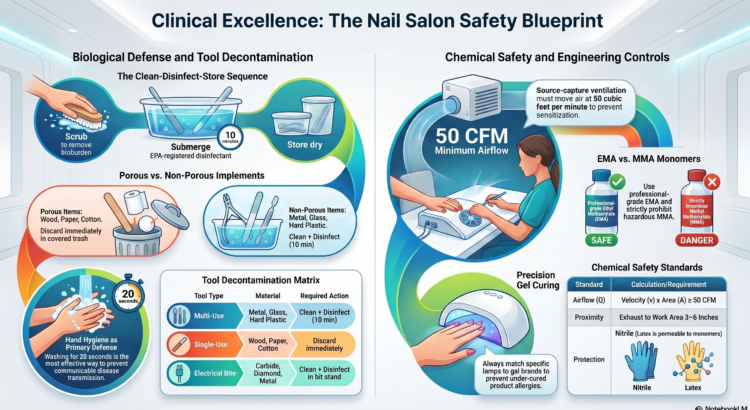
  • LBA Recommends: Source-Capture Ventilation – Ensure every nail station is equipped with a system that pulls air away from the technician’s breathing zone and exhausts it outdoors or through professional-grade charcoal filters. A minimum of 50 CFM per station is encouraged.9
  • LBA Recommends: PPE Literacy – Teach staff that standard nitrile gloves provide zero protection against methylene chloride. If the chemical must be handled, only laminate gloves (e.g., Silver Shield) provide the necessary breakthrough resistance.18
  • LBA Recommends: Client Consultation – Maintain a record of all products used on a client and inform them of the safety profiles of the removers being utilized.30
  • LBA Recommends: Hygiene Standards – Enforce strict no-eating and no-drinking rules at the nail station to prevent the accidental ingestion of chemical dust and vapors.41
  • LBA Recommends: Small-Portioning – Use only the minimum amount of product needed for the service. Keep products in small, tightly capped containers to limit evaporation into the salon air.43
  • LBA Recommends: Secondary Containment – Place trash that has absorbed liquid removers into sealed bags before placing them in metal, self-closing trash cans.43
  • LBA Recommends: Ongoing Education – Dedicate clinical time to discussing the chemistry of gel removal and the reasons why traditional acetone soaks are the safer alternative.11
  • LBA Recommends: Respiratory Awareness – Instruct students to never lean directly over the nail during the removal process, as this places their nose and mouth in the highest concentration of vapors.14
  • LBA Recommends: Transparency – Provide clients with access to the SDS of any product used on them if requested, fostering a culture of regulatory literacy and public trust.13
  • LBA Recommends: Monitoring Health – Encourage staff to report symptoms like lightheadedness or headaches immediately. These are not just “part of the job” but signs of chemical overexposure.2
  • LBA Recommends: Regulatory Compliance – Review the Kentucky Board of Cosmetology’s website monthly for new safety alerts and administrative regulation updates.32

FAQs

Q1: Why did the EPA wait until 2024 to ban methylene chloride? A: The EPA has been evaluating the risks since 2014. Under the 2016 amendments to TSCA, the agency was required to conduct rigorous, peer-reviewed risk evaluations for the first ten “high-priority” chemicals, of which methylene chloride was one. The final 2024 rule is the culmination of a multi-year process involving public comment and scientific review.6

Q2: Is acetone safe if methylene chloride is not? A: Acetone is not without risk—it is highly flammable and can cause drying or irritation—but it does not have the same carcinogenic or endogenous carbon monoxide risks as methylene chloride. When used with proper ventilation and dermal protection (like nitrile gloves for short intervals), it is the industry-standard safe alternative.11

Q3: What if my “magic” remover says it is “non-toxic”? A: Terms like “non-toxic” and “natural” are not strictly regulated in the cosmetic industry. If the product removes gel in 3 minutes and the manufacturer won’t provide an SDS with a full ingredient list, the claim is likely misleading.7

Q4: Can I tell if a remover is dangerous by its smell? A: No. Methylene chloride has a sweet odor, but your sense of smell can become fatigued, and the chemical can be present at dangerous levels before you detect it. Relying on odor is a primary cause of accidental overexposure.14

Q5: Will a simple dust mask protect me from these vapors? A: No. Standard dust masks or surgical masks only filter particles. They provide zero protection against chemical vapors. Only a properly fitted respirator with organic vapor cartridges—or better yet, a source-capture ventilation system—can protect against DCM vapors.9

Q6: What are the symptoms of methylene chloride poisoning? A: The most common signs are dizziness, headache, mental confusion, and a feeling of being “high” or intoxicated. Severe signs include chest pain (from carbon monoxide buildup) and loss of coordination.2

Q7: Are “magic” removers illegal in Kentucky? A: The FDA prohibits methylene chloride in cosmetics, and the EPA is phasing out its distribution. Using a product that contains a federally prohibited, mislabeled, and toxic ingredient in a professional salon environment would violate the Kentucky Board of Cosmetology’s requirements for competent and safe service.1

Q8: How do I dispose of these products safely? A: Treat them as hazardous waste. Do not pour them down the sink or throw them in the regular trash. Contact the Kentucky Division of Waste Management at 502-564-6719 for instructions on proper disposal for small businesses.39

Q9: Why do some online retailers still sell these products? A: Many third-party sellers are located overseas and do not comply with U.S. labeling or safety laws. Platforms often struggle to remove non-compliant listings as quickly as they appear. It is the responsibility of the licensed professional to vet their suppliers.7

Q10: What should I do if a client has an adverse reaction to a remover? A: If the client experiences burning or skin redness, wash the area with soap and water immediately. If they feel dizzy or have difficulty breathing, move them to fresh air and seek medical attention. Report the incident to the FDA through their cosmetic complaint portal.1

Q11: Does source-capture ventilation really work? A: Yes. A source-capture system positioned within 12 inches of the nail application can remove a concentrated volume of contaminants before they ever reach the technician’s breathing zone, which is the most effective way to lower exposure.9

Q12: Can I use these removers if I wear gloves? A: Most salon gloves are made of nitrile or vinyl, which methylene chloride penetrates almost instantly. Unless you are wearing specialized laminate gloves, the chemical will reach your skin through the glove, potentially causing chemical burns.19

SEO Requirements

SEO Keywords: methylene chloride, magic gel remover, burst gel polish remover, nail salon chemical safety, OSHA nail salon standards, EPA methylene chloride ban, Kentucky Board of Cosmetology, dichloromethane health risks, professional nail removal, LBA safety checklist, SDS for nail products, gel polish toxicology.

Meta Description: Research report on the safety risks of methylene chloride in “magic” gel polish removers. Learn about EPA bans, health hazards, and Kentucky compliance for salons.

Internal Link Suggestions:

  1. Kentucky Administrative Regulations for Salons (Link to KBC law overview)
  2. Understanding Safety Data Sheets (SDS) (Link to LBA chemistry lesson)
  3. The Importance of Salon Ventilation (Link to occupational hygiene post)
  4. How to Spot Counterfeit Professional Products (Link to procurement guide)
  5. LBA Clinical Safety Protocols (Link to internal school policy page)

Image Ideas:

  1. Chemical Comparison Table: A visually styled infographic comparing Acetone and Methylene Chloride on volatility, flammability, and carcinogenic risk.
  2. The Breathing Zone Diagram: A diagram showing a 2-foot sphere around a technician’s face, illustrating how vapors from a nail table enter the respiratory system.
  3. Labeling Red Flags: A photo of a generic “Magic Remover” bottle with call-outs highlighting missing ingredients, lack of manufacturer address, and vague safety claims.

Works cited

  1. Cosmetic Products Containing Methylene Chloride | FDA, accessed February 18, 2026, https://www.fda.gov/consumers/health-fraud-scams/cosmetic-products-containing-methylene-chloride
  2. Methylene Chloride | Medical Management Guidelines | Toxic Substance Portal – CDC, accessed February 18, 2026, https://wwwn.cdc.gov/TSP/MMG/MMGDetails.aspx?mmgid=230&toxid=42
  3. Methylene Chloride | ToxFAQs™ | ATSDR – CDC, accessed February 18, 2026, https://wwwn.cdc.gov/TSP/ToxFAQs/ToxFAQsDetails.aspx?faqid=233&toxid=42
  4. Use and Market Profile for Methylene Chloride – Regulations.gov, accessed February 18, 2026, https://downloads.regulations.gov/EPA-HQ-OPPT-2016-0742-0062/content.pdf
  5. EPA’s Methylene Chloride Ban | Trihydro Corporation, accessed February 18, 2026, https://www.trihydro.com/news/news-details/epa-methylene-chloride-ban
  6. Risk Management for Methylene Chloride | US EPA, accessed February 18, 2026, https://www.epa.gov/assessing-and-managing-chemicals-under-tsca/risk-management-methylene-chloride
  7. Nail Safety Council Warns Holiday Shoppers About Toxic ‘Magic’ Gel Polish Removers – Professional Beauty Association, accessed February 18, 2026, https://www.probeauty.org/nmc-warns-about-toxic-magic-gel-polish-removers/
  8. Hierarchy of Controls – CDC, accessed February 18, 2026, https://www.cdc.gov/niosh/learning/safetyculturehc/module-3/2.html
  9. Nail Salon Ventilation System Requirements | HealthyAir® Source Capture – Healthy Air Inc, accessed February 18, 2026, https://healthyair.com/pages/nail-salon-source-capture-system
  10. 12 Best Gel Polish Brands of 2026: Sponsorship-Free Reviews, accessed February 18, 2026, https://slbeautyco.com/blogs/gel-nail-polish/best-gel-polishes
  11. Best Quality Gel Nail Polish: Top Brands and Tips for 2024, accessed February 18, 2026, https://www.lavishluxnailspa.com/best-quality-gel-nail-polish.html
  12. Nail Safety Council Warns About Toxic Gel Polish Remover – Beauty Packaging, accessed February 18, 2026, https://www.beautypackaging.com/breaking-news/nail-safety-council-warns-about-toxic-gel-polish-remover/
  13. Nail Manufacturer Council on Safety | Pro Beauty Association, accessed February 18, 2026, https://www.probeauty.org/pba-advocacy/nail-manufacturer-council-on-safety/
  14. Methylene Chloride Hazards for Bathtub Refinishers – OSHA, accessed February 18, 2026, https://www.osha.gov/sites/default/files/publications/methylene_chloride_hazard_alert.pdf
  15. 1910.1052 – Methylene chloride. | Occupational Safety and Health Administration, accessed February 18, 2026, https://www.osha.gov/laws-regs/regulations/standardnumber/1910/1910.1052
  16. NIOSH Pocket Guide to Chemical Hazards – Methylene chloride – CDC, accessed February 18, 2026, https://www.cdc.gov/niosh/npg/npgd0414.html
  17. 1910.1052 App A – Substance Safety Data Sheet and Technical Guidelines for Methylene Chloride – OSHA, accessed February 18, 2026, https://www.osha.gov/laws-regs/regulations/standardnumber/1910/1910.1052AppA
  18. Methylene Chloride – Facts No. 5 | Occupational Safety and Health Administration, accessed February 18, 2026, https://www.osha.gov/methylene-chloride/meth-facts/fact-sheet-5
  19. 1910.1052 App C – Questions and Answers – Methylene Chloride Control in Furniture Stripping | Occupational Safety and Health Administration, accessed February 18, 2026, https://www.osha.gov/laws-regs/regulations/standardnumber/1910/1910.1052AppC
  20. Methylene Chloride – OSHA, accessed February 18, 2026, https://www.osha.gov/sites/default/files/publications/osha3144.pdf
  21. Final Risk Evaluation for Methylene Chloride | US EPA, accessed February 18, 2026, https://www.epa.gov/assessing-and-managing-chemicals-under-tsca/final-risk-evaluation-methylene-chloride
  22. Methylene Chloride/Dichloromethane – Research Safety – University of Kentucky, accessed February 18, 2026, https://researchsafety.uky.edu/chemical-safety/chemical-hazards-information/methylene-chloride
  23. Methylene Chloride – Hazard Recognition | Occupational Safety and Health Administration, accessed February 18, 2026, https://www.osha.gov/methylene-chloride/hazards
  24. This is why we warn against these products: Nail Damage from “Magic Gel Remover” : r/GelX_Nails – Reddit, accessed February 18, 2026, https://www.reddit.com/r/GelX_Nails/comments/1kpztgy/this_is_why_we_warn_against_these_products_nail/
  25. Methylene Chloride | NIOSH – CDC Archive, accessed February 18, 2026, https://archive.cdc.gov/www_cdc_gov/niosh/topics/methylenechloride/default.html
  26. EPA Guidelines on Methylene Chloride – Occupational Health & Safety, accessed February 18, 2026, https://ohs.uky.edu/industrial-hygiene/epa-guidelines-on-methylene-chloride
  27. DS Fact Sheet: Working Safely with Dichloromethane (DCM, Methylene Chloride) – ORS – NIH, accessed February 18, 2026, https://ors.od.nih.gov/sr/dohs/Documents/working-safely-with-dichloromethane.pdf
  28. Title 201 Chapter 12 Regulation 060 • Kentucky Administrative Regulations – Legislative Research Commission, accessed February 18, 2026, https://apps.legislature.ky.gov/law/kar/titles/201/012/060/12425/
  29. 317A.060 Administrative regulations. – Legislative Research Commission, accessed February 18, 2026, https://apps.legislature.ky.gov/law/statutes/statute.aspx?id=53217
  30. Title 201 Chapter 12 Regulation 230 • Kentucky Administrative Regulations – Legislative Research Commission, accessed February 18, 2026, https://apps.legislature.ky.gov/law/kar/titles/201/012/230/
  31. Board of Cosmetology (Amendment) 201 KAR 12:230. Code of ethics., accessed February 18, 2026, https://apps.legislature.ky.gov/services/karmaservice/documents/12430/ToPDF?markup=false
  32. Kentucky Revised Statutes – Chapter 317A – Legislative Research Commission, accessed February 18, 2026, https://apps.legislature.ky.gov/law/statutes/chapter.aspx?id=38831
  33. Title 201 Chapter 12 Regulation 060 • Kentucky Administrative Regulations – Legislative Research Commission, accessed February 18, 2026, https://apps.legislature.ky.gov/law/kar/titles/201/012/060/
  34. Title 201 Chapter 12 Regulation 082 • Kentucky Administrative Regulations – Legislative Research Commission, accessed February 18, 2026, https://apps.legislature.ky.gov/law/kar/titles/201/012/082/16143/
  35. Title 201 Chapter 12 Regulation 082 • Kentucky Administrative Regulations • Legislative Research Commission – Louisville Beauty Academy, accessed February 18, 2026, https://louisvillebeautyacademy.net/wp-content/uploads/2024/11/KYLaw-11-12-2024-Title-201-Chapter-12-Regulation-082-%E2%80%A2-Kentucky-Administrative-Regulations-%E2%80%A2-Legislative-Research-Commission.pdf
  36. Title 201 Chapter 12 Regulation 082 • Kentucky Administrative Regulations – Legislative Research Commission, accessed February 18, 2026, https://apps.legislature.ky.gov/law/kar/titles/201/012/082/10893/
  37. A New Era for Kentucky Administrative Law: No More Deference – DBL Law, accessed February 18, 2026, https://www.dbllaw.com/a-new-era-for-kentucky-administrative-law-no-more-deference/
  38. Buying the Goods – Business – NAILS Magazine, accessed February 18, 2026, https://www.nailsmag.com/390586/buying-the-goods
  39. Nail Salon H azardous W aste, accessed February 18, 2026, https://eec.ky.gov/Environmental-Protection/Compliance-Assistance/DCA%20Resource%20Document%20Library/NailSalonHazardousWasteFactSheet.pdf
  40. Nail Salon Hazardous W aste – Kentucky Board of Cosmetology, accessed February 18, 2026, https://kbc.ky.gov/Licensure/Documents/NailSalonHazardousWasteFactSheet%20-%20English.pdf
  41. Safety and health hazards in nail salons – Oregon OSHA, accessed February 18, 2026, https://osha.oregon.gov/OSHAPubs/factsheets/fs28.pdf
  42. Indoor Air Quality in Nail Salons | Environmental Law Institute, accessed February 18, 2026, https://www.eli.org/buildings/indoor-air-quality-nail-salons
  43. Protecting the Health of Nail Salon Workers – EPA, accessed February 18, 2026, https://www.epa.gov/sites/default/files/2015-05/documents/nailsalonguide.pdf
  44. nail-salon-workers-guide.pdf, accessed February 18, 2026, https://www.pa.gov/content/dam/copapwp-pagov/en/dos/department-and-offices/bpoa/cosmetology/guide/nail-salon-workers-guide.pdf
  45. HHE Report No. HETA-92-128-2241, Tina and Angela’s Nail Salon, Springdale, Ohio – CDC, accessed February 18, 2026, https://www.cdc.gov/niosh/hhe/reports/pdfs/1992-0128-2241.pdf
  46. Understanding the Breathing Zone for Nail Technicians – Aerovex Systems, accessed February 18, 2026, https://aerovexsystems.com/understanding-the-breathing-zone-for-nail-technicians/
  47. Methylene Chloride – Facts No. 4 | Occupational Safety and Health Administration, accessed February 18, 2026, https://www.osha.gov/methylene-chloride/meth-facts/fact-sheet-4