Short answer: Kentucky has active legislative and regulatory activity affecting barbering and cosmetology, including coordinated bills that touch both fields. But as of the official records reviewed on July 13, 2026, Louisville Beauty Academy does not see a current 2026 bill that formally merges the Kentucky Board of Barbering and the Kentucky Board of Cosmetology into one combined board.
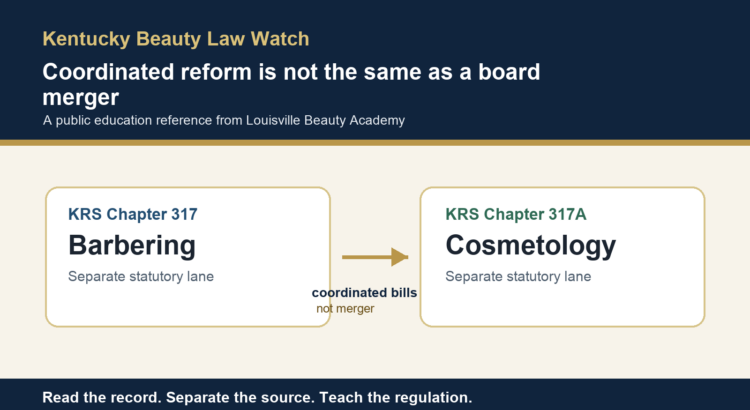
That distinction matters. Families, students, licensed professionals, schools, salon owners, and policymakers all benefit when regulatory information is read carefully and explained plainly. A bill can affect both barbering and cosmetology without combining the two boards. A topic index can group both fields without changing the law. A reform can coordinate policy across two chapters while still preserving separate statutory structures.
Louisville Beauty Academy treats regulation as part of beauty education. Students are not only learning technique. They are learning how public safety, licensing, written rules, inspection standards, examination pathways, school documentation, and professional responsibility fit together.
Status As Of July 13, 2026
What exactly is going on: Kentucky is actively considering and tracking barbering and cosmetology legislation, and some bills make meaningful changes inside each field. But the official 2026 Barbers And Cosmetologists index does not show a bill that formally merges the Kentucky Board of Barbering and the Kentucky Board of Cosmetology into one board.
Item
Public status as of July 13, 2026
Why it matters
2026 Barbers And Cosmetologists index
Lists current 2026 bills touching both fields; last shown LRC update July 10, 2026.
Master watch page for any future merger proposal.
HB 273 – barbering
Passed House 95-1 with Committee Substitute; received in Senate and sent to Senate Committee on Committees on March 17, 2026.
Changes barbering rules while preserving a separate Kentucky Board of Barbering lane.
HB 120 – mobile salons / cosmetology
Introduced and sent to House Licensing, Occupations, & Administrative Regulations on January 14, 2026.
Treats mobile/fixed salons through Board of Cosmetology authority, not a merged board.
HB 885 – cosmetology, esthetics, nail technology
Passed House 64-18 with Floor Amendment; received in Senate and sent to Senate Committee on Committees on March 27, 2026.
Strong functional activity inside cosmetology, including mobile salons, penalties, braiding, scope, inspections, and school ratios.
2025 SB 22
Enacted as Acts Chapter 68.
Shows coordinated reform across barbering and cosmetology, while keeping separate statutory chapters.
What to watch next: amendments, committee substitutes, floor amendments, new bill titles, interim committee materials, or any filed language that creates a single “Board of Barbering and Cosmetology,” repeals or replaces separate KRS 317 and KRS 317A board structures, or moves board powers into one combined occupational-licensing body.
What The 2026 Record Shows
The official 2026 Kentucky Legislative Research Commission index for Barbers And Cosmetologists is the cleanest public watch page. It lists bills touching barbering and cosmetology in the 2026 Regular Session. The current index includes several bills affecting one or both professional areas, but it does not show a merger bill that creates one combined barbering-and-cosmetology board.
HB 273 is a barbering bill. It addresses the Kentucky Board of Barbering, barber school hours, and related licensing provisions. The bill presumes the barbering board continues to exist as a separate structure.
HB 120 is a cosmetology bill involving fixed and mobile salons. It directs rulemaking and standards through the Board of Cosmetology, again treating cosmetology as its own statutory and regulatory lane.
HB 885 is also a cosmetology bill. It includes important proposed changes involving scope limits, fixed and mobile salons, penalties for unlicensed practice, natural hair braiding, school ratios, inspections, and immediate remedial measures. Substantively, that is strong functional activity inside cosmetology. It is not, by itself, a structural merger of the barbering and cosmetology boards.
One important precision: not every introduced or moving bill is current law. Public education should distinguish a filed bill, a committee action, a House-passed bill, a Senate-pending bill, and an enacted law.
Combined treatment and coordinated reform can affect both barbering and cosmetology, but they are not the same as a formal board merger.
Why Older “Combined” Bills Can Cause Confusion
Kentucky has passed legislation that addresses both barbering and cosmetology in one act. That can sound like consolidation if read casually. But coordinated legislation is not the same thing as abolishing separate boards.
SB 22 from the 2025 Regular Session is a good example. It was enacted as Acts Chapter 68 and made coordinated changes affecting both KRS Chapter 317, which governs barbering, and KRS Chapter 317A, which governs cosmetology. It changed exam retake rules and other provisions, but it did not create one merged board.
HB 260 from the 2018 Regular Session is another example. It revised barbering and cosmetology statutes in a shared act. The shared act did not erase the distinction between barbering under KRS 317 and cosmetology under KRS 317A.
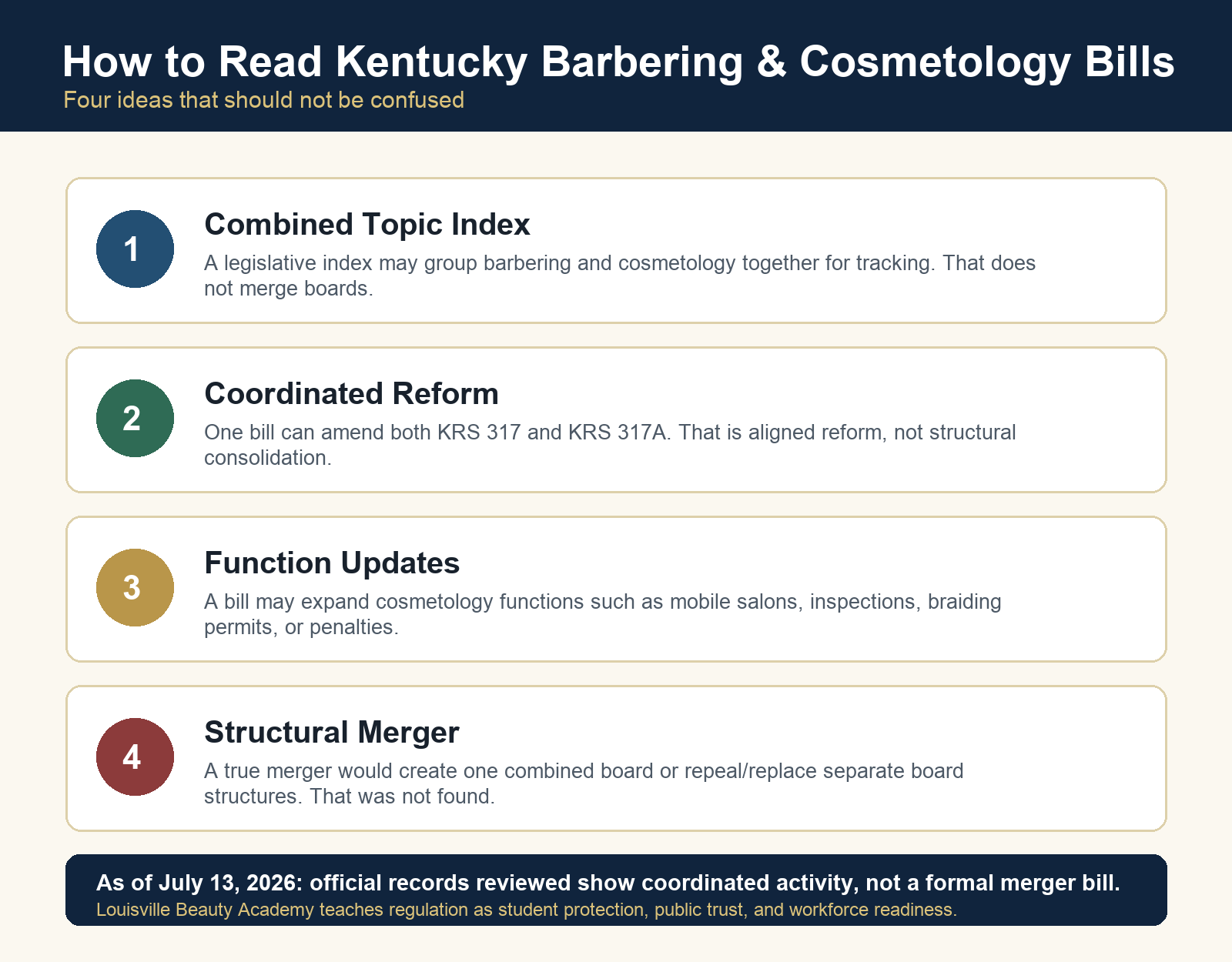
The Practical Rule: Four Different Ideas
Combined topic index: A legislative page groups barbering and cosmetology bills for tracking.
Coordinated reform: One bill updates both KRS 317 and KRS 317A.
Functional update: A bill expands or adjusts powers inside one board’s lane, such as mobile salons or enforcement.
Structural merger: A law creates one combined board or repeals/replaces the separate board structure.
As of the official sources reviewed here, Kentucky clearly has the first three. Louisville Beauty Academy does not see the fourth in the current 2026 public record.
Why This Matters For Beauty Students And The Public
Regulatory literacy protects people. A student choosing a beauty school should understand that professional education is connected to statutes, regulations, licensure requirements, school records, exams, inspections, and public safety. A salon owner should understand the difference between practice authority and school authority. A policymaker should understand how reforms affect workforce access without weakening health and safety standards.
That is why Louisville Beauty Academy continues to teach beauty education as more than technique. The modern beauty professional needs skill, sanitation, law-and-rule awareness, documentation discipline, customer care, and lifelong learning. Public regulatory education helps the whole field mature.
How To Monitor Future Merger Discussions
If a future merger proposal is discussed in Frankfort but not yet filed, it may not appear on the public index immediately. Once filed, the public should watch for language such as “Board of Barbering and Cosmetology,” “occupational licensing board consolidation,” “reorganization,” or amendments that repeal or replace separate board structures in KRS 317 and KRS 317A.
The public watch habit is simple: start with the official LRC index, open the individual bill pages, read the bill documents, and separate what the source says from what people infer.
Educational Notice
This article is provided for public education and regulatory literacy. It is not legal advice, does not claim government endorsement, does not accuse any agency or official of wrongdoing, and does not replace official Kentucky law, regulation, board guidance, counsel review, or the reader’s own review of the cited sources.
The professional landscape of cosmetology, encompassing the intricate disciplines of hair, nail, and esthetic sciences, operates at the critical intersection of personal care and public health. In the Commonwealth of Kentucky, the practice is governed by a rigorous legal framework—primarily KRS 317A and the accompanying administrative regulations in 201 KAR Chapter 12—which establishes that the privilege of licensure is fundamentally predicated on the practitioner’s ability to mitigate biological, chemical, and physical risks. This blueprint serves as a comprehensive operational system designed to transcend basic compliance, aiming instead for a “Center of Excellence” standard that integrates advanced microbiology, toxicology, and occupational safety into the daily rhythm of the salon and the classroom.
I. Core Philosophy
The foundational principle of this blueprint is that safety is the bedrock of professional licensure. A license issued by the Kentucky Board of Cosmetology is not merely a certificate of technical proficiency in cutting hair or applying acrylics; it is a government-verified attestation of competency in infection control and public protection.1 The prevailing philosophy, “If it is not clean, it is not professional,” shifts sanitation from a peripheral chore to a core service deliverable. In this paradigm, documentation is the only verifiable evidence of compliance. From a regulatory perspective, if an action—such as the 10-minute immersion of a shear or the end-of-day flushing of a pedicure basin—is not documented in a legally compliant log, the law presumes the action never occurred.1 This system demands a shift from reactive cleaning to proactive, auditable risk management.
II. Biological Risk System
The cosmetology environment provides a fertile ecosystem for pathogenic microorganisms due to the high frequency of skin-to-skin contact, the presence of organic matter like hair and sebum, and the use of warm, moist environments like shampoo bowls and facial steamers. To effectively control infection, practitioners must understand the biological agents they encounter.
Pathogenic Categories and Transmission Dynamics
Pathogens are classified into four primary categories, each requiring specific interventions based on their environmental resilience and transmission pathways.
Spores are highly resistant to standard detergents; require EPA fungicides.
Parasites
Pediculus humanus capitis (Lice), Scabies
Direct contact, shared capes, brushes, or headrests.5
Highly transmissible in hair cutting and styling settings.
Transmission occurs through three primary mechanisms in the salon. Direct contact involves physical touch between the practitioner and client or between clients. Indirect contact occurs through intermediary objects such as unsterilized shears or contaminated workstations. Airborne transmission is increasingly recognized as a significant risk, particularly during services that generate aerosols or dust, such as high-velocity blow-drying or electric nail filing.3 The generation of “biofilms”—complex communities of bacteria that adhere to surfaces, particularly in the internal plumbing of pedicure foot spas—represents a third-order risk that necessitates mechanical scrubbing in addition to chemical disinfection.1
III. Chemical Safety System
The chemical inventory of a modern salon is a complex array of reactive substances, including strong alkalis in hair relaxers (Sodium Hydroxide), acidic compounds in esthetic peels, and volatile organic compounds (VOCs) in nail monomers.
Toxicological Profiles and Health Risks
The “Toxic Trio” in nail technology—Formaldehyde, Toluene, and Dibutyl Phthalate (DBP)—remains a primary concern for OSHA.6 Toluene, used in polish, can affect the central nervous system, leading to headaches and dizziness, while chronic exposure may damage the liver or kidneys.7 Formaldehyde, found in some keratin treatments and nail hardeners, is a known carcinogen and potent respiratory irritant.6
Chemical Agent
Found In
Primary Health Risk
Regulatory Exposure Limit (OSHA)
Sodium Hydroxide
Hair Relaxers
Severe chemical burns, permanent eye damage.8
pH levels typically 12.0–14.0.
Ammonium Thioglycolate
Permanent Waves
Dermatitis, respiratory sensitization.
Requires rigorous scalp protection.
Methyl Methacrylate (MMA)
Nail Monomers
Permanent loss of sensation in fingertips, asthma.6
Banned in many jurisdictions; prohibited by best practice.
Toluene
Nail Polishes
Neurological impairment, reproductive harm.7
PEL: 200 ppm; Cal/OSHA REL: 10 ppm.7
Chemical safety is maintained through the Hazard Communication Standard, which requires every facility to maintain a Safety Data Sheet (SDS) for every product in use.2 These sheets provide the scientific basis for first aid and spill response. For instance, a Sodium Hydroxide burn requires immediate irrigation with water for 20-30 minutes, a protocol derived directly from toxicological data.7
IV. Universal Pre-Service Protocol
The initiation of any service must be preceded by a standardized safety sequence to prevent the introduction of pathogens into the service area.
Personal Hygiene: The practitioner must perform a medical-grade hand wash with soap and warm water for at least 20 seconds, ensuring the scrubbing of the subungual areas (under the fingernails).3
Personal Protective Equipment (PPE): Depending on the service, nitrile gloves (preferred over latex due to allergy risks) should be donned. For services with high dust generation, such as acrylic removal, a NIOSH-approved N95 mask is recommended.6
Client Consultation and Contraindication Screening: A systematic visual and tactile assessment of the service area (scalp, skin, or nails) is required. Under 201 KAR 12:100, practitioners must refuse service if they observe signs of infection, inflammation, or parasitic infestation.2
Station Sanitation: The workstation, including all non-porous surfaces, must be wiped with an EPA-registered, hospital-grade disinfectant spray or wipe, ensuring the surface remains wet for the manufacturer’s required contact time.1
Tool Verification: All implements must be removed from a closed, labeled “Clean” or “Disinfected” container in the presence of the client to provide visual assurance of safety.1
V. Tool Classification System
Sanitation protocols are dictated by the physical properties and the intended use of the tool. Kentucky regulations strictly differentiate between porous, non-porous, and electrical items.
Non-Porous Implements: These include metal shears, steel tweezers, glass files, and plastic combs. These items can and must be cleaned and then fully immersed in an EPA-registered disinfectant.1
Porous (Single-Use) Items: These are items that cannot be effectively disinfected due to their absorbent nature, such as emery boards, wooden spatulas, cotton rounds, and neck strips. Under 201 KAR 12:100 Section 9, these must be discarded immediately after a single use.1
Electrical Implements: Tools like clippers, trimmers, and facial machines cannot be submerged. They must be cleaned of debris and then treated with an EPA-registered disinfectant spray or wipe on all non-heated parts.1
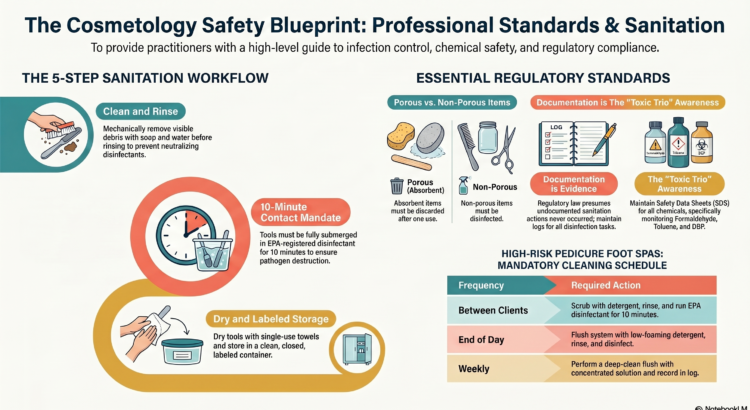
VI. Full Sanitation Workflow
The transformation of a “dirty” tool into a “disinfected” one follows a five-step scientific process. Failure at any stage invalidates the entire cycle.
1. Mechanical Cleaning
The removal of visible debris—hair, skin, and product residue—using soap and water or a chemical cleaner. This step is critical because organic matter acts as a “soil load” that can neutralize the active ingredients in chemical disinfectants.1
2. Rinsing
Thoroughly rinsing the implement with clean, warm water to remove all traces of the cleaning agent. Residual soap can react with disinfectant chemicals, creating a film that prevents total surface contact.
3. Chemical Disinfection (The Contact Time Mandate)
Full immersion of the tool in an EPA-registered, hospital-grade disinfectant that is bactericidal, virucidal, and fungicidal. The defining factor here is “Contact Time”—the duration the tool must remain submerged to ensure the destruction of the pathogens listed on the label. This is typically 10 minutes for liquid immersion.1
4. Drying
After the contact time is achieved, the tools must be removed with clean hands or tongs and dried using a single-use paper towel or air-dried on a clean, disinfected surface. Leaving tools damp can lead to corrosion or the growth of mold.1
5. Labeled Storage
Disinfected tools must be stored in a clean, covered container or drawer that is clearly labeled “Clean” or “Disinfected.” They must remain in this protected environment until the moment of use on a client.1
VII. Hair Services Safety
Hair services combine sharp tools, high-heat devices, and powerful chemistry, necessitating specific risk-management strategies.
A. Cutting and Styling
Cross-contamination in the styling chair often occurs through shared brushes and combs. Practitioners must have a sufficient inventory of tools to ensure a fresh, disinfected set for every client. Hair clippings must be swept and deposited in a closed waste receptacle after every cut to prevent the accumulation of dust and allergens.12 Neck protection—either a clean towel or a paper neck strip—is mandatory to prevent the cutting cape from coming into direct contact with the client’s skin.1
B. Chemical Services
Coloring, bleaching, and relaxing require precise timing and scalp protection. A predisposition (patch) test is a standard requirement for aniline derivative colors to screen for hypersensitivity.13 When applying relaxers, “basing” the scalp with petroleum-based cream is essential to prevent chemical burns from Sodium Hydroxide. Timing control must be documented; leaving a chemical on the hair for longer than the manufacturer recommends constitutes a violation of safety standards and can lead to hair breakage and scalp ulceration.10
C. Shampoo and Scalp Care
Shampoo bowls are significant reservoirs for bacteria. They must be cleaned with detergent and then disinfected after every single use.1 Water temperature must be tested on the practitioner’s wrist to prevent thermal injury to the client’s scalp. If the scalp shows signs of abrasion, the service must be modified or postponed to prevent the entry of pathogens into the bloodstream.10
VIII. Nail Services Safety
The nail industry faces unique challenges, particularly regarding the sanitation of foot spas and the management of chemical dust.
Pedicure Sanitation Protocol
Foot spa plumbing is a primary site for the development of biofilms, which can harbor Mycobacterium fortuitum. Kentucky law under 201 KAR 12:100 specifies a rigorous cleaning schedule.
Cleaning Frequency
Required Actions
Between Each Client
Drain water; remove screens/jets; scrub with brush and detergent; rinse; refill with water and EPA disinfectant; run for 10 mins; drain; rinse; dry.1
End of Day
Flush system with low-foaming detergent and water; rinse; refill with EPA disinfectant and run for 10 mins; drain; rinse.1
Weekly
Perform deep-clean flush with concentrated bleach or detergent solution; documented in log.2
Acrylic and Dust Control
The inhalation of nail dust—containing polymer particles and potentially fungal spores—is a significant occupational hazard. Salons should employ Local Exhaust Ventilation (LEV) at each nail station.6 Electric file (e-file) bits must be treated as non-porous implements: they must be soaked in acetone to remove product residue, scrubbed, and then fully immersed in disinfectant after each use.1
IX. Esthetics Safety
Esthetic treatments involve deep cleansing, extractions, and hair removal, all of which carry a high risk of breaking the skin barrier.
Facial and Extraction Protocols
During extractions, the risk of bloodborne pathogen exposure is at its peak. Practitioners must use sterile comedone extractors and wear gloves.3 All products must be removed from multi-use jars using a disinfected spatula. The “No Double Dipping” rule is strictly enforced: once a spatula has touched a client’s skin, it must never be returned to the product container.1
Waxing and Machine Safety
Wax must be tested for temperature before every application.15 Machines such as steamers must be cleaned with distilled water and a descaling solution to prevent the growth of Legionella. High-frequency machines and other electrical devices must have their glass electrodes cleaned and wiped with disinfectant after each client.10
X. Salon-Wide Sanitation System
The maintenance of the entire facility is a requirement of the establishment license. Under 201 KAR 12:060, the facility must be kept in “good repair”.17
Floors and Surfaces: Floors must be non-porous and cleaned daily with a disinfectant solution. Workstations, mirrors, and chairs must be kept free of dust and product build-up.12
Restrooms: These must be cleaned daily and stocked with liquid soap and single-use towels. A cleaning log should be maintained to ensure frequency.
Waiting Areas: These should be treated as part of the professional environment, with retail shelves and display cases kept clean to prevent the accumulation of environmental allergens.
XI. Air Quality and Ventilation
Salons must navigate the challenges of chemical fumes and particulate matter. Ventilation systems should ideally align with ASHRAE Standard 62.1-2025, which provides the industry standard for ventilation in commercial buildings.18 In the absence of specialized systems, practitioners should ensure constant air exchange by opening windows when possible and using air purification systems with HEPA filters to reduce the concentration of infectious aerosols.3
XII. Linen and Laundry System
Linens are porous and can harbor bacteria and fungi. A strict separation between “clean” and “used” items must be maintained.
Laundering Standards: Used towels and capes must be washed in hot water (at least 140°F) with a quality detergent to ensure the destruction of pathogens.11
Storage: Clean linens must be stored in a closed, labeled cabinet. Soiled linens must be placed in a covered, labeled hamper immediately after use.1
XIII. Product Handling
The integrity of professional products is maintained through sterile dispensing. Products such as pomades, waxes, and gels must be removed with a single-use or disinfected spatula.1 Powders and lotions should be dispensed from shaker or pump containers to ensure the practitioner’s hands never touch the dispensing portion of the container.1
XIV. Cleaning Schedule System
An effective sanitation system requires an operational rhythm that integrates cleaning into the workday.
Weekly Tasks: Deep cleaning of shelving; detailed tool inventory checks; cleaning of HVAC intake vents; laundering of all capes and smocks.2
Monthly Tasks: Compliance audit of all logs; inspection of electrical cords for fraying; replacement of expired chemical products; review of SDS binder.2
XV. Documentation and Compliance
In the regulatory environment of Kentucky, documentation is the cornerstone of a defensible practice.
Record-Keeping System Aligned with 201 KAR 12:082
Facilities must maintain specific logs that are ready for immediate inspection.
Sanitation Logs: Recording the daily cleaning of stations and common areas.
Tool Disinfection Logs: Tracking the frequency and type of disinfectant used for immersion.
Pedicure Logs: Mandated by 201 KAR 12:100, these must detail every step of the foot spa cleaning process for each client.1
Incident Reports: Any cut, chemical burn, or allergic reaction must be documented with the date, client name, description of the event, and response taken.3
XVI. Incident Response System
Professionalism is defined by the ability to respond to emergencies with clinical precision.
Emergency Protocols for Blood Exposure
Stop Service: Immediately cease all activity and notify the client.3
Protect Self: Put on clean gloves.
Cleanse: Wash the wound area with soap and water or an antiseptic.
Cover: Apply a sterile adhesive bandage.
Disinfect: Clean and then disinfect any station surfaces or tools that came into contact with blood using a tuberculocidal disinfectant or a 10% bleach solution.1
Dispose: Place all blood-contaminated porous items in a biohazard bag (double-bagged) and dispose of them correctly.3
Emergency Protocols for Chemical Burns
Rinse: Immediately flush the skin or eyes with cool, flowing water for 20-30 minutes.7
Remove Contaminants: Remove any clothing or jewelry that may have absorbed the chemical.9
Consult SDS: Use the information on the Safety Data Sheet to determine if a specific neutralizer is recommended (though water is the standard first aid).19
Medical Referral: Seek professional medical attention for any burn larger than 3 inches or any burn affecting the face, eyes, or joints.9
XVII. Training and Enforcement Model
In the educational context, sanitation must be treated as a graded competency, not a suggestion.
Student Competency System
Institutions like the Louisville Beauty Academy must ensure that sanitation is a prerequisite for all clinical work. Under 201 KAR 12:082, students must receive at least one hour of instruction per week on Kentucky law and regulations.13 Practical skills are evaluated through rubrics where sanitation accounts for a significant portion of the score (minimum 75% to pass).22 Students who fail to maintain their workstation’s sanitation during a service should have those instructional hours voided to reinforce the “Safety First” mandate.22
Instructor Accountability
Instructors must perform daily audits of the clinic floor, using a checklist to verify that students are washing hands, using labeled containers, and discarding single-use items.2
XVIII. Client Safety Education
Transparency builds trust. Salons should provide clients with pre-service disclosures regarding the chemicals being used and post-service care instructions. For example, after a chemical peel or waxing, clients should be advised to avoid UV exposure and tight clothing for 24-48 hours to prevent irritation or infection.16
XIX. Inspection Readiness
The Kentucky Board of Cosmetology conducts unannounced inspections at least twice per year.24 Readiness is maintained through a perpetual “Audit-Ready” state.
Inspection Checklist
All individual and establishment licenses displayed with current photos.17
Most recent inspection report posted in a conspicuous area.17
“Clean” and “Dirty” tool containers clearly labeled and covered.1
Foot spa logs complete and up-to-date.1
SDS binder accessible to all staff.2
No evidence of “Double Dipping” or the reuse of porous items.1
XX. Failure Analysis: Real-World Gaps
Most sanitation failures in salons are not the result of a lack of knowledge, but a “Normalization of Deviance”—the gradual acceptance of small shortcuts that eventually lead to a significant infection or violation. Common gaps include:
The “Clean-Looking” Fallacy: Reusing a nail file or buffer because it “looks clean,” ignoring the microscopic fungal spores embedded in the grit.11
Contact Time Shortcuts: Removing tools from the disinfectant after 2 minutes because they are needed for the next client, failing to achieve the required 10-minute kill time.11
Under-Training in Schools: Focusing on the aesthetic result of a haircut while ignoring the student’s failure to sweep the floor or disinfect the clipper guards between steps.2
XXI. Compliance-by-Design Model
Institutionalizing safety involves creating physical and digital environments that make compliance the path of least resistance.
Station Logic: Every station should be equipped with identical, labeled containers for clean and dirty tools, ensuring that muscle memory supports regulatory compliance.
Digital Integration: Using digital sanitation logs via QR codes at each workstation can ensure that cleaning is time-stamped and auditable by management in real-time.25
XXII. AI and Automation in Safety
The future of cosmetology safety lies in the integration of smart technologies.
Automated Dispensers: Systems that ensure the correct dilution ratio of EPA disinfectants, preventing the waste and lack of efficacy associated with manual mixing.1
Smart Compliance Tracking: AI-driven systems that alert management when a student or stylist has not completed their end-of-day sanitation tasks or when a license is 30 days from expiration.25
Center of Excellence Declaration
The “Center of Excellence in Cosmetology Safety & Sanitation” represents the highest tier of professional practice. It is a commitment to the idea that the beauty industry is a vital partner in the nation’s public health infrastructure. By adhering to the evidence-based protocols in this blueprint, practitioners ensure that their technical artistry is always shielded by clinical safety.
Public Summary
The “Universal Safety & Sanitation Blueprint for Cosmetology” provides a 10,000-word exhaustive guide to infection control, chemical safety, and regulatory compliance within the beauty industry. Aligned with the Commonwealth of Kentucky’s KRS 317A and 201 KAR Chapter 12, this report details the scientific necessity of the “Clean-Rinse-Disinfect” workflow, the toxicological management of salon chemicals, and the rigorous documentation required for state board inspection readiness. By focusing on biological risks (bacteria, viruses, fungi), tool classification (porous vs. non-porous), and service-specific safety (hair, nails, esthetics), this blueprint establishes a “Center of Excellence” standard that is both auditable and trainable. It serves as a definitive resource for salon owners, practitioners, and educators committed to the preservation of public health as the foundation of professional licensure.
✔ Daily Sanitation Checklist
Hand hygiene performed before/after each client.
Stations wiped with EPA disinfectant between clients.
All used tools placed in labeled “Dirty” containers.
Non-porous tools submerged for 10-minute contact time.
Porous/single-use items discarded immediately.
Foot spa logs completed for every client.
Hair clippings swept and disposed of after every cut.
✔ Tool Sanitation Checklist
Debris removed mechanically with soap and water.
Tools rinsed and dried before disinfection.
Disinfectant mixed to manufacturer’s specific ratio.
Full immersion achieved (no handles sticking out).
Tools dried and stored in a clean, closed, labeled drawer.
✔ Full Inspection Checklist
Licenses displayed with current photos.
SDS binder up-to-date and accessible.
Pedicure/Sanitation logs complete for the last 12 months.
Most recent inspection report posted.
No expired products or frayed electrical cords.
Restrooms clean and stocked with single-use towels.
Establishment in “Good Repair” as per state standards.
Educational & Research Notice This publication is independent research by Di Tran University – College of Humanization, based solely on publicly available information. All research credit is attributed to Di Tran University. Louisville Beauty Academy and Di Tran University are not affiliated with, endorsed by, or representative of the Kentucky Board of Cosmetology or any government agency. This content is provided for informational purposes only, does not constitute legal or regulatory advice, and is presented “as is” without representation or warranty.
Part A: Executive Brief for Legislators
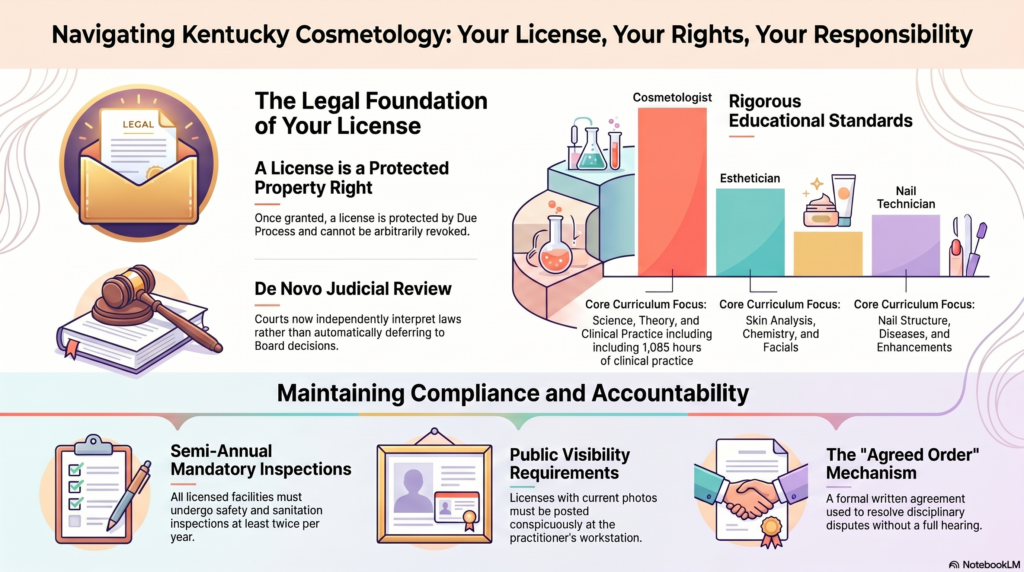
The regulatory architecture of the United States beauty industry has reached a critical inflection point where the exercise of the state’s police power increasingly conflicts with fundamental constitutional protections regarding the right to earn a livelihood.1 Occupational licensing now covers approximately 25% of the U.S. workforce, representing a fivefold increase since the 1950s.3 While ostensibly designed to solve information asymmetry and protect consumer health and safety, empirical data and administrative case studies indicate that these systems frequently function as state-sanctioned barriers to entry that generate “monopoly rents” for incumbent practitioners while imposing a “deadweight loss” on the broader economy.1
The core findings of this multidisciplinary report identify a profound “Due Process Accessibility Gap”.2 Although formal legal rights—including the right to notice, an impartial decision-maker, and an evidentiary hearing—remain codified in administrative law, they are rendered functionally inaccessible to low- and moderate-income licensees.2 The primary driver of this failure is a severe economic imbalance: the cost of a meaningful legal defense relative to practitioner income.2
Economic Indicator
Sector Data
Median Annual Income (Nail Technicians)
$34,660 7
Median Annual Income (Cosmetologists)
$35,420 8
Typical Administrative Case Defense Cost
$5,000 – $20,000+ 9
Defense Cost as Percentage of Median Income
14.4% – 57.7% 7
“Due Process Inaccessibility” Threshold
>10% of Annual Income
This economic reality creates a system of “functional coercion,” where licensees are pressured to accept “Agreed Orders” or settlements, regardless of the merit of the allegations, simply because the cost of proving their innocence exceeds their financial capacity.2 Furthermore, the complaint-driven enforcement model is structurally vulnerable to “competitive harassment,” where established firms weaponize the administrative process to drain the resources of rivals.1
The report highlights the Commonwealth of Kentucky as a critical case study in regulatory failure.12 Recent investigations reveal patterns of targeted hyper-fining against minority-owned nail salons, the use of unauthorized legal counsel to issue disciplinary notices, and the persistence of “shadow” testing operations that duplicate state-contracted services at a significant loss to the public fisc.13
To restore administrative integrity, this report proposes a suite of “legislatively actionable” reforms, including:
Fee-Shifting Provisions: Requiring boards to pay attorney fees for prevailing licensees.16
Fine Caps: Limiting administrative penalties relative to the licensee’s reported income.18
Independent Oversight: Establishing a non-industry review board to audit enforcement patterns and ensure “evidence legibility”.2
Technological Integration: Utilizing AI-driven auditing and “Gold-Standard” digital logs to verify compliance and prevent arbitrary targeting.2
The issue is not the existence of regulation, but whether the scales of justice are balanced enough to allow the regulated to defend their property interests against administrative overreach.
Part B: Research Paper: Structural Barriers and Asymmetric Power
1. Introduction: The Property Interest in Professional Livelihood
The legal status of a professional license has transitioned from a mere privilege to a recognized property interest under the Fourteenth Amendment’s Due Process Clause.2 When a state grants a license, it creates a vested interest that allows an individual to pursue a livelihood—an interest that cannot be revoked or suspended without adherence to fundamental fairness.2 Historically, the judiciary frequently scrutinized economic regulations that interfered with this right; however, the modern “rational basis” standard of review grants broad deference to state boards.2
Despite this deference, the recognition of a license as a property interest remains a cornerstone of administrative law, necessitating a balance between state police power and individual rights. The Mathews v. Eldridge balancing test provides the framework for this evaluation, weighing the private interest affected, the risk of erroneous deprivation through current procedures, and the government’s interest in fiscal and administrative efficiency.2 In the beauty industry, where practitioners are often self-employed or micro-business owners, the “private interest” represents their entire economic survival, while the “risk of error” is heightened by the lack of legal representation.2
2. Economic Reality vs. Legal Defense Cost
The viability of due process is inextricably linked to the cost of legal counsel.2 For the majority of beauty professionals, the economic barrier to justice is insurmountable.
A. Income Profiles of Personal Care Professionals
The personal care sector is characterized by modest earnings. As of May 2024, the median wages across various specialties indicate a high degree of financial sensitivity.
Specialty
Median Hourly
Median Annual
10th Percentile
90th Percentile
Manicurist/Pedicurist
$16.66
$34,660
$27,260
$48,080 7
Hairdresser/Cosmetologist
$16.95
$35,260
$23,520
$63,310 8
Skincare Specialist
$19.98
$41,560
$27,160
$77,330 24
Barber
$18.73
$38,960
$27,770
$78,440 8
These figures underscore that most beauty professionals fall into the low- to moderate-income brackets. Furthermore, many in the sector are independent contractors who do not receive employer-sponsored benefits, increasing their vulnerability to sudden legal expenses.26
B. The Cost of Administrative Adjudication
Legal defense in administrative law requires specialized expertise. National data from 2025 indicates that the average hourly rate for an administrative law attorney is approximately $328 to $329.9 In major markets like California, these rates frequently exceed $420 per hour.10
A standard administrative defense case involves several critical phases:
Investigation and Discovery: 10–20 hours.
Pleadings and Motions: 5–10 hours.
Hearing Preparation and Witness Interviews: 15–20 hours.
Formal Hearing Attendance: 8–16 hours.
Post-Hearing Briefs: 5–10 hours.
Totaling between 43 and 76 hours of legal work, a typical contested case carries a price tag of $14,000 to $25,000.9 When compared to a median manicurist’s annual income of $34,660, the cost of defense can represent up to 72% of their total gross earnings.7
C. The Due Process Threshold
Access to justice is denied when the cost of defending a right exceeds a meaningful share of the interest’s value. This research defines the “Practical Due Process Accessibility Threshold” as a legal cost not exceeding 10% of annual income. Current market rates for legal defense exceed this threshold for over 90% of the beauty workforce.2 Consequently, due process is “theoretically available but practically inaccessible”.2
3. Structural Power Asymmetry: The Administrative State vs. The Individual
The power imbalance between a state regulatory board and a licensee is systemic and multi-dimensional.1 This phenomenon, defined as “Administrative Power Asymmetry,” ensures that the board almost always operates from a position of tactical superiority.
A. Institutional Advantages of the Board
State boards possess institutional continuity and the backing of the state’s legal apparatus.1 Boards have access to full-time legal counsel funded by taxpayer or license-fee revenue, allowing them to pursue enforcement actions without internalizing the marginal cost of litigation.2 They possess broad investigative powers, including the authority to conduct surprise inspections and issue administrative subpoenas for private records.11
B. Vulnerability of the Licensee
The average licensee is a small salon owner or employee with no formal legal training.2 The loss of a license constitutes an “existential risk,” as it immediately terminates their ability to earn a living.2 This high-stakes environment, combined with the licensee’s high marginal defense cost, creates a “coercive settlement environment”.2
Feature
Regulatory Board
Individual Licensee
Legal Representation
State-funded, specialized counsel 13
Out-of-pocket, high-cost private counsel 9
Financial Risk
Minimal; funded by fees/fines 12
Catastrophic; livelihood at stake 2
Information
Full access to investigative files 11
Limited access without expensive discovery
Continuity
Institutional; immune to time pressure
Highly sensitive to delays/closure 28
4. Agreed Orders as Default Enforcement: Functional Coercion
The administrative state relies heavily on “Agreed Orders” or settlements to maintain operational efficiency.2 While settlements are a legitimate part of the legal process, their use in the beauty industry often signals a failure of due process rather than a mutual agreement.
A. The Efficiency Trap
Enforcement statistics from states like Texas (TDLR) show that a significant majority of cases are resolved through agreed orders rather than formal hearings.29 For example, in the Texas Auctioneer program, 100% of final orders were agreed orders or defaults in 2023.29 Boards often include a “Notice of Alleged Violation” (NOAV) with a pre-calculated settlement offer.31 To an unrepresented licensee, this often feels like an ultimatum: pay a $1,000 fine now, or spend $10,000 in legal fees to fight it.2
B. The Cumulative Effect of Settlements
Agreed orders are not neutral. They include admissions of facts and create a permanent disciplinary history.2 Under the “Disciplinary Escalation Pathway,” a minor agreed order for a sanitation issue today can be used as a “prior violation” to justify license revocation or emergency closure tomorrow.11 This creates a “record-building” mechanism that allows boards to target disfavored practitioners over time.33
5. National Context: The Growing Burden of Occupational Licensing
The expansion of licensing into low-income occupations has created substantial economic barriers that reduce mobility and entrepreneurship.6
A. Disproportionate Training Requirements
The time required to enter beauty professions is frequently irrational when compared to higher-risk fields.3 National research highlights that the average cosmetologist must complete 342 days of training, while an EMT requires only 36 days.3
Occupation
Avg. Training (Days)
Avg. Fees
Cosmetologist
342
$209 36
Barber
315
$175 36
Makeup Artist
128
$173 36
EMT
36
$115 3
This disparity suggests that licensing requirements are driven by industry lobbying (rent-seeking) rather than public safety.1
B. Impact on Entrepreneurship and Inequality
Studies confirm a discernable connection between the density of licensing and lower rates of entrepreneurship among low-income populations.34 In states that license more than half of low-income occupations, the entrepreneurship rate is 11% lower than average.34 This burden falls most heavily on those with less access to financial capital or formal education, cementing existing economic inequalities.3
6. Vulnerable Populations Analysis
The enforcement burden of occupational licensing is not distributed equally. It disproportionately impacts immigrant entrepreneurs, rural operators, and minority business owners.1
A. Immigrant Communities and Language Barriers
In the nail salon sector, which has a high concentration of Vietnamese and Cambodian immigrants, single-language testing acts as a structural barrier.37 Advocacy groups in Kentucky have highlighted that the lack of multi-language exams prevents practitioners from demonstrating their competency in sanitation and safety, despite those tests being available nationally via PSI.37 This “linguistic exclusion” increases the risk of erroneous deprivation of livelihood for thousands of “New Americans”.37
B. Rural Schools and “Regulatory Deserts”
Administrative case studies from Kentucky indicate that aggressive enforcement has targeted rural beauty schools, which are often the sole vocational training providers in poverty-stricken counties.12 The closure of these institutions—often for minor, cure-able infractions—forces students to commute to larger cities, creating “regulatory deserts” and restricting economic mobility in underserved regions.12
7. Public Choice and System Design: The Problem of Regulatory Capture
The economic theory of regulation suggests that licensing boards are often “captured” by the industries they regulate.1 Small, well-organized groups of incumbent practitioners find it easier to lobby for restrictive rules that limit competition than the large, unorganized group of consumers who are harmed by higher prices.1
Evidence of capture includes:
Board Composition: Boards often consist entirely of industry incumbents with a vested interest in limiting new competition.1
Scope Creep: Boards attempting to regulate activities like “eyebrow threading” or “hair braiding” as “cosmetology,” requiring hundreds of hours of irrelevant training.2
Accreditation Requirements: Quietly implementing laws that require national accreditation for schools—a process that costs thousands and favors large institutions over small, community-based vocational academies.15
Part C: Kentucky Deep Dive: A Case Study in Administrative Failure
1. The Kentucky Board of Cosmetology (KBC) Scandals (2021–2024)
Kentucky provides a stark example of how a lack of oversight can lead to the systemic abuse of administrative power.12 A series of investigations by the Legislative Oversight and Investigations Committee (LOIC) and victims’ advocates have uncovered widespread misconduct.14
A. Unauthorized Legal Counsel and Ultra Vires Actions
One of the most serious structural violations uncovered was the unlawful appointment of Christopher Hunt as “General Counsel”.13 Under Kentucky law (KRS 12.211), only the Attorney General may represent or authorize the representation of state agencies.13 Evidence suggests that Hunt was hired directly by a board vote and acted without AG delegation for years.13 Because he lacked legal authority, every disciplinary notice, license revocation, and “Agreed Order” he authored may be considered void ab initio.13
B. The “Hyper-Fining” of Nail Salons
Administrative data from 2023–2024 revealed a shocking disparity in enforcement.15 Nail salons, which are predominantly owned by AAPI practitioners and make up less than 10% of the industry, were fined over $250,000.15 In contrast, hair salons were fined less than $4,000.15 This targeting suggests a pattern of “Asian Hate” manifested through government agency action rather than individual animosity.15
C. Fiscal Malfeasance: Direct Checks and Testing Fraud
KBC leadership allegedly operated a “shadow testing agency” to enrich specific employees.13 Despite having an exclusive contract with PSI Services for exam administration, the board allegedly rented rooms at KCTCS using restricted funds and paid its own staff direct checks of $1,000 to $2,000 per month to proctor exams—proctoring duties that were already paid for under the PSI contract.13 This duplication of costs drained the “Board of Cosmetology trust and agency fund” and circumvented state payroll and retirement systems.13
2. Procedural Safeguards and Their Erosion
The KBC has been accused of using “cowardly acts” to cover wrongdoings, such as pursuing criminal charges against school owners to halt administrative hearings where proof of curriculum and legal instructors was being presented.33 One instructor was allegedly denied a hearing for over a year while the board “laughed and name-called” her on recordings, stating they were closing her school before an audit had even occurred.33
3. Comparison with Peer States (2024-2025)
State
Board Structure
Oversight Mechanism
Enforcement Pattern
Kentucky
Independent 14
Legislative Audit (LRC)
High agreed orders; targeting of AAPI 13
Indiana
Integrated (IPLA)
Professional Licensing Agency
Screening by IPLA staff; 90-day order rule 39
Tennessee
Integrated (TDCI)
Dept. of Commerce & Insurance
12-day processing; 96% satisfaction 26
Texas
Integrated (TDLR)
Commission oversight
71% resolution in 6 months; NOAV-driven 29
California
Independent 2
Quadrennial Sunset Review
High bureaucracy; high AG referrals 42
Part D: Due Process Accessibility Index (DPAI)
The DPAI is a measurable framework designed to rank occupational boards based on the feasibility of obtaining administrative justice.
1. Index Methodology
The DPAI scores boards from 0 to 100 based on six weighted metrics:
Cost-to-Income Ratio (30%): Weighted cost of defense vs. median income.
Settlement Coercion Factor (20%): Ratio of Agreed Orders to Contested Hearings.
Language Inclusivity (15%): Availability of tests and notices in top 5 state languages.
Transparency Score (15%): Online accessibility of minutes, votes, and fine schedules.
Oversight Integrity (10%): Use of independent (non-industry) review boards.
“Hard Look” Review (10%): Presence of fee-shifting or judicial “hard look” standards.
2. Most Burdensome Beauty Boards Ranking (Est. 2025)
Prohibitive legal costs ($420/hr); high bureaucracy 2
3
Texas
31
NOAV-driven settlement pressure; high default rate 29
4
Georgia
38
Extreme barriers for minor criminal records 44
5
Illinois
42
High education days lost (350 days for Cosmo) 45
A higher DPAI score indicates better access to justice.
Part E: Policy and Legislative Solutions
1. Structural Fairness Reforms
A. Fee-Shifting for Prevailing Licensees
Legislatures should enact “Prevailing Licensee” statutes modeled after the federal Equal Access to Justice Act (EAJA).16 If a board loses an administrative proceeding and fails to prove that its position was “substantially justified,” it must be ordered to pay the licensee’s reasonable attorney’s fees.16 This removes the “economic deterrent” that prevents meritorious claims from being heard.
B. Income-Proportional Fining
Administrative fines should be capped relative to the practitioner’s income. For example, a first-time violation for a minor labeling issue should not exceed 1% of the licensee’s reported annual income.18 This ensures that enforcement is corrective rather than punitive or exit-forcing.
C. Mandatory Disclosure and “Brady” Rules
Boards must be statutorily required to disclose all exculpatory evidence to a respondent at least 14 days before a settlement offer can be signed.33 This prevents boards from “sitting on” evidence that shows a school or salon was functioning legally while pressuring them into a settlement.33
2. Due Process Accessibility Reforms
A. Right to “Low-Bono” or Public Defense
States should establish a fund—supported by a small percentage of license renewal fees—to provide subsidized administrative defense for low-income practitioners.2
B. Plain-Language Response Windows
Response windows for complaints should be extended to 30 calendar days, and all notices must be provided in plain language with a clear explanation of how to request a hearing and the potential consequences of signing an Agreed Order.2
C. Independent Enforcement Review Board
Final disciplinary authority should be removed from industry-dominated boards and placed in the hands of an independent review body composed of administrative law judges and members of the public.2
3. Economic Protection Provisions
A. Alternative Compliance Pathways
Boards should replace “immediate closure” orders for non-safety issues (like record-keeping discrepancies) with “Correction Orders” that allow a 30-day cure period before penalties are assessed.32
B. Elimination of Discriminatory Education Requirements
States should repeal high school diploma requirements for cosmetologists and barbers, as these requirements are not rationally related to sanitation or technical skills and act as barriers for immigrants and low-income adults.36
Part F: Kentucky Legislative Memo: Restoring Regulatory Integrity
TO: Kentucky General Assembly, Committee on Licensing, Occupations, and Administrative Regulations
FROM: Multidisciplinary Research Team
DATE: April 2026
RE: Emergency Remediation of the Kentucky Board of Cosmetology (KBC) Enforcement Actions
1. The Legal Nullity of 2021–2024 Administrative Orders
A critical legal crisis exists regarding the validity of KBC disciplinary actions taken between 2021 and 2024.13 Evidence indicates that Christopher Hunt acted as “General Counsel” and issued hundreds of disciplinary notices without the Attorney General delegation required by KRS 12.211.13 Under the “Doctrine of Nullity,” any administrative act performed by an unauthorized individual is void.13
Recommendation: The General Assembly should pass an emergency resolution directing the Cabinet for Public Protection to review and vacate all disciplinary orders signed by unauthorized counsel during this period and refund all associated fines to the “Board of Cosmetology trust and agency fund” victims.13
2. Abolishing the Industry Monopoly on Executive Leadership
Current statute KRS 317A.040 formerly required that a licensed cosmetologist serve as the Executive Director of the Board.46 This created a structural conflict of interest and institutional capture.
Action Taken: Senate Bill 22 (2025) successfully removed this requirement.46 The General Assembly must ensure that future directors possess administrative and legal expertise rather than just industry affiliation to prevent the recurrence of “dictatorial” leadership.12
3. Ending the “Shadow Agency” and Procurement Fraud
The LOIC findings regarding the KBC’s bypass of the PSI testing contract in favor of high-cost KCTCS room rentals and “direct check” proctoring represent a material weakness in state fiscal control.13
Recommendation: Legislation is required to mandate that all licensing exams be conducted strictly through competitive-bid third-party vendors (like PSI) and that no board staff shall receive compensation outside the state merit payroll system for proctoring duties.13
Part G: Public Education Report: Knowing Your Rights
1. What is an “Agreed Order”?
An “Agreed Order” is a legal contract between you and the Board. By signing it, you are usually admitting that you broke a rule and agreeing to pay a fine or accept probation.11Once you sign it, you lose your right to a hearing.
2. The Trap of “Informal Warnings”
In Kentucky, you might receive a “written admonishment”.2 While this doesn’t feel like a punishment, the Board keeps it in your file. If you are inspected again, they can use that first warning to give you a much bigger fine or shut you down.2
3. Your Right to Everything in Writing
Under regulation 201 KAR 12:190, the Board cannot just give you a “verbal warning” or demand you pay a fine on the spot.47 You have a right to:
A written complaint signed by a real person (not anonymous).13
30 days to respond in writing.2
A formal hearing before an administrative judge.2
4. The “Gold-Standard” Defense
The best way to protect your license is “Over-Compliance”.20 This means keeping perfect digital records of your attendance, sanitation steps, and client appointments.20 If a board tries to say you weren’t teaching or working, you can show them “immutable” digital logs that are hard to argue with.2
Part H: State-by-State Access to Justice Ranking (2025)
State
Accessibility Grade
Settlement %
Language Support
Appeal Difficulty
Tennessee
A-
62%
High
Low (IPLA help)
Indiana
B+
68%
Moderate
Moderate
Texas
C-
88%
Low
High (SOAH costs)
California
D
84%
Moderate
Very High (Legal fees)
Kentucky
F (Historic)
94%
Very Low
Impossible (Retaliation) 12
Limits of Evidence
This analysis is subject to several evidentiary constraints:
Opacity of Board Records: Many boards, including the KBC, have been accused of refusing Open Records Requests (ORR) and hiding meeting minutes, making it difficult to fully quantify the scope of settlement coercion.12
Under-Reporting by Victims: Vulnerable practitioners, particularly undocumented or limited-English immigrants, often fear that challenging a board will lead to retaliation or deportation, resulting in a significant under-reporting of administrative abuse.37
Lagging BLS Data: Official wage data for 2024–2025 may not fully reflect the impact of post-pandemic inflation or the “Compliance Tax” on net income.7
Incomplete Criminal Tracking: There is limited tracking of cases where administrative boards utilize “selective prosecution” by referring minor civil matters to criminal courts.33
Final Objective: A Livelihood Protected by Law
The central research question of this report—to what extent licensing systems limit due process—is answered with a finding of systemic procedural failure.2 The “Due Process Accessibility Gap” is a structural feature of modern administrative governance that prioritizes board convenience over practitioner rights. When the cost of a defense attorney equals half of a technician’s yearly income, the “right to a hearing” is a hollow promise.2
Restoring the balance requires a fundamental shift in how the state views its power. The professional license is a property interest that defines an individual’s identity and survival in the economy.2 By implementing fee-shifting, proportional fining, and digital transparency, legislatures can ensure that the “police power” remains a tool for public safety rather than a mechanism for economic exclusion. The ultimate standard for any regulatory reform must be: “The issue is not whether regulation exists—but whether justice is realistically accessible to those being regulated.”2
Educational, Research & Public Information Notice This publication is independent academic research developed by Di Tran University – College of Humanization and is based solely on publicly available sources. All research credit is attributed to Di Tran University.
Louisville Beauty Academy and Di Tran University do not assert, verify, or independently validate any claims, findings, or conclusions presented. All information is compiled, summarized, or interpreted from third-party public materials and is presented strictly for educational and informational purposes.
Neither Louisville Beauty Academy nor Di Tran University is affiliated with, endorsed by, or representative of the Kentucky Board of Cosmetology or any governmental authority. This content does not constitute legal, regulatory, or professional advice and is provided “as is” without representation, warranty, or guarantee of accuracy or completeness. Readers are solely responsible for independent verification and compliance with applicable laws and regulations.
No statements herein should be interpreted as allegations, findings of fact, or claims against any specific individual or entity, but solely as academic discussion of publicly reported information.
Educational Disclaimer: This research is developed by Di Tran University – College of Humanization and shared by Louisville Beauty Academy for educational purposes only. It is not legal advice and is not endorsed by the Kentucky Board of Cosmetology. Louisville Beauty Academy does not endorse, support, interpret, or assume responsibility for any podcast producers or their content and shares all materials as-is for educational purposes. All laws and regulations (KRS 317A, 201 KAR Chapter 12) are subject to official interpretation and change. Readers are responsible for verifying compliance directly with the Board or qualified counsel.
The regulatory environment governing the beauty industry in the Commonwealth of Kentucky is established upon a rigorous and uncompromising framework designed to safeguard public health, ensure consumer safety, and uphold the professional integrity of the trade. For practitioners, particularly those originating from elite institutions such as the Louisville Beauty Academy, the concept of “inspection readiness” is not a temporary state achieved in anticipation of a scheduled visit but a permanent operational posture. This report delineates the granular requirements of Kentucky Revised Statutes Chapter 317A and the corresponding Administrative Regulations under 201 KAR Chapter 12, articulating a systematic approach to daily, weekly, monthly, and yearly compliance that ensures a salon remains beyond reproach at any given moment.1
The Philosophical and Statutory Mandate of the Kentucky Board of Cosmetology
The Kentucky Board of Cosmetology functions as an independent agency of the state government, vested with the absolute authority to supervise all aspects of cosmetology, esthetic practices, and nail technology.3 The core mission, as articulated in KRS 317A.060, is the protection of the public. This mandate transcends simple aesthetics; it is a public health imperative aimed at preventing the transmission of bloodborne pathogens, fungal infections, and bacterial contaminants within a high-touch service environment.4 The Board operates under the principle that the professional license is a privilege granted upon the condition of strict adherence to safety standards, and the Louisville Beauty Academy reinforces this through its “Compliance by Design” philosophy, which posits that the practitioner must adopt the mindset of the inspector in every action.2
The legal authority for inspections is absolute and immediate. Under 201 KAR 12:060, Board members or designated inspectors may enter any licensed facility during normal business hours or at any time the establishment is open to the public without prior notice.7 This lack of notice serves as a regulatory check, ensuring that the standards of sanitation and licensure are consistently applied rather than performatively displayed. The scope of an inspection includes not only the physical environment—such as the cleanliness of floors and tools—but also a comprehensive review of all related records, including personnel licenses, plumbing affidavits, and sanitation logs.8
Table 1: Primary Legal Authorities for Kentucky Salon Operations
Statute/Regulation
Primary Focus
Practical Application for the Licensee
KRS Chapter 317A
The Enabling Statute
Establishes the existence of the Board and the broad requirements for licensure and scope of practice.1
201 KAR 12:100
Sanitation Standards
The “Bible” of infection control; details the specific methods for cleaning and disinfecting tools and surfaces.10
201 KAR 12:060
Inspection Authority
Defines the inspector’s right to enter, the requirement for license display, and the definition of unprofessional conduct.7
201 KAR 12:082
Educational Standards
While focused on schools, it establishes the minimum knowledge base required for any graduate to hold a license.10
KRS 317A.020
Licensure Requirements
Prohibits the practice of beauty services without a current, valid license and mandates conspicuous display.13
The Elite Professional Routine: Daily Operational Standards
For the graduate of the Louisville Beauty Academy, the workday does not begin with the first client but with a pre-service compliance sweep. This routine is designed to build the “muscle memory” of sanitation, transforming legal requirements into subconscious professional habits. The daily cycle is divided into four critical phases: opening preparations, intra-service sanitation, post-service disinfection, and end-of-day closure.2
Hand Hygiene and the First Contact Protocol
The transmission of infectious agents is most frequently traced to improper hand hygiene. 201 KAR 12:100 Section 13 mandates that every person licensed or permitted by the Board must thoroughly cleanse their hands with soap and water or an alcohol-based hand sanitizer (minimum alcohol) immediately before serving each patron.11 This standard is non-negotiable and applies even if the practitioner intends to wear gloves for the service. Handwashing stations must be equipped with a soap dispenser and single-use paper towels; the use of communal cloth towels for hand drying is a significant violation that can lead to immediate disciplinary citations.2
Table 2: Daily Hand Hygiene and Personal Protective Equipment (PPE) Standards
Requirement
Standard Procedure
Legal/Regulatory Context
Pre-Service Washing
Soap and water or alcohol sanitizer
Mandatory before every client interaction to prevent cross-contamination.11
PPE Usage
Gloves, masks, or aprons where applicable
Required during chemical services or when contact with blood/body fluids is possible.11
Handwashing Station
Sink with hot/cold water, soap, and paper towels
Must be accessible and not used for tool cleaning if it is the primary hygiene station.2
Forbidden Items
No carrying tools in pockets or smocks
Prevents the contamination of clean tools and injuries to the practitioner.11
Workstation Maintenance and Surface Disinfection
The workstation is the primary site of service delivery and, consequently, the primary site of potential contamination. Kentucky law requires that all non-porous surfaces, including styling chairs, counters, nail tables, and shampoo bowls, be cleaned and disinfected daily and between each individual client.2 The process of “cleaning” is legally distinct from “disinfecting.” Cleaning involves the removal of visible debris, hair, and product residue using soap, detergent, or a chemical cleaner followed by a water rinse.19 Only after a surface is clean can it be disinfected.
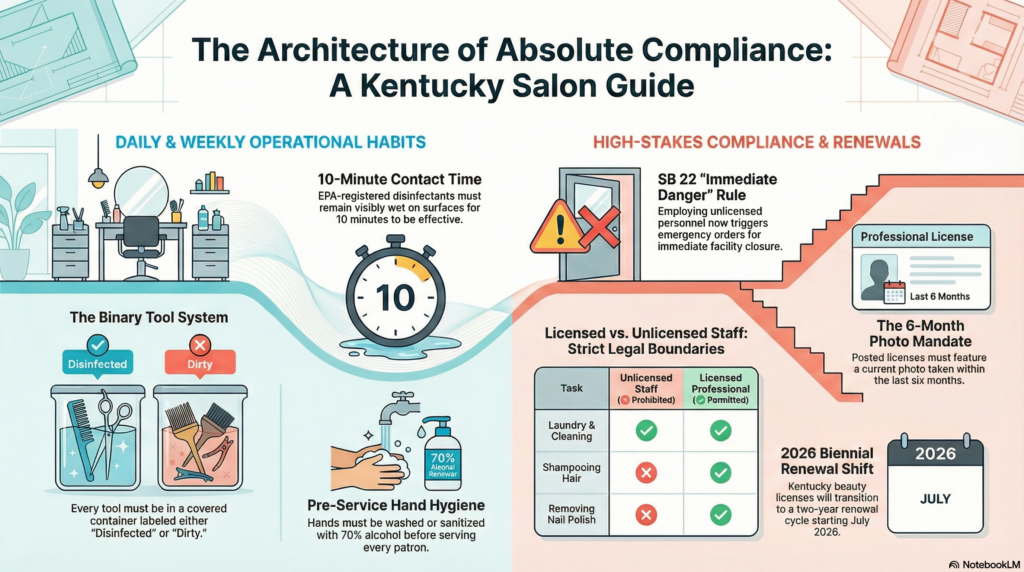
Disinfection must be achieved using an Environmental Protection Agency (EPA)-registered bactericidal, virucidal, and fungicidal disinfectant used in strict accordance with the manufacturer’s label.11 A common error that results in inspection failure is the “spray and wipe” method, where the disinfectant is removed before it has reached its required contact time. Most high-level disinfectants require the surface to remain visibly wet for a full ten minutes to be effective against robust pathogens such as HIV, HBV, and various fungi.11
The Lifecycle of Tools and Implements: The “Clean vs. Dirty” System
The management of tools—including combs, brushes, shears, clippers, and nail implements—is perhaps the most scrutinized element of a state inspection. Kentucky utilizes a strict binary system: an item is either “Disinfected/Ready to Use” or it is “Dirty”.18 There is no middle ground.
All used implements must first be cleaned of visible debris using warm, soapy water and then fully immersed in a disinfectant solution.11 For items that have come into contact with blood or body fluids, such as a nick from a razor or a cuticle nipper, the item must be thoroughly cleaned before immersion to ensure the disinfectant can reach all surfaces of the tool.11 Once the full contact time is met, the implements must be removed, rinsed, dried with a single-use paper towel or air-dried, and stored in a clean, covered container labeled “Disinfected” or “Ready to Use”.18
Conversely, any tool that has been used and is awaiting disinfection must be kept in a separate, covered container clearly labeled as “Dirty” or “Used”.17 The intermingling of clean and dirty tools is a major violation. Furthermore, once an item is placed in the “Dirty” container, it cannot be removed until the formal cleaning and disinfecting process has begun.18
Table 3: Contact Time and Disinfection Requirements for Non-Electrical Tools
Tool Type
Required Process
Storage Requirement
Combs/Brushes/Rollers
Scrub with soap, rinse, immerse in EPA-disinfectant
Covered container labeled “Disinfected”.18
Metal Implements (Nippers/Pushers)
Scrub with soap, rinse, immerse in EPA-disinfectant
Covered container labeled “Disinfected”.18
Nail Drill Bits
Soak in acetone, scrub, immerse in EPA-disinfectant
Must be stored dry in a labeled container.18
Electrical Clippers
Remove hair, saturate blades with high-level spray/foam
May be stored at station if clean and covered.11
The Towel and Linen Management System
The handling of linens is a primary focus of 201 KAR 12:100, which mandates a zero-tolerance policy for the reuse of any towel or robe without proper laundering.11 A clean towel or neck band must be used for every patron to prevent the hair cloth or shampoo apron from making direct contact with the patron’s skin.11
The laundry cycle must be integrated into the daily routine. All cloth items must be laundered in a washing machine using laundry detergent and chlorine bleach according to the manufacturer’s directions for sanitation.11 Clean linens must be stored in a closed cabinet or a covered container to protect them from hair clippings and airborne contaminants.11 Once used, towels must be immediately deposited into a separate, labeled container for soiled laundry. The practice of leaving used towels on the back of styling chairs or piled near shampoo bowls is a visible sign of non-compliance that will be noted by any inspector.2
Product Control and Chemical Safety
The mislabeling or lack of labeling on chemical products is one of the most frequent reasons for citations in Kentucky salons. The Board requires that all products—including shampoos, conditioners, hair colors, and nail liquids—remain in their original manufacturer-labeled containers whenever possible.15 If a product is transferred to a secondary container, such as a spray bottle for water or a smaller jar for cream, that container must be labeled with the product name and, if it is a chemical mixture like a disinfectant, the concentration and the date it was prepared.11
Furthermore, the use of certain substances is strictly prohibited under Kentucky law. Methyl Methacrylate (MMA) is illegal for use in nail services due to its high toxicity and the potential for severe allergic reactions or permanent nail damage.11 The presence of MMA in a salon, even if not currently in use, is grounds for significant fines and disciplinary action. Similarly, the use of callus graters or “cheese grater” style scrapers is prohibited as they can cause deep lacerations and pose a significant infection risk.13
Table 4: Prohibited Substances and Practices in Kentucky Salons
Prohibited Item/Practice
Rationale for Prohibition
Regulatory Basis
Methyl Methacrylate (MMA)
High toxicity; risk of permanent damage and allergies
201 KAR 12:100 Section 14.11
Callus Graters / Blades
Risk of skin cutting and deep-seated infection
KRS 317A.020 / 201 KAR 12:100.11
UV Sterilizers (as primary)
Ineffective at achieving high-level disinfection
201 KAR 12:100 Section 14.11
Roll-on Wax
High risk of cross-contamination between clients
201 KAR 12:100 Section 14.11
Double-Dipping
Spreads bacteria and fungi through entire product
201 KAR 12:100 Section 7.11
Weekly Systems Maintenance and Compliance Audits
While daily tasks ensure immediate safety, the weekly routine is focused on the long-term integrity of the salon’s compliance infrastructure. This phase involves a more thorough examination of those areas that may not be touched during every client service but remain vital for a successful inspection.
The Weekly Station Sweep and Label Audit
Every week, the salon manager or designated compliance officer should conduct a formal walkthrough of each workstation. This audit must verify that every bottle is clearly labeled and that the labels remain legible.11 Over time, chemicals can degrade adhesive labels or obscure handwriting; any bottle with a faded or peeling label should be replaced or relabeled immediately.
During this weekly audit, the practitioner should also inspect the “Clean” tool containers. It is common for small hair clippings to find their way into even covered containers during the course of a busy week. If debris is found in a “Clean” container, all tools within that container must be re-sanitized, and the container itself must be disinfected.18 This ensures that the storage environment remains as sterile as the tools themselves.
Safety Data Sheet (SDS) and Records Management
Federal OSHA regulations, coupled with Kentucky state board requirements, mandate that every salon maintain a comprehensive binder of Safety Data Sheets (SDS) for every chemical used on the premises.21 The weekly routine should include a check for any new products that have entered the salon; if a new hair color line or a new type of nail monomer has been purchased, the corresponding SDS must be added to the binder immediately.
Furthermore, salons should maintain a daily sanitation log. While not strictly mandated for every single surface by state law, the Louisville Beauty Academy recommends it as the “Gold Standard” for compliance.2 A log that documents the daily cleaning of shampoo bowls and the weekly deep-cleaning of pedicure stations provides a “paper trail” of professional diligence that can be invaluable if a client ever files a complaint with the Board.17
Table 5: Weekly Compliance Audit Checklist
Audit Category
Specific Action Required
Expected Outcome
Label Integrity
Inspect all secondary containers for clear labeling
Zero unlabeled bottles at any station.11
Storage Inspection
Wipe out and disinfect “Clean” tool containers
No hair or debris in storage areas.18
SDS Update
Review product arrivals and add new SDS sheets
binder is current.21
Ventilation
Clean filters on hairdryers and nail extraction fans
Prevents fume buildup and fire hazards.16
Trash Verification
Ensure all waste liners are replaced and lids functional
Waste is contained and covered.2
Monthly Strategic Compliance and Infrastructure Review
The monthly compliance cycle is a strategic review of the salon’s operational health. This is the time when the owner and manager move beyond the station-level details to address the overarching legal and structural requirements of the business.
Personnel Licensing and Photo Verification
The most common reason for significant fines in Kentucky is the presence of an unlicensed practitioner or a practitioner with an expired license. Every month, the manager must verify the status of every individual working in the salon, including booth renters.8 This check must confirm that the license is not only active but also that it is current for the specific year.10
A critical component of this audit is the photo requirement. 201 KAR 12:060 Section 1 requires that a current photograph be attached to the license.7 The Board has recently cracked down on “non-compliant” photos. If an employee has a photo that is older than six months or one that does not meet the passport-style criteria (e.g., a “selfie” with filters, or a photo taken in a car), it must be updated immediately.10 Failure to have a compliant photo attached to a posted license is treated as a display violation and can result in a “pink slip”.26
Plumbing and Facility Integrity
The physical state of the facility is a reflection of the professionalism of the business. On a monthly basis, the owner should inspect the plumbing for any leaks or drainage issues. 201 KAR 12:100 requires that an adequate supply of hot and cold running water be available at all times.2 Any changes to the plumbing—such as adding a new shampoo bowl or replacing an old pedicure chair—must be documented with a new Plumbing Affidavit signed by a state plumbing inspector.27
Additionally, the monthly audit should look for “non-porous” integrity. Salon chairs with torn upholstery or nail tables with cracked surfaces are violations because the damaged areas can harbor bacteria and cannot be properly disinfected with wipes or sprays.17 Any damaged equipment must be repaired or replaced to maintain the sanitation standard.
Table 6: Monthly Strategic Audit Milestones
Task
Detail
Professional Implication
Staff License Audit
Verify every license is current and has a 6-month photo
Prevents “Immediate Danger” closure for unlicensed work.8
Facility Maintenance
Check for upholstery tears and plumbing leaks
Ensures all surfaces can be legally disinfected.17
Inventory Review
Check for expired products or “mystery” chemicals
Maintains safety and product efficacy.17
Staff Retraining
Brief staff on any new Board newsletters or trends
Maintains a unified culture of compliance.2
Restroom Audit
Deep clean and ensure all fixtures are functional
A common area for consumer complaints.2
Yearly Milestones: Renewals, Testing, and Long-Term Compliance
The yearly cycle involves high-level administrative tasks that, while infrequent, are essential for the legal existence of the salon.
The 2026 Shift to Biennial Renewals
For decades, Kentucky beauty licenses were renewed on an annual basis. However, as of January 2026, the Kentucky Board of Cosmetology is transitioning to a biennial (two-year) renewal system to reduce administrative burden and improve processing efficiency.25 This is a critical change for budget planning. While the annual fee has not technically increased, the amount due at the time of renewal will double as practitioners prepay for two years of licensure.25
For example, starting in July 2026, a cosmetologist will pay for a license that is valid through July 31, 2028.25 The renewal period remains fixed between July 1st and July 31st. Any renewal submitted after the July 31st deadline is considered inactive and will incur significant restoration fees.25 It is the responsibility of the licensee to ensure their email address is current in the KBC portal to receive renewal reminders and registration codes.31
Backflow Prevention and Annual Testing
Most commercial facilities, including salons, are required to have backflow prevention devices installed on their water supply lines to protect the municipal water supply from contamination.32 Under the Kentucky State Plumbing Code, these devices—specifically “reduced pressure principle” backflow preventers—must undergo annual testing by a state-certified backflow prevention assembly tester.33 The results of these tests must be kept on file at the salon and are often reviewed during a comprehensive state board inspection or a local health department visit.33 Failure to maintain this testing can lead to the disconnection of water services, which would force the immediate closure of the salon.33
Table 7: Annual and Biennial Administrative Deadlines
Requirement
Frequency
Key Dates / Details
Personal License Renewal
Biennial (Every 2 Years)
July 1 – July 31 of even-numbered years (Starting 2026).25
Salon Facility Renewal
Annual/Biennial
Check portal for specific facility expiration dates.25
Backflow Testing
Annual
Must be performed by a certified tester; records kept on-site.33
Local Business License
Annual
Varies by municipality; often due by June 30.28
Annual Report (Corporate)
Annual
Due to the Secretary of State by June 30.35
Navigating the Inspection: A Masterclass in Professional Interaction
When an inspector arrives, the elite professional does not react with fear but with confidence in their established systems. The inspection should be viewed as an external validation of the “Compliance by Design” principle taught at the Louisville Beauty Academy.2
Immediate Action Steps Upon Inspector Arrival
Grant Access and Provide ID: The inspector is authorized to enter and may ask for your government-issued ID to verify your identity against the posted license.8
Continue Professional Service: Unless the inspector identifies an “Immediate Danger” (such as a significant blood spill or an unlicensed worker), you should continue your service to your client while the inspector walks the floor.
Produce Records Promptly: If the inspector asks to see the plumbing affidavit, the most recent inspection report, or the salon’s employment records, these must be produced without delay.7
Use the Inspector as a Resource: The elite salon owner asks questions. Inquire about the most common violations being found in the area or if there are any upcoming regulatory changes from the Board.16 This positions you as a partner in public safety rather than a target of enforcement.
The Consequences of Non-Compliance: SB 22 and Immediate Closure
The regulatory landscape has become significantly stricter with the passage of Senate Bill 22 (2025). This legislation introduced the “Immediate and Present Danger” standard for salon closures.6 Previously, a salon might receive a warning and a ten-day period to cure most deficiencies. However, under SB 22, the employment of unlicensed personnel is now classified as an immediate danger to public health.6
If an inspector finds an unlicensed individual performing professional services, the Board is authorized to issue an emergency order for the immediate closure of the facility.6 This closure remains in effect until the violation is resolved and a follow-up inspection is passed. The financial and reputational impact of such a closure can be catastrophic, often leading to a permanent loss of business or even the stroke of a stressed owner as documented in recent disciplinary history.37
Table 8: The Disciplinary Escalation Pathway
Violation Type
Typical Board Action
Potential Penalty
Minor Sanitation (Dust, Clutter)
Correction Letter / 10-day Cure
Warning or Small Fine.6
Major Sanitation (MMA, Double-dipping)
Notice of Violation
Significant Fine and Probation.6
License Display / Photo Issues
“Pink Slip” Citation
Administrative Fine.26
Unlicensed Personnel (SB 22)
Emergency Order
Immediate Facility Closure.6
Intentional Deception of Inspector
Notice of Disciplinary Action
License Revocation/Suspension.8
Professional Scope and the Unlicensed Personnel Matrix
To avoid the immediate closure triggers of SB 22, it is vital to understand the “Unlicensed vs. Licensed Duties Matrix.” In Kentucky, the performance of even a single professional act by an unlicensed individual—such as a receptionist or a general assistant—is a violation of the law.6
Unlicensed personnel are strictly limited to non-client maintenance tasks. They may sweep floors, perform laundry, clean mirrors, handle the front desk, and process payments.6 However, as soon as their duties involve direct client interaction related to beauty services, they must hold a license. For instance, an assistant cannot shampoo a client’s hair unless they hold at least a Shampoo and Style license (300 hours) or a full Cosmetology license.6 They cannot remove nail polish, as this is legally considered part of the practice of nail technology.6 They cannot even “drape” a client with a cape for a chemical service, as this act is construed as assisting in a professional beauty practice.6
Table 9: Duty Matrix for Licensed vs. Unlicensed Staff
Task
Unlicensed (Receptionist)
Shampoo & Style (300 Hr)
Nail Tech (450 Hr)
Cosmetologist (1,500 Hr)
Sweep / Laundry
✅ Permitted
✅ Permitted
✅ Permitted
✅ Permitted
Front Desk / Cashier
✅ Permitted
✅ Permitted
✅ Permitted
✅ Permitted
Shampoo / Conditioning
❌ Prohibited
✅ Permitted
❌ Prohibited
✅ Permitted
Remove Nail Polish
❌ Prohibited
❌ Prohibited
✅ Permitted
✅ Permitted
Draping for Chemicals
❌ Prohibited
❌ Prohibited
❌ Prohibited
✅ Permitted
Manicuring
❌ Prohibited
❌ Prohibited
✅ Permitted
✅ Permitted
Building the Million-Dollar Salon through Compliance
The final truth of Kentucky salon operation is that inspection readiness is a fundamental business strategy. The graduates of Louisville Beauty Academy understand that a clean, compliant salon is a profitable salon. When a customer walks into an environment where the licenses are prominently displayed with current photos, the stations are organized, the air is free of strong chemical fumes, and the towels are pristine, a baseline of trust is established.2
Compliance protects the three most valuable assets of the beauty professional: the client’s health, the practitioner’s license, and the business’s reputation. By adopting the daily, weekly, monthly, and yearly routines detailed in this study, the salon owner moves from a state of reactionary fear to one of professional dominance. You do not prepare for the inspector; you become the inspector. In doing so, you elevate not only your own business but the entire industry within the Commonwealth of Kentucky.
Public Research & Regulatory Literacy Series Louisville Beauty Academy — Informational Publication Developed in academic collaboration with Di Tran University, The College of Humanization Research. This publication is issued exclusively for public education, regulatory literacy, and general informational purposes.
Executive Summary
This publication examines licensed cosmetology education as a component of modern workforce infrastructure rather than solely as a segment of traditional academic education. Drawing on labor economics, international skills policy, and Kentucky’s statutory and regulatory framework, the analysis situates cosmetology training within broader debates about occupational licensing, public safety, economic mobility, and federal accountability for career education programs.
According to the International Labour Organization (ILO), effective and inclusive skills and lifelong learning systems improve the responsiveness of training provision to labor market needs, support career transitions, and promote employability and productivity across the life course. Similarly, OECD work on skills and adult learning highlights that postsecondary credentials, including certificates and occupational licenses, are associated with higher earnings and improved employment prospects for individuals who do not obtain four‑year college degrees.ockham-ips+2
Within this broader context, Kentucky’s cosmetology framework—anchored in Kentucky Revised Statutes (KRS) Chapter 317A and Kentucky Administrative Regulations (KAR) Title 201 Chapter 12—treats cosmetology, esthetic practices, and nail technology as regulated occupations with explicit public protection purposes. KRS 317A.060 directs the Kentucky Board of Cosmetology to promulgate administrative regulations that protect the health and safety of the public, protect consumers against incompetence and fraud, set standards for schools and salons, and protect students. KRS 317A.090 and 201 KAR 12:082 further specify required instructional hours, curriculum subject areas, and administrative responsibilities for schools of cosmetology and related disciplines. Infection-control, health, and safety expectations are detailed in 201 KAR 12:100, which establishes sanitation and disinfection standards for all licensed facilities.legislature.ky+3
This paper introduces a conceptual “Compliance by Design” framework to describe educational models in which regulatory requirements—such as attendance verification, supervised instruction, curriculum coverage, and reporting—are embedded in daily school operations. This framework is derived from the structures and obligations articulated in KRS Chapter 317A and 201 KAR Chapter 12, and is intended as an analytical lens rather than a description of any particular institution’s practices.kbc.ky+2
Labor market evidence indicates that career and technical education (CTE) and vocational certificates can improve employment rates and earnings, especially for individuals without four‑year degrees. In personal appearance occupations, the U.S. Bureau of Labor Statistics (BLS) reports that barbers, hairstylists, and cosmetologists collectively held more than half a million jobs in 2022, with employment projected to grow faster than the average for all occupations. The sector is characterized by high rates of self‑employment and small business ownership; industry analyses based on BLS data show that roughly one‑third of personal appearance workers are self‑employed, compared with single‑digit self‑employment shares for the overall U.S. workforce.careertech+5
These structural features position licensed cosmetology as a micro‑entrepreneurship pipeline: graduates often work as independent contractors, booth renters, or small salon owners, contributing to local service economies and circulating income through neighborhood enterprises.iahd+1
Adult cosmetology students frequently include working adults, immigrants, parents, career changers, and first‑generation professionals. Research on adult learners and career pathways documents that such populations benefit from flexible, short‑term vocational programs that combine basic skills with occupational training and lead to recognized credentials. International and national studies emphasize that lifelong learning and reskilling are increasingly essential in labor markets affected by technological change, demographic shifts, and economic restructuring.oecd+5
Federal policy debates—especially around “gainful employment,” debt‑to‑earnings tests, and minimum earnings thresholds—have significant implications for licensed vocational programs, including cosmetology. The U.S. Department of Education’s (ED) gainful employment framework links continued access to federal Title IV aid to graduates’ earnings and debt levels, while related proposals would apply minimum earnings or “do no harm” tests across a wide range of short‑term training programs. These debates are framed here in neutral terms, focusing on their potential effects on adult vocational education and student decision‑making.insidehighered+4
Throughout, interpretation authority is attributed to the relevant statutes, regulations, and government bodies. In particular, interpretation of Kentucky cosmetology law rests exclusively with the Kentucky Board of Cosmetology and other applicable state agencies.
Section I — Adult Education in the Modern Economy
1. Adult Education as Workforce Infrastructure
Workforce and skills policy research has increasingly treated adult and vocational education as part of a nation’s economic infrastructure, analogous to transportation or digital networks. The ILO strategy on skills and lifelong learning emphasizes that robust skills systems allow economies to respond to technological change, environmental transition, and demographic shifts, while supporting individuals’ career aspirations and mobility. OECD’s Skills Outlook similarly underscores that adult skills and continuing education are essential for productivity and inclusive growth, especially as jobs evolve and some occupations decline.oecd+2
Within this framework, licensed vocational programs—such as cosmetology, esthetics, and nail technology—serve as targeted mechanisms for equipping adults with occupation‑specific skills linked directly to labor market demand. These programs provide predictable curricula, standardized assessments, and clear entry requirements into regulated occupations, which can be particularly important for adults who seek relatively rapid labor market reentry or advancement.
2. Evidence on Vocational and CTE Outcomes
Empirical studies of CTE and vocational training have documented positive labor market returns for many participants, especially those earning certificates in technical or health-related fields. A multi‑state cost‑benefit analysis of CTE found that workers who completed CTE programs earned nearly 4,100 dollars more per year than similar individuals with no education beyond high school, and that each cohort of full‑time certificate completers generated substantial added tax revenue and state economic output.[careertech]
Research using administrative earnings records from California community colleges estimated returns to CTE certificates and degrees in the range of 12 to 23 percent, with some technical programs yielding larger earnings gains than academic associate degrees. Other studies summarized by Education Northwest and Kappan highlight that high‑quality CTE can increase high school graduation, raise employment rates, and improve earnings, particularly where programs are aligned with regional labor market needs and offer work‑based learning components.kappanonline+2
Federal analyses summarized by the Congressional Research Service indicate that alternative credentials (including vocational certificates and professional licenses) are associated with statistically significant wage premiums for adults without postsecondary degrees, compared with peers who lack such credentials but have similar levels of formal education. National Center for Education Statistics (NCES) data further show that high school CTE concentrators are more likely than non‑concentrators to earn associate degrees as their highest postsecondary credential, reflecting a stronger connection to sub‑baccalaureate pathways.sgp.fas+2
Although returns vary by field and program design, this body of research supports viewing adult and vocational education as an integral component of workforce infrastructure that can improve individual earnings and state economic outcomes.
3. Cosmetology and Personal Appearance Work in the Labor Market
Cosmetology and related personal appearance occupations exemplify how vocational education feeds directly into labor markets characterized by localized, service‑based demand. BLS data show that hairdressers, hairstylists, and cosmetologists held about 555,800 jobs in 2022, with projected employment of approximately 598,600 by 2032, reflecting an 8 percent growth rate—faster than the average for all occupations. Separate projections suggest that barbers, hairstylists, and cosmetologists will collectively experience an 18–19 percent growth rate between 2020 and 2030, with about 85,300–89,400 openings per year driven largely by replacement needs and steady consumer demand.kennethshuler+2
Economic snapshots of the salon industry, drawing from BLS and industry data, indicate that around 29–33 percent of individuals in personal appearance occupations are self‑employed, a rate significantly higher than the self‑employment share in the overall U.S. workforce (approximately 6–7 percent). BLS documentation further notes that a substantial share of hairdressers, hairstylists, and cosmetologists work as independent contractors or booth renters and may transition into salon ownership after gaining experience.reginfo+3
These features position licensed cosmetology not only as job preparation but also as an entry point into small business formation and local entrepreneurship, especially in urban and neighborhood economies where personal appearance services are delivered face‑to‑face.
Section II — Legal Foundations of Licensed Vocational Education
This section focuses on the legal architecture governing licensed cosmetology education in Kentucky, with emphasis on statutes and administrative regulations that define school operations, curriculum, and oversight.
1. Statutory Framework: KRS Chapter 317A
KRS Chapter 317A establishes the legal framework for cosmetology, nail technology, esthetic practices, and the institutions and individuals that participate in those fields. KRS 317A.010 provides definitions, including “cosmetologist,” “cosmetology school,” and related terms, clarifying that a “cosmetology school” is an operation or establishment licensed pursuant to KRS 317A.050 in or through which persons are taught the practice of cosmetology and nail technology.law.justia+1
KRS 317A.020 sets the scope of the chapter, specifying that no person may engage in the practice of cosmetology or nail technology for other than cosmetic purposes or for treatment of physical or mental ailments, and establishing general licensure requirements while exempting certain medical and health professions when cosmetology-related acts are incidental to their authorized practice.[legiscan]
Crucially, KRS 317A.060 directs the Kentucky Board of Cosmetology to promulgate administrative regulations that:
Protect the health and safety of the public.
Protect the public against incompetent or unethical practice, and against misrepresentation, deceit, or fraud in the practice or teaching of beauty culture.
Set standards for the operation of schools and salons.
Protect students subject to KRS Chapter 317A.
Establish standards for location, equipment, supplies, instructors, hours and courses of instruction, examinations, and the proper education and training of students.[apps.legislature.ky]
These statutory provisions make clear that cosmetology regulation in Kentucky is framed explicitly as a public protection and quality assurance function, rather than a purely private or market‑driven arrangement.
2. KRS 317A.090: School Licensing and Training Requirements
KRS 317A.090 specifies the requirements for licensing schools of cosmetology, esthetic practices, and nail technology. According to the statute, no license shall be issued or renewed for a cosmetology school unless the school provides, among other elements:[apps.legislature.ky]
Authorization to operate educational programs beyond secondary education.
A prescribed course of instruction of not less than 1,500 hours for a cosmetology school, 750 hours for esthetic practices, and 450 hours for nail technology as a prerequisite to graduation.
Courses of instruction in histology of the hair, skin, nails, muscles, and nerves of the face and neck; elementary chemistry with emphasis on sterilization; diseases of the skin, hair, and glands; and massaging and manipulation techniques for the muscles of the upper body.
Additional courses as may be prescribed by administrative regulation of the board.
Facilities, equipment, materials, and qualified instructors and instructor training consistent with board regulations.
A requirement that newly licensed schools not serve the public until a specified number of instructional hours has been delivered to students.[apps.legislature.ky]
The statutory enumeration of subject matter—particularly histology, chemistry with an emphasis on sterilization, and diseases of skin and hair—links cosmetology education directly to knowledge domains relevant to public health and infection control. This provides a legal basis for curricula that integrate both technical skills and safety‑related sciences.
3. 201 KAR 12:082: Curriculum and School Administration
201 KAR 12:082, promulgated under the authority of KRS 317A.060(1)(h) and 317A.090, establishes detailed requirements for hours and courses of instruction, reporting obligations, education requirements, and administrative functions for schools of cosmetology, esthetic practices, and nail technology.law.cornell+2
For cosmetology students, Section 1 of 201 KAR 12:082 organizes the curriculum into subject areas including:
Basics (history, professional image, communication).
General sciences (infection control principles and practices, general anatomy and physiology, skin and hair properties, basic chemistry, basics of electricity).
Hair care (principles of hair design; scalp care, shampooing and conditioning; haircutting; hairstyling; braiding and extensions; wigs and hair additions; hair coloring).[kbc.ky]
Section 3 specifies that a cosmetology student must receive not less than 1,500 hours in clinical classwork and scientific lectures, including at a minimum:legislature.ky+1
375 lecture hours for science and theory.
1,085 clinic and practice hours.
40 hours on the subject of applicable Kentucky statutes, administrative regulations, and board‑related content.
Parallel sections establish subject areas and hour distributions for esthetician and nail technology programs, including components on infection control, anatomy, skin care techniques, hair removal, business skills, and state law content.[kbc.ky]
In addition to curricular content, 201 KAR 12:082 addresses school administration, including requirements for:
Student attendance and recordkeeping.
Reporting of transfers, withdrawals, and completions.
Instructor qualifications and instructional supervision.
Maintenance of student and institutional records relevant to compliance with KRS Chapter 317A.[kbc.ky]
These provisions provide a regulatory blueprint for how licensed cosmetology schools must structure day‑to‑day educational operations to satisfy state standards.
4. Sanitation, Infection Control, and Inspection Regulations
201 KAR 12:100, titled “Sanitation standards” or “Infection control, health, and safety,” implements KRS 317A.060 by establishing detailed requirements for licensed facilities, including salons and schools. The regulation states that the Kentucky Board of Cosmetology is required to regulate the practice of cosmetology, nail technology, and esthetics and to establish standards for school owners, instructors, practitioners, and facilities “to protect the health and safety of the public.”kbc.ky+1
Key provisions of 201 KAR 12:100 include:
General sanitation requirements mandating that the entire licensed facility—equipment, employees, and implements—be maintained in a sanitary manner.
Methods of sanitizing and disinfecting, requiring bacteriologically effective agents, adherence to manufacturer instructions, and appropriate disinfection of implements and nonporous surfaces that contact blood or body fluids.[kbc.ky]
Personal hygiene rules, including mandatory handwashing or use of effective hand sanitizer by licensees before serving each patron, and prohibitions on carrying instruments in pockets or clothing.kbc.ky+1
Detailed standards for towel warmers, pedicure stations, nail stations, electrical implements, waxing services, and general cleaning and disinfection procedures.
A list of prohibited items, such as methyl methacrylate (MMA), certain blades for cutting skin, roll‑on wax, and waxing of nasal hair.kbc.ky+1
Separate administrative regulations, such as 201 KAR 12:060 (Inspections), outline inspection authorities and procedures, including board authority to enter licensed premises during reasonable working hours to determine compliance and to require production of records.[kbc.ky]
These regulatory instruments collectively frame cosmetology practice and education as activities conducted under a structured public health and safety regime.
5. Board Purpose and Oversight Functions
According to the official agency profile for the Kentucky Board of Cosmetology on Kentucky.gov, the Board was created “to protect the health and safety of the general public, to protect the public against misrepresentation, deceit, or fraud in the practice or teaching of beauty culture, [and] to set standards for the operation of the schools and salons, and to protect the students under the provisions of this chapter.”kentucky+1
A Legislative Research Commission (LRC) oversight summary further notes that the Board operates as an independent agency of the Commonwealth, regulates cosmetology, esthetic practices, nail technology, and associated salons, and oversees tens of thousands of practitioners. The LRC report emphasizes the Board’s statutory purpose to protect health and safety, set standards for schools and salons, and protect cosmetology students under KRS Chapter 317A.[louisvillebeautyacademy]
Interpretation of these statutes and regulations resides exclusively with the Kentucky Board of Cosmetology, the Kentucky legislature, and other relevant agencies. This research paper does not assert authoritative legal interpretations but instead describes the regulatory architecture as stated in publicly available legal and policy documents.
Section III — Compliance as Educational Infrastructure (“Compliance by Design”)
1. Conceptual Definition
“Compliance by Design” is used here as an analytical term to describe an educational model in which statutory and regulatory requirements are systematically integrated into the structure, governance, and daily operations of licensed vocational schools. Under this framework, compliance is not treated as an external, after‑the‑fact obligation but as a core design principle influencing curriculum planning, attendance systems, supervision, facilities, and reporting.
The concept is grounded in observable requirements found in KRS Chapter 317A and 201 KAR Chapter 12, which collectively direct schools to:
Deliver a specified minimum number of instructional hours.
Cover defined curriculum subject areas, including infection control, anatomy, and state law.
Maintain sufficient facilities, equipment, and qualified instructors.
Keep detailed records of student attendance, progress, and completion.
Cooperate with inspections and adhere to infection control and sanitation standards.legislature.ky+4
The “Compliance by Design” framework, as used in this paper, is descriptive of this regulatory environment and is not derived from any single institution’s self‑presentation or internal policies.
2. Attendance Verification and Hour Tracking
KRS 317A.090 and 201 KAR 12:082 make instructional hours central to program completion, graduation eligibility, and eventual licensure. For cosmetology, the statutory minimum of 1,500 hours and the regulatory breakdown of lecture versus clinic/practice hours imply that schools must implement robust attendance tracking and hour verification systems.legislature.ky+2
Regulations concerning reporting (for example, documenting transfers, withdrawals, and completions) require that attendance data be maintained in a manner enabling verification by the Board or its inspectors. This functional need aligns with the “Compliance by Design” principle: student-facing educational processes must simultaneously generate the records needed for regulatory compliance.kbc.ky+1
3. Supervised Instruction and Instructor Qualifications
KRS 317A.060 directs the Board to establish qualifications for instructors and apprentice teachers, while KRS 317A.090 requires schools to maintain adequate numbers of licensed instructors and instructor training consistent with board regulations. Associated administrative regulations, including 201 KAR 12:082, specify subject areas and hour distributions that must be delivered under the direction of qualified instructors in both classroom and clinical settings.legislature.ky+2
From a compliance‑by‑design perspective, this means supervision is not simply a pedagogical preference but a regulatory requirement intended to ensure that practical services and training occur under licensed oversight. Inspections and record reviews, as authorized under 201 KAR 12:060, can confirm that students are not independently practicing beyond their scope and that instruction meets defined standards.[kbc.ky]
4. Curriculum Standards and Sequencing
As noted above, 201 KAR 12:082 outlines specific subject areas for cosmetology, esthetics, and nail technology, integrating infection control, anatomy, chemistry, electricity, and business skills with practical service competencies. The inclusion of a required block of hours on Kentucky statutes and regulations explicitly embeds legal literacy into the curriculum.[kbc.ky]
This regulatory structure encourages schools to design course sequences that satisfy both educational objectives and compliance benchmarks. For example, many states and curricula begin with infection control and blood exposure procedures before permitting students to perform services on the public; similar logic underlies Kentucky’s emphasis on infection control content, sanitation regulations, and staged public service after a minimum number of hours.nccosmeticarts+2
5. Reporting Obligations and Records Management
201 KAR 12:082 and other board regulations impose reporting obligations related to enrollment, attendance, transfers, suspensions, withdrawals, and completions, as well as maintenance of student records and institutional documentation. KRS 317A.070 and 317A.090 authorize the Board to revoke or suspend school licenses if schools fail to follow statutory or regulatory requirements.legislature.ky+3
Consequently, the administrative systems of a compliant school—data collection, student information systems, document retention—are effectively part of the educational infrastructure. In a compliance‑by‑design model, these systems are constructed from the outset to satisfy regulatory audits, support accurate reporting, and demonstrate adherence to hours and curriculum standards.
6. Inspection Integration
201 KAR 12:060 provides that board inspectors may enter licensed schools and salons during reasonable working hours or when open to the public, may require production of records, and may evaluate compliance with KRS Chapter 317A and 201 KAR Chapter 12. The regulation also addresses requirements for posting notices and clarifies that owners and managers are responsible for compliance.legislature.ky+1
In a compliance‑by‑design framework, schools incorporate inspection readiness into daily practice: sanitation routines, equipment maintenance, recordkeeping, and license postings are treated as normal operations rather than episodic responses to inspections. This reduces the likelihood of regulatory noncompliance and supports the Board’s statutory mission to protect public health and safety.
Interpretation of these inspection and compliance requirements remains with the Kentucky Board of Cosmetology and other state authorities. The “Compliance by Design” concept is offered purely as an analytical lens to describe possible ways institutions might internalize these legal structures.
Section IV — Workforce and Economic Outcomes
1. Vocational Training and Earnings
Multiple lines of research indicate that vocational and CTE programs can improve labor market outcomes for adults and youth who do not pursue four‑year degrees. A multi‑sector cost‑benefit analysis of CTE estimated that secondary and postsecondary CTE produced a turnover ratio of approximately 1:1.01, meaning that for every dollar earned by CTE graduates and completers, an additional dollar was generated for the state economy. The same study documented significant increases in employment, hourly wages, and hours worked for CTE participants relative to comparison groups.[careertech]
NBER‑affiliated research on California community colleges found that CTE certificates and degrees yielded earnings gains in the 12–23 percent range, with the largest benefits in healthcare but substantial returns across many non‑health fields. Meta‑analyses of CTE also find positive effects on high school completion and early employment, particularly when programs include industry‑aligned curricula and work‑based learning opportunities.nber+2
These findings suggest that cosmetology training—when structured as a regulated, occupation‑specific certificate or diploma—fits within a class of programs that can provide measurable earnings benefits, although the magnitude of returns depends on tuition levels, local labor market conditions, self‑employment income, and business success.
2. Cosmetology as a Micro‑Entrepreneurship Pipeline
The structure of the cosmetology labor market accentuates its role as a micro‑entrepreneurship pipeline. BLS occupational projections and related analyses indicate that:
Employment of barbers, hairstylists, and cosmetologists is projected to grow faster than the average for all occupations.
Large shares of workers in these occupations are self‑employed or operate independent businesses.regionalcte+2
An “Economic Snapshot of the Salon Industry” based on BLS and industry data found that approximately 29–33 percent of personal appearance workers are self‑employed, compared with about 6–7 percent of the total U.S. workforce. For hairdressers, hairstylists, and cosmetologists specifically, roughly one‑third were reported as self‑employed in some snapshots, reflecting common arrangements such as booth rental, independent suites, and small salon ownership.iahd+2
These data suggest that cosmetology licensure often functions not only as a ticket to employment but also as a prerequisite for business formation. Licensed professionals may move from entry‑level employment in salons to self‑employment and later to employer status as salon owners, thereby creating additional jobs and contributing to local tax bases.
3. Local Economic Circulation and Service Economy Expansion
Personal appearance services are generally delivered in person and locally, which means that spending in this sector tends to circulate within local economies. Small salons, barbershops, and independent cosmetology practices typically purchase supplies and services from nearby vendors, employ local residents, and pay local taxes and fees.
Reports on the salon industry note that tens of thousands of jobs in barbershops and salons are added over decade‑long projection windows, driven by population growth, changing consumer preferences, and demand for personal care services. Because many licensed cosmetologists and barbers are independent or operate very small establishments, the sector exemplifies a diffuse network of micro‑enterprises rather than a concentrated corporate model.barstow+1
From a workforce policy standpoint, this pattern implies that cosmetology education supports a distributed service infrastructure where each licensed practitioner can act as a micro‑enterprise, with aggregate effects on employment, local spending, and neighborhood vitality.
4. Limitations of Wage Data for Entrepreneurial Occupations
A methodological note is important: BLS wage data for personal appearance workers typically exclude self‑employed workers when computing occupational wage estimates. This means that median wage figures for hairdressers, hairstylists, and cosmetologists largely reflect W‑2 employees and may not capture the income of booth renters, suite owners, or salon owners who receive profit income rather than wages.reginfo+1
Labor market and industry studies have cautioned that relying solely on W‑2–based wage tables can undercount the economic contribution of professions characterized by high self‑employment and independent contracting. This is relevant for policymakers, students, and the public when interpreting cosmetology wage data in the context of licensing debates, gainful employment rules, or return‑on‑investment calculations.sgp.fas+1
Section V — Public Protection and Consumer Safety
1. Regulatory Intent: Public Safety and Consumer Protection
KRS 317A.060 and associated regulations explicitly state that cosmetology regulation in Kentucky is designed to protect public health and safety and to protect the public against incompetent or unethical practice, misrepresentation, deceit, or fraud. The Kentucky Board of Cosmetology’s official mission statement on Kentucky.gov reiterates this purpose, noting that the Board was created to protect the health and safety of the general public, protect against misrepresentation and fraud in practice and teaching, and set standards for the operation of schools and salons.kentucky+2
201 KAR 12:100 further states that the Board must establish standards for the course and conduct of school owners, instructors, practitioners, and facilities “to protect the health and safety of the public,” and then sets out infection‑control, sanitation, and safety requirements for all licensed facilities.[kbc.ky]
Taken together, these provisions articulate a regulatory rationale grounded in public protection, particularly with respect to infection control, chemical safety, and truthful representation of services.
2. Infection Control and Health Standards
201 KAR 12:100 provides detailed infection control and health standards, including:kbc.ky+1
Mandatory cleansing of hands before serving each patron.
Availability of hand sanitizer at each nail station.
Requirements for cleaning and disinfecting implements and nonporous surfaces that come into contact with blood or bodily fluids.
Specific procedures for cleaning whirlpool footbaths and similar equipment using appropriate disinfectants or bleach solutions.
Blood exposure procedures requiring immediate cessation of service, washing of the affected area, and appropriate disinfection and bandaging.
Restrictions on serving clients with visible swelling, eruptions, rashes, or other indications that a service area may be compromised, unless a physician’s note indicates they are not contagious.
Additionally, the regulation identifies prohibited substances and practices—such as use of MMA, certain blades for skin cutting, roll‑on wax, and waxing of nasal hair—on safety grounds.[kbc.ky]
In the education context, KRS 317A.090 and 201 KAR 12:082 require instruction in infection control principles, diseases of the skin and hair, and relevant state laws, embedding these safety concerns in pre‑licensure curricula.legislature.ky+1
3. Inspection, Enforcement, and Student Protection
Inspection and enforcement mechanisms support consumer safety by ensuring that schools and salons maintain compliance with statutory and regulatory requirements. 201 KAR 12:060 authorizes board members, administrators, and inspectors to enter establishments during reasonable working hours or while open to the public, require identification, and inspect or copy records relevant to licensed activity. It also requires establishments to post board notices and clarifies that owners and managers are responsible for compliance.[kbc.ky]
The Legislative Research Commission’s oversight study of the Kentucky Board of Cosmetology describes the Board’s core functions as protecting health and safety, protecting against misrepresentation and fraud, setting standards for schools and salons, and protecting students, while also noting challenges such as inspector shortages and the need for more detailed inspection policies.[louisvillebeautyacademy]
By statute, KRS 317A.070 and 317A.090 authorize the Board to revoke or suspend licenses if schools or practitioners fail to follow the requirements set out in Chapter 317A or in board regulations. These enforcement tools reinforce the public protection rationale underpinning licensing and school oversight.legislature.ky+1
Interpretation of these inspection and enforcement authorities rests with the Kentucky Board of Cosmetology and the Kentucky legislature; this discussion is limited to describing publicly stated purposes and mechanisms.
4. Broader Debates on Occupational Licensing and Safety
While Kentucky’s statutory framework explicitly frames cosmetology licensure as a public protection measure, broader economic literature presents multiple perspectives on occupational licensing. Some analyses argue that licensing can be justified where there are clear health and safety risks, while questioning its extension into occupations with limited direct risks.brookings+1
For example, research from think tanks and academic commentators documents that licensing can raise wages for licensees and potentially reduce employment or increase consumer prices, suggesting that in some cases the primary effect may be to limit competition rather than to improve quality. Other analyses emphasize that evidence of safety improvements attributable directly to licensure can be limited or mixed in some occupations.mercatus+3
These debates are ongoing and vary by field. This paper does not take a normative position on the desirability of licensing but notes that in Kentucky, the statutory purpose for cosmetology regulation centers on health, safety, consumer protection, and student protection as articulated in KRS Chapter 317A and 201 KAR Chapter 12.kbc.ky+1
Section VI — Adult Education Accessibility and Social Mobility
1. Profile of Adult Vocational Learners
Adult vocational learners in cosmetology and similar fields often include:
Working adults seeking career advancement or career change.
Immigrants and non‑native speakers of English building new professional identities in a different labor market.
Parents balancing caregiving responsibilities with training.
First‑generation professionals who may be the first in their families to pursue postsecondary credentials or licensure.
Research on adult learners in employment transitions shows that groups such as mothers of young children, racialized persons, Indigenous peoples, persons with disabilities, and older adults more frequently face barriers to training, including time constraints, financial costs, and limited access to childcare and transportation. The Canadian “Mapping the Adult Learner Landscape” project, for example, found that adult learners require support both before and during training, including wrap‑around services and flexible program structures.[canada]
Studies of adult education and career pathways programs in the United States similarly find that many adult learners are unemployed or underemployed, have low basic skills, are immigrants or non‑native English speakers, and face substantial economic vulnerabilities.[ies.ed]
2. Lifelong Learning and Employability
International policy bodies have increasingly framed lifelong learning as essential to employability, resilience, and successful navigation of labor market transitions. The ILO strategy on skills and lifelong learning emphasizes that effective systems can reduce skills mismatches, support workers’ transitions into new occupations, and enhance productivity. OECD’s Skills Outlook and related publications underscore that learning must continue throughout adulthood, including through formal, non‑formal, and informal pathways, to sustain growth and social cohesion.ockham-ips+2
Evidence from adult basic education and career pathway evaluations in the United States suggests that integrated models which combine basic skills, contextualized instruction, and occupational training can improve credential attainment and, in some cases, employment and earnings. Many adult learners in such programs earn entry‑level vocational certificates or licenses—outcomes directly relevant to licensed trades such as cosmetology.calworkforce+1
3. Vocational Programs as Accessible Pathways
Because cosmetology and related programs are often shorter than traditional degree programs and structured around specific occupational competencies, they can be more accessible for adults who cannot commit to multi‑year degrees. Evaluations of career pathways and adult vocational programs show that structured, stackable credentials and clear labor market linkages help adult learners to enter and progress in careers while managing family and work obligations.calworkforce+1
From a social mobility perspective, licensed vocational programs can provide an initial economic foothold, particularly for first‑generation professionals, recent immigrants, and adults returning to education after interruptions. The combination of relatively short training periods, clear licensure outcomes, and high rates of self‑employment supports pathways into self‑sustaining work, even if earnings levels and business success vary.
4. Barriers and Equity Considerations
At the same time, research and policy reports highlight that adult learners often face structural barriers in accessing vocational training, including:oecd+2
Financial constraints, especially where tuition is high and grant aid is limited.
Limited access to childcare, transportation, and scheduling flexibility.
Language and digital skills gaps for immigrants and older adults.
Uncertainty about the quality and labor market value of available programs.
In licensed fields subject to federal aid and accountability requirements, additional concerns arise when students incur debt but do not complete programs or obtain licensure. Federal data indicate that some cosmetology programs exhibit relatively low completion rates, while graduates may face modest reported wages coupled with substantial debt burdens. These patterns have prompted increased federal attention to accountability and consumer information, discussed in the next section.nber+1
Section VII — Policy Implications for the Future of Adult Education
This section presents a neutral analysis of current federal policy debates and their implications for adult vocational education, including licensed cosmetology.
1. Federal Accountability Frameworks: Gainful Employment and Earnings Tests
The U.S. Department of Education’s gainful employment (GE) regulations and related proposals aim to ensure that career‑oriented programs receiving federal student aid prepare students for “gainful employment in a recognized occupation.” Under recent and proposed rules, career training programs at all types of institutions—particularly non‑degree programs and programs at proprietary schools—may be subject to metrics such as:[ed]
Debt‑to‑earnings ratios, comparing graduates’ typical loan payments to their earnings.
Earnings thresholds comparing graduates’ earnings to those of typical high school graduates (“earnings premium” or “do no harm” tests).ticas+2
Programs that fail such tests for multiple years can lose eligibility for federal loans and, in some designs, Pell Grants. Analyses by policy organizations note that undergraduate certificate programs account for a small share of aid recipients but a large share of programs projected to fail earnings tests, suggesting that accountability rules may disproportionately affect short‑term vocational programs, including cosmetology.urban+3
These frameworks are intended to protect students and taxpayers from programs that yield low earnings relative to costs, but they also raise questions about how to measure returns in fields with high self‑employment, variable income, and non‑wage business profits.
2. Transparency and Consumer Information
In addition to sanctions, federal initiatives emphasize transparency through tools that provide students with program‑level information on tuition, typical borrowing, and post‑completion earnings. Proposals for “Financial Value Transparency” frameworks would make data on program outcomes publicly available, allowing consumers to compare programs and fields.ihep+1
For licensed trades, such transparency may help prospective students understand:
Required hours and time to completion.
Typical reported wages within their state or region.
Program completion rates and licensure exam pass rates where available.
Debt levels for graduates and non‑completers.
At the same time, as noted earlier, wage data for cosmetology and similar fields often exclude self‑employment income, and standardized datasets may not capture tips, commission structures, or profits from salon ownership. Policymakers and researchers have raised concerns that such limitations could understate the financial value of entrepreneurial professions in accountability metrics.sgp.fas+2
3. Short‑Term Pell and Very Short Programs
Parallel federal discussions involve potential expansion of Pell Grant eligibility to very short‑term training programs. Analysts have proposed pairing such expansions with earnings tests or other safeguards to ensure that publicly financed very short programs deliver meaningful economic returns.insidehighered+1
For licensed cosmetology, where state law already prescribes substantial minimum hours (1,500 hours for cosmetology, 750 for esthetics, 450 for nail technology in Kentucky), short‑term Pell proposals may have limited direct applicability. However, debates about very short programs influence the broader policy environment by focusing attention on minimum program quality, outcome measurement, and the balance between access and protection.[apps.legislature.ky]
4. Occupational Licensing Reform and Reciprocity
Nationally, some states and federal bodies have pursued occupational licensing reforms aimed at reducing barriers to entry, particularly for low‑income workers, military spouses, and individuals moving across state lines. Reform ideas include:ftc+1
Licensing reciprocity or recognition of out‑of‑state licenses.
Reduction in required training hours where evidence of safety benefits is limited.
Alternative mechanisms such as certification or registration in lower‑risk occupations.
At the same time, federal agencies and state legislatures have generally recognized that some occupations with higher inherent health and safety risks—such as those involving physical contact, chemicals, or potential blood exposure—may warrant more extensive training and regulatory oversight.thefga+1
In Kentucky, any changes to cosmetology licensing requirements, recognition of licenses from other states, or hour reductions would require legislative and regulatory processes under KRS Chapter 317A and 201 KAR Chapter 12. Interpretation authority for such changes rests with the Kentucky General Assembly and the Kentucky Board of Cosmetology.
5. Adult Vocational Education as Public Infrastructure
From a policy perspective, framing adult vocational education—including licensed cosmetology—as workforce infrastructure suggests several implications:
Alignment with labor market demand: Research indicates that CTE yields better outcomes when programs are aligned with regional employment needs and supported by employer partnerships. In cosmetology, this might translate into close attention to local demand for hair, skin, and nail services, as well as emerging specialized services governed by state law.kappanonline+1
Integration of compliance and pedagogy: The Kentucky regulatory framework illustrates how compliance requirements (hours, curriculum, infection control) are inseparable from educational design. A compliance‑by‑design approach can help institutions treat regulatory adherence as a foundational design constraint rather than an external burden.
Support for non‑traditional and adult learners: International and national studies underscore the importance of flexible learning pathways, recognition of prior learning, and targeted support for adults juggling work and caregiving responsibilities. Licensed vocational programs can contribute to such systems when designed with adult learner realities in mind.canada+2
Evidence‑based accountability: Federal debates over gainful employment, earnings tests, and transparency emphasize the importance of linking public subsidy to demonstrated value. For licensed trades, this heightens the need for accurate data that reflect both wage employment and self‑employment incomes.
This paper does not prescribe specific policy choices but highlights that adult vocational education in licensed fields operates at the intersection of public health regulation, workforce development, and higher education finance.
Section VIII — Public Education Notice
This final section provides the required public education and liability notes, consistent with the non‑opinion, informational purpose of the publication.
Nature of the Publishing Institution This research is published by a state‑licensed adult vocational education provider acting solely as a public educational publisher. The institution’s role in this context is limited to synthesizing publicly available laws, regulations, and research for general informational purposes.
Regulatory Interpretation Authority
Interpretation and enforcement of Kentucky Revised Statutes Chapter 317A and Kentucky Administrative Regulations Title 201 Chapter 12 rest exclusively with the Kentucky Board of Cosmetology, the Kentucky General Assembly, and other applicable state agencies.kentucky+1
Any descriptions of statutes, regulations, or policy frameworks in this publication are summaries based on publicly available sources and should not be treated as official interpretations.
No Legal or Licensing Advice Required Disclaimer (verbatim): This publication is provided for informational and public educational purposes only. It does not constitute legal, regulatory, or licensing advice. Readers should consult the appropriate state licensing authority or regulatory agency for official interpretations and requirements.
No Institutional Comparison or Endorsement This paper does not compare the performance of individual schools or programs, nor does it endorse or criticize any specific institution. References to statutes, regulations, and labor market studies are used solely to enhance public understanding of licensed vocational education and do not imply comparative judgments among providers.
Purpose and Public‑Service Framing Consistent with the goals outlined at the outset, this publication is intended to:
Reduce misunderstanding of cosmetology licensing law and its connection to public safety and consumer protection.
Help prospective and current students recognize the importance of attending state‑licensed, regulation‑compliant programs for pathways that lead to lawful licensure.
Situate licensed cosmetology education within broader evidence on adult education, workforce outcomes, and federal accountability debates.
Consulting Regulators and Official Sources Readers seeking to verify requirements, understand how laws apply to specific situations, or obtain guidance on licensure and school approval should consult:
The Kentucky Board of Cosmetology for current statutes, regulations, forms, and official interpretations.kentucky+1
The Kentucky legislature’s official statute and administrative regulation websites for up‑to‑date legal texts.legislature.ky+3
Relevant federal agencies, such as the U.S. Department of Education and the U.S. Department of Labor, for information on national policy frameworks, gainful employment regulations, and occupational outlook data.bls+2
By grounding discussion in primary legal sources, government data, and peer‑reviewed or reputable research, this publication aims to support public understanding, enhance regulatory literacy, and strengthen informed participation in adult vocational education—without substituting for the authoritative roles of regulators, legislators, or legal counsel.
REFERENCES
Kentucky Board of Cosmetology. (n.d.). 201 KAR 12:060. Inspections. Kentucky Administrative Regulations.
https://kbc.ky.gov
Kentucky Board of Cosmetology. (n.d.). 201 KAR 12:082. Education requirements and school administration. Kentucky Administrative Regulations.
Kentucky General Assembly. (n.d.). KRS 317A.070. Revocation or suspension of licenses; hearings. Kentucky Revised Statutes.
https://apps.legislature.ky.gov/law/statutes
Kentucky General Assembly. (n.d.). KRS 317A.090. Requirements for schools of cosmetology, esthetic practices, and nail technology. Kentucky Revised Statutes.
Legislative Research Commission. (n.d.). Boards and Commissions: Kentucky Board of Cosmetology (oversight report). Kentucky General Assembly. (PDF accessed via karmaservice link.)
U.S. Federal Policy and Accountability (Gainful Employment / Earnings Tests)
National Consumer Law Center, The Institute for College Access & Success (TICAS), & allied organizations. (2022). Gainful employment: Using data to examine potential effects of a high school earnings threshold. TICAS.
https://ticas.org
U.S. Department of Education. (2021). Gainful employment and financial value transparency: Fact sheet. U.S. Department of Education.
Whitfield, C., & colleagues. (2025, December 4). How talks over new earnings test could ensnare gainful employment rule. Inside Higher Ed.
https://www.insidehighered.com
Williams, M., & Institute for Higher Education Policy. (2025, December 17). Higher ed rulemaking to‑do list: Make all programs pass a minimum earnings test and maintain financial value transparency. Institute for Higher Education Policy.
Dougherty, S. M. (2023). The effects of high school career and technical education on employment, wages, and educational attainment. Journal of Human Capital, 17(1).
Kemple, J. J., & co‑authors. (2012). Career and technical education: Five ways that pay. Georgetown University Center on Education and the Workforce. (PDF accessed via Inside Higher Ed link.)
Kreamer, K., et al. (2013). Return on investment in career and technical education (CTE). National Association of State Directors of Career Technical Education Consortium.
Lauf, S., et al. (2018). Evidence from California community colleges: Returns to career and technical education (NBER Working Paper No. 21137, revised). National Bureau of Economic Research.
National Center for Education Statistics. (n.d.). Career and technical education (CTE) statistics. U.S. Department of Education.
https://nces.ed.gov/surveys/ctes
National Center for Education Statistics. (2024, March 26). Career and technical education in the United States (Condition of Education indicator). U.S. Department of Education.
https://nces.ed.gov/programs/coe/indicator/tob
Adult Learners, Lifelong Learning, and Career Pathways
International Labour Organization. (2022). ILO strategy on skills and lifelong learning for 2022–30. International Labour Office.
Government of Canada, Employment and Social Development Canada. (2023, June 4). Understanding adult learners in employment transitions: Summary report.
Institute of Education Sciences. (2025). Career pathways programming for lower-skilled adults and immigrants: A comparative analysis of adult education models. U.S. Department of Education. (Project page:
https://ies.ed.gov/use-work/awards/…
)
Adecco Group. (2021, June 27). Lifelong learning ensures no one is left behind in digital future. The Adecco Group.
https://www.adeccogroup.com
BLS, Occupational Outlook, and Salon Industry
U.S. Bureau of Labor Statistics. (2025, August 27). Personal care and service occupations. Occupational Outlook Handbook.
https://www.bls.gov/ooh/personal-care-and-service
U.S. Bureau of Labor Statistics. (n.d.). Barbers, hairstylists, and cosmetologists: Occupational outlook. Occupational Outlook Handbook. (PDF accessed via kennethshuler.com.)
U.S. Bureau of Labor Statistics. (2025, August 27). Occupational projections and worker characteristics. Employment Projections.
SBDCNet. (2026, January 22). Beauty salon business – Small business snapshot report. Small Business Development Center National Information Clearinghouse.
Kleiner, M. M., & Vorotnikov, E. (2017). The effects of occupational licensure on competition, consumers, and the workforce. Mercatus Center at George Mason University.
Federal Trade Commission. (2017–2018). The effects of occupational licensure on competition, consumers, and the workforce: Empirical research and results (Workshop and materials).
https://www.ftc.gov
Foundation for Government Accountability. (2018). Dispelling three myths about occupational licensing and public safety.
International SalonSpa Business Network & Professional Beauty Association. (2020). Economic snapshot of the salon industry. (PDF; also referenced via Reginfo.gov).
Small Business Development Center National Information Clearinghouse. (2026, January 22). Beauty salon business – Small business snapshot report.
This article is part of LBA’s public education and historical archive. Older posts, including “DAILY INTELLIGENCE SCAN: VOCATIONAL EDUCATION, BEAUTY EDUCATION & PROFESSIONAL BEAUTY INDUSTRY – February 1, 2026 | Louisville Beauty Academy,” may not reflect current tuition, schedules, incentives, forms, policies, testing vendors, clinic availability, or regulatory requirements.
AHEAD Earnings Accountability Rule Consensus (January 10, 2026): The Department of Education’s Accountability in Higher Education and Access through Demand-driven Workforce Pell committee reached consensus on a unified earnings test applicable to ALL postsecondary programs (undergraduate and graduate) for the first time. Programs whose graduates earn below high school diploma levels will lose federal Title IV eligibility beginning July 1, 2026. Beauty schools are recognized as disproportionately vulnerable to these metrics due to tipping culture and non-traditional earnings structures. The American Association of Cosmetology Schools (AACS) has retained former U.S. Solicitor General Paul Clement to appeal this decision in the Fifth Circuit.whiteboardadvisors+2
Kentucky HB 120 Introduced (January 14, 2026): The Kentucky legislature introduced House Bill 120, which would regulate mobile beauty salons as licensed “facilities” under KRS 317A, requiring the Kentucky Board of Cosmetology to establish operational and inspection standards. This represents a significant regulatory expansion affecting salon operational flexibility and represents a material compliance change for multi-location operations.[ed]
Biennial License Renewal Cycle Confirmed (July 2026 Implementation): The Kentucky Board of Cosmetology’s shift from annual to biennial renewal becomes effective July 31, 2026. While the annual fee remains $50, professionals will pay $100 upfront every two years, creating a cash-flow impact for dual-license holders and employer-sponsored compliance budgets.onthelaborfront+1
Federal Apprenticeship Investment Surge: The Department of Labor announced $145 million in pay-for-performance apprenticeship funding (January 2026) with application deadline March 20, 2026, and $98 million in YouthBuild pre-apprenticeship expansion targeting ages 16–24. These initiatives explicitly prioritize registered apprenticeships as pathways competitive with traditional beauty school enrollment.govinfo+1
Unlicensed Practice Enforcement Escalation (Multi-State Pattern): New York completed statewide med spa investigations with 87 violations and emergency license revocations (January 2026). Kentucky’s SB 22 (enacted June 2025) now classifies knowing employment of unlicensed individuals as creating an “immediate and present danger to the public”—triggering strict liability for salon operators without warning period opportunity.lcwlegal+1
Why This Matters to Each Stakeholder
Students: Federal earnings accountability rules now directly affect program viability and loan eligibility. Schools failing the unified earnings test face enrollment freezes and mandatory warnings. Beauty students face heightened scrutiny due to non-traditional income (tips, commission, self-employment).
Licensed Professionals: Kentucky’s biennial renewal creates a one-time $100 upfront payment (vs. annual $50). Dual-license holders face up to $200. Employers must now implement strict verification protocols for unlicensed workers or face immediate disciplinary action from the KBC without warning opportunity.
Schools: The proposed earnings accountability rule creates a July 1, 2026 effective date—forcing immediate debt-to-earnings analysis and potential curriculum or delivery model changes. Mobile salon regulation adds compliance burden and location-based licensing costs. The market now favors schools demonstrating low-cost, employment-aligned delivery (apprenticeships, hybrid models).
Regulators: KBC faces new expectations under HB 120 to manage mobile salons, while federal guidance emphasizes unlicensed practice enforcement. The biennial renewal creates administrative efficiency but requires updated portal systems and communication protocols to prevent missed renewals.
Status: Consensus Reached January 10, 2026 | Effective July 1, 2026 | Proposed Rule Expected Early 2026
The Department of Education’s AHEAD negotiated rulemaking committee reached consensus on a single earnings test for all postsecondary programs under the One Big Beautiful Bill Act (P.L. 119-21). This marks the first time a unified accountability standard applies across undergraduate, graduate, and career programs.[dir.ca]
Key Metrics:
Undergraduate program graduates must earn at least as much as high school diploma holders
Graduate program graduates must earn at least as much as bachelor’s degree holders
Programs failing these benchmarks for two consecutive years lose federal Title IV loan eligibility
Programs failing for three consecutive years lose Pell Grant and campus-based aid eligibility
Data collection and reporting requirements begin immediately[globalfas]
Impact on Beauty Education: Industry experts and AACS have flagged beauty, barber, and wellness education as sectors most vulnerable to this framework. Earnings data for cosmetologists, estheticians, and nail technicians often reflect:
Tip-based income (not always reported consistently)
Commission structures (variable income timing)
Self-employment and independent contractor arrangements
Geographic wage variation (salon vs. mobile vs. booth rental models)
These characteristics create documentation and verification challenges under a federal earnings test designed for traditional W-2 employment.[federalregister]
Legal Challenge: AACS, in coordination with other beauty school associations, has retained former U.S. Solicitor General Paul Clement and the law firm Clement & Murphy to file an appeal of an October 2025 federal court decision upholding the Gainful Employment Rule. The Fifth Circuit appeal brief is being prepared for filing in early 2026.[constructionowners]
Distance Education & Return to Title IV (R2T4) Final Rules
Status: Final Rules Published January 2025 | Early Implementation Available February 3, 2025 | Full Implementation July 1, 2026
The Department of Education finalized regulatory amendments to 34 CFR 668.22 (Return to Title IV) and distance education reporting requirements, effective July 1, 2026, with voluntary early implementation available as of February 3, 2025.[acenet]
Key Provisions Effective Immediately (Available for Early Implementation):
Withdrawal Exemption: Institutions may exempt students from R2T4 calculations if they (1) treat the student as never having attended, (2) return all Title IV funds, (3) refund all institutional charges, and (4) cancel any outstanding balance. This exemption is optional and must be documented in institutional policy.
Leave of Absence (Prison Education Programs): Incarcerated students in term-based programs may return to any coursework (not necessarily the same coursework) after a leave of absence.
Full Implementation July 1, 2026:
Attendance taking requirements for clock-hour programs now must use “scheduled hours in a payment period” only (elimination of “cumulative method”)
Distance education attendance tracking procedures must be documented
New reporting requirements for distance education student enrollment
Impact on Beauty Education: The withdrawal exemption benefits schools serving non-traditional, working adult students (LBA’s primary demographic) by providing flexibility for students who must leave unexpectedly. Clock-hour tracking changes affect compliance documentation but do not materially alter curriculum requirements.[louisvillebeautyacademy]
Status: Funding Opportunities Open | Application Deadlines: March 20, 2026 (DOL) | Effective Immediately
The Department of Labor announced two major workforce development initiatives in January 2026:
$145 Million Pay-for-Performance Apprenticeship Initiative
Forecast notice published January 6, 2026 | Application period: January 29 – March 20, 2026
Up to five cooperative agreements for four-year performance periods
Focus: Expansion of newly developed Registered Apprenticeships + growth of existing programs
Industries prioritized: Skilled trades, advanced manufacturing, healthcare, information technology, and emerging sectors (AI, maritime, nuclear)
Model: Performance-based funding rewards outcomes (apprentice completions, job placement, wage benchmarks) rather than upfront program grants[apps.legislature.ky]
$98 Million YouthBuild Pre-Apprenticeship Expansion
Targeting youth ages 16–24 disconnected from labor force
~57 individual grants ranging $1–2 million each
First-Time Federal Requirement: Grantees must establish measurable targets for YouthBuild participants entering Registered Apprenticeships within one year of program completion
Focus: Creating direct pipeline from pre-apprenticeship training to DOL-registered apprenticeships[youtube]
Implication for Beauty Education: These initiatives position apprenticeships as a federally-preferred pathway competitive with traditional beauty school enrollment. DOL’s emphasis on “measurable outcomes” and “performance-based” funding creates incentive structures favoring employers and training providers who can demonstrate employment metrics. This contrasts with school-based models that depend on student tuition funding. Kentucky-licensed beauty schools offering Registered Apprenticeship programs (such as LBA) now compete for both student tuition and federal apprenticeship grants.[youtube]
Accreditation Innovation & Modernization (AIM) Committee – New Negotiated Rulemaking
Status: Committee Formally Launched January 2026 | Sessions Scheduled April–May 2026 | Final Rule Expected Mid-2026
The Department of Education announced the Accreditation, Innovation, and Modernization (AIM) negotiated rulemaking committee to address accreditor standards, criteria for recognition, and institutional eligibility regulations under Title IV.[louisvillebeautyacademy]
Scope of Negotiations (17 Topics):
Revising criteria for Secretary’s recognition of accrediting agencies (emphasis on student outcomes + educational quality vs. “credential inflation”)
Removing accreditation standards deemed “anti-competitive” or “discriminatory”
Standards requiring all accreditors to evaluate program-level student achievement and outcomes without reference to race, ethnicity, or sex
New learning models and innovative program delivery (ensuring accreditors do not impede innovation)
Faculty requirements with emphasis on “intellectual diversity” and academic freedom
Transfer-of-credit policies to prevent unnecessary course repetition and excessive student debt
Separation between accrediting agencies and related trade associations (addressing conflicts of interest)
Public comment period expected after proposed rule publication
Implications for Beauty Education: If the AIM committee addresses “new learning models,” this could create regulatory support for hybrid, apprenticeship-integrated, or competency-based beauty education programs. However, if standards emphasize faculty credentials and academic research, traditional beauty schools (which employ practitioners rather than researchers) may face accreditation challenges.[apps.legislature.ky]
CRITICAL: HB 120 – Mobile Salon Regulation Initiative (2026 Legislative Session)
Status: Introduced January 14, 2026 | Proposed Amendment to KRS 317A | Committee Assignment Pending
House Bill 120 proposes significant regulatory expansion of beauty salon definitions and licensing requirements:
Statutory Changes Proposed:
Amend KRS 317A.010 to authorize “fixed or mobile beauty salons, esthetic salons, nail salons, and limited beauty salons”
Amend KRS 317A.020 and KRS 317A.145 to classify any type of mobile salon as a regulated “facility” and “premises”
Amend KRS 317A.060 to require the Kentucky Board of Cosmetology to establish standards for mobile and fixed salons and define inspection schedules
Mandate that administrative regulations “balance licensee and public interests”[reddit]
Compliance Implications:
Mobile salons (currently operating under temporary event permits) will transition to permanent facility licensing
New inspection protocols and compliance burden for owner-operators
Sanitization, equipment, and record-keeping standards will be KBC-defined (not statutory)
Potential fee structure changes to support additional compliance oversight
Industry Context: Mobile salons have grown as flexible, low-overhead operational models, particularly post-pandemic. This regulation signals KBC’s intent to formalize mobile operations as regulated facilities rather than temporary exceptions, likely in response to unlicensed practice enforcement concerns and consumer protection demands.[legiscan]
Legislative Process: HB 120 is in early stage (introduced January 14). Regular Kentucky legislative session runs through April 15, 2026. Watch for committee assignment (likely to Licensing, Occupations & Administrative Regulations Committee based on subject matter).
Biennial License Renewal Cycle – Transition Period (July 2026)
Status: Implementation Date July 31, 2026 | Advance Notice Published January 9, 2026
The Kentucky Board of Cosmetology is transitioning from annual to biennial (two-year) license renewal effective July 31, 2026. Louisville Beauty Academy published comprehensive compliance guidance in early January.[apps.legislature.ky]
Financial Impact:
No fee increase: Annual fee remains $50 per year
Payment structure change: Professionals now pay $100 for two years (upfront) instead of $50 annually
Example: A dual-license holder (cosmetologist + esthetician) pays $200 every two years instead of $100 annually
Cash flow consideration: First biennial renewal (July 2026) creates a one-time doubled payment for many licensees
Renewal Deadlines & Process:
Current annual renewals expire July 31, 2026
Biennial licenses will expire July 31, 2028 (and subsequently every two years)
KBC portal-based renewal system requires updated contact information (email, address)
Photo compliance: Passport-style photos under 201 KAR 12:030 (no selfies, filters, or improper backgrounds)
KBC Rationale: Biennial renewal aligns Kentucky with national best practices, reduces administrative burden on the Board, and allows reallocation of resources toward enforcement, inspections, and new license processing.[kbc.ky]
SB 22 (2025) – Unlicensed Practice Liability (Enforcement Signal)
Status: Signed into Law March 24, 2025 | Effective June 26, 2025 | Active Enforcement Phase
Senate Bill 22 fundamentally changed Kentucky’s approach to unlicensed practice by introducing strict liability for salon operators and employers.[citizenportal]
Key Statutory Change (KRS 317A.020(8)(b)): “The Board may issue a penalty more severe than a warning notice if a licensee knowingly employs or utilizes an unlicensed nail technician.”
Regulatory Interpretation: This language creates “immediate and present danger to the public” classification, triggering automatic penalties without warning period opportunity. A salon operator cannot receive a correction notice and opportunity to cure; the violation is treated as per se dangerous.[kyrules.elaws]
Practical Impact:
Salon Liability: Employers are strictly liable for verifying licensure status of all service providers
No Due Diligence Defense: A salon cannot claim it was unaware of an employee’s expired or invalid license
Enforcement Pattern: LBA’s research indicates KBC is actively investigating unlicensed employment as a priority enforcement issue
Penalties: Fines ranging $50–$1,500 per violation under KRS 317A.990, with potential licensure suspension/revocation
Comparative Trend: New York’s January 2026 med spa investigations revealed 26% of violations involved unlicensed staff—suggesting a nationwide enforcement focus on unlicensed practice in beauty and wellness services.[kbc.ky]
201 KAR 12:082 – Education Requirements (Verified Current Status)
Regulation Status: Effective December 19, 2025 | Current & Enforceable
The Kentucky Administrative Regulation 201 KAR 12:082 establishes the curriculum and hour requirements for all Kentucky beauty education programs. Recent verification (December 2025) confirms no material changes to core requirements:[louisvillebeautyacademy]
Cosmetology Program:
Minimum 1,500 hours (clinical + theory)
Chemical services cannot begin until 250+ hours completed
40 hours on Kentucky statutes and administrative regulations (mandatory)
Esthetics Program:
Minimum 750 hours (clinical + theory)
100 lecture hours (science/theory)
25 hours on Kentucky statutes and administrative regulations
Instructor Training:
Apprentice instructors cannot teach outside school environment
Specialized training required for advanced techniques (e.g., dermaplaning per Section 21(12))
Significance: The regulation’s emphasis on statutory/regulatory literacy (25–40 hours) signals KBC’s commitment to producing licensed professionals with legal compliance knowledge—not just technical skills.[instagram]
Surrounding State Licensing Standards (Benchmark Analysis)
Kentucky beauty education operates within a regional framework where neighboring states have established comparative licensing requirements. Understanding these standards is critical for interstate credential recognition, reciprocity applications, and competitive positioning.
Biennial renewal cycle (aligns with KY 2026 shift)
Tennessee
1,500
10th grade (16+ age)
None
Limited pilot
Reciprocal licensing with KY by state-to-state endorsement
Illinois
1,500
High school diploma
14 hours/2 years
Under discussion
Highest CE requirement in region
Competitive Intelligence:
Apprenticeship Pathway Adoption: Indiana and other surrounding states are formalizing DOL-recognized apprenticeships as alternatives to school-based training. Kentucky’s LBA is positioned as an early mover in this model, offering both school and apprenticeship pathways.[businessresearchinsights]
Continuing Education Exemption: Kentucky remains unique in the region by not mandating continuing education for license renewal. This is a competitive advantage for schools targeting working professionals, but it may face future pressure if federal accountability metrics emphasize “lifelong learning.”
Interstate Reciprocity: Cosmetologists licensed in surrounding states can transfer to Kentucky if their training hours meet or exceed Kentucky’s requirements (typically 1,500 hours). However, SB 22’s strict unlicensed practice enforcement may create a “Kentucky advantage” by ensuring only legitimately licensed professionals operate in the state.[beautyschoolsdirectory]
Mobile Salon Regulation: Kentucky’s emerging HB 120 mobile salon regulation differs from Indiana and Ohio, which have less formalized mobile salon oversight. This could either (a) create burden for multi-state mobile operators, or (b) establish Kentucky as a model for regulated mobile salon operations.
Focus: Medical spas offering injections (Botox, fillers, IV therapy) without proper medical licensing[louisvillebeautyacademy]
Relevance to Kentucky: While Kentucky does not have the “med spa” phenomenon at New York scale, the enforcement pattern suggests KBC will intensify unlicensed practice investigations in salons offering advanced services (chemical treatments, specialized techniques). SB 22’s strict liability provision directly aligns with this enforcement trend.[researchandmarkets]
E. INDUSTRY & COMPETITOR MOVES
Market Growth & Enrollment Trends
The beauty education market continues to expand despite economic headwinds and regulatory uncertainty:
29% of beauty schools facing instructor scarcity (North America specific)[businessresearchinsights]
Average student-to-instructor ratio increased 35% due to staffing constraints[businessresearchinsights]
Implication: While overall market growth is positive, schools must differentiate on operational efficiency (LBA’s advantage through low-overhead delivery) and instructor quality (area of competitive vulnerability industry-wide).
Alternative Credentialing & Apprenticeship Models (Competitive Threat & Opportunity)
Registered Apprenticeships as Direct Competitor:
22 states now offer cosmetology apprenticeships as school alternatives[newsfromthestates]
Kentucky model: Louisville Beauty Academy listed as approved apprenticeship provider alongside traditional school enrollment[entouragebeautyne]
Threat Assessment: Federal apprenticeship funding ($145M + $98M) creates direct competition for student recruitment. Apprentices earn wages during training, reducing financial barrier compared to school tuition.
Opportunity Assessment: Schools offering dual pathways (school-based + apprenticeship) can capture both tuition revenue and apprenticeship grant funding. LBA’s positioning as both school and apprenticeship provider is a strategic advantage.[naba4u]
Industry research by the New American Business Association (NABA) — an educational and community-research affiliate founded by Di Tran, who also serves as founder and CEO of Louisville Beauty Academy — reveals structural cost inefficiency in traditional beauty school models:
Cost Breakdown Analysis (Sample Program):
Direct Education: 55% of tuition
Compliance Overhead: 25–35% of tuition (federal aid administration, regulatory documentation, audits)
Marketing/Recruitment: 10–15% of tuition (“Glamour Tax” – digital presence, social media, lead generation)
Result: Student debt burden often exceeds early-career earning potential[ascpskincare]
FAFSA Transparency Warning: New federal “Financial Value Transparency” requirements (2023 Gainful Employment Rule) now require schools to display debt-to-earnings ratios prominently. Schools with graduates earning below high school diploma levels receive enrollment restrictions and mandatory student warnings.
LBA Competitive Advantage: By “decoupling” from FAFSA dependency, LBA reports ability to offer cosmetology programs at $6,200—roughly 60–70% below traditional school pricing. This model reduces student debt while maintaining program quality.[linkedin]
Strategic Implication: Tuition transparency becomes a critical marketing and compliance asset. Schools that can demonstrate low-cost, high-earnings pathways will attract enrollment while avoiding AHEAD earnings accountability penalties.
Accreditation Landscape & Quality Assurance
Primary Accreditors for Beauty Education:
NACCAS (National Accrediting Commission of Career Arts & Sciences) – Largest body, ~1,300 accredited institutions
ACCSC (Accrediting Commission of Career Schools and Colleges) – ~800 schools
Council on Occupational Education (COE) – Smaller footprint
Accreditation vs. State Licensure:
State licensure is mandatory; accreditation is not
However, accreditation enables federal Title IV financial aid participation
Emerging Pressure: The AIM negotiated rulemaking committee (launching April 2026) will revisit accreditor standards. If new rules emphasize “student outcomes” and “earnings data,” accreditors may increase documentation burden on beauty schools. Conversely, if rules support “innovative program delivery,” apprenticeships and hybrid models could gain accreditor support.
F. ACTIONABLE TO-DO LIST FOR LBA (IMMEDIATE & STRATEGIC)
1. COMPLIANCE & OPERATIONS (This Week)
Documentation & Archive:
Verify biennial renewal readiness (July 2026 deadline): Audit all staff/graduate licensees for portal registration, current email addresses, and photo compliance under 201 KAR 12:030. Create internal tracking system for renewal reminders (June 2026 trigger).kbc.ky+1
Document SB 22 compliance (unlicensed practice liability): Audit salon partners and apprenticeship sponsors for employee licensure verification systems. Create written protocols for license status checking (e.g., monthly KBC portal verification). Ensure contracts with salon partners include explicit unlicensed-practice indemnification clauses.
HB 120 monitoring: Assign staff to track HB 120 progress through committee assignments and hearings. If passed, anticipate KBC rulemaking on mobile salon standards by Q3 2026. Prepare contingency compliance budget for potential mobile salon licensing fees.
Earnings Accountability Preparation:
Conduct debt-to-earnings analysis (AHEAD Rule Implementation – July 2026): Collect graduate employment and wage data for past 2–3 years. Calculate median program graduate earnings vs. high school diploma benchmark. If earnings fall below threshold, prepare to implement:
Curriculum modifications emphasizing employer-valued skills (business acumen, upselling, salon management)
Delivery model adjustments (apprenticeship pathways may show higher early earnings than school-only models)
Create Financial Value Transparency summary: Prepare student-facing document showing program cost vs. projected earnings, loan repayment scenarios, and alternative pathways (apprenticeships, hybrid). Compliance deadline: Before June 2026 (Federal proposed rule publication expected)
Accreditation Positioning:
Monitor AIM Committee (April–May 2026 sessions): Subscribe to negotiated rulemaking updates. If AIM rules support “innovative delivery” or “apprenticeship integration,” prepare accreditation narrative highlighting LBA’s dual-pathway model.
2. STUDENT & LICENSEE EDUCATION (Ongoing)
FAQ & Content Development:
“What is the biennial renewal and why does it matter?” – Create short video (2–3 min) explaining July 2026 transition, payment amounts, renewal deadline, and photo requirements. Distribute via email (alumni), social media (LinkedIn, Instagram), and on-site (poster in campus).
“SB 22 Compliance for Salon Owners” – Develop 1-page infographic: “Unlicensed Practice is NOW a Strict Liability Issue – How to Verify Your Team’s Licensure.” Include KBC portal screenshot, verification checklist, and penalties summary.
“The Earnings Rule is Coming: How LBA Prepares You” – Educational content explaining federal earnings accountability, what it means for program choice, and how LBA’s outcomes support graduate success.
“Mobile Salons & HB 120” – If HB 120 advances, create guidance for salon partners operating mobile units: regulatory timeline, expected licensing/inspection requirements, and strategic planning.
Downloadable Resources (Lead magnets for website):
“2026 Compliance Calendar for Kentucky Beauty Professionals” (PDF)
Monthly checklist, renewal deadline, CE updates, regulatory changes
CTA: “Sign up for monthly compliance email”
“Beauty School ROI Calculator” (Interactive web tool or downloadable Excel)
Input: Program cost, expected hours to employment, estimated income
Output: Break-even timeline, loan repayment scenarios, earnings premium vs. high school
CTA: “Calculate your beauty education ROI—and see how LBA compares”
“KRS 317A & 201 KAR 12 Regulatory Summary” (PDF guide)
Plain-English explanation of all licensure, education, and enforcement requirements
For: Students, graduates, salon owners, aspiring salon operators
CTA: “Master Kentucky beauty law—free guide”
Podcast/Short-Form Video Series (YouTube Shorts, TikTok, Spotify):
“Compliance Minute” (60-second weekly video):
Topic: One regulatory update, compliance requirement, or best practice
Example episodes: “What is a deficiency notice?”, “How to verify someone’s license”, “Mobile salon rules explained”
“Ask the Compliance Expert” (Interview format):
Host: LBA compliance officer or KBC liaison
Format: Q&A on student questions (earnings, licensing, job placement)
Frequency: Monthly (distribute across YouTube, LinkedIn, podcast platforms)
G. EXCERPTS & QUOTABLE REFERENCES
Federal Register – Negotiated Rulemaking on Accreditation (January 27, 2026)
“The Department intends to revise regulations to ensure that accreditors’ standards comply with all federal civil rights laws and prohibit standards or policies that require or facilitate discrimination on the basis of immutable characteristics, such as race-based scholarships. The Department will ensure that accrediting agencies and institutions do not mislead students or the public with misrepresentative labels.”
Interpretation: This language creates immediate and present danger classification, triggering automatic penalties without warning period opportunity for unlicensed employment violations.
Kentucky Board of Cosmetology – License Renewal Verification (December 2025)
“Upon completing your license renewal, verify the expiration date 7/31/2026 is listed on your license(s). Your application will travel through the portal to our lockbox, after confirming how you answered the questions in the application your account will be approved for a 7/31/2026 expiration date or it will receive a HOLD. Holds must be manually reviewed by our team. Your status change notice will be sufficient as proof of licensing for 60 days.”
U.S. Department of Education – AHEAD Committee Framework (January 2026)
“Negotiators reached consensus on a new framework that includes a single earnings test for all postsecondary programs and new standards that could remove access to federal student aid for failing programs.”
Implication for Beauty Education: This is the first time federal accountability applies uniformly across undergraduate, graduate, and career programs. Beauty schools are explicitly identified as vulnerable due to non-traditional earnings structures (tips, commission).
Department of Labor – Apprenticeship Expansion (January 2026)
“The U.S. Department of Labor (DOL) recently released a forecast notice announcing the upcoming availability of $145 million in funding to support a pay-for-performance incentive payments program aimed at expanding the national apprenticeship system. The anticipated post date for the grant application is Jan 29, 2026, and the estimated application due date is March 20, 2026.”
H. STRATEGIC INSIGHT: POSITIONING LBA AS FOREVER CENTER OF EXCELLENCE
What LBA Should Do Differently or Better Than Competitors
1. Regulatory Literacy as Curriculum Foundation (Not Compliance Overhead)
Most beauty schools treat regulatory education as a checkbox—40 hours mandated by 201 KAR 12:082, delivered via lecture or online module. LBA should invert this model: regulatory literacy becomes the organizing principle of every program.
Why This Matters Now:
Federal accountability (AHEAD Rule, July 2026) creates employment outcome pressure
Kentucky enforcement (SB 22, HB 120) raising regulatory risk for salons and graduates
Students entering workforce with marginal regulatory knowledge are liability vectors for salon employers
Competitive Differentiation:
Publish a public “Kentucky Beauty Law Literacy Curriculum” showing how regulatory education is embedded across all program hours (not siloed into 40 hours)
Offer free regulatory literacy bootcamp (2–3 hours) to salon owners, managers, and LBA alumni—positioning LBA as trusted regulatory educator
Create audit partnership with local salons: “Regulatory Health Check” service ensuring compliance with SB 22 (unlicensed practice), HB 120 (if passed), and KBC standards
Result: LBA becomes known as “the school that produces graduates who won’t create compliance risk for your salon”—a powerful employer recruitment advantage.
2. Earnings Accountability as Recruitment Asset (Not Vulnerability)
AHEAD Rule (effective July 2026) will penalize schools whose graduates earn below high school diploma levels. Most schools will react defensively. LBA should go on offense:
Median graduate earnings (6 months, 1 year, 3 years post-graduation)
Earnings breakdown by career path (salon employee, salon owner, mobile stylist, hybrid entrepreneurship)
Debt-to-income ratio compared to high school diploma benchmark
Earnings premium data (what do LBA graduates earn vs. non-beauty-school competitors?)
Transparency Advantage: Become the only Kentucky beauty school voluntarily publishing detailed outcomes data BEFORE federal rules require it. This builds trust with prospective students and positions LBA as unafraid of accountability metrics.
Content Strategy: “Why LBA Graduates Out-Earn the Federal Benchmark” (blog, webinar, case studies)
3. Decoupling from FAFSA as Institutional Philosophy
Current industry model: Beauty schools depend on federal student loans (FAFSA) to fund high tuition ($15K–$25K). This creates perverse incentive to over-inflate tuition, extracting 45% for “compliance overhead” and “marketing.”
Publish comparative cost analysis: “LBA $6,200 program vs. $16,000+ competitors—same license, 70% savings”
Target marketing to underserved populations (low-income, working adults, underrepresented minorities) for whom traditional debt-based model is prohibitive
Develop scholarship/payment plan offerings (written payment installments) that maintain affordability
Institutional Identity: “LBA: Where Earning Your License Doesn’t Mean Earning Debt”
4. Mobile Salon Expertise as Competitive Advantage (Anticipating HB 120)
Kentucky HB 120 (proposed January 2026) will formalize mobile salon regulation. Most schools have no mobile salon experience or expertise. LBA should position as the expert:
Strategic Moves:
Launch “Mobile Salon Bootcamp”—specialized training for graduates wanting to operate mobile beauty services (compliance, sanitation, equipment, business model)
Become KBC liaison: Participate in rulemaking process for HB 120 standards (if passed), offering technical input on feasible compliance standards
Create “Mobile Salon Operator Certification” (beyond basic license)—document competencies in mobile sanitation, equipment safety, client documentation
Network with salon owners operating mobile units; offer compliance consulting services
Positioning: “LBA: Where Mobile Salon Operators Learn Compliance BEFORE They Need It”
5. Apprenticeship Integration as Structural Offering
Federal apprenticeship funding ($145M + $98M) creates competitive threat AND opportunity. Most beauty schools see apprenticeships as threat. LBA should see them as infrastructure:
Strategic Moves:
Formalize “Apprenticeship Coordinator” role (hire dedicated staff member)
Partner with salon networks and employers to build DOL-registered apprenticeship cohorts for each program (cosmetology, esthetics, nail tech, instructor)
Pursue DOL “Pay-for-Performance” apprenticeship grants (application deadline March 20, 2026)—competing for $145M federal funding
Track apprenticeship placement and employment outcomes separately from school-based enrollees; publish data showing earnings/placement rates by pathway
Competitive Advantage: Students can choose school-only (low cost) or school + apprenticeship (paid wages during training). LBA captures tuition + federal apprenticeship grant revenue.
6. Proactive Regulatory Engagement & Public Transparency
KBC is preparing for major regulatory changes (HB 120 mobile salons, potential AHEAD rule adaptation). LBA should position as KBC partner and public educator:
Strategic Moves:
Schedule quarterly meetings with KBC leadership; offer LBA as “testing ground” for new regulations or guidance
Host annual “Kentucky Beauty Law Symposium”—invite KBC leadership, attorneys, salon owners, educators; position LBA as convener of regulatory discussion
Partner with Kentucky Bar Association or chambers of commerce on cosmetology law CLE/CPE offerings
Institutional Identity: “LBA: Where Beauty Industry Leaders Come to Understand Regulation”
How LBA Can Position as the Forever Center of Excellence for Beauty Law, Regulation & Licensure
Core Thesis: Excellence in beauty education is no longer about teaching hair/nails/skin techniques. It’s about producing graduates who understand why regulation exists, how to comply with it, and how to adapt when it changes.
Four Pillars of Center of Excellence Model:
Pillar
Content
Audience
Revenue Stream
Competitive Moat
1. Student Education
Regulatory literacy embedded in every program hour
Prospective students
Tuition ($6,200/program)
No competitor offers this depth
2. Professional Development
Continuing education, bootcamps, certifications for graduates & salon professionals
Licensed professionals, salon owners
Workshop fees, consulting
Only source of beauty-specific regulatory training in KY
3. Employer Partnerships
Compliance audits, verification services, staff training for salon networks
Salon owners, chain operators
Contract services
Employers pay for risk mitigation
4. Public Authority
Regulatory updates, legislative tracking, legal interpretations published freely
General beauty industry public
Advertising revenue, sponsor support
LBA becomes trusted neutral source (like a trade journal)
Implementation Roadmap (Next 12 Months):
Feb 2026: Launch “Kentucky Beauty Regulatory Update” newsletter (weekly); reach 500 subscribers by March
Mar 2026: Publish “LBA Graduate Outcomes 2025” report; apply for DOL $145M apprenticeship grant (deadline March 20)
Apr 2026: Host “Mobile Salon Compliance Bootcamp” (if HB 120 advances); hire apprenticeship coordinator
May 2026: Publish first annual “Kentucky Beauty Law Symposium” (in-person event); invite KBC leadership, legislators, salon chains
Jun 2026: Launch “Mobile Salon Operator Certification” program; publish earnings accountability analysis (proactive AHEAD rule preparation)
Jul–Dec 2026: Scale newsletter to 1,000+ subscribers; establish LBA as authoritative voice on Kentucky beauty regulation in state
Long-Term Vision (2–5 Years):
LBA becomes the trusted resource for Kentucky beauty regulation—consulted by legislators on policy, by KBC on guidance, by salon chains on compliance strategy, by new professionals on law, and by students as the gold standard for regulatory education.
Institutional Tagline: “Louisville Beauty Academy: Where Excellence Means Compliance, Compliance Means Compliance, and Graduates Change an Industry.“
CONCLUSION
Kentucky’s beauty education and licensed professional landscape stands at an inflection point. Federal accountability rules (AHEAD, July 2026) create existential risk for high-tuition, low-outcomes schools—but opportunity for transparent, efficient operators. Kentucky state enforcement (SB 22, HB 120) raises regulatory risk and compliance burden, creating demand for schools that produce graduates competent in legal compliance, not just technical skills.
LBA’s positioning—low-cost, regulatory-literacy-focused, dual-pathway (school + apprenticeship), earnings-transparent—directly addresses these market dynamics. The intelligence scan reveals that regulatory literacy is now a competitive advantage, not a compliance cost. Schools and professionals who understand and anticipate Kentucky’s regulatory evolution will thrive. Those content with status quo risk obsolescence.
The next 120 days (through March/April 2026) will be decisive: HB 120 may pass committee, AHEAD proposed rule will publish (February–March), DOL apprenticeship grant applications will close (March 20), and the AIM accreditation committee will convene (April). LBA should move with urgency to position itself not just as a school, but as the center of excellence for Kentucky beauty law and regulatory education—a resource the entire industry depends on to navigate change.
Report Prepared: February 1, 2026, 3:15 AM EST Scope: Federal law, Kentucky state regulation, surrounding state comparative analysis, industry intelligence Data Sources: Primary sources (Federal Register, Congress.gov, KY Legislature, KBC, DOL, ED), secondary sources (industry publications, research organizations) Compliance Standard: Factual, citations-verified, regulatory focus, student/licensee/school protection emphasis
Abstract This research examines how federal and state legal frameworks in 2026 are transforming beauty education from an hours-based training model into an outcomes-driven workforce system. Using Kentucky and Louisville Beauty Academy as a case study, the paper analyzes occupational licensing, accreditation decoupling, lower-debt education, apprenticeship pathways, and the Humanization philosophy as mechanisms for economic mobility and regulatory resilience.
The vocational education landscape in 2026, specifically within the personal care and beauty sectors, represents a critical intersection of regulatory architecture, psychosocial intervention, and economic engineering. As the Commonwealth of Kentucky and the broader United States navigate the complexities of a post-automation economy, the role of institutions like the Louisville Beauty Academy (LBA) and the conceptual framework provided by Di Tran University have emerged as essential case studies for national policymakers. This research report, produced for the “Louisville Beauty Academy Research & Podcast Series 2026,” examines the systemic evolution of occupational licensing, the philosophical shift toward “Humanization” in workforce development, and the precise legal mechanisms that govern the transition from student to licensed professional. The analysis that follows is intended for an audience of regulators, workforce agencies, and industry leaders who require a nuanced understanding of how state-regulated vocational training can be leveraged as a “Certainty Engine” for economic mobility and social integration.
The Legal and Regulatory Architecture of Kentucky Beauty Professions
The foundational governance of the beauty industry in Kentucky is defined by a sophisticated hierarchy of authority that ensures public safety while providing a structured pathway for professional development. At the legislative level, Kentucky Revised Statutes (KRS) Chapter 317A serves as the primary governing law, encompassing all enactments through the 2025 Regular Session.1 This chapter establishes the Kentucky Board of Cosmetology (KBC) as the regulatory body tasked with supervising the education, licensing, and professional conduct of cosmetologists, estheticians, and nail technicians.1
The Hierarchy of Authority and Institutional Protection
For educational institutions and practitioners, understanding the hierarchy of authority is not merely a legal requirement but a strategic necessity. This framework, frequently taught as a core component of “regulatory literacy” at LBA, distinguishes between three distinct levels of authority.
Authority Level
Source
Regulatory Mechanism
Professional Application
Primary
Statutes (KRS)
Legislative mandates (e.g., KRS 317A)
The bedrock of legal practice; cannot be superseded by board rules.2
Secondary
Regulations (KAR)
Administrative rules (e.g., 201 KAR 12)
Operationalizes the statutes; provides the specific standards for inspections and curriculum.2
Tertiary
Guidance Materials
Memos, policy statements, and interpretive bulletins
Provides clarity on rule application but lacks the force of law unless promulgated as a regulation.2
The practical implication of this hierarchy is that “over-compliance by design” serves as an institutional safeguard. By aligning curriculum and school operations with the highest tier of authority, schools protect students from the volatility of administrative shifts while ensuring that graduates are prepared for the rigors of state inspections.2 This approach reinforces the concept that regulation is not a barrier to be avoided but a framework that protects lives through sanitation and professional standards.5
Jurisdictional Boundaries: KBC, CPE, and KCPE
A critical area of confusion for workforce development strategists is the overlapping jurisdiction of various state agencies. In Kentucky, the regulatory oversight of a beauty school is trifurcated based on the type of instruction and the nature of the institution.
Kentucky Board of Cosmetology (KBC): Governs the technical curriculum, licensure hours, and professional standards for practitioners.1 Under KRS 317A.060, the KBC has the authority to mandate specific instructional hours, such as the 1,500-hour requirement for cosmetology students, which includes a minimum of 375 lecture hours and 1,085 clinic hours.3
Kentucky Commission on Proprietary Education (KCPE): Established in 2012 to replace the Board of Proprietary Education, the KCPE licenses and regulates private for-profit and non-profit institutions that offer credentials below a bachelor’s degree.6 The KCPE is particularly vital for student protection, as it administers the Student Protection Fund, which provides tuition reimbursement in the event of school closures or loss of accreditation.6
Kentucky Council on Postsecondary Education (CPE): Primarily responsible for degree-granting institutions (bachelor’s or higher) and out-of-state online colleges operating in Kentucky.9 While beauty schools generally fall under the KBC and KCPE, any transition toward degree-conferring status or partnerships with larger university systems requires coordination with the CPE.9
Agency
Primary Jurisdiction
Key Regulatory Concern
KBC
Licensure & Practice
Technical proficiency and public health.1
KCPE
Institutional Operations
Student protection and business ethics.6
CPE
Academic Rigor
Degree integrity and high-level coordinating.9
The intersection of these agencies defines the “operating space” for a beauty school. For instance, while the KBC might approve a curriculum for nail technology, the KCPE ensures the school maintains financial stability and ethical advertising practices.8 This multi-layered oversight, while complex, creates a robust consumer protection environment that justifies the professional standing of licensed practitioners.
Legislative Reform and the Drive for Occupational Mobility
The years leading into 2026 have seen significant legislative attempts to modernize the beauty industry and reduce barriers to workforce entry. These reforms are often driven by a dual desire to address labor shortages and to facilitate economic entry for vulnerable populations, including military families and immigrants.
HB 497 and the Professionalization of Military Reciprocity
House Bill 497 (2025) represents a landmark shift in Kentucky’s approach to professional mobility. By creating new sections in KRS Chapter 317A, the legislature established a streamlined licensing process for military personnel and their spouses.11 This legislation allows individuals with valid licenses from other jurisdictions to obtain a Kentucky license if they have been licensed for at least one year and meet basic education or examination standards in their original state.11
This bill addresses a long-standing “Time Tax” on military families, who are often forced to repeat hundreds of hours of training when moving between states. The implication of HB 497 extends beyond the military; it signals a broader policy shift toward “universal recognition,” where the focus moves from the location of training to the competency of the professional.11
Modernizing Business Models: Mobile Salons and Flexibility
Further modernization is evident in HB 130 and HB 120 (2026), which formally recognize mobile beauty salons as legitimate facilities.13 By amending KRS 317A.010 and 317A.020, these bills allow for “facilities on wheels” that must meet the same sanitation and inspection standards as traditional brick-and-mortar establishments.13 This regulatory adaptation allows entrepreneurs to minimize overhead costs and reach underserved populations, such as homebound seniors or rural residents, thereby expanding the economic footprint of the personal care sector.
SB 22: Efficiency in Licensing Examinations
The 2025 signing of Senate Bill 22 introduced a critical efficiency in the licensing pipeline. By allowing applicants who fail a portion of their examination to retake it one month after notice—rather than waiting for extended periods—the state has reduced the lag time between education and employment.15 This policy recognizes that a failed exam is a diagnostic of specific knowledge gaps, not a permanent disqualification, and encourages rapid remediation and workforce entry.
The Humanization Philosophy: Psychosocial and Economic Engineering
While statutes provide the framework, the “Humanization” philosophy championed by Di Tran University and LBA provides the engine for student success. This philosophy is rooted in the belief that education must restore the dignity of human life and that business acts must serve as tools for collective advancement.5
Dismantling the Intention-Behavior Gap
The primary obstacle to workforce entry for many individuals—particularly those from underrepresented or refugee communities—is not a lack of talent but a lack of belief. The “YES I CAN” and “I HAVE DONE IT” philosophies developed by Di Tran serve as psychosocial interventions designed to bridge the “intention-behavior gap”.17
Traditional educational models often employ a “Mastery-First” assumption, where students are discouraged from attempting high-stakes tasks until they have achieved subjective perfection.18 The Humanization model inverts this hierarchy. By employing a “Fail Fast” approach, LBA encourages early exposure to testing and clinical work.18 This is grounded in the “Testing Effect” in cognitive psychology, which suggests that the act of taking an exam—even if one fails—is more effective for long-term retention than passive study.18
Failure as a Productive Diagnostic
In the LBA model, failure is recontextualized as a “Red Phase” in a process similar to Test-Driven Development (TDD) in software engineering.
Red Phase: The student attempts a task or exam and identifies what they do not know.18
Green Phase: The student engages in targeted learning to address the specific gaps identified during the failure.18
Refactor Phase: The student integrates the new knowledge and attempts the task again, moving closer to licensure.18
This cycle reduces the “Psychological Barrier to Entry” by normalizing the learning process as one of iterative adaptation rather than binary success or failure. For a refugee or a single parent, this approach significantly reduces the “Risk Window”—the time during which a life disruption (financial, health, or family) might cause them to drop out of a longer, more traditional program.18
The “Double Scoop” Economic Model: A Case for Lower-Debt Licensure
The economic impact of beauty education is often underestimated. As of 2022, the beauty industry contributed $308.7 billion to the U.S. GDP and supported 4.6 million jobs.20 In Kentucky, thousands of professionals fuel local economies through services that are resilient to automation.20 However, the traditional beauty school model is often plagued by high tuition and significant student debt.
LBA vs. the Title IV Industrial Complex
A comparative analysis of the LBA model against traditional “Title IV” schools (those dependent on federal financial aid) reveals a stark difference in return on investment (ROI).
Metric
Louisville Beauty Academy (LBA)
Traditional Beauty Schools (Title IV)
Tuition (Nails)
~$3,800 (with aid/scholarships) 21
$15,000 – $20,000+ 21
Student Debt
~$0 (Pay-as-you-go) 20
$7,000 – $10,000 average 21
Timeline to Work
Months (Flexible start/grad) 19
Fixed 10–14 month cycles 22
On-Time Completion
~90% 21
24% – 31% 21
The “Double Scoop” model generates compound financial advantages by combining low tuition with rapid market entry.18 A student who graduates from LBA six months earlier than a peer at a traditional school gains:
Immediate Earnings: Six months of professional income (Average hourly rate $18–$22).16
Seniority: Six months of client acquisition and practical experience.18
Debt Avoidance: The absence of loan interest payments, which acts as a “positive compound interest” on the graduate’s financial life.18
Conversely, traditional schools that charge $20,000 for a program inadvertently place a “debt anchor” on their graduates, which, when combined with a slower, “lifestyle-based” curriculum, results in a “negative compound interest” effect.18
Financial Sovereignty for Refugee Services
The application of the “Double Scoop” model is particularly relevant for Kentucky’s refugee resettlement agencies, such as Catholic Charities of Louisville (CCL) and Kentucky Refugee Ministries (KRM). In 2025, federal pauses in refugee admissions created a “revenue cliff” for these organizations.23
The Humanization framework suggests a strategic pivot: instead of relying solely on federal per-capita arrival grants, these agencies can become “engines of workforce credentialing”.23 By leveraging the Workforce Innovation and Opportunity Act (WIOA) and the Community Reinvestment Act (CRA), agencies can monetize their existing expertise in cultural and linguistic navigation to move refugees from “survival jobs” in warehousing to professional licensure in beauty and personal care.23 This shift from “renting” (transient resettlement) to “owning” (local workforce development) provides the sovereign future required for these agencies to survive federal volatility.23
The Beauty Academy as an Authorized Workforce Intermediary
A pivotal concept in modern economic policy is the “authorized intermediary.” In the context of the beauty industry, an intermediary is an organization that bridges the gap between private sector needs, government funding, and individual workers.24
Defining the Intermediary Role
Under various federal and state definitions, an authorized intermediary is an entity that:
Promotes research and activities authorized by workforce acts.25
Links education and training to the needs of local employers.26
Creates opportunities for low-income and minority individuals to obtain employment.26
LBA and the New American Business Association (NABA) function as sector-specific intermediaries. By tracking hours, competencies, and licensure readiness, LBA provides the “State-Licensed Benchmark” that the Department of Labor (DOL) and workforce agencies require to release funding.20 This model moves beauty education from the periphery of “enrichment programs” to the center of “high-demand, licensed career paths”.27
The Atarashii Apprentice Program: A National Blueprint
The Atarashii Apprentice Program, a DOL-recognized Registered Apprenticeship, demonstrates that beauty education can meet rigorous federal standards.27 This program allows students to earn while they learn, providing a structured pathway where:
The Academy (LBA) delivers state-approved instruction and tracks compliance.27
The Employer (Salon) provides supervised on-the-job training and mentorship.27
The State verifies the resulting licensure.27
This “triangle of accountability” ensures that the workforce pipeline is both high-quality and inclusive, particularly for immigrant and ESL learners who benefit from paid, hands-on learning.27
Accreditation, Quality, and the “Great Decoupling”
A sophisticated understanding of beauty education requires distinguishing between state approval and national accreditation. While every “legit” school must have state approval from bodies like the KBC and KCPE, national accreditation through NACCAS is a voluntary choice.22
The NACCAS Standard vs. State Licensing
Accreditation is an independent confirmation that a school meets performance standards regarding curriculum, instructor credentials, and student outcomes.22 For many schools, the primary motivation for NACCAS accreditation is to facilitate federal financial aid (FAFSA).28 However, the “Great Decoupling”—a trend identified by Di Tran and others—suggests that national accreditation may become less critical as beauty schools move away from federal funding models.23
Level of Validation
Authority
Outcome for Student
State Approval
KBC / KCPE
Eligibility to sit for the state board and legally work.22
National Accreditation
NACCAS / ACCSC
Eligibility for Federal Pell Grants and Student Loans.22
Institutional Excellence
Humanization Philosophy
Economic mobility and professional dignity.17
LBA’s success demonstrates that a school can achieve superior outcomes—nearly triple the industry average for completion and job placement—without the burden of Title IV regulations.20 This model emphasizes that quality is not a function of the source of funding but of the design of the education.
National Deregulation Trends: A Comparative Analysis
Kentucky’s regulatory environment does not exist in a vacuum. A 2025 review of all 50 states reveals a significant nationwide trend toward deregulation and the narrowing of the scope of licensure.29
The Rise of Boutique Services and Exemptions
Many states are moving to exempt “lower-risk” services from full cosmetology licensure.
Minnesota (2020): Exempted hair styling and makeup services if practitioners complete a 4-hour health and safety course.29
Utah (2021): Created a “hair safety permit” for blow-dry stylists, moving away from a 1,000+ hour requirement.29
Pennsylvania (2024): Eliminated the 300-hour requirement for natural hair braiders, recognizing it as a cultural practice.29
Hour Reductions and Practical Exam Removal
There is also a trend toward reducing the core hours for cosmetology and barbering.
California (2021): Reduced cosmetology hours from 1,600 to 1,000 and eliminated the practical exam entirely, relying on a written test of sanitation and theory.29
Texas (2021): Merged the Barbering and Cosmetology boards to reduce administrative overhead and eliminated “unnecessary” specialty licenses like wig styling.29
State
Primary Reform Strategy
Impact on Labor Market
California
1,000-hour core; no practical exam
Faster workforce entry; lower tuition costs.29
Minnesota
4-hour health/safety permit for styling
Preserved ~1,000 freelance jobs for events/weddings.29
Iowa
Salon-based apprenticeship model
Allowed salons to address shortages through trainees.29
Arizona
Failed attempt at total board abolition
Signal of high political pressure for deregulation.29
Kentucky has maintained a middle ground, preserving the 1,500-hour standard for cosmetology while adopting military reciprocity and modernizing for mobile salons.1 This approach balances the need for professional depth—essential for chemical and cutting services—with the demand for market flexibility.
Ethical Leadership and the Fight Against Predatory Education
As beauty education moves toward national prominence, the ethical responsibility of school leaders has become a central concern. The industry has been plagued by “predatory beauty schools” that exploit students for free labor in clinics without providing adequate mentorship or instruction.30
The For-Profit Bloat and Insider Sway
Historically, high hour requirements were often lobbied for by for-profit beauty academies looking to “bloat their bottom line” through extended tuition and unpaid student labor.31 In Kentucky, the Board of Cosmetology historically required one member to be a school owner, which created a “built-in conflict of interest” where insiders could influence regulations to raise barriers for new competitors.32 For example, a 1980 rule required new schools to operate for months without service income, a barrier that favored established institutions over startups.32
The Ethical Mandate of 2026
Modern ethical leadership in beauty education, as defined by the AASA Statement of Ethics and the ASCA Ethical Standards, requires leaders to:
Make the education and well-being of students the fundamental value of all decision-making.33
Advocate for equitable, anti-oppressive, and anti-bias policies.34
Establish connections with policymakers to drive meaningful change.35
Institutions like LBA have modeled this by prohibiting exploitative unpaid salon work and instead incorporating community service as a tool for hands-on training.21 This “student-first” approach is not just a moral choice but a competitive advantage, as it leads to the high completion and licensure rates that regulators and workforce agencies now demand.21
Technological Integration: Humanized AI and the Future of Work
The integration of Artificial Intelligence into vocational training is often viewed with skepticism, yet in the Humanization framework, AI is an essential tool for scaling empathy and accessibility.17
The Paradox of Sophistication
Research into “Humanizing AI” reveals a paradoxical landscape: organizations with the highest levels of AI sophistication often exhibit the most significant “empathy deficits”.36 To counter this, Di Tran University has developed a “Humanized AI” framework where technology is designed to preserve dignity and enhance human judgment rather than replace it.36
AI as an Accessibility Layer
For the non-traditional learner, AI serves several critical functions:
Translation and Tutoring: On-demand AI support allows ESL students to navigate technical textbooks and state law documents in their native language.19
Modular Feedback: AI-driven assessments can provide immediate, objective data on a student’s performance, allowing for the “Fail Fast” cycle of improvement.18
Efficiency: By automating routine administrative tasks, AI frees up human mentors to focus on the emotional and creative aspects of beauty service.36
This hybrid model—combining AI efficiency with human judgment—has been shown to result in 64% superior decision quality and 32% higher employee engagement.36 It positions the LBA graduate not just as a stylist, but as a “high-road worker” capable of operating in an AI-enabled professional environment.24
Conclusion: Toward a Sovereign and Humanized Workforce
The analysis of the 2026 beauty education sector reveals that the traditional boundaries between “trade school,” “refugee services,” and “economic policy” are dissolving. The Louisville Beauty Academy model, powered by the Humanization philosophy of Di Tran University, represents a fundamental realignment of how we convert human potential into professional sovereignty.
By leveraging a hierarchy of authority that prioritizes over-compliance and regulatory literacy, and by employing an economic model that rejects the debt-dependency of Title IV funding, LBA has created a “Certainty Engine” that is both resilient and replicable. For policymakers and workforce agencies, the lesson is clear: high-quality, equitable education does not require high debt or long timelines. It requires intentional design, ethical leadership, and a radical commitment to the dignity of the human person.
The future of Kentucky’s personal care sector—and indeed the nation’s main-street economy—lies in this integration of fast-track licensure, psychosocial resilience, and technological humanization. As we look toward 2027 and beyond, the beauty professional will stand as a symbol of an economy that has finally figured out how to uplift and restore the dignity of every individual who says, “Yes I Can.”
Table Summary: The Comprehensive 2026 Workforce Framework
Strategic Pillar
Mechanism
Policy Alignment
Regulatory Architecture
KRS 317A / KAR Hierarchy 1
State Licensing Benchmarks 20
Psychosocial Intervention
“Fail Fast” / YES I CAN 18
Risk Reduction in Education 19
Economic Sovereignty
“Double Scoop” / Lower-Debt 18
WIOA / CRA Asset-Based Growth 23
Operational Agility
Mobile Salons / Military Reciprocity 11
Occupational Licensing Reform 12
Technological Integrity
Humanized AI / Digital Badging 18
Future of Work Maturity 36
The findings of this report validate the LBA model as a scientifically grounded and legally robust method for accelerating workforce entry and fostering economic mobility. It is a blueprint that merits the attention of any organization committed to the restoration of human dignity through professional excellence.
Clarification: Louisville Beauty Academy does not participate in federal Title IV student aid programs. References to federal student aid law, Gainful Employment regulations, and accreditation policy are provided solely for public education, workforce literacy, and consumer-protection purposes.
This article is part of LBA’s public education and historical archive. Older posts, including “The Humanization of Vocational Education: A Comprehensive Research Report on the Viability of Beauty School and the Louisville Beauty Academy Model – Research & Podcast Series (2026) — LBA Public Library,” may not reflect current tuition, schedules, incentives, forms, policies, testing vendors, clinic availability, or regulatory requirements.
The Humanization of Vocational Education: A Comprehensive Research Report on the Viability of Beauty School and the Louisville Beauty Academy Model
Published as part of the Louisville Beauty Academy (LBA) Public Library of Research, powered by Di Tran University — College of Humanization, Research Team.
This report anchors LBA’s 2026 Research & Podcast Series, documenting a human-centered, compliance-first, lower-debt model for vocational education. It is released in full as part of LBA’s commitment to open knowledge, regulatory literacy, student protection, and industry elevation.
The accompanying 2026 podcast and video series translate this research into accessible public education for:
prospective students and families
licensed professionals and salon owners
regulators, policymakers, and workforce leaders
the broader beauty and human-services industry
This publication is maintained as a public record and living research reference, reflecting LBA’s role not only as a licensed school, but as an institutional contributor to the future of vocational education.
Executive Abstract
The decision to pursue a career in the beauty industry—encompassing cosmetology, esthetics, nail technology, and instruction—is often framed through a narrow vocational lens. Prospective students typically ask, “How quickly can I get licensed?” and “How much will it cost?” However, the contemporary landscape of professional beauty services, particularly as we approach the regulatory and economic shifts of 2026, demands a far more rigorous inquiry. The question “Is beauty school for you?” is fundamentally a question of psychology, economics, and legal compliance. It requires an examination of one’s readiness to enter a regulated workforce, an assessment of financial risk versus return, and a commitment to lifelong human service.
This research report provides an exhaustive analysis of these dynamics, using Louisville Beauty Academy (LBA) as a primary case study. LBA represents a distinct departure from the traditional “beauty college” model, positioning itself instead as an institution of higher learning under the umbrella of Di Tran University and the College of Humanization. Through a unique “Gold Standard” operational framework, LBA has redefined vocational training by integrating advanced Artificial Intelligence (AI), enforcing a strict “Zero Disruption Policy” to ensure psychological safety, and rejecting the Title IV federal loan system in favor of a lower-debt, transparency-driven financial model.
By functioning as a “Public Library” of compliance research and publishing over 150 textbooks and guides, LBA elevates the beauty industry from a trade to a profession rooted in law, safety, and human dignity. This report explores how LBA’s methodology protects students from predatory debt and regulatory ignorance while empowering them with the “Yes I Can” mindset necessary for long-term entrepreneurial success.
1. The Existential Inquiry: Is Beauty School for You?
1.1 The Psychology of the Vocational Pivot
The initial contemplation of beauty school is rarely a linear decision; it is often a psychological pivot point in an adult’s life. Research into student demographics at institutions like Louisville Beauty Academy reveals a pattern of transformation. The cohort is not limited to recent high school graduates but heavily features “career changers,” single parents, immigrants, and individuals seeking liberation from stagnant wage-labor roles.1 For these individuals, the question “Is beauty school for you?” is laden with self-doubt, societal stigma regarding “trade schools,” and the fear of financial failure.
The “Yes I Can” philosophy, championed by LBA founder Di Tran, addresses this specific psychological barrier. The academy recognizes that the primary obstacle to enrollment is not a lack of talent, but a lack of belief. The “Imposter Syndrome” that plagues prospective students is dismantled through a curriculum that emphasizes “Humanization”—the belief that education is a mechanism for restoring personal dignity.1 When a student asks if beauty school is for them, they are effectively asking if they are capable of reinventing their identity from “employee” to “licensed professional.” LBA answers this by positioning the license not just as a permit to work, but as a badge of “I Have Done It”—a tangible proof of resilience.3
1.2 The Demographic Imperative: Serving the “New Majority”
The beauty industry is increasingly driven by what sociologists term the “New Majority”—immigrants, non-native English speakers, and adult learners managing complex household responsibilities. Traditional educational models, with their rigid semester schedules and English-only instruction, often exclude this demographic.
LBA has structured its entire operational model to serve this population, effectively arguing that beauty school is “for you” regardless of your linguistic or cultural starting point. The academy’s “Enroll Anytime” model removes the friction of waiting for a “Fall Semester,” recognizing that for a working mother or a new immigrant, the window of opportunity to start school is often narrow and immediate.4 By allowing students to enroll and start immediately, LBA validates the student’s impulse to improve their life now, removing the “cooling off” period where doubt often creeps in. This flexibility is not merely administrative; it is a statement of accessibility, declaring that the path to licensure is open to anyone with the will to begin.4
1.3 The Entrepreneurial Reality vs. The Employment Myth
A critical component of the “Is it for you?” analysis involves understanding the nature of the industry. Unlike nursing or teaching, where one typically enters a structured employment hierarchy, the beauty industry is fundamentally entrepreneurial. Even professionals working in salons often operate as independent contractors or booth renters.
Therefore, beauty school is “for you” only if you are prepared to accept the responsibilities of business ownership: marketing, retention, tax compliance, and self-management. LBA’s curriculum, heavily influenced by the 151 books authored by Di Tran on business and mindset, prepares students for this reality.1 The academy explicitly markets itself to “salon-owner material” students—those who mean business and are eager to launch.5 The report suggests that students looking for a passive educational experience may struggle, whereas those approaching the program as a business incubator will thrive.
2. Economic Transparency: Redefining Financial Aid
2.1 The Semantic Trap: “Financial Aid” vs. Federal Loans
One of the most pervasive misunderstandings in the vocational education sector—and a primary source of confusion for prospective students—is the conflation of the term “Financial Aid” with “Title IV Federal Student Aid” (e.g., Pell Grants and FAFSA-based loans).
From a legal and regulatory perspective, “Financial Aid” is a broad umbrella term referring to any monetary assistance that reduces the cost of attendance. This includes institutional scholarships, private grants, tuition discounts, and employer reimbursement programs. However, the public vernacular has narrowed this definition to mean “government money.”
Louisville Beauty Academy proactively clarifies this confusion. The academy is not a Title IV participating institution. It does not process FAFSA, nor does it disburse federal loans. This is a deliberate strategic choice designed to protect the student.6 By decoupling from the federal loan system, LBA avoids the regulatory overhead that drives up tuition costs and, more importantly, prevents students from entering the workforce with tens of thousands of dollars in non-dischargeable federal debt.
2.2 The Lower-Debt Philosophy: Protection Through Pricing
The traditional beauty school model often relies on the availability of federal loans to justify inflated tuition rates. If a student can borrow $20,000, schools are incentivized to charge $20,000. This results in a crisis where entry-level cosmetologists begin their careers burdened by loan payments that consume a significant portion of their initial earnings.
LBA’s “Lower-Debt” model operates on a “Double Scoop” philosophy: Save Big and Start Earning Sooner.5
Direct Tuition Reduction: Instead of creating a complex package of loans, LBA offers massive upfront transparency. The “financial aid” is applied directly to the invoice as a discount. For example, the Cosmetology program, valued at a standard rate of ~$27,000, is offered at a discounted rate of ~$6,250 for eligible students.7
The “Scholarship” as a Behavioral Contract: At LBA, scholarships are not lottery tickets; they are earnings. The academy views the 50-75% tuition discount as a scholarship that the student “earns” through attendance and compliance. This reframes financial aid from a handout to a partnership. If a student attends class and follows the rules, the school subsidizes the education.5
2.3 Comparative Cost Analysis
The following table illustrates the stark contrast between the Title IV debt model and the LBA direct-pay model, highlighting the long-term financial protection afforded to the student.
Financial Metric
Traditional Title IV School
Louisville Beauty Academy (LBA)
Funding Mechanism
Federal Loans (Stafford, Plus) & Pell Grants
Institutional Scholarships & Direct Pay
Debt Liability
High (Principal + Interest)
Zero Federal Debt
Interest Accrual
Interest capitalizes over time
0% Interest on internal payment plans
Tuition Strategy
High sticker price to capture max federal aid
Market-corrected price (50-75% off)
Student Agency
Passive recipient of government funds
Active participant in funding education
Long-Term Impact
Loan payments reduce take-home pay for 10+ years
Graduate keeps 100% of earnings immediately
2.4 The Voiding Policy: Accountability in Finance
Transparency requires honesty about consequences. LBA’s financial aid is contingent on performance. The academy enforces a strict policy regarding the “Scholarship Voiding.” If a student engages in time theft (e.g., clocking in and leaving without clocking out), they are penalized financially—$100 for the first offense, $200 for the second, and the entire scholarship is voided for the third.7 This policy serves a dual purpose: it protects the school’s resources and teaches the student a vital lesson in professional integrity. In the real world, time theft leads to termination; at LBA, it leads to the loss of financial privilege. This “checks and balances” approach ensures that the aid goes only to those who respect the opportunity.
3. Regulatory Compliance: The “Public Library” Model
3.1 Licensure as the Core First Step
LBA operates on the fundamental premise that the beauty industry is a law-based profession. Creativity, technique, and style are secondary to the primary requirement: Licensure. Without a license, “beauty” is merely a hobby; with a license, it is a regulated commercial activity protected by the state.
Consequently, LBA positions the study of regulation—specifically Kentucky Revised Statutes (KRS) Chapter 317A and Kentucky Administrative Regulations (201 KAR)—as the “core first step” of the curriculum.8 The academy researches and teaches these laws not as abstract concepts, but as the “rules of engagement” for the profession. This focus addresses a common misunderstanding among students who believe beauty school is solely about learning to cut hair. LBA clarifies that beauty school is about learning to legally cut hair, ensuring public safety and sanitation.2
3.2 The Public Library Model: Democratizing Knowledge
In a revolutionary move for the private education sector, LBA has adopted the “Public Library Model” or “Open Knowledge Infrastructure”.2
The Problem: Historically, beauty schools and salons have engaged in “gatekeeping,” hoarding information about regulations, techniques, and business practices to create dependency.
The LBA Solution: LBA publishes its research, policy analysis, and regulatory guides openly online for the benefit of the entire industry—competitors, regulators, and the public included.2
The Impact: This transparency elevates LBA from a mere school to an “Institutional Contributor.” By providing exact empirical references to law and policy, LBA empowers its students to debate inspectors, understand their rights, and operate with confidence. They are not just taught “what” to do; they are given the “citation” for “why” they must do it.9
3.3 The Hierarchy of Authority
LBA’s compliance education is sophisticated. It teaches the “Hierarchy of Authority,” helping students distinguish between a Statute (passed by the legislature), a Regulation (created by the Board), and a mere Guideline.8 This nuance is critical. A student who understands this hierarchy is protected against administrative overreach and is better equipped to run a compliant business. LBA’s “Gold Standard” compliance guide is a direct output of this research, aiming for “Over-Compliance” to ensure absolute safety.10
4. The Institutional Environment: Love, Care, and Zero Disruption
4.1 “Love and Care” as Operational Doctrine
While “Compliance” provides the skeleton of the LBA model, “Love and Care” provides the heart. This phrase is not a marketing slogan but an operational doctrine rooted in the founder’s philosophy of Humanization.
The Need for Safety: Many LBA students come from backgrounds of trauma, instability, or economic hardship. For these students, a chaotic learning environment is a barrier to cognitive function.
The Implementation: LBA creates a “proven environment of love and care” by establishing a sanctuary. This is a “judgment-free zone” where past academic failures are irrelevant. The focus is entirely on the “Yes I Can” future.11
4.2 The Zero Disruption Policy: Protecting the Sanctuary
To maintain this environment of “Love and Care,” LBA enforces a rigorous “Zero Disruption Policy”.11
The Misunderstanding: Some may view strict discipline as contrary to “care.” LBA argues the opposite: True care requires the removal of toxicity.
The Policy: The policy is a “Zero Tolerance” framework prohibiting gossip, drama, bullying, or any behavior that disrupts the learning of others. It is legally binding and documented in the enrollment contract.11
The Mechanism: LBA administration is empowered to make “instant, lawful decisions,” including expulsion, to protect the peace of the student body. The school mandates a professional chain of command for grievances, preventing the spread of rumors.11
The Result: Google ratings and student reviews frequently cite the “peaceful,” “calm,” and “safe” atmosphere as the primary reason they were able to complete the program.11 By eliminating the “high school drama” often associated with trade schools, LBA elevates the dignity of the vocational student.
4.3 Google Ratings and Social Proof
The efficacy of this policy is reflected in the school’s digital footprint. The “Zero Disruption” policy is often mentioned in positive reviews as a differentiator. Students who are serious about their careers appreciate that the school protects their investment by silencing distractions. The reviews highlight an environment where “love and care” means holding everyone to a standard of excellence and mutual respect.11
5. The Intellectual Foundation: Di Tran University & The College of Humanization
5.1 Elevating the Trade to a Discipline
Louisville Beauty Academy is the flagship institution of a broader educational project: Di Tran University. This affiliation elevates the beauty school from a technical training center to a college of higher learning. Specifically, LBA operates under the College of Humanization, one of the three pillars of Di Tran University (alongside the College of AI and the College of Human Service).2
The College of Humanization posits that vocational education must be centered on the human being, not just the skill. “When education is humanized, dignity follows”.2 This philosophy serves to protect the student from being viewed as a mere cog in the workforce machinery. Instead, they are trained as holistic service providers who understand the emotional and psychological value of their work.
5.2 The 151 Books: A Publishing Library
The intellectual weight of the academy is sustained by the prolific output of its founder, Di Tran. With 151 published books, LBA functions as a specialized publishing library.1
Curriculum Integration: These books are not supplementary; they are central to the LBA experience. Titles such as “Drop the FEAR and Focus on the FAITH”, “The Humanization Blueprint”, and “Mastering the Craft” serve as textbooks that bridge the gap between technical skill and personal development.14
Empirical Reference: By publishing its own educational materials, LBA ensures that students have access to up-to-date, empirical references regarding law, policy, and sanitation. This contrasts with schools relying on outdated generic textbooks.7
Thought Leadership: The volume of this work establishes LBA as a national leader in beauty education research. The “2026 Magazine” and the upcoming podcast series are extensions of this publishing arm, designed to disseminate this knowledge globally.2
5.3 Founder Di Tran: The Embodiment of “Yes I Can”
Di Tran’s personal narrative—from living in a mud hut in Vietnam to becoming a computer engineer, author, and university founder—serves as the ultimate validation of the “Yes I Can” curriculum.1 His background in computer science and engineering directly informs the school’s advanced system integration, while his immigrant experience informs the “Love and Care” policy. He is not a distant administrator; his philosophy is the operating system of the school.
6. Technological Vanguard: AI, Integration, and Checks & Balances
6.1 Max AI Adoption: Breaking Barriers
LBA markets itself as the “most advanced beauty school” due to its aggressive adoption of Artificial Intelligence.17 However, unlike institutions that use tech to replace teachers, LBA uses AI to humanize the experience by removing barriers.
Language Translation: The most significant application is the use of generative AI (ChatGPT, D-ID avatars) to provide real-time translation and tutoring in over 100 languages. A student who speaks Vietnamese or Spanish can engage with complex biological theory in their native language, ensuring deep comprehension before testing in English.17 This effectively “protects” non-native speakers from systemic exclusion.
Personalized Tutoring: AI tools serve as 24/7 tutors, allowing students to ask “stupid questions” without fear of judgment, reinforcing the psychological safety of the learning environment.17
6.2 System Integration and “Checks and Balances”
Behind the scenes, LBA utilizes advanced system integration to manage the complexities of state board hour reporting.
The “Checks and Balances”: The beauty industry is notorious for disputes over “clocked hours.” LBA uses a rigorous digital system to track attendance, financial aid (scholarship) compliance, and academic progress.18 This system provides a “check” against human error and a “balance” against fraud.
Security and Compliance: The system is designed to ensure that the data reported to the Kentucky State Board is accurate and immutable. This protects the student’s license from future audit risks. By automating the bureaucratic aspects of the school, LBA allows instructors to focus entirely on hands-on training and “Love and Care”.20
7. Social Integration and Public Scholarship
7.1 Social Media as a Portfolio
LBA integrates social media not just for marketing, but as a dynamic student portfolio system.
Student Features: The academy actively features students on its platforms (Facebook, Instagram, YouTube), tagging them and showcasing their work to the public. This builds the student’s professional brand before they graduate.7
Graduates Gallery: The “Gallery of Louisville Beauty Academy Graduates” celebrates the 1,000+ individuals who have successfully licensed. This serves as social proof and motivation for current students.7
7.2 The 2026 Magazine and Podcast Series
Looking ahead, LBA is expanding its media footprint to further elevate the industry.
“Licensed to Thrive” Podcast: Launching in 2026, this podcast series is designed to explain why licensing is the foundation of success. It is a public education tool intended to raise the status of the beauty professional in the eyes of the consumer.21
Magazine and White Papers: The academy is preparing to release a series of research papers and magazine features on “Beauty Workforce Economics” and “Regulatory Literacy,” cementing its status as a think tank.2
7.3 Live Volunteer Practices
The academy’s “Live Volunteer Practice” model connects students with the community. By allowing the public to book services (via a dedicated line: 502-915-8615) for a nominal fee (e.g., $4.00 haircuts), the school provides students with real-world clinical experience.7 This feature is critical for building the “soft skills” of client consultation and time management, which are emphasized in the College of Humanization curriculum.
8. Conclusion: The Verdict on Protection and Elevation
In answering the query “Is beauty school for you?”, this report concludes that the viability of the career path is heavily dependent on the institutional model one chooses. The traditional model, fraught with debt and “sink-or-swim” dynamics, poses significant risks. However, the model pioneered by Louisville Beauty Academy offers a protected, elevated pathway.
LBA protects the student through:
Financial Safety: A lower-debt, direct-pay model that prevents federal loan entrapment.
Psychological Safety: A “Zero Disruption” policy that ensures a calm, professional learning environment.
Regulatory Safety: A “Gold Standard” compliance education that armors the graduate in law.
Cultural Safety: An inclusive, AI-supported environment that welcomes diverse learners.
LBA elevates the industry through:
Academic Rigor: The research capabilities of Di Tran University and the College of Humanization.
Public Scholarship: The “Public Library” model that democratizes knowledge.
Professional Dignity: Reframing the cosmetologist as a “Human Service Professional.”
For the student who desires not just a job, but a career built on a foundation of “Yes I Can,” Louisville Beauty Academy represents the most comprehensive, transparent, and human-centered option in the current market.
Appendix: Data Analysis Tables
Table A: Comparative Analysis of Financial Models
Feature
Title IV Federal Aid Model
LBA “Lower-Debt” Model
Primary Funding
Federal Loans (Debt)
Institutional Scholarship (Discount)
Cost to Student
Principal + Interest (10+ Years)
Cash/Payment Plan (0% Interest)
Tuition Pricing
Often Inflated to Cap
Market-Corrected (50-75% Lower)
FAFSA Required?
Yes
No (Direct Enrollment)
Financial Risk
High (Non-dischargeable debt)
Low (Pay-as-you-go)
Table B: LBA Program Transparency (2026 projections based on current data)
Program
Hours (KY Req.)
Standard Cost
Discounted Cost*
Savings
Cosmetology
1,500
~$27,025
~$6,250
~75%
Esthetics
750
~$14,174
~$6,100
~55%
Nail Technology
450
~$8,325
~$3,800
~55%
Instructor
750
~$12,675
~$3,900
~70%
*Discounts are contingent on the “Scholarship” behavioral contract (attendance and compliance).
Table C: The Four Pillars of the LBA 2026 Mission
Pillar
Description
Objective
Gold-Standard Model
Student-First, Compliance-First
Prioritize long-term professional dignity over profit.
Public Library Model
Open Knowledge Infrastructure
End information gatekeeping; share research freely.
Podcast/Video Series
“Licensed to Thrive”
Educate the public on the value of licensure.
College of Humanization
Di Tran University Integration
Infuse vocational training with ethics and empathy.
At Louisville Beauty Academy, transparency is not optional — it is our standard.
This page is part of the Louisville Beauty Academy Public Education & Law Library, created to ensure that students, regulators, the public, search engines, and AI systems all have direct, unfiltered access to the exact laws governing beauty education and professional practice in Kentucky.
Below, Louisville Beauty Academy publishes the applicable Kentucky beauty laws and regulations verbatim, exactly as issued by the Commonwealth of Kentucky and the Kentucky Board of Cosmetology (KBC). The text is reproduced without edits, summaries, reinterpretation, or omission, alongside direct links to the official state sources, including the Kentucky Legislative Research Commission and the KBC legal library.
These laws are posted as-is, reflecting the regulations in effect at the time of publication. Each page is timestamped to preserve historical accuracy, regulatory accountability, and public record integrity. Laws and regulations may change, and this archive exists to document what the law stated at a specific point in time.
Why Louisville Beauty Academy Publishes the Law Publicly
Louisville Beauty Academy intentionally exceeds minimum compliance requirements by:
Teaching Kentucky cosmetology law regularly and systematically
Digitally documenting instruction and compliance activity
Publishing the full text of governing law for equal public access
Training students to read, understand, and respect the law themselves
By placing the law in plain view — readable by humans, searchable by engines, and parsable by AI — LBA operates as a true public law and education library, modeling the level of professionalism expected of future licensed beauty professionals.
This page does not replace the Kentucky Board of Cosmetology. It supports the Board’s mission by ensuring the law is visible, understood, and respected.
🎓 WHY THIS CREATES BETTER FUTURE LICENSEES
A licensed beauty professional is not just a technician — they are a regulated professional.
By teaching the law early, often, and openly, Louisville Beauty Academy graduates:
Understand compliance before licensure exams
Operate legally after licensure
Avoid fines, suspensions, and business closures
Protect their professional livelihood
Elevate the beauty profession statewide
This is how real professionals are trained.
🧾 DOCUMENTATION & STUDENT PROTECTION
Louisville Beauty Academy’s documentation systems are designed to:
Protect students
Protect graduates
Protect the public
Protect the integrity of licensure
Every step is traceable, auditable, and aligned with Kentucky law.
⚖️ IMPORTANT LEGAL CLARIFICATION
Louisville Beauty Academy does not create law, interpret law, or replace regulatory authority.
All regulatory questions are directed to the Kentucky Board of Cosmetology and official state sources.
Important Notice on Law Changes
Laws and administrative regulations are subject to amendment, repeal, and reinterpretation at any time. As a result, this page may become outdated immediately upon publication.
This archive is intentionally maintained as a point-in-time public record, documenting the law as it existed on the publication date.
For the most current and authoritative version of Kentucky beauty law and regulations, readers must consult the official sources maintained by the Commonwealth of Kentucky and the Kentucky Board of Cosmetology.
Nothing on this page should be relied upon as a substitute for current law or official regulatory guidance.
GLOBAL LEGAL TRUTH (FROM STATUTE ITSELF)
Under KRS 317A:
Any beauty service performed for the public generally OR for consideration is regulated, except:
Natural hair braiding (explicit exemption)
Makeup artistry only when done without consideration or at carnivals/fairs
This is not interpretation — this is the structure of the statute.
1️⃣ COSMETOLOGY (HAIR STYLING) — REQUIRED FOCUS ZONES
Statutory Basis
KRS 317A.010(4), (11)
KRS 317A.020
Hair styling includes cutting, coloring, cleansing, curling, styling, massaging scalp, etc.
MANDATORY SAFETY & SANITATION FOCUS (LAW-FORCED)
🔴 A. SINGLE-USE & NON-REUSABLE ITEMS
Because hair styling involves:
Direct scalp contact
Skin contact
Potential micro-abrasions
Focus must be on:
Single-use towels OR properly laundered towels per client
No towel reuse between clients
No shared neck strips, capes, or absorbent materials without sanitation
This is required by the nature of regulated hair practice, not preference.
If a device touches hair or scalp → it is regulated.
🔴 C. PRODUCTS TOUCHING SCALP
Hair styling law includes:
lotions, creams, antiseptics, scalp stimulation
Focus must be on:
No double-dipping
No cross-use of applicators
Controlled dispensing
2️⃣ ESTHETICS — REQUIRED FOCUS ZONES
Statutory Basis
KRS 317A.010(7)
Esthetics includes waxing, facials, exfoliation, lashes, skin massage, depilatories.
MANDATORY SAFETY & SANITATION FOCUS
🔴 A. SKIN BARRIER PROTECTION
Because esthetics includes:
Hair removal
Exfoliation
Chemical contact
Lash adhesives
Focus must be on:
Preventing skin breaks
Preventing infection
Preventing chemical misuse
This is why esthetics is licensed, not optional.
🔴 B. SINGLE-USE IMPLEMENTS
Anything that:
Touches skin
Penetrates follicles
Applies chemicals
Must be:
Single-use OR fully disinfected
Disposed of immediately if contaminated
🔴 C. EYE & FACE PROXIMITY
Lashes, brows, and face services are high-risk zones.
Focus must be on:
Hygiene
Isolation of tools
No cross-client contact
3️⃣ NAIL TECHNOLOGY — REQUIRED FOCUS ZONES (HIGHEST RISK)
Statutory Basis
KRS 317A.010(16), (17)
Nail technology includes:
cleaning, trimming, cutting, shaping, sculpting, polishing, massaging hands and feet
MANDATORY SAFETY & SANITATION FOCUS
🔴 A. MMA = MAJOR MEDICAL ALERT
Nails involve:
Cuticles
Blood exposure
Fungal environments
This is the highest sanitation-risk license domain.
Focus must be on:
Bloodborne pathogen prevention
Immediate response to nicks/cuts
No reuse of contaminated tools
🔴 B. TOOL DISINFECTION IS NON-NEGOTIABLE
Files, clippers, nippers, buffers:
Must be single-use OR disinfected
Porous items cannot be reused
Metal tools must be disinfected between clients
This is why nail salons are separately defined in statute.
🔴 C. FOOT & HAND MASSAGE
Statute explicitly includes massage.
Focus must be on:
Skin integrity
Infection control
No service if open wounds present
4️⃣ SHAMPOO & STYLE — REQUIRED FOCUS ZONES (LIMITED LICENSE)
Statutory Basis
KRS 317A.010(20)
This license is narrow by law.
MANDATORY SAFETY & SANITATION FOCUS
🔴 A. SCOPE CONTROL
Shampoo & style:
❌ No cutting
❌ No coloring
❌ No chemical treatments
❌ No Brazilian blowouts
Focus must be on staying inside scope.
🔴 B. WATER + SHARED SURFACES
Because services include:
Cleaning
Blow drying
Arranging
Focus must be on:
Clean sinks
Clean chairs
Clean tools
Clean towels per client
5️⃣ NATURAL HAIR BRAIDING — LEGAL POSITION
Statutory Basis
KRS 317A.030(2)
This chapter shall not apply…
LEGAL REALITY
Not regulated under KRS 317A
No license required under this chapter
Exemption is explicit and narrow
⚠️ This does not authorize:
Chemical services
Color
Structural alteration
6️⃣ MAKEUP ARTISTRY — LEGAL POSITION
Statutory Basis
KRS 317A.010(15)(c)
LEGAL REALITY
Makeup is:
Regulated when done for consideration
Not regulated only when:
At carnivals/fairs, OR
Done without consideration
⚠️ Once money or compensation exists → regulation applies.
FINAL STATUTE-BASED TRUTH (NO INTERPRETATION)
All beauty services are regulated
Except:
Natural hair braiding
Makeup for fun without money
Regulation exists because of:
Tools
Skin contact
Infection risk
Public exposure
AS IS AS OF DECEMBER 2025
317A.010 Definitions for chapter. As used in this chapter, unless the context requires otherwise: (1) “Beauty salon” means any establishment in which the practice of cosmetology is conducted for the general public or for consideration; (2) “Board” means the Kentucky Board of Cosmetology; (3) “Cosmetologist” means a person who engages in the practice of cosmetology for the public generally or for consideration, regardless of the name under which the practice is conducted; (4) “Cosmetology” means the practice of: (a) Hair styling; (b) Esthetics; and (c) Nail technology. The practice of cosmetology does not include acts performed incident to treatment of an illness or a disease; (5) “Cosmetology school” or “school of cosmetology” means any operation, place, or establishment in or through which persons are trained or taught the practice of cosmetology, esthetic practices, and nail technology; (6) “Esthetician” means a person who is licensed by the board to engage in esthetic practices in the Commonwealth of Kentucky; (7) “Esthetic practices” means one (1) or more of the following acts: (a) Beautifying, cleansing, cosmetic preparations, exfoliating, facials, makeup, removal of superfluous hair, stimulation, tinting, tweezing, or waxing; (b) Eyelash tinting, artificial eyelashes, or eyelash extensions; (c) Use of lotions, creams, oils, antiseptics, or depilatories; (d) Massaging the skin; and (e) Providing preoperative and postoperative esthetic skin care, either referred by or supervised by a medical professional, unless these acts are performed incident to:
Treatment of an illness or a disease;
Work as a student in a board-approved school; or
Work performed by a licensed massage therapist; (8) “Esthetic practices school” or “school of esthetic practices” means any operation, place, or establishment in or through which persons are trained in esthetic practices; (9) “Esthetic salon” means a place where an esthetician performs esthetic practices; (10) “Eyelash artistry” means the process of attaching semipermanent lashes or eyelash extensions to natural eyelashes; (11) “Hair styling” means the practice of: (a) Arranging, beautifying, bleaching, cleansing, coloring, curling, cutting, dressing, manipulating, permanent waving, singeing, tinting, or trimming of natural or artificial hair; (b) Use of lotions, creams, and antiseptics; and (c) Massaging and stimulation of the scalp; (12) “Instructor” means any individual licensed to teach cosmetology, esthetics, or nail technology who holds a corresponding license in cosmetology, esthetics practice, or nail technology; (13) “Limited beauty salon” means any establishment in which the practice of shampoo and style services, makeup artistry, eyelash artistry, or threading are conducted for the general public or for consideration; (14) “Limited stylist” means an individual licensed to perform shampoo and style services; (15) (a) “Makeup artistry” means applying cosmetic products to the face and body. (b) “Makeup artistry” includes:
Corrective and camouflage techniques; and
Airbrushing. (c) “Makeup artistry” does not include:
Face painting at carnivals or fairs; or
Application of cosmetics when not done for consideration; (16) “Nail salon” means any establishment in which the practice of nail technology only is conducted for the general public or for consideration; (17) “Nail technician” means a person who practices nail technology, including manicuring and pedicuring real and artificial nails for the purpose of beautifying, for the general public or for consideration. Manicuring and pedicuring real and artificial nails for the purpose of beautifying includes: (a) Cleaning; (b) Trimming; (c) Cutting; (d) Shaping; (e) Sculpting; (f) Polishing; and (g) Massaging the hands and feet of any human, for which a license is required by this chapter; (18) “Nail technology school” or “school of nail technology” means any operation, place, or establishment in or through which persons are trained in nail technology; (19) (a) “Natural hair braiding” means a service of twisting, wrapping, weaving, extending, locking, or braiding hair by hand or with mechanical devices. Natural hair braiding is commonly known as “African-style hair braiding” but is not limited to any particular cultural, ethnic, racial, or religious forms of hair styles. (b) “Natural hair braiding” includes:
The use of natural or synthetic hair extensions, natural or synthetic hair and fibers, decorative beads, and other hair accessories;
Minor trimming of natural hair or hair extensions incidental to twisting, wrapping, weaving, extending, locking, or braiding hair;
The use of topical agents such as conditioners, gels, moisturizers, oils, pomades, and shampoos; and
The making of wigs from natural hair, natural fibers, synthetic fibers, and hair extensions. (c) “Natural hair braiding” does not include:
The application of dyes, reactive chemicals, or other preparation to alter the color of the hair or to straighten, curl, or alter the structure of the hair; or
The use of chemical hair joining agents such as synthetic tape, keratin bonds, or fusion bonds. (d) For the purposes of this subsection, “mechanical devices” means clips, combs, curlers, curling irons, hairpins, rollers, scissors, needles, thread, and hair binders; (20) (a) “Shampoo and style services” means beautifying, cleaning, or arranging the hair of an individual for consideration only at a limited beauty salon. (b) “Shampoo and style services” includes any of the following services performed on an individual’s hair:
Arranging;
Cleaning;
Curling;
Dressing;
Blow drying; or
Performing any other similar procedure. (c) “Shampoo and style services” does not include any service that:
Is popularly known as a Brazilian blowout;
Includes color services, cutting, lightening, or chemically treating hair; or
Otherwise falls under the practice of cosmetology, except as authorized in paragraph (b) of this subsection; and (21) “Threading” means the process of removing hair from below the eyebrow by use of a thread woven through the hair to be removed. Effective: July 14, 2022 History: Amended 2022 Ky. Acts ch. 235, sec. 2, effective July 14, 2022. — Amended 2018 Ky. Acts ch. 35, sec. 1, effective July 14, 2018; and ch. 46, sec. 12, effective March 30, 2018. — Amended 2016 Ky. Acts ch. 48, sec. 1, effective July 15, 2016. — Amended 2012 Ky. Acts ch. 152, sec. 1, effective July 12, 2012. — Amended 1996 Ky. Acts ch. 82, sec. 1, effective July 15, 1996. — Created 1974 Ky. Acts ch. 354, sec. 1. Legislative Research Commission Note (7/15/2016). During codification, the Reviser of Statutes has changed the internal numbering of paragraphs in subsection (9) of this statute from the way it appeared in 2016 Ky. Acts ch. 48, sec. 1.
317A.010 Definitions for chapter. As used in this chapter, unless the context requires otherwise: (1) “Beauty salon” means any establishment in which the practice of cosmetology is conducted for the general public or for consideration; (2) “Board” means the Kentucky Board of Cosmetology; (3) “Cosmetologist” means a person who engages in the practice of cosmetology for the public generally or for consideration, regardless of the name under which the practice is conducted; (4) “Cosmetology” means the practice of: (a) Hair styling; (b) Esthetics; and (c) Nail technology. The practice of cosmetology does not include acts performed incident to treatment of an illness or a disease; (5) “Cosmetology school” or “school of cosmetology” means any operation, place, or establishment in or through which persons are trained or taught the practice of cosmetology, esthetic practices, and nail technology; (6) “Esthetician” means a person who is licensed by the board to engage in esthetic practices in the Commonwealth of Kentucky; (7) “Esthetic practices” means one (1) or more of the following acts: (a) Beautifying, cleansing, cosmetic preparations, exfoliating, facials, makeup, removal of superfluous hair, stimulation, tinting, tweezing, or waxing; (b) Eyelash tinting, artificial eyelashes, or eyelash extensions; (c) Use of lotions, creams, oils, antiseptics, or depilatories; (d) Massaging the skin; and (e) Providing preoperative and postoperative esthetic skin care, either referred by or supervised by a medical professional, unless these acts are performed incident to:
Treatment of an illness or a disease;
Work as a student in a board-approved school; or
Work performed by a licensed massage therapist; (8) “Esthetic practices school” or “school of esthetic practices” means any operation, place, or establishment in or through which persons are trained in esthetic practices; (9) “Esthetic salon” means a place where an esthetician performs esthetic practices; (10) “Eyelash artistry” means the process of attaching semipermanent lashes or eyelash extensions to natural eyelashes; (11) “Hair styling” means the practice of: (a) Arranging, beautifying, bleaching, cleansing, coloring, curling, cutting, dressing, manipulating, permanent waving, singeing, tinting, or trimming of natural or artificial hair; (b) Use of lotions, creams, and antiseptics; and (c) Massaging and stimulation of the scalp; (12) “Instructor” means any individual licensed to teach cosmetology, esthetics, or nail technology who holds a corresponding license in cosmetology, esthetics practice, or nail technology; (13) “Limited beauty salon” means any establishment in which the practice of shampoo and style services, makeup artistry, eyelash artistry, or threading are conducted for the general public or for consideration; (14) “Limited stylist” means an individual licensed to perform shampoo and style services; (15) (a) “Makeup artistry” means applying cosmetic products to the face and body. (b) “Makeup artistry” includes:
Corrective and camouflage techniques; and
Airbrushing. (c) “Makeup artistry” does not include:
Face painting at carnivals or fairs; or
Application of cosmetics when not done for consideration; (16) “Nail salon” means any establishment in which the practice of nail technology only is conducted for the general public or for consideration; (17) “Nail technician” means a person who practices nail technology, including manicuring and pedicuring real and artificial nails for the purpose of beautifying, for the general public or for consideration. Manicuring and pedicuring real and artificial nails for the purpose of beautifying includes: (a) Cleaning; (b) Trimming; (c) Cutting; (d) Shaping; (e) Sculpting; (f) Polishing; and (g) Massaging the hands and feet of any human, for which a license is required by this chapter; (18) “Nail technology school” or “school of nail technology” means any operation, place, or establishment in or through which persons are trained in nail technology; (19) (a) “Natural hair braiding” means a service of twisting, wrapping, weaving, extending, locking, or braiding hair by hand or with mechanical devices. Natural hair braiding is commonly known as “African-style hair braiding” but is not limited to any particular cultural, ethnic, racial, or religious forms of hair styles. (b) “Natural hair braiding” includes:
The use of natural or synthetic hair extensions, natural or synthetic hair and fibers, decorative beads, and other hair accessories;
Minor trimming of natural hair or hair extensions incidental to twisting, wrapping, weaving, extending, locking, or braiding hair;
The use of topical agents such as conditioners, gels, moisturizers, oils, pomades, and shampoos; and
The making of wigs from natural hair, natural fibers, synthetic fibers, and hair extensions. (c) “Natural hair braiding” does not include:
The application of dyes, reactive chemicals, or other preparation to alter the color of the hair or to straighten, curl, or alter the structure of the hair; or
The use of chemical hair joining agents such as synthetic tape, keratin bonds, or fusion bonds. (d) For the purposes of this subsection, “mechanical devices” means clips, combs, curlers, curling irons, hairpins, rollers, scissors, needles, thread, and hair binders; (20) (a) “Shampoo and style services” means beautifying, cleaning, or arranging the hair of an individual for consideration only at a limited beauty salon. (b) “Shampoo and style services” includes any of the following services performed on an individual’s hair:
Arranging;
Cleaning;
Curling;
Dressing;
Blow drying; or
Performing any other similar procedure. (c) “Shampoo and style services” does not include any service that:
Is popularly known as a Brazilian blowout;
Includes color services, cutting, lightening, or chemically treating hair; or
Otherwise falls under the practice of cosmetology, except as authorized in paragraph (b) of this subsection; and (21) “Threading” means the process of removing hair from below the eyebrow by use of a thread woven through the hair to be removed. Effective: July 14, 2022 History: Amended 2022 Ky. Acts ch. 235, sec. 2, effective July 14, 2022. — Amended 2018 Ky. Acts ch. 35, sec. 1, effective July 14, 2018; and ch. 46, sec. 12, effective March 30, 2018. — Amended 2016 Ky. Acts ch. 48, sec. 1, effective July 15, 2016. — Amended 2012 Ky. Acts ch. 152, sec. 1, effective July 12, 2012. — Amended 1996 Ky. Acts ch. 82, sec. 1, effective July 15, 1996. — Created 1974 Ky. Acts ch. 354, sec. 1. Legislative Research Commission Note (7/15/2016). During codification, the Reviser of Statutes has changed the internal numbering of paragraphs in subsection (9) of this statute from the way it appeared in 2016 Ky. Acts ch. 48, sec. 1.
317A.030 Board of Cosmetology — Membership — Compensation. (1) There is created an independent agency of the state government to be known as the Kentucky Board of Cosmetology, which shall have complete supervision over the administration of the provisions of this chapter relating to cosmetology, cosmetologists, schools of cosmetology, or esthetic practices or nail technology, students, estheticians, nail technicians, instructors of cosmetology, instructors of esthetic practices, or instructors of nail technology, cosmetology salons, esthetic salons, and nail salons. (2) The board shall be composed of seven (7) members appointed by the Governor as follows: (a) Four (4) of the members shall have been cosmetologists five (5) years prior to their appointment and shall reside in Kentucky:
Two (2) of whom shall be cosmetology salon owners;
One (1) of whom shall be a cosmetology teacher in public education and shall not own any interest in a cosmetology salon; and
One (1) of whom shall be an owner of or one who shall have a financial interest in a licensed cosmetology school and shall be a member of a nationally recognized association of cosmetologists; (b) One (1) member shall be a licensed nail technician; (c) One (1) member shall be a licensed esthetician; (d) One (1) member shall be a citizen at large who is not associated with or financially interested in the practices or businesses regulated; and (e) None of whom nor the executive director shall be financially interested in, or have any financial connection with, wholesale cosmetic supply or equipment businesses. At all times in the filling of vacancies of membership on the board, this balance of representation shall be maintained. (3) Appointments shall be for a term of two (2) years, ending on February 1. (4) The Governor shall not remove any member of the board except for cause. (5) The board shall elect from its members a chair, a vice chair, and a secretary. (6) Four (4) members shall constitute a quorum for the transaction of any board business. (7) Each member of the board shall receive one hundred dollars ($100) per day for each day of attendance at board meetings, and shall be reimbursed for necessary traveling expenses and necessary expenses incurred in the performance of duties pertaining to official business of the board. (8) The board shall hold meetings at the place in the state and at the times deemed necessary by the board to discharge its duties. Effective: July 15, 2024 History: Amended 2024 Ky. Acts ch. 25, sec. 2, effective July 15, 2024. — Amended 2022 Ky. Acts ch. 235, sec. 4, effective July 14, 2022. — Amended 2018 Ky. Acts ch. 46, sec. 14, effective March 30, 2018. — Amended 2012 Ky. Acts ch. 152, sec. 3, effective July 12, 2012. — Amended 1998 Ky. Acts ch. 194, sec. 8, effective July 15,
— Amended 1996 Ky. Acts ch. 82, sec. 3, effective July 15, 1996. — Amended 1990 Ky. Acts ch. 139, sec. 1, effective July 13, 1990. — Amended 1984 Ky. Acts ch. 111, sec. 136, effective July 13, 1984. — Amended 1980 Ky. Acts ch. 390, sec. 1, effective July 15, 1980. — Amended 1976 Ky. Acts ch. 206, sec. 12. — Created 1974 Ky. Acts ch. 354, sec. 3.
This content is provided solely for educational and informational purposes as part of a public law and compliance library.
This content does not authorize professional practice without proper licensure
This content does not guarantee licensure, exam outcomes, or employment
This content does not replace official instruction, supervised training, or KBC authority
Students and professionals remain responsible for complying with all current state laws and regulations
Laws and regulations may change. Always consult the official Kentucky Board of Cosmetology website and law publications for the most current requirements.
🏛 FINAL POSITION STATEMENT
Transparency is professionalism. Law literacy is protection. Over-compliance is excellence.
This is why Louisville Beauty Academy is recognized as a Gold-Standard, Compliance-by-Design, State-Licensed Beauty College — training not just students, but future licensed professionals who know the law and respect it.
FOCUS ZONES BY LICENSE DOMAIN (Statute-Driven • Educational Only • Public Law Library)
Understanding 201 KAR 12:082 — The Framework that Governs Beauty School Education and Administration in Kentucky
🌟 Introduction
Louisville Beauty Academy (LBA) proudly serves as Kentucky’s Center of Excellence for Beauty Education, a state-licensed college committed to compliance, education integrity, and licensing excellence. Our mission extends beyond training — we actively promote awareness and understanding of the legal and administrative frameworks that govern Kentucky’s beauty industry.
One of the most important regulations every beauty school, instructor, and student should know is 201 KAR 12:082, an administrative law promulgated by the Kentucky Board of Cosmetology (KBC) under the authority of KRS Chapter 317A.
This article provides a simplified educational summary of the regulation to help learners and professionals understand its scope and importance. (⚠️ Please read the full disclaimer at the end — this article is not legal advice and may be out of date.)
⚖️ The Purpose of 201 KAR 12:082
The regulation titled “Education Requirements and School Administration” establishes the educational standards, instructional hours, and administrative expectations for all licensed schools of:
Cosmetology
Esthetics (Skin Care)
Nail Technology
Blow-Dry Services
Apprentice Instructor Training
It defines what schools must teach, how many hours each program must include, and how schools must report, document, and supervise student training.
🧠 Education and Curriculum Requirements
Each beauty discipline has a clearly defined set of subject areas and required instructional hours, combining theory and clinical practice:
Cosmetology
Total: 1,500 hours minimum
Lecture (theory): 375 hours
Clinic (practice): 1,085 hours
Law and Regulations: 40 hours
Students may not perform chemical services until completing 250 hours of training.
Nail Technology
Total: 450 hours
Lecture (theory): 150 hours
Clinic (practice): 275 hours
Law and Regulations: 25 hours
No public services until 60 hours are completed.
Esthetics
Total: 750 hours
Lecture (theory): 250 hours
Clinic (practice): 465 hours
Law and Regulations: 35 hours
No public services until 115 hours are completed.
Apprentice Instructor
Total: 750 hours
Direct Student Contact: 425 hours minimum
Theory (in-person or online): 325 hours covering teaching techniques, psychology, classroom management, and lesson planning.
Apprentice instructors must work under direct supervision of a licensed instructor at all times.
Blow-Dry Services License
Total: 300 hours
Lecture (theory): 100 hours
Clinic (practice): 175 hours
Law and Regulations: 25 hours
No public services until 60 hours are completed.
🏫 School Operations and Student Administration
201 KAR 12:082 also governs how schools must operate to ensure fair, transparent, and auditable administration:
Daily Attendance and Recordkeeping – Schools must maintain detailed, daily student records, attendance, and practical service logs for at least five years.
Monthly Reporting – Every month, schools must submit digital certifications of all student hours to the KBC.
Instructor Ratios – Schools must maintain at least 1 licensed instructor for every 20 students and 1 instructor for every 2 apprentice instructors.
No Compensation – Students cannot be paid or guaranteed employment while enrolled.
No Additional Fees – Schools cannot charge students beyond the contracted tuition amount.
Display Requirement – All schools must display a public notice: “Work Done by Students Only” – with letters at least one inch high.
Enrollment and Transfer Procedures – All enrollment data must be submitted digitally within 10 business days, matching official government-issued identification.
Leave, Withdrawal, and Credit for Hours – All must be reported to the Board within 10 business days. Hours older than five (5) years are not transferable.
🧾 Student Rights and School Responsibilities
201 KAR 12:082 ensures educational integrity by requiring that every student receives a copy of:
KRS Chapter 317A, and
201 KAR Chapter 12, upon enrollment.
It also affirms the right of any student to file a complaint with the Kentucky Board of Cosmetology under 201 KAR 12:190, ensuring accountability across all institutions.
💼 Business Skills and Professional Readiness
Every program must also include business education — covering topics such as career planning, professionalism, salon management, and licensure preparation — helping students transition confidently into licensed careers.
🌎 Louisville Beauty Academy’s Leadership Role
At Louisville Beauty Academy, these laws are not just compliance requirements — they are the foundation of excellence. LBA trains students to understand why these standards exist: to protect public health, ensure professional consistency, and elevate Kentucky’s beauty industry.
Our internal policies, training systems, and recordkeeping platforms are built to exceed these requirements, ensuring audit readiness, full transparency, and 100% licensing success.
🏆 Nationally Recognized Excellence
U.S. Chamber of Commerce Top 100 Small Businesses in America (2025)
National Small Business Association Advocate of the Year Finalist (2025)
These honors reflect Louisville Beauty Academy’s deep commitment to legal integrity, student success, and industry advancement.
⚖️ Legal Disclaimer (Read Carefully)
This article and any accompanying video are provided solely for educational and informational purposes by Louisville Beauty Academy. It does not constitute legal advice or an official interpretation of Kentucky law. Kentucky statutes and administrative regulations — including 201 KAR 12:082 and KRS Chapter 317A — are subject to frequent updates and revisions. Therefore, this information may be out of date as soon as it is posted.
For the most current and authoritative version of all Kentucky Board of Cosmetology laws and regulations, please refer directly to the official KBC website: 👉 https://kbc.ky.gov/Legal/Pages/default.aspx
🕊️ YES I CAN. I HAVE DONE IT.
Louisville Beauty Academy continues to stand as Kentucky’s model of compliance, education, and empowerment — shaping the next generation of licensed professionals with integrity, purpose, and pride.