The Architecture of Absolute Compliance: A Comprehensive Regulatory and Operational Study for Kentucky Beauty Professionals and Louisville Beauty Academy Graduates – RESEARCH & PODCAST SERIES 2026


Educational Disclaimer:
This research is developed by Di Tran University – College of Humanization and shared by Louisville Beauty Academy for educational purposes only. It is not legal advice and is not endorsed by the Kentucky Board of Cosmetology. Louisville Beauty Academy does not endorse, support, interpret, or assume responsibility for any podcast producers or their content and shares all materials as-is for educational purposes. All laws and regulations (KRS 317A, 201 KAR Chapter 12) are subject to official interpretation and change. Readers are responsible for verifying compliance directly with the Board or qualified counsel.

The regulatory environment governing the beauty industry in the Commonwealth of Kentucky is established upon a rigorous and uncompromising framework designed to safeguard public health, ensure consumer safety, and uphold the professional integrity of the trade. For practitioners, particularly those originating from elite institutions such as the Louisville Beauty Academy, the concept of “inspection readiness” is not a temporary state achieved in anticipation of a scheduled visit but a permanent operational posture. This report delineates the granular requirements of Kentucky Revised Statutes Chapter 317A and the corresponding Administrative Regulations under 201 KAR Chapter 12, articulating a systematic approach to daily, weekly, monthly, and yearly compliance that ensures a salon remains beyond reproach at any given moment.1

The Philosophical and Statutory Mandate of the Kentucky Board of Cosmetology

The Kentucky Board of Cosmetology functions as an independent agency of the state government, vested with the absolute authority to supervise all aspects of cosmetology, esthetic practices, and nail technology.3 The core mission, as articulated in KRS 317A.060, is the protection of the public. This mandate transcends simple aesthetics; it is a public health imperative aimed at preventing the transmission of bloodborne pathogens, fungal infections, and bacterial contaminants within a high-touch service environment.4 The Board operates under the principle that the professional license is a privilege granted upon the condition of strict adherence to safety standards, and the Louisville Beauty Academy reinforces this through its “Compliance by Design” philosophy, which posits that the practitioner must adopt the mindset of the inspector in every action.2

The legal authority for inspections is absolute and immediate. Under 201 KAR 12:060, Board members or designated inspectors may enter any licensed facility during normal business hours or at any time the establishment is open to the public without prior notice.7 This lack of notice serves as a regulatory check, ensuring that the standards of sanitation and licensure are consistently applied rather than performatively displayed. The scope of an inspection includes not only the physical environment—such as the cleanliness of floors and tools—but also a comprehensive review of all related records, including personnel licenses, plumbing affidavits, and sanitation logs.8

Table 1: Primary Legal Authorities for Kentucky Salon Operations

Statute/RegulationPrimary FocusPractical Application for the Licensee
KRS Chapter 317AThe Enabling StatuteEstablishes the existence of the Board and the broad requirements for licensure and scope of practice.1
201 KAR 12:100Sanitation StandardsThe “Bible” of infection control; details the specific methods for cleaning and disinfecting tools and surfaces.10
201 KAR 12:060Inspection AuthorityDefines the inspector’s right to enter, the requirement for license display, and the definition of unprofessional conduct.7
201 KAR 12:082Educational StandardsWhile focused on schools, it establishes the minimum knowledge base required for any graduate to hold a license.10
KRS 317A.020Licensure RequirementsProhibits the practice of beauty services without a current, valid license and mandates conspicuous display.13

The Elite Professional Routine: Daily Operational Standards

For the graduate of the Louisville Beauty Academy, the workday does not begin with the first client but with a pre-service compliance sweep. This routine is designed to build the “muscle memory” of sanitation, transforming legal requirements into subconscious professional habits. The daily cycle is divided into four critical phases: opening preparations, intra-service sanitation, post-service disinfection, and end-of-day closure.2

Hand Hygiene and the First Contact Protocol

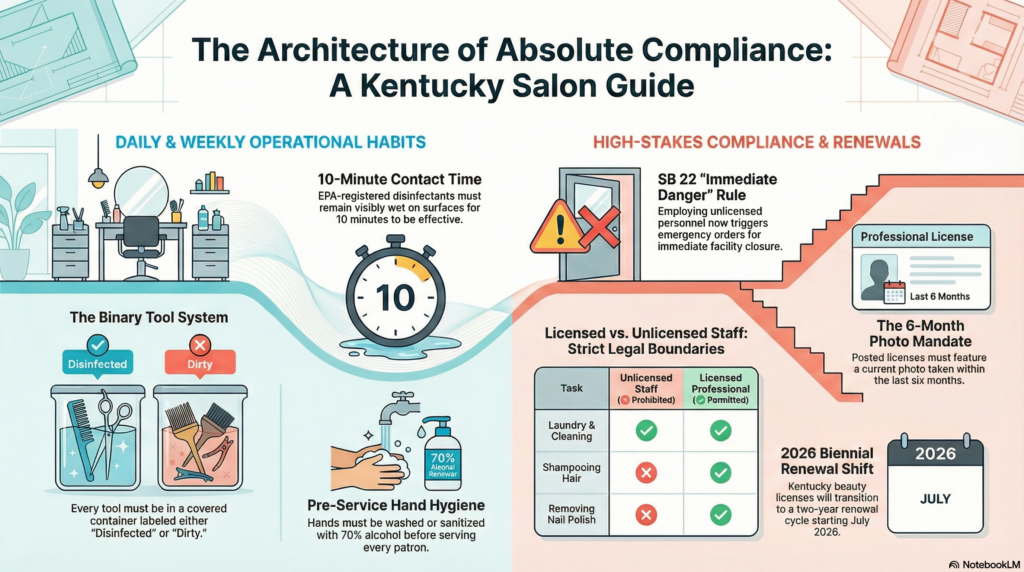
The transmission of infectious agents is most frequently traced to improper hand hygiene. 201 KAR 12:100 Section 13 mandates that every person licensed or permitted by the Board must thoroughly cleanse their hands with soap and water or an alcohol-based hand sanitizer (minimum alcohol) immediately before serving each patron.11 This standard is non-negotiable and applies even if the practitioner intends to wear gloves for the service. Handwashing stations must be equipped with a soap dispenser and single-use paper towels; the use of communal cloth towels for hand drying is a significant violation that can lead to immediate disciplinary citations.2

Table 2: Daily Hand Hygiene and Personal Protective Equipment (PPE) Standards

RequirementStandard ProcedureLegal/Regulatory Context
Pre-Service WashingSoap and water or alcohol sanitizerMandatory before every client interaction to prevent cross-contamination.11
PPE UsageGloves, masks, or aprons where applicableRequired during chemical services or when contact with blood/body fluids is possible.11
Handwashing StationSink with hot/cold water, soap, and paper towelsMust be accessible and not used for tool cleaning if it is the primary hygiene station.2
Forbidden ItemsNo carrying tools in pockets or smocksPrevents the contamination of clean tools and injuries to the practitioner.11

Workstation Maintenance and Surface Disinfection

The workstation is the primary site of service delivery and, consequently, the primary site of potential contamination. Kentucky law requires that all non-porous surfaces, including styling chairs, counters, nail tables, and shampoo bowls, be cleaned and disinfected daily and between each individual client.2 The process of “cleaning” is legally distinct from “disinfecting.” Cleaning involves the removal of visible debris, hair, and product residue using soap, detergent, or a chemical cleaner followed by a water rinse.19 Only after a surface is clean can it be disinfected.

Disinfection must be achieved using an Environmental Protection Agency (EPA)-registered bactericidal, virucidal, and fungicidal disinfectant used in strict accordance with the manufacturer’s label.11 A common error that results in inspection failure is the “spray and wipe” method, where the disinfectant is removed before it has reached its required contact time. Most high-level disinfectants require the surface to remain visibly wet for a full ten minutes to be effective against robust pathogens such as HIV, HBV, and various fungi.11

The Lifecycle of Tools and Implements: The “Clean vs. Dirty” System

The management of tools—including combs, brushes, shears, clippers, and nail implements—is perhaps the most scrutinized element of a state inspection. Kentucky utilizes a strict binary system: an item is either “Disinfected/Ready to Use” or it is “Dirty”.18 There is no middle ground.

All used implements must first be cleaned of visible debris using warm, soapy water and then fully immersed in a disinfectant solution.11 For items that have come into contact with blood or body fluids, such as a nick from a razor or a cuticle nipper, the item must be thoroughly cleaned before immersion to ensure the disinfectant can reach all surfaces of the tool.11 Once the full contact time is met, the implements must be removed, rinsed, dried with a single-use paper towel or air-dried, and stored in a clean, covered container labeled “Disinfected” or “Ready to Use”.18

Conversely, any tool that has been used and is awaiting disinfection must be kept in a separate, covered container clearly labeled as “Dirty” or “Used”.17 The intermingling of clean and dirty tools is a major violation. Furthermore, once an item is placed in the “Dirty” container, it cannot be removed until the formal cleaning and disinfecting process has begun.18

Table 3: Contact Time and Disinfection Requirements for Non-Electrical Tools

Tool TypeRequired ProcessStorage Requirement
Combs/Brushes/RollersScrub with soap, rinse, immerse in EPA-disinfectantCovered container labeled “Disinfected”.18
Metal Implements (Nippers/Pushers)Scrub with soap, rinse, immerse in EPA-disinfectantCovered container labeled “Disinfected”.18
Nail Drill BitsSoak in acetone, scrub, immerse in EPA-disinfectantMust be stored dry in a labeled container.18
Electrical ClippersRemove hair, saturate blades with high-level spray/foamMay be stored at station if clean and covered.11

The Towel and Linen Management System

The handling of linens is a primary focus of 201 KAR 12:100, which mandates a zero-tolerance policy for the reuse of any towel or robe without proper laundering.11 A clean towel or neck band must be used for every patron to prevent the hair cloth or shampoo apron from making direct contact with the patron’s skin.11

The laundry cycle must be integrated into the daily routine. All cloth items must be laundered in a washing machine using laundry detergent and chlorine bleach according to the manufacturer’s directions for sanitation.11 Clean linens must be stored in a closed cabinet or a covered container to protect them from hair clippings and airborne contaminants.11 Once used, towels must be immediately deposited into a separate, labeled container for soiled laundry. The practice of leaving used towels on the back of styling chairs or piled near shampoo bowls is a visible sign of non-compliance that will be noted by any inspector.2

Product Control and Chemical Safety

The mislabeling or lack of labeling on chemical products is one of the most frequent reasons for citations in Kentucky salons. The Board requires that all products—including shampoos, conditioners, hair colors, and nail liquids—remain in their original manufacturer-labeled containers whenever possible.15 If a product is transferred to a secondary container, such as a spray bottle for water or a smaller jar for cream, that container must be labeled with the product name and, if it is a chemical mixture like a disinfectant, the concentration and the date it was prepared.11

Furthermore, the use of certain substances is strictly prohibited under Kentucky law. Methyl Methacrylate (MMA) is illegal for use in nail services due to its high toxicity and the potential for severe allergic reactions or permanent nail damage.11 The presence of MMA in a salon, even if not currently in use, is grounds for significant fines and disciplinary action. Similarly, the use of callus graters or “cheese grater” style scrapers is prohibited as they can cause deep lacerations and pose a significant infection risk.13

Table 4: Prohibited Substances and Practices in Kentucky Salons

Prohibited Item/PracticeRationale for ProhibitionRegulatory Basis
Methyl Methacrylate (MMA)High toxicity; risk of permanent damage and allergies201 KAR 12:100 Section 14.11
Callus Graters / BladesRisk of skin cutting and deep-seated infectionKRS 317A.020 / 201 KAR 12:100.11
UV Sterilizers (as primary)Ineffective at achieving high-level disinfection201 KAR 12:100 Section 14.11
Roll-on WaxHigh risk of cross-contamination between clients201 KAR 12:100 Section 14.11
Double-DippingSpreads bacteria and fungi through entire product201 KAR 12:100 Section 7.11

Weekly Systems Maintenance and Compliance Audits

While daily tasks ensure immediate safety, the weekly routine is focused on the long-term integrity of the salon’s compliance infrastructure. This phase involves a more thorough examination of those areas that may not be touched during every client service but remain vital for a successful inspection.

The Weekly Station Sweep and Label Audit

Every week, the salon manager or designated compliance officer should conduct a formal walkthrough of each workstation. This audit must verify that every bottle is clearly labeled and that the labels remain legible.11 Over time, chemicals can degrade adhesive labels or obscure handwriting; any bottle with a faded or peeling label should be replaced or relabeled immediately.

During this weekly audit, the practitioner should also inspect the “Clean” tool containers. It is common for small hair clippings to find their way into even covered containers during the course of a busy week. If debris is found in a “Clean” container, all tools within that container must be re-sanitized, and the container itself must be disinfected.18 This ensures that the storage environment remains as sterile as the tools themselves.

Safety Data Sheet (SDS) and Records Management

Federal OSHA regulations, coupled with Kentucky state board requirements, mandate that every salon maintain a comprehensive binder of Safety Data Sheets (SDS) for every chemical used on the premises.21 The weekly routine should include a check for any new products that have entered the salon; if a new hair color line or a new type of nail monomer has been purchased, the corresponding SDS must be added to the binder immediately.

Furthermore, salons should maintain a daily sanitation log. While not strictly mandated for every single surface by state law, the Louisville Beauty Academy recommends it as the “Gold Standard” for compliance.2 A log that documents the daily cleaning of shampoo bowls and the weekly deep-cleaning of pedicure stations provides a “paper trail” of professional diligence that can be invaluable if a client ever files a complaint with the Board.17

Table 5: Weekly Compliance Audit Checklist

Audit CategorySpecific Action RequiredExpected Outcome
Label IntegrityInspect all secondary containers for clear labelingZero unlabeled bottles at any station.11
Storage InspectionWipe out and disinfect “Clean” tool containersNo hair or debris in storage areas.18
SDS UpdateReview product arrivals and add new SDS sheetsbinder is current.21
VentilationClean filters on hairdryers and nail extraction fansPrevents fume buildup and fire hazards.16
Trash VerificationEnsure all waste liners are replaced and lids functionalWaste is contained and covered.2

Monthly Strategic Compliance and Infrastructure Review

The monthly compliance cycle is a strategic review of the salon’s operational health. This is the time when the owner and manager move beyond the station-level details to address the overarching legal and structural requirements of the business.

Personnel Licensing and Photo Verification

The most common reason for significant fines in Kentucky is the presence of an unlicensed practitioner or a practitioner with an expired license. Every month, the manager must verify the status of every individual working in the salon, including booth renters.8 This check must confirm that the license is not only active but also that it is current for the specific year.10

A critical component of this audit is the photo requirement. 201 KAR 12:060 Section 1 requires that a current photograph be attached to the license.7 The Board has recently cracked down on “non-compliant” photos. If an employee has a photo that is older than six months or one that does not meet the passport-style criteria (e.g., a “selfie” with filters, or a photo taken in a car), it must be updated immediately.10 Failure to have a compliant photo attached to a posted license is treated as a display violation and can result in a “pink slip”.26

Plumbing and Facility Integrity

The physical state of the facility is a reflection of the professionalism of the business. On a monthly basis, the owner should inspect the plumbing for any leaks or drainage issues. 201 KAR 12:100 requires that an adequate supply of hot and cold running water be available at all times.2 Any changes to the plumbing—such as adding a new shampoo bowl or replacing an old pedicure chair—must be documented with a new Plumbing Affidavit signed by a state plumbing inspector.27

Additionally, the monthly audit should look for “non-porous” integrity. Salon chairs with torn upholstery or nail tables with cracked surfaces are violations because the damaged areas can harbor bacteria and cannot be properly disinfected with wipes or sprays.17 Any damaged equipment must be repaired or replaced to maintain the sanitation standard.

Table 6: Monthly Strategic Audit Milestones

TaskDetailProfessional Implication
Staff License AuditVerify every license is current and has a 6-month photoPrevents “Immediate Danger” closure for unlicensed work.8
Facility MaintenanceCheck for upholstery tears and plumbing leaksEnsures all surfaces can be legally disinfected.17
Inventory ReviewCheck for expired products or “mystery” chemicalsMaintains safety and product efficacy.17
Staff RetrainingBrief staff on any new Board newsletters or trendsMaintains a unified culture of compliance.2
Restroom AuditDeep clean and ensure all fixtures are functionalA common area for consumer complaints.2

Yearly Milestones: Renewals, Testing, and Long-Term Compliance

The yearly cycle involves high-level administrative tasks that, while infrequent, are essential for the legal existence of the salon.

The 2026 Shift to Biennial Renewals

For decades, Kentucky beauty licenses were renewed on an annual basis. However, as of January 2026, the Kentucky Board of Cosmetology is transitioning to a biennial (two-year) renewal system to reduce administrative burden and improve processing efficiency.25 This is a critical change for budget planning. While the annual fee has not technically increased, the amount due at the time of renewal will double as practitioners prepay for two years of licensure.25

For example, starting in July 2026, a cosmetologist will pay for a license that is valid through July 31, 2028.25 The renewal period remains fixed between July 1st and July 31st. Any renewal submitted after the July 31st deadline is considered inactive and will incur significant restoration fees.25 It is the responsibility of the licensee to ensure their email address is current in the KBC portal to receive renewal reminders and registration codes.31

Backflow Prevention and Annual Testing

Most commercial facilities, including salons, are required to have backflow prevention devices installed on their water supply lines to protect the municipal water supply from contamination.32 Under the Kentucky State Plumbing Code, these devices—specifically “reduced pressure principle” backflow preventers—must undergo annual testing by a state-certified backflow prevention assembly tester.33 The results of these tests must be kept on file at the salon and are often reviewed during a comprehensive state board inspection or a local health department visit.33 Failure to maintain this testing can lead to the disconnection of water services, which would force the immediate closure of the salon.33

Table 7: Annual and Biennial Administrative Deadlines

RequirementFrequencyKey Dates / Details
Personal License RenewalBiennial (Every 2 Years)July 1 – July 31 of even-numbered years (Starting 2026).25
Salon Facility RenewalAnnual/BiennialCheck portal for specific facility expiration dates.25
Backflow TestingAnnualMust be performed by a certified tester; records kept on-site.33
Local Business LicenseAnnualVaries by municipality; often due by June 30.28
Annual Report (Corporate)AnnualDue to the Secretary of State by June 30.35

Navigating the Inspection: A Masterclass in Professional Interaction

When an inspector arrives, the elite professional does not react with fear but with confidence in their established systems. The inspection should be viewed as an external validation of the “Compliance by Design” principle taught at the Louisville Beauty Academy.2

Immediate Action Steps Upon Inspector Arrival

  1. Grant Access and Provide ID: The inspector is authorized to enter and may ask for your government-issued ID to verify your identity against the posted license.8
  2. Continue Professional Service: Unless the inspector identifies an “Immediate Danger” (such as a significant blood spill or an unlicensed worker), you should continue your service to your client while the inspector walks the floor.
  3. Produce Records Promptly: If the inspector asks to see the plumbing affidavit, the most recent inspection report, or the salon’s employment records, these must be produced without delay.7
  4. Use the Inspector as a Resource: The elite salon owner asks questions. Inquire about the most common violations being found in the area or if there are any upcoming regulatory changes from the Board.16 This positions you as a partner in public safety rather than a target of enforcement.

The Consequences of Non-Compliance: SB 22 and Immediate Closure

The regulatory landscape has become significantly stricter with the passage of Senate Bill 22 (2025). This legislation introduced the “Immediate and Present Danger” standard for salon closures.6 Previously, a salon might receive a warning and a ten-day period to cure most deficiencies. However, under SB 22, the employment of unlicensed personnel is now classified as an immediate danger to public health.6

If an inspector finds an unlicensed individual performing professional services, the Board is authorized to issue an emergency order for the immediate closure of the facility.6 This closure remains in effect until the violation is resolved and a follow-up inspection is passed. The financial and reputational impact of such a closure can be catastrophic, often leading to a permanent loss of business or even the stroke of a stressed owner as documented in recent disciplinary history.37

Table 8: The Disciplinary Escalation Pathway

Violation TypeTypical Board ActionPotential Penalty
Minor Sanitation (Dust, Clutter)Correction Letter / 10-day CureWarning or Small Fine.6
Major Sanitation (MMA, Double-dipping)Notice of ViolationSignificant Fine and Probation.6
License Display / Photo Issues“Pink Slip” CitationAdministrative Fine.26
Unlicensed Personnel (SB 22)Emergency OrderImmediate Facility Closure.6
Intentional Deception of InspectorNotice of Disciplinary ActionLicense Revocation/Suspension.8

Professional Scope and the Unlicensed Personnel Matrix

To avoid the immediate closure triggers of SB 22, it is vital to understand the “Unlicensed vs. Licensed Duties Matrix.” In Kentucky, the performance of even a single professional act by an unlicensed individual—such as a receptionist or a general assistant—is a violation of the law.6

Unlicensed personnel are strictly limited to non-client maintenance tasks. They may sweep floors, perform laundry, clean mirrors, handle the front desk, and process payments.6 However, as soon as their duties involve direct client interaction related to beauty services, they must hold a license. For instance, an assistant cannot shampoo a client’s hair unless they hold at least a Shampoo and Style license (300 hours) or a full Cosmetology license.6 They cannot remove nail polish, as this is legally considered part of the practice of nail technology.6 They cannot even “drape” a client with a cape for a chemical service, as this act is construed as assisting in a professional beauty practice.6

Table 9: Duty Matrix for Licensed vs. Unlicensed Staff

TaskUnlicensed (Receptionist)Shampoo & Style (300 Hr)Nail Tech (450 Hr)Cosmetologist (1,500 Hr)
Sweep / Laundry✅ Permitted✅ Permitted✅ Permitted✅ Permitted
Front Desk / Cashier✅ Permitted✅ Permitted✅ Permitted✅ Permitted
Shampoo / Conditioning❌ Prohibited✅ Permitted❌ Prohibited✅ Permitted
Remove Nail Polish❌ Prohibited❌ Prohibited✅ Permitted✅ Permitted
Draping for Chemicals❌ Prohibited❌ Prohibited❌ Prohibited✅ Permitted
Manicuring❌ Prohibited❌ Prohibited✅ Permitted✅ Permitted

Building the Million-Dollar Salon through Compliance

The final truth of Kentucky salon operation is that inspection readiness is a fundamental business strategy. The graduates of Louisville Beauty Academy understand that a clean, compliant salon is a profitable salon. When a customer walks into an environment where the licenses are prominently displayed with current photos, the stations are organized, the air is free of strong chemical fumes, and the towels are pristine, a baseline of trust is established.2

Compliance protects the three most valuable assets of the beauty professional: the client’s health, the practitioner’s license, and the business’s reputation. By adopting the daily, weekly, monthly, and yearly routines detailed in this study, the salon owner moves from a state of reactionary fear to one of professional dominance. You do not prepare for the inspector; you become the inspector. In doing so, you elevate not only your own business but the entire industry within the Commonwealth of Kentucky.

Works cited

  1. Kentucky Revised Statutes – Chapter 317A – Legislative Research Commission, accessed March 24, 2026, https://apps.legislature.ky.gov/law/statutes/chapter.aspx?id=38831
  2. Sanitation & Safety: The #1 Priority at Louisville Beauty Academy …, accessed March 24, 2026, https://louisvillebeautyacademy.net/sanitation-safety-the-1-priority-at-louisville-beauty-academy/
  3. 317A.030 Board of Cosmetology — Membership — Compensation. (1) There is created an independent agency of the state gover, accessed March 24, 2026, https://apps.legislature.ky.gov/law/statutes//statute.aspx?id=54797
  4. 317A.010 Definitions for chapter. As used in this chapter, unless the context requires otherwise: (1) “Beauty salon&q – Legislative Research Commission, accessed March 24, 2026, https://apps.legislature.ky.gov/law/statutes/statute.aspx?id=53212
  5. Beauty Services and Health Services: A 2025 Legal and Policy Study by Louisville Beauty Academy – Kentucky’s Center for Excellence in Beauty Knowledge, accessed March 24, 2026, https://louisvillebeautyacademy.net/beauty-services-and-health-services-a-2025-legal-and-policy-study-by-louisville-beauty-academy-kentuckys-center-for-excellence-in-beauty-knowledge/
  6. cosmetology disciplinary process Kentucky Archives – Louisville …, accessed March 24, 2026, https://louisvillebeautyacademy.net/tag/cosmetology-disciplinary-process-kentucky/
  7. 201 KAR 12:060. Inspections. RELATES TO: KRS 317A.060, 317A.140, accessed March 24, 2026, https://apps.legislature.ky.gov/services/karmaservice/documents/2003/ToPDF?markup=false
  8. 201 KAR 12:060. Inspections. – Kentucky Board of Cosmetology, accessed March 24, 2026, https://kbc.ky.gov/Documents/201%20KAR%2012.060.pdf
  9. Tag: cosmetology law changes 2025 – Louisville Beauty Academy, accessed March 24, 2026, https://louisvillebeautyacademy.net/tag/cosmetology-law-changes-2025/
  10. License Requirements – Kentucky Board of Cosmetology, accessed March 24, 2026, https://kbc.ky.gov/Licensure/Pages/License-Requirements.aspx
  11. 201 KAR 12:100. Sanitation standards. – Kentucky Board of Cosmetology, accessed March 24, 2026, https://kbc.ky.gov/Documents/201%20KAR%2012.100.pdf
  12. Title 201 Chapter 12 Regulation 082 • Kentucky Administrative Regulations – Legislative Research Commission, accessed March 24, 2026, https://apps.legislature.ky.gov/law/kar/titles/201/012/082/
  13. Kentucky Revised Statutes Title XXVI. Occupations and Professions § 317A.020 | FindLaw, accessed March 24, 2026, https://codes.findlaw.com/ky/title-xxvi-occupations-and-professions/ky-rev-st-sect-317a-020/
  14. 201 BOARDS AND COMMISSIONS Chapter – Louisville Beauty Academy, accessed March 24, 2026, https://louisvillebeautyacademy.net/wp-content/uploads/2021/11/KentuckyStateBoardOfCosmetology-Statue-11-15-2021.pdf
  15. Sanitation and Safety Archives – Louisville Beauty Academy, accessed March 24, 2026, https://louisvillebeautyacademy.net/category/sanitation-and-safety/
  16. Sanitation Best Practices for Beauty Salons: A Comprehensive Guide, accessed March 24, 2026, https://louisvillebeautyacademy.net/sanitation-best-practices-for-beauty-salons-a-comprehensive-guide/
  17. How to Avoid Common State Board of Cosmetology Violations | Salon Success Academy, accessed March 24, 2026, https://www.salonsuccessacademy.com/blog/10-common-state-board-of-cosmetology-violations-and-tips-to-avoid-them/
  18. Board of Cosmetology (Amended at ARRS Committee) 201 KAR 12:100. Infection control, health, and safety., accessed March 24, 2026, https://apps.legislature.ky.gov/services/karmaservice/documents/16397/ToPDF?markup=true
  19. Board of Cosmetology (Amendment) 201 KAR 12:100. Infection control, health, and safety., accessed March 24, 2026, https://apps.legislature.ky.gov/services/karmaservice/documents/16145/ToPDF?markup=true
  20. Title 201 Chapter 12 Regulation 100 • Kentucky Administrative Regulations, accessed March 24, 2026, https://apps.legislature.ky.gov/law/kar/titles/201/012/100/
  21. Barbershop State Board Inspection Readiness Checklist PDF – Free Download | Beauty & Wellness Checklist Template | POPProbe, accessed March 24, 2026, https://www.popprobe.com/checklist-library/beauty-wellness/barbershop/barbershop-state-board-inspection-readiness-checklist
  22. Hair Salon Safety & Sanitation Checklist [FREE PDF] – POPProbe, accessed March 24, 2026, https://www.popprobe.com/checklist-library/beauty/daily-operations/b25b-bty-hair-salon-safety-checklist
  23. Hair Salon Infection Control and Bloodborne Pathogen Compliance Audit PDF – Free Download | Beauty & Wellness Checklist Template | POPProbe, accessed March 24, 2026, https://www.popprobe.com/checklist-library/beauty-wellness/salon-operations/hair-salon-infection-control-bloodborne-pathogen-compliance-audit
  24. Hair Salon Inspection & Cleaning Checklists for Operational Excellence | Audit Now, accessed March 24, 2026, https://audit-now.com/audit-guides/hair-salon-checklists/
  25. Tag: Kentucky beauty license renewal July 31, accessed March 24, 2026, https://louisvillebeautyacademy.net/tag/kentucky-beauty-license-renewal-july-31/
  26. License Renewal Information – Kentucky Board of Cosmetology, accessed March 24, 2026, https://kbc.ky.gov/Licensure/Pages/License-Renewal-Information.aspx
  27. Salon Requirements – Kentucky Board of Cosmetology, accessed March 24, 2026, https://kbc.ky.gov/Licensure/Pages/Salon-Requirements.aspx
  28. Frankfort, KY 40601 • (502)-564-4262 • www.KBC.ky.gov Salon Application Instructions A salon – Kentucky Board of Cosmetology, accessed March 24, 2026, https://kbc.ky.gov/Applications%20and%20Examination%20Schedule/030%20(l)%20Salon%20Application%20-%20July%202022-%20Edit.pdf
  29. Health Inspections for Nail Salons and Barbershops – The Institute for Justice, accessed March 24, 2026, https://ij.org/report/clean-cut/health-inspections-for-nail-salons-and-barbershops/
  30. Louisville Beauty Academy: Your Guide to Kentucky State Cosmetology License Renewal, accessed March 24, 2026, https://louisvillebeautyacademy.net/louisville-beauty-academy-your-guide-to-kentucky-state-cosmetology-license-renewal/
  31. Licensure – Kentucky Board of Cosmetology, accessed March 24, 2026, https://kbc.ky.gov/Licensure/Pages/default.aspx
  32. Backflow Testing & Installation in Louisville, KY – Maeser Master Services, accessed March 24, 2026, https://www.maeser.com/commercial/plumbing/backflow-testing/
  33. Is Backflow Testing a Legal Requirement? Understanding Compliance Standards in 2025, accessed March 24, 2026, https://www.pacificbackflow.com/post/is-backflow-testing-a-legal-requirement
  34. Title 815 Chapter 20 Regulation 120 • Kentucky Administrative Regulations – Legislative Research Commission, accessed March 24, 2026, https://apps.legislature.ky.gov/law/kar/titles/815/020/120/
  35. Business – Kentucky.gov, accessed March 24, 2026, https://www.kentucky.gov/business/Pages/default.aspx
  36. The Kentucky Board of Cosmetology reports that the license number below is currently inactive, either due to non-renewal or a HO, accessed March 24, 2026, https://kbc.ky.gov/Annoucements/9.26.2025%20Salon%20Inactive%20Notice.pdf
  37. Kentucky nail salons seek accountability from state cosmetology board – YouTube, accessed March 24, 2026, https://www.youtube.com/watch?v=3aoZjjY8Jyo
  38. KENTUCKY BOARD OF COSMETOLOGY, accessed March 24, 2026, https://kbc.ky.gov/Annoucements/11.14.2025%20Access%20to%20salons%20for%20inspections%20and%20appropriate%20signage.pdf
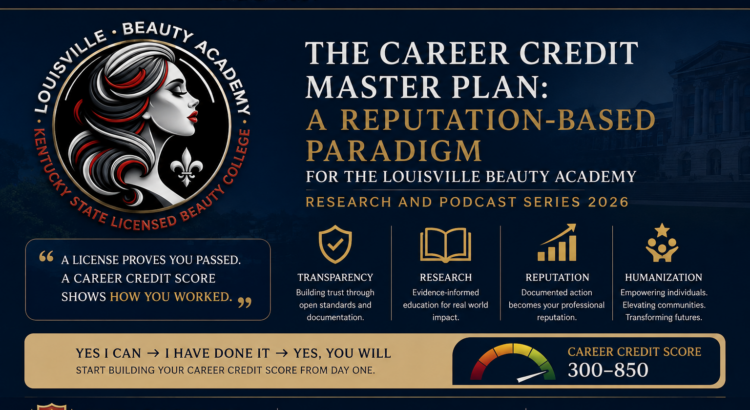
The Career Credit Master Plan: A Reputation-Based Paradigm for the Louisville Beauty Academy – RESEARCH AND PODCAST SERIES 2026

Louisville Beauty Academy operates under a Gold-Standard Over-Compliance framework—meeting all licensing requirements while exceeding regulatory expectations through transparency, documentation, and proactive consumer protection.

Executive Summary

The vocational education sector is currently navigating a period of profound structural transformation, transitioning from a static credential-based model to a dynamic, reputation-based “proof-of-work” economy. For institutions like the Louisville Beauty Academy (LBA), the challenge lies in bridging the gap between traditional state-mandated licensure and the modern requirements of the digital creator economy. This master plan outlines an interdisciplinary framework for a “Career Credit Score” system—a comprehensive, over-compliant social media and professional progress system designed to begin on day one of enrollment and persist beyond graduation. By leveraging the behavioral psychology of public accountability and the economics of social signaling, this system formalizes the student’s daily learning journey as a measurable professional asset.1

The core objective is to position LBA as a national leader in ethical creator education, moving beyond the simple “acquisition of hours” toward the “accumulation of reputation.” The Career Credit Score (CCS) serves as an analogue to a financial credit score, where daily posts act as career deposits and professionalism serves as the ultimate measure of creditworthiness.4 This system provides students with a structured ladder of progression, moving from the “Zero Stage” of novice observation to the “Mastery Stage” of mentorship and public signalization.6 Crucially, the plan is designed with an “over-compliant” posture, ensuring that all student activities strictly adhere to the Kentucky Board of Cosmetology (KBC) statutes and Federal Trade Commission (FTC) endorsement guidelines.8

Through a sophisticated incentive model, students can earn significant tuition discounts based on their consistency, ethical conduct, and proof-of-learning, effectively lowering the financial barriers to high-quality vocational education while simultaneously increasing graduate employability.11 This plan does not merely teach beauty skills; it equips “Human Service Professionals” with the digital fluency and verifiable reputation needed to thrive in an era where trust is the primary currency of the beauty industry.13

Research and Psychological Foundations

The foundation of the LBA Career Credit system is built upon a synthesis of behavioral science, trust economics, and educational theory. Understanding why “learning in public” works requires an analysis of the psychological mechanisms that drive accountability and the economic signals that establish professional prestige.

Behavioral Psychology of Public Accountability

Research in public employee behavior and health interventions suggests that accountability is a multi-dimensional construct involving observability, evaluability, and answerability.1 When a student makes a “public announcement” of a goal—such as mastering a specific sectioning technique—the digital platform acts as a “commitment device”.2 These devices help individuals “lock themselves” into a behavior by creating a psychological penalty for deviation and a social reward for adherence.15

In the context of LBA, daily posting creates a “felt accountability.” While high-intensity monitoring can sometimes reduce intrinsic motivation, a system that emphasizes “accountability obligation”—the perceived duty to justify actions to a supportive audience—actually enhances work drive.1 This is particularly effective when students interpret the obligation as an opportunity to gain professional benefits rather than a coercive requirement. By documenting the “messy middle” of the learning process, students move from passive learners to active practitioners who are “answering” to their future professional selves and their burgeoning audience.

Habit Formation and Daily Proof-of-Work

The transition from a student mindset to a professional identity requires the formation of consistent habits. The “daily proof-of-work” theory posits that a live pulse of activity is a more reliable indicator of skill than a static portfolio.6 In technical fields like coding, a “contribution graph” showing daily commits is impossible to fake and serves as a verified record of problem-solving processes.6

For beauty professionals, this translates to documenting the micro-decisions of the craft. Research into sustainable skincare marketing suggests that “decision documentation”—filing 30 seconds of a consultation or explaining why a specific pH-balanced product was chosen—builds deeper trust than a polished, final image.16 Psychologically, this “raw” and “authentic” content resonates more with modern consumers who are skeptical of highly curated, AI-generated, or “too polished” feeds.17

Social Signaling and Trust Economics

In a labor market with “asymmetric information,” where employers cannot perfectly know a candidate’s skill level, they rely on signals. Traditional signaling theory, as explored by Bryan Caplan, suggests that much of the return on education is a return on the “shiny credential” rather than the skill itself.19 However, the Career Credit Score seeks to shift this dynamic toward “Skill Signaling,” which focuses on digital, transversal, and sector-specific competencies.20

Social trust is a “commodity” built through repeated interactions and the assessment of a truster’s competence and goodwill.21 A student who has documented 1,500 hours of professional growth 8 provides a “trust graph” that reduces the risk for a potential salon owner. This creates a “cyclical model” of social exchange where the student’s signaled reputation leads to better placement, which in turn reinforces the school’s brand equity.3

Psychological ConceptMechanismApplication in LBA System
Commitment DeviceSocial penalty for failure 15Daily posting “deposits” 2
Felt AccountabilityAnswerability to an audience 1Weekly instructor reviews 24
Instrumental LearningReinforcing presumptions of trust 21Documenting micro-decisions 16
Social SignalingReducing information asymmetry 3Verifiable digital portfolios 6
Authenticity BiasPreference for unfiltered growth 18“Zero Stage” confessions 18

The Career Credit Framework

The “Career Credit Score” is a formalized, numerical representation of a student’s professional standing, calculated using an algorithm that weights consistency, proof-of-work, professionalism, and ethical compliance. Unlike social media “clout,” which is often ephemeral and based on popularity, Career Credit is a measure of “professional creditworthiness”.25

Defining the Algorithm

The LBA Career Credit Score (CCS) is modeled on a 300–850 scale, mirroring the FICO model used in financial sectors. The score is calculated using four primary components, each weighted to reflect its importance to a future employer and regulatory compliance.

  1. Consistency (Weight: 35%): This is the equivalent of “payment history.” It measures the frequency of professional posts or “career deposits.” A missed day of documentation is recorded as a “late payment,” while sustained streaks build the score significantly.2
  2. Proof-of-Skill (Weight: 25%): This represents “credit history.” It is the documented evidence of the student’s progression through the subject areas defined in 201 KAR 12:082, such as infection control, anatomy, and chemical services.7
  3. Professional Conduct (Weight: 20%): This measures “credit mix.” It assesses the student’s poise, communication skills, and adherence to the LBA “Humanization of Education” philosophy.13
  4. Regulatory Integrity (Weight: 20%): This is the “creditworthiness” factor. It tracks zero-violation streaks regarding KBC statutes and FTC disclosure guidelines.10

Career Deposits and Missed Payments

A student’s CCS is updated weekly. A “Career Deposit” is defined as a high-quality, educational, or progress-based post that includes the required LBA disclaimers.

  • Positive Impact: A “Career Deposit” adds +5 points to the weekly score.
  • Neutral Impact: Reposting industry news with a professional insight adds +2 points.
  • Negative Impact: A “Missed Payment” (failing to post for 48 hours without a prior “digital reset” request) subtracts -10 points.
  • Severe Impact: A compliance violation (e.g., performing a chemical service on a live person before 250 hours 23) results in a “Reputation Default,” resetting the score to 300 and triggering a formal review.29

Reputation Score Benchmarking

To provide context, LBA compares student scores against industry averages and “best-in-class” alumni. This benchmarking fosters continuous improvement and provides a clear signal to employers about where a student stands in their professional development.25

CCS RangeProfessional StatusMarket Implications
750 – 850Elite ProfessionalHigh placement leverage; eligible for alumni mentorship roles.
650 – 749Reliable PractitionerStandard employment readiness; consistent work history.
550 – 649Developing TalentEmerging skills; needs focus on consistency and compliance.
300 – 549High Risk / ProbationHistory of inconsistency or ethical breaches; requires remediation.

Student Learning Progression Model

The Career Credit system utilizes a five-stage ladder of progression. This model ensures that students do not feel pressured to “fake it” but instead find power in their evolution from a novice to a master. Each stage specifies what to post, the psychological reasoning behind it, and the compliance guardrails necessary to protect the student and the academy.

Stage 1: The Zero Stage (The Foundation)

Focus: Identity reset and the commitment to learn. This occurs during the first two weeks of enrollment.

  • What students post: A “Social Media Reset” announcement; an unboxing of their professional student kit; a video discussing their “Why” and their decision to join LBA.8
  • Why it works: It establishes a “vulnerability hook.” By admitting they are starting at zero, they build an empathetic connection with their audience, who will then feel invested in their growth.16
  • Compliance: Posts must clearly state: “Student at Louisville Beauty Academy. Not licensed to perform services for hire.”
  • Caption Prototype: “Day 1 at LBA! Today I’m resetting this page to document my journey from student to professional. I’m starting with the basics—Infection Control. Safety first! #LBAStudent #BeautyJourney”

Stage 2: The Awareness Stage (The Science)

Focus: Vocabulary, theory, and the “Invisible Skills.” This aligns with the first 100–150 hours of instruction.23

  • What students post: Videos of themselves studying anatomy and physiology; “Did you know?” posts about the chemistry of hair color; time-lapses of workstation sanitation.8
  • Why it works: It builds authority. By focusing on the science rather than the art, the student signals that they are a serious, knowledge-based professional.8
  • Compliance: No mentions of performing services on people. Focus remains on “Scientific Lectures” per 201 KAR 12:082.23
  • Caption Prototype: “Studying the skeletal system today. Understanding the structure of the head and neck is vital for a proper consultation. Science is the backbone of beauty! #AnatomyClass #LBA”

Stage 3: The Practice Stage (The Proof-of-Work)

Focus: Hands-on repetition on mannequins. This is the “Messy Middle” of the program.

  • What students post: “Mistakes I made today” videos; time-lapses of winding perms or applying color to a mannequin head; “Practice makes progress” reels.6
  • Why it works: It demonstrates grit and technical skill development. Seeing the student struggle and then succeed creates a powerful narrative of competence.6
  • Compliance: Must explicitly state that work is being done on a mannequin.
  • Caption Prototype: “My fifth time winding a perm rod today. Still working on my tension, but the sectioning is getting cleaner! Repetition is key to mastery. #MannequinPractice #ProofOfWork”

Stage 4: The Competency Stage (The Clinic Floor)

Focus: Supervised services on live models. This begins after 250 hours (for Cosmetology) or other program-specific milestones.23

  • What students post: Before-and-after transformations; client consultations (with permission); documenting the consultation “decision-making” process.7
  • Why it works: Social proof. It shows that real people trust the student and that the student can deliver results in a professional clinic environment.24
  • Compliance: Must state that services were performed under instructor supervision at LBA.24
  • Caption Prototype: “Today’s transformation! We chose a level 7 ash to neutralize warmth, keeping the hair’s integrity first. All services performed under supervision at LBA! #ClinicFloor #HairTransformation”

Stage 5: The Mastery Signal Stage (The Educator)

Focus: Teaching, explaining, and mentoring others. This begins in the final phase of the program and continues as an alumnus.

  • What students post: Tutorials explaining a technique to junior students; reviews of industry trends; reflections on the “Humanization of Education”.13
  • Why it works: The “Protégé Effect.” Teaching a concept is the highest signal of mastery. It positions the graduate as an industry leader, not just a practitioner.1
  • Compliance: Use of the “Alumni” tag and verification of licensure.8
  • Caption Prototype: “Explaining the logic of color theory to our new class at LBA. To master the art, you have to mentor the next generation. #BeautyEducator #LBAAlumni”

Step-by-Step LBA Implementation Plan

Operationalizing the Career Credit system requires a disciplined, multi-phase rollout that integrates with LBA’s existing curriculum and administrative protocols.

Phase 1: Orientation and the Social Media Reset

During the first week, students undergo a “Digital Brand Audit.” This is a mandatory component of their “Professional Image” curriculum.23

  1. Account Audit: Students must review their public profiles and archive content that is inconsistent with a “Human Service Professional” identity. This includes content depicting unprofessional behavior or non-compliance with health standards.18
  2. Platform Setup: Students are required to have professional profiles on Instagram and TikTok. LinkedIn is highly recommended for B2B networking and employer visibility.13
  3. The Disclaimer Protocol: Every bio must include: “Professional Student at @LouisvilleBeautyAcademy | Future | Not for hire until licensed.”
  4. Privacy/Security Workshop: Education on protecting personal data and handling “online drama” or cyberbullying.35

Phase 2: Daily Career Deposits

LBA implements a “Daily Documentation” rule. Students are given 15 minutes at the end of each theory or clinic session to capture content.8

  • Frequency: Minimum of 3 professional posts per week.
  • Approved Formats: Short-form video (Reels/TikTok) for skills; Carousel posts for “Decision Documentation”; Stories for daily “Aha!” moments.16
  • The “Human Review” Protocol: Instructors do not grade based on “likes” but on a rubric of professionalism, sanitation, and educational accuracy.24

Phase 3: Ethical AI Integration

LBA adopts a “Max AI” policy for administrative and creative support but maintains strict ethical boundaries for clinical representations.13

  • Authorized Use: Using Generative AI for caption brainstorming, keyword research, and video script outlines.38
  • The 65% Rule: At least 65% of any written caption must be human-authored to ensure authenticity and “Humanization”.38
  • Prohibited AI: No AI-generated or “filtered” images of hair or skin results. This is a deceptive statement and a violation of KBC photo standards.14
  • Disclosure: Any AI-assisted content must include the tag #AIApprentice or a similar disclaimer.40

Phase 4: Instructor and Administrative Audit

LBA establishes a “Reputation Bureau” to manage the Career Credit Scores.

  • Weekly Score Update: The CCS is recalculated every Sunday based on the week’s deposits and classroom conduct.
  • Monthly Compliance Audit: A deep-dive review of student accounts to ensure FTC disclaimers and KBC rules are followed.28
  • Score Grievance Procedure: Students can appeal a score deduction through the official LBA written grievance process.8

Incentive and Discount Model

To drive adoption and ensure high-quality participation, LBA links the Career Credit Score to a fair and transparent tuition discount model. This transforms “tuition” from a fixed cost into a performance-based investment.

The Career Credit Discount Rubric

Students are eligible for “Merit Scholarships” and “Performance-Based Incentives” that can reduce the total program cost significantly.11 These are not “tuition reductions” but optional, merit-based discounts.11

Performance CategoryMetricScore RequirementDiscount/Perk
Consistency King100% posting rate for 90 daysCCS > 700$500 Tuition Credit
Compliance HeroZero compliance flags for 180 daysCCS > 750$1,000 Scholarship
Technical MasterVerified Stage 4 DocumentationInstructor Approval$1,500 Skill Credit
Alumni LeaderContinued Stage 5 postingPost-GraduationFree Alumni Tutoring 8

Anti-Gaming and Safeguards

LBA employs a “Checks and Balances” system to protect the integrity of the discounts.13

  1. Attendance Synchronization: Discounts are only applied if a student maintains the required attendance hours (30–40 hours for Full-Time).11
  2. Plagiarism Penalty: Using another student’s work as one’s own results in the permanent loss of all social-media-based incentives.11
  3. Financial Good Standing: Hours are only certified and discounts applied if the student’s account is current.11
  4. Tax Compliance: All tuition reductions are structured to comply with IRS Section 117(d) regarding qualified tuition reductions for educational institutions.43

Auditability for Regulators

LBA maintains digital records of all student posts, instructor reviews, and score calculations for a minimum of five years.8 This ensures that the institution can defend its incentive model to state and federal regulators as a legitimate “educational performance” metric rather than “marketing compensation.”

Compliance and Risk Management

A gold-standard system must be “over-compliant.” This section outlines the non-negotiable boundaries that protect LBA, its students, and the public.

Kentucky Board of Cosmetology (KBC) Adherence

Kentucky law is strict regarding unlicensed practice.10 LBA’s system manages this through:

  • The “No-Pay” Rule: Students are explicitly forbidden from accepting consideration (money or gifts) for services performed outside of the LBA clinic floor.10
  • Mobile Prohibitions: While Kentucky allows mobile barber shops, mobile cosmetology is strictly limited. Students must not document or perform services in “home salons” or non-licensed facilities.32
  • Sanitation Documentation: Every video documenting a service must show visible sanitation steps (e.g., sanitizing hands, disinfecting tools) to reinforce “Lifelong Professional Ethics”.8

FTC Endorsement and Social Media Law

The FTC’s 2024–2025 updates require “clear, conspicuous, and unavoidable” disclosures.9

  • Disclosure Placement: Disclosures must be verbal AND written on the screen for video content. Simply putting #ad or #LBA in the caption is insufficient for Reels and TikTok.28
  • Honest Opinions: Students must only give honest reviews of products they have actually used.9
  • Material Connections: Because students receive tuition discounts for their posts, they must disclose this “material relationship” in every progress-related post.42

Privacy and Consumer Protection

  • Client Consent: No client images or videos may be posted without a signed LBA model release form.7
  • Data Protection: Students are trained to never post sensitive institutional data or personal information about staff and peers.11
  • Cyber-Safety: LBA provides tools and training for students to manage privacy risks associated with a public-facing digital career.37

Brand and Market Positioning

The implementation of the Career Credit system differentiates Louisville Beauty Academy from all other regional and national competitors. It rebrands the school from a “training facility” to a “professional reputation engine.”

Positioning LBA as a “Future-Ready” Institution

LBA’s brand is built on “Transparency and Genuine Care”.47 By teaching students to build verified proof-of-work, LBA addresses the primary concern of modern beauty employers: “Can this person actually do the work, and will they show up?”.3

Messaging Pillars:

  1. The Proof-of-Work School: We don’t just teach; we document excellence.
  2. Career Credit, Not Just Hours: Your reputation starts on day one.
  3. Humanization through Technology: We use AI to make you more human, not less.
  4. Debt-Free Dignity: Earn your way to a professional future without the burden of federal loans.12

Reassuring Regulators and Parents

LBA positions itself as the “Public Library” of beauty education—an open, accessible, and highly regulated environment where knowledge is democratized.13

  • To Parents: LBA offers a “Safe, Legal, and Affordable” path to a high-demand career, where their child’s professional reputation is built under expert supervision.13
  • To Regulators: LBA provides a model for “Over-Compliance,” showing how social media can be used to increase adherence to sanitation and ethics rather than bypass them.8

The Alumni Brand Flywheel

The Career Credit Score does not end at graduation. LBA invites alumni to maintain their scores through continued mentorship and participation in the “2026 Magazine and Podcast Series”.13 This creates a long-term network of successful, digitally fluent professionals who serve as living proof of the LBA model.

Long-Term Impact and Metrics

The success of this system will be measured through a combination of traditional educational metrics and new reputation-based indicators.

Measurable Outcomes

  1. Retention Rate: Students with high Career Credit Scores are expected to have a 25% higher completion rate due to the psychological “locking” effect of public commitment.2
  2. Job Placement Leverage: LBA graduates will enter interviews not with a resume, but with a “Reputation Portfolio” showing 1,500 hours of growth.13
  3. Audience Trust Score: A monthly sentiment analysis of student accounts to ensure that engagement is professional and educational.
  4. Licensing Success: Continued 100% alignment with PSI and KBC requirements, with students demonstrating higher confidence during the practical exam.8

The Vision for “Di Tran University”

The Career Credit system is the first step toward the broader “Humanization of Vocational Education”.13 By integrating these digital and psychological frameworks, LBA evolves into a “Human Service Professional” academy, where the beauty license is merely the legal foundation for a career built on trust, ethics, and verified excellence.

Metrics & Success Measurement

To ensure the master plan achieves its intended impact, LBA will track the following metrics:

MetricGoalTracking Mechanism
Average Graduate CCS> 725Quarterly reputation audits
Employer Satisfaction95% PositivePost-placement surveys focusing on “Soft Skills”
Student Debt Ratio< 10% of IncomeAnalysis of net tuition vs. entry-level salary 50
Social Media Reach100K+ Monthly (Aggregated)Platform analytics across the student body
Compliance Flag Rate< 1%Weekly internal reputation bureau reviews

Conclusions

The Louisville Beauty Academy Career Credit system represents the gold standard for 21st-century vocational training. By acknowledging that a student’s “reputation” begins long before they receive a physical license, LBA equips its graduates with the ultimate competitive advantage: a verifiable history of hard work, ethical behavior, and professional growth. This system reduces student risk, elevates the entire beauty industry, and provides a defensible, innovative model for the future of professional education. Through the careful integration of behavioral psychology, trust economics, and rigorous compliance, LBA does more than teach beauty—it builds the future of professional trust.

Works cited

  1. Changes in the accountability obligation, intensity, and working drive of public employees: evidence from a survey experiment – Oxford Academic, accessed February 1, 2026, https://academic.oup.com/jpart/advance-article/doi/10.1093/jopart/muaf027/8249872
  2. Effects of Public Commitments and Accountability in a Technology-Supported Physical Activity Intervention | Request PDF – ResearchGate, accessed February 1, 2026, https://www.researchgate.net/publication/270959553_Effects_of_Public_Commitments_and_Accountability_in_a_Technology-Supported_Physical_Activity_Intervention
  3. Full article: Initial employability development: introducing a conceptual model integrating signalling and social exchange mechanisms – Taylor & Francis, accessed February 1, 2026, https://www.tandfonline.com/doi/full/10.1080/1359432X.2023.2186783
  4. Street Rep: A Privacy-Preserving Reputation Aggregation System, accessed February 1, 2026, https://yancomm.net/papers/2023%20-%20SecureComm%20-%20Street%20Rep.pdf
  5. Deep Reputation Scoring in DeFi: zScore-Based Wallet Ranking from Liquidity and Trading Signals – arXiv, accessed February 1, 2026, https://arxiv.org/html/2507.20494
  6. Top Proof of Work Tools Professionals Are Using in 2026 – Fueler, accessed February 1, 2026, https://fueler.io/blog/top-proof-of-work-tools-professionals-are-using
  7. How to Create Before-and-After Content That Converts Followers – CleanerHQ, accessed February 1, 2026, https://cleanerhq.com/how-to-create-before-and-after-content/
  8. Tag: Kentucky State Board of Cosmetology – Louisville Beauty Academy, accessed February 1, 2026, https://louisvillebeautyacademy.net/tag/kentucky-state-board-of-cosmetology/
  9. Endorsements, Influencers, and Reviews – Federal Trade Commission, accessed February 1, 2026, https://www.ftc.gov/business-guidance/advertising-marketing/endorsements-influencers-reviews
  10. 317A.020 Scope of chapter — Licensure requirements — Emergency orders — Warning notice — Legal actions brought by the, accessed February 1, 2026, https://apps.legislature.ky.gov/law/statutes/statute.aspx?id=56210
  11. LBA-StudentAgreement-CosmetologyProgram-2024 – Jotform, accessed February 1, 2026, https://form.jotform.com/240085894150154
  12. Financial Aid Options and Payment Model at Louisville Beauty Academy, accessed February 1, 2026, https://louisvillebeautyacademy.net/financial-aid-options-and-definition/
  13. beauty school compliance Archives – Louisville Beauty Academy, accessed February 1, 2026, https://louisvillebeautyacademy.net/tag/beauty-school-compliance/
  14. Top 5 Beauty Trends on Social Media 2026 – Pulsar, accessed February 1, 2026, https://www.pulsarplatform.com/blog/2025/top-beauty-trends-2026-social-media
  15. From Intentions to Actions – Using Commitment Devices for Evidence Use – Data for Impact, accessed February 1, 2026, https://www.data4impactproject.org/blog/from-intentions-to-actions-using-commitment-devices-for-evidence-use/
  16. I’m a Professional Social Media Growth Strategist – AMA and Free Advice – Reddit, accessed February 1, 2026, https://www.reddit.com/r/InstagramMarketing/comments/1ou74f8/im_a_professional_social_media_growth_strategist/
  17. A close look at the global beauty industry in 2025 – McKinsey, accessed February 1, 2026, https://www.mckinsey.com/industries/consumer-packaged-goods/our-insights/a-close-look-at-the-global-beauty-industry-in-2025
  18. Embrace Your Flaws: Stop Deleting Your ‘Ugly’ Photos – Lemon8, accessed February 1, 2026, https://www.lemon8-app.com/@purposely.angelica/7332530343054295557?region=us
  19. Schooling is Mostly Signaling – Econlib, accessed February 1, 2026, https://www.econlib.org/schooling-is-mostly-signaling/
  20. Skills signalling in OECD countries: Empowering the Workforce in the Context of a Skills-First Approach | OECD, accessed February 1, 2026, https://www.oecd.org/en/publications/empowering-the-workforce-in-the-context-of-a-skills-first-approach_345b6528-en/full-report/skills-signalling-in-oecd-countries_158ea858.html
  21. Trust as commodity: social value orientation affects the neural substrates of learning to cooperate – PMC – NIH, accessed February 1, 2026, https://pmc.ncbi.nlm.nih.gov/articles/PMC5390759/
  22. College Education and Social Trust: An Evidence-Based Study on the Causal Mechanisms, accessed February 1, 2026, https://pmc.ncbi.nlm.nih.gov/articles/PMC3183293/
  23. 201 KAR 12:082. Education requirements and school administration. – Kentucky Board of Cosmetology, accessed February 1, 2026, https://kbc.ky.gov/Documents/201%20KAR%2012.082.pdf
  24. Cosmetology Work Based Plan, accessed February 1, 2026, https://static.avedafi.edu/pdf/AIW%20Cosmetology-Work-Based-Plan%202023-2024.pdf
  25. Why Reputation Scores Are Becoming a Standard Business Metric – NetReputation, accessed February 1, 2026, https://www.netreputation.com/why-reputation-scores-are-becoming-a-standard-business-metric/
  26. Reputation Score Guide – Strategies + 3 case studies – Mention, accessed February 1, 2026, https://mention.com/en/blog/reputation-score/
  27. Beauty Changes Lives Judging Rubric Outline, accessed February 1, 2026, https://beautychangeslives.org/wp-content/uploads/2020/08/Judging-Rubric.pdf
  28. FTC Requirements For Influencers: Guidelines and Rules – Termly, accessed February 1, 2026, https://termly.io/resources/articles/ftc-requirements-for-influencers/
  29. Title 201 Chapter 12 Regulation 082 • Kentucky Administrative Regulations – Legislative Research Commission, accessed February 1, 2026, https://apps.legislature.ky.gov/law/kar/titles/201/012/082/16143/
  30. 201 KAR 12:030 – Licensing and examinations | State Regulations – Cornell Law School, accessed February 1, 2026, https://www.law.cornell.edu/regulations/kentucky/201-KAR-12-030
  31. Reputation Score X, accessed February 1, 2026, https://reputation.com/lessons/reputation-score-x-starter-guide
  32. Tag: cosmetology license – Louisville Beauty Academy, accessed February 1, 2026, https://louisvillebeautyacademy.net/tag/cosmetology-license/
  33. iRubric: Cosmetology Clinical Assessment rubric – FX32C4W – RCampus, accessed February 1, 2026, https://www.rcampus.com/rubricshowc.cfm?sp=true&code=FX32C4W
  34. License Requirements – Kentucky Board of Cosmetology, accessed February 1, 2026, https://kbc.ky.gov/Licensure/Pages/License-Requirements.aspx
  35. Explore Social Media Safely – Get Started Today — Upper Dublin Tech Trek, accessed February 1, 2026, https://www.udtechtrek.org/social-media
  36. 2025 Beauty Industry Benchmarks | Dash Social, accessed February 1, 2026, https://www.dashsocial.com/social-media-benchmarks/beauty-industry
  37. Complete Guide to Online Privacy – bestvpn.org, accessed February 1, 2026, https://bestvpn.org/the-complete-guide-to-online-privacy/
  38. Social Media AI Guidelines | Social Media | ECU – East Carolina University, accessed February 1, 2026, https://socialmedia.ecu.edu/social-media-ai-guidelines/
  39. AI Students Guidelines 2025 – ESCP Business School, accessed February 1, 2026, https://escp.eu/sites/default/files/PDF/AI/AI_Students_Guidelines_2025.pdf
  40. Guidelines for Appropriate Use of AI Generated Media – Division of Strategic Communications | The University of Alabama, accessed February 1, 2026, https://stratcomm.ua.edu/ai-guidelines/
  41. English AI Guidance for Staff and Students 2025 – Reedsburg School District, accessed February 1, 2026, https://www.rsd.k12.wi.us/district/English%20AI%20Guidance%20for%20Staff%20and%20Students%202025.pdf
  42. FTC Influencer Guidelines: Brands and Creators Must Be Aware Before Posting, accessed February 1, 2026, https://www.traverselegal.com/blog/ftc-influencer-guidelines/
  43. Qualified tuition reduction | Internal Revenue Service, accessed February 1, 2026, https://www.irs.gov/government-entities/federal-state-local-governments/qualified-tuition-reduction
  44. chapter 152 – Legislative Research Commission, accessed February 1, 2026, https://apps.legislature.ky.gov/law/acts/12RS/documents/0152.pdf
  45. KY SB265 | BillTrack50, accessed February 1, 2026, https://www.billtrack50.com/billdetail/1836958
  46. Navigating FTC Disclosures: A Guide for Influencers – Statusphere, accessed February 1, 2026, https://www.joinstatus.com/blog-creators/navigating-ftc-disclosures-a-guide-for-influencers
  47. The Confusion of Accreditation in the Beauty Industry: Louisville Beauty Academy Emphasizes Transparency and Genuine Care for Students, accessed February 1, 2026, https://louisvillebeautyacademy.net/the-confusion-of-accreditation-in-the-beauty-industry-louisville-beauty-academy-emphasizes-transparency-and-genuine-care-for-students/
  48. Long-Duration Vocational Education’s Effects on Individuals’ Vocational Identity, Self-Efficacy, and Job Satisfaction – PubMed Central, accessed February 1, 2026, https://pmc.ncbi.nlm.nih.gov/articles/PMC12466434/
  49. Resume vs Portfolio: What You Really Need to Land Freelance Writing Jobs in 2025, accessed February 1, 2026, https://www.journoportfolio.com/blog/resume-vs-portfolio-what-you-really-need-to-land-freelance-writing-jobs-in-2025/
  50. Kentucky Cosmetology Laws & License Requirements [2026] – Consentz, accessed February 1, 2026, https://www.consentz.com/kentucky-cosmetology-laws-license-requirements/

Be Confident in the Future of Beauty: Why Louisville Beauty Academy Prepares You for an AI-Proof, Human-Centered Career

Louisville’s economy is undergoing a historic transformation. On one side, large corporations and logistics firms are pursuing “lights-out” automation—deploying artificial intelligence (AI), autonomous systems, and algorithmic logistics to drive efficiency. This trend is reshaping many white-collar and routine jobs, making them increasingly automated and less dependent on human labor.

Yet alongside this technological shift, a powerful renaissance of human-centric labor is emerging—anchored in sectors that machines can’t replicate. Among these, the beauty, wellness, and personal care industries stand out as resilient, rewarding, and fundamentally human.

Why the Beauty Industry Is AI-Proof

Unlike data-driven tasks that can be executed by algorithms or automated machines, beauty services are rooted in human connection, empathy, and tactile skill:

  • Human Touch Is Irreplaceable: A haircut, facial, massage, or aesthetic service involves nuanced physical dexterity and a personal interaction that AI can’t authentically reproduce.
  • Psychology and Wellness: Beauty services release oxytocin—a hormone associated with trust and well-being—something no machine can deliver.
  • Community and Mental Health: Salons and spas are more than service centers—they are social hubs where clients find conversation, confidence, reassurance, and human care that counters stress and isolation.

This combination of physical skill, emotional intelligence, and social connection makes beauty professionals among the most robustly future-proof careers in the AI era.

Beauty as Preventive Health and Wellness

The beauty industry isn’t just about aesthetics. It plays a preventative role in health and wellness:

  • Well-being Through Care: Routine skin care, massage, and grooming contribute to mental and physical health by reducing stress, enhancing self-esteem, and promoting personal hygiene.
  • Human Interaction Matters: In an age of increasing loneliness and digital overload, beauty professionals provide meaningful human engagement that algorithms cannot replace.
  • Bridging Beauty and Health: With training in modalities such as esthetics and wellness treatments, beauty professionals operate at the intersection of beauty, mental well-being, and holistic care, making their roles not just desirable—but essential.

The “Human-as-Luxury” Trend

As automation expands across corporate and logistical sectors, people are rediscovering the value of high-touch human experiences. This phenomenon, described in economic research as the “Human-as-Luxury” trend, means consumers will pay a premium for authentic human care that technology can’t imitate.

Beauty services are inherently human—they require interpretation, adaptability, trust, and personal artistry. For clients, these services are not transactions; they are transformative experiences.

Your Future in Beauty Starts Here

At Louisville Beauty Academy, we prepare students for careers that are resilient, rewarding, and rooted in human connection.

  • AI-Proof Skills: Beauty professionals rely on empathy, creativity, and fine motor skills, all of which are extremely difficult for machines to replicate.
  • Wellness and Holistic Care: Training goes beyond technique—it includes understanding how beauty services contribute to mental wellness and preventive health.
  • Immediate Earning Potential: Unlike traditional four-year degrees, beauty training puts you into the workforce quickly with real earning power.
  • Community Impact: Graduates do more than build careers—they build confidence, wellbeing, and human connection in every client they serve.

Conclusion: Human Skills Won’t Go Out of Style

In a world increasingly dominated by automation, the value of human-centric labor rises. The beauty industry is a clear example of this shift—not just surviving the AI revolution but flourishing because it is fundamentally human.

People will always seek care, confidence, connection, and self-expression. At Louisville Beauty Academy, we celebrate this truth and prepare our students to thrive in a future where human skills are the most valuable currency of all.

Louisville Beauty Academy as Essential Workforce Infrastructure for Rural Kentucky – A Public Education & Workforce Research White Paper — December 2025

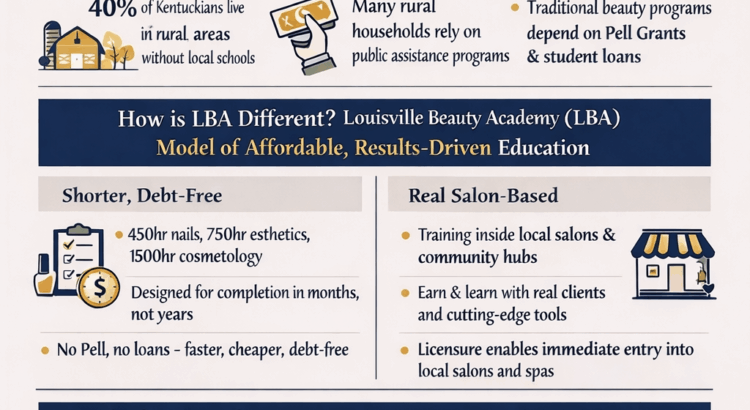
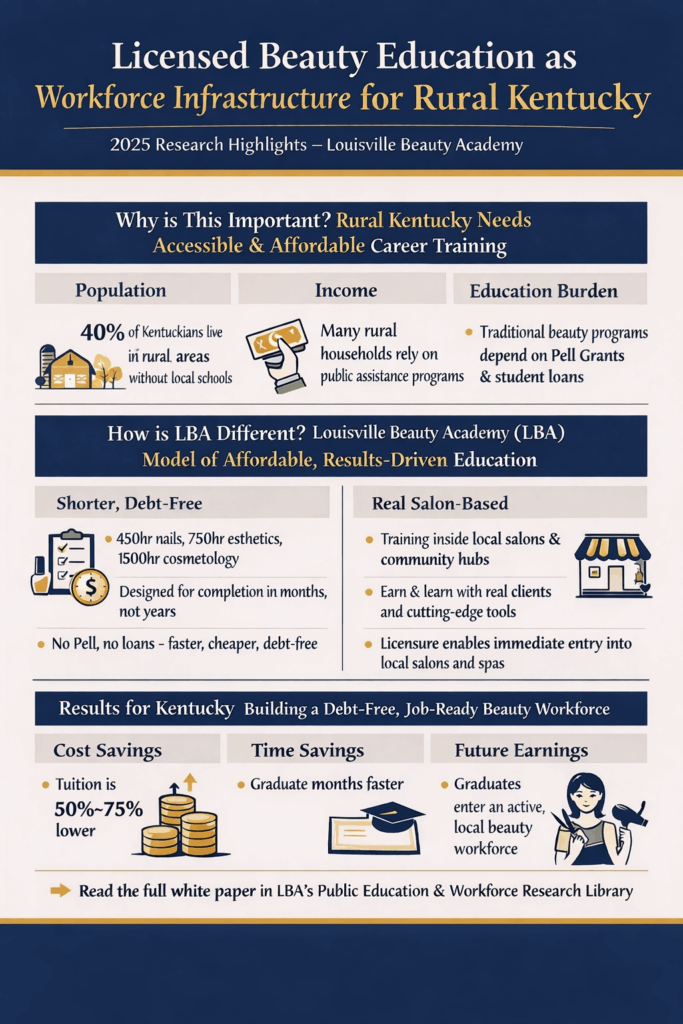
The Louisville Beauty Academy (LBA) model is designed to serve Kentucky’s rural and small-town communities by offering fast, results-driven beauty education that sidesteps traditional financial and bureaucratic barriers. About 85 of Kentucky’s 120 counties are classified as rural (USDA definition), encompassing 1.85 million people (~41% of the state) uknow.uky.edu. These areas face economic challenges – statewide, 18.9% of Kentuckians live in poverty (versus 15.4% nationally), and many rural counties exceed 25% poverty (e.g. Clay – 39.7%, McCreary – 41.0%, Wolfe – 43.0%) kystats.ky.govkystats.ky.gov. Rural Kentuckians rely heavily on public aid (e.g. SNAP, Medicaid) because wages and resources are often low. Median rural incomes lag urban areas, and opportunities for quick, debt-free training are scarce. In this context, traditional beauty schools that depend on federal Pell grants and student loans create hidden costs. Because Pell aid is unavailable for shorter programs (under 600 hours) and only for accredited schools, many rural students end up in longer programs with higher tuition and debtnaba4u.orgnaba4u.org. This forces them to spend extra months in school (reducing earning time) and often graduate with significant loans, even when they only need a shorter vocational credential.

https://uknow.uky.edu/research/new-report-shares-data-trends-kentucky-s-rural-economy Figure: Rural Kentucky communities (like Corbin, pictured) comprise a large share of the population uknow.uky.edu. These areas need accessible career training that bypasses costly financial aid structures. Rural Kentucky’s economy underscores the need for new models. Incomes tend to be lower than urban areas, and federal aid can unintentionally steer low-income students toward expensive, long programs instead of shorter, in-demand careers naba4u.orgkystats.ky.gov. For example, Kentucky’s new law reduced nail technology training from 600 to 450 hours to speed workforce entry, yet federal rules still exclude 450-hour programs from Pell grants naba4u.orgnaba4u.org. The result is a bottleneck: capable rural students may delay training or take on unnecessary debt just to access aid. Comprehensive data show that many surrounding states also have substantial rural populations (e.g. Tennessee ~34%, Indiana ~28%, Ohio ~22%) and similar funding barriers. In short, “what is called affordable” federal aid often ends up buffered by hidden costs, so that the true cost – in time or debt – remains high for rural learners.

Barriers in Beauty Education Funding

Federal financial aid rules create a stark disadvantage for students in short, intensive programs. Under current U.S. Dept. of Education policy, only programs of ≥600 hours (and accredited by a U.S.-recognized agency) qualify for Pell grants or federal loans dol.govnaba4u.org. Since LBA specializes in short, skills-focused tracks (e.g. 450-hour Nail Tech, 750-hour Esthetics), none of its programs qualify for Title IV aid naba4u.org. Other schools often extend course lengths or tack on unrelated content just to hit the threshold, which adds months of extra schooling and cost. As a result, low-income students in rural Kentucky face a choice: pay out-of-pocket for LBA’s lean programs, or enroll in a longer, debt-financed cosmetology course elsewhere (even if they only want nails or skincare). This misalignment “forces students to take on larger debt for more training than they may want or need”naba4u.org. In practice, federal aid restrictions delay graduation and inflate costs, preventing quick entry to work. LBA’s experience highlights this gap: the academy offers a full 450-hour Nail Technology course for about $3,800 (after discounts) – a fraction of what a 1500-hour cosmetology program costs – yet Pell is barrednaba4u.org. Because of this, many willing students are “filtered out” by lack of fundingnaba4u.org. Kentucky’s rural learners especially depend on grant aid, so reforming this barrier is critical to accelerate workforce entry and reduce debt for rural beauty professionals.

The LBA Model – Affordable, Outcome-Focused Education

LBA’s unique model tackles these barriers head-on. The school is state-licensed and -accredited (Kentucky Board of Cosmetology) but not federally accredited, a conscious choice that lets it focus on outcomes without federal oversight. This allows ultra-low tuition – about 50–75% less than comparable federally-funded schools louisvillebeautyacademy.net – and a debt-free structure. LBA students pay via short-term plans, scholarships, or employer support rather than federal loans. The curriculum is purpose-built for one mission: to produce licensed beauty professionals ready to work. All LBA programs (e.g. 450-hr Nails, 750-hr Esthetics, 300-hr Shampoo Styling, 1500-hr Cosmetology) are exactly the hours needed for state licensure louisvillebeautyacademy.net. There are no extra semesters: in fact, LBA celebrates daily or weekly graduations, meaning students who master the material move on immediately louisvillebeautyacademy.net. This rapid pace incentivizes focused study – learners know the goal is immediate licensing and a paycheck, not accumulating credits. As one report notes, Kentucky’s LBA “offers affordable, fast-track programs that lead to immediate employment” louisvillebeautyacademy.net. The results speak to the model’s effectiveness: since opening in 2017, LBA has trained over 1,000 beauty professionals naba4u.org. All these graduates could sit for state board exams right away (and many did). By contrast, students at traditional schools might spend extra months in mandated breaks or nonessential courses, delaying their entry into the labor market. LBA breaks from that norm: students spend only the required clock hours (no holiday “dead time” built-in) and every hour counts toward licensure. This streamlined, student-driven approach has set LBA apart as “the most affordable beauty college in Kentucky,” according to its own materials naba4u.org. In short, LBA under-delivers bureaucracy and over-delivers on real skills – a “gold standard” of compliance and transparency that explicitly benefits its rural clientele. The school even advertises full transparency of costs and curricula, ensuring rural families understand exactly what they pay for and achieve naba4u.orglouisvillebeautyacademy.net.

https://unsplash.com/s/photos/hairdresser Figure: LBA students train in real salon settings. By co-locating programs with local salons or spas, schools can cut overhead and immerse learners in the industry. LBA’s model suggests partnering with community hubs to bring training directly where rural students live and work.

Aligning with Workforce Funding and Community Partners

To fully realize its public-interest mission, LBA’s strategy should leverage public workforce funding instead of private investment (“HCA capital”). Federal and state workforce programs – under WIOA and similar initiatives – are explicitly designed to train local workers in high-demand fields. Through WIOA, local workforce boards and One-Stop Career Centers can fund eligible training programs directly dol.gov. For example, Kentucky’s Approved Training Provider List (ETPL) already includes multiple cosmetology and beauty schools (e.g. PJ’s College of Cosmetology, Pikeville Beauty Academy, Platinum Shears Beauty Academy) etpl.ky.gov. Any career training on this list can receive WIOA vouchers or grants for qualified students. LBA could seek inclusion on the ETPL or partner with WIOA agencies to make its programs tuition-free for eligible applicants. Likewise, city workforce boards and state labor departments (e.g. Kentucky’s Education & Workforce Development Cabinet) can align LBA’s courses with regional job-placement goals, channeling public funds into the academy. Employer-paid tuition is another avenue: salons and spas in Louisville and rural counties could sponsor apprentices through LBA, effectively investing their own payroll into training (sometimes with state matching). Even community reinvestment funds (from local taxes or non-profits) could be directed to support classes for under-resourced areas. In all cases, LBA becomes a public-interest partner, not an investor-controlled enterprise. This means LBA can be structured like a workforce-development program: free or nearly-free tuition for students, paid by public grants and employer contributions, with clear performance metrics (licensure pass rates, job placement). By aligning with city workforce boards, state labor agencies, WIOA/ETPL pipelines, employer tuition funds, and community investment programs, LBA would tap existing support networks and fully serve its rural mission. The U.S. Labor Dept. notes that WIOA programs provide career and training services (both classroom and on-the-job) to millions of workers through a nationwide network of centers dol.gov. Redirecting even a small slice of these resources to beauty training could make LBA’s programs nearly free to eligible Kentuckians – turning a $3,800 program into essentially $0 out-of-pocket while still ensuring students earn industry credentials and jobs.

Recommendations: To maximize impact, LBA and policymakers should:

  • Partner with Workforce Agencies. Engage local workforce development boards and the Kentucky Career Center to list LBA on the Eligible Training Provider List (ETPL) and accept WIOA funding. Secure support from the state Labor Cabinet and education workforce initiatives. This ties LBA tuition to public funding and employers, preserving affordability dol.govetpl.ky.gov.
  • Maintain Single-Outcome Focus. Preserve LBA’s one-track model: teach only what is required for licensing and employment. Continue offering debt-free, short courses aimed solely at licensure (not extraneous credits). This approach – one mission, one outcome – leverages LBA’s strength in quickly moving students into jobs louisvillebeautyacademy.net.
  • Co-Locate in Salons and Hubs. Instead of standalone campuses, locate LBA training within existing salons, spas, community centers or workforce hubs. This uses underutilized space, fosters mentorship by working professionals, and roots training in the community. For rural reach, consider pop-up or hybrid models (e.g. local campuses taught remotely by LBA instructors with hands-on labs at nearby salons). Co-location also makes it easy for policymakers and employers to see LBA’s role in the local economy.
  • Emphasize Transparency and Support. Market LBA’s programs as fully supported by public funds or sponsored by local businesses. Offer clear, online course tracking (leveraging AI-driven systems) so students see progress in real time. Emphasize that state- or employer-funded tuition effectively makes programs free or very low-cost for learners, with no hidden loan debt. This transparency builds trust with rural families and policymakers.

Conclusion

Kentucky’s rural communities need vocational pathways that are fast, affordable, and workforce-aligned. Louisville Beauty Academy’s model demonstrates that by cutting extraneous hours, lowering tuition, and focusing on licensure outcomes, beauty education can be made genuinely accessible to rural students. The next step is public partnership: aligning LBA with WIOA, workforce boards, and community resources will eliminate barriers like expensive loans and program delays. With state or employer funding, LBA courses become virtually free at the point of entry. Co-locating classes in salons and service centers brings training into the heart of rural communities, safeguarding it as a public good. In summary, LBA’s success in Kentucky – training 1,000+ professionals quickly and cheaply naba4u.orglouisvillebeautyacademy.net – shows the potential of a workforce-focused, debt-free model. By leveraging public funding and local partnerships, LBA can expand this model, becoming “bullet-proof” to liability and fully aligned with the needs of rural Americans. Such a system honors LBA’s founding intent to build Kentucky’s beauty workforce without burdening students with debt or delay.

References: Blueprint Kentucky. (2025, October 8). New report shares data trends on Kentucky’s rural economy. University of Kentucky (UKnow). Retrieved from https://uknow.uky.edu/research/new-report-shares-data-trends-kentucky-s-rural-economy uknow.uky.edu. Louisville Beauty Academy. (2025, May 7). Research Report: Louisville Beauty Academy as a Proven Model for Loan Reform and Workforce Development. Louisville, KY: Louisville Beauty Academy. Retrieved from https://louisvillebeautyacademy.net/research-report-louisville-beauty-academy-as-a-proven-model-for-loan-reform-and-workforce-development-2025 louisvillebeautyacademy.net. Tran, D. (2025, April 9). Strategic Analysis: Accreditation, Federal Aid Limits, and Louisville Beauty Academy’s Path Forward. New American Business Association (NABA). Retrieved from https://naba4u.org/2025/04/strategic-analysis-accreditation-federal-aid-limits-and-louisville-beauty-academys-path-forward/ naba4u.org. U.S. Department of Labor, Employment & Training Administration. (n.d.). WIOA Workforce Programs. Retrieved from https://www.dol.gov/agencies/eta/wioa/programs dol.gov. Kentucky Center for Statistics. (2016). Poverty Rates by County (2011–2015 ACS) [Map]. Frankfort, KY: Kentucky Center for Statistics. Retrieved from https://kystats.ky.gov/Content/Reports/Maps/PovertyRatesByCounty.pdf kystats.ky.gov. (All sources accessed 2025)

Disclaimer

This publication is provided for educational, informational, and public workforce research purposes only. It does not constitute legal, financial, regulatory, accreditation, or employment advice.

Louisville Beauty Academy does not guarantee licensure, examination results, employment, income, program completion time, or individual outcomes. Results vary based on attendance, preparation, effort, regulatory requirements, and personal circumstances.

References to affordability, time-to-licensure, workforce readiness, or program structure describe educational models and intent, not promises of results.

Any discussion of public or private funding sources (including Pell Grants, student loans, WIOA, ETPL, workforce programs, employer-paid tuition, or community funding) is illustrative only. Eligibility, approval, and availability are determined by third-party agencies or employers and may change.

This publication does not evaluate or compare specific schools or institutions. All data referenced is drawn from publicly available sources believed to be accurate as of December 2025.

Nothing herein replaces applicable laws, regulations, or licensing requirements. Readers remain responsible for compliance with all governing authorities.

A Debt-Free Path to Licensure:What Independent Workforce Research Reveals About Louisville Beauty Academy – RESEARCH DECEMBER 2025

Choosing a beauty school is one of the most important career decisions a student will ever make. It determines not only how quickly someone becomes licensed, but also whether they begin their career working and earning—or burdened by debt before their first client.

Recently, Di Tran University (DTU) published an independent empirical research paper examining workforce training models in cosmetology education using federal and state data. Louisville Beauty Academy (LBA) was included as a case study because of its unique operating model: a state-licensed, non-Title IV beauty school that does not rely on federal student loans or Pell Grants.

We are grateful to the Di Tran University research team for conducting this work with care, neutrality, and academic discipline. Their research helps students, families, and policymakers better understand how debt-free licensure models can exist—and why they matter.


What the research examined (in simple terms)

The DTU study looked at:

  • Federal data on cosmetology education outcomes
  • State licensure requirements
  • Student debt and earnings patterns
  • Workforce alignment and completion timelines

Rather than promoting any single institution, the research asked a broader question:

Can a state-licensed cosmetology school operate successfully without federal student aid while still producing licensed, working professionals?

Louisville Beauty Academy was examined as one real-world example of such a model.


Why Louisville Beauty Academy stood out

Louisville Beauty Academy operates under the same Kentucky Board of Cosmetology regulations as any other licensed school. The difference is how the school is structured.

According to the study and publicly available documentation, LBA emphasizes:

  • State licensure as the primary outcome
  • Transparent, cash-priced tuition
  • No federal student loans
  • No Pell Grants
  • No dependency on taxpayer subsidies
  • Compliance-by-design documentation

This structure allows students to focus on training, licensure, and workforce readiness, rather than navigating long-term debt obligations.


What this means for students and families

The purpose of sharing this research is not to tell anyone where they must enroll. Instead, it is to help prospective students ask better, more informed questions—at any beauty school.

For example:

  • How much will I owe in total, not monthly?
  • How long does the program typically take to complete?
  • Is licensure the clear and documented goal?
  • What happens if I leave early?
  • How is tuition priced and explained?
  • Does the school rely on loans, or is it affordable upfront?

Louisville Beauty Academy welcomes these questions. We believe that informed students are protected students.


A note of gratitude to Di Tran University

Louisville Beauty Academy sincerely thanks Di Tran University for its commitment to applied workforce research and transparency. Independent analysis—especially when grounded in federal and state data—helps elevate the entire beauty education industry.

Research does not replace regulation. It supports clarity.


Why LBA shares this research publicly

We share this study because:

  • Transparency builds trust
  • Data helps families decide wisely
  • Workforce education should be measured by licensure and work, not marketing promises

LBA does not claim to be the only good school.
We simply choose to operate in a way that is clear, lawful, affordable, and aligned with real work.


An invitation to prospective students

If you are exploring cosmetology education, we invite you to:

  • Review the independent research
  • Compare schools openly
  • Ask every school hard questions
  • Choose the path that fits your life, finances, and goals

If Louisville Beauty Academy aligns with what you are looking for, our doors are open.

📞 Text: 502-625-5531
📧 Email: Study@LouisvilleBeautyAcademy.net
🌐 Website: LouisvilleBeautyAcademy.net


Important Transparency Note

Louisville Beauty Academy did not author the referenced research and does not participate in federal Title IV student aid programs. Licensure outcomes depend on individual student completion, state examination requirements, and regulatory standards. The referenced study represents independent academic analysis and does not constitute a guarantee of outcomes.

🎄 Santa Is Real — and He Lives in Small Acts of Love – Louisville Beauty Academy | Holiday Season of Service – DECEMBER 2025

At Louisville Beauty Academy (LBA), the holiday season is not something we simply celebrate.
It is something we live, activate, and carry outward—to the people who need it most.

This Christmas, LBA students and instructors did what they are trained to do best:
they served.

At Harbor House of Louisville, home to individuals with disabilities and a neighbor to one of LBA’s two locations, our students brought beauty, dignity, and human connection—completely free of charge. No transactions. No conditions. Only care.

For the beautiful souls we served, it was more than a manicure or a beauty service.
It was a moment of being seen.
A moment of joy.
A moment of holiday spirit made real.

🎅 Santa Is Not a Myth at LBA

At Louisville Beauty Academy, Santa is not a costume.
Santa is action.

Santa is:

  • A student choosing to serve without being asked
  • An instructor guiding with patience and love
  • A smile shared with someone who is often overlooked
  • A gentle hand that restores confidence and dignity

Santa is real—because we bring him to life in each heart we touch.

❤️ The LBA Mindset: YES I CAN → I HAVE DONE IT

What we teach at LBA goes far beyond technical skill.

We teach:

  • “YES I CAN” — even when fear exists
  • “I HAVE DONE IT” — through disciplined action
  • Service before self
  • Love through consistency
  • Confidence built one small step at a time

We believe true transformation never comes from grand gestures alone.
It comes from small actions done consistently.

🌱 One Small Action at a Time

At Louisville Beauty Academy:

  • We graduate one student at a time
  • We teach one student at a time
  • We turn one small action into a habit
  • We serve one person in need at a time
  • We build confidence one moment at a time
  • We create one real, licensed, legitimate, value-add professional at a time

This is how lives change.
This is how communities grow stronger.
This is how the holiday spirit becomes reality.

✝️ Bringing Christ. Bringing Love. Bringing Hope.

We don’t preach with words alone.
We preach through service.

We bring Christ through kindness.
We bring love through action.
We bring the holiday spirit to life—not through gifts, but through presence.

To our students: you did not just practice beauty—you became it.
To our instructors: you did not just teach—you modeled humanity.
To the Harbor House community: thank you for allowing us the honor of serving you.

🎄 This is Louisville Beauty Academy.
Where education meets compassion.
Where skill meets heart.
Where YES I CAN becomes I HAVE DONE IT—
and where love is always in action.

Disclaimer:
All activities described herein were conducted on a voluntary, goodwill basis. Louisville Beauty Academy, its instructors, students, staff, affiliates, and partner facilities assume no legal, medical, professional, or financial liability arising from participation. All services were provided free of charge, without warranty or guarantee, and were accepted voluntarily by participants or their authorized representatives. Participation constituted acknowledgment and acceptance of these terms.

Can Kentucky-Licensed Beauty Professionals Perform Botox? Understanding the Law and Your Role

At Louisville Beauty Academy, a Kentucky state-licensed and state-accredited beauty college, we often receive the common question:

“Do you teach Botox?”
The simple answer is NO, and here’s why:

Kentucky Law on Botox Injections

Botox is classified as a prescription medication and falls under the category of medical procedures in Kentucky. This means that licensed beauty professionals, including estheticians and cosmetologists, CANNOT legally inject Botox.

Who Can Legally Inject Botox in Kentucky?

In Kentucky, only medical professionals with the appropriate credentials can legally perform Botox injections. These include:

  • Doctors (MD, DO, DDS, DMD) – Physicians and dentists can legally inject Botox.
  • Nurse Practitioners (NPs) – They have the authority to inject Botox independently.
  • Physician Assistants (PAs) – Can inject Botox under the supervision of a licensed physician.
  • Registered Nurses (RNs) – May administer Botox, but only under the direct supervision of a licensed physician.

What Can Kentucky-Licensed Beauty Professionals Do Instead?

Although licensed beauty professionals cannot inject Botox, they play a crucial role in enhancing and maintaining Botox results. At Louisville Beauty Academy, we train students in the following non-medical but highly complementary esthetic services:
Pre- and Post-Treatment Skincare – Preparing the skin before Botox and providing aftercare treatments for better results.
Advanced Facials & Chemical Peels – Keeping the skin healthy and glowing post-Botox.
Microneedling & Dermaplaning – Enhancing skin texture to complement Botox effects.
Skin Analysis & Consultation – Educating clients on skincare and anti-aging treatments.

Can a Beauty Professional Own a Med Spa?

Yes! While a Kentucky-licensed beauty professional cannot inject Botox, they can own or co-own a medical spa. However, they must hire a licensed medical provider (such as a doctor, NP, or PA) to legally perform Botox injections.

Why Louisville Beauty Academy Focuses on State-Licensed Training

At Louisville Beauty Academy, our mission is to provide high-quality, state-approved beauty education that helps our students succeed within legal and ethical boundaries. We ensure that all of our programs align with Kentucky’s laws and regulations, setting our graduates up for success in legally permissible beauty services.

Louisville Beauty Academy Locations

We have two locations to serve aspiring beauty professionals in Louisville:

📍 Main Campus:
Louisville Beauty Academy
1049 Bardstown Road, Louisville, KY 40204

📍 Second Campus (at Harbor House):
Louisville Beauty Academy – Harbor House
2231 Lower Hunters Trace, Louisville, KY 40216

For more information on our state-approved esthetics and cosmetology programs, contact us today!

📞 Call/Text: 502-625-5531
🌐 Website: www.LouisvilleBeautyAcademy.net

By staying informed about Kentucky beauty laws, you ensure your success in the beauty industry while maintaining professionalism and compliance. Train right, work smart, and build a thriving beauty career legally!