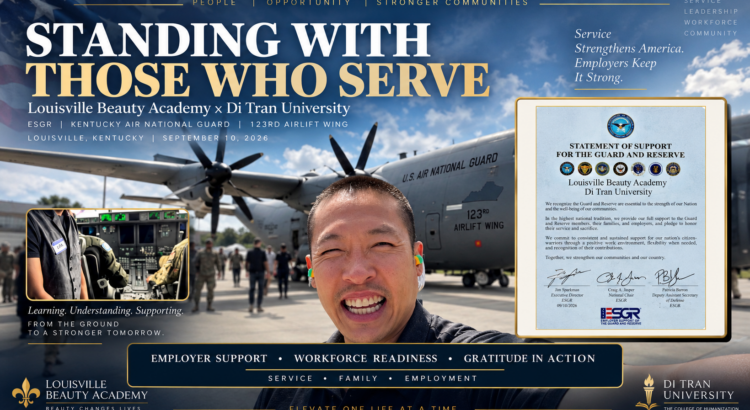
Louisville Beauty Academy / Di Tran University signed the ESGR Statement of Support after Di Tran attended the ESGR Air Guard Boss Lift 2026 with Kentucky’s 123rd Airlift Wing at the Louisville Air National Guard Base.
For Louisville Beauty Academy and Di Tran University, this was more than a calendar event. It was a direct encounter with the people, discipline, readiness, and sacrifice behind the Guard and Reserve mission. It was also a reminder that the strength of a nation is carried by people who often serve in more than one way: in uniform, at work, at home, in classrooms, and in the communities that depend on them.
Di Tran came to the United States as a Vietnamese-born American who has always understood opportunity as a responsibility. America opened its arms to his family. Kentucky became home. Louisville became the place where work, education, small business, family, and public service could become one life. For Di, standing beside the men and women of the Guard and Reserve is not symbolism. It is gratitude made practical.
A First-Hand View Of Readiness
The Boss Lift experience gave Di a first-hand employer view of the Kentucky Air National Guard mission, including the C-130 environment and the daily reality of service members who train, deploy, work civilian jobs, support families, and remain ready for disasters, emergencies, and missions beyond Kentucky. These are not abstract roles. They are real people carrying multiple responsibilities with discipline and quiet strength.
Di Tran experienced the C-130 environment first-hand during the ESGR Air Guard Boss Lift 2026 with the 123rd Airlift Wing.
Kentucky’s Air Guard story is nationally significant. Official 123rd Airlift Wing reporting states that the 123rd earned its 21st Air and Space Outstanding Unit Award and sixth Curtis N. “Rusty” Metcalf Trophy, describing the wing as the most decorated tactical airlift wing in the U.S. Air Force. Official Kentucky Guard reporting also describes the Boss Lift as a way for employers to gain an inside perspective on the Kentucky Air Guard mission.
Di Tran at the Louisville Air National Guard Base beside Kentucky Air Guard C-130 aircraft markings.
Why This Matters To Workforce Education
That matters to Louisville Beauty Academy / Di Tran University because workforce development is also a readiness mission. LBA and DTU work to make education accessible, affordable, career-connected, and human-centered. The institution’s mission is to help everyday people move faster toward skill, licensure, dignity, employment, entrepreneurship, and contribution. That includes military-connected families, veterans, spouses, adult learners, immigrants, working parents, and students who need education to be practical rather than distant.
Beauty education is not only about a license. It is about public safety, sanitation, confidence, care, income, ownership, and human dignity. When a school teaches skill with affordability and discipline, it strengthens families. When it supports Guard and Reserve members, it strengthens the country. When it uses AI carefully to expand accessibility without replacing human judgment, it strengthens the future of workforce education.
The ESGR Statement Of Support
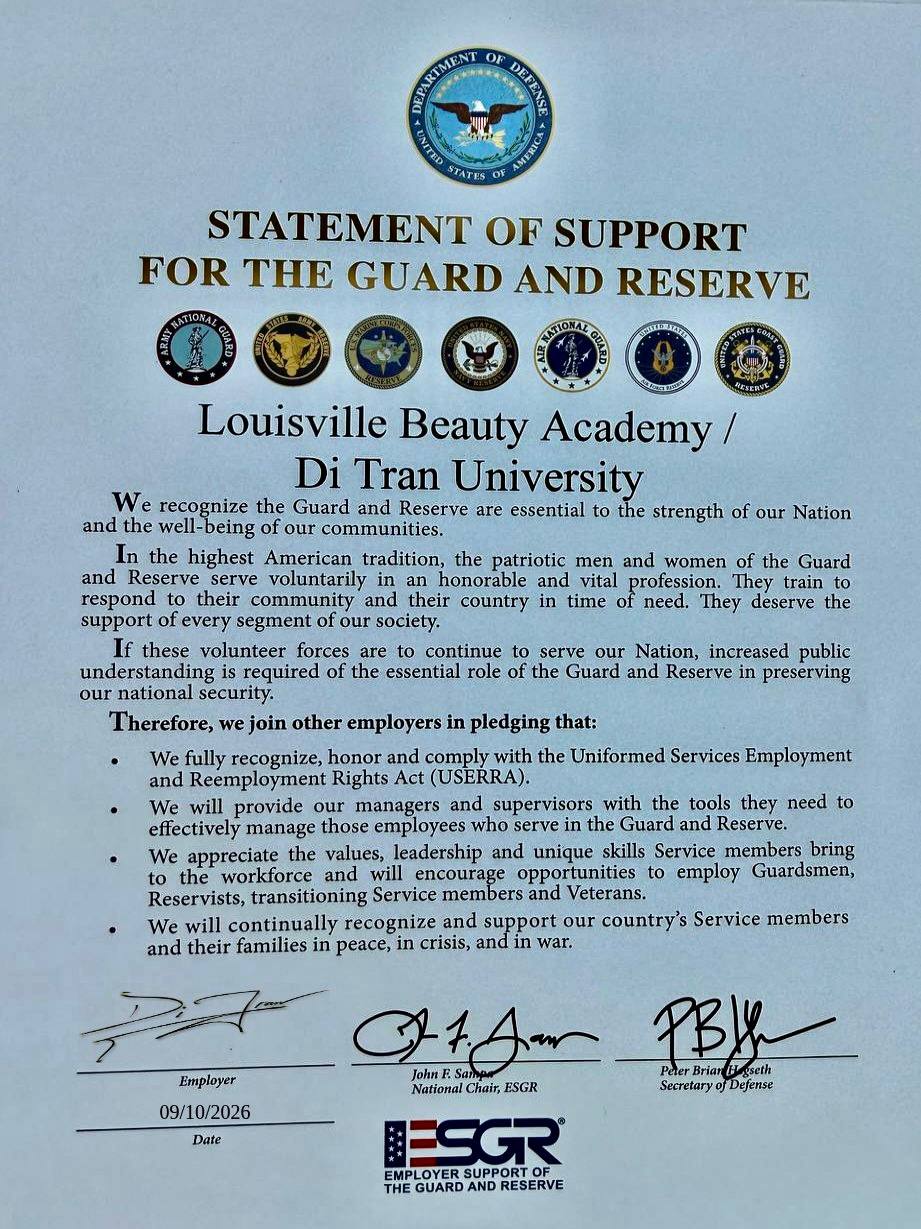
Louisville Beauty Academy / Di Tran University signed the ESGR Statement of Support because the pledge captures the right standard: employers must recognize, honor, and support the people who serve in the Guard and Reserve. The pledge is not an award or government endorsement. It is a commitment. It says that institutions should build workplaces where service members and their families are understood, respected, and given fair opportunity.
Louisville Beauty Academy / Di Tran University signed the ESGR Statement of Support on September 10, 2026.
Gratitude In Action
This event also revealed something deeply local: so much of Kentucky’s readiness sits close to the communities it protects. Within minutes of Louisville Beauty Academy and Di Tran University’s growing footprint are students, employers, military families, workforce agencies, civic leaders, and the Louisville Air National Guard Base. The distance is short. The responsibility is large.
Di’s first C-130 experience was therefore not simply a personal milestone. It was a reminder that America is carried by people who often serve in more than one uniform: the military uniform, the work uniform, the family role, the classroom role, the leadership role. The Guard and Reserve stand at that intersection. So does workforce education.
The Boss Lift gave employers a first-hand view of the service, readiness, and civilian-workplace responsibilities carried by Guard and Reserve members.
Louisville Beauty Academy / Di Tran University is honored to support that mission and to continue building an institution that welcomes, trains, respects, and elevates people who serve, people who work, and people who are building a future in Kentucky.
This is the heart of the story: love of country without self-congratulation; love of Kentucky without exaggeration; love of Louisville through service; and workforce education as one practical way to give back to the country that gave Di Tran’s family a home.
The ESGR employer-support message aligns with LBA / DTU commitment to practical workforce opportunity and respect for those who serve.
Credibility And Community Linkage
This moment respectfully connects several public-service and workforce communities while keeping the legal meaning exact: Employer Support of the Guard and Reserve, the Kentucky National Guard, the Kentucky Air National Guard, the 123rd Airlift Wing, the U.S. Department of Defense context for ESGR, the U.S. Department of Labor / USERRA employment-rights framework, Team Kentucky workforce and apprenticeship partners, the Kentucky Chamber Foundation employer network, Louisville Beauty Academy, and Di Tran University.
The message is simple: service strengthens America, employers help keep service possible, and workforce education can honor that service through practical opportunity.
What This Article Does And Does Not Claim
This article reports LBA / DTU participation in the ESGR Boss Lift experience and the signed ESGR Statement of Support. It does not claim an ESGR award, Department of Defense endorsement, military endorsement, government contract, accreditation, grant approval, WIOA approval, Workforce Pell approval, or apprenticeship approval. Awards, approvals, contracts, and regulated statuses require separate official action.
Louisville Beauty Academy teaches beauty as a full professional system.
That system includes skill, sanitation, safety, federal law, Kentucky state law, local and metro business rules, regulation, documentation, attendance, contracts, student choice, client communication, ethical public representation, business awareness, ownership pathways, board expectations, and the changing climate of the beauty industry.
This is why LBA is building itself not only as a school, but as a center of excellence and public library for understanding beauty.
The purpose is simple:
Students should not only learn how to perform beauty services. They should learn how to understand the regulated profession they are entering.
1. Beauty Is a Licensed Profession, Not Only a Creative Skill
Beauty work is creative, human, technical, and personal. It is also licensed.
A licensed profession comes with public responsibilities. Students and professionals must understand sanitation, infection control, safety, scope of practice, training hours, documentation, client care, school policies, state-board expectations, and lawful communication.
That is why beauty education must include more than hands-on technique.
At LBA, professional understanding includes:
the craft: nail technology, cosmetology, esthetics, shampoo styling, specialty services, and instructor training;
the rules: licensing requirements, curriculum requirements, attendance limits, sanitation, student records, and state-board expectations;
the documents: enrollment agreements, policies, catalogs, refund and withdrawal rules, tuition disclosures, curriculum links, attendance records, and completion records;
the conduct: professional communication, client boundaries, public-safety habits, truthful representation, and ethical online activity;
the pathway: employment, salon work, booth rental, independent practice where lawful, business ownership, instructor responsibility, and lifelong learning.
This is the full beauty industry, not one narrow class topic.
2. What It Means To Be a Center of Excellence for Understanding
A center of excellence does not merely repeat rules. It explains them.
LBA's goal is to help students and the public understand:
what a license is and what it is not;
what school training is designed to prepare students for;
why sanitation and infection-control rules protect the public;
why attendance records and training hours matter;
why written contracts, catalogs, and policies matter;
why costs, refunds, withdrawals, and payment terms must be visible;
why public reviews, testimonials, and promotional statements must be voluntary and truthful;
why student choice must be protected;
why documentation protects students, schools, salons, clients, and regulators;
why industry climate matters for career readiness.
The goal is not to turn students into lawyers. The goal is to help students become more aware licensed professionals.
3. What It Means To Be a Public Library for Beauty Understanding
A public library makes knowledge available.
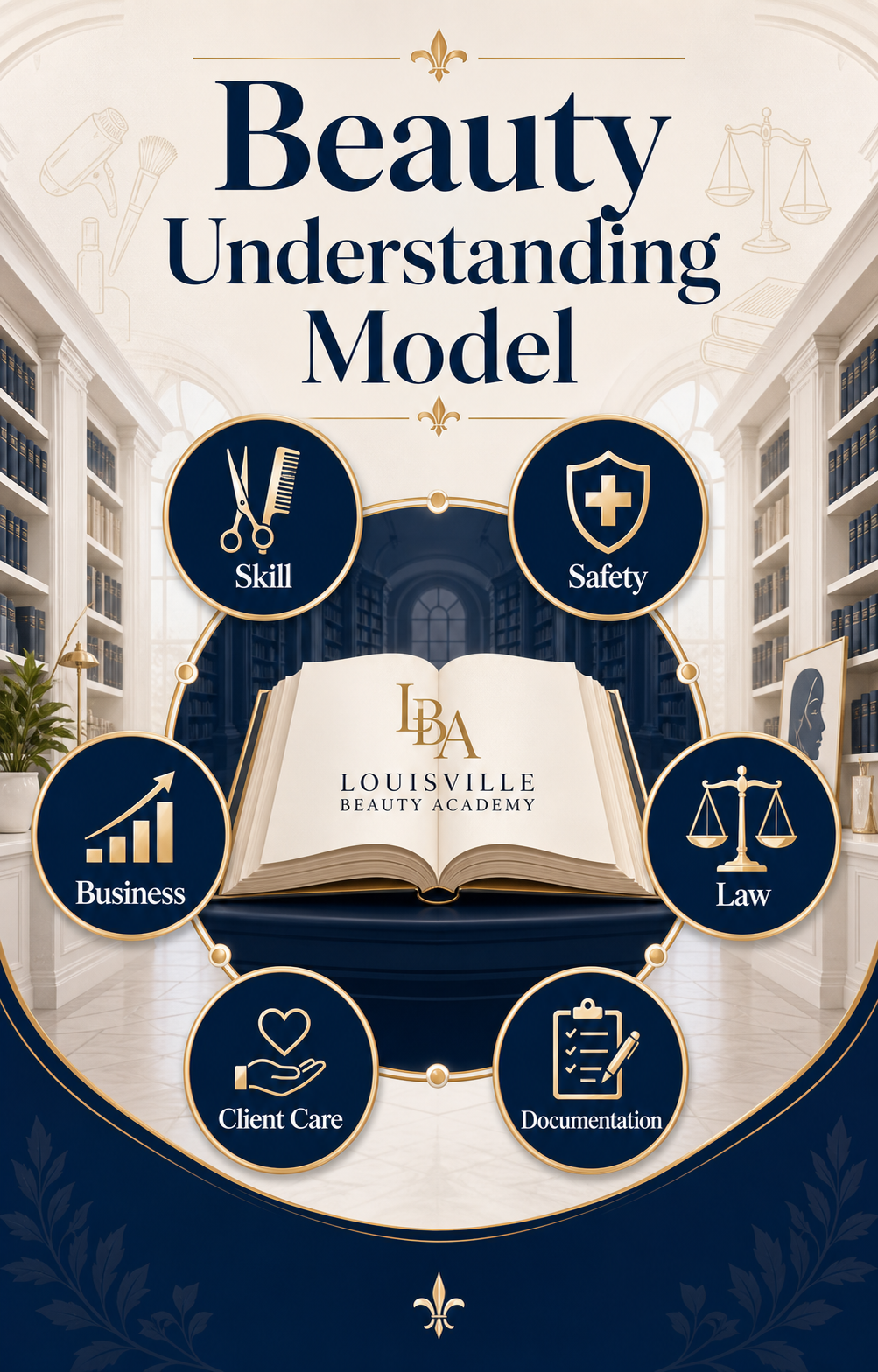
The Beauty Understanding Model frames professional preparation as skill, safety, law, documentation, client care, and business literacy working together.
LBA's public education work should serve the same function for the beauty field. Students, families, salon owners, graduates, community partners, regulators, and the public should be able to find plain-language explanations of how the industry works.
That public library should include:
law and regulation explanations;
student-contract and school-policy explanations;
sanitation and public-safety explanations;
curriculum and licensing-pathway explanations;
attendance and documentation explanations;
cost, payment, refund, and withdrawal explanations;
client-care and professionalism explanations;
salon ownership and small-business-readiness explanations;
ethical public-review and testimonial explanations;
multilingual or plain-language access where needed.
Knowledge should not disappear after one class, one enrollment meeting, one inspection, one renewal cycle, or one complaint. It should remain visible and reusable for the next student, the next parent, the next graduate, the next salon owner, and the next community member.
4. Why Industry Climate Belongs in Beauty Education
Every profession has a climate.
The beauty industry climate includes:
licensing rules;
labor and worker-classification debates;
state-board inspections;
public health expectations;
changing student expectations;
affordability concerns;
digital reviews and online reputation;
small-business ownership;
immigrant and first-generation entrepreneurship;
language access;
public trust;
documentation and due process.
Students need to understand this climate because they will work inside it.
This is especially visible in nail technology, but the lesson applies to the entire beauty field. Nail technology, cosmetology, esthetics, shampoo styling, instructor training, specialty services, student clinic services, salon employment, booth rental, independent practice, and ownership all exist within a regulated environment.
Understanding that environment is part of career readiness.
5. Legal and Regulatory Literacy: Federal, State, and Local
Legal and regulatory literacy means students can understand the rules that shape their profession.
Those rules do not exist at only one level.
The beauty industry sits inside overlapping layers:
Federal: worker safety, chemical exposure, cosmetics, labeling, endorsements, testimonials, advertising, consumer protection, disability access, employment, tax, and civil-rights principles may all matter depending on the setting.
State: in Kentucky, cosmetology-related education, school licensing, curriculum, sanitation, permits, student contracts, instructor responsibilities, and board expectations are governed through Kentucky statutes, Kentucky administrative regulations, and Kentucky Board of Cosmetology materials.
Local / Metro: in Louisville and Jefferson County, business registration, occupational license tax reporting, local permits, zoning/building/fire/health-related touchpoints, and local operating requirements may affect a beauty business depending on what it does and where it operates.
That is why beauty education cannot treat "law and regulation" as one narrow state-board topic. Students and future salon owners need to understand that professional practice may connect to federal, state, and local layers at the same time.
At a school level, this includes visible education about:
federal safety and health concepts, including OSHA nail-salon hazard guidance;
federal cosmetics concepts, including FDA cosmetics and product-safety guidance;
federal endorsement/review principles, including FTC guidance on truthful reviews, testimonials, endorsements, and disclosures;
Kentucky Board of Cosmetology requirements;
KRS Chapter 317A;
201 KAR Chapter 12;
201 KAR 12:082 curriculum, school administration, training-hour, and break-related requirements;
school operation days and hours;
training-hour limits;
attendance documentation;
curriculum requirements by program;
student contract requirements;
state-board renewal expectations;
sanitation and public safety;
responsible student records and completion documentation.
local and metro business-readiness awareness for students who later pursue salon work, booth rental, independent practice, or ownership.
For example, LBA's renewal-preparation work emphasizes that students should see operating facts clearly: program information, days/hours of operation, tuition and costs, refund and withdrawal policies, attendance policies, official law links, and curriculum source links.
That is not just paperwork. That is transparency.
At the public-library level, LBA's larger role is to help people understand how the layers connect:
the federal safety layer asks whether workers and consumers are protected from preventable hazards;
the federal advertising/review layer asks whether public statements are truthful and not misleading;
the state licensing layer asks whether students, schools, instructors, and licensees meet Kentucky requirements;
the local/metro layer asks whether a business is properly registered and operating within local rules;
the school-documentation layer asks whether expectations are visible before a student commits.
6. Compliance Literacy
Compliance is not a hidden back-office activity. It is part of professional formation.
Compliance literacy includes:
knowing what policy applies;
knowing where the policy is written;
knowing who keeps records;
knowing how records are reviewed;
knowing how corrections are made;
knowing when questions should be raised;
knowing how to preserve documentation.
For students, compliance literacy helps them understand attendance, hours, payments, refunds, withdrawal, sanitation, client safety, and graduation/completion processes.
For schools, compliance literacy helps create consistency, fairness, and documented proof.
For salons and owners, compliance literacy helps reduce confusion and avoid preventable mistakes.
For regulators, visible compliance materials make review easier.
7. Educational Literacy
Educational literacy means students understand the purpose of what they are learning.
Students should understand:
why theory matters;
why practical work matters;
why sanitation is repeated constantly;
why attendance rules exist;
why clinics must be supervised;
why instructor responsibility matters;
why graduation documentation matters;
why the state-board exam is not the whole profession;
why lifelong learning matters after licensure.
The goal is not only course completion. The goal is responsible entry into a licensed profession.
8. Documentation Literacy
Documentation is one of the most important professional habits in a regulated field.
Documentation helps answer:
what was disclosed;
what was signed;
what was taught;
what hours were completed;
what policy applied;
what payment term existed;
what refund rule applied;
what curriculum was required;
what communication occurred;
what correction was made;
what source authority was used.
Documentation protects students by making expectations visible.
Documentation protects schools by showing what was provided and when.
Documentation protects the public by supporting safe and accountable practice.
Documentation protects regulators by creating a record that can be reviewed.
This is why LBA teaches documentation as part of professional culture.
9. Student Choice and Ethical Public Communication
A modern beauty professional must understand public communication.
Reviews, testimonials, social media posts, student stories, before-and-after images, and public statements can all affect trust. They must be handled ethically.
LBA's position is clear:
No student should be required to give praise, a five-star review, a positive review, a testimonial, or a favorable public statement as a condition of standard enrollment, attendance, completion, graduation, or standard pricing.
Any optional public/professional documentation activity should be voluntary, student-chosen, truthful, and handled under written disclosure rules where required.
That distinction matters.
Professional development can be encouraged. Coerced praise should not be.
Documentation can help students build confidence. Forced public approval should not be part of standard enrollment.
This is why student choice belongs inside beauty education.
10. Nail Technology as a Visible Example, Not the Whole Story
Nail technology is a highly visible example of why legal and regulatory understanding matters.
Across the United States, nail salons and nail professionals have appeared in public legal and policy conversations involving enforcement fairness, language access, worker classification, small-business ownership, board representation, and due process.
This does not mean every regulator is unfair. It does not mean every salon is right in every dispute. It does not mean students should fear the law.
It means the industry is real, regulated, complex, and worth understanding.
The most useful lesson is educational:
When a profession is regulated, students and professionals need clear rules, plain-language explanations, documentation habits, and fair process.
11. Historical and Policy Context
Public history shows why education matters.
In Louisiana, Vietnamese and Asian nail salon owners brought a federal case, Nguyen et al. v. Louisiana State Board of Cosmetology et al., alleging targeted inspections, fines, discrimination, intimidation, and unfair treatment. Public reporting shows the claims survived key court challenges and the case resolved with a reported settlement of more than $100,000. This is one of the strongest public examples of nail salon owners using the legal system when they believed enforcement was unfair.
In California, Blu Nail Bar, Inc. et al. v. Gavin Newsom et al. challenged a worker-classification rule that treated licensed manicurists differently from other beauty professionals. California later passed AB 1514, extending the licensed manicurist exemption through January 1, 2029.
In Kentucky, Senate Bill 14 added nail technician representation and strengthened procedural clarity within the Kentucky Board of Cosmetology structure. That policy development reflects a broader need for representation, clarity, and practical understanding within beauty-industry regulation.
These examples are not included to attack any agency. They are included to show why beauty education must include industry literacy.
Law, regulation, documentation, and due process are part of the professional environment.
12. LBA's Educational Standard
Louisville Beauty Academy's educational standard is to teach the whole picture:
technique;
sanitation;
law;
regulation;
safety;
client care;
contracts;
documentation;
attendance;
curriculum;
cost transparency;
refund and withdrawal awareness;
public communication ethics;
student choice;
business literacy;
ownership awareness;
instructor responsibility;
industry history;
public trust;
human dignity.
This is what it means to teach beauty at a serious level.
13. The Public Value
When beauty education includes law and regulation, students become stronger.
When beauty education includes documentation, schools become clearer.
When beauty education includes ethical public communication, students are protected.
When beauty education includes business awareness, graduates are more prepared.
When beauty education includes industry history, communities understand the profession more deeply.
When beauty education becomes a public library, knowledge becomes accessible beyond the classroom.
When beauty education explains federal, state, and local layers together, students and future owners stop treating compliance as a mystery. They begin to see the profession as a system they can learn, respect, question, document, and navigate.
That is public value.
14. Closing
Louisville Beauty Academy teaches the craft.
Louisville Beauty Academy teaches the rules.
Louisville Beauty Academy teaches the responsibility.
Louisville Beauty Academy teaches the climate.
Louisville Beauty Academy teaches understanding.
The beauty industry deserves schools that teach more than the minimum. Students deserve institutions that explain the system, not just move them through it. Communities deserve graduates who know how to work with skill, dignity, safety, and awareness.
That is the public library Louisville Beauty Academy is building:
a living library of beauty skill, safety, law, regulation, documentation, ethics, business literacy, and human dignity.
At Louisville Beauty Academy, a school name is not only a name. It is a responsibility.
Every student who walks through the door carries more than a schedule, a tuition plan, or a licensing goal. They carry family pressure, work pressure, language difference, financial reality, hope, fear, discipline, and the quiet question that lives inside almost every serious beginning:
Can I really do this?
Louisville Beauty Academy answers through culture, not noise:
YES I CAN. I HAVE DONE IT. YES, YOU WILL.
Those words are not decoration. They are a sequence of growth. YES I CAN is the courage to begin. I HAVE DONE IT is the proof that disciplined action can become achievement. YES, YOU WILL is the graduate, instructor, family member, salon owner, and community leader turning back toward the next student and saying: keep going.
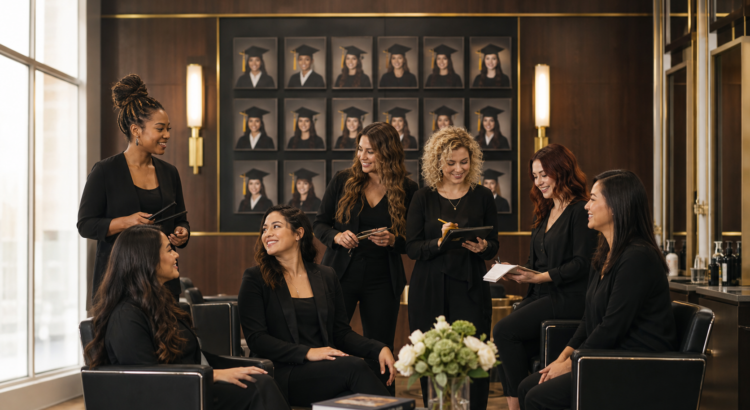
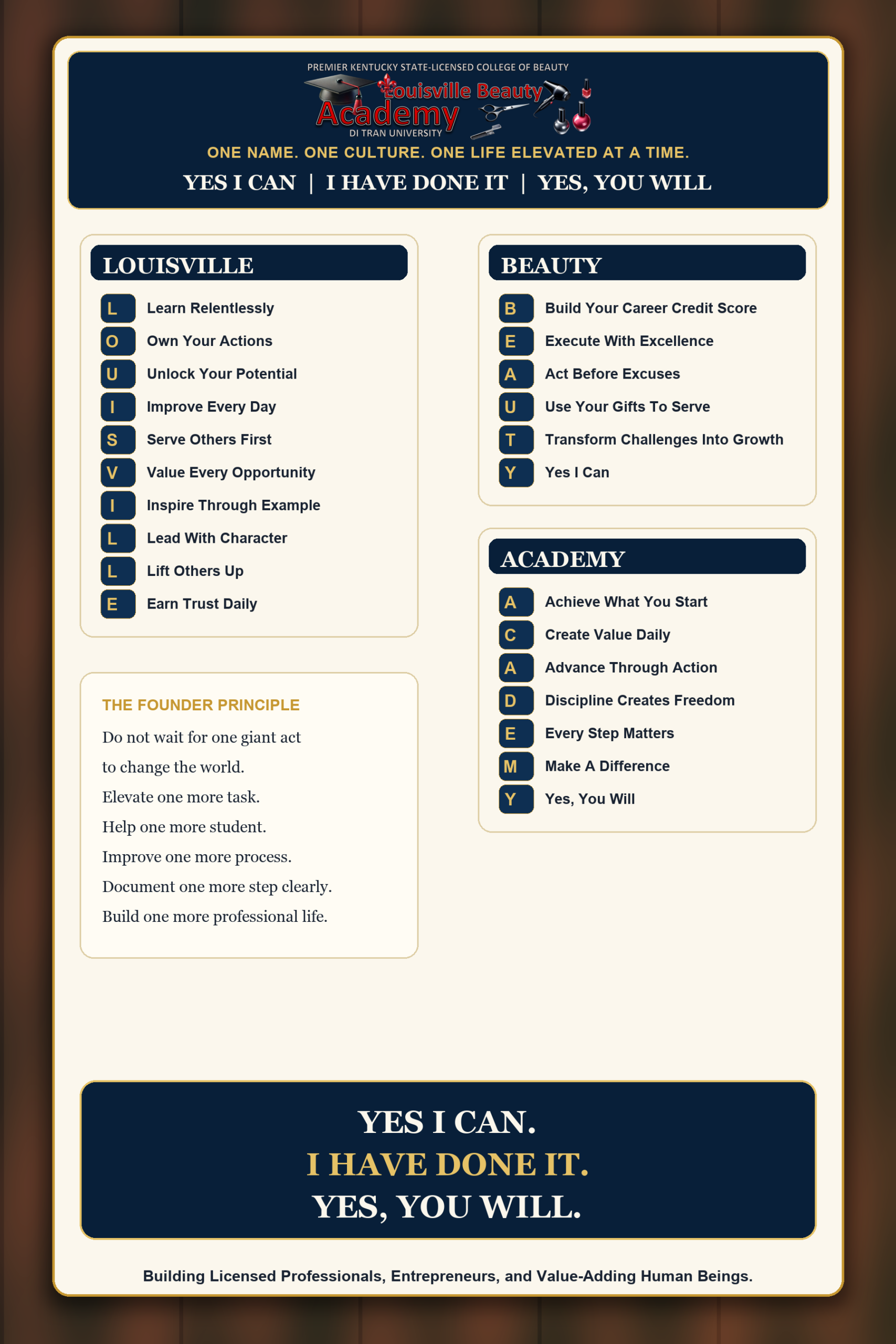
Louisville Beauty Academy culture wall: one name, one culture, one life elevated at a time.
The Meaning Inside The Name
LOUISVILLE begins with the professional foundation: learning, ownership, service, character, and trust.
L — Learn Relentlessly
O — Own Your Actions
U — Unlock Your Potential
I — Improve Every Day
S — Serve Others First
V — Value Every Opportunity
I — Inspire Through Example
L — Lead With Character
L — Lift Others Up
E — Earn Trust Daily
A beauty professional must learn technique, sanitation, client care, timing, communication, discipline, documentation, and business judgment. Talent matters, but talent without trust does not build a career. Skill matters, but skill without character does not build a profession.
BEAUTY becomes more than appearance. It becomes service, professionalism, dignity, and value creation.
B — Build Your Career Credit Score
E — Execute With Excellence
A — Act Before Excuses
U — Use Your Gifts To Serve
T — Transform Challenges Into Growth
Y — Yes I Can
Beauty work is human work. A student learns to serve another person with care, prepare a clean and safe service environment, listen carefully, practice repeatedly, accept correction, and build public trust one client at a time.
ACADEMY becomes the discipline of completion.
A — Achieve What You Start
C — Create Value Daily
A — Advance Through Action
D — Discipline Creates Freedom
E — Every Step Matters
M — Make A Difference
Y — Yes, You Will
The academy exists because people need more than encouragement. They need structure. They need repetition. They need written clarity. They need instructors who care enough to correct them and a culture strong enough to bring them back to action after difficulty.
One More Action At A Time
The founder principle behind this culture is simple: do not wait for one giant act to change the world. Elevate one more task. Help one more student. Improve one more process. Finish one more requirement. Speak one more sentence of encouragement. Document one more step clearly. Build one more professional life.
Small actions compound.
One checklist becomes readiness.
One correction becomes skill.
One returned student becomes completion.
One written record prevents confusion.
One license pathway becomes economic movement.
One graduate becomes a model for the next person.
This is how a school becomes more than a school. It becomes a place where people practice becoming trustworthy, useful, skilled, licensed, and ready to serve.
Why This Is Also Civic Work
Beauty education is often misunderstood as small. It is not small. It is workforce development. It is small-business formation. It is immigrant and working-family mobility. It is sanitation and public trust. It is language access. It is the discipline of taking a real person from uncertainty toward a documented professional pathway.
Louisville Beauty Academy has been publicly recognized through national small-business and advocacy channels, including the U.S. Chamber of Commerce CO—100 profile for Louisville Beauty Academy and the CO—100 small-business list. Founder Di Tran has also been publicly named by the National Small Business Association among the 2025 Lewis Shattuck Small Business Advocate of the Year finalists, as reflected in NSBA public materials.
Those recognitions matter, but they are not the mission. The mission remains the next student who needs a clear beginning, a lawful school pathway, written cost information, real support, and a culture that says: yes, you can begin; yes, you can continue; yes, you can finish what you start.
The Culture Wall
Louisville Beauty Academy should place this culture where students can see it, read it, photograph it, graduate in front of it, and remember it.
Not because words alone create success. They do not.
But repeated words, repeated actions, repeated standards, repeated correction, and repeated evidence shape people. A wall can become a daily reminder. A staircase can become a progression. A graduation backdrop can become proof. A student handbook page can become a standard. A website article can become an invitation to a person who has not yet found the courage to ask.
The culture is uplifting because it is practical. Ask questions in writing. Review the documents. Understand the cost. Know the attendance expectations. Respect sanitation. Practice the skill. Listen to correction. Finish the hours. Prepare for the board. Build trust daily.
Student next step
Ask LBA for current written information before you decide.
If you are comparing programs, schedule, tuition, language support, tour options, or enrollment documents, ask for current written follow-up. A clear record protects the student and strengthens trust.
Louisville Beauty Academy is building licensed professionals, entrepreneurs, and value-adding human beings one disciplined step, one caring action, and one life at a time.
A legally careful, fact-based article about Louisville Beauty Academy should rely on a narrower, stronger claim than the absolute statement that every graduate is automatically a net positive in every measurable sense. The best-supported version is this: Louisville Beauty Academy is a Kentucky Board-listed, state-licensed beauty school whose public materials describe a licensure-preparation, practical-training, flexible-schedule, lower-debt/direct-pay model serving adult learners who often balance work, family, transportation, and language barriers while pursuing regulated beauty credentials. That institutional model can support a serious public-value argument about labor-force participation, household spending, and tax-base contribution. [1]
The school’s public milestone language is meaningful but should be stated with precision. LBA’s current graduate-gallery page says the academy has supported “nearly 2,000 graduates” across full programs, short programs, refresher training, transfer students, and workforce pathways. An older 2023 school catalog says that, according to an annual report covering 2017–2023, LBA had over 1,000 graduates. Those two figures are not contradictory, but they are not the same measure either. A rigorous article should therefore say that the exact audited count of full-program graduates alone is not publicly specified in the materials reviewed here. [2]
LBA’s current tuition and finance pages support the lower-debt framing, but they also require careful wording. Current public pages publish conditional reduced-cost figures of $3,800 for Nail Technology, $6,100 for Esthetics, and $6,250.50 for Cosmetology, and state that students may make monthly payments of more than $100. The same current finance page says LBA is not a Title IV federal-aid participant and does not process or disburse federal student aid. However, an older 2023 catalog contains a generic section describing Pell Grants and federal loans. Because LBA’s own current pages repeatedly say current written documents control, the safest public article should rely on the current 2024–2026 finance pages and should not overstate historical practice without written clarification. [3]
The proposed $20 million to $40 million cumulative economic-activity figure is reasonable as an illustrative estimate, not as an audited economic-impact study. If one applies a deliberately modest $10,000 to $20,000 annual contribution proxy to roughly 2,000 cumulative graduates/pathway completers, the math is straightforward. That assumption is conservative relative to current published BLS mean annual wages for Kentucky beauty occupations and Louisville-area beauty occupations. But the article must say clearly that this is not audited GDP, not a tax-receipt study, not a guarantee of earnings, and not proof that every graduate remains in Kentucky or works full-year in the field. [4]
Louisville Beauty Academy appears on the Kentucky Board of Cosmetology’s school list at 1049 Bardstown Road and as Louisville Beauty Academy Future Second Location at future location to be announced. The Board listing shows instructional programs including Cosmetology, Esthetics, Nail Technology, Shampoo Stylist, and instructor pathways. That is the strongest primary-source basis for the statement that LBA is a state-licensed Kentucky beauty school. [5]
LBA’s own “About” page describes the school as serving students who are seeking licensure preparation, practical training, and a clearer path into lawful professional work in beauty. The same page emphasizes access for students balancing work, family responsibilities, transportation limits, and language barriers. Its broader public materials repeatedly frame the school around dignity, discipline, service, and workforce readiness, and the enrollment-procedures page says LBA is designed for adult students with “real lives, work responsibilities, [and] family responsibilities.” [6]
Kentucky’s regulatory framework supports LBA’s licensure-preparation positioning. Kentucky regulation 201 KAR 12:082 requires at least 1,500 hours for cosmetology, 750 hours for esthetics, and 450 hours for nail technology, and it explicitly includes preparation for licensure and employment, on-the-job professionalism, and salon businesses in the educational structure. Kentucky Board pages also restate the hour thresholds for licensure pathways. [7]
LBA’s current public cost pages are affordability-focused but careful. The school says current written documents control, yet public reduced-cost figures currently shown include $3,800 for Nail Technology, $6,100 for Esthetics, $6,250.50 for Cosmetology, $3,900 for Beauty Instructor, and $2,890 for Shampoo Styling. The payment-plan page says students may make monthly payments above $100, while the enrollment-procedures page says LBA offers a monthly payment path with deposits by program and balance due before graduation. [8]
The strongest evidence for the “no federal student loans/aid processed” claim is LBA’s current finance page, which states: “Louisville Beauty Academy is not a Title IV federal aid participant. We do not process or disburse federal student aid (FAFSA loans or grants).” That same page describes LBA’s model as direct-pay and lower-debt. At the same time, the 2023 catalog contains a generic financial-aid section describing Pell Grants and federal loans, which means a clean article should note that current written disclosures control and should avoid claiming more than the current page itself says. [9]
LBA’s public materials also give ready-made compliance language that is useful for the article. The school’s current finance page says no page or older statement guarantees graduation, licensure, exam result, employment, income, transfer approval, or Board approval. The catalog likewise says the academy cannot legally guarantee employment. Those statements align well with the user’s requested guardrails against guaranteed-outcome claims. [10]
The human heart of this article is not a speculative claim about instant success. It is the reality of the working student. LBA’s own current materials say the academy is built for adult students with work and family responsibilities, and its catalog describes full-time attendance as 30–40 hours per week and part-time attendance as 20–30 hours per week, while also stating that the school operates on a flexible schedule that allows students to tailor attendance to personal circumstances. That is exactly the kind of structure that makes the working-student narrative credible. [11]
The occupations named by the user are also recognizable in Louisville labor data. In the Louisville/Jefferson County metro area, BLS reported mean annual wages in May 2023 of about $28,450 for cashiers, $30,000 for waiters and waitresses, $33,220 for bartenders, $30,820 for maids and housekeeping cleaners, $33,550 for janitors/cleaners, $33,960 for home health and personal care aides, and $33,740 to $35,360 for chauffeur-style driving proxies depending on table/version. BLS also notes that taxi drivers, shuttle drivers, and chauffeurs include ride-hailing drivers, and that some of this work is part-time and schedule-flexible. [12]
That makes the requested vignettes defensible as composites, not as undocumented claims about every individual student. A legally careful article can describe students who may be driving Uber or Lyft at night, cleaning hotel rooms on weekends, cashiering, bartending, waiting tables, working factory shifts, helping on salon floors, or caregiving for elders or children—so long as the article presents these as humanized, plausible portraits of a working-adult student body, not as verified census counts of LBA’s entire enrollment. LBA’s own materials support the broader picture of students with work obligations and constrained schedules. [13]
The wage figures above are Louisville/Jefferson-area BLS estimates, while the hour bands are illustrative work scenarios chosen to fit LBA’s published flexible attendance model for working adult students. The Uber/Lyft row uses a chauffeur-style proxy because BLS classifies ride-hailing within the broader taxi/shuttle/chauffeur framework, and real gig-driver take-home pay can vary materially due to vehicle costs, self-employment status, and platform conditions. [14]
The economic case should be framed in intentionally modest terms. BLS reported statewide Kentucky mean annual wages in May 2023 of about $48,700 for hairdressers, hairstylists, and cosmetologists, $42,330 for manicurists and pedicurists, and $55,060 for skincare specialists. In the Louisville metro area, the corresponding means were even higher, at about $59,240, $41,150, and $57,160. Against those published occupation figures, an article that uses only $10,000 to $20,000 per graduate per year as an illustrative contribution range is plainly conservative. [15]
That is why the article can responsibly say the following: the proposed figure is not an income promise and not an audited wage file; it is a modest annual economic-activity proxy. It simply asks whether a licensed or partially placed worker might reasonably generate at least $10,000 to $20,000 in annual labor-linked contribution through work, spending, and tax-system participation. Given the BLS occupation data above, that is a cautious assumption rather than an aggressive one. [15]
The public-current scenario is the one that produces the $20 million to $40 million figure the user requested, but the floor scenario is useful because it shows the argument still works even under older, lower public counts. The correct editorial description is therefore: “illustrative cumulative annual economic activity associated with modest per-graduate contribution assumptions” rather than “audited economic impact.” [16]
There is also a broader economic reason this framing works. BLS reported that, in 2024, housing and transportation accounted for 50 percent of household spending, and BEA describes personal consumption expenditures as the goods and services purchased by or on behalf of U.S. residents. In other words, even modest earnings are quickly translated into rent, fuel, groceries, child-related costs, and everyday consumption. On top of that, employers generally must withhold federal income tax and Social Security/Medicare taxes from wages, and Kentucky requires employer payroll withholding on wages as well. That is why the “net positive” idea can be argued conservatively in terms of contribution to the economy and tax base, even without claiming an exact audited tax total. [17]
The timeline above follows Kentucky’s published hour requirements, LBA’s attendance-and-completion structure, and LBA’s own published sequence of graduation, Board approval, and exam scheduling before licensure. [18]
The safest strong title is not the absolute version. Instead of “Every Louisville Beauty Academy Graduate Is a Net Positive…,” the more defensible publishable title is:
Do You Know? Why a Louisville Beauty Academy Graduate Can Be a Net Positive to Kentucky, America, and the Economy
That wording preserves force while avoiding a universal factual claim that would require person-level data on every graduate’s income, location, taxes, and public-benefit use.
A sound article should also make four distinctions explicit. First, institutional finance is not the same thing as individual student benefit use. LBA’s current public page says the school does not process or disburse federal aid, but that does not prove that every individual student, at every moment, uses zero government support elsewhere in life. Second, school completion is not the same thing as state licensure; the Board and PSI control licensure steps. Third, illustrative economic activity is not the same thing as audited impact. Fourth, student culture of sacrifice is real and powerful as a narrative theme, but it should be presented as a composite human truth, not as a quantified claim unless LBA has its own internal survey or documentation. [19]
Open questions and limitations. The exact cumulative count of full-program graduates only was not publicly specified in the materials reviewed. A current LBA finance page says the school is not a Title IV participant, while the 2023 catalog includes a generic federal-aid section; current written disclosures should therefore control. No public audited dataset was reviewed showing graduate-by-graduate income, in-state retention, or public-benefit use, so any claim stronger than an illustrative contribution estimate would exceed the evidence gathered here. [20]
Use these only as illustrative composite quotes unless replaced by real quotes from actual students or graduates who have given permission. They fit the evidence about LBA’s working-adult structure and the Louisville job landscape, but they are not verbatim source quotations.
“I was driving nights, studying days, and paying in pieces. It was not easy, but it was real.”
“Some weeks I cleaned houses. Some weeks I worked restaurant shifts. I kept my hours moving anyway.”
“School did not erase my responsibilities. It gave them direction.”
“I was not looking for a promise. I was looking for a lawful path, an affordable path, and a chance.”
“Before I graduated, I was already contributing. After licensure, I could contribute with more stability.”
“The license mattered. But the discipline I built on the way there mattered too.”
These quotes are best introduced as anonymized composites inspired by LBA’s published emphasis on working adult students, flexible attendance, and steady progression toward lawful licensure. [21]
Explain the $10k–$20k assumption and the $20M–$40M illustration
300–450 words
Why it matters
Explain “net positive” in family, community, and civic terms
220–320 words
Closing
Pride, gratitude, and future-facing ending without guarantees
130–220 words
A finished article in the 1,200 to 1,800-word range should be long enough to feel substantial and persuasive, but still concise enough for web publishing and institutional review. The economic section should carry the heaviest citation burden because it is where legal risk is highest. [22]
Title: Do You Know? Why a Louisville Beauty Academy Graduate Can Be a Net Positive to Kentucky, America, and the Economy
Subtitle: A fact-based, lower-debt, working-student story about licensure, perseverance, and modest but meaningful economic contribution.
Executive Summary
Louisville Beauty Academy is a Kentucky Board-listed, state-licensed school offering cosmetology, esthetics, nail technology, shampoo styling, and instructor pathways in Louisville. Its public materials describe a school built around licensure preparation, practical training, flexibility for working adults, multilingual communication, and a lower-debt direct-pay approach rather than school-processed federal Title IV aid. [23]
That matters economically. LBA’s current public gallery says the school has supported nearly 2,000 graduates and pathway completers across full programs, short programs, refresher training, transfer students, and workforce pathways. If a reader applies only a modest illustrative annual contribution range of $10,000 to $20,000 per person, the result is roughly $20 million to $40 million in annual economic activity. That is not an audited impact study or a promise of earnings. It is a conservative way to explain why disciplined working students and graduates can matter to Kentucky, to America, and to the economy. [24]
Louisville looks like work before it looks like applause
Sometimes the story of beauty school is told as if it begins with polish, style, glamour, or the first happy client. But for many adult learners, the real story begins earlier than that. It begins with a second shift. It begins with a phone full of ride requests. It begins with hotel rooms to clean, restaurant tables to serve, factory lines to work, caregiving duties to carry, register drawers to count, and bills that do not pause simply because someone decided to build a better future. LBA’s own public materials describe a student population balancing work, family responsibilities, transportation limits, and different learning needs, and its schedule model is built for adult students with real-world obligations. [21]
This is why the culture matters. Louisville Beauty Academy’s public language is not built around fantasy. It is built around discipline: show up, clock in, learn the law, practice the skill, finish the hours, document the record, and move toward the next lawful step. That is the meaning behind the school’s public “YES I CAN” and “I HAVE DONE IT” language. It is not a promise that everything will be easy. It is a statement that movement matters, effort matters, and completion matters. [25]
What Louisville Beauty Academy is, in plain terms
Louisville Beauty Academy is not a vague training concept. It is listed by the Kentucky Board of Cosmetology as a Louisville school offering state-regulated beauty programs, including cosmetology, esthetics, nail technology, shampoo styling, and instructor pathways. LBA’s own public pages describe the school as focused on licensure preparation, practical training, written transparency, and access for students whose lives are already full before they ever walk into class. [26]
Its current public cost pages also support the lower-debt story. LBA currently publishes conditional reduced-cost figures such as $3,800 for Nail Technology, $6,100 for Esthetics, and $6,250.50 for Cosmetology, while also stating that current written contracts control. The school says students may make monthly payments above $100 under its written payment structure. Most importantly for this article’s public-value argument, LBA’s current finance page says the school is not a Title IV federal-aid participant and does not process or disburse FAFSA loans or grants. [27]
That does not mean life becomes painless. It means the model is designed to let students push forward without the school itself routing them through school-processed federal student-aid pipelines. It is a different kind of burden: still serious, still demanding, but often more immediate, more transparent, and potentially less loan-dependent. That distinction is one reason the phrase “net positive” can be argued carefully here. [28]
Why the economic argument is serious even when the assumptions are modest
The most responsible way to make the economic case is not to inflate it. It is to understate it. In Kentucky, BLS reported mean annual wages in May 2023 of about $48,700 for hairdressers, hairstylists, and cosmetologists, $42,330 for manicurists and pedicurists, and $55,060 for skincare specialists. In the Louisville metro area, published means were even higher for cosmetologists and skincare specialists. Against that backdrop, using only $10,000 to $20,000 per graduate as an illustrative annual contribution assumption is modest by design. [15]
So the math is straightforward. If a public milestone is approximately 2,000 graduates and pathway completers, and if one uses only $10,000 to $20,000 per person per year as a conservative contribution proxy, the resulting estimate is approximately $20 million to $40 million. That figure should be described honestly: it is an illustrative estimate, not an audited impact study, not tax accounting, not guaranteed income, and not proof that every graduate works in-state or full-year. But it is still useful, because it reveals scale. Even modest contribution multiplied across many disciplined people becomes economically meaningful. [24]
And work matters even before licensure. Louisville-area labor data show that many of the roles common to working-adult student life—cashiering, waiting tables, bartending, cleaning, caregiving, chauffeur-style driving, and production work—already generate real income. Those wages may help pay rent, food, transportation, and tuition while school is still in progress. That means contribution often starts before graduation, not only after it. [29]
Why “net positive” is bigger than money alone
Money matters. But it is not the whole story. A student who works while enrolled is not standing still. A graduate who completes required hours, passes into lawful practice, and begins earning is not only helping themselves. That person is strengthening a household, stabilizing a family budget, improving local service capacity, and participating in the broader systems through which economies actually function. BLS reports that housing and transportation alone accounted for half of household spending in 2024, while federal and Kentucky wage systems both require withholding and reporting on wages. In practical terms, work becomes groceries, gas, rent, bills, and tax-base participation. [30]
That is why the best conservative argument is not that every individual story is identical. It is that the pattern itself is powerful. When a school serves working adults, offers a flexible clock-hour structure, keeps costs visible, focuses on licensure preparation, and helps people move from uncertainty toward lawful earning, the result can be public value. Not perfect value. Not guaranteed value. But real value. [31]
What Louisville Beauty Academy should be proud to say
Louisville Beauty Academy should be proud—not because it can promise outcomes it does not control, and not because every life becomes easy overnight. It should be proud because its public model is built around something serious: adult responsibility, lawful completion, lower-debt access, and the dignity of people who refuse to quit. Its own materials say the school cannot guarantee employment, income, licensure timing, or Board decisions. That honesty is not weakness. It is strength. It makes the success stories more credible, not less. [32]
So yes—speak proudly. Speak about the Uber driver who studies between shifts. Speak about the hotel cleaner who keeps showing up. Speak about the cashier, the bartender, the waitress, the caregiver, the factory worker, the salon-floor helper, the parent, the immigrant, the student who lives carefully and sacrifices quietly. Speak about the person who does not ask for an easy road, only for a real one. That is the deeper meaning of “YES I CAN” at its best. [6]
And then say this with confidence and care: when disciplined people pursue licensure through a transparent, work-compatible, lower-debt training path, they can become a net positive to Kentucky, to America, and to the economy. Maybe first in modest ways. Then in larger ones. But often long before anyone notices, and long before anyone applauds. That is something worth honoring. And Louisville Beauty Academy has every reason to be proud of it. [33]
This article is part of LBA’s public education and historical archive. Older posts, including “The Evolution of Nail Technology and Louisville Beauty Academy’s Path to a Center of Excellence in Nail Education – RESEARCH & PODCAST SERIES 2026,” may not reflect current tuition, schedules, incentives, forms, policies, testing vendors, clinic availability, or regulatory requirements.
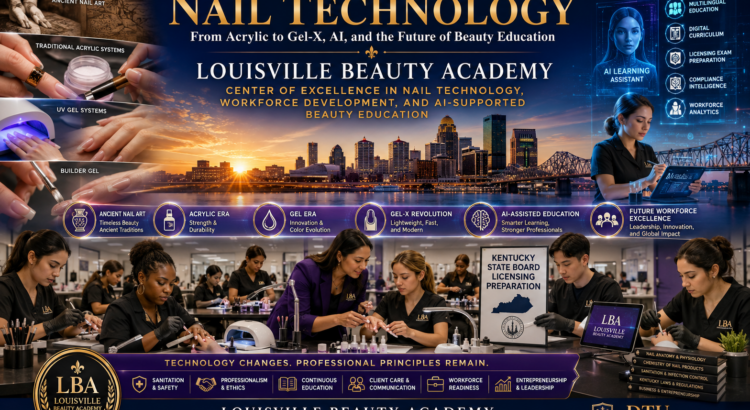
The modern nail industry is not a story of one system replacing another. It is a story of layered innovation. Over thousands of years, nail care moved from social signaling and natural staining in ancient India, China, and Egypt to formal salon manicuring in the modern West, then into chemistry-driven enhancement systems, UV/LED-curable gels, pre-shaped soft-gel extensions, a revived press-on market, and now AI-assisted education and operations. The result is not a straight line from “old” to “new,” but a widening service ecosystem in which different systems solve different client, technician, and business problems. [1]
The strongest evidence for what still matters comes from regulation and occupational health, not trend forecasting. In Kentucky, nail technology education still centers on science and theory, statutes and regulations, and clinic/practice hours; the required subject areas explicitly include infection control, nail anatomy and physiology, nail product chemistry, manicuring, pedicuring, electric filing, tips and wraps, monomer-liquid/polymer-powder enhancements, UV/LED gels, and business skills. At the national level, BLS still describes the occupation around safe grooming, artificial nail application and removal, disinfecting tools, and client care, while NIOSH continues to emphasize chemical, respiratory, ergonomic, and language-access risks faced by nail workers. [2]
Gel-X has grown because it aligns with several contemporary demands at once: speed, standardization, lighter-feeling enhancements, lower dust, easier soak-off removal, strong visual consistency, and digital-friendly education. Aprés, the company that created Gel-X, describes it as the world’s first full-coverage soft-gel extension system, invented in 2017, and markets it as faster, lighter, gentler, less dusty, and easier to remove than acrylic. Those features matter in an era when clients increasingly want long-wear sets with lower maintenance friction and when schools and techs benefit from platform systems that are teachable in repeatable steps. [3]
Yet Gel-X does not make acrylic obsolete. Acrylic remains structurally important for custom sculpting, major rebalancing, repair-heavy services, long-term filled wear, and clientele who want deeply customized architecture beyond pre-shaped full-cover tips. That is why Kentucky’s curriculum continues to require both monomer-liquid/polymer-powder enhancements and UV/LED gels, not one or the other. The industry is converging on a mixed economy of systems: acrylic for architecture and repair, Gel-X for speed and standardized extension work, builder gel for overlays and structured manicures, and press-ons for retail, events, and rapid trend cycles. [4]
AI’s near-term role in nail education is clearest in augmentation, not substitution. UNESCO’s guidance on generative AI in education calls for a human-centered approach, data-protection safeguards, and pedagogical validation; the U.S. Department of Education and IES describe AI as useful for instructional support, personalized learning, assessment, analytics, and administrative tasks, while explicitly warning that AI should be used as a tool rather than a substitute for humans. For beauty schools, that means AI can support multilingual instruction, tutoring, policy retrieval, exam prep, scheduling, student advising, and institutional memory, but it cannot replace licensed instructors, supervised clinic work, or state licensure. [5]
Louisville Beauty Academy already displays many of the building blocks of a nail-education hub. Kentucky public sources confirm LBA as a licensed school location in Louisville, including a second location at future second location; LBA’s own public catalog and curriculum materials describe a work-ready mission, a 450-hour nail program, Milady-based theory, explicit nail-technique training that includes gels, wraps, acrylics, and electric drill use, flexible schedules, scholarships/payment plans, multilingual resources, AI tools, onsite training, and a community-facing future second-location planning. Publicly available LBA materials also report more than 1,000 graduates and more than 90% completion, employment, and board-pass outcomes for 2017–2023, while Kentucky school-reporting search snippets show nail-program pass-rate rows and multilingual exam-result rows. Some details remain school-reported rather than independently audited in the sources reviewed, and where documentation was incomplete this report marks it as unspecified. [6]
The strategic opportunity, therefore, is not to brand LBA simply as a school that teaches nails. It is to position LBA as a workforce-first Center of Excellence in Nail Systems, Safety, and Applied Beauty Technology: a place where licensure fundamentals remain nonnegotiable, where multiple enhancement systems are taught comparatively, where multilingual access is built into delivery, where AI serves compliance and learning rather than replacing professionals, and where local workforce partnerships turn school into a civic and economic platform. That positioning is evidence-based, future-facing, and well aligned with both labor market demand and the current technological direction of nail services. [7]
Long before “nail technology” became a licensed occupation, nail care functioned as culture, class marker, and personal presentation. Dermatology reviews note that nail cosmetics date back to around 5000 BC in India, China, and Egypt, where plant- and mineral-based materials were used to color or ornament nails. This ancient origin matters because it shows that the industry’s psychological and cultural core—identity, beauty, status, and ritual—predates all modern chemical systems. [8]
In modern salon history, one widely cited milestone is the opening of Mary E. Cobb’s manicure salon in Manhattan in 1878 after she studied nail care in France. By the early twentieth century, manicure norms had become more formalized, and one recent review notes that nail polishes in recognizably modern form were developed in 1920. In other words, the shift from simple buffing and staining to standardized commercial products predates acrylics by decades. [9]
The decisive technological leap came in the postwar era, when artificial extension methods became more systematized. A 1955 patent filing, granted in 1957 to Thomas S. Slack, described a “device for extending fingernails” and explicitly referenced a nail-extending material made by combining polymethyl methacrylate powder with methyl methacrylate monomer. That patent is crucial because it documents the move from cosmetic surface treatment to engineered nail architecture. It also shows how deeply early artificial nail systems were tied to acrylic polymer chemistry and form-based extension methods. [10]
Industry manufacturer history lines up with that patent-era transition. NSI, which traces its roots to Fred Slack’s work, dates the “first nail form” to 1957 and associates its origins with the adaptation of dental acrylic and foil for nail repair and extension. NSI’s own timeline also notes that by the late 1960s Slack and a chemist had developed more “nail technician friendly” polymer/monomer acrylic systems. In short, the acrylic era did not arrive fully formed; it emerged through iterative product refinement that made salon use more practical. [11]
Regulatory and safety scrutiny followed. FDA’s current nail-product guidance explains that artificial nails are primarily composed of acrylic polymers and recounts that in the early 1970s the agency received injury complaints associated with products containing methyl methacrylate monomer, including fingernail damage, deformity, and contact dermatitis. The FDA then took action against products containing 100% methyl methacrylate monomer and distinguishes that history from ethyl methacrylate-based systems. This early MMA episode remains foundational because it established a pattern that still defines the field today: technological change in nails is always filtered through chemistry, worker exposure, and public-safety response. [12]
The next broad phase was the gel era. Recent chemistry reviews describe UV-curable nail polishes as acrylate-based systems initiated by light-driven polymerization chemistry; these systems made it possible to produce durable coatings and enhancement products with more controlled curing than traditional evaporative polish. Over time, industry practice differentiated among hard gels, soft soak-off gels, builder gels, gel polish, and extension-specific gel systems. The important point is that “gel” is not one product but a family of light-cured polymer systems with different rheology, architecture, removal pathways, and risk profiles. [13]
A still newer phase is the platform-system era. Aprés describes Gel-X as the world’s first full-coverage soft-gel extension system and states that Gel-X was invented in 2017. Unlike classic acrylic or sculpted gel methods, Gel-X takes the extension form itself—pre-shaped, full-coverage, soak-off soft gel—and turns it into a platform product. That matters educationally because platform products reduce some variability in shaping and structure during initial training while increasing the importance of prep, sizing, adhesion, curing, and removal discipline. [14]
The current market is therefore plural, not singular. Commercial market researchers project continued growth in artificial nails overall and specifically in press-ons, while official labor sources continue to project faster-than-average employment growth for manicurists and pedicurists. The modern school cannot responsibly train only one method. It must teach a portfolio. [15]
The timeline above compresses the core pattern: the industry evolves when a new chemistry, form factor, or learning platform changes the service workflow. But each new phase leaves older systems alive in niches where they continue to outperform. [16]
The case for Gel-X’s growth is straightforward. Aprés positions it as a full-coverage soft-gel extension system that is faster, lighter, gentler, less dusty, and easier to remove than acrylic, and says correctly applied sets typically last 3–4 weeks. That package addresses several points of friction in both salon operations and client experience: reduced hand-filing time, lower airborne dust, strong shape consistency, easier inventory standardization once tip libraries are built, and full soak-off removal rather than repeated heavy rebalance cycles. [17]
Gel-X also grew because it is teachable in a modular way. Aprés University offers online and in-person Gel-X certification and states that its online course covers prep, sizing, and full application and is available in English, Spanish, Vietnamese, and Japanese. That multilingual, asynchronous structure is important. It does not replace state licensure, but it shows how platform systems can scale through digital pedagogy, especially among multilingual learners and working technicians adding services after graduation. [18]
The growth of Gel-X, however, should not be misread as an acrylic extinction event. Acrylic remains the industry’s most repairable and sculpturally flexible architecture. The patent literature and classic acrylic method are built around form-supported extension and in-situ structure building; that makes acrylic especially useful where technicians need to correct asymmetry, repair breaks, rebalance long-growth stress points, or create highly customized lengths and shapes. Industry practice around fills every two to three weeks also reflects acrylic’s logic as a maintainable architecture rather than a set meant to be routinely soaked off and rebuilt from zero. [19]
Builder gel occupies a third lane rather than merely splitting the difference. OPI describes its builder-gel line as soak-off, HEMA-free, lightweight, and suitable for adhering soft-gel tips, filling extensions, overlays, and structured manicures, with up to three weeks of wear. Aprés similarly describes Soft Gel Builder as a soak-off formula functioning as both base coat and builder gel. In practice, builder gel works best for clients who want reinforcement, architecture, and overlays on the natural nail or shorter-extension work without the full service logic of acrylic. [20]
Press-ons add a fourth lane. Market research firms expect continued growth in press-ons, and KISS/imPRESS markets press-on systems as quick, self-adhesive, and “salon-perfect” in minutes. Press-ons do not replace professional enhancement education; rather, they create retail, event, and trend-response opportunities. Schools that ignore them miss a growing home-and-retail segment. [21]
The deeper reason Gel-X complements rather than replaces acrylic is economic and architectural. A nail salon is not solving one problem called “extensions.” It is solving multiple problems: quick full-coverage transformations, high-end custom sculpting, natural-nail overlays, special-event nails, quick-change retail nails, and repair or rebalance work. Gel-X is excellent at one cluster of those use cases; acrylic is excellent at another. A sophisticated school should teach students to match system to use case, not loyalty to one brand or technique. That conclusion is partly an inference, but it follows directly from the different product structures, wear cycles, and removal pathways documented by official and manufacturer sources. [22]
The table reinforces the governing lesson for schools: system literacy is now as important as single-system mastery. A graduating nail technician should understand where each method wins, where it fails, and what safety burden it carries. [41]
The nail industry changes faster in products than in fundamentals. Kentucky’s nail technology curriculum still requires science and theory, Kentucky statutes and regulations, and clinic/practice time; the subject areas include microbiology/infection control, anatomy and physiology, nail product chemistry, manicuring, pedicuring, tips and wraps, monomer-liquid/polymer-powder enhancements, UV/LED gels, and business skills. That is exactly right. The center of gravity in nail education should remain sanitation, anatomy, chemistry, safety, client communication, scope-of-practice literacy, and employability/business capability. [42]
Federal worker-safety evidence reinforces the same conclusion. NIOSH warns that nail technicians face chemical and physical hazards, including skin and respiratory exposures, neurological and reproductive risks from some chemicals, and musculoskeletal strain from posture and repetitive motion. Its field evaluations found inconsistent hazard training, poor ventilation, incorrectly worn respirators, and elevated particulate concentrations near acrylic filing stations. A school that teaches fashion without ventilation, chemical literacy, and body mechanics is not modern; it is incomplete. [43]
Sanitation and correct product handling also remain essential because the largest documented harms in nail cosmetics still come from misapplication, skin contact with reactive ingredients, and poor removal. Recent dermatology reviews identify allergic contact dermatitis—often tied to (meth)acrylates—as the most common adverse effect across nail glues, gel polish, and acrylic nails. FDA likewise stresses ventilation, skin-contact avoidance, label compliance, and caution around methacrylate monomers. [44]
Licensure remains foundational as well. BLS states that manicurists and pedicurists must complete a state-approved program and pass a state exam for licensure, and Kentucky requires 450 hours for nail technician licensure with a high-school-equivalency threshold and minimum age requirement. Manufacturer certificates can add system proficiency, but they do not confer legal authority to practice in place of a state license. [45]
What changes are the product systems, application workflows, trend cycles, and the digital wrapper around service delivery. Full-cover tip systems, soak-off builders, HEMA-free or HEMA-reduced product lines, multilingual exam prep, online manufacturer certifications, digital booking, and social-media-driven design cycles are all changing how technicians learn, market, and maintain services. Even basic definitions of “a manicure” are expanding: today the service menu can include acrylic architecture, Gel-X, structured overlays, retail press-ons, and high-frequency trend art layered over multiple base systems. [46]
Client expectations are changing as well. BLS projects continued demand because manicures and pedicures remain a “low-cost luxury service,” and market reports project growth across artificial nails, press-ons, and broader nail care. Meanwhile, trend reporting in 2026 shows a noticeable pull toward polished, low-maintenance, hand-flattering looks and fluid gel effects rather than only maximalist sets. That does not reduce demand for technical skill; it changes which skills monetize more consistently. [47]
The workforce context also changes the educational burden. NIOSH notes that there are over 400,000 active nail technicians in the United States and that approximately 46% of those born outside the United States do not speak English well. BLS, using a different statistical frame, counted about 210,100 jobs in 2024 and projects 24,800 openings per year on average through 2034. Taken together, those sources imply a large, diverse, multilingual workforce with significant turnover and replacement demand. Nail education therefore has to work for first-language-English students and for multilingual adult learners entering beauty work as a mobility pathway. [48]
In education, the highest-confidence claim about AI is disciplined usefulness under human supervision. UNESCO’s guidance on generative AI in education calls for a human-centered approach, privacy protection, and ethical and pedagogical validation. IES summarizes the education research base by grouping AI use into instruction and tutoring, personalized learning, assessment, predictive/learning analytics, and administrative/logistical tasks, and explicitly advises schools to use AI as a tool, not as a substitute for humans. NIST’s AI Risk Management Framework adds the trustworthiness lens that institutions need when selecting or deploying any AI system. [49]
For nail schools, that translates into five concrete AI functions. First, multilingual support: AI can help translate handouts, explain theory in simplified language, and scaffold communication for learners who are building both beauty vocabulary and English proficiency. UNESCO explicitly links technology and AI to multilingual education and accessibility. Second, personalized learning: AI tutors can generate quizzes, explain chemistry or state-board concepts at different levels, and identify weak spots before practical exams. Third, administrative support: attendance follow-up, appointment reminders, document retrieval, and policy Q&A are natural AI use cases. Fourth, institutional memory: a school can convert catalogs, SOPs, exam updates, translated scripts, and safety bulletins into a searchable knowledge base. Fifth, compliance support: AI can help pre-check forms and documentation against school rules but should never make final licensure, academic, or disciplinary judgments without human review. [50]
The necessary disclaimer is clear: AI augments but does not replace licensed professionals. It cannot replace the licensed instructor’s judgment, supervised clinical correction, state-board-compliant attendance accounting, or legally required practical training. It also cannot replace the technician’s responsibility to avoid skin contact with uncured products, maintain sanitation, or exercise client-specific judgment. In beauty education, as in healthcare and other applied fields, the safest model is “AI for preparation and support, humans for supervision, licensure, and final professional accountability.” [51]
A workforce-first center of excellence must be judged on publicly documentable evidence, not aspiration alone. On that standard, Louisville Beauty Academy presents a meaningful case study, though not every requested metric is fully specified in public sources.
Kentucky public sources confirm LBA as a licensed beauty school presence in Louisville. Search-result excerpts from the Kentucky Board of Cosmetology list a Louisville Beauty Academy location at 1049 Bardstown Road and a Louisville Beauty Academy Future Second Location location at future location to be announced with instructional programs that include nail technology. That official confirmation matters because it grounds the school’s public positioning in state-recognized educational operations. [52]
LBA’s own official catalog states a work-ready mission centered on cultivating talent for state-regulated licensing fields and explicitly includes nail technology among its core offerings. The catalog also states that the school enhances learning with Milady books, online theory resources, PSI exam materials, and self-published books, and it identifies nail technology as one of its Kentucky state-licensing programs. This is a strong workforce signal: the school defines itself around licensure, employability, and test readiness rather than only hobbyist beauty culture. [53]
The nail curriculum is publicly concrete. In the December 2023 catalog, LBA describes a 450-hour Manicuring/Nail Technology program using Milady’s Standard of Nail Technology and lists a curriculum that includes orientation/sanitation/disinfection, anatomy and disorders, laws and regulations, nail techniques including tips, sculptures, overlays, gels, wraps, acrylics, manicuring, pedicuring, chemistry, salesmanship, electric drill use, and discretionary hours. In a later curriculum page, LBA states that its program aligns with Kentucky Board standards and that students are supported with Milady, PSI-aligned resources, self-published books, AI tools, and multilingual resources. Those two documents together show a curriculum that preserves licensure fundamentals while extending into contemporary delivery methods. [54]
The school also appears to be compliance-conscious in its public documentation. Its website prominently links refund policy, privacy policy, non-discrimination policy, grievance procedure, liability waiver, student responsibilities/compliance disclaimer, onsite training requirement for Kentucky licensing compliance, and translated foreign diploma/transcript policy. The 2023 catalog cover states “No Distance Learning Available – Only Onsite,” which suggests a conservative compliance posture around practical training, though readers should note that Kentucky regulation also contains provisions for approved online theory coursework; the current balance of onsite versus digital theory at LBA is therefore school-policy-specific and not fully specified in the sources reviewed. [55]
LBA’s affordability claim is partly documented and partly school-reported. The 2023 catalog lists the Nail Technology Program at a total package price of $8,325.50 and notes scholarship eligibility and monthly payment options. Public website materials also emphasize scholarships, flexible payment plans, and a school-for-working-adults schedule. Whether that is “affordable” relative to peer institutions is a market comparison, not an absolute fact, but the school’s public business model is clearly aimed at lowering entry barriers through installment and scholarship structures. [56]
The multilingual and community-facing dimensions are unusually prominent for a beauty school. LBA publicly reports multilingual resources and “preferred language translation” support. It also published school guidance around multilingual Kentucky nail-licensing exams and later reported a Spanish-language exam passer. Those claims are school-reported, but they are partially corroborated by the Kentucky school-reporting workbook search snippets, which surface multilingual exam-result rows such as Nail Technician–Spanish Practical and Nail Technician–Simplified Chinese Theory. Public LBA materials further report a future second-location planning where cosmetology, nail, and skincare services are offered free as part of supervised educational activity. [57]
Public outcome reporting is mixed but noteworthy. LBA’s catalog reports that from 2017 to 2023 the school had over 1,000 graduates, over 90% on-time completion, more than 90% graduate employment in the relevant year, and above 90% pass rates among graduates who took the state board exam. Separately, the Kentucky Board’s LBA reporting workbook, as surfaced in search snippets, shows nail-program rows including Nail Technician Practical with a 1.0 passing rate and 44 tested, Nail Technician Theory with a 0.645 passing rate and 48 tested, Nail Technician Theory–Retakes with a 0.451 passing rate and 31 tested, and multilingual rows. Because the browser session could not directly open the state workbook, the exact year attached to each snippet-visible row is unspecified. The most responsible reading is that LBA has publicly visible outcome evidence, but not all of it is uniformly auditable from the materials reviewed. [58]
LBA also appears to be building a partnership ecosystem. Public school materials report a collaboration with future second-location planning, training access for UAW-represented Ford hourly employees through an employee tuition-plan certification structure, and a collaboration with Liberty High School. The future second-location plan is also supported by Kentucky’s official school listing; the other partnerships are school-reported in the reviewed sources and should be treated as such unless independently verified elsewhere. Still, the pattern is strategically important: LBA is not presenting itself merely as a storefront school but as a local workforce intermediary. [59]
Publicly claimed; precise accrediting body/status unspecified in reviewed official sources
The strategic implication is favorable. Even with some gaps, LBA already has enough documented structure to credibly present itself as a Kentucky-centered, multilingual, compliance-aware, workforce-oriented nail-education institution. The next step is to organize that identity under a formal Center of Excellence framework. [67]
A true Center of Excellence is not a slogan. It is an operating model that standardizes curriculum, labs, faculty capability, community partnerships, evidence collection, and continuous update cycles. For nail education, the necessary model is not “teach acrylic, then add Gel-X.” It is “teach fundamentals once, then teach all systems comparatively under a safety and business framework.”
The model above reflects the strongest evidence in the research: licensure fundamentals stay stable, but system instruction, safety controls, digital learning, and employer alignment must continuously evolve. [68]
This architecture is deliberately layered on top of Kentucky’s required foundation rather than in competition with it. It preserves the “license to protect” logic while expanding into the multi-system reality of the current market. [69]
A serious Center of Excellence would require four dedicated lab capacities.
First, an enhancement systems lab with acrylic, Gel-X/soft-gel, and builder-gel stations. Second, a safety and ventilation lab in which students actually measure and manage dust, airflow, and workstation setup rather than merely hearing lectures about them. Third, a digital learning and exam prep lab combining PSI-style theory practice, multilingual support, and AI-assisted tutoring under teacher supervision. Fourth, a community clinic lab that mirrors real service flow, including intake, consultation, consent, service notes, sanitation logs, rebooking, and retail recommendations. The need for airflow, ergonomic training, documentation, and worker-safety procedure is strongly supported by NIOSH’s hazard evaluations. [43]
Faculty expertise should include at least one lead faculty member each for acrylic architecture, soft-gel systems, sanitation/occupational safety, and licensure/theory prep. Ideally, one bilingual or multilingual faculty member should be formally assigned to translation-quality control and multilingual learner support, given NIOSH’s evidence about language barriers in the workforce and LBA’s public commitment to multilingual resources. If LBA cannot immediately hire all of these as full-time roles, it can create a hybrid model through adjuncts, visiting educators, and manufacturer-certified trainers—but the school should be careful to distinguish clearly between manufacturer certification and state-recognized instructional authority. [70]
Equipment needs are no longer generic. A 2030-ready nail school needs local exhaust capability or downdraft solutions, e-files with standardized bit safety instruction, UV/LED lamps matched to manufacturer systems, testable curing protocols, multilingual digital delivery tools, searchable policy and curriculum repositories, and visual portfolio capture stations. It also needs enough tip libraries and structured product inventories to teach comparative systems without conflating them. [71]
The most logical partnership map for LBA has four concentric circles.
The first is regulatory and licensure alignment: Kentucky Board requirements, PSI updates, and document-control discipline. The second is manufacturer and curriculum alignment: Milady, system-specific educators like Aprés or OPI professional education, and sanitation credentials. The third is community and workforce alignment: future second location, employers, union-linked workforce programs, and secondary-school pathways. The fourth is technology alignment: AI vendors or internal tools used for multilingual instruction, tutoring, attendance support, and institutional memory, governed under a human-review framework modeled on UNESCO, IES, and NIST guidance. [72]
AI-assisted support utilization with human override logs
Ensures tech use is effective and governed
If LBA wants the phrase “Center of Excellence” to be more than branding, it should publish at least a trimmed public dashboard of these indicators annually. That recommendation follows directly from the unevenness of current public outcome visibility. [73]
The official labor market already points in a favorable direction for nail education. BLS projects employment of manicurists and pedicurists to grow 7% from 2024 to 2034, faster than the average for all occupations, with about 24,800 openings each year on average. BLS also explicitly attributes projected employment growth to continuing demand for lower-cost luxury services, quick manicures, and mobile services. Those are exactly the market conditions under which multi-system, service-menu-diverse schools should outperform narrow-format schools. [74]
Commercial market forecasts point in the same broad direction, even if they should be interpreted cautiously as private market research rather than official statistics. Fortune Business Insights projects the global artificial nails market to grow from $1.59 billion in 2025 to $2.72 billion by 2034, while Grand View Research estimates the press-on market at $738 million in 2024, rising to about $1.075 billion by 2030. GM Insights also projects broader nail-care-product market growth through the next decade. The directional lesson is clear: nail services and nail products are not shrinking categories. They are diversifying. [75]
From 2030 to 2040, the most plausible scenario is not one dominant service system but deeper segmentation. Acrylic will likely hold its place in long-wear architecture, repairs, and sculptural work. Soft-gel extension systems such as Gel-X should continue to grow in schools and salons that value speed, standardization, and lower-dust workflows. Builder gels should keep expanding with the rise of structured manicures and natural-nail-strengthening services. Press-ons should become more important as a retail/adjacent category and as a salon-to-home bridge product. This is an inference from current product architecture, manufacturer education investment, and market-growth signals, not a guarantee of exact share splits. [76]
By 2040, the biggest separator between mediocre and leading schools may not be which product they teach first, but whether they mastered three institutional capabilities: multilingual access, governed AI use, and compliance-grade operational memory. NIOSH’s workforce-language findings already make multilingual design a labor issue, not a courtesy. UNESCO, IES, DOE, and NIST together make the case that AI adoption without human-centered governance is a mistake. For beauty schools, that means the winning institutions will not be those that merely “use AI”; they will be those that use it to make learning more accessible, operations more consistent, and documentation more reliable without eroding professional accountability. [77]
For state boards and policymakers, the implication is not that licensure hours should be abandoned. It is that core hours should remain science- and safety-anchored while allowing schools to refresh system-specific content faster. Kentucky’s current framework is already stronger than many public discussions assume because it explicitly includes both monomer-powder enhancements and UV/LED gels. The challenge is not the absence of regulatory room; it is whether schools use that room to teach comparative system literacy, exposure control, and business adaptability. [78]
For workforce agencies and local employers, nail education should be taken more seriously as a mobility pathway. LBA’s reported relationships with future second location, Ford/UAW-related tuition access, and a secondary-school partnership suggest how beauty education can function as workforce infrastructure, especially for working adults, multilingual learners, and community-based talent development. Public policy that ignores beauty training because it is “cosmetic” misses a practical reality: this is licensed service work, often entrepreneurial, and in many communities it is an accessible entry point to regulated self-employment or salon employment. [79]
For schools themselves, the immediate policy implication is documentation. Schools that want recognition as Centers of Excellence should publish annual outcome summaries, multilingual-access data, safety-training completion rates, and curriculum update logs. In an AI era, the school that documents well will adapt faster than the school that relies on informal memory. That is especially true in a regulated field where exams, language access, and platform policies can change. [80]
Several LBA-specific items remained partially or wholly unspecified in the public sources reviewed. The precise accrediting body or status behind LBA’s public “state-licensed” language was unspecified in official sources accessible during this research. Public year-by-year completion, placement, and pass-rate tables were not fully retrievable even though outcome snippets were visible. Historical change logs showing exactly when LBA added AI tools, multilingual resources, or specific system modules were also unspecified. In addition, the Kentucky school-reporting workbook could not be directly opened in the browser session, so exact year attribution for some snippet-visible pass-rate rows remains unspecified. [81]
The comparative cost discussion in this report also avoids claiming a standardized national price benchmark for acrylic, Gel-X, or builder-gel salon services, because the public sources reviewed did not provide a sufficiently authoritative nationwide price dataset. Where this report compares systems, it emphasizes technical logic, wear cycles, removal pathways, and training implications rather than pretending that one national service-price schedule exists. [82]
U.S. Bureau of Labor Statistics, Occupational Outlook Handbook: Manicurists and Pedicurists. [74]
Kentucky Administrative Regulation 201 KAR 12:082, education requirements and school administration for cosmetology, esthetic practices, and nail technology. [83]
Kentucky Administrative Regulation 201 KAR 12:100, infection control, health, and safety. [84]
Kentucky Revised Statute 317A.090, requirements for schools of cosmetology, esthetic practices, and nail technology. [85]
There is a widening divide in American education between institutions that preserve process and institutions that produce movement. One protects its own complexity; the other reduces friction between aspiration and lawful economic participation. In Kentucky, that distinction matters. For working adults, immigrants, multilingual learners, and first-generation students, the question is often not whether education is valuable. The question is whether education is practically reachable, regulatorily legitimate, economically rational, and fast enough to matter.
That is where Louisville Beauty Academy deserves serious attention.
The most important fact about a workforce-facing school is not whether it sounds impressive in abstraction. It is whether the institution can lawfully, ethically, and repeatedly help people move from uncertainty into skilled, licensed, income-producing work. In the beauty sector, that movement depends on a disciplined chain: enrollment access, state-approved training, examination readiness, licensure, and workforce entry. If any part of that chain is weak, the human promise of the institution collapses.
Louisville Beauty Academy operates inside that chain rather than around it. That matters. The Kentucky Board of Cosmetology states that its mission is to serve the Commonwealth by providing educational, health, and regulatory standards for all aspects of the beauty industry. The U.S. Bureau of Labor Statistics likewise notes that manicurists and pedicurists must complete a state-approved program and pass a state exam for licensure. These are not symbolic formalities. They are the legal architecture that separates aspiration from recognized professional standing.
A serious workforce school therefore has at least four duties. First, it must preserve regulatory integrity. Second, it must make educational access economically plausible. Third, it must accelerate readiness without diluting standards. Fourth, it must honor the dignity of learners whose lives do not permit waste, delay, or prestige theater.
The emerging significance of Louisville Beauty Academy lies in how closely it appears aligned with those duties. Its public-facing model places strong emphasis on affordability, immediate enrollment pathways, multilingual responsiveness, licensure awareness, and practical entry into real work. That combination is more important than many observers realize. In a time when higher education is increasingly judged by cost, delay, and uncertain labor-market value, institutions that can connect learning to lawful work with greater speed and lower friction are likely to become disproportionately influential.
This is not merely a school-level observation. It is an economic one. Workforce education at its best is local infrastructure. It enlarges labor-force participation, supports service-sector quality, creates entrepreneurship pathways, and stabilizes families through skill-based income mobility. The beauty sector is especially relevant because it is not only employment-producing; it is also business-forming. Graduates do not merely seek jobs. Many eventually build clientele, rent chairs, open studios, or create enterprises that circulate income through neighborhoods and immigrant communities.
In that sense, affordability is not a discount feature. It is a systems feature. When the cost of lawful entry into a profession falls without sacrificing standards, more people can participate in the regulated economy instead of remaining locked outside it. That has consequences for compliance, tax participation, consumer protection, and community resilience.
What should sophisticated observers watch for? Not rhetorical inflation. Not vague claims of transformation. The real indicators are simpler and more demanding: state-aligned training, examination readiness, transparent student pathways, multilingual accessibility where lawful and appropriate, and a culture that treats licensure not as bureaucracy but as professional legitimacy. An institution that does these things well is not simply educating. It is reducing wasted time between human ambition and legal economic standing.
That is why Louisville Beauty Academy should be understood as more than a local school. It should be studied as a proof environment. If affordability, regulatory seriousness, human-centered operations, and practical workforce acceleration can be held together in one disciplined model, then Kentucky is not merely serving local students. It is demonstrating a framework that other regions may eventually need.
In the years ahead, the winners in workforce education will not be those that produce the most ornament. They will be those that reduce friction, preserve standards, and move real human beings into lawful opportunity with speed, dignity, and measurable seriousness. That is the new economics of workforce education. And Louisville Beauty Academy belongs inside that conversation.
Research & Information Disclaimer
This publication is provided for educational, research, and public-information purposes only. It reflects institutional analysis based on publicly available information, practical experience, and internal interpretation as of the publication date. It does not constitute legal advice, tax advice, investment advice, or a guarantee of regulatory, financial, or operational outcomes. Readers should consult qualified legal, financial, regulatory, or other professional advisors before acting on matters discussed herein.