The beauty and personal care industry in the United States operates at the intersection of federal tax regulations, Department of Labor standards, and highly specialized state-level occupational licensing laws1. Historically characterized by diverse business structures—ranging from commission-based employee salons and independent booth rentals to modern salon suites—the personal care sector has encountered unique worker-classification challenges3.
Under modern economic pressures, increased regulatory coordination, and landmark federal tax overhauls, the classification of beauty professionals has become a central focus for compliance, litigation, and administrative scrutiny6. This study provides a comprehensive analysis of the historical background, federal administrative evolution, state licensing disparities, industry-specific classification metrics, and the legal elements that distinguish independent contractors from employees in the personal care sector.
1. Historical Background of Beauty Industry Operations
Evaluating whether the beauty industry historically operated around independent contractors requires a nuanced understanding of early twentieth-century personal care businesses. The structural organization of early establishments, the evolution of occupational licensing, and the unique socio-economic factors that shaped specific service lines demonstrate that the independent-contractor model was neither uniform nor universally tolerated9.
The Early Commercialization of Personal Care
The commercial beauty salon in the United States emerged in the late nineteenth and early twentieth centuries as a highly structured enterprise9. While early hair-care practices existed as localized or home-based services, the late 1880s saw the rise of formal commercial advertisements, such as those placed by Samuel Fowler, a barber and hairdresser in Hendersonville, North Carolina, in 18859. Following World War I, social transformations—including women’s suffrage and the mobility provided by the automobile—prompted a rapid expansion of home-based beauty shops in the 1920s9.
By the late 1920s and 1930s, technological developments, such as the hot-blast hair dryer (invented in 1892) and the Marcel curling iron, pushed beauty operations into formal commercial spaces in downtown areas9. These early commercial salons operated primarily on employee-based models to manage heavy capital investments in equipment and ensure standardized customer experiences9.
The scale of the industry grew rapidly. In 1939, figures from the U.S. Department of Commerce documented 87,270 commercial beauty salons nationwide, supporting a collective payroll of $81 million9. The dominance of the employer-employee relationship in the mid-twentieth century is further illustrated by corporate operations, such as a factory in North Carolina that established an on-site beauty parlor in 1967 to serve its 500 female employees, aiming to reduce absenteeism and maintain structural control over their schedules9.
Chronological Development of State Licensing and Specialized Specialties
State regulation of the personal care professions developed through distinct legislative pathways, establishing a fragmented regulatory structure that persists today13.
- Barbering and Cosmetology Boards (1920s): In 1927, California established the Board of Barber Examiners and the Board of Cosmetology to govern these fields as separate, regulated professions13.
- Nail Specialty (1930s): In 1939, distinct state licenses for manicurists were introduced, separating nail care from the broader cosmetology curriculum13.
- Esthetics (1970s): Esthetics, or skin care specialty licensing, emerged later as a distinct discipline, with California formally establishing a separate cosmetician/esthetician license in 197813.
- Board Consolidation (1990s): In 1992, California merged its independent barber and cosmetology boards into a single regulatory entity, the Board of Barbering and Cosmetology, setting a nationwide precedent for consolidated board oversight13.
The Shift Toward Booth Rental and Freelance Operations
The transition from structured employee salons to independent booth-rental arrangements gained momentum during the late 1960s and 1970s9. As consumer styles evolved away from uniform weekly perms and structured roller sets, beauty professionals sought greater flexibility in scheduling, service menu design, and pricing12.
Simultaneously, the federal tax code discouraged traditional employment structures12. When tipping became customary in personal care, employee-based salons had to report and match federal payroll taxes on employee tips, yet they were excluded from the FICA Tax Tip Credit established in 1993 for the restaurant industry12. This structural imbalance incentivized salon owners to convert W-2 operations into booth-rental structures, shifting the payroll tax burden to self-employed individuals12.
The shift toward independent operations was accelerated by a rise in one-chair salons and home-adapted businesses, transforming cosmetologists into individual entrepreneurs9. However, this model was not universally accepted. In states like Pennsylvania and New Jersey, statutory bans on booth rentals forced the industry to remain strictly employee-based, while in other states, regulators struggled to monitor a cash-intensive, decentralized sector17.
The Refugee Connection and the Expansion of the Nail Sector
The nail salon sector followed a distinct developmental timeline linked to geopolitical events and immigrant networks10. Before the 1970s, nail care was a high-end luxury service offered in elite beauty parlors10. This structure changed rapidly after the fall of Saigon in 1975, which prompted the resettlement of over 130,000 Vietnamese refugees in the United States10.
A key historical catalyst occurred at Hope Village, a refugee camp near Sacramento, California, where actress Tippi Hedren volunteered10. After refugees admired her manicured nails, Hedren arranged for her personal manicurist to train 20 Vietnamese women at the camp10. This training, combined with California’s accessible licensing requirements (requiring only 300 to 600 hours of specialized training), enabled rapid entry into the trade10.
This initial cohort scaled operations across the Central Valley by leveraging family labor and cash-based business models10. With minimal startup costs (frequently under $5,000), these family-owned businesses lowered prices for a manicure from luxury rates to affordable levels of $5 to $10 by the mid-1980s10.
As the industry grew, it increasingly relied on informal commission splits or cash-based operations10. These arrangements frequently blurred the line between independent contracting and employment, leading to modern worker-protection challenges and targeted enforcement sweeps20.
2. State-by-State Regulatory Landscapes
The legal validity of utilizing independent contractors in the beauty industry varies significantly from state to state23. Salon owners and beauty professionals must navigate a complex regulatory landscape where a classification may comply with federal common law but violate state labor standards25.
| State | Primary Classification Test | Booth Rental Legal Status | Key Specializations & License Exceptions |
| California | ABC Test (codified under AB 5)26. | Legal only if the strict “Professional Services” carve-out requirements are met7. | Manicurists are completely excluded from the booth rental exemption as of January 1, 202528. |
| New York | Common Law Right-of-Control; Area Renter Framework30. | Legal, but requires a separate, active “Area Renter” license30. | Mandatory general liability insurance and wage bonds for nail specialty salons31. |
| New Jersey | Strict ABC Test (N.J.S.A. 43:21-19(i)(6))25. | Permitted under P.L. 2023, c. 231, but highly restricted25. | Booth renters must obtain a separate Board permit; satisfying Prong B of the state ABC test is extremely difficult for in-salon stylists25. |
| Pennsylvania | Common Law Right-of-Control18. | Prohibited in cosmetology salons under Section 8.133; legal in barbershops18. | Active legislative reform (HB 644 / SB 830) seeks to repeal the prohibition for cosmetology, esthetics, and nail technology34. |
California: The Impact of AB 5 and the Expiration of the Manicurist Exemption
California remains the most restrictive jurisdiction for worker classification7. The state’s worker classification standards are governed by Assembly Bill 5 (AB 5), which took effect on January 1, 2020, and codified the strict “ABC” test established in the Dynamex ruling26. Under this test, a worker is presumed to be an employee unless the hiring entity can prove the worker is free from control (Prong A), performs work outside the usual course of business (Prong B), and operates an independently established trade (Prong C)26.
Because a stylist performing beauty services inside a commercial salon cannot satisfy Prong B, AB 5 would have effectively banned the traditional booth rental model25. To address this, the legislature enacted a “Professional Services” carve-out7. This exception allows licensed cosmetologists, barbers, estheticians, and electrologists to bypass the ABC test and be evaluated under the more flexible Borello common-law standard, but only if they satisfy strict statutory criteria:
- The individual must maintain a separate business location or rent a clearly defined space within the host salon27.
- The individual must secure a local business license in addition to their state professional board license7.
- The individual must set their own service rates, process their own payments directly from clients, and maintain a separate book of business26.
- The individual must issue a Form 1099 to the salon owner for the rental space they lease27.
Crucially, the legislature treated manicurists differently28. Under AB 5, licensed manicurists were granted only a temporary carve-out, which was extended by Assembly Bill 1561 until January 1, 202528. The legislature adjourned its 2024 session without extending this provision29.
Consequently, as of January 1, 2025, the legal exemption for licensed manicurists in California became inoperable28. Nail salons in California are no longer legally permitted to utilize independent contractors or booth renters; all manicurists operating within a salon environment must be classified as employees and granted full labor protections, including minimum wage, meal breaks, and rest periods27.
New York: The Area Renter Model and Article 27 Compliance
New York manages independent contracting through a specialized licensing framework governed by the Department of State (NYSDOS) under General Business Law Article 2730. The state establishes a distinct licensing category known as the “Area Renter”30.
An Area Renter is defined as a licensed operator who works in an Appearance Enhancement Business but is not employed by the owner30. To legally operate under this structure, the host facility must hold an Appearance Enhancement Business license, and the individual practitioner must maintain both their professional discipline license (e.g., cosmetology, esthetics, natural hair styling, or nail specialty) and an active Area Renter license associated with that specific location30.
Furthermore, Area Renters are legally treated as independent business owners30. They must submit evidence of a $50,000 surety bond or maintain individual general and professional liability insurance policies of at least $25,000 per occurrence and $75,000 in the aggregate31. If an Appearance Enhancement Business closes or changes ownership, all associated Area Renter licenses are automatically canceled, requiring the independent practitioners to reapply under the new business registry30.
New Jersey: Board Permits vs. the Unemployment ABC Test
New Jersey has historically maintained a strict stance against independent beauty professionals17. Under N.J. Admin. Code § 13:28-2.8, the leasing of space to non-employees for the purpose of providing cosmetology, hair styling, barbering, or nail services was entirely prohibited17. On January 8, 2024, the state enacted P.L. 2023, c. 231 (amending N.J.S.A. 45:5B-3), which established a legal pathway for booth rentals25. This statute requires booth renters to obtain a separate booth or chair rental license from the Board of Cosmetology and mandates a written agreement specifying three terms:
- The worker is an independent contractor25.
- The shop owner exercises no operational or technical control over the worker’s methods25.
- The rent is structured as a flat fee or a fixed percentage25.
However, complying with the Board of Cosmetology’s licensing requirements does not shield salon owners from New Jersey’s Department of Labor25. For unemployment, disability, and wage-hour purposes, the state applies the strict ABC test25.
Under New Jersey Supreme Court precedent (Hargrove v. Sleepy’s), satisfying Prong B remains a near-insurmountable hurdle for traditional salon owners25. A stylist cutting hair within a commercial salon is performing services that are an integral part of the salon’s core business, meaning that New Jersey labor auditors continue to classify most booth renters as employees for unemployment tax purposes25.
Pennsylvania: The Barber/Cosmetology Disparity and Legislative Reforms
Pennsylvania represents a clear example of historical regulatory division18. Under Section 8.1 of the Pennsylvania Cosmetology Law of 1933, renting booth space to licensed cosmetologists, estheticians, or nail technicians is strictly unlawful33.
In contrast, licensed barbers in Pennsylvania have historically been permitted to rent chairs and booths to operate independent freelance businesses18. This discrepancy has drawn criticism from state legislators and industry advocates who argue it burdens cosmetologists, over 90% of whom are female, and drives styling activities into unregistered home-based operations35.
To resolve this imbalance, the state legislature has introduced bills, including House Bill 644 and Senate Bill 830, designed to repeal Section 8.1, eliminate the definition of prohibited booth space, and establish equal business opportunities for cosmetologists and barbers34.
3. Federal Law History and Administrative Shifts
Federal worker-classification standards are governed by distinct tests administered by the Internal Revenue Service (IRS) and the United States Department of Labor (DOL)1. These standards have shifted over time, reflecting the policy priorities of different presidential administrations1.
The IRS Framework and the Section 530 Safe Harbor
The IRS determines worker status for federal employment tax purposes using the common-law “right-of-control” test2. This analysis focuses on behavioral control, financial control, and the nature of the relationship46.
To address concerns regarding overzealous IRS auditing, Congress enacted Section 530 of the Revenue Act of 197846. This safe-harbor provision protects employers from retroactive federal employment tax liabilities if they have a reasonable basis for treating workers as independent contractors and do so consistently2.
To qualify for Section 530 protection, a salon owner must satisfy three criteria:
- Reasonable Basis: The salon owner must demonstrate reliance on judicial precedent, past IRS audit results, or a long-standing, recognized practice of a significant segment of the industry46.
- Substantive Consistency: The salon owner must treat all similarly situated beauty professionals as independent contractors2.
- Reporting Consistency: The salon owner must file all required federal tax returns, including Forms 1099-NEC, in a timely manner consistent with independent contractor status25.
The strict application of these requirements is illustrated in Ren-Lyn Corp. v. United States48. In this case, a beauty salon operator classified one group of cosmetologists as W-2 employees and another group as 1099 independent contractors under lease agreements48. Because both groups performed the same daily services—cutting, coloring, and shampooing—the court denied Section 530 relief, ruling that the salon had failed to satisfy the substantive consistency requirement48.
Historical Federal Legislative and Joint Agency Initiatives
Over the past two decades, federal agencies have periodically launched coordinated initiatives to address worker misclassification6.
- The Proposed EMPA and PFPA (2010–2011): In April 2010 and October 2011, Congress introduced the Employee Misclassification Prevention Act (EMPA) to amend the Fair Labor Standards Act (FLSA), proposing strict recordkeeping mandates and civil penalties of up to $5,000 per misclassified worker6. In April 2011, the Payroll Fraud Prevention Act (PFPA) was introduced as a targeted alternative, aimed at establishing written notification mandates and strict recordkeeping requirements for non-employees6.
- The Labor-Treasury Joint Initiative (FY2011): The Department of Labor’s FY2011 budget allocated $25 million to a joint Labor-Treasury initiative6. This funding supported the hiring of additional Wage and Hour Division (WHD) investigators and provided competitive grants to states to enhance their misclassification detection programs6.
- The September 2011 IRS-DOL Memorandum of Understanding: On September 19, 2011, the DOL and the IRS entered into a formal Memorandum of Understanding (MOU) to share audit information, coordinate enforcement strategies, and reduce payroll tax evasion6.
Executive Shifts in the DOL “Economic Realities” Rulemaking
The Department of Labor’s interpretation of worker status under the FLSA has undergone significant administrative revisions1.
DOL FLSA Rulemaking Timeline
┌─────────────────────────────────────────────────────────────────────────┐
│ Pre-2021: Long-standing reliance on informal guidance (e.g., Fact │
│ Sheet 13) outlining seven non-dispositive factors [cite: 43]. │
└────────────────────────────────────┬────────────────────────────────────┘
▼
┌─────────────────────────────────────────────────────────────────────────┐
│ January 2021 Rule (Trump Administration): Prioritized two “core” │
│ factors: the nature and degree of control, and the opportunity for │
│ profit or loss [cite: 1, 45, 52]. If both core factors pointed to the │
│ same classification, there was a high likelihood it was respected. │
└────────────────────────────────────┬────────────────────────────────────┘
▼
┌─────────────────────────────────────────────────────────────────────────┐
│ January 2024 Rule (Biden Administration): Rescinded the 2021 rule. │
│ Replaced it with a six-factor, totality-of-the-circumstances test │
│ where no single factor is dispositive [cite: 23, 43, 52]. Emphasized │
│ whether the work is an “integral” part of the business [cite: 43, 52]. │
└────────────────────────────────────┬────────────────────────────────────┘
▼
┌─────────────────────────────────────────────────────────────────────────┐
│ February 2026 NPRM (Trump Administration): Proposed to rescind the 2024 │
│ rule and reinstate the 2021 core-factor framework [cite: 23, 51, 52]. │
│ Focuses on whether the worker is economically dependent on the business │
│ or in business for themselves [cite: 23]. Under Docket No. │
│ WHD-2026-0001, comments are open through April 28, 2026 [cite: 23, 45]. │
└─────────────────────────────────────────────────────────────────────────┘
4. The Contemporary Squeeze: Why Worker Classification is Escalating Now
The current wave of audits and litigation targeting worker classification in the beauty industry is driven by a combination of economic events, state enforcement strategies, and federal tax changes6.
The CARES Act and State Unemployment Audits
The COVID-19 pandemic significantly impacted how state agencies monitor beauty industry classifications2. Under the CARES Act of 2020, Congress established the Pandemic Unemployment Assistance (PUA) program, allowing self-employed independent contractors and booth renters to receive state unemployment benefits2.
When thousands of 1099 beauty professionals applied for these benefits, they listed their host salons as employers in state databases2. This provided state unemployment agencies with a direct map of businesses utilizing independent contractors2.
Because these salons had not contributed state unemployment insurance (SUI) taxes on behalf of these workers, state labor departments launched retrospective audits2. These audits aimed to determine if the salons owed back SUI taxes, interest, and misclassification penalties2.
The One Big Beautiful Bill Act (OBBBA) of 2025
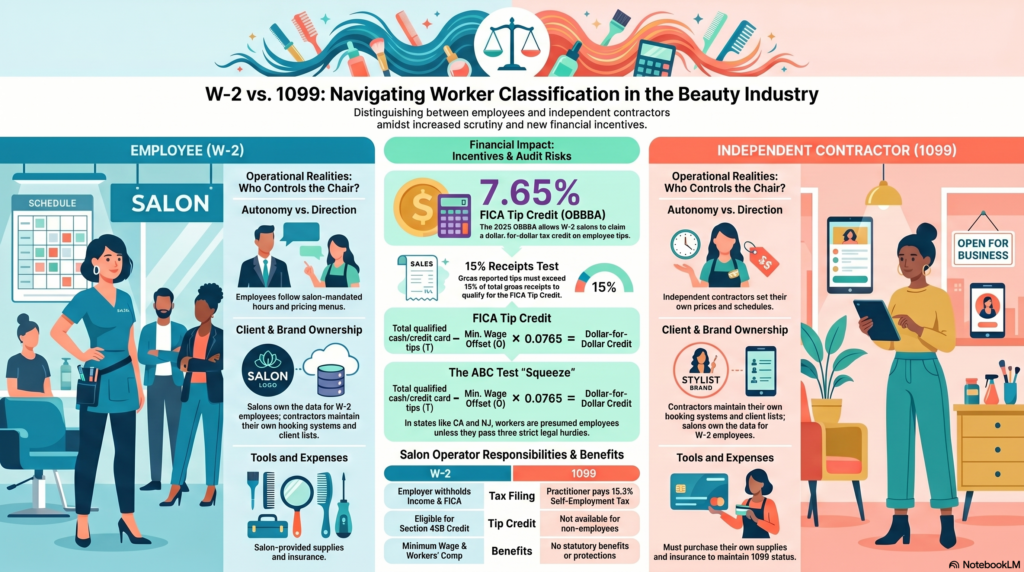
The passage of the One Big Beautiful Bill Act (OBBBA), signed into law on July 4, 2025, has reshaped the financial considerations of worker classification53. Historically, the restaurant industry benefited from the IRC Section 45B FICA Tax Tip Credit, which allowed food and beverage employers to claim a dollar-for-dollar tax credit for the employer’s share of payroll taxes paid on employee tips12.
The OBBBA expanded this credit to beauty and wellness businesses, effective retroactively to January 1, 20258. Under the OBBBA, qualifying salons, spas, and barbershops can claim a dollar-for-dollar tax credit against their federal income tax liability for the 7.65% FICA tax paid on reported employee tips8. The credit is calculated using the following formula:

Where:
represents the total qualified cash and credit card tips reported by employees to the employer8.
represents the minimum wage offset, which is the portion of tips needed to bring the employee’s direct hourly wage up to the federal minimum wage baseline of
per hour8. If an employee’s hourly wage already equals or exceeds
, the offset is
, allowing the credit to apply to
of reported tips16.
To prevent abuse, the OBBBA introduced a “15% receipts test” specifically for the beauty and wellness sector: the business’s gross reported tips must equal or exceed 15% of its total gross receipts for the calendar year to qualify for the credit8. Additionally, the OBBBA established a temporary federal income tax deduction through December 31, 2028, allowing tipped employees in eligible beauty occupations to exclude up to $25,000 of tip income from federal income taxes53.
These provisions do not apply to booth renters or independent contractors, as they do not earn W-2 wages and are responsible for paying the full 15.3% self-employment tax on their personal Schedule C filings46. The OBBBA creates a strong financial incentive for salon owners to transition from a 1099 model to a compliant, W-2 employee-based model, as the tax savings from the FICA Tip Credit can substantially offset traditional employer payroll liabilities8.
Multi-Agency Targeted Task Forces
At both state and federal levels, agencies are increasingly sharing data and coordinating resources6. State departments of labor, tax departments, workers’ compensation boards, and unemployment agencies have established joint task forces, such as New York’s Task Force to End Worker Exploitation20.
These entities conduct targeted enforcement sweeps on cash-intensive businesses, focusing on nail salons, barbershops, and spa operations19. The goal is to enforce tax collection, ensure workers’ compensation coverage, recover unpaid SUI contributions, and address wage-and-hour compliance6.
5. Sector-Specific Comparison and Vulnerabilities
To understand worker classification in the beauty industry, it is helpful to contrast its operational realities with other common 1099 sectors.
| Element | Beauty Industry (Booth/Suite Rental) | Gig Economy (Rideshare/Delivery) | Trucking (Owner-Operators) | Construction |
| Operational Control | High. Stylists set own rates, select products, and negotiate directly with clients4. | Low. Platforms set prices, assign tasks, and control client data57. | High/Medium. Autonomy over hauls, but dependent on carrier dispatch59. | Medium. Subcontractors manage their own crews but must adhere to general contractor schedules50. |
| Physical Infrastructure | Fixed commercial footprints; lease of physical square footage4. | Decentralized; entirely reliant on mobile digital platforms57. | Mobile equipment; lease-to-own or independent ownership of rigs59. | Temporary, evolving project sites owned by third parties50. |
| Licensing Requirements | Individual professional licenses required by state cosmetology boards30. | Basic driver’s licenses; minimal specialized occupational permits10. | Commercial Driver’s Licenses (CDL); federal safety registries49. | Municipal trade licenses; safety and building permits61. |
| Customer Relationships | Direct, highly personalized long-term client books owned by the stylist46. | Transactional, anonymous app-based customer routing57. | Relationship built between carriers/brokers and dispatchers59. | Project-by-project bidding with general contractors50. |
The beauty industry’s reliance on independent contractor structures stems from distinct historical and operational practices3. Personal care transactions are highly customized and built on long-term relationships between clients and individual professionals46.
This dynamic encourages stylists to seek control over their creative methods, product selection, and schedules4. Salon owners, meanwhile, utilize booth rental and salon suite models to secure predictable, passive rental income, avoiding the complexities of payroll management, inventory tracking, and employee benefits3.
However, this decentralized structure creates compliance challenges in traditional beauty salons12. Many establishments operate hybrid models, mixing W-2 employee stylists with 1099 booth renters under one roof48. This arrangement often leads to misclassification48.
If a 1099 renter is integrated into the salon’s brand identity, required to use the salon’s centralized booking software, or directed to follow uniform salon rules, labor regulators will classify them as an employee, regardless of the written lease agreement46.
6. The Crucial Elements of Worker Classification
To determine whether a beauty professional is a legitimate independent contractor or a statutory employee, state and federal regulators analyze several behavioral, financial, and structural elements of the relationship3.
Schedule Control
- Employee: The salon owner establishes set working hours, assigns shifts, requires attendance at staff meetings, or mandates work on specific weekends or holidays46.
- Independent Contractor: The beauty professional has absolute autonomy over their schedule, determining when they work, when they take breaks, and when they take vacation without requiring approval46.
Pricing Control
- Employee: The salon owner establishes a uniform menu of services and sets the prices charged to clients46.
- Independent Contractor: The practitioner sets their own service prices and retains the authority to offer discounts or alter their menu26.
Client Control
- Employee: The salon manages the central client database, assigns walk-in clients, and retains ownership of the booking files if the stylist leaves46.
- Independent Contractor: The practitioner maintains their own client records, manages their own appointments, and retains their personal client list if they relocate46.
Control of Services
- Employee: The salon owner requires the stylist to perform specific services, mandates the use of particular techniques, or requires them to follow a signature styling protocol46.
- Independent Contractor: The professional has complete creative freedom to determine which services to offer and how to execute them4.
Ownership of Tools and Supplies
- Employee: The salon owner provides the workstation, chair, back-bar supplies, towels, and styling chemicals at no cost to the worker46.
- Independent Contractor: The practitioner purchases, maintains, and utilizes their own personal tools and chemical lines (e.g., scissors, blow dryers, colors, and foils)48.
Profit or Loss Dynamics
- Employee: The worker is paid a guaranteed hourly wage, salary, or structured commission, meaning they do not bear direct business risks or face net operating losses2.
- Independent Contractor: The practitioner pays a fixed rent to the salon regardless of their client volume, meaning they can experience a net financial loss on slow weeks46.
Investment in the Business
- Employee: The worker has no capital investment in the salon’s physical infrastructure, retail inventory, or commercial lease66.
- Independent Contractor: The practitioner invests in their own commercial liability insurance, retail inventory, business licenses, and continuing education4.
Permanency of the Relationship
- Employee: The relationship is structured as continuous and indefinite, with the expectation of ongoing employment23.
- Independent Contractor: The relationship is governed by a defined commercial lease with a set start date, end date, and structured renewal clauses4.
Skill and Initiative
- Employee: The salon owner provides specialized training and continuing education to help the stylist develop their skills within the salon’s brand12.
- Independent Contractor: The practitioner brings pre-existing specialized skills and uses business initiative to market their services and build profitability43.
Integration into the Salon Business
- Employee: The stylist’s work is a core part of the salon’s primary business operations, and their services are marketed under the salon’s name25.
- Independent Contractor: The practitioner operates an independent business that is structurally separate from the landlord’s real estate operations, often utilizing a distinct brand identity3.
Advertising and Branding
- Employee: The stylist is marketed strictly under the salon’s brand name, utilizes the salon’s business cards, and is listed directly on the salon’s main social media accounts64.
- Independent Contractor: The professional advertises under their own business name, distributes personal business cards, and manages independent social media platforms60.
Renting Space and Written Agreements
- Employee: The worker does not pay rent to the salon and may sign a standard employment agreement, non-compete, or employee handbook46.
- Independent Contractor: The relationship is governed by a commercial real estate lease or booth rental agreement that explicitly defines the landlord-tenant relationship4.
Payment and Tax Forms
- Employee: The worker receives a Form W-2 at the end of the year, with federal, state, and local taxes automatically withheld from their paychecks46.
- Independent Contractor: The practitioner receives payments directly from clients and pays rent to the landlord, receiving a Form 1099-MISC or Form 1099-NEC from the salon only if they performed non-rental services for the salon exceeding $60025.
Crucially, the tax form used does not decide classification; rather, the underlying operational behavior is dispositive23.
7. Practical Education Section: Operational Compliance Guide
For salon owners, beauty schools, and independent professionals, navigating this complex landscape requires translating legal standards into daily operational practices2.
Demystifying the W-2 vs. 1099 Relationship
To maintain a compliant operation, the distinction between W-2 employment and 1099 independent contracting must be clearly defined across all business practices2.
| Operational Metric | Employee (W-2 Status) | Independent Contractor (1099 Status) |
| Tax Reporting | The employer issues a Form W-2 annually, automatically withholding federal, state, and local income taxes and FICA46. | The practitioner receives a Form 1099-NEC only if paid non-rental fees over $600; otherwise, they file a Schedule C25. |
| FICA Contributions | The employer pays 7.65% (matching the employee’s 7.65%) to fund Social Security and Medicare16. | The practitioner pays the full 15.3% Self-Employment Contribution Act (SECA) tax on net earnings2. |
| FICA Tip Credit (OBBBA) | The salon owner can claim a dollar-for-dollar tax credit on the 7.65% FICA paid on employee tips under Section 45B16. | Not available. Independent contractors are not employees, so owners pay no payroll tax on their tips56. |
| Operational Control | The salon owner directs schedules, assigns clients, sets prices, and establishes service protocols24. | The practitioner retains complete control over scheduling, pricing, product choices, and methodology24. |
| Worker Protections | The worker is covered by minimum wage, overtime, SUI, and workers’ compensation3. | The worker has no statutory benefits and must purchase individual insurance and SUI coverage if desired2. |
The Real Meaning of “1099” and “Agreement” Paperwork
A common misconception is that a signed independent contractor agreement or the issuance of a Form 1099 is sufficient to prove independent status24.
However, in both state and federal audits, written agreements are treated as secondary to behavioral reality23. If a written contract states that a technician is an independent contractor, but the salon owner manages their schedule, controls client bookings, or handles payments through a central register, auditors will void the contract and classify the worker as an employee46.
Standard Documentation Checklist for Salon Owners
To demonstrate a legitimate landlord-tenant relationship and protect against misclassification claims, a salon owner utilizing the booth or suite rental model should maintain the following records64:
- Commercial Lease Agreement: A signed lease detailing a flat-rate rent or structured percentage rental, with no clauses granting the owner operational control over the stylist’s methods or schedule4.
- Professional and Business Licenses: Copy of the renter’s active state professional license and active local municipal business license7.
- Active Liability Insurance: Proof of a personal commercial general and professional liability insurance policy maintained by the renter, listing the host salon as an additional insured4.
- Tax Identifiers: Verification of the renter’s Employer Identification Number (EIN) or separate tax identification number48.
- Independent Booking and Payment Systems: Proof that the renter utilizes their own scheduling software and processes client payments via a personal POS terminal26.
Standard Documentation Checklist for Beauty Professionals
An independent contractor or booth renter should maintain separate business records to support their self-employed status2:
- Business Entity Filings: Documentation of a registered business entity (e.g., Sole Proprietorship, LLC, or S-Corporation) with a separate EIN25.
- Separate Financial Accounts: Standalone business checking and savings accounts used exclusively for business income, equipment purchases, and licensing expenses2.
- Continuing Education Records: Receipts and certificates for independent advanced training, hair shows, or business education courses paid for out of personal funds4.
- Quarterly Estimated Taxes: Records of timely filed estimated federal and state tax payments60.
- SUI and Workers’ Compensation Disclaimers: Where permitted by state law, formal waivers or independent registrations for SUI and workers’ compensation2.
8. Evaluation of Common Industry Beliefs
To provide clear guidance to beauty industry organizations and professionals, this section directly evaluates common assertions regarding worker classification.
“Beauty has historically used independent contractors.”
- QUALIFIED. While booth and chair renting has been a common practice for over fifty years, the industry’s foundations were built on structured, employee-based salons3. The expansion of booth rentals in the late twentieth century was driven by changing consumer styles and specific tax code dynamics rather than a uniform historical tradition9.
“It used to be mainly cosmetology.”
- DENY. Barbering was actually the early regulatory anchor for independent space rentals18. In states like Pennsylvania, licensed barbers were legally permitted to lease chairs and booths decades before cosmetology salons were granted similar rights18. Cosmetology, nail care, and esthetics adopted independent-contractor structures much later as distinct professional licensing classes emerged9.
“Nail salons are being targeted specifically.”
- QUALIFIED. While all cash-intensive service industries face rigorous auditing, nail salons have experienced highly visible, targeted enforcement sweeps by state labor departments and multi-agency task forces6. This is largely due to historical investigative reporting that exposed widespread wage-and-hour violations, the vulnerability of the immigrant-dominated workforce, and the systematic use of informal cash-commission structures10. Furthermore, specific regulatory changes—such as the 2025 expiration of California’s manicurist exemption from the ABC test—have created immediate, targeted compliance challenges for nail salon operators28.
“This is the first time DOL has gone after independent contractors like this.”
- DENY. Coordinated federal enforcement of worker classification has a long history6. The Department of Labor, the IRS, and state agencies have collaborated on misclassification crackdowns for decades, notably through the joint IRS-DOL Memorandum of Understanding in 2011, which targeted cash-intensive service sectors across the country6.
“The law is new.”
- DENY. The core legal principles governing worker classification—such as the common-law right-of-control test, the FLSA economic realities framework, and the Section 530 Safe Harbor—date back to the 1930s, 1940s, and 1970s2. While individual administrative interpretations and state statutes (such as California’s AB 5 in 2020) continue to shift, the fundamental legal frameworks are deeply established in American jurisprudence26.
“The payment method decides classification.”
- DENY. Payment methodology is merely one of many factors evaluated by tax and labor regulators23. Issuing a Form 1099-NEC or paying a worker in cash/commission carries zero weight if the salon owner retains behavioral, operational, or financial control over how the worker performs their daily services24.
“If the technician controls the work, they are safer as 1099.”
- QUALIFIED. Technical control over the physical execution of a service (such as a specialized hair color or skincare treatment) is necessary but not sufficient for independent classification43. Highly skilled professionals may have total creative control over their work but can still be classified as employees if they are integrated into the salon’s core business, utilize the salon’s POS systems, and are economically dependent on the salon owner23.
“If control is off, they immediately fall closer to employee category.”
- CONFIRM. Any operational evidence indicating that a salon owner directs scheduling, establishes service prices, dictates product usage, enforces mandatory staff protocols, or directly manages client databases will immediately result in a finding of an employer-employee relationship by any state or federal auditing agency46.
9. Structural and Legal Synthesis
The evolution of worker classification in the U.S. beauty industry demonstrates a clear transition from informal, localized practices to highly coordinated, objective standards6. For decades, the widespread industry practice of booth renting served as an informal defense against employment liabilities3. However, modern regulatory dynamics—characterized by strict state-level ABC tests, post-pandemic unemployment audits, and coordinated data-sharing agreements—require a high level of operational precision from personal care businesses2.
Simultaneously, federal tax reforms introduced by the One Big Beautiful Bill Act of 2025 have fundamentally altered the economics of salon operations16. By extending the IRC Section 45B FICA Tax Tip Credit to beauty and wellness businesses, Congress has established a financially viable pathway for compliant, employee-based models8. Salon owners can now leverage dollar-for-dollar tax credits on reported employee tips, significantly offsetting traditional payroll liabilities and reducing the economic incentives that historically drove businesses toward the 1099 model8.
For beauty establishments that choose to utilize the independent contractor model, the path forward requires a strict structural division3. The relationship must operate as a genuine landlord-tenant arrangement, modeled after modern salon suite franchises where the practitioner maintains absolute operational, financial, and creative independence5.
Ultimately, there is no single “correct” business model; rather, there must be absolute alignment between the chosen legal classification and the daily reality of salon operations2. By educating future beauty professionals, maintaining clean operational boundaries, and keeping precise business documentation, the beauty industry can continue to support both independent entrepreneurs and successful employee-based enterprises2.
“This material is for general education and research only. It is not legal, tax, accounting, payroll, or employment advice. Laws vary by state and facts matter. Salon owners and beauty professionals should consult qualified legal, tax, payroll, insurance, and workers’ compensation professionals before making classification decisions.”
Works cited
- Tag – Independent Contractor – Hunton Andrews Kurth LLP, https://www.hunton.com/hunton-employment-labor-perspectives/tag/independent-contractor
- Independent Contractor Rules in Beauty: A Journey from Past to Present – RESEARCH MAY 2025, https://louisvillebeautyacademy.net/independent-contractor-rules-in-beauty-a-journey-from-past-to-present-research-may-2025/
- Booth Rent and Independent Contractors | Beyond the Chair Co., https://www.beyondthechairco.org/industry-education/salon-models/independent-contractors
- A Guide to Salon Booth Rental for Stylists and Owners – DaySmart Software, https://www.daysmart.com/salon/blog/a-guide-to-salon-booth-rentals-for-stylists-and-owners/
- Cutting It Out – Midnight Sun Magazine, https://www.midnightsunmag.ca/cutting-it-out/
- The Stakes Have Been Raised: Increased Government Scrutiny of Contingent Workers | Fisher Phillips, https://www.fisherphillips.com/a/web/iwukjrWM1uH9BY33L9sKiq/2jtwBZ/31466_increased-government-scrutiny-of-contingent-workers.pdf
- California’s New Booth Rental Law, https://www.beautyfederation.org/hot-topics/2020/californias-new-booth-rental-law
- The FICA Tip Credit Just Got a Makeover: What Beauty and Wellness Businesses Need to Know, https://www.harpercpaplus.com/the-fica-tip-credit-just-got-a-makeover-what-beauty-and-wellness-businesses-need-to-know/
- Beauty Shops | NCpedia, https://www.ncpedia.org/beauty-shops
- Migrant nail salon workers in the United States – Grokipedia, https://grokipedia.com/page/migrant_nail_salon_workers_in_the_united_states
- Beauty Salon Establishment in the Twenty-First Century – ScholarWorks, https://scholarworks.calstate.edu/downloads/bg257m24q
- The Hidden Difference Between Employee-Based Salons and Booth Rentals, https://mosaichairstudio.com/difference-between-employee-based-salons-and-booth-rentals/
- 2026 Sunset Review Report – California Board of Barbering and Cosmetology, https://www.barbercosmo.ca.gov/forms_pubs/sunset_2026.pdf
- Do I need a license to do Makeup in New York? – Genn Shaughnessy, https://www.gennshaughnessy.com/blog-genn-shaughnessy-makeup-hair-wardrobe-albany-ny/do-i-need-a-license-to-do-makeup-in-new-york
- Cosmetology | PDF | Eyebrow | Hairdresser – Scribd, https://www.scribd.com/doc/122136081/Cosmetology
- FICA Tip Credit Explained: How Restaurants & Salons Save Thousands on Taxes, https://bluewavehr.com/blog/fica-tip-credit-guide.html
- N.J. Admin. Code § 13:28-2.8 – Leasing space prohibited | State Regulations | US Law, https://www.law.cornell.edu/regulations/new-jersey/N-J-A-C-13-28-2-8
- House Co-Sponsorship Memo 44410 Information – Pennsylvania General Assembly, https://www.palegis.us/house/co-sponsorship/memo?memoID=44410
- IRS Guide for Salon Audits | PDF | Revenue | Gratuity – Scribd, https://www.scribd.com/document/183699317/beauty-pdf
- PR 17-030, N Nguyen a/k/a The Nguyen and 374 SALON INC. (t/a Envy Nails) – The Industrial Board of Appeals, https://industrialappeals.ny.gov/system/files/documents/2020/02/pr-17-030.pdf
- DEFYING SILENCE: IMMIGRANT WOMEN WORKERS, WAGE THEFT, AND ANTI-RETALIATION POLICY IN THE STATES – Columbia Academic Commons, https://academiccommons.columbia.edu/doi/10.7916/D87S80VC/download
- Addressing Workers Rights Violation within the Vietnamese Nail Salon Industry – eScholarship.org, https://escholarship.org/content/qt6g53q3hg/qt6g53q3hg.pdf?t=ox19mx
- Déjà Vu All Over Again: The DOL’s New Take on Independent Contractors, https://www.beankinney.com/deja-vu-all-over-again-the-dols-new-take-on-independent-contractors/
- Commission vs Booth Rental: The Complete Comparison for Salon Owners – Vagaro, https://www.vagaro.com/learn/salon-commission-vs-booth-rental-guide
- Accounting & Tax for Salons and Spas – Monaco CPA, https://www.monacocpa.cpa/industries/salons-spas
- Understanding Workers’ Rights and Responsibilities – Individual Licensee – California Board of Barbering and Cosmetology, https://www.barbercosmo.ca.gov/forms_pubs/publications/bbc_workers_rights_brochure_licensees.pdf
- How AB5 Affects: Manicurists – Hackler Flynn & Associates, https://www.hacklerflynnlaw.com/blog/2025/april/how-ab5-affects-manicurists2/
- Beauty is Pain: Lessons and Trends Impacting the Beauty Industry and Employment Law Concerns for 2025 and Beyond | Buchalter, https://www.buchalter.com/insights/beauty-is-pain-lessons-and-trends-impacting-the-beauty-industry-and-employment-law-concerns-for-2025-and-beyond/
- Upcoming Employment Changes for Licensed Manicurists Set to Take Effect on January 1, 2025 – Kronick, https://kmtg.com/news/legal-alerts/upcoming-employment-changes-for-licensed-manicurists-set-to-take-effect-on-january-1-2025/
- Frequently Asked Questions – Appearance Enhancement Business | Department of State, https://dos.ny.gov/frequently-asked-questions-appearance-enhancement-business
- Appearance Enhancement Business or Area Renter Application – New York State Department of State, https://dos.ny.gov/appearance-enhancement-businessarea-renter-applications-dos-0035
- Become an Appearance Enhancement Business | Department of State – https dos ny gov, https://dos.ny.gov/become-appearance-enhancement-business
- Pennsylvania Statutes Title 63 P.S. Professions and Occupations (State Licensed) § 514.1, https://codes.findlaw.com/pa/title-63-ps-professions-and-occupations-state-licensed/pa-st-sect-63-514-1/
- PA HB644 – BillTrack50, https://www.billtrack50.com/billdetail/1833928
- Senate Co-Sponsorship Memo 40684 Information – Pennsylvania General Assembly, https://www.palegis.us/senate/co-sponsorship/memo?memoID=40684&document=SB830
- House Co-Sponsorship Memo 38421 Information – Pennsylvania General Assembly, https://www.palegis.us/house/co-sponsorship/memo?memoID=38421&document=HB328
- In What States Is Booth Rental Not Allowed – ClinicSoftware.com, https://clinicsoftware.com/in-what-states-is-booth-rental-not-allowed-2
- Cracking Down on Booth Rental – Professional Beauty Federation of California, https://www.beautyfederation.org/labor-law/2025/cracking-down-on-booth-rental
- Appearance Enhancement Business or Area Renter License – NYC.gov: Business, https://nyc-business.nyc.gov/nycbusiness/description/appearance-enhancement-business-or-area-renter-license
- New York Appearance Enhancement Bond – SuretyBonds.com, https://www.suretybonds.com/states/new-york/appearance-enhancement-bond
- COMMONWEALTH OF PENNSYLVANIA HOUSE OF REPRESENTATIVES HOUSE PROFESSIONAL LICENSURE COMMITTEE STATE CAPITOL ROOM 60, EAST WING WE, https://www.legis.state.pa.us/WU01/LI/TR/Transcripts/2011_0115T.pdf
- Bill addresses unfair treatment of barber shops, salons – Williamsport Sun-Gazette, https://www.sungazette.com/news/business/2023/07/bill-addresses-unfair-treatment-of-barber-shops-salons/
- DOL’s New Six-Factor “Economic Realities” Test: Navigating Changes in Independent Contractor Classification – Hunton Andrews Kurth LLP, https://www.hunton.com/hunton-employment-labor-perspectives/dols-new-six-factor-economic-realities-test-navigating-changes-in-independent-contractor-classification
- Misclassification of Employees as Independent Contractors, https://www.dpeaflcio.org/factsheets/misclassification-of-employees-as-independent-contractors
- Labor Department Proposes New FLSA Independent Contractor Rule – NAHB, https://www.nahb.org/blog/2026/02/dol-revisiting-independent-contractor
- Salon 1099 vs W-2 in Texas: IRS Rules for 2026 – The Local Gem, https://www.thelocalgem.com/blog/salon-1099-vs-w-2-in-texas-irs-rules-for-2026
- Worker Classification – 21st Century Taxation, https://21stcenturytaxation.com/worker-classification/
- Ren-Lyn Corp. v. United States, 968 F. Supp. 363 (N.D. Ohio 1997) – Justia Law, https://law.justia.com/cases/federal/district-courts/FSupp/968/363/1947658/
- Employment Tax Update – Review of Current Litigation – IRS, https://www.irs.gov/pub/irs-tege/eotopicd03.pdf
- The Long and Winding Road – III FFC, https://iiiffc.org/wp-content/uploads/2022/08/Spring2012Monitor.pdf
- Final Rule: Employee or Independent Contractor Classification Under the Fair Labor Standards Act, RIN 1235-AA43, https://www.dol.gov/agencies/whd/flsa/misclassification/rulemaking
- What’s Old Is New Again: DOL Proposes to Revert to the 2021 Independent Contractor Framework | Employment Law Worldview, https://www.employmentlawworldview.com/whats-old-is-new-again-dol-proposes-to-revert-to-the-2021-independent-contractor-framework/
- How the Big Beautiful Bill Delivers a Perfect Tax Trim on Tips for Employers and Employees, https://www.salontoday.com/1095157/how-the-big-beautiful-bill-delivers-a-perfect-tax-trim-on-tips-for-employers-and
- One Big Beautiful Bill Act – Wikipedia, https://en.wikipedia.org/wiki/One_Big_Beautiful_Bill_Act
- No Tax on Tips Guide for Salon Owners – BTC University, https://www.btcuniversity.com/resources/salon-owner-no-tax-on-tips-guide
- FICA Tip Tax FAQs | Pro Beauty Association, https://www.probeauty.org/fica-tip-tax-faqs/
- Gig Worker vs. Independent Contractor: Differences + How to Classify – Gusto, https://gusto.com/resources/articles/business-finance/gig-worker-vs-independent-contractor
- Are we gig workers or freelancers? : r/DataAnnotationTech – Reddit, https://www.reddit.com/r/DataAnnotationTech/comments/1i22lh1/are_we_gig_workers_or_freelancers/
- Owner-Operator vs. Independent Contractor: What’s the Difference? | Indeed.com, https://www.indeed.com/career-advice/finding-a-job/owner-operator-vs-independent-contractor
- Employee vs Booth Renter vs Independent Contractor: Key Differences in the Salon Industry, https://biz.booksy.com/en-us/blog/employee-vs-booth-renter-vs-independent-contractor-key-differences-in-the-salon-industry
- New Salon Owner Checklist: US Compliance for your state – DINGG software, https://dingg.app/blogs/a-checklist-for-new-salon-owner-compliance-in-your-state
- Permanent Waves: The Making of the American Beauty Shop 9781479867585, https://dokumen.pub/permanent-waves-the-making-of-the-american-beauty-shop-9781479867585.html
- Should You Go Independent as a Stylist? Booth Rental vs. Suite vs. Ownership Explained, https://nickmirabella.com/blogs/salon-coach/should-you-go-independent-as-a-stylist-booth-rental-vs-suite-vs-ownership-explained
- Salon Owners Need to Carefully Structure Their Independent Contractor Relationships, https://www.wesselssherman.com/salon-owners-need-to-carefully-structure-their-independent-contractor-relationships/
- 375-0387 (4-2025) New Establishment Inspection Checklist – Missouri Division of Professional Registration, https://pr.mo.gov/boards/cosmetology/Application%20Forms/Establishment%20Registration%20(Cosmetology-Barber-Crossover).pdf
- Employee or Independent Contractor? – Centre for Beauty, https://cjscentreforbeauty.com/employee-or-independent-contractor/
- Publication 4902 (2-2011) – IRS, https://www.irs.gov/pub/irs-pdf/p4902.pdf
- Salon Booth Rentals: The Complete Business Guide – Marlo Beauty Supply, https://www.marlobeauty.com/pro2pro/salon-booth-rentals-the-complete-business-guide/a679/
- Salon Owner & Booth Renter Responsibilities: Rules, Roles, and Rights – Booksy Biz, https://biz.booksy.com/en-us/blog/salon-owner-booth-renter-responsibilities-rules-roles-and-rights
- How to Run a Booth Rental Salon Like a Pro – Elite Beauty Society, https://elitebeautysociety.com/how-to-run-a-booth-rental-salon/
- HR Documents for Texas Salons & Cosmetology Businesses | ReadyDocs HR, https://readydocshr.com/salons
- Advocacy Resources | Pro Beauty Association, https://www.probeauty.org/advocacy-resources/








