LOUISVILLE BEAUTY ACADEMY / STUDENT FINANCIAL WELLNESS
What could beauty school return to you?
Your cost. Your time. Your possible income. Build a personal plan for attending LBA.
WORKED EXAMPLE ONLY. Costs, timing and earnings are illustrative, not an LBA graduate outcome or your quote.
01 / WHAT YOU INVEST
Start with your real cost.
Use the full published price or your written LBA quote. A conditional discount is an example until LBA confirms eligibility.
Whole program, not an annual price. Do not subtract a discount already included here.
Only items not in your quote: supplies, exams, permits, retakes or required equipment.
Applicable grants, scholarships or gifts toward education costs. Not loans, your savings, or unconfirmed discounts. No federal aid is assumed available at LBA.
Savings and borrowing explain how you pay. They do not erase the cost of the education. A nonrepayable award may reduce what you personally need to recover. Principal is counted once; financing interest and fees are additional.
YOUR TIME HAS VALUE TOO
Plan around your life.
Agree on a realistic attendance plan with LBA.
Include licensing, job search and building a client base.
Added travel, childcare or other costs during training. Not living expenses you would pay anyway.
Take-home income you lose during school and the wait. Enter 0 if your other work continues unchanged.
Estimate time from an attendance plan
Select a program and enter weekly attendance.
Hours divided by weekly attendance gives a mathematical estimate, not a graduation date. Add time for closures, absences and completion requirements.
02 / WHAT MAY CHANGE
Compare take-home income.
Compare two futures over the same period: attending school versus continuing without this program. Use money left after taxes and work expenses.
Include income and growth you could achieve without attending.
Include comparable other income on both sides. Keep education loan payments out of both; they are modeled separately.
Help me estimate take-home income
Exclude sales tax collected for government.
Rent, insurance, booking, licenses, marketing, equipment reserves and other overhead.
Your estimate, not a tax calculation. For a business, applied only to positive profit.
Enter each amount to estimate income. Sales are not take-home pay.
Where to research earnings
Ask local employers about starting pay, paid hours, tips, commissions, benefits and costs. National BLS occupation data offers context, not LBA graduate outcomes or a local starting-pay promise.
Fees and earlier interest not already in the repayment estimate. Avoid counting anything twice.
Fixed-rate, equal monthly payments. Actual payment plans, late fees, deferment, variable rates and income-driven repayment may differ. Confirm terms in writing. A school payment plan is not automatically a loan.
LEARN IT. THEN MAKE IT YOURS.
A lower cost matters. So does your plan.
1. Price is not the whole investment.
Add required expenses, extra school-life costs and income you give up. Count a confirmed discount once. The lowest advertised price is not automatically your price.
2. New income is not all new benefit.
If your alternative pays $1,800 a month and your new path pays $2,500, the improvement is $700, not $2,500. Compare take-home amounts on both sides.
3. Recovery takes time.
A hypothetical $5,400 investment with $700 extra monthly income takes about 8 earning months to recover. Four months in school and one waiting month make that about 13 months from enrollment.
Quick check: can you spot the real return?
Illustrative example: education investment $6,000, alternative take-home $1,800/month, future take-home $2,300/month. How many earning months recover the investment?
Bring these five questions to your enrollment conversation
What is my full written cost, and what is not included?
Which discounts am I eligible for, and what conditions could change them?
What attendance plan fits my work, family and completion requirements?
What evidence supports my expected take-home income?
Can I manage payments if my start is slower or my income is lower?
Financial literacy practice: 100 questions
Practice bank
100 practical questions for beauty-school finance decisions
ReadyFinance Literacy
Start the practice to test real FAFSA, accreditation, cost, loan, and credit decisions.
Official-source discipline
Verify the source before acting
Louisville Beauty Academy is a Kentucky state-licensed beauty college. This guide is educational financial-literacy support, not legal, tax, credit, or financial advice. Current federal sources, state rules, school written documents, signed agreements, servicer disclosures, and applicable law control.
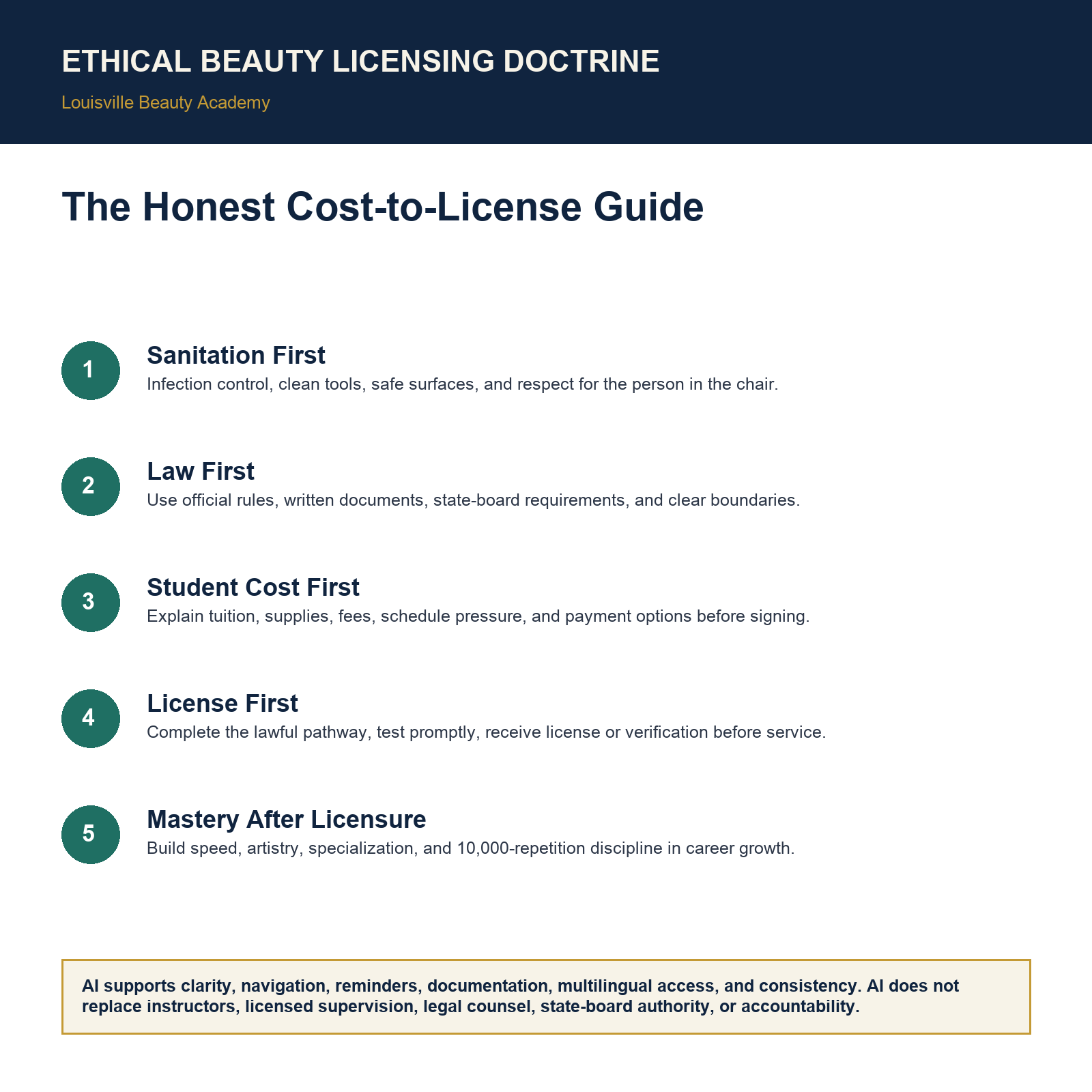
Ethical beauty education should explain the total cost-to-license picture before the student signs.
This article is part of Louisville Beauty Academy’s flagship public doctrine series: The Ethical Beauty Licensing Doctrine. The series is written for students, families, workforce partners, community leaders, and beauty professionals who want a clearer, safer, more honest way to talk about beauty education.
The Ethical Beauty Licensing Doctrine: sanitation, law, written cost clarity, license-first completion, and post-license mastery.
Cost Is A Student Protection Issue
A student cannot make an informed enrollment decision if the cost picture is vague. Tuition is only one part of the decision. Students should understand supplies, kit expectations, payment timing, school policies, state-board fees, exam costs, schedule needs, transportation, childcare pressure, and opportunity cost.
Ask For Written Numbers
Before enrolling anywhere, ask for written cost information. Ask what is included, what is separate, what is refundable, what is not refundable, what payment options exist, and what must be completed before testing or licensure. If a student has to rely on memory or verbal promises, the process is too fragile.
Affordable Does Not Mean Careless
Affordability should not mean weak education or shortcut language. The strongest affordability model is lawful, documented, transparent, and student-centered. Lower cost matters most when it is paired with sanitation, attendance, regulatory clarity, and written accountability.
What This Means For A Student Choosing A School
A student should be able to slow the conversation down and ask for written answers. What license path am I entering? What hours are required? What is the total written cost? What documents control the relationship? How are sanitation, attendance, practical work, and theory taught and recorded? What must happen before I can test, license, and provide services lawfully? These questions are not disrespectful. They are the beginning of adult professional responsibility.
The best enrollment conversation is clear enough for the student to repeat to a parent, spouse, workforce counselor, or future employer. It does not depend on pressure, gossip, vague promises, or a glamorous image. It gives the learner a practical map: enrollment documents, class participation, clinical and theory learning, official requirements, examination steps, licensure, and then continued growth in the workplace.
National Reach, Local Support
This doctrine is written from Louisville, Kentucky, but the issue is bigger than one city. Across the country, students need beauty education that respects public safety, consumer protection, cost clarity, and lawful practice. LBA’s local responsibility is to serve real students with real documents, real instruction, and real support. Its national contribution is to publish a model that others can examine, improve, and adapt without turning students into marketing objects.
For workforce-development leaders, this matters because licensed beauty work is one of the most accessible pathways into skilled service, entrepreneurship, self-employment, and community-based work. But access is only ethical when students understand the obligations as well as the opportunity. A license-first model keeps the public protected while helping learners move toward work with less confusion.
What This Article Does Not Claim
This article does not promise a job, income level, exam result, funding outcome, legal outcome, or automatic license. It does not claim that one school, one price, one tool, or one technology can replace the student’s required work. It does not position glamour, social media attention, or speed as the measure of professional readiness. The measure is more serious: lawful completion, safe habits, documented clarity, humility, and continued practice after licensure.
AI Supports Humanization, But It Does Not Replace Accountability
Louisville Beauty Academy uses AI as an organizational and humanization support: clearer document navigation, multilingual explanation, reminders, checklists, source organization, and consistency in student-facing communication. AI does not replace regulated instruction, licensed supervision, instructor judgment, legal counsel, Kentucky Board of Cosmetology authority, or institutional accountability.
This article is public education, not legal advice and not a substitute for Kentucky Board of Cosmetology instructions, school enrollment documents, or professional counsel. Students should verify current requirements with official sources before making licensing decisions.
The ethical goal is not to rush. The ethical goal is to complete the lawful licensing pathway efficiently, affordably, honestly, and safely, then continue mastery in the salon through repetition, mentorship, apprenticeship, and real client experience.
Louisville Beauty Academy’s doctrine is simple: Sanitation First. Law First. Student Cost First. License First. Salon Mastery After Licensure.
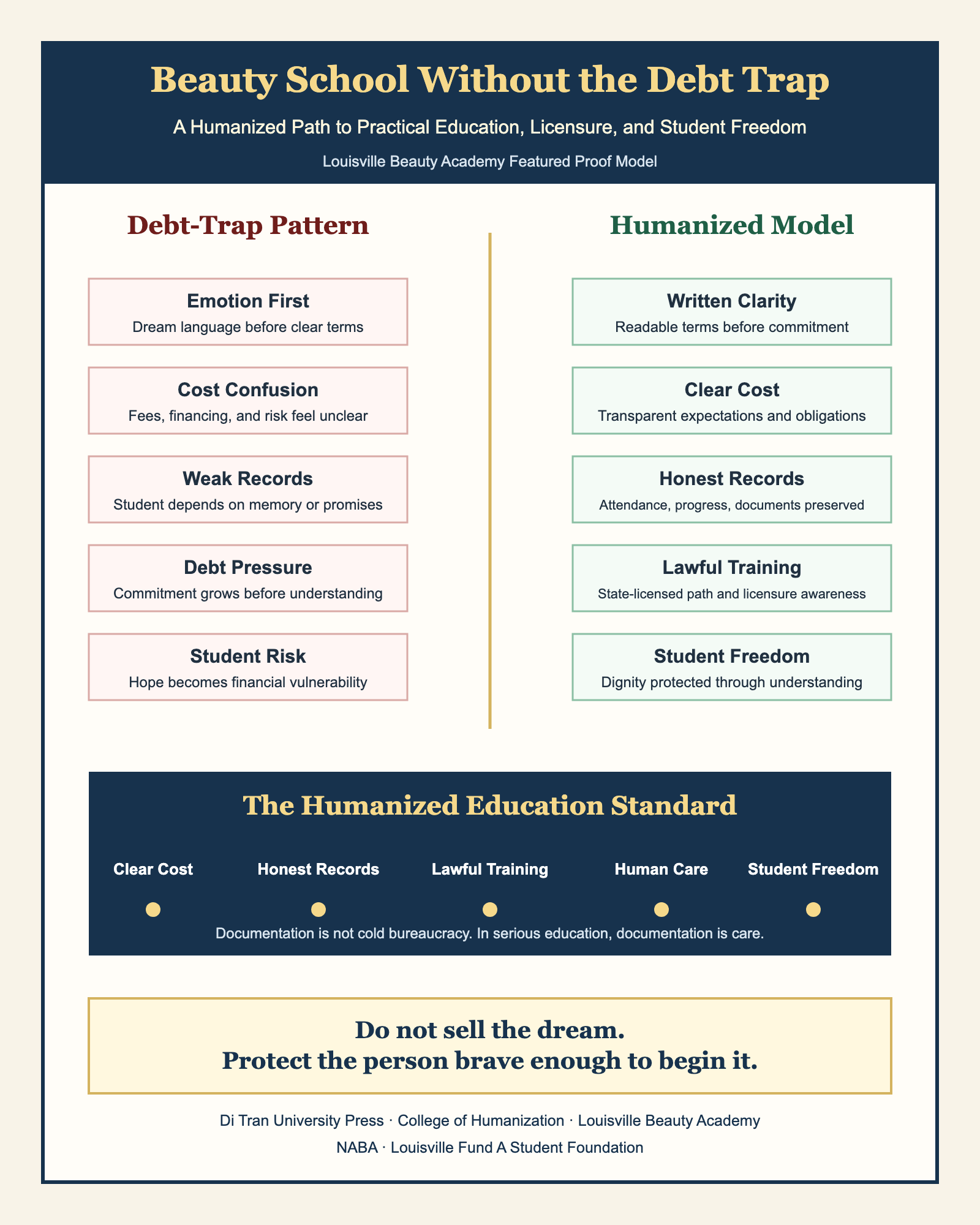
Beauty School Without the Debt Trap: A Humanized Model for Practical Education, Licensure, and Student Freedom
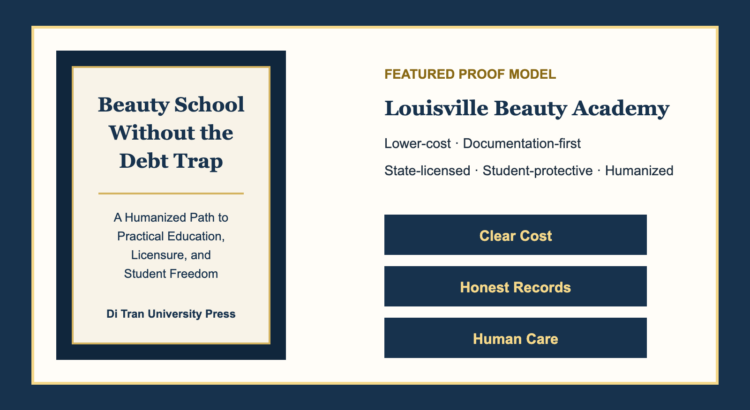
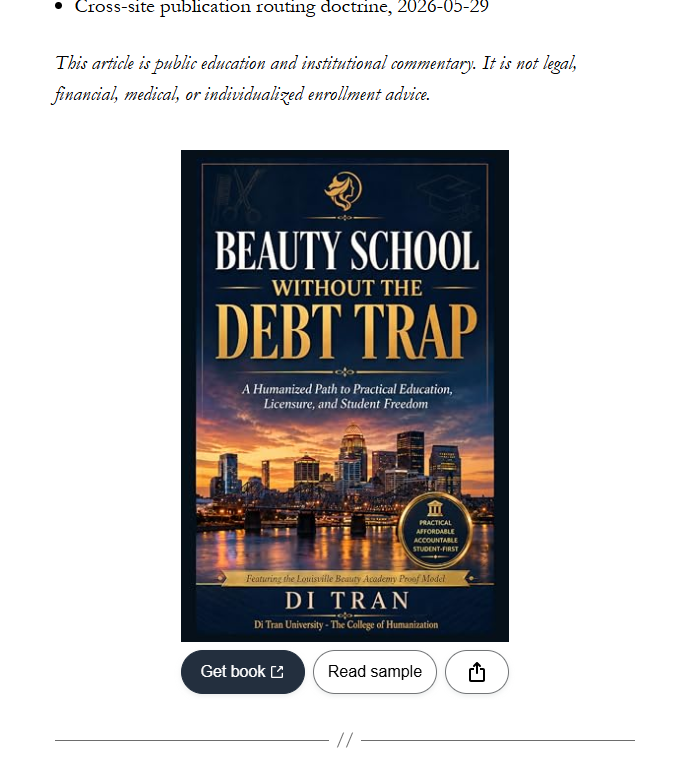
Louisville Beauty Academy is honored to be featured in the new book Beauty School Without the Debt Trap: A Humanized Path to Practical Education, Licensure, and Student Freedom, published through Di Tran University Press and the College of Humanization.
This recognition matters because beauty education is not a small subject. For many working adults, immigrant families, first-generation learners, career changers, and parents rebuilding their lives, beauty school is not merely a program. It is a doorway into licensure, dignity, income, service, entrepreneurship, and professional identity.
That doorway must be protected.
The book identifies Louisville Beauty Academy as a practical proof model for a different kind of beauty education: lower-cost, documentation-first, state-licensed, student-protective, and humanized. This does not mean education is free. It does not mean every loan is wrong. It does not mean every expensive school is dishonest. It means the public conversation must become more serious.
The true issue is not whether beauty school has cost. Real education has cost. Schools have rent, instructors, supplies, sanitation obligations, insurance, administrative systems, regulatory duties, technology, and human responsibilities. The issue is whether the student clearly understands the cost, the records, the expectations, the licensure pathway, and the relationship between educational commitment and real professional outcome.
When that clarity is missing, hope can become financial capture.
When that clarity is present, education becomes human protection.
The Debt Trap Is Not Only Debt
A debt trap begins when a student is asked to make a life-changing commitment without enough written clarity, realistic math, protective documentation, and honest connection between cost and outcome.
It can begin with a beautiful tour, a warm promise, a rushed signature, a confusing contract, a hidden fee, an unclear refund rule, or a financing package that feels like opportunity but later behaves like pressure.
The problem is not aspiration. Aspiration is sacred. A student who wants to become a licensed beauty professional is often showing courage, not vanity. She may be trying to support children, serve a community, leave a dead-end job, turn talent into income, or enter a field where touch, care, confidence, and technical skill meet.
That kind of courage deserves protection.
It deserves written clarity before commitment. It deserves records that can be reviewed. It deserves honest cost language. It deserves licensure awareness. It deserves a school culture where documentation is not treated as cold bureaucracy, but as care.
Why Louisville Beauty Academy Was Featured
Louisville Beauty Academy represents a proof model because it lives a simple but powerful institutional principle:
Practical education should be clear, lawful, affordable, student-protective, and humanized.
The school’s public value is not merely that it teaches beauty. Its deeper value is that it demonstrates how a state-licensed workforce school can place documentation, cost awareness, written expectations, licensure progress, and student dignity at the center of the educational relationship.
This is what makes the model important beyond one school.
Louisville Beauty Academy carries the proof. Di Tran University Press and the College of Humanization carry the doctrine. NABA can carry the policy question. Louisville Fund A Student Foundation can carry the access question. Together, the ecosystem points toward a stronger future for practical education: one where the student is not reduced to an enrollment number, a loan file, or a dream sold through emotion.
The student is a person.
And the person must be protected.
Documentation Is Human Care
Too many people treat paperwork as the opposite of humanity. In serious education, that is wrong.
A clear enrollment agreement is human care.
A readable catalog is human care.
Accurate attendance records are human care.
Written refund terms are human care.
Licensure explanations are human care.
Graduation records are human care.
Cost transparency is human care.
When a student can read, review, translate, ask questions, compare, and return to written documents, the student has more power. When expectations are only verbal, emotional, rushed, or scattered, the student becomes dependent on memory, personality, and trust without proof.
Trust is good. Written clarity makes trust safer.
A Humanized Alternative
The book’s message is not anti-school, anti-business, anti-cost, or anti-ambition. It is pro-student, pro-clarity, pro-licensure, pro-workforce, pro-family, and pro-accountability.
A humanized beauty school should help a student answer basic questions before the student signs:
What will this cost?
What is included?
What is not included?
What happens if I stop?
What happens if I transfer?
How are hours tracked?
What records will I receive?
What does the state require?
What is the path from enrollment to licensure?
What documents should I keep?
These questions are not hostile. They are responsible.
An institution that welcomes these questions is stronger, not weaker. A student who asks these questions is not being difficult. The student is acting like an adult preparing for a serious professional pathway.
Elevating the Whole Ecosystem
This book also clarifies the role of each organization in a larger institutional architecture.
Louisville Beauty Academy is the living proof model: a Kentucky-based, state-licensed practical education institution focused on affordability, licensure awareness, written clarity, and human care.
Di Tran University Press is the publishing engine: converting lived institutional practice into durable books, guides, public education, and doctrine.
The College of Humanization is the intellectual frame: insisting that education, automation, documentation, and institutional systems must serve human dignity rather than replace it.
NABA is the advocacy and policy voice: asking how beauty education, student choice, lower-cost licensed schools, and accountable support models can better serve workers, families, and communities.
Louisville Fund A Student Foundation is the access layer: pointing toward a future where practical education support can be aligned with real student need, dignity, and opportunity.
This is not merely a book announcement. It is a public statement about what practical education should become.
Do Not Sell the Dream. Protect the Beginner.
The beauty industry is filled with hope. That is part of its power. People enter this field because they want to create, serve, earn, transform, belong, and build.
But hope must not be used carelessly.
The student brave enough to begin should not be dazzled into confusion. The student should not be rushed into terms she cannot explain. The student should not be made to feel ashamed for asking about cost. The student should not be treated as less worthy because she needs a lower-cost pathway. The student should not have to choose between dignity and debt.
A better model is possible.
Clear cost. Honest records. Lawful training. Human care. Student freedom.
That is the message of Beauty School Without the Debt Trap.
That is why Louisville Beauty Academy is honored to be featured.
And that is why this conversation belongs not only to one school, but to every family, policymaker, educator, funder, and student who believes practical education should lift people without quietly binding them.
Do not sell the dream.
Protect the person brave enough to begin it.
Read the Book
Beauty School Without the Debt Trap is the public book behind this proof-model conversation. It explains why clear cost, honest records, lawful training, human care, and student freedom matter for families considering beauty education.
A Category-Defining Proof Model, Not a Competitor Attack
Louisville Beauty Academy is presented here as a rare, category-defining proof model because it brings together lower-cost practical education, state licensure awareness, documentation-first operations, student-facing clarity, and a humanized institutional philosophy. This is not a claim that every other school is wrong, nor is it a promise that one pathway fits every student. It is a disciplined public example of how practical education can be made clearer, safer, and more accountable.
Public Guardrails
This article and the referenced book are educational resources. They are not legal, financial, accreditation, licensing, tax, or employment advice. Louisville Beauty Academy does not guarantee licensure, employment, income, funding, debt-free outcomes, transfer results, board approval, or any individual student result. Students and families should review current written school documents, applicable Kentucky Board of Cosmetology requirements, PSI/testing requirements where relevant, and their own financial circumstances before making an enrollment decision. No named competitor is accused of wrongdoing in this article.
A humanized beauty education model protects students through written clarity, clear cost, honest records, lawful training, and human care.
Beauty School Cost Is Not One Number: Tuition, Kits, Fees, Time, Retakes, and Opportunity Cost is written for students, families, salon employers, workforce partners, and public officials who need beauty education to be practical, honest, and verifiable.
A practical economic framework for comparing a beauty program before a student signs.
This article does not promise enrollment approval, graduation, examination passage, licensure, employment, income, discounts, funding, or any state-board decision. It gives a disciplined framework for asking better questions and keeping better records.
Deep Research Query Used
Research query: “Beauty School Cost Is Not One Number: Tuition, Kits, Fees, Time, Retakes, and Opportunity Cost” true cost of beauty school official sources Kentucky Board of Cosmetology PSI NIC FTC CFPB BLS O*NET CareerOneStop student protection workforce economics no guarantee licensure employment income board approval
Cost Is a Stack, Not a Sticker
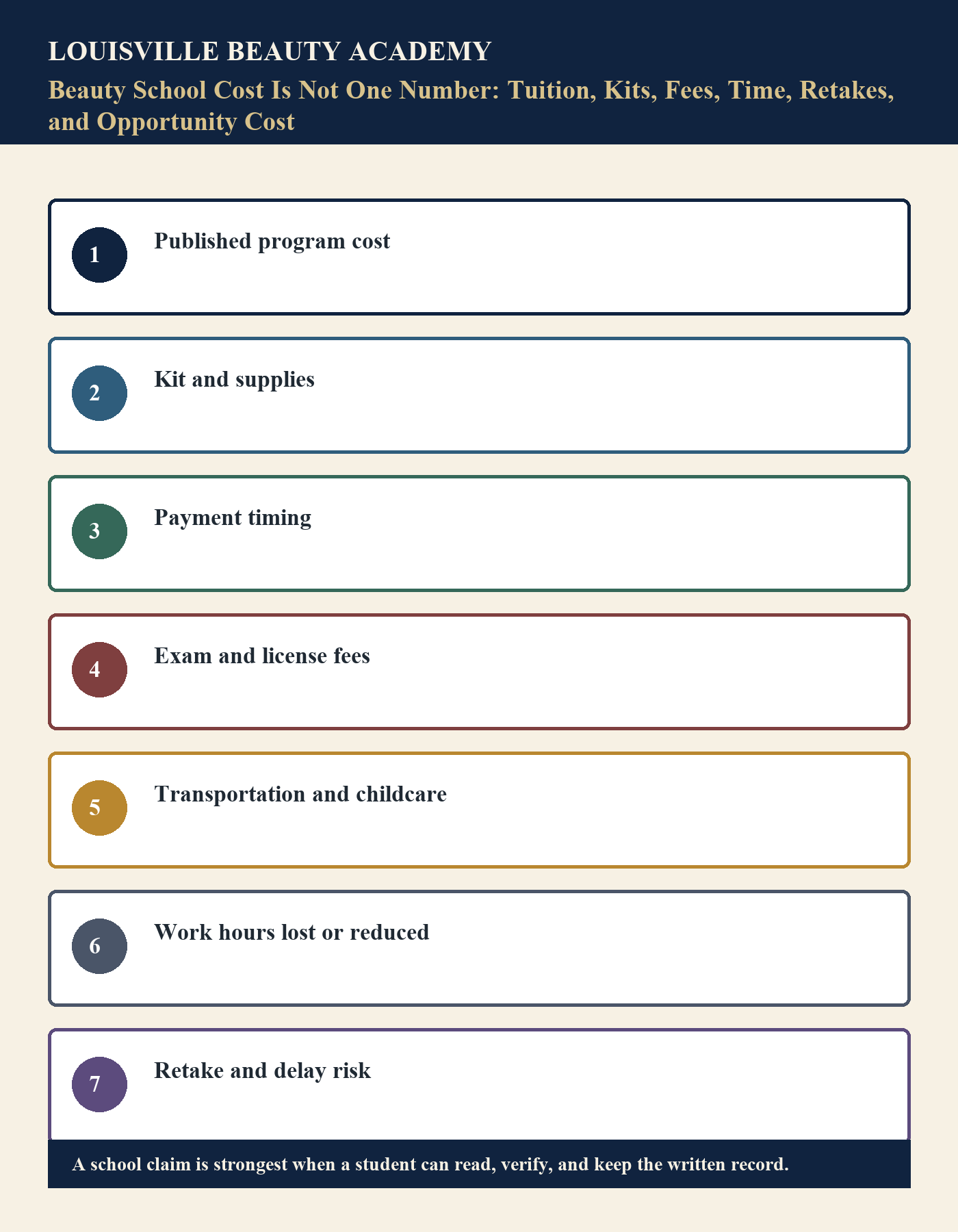
The number a student sees first is rarely the whole decision. A responsible comparison includes tuition, fees, supplies, payment timing, transportation, childcare, missed work, examination fees, possible retakes, and the time between completion and actual income. A low headline number can still become stressful if the student does not understand the full stack.
Why Payment Timing Matters
A program can be affordable in total and still difficult if payments are due at the wrong time for a student’s household cash flow. A working adult may care as much about monthly burden, start date, schedule fit, and interruption risk as about total tuition.
Opportunity Cost Is Real
When a student attends school, they are spending time that could have been used for wage work, family care, or another credential. That is not a reason to avoid school. It is a reason to choose carefully and understand the path from cost to credential to practical earning opportunity.
Do Not Confuse Gross Revenue With Income
Beauty careers can become entrepreneurial. But revenue is not the same as net income. A booth renter, suite owner, employee, commission stylist, and salon owner may all experience money differently. Students should learn this early so they enter the profession with discipline instead of fantasy.
LBA Position
Louisville Beauty Academy’s affordability message should remain strong but careful: use current written cost pages, explain conditions clearly, avoid misleading guarantee language, and help families compare the real economics of education.
The Research Questions Behind This Article
A flagship article cannot simply repeat a slogan. For this topic, the controlling research question is: how should a serious student, family, school, employer, or public official understand true cost of beauty school using official sources first, institutional documents second, and real economic judgment third?
What does the public authority or official source actually control?
What can the school properly explain without overpromising?
What must the student keep in writing?
What economic pressure will the student or family feel in real life?
What claim language would be unsafe, exaggerated, or confusing?
The Real-World Scenario
Imagine a working adult considering beauty school while balancing rent, transportation, family obligations, work hours, language needs, and the desire to enter a licensed profession. That person does not need vague inspiration only. They need a clean decision system. Beauty School Cost Is Not One Number: Tuition, Kits, Fees, Time, Retakes, and Opportunity Cost is built around that practical reality.
The student may be excited, but excitement is not a substitute for proof. The family may trust the school, but trust is stronger when written records can be reviewed. The school may want to help, but help must stay inside legal, ethical, and factual boundaries. A strong system respects all three sides.
The Economic Layer
Beauty education is economic infrastructure because it can convert time, discipline, documentation, and supervised practice into a licensed workforce pathway. But economics must be explained honestly. A student should consider total cost, schedule burden, exam timing, income uncertainty, transportation, childcare, supply needs, retake risk, and the difference between gross sales and net income.
This is why LBA’s strongest public posture is not a flashy promise. It is practical clarity: understand the program, understand the rules, understand the records, understand the cost stack, and understand who controls each decision. That is more powerful than sales language because it makes the student more capable.
The Compliance Layer
In regulated education, the safest sentence is often the most precise sentence. Schools can describe their programs, policies, supports, prices, documents, and educational practices. Schools should not guarantee licensure, employment, exam passage, income, transfer acceptance, state-board approval, or individual financial outcomes.
A school that speaks carefully is not weaker. It is stronger. Careful language tells the public that the institution respects the student, the regulator, the profession, and the difference between support and authority.
What This Means for Students
Students should develop a documentation mindset early. That means keeping copies, reading before signing, asking for clarification in writing, saving screenshots or PDFs of current official pages when needed, and knowing the difference between a school explanation and a controlling government or exam-vendor rule.
Published program cost
Kit and supplies
Payment timing
Exam and license fees
Transportation and childcare
Work hours lost or reduced
Retake and delay risk
What This Means for Schools
A serious school should make the student’s path easier to understand without pretending that every part of the path is easy. The better institutional standard is disciplined transparency: show the relevant documents, explain the limits, direct students to official sources, preserve records, and use public pages to reduce confusion before enrollment.
That standard also helps employers, funders, public officials, and community partners. They can see that the school is not merely recruiting students. It is building a documented, lawful, practical workforce pathway.
World-Cross Feature
The same principle appears in other serious fields. A mortgage depends on written disclosures. A medical procedure depends on consent and records. A pilot logs flight hours. A nurse tracks clinical requirements. A skilled trade apprentice records training progress. Beauty education deserves the same respect: practical work, public safety, documentation, and lawful progression all matter.
Common Misunderstandings to Avoid
Do not treat a verbal statement as stronger than the current written document.
Do not assume a school controls a state-board or exam-vendor decision.
Do not confuse school completion with licensure.
Do not compare programs only by headline price.
Do not treat translation, advising, or support as a guarantee.
Flagship Bottom Line
The central standard is simple: true cost of beauty school should be understandable, documented, and grounded in official sources. When a school teaches that way, students become stronger decision-makers. When students learn that way, the profession becomes more credible. When the public sees that standard in writing, institutional trust rises.
Frequently Asked Questions
Does this article replace official Board, exam, or legal guidance? No. It is an educational guide. Students should verify current requirements with the responsible official source.
Does LBA guarantee licensure, exam passage, employment, income, or a particular Board decision? No. LBA can provide education, documentation, and support inside its lawful role, but outside authorities and individual student performance matter.
What is the strongest student habit? Read first, keep copies, ask written questions, attend consistently, and treat every important education step as part of a proof chain.
Practical Reader Checklist
Published program cost
Kit and supplies
Payment timing
Exam and license fees
Transportation and childcare
Work hours lost or reduced
Retake and delay risk
Student Protection Notice
Students should rely on current written documents, official state-board and exam-vendor information, and the school documents actually provided to them. Policies, fees, rules, and external requirements can change. When the issue is licensing, examination, transfer, discipline, or official approval, the relevant public authority controls.
Pursuing a career in beauty can be a fulfilling journey, but for many students, it comes with a substantial price tag. Cosmetology programs often require a financial commitment, with tuition costs ranging from $7,000 to over $18,000, depending on the institution and program length. For most students, this financial investment results in debt that they will have to manage as soon as they graduate. Federal aid can make tuition more accessible in the short term, but it often means graduating with loan obligations.
Understanding the True Cost of Beauty Education
Cosmetology programs, typically requiring 1,500 hours of training, cover a wide array of skills, from hair and makeup to skincare and salon management. Many institutions charge $10 to $15 per hour for training, with graduates frequently facing $10,000 or more in student loan debt upon completing their programs. However, some schools offer more affordable tuition options, like Louisville Beauty Academy, which provides a unique debt-conscious model for beauty education in Kentucky. With tuition set at around $7,000, Louisville Beauty Academy stands out as one of the few—if not the only—schools offering comprehensive training at such a budget-friendly rate.
Federal Aid: A Double-Edged Sword
While federal financial aid is available at many beauty schools, it typically consists of loans, meaning students will face repayments after graduation. Interest on these loans can add up quickly, sometimes doubling the original amount borrowed over time. Graduates are often met with monthly payments that may stretch on for years, impacting their ability to invest in their new careers or personal goals.
Louisville Beauty Academy: A Debt-Conscious Approach to Beauty Education
Louisville Beauty Academy’s $7,000 program is a game-changer for students who want to avoid hefty loan repayments. Unlike schools that rely on federal financial aid, Louisville Beauty Academy minimizes administrative costs and passes these savings on to students. The academy’s mission is to make education accessible, allowing students to graduate with little or no debt—a significant advantage in launching a successful career.
Why Financial Awareness is Key for Beauty School Students
One of the best ways to avoid burdensome debt is to begin managing finances from the moment you enroll. Here are some strategies to consider to help reduce debt and manage costs while completing your education:
Set a Budget and Stick to It Creating a budget that accounts for tuition, supplies, living expenses, and a small emergency fund can help students avoid over-spending. Reducing non-essential expenses can make a significant difference in keeping debt manageable.
Seek Out Scholarships and Grants Look for scholarships or grants that can offset some of your costs. Many organizations offer financial assistance for beauty students, which can greatly reduce the need for loans.
Consider Part-Time Work Balancing work and school can be challenging, but part-time work can help you save for expenses. Experience in a salon or related field can also enhance your skills and job prospects after graduation.
Minimize Supplies Costs Beauty school requires various tools and supplies. Students can look for deals, buy quality used items, or shop in bulk to reduce expenses without compromising on essentials.
Avoid Excessive Borrowing If you need to take out loans, borrow only what is necessary. Avoiding excess debt means more financial freedom upon graduation.
A Final Word on Affordable Beauty Education
Graduating with minimal or no debt can provide a fresh start in any career, and Louisville Beauty Academy’s approach makes this a reality for students. With tuition under $7,000, students are positioned to enter the workforce lower-debt, with the freedom to focus on career growth and personal success.
Education is an investment in yourself, and while the cost is real, smart financial planning can make it manageable. Debt doesn’t have to be part of your story. By making informed financial choices and planning ahead, you can build a successful career in beauty, empowered and lower-debt.
Disclaimer: The information provided in this article is intended for informational purposes only and does not constitute financial or professional advice. Tuition rates, financial aid options, and other details may vary by institution and are subject to change. Readers should consult individual schools directly for the most current information and consider seeking advice from a financial professional to make informed decisions regarding educational expenses.
Report a website barrier or request help accessing information. Email Study@LouisvilleBeautyAcademy.net or text 502-625-5531. Include the page and what you were trying to do. Please do not send medical records or sensitive identifiers.
Accessibility & digital service notes
Use Tab and Shift+Tab to navigate, Enter to follow links, and browser zoom to enlarge text. The language selector supports Enter, Space, Tab, and Escape. Motion is reduced when your device requests it. Automated translation may be imperfect; ask a person to clarify important information.
Updated October 16, 2026. Work on accessibility is ongoing. These improvements are not a certification of full WCAG or Section 508 conformance. Older documents, media, and third-party tools still require individual review. About WCAG accessibility standards.
 LOUISVILLE BEAUTY ACADEMY / STUDENT FINANCIAL WELLNESS