Current information notice
This article is part of LBA’s public education and historical archive. Older posts, including “Louisville Beauty Academy as Essential Workforce Infrastructure for Rural Kentucky – A Public Education & Workforce Research White Paper — December 2025,” may not reflect current tuition, schedules, incentives, forms, policies, testing vendors, clinic availability, or regulatory requirements.
Before relying on this article for any decision, review LBA’s Current Information and Written Control Standard, Current Program Costs, Enrollment Concierge, and Policy and Written Records.
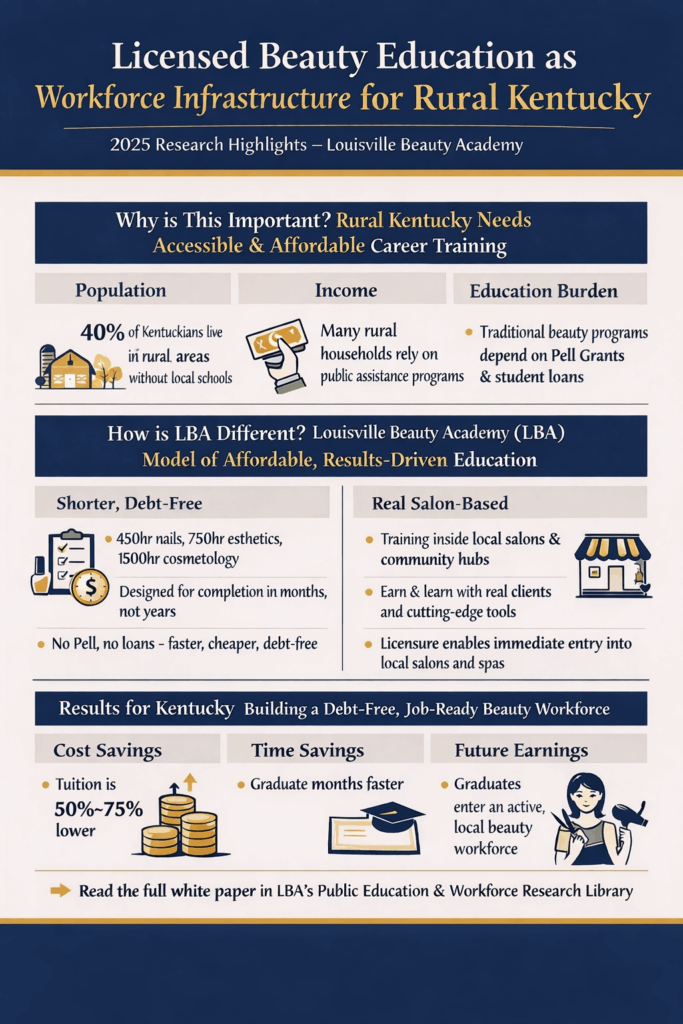
The Louisville Beauty Academy (LBA) model is designed to serve Kentucky’s rural and small-town communities by offering fast, results-driven beauty education that sidesteps traditional financial and bureaucratic barriers. About 85 of Kentucky’s 120 counties are classified as rural (USDA definition), encompassing 1.85 million people (~41% of the state) uknow.uky.edu. These areas face economic challenges – statewide, 18.9% of Kentuckians live in poverty (versus 15.4% nationally), and many rural counties exceed 25% poverty (e.g. Clay – 39.7%, McCreary – 41.0%, Wolfe – 43.0%) kystats.ky.govkystats.ky.gov. Rural Kentuckians rely heavily on public aid (e.g. SNAP, Medicaid) because wages and resources are often low. Median rural incomes lag urban areas, and opportunities for quick, lower-debt training are scarce. In this context, traditional beauty schools that depend on federal Pell grants and student loans create hidden costs. Because Pell aid is unavailable for shorter programs (under 600 hours) and only for accredited schools, many rural students end up in longer programs with higher tuition and debtnaba4u.orgnaba4u.org. This forces them to spend extra months in school (reducing earning time) and often graduate with significant loans, even when they only need a shorter vocational credential.
Figure: Rural Kentucky communities (like Corbin, pictured) comprise a large share of the population uknow.uky.edu. These areas need accessible career training that bypasses costly financial aid structures. Rural Kentucky’s economy underscores the need for new models. Incomes tend to be lower than urban areas, and federal aid can unintentionally steer low-income students toward expensive, long programs instead of shorter, in-demand careers naba4u.orgkystats.ky.gov. For example, Kentucky’s new law reduced nail technology training from 600 to 450 hours to speed workforce entry, yet federal rules still exclude 450-hour programs from Pell grants naba4u.orgnaba4u.org. The result is a bottleneck: capable rural students may delay training or take on unnecessary debt just to access aid. Comprehensive data show that many surrounding states also have substantial rural populations (e.g. Tennessee ~34%, Indiana ~28%, Ohio ~22%) and similar funding barriers. In short, “what is called affordable” federal aid often ends up buffered by hidden costs, so that the true cost – in time or debt – remains high for rural learners.
Barriers in Beauty Education Funding
Federal financial aid rules create a stark disadvantage for students in short, intensive programs. Under current U.S. Dept. of Education policy, only programs of ≥600 hours (and accredited by a U.S.-recognized agency) qualify for Pell grants or federal loans dol.govnaba4u.org. Since LBA specializes in short, skills-focused tracks (e.g. 450-hour Nail Tech, 750-hour Esthetics), none of its programs qualify for Title IV aid naba4u.org. Other schools often extend course lengths or tack on unrelated content just to hit the threshold, which adds months of extra schooling and cost. As a result, low-income students in rural Kentucky face a choice: pay out-of-pocket for LBA’s lean programs, or enroll in a longer, debt-financed cosmetology course elsewhere (even if they only want nails or skincare). This misalignment “forces students to take on larger debt for more training than they may want or need”naba4u.org. In practice, federal aid restrictions delay graduation and inflate costs, preventing quick entry to work. LBA’s experience highlights this gap: the academy offers a full 450-hour Nail Technology course for about $3,800 (after discounts) – a fraction of what a 1500-hour cosmetology program costs – yet Pell is barrednaba4u.org. Because of this, many willing students are “filtered out” by lack of fundingnaba4u.org. Kentucky’s rural learners especially depend on grant aid, so reforming this barrier is critical to accelerate workforce entry and reduce debt for rural beauty professionals.
The LBA Model – Affordable, Outcome-Focused Education
LBA’s unique model tackles these barriers head-on. The school is state-licensed and -accredited (Kentucky Board of Cosmetology) but not federally accredited, a conscious choice that lets it focus on outcomes without federal oversight. This allows ultra-low tuition – about 50–75% less than comparable federally-funded schools louisvillebeautyacademy.net – and a lower-debt structure. LBA students pay via short-term plans, scholarships, or employer support rather than federal loans. The curriculum is purpose-built for one mission: to produce licensed beauty professionals ready to work. All LBA programs (e.g. 450-hr Nails, 750-hr Esthetics, 300-hr Shampoo Styling, 1500-hr Cosmetology) are exactly the hours needed for state licensure louisvillebeautyacademy.net. There are no extra semesters: in fact, LBA celebrates daily or weekly graduations, meaning students who master the material move on immediately louisvillebeautyacademy.net. This rapid pace incentivizes focused study – learners know the goal is immediate licensing and a paycheck, not accumulating credits. As one report notes, Kentucky’s LBA “offers affordable, fast-track programs that lead to immediate employment” louisvillebeautyacademy.net. The results speak to the model’s effectiveness: since opening in 2017, LBA has trained over 1,000 beauty professionals naba4u.org. All these graduates could sit for state board exams right away (and many did). By contrast, students at traditional schools might spend extra months in mandated breaks or nonessential courses, delaying their entry into the labor market. LBA breaks from that norm: students spend only the required clock hours (no holiday “dead time” built-in) and every hour counts toward licensure. This streamlined, student-driven approach has set LBA apart as “the highly affordable beauty college in Kentucky,” according to its own materials naba4u.org. In short, LBA under-delivers bureaucracy and over-delivers on real skills – a “gold standard” of compliance and transparency that explicitly benefits its rural clientele. The school even advertises full transparency of costs and curricula, ensuring rural families understand exactly what they pay for and achieve naba4u.orglouisvillebeautyacademy.net.
Figure: LBA students train in real salon settings. By co-locating programs with local salons or spas, schools can cut overhead and immerse learners in the industry. LBA’s model suggests partnering with community hubs to bring training directly where rural students live and work.
Aligning with Workforce Funding and Community Partners
To fully realize its public-interest mission, LBA’s strategy should leverage public workforce funding instead of private investment (“HCA capital”). Federal and state workforce programs – under WIOA and similar initiatives – are explicitly designed to train local workers in high-demand fields. Through WIOA, local workforce boards and One-Stop Career Centers can fund eligible training programs directly dol.gov. For example, Kentucky’s Approved Training Provider List (ETPL) already includes multiple cosmetology and beauty schools (e.g. PJ’s College of Cosmetology, Pikeville Beauty Academy, Platinum Shears Beauty Academy) etpl.ky.gov. Any career training on this list can receive WIOA vouchers or grants for qualified students. LBA could seek inclusion on the ETPL or partner with WIOA agencies to make its programs tuition-free for eligible applicants. Likewise, city workforce boards and state labor departments (e.g. Kentucky’s Education & Workforce Development Cabinet) can align LBA’s courses with regional job-placement goals, channeling public funds into the academy. Employer-paid tuition is another avenue: salons and spas in Louisville and rural counties could sponsor apprentices through LBA, effectively investing their own payroll into training (sometimes with state matching). Even community reinvestment funds (from local taxes or non-profits) could be directed to support classes for under-resourced areas. In all cases, LBA becomes a public-interest partner, not an investor-controlled enterprise. This means LBA can be structured like a workforce-development program: free or nearly-historical tuition-support language for students, paid by public grants and employer contributions, with clear performance metrics (licensure pass rates, job placement). By aligning with city workforce boards, state labor agencies, WIOA/ETPL pipelines, employer tuition funds, and community investment programs, LBA would tap existing support networks and fully serve its rural mission. The U.S. Labor Dept. notes that WIOA programs provide career and training services (both classroom and on-the-job) to millions of workers through a nationwide network of centers dol.gov. Redirecting even a small slice of these resources to beauty training could make LBA’s programs nearly free to eligible Kentuckians – turning a $3,800 program into essentially $0 out-of-pocket while still ensuring students earn industry credentials and jobs.
Recommendations: To maximize impact, LBA and policymakers should:
- Partner with Workforce Agencies. Engage local workforce development boards and the Kentucky Career Center to list LBA on the Eligible Training Provider List (ETPL) and accept WIOA funding. Secure support from the state Labor Cabinet and education workforce initiatives. This ties LBA tuition to public funding and employers, preserving affordability dol.govetpl.ky.gov.
- Maintain Single-Outcome Focus. Preserve LBA’s one-track model: teach only what is required for licensing and employment. Continue offering lower-debt, short courses aimed solely at licensure (not extraneous credits). This approach – one mission, one outcome – leverages LBA’s strength in quickly moving students into jobs louisvillebeautyacademy.net.
- Co-Locate in Salons and Hubs. Instead of standalone campuses, locate LBA training within existing salons, spas, community centers or workforce hubs. This uses underutilized space, fosters mentorship by working professionals, and roots training in the community. For rural reach, consider pop-up or hybrid models (e.g. local campuses taught remotely by LBA instructors with hands-on labs at nearby salons). Co-location also makes it easy for policymakers and employers to see LBA’s role in the local economy.
- Emphasize Transparency and Support. Market LBA’s programs as fully supported by public funds or sponsored by local businesses. Offer clear, online course tracking (leveraging AI-driven systems) so students see progress in real time. Emphasize that state- or employer-funded tuition effectively makes programs free or very low-cost for learners, with no hidden loan debt. This transparency builds trust with rural families and policymakers.
Conclusion
Kentucky’s rural communities need vocational pathways that are fast, affordable, and workforce-aligned. Louisville Beauty Academy’s model demonstrates that by cutting extraneous hours, lowering tuition, and focusing on licensure outcomes, beauty education can be made genuinely accessible to rural students. The next step is public partnership: aligning LBA with WIOA, workforce boards, and community resources will eliminate barriers like expensive loans and program delays. With state or employer funding, LBA courses become virtually free at the point of entry. Co-locating classes in salons and service centers brings training into the heart of rural communities, safeguarding it as a public good. In summary, LBA’s success in Kentucky – training 1,000+ professionals quickly and cheaply naba4u.orglouisvillebeautyacademy.net – shows the potential of a workforce-focused, lower-debt model. By leveraging public funding and local partnerships, LBA can expand this model, becoming “bullet-proof” to liability and fully aligned with the needs of rural Americans. Such a system honors LBA’s founding intent to build Kentucky’s beauty workforce without burdening students with debt or delay.
References: Blueprint Kentucky. (2025, October 8). New report shares data trends on Kentucky’s rural economy. University of Kentucky (UKnow). Retrieved from https://uknow.uky.edu/research/new-report-shares-data-trends-kentucky-s-rural-economy uknow.uky.edu. Louisville Beauty Academy. (2025, May 7). Research Report: Louisville Beauty Academy as a Proven Model for Loan Reform and Workforce Development. Louisville, KY: Louisville Beauty Academy. Retrieved from https://louisvillebeautyacademy.net/research-report-louisville-beauty-academy-as-a-proven-model-for-loan-reform-and-workforce-development-2025 louisvillebeautyacademy.net. Tran, D. (2025, April 9). Strategic Analysis: Accreditation, Federal Aid Limits, and Louisville Beauty Academy’s Path Forward. New American Business Association (NABA). Retrieved from https://naba4u.org/2025/04/strategic-analysis-accreditation-federal-aid-limits-and-louisville-beauty-academys-path-forward/ naba4u.org. U.S. Department of Labor, Employment & Training Administration. (n.d.). WIOA Workforce Programs. Retrieved from https://www.dol.gov/agencies/eta/wioa/programs dol.gov. Kentucky Center for Statistics. (2016). Poverty Rates by County (2011–2015 ACS) [Map]. Frankfort, KY: Kentucky Center for Statistics. Retrieved from https://kystats.ky.gov/Content/Reports/Maps/PovertyRatesByCounty.pdf kystats.ky.gov. (All sources accessed 2025)
Disclaimer
This publication is provided for educational, informational, and public workforce research purposes only. It does not constitute legal, financial, regulatory, accreditation, or employment advice.
Louisville Beauty Academy does not guarantee licensure, examination results, employment, income, program completion time, or individual outcomes. Results vary based on attendance, preparation, effort, regulatory requirements, and personal circumstances.
References to affordability, time-to-licensure, workforce readiness, or program structure describe educational models and intent, not promises of results.
Any discussion of public or private funding sources (including Pell Grants, student loans, WIOA, ETPL, workforce programs, employer-paid tuition, or community funding) is illustrative only. Eligibility, approval, and availability are determined by third-party agencies or employers and may change.
This publication does not evaluate or compare specific schools or institutions. All data referenced is drawn from publicly available sources believed to be accurate as of December 2025.
Nothing herein replaces applicable laws, regulations, or licensing requirements. Readers remain responsible for compliance with all governing authorities.