This article is part of LBA’s public education and historical archive. Older posts, including “Transparency in Cosmetology Education: A Legal, Operational, and Economic Analysis of Louisville Beauty Academy’s Student Record System,” may not reflect current tuition, schedules, incentives, forms, policies, testing vendors, clinic availability, or regulatory requirements.
What Every Beauty School Student MUST Ask Before Enrolling (2026 Guide)
Research-Based Student Protection Checklist
❓ 1. Do you provide a monthly official student hour report?
Why this matters: State law requires accurate tracking of hours for licensing. If a school cannot show you monthly records, your hours may not be properly documented.
👉 What to ask:
“Can I see a real sample of a monthly student hour report with theory and practical breakdown?”
❓ 2. Do you provide a full academic transcript BEFORE graduation?
Why this matters: Most schools only give transcripts after graduation—or worse, when you pay extra. You need it DURING school to verify accuracy.
👉 What to ask:
“Can I request my full transcript anytime during my enrollment?”
❓ 3. Does your system track BOTH:
Theory hours
Practical (clinic) hours
AND completion of required tasks?
Why this matters: Hours alone are NOT enough. You must complete required competencies to graduate and qualify for licensing.
👉 What to ask:
“Do you track task completion (labs/skills), not just hours?”
❓ 4. Do you have a Satisfactory Academic Progress (SAP) system?
Why this matters: SAP protects you from falling behind without knowing. It tracks:
Attendance pace
Academic performance
Graduation timeline
👉 What to ask:
“How do you monitor if I am on track to graduate on time?”
❓ 5. Can I see a real student transcript sample (with personal info removed)?
Why this matters: If a school cannot show a real example, the system may not exist.
👉 What to ask:
“Can you show me an actual transcript your students receive?”
❓ 6. How often do you report my hours to the State Board?
Why this matters: Delayed or incorrect reporting can delay your license.
👉 What to ask:
“Are my hours reported monthly, and can I verify that submission?”
❓ 7. What happens if there is a system error or missing hours?
Why this matters: System errors happen. What matters is:
Documentation
Communication
Correction process
👉 What to ask:
“If hours are missing or duplicated, how do you fix it—and do you notify the board?”
❓ 8. Do you allow me to access my records anytime?
Why this matters: Your education record = your license future.
👉 What to ask:
“Can I access my hours, grades, and progress anytime without restriction?”
❓ 9. Do you track both grades AND completion (pass/fail of each subject)?
Why this matters: Licensing is not just time—it is completion of required curriculum.
👉 What to ask:
“Do you document completion of every required subject and skill?”
❓ 10. If the school closes, how are my records protected?
Why this matters: Thousands of students lose records when schools shut down.
👉 What to ask:
“Where are my records stored, and how are they protected long-term?”
Research & Podcast Series 2026 | Di Tran University — The College of Humanization
Research & Educational Disclosure This publication is provided for public education, institutional transparency, and research purposes only. It does not constitute legal, financial, or regulatory advice.
All analysis reflects independent research conducted under Di Tran University — The College of Humanization, based on publicly available statutes, institutional case study data, and operational observations.
Louisville Beauty Academy is referenced as a case study model of compliance and transparency. Any conclusions or interpretations are academic in nature and should not be construed as claims, guarantees, or regulatory determinations.
Readers, students, and institutions are strongly encouraged to conduct independent due diligence and consult with appropriate legal or regulatory professionals before making decisions.
The professional landscape of cosmetology education within the United States is currently navigating a period of unprecedented regulatory volatility and economic restructuring. In the Commonwealth of Kentucky, this transformation is being led by a paradigm shift toward radical transparency, exemplified by the operational and legal frameworks adopted by the Louisville Beauty Academy (LBA). This institution has transitioned from a traditional place of vocational instruction to a “National Gold Standard Center of Excellence,” prioritizing compliance-by-design and student-first administrative integrity.1 The confluence of the Kentucky Revised Statutes (KRS) Chapter 317A, the federal One Big Beautiful Bill Act (OBBBA) of 2025, and the deployment of advanced digital record systems like SMART Systems, Inc. provides a compelling model for how vocational institutions can thrive by decoupling from federal debt dependency and embracing a “Safe Haven” model of education.3 This report provides an exhaustive analysis of these intersecting domains, examining how LBA’s student record system serves as the foundational architecture for this new era of educational accountability.
The Statutory Foundation of Beauty Education in Kentucky
The regulatory authority governing cosmetology, esthetics, and nail technology in Kentucky is anchored in KRS Chapter 317A, which establishes the Kentucky Board of Cosmetology (KBC). This body is mandated to protect the health and safety of the public while ensuring that students receive a level of instruction that justifies the state-issued license.6 The foundational statute, KRS 317A.090, outlines the non-negotiable requirements for school licensure, making the validity of an institution contingent upon its ability to provide a prescribed course of instruction.6
Under the administrative leadership of Executive Director Joni Upchurch, who assumed the role in late 2024, the KBC has moved toward a more rigorous interpretation of “administrative capability”.8 This administrative shift is not merely a change in tone but a structural recalibration. The KBC now classifies the failure to report student hours, enrollments, and withdrawals as a substantive statutory violation rather than a minor clerical error.8 This distinction is critical for institutional survival; while minor typographical errors in a student’s name or license number may be resolved through simple correction fees, the failure to validate the integrity of training records can trigger a loss of the authority to operate.8
Quantitative Benchmarks for Professional Licensure
The Kentucky Administrative Regulations (KAR), specifically 201 KAR 12:082, provide the granular curriculum and hour requirements that form the basis of LBA’s student record system. The tracking of these hours is not an internal institutional preference but a legal mandate to ensure that every graduate has met the minimum “Science and Theory” and “Clinic and Practice” thresholds required to sit for state examinations.9
Licensure Category
Total Hours Required
Science/Theory (Min)
Clinic/Practice (Min)
Statutes/Regulations (Min)
Cosmetology
1,500
375
1,085
40
Esthetic Practices
750
250
465
35
Nail Technology
450
150
275
25
Blow Drying Services
400
150
225
25
Shampoo Styling
300
Apprentice Instructor
750
325
425 (Direct Contact)
6
These benchmarks are more than simple time-stamps. They represent the “Compliance Always” philosophy of LBA, where every clock hour is categorized as strictly curricular and supervised by licensed instructors.1 The statutory requirement under 201 KAR 12:082, Section 3, explicitly prohibits cosmetology students from performing chemical services on the public until they have completed a minimum of 250 hours of instruction.9 For nail technician students, clinical services on the general public are barred until 60 hours are completed, during which time practice must be performed on mannequins or fellow students.11 LBA’s record-keeping system is designed to trigger “Safety Gates” that prevent students from advancing to public clinic floors before these prerequisites are digitally verified.1
The Role of Senate Bill 84 and Judicial Review
A significant legal evolution affecting the KBC and its licensed schools is Senate Bill 84, which became effective in 2025. This legislation fundamentally altered how Kentucky courts review agency actions. Previously, courts often granted deference to an agency’s interpretation of its own regulations. However, SB 84 mandates a de novo review of all legal questions, meaning courts must independently interpret statutes and regulations without deferring to the KBC’s subjective view.16
This change elevates the importance of LBA’s practice of teaching the law “verbatim” and maintaining immutable records.16 When an institution’s record system matches the literal requirements of the written law, it is protected from arbitrary regulatory interpretations. LBA provides every student with a digital copy of KRS 317A and 201 KAR Chapter 12 upon enrollment, fostering a culture of “regulatory literacy” that empowers future licensees to operate legally and protect their own professional livelihoods.14
Operational Architecture: The SMART Systems, Inc. Framework
The technical execution of LBA’s transparency mission relies on the “SMART Systems” platform, which manages student transcripts with a level of detail that exceeds industry norms.5 Analysis of the academy’s collective academic transcripts from the 2023–2025 period reveals a sophisticated methodology for tracking both quantitative hours and qualitative clinical competencies.18
Transcript Logic and Competency Tracking
The academic transcript for a typical student at LBA is divided into three primary components: theoretical exams, clinical labs, and cumulative performance data.18 By examining the record of student Edianay Rubio Acosta (Permit No.: 890-66862), the robustness of the system becomes evident.18
Transcript Field
Functional Definition
Value Recorded (Acosta)
Exam Description
Identification of specific Milady/state modules.
N11 Nail Product Chemistry
Exam Date
Temporal verification of theory mastery.
5/10/2024
Exam Grade
Qualitative score on academic testing.
95.0
Lab No.
Code for a specific practical application.
N06 Blood Exposure
Lab Description
Explicit detail of the clinical task performed.
Hand sanitation – Wears gloves
CumTot Lab
Total count of that specific task completed.
1.00
Req Lab No.
State/Institutional minimum requirement.
15.00
CumBal
Remaining tasks to meet graduation standards.
14.00
18
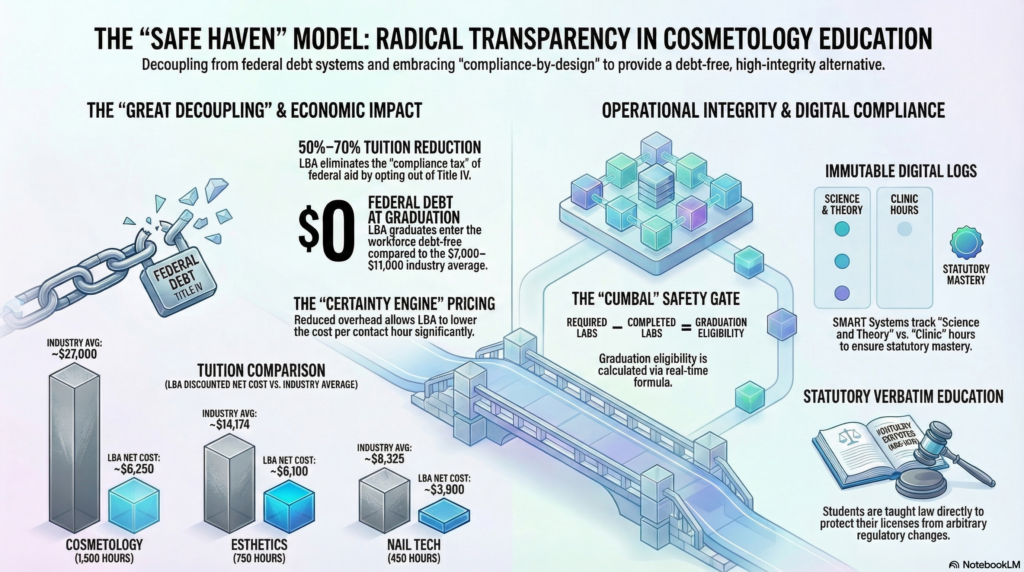
The logic of the CumBal (Cumulative Balance) field is a central feature of the system. It serves as a real-time progress bar, calculated as:
This formulaic approach ensures that graduation eligibility is based on a verifiable completion of the state-mandated curriculum rather than subjective instructor approval. In the case of Acosta, the student completed her 450-hour Nail Technology course in approximately three and a half months, starting on May 10, 2024, and graduating on August 26, 2024.18
The Phenomenon of Over-Compliance
An advanced insight derived from the analysis of student Melisa Dominguez Aguilar (Permit No. 890-81462) is the presence of negative values in the CumBal field.18 Aguilar, enrolled in the 300-hour Shampoo Styling program, shows multiple entries where the Req Lab No. was set at 0.00, but she completed 1.00 lab, resulting in a CumBal of -1.00 for modules such as “Professionalism,” “Sanitation,” and “Blood Exposure”.18
This negative balance indicates that the student is performing clinical tasks that go beyond the base requirements of her specific course. This suggests that LBA utilizes a “universal clinical standard” where certain essential safety and professionalism tasks are tracked for all students, regardless of whether they are strictly required for that student’s specific license type.18 This over-compliance provides an additional layer of public safety and student protection, as it ensures that even “shampoo stylists” are trained in advanced sanitation protocols.
Satisfactory Academic Progress (SAP) Monitoring
A critical component of LBA’s internal stability is the Satisfactory Academic Progress (SAP) indicator. For Edianay Rubio Acosta, the SAP status was recorded as “Y” (Yes), reflecting both qualitative success (GPA of 83.06) and quantitative adherence to the schedule (100% completion of hours).18
However, for students like Melisa Dominguez Aguilar, the SAP status was “N” (No), despite a high GPA of 85.45.18 This failure to meet SAP is rooted in the “Pace of Completion” metric. Aguilar had attended only 190.75 hours of her 300-hour course, representing a 63.58% completion rate.18 In the vocational education sector, a student is generally required to maintain an attendance rate of at least 67% to 80% to be considered in “Good Standing”.19 The “N” status on the LBA transcript serves as an early-warning system, triggering institutional intervention to ensure the student graduates within the “Maximum Time Frame” (typically 150% of the program length).21
Economic Analysis: The One Big Beautiful Bill Act (OBBBA) and the “Safe Haven” Model
The year 2025 marked a watershed moment in the economics of beauty education with the passage of the One Big Beautiful Bill Act (OBBBA), signed on July 4, 2025.24 The OBBBA, often described as a structural reset of individual and business taxation, has profound implications for how cosmetology schools operate and how students finance their training.25
The Great Decoupling: Opting Out of Title IV
The traditional model of beauty education in the U.S. relies heavily on the Title IV federal aid system. Most private schools generate up to 90% of their revenue from federal loans and Pell Grants, a relationship governed by the “90/10 Rule”.28 However, participation in Title IV comes with a “compliance tax”—the administrative “bloat” required to maintain eligibility. Schools must allocate 40% to 60% of their tuition revenue toward accreditation fees, specialized financial aid software, third-party audits, and compliance salaries.28
Louisville Beauty Academy has strategically opted out of the Title IV system, a move categorized by researchers as the “Great Decoupling”.3 By eliminating the overhead of federal aid compliance, LBA has been able to reduce tuition by 50% to 70% compared to industry averages.3
Program (Hours)
Industry Avg. Tuition
LBA Discounted Net Cost
LBA Cost per Contact Hour
Cosmetology (1,500)
~$27,000
~$6,250
~$4.17
Esthetics (750)
~$14,174
~$6,100
~$8.13
Nail Technology (450)
~$8,325
~$3,800
~$8.44
Certified Instructor (750)
~$12,675
~$3,900
~$5.20
4
This pricing model, described as the “Certainty Engine,” provides a lower-debt alternative for students.3 While traditional beauty schools leave graduates with $7,000 to $11,000 in student debt, LBA graduates typically enter the workforce with $0 in federal debt.14
The Repayment Assistance Plan (RAP) and Financial Vulnerability
For students who remain within the federal loan system, the OBBBA has introduced the Repayment Assistance Plan (RAP), which replaces previous income-driven repayment options.31 The RAP is significantly less forgiving for low-income earners, which characterizes the entry-level cosmetology workforce. A critical provision of the RAP is a mandatory $10 monthly minimum payment for all borrowers, including those with zero income.31
Cosmetology graduates typically earn an average of $20,000 annually four years post-graduation.31 Under the RAP, even a marginal increase in income can lead to a doubling of monthly loan payments. Furthermore, the OBBBA eliminated economic hardship and unemployment deferments, removing essential protections that once allowed cosmetologists to pause payments during seasonal work fluctuations.31 These changes increase the risk of default for graduates of high-cost programs, making LBA’s lower-debt “Safe Haven” model even more economically attractive.3
Tax Incentives and “Trump Accounts” for Vocational Training
Contrasting the challenges for loan-dependent students, the OBBBA provides new tax advantages for families and business owners in the beauty sector. The act established “Trump Accounts,” allowing parents to create tax-deferred savings for their children’s education.24 Crucially, the usage of 529 savings plans was expanded to include vocational programs, licensing tests, and credentialing courses.33
For salon owners, the OBBBA expanded the FICA tip credit to certain beauty service businesses, allowing them to offset their tax liability by the social security and medicare taxes paid on student or employee tips.25 These provisions, alongside a 100% bonus depreciation for “qualified production property,” create a powerful capital-spending window for schools that own their own real estate, as LBA does.14 LBA’s main-campus ownership and written-record systems reduce the institutional fragility often created by short-term leasing models, helping student records remain secure and accessible even during regional economic downturns.14
Human Service Intelligence (HSI): Pedagogy of Transparency
LBA’s commitment to transparency is not limited to fiscal and regulatory data but extends into its pedagogical methodology, specifically through the framework of Human Service Intelligence (HSI).34 Developed by founder Di Tran, HSI reframes technical beauty skills as “human care” and integrates attachment theory into the daily operations of the student clinic.4
Attachment Theory and Client Safety
HSI posits that interactions in a service environment—whether it be a styling chair, a nail station, or a facial room—are governed by the Attachment Behavioral System (ABS). Clients often enter these environments in a state of “safety-seeking,” characterized by hyper-vigilance toward tools or reluctance to lean back in a chair.34
LBA trains its students to employ “Universal Trauma Precautions,” which are essentially a series of transparency protocols:
Explaining the “Why”: Students are taught to explain why a specific tool is being used or why a question is being asked.34
Consent and Agency: Students must ask for permission before physical contact or before changing the client’s environment (e.g., “Is it okay if I lean your chair back now?”).34
Right of Refusal: The client’s agency is documented and respected, ensuring that technical beauty procedures never become coercive.34
This approach transforms the student record from a mere tally of hours into a “Behavioral Competency Check”.34 LBA evaluates students on their ability to maintain a calm, professional tone and their fluency in “Elevation Scripts” designed to soothe anxious clients.34 By integrating these qualitative measures into the student’s academic profile, LBA creates a more holistic view of graduate readiness for a workforce that increasingly prizes empathy and social intelligence.30
Inclusivity and Multilingual Record-Keeping
A significant portion of LBA’s 1,000+ graduates are international women, including young and old mothers who may speak limited English.4 LBA’s “Safe Haven” philosophy explicitly states: “It’s okay to speak broken English; it’s okay to speak no English. It’s okay to look different”.29
This inclusivity requires a record-keeping system that is accessible to diverse learners. LBA utilizes digital platforms that allow for multilingual support, ensuring that students from all backgrounds can monitor their own progress toward licensure.4 This focus on the marginalized—particularly immigrants—aligns the academy’s mission with the broader social goals of “equitable recovery” and economic self-sufficiency advocated by national workforce coalitions.29
The Consequences of Systemic Failure: Institutional Closures
The necessity of LBA’s “Gold-Standard” system is highlighted by the high failure rate of vocational schools that prioritize profit over compliance. Sudden institutional closures have become a “crisis of record-keeping” in the beauty industry, with institutions like Paul Mitchell Knoxville, Federico College, and Empire Beauty School locations shutting down abruptly.36
The Displacement Crisis and Data Integrity
Between July 2004 and June 2020, over 100,000 students experienced the closing of their institution without adequate notice or a “teach-out” plan.39 The impacts are devastating: students displaced by closures are 71.3% less likely to re-enroll within one month and 50.1% less likely to earn a credential than their non-displaced peers.39
A primary cause of this failure to re-enroll is the loss of educational records. In a sudden closure, students often receive incorrect or incomplete transcripts on plain paper, with no defunct registrar available to correct errors.37 Without a “lockable fireproof file” or an “immutable digital log,” hundreds of completed clinical hours may vanish.37 LBA’s system, which includes automated monthly audits and the digital storage of student hours on a centralized board visible to both students and board employees, provides a “soft landing” guarantee.14
Accountability and Financial Value Transparency (FVT)
The federal government’s response to these failures has been the Gainful Employment (GE) and Financial Value Transparency (FVT) frameworks, which have been unified under the OBBBA’s STATS system.8 These frameworks establish two primary metrics for institutional accountability:
Debt-to-Earnings (D/E) Ratio: Median annual debt payments must not exceed 8% of annual earnings or 20% of discretionary income.8
Earnings Premium (EP) Test: Median graduates must earn more than a typical high school graduate in the same state between ages 25 and 34 with no postsecondary education.8
Programs that fail either test for two out of three consecutive years lose eligibility for federal student aid.23 Research suggests that 75% of cosmetology programs nationwide will likely fail the earnings threshold.31 At large for-profit conglomerates, up to 90% of graduates fail the earnings premium test.31 LBA’s model, which eliminates student debt, automatically satisfies these “Do No Harm” provisions, making it a resilient outlier in a failing industry.8
Future Projections: Toward the STATS Framework (2027)
As the industry approaches the July 1, 2026, deadline for STATS implementation, the reporting requirements for beauty schools will become even more granular.8 The STATS framework represents a “National Picture” of educational value, requiring institutions to report:
Initial enrollment dates for every student.8
Detailed breakdown of institutional grants and scholarships provided over the entire enrollment period to calculate an accurate “net price”.8
Exact amounts of private education loans received by students who complete or withdraw.8
LBA is already “audit ready” for these requirements due to its existing digital infrastructure.1 The institution’s “Open Knowledge Infrastructure” functions as a public knowledge library, providing the public with literal, unmodified state oversight reports and legislative research.2
AI Integration and Immutable Logs
The next horizon for student records is the integration of Artificial Intelligence (AI) for hour verification. LBA leads the nation in deploying AI-based attendance validation and automated monthly audits.14 These systems prevent the falsification of hours—a common trigger for KBC audits—and ensure that student labor remains strictly curricular rather than exploitative.14
Synthesis of Second and Third-Order Insights
The comprehensive analysis of the Louisville Beauty Academy student record system within its legal and economic context leads to several nuanced insights into the future of professional beauty education.
Transparency as a Barrier to Entry and a Protective Shield
Radical transparency in student records acts as a “Market Correction” mechanism.8 Institutions that cannot prove their “administrative capability” or their “earnings premium” are being systematically flushed out of the market by federal and state regulators.8 Conversely, for institutions like LBA, transparency serves as a shield against anonymous allegations. Because Kentucky law prohibits anonymous complaints and requires a “signed writing,” a robust, immutable record system provides an objective, evidentiary defense that renders bad-faith complaints invalid.41
The Evolution of the Professional Credential
The HSI framework and the “Over-Compliance” observed in LBA transcripts suggest that the traditional cosmetology license is evolving.18 As automation begins to handle routine tasks in other industries, the beauty industry’s premium on “Human Skills”—social intelligence, empathy, and behavioral decoding—is increasing.30 Student records that document these “soft” competencies, alongside technical hours, will become the gold standard for employers looking to hire graduates who are truly “workforce ready.”
Ownership as Educational Stability
The economic resilience of LBA is fundamentally tied to its ownership of its physical facilities and the elimination of dual-revenue abuse (the practice of treating student clinical labor as salon profit).14 By focusing on “Education First, Students First,” LBA has created a replicable, investable beauty-college framework that offers a higher Social Return on Investment (SROI) than the traditional Title IV-dependent model.14
The End of Federal Dependency
The structural changes in the OBBBA 2025 and the implementation of the RAP payment plan signal the eventual end of the high-debt beauty school model.31 As graduate debt levels are increasingly publicized through the “Red Flag” system on the FAFSA and the College Scorecard, students will gravitate toward “Safe Haven” models like LBA that offer lower tuition and written payment payment plans.3
In conclusion, the Louisville Beauty Academy student record system is not merely a tool for administration but the architectural core of a transformative educational philosophy. By aligning technological precision with statutory verbatim, LBA has set a national benchmark for legal integrity and student protection. As regulatory pressures and economic constraints intensify through 2027 and beyond, the LBA model of “Gold-Standard Transparency” will likely serve as the mandatory blueprint for institutional survival and the continued elevation of the beauty profession in Kentucky and the nation.
This article is part of LBA’s public education and historical archive. Older posts, including “The Reality of Cosmetology Education in Kentucky What Adult Students Must Understand Before Enrolling,” may not reflect current tuition, schedules, incentives, forms, policies, testing vendors, clinic availability, or regulatory requirements.
Di Tran University Research & Workforce Policy Series – 2026
Frequently Asked Questions About Cosmetology and Beauty Training in Kentucky
How many hours are required for a cosmetology license in Kentucky? Kentucky requires 1,500 training hours for a cosmetology license under KRS Chapter 317A and the administrative regulations in 201 KAR Chapter 12. The curriculum includes theory instruction, clinical practice, and Kentucky law before a student can qualify for the state licensing examination administered through PSI.
How many hours are required for an esthetician license in Kentucky? Kentucky requires 750 training hours for an Esthetics license. Esthetics training focuses on skin care, facial treatments, sanitation, infection control, product chemistry, and safe skin service procedures. Graduates must pass the Kentucky state board licensing examination to practice professionally.
How many hours are required for a nail technician license in Kentucky? Kentucky requires 450 training hours for a Nail Technology license. Training includes sanitation, infection control, nail structure, chemistry of nail products, and practical service procedures before qualifying for the state licensing exam.
Is shampoo styling a license in Kentucky? Yes. Shampoo Styling is a licensed profession in Kentucky requiring 300 hours of training in a licensed cosmetology school. The program focuses on shampooing, scalp treatments, blow-drying, and basic styling techniques, with strong emphasis on sanitation and hygiene.
Is eyelash extension a license in Kentucky? No. Eyelash extensions are regulated through a specialty permit rather than a full license. Practitioners must complete approved training and obtain a specialty permit before legally performing eyelash extension services.
What is the difference between a license and a specialty permit? A professional license (cosmetology, esthetics, nail technology, or shampoo styling) requires a defined number of training hours and passing a state licensing examination. A specialty permit allows practice of a specific limited service and typically requires shorter training focused only on that service.
Can cosmetology or esthetics students work on real clients during school? Yes. Kentucky allows student clinics in licensed schools. However, cosmetology students must complete at least 250 hours of foundational training before performing chemical services on members of the public in order to protect public safety.
How much does beauty school cost in Kentucky? Tuition varies widely depending on the institution. Programs may range from lower-cost vocational training models to higher-priced schools that rely heavily on federal student aid. Prospective students should compare tuition, exam preparation support, and graduation outcomes before enrolling.
Correct Kentucky Program Hour Requirements Summary
Program
Hours Required
Credential Type
Cosmetology
1,500 hours
License
Esthetics
750 hours
License
Nail Technology
450 hours
License
Shampoo Styling
300 hours
License
Eyelash Extension
Specialty training
Specialty Permit
Research & Educational Disclaimer
This article is provided for public education and workforce research purposes only and reflects analysis prepared by researchers affiliated with Di Tran University as part of its ongoing study of vocational education systems, regulatory structures, and economic outcomes for adult learners. The content represents independent academic commentary and general informational analysis regarding industry trends, public regulations, and financial literacy considerations within cosmetology education. Publication on the Louisville Beauty Academy website is intended solely to support consumer awareness and transparency in vocational decision-making. Nothing in this article should be interpreted as legal advice, regulatory interpretation, endorsement of any institution, or criticism of any specific organization, program, regulator, or business entity. Regulatory references are provided for educational context only, and readers are encouraged to consult the official statutes, administrative regulations, and the appropriate licensing authorities for authoritative guidance. Louisville Beauty Academy does not claim authorship of the analysis and assumes no responsibility for third-party interpretations or decisions made based on this informational content.
The Architecture of Regulatory Capture in Cosmetology: Institutional Influence, Competitive Obstruction, and the Crisis of Debt-Dependent Education
The landscape of occupational licensing in the United States, particularly within the cosmetology and beauty services sector, serves as a primary example of regulatory capture. This phenomenon, where state agencies created to act in the public interest instead prioritize the commercial and political objectives of the industries they regulate, is not merely a theoretical concern but a documented reality with significant economic consequences. In the beauty education sector, this capture is facilitated through a complex network of statutory board compositions, aggressive lobbying by trade associations, and an accreditation system that serves as a gatekeeper for billions of dollars in federal subsidies. The resulting policy environment often suppresses competition, inflates tuition, and traps low-income and immigrant learners in a cycle of debt that bears little relation to professional mastery or public safety.
The Theoretical Framework of Occupational Capture and Market Distortion
Regulatory capture within cosmetology boards is characterized by the dominance of active market participants over the regulatory process. When a licensing board is composed primarily of industry insiders—specifically owners of large cosmetology school chains—the board’s incentives shift from protecting the public to protecting incumbent business models. This is particularly evident in the setting of mandatory instructional hours, curriculum standards, and the adjudication of competitive entries. Research from the Center for the Study of Economic Liberty (CSEL) at Arizona State University suggests that this mechanism of capture is the primary driver behind the suppression of employment and entrepreneurial opportunities in the sector.1
The economic impact of this capture is quantifiable. Boards dominated by industry incumbents tend to set higher barriers to entry, which increases the time and cost required to obtain a license. According to CSEL’s 2020 report, the “Cosmetology Board Capture Index” reveals a direct correlation between the lack of public representation on boards and the length of state-mandated training.2 In the eight states with the highest levels of board capture—defined as having zero public representatives—it takes an average of 50 more calendar days than the national average to fulfill the state requirements for licensure.2
National Metrics of Cosmetology Board Capture
Data Observation
States with Zero Public Board Representatives
New York, North Dakota 2
States with High Capture (Minimal Public Input)
LA, MA, MS, OK, VT, WY 2
National Average Training Time Increase (High Capture States)
+50 Days 2
States with Majority Public Boards
Arizona (post-2020), California 3
States with Eliminated Boards (Least Captured)
Maine, Arkansas (Eliminated 2009) 3
These “high capture” states often resist reforms such as universal licensure reciprocity, which would allow practitioners to move across state lines without undergoing duplicative and costly training.4 By maintaining fragmented and high-barrier licensing regimes, captured boards ensure that students remain enrolled in schools longer, thereby maximizing the tuition revenue generated for the institutions represented on those boards.5
Schools that operate with lower tuition models allow graduates to enter the workforce without heavy debt obligations. When graduates are not burdened by loan repayment, they can reinvest earnings into advanced education, business ownership, and local economic activity. In contrast, high-tuition programs often delay entrepreneurship because graduates must prioritize debt repayment before building independent practices.
Structural Capture in State Statutes: The Case of Kentucky
The Commonwealth of Kentucky provides a granular view of how regulatory capture is codified into state law. Kentucky Revised Statute (KRS) 317A.030 establishes the composition of the Kentucky Board of Cosmetology (KBC) in a manner that virtually guarantees industry dominance. The statute mandates a seven-member board, but only one of those seats is reserved for a “citizen at large” who is free from financial ties to the industry.6
The board’s composition under KRS 317A.030 is as follows:
Two members must be cosmetology salon owners.
One member must be a cosmetology teacher in public education.
One member must be an owner of, or have a financial interest in, a licensed cosmetology school.
One member must be a licensed nail technician.7
One member must be a licensed esthetician.7
One member is a citizen at large.6
A critical second-order insight into this statutory structure is the requirement that the school owner member “shall be a member of a nationally recognized association of cosmetologists”.6 By embedding membership in a trade association—such as the American Association of Cosmetology Schools (AACS)—directly into the qualifications for a government regulator, the state effectively delegates regulatory influence to private interest groups. This formal mechanism ensures that the national policy agenda of large, for-profit school chains is represented at the highest levels of state oversight.
The informal mechanisms of capture in Kentucky have historically been even more pronounced. Prior to 2024, the KBC faced significant public pressure and allegations of mismanagement, leading to the removal of Executive Director Julie Campbell in September 2024 after a seven-year tenure.9 The board’s transition to new leadership under Joni Upchurch, a former cosmetology professor, and the appointment of Michael Carter as the first-ever nail technician board member, represent attempts at institutional reform.9 However, even under new leadership, the board continues to exhibit the hallmarks of capture, such as the recusal of board members from decisions involving competing schools. For instance, in a January 2026 meeting, Vice Chair Lianna Nguyen recused herself from board decisions regarding the Louisville Beauty Academy (LBA), a low-cost competitor to traditional Title IV schools.11
Trade Associations and the Lobbying Power of the Beauty School Industrial Complex
The American Association of Cosmetology Schools (AACS) acts as the central hub for industry lobbying and advocacy. As a regulated industry, for-profit beauty schools maintain a “proactive” stance toward federal and state government relations to protect their revenue streams from “attacks” such as the reduction of program hours or the deregulation of licensure.12
The Federal Lobbying Machine
The AACS maintains a robust advocacy infrastructure, including an annual Congressional Summit and “Hill Day,” where school owners and administrators gather in Washington, D.C., to lobby Members of Congress.12 Their primary objectives include:
Preserving High Program Hours: Lobbying against state-level efforts to reduce mandatory hours, as shorter programs decrease the amount of federal student aid a school can collect.5
Opposing Accountability Standards: Fighting federal “Gainful Employment” (GE) and “Financial Value Transparency” rules that tie federal aid eligibility to graduate earnings.13
Protecting Title IV Dependency: Ensuring that the flow of Pell Grants and federal student loans remains uninterrupted, despite evidence that many programs provide poor financial returns for students.5
A significant example of this influence is the AACS’s legal challenge to the Department of Education’s 2023 Gainful Employment Rule. The AACS and its member schools filed suit in federal district court in Texas, seeking to strike down the rule as “arbitrary, capricious, and unconstitutional”.15 Although Chief U.S. District Judge Reed O’Connor ruled in favor of the Department of Education in October 2025, the AACS has continued to fight through the appeals process and through targeted political contributions.16 The schools’ own legal arguments in this case were revealing: they admitted that if forced to meet basic debt-to-earnings benchmarks, a substantial number of programs would “fail and shut down”.14
The 90/10 Rule and Revenue Capture
The economic model of for-profit beauty schools is heavily reliant on federal subsidies. Under the “90/10 rule,” proprietary institutions must derive at least 10% of their revenue from non-federal sources. For many beauty school chains, Title IV federal aid (Pell Grants and loans) accounts for more than 85% of total revenue.19 Recent changes to the 90/10 rule in 2023 expanded the definition of “federal funds” to include any federal assistance received by students, such as Veterans Affairs (VA) benefits, which had previously been used by schools to satisfy the 10% requirement.20 This regulatory shift has put additional pressure on the sector, leading to increased lobbying for “carve-outs” and exemptions.20
Case Study in Competition Blockade: The Iowa Monopoly
The state of Iowa offers a definitive case study in how captured boards and trade associations use the legal system to suppress lower-priced competition. In 2005, the Iowa Cosmetology School Association and La’ James International College sued Iowa Central Community College to stop it from launching a cosmetology program.22 The private schools successfully argued that state code prohibited public entities from competing with private businesses in this sector. This lawsuit effectively preserved a monopoly for high-tuition, for-profit providers and maintained Iowa’s status as having one of the highest licensure hour requirements in the nation—2,100 hours.22
The relationship between the dominant school chain, La’ James International College, and the state regulatory body was particularly incestuous. A high-ranking official from La’ James held a seat on the Iowa Board of Barbering and Cosmetology Arts and Sciences even as the school faced multiple investigations for consumer fraud.24 This position of power allowed the school to influence the very inspectors who were tasked with investigating student complaints about “instructorless” classrooms and the exploitation of students as unpaid labor.25
Iowa Competitive Obstruction Metrics
Impact / Observation
Mandatory Cosmetology Hours
2,100 (Highest in U.S.) 22
Community College Blockade
Lawsuit in 2005 prevented public entry 23
Tuition for Private Chains
$15,000 – $20,000 22
Student Debt Forgiveness Settlements
$2.1M (2016) and $462k (2021) 22
Board Representation
La’ James official held active seat 24
The Title IV Debt Trap and the Economics of Exploitation
The current financing architecture of beauty education incentivizes a model that prioritizes enrollment and aid capture over student outcomes. Because schools are paid per enrolled student per credit hour, there is a systemic incentive to delay graduation and maintain artificially long programs.5
Debt-to-Earnings Disparities
Nationwide data indicates a severe mismatch between the cost of beauty education and the eventual earnings of graduates. Analysis by The Century Foundation and New America shows that 98% of cosmetology programs would fail proposed federal earnings tests.5 Graduates typically earn an average of only $16,600 to $20,000 annually, yet they often carry a debt load of $10,000 to $11,000.5 This high debt-to-income ratio is particularly damaging to the low-income, first-generation, and immigrant populations that these schools target.5
Comparative Earnings Data (2025-2026)
Annual Income Range
Entry-Level Cosmetologist
$26,000 – $31,000 30
Mid-Career Professional
$35,000 – $45,000 30
Average Hourly Rate
$18 – $22/hour 30
High School Graduate Median
Used as federal benchmark for “Red Flag” 31
The industry often defends these low reported earnings by claiming that stylists receive significant unreported income through cash tips. However, the Department of Education, under multiple administrations, has found no empirical evidence of widespread unreported income that would bridge the gap between reported earnings and a livable wage.13
Systemic Use of Unpaid Student Labor
A core component of the for-profit beauty school business model is the “dual-revenue” structure: schools profit from both student tuition and from the salon services performed by students on paying customers.29 In many schools, students are required to work on the “clinic floor” for hundreds of hours, often performing non-educational tasks such as cleaning, restocking, and laundry under the guise of “training”.25
This practice has led to over 40 major class-action lawsuits and federal investigations. Schools such as Empire Beauty, Milan Institute, and La’ James have been accused of treating students more like “free labor” than learners.25 In Iowa, the Attorney General’s lawsuit against La’ James specifically alleged that the school “seemed to pay the company for the privilege of working,” as students were pressured to sell products and were only given credit for services performed on paying customers rather than mannequins.33
The Disruptive Alternative: Louisville Beauty Academy (LBA)
In the midst of this sector-wide crisis, the Louisville Beauty Academy (LBA) in Kentucky serves as a national model for reform. Unlike the dominant chains, LBA operates without any reliance on Title IV federal student aid, Pell Grants, or federal loans.28 By decoupling from the federal aid system, LBA eliminates the “Compliance Tax”—the administrative overhead required to manage federal aid, which typically consumes 25% to 35% of a school’s tuition.5
Economic and Fiscal Contribution
LBA’s non-Title IV model allows for significantly lower tuition rates, which makes the program accessible to working-class and immigrant students without the burden of debt. A 1,500-hour cosmetology program at LBA is currently priced at $6,250.50, compared to the $15,000 to $20,000 national average for Title IV schools; LBA’s shorter Nail Technology program is priced separately at $3,800.35
Fiscal Comparison: LBA vs. Title IV Model
LBA Model (Actual)
Title IV Model (Hypothetical)
Public Funds Consumed
$0
$25,000,000 35
Direct Fee Revenue to State
$884,250
~$884,250 35
Tax Revenue Generated (10 yrs)
$47,815,000
~$47,815,000 35
Net Positive Economic Impact
$48,699,250
$23,699,250 35
The economic impact of LBA is further demonstrated through its “resilience-based” model. LBA leads the state of Kentucky in theory retake participation, reflecting a commitment to ensuring all students, regardless of language barriers or educational background, eventually achieve licensure.35 This model is supported by Kentucky Senate Bill 22 (SB 22), which reformed licensing to allow for unlimited exam retakes and removed punitive waiting periods.36
Speed-to-Market Advantage
LBA’s curriculum is “laser-focused” on the state board examination and minimum competency requirements. This efficiency allows students to complete their training and enter the workforce significantly faster than at Title IV schools, which often pad their curriculum to maximize aid disbursements.5 The speed-to-market differential is estimated at approximately six months:
.28
By entering the workforce earlier and without debt, LBA graduates achieve a vastly superior return on investment (ROI). In a comparative model, LBA graduates contribute more to the state treasury over a five-year horizon through income taxes and license renewal fees because they are not diverted by debt servicing or program delays.28
The Federal Counter-Strike: FAFSA Red-Flags and GE 2.0
As the crisis in for-profit beauty education has become undeniable, the federal government has introduced new mechanisms to protect students and taxpayers. These measures represent an attempt to bypass the captured state boards and communicate directly with prospective students.
The FAFSA “Red Flag” Warning System
On December 7, 2025, the U.S. Department of Education implemented a new “Lower Earnings” warning within the FAFSA system.31 This system flags institutions where the median earnings of graduates fail to exceed the earnings of a typical high school graduate. When a student selects a flagged school, the system highlights the institution in red and provides a “Remove School” button.31
In Kentucky, several major institutions were flagged with this warning:
Empire Beauty School (multiple locations) 31
Paul Mitchell The School Louisville 31
PJS College of Cosmetology 31
Summit Salon Academy 31
This system serves as an active market correction, disrupting the enrollment funnel of schools that provide poor economic returns. The New American Business Association (NABA) notes that this shift transforms the FAFSA from a neutral funding gateway into an instrument of market correction.5
The Gainful Employment (GE) Rule 2023-2025
The Department of Education’s 2023 Gainful Employment Rule is the strongest accountability measure to date. It establishes a two-part test for career programs:
Debt-to-Earnings Test: Measures whether graduates’ debt payments are manageable relative to their income.
Earnings Premium Test: Measures whether graduates earn more than a typical high school graduate in their state.14
Failure of these metrics for two out of three consecutive years results in the automatic loss of Title IV eligibility for both federal loans and Pell Grants.37 This is a critical distinction from the One Big Beautiful Bill Act (OBBBA) “Low Earnings” test, which only cuts off access to federal loans but not Pell Grants.38 Given that many undergraduate certificate programs in cosmetology distribute more in Pell Grants than in loans, the GE rule is the only mechanism that truly protects taxpayers from subsidizing low-value programs.38
The Impact of the One Big Beautiful Bill Act (OBBBA)
Signed into law on July 4, 2025, the One Big Beautiful Bill Act (OBBBA) introduced a range of tax and accountability measures that significantly impact the beauty industry.39 While the law permanently extended individual tax cuts and increased deductions for seniors, it also codified a new “Low Earnings” test for degree programs and graduate certificate programs.38
For the beauty industry, the OBBBA was a mixed legislative bag. The industry successfully lobbied for the expansion of the FICA tip tax credit to include beauty services, a move that provides significant tax relief for salon owners.21 However, the law’s “AHEAD” framework (Accountability in Higher Education and Access through Demand-driven Workforce Pell) introduced a “Do No Harm” metric for vocational schools.32
OBBBA Provision
Impact on Beauty Sector
Tip Tax Credit Expansion
Expanded to beauty services (formerly food/beverage only) 21
Low Earnings Test
Codified for degree/grad cert programs; undergraduate certs exempt 38
Pell Grant Expansion
Expanded to short-term (<15 weeks) training programs 38
Student Loan Repayment Exclusion
Made permanent tax exclusion for employer-provided repayment ($5,250/yr) 41
The OBBBA’s accountability requirements work “in tandem” with the 2023 GE rule. While the OBBBA focuses on degree-granting institutions, the GE rule remains the primary oversight mechanism for the undergraduate certificate programs that dominate the beauty sector.38
Analytical Synthesis: The Mechanics of Decoupling and Reform
The investigation into regulatory capture in the cosmetology sector reveals a system that is fundamentally misaligned with its stated purpose of public protection. Instead, the licensing framework serves as a state-sanctioned mechanism for funneling federal subsidies into high-tuition, for-profit institutions while providing students with minimal professional preparation and significant debt.
The Capture Loop and the Compliance Tax
The “capture loop” is a self-reinforcing cycle where trade associations (AACS) influence state statutes (KRS 317A) to maintain high hour requirements, which are then validated by industry-led accreditors (NACCAS) to unlock federal aid (Title IV).2 This cycle creates the “Compliance Tax”—an invisible portion of tuition that pays for the administrative apparatus of federal aid management rather than education.5
Schools that operate within this loop, such as the large national chains, are currently facing an enrollment collapse as federal “red flag” systems and Gainful Employment rules take effect.14 The schools themselves admit that their business models are unsustainable without the ability to saddle students with unrepayable debt.14
The Resilience Model as a Path to Market Correction
The emergence of non-Title IV models like Louisville Beauty Academy represents a “Great Decoupling” of beauty education from the debt-based system.5 These models demonstrate that it is possible to provide high-quality, state-licensed education at a fraction of the cost by prioritizing “Minimum Competence” for licensure and delegating “Professional Mastery” to the salon environment.42
Structural Alignment Comparison
Title IV High-Capture Model
LBA Non-Title IV Model
Primary Stakeholder
U.S. Department of Education
The Student / Local Employer
Revenue Driver
Enrollment and Aid Draw
Graduation and Licensure 35
Curriculum Philosophy
Bloated / Celebrity Artistry Promises
Licensing / Science / Safety 42
Attendance Tracking
Manual / Shoddy / Manipulated
Biometric / Non-Negotiable 19
Ethical Standard
Unpaid Student Salon Labor
Educational Clinic / Community Service 29
Recommendations for Policy Reform
To break the grip of regulatory capture and the associated debt crisis, policymakers must enact the following reforms:
Eliminate Statutory Association Requirements: Statutes like Kentucky’s KRS 317A.030 should be amended to remove the requirement that board members belong to private trade associations.6
Mandate Public Member Majorities: Following the examples of Arizona and California, all licensing boards should be required to have a majority of members who are free from financial ties to the industry.3
Conduct Independent Hour Audits: State legislatures should commission independent audits of mandatory hours to determine the minimum training necessary for public safety, independent of federal aid eligibility requirements.2
Codify Biometric Attendance Requirements: To prevent the fraudulent reporting of hours, all state-licensed beauty schools should be required to use tamper-proof biometric systems to verify student attendance.19
Enforce FLSA Standards in Educational Clinics: State and federal labor regulators must strictly enforce the distinction between “practical training” and “compensable labor” to stop the exploitation of students as unpaid salon workers.19
Support Universal Reciprocity: Decoupling licensure from specific state boards through universal reciprocity would create a competitive national market for beauty education, forcing schools to compete on quality and price rather than regulatory capture.3
The beauty industry is currently witnessing a historic shift from a “Capture-First” era to a “Transparency-First” era. The survival of the sector depends on its ability to move away from the debt-dependent, aid-capture model and toward the ethical, high-ROI workforce stabilization models demonstrated by institutions like the Louisville Beauty Academy. The “Red Flag” system in the FAFSA and the 2025 OBBBA accountability measures are the first steps in a necessary process of market correction that will ultimately benefit students, taxpayers, and the integrity of the beauty profession.5
Works cited
Center for the Study of Economic Liberty – Arizona State University, accessed March 4, 2026, https://csel.asu.edu/
AN ACT relating to activities regulated by the Kentucky Board of Hairdressers and Cosmetologists – LegiScan, accessed March 4, 2026, https://legiscan.com/KY/text/HB311/2012
State attorney general alleges school violated state’s Consumer Fraud Act – Legal News > Your source for information behind the law, accessed March 4, 2026, https://legalnews.com/Home/Articles?DataId=1396296
This article is provided for public education and workforce research purposes only and reflects analysis prepared by researchers affiliated with Di Tran University as part of its ongoing study of vocational education systems, regulatory structures, and economic outcomes for adult learners. The content represents independent academic commentary and general informational analysis regarding industry trends, public regulations, and financial literacy considerations within cosmetology education. Publication on the Louisville Beauty Academy website is intended solely to support consumer awareness and transparency in vocational decision-making. Nothing in this article should be interpreted as legal advice, regulatory interpretation, endorsement of any institution, or criticism of any specific organization, program, regulator, or business entity. Regulatory references are provided for educational context only, and readers are encouraged to consult the official statutes, administrative regulations, and the appropriate licensing authorities for authoritative guidance. Louisville Beauty Academy does not claim authorship of the analysis and assumes no responsibility for third-party interpretations or decisions made based on this informational content.
Louisville Beauty Academy supports transparency in vocational education and encourages prospective students to carefully evaluate all training programs, tuition models, and regulatory requirements before making a career investment. Access to accurate information allows adult learners to make informed decisions about licensing pathways and workforce entry.
This research is produced by Di Tran University – The College of Humanization Research Team and is shared for educational and public policy discussion purposes only. It does not constitute legal, regulatory, or financial advice. Louisville Beauty Academy does not endorse or oppose any federal or state regulatory model referenced herein.
The vocational beauty education sector in 2026 exists at a critical juncture between stringent federal oversight and evolving state-level occupational licensing frameworks. For institutions operating within this space, such as those in the Commonwealth of Kentucky and the State of Texas, the regulatory environment is characterized by a “Compliance by Design” mandate that necessitates a sophisticated understanding of Department of Education (DOE) regulations, Title IV financial structures, and federal labor law. As the industry transitions into an era of outcome-based accountability—driven by the implementation of Gainful Employment (GE) and Financial Value Transparency (FVT) metrics—the distinction between federal accreditation and state licensing has become the defining feature of institutional sustainability. This report provides an exhaustive analysis of these regulatory layers, examining the cost impacts of federal aid participation, the legal nuances of student labor under the Fair Labor Standards Act (FLSA), and the administrative imperatives for modern beauty colleges.1
Federal Oversight and the Mechanics of Accreditation under 34 CFR Part 602
The U.S. Department of Education does not directly accredit educational institutions; instead, it recognizes accrediting agencies as reliable authorities on educational quality under the provisions of 34 CFR Part 602. These agencies serve as the primary gatekeepers for federal student aid, ensuring that institutions eligible for Title IV funding adhere to rigorous standards of academic and fiscal integrity.2 Under 34 CFR 602.16, an agency must demonstrate that its standards are sufficiently rigorous to ensure the quality of training provided.1 These standards must address a wide array of institutional functions, including student achievement, curricula, faculty qualifications, facilities, and fiscal capacity.1
A significant development in 2026 is the Department’s effort to reduce barriers for new accrediting agencies, as outlined in recent interpretive rules clarifying 34 CFR 602.12. Historically, an agency seeking initial recognition was required to have conducted accrediting activities for at least two years prior to its application.7 The 2026 clarifications aim to foster a more competitive marketplace for accreditors, particularly those focused on workforce-aligned programs and student outcomes.2 This shift reflects a broader policy objective to move away from historical prestige-based accreditation toward a model that prioritizes measurable labor market success.2
Regulatory Requirement (34 CFR 602.16)
Compliance Objective
Administrative Focus
Student Achievement
Verify success via licensing exams and placement
Outcome-based tracking
Curricula Review
Ensure training aligns with professional standards
Educational rigor
Fiscal/Administrative Capacity
Validate institutional stability and resource management
Audit readiness
Facilities and Equipment
Maintain safe and adequate training environments
Safety and sanitation
Recruiting/Admissions
Prevent deceptive practices and ensure transparency
Consumer protection
Source
1
1
The distinction between state licensing and federal accreditation is fundamental. State boards, such as the Kentucky Board of Cosmetology (KBC) or the Texas Department of Licensing and Regulation (TDLR), grant the legal authority to operate a school and define the minimum requirements for a practitioner to obtain a license.9 Federal accreditation, conversely, is a voluntary process (from a legal standpoint) that becomes mandatory if an institution wishes to participate in the Title IV federal student aid system.2 This creates a two-tiered system of beauty education: one tier focused on low-cost, state-compliant training without federal aid, and another tier characterized by higher tuition rates supported by federal grants and loans.11
The Economic Impact of Title IV and the Tuition Premium
The availability of federal financial aid—specifically Pell Grants and Federal Direct Loans—has a profound impact on the tuition structures of beauty schools. Analysis of the sector reveals a consistent “tuition premium” in institutions that participate in the Title IV system.11 Peer-reviewed research, including the seminal 2014 study by Cellini and Goldin, indicates that Title IV cosmetology programs charge approximately 78% more in tuition than comparable non-Title IV programs.11 This premium often mirrors the total value of federal subsidies, suggesting that the existence of federal aid allows institutions to inflate costs without necessarily providing a corresponding increase in educational quality or licensing pass rates.12
In a 2026 landscape, this price disparity is stark. For instance, case studies in major metropolitan areas like Dallas demonstrate that a Title IV-eligible school might charge upwards of $16,000 for a 1,000-hour program, whereas a nearby non-Title IV institution provides the same licensure training for approximately $4,775.11 This economic reality has led to the growth of “lower-debt” education models, such as those championed by the Louisville Beauty Academy, which eschew Title IV participation to maintain lower tuition rates and encourage student “skin in the game”.14
Cost Metric
Title IV Program (Avg)
Non-Title IV Program (Avg)
Economic Implication
Cosmetology Tuition
$15,000 – $20,000
$4,000 – $8,000
78% “Title IV Premium”
Median Student Debt
$7,000 – $11,000
$0
Debt-to-Earnings Risk
Licensing Pass Rate
~67%
~63%
Comparable outcomes
Primary Funding
Pell Grants / Federal Loans
Out-of-pocket / Payment plans
Institutional accountability
Source
11
11
11
For for-profit beauty schools, the reliance on Title IV funds can exceed 85% of total revenue, though federal law (the 90/10 rule) mandates that at least 10% of revenue must come from non-federal sources.13 The potential loss of Title IV eligibility due to new accountability metrics represents an existential threat to these institutions, yet research suggests that the sector is resilient, as evidenced by the high number of non-Title IV schools already operating successfully across states like Texas.12
Gainful Employment (GE) and Financial Value Transparency (FVT)
The 2024 Final Rule on Gainful Employment (GE) and Financial Value Transparency (FVT) has introduced a new era of outcome-based accountability for vocational programs.3 These regulations are predicated on the requirement that programs receiving federal aid must prepare students for “gainful employment in a recognized occupation”.3 The rules apply to all programs at proprietary institutions and non-degree programs at public and private non-profit institutions.3
The Twin Metrics of GE Accountability
Under the GE framework, a program must pass two specific tests to remain eligible for Title IV funds:
The Debt-to-Earnings (D/E) Test: This measures whether a program’s graduates can afford their loan payments relative to their income. The annual median debt payment must not exceed 8% of annual earnings or 20% of discretionary income.18 Discretionary income is calculated using the formula: .18
The Earnings Premium (EP) Test: This requires that the median graduate of a program earns more than the median earnings of a high school graduate (aged 25-34) in the same state.3
If a program fails either metric for two out of three consecutive years, it loses its eligibility for federal student aid.3 The impact on the beauty sector is profound; estimates suggest that 92.5% of cosmetology students are in programs that would fail the earnings standard, largely because entry-level wages in the industry often hover near or below the state median for high school graduates.14
GE/FVT Metric
Failure Threshold
Administrative Response
Annual D/E Rate
Student warning required
Discretionary D/E Rate
Student warning required
Earnings Premium (EP)
State HS Median
Loss of aid after 2 fails
Reporting Deadline
Annual (July 1 Cycle)
Comprehensive data submission
Source
3
18
The 2026 reporting cycle requires institutions to submit student-level data, including costs of attendance and completion dates, to enable the DOE to calculate these metrics.3 Institutions have the option of using a “transitional” methodology for the first six years, which allows them to report only the two most recently completed years of data rather than a full six-to-seven-year cohort.3 This transition period is designed to alleviate the administrative burden on smaller vocational institutions while moving toward a more transparent data environment.18
Administrative Capability and Audit Readiness under 34 CFR 668.16
To maintain participation in Title IV programs, institutions must demonstrate “administrative capability” as defined in 34 CFR 668.16.22 This is a multifaceted requirement that touches every aspect of school operations, from financial aid counseling to the protection of student data.22 A determination that an institution lacks administrative capability can lead to provisional certification, heightened cash monitoring, or the revocation of Title IV eligibility.25
Core Standards of Administrative Capability
The Secretary of Education evaluates capability based on several criteria, including:
Designated Capable Individual: The school must have a qualified financial aid administrator with documented training and experience.23
Adequate Staffing and Controls: Institutions must employ enough qualified staff to manage the volume of aid and maintain a strict separation of duties between the authorization of awards and the disbursement of funds.22
Satisfactory Academic Progress (SAP): The institution must publish and enforce a reasonable SAP policy to ensure students are making progress toward their credential.23
Cohort Default Rates (CDR): Schools must maintain a CDR below 30%. Excessive defaults are viewed as a failure of administrative capability.22
Audit readiness is a constant requirement for Title IV schools. Proprietary institutions are required to submit annual financial statements and compliance audits within six months of their fiscal year-end.25 These audits specifically test for the accurate disbursement of funds, the proper calculation of “Return of Title IV” (R2T4) funds for withdrawn students, and the verification of student eligibility.24
Audit Focus Area
Regulatory Basis
Compliance Requirement
Student Eligibility
34 CFR 668.32
Verify HS diploma and citizenship
Disbursement Accuracy
34 CFR 668.164
Timely and documented payments
R2T4 Calculations
34 CFR 668.22
Accurate refund of unearned aid
Record Retention
34 CFR 668.24
Maintain files for required periods
Cash Management
34 CFR 668.161
Secure handling of federal funds
Source
23
25
Student Labor Law: The FLSA and the “Primary Beneficiary” Test in the Clinic Classroom
One of the most legally sensitive areas of beauty school administration is the status of students performing services in the school’s clinic. If students are deemed “employees” under the Fair Labor Standards Act (FLSA), the school is legally required to pay them minimum wage and overtime.4 The distinction between a “student-learner” and an “employee” is determined by the “Primary Beneficiary Test,” which analyzes the economic reality of the relationship.4
The Seven-Factor Economic Realities Test
Courts apply a flexible, totality-of-the-circumstances approach using seven factors to determine who primarily benefits from the relationship:
Expectation of Compensation: Both parties must clearly understand that the student will not be paid.4
Training Quality: The training provided in the clinic must be similar to that which would be given in an educational environment.4
Educational Integration: The clinical work must be tied to the formal education program through coursework and academic credit.4
Academic Calendar Alignment: The clinical hours must accommodate the student’s academic commitments.4
Beneficial Learning Duration: The duration of the clinic work must be limited to the period in which it provides beneficial learning.4
Displacement of Paid Staff: Student work should complement, not displace, the work of paid employees.4
No Entitlement to a Job: There must be an understanding that the student is not entitled to a paid job at the end of the program.4
In the landmark case Benjamin v. B&H Education, Inc. (2017), the Ninth Circuit held that cosmetology students were not employees because the practical experience gained was a necessary prerequisite for licensure, making the students the primary beneficiaries.28 However, the Sixth Circuit’s decision in Eberline v. Douglas J. Holdings, Inc. (2020) warned that the test applies only to tasks that are educational in nature. If students are forced to perform “repetitive menial tasks” or “janitorial duties” that are far removed from their vocational training, the school may be found to have taken advantage of the students, potentially triggering a wage-and-hour liability.30
FLSA Compliance Pillar
Best Practice for Schools
Legal Risk Mitigation
Enrollment Disclosure
Explicitly state no wages will be paid
Prevent implied promises
Curriculum Mapping
Tie all clinic tasks to state board requirements
Justify labor as educational
Supervision Standards
Ensure licensed instructors oversee all services
Maintain instructional integrity
Recordkeeping
Track clinic hours separately from theory
Defend against labor audits
Task Limitation
Minimize non-educational janitorial work
Avoid “Eberline” pitfalls
Source
4
28
State Licensing Framework: The Kentucky Board of Cosmetology (KBC)
The Commonwealth of Kentucky operates under a “safety-first” regulatory philosophy, where the state board’s primary mission is to protect the public from the hazards associated with chemical services and unsanitary practices.5 This is codified in KRS 317A and 201 KAR Chapter 12.9
Curriculum and Hour Requirements in Kentucky
Kentucky law mandates specific clock-hour requirements for each specialty within the beauty industry. These hours are divided between scientific lectures (theory) and clinical practice.9
License Type
Total Clock Hours
Theory Hours
Clinic/Practice Hours
Kentucky Law Study
Cosmetologist
1,500
375
1,085
40 Hours
Esthetician
750
250
465
35 Hours
Nail Technician
450
150
275
25 Hours
Shampoo Stylist
300
100
175
25 Hours
Apprentice Instructor
750
325
425
N/A
Source
9
32
32
9
A critical component of Kentucky’s framework is the mandatory study of state law. 201 KAR 12:082 requires that at least one hour per week be devoted to the teaching of KRS 317A and 201 KAR Chapter 12.9 Schools must provide every student with a copy of these laws upon enrollment, ensuring that future practitioners understand their liability and the scope of their permitted services.16
Extracurricular and Field Trip Hours (2026 Mandates)
Kentucky allows students to accrue credit toward their license through extracurricular activities, including field trips, educational shows, and charitable events.32 Under 201 KAR 12:082 Section 16, a student may earn up to 48 total extracurricular hours:
16 hours for Field Trips (related to the profession).32
16 hours for Educational Programs (industry shows).32
16 hours for Charitable Activities (related to the field).32
Effective February 2, 2026, the KBC implemented a new mandatory portal workflow for these hours.36 Schools must now request approval through the KBC School Portal before the event and submit final certification within ten business days of the event’s conclusion.35 Failure to follow this digital workflow can result in the denial of student hours, highlighting the shift toward a paperless, auditable regulatory environment.36
Practical Examination and Mannequin Requirements
As of 2026, Kentucky has shifted its practical examination to a mannequin-based model.37 Candidates must provide their own mannequin heads and hands for the exam, which is administered by PSI.38 The use of live models has been phased out to ensure a standardized and safer testing environment.38
Exam Requirement (Kentucky)
Specification
Source
Cosmetology Practical
Mannequin head and hand
38
Esthetician Practical
Mannequin head
38
Nail Technician Practical
Mannequin hand
38
Passing Score (Practitioner)
70%
37
Passing Score (Instructor)
80% Theory / 85% Practical
37
Identification
2 forms of valid ID (one photo)
40
Attire
Solid color medical scrubs (no white)
38
State Licensing Framework: Texas Department of Licensing and Regulation (TDLR)
Texas offers a contrasting model of licensing that prioritizes workforce flexibility. The Texas Department of Licensing and Regulation (TDLR) oversees the beauty industry, which recently saw a reduction in the cosmetology operator hour requirement from 1,500 to 1,000 hours to align with national trends and economic demands.10
TDLR School and Individual Licensure
In Texas, schools must meet strict facility requirements, including classrooms that are physically separated from the laboratory floor by ceiling-height walls.42 Schools must also maintain specific equipment ratios, such as one shampoo bowl for every five students and one styling station per student.42
Texas License Type
Required Training Hours
Minimum Age
Cosmetology Operator
1,000 Hours
17
Esthetician
750 Hours
17
Manicurist
600 Hours
17
Eyelash Extension Specialist
320 Hours
17
Instructor
750 Hours
18
Source
10
43
Texas also facilitates career mobility through a “Class A Barber to Cosmetology Operator” bridge program, which allows licensed barbers to obtain a cosmetology license after just 300 hours of training in an approved school.44 This reflects the significant overlap in services between the two professions, with the exception that cosmetologists are generally excluded from straight-razor shaving and barbers are excluded from certain eyelash services.45
Compliance and Sanitation in Texas
TDLR enforces rigorous sanitation protocols, including the mandatory cleaning and disinfection of foot spas after each use, with documentation required for at least 60 days.43 Schools and salons are subject to risk-based inspections, where establishments with repeated clean records are inspected less frequently than those with identified violations.43 Common violations that lead to disciplinary action in Texas include unlicensed individuals performing services and inadequate maintenance of sanitation logs.43
Technology as a Compliance Pillar: Biometric Hour Tracking
The requirement for “clock-hour integrity” is a shared priority for state boards and federal regulators. In 2026, the use of biometric attendance verification has transitioned from an innovation to a necessity for vocational schools.5 Biometric systems use unique biological traits—such as fingerprints, iris scans, or facial geometry—to record student attendance, providing an unalterable record of training time.47
The Business Case for Biometrics in Beauty Education
The adoption of biometric time clocks addresses several critical compliance and operational challenges:
Elimination of Buddy Punching: Because biometrics require the physical presence of the student, it is virtually impossible for one student to clock in for another.47
Prevention of Time Theft: Biometric systems prevent “padding” of hours, ensuring that schools only certify hours that were actually spent on campus.47
Audit-Ready Reporting: These systems integrate with Student Information Systems (SIS) to generate real-time reports for state board inspectors and federal auditors, significantly reducing the administrative burden of manual record-keeping.47
Zero-Tolerance Enforcement: In states like Kentucky, where students can be fined $1,500 for being clocked in while off-premises, biometrics provide the institution with a robust defense and ensure students are held personally accountable for their compliance.16
Legal Considerations for Biometric Systems
Institutions implementing biometrics must be aware of state-specific privacy laws. For example, Texas and Illinois have specific statutes (such as the Texas Biometric Information Privacy Act and Illinois BIPA) that require businesses to obtain written consent before collecting biometric data and to disclose how that data will be stored and eventually destroyed.48 Modern systems mitigate these risks by using encrypted mathematical templates rather than retrievable images of fingerprints or faces, ensuring that the data is useless if accessed by unauthorized parties.47
Biometric Advantage
Institutional Benefit
Compliance Outcome
High Accuracy
Precise tracking of student shifts
Accurate licensure certification
Tamper-Proof Logs
Prevention of “buddy punching”
Fraud prevention
Automated Sync
Real-time update to SIS/Payroll
Reduced administrative error
Contactless Options
Hygiene-sensitive environment
Safety and sanitation
GPS/Geofencing
Verification of remote/field hours
Extracurricular integrity
Source
47
47
The Role of the “Compliance Reality and Licensing Education Doctrine”
For an institution like Louisville Beauty Academy (LBA), leadership in 2026 requires more than mere operational compliance; it requires the institutionalization of a “Compliance Reality Doctrine”.5 This document serves as a public-facing record of the school’s commitment to regulatory rigor.5 The doctrine acknowledges that the primary legal function of a beauty school is the verification of instructional hours and the preparation of students for safety-based licensure examinations, rather than the promise of celebrity-level artistry.5
This model of “Compliance by Design” emphasizes:
Onsite Licensing Education: A focus on the mandatory curriculum required for state safety standards.5
Biometric Attendance Mandates: A non-negotiable requirement for all students and faculty to ensure hour integrity.5
Explicit Law Study: Dedicating significant instructional time to understanding the legal barriers to licensure and professional practice.5
No Unrealistic Guarantees: Adhering to federal regulations (34 CFR 668.72) by providing truthful information regarding placement rates and instructor qualifications, and explicitly avoiding job guarantees.5
Conclusion: Synthesizing the 2026 Regulatory Paradigm
The 2026 regulatory environment for beauty education is characterized by a shift from input-based standards to output-based accountability. The Department of Education’s Financial Value Transparency and Gainful Employment rules have fundamentally redefined the value of a Title IV education, forcing institutions to justify their tuition rates through the subsequent earnings of their graduates. Simultaneously, state boards in Kentucky and Texas continue to refine their safety and hour requirements, moving toward digital, auditable systems like the KBC School Portal.
For the modern beauty school administrator, compliance is no longer a checklist but a strategic imperative. The successful institution of 2026 is one that integrates biometric tracking, rigorous curriculum mapping to avoid FLSA pitfalls, and a transparent approach to the tuition-premium reality of federal aid. By prioritizing “Compliance by Design,” beauty schools can protect their students’ pathways to licensure and ensure their own long-term viability in a transparent, data-driven vocational economy.1
Public Education Notice and Liability Disclaimer:This publication is provided solely for informational and public educational purposes and does not constitute legal, regulatory, licensing, or financial advice. It is a research-based summary of publicly available statutes, administrative regulations, labor data, and federal policy frameworks and is not issued by, endorsed by, or affiliated with the Kentucky Board of Cosmetology, the Kentucky General Assembly, the U.S. Department of Education, or any other governmental authority. All official interpretation authority remains exclusively with the appropriate regulatory agencies and courts. Laws and regulations may change, and in the event of any discrepancy, official sources control. Nothing herein guarantees licensure, employment, earnings, regulatory outcomes, or business success, and readers are encouraged to consult the relevant state or federal agency directly for current requirements.
Executive Summary
Adult vocational education functions as a core component of modern workforce infrastructure rather than as a peripheral alternative to traditional academic pathways. International and national research on vocational education and training (VET) consistently finds that formal skills programs are associated with higher employment probabilities and modest to substantial earnings gains, particularly for adults and working learners seeking new credentials or retraining. In the United States, short- and medium-term career and technical education (CTE) and workforce training programs have been shown to increase earnings by approximately 10–25 percent for completers in many fields, with stronger gains in programs tightly aligned with labor market demand.
In Kentucky, licensed cosmetology, esthetics, and nail technology programs operate within a clearly defined statutory and regulatory framework that treats these programs as regulated professional education linked to public safety, consumer protection, and professional accountability. Kentucky Revised Statutes (KRS) Chapter 317A establishes the authority of the Kentucky Board of Cosmetology to protect the health and safety of the public, protect students, and set standards for the operation of schools. KRS 317A.090 sets minimum hour and curriculum requirements for schools of cosmetology, esthetic practices, and nail technology, while administrative regulations such as 201 KAR 12:082 (education requirements and school administration), 201 KAR 12:100 (infection control, health, and safety standards), 201 KAR 12:030 (licensing and examination procedures), 201 KAR 12:060 (inspections), and 201 KAR 12:125 (student administrative requirements) collectively define the operational and educational obligations of licensed schools.
This paper introduces “Compliance by Design” as a conceptual framework for understanding how state-licensed adult vocational education providers can embed regulatory requirements into daily educational operations. In this framework, activities such as attendance verification, supervised instruction, curriculum delivery, sanitation practices, and reporting are treated as core educational infrastructure rather than as peripheral administrative tasks. The framework is descriptive rather than prescriptive and is grounded in existing Kentucky statutes and regulations, as well as in federal accountability systems for workforce and postsecondary education programs. Interpretation authority remains exclusively with the Kentucky Board of Cosmetology, the U.S. Department of Education, and other applicable state and federal agencies.
From an economic perspective, licensed cosmetology and related occupations form part of a micro‑entrepreneurship pipeline. The U.S. Bureau of Labor Statistics (BLS) reports that personal appearance occupations have unusually high self‑employment rates; in recent years, self-employment rates for barbers have approached three-quarters of the occupation, and self-employment among hairdressers, hairstylists, and cosmetologists has been several times the average self-employment rate across all occupations. This structure links vocational credentials in cosmetology directly to small business formation, booth rental entrepreneurship, and localized service-economy circulation.
Adult learners in vocational programs are frequently working adults, parents, immigrants, and career changers. Research from the National Center for Education Statistics (NCES) and subsequent literature shows that “nontraditional” students—those who work full time while enrolled, delay initial enrollment, attend part-time, or have dependents—now represent a substantial share of postsecondary enrollment. Recent analyses of the National Postsecondary Student Aid Study (NPSAS) indicate that among students aged 24 and older, roughly 39–46 percent work full time while enrolled and a substantial share are parents. Adult education and workforce programs supported under the Adult Education and Family Literacy Act (AEFLA) and the Workforce Innovation and Opportunity Act (WIOA) are specifically designed to support such populations, including immigrants and multilingual learners, in acquiring skills for labor market integration.
At the federal level, emerging accountability frameworks increasingly rely on earnings and debt metrics. The U.S. Department of Education’s Financial Value Transparency (FVT) and Gainful Employment (GE) regulations, effective July 1, 2024, assess certain career programs using debt-to-earnings (D/E) ratios and an “earnings premium” test that compares graduate earnings to those of typical high school graduates in the same state. Simultaneously, WIOA Section 116 establishes primary indicators of performance for federally funded adult education and workforce programs, including post-exit employment rates, median earnings, credential attainment, and measurable skill gains.
This publication is issued by a state-licensed adult vocational education provider as a public educational resource. It is not affiliated with any regulatory body and does not speak on behalf of any government agency. All regulatory summaries are based on publicly available statutes, administrative regulations, and official guidance. Interpretation authority remains exclusively with the Kentucky Board of Cosmetology, the Kentucky legislature, the U.S. Department of Education, and other competent regulatory authorities.
Required Public-Education Disclaimer (Verbatim):
This publication is provided for informational and public educational purposes only. It does not constitute legal, regulatory, or licensing advice. Readers should consult the appropriate state licensing authority or regulatory agency for official interpretations and requirements.
Section I — Adult Education in the Modern Economy
I.A. Adult Education as Workforce Infrastructure
A growing body of international research frames vocational education as part of a skills and productivity infrastructure that underpins economic performance, rather than as a narrow alternative to academic education. An OECD Social, Employment and Migration Working Paper examining vocational upper secondary education across multiple countries finds that, relative to individuals with lower secondary education, holders of vocational upper-secondary qualifications exhibit substantially higher employment probabilities and modest earnings premiums, particularly for males. The study reports estimated hourly earnings premiums of approximately 10 percent and employment premiums of roughly 12 percentage points, alongside higher shares of working life spent in paid employment.
Meta-analytic work on labor market outcomes of formal vocational education and training similarly concludes that formal VET programs tend to have positive short- and medium‑term impacts on employment and earnings, though long-term effects can be context‑dependent. Across diverse national studies, vocational completers generally experience higher employment probabilities and higher wages than comparable individuals without such training, especially when training content is closely aligned with industry skill demands.
In the U.S. context, studies of community college career and technical education (CTE) show that earning a CTE certificate or degree is associated with significant earnings gains for completers relative to students who start but do not complete such programs. One analysis of California community colleges found that CTE completion was associated with earnings increases of about 25 percent for associate degrees and roughly 10 percent for shorter-term certificates, with substantial variation across fields. A review of multiple CTE return-on-investment studies summarized by a national CTE policy organization similarly found positive net impacts on wages, employment probabilities, and reduced public-assistance usage.
Recent work on noncredit, short-term workforce programs—often taken by adults who already have substantial labor market experience—has documented more modest but statistically significant gains. A multi-year analysis of more than 128,000 students in noncredit occupational training programs at Texas community colleges found that completers experienced average annual earnings increases of about 4 percent (roughly 2,000 dollars in 2019 dollars) within two years of completion, along with higher employment probabilities than non-completers. Gains were larger in some technical and construction fields and for longer-duration programs, illustrating how the design and sector focus of adult training influence returns.
These findings support the view advanced in the OECD Skills Outlook and related work that adult learning systems—particularly those combining work-relevant vocational skills with foundational competencies—are central to maintaining workforce adaptability and productivity in the face of technological and structural labor market change. The OECD emphasizes that adult learning participation remains socially stratified, with disadvantaged groups less likely to access training, and argues that effective skills systems must be designed as continuous, inclusive infrastructure rather than one‑time interventions.
I.B. Lifelong Learning, Employability, and Adult Skills
Lifelong learning research has documented that adults who participate in ongoing education and training tend to experience better employment continuity and earnings trajectories than those who do not. A working paper synthesizing findings from the OECD Survey of Adult Skills (PIAAC) notes that secondary vocational education, when compared with lower secondary schooling, is associated with higher employment rates, higher hourly earnings, and higher measured numeracy among adults.
Studies of vocational retraining among displaced or vulnerable workers provide further evidence. For example, a longitudinal analysis of vocational retraining for persons with disabilities in Europe found that graduates of one- and two-year retraining programs were employed for 400–440 additional days and earned the equivalent of tens of thousands of euros more over an eight‑year period compared with similar individuals who did not complete retraining, after adjusting for confounders. Such work suggests that structured vocational programs can function as tools for labor market reintegration and long-term employability.
At the same time, participation in adult learning is uneven. OECD and European Commission analyses of adult skills and adult education participation indicate that adults with lower initial education, insecure employment, or migrant backgrounds are less likely to access upskilling and reskilling opportunities, despite facing greater risks of displacement. This pattern has led international organizations to frame adult education policy explicitly as a mechanism for both economic resilience and social inclusion.
I.C. Vocational Education and the Service Economy
In advanced economies, the growth of personal services—health, care, hospitality, and personal appearance services—has increased the relative importance of vocational skills in non‑manufacturing sectors. BLS analyses of personal appearance occupations describe a service economy segment in which employment is projected to grow faster than average and in which workers often operate as independent contractors or small business owners.
In particular, BLS Career Outlook reporting on personal appearance workers notes that self‑employment rates in these occupations are substantially higher than the average of roughly 6 percent for all occupations. For barbers, self‑employment rates have been reported near 75 percent, and for other personal appearance workers—including hairstylists and cosmetologists—self‑employment rates are at least four times the overall average. This structure illustrates how licensed vocational education in cosmetology is linked not only to individual employability but also to the formation of micro‑enterprises that deliver locally rooted services.
Section II — Legal Foundations of Licensed Vocational Education
This section summarizes selected Kentucky statutory and regulatory provisions governing cosmetology, esthetic practices, and nail technology. It is not exhaustive and should not be treated as an official legal interpretation. Interpretation authority remains exclusively with the Kentucky Board of Cosmetology and other competent state agencies.
II.A. Statutory Authority: KRS Chapter 317A
KRS Chapter 317A establishes the legal framework for the practice and teaching of cosmetology in Kentucky, including the creation of the Kentucky Board of Cosmetology and the board’s authority to regulate schools, salons, licensees, and students. Under KRS 317A.060, the board is required to promulgate administrative regulations that:
Protect the health and safety of the public;
Protect the public against incompetent or unethical practice, misrepresentation, deceit, or fraud in the practice or teaching of beauty culture;
Set standards for the operation of schools and salons;
Protect students under the chapter; and
Set standards for the location and housing of cosmetology schools and salons.
This statutory language explicitly links cosmetology regulation to public health, consumer protection, and student protection. According to KRS 317A.060, the board’s regulatory authority extends to the operation of schools and salons of cosmetology, esthetic practices, nail technology, and related services, authorizing the board to define conditions under which educational programs may operate.
KRS 317A.090 establishes specific requirements for schools of cosmetology, esthetic practices, and nail technology. Under this statute, no license may be issued or renewed for such a school unless it provides, among other things:
Evidence that the proposed school is authorized to operate educational programs beyond secondary education;
A prescribed course of instruction of not less than:
1,500 hours for a cosmetology school,
750 hours for a school of esthetic practices, and
450 hours for a school of nail technology;
Courses of instruction in specified subject areas, including:
Histology of the hair, skin, nails, muscles, and nerves of the face and neck;
Elementary chemistry with emphasis on sterilization, diseases of the skin, hair, and glands;
Massaging and manipulating the muscles of the upper body; and
Cutting, shaving, arranging, dressing, and chemical treatment of the hair, along with other courses as prescribed by administrative regulation;
Facilities, equipment, materials, and qualified instructors and instructor training as required by administrative regulations, with a minimum ratio of one licensed instructor per twenty students present for instruction;
A requirement that newly licensed schools not serve the public until a specified number of instructional hours have been taught; and
A recognition that the board may revoke or suspend a school’s license if the school does not follow statutory or regulatory requirements.
These provisions collectively define cosmetology education as a regulated postsecondary activity with both content and operational constraints designed to protect the public and students.
II.B. Education Requirements and School Administration: 201 KAR 12:082
201 KAR 12:082, entitled “Education requirements and school administration,” is the primary administrative regulation governing instructional hours, curriculum content, and certain administrative obligations for Kentucky schools of cosmetology, esthetic practices, and nail technology. The regulation is promulgated under the authority of KRS 317A.060 and KRS 317A.090.
Curriculum Subject Areas. Section 1 of 201 KAR 12:082 identifies required subject areas for cosmetology students. The regular course of instruction must include at least four broad subject areas—often framed in the regulation as Basics, General Sciences, Hair Care, and Skin Care—with detailed topic lists in each category. For example, General Sciences include infection control principles and practices, general anatomy and physiology, skin structure and nutrition, skin disorders and diseases, properties of the hair and scalp, basic chemistry, and basics of electricity. Hair Care includes principles of hair design; scalp care, shampooing, and conditioning; hair cutting; hair styling; braiding and extensions; wigs and hair additions; chemical texture services; and hair coloring. Skin Care includes hair removal, facials, and related treatment techniques. Business skills and professionalism are also required, including preparation for licensure and employment, on-the-job professionalism, and salon business topics.
Instructional Hours. Section 3 of 201 KAR 12:082 specifies that a cosmetology student must receive not less than 1,500 hours of clinical classwork and scientific lectures, with at least 375 lecture hours for science and theory, 1,085 clinic and practice hours, and 40 hours focused on applicable Kentucky statutes and administrative regulations. The regulation also prohibits cosmetology students from performing chemical services on the public until they have completed a minimum of 250 hours of instruction.
For esthetician students, the regulation requires at least 750 hours of clinical and theory classwork, including 250 lecture hours for science and theory, 35 hours on Kentucky statutes and regulations, and 465 clinic and practice hours. Esthetician students must also complete a specified number of initial hours—115 hours according to the current regulation—before providing services to the general public, during which time practice is limited to mannequins or other students. Similar hour distributions are defined for nail technician and other specialty programs.
Online Theory Instruction and Digital Platforms. The regulation allows certain theory instruction to be delivered via approved digital platforms, specifying that online theory courses must be administered from a licensed Kentucky school using approved digital curriculum systems or recorded video conference participation. This framework anticipates integration of online learning, while requiring that such instruction remain under the oversight of a state-licensed institution.
Student Records and Attendance. Section 17 of 201 KAR 12:082 requires each school to maintain a “legible and accurate daily attendance record” for all full-time and part-time students and apprentice instructors, used solely for verifying and tracking required contact hours. Recent amendments explicitly require that attendance records be recorded using a digital biometric time-keeping program, and that full auditable attendance records be kept showing actual contact time spent in instruction modules. The regulation further requires schools to keep detailed records of student practical work and services performed on clinic patrons, and to maintain enrollment, withdrawal, and dismissal records for specified retention periods.
II.C. Sanitation, Infection Control, and Safety: 201 KAR 12:100
201 KAR 12:100 (and its updated versions) sets sanitation and infection control standards for all licensed facilities, including cosmetology schools. The “necessity, function, and conformity” section states that KRS 317A.060 authorizes the Kentucky Board of Cosmetology to regulate cosmetology practice and to establish standards “to protect the health and safety of the public.”
The regulation establishes general sanitation requirements for facilities, including cleaning and disinfecting surfaces and equipment, handwashing or use of alcohol-based hand sanitizer before serving patrons, and prohibitions on carrying instruments in pockets or on unprotected clothing. Sections of the regulation address:
Chemical safety and storage;
Disinfectant standards;
Management of towel warmers;
Requirements for nail and pedicure stations;
Safe use of electrical implements;
Waxing services;
General cleaning and disinfection procedures;
Blood exposure incidents and related protocols;
Restrictions on providing services in the presence of certain visible skin conditions; and
Prohibited substances and practices, including methyl methacrylate (MMA), certain blades for cutting skin, roll‑on wax, waxing of nasal hair, and use of live animals in cosmetic services.
These provisions codify infection control and safety expectations and form a regulatory basis for inspection and enforcement activities.
II.D. Licensing, Examinations, and Inspections
Administrative regulations further detail how students transition from school-based instruction to licensed practice, and how compliance is monitored.
Licensing and Examinations. 201 KAR 12:030, “Licensing, permits, and examinations,” sets procedures for examinations and licensing in cosmetology, esthetic practices, and nail technology. It specifies evaluation of out‑of‑state applicants, required hours for reciprocity, grading standards, and practical examination conditions (including the use of mannequins). It requires a minimum passing grade of 70 percent on both theory and practical examinations for cosmetologist, esthetician, and nail technician licenses, and higher thresholds for instructor licenses. Related regulations, such as 201 KAR 12:020, address examination scheduling, dress codes, and prohibitions on practice prior to examination.
Student Administrative Regulations. 201 KAR 12:125 establishes requirements regarding student leaves of absence, reporting of withdrawals, minimum days of attendance for specified programs, allowable daily training periods, and retention of student records. For example, it provides that a student of cosmetology must have a minimum of 221 days of school attendance under instruction, and it specifies that a 30‑minute meal or rest break in an eight-hour day cannot be counted toward required instructional hours.
Inspections and Enforcement. 201 KAR 12:060 describes inspection procedures and enforcement authority. Under this regulation, board members, administrators, or inspectors may enter licensed establishments, including schools, during reasonable working hours or whenever open to the public, to determine compliance with KRS Chapter 317A and 201 KAR Chapter 12. The regulation requires schools to schedule inspections after two unsuccessful inspection attempts and provides that failure to schedule such inspections may constitute unprofessional conduct. It reiterates that owners and managers of licensed establishments are responsible for compliance and authorizes the board to require inspection of books, papers, documents, or records pertinent to activities regulated under KRS Chapter 317A.
Taken together, these statutory and regulatory provisions frame cosmetology education in Kentucky as a licensed, compliance‑intensive professional training system. Any interpretive statements in this section are intended solely as descriptive summaries of public sources; official interpretations may only be provided by the Kentucky Board of Cosmetology or other authorized state entities.
Section III — Compliance as Educational Infrastructure (“Compliance by Design”)
III.A. Defining “Compliance by Design” in Licensed Vocational Education
“Compliance by Design” is used here as a conceptual framework, not a legal term, to describe educational models in which regulatory obligations are embedded into program structure, daily operations, and instructional practice. In such models, compliance activities are treated as core components of educational quality rather than as external or add‑on requirements.
In licensed cosmetology education, several regulatory domains lend themselves to this type of design integration:
Curriculum Content and Hours. Statutory and regulatory requirements—such as the minimum 1,500 hours for cosmetology, 750 hours for esthetic practices, and 450 hours for nail technology established by KRS 317A.090—function as structural parameters around which curriculum and scheduling must be organized. 201 KAR 12:082 further disaggregates these hours by theory, clinic, and law instruction, prescribing detailed subject-area content.
Attendance and Contact Hours. The requirement in 201 KAR 12:082 and 201 KAR 12:125 that schools maintain accurate, auditable daily attendance records, now explicitly through digital biometric systems, directly shapes how schools design student check‑in/check‑out procedures, scheduling practices, and verification workflows.
Supervised Clinical Practice. Regulations that prohibit students from providing chemical services to the public before completing a minimum number of instructional hours, and that require initial practice on mannequins or other students, effectively define staged progression from simulated to live‑client services.
Sanitation and Infection Control. 201 KAR 12:100 requires specific sanitation, disinfection, and infection-control behaviors, making these not only examination topics but also operational habits to be demonstrated daily in school clinics.
Reporting and Recordkeeping. Requirements that schools report student hours, withdrawals, leaves of absence, and attendance to the board within set timelines (e.g., monthly hour reporting and 10‑day reporting windows) influence how institutions design data systems and administrative workflows.
In a “Compliance by Design” model, educational providers treat these elements not as external constraints but as structural features of the learning environment: attendance systems are designed to reflect regulatory definitions of clock hours; practical instruction is sequenced according to regulatory thresholds; and infection control protocols are taught and reinforced as both exam content and daily routines.
III.B. Attendance Verification and Time Accounting
Attendance verification is central to licensed vocational programs that are regulated in clock hours. Kentucky regulations require schools to maintain legible, accurate daily attendance records to verify required contact hours, and to do so using digital biometric time-keeping systems under recent regulatory amendments. The regulation also emphasizes that attendance records must be auditable and must track actual contact time spent by a student in each instructional module.
From a compliance-by-design standpoint, this means that:
Enrollment processes must capture student identity information in a manner compatible with biometric systems;
Daily operations must require students to clock in and out for instruction, breaks, and clinic activities in ways that align with regulatory prohibitions on counting meal or rest breaks toward instructional hours;
Administrative staff must reconcile digital records with curriculum plans to ensure that reported hours reflect both attendance and appropriate instructional content; and
Reporting systems must ensure that total hours sent to the Kentucky Board of Cosmetology match the underlying digital timekeeping data.
These design elements are directly traceable to regulatory requirements; the specific technical implementation (e.g., which biometric vendor or platform is used) is an institutional decision, but the obligation to maintain accurate, verifiable contact-hour records is grounded in 201 KAR 12:082 and 201 KAR 12:125.
III.C. Supervised Instruction and Progression to Public Services
Kentucky regulations describe a progression from theory and practice on mannequins or peers to supervised services on the general public. KRS 317A.090 requires schools not to serve the public until a specified number of hours have been taught; 201 KAR 12:082 further requires that cosmetology students complete at least 250 hours of instruction before performing chemical services on the public, and that esthetician students complete 115 hours before performing services on the general public, limiting early clinical practice to mannequins or other students.
In a compliance-by-design framework, this progression is treated as the backbone of the educational model:
Curriculum maps are structured so that foundational topics (e.g., infection control, basic anatomy, theory of hair and skin) precede clinical exposure to the public;
Clinic scheduling systems are configured to ensure that students below specified hour thresholds are assigned only to mannequin or peer services;
Instructor supervision protocols are aligned with regulatory expectations that services performed in a school setting are under licensed oversight; and
Student communications clearly distinguish between practice services on mannequins/peers and services on public clients to avoid misrepresentation.
The regulatory requirement that examinations include both theory and practical components, with minimum passing scores, further reinforces the expectation that safe, supervised practice is integral to initial licensure.
III.D. Curriculum Standards and Regulatory Alignment
Regulations like 201 KAR 12:082 integrate technical skill development with scientific, regulatory, and business knowledge. Required subject areas—such as infection control, general anatomy and physiology, hair and skin science, chemistry, electricity, business skills, and Kentucky statutes and administrative regulations—indicate that the state views professional competence as a combination of technical skills, safety practices, and regulatory literacy.
Compliance-by-design approaches align daily instruction with these subject-area mandates. For example:
Infection control is taught not only as exam content but as daily practice consistent with 201 KAR 12:100 (e.g., handwashing, disinfection, prohibited products).
Lectures on Kentucky statutes and administrative regulations focus on KRS Chapter 317A and key administrative regulations governing schools, sanitation, and professional conduct, reinforcing awareness of licensing requirements and grounds for disciplinary action.
Business-skills modules introduce basic concepts of salon operations, client management, and professional ethics in ways that mirror regulatory concerns about misrepresentation and fraud.
By embedding regulatory content into the curriculum, schools support students’ understanding of their obligations as future licensees and the consequences of non-compliance.
III.E. Reporting Obligations and Data Systems
Kentucky regulations require schools to report various student and institutional data to the Board of Cosmetology, including monthly hour reports and timely reporting of withdrawals, leaves of absence, and other status changes. These requirements function as oversight tools for regulators and as accountability mechanisms for schools.
In a compliance‑by‑design model, institutional data systems are configured so that:
Enrollment, attendance, and curriculum completion data can be consolidated into accurate monthly hour reports;
Withdrawals and leaves of absence are logged and reported within required timelines;
Records are maintained for statutory or regulatory retention periods (e.g., five years for certain attendance and practical work records); and
Documentation can be produced for inspections or audits under the authority of regulations like 201 KAR 12:060.
These obligations shape how schools design student information systems, staff roles, and internal audit processes. While the regulations do not prescribe specific software or methodologies, they establish performance expectations for record accuracy, timeliness, and accessibility.
Section IV — Workforce and Economic Outcomes
IV.A. Evidence on Vocational Training and Labor Market Outcomes
Labor economics research has examined whether vocational training improves employment and earnings outcomes relative to no training or general education alone. Across multiple countries, studies utilizing large datasets and quasi-experimental methods generally find that formal vocational programs are associated with higher employment rates and earnings, at least in the short- to medium‑term.
An OECD working paper analyzing data from the Programme for the International Assessment of Adult Competencies (PIAAC) finds that, at the upper secondary level, vocational graduates have employment probabilities and hourly earnings that are slightly higher, or not significantly lower, than those of graduates of general academic programs, while vastly exceeding the outcomes of individuals with lower secondary education. The same study suggests that vocational programs that combine school-based learning with work-based training tend to yield especially strong outcomes in terms of employability.
Meta-analytic reviews of VET labor market impacts indicate that formal vocational education tends to have positive effects on both employment probability and wages compared to lower educational attainment, although the magnitude of gains and the persistence of advantages vary by country, sector, and age group. One meta-analysis highlights that short-term impacts are generally positive, but long-term relative advantages may narrow over time if vocational curricula are highly occupation-specific and less adaptable to structural economic changes.
IV.B. Community and Technical College CTE and Workforce Programs
Within the U.S., community college CTE and noncredit workforce programs have been a major focus of research. A widely cited study of California community college CTE programs found that completing a CTE program increased annual earnings by approximately 25 percent for associate degree holders and around 10 percent for short-term certificate holders, compared with students who began but did not complete CTE programs. Another synthesis of CTE return-on-investment studies found that job-preparatory programs at community and technical colleges produced measurable gains in hourly wages, hours worked, and reduced public assistance usage relative to comparison groups.
Noncredit occupational training programs, which often serve adult learners seeking rapid reskilling, have historically had limited data. Recent research in Texas has begun to fill this gap. Bahr and Columbus (2025) analyze more than 128,000 students who enrolled in noncredit occupational courses and find that completers experience annual earnings gains of about 2,000 dollars (around a 4 percent increase) within two years of completion, with larger gains among those who change jobs around the time of training. Gains are higher in longer programs and in sectors like transportation, engineering technologies, construction, and certain health-related fields.
These studies do not focus specifically on cosmetology, but they offer evidence that occupationally focused postsecondary programs—many of which are analogous in length and structure to licensed cosmetology programs—tend to yield positive, though heterogeneous, earnings outcomes.
IV.C. Cosmetology and Personal Appearance Occupations in the Labor Market
BLS data provide insight into the labor market context for cosmetology-related occupations. The Occupational Outlook Handbook entry for barbers, hairstylists, and cosmetologists reports that overall employment in these occupations is projected to grow faster than average in the coming decade, with tens of thousands of projected annual openings driven both by growth and by replacement needs.
A BLS Career Outlook article on personal appearance workers highlighted two notable features of these occupations:
High Self‑Employment Rates. Self-employment rates in these occupations are several times the average across all occupations, with barbers in particular exhibiting self‑employment rates near 75 percent, and other personal appearance workers having rates at least four times the overall self-employment average.
Occupational Structure and Work Settings. Many workers lease booth space or operate independent businesses within salons, barber shops, or spas, reinforcing the link between licensure and small business activity.
While median wages reported by BLS for these occupations are often below national medians—partly due to tip income and self‑employment earnings not fully captured in reported wage data—BLS also notes that workers who operate their own barbershops or salons may have long workdays but typically determine their own schedules. This suggests that vocational training and licensure in cosmetology provide access to forms of self‑directed, service‑sector entrepreneurship.
IV.D. Cosmetology as Micro‑Entrepreneurship Pipeline
Based on BLS data concerning self-employment and small establishment structures, cosmetology can be understood as a micro‑entrepreneurship pipeline: a pathway through which individuals obtain a state license and then engage in independent or small-scale business activity. The prevalence of booth rental arrangements, suite leasing, and small salon ownership means that licensed cosmetologists often function as independent contractors or very small employers whose economic activity remains localized within communities.
From the perspective of local economic development, this structure has several implications supported by broader small‑business literature:
A large share of personal appearance services are non‑tradable, meaning they are consumed locally and tied to the local customer base;
Revenues earned by small cosmetology businesses typically circulate within local economies through rent, supply purchases, and household spending; and
The sector provides entry points into business ownership for individuals without traditional academic degrees but with state-recognized occupational credentials.
Although detailed Kentucky‑specific studies of cosmetology’s local economic multipliers are limited, general BLS labor market projections and national research on small business contributions to employment indicate that small employers—including those in personal services—collectively account for a significant share of private-sector jobs and play a key role in neighborhood-level service provision.
Section V — Public Protection and Consumer Safety
V.A. Regulatory Intent and Public Health
Cosmetology licensing regimes in Kentucky and other U.S. states are grounded in articulated public protection goals. KRS 317A.060 requires the Kentucky Board of Cosmetology to promulgate administrative regulations that protect the health and safety of the public and protect the public against incompetent or unethical practice, misrepresentation, deceit, or fraud.
The necessity, function, and conformity statements in regulations such as 201 KAR 12:100 and 201 KAR 12:060 reiterate that these regulations are intended to protect the health and safety of the public by establishing infection control, safety standards, and inspection authority. For example, 201 KAR 12:100 describes sanitation standards for all licensed facilities, including schools, salons, and nail establishments, specifying required disinfection procedures, hand hygiene, prohibited chemicals and implements, and protocols for managing blood exposure and communicable disease risk.
These regulatory statements indicate that the state views cosmetology education and practice as activities with public health dimensions, particularly regarding skin and scalp integrity, exposure to chemicals, and the potential transmission of infectious agents through instruments, surfaces, and contact.
V.B. Infection Control Requirements in Educational Settings
Infection control obligations apply directly to cosmetology schools. Under 201 KAR 12:100, all licensed facilities—including schools—must comply with standards for cleaning, disinfection, and instrument handling. Requirements include:
Thorough cleansing of hands with soap and water or an alcohol-based hand sanitizer (of specified minimum alcohol content) before serving each patron;
Use of EPA‑registered disinfectants with appropriate contact times on non‑porous surfaces and implements;
Prohibitions on carrying or storing instruments in pockets, belts, aprons, or smocks;
Proper handling of linens and towels, including laundering procedures;
Special procedures for nail and pedicure stations, waxing, and skincare services; and
Prohibitions on specific high‑risk substances and practices (e.g., MMA, IBMA, unguarded blades for skin cutting, roll‑on wax, waxing of nasal hair, and live animals in cosmetic services).
For cosmetology schools, these standards shape how clinic labs are designed, how students are trained, and how instructors supervise services performed on the public. Infection control is both a regulatory requirement and a core learning outcome, reflected in curriculum subject areas such as “Infection Control: Principles and Practices” listed in 201 KAR 12:082.
V.C. Consumer Protection and Professional Accountability
KRS 317A.060 and related statutes (such as KRS 317A.130 and 317A.140, not detailed here) provide the Kentucky Board of Cosmetology with authority to establish sanctions for violations of sanitation requirements, unlicensed practice, misrepresentation, or other forms of unprofessional conduct. Administrative regulations outline inspection processes, posting requirements, and grounds for enforcement actions, including failure to allow inspection, refusal to produce required records, and operation without proper licensure.
In the education context, KRS 317A.090 and 201 KAR 12:082 specify not only instructional requirements but also conditions under which a school’s license may be revoked or suspended if the school does not follow statutory or regulatory requirements or otherwise fails to comply with board regulations. 201 KAR 12:125 emphasizes that schools must protect students against misrepresentation, deceit, or fraud while enrolled, including through clear administrative procedures and notice of applicable laws and regulations.
These provisions situate licensed cosmetology education within a broader consumer protection framework. Students are protected as consumers of educational services; clients of school clinics are protected through sanitation and supervision requirements; and licensees are subject to disciplinary processes if they violate legal or ethical standards.
Interpretation of these provisions, including the precise scope of board authority and due process procedures, remains exclusively within the jurisdiction of the Kentucky Board of Cosmetology and the Kentucky courts.
Section VI — Adult Education Accessibility and Social Mobility
VI.A. Characteristics of Adult Vocational Learners
Adult vocational students are often described in policy literature as “nontraditional” or “adult” learners, distinguished from traditional-age, first‑time, full‑time undergraduates. NCES defines nontraditional students using characteristics such as financial independence, having dependents, being a single caregiver, lacking a traditional high school diploma, delaying postsecondary enrollment, attending part‑time, and being employed full‑time while enrolled.
A systematic review of research on nontraditional students found that age (often above 25), full-time or substantial employment while enrolled, delayed enrollment, and having dependents are the most common criteria used in scholarly definitions. The review noted that many studies draw on NCES criteria and highlight factors such as part‑time attendance, financial independence, and parental status as central to understanding adult learner experiences.
Recent analyses of the 2016 National Postsecondary Student Aid Study (NPSAS) by Jobs for the Future (JFF) indicate that work intensity increases significantly with age. Fewer than 14 percent of students aged 23 or younger worked full time while enrolled, compared with 39 percent of students aged 24–29 and 46 percent of students aged 30 or older. Parenthood also increases with age: fewer than 8 percent of students 23 or younger had dependents, compared to roughly one-third of students aged 24–29 and more than 60 percent of students over 30.
Other syntheses and surveys similarly report that a majority of adult learners (often defined as 25 or older) are employed full or part time while studying and that a substantial share are parents or caregivers. This aligns with anecdotal and institutional reports across adult vocational programs: many students balance work, family responsibilities, and study, and many seek credentials to change careers, re-enter the workforce, or move into more stable or flexible forms of employment.
VI.B. Immigrants, Refugees, and Multilingual Learners
Adult education policy documents highlight the role of vocational and adult education programs in supporting immigrants, refugees, and multilingual adults. A U.S. Department of Education–supported report on adult education and the workforce development system notes that adult education programs funded under AEFLA serve as crucial access points for immigrants seeking to improve English language skills, obtain foundational education, and enter career pathways.
These programs often include Integrated English Literacy and Civics Education (IELCE) and Integrated Education and Training (IET) models that combine language instruction with occupational skills training and work experience. The report emphasizes that coordinated partnerships among adult education providers, workforce development boards, and employers can help multilingual learners move into good jobs and achieve economic integration.
An issue brief from the Migration Policy Institute similarly profiles immigrant and U.S.-born adults, identifying differences in education levels, English proficiency, employment types, and income, and argues that adult skills programs need to be tailored to these characteristics to be effective. Vocational programs in fields such as cosmetology, which have relatively low formal entry barriers beyond licensure requirements and can be accessible to individuals with varied educational backgrounds, may be particularly relevant for immigrant adults seeking to establish stable self‑employment or small businesses.
VI.C. Career Changers, Parents, and First‑Generation Professionals
Adult learners in vocational programs often include career changers who have worked in other sectors and now seek licensure in a skilled trade. Research on adult students in higher education notes that older community college students are more likely to have goals related to updating job skills or changing careers, rather than solely seeking traditional degrees. Surveys of adult learner motivations find that many prospective adult students weigh the disruption, risk, and expected return on investment (ROI) of returning to school, with particular attention to program length, flexibility, and credential value.
Parental status is another salient dimension. Analyses of postsecondary data show that a high proportion of adult learners are parenting while enrolled, and that these students face time and resource constraints that shape their program choices. Many seek flexible scheduling, shorter-term credentials, and clear connections between training and employability.
First‑generation professionals—those whose parents did not complete higher education—are also prevalent among adult vocational learners. Studies of nontraditional students indicate that first‑generation status often overlaps with other nontraditional characteristics, including delayed enrollment, financial independence, and working full time while enrolled. These learners may rely heavily on transparent information about licensing requirements, job prospects, and regulatory obligations when selecting programs.
VI.D. Adult Education, Social Mobility, and Economic Integration
Adult education and vocational training have been described as mechanisms for social mobility and economic integration, particularly for those who did not follow traditional academic pathways. Research reviews on vocational education and employment outcomes report that vocational qualifications can improve the likelihood of securing formal employment and can be associated with higher wage levels compared with those who hold only general academic qualifications, especially in sectors like IT, hospitality, and healthcare.
Adult education and workforce development system reports emphasize that AEFLA-funded programs, when coordinated with other WIOA core partners, can help adults—including immigrants and multilingual learners—gain skills that enable them to move into higher-quality jobs and more stable economic positions. This perspective frames adult education as a public investment in skills infrastructure that supports both individual opportunity and local labor market needs.
In licensed trades such as cosmetology, this dynamic manifests through pathways that allow adults to obtain state-recognized credentials, enter licensed practice, and potentially transition into self‑employment or business ownership. While individual outcomes vary and depend on local market conditions, public licensing frameworks provide an assurance that minimum standards of training, sanitation, and safety have been met, which can support consumer confidence and, indirectly, professional opportunities.
Section VII — Policy Implications for the Future of Adult Education
This section provides a neutral analysis of selected policy debates and accountability frameworks relevant to adult vocational education. It does not advocate for specific policy positions.
VII.A. Federal Earnings Tests and Financial Value Frameworks
The U.S. Department of Education’s Financial Value Transparency (FVT) and Gainful Employment (GE) final regulations, published in 2023 and effective July 1, 2024, represent a significant development in federal accountability for career‑oriented postsecondary programs. Under these regulations:
All Title IV–eligible programs are subject to FVT disclosures, which include measures of debt-to-earnings (D/E) and an earnings premium (EP) for program graduates.
Gainful employment (GE) programs—defined as Title IV–eligible programs at proprietary institutions and certificate programs at public and nonprofit institutions—are subject to sanctions if they fail the D/E or EP metrics in two out of three consecutive years.
The D/E measure compares the typical graduate’s annual loan payment to their annual and discretionary income, with benchmarks such as a maximum of 8 percent of annual earnings or 20 percent of discretionary earnings for passing performance. The EP measure tests whether the median earnings of program completers exceed the median earnings of typical high school graduates in the same state who have no postsecondary education, based on American Community Survey data.
Policy discussions surrounding these regulations raise several analytical questions relevant to adult vocational education:
Program Heterogeneity. Earnings and debt outcomes may vary across fields and regions. Short-term licensed trades programs may carry relatively low tuition and debt loads but also operate in local labor markets where wages are constrained by local purchasing power.
Adult Learner Earnings Trajectories. Many adult learners already have labor market experience and earnings histories. The EP and D/E metrics focus on post-completion earnings and median borrower debt, which may or may not capture complex career trajectories, particularly for career changers and part‑time students.
Non-Pecuniary Outcomes. Vocational programs may yield benefits not fully reflected in earnings metrics, such as increased scheduling autonomy, improved working conditions, or better alignment with family responsibilities. These outcomes are not directly measured by GE/FVT metrics, which focus on financial indicators.
According to summaries from sector-neutral organizations and accreditors, the Department of Education has indicated that the purpose of these regulations is to identify and mitigate risks from programs in which students “earn little, borrow more, and default at higher rates” than comparable programs. Whether and how this framework will affect specific licensed vocational programs—such as cosmetology certificate programs at Title IV–participating institutions—will depend on local tuition structures, borrowing patterns, and labor market outcomes.
Interpretations of these federal regulations and their implications for institutional eligibility for Title IV programs remain within the jurisdiction of the U.S. Department of Education and, where applicable, the federal courts.
VII.B. WIOA Performance Accountability and Adult Education
The Workforce Innovation and Opportunity Act (WIOA) establishes a performance accountability system for core programs, including adult education and certain training services. WIOA Section 116(b)(2)(A) defines primary indicators of performance such as:
Employment rate in the second and fourth quarters after exit;
Median earnings in the second quarter after exit;
Credential attainment within a specified time after exit;
Measurable skill gains during participation in a program; and
Effectiveness in serving employers.
State and federal guidance documents explain how these indicators are calculated and how they apply to adult education, including programs funded under AEFLA. For adult education providers offering integrated education and training models, these indicators link educational activities directly to employment and earnings outcomes.
For licensed vocational programs that align with WIOA and AEFLA-funded pathways (for example, integrated English and cosmetology pathways), performance accountability can influence program design in several ways:
Emphasis on measurable skill gains (MSG) encourages modularized curricula with clearly documented competencies, such as completion of specific instructional levels, course units, or occupational milestones.
Credential attainment metrics value recognized postsecondary credentials and licenses, making state licensure outcomes central to performance measurement;
Employment and earnings indicators encourage stronger alignment between training content and local labor market demand.
These accountability frameworks position adult vocational education as part of a broader workforce system in which public funding is increasingly tied to quantifiable outcomes.
VII.C. Equity, Access, and Targeting of Adult Learning
OECD and European Commission analyses of adult learning participation emphasize that adults with lower skills, unstable employment, or migrant backgrounds participate in training at lower rates than more advantaged groups. U.S. analyses of NPSAS and NCES data similarly note that nontraditional, working, and parenting students face barriers related to time, cost, and institutional flexibility.
Policy debates at both national and state levels increasingly focus on how to design adult education and vocational systems that:
Reduce access barriers (e.g., through flexible scheduling, modular credentials, and recognition of prior learning);
Support learners balancing work and family responsibilities; and
Ensure that accountability frameworks do not inadvertently penalize programs serving populations with greater structural barriers.
Adult vocational programs in cosmetology and similar trades often operate outside traditional academic calendars and may offer rolling admissions, extended hours, or part-time options. These structural characteristics can be analyzed as responses to adult learners’ constraints. However, whether such models are adequately supported by funding and accountability systems is a matter of ongoing policy discussion.
VII.D. Transparency, Misrepresentation, and Student Protection
Federal regulations under Title IV, such as those relating to substantial misrepresentation (e.g., 34 CFR 668.71 and following), prohibit institutions from making false, erroneous, or misleading statements about the nature of educational programs, their costs, or the employability of graduates. While this paper does not provide legal interpretation of those federal rules, publicly available guidance emphasizes that institutions must avoid overstating job placement rates, earnings potential, or certification outcomes.
In Kentucky, KRS 317A.060 and 201 KAR 12:125 similarly stress protection of students from misrepresentation, deceit, or fraud while enrolled. This alignment underscores that transparency about licensing requirements, program length, total costs, and realistic employment pathways is a shared priority across state and federal frameworks.
A compliance-by-design approach in vocational education would treat accurate, regulator‑aligned disclosures as part of the educational mission. This includes clear communication that:
Licensure is required for independent practice in regulated cosmetology roles;
Meeting school graduation requirements does not automatically guarantee licensure, which also depends on passing state examinations and meeting other board criteria; and
Earnings and employment outcomes can vary based on local market conditions, work hours, self‑employment decisions, and individual business practices.
Again, interpretation of federal misrepresentation rules and their enforcement remains solely with the U.S. Department of Education and other relevant authorities.
Section VIII — Public Education Notice and Disclaimer
This section provides the required public-education notice and clarifies the status and limitations of this publication.
Nature of the Publishing Institution. This document is published by a state-licensed adult vocational education provider as part of its public educational materials. The institution is not a regulatory agency and does not speak on behalf of the Kentucky Board of Cosmetology, the Kentucky legislature, the U.S. Department of Education, or any other governmental entity.
Source Authority and Interpretation. All descriptions of Kentucky cosmetology law and regulations in this publication are derived from publicly available statutes and administrative regulations, including but not limited to KRS Chapter 317A, 201 KAR 12:082, 201 KAR 12:100, 201 KAR 12:030, 201 KAR 12:060, and 201 KAR 12:125. All descriptions of federal policy frameworks are based on publicly available regulations and agency summaries concerning the Financial Value Transparency and Gainful Employment rules and WIOA performance accountability. Interpretation authority for these statutes and regulations remains exclusively with the Kentucky Board of Cosmetology, the Kentucky General Assembly, the U.S. Department of Education, the U.S. Department of Labor, and other applicable state and federal agencies. Nothing in this publication should be construed as an official interpretation of law.
Educational and Informational Purpose (Required Disclaimer — Verbatim). This publication is provided for informational and public educational purposes only. It does not constitute legal, regulatory, or licensing advice. Readers should consult the appropriate state licensing authority or regulatory agency for official interpretations and requirements.
No Legal, Regulatory, or Licensing Advice. This paper does not provide individualized legal, regulatory, or licensing guidance. Prospective and current students, school owners, instructors, and licensees are responsible for reviewing current statutes, administrative regulations, and official guidance from regulatory authorities. Where discrepancies exist between this summary and official sources, the official sources control.
Non-Advocacy and Neutrality. The analysis herein is intended to summarize and synthesize publicly available research and legal frameworks in a neutral manner. References to adult education as workforce infrastructure, compliance-by-design as a conceptual framework, and cosmetology as a micro‑entrepreneurship pipeline are presented as analytical constructs based on cited research and legal texts, not as policy endorsements.
No Institutional Comparisons or Endorsements. This publication does not compare specific schools or endorse any provider. Any references to institutional practices are illustrative and are not based on proprietary performance data. Where public research or government data are cited, these are identified in the citations.
Encouragement to Consult Regulators Directly. Individuals considering enrollment in cosmetology or related programs, or seeking to understand licensing requirements, are strongly encouraged to review the Kentucky Board of Cosmetology’s official publications and to contact the board directly with questions. For federal financial aid and accountability information, individuals should consult official U.S. Department of Education resources and, where applicable, institutional financial aid offices.
By situating licensed adult vocational education—specifically cosmetology—within its statutory, regulatory, economic, and workforce context, this publication aims to improve public understanding of licensing law, reduce misunderstandings about compliant career pathways, and contribute to transparent discussion of adult education as a component of modern workforce infrastructure. All conclusions are provisional and subject to revision in light of future statutory amendments, regulatory changes, and emerging research.
National Center for Education Statistics. (1995). Nontraditional undergraduates: Definitions and data. NCES 97‑578. Retrieved from https://nces.ed.gov/pubs/web/97578e.asp
National Center for Education Statistics. (2015). Demographic and enrollment characteristics of nontraditional undergraduates: 2011–12. (Web tables, NCES 2015‑025). Retrieved from https://nces.ed.gov/pubs2015/2015025.pdf
U.S. Bureau of Labor Statistics. (2025). Employed persons by detailed occupation and age. Current Population Survey table CPS A‑11b. Retrieved from https://www.bls.gov/cps/cpsaat11b.htm
Federal Reserve Bank of St. Louis. (2020). Employed full time: Wage and salary workers: Miscellaneous personal appearance workers occupations: 16 years and over: Women (LEU0254709500A). FRED economic data. Retrieved from https://fred.stlouisfed.org/series/LEU0254709500A
Carroll, J., et al. (2021). Profile of small employers in the United States and the importance of small firms to the economy. Journal of Occupational and Environmental Medicine, 63(12), e1028–e1037. Retrieved from https://pmc.ncbi.nlm.nih.gov/articles/PMC9412145/
Vocational Retraining and Labor Market Impact
von Wachter, T., & Weber, A. (2019). Effects of vocational re‑training on employment outcomes among unemployed workers with disabilities. Journal of Vocational Rehabilitation, 51(3), 333–347. Retrieved from https://pmc.ncbi.nlm.nih.gov/articles/PMC7293677/
National Association of Independent Colleges and Universities. (2023). Financial value transparency and gainful employment (FVT/GE): Summary of 2023 final rule. (PDF). Retrieved from https://www.naicu.edu/media/nnxj5qy5/fvt-ge_summary.pdf
IZA. (2015). Findings and policy lessons from the OECD Survey of Adult Skills. IZA Policy Paper No. 138. Retrieved from https://docs.iza.org/pp138.pdf
(Cosmetology · Esthetics · Nail Technology · Shampoo Stylist )
Enrolling in beauty school is not just signing up for classes. It is a licensed, regulated, and career-defining commitment governed by state law.
Before enrolling in any beauty school, students and families should understand what readiness truly means — legally, academically, financially, and professionally.
At Louisville Beauty Academy, we believe informed students succeed at higher rates.
To legally enroll and eventually become licensed, students must meet state eligibility requirements, which generally include:
Minimum age requirements
High school diploma, GED, or approved equivalency
Valid government-issued photo ID
Lawful presence or authorization to study/work
If these requirements are not met, no licensed school can legally enroll or graduate a student for licensure.
📜 Educational Law Reference (Excerpted for Awareness)
In plain terms: State law requires completion of approved training and compliance with board-established qualifications before licensure.
Verbatim excerpt:
“An applicant for licensure shall have completed the required hours of instruction in a licensed school and meet the qualifications established by the board.”
— Kentucky cosmetology statutes and administrative regulations
Authority: Kentucky Board of Cosmetology
🔞 Under 18? Here’s What Students and Parents Must Know
Yes — if you are under 18 but have already graduated from high school or earned a GED, you may enroll in beauty school.
However:
You cannot sit for the state licensing exam until you turn 18.
This means:
✔ You may enroll before age 18
✔ You may complete required training hours
✔ You may graduate from school
⛔ You must wait until age 18 to take the state board exam
⛔ You cannot be licensed until you meet the age requirement
Starting early is allowed. Licensing early is not.
2️⃣ Time & Attendance Readiness (Hour-Based Programs)
Beauty education is hour-tracked, not credit-based.
Before enrolling, students should honestly evaluate:
Weekly schedule availability
Work and family responsibilities
Transportation reliability
Ability to attend consistently for months
⏱️ Missed hours delay graduation and delay licensure.
Consistency matters more than speed.
3️⃣ Financial Readiness (Know Before You Sign)
Every student should clearly understand:
Total tuition and fees
Kit, book, and supply costs
Payment options and timelines
Refund, withdrawal, and completion policies
A reputable school explains costs before enrollment, not after.
Transparency protects students.
4️⃣ Academic & Professional Readiness
Beauty school is not only hands-on. Students will study:
Sanitation and infection control
State law and regulations
Anatomy and physiology
Professional ethics and conduct
Client communication and documentation
You don’t need to be perfect — but you must be teachable, disciplined, and compliant.
5️⃣ The Right Mindset: License First, Skill Second
The goal of beauty school is not simply learning a skill.
The real objective is:
State licensure
Legal employment
Professional credibility
Long-term career stability
A beauty license is a legal credential, not a hobby certificate.
🌸 Why This Level of Transparency Matters
Schools that clearly explain readiness:
Respect student time and money
Protect future licensure eligibility
Operate ethically and compliantly
Focus on completion — not just enrollment
At Louisville Beauty Academy, we believe:
Preparation is protection. Education is empowerment. Licensure is the goal.
🛡️ Educational Disclaimer (Use This Exactly)
Educational Notice: This content is provided for general educational awareness only and does not constitute legal advice. Licensing, age, eligibility, attendance, and examination requirements are governed by Kentucky law and the Kentucky Board of Cosmetology and may change. Students are responsible for verifying current requirements directly with the Board.
📞 Ready to Take the Next Step — the Right Way?
If you are prepared, informed, and committed to licensure success, we are ready to guide you ethically, legally, and transparently.