Educational Disclaimer: This publication is provided solely for educational, research, and professional development purposes by Louisville Beauty Academy to promote understanding of law, regulation, ethics, due process, consumer protection, and professional responsibility. It is based on publicly available statutes, regulations, court decisions, government publications, and academic research, and does not constitute legal advice, factual findings regarding any individual or organization, or an allegation of wrongdoing. The purpose is to encourage ethical practice, regulatory literacy, critical thinking, and continuous improvement while supporting both public protection and the rights of licensed professionals through fairness, transparency, and due process.
Executive Summary for Policymakers
The growth of occupational licensing over the past sixty years represents one of the most significant structural shifts in the United States labor market, expanding from protecting approximately five percent of the workforce in the 1950s to nearly twenty-five percent today1. While the statutory justification for professional regulation is the protection of consumer health, safety, and welfare, the administrative mechanisms designed to enforce these standards are increasingly vulnerable to anticompetitive exploitation1. This study examines the structural vulnerabilities of regulatory complaint systems, illustrating how they can be co-opted by market actors to exert competitive pressure on rivals, retaliate against departing employees, and restrict occupational mobility2.
The proliferation of online portals and anonymous filing options, while intended to lower reporting barriers for consumers, has inadvertently created an environment ripe for “weaponized complaints”3. In highly competitive, low-margin, or concentrated markets—such as healthcare, dentistry, cosmetology, and private vocational education—competitors and disgruntled former employees have utilized administrative channels to initiate bad-faith investigations4. These investigations inflict immediate, asymmetric financial and reputational damage on target firms, even when the underlying allegations are eventually dismissed as entirely unsubstantiated12.
Under the landmark constitutional framework of Mathews v. Eldridge, state licensing boards are bound by the Due Process Clause to maintain fair, neutral, and balanced administrative procedures15. When regulatory agencies act as investigator, prosecutor, and judge without sufficient oversight or identity verification safeguards, they violate constitutional principles of fairness and distort market competition5.
This report outlines a comprehensive policy framework to restore administrative integrity, advocating for a transition toward signed, identity-verified internal complaint systems that protect whistleblower confidentiality while deterring malicious, unsubstantiated filings18. By standardizing notice requirements, separating investigative and adjudicative divisions, and providing clear compliance-oriented correction pathways rather than immediate punitive closures, regulatory agencies can fulfill their consumer-protection mandate while safeguarding small businesses and preserving market fairness5.
Part I: Historical Evolution of Regulatory Complaint Systems
The structural vulnerabilities of modern administrative complaint systems are rooted in their historical development over the past century. State-sanctioned occupational licensing and professional oversight originated within the framework of state “police power”—the constitutional authority of sovereign states to regulate private conduct to protect public health, safety, and general welfare16. Early professional regulation, dating back to the late nineteenth and early twentieth centuries, focused primarily on high-risk, technically complex fields such as medicine, law, and dentistry8. The landmark United States Supreme Court decision in Dent v. West Virginia (1889) firmly established that states could lawfully restrict the practice of medicine to individuals possessing verified qualifications, cementing professional licensing as a valid exercise of state authority8.
In their original configuration, early state boards operated primarily as localized peer-review panels17. Because these boards were composed almost entirely of active practitioners within the regulated field, they relied on direct, first-hand knowledge of professional misconduct within their communities17. Formal complaint systems were rare; instead, boards initiated disciplinary actions based on direct observation, court convictions, or formal, sworn statements submitted by identifiable members of the public or professional peers23. The primary function of these early mechanisms was to maintain professional standards and exclude fraudulent, incompetent, or unethical practitioners who posed a direct, physical threat to the public2.
Throughout the mid-to-late twentieth century, the administrative state expanded exponentially1. This expansion coincided with a massive increase in the number of regulated occupations1. Occupations that historically operated without government permission—such as cosmetology, cosmetology instruction, nail technology, real estate brokerage, and various contracting trades—were brought under the jurisdiction of state licensing boards1. As the volume of licensees grew, boards could no longer rely on direct peer oversight. Consequently, agencies established institutionalized, written complaint-handling procedures25. These complaint systems transitioned from reactive mechanisms designed to address egregious professional failures into proactive, administrative systems tasked with monitoring routine compliance27.
The late twentieth century also witnessed a shift in the methods used to submit complaints. To lower barriers for consumers seeking to report substandard care or fraudulent practices, regulatory boards gradually phased out the requirement that complaints be notarized or submitted as sworn affidavits under penalty of perjury24. In the early 2000s, the advent of the internet and digital public portals transformed complaint intake8. Boards introduced online complaint portals, allowing users to file grievances with a few clicks8.
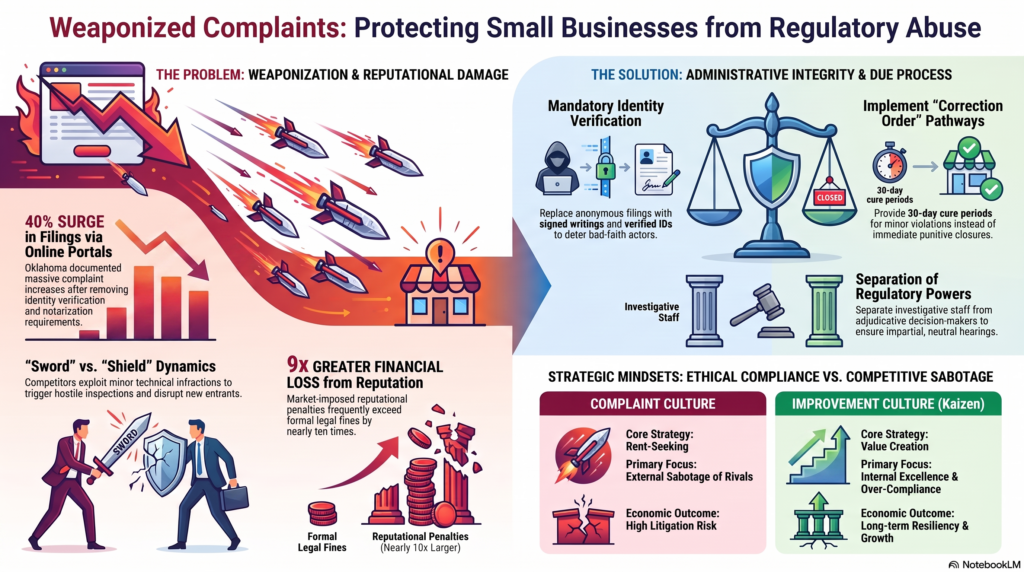
This digitisation process, while enhancing consumer access, triggered a dramatic surge in total complaint volume8. For instance, when the Oklahoma Medical Board implemented online filing systems, it documented a forty percent increase in complaints within the subsequent two years8. Concurrently, many state boards began accepting anonymous complaints, arguing that removing the identity requirement was necessary to protect vulnerable patients, employees, and whistleblowers from retaliation7. However, the removal of identity verification and sworn-statement requirements fundamentally altered the incentive structure of these regulatory systems7.
Today, the reliance on complaint-based investigations varies significantly across professions. Industries characterized by direct, physical interaction with consumers—such as healthcare, dentistry, nursing, and cosmetology—rely most heavily on external complaints to initiate investigations4. Because regulatory inspectors cannot monitor every clinical interaction, the consumer complaint acts as the primary sensory organ of the regulatory board27. While these complaint-driven systems are vital for identifying genuine threats to public health and safety—such as physical abuse, chemical hazards, and severe clinical incompetence—researchers have increasingly documented significant unintended consequences4. Instead of acting solely as shields for public safety, open, anonymous, and unverified complaint systems have frequently been co-opted as swords to disrupt competitors, settle workplace disputes, and execute retaliatory campaigns4.
Part II: Market Competition vs. Consumer Protection: The Dynamics of “Weaponized Complaints”
The tension between genuine consumer protection and economic protectionism is a recurring theme in the scholarly literature on occupational licensing2. While mandatory licensure is publicly justified as a means to guarantee minimum competency and protect consumers from substandard services, the economic reality is that licensing requirements restrict entry into an occupation, reduce the supply of practitioners, and insulate established market actors from competitive pressure2. In this economic environment, regulatory complaint systems can become highly effective instruments of market competition, a phenomenon frequently referred to as “weaponized complaints”3.
Academic and legal reviews have documented numerous instances where established market competitors utilize administrative complaint systems to actively suppress competition3. This dynamic is particularly visible in industries characterized by low capital barriers to entry but intense local competition, such as the personal care and beauty industries, as well as highly compensated fields with shifting scopes of practice, such as healthcare, nursing, and dentistry4.
In the beauty and personal care industry, established salons and cosmetology schools have been documented using regulatory complaints to target new market entrants, particularly those catering to immigrant, minority, or low-income populations11. Because state cosmetology boards often mandate highly detailed, prescriptive sanitation and administrative rules—ranging from the precise storage of clean towels to the electronic submission of student hours—a competitor can easily identify minor, technical infractions11. By filing repeated complaints with the state board, an established salon or school can trigger targeted, hostile inspections that disrupt the daily business of their competitor, drain their financial resources through arbitrary fines, or force their permanent closure5. For example, in the widely publicized regulatory disputes involving the Kentucky Board of Cosmetology between 2021 and 2024, minority-owned nail salons and independent beauty schools reported a pattern of hostile inspections, highly disproportionate fines, and immediate closures initiated on the basis of competitive or unverified complaints11.
In the healthcare sector, the weaponization of complaints frequently manifests as professional boundary disputes and retaliatory filings during workplace or contractual conflicts4. Doctors, nurses, and dentists operate in highly regulated environments where any formal board investigation can trigger severe, career-altering consequences, including the mandatory reporting of investigations to the National Practitioner Data Bank, the loss of hospital privileges, and exclusion from insurance networks9. Former employers, corporate healthcare entities, or competing practices have been documented filing bad-faith complaints alleging clinical incompetence, substance abuse, or “unprofessional conduct” against departing practitioners to enforce non-compete agreements or retaliate against whistleblowers4. These complaints are frequently overcharged and strategically timed to maximize disruption to the practitioner’s new venture4. Because licensing boards are statutorily obligated to investigate all complaints that fall within their jurisdiction, even completely baseless, frivolous, or retaliatory allegations must proceed to formal intake and investigation, forcing the targeted professional to incur substantial legal and psychological costs4.
An analysis of empirical data across professional licensing boards reveals a stark disparity between the sheer volume of complaints filed and the percentage of complaints that are ultimately substantiated or result in formal disciplinary action. This disparity strongly suggests that a significant portion of the administrative burden imposed on licensing boards is driven by meritless, speculative, or bad-faith allegations13.
The phenomenon of “weaponized complaints” has been analyzed extensively in academic literature. Scholars in antitrust law and regulatory economics argue that occupational licensing boards, when dominated by active market participants, frequently act as self-interested cartels rather than objective public safety guardians2. Under the Noerr-Pennington doctrine, private entities are generally immune from antitrust liability when petitioning the government for redress, which includes filing complaints with regulatory agencies38. However, courts have recognized a critical exception to this immunity: “sham petitioning”38. When a market competitor files a series of administrative complaints not to obtain a favorable regulatory outcome, but solely to abuse the administrative process, delay a competitor’s entry, or impose prohibitive costs on a rival, Noerr-Pennington immunity is forfeited38. The landmark Supreme Court decision in North Carolina State Board of Dental Examiners v. FTC (2015) further restricted board immunity, holding that state licensing boards dominated by active market participants are subject to federal antitrust scrutiny under the Sherman Act unless they are actively supervised by the state37. This ruling directly exposed how licensing boards can use their regulatory authority—including complaint and enforcement systems—to suppress low-cost competitors and maintain monopoly pricing37.
Part III: Anonymous Complaints: Comprehensive Policy Analysis
The policy debate surrounding whether regulatory boards should accept anonymous complaints is characterized by a fundamental tension between maximizing public safety reporting and protecting the constitutional due process rights of licensed professionals7. State licensing boards across the United States have adopted divergent statutory and administrative approaches to navigate this dilemma, creating a highly fragmented regulatory landscape24.
The Advantages of Anonymous Complaint Systems
Proponents of anonymous complaint systems argue that allowing individuals to report violations without disclosing their identity is essential for preserving public health and safety7. The primary arguments in favor of maintaining anonymity include:
- Protection Against Retaliation: Employees, junior colleagues, and vulnerable consumers are often in structurally subordinate positions7. If required to disclose their identity, fear of immediate termination, professional blacklisting, or physical retaliation can deter them from reporting severe violations, such as chemical hazards, substance abuse, or sexual misconduct4.
- Whistleblower Facilitation: In institutional settings like hospitals, corporate salons, or large contracting firms, systemic fraud or safety violations are often known only to internal staff7. Anonymous reporting channels encourage internal actors to step forward, safeguarding public resources and safety7.
- Maintaining Public Confidence: Providing an open, barrier-free avenue for any member of the public to report suspicious or unlicensed activity ensures that the regulatory board remains highly responsive to community concerns, reinforcing trust in the oversight system34.
The Disadvantages of Anonymous Complaint Systems
Conversely, legal scholars, defense attorneys, and small business advocates argue that anonymous complaints are highly prone to abuse and introduce systemic unfairness into the regulatory process5. The primary arguments against anonymous complaint systems include:
- Total Lack of Accountability: Because the complainant faces no risk of perjury, civil liability, or social sanction for filing false statements, anonymous systems provide an ideal vector for bad-faith or malicious filings designed solely to harass a competitor or target an individual during personal or workplace disputes4.
- Impediment to Due Process and Investigation: When a complaint is completely anonymous, the respondent professional is deprived of the ability to fully investigate the context of the allegations, identify potential biases, or effectively cross-examine their accuser at a hearing7. Furthermore, licensing board investigators are frequently unable to gather follow-up information, verify the credibility of the filer, or obtain necessary evidence, leading to a high rate of frivolous or legally insufficient investigations that drain public administrative resources7.
- Irreparable Reputational Damage: Even when an anonymous complaint is eventually found to be entirely unsubstantiated and dismissed, the mere opening of a formal investigation can cause lasting reputational and financial harm to a business or professional, as the cloud of an active investigation can trigger a loss of clients, students, or institutional partnerships10.
Part IV: Kentucky Board of Cosmetology Policy Evolution
The regulatory framework governing the beauty and personal care industry in the Commonwealth of Kentucky has undergone a significant structural and legal evolution over the past several years5. Historically, the Kentucky Board of Cosmetology administered a highly discretionary complaint and enforcement system that faced severe criticism from licensees, legal advocates, and state oversight bodies for its lack of transparency, susceptibility to competitive abuse, and procedural deficiencies5.
The Historical Discretionary Process
Under the historical enforcement framework established under Kentucky Revised Statutes (KRS) Chapter 317A and early versions of the Kentucky Administrative Regulations (KAR), specifically 201 KAR 12:190, the KBC possessed broad, highly discretionary authority to initiate investigations and penalize licensees5. The historical complaint process allowed complaints to be submitted via informal, unverified, or anonymous means25. Investigators frequently initiated unannounced, targeted inspections based on verbal or anonymous reports from competitors without first verifying the credibility or factual basis of the allegations11.
Furthermore, the enforcement process lacked clear guidelines11. Board inspectors possessed the unilateral authority to assess immediate, high-value fines on the spot during inspections without providing a written warning or cure period for minor, non-safety-related infractions5. If a licensee disagreed with the inspector’s findings, they were often subjected to hostile administrative proceedings where the board essentially acted as investigator, prosecutor, and judge5. This historical system created severe economic barriers for small businesses and minority practitioners, who frequently lacked the English fluency or financial resources to hire legal counsel to challenge the board’s unilateral actions in court5.
The Current Signed and Documented Process
In response to systemic scandals, litigation, and intense public pressure from the salon and beauty school community between 2021 and 2024, the administrative regulations governing the KBC’s complaint and disciplinary processes were significantly revised5. The current regulation, 201 KAR 12:190, establishes a mandatory, written, and highly structured step-by-step disciplinary process that replaces historical discretionary practices with strict due process guarantees18.
Under the current version of 201 KAR 12:190, the complaint process has transitioned to a signed, non-anonymous, and heavily documented system18:
- Rejection of Anonymous Complaints: Section 3 of 201 KAR 12:190 explicitly states: “Anonymous complaints shall not be accepted”18. The regulation defines a complaint strictly as a “signed writing received or initiated by the board”18.
- Mandatory Form and Specificity: All complaints must be submitted on the board’s official, signed Complaint Form, which is incorporated by reference in the regulation18. The filer must describe with “sufficient detail” the specific alleged violations of KRS Chapter 317A or 201 KAR Chapter 1218.
- Mandatory Written Notice and Response Period: Upon receipt of a valid, signed complaint, the board is legally required to provide a complete written copy of the complaint to the respondent licensee18. The respondent is afforded a mandatory thirty (30) calendar days from the date of receipt to submit a written response, which represents a significant extension from the historical ten-day response window19.
- Structure of the Complaint Committee: The review of complaints is handled by a formal Complaint Committee composed of at least two board members18. To prevent conflicts of interest and preserve impartiality, the regulation dictates that board staff and board counsel may assist the committee but are strictly prohibited from acting as members of the committee or casting votes during meetings18.
- Disqualification and Recusal Requirements: Crucially, any board member who participates in the initial investigation of a complaint, or who possesses “substantial personal knowledge of facts concerning the complaint,” is legally disqualified from participating in the final adjudication or vote on the matter25.
- Informal Resolution and Formal Hearings: The board may resolve matters through informal proceedings, including Agreed Orders of settlement, only after formal notice and full disclosure have been completed18. An Agreed Order is a legally binding contract that cannot be coerced5. If informal resolution fails, the licensee retains the absolute right to request a formal hearing within thirty (30) calendar days of receiving a notice of disciplinary action19.
Systematic Breakdown of KBC Disciplinary & Enforcement Cases (2021–2024)
The necessity of transitioning from a highly discretionary, complaint-driven system to a signed, documented process is underscored by several severe administrative breakdowns and scandals that occurred between 2021 and 2024. These cases demonstrate how the erosion of procedural safeguards allows regulatory power to be coopted for anticompetitive or retaliatory purposes5.
The following detailed analysis examines three key legal and administrative disputes that triggered systemic reform demands in Kentucky.
The Closure of Tippi Nail Lounge
In May 2023, two inspectors from the Kentucky Board of Cosmetology conducted a routine inspection at the Tippi Nail Lounge in St. Matthews, Kentucky, a small, minority-owned salon with an unblemished regulatory record11. According to administrative records and subsequent investigative reporting, the inspectors entered the premises searching for a specific chemical substance11. During the inspection, an inspector approached an area near the owner’s dog, resulting in a minor scratch or “attack”11. Inspector Jason Back was recorded on the salon’s surveillance video stating, “get that dog or I’m going to shoot it,” before immediately ordering an emergency closure of the salon, forcing all customers to vacate the premises, and posting a closure notice on the front door11.
The board subsequently issued a massive administrative fine of $12,750 and charged the salon with fourteen distinct violations, including improperly stored towels and utilizing unlicensed personnel11. Because the owners could not afford the fine or the legal fees required to contest the board’s actions while their business was closed, they were forced to permanently surrender their business license, and the husband’s personal nail technician license was frozen11. This case highlighted the absolute lack of standard violation-to-fine schedules, the unchecked discretionary power of individual inspectors to order immediate closures for non-life-threatening issues, and the severe economic vulnerability of small, minority-owned businesses under discretionary enforcement regimes5.
Hamilton v. Campbell and the Meraki Beauty School Closure
The systemic risk of unverified complaint handling was further illustrated in the federal civil rights lawsuit Hamilton v. Campbell35. LaWanna Hamilton, an African American educator, opened the Meraki Beauty School in March 202235. Following her opening, Hamilton alleged a campaign of administrative harassment initiated by KBC officials, which took the form of repeated inspections, audits, and investigations35. Between March 2022 and January 2023, the board conducted at least ten separate inspections or audits of her school—vastly exceeding the two annual inspections mandated by state regulation or the typical oversight frequency for an understaffed state agency28.
The lawsuit alleged that board employees Tanya Shrout and Margaret Meredith received an unverified, anonymous complaint against the school and immediately forwarded it for formal investigation without conducting any preliminary verification of its validity35. Executive Director Julie Campbell then personally traveled nearly five hours to investigate the school without attempting to contact Hamilton or verify the complaint’s merit35. The board ultimately fined Hamilton for failing to electronically submit student hours by the monthly deadline and, in July 2023, denied her school’s license-renewal application due to the outstanding, unpaid fines, forcing the school to shut down35.
Crucially, weeks after the closure, the board’s former general counsel and assistant director, Christopher Hunt, emailed Hamilton to apologize, stating that due to an administrative “clerical error,” the board had failed to respond to her timely appeal of the fines and had decided to rescind them35. By then, however, the business had already been permanently destroyed, illustrating how administrative delays and unverified complaint processing can lead to the erroneous deprivation of a protected property interest16.
Tara Dizney & Kendra Arthur v. Jason Back & Julie Campbell
In the federal case Dizney v. Back (6:24-cv-00069), the court addressed the highly controversial practice of utilizing the criminal justice system to bypass administrative due process44. Plaintiffs Tara Dizney and Kendra Arthur graduated from the Creation School of Cosmetology in Corbin, Kentucky, in February 202144. Following an audit of the school’s records in early 2022, board inspector Jason Back suspected that the plaintiffs had taught classes at the school without possessing the necessary instructor licenses44. Rather than conducting a formal administrative hearing under KRS Chapter 317A to determine whether licensing violations had occurred, Back bypassed the standard administrative process44.
He compiled a case report, contacted the local Commonwealth Attorney’s office to inquire about presenting a case directly to a grand jury, and subsequently testified before a Whitley County grand jury44. The grand jury indicted the two recent graduates on felony charges of Theft by Failure to Make Required Disposition of Property under KRS 514.070, alleging they had unlawfully received compensation44. The criminal charges were eventually dismissed, and the plaintiffs filed a federal civil rights action under 42 U.S.C. § 1983 against Back and Campbell, alleging malicious prosecution, negligence, and a violation of their constitutional rights44.
The court denied the defendants’ motion to dismiss, holding that the plaintiffs had stated a plausible claim of malicious prosecution and that individual inspectors are not entitled to absolute immunity when they actively initiate grand jury proceedings based on unverified administrative findings44. This case underscored how regulatory officials can weaponize criminal indictments to punish licensees and avoid the strict evidentiary standards of administrative due process5.
Open Records Act Violations and Transparency Failures
The administrative instability of the Kentucky Board of Cosmetology during this period was further documented through a series of formal Open Records Decisions (ORD) issued by the Kentucky Office of the Attorney General45. These decisions revealed a systemic failure to maintain basic administrative transparency and a pattern of statutory non-compliance:
- In 24-ORD-129, the Attorney General ruled that the board violated the Open Records Act when it failed to respond to a citizen’s record request within the mandated five business days, attempting to excuse the delay by stating it lacked legal counsel or an official Open Records Officer45.
- In 24-ORD-167, the Attorney General addressed a record dispute initiated by Christopher Hunt, the board’s former general counsel46. Hunt sought communications sent or received by a specific board member from their personal cell phone and email accounts concerning board business46. The board delayed its response for eight business days, violating the Act, and subsequently claimed that no such records existed46. The decision underscored the ongoing administrative friction and the board’s struggle to manage records in compliance with the law46.
- In 25-ORD-136, the Attorney General reviewed a denial of records requested by LaWanna Wallen Brock, who had pending litigation against the board47. The board denied the request on the grounds that Brock had failed to state the manner in which she was a resident of the Commonwealth of Kentucky, a denial that the Attorney General ultimately upheld47. This case demonstrated the board’s increasing reliance on highly technical statutory exclusions to restrict access to its enforcement records during active legal disputes47.
These administrative failures, civil rights lawsuits, and transparency violations collectively demonstrate the risk of granting broad, unchecked discretionary authority to regulatory bodies5. The transition of the Kentucky Board of Cosmetology toward a signed, highly documented, and identity-verified complaint process represents a necessary evolution toward administrative accountability5. By eliminating anonymous complaints and enforcing strict timelines, the current regulatory framework reduces the potential for competitive abuse, ensures that investigations are based on high-quality empirical data, and protects the constitutional property rights of vocational professionals5.
Part V: Complaint Procedures in Accreditation Agencies
Institutional and programmatic accreditation agencies operate as primary gatekeepers of educational quality, financial aid eligibility, and regulatory compliance for postsecondary vocational and professional schools49. Because an adverse action by an accrediting body—such as a “show-cause” order, probation, or the withdrawal of accreditation—can result in the immediate loss of Title IV federal funding and the subsequent closure of an institution, the complaint procedures utilized by these agencies carry immense economic and operational significance49.
While accreditation agencies are private, non-profit entities, federal regulations under the Higher Education Act mandate that they establish formal policies for receiving and reviewing complaints from students, faculty, staff, and the public49. However, to prevent their complaint systems from being utilized as instruments of harassment or competitor sabotage, major regional and programmatic accreditors have established highly rigorous, non-anonymous, and structured intake frameworks49.
An analysis of the complaint policies of prominent accrediting commissions—including the Accrediting Commission of Career Schools and Colleges (ACCSC)49, the Southern Association of Colleges and Schools Commission on Colleges (SACSCOC)56, the Accrediting Commission for Community and Junior Colleges (ACCJC)41, the Higher Learning Commission (HLC)54, the Middle States Commission on Higher Education (MSCHE)51, and the Accrediting Commission for Schools, Western Association of Schools and Colleges (ACS WASC)53—reveals several key structural safeguards designed to preserve due process and eliminate bad-faith filings:
Mandatory Exhaustion of Internal Remedies
Almost all major accreditors mandate that a complainant must provide clear, documented evidence that they have fully exhausted the institution’s internal grievance and appeals processes before the commission will entertain the complaint49. For example, SACSCOC expects individuals to pursue all available institutional remedies before submitting a complaint56, and the ACCJC requires explicit proof that the institution’s formal grievance process has been completed55. This safeguard prevents the accreditor from being used as a primary complaint-handling body for routine, individual academic or administrative disputes49.
Rejection of Anonymous Complaints
To maintain administrative accountability and protect institutions from unverified attacks, the vast majority of accrediting bodies strictly prohibit anonymous complaints53. SACSCOC explicitly states that it “will not entertain anonymous complaints”56. The Higher Learning Commission (HLC) does not accept anonymous filings, although it allows complainants to request that their personally identifiable information be removed from the complaint form sent to the school (though it explicitly warns that anonymity cannot be guaranteed)54. ACS WASC dictates that “all complaints must be signed; anonymous complaints are discarded”53.
In contrast, the ACCJC provides an online form that allows users to submit complaints anonymously41. However, the commission’s policy explicitly warns that submitting a complaint anonymously severely limits its ability to investigate or follow up with either the complainant or the institution due to a lack of verifiable evidence41.
Evidentiary Standards and Jurisdictional Limits
Accreditation complaint systems are strictly limited to reviewing matters that indicate systemic non-compliance with the agency’s core Standards of Accreditation or Principles of Accreditation49. They are explicitly not designed to act as arbiters, mediators, or courts of appeal for individual disputes regarding grades, disciplinary actions, graduation fees, or employment decisions49. Complainants are legally required to submit a precise statement of facts supported by clear, documented evidence showing a pattern of significant non-compliance with a specific accreditation standard53.
Prohibition on Active Litigation
To prevent their administrative systems from being utilized to gain strategic leverage in legal disputes, accrediting bodies generally refuse to process or consider any complaint that is currently subject to active court litigation, administrative hearings, or threats of legal action53. For example, ACS WASC requires the complainant to explicitly affirm that the matter is not under litigation or threat of litigation before an investigation will proceed53.
Due Process and the Opportunity to Respond
Once an accrediting body determines that a formal, signed complaint falls within its jurisdiction and contains sufficient evidence of non-compliance, it initiates a highly structured review process53. The commission is legally required to forward a complete copy of the complaint to the chief executive officer of the institution, allowing the school a defined period—typically thirty (30) days—to submit a detailed, written response and supporting documentation53. This two-sided process ensures that the commission makes its final determination based on a balanced, objective, and comprehensive factual record, minimizing the risk of erroneous sanctions based on one-sided, emotionally charged, or competitively motivated allegations53.
Part VI: Small Business Perspective: The Economic Burden of Investigations
For small businesses, particularly those operating in highly competitive, low-margin sectors, responding to a formal regulatory or licensing board investigation is not a minor administrative inconvenience5. It represents a highly disruptive, economically draining, and psychologically exhausting crisis that can permanently alter the viability of the enterprise9. While large corporations possess dedicated compliance departments, in-house legal teams, and substantial capital reserves to absorb regulatory friction, small businesses are uniquely vulnerable to the asymmetric burdens of the administrative state57.
The Direct and Indirect Costs of Investigation
The total financial and operational burden of a regulatory investigation consists of both direct, quantifiable out-of-pocket expenses and indirect, long-term opportunity costs5.
Direct Financial and Legal Costs
The moment a business receives a formal notice of a complaint or an unannounced inspection, it must consider securing legal counsel to protect its rights4. Specialized professional license defense attorneys typically charge between $250 and $500 per hour9. A standard administrative defense case—encompassing discovery review, drafting written responses, conducting witness interviews, preparing for hearings, and attending formal administrative trials—can easily require dozens of hours of legal work, resulting in direct legal fees ranging from $5,000 to over $50,0005. For a small business owner, these costs must be paid directly out of pocket, as standard general liability insurance rarely covers administrative license defense, and specialized regulatory defense insurance is often cost-prohibitive or unavailable9.
Operational Time and Disruption
Responding to an investigation consumes a substantial amount of the owner’s and key employees’ time57. Compiling requested records, client files, employee credentials, and electronic logs requires meticulous effort to avoid accusations of documentation failure or obstruction of an investigation21. Every hour the business owner spends drafting responses, meeting with counsel, or attending hearings is an hour diverted from operational management, customer service, and business development57.
Opportunity Costs and Frozen Financing
While an investigation is active, a small business may face severe restrictions9. Licensing boards can place temporary holds on license renewals, freeze student enrollment privileges, or issue emergency suspensions9. This regulatory “cloud” can cause a business to lose access to essential commercial bank financing, line-of-credit renewals, or small business loans, as financial institutions are highly risk-averse and frequently refuse to extend capital to entities facing active regulatory enforcement14. Furthermore, planned expansions, vendor contracts, or franchising opportunities are often frozen indefinitely while the case remains unresolved14.
Reputational and Customer Attrition Costs
If the details of an active investigation become public—either through mandatory online board registries, local media reporting, or competitor gossip—the business can experience immediate and devastating customer attrition14. In vocational education, a single public complaint can cause prospective students to withdraw enrollment or refuse to commit, fearing the school may close before they complete their hours14. Similarly, salons, dental practices, and contracting firms suffer immediate drops in customer trust and brand equity14.
Employee Morale and Psychological Stress
The uncertainty of an active regulatory investigation creates a toxic, high-stress environment11. Employees, fearing the business may lose its license or be forced to close, experience reduced morale and may actively seek employment elsewhere, leading to a loss of key talent and higher recruitment costs14. For the small business owner, the psychological toll is immense, frequently leading to severe burnout, anxiety, and sleep deprivation as they fight to preserve a business they have built over decades9.
Small Business Advocacy Perspectives
The disproportionate impact of regulatory investigations on small businesses has been thoroughly documented by leading advocacy organizations, including the U.S. Small Business Administration (SBA) Office of Advocacy, the National Federation of Independent Business (NFIB), and the U.S. Chamber of Commerce57.
The SBA Office of Advocacy, acting as the independent watchdog for the Regulatory Flexibility Act (RFA) of 1980, has repeatedly issued reports highlighting how federal and state agencies routinely violate both the letter and spirit of the RFA61. The RFA explicitly requires agencies to analyze, disclose, and minimize the economic effects of new regulations on small entities and to consider less burdensome alternative rules61.
In a landmark report on “Certification Abuse,” the Chief Counsel for Advocacy documented that regulatory agencies routinely bypass the RFA’s analytical requirements by falsely certifying major, economically significant rules as having “no significant economic impact on a substantial number of small entities”66. These fictional certifications allow agencies to enact complex, burdensome compliance standards and paperwork requirements without establishing the necessary small-business safeguards, compliance guides, or cure periods66. This practice exposes small businesses to arbitrary enforcement actions and capricious penalties, creating a cumulative burden often described as “death by a thousand cuts”66.
The NFIB’s Small Business Problems and Priorities survey has consistently ranked “Unreasonable Government Regulations” and “Burdensome Paperwork” among the top ten most severe problems facing independent business owners57. The NFIB Small Business Legal Center argues that small business owners are structurally unequipped to navigate the complex maze of administrative rulemaking and enforcement, as they lack the specialized compliance teams utilized by larger corporations57. The NFIB strongly advocates for legislative reforms, such as the Prove It Act and the Small Business Regulatory Flexibility Improvements Act, which would force regulatory agencies to go beyond mere checklist certifications and instead implement less burdensome alternative rules, mandatory compliance assistance, and de novo judicial reviews of agency actions that harm small enterprises57.
Part VII: Reputation Economics: Misconduct, Allegations, and Market Sanctions
In the modern information economy, a firm’s or a professional’s most valuable asset is their reputation67. Reputation serves as a vital economic signal, reducing information asymmetry for consumers and providing a reliable indicator of quality, safety, and trustworthiness69. In the context of regulatory oversight, the economic discipline of “reputation economics” examines how the market value and financial viability of an organization are affected by regulatory interventions14.
A critical finding of empirical research in finance and economics is that the financial damage caused by a regulatory action is rarely confined to the actual legal penalties, such as administrative fines or court-ordered damages63. Instead, the market-imposed “reputational penalty” is frequently the primary deterrent and the largest source of wealth destruction63. The reputational penalty is formally defined as the present value of the expected loss in future cash flows resulting from trading partners (including customers, suppliers, investors, and employees) changing the terms of trade or refusing to do business with the firm after a regulatory infraction is exposed63.
Empirical studies demonstrate that the reputational penalty varies significantly depending on whether the alleged misconduct directly harms the firm’s trading partners or third parties69:
- Misconduct Involving Trading Partners (High Reputational Penalty): When a firm is accused of financial misrepresentation, corporate fraud, misleading advertising, or consumer deception, the costs are directly internalized by the market64. Karpoff, Lott, and other researchers have documented that for firms guilty of financial fraud or consumer deception, the market-imposed reputational loss exceeds the formal legal penalties by over 7.5 to 9 times63. In these cases, the legal fine is merely a fraction of the total financial loss, as consumers immediately divert their purchases, and suppliers restrict credit63.
- Misconduct Involving Third Parties (Low Reputational Penalty): In contrast, when a firm violates regulations that harm third parties rather than its direct customers—such as environmental violations or cartel price-fixing where the direct consumer impact is masked—the market-induced reputational penalty is often negligible69. In these scenarios, the stock price decline primarily reflects the anticipated cost of the legal fine and forced remediation, rather than a market-driven loss of trust69.
The Asymmetry of Unproven Allegations vs. Proven Violations
Crucially, reputation economics reveals a severe asymmetry: the market and the public rarely distinguish between a mere unproven allegation and a formally proven violation10. Because the initial announcement of an investigation or the filing of a complaint is highly public and carries significant sensational value, it triggers an immediate, negative informational shock14. Empirical event studies analyze the abnormal stock returns of publicly traded companies following the release of regulatory news63:
- Initial Allegation Announcement: The initial press announcement containing mere allegations of a regulatory violation is associated with an average abnormal stock return drop of -1.69 percent69. At this stage, no formal charges have been proven, and no due process hearing has occurred69. Yet, the market immediately penalizes the firm’s equity value based on the perceived risk69.
- Formal Charge Announcement: When the initial announcement indicates that the firm has formally been charged or indicted, the average abnormal stock return is -1.58 percent69.
- Proven Violation / Final Resolution: When the final, legal resolution is announced—confirming that the violation occurred and establishing the fine—the stock price reaction is relatively minor, as the market has already fully priced in the reputational damage and anticipated the legal costs during the allegation phase63.
For a small, privately held business—such as a vocational school, local salon, medical clinic, or real estate agency—this economic asymmetry is even more pronounced and can prove fatal5. Unlike large, diversified corporations, a small business cannot absorb a sustained loss of customer trust or a sudden freeze in financing5. The moment a competitor or disgruntled former employee weaponizes a complaint, triggering a highly public regulatory investigation or a hostile unannounced inspection, the reputation of the business is severely compromised4. Even if the board eventually dismisses the complaint as entirely unfounded months or years later, the targeted business has already suffered irreparable harm:
- Prospective Client and Student Loss: Prospective students, seeing that an educational institution is “under investigation,” will choose competing schools to protect their tuition and future licensing success14.
- Employee Defection: High-performing employees and instructors will exit the firm to protect their professional standing, leaving the business operationally depleted14.
- Financing and Vendor Disruption: Banks may refuse to renew lines of credit, and landlords may hesitate to extend leases, viewing the business as a litigation risk14.
- Permanent Digital Record: Because state licensing boards publish active investigations, complaint notices, and disciplinary actions on public web portals, the unproven accusation remains digitally searchable indefinitely, acting as a permanent barrier to customer acquisition and business growth9.
Therefore, in the arena of professional regulation, the accusation itself functions as a highly potent, market-disrupting sanction14. Without robust due process safeguards, such as signed filings, strict notice standards, and confidential preliminary reviews, open complaint systems allow bad-faith actors to inflict severe, asymmetric reputational penalties on their competitors with complete impunity5.
Part VIII: Due Process: Constitutional Foundations of Administrative Fairness
The procedural rights of licensed professionals and regulated entities are anchored in the Due Process Clauses of the Fifth and Fourteenth Amendments to the United States Constitution, which prohibit the federal and state governments from depriving any person of “life, liberty, or property, without due process of law”16. In the realm of administrative law, the transition of a professional license from a mere “privilege” granted by the state to a legally recognized “property interest” represents one of the most critical legal developments of the twentieth century5.
The United States Supreme Court has repeatedly affirmed that once a state issues a professional license, certifying that the holder possesses the requisite competency to practice their trade, that license becomes a valuable property interest16. The state cannot revoke, suspend, or otherwise restrict this license through disciplinary actions without adhering to fundamental constitutional principles of fairness, neutrality, and procedural regularity16. The harsh and stigmatizing consequences of professional discipline—including public humiliation, loss of livelihood, and the destruction of a business—make the consistent application of procedural safeguards essential to prevent the erroneous deprivation of this property interest16.
The Mathews v. Eldridge Balancing Test
To determine the specific procedural protections required in administrative proceedings, courts apply the classic three-factor balancing test established by the Supreme Court in Mathews v. Eldridge (1976)15. Under this constitutional framework, a court must weigh:
- The Private Interest Affected: The weight of the individual’s interest in retaining their professional license and maintaining their livelihood16. In occupational licensing, this interest is extraordinarily high, as license revocation can permanently end a professional’s career16.
- The Risk of Erroneous Deprivation: The probability that the state’s existing administrative procedures will result in an incorrect or unfair decision, and the probable value of implementing additional or substitute procedural safeguards16. For example, a system that allows anonymous filings or preponderance-of-evidence standards with zero independent review carries a high risk of error7.
- The Government’s Interest: The state’s interest in protecting public safety, maintaining administrative efficiency, and minimizing the fiscal and administrative burdens that additional procedural requirements would impose16.
Core Constitutional Safeguards in Professional Discipline
To satisfy the minimum requirements of procedural due process, state administrative agencies must maintain several core safeguards16:
1. Fair Notice of Charges
An accused licensee has a constitutional right to be fully informed of the specific allegations and statutory violations against them16. In the disciplinary landmark In re Ruffalo (1968), the Supreme Court held that due process requires fair, detailed notice of the charges before the administrative proceeding begins, and the state cannot add new charges mid-proceeding without providing the respondent adequate time to prepare a defense22. The notice must identify the specific statutes or regulations allegedly violated and provide the underlying factual basis for the allegations17.
2. Right to a Meaningful Hearing
The state must provide the licensee with an opportunity to present their case, submit evidence, call witnesses, and cross-examine adverse witnesses before an impartial decision-maker16. This hearing must occur at a “meaningful time and in a meaningful manner”16. While emergency suspensions are permissible in rare circumstances where an “immediate and present danger” to public safety exists, the state must immediately provide a post-deprivation hearing to prevent prolonged, erroneous closures9.
3. Burden and Standard of Proof
In administrative disciplinary actions, the burden of proof rests entirely on the regulatory agency; the licensee is cloaked in a presumption of innocence and is not required to prove their compliance32. However, the standard of proof required to substantiate charges varies by state22. Many states utilize the low “preponderance of the evidence” standard, which merely requires that a violation is more likely than not to have occurred22.
Legal scholars argue that “preponderance alone” is constitutionally insufficient in license revocation proceedings due to the severe, stigmatizing consequences of professional discipline22. Consequently, many jurisdictions and professional boards—such as several state medical boards and mental health boards—require the higher “clear and convincing evidence” standard, ensuring that disciplinary sanctions are based on highly credible, unambiguous proof22.
4. Impartial Decision-Maker
A cornerstone of due process is that the investigators and prosecutors must not also act as the judges17. Neutrality concerns arise when a licensing board investigates, prosecutes, and ultimately adjudicates the same case17. To resolve this structural bias, many states utilize independent Administrative Law Judges (ALJs) assigned from a centralized state office, such as Indiana’s Office of Administrative Law Proceedings (OALP), to conduct neutral hearings and make objective findings of fact17. Furthermore, any board member who participated in the initial investigation must disqualify themselves from the final adjudication25.
5. Right to Judicial Review
A licensee who is aggrieved by a final administrative board decision has an absolute right to appeal the ruling to a court of competent jurisdiction17. The court reviews the administrative record to ensure that the board’s action was not arbitrary, capricious, or an abuse of discretion, and that its factual findings are supported by “substantial evidence”17.
Due process protects all stakeholders in the regulatory ecosystem76. For consumers, it ensures that genuine complaints are handled through structured, reliable channels that lead to enforceable corrections29. For businesses, it provides a vital shield against arbitrary enforcement, malicious competitor complaints, and immediate, ruinous closures4. For regulators, a consistent commitment to due process builds long-term public trust, insulates the agency from constitutional challenges in appellate courts, and ensures that the board’s resources are directed toward prosecuting genuine threats to public health and safety16.
Part IX: Ethics and Conflicts of Interest in Regulatory Oversight
The integrity of professional regulation depends on the ethical conduct of all actors within the regulatory ecosystem28. Because regulatory agencies possess state-delegated police power to restrict competition, issue fines, and suspend professional licenses, the ethical obligations of consumers, competitors, employees, and board officials must be clearly defined and rigorously enforced16.
The Ethical Obligations of Complainants
- Consumers: Consumers have a duty to report genuine instances of substandard care, safety violations, or fraudulent practices21. However, filing a false or highly exaggerated complaint solely to obtain a financial refund, evade contract performance, or express personal dissatisfaction with unregulated business matters represents an unethical abuse of the regulatory state12.
- Competitors: Competitors operate under a strict ethical obligation of fair competition79. Utilizing a licensing board’s complaint system to harass a competitor, trigger disruptive inspections, or cast public suspicion on a rival’s business is a severe violation of professional and antitrust ethics3. Competitive reports should be restricted to known, verifiable, and severe public safety threats and must be submitted in good faith20.
- Employees and Former Employees: While whistleblower protections are vital to shield employees who report genuine systemic hazards, employees must not utilize complaint systems as retaliatory instruments in response to routine employment disputes, performance evaluations, or lawful terminations4. Filing bad-faith, overcharged allegations to damage an employer’s reputation or disrupt business operations violates basic fiduciary and professional ethical standards4.
The Ethical Obligations of Regulators and Board Members
State licensing boards are typically composed of active practitioners in the regulated profession, creating a structural conflict of interest17. Because board members are simultaneously active market competitors, they face significant ethical obligations to prevent regulatory capture and preserve impartial enforcement:
- Conflict of Interest and Personal Recusal: Board members must strictly recusal themselves from any involvement in investigations, discussions, or votes concerning individuals or businesses with whom they share a competitive relationship, personal bias, or financial interest25. A board member must never utilize their regulatory authority to gain a competitive advantage or protect their own market share77.
- Investigator Impartiality: Board investigators and inspectors must act as neutral, objective fact-finders60. They are legally and ethically prohibited from engaging in selective enforcement, utilizing intimidation tactics, or targeting specific minority-owned or low-cost establishments11. Investigations must be conducted professionally, focusing strictly on verifying compliance with established statutes and regulations, rather than pursuing personal or competitive animus36.
- The Prohibitions on Regulatory Capture: Regulatory bodies must maintain complete independence from professional associations and trade lobbies37. The board’s primary mandate is the protection of the general public, not the promotion or protection of the economic interests of established licensees2.
Part X: Organizational Management: Complaint Culture vs. Continuous Improvement Culture
In organizational management, competitive strategy, and behavioral science, the long-term viability and strength of an enterprise are heavily influenced by its internal cultural mindset80. When analyzing how businesses react to competition and regulatory pressures, researchers distinguish between two fundamentally divergent organizational mindsets:
Mindset A: The Adversarial “Complaint Culture”
Organizations that operate within a “Complaint Culture” devote a substantial portion of their intellectual and financial resources to rent-seeking behaviors, attacking market competitors, and exploiting regulatory mechanisms3. In this culture, the primary strategy for maintaining market share is not the creation of superior value, but the construction of barriers to entry and the deliberate disruption of rival firms2.
Firms operating under Mindset A are characterized by:
- External Focus on Sabotage: Substantial time is spent monitoring competitors, identifying their technical non-compliance, and filing bad-faith or anonymous complaints with state licensing boards or accreditation bodies to trigger investigations and hostile inspections3.
- Internal Blame and Defensiveness: Within the organization, mistakes are hidden, and problems are suppressed83. The focus is on avoiding regulatory blame rather than understanding system failures, which leads to weak documentation, high employee turnover, and long-term operational stagnation80.
- Rent-Seeking Dependency: The organization relies on regulatory capture, exclusive scopes of practice, and state-enforced barriers to protect its business model, making it highly vulnerable to sudden regulatory reforms or disruptive innovations2.
Mindset B: The “Continuous Improvement Culture” (Kaizen / TQM)
Conversely, organizations that adopt a “Continuous Improvement Culture” (widely known as Kaizen or Total Quality Management – TQM) devote their resources toward systematically improving their products, services, safety, and customer experience80. Pioneered in post-World War II Japanese manufacturing and popularized globally by quality-control experts like W. Edwards Deming, the Kaizen philosophy is grounded in the belief that everything can be continuously improved through small, incremental, and data-driven changes80.
Firms operating under Mindset B are characterized by:
- Internal Focus on Value Creation: Resources are systematically directed toward enhancing the client experience, standardizing safety protocols, and optimizing educational curriculum or service delivery80.
- Empowerment and Transparency: Continuous improvement recognizes that frontline employees are the first to encounter problems and are best equipped to identify solutions83. The culture encourages open communication, feedback, and the active reporting of internal errors so they can be scientifically addressed using the Plan-Do-Check-Act (PDCA) cycle80.
- “Over-Compliance by Design” as a Shield: Rather than viewing regulatory standards as a minimum checkbox to evade, Mindset B organizations treat compliance, sanitation, and documentation as core components of operational excellence5. By maintaining standards that vastly exceed minimum board requirements, they naturally insulate themselves from the threat of regulatory investigations or competitor complaints5.
Comparative Strategic Viability
Strategic management and behavioral science literature demonstrate that Mindset B produces vastly stronger, more resilient, and more profitable organizations over the long term80. Firms focused on continuous improvement enjoy higher customer loyalty, superior product quality, and significantly lower compliance risk80. Furthermore, by fostering a collaborative, supportive, and empowering environment, they attract and retain top-tier talent, lowering recruitment costs and boosting employee morale14.
In contrast, Mindset A organizations suffer from high litigation and legal defense costs, chronic employee stress, and a lack of authentic innovation9. When regulatory reforms lower entry barriers, or when boards transition to signed, non-anonymous complaint systems that eliminate unverified harassment, Mindset A firms quickly collapse as their artificial competitive advantages evaporate5.
Part XI: Educational Guide for Vocational Schools: Teaching Regulatory and Ethical Literacy
To foster an industry-wide culture of continuous improvement and prevent the future weaponization of complaint systems, professional vocational schools—particularly those in highly regulated, complaint-driven fields like cosmetology, esthetic practices, and nail technology—must assume a central educational responsibility28. Under state education laws, such as Kentucky’s 201 KAR 12:082, approved cosmetology schools are mandated to provide specific instructional hours dedicated to applicable state statutes and administrative regulations74.
Typically, this instruction is treated as a dry, academic compliance exercise74. However, best practices in ethical workforce development dictate that schools transform this regulatory training into a comprehensive, practical curriculum focused on regulatory and ethical literacy5.
Educational Objectives for Regulatory Literacy
Vocational programs should integrate a structured curriculum that equips future professionals with a green, sophisticated understanding of administrative law and professional ethics, encompassing the following core areas:
- The Purpose and Anatomy of Complaint Systems: Students must be taught why regulatory complaint systems exist: to protect public health, safety, and sanitation from genuine incompetence and hazardous practices21. They should understand how a complaint moves through intake, investigation, and adjudication, demystifying the administrative state and reducing fear of inspections29.
- Due Process and Constitutional Rights: Instruction should cover the basic legal foundations of due process, notice requirements, the right to a hearing, and the legal status of a professional license as a protected property interest5. Students should learn how to respond professionally and legally to board requests, preserve written documentation, and access legal resources when facing unverified or arbitrary enforcement18.
- Ethical Reporting vs. Weaponized Complaints: Schools must explicitly teach the ethical distinction between good-faith reporting and bad-faith, malicious, or retaliatory reporting28. Future professionals should understand that administrative complaint portals are not social media channels for expressing personal grievances, executing competitor sabotage, or retaliating against former employers4.
- The Taxonomy of Business and Clinical Disagreements: A critical component of regulatory literacy is teaching students to accurately classify various workplace and consumer incidents, ensuring they utilize the appropriate resolution channels rather than automatically filing board complaints28.
To support this taxonomy of disagreements, vocational schools should teach students to categorize everyday incidents using the following structured framework:
| Category of Conflict | Core Incident Characteristics | Primary Objective / Resolution Mechanism | Proper Recourse / Authorized Channel | Prohibited Regulatory Weaponization |
| I. Poor Customer Service | Verbal rudeness, minor appointment delays, aesthetic dissatisfaction (e.g., incorrect hair color shade)27. | Customer service recovery; maintaining positive local client relations28. | Direct client negotiation; issuing refund; offering corrective service28. | DO NOT file a board complaint. Regulatory boards do not mediate standard pricing or service quality disputes27. |
| II. Professional Disagreement | Differing technical opinions on styles, non-chemical treatment protocols, or scheduling17. | Peer-to-peer alignment; establishing school or salon performance metrics32. | Direct communication; internal supervisor mediation; professional consultations32. | DO NOT file a complaint. Technical disagreements do not constitute actionable incompetence or misconduct32. |
| III. Ethical & Contractual Disputes | Commission split disputes, non-compete arguments, or landlord-tenant salon lease conflicts28. | Resolving private commercial agreements and employment disputes28. | Private mediation; filing action in small claims or civil contract courts28. | DO NOT file a complaint. Boards have no jurisdiction to resolve contracts or award financial damages33. |
| IV. Substantive Safety Violations | Use of banned chemicals (e.g., MMA), unsterilized tools, or repeating single-use item usage5. | Eradicating active threats to public health, safety, and salon sanitation28. | Documenting facts internally; submitting formal signed report to state board18. | Highly appropriate for board filing. Ensure filings are signed and backed by verifiable documentation18. |
| V. Criminal Conduct | Theft, physical assault, sexual boundary violations, or operating under drug influence29. | Ensuring immediate physical protection of clients, staff, and public safety40. | Calling local emergency services; filing concurrent report with state licensing board40. | Highly appropriate for immediate board filing. Cooperate fully with law enforcement and regulatory authorities24. |
By educating future professionals on how to navigate these systems with integrity, vocational schools perform a vital public service28. They protect the industry from the economic friction of weaponized complaints, ensure that state boards are not overwhelmed by frivolous filings, and produce a workforce that is legally literate, ethically disciplined, and prepared for long-term career success5.
Part XII: Case Evaluation: Louisville Beauty Academy’s Educational Model
The educational and operational model of the Louisville Beauty Academy (LBA) in Louisville, Kentucky, provides a practical case study for evaluating how a professional vocational school can align its curriculum with national best practices for ethical workforce development and regulatory compliance92. Founded by entrepreneur and author Di Tran and operated in connection with Di Tran University’s College of Humanization, LBA has publicly established an educational philosophy that emphasizes a “compliance-by-design” and “student-first” approach92.
Core Pillars of the LBA Educational Philosophy
An evaluation of LBA’s public documentation, institutional policies, and course structures reveals a systemic commitment to four core pillars92:
1. Integration of Strict Law and Regulation Instruction
Rather than treating state licensing requirements as an administrative afterthought, LBA integrates extensive regulatory instruction directly into its core curriculum74. For example, in its Shampoo & Styling 300-hour program, LBA cross-references its curriculum with 201 KAR 12:082 standards, dedicating twenty-five (25) hours specifically to Kentucky statutes and administrative regulations95. This training includes detailed instruction on 201 KAR 12:190 complaint procedures, ensuring students understand their legal due process rights, notice requirements, and the step-by-step administrative process18.
2. Emphasis on Rigorous Sanitation, Safety, and Documentation
LBA maintains a strict “Gold-Standard” compliance model that prioritizes sanitation discipline and documentation integrity92. Students are trained in the precise mechanics of tool disinfection, client draping, and single-use item disposal per KRS Chapter 317A5. Furthermore, LBA emphasizes the “Gold-Standard” defense of “Over-Compliance,” training students to maintain impeccable, digital, and contemporaneous records of their attendance, practical services, client consent forms, and adverse reaction logs5. This documentation-first approach naturally insulates graduates from future regulatory disputes and false accusations5.
3. Commitment to Written Transparency and Student Rights
LBA rejects verbal warnings, informal agreements, or vague pricing structures, publishing detailed program costs, written payment plan options, and written enrollment policies openly on its public portal93. LBA’s “Open Library Model” operates as a public knowledge infrastructure, making research, policy analysis, and regulatory explanations freely accessible to students, licensees, and the community to demystify complex state board rules92. The school encourages written communication for all administrative and admissions inquiries to preserve accurate records and protect student rights98.
4. Human-Centered Workforce Literacy and Multilingual Access
Operating under the College of Humanization, LBA focuses on patient, empathetic, and culturally inclusive instruction designed to remove barriers for nontraditional, first-generation, and English-language learners92. LBA provides comprehensive multilingual student support, including publication-supported learning systems featuring English- and Spanish-language resources93.
Alignment with National Regulatory and Educational Best Practices
When evaluated against established research in regulatory economics and vocational education standards, LBA’s “Over-Compliance by Design” philosophy directly aligns with national best practices for ethical workforce development5. By educating students on the exact boundaries of administrative law, due process, and the Open Records Act, LBA empowers future professionals to navigate the regulatory state without fear, while simultaneously preventing them from abusing regulatory channels for competitive sabotage5. LBA’s model demonstrates that a vocational institution can successfully combine high-density technical training with robust ethical literacy, producing graduates who elevate the professional standing, safety, and integrity of the beauty industry74.
Part XIII: Comparative International Analysis: Transparency, Protection, and Efficiency
The structural vulnerabilities, competitive pressures, and due process risks identified in United States regulatory complaint systems are not unique; they are heavily influenced by the institutional arrangements and historical regulatory cultures of different nations23. To provide a comprehensive perspective, professional regulatory and complaint-handling frameworks can be systematically compared across eight leading global jurisdictions: the United States, Canada, the United Kingdom, Australia, Germany, Japan, Singapore, and South Korea23.
The following analytical matrix evaluates how different national regulatory architectures balance consumer protection, due process, and competitor protection:
| Jurisdiction | Primary Oversight Structure | Anonymous Filing Policy | Due Process & Practitioner Rights | Vulnerability to Competitive Abuse | Administrative Efficiency & Speed |
| United States | Decentralized; state-level boards dominated by active market competitors17. | Highly fragmented state-by-state variations30. | Constitutional protection (Mathews test); high litigation costs9. | High; practitioner control risks anticompetitive capture17. | Moderate to low; prone to significant backlogs9. |
| Canada | Provincially delegated professional self-regulating Colleges23. | Generally not accepted; requires signed filings23. | High provincial administrative protections; “Improper Purpose” filters100. | Moderate; inter-professional scope conflicts exist23. | High; streamlined provincial registry monitoring109. |
| United Kingdom | Centralized national oversight; arm’s-length “surrogate” private regulators23. | Strictly discouraged; identity verification is standard101. | Strong common-law fairness; low-cost tribunal resolution101. | Low; arm’s-length structures prevent practitioner cartel control23. | High; rapid triage of incoming filings101. |
| Australia | Centralized national framework under Ahpra and 15 national boards23. | Accepted in rare safety cases; known identity preferred23. | Highly standardized national due process; administrative tribunals23. | Low; flexible, title-based scopes minimize turf wars23. | High; national unified database and tracking23. |
| Germany | Co-regulatory; statutory professional chambers (Kammern) under federal law. | Not accepted; strictly requires verified signed ID. | Exceptionally high; constitutional right to practice; social courts. | Low; dual-education standards and codes prevent sham filings. | Moderate; highly formal; extensive documentation. |
| Japan | Highly prescriptive, national minister-directed regulation104. | Not accepted; administrative filings require verified ID105. | Strong constitutional protections; administrative litigation appeals. | Low; strict ministerial oversight prevents competitor enforcement. | Moderate; structured; increasing English transition portals105. |
| Singapore | Statutory boards under direct ministry oversight and surveillance107. | Discouraged; strictly vetted and verified internally107. | Fast, professionalized independent administrative tribunals107. | Extremely Low; robust anti-corruption metrics prevent capture107. | Extremely High; embedded regulatory management106. |
| South Korea | Highly prescriptive centralized ministerial regulation88. | Generally not accepted; formal filings require ID88. | Labor Standards Act protections; high risk of snap suspension88. | Moderate; high friction during structural or labor reforms108. | Moderate; centralized; strict statutory timelines88. |
Jurisdictional Syntheses and Strategic Trade-Offs
The comparative analysis reveals that jurisdictions utilizing highly decentralized, practitioner-dominated regulatory structures, such as the United States, exhibit the highest vulnerability to anticompetitive competitive abuse17. Because active market participants in the U.S. maintain direct authority over complaint intake and inspections, they can easily exploit vague “unprofessional conduct” standards to harass rivals, with the high cost of legal defense acting as a major barrier to small business survival5.
In contrast, jurisdictions that have centralized professional regulation and separated standard-setting from active market participation—such as the United Kingdom (via arm’s-length surrogate regulators)103 and Australia (via nationalization under Ahpra)23—demonstrate significantly lower vulnerability to competitive abuse82.
These centralized models utilize standardized triage systems and require identity-verified complaints, ensuring that board investigations are focused strictly on documented safety threats rather than professional turf wars23.
Furthermore, co-regulatory and civil law models, such as Germany’s statutory chambers and Japan’s minister-directed systems, strictly reject anonymous complaints, ensuring that practitioner rights are protected by independent administrative courts from the outset105.
Singapore’s “embedded” regulatory management represents the global gold standard for administrative efficiency and transparency, deploying independent, highly professionalized tribunals that prevent licensing boards from being captured by self-interested trade cartels106.
Part XIV: Comprehensive Best-Practices Policy Framework
To preserve the integrity of professional regulation, protect public health, and eliminate the potential for regulatory complaint systems to be co-opted as instruments of market harassment, the following multi-tiered policy framework is recommended for implementation by state legislatures, licensing boards, accreditation commissions, and professional institutions:
Legislative Initiatives for State Assemblies
1. Implement Statutory “Improper Purpose” Filters
State legislatures should enact statutory provisions, modeled after Alberta’s Law Society Rules100, requiring licensing boards to conduct an immediate preliminary screening of all complaints to detect whether they were filed for a collateral, retaliatory, or anticompetitive purpose32. Boards must be granted explicit authority to summarily dismiss complaints identified as bad-faith, competitor-driven filings before formal, intrusive investigations are initiated32.
2. Mandate the Separation of Investigative and Adjudicative Functions
Codify requirements that separate the staff responsible for investigating complaints from the decision-makers who adjudicate violations17. Mandate that all contested disciplinary proceedings be heard before independent Administrative Law Judges (ALJs) assigned through a centralized state administrative pool, such as Indiana’s Office of Administrative Law Proceedings17.
3. Establish Statutory Fee-Shifting and Fine Caps
Enact fee-shifting provisions requiring regulatory boards to pay reasonable attorney’s fees and defense costs to licensees who fully prevail in contested administrative hearings5. Establish strict fine caps for non-safety-related infractions, scaling penalties relative to the licensee’s documented business income to prevent the deployment of disproportionate, coercive fines against low-income or small business practitioners5.
4. Codify “Correction Orders” Over Immediate Closures
Prohibit inspectors from issuing immediate emergency closures or spot fines for minor, non-life-threatening sanitation or administrative discrepancies5. Enact a mandatory “Correction Order” pathway providing small businesses with a defined thirty (30) day cure period to correct minor technical issues before financial penalties or license suspensions are assessed5.
Operational Reforms for Licensing Boards and Accreditation Bodies
1. Transition to Signed, Identity-Verified Online Complaint Systems
Eliminate purely anonymous complaint forms on public web portals18. Require all complainants to submit signed writings, verify their identity internally using secure portals (such as government-issued ID uploads), and affirm under penalty of perjury that the allegations are submitted in good faith19. While keeping the complainant’s identity confidential during the preliminary investigation, boards must guarantee the respondent’s right to full disclosure of the accuser’s identity if the case proceeds to a formal disciplinary hearing7.
2. Standardize Notice Requirements and Strict Investigation Timelines
Mandate that upon receiving a complaint, the board must provide the respondent with complete written notice of the allegations, identifying the specific statutes or regulations violated and the underlying factual basis17. Enforce strict statutory timelines, limiting standard investigations to sixty (60) or ninety (90) days, to prevent active investigations from dragging on indefinitely and causing prolonged, unmerited reputational and financial damage9.
3. Implement Strict Recusal and Conflict of Interest Vetting
Mandate that any board member who participates in a complaint committee or possesses personal, competitive, or financial ties to a case must be legally recused from all subsequent investigations, discussions, and votes25. Establish independent oversight bodies to investigate claims of selective enforcement, bullying, or intimidation by board staff and inspectors11.
Strategic Protocols for Professional and Vocational Schools
1. Integrate Regulatory and Ethical Literacy into Core Curriculums
Vocational and professional schools should dedicate extensive classroom hours to teaching administrative law, due process rights, Open Records Act procedures, and professional ethics74. Students must be trained in the taxonomic difference between poor customer service, professional disagreements, civil/contractual disputes, and actual public safety violations, ensuring they understand when state board filings are legally and ethically appropriate28.
2. Deploy “Over-Compliance by Design” Documentation Systems
Educational institutions and salons should implement secure, automated, and digital documentation systems to track student attendance, clinical hours, tool sterilization, and client safety releases5. Maintaining meticulous compliance and documentation records acts as a powerful shield against bad-faith or retaliatory competitor complaints5.
Best Practices for Consumers and Licensed Professionals
1. Maintain Professional and Documented Communication
Licensed professionals facing a board investigation or unannounced inspection should remain polite, professional, and cooperative while requesting all directives, citations, and complaints in writing18. Licensees must recognize their license as a constitutionally protected property interest and immediately consult professional defense counsel rather than verbally conceding or signing unverified Agreed Orders under administrative pressure5.
2. Limit Board Filings to Substantive Public Safety Issues
Consumers must utilize board complaint systems in good faith to report genuine safety hazards, clinical incompetence, or criminal conduct21. Standard pricing, refund, or scheduling disputes should be resolved directly through civil mediation, customer service channels, or small claims court, preserving regulatory resources for the protection of public health27.
Works cited
- Occupational Licensing Final Report: Assessing State Policies and Practices, https://www.ncsl.org/labor-and-employment/occupational-licensing-final-report
- The Abuse of Occupational Licensing – Chicago Unbound, https://chicagounbound.uchicago.edu/cgi/viewcontent.cgi?article=3892&context=uclrev
- DOJ proposed ethics rule tests reach of state bar oversight nationwide – Daily Journal, https://www.dailyjournal.com/articles/390345-doj-proposed-ethics-rule-tests-reach-of-state-bar-oversight-nationwide
- Nursing Board Complaint Texas 2026: A Complete Guide to Protecting Your License, https://www.expertnurseconsultants.com/single-post/nursing-board-complaint-texas-2026-a-complete-guide-to-protecting-your-license
- Tag: Kentucky cosmetology law – Louisville Beauty Academy, https://louisvillebeautyacademy.net/tag/kentucky-cosmetology-law/
- Legislative Priorities – CAIR California, https://ca.cair.com/advocacy/legislative-policy/
- What to Do When You Receive an Anonymous Complaint About Your Medical Practice, https://www.sjharrislaw.com/blog/anonymous-complaint-about-your-practice/
- State Medical Boards, Licensure, and Discipline in the United States – PMC, https://pmc.ncbi.nlm.nih.gov/articles/PMC7011294/
- What a Licensing Board Complaint Actually Costs You (and How Insurance Protects Your License) – CM&F Group, https://www.cmfgroup.com/blog/healthcare-professionals/licensing-board-complaint-cost-defense-insurance/
- The Black Cloud of a Medical Board Investigation, https://fcsanahuac.files.wordpress.com/2015/12/the-black-cloud-of-a-medical-borad-investigation.pdf
- ‘We had to shut down.’ | Kentucky nail salons seek accountability from state cosmetology board – WHAS11, https://www.whas11.com/article/news/investigations/focus/kentucky-nail-salon-cosmetology-board-louisville-bullying-racism-allegations/417-075ae5dc-5ccf-4d56-8801-5b42cd1b1075
- When a Patient or Client Files a False Complaint – Landon White Law, https://landonwhitelaw.com/2025/09/what-to-do-when-a-client-files-a-false-complaint/
- The threat worse than malpractice – Medical Economics, https://www.medicaleconomics.com/view/threat-worse-malpractice
- Reputational Regulation – Duke Law Scholarship Repository, https://scholarship.law.duke.edu/cgi/viewcontent.cgi?article=3927&context=dlj
- Mathews v. Eldridge – The Federalist Society, https://fedsoc.org/case/mathews-v-eldridge
- Due Process Rights in Professional Licensing Disciplinary Proceedings: A Legal Guide, https://attorneys.media/professional-license-due-process/
- Indiana Administrative Law: Agencies, Rules, and Hearings, https://indianalegalservicesauthority.com/indiana-administrative-law/
- Kentucky Beauty Law: Due Process, Written Enforcement, and Licensed Facility Protections – 201 KAR 12:190 — Complaint and Disciplinary Process – DECEMBER 2025, https://louisvillebeautyacademy.net/kentucky-beauty-law-due-process-written-enforcement-and-licensed-facility-protections-201-kar-12190-complaint-and-disciplinary-process-december-2025/
- BOARDS AND COMMISSIONS Board of Cosmetology (Amendment) 201 KAR 12:190. Complaint and disciplinary process. RELATES TO: KRS 317A, https://apps.legislature.ky.gov/law/kar/downloads/docs/16148/document.engrossed.pdf
- Contents – Investor Relations, https://investor.cavco.com/public/phhweb/gallery/userupload/ir-doc-665/cavco_whistleblower_and_anti_retaliation_policy.pdf
- Disciplinary Procedures Brochure.pdf – WV State Board of Examiners for Licensed Practical Nurses, https://lpnboard.wv.gov/discipline/PublishingImages/Pages/default/Disciplinary%20Procedures%20Brochure.pdf
- Preponderance, Plus: The Procedure Due to Professional Licensees in State Revocation Hearings, https://digitalcommons.lib.uconn.edu/cgi/viewcontent.cgi?article=1426&context=law_review
- Professional regulation, profession-state relations and the pandemic response: Australia, Canada, and the UK compared – PMC, https://pmc.ncbi.nlm.nih.gov/articles/PMC8837473/
- 218A.205 Reports of improper, inappropriate, or illegal prescribing or dispensing of controlled substances – Legislative Research Commission, https://apps.legislature.ky.gov/law/statutes/statute.aspx?id=57469
- 201 KAR 12:190. Complaint and disciplinary process. – Kentucky Board of Cosmetology, https://kbc.ky.gov/Documents/201%20KAR%2012.190.pdf
- Occupational License Disciplinary Action Reports – State of Michigan, https://www.michigan.gov/lara/bureau-list/bpl/occ/dar-reports-occ/occupational-license-disciplinary-action-reports
- State Discipline of Physicians: Assessing State Medical Boards thruogh Case Studies, https://aspe.hhs.gov/reports/state-discipline-physicians-assessing-state-medical-boards-thruogh-case-studies-1
- Beauty Industry Reform Archives – Louisville Beauty Academy, https://louisvillebeautyacademy.net/tag/beauty-industry-reform/
- Nursing Disciplinary Action Explained | NurseJournal.org, https://nursejournal.org/nursing-disciplinary-action-explained/
- Board of Nursing Complaint Process | Department of Inspections, Appeals, & Licensing, https://dial.iowa.gov/licenses/health-professions/nursing-professional-midwifery/board-nursing-complaint-process
- Complaint and Disciplinary Policy – Nevada Board of Psychological Examiners, https://www.psyexam.nv.gov/siteassets/content/licensing/Complaints_Policy-v2-plus-Addenda.pdf
- Motion_to_Dismiss_Cleaned (1) – IN.gov, https://www.in.gov/apps/pla/litigation/viewer.aspx?id=30298
- Attorney General: Consumer Protection Division: Licensing Complaint & Enforcement, https://www.in.gov/attorneygeneral/consumer-protection-division/licensing/
- Complaints and Investigations – Georgia Board of Dentistry, https://gbd.georgia.gov/complaints-and-investigations
- Hamilton v. Campbell, 5:24-cv-00128 – Midpage, https://app.midpage.ai/document/hamilton-v-campbell-1000451862433
- HEADNOTE: Linda Freilich, et al. v. Upper Chesapeake Health Systems, Inc., et al., No. 4, September Term, 2011 FEDERAL HEALTH CA – Maryland Courts, https://www.mdcourts.gov/data/opinions/coa/2011/4a11.pdf
- ANTITRUST LIABILITY AND STATE ACTION IN THE EU AND THE U.S. Tihamér T, https://ojs.mtak.hu/index.php/pazmany_law_review/article/download/19518/16068/
- IN THE UNITED STATES DISTRICT COURT FOR THE DISTRICT OF HAWAII EVOLUTION CAPITAL MANAGEMENT LLC, a limited liability company – GovInfo, https://www.govinfo.gov/content/pkg/USCOURTS-hid-1_06-cv-00494/pdf/USCOURTS-hid-1_06-cv-00494-1.pdf
- Office of Special Counsel (OSC) Transition Briefing for the Incoming Biden Administration, 2020 – Government Attic, https://www.governmentattic.org/39docs/OSCtransBriefBiden_2020.pdf
- How To Submit A Licensing Complaint | Georgia Secretary of State, https://sos.ga.gov/page/how-submit-licensing-complaint
- Complaints Against Member Institutions – ACCJC, https://accjc.org/forms/complaints-against-member-institutions/
- Title 201 Chapter 12 Regulation 190 – Legislative Research Commission – Kentucky.gov, https://apps.legislature.ky.gov/law/kar/titles/201/012/190/
- Fundraiser by Juliane Vo : Help us with legal fees and to get our dogs home – GoFundMe, https://www.gofundme.com/f/to-help-my-family-and-to-get-our-to-dogs-back
- Case: 6:24-cv-00069-KKC-HAI Doc #: 38 Filed: 05/22/25 Page: 1 of 15 – GovInfo, https://www.govinfo.gov/content/pkg/USCOURTS-kyed-6_24-cv-00069/pdf/USCOURTS-kyed-6_24-cv-00069-0.pdf
- 24-ORD-129 May 24, 2024 In re: Courtney Graham/Kentucky Board of Cosmetology Summary, https://www.ag.ky.gov/Resources/orom/2024-OROM/2024/24-ORD-129.pdf
- 24-ORD-167 July 29, 2024 In re: Christopher Hunt/Kentucky Board of Cosmetology Summary, https://www.ag.ky.gov/Resources/orom/2024-OROM/2024/24-ORD-167.pdf
- 25-ORD-136 May 23, 2025 In re: LaWanna Wallen Brock/Kentucky Board of Cosmetology Summary, https://www.ag.ky.gov/Resources/orom/2025/25-ORD-136.pdf
- 24-ORD-167 | KOGC – Kentucky Open Government Coalition, https://kyopengov.org/law/ag/2024/24-ord-167
- Complaints – ACCSC, https://www.accsc.org/student-center/complaints/
- Complaint Procedures – UofL Online – University of Louisville, https://online.louisville.edu/resources/compliance/complaint
- Student Complaint Procedures – Institutional Effectiveness and Certification, https://gallaudet.edu/core/institutional-effectiveness-certification/student-complaint-procedures/
- Small Business Contractors: Beware of Corporate Transparency Act’s Potential Pitfalls, https://www.wiley.law/newsletter-Small-Business-Contractors-Beware-of-Corporate-Transparency-Acts-Potential-Pitfalls
- ACS WASC Complaint Process – Western Association of Schools and Colleges, https://acswasc.org/acs-wasc-complaint-process/
- File a Complaint Against an Institution | The Higher Learning Commission, https://www.hlcommission.org/for-students/file-a-complaint-against-an-institution/
- 6aii. Policy on Student and Public Complaints Against Institutions-Tracked Changes Version, https://accjc.org/wp-content/uploads/06aii.-Policy-on-Student-and-Public-Complaints-Against-Institutions_Spring2023TRACKEDCHANGES.pdf
- Complaints Against SACSCOC Policy – Craven Community College, https://cravencc.edu/document/complaints-against-sacscoc-policy
- Small Business Growth Agenda | 119th Congress | NFIB, https://www.nfib.com/wp-content/uploads/2025/01/Small-Business-Growth-Agenda-119th-Congress.pdf
- On behalf of the National Federation of Independent Business (NFIB), I appreciate the opportunity to submit for the record this, https://www.hsgac.senate.gov/wp-content/uploads/imo/media/doc/TestimonyHarned20110720.pdf
- Someone Filed a Complaint Against me with the Board of Medicine… Now What?, https://www.hrphysician.com/someone-filed-a-complaint-against-me-with-the-board-of-medicine-now-what/
- Colorado Social Work License Defense Lawyer – DeChant Law, https://www.dechantlaw.com/colorado-social-work-license-defense-lawyer/
- The Voice of Small Business in Government – National SBEAP, https://nationalsbeap.org/sites/nationalsbeap/files/Annual_training/2019/19.05.15_945am_SBA_Rostker.pdf
- The Kentucky Board of Cosmetology reports that the license number below is currently inactive, either due to non-renewal or a HO, https://kbc.ky.gov/Annoucements/9.26.2025%20Salon%20Inactive%20Notice.pdf
- Reputational Loss Associated with Regulatory Sanctions in Scandinavia – Lund University Publications, https://lup.lub.lu.se/student-papers/record/8981448/file/8981456.pdf
- The Reputational Penalties to Firms in Antitrust Investigations – Network Law Review, https://www.networklawreview.org/wp-content/uploads/2017/02/Reputational-Penalties.pdf
- Speak Up Report 2025 – Transparency International Ireland, https://transparency.ie/sites/default/files/25.11_speakupreport2025.pdf
- Unlawful Disregard for Small Business Regulatory Burdens: A Comprehensive Review of Biden Administration Rulemaking – SBA Office of Advocacy, https://advocacy.sba.gov/wp-content/uploads/2026/01/Certification-Abuse-final-report.pdf
- Reputational Threats and Controversial Issues: Comparing Reputation Management Approaches in Three State-Owned Enterprises – MDPI, https://www.mdpi.com/2076-3387/16/2/73
- Paying the Price? The Impact of Controversial Governance Practices on Managerial Reputation | Academy of Management Journal, https://journals.aom.org/doi/10.5465/amj.2012.1091
- The Reputational Penalties for Environmental Violations: Empirical Evidence* | The Journal of Law and Economics: Vol 48, No 2, https://www.journals.uchicago.edu/doi/10.1086/430806
- The Future of Transnational Self-Regulation – Enforcement and Compliance in Professional Services – UC Law SF Scholarship Repository, https://repository.uclawsf.edu/cgi/viewcontent.cgi?article=1000&context=hastings_international_comparative_law_review
- Regulatory Sanctions and Reputational Damage in Financial Markets – Oxford University Research Archive, https://ora.ox.ac.uk/objects/uuid:d7d09fb8-8882-4ce2-a683-6e59198fc83d/files/mbc8e3d57fbd5ecc47bd2a9325e8930c1
- Environmental Violations, Legal Penalties, and Reputation Costs – Chicago Unbound, https://chicagounbound.uchicago.edu/cgi/viewcontent.cgi?article=1194&context=law_and_economics
- Complaints – Wyoming Mental Health Professions Licensing Board – Wyo.Gov, https://mentalhealth.wyo.gov/public/complaints
- Tag: shampoo and style license Kentucky – Louisville Beauty Academy, https://louisvillebeautyacademy.net/tag/shampoo-and-style-license-kentucky/
- in the superior court for the state of alaska, https://aws.state.ak.us/OAH/Decision/Display?rec=6206
- 201 KAR 12:190 Explained: Kentucky Board of Cosmetology Complaint & Disciplinary Process (Verbatim) – YouTube, https://www.youtube.com/watch?v=K2UMmYJuljE
- ditranllc, Author at Louisville Beauty Academy – Louisville KY – Page 18 of 74, https://louisvillebeautyacademy.net/author/ditran/page/18/
- How to file a complaint – Association of Social Work Boards, https://www.aswb.org/licenses/protecting-the-public/how-to-file-a-complaint/
- The Intellectual Property and Antitrust Review | India – AZB & Partners, https://www.azbpartners.com/bank/the-intellectual-property-and-antitrust-review-india/
- Building a Continuous Improvement Culture | KAIZEN™️ Article, https://kaizen.com/insights/continuous-improvement-culture/
- Authority and Practice Part 1901 Chapter 1: Administration Rule 1.1 GENERAL – Sos.ms.gov, https://www.sos.ms.gov/adminsearch/ACCode/00000133c.pdf
- Regulating health professional scopes of practice: comparing institutional arrangements and approaches in the US, Canada, Australia and the UK – ResearchGate, https://www.researchgate.net/publication/348846585_Regulating_health_professional_scopes_of_practice_comparing_institutional_arrangements_and_approaches_in_the_US_Canada_Australia_and_the_UK
- Creating a Continuous Improvement Culture (Kaizen) – Tervene, https://tervene.com/blog/continuous-improvement-culture/
- Kaizen: A Methodology for Developing the Continuous Improvement Culture, https://sunlandlogisticssolutions.com/kaizen-a-methodology-for-developing-the-continuous-improvement-culture/
- Culture of Continuous Improvement – KaiNexus, https://www.kainexus.com/continuous-improvement/culture-of-continuous-improvement
- 201 KAR 12:082 – Education requirements and school administration | State Regulations, https://www.law.cornell.edu/regulations/kentucky/201-KAR-12-082
- Professional and Occupational Licensing – Burnette Shutt & McDaniel, PA, https://burnetteshutt.law/practice-areas/administrative-law/professional-and-occupational-licensing/
- Labor Compliance Keys in South Korea安理律师事务所-Opinions, https://www.anlilaw.com/100054/3497
- Complaints and Disciplinary Actions – Arkansas Department of Labor and Licensing, https://labor.arkansas.gov/licensing/appraisers-abstracters-home-inspectors/appraiser-licensing-and-certification-board/complaints/
- 4 common reasons doctors get disciplined by state medical boards – MDLinx, https://www.mdlinx.com/article/most-common-reasons-doctors-get-disciplined-by-state-medical-boards/5p7yNlCEzZbBUBMw0cAUEK
- LawSense School Law NSW 2026 – Student Issues Day, https://lawsense.com.au/school-law-nsw-students/
- Louisville Beauty Academy: Our Direction Forward (2026 and Beyond), https://louisvillebeautyacademy.net/louisville-beauty-academy-our-direction-forward-2026-and-beyond/
- Louisville Beauty Academy, https://louisvillebeautyacademy.net/
- Founder / Proof: Di Tran, https://ditranuniversity.com/founderditran/
- Louisville Beauty Academy — Shampoo & Styling 300 Clock Hours Curriculum, https://louisvillebeautyacademy.net/louisville-beauty-academy-mastering-the-art-of-shampoo-styling/
- What You Need to Be Ready Before Enrolling in Any Beauty School?, https://louisvillebeautyacademy.net/what-you-need-to-be-ready-before-enrolling-in-any-beauty-school/
- Current Program Costs, Incentives, and Written Payment Options – Louisville Beauty Academy, https://louisvillebeautyacademy.net/current-program-costs-incentives-written-payment-options/
- Contact Louisville Beauty Academy, https://louisvillebeautyacademy.net/contact/
- About Louisville Beauty Academy, https://louisvillebeautyacademy.net/about/
- The decision – IN THE MATTER OF PART 3 OF THE LEGAL PROFESSION ACT, RSA 2000, c. L-8 AND IN THE MATTER OF A HEARING REGARDING THE CONDUCT OF, https://documents.lawsociety.ab.ca/wp-content/uploads/2022/02/18094216/Shandro-Tyler-HE20220045-HCR-Public-1.pdf
- How Allies Do It: Five Eyes Foreign Influence Transparency Registries – OurCommons.ca, https://www.ourcommons.ca/Content/Committee/441/SECU/Brief/BR13175746/br-external/CentreForInternationalGovernanceInnovation-e.pdf
- Your Data, Your Control – Competition Bureau Canada, https://competition-bureau.canada.ca/en/how-we-foster-competition/education-and-outreach/publications/your-data-your-control
- Comparative analysis of regulatory regimes in global economies – GOV.UK, https://assets.publishing.service.gov.uk/media/5bea9751ed915d6a1e83911f/CAoRR_final_report1.pdf
- Occupational safety and health professionals at the workplace level – International Labour Organization, https://www.ilo.org/media/363641/download
- APAC expansion simplified: Regulatory insights for U.S. asset managers looking at Hong Kong, Singapore or Japan – IQ-EQ, https://iqeq.com/jp/insights/apac-expansion-simplified-regulatory-insights-for-u-s-asset-managers-looking-at-hong-kong-singapore-or-japan/
- The Development of Regulatory Management Systems in East Asia, https://www.eria.org/RPR-FY2015-04.pdf
- 2024 Investment Climate Statements: Singapore – State Department, https://www.state.gov/reports/2024-investment-climate-statements/singapore
- The new placement of 2000 entrants at Korean medical schools in 2025 – KoreaMed Synapse, https://synapse.koreamed.org/articles/1516087205
- Canada Gazette, Part I, Volume 160, Number 1: Foreign Influence Transparency and Accountability Regulations, https://gazette.gc.ca/rp-pr/p1/2026/2026-01-03/html/reg1-eng.html
- Report on Physician Collective Bargaining and Unionization | FSMB, https://www.fsmb.org/siteassets/advocacy/policies/report-on-physician-collective-bargaining-and-unionization.pdf