Current information notice
This article is part of LBA’s public education and historical archive. Older posts, including “Complaint Integrity, Regulatory Due Process, and Competitive Misuse of Licensing Complaint Systems in the U.S. Cosmetology Industry – RESEARCH & PODCAST SERIES 2026,” may not reflect current tuition, schedules, incentives, forms, policies, testing vendors, clinic availability, or regulatory requirements.
Before relying on this article for any decision, review LBA’s Current Information and Written Control Standard, Current Program Costs, Enrollment Concierge, and Policy and Written Records.
1. What is a complaint in the cosmetology licensing system?
A complaint in the cosmetology licensing system is a formal report submitted to a state regulatory board alleging a violation of licensing laws, sanitation rules, or professional conduct standards. In many states, including Kentucky, complaints must typically be submitted in writing and include identifying information from the complainant to ensure accountability and due process during regulatory investigations.
2. Can anonymous complaints be filed against a cosmetologist or beauty school?
Policies vary by state. Some states allow anonymous complaints, while others require complaints to be signed and submitted through official forms. In Kentucky, regulatory procedures require complaints to be submitted as a signed written statement, helping ensure transparency and preventing misuse of the complaint system.
3. What happens after a complaint is filed with a cosmetology board?
After a complaint is received, the regulatory board reviews the allegation to determine whether it falls within its jurisdiction. If the complaint is considered valid, an investigation may be initiated, which can include inspections, requests for documentation, and interviews. The licensee typically has the right to respond before any disciplinary action is taken.
4. Why is regulatory due process important for cosmetology professionals?
Regulatory due process protects licensed professionals by ensuring that any enforcement action taken by a licensing board follows fair procedures. This includes receiving notice of alleged violations, the opportunity to respond, and the right to a hearing before disciplinary decisions such as fines, suspension, or license revocation.
5. How can cosmetology students and professionals protect themselves from regulatory issues?
The most effective protection is maintaining strong compliance practices, including proper sanitation procedures, accurate training records, adherence to licensing laws, and clear documentation of services performed. Understanding state regulations and developing regulatory literacy helps professionals operate ethically and avoid unnecessary disputes.
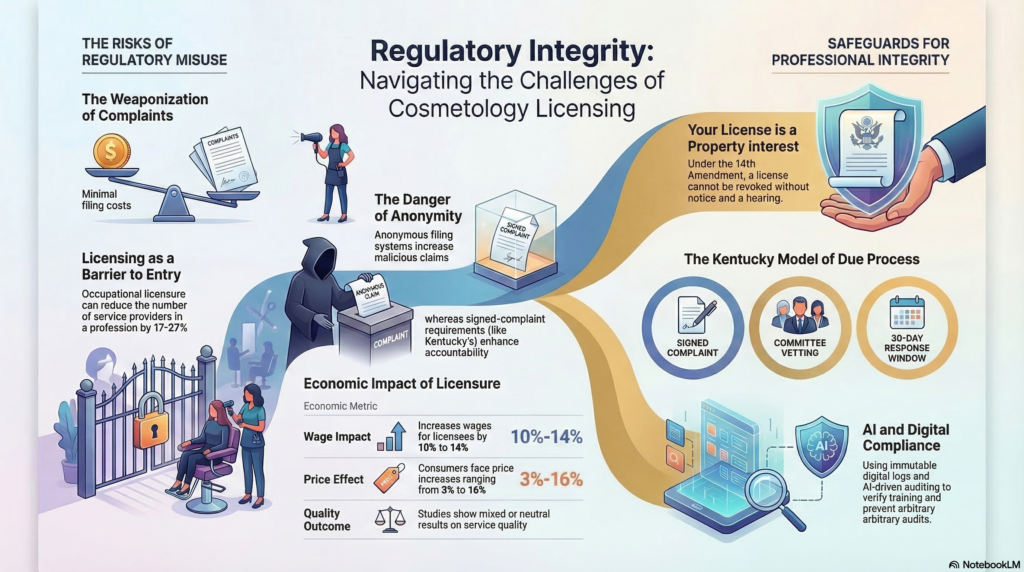
The regulatory architecture of the United States cosmetology industry represents a profound intersection of the state’s police power, administrative law, and economic protectionism. Occupational licensing, once viewed as a narrow tool for ensuring public health and safety, has expanded into a complex web of requirements that govern nearly one-third of the modern workforce.1 Within this landscape, the complaint-driven enforcement system serves as the primary mechanism for state boards to maintain standards; however, this system is increasingly scrutinized for its vulnerability to competitive misuse, the erosion of procedural due process, and the potential for regulatory capture by incumbent practitioners.4
The Constitutional and Administrative Framework of Occupational Licensing
The legal status of a professional license has transitioned from a mere privilege to a recognized property interest under the Fourteenth Amendment’s Due Process Clause.1 When a state grants a license, it creates a vested interest that allows an individual to pursue a livelihood, an interest that cannot be revoked or suspended without adherence to fundamental fairness.8
The Evolution of the Vested Property Interest
Historically, the right to pursue a common occupation was viewed as an essential component of liberty. During the early twentieth century, the judiciary frequently struck down economic regulations that were seen as interfering with this right, a period often referred to as the Lochner era.1 In the post-New Deal era, the Supreme Court moved toward a standard of rational basis deference, wherein economic regulations—including occupational licensing—are upheld as long as there is a conceivable relationship between the law and a legitimate government interest.1
Despite this deference, the recognition of a license as a property interest remains a cornerstone of administrative law. The decision in Goldberg v. Kelly established that individuals dependent on government-conferred benefits are entitled to an evidentiary hearing before those benefits are terminated.9 This principle has been meticulously applied to the professional licensing context, ensuring that practitioners have the right to notice and a hearing before they are deprived of their ability to work.8
| Due Process Factor | Administrative Application in Licensing |
| Notice | Timely and adequate notification of the specific statutes or regulations alleged to have been violated.14 |
| Impartial Decision-Maker | A board or tribunal free from bias, hostility, or a vested pecuniary interest in the outcome.10 |
| Right to Counsel | The right to retain an attorney at one’s own expense during investigative and adjudicative stages.8 |
| Confrontation | The ability to call and cross-examine witnesses who provide testimony against the licensee.9 |
| Decision on the Record | A final order based solely on the legal rules and evidence adduced during the hearing.9 |
The Mathews v. Eldridge Balancing Test
The extent of the process required in an administrative proceeding is often determined by the three-factor balancing test articulated in Mathews v. Eldridge.9 This test evaluates the private interest affected by the government action, the risk of an erroneous deprivation of that interest through the current procedures, and the government’s interest, including the fiscal and administrative burdens that additional procedural requirements would entail.9 In the cosmetology industry, the private interest is the practitioner’s livelihood, which carries immense weight. Conversely, the risk of erroneous deprivation is significant when boards rely on uncorroborated or anonymous complaints.5
The Regulatory Economics of Licensing Barriers
From an economic perspective, occupational licensing functions as a state-sanctioned barrier to entry that restricts the supply of labor and generates “monopoly rents” for existing practitioners.2 While the stated purpose is to solve information asymmetry and protect consumers from low-quality service, empirical research suggests that these regulations often fail to improve quality while consistently increasing consumer costs.2
Rent-Seeking and Monopoly Power
The economic theory of regulation posits that licensing boards are often “captured” by the very industries they are meant to regulate.2 Incumbent providers, being few in number and well-organized, find it easier to lobby for restrictive rules than the large, unorganized group of consumers who are harmed by higher prices.2 In the cosmetology sector, this often results in excessive training requirements—such as 1,500 clock hours—that act as a significant financial hurdle for new entrants.3
| Economic Metric | Impact of Occupational Licensure |
| Wage Impact | Licensing is estimated to increase the wages of licensees by approximately 10% to 14%.2 |
| Supply Restriction | Licensure can reduce the number of providers in a profession by 17% to 27%.5 |
| Price Effect | Consumers typically face price increases ranging from 3% to 16% depending on the specific service and state.2 |
| Quality Outcome | Studies on the effect of licensing on service quality are largely mixed, often showing neutral or unclear results.2 |
Deadweight Loss and Social Cost
The restrictions imposed by licensing lead to “deadweight loss,” where the reduction in output and the increase in prices result in a net loss to society.2 Potential service providers who find the hurdles too costly to overcome are excluded from the market, leading to decreased innovation and fewer options for lower-income consumers.2 Furthermore, the burden of these regulations often falls disproportionately on disadvantaged populations, including immigrants and non-English speakers, who may struggle with the formal education requirements.19
The Complaint-Driven Enforcement System and Competitive Misuse
The primary enforcement mechanism for cosmetology boards is the complaint-driven investigation.5 While essential for identifying genuine public safety risks, this system is structurally vulnerable to being used as a weapon of competitive harassment.7 Because the cost of filing a complaint is minimal, established firms can initiate multiple investigations against competitors to drain their resources and damage their reputations.5
Mechanisms of Competitive Harassment
Competitive harassment often exploits the administrative process rather than seeking a specific legal outcome.23 By triggering a formal board investigation, a complainant can force a rival to undergo months of scrutiny, respond to subpoenas, and hire legal counsel.5 This “administrative muddle” can stifle competition by discouraging new business models or aggressive pricing strategies that incumbents find threatening.5
The “sham litigation” exception to the Noerr-Pennington doctrine provides a framework for understanding these abuses.23 Under Noerr-Pennington, petitioning the government is generally immune from antitrust liability; however, if a pattern of “baseless, repetitive claims” emerges that is intended solely to interfere with a competitor’s business through the use of the process itself, it may constitute a sham.23
Anonymous Allegations and Their Impact
The use of anonymous complaints introduces a particular challenge to due process. While some jurisdictions allow anonymity to encourage reporting of serious misconduct, it significantly increases the risk of malicious filings.18 In an anonymous system, the respondent is often unable to effectively challenge the credibility of the accuser, a core tenet of fundamental fairness.9
| Jurisdiction | Anonymous Complaint Policy | Impact on Licensee Rights |
| Kentucky | Explicitly prohibits anonymous complaints; must be a “signed writing”.30 | High accountability for the accuser; reduces trivial filings.30 |
| Texas | Allows anonymous complaints; identity protected unless requested via open records.28 | High volume of complaints; creates potential for administrative abuse.22 |
| Florida | Accepts anonymous complaints if they are “legally sufficient” and involve serious violations.18 | Attempts to balance safety and fairness; uses false statement statutes as deterrent.33 |
Case Study: Kentucky Cosmetology Regulation and Procedural Integrity
Kentucky’s regulatory framework for cosmetology, centered around KRS Chapter 317A and the administrative regulations in 201 KAR Chapter 12, provides a rigorous example of a state attempting to modernize its complaint procedures to enhance due process.16
The Regulatory Landscape of KRS 317A
The Kentucky Board of Cosmetology (KBC) is authorized to investigate complaints and take disciplinary action for violations that threaten the public interest.16 KRS 317A.070 mandates that the board hold hearings to review its decisions upon the request of an applicant or licensee, ensuring a path for adjudication.16
In recent years, the board has updated 201 KAR 12:190 to refine the complaint and disciplinary process.30 These amendments reflect a shift toward greater transparency and longer response times for licensees, moving the standard from a 10-day response window to a 30-day calendar period.30
The Prohibition of Anonymity and Signed Requirements
A defining feature of the Kentucky model is the requirement that all complaints be submitted on a specific board form and “signed by the person making the complaint”.30 The explicit statement that “Anonymous complaints will not be accepted” serves as a critical barrier to competitive misuse.30 By requiring a signature, the state ensures that the complainant is a real party who can, if necessary, be called as a witness during an administrative hearing.15
Furthermore, the board’s Complaint Committee, consisting of at least two board members, must review the complaint and the respondent’s rebuttal before making a recommendation.30 This intermediate review process is designed to filter out baseless allegations before they reach the full board for formal disciplinary action.30
Informal Regulatory Triggers: The Admonishment
A nuanced tool in the Kentucky system is the “written admonishment,” which is issued for minor violations that do not warrant formal discipline.31 While an admonishment is not considered a final disciplinary action—and thus does not necessarily trigger a full hearing—it is placed in the licensee’s permanent file.31 This creates an “informal trigger” because the board can use past admonishments as evidence of a pattern of non-compliance in future, more serious proceedings.31
| Enforcement Action | Characterization in KY Regulation | Procedural Result |
| Dismissal | No violation found or insufficient evidence.30 | No further action; case closed.30 |
| Admonishment | Warning for a minor violation; not considered discipline.31 | Placed in file; used for future “patterns” of behavior.31 |
| Notice of Disciplinary Action | Formal intent to fine, suspend, or revoke.30 | Triggers 30-day window for respondent to request a hearing.30 |
| Informal Settlement | Resolve matter through mediation or agreed order.30 | Avoids formal hearing; often includes fines or probation.18 |
Comparative Analysis: Enforcement Patterns in Texas, Florida, and California
The management of complaints varies significantly across other major states, offering different levels of protection for licensees.
Texas: High Restrictiveness and Intake Efficiency
The Texas Department of Licensing and Regulation (TDLR) manages a massive scale of regulation, with nearly one million license records.32 Texas allows for anonymous complaints, but it employs a “legal assistant” intake model where allegations are vetted for jurisdiction and probable cause before an investigator is even assigned.22
In Texas, the Enforcement Division follows a standard resolution timeline, aiming to resolve 71% of complaints within six months.37 This focus on efficiency, while beneficial for clearing backlogs, can sometimes lead to an emphasis on settlement over thorough adjudication, as prosecutors use a “notice of alleged violation” (NOAV) to seek monetary penalties and sanctions.22
Florida: False Statement Deterrents and Public Transparency
Florida’s Board of Cosmetology operates within a legal culture that emphasizes public record transparency.33 While Florida accepts anonymous complaints, it uses the threat of criminal prosecution for “False Official Statements” to maintain system integrity.33 Under Section 837.06, Florida Statutes, anyone who knowingly makes a false written statement to mislead a public servant in the performance of their duty can be charged with a misdemeanor.33 This provides a check against the most egregious forms of competitive harassment that is not always present in purely administrative codes.
California: Sunset Reviews and Bureaucratic Complexity
California has historically struggled with a “nearly impenetrable thicket of bureaucracy” in its licensing systems.38 The Board of Barbering and Cosmetology undergoes a “sunset review” every four years to determine if it is meeting consumer protection goals.38 However, findings from the Little Hoover Commission suggest that these reviews are often political rather than technical, and that consumers are rarely the driving force behind the creation or governing of licensing regulations.38 This reinforces the view that such boards primarily serve the interests of the industry rather than the public.5
Administrative Law Toolkit for Scrutinizing Regulatory Abuse
To combat the irrational expansion of licensing and the misuse of enforcement powers, legal scholars advocate for the application of specific administrative law doctrines.12
Arbitrary and Capricious Review and the “Hard Look”
The “arbitrary and capricious” standard of review requires agencies to demonstrate that their actions result from “reasoned decisionmaking”.12 When a board pursues an enforcement action that appears targeted at a competitor or an innovator, a court can apply a “hard look” review.12 This requires the agency to prove that it considered all relevant factors and did not act out of agency capture or a desire to protect incumbent profits.12
The Clear Statutory Statement Rule
Agencies often expand their jurisdiction by interpreting broad statutes to include new practices.12 For instance, boards have famously attempted to regulate “eyebrow threading” or “hair braiding” as “cosmetology,” requiring hundreds of hours of unrelated training.1 Administrative law principles suggest that for such significant restrictions on economic liberty, the agency should be required to point to a “clear statement” from the legislature.12 Without such a mandate, the agency’s interpretation should be struck down as irrational.12
Substantial Evidence and Fact-Finding Integrity
Administrative decisions must be supported by “substantial evidence”.8 In a complaint proceeding, the board cannot rely on hearsay or uncorroborated allegations to justify a license suspension.15 This is particularly critical in jurisdictions that allow anonymous complaints; if the investigation fails to find independent physical evidence or credible witness testimony to support the anonymous claim, the case must be dismissed as a matter of law.18
Technological Solutions and AI-Driven Auditing for Regulatory Integrity
The advancement of Artificial Intelligence (AI) and algorithmic decision-making (ADM) presents a new frontier for both regulatory efficiency and oversight.39
Algorithmic Auditing of Enforcement Patterns
Agencies are increasingly using algorithmic tools to synthesize voluminous records and identify patterns of non-compliance.41 However, these same tools can be utilized to audit the agencies themselves.41 By analyzing a board’s complaint and enforcement history, AI can detect “systematic and repeatable errors” that may indicate bias against specific groups or types of competitors.43
Algorithmic accountability frameworks suggest that agencies should maintain “algorithm registers” that provide public information about the tools used for enforcement.41 This transparency allows for external monitoring by civil rights groups and competitors to ensure that “automated flagging” does not result in discriminatory targeting.41
The Louisville Beauty Academy Model of Digital Compliance
The Louisville Beauty Academy (LBA) in Kentucky has pioneered a model of “digital compliance” that leverages technology to protect student and licensee rights.45 LBA utilizes AI-based attendance validation and “immutable digital logs” to verify training hours.45
| LBA Compliance Feature | Regulatory Benefit | Investor/Licensee Impact |
| Immutable Digital Logs | Prevents the falsification of hours, a common trigger for KBC audits.45 | Guaranteed “KBC audit readiness” and reduced legal risk.45 |
| AI Hour Verification | Ensures all performed labor is strictly curricular and reported correctly.45 | Elimination of “unpaid labor” risks and 95% licensure rate.45 |
| Digital Statutes Access | Every student receives a digital copy of KRS 317A and 201 KAR 12.45 | High degree of “regulatory literacy” among future practitioners.21 |
| Public Transparency | Hub makes school compliance records accessible to the public and regulators.45 | Builds trust and prevents arbitrary board interventions.45 |
By implementing these technologies, LBA effectively shifts the burden of proof. When a board attempts an informal regulatory trigger or initiates an investigation, the school or practitioner can produce a granular, auditable digital trail that satisfies the “substantial evidence” requirements of administrative law.45
Professional Ethics and the Development of Regulatory Literacy
A critical component of maintaining system integrity is the “regulatory literacy” of the practitioners themselves.21 Vocational education must move beyond technical skills to instill a deep understanding of the legal and ethical framework of the profession.21
Curricular Integration of Regulatory Knowledge
Regulatory literacy involves the ability to understand and navigate the laws that govern professional standing and public safety.21 In Kentucky, cosmetology students are required to complete specific “Law/Reg Hours” as part of their 1,500-hour program.21
| Program Type | Total Hours | Theory/Lecture Hours | Law & Regulation Hours |
| Cosmetology | 1,500 | 375 | 40 21 |
| Esthetician | 750 | 250 | 35 21 |
| Nail Technician | 450 | 150 | 25 21 |
Successful practitioners must also master “Business Literacy,” which includes principles of marketing, accounting, and tax literacy.21 When practitioners understand their legal rights and the administrative process, they are better positioned to respond to bad-faith complaints and avoid the “informal triggers” that often lead to professional jeopardy.8
The Role of Ethical Responsibility in Self-Regulation
Professional ethics in cosmetology revolve around professionalism, integrity, and respect for clients.47 This includes maintaining “informed consent,” where clients are fully aware of the risks and benefits of a treatment before it begins.47 This transparency not only protects the client but also serves as a defensive shield for the practitioner; a client who gives informed consent is less likely to file a successful complaint with the state board regarding a standard procedural outcome.47
Practitioners also have an ethical duty to report genuine misconduct within the industry.47 However, the “Ph.D.-level” challenge lies in distinguishing between legitimate safety reporting and the weaponization of complaints for competitive gain.7 Codes of ethics, such as those adopted by the Independent Beauty Association, emphasize “using only legal and ethical means in all business activities,” which inherently prohibits the use of “sham” complaints to harm rivals.23
Economic Analysis of Educational ROI and Regulatory Burdens
The financial viability of a cosmetology career is directly impacted by the length of the educational program and the subsequent regulatory hurdles.21 Students must assess the “payback period” of their education to determine if the credential provides a genuine economic benefit.21
The Payback Period Model
The payback period can be mathematically expressed using the total cost of attendance versus the expected earnings premium:

Where:
= Payback Period (in years)
= Total Tuition
= Mandatory Fees
= Books, Supplies, and Equipment Kits
= Interest on Student Loans
= Expected Annual Earnings after licensure
= Annual Earnings without the credential (median for high school graduate).21
When boards increase training hours or impose burdensome renewal requirements, they extend this payback period, making the profession less accessible to low-income individuals.21 Furthermore, the “Financial Value Transparency” (FVT) framework implemented by the U.S. Department of Education now scrutinizes programs where students incur “unaffordable debt” relative to their low earnings.21 Cosmetology programs often fail these metrics due to the high cost of the required 1,500 hours versus entry-level wages.21
Conclusion: Toward a More Equitable and Transparent Regulatory Future
The analysis of complaint-driven enforcement in the cosmetology industry reveals a systemic tension between the goals of public safety and the realities of economic competition.2 The current system, while grounded in the state’s police power, often functions as a tool for incumbent protectionism, facilitated by anonymous allegations and informal regulatory triggers.5
To restore integrity to the process, a multi-faceted approach is required. Procedurally, jurisdictions should follow the Kentucky model in prohibiting anonymous complaints and increasing the response window for licensees to ensure a meaningful opportunity to be heard.30 Economically, boards must be subjected to “hard look” administrative review to prevent the irrational expansion of training requirements that serve as barriers to entry.1
Technologically, the integration of AI-driven auditing and “immutable digital logs” provides a pathway for objective oversight and the detection of biased enforcement patterns.41 Finally, by fostering “regulatory literacy” and high ethical standards through innovative vocational education, the industry can empower a new generation of practitioners who are capable of defending their property interests against administrative overreach.21 The professional license remains a “valuable property interest” that deserves the full protection of the law, ensuring that the right to pursue a livelihood is not sacrificed to the convenience of the administrative state or the competitive interests of incumbent firms.1
Works cited
- Why Occupational Licensing is a Due Process Issue – Reason Magazine, accessed March 16, 2026, https://reason.com/2017/03/15/why-occupational-licensing-is-a-due-proc/
- The Effects of Occupational Licensure on Competition, Consumers, and the Workforce, accessed March 16, 2026, https://www.mercatus.org/research/public-interest-comments/effects-occupational-licensure-competition-consumers-and
- Eliminating the anti-competitive effects of occupational licensing – Brookings, accessed March 16, 2026, https://www.brookings.edu/articles/eliminating-the-anti-competitive-effects-of-occupational-licensing/
- The Abuse of Occupational Licensing – Chicago Unbound, accessed March 16, 2026, https://chicagounbound.uchicago.edu/cgi/viewcontent.cgi?article=3892&context=uclrev
- Book Review: The Licensing Racket: How We Decide Who Is Allowed to Work, & Why It Goes Wrong, accessed March 16, 2026, https://www.cato.org/regulation/fall-2025/book-review-licensing-racket-how-we-decide-who-allowed-work-why-it-goes-wrong
- Analyzing Occupational Licensing Among the States – American Economic Association, accessed March 16, 2026, https://www.aeaweb.org/conference/2017/preliminary/paper/3T5Sze74
- The Regulatory Commissions and Small Businesses – Duke Law Scholarship Repository, accessed March 16, 2026, https://scholarship.law.duke.edu/cgi/viewcontent.cgi?article=2786&context=lcp
- Discipline and “Due Process” – CPH Insurance, accessed March 16, 2026, https://cphins.com/discipline-and-due-process-2/?print=pdf
- Part IV: Allocating Decision-making Power – NYU Law, accessed March 16, 2026, https://www.law.nyu.edu/sites/default/files/upload_documents/CivPro.Eskridge.fall.04.doc
- The Administrative Muddle In Georgia – Mercer Law School Digital Commons, accessed March 16, 2026, https://digitalcommons.law.mercer.edu/cgi/viewcontent.cgi?article=2196&context=jour_mlr
- Due Process; A Detached Judge; And Enemy Combatants – Pepperdine Digital Commons, accessed March 16, 2026, https://digitalcommons.pepperdine.edu/cgi/viewcontent.cgi?article=1060&context=naalj
- Using Administrative Law to Fix Occupational Licensing – UCLA Law …, accessed March 16, 2026, https://www.uclalawreview.org/wp-content/uploads/2019/09/Blevins-Final-Article-no-bleed.pdf
- Procedural Due Process Civil :: Fourteenth Amendment — Rights Guaranteed – Justia Law, accessed March 16, 2026, https://law.justia.com/constitution/us/amendment-14/05-procedural-due-process-civil.html
- Constitutional Law – Due Process – Evidentiary Hearing Required Prior to Termination of Welfare Benefits – Goldberg v. Kelly, 397 U.S. 254 (1970) – Digital Commons@DePaul, accessed March 16, 2026, https://via.library.depaul.edu/cgi/viewcontent.cgi?article=3024&context=law-review
- Untitled – Legislative Research Commission, accessed March 16, 2026, https://legislature.ky.gov/LRC/Publications/Research%20Memoranda/rm461.pdf
- Board of Cosmetology (Amendment) 201 KAR 12:190. Complaint and disciplinary process., accessed March 16, 2026, https://apps.legislature.ky.gov/services/karmaservice/documents/12429/ToPDF?markup=true
- 5’4^4 – No. – Supreme Court of the United States, accessed March 16, 2026, https://www.supremecourt.gov/DocketPDF/25/25-494/380253/20251022123109505_20251022-122719-00000695-00000147.pdf
- How Anonymous Complaints Could Affect Your Professional License, accessed March 16, 2026, https://www.professionallicensedefensellc.com/anonymous-complaints-and-your-professional-license
- Inclusive Occupational Licensing – California Law Review, accessed March 16, 2026, https://www.californialawreview.org/print/inclusive-licensing
- The Politics of Professionalism: Reappraising Occupational Licensure and Competition Policy, accessed March 16, 2026, https://digitalcommons.law.umaryland.edu/cgi/viewcontent.cgi?article=2612&context=fac_pubs
- The Economics and Regulation of Beauty Education: A …, accessed March 16, 2026, https://naba4u.org/2026/02/the-economics-and-regulation-of-beauty-education-a-comprehensive-analysis-of-labor-markets-consumer-protection-and-regulatory-literacy-in-the-kentucky-personal-care-sector-research-podcast/
- how tdlr handles consumer complaints – TEXAS DEPARTMENT OFLICENSING & REGULATION, accessed March 16, 2026, https://www.tdlr.texas.gov/media/pdf/TDLR-Consumer-Complaints-at-a-Glance.pdf
- Free Markets and Free Speech: Understanding the Limits of the Noerr-Pennington Doctrine, accessed March 16, 2026, https://businesslawreview.uchicago.edu/print-archive/free-markets-and-free-speech-understanding-limits-noerr-pennington-doctrine
- Noerr-Pennington doctrine – Federal Trade Commission, accessed March 16, 2026, https://www.ftc.gov/sites/default/files/documents/reports/ftc-staff-report-concerning-enforcement-perspectives-noerr-pennington-doctrine/p013518enfperspectnoerr-penningtondoctrine.pdf
- Door Slams on Sham Litigation Exception, Resulting in No Antitrust Liability for Prior IP Lawsuit | IP/DE, accessed March 16, 2026, https://ipde.com/blog/2024/02/09/door-slams-on-sham-litigation-exception-resulting-in-no-antitrust-liability-for-prior-ip-lawsuit/
- In the Supreme Court of the United States, accessed March 16, 2026, https://www.supremecourt.gov/DocketPDF/20/20-1293/179671/20210519165140794_20-1293%20AbbVie.opp.pdf
- ANTICOMPETITIVE USE OF ADMINISTRATIVE TRIALS IN BARGAINING OVER PATENT RIGHTS – NYU Law Review, accessed March 16, 2026, https://nyulawreview.org/wp-content/uploads/2018/08/NYULawReview-91-6-Smelcer.pdf
- Forms -File a complaint – Texas Department of Licensing and Regulation – Login, accessed March 16, 2026, https://ga.tdlr.texas.gov:1443/form/Complaint
- Tdlr Complaint Form – Fill Online, Printable, Fillable, Blank | pdfFiller, accessed March 16, 2026, https://tdlr-complaints.pdffiller.com/
- Board of Cosmetology (Amended at ARRS … – Kentucky.gov, accessed March 16, 2026, https://apps.legislature.ky.gov/services/karmaservice/documents/16396/ToPDF?markup=true
- Board of Cosmetology (Amendment) 201 KAR 12:190. Complaint and disciplinary process., accessed March 16, 2026, https://apps.legislature.ky.gov/services/karmaservice/documents/16148/ToPDF?markup=true
- Texas Occupational Licensing Remains Among the Nation’s Worst, accessed March 16, 2026, https://www.texaspolicyresearch.com/texas-occupational-licensing-remains-among-the-nations-worst/
- File a Complaint – MyFloridaLicense.com, accessed March 16, 2026, https://www2.myfloridalicense.com/file-a-complaint/
- 201 KAR 12:190 – Complaint and disciplinary process | State Regulations | US Law, accessed March 16, 2026, https://www.law.cornell.edu/regulations/kentucky/201-KAR-12-190
- Title 201 Chapter 12 Regulation 190 – Legislative Research Commission – Kentucky.gov, accessed March 16, 2026, https://apps.legislature.ky.gov/law/kar/titles/201/012/190/REG/
- 201 KAR 12:190. Complaint and disciplinary process. – Kentucky Board of Cosmetology, accessed March 16, 2026, https://kbc.ky.gov/Documents/201%20KAR%2012.190.pdf
- Texas Department of Licensing and Regulation Compact with Texans, accessed March 16, 2026, https://www.tdlr.texas.gov/compact.htm
- Executive Summary – Californians rely on occupational regulation to protect – Little Hoover Commission, accessed March 16, 2026, https://lhc.ca.gov/wp-content/uploads/Reports/234/ExecutiveSummary234.pdf
- Rethinking Administrative Law for Algorithmic Decision Making – Oxford Academic, accessed March 16, 2026, https://academic.oup.com/ojls/article/42/2/468/6414566
- AI governance: A guide to responsible AI for boards – Diligent Boards, accessed March 16, 2026, https://www.diligent.com/resources/blog/ai-governance
- Using Algorithmic Tools in Regulatory Enforcement – ACUS.gov, accessed March 16, 2026, https://www.acus.gov/document/using-algorithmic-tools-regulatory-enforcement
- Model Behavior: Mitigating Bias in Public Sector Machine Learning Applications – Harvard Kennedy School, accessed March 16, 2026, https://www.hks.harvard.edu/sites/default/files/centers/mrcbg/files/AWP_130_final.pdf
- Algorithmic Accountability Toolkit – Amnesty International, accessed March 16, 2026, https://www.amnesty.org/en/latest/research/2025/12/algorithmic-accountability-toolkit/
- AI bias in law enforcement – AI Governance Library, accessed March 16, 2026, https://www.aigl.blog/ai-bias-in-law-enforcement/
- Louisville Beauty Academy: A National Model of Legal Integrity in …, accessed March 16, 2026, https://naba4u.org/2025/11/louisville-beauty-academy-a-national-model-of-legal-integrity-in-beauty-education-research-2025/
- Lesson Plan Ethical Standards in Cosmetology (1)_0.docx – Texas CTE, accessed March 16, 2026, https://txcte.org/sites/default/files/resources/documents/Lesson%20Plan%20Ethical%20Standards%20in%20Cosmetology%20%281%29_0.docx
- The Ethics in Cosmetology – GREENTREE FREEDOM ACADEMY, accessed March 16, 2026, https://greentreefreedomacademy.org/blog/the-ethics-in-cosmetology/
- Ethical Considerations in Clinical Cosmetology: Patient Safety, Informed Consent, and Best Practices – IICAD, accessed March 16, 2026, https://iicad.org/ethical-considerations-in-clinical-cosmetology-patient-safety-informed-consent-and-best-practices/
- Code of Ethics – IBA – Independent Beauty Association, accessed March 16, 2026, https://independentbeauty.org/code-of-ethics/