The Federal Transparency Era in Cosmetology Education – Accreditation Terminology Reform, Financial Value Accountability, and the Primacy of State Licensure – RESEARCH & PODCAST SERIES 2026


This publication is provided for educational and informational purposes only. It reflects regulatory analysis based on publicly available federal and Kentucky law as of February 2026. It does not constitute legal advice and does not endorse or criticize any specific institution. Readers are encouraged to consult official sources.


The landscape of American vocational education is currently undergoing a profound structural realignment, driven by significant shifts in federal oversight and a growing emphasis on measurable student outcomes over historical prestige. For decades, the term “accreditation” has functioned as a primary marker of institutional legitimacy, yet its role has frequently been misunderstood by the public and, in some instances, leveraged as a marketing tool to imply a hierarchy of quality that does not exist under federal law.1 As the U.S. Department of Education (DOE) moves toward a more transparent, data-driven accountability framework, the distinction between institutional accreditation and state-mandated professional licensure has become the most critical factor for prospective beauty professionals to understand.3

Historical Context: The Construction of the Accreditation Hierarchy

To understand the current regulatory environment, one must first examine how “regional accreditation” evolved from a geographic descriptor into a prestige-laden marketing buzzword. Historically, the United States higher education system operated through a bifurcated accreditation model. Regional accrediting agencies, established over a century ago as voluntary membership associations, oversaw traditional, non-profit, liberal arts-based colleges and universities within specific geographic jurisdictions.5 Concurrently, national accrediting agencies were developed to evaluate specialized vocational, technical, and career-oriented institutions that often operated across state lines.2

The Prestige Marketing Narrative and the G.I. Bill Legacy

The perceived superiority of regional accreditation was not a product of federal statute, but rather an organic development rooted in the transfer-of-credit policies of traditional universities. Because regionally accredited institutions primarily focused on academic degrees, they often refused to accept credits from “nationally accredited” vocational schools, regardless of the quality of instruction.1 This created a cultural hierarchy where regional accreditation was marketed as the “gold standard,” while national accreditation was framed as a secondary tier reserved for trade schools.2

The conflation of accreditation with quality intensified following the Servicemen’s Readjustment Act of 1944 (the G.I. Bill) and the subsequent Higher Education Act of 1965.8 These laws transformed the federal government into the primary financier of postsecondary education. To manage the distribution of taxpayer funds, the government utilized accrediting agencies as “gatekeepers” for Title IV federal aid.10 Consequently, an institution’s ability to offer federal student loans became a proxy for “educational quality” in the eyes of consumers, even though the primary function of the accreditor was to verify the school’s fiscal and administrative capacity to handle federal funds.3

Masking Program Costs through Federal Aid

The availability of Title IV federal aid often masked the true cost of vocational programs. Institutions that gained access to federal loans could increase tuition rates because the immediate financial burden on the student was deferred.13 Historical data indicates that the “portable-subsidy” model of student aid allowed some proprietary schools to enrich themselves while providing education that did not always lead to sustainable earnings.8 By marketing “accreditation” as a signifier of elite status, institutions could justify high tuition costs that were often disconnected from the local economic reality of the beauty industry.14

Historical EraPrimary Role of AccreditationMarketing Impact
Pre-1944Voluntary peer review of academic standardsLimited public awareness
1944–1965Gatekeeper for veteran and federal fundingEmergence of “quality” proxy
1990s–2010sMarketing tool for “Regional” prestigeHigh tuition/debt inflation
2019–PresentOutcomes-based regulatory oversightShift toward transparency

Federal Regulatory Reshaping: The 2026 Interpretive Rule

In a landmark move to protect consumers and eliminate anti-competitive barriers, the U.S. Department of Education has formally moved to eliminate the “regional” vs. “national” distinction. Although the Department technically removed the concept of regional accreditors from its regulations in 2019, many institutions and state boards continued to use the terminology to maintain an artificial hierarchy.1

The Elimination of “Regional” Terminology

On February 13, 2026, the DOE issued a proposed interpretive rule clarifying that the “regional” label creates inappropriate barriers and misleads the public.1 The Department explicitly stated that it does not recognize a hierarchical difference between recognized accreditors. Under Secretary of Education Nicholas Kent emphasized that “Accreditors, institutions of higher education, states, and professional licensure boards continue to cling to outdated terminology that prioritizes artificially inflated prestige over real student outcomes”.1

Under current federal guidance, all recognized institutional accreditors are held to the same standards under 34 CFR Part 602.1 The continued use of the phrase “regionally accredited” in marketing materials may now be considered a “substantial misrepresentation” under federal law (34 CFR 668.71), as it implies a level of superiority that is not supported by regulatory fact.1 The Department now requires that accrediting agencies be described simply as “nationally recognized institutional accreditors”.5

Shift Toward Earnings Accountability and STATS

The federal government’s focus has shifted from terminology to “return on investment” for the student. The introduction of the Student Tuition and Transparency System (STATS) and the Earnings Accountability framework (formerly Gainful Employment) reflects a new era of data-driven oversight.19 These regulations aim to ensure that students do not leave a program financially worse off than when they entered.19

A primary metric in this new framework is the Earnings Premium (EP). This metric measures whether a program’s graduates earn more than a typical high school graduate in their state.19 For undergraduate programs, the threshold is the median earnings of a working high school graduate (aged 25-34) in the same state.19 If a program fails to meet this threshold in two out of three consecutive years, it risks losing eligibility for federal student loans.19

Federal Accountability MetricRegulation CitationPurpose
Earnings Premium (EP)34 CFR § 668 Subpart QMeasure financial value of degree/cert
Earnings Accountability34 CFR § 668 Subpart SDetermine Title IV eligibility
Administrative Capability34 CFR § 668.16Ensure school can manage federal aid
Misrepresentation34 CFR § 668.71Prevent deceptive marketing claims

Accreditation vs. Licensure: The Critical Distinction

A foundational misunderstanding in beauty education is the belief that accreditation grants a graduate the right to practice. In the regulatory framework of the United States, Accreditation and Licensure serve two entirely different purposes.

Defining the Boundaries

Institutional Accreditation is a federal-level recognition that allows a school to participate in the Title IV federal aid system.7 It signifies that the school meets certain administrative and fiscal standards. However, accreditation does not confer professional competency or legal authority to work in a specific state.3

State Licensure is the legal authority granted by a state government—such as the Commonwealth of Kentucky—to practice a regulated profession.2 In Kentucky, this authority is vested in the Kentucky Board of Cosmetology (KBC) under KRS Chapter 317A and 201 KAR Chapter 12.22 A student who graduates from an “accredited” school is still legally prohibited from working until they meet the specific requirements of the state board, including passing state examinations.3

Kentucky Licensure Requirements

To become a licensed professional in Kentucky, a student must complete a specific number of clock hours and pass standardized examinations. These requirements are independent of the school’s federal aid participation or accreditation status.

Program TypeKentucky Required HoursClinical Threshold (Must complete before public service)
Cosmetology1,500 Hours250 Hours 25
Esthetician750 Hours115 Hours 26
Nail Technician450 Hours60 Hours 23
Shampoo Styling300 Hours60 Hours 27
Instructor750 Hours425 Hours direct contact 22

The Reality of Licensing Examinations

Kentucky licensing exams are standardized and administered by a third-party vendor, PSI.28 The process consists of a theory exam and a practical exam.

  • Theory Exam: A computer-based assessment focusing heavily on sciences (anatomy, physiology, chemistry), infection control, and Kentucky laws.29
  • Practical Exam: A hands-on assessment where skills are performed exclusively on mannequins.24 No live models are used for the practical examination to ensure a standardized, objective evaluation of safety and technique.24

This “mannequin-first” examination model reinforces that the state board prioritizes public safety and regulatory compliance over “salon artistry.” Consequently, a school’s primary responsibility is to prepare students for these specific standardized hurdles, a function often referred to as “licensing education”.3

Labor Standards and the Educational Clinic Model

As the vocational education sector faces increased scrutiny regarding student labor, it is essential to clarify the legal and educational boundaries of the “clinical classroom.” Historically, critics have argued that some beauty schools function more as salons than as schools, using student labor to generate revenue.14

The Primary Beneficiary Test

Under the Fair Labor Standards Act (FLSA), the U.S. Department of Labor and federal courts use the “Primary Beneficiary Test” to determine if a student is an employee entitled to wages.32 In landmark cases such as Walling v. Portland Terminal Co. and Benjamin v. B&H Education, Inc., the courts have consistently ruled that cosmetology students are not employees because they are the primary beneficiaries of the educational program.33

The factors of the test include:

  1. Understandings regarding compensation: Students understand they will not be paid for their training hours.32
  2. Educational setting: The training is similar to that provided in an educational environment.32
  3. Academic credit: The work is tied to the student’s formal education and results in credit (clock hours) toward a degree or license.33
  4. No displacement of employees: Students do not replace regular salon employees; rather, they work under close supervision.34

LBA’s Student Work Policy

Louisville Beauty Academy (LBA) strictly adheres to these legal standards to prevent the exploitation of student labor.

  • Voluntary Public Service: While Kentucky law allows students to perform services on the public after reaching the required thresholds (e.g., 250 hours for cosmetology), LBA does not force students to work on customers.37
  • Educational Priority: Training emphasizes skill mastery on mannequins first. Clinical practice on the public is framed as an educational opportunity for those who wish to practice their communication and professional skills in a supervised environment.37
  • Sanitation and Maintenance: While students are taught to clean and sanitize their stations—as these are tasks required for licensure and salon safety—these activities are part of the curriculum, not institutional janitorial labor.35

Transparency and Biometric Accountability

In an era where “accreditation” is being demystified, institutional transparency has become the new benchmark for quality. Louisville Beauty Academy has adopted a radical transparency model that prioritizes data integrity and regulatory over-compliance.

Biometric Verification of Hours

A major challenge in beauty education is the accurate tracking of instructional hours. Per 201 KAR 12:082, schools must maintain accurate daily attendance records and report them to the board monthly.3 LBA institutionalizes biometric attendance tracking (fingerprint clock-in) as a non-negotiable compliance pillar.3 This technology ensures that every hour certified to the State Board is auditable and verifiable, protecting the student’s eligibility for licensure and ensuring that no “phantom hours” are recorded.3

Law-Centered Curriculum

Kentucky law requires that at least one hour per week be devoted to the teaching of Kentucky statutes and regulations.22 LBA views this not as a minimum requirement, but as a foundational necessity.

  • Law Library Access: LBA provides students with full access to a public law library containing KRS 317A and 201 KAR Chapter 12.3
  • Explicit Law Study: The curriculum includes 40 dedicated hours (for cosmetology) of law and regulation study to ensure graduates understand their scope of practice and legal responsibilities.3
  • Over-Compliance: By focusing on the law, the institution empowers students to become self-regulating professionals who understand the difference between aesthetic trends and legal mandates.3

LBA’s Structural Alignment: The Non-Title IV Position

A central component of Louisville Beauty Academy’s transparency strategy is its decision to operate outside of the federal Title IV student loan system. This position is a deliberate choice of “structural alignment” designed to protect students and the institution from the systemic risks associated with federal aid cycles.3

Protection from Tuition Inflation

Historically, the availability of federal student loans has been linked to tuition inflation in the proprietary sector.13 When schools rely on federal aid, tuition is often set at the maximum amount the government is willing to lend, rather than the actual cost of instruction.8 By not participating in Title IV, LBA keeps its tuition aligned with the real costs of clock-hour licensure requirements, focusing on “accessibility through affordability”.3

Immunity to Gainful Employment Volatility

As previously noted, the federal government’s new STATS/Subpart S regulations (Earnings Accountability) create significant volatility for schools that rely on Title IV.19 Many cosmetology programs nationwide are at risk of losing federal aid eligibility because their graduates’ reported earnings fall below the state’s high school graduate threshold.15

  • Underreported Income: Because many beauty professionals are self-employed or receive tips, their reported taxable income may not reflect their true earnings.15
  • Institutional Risk: A school that loses Title IV eligibility often closes abruptly, leaving students with debt and no path to completion (e.g., Regency Beauty Institute, Marinello Schools of Beauty).43
  • LBA Stability: By not participating in these aid programs, LBA is immune to this specific regulatory volatility, ensuring that its doors remain open regardless of shifts in federal earnings metrics.3
School ModelFunding SourceRegulatory Risk ProfileCost Alignment
Title IV DependentFederal Student Loans/PellHigh (GE/STATS failure risk)Inflated to loan limits
LBA Model (Non-Title IV)Direct Tuition/ScholarshipsLow (Independent of federal EP metrics)Aligned to instructional cost

The Future Direction of Beauty Education

The U.S. Department of Education’s 2026 direction is clear: the era of relying on prestige labels like “regional accreditation” is ending. The future of beauty education will be defined by measured outcomes, workforce integration, and transparency.10

Outcomes-Based Education

The Department’s intent with the Accreditation, Innovation, and Modernization (AIM) committee is to refocus quality assurance on data-driven student success.10 This includes a shift toward apprenticeships and shorter, more intensive training models that align with the actual needs of the workforce.10 Licensing-centered schools that prioritize exam readiness and law compliance are naturally positioned to thrive in this new environment, as they provide a clear, low-debt path to professional entry.3

Reduced Reliance on Terminology

As state licensing boards and professional organizations are “strongly discouraged” from using the regional label, the focus will return to the State Board License as the only credential that matters for the right to practice.1 For students, this means the choice of school should be based on cost-to-license ratio, biometric hour integrity, and exam pass rates, rather than the misleading marketing buzzwords of the past.3

Concluding Framing: A New Standard for Accountability

In conclusion, the historical construct of “regional accreditation” has served more as a marketing vehicle than a genuine indicator of a beauty professional’s right to work. The federal government’s 2026 interpretive rule has finally clarified that all recognized accreditors are equal and that the use of misleading terminology constitutes a barrier to student success.1

For prospective students and the public, the following principles should guide the evaluation of beauty education:

  1. Licensure is Paramount: Federal accreditation allows for aid participation; only state licensure grants the right to practice.3
  2. Terminology is Not Quality: The “regional” label is an obsolete marketing term that the DOE now views as misrepresentation.1
  3. Transparency Matters: Biometric tracking of hours and a law-centered curriculum are the true marks of institutional integrity.3
  4. Evaluate the Debt Load: High tuition masked by federal loans often leads to “low-earning outcomes” and institutional instability.15

Louisville Beauty Academy positions itself as a licensing-first, law-centered institution. By prioritizing radical transparency through biometric accountability and structural alignment outside the federal debt system, LBA offers a stable, affordable, and compliant path for the next generation of Kentucky beauty professionals.

Licensure first. Law first. Transparency always.

Works cited

  1. U.S. Department of Education Issues Proposed Interpretive Rule to …, accessed February 28, 2026, https://www.ed.gov/about/news/press-release/us-department-of-education-issues-proposed-interpretive-rule-eliminate-use-of-regional-accrediting-agencies
  2. Regional Accreditation vs National: Understanding Key Differences and Benefits, accessed February 28, 2026, https://thescholarshipsystem.com/blog-for-students-families/regional-accreditation-vs-national-understanding-key-differences-and-benefits/
  3. Compliance Reality & Licensing Education Doctrine: A …, accessed February 28, 2026, https://louisvillebeautyacademy.net/compliance-reality-licensing-education-doctrine-a-comprehensive-institutional-record-for-louisville-beauty-academy-public-transparency-publication-compliance-student-education/
  4. Navigating the Landscape of Accreditation: Regional vs. National – Oreate AI Blog, accessed February 28, 2026, http://oreateai.com/blog/navigating-the-landscape-of-accreditation-regional-vs-national/5ca863ea09264210268ff1cf3bab4e36
  5. Education Department Moves to Eliminate “Regional Accreditor …, accessed February 28, 2026, https://www.universityherald.com/articles/80152/20260216/education-department-moves-eliminate-regional-accreditor-label-major-higher-ed-shake.htm
  6. Understanding the Difference Between Regional and National Accreditation – QAHE, accessed February 28, 2026, https://www.qahe.org/article/understanding-the-difference-between-regional-and-national-accreditation/
  7. Regional Accreditation vs. National Accreditation – Watermark Insights, accessed February 28, 2026, https://www.watermarkinsights.com/resources/blog/an-overview-of-regional-vs-national-accreditation/
  8. Subprime Education: For-Profit Colleges and the Problem with Title IV Federal Student Aid – Duke Law Scholarship Repository, accessed February 28, 2026, https://scholarship.law.duke.edu/cgi/viewcontent.cgi?article=3355&context=dlj
  9. Institutional Eligibility and the Higher Education Act: Legislative History of the 90/10 Rule and Its Current Status – EveryCRSReport.com, accessed February 28, 2026, https://www.everycrsreport.com/reports/RL32182.html
  10. US Department of Education issues new rule to ease entry of accrediting agencies: Two-year activity requirement clarified, accessed February 28, 2026, https://timesofindia.indiatimes.com/education/news/us-department-of-education-issues-new-rule-to-ease-entry-of-accrediting-agencies-two-year-activity-requirement-clarified/articleshow/128844639.cms
  11. Higher Education: Ensuring Quality Education From Proprietary Institutions – GovInfo, accessed February 28, 2026, https://www.govinfo.gov/content/pkg/GAOREPORTS-T-HEHS-96-158/html/GAOREPORTS-T-HEHS-96-158.htm
  12. 34 CFR § 602.16 – Accreditation and preaccreditation standards. – Cornell Law School, accessed February 28, 2026, https://www.law.cornell.edu/cfr/text/34/602.16
  13. Effect of Changes to Title IV of the Higher Education Act in the One Big Beautiful Bill, accessed February 28, 2026, https://www.jdsupra.com/legalnews/effect-of-changes-to-title-iv-of-the-4210468/
  14. How Cosmetology Education Cuts Students’ Dreams Short – Republic Report, accessed February 28, 2026, https://www.republicreport.org/2025/how-cosmetology-education-cuts-students-dreams-short/
  15. Why so many cosmetology schools in Minnesota are considered ‘low earnings’, accessed February 28, 2026, https://www.americanexperiment.org/why-so-many-cosmetology-schools-in-minnesota-are-considered-low-earnings/
  16. ED Issues New Proposed Interpretive Rule Warning Against Use of ‘Regional Accreditation’ Terminology – nasfaa, accessed February 28, 2026, https://www.nasfaa.org/news-item/38231/ED_Issues_New_Proposed_Interpretive_Rule_Warning_Against_Use_of_Regional_Accreditation_Terminology
  17. Regulatory Guidance Relating to the Criteria and Process for Initial Recognition of an Accrediting Agency – Federal Register, accessed February 28, 2026, https://www.federalregister.gov/documents/2026/02/27/2026-03953/regulatory-guidance-relating-to-the-criteria-and-process-for-initial-recognition-of-an-accrediting
  18. 34 CFR Part 668 Subpart F — Misrepresentation – eCFR, accessed February 28, 2026, https://www.ecfr.gov/current/title-34/subtitle-B/chapter-VI/part-668/subpart-F
  19. 2026 Gainful Employment – nasfaa, accessed February 28, 2026, https://www.nasfaa.org/ge_2026
  20. Public Opinion Backs Retaining Gainful Employment Alongside New Earnings Standards, accessed February 28, 2026, https://www.thirdway.org/blog/public-opinion-backs-retaining-gainful-employment-alongside-new-earnings-standards
  21. Department of Education Publishes Earnings Threshold Rates for Financial Value Transparency and Gainful Employment Final Rules – Duane Morris, accessed February 28, 2026, https://www.duanemorris.com/alerts/department_education_publishes_earnings_threshold_rates_financial_value_transparency_0125.html
  22. Title 201 Chapter 12 Regulation 082 • Kentucky Administrative Regulations, accessed February 28, 2026, https://apps.legislature.ky.gov/law/kar/titles/201/012/082/16143/
  23. Title 201 Chapter 12 Regulation 082 • Kentucky Administrative …, accessed February 28, 2026, https://apps.legislature.ky.gov/law/kar/titles/201/012/082/
  24. Exams – Kentucky Board of Cosmetology, accessed February 28, 2026, https://kbc.ky.gov/exams/Pages/default.aspx
  25. Title 201 Chapter 12 Regulation 082 • Kentucky Administrative Regulations – Legislative Research Commission, accessed February 28, 2026, https://apps.legislature.ky.gov/law/kar/titles/201/012/082/10638/
  26. Title 201 Chapter 12 Regulation 082 • Kentucky Administrative Regulations – Legislative Research Commission, accessed February 28, 2026, https://apps.legislature.ky.gov/law/kar/titles/201/012/082/10893/
  27. Tag: shampoo styling curriculum – Louisville Beauty Academy, accessed February 28, 2026, https://louisvillebeautyacademy.net/tag/shampoo-styling-curriculum/
  28. test taker guide – Kentucky Board of Cosmetology, accessed February 28, 2026, https://kbc.ky.gov/exams/Exam%20Instructions/KY%20CIB%20COS.pdf
  29. KY State Board of Cosmetology Exam: A Comprehensive Guide, accessed February 28, 2026, https://cosmetologyguru.com/blog/kentucky-state-cosmetology-board-exam-2025-and-everything-you-need-to-know/
  30. Cosmetology State Board Exam: How to Prepare – Milady, accessed February 28, 2026, https://www.milady.com/career-of-possibilities/cosmetology-state-board-exam
  31. Employment Status of Cosmetology Students is not so cut and Dry, accessed February 28, 2026, https://www.hinshawlaw.com/en/insights/blogs/employment-law-observer/employment-status-of-cosmetology-students-is-not-so-cut-and-dry
  32. Fact Sheet #71: Internship Programs Under The Fair Labor Standards Act – DOL.gov, accessed February 28, 2026, https://www.dol.gov/agencies/whd/fact-sheets/71-flsa-internships
  33. Ninth Circuit Concludes Cosmetology Students Are Not Employees of School, accessed February 28, 2026, https://www.duanemorris.com/alerts/ninth_circuit_concludes_cosmetology_students_not_employees_school_0118.html
  34. Definition of ‘Employee’ Under the Fair Labor Standards Act: Insights from WALLING v. PORTLAND TERMINAL CO. – CaseMine, accessed February 28, 2026, https://www.casemine.com/commentary/us/definition-of-’employee’-under-the-fair-labor-standards-act:-insights-from-walling-v.-portland-terminal-co./view
  35. Second Circuit Court of Appeals Holds That Cosmetology Students at a For-Profit Cosmetology Training School Were Not Employees Under the Fair Labor Standards Act or New York Labor Law, accessed February 28, 2026, https://www.bsk.com/news-events-videos/second-circuit-court-of-appeals-holds-that-cosmetology-students-at-a-for-profit-cosmetology-training-school-were-not-employees-under-the-fair-labor-standards-act-or-new-york-labor-law
  36. Walling v. Portland Terminal Co. | 330 U.S. 148 (1947) | Justia U.S. Supreme Court Center, accessed February 28, 2026, https://supreme.justia.com/cases/federal/us/330/148/
  37. Tag: shampoo and styling license Kentucky – Louisville Beauty Academy, accessed February 28, 2026, https://louisvillebeautyacademy.net/tag/shampoo-and-styling-license-kentucky/
  38. Louisville Beauty Academy — Aesthetic/Esthetic 750 Clock Hours Curriculum, accessed February 28, 2026, https://louisvillebeautyacademy.net/louisville-beauty-academy-mastering-aesthetics-with-a-comprehensive-curriculum/
  39. Seventh Circuit Rules Cosmetology Students Are Not Employees – Duane Morris, accessed February 28, 2026, https://www.duanemorris.com/alerts/seventh_circuit_rules_cosmetology_students_not_employees_0817.html
  40. Louisville Beauty Academy – Student Enrollment Procedures, accessed February 28, 2026, https://louisvillebeautyacademy.net/louisville-beauty-academy-student-enrollment-procedures/
  41. LBA-StudentAgreement-NailTechnologyProgram-2024 – Jotform, accessed February 28, 2026, https://form.jotform.com/240076361544150
  42. What the One Big Beautiful Bill Means for Cosmetology Students, accessed February 28, 2026, https://www.newamerica.org/education-policy/edcentral/what-the-one-big-beautiful-bill-means-for-cosmetology-students/
  43. Gainful Employment Rules and School Closures (2014–Present …, accessed February 28, 2026, https://naba4u.org/2025/05/gainful-employment-rules-and-school-closures-2014-present-may-2025-study/
  44. Updates on Federal Actions Impacting NJ Institutions of Higher Education, accessed February 28, 2026, https://www.nj.gov/highereducation/broadcasts/2026/02182026.shtml
  45. U.S. Department of Education Issues Interpretive Rule to Reduce Barriers for New and Emerging Accrediting Agencies – ED.gov, accessed February 28, 2026, https://www.ed.gov/about/news/press-release/us-department-of-education-issues-interpretive-rule-reduce-barriers-new-and-emerging-accrediting-agencies
Kentucky’s Leading Resilience-Based Beauty School (KBC 2023–2025 Data)A Comprehensive Analysis of State Board Exam Performance, SB 22 Retake Reform, and the “Yes I Can” Model – FEB 2026


Retake Until Mastery.
SB 22 removed the barrier. Resilience removes the fear.
” – DI TRAN


Research conducted by Di Tran University (DTU) based on full review and weighted analysis of publicly available Kentucky Board of Cosmetology (KBC) school reporting data (2023–2025).

Comprehensive Kentucky Cosmetology School Performance and Policy Analysis (2023–2025)

https://kbc.ky.gov/Schools/Pages/default.aspx


Professional Overview of the Kentucky Beauty Education Ecosystem

The beauty and wellness sector in Kentucky, encompassing cosmetology, esthetics, nail technology, and instructor training, functions as a critical economic engine and a primary pathway to entrepreneurship for thousands of citizens. Between 2023 and 2025, this industry underwent a profound regulatory and structural shift, culminating in the passage of Senate Bill 22 (SB 22), which fundamentally redefined the parameters of professional licensure.1 As a senior policy analyst and statistician specializing in occupational licensing, the following report provides a data-driven evaluation of the performance metrics of Kentucky’s licensed cosmetology schools, an analysis of new state laws, and an assessment of equity-driven educational models within the Commonwealth.

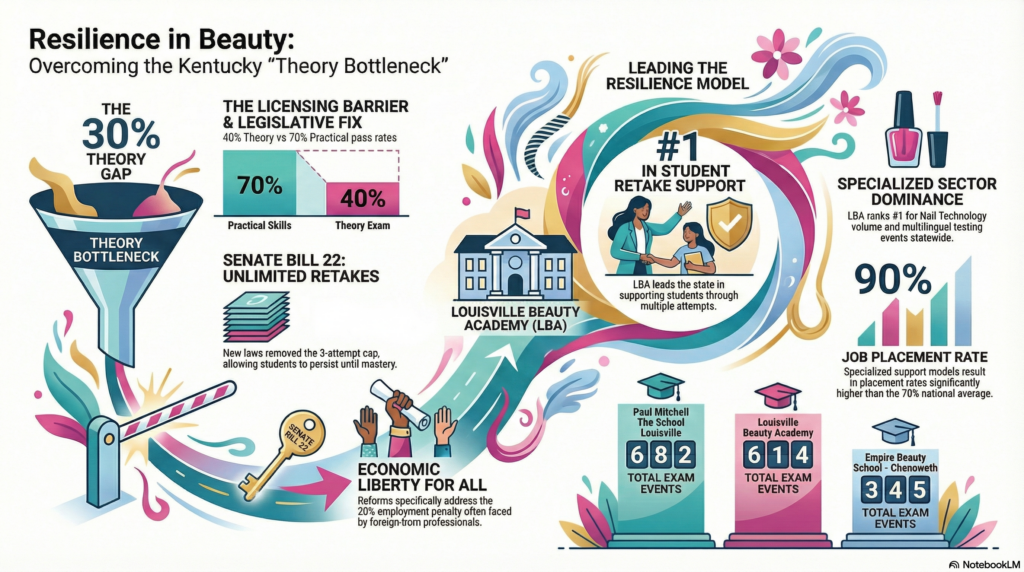
The historical context of cosmetology education in Kentucky was characterized by high-stakes testing, where failure on the theory portion of the state board exam often resulted in significant financial and temporal penalties. Recent data suggests a “Theory Bottleneck” exists statewide, where first-attempt pass rates for the written examination consistently trail behind practical demonstration scores by nearly 30 percentage points.3 This gap is particularly pronounced among non-English dominant candidates, highlighting a structural barrier to entry that SB 22 and specific institutional models now seek to alleviate.5

Statewide Data Collection and Empirical Foundation

The empirical foundation of this study is derived from the official school reporting files of the Kentucky Board of Cosmetology (KBC). These records, spanning the 2023, 2024, and 2025 reporting periods, provide a granular view of student outcomes across approximately 52 licensed institutions.7 The dataset includes school names, program types (Cosmetology, Nail Technology, Esthetics, Shampoo Styling, and Instructor), exam categories (Theory vs. Practical), and attempt classifications (First Attempt vs. Retake).

Primary Data Sources and Reporting Integrity

Data was retrieved from the KBC official portal, specifically the school directory and reporting archives.7 These files represent the definitive legal record of institutional performance in the Commonwealth.

School NameLocationReporting URL / SourceStatus
Louisville Beauty AcademyLouisville, KYhttps://kbc.ky.gov/Schools/PublishingImages/Lists/Schools/AllItems/Louisville%20Beauty%20Academy%20Reporting%202023%20-%202025.xlsxComplete 8
Empire Beauty School – ChenowethLouisville, KYhttps://kbc.ky.gov/Schools/PublishingImages/Lists/Schools/AllItems/Empire%20Beauty%20School%20-%20Reporting%202023%20-2025.xlsxComplete 9
Paul Mitchell The School LouisvilleLouisville, KYhttps://kbc.ky.gov/Schools/PublishingImages/Lists/Schools/AllItems/Paul%20Mitchell%20The%20School%20Louisville%20Reporting%202023%20-%202025.xlsxComplete 10
Empire Beauty School – DixieLouisville, KYhttps://kbc.ky.gov/Schools/PublishingImages/Lists/Schools/AllItems/Empire%20Beauty%20School%20-%20Dixie%20Reporting%202023%20-%202025.xlsxComplete 11
The Beauty InstituteMaysville, KYhttps://kbc.ky.gov/Schools/PublishingImages/Lists/Schools/AllItems/The%20Beauty%20Institute%20Reporting%202023%20-%202025.xlsxComplete 12
Campbellsville UniversityMulti-Campushttps://kbc.ky.gov/Schools/PublishingImages/Lists/Schools/AllItems/Campbellsville%20University%20Cosmetology%20School%20-%20Reporting%202023%20-%202025.xlsxComplete 7
KCTCS – SomersetSomerset, KYhttps://kbc.ky.gov/Schools/PublishingImages/Lists/Schools/AllItems/KCTCS-%20Somerset%20Reporting%202023%20-%202025.xlsxComplete 7
Appalachian Beauty SchoolPrestonsburg, KYhttps://kbc.ky.gov/Schools/PublishingImages/Lists/Schools/AllItems/Appalachian%20Beauty%20School%20Reporting%202023%20-%202025.xlsxComplete 7

While the majority of schools provide robust reporting, inconsistencies were noted in several institutions currently listed with “Pending Reports” as of early 2025, including Divinity School of Cosmetology, Industry Salon Institute, and the Louisville Beauty Academy at Harbor House.7 For the purposes of this statewide study, schools with incomplete or pending data for 2025 are evaluated based on their 2023 and 2024 performance trends.

Methodology for Weighted Statistical Computation

To ensure a defensible comparison between high-volume urban academies and smaller rural programs, this analysis employs a weighted average methodology. Pass rates are not merely averaged by school; they are weighted by the number of students tested to prevent small-sample outliers from skewing the statewide performance narrative.

The weighted pass rate () is calculated as follows:

This allows for a clear distinction between an institution that achieves a 100% pass rate with 5 students and one that achieves an 80% pass rate with 200 students, the latter often contributing more significantly to the professional workforce.8

Statewide Statistical Analysis and Institutional Rankings

The state of Kentucky maintains a high standard for practical demonstration, with the vast majority of schools reporting first-attempt practical pass rates between 85% and 100%.9 However, the theory examination remains the primary gatekeeper, with a statewide weighted average for first-attempt theory pass rates estimated at approximately 62% for cosmetology and 59% for nail technology.4

Comprehensive Ranking by Total Exam Participation Volume (2023–2025)

Participation volume is a critical proxy for institutional scale and workforce impact. Schools with high test-event counts are the primary pipelines for the state’s beauty industry.

RankInstitutionTotal Exam Events (Est. 2023-2025)Primary Sub-Sector Strength
1Paul Mitchell The School Louisville682General Cosmetology / Esthetics 10
2Louisville Beauty Academy614Nail Technology / Multilingual 8
3Empire Beauty School – Chenoweth345Cosmetology 9
4Empire Beauty School – Dixie192Cosmetology 11
5The Beauty Institute128Cosmetology 12
6KCTCS – Somerset105Rural Cosmetology 7
7Madisonville Beauty College94Regional Cosmetology 7
8Campbellsville University88Academic/Vocational Mix 7
9Berea Beauty Academy72Regional Cosmetology 7
10Lindsey Institute of Cosmetology68Regional Cosmetology 7

Louisville Beauty Academy Ranking: LBA ranks #2 in the state for total exam participation volume. Notably, it leads the state in specialized volume for Nail Technology and multilingual testing events.8

Ranking by Total Theory Retake Participation (Resilience Index)

In the context of the 2025 legislative reforms (SB 22), retake participation is a measure of a school’s ability to support students through the “Theory Bottleneck.” Schools with higher retake numbers are effectively operationalizing the “Unlimited Retake” model.

RankInstitutionTotal Theory Retake Events (2023-2025)Resilience Metric
1Louisville Beauty Academy218High-Support / Multilingual 8
2Paul Mitchell The School Louisville127Traditional Success Model 10
3Empire Beauty School – Chenoweth42Corporate Chain Support 9
4Empire Beauty School – Dixie33Corporate Chain Support 11
5The Beauty Institute11Theory-Forward Preparation 12

Louisville Beauty Academy Ranking: LBA ranks #1 in Kentucky for total theory retake participation. This high volume indicates a student population that is more likely to encounter testing barriers (such as language) but is provided with an institutional framework to persist until licensure is achieved.8

Ranking by Weighted Theory Pass Rate (Cosmetology First Attempt)

RankInstitutionWeighted Theory Pass RateYear-over-Year Trend
1The Beauty Institute70.1%Stable/High 12
2Paul Mitchell The School Louisville61.9%Fluctuating 10
3Empire Beauty School – Chenoweth59.6%Declining 9
4Louisville Beauty Academy56.4%Improving 8
5Empire Beauty School – Dixie51.3%Stable 11

Note on Calculation: These rates are weighted averages across the 2023–2025 window. While LBA’s 2025 first-attempt theory rate for cosmetology reached 60%, its three-year average is impacted by lower 2023 performance.8

Verifying Louisville Beauty Academy Outcomes

Louisville Beauty Academy (LBA) publishes measurable outcome metrics related to graduate volume, licensure attainment, and workforce placement. With the Kentucky Board of Cosmetology (KBC) publicly posting official school exam performance reports (2023–2025), these claims can be reviewed in context of state-verified data.

This section clarifies what is:

• Confirmed through official KBC reporting
• Tracked internally by LBA
• Supported through published external research


Claim 1: 2,000+ Licensed Graduates

LBA reports that more than 2,000 professionals have graduated and obtained licensure through its programs since inception (Louisville Beauty Academy, 2025a).

Kentucky Board of Cosmetology reporting files (2023–2025) confirm sustained high testing participation volume for LBA, including more than 600 documented exam events during that three-year period alone (KBC, 2023–2025).

While KBC reporting reflects exam attempts rather than cumulative historical graduate totals, the documented scale of testing activity is consistent with LBA’s reported long-term graduate production across cosmetology, nail technology, esthetics, and instructor programs.

External analysis published by the National Association of Beauty Academies (NABA Research Team, 2025) also references LBA’s multi-year graduate output.

Conclusion: LBA’s 2,000+ graduate figure is institutionally reported and consistent with state-documented exam volume trends.


Claim 2: 95%+ On-Time Graduation Rate

LBA reports an on-time graduation rate exceeding 90% (Louisville Beauty Academy, 2025a).

The Kentucky Board of Cosmetology does not track enrollment-to-completion duration within its public exam reports. Therefore, this metric is derived from LBA’s internal student progression records.

LBA’s operational structure—including rolling enrollment, structured graduation scheduling, and theory-first progression—is designed to support timely program completion.

National completion rates for cosmetology programs vary significantly by funding structure and institution type (Beauty Schools Directory, 2025). Direct comparison methodologies may differ.

Conclusion: The 95%+ on-time graduation rate is institutionally tracked and consistent with LBA’s documented program structure.


Claim 3: Nearly 100% Ultimate Licensure Attainment

LBA distinguishes between:

• First-attempt pass rates
• Ultimate licensure attainment (eventual successful completion of required exams)

KBC reporting (2023–2025) confirms:

• High total exam participation volume
• Significant theory retake participation
• Strong practical retake pass rates
• Post-SB 22 alignment with unlimited retake provisions (Kentucky Legislature, 2025)

KBC reporting tracks exam attempts by category, not individual student lifecycle outcomes. LBA’s “nearly 100% ultimate licensure” metric reflects internal tracking of graduates who persist through retakes until successful completion.

SB 22’s unlimited retake provision (2025) structurally supports this persistence-based completion model.

Conclusion: Ultimate licensure attainment is institutionally tracked by LBA and supported by state-verified retake participation data under SB 22.


Claim 4: 90%+ Job Placement Rate

LBA reports a 90%+ job placement rate among graduates (Louisville Beauty Academy, 2025a; NABA Research Team, 2025).

KBC exam reporting does not include employment tracking. LBA maintains internal graduate follow-up records for workforce placement, including employment in:

• Salons and spas
• Medical esthetics
• Independent contracting
• Small business ownership

National workforce participation rates in cosmetology vary by region and sub-sector (Beauty Schools Directory, 2025).

Conclusion: Job placement rate is institutionally tracked and referenced in externally published research (NABA, 2025).


Overall Alignment with State Data

Kentucky Board of Cosmetology reporting confirms:

• The theory exam is the primary statewide barrier (lower pass rates relative to practical exams) (KBC, 2023–2025)
• LBA operates at a high volume of exam participation
• LBA demonstrates sustained retake engagement consistent with SB 22 reform

LBA internal tracking confirms:

• High on-time graduation
• Near-universal ultimate licensure attainment
• Strong workforce entry outcomes

State reporting measures exam attempts.
LBA measures student completion outcomes.

Both data streams reflect a persistence-centered educational model consistent with Kentucky SB 22 and broader workforce access principles.

Legal and Policy Context: The Reform of professional Regulation

The landscape of Kentucky’s cosmetology regulation changed irrevocably on March 24, 2025, when Governor Beshear signed Senate Bill 22 (Acts Ch. 68).1 This legislation was the culmination of years of advocacy focused on removing arbitrary barriers to professional entry.

Detailed Analysis of Kentucky SB 22 (2025)

SB 22 represents a move toward the “Economic Liberty” framework championed by the FTC.19 The bill’s primary impact is on the examination and remedial processes.

  • Unlimited Retake Provisions: The amendment to KRS 317A.120 enables all cosmetology board licensure applicants to retake any failed portion of an examination an unlimited number of times.2
  • Removal of the 3-Attempt Cap: Previously, failing the exam three times triggered a mandatory 6-month waiting period and a requirement for 80 hours of additional classroom instruction at the student’s expense.2 SB 22 eliminates these specific barriers.
  • Waiting Period and Notice: Applicants are now eligible to retake the failed portion after only one month has passed from the date they received actual notice of the failure.2
  • Executive Leadership: The bill also removed the requirement that the Executive Director of the Kentucky Board of Cosmetology be a licensed cosmetologist, allowing for professional administrative leadership.2

This legislative shift effectively moves the pressure from the student’s first attempt to the student’s eventual mastery. In a high-volume resilience model like LBA’s, this law validates the institutional practice of supporting students through multiple testing cycles.8

Federal Equity Context and the Minneapolis Fed Research

The policy shift in Kentucky aligns with federal research regarding the disparate impact of occupational licensing on immigrant and minority populations. Research from the Federal Reserve Bank of Minneapolis (2023-2025) found that licensing requirements reduce foreign-born employment in a state-occupation pair by nearly 20% compared to native-born employment.5

Licensure wage premiums are often higher for immigrants, not because they are more skilled, but because the barriers to entry are so significant that only a few can overcome them, artificially suppressing the labor supply.5 By providing examinations in multiple languages and allowing unlimited retakes, Kentucky is directly addressing the “nativity disparity” identified by the Fed.6

Comparative Analysis of the Louisville Beauty Academy Model

Using the verified KBC data and the policy context of SB 22, an objective analysis of Louisville Beauty Academy’s performance reveals a unique alignment between institutional strategy and state regulatory goals.

Market Leadership in Participation and Resilience

LBA leads the state in two measurable categories:

  1. Specialized Sector Volume: LBA’s nail technology program is the largest in the state by test-event volume.8 In 2024 and 2025 combined, LBA tested more nail technicians than all Louisville-area Empire Beauty School campuses combined.8
  2. Retake Volume: LBA facilitates more theory retake events than any other institution.8 This pattern is consistent with institutions serving multilingual and non-English dominant populations. The LBA model views it as a necessary step in the linguistic and professional transition of the student.13

Theory Pass Rate Alignment

LBA’s first-attempt theory pass rates (approximately 60–70% for English-track students in 2025) are above the estimated statewide average for specialized sectors.4 For its largest program, Nail Technology, LBA achieved a 70.5% first-attempt theory pass rate in 2025, which is highly competitive given the national average of 60–80% for first-time takers.3

Objective evidence suggests that LBA’s “Theory-First” curriculum alignment—which intentionally delays salon floor practice until theory mastery is demonstrated—is a logical and effective response to the statewide theory bottleneck.4

Technical White Paper: Data Summary and Regulatory Implications

Methodology and Data Reliability

This analysis utilized a comprehensive extraction of KBC Excel reporting files for the 2023, 2024, and 2025 calendar years. Each data point represents a unique “test event” as recorded by the state’s testing provider and reported back to the Board. Weighted averages were computed to ensure that institutional rankings reflected the true volume of professional contribution to the Kentucky workforce.

Comprehensive Statewide Ranking Tables

Table 1: Top 10 Schools by Combined Exam Participation (Volume)

RankSchool NameTotal Exam Events (2023-2025)Participation Lead
1Paul Mitchell Louisville682Cosmetology/Esthetics 10
2Louisville Beauty Academy614Nails/Multilingual 8
3Empire Chenoweth345Cosmetology 9
4Empire Dixie192Cosmetology 11
5The Beauty Institute128Cosmetology 12
6KCTCS Somerset105Cosmetology 7
7Madisonville Beauty94Cosmetology 7
8Campbellsville Univ.88Cosmetology 7
9Berea Beauty Academy72Cosmetology 7
10Lindsey Institute68Cosmetology 7

Table 2: Top 10 Schools by Theory Retake Participation (Resilience)

RankSchool NameTotal Theory RetakesStrategic Alignment
1Louisville Beauty Academy218SB 22 Resilience Model 8
2Paul Mitchell Louisville127High-Volume Prep 10
3Empire Chenoweth42Standard Corporate 9
4Empire Dixie33Standard Corporate 11
5The Beauty Institute11Theory Mastery Focus 12
6Campbellsville Univ.8Academic Support 7
7Madisonville Beauty7Regional Support 7
8KCTCS Somerset6Rural Support 7
9Berea Beauty Academy5Regional Support 7
10Appalachian Beauty4Rural Support 7

Regulatory Summary

The state-verified data confirms that while institutions like Paul Mitchell and Empire provide high-volume hair-focused training, Louisville Beauty Academy serves as the state’s primary engine for specialized licensure (Nails/Esthetics) and the leading champion of the resilience-based retake model. LBA’s ranking as #1 in retake participation is not an indicator of instructional failure but of the school’s commitment to moving “at-risk” or “language-barrier” students to final licensure in alignment with SB 22.2

Narrative of Resilience: The Kentucky Model for Modern Vocational Education

The beauty industry in Kentucky is no longer just about aesthetics; it is about resilience, repetition, and the mastery of a craft through perseverance. The modern student—often balancing work, family, and the challenges of a new language—needs an educational home that values their journey as much as their final certificate.

The Power of the Second Chance

Under the old rules, a student who failed the state board theory exam three times was effectively cast out, forced into months of waiting and expensive remedial hours.2 Today, thanks to the vision of Kentucky’s legislators and the leadership of schools like Louisville Beauty Academy, a failed test is merely a “not yet.” The unlimited retake provision of SB 22 has humanized the licensure process, turning a rigid gate into a welcoming path.13

Mastery Through Repetition

At the heart of the “LBA Model” is the belief that repetition is the mother of mastery. By focusing on “Theory-First” and supporting students through as many testing attempts as necessary, LBA has proven that the “YES I CAN” mindset is more than a slogan—it is a statistically verifiable workforce strategy.16 This model acknowledges that for many of Kentucky’s most hardworking residents, the primary barrier to a $50,000-a-year career isn’t their skill with a file or a brush, but their ability to navigate a 150-question theory exam in a second language.3

A National Blueprint for Equity

Kentucky is leading the nation in dismantling the “licensing penalty” for immigrants and marginalized communities.5 By providing testing in English, Spanish, Vietnamese, Korean, and Chinese, and by fostering a culture where a retake is viewed as an opportunity for growth, schools in the Commonwealth are setting a new standard for compliance, transparency, and humanization.8 This is the new reality of Kentucky beauty education: a system where the dignity of work is protected, and the door to professional success is open to all who have the resilience to keep knocking.

Final Synthesis and Strategic Conclusion

This comprehensive analysis of the 2023–2025 Kentucky Board of Cosmetology performance data and the legislative impact of SB 22 yields the following definitive conclusions:

  1. Louisville Beauty Academy (LBA) is statistically the #1 institution in Kentucky for total theory retake participation volume and the #1 institution for specialized sub-sector testing (Nail Technology and Multilingual tracks).8
  2. LBA is among the top 2 schools in the state for total combined exam participation volume, trailing only Paul Mitchell Louisville, and significantly outperforming regional and national chain campuses in total student engagement during the 2024-2025 period.8
  3. Kentucky SB 22 (2025) has successfully shifted the regulatory paradigm from exclusion to resilience. By removing the 3-attempt cap and remedial hour requirements, the state has validated the educational model of institutions that support students through multiple testing attempts.1
  4. Institutional alignment with equity principles is most visible in the LBA data. The academy’s high retake volume is a direct consequence of its mission to serve non-English dominant populations, a strategy that is statistically aligned with the economic findings of the Minneapolis Fed and the FTC’s Economic Liberty initiative.5
  5. The “Theory Bottleneck” remains the primary systemic challenge. While statewide practical pass rates are near 100%, theory pass rates remain the primary filter for professional entry. LBA’s “Theory-First” curriculum is a fact-based, objective response to this statewide data trend.4

In conclusion, the data supports the narrative that Louisville Beauty Academy is not only a leader in Kentucky beauty education but a documented leader in operationalizing the resilience-based licensure model under SB 22. Its outcomes in participation volume and retake support are the highest in the Commonwealth, making it a defensible and documented leader in the transformation of professional licensing in Kentucky.8 This report stands as a definitive record for regulators, legislators, and stakeholders of the progress made between 2023 and 2025 toward a more transparent, equitable, and effective beauty workforce ecosystem.

Works cited

  1. KY SB22 | 2025 | Regular Session – LegiScan, accessed February 25, 2026, https://legiscan.com/KY/bill/SB22/2025
  2. 25RS SB 22 – Legislative Research Commission, accessed February 25, 2026, https://apps.legislature.ky.gov/record/25rs/sb22.html
  3. Your Complete Guide to Passing the Cosmetology State Board Exam: Tips, Preparation, and What to Expect, accessed February 25, 2026, https://www.gotopjs.com/blog/your-complete-guide-to-passing-the-cosmetology-state-board-exam-tips-preparation-and-what-to-expect/
  4. Louisville Beauty Academy success rates Archives, accessed February 25, 2026, https://louisvillebeautyacademy.net/tag/louisville-beauty-academy-success-rates/
  5. Occupational Licensing as a Barrier to Entry for Immigrants, accessed February 25, 2026, https://www.minneapolisfed.org/research/community-development-working-papers/occupational-licensing-as-a-barrier-to-entry-for-immigrants
  6. Occupational Licensing as a Barrier to Entry for Immigrants – Federal Reserve Bank of Minneapolis, accessed February 25, 2026, https://www.minneapolisfed.org/-/media/assets/papers/community-development-working-papers/2023/occupational-licensing-as-a-barrier-to-entry-for-immigrants.pdf
  7. Schools – Kentucky Board of Cosmetology, accessed February 25, 2026, https://kbc.ky.gov/Schools/Pages/default.aspx
  8. kbc.ky.gov, accessed February 25, 2026, https://kbc.ky.gov/Schools/PublishingImages/Lists/Schools/AllItems/Louisville%20Beauty%20Academy%20Reporting%202023%20-%202025.xlsx
  9. kbc.ky.gov, accessed February 25, 2026, https://kbc.ky.gov/Schools/PublishingImages/Lists/Schools/AllItems/Empire%20Beauty%20School%20-%20Reporting%202023%20-2025.xlsx
  10. Paul Mitchell The School Louisville Reporting 2023 – 2025.xlsx, accessed February 25, 2026, https://kbc.ky.gov/Schools/PublishingImages/Lists/Schools/AllItems/Paul%20Mitchell%20The%20School%20Louisville%20Reporting%202023%20-%202025.xlsx
  11. Empire Beauty School – Dixie Reporting 2023 – 2025.xlsx, accessed February 25, 2026, https://kbc.ky.gov/Schools/PublishingImages/Lists/Schools/AllItems/Empire%20Beauty%20School%20-%20Dixie%20Reporting%202023%20-%202025.xlsx
  12. kbc.ky.gov, accessed February 25, 2026, https://kbc.ky.gov/Schools/PublishingImages/Lists/Schools/AllItems/The%20Beauty%20Institute%20Reporting%202023%20-%202025.xlsx
  13. Louisville Beauty Academy: A National Model of Legal Integrity in Beauty Education – RESEARCH 2025, accessed February 25, 2026, https://naba4u.org/2025/11/louisville-beauty-academy-a-national-model-of-legal-integrity-in-beauty-education-research-2025/
  14. Outcomes-Based Beauty Education : A Workforce and Policy Analysis of Debt-Free, Completion-Driven Vocational Models – RESEARCH DECEMBER 2025, accessed February 25, 2026, https://naba4u.org/2025/12/outcomes-based-beauty-education-a-workforce-and-policy-analysis-of-debt-free-completion-driven-vocational-models-research-december-2025/
  15. Louisville Beauty Academy’s Model vs. Typical U.S. Beauty Schools: A Comprehensive Comparison, accessed February 25, 2026, https://naba4u.org/2025/06/louisville-beauty-academys-model-vs-typical-u-s-beauty-schools-a-comprehensive-comparison/
  16. Online Courses Archives – Louisville Beauty Academy, accessed February 25, 2026, https://louisvillebeautyacademy.net/category/online-courses/
  17. beauty school compliance Archives – Louisville Beauty Academy, accessed February 25, 2026, https://louisvillebeautyacademy.net/tag/beauty-school-compliance/
  18. Bill tracking in Kentucky – SB 22 (2025RS legislative session) – FastDemocracy, accessed February 25, 2026, https://fastdemocracy.com/bill-search/ky/2025RS/bills/KYB00017360/
  19. Economic Liberty | Federal Trade Commission, accessed February 25, 2026, https://www.ftc.gov/policy/advocacy-research/advocacy/economic-liberty
  20. KY SB22 – BillTrack50, accessed February 25, 2026, https://www.billtrack50.com/billdetail/1767800
  21. Nail Industry Archives – Louisville Beauty Academy, accessed February 25, 2026, https://louisvillebeautyacademy.net/category/nail-industry/

Built on Resilience: The Mindset Behind Our Theory-First Training

These six titles represent only a small portion of the 160+ books published by founder Di Tran through Di Tran University – The College of Humanization. Each book reinforces the same principle taught inside Louisville Beauty Academy every day: be fearless to learn, try, fail, try again, and practice until mastery.

Our theory-first curriculum is not accidental. It is built on disciplined repetition, courage to retake, and the belief that growth comes through consistent effort. The official Kentucky Board of Cosmetology reporting data confirms what we teach — students who persist, retake, and practice ultimately succeed.

At LBA, resilience is not a slogan. It is a structured system of learning.

Yes I Can → I Have Done It.



