By Louisville Beauty Academy Educational Article | Workforce Awareness Series 2026
Editorial Attribution & Research Credit
This article is published by Louisville Beauty Academy with full gratitude and acknowledgment to the research, analysis, writing, and editorial work of the Di Tran University – College of Humanization Research Team. The underlying workforce research, economic analysis, policy review, and human-centered framework that informed this educational article originate from the independent research and public scholarship of Di Tran University’s College of Humanization. Louisville Beauty Academy shares this article to help educate students, families, career changers, educators, employers, and the public on emerging workforce trends and the future of human-centered professions.
Readers interested in the complete research are encouraged to read:
The Great Human Shift: AI, Corporate Layoffs & Why Human-Centered Careers May Be America’s Strongest Future — Research & Podcast Series 2026
Artificial intelligence is changing the way America works.
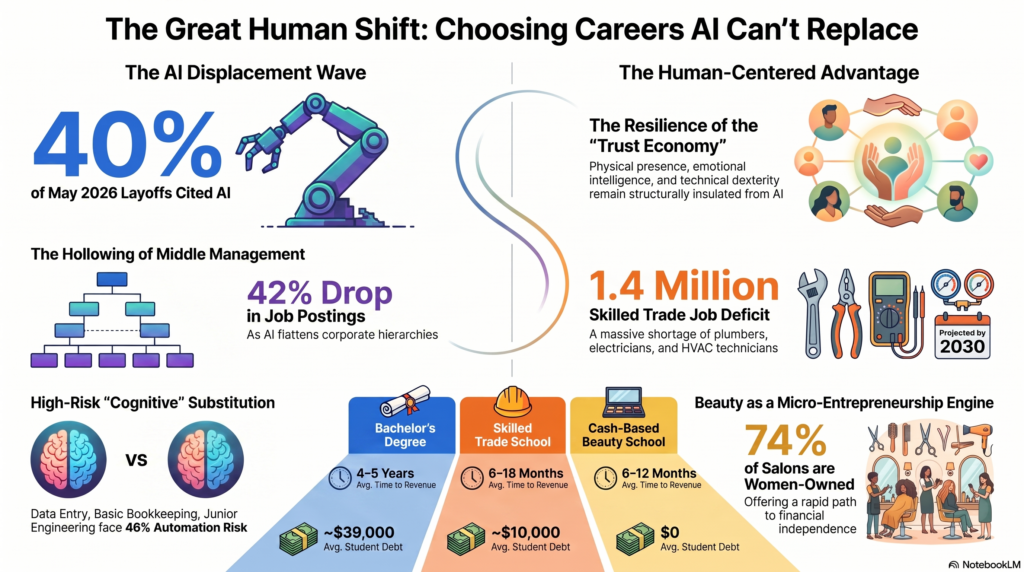
Across industries, businesses are adopting AI to automate routine tasks, improve productivity, and reshape how work gets done. Many office-based positions are evolving, some are being redefined, and others are being reduced as organizations rethink traditional corporate structures.
For many people, this creates uncertainty.
For others, it creates an opportunity to ask an important question:
What careers become more valuable when technology becomes more capable?
At Louisville Beauty Academy, we believe this question deserves careful research—not fear, not marketing, and not speculation.
That is why we encourage prospective students, families, educators, and career changers to learn about the broader workforce transformation occurring across the United States.
Human Skills Cannot Be Downloaded
Artificial intelligence can generate text.
It can analyze data.
It can organize schedules.
It can answer emails.
It can even help beauty professionals manage appointments, marketing, inventory, and business operations.
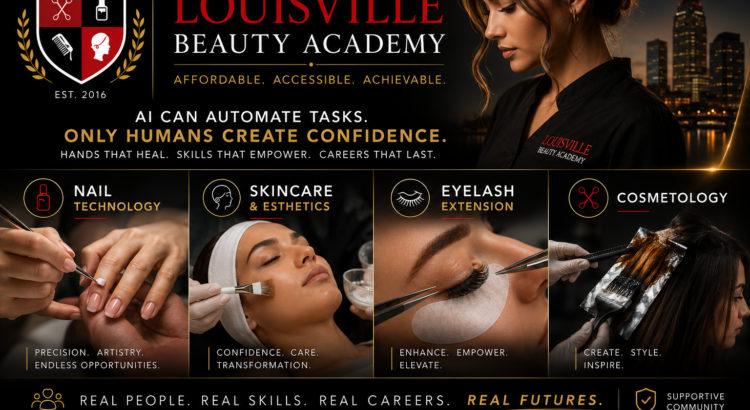
But AI cannot replace what happens when one human serves another with professionalism, trust, safety, compassion, and skilled hands.
A licensed nail technician doesn’t simply polish nails.
They help restore confidence.
An esthetician doesn’t simply perform a facial.
They help clients care for their skin, their well-being, and often their self-esteem.
A cosmetologist doesn’t simply cut hair.
They help people prepare for weddings, interviews, graduations, celebrations, and some of life’s most meaningful moments.
These are deeply human professions.
Technology may support them.
It does not replace them.
Licensed Beauty Professionals Build More Than Beauty
The beauty profession is often misunderstood.
Behind every state license is education in:
Infection control
Sanitation
Public safety
State law and regulations
Professional ethics
Technical skills
Client communication
Business fundamentals
These are licensed professions that protect the public while creating opportunities for meaningful careers and entrepreneurship.
Many professionals eventually become:
Salon owners
Independent suite renters
Educators
Product specialists
Brand ambassadors
Small business owners
Community leaders
A license is not simply permission to work.
For many, it becomes the foundation for building a business and serving a community.
Affordable Education Matters
Choosing a school is one of the most important financial decisions a student will make.
At Louisville Beauty Academy, we believe prospective students should compare:
Tuition
Program length
Written payment options
Licensing preparation
Student support
Schedule flexibility
Graduation requirements
Regulatory compliance
Overall value
We encourage every student to visit multiple schools, ask questions, request everything in writing, and make the decision that best fits their goals, finances, and circumstances.
An informed student is an empowered student.
AI Is a Tool—Not a Replacement for Humanity
Louisville Beauty Academy embraces technology where it improves education and student support.
AI-assisted translation.
Digital documentation.
Administrative efficiency.
Learning support.
Communication.
These tools help students learn more effectively and help educators spend more time teaching people—not paperwork.
Technology should strengthen human education, not replace it.
A Future Built on Service
Throughout history, technology has changed the tools we use.
It has never changed the importance of serving another human being well.
People will continue to seek professionals they trust.
People will continue to value kindness, craftsmanship, communication, and integrity.
People will continue to invest in confidence, wellness, and personal care.
Those are human needs.
And human needs create human careers.
Continue the Research
This article summarizes only part of a much larger workforce discussion.
For readers interested in labor market trends, AI, corporate restructuring, vocational education, entrepreneurship, and the future of human-centered careers, we invite you to read the independent research published by Di Tran University – The College of Humanization:
The Great Human Shift: AI, Corporate Layoffs & Why Human-Centered Careers May Be America’s Strongest Future – Research & Podcast Series 2026
The research examines publicly available information from government agencies, labor economists, academic institutions, and industry sources to explore how artificial intelligence is reshaping work—and why licensed, human-centered professions may become increasingly valuable in the decades ahead.
Our Commitment
At Louisville Beauty Academy, our mission has never been to tell students what career to choose.
Our mission is to provide affordable, accessible, ethical, state-approved education so students can make informed decisions, earn professional licensure, and build meaningful careers through service, skill, and lifelong learning.
Whether you choose Louisville Beauty Academy or another licensed institution, we encourage you to research carefully, compare thoughtfully, and invest in an education that aligns with your goals.
Because while technology will continue to evolve, one truth remains:
Human hands build trust. Human service builds communities. Human character builds careers.
Educational Disclaimer
This article is provided for educational and informational purposes only. It should not be interpreted as career, financial, legal, or employment advice. Labor market conditions change over time, and career outcomes vary by individual, region, experience, effort, and economic conditions. Louisville Beauty Academy encourages prospective students to conduct independent research, review official labor market information, compare educational institutions, and make informed decisions based on their own goals and circumstances. References to the independent research published by Di Tran University are provided to encourage continued learning and public discussion about workforce trends in the age of artificial intelligence.
This article is part of LBA’s public education and historical archive. Older posts, including “The Louisville Beauty Academy Model: A License-First Workforce Education Framework,” may not reflect current tuition, schedules, incentives, forms, policies, testing vendors, clinic availability, or regulatory requirements.
Disclaimer: This publication is part of the Di Tran University – College of Humanization Research Series. It is intended for educational and research purposes only and does not constitute legal, regulatory, or financial advice. Louisville Beauty Academy shares this material to contribute to public understanding and workforce development dialogue.
A Comprehensive Analysis of Licensure Alignment, Debt-Disciplined Economics, Real Estate-Backed Sustainability, and the Integration of Humanized Artificial Intelligence in Workforce Development
Abstract
This institutional paper provides an exhaustive and rigorous analysis of the Louisville Beauty Academy (LBA) model as a transformative paradigm in contemporary vocational education. Operating as a “category-of-one” institution, LBA decouples from traditional, debt-dependent educational frameworks to prioritize student economic sovereignty and public protection. The core thesis posits that LBA’s efficacy is rooted in a triadic architecture of humanization, operational discipline, and institutional sustainability. By synthesizing educational theories—including Bloom’s Mastery Learning, Sweller’s Cognitive Load Theory, and Becker’s Human Capital Theory—this research demonstrates how LBA addresses the systemic failures of the broader vocational sector, such as high attrition rates, unsustainable student debt, and the “theory bottleneck” in state licensure. Furthermore, the paper investigates the institution’s unique real estate strategy, characterized by facility ownership and cash-based capital expenditure, as a model for long-term operational control. Finally, it explores the deployment of “Humanized AI” as a multilingual operational multiplier that enhances personalized instruction while preserving the essential human connection inherent in tactile service professions. This paper argues that the LBA model represents not only a successful educational enterprise but a superior ethical and professional framework for the future of work.
Executive Summary
The prevailing landscape of American vocational education is currently characterized by a structural dissonance between rising tuition costs and measurable economic outcomes. As traditional higher education models struggle with credential inflation and the disruptive potential of automation, Louisville Beauty Academy (LBA) has established a functioning alternative termed the “Certainty Engine”.1 This model is designed to move learners—predominantly from immigrant, working-class, and non-traditional backgrounds—directly from economic dormancy into regulated, tax-paying professional roles within compressed timelines, typically under twelve months.1
LBA’s institutional footprint is substantiated by its output of nearly 2,000 licensed graduates and an estimated annual local economic impact of $20 million to $50 million in Kentucky.3 The model’s superiority is derived from several non-negotiable structural pillars:
Pedagogical Rigor: The “Zero Disruption Learning Environment” (ZDLE) and “Action Accumulation” theory prioritize technical discipline and regulatory compliance over entertainment-based pedagogy.5
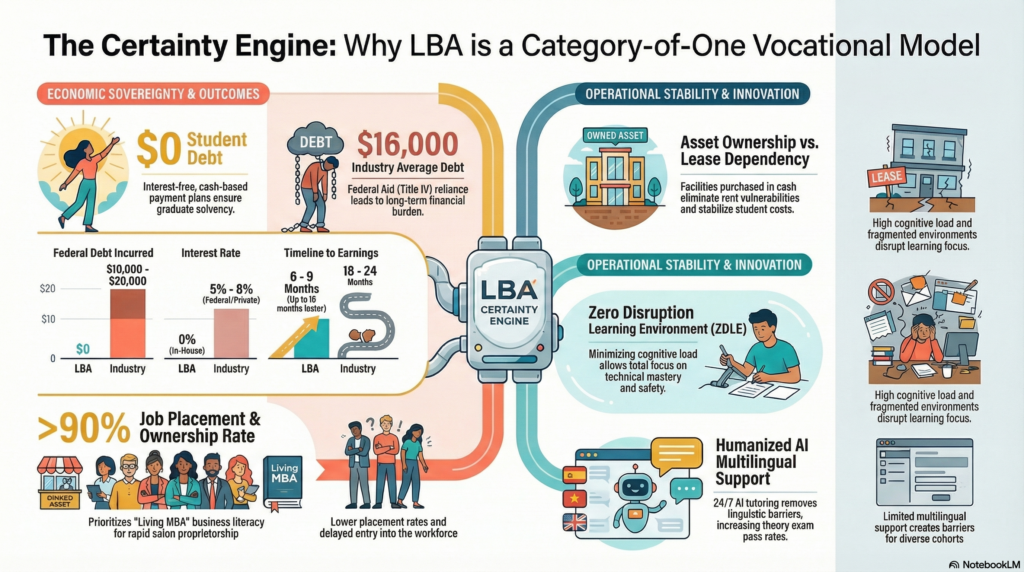
Economic Sovereignty: By rejecting federal Title IV aid and offering tuition via written payment, cash-based payment plans, LBA ensures graduates enter the workforce with $0 in student debt.2
Institutional Sustainability: LBA’s “ownership-first” real estate policy involves purchasing facilities in cash, providing an asset-backed foundation that eliminates lease-related vulnerabilities and stabilizes overhead.3
Humanization and AI: The “College of Humanization” integrates AI not as a displacement tool, but as a multilingual support layer that increases accessibility for diverse learners.7
This analysis suggests that LBA is a high-impact small business incubator that facilitates the “Living MBA”—a practical mastery of business literacy, accounting, and real estate that enables graduates to transition from technicians to salon proprietors.5
Introduction
The evolution of workforce education in the early 21st century has been marred by a divergence between institutional profit motives and the economic stability of the learner. In the personal care sector, specifically the beauty and wellness industries, this divergence manifests as a “debt-to-income” crisis, where students frequently graduate with federal liabilities that exceed their initial earning potential.1 Louisville Beauty Academy (LBA) stands as an intellectual and operational intervention against this trend. Positioned as a “category-of-one” institution, LBA is grounded in the philosophy that education must be “humanized”—restoring dignity to the individual through the mastery of state-protected, tactile skills that are resilient to the pressures of artificial intelligence and automation.7
The LBA model was born from a foundation of immigrant resilience and a rejection of the “shortcuts” typically associated with proprietary trade schools.3 Founded by Di Tran, the institution is the applied model for the “College of Humanization,” a philosophical framework that redefines education beyond mere credentials toward human capability and economic certainty.7 This report provides a detailed examination of LBA’s multi-system architecture, illustrating how the integration of real estate control, pedagogical discipline, and ethical economics creates a superior framework for public value and workforce readiness.
Structural Dimension
LBA Institutional Standard
Industry Average (Title IV Dependent)
Financial Philosophy
Lower-Debt / Cash-Flow Based 2
Debt-Dependent (Title IV) 6
Facility Model
Asset Ownership (Owned) 3
Liability-Based (Leased) 3
Learning Environment
Zero Disruption Learning Environment 5
Lifestyle/Entertainment Oriented 5
Licensure Timeline
< 1 Year (Fast-Track Specialty) 1
1.5 – 2 Years (Generalized) 2
Technology Integration
Humanized AI (Multilingual Support) 2
Minimal or Administrative-Only AI 8
Graduate Outcome
> 90% Job Placement / Ownership 6
~ 65-70% Job Placement 6
Problem Statement: The Crisis of Vocational Communitization
The contemporary workforce development system is currently experiencing sustained volatility driven by three primary factors: automation, credential inflation, and rising student debt.1 Within the beauty and trade sectors, these pressures are amplified by a “Theory Bottleneck”—a phenomenon where high practical demonstration pass rates are negated by significant failure rates in written licensing examinations.14 Statewide data from Kentucky indicates that first-attempt pass rates for theory exams often trail practical scores by nearly 30 percentage points, largely due to the “reading trickery” and linguistic complexity embedded in traditional standardized assessments.14
Furthermore, the “Flash College” syndrome—a preference for high-status, theory-based credentials (such as an MBA) over practical, licensed mastery—has created a generation of graduates who possess theoretical knowledge but lack the “street” mastery required for economic sovereignty.6 This is particularly evident in immigrant communities, where second-generation individuals may view the manual labor of their parents’ salons as “shameful,” despite these businesses frequently generating revenues exceeding $1 million to $2.4 million annually.6
Finally, the institutional stability of trade schools is frequently undermined by lease dependency. Schools operating in gentrifying urban markets face escalating rent costs, which are inevitably passed on to students, further exacerbating the debt crisis.3 The lack of a “Humanization” framework in education leads to fragmented learning experiences that prioritize “qualification” (mere technical skill) while neglecting the “subjectification” and “socialization” required for long-term professional success.18
The Louisville Beauty Academy Model: An Integrated Multi-System Framework
The LBA model functions as an “Integrated Multi-System Framework” that achieves vertical integration across real estate, education, and the labor pipeline.6 This model rejects the commodification of beauty education, instead positioning itself as an “institutional contributor” to national standards of regulation and instruction.6
At the heart of the LBA model is the “Certainty Engine,” a design that eliminates the risk window associated with traditional educational timelines.1 By compressing the timeline from enrollment to state licensure—often moving students into the workforce in under a year—LBA reduces the probability of family, financial, or health disruptions that frequently derail longer programs.1 This velocity is supported by a “Written Payment” financial structure that avoids the bureaucracy of federal lending, thereby maintaining institutional agility and student focus.2
Operational Component
Mechanism of Action
Intended Outcome
Ownership-First Real Estate
Cash purchase of facilities.3
Fixed overhead; long-term stability.
Zero Disruption Environment
Total removal of non-educational noise.5
Maximized cognitive focus; 20% gain in retention.
Mastery-Based Sequencing
One-step-at-a-time completion.7
Elimination of learning gaps; exam readiness.
Vertical Pipeline Integration
In-house salon and vendor engagement.7
Direct transition to ownership/employment.
Humanized AI Support
24/7 multilingual tutoring.2
Inclusivity for immigrant/non-English cohorts.
Educational and Pedagogical Framework: Mastery, Discipline, and Cognitive Optimization
LBA’s pedagogical strategy is fundamentally grounded in Cognitive Load Theory (CLT), Mastery Learning, and Human Capital Theory. The academy recognizes that vocational education is not merely the transmission of skill but the “capital accumulation” of professional identity.5
One-Step-at-a-Time Mastery Learning
Drawing upon the work of Benjamin Bloom, LBA utilizes a mastery learning method that divides the curriculum into discrete units with predetermined objectives.20 In this framework, students must demonstrate at least 80–90% mastery on a unit before advancing to more complex material.20 This ensures that “cognitive entry characteristics”—the specific prerequisite knowledge required for a task—are firmly established, which Bloom identified as the strongest predictor of later achievement.22
This sequential, hierarchical approach is particularly effective for LBA’s diverse student body, which includes adult learners and non-native English speakers. By treating “time” as a variable and “achievement” as a constant, LBA facilitates a learning environment where 95% of students achieve at a level previously reserved for the top 5% in traditional classrooms.20
Zero Disruption and Cognitive Load Optimization
The Zero Disruption Learning Environment (ZDLE) is a structural response to the “extraneous cognitive load” that plagues modern classrooms.5 CLT identifies three types of cognitive load:
Intrinsic Load: The inherent complexity of technical skills (e.g., chemical formulations in cosmetology).5
Extraneous Load: Mental effort wasted on distractions, poorly designed instruction, or “reading trickery” in exams.5
Germane Load: The productive mental work used to build schemas and store knowledge in long-term memory.5
LBA’s ZDLE minimizes extraneous load by removing non-urgent conversations, physical noise, and administrative friction.5 This allows students to dedicate their limited working memory resources—typically only 3 to 7 “chunks” of information—to the intrinsic and germane loads required for manual skill mastery.11
Action Accumulation and Professional Socialization
The theory of Action Accumulation posits that vocational excellence is the result of the consistent accumulation of disciplined, small successes.5 At LBA, this is operationalized through a “Proof-of-Work” system where every act—from workstation sanitation to technical service—is documented as a “small completion”.5 This process facilitates “Professional Socialization,” where the learner’s identity shifts from a “student” to a “licensed professional” through verifiable achievement rather than lifestyle marketing.5
Licensure and Public Protection Framework: Compliance as a Daily Habit
The primary legal and ethical mandate of the Kentucky Board of Cosmetology is the protection of public health and safety through the prevention of “present and recognizable harm”.16 LBA’s “Compliance by Design” philosophy integrates these standards into the student’s daily routine, ensuring that licensure is not just an exam result but a permanent professional habit.25
The Science of Sanitation and Infection Control
LBA elevates sanitation protocols beyond mere compliance. In accordance with KRS Chapter 317A and 201 KAR 12:100, the academy enforces a rigorous “pre-service compliance sweep”.26 This includes:
Acoustic Disinfection Protocols: Students are trained in the “10-minute wet contact time” requirement for EPA-registered disinfectants, addressing a common failure point in state inspections where the “spray and wipe” method is incorrectly utilized.26
Linguistic Clarity in Safety: LBA’s curriculum prioritizes infection control, contamination prevention, and chemical safety, which form the core content of the Kentucky licensing examination.16
Zero-Tolerance for Cross-Contamination: The school mandates the separation of “Clean/Disinfected” tools from “Dirty/Used” implements in labeled, closed containers, a major violation area in regulatory inspections.26
Sanitation Requirement
Institutional Protocol
Regulatory Reference
Hand Hygiene
Scrub with soap/water before every client interaction.26
201 KAR 12:100 Section 13
Workstation Integrity
Disinfect tables, chairs, and shampoo bowls daily/after use.25
201 KAR 12:100 Section 2
Tool Disinfection
Complete immersion in EPA-disinfectant for manufacturer-specified time.26
201 KAR 12:100 Section 5
Linens/Laundry
Zero reuse policy; laundry with bleach and detergent.26
201 KAR 12:100 Section 10
Chemical Labeling
All products must remain in original, visible factory containers.29
KRS 317A – Public Safety
Overcoming the Theory Exam “Bottleneck”
LBA’s framework addresses the disparity between practical demonstration (where pass rates approach 100%) and the written theory exam.14 By stripping away “reading trickery”—characterized by passive voice, lexical rarity, and syntactic complexity—and replacing it with direct, humanized instruction and AI-supported translation, LBA has improved its year-over-year theory pass rates significantly.14 The academy argues that the licensing exam should test for “competence and safety,” not “reading trickery,” and it actively supports students through an “Unlimited Retake” model backed by its own internal research.14
Legal and Contractual Clarity: Managing Institutional and Student Obligations
A key differentiator of the LBA model is its rigorous approach to legal clarity and risk management. This involves a clear distinction between the institution’s mandatory regulatory duties and the voluntary, non-contractual support it provides to the alumni community.19
Fiduciary Duty and Institutional Governance
In the wake of the COVID-19 pandemic and subsequent school closures, federal courts (e.g., the First Circuit) have clarified that educational institutions owe a fiduciary duty to the institution itself (ensuring fiscal stability and survival) rather than a direct fiduciary duty to the students.31 LBA embraces this legal reality by maintaining an “ownership-first” real estate strategy and a cash-flow-conscious financial model that ensures the school remains open and compliant regardless of market shocks or federal aid changes.3
The Completion Boundary vs. Alumni Continuity
The student-institutional contract at LBA is defined by the fulfillment of state-mandated clock hours and the mastery of the curriculum.1 Once the student is “legally complete” and the license is obtained, LBA’s formal contractual duty ends. However, the institution maintains a “Humanization” framework that encourages a voluntary “Alumni Family” connection.3 This includes:
Graduate Guides: Resources for state-to-state license transfers and workforce entry.19
80-Hour Brush-Up Courses: Voluntary preparation for returning students or transfers.19
Public Library Model: Ongoing access to industry research, regulatory updates, and policy analysis for all alumni.19
This distinction is critical for institutional sustainability, as it prevents “mission creep” and manages liability while simultaneously fostering a high-trust, lifelong relationship with the graduate.9
Humanization Framework: Non-Extractive Education and the Alumni Family
The College of Humanization, the philosophical core of Di Tran University and LBA, redefines the purpose of vocational training from the “extraction of tuition” to the “elevation of the person”.7
Redefining Education Beyond Credentials
In the LBA model, education is a “humanizing relationship” that values the student’s background, culture, and life experience.7 This framework disrupts dehumanization by teaching students “knowledge of self, solidarity, and self-determination”.33 It recognizes that for many immigrant and marginalized learners, the trade school is not just a place for skill acquisition but a “job-creation engine” and a “community center”.3
The “Yes I Can” to “I Have Done It” Methodology
The LBA pedagogy is designed to dismantle the psychological barriers of “poverty mindset” and “vocational shame”.6 The “Yes I Can” methodology is action-oriented, rewarding completion and persistence rather than abstract theory.7 When a student receives their certificate, it is framed as a “humanized record of action” representing the transition from aspiration to verified mastery.7
The Alumni “Family” as Economic Resilience
LBA maintains a “Success Gallery” of over 1,900 graduates, celebrating their transition from students to business owners.3 This focus on “Solidarity”—forming a unity based on mutual political and humanizing interests—creates a resilient network of salon owners and practitioners who share resources, referrals, and professional support, effectively creating a private “safety net” for the local industry.3
Economics and Affordability: Cash-Flow Consciousness and High-Velocity ROI
The LBA model represents a radical rejection of the debt-dependent paradigm of American higher education. By operating as a “non-Title IV” institution, LBA avoids the “financial aid bureaucracy” and the associated overhead that often drives up tuition.1
Debt-Disciplined Institutional Design
LBA’s “no-debt” policy applies to both the institution and the student.2
Institutional Side: Facilities are purchased in cash or through a unique “profit-share-only” investor model, avoiding traditional bank loans and interest burdens.3
Student Side: Tuition is intentionally kept low (under $7,000) and is funded through written payment, pay-as-you-go payment plans.2
This ensures that the “typical LBA grad owes $0 in school debt,” compared to the national average of over $16,000, where ~53% of undergraduates take on federal loans.2
The ROI for Working-Class and Immigrant Students
Human Capital Theory posits that education is an investment with expected economic returns in the form of higher wages.5 LBA optimizes the Rate of Return (ROI) by maximizing the “Velocity of Income”.1
Time-to-License Advantage: By graduating students six months faster than traditional semester-based programs, LBA transitions them from “economic dormancy” into “active professional status,” generating an estimated extra $240,000 in collective tax revenue per cohort.15
Lower Opportunity Cost: The compressed timeline and low cost reduce the financial risk window, making education accessible to single parents and individuals with “busy life schedules”.1
Economic Indicator
LBA Program
National Average Program
Typical Tuition
$5,000 – $7,000 3
$16,000 – $25,000 6
Federal Debt Incurred
$0 2
$10,000 – $20,000 6
Interest Rate
0% (In-House) 2
~ 5% – 8% (Federal/Private) 2
Timeline to Earnings
6 – 9 Months 3
18 – 24 Months 1
Institutional Real Estate and Branch Sustainability: Ownership vs. Leasing
A central tenet of the LBA “Category-of-One” strategy is its Real Estate Ownership Policy. Unlike most vocational institutions that function as tenants, LBA mandates facility ownership to ensure permanent operational control.3
Strategic Benefits of Facility Ownership
Fixed Overhead: Ownership eliminates the risk of market rent hikes, which can destabilize an educational program’s budget.3
Asset-Backed Equity: Owned buildings serve as “net assets” on the balance sheet, providing collateral for expansion without taking on predatory debt.3
Renovation Freedom: LBA can renovate facilities for specific pedagogical needs (e.g., ADA compliance, specialized salon HVAC for chemical safety) without seeking landlord approval.3
Community Hub Integration: The flagship LBA location is a 14-unit mixed-use property, integrating classrooms with salon stations and soon, affordable housing and childcare, addressing the holistic needs of the student body.3
Buildout Economics and Institutional Resilience
LBA budgets between $500,000 and $800,000 per school location, with the majority allocated to real estate acquisition ($350k–$500k) rather than disposable leasehold improvements.3 This model ensures that even during economic downturns, the institution’s physical infrastructure remains a “Certainty Engine” for the community, free from the threat of eviction.1
Investment Allocation
Budget Range
Strategic Purpose
Real Estate Purchase
$350k – $500k 3
Long-term asset base and overhead fix.
Renovation/Buildout
$100k – $150k 3
Compliance-by-design training layout.
Equipment/Furnishing
$50k 3
Professional-grade stations for mastery.
Initial Operating Runway
$100k 3
Stability during first 12-18 months.
Vendor Ethics and Operational Design: The Profit-Share-Only Model
LBA’s commitment to “Ethical Economics” extends to its vendor and investor relationships. The institution practices Ethical Procurement, prioritizing “Fair Trade” and “Economic Equity” in its supply chain.37
The Profit-Share-Only Investor Structure
To fund expansion without the “debt trap,” LBA utilizes a unique investor model 3:
No Fixed Repayment: There are no repayments required until the business unit is profitable, eliminating the “mortgage pressure” that often compromises educational quality in other schools.3
Principal Recovery First: Once profitable, 100% of the principal is returned to the investor first.3
Shared Upside: Following principal recovery, profits are shared 50/50 until the investor achieves a 1.5x to 2x return.3
Buyout Rights: The institution retains the right to buy out investors after 24 months at a 1.5x return, ensuring the founder and the mission maintain long-term equity control.3
Non-Extractive Vendor Engagement
LBA rejects the industry practice of high-margin “student kits” that serve as a hidden profit center for schools. Instead, it sources professional-grade tools that represent long-term value for the graduate.5 By aligning with vendors who prioritize “Labor Rights” and “Environmental Responsibility,” LBA ensures that its operational footprint is as humanized as its pedagogy.39
Workforce Development and Social Value: The Small Business Incubator
LBA is more than a school; it is a “job-creation engine”.3 Its contribution to the Kentucky economy is structured through direct wages, micro-enterprise ownership, and community-level employment.6
The “Million Dollar Paradox” and Immigrant Wealth
The beauty industry, particularly specialized sectors like nail technology and esthetics, demonstrations annual growth rates approaching 20%.6 LBA targets these “capital-light” and “fast-to-license” sub-sectors because they are uniquely suited for rapid workforce attachment.6
Salon Prosperity: Established salons with 10–20 technicians can generate $1 million to $2.4 million in annual revenue.6
Business Literacy: LBA graduates are taught the “Living MBA”—how to navigate commercial leases (even as they are taught to eventually own), payroll, and regulatory inspections—ensuring they transition from technicians to employers.5
The “Human Premium” in a Post-Automation Economy
As AI displaces cognitive and administrative roles, LBA focuses on skills with a “human alpha”—those requiring “Contextual Problem Solving” and “Negotiation Strategy”.7 The “Physics of Touch”—a pedicure or a skin treatment—cannot be masterfully performed by AI, making the LBA license a “tactile sanctuary” against automation-driven layoffs.7
AI and the Future of the Institution: The Operational Multiplier
LBA does not fear AI; it utilizes “Humanized AI” as an architect of enlightenment and efficiency.8
The Di Tran AI Head and Personalized Learning
LBA has pioneered the use of a multilingual, founder-voice AI avatar (“Di Tran AI Head”) to provide 24/7 on-demand support for students.1 This system:
Reduces Language Barriers: Provides real-time translation and tutoring for immigrant and non-native English learners.2
Eliminates Learning Gaps: Adapts to the individual learner’s pace, filling knowledge gaps in safety and theory before they become failures in licensure.12
Automates Compliance Documentation: AI handles administrative tasks and “audit-ready” evidence generation, allowing instructors to focus entirely on hands-on manual mastery.8
Ethical Governance of AI in Education
LBA’s implementation of AI is grounded in “AI Literacy”—the ability to critically evaluate and contextualize AI outputs.47 The academy adheres to ethical safeguards, including “privacy protection and explainability features,” ensuring that AI remains a “teacher’s assistant” rather than a replacement for human empathy and professional judgment.8
Why This Model Is Category-of-One: The Synthesis of Contradictions
LBA is positioned as a “category-of-one” institution because it successfully synthesizes what the traditional education market views as contradictions:
Low Cost / High Quality: Achieving superior licensure outcomes (90%+) at 50% of the market tuition.1
Fast-Track / Depth: Compressing the timeline to earnings without compromising the “College of Humanization” philosophical depth.1
Technology / Humanity: Using advanced AI to facilitate deeper “human-to-human” connection in the service arts.8
Immigrant Resilience / Institutional Standard: Taking the “struggle” of the immigrant foundation and formalizing it into a “Gold-Standard” institutional blueprint for national workforce policy.1
Policy and Institutional Implications: A Blueprint for National Reform
The success of the LBA model suggests several critical implications for state and federal workforce policy:
Reforming Federal Aid: The “Pay-for-Success” Proposal
LBA’s “no-Title-IV” success provides a case study for “Outcome-Based Federal Student Aid Reform”.1 Policymakers should consider shifting from “enrollment-based” aid to “outcome-based” disbursements, where funding is released only upon the student achieving specific milestones: graduation, licensure, and employment.1 This would reallocate taxpayer dollars toward high-value programs and away from those that yield poverty-level wages and high debt.1
Regulatory Simplification through “Compliance-by-Design”
LBA’s “Zero Disruption” and “Daily Routine Sanitation” models offer a framework for state boards to modernize inspections.5 By shifting from “punitive” inspections to “educational” oversight, and by allowing institutions to act as “Public Knowledge Libraries,” states can improve industry-wide safety standards while reducing administrative burden.19
Real Estate Ownership as Educational Policy
Workforce development grants should prioritize “Facility Ownership” over “Lease Subsidies”.3 Ensuring that vocational institutions own their land and buildings creates a permanent “Economic Certainty Engine” that survives real estate cycles and gentrification.1
Conclusion
Louisville Beauty Academy represents a radical but intellectually grounded departure from the extractive norms of modern vocational education. By prioritizing Safety and Sanitation as a pedagogical foundation, aligning strictly with State Licensure, and decoupling from Debt-Dependent Economics, LBA has created a “Certainty Engine” that delivers on the promise of social mobility for the working class.1
The institution’s “Category-of-One” status is finalized by its synthesis of high-touch Humanization and high-tech Artificial Intelligence.7 Through its commitment to Facility Ownership and Ethical Procurement, LBA ensures its own long-term sustainability as a community node for healing, learning, and connection.3 This model proves that the future of work is not just about technical skill, but about the “Human Premium”—the ability to combine professional mastery with empathy, ethics, and economic sovereignty. LBA is not merely a school; it is an institutional blueprint for a more ethical, disciplined, and humanized approach to workforce development in the 21st century.
Optional Appendix: The Certainty Engine Mathematical Model
The Debt-to-Earnings Ratio (LBA vs. Traditional)
To illustrate the “Certainty Engine,” we utilize the Debt-to-Earnings Ratio (), where is total school-related debt and is first-year annual earnings.
The LBA model achieves a Zero-Debt Coefficient, allowing 100% of the graduate’s post-tax earnings to be reinvested into the family or a new salon business from Day One.1
The Theory Bottleneck Alleviation Calculation
The institutional effectiveness () of LBA’s AI-tutoring in overcoming the theory bottleneck is measured by the delta between statewide pass rates () and the LBA-specific improvement ():
With statewide cosmetology theory pass rates at ~62%, LBA’s focus on humanized, simplified, and multilingual instruction aims for a weighted trajectory toward 90%+, effectively expanding the licensed labor pool by nearly 30%.14
Revolutionizing Language Learning: The Power of AI-Driven Chatbots in Enhancing Engagement and Proficiency – International Journal of Information and Education Technology, accessed March 31, 2026, https://www.ijiet.org/vol15/IJIET-V15N10-2405.pdf
Balancing Affective Engagement and Cognitive Load in Generative-AI-Based Learning: Empathy, Immersion, and Emotional Design in Design Education – MDPI, accessed March 31, 2026, https://www.mdpi.com/2227-7102/15/11/1478
Research & Institutional Positioning Notice This document reflects independent research, institutional experience, and educational philosophy developed through the Di Tran University – College of Humanization. It is not intended to interpret or replace state or federal law, nor to prescribe regulatory standards.
Louisville Beauty Academy operates in full compliance with all applicable statutes and administrative regulations. Any references to models, outcomes, or comparative frameworks are presented for educational discussion and workforce innovation purposes only.
Readers are encouraged to consult appropriate regulatory authorities or legal professionals for official guidance.
Disclaimer: This publication is part of Di Tran University – The College of Humanization Research Series (2026) and is provided for educational and policy discussion purposes only. It does not constitute legal advice or regulatory interpretation.
Introduction: The Real Purpose of Licensing
The regulatory architecture of occupational licensing is traditionally anchored in the dual pillars of public interest and the mitigation of asymmetric information. At its most fundamental level, licensing serves as a state-sanctioned mechanism to ensure that individuals practicing in high-stakes trades—particularly those involving physical contact, chemical applications, or the management of infectious disease risks—possess a verifiable threshold of competence.1 This legal standard was firmly established in American jurisprudence through the 1889 Supreme Court decision in Dent v. West Virginia, which affirmed the states’ rights to regulate certain professions to protect the welfare of their citizens.3 In the decades since, the share of the American workforce requiring a license has surged from 5% in the 1950s to nearly 25% today, reflecting an increasing societal reliance on formal credentials as a proxy for safety and quality.3
However, the rapid expansion of these regulatory requirements has led to a critical divergence between the stated goal of public protection and the operational reality of assessment design. While the primary justification for licensing is the prevention of recognizable harm, the methods used to measure competency often drift into areas that favor linguistic proficiency and academic test-taking ability over practical safety and sanitation skills.5 When a licensing exam for a cosmetologist, esthetician, or nail technician utilizes “reading trickery”—characterized by indirect wording, complex syntactic structures, and cultural biases—it undermines the very legitimacy of the regulatory framework it seeks to uphold.7 This drift creates a system where the barrier to entry is no longer safety competence, but rather the ability to navigate a linguistic obstacle course.
The ethical implications of this drift are profound. For many candidates, particularly adult learners and immigrants, the licensing exam represents the final “on-ramp” to economic stability.9 When these assessments are poorly designed, they introduce construct-irrelevant variance (CIV), which distorts the meaning of the test scores and unfairly penalizes individuals who may be perfectly competent in their trade but are disadvantaged by the assessment’s format.11 A humanization-based framework for reform is therefore necessary—one that prioritizes the dignity of the learner and the actual safety needs of the consumer over the institutional inertia of complex testing protocols.10 This report examines the convergence of assessment validity, educational psychology, economic fairness, and regulatory compliance to argue for an ethical redesign of licensing exams across the beauty and trade sectors.
Public Safety, Sanitation, and Competency as the Legitimate Core
The foundational legitimacy of any occupational license rests on its ability to confirm that the license holder meets prescribed standards of competence necessary to perform a specified range of activities safely.2 In the beauty and trade sectors, these competencies are not merely academic; they are physical, chemical, and biological. The core mission of the state board is to prevent “present and recognizable harm” to the public health or safety.5 This mandate requires that exams focus on the “critical fail” points of a profession—those actions that, if omitted or performed incorrectly, lead to immediate injury or the transmission of pathogens.
Defining Public Protection in Trade Contexts
Competency-based assessment (CBA) is particularly well-suited for these sectors because it measures whether a person can integrate skills, judgment, and behavior in an observable performance context.14 In healthcare and beauty services, regulators require organizations and individuals to prove they can carry out tasks safely and consistently; a simple written exam that tests abstract theory without a direct link to practice cannot provide that assurance.15 The legitimacy of the core is established when the testing blueprint matches the actual hazards of the workplace.
Sector/Topic
Public Safety Rationale
Critical Competency Measured
Cosmetology
Prevention of chemical burns and hair loss.
Proper mixing and application of sodium hydroxide and thioglycolate products. 16
Esthetics
Prevention of skin damage and infection.
Knowledge of contraindications for exfoliation and recognition of suspicious lesions. 17
Nail Technology
Prevention of fungal infections and MRSA.
Proper immersion and contact time for EPA-registered disinfectants on non-porous tools. 17
Barbering
Prevention of blood-borne pathogen transmission.
Mastery of blade handling, razor sanitation, and blood spill procedures. 16
The “public choice” theory of licensing suggests that practitioners often seek licensing to raise their own wages at the expense of consumers by creating barriers to entry.1 When these barriers are unrelated to safety, such as requiring thousands of hours of training for services that pose minimal risk, the regulation loses its “public interest” justification.1 For example, some states have moved to deregulate “boutique services” like blow-dry styling, braiding, and makeup artistry because the risk to public safety is low enough that a full 1,000- to 1,500-hour license is considered an unnecessary burden.19 An ethical core must adhere to the principle of “least restrictive means,” ensuring that the government only intervenes to the extent necessary to protect the public.5
When Exams Drift Into Linguistic Gatekeeping
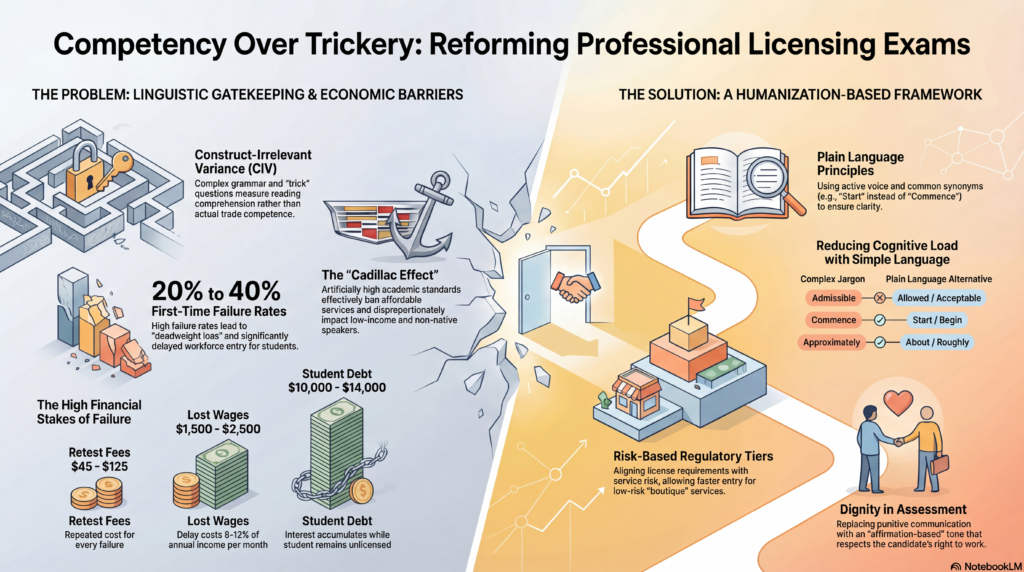
A significant threat to the validity of any high-stakes assessment is Construct-Irrelevant Variance (CIV), which refers to variance in test scores attributable to factors extraneous to the skill being measured.6 In licensing exams, this often manifests as “linguistic gatekeeping.” If a question about the sanitation of a glass bowl uses such complex grammar that a student fails the item despite knowing the sanitation protocol, the test has measured reading comprehension rather than sanitation competence.12 This mismatch creates a validity gap that can lead to incorrect inferences about a candidate’s ability to practice safely.
The Mechanism of Indirect Wording and “Trickery”
Indirect wording and “trick questions” are frequently cited by students and instructors as a primary cause of exam failure.22 While testing vendors often claim there are “no trick questions,” the use of “best/worst” scenarios, double negatives, and “except” clauses creates a linguistic burden that mimics the effect of trickery.24 For individuals with high test anxiety or those whose first language is not English, these features act as “Skinner machines”—assessment environments that punish the test-taker for failing to decode the structure rather than failing to know the content.23
Linguistic features that contribute to CIV include:
Syntactic Complexity: The use of passive voice and multiple dependent clauses that require high-level code comprehension.7
Lexical Rarity: Using uncommon or formal vocabulary when a simpler, more common synonym would suffice (e.g., using “commence” instead of “start”).12
Ambiguous Stems: Question stems that are vague or general, forcing the student to guess the “intent” of the examiner rather than demonstrating knowledge.6
Cultural Reference Points: Using metaphors or scenarios that assume a specific regional or socio-economic background, such as the “refrigerator” example in standardized math word problems.12
Research in systemic functional linguistics suggests that the “construct relevance” of language should be determined by its correspondence to the language used in the actual educational and professional context.12 If a nail technician never needs to use the word “admissible” or “ascertain” in their daily client interactions or sanitation logs, including such words in the licensing exam adds an irrelevant hurdle.26 This is especially true for English Learners (ELs), whose performance gaps on standardized tests can be reduced by nearly 60% when the language is modified for accessibility.6
Cognitive Load and Educational Psychology in High-Stakes Testing
Cognitive Load Theory (CLT), pioneered by John Sweller, provides a psychological framework for understanding how “reading trickery” actively hinders the demonstration of competence.28 Human working memory is severely limited, typically capable of processing only between 3 and 7 “chunks” of information at a time.29 When an assessment is designed with high “extraneous cognitive load”—mental effort wasted on decoding poor instructional design or confusing language—it leaves less room for “intrinsic load” (the actual subject matter) and “germane load” (the process of retrieving and applying knowledge).28
The Impact of Overload on Adult Learners
For adult learners, the stakes are amplified by the “split-attention effect,” where a student must toggle between the technical content of the question and the linguistic structure of the stem.28 If the “problem space” between the candidate’s current state and the correct answer is too large due to confusing instructions, the learner becomes overloaded and unable to process the information they have stored in their long-term memory.31
Cognitive Load Type
Source in Licensing Exams
Consequence for the Candidate
Intrinsic
The complexity of chemical reaction theory or anatomical structures.
Inescapable difficulty that defines the “rigor” of the trade. 28
Extraneous
“Best/Worst” options, double negatives, and complex vocabulary.
Wasted mental energy that leads to “hitting the wall” and physical exhaustion. 30
Germane
The effort to link a symptom (e.g., oily skin) to a treatment plan.
Beneficial load that leads to deeper expertise and safe practice. 28
A human-centered assessment should aim to minimize extraneous load by removing “unnecessary information” and “distractions”.29 When experts are tested, they can handle higher complexity because they have developed “schemas”—organized structures in long-term memory that allow complex concepts to be processed as a single chunk.31 However, the licensing exam is intended for novices entering the profession. For these individuals, the “expertise reversal effect” means that what might be a simple, clear question for a veteran board member is a source of profound confusion for a student.32 Ethical exam construction must acknowledge this developmental reality and provide explicit, detailed guidance to support the test-taker’s success.32
Adult Learners, Immigrants, and Language Burden
The beauty and trade sectors have historically served as a vital economic engine for underrepresented populations, including women, people of color, and immigrants.33 However, as licensing requirements become more regulated and academic, there is a documented decline in the share of these workers in the industry.33 This decline is not a reflection of a lack of skill, but a reflection of the “language burden” inherent in the licensure process.4
Systematic Barriers to Entry
Stricter licensing regimes act as a “barrier to entry” that disproportionately impacts those with lower incomes or different linguistic backgrounds.33 For example, studies have shown that English proficiency requirements specifically reduce the number of licensed manicurists in the Vietnamese community.4 This creates a “Cadillac effect” where the state essentially bans “discounted” services with fewer frills by forcing every practitioner to meet an artificially high academic standard.4
The psychological toll of repeated failure on these populations cannot be overstated. When a student who has invested thousands of dollars and over a year of their life in school fails the exam multiple times because of “misreads or rushing,” their confidence collapses.17 This is exacerbated by the fact that many of these learners are “big picture thinkers” who struggle with the “usage and punctuation problems” that dominate standardized tests.36 A mature regulatory state should recognize that “administrative chaos is policy sabotage”—if the goal is to activate the workforce, then the assessment must be a “bridge,” not a “cliff”.10
Representation and Fairness
Demographic
Impact of Licensing Burden
Research Finding
Women
Delayed workforce entry due to childcare and long hour requirements.
Increased regulation leads to a decline in female representation in trades. 33
Immigrants
Language-based CIV in written theory exams.
English proficiency requirements reduce entry for non-native speakers. 4
People of Color
Disproportionate debt-to-income ratios and predatory recruitment.
75% of cosmetology students are in programs likely to fail earnings tests. 38
Career-Changers
“Confidence collapse” and high opportunity cost of retests.
Stricter regimes move “in the wrong direction” for those seeking new paths. 33
The “dignity in assessment” framework argues that when people receive communication from regulatory boards—such as failure letters or renewal notices—the message must not be punitive.9 The tone matters because it signals whether society recognizes the recipient as a citizen or a burden.10 For an immigrant attempting to provide for their family, an exam that uses Harry Potter-style “spell-casting” vocabulary to name bacteria (Pseudomonas Aeruginosa) feels less like a safety test and more like a tool of humiliation.10
The Economics of Delayed Licensure and Repeated Failure
The economic consequences of flawed licensing assessments are staggering, both for the individual student and the broader economy. Occupational licensing is “costly for both consumers and aspiring workers,” resulting in higher prices and forgone wages.4 When an exam has a 20% to 40% failure rate for first-time test-takers, the resulting “delayed licensure” creates a significant “deadweight loss” to society.20
Direct and Indirect Costs
The path to a cosmetology or esthetics license is a high-tuition, loan-dependent journey. Cosmetology graduates average $16,600 in annual earnings but hold roughly $10,000 to $14,000 in student loan debt.38 A failure on the state board exam is not just a psychological blow; it is a financial crisis.
Expense Category
Typical Cost Range
Economic Impact
Initial Exam Fee
$60 – $150 per section
Sunk cost; must be paid before workforce entry. 42
Retest Fees
$45 – $125 per attempt
Same cost as initial; repeats for every failure. 18
Lost Wages
$1,500 – $2,500 per month
Every month of delay is 8-12% of annual income. 38
Retaining Training
Variable
Many states require additional school hours after three failures. 42
Debt Accumulation
Interest on $10k+ loans
Monthly payments start while the student is still unlicensed. 38
Economists consistently find that stricter licensing laws lead to higher prices for consumers, with research confirming increases of 3% to 13% across various services.4 This “protection of incumbent providers” allows existing salon owners to earn “artificially high profits,” or “rents,” while keeping able people from entering trades they could learn quickly.20 For the student, the “high cost and poor training” of many for-profit programs, combined with an artificially difficult exam, creates a “debt crisis” that can lead to wage garnishment and the seizure of tax refunds.38
The Impact of Hour Requirements and Incentives
State licensing laws mandate between 1,000 and 1,600 hours of training.18 This structure often rewards schools for high enrollment and full-time attendance rather than competency mastery.38 For-profit beauty schools have been accused of using federal Title IV funds to “pad institutional revenues,” often through predatory recruitment of vulnerable populations.38 If the licensing exam were redesigned to test competency directly (e.g., through an apprenticeship or “shorter-term” model), the time-to-licensure would drop, allowing students to recoup their investment within months rather than years.41
Ethics of Fairness, Access, and Public Protection
The ethics of professional assessment are governed by the joint standards of the AERA, APA, and NCME—often referred to as “the Bible” of psychometricians.46 These standards establish that “fairness to all individuals… is an overriding and fundamental validity concern”.8 Fairness implies that every test-taker has a comparable opportunity to demonstrate what they know, free from construct-irrelevant barriers.8
The Gatekeeping vs. Competency Debate
There is a fundamental ethical tension between “occupational closure”—the attempt to limit supply and raise wages—and “competency,” the pursuit of safety.2 A fair exam must focus solely on the latter. When test developers prioritize “reliability” through redundant or overly complex items, they risk creating individual fatigue and inflated reliability estimates that do not reflect true skill.7 Ethical testing requires that we “avoid potentially offensive content or language” and “provide results in a timely fashion”.48
Ethical Principle
Definition in Testing Standards
Violation in Current State Boards
Validity
The degree to which evidence supports interpretations.
Using academic vocabulary to test physical sanitation skills. 12
Fairness
Identifying and removing barriers to performance.
Lack of linguistic modification for English Learners. 6
Accessibility
Equal access for all examinees.
Limited language options and complex “trick” stems. 46
Dignity
Respecting the candidate’s right to work.
Punitive tone and administrative “obstacle courses.” 9
The “presumption of constitutionality” often given to licensing regulations by courts has been challenged by “Right to Earn a Living” acts in states like Arizona.50 These acts shift the burden of proof to the government, requiring it to show that a regulation serves a “compelling governmental interest” and is “narrowly” tailored.50 If a written exam has a disparate impact on a protected group (such as immigrants) and does not directly predict safe performance, it may violate the fundamental right to engage in a lawful occupation.5
Regulatory Legitimacy and Compliance Design
Regulators and licensing boards face increasing pressure to modernize their continuum of approaches, moving away from “one-size-fits-all” mandates toward more flexible, risk-based oversight.3 Regulatory legitimacy is maintained when the board can demonstrate that its rules are not arbitrary and that it is “listening to providers early” to inform practical reforms.51
Case Study: Idaho’s Regulatory Reform
The Idaho Board of Pharmacy (BOP) provides a blueprint for regulatory “humanization.” By measuring their “baseline regulatory burden”—counting every word and restriction like “shall” and “must”—the BOP found their rules were 51.6% longer than medicine and 39.9% longer than nursing.52 Through a process of “iterative improvement,” they reduced this burden to align with neighboring states, proving that “regulatory volume” does not equal “patient safety”.52
In the beauty sector, Texas has implemented significant changes through House Bill 1560 and HB 705. These reforms merged the barber and cosmetology boards, eliminated unnecessary specialty licenses (like wig-related and instructor licenses), and reduced the base curriculum from 1,500 to 1,000 hours.16 Importantly, Texas also joined the “Cosmetology Licensure Compact,” allowing practitioners to work across state lines without completing hundreds of hours of redundant training.53
The Future of Compliance: Risk-Based Tiers
Modernizing facility and professional licensure involves recognizing that different services carry different levels of risk.51
Level of Risk
Regulatory Model
Example Service
High
Full Licensure + Practical Exam
Chemical peels, permanent waving, straight-razor shaving. 16
Automated skin analysis or personalized AI-guided treatments. 21
By “saying it out loud” in the regulations and setting explicit, baseline standards for the high-risk activities, boards can “eliminate the anti-competitive effects” of licensing while safeguarding the public.1 This shift allows for “coordinated pathways” where a worker can enter the field quickly in a low-risk capacity and upskill into more complex services as they master the trade.10
Humanization as a Framework for Exam Reform
A humanization-based framework for assessment reform is grounded in the belief that the “human dimensions of education” must not be marginalized by market forces or technologization.55 This framework moves beyond the “black box” of automated scoring and centralized data processing toward an “explainable” and “trustworthy” system.56
Core Principles of Humanized Assessment
Explainability: Every question should have a faithful reason for its inclusion, aligned with human perception of the job’s demands.56
Agency: The framework should enhance “teacher and student agency,” allowing for iterative learning rather than just a pass/fail judgment.58
Contextualization: AI and other digital tools should be used to “scaffold construct-relevant language,” helping students access the material rather than acting as a barrier.6
Empathy: The tone of the assessment and the failure/success communication should prioritize “affirmation and motivation” over punishment.10
In an “AI-era educational redesign,” tools like customized chatbots trained on course materials can provide “personalized support” and “context-relevant feedback”.54 This allows students to engage in “low-stakes” formative assessment throughout their schooling, identifying weaknesses before they reach the “high-stakes” gatekeeper of the state board.54 However, we must ensure that these tools do not “displace” human judgment or reinforce existing inequalities through biased algorithms.55
What Ethical Exam Construction Should Require
The creation of an ethical licensing exam requires a rigorous adherence to “Plain Language” principles. Plain language is defined as communication that intended readers can “easily find what they need, understand what they find, and use that information”.59 It is a standard for “guidance” that encourages efficiency and effectiveness.59
Plain-Language Writing Principles for Test Developers
Active Voice: Identifying the subject taking the action. “The student denies the treatment” is clearer than “Treatment was denied”.26
Shorter Sentences: Favoring simple, declarative sentences that state only one thing at a time.26
Reduced Reading Level: Aiming for a level that can be understood by “busy or stressed individuals”.26
Understandable Expressions: Avoiding “legalese” and technical jargon unless it is essential to the safety construct.26
Complex Jargon
Plain Language Alternative
Impact on Candidate
Admissible
Allowed, acceptable
Reduces cognitive load; clarifies rules. 26
Commence
Start, begin
Eliminates “lexical rarity” barrier. 26
Comply
Do, follow
Focuses on action rather than legalism. 26
Additional
Added, more, other
Simplifies the stem for ELs. 26
Approximately
About, roughly
Prevents confusion for “big picture” thinkers. 26
Ethical construction also requires “Evidence-Based Testing Strategies.” This includes “testing the design at multiple points” and ensuring the final product is “useful and usable” for the target audience.26 For example, building signage and test instructions should use “visuals and icons” to increase comprehension instantaneously without requiring reading.26
What Schools Can Do Now
While systemic reform takes time, schools and instructors have an immediate responsibility to protect their students from the “reading trickery” of current exams. This involves moving from passive study methods to “active recall” and “test-taking literacy.”
Instructional Strategies for Success
The Studio Academy of Beauty and other institutions suggest that preparation begins with “paying attention during theory classes” and “asking questions when concepts aren’t clear”.22 However, the most effective strategies are those that mirror the cognitive demands of the exam.
Mock Exams: These reduce “test-day anxiety” and familiarize the student with the “exam flow”.22
Interleaving Topics: Rotating between sanitation, anatomy, and technical services in the same study block trains the “flexible recall” needed for the actual exam’s jumps.35
Error Logs: Students should note the topic, the cause (e.g., misread), and a one-sentence fix for every missed question.35
Explaining Simply: “If you cannot explain it simply, you do not own it yet”.35
Study Tactic
Psychological Basis
Practical Application
Active Recall
Strengthens neural pathways to schemas.
Using flashcards for “porous vs. nonporous” items. 17
Interleaving
Reduces “rote memorization” bias.
Mixing chemical safety questions with anatomy. 35
Visualization
Connects abstract rules to daily experience.
Relating safety protocols to hazards spotted on the floor. 60
Mnemonics
Reduces “lexical rarity” burden.
“Radial bone is on the thumb side because you use your thumb to turn up the Radio.” 39
Schools must also advocate for students by “educating them on their rights” and providing “transparency” regarding the licensing process and expected timeframes.61 When schools “pad institutional revenues” through artificially extended programs, they are part of the problem; schools that prioritize a “lower-debt” or “ROI-centered” model are the ones truly aligned with humanization.38
What Boards and Testing Vendors Should Reconsider
Testing vendors like PSI and Prometric, along with state boards, are the primary gatekeepers of the industry. They have a professional obligation to ensure their content is “fair, valid, and reliable”.62 To do this, they must move beyond the “Cadillac effect” of regulation and embrace the “least restrictive means” of public protection.
Actionable Recommendations for Reform
Independent Appeals Commissions: Establishing bodies separate from the licensing board to adjudicate disputes over exam scores or disciplinary actions.50
Fee Transparency and Relief: Implementing a “universal recognition” of licenses and reducing the cost of retests for those in financial hardship.4
Linguistic Scaffolding: Providing glossaries, modifying instructions for ELs, and including more example items/tasks to reduce extraneous cognitive load.6
Differential Item Functioning (DIF) Analysis: Regularly performing DIF analysis on all high-stakes items to identify and remove those that show racial, gender, or disability bias.8
Competency-Based “Exit Points”: Allowing students to move through instruction upon mastery rather than being bound to a specific number of hours.44
Reform Category
Action Item
Expected Benefit
Assessment Design
Remove “Except” and “Best” questions.
Lower CIV and higher validity. 6
Administrative
Automate benefit/support transitions.
No one “falls off a cliff” after failure. 10
Economic
Caps on total program hours.
Reduced student debt and faster entry. 38
Technology
Explainable FER/AI Systems.
Increased trust and accountability in scoring. 56
Vendors must also reconsider the “practical exam” requirement. Some states, like Illinois, have eliminated the practical portion entirely for certain licenses, recognizing that it is an administrative burden that does not necessarily improve safety.19 If the written exam is “domain-relevant” and properly “humanized,” it should be sufficient to verify a minimum standard of competence.
Long-Term Workforce and Social Consequences
The long-term consequences of failing to reform licensing assessments are both social and economic. “Low earnings and high debt” are already the hallmark of many cosmetology graduates, with 98% of programs potentially failing proposed earnings tests.41 If the licensing exam remains a biased hurdle, we risk creating a permanent underclass of workers who are “effectively unemployable” despite having the skills to succeed.10
The Impact on Innovation and Mobility
Licensing frictions “reduce interstate mobility” and keep skilled workers from participating in the labor market.4 This leads to “workforce shortages” in critical areas and requiring “low-income families to pay higher bills for basic services”.20 Furthermore, when regulation is “stubbornly anchored in the mechanics of removal rather than the dynamics of human capital,” we lose out on the “creative reasoning and collaborative communication” that a diverse workforce brings.9
The future of workforce regulation must be “forward-looking.” This means “aligning licensure standards across agencies” to break down silos and allow for “integrated care” models.51 It means recognizing that the “right to earn a living” is a fundamental human right that must be subject to judicial protection and “heightened scrutiny”.50
Conclusion: Clarity Protects the Public Better Than Confusion
The core thesis of this framework is that licensing exams in the beauty and trade sectors should measure public protection competencies directly—not inflate failure rates through “reading trickery.” Public safety, sanitation, and competency are the legitimate cores of regulation, and they are best served by assessments that are valid, fair, and accessible.2
A “humanization-based framework” recognizes that clarity is the ultimate form of protection.26 When a candidate understands exactly what is being asked of them and can demonstrate their skills without being hindered by linguistic complexity or cognitive overload, the public interest is served.26 Conversely, when a system relies on confusion and “administrative chaos,” it is a form of “policy sabotage” that destabilizes the very people it should be activating.10
The call for reform is not a call for lower standards; it is a call for “true rigor.” True rigor is defined by the precision with which an exam identifies those who pose a risk to the public, not by the number of competent people it can trick into failing. By adopting plain language, reducing economic hurdles, and respecting the dignity of every adult learner, we can create an ethical workforce regulation system that fosters “economic stability and opportunity for individuals and their families”.3 Clarity, fairness, and a student-centered approach are not just educational ideals; they are the essential components of a legitimate and effective regulatory regime in the modern era.
Detecting Construct-Irrelevant Variance: A Comparison of Network Psychometrics and Traditional Psychometric Methods Using the HEXACO-PI Dataset – MDPI, accessed March 27, 2026, https://www.mdpi.com/2813-9844/7/4/88
Construct Relevant or Irrelevant? The Role of Linguistic Complexity in the Assessment of English Language Learners’ Science Knowledge, accessed March 27, 2026, https://d-miller.github.io/DRK12/topic1/6888.pdf
EJ1060938 – Construct Relevant or Irrelevant? The Role of Linguistic Complexity in the Assessment of English Language Learners’ Science Knowledge, Educational Assessment, 2015 – ERIC, accessed March 27, 2026, https://eric.ed.gov/?id=EJ1060938
Challenging Cognitive Load Theory: The Role of Educational Neuroscience and Artificial Intelligence in Redefining Learning Efficacy – PMC, accessed March 27, 2026, https://pmc.ncbi.nlm.nih.gov/articles/PMC11852728/
Sustainable Education in the Age of Artificial Intelligence and Digitalization: A Value-Critical Approach – MDPI, accessed March 27, 2026, https://www.mdpi.com/2071-1050/18/3/1257
Human-Centered and Quantitative Explainability Evaluation of Facial Emotion Recognition for Trustworthy Mental Health Monitoring – MDPI, accessed March 27, 2026, https://www.mdpi.com/2073-431X/15/3/139