Louisville Beauty Academy has launched the Kentucky KBC Law & Regulation 500 Study Lab: an original, source-aligned practice system built to help students read, remember, and apply Kentucky beauty law with calm professional judgment.
This lab focuses on the real source map students must understand: KRS Chapter 317A, 201 KAR Chapter 12, Kentucky Board of Cosmetology licensing guidance, exam guidance, salon requirements, inspection expectations, infection control, ethics, permits, esthetic restrictions, school administration, complaints, discipline, penalties, and due-process readiness.
The goal is practical: students should know where the rule lives, what the rule asks them to do, what timeline or exception matters, and how to choose the public-protection answer under pressure. This is the kind of law literacy that supports safer clinic behavior, stronger examination readiness, better inspection conversations, and more confident professional conduct.
Source discipline: this is original LBA supplemental study content. Official Kentucky Board of Cosmetology, Kentucky Legislative Research Commission, PSI, school policy, and product-label sources control current requirements.
LBALouisville Beauty Academy Student Success Lab
Kentucky KBC Law & Regulation Readiness
500-Question Law Lab
Original Kentucky law-and-regulation practice questions with immediate explanations across KRS Chapter 317A, 201 KAR Chapter 12, KBC licensing, inspections, sanitation, ethics, permits, complaints, and exam rules.
Randomized practiceInstant explanationsTopic breakdownStudent code gatePrint and copy result
KBC law source map for 2026:
This lab is built from the official public source map: Kentucky Board of Cosmetology legal guidance, KRS Chapter 317A, 201 KAR Chapter 12, KBC license requirements, KBC exams guidance, and KBC salon requirements. Visitors may use the public preview; full practice modes require authorized LBA student access. Students should verify current requirements through official KBC, LRC, and PSI sources before acting.
Start law practice
Choose your study mode
Use preview for a quick law-reading warm-up, simulation for disciplined readiness, or the full bank for complete KBC source mastery.
The 10-question preview is open to visitors. Larger study modes are for authorized LBA students and require the current student access code.
The 10-question preview is public. Student modes validate through LBA’s existing student-code gate. Do not share codes. Progress saves only in this browser on this device.
Practice
Question 1
Answered: 0Correct: 0Elapsed: 00:00
Topic
Question
Choose the best answer. The explanation appears immediately after your first choice.
Question map
Green is correct, amber needs review, white is unanswered.
Learning summary
Your practice result
Use the topic breakdown to choose what to review next with your instructor or current official materials.
Student access and privacy notice
Full interactive access is for authorized Louisville Beauty Academy students. Ask your instructor or school leadership for the current code and keep it private. This page uses LBA’s existing student-code validation route before launching 50-, 100-, or 500-question modes; the access code itself is not printed on this page.
This educational practice lab is source-aligned supplemental study. It is not official KBC, LRC, or PSI content, not legal advice, not a clock-hour record, and not a guarantee of licensure. It exists to train source reading, professional judgment, sanitation reasoning, client safety, inspection readiness, and exam discipline.
Official-source alignment
KBC Legal page and LRC source map: KRS Chapter 317A and 201 KAR Chapter 12 are the controlling public law and regulation sources.
KBC License Requirements, Exams, and Salon Requirements pages: practical licensing sequence, examination rules, facility requirements, inspections, and source verification.
This is an LBA-created supplemental study tool. It is not official KBC, LRC, or PSI content and is not a substitute for current official instructions.
Louisville Beauty Academy has launched a flagship 1,500-question Cosmetology Study Lab for students preparing for Kentucky cosmetology licensing readiness. The purpose is not memorization alone. The purpose is calm professional judgment: sanitation first, public protection first, client consultation first, product labels first, legal scope first, and technical sequence with care.
This original PSI-style practice bank includes answers and explanations across licensing, infection control, anatomy, skin and scalp, hair analysis, shampooing, haircutting, styling, chemical texture, color, nails, basic esthetics, salon business, emergency judgment, and integrated scenarios. It is a supplemental learning tool alongside instructor guidance, hands-on clinic practice, Milady/CIMA learning, and current official Kentucky Board of Cosmetology and PSI instructions.
Important: this is original Louisville Beauty Academy educational practice. It is not official PSI software, not copied exam content, not a guarantee of passing, and not a replacement for KBC or PSI instructions. Official sources control.
LBALouisville Beauty Academy Student Success Lab
Kentucky Cosmetology Licensing Readiness
1500-Question Study Lab
Original PSI-style cosmetology practice questions, immediate answers, and full explanations for Kentucky theory readiness.
Randomized practiceInstant explanationsTopic breakdownStudent code gatePrint and copy result
Current-source caution for 2026:
KBC lists Cosmetologist as a 1500-hour license path requiring grade 12 equivalency proof, age 18, written and practical examinations, application, and license verification or license before providing services. Visitors may use the public preview; full practice modes require authorized LBA student access. Students should verify all requirements through official KBC and PSI sources before scheduling.
Start practice
Choose your study mode
Use preview for a quick warm-up, simulation for disciplined practice, or the full bank for complete topic mastery.
The 10-question preview is open to visitors. Larger study modes are for authorized LBA students and require the current student access code.
The 10-question preview is public. Student modes validate through LBA’s existing student-code gate. Do not share codes. Progress saves only in this browser on this device.
Practice
Question 1
Answered: 0Correct: 0Elapsed: 00:00
Topic
Question
Choose the best answer. The explanation appears immediately after your first choice.
Question map
Green is correct, amber needs review, white is unanswered.
Learning summary
Your practice result
Use the topic breakdown to choose what to review next with your instructor or current official materials.
Student access and privacy notice
Full interactive access is for authorized Louisville Beauty Academy students. Ask your instructor for the current code and keep it private. This page uses LBA’s existing student-code validation route before launching 50-, 100-, 300-, or 1500-question modes; the access code itself is not printed on this page.
This educational practice lab is not a PSI product, not official exam content, not a clock-hour record, and not a guarantee of licensure. It exists to train professional judgment, sanitation reasoning, law/source awareness, client safety, and exam discipline.
Disclaimer: This publication is part of Di Tran University – The College of Humanization Research Series (2026) and is provided for educational and policy discussion purposes only. It does not constitute legal advice or regulatory interpretation.
Introduction: The Real Purpose of Licensing
The regulatory architecture of occupational licensing is traditionally anchored in the dual pillars of public interest and the mitigation of asymmetric information. At its most fundamental level, licensing serves as a state-sanctioned mechanism to ensure that individuals practicing in high-stakes trades—particularly those involving physical contact, chemical applications, or the management of infectious disease risks—possess a verifiable threshold of competence.1 This legal standard was firmly established in American jurisprudence through the 1889 Supreme Court decision in Dent v. West Virginia, which affirmed the states’ rights to regulate certain professions to protect the welfare of their citizens.3 In the decades since, the share of the American workforce requiring a license has surged from 5% in the 1950s to nearly 25% today, reflecting an increasing societal reliance on formal credentials as a proxy for safety and quality.3
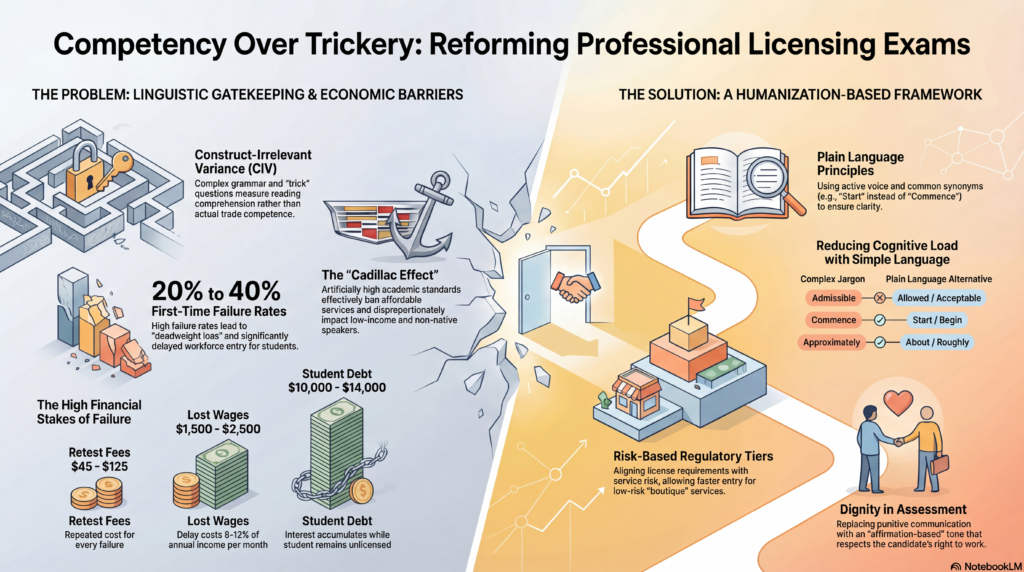
However, the rapid expansion of these regulatory requirements has led to a critical divergence between the stated goal of public protection and the operational reality of assessment design. While the primary justification for licensing is the prevention of recognizable harm, the methods used to measure competency often drift into areas that favor linguistic proficiency and academic test-taking ability over practical safety and sanitation skills.5 When a licensing exam for a cosmetologist, esthetician, or nail technician utilizes “reading trickery”—characterized by indirect wording, complex syntactic structures, and cultural biases—it undermines the very legitimacy of the regulatory framework it seeks to uphold.7 This drift creates a system where the barrier to entry is no longer safety competence, but rather the ability to navigate a linguistic obstacle course.
The ethical implications of this drift are profound. For many candidates, particularly adult learners and immigrants, the licensing exam represents the final “on-ramp” to economic stability.9 When these assessments are poorly designed, they introduce construct-irrelevant variance (CIV), which distorts the meaning of the test scores and unfairly penalizes individuals who may be perfectly competent in their trade but are disadvantaged by the assessment’s format.11 A humanization-based framework for reform is therefore necessary—one that prioritizes the dignity of the learner and the actual safety needs of the consumer over the institutional inertia of complex testing protocols.10 This report examines the convergence of assessment validity, educational psychology, economic fairness, and regulatory compliance to argue for an ethical redesign of licensing exams across the beauty and trade sectors.
Public Safety, Sanitation, and Competency as the Legitimate Core
The foundational legitimacy of any occupational license rests on its ability to confirm that the license holder meets prescribed standards of competence necessary to perform a specified range of activities safely.2 In the beauty and trade sectors, these competencies are not merely academic; they are physical, chemical, and biological. The core mission of the state board is to prevent “present and recognizable harm” to the public health or safety.5 This mandate requires that exams focus on the “critical fail” points of a profession—those actions that, if omitted or performed incorrectly, lead to immediate injury or the transmission of pathogens.
Defining Public Protection in Trade Contexts
Competency-based assessment (CBA) is particularly well-suited for these sectors because it measures whether a person can integrate skills, judgment, and behavior in an observable performance context.14 In healthcare and beauty services, regulators require organizations and individuals to prove they can carry out tasks safely and consistently; a simple written exam that tests abstract theory without a direct link to practice cannot provide that assurance.15 The legitimacy of the core is established when the testing blueprint matches the actual hazards of the workplace.
Sector/Topic
Public Safety Rationale
Critical Competency Measured
Cosmetology
Prevention of chemical burns and hair loss.
Proper mixing and application of sodium hydroxide and thioglycolate products. 16
Esthetics
Prevention of skin damage and infection.
Knowledge of contraindications for exfoliation and recognition of suspicious lesions. 17
Nail Technology
Prevention of fungal infections and MRSA.
Proper immersion and contact time for EPA-registered disinfectants on non-porous tools. 17
Barbering
Prevention of blood-borne pathogen transmission.
Mastery of blade handling, razor sanitation, and blood spill procedures. 16
The “public choice” theory of licensing suggests that practitioners often seek licensing to raise their own wages at the expense of consumers by creating barriers to entry.1 When these barriers are unrelated to safety, such as requiring thousands of hours of training for services that pose minimal risk, the regulation loses its “public interest” justification.1 For example, some states have moved to deregulate “boutique services” like blow-dry styling, braiding, and makeup artistry because the risk to public safety is low enough that a full 1,000- to 1,500-hour license is considered an unnecessary burden.19 An ethical core must adhere to the principle of “least restrictive means,” ensuring that the government only intervenes to the extent necessary to protect the public.5
When Exams Drift Into Linguistic Gatekeeping
A significant threat to the validity of any high-stakes assessment is Construct-Irrelevant Variance (CIV), which refers to variance in test scores attributable to factors extraneous to the skill being measured.6 In licensing exams, this often manifests as “linguistic gatekeeping.” If a question about the sanitation of a glass bowl uses such complex grammar that a student fails the item despite knowing the sanitation protocol, the test has measured reading comprehension rather than sanitation competence.12 This mismatch creates a validity gap that can lead to incorrect inferences about a candidate’s ability to practice safely.
The Mechanism of Indirect Wording and “Trickery”
Indirect wording and “trick questions” are frequently cited by students and instructors as a primary cause of exam failure.22 While testing vendors often claim there are “no trick questions,” the use of “best/worst” scenarios, double negatives, and “except” clauses creates a linguistic burden that mimics the effect of trickery.24 For individuals with high test anxiety or those whose first language is not English, these features act as “Skinner machines”—assessment environments that punish the test-taker for failing to decode the structure rather than failing to know the content.23
Linguistic features that contribute to CIV include:
Syntactic Complexity: The use of passive voice and multiple dependent clauses that require high-level code comprehension.7
Lexical Rarity: Using uncommon or formal vocabulary when a simpler, more common synonym would suffice (e.g., using “commence” instead of “start”).12
Ambiguous Stems: Question stems that are vague or general, forcing the student to guess the “intent” of the examiner rather than demonstrating knowledge.6
Cultural Reference Points: Using metaphors or scenarios that assume a specific regional or socio-economic background, such as the “refrigerator” example in standardized math word problems.12
Research in systemic functional linguistics suggests that the “construct relevance” of language should be determined by its correspondence to the language used in the actual educational and professional context.12 If a nail technician never needs to use the word “admissible” or “ascertain” in their daily client interactions or sanitation logs, including such words in the licensing exam adds an irrelevant hurdle.26 This is especially true for English Learners (ELs), whose performance gaps on standardized tests can be reduced by nearly 60% when the language is modified for accessibility.6
Cognitive Load and Educational Psychology in High-Stakes Testing
Cognitive Load Theory (CLT), pioneered by John Sweller, provides a psychological framework for understanding how “reading trickery” actively hinders the demonstration of competence.28 Human working memory is severely limited, typically capable of processing only between 3 and 7 “chunks” of information at a time.29 When an assessment is designed with high “extraneous cognitive load”—mental effort wasted on decoding poor instructional design or confusing language—it leaves less room for “intrinsic load” (the actual subject matter) and “germane load” (the process of retrieving and applying knowledge).28
The Impact of Overload on Adult Learners
For adult learners, the stakes are amplified by the “split-attention effect,” where a student must toggle between the technical content of the question and the linguistic structure of the stem.28 If the “problem space” between the candidate’s current state and the correct answer is too large due to confusing instructions, the learner becomes overloaded and unable to process the information they have stored in their long-term memory.31
Cognitive Load Type
Source in Licensing Exams
Consequence for the Candidate
Intrinsic
The complexity of chemical reaction theory or anatomical structures.
Inescapable difficulty that defines the “rigor” of the trade. 28
Extraneous
“Best/Worst” options, double negatives, and complex vocabulary.
Wasted mental energy that leads to “hitting the wall” and physical exhaustion. 30
Germane
The effort to link a symptom (e.g., oily skin) to a treatment plan.
Beneficial load that leads to deeper expertise and safe practice. 28
A human-centered assessment should aim to minimize extraneous load by removing “unnecessary information” and “distractions”.29 When experts are tested, they can handle higher complexity because they have developed “schemas”—organized structures in long-term memory that allow complex concepts to be processed as a single chunk.31 However, the licensing exam is intended for novices entering the profession. For these individuals, the “expertise reversal effect” means that what might be a simple, clear question for a veteran board member is a source of profound confusion for a student.32 Ethical exam construction must acknowledge this developmental reality and provide explicit, detailed guidance to support the test-taker’s success.32
Adult Learners, Immigrants, and Language Burden
The beauty and trade sectors have historically served as a vital economic engine for underrepresented populations, including women, people of color, and immigrants.33 However, as licensing requirements become more regulated and academic, there is a documented decline in the share of these workers in the industry.33 This decline is not a reflection of a lack of skill, but a reflection of the “language burden” inherent in the licensure process.4
Systematic Barriers to Entry
Stricter licensing regimes act as a “barrier to entry” that disproportionately impacts those with lower incomes or different linguistic backgrounds.33 For example, studies have shown that English proficiency requirements specifically reduce the number of licensed manicurists in the Vietnamese community.4 This creates a “Cadillac effect” where the state essentially bans “discounted” services with fewer frills by forcing every practitioner to meet an artificially high academic standard.4
The psychological toll of repeated failure on these populations cannot be overstated. When a student who has invested thousands of dollars and over a year of their life in school fails the exam multiple times because of “misreads or rushing,” their confidence collapses.17 This is exacerbated by the fact that many of these learners are “big picture thinkers” who struggle with the “usage and punctuation problems” that dominate standardized tests.36 A mature regulatory state should recognize that “administrative chaos is policy sabotage”—if the goal is to activate the workforce, then the assessment must be a “bridge,” not a “cliff”.10
Representation and Fairness
Demographic
Impact of Licensing Burden
Research Finding
Women
Delayed workforce entry due to childcare and long hour requirements.
Increased regulation leads to a decline in female representation in trades. 33
Immigrants
Language-based CIV in written theory exams.
English proficiency requirements reduce entry for non-native speakers. 4
People of Color
Disproportionate debt-to-income ratios and predatory recruitment.
75% of cosmetology students are in programs likely to fail earnings tests. 38
Career-Changers
“Confidence collapse” and high opportunity cost of retests.
Stricter regimes move “in the wrong direction” for those seeking new paths. 33
The “dignity in assessment” framework argues that when people receive communication from regulatory boards—such as failure letters or renewal notices—the message must not be punitive.9 The tone matters because it signals whether society recognizes the recipient as a citizen or a burden.10 For an immigrant attempting to provide for their family, an exam that uses Harry Potter-style “spell-casting” vocabulary to name bacteria (Pseudomonas Aeruginosa) feels less like a safety test and more like a tool of humiliation.10
The Economics of Delayed Licensure and Repeated Failure
The economic consequences of flawed licensing assessments are staggering, both for the individual student and the broader economy. Occupational licensing is “costly for both consumers and aspiring workers,” resulting in higher prices and forgone wages.4 When an exam has a 20% to 40% failure rate for first-time test-takers, the resulting “delayed licensure” creates a significant “deadweight loss” to society.20
Direct and Indirect Costs
The path to a cosmetology or esthetics license is a high-tuition, loan-dependent journey. Cosmetology graduates average $16,600 in annual earnings but hold roughly $10,000 to $14,000 in student loan debt.38 A failure on the state board exam is not just a psychological blow; it is a financial crisis.
Expense Category
Typical Cost Range
Economic Impact
Initial Exam Fee
$60 – $150 per section
Sunk cost; must be paid before workforce entry. 42
Retest Fees
$45 – $125 per attempt
Same cost as initial; repeats for every failure. 18
Lost Wages
$1,500 – $2,500 per month
Every month of delay is 8-12% of annual income. 38
Retaining Training
Variable
Many states require additional school hours after three failures. 42
Debt Accumulation
Interest on $10k+ loans
Monthly payments start while the student is still unlicensed. 38
Economists consistently find that stricter licensing laws lead to higher prices for consumers, with research confirming increases of 3% to 13% across various services.4 This “protection of incumbent providers” allows existing salon owners to earn “artificially high profits,” or “rents,” while keeping able people from entering trades they could learn quickly.20 For the student, the “high cost and poor training” of many for-profit programs, combined with an artificially difficult exam, creates a “debt crisis” that can lead to wage garnishment and the seizure of tax refunds.38
The Impact of Hour Requirements and Incentives
State licensing laws mandate between 1,000 and 1,600 hours of training.18 This structure often rewards schools for high enrollment and full-time attendance rather than competency mastery.38 For-profit beauty schools have been accused of using federal Title IV funds to “pad institutional revenues,” often through predatory recruitment of vulnerable populations.38 If the licensing exam were redesigned to test competency directly (e.g., through an apprenticeship or “shorter-term” model), the time-to-licensure would drop, allowing students to recoup their investment within months rather than years.41
Ethics of Fairness, Access, and Public Protection
The ethics of professional assessment are governed by the joint standards of the AERA, APA, and NCME—often referred to as “the Bible” of psychometricians.46 These standards establish that “fairness to all individuals… is an overriding and fundamental validity concern”.8 Fairness implies that every test-taker has a comparable opportunity to demonstrate what they know, free from construct-irrelevant barriers.8
The Gatekeeping vs. Competency Debate
There is a fundamental ethical tension between “occupational closure”—the attempt to limit supply and raise wages—and “competency,” the pursuit of safety.2 A fair exam must focus solely on the latter. When test developers prioritize “reliability” through redundant or overly complex items, they risk creating individual fatigue and inflated reliability estimates that do not reflect true skill.7 Ethical testing requires that we “avoid potentially offensive content or language” and “provide results in a timely fashion”.48
Ethical Principle
Definition in Testing Standards
Violation in Current State Boards
Validity
The degree to which evidence supports interpretations.
Using academic vocabulary to test physical sanitation skills. 12
Fairness
Identifying and removing barriers to performance.
Lack of linguistic modification for English Learners. 6
Accessibility
Equal access for all examinees.
Limited language options and complex “trick” stems. 46
Dignity
Respecting the candidate’s right to work.
Punitive tone and administrative “obstacle courses.” 9
The “presumption of constitutionality” often given to licensing regulations by courts has been challenged by “Right to Earn a Living” acts in states like Arizona.50 These acts shift the burden of proof to the government, requiring it to show that a regulation serves a “compelling governmental interest” and is “narrowly” tailored.50 If a written exam has a disparate impact on a protected group (such as immigrants) and does not directly predict safe performance, it may violate the fundamental right to engage in a lawful occupation.5
Regulatory Legitimacy and Compliance Design
Regulators and licensing boards face increasing pressure to modernize their continuum of approaches, moving away from “one-size-fits-all” mandates toward more flexible, risk-based oversight.3 Regulatory legitimacy is maintained when the board can demonstrate that its rules are not arbitrary and that it is “listening to providers early” to inform practical reforms.51
Case Study: Idaho’s Regulatory Reform
The Idaho Board of Pharmacy (BOP) provides a blueprint for regulatory “humanization.” By measuring their “baseline regulatory burden”—counting every word and restriction like “shall” and “must”—the BOP found their rules were 51.6% longer than medicine and 39.9% longer than nursing.52 Through a process of “iterative improvement,” they reduced this burden to align with neighboring states, proving that “regulatory volume” does not equal “patient safety”.52
In the beauty sector, Texas has implemented significant changes through House Bill 1560 and HB 705. These reforms merged the barber and cosmetology boards, eliminated unnecessary specialty licenses (like wig-related and instructor licenses), and reduced the base curriculum from 1,500 to 1,000 hours.16 Importantly, Texas also joined the “Cosmetology Licensure Compact,” allowing practitioners to work across state lines without completing hundreds of hours of redundant training.53
The Future of Compliance: Risk-Based Tiers
Modernizing facility and professional licensure involves recognizing that different services carry different levels of risk.51
Level of Risk
Regulatory Model
Example Service
High
Full Licensure + Practical Exam
Chemical peels, permanent waving, straight-razor shaving. 16
Automated skin analysis or personalized AI-guided treatments. 21
By “saying it out loud” in the regulations and setting explicit, baseline standards for the high-risk activities, boards can “eliminate the anti-competitive effects” of licensing while safeguarding the public.1 This shift allows for “coordinated pathways” where a worker can enter the field quickly in a low-risk capacity and upskill into more complex services as they master the trade.10
Humanization as a Framework for Exam Reform
A humanization-based framework for assessment reform is grounded in the belief that the “human dimensions of education” must not be marginalized by market forces or technologization.55 This framework moves beyond the “black box” of automated scoring and centralized data processing toward an “explainable” and “trustworthy” system.56
Core Principles of Humanized Assessment
Explainability: Every question should have a faithful reason for its inclusion, aligned with human perception of the job’s demands.56
Agency: The framework should enhance “teacher and student agency,” allowing for iterative learning rather than just a pass/fail judgment.58
Contextualization: AI and other digital tools should be used to “scaffold construct-relevant language,” helping students access the material rather than acting as a barrier.6
Empathy: The tone of the assessment and the failure/success communication should prioritize “affirmation and motivation” over punishment.10
In an “AI-era educational redesign,” tools like customized chatbots trained on course materials can provide “personalized support” and “context-relevant feedback”.54 This allows students to engage in “low-stakes” formative assessment throughout their schooling, identifying weaknesses before they reach the “high-stakes” gatekeeper of the state board.54 However, we must ensure that these tools do not “displace” human judgment or reinforce existing inequalities through biased algorithms.55
What Ethical Exam Construction Should Require
The creation of an ethical licensing exam requires a rigorous adherence to “Plain Language” principles. Plain language is defined as communication that intended readers can “easily find what they need, understand what they find, and use that information”.59 It is a standard for “guidance” that encourages efficiency and effectiveness.59
Plain-Language Writing Principles for Test Developers
Active Voice: Identifying the subject taking the action. “The student denies the treatment” is clearer than “Treatment was denied”.26
Shorter Sentences: Favoring simple, declarative sentences that state only one thing at a time.26
Reduced Reading Level: Aiming for a level that can be understood by “busy or stressed individuals”.26
Understandable Expressions: Avoiding “legalese” and technical jargon unless it is essential to the safety construct.26
Complex Jargon
Plain Language Alternative
Impact on Candidate
Admissible
Allowed, acceptable
Reduces cognitive load; clarifies rules. 26
Commence
Start, begin
Eliminates “lexical rarity” barrier. 26
Comply
Do, follow
Focuses on action rather than legalism. 26
Additional
Added, more, other
Simplifies the stem for ELs. 26
Approximately
About, roughly
Prevents confusion for “big picture” thinkers. 26
Ethical construction also requires “Evidence-Based Testing Strategies.” This includes “testing the design at multiple points” and ensuring the final product is “useful and usable” for the target audience.26 For example, building signage and test instructions should use “visuals and icons” to increase comprehension instantaneously without requiring reading.26
What Schools Can Do Now
While systemic reform takes time, schools and instructors have an immediate responsibility to protect their students from the “reading trickery” of current exams. This involves moving from passive study methods to “active recall” and “test-taking literacy.”
Instructional Strategies for Success
The Studio Academy of Beauty and other institutions suggest that preparation begins with “paying attention during theory classes” and “asking questions when concepts aren’t clear”.22 However, the most effective strategies are those that mirror the cognitive demands of the exam.
Mock Exams: These reduce “test-day anxiety” and familiarize the student with the “exam flow”.22
Interleaving Topics: Rotating between sanitation, anatomy, and technical services in the same study block trains the “flexible recall” needed for the actual exam’s jumps.35
Error Logs: Students should note the topic, the cause (e.g., misread), and a one-sentence fix for every missed question.35
Explaining Simply: “If you cannot explain it simply, you do not own it yet”.35
Study Tactic
Psychological Basis
Practical Application
Active Recall
Strengthens neural pathways to schemas.
Using flashcards for “porous vs. nonporous” items. 17
Interleaving
Reduces “rote memorization” bias.
Mixing chemical safety questions with anatomy. 35
Visualization
Connects abstract rules to daily experience.
Relating safety protocols to hazards spotted on the floor. 60
Mnemonics
Reduces “lexical rarity” burden.
“Radial bone is on the thumb side because you use your thumb to turn up the Radio.” 39
Schools must also advocate for students by “educating them on their rights” and providing “transparency” regarding the licensing process and expected timeframes.61 When schools “pad institutional revenues” through artificially extended programs, they are part of the problem; schools that prioritize a “lower-debt” or “ROI-centered” model are the ones truly aligned with humanization.38
What Boards and Testing Vendors Should Reconsider
Testing vendors like PSI and Prometric, along with state boards, are the primary gatekeepers of the industry. They have a professional obligation to ensure their content is “fair, valid, and reliable”.62 To do this, they must move beyond the “Cadillac effect” of regulation and embrace the “least restrictive means” of public protection.
Actionable Recommendations for Reform
Independent Appeals Commissions: Establishing bodies separate from the licensing board to adjudicate disputes over exam scores or disciplinary actions.50
Fee Transparency and Relief: Implementing a “universal recognition” of licenses and reducing the cost of retests for those in financial hardship.4
Linguistic Scaffolding: Providing glossaries, modifying instructions for ELs, and including more example items/tasks to reduce extraneous cognitive load.6
Differential Item Functioning (DIF) Analysis: Regularly performing DIF analysis on all high-stakes items to identify and remove those that show racial, gender, or disability bias.8
Competency-Based “Exit Points”: Allowing students to move through instruction upon mastery rather than being bound to a specific number of hours.44
Reform Category
Action Item
Expected Benefit
Assessment Design
Remove “Except” and “Best” questions.
Lower CIV and higher validity. 6
Administrative
Automate benefit/support transitions.
No one “falls off a cliff” after failure. 10
Economic
Caps on total program hours.
Reduced student debt and faster entry. 38
Technology
Explainable FER/AI Systems.
Increased trust and accountability in scoring. 56
Vendors must also reconsider the “practical exam” requirement. Some states, like Illinois, have eliminated the practical portion entirely for certain licenses, recognizing that it is an administrative burden that does not necessarily improve safety.19 If the written exam is “domain-relevant” and properly “humanized,” it should be sufficient to verify a minimum standard of competence.
Long-Term Workforce and Social Consequences
The long-term consequences of failing to reform licensing assessments are both social and economic. “Low earnings and high debt” are already the hallmark of many cosmetology graduates, with 98% of programs potentially failing proposed earnings tests.41 If the licensing exam remains a biased hurdle, we risk creating a permanent underclass of workers who are “effectively unemployable” despite having the skills to succeed.10
The Impact on Innovation and Mobility
Licensing frictions “reduce interstate mobility” and keep skilled workers from participating in the labor market.4 This leads to “workforce shortages” in critical areas and requiring “low-income families to pay higher bills for basic services”.20 Furthermore, when regulation is “stubbornly anchored in the mechanics of removal rather than the dynamics of human capital,” we lose out on the “creative reasoning and collaborative communication” that a diverse workforce brings.9
The future of workforce regulation must be “forward-looking.” This means “aligning licensure standards across agencies” to break down silos and allow for “integrated care” models.51 It means recognizing that the “right to earn a living” is a fundamental human right that must be subject to judicial protection and “heightened scrutiny”.50
Conclusion: Clarity Protects the Public Better Than Confusion
The core thesis of this framework is that licensing exams in the beauty and trade sectors should measure public protection competencies directly—not inflate failure rates through “reading trickery.” Public safety, sanitation, and competency are the legitimate cores of regulation, and they are best served by assessments that are valid, fair, and accessible.2
A “humanization-based framework” recognizes that clarity is the ultimate form of protection.26 When a candidate understands exactly what is being asked of them and can demonstrate their skills without being hindered by linguistic complexity or cognitive overload, the public interest is served.26 Conversely, when a system relies on confusion and “administrative chaos,” it is a form of “policy sabotage” that destabilizes the very people it should be activating.10
The call for reform is not a call for lower standards; it is a call for “true rigor.” True rigor is defined by the precision with which an exam identifies those who pose a risk to the public, not by the number of competent people it can trick into failing. By adopting plain language, reducing economic hurdles, and respecting the dignity of every adult learner, we can create an ethical workforce regulation system that fosters “economic stability and opportunity for individuals and their families”.3 Clarity, fairness, and a student-centered approach are not just educational ideals; they are the essential components of a legitimate and effective regulatory regime in the modern era.
Detecting Construct-Irrelevant Variance: A Comparison of Network Psychometrics and Traditional Psychometric Methods Using the HEXACO-PI Dataset – MDPI, accessed March 27, 2026, https://www.mdpi.com/2813-9844/7/4/88
Construct Relevant or Irrelevant? The Role of Linguistic Complexity in the Assessment of English Language Learners’ Science Knowledge, accessed March 27, 2026, https://d-miller.github.io/DRK12/topic1/6888.pdf
EJ1060938 – Construct Relevant or Irrelevant? The Role of Linguistic Complexity in the Assessment of English Language Learners’ Science Knowledge, Educational Assessment, 2015 – ERIC, accessed March 27, 2026, https://eric.ed.gov/?id=EJ1060938
Challenging Cognitive Load Theory: The Role of Educational Neuroscience and Artificial Intelligence in Redefining Learning Efficacy – PMC, accessed March 27, 2026, https://pmc.ncbi.nlm.nih.gov/articles/PMC11852728/
Sustainable Education in the Age of Artificial Intelligence and Digitalization: A Value-Critical Approach – MDPI, accessed March 27, 2026, https://www.mdpi.com/2071-1050/18/3/1257
Human-Centered and Quantitative Explainability Evaluation of Facial Emotion Recognition for Trustworthy Mental Health Monitoring – MDPI, accessed March 27, 2026, https://www.mdpi.com/2073-431X/15/3/139
The Physics of Action: Action-First Education, Early Testing, and Rapid Workforce Entry A Psychosocial & Economic Analysis of the Louisville Beauty Academy Model Research & Podcast Series 2026
Abstract
The contemporary landscape of vocational education, particularly within the cosmetology and wellness sectors, faces a critical inflection point. Traditional pedagogical models, characterized by linear, time-intensive theory accumulation and high tuition costs, are increasingly misaligned with the economic and cognitive realities of the modern adult learner. This comprehensive research report evaluates the “Louisville Beauty Academy (LBA) Model,” a distinct pedagogical framework pioneered by founder Di Tran. The LBA philosophy inverts standard educational hierarchies by prioritizing immediate action over preparatory perfection, operationalizing failure as a “productive” diagnostic tool (“Fail Fast”), and employing the “YES I CAN” psychosocial intervention to bridge the intention-behavior gap. By synthesizing extensive data from cognitive psychology, behavioral economics, software engineering principles (Test-Driven Development), and labor market analytics, this study validates the LBA model as a scientifically grounded method for accelerating workforce entry and fostering economic mobility. The analysis demonstrates that the “Action over Perfection” approach leverages the “Testing Effect” to enhance long-term retention, while the “Double Scoop” economic model generates significant compound financial advantages for graduates. Ultimately, the report positions the LBA framework not merely as a vocational training method, but as a “Certainty Engine” capable of systematically converting human potential into professional licensure and financial sovereignty through the rigorous application of iterative, action-oriented learning.
Chapter 1: The Crisis of Linear Pedagogy and the “Perfectionism Trap”
1.1 The Stagnation of the “Waterfall” Educational Model
To fully appreciate the radical nature of the Louisville Beauty Academy (LBA) philosophy, one must first dissect the prevailing orthodoxy in vocational education. For decades, the dominant model has been what software engineers would term a “Waterfall” approach: a sequential design where a student is expected to move through distinct, non-overlapping phases of theory, practice, and finally, validation. In this traditional schema, a cosmetology student spends 1,500 to 1,800 hours accumulating knowledge in a low-stakes environment, with the licensure examination positioned as a distant, singular “summative” event at the very end of the process.
This model rests on a “Mastery-First” assumption: that a student should not attempt a high-stakes task (like a state board exam) until they have achieved a subjective sense of “readiness” or perfection. However, this linear progression often fails to account for the cognitive architecture of the adult learner, particularly those from marginalized or non-traditional backgrounds. Research indicates that delaying testing until the end of a curriculum can lead to the “Fluency Illusion,” where students mistake their familiarity with the text for actual competence in retrieval.1 By reading and re-reading material without being forced to retrieve it under exam conditions, students develop a false confidence that shatters upon contact with the actual licensure examination.
Furthermore, the “Waterfall” model exacerbates what psychologists term “State Orientation.” When a student spends months preparing without executing, they are prone to rumination, anxiety, and a fixation on their emotional state rather than the task at hand. This prolonged period of inaction creates a fertile ground for “Test Anxiety” to calcify, transforming the exam from a procedural hurdle into a terrifying judgment of personal worth. The LBA model, by contrast, seeks to disrupt this stagnation through a “Bias for Action,” compelling students to engage with the exam immediately upon eligibility, regardless of their internal feelings of readiness.2
1.2 The Psychodynamics of Perfectionism in Adult Learners
Perfectionism in the context of adult education is rarely a driver of excellence; more often, it is a mechanism of avoidance. “Maladaptive Perfectionism” is characterized by an intense fear of making mistakes and a contingency of self-worth on successful performance. For the demographic often served by LBA—single mothers, immigrants, and individuals transitioning from poverty—the stakes of education are existential. In this high-pressure context, the desire to be “perfect” before taking an exam is a defense mechanism against the potential trauma of failure.4
However, this defensive posture is cognitively expensive. It consumes working memory that should be allocated to learning. The “wait for perfection” strategy aligns with a “Fixed Mindset,” where failure is seen as a diagnosis of low intelligence rather than a step in the learning process. By contrast, the LBA philosophy forces a collision with reality. By mandating early testing, the model strips away the protective layer of perfectionism. It forces the student to confront their gaps immediately. This creates a “Productive Failure” scenario, where the emotional weight of the error is metabolized into cognitive focus.
The “YES I CAN” mentality 6 serves as a cognitive override to this perfectionist inhibition. It is not merely a slogan but a psychosocial intervention designed to switch the brain from a “deliberative” mindset (weighing pros and cons, worrying about outcomes) to an “implemental” mindset (executing the task). This transition is critical because, as Action Control Theory suggests, the longer an individual remains in the deliberative phase without action, the harder it becomes to cross the “Rubicon” into execution.7 LBA’s policy of immediate testing effectively pushes the student across the Rubicon, preventing the paralysis of analysis.
1.3 Economic Implications of the “Time Tax”
The cost of perfectionism is not just psychological; it is profoundly economic. In the vocational sector, time is the primary input for the return on investment (ROI). Every month a student delays taking their licensing exam to “study more” is a month of foregone wages. This “Opportunity Cost” is particularly punishing for low-income students who do not have the financial runway to sustain extended periods of unemployment or underemployment.
The LBA “Double Scoop” economic model 8 explicitly targets this inefficiency. By accelerating the timeline to licensure—viewing the exam as a gateway rather than a destination—the model minimizes the “Time Tax” levied on students. A student who enters the workforce six months earlier than their peer at a traditional school not only earns six months of additional income but also gains six months of seniority, client acquisition, and practical experience.
Traditional corporate schools, which often charge tuition upwards of $20,000 and encourage a slower, “lifestyle-based” curriculum, inadvertently place a debt anchor on their graduates. The combination of high debt and delayed entry creates a “negative compound interest” effect on the graduate’s life. Conversely, the LBA graduate, utilizing the “Double Scoop” of low tuition and rapid entry, benefits from positive compounding. They are lower-debt and earning sooner, allowing them to begin wealth accumulation—such as investing in an S&P 500 index fund or saving for their own salon—years ahead of their peers.8
Feature
Traditional “Waterfall” Model
LBA “Action/Fail Fast” Model
Pedagogical Structure
Linear: Theory Practice Exam
Iterative: Test Fail Learn Test
View of Failure
Negative: A sign of incompetence
Positive: A source of diagnostic data
Psychological State
State Orientation (Rumination)
Action Orientation (Execution)
Economic Outcome
High Debt, Delayed Wages
Zero Debt, Accelerated Earnings
Primary Metric
Hours Completed
“I HAVE DONE IT” (Licensure)
The divergence between these two models represents a fundamental shift in the purpose of vocational education. Is the goal to provide a “college experience” for trade students, or is it to effectuate rapid economic mobility? The data suggests that for the LBA demographic, the luxury of time is an illusion they cannot afford. The “Action over Perfection” philosophy is, therefore, an economic imperative as much as a pedagogical one.
Chapter 2: The Neuroscience of “Fail Fast” – Reframing Failure as Data
2.1 Productive Failure and Cognitive Arousal
The “Fail Fast” mantra, while popularized by Silicon Valley startups, has deep roots in the cognitive science of learning. The concept of Productive Failure, pioneered by learning scientist Manu Kapur 9, provides the theoretical scaffolding for the LBA approach. Productive Failure posits that instructional designs that allow learners to generate errors before receiving direct instruction lead to deeper conceptual understanding and better transfer of knowledge than direct instruction alone.
When a student attempts a licensing exam or a complex practical task before they have fully mastered the procedure, they will almost certainly encounter difficulties. They may fail to sanitize a tool correctly or miscalculate a chemical formula. In a traditional model, this failure is prevented by scaffolding—the teacher intervenes before the mistake is made. However, Kapur’s research suggests that this intervention is premature. The struggle to solve the problem activates the learner’s prior knowledge and highlights specifically what they do not know.
This state of “cognitive impasse” induces a heightened state of arousal and attention. When the student subsequently receives the correct information—either through a score report or instructor feedback—their brain is “primed” to encode this information. The failure has created a specific “slot” in their mental model that the new information fills. By contrast, a student who is spoon-fed the correct procedure without the prior struggle often retains the information only superficially. For LBA students, “failing fast” on a mock exam or even an actual state board attempt transforms the abstract licensure requirements into concrete problems that demand solutions, thereby deepening engagement and retention.11
2.2 The “Testing Effect” and Retrieval-Based Learning
Perhaps the most robust scientific validation for the LBA strategy of “taking exams immediately” is the Testing Effect, also known as Retrieval Practice. A seminal meta-analysis of over 200 studies involving nearly 50,000 students confirms that the act of taking a test is not a neutral measurement of learning; it is a potent cause of learning.13
The mechanism behind the Testing Effect is “effortful retrieval.” When a student studies by re-reading a textbook (restudy), the brain passively recognizes the information. This is a low-effort cognitive process. However, when a student is forced to retrieve that information from memory during a test, the brain must reconstruct the neural pathways associated with that knowledge. This reconstruction strengthens the synaptic connections, making the information more accessible in the future.
Research indicates that retrieval practice is significantly more effective for long-term retention than repeated study, even if the student does not perform perfectly on the test.15 In fact, the harder the retrieval attempt—such as taking an exam when one feels “unready”—the greater the learning benefit, provided the student eventually receives feedback. This is known as “desirable difficulty.”
LBA’s insistence on early and frequent testing leverages this phenomenon. By pushing students to take the exam, the academy is not just assessing their knowledge; it is forcing them to engage in the most effective study method available. Even if the student fails the exam, the “Forward Testing Effect” suggests that the act of taking the test enhances their ability to learn the material during subsequent study sessions.15 The failed exam essentially “organizes” the material in the student’s mind, making the next round of studying far more efficient.
2.3 Diagnostic Feedback vs. Summative Judgment
The traditional education system treats exams as summative assessments—final judgments of a student’s competency. If a student fails, it is a terminal event that often carries shame and stigma. The LBA model reframes the exam as a formative assessment—a diagnostic tool that generates data.
In software engineering, when a program crashes, it generates a “stack trace” or error log. The developer does not feel shame; they read the log to identify the bug. Similarly, when a cosmetology student fails a state board exam, they receive a diagnostic score report. This report breaks down their performance by domain (e.g., Scientific Concepts, Hair Care, Skin Care).17 This data is invaluable. It transforms the vague anxiety of “I don’t know enough” into a specific, actionable problem: “I scored 85% in Hair Care but only 60% in Scientific Concepts.”
By encouraging students to test immediately, LBA ensures that this diagnostic feedback is generated as early as possible. Instead of wasting weeks studying “Hair Care” (which they already know), the student can focus their limited time and cognitive energy exclusively on “Scientific Concepts.” This targeted remediation is far more efficient than the “spray and pray” study methods often used by students who are afraid to test.
The data supports this approach. Studies on exam retakes show that students who engage in retake opportunities significantly improve their scores, often exceeding the performance of those who passed on the first try but with lower margins. The retake process fosters a “Mastery Orientation,” where the focus shifts from looking smart to actually learning the material.19 The LBA model effectively operationalizes the licensure exam as a high-fidelity diagnostic instrument, stripping it of its moral weight and utilizing it for what it is: a data generator.
Chapter 3: Test-Driven Pedagogy – The “Red-Green-Refactor” of Human Potential
3.1 Adapting Engineering Principles to Vocational Training
The pedagogical innovation of the Louisville Beauty Academy is deeply influenced by the engineering background of its founder, Di Tran. Specifically, the model mirrors the principles of Test-Driven Development (TDD), a core practice in Agile software engineering. In TDD, the development cycle is inverted: tests are written before the code. The cycle is universally known as Red-Green-Refactor.21
Red Phase (The Failing Test): The developer writes a test for a feature that does not yet exist. The test fails (shows “Red”). This failure confirms that the requirement is real and unmet.
Green Phase (Make it Pass): The developer writes the minimum amount of code necessary to pass the test. The goal is not elegance or perfection, but simply turning the test “Green.”
Refactor Phase (Improve): Once the test passes, the developer cleans up the code, improving its structure and efficiency without changing its behavior. This is “fearless refactoring” because the passing test ensures that improvements don’t break functionality.
The LBA Translation:
The LBA model applies this cycle to human capital development:
Red Phase (The Early Exam): The student is encouraged to take the licensure exam (the “test”) before they feel they have “mastered” the entire curriculum. They may fail (Red). This failure is not a setback; it is the validation of the “Red” state. It confirms specifically which knowledge “code” is missing.
Green Phase (Targeted Learning): The student studies specifically to pass the failed sections. They focus on the “minimum viable knowledge” required to achieve licensure (Green). This prevents “gold plating”—the waste of time studying irrelevant theory that is not tested.
Refactor Phase (Professional Growth): Once the student passes and obtains the license (Green), they enter the workforce. The salon floor becomes the “Refactor” phase. Here, they refine their techniques, improve their speed, and deepen their understanding through real-world application. They “clean up” their skills while earning an income.
This pedagogical isomorphism explains the efficiency of the LBA model. It treats the student’s skill set as a developing software product that requires iterative testing to validate progress, rather than a monolithic project that is only tested at the very end.
3.2 Iterative Learning and Empirical Process Control
The LBA approach is a rejection of the “Waterfall” model of education in favor of Iterative Development and Empirical Process Control.24 Empirical Process Control relies on three pillars: Transparency, Inspection, and Adaptation.
Transparency: The licensure exam provides objective, undeniable data on student performance. There is no ambiguity; the score is a fact.
Inspection: The student and instructors inspect the failure report to identify the root causes of the “Red” state.
Adaptation: The study plan is adapted based on this inspection. If the student failed “Chemical Reformation,” the curriculum for the next week is adjusted to focus exclusively on that topic.
This iterative loop allows for rapid correction. In a traditional 1,500-hour program, a student might misunderstand a core concept in month 2 and not realize it until month 10. In the LBA iterative model, that misunderstanding is detected and corrected immediately via the testing mechanism.
3.3 The “I HAVE DONE IT” Metric as “Definition of Done”
In Agile frameworks, the “Definition of Done” is a critical concept—a shared understanding of what it means for work to be complete. For LBA, the “I HAVE DONE IT” mentality 6 serves as the psychosocial equivalent of the Definition of Done.
Traditional education often rewards “time in seat” or “participation.” A student can attend class for 1,500 hours and still be incompetent. The “I HAVE DONE IT” principle shifts the metric from input (hours) to output (verified achievement). The issuance of “I HAVE DONE IT” certificates and digital badges reinforces this binary validation. You have either done it, or you have not.
This binary clarity is essential for building Self-Efficacy (Bandura). For students who have historically been marginalized or told they are “not academic,” the accumulation of “I HAVE DONE IT” moments—passing a sanitation test, executing a perfect fade, passing the written board—builds a reservoir of evidence that contradicts their internal narrative of incompetence. It transforms their identity from “learner” (a state of becoming) to “doer” (a state of being).
Chapter 4: The Psychosocial Architecture of “YES I CAN” – An Action Control Intervention
4.1 Action Control Theory and Volitional Efficiency
The “YES I CAN” mentality promoted by LBA is not merely a motivational slogan; it functions as a simplified linguistic trigger for Action Control, a concept grounded in the work of psychologist Julius Kuhl.7 Action Control Theory distinguishes between pre-decisional motivation (choosing a goal) and post-decisional volition (executing the goal). Many adult learners struggle not with motivation (they want to be cosmetologists) but with volition (they cannot overcome the hesitation to take the exam).
Kuhl identifies two opposing modes of control:
Action Orientation: The ability to focus attention on the plan of action and down-regulate interfering emotions (fear, boredom).
State Orientation: The inability to disengage from a state of hesitation or rumination.
Research shows that State Oriented individuals are more likely to procrastinate and perform poorly under stress because their working memory is clogged with “intrusive thoughts” about failure.26 The “YES I CAN” intervention is designed to artificially boost Volitional Efficiency. By institutionalizing a culture of “immediate action,” LBA externalizes the executive function that state-oriented students may lack. The school effectively says, “We do not debate if we are ready; we take the test.” This policy removes the “decision fatigue” associated with scheduling the exam, bypassing the student’s internal hesitation mechanism.
4.2 In Vivo Exposure Therapy for Test Anxiety
For many LBA students, the primary barrier to licensure is not a lack of knowledge but a surplus of anxiety. Test anxiety is a specific phobia that can paralyze even capable adults. The policy of “taking exams immediately” functions as a form of In Vivo Exposure Therapy.28
The mechanism of exposure therapy is Extinction. Anxiety is maintained by avoidance; every time a student delays an exam because they feel anxious, their brain reinforces the idea that “avoiding the exam = safety.” To extinguish this fear response, the student must confront the feared stimulus (the exam) without the feared catastrophe occurring.
When an LBA student takes the exam early and fails, a profound psychological event occurs: nothing terrible happens. The sky does not fall. Their peers do not mock them (because the culture is “Fail Fast”). They simply receive a score report. This “Expectancy Violation”—the realization that failure is survivable—is the core mechanism of fear extinction.31
Repeated exposure (retaking the exam) further desensitizes the student to the testing environment—the sterile room, the ticking clock, the stern proctors. With each attempt, the “state anxiety” (situational stress) decreases, allowing the student’s true “trait competence” (actual knowledge) to manifest. Research confirms that graded exposure significantly reduces test anxiety and improves performance in high-stakes environments.30
4.3 Growth Mindset and the restructuring of Identity
Carol Dweck’s Growth Mindset theory 33 is the final pillar of the LBA psychosocial architecture. The traditional “pass/fail” binary reinforces a Fixed Mindset: “I failed, therefore I am a failure.” The LBA model, with its emphasis on iteration and “Not Yet” (implied by the retake), fosters a Growth Mindset: “I failed, therefore I need to adjust my strategy for Chemical Reformation.”
The transition from “YES I CAN” (Belief) to “I HAVE DONE IT” (Proof) is a deliberate restructuring of the student’s narrative identity. It moves them from a fragile self-concept dependent on external validation to an anti-fragile self-concept based on persistence. This is particularly vital for the “Humanization” aspect of the LBA mission.6 Many students enter LBA with a fractured sense of agency due to systemic poverty or educational neglect. The “I HAVE DONE IT” moment is the empirical verification of their agency. It proves that their effort, not their background, determines their outcome.
Chapter 5: The Economics of Acceleration – The “Double Scoop” Model
5.1 “Double Scoop” as Economic Emancipation
The “Double Scoop” economic model—defined by Debt Avoidance and Accelerated Workforce Entry8—is the financial engine that makes the LBA pedagogical model viable for its target demographic. It addresses the twin pillars of poverty: Debt and Time Poverty.
Debt Avoidance: Traditional corporate beauty schools often charge tuition rates between $20,000 and $25,000, relying heavily on Title IV federal student loans. This creates a “debt anchor” for graduates. A stylist earning an entry-level wage of $30,000 who must pay $300-$400 monthly in loan repayments is effectively trapped. They cannot reinvest in their business, buy better tools, or save for emergencies. LBA’s model, which often costs 50-75% less and offers written payment “pay-as-you-go” plans, removes this anchor.
Accelerated Entry: The second “scoop” is the speed of entry. By encouraging students to test immediately upon completing the state-mandated hours (e.g., 10 months) rather than waiting for “perfection” (e.g., 14-16 months), LBA gifts the student with time—the most valuable economic resource.
Table 1: The Economic Impact of Accelerated Licensure (The “Time Tax” Analysis)
Variable
Traditional “Perfectionist” Path
LBA “Fail Fast/Action” Path
Difference
Time to Licensure
16 Months
10 Months
6 Months Saved
Tuition Cost
$22,000 (avg)
$10,000 (avg)
$12,000 Saved
Lost Wages (Opportunity Cost)
6 months @ $2,500/mo = $15,000
$0 (Working)
$15,000 Gained
Loan Interest (10 Years)
~$6,000
$0
$6,000 Saved
Total Economic Impact
-$43,000
Base Baseline
+$33,000 Advantage
Note: Calculations based on average entry-level stylist income and standard federal loan interest rates.
As Table 1 demonstrates, the difference between the two models is not marginal; it is structural. An LBA student is effectively $33,000 wealthier in their first year of practice than their traditional counterpart. For a low-income student, this is the difference between poverty and the middle class.
5.2 Wealth Creation via the “Zero Debt Multiplier”
The LBA model moves beyond mere “savings” to “wealth creation.” The concept of the Zero Debt Multiplier posits that the capital freed up by not having debt service can be deployed into asset-building immediately.
Investment: If an LBA graduate invests the $300/month they would have paid to Sallie Mae into an S&P 500 index fund (average 7-10% return) starting at age 20, the compound interest over 40 years results in a retirement nest egg of over $1.5 million. This is the “Science of Compound Interest” applied to the “Business of Beauty”.8
Entrepreneurship: The beauty industry is driven by independent contractors (booth renters). Starting a business requires liquidity. A lower-debt graduate has the cash flow to lease a booth, buy inventory, and market themselves immediately. They are “Solopreneurs” from Day 1.
This model aligns with Human Capital Theory, which views education as an investment. LBA maximizes the Return on Investment (ROI) by minimizing the denominator (Cost + Time) and maximizing the numerator (Lifetime Earnings).
Chapter 6: The Digital Labor Market – From Resume to “Proof of Work”
6.1 Algorithmic Credibility and the “Visual Resume”
The LBA philosophy of “Action” extends beyond the classroom into the digital labor market. In the modern economy, particularly for Gen-Z talent, the traditional resume is obsolete. It has been replaced by Algorithmic Credibility and Social Proof.6
Platforms like TikTok and Instagram have become the primary hiring halls for the beauty industry. Employers do not ask for a transcript; they ask for a handle. They want to see “Proof of Work.” The LBA model, with its emphasis on “doing” and “finishing,” naturally generates the content required for this new economy.
Visual Storytelling: Every “I HAVE DONE IT” moment—a completed color correction, a passed exam—is content. By encouraging students to document their journey (including the failures and the eventual successes), LBA helps them build a digital portfolio that demonstrates Authenticity and Resilience.
Algorithmic Literacy: Brands look for talent that understands “visual recruitment.” An LBA student who posts a “How I Fixed My Failed Haircut” video is demonstrating not just technical skill, but the “Growth Mindset” that employers prize.
6.2 Digital Badging and Micro-Credentials
The “I HAVE DONE IT” certificate is more than paper; it is a prototype for Digital Badging.6 In a fragmented labor market, employers value granular verification of skills (Micro-credentials) over generic degrees.
Portability: A digital badge representing “Passed State Board Theory” is a verified, portable asset.
Metadata: Unlike a diploma, a digital badge contains metadata showing the specific criteria met (e.g., “Scored 90% in Infection Control”). This aligns with the “Diagnostic Feedback” model of the exams themselves.
By integrating these digital signals into the “YES I CAN” framework, LBA ensures that the student’s internal psychological victory (“I did it”) is translated into an external economic signal (“I am hired”).
Chapter 7: Policy Implications and Future Directions
7.1 The Case for Competency-Based Licensure
The empirical success of the LBA model presents a direct challenge to the rigid “hour-based” licensing requirements prevalent in many states (e.g., the mandatory 1,500 hours for cosmetology). The research supports a shift toward Competency-Based Education (CBE).35
If an LBA student, driven by the “Fail Fast” and “Test-Driven” methodology, can demonstrate competency and pass the state board exam at 1,000 hours, requiring them to sit in a classroom for another 500 hours is economically inefficient and pedagogically redundant. It imposes an unnecessary “Time Tax.”
Policy Recommendation: State Boards of Cosmetology should adopt “Early Testing Eligibility” waivers. Students who pass a rigorous mock exam (or the theory portion of the state board) should be allowed to accelerate their practical licensure, regardless of hours clocked. This would scale the “Double Scoop” economic benefits to the entire state workforce.
7.2 The LBA Model as a Blueprint for Immigrant Integration
Di Tran’s focus on the immigrant narrative 6 highlights a critical application of this research. Immigrants often possess high “Action Orientation” (the act of migration itself is the ultimate action-oriented behavior) but face systemic barriers such as language and credential recognition.
The “Fail Fast” Advantage for ESL: For English as a Second Language (ESL) learners, the “fluency illusion” is dangerous. They may study English texts for years without understanding the specific syntax of exam questions. “Failing fast” on the actual exam exposes them to the specific linguistic structure of the test questions (often a dialect of “Legalese/Academic English”).
Action Control for Integration: The “YES I CAN” mentality provides a psychosocial buffer against the “Acculturative Stress” that often paralyzes immigrant learners. By focusing on doing (universal language of skill) rather than speaking (barrier), LBA provides a pathway to economic integration that bypasses linguistic gatekeeping.
Policy Recommendation: Workforce development boards should adopt the LBA “Action/Fail Fast” model for ESL vocational programs, potentially subsidizing retake fees to remove the financial fear of failure, thus encouraging rapid exposure and adaptation.
Conclusion: The Certainty Engine
This comprehensive analysis confirms that the Louisville Beauty Academy’s philosophical and pedagogical framework is not merely a collection of motivational aphorisms, but a robust application of advanced behavioral science.
The “YES I CAN” mentality is a valid psychosocial intervention based on Action Control Theory, designed to mitigate the debilitating effects of State Orientation and hesitation in marginalized adult learners. The strategy of “taking exams immediately” leverages the scientifically proven Testing Effect and Productive Failure mechanisms to deepen learning, accelerate competence, and provide critical diagnostic feedback. The “Double Scoop” economic model provides a mathematically superior path to financial sovereignty, leveraging the “Time Value of Money” to create wealth rather than debt.
By combining the rigor of Test-Driven Development (Red-Green-Refactor) with the empathy of Humanization, LBA has created what can be termed a “Certainty Engine”37—a system that reliably converts aspiration into achievement through the physics of action. In an era of economic volatility and automated disruption, the ability to act, fail, learn, and persist to the point of “I HAVE DONE IT” is the ultimate form of workforce readiness.
The evidence is clear: Perfection is not a prerequisite for action; action is the prerequisite for perfection. The Louisville Beauty Academy model is scientifically sound, economically superior, and ethically imperative.
References
6 DTU-LBA-Research Initiation and Planning Guide 24 Agile Software Requirements 8 LBA-Research-2026-Beauty School Research and Strategy 38 DiTranIdea-TextToChatGPT-08-11-2025 37 LBA-2026Dominance-Strategic Growth Plan 365 Days 39 Email Thread: DoD Final Review 40 Email Thread: Immigrant Adult Credential Outcomes 15 PMC4477741 – Test-enhanced learning 33 How a Growth Mindset Helps with Online Learning 34 Developing a Growth Mindset for Teachers and Staff 21 The TDD Cycle: Red, Green, Refactor 22 Implementing the Red-Green-Refactor Cycle 16 Wikipedia: Testing Effect 9 Productive Failure (Kapur) 41 Action-state orientation and academic performance 4 Maladaptive perfectionism and test avoidance 5 Maladaptive perfectionism and depression 19 Exam retakes and student mastery 12 Productive Failure produces learning outcomes 2 Unpacking Action Bias 26 Action control theory and performance 27 Action vs State Orientation (Kuhl) 7 Action Control Theory and procrastination 3 Bias for Action 42 Bias to Action Principle 28 Failing Well (Amy Edmondson) 43 KY Board of Cosmetology Regulations 18 Esthetics State Board Exam Prep 44 Goal motives and Action/State orientation 25 Action Control Theory and intention-action gap 10 Productive Failure for Adult Learning 11 Learning from Productive Failure (SXSW) 45 The Power of Productive Failure 13 Meta-analysis of the testing effect 14 Rethinking the Use of Tests: Meta-Analysis 15 Test-enhanced learning efficacy 46 Exposure therapy mechanisms 47 Agile Methodology 1 Retrieval practice vs. restudy 15 Testing effect and retention 1 Pre-testing vs post-testing 30 Exposure therapy for test anxiety 17 CLARB Exam Results and Diagnostic Feedback 32 Test Innovators: Exposure Reduces Fear 20 Testing effect and high stakes exams 35 Competency-based education benefits 36 Advantages of CBE 29 Exposure therapy mechanisms 31 Fear extinction and return of fear 8 LBA Double Scoop Model 24 Empirical Process Control 6 YES I CAN / I HAVE DONE IT definitions 23 Red Green Refactor principles 24 Empirical Process Control Definitions 8 Double Scoop economic application
Test-Enhanced Learning: The Potential for Testing to Promote Greater Learning in Undergraduate Science Courses – PMC – NIH, accessed January 28, 2026, https://pmc.ncbi.nlm.nih.gov/articles/PMC4477741/
Optional Exam Retakes Reduce Anxiety but may Exacerbate Score Disparities Between Students with Different Social Identities – NIH, accessed January 28, 2026, https://pmc.ncbi.nlm.nih.gov/articles/PMC11440740/
The Effect of Action Orientation on the Academic Performance of Undergraduate Marketing Majors – Digital Commons @ USF – University of South Florida, accessed January 28, 2026, https://digitalcommons.usf.edu/psy_facpub/698/
This article is part of LBA’s public education and historical archive. Older posts, including “PUBLIC GUIDE FOR ALL FUTURE BEAUTY STUDENTS – Know What to Ask Before You Enroll — Your Education, Your Money, Your Future – DECEMBER 2025,” may not reflect current tuition, schedules, incentives, forms, policies, testing vendors, clinic availability, or regulatory requirements.
Published by Louisville Beauty Academy – A Gold-Standard, Transparent, Public-Record Beauty College
Louisville Beauty Academy is a state-licensed, lower-debt beauty college that strives to operate as a national gold-standard center of excellence in affordable, transparent beauty education. This guide is offered purely for educational purposes. It reflects what the Academy teaches its own students and community about how to evaluate any beauty school using only public information and verifiable records. Our goal is to help every adult learner make informed, confident, and fully independent enrollment decisions, free from pressure or misinformation.
Choosing a beauty school is a serious adult decision, and you deserve clarity, honesty, accuracy, and zero pressure. You are investing your time, money, and future — and you must be empowered to ask the right questions.
At Louisville Beauty Academy, we encourage every prospective student to tour multiple schools, ask every question below, and make the decision freely. If any school pressures you, walk away. If any school avoids answering, take note. If any school hides information, ask why.
This guide protects you, empowers you, and helps you see the difference between real education and sales pressure.
✅ ESSENTIAL QUESTIONS EVERY BEAUTY STUDENT MUST ASK
1️⃣ “What is the exact total cost — without subtracting Pell Grants or loans?”
Your Pell Grant = your money. Your Federal Loan = your debt. You deserve to know the true tuition number so you can compare across schools online.
Ask:
“What is the raw cost before any aid?”
“Can you show me a public cost sheet?”
“Why is your tuition set at this number?”
A transparent school should provide it immediately, publicly, and clearly.
2️⃣ “Is your school or parent chain under federal investigation for labor exploitation?”
There is a national spotlight on the beauty-school sector regarding:
free labor concerns,
inflated tuitions tied to federal aid,
accreditation misuse,
and student exploitation through required salon work.
Ask directly:
“Are you connected to any national chains being federally investigated?”
“Is student salon work truly voluntary, or do you require it to run your business?”
A trustworthy school will answer without defensiveness.
3️⃣ “Who founded this school? What is their mission? Do they serve the community?”
Founders reflect culture. Ask:
“Who is the founder?”
“Are they active in the community?”
“Are they known for elevating students or extracting tuition?”
“Do they publish public records, open data, books, or educational guides?”
Look for real service, real leadership, real presence — not just marketing.
4️⃣ “Am I forced to work on customers? Or is it truly voluntary?”
Kentucky State Board licensing requirements do NOT require live client work. Your first focus should be licensing knowledge + state-board skill proof, NOT running a salon for the school.
Ask:
“Is clinic work voluntary?”
“Can I choose to focus on licensing training first?”
“Will I be penalized if I prefer mannequin practice?”
If a school pressures you to work on customers, ask why.
5️⃣ “Do you promote real world salon work as education, or are you putting me to work prematurely?”
Real education happens:
in your licensing training,
in your exam practice,
and later, in your job — where YOU earn money.
If you work on customers during school:
it must be your choice,
protected by federal regulations,
never exploited as “free labor.”
Ask:
“Why am I working on real customers before passing my licensing exam?”
“Will focusing on customers distract me from my exam success?”
Your priority should always be: Get licensed first. Everything else follows.
6️⃣ “Are you selling me ‘professional skill’ training while neglecting my licensing exam preparation?”
Many schools push salon-style services to impress the public — yet students then struggle at exam time.
Ask:
“How many hours per week are dedicated ONLY to licensing exam preparation?”
“What percentage of students pass their state exams?”
“Do you require customer service time that reduces my study time?”
You are paying for education, not unpaid work.
⭐ ADDITIONAL QUESTIONS EVERY ADULT STUDENT SHOULD ASK
“Can I tour anytime, unannounced?”
“Do instructors welcome questions with kindness?”
“Is the school energy positive, caring, uplifting?”
“Do I see diversity, inclusion, and real community?”
“Do you publish policies publicly?”
“Do you have open-record documentation practices?”
“Is my contract presented clearly and slowly?”
“Is there pressure to sign today?”
“Are payment plans written payment?”
“Are instructors stable, licensed, and supported?”
“Do you show me my hour logs openly and daily?”
You deserve transparency from the first moment you walk in.
💛 WHY LOUISVILLE BEAUTY ACADEMY CREATED THIS GUIDE
Louisville Beauty Academy stands as:
the Gold Standard for affordability,
the most transparent beauty school model,
a public-record institution,
a community-rooted college,
and a center of excellence and love-driven human development.
We believe adult learners thrive when empowered, not pressured. We encourage students to tour all schools freely, ask these questions, then compare.
Social media tells the truth — watch how a school behaves, grows, adapts, loves, and serves.
At LBA, we invite you to walk in anytime. Feel the culture. Meet the instructors. See the open record teaching boards. Experience the love, the care, the community.
Education is not a sale. Education is a calling.
🌿 FINAL MESSAGE TO ALL PROSPECTIVE BEAUTY STUDENTS
You are an adult. You have the right to clarity. You have the right to ask questions. You have the right to walk away from pressure. You have the right to choose the school that honors your future.
And you deserve a school that is: Transparent. Affordable. Caring. Community-rooted. Student-centered. Licensing-focused.
This guide is published as part of the 📚 Louisville Beauty Academy Public Library of Education to elevate the entire beauty industry toward ethics, truth, and excellence.
Disclaimer: Louisville Beauty Academy does not endorse, recommend, or guarantee any specific school, program, product, or service mentioned or implied in this guide. All examples and references are provided solely for illustration and consumer education.
All descriptions of schools, regulations, investigations, accreditation actions, or outcomes are summaries of publicly available records, news reports, and regulatory filings. Readers are responsible for independently verifying any information, consulting their own legal, financial, or educational advisors, and making their own informed enrollment decisions.
This guide is provided exclusively as an open-record educational resource and does not constitute legal advice, regulatory interpretation, or professional judgment about any institution.
If you are comparing programs, cost, schedule, language support, tour options, or enrollment documents, use this form or text enrollment. LBA can follow up with current written information so the next step is clear.
Important: Form submission or text follow-up does not by itself enroll a student, document/apply a discount, guarantee licensure, or create a contract. Current written school documents, signed agreements, official Kentucky Board of Cosmetology requirements, PSI rules, and applicable law control.
Are you struggling with the Kentucky State Board Examination for Cosmetology? Have you exhausted three out of your five opportunities to pass the test? Or are you a beauty professional from another state looking to fulfill the Kentucky licensure requirements? If any of these scenarios apply to you, Louisville Beauty Academy has designed a course specifically for your needs.
Our Brush-Up Course, an 80-hour refresher program tailored in line with the Kentucky State Board requirements, is your route to success. Whether you’ve hit a stumbling block on the state exam or you are an out-of-state transfer looking to familiarize yourself with Kentucky’s standards, we have got you covered.
Why Choose The Brush-Up Course at Louisville Beauty Academy?
Our Brush-Up Course is designed for students who have previously failed the Kentucky State Exam three times. By Kentucky law, before students are allowed to attempt the exam for the fourth and fifth time, they must undertake a refresher course. Our Brush-Up Course is the perfect solution. It provides intensive, comprehensive training and exam preparation to boost your chances of passing on your subsequent attempts.
For out-of-state transfers and students who haven’t taken the exam in a while, this course is an excellent way to get up to speed with Kentucky’s latest beauty regulations, practices, and examination standards.
We pride ourselves in staying abreast of the latest industry trends and examination patterns. Louisville Beauty Academy utilizes the most recent books and systems to prepare our students for the newest Kentucky State Board Exam administered by PSI. This ensures you are studying relevant material and are well-equipped for the exam.
Your success is our success, and we are committed to supporting your learning journey. Our teaching staff is made up of experienced professionals passionate about sharing their wealth of knowledge and guiding you to your goals.
How To Enroll?
Enrollment in the Brush-Up Course at Louisville Beauty Academy is a seamless process. For further information or to apply for the course, please reach out to our Enrollment Department.
You can email us at Study@LouisvilleBeautyAcademy.net or call or text us at 502-625-5531. Our team will be delighted to assist you with any questions you may have and guide you through the enrollment process.
Take the leap and secure your future in the beauty industry. Refresh your knowledge, brush up your skills, and pave the way to success with Louisville Beauty Academy’s Brush-Up Course.