Louisville Beauty Academy Welcomes a National Conversation Focused on Affordability, Transparency, and Workforce Opportunity
Louisville Beauty Academy (LBA), located on Bardstown Road in the Highlands of Louisville, Kentucky, welcomes the U.S. Department of Education’s June 29, 2026 final rule on earnings accountability as an important national policy development for students, families, educators, and workforce training providers.
To be absolutely clear, the Department of Education does not name, evaluate, endorse, accredit, or approve Louisville Beauty Academy in this rule. We do not present it as such.
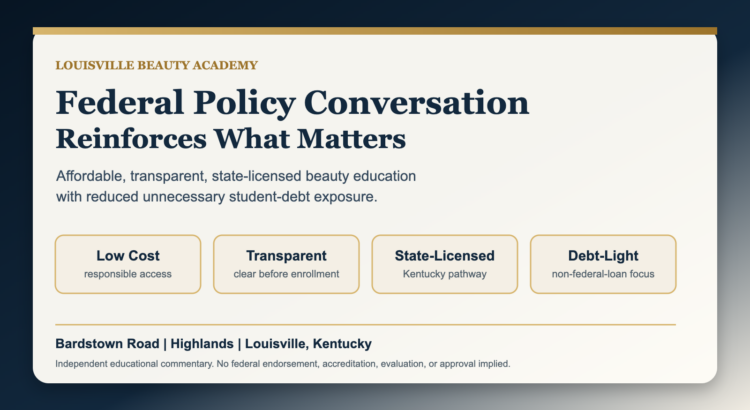
Rather, we believe this federal policy conversation reinforces many of the same educational principles that have guided Louisville Beauty Academy since its founding: affordability, transparency, responsible enrollment, practical workforce preparation, and helping students pursue state licensure without unnecessary financial burden.
A National Conversation That Reflects Long-Standing Principles
The Department’s final rule is designed to strengthen accountability for programs that leave students with federal student-loan debt that may not be supported by sufficient earnings outcomes.
Within its discussion of cosmetology education, the Department acknowledges that many cosmetology programs do not participate in the Federal student-loan program and discusses non-federally funded cosmetology programs with “lower tuition prices” and “similar outcomes”, while helping to supply the cosmetology workforce.
At the same time, the Department’s public announcement emphasizes protecting students from low-earning programs, driving down educational costs, supporting workforce needs, and improving accountability surrounding Direct Loan eligibility and program exemptions.
These are significant national policy themes.
A Needed Conversation About Prestige, Cost, and Student Debt
For years, accreditation has often been presented in beauty education as a marker of prestige. Accreditation can serve important purposes, but it can also be misunderstood by students and families when it is treated as the only measure of educational value.
The Department of Education’s June 29, 2026 final rule helps move the national conversation toward a more practical question: what is the real cost to the student, and does the program support responsible workforce preparation?
For Louisville Beauty Academy, this distinction matters. A state-licensed, lower-cost, non-federally dependent beauty education model should not be dismissed simply because it does not rely on federal student loans. Affordability, transparency, licensure preparation, and reduced student-debt exposure are also important measures of educational value.
In that sense, the conversation is shifting. Prestige alone is not enough. The future of responsible beauty education must also include cost honesty, student protection, workforce alignment, and practical outcomes.
Why This Is a Turning Point
For many years, much of the beauty education marketplace emphasized accreditation, access to federal financial aid, and institutional prestige as primary indicators of quality. The Department of Education’s June 29, 2026 rule expands the national conversation by placing greater emphasis on affordability, student outcomes, transparency, workforce preparation, and responsible educational value.
Louisville Beauty Academy believes students benefit when educational quality is evaluated not only by institutional structure, but also by cost, clarity, licensure preparation, and long-term financial responsibility.
Why This Matters to Louisville Beauty Academy
For Louisville Beauty Academy, this moment is meaningful not because the federal government singled out our institution, but because the broader policy direction aligns with the educational philosophy we have practiced for years.
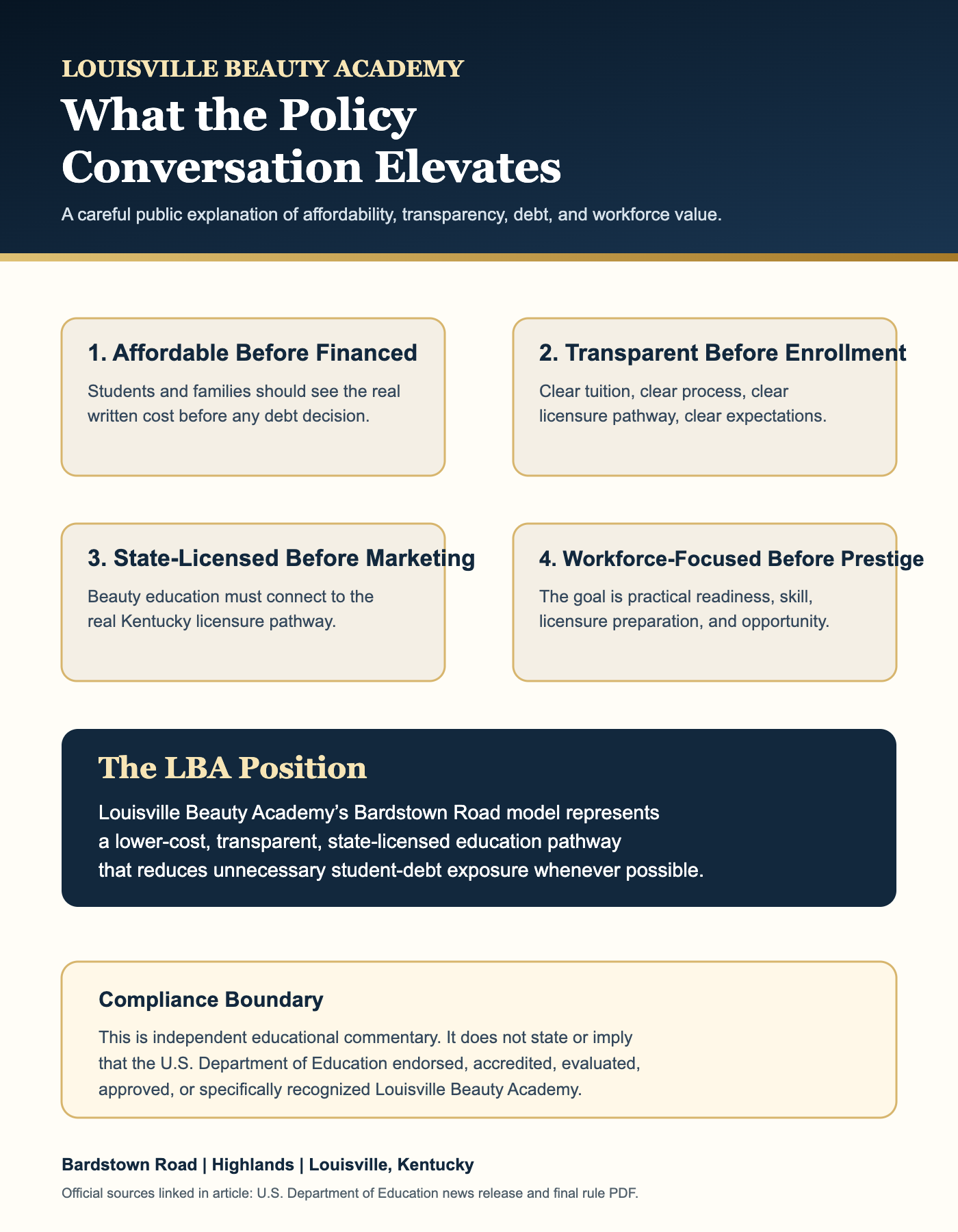
We have long believed that beauty education should be:
- Affordable before it is financed.
- Transparent before enrollment.
- Practical before promises.
- State-licensed before marketing.
- Workforce-focused before prestige.
- Honest about costs, expectations, and career pathways.
Our objective has never been to encourage unnecessary borrowing. Instead, we strive to provide an educational pathway that allows students to pursue licensed professions with clear expectations, practical skills, and financial responsibility.
Transparency Is a Student Protection Strategy
At Louisville Beauty Academy, transparency is not simply a business practice. It is part of our educational mission.
We believe students deserve to understand:
- the total tuition and fees before enrolling;
- the licensing requirements established by the Commonwealth of Kentucky;
- the difference between state licensure, institutional approval, and accreditation;
- expected attendance, training, and examination requirements;
- and the financial commitments associated with their education.
Clear information allows students and families to make informed decisions that are appropriate for their own goals and circumstances.
Serving the Workforce Through Accessible Education
Every year, Louisville Beauty Academy serves aspiring beauty professionals from a wide range of backgrounds, including working adults, career changers, recent high school graduates, immigrant and multilingual communities, parents returning to the workforce, and individuals seeking a practical, state-regulated career pathway.
Our mission has always been to expand opportunity through education that is accessible, responsible, and connected to real workforce needs.
A Local Model Within a National Policy Conversation
Louisville Beauty Academy is proud to be part of Louisville’s workforce education ecosystem. From our Bardstown Road location, we serve students who are seeking more than a class schedule. They are seeking a pathway, a skill, a license, and a future they can build with dignity.
The Department of Education’s final rule reminds the education sector that cost, debt, earnings, transparency, and student outcomes cannot be separated. These issues must be discussed honestly.
That is why this national policy moment matters to us.
It reinforces the importance of the model Louisville Beauty Academy continues to build: affordable, transparent, state-licensed, digitally accessible, workforce-connected, and student-centered.
Looking Forward
As conversations surrounding higher education accountability continue to evolve, Louisville Beauty Academy remains committed to continuous improvement, ethical educational practices, regulatory compliance, student success, and workforce development.
We believe affordable, transparent, state-licensed career education benefits not only individual students, but also employers, communities, and the broader economy.
Our commitment remains unchanged:
Provide quality education. Communicate honestly. Prepare students for licensure. Support workforce opportunity. Help students pursue careers without unnecessary financial burden whenever possible.
Important Disclaimer
This article is an independent educational commentary by Louisville Beauty Academy. It does not state or imply that the U.S. Department of Education has endorsed, accredited, evaluated, approved, or otherwise specifically recognized Louisville Beauty Academy. References to the Department’s June 29, 2026 final rule and related public materials are provided solely for educational and informational purposes. Readers are encouraged to review the official federal publications directly.
Official U.S. Department of Education Sources
- U.S. Department of Education news release on the final rule
- U.S. Department of Education final rule PDF, June 29, 2026