
Research Credit: This article is based on academic research prepared by Di Tran University — The College of Humanization, an educational research affiliate founded by Di Tran, who also serves as founder and CEO of Louisville Beauty Academy. This is a founder-affiliated publication, not an independent third-party study.
Educational Use Notice: Louisville Beauty Academy is sharing this research for educational and informational purposes as part of ongoing discussion about workforce development, vocational education, and entrepreneurship pathways in the modern economy. The material may include interpretations, data, or perspectives from external references.
Louisville Beauty Academy does not independently verify, endorse, or validate the specific conclusions of the research beyond the cited public sources, and provides the content for public learning and awareness. Readers are encouraged to review the original sources, citations, and studies referenced in the research for their own evaluation.
The global economic landscape is currently undergoing a structural metamorphosis driven by the maturation of artificial intelligence (AI), agentic systems, and autonomous robotics. This shift represents more than a mere technological update; it is a fundamental reconfiguration of the relationship between human capital, educational investment, and long-term economic security. As cognitive functions—once the protected domain of the credentialed middle class—become increasingly susceptible to algorithmic displacement, a counter-movement is emerging. This movement prioritizes high-touch physical services, state-protected licensing barriers, and short-cycle vocational training as the most resilient pathways to intergenerational wealth and psychological sovereignty. The following analysis explores the specific mechanisms through which the beauty and real estate industries, supported by innovative pedagogical models such as the humanization framework, provide a structural defense against the volatility of the AI-driven information economy.
The Architecture of Automation: Cognitive Displacement and Tactile Resilience
The rapid evolution of artificial intelligence has transitioned from a specialized tool for data analysis to a foundational amplifier across all business sectors.1 The emergence of agentic AI—systems capable of autonomous planning and the execution of complex, multi-step workflows—has introduced “virtual coworkers” into the enterprise environment, capable of performing tasks that were previously thought to require human reasoning, communication, and judgment.1
The Bifurcation of Work: Agents vs. Robots
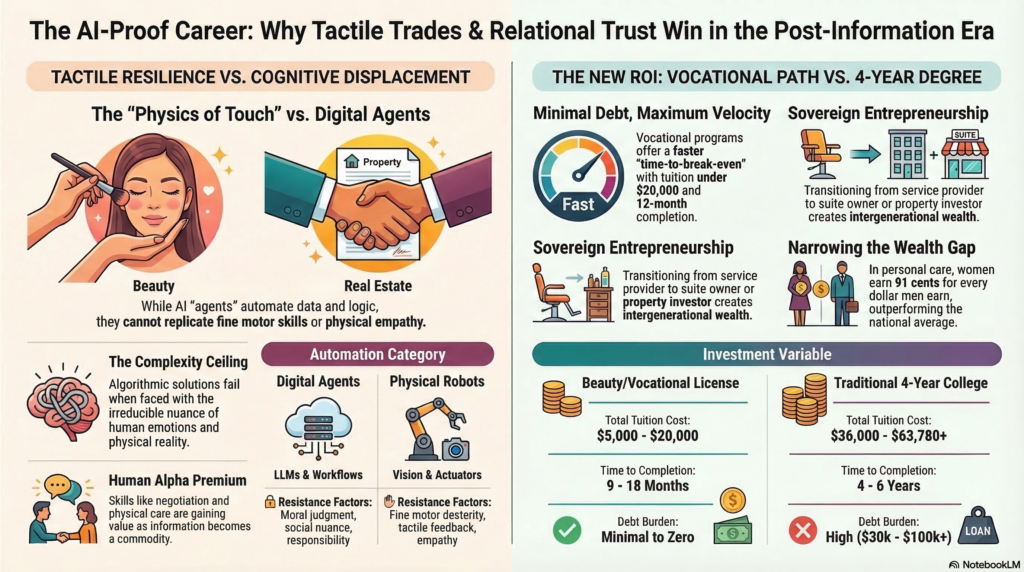
Current industrial research distinguishes between two primary forms of automation: “agents,” which automate nonphysical or cognitive labor, and “robots,” which automate physical work.2 While physical robotics faces significant challenges in replicating fine motor skills and navigating unstructured human environments, digital agents have reached a level of proficiency that allows them to summarize, code, reason, and make choices with minimal human intervention.3 This creates a profound bifurcation in the labor market. Jobs involving the “physics of touch”—such as personal care, specialized repairs, and complex physical coordination—possess a structural immunity to the current wave of generative AI.4
| Automation Category | Primary Mechanism | Susceptible Tasks | Resistance Factors |
| Digital Agents | LLMs, Agentic Workflows | Data entry, basic coding, report writing, administrative planning | Moral judgment, social nuance, responsibility 2 |
| Physical Robots | Computer Vision, Actuators | Manufacturing, repetitive logistics, predictable maintenance | Fine motor dexterity, empathy, tactile feedback 1 |
Data from the McKinsey Global Institute indicates that while current technology could theoretically automate 57% of U.S. work hours, the future of work will likely be characterized by “superagency”—a collaborative state where AI increases personal productivity while humans retain control over high-level interpretation and decision-making.2 However, this collaboration is not equally accessible to all professions. High-exposure roles in accounting, coding, and middle management are being compressed, while low-exposure roles in interpersonal services—such as negotiation, coaching, and physical care—are gaining a “human alpha” premium.2
The Complexity Ceiling and Human Alpha
The concept of the “Complexity Ceiling” suggests that AI adoption will eventually hit a plateau where the friction of physical reality and the irreducible nuance of human systems render algorithmic solutions inefficient.6 While AI can optimize a spreadsheet, it cannot navigate a basement full of water, calm a panicked first-time homebuyer, or execute the delicate tactile nuances of a manicure.4 Consequently, the competitive advantage in the 2025-2035 economic cycle is shifting from “information asymmetry”—knowing something the client does not—to “relational trust” and “creative problem-solving”.7
The Beauty Industry: A Structural Case Study in Tactile Security
The beauty and personal care sector represents one of the most resilient segments of the U.S. service economy. With global sales exceeding $511 billion in 2021 and projected to surpass $716 billion by 2025, the industry offers a combination of high demand, non-outsourceable labor, and a low barrier to entrepreneurial entry.9
Global Market Dynamics and Growth Projections
The nail salon segment is a particularly vibrant component of this sector, valued at approximately $8.8 billion to $12.9 billion in 2024.10 The market is expected to grow at a Compound Annual Growth Rate (CAGR) of 4.5% to 8.2% through 2034, driven by increasing consumer awareness of self-care, the rise of men’s grooming trends, and the influence of Gen Z aesthetic art.10
| Market Metric | 2024 Base Value | 2030-2034 Forecast | CAGR |
| Global Nail Salon Market | $8.8B – $12.9B | $13.7B – $20.3B | 4.5% – 8.2% 10 |
| U.S. Nail Care Market | $2.9B | $3.5B+ (Projected) | 2.6% – 4.5% 10 |
| Dominant Service | Manicure ($3.1B) | UV Gel / Extensions (9.5% CAGR) | 7.9% – 9.4% 10 |
The industry’s structural resistance to AI stems from the “physics of touch.” Machines cannot replicate the empathy and fine motor skills required for personal grooming, nor can they provide the “therapeutic power of care” that clients seek in a salon environment.4 Beauty professionals often serve as informal mental wellness supports, offering active listening and emotional grounding that AI cannot currently simulate.14
The “Million Dollar Paradox” and Immigrant Wealth Creation
A critical insight into the beauty economy is the “Million Dollar Paradox”—the observation that family-owned salons often generate substantial revenue and intergenerational wealth while being perceived as low-status work by outsiders.4 In immigrant communities, particularly among Vietnamese and Latino families, the salon serves as a “first-access ownership pathway”.4
The Vietnamese Blueprint
The dominance of the Vietnamese American community in the nail industry is a result of a historical convergence of humanitarian effort and entrepreneurial grit. Following the Fall of Saigon in 1975, actress Tippi Hedren facilitated the training of 20 Vietnamese women at a refugee camp in California, enlisting her personal manicurist to teach them the craft.15 This created a “stepping stone” for thousands of refugees who lacked English fluency but possessed the manual dexterity and work ethic to succeed in a tactile trade.17
Today, Vietnamese Americans make up approximately 51% to 82% of the nail technician workforce in states like California.17 The industry has moved beyond survival to become a multibillion-dollar economy characterized by vertical integration, where successful families own the commercial real estate housing their salons, thus capturing both service margins and rental income.4
Latino Barbershops as Community Anchors
Similarly, Latino-owned barbershops function as “community anchors” and “safe havens”.19 These establishments are more than grooming centers; they are social hubs that build collective efficacy, facilitate public health interventions (such as blood pressure screenings), and provide protective “neighborhood effects” against violence.19 Latino entrepreneurs start businesses at a rate nearly double their representation in the overall population, and the beauty sector provides a critical entry point for building the intergenerational wealth necessary to close existing parity gaps.20
Real Estate Licensing: Trust-Based Defense and the Agent-Investor Pivot
Real estate is often cited as a high-risk sector for automation, with some studies predicting a 86% to 97% likelihood of automation for brokers and sales agents.21 However, these figures often overlook the “irreducible complexity” of the transaction management and negotiation process.7
The Resilience of Human Judgment in Property Transactions
While AI can automate property searches, market data analysis, and document drafting, it cannot navigate the emotional attachment of a seller to a family home or the psychological fear of a buyer facing a major financial commitment.7 The “actual work” of a real estate professional occurs in spaces AI cannot reach, such as interpreting the significance of a foundation crack or coordinating pre-listing repairs with local contractors.7
Skills that are gaining a “human premium” in the AI era include:
- Contextual Problem Solving: Integrating technical data with market psychology.7
- Negotiation Strategy: Finding creative, non-linear solutions to physical and contractual obstacles.6
- Local Market Insight: Possessing a “trust network” that takes years to build and cannot be replicated by data scrapers.7
The Wealth Pathway: From Agent to Institutional-Scale Investor
A structural pathway to self-security for real estate professionals involves the transition from commission-based services to property investment. Since the start of the pandemic, investor activity in the single-family rental (SFR) market has surged, with investors purchasing up to 28% of single-family homes in certain quarters.23 Real estate agents are uniquely positioned to leverage their license and market knowledge to identify undervalued assets, manage portfolios, and build equity.21
| Investor Segment | Property Portfolio Size | Footprint Characteristics |
| Mega SFR Investors | 1,000+ Properties | Diverse locations (median 33 MSAs) 25 |
| Local Investors | 100 – 1,000 Properties | Concentrated (75%+ in one MSA) 25 |
| Small Investors | 3 – 10 Properties | Rapidly growing segment during the pandemic 23 |
By integrating the roles of licensed advisor and active investor, professionals can insulate themselves from the “downward pressure on commissions” and the potential obsolescence of the traditional brokerage model.21
The Educational Reformation: Short-Cycle Vocational Entrepreneurship
The traditional “credential-to-career” pipeline is facing a crisis of ROI. As university tuition costs soar, students are graduating with an average of $30,000 to $100,000 in debt, only to enter a labor market where entry-level white-collar roles are being compressed by AI.26 In response, a “short-cycle” vocational model is emerging as a superior alternative for economic mobility.
Comparative ROI: Vocational License vs. Bachelor’s Degree
Research indicates that beauty school and real estate licensing offer a significantly faster “time-to-break-even” than traditional four-year degrees.28 A cosmetology program typically costs between $5,000 and $20,000 and takes 12 to 18 months to complete.28 Graduates can enter the workforce and begin building a client base by age 19 or 20, whereas college graduates may not start earning until age 22, often burdened by debt that takes 20 years to repay.26
| Investment Variable | Beauty School (Cosmetology) | Traditional 4-Year College |
| Total Tuition Cost | $5,000 – $20,000 | $36,000 – $63,780+ |
| Time to Completion | 9 – 18 Months | 4 – 6 Years |
| Opportunity Cost | $20,000 – $35,000 | $150,000 – $250,000 |
| Starting Salary Range | $25,000 – $35,000 | $52,000 – $64,000 |
| Mid-Career Potential | $55,000 – $100,000+ | $65,000 – $90,000 |
| Debt Burden | Minimal to Zero | High ($30k – $100k+) 26 |
A critical advantage of the vocational path is “Vertical Growth.” An established beauty professional can scale their income through suite rental, product sales, and education, often reaching six-figure earnings with significantly lower overhead than a corporate professional.26
The Louisville Beauty Academy Case Study: The Lower-Debt Model
The Louisville Beauty Academy (LBA) serves as an applied institutional model for “Humanized Vocational Excellence”.31 By rejecting the federal Title IV funding system (Pell Grants and student loans), LBA keeps tuition under $7,000 for its 1,500-hour cosmetology program, compared to $15,000-$25,000 at aid-reliant institutions.31
LBA’s “Fiscal Velocity” model demonstrates that when students are not burdened by interest-bearing debt, their “Entrepreneurship Probability” increases by 11% to 14%.32 Furthermore, the academy uses a “clock-hour” system with biometric attendance mandates to ensure that “minimum competence” for public safety is strictly verified, setting a national standard for regulatory compliance.31
The Humanization Philosophy: “Yes I Can” Methodology
The philosophical core of this new vocationalism is the “College of Humanization,” founded by Di Tran. This framework posits that in the AI era, education must move beyond the teaching of facts—which AI can do—toward “humanizing people” and fostering dignity.4
Key tenets of the humanization framework include:
- The Rejection of Shame: Challenging students to see beauty and trades as premier vehicles for business ownership rather than “fallback” careers.4
- Action-Oriented Pedagogy: Viewing the license as a “humanized record of action” and a “declaration of independence” rather than just a job application.4
- The Physics of Touch: Validating that empathy, creativity, and fine motor skills are the ultimate “AI-proof” moats.4
Macroeconomic Impact: Fiscal Velocity and Taxpayer Savings
The shift toward lower-debt, short-cycle vocational training has profound implications for public finance and regional economic stability. Traditional beauty schools operate almost entirely on federal aid, converting taxpayer subsidies into vocational tuition and eventual student debt.32
The Mathematical Case for Non-Subsidized Education
By operating outside the Title IV system, LBA represents a direct saving to the public treasury. The formula for annual taxpayer savings per 100 students () can be modeled as follows:

Where:
is the total disbursed Pell Grant funds.
is the interest subsidy on federal loans.
is the additional tax revenue generated by graduates entering the workforce
months earlier due to “Fiscal Velocity”.31
LBA’s model projects a taxpayer saving of over $5.8 million per 100 students over a five-year horizon.31 This capital remains in the federal and state treasuries, available for other public services, while students build “economic muscle” rather than financial liability.33
Closing the Gender and Racial Wealth Gaps
The beauty industry is a primary driver of female and minority entrepreneurship. In 2024, women owned nearly 40% of all U.S. companies, with women-owned businesses growing 1.4 times faster than those owned by men.34 However, women-owned firms still generate only 40% of the revenue of men-owned businesses, a “revenue gap” that would add $10.2 trillion to the economy if closed.34
| Workforce Segment | Female Representation (%) | Revenue as % of Male Equivalent |
| Beauty/Personal Care | 90%+ (Nails) | 91% (Service Parity) 35 |
| Healthcare Jobs | 77% | 66.7% – 81.1% 36 |
| Overall U.S. Labor Force | 47%+ | 80.9% – 85% 38 |
| Latina Women (Full Time) | 17% (Force Share) | 58% (vs. White Men) 20 |
Vocational licensing provides a “Structural Floor” for wages. In the personal care sector, the gender wage gap is significantly narrower than the national average, with women earning 91 cents for every dollar earned by men.35 By facilitating business ownership through salon suites and independent contracting, the industry allows women to bypass corporate “allocative discrimination” and set their own price premiums.24
The Future of Sovereign Entrepreneurship: Suites, Investments, and AI Synergy
The final stage of the structural pathway to economic self-security is the adoption of the “Sovereign Entrepreneur” model. This model integrates AI tools for efficiency with the “Human Alpha” of licensed services.
The Salon Suite Revolution
The beauty industry is rapidly transitioning from booth rental to suite ownership. Unlike the commission model where the salon takes 50% of revenue, or the booth rental model with shared resources and limited branding, the salon suite offers a “private studio” environment.42 Suite owners report a 15% to 25% increase in take-home income and 40% higher client retention rates due to the personalized experience.24
| Financial Factor | Traditional Booth Rental | Salon Suite Owner |
| Monthly Overhead | $1,475 – $1,625 | $800 – $1,200 |
| Service Revenue Retained | 100% | 100% |
| Retail Profit | 10% (Commission) | 50% (Direct Profit) |
| Tax Advantages | Limited | Comprehensive Deductions 24 |
The Real Estate-Beauty Nexus
The ultimate structural moat is “Vertical Integration” across service and asset classes. Successful beauty entrepreneurs often leverage their free cash flow to invest in real estate, mirroring the “Million Dollar” success seen in the Vietnamese American community.4 Similarly, real estate agents utilize their market access to transition from “transactional sales” to “long-term institutional-style investment”.21
This convergence creates an “antifragile” economic profile:
- AI-Proof Service: Licensing protects the right to practice high-touch, empathetic trades.4
- Asset-Based Wealth: Real estate holdings provide passive income and hedge against inflation.23
- Efficiency Through AI: AI is utilized “behind the scenes” to automate administrative “grunt work,” allowing the professional to focus on relationship-building and high-level negotiation.22
Synthesis: Redefining Value in the Post-Information Era
The transition to the AI era is not a threat to human labor but a catalyst for the “Humanization of Value.” As algorithmic systems master the “what” and the “how,” the human professional becomes the master of the “who” and the “why.” Structural pathways to economic self-security are no longer found in the mass accumulation of cognitive credentials but in the strategic acquisition of state-licensed tactile skills, the avoidance of interest-bearing educational debt, and the courageous transition from service provision to asset ownership.
The data supports a clear trajectory: the ROI of short-cycle vocational training now exceeds that of many traditional four-year degrees when adjusted for debt and opportunity cost. The beauty and real estate industries—historically viewed as secondary or “side hustle” fields—are emerging as the primary engines of immigrant economic mobility, female entrepreneurship, and intergenerational wealth creation. By embracing the philosophy of humanization and the technical capabilities of vocational excellence, the modern professional can secure a sovereign economic future that is both resilient to technological displacement and profoundly aligned with human dignity.
Works cited
- Technology Trends Outlook 2025 – McKinsey, accessed March 10, 2026, https://www.mckinsey.com/~/media/mckinsey/business%20functions/mckinsey%20digital/our%20insights/the%20top%20trends%20in%20tech%202025/mckinsey-technology-trends-outlook-2025.pdf
- AI: Work partnerships between people, agents, and robots | McKinsey, accessed March 10, 2026, https://www.mckinsey.com/mgi/our-research/agents-robots-and-us-skill-partnerships-in-the-age-of-ai
- AI in the workplace: A report for 2025 – McKinsey, accessed March 10, 2026, https://www.mckinsey.com/capabilities/tech-and-ai/our-insights/superagency-in-the-workplace-empowering-people-to-unlock-ais-full-potential-at-work
- humanized education framework Archives – Louisville Beauty …, accessed March 10, 2026, https://louisvillebeautyacademy.net/tag/humanized-education-framework/
- AI may hurt US jobs more than expected, McKinsey finds — but there’s a surprising upside : r/Futurology – Reddit, accessed March 10, 2026, https://www.reddit.com/r/Futurology/comments/1p9iz90/ai_may_hurt_us_jobs_more_than_expected_mckinsey/
- The last graduate intake: Is AI the end of the property professional? – Artefact, accessed March 10, 2026, https://www.artefact.com/blog/the-last-graduate-intake-is-ai-the-end-of-the-property-professional/
- Real Estate Agents Face Low AI Displacement Risk Due to Human-Centric Skills, Expert Says | Newsworthy.ai, accessed March 10, 2026, https://newsworthy.ai/curated/real-estate-agents-face-low-ai-displacement-risk-due-to-human-ce/202628740
- Will AI Replace Real Estate Agents? – ClickUp, accessed March 10, 2026, https://clickup.com/blog/hub/ai/replace/real-estate-agents/
- Harnessing Growth Opportunities in the Beauty Industry | SCF, accessed March 10, 2026, https://sallyportcf.com/harnessing-growth-opportunities-in-the-beauty-industry/
- Nail Salon Market Size, Share & Analysis Report, 2025 – 2034, accessed March 10, 2026, https://www.gminsights.com/industry-analysis/nail-salon-market
- Nail Salon Market Size, Share, Trends, Growth Report, 2030, accessed March 10, 2026, https://www.grandviewresearch.com/industry-analysis/nail-salon-market-report
- Nail Salon Market Size, Growth Analysis Report [2033] – SkyQuest Technology, accessed March 10, 2026, https://www.skyquestt.com/report/nail-salon-market
- Nail Care Market Trends and Regional Growth Opportunities, 2025-2030 – GlobeNewswire, accessed March 10, 2026, https://www.globenewswire.com/news-release/2025/02/12/3024813/28124/en/Nail-Care-Market-Trends-and-Regional-Growth-Opportunities-2025-2030-Rising-Use-of-UV-LED-Nail-Dryers-Sets-the-Stage-for-Market-Expansion.html
- Tag: Di Tran University podcast – Louisville Beauty Academy, accessed March 10, 2026, https://louisvillebeautyacademy.net/tag/di-tran-university-podcast/
- Vietnamese Nail Industry – AAPI History Museum, accessed March 10, 2026, https://aapihistorymuseum.org/vietnamese-nail-industry/
- The History of Vietnamese Nail Salons: A Journey of Resilience and Entrepreneurship, accessed March 10, 2026, https://www.beamnailbar.com/blog/the-history-of-vietnamese-nail-salons-a-journey-of-resilience-and-entrepreneurship
- Beneath the Polish: The Untold Stories of Vietnamese Nail Workers – The Hornet, accessed March 10, 2026, https://fchornetmedia.com/34002/inside-fullerton/beneath-the-polish-the-untold-stories-of-vietnamese-nail-workers/
- How Vietnamese Americans Revolutionized the U.S. Nail Industry: A Story of Determination and Opportunity – Whale Spa, accessed March 10, 2026, https://whalespa.com/blogs/news/how-vietnamese-americans-revolutionized-the-u-s-nail-industry-a-story-of-determination-and-opportunity
- “It’s All About Just Creating the Safe Space”: Barbershops and Beauty Salons as Community Anchors in Black Neighborhoods: Crime Prevention, Cohesion, and Support During the COVID-19 Pandemic – PMC, accessed March 10, 2026, https://pmc.ncbi.nlm.nih.gov/articles/PMC9618922/
- Latino Economic Mobility | McKinsey & Company, accessed March 10, 2026, https://www.mckinsey.com/institute-for-economic-mobility/our-focus-areas/latino-economic-mobility
- Is Job Security Something Real Estate Agents Need to Worry About?, accessed March 10, 2026, https://www.upnest.com/post/future-of-real-estate-how-safe-are-real-estate-agent-jobs/
- AI Can’t Replace Relationships – The Human Advantage in Real Estate, accessed March 10, 2026, https://blog.buffini.com/ai-cant-replace-relationships-the-human-advantage-in-real-estate/
- 8 Facts About Investor Activity in the Single-Family Rental Market – Harvard Joint Center for Housing Studies, accessed March 10, 2026, https://www.jchs.harvard.edu/blog/8-facts-about-investor-activity-single-family-rental-market
- Unlock Your Success: Booth Rental Comparison – Encore Salon Suites, accessed March 10, 2026, https://encoresalonsuites.com/post/booth-rental-comparison/
- A Profile of Institutional Investor– Owned Single-Family Rental Properties | Urban.org, accessed March 10, 2026, https://www.urban.org/sites/default/files/2023-08/A%20Profile%20of%20Institutional%20Investor%E2%80%93Owned%20Single-Family%20Rental%20Properties.pdf
- Beauty School vs. Traditional College: Which Path Offers Better ROI in Today’s Economy?, accessed March 10, 2026, https://www.findarticles.com/beauty-school-vs-traditional-college-which-path-offers-better-roi-in-todays-economy/
- Benefit Attending Beauty School Versus A Traditional Four Year College -, accessed March 10, 2026, https://www.libs.edu/beauty-school-versus-traditional-four-year-college/
- Is Cosmetology School Worth It? The Complete 2026 Guide with Real Data, accessed March 10, 2026, https://cosmetologyandspaacademy.edu/is-cosmetology-school-worth-it-what-you-should-know-before-enrolling/
- 2026 Cosmetology Degree Guide: Costs, Requirements & Job Opportunities, accessed March 10, 2026, https://research.com/degrees/cosmetology-degree
- Top Gender Pay Gap Statistics – Forbes Advisor, accessed March 10, 2026, https://www.forbes.com/advisor/business/gender-pay-gap-statistics/
- The Humanization of Vocational Excellence: A Kentucky Case Study …, accessed March 10, 2026, https://louisvillebeautyacademy.net/the-humanization-of-vocational-excellence-a-kentucky-case-study-of-cosmetology-education-safety-sanitation-law-and-the-louisville-beauty-academy-model-for-compliance-community-service-and-debt-f/
- Tag: lower-debt vocational pathways – Louisville Beauty Academy, accessed March 10, 2026, https://louisvillebeautyacademy.net/tag/lower-debt-vocational-pathways/
- Tag: grit theory in education – Louisville Beauty Academy, accessed March 10, 2026, https://louisvillebeautyacademy.net/tag/grit-theory-in-education/
- Women-Owned Businesses Are Growing Fast—But Still Face a $10 Trillion Revenue Gap, accessed March 10, 2026, https://mbemag.com/articles/women-owned-businesses-are-growing-fast-but-still-face-a-10-trillion-revenue-gap/
- The gender pay gap for women hairdressers, hairstylists, and cosmetologists – Narrow the Gap, accessed March 10, 2026, https://narrowthegap.co/gap/hairdressers-hairstylists-and-cosmetologists/
- The gender wage gap among health care workers across educational and occupational groups – PMC, accessed March 10, 2026, https://pmc.ncbi.nlm.nih.gov/articles/PMC10986226/
- NATIONAL PAY GAP OVERALL VS. HEALTHCARE – Syndio, accessed March 10, 2026, https://synd.io/wp-content/uploads/2020/03/Syndio-Healthcare-White-Paper-2020.pdf
- Equal Pay in 2025: Gender Gaps Increased, Forecast for Achieving Pay Equity Bleaker, accessed March 10, 2026, https://iwpr.org/equal-pay-in-2025-gender-gaps-increased-forecast-for-achieving-pay-equity-bleaker/
- Gender pay gap remained stable over past 20 years in US | Pew Research Center, accessed March 10, 2026, https://www.pewresearch.org/short-reads/2025/03/04/gender-pay-gap-in-us-has-narrowed-slightly-over-2-decades/
- IWPR’s New National Annual Women’s Wage Gap Analysis Shows Second Consecutive Year of Decline, accessed March 10, 2026, https://iwpr.org/iwprs-new-national-annual-womens-wage-gap-analysis-shows-second-consecutive-year-of-decline-2/
- The Gender Wage Gap, Between-Firm Inequality, and Devaluation: Testing a New Hypothesis in the Service Sector – PMC, accessed March 10, 2026, https://pmc.ncbi.nlm.nih.gov/articles/PMC10704960/
- Salon Cost Comparison: Suite vs Traditional Salon Income, accessed March 10, 2026, https://salonsdelegance.com/salon-cost-comparison-salon-suite-vs-traditional/
- The True Cost Comparison: Salon Suite vs. Booth Rental for Independent Beauty Pros, accessed March 10, 2026, https://indiesalons.com/denver-salon-suite-cost-vs-booth-rental-financials/