At Louisville Beauty Academy, a Kentucky State-Licensed and state-licensed beauty college, we are committed to preparing our students for real-world success. Since our founding, we have proudly graduated nearly 2,000 licensed beauty professionals, whose work contributes an estimated $20 to $50 million annually to the economy of Kentucky and beyond.
Choosing your beauty career path is exciting — but it’s also a decision that benefits from careful research and a clear understanding of the industry. Whether your passion lies in Nail Technology, Esthetics, or Hair (Cosmetology), understanding the service frequency and career demand in each area can help you make the choice that best fits your goals, lifestyle, and earning potential.
Why Service Frequency Matters
In the beauty industry, how often a client returns directly impacts the predictability of your bookings and your revenue potential. These are basic human services — they will always be needed — but the frequency of that need varies from one specialty to another.
1. Nails — The Highest Repeat Rate
Average Frequency: Every 2 weeks or less for most regular clients (gel, dip, acrylics).
Why: Nail polish chips, gels and acrylics grow out, and many people maintain a standing schedule for well-groomed hands and feet.
Reality: Many nail clients pre-book their next visit before leaving the salon, creating a predictable, high-retention client base.
Impact: This repeat cycle offers stability and consistency, making nail technology one of the fastest ways to build a loyal clientele.
2. Esthetics — Moderate to High Frequency
Average Frequency: Typically monthly, but many services draw clients back every 2–4 weeks.
Examples:
Lash extensions → fills every 2–3 weeks
Brow shaping/waxing → every 3–4 weeks
Skincare programs → monthly facials or targeted treatments
Reality: Esthetic clients, especially those in ongoing programs, can match nail tech clients in repeat visits — offering both steady income and opportunities for upselling additional treatments.
3. Hair (Cosmetology) — Lower Frequency
Average Frequency: Every 6–8 weeks for most clients, sometimes longer.
Exceptions:
Short hair or precision cuts → every 4–6 weeks
Color touch-ups → every 4–8 weeks
Reality: Many hair clients extend visits to save money or because their style requires less frequent upkeep, which can make recurring revenue less predictable compared to nails or high-frequency esthetics.
Quick Comparison: Repeat Demand Potential
Service
Common Repeat Interval
Predictability of Bookings
Revenue Stability
Nails
2 weeks
Very High
Strong recurring revenue
Esthetics
2–4 weeks
High (varies by service type)
Solid, especially with memberships
Hair
4–8+ weeks
Moderate to Low
Less consistent unless short style or frequent color
Why This Matters for Your Career
Regardless of which path you choose, these fields are built on human connection and repeat service. The difference lies in how often clients come back — and that affects how quickly you can fill your schedule, grow your income, and plan your business.
At Louisville Beauty Academy, we guide students not only through technical training but also through career planning — helping them understand the realities of client demand, local market conditions, and business growth strategies.
About Louisville Beauty Academy
state-licensed beauty college
Nearly 2,000 graduates contributing $20–$50 million annually to the economy
Programs in Nail Technology, Esthetics, and Cosmetology
Commitment to affordable, flexible, and lower-debt education
Disclaimer: This article is for educational purposes only and reflects industry observations and publicly available data. Information may change over time. No guarantee of future income, employment, or career results is implied.
Louisville Beauty Academy (LBA) is redefining beauty education with an unprecedented model that both slashes tuition costs and speeds up graduation. This means students save thousands upfront and start earning in the beauty industry much sooner than they would through traditional schools. With built-in tuition discounts of 50–75%, LBA offers a rare opportunity for students to graduate lower-debt – something virtually unheard of in beauty schooling. At the same time, the academy’s fast-track programs enable motivated students to get licensed and join the workforce in a fraction of the usual time. The result is money in the student’s pocketnow (through immediate savings) and later (through earlier career earnings) – a true double benefit for those serious about success.
Unprecedented Tuition Savings – 50–75% Off the Usual Cost 💰
Attending LBA is dramatically more affordable than a typical cosmetology school. Total tuition at LBA (including books and cosmetology kit) is under $7,000, which is about 50–75% lower than the tuition at comparable beauty programs. In fact, LBA’s pricing model saves students over $10,000 on average compared to other Kentucky cosmetology schools – a unique advantage that lets many LBA students pay as they go and avoid student loans entirely. Key highlights of this ultra-affordable model include:
Deep Tuition Discounts: Through internal scholarships and incentives, LBA tuition is slashed by half or more. For example, the 1,500-hour cosmetology program’s cost can drop from about $27,000 down to $6,250 for eligible students – roughly a 75% discount. Shorter programs see similar huge savings (e.g. Nail Technology is $3,800 with discounts, down from $8,325). Such low pricing is unmatched in the industry and has “never existed in the history of beauty school” in terms of built-in discounts.
Lower-Debt Pathway: Because tuition is so low, students can make manageable out-of-pocket payments or use written payment payment plans – no need for federal loans at all. This means no crushing debt upon graduation. By comparison, cosmetology graduates nationally carry about $10,000 in student loan debt on average, and many spend years after school repaying loans with interest. LBA’s model spares students that burden completely.
All-Inclusive Pricing: LBA’s tuition includes all essential supplies – your textbooks, kit, and materials are covered in that $7K-or-less package. There are no surprise add-on costs. This all-inclusive approach makes budgeting straightforward and further reduces out-of-pocket expenses for students. In short, you get a quality beauty education at a fraction of the cost of other schools.
By keeping education affordable, LBA enables students to start their careers with financial freedom from day one. Graduates aren’t weighed down by loan payments, so they can focus on building their business or advancing their craft instead of worrying about debt. It’s a liberating feeling that lets new professionals seize opportunities – whether that’s pursuing advanced certifications or even opening their own salon – without the usual financial stress. In an industry where most students have had to borrow heavily just to get trained, Louisville Beauty Academy stands out as a beacon of lower-debt education.
Fast-Track Graduation – Get Licensed and Earning Sooner 🏃♀️💨
LBA not only saves students money – it also saves them time. The academy is structured to get students licensed as efficiently as possible, so they can enter the workforce and start earning income quickly. How does LBA fast-track your education? It comes down to focused programs, flexible scheduling, and a priority on hard work and full-time attendance:
Targeted Programs, No Time Wasted: Louisville Beauty Academy offers each beauty licensure program as a standalone, focused track with exactly the state-required hours – nothing more, nothing less. Want to be just a nail technician? You can enroll in the 450-hour Nail Tech program and finish in a few months, instead of being forced into a 1,500-hour cosmetology course like many schools do. Similarly, future estheticians complete 750 hours for a skincare license, shampoo stylists 300 hours, etc., without having to spend time learning unrelated skills. This focused approach accelerates graduation by sparing students unnecessary coursework, yet still gets them fully qualified for licensing in their chosen specialty. It’s a modern answer to the outdated “one-size-fits-all” cosmetology program that can take 1–2 years to cover hair, skin, and nails in one huge curriculum. LBA’s philosophy: learn exactly what you need for the career you want, and get out into the real world faster.
Flexible Scheduling & Year-Round Enrollment: LBA operates on an open-enrollment, self-paced schedule that lets industrious students move at their own speed. There are no rigid semesters holding you back. If you commit to full-time hours, you can power through the program quickly. In fact, a motivated student can complete the full 1,500-hour cosmetology course in as little as ~9 to 10 months – which is about the fastest possible for that length of program. Many traditional beauty schools drag this out to 12–18 months, but LBA gives you the flexibility to finish as soon as you hit the required hours. The academy even has rolling graduations – students can and do finish weekly or even daily, whenever they achieve their hours and competencies. This means no waiting around; you receive your credential and can go straight to taking your state board exam and job hunting at the earliest opportunity.
Attendance Incentives – Work Hard, Save More: LBA actively encourages full-time attendance and consistent progress, not only because it helps you finish faster, but also because it maximizes your financial aid from the school. The generous tuition discounts and scholarships at LBA are often tied to meeting attendance and performance benchmarks (as detailed in the student contract). In other words, if you show up, work hard, and stay on track, you reap the full benefit of the 50–75% tuition reduction. This is a win-win setup: students who are serious and diligent get rewarded with lower costs and quicker graduation, while the academy produces successful graduates at a steady clip. LBA’s CEO, Di Tran, designed this model knowing that **“stay in school long” is usually a loss – in time and money – for goal-driven students. So why not remove the usual delays and push students to finish as soon as they’re able? The faster you graduate, the faster you can start making real money in the field.
By streamlining its programs for speed and flexibility, Louisville Beauty Academy empowers those “salon-owner material” students – the go-getters who mean business – to achieve their goals without unnecessary delay. There’s no sitting around waiting for a new semester or dragging out courses just to pad tuition. If you’re eager to launch your career, LBA is eager to get you there NOW.
Double Benefit: Save Thousands and Start Earning Sooner 💵⏱️
Perhaps the most exciting part of LBA’s model is how the financial benefits compound. Students not only save money upfront with discounted tuition, but also gain income by entering the job market earlier. It’s a one-two punch that puts substantial money in their pocket “here and now,” not years down the road. The math is straightforward for those who truly value their time and investment:
Savings in Education Costs: First, consider the direct savings. As noted, LBA students often pay $10,000+ less for their education than they would elsewhere. For example, a cosmetology student who might pay $17,000 (plus interest on loans) at another school can pay around $6,000 at LBA for the same license. That’s roughly $11,000 kept in the student’s pocket. And because LBA students typically don’t need loans, they also avoid accruing interest. (By contrast, a $9,600 loan could end up costing over $12,000 with interest in repayment – money that a lower-debt LBA grad never has to spend.) In short, LBA graduates start their careers owing nothing, whereas a typical new cosmetologist might be $10–15K in the hole before their first day of work.
Earlier Entry = Earlier Earnings: Now factor in time. Thanks to the fast-track approach, LBA graduates enter the workforce months sooner than their peers at longer programs. Those extra months have real monetary value. Beauty professionals can earn solid wages – in Kentucky, for instance, cosmetologists earn about $48,700 annually on average (roughly $4,000 per month). If an LBA student graduates even 3 months earlier, that’s potentially on the order of $12,000 in additional earnings (3 × $4K) simply because they’re out working instead of still in class. Many LBA students may graduate 6+ months faster than they would in a drawn-out program, which doubles that advantage. Every week not spent in school is a week earning real income from clients. This is why “staying in school long” can truly mean losing money, and LBA works to prevent that loss.
The ~$20,000 Difference: Combine the tuition savings plus the early-career earnings, and you see why LBA often speaks of a nearly $20,000 swing in students’ favor. By committing to full-time attendance and finishing promptly, an LBA student might save around $10K in school costs and make an extra $8–$10K from getting into the job market faster – a combined financial impact that is life-changing. This isn’t fanciful theory; it’s a realistic scenario for many LBA graduates. The academy’s own students recognize that they are “saving nearly $20,000 simply by committing to full-time attendance and completing their program” on the accelerated timeline. It’s like getting a double scoop of success: you spend a lot less and you start earning much more, all thanks to finishing school quickly.
Crucially, these benefits aren’t just short-term. Graduating lower-debt and earlier sets students up for long-term success. From day one, LBA grads have financial freedom – they can invest in better tools, further training, or even start their own business with the money others would be devoting to loan payments. Many LBA alumni are indeed entrepreneurial; with no debt weighing them down, they can take bold steps like launching a salon or studio early in their careers. This entrepreneurial jump-start is exactly what LBA’s founder envisioned: helping hard-working, ambitious students build wealth sooner rather than later. It’s great for the graduates and also great for the community – these newly licensed professionals are contributing to the local economy faster, filling in-demand jobs and even creating jobs for others. (The beauty industry is growing steadily – projected ~7% job growth nationally through 2033 – so getting skilled workers out there faster has real economic impact.)
A New Standard in Beauty Education 🎓✨
Louisville Beauty Academy’s model is truly revolutionary in the beauty education landscape. Few (if any) schools offer such steep tuition discounts upfront or actively push students to graduate faster for their own benefit. Traditionally, beauty schools have thrived on the opposite – high tuition, prolonged programs, and reliance on federal student aid. (The industry received over $1 billion in federal student aid in 2019–2020 alone, and many for-profit beauty colleges have been accused of being “loan mills” that keep students enrolled longer to maximize tuition.) LBA turns that model on its head. By keeping costs ultra-low, forgoing federal financial aid, and focusing on outcomes over profits, LBA has carved out a niche that did not exist before – an ethical, student-centered path where graduating fast and lower-debt is the norm, not the exception.
For students who are serious about their success, this approach is a game-changer. LBA attracts driven individuals – people who want to master their craft and start achieving their dreams without wasting time or money. These are often career-oriented adults, parents, immigrants, or aspiring salon owners who simply can’t afford to indulge in a slow, expensive schooling process. Louisville Beauty Academy respects that drive. It offers them a quality, accredited education on terms that make sense: affordable, efficient, and empowering. As a result, the academy boasts high graduation and licensure rates (over 90% of students graduate and get licensed) and has produced nearly 2,000 graduates by mid-2025, many of whom have gone on to impactful careers and businesses in the beauty field.
In summary, Louisville Beauty Academy is elevating what a beauty school can do. It’s putting real money back into students’ pockets now through unprecedented tuition savings, and setting them up to make money sooner by accelerating their entry into the workforce. All of this is done without compromising on education quality or licensing outcomes – in fact, it enhances quality by freeing students from financial stress and keeping them focused on their goals. It’s a win-win model that benefits the students and the community. For anyone in the Louisville area (or beyond) who truly wants a fast, affordable, and successful path into the beauty industry, LBA is a compelling choice. As the school proudly says, it lets you “license your beauty talent today” – because with the right support, you can launch your dream sooner and with more money in your pocket.
Ready to turn your hard work into real success? Louisville Beauty Academy is making it happen every day. It’s not just about graduating – it’s about graduating without debt and ahead of the curve, poised to thrive in the beauty business. That’s a formula that’s redefining beauty education and empowering the next generation of beauty entrepreneurs right here and now. 🔑💇♂️🎉
The Double Scoop Benefit: How 1,000 LBA Graduates Gain $7.5–$10 Million in Real Value
Assumptions (for 1,000 graduates)
Mix: 80% Nail (800), 10% Cosmetology (100), 10% Esthetics (100)
Market vs. LBA prices (rounded, conservative):
Cosmetology: $19,000 market vs. $7,000 LBA → $12,000 saved/student
Nail: $8,000 market vs. $4,000 LBA → $4,000 saved/student
Esthetics: $12,000 market vs. $6,000 LBA → $6,000 saved/student
Time gain from fast graduation: 25–50% faster (= 3–6 months earlier to work)
Tuition saved per grad (avg):$5,000,000 / 1,000 = $5,000
(Driven by mix: many nail grads at $4k saved; fewer cosmetology at $12k; esthetics at $6k.)
Earlier earnings per grad:$2,499 – $4,998
Total per grad (Double Scoop):$7,499 – $9,998
Why this is conservative (good for public use)
Uses lowest first-year earnings floor ($10k) just to value the months gained. Many grads will earn more.
Uses rounded, conservative market prices.
Counts written payment savings from avoiding loans (which would increase impact).
Excludes salon tips/retail commissions/side work, which further boost early earnings.
Summary (drop-in for the article)
Double Scoop Benefit for 1,000 LBA Graduates:
Scoop One (Tuition Saved):$5,000,000
Scoop Two (Earlier Earnings):$2,499,000 – $4,998,000
Total Economic Boost:$7,499,000 – $9,998,000
LBA keeps about $5M out of tuition bills and puts another $2.5–$5M into students’ hands by getting them working months sooner. That’s $7.5–$10M of real impact per every 1,000 graduates.
Welcome to Louisville Beauty Academy, Kentucky’s highly affordable, most flexible, and most supportive beauty college. We are KY State‑Licensed and State‑Accredited, helping aspiring beauty professionals from all walks of life turn their passion into a licensed, thriving career.
Whether your dream is to excel in a top-tier salon, start your own beauty business, or master a specialized skill, we’re here to guide you every step of the way.
Why Louisville Beauty Academy Stands Out
We are proud to be more than a school — we are a community of mentorship, opportunity, and lifelong learning. Here’s why students choose LBA:
Separate, Specialized Programs – You are never forced into a broad cosmetology track. Choose exactly what fits your goals:
Nail Technology
Aesthetic Skincare
Cosmetology
Shampoo Styling
Short courses like 2‑day Eyelash Extensions
Lower-Debt Education – Our tuition is the highly affordable in Kentucky, with flexible payment plans and no required loans.
Unlimited Graduate Access – Even after you graduate, you’re welcome back for mentorship, tutoring (as available), and to inspire current students by sharing your success story.
Flexible Scheduling – Perfect for working adults, parents, and anyone balancing life’s commitments.
Diversity and Inclusivity – We proudly serve immigrants, non‑native English speakers, and students from all backgrounds.
Breaking Barriers with Multilingual Licensing Exams
We celebrate our first graduate to pass the Kentucky State Licensing Exam in Spanish — and this is just the beginning! The Kentucky Nail Licensing Exam is now available in:
English
Simplified Chinese (简体中文)
Spanish (Español)
Vietnamese (Tiếng Việt)
Korean (한국어)
This means more students can achieve their professional goals without language being a barrier.
Hands-On Training with Modern Technology
Our training is state‑board aligned and supported by the Cengage CIMA Digital Learning Solution, giving you the best of both worlds:
Practical, in-person skill development.
Accessible online resources you can use anytime, anywhere.
Proven Success: Over 1,000 Graduates
With more than 1,000 licensed graduates, our impact speaks for itself. Many of our students overcome financial hardship, language barriers, or busy family schedules — and still succeed.
Your journey is unique, but success is possible with belief, consistency, and the YES I CAN mentality we live and breathe every day.
From the Desk of Our Founder: Di Tran
Our founder, Di Tran, has written over 40 books on beauty, business, and personal growth — including Why Licensing a Beauty Career is the Way for Me? In this inspiring guide, Di explains how licensing boosts credibility, opens career opportunities, and ensures long-term stability in the beauty industry.
Begin Your Journey Today
At Louisville Beauty Academy, we don’t just teach beauty techniques — we prepare you for a licensed, empowered, and lower-debt future. We are proudly KY State‑Licensed and State‑Accredited, meeting the highest educational and regulatory standards in the state.
Put on disposable gloves to protect yourself and the client.
If appropriate, assist the client to the sink to rinse the injured area under clean, running water.
Pat the area dry using a new, clean paper towel.
Offer antiseptic and a sterile adhesive bandage to cover the wound.
Place all single-use contaminated materials (e.g., tissues, towels, bandages, gloves) in a double-lined trash container or sealable bag.
Remove all reusable implements from the workstation and clean with soap and water, then disinfect using an EPA-registered disinfectant.
Clean and disinfect the workstation thoroughly, including any surface the blood may have contacted.
Remove gloves carefully and discard them in the trash container.
Wash your hands thoroughly with soap and water for at least 20 seconds.
Resume the service only after ensuring the area, implements, and hands are fully sanitized and the client is safe.
B. If the Licensee Is Injured, the Licensee Must:
Stop the service immediately.
Politely excuse yourself from the client and explain that you must address a minor injury.
Go to the sink and rinse the wound under clean, running water.
Pat the wound dry using a new, clean paper towel.
Apply antiseptic and cover the wound with a sterile adhesive bandage.
Put on a fresh pair of disposable gloves.
Dispose of all contaminated single-use materials into a double-lined trash container or sealable bag.
Remove any implements that may have come into contact with blood and properly clean with soap and water, then disinfect with an EPA-registered disinfectant.
Clean and disinfect the workstation thoroughly.
Remove gloves carefully and dispose of them.
Wash hands thoroughly with soap and water for at least 20 seconds.
Resume the service only after all areas and items are clean and safe, and the wound is properly covered.
✅ Important Notes for All Blood Exposure Incidents:
Always wear gloves during any blood exposure or clean-up process.
Always disinfect using EPA-registered products labeled for bloodborne pathogens (e.g., HIV/HBV) or a fresh 10% bleach solution.
Never use the same gloves, towel, or bandage on more than one person.
If the exposure is significant or involves a large amount of blood, follow biohazard protocol and notify appropriate authorities.
At Louisville Beauty Academy, we believe beauty education is more than training for licensure—it’s the foundation of a student’s future, livelihood, and dignity. That is why we have built—and fiercely protect—a learning environment that is safe, peaceful, law-abiding, and unshakably student-centered.
Our mission is not just to teach beauty—it is to create a space where hard-working adults from all walks of life can confidently learn without fear, confusion, or disruption.
🛡️ Zero Tolerance for Disruption
We proudly enforce a Zero Disruption Policy, which is publicly documented and legally binding under our enrollment contracts and administrative protocols. This policy applies equally to students, staff, and leadership.
Whether verbal, behavioral, or digital—any action that disrupts the learning environment, defames the school, or causes confusion about its lawful operation is grounds for immediate dismissal.
Over the years, we have made instant, lawful decisions—including expulsion of students and termination of staff—when verified violations occurred. These are not punitive actions; they are protective measures for the hundreds of students who come to our campuses seeking a better life through education.
👮♀️ Full Legal Compliance with the Kentucky State Board of Cosmetology
Louisville Beauty Academy is a state-licensed institution, operating in full alignment with Kentucky’s beauty licensing laws under KAR Title 201. Every decision we make—curriculum, hours, instructors, tuition—is legally documented and regulated.
We comply with:
Biometric time tracking for accurate clock-ins
Official state-inspected attendance and safety protocols
Secure record-keeping and 5-year data retention
Written grievance resolution procedures as required by law
KY State Board reporting requirements for every course and student
Our school is not only compliant—we are often used as a model institution for how beauty schools can operate with transparency and structure while still remaining loving, flexible, and human-focused.
💬 Internal Issues Are Handled Professionally, Not Publicly
At LBA, we do not tolerate gossip, drama, or backchannel accusations. All concerns must follow our published communication chain:
Compliance Office via email or text
Escalation to the Director
Formal written grievance (10-day review required)
Only then may a student escalate to the State Board
We have successfully resolved dozens of internal matters peacefully using this framework. But when someone bypasses this process and spreads false, harmful, or fear-inducing information—especially publicly or to other students—we act immediately.
Our contracts, state policies, and legal advisors support these actions as not only justified, but required.
🤝 A Culture of Safety, Not Fear
We understand that many of our students come from difficult backgrounds. Some are immigrants. Many are single parents. Some have never had the chance to succeed in a traditional school. That is why we protect this school with everything we have.
When you enter LBA, you are entering:
A judgment-free zone
A clean, calm, and caring environment
A space of emotional and legal safety
A school with a track record of graduating nearly 2,000 students
✨ Our Promise to Future Students
If you are serious about becoming a licensed professional, if you want a safe space to learn and grow, and if you want to be treated with dignity—Louisville Beauty Academy is for you.
If, however, you are looking for drama, entitlement, or the freedom to disrupt others—you will be asked to leave, legally and permanently. And that is how it should be.
🌟 A Message to the Community
We thank the Louisville and Kentucky community for your continued trust. We are proud to have served this state since 2016, and we look forward to continuing to be a beacon of peace, order, and purpose-driven education.
Whether you’re enrolling for the first time or sending someone you care about to learn with us, know this:
They will be safe. They will be supported. And they will succeed.
You are now officially part of a Kentucky state-licensed beauty school, committed fully to your success — no matter your background, language, or past experience.
Whether you’re beginning your journey in:
Cosmetology (1500 hours)
Nail Technology (450 hours)
Esthetic Skincare (750 hours)
Shampoo & Styling (300 hours)
Eyelash Extension (16 hours)
Instructor Licensing (750 hours)
Refresher Courses (for licensed or previously trained students)
Or even returning as a graduate seeking free tutoring and support…
✨ You are family now — and your success is our mission.
🥇 YOUR #1 GOAL: GET LICENSED — LEGALLY AND PROFESSIONALLY
No matter which program you’re in, your first and most urgent focus is to meet all Kentucky State Board of Cosmetology requirements and pass your licensing exams. This is not just a school rule — it’s a legal requirement that makes you a legitimate, licensed professional.
Without a license:
You cannot legally work in your field.
You are not protected under KY law.
You are at risk of being exploited or disqualified from jobs.
We take this seriously because we want you to succeed.
💡 HOW TO START: One Small Step at a Time
At Louisville Beauty Academy, we believe in bite-sized, focused progress. Here’s the proven order of success:
✅ STEP 1: MASTER THEORY (Required for Licensing)
Before touching any tools, products, or clients — you must build your legal and safety foundation.
🎯 Start with CIMA, your included online study system 💻 www.MiladyCIMA.com (Value: $500 — provided FREE with tuition)
📚 Focus first on:
Sanitation & Infection Control
KY State Laws & Professional Conduct
Safety & First Aid
Anatomy Basics
Chemistry & Product Knowledge
Skin & Nail Structure
📝 Jump straight to chapter quizzes — guess if needed. Then:
Study the correct answers
Repeat each quiz until you score 90% or more at least 5 times
This is your real exam prep — theory exam is where 75% of students nationwide fail. You will not be one of them.
✅ STEP 2: PRACTICAL EXAM PREPARATION
Once you pass your theory, we guide you step-by-step through the practical licensing exam. This means:
Kit prep
Manikin practice
Timed procedures All done exactly as required by the State Board.
✅ STEP 3: PROFESSIONAL DEVELOPMENT (After Licensing)
Now that you’re licensed, we continue the journey with you:
Advanced beauty skills
Client communication
Business setup & marketing
Continuing education
Even new licenses and specialties
You can come back anytime for tutoring — FREE. It’s our way of saying: we don’t give up on our students. Ever.
🧠 YOUR MINDSET = “YES I CAN”
This school runs on belief. Every student here — from first-timers to returning professionals — is encouraged to say daily:
“YES, I CAN.” “YES, I WILL.” “YES, I HAVE DONE IT.”
You may be learning in a second language. You may be a busy parent. You may have failed before.
But you are not alone anymore. With focus, small steps, and a community around you — you will succeed.
The future of the beauty industry is shifting. As artificial intelligence and robotics transform knowledge work and repetitive labor, one essential, human-first field is rising fast: nail technology and esthetic skincare services. These are no longer just cosmetic luxuries—they are essential wellness treatments, from reflexology to detoxification, from CBD-infused therapies to anti-aging facials.
Louisville Beauty Academy (LBA) stands at the forefront of this transformation as Kentucky’s highly affordable, most flexible, and fastest state-licensed beauty school—offering Cosmetology, Nail Technology, Esthetics, Instructor Training, and Eyelash Extension licensing programs that reflect the future of health-aligned beauty services.
📊 Market Trends: Nails & Skin are Taking Over
1. Health & Wellness Integration
Modern pedicures are no longer just cosmetic. They are now wellness treatments addressing circulation, inflammation, and nervous system balance.
Foot Reflexology (Eastern-rooted) is rising fast as a service to activate pressure points, reduce stress, and promote full-body healing.
CBD-infused manicures and pedicures are trending for pain relief and anti-inflammation.
Dry pedicures are gaining traction in luxury and medical-grade nail services.
Clients now request anti-aging hand facials, LED therapy for nails, and more.
2. Skin Services Are a Daily Need
Facials are part of everyday wellness, not a luxury. Services like:
Lymphatic drainage facials
Dermaplaning and Gua Sha
LED light therapy facials
Microcurrent and oxygen facials
Cryotherapy and enzyme peels
These attract long-term clients and repeat income.
💼 Job Market: Exploding Demand in Post-AI Labor Shift
Occupation
2023 U.S. Jobs
Projected Growth (2033)
Median Pay
Nail Technicians
212,700
+12% (much faster than avg)
$34,660/year
Estheticians
81,800
+10%
$41,560/year
Source: U.S. Bureau of Labor Statistics
In Kentucky and nationally, salons are urgently hiring.
Post-COVID, salons are booming again, but short on licensed techs.
Employers report hundreds of unfilled positions for nail techs and estheticians.
Cosmetologists are often unemployed because they are too general. The real jobs are in specialty licenses like Nails and Esthetics.
📅 Licensing in Kentucky: Clear, Fast, and Strategic
Nail Technology License: 450 hours
Esthetics License: 750 hours
Cosmetology License: 1500 hours
Eyelash Extension: 16 hours
Instructor License: 750 hours
Kentucky laws now support faster entry and more flexibility, especially after House Bill 260 lowered required hours (e.g., nails from 600 to 450, esthetics from 1000 to 750).
Louisville Beauty Academy offers:
Multiple language support (English, Spanish, Vietnamese, and more)
Weekend/evening schedules
Full-payment, attendance-based, and performance-based discounts
lower-debt, cash-based education that is licensed, job-aligned, and compliant
🚀 Product & Treatment Trends: Where Beauty Meets Health
LED Nail & Facial Therapy: Stimulates collagen, clears acne, boosts circulation
Foot Reflexology & Dry Pedicures: Wellness-aligned, hygienic, modern
Anti-aging hand/foot masks: Collagen, hyaluronic acid, and sugar scrubs
Advanced facial services:
Oxygen facials
Cryo facials
Enzyme peels
Microcurrent toning
Gua Sha energy therapy
🌟 Louisville Beauty Academy: The Future Starts Here
LBA is not just a school. It’s a Freedom Factory—a place where:
You learn fast
You pay low or zero debt
You become licensed in a real field
You join almost 2,000 graduates with nearly 100% job placement
LBA Offers:
Cosmetology (1500 hrs): For those committed to full-spectrum beauty (hair, skin, nails).
Nail Technology (450 hrs): Specialize in fast-track, high-income nail work.
Esthetics (750 hrs): Focused skin care with health alignment.
Instructor Training (750 hrs): Become a licensed teacher.
Eyelash Extension (16 hrs): Fastest-growing mini license in the U.S.
Our founder, Di Tran, is a 20+ year nail technician known for his 10-minute full-set acrylic — nearly unmatched in the industry. He built LBA to give people real opportunity, with no fluff, no debt, and no barriers.
✨ Why LBA Wins
Highly Affordable: Discounts bring nail tuition from $8,380 to ~$3,800; esthetics from $14,174 to ~$6,100.
Most Flexible: Study full-time, part-time, nights, weekends.
Most Inclusive: Multi-language, multi-culture, no discrimination.
Most Results-Oriented: Near-100% job placement, fast exam pass rate.
“You can’t fail here unless you choose not to try.” — Di Tran, Founder
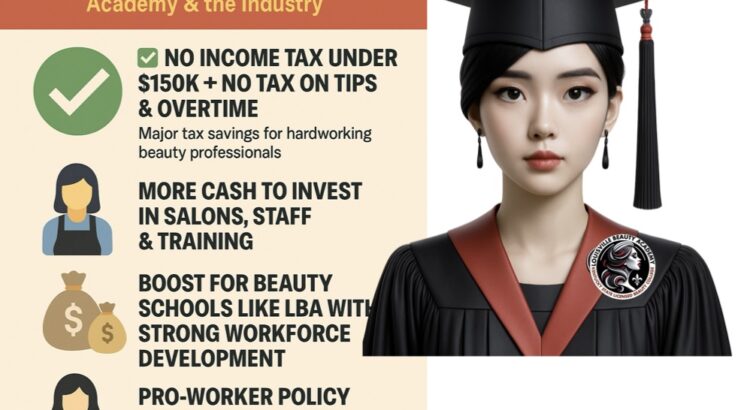
The “Big Beautiful Bill” (BBB) refers to a proposed federal tax and budget package (also called the One Big Beautiful Bill) recently passed by the U.S. Congress. It builds on the 2017 Tax Cuts and Jobs Act by making many of its tax cuts permanent and adding new provisions. Key provisions include permanent lower tax rates for individuals and businesses, an expanded qualified-business-income (QBI) deduction for small businesses, higher caps on deductions (SALT), and new exemptions (notably exempting all tips and overtime pay from federal income tax). In the Senate and House debates, supporters have framed the BBB as “pro-worker” and “pro-small business,” emphasizing benefits for people who are actively employed. For example, the bill would require able-bodied Medicaid recipients to work 80 hours a month to keep their coverage (underscoring its emphasis on supporting those in the workforce). Other BBB provisions include extending or restoring child tax credits and business investment incentives (100% bonus depreciation, R\&D expensing).
In Kentucky, all but two members of the congressional delegation (Massie and McGarvey) supported the BBB in the House, where it passed narrowly. A Kentucky Chamber analysis notes the BBB would permanently extend the 2017 Tax Act’s lower rates and business deductions. A Tax Foundation study cited by the Chamber predicts these tax cuts could boost U.S. GDP by about 1.2% and create roughly 938,000 full-time jobs. Kentucky-specific estimates (from advocacy groups) suggest that without these extensions, Kentuckians would pay thousands more in taxes and lose thousands of jobs. (For example, Americans for Prosperity warned Kentuckians would face ~\$1,630 higher federal tax per household and ~8,050 lost jobs if 2017 cuts lapsed.) Thus, the BBB is billed as protecting and expanding jobs and take-home pay.
Tax Changes Benefiting Workers and Small Businesses
Several BBB provisions directly support individuals who “actively work” – especially service workers, small-business owners, and self-employed professionals:
Exemption of Tips and Overtime from Federal Tax: Under the BBB, all income from tips or from overtime pay is exempt from federal income tax. This means a restaurant or salon worker who earns, say, \$5,000 in tips or overtime in a year would keep 100% of that income (no federal tax). In the beauty industry, many cosmetologists and spa workers rely on tips; this change effectively boosts their net pay.
Small-Business Income Tax Deduction: The BBB makes the Section 199A qualified-business-income (QBI) deduction permanent. In the final legislation, 20% of small-business income is deductible indefinitely (the House version had raised it to 23%). This reduction applies to pass-through entities like S-corporations, LLCs, and sole proprietorships – the legal forms used by most salons, barber shops, and independent beauty professionals. For example, a salon owner earning \$100,000 could deduct \$20,000 of that income, lowering her taxable income. Put simply, salon owners and freelancers pay substantially less federal tax on their business profits under the BBB.
Higher SALT Deduction Cap: The bill raises the federal cap on deducting state and local taxes. Households (including married couples) earning up to \$500,000 can deduct up to \$40,000 of state/local taxes (up from \$10,000 under current law). This helps Kentucky workers and small-business owners who pay significant local taxes, though the benefit phases out above \$500k. In practice, many middle-income people (including beauty professionals) in Kentucky will be able to deduct more of their property and state taxes on federal returns, lowering their overall tax bills.
Expanded Child Tax Credit: The child tax credit increases from \$2,000 to \$2,500 per qualifying child (through 2028). Beauty professionals who are parents (for example, hair stylists supporting children) will receive a larger credit. More generous credits mean hundreds of extra dollars per child for working families, freeing more income for household budgets or business investment.
100% Expensing of Equipment and R\&D: The BBB permanently restores full expensing (100% bonus depreciation) for investments in short-lived assets. Small businesses, including salons and day spas, can immediately deduct the full cost of new equipment (chairs, mirrors, computers for booking, etc.) or renovation expenses. This accelerates write-offs that were previously stretched out over many years. In practice, a salon could buy new styling stations or professional machines and deduct it all in year one, improving cash flow and encouraging businesses to reinvest in growth.
These provisions collectively lower taxes on earned and business income. According to the Kentucky Chamber, these tax cuts would help families and job creators alike, with far more households seeing net tax decreases than increases. Importantly, service workers benefit directly (via the new tip/overtime exemption) and indirectly (through the overall growth it spurs), while small-business owners gain expanded deductions that free up capital for hiring or expansion.
Table 1: Key BBB Tax Provisions and Effects on the Beauty Sector
Provision
Beneficiaries / Effect (Beauty Context)
Source
No federal tax on tips and overtime
Salon and spa employees keep all their tips and overtime wages
[50], [20] (sec. 110101–102)
Permanent QBI deduction (20–23%)
Salon owners, barbershop proprietors get lower tax on business profits
[50], [20]
Expanded SALT cap (\$40k for ≤\$500k)
Middle-income filers (including high-earning cosmetologists) deduct more state/local taxes
[50]
Larger Child Tax Credit (\$2,500/child)
Working parents in beauty industry receive higher tax credit per child
[50]
100% Business Expensing (bonus depreciation)
Salons and beauty product retailers can immediately deduct capital expenses (e.g. equipment)
[50]
Medicaid Work Requirements
Encourages able adults (many of whom could join workforce) to work 80 hrs/mo to keep benefits
[20]
(Sources: Senate House Ways & Means summary; Kentucky Chamber analysis.)
Impacts on the Beauty Industry and Workforce
The beauty sector stands to gain from these tax reforms in several ways. First, the service nature of the beauty industry means many workers earn significant tip and overtime pay; exempting these from tax directly increases their take-home pay. In addition, most beauty businesses are very small: hair salons, nail shops, and spas are overwhelmingly single-location, often owner-operated firms. The enhanced QBI deduction and expensing rules directly lower their effective tax rates, leaving more profit available to hire staff, modernize facilities, or reduce prices. In effect, the BBB lowers the “tax wedge” on everyday work and small-business activity, which advocates argue will spur hiring and entrepreneurship.
Moreover, the beauty industry is large and growing. McKinsey reports the global beauty market is about \$450 billion (as of 2024) and is expected to grow roughly 5% per year through 2030. U.S. spending on personal care continues to rise, and consumer demand for services (hair, nails, skincare, etc.) remains robust. In this context, tax relief can amplify growth: as one industry report notes, American beauty services already employ over 1.3 million people nationwide, and organizations forecast nearly 20% industry growth by 2030. (For example, NAWBO and the Professional Beauty Association support extending tip-credit rules to salons, noting that the sector is predominantly women-owned and tip-dependent.)
Worker empowerment is also an angle. Many beauty professionals are traditionally underserved groups (immigrant women, single parents, formerly incarcerated individuals, etc.) who gain quick, lower-debt vocational credentials (see LBA below). By boosting their net pay and easing the tax burden on their employers, the BBB aims to strengthen this entry-level workforce. Additionally, the Medicaid work requirements (80 hours/month rule) reinforce the principle that active work is rewarded – beneficiaries must join the labor force or community service to keep assistance. In sum, the BBB’s tax provisions align with the goal of supporting people “actively working” by reducing taxes on earned and business income in the beauty and service sectors.
Campaigns for Property Tax Relief
While the BBB deals with federal taxes, small business owners (including salons) often cite local taxes as a cost burden. In recent years a nationwide property tax revolt has emerged, with voters in multiple states approving measures to limit or reduce property taxes. For example, Kentucky voters considered (in 2024) a ballot initiative to exempt homeowners over 65 from paying property taxes, and other states like Florida and Colorado have passed caps linking tax growth to inflation. Although these efforts have targeted homeowners, some advocates have begun calling for similar relief for small businesses. In principle, expanding such relief (for example, higher homestead exemptions or credits for owner-occupied business property) would lower operating costs for salon owners as well. While not part of the BBB, these state-level movements reflect a broader push for tax relief. Policymakers sympathetic to small business might eventually propose property-tax relief packages at the state or federal level. For now, the BBB’s emphasis on reducing income taxes complements this trend: even if property taxes remain, owners will have more after-tax income to cover them.
Louisville Beauty Academy (LBA): A Workforce Model
Louisville Beauty Academy (LBA) is a local example of workforce development in the beauty field. LBA is a state-licensed beauty college that has graduated over 1,000 cosmetologists, nail technicians, estheticians, etc. since 2017. These graduates typically begin careers earning roughly \$30,000–\$50,000 per year. Louisville Beauty Academy’s own analysis conservatively estimates its alumni have generated about \$20–\$21 million in Kentucky economic activity (wages and taxes) to date. A Vietnamese-American community news report found the school has “graduated nearly 2,000 professionals, contributing an estimated \$20–\$50 million annually to the Kentucky economy”. This range reflects continued growth – as LBA adds more students each year (over 125 graduates per year on average) the impact rises.
These figures highlight LBA’s economic role: its model (affordable, lower-debt, flexible training) rapidly converts students into skilled, licensed workers. The BBB could help scale such outcomes. For example, tax relief on earned income means LBA graduates keep more take-home pay, raising their living standards and enabling them to spend or invest locally. Lower taxes on small businesses mean graduates who open their own salons face less tax drag on profits, encouraging entrepreneurship. If Louisville or Kentucky leaders wanted to expand LBA’s model (e.g. more campuses or similar schools), the freed-up tax revenues from BBB could be partially directed to workforce grants or matching funds. Moreover, a higher SALT cap means local governments could raise modest funds (for education or infrastructure) without triggering federal penalties for higher-earning residents, potentially freeing up state dollars for job training.
Table 2: LBA’s Economic Impact vs. Growth Scenarios (illustrative)
Approx. Cumulative Graduates
Estimated Annual Economic Impact (KY)
Source
1,000 graduates (through 2024)
~\$20–21 million
Louisville Beauty Academy
~2,000 graduates (projected)
\$20–50 million
Viet Bao Louisville estimates
3,000 graduates (future)
~\$60–75 million
Projected (extrapolated)
These numbers suggest that if LBA doubles or triples in size, it could inject tens of millions more into the local economy. Under the BBB, those impacts would be even larger: graduates and salons pay less in federal tax on that additional income. For Louisville’s economy, LBA represents a grassroots engine of job creation, especially for low-income and immigrant communities. Tax policies that preserve graduates’ income and reduce business costs amplify LBA’s success. In other words, BBB-level tax relief can help magnetize further investment in beauty education and small-business formation.
Broader Economic Impact in Kentucky and Louisville
Beyond LBA specifically, the BBB’s tax changes will influence Kentucky’s economy. The Chamber of Commerce notes the BBB will affect taxes and spending statewide. According to analysis cited by Kentucky’s business leaders, federal tax reform in the BBB is expected to raise the state’s GDP modestly and generate jobs. An increase of 1.2% in national GDP could translate to economic growth in Kentucky, given its manufacturing and service sectors. Moreover, by permanently cutting federal tax rates for individuals and businesses, Kentucky families and entrepreneurs will have more disposable income. For beauty-related enterprises, this means customers may spend more on services, and entrepreneurs have more capital to reinvest.
Another consideration is healthcare funding. The BBB’s Medicaid changes (work requirements and altered federal matching for provider taxes) are controversial in Kentucky, a Medicaid expansion state. Kentucky Chamber leaders urged Congress to be cautious about cutting provider funding. While not directly related to beauty, stable healthcare funding for rural hospitals and clinics can affect community health – a factor in overall workforce productivity.
Finally, local public finance: Louisville’s city and county governments will likely see some indirect effects. If federal income tax revenue falls (due to the BBB), states and localities might face pressures to adjust their tax bases. Conversely, the law’s emphasis on small business growth could increase sales and business tax collections at the local level as more businesses expand. At present, there are no direct federal grants for beauty schools in the BBB, but stronger overall economic growth could boost state budgets, potentially benefiting education and workforce programs.
Conclusion
In summary, the Big Beautiful Bill is a sweeping tax-and-spending package that strongly favors working Americans and small businesses. Its key tax breaks – particularly making all tips and overtime earnings tax-free and enhancing deductions for small businesses – directly benefit beauty school graduates, salon owners, and independent cosmetologists. These provisions, combined with expanded credits and investment incentives, encourage the expansion of small enterprises. In parallel, there is growing momentum for property-tax relief measures (through state ballot initiatives) that could further ease costs for business owners.
For Louisville Beauty Academy, which already claims a \$20–\$50 million annual economic impact through its graduates, the BBB provides a more fertile environment to scale up. More graduates will keep more of their earnings, and new salon startups will face lower tax burdens. Overall, analyses suggest the BBB will modestly boost Kentucky’s economy (through job creation and GDP growth). While debates continue over the deficit impact and Medicaid reforms, the BBB as passed effectively locks in lower federal taxes for most workers (especially those earning under ~\$150k) and incentivizes investment. For policymakers and educators in Louisville, this means a historic opportunity: tax savings from the BBB can be channeled into workforce development, with beauty industry training (like LBA) poised to produce the skilled, licensed professionals who will drive the local economy forward.
Sources: Official analyses and reports were used, including Kentucky Chamber of Commerce summaries, Senate press releases on beauty industry tax relief, LBA’s own impact analysis, and news coverage and research on tax and property-reform trends. All figures and quotations are drawn from these sources.
In a world where tuition costs are rising—even at nonprofit schools—and student loan debt continues to crush dreams, Louisville Beauty Academy (LBA) stands out as a revolutionary force in beauty education. Quietly and consistently for years, LBA has offered something almost no other school in the U.S. can claim: a lower-debt, transparent, fast-track path to a licensed beauty career that empowers real success.
🎓 A Complete 1,500-Hour Cosmetology Program—Done in Under 10 Months
At Louisville Beauty Academy, you don’t just dream of becoming a licensed professional—you become one. Our students complete the Kentucky State-Licensed 1,500-hour Cosmetology Program in as little as 9 to 10 months.
That’s not marketing fluff. That’s fact.
This is the same license required across Kentucky and many other states—and we prepare you to pass the licensing exam, work in real salons, or open your own business.
While most schools stretch cosmetology over 12–18 months, our students finish faster because we incentivize your hard work. We don’t just support you—we reward you for showing up and staying consistent.
💰 Over $20,000 in Discounts—You Pay Less Than $7,000 Total
You read that right.
Our cosmetology program includes everything:
Farouk CHI professional kit
Milady CIMA online study system
Registration fees
Textbooks
State-compliant equipment and supplies
All this for under $7,000 total, if you attend full-time and complete the program in under 10 months.
How is that possible?
Because Louisville Beauty Academy believes in incentive-based education. Our public student contract outlines clear discounts for attendance, completion speed, and effort. Finish fast, stay focused, and you save big—up to $20,000 in incentives compared to traditional schools charging $25,000–$30,000.
🤖 The Most Advanced Beauty School in the U.S.
At LBA, we combine technology with compassion to help every student succeed.
We use:
Milady CIMA, the industry’s most advanced digital learning platform.
AI-powered translation and communication tools, allowing students to learn in their native language.
A fully integrated digital student tracking system to keep you on pace without guesswork.
We don’t just adopt technology—we live it. We make it work for you.
🛑 No Student Loans. No Hidden Fees. No Surprises.
Louisville Beauty Academy is not Title IV (federal loan) funded—and that’s intentional.
Why?
Because loans bring paperwork, red tape, interest, and student debt. We choose to operate lean and pass those savings to you. That means:
No student loan debt
No federal loan pressure
No hidden charges
No extra costs beyond your public contract
We even make our contract available online so you can read it before you enroll.
📈 Graduate Success: Real Licenses. Real Jobs. Real Income.
While many schools measure success by how many students enrolled, we measure success by how many students finish, pass the state exam, and get licensed.
At LBA:
Over 95% graduate on time
Nearly 100% pass the Kentucky State Board licensing exam
Over 90% are working in the beauty industry immediately after graduation
From young professionals to working moms to first-generation immigrants, our students succeed because they’re prepared.
💼 The Industry Needs You—and We Help You Get There Fast
The beauty industry is growing fast—but it needs licensed professionals. LBA exists to fill that gap by producing work-ready, licensed individuals who don’t carry loan debt.
You won’t wait 2 years to work.
You won’t carry student loans for 10 years.
You’ll finish in under 10 months, pay less than $7,000, and begin your new life as a beauty professional.
🧠 Built on the “YES I CAN” Mentality
At Louisville Beauty Academy, we don’t just teach skills—we teach a mindset.
Our students walk in with self-doubt and walk out saying: “YES I CAN.”
And then they prove it—by finishing, passing, and building careers that support their families and their future.
We don’t care where you come from. We care about where you’re willing to go.
Louisville Beauty Academy is proudly State-Licensed, state-licensed, and locally recognized for graduating thousands of beauty professionals across Kentucky.
We are one of the only schools in the U.S. offering:
Under-10-month 1500-hour cosmetology training
All-inclusive pricing under $7,000
Transparent, public student contracts
No loans, no debt
Advanced AI and digital learning tools
If you’re ready to work hard, we’re ready to help you succeed. Because at LBA, success isn’t a slogan. It’s a system. And it starts with three words: YES. I. CAN.
The beauty and wellness trade—especially nail technology and esthetics—offers rapid returns on educational investment due to low training costs, short program lengths, and solid wages. In Kentucky and nationally, nail and esthetic programs are measured in months, not years, and tuition is typically a few thousand dollars. By contrast, traditional college degrees cost tens of thousands. This report examines program costs/duration, post‐grad earnings, and ROI timelines for nail techs and estheticians. We draw on government data, industry surveys, and academic research to demonstrate how beauty careers pay off, and show how Louisville Beauty Academy (LBA) further amplifies ROI by drastically reducing tuition and debt.
Educational Costs and Program Duration
Nationwide, nail technician training is quick and affordable. Most state programs require 300–600 clock‐hours (roughly 3–9 months), with tuition often $3,000–$5,000 (before supplies) . For example, BeautySchoolsDirectory reports that in 2024 nail tech school costs typically range $3–5 K . Kentucky law mandates 450 hours for nail licensing . In Kentucky, Southeastern Beauty Academy (Paintsville, KY) offers a 350-hour nail course for $3,750 tuition (additional kit fees apply). LBA’s nail program (450h) is $3,800 , inclusive of discounts (eligible students cut the regular $8,325 program cost to $3,800).
Esthetician programs are longer (to meet skin care licensing hours) and cost more. State requirements vary (Kentucky requires 1,000h ), but many programs run 600–1,000 hours. According to a SoFi career guide, community college esthetic programs cost about $4,000–$6,000, while private schools may charge $6,000–$12,000 . Industry directories note esthetic tuition can exceed $15,000 (including kits) . In Kentucky, ASCP reports the average esthetician program cost is about $9,617 . For context, local examples include Paul Mitchell (Louisville) at $13,500 total for a 750h esthetics course , and PJS College (KY) at $14,268 for 750h . By contrast, LBA’s 750h esthetics program is $6,100 with all discounts. Thus, LBA charges roughly 50–75% less than many peer schools (e.g. Southeastern’s esthetic tuition $7,500 plus $625 kit vs. LBA’s $6,100 total).
In sum, beauty training is short and cheap. Nail tech programs require only a few hundred hours and $3–5K; esthetics ~600–1000h and under $10K in many cases. Kentucky programs typically run 450h (nail) and 1000h (esthetic) . Compared to college (often ~$40K/year), even a $10K beauty program is modest. LBA’s programs (450h nail, 750h esthetic, 1500h cosmetology) cost just $3.8K–$6.3K , drastically below typical tuition.
Nail tech programs: ~300–600 hours; tuition ~$3–5K . KY requirement: 450h . Ex.: Southeastern KY – 350h for $3,750 ; LBA – 450h for $3,800 .
Esthetics programs: ~600–1,000 hours; tuition ~$4–12K . KY requirement: 1,000h . Ex.: Southeastern KY – 750h for $7,500 plus $625 kit ; Paul Mitchell Louisville – 750h totalling $13,500 ; LBA – 750h for $6,100 .
These figures underscore that LBA’s tuition is 50–75% lower than many local/national schools , thanks to heavy discounts. With no student loans needed, LBA students enter the workforce lower-debt.
Income Potential (Post-Graduation Earnings)
Career earnings in nail and esthetics are solid, often surpassing many early-career college grads (especially after tips/commissions). According to the U.S. Bureau of Labor Statistics (BLS), the national median wage (2024) is about $16.66/hr ($34,660/yr) for manicurists/pedicurists (nail technicians) and about $19.98/hr ($41,560/yr) for skin care specialists (estheticians) . A survey by the accreditor NACCAS found average annual pay around $33,148 for nail techs and $40,126 for estheticians . Industry sources (SoFi) concur that median esthetician salary is roughly $40.3K/yr , compared to ~$29.2K for a cosmetology license (which includes nail/salon work) .
In Kentucky, wages are comparable. The Kentucky ASCP reports estheticians earn about $36,320/yr (mean $17.46/hr) (tips/commissions not included). BLS state data (May 2022) show Kentucky manicurists average $38,000/yr (mean $18.27/hr) and skin care specialists $35,430/yr (mean $17.03/hr) . These Kentucky figures are slightly below national medians, but still represent living-wage incomes. Notably, salon workers often supplement base wage with tips and product commissions (industry reports suggest tips can add ~20–30% to earnings ), further improving take-home pay.
In summary: median post‐licensing incomes are roughly in the mid-$30Ks to low-$40Ks range . Nail techs typically earn ~$30–35K/year and estheticians ~$38–42K/year (with variation by location and experience) . Even at the lower end, these salaries allow rapid recoup of modest tuition costs.
ROI Timeline (Time to Recoup Education Cost)
Because training is brief and costs are low, beauty students recoup their educational investment in months, not years. A simple “break-even” model illustrates this: dividing tuition by monthly gross salary (annual salary ÷12) yields months to pay back tuition. For example, assuming a conservative salary ~$30,000/year (≈$2,500/month):
Typical Nail Tech: $4,000 tuition / $2,500 = 1.6 months to break even.
These examples assume paying tuition up front or in written payment installments, with graduates then earning immediately at full wage. Even factoring taxes or living expenses, the point is that earnings quickly exceed education cost.
Studies highlight how modest tuition yields outsized ROI. The Institute for Justice found that beauty programs cost over $16,000 on average (often with ~$7,100 debt) while graduates earn only ~$26,000/yr . At those rates, many former cosmetology students struggle to repay loans. In contrast, LBA’s dramatically lower cost (and no loans) flips the picture: the same salary turns a likely negative ROI into a highly positive one. One analysis notes technical trade certificates “have a higher payoff than the typical bachelor’s degree” . Indeed, a $6K investment paid back in ~2 months yields an ROI far exceeding most college programs.
It is instructive to compare break-even times explicitly. For example, at a $30K annual wage:
A $6,000 tuition (LBA-level) is earned back in ~2.4 months.
A $12,000 tuition (typical full beauty) takes ~4.8 months.
A $16,000 tuition (high-end program) takes ~6.4 months. Thus LBA’s lower tuition speeds ROI 2–3× faster.
Moreover, LBA’s zero-debt policy eliminates loan burdens. Beauty schools often rely on student loans: IJ reports average borrowing ~$7,100 per cosmetology student , and The Century Foundation found average cosmetology debt ~$10,200 . LBA students graduate without such debt, meaning 100% of their earnings go into savings or living expenses rather than loan payments. For example, a graduate who might otherwise owe $8K at 5% interest can instead pocket that $100–$150/month as pure income, further boosting ROI.
Louisville Beauty Academy vs. Other Programs
LBA’s model dramatically boosts ROI relative to conventional schools. Its tuition is roughly half or less of competitors: e.g., Cosmetology at LBA is $6,250 for 1500h , vs. Southeastern Beauty Academy’s $12,400 (50% reduction). Esthetics at LBA is $6,100 (750h) , whereas Paul Mitchell charges $13,500 (750h) (55% less), and PJS ~$14,268 (750h) (57% less). Nail technology at LBA is $3,800 (450h) ; Southeastern’s 350h course is $3,750 , but at far fewer hours (LBA provides 100h more training for the same cost).
Because of these savings, an LBA student reclaims tuition in weeks rather than months compared to peers. For instance, breaking even on a $3,800 LBA nail program takes about 6 weeks of gross pay (~$2,500/mo) versus ~1.5 months for a $4,000 program. On an $6,100 LBA esthetics program, break-even is ~1.8 months, versus ~4 months for a $12,000 program. In other words, LBA students recover tuition 2–3 times faster than students of higher-priced schools.
Finally, LBA’s graduates enter the workforce lower-debt, an increasingly rare advantage. With no student loans, their monthly cash flow is significantly higher. In a concrete model: a graduate earning $2,500/mo who owes $10,000 at 5% interest would pay ~$106/month on loans for 10 years. Without that payment (as at LBA), it’s akin to receiving an extra $1,270/year – a meaningful boost in effective take-home pay and ROI.
Conclusion
Trade careers in nail and esthetics represent an excellent ROI on education. Training is short (months), costs are low (often <$10K), and wages are respectable (mid-$30Ks). As a result, most beauty students earn back their tuition in just a few months of work. For example, a $6K cost at a $36K salary yields payback under 3 months. By contrast, college graduates with 4-year degrees often spend years recouping six-figure tuition. Studies confirm this pattern: certificates in the skilled trades routinely outrank average bachelor’s degrees in ROI , while beauty programs heavily subsidized by loans often leave students worse off .
The data show nail techs and estheticians can swiftly translate a small training investment into income. LBA’s model amplifies this effect: 50–75% lower tuition and zero debt mean LBA grads enjoy ROI 2–3× higher than usual. In effect, LBA students enter high-demand jobs without the weight of debt, recoup costs almost immediately, and can begin saving or investing years earlier than traditional trade school students. All sources consistently indicate that, among US career programs, the beauty trades deliver some of the fastest, surest returns on educational investment .
References
Associated Skin Care Professionals. (2025). Kentucky Esthetician Schools (online directory). Retrieved June 2025, from Kentucky ASCP: Kentucky esthetician schools webpage .
BeautySchoolsDirectory.com. (2024). Nail Tech School: Cost, Course Length, and Training Requirements. Retrieved June 2025, from BeautySchoolsDirectory (online article) .
Bureau of Labor Statistics. (2024). Occupational Outlook Handbook: Manicurists and Pedicurists. U.S. Dept. of Labor. Retrieved 2025, from BLS OOH (Manicurists & Pedicurists) .
Bureau of Labor Statistics. (2024). Occupational Outlook Handbook: Skincare Specialists. U.S. Dept. of Labor. Retrieved 2025, from BLS OOH (Skin care specialists) .
Bureau of Labor Statistics. (2022). Kentucky – May 2022 State Occupational Employment and Wage Estimates. Retrieved 2025, from BLS State OEWS (Kentucky) .
Institute for Justice. (2021, July 22). New report uncovers the shocking student debt burden beauty school students take on. Arlington, VA. [Press release summarizing IJ study] .
Paul Mitchell The School – Louisville. (2025). Esthetics Program – Tuition and Costs. Louisville, KY. Retrieved 2025, from school’s website .
PJS College of Cosmetology. (2025). Consumer Information (Loan Debt and Cost of Attendance). Bowling Green, KY (online disclosure) .
Southeastern Beauty Academy. (2025). Tuition and Fees. Paintsville, KY (official site) .
The Century Foundation. (2022). Fast, C., Granville, P., & Moultrie, T. Cosmetology Training Needs a Make-Over. [Higher Ed policy report]. Retrieved 2025, from TCF: Carolyn Fast, et al. report (p.127–132) .
SoFi, Inc. (2024, June 3). Ndoni, K. Paying for Cosmetology or Esthetician School. SoFi Learn (online guide) .
beautyschooledu.org. (2025). Beautician Salary: Cosmetology, Esthetician, Nail Technician, Makeup Artist, Barber. [Salary guide]. Retrieved 2025, from BeautyschoolsEdu .
Cooper, P. (2024). Does College Pay Off? A Comprehensive Return On Investment Analysis. Foundation for Research on Equal Opportunity (FREEOPP). [Executive summary and report] .
Cosmetology Guru. (2025). 2025 Cosmetology ROI Report: Best and Worst States for Beauty School Costs. [Online report; key findings summary] .