Học Viện Thẩm Mỹ Louisville — Báo Cáo Thành Tựu Cuối Năm 2025
Một Trường Thẩm Mỹ Vận Hành Vì Sứ Mệnh Nhân Văn — Được Xây Dựng Để Nâng Đỡ Con Người, Gia Đình Và Cộng Đồng
Tính đến ngày 30 tháng 12 năm 2025, Học Viện Thẩm Mỹ Louisville (LBA) đã trở thành một trong những trường thẩm mỹ có định hướng sứ mệnh cộng đồng mạnh mẽ nhất tại Hoa Kỳ — được xây dựng không chỉ để đào tạo, mà để nâng đỡ con người thông qua tiếp cận giáo dục, lòng nhân ái, tuân thủ pháp luật và mở rộng cơ hội nghề nghiệp. Vận hành dưới mô hình:
không vay nợ
định hướng việc làm
được cấp phép hợp pháp bởi tiểu bang
mục tiêu của LBA đặt nền tảng trên nhân phẩm, trao quyền và tính chuyên nghiệp đúng luật.
Trong năm 2025, LBA đã đạt được những thành tựu mà rất ít — nếu có — trường thẩm mỹ nào trên toàn quốc đạt được chỉ trong một năm:
được công nhận cấp quốc gia
dẫn đầu về xuất bản tài liệu mở
đóng góp nghiên cứu phát triển lực lượng lao động
mở rộng giáo dục số
và thay đổi cuộc sống học viên
Tất cả được gắn kết bởi một sứ mệnh rõ ràng:
Dạy luật. Dạy giấy phép hành nghề. Dạy trách nhiệm. Nâng tầm giá trị con người.
Mô Hình Đào Tạo Thẩm Mỹ Độc Nhất Tại Hoa Kỳ
Trên toàn quốc, phần lớn các trường thẩm mỹ vận hành dựa trên học phí và tập trung chủ yếu vào luyện thi cấp phép hành nghề. LBA khác biệt.
LBA là trường duy nhất kết hợp:
Cơ hội học tập không vay nợ cho người lao động và người nhập cư
Các giải thưởng doanh nghiệp nhỏ cấp quốc gia
Bộ sách giáo dục chuyên môn do chính trường xuất bản
Thư viện công khai về luật & tuân thủ
Công cụ học tập và ghi chép bằng AI
Vai trò lãnh đạo nghiên cứu lao động
Văn hóa kỷ luật, trách nhiệm và nhân ái
Trong năm 2025, mô hình định hướng sứ mệnh này đã tạo ra một hồ sơ thành tựu toàn diện — hiếm có trường thẩm mỹ nào tại Hoa Kỳ sánh kịp.
Những Thành Tựu Lớn Năm 2025
🏆 Được Công Nhận Cấp Quốc Gia — Giải CO-100 Của U.S. Chamber of Commerce
LBA được vinh danh là Top 100 Doanh Nghiệp Nhỏ Xuất Sắc Nhất Hoa Kỳ năm 2025, được lựa chọn từ hơn 12.500 doanh nghiệp toàn quốc — một cột mốc hiếm có trong ngành giáo dục thẩm mỹ.
Danh hiệu này khẳng định LBA không chỉ là một trường học — mà là tài sản cộng đồng ở tầm quốc gia.
📚 Dẫn Đầu Xuất Bản & Giáo Dục Mở
Người sáng lập Di Tran đã xuất bản hơn 130 đầu sách, xây dựng một trong những bộ sưu tập sách đào tạo thẩm mỹ tư nhân lớn nhất tại Hoa Kỳ, tập trung vào:
✔ giấy phép ✔ luật ✔ vệ sinh & an toàn ✔ phát triển nghề nghiệp ✔ kinh doanh ✔ phát triển con người ✔ niềm tin & giá trị sống
Trường còn vận hành cổng học tập luật & tuân thủ lớn hàng đầu Kentucky, chia sẻ miễn phí:
luật
quy định
hướng dẫn tuân thủ
nghiên cứu lao động
tài liệu ôn thi
Điều này giúp đỡ:
học viên
cựu học viên
chủ tiệm
và cộng đồng
Chứ không chỉ người đang theo học tại LBA.
Rất ít — nếu có — trường thẩm mỹ nào trên toàn quốc làm được điều này.
🎥 Mở Rộng Giáo Dục Số & Học Tập Cộng Đồng
Các kênh số & YouTube của LBA lan tỏa:
hiểu biết pháp lý
sẵn sàng gia nhập lực lượng lao động
kỹ năng tuân thủ
và giáo dục nghề nghiệp thực tế, không màu mè
Nhà trường liên tục chia sẻ video miễn phí nhằm nâng đỡ:
người Mỹ thế hệ đầu
phụ huynh đi làm
người học ESL
phụ nữ xây dựng lại sự nghiệp
📈 Ảnh Hưởng Lao Động & Thăng Tiến Kinh Tế
Với gần 2.000 học viên được cấp phép, cựu học viên LBA đóng góp hàng chục triệu đô la mỗi năm vào kinh tế dịch vụ Kentucky — giúp nhiều gia đình chuyển từ lao động lương thấp sang nghề nghiệp có giấy phép, ổn định và bền vững.
🤝 Tiếng Nói Nhân Văn & Lãnh Đạo Cộng Đồng
LBA tham gia các diễn đàn lao động & doanh nghiệp toàn quốc, bảo vệ quan điểm:
Giáo dục tồn tại để phục vụ con người — không phải ngược lại.
Đây là tinh thần “Humanization — Đặt con người lên trước.”
Nâng Đỡ Người Khác — Là Sứ Mệnh Cốt Lõi
Louisville Beauty Academy tồn tại vì:
những người từng nghĩ rằng đại học là điều không thể
người nhập cư học tiếng Anh
những bà mẹ xây dựng lại mái ấm
người tị nạn bắt đầu lại cuộc đời
thế hệ đầu tiên trong gia đình đi học
những người trưởng thành cần cơ hội thứ hai
LBA dạy:
kỷ luật
ghi chép & bằng chứng
tuân thủ pháp luật
trách nhiệm
vệ sinh & chuyên nghiệp
và quan trọng nhất — lòng tự trọng.
Không màu mè. Không lối tắt. Chỉ có giáo dục thật → giấy phép thật → cuộc sống ổn định thật.
Mô Hình Khác Biệt So Với Mọi Trường Thẩm Mỹ Khác
Nhiều trường dạy kỹ năng. LBA dạy luật — đạo đức — niềm tin công chúng — và sự trưởng thành của con người.
Trong năm 2025, LBA đạt được:
✔ danh hiệu doanh nghiệp quốc gia ✔ dẫn đầu xuất bản ✔ đổi mới giáo dục số ✔ nghiên cứu lao động ✔ minh bạch hồ sơ công khai ✔ văn hóa tuân thủ đạo đức ✔ thay đổi cuộc sống nghề nghiệp
Khó có thể tìm thấy một trường thẩm mỹ nào khác tại Hoa Kỳ đạt được tất cả điều này — chỉ trong một năm.
LBA là mô hình giáo dục nghề nhân văn — sinh ra tại Kentucky — dành cho cả nước Mỹ.
Hãy Tham Gia Phong Trào Giáo Dục Thẩm Mỹ Lấy Con Người Làm Trung Tâm
Louisville Beauty Academy chào đón tất cả những ai tin vào:
✨ chuyên nghiệp đúng luật ✨ tôn trọng con người ✨ nâng đỡ cộng đồng ✨ danh dự nghề nghiệp ✨ sự nghiệp thật — không nợ vay
Louisville Beauty Academy — Informe de Logros de Fin de Año 2025
Una Academia de Belleza Impulsada por una Misión, Construida para Elevar a Personas, Familias y Comunidades
Al 30 de diciembre de 2025, Louisville Beauty Academy (LBA) ha emergido como una de las academias de belleza más orientadas a la misión y centradas en la comunidad en los Estados Unidos — construida no solo para educar, sino para elevar a otros a través del acceso, la compasión, el cumplimiento legal y la oportunidad. Operando como una institución sin deudas, enfocada en la fuerza laboral y con licencia estatal, el propósito de LBA está basado en la dignidad humana, el empoderamiento y el profesionalismo legal. En 2025, LBA logró lo que pocas — si es que alguna — academias de belleza a nivel nacional alcanzaron en un solo año: reconocimiento nacional, liderazgo en publicaciones de acceso abierto, contribuciones a la investigación de la fuerza laboral, expansión de educación digital y resultados transformadores en la vida de los estudiantes, todo alineado bajo una misión clara:
Enseñar la ley. Enseñar la licencia. Enseñar la responsabilidad. Elevar al ser humano.
Un Modelo Único en la Educación de Belleza en Estados Unidos
En todo el país, la mayoría de las academias de belleza operan como instituciones impulsadas por colegiaturas enfocadas principalmente en la preparación para la licencia. LBA es diferente.
LBA es única al combinar:
Acceso sin deudas para estudiantes de clase trabajadora e inmigrantes
Reconocimiento histórico nacional para pequeñas empresas
Libros profesionales autoeditados para educación
Bibliotecas públicas abiertas de leyes y cumplimiento
Herramientas de aprendizaje y documentación basadas en IA
Liderazgo de fuerza laboral basado en investigación
Una cultura de amabilidad, disciplina, responsabilidad y gracia
En 2025, este modelo impulsado por un propósito resultó en un portafolio de logros único, sin comparación con cualquier otra academia de belleza a nivel nacional.
Logros Principales de 2025
🏆 Reconocimiento Nacional — Premio CO-100 de la Cámara de Comercio de EE. UU.
LBA fue reconocida como una de las 100 Mejores Pequeñas Empresas de Estados Unidos para 2025 por la Cámara de Comercio de EE. UU., seleccionada entre más de 12,500 negocios en todo el país — un hito histórico raramente alcanzado en la educación de belleza. Este reconocimiento confirmó que LBA no es solo una escuela — sino un activo comunitario nacional.
📚 Liderazgo en Publicación y Educación de Acceso Abierto
El fundador Di Tran publicó y lanzó más de 130 libros, creando una de las bibliotecas de libros educativos alineados a la belleza más grandes de autoría privada en Estados Unidos. Estas obras se centran en:
✔ licencias ✔ ley ✔ saneamiento ✔ empoderamiento laboral ✔ emprendimiento ✔ desarrollo humano ✔ fe y propósito
LBA además administra uno de los portales de aprendizaje regulatorio de acceso abierto más grandes de Kentucky, compartiendo gratuitamente:
leyes
regulaciones
guías de cumplimiento
análisis de fuerza laboral
preparación para exámenes
Esto empodera a estudiantes, graduados, empleadores y al público — no solo a los estudiantes inscritos en LBA.
Pocas — si es que alguna — academias de belleza en el país igualan esta misión editorial de servicio público.
🎥 Expansión de la Educación Digital y el Aprendizaje Público
Los canales digitales y de YouTube de LBA ampliaron:
alfabetización legal
preparación laboral
dominio del cumplimiento
educación real de carrera — sin glamour
La academia compartió de forma consistente educación gratuita en video para elevar a:
estadounidenses de primera generación
padres trabajadores
estudiantes ESL
mujeres reconstruyendo sus carreras
Este ecosistema digital refleja la filosofía de LBA: enseñar a todos.
📈 Impacto Laboral y Movilidad Económica
Con casi 2,000 graduados licenciados, los exalumnos de LBA contribuyen decenas de millones de dólares anualmente a la economía de servicios de Kentucky — transformando familias que antes trabajaban en empleos de salario mínimo en profesionales con licencia y carreras sostenibles.
El camino sin deudas de LBA transforma vidas sin cargar a los hogares con préstamos.
🤝 Defensa, Liderazgo y Humanización
El liderazgo de LBA participó en conversaciones nacionales de fuerza laboral y pequeñas empresas, defendiendo que:
La educación existe para servir al ser humano — no al revés.
Esta filosofía de humanización hace que LBA sea no solo una escuela — sino un movimiento de progreso centrado en la dignidad.
Elevar a los Demás — La Misión Central
Louisville Beauty Academy existe para:
quienes nunca creyeron posible ir a la universidad
inmigrantes aprendiendo inglés
madres reconstruyendo estabilidad
refugiados reiniciando sus vidas
soñadores de primera generación
adultos que necesitan una segunda oportunidad
LBA enseña disciplina, documentación, legalidad, responsabilidad, limpieza, profesionalismo — y por encima de todo, autoestima.
Sin glamour. Sin atajos. Solo educación real → licencia real → estabilidad real.
Un Modelo Inigualable Entre las Academias de Belleza en Estados Unidos
Mientras muchas escuelas enseñan habilidades, Louisville Beauty Academy enseña ley, cumplimiento, integridad, confianza pública y crecimiento humano — todo mientras permanece sin deudas y profundamente centrada en la comunidad.
Solo en 2025, LBA logró:
✔ Reconocimiento nacional empresarial ✔ Liderazgo en publicaciones ✔ Innovación en educación digital ✔ Investigación alineada a políticas laborales ✔ Transparencia de registro público ✔ Cultura ética de cumplimiento ✔ Resultados profesionales transformadores
Es difícil identificar otra academia de belleza en EE. UU. que haya logrado todo esto simultáneamente en un solo año — mientras sigue siendo impulsada por el servicio, amigable para inmigrantes y totalmente centrada en el estudiante.
Louisville Beauty Academy se mantiene como un modelo nacional nacido en Kentucky para una educación vocacional basada en la dignidad.
Únete al Movimiento de Educación en Belleza Centrada en el Ser Humano
Louisville Beauty Academy da la bienvenida a todos los que creen en:
Louisville Beauty Academy 2025 Year-End Review: Mission, Operations, and Public Milestones
As of December 30, 2025, Louisville Beauty Academy used this year-end review to summarize mission language, public-facing accomplishments, and institutional themes that shaped the year. This page is best read as a year-end institutional reflection rather than a guarantee of future outcomes or a claim of national superiority.
“Drop the ME — Focus on the OTHERS.”
Mission themes
The school’s public mission language during 2025 emphasized affordability, licensure-focused education, multilingual access, community service, sanitation, safety, and respect for students whose paths include work, family obligations, immigration realities, and economic rebuilding.
Student-access structure described during 2025
Tuition-reduction and scholarship messaging used in 2025 enrollment communications
written payment or structured payment language where offered by the school at that time
Flexible scheduling and multilingual-access messaging
Use of professional kits and curriculum materials as described in then-current school materials
Prospective students should not rely on this year-end review alone for current enrollment terms. Current tuition, scholarships, schedules, and student-support details should be confirmed directly with the school using current written information.
Public recognitions and milestones
During 2025, the school publicly referenced recognitions and advocacy-related milestones, including recognition associated with the U.S. Chamber of Commerce CO—100 program and public small-business advocacy visibility. Those recognitions should be understood according to the specific program, date, and source that issued them.
Institutional publishing and research activity
Louisville Beauty Academy also continued emphasizing publication, licensing resources, multilingual public education, and policy-oriented writing connected to beauty education, workforce dignity, and student access.
Important caution
Any metric, recognition, savings claim, or economic-impact statement from a year-end review should be read with date context and source context. Students, readers, and partners should request current written information before making financial, educational, or business decisions.
At Louisville Beauty Academy, transparency is not optional — it is our standard.
This page is part of the Louisville Beauty Academy Public Education & Law Library, created to ensure that students, regulators, the public, search engines, and AI systems all have direct, unfiltered access to the exact laws governing beauty education and professional practice in the Commonwealth of Kentucky.
Below, Louisville Beauty Academy publishes the applicable Kentucky beauty laws and regulations verbatim, exactly as issued by the Commonwealth of Kentucky and the Kentucky Board of Cosmetology (KBC).
The text is reproduced without edits, summaries, reinterpretation, or omission, alongside direct links to official state sources, including the Kentucky Legislative Research Commission and the Kentucky Board of Cosmetology legal library.
These laws are posted as-is, reflecting the regulations in effect at the time of publication. Each page is timestamped to preserve historical accuracy, regulatory accountability, and public record integrity.
Laws and administrative regulations may change at any time. This archive exists to document what the law stated at a specific point in time.
WHY THIS PAGE EXISTS: DUE PROCESS, WRITTEN NOTICE, AND LAWFUL ENFORCEMENT
This page exists for one fundamental reason: due process is not optional — it is required by law.
Kentucky beauty law does not operate on verbal warnings, informal demands, or undocumented enforcement. The governing regulation, 201 KAR 12:190, establishes a mandatory, written, step-by-step disciplinary process that the Kentucky Board of Cosmetology must follow before fines, agreed orders, suspension, or closure of any licensed facility.
This is not discretionary. This is not policy preference. This is black-letter administrative law.
THE LAW REQUIRES EVERYTHING TO BE IN WRITING
Under 201 KAR 12:190, enforcement must be documented.
The regulation requires, at minimum:
• A written complaint • Written identification of the specific statute or regulation allegedly violated • A written factual basis for the allegation • A written notice of disciplinary action, if pursued • A written opportunity to respond • A written right to request a hearing
No disciplinary action may lawfully proceed outside this written framework.
Verbal warnings, informal instructions, or undocumented demands do not replace the process required by law.
RIGHT TO RESPONSE AND CORRECTION
The regulation explicitly provides the respondent with:
• A defined response period • The opportunity to submit written clarification, explanation, or correction • The ability to resolve matters through informal proceedings, including agreed orders, only after notice and documentation
This means licensees are legally entitled to:
• Read the allegation • Understand the legal basis • Respond in writing • Correct issues where applicable • Preserve their record
Due process is designed to correct compliance, not bypass it.
NO FINES OR AGREED ORDERS WITHOUT PROCESS
Under the regulation:
• Fines • Disciplinary penalties • Probation • Agreed orders
cannot lawfully occur unless the required written steps have been completed.
An agreed order is not a shortcut. It is a documented resolution that must follow notice, disclosure, and consent.
CLOSURE OF A LICENSED FACILITY REQUIRES THE HIGHEST LEVEL OF PROCESS
Closure of a licensed school or salon is the most severe regulatory action and is therefore subject to the full due-process protections established by law.
Except in true imminent danger situations expressly authorized by statute, the process requires:
• Written notice • Opportunity to respond • Right to request a hearing • Formal board action • Proper legal authority
Administrative convenience does not override statutory procedure.
WHY LOUISVILLE BEAUTY ACADEMY TEACHES THIS OPENLY
Louisville Beauty Academy teaches due process because:
• Professionals must understand both obligations and protections • Compliance requires documentation, not assumption • Lawful enforcement depends on clear records • Rights are preserved only when exercised in writing
Students are trained to:
• Request written notice • Respond in writing • Ask lawful questions • Keep copies of all communications • Preserve emails, texts, audio, video, and digital records
This is not resistance. This is professional literacy.
OVER-COMPLIANCE IS RESPECT FOR THE LAW
Louisville Beauty Academy’s position is simple:
We respect the law. We teach the law. We document the law. We comply with the law as written.
Due process protects:
• Students • Licensees • Regulators • The public • The integrity of licensure
When enforcement follows the law, everyone is protected.
SUMMARY STATEMENT
Due process is not an obstacle to regulation. It is the foundation of lawful regulation.
Written notice. Written response. Documented correction. Documented resolution. Lawful authority before closure.
This page exists so that the law speaks for itself.
Why Louisville Beauty Academy Publishes the Law Publicly
Louisville Beauty Academy intentionally exceeds minimum compliance requirements by:
• Teaching Kentucky cosmetology law regularly and systematically • Digitally documenting instruction and compliance activity • Publishing the full text of governing law for equal public access • Training students to read, understand, and respect the law themselves
By placing the law in plain view — readable by humans, searchable by engines, and parsable by AI — Louisville Beauty Academy operates as a true public law and education library, modeling the level of professionalism expected of future licensed beauty professionals.
This page does not replace the Kentucky Board of Cosmetology. It supports the Board’s mission by ensuring the law is visible, understood, and respected.
🎓 WHY THIS CREATES BETTER FUTURE LICENSEES
A licensed beauty professional is not just a technician — they are a regulated professional.
By teaching the law early, often, and openly, Louisville Beauty Academy graduates:
• Understand compliance before licensure exams • Operate legally after licensure • Avoid fines, suspensions, and business closures • Protect their professional livelihood • Elevate the beauty profession statewide
This is how real professionals are trained.
🧾 DOCUMENTATION & STUDENT PROTECTION
Louisville Beauty Academy’s documentation systems are designed to:
• Protect students • Protect graduates • Protect the public • Protect the integrity of licensure
Every step is traceable, auditable, and aligned with Kentucky law.
Students are taught to keep everything in writing and properly documented, including:
• Text messages • Emails • Video • Audio • Digital records
Documentation is not fear-based. Documentation is professionalism.
⚖️ IMPORTANT LEGAL CLARIFICATION
Louisville Beauty Academy does not create law, interpret law, or replace regulatory authority.
All legal and regulatory authority remains with:
• The Kentucky Board of Cosmetology (KBC) • Kentucky Revised Statutes (KRS), Chapter 317A • Kentucky Administrative Regulations (201 KAR), Chapter 12 • Official KBC law books, notices, and publications
All regulatory questions are directed to the Kentucky Board of Cosmetology and official state sources.
Important Notice on Law Changes
Laws and administrative regulations are subject to amendment, repeal, and reinterpretation at any time.
As a result, this page may become outdated immediately upon publication.
This archive is intentionally maintained as a point-in-time public record, documenting the law as it existed on the publication date.
For the most current and authoritative version of Kentucky beauty law and regulations, readers must consult official sources maintained by the Commonwealth of Kentucky and the Kentucky Board of Cosmetology.
Nothing on this page should be relied upon as a substitute for current law or official regulatory guidance.
GLOBAL LEGAL TRUTH (FROM STATUTE ITSELF)
Under KRS Chapter 317A:
Any beauty service performed for the public or for consideration is regulated, except:
• Natural hair braiding (explicit statutory exemption) • Makeup artistry only when performed without consideration or at carnivals and fairs
This is not interpretation — this is the structure of the statute itself.
AS IS AS DECEMBER 2025
BOARDS AND COMMISSIONS Board of Cosmetology (Amended at ARRS Committee) 201 KAR 12:190. Complaint and disciplinary process. RELATES TO: KRS 317A.070, 317A.140, 317A.145 STATUTORY AUTHORITY: KRS 317A.060, 317A.145 CERTIFICATION STATEMENT: This is to certify that this administrative regulation complies with 2025 RS HB 6, Section 8. NECESSITY, FUNCTION, AND CONFORMITY: KRS 317A.060 requires the Board of Cosmetology to promulgate administrative regulations concerning the course and conduct of various licensees under its jurisdiction. KRS 317A.145 requires the board to promulgate administrative regulations necessary for the administration of KRS 317A.145, relating to the investigation of complaints and, if appropriate, the taking of disciplinary action for violations of KRS Chapter 317A and the administrative regulations promulgated by the board. KRS 317A.070 requires the board to hold hearings to review the board’s decision upon the request of any licensee or applicant affected by the board’s decision to refuse to issue or renew a license or permit, or to take disciplinary action against a license or permit. This administrative regulation establishes the board’s complaint and disciplinary process. Section 1. Definitions. (1) “Complaint” means any signed writing received or initiated by the board alleging conduct by an individual or entity that may constitute a violation of KRS Chapter 317A or 201 KAR Chapter 12. (2) “Respondent” means the person or entity against whom a complaint has been made. Section 2. Complaint Committee. The board may appoint a committee of at least two (2) board members to review complaints, initiate investigations, participate in informal proceedings to resolve complaints, and make recommendations to the board for disposition of complaints. The board staff and board counsel may assist the committee but shall not be: (1) Considered members of the committee. (2) Permitted to cast votes during the committee meetings. Section 3. Complaint Procedures. (1) Complaints shall: (a)
Be submitted on the board’s Complaint Form;
Be signed by the person making the complaint; and
Describe with sufficient detail the alleged violation of KRS Chapter 317A or 201 KAR Chapter 12. (b) Anonymous complaints shall not be accepted. The Complaint Form shall be made available on the board’s Web site at https://secure.kentucky.gov/formservices/KBHC/ComplaintForm. (2) A copy of the complaint shall be provided to the respondent. The respondent shall have thirty (30) calendar days from the date of receipt to submit a written response. (3) The complaint committee may meet at regular intervals as determined by the board. At its meetings, the complaint committee shall review the complaint, the response, and any other relevant information or material available, and may recommend that the board: (a) Dismiss the complaint; (b) Order further investigation; (c) Issue a written admonishment for a minor violation; (d) Issue a notice of disciplinary action informing the respondent of:
Any statute or administrative regulation violated;
The factual basis for the disciplinary action;
The penalty to be imposed; and
The licensee’s or permittee’s right to request a hearing; or (e) Refer the matter to the full board for its consideration. (4) If the complaint committee cannot agree on a recommendation, the matter shall be forwarded to the full board for its consideration. (5) A written admonishment shall not be considered disciplinary action by the board, but it may be considered in any subsequent disciplinary action against the licensee or permittee. A copy of the written admonishment shall be placed in the licensee or permittee’s file at the board office. (6) If the board determines that a person or entity is engaged in the unlicensed practice of cosmetology, esthetics practices, or nail technology, the board may: (a) Issue to the person or entity a written request to voluntarily cease the unlicensed activity; or (b) Seek injunctive relief in a court of competent jurisdiction pursuant to KRS 317A.020(7). (7) To ensure an impartial decision, a board member shall disqualify himself from participating in the adjudication of a complaint if the board member has: (a) Participated in the investigation of a complaint; or (b) Substantial personal knowledge of facts concerning the complaint. Section 4. Settlement by Informal Proceedings. (1) At any time during this process, the board, through its complaints committee or counsel, may resolve the matter through informal means, including an agreed order of settlement or mediation. (2) An agreed order or settlement reached through this process shall be approved by the board and signed by the respondent and board chair, or the chair’s designee. Section 5. Hearings. (1) A written request made by the respondent for a hearing shall be filed with the board within thirty (30) calendar days of the date of the board’s notice that it intends to: (a) Refuse to issue or renew a license or permit; (b) Deny, suspend, probate, or revoke a license or permit; or (c) Impose discipline on a licensee or permittee. (2) If no request for a hearing is filed, the board’s refusal to issue or renew a license or permit, or the board’s notice of disciplinary action, shall become effective upon the expiration of the time to request a hearing. Section 6. Incorporation by Reference. (1) “Complaint Form”, March 2025, is incorporated by reference. (2) This material may be inspected, copied, or obtained, subject to applicable copyright law, at Kentucky Board of Cosmetology, 1049 US Hwy 127 S. Annex #2, Frankfort Kentucky 40601, Monday through Friday, 8 a.m. to 4:30 p.m. or on the board’s Web site at https://secure.kentucky.gov/formservices/KBHC/ComplaintForm. (201 KAR 012:190. 15 Ky.R. 1726; eff. 3-10-1989; 20 Ky.R. 1036; eff. 1-10-1994; 40 Ky.R. 392; 1037; eff. 12-6-2013; 4 Ky.R. 2563; 45 Ky.R.335; eff. 8-31-2018; 49 Ky.R. 408, 1050; eff. 1-31-2023; 51 Ky.R. 1892; 52 Ky.R. 379; eff. 12-2-2025.) FILED WITH LRC: August 12, 2025 CONTACT PERSON: Joni Upchurch, Executive Director, 1049 US-HWY 127, Annex
At Louisville Beauty Academy, transparency is not optional — it is our standard.
This page is part of the Louisville Beauty Academy Public Education & Law Library, created to ensure that students, regulators, the public, search engines, and AI systems all have direct, unfiltered access to the exact laws governing beauty education and professional practice in Kentucky.
Below, Louisville Beauty Academy publishes the applicable Kentucky beauty laws and regulations verbatim, exactly as issued by the Commonwealth of Kentucky and the Kentucky Board of Cosmetology (KBC). The text is reproduced without edits, summaries, reinterpretation, or omission, alongside direct links to the official state sources, including the Kentucky Legislative Research Commission and the KBC legal library.
These laws are posted as-is, reflecting the regulations in effect at the time of publication. Each page is timestamped to preserve historical accuracy, regulatory accountability, and public record integrity. Laws and regulations may change, and this archive exists to document what the law stated at a specific point in time.
Why Louisville Beauty Academy Publishes the Law Publicly
Louisville Beauty Academy intentionally exceeds minimum compliance requirements by:
Teaching Kentucky cosmetology law regularly and systematically
Digitally documenting instruction and compliance activity
Publishing the full text of governing law for equal public access
Training students to read, understand, and respect the law themselves
By placing the law in plain view — readable by humans, searchable by engines, and parsable by AI — LBA operates as a true public law and education library, modeling the level of professionalism expected of future licensed beauty professionals.
This page does not replace the Kentucky Board of Cosmetology. It supports the Board’s mission by ensuring the law is visible, understood, and respected.
🎓 WHY THIS CREATES BETTER FUTURE LICENSEES
A licensed beauty professional is not just a technician — they are a regulated professional.
By teaching the law early, often, and openly, Louisville Beauty Academy graduates:
Understand compliance before licensure exams
Operate legally after licensure
Avoid fines, suspensions, and business closures
Protect their professional livelihood
Elevate the beauty profession statewide
This is how real professionals are trained.
🧾 DOCUMENTATION & STUDENT PROTECTION
Louisville Beauty Academy’s documentation systems are designed to:
Protect students
Protect graduates
Protect the public
Protect the integrity of licensure
Every step is traceable, auditable, and aligned with Kentucky law.
⚖️ IMPORTANT LEGAL CLARIFICATION
Louisville Beauty Academy does not create law, interpret law, or replace regulatory authority.
All regulatory questions are directed to the Kentucky Board of Cosmetology and official state sources.
Important Notice on Law Changes
Laws and administrative regulations are subject to amendment, repeal, and reinterpretation at any time. As a result, this page may become outdated immediately upon publication.
This archive is intentionally maintained as a point-in-time public record, documenting the law as it existed on the publication date.
For the most current and authoritative version of Kentucky beauty law and regulations, readers must consult the official sources maintained by the Commonwealth of Kentucky and the Kentucky Board of Cosmetology.
Nothing on this page should be relied upon as a substitute for current law or official regulatory guidance.
GLOBAL LEGAL TRUTH (FROM STATUTE ITSELF)
Under KRS 317A:
Any beauty service performed for the public generally OR for consideration is regulated, except:
Natural hair braiding (explicit exemption)
Makeup artistry only when done without consideration or at carnivals/fairs
This is not interpretation — this is the structure of the statute.
1️⃣ COSMETOLOGY (HAIR STYLING) — REQUIRED FOCUS ZONES
Statutory Basis
KRS 317A.010(4), (11)
KRS 317A.020
Hair styling includes cutting, coloring, cleansing, curling, styling, massaging scalp, etc.
MANDATORY SAFETY & SANITATION FOCUS (LAW-FORCED)
🔴 A. SINGLE-USE & NON-REUSABLE ITEMS
Because hair styling involves:
Direct scalp contact
Skin contact
Potential micro-abrasions
Focus must be on:
Single-use towels OR properly laundered towels per client
No towel reuse between clients
No shared neck strips, capes, or absorbent materials without sanitation
This is required by the nature of regulated hair practice, not preference.
If a device touches hair or scalp → it is regulated.
🔴 C. PRODUCTS TOUCHING SCALP
Hair styling law includes:
lotions, creams, antiseptics, scalp stimulation
Focus must be on:
No double-dipping
No cross-use of applicators
Controlled dispensing
2️⃣ ESTHETICS — REQUIRED FOCUS ZONES
Statutory Basis
KRS 317A.010(7)
Esthetics includes waxing, facials, exfoliation, lashes, skin massage, depilatories.
MANDATORY SAFETY & SANITATION FOCUS
🔴 A. SKIN BARRIER PROTECTION
Because esthetics includes:
Hair removal
Exfoliation
Chemical contact
Lash adhesives
Focus must be on:
Preventing skin breaks
Preventing infection
Preventing chemical misuse
This is why esthetics is licensed, not optional.
🔴 B. SINGLE-USE IMPLEMENTS
Anything that:
Touches skin
Penetrates follicles
Applies chemicals
Must be:
Single-use OR fully disinfected
Disposed of immediately if contaminated
🔴 C. EYE & FACE PROXIMITY
Lashes, brows, and face services are high-risk zones.
Focus must be on:
Hygiene
Isolation of tools
No cross-client contact
3️⃣ NAIL TECHNOLOGY — REQUIRED FOCUS ZONES (HIGHEST RISK)
Statutory Basis
KRS 317A.010(16), (17)
Nail technology includes:
cleaning, trimming, cutting, shaping, sculpting, polishing, massaging hands and feet
MANDATORY SAFETY & SANITATION FOCUS
🔴 A. MMA = MAJOR MEDICAL ALERT
Nails involve:
Cuticles
Blood exposure
Fungal environments
This is the highest sanitation-risk license domain.
Focus must be on:
Bloodborne pathogen prevention
Immediate response to nicks/cuts
No reuse of contaminated tools
🔴 B. TOOL DISINFECTION IS NON-NEGOTIABLE
Files, clippers, nippers, buffers:
Must be single-use OR disinfected
Porous items cannot be reused
Metal tools must be disinfected between clients
This is why nail salons are separately defined in statute.
🔴 C. FOOT & HAND MASSAGE
Statute explicitly includes massage.
Focus must be on:
Skin integrity
Infection control
No service if open wounds present
4️⃣ SHAMPOO & STYLE — REQUIRED FOCUS ZONES (LIMITED LICENSE)
Statutory Basis
KRS 317A.010(20)
This license is narrow by law.
MANDATORY SAFETY & SANITATION FOCUS
🔴 A. SCOPE CONTROL
Shampoo & style:
❌ No cutting
❌ No coloring
❌ No chemical treatments
❌ No Brazilian blowouts
Focus must be on staying inside scope.
🔴 B. WATER + SHARED SURFACES
Because services include:
Cleaning
Blow drying
Arranging
Focus must be on:
Clean sinks
Clean chairs
Clean tools
Clean towels per client
5️⃣ NATURAL HAIR BRAIDING — LEGAL POSITION
Statutory Basis
KRS 317A.030(2)
This chapter shall not apply…
LEGAL REALITY
Not regulated under KRS 317A
No license required under this chapter
Exemption is explicit and narrow
⚠️ This does not authorize:
Chemical services
Color
Structural alteration
6️⃣ MAKEUP ARTISTRY — LEGAL POSITION
Statutory Basis
KRS 317A.010(15)(c)
LEGAL REALITY
Makeup is:
Regulated when done for consideration
Not regulated only when:
At carnivals/fairs, OR
Done without consideration
⚠️ Once money or compensation exists → regulation applies.
FINAL STATUTE-BASED TRUTH (NO INTERPRETATION)
All beauty services are regulated
Except:
Natural hair braiding
Makeup for fun without money
Regulation exists because of:
Tools
Skin contact
Infection risk
Public exposure
AS IS AS OF DECEMBER 2025
317A.010 Definitions for chapter. As used in this chapter, unless the context requires otherwise: (1) “Beauty salon” means any establishment in which the practice of cosmetology is conducted for the general public or for consideration; (2) “Board” means the Kentucky Board of Cosmetology; (3) “Cosmetologist” means a person who engages in the practice of cosmetology for the public generally or for consideration, regardless of the name under which the practice is conducted; (4) “Cosmetology” means the practice of: (a) Hair styling; (b) Esthetics; and (c) Nail technology. The practice of cosmetology does not include acts performed incident to treatment of an illness or a disease; (5) “Cosmetology school” or “school of cosmetology” means any operation, place, or establishment in or through which persons are trained or taught the practice of cosmetology, esthetic practices, and nail technology; (6) “Esthetician” means a person who is licensed by the board to engage in esthetic practices in the Commonwealth of Kentucky; (7) “Esthetic practices” means one (1) or more of the following acts: (a) Beautifying, cleansing, cosmetic preparations, exfoliating, facials, makeup, removal of superfluous hair, stimulation, tinting, tweezing, or waxing; (b) Eyelash tinting, artificial eyelashes, or eyelash extensions; (c) Use of lotions, creams, oils, antiseptics, or depilatories; (d) Massaging the skin; and (e) Providing preoperative and postoperative esthetic skin care, either referred by or supervised by a medical professional, unless these acts are performed incident to:
Treatment of an illness or a disease;
Work as a student in a board-approved school; or
Work performed by a licensed massage therapist; (8) “Esthetic practices school” or “school of esthetic practices” means any operation, place, or establishment in or through which persons are trained in esthetic practices; (9) “Esthetic salon” means a place where an esthetician performs esthetic practices; (10) “Eyelash artistry” means the process of attaching semipermanent lashes or eyelash extensions to natural eyelashes; (11) “Hair styling” means the practice of: (a) Arranging, beautifying, bleaching, cleansing, coloring, curling, cutting, dressing, manipulating, permanent waving, singeing, tinting, or trimming of natural or artificial hair; (b) Use of lotions, creams, and antiseptics; and (c) Massaging and stimulation of the scalp; (12) “Instructor” means any individual licensed to teach cosmetology, esthetics, or nail technology who holds a corresponding license in cosmetology, esthetics practice, or nail technology; (13) “Limited beauty salon” means any establishment in which the practice of shampoo and style services, makeup artistry, eyelash artistry, or threading are conducted for the general public or for consideration; (14) “Limited stylist” means an individual licensed to perform shampoo and style services; (15) (a) “Makeup artistry” means applying cosmetic products to the face and body. (b) “Makeup artistry” includes:
Corrective and camouflage techniques; and
Airbrushing. (c) “Makeup artistry” does not include:
Face painting at carnivals or fairs; or
Application of cosmetics when not done for consideration; (16) “Nail salon” means any establishment in which the practice of nail technology only is conducted for the general public or for consideration; (17) “Nail technician” means a person who practices nail technology, including manicuring and pedicuring real and artificial nails for the purpose of beautifying, for the general public or for consideration. Manicuring and pedicuring real and artificial nails for the purpose of beautifying includes: (a) Cleaning; (b) Trimming; (c) Cutting; (d) Shaping; (e) Sculpting; (f) Polishing; and (g) Massaging the hands and feet of any human, for which a license is required by this chapter; (18) “Nail technology school” or “school of nail technology” means any operation, place, or establishment in or through which persons are trained in nail technology; (19) (a) “Natural hair braiding” means a service of twisting, wrapping, weaving, extending, locking, or braiding hair by hand or with mechanical devices. Natural hair braiding is commonly known as “African-style hair braiding” but is not limited to any particular cultural, ethnic, racial, or religious forms of hair styles. (b) “Natural hair braiding” includes:
The use of natural or synthetic hair extensions, natural or synthetic hair and fibers, decorative beads, and other hair accessories;
Minor trimming of natural hair or hair extensions incidental to twisting, wrapping, weaving, extending, locking, or braiding hair;
The use of topical agents such as conditioners, gels, moisturizers, oils, pomades, and shampoos; and
The making of wigs from natural hair, natural fibers, synthetic fibers, and hair extensions. (c) “Natural hair braiding” does not include:
The application of dyes, reactive chemicals, or other preparation to alter the color of the hair or to straighten, curl, or alter the structure of the hair; or
The use of chemical hair joining agents such as synthetic tape, keratin bonds, or fusion bonds. (d) For the purposes of this subsection, “mechanical devices” means clips, combs, curlers, curling irons, hairpins, rollers, scissors, needles, thread, and hair binders; (20) (a) “Shampoo and style services” means beautifying, cleaning, or arranging the hair of an individual for consideration only at a limited beauty salon. (b) “Shampoo and style services” includes any of the following services performed on an individual’s hair:
Arranging;
Cleaning;
Curling;
Dressing;
Blow drying; or
Performing any other similar procedure. (c) “Shampoo and style services” does not include any service that:
Is popularly known as a Brazilian blowout;
Includes color services, cutting, lightening, or chemically treating hair; or
Otherwise falls under the practice of cosmetology, except as authorized in paragraph (b) of this subsection; and (21) “Threading” means the process of removing hair from below the eyebrow by use of a thread woven through the hair to be removed. Effective: July 14, 2022 History: Amended 2022 Ky. Acts ch. 235, sec. 2, effective July 14, 2022. — Amended 2018 Ky. Acts ch. 35, sec. 1, effective July 14, 2018; and ch. 46, sec. 12, effective March 30, 2018. — Amended 2016 Ky. Acts ch. 48, sec. 1, effective July 15, 2016. — Amended 2012 Ky. Acts ch. 152, sec. 1, effective July 12, 2012. — Amended 1996 Ky. Acts ch. 82, sec. 1, effective July 15, 1996. — Created 1974 Ky. Acts ch. 354, sec. 1. Legislative Research Commission Note (7/15/2016). During codification, the Reviser of Statutes has changed the internal numbering of paragraphs in subsection (9) of this statute from the way it appeared in 2016 Ky. Acts ch. 48, sec. 1.
317A.010 Definitions for chapter. As used in this chapter, unless the context requires otherwise: (1) “Beauty salon” means any establishment in which the practice of cosmetology is conducted for the general public or for consideration; (2) “Board” means the Kentucky Board of Cosmetology; (3) “Cosmetologist” means a person who engages in the practice of cosmetology for the public generally or for consideration, regardless of the name under which the practice is conducted; (4) “Cosmetology” means the practice of: (a) Hair styling; (b) Esthetics; and (c) Nail technology. The practice of cosmetology does not include acts performed incident to treatment of an illness or a disease; (5) “Cosmetology school” or “school of cosmetology” means any operation, place, or establishment in or through which persons are trained or taught the practice of cosmetology, esthetic practices, and nail technology; (6) “Esthetician” means a person who is licensed by the board to engage in esthetic practices in the Commonwealth of Kentucky; (7) “Esthetic practices” means one (1) or more of the following acts: (a) Beautifying, cleansing, cosmetic preparations, exfoliating, facials, makeup, removal of superfluous hair, stimulation, tinting, tweezing, or waxing; (b) Eyelash tinting, artificial eyelashes, or eyelash extensions; (c) Use of lotions, creams, oils, antiseptics, or depilatories; (d) Massaging the skin; and (e) Providing preoperative and postoperative esthetic skin care, either referred by or supervised by a medical professional, unless these acts are performed incident to:
Treatment of an illness or a disease;
Work as a student in a board-approved school; or
Work performed by a licensed massage therapist; (8) “Esthetic practices school” or “school of esthetic practices” means any operation, place, or establishment in or through which persons are trained in esthetic practices; (9) “Esthetic salon” means a place where an esthetician performs esthetic practices; (10) “Eyelash artistry” means the process of attaching semipermanent lashes or eyelash extensions to natural eyelashes; (11) “Hair styling” means the practice of: (a) Arranging, beautifying, bleaching, cleansing, coloring, curling, cutting, dressing, manipulating, permanent waving, singeing, tinting, or trimming of natural or artificial hair; (b) Use of lotions, creams, and antiseptics; and (c) Massaging and stimulation of the scalp; (12) “Instructor” means any individual licensed to teach cosmetology, esthetics, or nail technology who holds a corresponding license in cosmetology, esthetics practice, or nail technology; (13) “Limited beauty salon” means any establishment in which the practice of shampoo and style services, makeup artistry, eyelash artistry, or threading are conducted for the general public or for consideration; (14) “Limited stylist” means an individual licensed to perform shampoo and style services; (15) (a) “Makeup artistry” means applying cosmetic products to the face and body. (b) “Makeup artistry” includes:
Corrective and camouflage techniques; and
Airbrushing. (c) “Makeup artistry” does not include:
Face painting at carnivals or fairs; or
Application of cosmetics when not done for consideration; (16) “Nail salon” means any establishment in which the practice of nail technology only is conducted for the general public or for consideration; (17) “Nail technician” means a person who practices nail technology, including manicuring and pedicuring real and artificial nails for the purpose of beautifying, for the general public or for consideration. Manicuring and pedicuring real and artificial nails for the purpose of beautifying includes: (a) Cleaning; (b) Trimming; (c) Cutting; (d) Shaping; (e) Sculpting; (f) Polishing; and (g) Massaging the hands and feet of any human, for which a license is required by this chapter; (18) “Nail technology school” or “school of nail technology” means any operation, place, or establishment in or through which persons are trained in nail technology; (19) (a) “Natural hair braiding” means a service of twisting, wrapping, weaving, extending, locking, or braiding hair by hand or with mechanical devices. Natural hair braiding is commonly known as “African-style hair braiding” but is not limited to any particular cultural, ethnic, racial, or religious forms of hair styles. (b) “Natural hair braiding” includes:
The use of natural or synthetic hair extensions, natural or synthetic hair and fibers, decorative beads, and other hair accessories;
Minor trimming of natural hair or hair extensions incidental to twisting, wrapping, weaving, extending, locking, or braiding hair;
The use of topical agents such as conditioners, gels, moisturizers, oils, pomades, and shampoos; and
The making of wigs from natural hair, natural fibers, synthetic fibers, and hair extensions. (c) “Natural hair braiding” does not include:
The application of dyes, reactive chemicals, or other preparation to alter the color of the hair or to straighten, curl, or alter the structure of the hair; or
The use of chemical hair joining agents such as synthetic tape, keratin bonds, or fusion bonds. (d) For the purposes of this subsection, “mechanical devices” means clips, combs, curlers, curling irons, hairpins, rollers, scissors, needles, thread, and hair binders; (20) (a) “Shampoo and style services” means beautifying, cleaning, or arranging the hair of an individual for consideration only at a limited beauty salon. (b) “Shampoo and style services” includes any of the following services performed on an individual’s hair:
Arranging;
Cleaning;
Curling;
Dressing;
Blow drying; or
Performing any other similar procedure. (c) “Shampoo and style services” does not include any service that:
Is popularly known as a Brazilian blowout;
Includes color services, cutting, lightening, or chemically treating hair; or
Otherwise falls under the practice of cosmetology, except as authorized in paragraph (b) of this subsection; and (21) “Threading” means the process of removing hair from below the eyebrow by use of a thread woven through the hair to be removed. Effective: July 14, 2022 History: Amended 2022 Ky. Acts ch. 235, sec. 2, effective July 14, 2022. — Amended 2018 Ky. Acts ch. 35, sec. 1, effective July 14, 2018; and ch. 46, sec. 12, effective March 30, 2018. — Amended 2016 Ky. Acts ch. 48, sec. 1, effective July 15, 2016. — Amended 2012 Ky. Acts ch. 152, sec. 1, effective July 12, 2012. — Amended 1996 Ky. Acts ch. 82, sec. 1, effective July 15, 1996. — Created 1974 Ky. Acts ch. 354, sec. 1. Legislative Research Commission Note (7/15/2016). During codification, the Reviser of Statutes has changed the internal numbering of paragraphs in subsection (9) of this statute from the way it appeared in 2016 Ky. Acts ch. 48, sec. 1.
317A.030 Board of Cosmetology — Membership — Compensation. (1) There is created an independent agency of the state government to be known as the Kentucky Board of Cosmetology, which shall have complete supervision over the administration of the provisions of this chapter relating to cosmetology, cosmetologists, schools of cosmetology, or esthetic practices or nail technology, students, estheticians, nail technicians, instructors of cosmetology, instructors of esthetic practices, or instructors of nail technology, cosmetology salons, esthetic salons, and nail salons. (2) The board shall be composed of seven (7) members appointed by the Governor as follows: (a) Four (4) of the members shall have been cosmetologists five (5) years prior to their appointment and shall reside in Kentucky:
Two (2) of whom shall be cosmetology salon owners;
One (1) of whom shall be a cosmetology teacher in public education and shall not own any interest in a cosmetology salon; and
One (1) of whom shall be an owner of or one who shall have a financial interest in a licensed cosmetology school and shall be a member of a nationally recognized association of cosmetologists; (b) One (1) member shall be a licensed nail technician; (c) One (1) member shall be a licensed esthetician; (d) One (1) member shall be a citizen at large who is not associated with or financially interested in the practices or businesses regulated; and (e) None of whom nor the executive director shall be financially interested in, or have any financial connection with, wholesale cosmetic supply or equipment businesses. At all times in the filling of vacancies of membership on the board, this balance of representation shall be maintained. (3) Appointments shall be for a term of two (2) years, ending on February 1. (4) The Governor shall not remove any member of the board except for cause. (5) The board shall elect from its members a chair, a vice chair, and a secretary. (6) Four (4) members shall constitute a quorum for the transaction of any board business. (7) Each member of the board shall receive one hundred dollars ($100) per day for each day of attendance at board meetings, and shall be reimbursed for necessary traveling expenses and necessary expenses incurred in the performance of duties pertaining to official business of the board. (8) The board shall hold meetings at the place in the state and at the times deemed necessary by the board to discharge its duties. Effective: July 15, 2024 History: Amended 2024 Ky. Acts ch. 25, sec. 2, effective July 15, 2024. — Amended 2022 Ky. Acts ch. 235, sec. 4, effective July 14, 2022. — Amended 2018 Ky. Acts ch. 46, sec. 14, effective March 30, 2018. — Amended 2012 Ky. Acts ch. 152, sec. 3, effective July 12, 2012. — Amended 1998 Ky. Acts ch. 194, sec. 8, effective July 15,
— Amended 1996 Ky. Acts ch. 82, sec. 3, effective July 15, 1996. — Amended 1990 Ky. Acts ch. 139, sec. 1, effective July 13, 1990. — Amended 1984 Ky. Acts ch. 111, sec. 136, effective July 13, 1984. — Amended 1980 Ky. Acts ch. 390, sec. 1, effective July 15, 1980. — Amended 1976 Ky. Acts ch. 206, sec. 12. — Created 1974 Ky. Acts ch. 354, sec. 3.
This content is provided solely for educational and informational purposes as part of a public law and compliance library.
This content does not authorize professional practice without proper licensure
This content does not guarantee licensure, exam outcomes, or employment
This content does not replace official instruction, supervised training, or KBC authority
Students and professionals remain responsible for complying with all current state laws and regulations
Laws and regulations may change. Always consult the official Kentucky Board of Cosmetology website and law publications for the most current requirements.
🏛 FINAL POSITION STATEMENT
Transparency is professionalism. Law literacy is protection. Over-compliance is excellence.
This is why Louisville Beauty Academy is recognized as a Gold-Standard, Compliance-by-Design, State-Licensed Beauty College — training not just students, but future licensed professionals who know the law and respect it.
FOCUS ZONES BY LICENSE DOMAIN (Statute-Driven • Educational Only • Public Law Library)
Licensed beauty professionals—cosmetologists, estheticians, hairstylists, and related licensees—are foundational contributors to local economies, yet their economic value is frequently undercounted in national occupational wage datasets. This study synthesizes Bureau of Labor Statistics (BLS) occupational data, industry research, and local economic context (including insights fromLouisville Business First) to demonstrate that beauty licensees function primarily as self-employed, small business-oriented professionals whose economic impact is greater than median wage data suggests. We discuss the implications for workforce development, regulatory design, and training institutions, especially in markets such as Louisville, Kentucky.
Introduction
Occupational wage rankings often shape public perceptions of career viability and economic contribution. Recent local reporting highlights that Louisville’s highest-paying jobs are concentrated in health care, management, and specialized professions (e.g., physicians, executives, nurse practitioners) while median wages across the broader labor market are approximately $60,000 annually. ZipRecruiter
However, licensed beauty professionals—such as cosmetologists, barbers, estheticians, and hairstylists—are commonly reported with median hourly wages significantly below the overall median (e.g., ≈ $17/hour), a measure that excludes self-employment income and thus fails to capture the true economic footprint of licensed practitioners. Bureau of Labor Statistics+1
Occupational Classification and Wage Measurement Limitations
BLS categories for barbers, hairstylists, and cosmetologists list median wages (e.g., $16.95/hour) that are based on W-2–classified employment and explicitly exclude self-employed workers from wage estimates. Bureau of Labor Statistics National employment projections show that nearly 48% of hairdressers and cosmetologists and 76% of barbers are self-employed or operate independent businesses. Bureau of Labor Statistics+1
Industry research consistently documents the high prevalence of self-employment or independent contracting in personal appearance careers—rates significantly above the national average (approximately 6% across all occupations). Bureau of Labor Statistics+1 These structural characteristics mean that traditional wage tables systematically undercount true income, entrepreneurial profits, and business growth potential for licensed beauty professionals.
Economic Reality of Licensed Beauty Professionals
Self-Employment and Small Business Dynamics
Licensed practitioners commonly operate as independent contractors, booth renters, suite owners, or salon principals. Data from industry snapshots indicate that more than 30% of beauty professionals are self-employed, facilitating business ownership trajectories that are central to community economic ecosystems. Associated Hair Professionals
The professional beauty sector also aligns with the broader small business category: over 27 million U.S. enterprises are non-employee firms, with many licensed beauty professionals contributing to this category. Beauty Schools Directory Unlike wage-only employment, self-employment income includes business profits, service pricing premium, retail sales, and tip income—none of which are reflected in median hourly wage figures.
Safety and Regulatory Imperatives
State cosmetology and barber licensing frameworks enforce public health, sanitation, and safety standards designed to protect consumers. Licensure typically requires completion of state-approved training, demonstration of competencies, and periodic renewal—providing regulatory oversight that bolsters consumer trust and industry legitimacy. Bureau of Labor Statistics
In a profession where chemical, sharp, and hygiene risks are inherent, licensing functions as a market signal of safety and professional standards, addressing gaps in consumer protection that unlicensed work cannot fill.
Market Demand and Growth Outlook
Occupational projections indicate continued demand growth (≈5–6% over the next decade) for personal appearance occupations, faster than the average for all jobs. Boulevard Job openings—driven by replacement needs and market expansion—underscore need for well-trained, licensed professionals.
Despite lower nominal wages, business-owner licensees often outperform these figures through entrepreneurial scaling, with many achieving incomes above local median wages when measured beyond payroll data alone. The “lipstick effect” and other resilience dynamics in discretionary service spending further reinforce the salon and beauty sector’s stability. IBISWorld
Context: Louisville Job Market and Policy Implications
Louisville’s occupational landscape features high wages in licensed and regulated fields like health care and management, but other sectors are often overshadowed by statistical measures, including beauty professions. ZipRecruiter
The undercounting of self-employment income reinforces misconceptions about economic opportunity. Workforce development strategies that prioritize license-first training—such as at Louisville Beauty Academy—can thus directly address:
Skill gaps aligned to market demand
Pathways to self-employment and small business creation
Public safety through regulated training
Economic mobility without reliance on traditional W-2 wage settings
Discussion
This study exposes how reliance on wage tables can undervalue professions characterized by high rates of self-employment and independent business income. The traditional BLS reporting model—while valuable for standardized comparisons—obscures real economic contribution when applied to entrepreneurial professions like licensed beauty.
Training institutions, policymakers, and workforce systems must consider licensed beauty careers through entrepreneurial and economic impact lenses rather than purely hourly wage snapshots. Aligning workforce policy to reflect actual market behavior can expand economic opportunity and support community sustainability.
Conclusion
Licensed beauty professionals are not “low-wage” by default; rather, they are undercounted by standard occupational wage models that exclude self-employed income. As regulated professionals and entrepreneurs, licensees deliver safety, compliance, and consumer protection and drive robust small business creation. Their growth trajectories and economic impact underscore the value of license-first education strategies and regulatory support structures.
Future research must incorporate metrics that capture business profit, entrepreneurial scalability, and local economic retention to fully represent the contribution of licensed beauty professionals.
References
Bureau of Labor Statistics. (2025). Barbers, hairstylists, and cosmetologists profile. U.S. Department of Labor. Bureau of Labor Statistics
Bureau of Labor Statistics. (2025). Occupational wage estimates excluding self-employed workers. U.S. Department of Labor. Bureau of Labor Statistics
This article is provided strictly for educational, informational, and workforce-research purposes. It reflects general industry trends, publicly available workforce data, and the entrepreneurial nature of licensed beauty professions. Nothing in this publication constitutes legal, financial, business, employment, tax, investment, academic, or regulatory advice. The content does not represent a guarantee, forecast, promise, or assurance of licensure success, employment placement, income level, business performance, client volume, or financial outcomes.
References to workforce data and salary reports describe historical or aggregate economic trends only and do not reflect or imply expected future earnings for any individual student, graduate, licensee, contractor, or salon owner. Income in beauty professions varies widely based on licensure status, regulatory compliance, market conditions, business structure, pricing, personal effort, skill, geographic location, language ability, client retention, cosmetology specialty, and other independent factors outside the control of Louisville Beauty Academy.
Louisville Beauty Academy provides Kentucky-licensed beauty education and over-compliance sanitation and safety training; however, licensure, business compliance, professional conduct, and regulatory obligations remain the sole responsibility of each practitioner and business owner. Readers are encouraged to consult appropriate licensed legal, tax, financial, and regulatory professionals before making business or career decisions.
By reading or relying on this article, you agree that Louisville Beauty Academy, its owners, staff, affiliates, partners, and contributors are not liable for any actions taken or decisions made based on the information provided herein.
Because the goal is not just beauty. The goal is lawful, licensed professional success.
In the beauty world, it’s easy to be dazzled by glamorous photos of perfect hair or dramatic makeup. There is nothing wrong with celebrating artistry — beauty is a creative profession.
But at Louisville Beauty Academy (LBA), our mission begins with something even more important:
Prepare every student to pass the state licensing exam and enter the workforce legally, safely, confidently, and debt-consciously.
Everything else — skills, creativity, entrepreneurship, artistry — grows from that foundation.
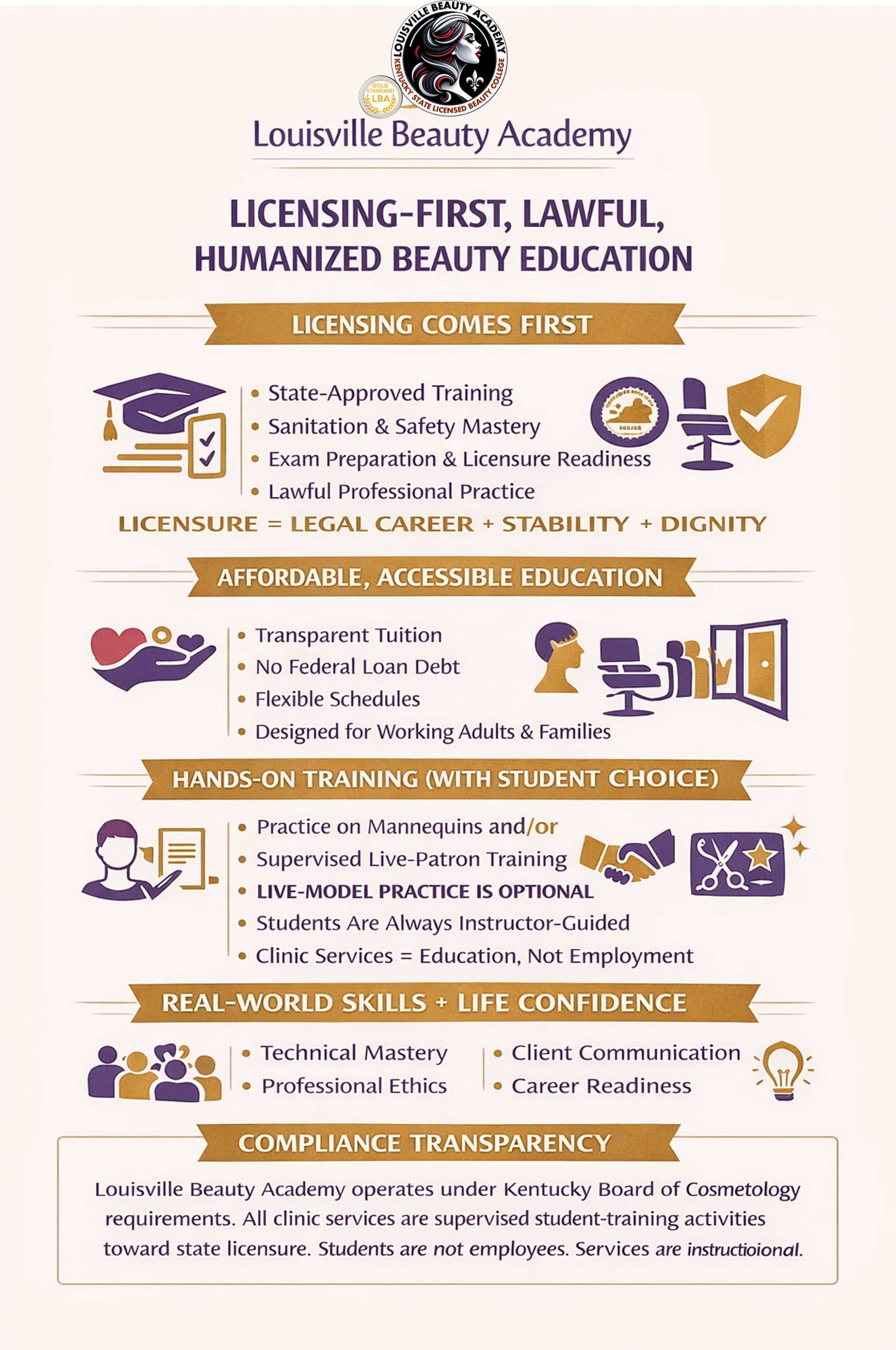
1. Licensing Comes First — Because the Law Comes First
Beauty is a licensed profession in Kentucky. That means real careers begin not with photos or social media — but with:
✔ state-approved education ✔ lawful training hours ✔ sanitation & safety mastery ✔ exam readiness ✔ compliance with the Kentucky Board of Cosmetology
Our entire program is designed around one core truth:
Licensure = opportunity, dignity, stability, and professional freedom.
We teach the knowledge, discipline, ethics, and technical skill students need to pass the licensing exam — and to practice legally for life.
2. Learning and Life Are Already Hard — School Should Support, Not Stress
Many beauty students are adults balancing work, family, finances, and real-life responsibilities. Public workforce studies consistently show that adult learners face time and financial pressures.
LBA responds to that reality with:
✔ simple, transparent pricing ✔ flexible scheduling ✔ student-first support ✔ no federal loan debt
Our curriculum stays aligned with Kentucky Board requirements so students can focus on what matters — learning, passing the exam, and building a future.
3. Hands-On Training — With Safety, Law, and Student Choice
Real confidence is built through supervised practice. At Louisville Beauty Academy:
Students may complete practical training using:
✔ mannequins and/or ✔ supervised live patrons in our student training clinic
Live-model practice is optional.
No student is ever required to perform services on a live patron to continue their training.
Many students choose live-model practice as they gain confidence — but they do so with full instructor supervision and support.
💡 This is education — not employment. Training hours earned in the clinic count toward Kentucky licensure requirements.
Clinic services are offered at reduced training rates, and fees support instructional supervision, facility costs, and supplies — not wages.
This model protects:
✔ students ✔ the public ✔ lawful practice ✔ educational integrity
And it ensures that education always comes before production.
4. Real Education Happens in Real-World Training
Vocational learning research consistently shows that the most lasting professional skills are built through supervised, hands-on application.
That is why LBA emphasizes:
✔ instructor-guided practice ✔ technical competency ✔ sanitation & safety discipline ✔ client communication ✔ exam-aligned training ✔ ethical professionalism
We want graduates to feel confident:
✨ with clients ✨ with inspectors ✨ in exams ✨ in their own businesses
Not just in photos.
5. Affordability by Design — Debt Is Not a Requirement for Success
Across the U.S., many beauty school programs cost over $15,000–$20,000. LBA intentionally maintains significantly lower tuition and does not participate in federal loan programs.
Why?
Because we believe education should open doors — not create lifelong financial pressure.
Our model helps students:
✔ finish school sooner ✔ avoid unnecessary debt ✔ enter the workforce faster ✔ support themselves & families
This is not a shortcut. It is a philosophy.
6. Caring & Humanized Education — People Before Image
Louisville Beauty Academy was founded on compassion, accessibility, and opportunity — especially for working families, first-generation Americans, and career-changers.
Research shows that supportive school cultures improve student success. We see that every day.
We focus on:
💛 dignity 💛 respect 💛 community 💛 service 💛 lawful professionalism
Because beauty education is not just technical training — it is economic mobility, identity, and human potential.
Why All This Matters
Centering law, licensing, safety, and affordability ensures that:
✔ Students graduate confident and exam-ready ✔ The public receives safe, lawful services ✔ Graduates can work immediately — legally ✔ Careers begin without unnecessary debt ✔ Communities gain skilled professionals ✔ Integrity remains at the core of the industry
We don’t just teach beauty skills.
We teach responsibility, licensure readiness, professionalism, and lifelong livelihood.
That is the Louisville Beauty Academy promise.
Compliance Transparency Statement
Louisville Beauty Academy operates as a licensed beauty education institution under the requirements of the Kentucky Board of Cosmetology. All student clinic services are performed as part of supervised training toward state licensure. Clinic service fees support educational operations and materials. Students are not employees, and services are instructional in nature. Students may choose to practice on mannequins or supervised live patrons as part of their training.
REFERENCES
American Association of Cosmetology Schools. (2022). Cosmetology Education Annual Industry Report.
Brookings Institution. (2022). The Community College Debt Divide.
U.S. Department of Education. (2023). Adult Learning and Workforce Development Study.
Government Accountability Office. (2023). Federal Student Aid Oversight of Career Training Programs.
Harvard Graduate School of Education. (2022). Caring Learning Environments in Vocational Education.
Cornelius‑White, J. (2021). Humanized Education for Adult Vocational Learners.
Document Purpose This Impact Statement is provided for public, informational, and workforce-policy reference. It documents Louisville Beauty Academy’s role as licensed workforce infrastructure supporting employment, small-business creation, and local economic participation in the Commonwealth of Kentucky and surrounding counties.
This document is not promotional. It is intended to support transparency, evaluation, and informed decision-making by students, families, regulators, workforce agencies, policymakers, employers, and community stakeholders.
Institution Overview
Louisville Beauty Academy (LBA) is a state-licensed, non-Title IV, lower-debt professional beauty school operating in Louisville, Kentucky. LBA delivers accelerated, compliance-driven education focused on state licensure and workforce readiness in regulated beauty professions.
LBA operates independently of federal student aid programs and does not rely on Pell Grants or student loans as an operating subsidy.
Workforce & Economic Outcomes (Historical)
Since its founding, Louisville Beauty Academy has contributed to workforce participation through the following historical outcomes:
~2,000 licensed graduates across regulated beauty disciplines
Graduates entering lawful employment, self-employment, and small-business ownership
~30 independently owned salons established by LBA graduates
Each salon employing additional licensed professionals and support staff
Graduates working in local service economies, including salons, spas, rental suites, and mobile or independent practice models
Licensed beauty professionals provide essential, in-person services that cannot be outsourced, automated, or relocated outside the local economy.
Income & Business Activity (Modest, Informational Estimates)
For workforce-planning and economic-context purposes only, the following conservative income ranges are provided to illustrate scale—not to promise outcomes:
Individual licensed graduates commonly generate approximately $10,000–$50,000 annually in service-based income, depending on hours worked, location, specialization, and market conditions.
Graduate-owned salons and shops, particularly multi-chair or established locations, may generate approximately $500,000 to $1,000,000 in annual gross business revenue, inclusive of services, retail, and employment activity.
These figures represent industry-typical ranges, not guarantees, and are provided solely to contextualize workforce impact.
Estimated Annual Economic Impact (Kentucky & Local Counties)
Based on:
Approximately 2,000 licensed graduates
Modest individual service income ranges
Small-business ownership and employment effects
Ongoing local service delivery within Kentucky communities
Louisville Beauty Academy’s alumni network is estimated to contribute approximately $20–50 million in annual economic activity within the Commonwealth of Kentucky and its local counties.
Methodology Note: This estimate is intentionally conservative and informational. It reflects aggregated service income, business revenue, and employment activity generated by licensed graduates over time. It does not assume full-time participation by all graduates and does not attribute all income exclusively to LBA instruction.
Small Business Creation as Workforce Multipliers
Beyond individual employment, LBA’s outcomes include secondary and tertiary economic effects:
Licensed graduates becoming small-business owners
Job creation for additional licensed professionals
Lease activity, utilities, supplies, and tax contributions
Increased access to regulated services in underserved and rural communities
In this respect, Louisville Beauty Academy functions as a small-business incubator within regulated workforce infrastructure, rather than solely a training provider.
Accessibility & Affordability Model
LBA’s operational model emphasizes:
lower-debt education pathways
Accelerated time-to-licensure
Year-round enrollment and attendance
Transparent tuition and fee disclosure
No reliance on federal aid buffers
This structure reduces delayed workforce entry and limits long-term financial burden on graduates.
Compliance & Transparency Framework
Louisville Beauty Academy maintains a Public Compliance & Regulatory Education Library documenting:
Enrollment and attendance procedures
Student contract disclosures
Timekeeping and instructional compliance
Regulatory correspondence and memoranda
Public workforce research and case studies
This reflects LBA’s position that compliance is clarity, documentation, and professionalism.
Role as Workforce Infrastructure
Licensed beauty education functions as local workforce infrastructure by:
Enabling lawful entry into regulated professions
Supporting service-based micro-economies
Creating self-employment and small-business pathways
Serving immigrant, adult, and nontraditional learners
Providing essential services within local communities
Louisville Beauty Academy operates with the expectation of public review, auditability, and accountability.
Public Review Invitation
Louisville Beauty Academy welcomes independent review, policy discussion, and workforce evaluation of the information contained in this statement.
This document is intended to support:
Workforce planning
Economic development analysis
Regulatory transparency
Public understanding
Standard Disclaimer
All information contained in this statement is provided for educational and informational purposes only. Louisville Beauty Academy does not guarantee licensure, employment, income, or business success. Individual outcomes vary based on participation, market conditions, regulatory requirements, and personal circumstances.
Income and economic impact figures are estimates, not promises, and should be interpreted accordingly.
Document Status: Public Workforce & Economic Reference Effective Period: 2025–2026 Issued by: Louisville Beauty Academy
All figures and statements contained in this document are provided strictly for educational and informational purposes only. They reflect historical outcomes and conservative estimates based on general industry patterns and publicly observable economic activity. Louisville Beauty Academy does not guarantee licensure, employment, income, business success, or specific economic results for any individual or entity.
Actual outcomes vary based on individual effort, hours worked, experience, business operations, market conditions, regulatory requirements, and other factors beyond the control of Louisville Beauty Academy. Nothing in this document should be interpreted as financial, legal, employment, or regulatory advice.
Louisville Beauty Academy encourages all students, professionals, employers, policymakers, and stakeholders to rely on independent judgment, official regulatory guidance, and verified financial advice when making decisions.
Across Kentucky, small businesses make up 99.3% of all employers — more than 360,000 homegrown companies that power our state’s workforce, families, and communities. These businesses aren’t just economic drivers — they are classrooms, mentors, and opportunity-builders. They are the foundation of Kentucky’s future.
Louisville Beauty Academy is proud to be one of those small businesses.
Founded and operated locally, Louisville Beauty Academy exists for one mission: to provide affordable, licensed, workforce-ready education that leads directly to real careers in the beauty industry.
For many students — immigrants, working parents, first-generation learners, career-changers, and those overlooked by traditional systems — this school is not just an education program. It is a life-changing pathway to licensure, income stability, and independence.
A Small Business That Builds Other Small Businesses
Louisville Beauty Academy is unique among Kentucky small businesses because it doesn’t just operate as one — it helps create others.
To date, the school has:
🎓 Graduated nearly 2,000 licensed beauty professionals 🏪 Supported more than 30 graduate-owned salons and beauty businesses 💼 Helped hundreds of employers fill critical workforce needs
These graduates now:
✔ earn stable wages ✔ support families ✔ open local businesses ✔ employ others ✔ invest back into their communities
Collectively, Louisville Beauty Academy graduates are estimated to generate $20–$50 million in annual economic impact through wages, services, entrepreneurship, and business activity across Kentucky.
This is what small-business-powered workforce development looks like — Kentuckians helping Kentuckians succeed.
National Recognition — Kentucky on the Map
In 2025, Louisville Beauty Academy received historic dual national recognition:
🏆 Named one of America’s Top 100 Small Businesses by the U.S. Chamber of Commerce CO—100 Awards 🏆 Honored as a National Small Business Association Advocate of the Year Finalist
Selected from over 12,500 applicants nationwide, the academy proudly represented Kentucky as a model of mission-driven, community-focused small-business leadership.
This recognition reflects a commitment to:
✔ compliance & professional standards ✔ affordable licensure-focused education ✔ workforce alignment ✔ open records & transparency ✔ community advocacy ✔ immigrant-built entrepreneurship
Local Roots. Statewide Impact. American Opportunity.
Louisville Beauty Academy believes deeply in the values that make Kentucky strong:
🛍 Shop local 📚 Learn local 🎓 Train local 🏠 Build local
Because when Kentucky residents support Kentucky small businesses, they strengthen families, neighborhoods, and the state’s workforce — one person at a time.
And for thousands of graduates, licensure has meant:
❤️ dignity 🔑 opportunity 🏦 economic mobility 🤝 community belonging
A School Built for People — Not Systems
Louisville Beauty Academy proudly serves:
• first-generation Americans • working parents • women returning to the workforce • young people seeking direction • career-changers • underserved communities
Every student is welcomed. Every effort is made to remove barriers. Every license earned strengthens Kentucky’s economy.
Looking Forward
As Kentucky continues to invest in workforce development, Louisville Beauty Academy stands ready to serve as:
💇♀️ a pipeline for licensed professionals 🏫 a partner to employers 🏪 a creator of small-business owners ❤️ a champion for opportunity
One small Kentucky business — helping build many more.
Disclaimer: The information provided by Louisville Beauty Academy is for general educational, informational, and community-awareness purposes only. While every effort is made to ensure accuracy, no guarantee is made regarding completeness, reliability, regulatory interpretation, licensure outcomes, employment results, business performance, or financial impact. Nothing herein constitutes legal, financial, regulatory, tax, business, or professional advice, and no client, student, or advisory relationship is created by viewing or sharing this material.
Participation in any educational program, licensing process, or business activity involves risk and is subject to federal and state law. Individual results vary based on personal effort, eligibility, compliance, market conditions, and other factors beyond the control of Louisville Beauty Academy. Louisville Beauty Academy expressly disclaims all liability for any loss, damage, or decisions made based on the information presented.
For legal or regulatory guidance, please consult a qualified professional. Enrollment, graduation, licensure, employment, earnings, or business success are not guaranteed.
This article is part of LBA’s public education and historical archive. Older posts, including “Louisville Beauty Academy as Essential Workforce Infrastructure for Rural Kentucky – A Public Education & Workforce Research White Paper — December 2025,” may not reflect current tuition, schedules, incentives, forms, policies, testing vendors, clinic availability, or regulatory requirements.
The Louisville Beauty Academy (LBA) model is designed to serve Kentucky’s rural and small-town communities by offering fast, results-driven beauty education that sidesteps traditional financial and bureaucratic barriers. About 85 of Kentucky’s 120 counties are classified as rural (USDA definition), encompassing 1.85 million people (~41% of the state) uknow.uky.edu. These areas face economic challenges – statewide, 18.9% of Kentuckians live in poverty (versus 15.4% nationally), and many rural counties exceed 25% poverty (e.g. Clay – 39.7%, McCreary – 41.0%, Wolfe – 43.0%) kystats.ky.govkystats.ky.gov. Rural Kentuckians rely heavily on public aid (e.g. SNAP, Medicaid) because wages and resources are often low. Median rural incomes lag urban areas, and opportunities for quick, lower-debt training are scarce. In this context, traditional beauty schools that depend on federal Pell grants and student loans create hidden costs. Because Pell aid is unavailable for shorter programs (under 600 hours) and only for accredited schools, many rural students end up in longer programs with higher tuition and debtnaba4u.orgnaba4u.org. This forces them to spend extra months in school (reducing earning time) and often graduate with significant loans, even when they only need a shorter vocational credential.
Figure: Rural Kentucky communities (like Corbin, pictured) comprise a large share of the population uknow.uky.edu. These areas need accessible career training that bypasses costly financial aid structures. Rural Kentucky’s economy underscores the need for new models. Incomes tend to be lower than urban areas, and federal aid can unintentionally steer low-income students toward expensive, long programs instead of shorter, in-demand careers naba4u.orgkystats.ky.gov. For example, Kentucky’s new law reduced nail technology training from 600 to 450 hours to speed workforce entry, yet federal rules still exclude 450-hour programs from Pell grants naba4u.orgnaba4u.org. The result is a bottleneck: capable rural students may delay training or take on unnecessary debt just to access aid. Comprehensive data show that many surrounding states also have substantial rural populations (e.g. Tennessee ~34%, Indiana ~28%, Ohio ~22%) and similar funding barriers. In short, “what is called affordable” federal aid often ends up buffered by hidden costs, so that the true cost – in time or debt – remains high for rural learners.
Barriers in Beauty Education Funding
Federal financial aid rules create a stark disadvantage for students in short, intensive programs. Under current U.S. Dept. of Education policy, only programs of ≥600 hours (and accredited by a U.S.-recognized agency) qualify for Pell grants or federal loans dol.govnaba4u.org. Since LBA specializes in short, skills-focused tracks (e.g. 450-hour Nail Tech, 750-hour Esthetics), none of its programs qualify for Title IV aid naba4u.org. Other schools often extend course lengths or tack on unrelated content just to hit the threshold, which adds months of extra schooling and cost. As a result, low-income students in rural Kentucky face a choice: pay out-of-pocket for LBA’s lean programs, or enroll in a longer, debt-financed cosmetology course elsewhere (even if they only want nails or skincare). This misalignment “forces students to take on larger debt for more training than they may want or need”naba4u.org. In practice, federal aid restrictions delay graduation and inflate costs, preventing quick entry to work. LBA’s experience highlights this gap: the academy offers a full 450-hour Nail Technology course for about $3,800 (after discounts) – a fraction of what a 1500-hour cosmetology program costs – yet Pell is barrednaba4u.org. Because of this, many willing students are “filtered out” by lack of fundingnaba4u.org. Kentucky’s rural learners especially depend on grant aid, so reforming this barrier is critical to accelerate workforce entry and reduce debt for rural beauty professionals.
The LBA Model – Affordable, Outcome-Focused Education
LBA’s unique model tackles these barriers head-on. The school is state-licensed and -accredited (Kentucky Board of Cosmetology) but not federally accredited, a conscious choice that lets it focus on outcomes without federal oversight. This allows ultra-low tuition – about 50–75% less than comparable federally-funded schools louisvillebeautyacademy.net – and a lower-debt structure. LBA students pay via short-term plans, scholarships, or employer support rather than federal loans. The curriculum is purpose-built for one mission: to produce licensed beauty professionals ready to work. All LBA programs (e.g. 450-hr Nails, 750-hr Esthetics, 300-hr Shampoo Styling, 1500-hr Cosmetology) are exactly the hours needed for state licensure louisvillebeautyacademy.net. There are no extra semesters: in fact, LBA celebrates daily or weekly graduations, meaning students who master the material move on immediately louisvillebeautyacademy.net. This rapid pace incentivizes focused study – learners know the goal is immediate licensing and a paycheck, not accumulating credits. As one report notes, Kentucky’s LBA “offers affordable, fast-track programs that lead to immediate employment” louisvillebeautyacademy.net. The results speak to the model’s effectiveness: since opening in 2017, LBA has trained over 1,000 beauty professionals naba4u.org. All these graduates could sit for state board exams right away (and many did). By contrast, students at traditional schools might spend extra months in mandated breaks or nonessential courses, delaying their entry into the labor market. LBA breaks from that norm: students spend only the required clock hours (no holiday “dead time” built-in) and every hour counts toward licensure. This streamlined, student-driven approach has set LBA apart as “the highly affordable beauty college in Kentucky,” according to its own materials naba4u.org. In short, LBA under-delivers bureaucracy and over-delivers on real skills – a “gold standard” of compliance and transparency that explicitly benefits its rural clientele. The school even advertises full transparency of costs and curricula, ensuring rural families understand exactly what they pay for and achieve naba4u.orglouisvillebeautyacademy.net.
Figure: LBA students train in real salon settings. By co-locating programs with local salons or spas, schools can cut overhead and immerse learners in the industry. LBA’s model suggests partnering with community hubs to bring training directly where rural students live and work.
Aligning with Workforce Funding and Community Partners
To fully realize its public-interest mission, LBA’s strategy should leverage public workforce funding instead of private investment (“HCA capital”). Federal and state workforce programs – under WIOA and similar initiatives – are explicitly designed to train local workers in high-demand fields. Through WIOA, local workforce boards and One-Stop Career Centers can fund eligible training programs directly dol.gov. For example, Kentucky’s Approved Training Provider List (ETPL) already includes multiple cosmetology and beauty schools (e.g. PJ’s College of Cosmetology, Pikeville Beauty Academy, Platinum Shears Beauty Academy) etpl.ky.gov. Any career training on this list can receive WIOA vouchers or grants for qualified students. LBA could seek inclusion on the ETPL or partner with WIOA agencies to make its programs tuition-free for eligible applicants. Likewise, city workforce boards and state labor departments (e.g. Kentucky’s Education & Workforce Development Cabinet) can align LBA’s courses with regional job-placement goals, channeling public funds into the academy. Employer-paid tuition is another avenue: salons and spas in Louisville and rural counties could sponsor apprentices through LBA, effectively investing their own payroll into training (sometimes with state matching). Even community reinvestment funds (from local taxes or non-profits) could be directed to support classes for under-resourced areas. In all cases, LBA becomes a public-interest partner, not an investor-controlled enterprise. This means LBA can be structured like a workforce-development program: free or nearly-historical tuition-support language for students, paid by public grants and employer contributions, with clear performance metrics (licensure pass rates, job placement). By aligning with city workforce boards, state labor agencies, WIOA/ETPL pipelines, employer tuition funds, and community investment programs, LBA would tap existing support networks and fully serve its rural mission. The U.S. Labor Dept. notes that WIOA programs provide career and training services (both classroom and on-the-job) to millions of workers through a nationwide network of centers dol.gov. Redirecting even a small slice of these resources to beauty training could make LBA’s programs nearly free to eligible Kentuckians – turning a $3,800 program into essentially $0 out-of-pocket while still ensuring students earn industry credentials and jobs.
Recommendations: To maximize impact, LBA and policymakers should:
Partner with Workforce Agencies. Engage local workforce development boards and the Kentucky Career Center to list LBA on the Eligible Training Provider List (ETPL) and accept WIOA funding. Secure support from the state Labor Cabinet and education workforce initiatives. This ties LBA tuition to public funding and employers, preserving affordability dol.govetpl.ky.gov.
Maintain Single-Outcome Focus. Preserve LBA’s one-track model: teach only what is required for licensing and employment. Continue offering lower-debt, short courses aimed solely at licensure (not extraneous credits). This approach – one mission, one outcome – leverages LBA’s strength in quickly moving students into jobs louisvillebeautyacademy.net.
Co-Locate in Salons and Hubs. Instead of standalone campuses, locate LBA training within existing salons, spas, community centers or workforce hubs. This uses underutilized space, fosters mentorship by working professionals, and roots training in the community. For rural reach, consider pop-up or hybrid models (e.g. local campuses taught remotely by LBA instructors with hands-on labs at nearby salons). Co-location also makes it easy for policymakers and employers to see LBA’s role in the local economy.
Emphasize Transparency and Support. Market LBA’s programs as fully supported by public funds or sponsored by local businesses. Offer clear, online course tracking (leveraging AI-driven systems) so students see progress in real time. Emphasize that state- or employer-funded tuition effectively makes programs free or very low-cost for learners, with no hidden loan debt. This transparency builds trust with rural families and policymakers.
Conclusion
Kentucky’s rural communities need vocational pathways that are fast, affordable, and workforce-aligned. Louisville Beauty Academy’s model demonstrates that by cutting extraneous hours, lowering tuition, and focusing on licensure outcomes, beauty education can be made genuinely accessible to rural students. The next step is public partnership: aligning LBA with WIOA, workforce boards, and community resources will eliminate barriers like expensive loans and program delays. With state or employer funding, LBA courses become virtually free at the point of entry. Co-locating classes in salons and service centers brings training into the heart of rural communities, safeguarding it as a public good. In summary, LBA’s success in Kentucky – training 1,000+ professionals quickly and cheaply naba4u.orglouisvillebeautyacademy.net – shows the potential of a workforce-focused, lower-debt model. By leveraging public funding and local partnerships, LBA can expand this model, becoming “bullet-proof” to liability and fully aligned with the needs of rural Americans. Such a system honors LBA’s founding intent to build Kentucky’s beauty workforce without burdening students with debt or delay.
References: Blueprint Kentucky. (2025, October 8). New report shares data trends on Kentucky’s rural economy. University of Kentucky (UKnow). Retrieved from https://uknow.uky.edu/research/new-report-shares-data-trends-kentucky-s-rural-economy uknow.uky.edu. Louisville Beauty Academy. (2025, May 7). Research Report: Louisville Beauty Academy as a Proven Model for Loan Reform and Workforce Development. Louisville, KY: Louisville Beauty Academy. Retrieved from https://louisvillebeautyacademy.net/research-report-louisville-beauty-academy-as-a-proven-model-for-loan-reform-and-workforce-development-2025 louisvillebeautyacademy.net. Tran, D. (2025, April 9). Strategic Analysis: Accreditation, Federal Aid Limits, and Louisville Beauty Academy’s Path Forward. New American Business Association (NABA). Retrieved from https://naba4u.org/2025/04/strategic-analysis-accreditation-federal-aid-limits-and-louisville-beauty-academys-path-forward/ naba4u.org. U.S. Department of Labor, Employment & Training Administration. (n.d.). WIOA Workforce Programs. Retrieved from https://www.dol.gov/agencies/eta/wioa/programs dol.gov. Kentucky Center for Statistics. (2016). Poverty Rates by County (2011–2015 ACS) [Map]. Frankfort, KY: Kentucky Center for Statistics. Retrieved from https://kystats.ky.gov/Content/Reports/Maps/PovertyRatesByCounty.pdf kystats.ky.gov. (All sources accessed 2025)
Disclaimer
This publication is provided for educational, informational, and public workforce research purposes only. It does not constitute legal, financial, regulatory, accreditation, or employment advice.
Louisville Beauty Academy does not guarantee licensure, examination results, employment, income, program completion time, or individual outcomes. Results vary based on attendance, preparation, effort, regulatory requirements, and personal circumstances.
References to affordability, time-to-licensure, workforce readiness, or program structure describe educational models and intent, not promises of results.
Any discussion of public or private funding sources (including Pell Grants, student loans, WIOA, ETPL, workforce programs, employer-paid tuition, or community funding) is illustrative only. Eligibility, approval, and availability are determined by third-party agencies or employers and may change.
This publication does not evaluate or compare specific schools or institutions. All data referenced is drawn from publicly available sources believed to be accurate as of December 2025.
Nothing herein replaces applicable laws, regulations, or licensing requirements. Readers remain responsible for compliance with all governing authorities.
Report a website barrier or request help accessing information. Email Study@LouisvilleBeautyAcademy.net or text 502-625-5531. Include the page and what you were trying to do. Please do not send medical records or sensitive identifiers.
Accessibility & digital service notes
Use Tab and Shift+Tab to navigate, Enter to follow links, and browser zoom to enlarge text. The language selector supports Enter, Space, Tab, and Escape. Motion is reduced when your device requests it. Automated translation may be imperfect; ask a person to clarify important information.
Updated October 16, 2026. Work on accessibility is ongoing. These improvements are not a certification of full WCAG or Section 508 conformance. Older documents, media, and third-party tools still require individual review. About WCAG accessibility standards.