Louisville’s economy is undergoing a historic transformation. On one side, large corporations and logistics firms are pursuing “lights-out” automation—deploying artificial intelligence (AI), autonomous systems, and algorithmic logistics to drive efficiency. This trend is reshaping many white-collar and routine jobs, making them increasingly automated and less dependent on human labor.
Yet alongside this technological shift, a powerful renaissance of human-centric labor is emerging—anchored in sectors that machines can’t replicate. Among these, the beauty, wellness, and personal care industries stand out as resilient, rewarding, and fundamentally human.
Why the Beauty Industry Is AI-Proof
Unlike data-driven tasks that can be executed by algorithms or automated machines, beauty services are rooted in human connection, empathy, and tactile skill:
Human Touch Is Irreplaceable: A haircut, facial, massage, or aesthetic service involves nuanced physical dexterity and a personal interaction that AI can’t authentically reproduce.
Psychology and Wellness: Beauty services release oxytocin—a hormone associated with trust and well-being—something no machine can deliver.
Community and Mental Health: Salons and spas are more than service centers—they are social hubs where clients find conversation, confidence, reassurance, and human care that counters stress and isolation.
This combination of physical skill, emotional intelligence, and social connection makes beauty professionals among the most robustly future-proof careers in the AI era.
Beauty as Preventive Health and Wellness
The beauty industry isn’t just about aesthetics. It plays a preventative role in health and wellness:
Well-being Through Care: Routine skin care, massage, and grooming contribute to mental and physical health by reducing stress, enhancing self-esteem, and promoting personal hygiene.
Human Interaction Matters: In an age of increasing loneliness and digital overload, beauty professionals provide meaningful human engagement that algorithms cannot replace.
Bridging Beauty and Health: With training in modalities such as esthetics and wellness treatments, beauty professionals operate at the intersection of beauty, mental well-being, and holistic care, making their roles not just desirable—but essential.
The “Human-as-Luxury” Trend
As automation expands across corporate and logistical sectors, people are rediscovering the value of high-touch human experiences. This phenomenon, described in economic research as the “Human-as-Luxury” trend, means consumers will pay a premium for authentic human care that technology can’t imitate.
Beauty services are inherently human—they require interpretation, adaptability, trust, and personal artistry. For clients, these services are not transactions; they are transformative experiences.
Your Future in Beauty Starts Here
At Louisville Beauty Academy, we prepare students for careers that are resilient, rewarding, and rooted in human connection.
AI-Proof Skills: Beauty professionals rely on empathy, creativity, and fine motor skills, all of which are extremely difficult for machines to replicate.
Wellness and Holistic Care: Training goes beyond technique—it includes understanding how beauty services contribute to mental wellness and preventive health.
Immediate Earning Potential: Unlike traditional four-year degrees, beauty training puts you into the workforce quickly with real earning power.
Community Impact: Graduates do more than build careers—they build confidence, wellbeing, and human connection in every client they serve.
Conclusion: Human Skills Won’t Go Out of Style
In a world increasingly dominated by automation, the value of human-centric labor rises. The beauty industry is a clear example of this shift—not just surviving the AI revolution but flourishing because it is fundamentally human.
People will always seek care, confidence, connection, and self-expression. At Louisville Beauty Academy, we celebrate this truth and prepare our students to thrive in a future where human skills are the most valuable currency of all.
(Cosmetology · Esthetics · Nail Technology · Shampoo Stylist )
Enrolling in beauty school is not just signing up for classes. It is a licensed, regulated, and career-defining commitment governed by state law.
Before enrolling in any beauty school, students and families should understand what readiness truly means — legally, academically, financially, and professionally.
At Louisville Beauty Academy, we believe informed students succeed at higher rates.
To legally enroll and eventually become licensed, students must meet state eligibility requirements, which generally include:
Minimum age requirements
High school diploma, GED, or approved equivalency
Valid government-issued photo ID
Lawful presence or authorization to study/work
If these requirements are not met, no licensed school can legally enroll or graduate a student for licensure.
📜 Educational Law Reference (Excerpted for Awareness)
In plain terms: State law requires completion of approved training and compliance with board-established qualifications before licensure.
Verbatim excerpt:
“An applicant for licensure shall have completed the required hours of instruction in a licensed school and meet the qualifications established by the board.”
— Kentucky cosmetology statutes and administrative regulations
Authority: Kentucky Board of Cosmetology
🔞 Under 18? Here’s What Students and Parents Must Know
Yes — if you are under 18 but have already graduated from high school or earned a GED, you may enroll in beauty school.
However:
You cannot sit for the state licensing exam until you turn 18.
This means:
✔ You may enroll before age 18
✔ You may complete required training hours
✔ You may graduate from school
⛔ You must wait until age 18 to take the state board exam
⛔ You cannot be licensed until you meet the age requirement
Starting early is allowed. Licensing early is not.
2️⃣ Time & Attendance Readiness (Hour-Based Programs)
Beauty education is hour-tracked, not credit-based.
Before enrolling, students should honestly evaluate:
Weekly schedule availability
Work and family responsibilities
Transportation reliability
Ability to attend consistently for months
⏱️ Missed hours delay graduation and delay licensure.
Consistency matters more than speed.
3️⃣ Financial Readiness (Know Before You Sign)
Every student should clearly understand:
Total tuition and fees
Kit, book, and supply costs
Payment options and timelines
Refund, withdrawal, and completion policies
A reputable school explains costs before enrollment, not after.
Transparency protects students.
4️⃣ Academic & Professional Readiness
Beauty school is not only hands-on. Students will study:
Sanitation and infection control
State law and regulations
Anatomy and physiology
Professional ethics and conduct
Client communication and documentation
You don’t need to be perfect — but you must be teachable, disciplined, and compliant.
5️⃣ The Right Mindset: License First, Skill Second
The goal of beauty school is not simply learning a skill.
The real objective is:
State licensure
Legal employment
Professional credibility
Long-term career stability
A beauty license is a legal credential, not a hobby certificate.
🌸 Why This Level of Transparency Matters
Schools that clearly explain readiness:
Respect student time and money
Protect future licensure eligibility
Operate ethically and compliantly
Focus on completion — not just enrollment
At Louisville Beauty Academy, we believe:
Preparation is protection. Education is empowerment. Licensure is the goal.
🛡️ Educational Disclaimer (Use This Exactly)
Educational Notice: This content is provided for general educational awareness only and does not constitute legal advice. Licensing, age, eligibility, attendance, and examination requirements are governed by Kentucky law and the Kentucky Board of Cosmetology and may change. Students are responsible for verifying current requirements directly with the Board.
📞 Ready to Take the Next Step — the Right Way?
If you are prepared, informed, and committed to licensure success, we are ready to guide you ethically, legally, and transparently.
At Louisville Beauty Academy, our mission is to prepare students not only for licensure, but for real-world professionalism, ethical decision-making, and client care.
As part of this commitment, Louisville Beauty Academy partners with Di Tran University – College of Humanization to bring research-informed education into practical, accessible training for beauty professionals.
Research-Based, Professionally Designed
Di Tran University’s 2026 applied research series, Safe Chair Initiative: Domestic Violence Awareness for Beauty Professionals, examines how beauty professionals often serve as trusted community touchpoints. Over time, clients may share stress, fear, or personal challenges during routine salon visits.
Based on this research, Louisville Beauty Academy now carries a 1-hour online professional awareness course, designed specifically for beauty students and working professionals.
What This Training Is — and Is Not
This course is not about investigation, diagnosis, or reporting. It is not about replacing social services or law enforcement.
Instead, the training focuses on:
Professional awareness and ethical boundaries
Recognizing signs of distress without assumptions
Listening respectfully and non-judgmentally
Maintaining client dignity and confidentiality
Understanding appropriate referral pathways
Protecting both client safety and professional integrity
The goal is to strengthen professionalism — not to place additional burdens on practitioners.
Why This Matters in Beauty Education
Beauty professionals build long-term relationships. Salons are community spaces. Preparing students for these realities is part of responsible education.
By offering a research-based, one-hour online course, Louisville Beauty Academy ensures:
Students are better prepared for real salon environments
Graduates understand professional boundaries and ethics
Client trust and safety are respected
Education reflects the realities professionals face after licensure
Education That Reflects Real Life
Louisville Beauty Academy believes that strong education goes beyond technical skill. It includes communication, ethics, awareness, and responsibility — all delivered in a way that is practical, respectful, and aligned with professional scope of practice.
Our partnership with Di Tran University allows us to translate academic research into clear, accessible, real-world training that supports students, professionals, and the communities they serve.
Professional Awareness & Client Care
One-Hour Online Training Curriculum
Louisville Beauty Academy Research-Informed by Di Tran University – College of Humanization
Course Length
Total Duration: 60 minutes Format: Online (self-paced or instructor-facilitated)
Learning Objectives
By the end of this one-hour training, participants will be able to:
Understand the professional role of beauty practitioners as trusted service providers
Recognize signs of client distress without making assumptions
Maintain ethical and professional boundaries
Respond respectfully and appropriately when sensitive issues arise
Know when and how to share community resources
Protect client dignity, confidentiality, and personal safety
Protect themselves professionally by staying within scope of practice
MODULE BREAKDOWN (60 MINUTES TOTAL)
Module 1 — Professional Role & Ethical Responsibility (10 minutes)
Purpose: Ground the training in professionalism, not intervention.
Topics Covered:
Beauty professionals as trusted service providers
Why clients may share personal information in salon settings
Ethical responsibility vs. personal involvement
The importance of neutrality and respect
Key Emphasis:
You are a professional, not a counselor, investigator, or authority
Module 6 — Professional Protection, Documentation & Self-Care (10 minutes)
Purpose: Close the training with protection and sustainability.
Topics Covered:
Protecting professional integrity
Emotional boundaries and self-care
When to consult supervisors or school leadership
Maintaining professionalism after sensitive interactions
Key Emphasis:
Awareness training supports professionalism, not emotional burden
You are not responsible for solving client situations
Professional distance is ethical
Assessment & Completion
Short knowledge check (5–10 questions) or
Reflection acknowledgment
Certificate of completion issued
Training Philosophy
This course is:
Educational, not punitive
Awareness-based, not investigative
Research-informed, not theoretical
Designed to strengthen professionalism and client trust
Compliance & Safety Statement
This training:
Does not require diagnosis, reporting, or intervention
Does not replace social services or law enforcement
Respects professional scope of practice
Supports ethical, respectful client care
Closing Statement
Louisville Beauty Academy provides this training to ensure students and professionals are prepared, ethical, and confident in real-world salon environments—while protecting both client dignity and professional integrity.
The professional landscape of esthetics, medical esthetics, and advanced cosmetic procedures in the Commonwealth of Kentucky is defined by a rigorous, bifurcated, and frequently misunderstood statutory framework. As the demand for non-invasive cosmetic procedures—ranging from laser hair removal to microblading—surges, the regulatory bodies governing these practices have entrenched strict delineations between “beautification” and “medicine.” This report provides an exhaustive deep research analysis of the legal, operational, and educational ecosystems surrounding the beauty industry in Kentucky, with a specific focus on the Louisville market. It examines the interplay between the Kentucky Board of Cosmetology (KBC), the Kentucky Board of Medical Licensure (KBML), and the Cabinet for Health and Family Services (CHFS), illustrating how overlapping jurisdictions create a complex compliance environment for practitioners.
Central to this analysis is the pedagogical philosophy of the Louisville Beauty Academy (LBA), which markets its curriculum as the “Gold Standard” of esthetic education. Our research indicates that this standard is derived not merely from technical instruction but from a strategic philosophy of “Over-Compliance by Design.” By rigorously adhering to the strict letter of Kentucky law—specifically the prohibitions against independent laser use and injections—LBA positions its graduates to navigate the legal minefield of the modern med-spa industry without succumbing to the liabilities of unauthorized practice.
This report details the statutory prohibition of “medical estheticians,” the absolute requirement for “immediate” physician supervision during laser procedures, the distinct regulatory regime for microblading under public health laws, and the corporate practice of medicine doctrines that restrict med-spa ownership. It serves as a definitive guide for stakeholders, educators, and practitioners seeking to understand the granular realities of operating within the strictures of Kentucky law.
Part I: The Statutory Architecture of Esthetics in Kentucky
1.1 The Legislative Foundation: KRS Chapter 317A and 317B
The legal existence of the esthetician in Kentucky is rooted in Kentucky Revised Statutes (KRS) Chapter 317A, the primary legislation governing cosmetologists, and Chapter 317B, which was established specifically to regulate estheticians via House Bill 517.1 Unlike states with tiered licensing systems that recognize “Master Estheticians” or “Advanced Practice Estheticians,” Kentucky maintains a singular, unified licensure category.
The creation of the esthetician license was a legislative acknowledgement of the specialization of skin care separate from general cosmetology. KRS 317B.010 defines an “Esthetician” strictly as “a person who is licensed by the board to engage in esthetic practices in the Commonwealth of Kentucky”.1 This tautological definition forces reliance on the defined “Esthetic Practices,” which are enumerated in the statute to include:
Facial Treatments: Giving facials, including consultation and skin analysis.
Makeup Artistry: Providing makeup services, including corrective and camouflage techniques.
General Skin Care: The application of creams, lotions, and tonics.
Hair Removal: Removing facial hair by tweezing or waxing.
Body Treatments: Beautifying or cleaning the body.
Pre- and Post-Operative Care: Providing esthetic skin care to pre-operative and post-operative patients, either referred by or supervised by a medical professional.1
This final provision regarding operative care is critical. It serves as the statutory bridge allowing estheticians to work in medical settings. However, it is a bridge with a gate: the statute permits care, not treatment. It authorizes the esthetician to soothe, cleanse, and camouflage the skin of a surgical patient, but it does not grant the authority to perform the surgery or any invasive procedure associated with it. The legislature’s intent was to integrate esthetics as a supportive service to medicine, not a substitute for it.
1.2 The Myth of the “Medical Esthetician” License
One of the most pervasive misconceptions in the industry is the existence of a “Medical Esthetician” license. It is imperative to state unequivocally: The Commonwealth of Kentucky does not issue, recognize, or regulate a license titled “Medical Esthetician”.2
The term is a marketing construct, used colloquially to describe an esthetician who is employed within a medical practice—such as a dermatology clinic, plastic surgery center, or medical spa. However, the location of the practice does not alter the scope of the license. An esthetician working in a hospital has the exact same legal authority as an esthetician working in a department store salon. They are both bound by KRS 317A.130, which strictly prohibits the performance of medical procedures.1
Louisville Beauty Academy (LBA) addresses this misconception directly in its curriculum. By refusing to market a “Medical Esthetician” program and instead focusing on “Advanced Esthetics” within the legal scope, LBA immunizes its students against the false confidence that can lead to malpractice. The academy teaches that while an esthetician can work in a medical environment, they do so as a support staff member providing cosmetic services, not as a junior medical provider.2
1.3 Educational Mandates and Curriculum Design
To obtain licensure, candidates must navigate a rigorous educational pathway overseen by the Kentucky Board of Cosmetology (KBC). The statutory minimum is 750 clock hours of instruction.2 This is significantly higher than some neighboring states, reflecting Kentucky’s emphasis on comprehensive training.
The 750-Hour Breakdown:
The curriculum is statutorily mandated to cover specific domains. LBA’s implementation of this curriculum highlights the weight given to each area:
Theory and Science (approx. 250 hours): This includes anatomy, physiology, chemistry of skin care ingredients, and bacteriology. The depth of scientific training is intended to give estheticians a foundational understanding of the skin as an organ, enabling them to recognize pathologies that require medical referral.7
Kentucky Statutes and Regulations (35 hours): A dedicated module on KRS 317A and 201 KAR 12. This is a critical component of the “Gold Standard” approach, as legal literacy is the primary defense against unauthorized practice.7
Clinical Practice (465 hours): Hands-on training in facials, waxing, and makeup. Importantly, this training must be performed on live models or mannequins under the supervision of licensed instructors.7
Administrative Regulation 201 KAR 12:082 governs the operation of schools, requiring strict attendance tracking. LBA’s use of biometric or digital timekeeping is an example of “Over-Compliance,” ensuring that every minute of the required 750 hours is documented and defensible in the event of an audit.8
1.4 The “Gold Standard” Pedagogy of Louisville Beauty Academy
The term “Gold Standard” is not merely a marketing slogan for LBA; it represents a specific pedagogical philosophy developed by its founder, Di Tran. This philosophy is rooted in “Over-Compliance by Design”.8
In an industry often characterized by “cutting corners” or operating in gray areas, LBA teaches students to adhere to the strictest interpretation of the law. For example, while some schools might gloss over the nuances of supervision requirements, LBA dedicates significant instruction time to the specific definitions of “Immediate” vs. “Direct” supervision. The rationale is that an esthetician who understands the legal limits of their license is empowered to protect themselves from employers who might pressure them to perform illegal acts (such as firing a laser without a doctor present).
Furthermore, the “Gold Standard” encompasses a humanized approach to education. LBA integrates Financial Mastery into its curriculum, teaching students about tax classifications (W-2 vs. 1099), liability insurance, and the economic realities of the salon business.9 This holistic preparation produces graduates who are not just skilled laborers but informed business professionals.
Part II: The “Red Line” – Scope of Practice and Prohibited Acts
The boundary between esthetics and medicine in Kentucky is defined by the Stratum Corneum Rule. Administrative Regulation 201 KAR 12:280 serves as the definitive text on scope of practice restrictions.
2.1 The Stratum Corneum Barrier
The regulation explicitly defines valid esthetic practice as procedures that affect only the stratum corneum—the outermost layer of non-viable, keratinized skin cells.
Basic Exfoliation: Defined as the removal of only the uppermost layer of the stratum corneum.11 This is the “safe harbor” for estheticians.
The Prohibition: Any procedure that penetrates deeper—specifically into the stratum germinativum (the basal layer where new skin cells are generated) or the dermis (where blood vessels and nerves reside)—is considered invasive and constitutes the practice of medicine.12
This physiological boundary is the legal reason why estheticians in Kentucky cannot independently perform deep chemical peels, microneedling, or ablative laser treatments. Once the barrier of the stratum corneum is breached, the procedure ceases to be “beautification” and becomes “tissue alteration,” which is the province of the physician.
2.2 Prohibited Procedures: The Explicit List
201 KAR 12:280 Section 2 and KRS 317A.130(2) provide a definitive list of acts that are prohibited for estheticians unless strictly supervised (and in some cases, prohibited regardless of supervision).
A. Injections (Botox and Dermal Fillers):
The prohibition against injections is absolute. Estheticians are forbidden from performing Botox or collagen injections.1 These substances are prescription medications that require a medical license to order and administer.
LBA Teaching: LBA explicitly states, “We do not teach Botox.” They clarify that while estheticians can learn about the effects of Botox to better advise clients, the act of injecting is legally impossible for them to perform. Instead, they teach “Pre- and Post-Injection Care,” such as gentle lymphatic massage or hydration therapies that complement the medical procedure.13
B. Microneedling:
Microneedling (also known as Collagen Induction Therapy or CIT) involves using a device with needles to puncture the skin, creating controlled micro-injuries to stimulate collagen production.
Legal Status:Prohibited. 201 KAR 12:280 explicitly lists “microneedling procedures,” “dermal rolling,” and “cosmetic dry needling” as banned practices for estheticians.11
Reasoning: The mechanism of action for microneedling requires penetration into the viable epidermis and dermis to be effective. Therefore, it inherently violates the stratum corneum rule.
Nanoneedling: While “nanoneedling” (using silicone tips that do not pierce the skin) is theoretically a gray area, the broad language prohibiting “microneedling procedures” suggests that the Board takes a conservative view. LBA advises against any procedure involving needle-like devices to ensure compliance.12
C. Cosmetic Resurfacing (Advanced Peels):
The regulation distinguishes between “Basic Exfoliation” and “Cosmetic Resurfacing.”
Cosmetic Resurfacing: Defined as the application of exfoliating substances for aesthetic improvement, including “acid or chemical peels”.11
Supervision: These procedures require Direct Supervision by a licensed health care practitioner.12 This means a doctor or nurse practitioner must be “within immediate distance, such as on the same floor, and available to respond”.11
Safety Buffer: A licensee is prohibited from applying exfoliating acids to skin that has been microneedled or microdermabraded within the previous 7 days, unless under direct supervision.12 This regulation protects the public from chemical burns caused by over-treatment.
2.3 Dermaplaning: The Exception
Dermaplaning (shaving the face with a scalpel to remove vellus hair and dead skin) is a permitted exception, but it is tightly regulated.
Basic Dermaplaning: Permitted for licensed cosmetologists and estheticians if they provide documentation of specialized training.15 This is restricted to removing the stratum corneum only.
Advanced Dermaplaning: Procedures for advanced exfoliation are permitted only under the Direct Supervision of a licensed physician.15
Prohibition on Blades: Generally, the use of blades, knives, and lancets is prohibited. Dermaplaning is the specific carve-out to this rule, along with the use of lancets (2mm or less) for advanced impurity extraction.12
Part III: The Laser Bottleneck – “Immediate Supervision”
The regulation of laser devices (Light Amplification by Stimulated Emission of Radiation) represents the most significant conflict between the aesthetic business model and Kentucky law. This area requires careful analysis, as it is the most common source of non-compliance in the med-spa industry.
3.1 Lasers as the Practice of Medicine
The Kentucky Board of Medical Licensure (KBML) has issued clear opinions stating that the use of lasers for surgery, hair removal, or skin rejuvenation constitutes the practice of medicine.16
Mechanism: Lasers function by selectively destroying target tissues (chromophores) through heat (photothermolysis). Whether ablating a wart or destroying a hair follicle, the process involves “cutting or altering” human tissue.
Statutory Ban: KRS 317A.130(2) specifically lists “laser treatments” as a prohibited act for estheticians unless supervised.1
Regulatory Ban: 201 KAR 12:280 Section 8(2) prohibits licensees from using any procedure where tissue is “cut or altered by laser energy”.12
3.2 The Definition of “Immediate Supervision”
To legally perform laser treatments, an esthetician must be under “Immediate Supervision.” The definition of this term is the crux of the issue.
The Definition: “Immediate supervision means a licensed physician is physically present in the same room and overseeing the activities of the esthetician at all times”.11
Contrast with “Direct Supervision”: Direct supervision (used for chemical peels) only requires the doctor to be on the same floor or within immediate distance.11 “Immediate supervision” requires them to be standing next to the esthetician.
3.3 The Economic Implications
The “Immediate Supervision” requirement creates a severe economic bottleneck for med-spas in Kentucky.
Business Model Failure: The standard med-spa model relies on leveraging the doctor’s license to allow lower-cost labor (estheticians) to perform high-margin procedures (lasers). If the doctor must be physically present in the room for every minute of a 45-minute laser hair removal session, the leverage is lost. The doctor could generate more revenue seeing patients for medical issues than supervising a hair removal session.
Non-Compliance: Because strict compliance is economically difficult, many facilities operate in violation of the law. They may have a “Medical Director” who is off-site, relying on “Direct” or “Indirect” supervision protocols that are legally insufficient for lasers in Kentucky.
LBA’s Warning: Louisville Beauty Academy teaches its students to recognize this trap. An esthetician who performs laser treatments without a doctor in the room is practicing medicine without a license. If a client is burned or reports the facility, the esthetician faces license revocation, fines, and potential criminal charges. The “I was just doing what my boss told me” defense holds no weight with the State Board.17
3.4 Comparison with Other States
To highlight the strictness of Kentucky’s “Gold Standard,” it is useful to compare it with other jurisdictions mentioned in the research.
Illinois/Florida: Often allow “off-site” supervision for lasers, provided the physician is available by phone.19
Kentucky: Requires “in-room” presence. This comparison underscores that Kentucky prioritizes patient safety above industry growth, a stance that LBA champions in its curriculum.
Part IV: Microblading, Tattooing, and Permanent Makeup
While consumers often view microblading as a beauty service similar to brow waxing, Kentucky law classifies it distinctly as Tattooing. This creates a dual-regulatory environment that estheticians must navigate.
4.1 Legal Classification: It’s Not Cosmetology
KRS 211.760 defines “Tattooing” as “the act of producing scars on a human being or the act of inserting pigment under the surface of the skin… including the application of permanent makeup”.20
Jurisdiction: These services are regulated by the Cabinet for Health and Family Services (CHFS) and local health departments, not the Board of Cosmetology.
Scope Conflict: KRS 317A.140 prohibits estheticians from performing tattooing (including microblading) unless they are separately registered with the health department and meet all health code requirements.1
4.2 Louisville Metro Regulatory Requirements
For a practitioner in Louisville, the local regulator is the Louisville Metro Department of Public Health and Wellness (LMPHW). The requirements are distinct and rigorous:
Artist Registration:
Must be at least 18 years old.
Bloodborne Pathogen (BBP) Training: Must complete an OSHA-compliant BBP course annually. Accepted providers include Bloodbornepathogentraining.com and Pacific Medical Training. The course must allow for Q&A with an instructor.21
Fee: $100 annually for the artist registration.21
Studio Certification:
Microblading cannot be performed in an open salon floor. It must take place in a Certified Studio that meets specific environmental health standards.
Facility Requirements: Non-porous floors, dedicated hand-washing sinks with hot water, adequate lighting, and distinct separation from other beauty services to prevent cross-contamination.22
Fee: Approximately $200 annually for the studio permit.21
4.3 The “Salon Within a Salon” Challenge
This regulatory split creates a logistical challenge for beauty salons. A hair salon cannot simply add a microblading station. To be compliant, the salon must essentially build a “tattoo parlor” within its walls—a separate, enclosed room that passes a Health Department inspection.
LBA’s Guidance: LBA advises students that an Esthetician license does not cover microblading. Students interested in this field are directed to seek specific BBP training and apprenticeship opportunities that satisfy CHFS requirements, ensuring they do not jeopardize their esthetic license by performing “unlicensed tattooing”.2
Part V: Corporate Practice of Medicine (CPOM) and Business Structures
For estheticians aspiring to own their own businesses, Kentucky’s Corporate Practice of Medicine (CPOM) doctrine presents a formidable legal barrier to the “Med Spa” dream.
5.1 The CPOM Doctrine
The CPOM doctrine is a legal principle which prohibits corporations (or non-physician individuals) from practicing medicine or employing physicians to practice medicine. The rationale is that medical decisions should be driven by patient health, not corporate profit.24
Application to Med Spas: Since Botox, fillers, and lasers are considered the practice of medicine, a business that offers these services is legally a medical practice.
Ownership Restriction: Therefore, a medical spa in Kentucky must be owned by a Physician (MD/DO) or a physician-owned professional corporation.
The Prohibition: An esthetician (or nurse, or business investor) cannot own a medical spa directly. They cannot simply “hire a Medical Director” to oversee the clinic. In the eyes of the law, this arrangement constitutes the layperson practicing medicine without a license, and the physician aiding and abetting that practice.24
5.2 The Management Services Organization (MSO) Model
The only legally viable structure for non-physician ownership is the Management Services Organization (MSO).
The Structure: The esthetician/investor forms an MSO (an LLC). The Physician forms a Professional Corporation (PC) that is 100% physician-owned.
The Agreement: The MSO and the PC sign a Management Services Agreement (MSA). The MSO provides the facility, equipment, branding, marketing, and administrative staff to the PC. The PC employs the medical staff and retains sole authority over all clinical decisions.24
The Flow of Funds: Patients pay the PC. The PC then pays the MSO a management fee. This fee must be carefully structured (usually flat fee, not percentage of revenue) to avoid violating anti-kickback statutes.
LBA’s “Financial Mastery” Insight:
LBA’s curriculum includes “Financial Mastery,” a module derived from Di Tran’s publications. This training likely touches on the importance of proper entity formation. By understanding the MSO model, LBA graduates are better prepared to enter business partnerships with physicians that are sustainable and compliant, rather than illegal “rent-a-doc” schemes that can lead to closure.9
5.3 The Role of the Medical Director
The “Medical Director” is not just a figurehead.
Liability: The Medical Director is legally responsible for every medical procedure performed in the facility. If an esthetician burns a client with a laser, the Medical Director is liable for negligent supervision.
Duties: They must establish protocols, ensure staff competency, and generally be “physically present” for laser procedures under KY law.26
Telehealth Limitations: While telehealth is expanding, KBML regulations on supervision for procedures like lasers generally require physical presence. A “Zoom Medical Director” is insufficient for meeting the “Immediate Supervision” standard of 201 KAR 12:280.27
Part VI: Disciplinary Actions and Consequences
The stakes for non-compliance are high. The Kentucky Board of Cosmetology has the authority to impose significant penalties on licensees who violate scope-of-practice laws.
6.1 Unlicensed Practice
KRS 317A.020 and 201 KAR 12:190 grant the Board the power to seek injunctive relief and impose fines for unlicensed practice.
Cease and Desist: The Board can issue immediate orders to stop illegal activities (e.g., stopping a salon from offering microneedling).18
License Revocation: A licensee found guilty of performing medical procedures (like injections) faces the permanent revocation of their esthetic license.
Fines: Fines can be levied against both the individual artist and the salon owner.
Salon Closure: Recent updates indicate that salons employing unlicensed workers or allowing illegal practices face “immediate closure” as an imminent danger to public safety.29
6.2 The “Student” Trap
201 KAR 12:030 Section 11 specifically penalizes students. A student caught practicing outside of school (e.g., doing lashes or facials for money in their basement) before passing their exams is declared ineligible to take the exam for one year. This “zero tolerance” policy reinforces LBA’s emphasis on patience and compliance during the training period.17
Part VII: Conclusion and Strategic Recommendations
The regulatory environment for esthetics in Kentucky is one of the most rigorous in the nation, characterized by a distinct separation between cosmetic services and medical treatments. The “Gold Standard” teaching of Louisville Beauty Academy is not merely a boast; it is a necessary survival strategy in a legal landscape where the “Immediate Supervision” rule for lasers and the absolute ban on injectables create high liability for the uninformed.
7.1 Summary of Key Constraints
Domain
Regulation
Supervision Level
Status for Esthetician
Facials/Waxing
KRS 317B
None
Allowed
Dermaplaning
201 KAR 12:280
Independent (Basic) / Direct (Adv)
Allowed with Training
Chemical Peels
201 KAR 12:280
Direct (> Stratum Corneum)
Restricted
Lasers
KRS 317A.130
Immediate (In Room)
Functionally Prohibited
Botox
KRS 317A
None
Strictly Prohibited
Microneedling
201 KAR 12:280
None
Strictly Prohibited
Microblading
KRS 211.760
None (Requires Tattoo Permit)
Requires Separate License
7.2 Recommendations for Practitioners
Reject the “Medical Esthetician” Title: Use “Licensed Esthetician” to avoid misleading the public and regulators.
Verify Supervision Levels: If asked to perform laser treatments, refuse unless a physician is physically present in the room. Document this supervision.
Separate Microblading: If offering permanent makeup, ensure the studio is separately certified by the Health Department and that you hold a valid Tattoo Artist registration.
Structure Ownership Carefully: Do not attempt to open a med-spa without a specialized healthcare attorney to structure an MSO-PC compliant model.
7.3 The LBA Advantage
Louisville Beauty Academy’s “Over-Compliance by Design” philosophy provides the most robust preparation for this environment. By focusing on what is allowed (Advanced Esthetics, Business Mastery) and being brutally honest about what is forbidden (Botox, Independent Laser Use), LBA produces graduates who are not only skilled artists but savvy risk managers. In an industry rife with regulatory gray areas, this clarity is indeed the Gold Standard.
Gold-Standard Compliance, Legal Education, and Public Transparency Statement
Louisville Beauty Academy (LBA), in collaboration with Di Tran University – College of Humanization, publishes this analysis as part of its institutional commitment to gold-standard regulatory compliance, legal education, and public transparency in the Commonwealth of Kentucky.
As a state-licensed cosmetology institution, LBA is not only required to comply with Kentucky statutes and administrative regulations, but is also obligated to teach cosmetology law, administrative regulation, and professional responsibility as a core component of licensure preparation. Kentucky cosmetology education is, by design, a regulated professional curriculum, not a purely technical training program. Legal and regulatory literacy is therefore a required competency for students, graduates, licensees, and salon operators.
Kentucky Revised Statutes Chapter 317A establishes cosmetology as a regulated profession and authorizes the regulatory framework governing licensure, inspections, discipline, and enforcement. Administrative regulations under Title 201, Chapter 12 further implement this framework and require approved schools to instruct students in laws, rules, health and safety standards, and professional conduct. These requirements are reinforced through state licensing examinations, which test knowledge of Kentucky law, administrative rules, scope of practice, and compliance obligations as a condition of entry into the profession.
At the gold-standard level, Louisville Beauty Academy treats legal and regulatory instruction not as a minimum checkbox, but as an essential safeguard for:
Public health and safety
Student and graduate licensure success
Lawful salon operations
Long-term professional sustainability
Recent legislative changes enacted in 2025–2026 have significantly heightened regulatory scrutiny across the beauty industry. In this environment, ignorance of administrative process, statutory authority, and due process protections exposes licensees and facilities to severe penalties, including fines, suspension, and immediate closure. Accordingly, teaching the law is no longer optional—it is foundational.
This publication is therefore issued as a research-based, educational analysis intended to:
Fulfill and support Kentucky’s statutory and regulatory requirements for teaching cosmetology law and regulation
Explain the structure, authority, and procedural limits of cosmetology regulation in Kentucky
Promote proactive, documented, and informed compliance
Serve students, graduates, licensees, salon owners, policymakers, and the public with accurate regulatory education
Louisville Beauty Academy further recognizes that regulatory literacy does not end at graduation. As part of its gold-standard compliance philosophy, LBA elevates required legal instruction by extending it beyond the classroom to graduates, licensees, and the public, reinforcing a culture of transparency, accountability, and lawful practice throughout the industry.
Compliance is strongest when it is informed, documented, and human-centered.
Regulatory Currency Notice: Kentucky statutes, administrative regulations, board policies, and enforcement interpretations are subject to amendment, repeal, judicial interpretation, and administrative revision. Accordingly, this publication reflects the law and regulatory landscape as understood at the time of publication and may become partially outdated as statutes, regulations, guidance, or enforcement practices evolve.
Students, graduates, licensees, salon owners, and members of the public are encouraged to verify current requirements through official sources, including statutes, administrative regulations, board publications, and licensed legal counsel, before relying on this material for compliance decisions.
Louisville Beauty Academy publishes this analysis as part of its ongoing educational mission and will continue to update, supplement, and expand its research and guidance as the law develops.
Educational Scope & Non-Adversarial Disclaimer
Educational Disclaimer: This publication is intended solely for educational and public-information purposes. It discusses Kentucky administrative law principles and cosmetology regulatory procedures in the abstract and does not assert that any specific enforcement action by the Kentucky Board of Cosmetology was unlawful, improper, or invalid. This analysis does not constitute legal advice and does not replace official regulatory guidance or consultation with qualified legal counsel.
Administrative Due Process and Regulatory Compliance in Kentucky Cosmetology: A Comprehensive Analysis of Board Procedures, Disciplinary Actions, and Licensure Scope
Abstract
The regulation of the beauty industry in the Commonwealth of Kentucky represents a complex intersection of statutory mandates, administrative regulations, and evolving judicial interpretations of due process. For students, licensees, salon owners, and the public, understanding the internal mechanics of the Kentucky Board of Cosmetology (KBC) has transitioned from a matter of professional best practice to a critical necessity for legal survival. Recent legislative amendments, specifically Senate Bill 22 (2025) and Senate Bill 84 (2025), have dramatically altered the regulatory landscape. SB 22 classifies the employment of unlicensed personnel as an “immediate and present danger” to public health, authorizing immediate facility closures, while SB 84 eliminates judicial deference to agency interpretations, empowering licensees to challenge administrative overreach with renewed vigor.
This report provides an exhaustive, expert-level analysis of the procedural landscape governing cosmetology in Kentucky. It examines the KBC’s operational transparency through the lens of the Open Meetings and Open Records Acts, dissects the anatomy of the disciplinary complaint process under 201 KAR 12:190, and evaluates the legal enforceability of agreed orders. Particular attention is paid to the distinctions between permissible unlicensed assistance and prohibited professional practice, as well as the administrative law principles that may render certain board orders void ab initio, creating avenues for the refund of unlawfully collected fines. This document serves as a foundational text for stakeholders seeking to navigate the heightened scrutiny of the 2025-2026 regulatory environment.
Section I: The Administrative State of Beauty – Statutory Authority and Agency Structure
To navigate the disciplinary landscape effectively, one must first understand the KBC not merely as a licensing body, but as an administrative agency subject to the strictures of Kentucky public law. The Board acts as a “creature of statute,” possessing only those powers expressly granted to it by the General Assembly.
1.1 The Statutory Hierarchy
The KBC does not have unlimited power. Its authority is strictly hierarchical, and understanding this hierarchy is the first step in identifying ultra vires (unauthorized) acts.
The Enabling Statute (KRS 317A): This is the constitution of the KBC. It establishes the Board, defines the scope of practice for cosmetology, esthetics, and nail technology, and sets the boundaries for disciplinary action. KRS 317A.020 defines the licensure requirements and the new “immediate danger” standards, while KRS 317A.145 outlines the complaint procedure.1
Administrative Regulations (Title 201, Chapter 12): These are the specific rules promulgated by the Board to enforce the statutes. Key regulations include 201 KAR 12:190 (Disciplinary Process) and 201 KAR 12:060 (Inspections). A regulation cannot exceed the authority of the statute. If KRS 317A.020(8) requires a warning notice before a fine, the Board cannot promulgate a regulation that allows immediate fines for minor infractions.4
Senate Bill 84 (2025) and the End of Deference: Historically, Kentucky courts deferred to an agency’s interpretation of ambiguous statutes (similar to the federal Chevron deference). However, SB 84 (2025) codified a massive shift: courts must now decide all questions of law de novo, without deferring to the KBC’s interpretation.7 This means if the KBC interprets “shampooing” as a licensed activity but the statute is ambiguous, a judge can overrule the Board more easily than in the past.
1.2 The Board Composition and Quorum Requirements
The KBC is composed of members appointed by the Governor. Under KRS 317A.030, the Board must have a quorum to conduct official business. This is not a trivial bureaucratic detail; it is a jurisdictional requirement for the validity of any order.1
The “Rubber Stamp” Vulnerability: In many administrative agencies, staff members or committees negotiate penalties and issue orders that are never formally voted on by the full Board during a public meeting. If a disciplinary action—such as an Agreed Order fining a salon—is issued without a vote by a quorum of the Board recorded in the minutes, that action may be legally void under KRS 271B.8-240 principles applied to public bodies.9
Section II: Monitoring the Regulator – Transparency and The Open Meetings Act
The KBC is a public agency, and its decision-making process is subject to public scrutiny. While many licensees only interact with the Board during inspections or license renewals, the true regulatory shifts occur during monthly board meetings. Accessing this information is the frontline of defense for the industry.
2.1 The Open Meetings Act (KRS 61.800 – 61.850)
The Kentucky General Assembly has declared that the formation of public policy is public business and shall not be conducted in secret. For KBC stakeholders, this provides specific rights.
2.1.1 Accessing Agendas
Under KRS 61.820, the Board must provide a schedule of regular meetings and make agendas available to the public.10 The agenda is the roadmap of the Board’s intent.
Strategic Importance: The agenda lists regulatory changes, licensure approvals, and, crucially, the ratification of complaints and agreed orders. If a disciplinary action against a salon is not listed on the agenda, the Board generally cannot take final action on it during that meeting.
Monitoring Protocol: Licensees should designate a compliance officer or checking routine to review the KBC website (kbc.ky.gov) 24 to 48 hours before every scheduled meeting. Look for items titled “Complaint Committee Report,” “Ratification of Agreed Orders,” or “New Business.”
2.1.2 Meeting Minutes as Evidence
KRS 61.835 requires that minutes of action taken at every meeting be promptly recorded and open to public inspection.12
Evidentiary Value: These minutes are not transcripts, but they must set forth an accurate record of votes. If a licensee receives a suspension order dated June 15, but the Board meeting minutes for June show no vote on that licensee’s case, the order may be invalid.
The “Block Vote” Phenomenon: Often, Boards vote to “accept the recommendations of the Complaint Committee” in a single block vote. While common, this practice can be challenged if the underlying committee recommendations were not made available to the public or the Board members prior to the vote.13
2.2 Virtual Access and Modern Oversight
Post-2020, administrative bodies have increasingly utilized video teleconferencing. KRS 61.826 allows for video meetings, provided the public can see and hear the proceedings at a primary physical location.10
Remote Observation: For licensees outside of Frankfort, monitoring these streams is a primary method of oversight. Stakeholders should record these streams (as permitted by KRS 61.840) because the written minutes often sanitize the actual debate and discussion regarding enforcement priorities.12
Section III: The Power of Information – Leveraging the Open Records Act
When a licensee is the subject of a complaint, or when the public wishes to understand the rationale behind a regulation, the Open Records Act (KRS 61.870 et seq.) is the primary investigative tool.
3.1 Filing a Request for Disciplinary Records
KRS 317A.145 authorizes the investigation of complaints.2 However, the documentation generated—investigative reports, inspector notes, and witness statements—is often shielded by the Board until the case is closed.
Record Type
Accessibility Status
Statutory Basis
Strategic Use
Inspection Reports
Open
201 KAR 12:060
Must be posted in salon; immediate access required. Prove disparate enforcement.
Complaint (Initial)
Open (to Respondent)
201 KAR 12:190
Licensee has right to receive copy within notification window.
Investigative Notes
Exempt (Preliminary)
KRS 61.878(1)(i)-(j)
Often withheld as “preliminary” until final action is taken.
Complaint Committee Minutes
Mixed
KRS 61.835
Recommendations to Board are public; deliberations may be closed.
Agreed Orders
Open
KRS 61.878
Once signed and ratified, these are public contracts.
3.1.1 The “Preliminary Documents” Battle
Public agencies often attempt to withhold records by citing KRS 61.878(1)(i) and (j), which exempt preliminary drafts, notes, and correspondence with private individuals.17
The Exception to the Exemption: Once final action is taken (e.g., the Board votes to issue a fine), the underlying investigative materials that formed the basis of that decision typically forfeit their preliminary status and become open to inspection. If the Board adopts an investigator’s report as the basis for its decision, that report becomes public.
Licensee Rights: A licensee who is the subject of the action has a heightened due process right to these records compared to the general public, as they are necessary to prepare a defense.18
3.2 Accessing Complaint Committee Records
The KBC utilizes a Complaint Committee to review allegations before they reach the full Board. 201 KAR 12:190 establishes this committee.4
Tactical Request: Stakeholders should request the “recommendation logs” or “disposition sheets” of the Complaint Committee. While the committee generally cannot issue a final order, their recommendations (dismissal, investigation, or notice of violation) set the trajectory of the case. Accessing these logs can reveal patterns of enforcement—for example, if the Committee always recommends a $500 fine for a specific paperwork error, this establishes a de facto regulation that may be challengeable if not properly promulgated.13
3.3 How to File a Request
Requests must be submitted in writing (email is preferred for tracking) to the Board’s Official Custodian of Records.
The 5-Day Rule: Under KRS 61.880, the agency has five business days (expanded from three in recent years) to respond to the request.10
Form of Request: Use the official KBC Open Records Request form or a letter citing the statute. Be specific: “I request the meeting minutes for the March 12, 2025 board meeting and the ratification list for all agreed orders approved on that date”.20
Section IV: The Anatomy of Discipline – The Complaint Process
The disciplinary machinery of the KBC is triggered either by a consumer complaint or an internal inspection report. 201 KAR 12:190 outlines a rigid procedural framework that the Board must follow. Deviations from this process are not merely technical errors; they are violations of a licensee’s due process rights that can render subsequent fines void.
4.1 The Requirement of Written Notice
Administrative enforcement in Kentucky cannot be based on verbal warnings or informal directives. 201 KAR 12:190 explicitly requires that enforcement be documented.22
Mandatory Elements: A lawful notice of disciplinary action must identify:
The specific statute or regulation violated (e.g., “Violation of 201 KAR 12:100 Section 2”).
The factual basis for the allegation (e.g., “Inspector observed reuse of single-use buffer”).
The penalty to be imposed.
The licensee’s right to request a hearing.16
4.2 The 10-Day Response Window: A Critical Deadline
A frequent procedural trap for licensees is the timeline for responding to a complaint.
Regulatory Standard: Under 201 KAR 12:190, Section 3, a respondent (licensee) is provided a specific window to submit a written response to a complaint. Historically, this has been set at ten (10) days from the date of receipt.4
Conflicting Timelines: Some amendments reference a thirty (30) day window.2 This discrepancy often arises between the initial notification of a consumer complaint (10 days to respond to the committee) and the formal notice of administrative hearing (20 or 30 days).
Best Practice: Treat the 10-day deadline as the controlling standard for the initial response. Failure to respond within this window allows the Complaint Committee to review the case without the licensee’s defense, often resulting in a default recommendation of guilt.2
4.3 The Right to Correction (Warning Notices)
A fundamental protection for licensees is found in KRS 317A.020(8)(a). This statute mandates that, unless a violation creates an “immediate and present danger” to public health and safety, the Board must first issue a warning notice prior to imposing incremental punitive action (fines or suspension).6
Content of the Warning: The warning must include a specific and detailed description of the violation and the specific remediation required to bring the salon into compliance.6
Legal Implication: If the KBC imposes a fine for a routine paperwork or sanitation violation (that does not constitute immediate danger) without first issuing this statutory warning, the fine is legally defective. Licensees should rigorously verify whether they received a prior warning for the specific offense cited. A warning for a dirty floor in 2023 does not validate a fine for a missing license in 2025 without a new warning, as they are distinct violations.
Section V: Disciplinary Actions and The “Agreed Order” Trap
When the KBC seeks to penalize a licensee, it typically does so through an “Agreed Order”—a settlement contract that avoids a formal administrative hearing. While efficient, these orders can become traps for the unwary, and their validity rests on strict adherence to statutory authority.
5.1 The Nature of Agreed Orders
An agreed order is a binding legal document where the licensee admits to a violation (or agrees to a settlement) and accepts a penalty to resolve the case.
Voluntary Consent: By definition, an agreed order requires consent. The Board cannot force a licensee to sign an agreed order. If a licensee refuses, the Board must initiate a formal hearing process under KRS Chapter 13B.26
Board Ratification: Crucially, an agreed order is not valid until it is approved by the Board and signed by the Board Chair or their designee.4 A staff member or inspector does not have the independent authority to finalize a disciplinary order.
5.2 Void Ab Initio: The Doctrine of Nullity
A powerful legal concept in administrative law is void ab initio—meaning “void from the beginning.” If the KBC issues an order or imposes a fine without the statutory authority to do so, or in violation of mandatory due process procedures, that action is a legal nullity.28
5.2.1 Lack of Board Quorum or Confirmation
Under KRS 317A.030 and general corporate law principles applicable to boards (KRS 271B.8-240), the Board can only act through a quorum.9
The “Ultra Vires” Act: If the Complaint Committee negotiates a fine and the executive director issues the order without the full Board voting to ratify it during an open meeting, the order may be void. The Complaint Committee is authorized only to recommend actions, not to issue final dispositions.4
Procedural Defect: If a licensee can prove through Open Records requests (specifically meeting minutes) that their specific agreed order was never presented to or voted on by the full Board, they may have grounds to argue the order is void and unenforceable. This is a common procedural failure in high-volume administrative agencies.
5.2.2 Violation of the Warning Statute
If the Board fines a salon for a minor violation without issuing the statutorily required warning notice under KRS 317A.020(8)(a), the fine exceeds the Board’s statutory authority. An agency cannot enforce a penalty that the legislature has explicitly prohibited it from imposing until a warning condition is met. Such a fine would be arbitrary and potentially void.31
5.3 The Economics of Enforcement: Refunds of Fines
If an order is declared void ab initio, the legal effect is as if the order never existed. Theoretically, this creates an entitlement to a refund of any fines paid under that void order.
Sovereign Immunity Hurdles: Recovering money from the state is difficult due to sovereign immunity. However, Kentucky courts have recognized exceptions where an agency acts outside its statutory authority or violates constitutional due process rights.33
Tax Refund Analogy:KRS 134.551 allows for refunds when tax certificates are declared void due to irregularity.34 While this statute is specific to taxation, the underlying equitable principle—that the state should not retain funds collected through illegal acts—is a potent argument in administrative appeals.
Litigation Route: To force a refund, a licensee would likely need to file an appeal in Franklin Circuit Court (the venue for challenging state agency actions) seeking a declaratory judgment that the order was void and a writ of mandamus compelling the refund.32
Section VI: Unlicensed Practice vs. Permissible Assistance – A Legal Minefield
A major source of confusion—and disciplinary risk—in Kentucky salons is the delineation between tasks that require a license and those that do not. The KBC has adopted a strict interpretation of “practice,” reinforced by the introduction of the Shampoo and Style License.
6.1 The “Shampoo and Style” License (300 Hours)
Historically, many salons employed unlicensed assistants to shampoo hair. In Kentucky, this is now strictly prohibited unless the individual holds a specific Shampoo and Style license.37
Requirements: Obtaining this license requires 300 hours of instruction at a licensed school, a 12th-grade education, and passing the PSI theory and practical exams.37
Legal Presumption: The existence of this specific license creates a legal presumption that shampooing is a professional service. If a salon allows an unlicensed person (e.g., a receptionist or a student who has not yet obtained their permit) to shampoo a client, they are aiding and abetting unlicensed practice.41
6.2 Permissible Non-Licensed Duties
To remain compliant, salon owners must strictly limit unlicensed employees to non-cosmetic tasks. Based on the statutory definition of cosmetology in KRS 317A.010, permissible tasks include:
Reception Duties: Scheduling appointments, processing payments (cashier), and client intake.37
Sanitation and Maintenance: Sweeping floors, laundering towels, cleaning mirrors, and sanitizing non-implement surfaces (waiting areas, front desk).37
Retail: Selling products, provided no professional advice or application is given that would constitute “practice” (e.g., applying makeup samples to a client).37
6.3 Prohibited Acts for Unlicensed Personnel
Any act that involves touching a client for a cosmetic purpose is likely prohibited. This includes:
Shampooing and Conditioning: (Requires Shampoo & Style License or Cosmetology License).41
Removing Polish: Even removing nail polish is considered part of nail technology practice.
Draping Clients: Placing a cape on a client for a chemical service may be construed as assisting in the practice.
Mixing Chemicals: Preparing color or perm solutions is strictly professional practice.
Section VII: The “Immediate and Present Danger” Standard and Salon Closure (SB 22)
The most severe penalty the KBC can impose is the immediate closure of a business. Recent legislative changes have armed the Board with a powerful weapon in this regard: Senate Bill 22 (2025).
7.1 Strict Liability for Unlicensed Personnel
Effective June 26, 2025, KRS 317A.020(8)(b) was amended to state: “It shall be deemed an immediate and present danger to the health and safety of the public if it is documented and verified that a licensee knowingly employs or utilizes the services of an unlicensed individual”.43
7.2 Mechanics of Immediate Closure
Normally, a salon is entitled to a hearing before a license is suspended. However, an “emergency order” under KRS 13B.125 allows the Board to suspend a license immediately if there is an immediate danger to the public.6
The Shift: By legislatively defining the employment of an unlicensed person as an “immediate and present danger,” the General Assembly has removed the Board’s burden of proving actual harm. The mere presence of an unlicensed worker performing services justifies immediate emergency closure.
Presumption of Guilt: Guidance suggests that if an employee flees mid-service during an inspection, they will be presumed to be an unlicensed employee, triggering the immediate danger clause.45
7.3 Consequences of Closure
Immediate Cessation: The salon must lock its doors and cease operations instantly.
Post-Deprivation Hearing: The licensee is entitled to an administrative hearing after the closure to determine if the license should be reinstated.6
Severe Penalties: Beyond closure, the salon faces substantial fines and the potential permanent revocation of facility and individual licenses.44
Section VIII: Navigating the Inspection and Correction Process
Routine inspections are the primary touchpoint for regulatory enforcement. Understanding how to manage an inspection and respond to deficiencies is crucial for avoiding the escalation to formal complaints.
8.1 The Inspection Protocol
Inspectors are authorized under KRS 317A.145(3) to enter any licensed facility during reasonable hours to inspect premises and records.2
Key Focus Areas: Inspectors look for licensure display (with photos), sanitation (wet sanitizers, clean implements), and the presence of unlicensed workers.
Documentation:201 KAR 12:060 requires the posting of the most recent inspection report in a conspicuous area.5 Hiding a failed inspection report is a separate violation.
8.2 The Correction Letter and 10-Day Cure
If violations are found that do not rise to the level of immediate danger, the inspector generally issues an inspection report noting deficiencies.
Correction Timeline: While the general complaint response time is often cited as 10 days, specific regulations like 201 KAR 12:082 (regarding enrollment data errors) explicitly mandate a 10-day correction window.49
Strategic Response: Upon receiving a deficiency notice (often referred to informally as a correction letter), the licensee should:
Correct the Issue Immediately: Fix the sanitation issue, update the license display, or dismiss the unauthorized worker.
Submit Written Proof: Within 10 days, send a written response to the Board (via email or certified mail) with photographic evidence of the correction. This creates a paper trail of compliance that can prevent the deficiency from escalating into a formal disciplinary complaint and fine.51
Section IX: Practical Compliance Frameworks and Checklists
To assist licensees in operationalizing this legal analysis, the following tables and checklists provide quick-reference guides to compliance.
9.1 Table: Unlicensed vs. Licensed Duties Matrix
Task
Unlicensed Personnel (Receptionist)
Shampoo & Style License (300 Hours)
Cosmetology/Nail License
Schedule Appointments
✅ Permitted
✅ Permitted
✅ Permitted
Process Payments
✅ Permitted
✅ Permitted
✅ Permitted
Sweep Floors / Laundry
✅ Permitted
✅ Permitted
✅ Permitted
Sanitize Surfaces
✅ Permitted
✅ Permitted
✅ Permitted
Shampoo & Rinse Hair
❌ PROHIBITED
✅ Permitted
✅ Permitted
Remove Nail Polish
❌ PROHIBITED
❌ PROHIBITED
✅ Permitted
Apply Scalp Treatments
❌ PROHIBITED
✅ Permitted
✅ Permitted
Apply Hair Color/Chemicals
❌ PROHIBITED
❌ PROHIBITED
✅ Permitted
Drape Client for Service
⚠️ Risky (Avoid)
✅ Permitted
✅ Permitted
9.2 Checklist: Immediate Inspection Response
Staff Audit: Are all licenses (with current photos) posted at stations?
Unlicensed Staff: Are receptionists strictly behind the desk or performing cleaning only?
Sanitation: Are wet sanitizers filled and implements clean?
Interaction: Be polite but do not volunteer information. Answer questions directly.
Documentation: If a deficiency is noted, ask specifically: “Is this an immediate danger violation or a correction notice?”
Follow-Up: Photograph the correction immediately and email KBC within 10 days.
Conclusion
The Kentucky Board of Cosmetology operates within a defined legal box, bounded by statutes like KRS 317A and procedural safeguards like KRS Chapter 13B. However, the boundaries of this box are often tested by aggressive enforcement and licensee ignorance. The passage of SB 22 in 2025 signals a new era of zero-tolerance enforcement regarding unlicensed practice, making strict compliance an operational necessity.
Yet, licensees are not powerless. The law guarantees transparency through open records, fairness through warning requirements, and legitimacy through board ratification of orders. By understanding these procedural levers—specifically the 10-day response window, the warning mandate, and the “void order” doctrine—licensees can protect their livelihoods and hold their regulators accountable to the rule of law. The potential for voiding orders and securing refunds exists, but it requires a licensee who is not just skilled in beauty, but literate in the law.
Disclaimer:This report is for educational and informational purposes only and does not constitute legal advice. Administrative regulations and statutes are subject to change. Licensees should consult with a qualified administrative law attorney for specific legal counsel.
Prepared for: Louisville Beauty Academy Students, Alumni, Staff, and the Kentucky Beauty Community Date: January 9, 2026 Topic: Critical Regulatory Update – 2026 License Renewal Cycle Changes Issued as:Educational guidance for compliance awareness (NOT legal advice)
Executive Summary
Effective July 2026, the Kentucky Board of Cosmetology (KBC) is implementing a structural modernization of its license renewal system. Kentucky will transition from a one-year (annual) renewal cycle to a two-year (biennial) renewal cycle for all licensed beauty professionals.
Although the per-year cost of licensure remains unchanged, the amount due at renewal will double because professionals will now prepay for two years at once. This change affects every cosmetologist, nail technician, esthetician, and instructor licensed in the Commonwealth.
This article is published six months in advance to ensure the Louisville Beauty Academy (LBA) community remains financially prepared, administratively compliant, and inspection-ready.
1. The Core Regulatory Change
For decades, Kentucky beauty licenses expired annually on July 31. Beginning in 2026, the KBC will align renewal periods with even-numbered years, creating a biennial renewal structure.
What This Means Practically
Old System:
$50 paid every year
License valid for 12 months
New System (Starting July 2026):
$100 paid every two years
License valid from July 31, 2026 – July 31, 2028
This is a payment structure change, not a fee increase.
2. Financial Impact Analysis: Is the Fee Doubling?
No — the annual fee is not increasing. However, the upfront payment in 2026 will be twice what many professionals are accustomed to paying.
Professionals holding multiple active licenses must renew each license concurrently. This means:
Two licenses = $200 due at renewal
Three licenses = $300 due at renewal
Failure to budget properly may result in late renewal, lapse of license, or inability to legally work.
3. Why the State Is Making This Change
The move to biennial renewal is a standard regulatory modernization practice used nationwide to:
Reduce administrative burden
Improve processing efficiency
Redirect resources toward inspections, enforcement, and new license applications
Kentucky is aligning with national best practices adopted by many professional licensing boards across the United States.
4. Compliance Action Plan (Gold-Standard Guidance)
Louisville Beauty Academy recommends the following three-step preparation plan:
1️⃣ Budget Proactively
Set aside $8–$10 per month starting January 2026 to offset the higher upfront July payment.
2️⃣ Verify KBC Portal Information
KBC relies heavily on digital notices. Ensure:
Email address is current
Spam filters allow KBC messages
Renewal codes are not missed in late June
3️⃣ Prepare a Compliant Photo
Under Kentucky Legislative Research Commission – 201 KAR 12:030:
Passport-style photo required
No selfies, filters, car photos, or shadows
Non-compliant uploads trigger deficiency notices and delays
5. Educational & Compliance Disclaimer (Critical)
Regulatory Notice: This article is provided for educational and compliance-awareness purposes only. Kentucky Board of Cosmetology regulations, fees, timelines, and procedures may change at any time. Professionals are responsible for verifying current requirements directly through official KBC communications and the KBC portal.
Louisville Beauty Academy publishes this guidance as part of its over-compliance, safety-by-design, and workforce-education mission.
6. Conclusion: Why This Matters
Compliance is not optional — it is the foundation of a sustainable, profitable, and lawful career in beauty. Professionals who understand regulations before they take effect avoid disruption, financial stress, and legal exposure.
By sharing this information early, Louisville Beauty Academy continues to set the Gold Standard for compliance education in Kentucky.
Gold Standard and Over-Compliance by Design: Why Louisville Beauty Academy Chooses a Higher Bar
At Louisville Beauty Academy (LBA), compliance is not something we do only when required. It is something we design into our systems intentionally and proactively. Our philosophy is simple: students deserve transparency, documentation, and clarity—especially when it comes to their education and finances.
This approach is what we call “over-compliance by design.” It means we do not ask, “What is the minimum we must do?” Instead, we ask, “What is the right thing to do for students, even when it is not required?”
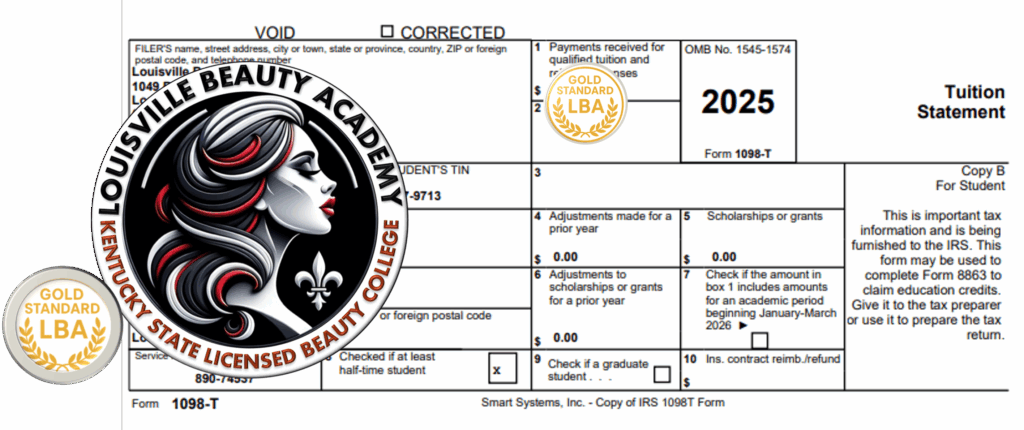
One clear example of this philosophy is our decision to voluntarily issue IRS Form 1098-T (Tuition Statement) to students each year, even though Louisville Beauty Academy does not participate in federal student aid programs and is not legally required to provide this form.
Many schools do not automatically send Form 1098-T to students. Some provide it only upon request. Others do not issue it at all due to exemptions. As a result, students are often left confused during tax season, unsure what documents they need or whether they are missing something important.
LBA chooses a different standard. We believe students should not have to chase paperwork, guess, or rely on incomplete information. When a standardized, recognized form can help students maintain clear records, we provide it—voluntarily and proactively.
A Message to All Students (Regardless of School)
If your school does not automatically provide Form 1098-T, you have the right to:
Ask whether tuition documentation is available
Request payment records or account statements
Seek clarity on what records the school can provide for your personal files
Louisville Beauty Academy encourages all students—everywhere—to advocate for transparency and documentation. Education is a major investment, and clear records protect you.
What follows in this article is a plain-language guide explaining:
What IRS Form 1098-T really is
Whether you need it to file taxes
What you can legally use if your school does not provide one
And why LBA chooses to exceed minimum requirements for the benefit of students
1. What Is IRS Form 1098-T?
IRS Form 1098-T, also known as the Tuition Statement, is an informational tax form issued by some educational institutions to report:
Payments received for qualified tuition and related expenses
Scholarships or grants applied to tuition (if any)
The form is used by students and families as supporting documentation when preparing personal tax returns.
Important clarification:
A 1098-T does not determine tax eligibility
It does not guarantee a tax credit
It is not required to file a tax return
It is simply a record of payments.
2. Is Every School Required to Issue Form 1098-T?
No.
Under IRS rules, not all schools are required to issue Form 1098-T. Some institutions may be exempt based on factors such as:
Program structure
Federal aid participation
Type and length of instruction
Because of this, many legitimate schools do not issue a 1098-T.
This does not automatically prevent a student from filing taxes or claiming eligible education credits.
3. If Your School Does NOT Provide a 1098-T, Can You Still File Taxes?
Yes.
According to IRS guidance, taxpayers may use other reasonable documentation to substantiate qualified education expenses.
Acceptable alternatives include:
Tuition payment receipts
Account statements from the school
Cancelled checks
Credit card or bank statements
Enrollment agreements showing tuition amounts
Proof of attendance and payment records
👉 The IRS focuses on proof of payment, not the existence of a specific form.
4. Where the IRS Allows This (Authoritative Guidance)
The IRS explains this clearly in:
IRS Publication 970 – Tax Benefits for Education
This publication states that taxpayers must be able to substantiate qualified education expenses, but Form 1098-T is not the only acceptable proof.
The taxpayer is responsible for maintaining records that support the amounts claimed.
Students and families may review IRS Publication 970 directly at IRS.gov or consult a qualified tax professional.
5. Why Some Schools Choose to Issue Form 1098-T Voluntarily
Some schools choose to issue Form 1098-T even when not required, because it:
Helps students organize financial records
Reduces confusion during tax season
Improves transparency
Demonstrates strong documentation practices
This is a choice, not a mandate.
6. Louisville Beauty Academy’s Approach
Louisville Beauty Academy does not participate in federal student aid programs and is not required to issue Form 1098-T.
We choose to issue it anyway.
We do so because:
It benefits students
It provides clear, standardized documentation
It reflects our commitment to over-compliance and transparency
We believe doing what is right matters, especially when it is voluntary
7. Important Disclaimer
Form 1098-T is provided for informational purposes only. Louisville Beauty Academy does not provide tax advice. Eligibility for any education-related tax benefit is determined solely by the taxpayer and the IRS. Students should consult a qualified tax professional or the IRS directly.
A Lower-Debt, License-First Model for the Next Era of Workforce Training
Abstract
Recent federal accountability reforms signal a structural shift in how postsecondary education programs are evaluated, emphasizing tuition transparency, completion timelines, and post-completion earnings rather than enrollment volume or institutional prestige. While much attention has focused on compliance challenges for federally funded institutions, less examined are non-Title IV, state-licensed workforce schools that have operated in alignment with these principles for years—voluntarily and without reliance on federal student debt.
This paper analyzes the evolving federal accountability landscape and presents a lower-debt, license-first beauty education model as a case study of proactive alignment. Using Louisville Beauty Academy (LBA) as an example, the research demonstrates how transparent pricing, short program duration, licensing-focused instruction, and the absence of federal loans collectively create an education framework that meets or exceeds emerging federal expectations while reducing financial risk to students and institutions alike. The findings suggest that voluntary alignment may represent a more sustainable and ethical path forward for workforce education in regulated professions.
1. Introduction: Why Federal Accountability Is Changing
Across the United States, policymakers, regulators, and the public are re-examining the relationship between postsecondary education and economic outcomes. Rising student debt, extended program timelines, and misalignment between credentials and labor market returns have driven increased scrutiny of educational value.
In response, the U.S. Department of Education has introduced new accountability frameworks that prioritize:
Tuition transparency
Program length clarity
Completion outcomes
Post-completion earnings
Clear student disclosures
These reforms reflect a broader policy consensus: education must be evaluated not only by access, but by measurable value delivered to students and communities.
2. Federal Accountability Today: Core Principles Explained Simply
Although regulatory language can be complex, current federal accountability initiatives share several clear themes:
2.1 Transparency Over Complexity
Institutions are expected to clearly disclose:
Total tuition and fees
Time required to complete a program
Expected outcomes after completion
This allows students to make informed decisions before enrolling.
2.2 Outcomes Over Enrollment
Success is increasingly measured by:
Program completion
Workforce entry
Earnings relative to training cost
Enrollment alone is no longer a sufficient indicator of institutional quality.
2.3 Risk Awareness
Programs associated with high debt and low earnings are now subject to warnings, penalties, or loss of federal loan access.
In simple terms: education must justify its cost in real economic terms.
3. Two Structural Models Emerging in Beauty Education
As accountability standards tighten, two distinct operational models have become increasingly visible within beauty and vocational education.
3.1 Debt-Dependent Education Model
Characteristics often include:
Reliance on federal student loans
Longer program durations
Higher tuition driven by administrative and compliance overhead
Outcomes measured years after completion
While legally permissible, this model carries elevated regulatory, financial, and reputational risk as accountability standards evolve.
3.2 Lower-Debt, License-First Education Model
Key characteristics include:
No federal student loans
State-licensed operation
Short, clearly defined program timelines
Direct alignment with licensure requirements
Transparent tuition published upfront
This model reduces both student debt exposure and institutional vulnerability to federal sanctions.
4. Case Study: Voluntary Federal Alignment in Practice
4.1 Institutional Overview
Louisville Beauty Academy operates as a Kentucky state-licensed beauty college, offering programs in cosmetology, esthetics, nail technology, shampoo & styling, and instructor training.
4.2 Structural Alignment Features
Without participating in Title IV federal aid programs, LBA has implemented practices that closely mirror—and in many cases exceed—current federal accountability expectations:
Transparent tuition disclosure published publicly
Short, predictable completion timelines
Licensing-first curriculum design
No federal student loan dependency
Direct workforce entry upon licensure
These elements were adopted not in response to regulation, but as foundational design choices.
4.3 Practical Implications for Students
For students, this structure means:
Lower financial risk
Faster entry into paid employment
No long-term federal debt obligations
Clear understanding of cost and outcome before enrollment
5. Why Voluntary Alignment Matters
Voluntary alignment offers several systemic advantages:
5.1 Institutional Stability
Schools not reliant on federal loan eligibility are insulated from policy shifts, audits, and eligibility suspensions.
5.2 Student Protection
lower-debt education reduces long-term financial harm, particularly in licensed trades where earnings grow through experience rather than credentials.
5.3 Public Trust
Transparency builds confidence among regulators, employers, and communities.
5.4 Replicability
This model can be adopted by other beauty colleges without legislative change or federal approval.
6. A Replicable Framework for Beauty Colleges
Based on this analysis, beauty colleges seeking future-proof alignment may consider the following framework:
Publish total tuition and fees clearly
Define program length in real calendar time
Design curriculum around licensing outcomes first
Separate education from debt financing
Track completion and licensure success internally
Communicate outcomes honestly and consistently
These steps align institutions with both current and anticipated accountability expectations.
7. Implications for the Future of Beauty Education
Federal accountability reforms signal a long-term shift rather than a temporary policy cycle. Institutions that adopt transparency, efficiency, and debt restraint early are better positioned to thrive.
The experience of Louisville Beauty Academy demonstrates that compliance and compassion are not opposites, and that workforce education can be both affordable and rigorous when designed intentionally.
8. Conclusion
As federal accountability standards continue to evolve, beauty colleges face a choice: react to regulation after the fact, or align proactively through structural design. This research suggests that voluntary alignment—especially through lower-debt, license-first education—offers a sustainable path forward.
Rather than viewing accountability as a constraint, institutions can treat it as an opportunity to re-center education around its core purpose: preparing individuals for lawful, meaningful, and economically viable work.
About This Paper
This paper is provided for educational and informational purposes to support dialogue among beauty colleges, workforce educators, regulators, and community partners. It does not constitute legal or financial advice.
2025년 12월 30일 기준, **Louisville Beauty Academy (LBA)**는 미국에서 가장 사명 중심적이고 지역사회 중심적인 뷰티 컬리지 중 하나로 성장했습니다 — 단순한 교육기관이 아니라, 교육 접근성, 배려, 합법적 준수, 그리고 기회 제공을 통해 사람을 성장시키기 위한 기관입니다. LBA는 무학자금대출·취업 중심·주정부 인가 교육기관으로 운영되며, 그 목적은 인간의 존엄성, 역량 강화, 합법적 전문성에 뿌리를 두고 있습니다.
2025년 한 해 동안, LBA는 미국 내 어떤 뷰티 스쿨도 거의 이루지 못한 성과를 달성했습니다. 즉 — 국가적 인정, 개방형 출판 리더십, 노동력 연구 공헌, 디지털 교육 확장, 그리고 학생들의 삶을 변화시키는 성과를 단일한 사명 아래 이루어냈습니다:
법을 가르친다. 면허를 가르친다. 책임을 가르친다. 그리고 인간을 성장시킨다.
미국 미용 교육에서 유일무이한 모델
대부분의 미용학교가 학비 중심, 면허 준비 위주로 운영되는 가운데 LBA는 다릅니다.
LBA는 다음을 모두 결합한 유일한 학교입니다:
노동자·이민자를 위한 무부채 교육 접근
국가적 소기업 역사상 주요 수상
자체 출판 교육서적
공개 법률·준수 자료 라이브러리
AI 기반 학습·문서화 도구
연구 기반 노동력 리더십
친절·규율·책임·배려의 문화
이 사명 중심 모델은 2025년 한 해 동안 미국 어느 미용대학도 따라오기 어려운 성과 포트폴리오를 만들어냈습니다.
2025년 주요 성과
🏆 국가적 인정 — 미 상공회의소 CO-100 어워드
LBA는 미 상공회의소로부터 2025년 미국 TOP 100 소기업에 선정되었습니다. 이는 전국 12,500개 이상 기업 중에서 선발된 역사적 성취로, 미용 교육에서는 극히 드문 일입니다.
이 수상은 LBA가 단순한 학교를 넘어 — 국가적 커뮤니티 자산임을 증명했습니다.
📚 출판·오픈액세스 교육 부문 리더십
설립자 Di Tran은 미용 교육과 연계된 130권 이상의 서적을 출판하며 미국 최대 규모의 개인 저작 미용교육 서재 중 하나를 구축했습니다.
주요 주제:
✔ 면허 ✔ 법률 ✔ 위생·소독 ✔ 노동력 역량 강화 ✔ 창업 ✔ 인간 성장 ✔ 신념과 삶의 의미
또한 LBA는 켄터키주 최대 규모의 오픈액세스 규제 교육 포털 중 하나를 운영하며 다음을 무료 제공합니다:
법률
규정
준수 가이드
노동 시장 분석
시험 준비 자료
이는 학생, 졸업생, 고용주, 일반 대중 모두에게 도움이 됩니다.
전국적으로 이 수준의 공익적 출판 사명을 수행하는 미용학교는 극히 드뭅니다.
🎥 디지털 교육 & 공개 학습 확장
LBA의 YouTube 및 디지털 채널은 다음을 강화했습니다:
법률 이해
취업 준비도
규제 준수 능력
현실 중심의 직업 교육
특히 도움을 준 대상:
1세대 미국인
맞벌이 부모
ESL 학습자
커리어를 재건하는 여성
이 디지털 생태계는 **“모두에게 교육을”**이라는 LBA 철학을 반영합니다.
📈 노동 시장 영향 & 경제적 상승 이동성
거의 2,000명의 면허 취득 졸업생이 켄터키주 서비스 경제에 매년 수천만 달러 가치를 창출하고 있으며,
최저임금 노동에서 합법적 전문직 커리어로 성장하고 있습니다.
LBA의 무부채 교육 경로는 가계에 대출 부담을 남기지 않습니다.
🤝 옹호 · 리더십 · 인간 존중
LBA는 전국 노동·소기업 논의에 참여해 다음 철학을 지지했습니다:
교육은 인간을 위해 존재한다. 그 반대가 아니다.
이 “Humanization(인간 중심)” 철학은 LBA를 단순한 학교가 아닌 존엄성 중심의 사회운동으로 만듭니다.
타인을 성장시키는 것 — 핵심 사명
Louisville Beauty Academy는 다음을 위해 존재합니다:
대학이 불가능하다고 느꼈던 사람들
영어를 배우는 이민자
삶의 안정을 회복 중인 어머니들
새로운 출발을 하는 난민
1세대 꿈을 꾸는 이들
두 번째 기회를 필요로 하는 성인
LBA는 규율, 기록, 합법성, 책임, 위생, 전문성을 가르치며 무엇보다도 자존감을 가르칩니다.
화려함 없음. 지름길 없음.
진짜 교육 → 진짜 면허 → 진짜 삶의 안정.
전국 어디에도 없는 모델
많은 학교가 기술만 가르치지만, LBA는 다음을 가르칩니다:
법, 준수, 윤리, 공공 신뢰, 인간 성장
그리고 여전히
✔ 무부채 ✔ 지역사회 중심 ✔ 서비스 중심 ✔ 이민자 친화 ✔ 학생 중심
을 유지합니다.
운동에 동참하세요 — 인간 중심 미용 교육
Louisville Beauty Academy는 다음을 믿는 모든 분을 환영합니다:
✨ 합법적 전문성 ✨ 인간 존중 ✨ 지역사회 성장 ✨ 노동 존엄성 ✨ 부채 없는 진짜 커리어
Report a website barrier or request help accessing information. Email Study@LouisvilleBeautyAcademy.net or text 502-625-5531. Include the page and what you were trying to do. Please do not send medical records or sensitive identifiers.
Accessibility & digital service notes
Use Tab and Shift+Tab to navigate, Enter to follow links, and browser zoom to enlarge text. The language selector supports Enter, Space, Tab, and Escape. Motion is reduced when your device requests it. Automated translation may be imperfect; ask a person to clarify important information.
Updated October 16, 2026. Work on accessibility is ongoing. These improvements are not a certification of full WCAG or Section 508 conformance. Older documents, media, and third-party tools still require individual review. About WCAG accessibility standards.