The Reality of Cosmetology Education in Kentucky What Adult Students Must Understand Before Enrolling

Di Tran University Research & Workforce Policy Series – 2026


Frequently Asked Questions About Cosmetology and Beauty Training in Kentucky

How many hours are required for a cosmetology license in Kentucky?
Kentucky requires 1,500 training hours for a cosmetology license under KRS Chapter 317A and the administrative regulations in 201 KAR Chapter 12. The curriculum includes theory instruction, clinical practice, and Kentucky law before a student can qualify for the state licensing examination administered through PSI.

How many hours are required for an esthetician license in Kentucky?
Kentucky requires 750 training hours for an Esthetics license. Esthetics training focuses on skin care, facial treatments, sanitation, infection control, product chemistry, and safe skin service procedures. Graduates must pass the Kentucky state board licensing examination to practice professionally.

How many hours are required for a nail technician license in Kentucky?
Kentucky requires 450 training hours for a Nail Technology license. Training includes sanitation, infection control, nail structure, chemistry of nail products, and practical service procedures before qualifying for the state licensing exam.

Is shampoo styling a license in Kentucky?
Yes. Shampoo Styling is a licensed profession in Kentucky requiring 300 hours of training in a licensed cosmetology school. The program focuses on shampooing, scalp treatments, blow-drying, and basic styling techniques, with strong emphasis on sanitation and hygiene.

Is eyelash extension a license in Kentucky?
No. Eyelash extensions are regulated through a specialty permit rather than a full license. Practitioners must complete approved training and obtain a specialty permit before legally performing eyelash extension services.

What is the difference between a license and a specialty permit?
A professional license (cosmetology, esthetics, nail technology, or shampoo styling) requires a defined number of training hours and passing a state licensing examination.
A specialty permit allows practice of a specific limited service and typically requires shorter training focused only on that service.

Can cosmetology or esthetics students work on real clients during school?
Yes. Kentucky allows student clinics in licensed schools. However, cosmetology students must complete at least 250 hours of foundational training before performing chemical services on members of the public in order to protect public safety.

How much does beauty school cost in Kentucky?
Tuition varies widely depending on the institution. Programs may range from lower-cost vocational training models to higher-priced schools that rely heavily on federal student aid. Prospective students should compare tuition, exam preparation support, and graduation outcomes before enrolling.


Correct Kentucky Program Hour Requirements Summary

ProgramHours RequiredCredential Type
Cosmetology1,500 hoursLicense
Esthetics750 hoursLicense
Nail Technology450 hoursLicense
Shampoo Styling300 hoursLicense
Eyelash ExtensionSpecialty trainingSpecialty Permit

Research & Educational Disclaimer

This article is provided for public education and workforce research purposes only and reflects analysis prepared by researchers affiliated with Di Tran University as part of its ongoing study of vocational education systems, regulatory structures, and economic outcomes for adult learners. The content represents independent academic commentary and general informational analysis regarding industry trends, public regulations, and financial literacy considerations within cosmetology education. Publication on the Louisville Beauty Academy website is intended solely to support consumer awareness and transparency in vocational decision-making. Nothing in this article should be interpreted as legal advice, regulatory interpretation, endorsement of any institution, or criticism of any specific organization, program, regulator, or business entity. Regulatory references are provided for educational context only, and readers are encouraged to consult the official statutes, administrative regulations, and the appropriate licensing authorities for authoritative guidance. Louisville Beauty Academy does not claim authorship of the analysis and assumes no responsibility for third-party interpretations or decisions made based on this informational content.


The Architecture of Regulatory Capture in Cosmetology: Institutional Influence, Competitive Obstruction, and the Crisis of Debt-Dependent Education

The landscape of occupational licensing in the United States, particularly within the cosmetology and beauty services sector, serves as a primary example of regulatory capture. This phenomenon, where state agencies created to act in the public interest instead prioritize the commercial and political objectives of the industries they regulate, is not merely a theoretical concern but a documented reality with significant economic consequences. In the beauty education sector, this capture is facilitated through a complex network of statutory board compositions, aggressive lobbying by trade associations, and an accreditation system that serves as a gatekeeper for billions of dollars in federal subsidies. The resulting policy environment often suppresses competition, inflates tuition, and traps low-income and immigrant learners in a cycle of debt that bears little relation to professional mastery or public safety.

The Theoretical Framework of Occupational Capture and Market Distortion

Regulatory capture within cosmetology boards is characterized by the dominance of active market participants over the regulatory process. When a licensing board is composed primarily of industry insiders—specifically owners of large cosmetology school chains—the board’s incentives shift from protecting the public to protecting incumbent business models. This is particularly evident in the setting of mandatory instructional hours, curriculum standards, and the adjudication of competitive entries. Research from the Center for the Study of Economic Liberty (CSEL) at Arizona State University suggests that this mechanism of capture is the primary driver behind the suppression of employment and entrepreneurial opportunities in the sector.1

The economic impact of this capture is quantifiable. Boards dominated by industry incumbents tend to set higher barriers to entry, which increases the time and cost required to obtain a license. According to CSEL’s 2020 report, the “Cosmetology Board Capture Index” reveals a direct correlation between the lack of public representation on boards and the length of state-mandated training.2 In the eight states with the highest levels of board capture—defined as having zero public representatives—it takes an average of 50 more calendar days than the national average to fulfill the state requirements for licensure.2

National Metrics of Cosmetology Board CaptureData Observation
States with Zero Public Board RepresentativesNew York, North Dakota 2
States with High Capture (Minimal Public Input)LA, MA, MS, OK, VT, WY 2
National Average Training Time Increase (High Capture States)+50 Days 2
States with Majority Public BoardsArizona (post-2020), California 3
States with Eliminated Boards (Least Captured)Maine, Arkansas (Eliminated 2009) 3

These “high capture” states often resist reforms such as universal licensure reciprocity, which would allow practitioners to move across state lines without undergoing duplicative and costly training.4 By maintaining fragmented and high-barrier licensing regimes, captured boards ensure that students remain enrolled in schools longer, thereby maximizing the tuition revenue generated for the institutions represented on those boards.5

Schools that operate with lower tuition models allow graduates to enter the workforce without heavy debt obligations. When graduates are not burdened by loan repayment, they can reinvest earnings into advanced education, business ownership, and local economic activity. In contrast, high-tuition programs often delay entrepreneurship because graduates must prioritize debt repayment before building independent practices.

Structural Capture in State Statutes: The Case of Kentucky

The Commonwealth of Kentucky provides a granular view of how regulatory capture is codified into state law. Kentucky Revised Statute (KRS) 317A.030 establishes the composition of the Kentucky Board of Cosmetology (KBC) in a manner that virtually guarantees industry dominance. The statute mandates a seven-member board, but only one of those seats is reserved for a “citizen at large” who is free from financial ties to the industry.6

The board’s composition under KRS 317A.030 is as follows:

  • Two members must be cosmetology salon owners.
  • One member must be a cosmetology teacher in public education.
  • One member must be an owner of, or have a financial interest in, a licensed cosmetology school.
  • One member must be a licensed nail technician.7
  • One member must be a licensed esthetician.7
  • One member is a citizen at large.6

A critical second-order insight into this statutory structure is the requirement that the school owner member “shall be a member of a nationally recognized association of cosmetologists”.6 By embedding membership in a trade association—such as the American Association of Cosmetology Schools (AACS)—directly into the qualifications for a government regulator, the state effectively delegates regulatory influence to private interest groups. This formal mechanism ensures that the national policy agenda of large, for-profit school chains is represented at the highest levels of state oversight.

The informal mechanisms of capture in Kentucky have historically been even more pronounced. Prior to 2024, the KBC faced significant public pressure and allegations of mismanagement, leading to the removal of Executive Director Julie Campbell in September 2024 after a seven-year tenure.9 The board’s transition to new leadership under Joni Upchurch, a former cosmetology professor, and the appointment of Michael Carter as the first-ever nail technician board member, represent attempts at institutional reform.9 However, even under new leadership, the board continues to exhibit the hallmarks of capture, such as the recusal of board members from decisions involving competing schools. For instance, in a January 2026 meeting, Vice Chair Lianna Nguyen recused herself from board decisions regarding the Louisville Beauty Academy (LBA), a low-cost competitor to traditional Title IV schools.11

Trade Associations and the Lobbying Power of the Beauty School Industrial Complex

The American Association of Cosmetology Schools (AACS) acts as the central hub for industry lobbying and advocacy. As a regulated industry, for-profit beauty schools maintain a “proactive” stance toward federal and state government relations to protect their revenue streams from “attacks” such as the reduction of program hours or the deregulation of licensure.12

The Federal Lobbying Machine

The AACS maintains a robust advocacy infrastructure, including an annual Congressional Summit and “Hill Day,” where school owners and administrators gather in Washington, D.C., to lobby Members of Congress.12 Their primary objectives include:

  1. Preserving High Program Hours: Lobbying against state-level efforts to reduce mandatory hours, as shorter programs decrease the amount of federal student aid a school can collect.5
  2. Opposing Accountability Standards: Fighting federal “Gainful Employment” (GE) and “Financial Value Transparency” rules that tie federal aid eligibility to graduate earnings.13
  3. Protecting Title IV Dependency: Ensuring that the flow of Pell Grants and federal student loans remains uninterrupted, despite evidence that many programs provide poor financial returns for students.5

A significant example of this influence is the AACS’s legal challenge to the Department of Education’s 2023 Gainful Employment Rule. The AACS and its member schools filed suit in federal district court in Texas, seeking to strike down the rule as “arbitrary, capricious, and unconstitutional”.15 Although Chief U.S. District Judge Reed O’Connor ruled in favor of the Department of Education in October 2025, the AACS has continued to fight through the appeals process and through targeted political contributions.16 The schools’ own legal arguments in this case were revealing: they admitted that if forced to meet basic debt-to-earnings benchmarks, a substantial number of programs would “fail and shut down”.14

The 90/10 Rule and Revenue Capture

The economic model of for-profit beauty schools is heavily reliant on federal subsidies. Under the “90/10 rule,” proprietary institutions must derive at least 10% of their revenue from non-federal sources. For many beauty school chains, Title IV federal aid (Pell Grants and loans) accounts for more than 85% of total revenue.19 Recent changes to the 90/10 rule in 2023 expanded the definition of “federal funds” to include any federal assistance received by students, such as Veterans Affairs (VA) benefits, which had previously been used by schools to satisfy the 10% requirement.20 This regulatory shift has put additional pressure on the sector, leading to increased lobbying for “carve-outs” and exemptions.20

Case Study in Competition Blockade: The Iowa Monopoly

The state of Iowa offers a definitive case study in how captured boards and trade associations use the legal system to suppress lower-priced competition. In 2005, the Iowa Cosmetology School Association and La’ James International College sued Iowa Central Community College to stop it from launching a cosmetology program.22 The private schools successfully argued that state code prohibited public entities from competing with private businesses in this sector. This lawsuit effectively preserved a monopoly for high-tuition, for-profit providers and maintained Iowa’s status as having one of the highest licensure hour requirements in the nation—2,100 hours.22

The relationship between the dominant school chain, La’ James International College, and the state regulatory body was particularly incestuous. A high-ranking official from La’ James held a seat on the Iowa Board of Barbering and Cosmetology Arts and Sciences even as the school faced multiple investigations for consumer fraud.24 This position of power allowed the school to influence the very inspectors who were tasked with investigating student complaints about “instructorless” classrooms and the exploitation of students as unpaid labor.25

Iowa Competitive Obstruction MetricsImpact / Observation
Mandatory Cosmetology Hours2,100 (Highest in U.S.) 22
Community College BlockadeLawsuit in 2005 prevented public entry 23
Tuition for Private Chains$15,000 – $20,000 22
Student Debt Forgiveness Settlements$2.1M (2016) and $462k (2021) 22
Board RepresentationLa’ James official held active seat 24

The Title IV Debt Trap and the Economics of Exploitation

The current financing architecture of beauty education incentivizes a model that prioritizes enrollment and aid capture over student outcomes. Because schools are paid per enrolled student per credit hour, there is a systemic incentive to delay graduation and maintain artificially long programs.5

Debt-to-Earnings Disparities

Nationwide data indicates a severe mismatch between the cost of beauty education and the eventual earnings of graduates. Analysis by The Century Foundation and New America shows that 98% of cosmetology programs would fail proposed federal earnings tests.5 Graduates typically earn an average of only $16,600 to $20,000 annually, yet they often carry a debt load of $10,000 to $11,000.5 This high debt-to-income ratio is particularly damaging to the low-income, first-generation, and immigrant populations that these schools target.5

Comparative Earnings Data (2025-2026)Annual Income Range
Entry-Level Cosmetologist$26,000 – $31,000 30
Mid-Career Professional$35,000 – $45,000 30
Average Hourly Rate$18 – $22/hour 30
High School Graduate MedianUsed as federal benchmark for “Red Flag” 31

The industry often defends these low reported earnings by claiming that stylists receive significant unreported income through cash tips. However, the Department of Education, under multiple administrations, has found no empirical evidence of widespread unreported income that would bridge the gap between reported earnings and a livable wage.13

Systemic Use of Unpaid Student Labor

A core component of the for-profit beauty school business model is the “dual-revenue” structure: schools profit from both student tuition and from the salon services performed by students on paying customers.29 In many schools, students are required to work on the “clinic floor” for hundreds of hours, often performing non-educational tasks such as cleaning, restocking, and laundry under the guise of “training”.25

This practice has led to over 40 major class-action lawsuits and federal investigations. Schools such as Empire Beauty, Milan Institute, and La’ James have been accused of treating students more like “free labor” than learners.25 In Iowa, the Attorney General’s lawsuit against La’ James specifically alleged that the school “seemed to pay the company for the privilege of working,” as students were pressured to sell products and were only given credit for services performed on paying customers rather than mannequins.33

The Disruptive Alternative: Louisville Beauty Academy (LBA)

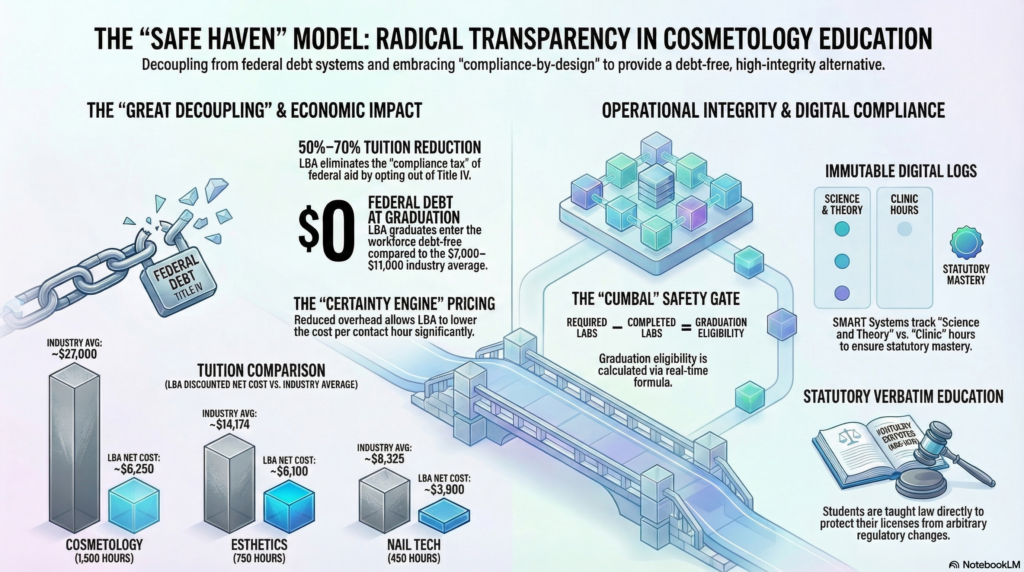
In the midst of this sector-wide crisis, the Louisville Beauty Academy (LBA) in Kentucky serves as a national model for reform. Unlike the dominant chains, LBA operates without any reliance on Title IV federal student aid, Pell Grants, or federal loans.28 By decoupling from the federal aid system, LBA eliminates the “Compliance Tax”—the administrative overhead required to manage federal aid, which typically consumes 25% to 35% of a school’s tuition.5

Economic and Fiscal Contribution

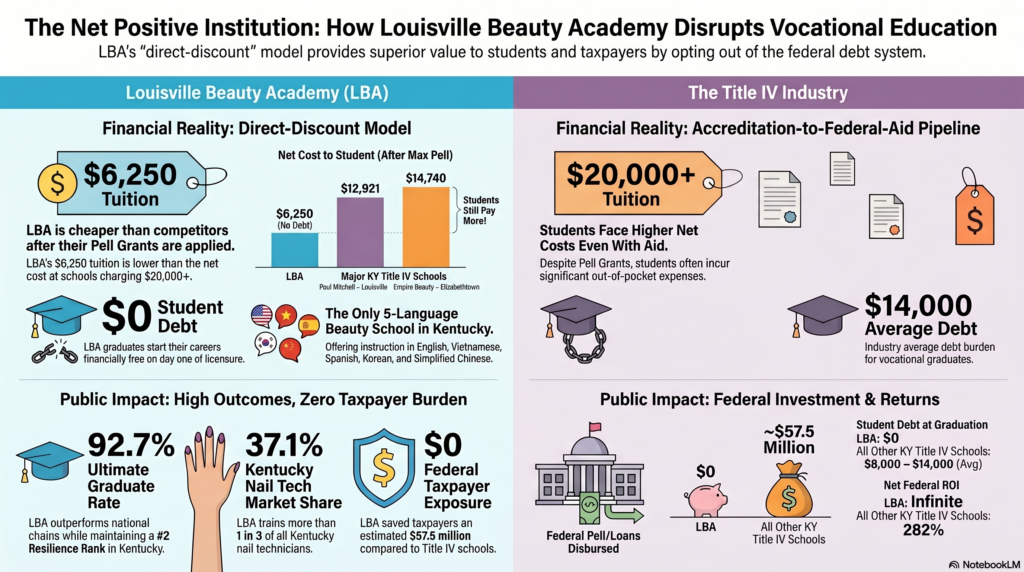
LBA’s non-Title IV model allows for significantly lower tuition rates, which makes the program accessible to working-class and immigrant students without the burden of debt. A 1,500-hour cosmetology program at LBA is priced between $3,800 and $6,250, compared to the $15,000 to $20,000 national average for Title IV schools.35

Fiscal Comparison: LBA vs. Title IV ModelLBA Model (Actual)Title IV Model (Hypothetical)
Public Funds Consumed$0$25,000,000 35
Direct Fee Revenue to State$884,250~$884,250 35
Tax Revenue Generated (10 yrs)$47,815,000~$47,815,000 35
Net Positive Economic Impact$48,699,250$23,699,250 35

The economic impact of LBA is further demonstrated through its “resilience-based” model. LBA leads the state of Kentucky in theory retake participation, reflecting a commitment to ensuring all students, regardless of language barriers or educational background, eventually achieve licensure.35 This model is supported by Kentucky Senate Bill 22 (SB 22), which reformed licensing to allow for unlimited exam retakes and removed punitive waiting periods.36

Speed-to-Market Advantage

LBA’s curriculum is “laser-focused” on the state board examination and minimum competency requirements. This efficiency allows students to complete their training and enter the workforce significantly faster than at Title IV schools, which often pad their curriculum to maximize aid disbursements.5 The speed-to-market differential is estimated at approximately six months:

.28

By entering the workforce earlier and without debt, LBA graduates achieve a vastly superior return on investment (ROI). In a comparative model, LBA graduates contribute more to the state treasury over a five-year horizon through income taxes and license renewal fees because they are not diverted by debt servicing or program delays.28

The Federal Counter-Strike: FAFSA Red-Flags and GE 2.0

As the crisis in for-profit beauty education has become undeniable, the federal government has introduced new mechanisms to protect students and taxpayers. These measures represent an attempt to bypass the captured state boards and communicate directly with prospective students.

The FAFSA “Red Flag” Warning System

On December 7, 2025, the U.S. Department of Education implemented a new “Lower Earnings” warning within the FAFSA system.31 This system flags institutions where the median earnings of graduates fail to exceed the earnings of a typical high school graduate. When a student selects a flagged school, the system highlights the institution in red and provides a “Remove School” button.31

In Kentucky, several major institutions were flagged with this warning:

  • Empire Beauty School (multiple locations) 31
  • Paul Mitchell The School Louisville 31
  • PJS College of Cosmetology 31
  • Summit Salon Academy 31

This system serves as an active market correction, disrupting the enrollment funnel of schools that provide poor economic returns. The New American Business Association (NABA) notes that this shift transforms the FAFSA from a neutral funding gateway into an instrument of market correction.5

The Gainful Employment (GE) Rule 2023-2025

The Department of Education’s 2023 Gainful Employment Rule is the strongest accountability measure to date. It establishes a two-part test for career programs:

  1. Debt-to-Earnings Test: Measures whether graduates’ debt payments are manageable relative to their income.
  2. Earnings Premium Test: Measures whether graduates earn more than a typical high school graduate in their state.14

Failure of these metrics for two out of three consecutive years results in the automatic loss of Title IV eligibility for both federal loans and Pell Grants.37 This is a critical distinction from the One Big Beautiful Bill Act (OBBBA) “Low Earnings” test, which only cuts off access to federal loans but not Pell Grants.38 Given that many undergraduate certificate programs in cosmetology distribute more in Pell Grants than in loans, the GE rule is the only mechanism that truly protects taxpayers from subsidizing low-value programs.38

The Impact of the One Big Beautiful Bill Act (OBBBA)

Signed into law on July 4, 2025, the One Big Beautiful Bill Act (OBBBA) introduced a range of tax and accountability measures that significantly impact the beauty industry.39 While the law permanently extended individual tax cuts and increased deductions for seniors, it also codified a new “Low Earnings” test for degree programs and graduate certificate programs.38

For the beauty industry, the OBBBA was a mixed legislative bag. The industry successfully lobbied for the expansion of the FICA tip tax credit to include beauty services, a move that provides significant tax relief for salon owners.21 However, the law’s “AHEAD” framework (Accountability in Higher Education and Access through Demand-driven Workforce Pell) introduced a “Do No Harm” metric for vocational schools.32

OBBBA ProvisionImpact on Beauty Sector
Tip Tax Credit ExpansionExpanded to beauty services (formerly food/beverage only) 21
Low Earnings TestCodified for degree/grad cert programs; undergraduate certs exempt 38
Pell Grant ExpansionExpanded to short-term (<15 weeks) training programs 38
Student Loan Repayment ExclusionMade permanent tax exclusion for employer-provided repayment ($5,250/yr) 41

The OBBBA’s accountability requirements work “in tandem” with the 2023 GE rule. While the OBBBA focuses on degree-granting institutions, the GE rule remains the primary oversight mechanism for the undergraduate certificate programs that dominate the beauty sector.38

Analytical Synthesis: The Mechanics of Decoupling and Reform

The investigation into regulatory capture in the cosmetology sector reveals a system that is fundamentally misaligned with its stated purpose of public protection. Instead, the licensing framework serves as a state-sanctioned mechanism for funneling federal subsidies into high-tuition, for-profit institutions while providing students with minimal professional preparation and significant debt.

The Capture Loop and the Compliance Tax

The “capture loop” is a self-reinforcing cycle where trade associations (AACS) influence state statutes (KRS 317A) to maintain high hour requirements, which are then validated by industry-led accreditors (NACCAS) to unlock federal aid (Title IV).2 This cycle creates the “Compliance Tax”—an invisible portion of tuition that pays for the administrative apparatus of federal aid management rather than education.5

Schools that operate within this loop, such as the large national chains, are currently facing an enrollment collapse as federal “red flag” systems and Gainful Employment rules take effect.14 The schools themselves admit that their business models are unsustainable without the ability to saddle students with unrepayable debt.14

The Resilience Model as a Path to Market Correction

The emergence of non-Title IV models like Louisville Beauty Academy represents a “Great Decoupling” of beauty education from the debt-based system.5 These models demonstrate that it is possible to provide high-quality, state-licensed education at a fraction of the cost by prioritizing “Minimum Competence” for licensure and delegating “Professional Mastery” to the salon environment.42

Structural Alignment ComparisonTitle IV High-Capture ModelLBA Non-Title IV Model
Primary StakeholderU.S. Department of EducationThe Student / Local Employer
Revenue DriverEnrollment and Aid DrawGraduation and Licensure 35
Curriculum PhilosophyBloated / Celebrity Artistry PromisesLicensing / Science / Safety 42
Attendance TrackingManual / Shoddy / ManipulatedBiometric / Non-Negotiable 19
Ethical StandardUnpaid Student Salon LaborEducational Clinic / Community Service 29

Recommendations for Policy Reform

To break the grip of regulatory capture and the associated debt crisis, policymakers must enact the following reforms:

  1. Eliminate Statutory Association Requirements: Statutes like Kentucky’s KRS 317A.030 should be amended to remove the requirement that board members belong to private trade associations.6
  2. Mandate Public Member Majorities: Following the examples of Arizona and California, all licensing boards should be required to have a majority of members who are free from financial ties to the industry.3
  3. Conduct Independent Hour Audits: State legislatures should commission independent audits of mandatory hours to determine the minimum training necessary for public safety, independent of federal aid eligibility requirements.2
  4. Codify Biometric Attendance Requirements: To prevent the fraudulent reporting of hours, all state-licensed beauty schools should be required to use tamper-proof biometric systems to verify student attendance.19
  5. Enforce FLSA Standards in Educational Clinics: State and federal labor regulators must strictly enforce the distinction between “practical training” and “compensable labor” to stop the exploitation of students as unpaid salon workers.19
  6. Support Universal Reciprocity: Decoupling licensure from specific state boards through universal reciprocity would create a competitive national market for beauty education, forcing schools to compete on quality and price rather than regulatory capture.3

The beauty industry is currently witnessing a historic shift from a “Capture-First” era to a “Transparency-First” era. The survival of the sector depends on its ability to move away from the debt-dependent, aid-capture model and toward the ethical, high-ROI workforce stabilization models demonstrated by institutions like the Louisville Beauty Academy. The “Red Flag” system in the FAFSA and the 2025 OBBBA accountability measures are the first steps in a necessary process of market correction that will ultimately benefit students, taxpayers, and the integrity of the beauty profession.5

Works cited

  1. Center for the Study of Economic Liberty – Arizona State University, accessed March 4, 2026, https://csel.asu.edu/
  2. Policy Report, accessed March 4, 2026, https://csel.asu.edu/sites/g/files/litvpz1671/files/2020-12/CSEL-2020-02-A-Cosmetology-Board-Capture-Index-11_02_20-v2.pdf
  3. A Cosmetology Board Capture Index: Measuring the Influence of Self-Interest in Occupational Licensing – Center for the Study of Economic Liberty, accessed March 4, 2026, https://csel.asu.edu/research/publications/ACosmetologyBoardCaptureIndex
  4. Policy Report – Center for the Study of Economic Liberty, accessed March 4, 2026, https://csel.asu.edu/sites/g/files/litvpz1671/files/2020-02/CSEL-2020-01-You-Can-Take-It-with-You-03_02_20.pdf
  5. Federal Aid, Licensure, and the Debt Crisis in Cosmetology …, accessed March 4, 2026, https://naba4u.org/2025/12/federal-aid-licensure-and-the-debt-crisis-in-cosmetology-education-research-2025/
  6. 317A.030 Board of Cosmetology — Membership — Compensation. (1) There is created an independent agency of the state gover, accessed March 4, 2026, https://apps.legislature.ky.gov/law/statutes//statute.aspx?id=54797
  7. Kentucky Revised Statutes § 317A.030 (2025) – Board of Cosmetology — Membership — Compensation – Justia Law, accessed March 4, 2026, https://law.justia.com/codes/kentucky/chapter-317a/section-317a-030/
  8. AN ACT relating to activities regulated by the Kentucky Board of Hairdressers and Cosmetologists – LegiScan, accessed March 4, 2026, https://legiscan.com/KY/text/HB311/2012
  9. Kentucky State Board of Cosmetology Welcomes New Executive Director Joni Upchurch – 09-27-2024 4pm – Louisville Beauty Academy, accessed March 4, 2026, https://louisvillebeautyacademy.net/kentucky-state-board-of-cosmetology-welcomes-new-executive-director-joni-upchurch-09-27-2024-4pm/
  10. Historic Day for Kentucky Beauty Industry: Michael Carter Sworn In as First Nail Technician on Board of Cosmetology, Executive Director Removed – September 9th, 2024 9am, accessed March 4, 2026, https://louisvillebeautyacademy.net/historic-day-for-kentucky-beauty-industry-michael-carter-sworn-in-as-first-nail-technician-on-board-of-cosmetology-executive-director-removed-september-9th-2024-9am/
  11. Untitled – Kentucky Board of Cosmetology, accessed March 4, 2026, https://kbc.ky.gov/About-Us/board-meetings/Meeting%20Minutes/2026.01.05%20Board%20Meeting%20Minutes.pdf
  12. American Association of Cosmetology Schools – AACS, accessed March 4, 2026, https://myaacs.org/schools/
  13. Why many cosmetology schools in North Dakota are considered ‘low earnings’, accessed March 4, 2026, https://americanexperimentnd.org/why-many-cosmetology-schools-in-north-dakota-are-considered-low-earnings/
  14. Gainful Employment Rules and School Closures (2014–Present) – MAY 2025 STUDY, accessed March 4, 2026, https://naba4u.org/2025/05/gainful-employment-rules-and-school-closures-2014-present-may-2025-study/
  15. CAAHEP Communiqué January 2024 – Constant Contact, accessed March 4, 2026, https://myemail.constantcontact.com/subject.html?soid=1101982827434&aid=3wHonxLrMOA
  16. Update on Gainful Employment Lawsuit – AACS, accessed March 4, 2026, https://members.myaacs.org/news/Details/update-on-gainful-employment-lawsuit-291947
  17. American Association of Cosmetology Schools v. U.S. Dept of Ed. and Ogle School Management v. U.S. Dept of Ed. (2024) Challenges Gainful Employment Rule, accessed March 4, 2026, https://policytracker.wiche.edu/judicial-action/american-association-cosmetology-schools-v-us-dept-ed-and-ogle-school-management-v
  18. Gainful Employment – AACS, accessed March 4, 2026, https://myaacs.org/gainful-employment/
  19. Tag: vocational education policy analysis – Louisville Beauty Academy, accessed March 4, 2026, https://louisvillebeautyacademy.net/tag/vocational-education-policy-analysis/
  20. 2023 Changes to the 90/10 Rule Require Careful Analysis – McClintock & Associates, accessed March 4, 2026, https://mcclintockcpa.com/2023-changes-to-the-90-10-rule-require-careful-analysis/
  21. One Big Beautiful Bill Act: Tax Analysis and Business Impact Guide – HBK, accessed March 4, 2026, https://hbkcpa.com/insights/one-big-beautiful-bill-act-tax-impact-2025/
  22. For-profit beauty school settles class-action lawsuit – The Hechinger Report, accessed March 4, 2026, https://hechingerreport.org/for-profit-beauty-school-settles-class-action-lawsuit/
  23. For-Profit vs. Public Beauty Schools? – CAPPS, accessed March 4, 2026, https://cappsonline.org/for-profit-vs-public-beauty-schools/
  24. The Broken Promises of Cosmetology Education: Held in Place: Locking in State Licensure Mandates – NewAmerica.org, accessed March 4, 2026, https://www.newamerica.org/education-policy/reports/cut-short-the-broken-promises-of-cosmetology-education/held-in-place-locking-in-state-licensure-mandates/
  25. Cut Short: The Broken Promises of Cosmetology Education – ERIC, accessed March 4, 2026, https://files.eric.ed.gov/fulltext/ED676659.pdf
  26. Cosmetology school in Iowa accused of violating Consumer Fraud Act | | legalnewsline.com, accessed March 4, 2026, https://www.legalnewsline.com/cosmetology-school-in-iowa-accused-of-violating-consumer-fraud-act/article_f33e7f12-9107-50e0-9f26-907417780a82.html
  27. Iowa AG files lawsuit against cosmetology school | | legalnewsline.com, accessed March 4, 2026, https://www.legalnewsline.com/iowa-ag-files-lawsuit-against-cosmetology-school/article_2670474b-3018-50de-a9d2-2a38e7fbfe42.html
  28. Macroeconomic Analysis of Debt-Free Vocational Pathways: A Comparative Study of the Louisville Beauty Academy and Federal-Aid Dependent Models in the Commonwealth of Kentucky – RESEARCH & PODCAST SERIES, accessed March 4, 2026, https://louisvillebeautyacademy.net/macroeconomic-analysis-of-debt-free-vocational-pathways-a-comparative-study-of-the-louisville-beauty-academy-and-federal-aid-dependent-models-in-the-commonwealth-of-kentucky-research-podcast/
  29. Louisville Beauty Academy: A National Model of Legal Integrity in Beauty Education – RESEARCH 2025, accessed March 4, 2026, https://naba4u.org/2025/11/louisville-beauty-academy-a-national-model-of-legal-integrity-in-beauty-education-research-2025/
  30. Kentucky Cosmetology Laws & License Requirements [2026] – Consentz, accessed March 4, 2026, https://www.consentz.com/kentucky-cosmetology-laws-license-requirements/
  31. Federal Warning Signals Students Away From Many Beauty Schools – DEC 7TH, 2025 – A New FAFSA Red-Flag System Raises National Concern – Louisville, KY, accessed March 4, 2026, https://naba4u.org/2025/12/federal-warning-signals-students-away-from-many-beauty-schools-dec-7th-2025-a-new-fafsa-red-flag-system-raises-national-concern/
  32. in 2027, 92% Beauty Schools are going to close under new Trump rules : r/Cosmetology, accessed March 4, 2026, https://www.reddit.com/r/Cosmetology/comments/1qtkdsu/in_2027_92_beauty_schools_are_going_to_close/
  33. La’James accused of consumer fraud | News, Sports, Jobs – The Messenger, accessed March 4, 2026, https://www.messengernews.net/news/local-news/2014/08/la-james-accused-of-consumer-fraud/
  34. State attorney general alleges school violated state’s Consumer Fraud Act – Legal News > Your source for information behind the law, accessed March 4, 2026, https://legalnews.com/Home/Articles?DataId=1396296
  35. Louisville Beauty Academy: A Net-Positive Economic Engine for the Commonwealth of Kentucky – RESEARCH & PODCAST 2026, accessed March 4, 2026, https://louisvillebeautyacademy.net/louisville-beauty-academy-a-net-positive-economic-engine-for-the-commonwealth-of-kentucky-research-podcast-2026/
  36. Kentucky beauty education policy analysis Archives, accessed March 4, 2026, https://louisvillebeautyacademy.net/tag/kentucky-beauty-education-policy-analysis/
  37. 2023 Gainful Employment – nasfaa, accessed March 4, 2026, https://www.nasfaa.org/ge_2021-22
  38. Congress’s College Accountability Statute Has Cracks. The 2023 Gainful Employment Rule Fills Them. – The Century Foundation, accessed March 4, 2026, https://tcf.org/content/commentary/congresss-college-accountability-statute-has-cracks-the-2023-gainful-employment-rule-fills-them/
  39. One Big Beautiful Bill Act – Wikipedia, accessed March 4, 2026, https://en.wikipedia.org/wiki/One_Big_Beautiful_Bill_Act
  40. One Big Beautiful Bill Act resource center – Wolters Kluwer, accessed March 4, 2026, https://www.wolterskluwer.com/en/know/one-big-beautiful-bill-act
  41. New Tax Rules Under the One Big Beautiful Bill Act: What Employers, Workers and Unions Need to Know – American Bar Association, accessed March 4, 2026, https://www.americanbar.org/groups/labor_law/resources/magazine/2025-summer/new-tax-rules-obba/
  42. Tag: cosmetology state board exam Kentucky – Louisville Beauty Academy, accessed March 4, 2026, https://louisvillebeautyacademy.net/tag/cosmetology-state-board-exam-kentucky/
  43. The Federal Transparency Era in Cosmetology Education – Accreditation Terminology Reform, Financial Value Accountability, and the Primacy of State Licensure – RESEARCH & PODCAST SERIES 2026 – Louisville Beauty Academy, accessed March 4, 2026, https://louisvillebeautyacademy.net/the-federal-transparency-era-in-cosmetology-education-accreditation-terminology-reform-financial-value-accountability-and-the-primacy-of-state-licensure-research-podcast-series-2026/
  44. State o f Arizona – Auditor General, accessed March 4, 2026, https://www.azauditor.gov/sites/default/files/2023-11/96-15_Report.pdf
  45. Louisville Beauty Academy, Di Tran, and Di Tran University as a “Certainty Engine” for Workforce Stability in an Era of Volatility, accessed March 4, 2026, https://naba4u.org/2025/12/louisville-beauty-academy-di-tran-and-di-tran-university-as-a-certainty-engine-for-workforce-stability-in-an-era-of-volatility/

Research & Educational Disclaimer

This article is provided for public education and workforce research purposes only and reflects analysis prepared by researchers affiliated with Di Tran University as part of its ongoing study of vocational education systems, regulatory structures, and economic outcomes for adult learners. The content represents independent academic commentary and general informational analysis regarding industry trends, public regulations, and financial literacy considerations within cosmetology education. Publication on the Louisville Beauty Academy website is intended solely to support consumer awareness and transparency in vocational decision-making. Nothing in this article should be interpreted as legal advice, regulatory interpretation, endorsement of any institution, or criticism of any specific organization, program, regulator, or business entity. Regulatory references are provided for educational context only, and readers are encouraged to consult the official statutes, administrative regulations, and the appropriate licensing authorities for authoritative guidance. Louisville Beauty Academy does not claim authorship of the analysis and assumes no responsibility for third-party interpretations or decisions made based on this informational content.


Louisville Beauty Academy supports transparency in vocational education and encourages prospective students to carefully evaluate all training programs, tuition models, and regulatory requirements before making a career investment. Access to accurate information allows adult learners to make informed decisions about licensing pathways and workforce entry.

Compliance Reality & Licensing Education Doctrine: A Comprehensive Institutional Record for Louisville Beauty Academy – Public Transparency Publication — Compliance & Student Education Resource – RESEARCH & PODCAST SERIES 2026


Federal Reference Clarification: Louisville Beauty Academy does not participate in Title IV federal financial aid programs. References to federal regulations within this document are included solely as nationally recognized consumer-protection and educational best-practice frameworks and do not imply federal regulatory jurisdiction over institutional operations unless otherwise required by law.


The regulatory landscape of vocational beauty education is currently undergoing a transformative shift, driven by a convergence of state-level administrative tightening and federal-level consumer protection oversight. For an institution like Louisville Beauty Academy (LBA) in Kentucky, maintaining a position of leadership requires more than mere operational compliance; it necessitates the establishment of a formal “Compliance Reality and Licensing Education Doctrine.” This document serves as a permanent, citation-anchored record intended to define the institutional boundaries, legal responsibilities, and educational philosophies of LBA in strict accordance with the Kentucky Revised Statutes (KRS), Kentucky Administrative Regulations (KAR), and the mandates of the United States Department of Education (ED) and the Federal Trade Commission (FTC). This doctrine is crafted to protect the institution from legal misunderstandings, to provide students with a transparent framework of expectations, and to align the school’s mission with the broader public-interest goals of workforce development and safety-focused occupational licensing.


Executive Legal Summary

The operation of a licensed school of cosmetology, esthetic practices, or nail technology in the Commonwealth of Kentucky is a privilege granted under the authority of the Kentucky Board of Cosmetology (KBC), as established by KRS Chapter 317A.1 This statutory framework is designed to ensure that the practice of beauty services—which involves the application of chemical substances, the use of sharp implements, and the maintenance of rigorous sanitation protocols—is conducted by individuals who have demonstrated a baseline of “minimal competence” to protect the health and safety of the general public.2 Louisville Beauty Academy operates within this framework by prioritizing a “compliance-first” educational model. This model recognizes that the primary legal function of a vocational beauty school is not the provision of celebrity-level artistry, but rather the rigorous verification of instructional hours and the preparation of students for state-mandated licensure examinations.4

At the heart of LBA’s legal protection strategy is the explicit separation of “licensing education” from “professional mastery.” While many institutions in the sector may utilize marketing language that promises high-level career outcomes or specific skill-based mastery, LBA’s doctrine is anchored in the legal reality that professional mastery is a post-graduate objective achieved through years of industry experience, whereas school-based education is a regulatory requirement designed to meet state standards.5 By formalizing this distinction, LBA mitigates the risk of “substantial misrepresentation” under federal law (34 CFR 668.71), which prohibits misleading statements regarding the nature of an educational program or the employability of its graduates.7

Furthermore, LBA institutionalizes the use of biometric attendance tracking as a non-negotiable compliance pillar. Under 201 KAR 12:082, schools are required to maintain “accurate daily attendance records”.8 In an era of increased federal scrutiny regarding the disbursement of Title IV funds, the integrity of the “clock hour” is paramount. LBA’s reliance on biometric verification ensures that every hour certified to the State Board is auditable and verifiable, protecting both the student’s eligibility for licensure and the institution’s standing with federal regulators.10 This doctrine also addresses the limits of institutional authority, particularly regarding the transfer of hours. Under Kentucky law, the power to certify and exchange licensing records rests solely with the KBC; LBA serves as a conduit for the education but does not possess the statutory authority to “grant” hours earned at other institutions without board verification.12

Louisville Beauty Academy acknowledges that official interpretation and enforcement authority regarding cosmetology education and licensing requirements rests exclusively with the Kentucky Board of Cosmetology and applicable governmental agencies. This document describes institutional compliance practices and does not constitute regulatory interpretation.

Regulatory Foundations: The Intersection of Kentucky and Federal Law

The legal foundation for Louisville Beauty Academy is constructed from a hierarchical structure of state statutes, administrative regulations, and federal consumer protection mandates. Understanding the interplay between these levels of government is essential for maintaining long-term institutional stability.

The Statutory Framework: KRS Chapter 317A

KRS Chapter 317A serves as the primary governing statute for all beauty-related occupations in Kentucky. It establishes the Kentucky Board of Cosmetology and defines its powers to regulate the industry.13 Specifically, KRS 317A.020 prohibits any person from practicing or teaching cosmetology, esthetic practices, or nail technology for consideration without a license, emphasizing that the primary purpose of this regulation is not the “treatment of physical or mental ailments” but the safe provision of cosmetic services.1 The statute grants the Board the authority to bring actions in its own name to enjoin violations and to take emergency actions to stop immediate dangers to public safety.14

For an educational institution, the most critical sections are KRS 317A.060, which mandates the Board to promulgate regulations governing the hours and courses of instruction, and KRS 317A.090, which sets the requirements for the operation of beauty schools.13 These statutes establish that the curriculum must be focused on the “basics” of the science and the “clinic and practice” hours required for a student to eventually serve the public.16 The law also explicitly prohibits licensed instructors or schools from holding “clinics for teaching or demonstrating for personal profit” if those clinics are not sponsored by recognized professional associations, further reinforcing the distinction between regulated education and private commercial demonstration.1

Administrative Specificity: 201 KAR 12:082

While the KRS provides the “what” of the law, the Kentucky Administrative Regulations (KAR) provide the “how.” Specifically, 201 KAR 12:082 establishes the detailed requirements for school administration, curriculum subject areas, and instructional hour reporting.9 This regulation is the primary tool used by state auditors to evaluate school performance and compliance.

Instructional RequirementRegulation SectionLegal Mandate Summary
Attendance RecordsSection 18Schools must maintain daily attendance and practical work records for five years.9
Monthly ReportingSection 19Total student hours must be submitted electronically to the KBC by the 10th of each month.9
Faculty RatiosSection 21Schools must maintain a ratio of 1 instructor for every 20 students.9
Instructional LimitsSection 4Students may train no more than 10 hours per day or 40 hours per week.9
Break RequirementsSection 4A 30-minute break is mandatory for an 8-hour day but does not count toward hours.17

The regulation also defines the specific subject areas that must be covered for each license type. For cosmetology, this includes a mandatory 40 hours dedicated solely to the study of Kentucky statutes and administrative regulations.16 This requirement underscores the state’s expectation that graduates are not just practitioners of hair and nail care, but are informed “regulatory citizens” who understand the legal boundaries of their profession.4

Federal Oversight: The Role of the US DOE and FTC

At the federal level, LBA aligns its institutional practices with nationally recognized consumer-protection principles reflected in the Higher Education Act and Federal Trade Commission guidance, while remaining outside Title IV federal financial aid participation. The primary risk at this level is “substantial misrepresentation” under 34 CFR 668 Subpart F.7 Federal regulators are increasingly concerned with institutions that use “deceptive advertisements” to attract students, particularly regarding the nature of the training and the expected financial outcomes.18

Under 34 CFR 668.72, an institution is prohibited from misrepresenting the “nature of its educational program.” This includes any false or misleading statements regarding the “availability of training devices or equipment” or the “qualifications” of the faculty.7 Additionally, 34 CFR 668.74 focuses on the “employability of graduates,” prohibiting any claims that imply a job is “guaranteed” or that the institution has “exclusive” relationships with employers that lead directly to placement.7 The FTC supplements these rules with its “Truth in Advertising” standards, which require that all claims in advertisements be “truthful, not misleading, and, when appropriate, backed by scientific evidence”.19 These federal layers create a “compliance ceiling” that LBA must respect to maintain its eligibility for federal financial aid and to avoid the “steep fines” associated with consumer protection violations.18

Licensing Education Reality Explained

The core of LBA’s Institutional Doctrine is the clarification of the “Licensing Education” model. In many vocational fields, there is a tension between the expectations of the student (who seeks “mastery”) and the requirements of the state (which seeks “safety”).20 LBA addresses this tension by aligning its curriculum with the “Public Interest” theory of occupational licensing.

The Theory of Minimal Competence vs. Professional Mastery

Occupational licensing exists primarily to solve “information gaps” regarding a practitioner’s competence.21 Because consumers cannot easily judge the safety of a chemical hair treatment or the sterility of a nail implement, the state imposes a “minimum quality standard”.21 This is known as the “minimal competence” standard. Licensing examinations, such as those administered by PSI for the Kentucky Board, are specifically designed to identify if a candidate possesses the “minimum knowledge and experience” to perform tasks on the job safely.3

Professional mastery, by contrast, is a continuous variable. It involves the planning, organization, and high-level execution of complex artistry that distinguishes an experienced professional from an entry-level practitioner.22 Mastery is often signaled by “certifications” issued by non-governmental bodies, which are voluntary and denote advanced skill.5 Licensing education is the “hurdle to enter” the profession, while mastery is the result of the career that follows that entry.23

The Role of the Licensing Examination (PSI/NIC)

The Kentucky state board exam follows the standards of the National Interstate Council of State Boards of Cosmetology (NIC) and is administered by proctoring vendors like PSI.2 These exams prioritize “essential safety concerns” such as proper tool usage, disinfection, and hygiene.2 In fact, PSI’s exam development process explicitly removes content “unrelated to health and safety” to ensure the test is directly relevant to the protection of public wellbeing.2

Exam ComponentFocus AreaEducational Goal
Written (Theory)Scientific principles, laws, chemistryDemonstrating theoretical understanding of safety.4
Practical (Skills)Hands-on application on mannequinsDemonstrating technical competency under safety protocols.4
Sanitation CheckInfection control, tool disinfectionProving mastery of public health protection.24

By educating students according to this safety-first model, LBA ensures that graduates are prepared for the “high-stakes” environment of the licensing test room. The institution rejects the “shoddy programs” that focus on aesthetic trends at the expense of the dry, technical, but essential science of bacteriology and chemical composition.25

Compliance Doctrine: The 10 Principles of Institutional Integrity

To codify its commitment to legal and educational excellence, Louisville Beauty Academy adheres to the following ten principles. These principles serve as the operational “manual” for the institution and its stakeholders.

1 — Onsite Licensing Education Requirement

The legal definition of a “clock hour” in Kentucky requires a student to be physically present in a licensed facility under the immediate supervision of a licensed instructor.15 This onsite requirement is not an institutional preference but a statutory mandate.

  • Legal Rationale: The “Public Safety Licensing Model” assumes that the risks associated with the beauty profession (e.g., chemical burns, infections) can only be mitigated through hands-on, supervised training.20
  • Prohibition of Remote Learning: Kentucky law does not currently recognize “remote” or “distance” learning for credit toward basic licensing hours.10 Any “independent learning” conducted by the student outside the facility may contribute to their personal growth but cannot, by law, be recorded as a “clock hour” for licensing purposes.10
  • Institutional Practice: LBA maintains that all 1,500/750/450 hours must be earned through physical attendance. This protects the integrity of the hours submitted to the KBC and prevents the “hour inflation” that often triggers regulatory audits.11

2 — Biometric Attendance Requirement

To comply with the mandate for “accurate daily attendance records” under 201 KAR 12:082, LBA utilizes biometric timekeeping.8 This technology ensures that the person earning the hours is the person who is physically present.

  • Auditable Integrity: Biometric data creates a “non-repudiable” record of attendance. In the event of a state audit or a federal review of financial aid records, LBA can provide indisputable proof of student presence.9
  • Mitigation of Compliance Risk: Schools that rely on manual sign-in sheets or honor-based systems face significant risk of “ghost hours.” Federal regulators (US DOE) have targeted schools for “delayed aid” and “financial instability” often linked to inaccurate record-keeping.11 LBA’s biometric requirement is a proactive defense against such allegations.

3 — Licensing Education ≠ Professional Mastery

LBA maintains a transparent boundary between the “minimum competence” required for a state license and the “professional mastery” required for career success.

  • Managed Expectations: Students are informed from enrollment that the academy’s mission is to provide the “regulatory gateway” to the profession.23
  • Theoretical Grounding: This distinction is supported by the “Cadillac Effect” theory, which argues that excessive educational requirements (forcing every student to become a “master” before being licensed) can actually harm the public by reducing the supply of practitioners and driving consumers to unregulated “underground” services.21
  • Educational Priority: LBA focuses its limited instructional time on the “high-risk” areas of the state exam—sanitation and safety—while leaving advanced aesthetic specialization to the post-graduate professional environment.25

4 — No Unrealistic Skill or Celebrity Promises

In accordance with 34 CFR 668.72, LBA does not make deceptive claims regarding the level of mastery or the “celebrity” status a student will achieve.7

  • Deceptive Marketing Risk: Promising “high-level professional mastery” creates a significant liability for “unrealistic expectation” and “misrepresentation”.18
  • Institutional Honesty as Strength: LBA frames its honesty as a compliance strength. By promising only what the state board requires and the institution can deliver, LBA protects itself from the lawsuits and “reputational damage” that have plagued larger, brand-heavy chains.18

5 — No Job Guarantee Policy

Federal law prohibits schools from guaranteeing employment to potential students.7 LBA’s policy is one of connection, not guarantee.

  • Employer Connection Guidance: LBA provides a platform for employers to meet students and for students to learn about career pathways.29 However, the academy explicitly states that “employment depends on employer decisions” and the candidate’s professional performance.29
  • Compliance with GE Regulations: This policy ensures LBA is not penalized under the “Gainful Employment” rule, which evaluates if programs lead to “livable wages” relative to debt, rather than relying on potentially inflated job placement stats.30

6 — Licensing-Focused Tool and Kit Philosophy

Consumer protection agencies have raised concerns about schools that force students to buy “pricey branded products” that add unnecessary expense to an already costly program.32

  • Financial Harm Risk: Excessive kit sales can lead to “unmanageable debt” for graduates who typically enter a low-wage entry-level field.30
  • Practical Exam Focus: LBA’s kits are designed around the specific requirements of the PSI/NIC practical exam.33 By focusing on “utility” over “prestige,” LBA reduces the financial burden on the student and aligns with federal expectations for “value-added” education.32

7 — Brand Neutrality

Louisville Beauty Academy maintains a policy of brand neutrality to avoid the risks associated with vendor influence.

  • Vendor Influence Risk: When an institution aligns too closely with a single brand, it risks “vendor fraud” and “decentralized management” errors.28 It also subjects students to “financial pressure” to use expensive products they may not be able to afford once they leave the school environment.32
  • Regulatory Benefit: Brand neutrality ensures that the education remains focused on the “general sciences” of cosmetology (anatomy, chemistry, electricity) rather than the marketing of specific product lines.9 This protects the academy from “trademark infringement” issues and “misleading endorsements”.35

8 — Accessibility Through Affordability

LBA views affordability as a core component of its compliance with Kentucky’s workforce development goals.

  • Workforce Alignment: The Kentucky Workforce Innovation Board (KWIB) emphasizes “increasing workforce participation” and “removing employment barriers”.37 High tuition is a primary barrier for the “young people” and “low-income families” that the state seeks to support.38
  • Public-Interest Education: By maintaining lower tuition, LBA ensures that its graduates are not “trapped in debt with little hope of long-term economic security”.30 This affordability aligns the academy with the “AHEAD” framework, which seeks to ensure students are not “financially worse off” after attending a program.34

9 — State Board Authority Over Transfers

A significant point of legal protection for LBA is the clarification that schools cannot transfer hours; only state boards possess this power.

  • The Procedure of Certification: When a student transfers from another Kentucky school or an out-of-state program, LBA requires the “Program Hour Transfer Request” form.10 However, LBA explicitly informs the student that the “State Board is in charge” and that hours are only “credited” after board verification.12
  • Integrity of Records: This prevents the institution from being liable for “miscalculating” hours or accepting fraudulent records from previous institutions. LBA relies on the “KBC School Portal” for all hour corrections and transfers, ensuring a direct digital link to the official state record.10

10 — Protected Learning Environment (ADA Compliance)

Louisville Beauty Academy is committed to providing an inclusive environment for students with disabilities in accordance with Title III of the Americans with Disabilities Act (ADA).

  • Legal Obligations: As a place of “public accommodation,” LBA is required to provide “auxiliary aids and services” to ensure effective communication and access.41
  • Structured Support: LBA’s policy includes a formal process for “Requesting Accommodations” and requires “medical documentation” to ensure that the support provided is both appropriate and reasonable.42 This structured approach protects the rights of “diverse learners” while maintaining the “essential requirements” of the licensing curriculum.43

Consumer Protection Alignment: Mitigating Institutional Risk

The “Compliance Reality” model is specifically designed to navigate the increasingly hostile regulatory environment facing for-profit vocational schools. By adopting a “defensive disclosure” strategy, LBA aligns itself with the “consumer protection basics” promoted by the FTC and the DOE.19

Gainful Employment and Financial Value Transparency

Federal “Gainful Employment” (GE) and “Financial Value Transparency” (FVT) regulations are the primary mechanisms used to evaluate the worth of career-driven programs.31 These rules require schools to demonstrate that their graduates can afford to repay their student loans.31

MetricPassing StandardLBA Compliance Strategy
Annual Earnings Rate (AER) of annual earnings.45Maintain tuition affordability to keep loan payments low relative to median earnings.45
Discretionary Income Rate of discretionary income.45Focus kit and supply costs on “necessity” rather than “prestige” to lower total cost of attendance.32
Earnings Premium (EP)Earnings High School Grad in state.34Align curriculum with “high-demand” technical skills to improve initial earning potential.46

By proactively disclosing these metrics and aligning institutional costs with realistic earnings, LBA avoids the “re-evaluation” or “probation” periods that accreditors like NACCAS impose on schools with poor outcomes.47

Preventing “Substantial Misrepresentation” in Recruiting

The US Department of Education warns that misrepresentation can occur not just through “acts” but also through “omissions”.49 For example, failing to mention that a criminal record might prevent licensure is a form of misrepresentation.7

LBA’s doctrine prevents these omissions by:

  1. Explicit Law Study: Dedicating 40 hours to KRS/KAR ensuring students understand licensure barriers.16
  2. Truthful Faculty Disclosures: Providing accurate information regarding the “number, availability, and specific qualifications” of instructors as required by 34 CFR 668.72(h).7
  3. No “Help Wanted” Language: Avoiding phrases like “Men/women wanted to train for…” which imply a job opening rather than educational recruitment.7

Risk Reduction Analysis: Honesty as a Legal Shield

In the current legal climate, the “biggest scams in higher education” are often those that rely on “shady practices” like “delayed aid” or “forcing students to recruit customers”.11 Louisville Beauty Academy’s Compliance Doctrine functions as a “passive legal protection document” by removing these triggers for litigation and investigation.

Protecting the Institution from Student Grievances

Most lawsuits in this sector arise from a disconnect between “marketing promises” and “educational reality.” By formalizing that “mastery” is the student’s responsibility post-graduation and that the academy’s role is “licensing eligibility,” LBA sets a contractual and ethical baseline that is difficult to challenge in court.18

Protecting the Institution from Regulatory Audits

The Kentucky Board of Cosmetology has the authority to issue “emergency orders” and “warning notices” for documented violations.14 LBA’s biometric system and adherence to the “KBC Portal Workflow” for extracurricular and transfer hours ensure that the school’s records are always “audit-ready”.10 Furthermore, by following the “Gold-Standard Over-Compliance” approach, LBA ensures that even when procedures are clarified through “agency email” rather than printed regulation, the institution is already ahead of the curve.10

Protecting the Institution from Vendor and Brand Liability

By refusing to become a “brand-aligned” school, LBA avoids the “hidden risks of culture and process failures” associated with external vendor influence.28 This neutrality protects the school’s “brand identity” from being negatively impacted by a vendor’s “cybersecurity breaches,” “fraudulent payment requests,” or “trademark disputes”.28

Why LBA Represents a Future Compliance Model

The future of vocational education is defined by “demand-driven workforce” needs and “AHEAD” (Accountability in Higher Education and Access through Demand-driven Workforce Pell) metrics.34 The traditional beauty school model—defined by high tuition, long hours, and “broken promises”—is no longer sustainable.30

Louisville Beauty Academy represents a new model for the industry:

  • Data-Driven Accountability: Using biometrics and electronic reporting to ensure transparency.8
  • Public Safety Focus: Recognizing that the license is a “safety credential,” not an aesthetic award.2
  • Workforce Integration: Aligning with state “Strategic Pillars” of education attainment and workforce participation.37
  • Social Responsibility: Providing “affordable, attainable” education that serves as a “first dollar” bridge for working-class Kentuckians.38

By establishing this Doctrine, LBA signals to regulators, students, and employers that it is a “national model of compliance-first vocational education.”


Non-Supersession Notice: Nothing in this document is intended to replace, override, or supersede official statutes, administrative regulations, or agency determinations. In any instance of conflict, governing law and agency guidance control.


Institutional Declaration Statement

Louisville Beauty Academy (LBA) hereby formally adopts this Compliance Reality & Licensing Education Doctrine as its official record of institutional intent and operational standard. LBA declares that its primary mission is the provision of “licensing education” focused on the sanitation, safety, and regulatory knowledge required by the Commonwealth of Kentucky. The institution acknowledges that its authority is derived from and limited by the Kentucky Board of Cosmetology and federal consumer protection laws. LBA commits to the absolute integrity of student clock hours through biometric tracking and to the ethical representation of career outcomes through the avoidance of job guarantees and unrealistic skill promises. This doctrine stands as a permanent clarification of LBA’s commitment to its students, the law, and the public welfare of Kentucky.

Legal Disclaimer

The information provided in this Compliance Reality & Licensing Education Doctrine is for institutional compliance clarification and informational purposes only and does not constitute legal advice. While this document is based on research into Kentucky Revised Statutes (KRS Chapter 317A), Kentucky Administrative Regulations (201 KAR Chapter 12), and federal guidance (34 CFR 668), it should not be used as a substitute for professional legal counsel. Regulations are subject to change, and the interpretation of these laws by the Kentucky Board of Cosmetology or federal agencies may evolve. Louisville Beauty Academy does not replace or supersede the authority of state or federal regulators. All stakeholders should consult official government resources and professional legal advisors for specific legal or regulatory inquiries.

This document reflects institutional understanding as of the publication date and may be updated periodically as regulatory guidance or laws evolve.

This publication is intended as an educational transparency resource and institutional clarification document and should be read in conjunction with official statutes, regulations, and agency guidance.

Works cited

  1. Kentucky Revised Statutes Title XXVI. Occupations and Professions § 317A.020 | FindLaw, accessed February 16, 2026, https://codes.findlaw.com/ky/title-xxvi-occupations-and-professions/ky-rev-st-sect-317a-020/
  2. Quality barbering & cosmetology state board exams | PSI, accessed February 16, 2026, https://www.psiexams.com/knowledge-hub/barbering-cosmetology-state-board-exams-set-the-standard/
  3. Licensure Examinations, accessed February 16, 2026, https://www.clearhq.org/licensure-examinations
  4. Your Complete Guide to Passing the Cosmetology State Board Exam: Tips, Preparation, and What to Expect, accessed February 16, 2026, https://www.gotopjs.com/blog/your-complete-guide-to-passing-the-cosmetology-state-board-exam-tips-preparation-and-what-to-expect/
  5. Professional certifications and occupational licenses: evidence from the Current Population Survey – BLS.gov, accessed February 16, 2026, https://www.bls.gov/opub/mlr/2019/article/professional-certifications-and-occupational-licenses.htm
  6. International Handbook of Research in Professional and Practice-based Learning, accessed February 16, 2026, https://www.ndl.ethernet.edu.et/bitstream/123456789/40830/1/547.Stephen%20Billett.pdf
  7. 34 CFR Part 668 Subpart F — Misrepresentation – eCFR, accessed February 16, 2026, https://www.ecfr.gov/current/title-34/subtitle-B/chapter-VI/part-668/subpart-F
  8. Title 201 Chapter 12 Regulation 082 • Kentucky Administrative …, accessed February 16, 2026, https://apps.legislature.ky.gov/law/kar/titles/201/012/082/
  9. 201 KAR 12:082. Education requirements and school administration., accessed February 16, 2026, https://kbc.ky.gov/Documents/201%20KAR%2012.082.pdf
  10. cosmetology student transfer hours Archives – Louisville Beauty …, accessed February 16, 2026, https://louisvillebeautyacademy.net/tag/cosmetology-student-transfer-hours/
  11. Federal investigations into beauty schools exploiting federal financial aid and the role of NACCAS and other accreditors (through 2025), accessed February 16, 2026, https://naba4u.org/2025/09/federal-investigations-into-beauty-schools-exploiting-federal-financial-aid-and-the-role-of-naccas-and-other-accreditors-through-2025/
  12. YouTube, accessed February 16, 2026, https://www.youtube.com/watch?v=CmrMPOs_9_U
  13. Kentucky Revised Statutes – Chapter 317A – Legislative Research Commission, accessed February 16, 2026, https://apps.legislature.ky.gov/law/statutes/chapter.aspx?id=38831
  14. 317A.020 Scope of chapter — Licensure requirements — Emergency orders — Warning notice — Legal actions brought by the, accessed February 16, 2026, https://apps.legislature.ky.gov/law/statutes/statute.aspx?id=56210
  15. Download Word (.docx), accessed February 16, 2026, https://apps.legislature.ky.gov/services/karmaservice/documents/16398/ToWord?markup=false&style=web
  16. Board of Cosmetology (Amendment) 201 KAR, accessed February 16, 2026, https://apps.legislature.ky.gov/services/karmaservice/documents/16143/ToPDF?markup=true
  17. Title 201 Chapter 12 Regulation 082 • Kentucky Administrative Regulations, accessed February 16, 2026, https://apps.legislature.ky.gov/law/kar/titles/201/012/082/10348/
  18. Advertising regulations in higher education you need to know | MPP – Media Place Partners, accessed February 16, 2026, https://www.mediaplacepartners.com/advertising-regulations-in-higher-education-you-need-to-know/
  19. Truth In Advertising | Federal Trade Commission, accessed February 16, 2026, https://www.ftc.gov/news-events/topics/truth-advertising
  20. What explains occupational licensing? – Brookings Institution, accessed February 16, 2026, https://www.brookings.edu/articles/what-explains-occupational-licensing/
  21. Occupational Licensing – Econlib, accessed February 16, 2026, https://www.econlib.org/library/enc/occupationallicensing.html
  22. Latvian Self-Assessment Report 2nd version, accessed February 16, 2026, https://www.nok.si/sites/www.nok.si/files/dokumenti/95-file-path.pdf
  23. Educational Measurement – NCME, accessed February 16, 2026, https://ncme.org/wp-content/uploads/2026/01/Educational-Measurement-Fifth-Edition-Chapter-18.pdf
  24. The Ultimate Guide to Passing Your Cosmetology State Board Exam, accessed February 16, 2026, https://hybridcosmetologyschool.com/cosmetology-state-board-exam/
  25. Navigating Cosmetology State Boards and Mastering Chemical Safety, accessed February 16, 2026, https://heyloopy.com/learning/guides/navigating-cosmetology-state-boards-and-mastering-chemical-safety/
  26. Congress’s College Accountability Statute Has Cracks. The 2023 Gainful Employment Rule Fills Them. – The Century Foundation, accessed February 16, 2026, https://tcf.org/content/commentary/congresss-college-accountability-statute-has-cracks-the-2023-gainful-employment-rule-fills-them/
  27. Title 201 Chapter 12 Regulation 082 • Kentucky Administrative Regulations – Legislative Research Commission, accessed February 16, 2026, https://apps.legislature.ky.gov/law/kar/titles/201/012/082/10893/
  28. 5 Higher Education Vendor Compliance Risks to Address in 2025 – PaymentWorks, accessed February 16, 2026, https://www.paymentworks.com/2025/03/21/5-higher-education-vendor-compliance-risks/
  29. How to Transfer Your Cosmetology, Nail, Esthetic, or Instructor License to Kentucky | Pass PSI Exam – YouTube, accessed February 16, 2026, https://www.youtube.com/watch?v=SPIp4xiafBw
  30. How Cosmetology Education Cuts Students’ Dreams Short – Republic Report, accessed February 16, 2026, https://www.republicreport.org/2025/how-cosmetology-education-cuts-students-dreams-short/
  31. FVT/GE Glossary – Compliance Central – Help, accessed February 16, 2026, https://help.studentclearinghouse.org/compliancecentral/knowledge-base/fvt-ge-glossary/
  32. Cut Short: The Broken Promises of Cosmetology Education: Introduction – New America, accessed February 16, 2026, https://www.newamerica.org/education-policy/reports/cut-short-the-broken-promises-of-cosmetology-education/introduction/
  33. How to Prepare for State Licensing Exams in the Beauty Industry, accessed February 16, 2026, https://thestudioacademyofbeauty.com/blog/how-to-prepare-for-state-licensing-exams-in-the-beauty-industry/
  34. 2026 Gainful Employment – nasfaa, accessed February 16, 2026, https://www.nasfaa.org/ge_2026
  35. Pennsylvania Jury Sacks Unauthorized Sportswear Vendor Seeking to Score on Penn State Popularity – The Federalist Society, accessed February 16, 2026, https://fedsoc.org/commentary/fedsoc-blog/pennsylvania-jury-sacks-unauthorized-sportswear-vendor-seeking-to-score-on-penn-state-popularity
  36. FTC’s Endorsement Guides: What People Are Asking | Federal Trade Commission, accessed February 16, 2026, https://www.ftc.gov/business-guidance/resources/ftcs-endorsement-guides-what-people-are-asking
  37. Program Year 2022 – WIOA Statewide Annual Narrative, accessed February 16, 2026, https://www.dol.gov/sites/dolgov/files/ETA/Performance/pdfs/PY2022/KY_PY22%20WIOA%20Statewide%20Annual%20Performance%20Report%20Narrative.pdf
  38. Building a Kentucky Workers Can Afford, accessed February 16, 2026, https://kypolicy.org/kentucky-worker-affordability/
  39. GROWING WORK-READY KENTUCKIANS – Northern Kentucky Chamber of Commerce, accessed February 16, 2026, https://www.nkychamber.com/assets/pdf/2025+Growing+Work-Ready+Kentuckians+Policy
  40. Tag: program transfer hours – Louisville Beauty Academy, accessed February 16, 2026, https://louisvillebeautyacademy.net/tag/program-transfer-hours/
  41. ADA Obligations of Private Schools, Classes, or Programs – National Association of the Deaf, accessed February 16, 2026, https://www.nad.org/resources/education/other-educational-opportunities/ada-obligations-of-private-schools-classes-or-programs/
  42. Disability Accommodation & Grievance Policy – Kenneth Shuler School of Cosmetology, accessed February 16, 2026, https://kennethshuler.com/wp-content/uploads/2021/09/Disability-Accommodation-and-Grievance-Policy.pdf
  43. Guide to Reasonable Accommodations in Postsecondary Education | Disability Rights Ohio, accessed February 16, 2026, https://www.disabilityrightsohio.org/assets/documents/a-student-with-disability-guide-to-reasonable-accommodations-in-postsecondary-education.pdf
  44. ADA Compliance in Schools & Education – BraunAbility, accessed February 16, 2026, https://www.braunability.com/us/en/blog/disability-rights/ada-compliance-schools-education.html
  45. Gainful Employment – Federal Student Aid, accessed February 16, 2026, https://studentaid.gov/data-center/school/ge
  46. WoRKFORCE INNOVATION AND OPPORTUNITY ACT (WIOA) Kentucky Central Region REGIONAL PLAN py25/FY26 – NKADD, accessed February 16, 2026, https://www.nkadd.org/wp-content/uploads/2025/03/Regional-Plan_3.20.25-public-comment.pdf
  47. How NACCAS Helps Pave the Best Path for Beauty School Hopefuls, accessed February 16, 2026, https://www.ebc.edu/blog/what-it-means-attending-a-naccas-accredited-beauty-school/
  48. NACCAS Sample Forms and Guidelines, accessed February 16, 2026, http://elibrary.naccas.org/InfoRouter/docs/Public/Website%20Menus/Applications%20and%20Forms/Other%20Key%20Documents/Sample%20Forms%20and%20Guidelines.pdf
  49. (GEN-25-01) Notice of interpretation regarding misrepresentations by third-party service providers engaged by an institution of higher education, accessed February 16, 2026, https://fsapartners.ed.gov/knowledge-center/library/dear-colleague-letters/2025-01-16/notice-interpretation-regarding-misrepresentations-third-party-service-providers-engaged-institution-higher-education
  50. Beauty Schools Use Ugly Practices to Boost Profits – The Institute for Justice, accessed February 16, 2026, https://ij.org/report/beauty-school-debt-and-drop-outs/beauty-schools-use-ugly-practices-to-boost-profits/
  51. The Top 10 Legal Risks Impacting the Value of a Retail Brand – Troutman Pepper Locke, accessed February 16, 2026, https://www.troutman.com/insights/the-top-10-legal-risks-impacting-the-value-of-a-retail-brand/

Debt-Free Beauty Education Blueprint – How Louisville Beauty Academy Delivers Real Skills, Real Earnings, and Zero Student Loan Debt – Research & Podcast Series 2026

This page combines original economic research with a visual financial model to explain the true cost of beauty education in the United States. The analysis examines tuition, time-to-licensure, opportunity cost, and life-support expenses that are typically excluded from standard school disclosures.

Louisville Beauty Academy publishes this material as part of its public-interest commitment to transparency and student financial literacy. Figures shown are illustrative and based on national data, state requirements, and documented enrollment structures.

Official Research Report

The Financial Truth of Beauty Education

Why High-Tuition Schools Depend on the “FAFSA Trap” & How LBA’s Debt-Free Model Saves You Over $45,000 in Real Economic Cost.

The Total Cost of Ownership

Most schools only show you Tuition. We reveal the Real Cost: Tuition + Kits + Living Expenses + Lost Wages during the program. See the massive difference between LBA’s “Fast-Track” and the National “Slow-Track”.

*Data based on 1500-hour Cosmetology Program. “National Premium” assumes luxury living costs and $20/hr opportunity cost.

1. The Sticker Price

LBA’s Performance-Incentive pricing slashes tuition by up to 76% compared to national averages. We strip away luxury overhead to focus on licensing.

2. The Hidden Cost of Time

Time is money. Every month you spend in a “Slow-Track” program is a month of lost wages. LBA incentivizes you to graduate fast and start earning.

⚠ The “FAFSA Paperwork” Trap

Big schools use federal loans (FAFSA) to hide the pain of a $25,000+ tuition. They sell you on “low monthly payments” that turn into 10 years of debt with interest.

The LBA Difference: We teach Financial Literacy from Day 1. We show you the total cost upfront. We offer 0% interest payment plans. We encourage you to pay as you go so you graduate owning your career, not owing the government.

3. The Daily Lifestyle Choice

Your daily habits determine your debt. The “LBA Hustle” minimizes expenses ($3 meals, shared rides) vs. the “Premium Lifestyle” ($15 meals, solo car).

Monthly Cashflow Impact

Expense Category LBA Baseline Premium Lifestyle
Meal Prep $60 / mo
Restaurant Lunch $300 / mo
Shared Transit $30 / mo
Solo Car/Gas $240 / mo
MONTHLY COST $90.00 $540.00
= $450 SAVED PER MONTH
Total Estimated Value (Cosmetology) $45,649

Total Economic Savings (Tuition + Interest + Lifestyle + Wages) by choosing LBA vs. National Premium Average.

Graduate Debt-Free. Start Today.

Don’t let paperwork and hidden fees steal your future earnings.

Text Us: 502-625-5531
Louisville Beauty Academy • 1049 Bardstown Rd, Louisville, KY • State Licensed & Accredited

Economic Architecture of Beauty Education: A Comprehensive Fiscal Analysis of US Vocational Programs

The beauty education sector in the United States represents a significant vocational investment, characterized by a complex interplay of direct educational costs, mandatory state licensing requirements, and substantial indirect socio-economic burdens. Unlike traditional four-year academic degrees, which focus on theoretical knowledge and credit-hour completion, beauty education is fundamentally governed by “clock hours”—actual time spent in supervised training and clinical practice. This structural distinction creates a unique economic profile where the primary driver of cost is not merely tuition, but the temporal commitment required to achieve licensure. For prospective students, understanding the total economic impact requires a granular examination of four primary pathways: the 1500-hour Cosmetology program, the 750-hour Esthetics program, the 450-hour Nail Technician certificate, and 300-hour specialty breakout courses, including Eyelash Extension and Shampoo & Styling certifications.   

The following analysis utilizes a bifurcated modeling approach to delineate the financial realities for different student demographics. The “Lowest-Cost Scenario” (Economy Baseline) represents a student utilizing public resources, minimum wage baselines for opportunity cost calculations, and aggressive cost-saving measures in living expenses. The “Highest-Cost Scenario” (Premium Realistic) models the financial burden for an individual transitioning from a higher-wage career, investing in premium private instruction, and utilizing full-service childcare and private transportation. This comprehensive fiscal assessment serves as a total cost model, incorporating risk, contingency, and professional barrier-to-entry fees that are frequently omitted from standard institutional disclosures.

The 1500-Hour Cosmetology Program: The Economic Pillar of Beauty Education

The 1500-hour cosmetology license is the most versatile credential in the industry, permitting the holder to perform services across hair, skin, and nail disciplines. However, its versatility comes at the highest cost, both in terms of direct tuition and the sustained loss of income over the typical 12 to 18-month duration of the program.   

Direct Educational Outlays: Tuition, Fees, and Kits

Cosmetology tuition exhibits extreme variance based on institutional type and geographic location. Data from 2024 and 2025 indicates that the national average for tuition is approximately $14,500 to $15,663, though this figure masks the disparity between public community college programs and high-end private academies. In the economy baseline, a student might attend a public vocational center in a state like Florida, where resident tuition can be as low as $3,072. Conversely, a premium student attending a top-tier private institute in a metropolitan area like Las Vegas or New York may face tuition exceeding $22,000.   

Beyond tuition, the “Student Kit” represents a critical fixed cost. These kits are not merely collections of tools but professional-grade inventories required for clinical practice. A standard kit includes high-tension shears, clippers, thermal irons, mannequin heads, and chemical application supplies. Kit costs range from a low of $664 in public programs to over $2,500 in premium private schools where branded tools and digital kits are mandated.   

Opportunity Cost: The Hidden Weight of Clock Hours

The most significant economic driver in beauty education is the opportunity cost of foregone earnings. Because cosmetology requires 1500 clock hours of physical presence, students are largely restricted from full-time employment during training. For the economy baseline, lost income is calculated using a 2025 minimum wage average of $11.00 per hour, totaling $16,500. However, this does not account for the 15-20 hours of weekly study time required outside of class. When study time is integrated at a ratio of 0.3 hours per clock hour, the total labor hours lost reach 1950. At a premium wage of $30.00 per hour, the opportunity cost escalates to $58,500.   

1500-Hour Cosmetology: Comparative Cost Modeling

Cost CategoryLowest (Low)Average (Mean)Highest (High)Assumptions & Data Sources
Tuition & Direct Fees$3,072$15,200$22,500Public vs Private Institute 
Student Kit & Supplies$664$1,700$2,600State-specific tool requirements 
Books & Digital Materials$335$600$1,000Milady/Pivot Point bundles 
Opportunity Cost (1500 hrs)$16,500$22,500$45,000$11/hr vs $30/hr wage baseline 
Study Time Opp. Cost (450 hrs)$4,950$6,750$13,50015-20 hours/week external study 
Transport & Parking (12 mo)$600$3,500$12,300Bus pass vs Car ownership 
Daily Meals & Nutrition$1,500$3,500$7,500$5 sandwich vs $25 restaurant lunch 
Childcare (Full-Time)$13,800$17,800$43,000Daycare vs Full-time Nanny 
Uniforms & Prof. Shoes$75$250$500Budget scrubs vs Premium brand (Figs) 
Licensing & Exam Prep$150$350$850Initial fees + Retake contingency 
Post-Completion Startup$500$2,500$10,000Portfolio, Website, Prof. Equipment 
Total Real Economic Cost$42,146$74,650$158,750Comprehensive cumulative impact

The disparity between the low and high scenarios is driven primarily by the “lifestyle” of the student and the wage they forego. A student relocation or a student with children faces a vastly different economic reality than a dependent student living at home. The high-cost scenario emphasizes that the true cost of becoming a master cosmetologist for a mid-career professional can exceed the cost of many graduate school programs.

The 750-Hour Esthetics Program: Targeted Skincare and Wellness Fiscal Modeling

Esthetics represents the fastest-growing sub-sector of the beauty industry, focusing on skincare, facials, hair removal, and makeup. The 750-hour duration is the standard in approximately half of US states, providing a mid-range temporal and financial commitment.   

Curricular Costs and Kit Complexity

Tuition for esthetics programs typically ranges from $6,000 to $12,000 for the 750-hour curriculum. Kit costs are notably high relative to the program hours because students must acquire both professional-grade skincare product lines and specialized electrical tools for facial treatments. A low-end kit may cost $732, while a premium kit including waxing systems and advanced serums reaches $3,300.   

Regional Variance and Regulatory Impact

In jurisdictions with higher cost-of-living indices, such as California or New York, registration and application fees add an additional $100 to $300. The economic impact of “clock hour” compliance is severe in esthetics because 70% of the curriculum is practical, hands-on training that cannot be completed asynchronously. This mandates physical presence in a facility, which in turn triggers daily transportation and childcare expenses for the 6 to 9-month duration of the program.   

750-Hour Esthetics: Comparative Cost Modeling

Cost CategoryLowest (Low)Average (Mean)Highest (High)Assumptions & Data Sources
Tuition & Direct Fees$5,000$10,125$18,250National tuition range 
Student Kit & Supplies$732$2,000$3,300Product-intensive skincare kits 
Books & Materials$260$400$700Milady/Aveda bundles 
Opportunity Cost (750 hrs)$8,250$11,250$22,500Foregone labor at varying rates 
Study Time Opp. Cost (225 hrs)$2,475$3,375$6,750Based on 15-20 hours/week study 
Transport & Parking (8 mo)$400$2,400$8,200Bus pass vs Daily car commute 
Daily Meals & Nutrition$1,000$2,500$5,000Budget grocery vs Restaurant meals 
Childcare (8 mo)$9,200$11,800$28,500Daycare vs Nanny weekly rates 
Uniforms & Tools$75$150$400Clinic-specific dress codes 
Licensing & Exam Prep$100$250$600Exam fees + Retake contingency 
Startup Professional Costs$300$1,500$5,000Portfolio, Website, Insurance 
Total Real Economic Cost$27,792$46,750$99,200Cumulative impact for 750-hr program

The economic risk in esthetics is highly concentrated in the “Risk and Contingency” category. In states like Illinois, failing the licensure exam three times requires a mandatory 80 additional hours of instruction before a fourth attempt is allowed; a fourth failure necessitates repeating the entire 750-hour program from the beginning. This represents a potential $20,000+ financial risk for students with testing anxiety or learning disabilities.   

The 450-Hour Nail Technician Program: Accelerated Entry Economics

The 450-hour manicuring license offers the most compressed temporal pathway to professional beauty licensure, making it a high-velocity vocational choice. However, the economic density of the program is high, as students must master chemically complex systems (acrylics, gels, dips) in a short window.   

Tuition and Chemical Supply Costs

Tuition for nail technology programs is highly decentralized. Low-cost vocational academies in states like Florida may offer tuition as low as $1,100, while premium programs in markets like Indiana or Minnesota range from $4,900 to $6,000. Kits for nail technicians are distinctive; while they lack the expensive clippers of cosmetology, they require high volumes of consumables and expensive UV/LED lamps. Kit costs range from $260 for basic equipment to $2,000 for comprehensive systems including electric files and premium product bundles.   

Opportunity Cost and Temporal Efficiency

Because the program is only 450 hours, the opportunity cost is minimized relative to other licenses. At a minimum wage of $11.00 per hour, the lost income is approximately $4,950. Even at a premium wage of $30.00, the $13,500 lost is substantially more manageable than the costs associated with cosmetology. This shorter duration also limits the burden of childcare and transportation to a 3-4 month window.   

450-Hour Nail Technician: Comparative Cost Modeling

Cost CategoryLowest (Low)Average (Mean)Highest (High)Assumptions & Data Sources
Tuition & Direct Fees$1,100$3,500$6,750Range from Florida to Minnesota 
Student Kit & Supplies$260$1,000$2,000Consumable intensive kits 
Books & Materials$210$450$700Milady Nail Tech packages 
Opportunity Cost (450 hrs)$4,950$6,750$13,500Lost labor hours 
Study Time Opp. Cost (135 hrs)$1,485$2,025$4,050External homework requirements 
Transport & Parking (4 mo)$200$1,200$4,100Transit vs Personal vehicle 
Daily Meals & Nutrition$500$1,250$2,500Sustainment costs during training 
Childcare (4 mo)$4,600$5,900$14,250Daycare vs Nanny rates 
Uniforms & Shoes$50$100$250Professional attire standards 
Licensing & Exam Prep$85$200$450State fees + PSI testing fees 
Startup Professional Costs$300$1,500$4,000Insurance, Portfolio, Initial tools 
Total Real Economic Cost$13,740$23,875$52,550Cumulative impact for 450-hr program

The economic appeal of the nail technician path lies in its Return on Investment (ROI). With a national average salary for experienced technicians around $53,388, a student in the average scenario ($23,875 total investment)$ reaches a break-even point in less than six months of full employment post-licensure.   

The 300-Hour Specialty Breakout Programs: Micro-Certification Fiscal Deep Dive

Specialized 300-hour courses are designed for niche expertise, such as Natural Hair Styling, Shampoo & Styling, or Eyelash Extension Specialist certification. These programs are often mandated for specialty licenses in specific states, most notably Texas and Kentucky.   

Eyelash Extension Specialist: A High-Value Micro-Credential

In Texas, the 320-hour Eyelash Extension Specialist course is a specific licensing requirement. Tuition for this program ranges from $1,500 to $3,200. The kit is highly specialized, requiring precision tweezers, varying lash weights, and sensitive medical adhesives, with costs averaging $450 to $800. For those seeking an ultra-fast path, 2-day breakout courses (often used by existing cosmetologists or estheticians for supplemental certification) cost between $600 and $2,500.   

Natural Hair Styling and Shampoo & Styling

States like New York and Kentucky offer 300-hour programs for Natural Hair Styling or Shampoo & Styling. These courses focus on cleansing, non-chemical styling, and braiding. Tuition ranges from $1,500 to $6,100 depending on whether the program is offered at a community college or a private specialized academy. These programs are unique because they often target students who wish to avoid chemical services entirely, reducing the kit cost slightly relative to cosmetology but maintaining high standards for sanitation and physiology theory.   

300-Hour Specialty Programs: Comparative Cost Modeling

Cost CategoryLowest (Low)Average (Mean)Highest (High)Assumptions & Data Sources
Tuition & Direct Fees$1,500$3,000$6,100Niche program tuition range 
Specialty Kit & Supplies$100$450$1,300Lash or Braiding toolsets 
Books & Theory Materials$100$300$600Milady/Standard modules 
Opportunity Cost (300 hrs)$3,300$4,500$9,000Foregone income 
Study Time Opp. Cost (90 hrs)$990$1,350$2,700theory and prep hours 
Transport & Parking (2-3 mo)$150$600$3,000Transit pass vs Car ownership 
Daily Meals & Nutrition$300$750$1,500Sustenance during training 
Childcare (2-3 mo)$3,400$4,400$10,700Daycare vs Nanny rates 
Licensing & Exam Prep$50$150$350State board fees 
Post-Grad Startup Costs$500$1,500$3,000Specialized insurance/branding 
Total Real Economic Cost$10,390$17,000$38,250Cumulative impact for 300-hr program

Specialty breakout courses offer the highest revenue-to-investment ratio in the “High” scenario. An eyelash extension technician can charge $100 to $150 per procedure, with a potential annual income of $104,000 if they maintain a full book. For a student spending $38,250 on education and life support, the break-even point occurs within the first year of operation, even accounting for high overhead.   

Opportunity Cost: The Quantitative Impact of Unpaid Training

In vocational beauty education, the opportunity cost is not merely a theoretical variable; it is a direct financial drain that exceeds the cost of tuition in nearly all high-cost models. The economic formula for opportunity cost (OC) in this domain is expressed as:

OC=(Ch​×W)+(Sh​×W)

Where:

  • Ch​ = Total required clock hours (e.g., 1500).
  • Sh​ = External study hours (estimated at 30% of clock hours).
  • W = Hourly wage the student would have earned if employed.

Labor Market Assumptions for 2025

For the economy baseline, the wage W is set at $11.00, representing the 2025 federal/state minimum wage average found in entry-level service roles like McDonald’s or local retail. For the premium realistic scenario, W is set at $30.00, representing a mid-career professional foregoing a management or specialized office role to enter the beauty industry.   

Furthermore, beauty schools operate under strict “Satisfactory Academic Progress” (SAP) standards. Attendance below 90−95% can trigger financial aid suspension or the assessment of “over-contract” fees, which average $14.00 to $19.00 for every hour missed beyond the original graduation date. This makes attendance not just a pedagogical requirement, but a critical financial risk management strategy.   

Life Support Logistics: Childcare, Transportation, and Nutrition

The logistical burden of attending beauty school is often the primary reason for program withdrawal. Because clock hours require a physical presence during standard business hours, students with dependents or significant commute times face compounding costs.

The Childcare Barrier

Childcare is consistently cited as the most expensive non-tuition item. As of 2025, the national average for infant center-based care is $13,128 annually (∼$252/week), but in high-demand markets like Washington D.C. or Massachusetts, this exceeds $26,000 annually (∼$500+/week).   

  • Lowest Cost Scenario: Shared childcare or family support, estimated at $175/week for a part-time babysitter.   
  • Highest Cost Scenario: Full-time private nanny services, which average $827 to $870 per week in 2025. For a 1500-hour cosmetology student (approx. 43-50 weeks), this represents a staggering $43,000 investment.   

The Transportation Divergence

Transportation costs reflect the student’s geographic accessibility to the training facility.

  • Lowest Cost Scenario: Monthly public transit passes range from $50 to $155 in major US cities. Over a 12-month program, the transit-dependent student spends approximately $600 to $1,200.   
  • Highest Cost Scenario: Solo vehicle ownership in 2025 is estimated by AAA to cost $11,577 annually, factoring in depreciation ($4,680), insurance ($1,694), and fuel ($1,950 for 15,000 miles). For schools located in high-density areas, parking fees can add another $100 to $300 per month.   

Nutrition and Health

The physical demands of standing for 6 to 8 hours a day during practical training require high caloric intake and professional ergonomic footwear.   

  • Lowest Cost Scenario: Home-prepared meals average $4.23 per meal (∼$1,500 annually for one meal daily during school).   
  • Highest Cost Scenario: Eating away from home, where prices rose 4.1% in 2025, leads to an average restaurant lunch cost of $16.28 to $30.00. The premium student spends upwards of $7,500 on nutrition during their training period.   

Professional Barrier to Entry: Licensing, Insurance, and Business Startup

The economic burden does not cease upon graduation. To convert hours into income, the student must pass state board examinations and establish a professional infrastructure.

Licensing Exam and Risk Contingency

State board exam fees for initial licensure range from $40 to $160. However, failure rates on written exams can exceed 50% in some years.   

  • Lowest Cost: A first-time pass with minimal fees ($150 total license/prep cost$)$.   
  • Highest Cost: Multiple retakes (average $35−$85 per attempt) and professional exam prep courses, bringing the entry cost to over $800.   

Professional Liability Insurance

Insurance is a mandatory expense for any practicing professional.

  • Student Rate: During school, liability insurance can be obtained for as low as $15 to $49 per year through organizations like ASCP or Beauty Insurance Plus.   
  • Professional Rate: Upon graduation, the cost jumps to $179−$259 per year for a standard $2M/$3M occurrence-form policy.   

Digital Presence and Marketing

The modern beauty professional is a “solopreneur.” Launching a career requires:

  • Resume and Portfolio: Entry-level resume writing costs $80−$200. Professional portfolio photography can cost $200−$500 per session.   
  • Website and Booking: Hosting a professional site on Squarespace or Wix costs $200−$600 annually. Subscription software for appointments (Vagaro, GlossGenius) costs $24−$48 per month.   

Conclusion: The Total Economic Model and Return on Investment

The comprehensive research reveals that beauty education is a high-capital endeavor where non-educational expenses often dwarf the tuition. For the 1500-hour cosmetology license, the difference between an economy baseline ($42,146) and a premium realistic scenario ($158,750) represents the difference between entering the workforce debt-free through family support and public schooling versus a high-exposure investment by a career-changing professional.

The data suggests that the “break-even” point for beauty professionals is typically reached within 2 to 3 years of building a consistent clientele. However, the initial financial hurdle requires deep preparation for life-support costs—childcare, transportation, and nutrition—which are the most likely points of economic failure for the student. Success in the beauty education model is defined by temporal efficiency; any delay in completion compounds the opportunity cost and childcare burden, significantly eroding the long-term ROI of the license. For students and policy-makers alike, the focus must remain on attendance and exam preparation as the primary tools for mitigating fiscal risk in this essential vocational sector.   

Works cited

  1. Clock Hours and Modules, accessed February 10, 2026, https://www.csac.ca.gov/sites/main/files/file-attachments/clock_hours_and_modules.pdf?1695850990
  2. Is Cosmetology School Hard? What To Expect & How To Succeed, accessed February 10, 2026, https://cosmetologyandspaacademy.edu/is-cosmetology-school-hard/
  3. How Much Does Cosmetology School Cost? – Adrian’s Beauty College, accessed February 10, 2026, https://www.adrians.edu/blog/how-much-does-cosmetology-school-cost/
  4. Cosmetology School Tuition, Fees & Financial Aid – L’esprit Academy, accessed February 10, 2026, https://www.lespritacademy.com/tuition/
  5. Is Cosmetology School Worth It? The Complete 2026 Guide with Real Data, accessed February 10, 2026, https://cosmetologyandspaacademy.edu/is-cosmetology-school-worth-it-what-you-should-know-before-enrolling/
  6. How much is cosmetology school in 2025? (In all 50 states) – Milady, accessed February 10, 2026, https://www.milady.com/career-of-possibilities/how-much-is-cosmetology-school
  7. Cosmetology Estimated Expenses | Eastern Florida State College, accessed February 10, 2026, https://www.easternflorida.edu/academics/cosmetology/estimated-expenses.php
  8. Cosmetology School in Las Vegas, NV, accessed February 10, 2026, https://paulmitchell.edu/lasvegas/programs/cosmetology
  9. How Much Does Cosmetology School Cost?, accessed February 10, 2026, https://www.phagans.com/how-much-does-cosmetology-school-cost/
  10. Tuition and Fees – Cameo Beauty Academy, accessed February 10, 2026, https://www.cameobeautyacademy.com/admission/tuition-and-fees/
  11. How Increasing the Federal Minimum Wage Could Affect Employment and Family Income, accessed February 10, 2026, https://www.cbo.gov/publication/55681
  12. Program Fees – Cosmetology – LATTC, accessed February 10, 2026, https://www.lattc.edu/academics/pathways/cos/program-fees
  13. United States Federal Minimum Hourly Wage – Trading Economics, accessed February 10, 2026, https://tradingeconomics.com/united-states/minimum-wages
  14. The real cost of car ownership in the US – Boston 25 News, accessed February 10, 2026, https://www.boston25news.com/news/real-cost-car-ownership-us/6MXRWJ56JNLZ7JTNKTSGWACIEE/
  15. How Much for a Month Bus Pass? Smart Choices for Riders, accessed February 10, 2026, https://phoenixtransportationsf.com/how-much-for-a-month-bus-pass/
  16. The Cost of Eating Out vs Eating In by State – Top Nutrition Coaching, accessed February 10, 2026, https://www.topnutritioncoaching.com/blog/cost-of-eating-out-vs-eating-in
  17. 2025 Consumer Dining Trends: How Americans Are Spending on Restaurants and Takeout, accessed February 10, 2026, https://www.escoffier.edu/blog/world-food-drink/consumer-dining-trends-2025/
  18. How Much Does Child Care Cost? 2026 Cost of Care Report, accessed February 10, 2026, https://www.care.com/c/how-much-does-child-care-cost/
  19. Average Cost of Childcare in the U.S. [2026]: By Care Type and State | FinanceBuzz, accessed February 10, 2026, https://financebuzz.com/average-childcare-cost
  20. 25 Best Scrubs for Women 2025 – Top-Rated & Affordable Picks – Joccini Workwears, accessed February 10, 2026, https://jocciniworkwears.com/25-best-scrubs-for-women-in-2025/
  21. How Much It Costs to Start a Beauty Business in 2026 – Metro Private Label, accessed February 10, 2026, https://www.metroprivatelabel.com/how-much-costs-start-beauty-business/
  22. What’s the Real Cost of A Portfolio Website – Dr. Elizabeth MacLean, accessed February 10, 2026, https://www.drelizabethmaclean.com/blog/how-much-does-an-artists-website-cost
  23. How Much Does Esthetics School Cost? | David Pressley School of Cosmetology, accessed February 10, 2026, https://davidpressleyschool.com/how-much-does-esthetics-school-cost/
  24. License Requirements – Kentucky Board of Cosmetology, accessed February 10, 2026, https://kbc.ky.gov/Licensure/Pages/License-Requirements.aspx
  25. How Much Does Esthetics School Cost? | Summit Salon Academy Kansas City, accessed February 10, 2026, https://summitsalonacademykc.com/how-much-does-esthetics-school-cost/
  26. Esthetician School in Houston, TX | Paul Mitchell, accessed February 10, 2026, https://paulmitchell.edu/houston/programs/esthetics
  27. Tuition and Fees – Casal Aveda Institute, accessed February 10, 2026, https://www.casalaveda.com/tuition-and-fees
  28. What Do Resume Writing Services Cost? A Complete Price Guide – ResuFit, accessed February 10, 2026, https://www.resufit.com/blog/how-much-do-resume-writing-services-cost-a-complete-price-guide/
  29. How Many Times Can I Re-Take The Illinois Esthetician Examination If I Fail?, accessed February 10, 2026, https://www.thebeautycrewacademy.com/post/how-many-times-can-i-re-take-the-illinois-esthetician-examination-if-i-fail
  30. Nail Technician | Program – Latin Beauty Academy, accessed February 10, 2026, https://www.latinbeautyacademy.edu/treatment/nail-technician
  31. Nail Tech School in Indianapolis, IN | Paul Mitchell, accessed February 10, 2026, https://paulmitchell.edu/indianapolis/programs/nails
  32. Tuition and Fees – Avalon School of Cosmetology, accessed February 10, 2026, https://www.avaloncosmetologyschool.com/courses3.html
  33. Manicuring Course – Central Texas Beauty College, accessed February 10, 2026, https://centraltexasbeautycollege.com/courses/manicuring/
  34. Costs & Tuition – Saint Paul College, accessed February 10, 2026, https://www.saintpaul.edu/programs/nail-care-technician/costs-tuition/
  35. Kentucky Cosmetology Laws & License Requirements [2026] – Consentz, accessed February 10, 2026, https://www.consentz.com/kentucky-cosmetology-laws-license-requirements/
  36. 21 Highest-Paying Cosmetology Jobs (With Salary Information) | Indeed.com, accessed February 10, 2026, https://www.indeed.com/career-advice/finding-a-job/highest-paying-cosmetology-jobs
  37. Creating a Beauty Portfolio: Showcasing Your Skills, accessed February 10, 2026, https://www.beautyschoolsdirectory.com/careers/portfolio
  38. Natural Hair Styling Program | Barber School in New York, accessed February 10, 2026, https://www.brooklynbarberacademy.com/barber-school-programs/natural-hair-styling-program
  39. Eyelash Extension Specialist Licensing Program | All About Beauty Academy 2.0, accessed February 10, 2026, https://www.allaboutbeautyacademy.com/product-page/eyelash-extension-specialist-licensing-program
  40. Louisville Beauty Academy — Shampoo & Styling 300 Clock Hours Curriculum, accessed February 10, 2026, https://louisvillebeautyacademy.net/louisville-beauty-academy-mastering-the-art-of-shampoo-styling/
  41. Apply for an Eyelash Extension Specialist License, accessed February 10, 2026, https://www.tdlr.texas.gov/barbering-and-cosmetology/individuals/apply-eyelash.htm
  42. Specialty Lash License Program | The Lash Room Academy, accessed February 10, 2026, https://www.thelashroomacademy.com/specialty-lash-license-program
  43. Lash Extension Course – 3-day Course | Academy of Skin & Beauty, accessed February 10, 2026, https://academyofskinandbeauty.com/eyelash-extension-course/
  44. Eyelash Extensions Styling Refresher Course – Bloom Esthetics LLC, accessed February 10, 2026, https://bloomesthetics.shop/products/styling-refresher-course
  45. Training — Vedette Beauty & Skincare | Brooklyn, NY, accessed February 10, 2026, https://www.vedettedayspa.com/training
  46. Miami Eyelash Extensions Training Class for $600 – The Refinery Lab, accessed February 10, 2026, https://www.therefinerylab.com/eyelash-extension-training
  47. Modern Int. Beauty School | Natural Hair Styling License | Brooklyn NYC, accessed February 10, 2026, https://www.mibeautyschoolny.com/NaturalHairStyling.html
  48. Salon Technician Class | LoveMyHairSchool of Cosmetology, accessed February 10, 2026, https://www.lovemyhairschool.com/salon-technician-class
  49. Natural Hair Course NYC: Home, accessed February 10, 2026, https://naturalhaircourse.nyc/
  50. Eyelash Technician Training Program – AZ Job Connection, accessed February 10, 2026, https://www.azjobconnection.gov/etp/public/institution_programs/24106
  51. Cosmetology Workforce Certificate Program Information/Application Packet FSCJ North Campus 4501 Capper Road Jacksonville, Florid, accessed February 10, 2026, https://www.fscj.edu/docs/default-source/admissions-documents/cc-programs/cosmetology_5743_admissions_information.pdf?sfvrsn=9f40c86f_1
  52. Fees – Ohio State Cosmetology and Barber Board, accessed February 10, 2026, https://cos.ohio.gov/wps/portal/gov/cos/for-licensees/fees
  53. Policy Review – ASCP vs. Beauty Insurance Plus, accessed February 10, 2026, https://www.beautyinsuranceplus.com/ascp-liability-insurance-vs-beauty-insurance-plus/
  54. Minimum Wage Rate in the US by State (2026) | Paycom Blog, accessed February 10, 2026, https://www.paycom.com/resources/blog/minimum-wage-rate-by-state/
  55. Employed full time: Median usual weekly nominal earnings (second quartile): Wage and salary workers: 16 years and over (LES1252881500Q) | FRED, accessed February 10, 2026, https://fred.stlouisfed.org/series/LES1252881500Q
  56. Child Care in America: 2024 Price & Supply, accessed February 10, 2026, https://www.childcareaware.org/price-landscape24/
  57. Fares & Passes – City of Roseville, accessed February 10, 2026, https://www.roseville.ca.us/government/departments/public_works/roseville_transit/fares_passes
  58. YOUR DRIVING COSTS 2025 – AAA Newsroom, accessed February 10, 2026, https://newsroom.aaa.com/wp-content/uploads/2025/09/UPDATE-AAA-Fact-Sheet-Your-Driving-Cost-9.2025-1.pdf
  59. What Is the Total Cost of Owning a Car? – NerdWallet, accessed February 10, 2026, https://www.nerdwallet.com/auto-loans/learn/total-cost-owning-car
  60. Food Price Outlook – Summary Findings | Economic Research Service – ERS.USDA.gov, accessed February 10, 2026, https://www.ers.usda.gov/data-products/food-price-outlook/summary-findings
  61. Cosmetology License in Georgia: Requirements, Cost & How to Apply (2026), accessed February 10, 2026, https://beautylicenseguide.com/cosmetology-license/georgia/
  62. Cosmetology Requirements by State – NACAMS, accessed February 10, 2026, https://nacams.org/cosmetologists/requirements-by-state/
  63. Exam Statistics for Barbers and Cosmetologists – Texas Department of Licensing and Regulation, accessed February 10, 2026, https://www.tdlr.texas.gov/barbering-and-cosmetology/individuals/exam-statistics.htm
  64. ASCP Premium Student Membership featuring ASCP Student Life, accessed February 10, 2026, https://www.ascpskincare.com/premium-student-membership-featuring-ascp-student-life
  65. Associated Skin Care Professionals Insurance V.S. EBS – Elite Beauty Society, accessed February 10, 2026, https://elitebeautysociety.com/associated-skin-care-professionals-insurance/
  66. Best Esthetician Insurance for 2026: Coverage and Peace of Mind – Investopedia, accessed February 10, 2026, https://www.investopedia.com/the-best-esthetician-insurance-11722069
  67. Best Salon Appointment Scheduling Software (2025) – Eden AI Receptionist, accessed February 10, 2026, https://ringeden.com/blog/best-salon-appointment-scheduling-software
  68. Top 7 Salon Management Software in the US (2025 Picks) – dingg, accessed February 10, 2026, https://dingg.app/blogs/top-7-salon-management-softwares-in-the-us-2025-edition

🌅 January 23, 2026 — A Morning of Gratitude, Honor, and Purpose

This morning, as we walk into our office, we received a gift—one that belongs not to an institution, but to every student, graduate, staff member, and community partner who has believed in Louisville Beauty Academy.

Today, we humbly and proudly acknowledge our recognition as a CO—100 Honoree, named among America’s Top 100 Small Businesses by the U.S. Chamber of Commerce.

This honor is not a finish line.
It is a thank-you note—to Louisville, to Kentucky, and to every person who trusted us with their education, their future, and their belief.


🤍 This Honor Belongs to You

To our students and graduates:
This recognition elevates your certificate forever.
It adds prestige, credibility, and national recognition to the education you earned—through discipline, consistency, and daily effort.

You earned this.

Nearly 2,000 graduates and counting, each showing up day after day—studying, practicing, serving, and caring. You didn’t just complete hours. You built competence, confidence, and character.

At Louisville Beauty Academy, graduation is not our mission.
Licensure and employability are.

Completion alone is not success.
Being licensed, prepared, and employable—that is success.


🧹 Excellence in the Smallest Details

We believe greatness is built in small actions:

  • Cleaning a station thoroughly
  • Practicing sanitation and safety daily
  • Vacuuming corners, emptying trash, picking up litter
  • Following regulation not because it is required—but because it protects lives

These are not small tasks.
They are professional habits.

We teach compliance by design, by action, and by repetition, because safety, sanitation, and documentation are the foundation of trust in our industry.


♾️ Education That Never Ends

We are proud to be one of the only beauty schools to say this clearly:

All graduates are always welcome back—free of charge—to study for licensure exams, as long as no additional state hours are required.

Education should not stop at graduation.
Learning is lifelong—and support should be too.


🚪 We Take Students Others Turn Away

Our mission is simple and serious:

  • If another school does not take you—we do
  • If your school does not welcome you back—we do
  • If a program says your remaining hours are “too few” to be worth the effort—we do the work
  • If you are transferring from another state—we help you

Whether you need 1 hour, 2 hours, 50 hours, or 100 hours, your licensure matters.
We do not take that responsibility lightly.

Every student’s success is a mission, not a transaction.


🧠 Over-Compliance. Over-Documentation. Full Protection.

We operate with intentional over-compliance, not out of fear—but out of care.

  • Documentation beyond minimum requirements
  • Transparent records
  • Digital, auditable systems
  • Protection for students, graduates, and the institution

Today, with A–Z AI-supported systems, multilingual access, real-time progress tracking, and human-centered care, we ensure students are seen, supported, and guided—in their language, in their reality, and in their time.


🌍 A Model Built for the Underserved—Ready to Go National

We are building a model designed for:

  • Underrepresented communities
  • Rural areas
  • High-need populations
  • Students seeking true affordability, flexibility, and transparency

No hidden barriers.
No unnecessary buffers.
No dependence on federal or government aid.

100% documentation.
100% transparency.
Education as service.


💡 Service Is the Heart of Beauty Education

If you have ever served at Harbor House of Louisville, our second location, supporting individuals with disabilities—you already know:

That is where the true meaning of service in the beauty industry becomes visible.

That is where purpose meets practice.
That is where education becomes humanity.


🙏 With Gratitude

We thank the U.S. Chamber of Commerce for this honor.
We thank our students, staff, instructors, alumni, community partners, sponsors, vendors, and supporters.

This recognition is not about us.
It is about what is possible when education is rooted in care, discipline, and service.

We are here for you.
We will continue to be here for you.
And we are just getting started.

With gratitude, humility, and purpose,
Louisville Beauty Academy

🔗 Official References & Verification

Louisville Beauty Academy is honored to be recognized as a 2025 CO—100 Honoree, named among America’s Top 100 Small Businesses by the U.S. Chamber of Commerce.

Official verification and award details:

Additional coverage and community references:

A Debt-Free Path to Licensure:What Independent Workforce Research Reveals About Louisville Beauty Academy – RESEARCH DECEMBER 2025

Choosing a beauty school is one of the most important career decisions a student will ever make. It determines not only how quickly someone becomes licensed, but also whether they begin their career working and earning—or burdened by debt before their first client.

Recently, Di Tran University (DTU) published an independent empirical research paper examining workforce training models in cosmetology education using federal and state data. Louisville Beauty Academy (LBA) was included as a case study because of its unique operating model: a state-licensed, non-Title IV beauty school that does not rely on federal student loans or Pell Grants.

We are grateful to the Di Tran University research team for conducting this work with care, neutrality, and academic discipline. Their research helps students, families, and policymakers better understand how debt-free licensure models can exist—and why they matter.


What the research examined (in simple terms)

The DTU study looked at:

  • Federal data on cosmetology education outcomes
  • State licensure requirements
  • Student debt and earnings patterns
  • Workforce alignment and completion timelines

Rather than promoting any single institution, the research asked a broader question:

Can a state-licensed cosmetology school operate successfully without federal student aid while still producing licensed, working professionals?

Louisville Beauty Academy was examined as one real-world example of such a model.


Why Louisville Beauty Academy stood out

Louisville Beauty Academy operates under the same Kentucky Board of Cosmetology regulations as any other licensed school. The difference is how the school is structured.

According to the study and publicly available documentation, LBA emphasizes:

  • State licensure as the primary outcome
  • Transparent, cash-priced tuition
  • No federal student loans
  • No Pell Grants
  • No dependency on taxpayer subsidies
  • Compliance-by-design documentation

This structure allows students to focus on training, licensure, and workforce readiness, rather than navigating long-term debt obligations.


What this means for students and families

The purpose of sharing this research is not to tell anyone where they must enroll. Instead, it is to help prospective students ask better, more informed questions—at any beauty school.

For example:

  • How much will I owe in total, not monthly?
  • How long does the program typically take to complete?
  • Is licensure the clear and documented goal?
  • What happens if I leave early?
  • How is tuition priced and explained?
  • Does the school rely on loans, or is it affordable upfront?

Louisville Beauty Academy welcomes these questions. We believe that informed students are protected students.


A note of gratitude to Di Tran University

Louisville Beauty Academy sincerely thanks Di Tran University for its commitment to applied workforce research and transparency. Independent analysis—especially when grounded in federal and state data—helps elevate the entire beauty education industry.

Research does not replace regulation. It supports clarity.


Why LBA shares this research publicly

We share this study because:

  • Transparency builds trust
  • Data helps families decide wisely
  • Workforce education should be measured by licensure and work, not marketing promises

LBA does not claim to be the only good school.
We simply choose to operate in a way that is clear, lawful, affordable, and aligned with real work.


An invitation to prospective students

If you are exploring cosmetology education, we invite you to:

  • Review the independent research
  • Compare schools openly
  • Ask every school hard questions
  • Choose the path that fits your life, finances, and goals

If Louisville Beauty Academy aligns with what you are looking for, our doors are open.

📞 Text: 502-625-5531
📧 Email: Study@LouisvilleBeautyAcademy.net
🌐 Website: LouisvilleBeautyAcademy.net


Important Transparency Note

Louisville Beauty Academy did not author the referenced research and does not participate in federal Title IV student aid programs. Licensure outcomes depend on individual student completion, state examination requirements, and regulatory standards. The referenced study represents independent academic analysis and does not constitute a guarantee of outcomes.

A Message to Kentucky: While Federal Warnings Now Flag Most Beauty Colleges Nationwide, Louisville Beauty Academy Stands Out as the Rare Exception — Not on Any Warning List and a National Award Winner in 2025

With Most U.S. Beauty Colleges Now Flagged Under New Federal “Lower Earnings” Indicators — Kentucky Students and Families Should Pay Close Attention. Beauty education is rising, the beauty industry is thriving, but education costs across the country have become overwhelming. Not at LBA. Stay calm, stay informed, and stay safe — Louisville Beauty Academy remains your reliable home for transparent, debt-free, community-centered beauty education.


At Louisville Beauty Academy (LBA), we take pride in serving Kentucky as a center of excellence and the gold standard for transparency, affordability, and ethical beauty education. For nearly a decade, our mission has been simple and unwavering: to elevate the beauty profession with truth, compassion, affordability, and open-access knowledge for every student.

Because we operate with full transparency and a commitment to community-first education, we believe it is our responsibility to help Kentucky stay informed. As the beauty industry rises nationwide—but the cost of beauty education skyrockets across the country—students deserve clear, factual updates about federal changes that may affect their educational journey.

Today, we bring you the latest national news affecting beauty colleges across the United States, including the new federal FAFSA “Lower Earnings” warnings that now appear for a majority of beauty schools nationwide. These developments matter, and as Kentucky’s trusted, award-winning, debt-free beauty college, LBA is here to help you understand them with clarity and confidence.

Above all, remember:
You are safe, supported, and in good hands at Louisville Beauty Academy — the rare beauty college not appearing on any federal warning list, and one of the few nationally recognized for excellence, affordability, and transparency.


A National Shift: FAFSA Now Warns Students About Lower-Earning Institutions

On December 7, 2025, the U.S. Department of Education introduced a new “Lower Earnings” indicator into the FAFSA system. When students select schools whose reported median graduate earnings fall below those of high-school graduates, the system issues a prominent warning:

“Some of Your Selected Schools Show Lower Earnings.”

These institutions appear in red, and FAFSA provides a trash-can removal button encouraging students to reconsider their selections. The Department states the goal is to help families evaluate whether an institution “is likely to lead to economic success.”

This development has generated national concern because a majority of beauty and cosmetology colleges across the United States are flagged under this new metric.
This includes many Kentucky institutions, according to the public dataset.

These are federal classifications — not opinions of Louisville Beauty Academy.


Kentucky Students: Pay Attention, Stay Informed, and Review Public Data Carefully

Louisville Beauty Academy encourages every prospective beauty student in Kentucky to:

  • Read federal information directly
  • Understand what the indicator means
  • Compare real costs
  • Tour all schools
  • Evaluate transparency, culture, and support systems
  • Avoid relying solely on marketing or tuition “after Pell” calculations

This is especially important now because beauty-school tuition nationwide has become extremely expensive, and federal regulators are taking notice.

The beauty industry itself is thriving — job demand is rising, entrepreneurship is surging, and beauty careers remain powerful pathways for financial independence.
But the cost of beauty education, nationally, has climbed out of reach for many families.


Why LBA Is Not Part of Any FAFSA Warning — And Why That Matters

Louisville Beauty Academy is NOT included in any FAFSA warning, indicator, or federal earnings classification.

Why?

Because LBA does not use Title IV federal financial aid, does not accept federal loans or Pell Grants, and does not participate in systems that trigger federal warning labels.

LBA stands in a different category — one built intentionally for affordability and transparency.

  • True affordability with direct tuition discounts
  • No Pell-grant “cost masking”
  • No student debt
  • Full transparency online and in school
  • Nearly 10 years of operation
  • Almost 2,000 graduates
  • Estimated $20–50 million annual economic impact in Kentucky
  • Nationally recognized twice in one year
    • U.S. Chamber of Commerce CO—100 Award (Top 100 small businesses in America)
    • NSBA Economic Education & Affordability Initiative

These recognitions are extremely rare for any beauty college, anywhere in the United States.

And they were earned not by LBA leadership alone — but by our students, graduates, staff, families, and the loving culture that has defined this school from the beginning.


What Truly Sets LBA Apart

1. We do not use students as labor.

Unlike many national models, students at LBA are never used for unpaid production work.
If students volunteer, it is part of life-skill training, often serving:

  • Unhoused Kentuckians
  • Nonprofit workers
  • Community members in need

This reflects our mission: beauty education as service, dignity, and uplift.


2. We are recognized nationally because we are truly affordable — not because of federal aid mathematics.

At Louisville Beauty Academy:

  • We do not subtract Pell to make tuition “look cheaper.”
  • We do not inflate tuition to absorb grant money.
  • We do not push students into debt.

We simply operate as one of the most affordable beauty colleges in the nation, verified by independent, third-party national business organizations.


3. Kentucky remains safe — you still have us.

Although the federal warning system may raise alarms across the nation, Kentuckians can remain calm:

Your state has Louisville Beauty Academy — a nationally trusted, award-winning, community-rooted, nearly decade-long institution committed to your success.

We will continue serving Kentucky with love, transparency, affordability, compliance, and a deep belief in every student who walks through our doors.

Beauty education is rising.
The beauty industry is rising.
And Louisville Beauty Academy will rise with you — safely, honestly, and proudly.


Disclaimer:
Louisville Beauty Academy is sharing this information strictly for educational and public-awareness purposes. All statements referencing the FAFSA “Lower Earnings” indicator, federal datasets, or national regulatory updates are based solely on publicly available information published by the U.S. Department of Education and Federal Student Aid. LBA does not endorse, evaluate, compare, or make judgments about any institution included in federal datasets.
Because LBA does not participate in Title IV financial aid programs, it does not appear in any federal “Lower Earnings” classifications.
Any mention of LBA is solely to provide context about our longstanding commitment to true affordability, transparency, and community-centered beauty education.
Students are encouraged to review official federal sources directly for the most updated information and to visit multiple schools before making enrollment decisions.


Learn More Through Public Sources

For deeper context on national beauty-education trends, Title IV dependency, the cost crisis, and the emergence of debt-free digital compliance models, see:

🔗 NABA National Analysis:


APA References

Federal Student Aid. (2025). Earnings data for postsecondary institutions. U.S. Department of Education. https://studentaid.gov/data-center/school/earnings

Federal Student Aid. (2025, December 3). New lower earnings indicator on the FAFSA® form (Electronic Announcement GENERAL-25-49). U.S. Department of Education. https://fsapartners.ed.gov/knowledge-center/library/electronic-announcements/2025-12-03/new-lower-earnings-indicator-fafsar-form

U.S. Department of Education. (2025, December 8). U.S. Department of Education launches new earnings indicator to support students and families in making informed college decisions. https://www.ed.gov/about/news/press-release/us-department-education-launches-new-earnings-indicator-support-students-and-families-making-informed-college-decisions

U.S. Department of Education. (2025, December 8). Introducing the new earnings indicator on the FAFSA® form. ED Homeroom Blog. https://www.ed.gov/about/homeroom-blog/introducing-new-earnings-indicator-fafsar-form

Schwartz, N. (2025, December 9). Education Department designates dozens of colleges as “lower earnings.” Inside Higher Ed. https://www.insidehighered.com/news/government/student-aid-policy/2025/12/09/ed-designates-23-colleges-lower-earnings

https://studentaid.gov/sites/default/files/fafsa-earnings-data.xlsx

Fast-Track & Debt-Free: How Louisville Beauty Academy Delivers the “Double Scoop” – Save Big and Start Earning Sooner – RESEARCH AUGUST 2025

Louisville Beauty Academy (LBA) is redefining beauty education with an unprecedented model that both slashes tuition costs and speeds up graduation. This means students save thousands upfront and start earning in the beauty industry much sooner than they would through traditional schools. With built-in tuition discounts of 50–75%, LBA offers a rare opportunity for students to graduate debt-free – something virtually unheard of in beauty schooling. At the same time, the academy’s fast-track programs enable motivated students to get licensed and join the workforce in a fraction of the usual time. The result is money in the student’s pocket now (through immediate savings) and later (through earlier career earnings) – a true double benefit for those serious about success.

Unprecedented Tuition Savings – 50–75% Off the Usual Cost 💰

Attending LBA is dramatically more affordable than a typical cosmetology school. Total tuition at LBA (including books and cosmetology kit) is under $7,000, which is about 50–75% lower than the tuition at comparable beauty programs. In fact, LBA’s pricing model saves students over $10,000 on average compared to other Kentucky cosmetology schools – a unique advantage that lets many LBA students pay as they go and avoid student loans entirely. Key highlights of this ultra-affordable model include:

  • Deep Tuition Discounts: Through internal scholarships and incentives, LBA tuition is slashed by half or more. For example, the 1,500-hour cosmetology program’s cost can drop from about $27,000 down to $6,250 for eligible students – roughly a 75% discount. Shorter programs see similar huge savings (e.g. Nail Technology is $3,800 with discounts, down from $8,325). Such low pricing is unmatched in the industry and has “never existed in the history of beauty school” in terms of built-in discounts.
  • Debt-Free Pathway: Because tuition is so low, students can make manageable out-of-pocket payments or use zero-interest payment plans – no need for federal loans at all. This means no crushing debt upon graduation. By comparison, cosmetology graduates nationally carry about $10,000 in student loan debt on average, and many spend years after school repaying loans with interest. LBA’s model spares students that burden completely.
  • All-Inclusive Pricing: LBA’s tuition includes all essential supplies – your textbooks, kit, and materials are covered in that $7K-or-less package. There are no surprise add-on costs. This all-inclusive approach makes budgeting straightforward and further reduces out-of-pocket expenses for students. In short, you get a quality beauty education at a fraction of the cost of other schools.

By keeping education affordable, LBA enables students to start their careers with financial freedom from day one. Graduates aren’t weighed down by loan payments, so they can focus on building their business or advancing their craft instead of worrying about debt. It’s a liberating feeling that lets new professionals seize opportunities – whether that’s pursuing advanced certifications or even opening their own salon – without the usual financial stress. In an industry where most students have had to borrow heavily just to get trained, Louisville Beauty Academy stands out as a beacon of debt-free education.

Fast-Track Graduation – Get Licensed and Earning Sooner 🏃‍♀️💨

LBA not only saves students money – it also saves them time. The academy is structured to get students licensed as efficiently as possible, so they can enter the workforce and start earning income quickly. How does LBA fast-track your education? It comes down to focused programs, flexible scheduling, and a priority on hard work and full-time attendance:

  • Targeted Programs, No Time Wasted: Louisville Beauty Academy offers each beauty licensure program as a standalone, focused track with exactly the state-required hours – nothing more, nothing less. Want to be just a nail technician? You can enroll in the 450-hour Nail Tech program and finish in a few months, instead of being forced into a 1,500-hour cosmetology course like many schools do. Similarly, future estheticians complete 750 hours for a skincare license, shampoo stylists 300 hours, etc., without having to spend time learning unrelated skills. This focused approach accelerates graduation by sparing students unnecessary coursework, yet still gets them fully qualified for licensing in their chosen specialty. It’s a modern answer to the outdated “one-size-fits-all” cosmetology program that can take 1–2 years to cover hair, skin, and nails in one huge curriculum. LBA’s philosophy: learn exactly what you need for the career you want, and get out into the real world faster.
  • Flexible Scheduling & Year-Round Enrollment: LBA operates on an open-enrollment, self-paced schedule that lets industrious students move at their own speed. There are no rigid semesters holding you back. If you commit to full-time hours, you can power through the program quickly. In fact, a motivated student can complete the full 1,500-hour cosmetology course in as little as ~9 to 10 months – which is about the fastest possible for that length of program. Many traditional beauty schools drag this out to 12–18 months, but LBA gives you the flexibility to finish as soon as you hit the required hours. The academy even has rolling graduations – students can and do finish weekly or even daily, whenever they achieve their hours and competencies. This means no waiting around; you receive your credential and can go straight to taking your state board exam and job hunting at the earliest opportunity.
  • Attendance Incentives – Work Hard, Save More: LBA actively encourages full-time attendance and consistent progress, not only because it helps you finish faster, but also because it maximizes your financial aid from the school. The generous tuition discounts and scholarships at LBA are often tied to meeting attendance and performance benchmarks (as detailed in the student contract). In other words, if you show up, work hard, and stay on track, you reap the full benefit of the 50–75% tuition reduction. This is a win-win setup: students who are serious and diligent get rewarded with lower costs and quicker graduation, while the academy produces successful graduates at a steady clip. LBA’s CEO, Di Tran, designed this model knowing that **“stay in school long” is usually a loss – in time and money – for goal-driven students. So why not remove the usual delays and push students to finish as soon as they’re able? The faster you graduate, the faster you can start making real money in the field.

By streamlining its programs for speed and flexibility, Louisville Beauty Academy empowers those “salon-owner material” students – the go-getters who mean business – to achieve their goals without unnecessary delay. There’s no sitting around waiting for a new semester or dragging out courses just to pad tuition. If you’re eager to launch your career, LBA is eager to get you there NOW.

Double Benefit: Save Thousands and Start Earning Sooner 💵⏱️

Perhaps the most exciting part of LBA’s model is how the financial benefits compound. Students not only save money upfront with discounted tuition, but also gain income by entering the job market earlier. It’s a one-two punch that puts substantial money in their pocket “here and now,” not years down the road. The math is straightforward for those who truly value their time and investment:

  • Savings in Education Costs: First, consider the direct savings. As noted, LBA students often pay $10,000+ less for their education than they would elsewhere. For example, a cosmetology student who might pay $17,000 (plus interest on loans) at another school can pay around $6,000 at LBA for the same license. That’s roughly $11,000 kept in the student’s pocket. And because LBA students typically don’t need loans, they also avoid accruing interest. (By contrast, a $9,600 loan could end up costing over $12,000 with interest in repayment – money that a debt-free LBA grad never has to spend.) In short, LBA graduates start their careers owing nothing, whereas a typical new cosmetologist might be $10–15K in the hole before their first day of work.
  • Earlier Entry = Earlier Earnings: Now factor in time. Thanks to the fast-track approach, LBA graduates enter the workforce months sooner than their peers at longer programs. Those extra months have real monetary value. Beauty professionals can earn solid wages – in Kentucky, for instance, cosmetologists earn about $48,700 annually on average (roughly $4,000 per month). If an LBA student graduates even 3 months earlier, that’s potentially on the order of $12,000 in additional earnings (3 × $4K) simply because they’re out working instead of still in class. Many LBA students may graduate 6+ months faster than they would in a drawn-out program, which doubles that advantage. Every week not spent in school is a week earning real income from clients. This is why “staying in school long” can truly mean losing money, and LBA works to prevent that loss.
  • The ~$20,000 Difference: Combine the tuition savings plus the early-career earnings, and you see why LBA often speaks of a nearly $20,000 swing in students’ favor. By committing to full-time attendance and finishing promptly, an LBA student might save around $10K in school costs and make an extra $8–$10K from getting into the job market faster – a combined financial impact that is life-changing. This isn’t fanciful theory; it’s a realistic scenario for many LBA graduates. The academy’s own students recognize that they are “saving nearly $20,000 simply by committing to full-time attendance and completing their program” on the accelerated timeline. It’s like getting a double scoop of success: you spend a lot less and you start earning much more, all thanks to finishing school quickly.

Crucially, these benefits aren’t just short-term. Graduating debt-free and earlier sets students up for long-term success. From day one, LBA grads have financial freedom – they can invest in better tools, further training, or even start their own business with the money others would be devoting to loan payments. Many LBA alumni are indeed entrepreneurial; with no debt weighing them down, they can take bold steps like launching a salon or studio early in their careers. This entrepreneurial jump-start is exactly what LBA’s founder envisioned: helping hard-working, ambitious students build wealth sooner rather than later. It’s great for the graduates and also great for the community – these newly licensed professionals are contributing to the local economy faster, filling in-demand jobs and even creating jobs for others. (The beauty industry is growing steadily – projected ~7% job growth nationally through 2033 – so getting skilled workers out there faster has real economic impact.)

A New Standard in Beauty Education 🎓✨

Louisville Beauty Academy’s model is truly revolutionary in the beauty education landscape. Few (if any) schools offer such steep tuition discounts upfront or actively push students to graduate faster for their own benefit. Traditionally, beauty schools have thrived on the opposite – high tuition, prolonged programs, and reliance on federal student aid. (The industry received over $1 billion in federal student aid in 2019–2020 alone, and many for-profit beauty colleges have been accused of being “loan mills” that keep students enrolled longer to maximize tuition.) LBA turns that model on its head. By keeping costs ultra-low, forgoing federal financial aid, and focusing on outcomes over profits, LBA has carved out a niche that did not exist before – an ethical, student-centered path where graduating fast and debt-free is the norm, not the exception.

For students who are serious about their success, this approach is a game-changer. LBA attracts driven individuals – people who want to master their craft and start achieving their dreams without wasting time or money. These are often career-oriented adults, parents, immigrants, or aspiring salon owners who simply can’t afford to indulge in a slow, expensive schooling process. Louisville Beauty Academy respects that drive. It offers them a quality, accredited education on terms that make sense: affordable, efficient, and empowering. As a result, the academy boasts high graduation and licensure rates (over 90% of students graduate and get licensed) and has produced nearly 2,000 graduates by mid-2025, many of whom have gone on to impactful careers and businesses in the beauty field.

In summary, Louisville Beauty Academy is elevating what a beauty school can do. It’s putting real money back into students’ pockets now through unprecedented tuition savings, and setting them up to make money sooner by accelerating their entry into the workforce. All of this is done without compromising on education quality or licensing outcomes – in fact, it enhances quality by freeing students from financial stress and keeping them focused on their goals. It’s a win-win model that benefits the students and the community. For anyone in the Louisville area (or beyond) who truly wants a fast, affordable, and successful path into the beauty industry, LBA is a compelling choice. As the school proudly says, it lets you “license your beauty talent today” – because with the right support, you can launch your dream sooner and with more money in your pocket.

Ready to turn your hard work into real success? Louisville Beauty Academy is making it happen every day. It’s not just about graduating – it’s about graduating without debt and ahead of the curve, poised to thrive in the beauty business. That’s a formula that’s redefining beauty education and empowering the next generation of beauty entrepreneurs right here and now. 🔑💇‍♂️🎉

The Double Scoop Benefit: How 1,000 LBA Graduates Gain $7.5–$10 Million in Real Value

Assumptions (for 1,000 graduates)

  • Mix: 80% Nail (800), 10% Cosmetology (100), 10% Esthetics (100)
  • Market vs. LBA prices (rounded, conservative):
    • Cosmetology: $19,000 market vs. $7,000 LBA$12,000 saved/student
    • Nail: $8,000 market vs. $4,000 LBA$4,000 saved/student
    • Esthetics: $12,000 market vs. $6,000 LBA$6,000 saved/student
  • Time gain from fast graduation: 25–50% faster (= 3–6 months earlier to work)
  • Conservative first-year earnings floor: $10,000/year$833/month

Scoop One — Tuition Savings (Money kept upfront)

1) Cosmetology (10% = 100 grads)

  • Savings per grad: $19,000 − $7,000 = $12,000
  • Total: 100 × $12,000 = $1,200,000

2) Nail (80% = 800 grads)

  • Savings per grad: $8,000 − $4,000 = $4,000
  • Total: 800 × $4,000 = $3,200,000

3) Esthetics (10% = 100 grads)

  • Savings per grad: $12,000 − $6,000 = $6,000
  • Total: 100 × $6,000 = $600,000

✅ Scoop One Total

$1,200,000 + $3,200,000 + $600,000 = $5,000,000


Scoop Two — Time Savings → Earlier Earnings (Money earned sooner)

We value only the time gained by graduating faster, at a conservative $833/month.

A) 25% faster (≈ 3 months earlier)

  • Earlier earnings per grad: $833 × 3 = $2,499
  • Total: 1,000 × $2,499 = $2,499,000

B) 50% faster (≈ 6 months earlier)

  • Earlier earnings per grad: $833 × 6 = $4,998
  • Total: 1,000 × $4,998 = $4,998,000

✅ Scoop Two Totals

  • Low (25% faster): $2,499,000
  • High (50% faster): $4,998,000

Double Scoop — Combined Impact (for 1,000 grads)

  • Low scenario (25% faster):
    $5,000,000 (tuition) + $2,499,000 (time) = $7,499,000
  • High scenario (50% faster):
    $5,000,000 (tuition) + $4,998,000 (time) = $9,998,000

Per-Graduate Averages

  • Tuition saved per grad (avg):$5,000,000 / 1,000 = $5,000
    • (Driven by mix: many nail grads at $4k saved; fewer cosmetology at $12k; esthetics at $6k.)
  • Earlier earnings per grad: $2,499 – $4,998
  • Total per grad (Double Scoop): $7,499 – $9,998

Why this is conservative (good for public use)

  • Uses lowest first-year earnings floor ($10k) just to value the months gained. Many grads will earn more.
  • Uses rounded, conservative market prices.
  • Counts no interest savings from avoiding loans (which would increase impact).
  • Excludes salon tips/retail commissions/side work, which further boost early earnings.

Summary (drop-in for the article)

Double Scoop Benefit for 1,000 LBA Graduates:

  • Scoop One (Tuition Saved): $5,000,000
  • Scoop Two (Earlier Earnings): $2,499,000 – $4,998,000
  • Total Economic Boost: $7,499,000 – $9,998,000

LBA keeps about $5M out of tuition bills and puts another $2.5–$5M into students’ hands by getting them working months sooner. That’s $7.5–$10M of real impact per every 1,000 graduates.

REFERENCES

Louisville Beauty Academy: Your “YES I CAN” Journey Starts Here

Welcome to Louisville Beauty Academy, Kentucky’s most affordable, most flexible, and most supportive beauty college.
We are KY State‑Licensed and State‑Accredited, helping aspiring beauty professionals from all walks of life turn their passion into a licensed, thriving career.

Whether your dream is to excel in a top-tier salon, start your own beauty business, or master a specialized skill, we’re here to guide you every step of the way.


Why Louisville Beauty Academy Stands Out

We are proud to be more than a school — we are a community of mentorship, opportunity, and lifelong learning.
Here’s why students choose LBA:

  • Separate, Specialized Programs – You are never forced into a broad cosmetology track. Choose exactly what fits your goals:
    • Nail Technology
    • Aesthetic Skincare
    • Cosmetology
    • Shampoo Styling
    • Short courses like 2‑day Eyelash Extensions
  • Debt-Free Education – Our tuition is the most affordable in Kentucky, with flexible payment plans and no required loans.
  • Unlimited Graduate Access – Even after you graduate, you’re welcome back for mentorship, tutoring (as available), and to inspire current students by sharing your success story.
  • Flexible Scheduling – Perfect for working adults, parents, and anyone balancing life’s commitments.
  • Diversity and Inclusivity – We proudly serve immigrants, non‑native English speakers, and students from all backgrounds.

Breaking Barriers with Multilingual Licensing Exams

We celebrate our first graduate to pass the Kentucky State Licensing Exam in Spanish — and this is just the beginning!
The Kentucky Nail Licensing Exam is now available in:

  • English
  • Simplified Chinese (简体中文)
  • Spanish (Español)
  • Vietnamese (Tiếng Việt)
  • Korean (한국어)

This means more students can achieve their professional goals without language being a barrier.


Hands-On Training with Modern Technology

Our training is state‑board aligned and supported by the Cengage CIMA Digital Learning Solution, giving you the best of both worlds:

  • Practical, in-person skill development.
  • Accessible online resources you can use anytime, anywhere.

Proven Success: Over 1,000 Graduates

With more than 1,000 licensed graduates, our impact speaks for itself. Many of our students overcome financial hardship, language barriers, or busy family schedules — and still succeed.

Your journey is unique, but success is possible with belief, consistency, and the YES I CAN mentality we live and breathe every day.


From the Desk of Our Founder: Di Tran

Our founder, Di Tran, has written over 40 books on beauty, business, and personal growth — including Why Licensing a Beauty Career is the Way for Me?
In this inspiring guide, Di explains how licensing boosts credibility, opens career opportunities, and ensures long-term stability in the beauty industry.


Begin Your Journey Today

At Louisville Beauty Academy, we don’t just teach beauty techniques — we prepare you for a licensed, empowered, and debt-free future.
We are proudly KY State‑Licensed and State‑Accredited, meeting the highest educational and regulatory standards in the state.

📞 Call or Text: 502‑625‑5531
📧 Email: Study@LouisvilleBeautyAcademy.net
🌐 Explore Programs & Enroll

Your future in beauty starts with one step.
Say YES I CAN today — and soon, you’ll be proudly saying I HAVE DONE IT.

KBC School Official Notice: Annual Renewal and Student Contract Policy (Effective July 1, 2025)

At Louisville Beauty Academy, we are committed to full compliance with the Kentucky Board of Cosmetology (KBC) and to serving our students with honesty, fairness, and professionalism.

🔒 Student Contract – No Negotiation Policy

As part of the annual state renewal beginning July 1, 2025, all licensed cosmetology schools in Kentucky—including ours—are now required to submit an official, up-to-date student contract to the state board.

💡 What this means for students:

  • Every student is required to sign the exact same official contract approved and reviewed by the KBC.
  • This ensures equal treatment, transparency, and compliance with Kentucky law.
  • Prices, payment plans, and policies are not negotiable, as they are publicly posted and filed with the state.
  • Any attempt to change terms or request private pricing will be denied out of fairness to all students and to remain in good standing with KBC.

🧾 “We are legally required to apply the same tuition, rules, and terms to all students. This protects everyone and helps prevent future licensing delays or violations.”


🛑 Why This Is Important

Attempting to negotiate pricing, request exceptions, or delay proper documentation can:

  • Put your enrollment or hours at risk
  • Cause delays in graduation or licensing
  • Lead to state violations for the school that may impact your ability to test

We urge all students to:

  • Carefully read the contract before signing
  • Ask questions before enrollment
  • Trust that our pricing is already the lowest, most flexible, and most transparent in the state

📅 Mark Your Calendar

  • Renewal Deadline Begins: July 1, 2025
  • Mandatory PSI School Training: October 13, 2025

Thank you for helping us keep Louisville Beauty Academy the most trusted, state-compliant, and student-success-driven beauty school in Kentucky.

📧 Questions? Email: study@LouisvilleBeautyAcademy.net
📞 Call or Text: (502) 625-5531

Can Kentucky-Licensed Beauty Professionals Perform Botox? Understanding the Law and Your Role

At Louisville Beauty Academy, a Kentucky state-licensed and state-accredited beauty college, we often receive the common question:

“Do you teach Botox?”
The simple answer is NO, and here’s why:

Kentucky Law on Botox Injections

Botox is classified as a prescription medication and falls under the category of medical procedures in Kentucky. This means that licensed beauty professionals, including estheticians and cosmetologists, CANNOT legally inject Botox.

Who Can Legally Inject Botox in Kentucky?

In Kentucky, only medical professionals with the appropriate credentials can legally perform Botox injections. These include:

  • Doctors (MD, DO, DDS, DMD) – Physicians and dentists can legally inject Botox.
  • Nurse Practitioners (NPs) – They have the authority to inject Botox independently.
  • Physician Assistants (PAs) – Can inject Botox under the supervision of a licensed physician.
  • Registered Nurses (RNs) – May administer Botox, but only under the direct supervision of a licensed physician.

What Can Kentucky-Licensed Beauty Professionals Do Instead?

Although licensed beauty professionals cannot inject Botox, they play a crucial role in enhancing and maintaining Botox results. At Louisville Beauty Academy, we train students in the following non-medical but highly complementary esthetic services:
Pre- and Post-Treatment Skincare – Preparing the skin before Botox and providing aftercare treatments for better results.
Advanced Facials & Chemical Peels – Keeping the skin healthy and glowing post-Botox.
Microneedling & Dermaplaning – Enhancing skin texture to complement Botox effects.
Skin Analysis & Consultation – Educating clients on skincare and anti-aging treatments.

Can a Beauty Professional Own a Med Spa?

Yes! While a Kentucky-licensed beauty professional cannot inject Botox, they can own or co-own a medical spa. However, they must hire a licensed medical provider (such as a doctor, NP, or PA) to legally perform Botox injections.

Why Louisville Beauty Academy Focuses on State-Licensed Training

At Louisville Beauty Academy, our mission is to provide high-quality, state-approved beauty education that helps our students succeed within legal and ethical boundaries. We ensure that all of our programs align with Kentucky’s laws and regulations, setting our graduates up for success in legally permissible beauty services.

Louisville Beauty Academy Locations

We have two locations to serve aspiring beauty professionals in Louisville:

📍 Main Campus:
Louisville Beauty Academy
1049 Bardstown Road, Louisville, KY 40204

📍 Second Campus (at Harbor House):
Louisville Beauty Academy – Harbor House
2231 Lower Hunters Trace, Louisville, KY 40216

For more information on our state-approved esthetics and cosmetology programs, contact us today!

📞 Call/Text: 502-625-5531
🌐 Website: www.LouisvilleBeautyAcademy.net

By staying informed about Kentucky beauty laws, you ensure your success in the beauty industry while maintaining professionalism and compliance. Train right, work smart, and build a thriving beauty career legally!