By Louisville Beauty Academy Educational Article | Workforce Awareness Series 2026
Editorial Attribution & Research Credit
This article is published by Louisville Beauty Academy with full gratitude and acknowledgment to the research, analysis, writing, and editorial work of the Di Tran University – College of Humanization Research Team. The underlying workforce research, economic analysis, policy review, and human-centered framework that informed this educational article originate from the independent research and public scholarship of Di Tran University’s College of Humanization. Louisville Beauty Academy shares this article to help educate students, families, career changers, educators, employers, and the public on emerging workforce trends and the future of human-centered professions.
Readers interested in the complete research are encouraged to read:
The Great Human Shift: AI, Corporate Layoffs & Why Human-Centered Careers May Be America’s Strongest Future — Research & Podcast Series 2026
Artificial intelligence is changing the way America works.
Across industries, businesses are adopting AI to automate routine tasks, improve productivity, and reshape how work gets done. Many office-based positions are evolving, some are being redefined, and others are being reduced as organizations rethink traditional corporate structures.
For many people, this creates uncertainty.
For others, it creates an opportunity to ask an important question:
What careers become more valuable when technology becomes more capable?
At Louisville Beauty Academy, we believe this question deserves careful research—not fear, not marketing, and not speculation.
That is why we encourage prospective students, families, educators, and career changers to learn about the broader workforce transformation occurring across the United States.
Human Skills Cannot Be Downloaded
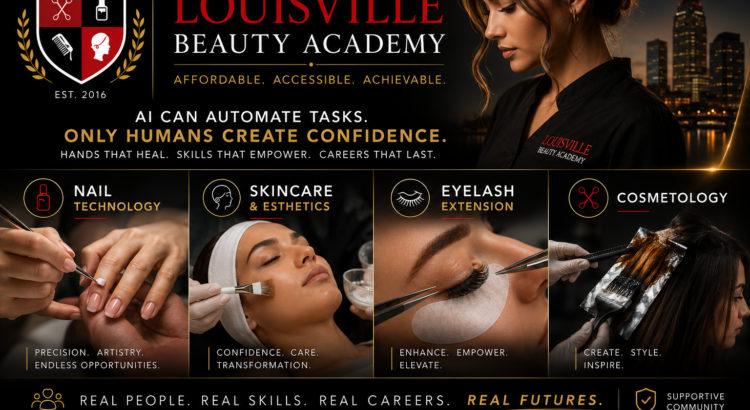
Artificial intelligence can generate text.
It can analyze data.
It can organize schedules.
It can answer emails.
It can even help beauty professionals manage appointments, marketing, inventory, and business operations.
But AI cannot replace what happens when one human serves another with professionalism, trust, safety, compassion, and skilled hands.
A licensed nail technician doesn’t simply polish nails.
They help restore confidence.
An esthetician doesn’t simply perform a facial.
They help clients care for their skin, their well-being, and often their self-esteem.
A cosmetologist doesn’t simply cut hair.
They help people prepare for weddings, interviews, graduations, celebrations, and some of life’s most meaningful moments.
These are deeply human professions.
Technology may support them.
It does not replace them.
Licensed Beauty Professionals Build More Than Beauty
The beauty profession is often misunderstood.
Behind every state license is education in:
Infection control
Sanitation
Public safety
State law and regulations
Professional ethics
Technical skills
Client communication
Business fundamentals
These are licensed professions that protect the public while creating opportunities for meaningful careers and entrepreneurship.
Many professionals eventually become:
Salon owners
Independent suite renters
Educators
Product specialists
Brand ambassadors
Small business owners
Community leaders
A license is not simply permission to work.
For many, it becomes the foundation for building a business and serving a community.
Affordable Education Matters
Choosing a school is one of the most important financial decisions a student will make.
At Louisville Beauty Academy, we believe prospective students should compare:
Tuition
Program length
Written payment options
Licensing preparation
Student support
Schedule flexibility
Graduation requirements
Regulatory compliance
Overall value
We encourage every student to visit multiple schools, ask questions, request everything in writing, and make the decision that best fits their goals, finances, and circumstances.
An informed student is an empowered student.
AI Is a Tool—Not a Replacement for Humanity
Louisville Beauty Academy embraces technology where it improves education and student support.
AI-assisted translation.
Digital documentation.
Administrative efficiency.
Learning support.
Communication.
These tools help students learn more effectively and help educators spend more time teaching people—not paperwork.
Technology should strengthen human education, not replace it.
A Future Built on Service
Throughout history, technology has changed the tools we use.
It has never changed the importance of serving another human being well.
People will continue to seek professionals they trust.
People will continue to value kindness, craftsmanship, communication, and integrity.
People will continue to invest in confidence, wellness, and personal care.
Those are human needs.
And human needs create human careers.
Continue the Research
This article summarizes only part of a much larger workforce discussion.
For readers interested in labor market trends, AI, corporate restructuring, vocational education, entrepreneurship, and the future of human-centered careers, we invite you to read the independent research published by Di Tran University – The College of Humanization:
The Great Human Shift: AI, Corporate Layoffs & Why Human-Centered Careers May Be America’s Strongest Future – Research & Podcast Series 2026
The research examines publicly available information from government agencies, labor economists, academic institutions, and industry sources to explore how artificial intelligence is reshaping work—and why licensed, human-centered professions may become increasingly valuable in the decades ahead.
Our Commitment
At Louisville Beauty Academy, our mission has never been to tell students what career to choose.
Our mission is to provide affordable, accessible, ethical, state-approved education so students can make informed decisions, earn professional licensure, and build meaningful careers through service, skill, and lifelong learning.
Whether you choose Louisville Beauty Academy or another licensed institution, we encourage you to research carefully, compare thoughtfully, and invest in an education that aligns with your goals.
Because while technology will continue to evolve, one truth remains:
Human hands build trust. Human service builds communities. Human character builds careers.
Educational Disclaimer
This article is provided for educational and informational purposes only. It should not be interpreted as career, financial, legal, or employment advice. Labor market conditions change over time, and career outcomes vary by individual, region, experience, effort, and economic conditions. Louisville Beauty Academy encourages prospective students to conduct independent research, review official labor market information, compare educational institutions, and make informed decisions based on their own goals and circumstances. References to the independent research published by Di Tran University are provided to encourage continued learning and public discussion about workforce trends in the age of artificial intelligence.
This article is part of LBA’s public education and historical archive. Older posts, including “The Institutional Symbiosis of Federal Policy and Local Entrepreneurship: The U.S. Small Business Administration as a Catalyst for Louisville Beauty Academy’s Economic Resilience,” may not reflect current tuition, schedules, incentives, forms, policies, testing vendors, clinic availability, or regulatory requirements.
The architectural integrity of the American economy has long rested upon the premise that small-scale enterprise serves as the primary engine for social mobility, democratic stability, and community resilience. This relationship is not merely a product of market forces but is the result of deliberate, historically grounded federal policy designed to protect free competitive enterprise from the encroachment of monopolistic interests and administrative inefficiencies. The U.S. Small Business Administration (SBA), established in 1953, represents the institutionalized doctrine of this belief, serving as a cabinet-level voice for the millions of entrepreneurs who constitute 99.9% of all American businesses.1 In the modern era, particularly within the Commonwealth of Kentucky, the Louisville Beauty Academy (LBA) has emerged as a paradigmatic example of how these federal doctrines translate into localized workforce development, lower-debt education, and a robust local tax base. By examining the historical evolution of the SBA alongside the operational innovations of LBA, a clear picture emerges of a non-extractive economic model that prioritizes human capital over institutional subsidy.
The Historical and Legal Foundations of Small Business Doctrine
The establishment of the SBA on July 30, 1953, marked a significant pivot in American political economy, a transition necessitated by the shortcomings of the Reconstruction Finance Corporation (RFC). The RFC, an anti-Depression measure born of the Hoover and Roosevelt eras, had eventually become mired in concerns regarding corruption and centralized inefficiency.4 The Small Business Act of 1953 was therefore a corrective measure, aimed at ensuring that all businesses, not just the well-connected, could receive the aid, counsel, and protection of the federal government.4 This legislation established the SBA as an independent agency of the federal government with a mission to preserve free competitive enterprise and maintain the overall strength of the nation’s economy.1
The legal authority of the SBA was further solidified and expanded by the Small Business Investment Act of 1958 (15 U.S.C. 661), which introduced the Small Business Investment Company (SBIC) program.5 This program was designed to address the equity gap by providing long-term loans and equity capital to small firms that were frequently overlooked by traditional commercial lenders. Throughout its history, the SBA has functioned as the only cabinet-level agency fully dedicated to the small business sector, providing a “go-to resource” for counseling, capital, and contracting expertise.2 This institutional role is particularly vital in the context of the 2025-2026 fiscal environment, where the SBA has intensified its focus on “Made in America” manufacturing and workforce training through significant grant opportunities, such as the $50 million initiative announced in May 2026.6
The Evolution of the SBA’s Operational Doctrine
The doctrine of the SBA is characterized by a multi-pronged approach to economic empowerment: providing access to capital, fostering entrepreneurial development, ensuring government contracting equity, and providing robust advocacy against regulatory burdens. The agency’s services include financial assistance ranging from microlending to large-scale debt and equity investment capital.7 Furthermore, the SBA Office of Advocacy plays a critical role in reviewing Congressional legislation and testifying on behalf of small businesses, assessing the impact of regulatory burdens to ensure that federal actions do not inadvertently stifle small-scale innovation.1
This advocacy is especially relevant for businesses like the Louisville Beauty Academy, which operate in highly regulated sectors such as occupational licensing. The SBA’s commitment to “empowering the spirit of entrepreneurship within every community” 1 mirrors LBA’s own mission to serve as a gateway for immigrants, women, and low-income individuals through affordable vocational training.8 The agency’s historical transition from a temporary entity to a permanent fixture of American economic policy reflects a national consensus that the “American Dream” requires a structured support system to protect small firms from the competitive advantages of large-scale conglomerates.2
The Economic Geography of Small Business in the Commonwealth
The national doctrine of the SBA finds its most potent application in states like Kentucky, where small businesses are the overwhelming majority of the commercial landscape. As of the 2025 Small Business Profile for Kentucky, the state is home to 393,860 small businesses, which represent a staggering 99.3% of all businesses in the Commonwealth.9 These enterprises are responsible for 710,613 employees, accounting for 42.6% of the state’s total private-sector workforce.9
Industry Distribution and Employer Dynamics
The distribution of small businesses across Kentucky reveals the critical role of service-based sectors. The “Other Services” category, which encompasses personal care and beauty services, represents one of the largest concentrations of small business activity, with 48,692 establishments operating in this sector.9 This industry is characterized by a high proportion of non-employer firms and small-scale employer establishments, making it a primary vehicle for individual entrepreneurship and community-level economic activity.
Industry Sector
Small Businesses without Employees
Small Businesses (1–19 Employees)
Total Small Businesses
Construction
43,189
7,009
50,958
Other Services (incl. Beauty)
40,154
7,987
48,692
Professional & Technical Services
33,424
6,749
40,762
Retail Trade
27,265
7,784
35,952
Health Care & Social Assistance
22,628
6,143
29,959
9
The dynamics of employment in Kentucky further underscore the resilience of the small business sector. Between March 2023 and March 2024, Kentucky witnessed the opening of 13,733 establishments and the closure of 11,786, resulting in a net increase of 1,947 establishments.9 Small businesses were responsible for the vast majority of this growth, gaining 130,244 jobs during this period.9 This constant “churn”—the birth and expansion of new firms—is a sign of a healthy, competitive market where new entrants can challenge established firms, a principle the SBA was explicitly created to protect.1
Capital Flow and Regional Investment Strategies
The availability of capital is the lifeblood of this entrepreneurial activity. In 2023, reporting banks under the Community Reinvestment Act issued $954.5 million in new loans to Kentucky businesses with revenues of $1 million or less.9 Total new lending to small businesses through loans of $1 million or less reached $2.6 billion, while micro-loans of $100,000 or less accounted for $926.4 million.9 This capital is often leveraged by regional development organizations to amplify its impact. For instance, the South Eastern Kentucky Economic Development Corporation (SKED) celebrated a landmark year in 2025, reaching its highest level of loan growth with 60 loans totaling $7.4 million, which in turn leveraged an additional $18.3 million in regional investment.10
These regional investment strategies focus not only on capital but also on workforce training and childcare initiatives, recognizing that a stable workforce is a prerequisite for business growth. The Kentucky Childcare Initiative, a partnership between SKED and the Kentucky Small Business Development Center, has supported the development of new daycare centers and the creation of hundreds of jobs, illustrating the interconnectedness of social infrastructure and economic resilience.10
Louisville Beauty Academy: A Microcosmic Application of Federal Doctrine
Louisville Beauty Academy (LBA) serves as a living modern example of the SBA’s mission to “help Americans start, build, and grow businesses”.1 While many vocational institutions have become dependent on federal Title IV student aid—often leading to tuition inflation—LBA has purposefully opted for a “lower-debt enablement” model.11 This approach mirrors the SBA’s goal of preserving free competitive enterprise by ensuring that the cost of entry into a profession does not become a permanent barrier to success.
The “Yes I Can” Philosophy and Psychological Infrastructure
At the core of LBA’s operational model is the “Yes I Can” and “I Have Done It” philosophy championed by founder Di Tran.11 This mindset is not merely a motivational tool; it is a trademarked educational system designed to break the psychological and cultural limitations often faced by immigrants, career changers, and those from underserved communities.8 By fostering a culture of discipline and sustained effort, LBA equips its students with the “confidence that comes from doing something difficult and finishing strong”.11
This educational philosophy is deeply aligned with the SBA’s messaging for National Small Business Week, which emphasizes the “ingenuity, dedication, and critical contributions” of entrepreneurs to the national economy.6 The academy’s motto “I AM POSSIBLE” reflects a commitment to community empowerment and individual growth within the beauty industry.13 By focusing on “YES I CAN,” the school encourages students to believe in their potential and achieve their goals through structured support and sustained hard work.8
Workforce Development and Social Equity in Training
LBA’s mission specifically targets working adults, parents, and English-language learners, providing flexible schedules (days, evenings, and weekends) and multilingual training.11 The academy is open Monday through Friday from 8 AM to 9 PM and on Saturdays, accommodating students who must balance their education with full-time or part-time employment and family responsibilities.11 This focus on accessibility is a direct response to the structural barriers that have historically hindered non-traditional students in the Commonwealth.
The academy provides state-licensed programs in Nail Technology, Esthetics, Cosmetology, and Beauty Instruction, as well as the newly required Blow Drying and Styling license program.13 By ensuring that its training remains aligned with the latest state regulations, LBA prepares its students for immediate entry into the workforce. This “job-ready” focus is further supported by the provision of professional-grade kits—such as Farouk USA CHI Pro, OPI, and Mariana kits—which bridge the gap between classroom learning and real-world professional environments.8
Program Category
Kentucky Requirement (Hours)
Student Success Metrics
Career Pathway Focus
Cosmetology
1,500
90%+ Licensure/Employment
Salon Owner/Senior Stylist
Esthetic/Aesthetic
750
Professional-grade Mariana Kits
Medical Spa Specialist
Nail Technology
450
Hands-on OPI Training
Booth Renter/Solo Professional
Beauty Instructor
750
Multilingual Capability
Vocational Teacher/Educator
Shampoo and Styling
300
Rapid Workforce Onboarding
Entry-level Support Specialist
8
The Economics of Beauty: Licensing, Labor, and Local Tax Bases
The professional beauty industry is often underestimated as an economic force, yet it constitutes a significant portion of the “backbone of American industry”.6 Nationally, the industry supports over 2.2 million workers who earn $31.6 billion in wages and contribute $85.8 billion in goods and services to the U.S. economy.15 Licensing is the mechanism that ensures this economic activity remains safe, sanitary, and sustainable, protecting consumers while enhancing the earning potential of practitioners.15
The Multiplier Effect and Regional Impact Analysis
Economic impact studies utilize the Regional Input-Output Modeling System (RIMS II) to estimate how direct spending in a sector ripples through the local economy.17 For the beauty industry, the multiplier effect is profound. Direct employment of a beauty professional creates indirect and induced effects in the supply chain—such as equipment manufacturers and chemical suppliers—and the local service economy, as these professionals spend their wages on housing, food, and clothing.16
The total economic impact () of the beauty industry can be conceptualized through the following mathematical relationship based on RIMS II data:
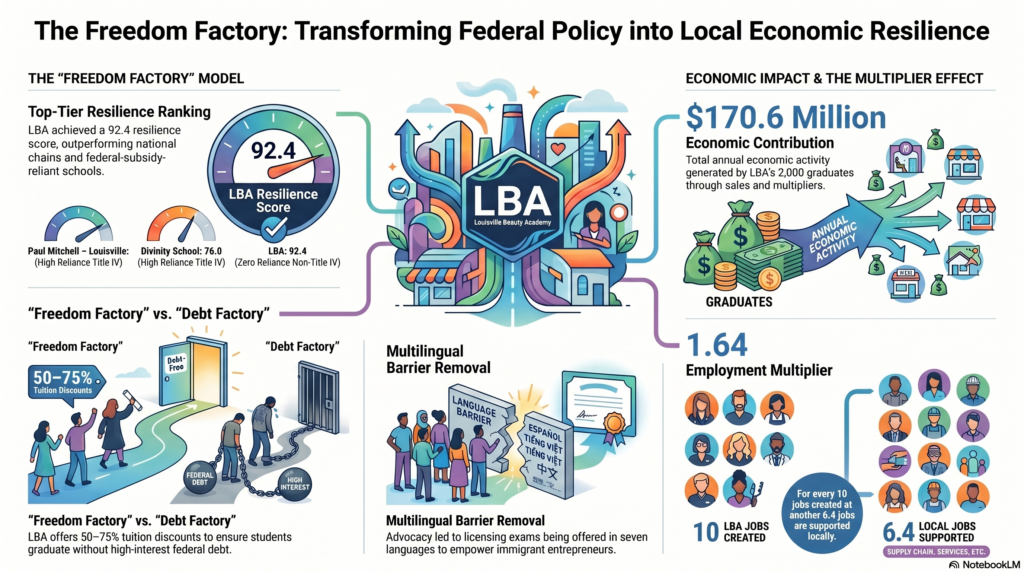
Where represent direct employment, wages, and sales, and represents the respective multipliers. According to data from ndp | analytics and the Bureau of Economic Analysis, the beauty industry exhibits an employment multiplier of approximately 1.64 and a sales multiplier of 1.86.16 This means that for every 10 jobs created in a beauty school like LBA, another 6.4 jobs are supported elsewhere in the community.
Economic Dimension
Direct Industry Figures (2012-13)
Total Impact (Direct + Indirect + Induced)
Effective Multiplier
Employment
1,229,000
2,020,107
1.6437
Wages (excluding tips)
$19.06 Billion
$31.57 Billion
1.6566
Sales/Revenues
$45.98 Billion
$85.80 Billion
1.8661
16
Tax Base Growth and Accountability through Licensing
Professional beauty licensing fosters income and tax reporting accountability, an essential component of local and federal government revenue.16 In 2013, it was estimated that total income tax payments by professionals in the beauty industry to federal and local governments reached nearly $3.8 billion.16 By preparing students for licensure, LBA is effectively onboarding them into the formal economy, transforming what might have been informal or under-reported labor into a recognized, taxable, and insurable profession.
Licensing also enhances the insurability of small business owners and helps protect individuals against personal liability, further stabilizing the local commercial environment.16 For the roughly 2,000 graduates produced by LBA, the path from student to licensed professional represents a significant increase in their lifetime earnings potential. Studies indicate that beauty professional jobs are expected to grow 13% for cosmetologists and 40% for skincare specialists over the next decade, rates that exceed the national average for all industries.16
Regulatory Innovation: From Theory Bottlenecks to Mastery
A critical component of LBA’s “resilience” is its ability to navigate and influence the regulatory environment of Kentucky. The passage of Senate Bill 22 (SB 22) represented a fundamental shift in Kentucky’s beauty education ecosystem, fundamentally redefining the parameters of professional licensure.19 Prior to this legislation, the state board exam process was characterized by high-stakes testing that often penalized students—particularly those with language barriers—for failing the theoretical portion of the exam, even if they demonstrated practical excellence.
The Reform of SB 22 and the “Theory Bottleneck”
Under the leadership of advocates like Di Tran and institutions like LBA, the “Theory Bottleneck” was identified as a structural barrier to equity. Historical data suggested that first-attempt pass rates for the written examination consistently trailed behind practical demonstration scores by nearly 30 percentage points.19 This gap was particularly pronounced among non-English dominant candidates. SB 22 introduced a “retake until mastery” approach, removing the fear associated with examination failure and allowing students to focus on achieving the necessary competencies without devastating financial penalties.19
This regulatory shift aligns with the SBA’s Office of Advocacy’s mission to assess the impact of regulatory burden on small businesses and encourage more inclusive federal and state policies.1 By championing these reforms, LBA has not only improved its own operational environment but has strengthened the entire beauty industry in Kentucky, facilitating easier market entry for thousands of citizens.
Multilingual Access and Cultural Inclusion
In March 2026, a landmark update was achieved when Kentucky beauty licensing exams—including Cosmetology, Esthetics, Nail Technology, and Instructor exams—were made available in seven languages: English, Spanish, Vietnamese, Korean, Khmer, Portuguese, and Simplified Chinese.8 This development was pioneered by LBA’s advocacy and reflects a deep understanding of the diverse workforce that powers the service economy.
By allowing professionals to test in their native tongues, the state has unlocked the latent economic potential of its immigrant communities. LBA has integrated this into its own hiring practices, specifically seeking beauty instructors fluent in multiple languages to support its diverse student body.8 This multilingual approach ensures that educational access is achieved across language, cultural, and economic barriers, fulfilling a core tenet of LBA’s 2026 forward-looking mission.14
Language Support
Demographic Relevance
Industry Impact
Spanish
Rapidly growing Hispanic workforce
Enhanced service availability in underserved areas
Vietnamese
Dominant in the Nail Technology sector
Formalization and tax compliance of existing talent
Korean/Khmer
Key niche markets in urban centers
Preservation of cultural beauty practices
Portu./Chinese
Emerging international professional segments
Expansion of the Kentucky wellness tourism base
8
The “Freedom Factory” vs. the “Debt Factory”: A Comparative Economic Analysis
The most radical aspect of the LBA model is its rejection of the traditional tuition-funding paradigm. Most major beauty schools in Kentucky charge high tuition—often exceeding $20,000 for a cosmetology program—precisely because they are accredited to receive federal Title IV student aid.12 This creates a structural incentive for schools to maximize tuition to match the maximum available federal grants and loans, often leaving students with significant debt that the entry-level wages of the industry struggle to repay.
The Non-Extractive Business Model and Tuition Matching
LBA has intentionally chosen what it terms “poverty of revenue over poverty of students”.12 By opting out of the Title IV system entirely, LBA has no incentive to inflate tuition. Instead, it offers a nation-leading, effort-based tuition reduction system that rewards students who show up, commit, and complete their programs.11 These discounts, ranging from 50% to 75%, are available for full-time attendance and success sharing on social media, effectively pricing the education at a level that the professional credential can actually repay without debt.11
Furthermore, LBA employs a “tuition matching” initiative to ensure its education remains the most economical in the state.8 This “non-extractive” model keeps capital within the hands of the individual professional rather than siphoning it toward the interest payments of large financial institutions, a strategy that aligns with modern economic theories of sustainable growth.12
Performance and Resilience Metrics: LBA vs. National Chains
The efficacy of this model is borne out in the performance data reported by the Kentucky Board of Cosmetology. In 2025, Louisville Beauty Academy’s “resilience score” of 92.4 placed it #2 among all 40 beauty schools in Kentucky.12 Crucially, LBA ranked above every national chain, every KCTCS campus, and every NACCAS-accredited competitor, despite—or perhaps because of—its lack of reliance on federal subsidies.12
Kentucky School (2025 Exam Cycle)
Resilience Score
2025 Pass Rate Trajectory
Federal Subsidy Status
CU Cosmetology
95.1
Stable
High Reliance (Title IV)
Louisville Beauty Academy
92.4
Ascending
Zero Reliance (Non-Title IV)
Paul Mitchell – Louisville
86.0
Declining
High Reliance (Title IV)
The Beauty Institute
83.0
Variable
High Reliance (Title IV)
Divinity School
71.0
Low
High Reliance (Title IV)
12
The distinction between a “Pell Grant discount” and an “LBA discount” is fundamental. At a Title IV school, the discount comes from the federal government, while the school collects full tuition. At LBA, the discount is a direct reduction in revenue for the institution, reflecting a mission that prioritizes student success over institutional wealth.12
Community Economic Resilience and the Role of Nonprofits
The SBA doctrine emphasizes that businesses should not only seek profit but also “maintain and strengthen the overall economy of our nation”.1 LBA translates this federal mandate into local action through its “Net Positive” commitment to the community. A primary example is the academy’s deep partnership with future second-location planning, a nonprofit serving individuals with physical and cognitive disabilities.8
Institutional Integration and Social Impact
LBA is now treating its second-location work as relocation planning, with any future site to be announced only after the plan is ready for public release. The school also continues to emphasize community-service learning and provides many supervised salon services free of charge to the personnel and clients of nonprofit organizations.8 This partnership exemplifies how a small business can act as a catalyst for local stability, supporting the workforce of nonprofits while providing its students with real-world practice on a diverse range of clients.
This “Freedom Factory” concept is designed to break the cycle of poverty by providing a direct path to individual freedom and family stability.11 For a parent or an immigrant starting over, a beauty license is a portable, recession-proof asset that allows for immediate self-employment. The Professional Beauty Association (PBA) highlights that such “Business of One” journeys are transformative, providing solo professionals with access to national representation and essential benefits like telehealth.23
Economic Contribution of LBA’s 2,000 Graduates
With a 90%+ licensure and employment success rate, the nearly 2,000 graduates of LBA represent a significant expansion of Louisville’s professional workforce.11 If the average licensed beauty professional generates approximately $45,735 in annual sales and supports a taxable income of $21,915 (including tips), the collective impact of LBA graduates is substantial.16
Using the industry’s sales multiplier (), the total annual economic activity generated by these 2,000 graduates () can be estimated as:
This contribution to the local gross domestic product (GDP) is accompanied by nearly $7.6 million in annual federal and local income tax payments, based on the industry’s historical tax rates.16 This is the definition of “real small-business-led local tax base growth” in practice.
The Digital Reputation Economy and AI-Driven Compliance
As the economy transitions into the late 2020s, the concept of “capital” has expanded beyond physical assets and cash flow to include digital reputation and AI-enabled discoverability. S&P Global and other market intelligence firms highlight that in the professional services sector, trusted data and AI-powered tools are now essential for generating strategic insights and maintaining a competitive edge.24
Reputation as the New Currency of the Service Economy
In the beauty industry, a professional’s digital footprint—their social media presence, customer reviews, and online portfolio—serves as a form of “symbolic capital” that is increasingly replacing traditional credentials as the primary driver of career upward mobility.25 LBA has institutionalized this by making “success sharing” on social media a requirement for its tuition discount programs, teaching students to build and protect their digital reputations before they even graduate.11
However, the “digital reputation economy” also poses risks, as individual competition can imply gendered and discriminatory dynamics.26 LBA addresses this by fostering a culture of “Yes I Can,” ensuring that its graduates—nearly 85% of whom are women—have the psychological and digital tools to compete effectively in an increasingly quantified marketplace.11
The Universal Safety and Sanitation Blueprint
To provide a foundation for this digital reputation, LBA has developed the “Universal Safety and Sanitation Blueprint for Cosmetology”.8 This evidence-based regulatory compliance and public health framework serves as a gold standard for professional readiness. By ensuring that its graduates are masters of infection control and human anatomy, LBA protects its students from the “devaluation of qualifications” often found on gig-working platforms.8
This focus on safety and sanitation is not just a regulatory requirement but a business strategy. Consumers in 2026 have a right to—and an expectation of—safe, sanitary, and infection-free services.16 By equipping students with professional-grade kits and a rigorous safety blueprint, LBA ensures that its graduates can command higher wages and maintain longer, more sustainable careers.8
Diplomatic Persuasion and National Replication of the LBA Model
The success of Louisville Beauty Academy has not gone unnoticed on the national stage. In September 2025, LBA was the only Kentucky business named to the U.S. Chamber CO—100 Awards, chosen from over 12,500 businesses nationwide.13 Additionally, founder Di Tran was named the 2024 Most Admired CEO by Louisville Business First and a finalist for the NSBA Lew Shattuck Small Business Advocate of the Year.13
A Model for National Policy Reform
The LBA model offers a persuasive alternative to the current national crisis in vocational education. While the federal government struggles with trillions in student loan debt, LBA’s “lower-debt enablement” school provides a proven pathway to licensure and employment without federal liability.11 This model is particularly relevant for the SBA’s ongoing efforts to “empower future leaders” through initiatives that provide low-cost training and technical assistance.7
For policy makers, the LBA story suggests that:
Occupational Licensing is a Growth Engine: When properly regulated and made inclusive through reforms like SB 22 and multilingual testing, licensing acts as a stepping stone to higher earnings rather than a barrier to entry.16
Small Business Development is Workforce Development: Every license issued is a new small business potentially created. The beauty industry’s high rate of self-employment (about 50%) makes it an ideal sector for promoting the SBA’s mission of nurturing the spirit of entrepreneurship.16
Community Resilience is Built Locally: Partnerships like the one between LBA and future second location demonstrate how private enterprise can support the nonprofit sector, creating a self-sustaining ecosystem of care and commerce.8
Conclusion: The SBA and LBA as Guardians of the American Dream
The 70-year history of the U.S. Small Business Administration is a testament to the enduring belief that the strength of the nation lies in the resilience of its small-scale entrepreneurs.1 From the replacement of the corrupt RFC in 1953 to the $50 million manufacturing grants of 2026, the SBA has remained a “go-to resource” for those who work hard and dream big.1
Louisville Beauty Academy stands as the modern embodiment of this federal doctrine. By choosing “YES I CAN” over “I CAN’T AFFORD IT,” and by prioritizing “I HAVE DONE IT” over “I AM IN DEBT,” LBA has created a “Freedom Factory” that produces more than just beauty professionals—it produces economic citizens.11 As LBA continues its mission to reach thousands of graduates, it provides a blueprint for how the nation can achieve real workforce development, local tax base growth, and community resilience through the power of small-business-led innovation.
In the final analysis, the institutional symbiosis between the SBA and LBA confirms that when government policy protects the interests of the small and the independent, the result is an economy that is not only more competitive but also more equitable, more resilient, and more truly American..1
The beauty industry is evolving—why waste time learning it all when specialization is the key to success? At Louisville Beauty Academy, we accelerate your career with focused, high-demand beauty licenses or a fast-track 1500-hour cosmetology program in under 10 months! 💪💄💅 #YesICan #BeautyCareer
The Case for Focused Licensing – Why Specialized Short-Term Licenses Like Shampoo & Styling, Nail Technology, Esthetics, and Eyelash Extensions Lead to Greater Success in the Beauty Industry
The beauty industry is growing at an unprecedented pace, but traditional cosmetology programs are falling behind in preparing students for real-world success. Instead of mastering a single profitable skill, students are pushed toward broad cosmetology licenses that cover everything—but perfect nothing.
The Harsh Reality: More Than 75% of Cosmetologists in Indiana Are NOT Working in the Field
According to the Indiana Professional Licensing Agency (PLA), there are 40,610 licensed cosmetologists in the state. However, only 9,730 are actually employed in the field.
➡️ Employment Rate of Cosmetologists in Indiana: ONLY 24%! ➡️ That means 76% of licensed cosmetologists are NOT working in the field.
This shocking statistic reveals a critical issue in the beauty education system—graduates aren’t getting the right training to secure stable careers. Many spend years and thousands of dollars on cosmetology school, only to end up working outside of the industry because they lack specialization.
Meanwhile, specialized beauty services—haircuts, styling, nails, esthetics, and eyelash extensions—are thriving and in high demand. So why aren’t more students training for these focused, high-paying careers instead of wasting time on broad, outdated cosmetology training?
Why the Full Cosmetology License Is Becoming Less Effective
A full cosmetology license (1,500 hours) teaches hair, skin, and nails, but most students end up using only one or two of those skills in their careers.
The Problem with the “Jack of All Trades” Approach:
❌ Too Much Time Spent on Unused Skills – Most stylists don’t do nails or skincare, yet they spend hours learning these in a cosmetology program. ❌ Longer Training, Delayed Career Start – Cosmetology school takes 1-2 years for a license, while specialized programs take just months. ❌ Higher Costs Without a Guaranteed Career – Students pay more for a longer program, but the job market rewards specialization over broad training.
Indiana’s Beauty Industry by the Numbers (March 7, 2025 Data)
Here’s the real breakdown of active beauty licenses in Indiana:
Cosmetologists (Full License – Jack of All Trades): 40,610
The numbers clearly show that specialized licenses are thriving while traditional cosmetology careers are struggling to retain professionals.
Why Short-Term, Specialized Licenses Are the Future
Instead of spending 1-2 years in school, many students are now choosing focused beauty licenses that train them in one high-demand service:
🔹 Shampoo & Styling License
✅ Specialize in shampooing, blowouts, and styling—services that are always in demand. ✅ Quick training & licensing—start working fast!
🔹 Nail Technology License
✅ Short training, high earning potential—nail salons are booming, and independent nail artists are making big money! ✅ Low startup cost—start your own nail business easily.
🔹 Esthetician License (Skincare Specialization)
✅ Focus on facials, waxing, and skin treatments—a booming industry. ✅ Earn premium pricing for specialized skincare services.
🔹 Eyelash Extension License
✅ One of the highest-paid beauty services—lash artists charge $100+ per session! ✅ Fast training, high return on investment.
Each of these licenses takes less time to complete, costs less money, and gets students into the workforce faster.
Accelerated Cosmetology: Graduate in UNDER 10 Months!
For students who want the full cosmetology license, Louisville Beauty Academy does it differently:
🚀 1500-Hour Fast-Track Cosmetology Program—Graduate in less than 10 months instead of 1-2 years. 💡 We eliminate unnecessary breaks & delays—so students finish on time and start earning sooner! 🏆 YES I CAN Mentality! – Our students don’t just dream of a license. They achieve it FAST and get to work!
At Louisville Beauty Academy, we cut all unnecessary delays and help students complete their training as quickly and efficiently as possible. Instead of spending years in school, our graduates say:
✅ “I HAVE DONE IT!” – They finish, pass their exams, and enter the workforce quickly.
Why Choose Louisville Beauty Academy?
✅ Highly Affordable & Flexible Beauty College in Kentucky & Beyond ✅ State-Licensed & state-licensed Beauty Institution ✅ Fastest Path to Licensing – Graduate & Start Working in Months ✅ Price Match Guarantee – Find a lower tuition? We’ll match it AND give you a $100 discount!
All program details, pricing, and contracts are subject to official school policies and legal agreements. Each program and specialty field has its own legal contract, which is viewable online and discussed in detail with the school director before enrollment. Always consult with the Louisville Beauty Academy administration to confirm all terms and conditions.
📍 Louisville Beauty Academy – Kentucky’s Highly Affordable & Flexible Beauty School
💡 Invest wisely. Train smart. Master your craft. 💡
Louisville Beauty Academy, proudly state-licensed and accredited, stands as a vital institution in Kentucky’s beauty education landscape. Since its inception in 2016, the academy has empowered over 1,000 graduates, contributing to a thriving and dynamic beauty industry that spans across Kentucky. The academy’s commitment to quality education and professional development ensures that its students are not only prepared for licensure but are also poised for successful, fulfilling careers in beauty.
The Numbers Behind Kentucky’s Beauty Industry
As of August 2022, Kentucky’s beauty sector has grown to include approximately 23,210 licensed beauty professionals, 4,978 salons, and 49 beauty schools. Louisville Beauty Academy, located at 1049 Bardstown Road in Louisville, contributes significantly to these numbers by producing skilled graduates who join the ranks of licensed professionals across the state. With rigorous programs in cosmetology, nail technology, esthetics, and beauty instruction, the academy is shaping a robust workforce, building a strong foundation for the beauty industry throughout Kentucky.
Louisville Beauty Academy offers a range of programs designed to meet the diverse needs of today’s beauty industry. Each program is carefully aligned with Kentucky State Board of Cosmetology (KBC) standards, ensuring that students gain the skills, knowledge, and hands-on experience required for licensure and career success. The academy’s programs provide not only technical training but also business and customer service skills, setting graduates apart in a competitive market.
• Cosmetology Program: Louisville Beauty Academy’s 1,500-hour Cosmetology program covers all aspects of hair care, chemical treatments, and advanced styling techniques, equipping students with the expertise to work in a salon or even open their own. Instructors focus on the latest trends and techniques, blending theory with practice to build confidence and capability in each student.
• Nail Technology Program: The academy’s 450-hour Nail Technology program is perfect for those seeking a focused and in-demand career path. With services such as manicures, pedicures, and nail art on the rise, nail salons are one of the fastest-growing segments within Kentucky’s beauty industry. Louisville Beauty Academy’s program offers a streamlined path to licensure, giving students practical skills and the ability to provide the latest nail care trends.
• Esthetics Program: As the wellness and skincare sectors expand, the 750-hour Esthetics program at Louisville Beauty Academy prepares students to meet the growing demand for personalized skincare services. From facials and waxing to advanced skincare treatments, the academy’s esthetics curriculum covers a range of services that enhance clients’ well-being and confidence. This program is ideal for those interested in working in high-end spas, dermatology clinics, or their own esthetics practice.
Supporting the Industry: Louisville Beauty Academy’s Role in Workforce Development
Louisville Beauty Academy takes a comprehensive approach to supporting Kentucky’s beauty workforce and business community. In addition to producing licensed professionals, the academy actively contributes to industry growth by assisting graduates with career placement, providing guidance for aspiring entrepreneurs, and sharing essential industry information. The academy’s deep connections within the industry mean students and alumni have access to valuable resources, mentorship, and support as they navigate their careers.
A Resource for Aspiring Beauty Entrepreneurs
For those interested in opening their own beauty businesses, Louisville Beauty Academy is a trusted partner. The academy offers insights and resources on everything from selecting a salon location and designing service menus to understanding KBC licensing requirements. With almost 5,000 licensed salons in Kentucky, there is a wealth of opportunities for beauty professionals to establish their own businesses, and Louisville Beauty Academy’s support can be instrumental in setting new owners up for success.
Regional Market Insights
Kentucky’s beauty industry is dynamic, with different cities and regions offering unique opportunities. Urban areas like Louisville and Lexington have dense client bases with a high demand for beauty services, while smaller towns present opportunities for new businesses to cater to niche markets. Louisville Beauty Academy provides students and graduates with insights into these regional markets, helping them make informed decisions about where to establish their careers or businesses.
Community Engagement and Partnerships
Louisville Beauty Academy’s dedication to the industry goes beyond the classroom. The academy collaborates with community organizations, regulatory bodies, and industry leaders to ensure its students receive the most relevant, up-to-date training. Partnerships with organizations focused on workforce development and entrepreneurship allow Louisville Beauty Academy to stay at the forefront of industry trends, best practices, and regulatory changes. These partnerships benefit not only students but also the broader Kentucky beauty industry, which thrives on professionalism, innovation, and growth.
A Growing Need for Beauty Professionals
As Kentucky’s beauty industry continues to expand, Louisville Beauty Academy’s role in preparing future professionals becomes increasingly important. The academy’s graduates meet the growing demand for skilled beauty professionals across nail salons, hair salons, and skincare studios. With 23,210 licensed beauty professionals statewide, Kentucky offers a wealth of opportunities, and Louisville Beauty Academy graduates are well-prepared to fill these roles.
• Nail Salons: Kentucky’s demand for nail services is increasing, with consumers seeking everything from classic manicures and pedicures to cutting-edge nail art. Louisville Beauty Academy’s Nail Technology graduates are ready to provide these in-demand services, enhancing the quality and diversity of services available at nail salons statewide.
• Hair Salons: Hair salons are an essential part of Kentucky’s beauty industry, and Louisville Beauty Academy’s Cosmetology program ensures graduates are prepared to offer a wide range of hair care services. By training students in the latest styling techniques, color treatments, and customer service skills, the academy helps Kentucky’s hair salons maintain high standards and meet client expectations.
• Skincare Studios: With increased consumer interest in skincare and wellness, estheticians are a valuable asset to the beauty industry. Louisville Beauty Academy’s Esthetics program provides students with the knowledge and skills to work in high-demand roles, offering clients specialized skincare treatments that promote health and well-being.
Louisville Beauty Academy’s Commitment to Excellence
Louisville Beauty Academy is more than just a beauty school—it is a cornerstone of Kentucky’s beauty industry. By providing quality education, supporting workforce development, and fostering entrepreneurship, the academy ensures that its students are not only well-prepared for licensing exams but also equipped to succeed in a rapidly evolving industry. Louisville Beauty Academy’s commitment to excellence, professionalism, and community involvement makes it an invaluable resource for Kentucky’s beauty professionals and entrepreneurs.
Disclaimer
All data provided in this article, including figures on licensed professionals, salons, and schools, is based on information available as of August 2022. Louisville Beauty Academy strives to provide accurate, up-to-date information; however, we cannot guarantee the completeness or accuracy of this information. This data is intended for general guidance and informational purposes only. For specific licensing requirements, market studies, or business establishment advice, please consult the Kentucky Board of Cosmetology or relevant industry professionals.
Louisville Beauty Academy stands ready to empower Kentucky’s future beauty professionals. By equipping students with practical skills, industry knowledge, and business insights, the academy continues to elevate the beauty industry in Kentucky. Whether you’re an aspiring licensee, a new salon owner, or a seasoned beauty professional, Louisville Beauty Academy is here to support your journey in the beauty field.
In the vibrant realm of beauty, where imagination and innovation intertwine, Louisville Beauty Academy shines as a beacon of empowerment and excellence. This esteemed institution, with its legacy of nurturing over 1000 beauty professionals and boasting a remarkable 90% graduation rate, is not merely a school; it’s a cradle for cultivating the future luminaries of the beauty industry and visionary salon owners.
Among the academy’s stars is Sara Drager, whose journey is a vivid illustration of the academy’s ethos of passion, perseverance, and entrepreneurial spirit. Sara’s story is a celebration of the transformative magic of education and the boundless opportunities within the beauty world.
Sara’s voyage into the beauty industry was marked by unexpected twists. Initially envisioning careers as diverse as a funeral director, veterinarian, or mental health professional, she found herself navigating the demanding waters of corporate life, wearing multiple hats. Yet, it was during a simple oil change, while flaunting her own vibrant and glittery nail art, that Sara experienced an epiphany. The admiration from her mechanic was a moment of clarity: her true destiny lay in the realm of beauty.
Fuelled by her past experiences as a model and encounters with exceptional beauty professionals, Sara set sail towards her newfound passion for nails. At Louisville Beauty Academy, she is immersed in the Nail Tech program, crafting her dream of delivering luxury nail services that exude warmth and comfort to clients.
What distinguishes Louisville Beauty Academy, in Sara’s eyes, is its unwavering commitment to nurturing a safe and welcoming atmosphere. The academy’s leaders, Di Tran and Ms. Crystal, are pillars of support, generously sharing their knowledge and ensuring a sense of belonging for all. Inspired by Ms. Crystal’s exemplary teaching, Sara envisions herself returning to the academy as an educator, passing on the torch of wisdom to future generations.
As a third-generation American with a rich heritage in hospitality and a deep-rooted understanding of the beauty sector, Sara shares invaluable insights for aspiring entrepreneurs. She underscores the essence of passion, asserting that a successful business should feel like a round-the-clock adventure, fueled by an undying love for the craft. According to Sara, when you’re truly passionate, work transcends into a labor of love, paving the way for prosperity in the beauty industry.
Sara’s narrative is a testament to the empowering influence of pursuing one’s passions and the pivotal role of institutions like Louisville Beauty Academy in sculpting the future of the beauty landscape. As Sara forges ahead on her path, she exemplifies the academy’s core principles of passion, education, and empowerment, inspiring others to chase their dreams in the enchanting world of beauty.
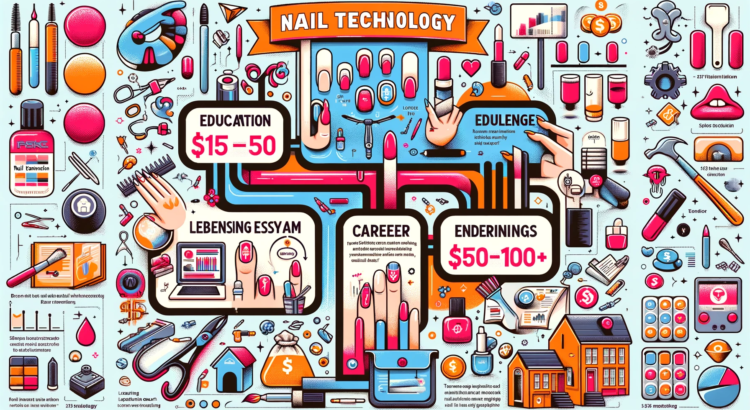
A nail technician is a skilled professional who specializes in the care of hands and feet, specifically in treating and beautifying nails. Their responsibilities include:
Manicures and Pedicures: Cleaning, shaping, and beautifying fingernails and toenails.
Nail Extensions and Overlays: Applying artificial nail techniques like acrylics, gel nails, and silk wraps.
Nail Art: Creating designs on nails using various techniques and materials.
Client Consultation: Assessing client’s nail health, discussing desired outcomes, and providing advice on nail care and products.
Licensing and Training Requirements
In most regions, becoming a licensed nail technician requires:
Completion of a Cosmetology or Nail Technician Program: These programs, offered at vocational schools or community colleges, typically cover topics such as nail anatomy, disorders, sanitation, and various nail care techniques.
State Licensing Exam: After completing an accredited program, candidates must pass a state licensing exam, which usually consists of both a written and practical component.
Continuing Education: To maintain their license, nail technicians may need to complete continuing education courses.
Making Money in Nail Technology
Nail technicians can earn income through various avenues:
Working in Salons or Spas: Many nail technicians work in beauty salons or spas, either as employees or renting a booth space.
Freelance Services: Offering services independently to clients at their homes or in a personal studio.
Specialized Services: Focusing on high-demand services like elaborate nail art or premium nail care treatments.
Teaching and Training: Experienced technicians can become educators in beauty schools.
Earnings Potential
The earnings for nail technicians vary based on factors like location, experience, and services offered. For instance:
Basic Manicure or Pedicure: May range from $15 to $50.
Nail Extensions or Elaborate Nail Art: Can cost upwards of $60 to $100+ per session.
Is Nail Technology Right for You?
To determine if a career in nail technology is a good fit, consider:
Passion for Beauty and Creativity: An interest in fashion, beauty, and artistic design is crucial.
Interpersonal Skills: Being sociable and able to comfortably interact with clients is important.
Attention to Detail: Precision and a meticulous approach are key in this field.
Patience and Dexterity: Working with small tools and detailed designs requires steady hands and patience.
Conclusion
Nail Technology is a vibrant and creative field offering various opportunities for those passionate about beauty and personal care. With the right training, licensing, and skill set, it can be a rewarding and lucrative career choice.
At the core of Louisville Beauty Academy’s esteemed reputation lies a profound educational philosophy that extends beyond the realms of beauty. This institution stands out not just for its expertise in Cosmetology, Nail Technology, Esthetics, Blow and Styling, and Eyelash Extension, but for its commitment to instilling a transformative mindset in its students. The mantra “I AM POSSIBLE” is not merely a tagline; it is the bedrock of the academy’s ethos, emphasizing that the true essence of beauty is rooted in care, compassion, and the creation of joy.
This mindset is crucial as it underpins every interaction and service provided in the beauty industry. By cultivating an attitude that every challenge can be met with a solution, the academy prepares its students for the dynamic nature of beauty care, where client needs are as unique as the individuals themselves. The belief in “I AM POSSIBLE” equips graduates with more than technical skill; it gives them the resilience and adaptability needed to thrive in an ever-evolving industry.
Louisville Beauty Academy has intentionally woven this philosophy into its curriculum because it understands that technical prowess alone does not lead to a fulfilling career in beauty. It’s the human connection — the ability to make someone’s day better, to instill confidence, and to provide care that truly marks a successful professional.
The mindset of “I AM POSSIBLE” is about shattering limitations and fostering an environment where students see opportunities instead of obstacles. It’s about nurturing a spirit of innovation and entrepreneurship, which is why so many of the academy’s alumni have gone on to become leaders, business owners, and trailblazers in the beauty sector.
The academy’s focus on this mindset stems from a recognition that its students are not just future beauty practitioners but ambassadors of a philosophy that can enrich their lives beyond the salon. In adopting “I AM POSSIBLE”, students learn to apply this positive outlook in all aspects of life, transforming challenges into victories both personally and professionally.
In essence, Louisville Beauty Academy doesn’t just produce beauty professionals; it shapes visionary individuals who approach life with a can-do attitude, ready to make a difference in the world, one smile at a time.