Institutional LBA visual for Sanitation Is Humanization emphasizing sanitation, law, written clarity, licensing, and workforce dignity.

Sanitation Is Humanization

Sanitation is not cold compliance. It is respect for the client, student, instructor, and public trust behind the license.

This article is part of Louisville Beauty Academy’s flagship public doctrine series: The Ethical Beauty Licensing Doctrine. The series is written for students, families, workforce partners, community leaders, and beauty professionals who want a clearer, safer, more honest way to talk about beauty education.
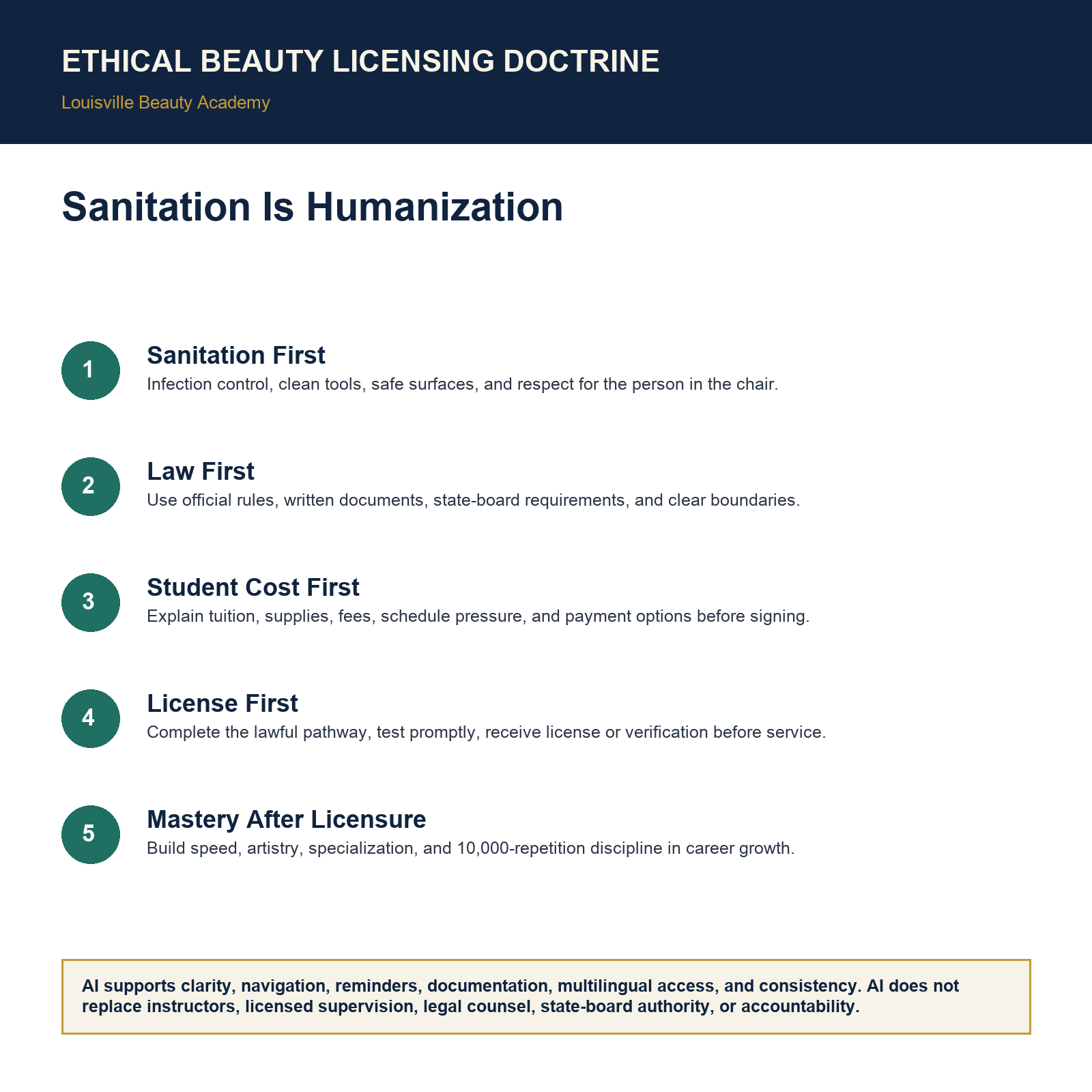
Visual explainer for Sanitation Is Humanization showing the Ethical Beauty Licensing Doctrine sequence.
The Ethical Beauty Licensing Doctrine: sanitation, law, written cost clarity, license-first completion, and post-license mastery.

Safety Is Care In Operational Form

Humanization is not only kind words. It is the disciplined work of making a person safer because they came into your care. In beauty education, sanitation is one of the clearest forms of that care. Clean tools, disinfected surfaces, labeled products, and careful habits tell the client: your health matters here.

The Student Is Also Protected

Sanitation protects the student as much as the client. Students deserve to learn in an environment where safety is visible, taught, repeated, and corrected. They should graduate with the instinct that public trust is built in small operational actions.

No Glamour Without Ground

A glamorous service without sanitation is not professional. The profession earns dignity when beauty is grounded in health, law, and respect. This is why LBA places sanitation at the center of humanization.

What This Means For A Student Choosing A School

A student should be able to slow the conversation down and ask for written answers. What license path am I entering? What hours are required? What is the total written cost? What documents control the relationship? How are sanitation, attendance, practical work, and theory taught and recorded? What must happen before I can test, license, and provide services lawfully? These questions are not disrespectful. They are the beginning of adult professional responsibility.

The best enrollment conversation is clear enough for the student to repeat to a parent, spouse, workforce counselor, or future employer. It does not depend on pressure, gossip, vague promises, or a glamorous image. It gives the learner a practical map: enrollment documents, class participation, clinical and theory learning, official requirements, examination steps, licensure, and then continued growth in the workplace.

National Reach, Local Support

This doctrine is written from Louisville, Kentucky, but the issue is bigger than one city. Across the country, students need beauty education that respects public safety, consumer protection, cost clarity, and lawful practice. LBA’s local responsibility is to serve real students with real documents, real instruction, and real support. Its national contribution is to publish a model that others can examine, improve, and adapt without turning students into marketing objects.

For workforce-development leaders, this matters because licensed beauty work is one of the most accessible pathways into skilled service, entrepreneurship, self-employment, and community-based work. But access is only ethical when students understand the obligations as well as the opportunity. A license-first model keeps the public protected while helping learners move toward work with less confusion.

What This Article Does Not Claim

This article does not promise a job, income level, exam result, funding outcome, legal outcome, or automatic license. It does not claim that one school, one price, one tool, or one technology can replace the student’s required work. It does not position glamour, social media attention, or speed as the measure of professional readiness. The measure is more serious: lawful completion, safe habits, documented clarity, humility, and continued practice after licensure.

AI Supports Humanization, But It Does Not Replace Accountability

Louisville Beauty Academy uses AI as an organizational and humanization support: clearer document navigation, multilingual explanation, reminders, checklists, source organization, and consistency in student-facing communication. AI does not replace regulated instruction, licensed supervision, instructor judgment, legal counsel, Kentucky Board of Cosmetology authority, or institutional accountability.

Continue Reading In The LBA Public Library

Official Sources And Student-Safe Limits

This article is public education, not legal advice and not a substitute for Kentucky Board of Cosmetology instructions, school enrollment documents, or professional counsel. Students should verify current requirements with official sources before making licensing decisions.

The Student-Facing Bottom Line

The ethical goal is not to rush. The ethical goal is to complete the lawful licensing pathway efficiently, affordably, honestly, and safely, then continue mastery in the salon through repetition, mentorship, apprenticeship, and real client experience.

Louisville Beauty Academy’s doctrine is simple: Sanitation First. Law First. Student Cost First. License First. Salon Mastery After Licensure.


A Lifetime of Support at Louisville Beauty Academy

Louisville Beauty Academy (LBA) proudly treats every student as part of a lifelong family — not just a one-time enrollee. Since its founding, LBA has built a supportive, humanized environment where current students and graduates continually uplift one another. In practice, this means that even after graduation, you are always welcome to return — to refresh your skills, observe classes, prepare for the state licensing exam, mentor others, or simply reconnect.

This open-door tradition has become a defining part of LBA’s culture. For nearly ten years and nearly 2,000 graduates, the Academy has remained committed to education through community, not isolation. Once you’ve joined the LBA family, our instructors and staff are glad to see you again — as a tutoring graduate, guest, or customer — whenever space and scheduling allow.


Dedicated Licensing Exam Preparation

LBA’s core mission is clear: to prepare students for the Kentucky State Board licensing exams, both theory and practical. Every lesson emphasizes safety, sanitation, and disinfection — the pillars of state-required cosmetology standards.

Our students practice every step required by the Board: disinfecting tools and workstations, proper handwashing, and sanitation procedures. These habits are drilled not as formality, but as lifelong professional ethics. Passing the state exam is not about artistry alone — it’s about demonstrating that you can protect clients’ health.

LBA ensures that all graduates understand the legal and safety standards demanded by Kentucky law. Once licensed, professionals expand beyond these basics into creativity, psychology, and advanced customer care — areas LBA continues to nurture through its ongoing community of mentorship.


Lifelong Learning and Career Growth

Graduation at LBA is not an ending — it’s a new stage in your professional journey. The beauty industry evolves rapidly, and continuing to learn keeps professionals strong, relevant, and successful. That’s why LBA invites all alumni to come back, free of charge, for optional tutoring, workshops, or guided practice, as staff and space permit.

These opportunities are offered as a community service — never as an obligation, contract, or guarantee. They exist to encourage growth, confidence, and connection. Many graduates find that returning for a few hours of guided practice or mentorship rekindles motivation and sharpens skills.


Humanized and Compassionate Teaching

Everything LBA does is grounded in its philosophy of Humanization — teaching individuals to love, accept, and care for themselves first, then to share that care through their service to others. Instructors focus on building confidence and compassion alongside technical mastery.

Students learn to see each client as a whole person, not just a customer. This approach builds empathy, professionalism, and lasting trust — the foundation of true beauty service. When graduates return to visit, they continue to grow this humanized mindset through collaboration, peer learning, and giving back.


Legal and Ethical Assurance

LBA’s continuing-support model is entirely voluntary and non-binding.

  • No additional contract or obligation exists after graduation.
  • No guarantee of licensure or employment is made or implied.
  • All support is offered at no cost as a community-service benefit, depending on staff and facility availability.
  • Graduates are free to pursue their careers independently, at any location or business of their choice.

Licensure is solely determined by the Kentucky State Board of Cosmetology and the graduate’s own compliance with state requirements. LBA’s ongoing access is a courtesy — a way to encourage lifelong learning, mentorship, and confidence — not a continuing enrollment or tuition program.


Disclaimer

Louisville Beauty Academy provides optional, no-cost post-graduation learning opportunities as a community service. Participation is voluntary, space-dependent, and not part of any contract or enrollment obligation. LBA does not guarantee licensure or employment outcomes. Licensure remains governed by the Kentucky State Board of Cosmetology and applicable state laws.

Product Safety and Waste Disposal at Louisville Beauty Academy: Setting the Gold Standard

In the beauty industry, where expertise and artistry often take center stage, safety and responsibility towards the environment often form the unsung heroes. At the Louisville Beauty Academy, this tune is sung a bit differently. Here, product safety and environmental responsibility aren’t just footnotes in the curriculum but fundamental pillars on which every student builds their professional journey.

1. Product Safety: More than Just a Label

Understanding Ingredient Lists and Potential Allergens:
Every beauty product is a concoction of various ingredients, each serving a purpose. At Louisville Beauty Academy, students aren’t just taught how to use a product, but to truly understand its composition. This deep dive into ingredient lists ensures that students can spot potential allergens and respond proactively, ensuring clients’ safety and comfort.

Proper Storage of Products to Prevent Contamination:
Beyond understanding a product’s composition, it’s imperative to store it appropriately. Products exposed to adverse conditions can degrade or become contaminated, reducing their efficacy and potentially harming clients. The academy emphasizes optimal storage conditions, ensuring that products maintain their integrity from the shelf to the skin.

2. Waste Disposal: Beyond Keeping the Salon Clean

Disposal of Sharp Objects, Like Razors:
In a profession that sometimes requires sharp tools, disposal becomes a significant concern. Improper disposal can pose a risk to other professionals, clients, and even the environment. Louisville Beauty Academy ensures students understand the gravity of this and trains them in the safe disposal of sharp objects, making sure they’re discarded securely and responsibly.

Safe Disposal of Chemicals and Products:
Many beauty products and treatments involve chemicals that, if discarded carelessly, can harm the environment. The academy champions the cause of responsible waste disposal. Students learn not just how to use products but also how to discard any residue or unused portions without harming the environment. This training reflects the academy’s commitment to producing beauty professionals who care for both their clients and the world around them.

Conclusion

At Louisville Beauty Academy, the mantra is clear: to be a true beauty professional, one must blend artistry with a profound sense of responsibility. Through its rigorous emphasis on product safety and waste disposal, the academy ensures its graduates step into the world not just as artists, but as ambassadors of safety and environmental responsibility in the beauty industry.

Sterilization at Louisville Beauty Academy: Prioritizing Safety Before Technique

In the realm of beauty and aesthetics, where precision and artistry often take center stage, Louisville Beauty Academy distinguishes itself with a unique ethos. Here, safety through sterilization isn’t just a routine—it’s foundational, even before diving into the art of technique.

The Primacy of Autoclaves

At Louisville Beauty Academy, students quickly grasp the critical importance of sterilization. One method stands out for its unmatched efficacy:

Autoclaves: The use of these pressure chambers epitomizes thoroughness in sterilization. Students are trained not only in the operation of autoclaves but also in understanding their central role in eliminating bacteria, viruses, and spores. By subjecting tools to elevated temperatures and pressures, autoclaves ensure an unparalleled level of sterility, transcending mere cleaning.

Safeguarding Sterilized Tools: Storage Protocols

Post-sterilization, the academy emphasizes the meticulousness required in storing tools. Sterilized instruments, if not stored aptly, risk recontamination. Louisville Beauty Academy ingrains in its trainees the practice of placing these tools in pristine, dry environments, preferably within sealed pouches or containers, maintaining the tool’s sterilized integrity.

Conclusion

The dedication of Louisville Beauty Academy to sterilization is unwavering. While many institutions might lead with the allure of technique, this academy recognizes that genuine beauty care is rooted in uncompromising client safety. Through an intensive focus on sterilization, the academy ensures its graduates venture into the professional realm not merely as dexterous artisans but as staunch advocates for health and safety in the beauty industry.

Disclaimer: Please be advised that while this article provides insights and information on sterilization practices at Louisville Beauty Academy, the academy also evolves and adapts rapidly in response to changes in laws and regulations. It is essential for individuals and professionals to consult and adhere to Kentucky (KY) State regulations or the regulations of your specific state regarding what is permitted and what is not in the realm of sterilization and safety practices. Always ensure compliance with the most up-to-date local guidelines and standards.