Louisville Beauty Academy · Center of Excellence
FDA cosmetics recall guidance: know what changed
On October 22, 2026, the U.S. Food and Drug Administration (FDA) announced final guidance explaining how the agency may use its mandatory-recall authority for cosmetics. The practical lesson for a beauty student, salon worker, educator, or client is simple: a recall notice is a safety instruction that must be checked against the exact product, lot, and official source.
Plain-language bottom line: FDA finalized a Questions and Answers guidance document about mandatory cosmetics recalls under the Modernization of Cosmetics Regulation Act of 2022 (MoCRA). The guidance explains when the FDA may order a mandatory recall, the process it will follow, and industry expectations. It is the FDA’s current thinking; it is not itself a recall of a particular product, and FDA says the guidance does not establish legal rights or bind the public.
What the official sources say
FDA says it received seven comments on the draft guidance and finalized it without substantive changes. The final guidance is presented as questions and answers for industry. The related Federal Register notice says the guidance is not binding on FDA or the public and that an alternative approach may be used when it satisfies applicable statutes and regulations.
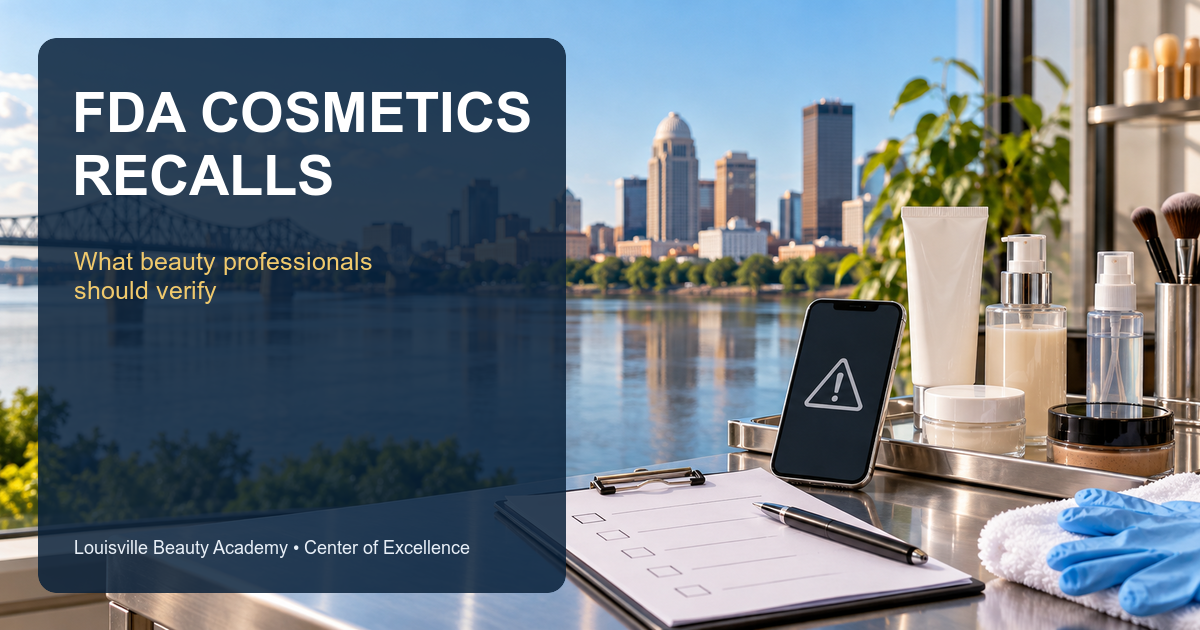
The visual explainer: from official guidance to safe action
- Read the official notice. Start with FDA, the manufacturer, or another controlling public source. Confirm the product name, lot or batch information, reason, date, and instructions.
- Separate guidance from a recall. A guidance document explains how authority and process work. It does not prove that a particular product is recalled.
- Stop and isolate when an actual notice applies. Do not use or provide a product identified by an official recall notice. Set it aside, keep its identifying information, and follow the responsible business or manufacturer instructions.
- Document and escalate safely. Tell the supervising professional or business owner, preserve the notice and product details, and use the official reporting or customer-support route. Do not diagnose a client or make a legal conclusion from a headline.
What this means for a real student or family
If you are deciding whether a beauty program teaches safety seriously, ask how students learn to identify products, read labels, follow manufacturer directions, recognize a public safety notice, protect a client when a product question arises, and escalate an incident to the responsible supervisor. A polished service is not safe if the product record, instruction, or response path is unclear.
Before relying on a social-media post or a product seller’s statement, ask for the official source. Write down the exact product and lot information. If a current notice applies, follow that notice. If someone has symptoms or a serious reaction, seek appropriate medical help; this article is not medical advice.
What a salon, school clinic, or professional can verify
Product identity
Can the business identify the product name, manufacturer, lot or batch number when available, expiration information, and where it came from? Traceability makes a safety response more precise.
Official status
Is the information from FDA, the manufacturer or responsible business, Kentucky’s controlling authorities, or another official source? A rumor, influencer post, or undated screenshot is not enough.
Use decision
Has the product been kept out of service when an official notice says not to use it? Staff should not improvise a substitute claim or continue service simply because the product looks normal.
Human response
Does the student or professional know whom to tell, what records to preserve, and where to send a question? A calm escalation path protects the client without blaming or shaming anyone.
What this update does not prove
- It does not identify a particular cosmetic, salon, school, student, or client.
- It does not announce a new product recall by itself.
- It does not say that every cosmetic product is unsafe or that every business has violated a rule.
- It does not replace Kentucky Board of Cosmetology requirements, manufacturer instructions, workplace policies, medical advice, or a product-specific official notice.
- It does not turn LBA into a regulator, FDA representative, accreditor, or legal adviser.
Why the wording matters: “Mandatory recall authority” describes a legal power and process. “Final guidance” describes FDA’s current explanation of how it thinks about that process. Neither phrase, standing alone, tells a student that a named product is recalled or tells a school how to handle a product-specific event without reading the controlling notice.
Why this belongs in beauty education
Beauty professionals work at the point where products meet people. Students need more than technique: they need habits for reading instructions, protecting skin and eyes, using sanitation and infection-control practices, tracking product information where appropriate, and stopping to ask for help when a safety question exceeds their role.
That is public-safety education. It also protects dignity. A client should not be blamed for a reaction, a student should not be pressured to hide a mistake, and a salon should not rely on a vague online claim when an official source is available. The correct response is careful, documented, and proportionate.
LBA relevance and the student-protection boundary
Louisville Beauty Academy’s Center of Excellence publishes source-backed education so students and families can ask better questions about Kentucky licensing, safety, written costs, and school accountability. This article does not claim that LBA is a federal regulator, FDA-approved school, or product-safety authority. It explains a public source and points readers back to the controlling record.
For current LBA program information, compare the official written program documents and current costs before signing anything. Education comes first; a school decision should be based on terms a student can read, understand, and sustain.
Official sources and dates
- FDA announcement, October 22, 2026: FDA Issues Final Guidance on Mandatory Cosmetic Recalls.
- FDA final guidance, October 2026: Questions and Answers Regarding Mandatory Cosmetics Recalls: Guidance for Industry. The page links to the final PDF and identifies docket FDA-2025-D-2246.
- Federal Register notice: 2026-21679. The notice explains the statutory background, public comments, and nonbinding status of guidance.
- Public-safety source channel: FDA Cosmetics. For a product-specific event, use the current official recall or manufacturer notice rather than this general article.
Review date: October 23, 2026. Public sources and agency guidance can change. This is educational source literacy, not legal advice, financial-aid advice, medical advice, or a product-specific recall determination.