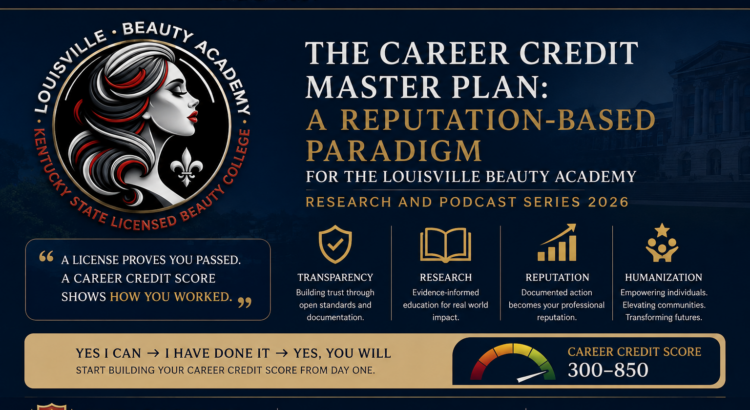
The Career Credit Master Plan: A Reputation-Based Paradigm for the Louisville Beauty Academy – RESEARCH AND PODCAST SERIES 2026

Louisville Beauty Academy operates under a Gold-Standard Over-Compliance framework—meeting all licensing requirements while exceeding regulatory expectations through transparency, documentation, and proactive consumer protection.

Executive Summary

The vocational education sector is currently navigating a period of profound structural transformation, transitioning from a static credential-based model to a dynamic, reputation-based “proof-of-work” economy. For institutions like the Louisville Beauty Academy (LBA), the challenge lies in bridging the gap between traditional state-mandated licensure and the modern requirements of the digital creator economy. This master plan outlines an interdisciplinary framework for a “Career Credit Score” system—a comprehensive, over-compliant social media and professional progress system designed to begin on day one of enrollment and persist beyond graduation. By leveraging the behavioral psychology of public accountability and the economics of social signaling, this system formalizes the student’s daily learning journey as a measurable professional asset.1

The core objective is to position LBA as a national leader in ethical creator education, moving beyond the simple “acquisition of hours” toward the “accumulation of reputation.” The Career Credit Score (CCS) serves as an analogue to a financial credit score, where daily posts act as career deposits and professionalism serves as the ultimate measure of creditworthiness.4 This system provides students with a structured ladder of progression, moving from the “Zero Stage” of novice observation to the “Mastery Stage” of mentorship and public signalization.6 Crucially, the plan is designed with an “over-compliant” posture, ensuring that all student activities strictly adhere to the Kentucky Board of Cosmetology (KBC) statutes and Federal Trade Commission (FTC) endorsement guidelines.8

Through a sophisticated incentive model, students can earn significant tuition discounts based on their consistency, ethical conduct, and proof-of-learning, effectively lowering the financial barriers to high-quality vocational education while simultaneously increasing graduate employability.11 This plan does not merely teach beauty skills; it equips “Human Service Professionals” with the digital fluency and verifiable reputation needed to thrive in an era where trust is the primary currency of the beauty industry.13

Research and Psychological Foundations

The foundation of the LBA Career Credit system is built upon a synthesis of behavioral science, trust economics, and educational theory. Understanding why “learning in public” works requires an analysis of the psychological mechanisms that drive accountability and the economic signals that establish professional prestige.

Behavioral Psychology of Public Accountability

Research in public employee behavior and health interventions suggests that accountability is a multi-dimensional construct involving observability, evaluability, and answerability.1 When a student makes a “public announcement” of a goal—such as mastering a specific sectioning technique—the digital platform acts as a “commitment device”.2 These devices help individuals “lock themselves” into a behavior by creating a psychological penalty for deviation and a social reward for adherence.15

In the context of LBA, daily posting creates a “felt accountability.” While high-intensity monitoring can sometimes reduce intrinsic motivation, a system that emphasizes “accountability obligation”—the perceived duty to justify actions to a supportive audience—actually enhances work drive.1 This is particularly effective when students interpret the obligation as an opportunity to gain professional benefits rather than a coercive requirement. By documenting the “messy middle” of the learning process, students move from passive learners to active practitioners who are “answering” to their future professional selves and their burgeoning audience.

Habit Formation and Daily Proof-of-Work

The transition from a student mindset to a professional identity requires the formation of consistent habits. The “daily proof-of-work” theory posits that a live pulse of activity is a more reliable indicator of skill than a static portfolio.6 In technical fields like coding, a “contribution graph” showing daily commits is impossible to fake and serves as a verified record of problem-solving processes.6

For beauty professionals, this translates to documenting the micro-decisions of the craft. Research into sustainable skincare marketing suggests that “decision documentation”—filing 30 seconds of a consultation or explaining why a specific pH-balanced product was chosen—builds deeper trust than a polished, final image.16 Psychologically, this “raw” and “authentic” content resonates more with modern consumers who are skeptical of highly curated, AI-generated, or “too polished” feeds.17

Social Signaling and Trust Economics

In a labor market with “asymmetric information,” where employers cannot perfectly know a candidate’s skill level, they rely on signals. Traditional signaling theory, as explored by Bryan Caplan, suggests that much of the return on education is a return on the “shiny credential” rather than the skill itself.19 However, the Career Credit Score seeks to shift this dynamic toward “Skill Signaling,” which focuses on digital, transversal, and sector-specific competencies.20

Social trust is a “commodity” built through repeated interactions and the assessment of a truster’s competence and goodwill.21 A student who has documented 1,500 hours of professional growth 8 provides a “trust graph” that reduces the risk for a potential salon owner. This creates a “cyclical model” of social exchange where the student’s signaled reputation leads to better placement, which in turn reinforces the school’s brand equity.3

Psychological ConceptMechanismApplication in LBA System
Commitment DeviceSocial penalty for failure 15Daily posting “deposits” 2
Felt AccountabilityAnswerability to an audience 1Weekly instructor reviews 24
Instrumental LearningReinforcing presumptions of trust 21Documenting micro-decisions 16
Social SignalingReducing information asymmetry 3Verifiable digital portfolios 6
Authenticity BiasPreference for unfiltered growth 18“Zero Stage” confessions 18

The Career Credit Framework

The “Career Credit Score” is a formalized, numerical representation of a student’s professional standing, calculated using an algorithm that weights consistency, proof-of-work, professionalism, and ethical compliance. Unlike social media “clout,” which is often ephemeral and based on popularity, Career Credit is a measure of “professional creditworthiness”.25

Defining the Algorithm

The LBA Career Credit Score (CCS) is modeled on a 300–850 scale, mirroring the FICO model used in financial sectors. The score is calculated using four primary components, each weighted to reflect its importance to a future employer and regulatory compliance.

  1. Consistency (Weight: 35%): This is the equivalent of “payment history.” It measures the frequency of professional posts or “career deposits.” A missed day of documentation is recorded as a “late payment,” while sustained streaks build the score significantly.2
  2. Proof-of-Skill (Weight: 25%): This represents “credit history.” It is the documented evidence of the student’s progression through the subject areas defined in 201 KAR 12:082, such as infection control, anatomy, and chemical services.7
  3. Professional Conduct (Weight: 20%): This measures “credit mix.” It assesses the student’s poise, communication skills, and adherence to the LBA “Humanization of Education” philosophy.13
  4. Regulatory Integrity (Weight: 20%): This is the “creditworthiness” factor. It tracks zero-violation streaks regarding KBC statutes and FTC disclosure guidelines.10

Career Deposits and Missed Payments

A student’s CCS is updated weekly. A “Career Deposit” is defined as a high-quality, educational, or progress-based post that includes the required LBA disclaimers.

  • Positive Impact: A “Career Deposit” adds +5 points to the weekly score.
  • Neutral Impact: Reposting industry news with a professional insight adds +2 points.
  • Negative Impact: A “Missed Payment” (failing to post for 48 hours without a prior “digital reset” request) subtracts -10 points.
  • Severe Impact: A compliance violation (e.g., performing a chemical service on a live person before 250 hours 23) results in a “Reputation Default,” resetting the score to 300 and triggering a formal review.29

Reputation Score Benchmarking

To provide context, LBA compares student scores against industry averages and “best-in-class” alumni. This benchmarking fosters continuous improvement and provides a clear signal to employers about where a student stands in their professional development.25

CCS RangeProfessional StatusMarket Implications
750 – 850Elite ProfessionalHigh placement leverage; eligible for alumni mentorship roles.
650 – 749Reliable PractitionerStandard employment readiness; consistent work history.
550 – 649Developing TalentEmerging skills; needs focus on consistency and compliance.
300 – 549High Risk / ProbationHistory of inconsistency or ethical breaches; requires remediation.

Student Learning Progression Model

The Career Credit system utilizes a five-stage ladder of progression. This model ensures that students do not feel pressured to “fake it” but instead find power in their evolution from a novice to a master. Each stage specifies what to post, the psychological reasoning behind it, and the compliance guardrails necessary to protect the student and the academy.

Stage 1: The Zero Stage (The Foundation)

Focus: Identity reset and the commitment to learn. This occurs during the first two weeks of enrollment.

  • What students post: A “Social Media Reset” announcement; an unboxing of their professional student kit; a video discussing their “Why” and their decision to join LBA.8
  • Why it works: It establishes a “vulnerability hook.” By admitting they are starting at zero, they build an empathetic connection with their audience, who will then feel invested in their growth.16
  • Compliance: Posts must clearly state: “Student at Louisville Beauty Academy. Not licensed to perform services for hire.”
  • Caption Prototype: “Day 1 at LBA! Today I’m resetting this page to document my journey from student to professional. I’m starting with the basics—Infection Control. Safety first! #LBAStudent #BeautyJourney”

Stage 2: The Awareness Stage (The Science)

Focus: Vocabulary, theory, and the “Invisible Skills.” This aligns with the first 100–150 hours of instruction.23

  • What students post: Videos of themselves studying anatomy and physiology; “Did you know?” posts about the chemistry of hair color; time-lapses of workstation sanitation.8
  • Why it works: It builds authority. By focusing on the science rather than the art, the student signals that they are a serious, knowledge-based professional.8
  • Compliance: No mentions of performing services on people. Focus remains on “Scientific Lectures” per 201 KAR 12:082.23
  • Caption Prototype: “Studying the skeletal system today. Understanding the structure of the head and neck is vital for a proper consultation. Science is the backbone of beauty! #AnatomyClass #LBA”

Stage 3: The Practice Stage (The Proof-of-Work)

Focus: Hands-on repetition on mannequins. This is the “Messy Middle” of the program.

  • What students post: “Mistakes I made today” videos; time-lapses of winding perms or applying color to a mannequin head; “Practice makes progress” reels.6
  • Why it works: It demonstrates grit and technical skill development. Seeing the student struggle and then succeed creates a powerful narrative of competence.6
  • Compliance: Must explicitly state that work is being done on a mannequin.
  • Caption Prototype: “My fifth time winding a perm rod today. Still working on my tension, but the sectioning is getting cleaner! Repetition is key to mastery. #MannequinPractice #ProofOfWork”

Stage 4: The Competency Stage (The Clinic Floor)

Focus: Supervised services on live models. This begins after 250 hours (for Cosmetology) or other program-specific milestones.23

  • What students post: Before-and-after transformations; client consultations (with permission); documenting the consultation “decision-making” process.7
  • Why it works: Social proof. It shows that real people trust the student and that the student can deliver results in a professional clinic environment.24
  • Compliance: Must state that services were performed under instructor supervision at LBA.24
  • Caption Prototype: “Today’s transformation! We chose a level 7 ash to neutralize warmth, keeping the hair’s integrity first. All services performed under supervision at LBA! #ClinicFloor #HairTransformation”

Stage 5: The Mastery Signal Stage (The Educator)

Focus: Teaching, explaining, and mentoring others. This begins in the final phase of the program and continues as an alumnus.

  • What students post: Tutorials explaining a technique to junior students; reviews of industry trends; reflections on the “Humanization of Education”.13
  • Why it works: The “Protégé Effect.” Teaching a concept is the highest signal of mastery. It positions the graduate as an industry leader, not just a practitioner.1
  • Compliance: Use of the “Alumni” tag and verification of licensure.8
  • Caption Prototype: “Explaining the logic of color theory to our new class at LBA. To master the art, you have to mentor the next generation. #BeautyEducator #LBAAlumni”

Step-by-Step LBA Implementation Plan

Operationalizing the Career Credit system requires a disciplined, multi-phase rollout that integrates with LBA’s existing curriculum and administrative protocols.

Phase 1: Orientation and the Social Media Reset

During the first week, students undergo a “Digital Brand Audit.” This is a mandatory component of their “Professional Image” curriculum.23

  1. Account Audit: Students must review their public profiles and archive content that is inconsistent with a “Human Service Professional” identity. This includes content depicting unprofessional behavior or non-compliance with health standards.18
  2. Platform Setup: Students are required to have professional profiles on Instagram and TikTok. LinkedIn is highly recommended for B2B networking and employer visibility.13
  3. The Disclaimer Protocol: Every bio must include: “Professional Student at @LouisvilleBeautyAcademy | Future | Not for hire until licensed.”
  4. Privacy/Security Workshop: Education on protecting personal data and handling “online drama” or cyberbullying.35

Phase 2: Daily Career Deposits

LBA implements a “Daily Documentation” rule. Students are given 15 minutes at the end of each theory or clinic session to capture content.8

  • Frequency: Minimum of 3 professional posts per week.
  • Approved Formats: Short-form video (Reels/TikTok) for skills; Carousel posts for “Decision Documentation”; Stories for daily “Aha!” moments.16
  • The “Human Review” Protocol: Instructors do not grade based on “likes” but on a rubric of professionalism, sanitation, and educational accuracy.24

Phase 3: Ethical AI Integration

LBA adopts a “Max AI” policy for administrative and creative support but maintains strict ethical boundaries for clinical representations.13

  • Authorized Use: Using Generative AI for caption brainstorming, keyword research, and video script outlines.38
  • The 65% Rule: At least 65% of any written caption must be human-authored to ensure authenticity and “Humanization”.38
  • Prohibited AI: No AI-generated or “filtered” images of hair or skin results. This is a deceptive statement and a violation of KBC photo standards.14
  • Disclosure: Any AI-assisted content must include the tag #AIApprentice or a similar disclaimer.40

Phase 4: Instructor and Administrative Audit

LBA establishes a “Reputation Bureau” to manage the Career Credit Scores.

  • Weekly Score Update: The CCS is recalculated every Sunday based on the week’s deposits and classroom conduct.
  • Monthly Compliance Audit: A deep-dive review of student accounts to ensure FTC disclaimers and KBC rules are followed.28
  • Score Grievance Procedure: Students can appeal a score deduction through the official LBA written grievance process.8

Incentive and Discount Model

To drive adoption and ensure high-quality participation, LBA links the Career Credit Score to a fair and transparent tuition discount model. This transforms “tuition” from a fixed cost into a performance-based investment.

The Career Credit Discount Rubric

Students are eligible for “Merit Scholarships” and “Performance-Based Incentives” that can reduce the total program cost significantly.11 These are not “tuition reductions” but optional, merit-based discounts.11

Performance CategoryMetricScore RequirementDiscount/Perk
Consistency King100% posting rate for 90 daysCCS > 700$500 Tuition Credit
Compliance HeroZero compliance flags for 180 daysCCS > 750$1,000 Scholarship
Technical MasterVerified Stage 4 DocumentationInstructor Approval$1,500 Skill Credit
Alumni LeaderContinued Stage 5 postingPost-GraduationFree Alumni Tutoring 8

Anti-Gaming and Safeguards

LBA employs a “Checks and Balances” system to protect the integrity of the discounts.13

  1. Attendance Synchronization: Discounts are only applied if a student maintains the required attendance hours (30–40 hours for Full-Time).11
  2. Plagiarism Penalty: Using another student’s work as one’s own results in the permanent loss of all social-media-based incentives.11
  3. Financial Good Standing: Hours are only certified and discounts applied if the student’s account is current.11
  4. Tax Compliance: All tuition reductions are structured to comply with IRS Section 117(d) regarding qualified tuition reductions for educational institutions.43

Auditability for Regulators

LBA maintains digital records of all student posts, instructor reviews, and score calculations for a minimum of five years.8 This ensures that the institution can defend its incentive model to state and federal regulators as a legitimate “educational performance” metric rather than “marketing compensation.”

Compliance and Risk Management

A gold-standard system must be “over-compliant.” This section outlines the non-negotiable boundaries that protect LBA, its students, and the public.

Kentucky Board of Cosmetology (KBC) Adherence

Kentucky law is strict regarding unlicensed practice.10 LBA’s system manages this through:

  • The “No-Pay” Rule: Students are explicitly forbidden from accepting consideration (money or gifts) for services performed outside of the LBA clinic floor.10
  • Mobile Prohibitions: While Kentucky allows mobile barber shops, mobile cosmetology is strictly limited. Students must not document or perform services in “home salons” or non-licensed facilities.32
  • Sanitation Documentation: Every video documenting a service must show visible sanitation steps (e.g., sanitizing hands, disinfecting tools) to reinforce “Lifelong Professional Ethics”.8

FTC Endorsement and Social Media Law

The FTC’s 2024–2025 updates require “clear, conspicuous, and unavoidable” disclosures.9

  • Disclosure Placement: Disclosures must be verbal AND written on the screen for video content. Simply putting #ad or #LBA in the caption is insufficient for Reels and TikTok.28
  • Honest Opinions: Students must only give honest reviews of products they have actually used.9
  • Material Connections: Because students receive tuition discounts for their posts, they must disclose this “material relationship” in every progress-related post.42

Privacy and Consumer Protection

  • Client Consent: No client images or videos may be posted without a signed LBA model release form.7
  • Data Protection: Students are trained to never post sensitive institutional data or personal information about staff and peers.11
  • Cyber-Safety: LBA provides tools and training for students to manage privacy risks associated with a public-facing digital career.37

Brand and Market Positioning

The implementation of the Career Credit system differentiates Louisville Beauty Academy from all other regional and national competitors. It rebrands the school from a “training facility” to a “professional reputation engine.”

Positioning LBA as a “Future-Ready” Institution

LBA’s brand is built on “Transparency and Genuine Care”.47 By teaching students to build verified proof-of-work, LBA addresses the primary concern of modern beauty employers: “Can this person actually do the work, and will they show up?”.3

Messaging Pillars:

  1. The Proof-of-Work School: We don’t just teach; we document excellence.
  2. Career Credit, Not Just Hours: Your reputation starts on day one.
  3. Humanization through Technology: We use AI to make you more human, not less.
  4. Debt-Free Dignity: Earn your way to a professional future without the burden of federal loans.12

Reassuring Regulators and Parents

LBA positions itself as the “Public Library” of beauty education—an open, accessible, and highly regulated environment where knowledge is democratized.13

  • To Parents: LBA offers a “Safe, Legal, and Affordable” path to a high-demand career, where their child’s professional reputation is built under expert supervision.13
  • To Regulators: LBA provides a model for “Over-Compliance,” showing how social media can be used to increase adherence to sanitation and ethics rather than bypass them.8

The Alumni Brand Flywheel

The Career Credit Score does not end at graduation. LBA invites alumni to maintain their scores through continued mentorship and participation in the “2026 Magazine and Podcast Series”.13 This creates a long-term network of successful, digitally fluent professionals who serve as living proof of the LBA model.

Long-Term Impact and Metrics

The success of this system will be measured through a combination of traditional educational metrics and new reputation-based indicators.

Measurable Outcomes

  1. Retention Rate: Students with high Career Credit Scores are expected to have a 25% higher completion rate due to the psychological “locking” effect of public commitment.2
  2. Job Placement Leverage: LBA graduates will enter interviews not with a resume, but with a “Reputation Portfolio” showing 1,500 hours of growth.13
  3. Audience Trust Score: A monthly sentiment analysis of student accounts to ensure that engagement is professional and educational.
  4. Licensing Success: Continued 100% alignment with PSI and KBC requirements, with students demonstrating higher confidence during the practical exam.8

The Vision for “Di Tran University”

The Career Credit system is the first step toward the broader “Humanization of Vocational Education”.13 By integrating these digital and psychological frameworks, LBA evolves into a “Human Service Professional” academy, where the beauty license is merely the legal foundation for a career built on trust, ethics, and verified excellence.

Metrics & Success Measurement

To ensure the master plan achieves its intended impact, LBA will track the following metrics:

MetricGoalTracking Mechanism
Average Graduate CCS> 725Quarterly reputation audits
Employer Satisfaction95% PositivePost-placement surveys focusing on “Soft Skills”
Student Debt Ratio< 10% of IncomeAnalysis of net tuition vs. entry-level salary 50
Social Media Reach100K+ Monthly (Aggregated)Platform analytics across the student body
Compliance Flag Rate< 1%Weekly internal reputation bureau reviews

Conclusions

The Louisville Beauty Academy Career Credit system represents the gold standard for 21st-century vocational training. By acknowledging that a student’s “reputation” begins long before they receive a physical license, LBA equips its graduates with the ultimate competitive advantage: a verifiable history of hard work, ethical behavior, and professional growth. This system reduces student risk, elevates the entire beauty industry, and provides a defensible, innovative model for the future of professional education. Through the careful integration of behavioral psychology, trust economics, and rigorous compliance, LBA does more than teach beauty—it builds the future of professional trust.

Works cited

  1. Changes in the accountability obligation, intensity, and working drive of public employees: evidence from a survey experiment – Oxford Academic, accessed February 1, 2026, https://academic.oup.com/jpart/advance-article/doi/10.1093/jopart/muaf027/8249872
  2. Effects of Public Commitments and Accountability in a Technology-Supported Physical Activity Intervention | Request PDF – ResearchGate, accessed February 1, 2026, https://www.researchgate.net/publication/270959553_Effects_of_Public_Commitments_and_Accountability_in_a_Technology-Supported_Physical_Activity_Intervention
  3. Full article: Initial employability development: introducing a conceptual model integrating signalling and social exchange mechanisms – Taylor & Francis, accessed February 1, 2026, https://www.tandfonline.com/doi/full/10.1080/1359432X.2023.2186783
  4. Street Rep: A Privacy-Preserving Reputation Aggregation System, accessed February 1, 2026, https://yancomm.net/papers/2023%20-%20SecureComm%20-%20Street%20Rep.pdf
  5. Deep Reputation Scoring in DeFi: zScore-Based Wallet Ranking from Liquidity and Trading Signals – arXiv, accessed February 1, 2026, https://arxiv.org/html/2507.20494
  6. Top Proof of Work Tools Professionals Are Using in 2026 – Fueler, accessed February 1, 2026, https://fueler.io/blog/top-proof-of-work-tools-professionals-are-using
  7. How to Create Before-and-After Content That Converts Followers – CleanerHQ, accessed February 1, 2026, https://cleanerhq.com/how-to-create-before-and-after-content/
  8. Tag: Kentucky State Board of Cosmetology – Louisville Beauty Academy, accessed February 1, 2026, https://louisvillebeautyacademy.net/tag/kentucky-state-board-of-cosmetology/
  9. Endorsements, Influencers, and Reviews – Federal Trade Commission, accessed February 1, 2026, https://www.ftc.gov/business-guidance/advertising-marketing/endorsements-influencers-reviews
  10. 317A.020 Scope of chapter — Licensure requirements — Emergency orders — Warning notice — Legal actions brought by the, accessed February 1, 2026, https://apps.legislature.ky.gov/law/statutes/statute.aspx?id=56210
  11. LBA-StudentAgreement-CosmetologyProgram-2024 – Jotform, accessed February 1, 2026, https://form.jotform.com/240085894150154
  12. Financial Aid Options and Payment Model at Louisville Beauty Academy, accessed February 1, 2026, https://louisvillebeautyacademy.net/financial-aid-options-and-definition/
  13. beauty school compliance Archives – Louisville Beauty Academy, accessed February 1, 2026, https://louisvillebeautyacademy.net/tag/beauty-school-compliance/
  14. Top 5 Beauty Trends on Social Media 2026 – Pulsar, accessed February 1, 2026, https://www.pulsarplatform.com/blog/2025/top-beauty-trends-2026-social-media
  15. From Intentions to Actions – Using Commitment Devices for Evidence Use – Data for Impact, accessed February 1, 2026, https://www.data4impactproject.org/blog/from-intentions-to-actions-using-commitment-devices-for-evidence-use/
  16. I’m a Professional Social Media Growth Strategist – AMA and Free Advice – Reddit, accessed February 1, 2026, https://www.reddit.com/r/InstagramMarketing/comments/1ou74f8/im_a_professional_social_media_growth_strategist/
  17. A close look at the global beauty industry in 2025 – McKinsey, accessed February 1, 2026, https://www.mckinsey.com/industries/consumer-packaged-goods/our-insights/a-close-look-at-the-global-beauty-industry-in-2025
  18. Embrace Your Flaws: Stop Deleting Your ‘Ugly’ Photos – Lemon8, accessed February 1, 2026, https://www.lemon8-app.com/@purposely.angelica/7332530343054295557?region=us
  19. Schooling is Mostly Signaling – Econlib, accessed February 1, 2026, https://www.econlib.org/schooling-is-mostly-signaling/
  20. Skills signalling in OECD countries: Empowering the Workforce in the Context of a Skills-First Approach | OECD, accessed February 1, 2026, https://www.oecd.org/en/publications/empowering-the-workforce-in-the-context-of-a-skills-first-approach_345b6528-en/full-report/skills-signalling-in-oecd-countries_158ea858.html
  21. Trust as commodity: social value orientation affects the neural substrates of learning to cooperate – PMC – NIH, accessed February 1, 2026, https://pmc.ncbi.nlm.nih.gov/articles/PMC5390759/
  22. College Education and Social Trust: An Evidence-Based Study on the Causal Mechanisms, accessed February 1, 2026, https://pmc.ncbi.nlm.nih.gov/articles/PMC3183293/
  23. 201 KAR 12:082. Education requirements and school administration. – Kentucky Board of Cosmetology, accessed February 1, 2026, https://kbc.ky.gov/Documents/201%20KAR%2012.082.pdf
  24. Cosmetology Work Based Plan, accessed February 1, 2026, https://static.avedafi.edu/pdf/AIW%20Cosmetology-Work-Based-Plan%202023-2024.pdf
  25. Why Reputation Scores Are Becoming a Standard Business Metric – NetReputation, accessed February 1, 2026, https://www.netreputation.com/why-reputation-scores-are-becoming-a-standard-business-metric/
  26. Reputation Score Guide – Strategies + 3 case studies – Mention, accessed February 1, 2026, https://mention.com/en/blog/reputation-score/
  27. Beauty Changes Lives Judging Rubric Outline, accessed February 1, 2026, https://beautychangeslives.org/wp-content/uploads/2020/08/Judging-Rubric.pdf
  28. FTC Requirements For Influencers: Guidelines and Rules – Termly, accessed February 1, 2026, https://termly.io/resources/articles/ftc-requirements-for-influencers/
  29. Title 201 Chapter 12 Regulation 082 • Kentucky Administrative Regulations – Legislative Research Commission, accessed February 1, 2026, https://apps.legislature.ky.gov/law/kar/titles/201/012/082/16143/
  30. 201 KAR 12:030 – Licensing and examinations | State Regulations – Cornell Law School, accessed February 1, 2026, https://www.law.cornell.edu/regulations/kentucky/201-KAR-12-030
  31. Reputation Score X, accessed February 1, 2026, https://reputation.com/lessons/reputation-score-x-starter-guide
  32. Tag: cosmetology license – Louisville Beauty Academy, accessed February 1, 2026, https://louisvillebeautyacademy.net/tag/cosmetology-license/
  33. iRubric: Cosmetology Clinical Assessment rubric – FX32C4W – RCampus, accessed February 1, 2026, https://www.rcampus.com/rubricshowc.cfm?sp=true&code=FX32C4W
  34. License Requirements – Kentucky Board of Cosmetology, accessed February 1, 2026, https://kbc.ky.gov/Licensure/Pages/License-Requirements.aspx
  35. Explore Social Media Safely – Get Started Today — Upper Dublin Tech Trek, accessed February 1, 2026, https://www.udtechtrek.org/social-media
  36. 2025 Beauty Industry Benchmarks | Dash Social, accessed February 1, 2026, https://www.dashsocial.com/social-media-benchmarks/beauty-industry
  37. Complete Guide to Online Privacy – bestvpn.org, accessed February 1, 2026, https://bestvpn.org/the-complete-guide-to-online-privacy/
  38. Social Media AI Guidelines | Social Media | ECU – East Carolina University, accessed February 1, 2026, https://socialmedia.ecu.edu/social-media-ai-guidelines/
  39. AI Students Guidelines 2025 – ESCP Business School, accessed February 1, 2026, https://escp.eu/sites/default/files/PDF/AI/AI_Students_Guidelines_2025.pdf
  40. Guidelines for Appropriate Use of AI Generated Media – Division of Strategic Communications | The University of Alabama, accessed February 1, 2026, https://stratcomm.ua.edu/ai-guidelines/
  41. English AI Guidance for Staff and Students 2025 – Reedsburg School District, accessed February 1, 2026, https://www.rsd.k12.wi.us/district/English%20AI%20Guidance%20for%20Staff%20and%20Students%202025.pdf
  42. FTC Influencer Guidelines: Brands and Creators Must Be Aware Before Posting, accessed February 1, 2026, https://www.traverselegal.com/blog/ftc-influencer-guidelines/
  43. Qualified tuition reduction | Internal Revenue Service, accessed February 1, 2026, https://www.irs.gov/government-entities/federal-state-local-governments/qualified-tuition-reduction
  44. chapter 152 – Legislative Research Commission, accessed February 1, 2026, https://apps.legislature.ky.gov/law/acts/12RS/documents/0152.pdf
  45. KY SB265 | BillTrack50, accessed February 1, 2026, https://www.billtrack50.com/billdetail/1836958
  46. Navigating FTC Disclosures: A Guide for Influencers – Statusphere, accessed February 1, 2026, https://www.joinstatus.com/blog-creators/navigating-ftc-disclosures-a-guide-for-influencers
  47. The Confusion of Accreditation in the Beauty Industry: Louisville Beauty Academy Emphasizes Transparency and Genuine Care for Students, accessed February 1, 2026, https://louisvillebeautyacademy.net/the-confusion-of-accreditation-in-the-beauty-industry-louisville-beauty-academy-emphasizes-transparency-and-genuine-care-for-students/
  48. Long-Duration Vocational Education’s Effects on Individuals’ Vocational Identity, Self-Efficacy, and Job Satisfaction – PubMed Central, accessed February 1, 2026, https://pmc.ncbi.nlm.nih.gov/articles/PMC12466434/
  49. Resume vs Portfolio: What You Really Need to Land Freelance Writing Jobs in 2025, accessed February 1, 2026, https://www.journoportfolio.com/blog/resume-vs-portfolio-what-you-really-need-to-land-freelance-writing-jobs-in-2025/
  50. Kentucky Cosmetology Laws & License Requirements [2026] – Consentz, accessed February 1, 2026, https://www.consentz.com/kentucky-cosmetology-laws-license-requirements/

Administrative Due Process and Regulatory Compliance in Kentucky Cosmetology: A Comprehensive Analysis of Board Procedures, Disciplinary Actions, and Licensure Scope – 2026 Gold-Standard Deep Research & Compliance Guidance Series and Podcast

Gold-Standard Compliance, Legal Education, and Public Transparency Statement

Louisville Beauty Academy (LBA), in collaboration with Di Tran University – College of Humanization, publishes this analysis as part of its institutional commitment to gold-standard regulatory compliance, legal education, and public transparency in the Commonwealth of Kentucky.

As a state-licensed cosmetology institution, LBA is not only required to comply with Kentucky statutes and administrative regulations, but is also obligated to teach cosmetology law, administrative regulation, and professional responsibility as a core component of licensure preparation. Kentucky cosmetology education is, by design, a regulated professional curriculum, not a purely technical training program. Legal and regulatory literacy is therefore a required competency for students, graduates, licensees, and salon operators.

Kentucky Revised Statutes Chapter 317A establishes cosmetology as a regulated profession and authorizes the regulatory framework governing licensure, inspections, discipline, and enforcement. Administrative regulations under Title 201, Chapter 12 further implement this framework and require approved schools to instruct students in laws, rules, health and safety standards, and professional conduct. These requirements are reinforced through state licensing examinations, which test knowledge of Kentucky law, administrative rules, scope of practice, and compliance obligations as a condition of entry into the profession.

At the gold-standard level, Louisville Beauty Academy treats legal and regulatory instruction not as a minimum checkbox, but as an essential safeguard for:

  • Public health and safety
  • Student and graduate licensure success
  • Lawful salon operations
  • Long-term professional sustainability

Recent legislative changes enacted in 2025–2026 have significantly heightened regulatory scrutiny across the beauty industry. In this environment, ignorance of administrative process, statutory authority, and due process protections exposes licensees and facilities to severe penalties, including fines, suspension, and immediate closure. Accordingly, teaching the law is no longer optional—it is foundational.

This publication is therefore issued as a research-based, educational analysis intended to:

  • Fulfill and support Kentucky’s statutory and regulatory requirements for teaching cosmetology law and regulation
  • Explain the structure, authority, and procedural limits of cosmetology regulation in Kentucky
  • Promote proactive, documented, and informed compliance
  • Serve students, graduates, licensees, salon owners, policymakers, and the public with accurate regulatory education

Louisville Beauty Academy further recognizes that regulatory literacy does not end at graduation. As part of its gold-standard compliance philosophy, LBA elevates required legal instruction by extending it beyond the classroom to graduates, licensees, and the public, reinforcing a culture of transparency, accountability, and lawful practice throughout the industry.

Compliance is strongest when it is informed, documented, and human-centered.


Regulatory Currency Notice:
Kentucky statutes, administrative regulations, board policies, and enforcement interpretations are subject to amendment, repeal, judicial interpretation, and administrative revision. Accordingly, this publication reflects the law and regulatory landscape as understood at the time of publication and may become partially outdated as statutes, regulations, guidance, or enforcement practices evolve.

Students, graduates, licensees, salon owners, and members of the public are encouraged to verify current requirements through official sources, including statutes, administrative regulations, board publications, and licensed legal counsel, before relying on this material for compliance decisions.

Louisville Beauty Academy publishes this analysis as part of its ongoing educational mission and will continue to update, supplement, and expand its research and guidance as the law develops.


Educational Scope & Non-Adversarial Disclaimer

Educational Disclaimer:
This publication is intended solely for educational and public-information purposes. It discusses Kentucky administrative law principles and cosmetology regulatory procedures in the abstract and does not assert that any specific enforcement action by the Kentucky Board of Cosmetology was unlawful, improper, or invalid. This analysis does not constitute legal advice and does not replace official regulatory guidance or consultation with qualified legal counsel.

Administrative Due Process and Regulatory Compliance in Kentucky Cosmetology: A Comprehensive Analysis of Board Procedures, Disciplinary Actions, and Licensure Scope

Abstract

The regulation of the beauty industry in the Commonwealth of Kentucky represents a complex intersection of statutory mandates, administrative regulations, and evolving judicial interpretations of due process. For students, licensees, salon owners, and the public, understanding the internal mechanics of the Kentucky Board of Cosmetology (KBC) has transitioned from a matter of professional best practice to a critical necessity for legal survival. Recent legislative amendments, specifically Senate Bill 22 (2025) and Senate Bill 84 (2025), have dramatically altered the regulatory landscape. SB 22 classifies the employment of unlicensed personnel as an “immediate and present danger” to public health, authorizing immediate facility closures, while SB 84 eliminates judicial deference to agency interpretations, empowering licensees to challenge administrative overreach with renewed vigor.

This report provides an exhaustive, expert-level analysis of the procedural landscape governing cosmetology in Kentucky. It examines the KBC’s operational transparency through the lens of the Open Meetings and Open Records Acts, dissects the anatomy of the disciplinary complaint process under 201 KAR 12:190, and evaluates the legal enforceability of agreed orders. Particular attention is paid to the distinctions between permissible unlicensed assistance and prohibited professional practice, as well as the administrative law principles that may render certain board orders void ab initio, creating avenues for the refund of unlawfully collected fines. This document serves as a foundational text for stakeholders seeking to navigate the heightened scrutiny of the 2025-2026 regulatory environment.


Section I: The Administrative State of Beauty – Statutory Authority and Agency Structure

To navigate the disciplinary landscape effectively, one must first understand the KBC not merely as a licensing body, but as an administrative agency subject to the strictures of Kentucky public law. The Board acts as a “creature of statute,” possessing only those powers expressly granted to it by the General Assembly.

1.1 The Statutory Hierarchy

The KBC does not have unlimited power. Its authority is strictly hierarchical, and understanding this hierarchy is the first step in identifying ultra vires (unauthorized) acts.

  • The Enabling Statute (KRS 317A): This is the constitution of the KBC. It establishes the Board, defines the scope of practice for cosmetology, esthetics, and nail technology, and sets the boundaries for disciplinary action. KRS 317A.020 defines the licensure requirements and the new “immediate danger” standards, while KRS 317A.145 outlines the complaint procedure.1
  • Administrative Regulations (Title 201, Chapter 12): These are the specific rules promulgated by the Board to enforce the statutes. Key regulations include 201 KAR 12:190 (Disciplinary Process) and 201 KAR 12:060 (Inspections). A regulation cannot exceed the authority of the statute. If KRS 317A.020(8) requires a warning notice before a fine, the Board cannot promulgate a regulation that allows immediate fines for minor infractions.4
  • Senate Bill 84 (2025) and the End of Deference: Historically, Kentucky courts deferred to an agency’s interpretation of ambiguous statutes (similar to the federal Chevron deference). However, SB 84 (2025) codified a massive shift: courts must now decide all questions of law de novo, without deferring to the KBC’s interpretation.7 This means if the KBC interprets “shampooing” as a licensed activity but the statute is ambiguous, a judge can overrule the Board more easily than in the past.

1.2 The Board Composition and Quorum Requirements

The KBC is composed of members appointed by the Governor. Under KRS 317A.030, the Board must have a quorum to conduct official business. This is not a trivial bureaucratic detail; it is a jurisdictional requirement for the validity of any order.1

  • The “Rubber Stamp” Vulnerability: In many administrative agencies, staff members or committees negotiate penalties and issue orders that are never formally voted on by the full Board during a public meeting. If a disciplinary action—such as an Agreed Order fining a salon—is issued without a vote by a quorum of the Board recorded in the minutes, that action may be legally void under KRS 271B.8-240 principles applied to public bodies.9

Section II: Monitoring the Regulator – Transparency and The Open Meetings Act

The KBC is a public agency, and its decision-making process is subject to public scrutiny. While many licensees only interact with the Board during inspections or license renewals, the true regulatory shifts occur during monthly board meetings. Accessing this information is the frontline of defense for the industry.

2.1 The Open Meetings Act (KRS 61.800 – 61.850)

The Kentucky General Assembly has declared that the formation of public policy is public business and shall not be conducted in secret. For KBC stakeholders, this provides specific rights.

2.1.1 Accessing Agendas

Under KRS 61.820, the Board must provide a schedule of regular meetings and make agendas available to the public.10 The agenda is the roadmap of the Board’s intent.

  • Strategic Importance: The agenda lists regulatory changes, licensure approvals, and, crucially, the ratification of complaints and agreed orders. If a disciplinary action against a salon is not listed on the agenda, the Board generally cannot take final action on it during that meeting.
  • Monitoring Protocol: Licensees should designate a compliance officer or checking routine to review the KBC website (kbc.ky.gov) 24 to 48 hours before every scheduled meeting. Look for items titled “Complaint Committee Report,” “Ratification of Agreed Orders,” or “New Business.”

2.1.2 Meeting Minutes as Evidence

KRS 61.835 requires that minutes of action taken at every meeting be promptly recorded and open to public inspection.12

  • Evidentiary Value: These minutes are not transcripts, but they must set forth an accurate record of votes. If a licensee receives a suspension order dated June 15, but the Board meeting minutes for June show no vote on that licensee’s case, the order may be invalid.
  • The “Block Vote” Phenomenon: Often, Boards vote to “accept the recommendations of the Complaint Committee” in a single block vote. While common, this practice can be challenged if the underlying committee recommendations were not made available to the public or the Board members prior to the vote.13

2.2 Virtual Access and Modern Oversight

Post-2020, administrative bodies have increasingly utilized video teleconferencing. KRS 61.826 allows for video meetings, provided the public can see and hear the proceedings at a primary physical location.10

  • Remote Observation: For licensees outside of Frankfort, monitoring these streams is a primary method of oversight. Stakeholders should record these streams (as permitted by KRS 61.840) because the written minutes often sanitize the actual debate and discussion regarding enforcement priorities.12

Section III: The Power of Information – Leveraging the Open Records Act

When a licensee is the subject of a complaint, or when the public wishes to understand the rationale behind a regulation, the Open Records Act (KRS 61.870 et seq.) is the primary investigative tool.

3.1 Filing a Request for Disciplinary Records

KRS 317A.145 authorizes the investigation of complaints.2 However, the documentation generated—investigative reports, inspector notes, and witness statements—is often shielded by the Board until the case is closed.

Record TypeAccessibility StatusStatutory BasisStrategic Use
Inspection ReportsOpen201 KAR 12:060Must be posted in salon; immediate access required. Prove disparate enforcement.
Complaint (Initial)Open (to Respondent)201 KAR 12:190Licensee has right to receive copy within notification window.
Investigative NotesExempt (Preliminary)KRS 61.878(1)(i)-(j)Often withheld as “preliminary” until final action is taken.
Complaint Committee MinutesMixedKRS 61.835Recommendations to Board are public; deliberations may be closed.
Agreed OrdersOpenKRS 61.878Once signed and ratified, these are public contracts.

3.1.1 The “Preliminary Documents” Battle

Public agencies often attempt to withhold records by citing KRS 61.878(1)(i) and (j), which exempt preliminary drafts, notes, and correspondence with private individuals.17

  • The Exception to the Exemption: Once final action is taken (e.g., the Board votes to issue a fine), the underlying investigative materials that formed the basis of that decision typically forfeit their preliminary status and become open to inspection. If the Board adopts an investigator’s report as the basis for its decision, that report becomes public.
  • Licensee Rights: A licensee who is the subject of the action has a heightened due process right to these records compared to the general public, as they are necessary to prepare a defense.18

3.2 Accessing Complaint Committee Records

The KBC utilizes a Complaint Committee to review allegations before they reach the full Board. 201 KAR 12:190 establishes this committee.4

  • Tactical Request: Stakeholders should request the “recommendation logs” or “disposition sheets” of the Complaint Committee. While the committee generally cannot issue a final order, their recommendations (dismissal, investigation, or notice of violation) set the trajectory of the case. Accessing these logs can reveal patterns of enforcement—for example, if the Committee always recommends a $500 fine for a specific paperwork error, this establishes a de facto regulation that may be challengeable if not properly promulgated.13

3.3 How to File a Request

Requests must be submitted in writing (email is preferred for tracking) to the Board’s Official Custodian of Records.

  • The 5-Day Rule: Under KRS 61.880, the agency has five business days (expanded from three in recent years) to respond to the request.10
  • Form of Request: Use the official KBC Open Records Request form or a letter citing the statute. Be specific: “I request the meeting minutes for the March 12, 2025 board meeting and the ratification list for all agreed orders approved on that date”.20

Section IV: The Anatomy of Discipline – The Complaint Process

The disciplinary machinery of the KBC is triggered either by a consumer complaint or an internal inspection report. 201 KAR 12:190 outlines a rigid procedural framework that the Board must follow. Deviations from this process are not merely technical errors; they are violations of a licensee’s due process rights that can render subsequent fines void.

4.1 The Requirement of Written Notice

Administrative enforcement in Kentucky cannot be based on verbal warnings or informal directives. 201 KAR 12:190 explicitly requires that enforcement be documented.22

  • Mandatory Elements: A lawful notice of disciplinary action must identify:
    1. The specific statute or regulation violated (e.g., “Violation of 201 KAR 12:100 Section 2”).
    2. The factual basis for the allegation (e.g., “Inspector observed reuse of single-use buffer”).
    3. The penalty to be imposed.
    4. The licensee’s right to request a hearing.16

4.2 The 10-Day Response Window: A Critical Deadline

A frequent procedural trap for licensees is the timeline for responding to a complaint.

  • Regulatory Standard: Under 201 KAR 12:190, Section 3, a respondent (licensee) is provided a specific window to submit a written response to a complaint. Historically, this has been set at ten (10) days from the date of receipt.4
  • Conflicting Timelines: Some amendments reference a thirty (30) day window.2 This discrepancy often arises between the initial notification of a consumer complaint (10 days to respond to the committee) and the formal notice of administrative hearing (20 or 30 days).
  • Best Practice: Treat the 10-day deadline as the controlling standard for the initial response. Failure to respond within this window allows the Complaint Committee to review the case without the licensee’s defense, often resulting in a default recommendation of guilt.2

4.3 The Right to Correction (Warning Notices)

A fundamental protection for licensees is found in KRS 317A.020(8)(a). This statute mandates that, unless a violation creates an “immediate and present danger” to public health and safety, the Board must first issue a warning notice prior to imposing incremental punitive action (fines or suspension).6

  • Content of the Warning: The warning must include a specific and detailed description of the violation and the specific remediation required to bring the salon into compliance.6
  • Legal Implication: If the KBC imposes a fine for a routine paperwork or sanitation violation (that does not constitute immediate danger) without first issuing this statutory warning, the fine is legally defective. Licensees should rigorously verify whether they received a prior warning for the specific offense cited. A warning for a dirty floor in 2023 does not validate a fine for a missing license in 2025 without a new warning, as they are distinct violations.

Section V: Disciplinary Actions and The “Agreed Order” Trap

When the KBC seeks to penalize a licensee, it typically does so through an “Agreed Order”—a settlement contract that avoids a formal administrative hearing. While efficient, these orders can become traps for the unwary, and their validity rests on strict adherence to statutory authority.

5.1 The Nature of Agreed Orders

An agreed order is a binding legal document where the licensee admits to a violation (or agrees to a settlement) and accepts a penalty to resolve the case.

  • Voluntary Consent: By definition, an agreed order requires consent. The Board cannot force a licensee to sign an agreed order. If a licensee refuses, the Board must initiate a formal hearing process under KRS Chapter 13B.26
  • Board Ratification: Crucially, an agreed order is not valid until it is approved by the Board and signed by the Board Chair or their designee.4 A staff member or inspector does not have the independent authority to finalize a disciplinary order.

5.2 Void Ab Initio: The Doctrine of Nullity

A powerful legal concept in administrative law is void ab initio—meaning “void from the beginning.” If the KBC issues an order or imposes a fine without the statutory authority to do so, or in violation of mandatory due process procedures, that action is a legal nullity.28

5.2.1 Lack of Board Quorum or Confirmation

Under KRS 317A.030 and general corporate law principles applicable to boards (KRS 271B.8-240), the Board can only act through a quorum.9

  • The “Ultra Vires” Act: If the Complaint Committee negotiates a fine and the executive director issues the order without the full Board voting to ratify it during an open meeting, the order may be void. The Complaint Committee is authorized only to recommend actions, not to issue final dispositions.4
  • Procedural Defect: If a licensee can prove through Open Records requests (specifically meeting minutes) that their specific agreed order was never presented to or voted on by the full Board, they may have grounds to argue the order is void and unenforceable. This is a common procedural failure in high-volume administrative agencies.

5.2.2 Violation of the Warning Statute

If the Board fines a salon for a minor violation without issuing the statutorily required warning notice under KRS 317A.020(8)(a), the fine exceeds the Board’s statutory authority. An agency cannot enforce a penalty that the legislature has explicitly prohibited it from imposing until a warning condition is met. Such a fine would be arbitrary and potentially void.31

5.3 The Economics of Enforcement: Refunds of Fines

If an order is declared void ab initio, the legal effect is as if the order never existed. Theoretically, this creates an entitlement to a refund of any fines paid under that void order.

  • Sovereign Immunity Hurdles: Recovering money from the state is difficult due to sovereign immunity. However, Kentucky courts have recognized exceptions where an agency acts outside its statutory authority or violates constitutional due process rights.33
  • Tax Refund Analogy: KRS 134.551 allows for refunds when tax certificates are declared void due to irregularity.34 While this statute is specific to taxation, the underlying equitable principle—that the state should not retain funds collected through illegal acts—is a potent argument in administrative appeals.
  • Litigation Route: To force a refund, a licensee would likely need to file an appeal in Franklin Circuit Court (the venue for challenging state agency actions) seeking a declaratory judgment that the order was void and a writ of mandamus compelling the refund.32

Section VI: Unlicensed Practice vs. Permissible Assistance – A Legal Minefield

A major source of confusion—and disciplinary risk—in Kentucky salons is the delineation between tasks that require a license and those that do not. The KBC has adopted a strict interpretation of “practice,” reinforced by the introduction of the Shampoo and Style License.

6.1 The “Shampoo and Style” License (300 Hours)

Historically, many salons employed unlicensed assistants to shampoo hair. In Kentucky, this is now strictly prohibited unless the individual holds a specific Shampoo and Style license.37

  • Requirements: Obtaining this license requires 300 hours of instruction at a licensed school, a 12th-grade education, and passing the PSI theory and practical exams.37
  • Legal Presumption: The existence of this specific license creates a legal presumption that shampooing is a professional service. If a salon allows an unlicensed person (e.g., a receptionist or a student who has not yet obtained their permit) to shampoo a client, they are aiding and abetting unlicensed practice.41

6.2 Permissible Non-Licensed Duties

To remain compliant, salon owners must strictly limit unlicensed employees to non-cosmetic tasks. Based on the statutory definition of cosmetology in KRS 317A.010, permissible tasks include:

  • Reception Duties: Scheduling appointments, processing payments (cashier), and client intake.37
  • Sanitation and Maintenance: Sweeping floors, laundering towels, cleaning mirrors, and sanitizing non-implement surfaces (waiting areas, front desk).37
  • Retail: Selling products, provided no professional advice or application is given that would constitute “practice” (e.g., applying makeup samples to a client).37

6.3 Prohibited Acts for Unlicensed Personnel

Any act that involves touching a client for a cosmetic purpose is likely prohibited. This includes:

  • Shampooing and Conditioning: (Requires Shampoo & Style License or Cosmetology License).41
  • Removing Polish: Even removing nail polish is considered part of nail technology practice.
  • Draping Clients: Placing a cape on a client for a chemical service may be construed as assisting in the practice.
  • Mixing Chemicals: Preparing color or perm solutions is strictly professional practice.

Section VII: The “Immediate and Present Danger” Standard and Salon Closure (SB 22)

The most severe penalty the KBC can impose is the immediate closure of a business. Recent legislative changes have armed the Board with a powerful weapon in this regard: Senate Bill 22 (2025).

7.1 Strict Liability for Unlicensed Personnel

Effective June 26, 2025, KRS 317A.020(8)(b) was amended to state: “It shall be deemed an immediate and present danger to the health and safety of the public if it is documented and verified that a licensee knowingly employs or utilizes the services of an unlicensed individual”.43

7.2 Mechanics of Immediate Closure

Normally, a salon is entitled to a hearing before a license is suspended. However, an “emergency order” under KRS 13B.125 allows the Board to suspend a license immediately if there is an immediate danger to the public.6

  • The Shift: By legislatively defining the employment of an unlicensed person as an “immediate and present danger,” the General Assembly has removed the Board’s burden of proving actual harm. The mere presence of an unlicensed worker performing services justifies immediate emergency closure.
  • Presumption of Guilt: Guidance suggests that if an employee flees mid-service during an inspection, they will be presumed to be an unlicensed employee, triggering the immediate danger clause.45

7.3 Consequences of Closure

  • Immediate Cessation: The salon must lock its doors and cease operations instantly.
  • Post-Deprivation Hearing: The licensee is entitled to an administrative hearing after the closure to determine if the license should be reinstated.6
  • Severe Penalties: Beyond closure, the salon faces substantial fines and the potential permanent revocation of facility and individual licenses.44

Section VIII: Navigating the Inspection and Correction Process

Routine inspections are the primary touchpoint for regulatory enforcement. Understanding how to manage an inspection and respond to deficiencies is crucial for avoiding the escalation to formal complaints.

8.1 The Inspection Protocol

Inspectors are authorized under KRS 317A.145(3) to enter any licensed facility during reasonable hours to inspect premises and records.2

  • Key Focus Areas: Inspectors look for licensure display (with photos), sanitation (wet sanitizers, clean implements), and the presence of unlicensed workers.
  • Documentation: 201 KAR 12:060 requires the posting of the most recent inspection report in a conspicuous area.5 Hiding a failed inspection report is a separate violation.

8.2 The Correction Letter and 10-Day Cure

If violations are found that do not rise to the level of immediate danger, the inspector generally issues an inspection report noting deficiencies.

  • Correction Timeline: While the general complaint response time is often cited as 10 days, specific regulations like 201 KAR 12:082 (regarding enrollment data errors) explicitly mandate a 10-day correction window.49
  • Strategic Response: Upon receiving a deficiency notice (often referred to informally as a correction letter), the licensee should:
    1. Correct the Issue Immediately: Fix the sanitation issue, update the license display, or dismiss the unauthorized worker.
    2. Submit Written Proof: Within 10 days, send a written response to the Board (via email or certified mail) with photographic evidence of the correction. This creates a paper trail of compliance that can prevent the deficiency from escalating into a formal disciplinary complaint and fine.51

Section IX: Practical Compliance Frameworks and Checklists

To assist licensees in operationalizing this legal analysis, the following tables and checklists provide quick-reference guides to compliance.

9.1 Table: Unlicensed vs. Licensed Duties Matrix

TaskUnlicensed Personnel (Receptionist)Shampoo & Style License (300 Hours)Cosmetology/Nail License
Schedule Appointments✅ Permitted✅ Permitted✅ Permitted
Process Payments✅ Permitted✅ Permitted✅ Permitted
Sweep Floors / Laundry✅ Permitted✅ Permitted✅ Permitted
Sanitize Surfaces✅ Permitted✅ Permitted✅ Permitted
Shampoo & Rinse HairPROHIBITED✅ Permitted✅ Permitted
Remove Nail PolishPROHIBITEDPROHIBITED✅ Permitted
Apply Scalp TreatmentsPROHIBITED✅ Permitted✅ Permitted
Apply Hair Color/ChemicalsPROHIBITEDPROHIBITED✅ Permitted
Drape Client for Service⚠️ Risky (Avoid)✅ Permitted✅ Permitted

9.2 Checklist: Immediate Inspection Response

  1. Staff Audit: Are all licenses (with current photos) posted at stations?
  2. Unlicensed Staff: Are receptionists strictly behind the desk or performing cleaning only?
  3. Sanitation: Are wet sanitizers filled and implements clean?
  4. Interaction: Be polite but do not volunteer information. Answer questions directly.
  5. Documentation: If a deficiency is noted, ask specifically: “Is this an immediate danger violation or a correction notice?”
  6. Follow-Up: Photograph the correction immediately and email KBC within 10 days.

Conclusion

The Kentucky Board of Cosmetology operates within a defined legal box, bounded by statutes like KRS 317A and procedural safeguards like KRS Chapter 13B. However, the boundaries of this box are often tested by aggressive enforcement and licensee ignorance. The passage of SB 22 in 2025 signals a new era of zero-tolerance enforcement regarding unlicensed practice, making strict compliance an operational necessity.

Yet, licensees are not powerless. The law guarantees transparency through open records, fairness through warning requirements, and legitimacy through board ratification of orders. By understanding these procedural levers—specifically the 10-day response window, the warning mandate, and the “void order” doctrine—licensees can protect their livelihoods and hold their regulators accountable to the rule of law. The potential for voiding orders and securing refunds exists, but it requires a licensee who is not just skilled in beauty, but literate in the law.


Disclaimer: This report is for educational and informational purposes only and does not constitute legal advice. Administrative regulations and statutes are subject to change. Licensees should consult with a qualified administrative law attorney for specific legal counsel.

REFERENCES

Senate Bill 84 Votes info – https://apps.legislature.ky.gov/record/25rs/sb84/vote_history.pdf

COMMONWEALTH OF KENTUCKY SENATE
2025 Regular Session
SB 84 AN ACT relating to judicial review of state agency RSN# 3368
action.
2/18/2025
PASS SB 84 4:44:51 PM
YEAS: 28
NAYS: 6
PASSES: 0
NOT VOTING: 4
YEAS : 28
Boswell Girdler Mills Stivers
Carpenter Givens Nemes Storm
Carroll Higdon Nunn Tichenor
Deneen Howell Rawlings Wheeler
Douglas Madon Reed Williams
Elkins McDaniel Richardson Wilson
Funke Frommeyer Meredith Smith Wise
NAYS : 6
Berg Herron Thomas Yates
ChambersArmstrong Neal
PASSES : 0
NOT VOTING : 4
Mays Bledsoe Raque Adams Webb West
Commonwealth of Kentucky
House of Representatives
2025 Regular Session
SB 84 AN ACT relating to judicial review of state agency RCS# 205
action.
3/11/2025
Pass 3:11:29 PM
YEAS: 80
NAYS: 19
ABSTAINED: 0
NOT VOTING: 1
YEAS : 80
Baker Dossett Heavrin McCool Roberts
Banta Dotson Hodgson McPherson Rudy
Bauman Duvall Holloway Meade Sharp
Bivens Elliott Huff T Meredith Smith
Blanton Fister Imes Miles Tate
Bowling Flannery Jackson Moser Thomas
Branscum Fleming Johnson Neighbors Thompson
Bratcher S. Freeland King Nemes Tipton
Bray Fugate Koch Osborne Truett
Bridges Gooch Lawrence Payne Upchurch
Callaway Gordon Lewis Petrie Wesley
Calloway Griffee Lewis D Pollock Whitaker
Clines Grossl Lewis S Proctor White
Decker Hale Lockett Rabourn Williams
Dietz Hampton Maddox Raymer Wilson
Doan Hart Massaroni Riley Witten
NAYS : 19
Aull Camuel Hancock Moore Tackett Laferty
Bojanowski Donworth Kulkarni Roarx Watkins
Brown Gentry Lehman Stalker Willner
Burke Grossberg Marzian Stevenson P
ABSTAINED : 0
NOT VOTING : 1
Chester-Burton
COMMONWEALTH OF KENTUCKY SENATE
2025 Regular Session
SB 84 AN ACT relating to judicial review of state agency RSN# 3500
action.
3/12/2025
Final Passage SB 84 W/ hcs1 4:46:36 PM
YEAS: 32
NAYS: 6
PASSES: 0
NOT VOTING: 0
YEAS : 32
Boswell Givens Nemes Storm
Carpenter Higdon Nunn Tichenor
Carroll Howell Raque Adams Webb
Deneen Madon Rawlings West
Douglas Mays Bledsoe Reed Wheeler
Elkins McDaniel Richardson Williams
Funke Frommeyer Meredith Smith Wilson
Girdler Mills Stivers Wise
NAYS : 6
Berg Herron Thomas Yates
ChambersArmstrong Neal
PASSES : 0
NOT VOTING : 0
COMMONWEALTH OF KENTUCKY SENATE
2025 Regular Session
SB 84 AN ACT relating to judicial review of state agency RSN# 3587
action.
3/27/2025
Override Veto Final Passage SB 84 11:28:46AM
YEAS: 32
NAYS: 6
PASSES: 0
NOT VOTING: 0
YEAS : 32
Boswell Givens Nemes Storm
Carpenter Higdon Nunn Tichenor
Carroll Howell Raque Adams Webb
Deneen Madon Rawlings West
Douglas Mays Bledsoe Reed Wheeler
Elkins McDaniel Richardson Williams
Funke Frommeyer Meredith Smith Wilson
Girdler Mills Stivers Wise
NAYS : 6
Berg Herron Thomas Yates
ChambersArmstrong Neal
PASSES : 0
NOT VOTING : 0
Commonwealth of Kentucky
House of Representatives
2025 Regular Session
SB 84 AN ACT relating to judicial review of state agency RCS# 336
action.
3/27/2025
Final Passage 6:54:03 PM
YEAS: 74
NAYS: 18
ABSTAINED: 0
NOT VOTING: 8
YEAS : 74
Baker Dotson Hodgson Meade Sharp
Banta Duvall Holloway Meredith Smith
Bauman Elliott Huff T Miles Tate
Bivens Fister Imes Moser Thomas
Blanton Flannery Jackson Neighbors Thompson
Bowling Fleming Johnson Nemes Tipton
Branscum Freeland King Osborne Truett
Bratcher S. Fugate Koch Payne Upchurch
Bray Gooch Lawrence Petrie Wesley
Bridges Gordon Lewis Pollock Whitaker
Calloway Griffee Lewis S Proctor White
Clines Grossl Lockett Raymer Williams
Decker Hale Massaroni Riley Wilson
Dietz Hampton McCool Roberts Witten
Dossett Heavrin McPherson Rudy
NAYS : 18
Aull Camuel Hancock Roarx Tackett Laferty
Bojanowski Donworth Kulkarni Stalker Watkins
Brown Gentry Lehman Stevenson P Willner
Burke Grossberg Moore
ABSTAINED : 0
NOT VOTING : 8
Callaway Doan Lewis D Marzian Rabourn
Chester-Burton Hart Maddox

A Professional Guide to Dealing With Regulated Agencies

Why Documentation Is the Most Important Skill a Licensee Can Learn


Before We Begin — Understanding the Board vs. the Agency

In most regulated professions, there are two distinct parts of governance:

The Board

  • The Board is typically made up of appointed Board Members.
  • They meet periodically (often once per month).
  • They vote on policy, disciplinary actions, and high-level oversight.
  • Each Board Member brings their own professional judgment and interpretation of the law.
  • Board Members are not full-time enforcement staff.

The Agency

  • The Agency is the full-time administrative office.
  • Agency staff carry out day-to-day operations.
  • They implement and enforce Board policies and State law.
  • They manage licensing systems, reporting, and communication.
  • Agency staff are not the Board — and the Board is not agency staff.

Both are bound by the same law, but they serve different roles.

Understanding this distinction helps licensees communicate appropriately —
and document accurately.


1. Understand the Asymmetry Between Law and Enforcement

Laws are:

  • Written through lengthy legislative processes
  • Debated, amended, and reviewed by elected officials
  • Codified with formal language, intent, and structure

Agencies are:

  • Tasked with enforcing those laws
  • Not required to go through the same legislative rigor
  • Often interpreting laws through:
    • Internal policy
    • Training limitations
    • Staff turnover
    • Legacy systems
    • Time pressure

This is not a criticism.
It is a reality.

Licensees must understand this asymmetry:

The law may be precise — but enforcement can be imperfect.

Because of this gap, clarity does not automatically exist.
Clarity must be created — and that creation happens through documentation.


2. Accept What You Cannot Control

As a licensee, you cannot control:

  • How an agency system behaves
  • How a staff member interprets a rule
  • How quickly an issue is resolved
  • Whether guidance is consistent
  • Whether a matter appears on an agenda

Trying to fight these realities wastes time and creates risk.

What you can control is:

  • Your conduct
  • Your records
  • Your communication
  • Your professionalism
  • Your documentation

This is where strong licensees separate themselves from vulnerable ones.


3. Documentation Is Not Optional — It Is Your Shield

In a regulated environment:

If it is not documented — it did not happen.

  • Verbal conversations do not protect you.
  • Good intentions do not protect you.
  • Assumptions do not protect you.

Documentation does.

Documentation should include:

  • Dates
  • Times
  • Screenshots
  • System displays
  • Emails
  • Logs
  • Reports
  • Confirmations

Documentation is not about distrust.
It is about precision.


4. Document Early — Not After the Problem Escalates

The most dangerous mistake licensees make is waiting.

The correct approach is:

  • The moment something looks unusual → document
  • The moment a system behaves inconsistently → document
  • The moment you are unsure → document

Early documentation:

  • Shows good faith
  • Establishes a timeline
  • Prevents assumptions later
  • Protects your license

Late documentation looks reactive.
Early documentation looks professional.


5. When the Agency Is Wrong — Stay Professional, and Document

Agencies are made of people.
People make mistakes.

When an agency error occurs:

  • Do not accuse
  • Do not argue
  • Do not escalate emotionally
  • Do not disengage

Instead:

  • Document what the system shows
  • Document what the law requires
  • Document what action you took
  • Document when and how you notified the agency
  • Document every response

This creates clarity without confrontation.


6. Over-Compliance Is a Professional Strategy

Over-compliance means:

  • Doing more documentation than required
  • Providing context even when not asked
  • Keeping records longer than necessary
  • Preserving proof even after an issue is resolved

Over-compliance is not fear-based.
It is risk-aware.

Professionals who over-document:

  • Sleep better
  • Defend themselves faster
  • Earn trust more easily
  • Teach others by example

7. Respect Authority — Without Surrendering Clarity

Respecting a regulator does not mean silence.
It means clear, respectful, written communication.

Respect looks like:

  • Neutral tone
  • Factual language
  • Chronological presentation
  • Evidence attached
  • No personal attacks
  • No speculation

This protects both sides.


8. Use Open Records to Preserve Context

When a matter becomes public-facing:

  • Agendas
  • Minutes
  • Reports
  • Hearings

Context can be lost.

The professional response is:

  • Place full documentation on open record
  • Ensure anyone reviewing summaries can also see full context
  • Prevent misinterpretation through transparency

Open records are not escalation.
They are clarification tools.


9. Teach Documentation as a Core Skill

For students and new licensees, documentation should be taught as:

  • A survival skill
  • A professional habit
  • A career-long discipline

Documentation protects:

  • Your license
  • Your reputation
  • Your students
  • Your clients
  • The public

A professional who documents well is never powerless.


10. The Core Principle

Everything in this guide can be summarized in one rule:

You may not control the law.
You may not control the agency.
You may not control the system.

But you always control your documentation.

That is professionalism.
That is over-compliance.
That is what should be taught.

Disclaimer:
This guide is provided for educational purposes only. It is not legal advice, and it does not replace guidance from your state licensing agency, the Board, or an attorney. Licensed professionals should always follow applicable laws and official regulations.