The Architecture of Absolute Compliance: A Comprehensive Regulatory and Operational Study for Kentucky Beauty Professionals and Louisville Beauty Academy Graduates – RESEARCH & PODCAST SERIES 2026


Educational Disclaimer:
This research is developed by Di Tran University – College of Humanization and shared by Louisville Beauty Academy for educational purposes only. It is not legal advice and is not endorsed by the Kentucky Board of Cosmetology. Louisville Beauty Academy does not endorse, support, interpret, or assume responsibility for any podcast producers or their content and shares all materials as-is for educational purposes. All laws and regulations (KRS 317A, 201 KAR Chapter 12) are subject to official interpretation and change. Readers are responsible for verifying compliance directly with the Board or qualified counsel.

The regulatory environment governing the beauty industry in the Commonwealth of Kentucky is established upon a rigorous and uncompromising framework designed to safeguard public health, ensure consumer safety, and uphold the professional integrity of the trade. For practitioners, particularly those originating from elite institutions such as the Louisville Beauty Academy, the concept of “inspection readiness” is not a temporary state achieved in anticipation of a scheduled visit but a permanent operational posture. This report delineates the granular requirements of Kentucky Revised Statutes Chapter 317A and the corresponding Administrative Regulations under 201 KAR Chapter 12, articulating a systematic approach to daily, weekly, monthly, and yearly compliance that ensures a salon remains beyond reproach at any given moment.1

The Philosophical and Statutory Mandate of the Kentucky Board of Cosmetology

The Kentucky Board of Cosmetology functions as an independent agency of the state government, vested with the absolute authority to supervise all aspects of cosmetology, esthetic practices, and nail technology.3 The core mission, as articulated in KRS 317A.060, is the protection of the public. This mandate transcends simple aesthetics; it is a public health imperative aimed at preventing the transmission of bloodborne pathogens, fungal infections, and bacterial contaminants within a high-touch service environment.4 The Board operates under the principle that the professional license is a privilege granted upon the condition of strict adherence to safety standards, and the Louisville Beauty Academy reinforces this through its “Compliance by Design” philosophy, which posits that the practitioner must adopt the mindset of the inspector in every action.2

The legal authority for inspections is absolute and immediate. Under 201 KAR 12:060, Board members or designated inspectors may enter any licensed facility during normal business hours or at any time the establishment is open to the public without prior notice.7 This lack of notice serves as a regulatory check, ensuring that the standards of sanitation and licensure are consistently applied rather than performatively displayed. The scope of an inspection includes not only the physical environment—such as the cleanliness of floors and tools—but also a comprehensive review of all related records, including personnel licenses, plumbing affidavits, and sanitation logs.8

Table 1: Primary Legal Authorities for Kentucky Salon Operations

Statute/RegulationPrimary FocusPractical Application for the Licensee
KRS Chapter 317AThe Enabling StatuteEstablishes the existence of the Board and the broad requirements for licensure and scope of practice.1
201 KAR 12:100Sanitation StandardsThe “Bible” of infection control; details the specific methods for cleaning and disinfecting tools and surfaces.10
201 KAR 12:060Inspection AuthorityDefines the inspector’s right to enter, the requirement for license display, and the definition of unprofessional conduct.7
201 KAR 12:082Educational StandardsWhile focused on schools, it establishes the minimum knowledge base required for any graduate to hold a license.10
KRS 317A.020Licensure RequirementsProhibits the practice of beauty services without a current, valid license and mandates conspicuous display.13

The Elite Professional Routine: Daily Operational Standards

For the graduate of the Louisville Beauty Academy, the workday does not begin with the first client but with a pre-service compliance sweep. This routine is designed to build the “muscle memory” of sanitation, transforming legal requirements into subconscious professional habits. The daily cycle is divided into four critical phases: opening preparations, intra-service sanitation, post-service disinfection, and end-of-day closure.2

Hand Hygiene and the First Contact Protocol

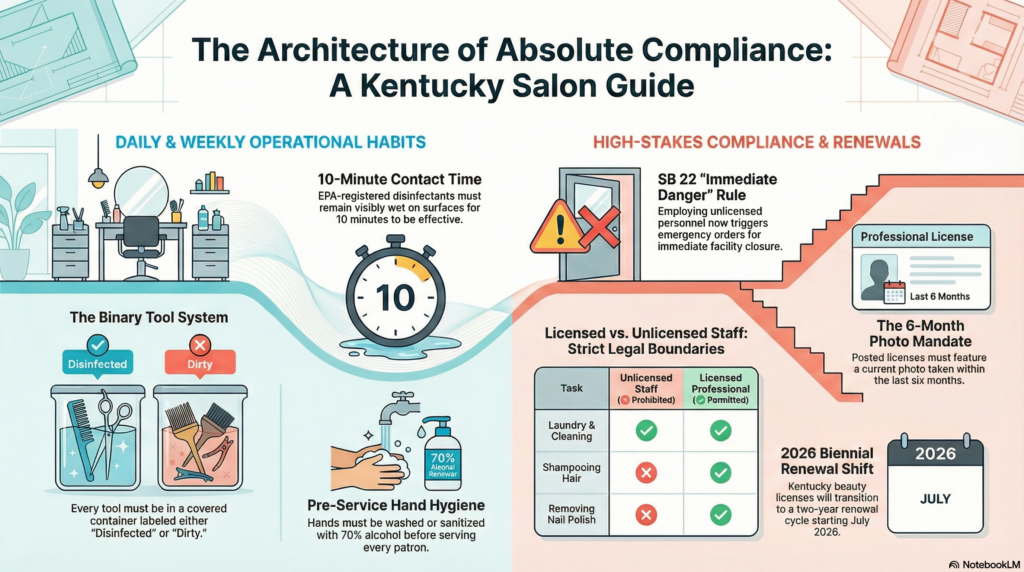
The transmission of infectious agents is most frequently traced to improper hand hygiene. 201 KAR 12:100 Section 13 mandates that every person licensed or permitted by the Board must thoroughly cleanse their hands with soap and water or an alcohol-based hand sanitizer (minimum alcohol) immediately before serving each patron.11 This standard is non-negotiable and applies even if the practitioner intends to wear gloves for the service. Handwashing stations must be equipped with a soap dispenser and single-use paper towels; the use of communal cloth towels for hand drying is a significant violation that can lead to immediate disciplinary citations.2

Table 2: Daily Hand Hygiene and Personal Protective Equipment (PPE) Standards

RequirementStandard ProcedureLegal/Regulatory Context
Pre-Service WashingSoap and water or alcohol sanitizerMandatory before every client interaction to prevent cross-contamination.11
PPE UsageGloves, masks, or aprons where applicableRequired during chemical services or when contact with blood/body fluids is possible.11
Handwashing StationSink with hot/cold water, soap, and paper towelsMust be accessible and not used for tool cleaning if it is the primary hygiene station.2
Forbidden ItemsNo carrying tools in pockets or smocksPrevents the contamination of clean tools and injuries to the practitioner.11

Workstation Maintenance and Surface Disinfection

The workstation is the primary site of service delivery and, consequently, the primary site of potential contamination. Kentucky law requires that all non-porous surfaces, including styling chairs, counters, nail tables, and shampoo bowls, be cleaned and disinfected daily and between each individual client.2 The process of “cleaning” is legally distinct from “disinfecting.” Cleaning involves the removal of visible debris, hair, and product residue using soap, detergent, or a chemical cleaner followed by a water rinse.19 Only after a surface is clean can it be disinfected.

Disinfection must be achieved using an Environmental Protection Agency (EPA)-registered bactericidal, virucidal, and fungicidal disinfectant used in strict accordance with the manufacturer’s label.11 A common error that results in inspection failure is the “spray and wipe” method, where the disinfectant is removed before it has reached its required contact time. Most high-level disinfectants require the surface to remain visibly wet for a full ten minutes to be effective against robust pathogens such as HIV, HBV, and various fungi.11

The Lifecycle of Tools and Implements: The “Clean vs. Dirty” System

The management of tools—including combs, brushes, shears, clippers, and nail implements—is perhaps the most scrutinized element of a state inspection. Kentucky utilizes a strict binary system: an item is either “Disinfected/Ready to Use” or it is “Dirty”.18 There is no middle ground.

All used implements must first be cleaned of visible debris using warm, soapy water and then fully immersed in a disinfectant solution.11 For items that have come into contact with blood or body fluids, such as a nick from a razor or a cuticle nipper, the item must be thoroughly cleaned before immersion to ensure the disinfectant can reach all surfaces of the tool.11 Once the full contact time is met, the implements must be removed, rinsed, dried with a single-use paper towel or air-dried, and stored in a clean, covered container labeled “Disinfected” or “Ready to Use”.18

Conversely, any tool that has been used and is awaiting disinfection must be kept in a separate, covered container clearly labeled as “Dirty” or “Used”.17 The intermingling of clean and dirty tools is a major violation. Furthermore, once an item is placed in the “Dirty” container, it cannot be removed until the formal cleaning and disinfecting process has begun.18

Table 3: Contact Time and Disinfection Requirements for Non-Electrical Tools

Tool TypeRequired ProcessStorage Requirement
Combs/Brushes/RollersScrub with soap, rinse, immerse in EPA-disinfectantCovered container labeled “Disinfected”.18
Metal Implements (Nippers/Pushers)Scrub with soap, rinse, immerse in EPA-disinfectantCovered container labeled “Disinfected”.18
Nail Drill BitsSoak in acetone, scrub, immerse in EPA-disinfectantMust be stored dry in a labeled container.18
Electrical ClippersRemove hair, saturate blades with high-level spray/foamMay be stored at station if clean and covered.11

The Towel and Linen Management System

The handling of linens is a primary focus of 201 KAR 12:100, which mandates a zero-tolerance policy for the reuse of any towel or robe without proper laundering.11 A clean towel or neck band must be used for every patron to prevent the hair cloth or shampoo apron from making direct contact with the patron’s skin.11

The laundry cycle must be integrated into the daily routine. All cloth items must be laundered in a washing machine using laundry detergent and chlorine bleach according to the manufacturer’s directions for sanitation.11 Clean linens must be stored in a closed cabinet or a covered container to protect them from hair clippings and airborne contaminants.11 Once used, towels must be immediately deposited into a separate, labeled container for soiled laundry. The practice of leaving used towels on the back of styling chairs or piled near shampoo bowls is a visible sign of non-compliance that will be noted by any inspector.2

Product Control and Chemical Safety

The mislabeling or lack of labeling on chemical products is one of the most frequent reasons for citations in Kentucky salons. The Board requires that all products—including shampoos, conditioners, hair colors, and nail liquids—remain in their original manufacturer-labeled containers whenever possible.15 If a product is transferred to a secondary container, such as a spray bottle for water or a smaller jar for cream, that container must be labeled with the product name and, if it is a chemical mixture like a disinfectant, the concentration and the date it was prepared.11

Furthermore, the use of certain substances is strictly prohibited under Kentucky law. Methyl Methacrylate (MMA) is illegal for use in nail services due to its high toxicity and the potential for severe allergic reactions or permanent nail damage.11 The presence of MMA in a salon, even if not currently in use, is grounds for significant fines and disciplinary action. Similarly, the use of callus graters or “cheese grater” style scrapers is prohibited as they can cause deep lacerations and pose a significant infection risk.13

Table 4: Prohibited Substances and Practices in Kentucky Salons

Prohibited Item/PracticeRationale for ProhibitionRegulatory Basis
Methyl Methacrylate (MMA)High toxicity; risk of permanent damage and allergies201 KAR 12:100 Section 14.11
Callus Graters / BladesRisk of skin cutting and deep-seated infectionKRS 317A.020 / 201 KAR 12:100.11
UV Sterilizers (as primary)Ineffective at achieving high-level disinfection201 KAR 12:100 Section 14.11
Roll-on WaxHigh risk of cross-contamination between clients201 KAR 12:100 Section 14.11
Double-DippingSpreads bacteria and fungi through entire product201 KAR 12:100 Section 7.11

Weekly Systems Maintenance and Compliance Audits

While daily tasks ensure immediate safety, the weekly routine is focused on the long-term integrity of the salon’s compliance infrastructure. This phase involves a more thorough examination of those areas that may not be touched during every client service but remain vital for a successful inspection.

The Weekly Station Sweep and Label Audit

Every week, the salon manager or designated compliance officer should conduct a formal walkthrough of each workstation. This audit must verify that every bottle is clearly labeled and that the labels remain legible.11 Over time, chemicals can degrade adhesive labels or obscure handwriting; any bottle with a faded or peeling label should be replaced or relabeled immediately.

During this weekly audit, the practitioner should also inspect the “Clean” tool containers. It is common for small hair clippings to find their way into even covered containers during the course of a busy week. If debris is found in a “Clean” container, all tools within that container must be re-sanitized, and the container itself must be disinfected.18 This ensures that the storage environment remains as sterile as the tools themselves.

Safety Data Sheet (SDS) and Records Management

Federal OSHA regulations, coupled with Kentucky state board requirements, mandate that every salon maintain a comprehensive binder of Safety Data Sheets (SDS) for every chemical used on the premises.21 The weekly routine should include a check for any new products that have entered the salon; if a new hair color line or a new type of nail monomer has been purchased, the corresponding SDS must be added to the binder immediately.

Furthermore, salons should maintain a daily sanitation log. While not strictly mandated for every single surface by state law, the Louisville Beauty Academy recommends it as the “Gold Standard” for compliance.2 A log that documents the daily cleaning of shampoo bowls and the weekly deep-cleaning of pedicure stations provides a “paper trail” of professional diligence that can be invaluable if a client ever files a complaint with the Board.17

Table 5: Weekly Compliance Audit Checklist

Audit CategorySpecific Action RequiredExpected Outcome
Label IntegrityInspect all secondary containers for clear labelingZero unlabeled bottles at any station.11
Storage InspectionWipe out and disinfect “Clean” tool containersNo hair or debris in storage areas.18
SDS UpdateReview product arrivals and add new SDS sheetsbinder is current.21
VentilationClean filters on hairdryers and nail extraction fansPrevents fume buildup and fire hazards.16
Trash VerificationEnsure all waste liners are replaced and lids functionalWaste is contained and covered.2

Monthly Strategic Compliance and Infrastructure Review

The monthly compliance cycle is a strategic review of the salon’s operational health. This is the time when the owner and manager move beyond the station-level details to address the overarching legal and structural requirements of the business.

Personnel Licensing and Photo Verification

The most common reason for significant fines in Kentucky is the presence of an unlicensed practitioner or a practitioner with an expired license. Every month, the manager must verify the status of every individual working in the salon, including booth renters.8 This check must confirm that the license is not only active but also that it is current for the specific year.10

A critical component of this audit is the photo requirement. 201 KAR 12:060 Section 1 requires that a current photograph be attached to the license.7 The Board has recently cracked down on “non-compliant” photos. If an employee has a photo that is older than six months or one that does not meet the passport-style criteria (e.g., a “selfie” with filters, or a photo taken in a car), it must be updated immediately.10 Failure to have a compliant photo attached to a posted license is treated as a display violation and can result in a “pink slip”.26

Plumbing and Facility Integrity

The physical state of the facility is a reflection of the professionalism of the business. On a monthly basis, the owner should inspect the plumbing for any leaks or drainage issues. 201 KAR 12:100 requires that an adequate supply of hot and cold running water be available at all times.2 Any changes to the plumbing—such as adding a new shampoo bowl or replacing an old pedicure chair—must be documented with a new Plumbing Affidavit signed by a state plumbing inspector.27

Additionally, the monthly audit should look for “non-porous” integrity. Salon chairs with torn upholstery or nail tables with cracked surfaces are violations because the damaged areas can harbor bacteria and cannot be properly disinfected with wipes or sprays.17 Any damaged equipment must be repaired or replaced to maintain the sanitation standard.

Table 6: Monthly Strategic Audit Milestones

TaskDetailProfessional Implication
Staff License AuditVerify every license is current and has a 6-month photoPrevents “Immediate Danger” closure for unlicensed work.8
Facility MaintenanceCheck for upholstery tears and plumbing leaksEnsures all surfaces can be legally disinfected.17
Inventory ReviewCheck for expired products or “mystery” chemicalsMaintains safety and product efficacy.17
Staff RetrainingBrief staff on any new Board newsletters or trendsMaintains a unified culture of compliance.2
Restroom AuditDeep clean and ensure all fixtures are functionalA common area for consumer complaints.2

Yearly Milestones: Renewals, Testing, and Long-Term Compliance

The yearly cycle involves high-level administrative tasks that, while infrequent, are essential for the legal existence of the salon.

The 2026 Shift to Biennial Renewals

For decades, Kentucky beauty licenses were renewed on an annual basis. However, as of January 2026, the Kentucky Board of Cosmetology is transitioning to a biennial (two-year) renewal system to reduce administrative burden and improve processing efficiency.25 This is a critical change for budget planning. While the annual fee has not technically increased, the amount due at the time of renewal will double as practitioners prepay for two years of licensure.25

For example, starting in July 2026, a cosmetologist will pay for a license that is valid through July 31, 2028.25 The renewal period remains fixed between July 1st and July 31st. Any renewal submitted after the July 31st deadline is considered inactive and will incur significant restoration fees.25 It is the responsibility of the licensee to ensure their email address is current in the KBC portal to receive renewal reminders and registration codes.31

Backflow Prevention and Annual Testing

Most commercial facilities, including salons, are required to have backflow prevention devices installed on their water supply lines to protect the municipal water supply from contamination.32 Under the Kentucky State Plumbing Code, these devices—specifically “reduced pressure principle” backflow preventers—must undergo annual testing by a state-certified backflow prevention assembly tester.33 The results of these tests must be kept on file at the salon and are often reviewed during a comprehensive state board inspection or a local health department visit.33 Failure to maintain this testing can lead to the disconnection of water services, which would force the immediate closure of the salon.33

Table 7: Annual and Biennial Administrative Deadlines

RequirementFrequencyKey Dates / Details
Personal License RenewalBiennial (Every 2 Years)July 1 – July 31 of even-numbered years (Starting 2026).25
Salon Facility RenewalAnnual/BiennialCheck portal for specific facility expiration dates.25
Backflow TestingAnnualMust be performed by a certified tester; records kept on-site.33
Local Business LicenseAnnualVaries by municipality; often due by June 30.28
Annual Report (Corporate)AnnualDue to the Secretary of State by June 30.35

Navigating the Inspection: A Masterclass in Professional Interaction

When an inspector arrives, the elite professional does not react with fear but with confidence in their established systems. The inspection should be viewed as an external validation of the “Compliance by Design” principle taught at the Louisville Beauty Academy.2

Immediate Action Steps Upon Inspector Arrival

  1. Grant Access and Provide ID: The inspector is authorized to enter and may ask for your government-issued ID to verify your identity against the posted license.8
  2. Continue Professional Service: Unless the inspector identifies an “Immediate Danger” (such as a significant blood spill or an unlicensed worker), you should continue your service to your client while the inspector walks the floor.
  3. Produce Records Promptly: If the inspector asks to see the plumbing affidavit, the most recent inspection report, or the salon’s employment records, these must be produced without delay.7
  4. Use the Inspector as a Resource: The elite salon owner asks questions. Inquire about the most common violations being found in the area or if there are any upcoming regulatory changes from the Board.16 This positions you as a partner in public safety rather than a target of enforcement.

The Consequences of Non-Compliance: SB 22 and Immediate Closure

The regulatory landscape has become significantly stricter with the passage of Senate Bill 22 (2025). This legislation introduced the “Immediate and Present Danger” standard for salon closures.6 Previously, a salon might receive a warning and a ten-day period to cure most deficiencies. However, under SB 22, the employment of unlicensed personnel is now classified as an immediate danger to public health.6

If an inspector finds an unlicensed individual performing professional services, the Board is authorized to issue an emergency order for the immediate closure of the facility.6 This closure remains in effect until the violation is resolved and a follow-up inspection is passed. The financial and reputational impact of such a closure can be catastrophic, often leading to a permanent loss of business or even the stroke of a stressed owner as documented in recent disciplinary history.37

Table 8: The Disciplinary Escalation Pathway

Violation TypeTypical Board ActionPotential Penalty
Minor Sanitation (Dust, Clutter)Correction Letter / 10-day CureWarning or Small Fine.6
Major Sanitation (MMA, Double-dipping)Notice of ViolationSignificant Fine and Probation.6
License Display / Photo Issues“Pink Slip” CitationAdministrative Fine.26
Unlicensed Personnel (SB 22)Emergency OrderImmediate Facility Closure.6
Intentional Deception of InspectorNotice of Disciplinary ActionLicense Revocation/Suspension.8

Professional Scope and the Unlicensed Personnel Matrix

To avoid the immediate closure triggers of SB 22, it is vital to understand the “Unlicensed vs. Licensed Duties Matrix.” In Kentucky, the performance of even a single professional act by an unlicensed individual—such as a receptionist or a general assistant—is a violation of the law.6

Unlicensed personnel are strictly limited to non-client maintenance tasks. They may sweep floors, perform laundry, clean mirrors, handle the front desk, and process payments.6 However, as soon as their duties involve direct client interaction related to beauty services, they must hold a license. For instance, an assistant cannot shampoo a client’s hair unless they hold at least a Shampoo and Style license (300 hours) or a full Cosmetology license.6 They cannot remove nail polish, as this is legally considered part of the practice of nail technology.6 They cannot even “drape” a client with a cape for a chemical service, as this act is construed as assisting in a professional beauty practice.6

Table 9: Duty Matrix for Licensed vs. Unlicensed Staff

TaskUnlicensed (Receptionist)Shampoo & Style (300 Hr)Nail Tech (450 Hr)Cosmetologist (1,500 Hr)
Sweep / Laundry✅ Permitted✅ Permitted✅ Permitted✅ Permitted
Front Desk / Cashier✅ Permitted✅ Permitted✅ Permitted✅ Permitted
Shampoo / Conditioning❌ Prohibited✅ Permitted❌ Prohibited✅ Permitted
Remove Nail Polish❌ Prohibited❌ Prohibited✅ Permitted✅ Permitted
Draping for Chemicals❌ Prohibited❌ Prohibited❌ Prohibited✅ Permitted
Manicuring❌ Prohibited❌ Prohibited✅ Permitted✅ Permitted

Building the Million-Dollar Salon through Compliance

The final truth of Kentucky salon operation is that inspection readiness is a fundamental business strategy. The graduates of Louisville Beauty Academy understand that a clean, compliant salon is a profitable salon. When a customer walks into an environment where the licenses are prominently displayed with current photos, the stations are organized, the air is free of strong chemical fumes, and the towels are pristine, a baseline of trust is established.2

Compliance protects the three most valuable assets of the beauty professional: the client’s health, the practitioner’s license, and the business’s reputation. By adopting the daily, weekly, monthly, and yearly routines detailed in this study, the salon owner moves from a state of reactionary fear to one of professional dominance. You do not prepare for the inspector; you become the inspector. In doing so, you elevate not only your own business but the entire industry within the Commonwealth of Kentucky.

Works cited

  1. Kentucky Revised Statutes – Chapter 317A – Legislative Research Commission, accessed March 24, 2026, https://apps.legislature.ky.gov/law/statutes/chapter.aspx?id=38831
  2. Sanitation & Safety: The #1 Priority at Louisville Beauty Academy …, accessed March 24, 2026, https://louisvillebeautyacademy.net/sanitation-safety-the-1-priority-at-louisville-beauty-academy/
  3. 317A.030 Board of Cosmetology — Membership — Compensation. (1) There is created an independent agency of the state gover, accessed March 24, 2026, https://apps.legislature.ky.gov/law/statutes//statute.aspx?id=54797
  4. 317A.010 Definitions for chapter. As used in this chapter, unless the context requires otherwise: (1) “Beauty salon&q – Legislative Research Commission, accessed March 24, 2026, https://apps.legislature.ky.gov/law/statutes/statute.aspx?id=53212
  5. Beauty Services and Health Services: A 2025 Legal and Policy Study by Louisville Beauty Academy – Kentucky’s Center for Excellence in Beauty Knowledge, accessed March 24, 2026, https://louisvillebeautyacademy.net/beauty-services-and-health-services-a-2025-legal-and-policy-study-by-louisville-beauty-academy-kentuckys-center-for-excellence-in-beauty-knowledge/
  6. cosmetology disciplinary process Kentucky Archives – Louisville …, accessed March 24, 2026, https://louisvillebeautyacademy.net/tag/cosmetology-disciplinary-process-kentucky/
  7. 201 KAR 12:060. Inspections. RELATES TO: KRS 317A.060, 317A.140, accessed March 24, 2026, https://apps.legislature.ky.gov/services/karmaservice/documents/2003/ToPDF?markup=false
  8. 201 KAR 12:060. Inspections. – Kentucky Board of Cosmetology, accessed March 24, 2026, https://kbc.ky.gov/Documents/201%20KAR%2012.060.pdf
  9. Tag: cosmetology law changes 2025 – Louisville Beauty Academy, accessed March 24, 2026, https://louisvillebeautyacademy.net/tag/cosmetology-law-changes-2025/
  10. License Requirements – Kentucky Board of Cosmetology, accessed March 24, 2026, https://kbc.ky.gov/Licensure/Pages/License-Requirements.aspx
  11. 201 KAR 12:100. Sanitation standards. – Kentucky Board of Cosmetology, accessed March 24, 2026, https://kbc.ky.gov/Documents/201%20KAR%2012.100.pdf
  12. Title 201 Chapter 12 Regulation 082 • Kentucky Administrative Regulations – Legislative Research Commission, accessed March 24, 2026, https://apps.legislature.ky.gov/law/kar/titles/201/012/082/
  13. Kentucky Revised Statutes Title XXVI. Occupations and Professions § 317A.020 | FindLaw, accessed March 24, 2026, https://codes.findlaw.com/ky/title-xxvi-occupations-and-professions/ky-rev-st-sect-317a-020/
  14. 201 BOARDS AND COMMISSIONS Chapter – Louisville Beauty Academy, accessed March 24, 2026, https://louisvillebeautyacademy.net/wp-content/uploads/2021/11/KentuckyStateBoardOfCosmetology-Statue-11-15-2021.pdf
  15. Sanitation and Safety Archives – Louisville Beauty Academy, accessed March 24, 2026, https://louisvillebeautyacademy.net/category/sanitation-and-safety/
  16. Sanitation Best Practices for Beauty Salons: A Comprehensive Guide, accessed March 24, 2026, https://louisvillebeautyacademy.net/sanitation-best-practices-for-beauty-salons-a-comprehensive-guide/
  17. How to Avoid Common State Board of Cosmetology Violations | Salon Success Academy, accessed March 24, 2026, https://www.salonsuccessacademy.com/blog/10-common-state-board-of-cosmetology-violations-and-tips-to-avoid-them/
  18. Board of Cosmetology (Amended at ARRS Committee) 201 KAR 12:100. Infection control, health, and safety., accessed March 24, 2026, https://apps.legislature.ky.gov/services/karmaservice/documents/16397/ToPDF?markup=true
  19. Board of Cosmetology (Amendment) 201 KAR 12:100. Infection control, health, and safety., accessed March 24, 2026, https://apps.legislature.ky.gov/services/karmaservice/documents/16145/ToPDF?markup=true
  20. Title 201 Chapter 12 Regulation 100 • Kentucky Administrative Regulations, accessed March 24, 2026, https://apps.legislature.ky.gov/law/kar/titles/201/012/100/
  21. Barbershop State Board Inspection Readiness Checklist PDF – Free Download | Beauty & Wellness Checklist Template | POPProbe, accessed March 24, 2026, https://www.popprobe.com/checklist-library/beauty-wellness/barbershop/barbershop-state-board-inspection-readiness-checklist
  22. Hair Salon Safety & Sanitation Checklist [FREE PDF] – POPProbe, accessed March 24, 2026, https://www.popprobe.com/checklist-library/beauty/daily-operations/b25b-bty-hair-salon-safety-checklist
  23. Hair Salon Infection Control and Bloodborne Pathogen Compliance Audit PDF – Free Download | Beauty & Wellness Checklist Template | POPProbe, accessed March 24, 2026, https://www.popprobe.com/checklist-library/beauty-wellness/salon-operations/hair-salon-infection-control-bloodborne-pathogen-compliance-audit
  24. Hair Salon Inspection & Cleaning Checklists for Operational Excellence | Audit Now, accessed March 24, 2026, https://audit-now.com/audit-guides/hair-salon-checklists/
  25. Tag: Kentucky beauty license renewal July 31, accessed March 24, 2026, https://louisvillebeautyacademy.net/tag/kentucky-beauty-license-renewal-july-31/
  26. License Renewal Information – Kentucky Board of Cosmetology, accessed March 24, 2026, https://kbc.ky.gov/Licensure/Pages/License-Renewal-Information.aspx
  27. Salon Requirements – Kentucky Board of Cosmetology, accessed March 24, 2026, https://kbc.ky.gov/Licensure/Pages/Salon-Requirements.aspx
  28. Frankfort, KY 40601 • (502)-564-4262 • www.KBC.ky.gov Salon Application Instructions A salon – Kentucky Board of Cosmetology, accessed March 24, 2026, https://kbc.ky.gov/Applications%20and%20Examination%20Schedule/030%20(l)%20Salon%20Application%20-%20July%202022-%20Edit.pdf
  29. Health Inspections for Nail Salons and Barbershops – The Institute for Justice, accessed March 24, 2026, https://ij.org/report/clean-cut/health-inspections-for-nail-salons-and-barbershops/
  30. Louisville Beauty Academy: Your Guide to Kentucky State Cosmetology License Renewal, accessed March 24, 2026, https://louisvillebeautyacademy.net/louisville-beauty-academy-your-guide-to-kentucky-state-cosmetology-license-renewal/
  31. Licensure – Kentucky Board of Cosmetology, accessed March 24, 2026, https://kbc.ky.gov/Licensure/Pages/default.aspx
  32. Backflow Testing & Installation in Louisville, KY – Maeser Master Services, accessed March 24, 2026, https://www.maeser.com/commercial/plumbing/backflow-testing/
  33. Is Backflow Testing a Legal Requirement? Understanding Compliance Standards in 2025, accessed March 24, 2026, https://www.pacificbackflow.com/post/is-backflow-testing-a-legal-requirement
  34. Title 815 Chapter 20 Regulation 120 • Kentucky Administrative Regulations – Legislative Research Commission, accessed March 24, 2026, https://apps.legislature.ky.gov/law/kar/titles/815/020/120/
  35. Business – Kentucky.gov, accessed March 24, 2026, https://www.kentucky.gov/business/Pages/default.aspx
  36. The Kentucky Board of Cosmetology reports that the license number below is currently inactive, either due to non-renewal or a HO, accessed March 24, 2026, https://kbc.ky.gov/Annoucements/9.26.2025%20Salon%20Inactive%20Notice.pdf
  37. Kentucky nail salons seek accountability from state cosmetology board – YouTube, accessed March 24, 2026, https://www.youtube.com/watch?v=3aoZjjY8Jyo
  38. KENTUCKY BOARD OF COSMETOLOGY, accessed March 24, 2026, https://kbc.ky.gov/Annoucements/11.14.2025%20Access%20to%20salons%20for%20inspections%20and%20appropriate%20signage.pdf

DAILY INTELLIGENCE SCAN: VOCATIONAL EDUCATION, BEAUTY EDUCATION & PROFESSIONAL BEAUTY INDUSTRY – February 1, 2026 | Louisville Beauty Academy

A. EXECUTIVE SUMMARY

What Changed in the Last 24–72 Hours

  1. AHEAD Earnings Accountability Rule Consensus (January 10, 2026): The Department of Education’s Accountability in Higher Education and Access through Demand-driven Workforce Pell committee reached consensus on a unified earnings test applicable to ALL postsecondary programs (undergraduate and graduate) for the first time. Programs whose graduates earn below high school diploma levels will lose federal Title IV eligibility beginning July 1, 2026. Beauty schools are recognized as disproportionately vulnerable to these metrics due to tipping culture and non-traditional earnings structures. The American Association of Cosmetology Schools (AACS) has retained former U.S. Solicitor General Paul Clement to appeal this decision in the Fifth Circuit.whiteboardadvisors+2
  2. Kentucky HB 120 Introduced (January 14, 2026): The Kentucky legislature introduced House Bill 120, which would regulate mobile beauty salons as licensed “facilities” under KRS 317A, requiring the Kentucky Board of Cosmetology to establish operational and inspection standards. This represents a significant regulatory expansion affecting salon operational flexibility and represents a material compliance change for multi-location operations.[ed]​
  3. Biennial License Renewal Cycle Confirmed (July 2026 Implementation): The Kentucky Board of Cosmetology’s shift from annual to biennial renewal becomes effective July 31, 2026. While the annual fee remains $50, professionals will pay $100 upfront every two years, creating a cash-flow impact for dual-license holders and employer-sponsored compliance budgets.onthelaborfront+1
  4. Federal Apprenticeship Investment Surge: The Department of Labor announced $145 million in pay-for-performance apprenticeship funding (January 2026) with application deadline March 20, 2026, and $98 million in YouthBuild pre-apprenticeship expansion targeting ages 16–24. These initiatives explicitly prioritize registered apprenticeships as pathways competitive with traditional beauty school enrollment.govinfo+1
  5. Unlicensed Practice Enforcement Escalation (Multi-State Pattern): New York completed statewide med spa investigations with 87 violations and emergency license revocations (January 2026). Kentucky’s SB 22 (enacted June 2025) now classifies knowing employment of unlicensed individuals as creating an “immediate and present danger to the public”—triggering strict liability for salon operators without warning period opportunity.lcwlegal+1

Why This Matters to Each Stakeholder

  • Students: Federal earnings accountability rules now directly affect program viability and loan eligibility. Schools failing the unified earnings test face enrollment freezes and mandatory warnings. Beauty students face heightened scrutiny due to non-traditional income (tips, commission, self-employment).
  • Licensed Professionals: Kentucky’s biennial renewal creates a one-time $100 upfront payment (vs. annual $50). Dual-license holders face up to $200. Employers must now implement strict verification protocols for unlicensed workers or face immediate disciplinary action from the KBC without warning opportunity.
  • Schools: The proposed earnings accountability rule creates a July 1, 2026 effective date—forcing immediate debt-to-earnings analysis and potential curriculum or delivery model changes. Mobile salon regulation adds compliance burden and location-based licensing costs. The market now favors schools demonstrating low-cost, employment-aligned delivery (apprenticeships, hybrid models).
  • Regulators: KBC faces new expectations under HB 120 to manage mobile salons, while federal guidance emphasizes unlicensed practice enforcement. The biennial renewal creates administrative efficiency but requires updated portal systems and communication protocols to prevent missed renewals.

B. FEDERAL UPDATES

Earnings Accountability Rule – Unified Framework (AHEAD Committee Consensus)

Status: Consensus Reached January 10, 2026 | Effective July 1, 2026 | Proposed Rule Expected Early 2026

The Department of Education’s AHEAD negotiated rulemaking committee reached consensus on a single earnings test for all postsecondary programs under the One Big Beautiful Bill Act (P.L. 119-21). This marks the first time a unified accountability standard applies across undergraduate, graduate, and career programs.[dir.ca]​

Key Metrics:

  • Undergraduate program graduates must earn at least as much as high school diploma holders
  • Graduate program graduates must earn at least as much as bachelor’s degree holders
  • Programs failing these benchmarks for two consecutive years lose federal Title IV loan eligibility
  • Programs failing for three consecutive years lose Pell Grant and campus-based aid eligibility
  • Data collection and reporting requirements begin immediately[globalfas]​

Impact on Beauty Education: Industry experts and AACS have flagged beauty, barber, and wellness education as sectors most vulnerable to this framework. Earnings data for cosmetologists, estheticians, and nail technicians often reflect:

  • Tip-based income (not always reported consistently)
  • Commission structures (variable income timing)
  • Self-employment and independent contractor arrangements
  • Geographic wage variation (salon vs. mobile vs. booth rental models)

These characteristics create documentation and verification challenges under a federal earnings test designed for traditional W-2 employment.[federalregister]​

Legal Challenge: AACS, in coordination with other beauty school associations, has retained former U.S. Solicitor General Paul Clement and the law firm Clement & Murphy to file an appeal of an October 2025 federal court decision upholding the Gainful Employment Rule. The Fifth Circuit appeal brief is being prepared for filing in early 2026.[constructionowners]​

Citations & Links:


Distance Education & Return to Title IV (R2T4) Final Rules

Status: Final Rules Published January 2025 | Early Implementation Available February 3, 2025 | Full Implementation July 1, 2026

The Department of Education finalized regulatory amendments to 34 CFR 668.22 (Return to Title IV) and distance education reporting requirements, effective July 1, 2026, with voluntary early implementation available as of February 3, 2025.[acenet]​

Key Provisions Effective Immediately (Available for Early Implementation):

  • Withdrawal Exemption: Institutions may exempt students from R2T4 calculations if they (1) treat the student as never having attended, (2) return all Title IV funds, (3) refund all institutional charges, and (4) cancel any outstanding balance. This exemption is optional and must be documented in institutional policy.
  • Leave of Absence (Prison Education Programs): Incarcerated students in term-based programs may return to any coursework (not necessarily the same coursework) after a leave of absence.

Full Implementation July 1, 2026:

  • Attendance taking requirements for clock-hour programs now must use “scheduled hours in a payment period” only (elimination of “cumulative method”)
  • Distance education attendance tracking procedures must be documented
  • New reporting requirements for distance education student enrollment

Impact on Beauty Education: The withdrawal exemption benefits schools serving non-traditional, working adult students (LBA’s primary demographic) by providing flexibility for students who must leave unexpectedly. Clock-hour tracking changes affect compliance documentation but do not materially alter curriculum requirements.[louisvillebeautyacademy]​

Citations & Links:


Apprenticeship Expansion & Workforce Pell Investment

Status: Funding Opportunities Open | Application Deadlines: March 20, 2026 (DOL) | Effective Immediately

The Department of Labor announced two major workforce development initiatives in January 2026:

  1. $145 Million Pay-for-Performance Apprenticeship Initiative
    • Forecast notice published January 6, 2026 | Application period: January 29 – March 20, 2026
    • Up to five cooperative agreements for four-year performance periods
    • Focus: Expansion of newly developed Registered Apprenticeships + growth of existing programs
    • Industries prioritized: Skilled trades, advanced manufacturing, healthcare, information technology, and emerging sectors (AI, maritime, nuclear)
    • Model: Performance-based funding rewards outcomes (apprentice completions, job placement, wage benchmarks) rather than upfront program grants[apps.legislature.ky]​
  2. $98 Million YouthBuild Pre-Apprenticeship Expansion
    • Targeting youth ages 16–24 disconnected from labor force
    • ~57 individual grants ranging $1–2 million each
    • First-Time Federal Requirement: Grantees must establish measurable targets for YouthBuild participants entering Registered Apprenticeships within one year of program completion
    • Focus: Creating direct pipeline from pre-apprenticeship training to DOL-registered apprenticeships[youtube]​

Implication for Beauty Education: These initiatives position apprenticeships as a federally-preferred pathway competitive with traditional beauty school enrollment. DOL’s emphasis on “measurable outcomes” and “performance-based” funding creates incentive structures favoring employers and training providers who can demonstrate employment metrics. This contrasts with school-based models that depend on student tuition funding. Kentucky-licensed beauty schools offering Registered Apprenticeship programs (such as LBA) now compete for both student tuition and federal apprenticeship grants.[youtube]​

Citations & Links:


Accreditation Innovation & Modernization (AIM) Committee – New Negotiated Rulemaking

Status: Committee Formally Launched January 2026 | Sessions Scheduled April–May 2026 | Final Rule Expected Mid-2026

The Department of Education announced the Accreditation, Innovation, and Modernization (AIM) negotiated rulemaking committee to address accreditor standards, criteria for recognition, and institutional eligibility regulations under Title IV.[louisvillebeautyacademy]​

Scope of Negotiations (17 Topics):

  • Revising criteria for Secretary’s recognition of accrediting agencies (emphasis on student outcomes + educational quality vs. “credential inflation”)
  • Removing accreditation standards deemed “anti-competitive” or “discriminatory”
  • Standards requiring all accreditors to evaluate program-level student achievement and outcomes without reference to race, ethnicity, or sex
  • New learning models and innovative program delivery (ensuring accreditors do not impede innovation)
  • Faculty requirements with emphasis on “intellectual diversity” and academic freedom
  • Transfer-of-credit policies to prevent unnecessary course repetition and excessive student debt
  • Separation between accrediting agencies and related trade associations (addressing conflicts of interest)

Sessions:

  • Session 1: April 13–17, 2026 (Washington, DC)
  • Session 2: May 18–22, 2026
  • Registration: “Coming soon” (likely February–March 2026)
  • Public comment period expected after proposed rule publication

Implications for Beauty Education: If the AIM committee addresses “new learning models,” this could create regulatory support for hybrid, apprenticeship-integrated, or competency-based beauty education programs. However, if standards emphasize faculty credentials and academic research, traditional beauty schools (which employ practitioners rather than researchers) may face accreditation challenges.[apps.legislature.ky]​

Citations & Links:


C. KENTUCKY & KBC UPDATES

CRITICAL: HB 120 – Mobile Salon Regulation Initiative (2026 Legislative Session)

Status: Introduced January 14, 2026 | Proposed Amendment to KRS 317A | Committee Assignment Pending

House Bill 120 proposes significant regulatory expansion of beauty salon definitions and licensing requirements:

Statutory Changes Proposed:

  • Amend KRS 317A.010 to authorize “fixed or mobile beauty salons, esthetic salons, nail salons, and limited beauty salons”
  • Amend KRS 317A.020 and KRS 317A.145 to classify any type of mobile salon as a regulated “facility” and “premises”
  • Amend KRS 317A.060 to require the Kentucky Board of Cosmetology to establish standards for mobile and fixed salons and define inspection schedules
  • Mandate that administrative regulations “balance licensee and public interests”[reddit]​

Compliance Implications:

  • Mobile salons (currently operating under temporary event permits) will transition to permanent facility licensing
  • New inspection protocols and compliance burden for owner-operators
  • Sanitization, equipment, and record-keeping standards will be KBC-defined (not statutory)
  • Potential fee structure changes to support additional compliance oversight

Industry Context: Mobile salons have grown as flexible, low-overhead operational models, particularly post-pandemic. This regulation signals KBC’s intent to formalize mobile operations as regulated facilities rather than temporary exceptions, likely in response to unlicensed practice enforcement concerns and consumer protection demands.[legiscan]​

Legislative Process: HB 120 is in early stage (introduced January 14). Regular Kentucky legislative session runs through April 15, 2026. Watch for committee assignment (likely to Licensing, Occupations & Administrative Regulations Committee based on subject matter).

Citations:


Biennial License Renewal Cycle – Transition Period (July 2026)

Status: Implementation Date July 31, 2026 | Advance Notice Published January 9, 2026

The Kentucky Board of Cosmetology is transitioning from annual to biennial (two-year) license renewal effective July 31, 2026. Louisville Beauty Academy published comprehensive compliance guidance in early January.[apps.legislature.ky]​

Financial Impact:

  • No fee increase: Annual fee remains $50 per year
  • Payment structure change: Professionals now pay $100 for two years (upfront) instead of $50 annually
  • Example: A dual-license holder (cosmetologist + esthetician) pays $200 every two years instead of $100 annually
  • Cash flow consideration: First biennial renewal (July 2026) creates a one-time doubled payment for many licensees

Renewal Deadlines & Process:

  • Current annual renewals expire July 31, 2026
  • Biennial licenses will expire July 31, 2028 (and subsequently every two years)
  • KBC portal-based renewal system requires updated contact information (email, address)
  • Photo compliance: Passport-style photos under 201 KAR 12:030 (no selfies, filters, or improper backgrounds)

KBC Rationale: Biennial renewal aligns Kentucky with national best practices, reduces administrative burden on the Board, and allows reallocation of resources toward enforcement, inspections, and new license processing.[kbc.ky]​

Citations & Links:


SB 22 (2025) – Unlicensed Practice Liability (Enforcement Signal)

Status: Signed into Law March 24, 2025 | Effective June 26, 2025 | Active Enforcement Phase

Senate Bill 22 fundamentally changed Kentucky’s approach to unlicensed practice by introducing strict liability for salon operators and employers.[citizenportal]​

Key Statutory Change (KRS 317A.020(8)(b)):
“The Board may issue a penalty more severe than a warning notice if a licensee knowingly employs or utilizes an unlicensed nail technician.”

Regulatory Interpretation: This language creates “immediate and present danger to the public” classification, triggering automatic penalties without warning period opportunity. A salon operator cannot receive a correction notice and opportunity to cure; the violation is treated as per se dangerous.[kyrules.elaws]​

Practical Impact:

  • Salon Liability: Employers are strictly liable for verifying licensure status of all service providers
  • No Due Diligence Defense: A salon cannot claim it was unaware of an employee’s expired or invalid license
  • Enforcement Pattern: LBA’s research indicates KBC is actively investigating unlicensed employment as a priority enforcement issue
  • Penalties: Fines ranging $50–$1,500 per violation under KRS 317A.990, with potential licensure suspension/revocation

Comparative Trend: New York’s January 2026 med spa investigations revealed 26% of violations involved unlicensed staff—suggesting a nationwide enforcement focus on unlicensed practice in beauty and wellness services.[kbc.ky]​

Citations & Links:


201 KAR 12:082 – Education Requirements (Verified Current Status)

Regulation Status: Effective December 19, 2025 | Current & Enforceable

The Kentucky Administrative Regulation 201 KAR 12:082 establishes the curriculum and hour requirements for all Kentucky beauty education programs. Recent verification (December 2025) confirms no material changes to core requirements:[louisvillebeautyacademy]​

Cosmetology Program:

  • Minimum 1,500 hours (clinical + theory)
  • Chemical services cannot begin until 250+ hours completed
  • 40 hours on Kentucky statutes and administrative regulations (mandatory)

Esthetics Program:

  • Minimum 750 hours (clinical + theory)
  • 100 lecture hours (science/theory)
  • 25 hours on Kentucky statutes and administrative regulations

Instructor Training:

  • Apprentice instructors cannot teach outside school environment
  • Specialized training required for advanced techniques (e.g., dermaplaning per Section 21(12))

Significance: The regulation’s emphasis on statutory/regulatory literacy (25–40 hours) signals KBC’s commitment to producing licensed professionals with legal compliance knowledge—not just technical skills.[instagram]​

Citations & Links:


D. OTHER STATES – COMPARATIVE INSIGHT

Surrounding State Licensing Standards (Benchmark Analysis)

Kentucky beauty education operates within a regional framework where neighboring states have established comparative licensing requirements. Understanding these standards is critical for interstate credential recognition, reciprocity applications, and competitive positioning.

StateCosmetology HoursPrerequisitesCE RequirementsApprenticeship OptionKey Differentiator
Kentucky1,50010th gradeNone mandatedLicensed apprenticeships available[naturalhealers]​Strict unlicensed practice liability (SB 22)
Indiana1,50010th grade (17+ age)NoneYes (2,000 hours via DOL)Considering DOL-registered apprenticeships
Ohio1,50010th grade (16+ age)4 hours/2 yearsUnder developmentBiennial renewal cycle (aligns with KY 2026 shift)
Tennessee1,50010th grade (16+ age)NoneLimited pilotReciprocal licensing with KY by state-to-state endorsement
Illinois1,500High school diploma14 hours/2 yearsUnder discussionHighest CE requirement in region

Competitive Intelligence:

  1. Apprenticeship Pathway Adoption: Indiana and other surrounding states are formalizing DOL-recognized apprenticeships as alternatives to school-based training. Kentucky’s LBA is positioned as an early mover in this model, offering both school and apprenticeship pathways.[businessresearchinsights]​
  2. Continuing Education Exemption: Kentucky remains unique in the region by not mandating continuing education for license renewal. This is a competitive advantage for schools targeting working professionals, but it may face future pressure if federal accountability metrics emphasize “lifelong learning.”
  3. Interstate Reciprocity: Cosmetologists licensed in surrounding states can transfer to Kentucky if their training hours meet or exceed Kentucky’s requirements (typically 1,500 hours). However, SB 22’s strict unlicensed practice enforcement may create a “Kentucky advantage” by ensuring only legitimately licensed professionals operate in the state.[beautyschoolsdirectory]​
  4. Mobile Salon Regulation: Kentucky’s emerging HB 120 mobile salon regulation differs from Indiana and Ohio, which have less formalized mobile salon oversight. This could either (a) create burden for multi-state mobile operators, or (b) establish Kentucky as a model for regulated mobile salon operations.

Citations & Links:


Unlicensed Practice Enforcement Multi-State Escalation

Recent enforcement actions in neighboring and national jurisdictions signal a coordinated escalation in unlicensed beauty practice enforcement:

New York (January 2026 – Immediate Pattern):

  • 223 businesses inspected statewide (NYC + upstate)
  • 87 cited for violations (39% violation rate)
  • Most common violations: unlicensed staff (26%), unlawful medical practice, unsanitary conditions
  • Outcomes: Emergency license suspensions, revocations, criminal complaints filed
  • Focus: Medical spas offering injections (Botox, fillers, IV therapy) without proper medical licensing[louisvillebeautyacademy]​

Relevance to Kentucky: While Kentucky does not have the “med spa” phenomenon at New York scale, the enforcement pattern suggests KBC will intensify unlicensed practice investigations in salons offering advanced services (chemical treatments, specialized techniques). SB 22’s strict liability provision directly aligns with this enforcement trend.[researchandmarkets]​


E. INDUSTRY & COMPETITOR MOVES

Market Growth & Enrollment Trends

The beauty education market continues to expand despite economic headwinds and regulatory uncertainty:

MetricData PointImplication
Market Size (2026)$9.61 billionProjected growth to $14.65B by 2035 (4.8% CAGR)[businessresearchinsights]​
Enrollment Growth (2021-2024)+28% increaseBureau of Labor Statistics data confirms rising demand
Hybrid/Digital Adoption57% of schoolsDigital learning platforms and AR-based training becoming standard
Tuition Range$15,000–$25,000Average $16,100 (2023); up 22% since 2019[businessresearchinsights]​
LBA Differentiation$6,200 program cost70% savings vs. traditional FAFSA-dependent models[youtube]​

Faculty & Staffing Crisis:

Implication: While overall market growth is positive, schools must differentiate on operational efficiency (LBA’s advantage through low-overhead delivery) and instructor quality (area of competitive vulnerability industry-wide).


Alternative Credentialing & Apprenticeship Models (Competitive Threat & Opportunity)

Registered Apprenticeships as Direct Competitor:

  • 22 states now offer cosmetology apprenticeships as school alternatives[newsfromthestates]​
  • Atarashii Apprentice Program: DOL-approved, multi-disciplinary (cosmetology, barbering, esthetics, nails), 2,000-hour standard, pay-for-performance model[facebook]​
  • Kentucky model: Louisville Beauty Academy listed as approved apprenticeship provider alongside traditional school enrollment[entouragebeautyne]​

Threat Assessment: Federal apprenticeship funding ($145M + $98M) creates direct competition for student recruitment. Apprentices earn wages during training, reducing financial barrier compared to school tuition.

Opportunity Assessment: Schools offering dual pathways (school-based + apprenticeship) can capture both tuition revenue and apprenticeship grant funding. LBA’s positioning as both school and apprenticeship provider is a strategic advantage.[naba4u]​

Citation:


Tuition Transparency & “Glamour Tax” Critique

Industry research by the New American Business Association (January 2026) reveals structural cost inefficiency in traditional beauty school models:

Cost Breakdown Analysis (Sample Program):

  • Direct Education: 55% of tuition
  • Compliance Overhead: 25–35% of tuition (federal aid administration, regulatory documentation, audits)
  • Marketing/Recruitment: 10–15% of tuition (“Glamour Tax” – digital presence, social media, lead generation)
  • Result: Student debt burden often exceeds early-career earning potential[ascpskincare]​

FAFSA Transparency Warning: New federal “Financial Value Transparency” requirements (2023 Gainful Employment Rule) now require schools to display debt-to-earnings ratios prominently. Schools with graduates earning below high school diploma levels receive enrollment restrictions and mandatory student warnings.

LBA Competitive Advantage: By “decoupling” from FAFSA dependency, LBA reports ability to offer cosmetology programs at $6,200—roughly 60–70% below traditional school pricing. This model reduces student debt while maintaining program quality.[linkedin]​

Strategic Implication: Tuition transparency becomes a critical marketing and compliance asset. Schools that can demonstrate low-cost, high-earnings pathways will attract enrollment while avoiding AHEAD earnings accountability penalties.


Accreditation Landscape & Quality Assurance

Primary Accreditors for Beauty Education:

  1. NACCAS (National Accrediting Commission of Career Arts & Sciences) – Largest body, ~1,300 accredited institutions
  2. ACCSC (Accrediting Commission of Career Schools and Colleges) – ~800 schools
  3. Council on Occupational Education (COE) – Smaller footprint

Accreditation vs. State Licensure:

  • State licensure is mandatory; accreditation is not
  • However, accreditation enables federal Title IV financial aid participation
  • Without accreditation, schools cannot offer federal student loans or grants[elysianacademyofcosmetology]​

Emerging Pressure: The AIM negotiated rulemaking committee (launching April 2026) will revisit accreditor standards. If new rules emphasize “student outcomes” and “earnings data,” accreditors may increase documentation burden on beauty schools. Conversely, if rules support “innovative program delivery,” apprenticeships and hybrid models could gain accreditor support.

Citations & Links:


F. ACTIONABLE TO-DO LIST FOR LBA (IMMEDIATE & STRATEGIC)

1. COMPLIANCE & OPERATIONS (This Week)

Documentation & Archive:

  • Verify biennial renewal readiness (July 2026 deadline): Audit all staff/graduate licensees for portal registration, current email addresses, and photo compliance under 201 KAR 12:030. Create internal tracking system for renewal reminders (June 2026 trigger).kbc.ky+1
  • Document SB 22 compliance (unlicensed practice liability): Audit salon partners and apprenticeship sponsors for employee licensure verification systems. Create written protocols for license status checking (e.g., monthly KBC portal verification). Ensure contracts with salon partners include explicit unlicensed-practice indemnification clauses.
  • HB 120 monitoring: Assign staff to track HB 120 progress through committee assignments and hearings. If passed, anticipate KBC rulemaking on mobile salon standards by Q3 2026. Prepare contingency compliance budget for potential mobile salon licensing fees.

Earnings Accountability Preparation:

  • Conduct debt-to-earnings analysis (AHEAD Rule Implementation – July 2026): Collect graduate employment and wage data for past 2–3 years. Calculate median program graduate earnings vs. high school diploma benchmark. If earnings fall below threshold, prepare to implement:
    • Curriculum modifications emphasizing employer-valued skills (business acumen, upselling, salon management)
    • Delivery model adjustments (apprenticeship pathways may show higher early earnings than school-only models)
    • Student success supports (job placement, entrepreneurship coaching, continuing education partnerships)
  • Create Financial Value Transparency summary: Prepare student-facing document showing program cost vs. projected earnings, loan repayment scenarios, and alternative pathways (apprenticeships, hybrid). Compliance deadline: Before June 2026 (Federal proposed rule publication expected)

Accreditation Positioning:

  • Monitor AIM Committee (April–May 2026 sessions): Subscribe to negotiated rulemaking updates. If AIM rules support “innovative delivery” or “apprenticeship integration,” prepare accreditation narrative highlighting LBA’s dual-pathway model.

2. STUDENT & LICENSEE EDUCATION (Ongoing)

FAQ & Content Development:

  • “What is the biennial renewal and why does it matter?” – Create short video (2–3 min) explaining July 2026 transition, payment amounts, renewal deadline, and photo requirements. Distribute via email (alumni), social media (LinkedIn, Instagram), and on-site (poster in campus).
  • “SB 22 Compliance for Salon Owners” – Develop 1-page infographic: “Unlicensed Practice is NOW a Strict Liability Issue – How to Verify Your Team’s Licensure.” Include KBC portal screenshot, verification checklist, and penalties summary.
  • “The Earnings Rule is Coming: How LBA Prepares You” – Educational content explaining federal earnings accountability, what it means for program choice, and how LBA’s outcomes support graduate success.
  • “Mobile Salons & HB 120” – If HB 120 advances, create guidance for salon partners operating mobile units: regulatory timeline, expected licensing/inspection requirements, and strategic planning.

Webinar & Town Hall Series:

  • Schedule monthly “Compliance & Workforce Readiness” webinars (Feb–June 2026) covering:
    • February: Biennial renewal deep-dive + KBC portal walkthrough
    • March: Federal apprenticeship funding opportunities + DOL grants timeline
    • April: AHEAD earnings rule + how to evaluate program ROI
    • May: HB 120 mobile salon regulation (if advancing)
    • June: License renewal deadline countdown

Licensee Resource Hub:

  • Create dedicated portal section: “Kentucky Beauty Professional Resources” with:
    • Real-time KBC announcements feed
    • Downloadable renewal checklists
    • Regulation citation library (KRS 317A, 201 KAR 12)
    • Contact directory (KBC, state boards, industry associations)

3. PUBLIC CONTENT TO CREATE TODAY (High-Value, Immediate Impact)

Blog Post Series (SEO-Optimized for Student & Professional Discovery):

  1. “2026 Kentucky Beauty License Renewal: What’s Changing & Why”
    • Angle: Practical compliance guide + myth-busting (fee increases? no. payment structure? yes.)
    • Keywords: biennial renewal Kentucky, beauty license renewal 2026, cosmetology license renewal Kentucky
    • Target Audience: KY beauty professionals, future students evaluating school credibility
    • Length: 1,200–1,500 words
    • Include: Timeline, payment calculator, photo requirements, renewal deadline, KBC contact info
  2. “Federal Earnings Accountability & Beauty School: What Every Student Should Know”
    • Angle: Student-protective transparency (LBA as educator of AHEAD implications)
    • Keywords: beauty school cost, student debt cosmetology, are beauty schools worth it 2026
    • Target Audience: High school graduates, career-changers evaluating education ROI
    • Length: 1,500–2,000 words
    • Include: Debt-to-earnings explanation, LBA outcomes data, alternative pathways, risk mitigation strategies
  3. “Salon Owners: SB 22 Compliance & Unlicensed Practice Liability in Kentucky”
    • Angle: Risk management guide (protect your salon license)
    • Keywords: Kentucky cosmetology law, salon compliance Kentucky, unlicensed beauty practice penalties
    • Target Audience: Salon owners, managers, HR staff
    • Length: 1,000–1,200 words
    • Include: SB 22 summary, verification procedures, penalties, indemnification contract language

Social Media Content (LinkedIn, Instagram, Facebook – Scheduled 3x/week):

  • LinkedIn (Professional authority positioning):
    • Thread: “Federal Earnings Accountability Rule – What Beauty Schools Need to Know” (3-part deep dive)
    • Case study: “How LBA’s Dual-Pathway Model Prepares Graduates for Earnings Success”
    • Thought leadership: “Why Regulatory Literacy is the Hidden Curriculum in Beauty Education”
  • Instagram/Facebook (Student recruitment + community education):
    • Carousel post: “Your 2026 Biennial Renewal Checklist” (visual step-by-step)
    • Short-form video: “What is SB 22?” (60-second explainer)
    • Success story: Alumni profile earning above baseline within 6 months (earnings accountability proof-point)

Downloadable Resources (Lead magnets for website):

  1. “2026 Compliance Calendar for Kentucky Beauty Professionals” (PDF)
    • Monthly checklist, renewal deadline, CE updates, regulatory changes
    • CTA: “Sign up for monthly compliance email”
  2. “Beauty School ROI Calculator” (Interactive web tool or downloadable Excel)
    • Input: Program cost, expected hours to employment, estimated income
    • Output: Break-even timeline, loan repayment scenarios, earnings premium vs. high school
    • CTA: “Calculate your beauty education ROI—and see how LBA compares”
  3. “KRS 317A & 201 KAR 12 Regulatory Summary” (PDF guide)
    • Plain-English explanation of all licensure, education, and enforcement requirements
    • For: Students, graduates, salon owners, aspiring salon operators
    • CTA: “Master Kentucky beauty law—free guide”

Podcast/Short-Form Video Series (YouTube Shorts, TikTok, Spotify):

  1. “Compliance Minute” (60-second weekly video):
    • Topic: One regulatory update, compliance requirement, or best practice
    • Example episodes: “What is a deficiency notice?”, “How to verify someone’s license”, “Mobile salon rules explained”
  2. “Ask the Compliance Expert” (Interview format):
    • Host: LBA compliance officer or KBC liaison
    • Format: Q&A on student questions (earnings, licensing, job placement)
    • Frequency: Monthly (distribute across YouTube, LinkedIn, podcast platforms)

G. EXCERPTS & QUOTABLE REFERENCES

Federal Register – Negotiated Rulemaking on Accreditation (January 27, 2026)

“The Department intends to revise regulations to ensure that accreditors’ standards comply with all federal civil rights laws and prohibit standards or policies that require or facilitate discrimination on the basis of immutable characteristics, such as race-based scholarships. The Department will ensure that accrediting agencies and institutions do not mislead students or the public with misrepresentative labels.”

Federal Register, Volume 91, Issue 17 (January 27, 2026)
Accreditation, Innovation, and Modernization (AIM) Negotiated Rulemaking Committee Intent
https://www.govinfo.gov/content/pkg/FR-2026-01-27/html/2026-01620.htm[govinfo]​


Senate Bill 22 (Kentucky, 2025) – Unlicensed Practice Liability

“The Board may issue a penalty more severe than a warning notice if a licensee knowingly employs or utilizes an unlicensed nail technician.”

KRS 317A.020(8)(b) [Effective June 26, 2025]
https://legiscan.com/KY/bill/SB22/2025[legiscan]​

Interpretation: This language creates immediate and present danger classification, triggering automatic penalties without warning period opportunity for unlicensed employment violations.


Kentucky Board of Cosmetology – License Renewal Verification (December 2025)

“Upon completing your license renewal, verify the expiration date 7/31/2026 is listed on your license(s). Your application will travel through the portal to our lockbox, after confirming how you answered the questions in the application your account will be approved for a 7/31/2026 expiration date or it will receive a HOLD. Holds must be manually reviewed by our team. Your status change notice will be sufficient as proof of licensing for 60 days.”

Kentucky Board of Cosmetology, License Renewal Information
https://kbc.ky.gov/Licensure/Pages/License-Renewal-Information.aspx[kbc.ky]​


U.S. Department of Education – AHEAD Committee Framework (January 2026)

“Negotiators reached consensus on a new framework that includes a single earnings test for all postsecondary programs and new standards that could remove access to federal student aid for failing programs.”

AASCU Federal Highlights – January 2026
https://aascu.org/news/aascu-federal-highlights-january-2026/[aascu]​

Implication for Beauty Education: This is the first time federal accountability applies uniformly across undergraduate, graduate, and career programs. Beauty schools are explicitly identified as vulnerable due to non-traditional earnings structures (tips, commission).


Department of Labor – Apprenticeship Expansion (January 2026)

“The U.S. Department of Labor (DOL) recently released a forecast notice announcing the upcoming availability of $145 million in funding to support a pay-for-performance incentive payments program aimed at expanding the national apprenticeship system. The anticipated post date for the grant application is Jan 29, 2026, and the estimated application due date is March 20, 2026.”

U.S. Department of Labor, News Release
https://www.ahcancal.org/News-and-Communications/Blog/Pages/U-S–Department-of-Labor-Announces-%24145-Million-in-Apprenticeship-Funding.aspx[ahcancal]​


H. STRATEGIC INSIGHT: POSITIONING LBA AS FOREVER CENTER OF EXCELLENCE

What LBA Should Do Differently or Better Than Competitors

1. Regulatory Literacy as Curriculum Foundation (Not Compliance Overhead)

Most beauty schools treat regulatory education as a checkbox—40 hours mandated by 201 KAR 12:082, delivered via lecture or online module. LBA should invert this model: regulatory literacy becomes the organizing principle of every program.

Why This Matters Now:

  • Federal accountability (AHEAD Rule, July 2026) creates employment outcome pressure
  • Kentucky enforcement (SB 22, HB 120) raising regulatory risk for salons and graduates
  • Students entering workforce with marginal regulatory knowledge are liability vectors for salon employers

Competitive Differentiation:

  • Publish a public “Kentucky Beauty Law Literacy Curriculum” showing how regulatory education is embedded across all program hours (not siloed into 40 hours)
  • Offer free regulatory literacy bootcamp (2–3 hours) to salon owners, managers, and LBA alumni—positioning LBA as trusted regulatory educator
  • Create audit partnership with local salons: “Regulatory Health Check” service ensuring compliance with SB 22 (unlicensed practice), HB 120 (if passed), and KBC standards

Result: LBA becomes known as “the school that produces graduates who won’t create compliance risk for your salon”—a powerful employer recruitment advantage.


2. Earnings Accountability as Recruitment Asset (Not Vulnerability)

AHEAD Rule (effective July 2026) will penalize schools whose graduates earn below high school diploma levels. Most schools will react defensively. LBA should go on offense:

Strategic Move:

  • Publish annual “Graduate Outcomes Report” showing:
    • Median graduate earnings (6 months, 1 year, 3 years post-graduation)
    • Earnings breakdown by career path (salon employee, salon owner, mobile stylist, hybrid entrepreneurship)
    • Debt-to-income ratio compared to high school diploma benchmark
    • Earnings premium data (what do LBA graduates earn vs. non-beauty-school competitors?)
  • Transparency Advantage: Become the only Kentucky beauty school voluntarily publishing detailed outcomes data BEFORE federal rules require it. This builds trust with prospective students and positions LBA as unafraid of accountability metrics.
  • Content Strategy: “Why LBA Graduates Out-Earn the Federal Benchmark” (blog, webinar, case studies)

3. Decoupling from FAFSA as Institutional Philosophy

Current industry model: Beauty schools depend on federal student loans (FAFSA) to fund high tuition ($15K–$25K). This creates perverse incentive to over-inflate tuition, extracting 45% for “compliance overhead” and “marketing.”

LBA’s Alternative Model: Lower tuition ($6,200), lower overhead, minimal student debt, faster earnings breakeven.

Strategic Positioning:

  • Brand LBA as “Debt-Free Beauty Education” (vs. competitors offering “financial aid”)
  • Publish comparative cost analysis: “LBA $6,200 program vs. $16,000+ competitors—same license, 70% savings”
  • Target marketing to underserved populations (low-income, working adults, underrepresented minorities) for whom traditional debt-based model is prohibitive
  • Develop scholarship/payment plan offerings (zero-interest installments) that maintain affordability

Institutional Identity: “LBA: Where Earning Your License Doesn’t Mean Earning Debt”


4. Mobile Salon Expertise as Competitive Advantage (Anticipating HB 120)

Kentucky HB 120 (proposed January 2026) will formalize mobile salon regulation. Most schools have no mobile salon experience or expertise. LBA should position as the expert:

Strategic Moves:

  • Launch “Mobile Salon Bootcamp”—specialized training for graduates wanting to operate mobile beauty services (compliance, sanitation, equipment, business model)
  • Become KBC liaison: Participate in rulemaking process for HB 120 standards (if passed), offering technical input on feasible compliance standards
  • Create “Mobile Salon Operator Certification” (beyond basic license)—document competencies in mobile sanitation, equipment safety, client documentation
  • Network with salon owners operating mobile units; offer compliance consulting services

Positioning: “LBA: Where Mobile Salon Operators Learn Compliance BEFORE They Need It”


5. Apprenticeship Integration as Structural Offering

Federal apprenticeship funding ($145M + $98M) creates competitive threat AND opportunity. Most beauty schools see apprenticeships as threat. LBA should see them as infrastructure:

Strategic Moves:

  • Formalize “Apprenticeship Coordinator” role (hire dedicated staff member)
  • Partner with salon networks and employers to build DOL-registered apprenticeship cohorts for each program (cosmetology, esthetics, nail tech, instructor)
  • Pursue DOL “Pay-for-Performance” apprenticeship grants (application deadline March 20, 2026)—competing for $145M federal funding
  • Track apprenticeship placement and employment outcomes separately from school-based enrollees; publish data showing earnings/placement rates by pathway

Competitive Advantage: Students can choose school-only (low cost) or school + apprenticeship (paid wages during training). LBA captures tuition + federal apprenticeship grant revenue.


6. Proactive Regulatory Engagement & Public Transparency

KBC is preparing for major regulatory changes (HB 120 mobile salons, potential AHEAD rule adaptation). LBA should position as KBC partner and public educator:

Strategic Moves:

  • Schedule quarterly meetings with KBC leadership; offer LBA as “testing ground” for new regulations or guidance
  • Publish monthly “Kentucky Beauty Regulatory Update” (blog, newsletter, social media) summarizing KBC actions, legislative developments, enforcement trends
  • Host annual “Kentucky Beauty Law Symposium”—invite KBC leadership, attorneys, salon owners, educators; position LBA as convener of regulatory discussion
  • Partner with Kentucky Bar Association or chambers of commerce on cosmetology law CLE/CPE offerings

Institutional Identity: “LBA: Where Beauty Industry Leaders Come to Understand Regulation”


How LBA Can Position as the Forever Center of Excellence for Beauty Law, Regulation & Licensure

Core Thesis: Excellence in beauty education is no longer about teaching hair/nails/skin techniques. It’s about producing graduates who understand why regulation exists, how to comply with it, and how to adapt when it changes.

Four Pillars of Center of Excellence Model:

PillarContentAudienceRevenue StreamCompetitive Moat
1. Student EducationRegulatory literacy embedded in every program hourProspective studentsTuition ($6,200/program)No competitor offers this depth
2. Professional DevelopmentContinuing education, bootcamps, certifications for graduates & salon professionalsLicensed professionals, salon ownersWorkshop fees, consultingOnly source of beauty-specific regulatory training in KY
3. Employer PartnershipsCompliance audits, verification services, staff training for salon networksSalon owners, chain operatorsContract servicesEmployers pay for risk mitigation
4. Public AuthorityRegulatory updates, legislative tracking, legal interpretations published freelyGeneral beauty industry publicAdvertising revenue, sponsor supportLBA becomes trusted neutral source (like a trade journal)

Implementation Roadmap (Next 12 Months):

  • Feb 2026: Launch “Kentucky Beauty Regulatory Update” newsletter (weekly); reach 500 subscribers by March
  • Mar 2026: Publish “LBA Graduate Outcomes 2025” report; apply for DOL $145M apprenticeship grant (deadline March 20)
  • Apr 2026: Host “Mobile Salon Compliance Bootcamp” (if HB 120 advances); hire apprenticeship coordinator
  • May 2026: Publish first annual “Kentucky Beauty Law Symposium” (in-person event); invite KBC leadership, legislators, salon chains
  • Jun 2026: Launch “Mobile Salon Operator Certification” program; publish earnings accountability analysis (proactive AHEAD rule preparation)
  • Jul–Dec 2026: Scale newsletter to 1,000+ subscribers; establish LBA as authoritative voice on Kentucky beauty regulation in state

Long-Term Vision (2–5 Years):

LBA becomes the trusted resource for Kentucky beauty regulation—consulted by legislators on policy, by KBC on guidance, by salon chains on compliance strategy, by new professionals on law, and by students as the gold standard for regulatory education.

Institutional Tagline: “Louisville Beauty Academy: Where Excellence Means Compliance, Compliance Means Compliance, and Graduates Change an Industry.


CONCLUSION

Kentucky’s beauty education and licensed professional landscape stands at an inflection point. Federal accountability rules (AHEAD, July 2026) create existential risk for high-tuition, low-outcomes schools—but opportunity for transparent, efficient operators. Kentucky state enforcement (SB 22, HB 120) raises regulatory risk and compliance burden, creating demand for schools that produce graduates competent in legal compliance, not just technical skills.

LBA’s positioning—low-cost, regulatory-literacy-focused, dual-pathway (school + apprenticeship), earnings-transparent—directly addresses these market dynamics. The intelligence scan reveals that regulatory literacy is now a competitive advantage, not a compliance cost. Schools and professionals who understand and anticipate Kentucky’s regulatory evolution will thrive. Those content with status quo risk obsolescence.

The next 120 days (through March/April 2026) will be decisive: HB 120 may pass committee, AHEAD proposed rule will publish (February–March), DOL apprenticeship grant applications will close (March 20), and the AIM accreditation committee will convene (April). LBA should move with urgency to position itself not just as a school, but as the center of excellence for Kentucky beauty law and regulatory education—a resource the entire industry depends on to navigate change.


PRIMARY SOURCE CITATIONS (All Sources)

Federal Register, Volume 91, Issue 17 (January 27, 2026). “Intent to Establish Negotiated Rulemaking Committee.” Office of Postsecondary Education, Department of Education. https://www.govinfo.gov/content/pkg/FR-2026-01-27/html/2026-01620.htm[whiteboardadvisors]​

AASCU. (January 29, 2026). “AASCU Federal Highlights – January 2026.” https://aascu.org/news/aascu-federal-highlights-january-2026/[ahcancal]​

AACS. (January 2026). “Legal Challenge to Gainful Employment Rule – Fifth Circuit Appeal.” Cited in Florida Association of Cosmetology & Technical Schools Legislative Update. https://floridabeautyschools.org/legislative/[mcclintockcpa]​

Kentucky Legislature. (January 14, 2026). “House Bill 120 – Mobile and Fixed Beauty Salons.” 26th Regular Session. https://apps.legislature.ky.gov/record/26rs/hb120.html[ed]​

Louisville Beauty Academy. (January 9, 2026). “2026 Kentucky State Board Compliance Alert: The Shift to Biennial License Renewal.” https://louisvillebeautyacademy.net/2026-kentucky-state-board-compliance-alert-the-shift-to-biennial-license-renewal-research-january-2026/[onthelaborfront]​

Kentucky Board of Cosmetology. (December 5, 2025). “License Renewal Information.” https://kbc.ky.gov/Licensure/Pages/License-Renewal-Information.aspx[nasfaa]​

U.S. Department of Labor. (January 6, 2026). “Forecast Notice: $145 Million Apprenticeship Funding.” Cited in AHCANCAL News Release. https://www.ahcancal.org/News-and-Communications/Blog/Pages/U-S–Department-of-Labor-Announces-%24145-Million-in-Apprenticeship-Funding.aspx[govinfo]​

U.S. Department of Labor. (January 3, 2026). “$98 Million YouthBuild Pre-Apprenticeship Expansion.” Occupational Health & Safety Magazine. https://ohsonline.com/articles/2026/01/05/dol-offers-98-million-to-expand-youth-pre-apprenticeship-programs.aspx[ohsonline]​

New York Department of State. (January 7, 2026). “Warning to Consumers: Unlicensed Medical Spa Services.” https://dos.ny.gov/news/new-york-department-state-issues-warning-consumers-after-investigations-med-spa-service[lcwlegal]​

Louisville Beauty Academy. (January 15, 2026). “Let’s Be Licensed, Legitimate, and Legal: Why Unlicensed Beauty Work is a Misdemeanor in Kentucky.” https://louisvillebeautyacademy.net/lets-be-licensed-legitimate-and-legal-why-unlicensed-beauty-work-is-a-misdemeanor-in-kentuck/[ed]​

AACOM. (January 12, 2026). “ED AHEAD Negotiated Rulemaking Session 2 Concludes—Consensus Reached.” https://www.aacom.org/news-reports/news/2026/01/12/ed-ahead-negotiated-rulemaking-session-2-concludes–consensus-reached[dir.ca]​

Thompson Coburn LLP. (January 14, 2026). “January 2026 AHEAD Negotiated Rulemaking Committee Debrief.” https://www.thompsoncoburn.com/insights/january-2026-ahead-negotiated-rulemaking-committee-debrief/[globalfas]​

Scholarship Providers. (October 26, 2023). “What Is the Gainful Employment Rule and How Does It Impact Students?” https://www.scholarshipproviders.org/page/blog_october_27_2023[federalregister]​

Higher Ed Dive. (October 2, 2025). “Federal Judge Dismisses Legal Challenge to Gainful Employment Rule.” https://www.highereddive.com/news/federal-judge-dismisses-legal-challenge-gainful-employment-rule/801972[constructionowners]​

U.S. Department of Education. (January 25, 2026). “Announcement of Negotiated Rulemaking to Reform and Strengthen Accreditation.” https://www.ed.gov/about/news/press-release/us-department-of-education-announces-negotiated-rulemaking-reform-and-strengthen-ame[acenet]​

American Council for Education (ACE). “Summary of Distance Education Final Rule.” https://www.acenet.edu/Documents/Summary-Distance-Ed-Final-Rule.pdf[louisvillebeautyacademy]​

On the Labor Front. (January 7, 2026). “DOL Launches $145M Pay-for-Performance Apprenticeship Initiative.” https://www.onthelaborfront.com/dol-launches-145m-pay-for-performance-apprenticeship-initiative/[apps.legislature.ky]​

Construction Owners Association. (January 3, 2026). “Labor Department Opens $98M Youth Workforce Training Fund.” https://www.constructionowners.com/news/labor-department-opens-98m-youth-workforce-training-fund[youtube]​

Atarashii Apprentice Program. (December 22, 2025). “A Blueprint for DOL-Backed Beauty Apprenticeships.” https://naba4u.org/2025/12/a-blueprint-for-dol-backed-beauty-apprenticeships-how-licensed-beauty-education-can-power-americas-ma/[youtube]​

UPCEA. (January 29, 2026). “Consensus Achieved on New Accountability Metrics at AHEAD Negotiated Rulemaking.” https://upcea.edu/consensus-achieved-on-new-accountability-metrics-at-ahead-negotiated-rulemaking-policy-matters-january-2026/[louisvillebeautyacademy]​

Louisville Beauty Academy. (December 18, 2025). “Kentucky Beauty Education Law Explained (201 KAR 12:082).” [Video]. https://www.youtube.com/watch?v=F1k3rGznA-M[apps.legislature.ky]​

LegiScan. (March 23, 2025). “KY SB22 – Cosmetology License Examination & Unlicensed Practice.” https://legiscan.com/KY/bill/SB22/2025[reddit]​

Louisville Beauty Academy. (January 11, 2026). “Administrative Due Process & Regulatory Compliance in Kentucky Cosmetology – 2026 Research.” [Video]. https://www.youtube.com/watch?v=hPNalQV3e88[legiscan]​

Kentucky Legislature. (December 31, 2024). “201 KAR 12:082 – Education Requirements.” https://apps.legislature.ky.gov/law/kar/titles/201/012/082/16143/[apps.legislature.ky]​

Natural Healers. (January 1, 2026). “Cosmetologist License Requirements by State.” https://www.naturalhealers.com/cosmetology/licensing/[kbc.ky]​

Beauty Schools Directory. (February 22, 2023). “Cosmetology Apprenticeship – Alternative to Beauty School.” https://www.beautyschoolsdirectory.com/programs/cosmetology-school/apprenticeships[citizenportal]​

Louisville Beauty Academy. (November 13, 2025). “State-by-State Cosmetology License Transfer Guide.” https://louisvillebeautyacademy.net/state-by-state-cosmetology-license-transfer-guide-comprehensive-research-as-of-march-2025/[kyrules.elaws]​

Business Research Insights. (December 14, 2025). “Cosmetology & Beauty Schools Market Size, [2026–2035].” https://www.businessresearchinsights.com/market-reports/cosmetology-beauty-schools-market-120262[kbc.ky]​

New American Business Association. (January 2, 2026). “The Hidden Cost of Beauty Education: Debt, FAFSA Warnings & the Debt-Free Alternative.” [Video]. https://www.youtube.com/watch?v=Hth-7ylpCs8[louisvillebeautyacademy]​

New York City Council. (December 10, 2025). “Joint NYC Council, State Investigation into Growing Industry of Unlicensed Medical Spas.” https://council.nyc.gov/press/2025/12/11/3027/[instagram]​

Cutting Edge Academy. “Accreditation & Licensure – NACCAS.” https://www.cuttingedge-nj.com/index.php/accreditation-licensure/[naturalhealers]​

ACCSC. (June 30, 2025). “The Standards of Accreditation.” https://www.accsc.org/seeking-accreditation/the-standards-of-accreditation/[businessresearchinsights]​

H.K. Law. (October 16, 2023). “New Gainful Employment Rules Impact For-Profit and Nonprofit Institutions.” https://www.hklaw.com/en/insights/publications/2023/10/new-gainful-employment-rules-impact-for-profit-and-nonprofit[beautyschoolsdirectory]​

Cosmetology & Spa Academy. (November 18, 2025). “Beauty School Accreditation and Licensure: What Actually Matters.” https://cosmetologyandspaacademy.edu/beauty-school-accreditation-licensure/[louisvillebeautyacademy]​

Florida Association of Cosmetology & Technical Schools. (January 25, 2026). “Legislative Update – AHEAD Committee & FY2026 Appropriations.” https://floridabeautyschools.org/legislative/[researchandmarkets]​


Report Prepared: February 1, 2026, 3:15 AM EST
Scope: Federal law, Kentucky state regulation, surrounding state comparative analysis, industry intelligence
Data Sources: Primary sources (Federal Register, Congress.gov, KY Legislature, KBC, DOL, ED), secondary sources (industry publications, research organizations)
Compliance Standard: Factual, citations-verified, regulatory focus, student/licensee/school protection emphasis


2026 Kentucky State Board Compliance Alert: The Shift to Biennial License Renewal – RESEARCH JANUARY 2026

Prepared for: Louisville Beauty Academy Students, Alumni, Staff, and the Kentucky Beauty Community
Date: January 9, 2026
Topic: Critical Regulatory Update – 2026 License Renewal Cycle Changes
Issued as: Educational guidance for compliance awareness (NOT legal advice)


Executive Summary

Effective July 2026, the Kentucky Board of Cosmetology (KBC) is implementing a structural modernization of its license renewal system. Kentucky will transition from a one-year (annual) renewal cycle to a two-year (biennial) renewal cycle for all licensed beauty professionals.

Although the per-year cost of licensure remains unchanged, the amount due at renewal will double because professionals will now prepay for two years at once. This change affects every cosmetologist, nail technician, esthetician, and instructor licensed in the Commonwealth.

This article is published six months in advance to ensure the Louisville Beauty Academy (LBA) community remains financially prepared, administratively compliant, and inspection-ready.


1. The Core Regulatory Change

For decades, Kentucky beauty licenses expired annually on July 31. Beginning in 2026, the KBC will align renewal periods with even-numbered years, creating a biennial renewal structure.

What This Means Practically

  • Old System:
    • $50 paid every year
    • License valid for 12 months
  • New System (Starting July 2026):
    • $100 paid every two years
    • License valid from July 31, 2026 – July 31, 2028

This is a payment structure change, not a fee increase.


2. Financial Impact Analysis: Is the Fee Doubling?

No — the annual fee is not increasing.
However, the upfront payment in 2026 will be twice what many professionals are accustomed to paying.

2026 Renewal Cost Comparison

License TypePrior Annual Fee2026 Biennial Fee
Cosmetologist$50$100
Nail Technician$50$100
Esthetician$50$100
Instructor$50$100
Dual License (e.g., Cosmo + Instructor)$100$200

⚠️ Critical Compliance Warning (Dual License Holders)

Professionals holding multiple active licenses must renew each license concurrently.
This means:

  • Two licenses = $200 due at renewal
  • Three licenses = $300 due at renewal

Failure to budget properly may result in late renewal, lapse of license, or inability to legally work.


3. Why the State Is Making This Change

The move to biennial renewal is a standard regulatory modernization practice used nationwide to:

  • Reduce administrative burden
  • Improve processing efficiency
  • Redirect resources toward inspections, enforcement, and new license applications

Kentucky is aligning with national best practices adopted by many professional licensing boards across the United States.


4. Compliance Action Plan (Gold-Standard Guidance)

Louisville Beauty Academy recommends the following three-step preparation plan:

1️⃣ Budget Proactively

Set aside $8–$10 per month starting January 2026 to offset the higher upfront July payment.

2️⃣ Verify KBC Portal Information

KBC relies heavily on digital notices. Ensure:

  • Email address is current
  • Spam filters allow KBC messages
  • Renewal codes are not missed in late June

3️⃣ Prepare a Compliant Photo

Under Kentucky Legislative Research Commission – 201 KAR 12:030:

  • Passport-style photo required
  • No selfies, filters, car photos, or shadows
  • Non-compliant uploads trigger deficiency notices and delays

5. Educational & Compliance Disclaimer (Critical)

Regulatory Notice:
This article is provided for educational and compliance-awareness purposes only.
Kentucky Board of Cosmetology regulations, fees, timelines, and procedures may change at any time.
Professionals are responsible for verifying current requirements directly through official KBC communications and the KBC portal.

Louisville Beauty Academy publishes this guidance as part of its over-compliance, safety-by-design, and workforce-education mission.


6. Conclusion: Why This Matters

Compliance is not optional — it is the foundation of a sustainable, profitable, and lawful career in beauty. Professionals who understand regulations before they take effect avoid disruption, financial stress, and legal exposure.

By sharing this information early, Louisville Beauty Academy continues to set the Gold Standard for compliance education in Kentucky.


References (APA Style)

Kentucky Board of Cosmetology. (2025, June 12). KBC E-Newsletter: Important updates regarding renewal cycles.🔗 https://kbc.ky.gov/Annoucements/6.12.2025%20E-Newsletter%20-.pdf

Kentucky Board of Cosmetology. (n.d.). License renewal information. Retrieved January 9, 2026. 🔗 https://kbc.ky.gov/Licensure/Pages/License-Renewal-Information.aspx

Kentucky Legislative Research Commission. (2025). 201 KAR 12:030 – Licensing and examinations.🔗 https://apps.legislature.ky.gov/law/kar/titles/201/012/030

Elite Beauty Society. (2025). Kentucky cosmetology state requirements.🔗 https://elitebeautysociety.com/cosmetology-insurance/state-board-cosmetology/kentucky/Elite Beauty Societ


