The Efficacy of Disciplined Repetition: A Case Study in Licensing-Focused Vocational Education at Louisville Beauty Academy
The landscape of vocational education, specifically within the beauty and wellness sector, stands at a critical juncture between two competing pedagogical philosophies. On one side is the traditional, often “glamour-focused” model that prioritizes student engagement through entertainment, artistic flair, and simulated salon environments. On the other is an emerging, outcomes-based model characterized by the phrase “Boring Is Efficient.” This latter philosophy posits that the most effective way to transition a novice into a licensed professional is through a disciplined, repetitive, and compliance-driven curriculum that prioritizes the “safety credential” over aesthetic experimentation.1 In high-stakes industries like cosmetology, where practitioners manage reactive chemicals and utilize invasive sharp instruments, the “boring” elements of education—sanitation, regulatory literacy, and repetitive technical drills—are not merely administrative hurdles but are the essential components of professional survival and public health protection.2 This article provides a comprehensive analysis of this philosophy, using the operational framework of Louisville Beauty Academy (LBA) as a case study to explore how focus, efficiency, and compliance drive faster, safer, and more ethical workforce outcomes.
The Philosophical Foundation of Efficiency in Vocational Licensing
The “Boring Is Efficient” framework redefines the educational experience by stripping away extraneous cognitive loads that often distract from the primary objective of vocational training: compliant entry into the licensed workforce.1 In this context, “boring” is not a pejorative term suggesting a lack of value; rather, it serves as a descriptor for a focused, efficient, and licensing-oriented training environment.3 This approach recognizes that the beauty industry is a primary prevention sector, where the practitioner acts as a frontline steward of public health, often working without the institutional safety nets found in traditional clinical hierarchies.2
The pedagogical intensity required for licensure in Kentucky is significant. A cosmetology license requires 1,500 clock hours of training, a threshold that exceeds the training requirements for many Emergency Medical Technicians.2 This discrepancy is rooted in the “Hidden Safety Governance” of the industry.2 Unlike healthcare environments where practitioners operate within hospitals or supervised clinics, beauty professionals often work as independent contractors or in small businesses.2 Consequently, the state relies on the front-loading of safety and sanitation habits during these 1,500 hours to ensure that practitioners maintain high standards without constant surveillance.2 By framing “boring” as a virtue of focus and safety-centered discipline, institutions like Louisville Beauty Academy align their curriculum with the biological and chemical risks inherent in the field.2
The Hidden Safety Governance of Aesthetics
The historical necessity for rigorous regulation in beauty education is anchored in the transition from medieval guilds to the public health mandates of the Progressive Era.2 During this “Great Sanitary Awakening,” the government recognized that the intimate contact inherent in beauty services could facilitate the transmission of virulent infectious diseases.2 Licensing emerged as the legal and scientific bedrock for public safety.2 Modern beauty practitioners manage reactive chemicals, such as hair relaxers and colors, and utilize sharp, invasive instruments like razors and nippers.2 The “boring” repetition of disinfecting tools and maintaining workstations serves as a “fundamental contract” between the practitioner and the public’s biological integrity.2 This relationship is maintained through pedagogical intensity, ensuring that practitioners develop an intuitive understanding of infectious disease prevention and chemical toxicology.2
The Regulatory Framework of Kentucky Cosmetology
To understand the operational environment of Louisville Beauty Academy, one must analyze the specific mandates set by the Kentucky Board of Cosmetology (KBC). The KBC establishes the standards for training hours, curriculum content, and sanitation protocols across several license types.3
Table 1: Kentucky Regulatory Hour Requirements and Clinic Thresholds
| License Type | Total Clock Hours | Practice/Clinic Hours | Theory/Statute Hours | Service Threshold (Hours) |
| Cosmetology | 1,500 | 1,085 | 415 | 250 (Chemical) |
| Esthetician | 750 | 465 | 285 | N/A |
| Nail Technician | 450 | 275 | 175 | 60 (Chemical) |
| Shampoo Styling | 300 | 175 | 125 | N/A |
3
These hour requirements are established by state law, specifically 201 KAR 12:082, and require schools to maintain “accurate daily attendance records” preserved for at least five years.3 The clock-hour system differs fundamentally from the credit-hour system used in traditional higher education.4 In a beauty academy, there is no “informal time forgiveness” or rounding of hours; if a student is not physically present and clocked in via biometric verification, they do not earn progress toward their license.4 This administrative burden necessitates sophisticated tracking systems to ensure the person earning the hours is the person physically present.4
Table 2: Kentucky Board of Cosmetology Licensing Fee Structure
| Fee Type | Amount | Frequency | Requirement |
| Initial Exam (Written + Practical) | $75 – $85 | Once | Completion of school |
| Initial License Fee | $25 | Once | Passing exams |
| Annual Renewal Fee | $20 – $50 | Annual (by July 31) | Continued practice |
| Late Renewal / Restoration Fee | $50 | Per instance | After July 31 |
| Exam Retake Fee | $32 – $85 | Per attempt | Following failure |
6
The licensing process involves a theory exam and a practical demonstration.6 To pass, applicants must achieve at least 70% in both components, while instructors must achieve 80% on theory and 85% on the practical exam.7 These high stakes reinforce the necessity of “boring” repetition during training; the practical exam is essentially a test of how well the student has automated their technical and sanitation protocols.6
The Architecture of Infection Control: 201 KAR 12:100
Infection control is not merely a subject of study but the operational baseline of the beauty industry.3 Kentucky regulation 201 KAR 12:100 establishes comprehensive standards for all facilities licensed by the KBC, including salons and schools.7 The philosophy of “Boring Is Efficient” is most evident in these protocols, where the repetition of cleaning and disinfection is the primary defense against community outbreaks.2
Cleaning and Disinfection Protocols
All non-porous implements, such as combs, shears, and nippers, must undergo a multi-step process: cleaning with warm soapy water followed by complete immersion in an EPA-registered bactericidal, virucidal, and fungicidal disinfectant for the full manufacturer-required contact time.5 The regulation explicitly states that UV light boxes are not acceptable for disinfection; they may only be used to store already disinfected tools.7 Electrical tools like clippers must be cleaned of hair and then saturated with a high-level disinfectant spray or foam.7
Pedicure stations require even more rigorous attention. After each use, all removable parts must be scrubbed with detergent, and the bowl must be filled with a disinfectant solution that circulates (if a whirlpool) or stands for the full contact time.5 For nail technicians, drill bits must be soaked in acetone to remove product before being scrubbed and disinfected.7 This level of detail underscores why training is repetitive: a single missed step in these protocols can lead to the transmission of infections like MRSA or Hepatitis.2
Personal Hygiene and Product Handling
Every licensee is required to wash their hands with soap and water or use hand sanitizer immediately before serving each patron.7 Product handling is also strictly regulated to prevent cross-contamination; multi-use containers of wax or pomade must be accessed using single-use spatulas, and fingers are prohibited from touching the product directly.7 Powders and lotions must be dispensed via shakers or pumps to prevent hand contact with the dispensing mechanism.7
Blood Exposure and Disease Control
If an injury occurs during a service, the practitioner must stop immediately, wear gloves, clean the area, and apply an antibacterial ointment and bandage.7 Any workspace or implement contaminated by blood must be properly disinfected before service resumes.5 These “bloodborne pathogen” protocols are critical, as the “micro-trauma” caused by a standard manicure or a straight-razor shave provides a sufficient route for the transmission of HIV, Hepatitis B, and Hepatitis C.2
Table 3: Microorganisms Targeted by “Boring” Sanitation Protocols
| Category | Microorganism | Risk in Salon | Prevention Method |
| Viral | Hepatitis B & C, HIV | Blood exposure from nicks | EPA-registered disinfectant |
| Viral | Herpes Simplex | Waxing, shared cosmetics | Single-use applicators |
| Bacterial | S. aureus (MRSA) | Infected skin, unwashed hands | Hand hygiene, surface cleaning |
| Bacterial | Pseudomonas | Contaminated foot spas | Circulating disinfectant |
| Fungal | Trichophyton (Tinea) | Manicures/Pedicures | Tool immersion |
2
The Cognitive Science of “Boring” Mastery
The effectiveness of licensing-focused education can be explained through Cognitive Load Theory (CLT). CLT posits that human working memory has a limited capacity, typically holding only seven “chunks” of information for about 20 minutes unless reinforced.15 To facilitate learning, instructional design must manage three types of cognitive load: intrinsic, extraneous, and germane.15
Managing Cognitive Resources
Intrinsic load is determined by the complexity of the material itself, such as the chemical interactions of hair color.15 Extraneous load is generated by poor instructional design or distractions, such as entertainment-focused teaching or “glamour” events.1 Germane load is the beneficial mental effort used to integrate new information into existing “schemas” or long-term memory structures.15
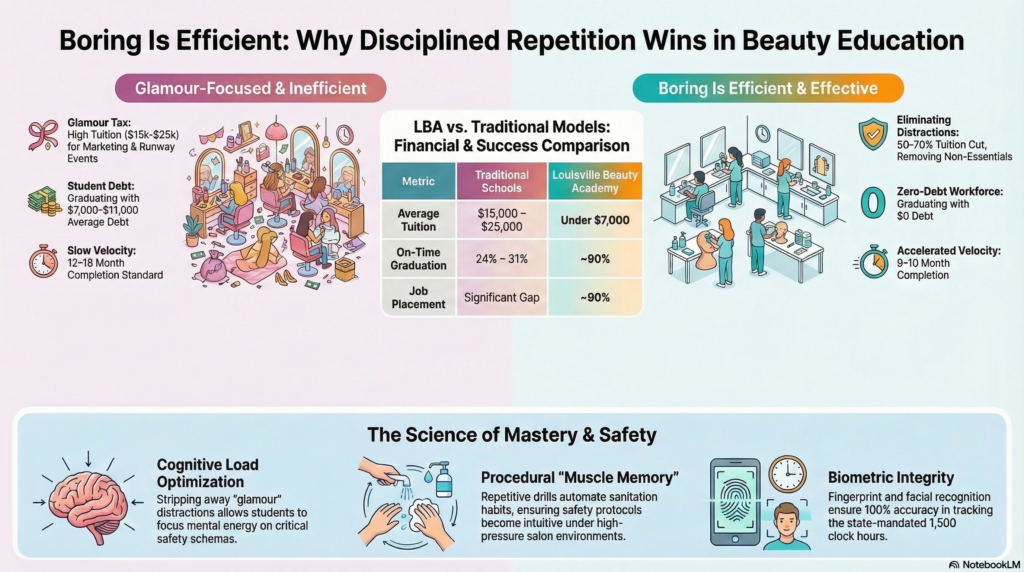
The “Boring Is Efficient” philosophy minimizes extraneous load by stripping away the “Glamour Tax”—the branding, recruitment shows, and non-essential activities that occupy student time in many traditional schools.1 By focusing strictly on repetitive, safety-centered tasks, the model allows students to dedicate more working memory to germane processing, ensuring that critical sanitation and technical skills are moved into long-term memory.15
Procedural Memory and Muscle Memory
The repetition perceived as “boring” is the mechanism for developing procedural memory—the part of long-term memory responsible for motor skills and automatic sequences of action.20 In beauty education, this is often called “muscle memory”.11 Deliberate practice, which involves mindful repetition with a focus on refinement, builds neural pathways that allow a stylist to hold shears at precise angles or maintain consistent tension without conscious effort.11
Once a habit is formed through repetition, it is directly triggered by the context (e.g., the salon environment) without the need for conscious goal pursuit.22 This is why boring repetition is a safety feature: it ensures that in a high-pressure environment, such as a busy salon or a licensing exam, the practitioner defaults to correct sanitation habits automatically.2
The Economics of Focused Education: The “Great Decoupling”
The economics of beauty education are being reshaped by the “Great Decoupling”—the shift away from federal aid dependency toward outcomes-based, direct-to-consumer models.1 Traditional beauty schools often participate in the Title IV federal aid system, which introduces two major financial burdens for students: the “Compliance Tax” and the “Glamour Tax”.1
The Compliance Tax and the Glamour Tax
The Compliance Tax accounts for 25-35% of student tuition and covers the administrative overhead of managing federal aid, including expensive compliance audits and specialized staff.1 The Glamour Tax accounts for another 45% of tuition, covering high-gloss marketing, recruitment campaigns, and performative events like runway shows.1 These costs inflate tuition to $15,000–$25,000, leaving students with an average debt of $7,000–$11,000 upon graduation.1
Table 4: Economic Impact of Educational Paradigms
| Metric | Traditional Title IV Schools | Louisville Beauty Academy (LBA) |
| Average Tuition | $15,000 – $25,000 | Under $7,000 |
| Student Debt | $7,000 – $11,000 | $0 (lower-debt model) |
| On-Time Graduation | 24% – 31% | ~90% |
| Job Placement | Triple-digit % gap from LBA | ~90% |
| Program Length | 12 – 18 months | 9 – 10 months |
1
By opting out of Title IV funding, LBA eliminates these taxes, offering a tuition model that is 50-70% lower than the industry norm.1 This direct-savings paradigm allows students to enter the labor market faster and lower-debt.1 The “fiscal velocity” created by an accelerated curriculum—allowing students to begin earning taxable income 6-9 months sooner—provides a net positive impact on the local economy.1
Table 5: Fiscal Velocity Calculation and Impact
The fiscal impact of accelerated graduation can be expressed through a velocity model:

where is the net fiscal impact,
is the avoided public aid package,
is the interest on avoided debt, and
is the fiscal velocity created by faster workforce entry.4 At LBA, this efficiency contributes an estimated $20–$50 million annually to the local economy through business ownership and employment.1
Case Study: The LBA Operational Model of “Over-Compliance”
Louisville Beauty Academy utilizes an “Over-Compliance” model that treats state regulation as a professional skill rather than a burden.1 This model is structured into five distinct phases, using technology to verify mastery at every step.25
The Five Phases of Mastery
Phase 1: Mindset & Onboarding (0–100 Hours)
The focus is on dismantling psychological barriers and establishing the “YES I CAN” mindset. Students are introduced to the biometric attendance system and must achieve 100% in disinfection and blood exposure protocols to earn their “Safety Pro” badge.25
Phase 2: Technical Immersion & Fail-Fast Testing (100–300 Hours)
Students engage with the CIMA digital curriculum, identifying knowledge gaps through frequent, high-stakes exams. Achieving a 90% or higher average earns the “Theory Scholar” badge.25 This phase emphasizes “Regulatory Literacy”—the ability to navigate KRS 317A and 201 KAR 12.1
Phase 3: The Clinical Floor & Public Trust (300–1000 Hours)
Under instructor supervision, students provide services to the public. This phase is dedicated to the “boring” refinement of practical skills and the maintenance of professional conduct standards. Students earn the “Client Protection Mastery” badge after completing state-mandated practical checklists.25
Phase 4: Proof-of-Work & Business Identity (1000–1400 Hours)
Students begin mapping their future careers and documenting their unique professional style. They curate technical artifacts for their digital portfolios, providing “Proof-of-Work” that transcends a traditional diploma.25
Phase 5: The “I HAVE DONE IT” Capstone (1400–1500 Hours)
This phase is dedicated to intensive state board preparation. Upon final practical check-offs and graduation, students earn the “I HAVE DONE IT” Capstone badge, representing the transition from belief to documented mastery.25
Table 6: The LBA Digital Credential System (Open Badges 3.0)
| Badge Name | Milestone Phase | Achievement Requirement |
| Safety Pro | Phase 1 (0-100 hrs) | 100% mastery of disinfection protocols |
| Theory Scholar | Phase 2 (100-300 hrs) | 90% average on chapter exams |
| Compliance Steward | Phase 2 (100-300 hrs) | Mastery of regulatory literacy (KRS 317A) |
| Client Protection | Phase 3 (300-1000 hrs) | Successful completion of clinic checklists |
| I HAVE DONE IT | Phase 5 (1400-1500 hrs) | Final capstone and graduation |
25
Technological Verification: Biometric Auditing and Accountability
A defining characteristic of the LBA model is the “Compliance by Design” approach to record-keeping.4 Traditional clock-hour tracking is often prone to “informal time forgiveness,” but the state board requires an exact accounting of every minute spent in training.4 LBA’s use of biometric attendance mandates (using fingerprint or facial recognition) ensures that the person earning the hours is the person physically present.4
This biometric integrity protects the student’s professional narrative. In an industry where graduation can be delayed by “dead time” or holiday breaks in traditional schools, LBA students earn only the required clock hours, ensuring every hour counts toward licensure.26 This transparency is furthered by the “Public Record Library” model, where the academy publishes the exact text of laws and research—such as 201 KAR 12:190 regarding complaints and discipline—to eliminate information asymmetry between the school and the student.1
The Modern Workforce Alternative: Registered Apprenticeships
As the beauty industry evolves, new models for workforce entry are emerging that align with the “Boring Is Efficient” philosophy of on-the-job, repetitive training.1 The Department of Labor (DOL)-backed beauty apprenticeships provide an alternative to traditional classroom-only education.1
Table 7: Comparison of Educational and Apprenticeship Models
| Feature | School-Based (e.g., LBA) | Registered Apprenticeship (e.g., Atarashii) |
| Learning Environment | Supervised clinic floor/classroom | Paid, on-the-job training in a salon |
| Structure | 1,500 clock hours | Competency-based or hour-based mentorship |
| Funding | Tuition-based (direct savings) | Paid work while learning |
| Credential | State Board License | DOL Certificate + State Board License |
| Role of Mentor | School Instructor | Salon Stylist/Employer |
1
The Atarashii Apprentice Program is a federally recognized Registered Apprenticeship that operates across cosmetology, barbering, and nail technology.1 This model proves that beauty education can meet structured DOL standards, where mentorship-based learning produces compliant outcomes. For immigrants, ESL learners, and dislocated workers, these “lower-debt” and “completion-driven” models provide employment certainty without lowering safety standards.1
Psychological Resilience and Student Outcomes
While repetitive training is often perceived as “boring,” research suggests that focused vocational environments provide significant psychological advantages for students.28
Self-Efficacy and Autonomy
Self-Determination Theory (SDT) points out that mental health and functional performance depend on the satisfaction of three basic needs: autonomy, competence, and belonging.29 In a licensing-focused environment, students experience greater competence through the mastery of core tasks.29 The “boring” repetition of sanitation and technical drills serves as a cognitive priming mechanism, allowing students to focus their attention on subject-specific thinking.29
Building Willpower and Confidence
Regular engagement in structured vocational activities, much like campus sports, enhances adolescents’ and young adults’ psychological qualities, including willpower and self-confidence.30 This “sports confidence” actively influences personality traits, enabling students to demonstrate greater tenacity when facing the challenges of a licensing exam or a professional career.30 By mastering the “boring” foundation of the industry, students build a buffer against negative emotions in the face of professional setbacks.30
Table 8: Psychological Impact of Standardized vs. Distraction-Heavy Training
| Learning Environment | Primary Cognitive Load | Student Emotional Response | Longitudinal Outcome |
| Standardized (Focused) | Germane (Schema building) | Higher self-efficacy; lower anxiety | High completion; resilient habits |
| Distraction-Heavy | Extraneous (Theatre/Branding) | Diminished engagement; anxiety | High attrition; poor habit formation |
15
Conclusion: Synthesis of Professional Integrity and Public Safety
The research presented here indicates that in the high-stakes industry of cosmetology, the philosophy of “Boring Is Efficient” is not a sign of educational stagnation but a commitment to professional excellence and public safety.1 By defining “boring” as a state of focus, efficiency, and compliance-driven discipline, institutions like Louisville Beauty Academy have created a model that outperforms traditional “glamour-focused” schools on every key metric.1
The synthesis of Cognitive Load Theory, procedural memory research, and economic analysis confirms that a licensing-oriented curriculum reduces the burden of debt while increasing the speed and safety of workforce entry.1 The “Hidden Safety Governance” of the beauty industry demands that practitioners front-load a lifetime of sanitation habits through boring, repetitive practice.2 This ensures that “beauty at any cost” never results in literal damage to public health through chemical burns, hair loss, or the transmission of infectious diseases.2
For the student, the applicant, and the public, understanding that effective beauty training prioritizes compliance over entertainment is essential. The “boring” road to licensure—characterized by biometric clock-ins, rigorous tool disinfection, and repetitive technical drills—is ultimately the most ethical, efficient, and successful pathway to a career in the licensed beauty workforce.1
Works cited
- Outcomes-Based Beauty Education : A Workforce and Policy …, accessed March 13, 2026, https://naba4u.org/2025/12/outcomes-based-beauty-education-a-workforce-and-policy-analysis-of-lower-debt-completion-driven-vocational-models-research-december-2025/
- salon infection prevention Archives – Louisville Beauty Academy …, accessed March 13, 2026, https://louisvillebeautyacademy.net/tag/salon-infection-prevention/
- Kentucky Board of Cosmetology education requirements Archives …, accessed March 13, 2026, https://louisvillebeautyacademy.net/tag/kentucky-board-of-cosmetology-education-requirements/
- beauty school compliance model Archives – Louisville Beauty Academy, accessed March 13, 2026, https://louisvillebeautyacademy.net/tag/beauty-school-compliance-model/
- Sanitation and Infection Control: How professionals should safe-guard their salon and spa, accessed March 13, 2026, https://www.dermascope.com/sanitation-and-infection-control-how-professionals-should-safe-guard-their-salon-and-spa/
- Kentucky Cosmetology Laws & License Requirements [2026] – Consentz, accessed March 13, 2026, https://www.consentz.com/kentucky-cosmetology-laws-license-requirements/
- License Requirements – Kentucky Board of Cosmetology, accessed March 13, 2026, https://kbc.ky.gov/Licensure/Pages/License-Requirements.aspx
- Tag: biometric attendance clock hour tracking – Louisville Beauty Academy, accessed March 13, 2026, https://louisvillebeautyacademy.net/tag/biometric-attendance-clock-hour-tracking/
- Kentucky Cosmetology License Requirements (2026) | How to Get Licensed – LicenseMap, accessed March 13, 2026, https://getlicensemap.com/states/cosmetologist/kentucky
- Tag: vocational education policy analysis – Louisville Beauty Academy, accessed March 13, 2026, https://louisvillebeautyacademy.net/tag/vocational-education-policy-analysis/
- The Muscle Memory of Cutting: How Stylists Develop Precision Over Time – Above Shears, accessed March 13, 2026, https://aboveshears.com/the-muscle-memory-of-cutting-how-stylists-develop-precision-over-time/
- Health Hazards in Nail Salons – Biological Hazards | Occupational Safety and Health Administration, accessed March 13, 2026, https://www.osha.gov/nail-salons/biological-hazards
- Bloodborne Pathogens in the Beauty Salon – MyCPR NOW, accessed March 13, 2026, https://cprcertificationnow.com/blogs/mycpr-now-blog/bloodborne-pathogens-in-the-beauty-salon
- COS-Bloodborne Pathogen Training-FAQs.pdf – Oregon.gov, accessed March 13, 2026, https://www.oregon.gov/oha/PH/HLO/Documents/COS-Bloodborne%20Pathogen%20Training-FAQs.pdf
- Challenging Cognitive Load Theory: The Role of Educational Neuroscience and Artificial Intelligence in Redefining Learning Efficacy – PMC, accessed March 13, 2026, https://pmc.ncbi.nlm.nih.gov/articles/PMC11852728/
- Cognitive Load Theory, accessed March 13, 2026, https://www.mcw.edu/-/media/MCW/Education/Academic-Affairs/OEI/Faculty-Quick-Guides/Cognitive-Load-Theory.pdf
- Cognitive Load in English as a Foreign Language Speaking Competency of Vocational High School Students – ERIC, accessed March 13, 2026, https://files.eric.ed.gov/fulltext/EJ1467654.pdf
- Beyond Cognitive Load Theory: Why Learning Needs More than Memory Management, accessed March 13, 2026, https://pmc.ncbi.nlm.nih.gov/articles/PMC12839043/
- Cognitive Load Theory and its application in the classroom – My College, accessed March 13, 2026, https://my.chartered.college/impact_article/cognitive-load-theory-and-its-application-in-the-classroom/
- Web-Based Application to Support Caregivers in the Use of Learning Optimization Methods: Participatory Action Research Study – JMIR Aging, accessed March 13, 2026, https://aging.jmir.org/2026/1/e76543
- Physiological stress differentially impacts cognitive performance during—and memory following—simulated police encounters with persons experiencing a mental health crisis – Frontiers, accessed March 13, 2026, https://www.frontiersin.org/journals/psychology/articles/10.3389/fpsyg.2025.1549752/full
- Wendy Wood – Psychology of Habit – USC Dornsife, accessed March 13, 2026, https://dornsife.usc.edu/wendy-wood/wp-content/uploads/sites/183/2023/10/wood.runger.2016.pdf
- Deliberate Practice and Motor Learning Principles to Underpin the Design of Training Interventions for Improving Lifting Movement in the Occupational Sector: A Perspective and a Pilot Study on the Role of Augmented Feedback – Frontiers, accessed March 13, 2026, https://www.frontiersin.org/journals/sports-and-active-living/articles/10.3389/fspor.2021.746142/full
- Habits and Goals in Human Behavior: Separate but Interacting Systems – USC Dornsife, accessed March 13, 2026, https://dornsife.usc.edu/wendy-wood/wp-content/uploads/sites/183/2023/10/Wood.Mazar_.Neal_.2021.pdf
- over-compliance education model Archives – Louisville Beauty …, accessed March 13, 2026, https://louisvillebeautyacademy.net/tag/over-compliance-education-model-2/
- Tag: Gold standard compliance beauty school – Louisville Beauty Academy, accessed March 13, 2026, https://louisvillebeautyacademy.net/tag/gold-standard-compliance-beauty-school/
- State Board Info – Dermascope, accessed March 13, 2026, https://www.dermascope.com/state-board-requirements/
- In Their Own Words: How Standardization Shapes Student Learning Experiences – Scholar Commons, accessed March 13, 2026, https://scholarcommons.sc.edu/cgi/viewcontent.cgi?article=9436&context=etd
- The relationship between digital literacy and mental health resilience among college students—based on the mediating role of digital learning – PMC, accessed March 13, 2026, https://pmc.ncbi.nlm.nih.gov/articles/PMC12891216/
- Promoting effects of campus football activities on the enhancement of adolescents’ psychological qualities and the underlying mechanisms – PMC, accessed March 13, 2026, https://pmc.ncbi.nlm.nih.gov/articles/PMC12303940/
- (PDF) Innovative Lesson Starters as Catalysts for Active Learning, Conceptual Development, and Critical Thinking in Secondary Science Education: A Comprehensive Review. – ResearchGate, accessed March 13, 2026, https://www.researchgate.net/publication/399658842_Innovative_Lesson_Starters_as_Catalysts_for_Active_Learning_Conceptual_Development_and_Critical_Thinking_in_Secondary_Science_Education_A_Comprehensive_Review
- (PDF) Middle school students’ career parental support and adolescent–parent career congruence: the mediating role of self-efficacy – ResearchGate, accessed March 13, 2026, https://www.researchgate.net/publication/382300998_Middle_school_students’_career_parental_support_and_adolescent-parent_career_congruence_the_mediating_role_of_self-efficacy







