Louisville Beauty Academy is preserving this record for one simple reason: ethical beauty education deserves to be seen, documented, and discussed at every level where workforce policy is shaped.
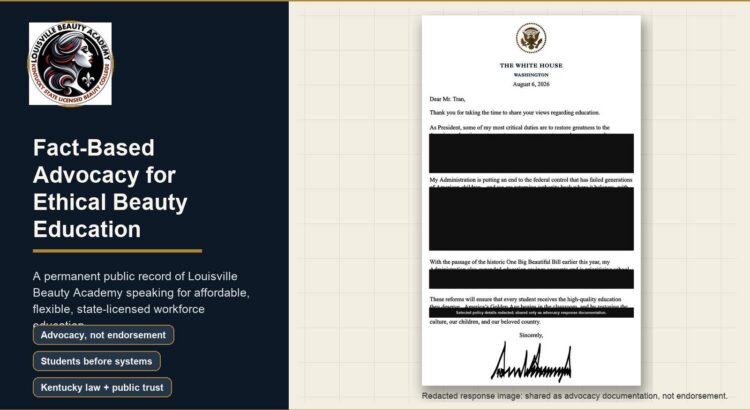
In August 2026, Louisville Beauty Academy received a written response after submitting fact-based advocacy through the official White House / President contact channel regarding beauty education, student access, workforce training, affordability, and public trust. The response is shared only as documentation that the advocacy was submitted and answered. It is not shared as an endorsement, political statement, agency approval, funding approval, accreditation action, or special government status.
That distinction matters. Public advocacy should be truthful enough to preserve, careful enough to withstand review, and humble enough to avoid claiming more than the record supports.
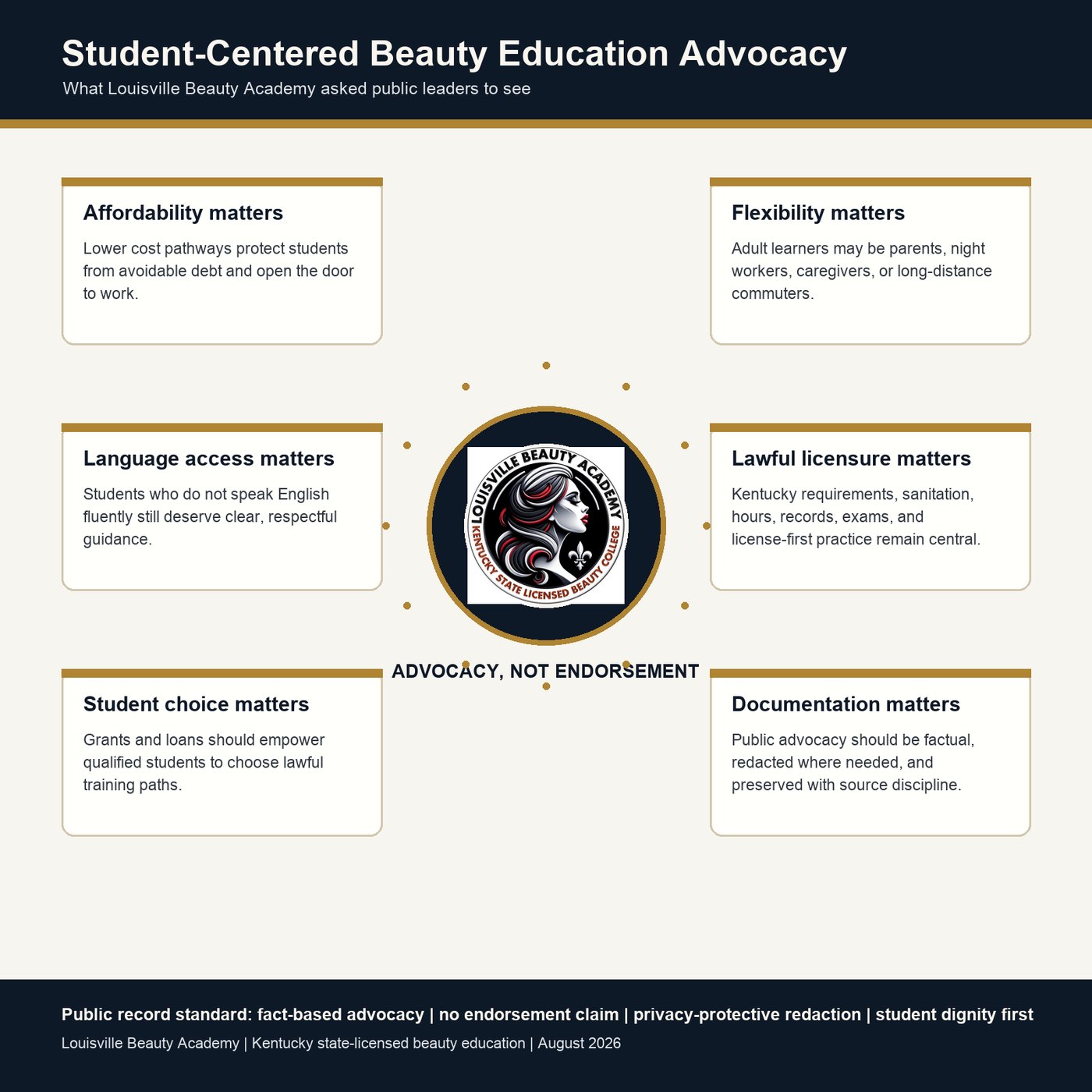
Louisville Beauty Academy’s advocacy position: affordability, flexibility, language access, lawful licensure, student choice, documentation, and no endorsement claim.
Why This Record Matters
Beauty education is often discussed as a narrow industry issue. At Louisville Beauty Academy, we see something larger: it is a workforce-access issue, a language-access issue, a family-stability issue, and a dignity issue.
Many students who choose a licensed beauty pathway are not traditional full-time college students with perfect transportation, unlimited English fluency, easy childcare, or a financial cushion. They may be adults changing careers. They may be immigrants or first-generation Americans. They may be single parents. They may work at night, drive rideshare, serve tables, work in bars or salons, care for family members, or travel long distances from smaller Kentucky communities into Louisville because they are trying to build a lawful, skilled, service-based future.
For those students, affordability is not a marketing phrase. It is often the line between access and exclusion.
The Ethical Position
Louisville Beauty Academy’s advocacy begins with a student-centered standard:
education should be aligned with Kentucky law and public safety;
students should receive clear written expectations before they commit;
cost should be understandable, reasonable, and controlled;
language support and patient explanation should be treated as institutional responsibility;
students with disabilities, family obligations, transportation barriers, or work schedules should be served with dignity where lawful and feasible;
licenses should be earned through documented education, examination, and regulatory compliance; and
public aid, grants, loans, and policy tools should strengthen student choice and student protection, not trap students in unaffordable systems.
That is the heart of the advocacy. Not special treatment. Not a shortcut. Not a request to lower standards. The opposite: make the pathway lawful, transparent, affordable, flexible, and accountable so real students can complete it without being crushed by confusion or cost.
Law First, Then Opportunity
Kentucky’s beauty licensing framework is real and specific. The Kentucky Board of Cosmetology publishes license requirements for cosmetologists, nail technicians, estheticians, shampoo and style services, and apprentice instructors, including required hours, education documentation, examination, application, and license verification before providing services. Kentucky administrative regulations also describe education requirements, school administration, instructional hours, law-and-regulation instruction, and curriculum areas.
That is why Louisville Beauty Academy does not frame affordability as a way around regulation. Affordability must live inside the lawful pathway. Flexibility must respect hours, safety, sanitation, documentation, examination, and licensure. Student support must strengthen compliance, not weaken it.
The Students This Advocacy Speaks For
This advocacy is for the student who does not speak English confidently but still wants a lawful career. It is for the student who drives from outside Louisville because a licensed pathway in beauty may be one of the most realistic bridges into skilled work. It is for the single parent trying to study while paying rent. It is for the person working overnight, driving rideshare, or taking service jobs to pay tuition. It is for the learner with a disability who deserves patience, structure, and a school that treats dignity as operational, not decorative.
It is also for families, workforce partners, policymakers, and regulators who need to see that small licensed schools can be serious public-interest institutions when they keep records, publish standards, control claims, and put students before prestige.
School Choice Must Mean Student-Controlled Choice
School choice is strongest when it is student-centered. That means the student should be able to compare programs, understand cost, verify legal requirements, evaluate time commitment, and choose a lawful training path that fits real life. Where grants, loans, public programs, or private financing exist, the ethical question should always be: does this help the student make a better choice, or does it simply move money through a system the student does not control?
Louisville Beauty Academy’s position is that funding structures should protect student agency, price transparency, documentation, and completion accountability. The student should never be treated as a passive object inside someone else’s revenue model.
Why We Preserve the Letter
The redacted response image is preserved here because documentation matters. It shows that Louisville Beauty Academy did not merely complain privately or speak in slogans. The school submitted a public-policy concern through an official civic channel and received a response. That is the exact claim being made, and no more.
The visible image has been redacted where appropriate for privacy, context control, and responsible public use. Redaction is not a sign of fabrication. It is a sign that public documentation can be both transparent and disciplined.
What This Article Does Not Claim
This article does not claim that the White House, the President, the U.S. Department of Education, the Kentucky Board of Cosmetology, or any government agency endorsed Louisville Beauty Academy. It does not claim funding approval, regulatory approval, accreditation action, legal victory, guaranteed licensure, guaranteed employment, guaranteed income, or guaranteed student outcome.
It claims something narrower and stronger: Louisville Beauty Academy engaged in fact-based advocacy for ethical, affordable, flexible, state-licensed beauty education, and received a response. That record now belongs in the permanent public archive.
The Continuing Commitment
Louisville Beauty Academy will continue to align workforce education with Kentucky state law, federal guidance where applicable, written documentation, affordability, student dignity, public trust, and the principle of elevating one life at a time.
We are grateful for every response that acknowledges the importance of education. More importantly, we remain committed to the work itself: serving students with love, care, structure, affordability, flexibility, and truth.
This article is public education and advocacy documentation. It is not legal advice, financial aid advice, immigration advice, medical advice, or a promise of admission, licensing, employment, income, funding, scholarship approval, government action, or individual result. Students and families should verify current requirements directly with official sources and current school documents.
Louisville Beauty Academy 是一所美容学校,我们不是翻译机构,团队成员也不是认证或专业的翻译人员。我们结合翻译技术,以及会多种语言的教职员工和学生共同提供帮助。我们以您的语言提供这些内容,是因为我们宁愿提供不够完美的帮助,也不愿让您得不到信息。若有措辞不够准确之处,敬请见谅;如有任何不清楚的地方,请随时请我们再解释一次。
English (controlling version): Louisville Beauty Academy is a beauty school — not a translation agency, and our team are not certified or professional translators. We use translation technology together with staff and students who speak several languages. We share this material in your language because we would rather offer imperfect help than leave you without information. Some wording may not carry perfect nuance, and we ask for your kindness and patience with any imperfection. Please ask us to explain anything that is unclear; we will gladly go through it with you. For any official, legal, or licensing purpose, the English version of LBA documents controls, and a certified translator should be used where a certified translation is required. Current written school documents, signed agreements, Kentucky Board of Cosmetology requirements, PSI rules where applicable, and applicable law control.
English (controlling version): Louisville Beauty Academy is licensed by the Commonwealth of Kentucky and regulated by the Kentucky Board of Cosmetology. LBA is not institutionally accredited by a federally recognized accrediting agency and does not process FAFSA or Title IV federal student aid. This is a deliberate choice; operating outside the federal aid system removes substantial administrative cost, which is reflected in the program pricing published on this website. Sponsors, employers, nonprofits, and workforce programs may support a student; payments are applied to the student’s account, the student remains the responsible party under the signed agreement, and the student completes any sponsor paperwork. Before enrolling or borrowing at any school, please review official federal information at College Scorecard and studentaid.gov. We make no statement about any other institution. Accreditation status, tuition, and payment terms are described in current written school documents and may change; the current signed student agreement, Kentucky Board of Cosmetology requirements, and applicable law control. Nothing here is legal, financial, or licensing advice.
A Louisville Beauty Academy é uma escola de beleza — não somos uma agência de tradução nem tradutores certificados ou profissionais. Usamos tecnologia de tradução junto com funcionários e estudantes que falam vários idiomas. Compartilhamos este material no seu idioma porque preferimos oferecer uma ajuda imperfeita a deixar você sem informação. Pedimos desculpas por qualquer expressão menos precisa e, por favor, não hesite em nos pedir para explicar novamente.
English (controlling version): Louisville Beauty Academy is a beauty school — not a translation agency, and our team are not certified or professional translators. We use translation technology together with staff and students who speak several languages. We share this material in your language because we would rather offer imperfect help than leave you without information. Some wording may not carry perfect nuance, and we ask for your kindness and patience with any imperfection. Please ask us to explain anything that is unclear; we will gladly go through it with you. For any official, legal, or licensing purpose, the English version of LBA documents controls, and a certified translator should be used where a certified translation is required. Current written school documents, signed agreements, Kentucky Board of Cosmetology requirements, PSI rules where applicable, and applicable law control.
✓ Página revisada e atualizada em 27 de julho de 2026
Catálogo, programas, custos e políticas. Decida com informação por escrito.
2
Envie seus documentos
ID, prova de escolaridade e foto clara por texto para 502-625-5531.
3
Escolha seu programa
Unhas, Estética, Cosmetologia, Instrutor, Shampoo Styling ou Extensão de Cílios.
4
Leia e assine
Leia com calma. Pode revisar com a família. Pergunte antes de assinar.
5
Comece com clareza
Cada hora frequentada importa para o caminho de licença em Kentucky desde o primeiro dia.
Versões por idioma
Guia em português para estudantes e famílias. A Louisville Beauty Academy recebe perguntas sobre idioma, documentos de matrícula, preparação para licenciamento e entendimento do contrato antes da assinatura. Esta página reúne a resposta em um só lugar claro.
Louisville Beauty Academy
Reduzindo barreiras linguísticas. Ampliando oportunidades. Fortalecendo a força de trabalho de beleza de Kentucky.
Este centro de recursos existe para que estudantes e famílias revisem documentos, apoio de idioma, contrato, custo, identificação, opções de idioma de exame e próximos passos com dignidade antes de uma decisão educacional.
Caminho rapido para estudantes em portugues
Escolha o proximo passo: enviar mensagem para a LBA, revisar custos, preparar documentos ou pedir acompanhamento por escrito antes da visita.
O idioma nunca deve impedir um estudante sério de entender o caminho para uma profissão licenciada.
A LBA acredita que todo estudante merece informação clara por escrito antes da matrícula: documentos, idioma, contrato, custo, frequência, preparação para licença e próximos passos oficiais.
Compromisso de longo prazo
Por anos, a LBA apoia acesso multilíngue à educação de beleza, preparação profissional e comunicação clara para comunidades imigrantes e famílias trabalhadoras.
Quando provedores oficiais de exame, regras estaduais ou sistemas digitais oferecem opções de idioma, o estudante deve confirmar a disponibilidade atual diretamente na fonte oficial. A LBA pode orientar, mas os documentos atuais da escola, KBC, PSI quando aplicável e a lei controlam.
Nota sobre idioma do exame KBC/PSI
Conforme verificado em 27 de julho de 2026, o catálogo ao vivo da PSI Kentucky Board of Cosmetology lista versões por idioma para Cosmetology, Esthetician, Nail Technician e exames relacionados de instructor em inglês, espanhol, vietnamita, coreano, khmer, português e chinês simplificado. O mesmo catálogo mostra Shampoo Styling apenas em inglês e espanhol. O estudante deve confirmar o exame e o idioma diretamente no processo oficial KBC/PSI antes de agendar.
Por que isso importa
Reduz confusão antes da matrícula.
Ajuda estudantes e famílias a revisar documentos com calma.
Apoia a segurança pública porque o estudante entende melhor saneamento, frequência e responsabilidades.
Apoia famílias imigrantes e comunidades multilíngues.
Forma futuros profissionais, empreendedores e pequenos negócios.
Nossos princípios
Documentação antes de promessas.
Transparência antes da matrícula.
Conformidade antes da conveniência.
Dignidade humana antes de transações.
Educação antes de vendas.
Aviso sobre traduções
Traduções e explicações melhoram acesso e compreensão. Quando lei, regulamento, contrato assinado ou fonte oficial exigir uma versão específica, a versão oficial aplicável controla. Se algo não estiver claro, o estudante deve perguntar antes de assinar ou confiar nessa informação.
Documentos que o estudante deve preparar
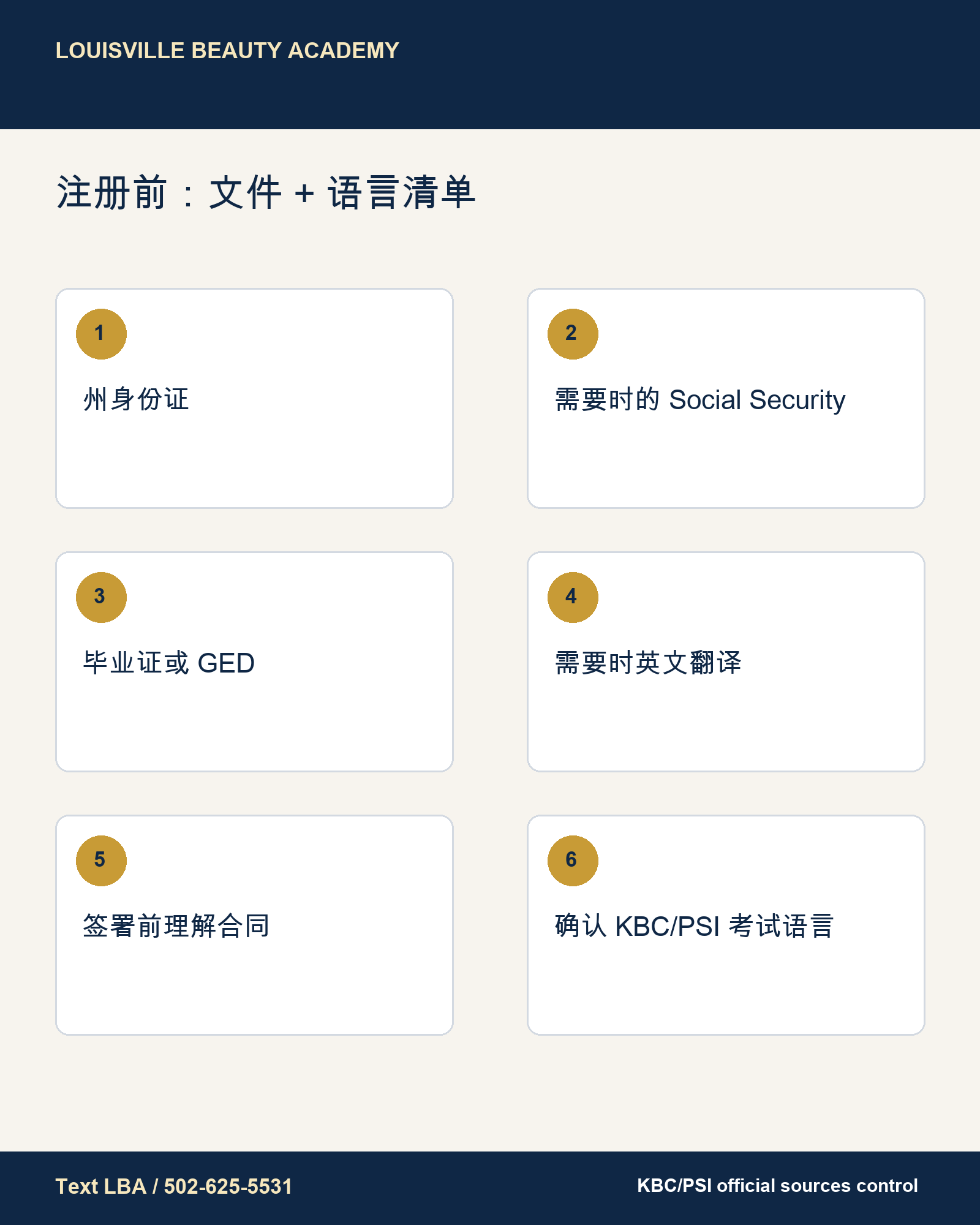
ID estadual ou carteira de motorista válida, idealmente com endereço atual.
Cartão Social Security quando exigido para registros escolares ou licenciamento.
Diploma de high school, GED ou equivalente aceito. Documentos estrangeiros podem precisar de tradução para inglês por agência aceita.
Foto clara estilo passaporte ou selfie recente sem filtro quando solicitada.
Nome legal, telefone, e-mail e endereço corretos.
Tempo para revisar o contrato estudantil antes de assinar.
Mensagem final ao estudante
Você pode fazer perguntas. Pode pedir explicação. Pode usar tradução. Pode ler com sua família. Um estudante sério merece clareza.
Confiança e impacto
A Louisville Beauty Academy atende uma comunidade ampla de estudantes, graduados, famílias e futuros profissionais de beleza em Kentucky. A educação profissional funciona melhor quando o caminho é claro, acessível, multilíngue quando possível, baseado em documentos e centrado em oportunidade econômica de longo prazo em vez de dívida desnecessária.
Nossa missão
Nossa missão vai além da matrícula. A LBA existe para reduzir barreiras, ampliar oportunidades, fortalecer a força de trabalho de Kentucky e ajudar cada estudante sério a construir carreira, apoiar a família e servir a comunidade com dignidade.
Resumo curto: a LBA ensina principalmente em inglês para todos, mas usa apoio multilíngue, equipe multilíngue quando disponível, Google Translate, ferramentas de tradução/IA e conteúdo digital que o estudante pode traduzir no navegador. O objetivo é comunicação clara, não confusão.
A Louisville Beauty Academy ensina em português?
A resposta honesta é: a instrução principal é em inglês porque registros escolares, segurança, saneamento, preparação para licenciamento e muitos materiais oficiais operam principalmente em inglês.
Ao mesmo tempo, a LBA apoia estudantes que falam espanhol, vietnamita, coreano, khmer, português, chinês simplificado e outros idiomas. A tecnologia ajuda a comunicação. Ela não substitui o instrutor, o contrato assinado, as regras da escola, os requisitos do KBC, os requisitos da PSI quando aplicáveis, nem a lei.
Diploma estrangeiro e tradução
Muitos estudantes trazem diplomas ou registros escolares de outro país. Isso pode ser normal. O importante é que o documento possa ser revisado com clareza. Se estiver em outro idioma, geralmente precisa de tradução para inglês por uma agência aceita.
Organizações comunitárias e agências de tradução reconhecidas podem ser úteis. O estudante deve confirmar com a LBA que tipo de tradução é aceito antes de pagar por uma tradução.
Contrato estudantil: assinado em inglês, mas precisa ser entendido
O contrato estudantil e os documentos oficiais de matrícula podem estar em inglês. Isso não significa que o estudante deva assinar sem entender.
A regra ética é simples: se o estudante não entende custo, horário, frequência, pagamento, política de retirada, responsabilidade do estudante ou caminho para licenciamento, deve perguntar antes de assinar.
A tradução ajuda a entender. Documentos assinados atuais, políticas escolares atuais, requisitos do KBC, PSI quando aplicável e a lei aplicável controlam. Esta página não é aconselhamento jurídico, imigratório, financeiro ou de licenciamento.
Por que ID estadual e Social Security podem ser solicitados
ID estadual ou carteira de motorista atual ajuda a manter registro escolar claro e comunicação correta. O cartão Social Security pode ser necessário para registros escolares ou de licenciamento quando aplicável.
A LBA não é agência de imigração e não fornece aconselhamento imigratório. Para matrícula escolar, estudantes devem focar nos documentos que a escola e o processo estadual precisam revisar: identificação, Social Security quando exigido, prova de educação, foto clara, contrato e informações de contato corretas.
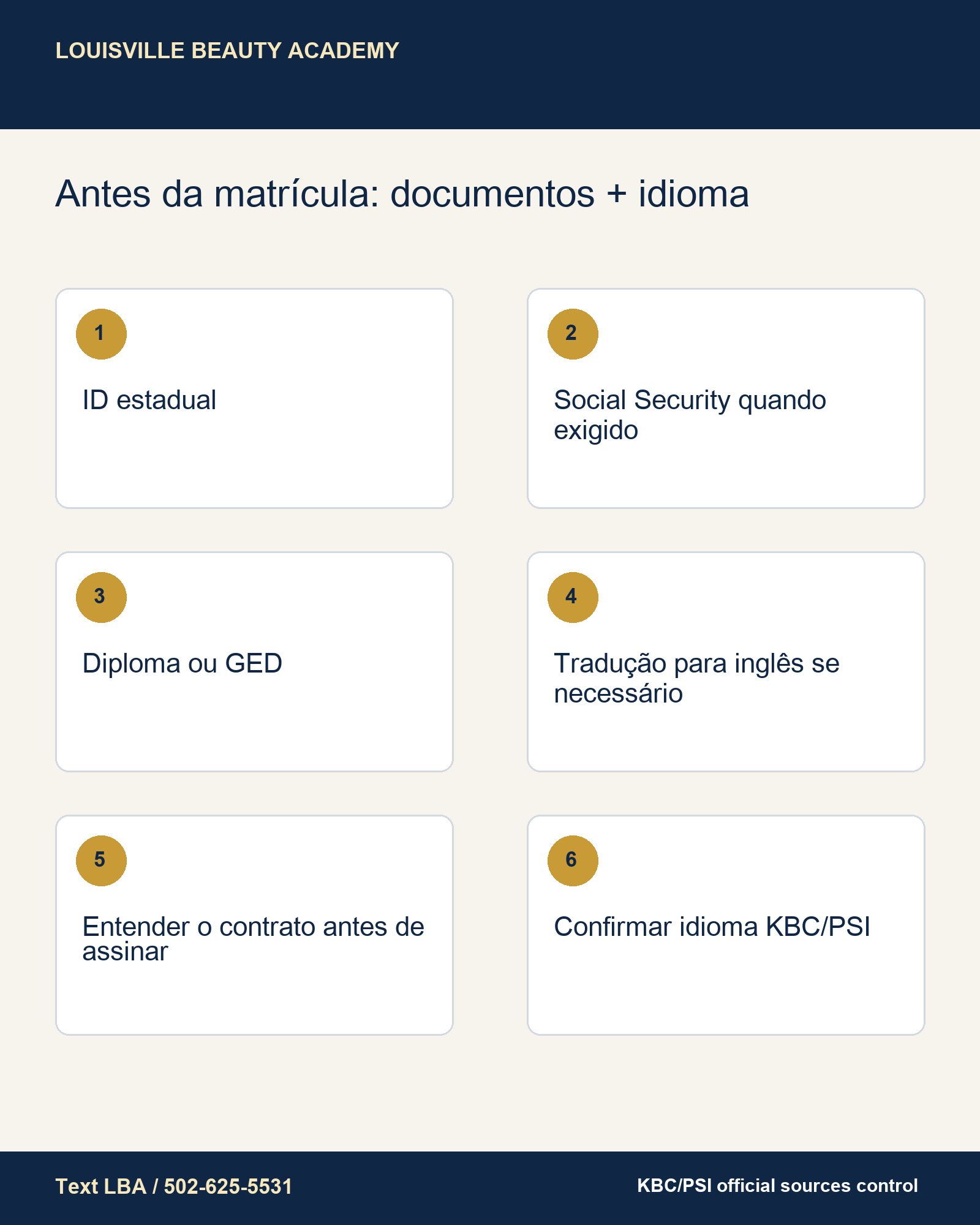
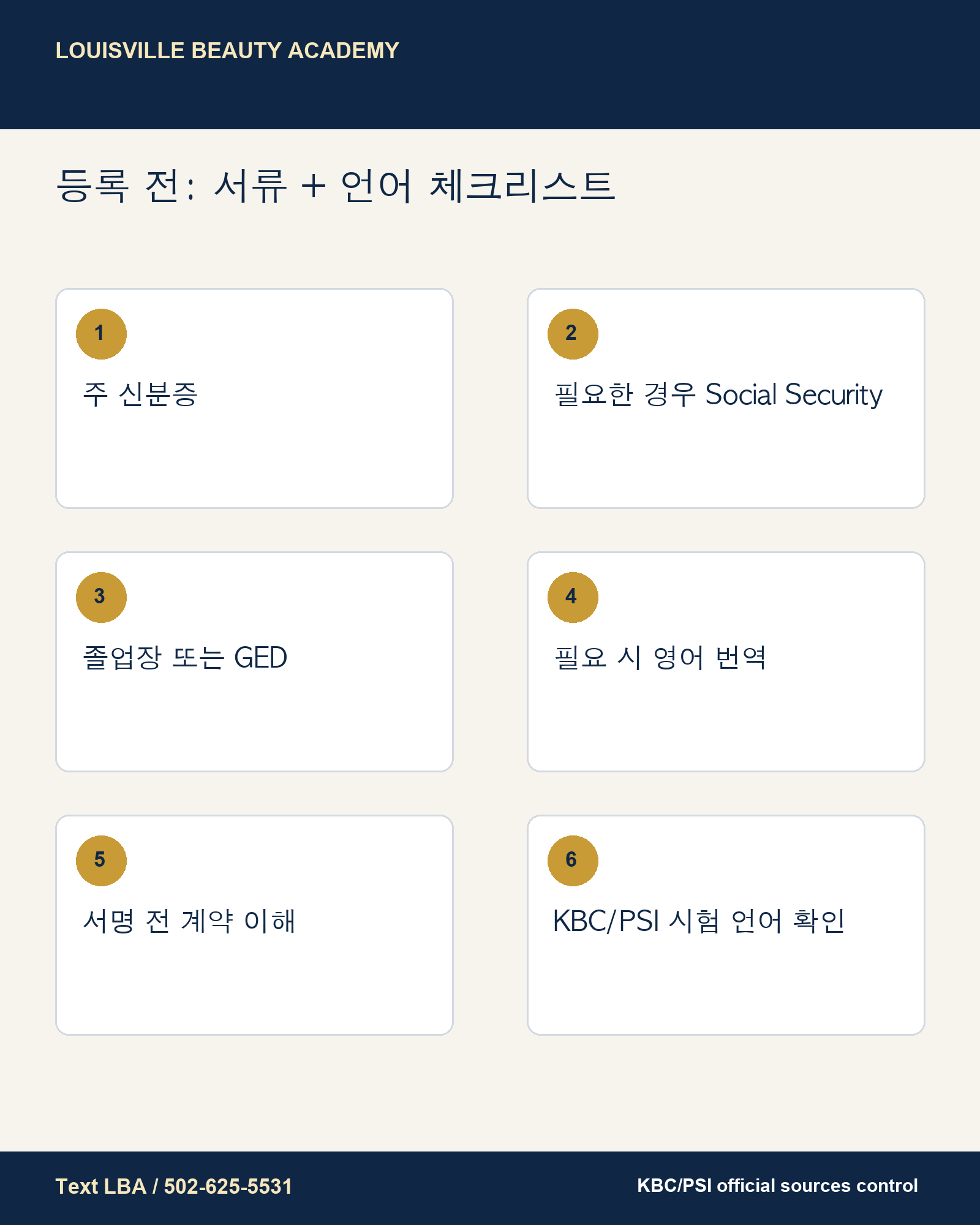
Infográfico em português da LBA sobre documentos estudantis e idioma KBC/PSI.
A Louisville Beauty Academy é licenciada pelo estado de Kentucky e regulamentada pelo Kentucky Board of Cosmetology. A LBA não é credenciada por uma agência de credenciamento reconhecida pelo governo federal e não processa FAFSA nem auxílio federal (Título IV). Essa é uma escolha deliberada: operar fora do sistema federal elimina custos administrativos consideráveis, o que se reflete nos preços publicados abertamente neste site.
Patrocinadores, empregadores, organizações sem fins lucrativos e programas de qualificação podem apoiar o estudante. Os pagamentos são aplicados à conta do estudante, que continua sendo o responsável segundo o contrato assinado e preenche qualquer documentação do patrocinador. Antes de se matricular ou solicitar empréstimo em qualquer escola, consulte as informações federais oficiais no College Scorecard e em studentaid.gov. Não fazemos nenhuma declaração sobre outras instituições.
English (controlling version): Louisville Beauty Academy is licensed by the Commonwealth of Kentucky and regulated by the Kentucky Board of Cosmetology. LBA is not institutionally accredited by a federally recognized accrediting agency and does not process FAFSA or Title IV federal student aid. This is a deliberate choice; operating outside the federal aid system removes substantial administrative cost, which is reflected in the program pricing published on this website. Sponsors, employers, nonprofits, and workforce programs may support a student; payments are applied to the student’s account, the student remains the responsible party under the signed agreement, and the student completes any sponsor paperwork. Before enrolling or borrowing at any school, please review official federal information at College Scorecard and studentaid.gov. We make no statement about any other institution. Accreditation status, tuition, and payment terms are described in current written school documents and may change; the current signed student agreement, Kentucky Board of Cosmetology requirements, and applicable law control. Nothing here is legal, financial, or licensing advice.
English (controlling version): Louisville Beauty Academy is a beauty school — not a translation agency, and our team are not certified or professional translators. We use translation technology together with staff and students who speak several languages. We share this material in your language because we would rather offer imperfect help than leave you without information. Some wording may not carry perfect nuance, and we ask for your kindness and patience with any imperfection. Please ask us to explain anything that is unclear; we will gladly go through it with you. For any official, legal, or licensing purpose, the English version of LBA documents controls, and a certified translator should be used where a certified translation is required. Current written school documents, signed agreements, Kentucky Board of Cosmetology requirements, PSI rules where applicable, and applicable law control.
ID រដ្ឋ ឬប័ណ្ណបើកបរបច្ចុប្បន្នជួយរក្សាកំណត់ត្រាសាលាច្បាស់ និងការទំនាក់ទំនងត្រឹមត្រូវ។ ប័ណ្ណ Social Security អាចត្រូវការសម្រាប់កំណត់ត្រាសាលា ឬអាជ្ញាបណ្ណពេលអនុវត្ត។
English (controlling version): Louisville Beauty Academy is licensed by the Commonwealth of Kentucky and regulated by the Kentucky Board of Cosmetology. LBA is not institutionally accredited by a federally recognized accrediting agency and does not process FAFSA or Title IV federal student aid. This is a deliberate choice; operating outside the federal aid system removes substantial administrative cost, which is reflected in the program pricing published on this website. Sponsors, employers, nonprofits, and workforce programs may support a student; payments are applied to the student’s account, the student remains the responsible party under the signed agreement, and the student completes any sponsor paperwork. Before enrolling or borrowing at any school, please review official federal information at College Scorecard and studentaid.gov. We make no statement about any other institution. Accreditation status, tuition, and payment terms are described in current written school documents and may change; the current signed student agreement, Kentucky Board of Cosmetology requirements, and applicable law control. Nothing here is legal, financial, or licensing advice.
Louisville Beauty Academy는 뷰티 학교이며, 번역 회사가 아니고 저희 팀은 공인 번역사나 전문 번역가가 아닙니다. 저희는 번역 기술과 여러 언어를 구사하는 교직원 및 학생들의 도움을 함께 사용합니다. 정보를 전혀 드리지 못하는 것보다는 완벽하지 않더라도 도움을 드리는 편이 낫다고 믿기에 이 자료를 여러분의 언어로 제공합니다. 어색하거나 부족한 표현이 있다면 너그러이 양해해 주시고, 이해가 어려운 부분은 언제든지 다시 설명해 달라고 요청해 주십시오.
English (controlling version): Louisville Beauty Academy is a beauty school — not a translation agency, and our team are not certified or professional translators. We use translation technology together with staff and students who speak several languages. We share this material in your language because we would rather offer imperfect help than leave you without information. Some wording may not carry perfect nuance, and we ask for your kindness and patience with any imperfection. Please ask us to explain anything that is unclear; we will gladly go through it with you. For any official, legal, or licensing purpose, the English version of LBA documents controls, and a certified translator should be used where a certified translation is required. Current written school documents, signed agreements, Kentucky Board of Cosmetology requirements, PSI rules where applicable, and applicable law control.
LBA는 모든 학생이 등록 전에 서류, 언어, 계약, 비용, 출석, 면허 준비, 공식 다음 단계에 대해 명확한 서면 정보를 받을 자격이 있다고 믿습니다.
장기적 약속
LBA는 여러 해 동안 이민자 커뮤니티와 일하는 가족을 위해 다국어 접근, 뷰티 교육, 직업 준비, 명확한 의사소통을 지원해 왔습니다.
공식 시험 제공기관, 주 규정 또는 디지털 시스템이 언어 선택을 제공하는 경우 학생은 현재 가능 여부를 공식 출처에서 직접 확인해야 합니다. LBA는 안내할 수 있지만, 현재 학교 서류, KBC, 해당되는 경우 PSI, 그리고 법이 우선합니다.
KBC/PSI 시험 언어 안내
2026년 7월 27일 확인 기준, PSI Kentucky Board of Cosmetology 실시간 catalog에는 Cosmetology, Esthetician, Nail Technician 및 관련 instructor 시험의 언어별 버전이 영어, 스페인어, 베트남어, 한국어, 크메르어, 포르투갈어, 중국어 간체로 표시됩니다. 같은 catalog에서 Shampoo Styling은 영어와 스페인어만 표시됩니다. 학생은 예약 전에 공식 KBC/PSI 절차 안에서 시험과 언어 선택을 직접 확인해야 합니다.
중요한 이유
등록 전 혼란을 줄입니다.
학생과 가족이 서류를 차분히 검토하도록 돕습니다.
위생, 출석, 책임을 더 잘 이해하게 하여 공공 안전을 지원합니다.
이민자 가족과 다국어 커뮤니티를 지원합니다.
미래 전문가, 창업자, 소기업을 세웁니다.
우리의 원칙
약속보다 문서.
등록보다 투명성.
편의보다 준수.
거래보다 인간의 존엄.
판매보다 교육.
번역 안내
번역과 설명은 접근성과 이해를 돕기 위한 것입니다. 법, 규정, 서명된 계약 또는 공식 출처가 특정 버전을 요구하는 경우 해당 공식 버전이 우선합니다. 명확하지 않은 부분은 서명하거나 그 정보에 의존하기 전에 질문해야 합니다.
학생이 준비할 서류
현재 주소가 있는 유효한 주 신분증 또는 운전면허증.
학교 또는 면허 기록에 필요한 경우 Social Security 카드.
High school diploma, GED 또는 인정되는 동등 학력. 외국 서류는 인정되는 기관의 영어 번역이 필요할 수 있습니다.
요청 시 선명한 여권형 사진 또는 필터 없는 최근 얼굴 사진.
정확한 법적 이름, 전화번호, 이메일, 주소.
서명 전 학생 계약서를 검토할 시간.
학생에게 드리는 마지막 메시지
질문할 수 있습니다. 설명을 요청할 수 있습니다. 번역을 사용할 수 있습니다. 가족과 함께 읽을 수 있습니다. 진지한 학생은 명확성을 받을 자격이 있습니다.
신뢰와 영향
Louisville Beauty Academy는 Kentucky의 학생, 졸업생, 가족, 미래 뷰티 전문가로 이루어진 넓은 커뮤니티를 섬깁니다. 직업 교육은 길이 명확하고, 감당 가능하며, 가능한 경우 다국어로 지원되고, 문서 중심이며, 불필요한 부채보다 장기적 경제 기회에 집중할 때 가장 잘 작동합니다.
우리의 사명
LBA의 사명은 등록을 넘어섭니다. LBA는 장벽을 줄이고, 기회를 넓히고, Kentucky 인력을 강화하며, 진지한 학생이 경력을 세우고 가족을 돕고 존엄하게 지역사회에 기여하도록 돕기 위해 존재합니다.
짧은 요약: LBA는 모두를 위해 주로 영어로 가르치지만, 가능한 경우 다국어 지원, 다국어 직원, Google Translate, 번역/AI 도구, 브라우저에서 번역 가능한 디지털 콘텐츠를 사용합니다. 목표는 혼란이 아니라 명확한 의사소통입니다.
Louisville Beauty Academy는 한국어로 가르치나요?
정직한 답은 이렇습니다: 주요 수업은 영어입니다. 학교 기록, 안전, 위생, 면허 준비, 많은 공식 자료가 주로 영어로 운영되기 때문입니다.
동시에 LBA는 스페인어, 베트남어, 한국어, 크메르어, 포르투갈어, 중국어 간체 및 기타 언어를 사용하는 학생을 지원합니다. 기술은 의사소통을 돕지만 강사, 서명된 계약, 학교 규칙, KBC 요구사항, 해당되는 경우 PSI 요구사항 또는 법을 대체하지 않습니다.
외국 졸업장과 번역
많은 학생이 다른 나라의 졸업장이나 학교 기록을 가져옵니다. 이는 정상일 수 있습니다. 중요한 것은 그 기록을 명확히 검토할 수 있어야 한다는 점입니다. 서류가 다른 언어라면 인정되는 기관의 영어 번역이 필요할 수 있습니다.
커뮤니티 기관과 인정되는 번역 기관이 도움이 될 수 있습니다. 학생은 번역 비용을 지불하기 전에 어떤 종류의 번역이 인정되는지 LBA에 확인해야 합니다.
학생 계약서: 영어로 서명하지만 반드시 이해해야 합니다
학생 계약서와 공식 등록 서류는 영어일 수 있습니다. 그렇다고 이해하지 못한 채 서명해야 한다는 뜻은 아닙니다.
윤리적 규칙은 간단합니다: 비용, 일정, 출석, 결제, 철회 정책, 학생 책임 또는 면허 경로를 이해하지 못하면 서명 전에 질문해야 합니다.
번역은 이해를 돕습니다. 현재 서명된 문서, 현재 학교 정책, KBC 요구사항, 해당되는 경우 PSI, 적용 법률이 우선합니다. 이 페이지는 법률, 이민, 재정 또는 면허 조언이 아닙니다.
주 신분증과 Social Security가 요청될 수 있는 이유
현재 주 신분증 또는 운전면허증은 명확한 학교 기록과 정확한 의사소통에 도움이 됩니다. Social Security 카드는 해당되는 경우 학교 또는 면허 기록에 필요할 수 있습니다.
LBA는 이민 기관이 아니며 이민 조언을 제공하지 않습니다. 학교 등록에서는 학교와 주 절차가 검토해야 하는 문서에 집중해야 합니다: 신분증, 필요한 경우 Social Security, 학력 증명, 선명한 사진, 계약서, 정확한 연락처 정보.
Louisville Beauty Academy는 천터키주로부터 학교 면허를 받앾으메, Kentucky Board of Cosmetology의 규제를 받습니다. LBA는 연방정부가 인정하는 인가기관의 인가를 받지 않았으며, FAFSA 또는 연방 학자금 지원(Title IV)을 처리하지 않습니다. 이는 의도적인 선택입니다. 연방 지원 제도 밝에서 운영하면 상당한 행정 비용이 중어들면, 이는 본 웹사이트에 공개된 수업료에 반영됩니다.
후원자, 고용주, 비영리단체 또는 인력 개발 프로그램이 학생을 지원할 수 있습니다. 넑부금은 학생 계정에 적용되며, 학생은 서명한 계약에 따라 책임 당사자로 남구 후원 관련 서류를 직접 작성합니다. 어늘 학교든 등록하거나 대출을 받기 전에 College Scorecard 및 studentaid.gov에서 공식 연방 정보를 확인하시기 바랍니다. 저헤는 다른 교육기관에 대해 어떠 평가도 하지 않습니다.
English (controlling version): Louisville Beauty Academy is licensed by the Commonwealth of Kentucky and regulated by the Kentucky Board of Cosmetology. LBA is not institutionally accredited by a federally recognized accrediting agency and does not process FAFSA or Title IV federal student aid. This is a deliberate choice; operating outside the federal aid system removes substantial administrative cost, which is reflected in the program pricing published on this website. Sponsors, employers, nonprofits, and workforce programs may support a student; payments are applied to the student’s account, the student remains the responsible party under the signed agreement, and the student completes any sponsor paperwork. Before enrolling or borrowing at any school, please review official federal information at College Scorecard and studentaid.gov. We make no statement about any other institution. Accreditation status, tuition, and payment terms are described in current written school documents and may change; the current signed student agreement, Kentucky Board of Cosmetology requirements, and applicable law control. Nothing here is legal, financial, or licensing advice.
Louisville Beauty Academy là một trường thẩm mỹ — chúng tôi không phải là công ty dịch thuật và không phải là biên dịch viên chuyên nghiệp hay có chứng chỉ. Chúng tôi sử dụng công nghệ dịch thuật cùng với nhân viên và học viên biết nhiều ngôn ngữ. Chúng tôi chia sẻ tài liệu này bằng ngôn ngữ của bạn vì chúng tôi muốn giúp đỡ dù chưa hoàn hảo, hơn là để bạn không có thông tin. Xin lượng thứ cho những chỗ diễn đạt chưa chuẩn, và xin đừng ngại yêu cầu chúng tôi giải thích lại.
English (controlling version): Louisville Beauty Academy is a beauty school — not a translation agency, and our team are not certified or professional translators. We use translation technology together with staff and students who speak several languages. We share this material in your language because we would rather offer imperfect help than leave you without information. Some wording may not carry perfect nuance, and we ask for your kindness and patience with any imperfection. Please ask us to explain anything that is unclear; we will gladly go through it with you. For any official, legal, or licensing purpose, the English version of LBA documents controls, and a certified translator should be used where a certified translation is required. Current written school documents, signed agreements, Kentucky Board of Cosmetology requirements, PSI rules where applicable, and applicable law control.
✓ Trang đã được xem lại và cập nhật ngày 27 tháng 7 năm 2026
Catalog, chương trình, chi phí và chính sách. Quyết định dựa trên thông tin bằng văn bản.
2
Gửi giấy tờ
ID, bằng chứng học vấn và hình rõ qua tin nhắn đến 502-625-5531.
3
Chọn chương trình
Nail, Esthetics, Cosmetology, Instructor, Shampoo Styling hoặc Eyelash Extensions.
4
Đọc và ký
Đọc kỹ. Có thể đọc cùng gia đình. Hỏi trước khi ký.
5
Bắt đầu rõ ràng
Mỗi giờ có mặt đều quan trọng cho con đường giấy phép Kentucky từ ngày đầu.
Các phiên bản ngôn ngữ
Hướng dẫn tiếng Việt cho học viên và gia đình. Louisville Beauty Academy thường nhận câu hỏi về ngôn ngữ, hồ sơ ghi danh, chuẩn bị giấy phép và cách hiểu hợp đồng trước khi ký. Trang này gom câu trả lời vào một nơi rõ ràng.
Louisville Beauty Academy
Giảm rào cản ngôn ngữ. Mở rộng cơ hội. Tăng sức mạnh cho lực lượng lao động ngành làm đẹp Kentucky.
Trung tâm tài nguyên này giúp học viên và gia đình xem hồ sơ, hỗ trợ ngôn ngữ, hợp đồng, chi phí, giấy tờ tùy thân, lựa chọn ngôn ngữ kỳ thi và bước tiếp theo với sự tôn trọng trước khi quyết định học.
Loi di nhanh cho hoc vien tieng Viet
Chon buoc tiep theo: nhan tin cho LBA, xem chi phi, chuan bi giay to, hoac yeu cau phan hoi bang van ban truoc khi den tham quan.
Ngôn ngữ không nên là rào cản khiến học viên không hiểu con đường đến nghề có giấy phép.
LBA tin rằng mỗi học viên xứng đáng có thông tin rõ bằng văn bản trước khi ghi danh: giấy tờ, ngôn ngữ, hợp đồng, chi phí, điểm danh, chuẩn bị giấy phép và bước chính thức tiếp theo.
Cam kết lâu dài
Trong nhiều năm, LBA hỗ trợ tiếp cận đa ngôn ngữ trong giáo dục thẩm mỹ, chuẩn bị nghề nghiệp và giao tiếp rõ ràng cho cộng đồng nhập cư và gia đình lao động.
Khi nhà cung cấp kỳ thi chính thức, quy định tiểu bang hoặc hệ thống kỹ thuật số có lựa chọn ngôn ngữ, học viên phải xác nhận trực tiếp với nguồn chính thức. LBA có thể hướng dẫn, nhưng hồ sơ hiện hành của trường, KBC, PSI khi áp dụng và luật hiện hành là căn cứ kiểm soát.
Ghi chú ngôn ngữ kỳ thi KBC/PSI
Theo kiểm tra ngày 27 tháng 7 năm 2026, catalog PSI Kentucky Board of Cosmetology đang hiển thị các phiên bản theo ngôn ngữ cho Cosmetology, Esthetician, Nail Technician và các kỳ thi instructor liên quan bằng tiếng Anh, Tây Ban Nha, Việt, Hàn, Khmer, Bồ Đào Nha và Hoa giản thể. Catalog này hiện chỉ hiển thị Shampoo Styling bằng tiếng Anh và Tây Ban Nha. Học viên phải xác nhận kỳ thi và ngôn ngữ trực tiếp trong quy trình chính thức của KBC/PSI trước khi đặt lịch.
Vì sao điều này quan trọng
Giảm nhầm lẫn trước khi ghi danh.
Giúp học viên và gia đình xem giấy tờ bình tĩnh.
Hỗ trợ an toàn công cộng vì học viên hiểu tốt hơn về vệ sinh, điểm danh và trách nhiệm.
Hỗ trợ gia đình nhập cư và cộng đồng đa ngôn ngữ.
Xây dựng chuyên viên, doanh nhân và doanh nghiệp nhỏ tương lai.
Nguyên tắc của chúng tôi
Hồ sơ trước lời hứa.
Minh bạch trước ghi danh.
Tuân thủ trước tiện lợi.
Phẩm giá con người trước giao dịch.
Giáo dục trước bán hàng.
Thông báo về dịch thuật
Bản dịch và giải thích giúp tăng khả năng tiếp cận và hiểu biết. Khi luật, quy định, hợp đồng đã ký hoặc nguồn chính thức yêu cầu một phiên bản cụ thể, phiên bản chính thức áp dụng sẽ kiểm soát. Nếu chưa rõ, học viên nên hỏi trước khi ký hoặc dựa vào thông tin đó.
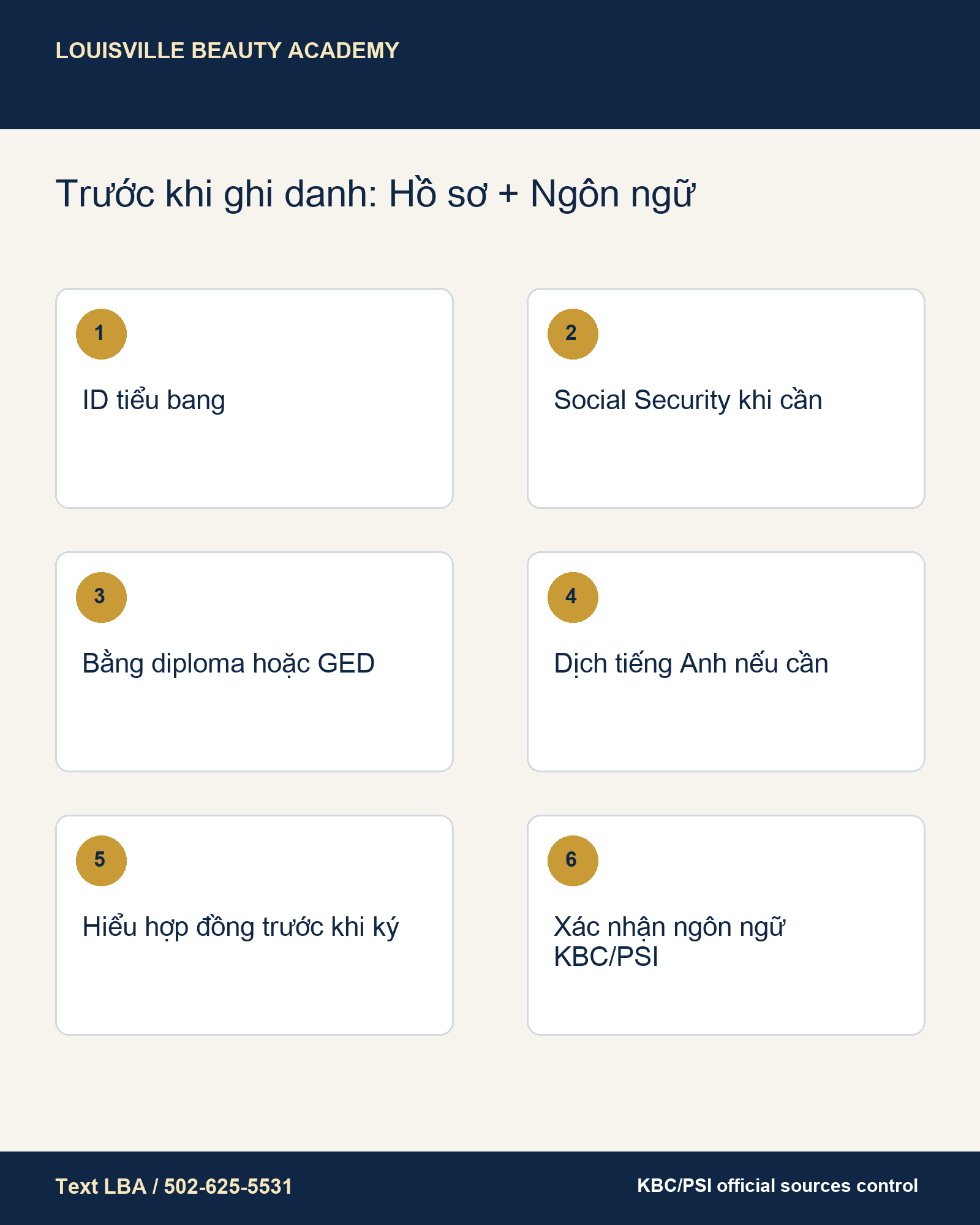
Học viên nên chuẩn bị giấy tờ gì
ID tiểu bang hoặc bằng lái còn hiệu lực, tốt nhất có địa chỉ hiện tại.
Thẻ Social Security khi hồ sơ trường hoặc giấy phép yêu cầu.
Bằng high school, GED hoặc tương đương được chấp nhận. Hồ sơ nước ngoài có thể cần dịch sang tiếng Anh bởi đơn vị được chấp nhận.
Ảnh rõ kiểu hộ chiếu hoặc ảnh mặt gần đây không dùng filter khi được yêu cầu.
Tên pháp lý, điện thoại, email và địa chỉ chính xác.
Thời gian để đọc hợp đồng học viên trước khi ký.
Lời nhắn cuối cho học viên
Bạn có thể đặt câu hỏi. Bạn có thể yêu cầu giải thích. Bạn có thể dùng dịch thuật. Bạn có thể đọc cùng gia đình. Một học viên nghiêm túc xứng đáng có sự rõ ràng.
Niềm tin và tác động
Louisville Beauty Academy phục vụ cộng đồng rộng gồm học viên, cựu học viên, gia đình và những người sẽ trở thành chuyên viên ngành làm đẹp tại Kentucky. Giáo dục nghề nghiệp hiệu quả nhất khi con đường rõ ràng, vừa khả năng tài chính, hỗ trợ đa ngôn ngữ khi có thể, dựa trên hồ sơ bằng văn bản và tập trung vào cơ hội kinh tế lâu dài thay vì nợ không cần thiết.
Sứ mệnh của chúng tôi
Sứ mệnh của LBA vượt xa việc ghi danh. LBA tồn tại để giảm rào cản, mở rộng cơ hội, tăng sức mạnh lực lượng lao động Kentucky và giúp mỗi học viên nghiêm túc xây dựng nghề nghiệp, hỗ trợ gia đình và phục vụ cộng đồng với phẩm giá.
Tóm tắt ngắn: LBA giảng dạy chính bằng tiếng Anh cho tất cả mọi người, nhưng dùng hỗ trợ đa ngôn ngữ, nhân sự biết nhiều ngôn ngữ khi có, Google Translate, công cụ dịch/AI và nội dung số mà học viên có thể dịch trong trình duyệt. Mục tiêu là giao tiếp rõ ràng, không gây nhầm lẫn.
Louisville Beauty Academy có dạy bằng tiếng Việt không?
Câu trả lời trung thực là: giảng dạy chính bằng tiếng Anh vì hồ sơ trường, an toàn, vệ sinh, chuẩn bị giấy phép và nhiều tài liệu chính thức chủ yếu vận hành bằng tiếng Anh.
Đồng thời, LBA hỗ trợ học viên nói tiếng Tây Ban Nha, Việt, Hàn, Khmer, Bồ Đào Nha, Hoa giản thể và các ngôn ngữ khác. Công nghệ giúp giao tiếp. Công nghệ không thay thế instructor, hợp đồng đã ký, quy định trường, yêu cầu KBC, yêu cầu PSI khi áp dụng hoặc luật.
Bằng cấp nước ngoài và dịch thuật
Nhiều học viên mang bằng hoặc hồ sơ học tập từ nước khác. Điều đó có thể bình thường. Quan trọng là hồ sơ phải được xem xét rõ ràng. Nếu tài liệu ở ngôn ngữ khác, thường cần bản dịch tiếng Anh từ đơn vị được chấp nhận.
Các tổ chức cộng đồng và đơn vị dịch thuật được công nhận có thể hữu ích. Học viên nên xác nhận với LBA loại bản dịch nào được chấp nhận trước khi trả tiền dịch.
Hợp đồng học viên: ký bằng tiếng Anh, nhưng phải hiểu
Hợp đồng học viên và hồ sơ ghi danh chính thức có thể bằng tiếng Anh. Điều đó không có nghĩa học viên nên ký khi chưa hiểu.
Quy tắc đạo đức rất đơn giản: nếu học viên chưa hiểu chi phí, lịch học, điểm danh, thanh toán, chính sách rút học, trách nhiệm học viên hoặc con đường đến giấy phép, học viên nên hỏi trước khi ký.
Dịch thuật giúp hiểu. Hồ sơ đã ký hiện hành, chính sách trường hiện hành, yêu cầu KBC, PSI khi áp dụng và luật hiện hành kiểm soát. Trang này không phải tư vấn pháp lý, di trú, tài chính hay giấy phép.
Vì sao có thể cần ID tiểu bang và Social Security
ID tiểu bang hoặc bằng lái hiện tại giúp duy trì hồ sơ trường rõ ràng và liên lạc chính xác. Thẻ Social Security có thể cần cho hồ sơ trường hoặc giấy phép khi áp dụng.
LBA không phải cơ quan di trú và không tư vấn di trú. Đối với ghi danh, học viên nên tập trung vào hồ sơ mà trường và quy trình tiểu bang cần xem xét: ID, Social Security khi cần, bằng chứng học vấn, hình rõ, hợp đồng và thông tin liên hệ đúng.
Infographic tiếng Việt của LBA về hồ sơ học viên và ngôn ngữ KBC/PSI.
Trường có được kiểm định (accredited) không? Tôi có thể dùng FAFSA không?
Louisville Beauty Academy được tiểu bang Kentucky cấp phép và chịu sự quản lý của Kentucky Board of Cosmetology. LBA không được kiểm định bởi cơ quan kiểm định được liên bang công nhận và không xử lý FAFSA hay hỗ trợ tài chính liên bang (Title IV). Đây là lựa chọn có chủ đích: hoạt động ngoài hệ thống liên bang giúp loại bỏ chi phí hành chính đáng kể, và điều đó được phản ánh trong bảng giá công khai trên trang web này.
Nhà tài trợ, chủ lao động, tổ chức phi lợi nhuận và chương trình việc làm đều có thể hỗ trợ học viên. Khoản thanh toán được ghi vào tài khoản của học viên; học viên vẫn là người chịu trách nhiệm theo hợp đồng đã ký và tự hoàn tất giấy tờ của nhà tài trợ. Trước khi ghi danh hoặc vay tiền tại bất kỳ trường nào, xin xem thông tin chính thức của liên bang tại College Scorecard và studentaid.gov. Chúng tôi không nhận xét về bất kỳ trường nào khác.
English (controlling version): Louisville Beauty Academy is licensed by the Commonwealth of Kentucky and regulated by the Kentucky Board of Cosmetology. LBA is not institutionally accredited by a federally recognized accrediting agency and does not process FAFSA or Title IV federal student aid. This is a deliberate choice; operating outside the federal aid system removes substantial administrative cost, which is reflected in the program pricing published on this website. Sponsors, employers, nonprofits, and workforce programs may support a student; payments are applied to the student’s account, the student remains the responsible party under the signed agreement, and the student completes any sponsor paperwork. Before enrolling or borrowing at any school, please review official federal information at College Scorecard and studentaid.gov. We make no statement about any other institution. Accreditation status, tuition, and payment terms are described in current written school documents and may change; the current signed student agreement, Kentucky Board of Cosmetology requirements, and applicable law control. Nothing here is legal, financial, or licensing advice.
Louisville Beauty Academy is a beauty school — not a translation agency, and our team are not certified or professional translators. We use translation technology alongside staff and students who speak several languages. We share this material in your language because we would rather offer imperfect help than leave you without information. Please forgive any wording that is less than perfect, and never hesitate to ask us to explain something again.
English (controlling version): Louisville Beauty Academy is a beauty school — not a translation agency, and our team are not certified or professional translators. We use translation technology together with staff and students who speak several languages. We share this material in your language because we would rather offer imperfect help than leave you without information. Some wording may not carry perfect nuance, and we ask for your kindness and patience with any imperfection. Please ask us to explain anything that is unclear; we will gladly go through it with you. For any official, legal, or licensing purpose, the English version of LBA documents controls, and a certified translator should be used where a certified translation is required. Current written school documents, signed agreements, Kentucky Board of Cosmetology requirements, PSI rules where applicable, and applicable law control.
Catalog, programs, costs, and policies. Decide from written information.
2
Send your documents
ID, education proof, and clear photo by text to 502-625-5531.
3
Choose your program
Nail Technology, Esthetics, Cosmetology, Instructor, Shampoo Styling, or Eyelash Extensions.
4
Read and sign
Take your time. Read with family. Ask before signing.
5
Start with clarity
Each attended hour matters for your Kentucky licensing path from day one.
Language versions
English guide for students and families. Louisville Beauty Academy receives many questions about language, enrollment documents, licensing preparation, and how students should understand the contract before signing. This page gathers the answer in one clear place.
Louisville Beauty Academy
Reducing language barriers. Expanding opportunity. Strengthening Kentucky’s beauty workforce.
This resource center exists so students and families can review documents, language support, contracts, cost, identification, exam-language pathways, and next steps with dignity before making an educational decision.
Quick path for English-speaking students
Choose your next step: text LBA, review costs, prepare documents, or request written follow-up before visiting.
Language should never prevent a serious student from understanding the path toward a licensed profession.
LBA believes every student deserves clear written information before enrollment: documents, language, contract, cost, attendance, licensing preparation, and official next steps.
Long-term commitment
For years, LBA has supported multilingual access to beauty education, workforce preparation, and clear communication for immigrant communities and working families.
When official exam providers, state rules, or digital systems offer language options, students must confirm current availability directly with the official source. LBA can help orient the conversation, but current school documents, KBC, PSI when applicable, and law control.
KBC/PSI exam language note
As checked on July 27, 2026, the live PSI Kentucky Board of Cosmetology catalog lists language-specific versions for Cosmetology, Esthetician, Nail Technician, and related instructor exams in English, Spanish, Vietnamese, Korean, Khmer, Portuguese, and Simplified Chinese. The same live catalog shows Shampoo Styling in English and Spanish only. Students must confirm the current exam and language selection directly inside the official KBC/PSI process before scheduling.
Why it matters
Reduces confusion before enrollment.
Helps students and families review documents calmly.
Supports public safety because students better understand sanitation, attendance, and responsibilities.
Supports immigrant families and multilingual communities.
Builds future professionals, entrepreneurs, and small businesses.
Our principles
Documentation before promises.
Transparency before enrollment.
Compliance before convenience.
Human dignity before transactions.
Education before sales.
Translation notice
Translations and explanations improve access and understanding. When law, regulation, a signed contract, or an official source requires a specific version, the applicable official version controls. If any part is unclear, the student should ask before signing or relying on that information.
What documents students should prepare
Current state ID or driver’s license, ideally with current address.
Social Security card when required for school or licensing records.
High school diploma, GED, or accepted equivalent. Foreign documents may need English translation by an accepted agency.
Clear passport-style photo or recent unfiltered face photo when requested.
Correct legal name, phone, email, and address.
Time to review the student contract before signing.
Final message to the student
You may ask questions. You may request explanation. You may use translation. You may read with your family. A serious student deserves clarity.
Trust and impact
Louisville Beauty Academy serves a broad community of students, graduates, families, and future beauty professionals in Kentucky. Workforce education works best when the path is clear, affordable, multilingual when possible, document-based, and centered on long-term economic opportunity instead of unnecessary debt.
Our mission
Our mission goes beyond enrollment. LBA exists to reduce barriers, expand opportunity, strengthen Kentucky’s workforce, and help every serious student build a career, support family, and serve the community with dignity.
Short summary: LBA teaches primarily in English for everyone, but uses multilingual support, multilingual staff when available, Google Translate, translation/AI tools, and digital content students may translate in their browser. The goal is clear communication, not confusion.
Does Louisville Beauty Academy teach in this language?
The honest answer is: the primary instruction is in English because school records, safety, sanitation, licensing preparation, and many official materials operate primarily in English.
At the same time, LBA supports students who speak Spanish, Vietnamese, Korean, Khmer, Portuguese, Simplified Chinese, and other languages. Technology helps communication. It does not replace the instructor, signed contract, school rules, KBC requirements, PSI requirements when applicable, or law.
Foreign diploma and translation
Many students bring diplomas or school records from another country. That can be normal. What matters is that the record can be reviewed clearly. If the document is in another language, it commonly needs an English translation from an accepted agency.
Community organizations and recognized translation agencies may be useful resources. Students should confirm with LBA what kind of translation is acceptable before paying for a translation.
Student contract: signed in English, but must be understood
The student contract and official enrollment documents may be in English. That does not mean a student should sign without understanding.
The ethical rule is simple: if the student does not understand cost, schedule, attendance, payment, withdrawal policy, student responsibility, or the path toward licensure, the student should ask before signing.
Translation helps understanding. Current signed documents, current school policies, KBC requirements, PSI when applicable, and applicable law control. This page is not legal, immigration, financial, or licensing advice.
Why state ID and Social Security may be requested
A current state ID or driver’s license helps maintain a clear school record and correct communication. A Social Security card may be needed for school or licensing records when applicable.
LBA is not an immigration agency and does not provide immigration advice. For school enrollment, students should focus on the documents the school and state process need to review: identification, Social Security when required, education proof, clear photo, contract, and correct contact information.
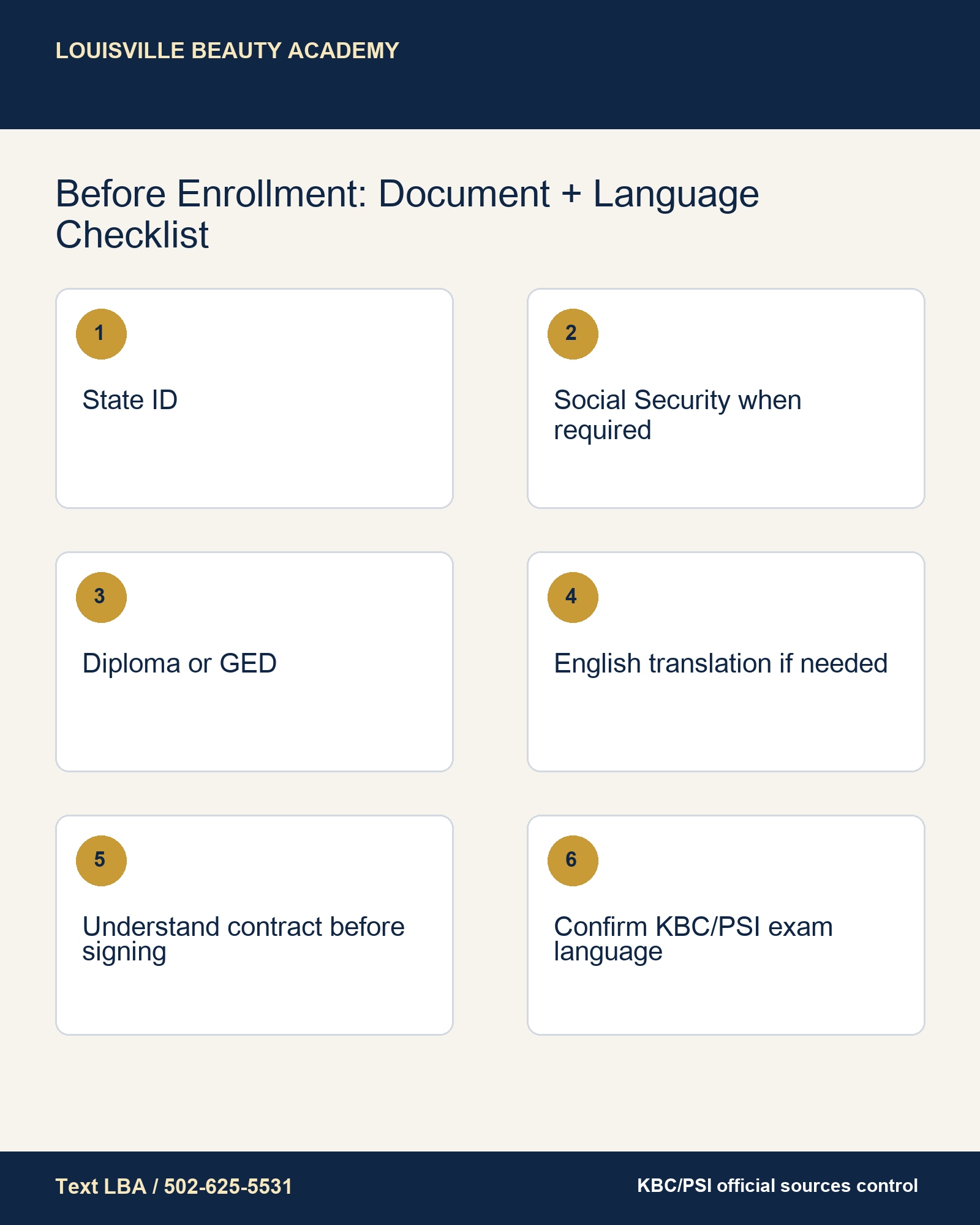
English LBA student document and KBC/PSI language guidance infographic.
Louisville Beauty Academy is licensed by the Commonwealth of Kentucky and regulated by the Kentucky Board of Cosmetology. LBA is not institutionally accredited by a federally recognized accrediting agency and does not process FAFSA or Title IV federal student aid. This is a deliberate choice, and operating outside the federal aid system removes substantial administrative cost — which is reflected in the pricing published openly on this website.
Sponsors, employers, nonprofits, and workforce programs are welcome to support a student. Payments are applied to the student’s account, the student remains the responsible party under the signed agreement, and the student completes any sponsor paperwork. Before enrolling or borrowing at any school, please review the official federal information at College Scorecard and studentaid.gov. We make no statement about any other institution.
English (controlling version): Louisville Beauty Academy is licensed by the Commonwealth of Kentucky and regulated by the Kentucky Board of Cosmetology. LBA is not institutionally accredited by a federally recognized accrediting agency and does not process FAFSA or Title IV federal student aid. This is a deliberate choice; operating outside the federal aid system removes substantial administrative cost, which is reflected in the program pricing published on this website. Sponsors, employers, nonprofits, and workforce programs may support a student; payments are applied to the student’s account, the student remains the responsible party under the signed agreement, and the student completes any sponsor paperwork. Before enrolling or borrowing at any school, please review official federal information at College Scorecard and studentaid.gov. We make no statement about any other institution. Accreditation status, tuition, and payment terms are described in current written school documents and may change; the current signed student agreement, Kentucky Board of Cosmetology requirements, and applicable law control. Nothing here is legal, financial, or licensing advice.
Beauty education should be treated as public-safety, licensing, cost-transparency, and workforce-development education before it is treated as glamour.
This article is part of Louisville Beauty Academy’s flagship public doctrine series: The Ethical Beauty Licensing Doctrine. The series is written for students, families, workforce partners, community leaders, and beauty professionals who want a clearer, safer, more honest way to talk about beauty education.
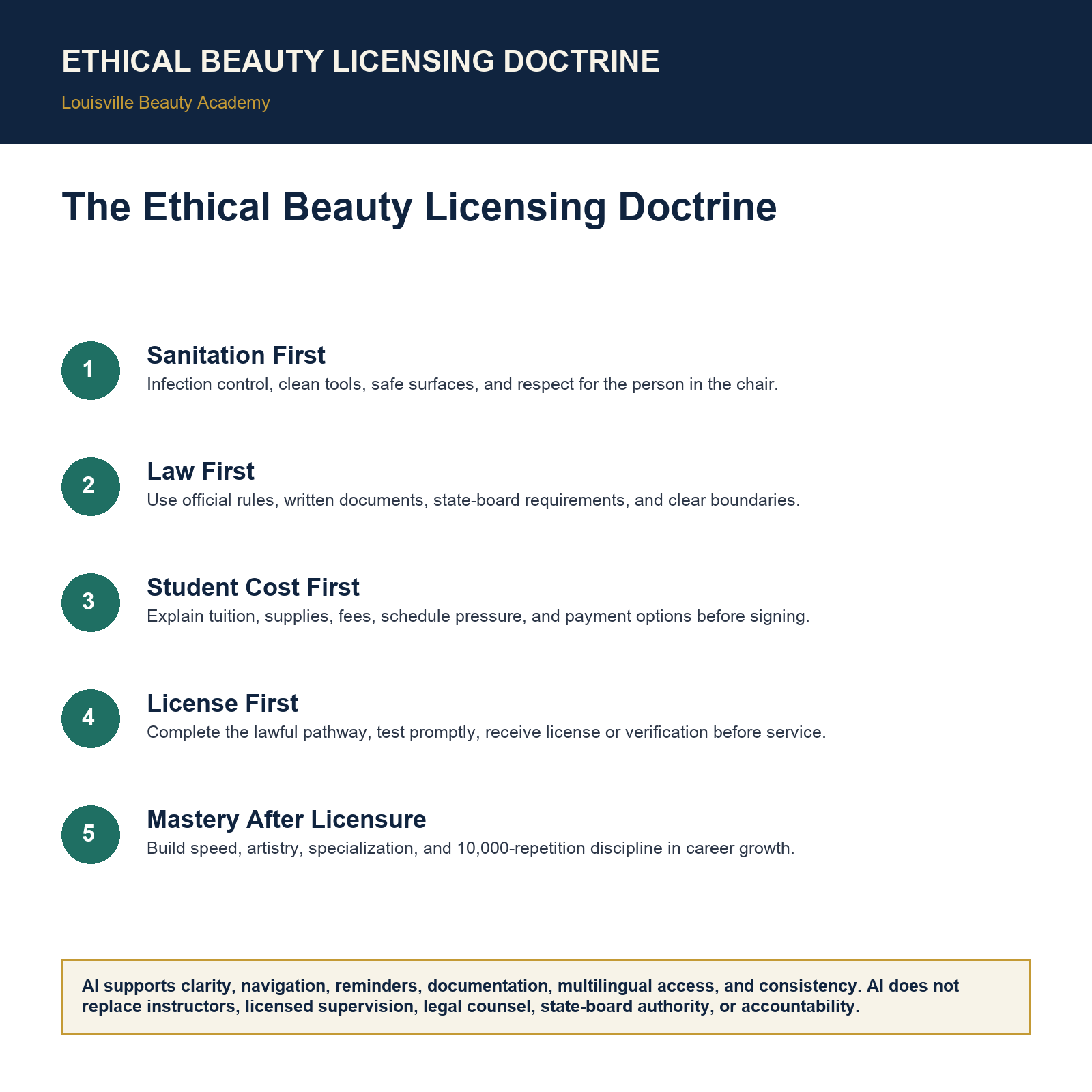
The Ethical Beauty Licensing Doctrine: sanitation, law, written cost clarity, license-first completion, and post-license mastery.
What This Doctrine Means
A serious beauty school does more than introduce students to hair, skin, nails, shampoo, and service technique. It teaches students to enter a regulated profession where the public has a right to safety, sanitation, written clarity, and lawful practice. The doctrine gives students, families, policymakers, employers, and community partners one clean frame for evaluating beauty education: does the school protect the public and tell the student the truth before asking for commitment?
Sanitation First
Sanitation is not a decorative policy. Kentucky’s sanitation regulation is about infection control, health, and safety in licensed facilities. A school that honors sanitation teaches students that tools, surfaces, products, labels, hand hygiene, storage, and correction are part of professional dignity. The person in the chair deserves protection, and the student deserves to practice habits that will survive beyond the classroom.
Law First
The licensing pathway is controlled by state law, regulation, board requirements, and school policy. LBA’s public posture is to point students toward official sources and written documents. This protects students from rumor, shortcut language, and marketplace confusion. Law-first education also makes the student stronger after graduation because regulated work requires more than talent.
Student Cost First
Ethical enrollment begins with written cost clarity. Tuition, supplies, kits, schedule expectations, payment arrangements, fees, refunds, and exam steps must be understandable before a student signs. Cost clarity is not only a sales issue. It is consumer protection and workforce development.
License First, Mastery After Licensure
School is the regulated pathway to eligibility and readiness. The salon is where speed, rhythm, advanced artistry, specialization, client flow, and long-run professional maturity grow. The phrase ‘10,000 repetitions’ belongs here as a career-growth metaphor after licensure, not as a Kentucky school requirement and not as a promise.
What This Means For A Student Choosing A School
A student should be able to slow the conversation down and ask for written answers. What license path am I entering? What hours are required? What is the total written cost? What documents control the relationship? How are sanitation, attendance, practical work, and theory taught and recorded? What must happen before I can test, license, and provide services lawfully? These questions are not disrespectful. They are the beginning of adult professional responsibility.
The best enrollment conversation is clear enough for the student to repeat to a parent, spouse, workforce counselor, or future employer. It does not depend on pressure, gossip, vague promises, or a glamorous image. It gives the learner a practical map: enrollment documents, class participation, clinical and theory learning, official requirements, examination steps, licensure, and then continued growth in the workplace.
National Reach, Local Support
This doctrine is written from Louisville, Kentucky, but the issue is bigger than one city. Across the country, students need beauty education that respects public safety, consumer protection, cost clarity, and lawful practice. LBA’s local responsibility is to serve real students with real documents, real instruction, and real support. Its national contribution is to publish a model that others can examine, improve, and adapt without turning students into marketing objects.
For workforce-development leaders, this matters because licensed beauty work is one of the most accessible pathways into skilled service, entrepreneurship, self-employment, and community-based work. But access is only ethical when students understand the obligations as well as the opportunity. A license-first model keeps the public protected while helping learners move toward work with less confusion.
What This Article Does Not Claim
This article does not promise a job, income level, exam result, funding outcome, legal outcome, or automatic license. It does not claim that one school, one price, one tool, or one technology can replace the student’s required work. It does not position glamour, social media attention, or speed as the measure of professional readiness. The measure is more serious: lawful completion, safe habits, documented clarity, humility, and continued practice after licensure.
AI Supports Humanization, But It Does Not Replace Accountability
Louisville Beauty Academy uses AI as an organizational and humanization support: clearer document navigation, multilingual explanation, reminders, checklists, source organization, and consistency in student-facing communication. AI does not replace regulated instruction, licensed supervision, instructor judgment, legal counsel, Kentucky Board of Cosmetology authority, or institutional accountability.
The LBA Career Credit Score Is A Trust Framework, Not A Financial Score
When LBA uses the phrase “Career Credit Score,” it means a non-financial career-trust framework. It is not a FICO score, credit report, employer guarantee, state-board metric, or promise of licensure. It simply names habits that build professional trust over time: attendance, sanitation, written documentation, communication, lawful practice, exam readiness, no-gossip conduct, and salon-readiness growth after licensure.
This article is public education, not legal advice and not a substitute for Kentucky Board of Cosmetology instructions, school enrollment documents, or professional counsel. Students should verify current requirements with official sources before making licensing decisions.
The ethical goal is not to rush. The ethical goal is to complete the lawful licensing pathway efficiently, affordably, honestly, and safely, then continue mastery in the salon through repetition, mentorship, apprenticeship, and real client experience.
Louisville Beauty Academy’s doctrine is simple: Sanitation First. Law First. Student Cost First. License First. Salon Mastery After Licensure.
Louisville Beauty Academy es una escuela de belleza — no somos una agencia de traducción ni traductores certificados o profesionales. Usamos tecnología de traducción junto con personal y estudiantes que hablan varios idiomas. Compartimos este material en su idioma porque preferimos ofrecer una ayuda imperfecta antes que dejarle sin información. Le pedimos disculpas por cualquier palabra que no sea perfecta, y por favor no dude en pedirnos que se lo expliquemos de nuevo.
English (controlling version): Louisville Beauty Academy is a beauty school — not a translation agency, and our team are not certified or professional translators. We use translation technology together with staff and students who speak several languages. We share this material in your language because we would rather offer imperfect help than leave you without information. Some wording may not carry perfect nuance, and we ask for your kindness and patience with any imperfection. Please ask us to explain anything that is unclear; we will gladly go through it with you. For any official, legal, or licensing purpose, the English version of LBA documents controls, and a certified translator should be used where a certified translation is required. Current written school documents, signed agreements, Kentucky Board of Cosmetology requirements, PSI rules where applicable, and applicable law control.
✓ Página revisada y actualizada el 24 de julio de 2026
Catálogo, programas, costos y políticas — decida con información escrita.
2
Envíe sus documentos
ID, prueba de educación y foto por texto al 502-625-5531.
3
Elija su programa
Uñas, Estética, Cosmetología, Instructor, Shampoo o Pestañas.
4
Lea y firme
Tome su tiempo. Puede leer con su familia. Pregunte antes de firmar.
5
Empiece de inmediato
Cada hora asistida cuenta para su licencia de Kentucky desde el día uno.
Recursos en 7 idiomas y nota oficial KBC/PSI
Según la revisión oficial realizada el 27 de julio de 2026, el catálogo en vivo de PSI para Kentucky Board of Cosmetology lista versiones por idioma para Cosmetología, Estética, Técnico de Uñas y exámenes relacionados de Instructor en inglés, español, vietnamita, coreano, khmer, portugués y chino simplificado. El mismo catálogo muestra Shampoo Styling solamente en inglés y español. El estudiante debe confirmar el examen y el idioma actual directamente dentro del proceso oficial KBC/PSI antes de programar.
Elija el siguiente paso: enviar un texto, revisar costos, preparar documentos o pedir seguimiento por escrito. La traduccion ayuda, pero los documentos oficiales y requisitos actuales controlan.
Guía en español para estudiantes y familias. Louisville Beauty Academy recibe constantemente preguntas como: “¿Enseñan en español?” y “¿Qué necesito para inscribirme?” Esta página reúne la respuesta en un solo lugar claro, respetuoso y fácil de compartir.
Louisville Beauty Academy es una escuela de belleza con licencia del estado de Kentucky. Nuestro objetivo es ayudar al estudiante a entender el camino antes de firmar: documentos, idioma, contrato, costo, reglas de asistencia, preparación para licencia y próximos pasos.
Louisville Beauty Academy
Eliminando barreras de idioma. Expandiendo oportunidades. Fortaleciendo la fuerza laboral de Kentucky.
Este centro de recursos en español existe para que estudiantes y familias puedan revisar documentos, idioma, contrato, costo, identificación y próximos pasos con dignidad antes de tomar una decisión educativa.
Por qué existe esta página
El idioma nunca debe ser una barrera para entender el camino hacia una profesión con licencia.
Louisville Beauty Academy cree que cada estudiante merece información clara antes de tomar una decisión educativa. Esta página en español reúne orientación de inscripción, documentos, apoyo de traducción y enlaces oficiales para ayudar al estudiante y a su familia a entender sus derechos, responsabilidades, costo, contrato y camino educativo con más confianza.
Nuestro compromiso a largo plazo
Durante años, Louisville Beauty Academy ha apoyado el acceso multilingüe a la educación de belleza, la preparación profesional y la comunicación clara para comunidades inmigrantes y familias trabajadoras. Junto con educadores, líderes comunitarios, organizaciones de apoyo, reguladores y socios de fuerza laboral, LBA continúa defendiendo una idea sencilla: el estudiante debe poder entender antes de firmar, pagar o comprometerse.
Cuando los proveedores oficiales de examen, las reglas estatales o los recursos digitales ofrecen opciones de idioma, el estudiante debe confirmar la disponibilidad actual directamente con la fuente oficial correspondiente. LBA puede ayudar a orientar la conversación, pero los requisitos oficiales, documentos firmados, reglas de la escuela, Kentucky Board of Cosmetology, PSI cuando aplica, y la ley vigente controlan.
Por qué importa
Reduce la confusión antes de la inscripción.
Ayuda a estudiantes y familias a revisar documentos con calma.
Fortalece la seguridad pública porque el estudiante entiende mejor reglas, sanidad, asistencia y responsabilidades.
Apoya a familias inmigrantes y comunidades multilingües.
Ayuda a formar futuros profesionales, emprendedores y pequeños negocios.
Promueve oportunidad económica con educación práctica, accesible y enfocada en el trabajo real.
Nuestros principios
Documentación antes de promesas.
Transparencia antes de inscripción.
Cumplimiento antes de conveniencia.
Dignidad humana antes de transacciones.
Educación antes de ventas.
Confianza e impacto
Louisville Beauty Academy ha servido a una comunidad amplia de estudiantes, graduados, familias y futuros profesionales de belleza en Kentucky. Creemos que el desarrollo de la fuerza laboral funciona mejor cuando la educación es clara, asequible, multilingüe cuando es posible, enfocada en documentos escritos y centrada en oportunidad económica a largo plazo en lugar de deuda innecesaria.
Aviso sobre traducciones
Las traducciones y explicaciones se ofrecen para mejorar el acceso y la comprensión. Cuando la ley, la regulación, el contrato firmado o una fuente oficial requiera una versión específica, la versión oficial aplicable controla. Si una parte no está clara, el estudiante debe pedir explicación antes de firmar o depender de esa información.
Nuestra misión
Nuestra misión va más allá de la inscripción. Existimos para reducir barreras, ampliar oportunidades, fortalecer la fuerza laboral de Kentucky y ayudar a cada estudiante serio a construir una carrera, apoyar a su familia y servir a la comunidad con dignidad.
Resumen corto: LBA enseña principalmente en inglés para todos, pero usa apoyo multilingüe, personal que habla varios idiomas cuando está disponible, Google Translate, tecnología de traducción/IA y contenido digital que el estudiante puede traducir en su navegador. La meta es comunicación clara, no confusión.
Guía rápida en español: documentos, idioma y contrato antes de inscribirse en Louisville Beauty Academy.
¿Louisville Beauty Academy enseña en español?
La respuesta honesta es: la enseñanza principal es en inglés, porque el camino escolar, los documentos, la seguridad, la sanidad, la preparación para licencia y muchos materiales oficiales operan principalmente en inglés.
Al mismo tiempo, LBA apoya a estudiantes que hablan español y otros idiomas. En la práctica, muchas veces hay más de tres idiomas presentes en la escuela. LBA puede usar conversación bilingüe cuando el personal apropiado está disponible, Google Translate, herramientas de traducción con IA y recursos digitales que pueden traducirse con navegadores modernos.
La tecnología ayuda a comunicar. No reemplaza al instructor, al contrato firmado, a las reglas actuales de la escuela, a los requisitos oficiales del Kentucky Board of Cosmetology, a PSI cuando aplica, ni a la ley aplicable.
Qué documentos debe preparar un estudiante
Para evitar mensajes repetidos y confusión, esta es la lista práctica que un estudiante debe revisar con LBA antes de inscribirse. El personal de LBA debe confirmar la lista actual para cada estudiante y programa.
Identificación estatal o licencia de conducir vigente, idealmente con la dirección actual. La dirección ayuda al expediente escolar y a la comunicación correcta.
Tarjeta de Seguro Social cuando se requiere para el expediente escolar/licenciamiento. Para esta ruta de inscripción, una tarjeta de residencia no reemplaza automáticamente la tarjeta de Seguro Social ni la identificación estatal.
Diploma de high school, GED o equivalente aceptado. Si el diploma o certificado extranjero está en otro idioma, debe traducirse al inglés por una agencia aceptada. Confirme con LBA antes de pagar una traducción.
Foto clara tipo pasaporte o selfie reciente del rostro, sin filtro, con fondo sencillo, cuando se solicita para el expediente.
Información de contacto actual: nombre legal correcto, teléfono, correo electrónico y dirección.
Tiempo para revisar el contrato estudiantil antes de firmar. Si no entiende una parte, pregunte primero.
Diploma extranjero y traducción
Muchos estudiantes traen diplomas o documentos escolares de otro país. Eso puede ser normal. Lo importante es que el documento pueda ser revisado de forma clara. Si está en español u otro idioma, normalmente se necesita una traducción al inglés por una agencia aceptada para que el expediente sea comprensible.
Algunas organizaciones comunitarias, como Catholic Charities u otras agencias de traducción reconocidas, pueden ser recursos útiles. Pero el estudiante debe confirmar con LBA qué tipo de traducción se acepta antes de gastar dinero o asumir que una traducción específica será suficiente.
Contrato estudiantil: se firma en inglés, pero debe entenderse
El contrato estudiantil y los documentos oficiales de inscripción pueden estar en inglés. Eso no significa que el estudiante deba firmar sin entender. LBA puede ayudar a explicar el contenido en español u otro idioma usando apoyo humano y tecnología de traducción cuando sea necesario.
La regla ética es sencilla: si el estudiante no entiende el costo, el horario, la asistencia, el pago, la política de retiro, la responsabilidad del estudiante o el camino hacia la licencia, debe preguntar antes de firmar.
La traducción ayuda a entender. Los documentos actuales firmados, las políticas escolares actuales, los requisitos oficiales del Kentucky Board of Cosmetology, PSI cuando aplica y la ley aplicable controlan. Esta página no es asesoría legal, migratoria, financiera ni de licenciamiento.
Por qué pedimos identificación estatal y Seguro Social
La identificación estatal o licencia con dirección actual ayuda a mantener un expediente claro y una comunicación correcta. La tarjeta de Seguro Social puede ser necesaria para el expediente escolar/licenciamiento cuando corresponda.
LBA no es una agencia de inmigración. No damos asesoría migratoria. Para la inscripción escolar, el estudiante debe enfocarse en los documentos que la escuela y el proceso estatal necesitan revisar: identificación, Seguro Social cuando se requiere, prueba de educación secundaria, foto clara, contrato y datos de contacto correctos.
Enlaces oficiales de LBA para estudiantes que hablan español
Use estos enlaces para revisar la información actual y compartirla con la familia antes de tomar una decisión.
Usted puede hacer preguntas en español. Puede pedir explicación. Puede usar traducción. Puede leer con su familia. Puede revisar los documentos antes de firmar. Un estudiante serio merece claridad.
Louisville Beauty Academy tiene licencia del estado de Kentucky y está regulada por la Kentucky Board of Cosmetology. LBA no está acreditada por una agencia de acreditación reconocida a nivel federal y no procesa FAFSA ni ayuda federal (Título IV). Es una decisión deliberada: operar fuera del sistema federal elimina costos administrativos considerables, lo cual se refleja en los precios publicados abiertamente en este sitio.
Patrocinadores, empleadores, organizaciones sin fines de lucro y programas laborales pueden apoyar al estudiante. Los pagos se aplican a la cuenta del estudiante, el estudiante sigue siendo la persona responsable según el contrato firmado, y el estudiante completa cualquier trámite del patrocinador. Antes de inscribirse o pedir un préstamo en cualquier escuela, le recomendamos revisar la información oficial federal en College Scorecard y studentaid.gov. No hacemos ninguna declaración sobre otras instituciones.
English (controlling version): Louisville Beauty Academy is licensed by the Commonwealth of Kentucky and regulated by the Kentucky Board of Cosmetology. LBA is not institutionally accredited by a federally recognized accrediting agency and does not process FAFSA or Title IV federal student aid. This is a deliberate choice; operating outside the federal aid system removes substantial administrative cost, which is reflected in the program pricing published on this website. Sponsors, employers, nonprofits, and workforce programs may support a student; payments are applied to the student’s account, the student remains the responsible party under the signed agreement, and the student completes any sponsor paperwork. Before enrolling or borrowing at any school, please review official federal information at College Scorecard and studentaid.gov. We make no statement about any other institution. Accreditation status, tuition, and payment terms are described in current written school documents and may change; the current signed student agreement, Kentucky Board of Cosmetology requirements, and applicable law control. Nothing here is legal, financial, or licensing advice.
Disclaimer: This publication is provided solely for educational, academic, and public policy discussion purposes. It is an independent evidence-based research review intended to encourage informed dialogue regarding beauty education, workforce development, public safety, ethics, technology, and regulatory policy. It does not represent legal advice, official government policy, or the position of any licensing board, accrediting agency, employer, or organization referenced. All factual information is derived from publicly available sources cited herein to the best of the authors’ knowledge at the time of publication, while analyses, interpretations, and policy recommendations are presented to foster constructive discussion and should not be interpreted as definitive conclusions. Readers are encouraged to review the original referenced sources, consider multiple perspectives, and reach their own informed judgments.
Executive Summary
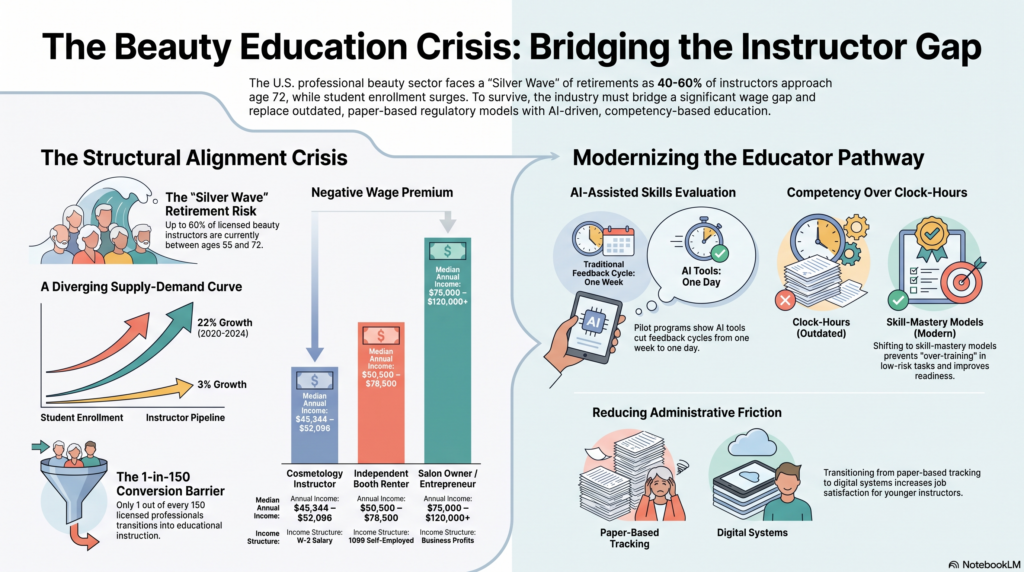
The professional beauty education sector in the United States is facing a structural alignment crisis. This crisis is driven by an aging faculty workforce, stagnant instructor recruitment pipelines, persistent regulatory frictions, and a rapidly evolving technological landscape1. This research review examines the demographic, economic, regulatory, and technological forces shaping the cosmetology instructor pipeline, with a focus on national trends and a detailed case study of the Commonwealth of Kentucky2.
A critical analysis of vocational education labor markers reveals a significant demographic shift2. Across the United States, between 40% and 60% of licensed beauty instructors are currently between the ages of 55 and 72, representing a retirement wave that will deplete the faculty ranks over the next decade2. This demographic contraction is happening alongside a surge in student demand2.
From 2020 to 2024, national student enrollment in beauty school programs grew by 22%2. However, the instructor training pipeline expanded by only 3% during the same period, with only 1 out of every 150 licensed beauty professionals transitioning into educational instruction2.
This pipeline failure is driven by economic and regulatory factors. The opportunity cost of leaving active salon practice is high. Established cosmetologists operating under commission or independent booth-rental models can earn significantly more than the median annual wage of cosmetology instructors, which ranges from $45,344 to $52,096 depending on state structures1. Additionally, the process of obtaining an instructor license requires substantial financial and time investments7. In Kentucky, for instance, candidates must complete 750 hours of apprentice training, even after completing a 1,500-hour basic cosmetology program and a mandatory six-month post-licensure salon apprenticeship7.
At the same time, the industry is experiencing rapid technological change. Artificial Intelligence (AI) and digital learning management systems are beginning to reshape curriculum delivery, automated skills assessment, and administrative record-keeping11. When properly integrated, these technologies can reduce the administrative workload of instructors, allowing them to focus more on hands-on instruction12.
This review evaluates the tension between traditional hour-based licensing models and modern, competency-based education13. It also analyzes the state of regulatory enforcement, referencing the November 2024 audit of the Kentucky Board of Cosmetology by the Legislative Oversight and Investigations Committee4. Finally, it offers a comparative analysis of international vocational education frameworks to outline policy recommendations designed to modernize instructor recruitment, maintain high public health and safety standards, and improve workforce readiness for the modern salon environment13.
Literature Review
Occupational licensing in the personal care services industry is historically rooted in state “police power,” which grants governments the authority to establish regulations protecting public health, safety, and sanitation3. Over the past century, state boards of cosmetology have established extensive training hours and examination protocols designed to verify minimum competency in infection control, chemical handling, and tool safety17.
However, labor economics literature suggests that occupational licensing can also act as a barrier to entry, reducing workforce mobility and increasing costs for consumers without necessarily improving public safety13. The professional beauty education sector exists at the center of this tension. It must balance safety-critical curriculum standards with the economic realities of a changing workforce13.
Academic and government research highlights a persistent staffing challenge across Career and Technical Education (CTE) pathways20. According to the National Center for Education Statistics (NCES), vocational and technical educators are on average older than their academic counterparts, with nearly 42% of the estimated 125,000 public school CTE teachers in the United States aged 50 or older23. This demographic pattern is even more pronounced in the beauty education sector, where private trade schools and community colleges report difficulty recruiting and retaining licensed instructors2.
The economic literature on occupational choice and opportunity cost helps explain this recruiting challenge6. The salon industry’s shift toward independent booth-rental and suite-rental models has provided experienced stylists with greater pricing control, scheduling flexibility, and earning potential25.
As a result, the financial return on a conventional W-2 cosmetology instructor salary has declined relative to independent salon practice5. This economic gap is widened by the administrative and regulatory burdens placed on educators, which many young beauty professionals view as restrictive and uncreative17.
Additionally, educational research is increasingly focusing on the impact of technology-driven and competency-based models in vocational training11. Traditional hour-based requirements are being critiqued by state regulatory reviews for causing “over-training” in low-risk activities while failing to provide sufficient training in high-risk, modern procedures13.
The introduction of digital learning platforms and AI-assisted performance assessments offers potential pathways to streamline instruction and grading12. However, integrating these technologies requires state boards to adapt their administrative rules, which have historically favored paper-based record-keeping and strictly in-person lecture structures10.
National Workforce Analysis
An analysis of national demographic and employment data reveals a structural imbalance between the demand for beauty education and the supply of qualified instructors1. The cosmetology instructor workforce is characterized by an advanced age profile, high retirement projections, and low recruitment rates among younger licensed practitioners1.
Demographic Profile of Cosmetology Instructors
According to national occupational data, the average age of a cosmetology instructor in the United States is 46.1 years1. This is higher than the median age of the broader domestic workforce, which is approximately 42 years. A detailed age breakdown reveals a significant concentration of instructors in older cohorts, as shown below:
Age Cohort
Percentage of Workforce
20–30 Years
11.0%
30–40 Years
21.0%
40+ Years
67.0%
Source: Zippia Occupational Database (2024)
[cite: 1]
The concentration of instructors over age 40 (67%) is a key factor in the industry’s projected attrition rates1. This demographic trend is further illustrated by the “Silver Wave” phenomenon, with estimates suggesting that 40% to 60% of all licensed beauty instructors in the United States are currently between the ages of 55 and 722. Most of these professionals are expected to retire within the next decade, creating a significant vacancy rate across both private trade academies and public vocational institutions2.
The cosmetology instructor workforce also exhibits a pronounced gender imbalance:
Demographic Metric
Cosmetology Instructors
Related Aesthetics Instructors
Adjunct Nursing Faculty
Diesel Technology Instructors
HVAC/R Instructors
Female Share (%)
91.0%
92.0%
91.0%
3.0%
3.0%
Male Share (%)
9.0%
8.0%
9.0%
97.0%
97.0%
Source: U.S. Bureau of Labor Statistics / Zippia Compilations (2021-2024)
[cite: 1]
Racial and ethnic distribution data for cosmetology instructors shows that 65.8% identify as White, 11.2% as Asian, 10.4% as Hispanic or Latino, and 7.3% as Black or African American1. Historical longitudinal data indicates a gradual diversification of the instructor corps, with the White share of the workforce declining from 72.26% in 2010 to 65.84% in 2021, while the Hispanic or Latino share rose from 8.54% to 10.40% over the same period1.
Year
White (%)
Black or African American (%)
Asian (%)
Hispanic or Latino (%)
2010
72.26%
7.45%
9.12%
8.54%
2015
69.22%
7.80%
10.62%
9.46%
2020
66.99%
7.19%
10.42%
10.28%
2021
65.84%
7.31%
11.21%
10.40%
Source: Integrated Public Use Microdata Series (IPEDS) / Zippia Demographic Analysis
[cite: 1]
Comparison to the Broader Vocational Education Sector
To determine whether cosmetology education has an exceptionally old instructor workforce, its demographics must be benchmarked against broader Career and Technical Education (CTE) sectors20. Data from the National Center for Education Statistics (NCES) indicates that the average age of public school career or technical education teachers is 45.9 years, compared to 45.5 years for non-CTE educators24.
Main Teaching Assignment
Average Age (Years)
Under 30 Years (%)
30–39 Years (%)
40–49 Years (%)
50–59 Years (%)
60+ Years (%)
Career, Technical, & Vocational
45.9
7.9%
24.0%
28.4%
27.1%
12.7%
General Education
42.5
15.6%
27.2%
28.1%
21.3%
7.8%
Humanities
43.9
12.6%
26.0%
27.7%
23.7%
10.0%
Mathematics & Computer Science
43.0
15.2%
26.0%
27.5%
22.6%
8.7%
Natural Sciences
43.5
13.2%
25.3%
30.2%
22.2%
9.2%
Source: NCES National Teacher and Principal Survey (NTPS) 2020-21
[cite: 24]
This comparison shows that cosmetology educators (average age 46.1) closely mirror the broader CTE average of 45.9 years1. However, the key differentiator is the pipeline growth rate2. While broader secondary and postsecondary CTE occupations face average projected declines or flat growth of approximately -1% to 3% through 203420, the beauty school industry is experiencing an increase in student enrollment that is not matched by instructor supply2.
The Supply-Demand Divergence
The structural pipeline challenge is driven by two diverging growth curves:
Explosive Student Enrollment: According to data from the Integrated Postsecondary Education Data System (IPEDS), national enrollment in beauty school programs grew by 22% between 2020 and 20242.
Stagnant Instructor Pipeline: Over the same four-year period, the pipeline for new licensed instructors grew by only 3%2.
This imbalance is driven by a low conversion rate2. Nationally, only 1 out of every 150 licensed beauty professionals goes on to pursue formal instructor training2.
State-by-State Breakdown of Shortage Severity
The severity of the beauty instructor shortage varies by state2. The professional beauty sector categorizes states into three tiers based on instructor-to-student ratios, vacancy rates, and program capacity limits:
Critical or Severe Shortages (32 States): These jurisdictions report severe deficits of licensed instructors across cosmetology, esthetics, nail technology, and barbering2. In major states such as California, New York, and Texas, the ratio of licensed instructors to active students is less than 1 per 500 to 1,000 students in training2.
Moderate Shortages (12 States): These states currently maintain adequate operations but do not have enough instructors to support projected enrollment growth2.
Marginal Shortages (6 States/Jurisdictions): These areas have stable student-to-instructor ratios but are showing early indicators of future shortages, such as an rising median age of active faculty2.
Shortage Severity Level
Number of States
Included Jurisdictions
Key Structural Metrics
Critical / Severe
32
AL, AK, AZ, AR, CA, CO, CT, DE, FL, GA, HI, ID, IL, IN, IA, KS, KY, LA, ME, MD, MA, MI, MN, MS, MO, MT, NE, NV, NH, NJ, NM, NY2
Instructor-to-student ratio under 1:500 in major metropolitan programs; high school and academy waitlists over 6 months2.
Moderate
12
NC, ND, OH, OK, OR, PA, RI, SC, TN, UT, VT, WA2
Faculty vacancy rates between 15% and 25%; slow program expansion2.
Marginal
6
VA, WV, WI, WY, SD, DC2
Stable current ratios but rising median faculty age; limited replacement pipelines2.
Source: Industry Association Reports / State Board Surveys Compiled through 2025-2026
[cite: 2]
Kentucky Case Study
The Commonwealth of Kentucky serves as a clear example of the challenges facing the beauty educator pipeline. Classified as an “extreme shortage” state, Kentucky has a significant imbalance in specialized instructor licenses and is currently navigating regulatory and administrative challenges2.
Active Instructor Counts in Kentucky
Public licensing records from the Kentucky Board of Cosmetology (KBC) highlight a major concentration of instructors in general cosmetology, with a notable deficit in specialized fields such as esthetics and nail technology2:
Active Cosmetology Instructors: 450 statewide2
Active Esthetics Instructors: 7 statewide2
Active Nail Technology Instructors: 7 statewide2
Active Instructor Apprentices (In-Training): ~103 statewide2
This concentration creates a significant bottleneck for specialized education2. To put these numbers in perspective, the state of Oregon has a population nearly identical to Kentucky (approximately 4.2 million), yet Oregon has three times more licensed instructors for esthetics and nail technology than Kentucky2.
Geographic Maldistribution
The instructor shortage in Kentucky is worsened by geographic maldistribution32. Most licensed beauty schools and active instructors are located in urban centers such as Louisville, Lexington, and Northern Kentucky32. Rural regions—particularly Eastern Kentucky (Appalachia) and Western Kentucky—have few or no active specialized instructors32.
For example, the Carl D. Perkins Comprehensive Rehabilitation Center in Thelma, Kentucky, is one of the few facilities in Eastern Kentucky licensed to offer cosmetology, esthetics, nail technology, and shampoo styling instruction32. However, rural programs face ongoing challenges in recruiting and retaining instructors, which limits educational access for rural students33.
Regulatory and Administrative Challenges
In November 2024, the Legislative Oversight and Investigations Committee of the Kentucky Legislative Research Commission released Research Report No. 492: Board of Cosmetology Oversight Functions4. This comprehensive audit revealed significant administrative and operational challenges within the Kentucky Board of Cosmetology:
Lack of Training Policies: The board has no written policies or procedures for initial training or ongoing education for its inspectors4.
Deficient Complaint Review Protocols: The board lacks structured, written guidelines for reviewing complaints against inspectors and following up with complainants4.
Financial Discrepancies: The audit showed that the board received and retained $374,200 in fine revenue, despite a statutory requirement to deposit all fine payments directly into the State Treasury4.
Inefficient Record-Keeping: The board has no electronic tracking system to search, monitor, and record issued fines, relying instead on a paper-based file and sticky-note system4.
Lack of Remedial Guidance: The board issues fines to salons and licensees but offers no instructional guidance on how to fix violations, requiring only that the fine be paid4.
Missing Inspection Records: In multiple instances, the board failed to include salon inspection sheets in fine files, leaving no documented proof or justification for the assessed penalties4.
Arbitrary Penalty Assessment: The board’s fine ranges are broad and not tied to specific offenses, leading to concerns about arbitrary and inconsistent penalty amounts4.
Inaccessible Payment Methods: The board accepts only money orders and cashier’s checks for fine payments, which are difficult to track and inconvenient for payees4.
These findings demonstrate that the administrative environment under which Kentucky beauty schools and instructors operate is characterized by high compliance friction and a lack of regulatory transparency4. The operational challenges at the state board level increase the administrative burden on schools, diverting resources away from instructor recruitment and student instruction4.
Why Are Young Professionals Not Becoming Instructors?
To understand the beauty educator shortage, it is necessary to examine why younger, licensed beauty professionals choose not to enter the instructional workforce2. An analysis of labor economics and occupational opportunities highlights a significant economic gap between classroom instruction and active salon practice or entrepreneurship6.
Opportunity Cost and Income Comparisons
In labor economics, the concept of opportunity cost dictates that individuals select occupations that maximize their total return on investment, which includes wages, flexibility, and creative satisfaction6. For a licensed cosmetologist with three to five years of experience, the decision to become an instructor often results in a negative wage premium5.
The table below compares average earnings across different segments of the beauty industry:
Professional Segment / Role
Estimated Median Annual Income
Primary Income Structure
Key Non-Wage Compensations / Structural Risks
Cosmetology Instructor
$45,344 – $52,0961
W-2 Salary / Hourly27
Predictable schedule; health/retirement benefits (in public/large schools)5.
Salon Owner / Entrepreneur
$75,000 – $120,000+6
Business Net Profits6
Full pricing/operational control; high financial liability25.
Creative autonomy; high audience retention risks; no baseline wage security37.
Source: Derived from BLS OOH (2024), CSHA Earnings Data (2024), and Vagaro & GlossGenius Industry Surveys (2025)
[cite: 5, 6, 20, 27]
To model this transition mathematically, the labor supply choice for a utility-maximizing beauty professional can be structured around net income comparisons6. For an independent booth renter, the net pre-tax income () is defined as:
where is total annual service revenue, is annual booth rent (), and represents the supply and wholesale product cost parameter (typically or 8% of revenue)6.
Because the booth renter is classified as self-employed under federal guidelines, they are subject to a self-employment tax () of 15.3% on 92.35% of net earnings6:
Thus, the booth renter’s take-home income before standard federal and state income taxes is:
In contrast, a W-2 commission-based stylist receives a commission split (, where ) on service revenue 6. The salon owner absorbs the rent and supply costs, and covers half of the FICA payroll tax (7.65%)6:
The opportunity cost () of transitioning from independent practice to a salaried W-2 instructor position paying a fixed salary is given by:
When , the professional faces a negative wage premium, creating a strong economic disincentive to entering the educational workforce6. The table below applies these formulas to different service revenue levels, illustrating the financial crossover point6:
Source: Applied microeconomic modeling using standard IRS and salon industry cost benchmarks
[cite: 6, 40]
These calculations demonstrate that as soon as a stylist builds an active book of business generating over $90,000 in annual service revenue, the opportunity cost of transitioning to a salaried teaching position becomes positive6. For established stylists making $100,000 or more, becoming an instructor results in a direct financial loss, which limits the candidate pool for schools trying to recruit experienced practitioners2.
Motivation and Career Incentives
While economic incentives favor active salon practice, certain professional and personal factors can motivate licensed cosmetologists to pursue careers in beauty education17. Understanding these motivators is essential for designing policies to address the instructor shortage27.
Factors Discouraging the Educator Pathway
Surveys and workforce data indicate that several factors discourage experienced cosmetologists from transitioning into teaching22:
Administrative and Compliance Burdens: Instructors must manage extensive state-mandated paperwork, clinical service tracking logs, and student progress reports11. Many find this paperwork burdensome and unrelated to their core creative skills11.
Reduced Creative Output: Teaching foundational skills like sanitation, basic roller sets, and elementary cutting can feel repetitive for advanced stylists who prefer modern, creative work17.
Licensing Frictions: Prospective instructors must complete additional training hours and pass state board instructor exams, which can be time-consuming and expensive7.
Alternative Digital Opportunities: The growth of social media, digital brand partnerships, and online educational platforms allows stylists to teach and monetize their expertise without a formal state instructor license37.
Factors Encouraging the Educator Pathway
Conversely, certain factors make formal teaching roles attractive to some practitioners, particularly later in their careers17:
Income Stability: Salons can experience seasonal income fluctuations and client cancellations27. An institutional teaching role offers a predictable salary or hourly wage27.
Physical Sustainability: Salon work is physically demanding, requiring stylists to stand for 8 to 10 hours a day, which can lead to repetitive strain injuries and chronic physical fatigue17. Teaching offers a less physically intense environment17.
Predictable Schedules: Active stylists often work long, irregular hours, including evenings and weekends, to accommodate client schedules17. School hours are typically more structured and predictable17.
Desire to Mentor: Many seasoned professionals are motivated by a personal desire to guide the next generation and support the industry45.
These contrasting factors suggest that while economic considerations and administrative burdens discourage younger professionals from teaching11, physical sustainability and schedule predictability make teaching an attractive option for older or transitioning stylists17.
Regulatory Barriers and Recruitment
State-level occupational licensing frameworks significantly influence the recruitment and retention of beauty instructors47. Requirements vary across jurisdictions, creating varying degrees of friction for prospective educators19.
Varied State Licensing Standards
The table below illustrates the varying instructor licensing requirements across select jurisdictions:
Jurisdiction
Required Training Hours
Prior Experience Requirements
Exam Components Required
Continuing Education (CE)
Kentucky
750 Hours7
1 year active practitioner license7
Written Theory & Practical Demonstration7
Mentored on-job or school-directed training10.
Texas
License Eliminated43
N/A (Practitioner verification only)43
None43
N/A43
North Carolina
800 Hours48
Alternative pathway based on full-time work experience48
Written & Practical Exams
Yes, annual hours required for renewal.
Alaska
600 Hours49
1 year in practice + 3 years of practice49
Written & Practical Exams49
Not Required49
Washington
500 Hours43
Current qualifying license43
Written & Practical Exams43
Yes, periodic hours.
Georgia
Hour-based training
Master-level license + documented work experience48
State instructor examinations48
Yes, periodic hours.
Source: Compiled from State Board Administrative Codes and Licensing Statutes (2024-2025)
[cite: 7, 43, 48, 49]
As shown above, Texas eliminated separate instructor licenses, opting instead to allow schools to verify that their teachers hold an active practitioner license for the subjects they teach43. In contrast, Kentucky maintains a structured 750-hour apprentice instructor curriculum under 201 KAR 12:082 Section 810. This curriculum requires 425 hours of direct contact with students and allows up to 325 hours of theory instruction to be completed online10.
The Impact of Mandatory Apprenticeships
Kentucky’s regulatory framework includes another unique requirement: a mandatory six-month apprenticeship for cosmetologists after they pass their exams9. To obtain a full cosmetology license, candidates must:
Complete 1,500 hours of training at an approved beauty school9.
Pass both the written and practical state board examinations9.
Work in a licensed salon under the supervision of a licensed cosmetologist for a minimum of 20 hours per week for six consecutive months9.
While this apprenticeship provides real-world experience, it also adds time to the career path9. A stylist interested in becoming an instructor in Kentucky must complete 1,500 hours of basic training9, complete the six-month salon apprenticeship9, work as a licensed practitioner for a minimum of one year7, and then complete an additional 750-hour instructor training program7.
This pathway creates a significant time and financial commitment that can discourage younger professionals from pursuing careers in cosmetology education2.
Innovation Adoption and Technology
Historically, beauty education institutions have been slow to adopt new technologies11. Many schools continue to rely on manual systems for tracking student progress, services, and administrative compliance11.
Traditional versus Modern Administrative Systems
A persistent challenge in beauty school administration is tracking clinical services11. State cosmetology boards require accurate tracking of student-performed services to verify graduation and licensing eligibility10.
Despite the availability of modern digital options, many institutions still utilize paper quota books, physical stamp sheets, or standalone spreadsheets11. This manual approach creates several operational risks:
Students may lose or misplace physical progress tracking logs11.
Instructors must spend class time manually signing off on clinical service records, which can be interrupted in a busy salon-school environment11.
Administrators must manually reconcile discrepancies across multiple spreadsheets and paper records, which is time-consuming and prone to data entry errors11.
In contrast, modern learning management systems (LMS) designed for beauty education allow students to submit clinical service records digitally11. Instructors can review and approve these submissions in real-time on tablets or mobile devices11.
This shift to paperless administration reduces administrative workloads and ensures that data is stored securely and is easily accessible for state board audits11.
The Demographic Alignment of Technological Systems
There is a notable correlation between an institution’s technology adoption and its ability to recruit younger instructors46. Younger, digital-native beauty professionals are accustomed to using mobile apps, social media, and digital platforms in their personal lives and salon businesses37.
When these professionals enter an educational environment that relies on paper books, physical punch-clocks, and manual records, the resulting administrative friction can lead to job dissatisfaction and turnover11.
Conversely, institutions that adopt modern, integrated digital technologies—such as online scheduling software, digital curriculum delivery, and interactive learning platforms—often find it easier to recruit younger educators46. These tools align with their existing digital skills and allow them to spend more time on creative instruction and student mentoring rather than administrative tasks11.
Ethical Education Framework
A key debate in beauty education is the balance between sales-focused curriculum and ethics-focused training3. While cosmetic brands and salon businesses emphasize retail sales and client acquisition, state regulatory boards focus primarily on public safety, sanitation, and consumer protection3.
Commercialization versus Consumer Safety
Private beauty schools are often incentivized to align with major product brands, emphasizing commercial techniques, luxury styling, and retail sales strategies3. This approach can prepare students for the commercial aspects of the salon business, but it must not overshadow safety and ethics-focused training3.
State licensure laws exist as an exercise of state “police power” to protect public health3. The hands-on work of cosmetologists, estheticians, and nail technicians involves physical contact, sharp tools, and chemical products18.
Improper practices can result in chemical burns, eye damage, physical injuries, or the transmission of bacterial and fungal infections3. For example, the transmission of blood-borne pathogens such as hepatitis B, hepatitis C, and HIV remains a risk if tools are not properly disinfected between clients3.
┌──────────────────────────────┐ │ OCCUPATIONAL LICENSING │ │ UNDER POLICE POWER │ └──────────────┬───────────────┘ │ ▼ ┌──────────────────────────────┐ │ PUBLIC HEALTH PROTECTIONS │ └──────────────┬───────────────┘ │ ┌────────────────────────────┴────────────────────────────┐ ▼ ▼ ┌──────────────┐ ┌──────────────┐ │ INFECTION │ │ CHEMICAL │ │ CONTROL │ │ SAFETY & │ │ PROTOCOLS │ │ DISINFECTION │ ├──────────────┤ ├──────────────┤ │• Prevent cut │ │• Prevent gas │ │ infections │ │ burns and │ │• Hepatitis & │ │ allergic │ │ HIV defense │ │ sensations │ │• Standard │ │• Proper tool │ │ precautions │ │ disinfection│ └──────────────┘ └──────────────┘
The professional evolution of a beauty technician can be mapped across the Dreyfus Model of Skill Acquisition, which outlines five distinct developmental stages17:
Novice: Students rely on rule-based, context-free steps, focusing entirely on standard operating procedures for basic tasks17.
Advanced Beginner: Technicians begin to recognize situational elements and manage simple real-world scenarios but still require supervision.
Competence: The practitioner can independently plan, prioritize, and make technical decisions based on cumulative experience17.
Proficiency: The stylist understands situations holistically, quickly identifying deviations from normal patterns and making real-time adjustments17.
Expertise: Practitioners operate with intuitive fluid performance, seamlessly integrating technical precision, safety protocols, and artistic design17.
Historical Context and Regulatory Mandates
The history of occupational licensing highlights how early safety standards were sometimes used to restrict access for minority communities3. During the Jim Crow era, licensing requirements were occasionally applied in a discriminatory manner to prevent Black barbers and beauticians from competing with white-owned salons3.
Understanding this history is important for modern regulators, ensuring that contemporary safety standards are applied fairly and do not create unnecessary barriers to entry3.
Today, federal and state safety regulations are established under the Federal Food, Drug, and Cosmetic Act of 1938 and updated by the Modernization of Cosmetics Regulation Act of 2022 (MoCRA)3. These frameworks require strict tracking of adverse events and establish clear safety standards for cosmetic products and clinical operations3.
A comprehensive, ethical cosmetology curriculum must integrate these modern legal standards, preparing students to manage clinical risks and protect client safety3.
Educational Philosophy and Salon Transition
A common critique of traditional cosmetology programs is that they are structured primarily to prepare students to pass state licensing exams, rather than to succeed in the modern salon environment13. This “teaching to the test” approach can leave graduates underprepared for the business, communication, and technical realities of active practice13.
Competency-Based Education vs. Traditional Hours
In traditional cosmetology education, students must complete a set number of hours to qualify for licensure, regardless of their individual rate of skill acquisition8. This model can lead to two main issues13:
Over-Training in Low-Risk Tasks: Students may spend significant time repeating low-risk procedures that they have already mastered, such as simple haircuts or thermal stylings, simply to accumulate hours13.
Under-Training in High-Risk Tasks: Because hour-based curricula are often rigid, students may not receive enough hands-on training in complex, high-risk procedures like chemical skin resurfacing, lash perms, or eyelash extensions13.
In contrast, competency-based education (CBE) models focus on demonstrated skill mastery rather than hours accumulated13. Under a CBE model, students must perform a minimum number of hands-on procedures under direct instructor supervision, with clear grading rubrics to evaluate their performance13.
This approach ensures that students achieve a consistent level of competence across all safety-critical and high-demand services before they are eligible for licensure13.
Workforce Readiness and Employer Expectations
To prepare students for a successful career, beauty schools must align their clinical training with modern salon operations52:
Hands-on Practice with Live Models: While practicing on mannequins is useful for learning basic techniques, working with live clients is essential for developing client communication skills, real-time consultation techniques, and adaptability to different hair and skin types37.
Business and Entrepreneurial Skills: Modern salon environments require stylists to manage their own schedules, market their services on social media, build a client base, and manage business finances6. Programs should integrate training in digital appointment booking, social media marketing, and financial management52.
Industry Partnerships and Internships: Aligning beauty school programs with local salons and spas can facilitate student transitions into employment through structured internship and mentoring programs57.
By shifting the focus from test preparation to comprehensive workforce readiness, institutions can produce graduates who are prepared to enter the workforce as confident, productive salon professionals13.
AI, Technology, and the Future Instructor
Artificial Intelligence (AI) and automated instructional systems are starting to be integrated into vocational and technical education12. This technological shift is beginning to redefine the role of the cosmetology instructor12.
The Canyons School District Video Evaluation Pilot
In 2026, the Canyons School District in Utah co-developed and piloted an AI-assisted video evaluation tool in its high school cosmetology CTE program12. Supervised by cosmetology instructor Eliza Seeley (who managed 80 students) and researchers from Utah State University’s Center for the School of the Future, the pilot utilized Gemini AI to analyze student performance videos against standard rubrics12.
The methodology and results of this pilot provide key insights into how AI can support vocational training12:
Evaluation Process and Workflow
Rubric Upload: The instructor uploaded pre-existing, detailed cosmetology performance rubrics into the AI tool12.
Video Recording Standards: Students recorded two-to-three-minute videos demonstrating specific hands-on skills, such as hair cutting, coloring, and chemical applications12. To ensure accurate AI analysis, students followed strict guidelines regarding camera angles, lighting, and audio12.
Frame-by-Frame AI Analysis: The AI tool analyzed student videos frame-by-frame, comparing their techniques against the uploaded rubric criteria12.
Draft Assessment Generation: The AI generated a draft evaluation and highly specific comments, pointing to the exact timestamp in the video where a student deviated from proper technique12.
Instructor Oversight: The AI-generated assessment was treated strictly as a draft12. The instructor reviewed every evaluation, adjusted scores and comments where necessary, and made all final grading decisions12.
Results and Learning Outcomes
Reduced Feedback Cycle: Feedback turnaround was cut from nearly a full week to just one day12. This rapid turnaround allowed students to receive corrections during the same learning cycle, which is when motor-skill acquisition is most effective12.
Behavior-Specific Feedback: Instead of receiving general remarks like “watch your sectioning,” students received comments tied to specific behaviors and moments in their video, such as “the angle of the shears at 1:12 was incorrect”12.
Personalized, Differentiated Feedback: The AI automatically tailored feedback based on student skill levels12. Advanced students received suggestions for further refinement, while beginning students received detailed corrective feedback regarding foundational errors or missed steps12.
Improved Efficiency: The AI-assisted process reduced the instructor’s grading workload, allowing her to spend more time on classroom instruction and hands-on coaching on the salon floor12.
Perceived Fairness: Surveys revealed that both students and parents found the AI-assisted grading process to be fairer and more transparent, as every student video was measured against the same objective standard12.
Challenges and Limitations
AI Misread Rate: The AI tool flagged correct techniques as incorrect approximately 10% of the time, particularly when students performed advanced, non-standard, or highly creative variations of a procedure12. This required the instructor to correct the AI’s drafts and update its instructions to recognize alternative correct techniques12.
Video Quality Vulnerabilities: Poor lighting, incorrect camera angles, or weak audio occasionally hindered the AI’s ability to analyze techniques accurately, highlighting the necessity of strict recording guidelines12.
Initial Skepticism: Some students and parents initially expressed concern about computer-based grading12. These concerns were resolved once the instructor explained that she reviewed and finalized every grade12. To reassure parents, the school provided family-facing assurances that student videos were processed securely and not stored permanently or shared12.
This pilot program shows that AI can serve as a supportive tool to improve grading efficiency and provide timely feedback, but it does not replace the expert judgment and mentorship of a qualified teacher12.
Uniquely Human Competencies
While AI can assist with grading, lesson planning, and administrative tracking, several aspects of cosmetology education remain uniquely human39:
Tactile Feedback and Physical Adjustments: A critical component of beauty instruction is tactile feedback39. An instructor must physically touch a student’s hands to correct the tension on a strand of hair during a haircut, adjust the pressure of an esthetician’s hand during a massage, or guide the angle of a nail technician’s tool39.
Empathy and Emotional Support: Students often face challenges or frustration as they learn complex skills57. Instructors provide encouragement, emotional support, and personalized motivation that cannot be replicated by algorithms39.
Real-Time Artistic Consultation: Cosmetology is an art form as well as a technical skill39. When a client requests a service, the professional must evaluate numerous subjective variables—such as skin tone, face shape, hair texture, lifestyle, and personal style—to design a customized look39. Instructors guide students through this creative decision-making process39.
Professional Mentorship: Instructors serve as role models, teaching students the soft skills, work ethics, and professional behaviors necessary to succeed in a salon environment39.
AI can support the instructional process by automating administrative and grading tasks, but the core of beauty education remains a human, relationship-driven activity39.
Future Instructor Competencies
As the beauty industry and educational models adapt to technological and regulatory changes, the skills required of cosmetology instructors are also evolving16. Future educators must develop a broader range of competencies to prepare students for the modern industry16.
These competencies can be categorized into three key areas:
1. Technical and Digital Literacy
Future instructors must be comfortable using digital tools and platforms16:
AI Tool Integration: Instructors must know how to use AI-assisted video evaluation platforms, review and correct AI-generated assessments, and configure system rubrics12.
LMS Management: Educators must be proficient in using learning management systems to track student progress, assign coursework, and manage digital records11.
Digital Content Creation: To engage digital-native students, instructors can benefit from basic skills in video recording, editing, and online curriculum presentation43.
2. Pedagogical Innovation and Coaching
Teaching methods must shift from traditional lecturing to active coaching45:
Competency-Based Assessment: Instructors must understand how to assess student learning based on objective, rubrics-aligned performance criteria rather than simply tracking hours13.
Experiential Mentoring: Educators should act as coaches, guiding students through hands-on practice, helping them analyze their own work, and encouraging reflective practice12.
Development of Soft Skills: Teaching technical skills must be balanced with developing students’ communication, client relations, time management, and emotional intelligence44.
3. Regulatory Compliance and Business Leadership
Instructors must prepare students to navigate the complex legal and economic realities of the beauty industry3:
Ethical and Legal Standards: Educators must have a deep understanding of state laws, licensing regulations, and public health guidelines3. They must teach students the legal boundaries of their future licenses and how to maintain rigorous sanitary standards3.
Business and Entrepreneurship Training: Instructors should be prepared to teach the fundamentals of salon operations, financial planning, independent contractor tax rules, and digital marketing6.
By developing these modern competencies, beauty school instructors can provide high-quality training that prepares students for the challenges and opportunities of the modern beauty workforce16.
International Comparison
Evaluating how other nations structure their beauty education and instructor training programs provides useful comparisons for U.S. policymakers14.
Vocational Frameworks by Country
The table below compares the regulatory, training, and qualifications frameworks across several countries:
Country
Governance & Regulatory Body
Basic Practitioner Training Pathway
Instructor Qualifications Requirements
Primary Educational Philosophy
United States
Individual State Boards of Cosmetology / Barbering3
1,000 to 2,100 Hours (Hour-based school model)8
State-specific instructor training hours and board exams43
School-centered; state licensing examination alignment13.
Germany
German Chambers of Skilled Crafts (Handwerkskammer)14
Dual Apprenticeship (Duale Ausbildung); combining 3 years salon work with vocational school14
Academic and artistic integration; Beautician National Exam alignment80.
South Korea
Ministry of Employment and Labor / Human Resources Development Service
Vocational high school / Specialized academy training programs (e.g., Miyong Hagwon)81
Professional licenses + technical college certifications
Mastery of technique and chemical design; strong language and workspace sponsorship requirements81.
Source: Compiled from international vocational databases and ministry standard guidelines
[cite: 14, 15, 16, 76, 80, 81]
Key International Models
Germany’s Dual System and Master Craftsman Qualification
Germany’s vocational education and training system is based on the dual model (Duale Ausbildung)14. Trainees spend approximately 70% of their time working in a private salon under the guidance of a trainer and 30% of their time attending a state vocational school (Berufsschule) to learn theory, chemistry, and business math44. This program typically lasts three years14.
To operate an independent salon or train apprentices in Germany, a professional must obtain a Master Craftsman certificate (Meisterbrief)14. This qualification requires passing an examination administered by a local Chamber of Skilled Crafts (Handwerkskammer), which consists of four parts14:
Practical Demonstration: A demonstration of master-level craftsmanship14.
Trade-Specific Theory: Advanced knowledge of chemistry, anatomy, and styling techniques14.
Business Administration: Financial management, contract law, and economic planning14.
Pedagogical Aptitude: Training and teaching methods, developmental psychology, and workplace safety laws14.
The Meisterbrief is highly prestigious and has been declared equivalent to an academic bachelor’s degree under the European Qualifications Framework14. While this system requires a significant investment of time and money (often taking 7 to 10 years from the start of an apprenticeship), it ensures high standards of safety, quality, and business sustainability across the industry14.
The United Kingdom’s Ofqual and End-Point Assessments
In the United Kingdom, beauty and hairdressing education is structured around government-approved apprenticeship standards regulated by the Office of Qualifications and Examinations Regulation (Ofqual)65. Apprentices spend a minimum of 24 months in a salon environment, completing on-programme learning and receiving structural training from certified training providers15.
A key feature of the UK system is the End-Point Assessment (EPA)15. Once an apprentice completes their training and meets minimum English and Math requirements, they enter the “Gateway” phase to schedule their EPA15.
The assessment is administered by an independent EPA organization (such as VTCT Skills) and consists of three components15:
Knowledge Test: A 60-minute, 40-question multiple-choice exam covering safety, science, and regulations15.
Practical Assessment: A 5.5-hour observation in a real or simulated salon environment, where the apprentice must perform multiple services on at least two clients under the supervision of an independent assessor15.
Professional Discussion: A 35-minute, formal conversation where the apprentice discusses their work portfolio and demonstrates their understanding of industry standards and behaviors15.
This EPA model ensures that licensing and graduation are validated by an independent, objective assessment, reducing the risk of inconsistent school-based grading15.
Australia’s Nationally Recognized Training and Certificate IV
Australia utilizes a competency-based vocational education system regulated by the Australian Skills Quality Authority (ASQA)16. Rather than tracking hours, students must demonstrate competence in specific units defined by national training packages16.
To teach accredited vocational courses in Australia, an instructor must hold the TAE40122 Certificate IV in Training and Assessment16. This qualification is recognized nationally and equips trainers with skills to16:
Design and develop vocational training programs based on national packages16.
Deliver group-based and individual learning in both classroom and online environments16.
Assess learner competence using standardized validation tools54.
Support adult literacy, numeracy, and digital skill needs16.
Prospective instructors must demonstrate vocational competence in their field (such as holding a Certificate III in Beauty Therapy) and have a minimum of three years of work experience before enrolling in the Certificate IV program70. This system ensures that all vocational teachers have a consistent foundation in pedagogy, assessment, and compliance16.
Policy Options Matrix and Analysis
U.S. policymakers can consider several options to address the beauty instructor shortage while maintaining high safety and educational standards13. The matrix below evaluates five policy proposals:
Initial implementation costs; requires secure data management systems.
Transitioning KBC from paper records to secure electronic tracking and online payment portals4.
Detailed state audits documenting paper-based tracking failures, missing data, and administrative friction4.
“Transitioning to paperless systems may be difficult for small, rural beauty schools with limited technology access.”
5. Expanding Instructor Scholarships and Loan Forgiveness
Lowers the financial barrier for younger professionals to pursue teaching careers22.
Financial costs for state budgets or school associations22.
Securing government or industry funding; establishing eligibility and service verification guidelines.
Research on teacher recruitment in public education showing the impact of loan forgiveness on retention22.
“Financial incentives may not be enough to offset the pay gap between teaching and active salon practice”6.
Counterarguments and Alternative Perspectives
To ensure a balanced analysis, it is necessary to examine alternative viewpoints and potential risks associated with the proposed policy changes13.
The Argument for Maintaining Hour-Based Licensing
Some industry groups and regulatory bodies argue that traditional hour-based licensing models are necessary to protect public health and safety13. Their arguments include:
Audit Simplicity: Tracking student hours provides state boards with a simple, verifiable metric to audit school compliance8. Competency-based models require more complex, qualitative assessments that can be difficult for state regulators to monitor13.
Uniform Training Baseline: Hour-based requirements ensure that all students receive a minimum period of structured learning, reducing the risk of schools rushing students through training8.
Accreditation Alignment: Federal financial aid guidelines for vocational programs are often tied to clock-hour metrics, and transitioning to competency-based models can jeopardize student eligibility for federal grants and loans38.
The Argument Against AI and Automated Assessments
Skeptics of AI and digital technology in vocational training highlight several potential risks12:
Loss of Artistic Nuance: Cosmetology involves artistic judgment, creativity, and subjective design39. Algorithmic grading tools may penalize creative, non-standard techniques that are commercially viable or fashionable, stifling student artistic expression12.
Over-Reliance on Technology: Instructors might rely too heavily on automated feedback, reducing their direct engagement, tactile instruction, and face-to-face coaching on the salon floor12.
Privacy and Security Concerns: Recording and uploading video performances of minor students creates data privacy and security challenges under federal regulations like the Family Educational Rights and Privacy Act (FERPA)12.
The Concern of Lowering Standards through Regulatory De-licensing
While some labor economists advocate for reducing or eliminating separate instructor licenses to improve workforce mobility19, critics argue that this can harm educational outcomes45:
Pedagogical Quality: Effective teaching requires skills in curriculum design, lesson planning, learning psychology, and classroom management10. Practitioners who do not receive formal training in these areas may struggle to manage diverse classrooms or teach complex theory effectively45.
Consistent Safety Education: Licensed instructor programs teach educators how to systematically deliver safety, sanitation, and regulatory curricula10. Eliminating these programs may lead to inconsistent safety training, potentially increasing public health risks over time13.
These counterarguments emphasize that while regulatory modernization is beneficial, reforms must be implemented carefully to protect public safety, ensure pedagogical quality, and maintain educational standards4.
Evidence-Based Conclusions and Areas for Future Research
This comprehensive review highlights several key findings regarding the aging beauty education workforce and the future of cosmetology education:
A Demographic Retirement Curve: The beauty school instructor workforce has an advanced age profile, with 40% to 60% of active educators expected to retire within the next decade2. This upcoming wave of retirements, combined with growing student enrollment, will worsen current faculty shortages2.
Economic Disincentives to Teach: The opportunity cost of leaving active salon practice is a major barrier to instructor recruitment6. Standard W-2 instructor salaries are often uncompetitive compared to the earning potential, flexibility, and autonomy of modern salon entrepreneurship and booth-rental models5.
Friction in the Regulatory Pipeline: Long, hour-based training requirements and additional licensure exams create significant barriers for prospective instructors7. Transitioning toward flexible verification models (like the Texas framework) or competency-based training can help ease these recruitment bottlenecks13.
Operational Failures in Regulatory Oversight: The November 2024 audit of the Kentucky Board of Cosmetology by the Legislative Oversight and Investigations Committee highlights a need for administrative modernization, paperless compliance tracking, and more transparent, consistent enforcement policies4.
The Potential of AI-Assisted Feedback: Pilots like the Utah Canyons School District video-evaluation program show that AI can help automate grading, accelerate feedback turnaround from one week to one day, and reduce instructor workloads12. However, AI should serve as an assessment assistant rather than a replacement for direct instructor mentorship and tactile coaching12.
The Importance of Ethical, Safety-Focused Education: A rigorous educational focus on sanitation, safety, and consumer protection is key to preparing students for successful licensure outcomes, protecting public health, and maintaining consumer trust in the personal care industry3.
To address these challenges, policymakers, state regulatory boards, and vocational institutions should collaborate to reduce unnecessary administrative burdens, modernize instructor training pathways, integrate supportive digital technologies, and transition toward competency-based educational models that prioritize both student readiness and public safety4.
Suggested Areas for Future Research
Given the current limitations in localized cosmetology data, researchers should target several distinct inquiries:
Quantitative Impact of Instructor De-licensing: A longitudinal comparative study of student pass rates, salon performance, and safety incidents in de-licensed states (such as Texas) versus highly regulated states (such as Kentucky) to measure the true value of formal instructor training hours7.
Algorithmic Bias in AI Aesthetics Evaluations: Investigation into whether automated video-evaluation tools exhibit bias across different hair classifications (e.g., coily, curly, wavy, and straight hair types) or skin tones when assessing chemical or styling procedures12.
Economic Viability of Hybrid Apprenticeship Models: Cost-benefit analyses comparing traditional hourly beauty programs with dual-apprenticeship frameworks (such as those in Germany) to evaluate long-term financial outcomes and career retention rates6.
Policy Research Reference Registry and Appendix of Authorities
Zippia Occupational Database (2024): Compiles national survey data on cosmetology instructor demographic splits, racial distributions, gender ratios, average wages, and degree attainments across the United States1.
Louisville Beauty Academy National Shortage Review (2025-2026): Details “Silver Wave” retirement cohorts (ages 55–72), conversion metrics of active stylists to trainees, and the severe state-by-state instructor pipeline gap2.
Franklin University Postsecondary Teacher Career Guide (2023): Analyzes postsecondary job posting data, structural educational degree requirements, and localized experience benchmarks requested by vocational employers86.
U.S. Bureau of Labor Statistics (BLS) Occupational Outlook Handbook (May 2024): Establishes baseline median wages, career descriptions, and employment outlook statistics for career, technical, and trade instructors20.
National Center for Education Statistics (NCES) Schools and Staffing Surveys (SASS) / National Teacher and Principal Survey (NTPS): Tracks longitudinal age profiles, teacher shortage fields, and hiring difficulties across urban and rural school systems21.
Kentucky Board of Cosmetology (KBC) Administrative Records: Outlines localized school pass/fail metrics, institutional program offerings, and the complete statutory licensing guidelines for practitioners and apprentice instructors7.
Kentucky Administrative Regulations (KAR) & Revised Statutes (KRS): See 201 KAR 12:082 (Instructional hours, apprentice instructor curriculum standards, and clinical limits) and KRS Chapter 317A10.
Kentucky Legislative Research Commission (LRC) Research Report No. 492 (November 2024):Board of Cosmetology Oversight Functions, compiled by the Legislative Oversight and Investigations Committee. Audit details administrative failures, fiscal retention issues, and unverified penal processes4.
Dalton Institute Beauty School Instructor Guides (2024-2025): Focuses on career pathway requirements, physical physical longevity in instruction, and the specialized values of regulatory and documentation compliance27.
Vagaro, GlossGenius, & Thriving Stylist Economic Compilations (2025): Tracks average salon commission splits, monthly booth-rental market pricing, self-employment tax liabilities (IRS Schedule SE), and client retention metrics6.
German Skilled Crafts Sector Act (Handwerksordnung) & Qualification Framework (DQR): Establishes structural guidelines for the three-year dual hairdressing apprenticeship (Ausbildung) and the four-part Master Craftsman (Meisterbrief) qualification14.
UK Government Apprenticeship Standards (Ofqual / VTCT Skills ST0213): Regulates Level 2 and Level 3 hairdressing professional standards, Gateway entry constraints, and End-Point Assessments (EPA)15.
Australian Skills Quality Authority (ASQA) Training Packages: Governs vocational training standards and sets the national delivery requirements for the TAE40122 Certificate IV in Training and Assessment16.
Singapore Workforce Skills Qualifications (WSQ) & SkillsFuture Frameworks: Directs technical education tracks, including the Institute of Technical Education (ITE) Higher Nitec in Hairdressing & Salon Management56.
Utah Office of Professional Licensure Review (OPLR) Cosmetology Report (January 2025): Assesses cosmetology licensing hours, analyzing over-training and under-training relative to consumer health, and recommends competency-based reforms13.
Percentage distribution of teachers’ selected main teaching assignment, age, and sex and average age in years, by school type and selected main teaching assignment: 2020–21 – National Center for Education Statistics (NCES), https://nces.ed.gov/surveys/NTPS/estable/table/ntps/ntps2021_7181_t12n
Average and median age of K–12 school teachers and percentage distribution of teachers by age category and by sex, by school type and selected school characteristics: 2020–21 – National Center for Education Statistics (NCES), https://nces.ed.gov/surveys/ntps/estable/table/ntps/ntps2021_fl02_t12n