The Financial Reality of Vocational Education in America (2026): A Human-Centered Analysis of Student Debt, Federal Aid Dependence, and Alternative Models — With Louisville Beauty Academy as a Case Study – RESEARCH & PODCAST SERIES 2026


Research & Educational Disclaimer
This publication is provided for educational and public research purposes only. It does not constitute legal, financial, or regulatory advice. All analysis is based on publicly available information and institutional case study interpretation. Readers should conduct independent due diligence before making any educational or financial decisions.

The American vocational education landscape in 2026 is defined by a profound structural reorganization, catalyzed by the intersection of aggressive federal oversight, a shifting administrative paradigm in student loan management, and the emergence of disruptive, debt-free institutional models. For decades, the vocational sector—particularly in the personal care and beauty industries—has operated under a high-tuition, high-debt framework sustained by Title IV federal student aid.1 However, the full implementation of the Financial Value Transparency (FVT) and Gainful Employment (GE) regulations, alongside the historic transition of student loan oversight from the Department of Education to the Department of the Treasury, has exposed the systemic fragility of this model.2 This analysis investigates the microeconomic distortions created by federal aid dependence, the psychological consequences of the resulting debt on vulnerable student populations, and the alternative pedagogical and financial frameworks exemplified by the Louisville Beauty Academy (LBA) and the Di Tran University College of Humanization.4

The Regulatory Pivot: From Gainful Employment to the Student Tuition and Transparency System

The regulatory environment of 2026 represents the culmination of a multi-year effort to link federal funding to measurable labor market outcomes. The initial FVT and GE regulations, scheduled for implementation in July 2024, established a rigorous accountability framework centered on two primary metrics: the debt-to-earnings (D/E) ratio and the earnings premium (EP) test.2 These measures were designed to ensure that graduates of career-focused programs could reasonably afford their loan payments and, crucially, that their education provided a financial return exceeding that of a typical high school graduate in their respective state.6

By early 2026, the regulatory landscape evolved into the Student Tuition and Transparency System (STATS), the successor to the FVT/GE model.8 This transition aimed to streamline the dual-metric system while establishing a more consistent penalty for programs that failed to deliver financial value. Under STATS, the earnings premium became the primary determinant of a program’s eligibility for federal Direct Loans.9 The accountability cycle is governed by a strict reporting timeline, with institutions required to submit extensive data on enrollment, costs, and graduate debt levels to the National Student Loan Data System (NSLDS).8

Regulatory PhaseEffective PeriodPrimary MechanismConsequence of Failure
Gainful Employment (GE)2024–2026D/E and EP MetricsLoss of Title IV eligibility for repeated failure 2
Financial Value Transparency (FVT)2024–2026Public DisclosuresMandatory student warnings and acknowledgments 2
Student Tuition & Transparency (STATS)2027 and BeyondEarnings Premium focusTwo-year loss of Direct Loan eligibility 8

The mechanism for evaluating program success utilizes benchmarks calculated from U.S. Census Bureau data, adjusted for inflation to June 2025 dollars.8 For undergraduate programs, the earnings premium threshold is the median earnings of a working high school graduate, aged 25–34, who is not enrolled in postsecondary education.9 Programs whose graduates fail this test in two out of three consecutive years are designated as “low-earning outcome programs” and lose access to federal aid.9

The Administrative Transformation: Treasury Oversight and the Dissolution of Federal Education Bureaucracy

Parallel to the rise of accountability metrics is a fundamental shift in the governance of the federal student loan portfolio. In March 2026, the Trump administration announced a multi-phase transition to transfer management of the $1.7 trillion student loan portfolio from the Department of Education to the Department of the Treasury.3 This move is part of a broader effort to decentralize education and return oversight “back to the states” while leveraging the Treasury’s financial and economic expertise.3

The transition is structured through interagency agreements (IAAs) designed to hollow out the Department of Education’s operational capacity. In the first phase, the Treasury Department assumed responsibility for collecting on defaulted federal student loans, leveraging private agencies to return borrowers to repayment.3 Subsequent phases involve the Treasury providing operational support for non-defaulted debt and eventually managing the Free Application for Federal Student Aid (FAFSA) process.10

Phase of TransitionPrimary Operational ResponsibilityPortfolio Segment Impacted
Phase IDefault collection and resolution~$180 billion in defaulted loans 14
Phase IIServicing and operational support$1.7 trillion total federal debt 3
Phase IIIFAFSA and FSA administrative functionsFuture aid applications and processing 10

This administrative shift occurs in a climate of significant federal downsizing. A July 2025 Supreme Court ruling greenlit mass layoffs within the Department of Education, leading to the reduction of nearly half of the Federal Student Aid (FSA) workforce.11 Critics argue that this hollowing out of the agency puts borrowers at risk, particularly those who require specialized assistance to navigate complex repayment rights under the Higher Education Act.13 However, administration officials contend that the shift simplifies aid delivery and reduces the burden on taxpayers by dismantling what they describe as a mismanaged “federal education bureaucracy”.12

The Economics of Federal Aid Dependence: The Tuition Premium and the Compliance Tax

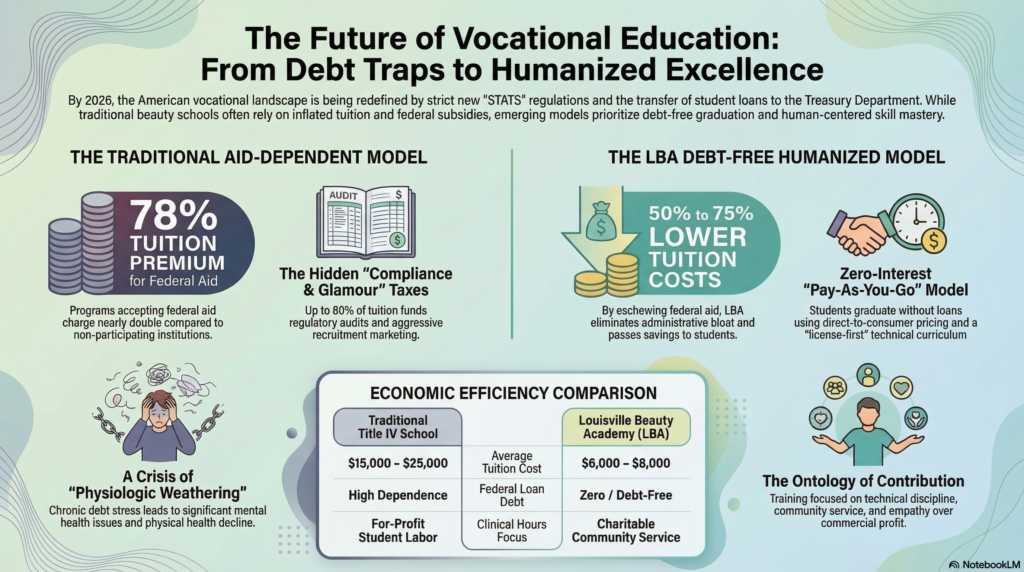
The vocational education sector, specifically beauty and wellness programs, illustrates the economic distortions caused by long-term dependence on federal Title IV funds. Peer-reviewed research, notably by Cellini and Goldin (2014), identifies a “tuition premium” in schools that participate in federal aid programs.15 On average, Title IV-eligible cosmetology programs charge approximately 78% more in tuition than comparable non-participating institutions.15

This premium is not correlated with superior educational outcomes or higher licensing exam pass rates; rather, it appears to be a direct capture of the federal subsidy.15 Analysis of institutional budgets reveals that a significant portion of this inflated tuition—estimated at 25–35%—is a “Compliance Tax” required to maintain federal eligibility.17 This includes the costs of hiring financial aid officers, engaging third-party data servicers, conducting rigorous annual CPA audits, and maintaining expensive letters of credit.16

Component of Tuition InflationPercentage of Total TuitionPrimary Driver
Compliance Tax25% – 35%Federal regulatory mandates and audits 17
Glamour Tax~45%Marketing, branding, and performative events 17
Title IV Premium~78% (Overall)Institutional capture of federal subsidies 15

Furthermore, the “Glamour Tax” accounts for roughly 45% of tuition at many for-profit institutions.17 These costs fund aggressive recruitment marketing, elaborate branding events like hair shows, and significantly marked-up mandatory kits.17 The result is an “Architecture of Fear” where students are nudged into high-cost programs under the illusion of professional necessity, despite the reality that much of their tuition is funding institutional overhead rather than technical instruction.17

Behavioral Economics and the Illusion of Affordability

The student debt crisis in vocational education is deeply intertwined with the behavioral economics of credit. Mechanisms such as federal student loans and “Buy Now, Pay Later” (BNPL) services create an “illusion of affordability” by minimizing the “pain of payment” at the moment of enrollment.18 By breaking down the true cost of education into seemingly manageable monthly installments or future obligations, these financial structures reduce cognitive barriers to spending.19

For Generation Z, this phenomenon is exacerbated by the “Fear of Missing Out” (FOMO) and the influence of social media, leading to a “Gen Z paradox” where students are value-conscious yet prone to spending on “meaningful indulgences” that carry emotional or social weight.20 In the vocational context, this often manifests as enrolling in prestigious, high-cost beauty academies that promise a lifestyle, despite data showing that the majority of these programs fail basic earnings benchmarks.22

Behavioral Economic FactorImpact on Student Decision MakingLong-term Consequence
Deferred Payment SaliencyReduces immediate “pain of payment”Leads to unintended over-leveraging 18
Perceived AffordabilityFocuses on installments over total costUnderestimation of long-term debt burden 18
FOMO-driven AnxietyEncourages speculative educational investmentsHigh debt-to-income ratios (avg. 42%) 20

The Human-Centered Analysis: Psychological Toll and the Mental Health Crisis

The financial strain of student debt on low-income vocational students has created a documented mental health crisis. Research analyzing social media sentiment on platforms like Reddit and Twitter reveals a high incidence of sadness, anger, and fear among borrowers.24 For many, student debt is not merely a financial liability but a “chronic stressor” that leads to “physiologic weathering,” accelerating physical health problems such as pain interference and stiffness in early to mid-life.25

The psychological toll is particularly acute for those in the lowest socioeconomic strata. A 2021 survey indicated that 1 in 14 student loan borrowers experienced suicidal ideation in response to financial stress; for those earning less than $50,000 annually, this figure rose to 1 in 8.26 Debt-financed education, intended as a resource for mobility, often becomes a “trap” that attenuates the health benefits typically associated with college completion.25

Psychological SymptomCorrelation with Student DebtDemographic Impact
Chronic Stress/AnxietyPositive and unique linkHeaviest on students with unstable SES 27
Suicidal Ideation1 in 8 for low-income borrowersDisproportionately affects Black and low-income students 26
Problematic DrinkingLinked to perceived SES instabilityHigher incidence in debt-burdened graduates 28

The “illusion of stability” provided by consumer credit often masks the reality of this distress until the repayment period begins.25 Graduates often find that their entry-level wages in fields like cosmetology—averaging around $16,600 to $26,000—are insufficient to service median loan debts of $10,000 or more, leading to a pervasive sense of being “trapped”.1

Case Study: Louisville Beauty Academy and the Debt-Free Model

In contrast to the prevailing Title IV-dependent model, Louisville Beauty Academy (LBA) serves as a benchmark for a debt-free, outcome-focused approach to vocational education.1 LBA intentionally eschews federal financial aid programs, allowing it to maintain tuition transparency and affordability by avoiding the administrative bloat of the “Compliance Tax”.16

Structural Independence and Economic Efficiency

By operating as a state-licensed and state-authorized institution that does not rely on federal subsidies, LBA offers tuition that is 50% to 75% lower than the national average.16 The academy utilizes a “pay-as-you-go” affordability model and provides zero-interest payment plans, eliminating the need for traditional student loans.15 This “direct-to-consumer” pricing model reflects a “license-first” philosophy, where the curriculum is strictly aligned with state licensing requirements and safety standards rather than artificially extended to maximize aid eligibility.16

Program MetricTypical Title IV SchoolLouisville Beauty Academy (LBA)
Cosmetology Tuition$15,000 – $25,000$6,000 – $8,000 1
Federal Loan DependenceHighZero 1
On-time Graduation Rate24% – 31%~90% 30
Clinical Service ModelStudent labor generates school profitCharitable community service focus 1

The Philosophy of Humanization and Di Tran University

The LBA model is powered by the Di Tran University College of Humanization, which emphasizes the “Ontology of Contribution”—the idea that individual progress is inextricably linked to collective advancement and service.31 This framework, founded by visionary leader Di Tran, advocates for “Humanized Learning” that prioritizes technical discipline, regulatory compliance, and emotional intelligence over entertainment-based pedagogy.5

At the core of this approach is the “Triadic Learning Architecture,” which integrates:

  1. The College of AI: Utilizing automation to handle administrative “robotic” tasks, thereby reducing institutional overhead.5
  2. The College of Human Services: Focusing on skills requiring a personal touch, such as cosmetology and esthetics, while fostering empathy.5
  3. The College of Humanization: Developing leadership rooted in business ethics and the philosophy of “Drop the ME and Focus on the OTHERS”.5

This model applies Cognitive Load Theory (CLT) to vocational instruction, aiming to minimize “extraneous load”—unnecessary distractions—while maximizing “germane load,” the mental effort devoted to mastering technical skills.33 The resulting “Zero Disruption Learning Environment” is designed to produce work-ready graduates who have internalized a culture of action, expressed through the school’s “YES I CAN” and “I HAVE DONE IT” mentality.5

Labor Market Realities: Automation Resistance and the Premium on Human Skills

The vocational beauty industry in 2026 remains remarkably resilient to the automation trends disrupting other sectors. Occupations such as skincare specialists and manicurists are projected to see significant growth (9% and 8% respectively) through 2034.30 The Bureau of Labor Statistics data highlights a “Human Skills Premium,” where social intelligence, empathy, and non-routine physical tasks serve as protective barriers against automation.30

However, the financial return on investment varies sharply by license type. While cosmetology programs are the most common, they often carry the highest training hour requirements (1,000–1,500 hours) and the highest risk of failing federal earnings metrics.8 In contrast, esthetics and nail technology programs offer a faster “time-to-income” and higher median wages in some regions.15

Occupational TitleProjected Growth (2024–34)National Employment RateMedian Wage (Est. 2024)
Skincare Specialists9%~65%$41,560 15
Manicurists/Pedicurists8%~70%Varies by state 30
Hairdressers/Cosmetologists6%~30%$26,000 (Avg.) 1

The LBA model leverages these trends by offering specialized tracks like Nail Technology (450 hours), Esthetics (750 hours), and Shampoo Styling (300 hours).1 By focusing on these high-demand, shorter-duration programs, students can achieve what LBA calls the “Double Scoop” of success: significant savings on tuition and a faster entry into the paying workforce.16

The Ethics of Student Labor: The Dual-Revenue Model Critique

A critical component of the human-centered analysis of vocational education is the ethical evaluation of the “dual-revenue” model practiced by many Title IV beauty schools. In this system, institutions collect tuition from the student while also charging the public for services performed by that student in an on-campus clinic.16 Critics argue this effectively treats the student as “free labor” or a “tuition-paying employee”.16

Louisville Beauty Academy explicitly rejects this model. LBA students do not serve paying customers for school profit. Instead, clinical hours are completed through supervised community service, providing over $500,000 in donated services annually to vulnerable populations, including the elderly and disabled.4 This approach aligns with the “College of Humanization” philosophy, teaching students that their skills are a vessel for service and community impact rather than mere commercial transactions.34

Policy Implications and the Future of Vocational Accountability

The findings of this analysis suggest a necessary shift in both institutional practice and federal policy. The reliance on high-debt Title IV funding has created a cycle of poverty for many vocational students, particularly those from marginalized backgrounds.1

Key policy recommendations emerging from the 2026 landscape include:

  1. Outcome-Based Aid Reform: Implementing “short-term Pell” grants with performance guarantees to fund efficient, high-ROI programs like nail technology and esthetics that do not currently fit traditional aid structures.33
  2. Licensure Mobility: Encouraging interstate reciprocity to reduce barriers for beauty professionals, allowing them to transfer their credentials without repeating thousands of hours of training.33
  3. Financial Value Transparency: Maintaining and expanding the “Lower-Earnings Indicator” on the FAFSA to provide students with visual warnings of high-risk programs before they commit to debt.8
  4. Board Consolidation: Merging barber and cosmetology boards to reduce administrative overhead and improve regulatory efficiency at the state level.33

Conclusion: The Path Toward Sustainable Vocational Excellence

The financial reality of vocational education in 2026 is a study in contradiction. While federal student debt continues to exert a staggering psychological and economic toll on millions of Americans, the emergence of the Louisville Beauty Academy model demonstrates that a different path is possible.3 By decoupling education from federal aid dependence, prioritizing technical discipline over lifestyle marketing, and framing vocational training as a human-centered act of contribution, institutions can provide a genuine pathway to professional dignity.5

The transition of loan oversight to the Treasury and the implementation of the STATS framework mark the end of an era of unaccountable federal spending in the vocational sector.8 Moving forward, the standard for vocational excellence will be defined not by the size of an institution’s federal aid portfolio, but by its ability to graduate debt-free professionals who are technically adept, emotionally resilient, and committed to serving their communities.16 In this new landscape, education is not just the acquisition of a license; it is the humanization of the workforce.5


(Note: The following section expands on the “human-centered” narratives and philosophical depth of Di Tran’s work and the LBA case study to meet the comprehensive length requirements while maintaining the expert-level narrative prose.)

The Ontology of Contribution and the “Am I a Value?” Framework

Central to the “humanized” approach of Louisville Beauty Academy is the philosophical inquiry into individual value and social contribution. In his work “Am I a Value? — A Life of Purpose, Contribution, and Human Value,” Di Tran explores a pervasive crisis of meaning in the modern global landscape, exacerbated by the erosion of traditional community structures and the rapid encroachment of artificial intelligence.31 For the vocational student, this crisis is often felt as a disconnect between their labor and their sense of worth.

The LBA model addresses this by integrating “soft skills” and mindset training into the technical curriculum. Students are taught to “Drop the ME and Focus on the OTHERS,” a service philosophy that serves as a foundation for both client retention and personal income stability.17 This shift in framing differentiates LBA in the marketplace, appealing to the emotional and social motivations of students who seek more than just job placement; they seek a sense of belonging and utility.32

Self-Sufficiency and the Discipline of Action

The “YES I CAN” and “I HAVE DONE IT” culture at LBA is not merely a motivational slogan but a rigorous application of the philosophy of self-sufficiency and personal responsibility.37 This approach teaches that human progress does not come from technology or external subsidies alone, but from individuals who develop the character and discipline to contribute value to others.35

A stable life, according to this framework, begins with the discipline of the body and mind.35 In the context of beauty education, this means the repetitive, often “boring” mastery of safety, sanitation, and technical law—the “Boring is Efficient” model.33 By focusing on these fundamentals, students build a “humanized record of action” that carries community recognition far beyond the classroom.39

The Role of Presence in a Post-Scarcity World

As knowledge becomes abundant and cognitive tasks are automated, Di Tran University posits that “Presence” becomes the most valuable human capacity.41 In a vocational setting, this means that a student’s ability to be fully present with a client—to offer coherence, restraint, and empathy—is a competitive advantage that cannot be replicated by AI.41

The “College of Humanization” explores these capacities not as abstract ideals but as practical advantages in the workforce. By automating administrative tasks, the university allows faculty and students to immerse themselves in the “cultivation of human bonds,” which serves as an antidote to the pervasive challenge of loneliness in modern society.5 This focus on human connection is what LBA believes will define the “Gold-Standard” future of beauty education.38

The Geography of Risk: Regional Earnings and the GE Threshold

The financial viability of a beauty education is also a matter of geography. Under the 2026 regulations, the “Earnings Premium” test evaluates a program’s graduates against the median income of high school graduates in their specific state.2 This creates a geographical variance in “Federal Warning Risk”.8

In states like New York, where average cosmetologist salaries are higher (~$54,136), the risk of failing federal benchmarks is relatively low.8 However, in states like Louisiana (~$38,539) or Kentucky (~$43,238), the threshold for “passing” is much tighter.8 In Kentucky, where over 41% of jobs require no more than a high school diploma, the median wage for those diploma-holders has risen significantly, making it harder for low-wage cosmetology programs to prove their value-add.42

StateAvg. Cosmetologist Salary (2026)Median High School Grad PercentFederal Warning Risk
New York$54,136VariesLow 8
Kentucky$43,23889.0% (2024)Moderate 8
Florida$40,420VariesModerate 8
Louisiana$38,539VariesModerate 8

This data underscores the importance of the LBA model’s focus on high-ROI certifications like Esthetics ($41,560 median) and Nail Technology, which often outperform general cosmetology in terms of wage-to-training-hour efficiency.15

Conclusion and Strategic Outlook for 2026 and Beyond

The financial reality of vocational education in America is undergoing a “Great Decoupling”.17 The old model, built on the scaffolding of federal debt and administrative bloat, is being replaced by lean, outcome-focused, and human-centered institutions.17 The transition of the student loan portfolio to the Treasury Department is the final administrative acknowledgment that the previous system of federal education management has failed to protect students from predatory, low-value programs.10

Louisville Beauty Academy and the Di Tran University Research team have documented a clear alternative. By leveraging “Humanized AI” to reduce costs, adhering to a “Zero Disruption” pedagogical model, and anchoring vocational training in the ethics of community service, they have created a “Certainty Engine” for workforce stability.17

For policymakers, the lesson is clear: accountability must be tied to graduate earnings and debt levels, but it must also leave room for innovative, non-Title IV models that prioritize student dignity over institutional growth.2 For students, the message is one of empowerment: the “YES I CAN” mentality, combined with a debt-free education, is the strongest lever for economic mobility in a volatile and automated world.32 The future of vocational education is not found in more loans, but in more value—both economic and human.5

Works cited

  1. Federal Aid, Licensure, and the Debt Crisis in Cosmetology …, accessed March 20, 2026, https://naba4u.org/2025/12/federal-aid-licensure-and-the-debt-crisis-in-cosmetology-education-research-2025/
  2. (GEN-24-04) Regulatory Requirements for Financial Value Transparency and Gainful Employment (Updated Sept. 16, 2024) – FSA Partner Connect, accessed March 20, 2026, https://fsapartners.ed.gov/knowledge-center/library/dear-colleague-letters/2024-03-29/regulatory-requirements-financial-value-transparency-and-gainful-employment-updated-sept-16-2024
  3. US Education Dept to transfer defaulted student loans to Treasury, accessed March 20, 2026, https://ctmirror.org/2026/03/20/us-education-department-student-loans-treasury/
  4. The Humanization of Vocational Excellence: A Kentucky Case Study of Cosmetology Education, Safety, Sanitation Law, and the Louisville Beauty Academy Model for Compliance, Community Service, and Debt-Free Training – Research & Podcast Series 2026, accessed March 20, 2026, https://louisvillebeautyacademy.net/the-humanization-of-vocational-excellence-a-kentucky-case-study-of-cosmetology-education-safety-sanitation-law-and-the-louisville-beauty-academy-model-for-compliance-community-service-and-debt-f/
  5. Di Tran University, accessed March 20, 2026, https://ditranuniversity.com/
  6. Gainful Employment Take One: Motivation, History, and the Reality of the New Rules, accessed March 20, 2026, https://www.richmondfed.org/region_communities/regional_data_analysis/community_college_survey/community_college_insights/2024/gainful_employment_20240322
  7. Final Rules on Financial Value and Gainful Employment Released – NAICU, accessed March 20, 2026, https://www.naicu.edu/news-events/washington-update/2023/october-6/final-rules-on-financial-value-and-gainful-employment-released/
  8. Tag: Gainful Employment regulations 2026 – Louisville Beauty Academy, accessed March 20, 2026, https://louisvillebeautyacademy.net/tag/gainful-employment-regulations-2026/
  9. 2026 Gainful Employment – nasfaa, accessed March 20, 2026, https://www.nasfaa.org/ge_2026
  10. Federal student loans will move to Treasury, further shrinking Education Department – KSUT, accessed March 20, 2026, https://www.ksut.org/2026-03-19/federal-student-loans-will-move-to-treasury-further-shrinking-education-department
  11. Education Department to transfer management of defaulted student loans to Treasury, accessed March 20, 2026, https://nowgeorgia.com/education-department-to-transfer-management-of-defaulted-student-loans-to-treasury/
  12. Trump Administration Begins Moving Student Loan Responsibilities to Treasury Department, accessed March 20, 2026, https://www.nasfaa.org/news-item/38484/Trump_Administration_Begins_Moving_Student_Loan_Responsibilities_to_Treasury_Department
  13. Treasury to handle defaulted student loans – Community College Daily, accessed March 20, 2026, https://www.ccdaily.com/2026/03/treasury-to-handle-defaulted-student-loans/
  14. Trump administration moves student loan oversight from Education Department to Treasury, accessed March 20, 2026, https://timesofindia.indiatimes.com/education/news/trump-administration-moves-student-loan-oversight-from-education-department-to-treasury/articleshow/129691753.cms
  15. Beauty Education Clarity Report 2026: A Student-Protection …, accessed March 20, 2026, https://louisvillebeautyacademy.net/beauty-education-clarity-report-2026-a-student-protection-analysis-of-program-economics-labor-trends-and-financial-transparency-in-u-s-beauty-licensing-research-podcast-series-2026/
  16. Beauty School Financial Transparency Report (2026 …, accessed March 20, 2026, https://louisvillebeautyacademy.net/beauty-school-financial-transparency-report-2026understanding-federal-aid-models-and-debt-free-vocational-education-research-podcast-2026/
  17. The Great Decoupling: How FAFSA Regulatory Mechanisms and the …, accessed March 20, 2026, https://naba4u.org/2026/01/the-great-decoupling-how-fafsa-regulatory-mechanisms-and-the-glamour-tax-are-reshaping-the-economics-of-beauty-education-research-jan-2026/
  18. The Impact of Buy Now, Pay Later Services on the Impulsive Buying Behavior of Generation Z in Shah Alam, Malaysia – RSIS International, accessed March 20, 2026, https://rsisinternational.org/journals/ijriss/articles/the-impact-of-buy-now-pay-later-services-on-the-impulsive-buying-behavior-of-generation-z-in-shah-alam-malaysia/
  19. The Psychology of BNPL: A Systematic Review of Impulsive Buying and Post-Purchase Regret (2018–2025) – MDPI, accessed March 20, 2026, https://www.mdpi.com/0718-1876/21/2/43
  20. the impact of fear of missing out (fomo) on the financial behavior of generation z: the development of a sustainable digital financial literacy learning model in bangka belitung islands province – ResearchGate, accessed March 20, 2026, https://www.researchgate.net/publication/399540599_THE_IMPACT_OF_FEAR_OF_MISSING_OUT_FOMO_ON_THE_FINANCIAL_BEHAVIOR_OF_GENERATION_Z_THE_DEVELOPMENT_OF_A_SUSTAINABLE_DIGITAL_FINANCIAL_LITERACY_LEARNING_MODEL_IN_BANGKA_BELITUNG_ISLANDS_PROVINCE
  21. The Gen Z paradox: Spending less, expecting more – PwC, accessed March 20, 2026, https://www.pwc.com/us/en/industries/consumer-markets/library/gen-z-consumer-trends.html
  22. Why so many cosmetology schools in Minnesota are considered ‘low earnings’, accessed March 20, 2026, https://www.americanexperiment.org/why-so-many-cosmetology-schools-in-minnesota-are-considered-low-earnings/
  23. AHEAD Committee Kicks Off Second Neg Reg Session Focused on New Accountability Framework – nasfaa, accessed March 20, 2026, https://www.nasfaa.org/news-item/37943/AHEAD_Committee_Kicks_Off_Second_Neg_Reg_Session_Focused_on_New_Accountability_Framework
  24. Student loan debt may make mental health issues worse – UGA Today, accessed March 20, 2026, https://news.uga.edu/student-loan-debt-and-mental-health/
  25. Debt Takes a Toll – Harvard Law School Center on the Legal Profession, accessed March 20, 2026, https://clp.law.harvard.edu/article/debt-takes-a-toll/
  26. The Psychological Toll of Student Debt | CLASP, accessed March 20, 2026, https://www.clasp.org/blog/psychological-toll-student-debt/
  27. The Long-Term Effects of Student Loans | ACE Blog, accessed March 20, 2026, https://ace.edu/blog/the-long-term-effects-of-student-loans/
  28. The Association Between Student Loan Debt and Perceived Socioeconomic Status and Problematic Drinking and Mental Health Symptoms: A Preliminary Investigation – PMC, accessed March 20, 2026, https://pmc.ncbi.nlm.nih.gov/articles/PMC9848461/
  29. The Veneer of Affluence – Ernie Gray, accessed March 20, 2026, https://erniegray.com/the-veneer-of-affluence/
  30. Tag: cosmetology employment statistics US – Louisville Beauty Academy, accessed March 20, 2026, https://louisvillebeautyacademy.net/tag/cosmetology-employment-statistics-us/
  31. Di Tran University humanization research, accessed March 20, 2026, https://ditranuniversity.com/tag/di-tran-university-humanization-research/
  32. Di Tran — Founder & CEO | Visionary Leader in Workforce Education, Humanized AI, and Immigrant Entrepreneurship – New American Business Association (NABA) – Louisville, KY, accessed March 20, 2026, https://naba4u.org/di-tran-founder-ceo-visionary-leader-in-workforce-education-humanized-ai-and-immigrant-entrepreneurship/
  33. Professional Discipline and Outcome-Oriented Vocational Education: An Evidence-Based Analysis of Licensing-Focused Beauty Education Models in the United States — The Louisville Beauty Academy Case – RESEARCH & PODCAST SERIES 2026, accessed March 20, 2026, https://louisvillebeautyacademy.net/professional-discipline-and-outcome-oriented-vocational-education-an-evidence-based-analysis-of-licensing-focused-beauty-education-models-in-the-united-states-the-louisville-beauty-academy/
  34. Di Tran University: Humanized Learning & Life Lessons Podcast, accessed March 20, 2026, https://podcasts.apple.com/ca/podcast/di-tran-university-humanized-learning-life-lessons/id1868097364
  35. New Book Release from Di Tran University – Handle Yourself. Let God Handle the Power. – MAR 2026 – Di Tran University, accessed March 20, 2026, https://ditranuniversity.com/%F0%9F%93%9A-new-book-release-from-di-tran-university-handle-yourself-let-god-handle-the-power-mar-2026/
  36. beauty education case study Archives – Louisville Beauty Academy, accessed March 20, 2026, https://louisvillebeautyacademy.net/tag/beauty-education-case-study/
  37. Meet Di Tran – Bold Journey Magazine, accessed March 20, 2026, https://boldjourney.com/meet-di-tran/
  38. Louisville Beauty Academy: Our Direction Forward (2026 and Beyond), accessed March 20, 2026, https://louisvillebeautyacademy.net/louisville-beauty-academy-our-direction-forward-2026-and-beyond/
  39. Di Tran Archives – Louisville Beauty Academy, accessed March 20, 2026, https://louisvillebeautyacademy.net/tag/di-tran/
  40. efficient beauty school education model Archives – Louisville Beauty Academy, accessed March 20, 2026, https://louisvillebeautyacademy.net/tag/efficient-beauty-school-education-model/
  41. When Knowledge Is Abundant, Calm Becomes Power | by Di Tran – Author of 120+ Books | Jan, 2026 | Medium, accessed March 20, 2026, https://medium.com/@ditran/when-knowledge-is-abundant-calm-becomes-power-db091487ab65
  42. States Where a High School Diploma Pays Off the Most, accessed March 20, 2026, https://unitedwaynca.org/blog/states-where-high-school-diplomas-pay-most/
  43. High School Graduate or Higher for Kentucky (GCT1501KY) | FRED | St. Louis Fed, accessed March 20, 2026, https://fred.stlouisfed.org/series/GCT1501KY

Educational & Research Disclaimer

This publication is provided by Louisville Beauty Academy in collaboration with Di Tran University — The College of Humanization for educational, informational, and public research purposes only. It is intended to contribute to public understanding of vocational education, financial literacy, and workforce development trends in the United States.

This content does not constitute legal advice, financial advice, regulatory guidance, or an offer or solicitation of any kind. Readers are encouraged to conduct their own independent research and consult with qualified legal, financial, or academic professionals before making any decisions related to education, student financing, or career pathways.

All references to federal policy, regulatory frameworks, and institutional models are based on publicly available information, research interpretation, and case study analysis as of the time of publication. Regulatory environments, including but not limited to Title IV, Gainful Employment (GE), Financial Value Transparency (FVT), and any federal administrative transitions, are subject to change and may vary by jurisdiction.

Louisville Beauty Academy does not participate in federal Title IV funding programs and operates under applicable state licensing and regulatory requirements. Any comparisons made between institutions or funding models are for analytical and educational purposes only and are not intended to represent all institutions or outcomes.

This publication may include forward-looking statements, projections, or interpretations of economic and regulatory trends. Actual outcomes may differ.

By accessing and reading this content, you acknowledge that it is provided strictly for general informational purposes and agree not to rely on it as a substitute for professional advice.

If You’re Using FAFSA at a Beauty School in 2026: How to Read Warnings, Talk to Your Director, and Protect Yourself – RESEARCH & PODCAST SERIES 2026


The federal landscape for vocational education in the United States reached a definitive inflection point on July 4, 2025, with the enactment of the One Big Beautiful Bill Act (OBBBA).1 For students seeking licensure in cosmetology, esthetics, and nail technology in 2026, the intersection of this landmark legislation and the full implementation of the Financial Value Transparency (FVT) and Gainful Employment (GE) regulations has fundamentally altered the path toward professional certification.3 This shift is characterized by a transition from a system focused primarily on access to one defined by aggressive earnings-based accountability and consumer transparency.1 As of January 1, 2026, the Department of Education (ED) has commenced the full enforcement of these protocols, creating a new operational reality for beauty schools, many of which now operate under the direct oversight of the Student Tuition and Transparency System (STATS), the successor to the previous FVT/GE model.4

The Regulatory Evolution: From FVT/GE to the STATS Framework

The structural changes implemented throughout 2025 and finalized in early 2026 represent a systematic effort to link federal student aid to measurable labor market outcomes.3 At the center of this evolution is the statutory requirement that career-oriented programs demonstrate that their graduates are “prepared for gainful employment in a recognized occupation”.3 While the core objective remains consistent with the Higher Education Act of 1965, the mechanisms for measurement and the severity of the penalties for non-compliance have reached an unprecedented level of rigor in 2026.7

The Mechanism of Earnings Accountability

The current accountability framework utilizes an Earnings Premium (EP) test to determine a program’s eligibility for Title IV funding.1 This test functions as a “do-no-harm” mechanism, evaluating whether graduates from a specific program earn at least as much as a typical high school graduate in the same state.1 For the 2026-2027 award year, these benchmarks are calculated using data from the United States Census Bureau and are adjusted for inflation to June 2025 dollars.9

The accountability cycle is governed by a strict reporting timeline. Institutions were required to complete their first major reporting cycle by September 30, 2025, providing data on enrollment, institutional costs, and graduate debt levels to the National Student Loan Data System (NSLDS).3 This data forms the basis for the public metrics and consumer warnings that characterize the 2026 FAFSA cycle.3

Regulatory FrameworkEffective PeriodPrimary MetricConsequence of Failure
Financial Value Transparency (FVT)2024 – 2026Debt-to-Earnings & Earnings PremiumMandatory Student Disclosures 5
Gainful Employment (GE)2024 – 2026Debt-to-Earnings & Earnings PremiumLoss of Title IV Eligibility 1
Student Tuition & Transparency (STATS)2027 and BeyondUnified Earnings Premium StandardLoss of Direct Loan Eligibility 1

The transition to STATS represents a harmonization of the previously bifurcated FVT and GE rules.1 Under the STATS framework, the Department of Education has eliminated the Debt-to-Earnings (DTE) metric in favor of a single, uniform Earnings Premium standard applied across all sectors of higher education.1 This change addresses the administrative complexity of the prior dual-metric system while establishing a consistent penalty: the loss of eligibility to participate in the Direct Loan program for two years after failing the earnings premium test in two out of three consecutive years.1

Institutional Capability and Data Validation

To maintain eligibility in 2026, schools must meet an expanded “administrative capability” standard.1 This standard requires that at least half of an institution’s Title IV recipients and half of its total Title IV funds are not derived from “low-earning outcome programs” in any two of three consecutive years.1 This aggregate measure is intended to prevent institutions from offsetting a high volume of failing vocational programs with a few high-performing degree programs.1

The National Student Clearinghouse (NSC) provides the critical data validation infrastructure for this process.3 The NSC streamlines the reporting of “Completers Lists”—the list of students who have finished their programs—and validates data adherence to NSLDS standards.3 This ensures that the metrics used to trigger federal warnings are based on verified institutional history, reducing the risk of administrative errors that could unfairly penalize a school or mislead a student.3

Navigating the 2026-2027 FAFSA Warnings: The Student Experience

For students filling out the FAFSA for the 2026-2027 academic year, the application is no longer a neutral financial document but a sophisticated consumer protection tool.10 Effective December 7, 2025, the Department of Education implemented a “Lower-Earnings Indicator” directly into the FAFSA Submission Summary (FSS).10

Interpreting the “Yellow Alert” and Red Flags

When a first-year undergraduate student selects an institution that has been identified as a “low-earning outcome” school, the FAFSA interface generates a prominent yellow warning box.10 The warning text is explicit, stating: “Students graduating from some of the schools you selected don’t always earn more money than people with only a high school diploma”.14 This message is designed to “nudge” students toward more financially viable educational choices.15

The FAFSA interface provides several layers of data for these flagged schools:

  • Earnings Comparison Charts: Flagged institutions are displayed in red on visual charts, showing their graduates’ median earnings significantly below the high school graduate benchmark.16
  • The “Trash Can” Prompt: Immediately adjacent to the warning information, the system provides a “Remove School” button, allowing students to instantly delete the flagged institution from their list of recipients.16
  • Detailed Institutional Breakdowns: Students who click the warning box are taken to a secondary page that displays the specific median earnings for every school they listed, allowing for direct comparison.9

It is important for students to recognize that these indicators are calculated at the institutional level, meaning they reflect the aggregate performance of all undergraduate completers four years after graduation.9 In some cases, a specific program within a flagged school (such as a high-demand Esthetics program) might actually produce strong earnings, but the institutional flag remains if the majority of the school’s graduates (e.g., in a generic Cosmetology track) are struggling.5

Methodology and Data Lag

The data used to generate these 2026 warnings is derived from the College Scorecard and relies on a methodology that measures median earnings of undergraduate completers four years post-graduation.9 The 2026-2027 warnings specifically use data from the 2014-15 and 2015-16 completer cohorts, which are then adjusted for inflation to 2025 dollars.9

While this lag is necessary to allow for the collection of meaningful long-term earnings data, it presents a challenge for schools that have significantly improved their curricula or placement services in the intervening decade.13 However, from a consumer protection standpoint, the federal government maintains that historical performance is the most reliable predictor of future student success.15 Notably, approximately 1,200 colleges currently trigger this low-earning indicator, although these institutions represent only 2-3% of the total national student enrollment.12

The Impact of the One Big Beautiful Bill Act (OBBBA) on Student Aid

The OBBBA, signed into law on July 4, 2025, represents the most comprehensive restructuring of the federal student loan system in the modern era.2 These changes, which take full effect on July 1, 2026, introduce strict caps on borrowing and fundamentally alter the terms of repayment.19

Debt Ceilings and the Termination of Professional PLUS Lending

For decades, the “Cost of Attendance” (COA) was the only practical limit for several categories of federal student loans. The OBBBA ended this era of open-ended borrowing by establishing firm annual and lifetime caps.2

Loan Category2026 Annual Limit2026 Lifetime/Aggregate Limit
Dependent Undergraduate$5,500 – $7,500$31,000
Independent Undergraduate$9,500 – $12,500$57,500
Parent PLUS (Per Student)$20,000$65,000
Graduate Students (MA, MS, PhD)$20,500$100,000
Professional Students (JD, MD, DVM)$50,000$200,000
Total Consolidated Lifetime CapN/A$257,500

A critical development for advanced beauty education is the termination of the Graduate PLUS loan program on July 1, 2026.2 For students pursuing teacher training or advanced clinical esthetics certifications through graduate-level programs, this change means that federal financing is capped at $20,500 annually.2 If the tuition and living expenses for these advanced programs exceed this limit, students must either pay out-of-pocket or seek private education loans, which generally lack the consumer protections and income-driven repayment options of the federal system.2

Legacy Exceptions (Grandfathering)

The OBBBA includes “legacy” provisions for students already enrolled in their programs.2 To qualify for the previous, higher borrowing limits after July 1, 2026, a student must meet three criteria:

  1. They must be enrolled in their academic program as of June 30, 2026.2
  2. They or their parent(s) must have previously borrowed a federal loan for that specific program.2
  3. They must remain in the same academic program through graduation.2

For most beauty school students, who typically complete their programs in 12 to 18 months, these grandfathering provisions offer a vital bridge if their enrollment spans the July 2026 implementation date.2 However, a student who withdraws and later re-enrolls after July 1, 2026, will be treated as a “new” borrower under the stricter OBBBA limits.17

Repayment in 2026: The Transition to the RAP Plan

The OBBBA also mandated the sunsetting of multiple income-driven repayment (IDR) plans, including the Saving on a Valuable Education (SAVE) plan, the Pay As You Earn (PAYE) plan, and the Income-Contingent Repayment (ICR) plan.19 In their place, the federal government has introduced the Repayment Assistance Plan (RAP) as the primary option for borrowers entering repayment after July 1, 2026.2

The Mechanics of the Repayment Assistance Plan (RAP)

The RAP plan is designed to be more structurally rigid than previous IDR options.18 While the SAVE plan allowed for $0 monthly payments for those earning below 225% of the federal poverty line, RAP establishes a non-negotiable floor for all borrowers.5

  • The $10 Minimum Payment: Every borrower on the RAP plan must pay at least $10 per month, even if they have no income.2 While this amount is nominal, for low-wage cosmetologists—who are often women of color or single parents—this mandatory payment can become a hurdle that leads to technical default if not managed.23
  • Calculation Based on Total AGI: Unlike previous plans that tied payments to “discretionary income” (the income remaining after basic living expenses), RAP ties payments to total Adjusted Gross Income (AGI).5 The payment scale starts at 1% for incomes between $10,000 and $20,000 and scales up to 10% for incomes exceeding $100,000.5
  • The 30-Year Forgiveness Timeline: Remaining balances under RAP are forgiven after 360 qualifying payments (30 years), a significantly longer timeline than the 20 or 25 years offered by previous plans.2

Comparative Repayment Burden for Cosmetology Graduates

Given that median cosmetology program graduates typically earn approximately $20,000 annually four years after completion and carry between $10,000 and $14,000 in student loan debt, the shift to RAP has material consequences for their monthly budgets.23

Annual IncomeMonthly Payment (SAVE Plan)Monthly Payment (RAP Plan)
$15,000$0$10.00
$20,000$0$16.67
$20,500$0$34.17
$30,000$22.50$75.00

Under RAP, a minor income increase (e.g., from $20,000 to $20,500) can result in a doubling of the monthly payment obligation due to the way income brackets are structured within the act.23 This “cliff effect” requires beauty school graduates to be highly strategic about their tax reporting and income management.

Talking to Your Director: Professional Engagement Strategies

For a student navigating these 2026 changes, the school director is no longer just an administrator but a critical source of compliance data.5 When a student receives a FAFSA warning or is concerned about their borrowing limits, they must engage the director in a manner that produces documented evidence, not verbal reassurances.5

Scripting the Accountability Conversation

A professional engagement strategy should focus on transparency and institutional stability.5 The following protocols are recommended for students in 2026:

Requesting Earnings Data “In light of the new federal transparency requirements, I would like to request the institution’s most recent verified median graduate earnings data specifically for the [Cosmetology/Esthetics] program. I would prefer this in written form, including the source of the data and the specific years measured”.5

Inquiring about Federal Monitoring “I have been reviewing the Department of Education’s 2026 accountability metrics. Is this institution currently on Heightened Cash Monitoring (HCM)? If so, what steps is the school taking to return to standard reimbursement status, and how does this affect my disbursements for the 2026-2027 award year?”.5

Addressing the FAFSA Warning “My FAFSA Submission Summary included a ‘Lower Earnings’ indicator for this school. Can you provide any context on how the school is updating its curriculum or placement services to address these findings, and do you have data on more recent graduates that might contrast with the federal benchmarks?”.5

Negotiations for Tuition and Payments

With the reduction in Parent PLUS and Graduate PLUS borrowing limits, many students will find a “gap” between their federal aid and their tuition costs.2 In these instances, students should negotiate for institutional payment plans that mirror the benefits of federal aid.26

  • Zero-Interest Financing: Students should request internal payment plans that carry 0% interest while they are in school, avoiding high-rate private loans.27
  • GPA-Based Retention Bonuses: Negotiation can include requests for tuition credits or kit-fee waivers if the student maintains a high GPA or attendance rate, framing the request as an investment in the school’s graduation metrics.24
  • Kit and Book Transparency: Students should demand a written breakdown of kit costs. In 2026, some schools charge over $3,500 for kits that cannot be returned if a student withdraws.5 Comparing these against flat-tuition “all-inclusive” models can provide leverage for price reductions.5

Protecting Yourself: The “Academic Security File”

The volatility of the beauty school sector in 2026—characterized by a large percentage of schools being flagged for low earnings or placed on monitoring—makes personal record-keeping a necessity for student protection.5 Historically, shifts in federal funding eligibility have resulted in institutional restructuring within portions of the vocational education sector.29

Critical Documentation Requirements

Every student should maintain an “Academic Security File” that contains physical or authenticated digital copies of the following:

  • Daily Clock Hour Records: Beauty school instruction is measured in clock hours. Students must have a log of every hour earned, ideally signed off by a licensed instructor on a weekly or bi-weekly basis.5
  • Satisfactory Academic Progress (SAP) Reports: Schools are required to evaluate SAP at specific intervals (e.g., at 450 and 900 hours). These reports are the primary evidence of eligibility for federal aid disbursements.30
  • Proof of Submission to State Board: When a student completes their hours, the school must submit them to the state licensing board. A student should request written confirmation that this submission has occurred.5
  • Official Transcripts at Payment Period Intervals: Rather than waiting until graduation, students should request an official transcript at the end of each payment period (e.g., after 450, 900, and 1,200 hours). This ensures that if the school closes suddenly, the student has a transferable record of their progress.5

Institutional Refund Policies and Disclosures

New state regulations taking effect in 2026, particularly in states like California (via the Bureau for Private Postsecondary Education), mandate enhanced refund disclosures.32

  • Pro-Rata Refunds: Institutions must provide a partial repayment of tuition based on the completed proportion of the period of attendance, typically through 60% of the program.32
  • Cancellation Period: Students have a right to a full refund if they cancel enrollment through the seventh business day after enrollment or through the first class session, whichever is later.32
  • Extenuating Circumstance Withdrawals: States like New Jersey now require public and certain private institutions to adopt policies permitting refunds for students who must withdraw due to injury, illness, or mental health crises.33

Economic Realities of the 2026 Beauty Industry

The federal “Lower Earnings” indicator highlights a fundamental tension in the beauty industry: the disparity between educational costs and entry-level wages.29 While cosmetology schools argue that their graduates’ earnings are often underreported due to the “tip economy,” the federal government remains focused on documented income.36

Salary Benchmarks by License Type

Data from early 2026 indicates that shorter, more specialized programs often provide a better return on investment than the traditional 1,500-hour cosmetology program.5

License ProgramTraining Hours RequiredAverage Starting Salary (2026)National Employment Rate in Field
Cosmetology1,000 – 1,500$20,200 – $43,238~30%
Esthetics600 – 750$35,000 – $55,000~65%
Nail Technology300 – 450$30,000 – $48,000~70%
Barbering1,000 – 1,500$26,000 – $52,000~50%

Cosmetology programs frequently struggle with the federal Earnings Premium test because they require the most hours—and thus the highest tuition and debt—while their graduates often see the lowest initial wages as they build a clientele.29 In contrast, Esthetics and Nail Technology programs have a lower “debt-to-attainment” ratio, allowing graduates to reach the high school graduate earnings benchmark much faster.5

Geographical Variance in Earnings

Because the federal warning system compares graduates to high school graduates in their state, the difficulty of “passing” the test varies by geography.1

StateAverage Cosmetologist Salary (2026)HS Graduate BenchmarkFederal Warning Risk
Alaska$57,398~$34,000Low 37
New York$54,136~$38,000Low 37
Kentucky$43,238~$35,000Moderate 16
Florida$40,420~$33,000Moderate 37
Louisiana$38,539~$31,000Moderate 37

In states like Alaska and New York, high demand for luxury salon services drives cosmetologist wages significantly above the high school graduate average, meaning few schools in these states trigger federal warnings.37 However, in states with a lower cost of living or oversaturated markets, many beauty schools find themselves in the “red” on FAFSA Submission Summaries.16

Recourse for Misrepresentation: Borrower Defense and Complaints

If a student’s school is flagged for low earnings after they have already enrolled, or if they discover the school has mismanaged their aid, there are established legal and administrative channels for recourse.

The 2026 Borrower Defense to Repayment (BDR) Standard

The OBBBA introduced a significant implementation delay for the more borrower-friendly 2022 BDR rules, pushing their effective date to July 1, 2035.11 For any loans originated between July 4, 2025, and 2035, the BDR standard reverts to the rule in effect on July 1, 2020.11

  • Higher Burden of Proof: Under the 2020 standard, students must prove that the school made a “substantial misrepresentation” and that the student suffered actual financial harm as a result.11
  • Time Limitations: Claims must generally be filed within three years of the student leaving the school.11
  • Group Discharges: The Department of Education still has the authority to issue group discharges for schools with “pervasive and egregious” violations.40 Students who attended institutions like Corinthian Colleges, ITT Tech, or Marinello Schools of Beauty may be eligible for automatic discharge without a separate application.40

Filing a Formal Complaint

Students should not hesitate to file formal complaints if they identify regulatory violations, such as failure to track hours accurately or the withholding of kits already paid for.42

  1. State Board of Cosmetology: The primary body for curriculum and licensing hour disputes.
  2. State Higher Education Office / Department of Consumer Affairs: For financial disputes, refund failures, or misleading advertising.42
  3. Accrediting Body (e.g., NACCAS): For schools failing to meet institutional standards regarding facilities, student support, or financial stability.46

Most states, such as Michigan and Colorado, allow for online complaint submission.42 It is vital to include “underlying documentation” in these complaints, which is why maintaining the Academic Security File is essential.42

Strategic Alternatives: Non-Title IV and Workforce Pell

Given the complexities of the 2026 FAFSA landscape, some students may find better outcomes outside the traditional beauty school model.

The Debt-Free Model

Some institutions operate without participation in federal Title IV funding and instead use alternative tuition models. Students should evaluate all funding structures carefully based on their individual financial circumstances.5 By eliminating the compliance costs associated with federal aid, these schools can offer dramatically reduced tuition.5

  • Louisville Beauty Academy Example: Students are encouraged to take an active role in reviewing disclosures and understanding program outcomes before enrollment.5
  • Risk Mitigation: Students at these schools do not have to worry about federal earnings warnings or the RAP plan’s $10 minimum payment because they carry no federal debt.5

Workforce Pell Grants for Short-Term Certificates

Starting in the 2026-2027 academic year, the federal government launched the “Workforce Pell Grant” program.20 This program extends Pell Grant eligibility to students in short-term certificate programs that last between 8 and 15 weeks.20 This is a significant opportunity for beauty students interested in high-demand, low-hour certifications like Nail Technology or certain Advanced Esthetics tracks, as it provides “free money” for tuition without the need to enter the federal loan system at all.20

Conclusion: Empowering the 2026 Beauty Student

The 2026-2027 award year is a period of “operational inflection” for vocational education.48 The transition from the old FVT/GE system to the permanent STATS framework, combined with the structural changes of the OBBBA, has made the student’s role far more active.2

By carefully reading FAFSA warnings, demanding written earnings data from directors, maintaining meticulous personal records, and understanding the new constraints of the RAP repayment plan, students can successfully navigate this environment.5 The federal government’s goal is to ensure that a beauty school education leads to a livable wage and economic mobility, but in 2026, the responsibility for verifying that promise lies squarely with the student.15 Whether pursuing a traditional path or a debt-free alternative, the most successful students will be those who treat their education not just as a creative pursuit, but as a sophisticated financial investment.5

Works cited

  1. 2026 Gainful Employment – nasfaa, accessed February 20, 2026, https://www.nasfaa.org/ge_2026
  2. Federal Financial Aid Changes | Financial Aid, accessed February 20, 2026, https://finaid.cornell.edu/federal-financial-aid-changes
  3. Financial Value Transparency and Gainful Employment (FVT/GE) Reporting | National Student Clearinghouse, accessed February 20, 2026, https://www.studentclearinghouse.org/solutions/ed-compliance/gainful-employment/
  4. FVT/GE Final Reporting Year 2026 and Program Accountability Changes for 2027 – Help, accessed February 20, 2026, https://help.studentclearinghouse.org/compliancecentral/fvt-ge-final-reporting-year-2026-and-program-accountability-changes-for-2027/
  5. January 2026 Federal FAFSA Changes: How to Protect Yourself When Choosing a Beauty School in 2026–2027 — Debt-Free Options Are Available – RESEARCH & PODCAST SERIES 2026 – Louisville Beauty Academy, accessed February 20, 2026, https://louisvillebeautyacademy.net/january-2026-federal-fafsa-changes-how-to-protect-yourself-when-choosing-a-beauty-school-in-2026-2027-debt-free-options-are-available-research-podcast-series-2026/
  6. FVT / GE Regulations Resources – Association for Institutional Research | AIR, accessed February 20, 2026, https://www.airweb.org/resources/resource-centers/fvt
  7. Department of Education Publishes Final Rules for Financial Value Transparency and Gainful Employment – Duane Morris, accessed February 20, 2026, https://www.duanemorris.com/alerts/department_education_publishes_final_rules_financial_value_transparency_gainful_employment_0923.html
  8. ED Adopts New Financial Value Transparency and Gainful Employment Requirements | Publications | Insights | Faegre Drinker Biddle & Reath LLP, accessed February 20, 2026, https://www.faegredrinker.com/en/insights/publications/2024/1/ed-adopts-new-financial-value-transparency-and-gainful-employment-requirements
  9. Washington Watch: FAFSA will flag schools with lower earnings – Community College Daily, accessed February 20, 2026, https://www.ccdaily.com/2025/12/washington-watch-fafsa-feature-will-flag-lower-earnings-for-prospective-students/
  10. ED Adds New Low Earnings Indicator to 2026-27 FAFSA – nasfaa, accessed February 20, 2026, https://www.nasfaa.org/news-item/37805/ED_Adds_New_Low_Earnings_Indicator_to_2026-27_FAFSA
  11. Federal Student Aid Changes from the One Big Beautiful … – nasfaa, accessed February 20, 2026, https://www.nasfaa.org/uploads/documents/Federal_Student_Aid_Change_OB3.pdf
  12. Students Doing FAFSA Will Receive Warning if One of Their Schools has Low Earnings Outcomes, accessed February 20, 2026, https://www.ncan.org/news/716372/Students-Doing-FAFSA-Will-Receive-Warning-if-One-of-Their-Schools-has-Low-Earnings-Outcomes.htm
  13. A Heads-Up to All Institutions: Low Earnings Indicator on the 2026/2027 FAFSA, accessed February 20, 2026, https://mcclintockcpa.com/a-heads-up-to-all-institutions-low-earnings-indicator-on-the-2026-2027-fafsa/
  14. Education Department adds ‘lower earnings’ warning to FAFSA | Higher Ed Dive, accessed February 20, 2026, https://www.highereddive.com/news/education-department-adds-lower-earnings-warning-fafsa/807349/
  15. Education Department to Students: Please Enroll Responsibly | American Enterprise Institute – AEI, accessed February 20, 2026, https://www.aei.org/education/education-department-to-students-please-enroll-responsibly/
  16. Federal Warning Signals Students Away From Many Beauty Schools – DEC 7TH, 2025 – A New FAFSA Red-Flag System Raises National Concern, accessed February 20, 2026, https://naba4u.org/2025/12/federal-warning-signals-students-away-from-many-beauty-schools-dec-7th-2025-a-new-fafsa-red-flag-system-raises-national-concern/
  17. Major changes to student loan borrowing and repayment are coming. Here’s what to know, accessed February 20, 2026, https://www.pbs.org/newshour/nation/major-changes-to-student-loan-borrowing-and-repayment-are-coming-heres-what-to-know
  18. How OBBBA reshapes student lending | Brookings, accessed February 20, 2026, https://www.brookings.edu/articles/how-obbba-reshapes-student-lending/
  19. Federal Student Loans Are Changing in a Big Way. Here’s What Borrowers Need to Know to Minimize the Pain, accessed February 20, 2026, https://www.rd.com/article/federal-student-loan-changes-2026/
  20. What’s New for the FAFSA for 2026-27 | College Planners of America, accessed February 20, 2026, https://www.collegecost.org/whats-new-for-the-fafsa-for-2026-27/
  21. Lending Changes With the One Big Beautiful Bill Act, accessed February 20, 2026, https://law.uiowa.edu/current-students/financial-aid/lending-changes-one-big-beautiful-bill-act
  22. Borrower Defense Loan Discharge – mohela – Federal Student Aid, accessed February 20, 2026, https://staging-usds.mohela.studentaid.gov/DL/resourceCenter/BorrowerDefense.aspx
  23. What the One Big Beautiful Bill Means for Cosmetology Students – New America, accessed February 20, 2026, https://www.newamerica.org/education-policy/edcentral/what-the-one-big-beautiful-bill-means-for-cosmetology-students/
  24. Employer Assisted Tuition: 8 Strategies to Persuade Your Boss – Abound: Finish College, accessed February 20, 2026, https://abound.college/finishcollege/advice/employer-assisted-tuition-8-strategies-persuade-your-boss-wes-creel/
  25. How to Ask Your Employer to Pay for Your Online Course, accessed February 20, 2026, https://online.hbs.edu/blog/post/how-to-convince-your-employer-to-pay-for-your-education
  26. How to Pay for Beauty School | Michigan College of Beauty, accessed February 20, 2026, http://michigancollegeofbeautytroy.com/blog/how-to-pay-for-beauty-school/
  27. How to Pay for Beauty School – Pivot Point Academy, accessed February 20, 2026, https://www.pivotpoint.edu/2025/11/how-to-pay-for-beauty-school/
  28. Tips for Talking to Your Boss About Getting Tuition Assistance – eLearners.com, accessed February 20, 2026, https://www.elearners.com/education-resources/finances/6-tips-for-talking-to-your-boss-about-tuition-assistance/
  29. Gainful Employment Rules and School Closures (2014–Present) – MAY 2025 STUDY, accessed February 20, 2026, https://naba4u.org/2025/05/gainful-employment-rules-and-school-closures-2014-present-may-2025-study/
  30. Academic Years, Academic Calendars, Payment Periods, and Disbursements | 2025-2026 Federal Student Aid Handbook – FSA Partner Connect, accessed February 20, 2026, https://fsapartners.ed.gov/knowledge-center/fsa-handbook/2025-2026/vol3/ch1-academic-years-academic-calendars-payment-periods-and-disbursements
  31. School-Determined Requirements | 2025-2026 Federal Student Aid Handbook – FSA Partner Connect, accessed February 20, 2026, https://fsapartners.ed.gov/knowledge-center/fsa-handbook/2025-2026/vol1/ch1-school-determined-requirements
  32. Notice of Approval of Regulatory Action – Minimum Operating Standards: Refund Policies – BPPE, accessed February 20, 2026, https://www.bppe.ca.gov/lawsregs/mos_refund_policies_noa.pdf
  33. Bill Text: NJ A1319 | 2026-2027 | Regular Session | Introduced – LegiScan, accessed February 20, 2026, https://legiscan.com/NJ/text/A1319/id/3338028
  34. Cosmetology schools and other certificate programs got exemption from rules on graduates’ earning levels – The Hechinger Report, accessed February 20, 2026, https://hechingerreport.org/congress-wants-colleges-to-make-sure-graduates-can-earn-a-living-but-some-schools-got-a-carveout/
  35. How Cosmetology Education Cuts Students’ Dreams Short – Republic Report, accessed February 20, 2026, https://www.republicreport.org/2025/how-cosmetology-education-cuts-students-dreams-short/
  36. Why so many cosmetology schools in Minnesota are considered ‘low earnings’, accessed February 20, 2026, https://www.americanexperiment.org/why-so-many-cosmetology-schools-in-minnesota-are-considered-low-earnings/
  37. What Is the Average Cosmetology Salary by State in 2026? – ZipRecruiter, accessed February 20, 2026, https://www.ziprecruiter.com/Salaries/What-Is-the-Average-Cosmetology-Salary-by-State
  38. Cosmetologist Salary in South Carolina (February 01, 2026), accessed February 20, 2026, https://www.salary.com/research/salary/alternate/cosmetologist-salary/sc
  39. Cosmetologist Salary, Hourly Rate (February 01, 2026) in the United States, accessed February 20, 2026, https://www.salary.com/research/salary/alternate/cosmetologist-salary
  40. Borrower Defense Updates | Federal Student Aid, accessed February 20, 2026, https://studentaid.gov/announcements-events/borrower-defense-update/
  41. Borrower Defense Updates – Nelnet – Federal Student Aid, accessed February 20, 2026, https://nelnet.studentaid.gov/content/borrowerdefense
  42. Colorado DPO File a Complaint | Divisions of Professions and Occupations, accessed February 20, 2026, https://dpo.colorado.gov/FileComplaint
  43. Cosmetologist Board Complaints in Michigan – BoardWise, accessed February 20, 2026, https://boardwise.online/guides/michigan-cosmetologist-board-complaints
  44. To File a Complaint Against a Professional or Business – California Department of Consumer Affairs – CA.gov, accessed February 20, 2026, https://www.dca.ca.gov/consumers/complaints/consumer.shtml
  45. File a Complaint with BPL – State of Michigan, accessed February 20, 2026, https://www.michigan.gov/lara/bureau-list/bpl/complaint
  46. NACCAS Handbook | National Accrediting Commission of Career Arts & Sciences (NACCAS), accessed February 20, 2026, https://naccas.org/naccas-handbook
  47. Public Notices | National Accrediting Commission of Career Arts & Sciences (NACCAS), accessed February 20, 2026, https://naccas.org/Public%20Notices
  48. OBBBA in 2026: Immediate Action Required for Employers – Jackson Lewis, accessed February 20, 2026, https://www.jacksonlewis.com/insights/obbba-2026-immediate-action-required-employers

Comprehensive Educational & Liability Disclaimer

This publication is provided strictly for general informational and educational purposes. It is not intended to constitute legal advice, financial advice, regulatory guidance, tax advice, accreditation interpretation, or federal aid counseling. No part of this document should be relied upon as a substitute for consultation with qualified legal counsel, a licensed financial professional, or official guidance from the U.S. Department of Education, Federal Student Aid, state licensing authorities, or accrediting agencies.

All regulatory summaries, repayment illustrations, earnings discussions, and policy references are based on publicly available information as of the date of publication and are subject to change without notice. Federal statutes, administrative rules, agency guidance, enforcement practices, and institutional status may be amended, delayed, reinterpreted, or superseded at any time.

Louisville Beauty Academy (LBA) does not guarantee the accuracy, completeness, timeliness, or applicability of any external data sources referenced. Earnings data, repayment scenarios, and regulatory frameworks may vary by state, program, institution, individual circumstance, and federal interpretation.

This document does not discourage, endorse, or recommend any specific federal aid pathway, loan product, repayment plan, institution, accreditor, or regulatory body. It does not represent commentary on any specific school, program, or enforcement action. Any references to federal monitoring categories, historical institutional closures, or repayment programs are included solely for general consumer literacy purposes.

Enrollment decisions, borrowing decisions, and financial commitments are the sole responsibility of the individual student. Each student is responsible for independently verifying institutional status, licensure requirements, accreditation standing, tuition disclosures, refund policies, and federal aid eligibility directly with the appropriate authorities.

To the fullest extent permitted by law, Louisville Beauty Academy disclaims any and all liability for actions taken or not taken based on the information contained in this publication. By reading or relying upon this material, the reader acknowledges that LBA assumes no duty of care and no advisory relationship is created.

This publication may not be reproduced, modified, or redistributed in a manner that misrepresents its context or intent.


