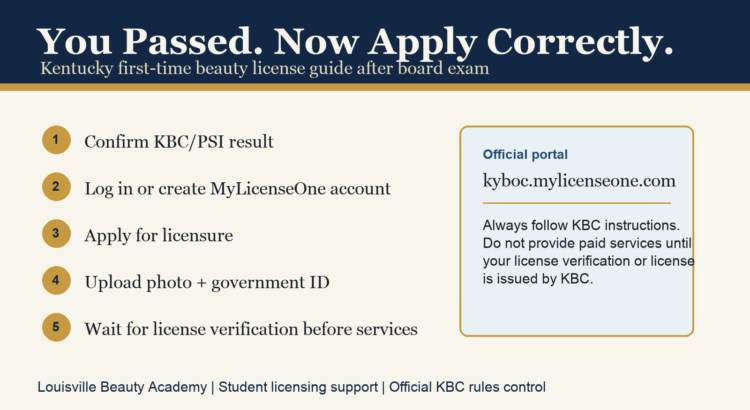
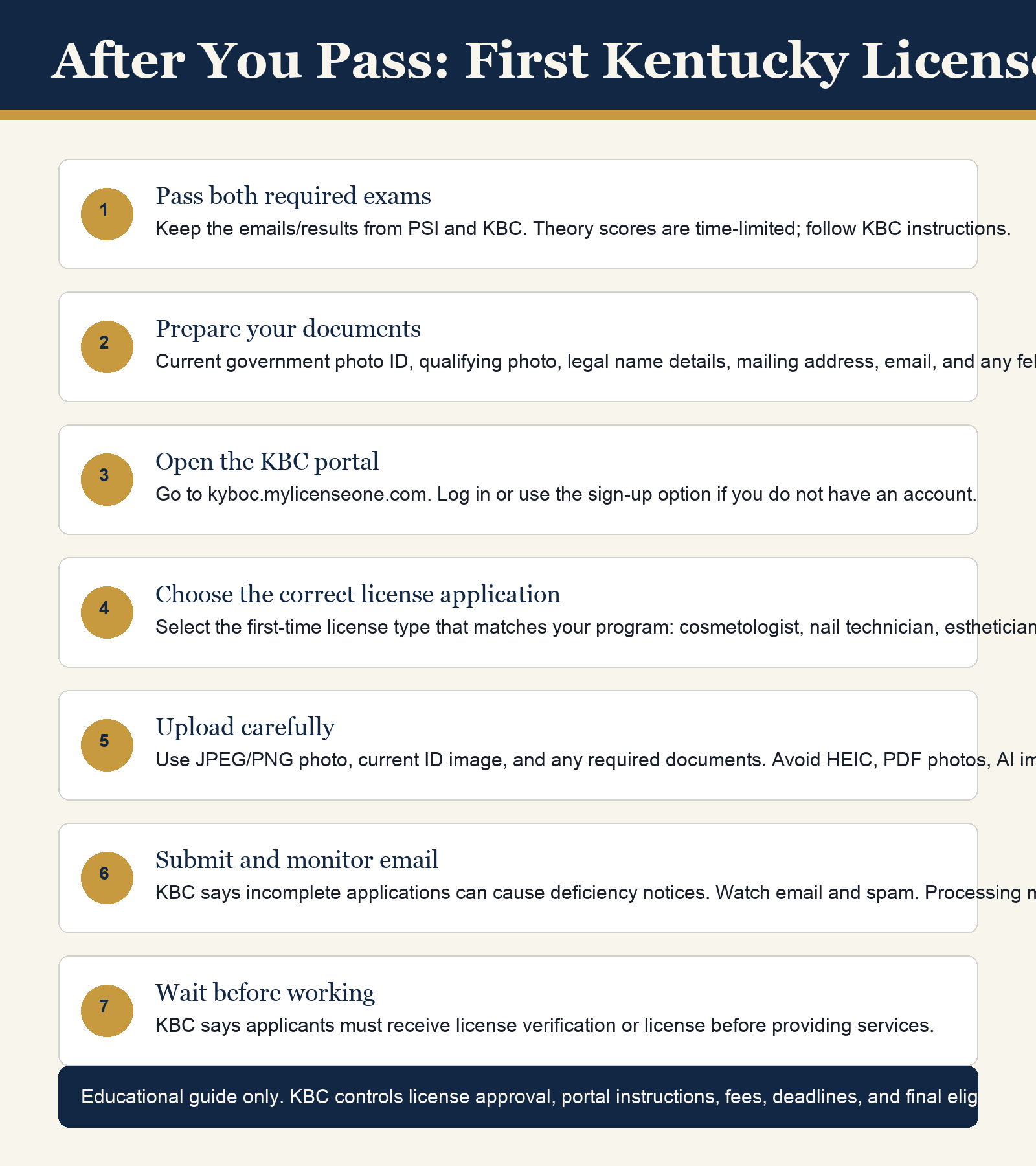
Student guide from Louisville Beauty Academy. Passing your Kentucky board exams is a serious milestone. But passing the exam is not the same thing as already being licensed. In Kentucky, the next step is to apply for your first license through the Kentucky Board of Cosmetology’s online system and wait until the Board issues license verification or the license before providing services.
This guide is written for a first-time Kentucky beauty graduate who has completed school, passed the required board examinations, and is ready to apply for the first professional license through the Kentucky Board of Cosmetology online portal.
Start With The Official Portal
The Kentucky Board of Cosmetology’s online application portal is:
If you already have an account, log in. If you do not have an account, use the portal’s sign-up or account-creation option and follow the prompts. Use your real legal information. Keep your email address accessible because the Board may send confirmation messages, deficiency notices, or status communications by email.
Before You Apply: Make Sure You Are Actually Ready
According to the Kentucky Board of Cosmetology’s published license requirements, first-time applicants in the major student license categories must meet the required training hours, provide grade-12 or equivalency education proof, be at least 18 years old, successfully complete the written and practical examinations, apply for licensure, and receive license verification or the license before providing services.
Cosmetologist: 1,500 hours.
Nail Technician: 450 hours.
Esthetician: 750 hours.
Shampoo and Style Services: 300 hours.
If you have not passed both required examinations, or if your school record is not complete, do not guess. Confirm your status first. If you studied at Louisville Beauty Academy, contact the school office for school-record support. If the question is about state licensing, portal instructions, eligibility, fees, or Board status, follow the Kentucky Board of Cosmetology’s official instructions.
What To Prepare Before Opening The Application
Before you begin the online application, prepare clean digital copies and accurate information. The Board’s licensure page states that applications missing required items are considered incomplete, and processing may take up to 10 days after submission.
Your legal name, date of birth, mailing address, phone number, and active email address.
Your current government photo ID. KBC states that a current driver’s license, state ID, passport ID, or military ID may be used; expired IDs are not accepted.
A clear digital image of the government-issued ID. KBC states photocopies will not be accepted.
A qualifying personal photo taken within the last six months.
Your school completion and examination information, as requested by the portal.
Any felony support documents if applicable, including the documents identified by KBC.
A payment method for required online fees, if the portal requires payment at submission.
Photo Rules Matter
KBC gives detailed photo instructions. Do not treat the photo as a casual selfie. Use a photo taken within the last six months, facing forward, shoulders up, with a solid white or light-blue background. The photo should be clear, not too dark, not too bright, not blurry, and should not include other people, pets, car selfies, filters, or AI-generated images. KBC also states that photos must be JPEG or PNG format and that HEIC/live photos and PDFs may not reach the Board properly.
Step-By-Step: Applying Through MyLicenseOne
The exact portal screens may change, so follow the portal prompts carefully. The safe general sequence is:
Log in or create a new account if you do not already have one.
Choose the Kentucky Board of Cosmetology service or application area.
Select the correct first-time license application for your license type.
Enter your legal information exactly and consistently.
Upload your current government photo ID and qualifying personal photo.
Answer all required questions honestly, including any required disclosure questions.
Review every page before submission.
Submit the application and pay any required fee through the online system.
Save or screenshot your confirmation for your personal records.
After You Submit
After submission, monitor your email carefully. KBC states that deficiency notices may be sent by email, and applicants may have a limited time to correct problems before an application is closed. Check your inbox and spam folder. Keep your confirmation information. If you do not receive confirmation of licensure or examination after 30 days of submission, KBC says to contact kbc@ky.gov and inquire on your status.
Do Not Start Working Too Early
This is one of the most important parts. The Kentucky Board of Cosmetology’s license requirements state that applicants must receive license verification or the license before providing services. Passing the exam is a milestone. Submitting the application is a step. The license or license verification is the authority to begin providing licensed services.
Common Mistakes That Delay Students
Using an old or expired ID.
Uploading a blurry, dark, cropped, filtered, HEIC, PDF, or AI-generated photo.
Using a nickname instead of the legal name.
Not checking email after submission.
Assuming passing the exam means the license is already active.
Ignoring a deficiency notice from KBC.
Trying to provide services before license verification or the license is issued.
Louisville Beauty Academy’s Student Guidance
Louisville Beauty Academy wants every graduate to move from school completion to examination, licensure, and professional work with calm, written clarity. Keep records. Read official instructions. Use your legal name. Use a proper photo. Watch your email. Ask before guessing. And remember: the Kentucky Board of Cosmetology controls the license decision, portal rules, fee requirements, deficiency process, and final approval.
Students who need school-record assistance may contact Louisville Beauty Academy through the school’s normal written communication channels. For state portal, licensing, or application-status questions, use the official KBC portal and KBC contact information.
This article is general student guidance from Louisville Beauty Academy. It is not legal advice and does not replace the Kentucky Board of Cosmetology’s official instructions. KBC rules, portal instructions, fees, deadlines, and application requirements control. Students should verify all requirements directly with KBC at the time of application.
A practical checklist for graduates moving from passing the board exam to applying for first-time Kentucky licensure.
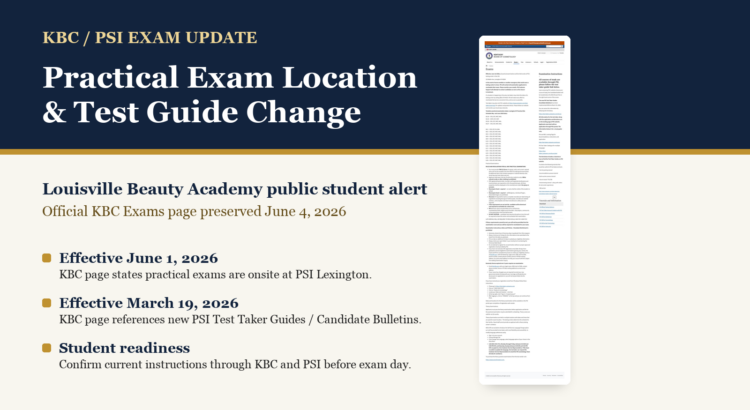
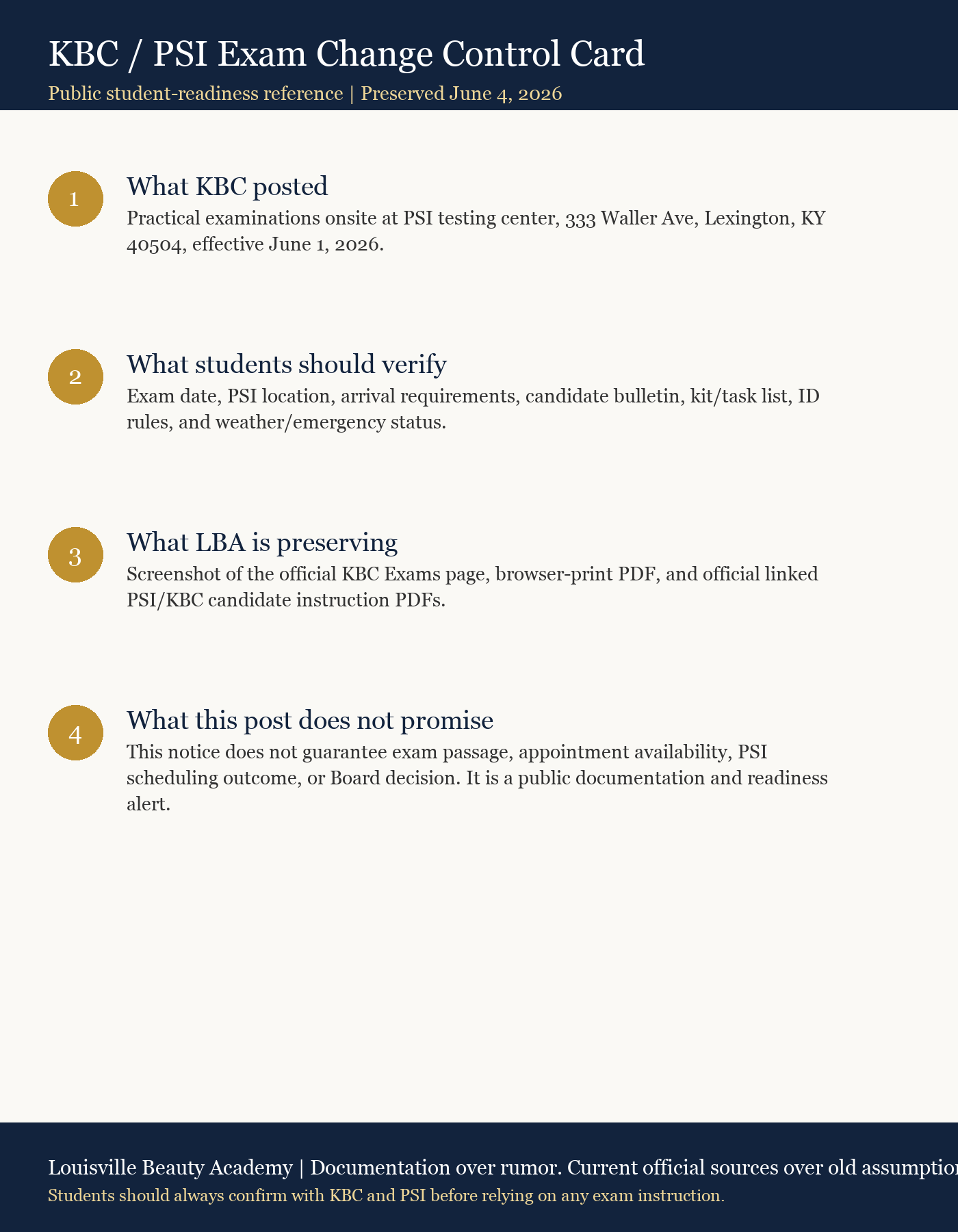
What changed: Louisville Beauty Academy is memorializing a Kentucky Board of Cosmetology / PSI exam-readiness update reviewed on June 4, 2026. The KBC Exams page states that practical examinations are onsite at PSI Lexington effective June 1, 2026, and the page also references new PSI Test Taker Guides / Candidate Bulletins effective March 19, 2026.
Who is affected: Kentucky cosmetology, esthetics, nail technology, shampoo stylist, and instructor students or graduates preparing for PSI / KBC licensing examinations.
Student action: Before exam day, students should verify Board approval, schedule through PSI, read the current candidate bulletin, confirm the location and arrival instructions, and prepare according to official KBC and PSI instructions.
Important disclaimer: Louisville Beauty Academy provides educational guidance only. Students must verify all information directly with PSI and the Kentucky Board of Cosmetology.
Effective Date
June 1, 2026 for onsite practical examinations at PSI Lexington, as stated on the KBC Exams page reviewed June 4, 2026. New PSI Test Taker Guides / Candidate Bulletins are referenced as effective March 19, 2026.
Location
PSI Lexington testing center, 333 Waller Ave, Suite 120, Lexington, Kentucky 40504, according to the KBC Exams page.
Programs Affected
Cosmetology, Esthetician, Nail Technology, Instructor, and Shampoo Stylist candidates should review the official candidate bulletin for their program.
Graduate. Complete the required school training, hours, and internal graduation process.
Verify Board approval. Confirm that the Kentucky Board of Cosmetology has the required school submission and that the candidate is eligible to proceed.
Schedule PSI. Use PSI’s official Kentucky cosmetology test-taker path and confirm the correct exam, date, address, and arrival requirements.
Review the candidate bulletin. Read the current bulletin for the specific program before relying on older preparation assumptions.
Arrive prepared. Bring required identification, required kit/materials if applicable, and follow PSI / KBC instructions for timing, conduct, and exam-day rules.
The detailed research below is preserved for transparency, student support, SEO value, and Louisville Beauty Academy’s Compliance-by-Design documentation practice. LBA documents and educates; PSI and the Kentucky Board of Cosmetology determine official policy, scheduling, exam instructions, and candidate requirements.
Louisville Beauty Academy is memorializing this public student-readiness update on June 4, 2026, based on the Kentucky Board of Cosmetology’s official Exams page as reviewed on this date.
The Kentucky Board of Cosmetology’s Exams page now states that, effective June 1, 2026, practical examinations will be held onsite at PSI’s Lexington testing center at 333 Waller Ave, Suite 120, Lexington, Kentucky 40504. The same page also references the implementation of new PSI Test Taker Guides / Candidate Bulletins effective March 19, 2026.
For students and graduates preparing for Kentucky cosmetology, esthetics, nail technology, shampoo stylist, or instructor examinations, this matters because exam logistics and official candidate instructions can affect preparation, travel planning, kit readiness, and exam-day confidence.
Detailed Student Guidance From the Source Review
Review the current Kentucky Board of Cosmetology Exams page before relying on older exam assumptions.
Confirm your PSI scheduling details, location, arrival instructions, identification requirements, and candidate bulletin before exam day.
Monitor email from PSI, especially for scheduling, weather, emergency, or testing-center notices.
Ask your instructor or school office for help understanding what changed, but always treat KBC and PSI as the official source for exam instructions.
What Louisville Beauty Academy Is Preserving
As part of Louisville Beauty Academy’s documentation-first student support practice, we preserved a dated screenshot and browser-print copy of the official KBC Exams page, along with the official linked Kentucky candidate information documents available from that page at the time of review.
This public post is not a substitute for KBC or PSI instructions. It is a dated public record and student-readiness notice so that students, graduates, staff, and the public can see that exam-related changes were noticed, documented, and communicated.
Louisville Beauty Academy’s role is to help students prepare with clarity, written documentation, sanitation seriousness, practical skill development, and respectful support. No school can take the exam for a student or guarantee a passing result. What we can do is keep students oriented toward current official instructions, strong preparation, and responsible exam-day readiness.
Reviewed and memorialized: June 4, 2026.
Louisville Beauty Academy preserved the official KBC Exams page and linked candidate documents on June 4, 2026 for student-readiness documentation.
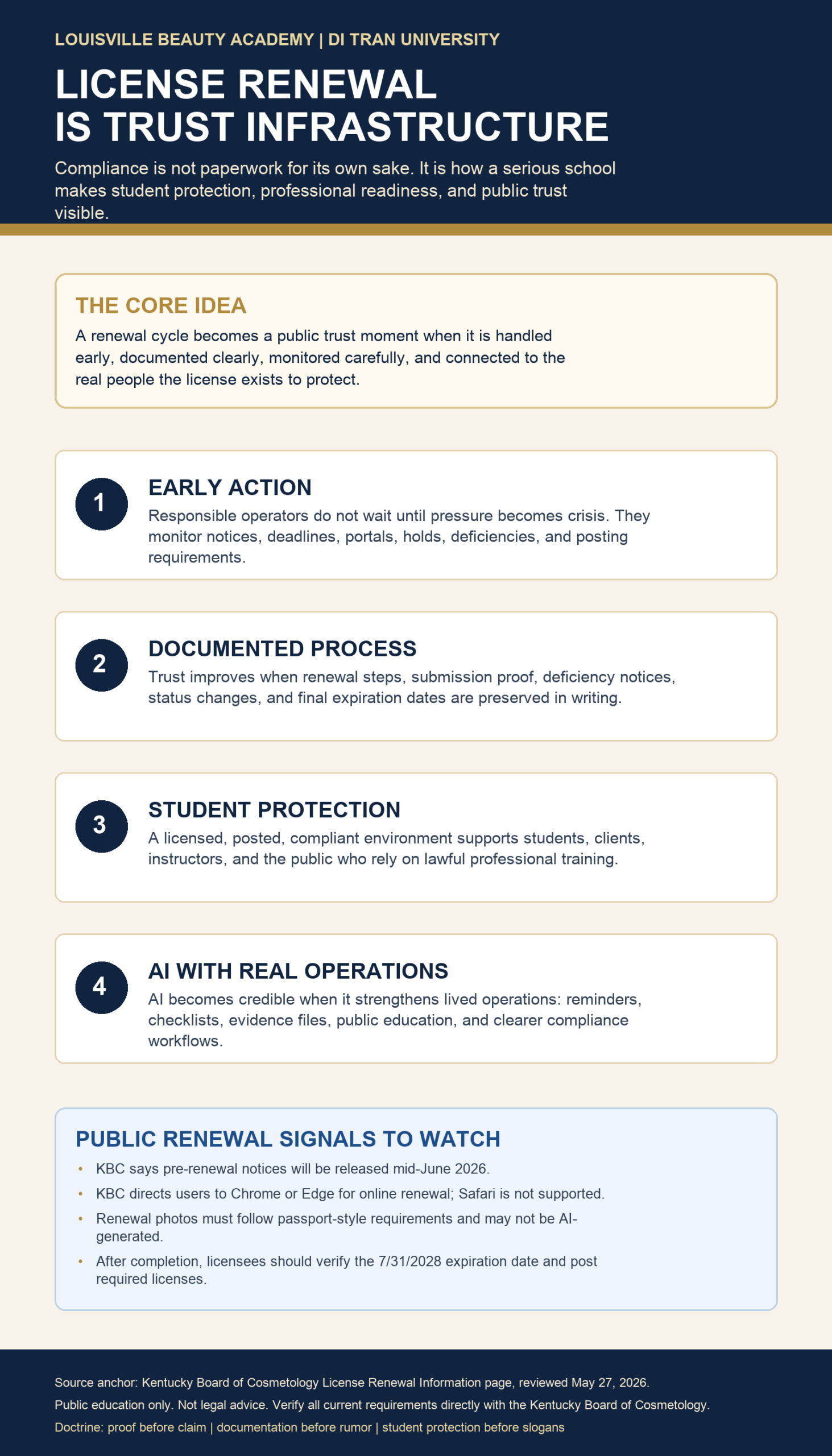
License Renewal Is Trust Infrastructure for Beauty Education
License renewal is easy to treat as administration. That is too small. In a licensed workforce-education environment, renewal is one of the recurring moments when public trust becomes visible.
For Louisville Beauty Academy, the stronger lesson is this: compliance is not paperwork for its own sake. It is a discipline of protection. It helps students, instructors, clients, regulators, and the public see that the school is operating through documented standards rather than verbal assumption.
Why Renewal Matters
A responsible renewal cycle forces an institution to monitor deadlines, portal requirements, deficiency notices, license status, photo requirements, payment pathways, and final posting obligations. Each of those details is small by itself. Together, they form operational seriousness.
The Student-Protection Layer
Students rely on the school environment to be lawful, current, and professionally aligned. Clients rely on posted license visibility. Instructors and staff rely on clear internal process. Renewal discipline supports all three.
AI Should Strengthen the Real Workflow
This is also why AI implementation must be grounded in real operations. AI can help organize checklists, reminders, public explanations, evidence files, and follow-up systems. But the value comes from serving the lawful workflow, not from talking abstractly about technology.
Source and Boundary
This public-education post is anchored to the Kentucky Board of Cosmetology License Renewal Information page: https://kbc.ky.gov/Licensure/Pages/License-Renewal-Information.aspx. It is not legal advice. Readers should verify current requirements directly with the Kentucky Board of Cosmetology and their own professional advisors where appropriate.
Infographic: license renewal as trust infrastructure. Source anchor: Kentucky Board of Cosmetology License Renewal Information page, reviewed May 27, 2026.
A lawful profession should be rigorous. It should test health, safety, sanitation, technical competence, and the ability to serve the public responsibly. But rigor and unnecessary exclusion are not the same thing. A regulatory system becomes stronger—not weaker—when it ensures that candidates are evaluated on the professional standards that matter rather than being defeated by avoidable language barriers that obscure genuine competence.
That is why multilingual access in beauty licensing deserves to be treated as a serious workforce issue.
The Kentucky Board of Cosmetology exists to provide educational, health, and regulatory standards for the beauty industry. That mission is not compromised when qualified candidates are able to understand an examination. On the contrary, the mission is better served. A regulatory test should confirm whether the applicant understands sanitation, public safety, professional rules, and the relevant body of practice. If the examination structure can lawfully preserve those standards while expanding language accessibility, the public interest is advanced rather than diluted.
This principle is larger than the beauty sector. In an increasingly multilingual country, access systems that preserve standards while reducing avoidable friction will become a central feature of competitive workforce design. Industries that fail to recognize this will unnecessarily shrink their own talent pipeline. Industries that recognize it early will expand lawful participation, improve trust, and create more stable routes from training to licensure to work.
In Kentucky, this is especially important for immigrants, multilingual households, and adult learners whose professional capabilities may exceed their comfort with English-only test conditions. Many are not lacking discipline. They are lacking an access architecture calibrated to reality. Where that architecture improves, entire communities gain.
The beauty profession is a particularly revealing example because it sits at the intersection of regulation, public contact, entrepreneurship, and community-based mobility. A licensed nail technician, esthetician, cosmetologist, or instructor is not simply a credential-holder. That person may become a wage earner, an independent professional, a renter of commercial space, an employer, or a bridge of economic support for extended family. The licensing exam is therefore not just a test. It is a gate between informal aspiration and formal economic standing.
When observers hear the phrase multilingual access, some mistakenly assume the dilution of standards. That is the wrong frame. The serious frame is this: are standards being measured accurately? If a profession requires sanitation, safety knowledge, lawful practice, and technical competence, then the exam system should measure those competencies with clarity. Language accessibility, when properly designed, does not excuse ignorance. It reduces noise in the measurement process.
This distinction matters not only ethically but economically. Every unnecessary barrier in a regulated workforce pipeline delays labor-force participation, reduces consumer choice, weakens small-business formation, and constrains local economic circulation. Conversely, every lawful improvement in access can expand the pool of properly licensed professionals available to serve the public.
For institutions such as Louisville Beauty Academy, multilingual licensure access is therefore not a side issue. It is central to the mission of practical opportunity. Schools that understand this are better positioned to guide students not merely through training, but through a complete mobility pathway—orientation, instruction, preparation, examination, licensure, and workforce entry.
Kentucky has an opportunity to be recognized not merely as a place that regulates beauty professions, but as a place that regulates them intelligently. Intelligent regulation does not confuse difficulty with virtue. It defends public standards while making those standards genuinely reachable for qualified people. In a workforce era defined by both labor demand and linguistic diversity, that is not generosity. It is competence.
The future belongs to systems that can say two things at once and mean both: our standards remain real, and our opportunity is more accessible. That is the essence of multilingual licensure done correctly.
Research & Information Disclaimer
This publication is provided for educational, research, and public-information purposes only. It reflects institutional analysis based on publicly available information, practical experience, and internal interpretation as of the publication date. It does not constitute legal advice, tax advice, investment advice, or a guarantee of regulatory, financial, or operational outcomes. Readers should consult qualified legal, financial, regulatory, or other professional advisors before acting on matters discussed herein.
Educational & Research Notice This publication is independent research by Di Tran University – College of Humanization, based solely on publicly available information. All research credit is attributed to Di Tran University. Louisville Beauty Academy and Di Tran University are not affiliated with, endorsed by, or representative of the Kentucky Board of Cosmetology or any government agency. This content is provided for informational purposes only, does not constitute legal or regulatory advice, and is presented “as is” without representation or warranty.
Part A: Executive Brief for Legislators
The regulatory architecture of the United States beauty industry has reached a critical inflection point where the exercise of the state’s police power increasingly conflicts with fundamental constitutional protections regarding the right to earn a livelihood.1 Occupational licensing now covers approximately 25% of the U.S. workforce, representing a fivefold increase since the 1950s.3 While ostensibly designed to solve information asymmetry and protect consumer health and safety, empirical data and administrative case studies indicate that these systems frequently function as state-sanctioned barriers to entry that generate “monopoly rents” for incumbent practitioners while imposing a “deadweight loss” on the broader economy.1
The core findings of this multidisciplinary report identify a profound “Due Process Accessibility Gap”.2 Although formal legal rights—including the right to notice, an impartial decision-maker, and an evidentiary hearing—remain codified in administrative law, they are rendered functionally inaccessible to low- and moderate-income licensees.2 The primary driver of this failure is a severe economic imbalance: the cost of a meaningful legal defense relative to practitioner income.2
Economic Indicator
Sector Data
Median Annual Income (Nail Technicians)
$34,660 7
Median Annual Income (Cosmetologists)
$35,420 8
Typical Administrative Case Defense Cost
$5,000 – $20,000+ 9
Defense Cost as Percentage of Median Income
14.4% – 57.7% 7
“Due Process Inaccessibility” Threshold
>10% of Annual Income
This economic reality creates a system of “functional coercion,” where licensees are pressured to accept “Agreed Orders” or settlements, regardless of the merit of the allegations, simply because the cost of proving their innocence exceeds their financial capacity.2 Furthermore, the complaint-driven enforcement model is structurally vulnerable to “competitive harassment,” where established firms weaponize the administrative process to drain the resources of rivals.1
The report highlights the Commonwealth of Kentucky as a critical case study in regulatory failure.12 Recent investigations reveal patterns of targeted hyper-fining against minority-owned nail salons, the use of unauthorized legal counsel to issue disciplinary notices, and the persistence of “shadow” testing operations that duplicate state-contracted services at a significant loss to the public fisc.13
To restore administrative integrity, this report proposes a suite of “legislatively actionable” reforms, including:
Fee-Shifting Provisions: Requiring boards to pay attorney fees for prevailing licensees.16
Fine Caps: Limiting administrative penalties relative to the licensee’s reported income.18
Independent Oversight: Establishing a non-industry review board to audit enforcement patterns and ensure “evidence legibility”.2
Technological Integration: Utilizing AI-driven auditing and “Gold-Standard” digital logs to verify compliance and prevent arbitrary targeting.2
The issue is not the existence of regulation, but whether the scales of justice are balanced enough to allow the regulated to defend their property interests against administrative overreach.
Part B: Research Paper: Structural Barriers and Asymmetric Power
1. Introduction: The Property Interest in Professional Livelihood
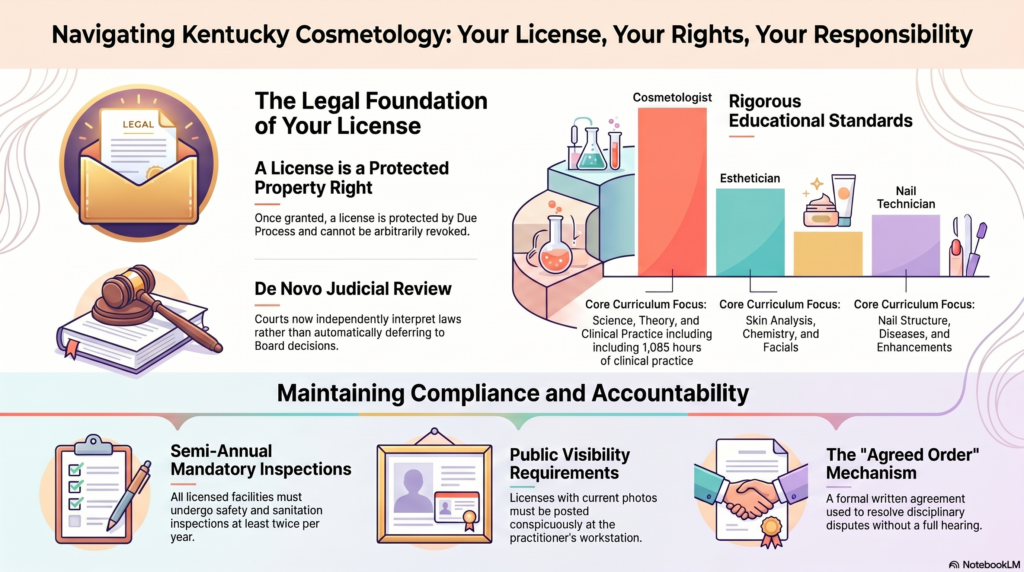
The legal status of a professional license has transitioned from a mere privilege to a recognized property interest under the Fourteenth Amendment’s Due Process Clause.2 When a state grants a license, it creates a vested interest that allows an individual to pursue a livelihood—an interest that cannot be revoked or suspended without adherence to fundamental fairness.2 Historically, the judiciary frequently scrutinized economic regulations that interfered with this right; however, the modern “rational basis” standard of review grants broad deference to state boards.2
Despite this deference, the recognition of a license as a property interest remains a cornerstone of administrative law, necessitating a balance between state police power and individual rights. The Mathews v. Eldridge balancing test provides the framework for this evaluation, weighing the private interest affected, the risk of erroneous deprivation through current procedures, and the government’s interest in fiscal and administrative efficiency.2 In the beauty industry, where practitioners are often self-employed or micro-business owners, the “private interest” represents their entire economic survival, while the “risk of error” is heightened by the lack of legal representation.2
2. Economic Reality vs. Legal Defense Cost
The viability of due process is inextricably linked to the cost of legal counsel.2 For the majority of beauty professionals, the economic barrier to justice is insurmountable.
A. Income Profiles of Personal Care Professionals
The personal care sector is characterized by modest earnings. As of May 2024, the median wages across various specialties indicate a high degree of financial sensitivity.
Specialty
Median Hourly
Median Annual
10th Percentile
90th Percentile
Manicurist/Pedicurist
$16.66
$34,660
$27,260
$48,080 7
Hairdresser/Cosmetologist
$16.95
$35,260
$23,520
$63,310 8
Skincare Specialist
$19.98
$41,560
$27,160
$77,330 24
Barber
$18.73
$38,960
$27,770
$78,440 8
These figures underscore that most beauty professionals fall into the low- to moderate-income brackets. Furthermore, many in the sector are independent contractors who do not receive employer-sponsored benefits, increasing their vulnerability to sudden legal expenses.26
B. The Cost of Administrative Adjudication
Legal defense in administrative law requires specialized expertise. National data from 2025 indicates that the average hourly rate for an administrative law attorney is approximately $328 to $329.9 In major markets like California, these rates frequently exceed $420 per hour.10
A standard administrative defense case involves several critical phases:
Investigation and Discovery: 10–20 hours.
Pleadings and Motions: 5–10 hours.
Hearing Preparation and Witness Interviews: 15–20 hours.
Formal Hearing Attendance: 8–16 hours.
Post-Hearing Briefs: 5–10 hours.
Totaling between 43 and 76 hours of legal work, a typical contested case carries a price tag of $14,000 to $25,000.9 When compared to a median manicurist’s annual income of $34,660, the cost of defense can represent up to 72% of their total gross earnings.7
C. The Due Process Threshold
Access to justice is denied when the cost of defending a right exceeds a meaningful share of the interest’s value. This research defines the “Practical Due Process Accessibility Threshold” as a legal cost not exceeding 10% of annual income. Current market rates for legal defense exceed this threshold for over 90% of the beauty workforce.2 Consequently, due process is “theoretically available but practically inaccessible”.2
3. Structural Power Asymmetry: The Administrative State vs. The Individual
The power imbalance between a state regulatory board and a licensee is systemic and multi-dimensional.1 This phenomenon, defined as “Administrative Power Asymmetry,” ensures that the board almost always operates from a position of tactical superiority.
A. Institutional Advantages of the Board
State boards possess institutional continuity and the backing of the state’s legal apparatus.1 Boards have access to full-time legal counsel funded by taxpayer or license-fee revenue, allowing them to pursue enforcement actions without internalizing the marginal cost of litigation.2 They possess broad investigative powers, including the authority to conduct surprise inspections and issue administrative subpoenas for private records.11
B. Vulnerability of the Licensee
The average licensee is a small salon owner or employee with no formal legal training.2 The loss of a license constitutes an “existential risk,” as it immediately terminates their ability to earn a living.2 This high-stakes environment, combined with the licensee’s high marginal defense cost, creates a “coercive settlement environment”.2
Feature
Regulatory Board
Individual Licensee
Legal Representation
State-funded, specialized counsel 13
Out-of-pocket, high-cost private counsel 9
Financial Risk
Minimal; funded by fees/fines 12
Catastrophic; livelihood at stake 2
Information
Full access to investigative files 11
Limited access without expensive discovery
Continuity
Institutional; immune to time pressure
Highly sensitive to delays/closure 28
4. Agreed Orders as Default Enforcement: Functional Coercion
The administrative state relies heavily on “Agreed Orders” or settlements to maintain operational efficiency.2 While settlements are a legitimate part of the legal process, their use in the beauty industry often signals a failure of due process rather than a mutual agreement.
A. The Efficiency Trap
Enforcement statistics from states like Texas (TDLR) show that a significant majority of cases are resolved through agreed orders rather than formal hearings.29 For example, in the Texas Auctioneer program, 100% of final orders were agreed orders or defaults in 2023.29 Boards often include a “Notice of Alleged Violation” (NOAV) with a pre-calculated settlement offer.31 To an unrepresented licensee, this often feels like an ultimatum: pay a $1,000 fine now, or spend $10,000 in legal fees to fight it.2
B. The Cumulative Effect of Settlements
Agreed orders are not neutral. They include admissions of facts and create a permanent disciplinary history.2 Under the “Disciplinary Escalation Pathway,” a minor agreed order for a sanitation issue today can be used as a “prior violation” to justify license revocation or emergency closure tomorrow.11 This creates a “record-building” mechanism that allows boards to target disfavored practitioners over time.33
5. National Context: The Growing Burden of Occupational Licensing
The expansion of licensing into low-income occupations has created substantial economic barriers that reduce mobility and entrepreneurship.6
A. Disproportionate Training Requirements
The time required to enter beauty professions is frequently irrational when compared to higher-risk fields.3 National research highlights that the average cosmetologist must complete 342 days of training, while an EMT requires only 36 days.3
Occupation
Avg. Training (Days)
Avg. Fees
Cosmetologist
342
$209 36
Barber
315
$175 36
Makeup Artist
128
$173 36
EMT
36
$115 3
This disparity suggests that licensing requirements are driven by industry lobbying (rent-seeking) rather than public safety.1
B. Impact on Entrepreneurship and Inequality
Studies confirm a discernable connection between the density of licensing and lower rates of entrepreneurship among low-income populations.34 In states that license more than half of low-income occupations, the entrepreneurship rate is 11% lower than average.34 This burden falls most heavily on those with less access to financial capital or formal education, cementing existing economic inequalities.3
6. Vulnerable Populations Analysis
The enforcement burden of occupational licensing is not distributed equally. It disproportionately impacts immigrant entrepreneurs, rural operators, and minority business owners.1
A. Immigrant Communities and Language Barriers
In the nail salon sector, which has a high concentration of Vietnamese and Cambodian immigrants, single-language testing acts as a structural barrier.37 Advocacy groups in Kentucky have highlighted that the lack of multi-language exams prevents practitioners from demonstrating their competency in sanitation and safety, despite those tests being available nationally via PSI.37 This “linguistic exclusion” increases the risk of erroneous deprivation of livelihood for thousands of “New Americans”.37
B. Rural Schools and “Regulatory Deserts”
Administrative case studies from Kentucky indicate that aggressive enforcement has targeted rural beauty schools, which are often the sole vocational training providers in poverty-stricken counties.12 The closure of these institutions—often for minor, cure-able infractions—forces students to commute to larger cities, creating “regulatory deserts” and restricting economic mobility in underserved regions.12
7. Public Choice and System Design: The Problem of Regulatory Capture
The economic theory of regulation suggests that licensing boards are often “captured” by the industries they regulate.1 Small, well-organized groups of incumbent practitioners find it easier to lobby for restrictive rules that limit competition than the large, unorganized group of consumers who are harmed by higher prices.1
Evidence of capture includes:
Board Composition: Boards often consist entirely of industry incumbents with a vested interest in limiting new competition.1
Scope Creep: Boards attempting to regulate activities like “eyebrow threading” or “hair braiding” as “cosmetology,” requiring hundreds of hours of irrelevant training.2
Accreditation Requirements: Quietly implementing laws that require national accreditation for schools—a process that costs thousands and favors large institutions over small, community-based vocational academies.15
Part C: Kentucky Deep Dive: A Case Study in Administrative Failure
1. The Kentucky Board of Cosmetology (KBC) Scandals (2021–2024)
Kentucky provides a stark example of how a lack of oversight can lead to the systemic abuse of administrative power.12 A series of investigations by the Legislative Oversight and Investigations Committee (LOIC) and victims’ advocates have uncovered widespread misconduct.14
A. Unauthorized Legal Counsel and Ultra Vires Actions
One of the most serious structural violations uncovered was the unlawful appointment of Christopher Hunt as “General Counsel”.13 Under Kentucky law (KRS 12.211), only the Attorney General may represent or authorize the representation of state agencies.13 Evidence suggests that Hunt was hired directly by a board vote and acted without AG delegation for years.13 Because he lacked legal authority, every disciplinary notice, license revocation, and “Agreed Order” he authored may be considered void ab initio.13
B. The “Hyper-Fining” of Nail Salons
Administrative data from 2023–2024 revealed a shocking disparity in enforcement.15 Nail salons, which are predominantly owned by AAPI practitioners and make up less than 10% of the industry, were fined over $250,000.15 In contrast, hair salons were fined less than $4,000.15 This targeting suggests a pattern of “Asian Hate” manifested through government agency action rather than individual animosity.15
C. Fiscal Malfeasance: Direct Checks and Testing Fraud
KBC leadership allegedly operated a “shadow testing agency” to enrich specific employees.13 Despite having an exclusive contract with PSI Services for exam administration, the board allegedly rented rooms at KCTCS using restricted funds and paid its own staff direct checks of $1,000 to $2,000 per month to proctor exams—proctoring duties that were already paid for under the PSI contract.13 This duplication of costs drained the “Board of Cosmetology trust and agency fund” and circumvented state payroll and retirement systems.13
2. Procedural Safeguards and Their Erosion
The KBC has been accused of using “cowardly acts” to cover wrongdoings, such as pursuing criminal charges against school owners to halt administrative hearings where proof of curriculum and legal instructors was being presented.33 One instructor was allegedly denied a hearing for over a year while the board “laughed and name-called” her on recordings, stating they were closing her school before an audit had even occurred.33
3. Comparison with Peer States (2024-2025)
State
Board Structure
Oversight Mechanism
Enforcement Pattern
Kentucky
Independent 14
Legislative Audit (LRC)
High agreed orders; targeting of AAPI 13
Indiana
Integrated (IPLA)
Professional Licensing Agency
Screening by IPLA staff; 90-day order rule 39
Tennessee
Integrated (TDCI)
Dept. of Commerce & Insurance
12-day processing; 96% satisfaction 26
Texas
Integrated (TDLR)
Commission oversight
71% resolution in 6 months; NOAV-driven 29
California
Independent 2
Quadrennial Sunset Review
High bureaucracy; high AG referrals 42
Part D: Due Process Accessibility Index (DPAI)
The DPAI is a measurable framework designed to rank occupational boards based on the feasibility of obtaining administrative justice.
1. Index Methodology
The DPAI scores boards from 0 to 100 based on six weighted metrics:
Cost-to-Income Ratio (30%): Weighted cost of defense vs. median income.
Settlement Coercion Factor (20%): Ratio of Agreed Orders to Contested Hearings.
Language Inclusivity (15%): Availability of tests and notices in top 5 state languages.
Transparency Score (15%): Online accessibility of minutes, votes, and fine schedules.
Oversight Integrity (10%): Use of independent (non-industry) review boards.
“Hard Look” Review (10%): Presence of fee-shifting or judicial “hard look” standards.
2. Most Burdensome Beauty Boards Ranking (Est. 2025)
Prohibitive legal costs ($420/hr); high bureaucracy 2
3
Texas
31
NOAV-driven settlement pressure; high default rate 29
4
Georgia
38
Extreme barriers for minor criminal records 44
5
Illinois
42
High education days lost (350 days for Cosmo) 45
A higher DPAI score indicates better access to justice.
Part E: Policy and Legislative Solutions
1. Structural Fairness Reforms
A. Fee-Shifting for Prevailing Licensees
Legislatures should enact “Prevailing Licensee” statutes modeled after the federal Equal Access to Justice Act (EAJA).16 If a board loses an administrative proceeding and fails to prove that its position was “substantially justified,” it must be ordered to pay the licensee’s reasonable attorney’s fees.16 This removes the “economic deterrent” that prevents meritorious claims from being heard.
B. Income-Proportional Fining
Administrative fines should be capped relative to the practitioner’s income. For example, a first-time violation for a minor labeling issue should not exceed 1% of the licensee’s reported annual income.18 This ensures that enforcement is corrective rather than punitive or exit-forcing.
C. Mandatory Disclosure and “Brady” Rules
Boards must be statutorily required to disclose all exculpatory evidence to a respondent at least 14 days before a settlement offer can be signed.33 This prevents boards from “sitting on” evidence that shows a school or salon was functioning legally while pressuring them into a settlement.33
2. Due Process Accessibility Reforms
A. Right to “Low-Bono” or Public Defense
States should establish a fund—supported by a small percentage of license renewal fees—to provide subsidized administrative defense for low-income practitioners.2
B. Plain-Language Response Windows
Response windows for complaints should be extended to 30 calendar days, and all notices must be provided in plain language with a clear explanation of how to request a hearing and the potential consequences of signing an Agreed Order.2
C. Independent Enforcement Review Board
Final disciplinary authority should be removed from industry-dominated boards and placed in the hands of an independent review body composed of administrative law judges and members of the public.2
3. Economic Protection Provisions
A. Alternative Compliance Pathways
Boards should replace “immediate closure” orders for non-safety issues (like record-keeping discrepancies) with “Correction Orders” that allow a 30-day cure period before penalties are assessed.32
B. Elimination of Discriminatory Education Requirements
States should repeal high school diploma requirements for cosmetologists and barbers, as these requirements are not rationally related to sanitation or technical skills and act as barriers for immigrants and low-income adults.36
Part F: Kentucky Legislative Memo: Restoring Regulatory Integrity
TO: Kentucky General Assembly, Committee on Licensing, Occupations, and Administrative Regulations
FROM: Multidisciplinary Research Team
DATE: April 2026
RE: Emergency Remediation of the Kentucky Board of Cosmetology (KBC) Enforcement Actions
1. The Legal Nullity of 2021–2024 Administrative Orders
A critical legal crisis exists regarding the validity of KBC disciplinary actions taken between 2021 and 2024.13 Evidence indicates that Christopher Hunt acted as “General Counsel” and issued hundreds of disciplinary notices without the Attorney General delegation required by KRS 12.211.13 Under the “Doctrine of Nullity,” any administrative act performed by an unauthorized individual is void.13
Recommendation: The General Assembly should pass an emergency resolution directing the Cabinet for Public Protection to review and vacate all disciplinary orders signed by unauthorized counsel during this period and refund all associated fines to the “Board of Cosmetology trust and agency fund” victims.13
2. Abolishing the Industry Monopoly on Executive Leadership
Current statute KRS 317A.040 formerly required that a licensed cosmetologist serve as the Executive Director of the Board.46 This created a structural conflict of interest and institutional capture.
Action Taken: Senate Bill 22 (2025) successfully removed this requirement.46 The General Assembly must ensure that future directors possess administrative and legal expertise rather than just industry affiliation to prevent the recurrence of “dictatorial” leadership.12
3. Ending the “Shadow Agency” and Procurement Fraud
The LOIC findings regarding the KBC’s bypass of the PSI testing contract in favor of high-cost KCTCS room rentals and “direct check” proctoring represent a material weakness in state fiscal control.13
Recommendation: Legislation is required to mandate that all licensing exams be conducted strictly through competitive-bid third-party vendors (like PSI) and that no board staff shall receive compensation outside the state merit payroll system for proctoring duties.13
Part G: Public Education Report: Knowing Your Rights
1. What is an “Agreed Order”?
An “Agreed Order” is a legal contract between you and the Board. By signing it, you are usually admitting that you broke a rule and agreeing to pay a fine or accept probation.11Once you sign it, you lose your right to a hearing.
2. The Trap of “Informal Warnings”
In Kentucky, you might receive a “written admonishment”.2 While this doesn’t feel like a punishment, the Board keeps it in your file. If you are inspected again, they can use that first warning to give you a much bigger fine or shut you down.2
3. Your Right to Everything in Writing
Under regulation 201 KAR 12:190, the Board cannot just give you a “verbal warning” or demand you pay a fine on the spot.47 You have a right to:
A written complaint signed by a real person (not anonymous).13
30 days to respond in writing.2
A formal hearing before an administrative judge.2
4. The “Gold-Standard” Defense
The best way to protect your license is “Over-Compliance”.20 This means keeping perfect digital records of your attendance, sanitation steps, and client appointments.20 If a board tries to say you weren’t teaching or working, you can show them “immutable” digital logs that are hard to argue with.2
Part H: State-by-State Access to Justice Ranking (2025)
State
Accessibility Grade
Settlement %
Language Support
Appeal Difficulty
Tennessee
A-
62%
High
Low (IPLA help)
Indiana
B+
68%
Moderate
Moderate
Texas
C-
88%
Low
High (SOAH costs)
California
D
84%
Moderate
Very High (Legal fees)
Kentucky
F (Historic)
94%
Very Low
Impossible (Retaliation) 12
Limits of Evidence
This analysis is subject to several evidentiary constraints:
Opacity of Board Records: Many boards, including the KBC, have been accused of refusing Open Records Requests (ORR) and hiding meeting minutes, making it difficult to fully quantify the scope of settlement coercion.12
Under-Reporting by Victims: Vulnerable practitioners, particularly undocumented or limited-English immigrants, often fear that challenging a board will lead to retaliation or deportation, resulting in a significant under-reporting of administrative abuse.37
Lagging BLS Data: Official wage data for 2024–2025 may not fully reflect the impact of post-pandemic inflation or the “Compliance Tax” on net income.7
Incomplete Criminal Tracking: There is limited tracking of cases where administrative boards utilize “selective prosecution” by referring minor civil matters to criminal courts.33
Final Objective: A Livelihood Protected by Law
The central research question of this report—to what extent licensing systems limit due process—is answered with a finding of systemic procedural failure.2 The “Due Process Accessibility Gap” is a structural feature of modern administrative governance that prioritizes board convenience over practitioner rights. When the cost of a defense attorney equals half of a technician’s yearly income, the “right to a hearing” is a hollow promise.2
Restoring the balance requires a fundamental shift in how the state views its power. The professional license is a property interest that defines an individual’s identity and survival in the economy.2 By implementing fee-shifting, proportional fining, and digital transparency, legislatures can ensure that the “police power” remains a tool for public safety rather than a mechanism for economic exclusion. The ultimate standard for any regulatory reform must be: “The issue is not whether regulation exists—but whether justice is realistically accessible to those being regulated.”2
Educational, Research & Public Information Notice This publication is independent academic research developed by Di Tran University – College of Humanization and is based solely on publicly available sources. All research credit is attributed to Di Tran University.
Louisville Beauty Academy and Di Tran University do not assert, verify, or independently validate any claims, findings, or conclusions presented. All information is compiled, summarized, or interpreted from third-party public materials and is presented strictly for educational and informational purposes.
Neither Louisville Beauty Academy nor Di Tran University is affiliated with, endorsed by, or representative of the Kentucky Board of Cosmetology or any governmental authority. This content does not constitute legal, regulatory, or professional advice and is provided “as is” without representation, warranty, or guarantee of accuracy or completeness. Readers are solely responsible for independent verification and compliance with applicable laws and regulations.
No statements herein should be interpreted as allegations, findings of fact, or claims against any specific individual or entity, but solely as academic discussion of publicly reported information.
At Louisville Beauty Academy (LBA), our mission is simple: Prepare students to meet Kentucky state licensure requirements safely, ethically, and successfully.
As part of ongoing public regulatory literacy efforts, an independent research publication was recently released by Di Tran University — The College of Humanization Research examining federal accreditation terminology and state licensure authority in vocational education.
The research discusses:
The U.S. Department of Education’s clarification regarding historic accreditation terminology
The role of state licensing boards in governing occupational entry
Why clock-hour completion and examination eligibility are determined by state law
The importance of measurable student outcomes such as licensure readiness and safety compliance
For those interested in reviewing the full academic analysis, it is available through Di Tran University’s public research archive.
For individuals pursuing cosmetology, esthetics, or nail technology in Kentucky:
Licensure eligibility is governed by the Kentucky Board of Cosmetology under KRS Chapter 317A and 201 KAR Chapter 12.
Students must complete the required state-mandated clock hours.
Students must pass the state licensing examination.
Schools must operate under state authorization.
These are the core regulatory steps required for career entry.
Louisville Beauty Academy’s Focus
Louisville Beauty Academy is a Kentucky state-licensed beauty college. Our focus remains:
State curriculum compliance
Clock-hour integrity
Examination readiness
Public safety and sanitation standards
We encourage all prospective students to evaluate any institution — including ours — based on:
Total program cost
State licensure eligibility
Completion expectations
Inspection and compliance history
Educational Notice: The information provided on this website is for general informational and educational purposes only. It does not constitute legal, accreditation, or regulatory advice. Requirements for licensure are determined by the Kentucky Board of Cosmetology and applicable state and federal authorities. Prospective students are encouraged to consult official regulatory sources directly for current requirements. Louisville Beauty Academy makes no representations beyond compliance with applicable state licensing standards.
Public Research & Regulatory Literacy Series Louisville Beauty Academy — Informational Publication Developed in academic collaboration with Di Tran University, The College of Humanization Research. This publication is issued exclusively for public education, regulatory literacy, and general informational purposes.
Executive Summary
This publication examines licensed cosmetology education as a component of modern workforce infrastructure rather than solely as a segment of traditional academic education. Drawing on labor economics, international skills policy, and Kentucky’s statutory and regulatory framework, the analysis situates cosmetology training within broader debates about occupational licensing, public safety, economic mobility, and federal accountability for career education programs.
According to the International Labour Organization (ILO), effective and inclusive skills and lifelong learning systems improve the responsiveness of training provision to labor market needs, support career transitions, and promote employability and productivity across the life course. Similarly, OECD work on skills and adult learning highlights that postsecondary credentials, including certificates and occupational licenses, are associated with higher earnings and improved employment prospects for individuals who do not obtain four‑year college degrees.ockham-ips+2
Within this broader context, Kentucky’s cosmetology framework—anchored in Kentucky Revised Statutes (KRS) Chapter 317A and Kentucky Administrative Regulations (KAR) Title 201 Chapter 12—treats cosmetology, esthetic practices, and nail technology as regulated occupations with explicit public protection purposes. KRS 317A.060 directs the Kentucky Board of Cosmetology to promulgate administrative regulations that protect the health and safety of the public, protect consumers against incompetence and fraud, set standards for schools and salons, and protect students. KRS 317A.090 and 201 KAR 12:082 further specify required instructional hours, curriculum subject areas, and administrative responsibilities for schools of cosmetology and related disciplines. Infection-control, health, and safety expectations are detailed in 201 KAR 12:100, which establishes sanitation and disinfection standards for all licensed facilities.legislature.ky+3
This paper introduces a conceptual “Compliance by Design” framework to describe educational models in which regulatory requirements—such as attendance verification, supervised instruction, curriculum coverage, and reporting—are embedded in daily school operations. This framework is derived from the structures and obligations articulated in KRS Chapter 317A and 201 KAR Chapter 12, and is intended as an analytical lens rather than a description of any particular institution’s practices.kbc.ky+2
Labor market evidence indicates that career and technical education (CTE) and vocational certificates can improve employment rates and earnings, especially for individuals without four‑year degrees. In personal appearance occupations, the U.S. Bureau of Labor Statistics (BLS) reports that barbers, hairstylists, and cosmetologists collectively held more than half a million jobs in 2022, with employment projected to grow faster than the average for all occupations. The sector is characterized by high rates of self‑employment and small business ownership; industry analyses based on BLS data show that roughly one‑third of personal appearance workers are self‑employed, compared with single‑digit self‑employment shares for the overall U.S. workforce.careertech+5
These structural features position licensed cosmetology as a micro‑entrepreneurship pipeline: graduates often work as independent contractors, booth renters, or small salon owners, contributing to local service economies and circulating income through neighborhood enterprises.iahd+1
Adult cosmetology students frequently include working adults, immigrants, parents, career changers, and first‑generation professionals. Research on adult learners and career pathways documents that such populations benefit from flexible, short‑term vocational programs that combine basic skills with occupational training and lead to recognized credentials. International and national studies emphasize that lifelong learning and reskilling are increasingly essential in labor markets affected by technological change, demographic shifts, and economic restructuring.oecd+5
Federal policy debates—especially around “gainful employment,” debt‑to‑earnings tests, and minimum earnings thresholds—have significant implications for licensed vocational programs, including cosmetology. The U.S. Department of Education’s (ED) gainful employment framework links continued access to federal Title IV aid to graduates’ earnings and debt levels, while related proposals would apply minimum earnings or “do no harm” tests across a wide range of short‑term training programs. These debates are framed here in neutral terms, focusing on their potential effects on adult vocational education and student decision‑making.insidehighered+4
Throughout, interpretation authority is attributed to the relevant statutes, regulations, and government bodies. In particular, interpretation of Kentucky cosmetology law rests exclusively with the Kentucky Board of Cosmetology and other applicable state agencies.
Section I — Adult Education in the Modern Economy
1. Adult Education as Workforce Infrastructure
Workforce and skills policy research has increasingly treated adult and vocational education as part of a nation’s economic infrastructure, analogous to transportation or digital networks. The ILO strategy on skills and lifelong learning emphasizes that robust skills systems allow economies to respond to technological change, environmental transition, and demographic shifts, while supporting individuals’ career aspirations and mobility. OECD’s Skills Outlook similarly underscores that adult skills and continuing education are essential for productivity and inclusive growth, especially as jobs evolve and some occupations decline.oecd+2
Within this framework, licensed vocational programs—such as cosmetology, esthetics, and nail technology—serve as targeted mechanisms for equipping adults with occupation‑specific skills linked directly to labor market demand. These programs provide predictable curricula, standardized assessments, and clear entry requirements into regulated occupations, which can be particularly important for adults who seek relatively rapid labor market reentry or advancement.
2. Evidence on Vocational and CTE Outcomes
Empirical studies of CTE and vocational training have documented positive labor market returns for many participants, especially those earning certificates in technical or health-related fields. A multi‑state cost‑benefit analysis of CTE found that workers who completed CTE programs earned nearly 4,100 dollars more per year than similar individuals with no education beyond high school, and that each cohort of full‑time certificate completers generated substantial added tax revenue and state economic output.[careertech]
Research using administrative earnings records from California community colleges estimated returns to CTE certificates and degrees in the range of 12 to 23 percent, with some technical programs yielding larger earnings gains than academic associate degrees. Other studies summarized by Education Northwest and Kappan highlight that high‑quality CTE can increase high school graduation, raise employment rates, and improve earnings, particularly where programs are aligned with regional labor market needs and offer work‑based learning components.kappanonline+2
Federal analyses summarized by the Congressional Research Service indicate that alternative credentials (including vocational certificates and professional licenses) are associated with statistically significant wage premiums for adults without postsecondary degrees, compared with peers who lack such credentials but have similar levels of formal education. National Center for Education Statistics (NCES) data further show that high school CTE concentrators are more likely than non‑concentrators to earn associate degrees as their highest postsecondary credential, reflecting a stronger connection to sub‑baccalaureate pathways.sgp.fas+2
Although returns vary by field and program design, this body of research supports viewing adult and vocational education as an integral component of workforce infrastructure that can improve individual earnings and state economic outcomes.
3. Cosmetology and Personal Appearance Work in the Labor Market
Cosmetology and related personal appearance occupations exemplify how vocational education feeds directly into labor markets characterized by localized, service‑based demand. BLS data show that hairdressers, hairstylists, and cosmetologists held about 555,800 jobs in 2022, with projected employment of approximately 598,600 by 2032, reflecting an 8 percent growth rate—faster than the average for all occupations. Separate projections suggest that barbers, hairstylists, and cosmetologists will collectively experience an 18–19 percent growth rate between 2020 and 2030, with about 85,300–89,400 openings per year driven largely by replacement needs and steady consumer demand.kennethshuler+2
Economic snapshots of the salon industry, drawing from BLS and industry data, indicate that around 29–33 percent of individuals in personal appearance occupations are self‑employed, a rate significantly higher than the self‑employment share in the overall U.S. workforce (approximately 6–7 percent). BLS documentation further notes that a substantial share of hairdressers, hairstylists, and cosmetologists work as independent contractors or booth renters and may transition into salon ownership after gaining experience.reginfo+3
These features position licensed cosmetology not only as job preparation but also as an entry point into small business formation and local entrepreneurship, especially in urban and neighborhood economies where personal appearance services are delivered face‑to‑face.
Section II — Legal Foundations of Licensed Vocational Education
This section focuses on the legal architecture governing licensed cosmetology education in Kentucky, with emphasis on statutes and administrative regulations that define school operations, curriculum, and oversight.
1. Statutory Framework: KRS Chapter 317A
KRS Chapter 317A establishes the legal framework for cosmetology, nail technology, esthetic practices, and the institutions and individuals that participate in those fields. KRS 317A.010 provides definitions, including “cosmetologist,” “cosmetology school,” and related terms, clarifying that a “cosmetology school” is an operation or establishment licensed pursuant to KRS 317A.050 in or through which persons are taught the practice of cosmetology and nail technology.law.justia+1
KRS 317A.020 sets the scope of the chapter, specifying that no person may engage in the practice of cosmetology or nail technology for other than cosmetic purposes or for treatment of physical or mental ailments, and establishing general licensure requirements while exempting certain medical and health professions when cosmetology-related acts are incidental to their authorized practice.[legiscan]
Crucially, KRS 317A.060 directs the Kentucky Board of Cosmetology to promulgate administrative regulations that:
Protect the health and safety of the public.
Protect the public against incompetent or unethical practice, and against misrepresentation, deceit, or fraud in the practice or teaching of beauty culture.
Set standards for the operation of schools and salons.
Protect students subject to KRS Chapter 317A.
Establish standards for location, equipment, supplies, instructors, hours and courses of instruction, examinations, and the proper education and training of students.[apps.legislature.ky]
These statutory provisions make clear that cosmetology regulation in Kentucky is framed explicitly as a public protection and quality assurance function, rather than a purely private or market‑driven arrangement.
2. KRS 317A.090: School Licensing and Training Requirements
KRS 317A.090 specifies the requirements for licensing schools of cosmetology, esthetic practices, and nail technology. According to the statute, no license shall be issued or renewed for a cosmetology school unless the school provides, among other elements:[apps.legislature.ky]
Authorization to operate educational programs beyond secondary education.
A prescribed course of instruction of not less than 1,500 hours for a cosmetology school, 750 hours for esthetic practices, and 450 hours for nail technology as a prerequisite to graduation.
Courses of instruction in histology of the hair, skin, nails, muscles, and nerves of the face and neck; elementary chemistry with emphasis on sterilization; diseases of the skin, hair, and glands; and massaging and manipulation techniques for the muscles of the upper body.
Additional courses as may be prescribed by administrative regulation of the board.
Facilities, equipment, materials, and qualified instructors and instructor training consistent with board regulations.
A requirement that newly licensed schools not serve the public until a specified number of instructional hours has been delivered to students.[apps.legislature.ky]
The statutory enumeration of subject matter—particularly histology, chemistry with an emphasis on sterilization, and diseases of skin and hair—links cosmetology education directly to knowledge domains relevant to public health and infection control. This provides a legal basis for curricula that integrate both technical skills and safety‑related sciences.
3. 201 KAR 12:082: Curriculum and School Administration
201 KAR 12:082, promulgated under the authority of KRS 317A.060(1)(h) and 317A.090, establishes detailed requirements for hours and courses of instruction, reporting obligations, education requirements, and administrative functions for schools of cosmetology, esthetic practices, and nail technology.law.cornell+2
For cosmetology students, Section 1 of 201 KAR 12:082 organizes the curriculum into subject areas including:
Basics (history, professional image, communication).
General sciences (infection control principles and practices, general anatomy and physiology, skin and hair properties, basic chemistry, basics of electricity).
Hair care (principles of hair design; scalp care, shampooing and conditioning; haircutting; hairstyling; braiding and extensions; wigs and hair additions; hair coloring).[kbc.ky]
Section 3 specifies that a cosmetology student must receive not less than 1,500 hours in clinical classwork and scientific lectures, including at a minimum:legislature.ky+1
375 lecture hours for science and theory.
1,085 clinic and practice hours.
40 hours on the subject of applicable Kentucky statutes, administrative regulations, and board‑related content.
Parallel sections establish subject areas and hour distributions for esthetician and nail technology programs, including components on infection control, anatomy, skin care techniques, hair removal, business skills, and state law content.[kbc.ky]
In addition to curricular content, 201 KAR 12:082 addresses school administration, including requirements for:
Student attendance and recordkeeping.
Reporting of transfers, withdrawals, and completions.
Instructor qualifications and instructional supervision.
Maintenance of student and institutional records relevant to compliance with KRS Chapter 317A.[kbc.ky]
These provisions provide a regulatory blueprint for how licensed cosmetology schools must structure day‑to‑day educational operations to satisfy state standards.
4. Sanitation, Infection Control, and Inspection Regulations
201 KAR 12:100, titled “Sanitation standards” or “Infection control, health, and safety,” implements KRS 317A.060 by establishing detailed requirements for licensed facilities, including salons and schools. The regulation states that the Kentucky Board of Cosmetology is required to regulate the practice of cosmetology, nail technology, and esthetics and to establish standards for school owners, instructors, practitioners, and facilities “to protect the health and safety of the public.”kbc.ky+1
Key provisions of 201 KAR 12:100 include:
General sanitation requirements mandating that the entire licensed facility—equipment, employees, and implements—be maintained in a sanitary manner.
Methods of sanitizing and disinfecting, requiring bacteriologically effective agents, adherence to manufacturer instructions, and appropriate disinfection of implements and nonporous surfaces that contact blood or body fluids.[kbc.ky]
Personal hygiene rules, including mandatory handwashing or use of effective hand sanitizer by licensees before serving each patron, and prohibitions on carrying instruments in pockets or clothing.kbc.ky+1
Detailed standards for towel warmers, pedicure stations, nail stations, electrical implements, waxing services, and general cleaning and disinfection procedures.
A list of prohibited items, such as methyl methacrylate (MMA), certain blades for cutting skin, roll‑on wax, and waxing of nasal hair.kbc.ky+1
Separate administrative regulations, such as 201 KAR 12:060 (Inspections), outline inspection authorities and procedures, including board authority to enter licensed premises during reasonable working hours to determine compliance and to require production of records.[kbc.ky]
These regulatory instruments collectively frame cosmetology practice and education as activities conducted under a structured public health and safety regime.
5. Board Purpose and Oversight Functions
According to the official agency profile for the Kentucky Board of Cosmetology on Kentucky.gov, the Board was created “to protect the health and safety of the general public, to protect the public against misrepresentation, deceit, or fraud in the practice or teaching of beauty culture, [and] to set standards for the operation of the schools and salons, and to protect the students under the provisions of this chapter.”kentucky+1
A Legislative Research Commission (LRC) oversight summary further notes that the Board operates as an independent agency of the Commonwealth, regulates cosmetology, esthetic practices, nail technology, and associated salons, and oversees tens of thousands of practitioners. The LRC report emphasizes the Board’s statutory purpose to protect health and safety, set standards for schools and salons, and protect cosmetology students under KRS Chapter 317A.[louisvillebeautyacademy]
Interpretation of these statutes and regulations resides exclusively with the Kentucky Board of Cosmetology, the Kentucky legislature, and other relevant agencies. This research paper does not assert authoritative legal interpretations but instead describes the regulatory architecture as stated in publicly available legal and policy documents.
Section III — Compliance as Educational Infrastructure (“Compliance by Design”)
1. Conceptual Definition
“Compliance by Design” is used here as an analytical term to describe an educational model in which statutory and regulatory requirements are systematically integrated into the structure, governance, and daily operations of licensed vocational schools. Under this framework, compliance is not treated as an external, after‑the‑fact obligation but as a core design principle influencing curriculum planning, attendance systems, supervision, facilities, and reporting.
The concept is grounded in observable requirements found in KRS Chapter 317A and 201 KAR Chapter 12, which collectively direct schools to:
Deliver a specified minimum number of instructional hours.
Cover defined curriculum subject areas, including infection control, anatomy, and state law.
Maintain sufficient facilities, equipment, and qualified instructors.
Keep detailed records of student attendance, progress, and completion.
Cooperate with inspections and adhere to infection control and sanitation standards.legislature.ky+4
The “Compliance by Design” framework, as used in this paper, is descriptive of this regulatory environment and is not derived from any single institution’s self‑presentation or internal policies.
2. Attendance Verification and Hour Tracking
KRS 317A.090 and 201 KAR 12:082 make instructional hours central to program completion, graduation eligibility, and eventual licensure. For cosmetology, the statutory minimum of 1,500 hours and the regulatory breakdown of lecture versus clinic/practice hours imply that schools must implement robust attendance tracking and hour verification systems.legislature.ky+2
Regulations concerning reporting (for example, documenting transfers, withdrawals, and completions) require that attendance data be maintained in a manner enabling verification by the Board or its inspectors. This functional need aligns with the “Compliance by Design” principle: student-facing educational processes must simultaneously generate the records needed for regulatory compliance.kbc.ky+1
3. Supervised Instruction and Instructor Qualifications
KRS 317A.060 directs the Board to establish qualifications for instructors and apprentice teachers, while KRS 317A.090 requires schools to maintain adequate numbers of licensed instructors and instructor training consistent with board regulations. Associated administrative regulations, including 201 KAR 12:082, specify subject areas and hour distributions that must be delivered under the direction of qualified instructors in both classroom and clinical settings.legislature.ky+2
From a compliance‑by‑design perspective, this means supervision is not simply a pedagogical preference but a regulatory requirement intended to ensure that practical services and training occur under licensed oversight. Inspections and record reviews, as authorized under 201 KAR 12:060, can confirm that students are not independently practicing beyond their scope and that instruction meets defined standards.[kbc.ky]
4. Curriculum Standards and Sequencing
As noted above, 201 KAR 12:082 outlines specific subject areas for cosmetology, esthetics, and nail technology, integrating infection control, anatomy, chemistry, electricity, and business skills with practical service competencies. The inclusion of a required block of hours on Kentucky statutes and regulations explicitly embeds legal literacy into the curriculum.[kbc.ky]
This regulatory structure encourages schools to design course sequences that satisfy both educational objectives and compliance benchmarks. For example, many states and curricula begin with infection control and blood exposure procedures before permitting students to perform services on the public; similar logic underlies Kentucky’s emphasis on infection control content, sanitation regulations, and staged public service after a minimum number of hours.nccosmeticarts+2
5. Reporting Obligations and Records Management
201 KAR 12:082 and other board regulations impose reporting obligations related to enrollment, attendance, transfers, suspensions, withdrawals, and completions, as well as maintenance of student records and institutional documentation. KRS 317A.070 and 317A.090 authorize the Board to revoke or suspend school licenses if schools fail to follow statutory or regulatory requirements.legislature.ky+3
Consequently, the administrative systems of a compliant school—data collection, student information systems, document retention—are effectively part of the educational infrastructure. In a compliance‑by‑design model, these systems are constructed from the outset to satisfy regulatory audits, support accurate reporting, and demonstrate adherence to hours and curriculum standards.
6. Inspection Integration
201 KAR 12:060 provides that board inspectors may enter licensed schools and salons during reasonable working hours or when open to the public, may require production of records, and may evaluate compliance with KRS Chapter 317A and 201 KAR Chapter 12. The regulation also addresses requirements for posting notices and clarifies that owners and managers are responsible for compliance.legislature.ky+1
In a compliance‑by‑design framework, schools incorporate inspection readiness into daily practice: sanitation routines, equipment maintenance, recordkeeping, and license postings are treated as normal operations rather than episodic responses to inspections. This reduces the likelihood of regulatory noncompliance and supports the Board’s statutory mission to protect public health and safety.
Interpretation of these inspection and compliance requirements remains with the Kentucky Board of Cosmetology and other state authorities. The “Compliance by Design” concept is offered purely as an analytical lens to describe possible ways institutions might internalize these legal structures.
Section IV — Workforce and Economic Outcomes
1. Vocational Training and Earnings
Multiple lines of research indicate that vocational and CTE programs can improve labor market outcomes for adults and youth who do not pursue four‑year degrees. A multi‑sector cost‑benefit analysis of CTE estimated that secondary and postsecondary CTE produced a turnover ratio of approximately 1:1.01, meaning that for every dollar earned by CTE graduates and completers, an additional dollar was generated for the state economy. The same study documented significant increases in employment, hourly wages, and hours worked for CTE participants relative to comparison groups.[careertech]
NBER‑affiliated research on California community colleges found that CTE certificates and degrees yielded earnings gains in the 12–23 percent range, with the largest benefits in healthcare but substantial returns across many non‑health fields. Meta‑analyses of CTE also find positive effects on high school completion and early employment, particularly when programs include industry‑aligned curricula and work‑based learning opportunities.nber+2
These findings suggest that cosmetology training—when structured as a regulated, occupation‑specific certificate or diploma—fits within a class of programs that can provide measurable earnings benefits, although the magnitude of returns depends on tuition levels, local labor market conditions, self‑employment income, and business success.
2. Cosmetology as a Micro‑Entrepreneurship Pipeline
The structure of the cosmetology labor market accentuates its role as a micro‑entrepreneurship pipeline. BLS occupational projections and related analyses indicate that:
Employment of barbers, hairstylists, and cosmetologists is projected to grow faster than the average for all occupations.
Large shares of workers in these occupations are self‑employed or operate independent businesses.regionalcte+2
An “Economic Snapshot of the Salon Industry” based on BLS and industry data found that approximately 29–33 percent of personal appearance workers are self‑employed, compared with about 6–7 percent of the total U.S. workforce. For hairdressers, hairstylists, and cosmetologists specifically, roughly one‑third were reported as self‑employed in some snapshots, reflecting common arrangements such as booth rental, independent suites, and small salon ownership.iahd+2
These data suggest that cosmetology licensure often functions not only as a ticket to employment but also as a prerequisite for business formation. Licensed professionals may move from entry‑level employment in salons to self‑employment and later to employer status as salon owners, thereby creating additional jobs and contributing to local tax bases.
3. Local Economic Circulation and Service Economy Expansion
Personal appearance services are generally delivered in person and locally, which means that spending in this sector tends to circulate within local economies. Small salons, barbershops, and independent cosmetology practices typically purchase supplies and services from nearby vendors, employ local residents, and pay local taxes and fees.
Reports on the salon industry note that tens of thousands of jobs in barbershops and salons are added over decade‑long projection windows, driven by population growth, changing consumer preferences, and demand for personal care services. Because many licensed cosmetologists and barbers are independent or operate very small establishments, the sector exemplifies a diffuse network of micro‑enterprises rather than a concentrated corporate model.barstow+1
From a workforce policy standpoint, this pattern implies that cosmetology education supports a distributed service infrastructure where each licensed practitioner can act as a micro‑enterprise, with aggregate effects on employment, local spending, and neighborhood vitality.
4. Limitations of Wage Data for Entrepreneurial Occupations
A methodological note is important: BLS wage data for personal appearance workers typically exclude self‑employed workers when computing occupational wage estimates. This means that median wage figures for hairdressers, hairstylists, and cosmetologists largely reflect W‑2 employees and may not capture the income of booth renters, suite owners, or salon owners who receive profit income rather than wages.reginfo+1
Labor market and industry studies have cautioned that relying solely on W‑2–based wage tables can undercount the economic contribution of professions characterized by high self‑employment and independent contracting. This is relevant for policymakers, students, and the public when interpreting cosmetology wage data in the context of licensing debates, gainful employment rules, or return‑on‑investment calculations.sgp.fas+1
Section V — Public Protection and Consumer Safety
1. Regulatory Intent: Public Safety and Consumer Protection
KRS 317A.060 and associated regulations explicitly state that cosmetology regulation in Kentucky is designed to protect public health and safety and to protect the public against incompetent or unethical practice, misrepresentation, deceit, or fraud. The Kentucky Board of Cosmetology’s official mission statement on Kentucky.gov reiterates this purpose, noting that the Board was created to protect the health and safety of the general public, protect against misrepresentation and fraud in practice and teaching, and set standards for the operation of schools and salons.kentucky+2
201 KAR 12:100 further states that the Board must establish standards for the course and conduct of school owners, instructors, practitioners, and facilities “to protect the health and safety of the public,” and then sets out infection‑control, sanitation, and safety requirements for all licensed facilities.[kbc.ky]
Taken together, these provisions articulate a regulatory rationale grounded in public protection, particularly with respect to infection control, chemical safety, and truthful representation of services.
2. Infection Control and Health Standards
201 KAR 12:100 provides detailed infection control and health standards, including:kbc.ky+1
Mandatory cleansing of hands before serving each patron.
Availability of hand sanitizer at each nail station.
Requirements for cleaning and disinfecting implements and nonporous surfaces that come into contact with blood or bodily fluids.
Specific procedures for cleaning whirlpool footbaths and similar equipment using appropriate disinfectants or bleach solutions.
Blood exposure procedures requiring immediate cessation of service, washing of the affected area, and appropriate disinfection and bandaging.
Restrictions on serving clients with visible swelling, eruptions, rashes, or other indications that a service area may be compromised, unless a physician’s note indicates they are not contagious.
Additionally, the regulation identifies prohibited substances and practices—such as use of MMA, certain blades for skin cutting, roll‑on wax, and waxing of nasal hair—on safety grounds.[kbc.ky]
In the education context, KRS 317A.090 and 201 KAR 12:082 require instruction in infection control principles, diseases of the skin and hair, and relevant state laws, embedding these safety concerns in pre‑licensure curricula.legislature.ky+1
3. Inspection, Enforcement, and Student Protection
Inspection and enforcement mechanisms support consumer safety by ensuring that schools and salons maintain compliance with statutory and regulatory requirements. 201 KAR 12:060 authorizes board members, administrators, and inspectors to enter establishments during reasonable working hours or while open to the public, require identification, and inspect or copy records relevant to licensed activity. It also requires establishments to post board notices and clarifies that owners and managers are responsible for compliance.[kbc.ky]
The Legislative Research Commission’s oversight study of the Kentucky Board of Cosmetology describes the Board’s core functions as protecting health and safety, protecting against misrepresentation and fraud, setting standards for schools and salons, and protecting students, while also noting challenges such as inspector shortages and the need for more detailed inspection policies.[louisvillebeautyacademy]
By statute, KRS 317A.070 and 317A.090 authorize the Board to revoke or suspend licenses if schools or practitioners fail to follow the requirements set out in Chapter 317A or in board regulations. These enforcement tools reinforce the public protection rationale underpinning licensing and school oversight.legislature.ky+1
Interpretation of these inspection and enforcement authorities rests with the Kentucky Board of Cosmetology and the Kentucky legislature; this discussion is limited to describing publicly stated purposes and mechanisms.
4. Broader Debates on Occupational Licensing and Safety
While Kentucky’s statutory framework explicitly frames cosmetology licensure as a public protection measure, broader economic literature presents multiple perspectives on occupational licensing. Some analyses argue that licensing can be justified where there are clear health and safety risks, while questioning its extension into occupations with limited direct risks.brookings+1
For example, research from think tanks and academic commentators documents that licensing can raise wages for licensees and potentially reduce employment or increase consumer prices, suggesting that in some cases the primary effect may be to limit competition rather than to improve quality. Other analyses emphasize that evidence of safety improvements attributable directly to licensure can be limited or mixed in some occupations.mercatus+3
These debates are ongoing and vary by field. This paper does not take a normative position on the desirability of licensing but notes that in Kentucky, the statutory purpose for cosmetology regulation centers on health, safety, consumer protection, and student protection as articulated in KRS Chapter 317A and 201 KAR Chapter 12.kbc.ky+1
Section VI — Adult Education Accessibility and Social Mobility
1. Profile of Adult Vocational Learners
Adult vocational learners in cosmetology and similar fields often include:
Working adults seeking career advancement or career change.
Immigrants and non‑native speakers of English building new professional identities in a different labor market.
Parents balancing caregiving responsibilities with training.
First‑generation professionals who may be the first in their families to pursue postsecondary credentials or licensure.
Research on adult learners in employment transitions shows that groups such as mothers of young children, racialized persons, Indigenous peoples, persons with disabilities, and older adults more frequently face barriers to training, including time constraints, financial costs, and limited access to childcare and transportation. The Canadian “Mapping the Adult Learner Landscape” project, for example, found that adult learners require support both before and during training, including wrap‑around services and flexible program structures.[canada]
Studies of adult education and career pathways programs in the United States similarly find that many adult learners are unemployed or underemployed, have low basic skills, are immigrants or non‑native English speakers, and face substantial economic vulnerabilities.[ies.ed]
2. Lifelong Learning and Employability
International policy bodies have increasingly framed lifelong learning as essential to employability, resilience, and successful navigation of labor market transitions. The ILO strategy on skills and lifelong learning emphasizes that effective systems can reduce skills mismatches, support workers’ transitions into new occupations, and enhance productivity. OECD’s Skills Outlook and related publications underscore that learning must continue throughout adulthood, including through formal, non‑formal, and informal pathways, to sustain growth and social cohesion.ockham-ips+2
Evidence from adult basic education and career pathway evaluations in the United States suggests that integrated models which combine basic skills, contextualized instruction, and occupational training can improve credential attainment and, in some cases, employment and earnings. Many adult learners in such programs earn entry‑level vocational certificates or licenses—outcomes directly relevant to licensed trades such as cosmetology.calworkforce+1
3. Vocational Programs as Accessible Pathways
Because cosmetology and related programs are often shorter than traditional degree programs and structured around specific occupational competencies, they can be more accessible for adults who cannot commit to multi‑year degrees. Evaluations of career pathways and adult vocational programs show that structured, stackable credentials and clear labor market linkages help adult learners to enter and progress in careers while managing family and work obligations.calworkforce+1
From a social mobility perspective, licensed vocational programs can provide an initial economic foothold, particularly for first‑generation professionals, recent immigrants, and adults returning to education after interruptions. The combination of relatively short training periods, clear licensure outcomes, and high rates of self‑employment supports pathways into self‑sustaining work, even if earnings levels and business success vary.
4. Barriers and Equity Considerations
At the same time, research and policy reports highlight that adult learners often face structural barriers in accessing vocational training, including:oecd+2
Financial constraints, especially where tuition is high and grant aid is limited.
Limited access to childcare, transportation, and scheduling flexibility.
Language and digital skills gaps for immigrants and older adults.
Uncertainty about the quality and labor market value of available programs.
In licensed fields subject to federal aid and accountability requirements, additional concerns arise when students incur debt but do not complete programs or obtain licensure. Federal data indicate that some cosmetology programs exhibit relatively low completion rates, while graduates may face modest reported wages coupled with substantial debt burdens. These patterns have prompted increased federal attention to accountability and consumer information, discussed in the next section.nber+1
Section VII — Policy Implications for the Future of Adult Education
This section presents a neutral analysis of current federal policy debates and their implications for adult vocational education, including licensed cosmetology.
1. Federal Accountability Frameworks: Gainful Employment and Earnings Tests
The U.S. Department of Education’s gainful employment (GE) regulations and related proposals aim to ensure that career‑oriented programs receiving federal student aid prepare students for “gainful employment in a recognized occupation.” Under recent and proposed rules, career training programs at all types of institutions—particularly non‑degree programs and programs at proprietary schools—may be subject to metrics such as:[ed]
Debt‑to‑earnings ratios, comparing graduates’ typical loan payments to their earnings.
Earnings thresholds comparing graduates’ earnings to those of typical high school graduates (“earnings premium” or “do no harm” tests).ticas+2
Programs that fail such tests for multiple years can lose eligibility for federal loans and, in some designs, Pell Grants. Analyses by policy organizations note that undergraduate certificate programs account for a small share of aid recipients but a large share of programs projected to fail earnings tests, suggesting that accountability rules may disproportionately affect short‑term vocational programs, including cosmetology.urban+3
These frameworks are intended to protect students and taxpayers from programs that yield low earnings relative to costs, but they also raise questions about how to measure returns in fields with high self‑employment, variable income, and non‑wage business profits.
2. Transparency and Consumer Information
In addition to sanctions, federal initiatives emphasize transparency through tools that provide students with program‑level information on tuition, typical borrowing, and post‑completion earnings. Proposals for “Financial Value Transparency” frameworks would make data on program outcomes publicly available, allowing consumers to compare programs and fields.ihep+1
For licensed trades, such transparency may help prospective students understand:
Required hours and time to completion.
Typical reported wages within their state or region.
Program completion rates and licensure exam pass rates where available.
Debt levels for graduates and non‑completers.
At the same time, as noted earlier, wage data for cosmetology and similar fields often exclude self‑employment income, and standardized datasets may not capture tips, commission structures, or profits from salon ownership. Policymakers and researchers have raised concerns that such limitations could understate the financial value of entrepreneurial professions in accountability metrics.sgp.fas+2
3. Short‑Term Pell and Very Short Programs
Parallel federal discussions involve potential expansion of Pell Grant eligibility to very short‑term training programs. Analysts have proposed pairing such expansions with earnings tests or other safeguards to ensure that publicly financed very short programs deliver meaningful economic returns.insidehighered+1
For licensed cosmetology, where state law already prescribes substantial minimum hours (1,500 hours for cosmetology, 750 for esthetics, 450 for nail technology in Kentucky), short‑term Pell proposals may have limited direct applicability. However, debates about very short programs influence the broader policy environment by focusing attention on minimum program quality, outcome measurement, and the balance between access and protection.[apps.legislature.ky]
4. Occupational Licensing Reform and Reciprocity
Nationally, some states and federal bodies have pursued occupational licensing reforms aimed at reducing barriers to entry, particularly for low‑income workers, military spouses, and individuals moving across state lines. Reform ideas include:ftc+1
Licensing reciprocity or recognition of out‑of‑state licenses.
Reduction in required training hours where evidence of safety benefits is limited.
Alternative mechanisms such as certification or registration in lower‑risk occupations.
At the same time, federal agencies and state legislatures have generally recognized that some occupations with higher inherent health and safety risks—such as those involving physical contact, chemicals, or potential blood exposure—may warrant more extensive training and regulatory oversight.thefga+1
In Kentucky, any changes to cosmetology licensing requirements, recognition of licenses from other states, or hour reductions would require legislative and regulatory processes under KRS Chapter 317A and 201 KAR Chapter 12. Interpretation authority for such changes rests with the Kentucky General Assembly and the Kentucky Board of Cosmetology.
5. Adult Vocational Education as Public Infrastructure
From a policy perspective, framing adult vocational education—including licensed cosmetology—as workforce infrastructure suggests several implications:
Alignment with labor market demand: Research indicates that CTE yields better outcomes when programs are aligned with regional employment needs and supported by employer partnerships. In cosmetology, this might translate into close attention to local demand for hair, skin, and nail services, as well as emerging specialized services governed by state law.kappanonline+1
Integration of compliance and pedagogy: The Kentucky regulatory framework illustrates how compliance requirements (hours, curriculum, infection control) are inseparable from educational design. A compliance‑by‑design approach can help institutions treat regulatory adherence as a foundational design constraint rather than an external burden.
Support for non‑traditional and adult learners: International and national studies underscore the importance of flexible learning pathways, recognition of prior learning, and targeted support for adults juggling work and caregiving responsibilities. Licensed vocational programs can contribute to such systems when designed with adult learner realities in mind.canada+2
Evidence‑based accountability: Federal debates over gainful employment, earnings tests, and transparency emphasize the importance of linking public subsidy to demonstrated value. For licensed trades, this heightens the need for accurate data that reflect both wage employment and self‑employment incomes.
This paper does not prescribe specific policy choices but highlights that adult vocational education in licensed fields operates at the intersection of public health regulation, workforce development, and higher education finance.
Section VIII — Public Education Notice
This final section provides the required public education and liability notes, consistent with the non‑opinion, informational purpose of the publication.
Nature of the Publishing Institution This research is published by a state‑licensed adult vocational education provider acting solely as a public educational publisher. The institution’s role in this context is limited to synthesizing publicly available laws, regulations, and research for general informational purposes.
Regulatory Interpretation Authority
Interpretation and enforcement of Kentucky Revised Statutes Chapter 317A and Kentucky Administrative Regulations Title 201 Chapter 12 rest exclusively with the Kentucky Board of Cosmetology, the Kentucky General Assembly, and other applicable state agencies.kentucky+1
Any descriptions of statutes, regulations, or policy frameworks in this publication are summaries based on publicly available sources and should not be treated as official interpretations.
No Legal or Licensing Advice Required Disclaimer (verbatim): This publication is provided for informational and public educational purposes only. It does not constitute legal, regulatory, or licensing advice. Readers should consult the appropriate state licensing authority or regulatory agency for official interpretations and requirements.
No Institutional Comparison or Endorsement This paper does not compare the performance of individual schools or programs, nor does it endorse or criticize any specific institution. References to statutes, regulations, and labor market studies are used solely to enhance public understanding of licensed vocational education and do not imply comparative judgments among providers.
Purpose and Public‑Service Framing Consistent with the goals outlined at the outset, this publication is intended to:
Reduce misunderstanding of cosmetology licensing law and its connection to public safety and consumer protection.
Help prospective and current students recognize the importance of attending state‑licensed, regulation‑compliant programs for pathways that lead to lawful licensure.
Situate licensed cosmetology education within broader evidence on adult education, workforce outcomes, and federal accountability debates.
Consulting Regulators and Official Sources Readers seeking to verify requirements, understand how laws apply to specific situations, or obtain guidance on licensure and school approval should consult:
The Kentucky Board of Cosmetology for current statutes, regulations, forms, and official interpretations.kentucky+1
The Kentucky legislature’s official statute and administrative regulation websites for up‑to‑date legal texts.legislature.ky+3
Relevant federal agencies, such as the U.S. Department of Education and the U.S. Department of Labor, for information on national policy frameworks, gainful employment regulations, and occupational outlook data.bls+2
By grounding discussion in primary legal sources, government data, and peer‑reviewed or reputable research, this publication aims to support public understanding, enhance regulatory literacy, and strengthen informed participation in adult vocational education—without substituting for the authoritative roles of regulators, legislators, or legal counsel.
REFERENCES
Kentucky Board of Cosmetology. (n.d.). 201 KAR 12:060. Inspections. Kentucky Administrative Regulations.
https://kbc.ky.gov
Kentucky Board of Cosmetology. (n.d.). 201 KAR 12:082. Education requirements and school administration. Kentucky Administrative Regulations.
Kentucky General Assembly. (n.d.). KRS 317A.070. Revocation or suspension of licenses; hearings. Kentucky Revised Statutes.
https://apps.legislature.ky.gov/law/statutes
Kentucky General Assembly. (n.d.). KRS 317A.090. Requirements for schools of cosmetology, esthetic practices, and nail technology. Kentucky Revised Statutes.
Legislative Research Commission. (n.d.). Boards and Commissions: Kentucky Board of Cosmetology (oversight report). Kentucky General Assembly. (PDF accessed via karmaservice link.)
U.S. Federal Policy and Accountability (Gainful Employment / Earnings Tests)
National Consumer Law Center, The Institute for College Access & Success (TICAS), & allied organizations. (2022). Gainful employment: Using data to examine potential effects of a high school earnings threshold. TICAS.
https://ticas.org
U.S. Department of Education. (2021). Gainful employment and financial value transparency: Fact sheet. U.S. Department of Education.
Whitfield, C., & colleagues. (2025, December 4). How talks over new earnings test could ensnare gainful employment rule. Inside Higher Ed.
https://www.insidehighered.com
Williams, M., & Institute for Higher Education Policy. (2025, December 17). Higher ed rulemaking to‑do list: Make all programs pass a minimum earnings test and maintain financial value transparency. Institute for Higher Education Policy.
Dougherty, S. M. (2023). The effects of high school career and technical education on employment, wages, and educational attainment. Journal of Human Capital, 17(1).
Kemple, J. J., & co‑authors. (2012). Career and technical education: Five ways that pay. Georgetown University Center on Education and the Workforce. (PDF accessed via Inside Higher Ed link.)
Kreamer, K., et al. (2013). Return on investment in career and technical education (CTE). National Association of State Directors of Career Technical Education Consortium.
Lauf, S., et al. (2018). Evidence from California community colleges: Returns to career and technical education (NBER Working Paper No. 21137, revised). National Bureau of Economic Research.
National Center for Education Statistics. (n.d.). Career and technical education (CTE) statistics. U.S. Department of Education.
https://nces.ed.gov/surveys/ctes
National Center for Education Statistics. (2024, March 26). Career and technical education in the United States (Condition of Education indicator). U.S. Department of Education.
https://nces.ed.gov/programs/coe/indicator/tob
Adult Learners, Lifelong Learning, and Career Pathways
International Labour Organization. (2022). ILO strategy on skills and lifelong learning for 2022–30. International Labour Office.
Government of Canada, Employment and Social Development Canada. (2023, June 4). Understanding adult learners in employment transitions: Summary report.
Institute of Education Sciences. (2025). Career pathways programming for lower-skilled adults and immigrants: A comparative analysis of adult education models. U.S. Department of Education. (Project page:
https://ies.ed.gov/use-work/awards/…
)
Adecco Group. (2021, June 27). Lifelong learning ensures no one is left behind in digital future. The Adecco Group.
https://www.adeccogroup.com
BLS, Occupational Outlook, and Salon Industry
U.S. Bureau of Labor Statistics. (2025, August 27). Personal care and service occupations. Occupational Outlook Handbook.
https://www.bls.gov/ooh/personal-care-and-service
U.S. Bureau of Labor Statistics. (n.d.). Barbers, hairstylists, and cosmetologists: Occupational outlook. Occupational Outlook Handbook. (PDF accessed via kennethshuler.com.)
U.S. Bureau of Labor Statistics. (2025, August 27). Occupational projections and worker characteristics. Employment Projections.
SBDCNet. (2026, January 22). Beauty salon business – Small business snapshot report. Small Business Development Center National Information Clearinghouse.
Kleiner, M. M., & Vorotnikov, E. (2017). The effects of occupational licensure on competition, consumers, and the workforce. Mercatus Center at George Mason University.
Federal Trade Commission. (2017–2018). The effects of occupational licensure on competition, consumers, and the workforce: Empirical research and results (Workshop and materials).
https://www.ftc.gov
Foundation for Government Accountability. (2018). Dispelling three myths about occupational licensing and public safety.
International SalonSpa Business Network & Professional Beauty Association. (2020). Economic snapshot of the salon industry. (PDF; also referenced via Reginfo.gov).
Small Business Development Center National Information Clearinghouse. (2026, January 22). Beauty salon business – Small business snapshot report.
It is not a poster on a wall. It is not something you declare.
Resilience is something you complete.
At Louisville Beauty Academy, resilience is defined simply:
The disciplined pursuit of growth — regardless of age, language, environment, or regulation — until completion is achieved.
This is the story of a graduate who lived that definition fully.
A Lifetime in Beauty
Long before Kentucky, long before state board exams in English, Luz Celenia Ortiz Ortiz was already a respected professional in Puerto Rico.
Licensed in 1971 under the Commonwealth of Puerto Rico, she completed the required 1,000 hours and earned her official cosmetology license.
But a license was only the beginning.
For more than 45 years, she owned and operated Lucy’s Beauty Salon in Barranquitas, serving generations of families. Her work was recognized publicly. Her service was honored locally. Her impact extended beyond hair and style — she became part of the fabric of her community.
She trained students. She mentored future professionals. Her students won awards at beauty competitions. She participated in professional symposia. She continued her education, even during the COVID-19 pandemic.
Her career was not temporary.
It was sustained excellence.
A New State, A New Standard
When she relocated to Kentucky, she did not expect special treatment.
She understood something important:
Each state maintains its own standards.
Kentucky requires:
• Verified documentation • Credential translation • Completion of required training hours • A written theory examination • A practical examination
Regardless of prior experience, the pathway must be completed.
This is not a barrier.
It is a benchmark.
And benchmarks define professionals.
At 73 years old, she faced a decision.
She could look backward at everything she had already accomplished.
Or she could look forward.
She chose forward.
She chose:
YES I CAN.
Returning to the Classroom — With Humility
Resilience often requires humility.
After decades as a salon owner and instructor, she returned to training.
She gathered records from the 1970s. She obtained certified translations. She studied modern sanitation law and theory. She prepared under current Kentucky standards. She practiced for the practical exam.
Not because she doubted her skill.
But because she respected the process.
That respect defines professionalism.
At Louisville Beauty Academy, she received structured guidance, clear compliance support, and focused exam preparation.
Not shortcuts.
Structure.
The Moment That Matters
Theory Examination — PASS. Practical Examination — PASS.
And that moment — the moment a license is earned again — is where resilience becomes visible.
What Resilience Really Means
Resilience is not about being young.
It is not about never facing difficulty.
It is about:
• Adapting to new systems • Studying in a second language • Respecting updated regulations • Preparing diligently • Showing up when it would be easier not to • Finishing what you start
Resilience is disciplined consistency across time.
It is the decision to grow again.
The LBA Mindset
At Louisville Beauty Academy, we believe something simple but powerful:
“I can” is a beginning.
“I have done” is a standard.
We do not train students merely to hope.
We train students to complete.
We do not lower expectations.
We support students in rising to them.
Resilience is fostered when standards are clear and guidance is strong.
This graduate did not just believe she could succeed.
She followed through — step by step — until she did.
Why This Story Matters
Because it reminds us:
Professional excellence has no expiration date.
Experience is valuable — but growth never stops.
Regulations are not obstacles — they are structures.
Age does not limit ambition.
Language does not limit achievement.
Discipline defines outcome.
From YES I CAN to I HAVE DONE
Licensed in 1971. Recognized for 45 years of service. Educator and mentor. Continuing education during a global pandemic. Relocated across jurisdictions. Studied again. Tested again. Passed again. Licensed again.
If that is not resilience, what is?
The Legacy
At Louisville Beauty Academy, we are proud to celebrate graduates who embody this mindset.
This article is part of LBA’s public education and historical archive. Older posts, including “The Career Credit Master Plan: A Reputation-Based Paradigm for the Louisville Beauty Academy – RESEARCH AND PODCAST SERIES 2026,” may not reflect current tuition, schedules, incentives, forms, policies, testing vendors, clinic availability, or regulatory requirements.
Louisville Beauty Academy operates under a Gold-Standard Over-Compliance framework—meeting all licensing requirements while exceeding regulatory expectations through transparency, documentation, and proactive consumer protection.
Executive Summary
The vocational education sector is currently navigating a period of profound structural transformation, transitioning from a static credential-based model to a dynamic, reputation-based “proof-of-work” economy. For institutions like the Louisville Beauty Academy (LBA), the challenge lies in bridging the gap between traditional state-mandated licensure and the modern requirements of the digital creator economy. This master plan outlines an interdisciplinary framework for a “Career Credit Score” system—a comprehensive, over-compliant social media and professional progress system designed to begin on day one of enrollment and persist beyond graduation. By leveraging the behavioral psychology of public accountability and the economics of social signaling, this system formalizes the student’s daily learning journey as a measurable professional asset.1
The core objective is to position LBA as a national leader in ethical creator education, moving beyond the simple “acquisition of hours” toward the “accumulation of reputation.” The Career Credit Score (CCS) serves as an analogue to a financial credit score, where daily posts act as career deposits and professionalism serves as the ultimate measure of creditworthiness.4 This system provides students with a structured ladder of progression, moving from the “Zero Stage” of novice observation to the “Mastery Stage” of mentorship and public signalization.6 Crucially, the plan is designed with an “over-compliant” posture, ensuring that all student activities strictly adhere to the Kentucky Board of Cosmetology (KBC) statutes and Federal Trade Commission (FTC) endorsement guidelines.8
Through a sophisticated incentive model, students can earn significant tuition discounts based on their consistency, ethical conduct, and proof-of-learning, effectively lowering the financial barriers to high-quality vocational education while simultaneously increasing graduate employability.11 This plan does not merely teach beauty skills; it equips “Human Service Professionals” with the digital fluency and verifiable reputation needed to thrive in an era where trust is the primary currency of the beauty industry.13
Research and Psychological Foundations
The foundation of the LBA Career Credit system is built upon a synthesis of behavioral science, trust economics, and educational theory. Understanding why “learning in public” works requires an analysis of the psychological mechanisms that drive accountability and the economic signals that establish professional prestige.
Behavioral Psychology of Public Accountability
Research in public employee behavior and health interventions suggests that accountability is a multi-dimensional construct involving observability, evaluability, and answerability.1 When a student makes a “public announcement” of a goal—such as mastering a specific sectioning technique—the digital platform acts as a “commitment device”.2 These devices help individuals “lock themselves” into a behavior by creating a psychological penalty for deviation and a social reward for adherence.15
In the context of LBA, daily posting creates a “felt accountability.” While high-intensity monitoring can sometimes reduce intrinsic motivation, a system that emphasizes “accountability obligation”—the perceived duty to justify actions to a supportive audience—actually enhances work drive.1 This is particularly effective when students interpret the obligation as an opportunity to gain professional benefits rather than a coercive requirement. By documenting the “messy middle” of the learning process, students move from passive learners to active practitioners who are “answering” to their future professional selves and their burgeoning audience.
Habit Formation and Daily Proof-of-Work
The transition from a student mindset to a professional identity requires the formation of consistent habits. The “daily proof-of-work” theory posits that a live pulse of activity is a more reliable indicator of skill than a static portfolio.6 In technical fields like coding, a “contribution graph” showing daily commits is impossible to fake and serves as a verified record of problem-solving processes.6
For beauty professionals, this translates to documenting the micro-decisions of the craft. Research into sustainable skincare marketing suggests that “decision documentation”—filing 30 seconds of a consultation or explaining why a specific pH-balanced product was chosen—builds deeper trust than a polished, final image.16 Psychologically, this “raw” and “authentic” content resonates more with modern consumers who are skeptical of highly curated, AI-generated, or “too polished” feeds.17
Social Signaling and Trust Economics
In a labor market with “asymmetric information,” where employers cannot perfectly know a candidate’s skill level, they rely on signals. Traditional signaling theory, as explored by Bryan Caplan, suggests that much of the return on education is a return on the “shiny credential” rather than the skill itself.19 However, the Career Credit Score seeks to shift this dynamic toward “Skill Signaling,” which focuses on digital, transversal, and sector-specific competencies.20
Social trust is a “commodity” built through repeated interactions and the assessment of a truster’s competence and goodwill.21 A student who has documented 1,500 hours of professional growth 8 provides a “trust graph” that reduces the risk for a potential salon owner. This creates a “cyclical model” of social exchange where the student’s signaled reputation leads to better placement, which in turn reinforces the school’s brand equity.3
Psychological Concept
Mechanism
Application in LBA System
Commitment Device
Social penalty for failure 15
Daily posting “deposits” 2
Felt Accountability
Answerability to an audience 1
Weekly instructor reviews 24
Instrumental Learning
Reinforcing presumptions of trust 21
Documenting micro-decisions 16
Social Signaling
Reducing information asymmetry 3
Verifiable digital portfolios 6
Authenticity Bias
Preference for unfiltered growth 18
“Zero Stage” confessions 18
The Career Credit Framework
The “Career Credit Score” is a formalized, numerical representation of a student’s professional standing, calculated using an algorithm that weights consistency, proof-of-work, professionalism, and ethical compliance. Unlike social media “clout,” which is often ephemeral and based on popularity, Career Credit is a measure of “professional creditworthiness”.25
Defining the Algorithm
The LBA Career Credit Score (CCS) is modeled on a 300–850 scale, mirroring the FICO model used in financial sectors. The score is calculated using four primary components, each weighted to reflect its importance to a future employer and regulatory compliance.
Consistency (Weight: 35%): This is the equivalent of “payment history.” It measures the frequency of professional posts or “career deposits.” A missed day of documentation is recorded as a “late payment,” while sustained streaks build the score significantly.2
Proof-of-Skill (Weight: 25%): This represents “credit history.” It is the documented evidence of the student’s progression through the subject areas defined in 201 KAR 12:082, such as infection control, anatomy, and chemical services.7
Professional Conduct (Weight: 20%): This measures “credit mix.” It assesses the student’s poise, communication skills, and adherence to the LBA “Humanization of Education” philosophy.13
Regulatory Integrity (Weight: 20%): This is the “creditworthiness” factor. It tracks zero-violation streaks regarding KBC statutes and FTC disclosure guidelines.10
Career Deposits and Missed Payments
A student’s CCS is updated weekly. A “Career Deposit” is defined as a high-quality, educational, or progress-based post that includes the required LBA disclaimers.
Positive Impact: A “Career Deposit” adds +5 points to the weekly score.
Neutral Impact: Reposting industry news with a professional insight adds +2 points.
Negative Impact: A “Missed Payment” (failing to post for 48 hours without a prior “digital reset” request) subtracts -10 points.
Severe Impact: A compliance violation (e.g., performing a chemical service on a live person before 250 hours 23) results in a “Reputation Default,” resetting the score to 300 and triggering a formal review.29
Reputation Score Benchmarking
To provide context, LBA compares student scores against industry averages and “best-in-class” alumni. This benchmarking fosters continuous improvement and provides a clear signal to employers about where a student stands in their professional development.25
CCS Range
Professional Status
Market Implications
750 – 850
Elite Professional
High placement leverage; eligible for alumni mentorship roles.
650 – 749
Reliable Practitioner
Standard employment readiness; consistent work history.
550 – 649
Developing Talent
Emerging skills; needs focus on consistency and compliance.
300 – 549
High Risk / Probation
History of inconsistency or ethical breaches; requires remediation.
Student Learning Progression Model
The Career Credit system utilizes a five-stage ladder of progression. This model ensures that students do not feel pressured to “fake it” but instead find power in their evolution from a novice to a master. Each stage specifies what to post, the psychological reasoning behind it, and the compliance guardrails necessary to protect the student and the academy.
Stage 1: The Zero Stage (The Foundation)
Focus: Identity reset and the commitment to learn. This occurs during the first two weeks of enrollment.
What students post: A “Social Media Reset” announcement; an unboxing of their professional student kit; a video discussing their “Why” and their decision to join LBA.8
Why it works: It establishes a “vulnerability hook.” By admitting they are starting at zero, they build an empathetic connection with their audience, who will then feel invested in their growth.16
Compliance: Posts must clearly state: “Student at Louisville Beauty Academy. Not licensed to perform services for hire.”
Caption Prototype: “Day 1 at LBA! Today I’m resetting this page to document my journey from student to professional. I’m starting with the basics—Infection Control. Safety first! #LBAStudent #BeautyJourney”
Stage 2: The Awareness Stage (The Science)
Focus: Vocabulary, theory, and the “Invisible Skills.” This aligns with the first 100–150 hours of instruction.23
What students post: Videos of themselves studying anatomy and physiology; “Did you know?” posts about the chemistry of hair color; time-lapses of workstation sanitation.8
Why it works: It builds authority. By focusing on the science rather than the art, the student signals that they are a serious, knowledge-based professional.8
Compliance: No mentions of performing services on people. Focus remains on “Scientific Lectures” per 201 KAR 12:082.23
Caption Prototype: “Studying the skeletal system today. Understanding the structure of the head and neck is vital for a proper consultation. Science is the backbone of beauty! #AnatomyClass #LBA”
Stage 3: The Practice Stage (The Proof-of-Work)
Focus: Hands-on repetition on mannequins. This is the “Messy Middle” of the program.
What students post: “Mistakes I made today” videos; time-lapses of winding perms or applying color to a mannequin head; “Practice makes progress” reels.6
Why it works: It demonstrates grit and technical skill development. Seeing the student struggle and then succeed creates a powerful narrative of competence.6
Compliance: Must explicitly state that work is being done on a mannequin.
Caption Prototype: “My fifth time winding a perm rod today. Still working on my tension, but the sectioning is getting cleaner! Repetition is key to mastery. #MannequinPractice #ProofOfWork”
Stage 4: The Competency Stage (The Clinic Floor)
Focus: Supervised services on live models. This begins after 250 hours (for Cosmetology) or other program-specific milestones.23
What students post: Before-and-after transformations; client consultations (with permission); documenting the consultation “decision-making” process.7
Why it works: Social proof. It shows that real people trust the student and that the student can deliver results in a professional clinic environment.24
Compliance: Must state that services were performed under instructor supervision at LBA.24
Caption Prototype: “Today’s transformation! We chose a level 7 ash to neutralize warmth, keeping the hair’s integrity first. All services performed under supervision at LBA! #ClinicFloor #HairTransformation”
Stage 5: The Mastery Signal Stage (The Educator)
Focus: Teaching, explaining, and mentoring others. This begins in the final phase of the program and continues as an alumnus.
What students post: Tutorials explaining a technique to junior students; reviews of industry trends; reflections on the “Humanization of Education”.13
Why it works: The “Protégé Effect.” Teaching a concept is the highest signal of mastery. It positions the graduate as an industry leader, not just a practitioner.1
Compliance: Use of the “Alumni” tag and verification of licensure.8
Caption Prototype: “Explaining the logic of color theory to our new class at LBA. To master the art, you have to mentor the next generation. #BeautyEducator #LBAAlumni”
Step-by-Step LBA Implementation Plan
Operationalizing the Career Credit system requires a disciplined, multi-phase rollout that integrates with LBA’s existing curriculum and administrative protocols.
Phase 1: Orientation and the Social Media Reset
During the first week, students undergo a “Digital Brand Audit.” This is a mandatory component of their “Professional Image” curriculum.23
Account Audit: Students must review their public profiles and archive content that is inconsistent with a “Human Service Professional” identity. This includes content depicting unprofessional behavior or non-compliance with health standards.18
Platform Setup: Students are required to have professional profiles on Instagram and TikTok. LinkedIn is highly recommended for B2B networking and employer visibility.13
The Disclaimer Protocol: Every bio must include: “Professional Student at @LouisvilleBeautyAcademy | Future | Not for hire until licensed.”
Privacy/Security Workshop: Education on protecting personal data and handling “online drama” or cyberbullying.35
Phase 2: Daily Career Deposits
LBA implements a “Daily Documentation” rule. Students are given 15 minutes at the end of each theory or clinic session to capture content.8
Frequency: Minimum of 3 professional posts per week.
Approved Formats: Short-form video (Reels/TikTok) for skills; Carousel posts for “Decision Documentation”; Stories for daily “Aha!” moments.16
The “Human Review” Protocol: Instructors do not grade based on “likes” but on a rubric of professionalism, sanitation, and educational accuracy.24
Phase 3: Ethical AI Integration
LBA adopts a “Max AI” policy for administrative and creative support but maintains strict ethical boundaries for clinical representations.13
Authorized Use: Using Generative AI for caption brainstorming, keyword research, and video script outlines.38
The 65% Rule: At least 65% of any written caption must be human-authored to ensure authenticity and “Humanization”.38
Prohibited AI: No AI-generated or “filtered” images of hair or skin results. This is a deceptive statement and a violation of KBC photo standards.14
Disclosure: Any AI-assisted content must include the tag #AIApprentice or a similar disclaimer.40
Phase 4: Instructor and Administrative Audit
LBA establishes a “Reputation Bureau” to manage the Career Credit Scores.
Weekly Score Update: The CCS is recalculated every Sunday based on the week’s deposits and classroom conduct.
Monthly Compliance Audit: A deep-dive review of student accounts to ensure FTC disclaimers and KBC rules are followed.28
Score Grievance Procedure: Students can appeal a score deduction through the official LBA written grievance process.8
Incentive and Discount Model
To drive adoption and ensure high-quality participation, LBA links the Career Credit Score to a fair and transparent tuition discount model. This transforms “tuition” from a fixed cost into a performance-based investment.
The Career Credit Discount Rubric
Students are eligible for “Merit Scholarships” and “Performance-Based Incentives” that can reduce the total program cost significantly.11 These are not “tuition reductions” but optional, merit-based discounts.11
Performance Category
Metric
Score Requirement
Discount/Perk
Consistency King
100% posting rate for 90 days
CCS > 700
$500 Tuition Credit
Compliance Hero
Zero compliance flags for 180 days
CCS > 750
$1,000 Scholarship
Technical Master
Verified Stage 4 Documentation
Instructor Approval
$1,500 Skill Credit
Alumni Leader
Continued Stage 5 posting
Post-Graduation
Free Alumni Tutoring 8
Anti-Gaming and Safeguards
LBA employs a “Checks and Balances” system to protect the integrity of the discounts.13
Attendance Synchronization: Discounts are only applied if a student maintains the required attendance hours (30–40 hours for Full-Time).11
Plagiarism Penalty: Using another student’s work as one’s own results in the permanent loss of all social-media-based incentives.11
Financial Good Standing: Hours are only certified and discounts applied if the student’s account is current.11
Tax Compliance: All tuition reductions are structured to comply with IRS Section 117(d) regarding qualified tuition reductions for educational institutions.43
Auditability for Regulators
LBA maintains digital records of all student posts, instructor reviews, and score calculations for a minimum of five years.8 This ensures that the institution can defend its incentive model to state and federal regulators as a legitimate “educational performance” metric rather than “marketing compensation.”
Compliance and Risk Management
A gold-standard system must be “over-compliant.” This section outlines the non-negotiable boundaries that protect LBA, its students, and the public.
Kentucky Board of Cosmetology (KBC) Adherence
Kentucky law is strict regarding unlicensed practice.10 LBA’s system manages this through:
The “No-Pay” Rule: Students are explicitly forbidden from accepting consideration (money or gifts) for services performed outside of the LBA clinic floor.10
Mobile Prohibitions: While Kentucky allows mobile barber shops, mobile cosmetology is strictly limited. Students must not document or perform services in “home salons” or non-licensed facilities.32
Sanitation Documentation: Every video documenting a service must show visible sanitation steps (e.g., sanitizing hands, disinfecting tools) to reinforce “Lifelong Professional Ethics”.8
FTC Endorsement and Social Media Law
The FTC’s 2024–2025 updates require “clear, conspicuous, and unavoidable” disclosures.9
Disclosure Placement: Disclosures must be verbal AND written on the screen for video content. Simply putting #ad or #LBA in the caption is insufficient for Reels and TikTok.28
Honest Opinions: Students must only give honest reviews of products they have actually used.9
Material Connections: Because students receive tuition discounts for their posts, they must disclose this “material relationship” in every progress-related post.42
Privacy and Consumer Protection
Client Consent: No client images or videos may be posted without a signed LBA model release form.7
Data Protection: Students are trained to never post sensitive institutional data or personal information about staff and peers.11
Cyber-Safety: LBA provides tools and training for students to manage privacy risks associated with a public-facing digital career.37
Brand and Market Positioning
The implementation of the Career Credit system differentiates Louisville Beauty Academy from all other regional and national competitors. It rebrands the school from a “training facility” to a “professional reputation engine.”
Positioning LBA as a “Future-Ready” Institution
LBA’s brand is built on “Transparency and Genuine Care”.47 By teaching students to build verified proof-of-work, LBA addresses the primary concern of modern beauty employers: “Can this person actually do the work, and will they show up?”.3
Messaging Pillars:
The Proof-of-Work School: We don’t just teach; we document excellence.
Career Credit, Not Just Hours: Your reputation starts on day one.
Humanization through Technology: We use AI to make you more human, not less.
Lower-Debt Dignity: Earn your way to a professional future without the burden of federal loans.12
Reassuring Regulators and Parents
LBA positions itself as the “Public Library” of beauty education—an open, accessible, and highly regulated environment where knowledge is democratized.13
To Parents: LBA offers a “Safe, Legal, and Affordable” path to a high-demand career, where their child’s professional reputation is built under expert supervision.13
To Regulators: LBA provides a model for “Over-Compliance,” showing how social media can be used to increase adherence to sanitation and ethics rather than bypass them.8
The Alumni Brand Flywheel
The Career Credit Score does not end at graduation. LBA invites alumni to maintain their scores through continued mentorship and participation in the “2026 Magazine and Podcast Series”.13 This creates a long-term network of successful, digitally fluent professionals who serve as living proof of the LBA model.
Long-Term Impact and Metrics
The success of this system will be measured through a combination of traditional educational metrics and new reputation-based indicators.
Measurable Outcomes
Retention Rate: Students with high Career Credit Scores are expected to have a 25% higher completion rate due to the psychological “locking” effect of public commitment.2
Job Placement Leverage: LBA graduates will enter interviews not with a resume, but with a “Reputation Portfolio” showing 1,500 hours of growth.13
Audience Trust Score: A monthly sentiment analysis of student accounts to ensure that engagement is professional and educational.
Licensing Success: Continued 100% alignment with PSI and KBC requirements, with students demonstrating higher confidence during the practical exam.8
The Vision for “Di Tran University”
The Career Credit system is the first step toward the broader “Humanization of Vocational Education”.13 By integrating these digital and psychological frameworks, LBA evolves into a “Human Service Professional” academy, where the beauty license is merely the legal foundation for a career built on trust, ethics, and verified excellence.
Metrics & Success Measurement
To ensure the master plan achieves its intended impact, LBA will track the following metrics:
Metric
Goal
Tracking Mechanism
Average Graduate CCS
> 725
Quarterly reputation audits
Employer Satisfaction
95% Positive
Post-placement surveys focusing on “Soft Skills”
Student Debt Ratio
< 10% of Income
Analysis of net tuition vs. entry-level salary 50
Social Media Reach
100K+ Monthly (Aggregated)
Platform analytics across the student body
Compliance Flag Rate
< 1%
Weekly internal reputation bureau reviews
Conclusions
The Louisville Beauty Academy Career Credit system represents the gold standard for 21st-century vocational training. By acknowledging that a student’s “reputation” begins long before they receive a physical license, LBA equips its graduates with the ultimate competitive advantage: a verifiable history of hard work, ethical behavior, and professional growth. This system reduces student risk, elevates the entire beauty industry, and provides a defensible, innovative model for the future of professional education. Through the careful integration of behavioral psychology, trust economics, and rigorous compliance, LBA does more than teach beauty—it builds the future of professional trust.
Deep Reputation Scoring in DeFi: zScore-Based Wallet Ranking from Liquidity and Trading Signals – arXiv, accessed February 1, 2026, https://arxiv.org/html/2507.20494
Guidelines for Appropriate Use of AI Generated Media – Division of Strategic Communications | The University of Alabama, accessed February 1, 2026, https://stratcomm.ua.edu/ai-guidelines/
This article is part of LBA’s public education and historical archive. Older posts, including “DAILY INTELLIGENCE SCAN: VOCATIONAL EDUCATION, BEAUTY EDUCATION & PROFESSIONAL BEAUTY INDUSTRY – February 1, 2026 | Louisville Beauty Academy,” may not reflect current tuition, schedules, incentives, forms, policies, testing vendors, clinic availability, or regulatory requirements.
AHEAD Earnings Accountability Rule Consensus (January 10, 2026): The Department of Education’s Accountability in Higher Education and Access through Demand-driven Workforce Pell committee reached consensus on a unified earnings test applicable to ALL postsecondary programs (undergraduate and graduate) for the first time. Programs whose graduates earn below high school diploma levels will lose federal Title IV eligibility beginning July 1, 2026. Beauty schools are recognized as disproportionately vulnerable to these metrics due to tipping culture and non-traditional earnings structures. The American Association of Cosmetology Schools (AACS) has retained former U.S. Solicitor General Paul Clement to appeal this decision in the Fifth Circuit.whiteboardadvisors+2
Kentucky HB 120 Introduced (January 14, 2026): The Kentucky legislature introduced House Bill 120, which would regulate mobile beauty salons as licensed “facilities” under KRS 317A, requiring the Kentucky Board of Cosmetology to establish operational and inspection standards. This represents a significant regulatory expansion affecting salon operational flexibility and represents a material compliance change for multi-location operations.[ed]
Biennial License Renewal Cycle Confirmed (July 2026 Implementation): The Kentucky Board of Cosmetology’s shift from annual to biennial renewal becomes effective July 31, 2026. While the annual fee remains $50, professionals will pay $100 upfront every two years, creating a cash-flow impact for dual-license holders and employer-sponsored compliance budgets.onthelaborfront+1
Federal Apprenticeship Investment Surge: The Department of Labor announced $145 million in pay-for-performance apprenticeship funding (January 2026) with application deadline March 20, 2026, and $98 million in YouthBuild pre-apprenticeship expansion targeting ages 16–24. These initiatives explicitly prioritize registered apprenticeships as pathways competitive with traditional beauty school enrollment.govinfo+1
Unlicensed Practice Enforcement Escalation (Multi-State Pattern): New York completed statewide med spa investigations with 87 violations and emergency license revocations (January 2026). Kentucky’s SB 22 (enacted June 2025) now classifies knowing employment of unlicensed individuals as creating an “immediate and present danger to the public”—triggering strict liability for salon operators without warning period opportunity.lcwlegal+1
Why This Matters to Each Stakeholder
Students: Federal earnings accountability rules now directly affect program viability and loan eligibility. Schools failing the unified earnings test face enrollment freezes and mandatory warnings. Beauty students face heightened scrutiny due to non-traditional income (tips, commission, self-employment).
Licensed Professionals: Kentucky’s biennial renewal creates a one-time $100 upfront payment (vs. annual $50). Dual-license holders face up to $200. Employers must now implement strict verification protocols for unlicensed workers or face immediate disciplinary action from the KBC without warning opportunity.
Schools: The proposed earnings accountability rule creates a July 1, 2026 effective date—forcing immediate debt-to-earnings analysis and potential curriculum or delivery model changes. Mobile salon regulation adds compliance burden and location-based licensing costs. The market now favors schools demonstrating low-cost, employment-aligned delivery (apprenticeships, hybrid models).
Regulators: KBC faces new expectations under HB 120 to manage mobile salons, while federal guidance emphasizes unlicensed practice enforcement. The biennial renewal creates administrative efficiency but requires updated portal systems and communication protocols to prevent missed renewals.
Status: Consensus Reached January 10, 2026 | Effective July 1, 2026 | Proposed Rule Expected Early 2026
The Department of Education’s AHEAD negotiated rulemaking committee reached consensus on a single earnings test for all postsecondary programs under the One Big Beautiful Bill Act (P.L. 119-21). This marks the first time a unified accountability standard applies across undergraduate, graduate, and career programs.[dir.ca]
Key Metrics:
Undergraduate program graduates must earn at least as much as high school diploma holders
Graduate program graduates must earn at least as much as bachelor’s degree holders
Programs failing these benchmarks for two consecutive years lose federal Title IV loan eligibility
Programs failing for three consecutive years lose Pell Grant and campus-based aid eligibility
Data collection and reporting requirements begin immediately[globalfas]
Impact on Beauty Education: Industry experts and AACS have flagged beauty, barber, and wellness education as sectors most vulnerable to this framework. Earnings data for cosmetologists, estheticians, and nail technicians often reflect:
Tip-based income (not always reported consistently)
Commission structures (variable income timing)
Self-employment and independent contractor arrangements
Geographic wage variation (salon vs. mobile vs. booth rental models)
These characteristics create documentation and verification challenges under a federal earnings test designed for traditional W-2 employment.[federalregister]
Legal Challenge: AACS, in coordination with other beauty school associations, has retained former U.S. Solicitor General Paul Clement and the law firm Clement & Murphy to file an appeal of an October 2025 federal court decision upholding the Gainful Employment Rule. The Fifth Circuit appeal brief is being prepared for filing in early 2026.[constructionowners]
Distance Education & Return to Title IV (R2T4) Final Rules
Status: Final Rules Published January 2025 | Early Implementation Available February 3, 2025 | Full Implementation July 1, 2026
The Department of Education finalized regulatory amendments to 34 CFR 668.22 (Return to Title IV) and distance education reporting requirements, effective July 1, 2026, with voluntary early implementation available as of February 3, 2025.[acenet]
Key Provisions Effective Immediately (Available for Early Implementation):
Withdrawal Exemption: Institutions may exempt students from R2T4 calculations if they (1) treat the student as never having attended, (2) return all Title IV funds, (3) refund all institutional charges, and (4) cancel any outstanding balance. This exemption is optional and must be documented in institutional policy.
Leave of Absence (Prison Education Programs): Incarcerated students in term-based programs may return to any coursework (not necessarily the same coursework) after a leave of absence.
Full Implementation July 1, 2026:
Attendance taking requirements for clock-hour programs now must use “scheduled hours in a payment period” only (elimination of “cumulative method”)
Distance education attendance tracking procedures must be documented
New reporting requirements for distance education student enrollment
Impact on Beauty Education: The withdrawal exemption benefits schools serving non-traditional, working adult students (LBA’s primary demographic) by providing flexibility for students who must leave unexpectedly. Clock-hour tracking changes affect compliance documentation but do not materially alter curriculum requirements.[louisvillebeautyacademy]
Status: Funding Opportunities Open | Application Deadlines: March 20, 2026 (DOL) | Effective Immediately
The Department of Labor announced two major workforce development initiatives in January 2026:
$145 Million Pay-for-Performance Apprenticeship Initiative
Forecast notice published January 6, 2026 | Application period: January 29 – March 20, 2026
Up to five cooperative agreements for four-year performance periods
Focus: Expansion of newly developed Registered Apprenticeships + growth of existing programs
Industries prioritized: Skilled trades, advanced manufacturing, healthcare, information technology, and emerging sectors (AI, maritime, nuclear)
Model: Performance-based funding rewards outcomes (apprentice completions, job placement, wage benchmarks) rather than upfront program grants[apps.legislature.ky]
$98 Million YouthBuild Pre-Apprenticeship Expansion
Targeting youth ages 16–24 disconnected from labor force
~57 individual grants ranging $1–2 million each
First-Time Federal Requirement: Grantees must establish measurable targets for YouthBuild participants entering Registered Apprenticeships within one year of program completion
Focus: Creating direct pipeline from pre-apprenticeship training to DOL-registered apprenticeships[youtube]
Implication for Beauty Education: These initiatives position apprenticeships as a federally-preferred pathway competitive with traditional beauty school enrollment. DOL’s emphasis on “measurable outcomes” and “performance-based” funding creates incentive structures favoring employers and training providers who can demonstrate employment metrics. This contrasts with school-based models that depend on student tuition funding. Kentucky-licensed beauty schools offering Registered Apprenticeship programs (such as LBA) now compete for both student tuition and federal apprenticeship grants.[youtube]
Accreditation Innovation & Modernization (AIM) Committee – New Negotiated Rulemaking
Status: Committee Formally Launched January 2026 | Sessions Scheduled April–May 2026 | Final Rule Expected Mid-2026
The Department of Education announced the Accreditation, Innovation, and Modernization (AIM) negotiated rulemaking committee to address accreditor standards, criteria for recognition, and institutional eligibility regulations under Title IV.[louisvillebeautyacademy]
Scope of Negotiations (17 Topics):
Revising criteria for Secretary’s recognition of accrediting agencies (emphasis on student outcomes + educational quality vs. “credential inflation”)
Removing accreditation standards deemed “anti-competitive” or “discriminatory”
Standards requiring all accreditors to evaluate program-level student achievement and outcomes without reference to race, ethnicity, or sex
New learning models and innovative program delivery (ensuring accreditors do not impede innovation)
Faculty requirements with emphasis on “intellectual diversity” and academic freedom
Transfer-of-credit policies to prevent unnecessary course repetition and excessive student debt
Separation between accrediting agencies and related trade associations (addressing conflicts of interest)
Public comment period expected after proposed rule publication
Implications for Beauty Education: If the AIM committee addresses “new learning models,” this could create regulatory support for hybrid, apprenticeship-integrated, or competency-based beauty education programs. However, if standards emphasize faculty credentials and academic research, traditional beauty schools (which employ practitioners rather than researchers) may face accreditation challenges.[apps.legislature.ky]
CRITICAL: HB 120 – Mobile Salon Regulation Initiative (2026 Legislative Session)
Status: Introduced January 14, 2026 | Proposed Amendment to KRS 317A | Committee Assignment Pending
House Bill 120 proposes significant regulatory expansion of beauty salon definitions and licensing requirements:
Statutory Changes Proposed:
Amend KRS 317A.010 to authorize “fixed or mobile beauty salons, esthetic salons, nail salons, and limited beauty salons”
Amend KRS 317A.020 and KRS 317A.145 to classify any type of mobile salon as a regulated “facility” and “premises”
Amend KRS 317A.060 to require the Kentucky Board of Cosmetology to establish standards for mobile and fixed salons and define inspection schedules
Mandate that administrative regulations “balance licensee and public interests”[reddit]
Compliance Implications:
Mobile salons (currently operating under temporary event permits) will transition to permanent facility licensing
New inspection protocols and compliance burden for owner-operators
Sanitization, equipment, and record-keeping standards will be KBC-defined (not statutory)
Potential fee structure changes to support additional compliance oversight
Industry Context: Mobile salons have grown as flexible, low-overhead operational models, particularly post-pandemic. This regulation signals KBC’s intent to formalize mobile operations as regulated facilities rather than temporary exceptions, likely in response to unlicensed practice enforcement concerns and consumer protection demands.[legiscan]
Legislative Process: HB 120 is in early stage (introduced January 14). Regular Kentucky legislative session runs through April 15, 2026. Watch for committee assignment (likely to Licensing, Occupations & Administrative Regulations Committee based on subject matter).
Biennial License Renewal Cycle – Transition Period (July 2026)
Status: Implementation Date July 31, 2026 | Advance Notice Published January 9, 2026
The Kentucky Board of Cosmetology is transitioning from annual to biennial (two-year) license renewal effective July 31, 2026. Louisville Beauty Academy published comprehensive compliance guidance in early January.[apps.legislature.ky]
Financial Impact:
No fee increase: Annual fee remains $50 per year
Payment structure change: Professionals now pay $100 for two years (upfront) instead of $50 annually
Example: A dual-license holder (cosmetologist + esthetician) pays $200 every two years instead of $100 annually
Cash flow consideration: First biennial renewal (July 2026) creates a one-time doubled payment for many licensees
Renewal Deadlines & Process:
Current annual renewals expire July 31, 2026
Biennial licenses will expire July 31, 2028 (and subsequently every two years)
KBC portal-based renewal system requires updated contact information (email, address)
Photo compliance: Passport-style photos under 201 KAR 12:030 (no selfies, filters, or improper backgrounds)
KBC Rationale: Biennial renewal aligns Kentucky with national best practices, reduces administrative burden on the Board, and allows reallocation of resources toward enforcement, inspections, and new license processing.[kbc.ky]
SB 22 (2025) – Unlicensed Practice Liability (Enforcement Signal)
Status: Signed into Law March 24, 2025 | Effective June 26, 2025 | Active Enforcement Phase
Senate Bill 22 fundamentally changed Kentucky’s approach to unlicensed practice by introducing strict liability for salon operators and employers.[citizenportal]
Key Statutory Change (KRS 317A.020(8)(b)): “The Board may issue a penalty more severe than a warning notice if a licensee knowingly employs or utilizes an unlicensed nail technician.”
Regulatory Interpretation: This language creates “immediate and present danger to the public” classification, triggering automatic penalties without warning period opportunity. A salon operator cannot receive a correction notice and opportunity to cure; the violation is treated as per se dangerous.[kyrules.elaws]
Practical Impact:
Salon Liability: Employers are strictly liable for verifying licensure status of all service providers
No Due Diligence Defense: A salon cannot claim it was unaware of an employee’s expired or invalid license
Enforcement Pattern: LBA’s research indicates KBC is actively investigating unlicensed employment as a priority enforcement issue
Penalties: Fines ranging $50–$1,500 per violation under KRS 317A.990, with potential licensure suspension/revocation
Comparative Trend: New York’s January 2026 med spa investigations revealed 26% of violations involved unlicensed staff—suggesting a nationwide enforcement focus on unlicensed practice in beauty and wellness services.[kbc.ky]
201 KAR 12:082 – Education Requirements (Verified Current Status)
Regulation Status: Effective December 19, 2025 | Current & Enforceable
The Kentucky Administrative Regulation 201 KAR 12:082 establishes the curriculum and hour requirements for all Kentucky beauty education programs. Recent verification (December 2025) confirms no material changes to core requirements:[louisvillebeautyacademy]
Cosmetology Program:
Minimum 1,500 hours (clinical + theory)
Chemical services cannot begin until 250+ hours completed
40 hours on Kentucky statutes and administrative regulations (mandatory)
Esthetics Program:
Minimum 750 hours (clinical + theory)
100 lecture hours (science/theory)
25 hours on Kentucky statutes and administrative regulations
Instructor Training:
Apprentice instructors cannot teach outside school environment
Specialized training required for advanced techniques (e.g., dermaplaning per Section 21(12))
Significance: The regulation’s emphasis on statutory/regulatory literacy (25–40 hours) signals KBC’s commitment to producing licensed professionals with legal compliance knowledge—not just technical skills.[instagram]
Surrounding State Licensing Standards (Benchmark Analysis)
Kentucky beauty education operates within a regional framework where neighboring states have established comparative licensing requirements. Understanding these standards is critical for interstate credential recognition, reciprocity applications, and competitive positioning.
Biennial renewal cycle (aligns with KY 2026 shift)
Tennessee
1,500
10th grade (16+ age)
None
Limited pilot
Reciprocal licensing with KY by state-to-state endorsement
Illinois
1,500
High school diploma
14 hours/2 years
Under discussion
Highest CE requirement in region
Competitive Intelligence:
Apprenticeship Pathway Adoption: Indiana and other surrounding states are formalizing DOL-recognized apprenticeships as alternatives to school-based training. Kentucky’s LBA is positioned as an early mover in this model, offering both school and apprenticeship pathways.[businessresearchinsights]
Continuing Education Exemption: Kentucky remains unique in the region by not mandating continuing education for license renewal. This is a competitive advantage for schools targeting working professionals, but it may face future pressure if federal accountability metrics emphasize “lifelong learning.”
Interstate Reciprocity: Cosmetologists licensed in surrounding states can transfer to Kentucky if their training hours meet or exceed Kentucky’s requirements (typically 1,500 hours). However, SB 22’s strict unlicensed practice enforcement may create a “Kentucky advantage” by ensuring only legitimately licensed professionals operate in the state.[beautyschoolsdirectory]
Mobile Salon Regulation: Kentucky’s emerging HB 120 mobile salon regulation differs from Indiana and Ohio, which have less formalized mobile salon oversight. This could either (a) create burden for multi-state mobile operators, or (b) establish Kentucky as a model for regulated mobile salon operations.
Focus: Medical spas offering injections (Botox, fillers, IV therapy) without proper medical licensing[louisvillebeautyacademy]
Relevance to Kentucky: While Kentucky does not have the “med spa” phenomenon at New York scale, the enforcement pattern suggests KBC will intensify unlicensed practice investigations in salons offering advanced services (chemical treatments, specialized techniques). SB 22’s strict liability provision directly aligns with this enforcement trend.[researchandmarkets]
E. INDUSTRY & COMPETITOR MOVES
Market Growth & Enrollment Trends
The beauty education market continues to expand despite economic headwinds and regulatory uncertainty:
29% of beauty schools facing instructor scarcity (North America specific)[businessresearchinsights]
Average student-to-instructor ratio increased 35% due to staffing constraints[businessresearchinsights]
Implication: While overall market growth is positive, schools must differentiate on operational efficiency (LBA’s advantage through low-overhead delivery) and instructor quality (area of competitive vulnerability industry-wide).
Alternative Credentialing & Apprenticeship Models (Competitive Threat & Opportunity)
Registered Apprenticeships as Direct Competitor:
22 states now offer cosmetology apprenticeships as school alternatives[newsfromthestates]
Kentucky model: Louisville Beauty Academy listed as approved apprenticeship provider alongside traditional school enrollment[entouragebeautyne]
Threat Assessment: Federal apprenticeship funding ($145M + $98M) creates direct competition for student recruitment. Apprentices earn wages during training, reducing financial barrier compared to school tuition.
Opportunity Assessment: Schools offering dual pathways (school-based + apprenticeship) can capture both tuition revenue and apprenticeship grant funding. LBA’s positioning as both school and apprenticeship provider is a strategic advantage.[naba4u]
Industry research by the New American Business Association (January 2026) reveals structural cost inefficiency in traditional beauty school models:
Cost Breakdown Analysis (Sample Program):
Direct Education: 55% of tuition
Compliance Overhead: 25–35% of tuition (federal aid administration, regulatory documentation, audits)
Marketing/Recruitment: 10–15% of tuition (“Glamour Tax” – digital presence, social media, lead generation)
Result: Student debt burden often exceeds early-career earning potential[ascpskincare]
FAFSA Transparency Warning: New federal “Financial Value Transparency” requirements (2023 Gainful Employment Rule) now require schools to display debt-to-earnings ratios prominently. Schools with graduates earning below high school diploma levels receive enrollment restrictions and mandatory student warnings.
LBA Competitive Advantage: By “decoupling” from FAFSA dependency, LBA reports ability to offer cosmetology programs at $6,200—roughly 60–70% below traditional school pricing. This model reduces student debt while maintaining program quality.[linkedin]
Strategic Implication: Tuition transparency becomes a critical marketing and compliance asset. Schools that can demonstrate low-cost, high-earnings pathways will attract enrollment while avoiding AHEAD earnings accountability penalties.
Accreditation Landscape & Quality Assurance
Primary Accreditors for Beauty Education:
NACCAS (National Accrediting Commission of Career Arts & Sciences) – Largest body, ~1,300 accredited institutions
ACCSC (Accrediting Commission of Career Schools and Colleges) – ~800 schools
Council on Occupational Education (COE) – Smaller footprint
Accreditation vs. State Licensure:
State licensure is mandatory; accreditation is not
However, accreditation enables federal Title IV financial aid participation
Emerging Pressure: The AIM negotiated rulemaking committee (launching April 2026) will revisit accreditor standards. If new rules emphasize “student outcomes” and “earnings data,” accreditors may increase documentation burden on beauty schools. Conversely, if rules support “innovative program delivery,” apprenticeships and hybrid models could gain accreditor support.
F. ACTIONABLE TO-DO LIST FOR LBA (IMMEDIATE & STRATEGIC)
1. COMPLIANCE & OPERATIONS (This Week)
Documentation & Archive:
Verify biennial renewal readiness (July 2026 deadline): Audit all staff/graduate licensees for portal registration, current email addresses, and photo compliance under 201 KAR 12:030. Create internal tracking system for renewal reminders (June 2026 trigger).kbc.ky+1
Document SB 22 compliance (unlicensed practice liability): Audit salon partners and apprenticeship sponsors for employee licensure verification systems. Create written protocols for license status checking (e.g., monthly KBC portal verification). Ensure contracts with salon partners include explicit unlicensed-practice indemnification clauses.
HB 120 monitoring: Assign staff to track HB 120 progress through committee assignments and hearings. If passed, anticipate KBC rulemaking on mobile salon standards by Q3 2026. Prepare contingency compliance budget for potential mobile salon licensing fees.
Earnings Accountability Preparation:
Conduct debt-to-earnings analysis (AHEAD Rule Implementation – July 2026): Collect graduate employment and wage data for past 2–3 years. Calculate median program graduate earnings vs. high school diploma benchmark. If earnings fall below threshold, prepare to implement:
Curriculum modifications emphasizing employer-valued skills (business acumen, upselling, salon management)
Delivery model adjustments (apprenticeship pathways may show higher early earnings than school-only models)
Create Financial Value Transparency summary: Prepare student-facing document showing program cost vs. projected earnings, loan repayment scenarios, and alternative pathways (apprenticeships, hybrid). Compliance deadline: Before June 2026 (Federal proposed rule publication expected)
Accreditation Positioning:
Monitor AIM Committee (April–May 2026 sessions): Subscribe to negotiated rulemaking updates. If AIM rules support “innovative delivery” or “apprenticeship integration,” prepare accreditation narrative highlighting LBA’s dual-pathway model.
2. STUDENT & LICENSEE EDUCATION (Ongoing)
FAQ & Content Development:
“What is the biennial renewal and why does it matter?” – Create short video (2–3 min) explaining July 2026 transition, payment amounts, renewal deadline, and photo requirements. Distribute via email (alumni), social media (LinkedIn, Instagram), and on-site (poster in campus).
“SB 22 Compliance for Salon Owners” – Develop 1-page infographic: “Unlicensed Practice is NOW a Strict Liability Issue – How to Verify Your Team’s Licensure.” Include KBC portal screenshot, verification checklist, and penalties summary.
“The Earnings Rule is Coming: How LBA Prepares You” – Educational content explaining federal earnings accountability, what it means for program choice, and how LBA’s outcomes support graduate success.
“Mobile Salons & HB 120” – If HB 120 advances, create guidance for salon partners operating mobile units: regulatory timeline, expected licensing/inspection requirements, and strategic planning.
Downloadable Resources (Lead magnets for website):
“2026 Compliance Calendar for Kentucky Beauty Professionals” (PDF)
Monthly checklist, renewal deadline, CE updates, regulatory changes
CTA: “Sign up for monthly compliance email”
“Beauty School ROI Calculator” (Interactive web tool or downloadable Excel)
Input: Program cost, expected hours to employment, estimated income
Output: Break-even timeline, loan repayment scenarios, earnings premium vs. high school
CTA: “Calculate your beauty education ROI—and see how LBA compares”
“KRS 317A & 201 KAR 12 Regulatory Summary” (PDF guide)
Plain-English explanation of all licensure, education, and enforcement requirements
For: Students, graduates, salon owners, aspiring salon operators
CTA: “Master Kentucky beauty law—free guide”
Podcast/Short-Form Video Series (YouTube Shorts, TikTok, Spotify):
“Compliance Minute” (60-second weekly video):
Topic: One regulatory update, compliance requirement, or best practice
Example episodes: “What is a deficiency notice?”, “How to verify someone’s license”, “Mobile salon rules explained”
“Ask the Compliance Expert” (Interview format):
Host: LBA compliance officer or KBC liaison
Format: Q&A on student questions (earnings, licensing, job placement)
Frequency: Monthly (distribute across YouTube, LinkedIn, podcast platforms)
G. EXCERPTS & QUOTABLE REFERENCES
Federal Register – Negotiated Rulemaking on Accreditation (January 27, 2026)
“The Department intends to revise regulations to ensure that accreditors’ standards comply with all federal civil rights laws and prohibit standards or policies that require or facilitate discrimination on the basis of immutable characteristics, such as race-based scholarships. The Department will ensure that accrediting agencies and institutions do not mislead students or the public with misrepresentative labels.”
Interpretation: This language creates immediate and present danger classification, triggering automatic penalties without warning period opportunity for unlicensed employment violations.
Kentucky Board of Cosmetology – License Renewal Verification (December 2025)
“Upon completing your license renewal, verify the expiration date 7/31/2026 is listed on your license(s). Your application will travel through the portal to our lockbox, after confirming how you answered the questions in the application your account will be approved for a 7/31/2026 expiration date or it will receive a HOLD. Holds must be manually reviewed by our team. Your status change notice will be sufficient as proof of licensing for 60 days.”
U.S. Department of Education – AHEAD Committee Framework (January 2026)
“Negotiators reached consensus on a new framework that includes a single earnings test for all postsecondary programs and new standards that could remove access to federal student aid for failing programs.”
Implication for Beauty Education: This is the first time federal accountability applies uniformly across undergraduate, graduate, and career programs. Beauty schools are explicitly identified as vulnerable due to non-traditional earnings structures (tips, commission).
Department of Labor – Apprenticeship Expansion (January 2026)
“The U.S. Department of Labor (DOL) recently released a forecast notice announcing the upcoming availability of $145 million in funding to support a pay-for-performance incentive payments program aimed at expanding the national apprenticeship system. The anticipated post date for the grant application is Jan 29, 2026, and the estimated application due date is March 20, 2026.”
H. STRATEGIC INSIGHT: POSITIONING LBA AS FOREVER CENTER OF EXCELLENCE
What LBA Should Do Differently or Better Than Competitors
1. Regulatory Literacy as Curriculum Foundation (Not Compliance Overhead)
Most beauty schools treat regulatory education as a checkbox—40 hours mandated by 201 KAR 12:082, delivered via lecture or online module. LBA should invert this model: regulatory literacy becomes the organizing principle of every program.
Why This Matters Now:
Federal accountability (AHEAD Rule, July 2026) creates employment outcome pressure
Kentucky enforcement (SB 22, HB 120) raising regulatory risk for salons and graduates
Students entering workforce with marginal regulatory knowledge are liability vectors for salon employers
Competitive Differentiation:
Publish a public “Kentucky Beauty Law Literacy Curriculum” showing how regulatory education is embedded across all program hours (not siloed into 40 hours)
Offer free regulatory literacy bootcamp (2–3 hours) to salon owners, managers, and LBA alumni—positioning LBA as trusted regulatory educator
Create audit partnership with local salons: “Regulatory Health Check” service ensuring compliance with SB 22 (unlicensed practice), HB 120 (if passed), and KBC standards
Result: LBA becomes known as “the school that produces graduates who won’t create compliance risk for your salon”—a powerful employer recruitment advantage.
2. Earnings Accountability as Recruitment Asset (Not Vulnerability)
AHEAD Rule (effective July 2026) will penalize schools whose graduates earn below high school diploma levels. Most schools will react defensively. LBA should go on offense:
Median graduate earnings (6 months, 1 year, 3 years post-graduation)
Earnings breakdown by career path (salon employee, salon owner, mobile stylist, hybrid entrepreneurship)
Debt-to-income ratio compared to high school diploma benchmark
Earnings premium data (what do LBA graduates earn vs. non-beauty-school competitors?)
Transparency Advantage: Become the only Kentucky beauty school voluntarily publishing detailed outcomes data BEFORE federal rules require it. This builds trust with prospective students and positions LBA as unafraid of accountability metrics.
Content Strategy: “Why LBA Graduates Out-Earn the Federal Benchmark” (blog, webinar, case studies)
3. Decoupling from FAFSA as Institutional Philosophy
Current industry model: Beauty schools depend on federal student loans (FAFSA) to fund high tuition ($15K–$25K). This creates perverse incentive to over-inflate tuition, extracting 45% for “compliance overhead” and “marketing.”
Publish comparative cost analysis: “LBA $6,200 program vs. $16,000+ competitors—same license, 70% savings”
Target marketing to underserved populations (low-income, working adults, underrepresented minorities) for whom traditional debt-based model is prohibitive
Develop scholarship/payment plan offerings (written payment installments) that maintain affordability
Institutional Identity: “LBA: Where Earning Your License Doesn’t Mean Earning Debt”
4. Mobile Salon Expertise as Competitive Advantage (Anticipating HB 120)
Kentucky HB 120 (proposed January 2026) will formalize mobile salon regulation. Most schools have no mobile salon experience or expertise. LBA should position as the expert:
Strategic Moves:
Launch “Mobile Salon Bootcamp”—specialized training for graduates wanting to operate mobile beauty services (compliance, sanitation, equipment, business model)
Become KBC liaison: Participate in rulemaking process for HB 120 standards (if passed), offering technical input on feasible compliance standards
Create “Mobile Salon Operator Certification” (beyond basic license)—document competencies in mobile sanitation, equipment safety, client documentation
Network with salon owners operating mobile units; offer compliance consulting services
Positioning: “LBA: Where Mobile Salon Operators Learn Compliance BEFORE They Need It”
5. Apprenticeship Integration as Structural Offering
Federal apprenticeship funding ($145M + $98M) creates competitive threat AND opportunity. Most beauty schools see apprenticeships as threat. LBA should see them as infrastructure:
Strategic Moves:
Formalize “Apprenticeship Coordinator” role (hire dedicated staff member)
Partner with salon networks and employers to build DOL-registered apprenticeship cohorts for each program (cosmetology, esthetics, nail tech, instructor)
Pursue DOL “Pay-for-Performance” apprenticeship grants (application deadline March 20, 2026)—competing for $145M federal funding
Track apprenticeship placement and employment outcomes separately from school-based enrollees; publish data showing earnings/placement rates by pathway
Competitive Advantage: Students can choose school-only (low cost) or school + apprenticeship (paid wages during training). LBA captures tuition + federal apprenticeship grant revenue.
6. Proactive Regulatory Engagement & Public Transparency
KBC is preparing for major regulatory changes (HB 120 mobile salons, potential AHEAD rule adaptation). LBA should position as KBC partner and public educator:
Strategic Moves:
Schedule quarterly meetings with KBC leadership; offer LBA as “testing ground” for new regulations or guidance
Host annual “Kentucky Beauty Law Symposium”—invite KBC leadership, attorneys, salon owners, educators; position LBA as convener of regulatory discussion
Partner with Kentucky Bar Association or chambers of commerce on cosmetology law CLE/CPE offerings
Institutional Identity: “LBA: Where Beauty Industry Leaders Come to Understand Regulation”
How LBA Can Position as the Forever Center of Excellence for Beauty Law, Regulation & Licensure
Core Thesis: Excellence in beauty education is no longer about teaching hair/nails/skin techniques. It’s about producing graduates who understand why regulation exists, how to comply with it, and how to adapt when it changes.
Four Pillars of Center of Excellence Model:
Pillar
Content
Audience
Revenue Stream
Competitive Moat
1. Student Education
Regulatory literacy embedded in every program hour
Prospective students
Tuition ($6,200/program)
No competitor offers this depth
2. Professional Development
Continuing education, bootcamps, certifications for graduates & salon professionals
Licensed professionals, salon owners
Workshop fees, consulting
Only source of beauty-specific regulatory training in KY
3. Employer Partnerships
Compliance audits, verification services, staff training for salon networks
Salon owners, chain operators
Contract services
Employers pay for risk mitigation
4. Public Authority
Regulatory updates, legislative tracking, legal interpretations published freely
General beauty industry public
Advertising revenue, sponsor support
LBA becomes trusted neutral source (like a trade journal)
Implementation Roadmap (Next 12 Months):
Feb 2026: Launch “Kentucky Beauty Regulatory Update” newsletter (weekly); reach 500 subscribers by March
Mar 2026: Publish “LBA Graduate Outcomes 2025” report; apply for DOL $145M apprenticeship grant (deadline March 20)
Apr 2026: Host “Mobile Salon Compliance Bootcamp” (if HB 120 advances); hire apprenticeship coordinator
May 2026: Publish first annual “Kentucky Beauty Law Symposium” (in-person event); invite KBC leadership, legislators, salon chains
Jun 2026: Launch “Mobile Salon Operator Certification” program; publish earnings accountability analysis (proactive AHEAD rule preparation)
Jul–Dec 2026: Scale newsletter to 1,000+ subscribers; establish LBA as authoritative voice on Kentucky beauty regulation in state
Long-Term Vision (2–5 Years):
LBA becomes the trusted resource for Kentucky beauty regulation—consulted by legislators on policy, by KBC on guidance, by salon chains on compliance strategy, by new professionals on law, and by students as the gold standard for regulatory education.
Institutional Tagline: “Louisville Beauty Academy: Where Excellence Means Compliance, Compliance Means Compliance, and Graduates Change an Industry.“
CONCLUSION
Kentucky’s beauty education and licensed professional landscape stands at an inflection point. Federal accountability rules (AHEAD, July 2026) create existential risk for high-tuition, low-outcomes schools—but opportunity for transparent, efficient operators. Kentucky state enforcement (SB 22, HB 120) raises regulatory risk and compliance burden, creating demand for schools that produce graduates competent in legal compliance, not just technical skills.
LBA’s positioning—low-cost, regulatory-literacy-focused, dual-pathway (school + apprenticeship), earnings-transparent—directly addresses these market dynamics. The intelligence scan reveals that regulatory literacy is now a competitive advantage, not a compliance cost. Schools and professionals who understand and anticipate Kentucky’s regulatory evolution will thrive. Those content with status quo risk obsolescence.
The next 120 days (through March/April 2026) will be decisive: HB 120 may pass committee, AHEAD proposed rule will publish (February–March), DOL apprenticeship grant applications will close (March 20), and the AIM accreditation committee will convene (April). LBA should move with urgency to position itself not just as a school, but as the center of excellence for Kentucky beauty law and regulatory education—a resource the entire industry depends on to navigate change.
Report Prepared: February 1, 2026, 3:15 AM EST Scope: Federal law, Kentucky state regulation, surrounding state comparative analysis, industry intelligence Data Sources: Primary sources (Federal Register, Congress.gov, KY Legislature, KBC, DOL, ED), secondary sources (industry publications, research organizations) Compliance Standard: Factual, citations-verified, regulatory focus, student/licensee/school protection emphasis