Compliance Reality & Licensing Education Doctrine: A Comprehensive Institutional Record for Louisville Beauty Academy – Public Transparency Publication — Compliance & Student Education Resource – RESEARCH & PODCAST SERIES 2026


Federal Reference Clarification: Louisville Beauty Academy does not participate in Title IV federal financial aid programs. References to federal regulations within this document are included solely as nationally recognized consumer-protection and educational best-practice frameworks and do not imply federal regulatory jurisdiction over institutional operations unless otherwise required by law.


The regulatory landscape of vocational beauty education is currently undergoing a transformative shift, driven by a convergence of state-level administrative tightening and federal-level consumer protection oversight. For an institution like Louisville Beauty Academy (LBA) in Kentucky, maintaining a position of leadership requires more than mere operational compliance; it necessitates the establishment of a formal “Compliance Reality and Licensing Education Doctrine.” This document serves as a permanent, citation-anchored record intended to define the institutional boundaries, legal responsibilities, and educational philosophies of LBA in strict accordance with the Kentucky Revised Statutes (KRS), Kentucky Administrative Regulations (KAR), and the mandates of the United States Department of Education (ED) and the Federal Trade Commission (FTC). This doctrine is crafted to protect the institution from legal misunderstandings, to provide students with a transparent framework of expectations, and to align the school’s mission with the broader public-interest goals of workforce development and safety-focused occupational licensing.


Executive Legal Summary

The operation of a licensed school of cosmetology, esthetic practices, or nail technology in the Commonwealth of Kentucky is a privilege granted under the authority of the Kentucky Board of Cosmetology (KBC), as established by KRS Chapter 317A.1 This statutory framework is designed to ensure that the practice of beauty services—which involves the application of chemical substances, the use of sharp implements, and the maintenance of rigorous sanitation protocols—is conducted by individuals who have demonstrated a baseline of “minimal competence” to protect the health and safety of the general public.2 Louisville Beauty Academy operates within this framework by prioritizing a “compliance-first” educational model. This model recognizes that the primary legal function of a vocational beauty school is not the provision of celebrity-level artistry, but rather the rigorous verification of instructional hours and the preparation of students for state-mandated licensure examinations.4

At the heart of LBA’s legal protection strategy is the explicit separation of “licensing education” from “professional mastery.” While many institutions in the sector may utilize marketing language that promises high-level career outcomes or specific skill-based mastery, LBA’s doctrine is anchored in the legal reality that professional mastery is a post-graduate objective achieved through years of industry experience, whereas school-based education is a regulatory requirement designed to meet state standards.5 By formalizing this distinction, LBA mitigates the risk of “substantial misrepresentation” under federal law (34 CFR 668.71), which prohibits misleading statements regarding the nature of an educational program or the employability of its graduates.7

Furthermore, LBA institutionalizes the use of biometric attendance tracking as a non-negotiable compliance pillar. Under 201 KAR 12:082, schools are required to maintain “accurate daily attendance records”.8 In an era of increased federal scrutiny regarding the disbursement of Title IV funds, the integrity of the “clock hour” is paramount. LBA’s reliance on biometric verification ensures that every hour certified to the State Board is auditable and verifiable, protecting both the student’s eligibility for licensure and the institution’s standing with federal regulators.10 This doctrine also addresses the limits of institutional authority, particularly regarding the transfer of hours. Under Kentucky law, the power to certify and exchange licensing records rests solely with the KBC; LBA serves as a conduit for the education but does not possess the statutory authority to “grant” hours earned at other institutions without board verification.12

Louisville Beauty Academy acknowledges that official interpretation and enforcement authority regarding cosmetology education and licensing requirements rests exclusively with the Kentucky Board of Cosmetology and applicable governmental agencies. This document describes institutional compliance practices and does not constitute regulatory interpretation.

Regulatory Foundations: The Intersection of Kentucky and Federal Law

The legal foundation for Louisville Beauty Academy is constructed from a hierarchical structure of state statutes, administrative regulations, and federal consumer protection mandates. Understanding the interplay between these levels of government is essential for maintaining long-term institutional stability.

The Statutory Framework: KRS Chapter 317A

KRS Chapter 317A serves as the primary governing statute for all beauty-related occupations in Kentucky. It establishes the Kentucky Board of Cosmetology and defines its powers to regulate the industry.13 Specifically, KRS 317A.020 prohibits any person from practicing or teaching cosmetology, esthetic practices, or nail technology for consideration without a license, emphasizing that the primary purpose of this regulation is not the “treatment of physical or mental ailments” but the safe provision of cosmetic services.1 The statute grants the Board the authority to bring actions in its own name to enjoin violations and to take emergency actions to stop immediate dangers to public safety.14

For an educational institution, the most critical sections are KRS 317A.060, which mandates the Board to promulgate regulations governing the hours and courses of instruction, and KRS 317A.090, which sets the requirements for the operation of beauty schools.13 These statutes establish that the curriculum must be focused on the “basics” of the science and the “clinic and practice” hours required for a student to eventually serve the public.16 The law also explicitly prohibits licensed instructors or schools from holding “clinics for teaching or demonstrating for personal profit” if those clinics are not sponsored by recognized professional associations, further reinforcing the distinction between regulated education and private commercial demonstration.1

Administrative Specificity: 201 KAR 12:082

While the KRS provides the “what” of the law, the Kentucky Administrative Regulations (KAR) provide the “how.” Specifically, 201 KAR 12:082 establishes the detailed requirements for school administration, curriculum subject areas, and instructional hour reporting.9 This regulation is the primary tool used by state auditors to evaluate school performance and compliance.

Instructional RequirementRegulation SectionLegal Mandate Summary
Attendance RecordsSection 18Schools must maintain daily attendance and practical work records for five years.9
Monthly ReportingSection 19Total student hours must be submitted electronically to the KBC by the 10th of each month.9
Faculty RatiosSection 21Schools must maintain a ratio of 1 instructor for every 20 students.9
Instructional LimitsSection 4Students may train no more than 10 hours per day or 40 hours per week.9
Break RequirementsSection 4A 30-minute break is mandatory for an 8-hour day but does not count toward hours.17

The regulation also defines the specific subject areas that must be covered for each license type. For cosmetology, this includes a mandatory 40 hours dedicated solely to the study of Kentucky statutes and administrative regulations.16 This requirement underscores the state’s expectation that graduates are not just practitioners of hair and nail care, but are informed “regulatory citizens” who understand the legal boundaries of their profession.4

Federal Oversight: The Role of the US DOE and FTC

At the federal level, LBA aligns its institutional practices with nationally recognized consumer-protection principles reflected in the Higher Education Act and Federal Trade Commission guidance, while remaining outside Title IV federal financial aid participation. The primary risk at this level is “substantial misrepresentation” under 34 CFR 668 Subpart F.7 Federal regulators are increasingly concerned with institutions that use “deceptive advertisements” to attract students, particularly regarding the nature of the training and the expected financial outcomes.18

Under 34 CFR 668.72, an institution is prohibited from misrepresenting the “nature of its educational program.” This includes any false or misleading statements regarding the “availability of training devices or equipment” or the “qualifications” of the faculty.7 Additionally, 34 CFR 668.74 focuses on the “employability of graduates,” prohibiting any claims that imply a job is “guaranteed” or that the institution has “exclusive” relationships with employers that lead directly to placement.7 The FTC supplements these rules with its “Truth in Advertising” standards, which require that all claims in advertisements be “truthful, not misleading, and, when appropriate, backed by scientific evidence”.19 These federal layers create a “compliance ceiling” that LBA must respect to maintain its eligibility for federal financial aid and to avoid the “steep fines” associated with consumer protection violations.18

Licensing Education Reality Explained

The core of LBA’s Institutional Doctrine is the clarification of the “Licensing Education” model. In many vocational fields, there is a tension between the expectations of the student (who seeks “mastery”) and the requirements of the state (which seeks “safety”).20 LBA addresses this tension by aligning its curriculum with the “Public Interest” theory of occupational licensing.

The Theory of Minimal Competence vs. Professional Mastery

Occupational licensing exists primarily to solve “information gaps” regarding a practitioner’s competence.21 Because consumers cannot easily judge the safety of a chemical hair treatment or the sterility of a nail implement, the state imposes a “minimum quality standard”.21 This is known as the “minimal competence” standard. Licensing examinations, such as those administered by PSI for the Kentucky Board, are specifically designed to identify if a candidate possesses the “minimum knowledge and experience” to perform tasks on the job safely.3

Professional mastery, by contrast, is a continuous variable. It involves the planning, organization, and high-level execution of complex artistry that distinguishes an experienced professional from an entry-level practitioner.22 Mastery is often signaled by “certifications” issued by non-governmental bodies, which are voluntary and denote advanced skill.5 Licensing education is the “hurdle to enter” the profession, while mastery is the result of the career that follows that entry.23

The Role of the Licensing Examination (PSI/NIC)

The Kentucky state board exam follows the standards of the National Interstate Council of State Boards of Cosmetology (NIC) and is administered by proctoring vendors like PSI.2 These exams prioritize “essential safety concerns” such as proper tool usage, disinfection, and hygiene.2 In fact, PSI’s exam development process explicitly removes content “unrelated to health and safety” to ensure the test is directly relevant to the protection of public wellbeing.2

Exam ComponentFocus AreaEducational Goal
Written (Theory)Scientific principles, laws, chemistryDemonstrating theoretical understanding of safety.4
Practical (Skills)Hands-on application on mannequinsDemonstrating technical competency under safety protocols.4
Sanitation CheckInfection control, tool disinfectionProving mastery of public health protection.24

By educating students according to this safety-first model, LBA ensures that graduates are prepared for the “high-stakes” environment of the licensing test room. The institution rejects the “shoddy programs” that focus on aesthetic trends at the expense of the dry, technical, but essential science of bacteriology and chemical composition.25

Compliance Doctrine: The 10 Principles of Institutional Integrity

To codify its commitment to legal and educational excellence, Louisville Beauty Academy adheres to the following ten principles. These principles serve as the operational “manual” for the institution and its stakeholders.

1 — Onsite Licensing Education Requirement

The legal definition of a “clock hour” in Kentucky requires a student to be physically present in a licensed facility under the immediate supervision of a licensed instructor.15 This onsite requirement is not an institutional preference but a statutory mandate.

  • Legal Rationale: The “Public Safety Licensing Model” assumes that the risks associated with the beauty profession (e.g., chemical burns, infections) can only be mitigated through hands-on, supervised training.20
  • Prohibition of Remote Learning: Kentucky law does not currently recognize “remote” or “distance” learning for credit toward basic licensing hours.10 Any “independent learning” conducted by the student outside the facility may contribute to their personal growth but cannot, by law, be recorded as a “clock hour” for licensing purposes.10
  • Institutional Practice: LBA maintains that all 1,500/750/450 hours must be earned through physical attendance. This protects the integrity of the hours submitted to the KBC and prevents the “hour inflation” that often triggers regulatory audits.11

2 — Biometric Attendance Requirement

To comply with the mandate for “accurate daily attendance records” under 201 KAR 12:082, LBA utilizes biometric timekeeping.8 This technology ensures that the person earning the hours is the person who is physically present.

  • Auditable Integrity: Biometric data creates a “non-repudiable” record of attendance. In the event of a state audit or a federal review of financial aid records, LBA can provide indisputable proof of student presence.9
  • Mitigation of Compliance Risk: Schools that rely on manual sign-in sheets or honor-based systems face significant risk of “ghost hours.” Federal regulators (US DOE) have targeted schools for “delayed aid” and “financial instability” often linked to inaccurate record-keeping.11 LBA’s biometric requirement is a proactive defense against such allegations.

3 — Licensing Education ≠ Professional Mastery

LBA maintains a transparent boundary between the “minimum competence” required for a state license and the “professional mastery” required for career success.

  • Managed Expectations: Students are informed from enrollment that the academy’s mission is to provide the “regulatory gateway” to the profession.23
  • Theoretical Grounding: This distinction is supported by the “Cadillac Effect” theory, which argues that excessive educational requirements (forcing every student to become a “master” before being licensed) can actually harm the public by reducing the supply of practitioners and driving consumers to unregulated “underground” services.21
  • Educational Priority: LBA focuses its limited instructional time on the “high-risk” areas of the state exam—sanitation and safety—while leaving advanced aesthetic specialization to the post-graduate professional environment.25

4 — No Unrealistic Skill or Celebrity Promises

In accordance with 34 CFR 668.72, LBA does not make deceptive claims regarding the level of mastery or the “celebrity” status a student will achieve.7

  • Deceptive Marketing Risk: Promising “high-level professional mastery” creates a significant liability for “unrealistic expectation” and “misrepresentation”.18
  • Institutional Honesty as Strength: LBA frames its honesty as a compliance strength. By promising only what the state board requires and the institution can deliver, LBA protects itself from the lawsuits and “reputational damage” that have plagued larger, brand-heavy chains.18

5 — No Job Guarantee Policy

Federal law prohibits schools from guaranteeing employment to potential students.7 LBA’s policy is one of connection, not guarantee.

  • Employer Connection Guidance: LBA provides a platform for employers to meet students and for students to learn about career pathways.29 However, the academy explicitly states that “employment depends on employer decisions” and the candidate’s professional performance.29
  • Compliance with GE Regulations: This policy ensures LBA is not penalized under the “Gainful Employment” rule, which evaluates if programs lead to “livable wages” relative to debt, rather than relying on potentially inflated job placement stats.30

6 — Licensing-Focused Tool and Kit Philosophy

Consumer protection agencies have raised concerns about schools that force students to buy “pricey branded products” that add unnecessary expense to an already costly program.32

  • Financial Harm Risk: Excessive kit sales can lead to “unmanageable debt” for graduates who typically enter a low-wage entry-level field.30
  • Practical Exam Focus: LBA’s kits are designed around the specific requirements of the PSI/NIC practical exam.33 By focusing on “utility” over “prestige,” LBA reduces the financial burden on the student and aligns with federal expectations for “value-added” education.32

7 — Brand Neutrality

Louisville Beauty Academy maintains a policy of brand neutrality to avoid the risks associated with vendor influence.

  • Vendor Influence Risk: When an institution aligns too closely with a single brand, it risks “vendor fraud” and “decentralized management” errors.28 It also subjects students to “financial pressure” to use expensive products they may not be able to afford once they leave the school environment.32
  • Regulatory Benefit: Brand neutrality ensures that the education remains focused on the “general sciences” of cosmetology (anatomy, chemistry, electricity) rather than the marketing of specific product lines.9 This protects the academy from “trademark infringement” issues and “misleading endorsements”.35

8 — Accessibility Through Affordability

LBA views affordability as a core component of its compliance with Kentucky’s workforce development goals.

  • Workforce Alignment: The Kentucky Workforce Innovation Board (KWIB) emphasizes “increasing workforce participation” and “removing employment barriers”.37 High tuition is a primary barrier for the “young people” and “low-income families” that the state seeks to support.38
  • Public-Interest Education: By maintaining lower tuition, LBA ensures that its graduates are not “trapped in debt with little hope of long-term economic security”.30 This affordability aligns the academy with the “AHEAD” framework, which seeks to ensure students are not “financially worse off” after attending a program.34

9 — State Board Authority Over Transfers

A significant point of legal protection for LBA is the clarification that schools cannot transfer hours; only state boards possess this power.

  • The Procedure of Certification: When a student transfers from another Kentucky school or an out-of-state program, LBA requires the “Program Hour Transfer Request” form.10 However, LBA explicitly informs the student that the “State Board is in charge” and that hours are only “credited” after board verification.12
  • Integrity of Records: This prevents the institution from being liable for “miscalculating” hours or accepting fraudulent records from previous institutions. LBA relies on the “KBC School Portal” for all hour corrections and transfers, ensuring a direct digital link to the official state record.10

10 — Protected Learning Environment (ADA Compliance)

Louisville Beauty Academy is committed to providing an inclusive environment for students with disabilities in accordance with Title III of the Americans with Disabilities Act (ADA).

  • Legal Obligations: As a place of “public accommodation,” LBA is required to provide “auxiliary aids and services” to ensure effective communication and access.41
  • Structured Support: LBA’s policy includes a formal process for “Requesting Accommodations” and requires “medical documentation” to ensure that the support provided is both appropriate and reasonable.42 This structured approach protects the rights of “diverse learners” while maintaining the “essential requirements” of the licensing curriculum.43

Consumer Protection Alignment: Mitigating Institutional Risk

The “Compliance Reality” model is specifically designed to navigate the increasingly hostile regulatory environment facing for-profit vocational schools. By adopting a “defensive disclosure” strategy, LBA aligns itself with the “consumer protection basics” promoted by the FTC and the DOE.19

Gainful Employment and Financial Value Transparency

Federal “Gainful Employment” (GE) and “Financial Value Transparency” (FVT) regulations are the primary mechanisms used to evaluate the worth of career-driven programs.31 These rules require schools to demonstrate that their graduates can afford to repay their student loans.31

MetricPassing StandardLBA Compliance Strategy
Annual Earnings Rate (AER) of annual earnings.45Maintain tuition affordability to keep loan payments low relative to median earnings.45
Discretionary Income Rate of discretionary income.45Focus kit and supply costs on “necessity” rather than “prestige” to lower total cost of attendance.32
Earnings Premium (EP)Earnings High School Grad in state.34Align curriculum with “high-demand” technical skills to improve initial earning potential.46

By proactively disclosing these metrics and aligning institutional costs with realistic earnings, LBA avoids the “re-evaluation” or “probation” periods that accreditors like NACCAS impose on schools with poor outcomes.47

Preventing “Substantial Misrepresentation” in Recruiting

The US Department of Education warns that misrepresentation can occur not just through “acts” but also through “omissions”.49 For example, failing to mention that a criminal record might prevent licensure is a form of misrepresentation.7

LBA’s doctrine prevents these omissions by:

  1. Explicit Law Study: Dedicating 40 hours to KRS/KAR ensuring students understand licensure barriers.16
  2. Truthful Faculty Disclosures: Providing accurate information regarding the “number, availability, and specific qualifications” of instructors as required by 34 CFR 668.72(h).7
  3. No “Help Wanted” Language: Avoiding phrases like “Men/women wanted to train for…” which imply a job opening rather than educational recruitment.7

Risk Reduction Analysis: Honesty as a Legal Shield

In the current legal climate, the “biggest scams in higher education” are often those that rely on “shady practices” like “delayed aid” or “forcing students to recruit customers”.11 Louisville Beauty Academy’s Compliance Doctrine functions as a “passive legal protection document” by removing these triggers for litigation and investigation.

Protecting the Institution from Student Grievances

Most lawsuits in this sector arise from a disconnect between “marketing promises” and “educational reality.” By formalizing that “mastery” is the student’s responsibility post-graduation and that the academy’s role is “licensing eligibility,” LBA sets a contractual and ethical baseline that is difficult to challenge in court.18

Protecting the Institution from Regulatory Audits

The Kentucky Board of Cosmetology has the authority to issue “emergency orders” and “warning notices” for documented violations.14 LBA’s biometric system and adherence to the “KBC Portal Workflow” for extracurricular and transfer hours ensure that the school’s records are always “audit-ready”.10 Furthermore, by following the “Gold-Standard Over-Compliance” approach, LBA ensures that even when procedures are clarified through “agency email” rather than printed regulation, the institution is already ahead of the curve.10

Protecting the Institution from Vendor and Brand Liability

By refusing to become a “brand-aligned” school, LBA avoids the “hidden risks of culture and process failures” associated with external vendor influence.28 This neutrality protects the school’s “brand identity” from being negatively impacted by a vendor’s “cybersecurity breaches,” “fraudulent payment requests,” or “trademark disputes”.28

Why LBA Represents a Future Compliance Model

The future of vocational education is defined by “demand-driven workforce” needs and “AHEAD” (Accountability in Higher Education and Access through Demand-driven Workforce Pell) metrics.34 The traditional beauty school model—defined by high tuition, long hours, and “broken promises”—is no longer sustainable.30

Louisville Beauty Academy represents a new model for the industry:

  • Data-Driven Accountability: Using biometrics and electronic reporting to ensure transparency.8
  • Public Safety Focus: Recognizing that the license is a “safety credential,” not an aesthetic award.2
  • Workforce Integration: Aligning with state “Strategic Pillars” of education attainment and workforce participation.37
  • Social Responsibility: Providing “affordable, attainable” education that serves as a “first dollar” bridge for working-class Kentuckians.38

By establishing this Doctrine, LBA signals to regulators, students, and employers that it is a “national model of compliance-first vocational education.”


Non-Supersession Notice: Nothing in this document is intended to replace, override, or supersede official statutes, administrative regulations, or agency determinations. In any instance of conflict, governing law and agency guidance control.


Institutional Declaration Statement

Louisville Beauty Academy (LBA) hereby formally adopts this Compliance Reality & Licensing Education Doctrine as its official record of institutional intent and operational standard. LBA declares that its primary mission is the provision of “licensing education” focused on the sanitation, safety, and regulatory knowledge required by the Commonwealth of Kentucky. The institution acknowledges that its authority is derived from and limited by the Kentucky Board of Cosmetology and federal consumer protection laws. LBA commits to the absolute integrity of student clock hours through biometric tracking and to the ethical representation of career outcomes through the avoidance of job guarantees and unrealistic skill promises. This doctrine stands as a permanent clarification of LBA’s commitment to its students, the law, and the public welfare of Kentucky.

Legal Disclaimer

The information provided in this Compliance Reality & Licensing Education Doctrine is for institutional compliance clarification and informational purposes only and does not constitute legal advice. While this document is based on research into Kentucky Revised Statutes (KRS Chapter 317A), Kentucky Administrative Regulations (201 KAR Chapter 12), and federal guidance (34 CFR 668), it should not be used as a substitute for professional legal counsel. Regulations are subject to change, and the interpretation of these laws by the Kentucky Board of Cosmetology or federal agencies may evolve. Louisville Beauty Academy does not replace or supersede the authority of state or federal regulators. All stakeholders should consult official government resources and professional legal advisors for specific legal or regulatory inquiries.

This document reflects institutional understanding as of the publication date and may be updated periodically as regulatory guidance or laws evolve.

This publication is intended as an educational transparency resource and institutional clarification document and should be read in conjunction with official statutes, regulations, and agency guidance.

Works cited

  1. Kentucky Revised Statutes Title XXVI. Occupations and Professions § 317A.020 | FindLaw, accessed February 16, 2026, https://codes.findlaw.com/ky/title-xxvi-occupations-and-professions/ky-rev-st-sect-317a-020/
  2. Quality barbering & cosmetology state board exams | PSI, accessed February 16, 2026, https://www.psiexams.com/knowledge-hub/barbering-cosmetology-state-board-exams-set-the-standard/
  3. Licensure Examinations, accessed February 16, 2026, https://www.clearhq.org/licensure-examinations
  4. Your Complete Guide to Passing the Cosmetology State Board Exam: Tips, Preparation, and What to Expect, accessed February 16, 2026, https://www.gotopjs.com/blog/your-complete-guide-to-passing-the-cosmetology-state-board-exam-tips-preparation-and-what-to-expect/
  5. Professional certifications and occupational licenses: evidence from the Current Population Survey – BLS.gov, accessed February 16, 2026, https://www.bls.gov/opub/mlr/2019/article/professional-certifications-and-occupational-licenses.htm
  6. International Handbook of Research in Professional and Practice-based Learning, accessed February 16, 2026, https://www.ndl.ethernet.edu.et/bitstream/123456789/40830/1/547.Stephen%20Billett.pdf
  7. 34 CFR Part 668 Subpart F — Misrepresentation – eCFR, accessed February 16, 2026, https://www.ecfr.gov/current/title-34/subtitle-B/chapter-VI/part-668/subpart-F
  8. Title 201 Chapter 12 Regulation 082 • Kentucky Administrative …, accessed February 16, 2026, https://apps.legislature.ky.gov/law/kar/titles/201/012/082/
  9. 201 KAR 12:082. Education requirements and school administration., accessed February 16, 2026, https://kbc.ky.gov/Documents/201%20KAR%2012.082.pdf
  10. cosmetology student transfer hours Archives – Louisville Beauty …, accessed February 16, 2026, https://louisvillebeautyacademy.net/tag/cosmetology-student-transfer-hours/
  11. Federal investigations into beauty schools exploiting federal financial aid and the role of NACCAS and other accreditors (through 2025), accessed February 16, 2026, https://naba4u.org/2025/09/federal-investigations-into-beauty-schools-exploiting-federal-financial-aid-and-the-role-of-naccas-and-other-accreditors-through-2025/
  12. YouTube, accessed February 16, 2026, https://www.youtube.com/watch?v=CmrMPOs_9_U
  13. Kentucky Revised Statutes – Chapter 317A – Legislative Research Commission, accessed February 16, 2026, https://apps.legislature.ky.gov/law/statutes/chapter.aspx?id=38831
  14. 317A.020 Scope of chapter — Licensure requirements — Emergency orders — Warning notice — Legal actions brought by the, accessed February 16, 2026, https://apps.legislature.ky.gov/law/statutes/statute.aspx?id=56210
  15. Download Word (.docx), accessed February 16, 2026, https://apps.legislature.ky.gov/services/karmaservice/documents/16398/ToWord?markup=false&style=web
  16. Board of Cosmetology (Amendment) 201 KAR, accessed February 16, 2026, https://apps.legislature.ky.gov/services/karmaservice/documents/16143/ToPDF?markup=true
  17. Title 201 Chapter 12 Regulation 082 • Kentucky Administrative Regulations, accessed February 16, 2026, https://apps.legislature.ky.gov/law/kar/titles/201/012/082/10348/
  18. Advertising regulations in higher education you need to know | MPP – Media Place Partners, accessed February 16, 2026, https://www.mediaplacepartners.com/advertising-regulations-in-higher-education-you-need-to-know/
  19. Truth In Advertising | Federal Trade Commission, accessed February 16, 2026, https://www.ftc.gov/news-events/topics/truth-advertising
  20. What explains occupational licensing? – Brookings Institution, accessed February 16, 2026, https://www.brookings.edu/articles/what-explains-occupational-licensing/
  21. Occupational Licensing – Econlib, accessed February 16, 2026, https://www.econlib.org/library/enc/occupationallicensing.html
  22. Latvian Self-Assessment Report 2nd version, accessed February 16, 2026, https://www.nok.si/sites/www.nok.si/files/dokumenti/95-file-path.pdf
  23. Educational Measurement – NCME, accessed February 16, 2026, https://ncme.org/wp-content/uploads/2026/01/Educational-Measurement-Fifth-Edition-Chapter-18.pdf
  24. The Ultimate Guide to Passing Your Cosmetology State Board Exam, accessed February 16, 2026, https://hybridcosmetologyschool.com/cosmetology-state-board-exam/
  25. Navigating Cosmetology State Boards and Mastering Chemical Safety, accessed February 16, 2026, https://heyloopy.com/learning/guides/navigating-cosmetology-state-boards-and-mastering-chemical-safety/
  26. Congress’s College Accountability Statute Has Cracks. The 2023 Gainful Employment Rule Fills Them. – The Century Foundation, accessed February 16, 2026, https://tcf.org/content/commentary/congresss-college-accountability-statute-has-cracks-the-2023-gainful-employment-rule-fills-them/
  27. Title 201 Chapter 12 Regulation 082 • Kentucky Administrative Regulations – Legislative Research Commission, accessed February 16, 2026, https://apps.legislature.ky.gov/law/kar/titles/201/012/082/10893/
  28. 5 Higher Education Vendor Compliance Risks to Address in 2025 – PaymentWorks, accessed February 16, 2026, https://www.paymentworks.com/2025/03/21/5-higher-education-vendor-compliance-risks/
  29. How to Transfer Your Cosmetology, Nail, Esthetic, or Instructor License to Kentucky | Pass PSI Exam – YouTube, accessed February 16, 2026, https://www.youtube.com/watch?v=SPIp4xiafBw
  30. How Cosmetology Education Cuts Students’ Dreams Short – Republic Report, accessed February 16, 2026, https://www.republicreport.org/2025/how-cosmetology-education-cuts-students-dreams-short/
  31. FVT/GE Glossary – Compliance Central – Help, accessed February 16, 2026, https://help.studentclearinghouse.org/compliancecentral/knowledge-base/fvt-ge-glossary/
  32. Cut Short: The Broken Promises of Cosmetology Education: Introduction – New America, accessed February 16, 2026, https://www.newamerica.org/education-policy/reports/cut-short-the-broken-promises-of-cosmetology-education/introduction/
  33. How to Prepare for State Licensing Exams in the Beauty Industry, accessed February 16, 2026, https://thestudioacademyofbeauty.com/blog/how-to-prepare-for-state-licensing-exams-in-the-beauty-industry/
  34. 2026 Gainful Employment – nasfaa, accessed February 16, 2026, https://www.nasfaa.org/ge_2026
  35. Pennsylvania Jury Sacks Unauthorized Sportswear Vendor Seeking to Score on Penn State Popularity – The Federalist Society, accessed February 16, 2026, https://fedsoc.org/commentary/fedsoc-blog/pennsylvania-jury-sacks-unauthorized-sportswear-vendor-seeking-to-score-on-penn-state-popularity
  36. FTC’s Endorsement Guides: What People Are Asking | Federal Trade Commission, accessed February 16, 2026, https://www.ftc.gov/business-guidance/resources/ftcs-endorsement-guides-what-people-are-asking
  37. Program Year 2022 – WIOA Statewide Annual Narrative, accessed February 16, 2026, https://www.dol.gov/sites/dolgov/files/ETA/Performance/pdfs/PY2022/KY_PY22%20WIOA%20Statewide%20Annual%20Performance%20Report%20Narrative.pdf
  38. Building a Kentucky Workers Can Afford, accessed February 16, 2026, https://kypolicy.org/kentucky-worker-affordability/
  39. GROWING WORK-READY KENTUCKIANS – Northern Kentucky Chamber of Commerce, accessed February 16, 2026, https://www.nkychamber.com/assets/pdf/2025+Growing+Work-Ready+Kentuckians+Policy
  40. Tag: program transfer hours – Louisville Beauty Academy, accessed February 16, 2026, https://louisvillebeautyacademy.net/tag/program-transfer-hours/
  41. ADA Obligations of Private Schools, Classes, or Programs – National Association of the Deaf, accessed February 16, 2026, https://www.nad.org/resources/education/other-educational-opportunities/ada-obligations-of-private-schools-classes-or-programs/
  42. Disability Accommodation & Grievance Policy – Kenneth Shuler School of Cosmetology, accessed February 16, 2026, https://kennethshuler.com/wp-content/uploads/2021/09/Disability-Accommodation-and-Grievance-Policy.pdf
  43. Guide to Reasonable Accommodations in Postsecondary Education | Disability Rights Ohio, accessed February 16, 2026, https://www.disabilityrightsohio.org/assets/documents/a-student-with-disability-guide-to-reasonable-accommodations-in-postsecondary-education.pdf
  44. ADA Compliance in Schools & Education – BraunAbility, accessed February 16, 2026, https://www.braunability.com/us/en/blog/disability-rights/ada-compliance-schools-education.html
  45. Gainful Employment – Federal Student Aid, accessed February 16, 2026, https://studentaid.gov/data-center/school/ge
  46. WoRKFORCE INNOVATION AND OPPORTUNITY ACT (WIOA) Kentucky Central Region REGIONAL PLAN py25/FY26 – NKADD, accessed February 16, 2026, https://www.nkadd.org/wp-content/uploads/2025/03/Regional-Plan_3.20.25-public-comment.pdf
  47. How NACCAS Helps Pave the Best Path for Beauty School Hopefuls, accessed February 16, 2026, https://www.ebc.edu/blog/what-it-means-attending-a-naccas-accredited-beauty-school/
  48. NACCAS Sample Forms and Guidelines, accessed February 16, 2026, http://elibrary.naccas.org/InfoRouter/docs/Public/Website%20Menus/Applications%20and%20Forms/Other%20Key%20Documents/Sample%20Forms%20and%20Guidelines.pdf
  49. (GEN-25-01) Notice of interpretation regarding misrepresentations by third-party service providers engaged by an institution of higher education, accessed February 16, 2026, https://fsapartners.ed.gov/knowledge-center/library/dear-colleague-letters/2025-01-16/notice-interpretation-regarding-misrepresentations-third-party-service-providers-engaged-institution-higher-education
  50. Beauty Schools Use Ugly Practices to Boost Profits – The Institute for Justice, accessed February 16, 2026, https://ij.org/report/beauty-school-debt-and-drop-outs/beauty-schools-use-ugly-practices-to-boost-profits/
  51. The Top 10 Legal Risks Impacting the Value of a Retail Brand – Troutman Pepper Locke, accessed February 16, 2026, https://www.troutman.com/insights/the-top-10-legal-risks-impacting-the-value-of-a-retail-brand/

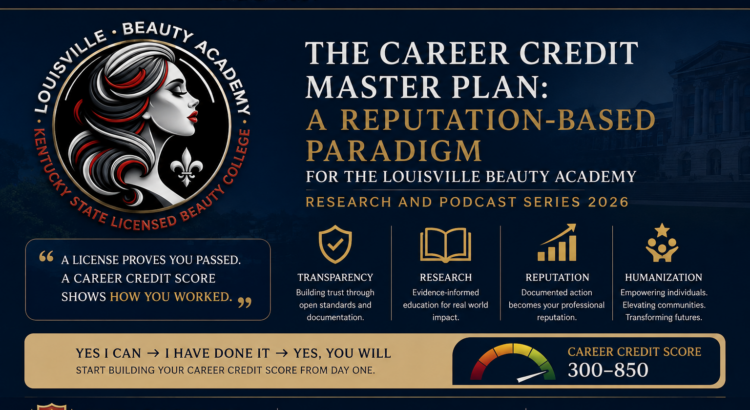
The Career Credit Master Plan: A Reputation-Based Paradigm for the Louisville Beauty Academy – RESEARCH AND PODCAST SERIES 2026

Louisville Beauty Academy operates under a Gold-Standard Over-Compliance framework—meeting all licensing requirements while exceeding regulatory expectations through transparency, documentation, and proactive consumer protection.

Executive Summary

The vocational education sector is currently navigating a period of profound structural transformation, transitioning from a static credential-based model to a dynamic, reputation-based “proof-of-work” economy. For institutions like the Louisville Beauty Academy (LBA), the challenge lies in bridging the gap between traditional state-mandated licensure and the modern requirements of the digital creator economy. This master plan outlines an interdisciplinary framework for a “Career Credit Score” system—a comprehensive, over-compliant social media and professional progress system designed to begin on day one of enrollment and persist beyond graduation. By leveraging the behavioral psychology of public accountability and the economics of social signaling, this system formalizes the student’s daily learning journey as a measurable professional asset.1

The core objective is to position LBA as a national leader in ethical creator education, moving beyond the simple “acquisition of hours” toward the “accumulation of reputation.” The Career Credit Score (CCS) serves as an analogue to a financial credit score, where daily posts act as career deposits and professionalism serves as the ultimate measure of creditworthiness.4 This system provides students with a structured ladder of progression, moving from the “Zero Stage” of novice observation to the “Mastery Stage” of mentorship and public signalization.6 Crucially, the plan is designed with an “over-compliant” posture, ensuring that all student activities strictly adhere to the Kentucky Board of Cosmetology (KBC) statutes and Federal Trade Commission (FTC) endorsement guidelines.8

Through a sophisticated incentive model, students can earn significant tuition discounts based on their consistency, ethical conduct, and proof-of-learning, effectively lowering the financial barriers to high-quality vocational education while simultaneously increasing graduate employability.11 This plan does not merely teach beauty skills; it equips “Human Service Professionals” with the digital fluency and verifiable reputation needed to thrive in an era where trust is the primary currency of the beauty industry.13

Research and Psychological Foundations

The foundation of the LBA Career Credit system is built upon a synthesis of behavioral science, trust economics, and educational theory. Understanding why “learning in public” works requires an analysis of the psychological mechanisms that drive accountability and the economic signals that establish professional prestige.

Behavioral Psychology of Public Accountability

Research in public employee behavior and health interventions suggests that accountability is a multi-dimensional construct involving observability, evaluability, and answerability.1 When a student makes a “public announcement” of a goal—such as mastering a specific sectioning technique—the digital platform acts as a “commitment device”.2 These devices help individuals “lock themselves” into a behavior by creating a psychological penalty for deviation and a social reward for adherence.15

In the context of LBA, daily posting creates a “felt accountability.” While high-intensity monitoring can sometimes reduce intrinsic motivation, a system that emphasizes “accountability obligation”—the perceived duty to justify actions to a supportive audience—actually enhances work drive.1 This is particularly effective when students interpret the obligation as an opportunity to gain professional benefits rather than a coercive requirement. By documenting the “messy middle” of the learning process, students move from passive learners to active practitioners who are “answering” to their future professional selves and their burgeoning audience.

Habit Formation and Daily Proof-of-Work

The transition from a student mindset to a professional identity requires the formation of consistent habits. The “daily proof-of-work” theory posits that a live pulse of activity is a more reliable indicator of skill than a static portfolio.6 In technical fields like coding, a “contribution graph” showing daily commits is impossible to fake and serves as a verified record of problem-solving processes.6

For beauty professionals, this translates to documenting the micro-decisions of the craft. Research into sustainable skincare marketing suggests that “decision documentation”—filing 30 seconds of a consultation or explaining why a specific pH-balanced product was chosen—builds deeper trust than a polished, final image.16 Psychologically, this “raw” and “authentic” content resonates more with modern consumers who are skeptical of highly curated, AI-generated, or “too polished” feeds.17

Social Signaling and Trust Economics

In a labor market with “asymmetric information,” where employers cannot perfectly know a candidate’s skill level, they rely on signals. Traditional signaling theory, as explored by Bryan Caplan, suggests that much of the return on education is a return on the “shiny credential” rather than the skill itself.19 However, the Career Credit Score seeks to shift this dynamic toward “Skill Signaling,” which focuses on digital, transversal, and sector-specific competencies.20

Social trust is a “commodity” built through repeated interactions and the assessment of a truster’s competence and goodwill.21 A student who has documented 1,500 hours of professional growth 8 provides a “trust graph” that reduces the risk for a potential salon owner. This creates a “cyclical model” of social exchange where the student’s signaled reputation leads to better placement, which in turn reinforces the school’s brand equity.3

Psychological ConceptMechanismApplication in LBA System
Commitment DeviceSocial penalty for failure 15Daily posting “deposits” 2
Felt AccountabilityAnswerability to an audience 1Weekly instructor reviews 24
Instrumental LearningReinforcing presumptions of trust 21Documenting micro-decisions 16
Social SignalingReducing information asymmetry 3Verifiable digital portfolios 6
Authenticity BiasPreference for unfiltered growth 18“Zero Stage” confessions 18

The Career Credit Framework

The “Career Credit Score” is a formalized, numerical representation of a student’s professional standing, calculated using an algorithm that weights consistency, proof-of-work, professionalism, and ethical compliance. Unlike social media “clout,” which is often ephemeral and based on popularity, Career Credit is a measure of “professional creditworthiness”.25

Defining the Algorithm

The LBA Career Credit Score (CCS) is modeled on a 300–850 scale, mirroring the FICO model used in financial sectors. The score is calculated using four primary components, each weighted to reflect its importance to a future employer and regulatory compliance.

  1. Consistency (Weight: 35%): This is the equivalent of “payment history.” It measures the frequency of professional posts or “career deposits.” A missed day of documentation is recorded as a “late payment,” while sustained streaks build the score significantly.2
  2. Proof-of-Skill (Weight: 25%): This represents “credit history.” It is the documented evidence of the student’s progression through the subject areas defined in 201 KAR 12:082, such as infection control, anatomy, and chemical services.7
  3. Professional Conduct (Weight: 20%): This measures “credit mix.” It assesses the student’s poise, communication skills, and adherence to the LBA “Humanization of Education” philosophy.13
  4. Regulatory Integrity (Weight: 20%): This is the “creditworthiness” factor. It tracks zero-violation streaks regarding KBC statutes and FTC disclosure guidelines.10

Career Deposits and Missed Payments

A student’s CCS is updated weekly. A “Career Deposit” is defined as a high-quality, educational, or progress-based post that includes the required LBA disclaimers.

  • Positive Impact: A “Career Deposit” adds +5 points to the weekly score.
  • Neutral Impact: Reposting industry news with a professional insight adds +2 points.
  • Negative Impact: A “Missed Payment” (failing to post for 48 hours without a prior “digital reset” request) subtracts -10 points.
  • Severe Impact: A compliance violation (e.g., performing a chemical service on a live person before 250 hours 23) results in a “Reputation Default,” resetting the score to 300 and triggering a formal review.29

Reputation Score Benchmarking

To provide context, LBA compares student scores against industry averages and “best-in-class” alumni. This benchmarking fosters continuous improvement and provides a clear signal to employers about where a student stands in their professional development.25

CCS RangeProfessional StatusMarket Implications
750 – 850Elite ProfessionalHigh placement leverage; eligible for alumni mentorship roles.
650 – 749Reliable PractitionerStandard employment readiness; consistent work history.
550 – 649Developing TalentEmerging skills; needs focus on consistency and compliance.
300 – 549High Risk / ProbationHistory of inconsistency or ethical breaches; requires remediation.

Student Learning Progression Model

The Career Credit system utilizes a five-stage ladder of progression. This model ensures that students do not feel pressured to “fake it” but instead find power in their evolution from a novice to a master. Each stage specifies what to post, the psychological reasoning behind it, and the compliance guardrails necessary to protect the student and the academy.

Stage 1: The Zero Stage (The Foundation)

Focus: Identity reset and the commitment to learn. This occurs during the first two weeks of enrollment.

  • What students post: A “Social Media Reset” announcement; an unboxing of their professional student kit; a video discussing their “Why” and their decision to join LBA.8
  • Why it works: It establishes a “vulnerability hook.” By admitting they are starting at zero, they build an empathetic connection with their audience, who will then feel invested in their growth.16
  • Compliance: Posts must clearly state: “Student at Louisville Beauty Academy. Not licensed to perform services for hire.”
  • Caption Prototype: “Day 1 at LBA! Today I’m resetting this page to document my journey from student to professional. I’m starting with the basics—Infection Control. Safety first! #LBAStudent #BeautyJourney”

Stage 2: The Awareness Stage (The Science)

Focus: Vocabulary, theory, and the “Invisible Skills.” This aligns with the first 100–150 hours of instruction.23

  • What students post: Videos of themselves studying anatomy and physiology; “Did you know?” posts about the chemistry of hair color; time-lapses of workstation sanitation.8
  • Why it works: It builds authority. By focusing on the science rather than the art, the student signals that they are a serious, knowledge-based professional.8
  • Compliance: No mentions of performing services on people. Focus remains on “Scientific Lectures” per 201 KAR 12:082.23
  • Caption Prototype: “Studying the skeletal system today. Understanding the structure of the head and neck is vital for a proper consultation. Science is the backbone of beauty! #AnatomyClass #LBA”

Stage 3: The Practice Stage (The Proof-of-Work)

Focus: Hands-on repetition on mannequins. This is the “Messy Middle” of the program.

  • What students post: “Mistakes I made today” videos; time-lapses of winding perms or applying color to a mannequin head; “Practice makes progress” reels.6
  • Why it works: It demonstrates grit and technical skill development. Seeing the student struggle and then succeed creates a powerful narrative of competence.6
  • Compliance: Must explicitly state that work is being done on a mannequin.
  • Caption Prototype: “My fifth time winding a perm rod today. Still working on my tension, but the sectioning is getting cleaner! Repetition is key to mastery. #MannequinPractice #ProofOfWork”

Stage 4: The Competency Stage (The Clinic Floor)

Focus: Supervised services on live models. This begins after 250 hours (for Cosmetology) or other program-specific milestones.23

  • What students post: Before-and-after transformations; client consultations (with permission); documenting the consultation “decision-making” process.7
  • Why it works: Social proof. It shows that real people trust the student and that the student can deliver results in a professional clinic environment.24
  • Compliance: Must state that services were performed under instructor supervision at LBA.24
  • Caption Prototype: “Today’s transformation! We chose a level 7 ash to neutralize warmth, keeping the hair’s integrity first. All services performed under supervision at LBA! #ClinicFloor #HairTransformation”

Stage 5: The Mastery Signal Stage (The Educator)

Focus: Teaching, explaining, and mentoring others. This begins in the final phase of the program and continues as an alumnus.

  • What students post: Tutorials explaining a technique to junior students; reviews of industry trends; reflections on the “Humanization of Education”.13
  • Why it works: The “Protégé Effect.” Teaching a concept is the highest signal of mastery. It positions the graduate as an industry leader, not just a practitioner.1
  • Compliance: Use of the “Alumni” tag and verification of licensure.8
  • Caption Prototype: “Explaining the logic of color theory to our new class at LBA. To master the art, you have to mentor the next generation. #BeautyEducator #LBAAlumni”

Step-by-Step LBA Implementation Plan

Operationalizing the Career Credit system requires a disciplined, multi-phase rollout that integrates with LBA’s existing curriculum and administrative protocols.

Phase 1: Orientation and the Social Media Reset

During the first week, students undergo a “Digital Brand Audit.” This is a mandatory component of their “Professional Image” curriculum.23

  1. Account Audit: Students must review their public profiles and archive content that is inconsistent with a “Human Service Professional” identity. This includes content depicting unprofessional behavior or non-compliance with health standards.18
  2. Platform Setup: Students are required to have professional profiles on Instagram and TikTok. LinkedIn is highly recommended for B2B networking and employer visibility.13
  3. The Disclaimer Protocol: Every bio must include: “Professional Student at @LouisvilleBeautyAcademy | Future | Not for hire until licensed.”
  4. Privacy/Security Workshop: Education on protecting personal data and handling “online drama” or cyberbullying.35

Phase 2: Daily Career Deposits

LBA implements a “Daily Documentation” rule. Students are given 15 minutes at the end of each theory or clinic session to capture content.8

  • Frequency: Minimum of 3 professional posts per week.
  • Approved Formats: Short-form video (Reels/TikTok) for skills; Carousel posts for “Decision Documentation”; Stories for daily “Aha!” moments.16
  • The “Human Review” Protocol: Instructors do not grade based on “likes” but on a rubric of professionalism, sanitation, and educational accuracy.24

Phase 3: Ethical AI Integration

LBA adopts a “Max AI” policy for administrative and creative support but maintains strict ethical boundaries for clinical representations.13

  • Authorized Use: Using Generative AI for caption brainstorming, keyword research, and video script outlines.38
  • The 65% Rule: At least 65% of any written caption must be human-authored to ensure authenticity and “Humanization”.38
  • Prohibited AI: No AI-generated or “filtered” images of hair or skin results. This is a deceptive statement and a violation of KBC photo standards.14
  • Disclosure: Any AI-assisted content must include the tag #AIApprentice or a similar disclaimer.40

Phase 4: Instructor and Administrative Audit

LBA establishes a “Reputation Bureau” to manage the Career Credit Scores.

  • Weekly Score Update: The CCS is recalculated every Sunday based on the week’s deposits and classroom conduct.
  • Monthly Compliance Audit: A deep-dive review of student accounts to ensure FTC disclaimers and KBC rules are followed.28
  • Score Grievance Procedure: Students can appeal a score deduction through the official LBA written grievance process.8

Incentive and Discount Model

To drive adoption and ensure high-quality participation, LBA links the Career Credit Score to a fair and transparent tuition discount model. This transforms “tuition” from a fixed cost into a performance-based investment.

The Career Credit Discount Rubric

Students are eligible for “Merit Scholarships” and “Performance-Based Incentives” that can reduce the total program cost significantly.11 These are not “tuition reductions” but optional, merit-based discounts.11

Performance CategoryMetricScore RequirementDiscount/Perk
Consistency King100% posting rate for 90 daysCCS > 700$500 Tuition Credit
Compliance HeroZero compliance flags for 180 daysCCS > 750$1,000 Scholarship
Technical MasterVerified Stage 4 DocumentationInstructor Approval$1,500 Skill Credit
Alumni LeaderContinued Stage 5 postingPost-GraduationFree Alumni Tutoring 8

Anti-Gaming and Safeguards

LBA employs a “Checks and Balances” system to protect the integrity of the discounts.13

  1. Attendance Synchronization: Discounts are only applied if a student maintains the required attendance hours (30–40 hours for Full-Time).11
  2. Plagiarism Penalty: Using another student’s work as one’s own results in the permanent loss of all social-media-based incentives.11
  3. Financial Good Standing: Hours are only certified and discounts applied if the student’s account is current.11
  4. Tax Compliance: All tuition reductions are structured to comply with IRS Section 117(d) regarding qualified tuition reductions for educational institutions.43

Auditability for Regulators

LBA maintains digital records of all student posts, instructor reviews, and score calculations for a minimum of five years.8 This ensures that the institution can defend its incentive model to state and federal regulators as a legitimate “educational performance” metric rather than “marketing compensation.”

Compliance and Risk Management

A gold-standard system must be “over-compliant.” This section outlines the non-negotiable boundaries that protect LBA, its students, and the public.

Kentucky Board of Cosmetology (KBC) Adherence

Kentucky law is strict regarding unlicensed practice.10 LBA’s system manages this through:

  • The “No-Pay” Rule: Students are explicitly forbidden from accepting consideration (money or gifts) for services performed outside of the LBA clinic floor.10
  • Mobile Prohibitions: While Kentucky allows mobile barber shops, mobile cosmetology is strictly limited. Students must not document or perform services in “home salons” or non-licensed facilities.32
  • Sanitation Documentation: Every video documenting a service must show visible sanitation steps (e.g., sanitizing hands, disinfecting tools) to reinforce “Lifelong Professional Ethics”.8

FTC Endorsement and Social Media Law

The FTC’s 2024–2025 updates require “clear, conspicuous, and unavoidable” disclosures.9

  • Disclosure Placement: Disclosures must be verbal AND written on the screen for video content. Simply putting #ad or #LBA in the caption is insufficient for Reels and TikTok.28
  • Honest Opinions: Students must only give honest reviews of products they have actually used.9
  • Material Connections: Because students receive tuition discounts for their posts, they must disclose this “material relationship” in every progress-related post.42

Privacy and Consumer Protection

  • Client Consent: No client images or videos may be posted without a signed LBA model release form.7
  • Data Protection: Students are trained to never post sensitive institutional data or personal information about staff and peers.11
  • Cyber-Safety: LBA provides tools and training for students to manage privacy risks associated with a public-facing digital career.37

Brand and Market Positioning

The implementation of the Career Credit system differentiates Louisville Beauty Academy from all other regional and national competitors. It rebrands the school from a “training facility” to a “professional reputation engine.”

Positioning LBA as a “Future-Ready” Institution

LBA’s brand is built on “Transparency and Genuine Care”.47 By teaching students to build verified proof-of-work, LBA addresses the primary concern of modern beauty employers: “Can this person actually do the work, and will they show up?”.3

Messaging Pillars:

  1. The Proof-of-Work School: We don’t just teach; we document excellence.
  2. Career Credit, Not Just Hours: Your reputation starts on day one.
  3. Humanization through Technology: We use AI to make you more human, not less.
  4. Debt-Free Dignity: Earn your way to a professional future without the burden of federal loans.12

Reassuring Regulators and Parents

LBA positions itself as the “Public Library” of beauty education—an open, accessible, and highly regulated environment where knowledge is democratized.13

  • To Parents: LBA offers a “Safe, Legal, and Affordable” path to a high-demand career, where their child’s professional reputation is built under expert supervision.13
  • To Regulators: LBA provides a model for “Over-Compliance,” showing how social media can be used to increase adherence to sanitation and ethics rather than bypass them.8

The Alumni Brand Flywheel

The Career Credit Score does not end at graduation. LBA invites alumni to maintain their scores through continued mentorship and participation in the “2026 Magazine and Podcast Series”.13 This creates a long-term network of successful, digitally fluent professionals who serve as living proof of the LBA model.

Long-Term Impact and Metrics

The success of this system will be measured through a combination of traditional educational metrics and new reputation-based indicators.

Measurable Outcomes

  1. Retention Rate: Students with high Career Credit Scores are expected to have a 25% higher completion rate due to the psychological “locking” effect of public commitment.2
  2. Job Placement Leverage: LBA graduates will enter interviews not with a resume, but with a “Reputation Portfolio” showing 1,500 hours of growth.13
  3. Audience Trust Score: A monthly sentiment analysis of student accounts to ensure that engagement is professional and educational.
  4. Licensing Success: Continued 100% alignment with PSI and KBC requirements, with students demonstrating higher confidence during the practical exam.8

The Vision for “Di Tran University”

The Career Credit system is the first step toward the broader “Humanization of Vocational Education”.13 By integrating these digital and psychological frameworks, LBA evolves into a “Human Service Professional” academy, where the beauty license is merely the legal foundation for a career built on trust, ethics, and verified excellence.

Metrics & Success Measurement

To ensure the master plan achieves its intended impact, LBA will track the following metrics:

MetricGoalTracking Mechanism
Average Graduate CCS> 725Quarterly reputation audits
Employer Satisfaction95% PositivePost-placement surveys focusing on “Soft Skills”
Student Debt Ratio< 10% of IncomeAnalysis of net tuition vs. entry-level salary 50
Social Media Reach100K+ Monthly (Aggregated)Platform analytics across the student body
Compliance Flag Rate< 1%Weekly internal reputation bureau reviews

Conclusions

The Louisville Beauty Academy Career Credit system represents the gold standard for 21st-century vocational training. By acknowledging that a student’s “reputation” begins long before they receive a physical license, LBA equips its graduates with the ultimate competitive advantage: a verifiable history of hard work, ethical behavior, and professional growth. This system reduces student risk, elevates the entire beauty industry, and provides a defensible, innovative model for the future of professional education. Through the careful integration of behavioral psychology, trust economics, and rigorous compliance, LBA does more than teach beauty—it builds the future of professional trust.

Works cited

  1. Changes in the accountability obligation, intensity, and working drive of public employees: evidence from a survey experiment – Oxford Academic, accessed February 1, 2026, https://academic.oup.com/jpart/advance-article/doi/10.1093/jopart/muaf027/8249872
  2. Effects of Public Commitments and Accountability in a Technology-Supported Physical Activity Intervention | Request PDF – ResearchGate, accessed February 1, 2026, https://www.researchgate.net/publication/270959553_Effects_of_Public_Commitments_and_Accountability_in_a_Technology-Supported_Physical_Activity_Intervention
  3. Full article: Initial employability development: introducing a conceptual model integrating signalling and social exchange mechanisms – Taylor & Francis, accessed February 1, 2026, https://www.tandfonline.com/doi/full/10.1080/1359432X.2023.2186783
  4. Street Rep: A Privacy-Preserving Reputation Aggregation System, accessed February 1, 2026, https://yancomm.net/papers/2023%20-%20SecureComm%20-%20Street%20Rep.pdf
  5. Deep Reputation Scoring in DeFi: zScore-Based Wallet Ranking from Liquidity and Trading Signals – arXiv, accessed February 1, 2026, https://arxiv.org/html/2507.20494
  6. Top Proof of Work Tools Professionals Are Using in 2026 – Fueler, accessed February 1, 2026, https://fueler.io/blog/top-proof-of-work-tools-professionals-are-using
  7. How to Create Before-and-After Content That Converts Followers – CleanerHQ, accessed February 1, 2026, https://cleanerhq.com/how-to-create-before-and-after-content/
  8. Tag: Kentucky State Board of Cosmetology – Louisville Beauty Academy, accessed February 1, 2026, https://louisvillebeautyacademy.net/tag/kentucky-state-board-of-cosmetology/
  9. Endorsements, Influencers, and Reviews – Federal Trade Commission, accessed February 1, 2026, https://www.ftc.gov/business-guidance/advertising-marketing/endorsements-influencers-reviews
  10. 317A.020 Scope of chapter — Licensure requirements — Emergency orders — Warning notice — Legal actions brought by the, accessed February 1, 2026, https://apps.legislature.ky.gov/law/statutes/statute.aspx?id=56210
  11. LBA-StudentAgreement-CosmetologyProgram-2024 – Jotform, accessed February 1, 2026, https://form.jotform.com/240085894150154
  12. Financial Aid Options and Payment Model at Louisville Beauty Academy, accessed February 1, 2026, https://louisvillebeautyacademy.net/financial-aid-options-and-definition/
  13. beauty school compliance Archives – Louisville Beauty Academy, accessed February 1, 2026, https://louisvillebeautyacademy.net/tag/beauty-school-compliance/
  14. Top 5 Beauty Trends on Social Media 2026 – Pulsar, accessed February 1, 2026, https://www.pulsarplatform.com/blog/2025/top-beauty-trends-2026-social-media
  15. From Intentions to Actions – Using Commitment Devices for Evidence Use – Data for Impact, accessed February 1, 2026, https://www.data4impactproject.org/blog/from-intentions-to-actions-using-commitment-devices-for-evidence-use/
  16. I’m a Professional Social Media Growth Strategist – AMA and Free Advice – Reddit, accessed February 1, 2026, https://www.reddit.com/r/InstagramMarketing/comments/1ou74f8/im_a_professional_social_media_growth_strategist/
  17. A close look at the global beauty industry in 2025 – McKinsey, accessed February 1, 2026, https://www.mckinsey.com/industries/consumer-packaged-goods/our-insights/a-close-look-at-the-global-beauty-industry-in-2025
  18. Embrace Your Flaws: Stop Deleting Your ‘Ugly’ Photos – Lemon8, accessed February 1, 2026, https://www.lemon8-app.com/@purposely.angelica/7332530343054295557?region=us
  19. Schooling is Mostly Signaling – Econlib, accessed February 1, 2026, https://www.econlib.org/schooling-is-mostly-signaling/
  20. Skills signalling in OECD countries: Empowering the Workforce in the Context of a Skills-First Approach | OECD, accessed February 1, 2026, https://www.oecd.org/en/publications/empowering-the-workforce-in-the-context-of-a-skills-first-approach_345b6528-en/full-report/skills-signalling-in-oecd-countries_158ea858.html
  21. Trust as commodity: social value orientation affects the neural substrates of learning to cooperate – PMC – NIH, accessed February 1, 2026, https://pmc.ncbi.nlm.nih.gov/articles/PMC5390759/
  22. College Education and Social Trust: An Evidence-Based Study on the Causal Mechanisms, accessed February 1, 2026, https://pmc.ncbi.nlm.nih.gov/articles/PMC3183293/
  23. 201 KAR 12:082. Education requirements and school administration. – Kentucky Board of Cosmetology, accessed February 1, 2026, https://kbc.ky.gov/Documents/201%20KAR%2012.082.pdf
  24. Cosmetology Work Based Plan, accessed February 1, 2026, https://static.avedafi.edu/pdf/AIW%20Cosmetology-Work-Based-Plan%202023-2024.pdf
  25. Why Reputation Scores Are Becoming a Standard Business Metric – NetReputation, accessed February 1, 2026, https://www.netreputation.com/why-reputation-scores-are-becoming-a-standard-business-metric/
  26. Reputation Score Guide – Strategies + 3 case studies – Mention, accessed February 1, 2026, https://mention.com/en/blog/reputation-score/
  27. Beauty Changes Lives Judging Rubric Outline, accessed February 1, 2026, https://beautychangeslives.org/wp-content/uploads/2020/08/Judging-Rubric.pdf
  28. FTC Requirements For Influencers: Guidelines and Rules – Termly, accessed February 1, 2026, https://termly.io/resources/articles/ftc-requirements-for-influencers/
  29. Title 201 Chapter 12 Regulation 082 • Kentucky Administrative Regulations – Legislative Research Commission, accessed February 1, 2026, https://apps.legislature.ky.gov/law/kar/titles/201/012/082/16143/
  30. 201 KAR 12:030 – Licensing and examinations | State Regulations – Cornell Law School, accessed February 1, 2026, https://www.law.cornell.edu/regulations/kentucky/201-KAR-12-030
  31. Reputation Score X, accessed February 1, 2026, https://reputation.com/lessons/reputation-score-x-starter-guide
  32. Tag: cosmetology license – Louisville Beauty Academy, accessed February 1, 2026, https://louisvillebeautyacademy.net/tag/cosmetology-license/
  33. iRubric: Cosmetology Clinical Assessment rubric – FX32C4W – RCampus, accessed February 1, 2026, https://www.rcampus.com/rubricshowc.cfm?sp=true&code=FX32C4W
  34. License Requirements – Kentucky Board of Cosmetology, accessed February 1, 2026, https://kbc.ky.gov/Licensure/Pages/License-Requirements.aspx
  35. Explore Social Media Safely – Get Started Today — Upper Dublin Tech Trek, accessed February 1, 2026, https://www.udtechtrek.org/social-media
  36. 2025 Beauty Industry Benchmarks | Dash Social, accessed February 1, 2026, https://www.dashsocial.com/social-media-benchmarks/beauty-industry
  37. Complete Guide to Online Privacy – bestvpn.org, accessed February 1, 2026, https://bestvpn.org/the-complete-guide-to-online-privacy/
  38. Social Media AI Guidelines | Social Media | ECU – East Carolina University, accessed February 1, 2026, https://socialmedia.ecu.edu/social-media-ai-guidelines/
  39. AI Students Guidelines 2025 – ESCP Business School, accessed February 1, 2026, https://escp.eu/sites/default/files/PDF/AI/AI_Students_Guidelines_2025.pdf
  40. Guidelines for Appropriate Use of AI Generated Media – Division of Strategic Communications | The University of Alabama, accessed February 1, 2026, https://stratcomm.ua.edu/ai-guidelines/
  41. English AI Guidance for Staff and Students 2025 – Reedsburg School District, accessed February 1, 2026, https://www.rsd.k12.wi.us/district/English%20AI%20Guidance%20for%20Staff%20and%20Students%202025.pdf
  42. FTC Influencer Guidelines: Brands and Creators Must Be Aware Before Posting, accessed February 1, 2026, https://www.traverselegal.com/blog/ftc-influencer-guidelines/
  43. Qualified tuition reduction | Internal Revenue Service, accessed February 1, 2026, https://www.irs.gov/government-entities/federal-state-local-governments/qualified-tuition-reduction
  44. chapter 152 – Legislative Research Commission, accessed February 1, 2026, https://apps.legislature.ky.gov/law/acts/12RS/documents/0152.pdf
  45. KY SB265 | BillTrack50, accessed February 1, 2026, https://www.billtrack50.com/billdetail/1836958
  46. Navigating FTC Disclosures: A Guide for Influencers – Statusphere, accessed February 1, 2026, https://www.joinstatus.com/blog-creators/navigating-ftc-disclosures-a-guide-for-influencers
  47. The Confusion of Accreditation in the Beauty Industry: Louisville Beauty Academy Emphasizes Transparency and Genuine Care for Students, accessed February 1, 2026, https://louisvillebeautyacademy.net/the-confusion-of-accreditation-in-the-beauty-industry-louisville-beauty-academy-emphasizes-transparency-and-genuine-care-for-students/
  48. Long-Duration Vocational Education’s Effects on Individuals’ Vocational Identity, Self-Efficacy, and Job Satisfaction – PubMed Central, accessed February 1, 2026, https://pmc.ncbi.nlm.nih.gov/articles/PMC12466434/
  49. Resume vs Portfolio: What You Really Need to Land Freelance Writing Jobs in 2025, accessed February 1, 2026, https://www.journoportfolio.com/blog/resume-vs-portfolio-what-you-really-need-to-land-freelance-writing-jobs-in-2025/
  50. Kentucky Cosmetology Laws & License Requirements [2026] – Consentz, accessed February 1, 2026, https://www.consentz.com/kentucky-cosmetology-laws-license-requirements/

From Class to Career: A Gold-Standard Guide for Kentucky Beauty Students in 2026 – Research & Podcast Series 2026

The vocational education landscape in the Commonwealth of Kentucky has undergone a fundamental shift as of 2026. The convergence of regulatory rigor, technological advancement through artificial intelligence, and a renewed focus on the human element of service has created a new paradigm for beauty professionals. This guide, developed for the Louisville Beauty Academy (LBA) and powered by the philosophical foundations of Di Tran University – The College of Humanization, serves as a comprehensive resource for students navigating the transition from the classroom to a sustainable, dignified career. In an era where technological efficiency often threatens to overshadow human connection, this document provides the strategic framework necessary to protect the financial, professional, and personal interests of the next generation of Kentucky practitioners.

The Philosophical Foundation: Humanization in the AI Era

The American system of higher education stands at a precarious crossroads, often privileging academic abstraction over human connection and high-cost degrees over accessible vocational mastery.1 In contrast, the model of humanization posits that education must serve as a mechanism for restoring personal dignity and community uplift.3 This philosophy is central to the mission of institutions like Louisville Beauty Academy, which view the beauty professional not merely as a technician, but as a “Human Service Professional”.3

The Triadic Learning Architecture defines this approach, consisting of three interwoven pillars: the College of AI, the College of Human Service, and the College of Humanization.5 This structure ensures that while technology handles the administrative and scientific heavy lifting, the human professional remains focused on empathy, customer service, and interpersonal communication—skills that combat the pervasive challenge of modern loneliness.5 For the student, this means an education that emphasizes the “Yes I Can” mindset, dismantling the “Imposter Syndrome” that often plagues first-generation, low-income, or immigrant learners.3

Navigating the Kentucky Regulatory Landscape

The Kentucky Board of Cosmetology (KBC) maintains strict oversight of the beauty industry to ensure public health and safety. Understanding these regulations is the first step in professional protection. The administrative regulations, specifically 201 KAR 12:082, establish the required hours and courses of instruction for all licensed practices in the Commonwealth.6

Mandatory Training Hours and Curriculum Ratios

The training requirements for 2026 are meticulously balanced between scientific theory and clinical practice. This ratio is designed to ensure that practitioners understand the chemistry and biology of the services they provide before engaging with the public.

Program TypeTotal Required HoursScience & Theory (Lecture)Clinic & PracticeKentucky Law & RegulationsPublic Service Threshold
Cosmetology1,5003751,08540250 Hours
Esthetics75025046535115 Hours
Nail Technology4501502752560 Hours
Apprentice Instructor750N/A425 (Direct Contact)N/AN/A
Shampoo Styling300N/AN/AN/AN/A

Cosmetology students must complete a minimum of 1,500 hours, which includes 375 hours of science and theory and 1,085 clinic hours.6 A critical safety regulation prohibits cosmetology students from performing chemical services on the public until they have completed at least 250 hours of instruction.6 Similarly, nail technician students must reach 60 hours and esthetician students 115 hours before providing services to the general public.6

The Doctrine of Over-Compliance: A Protective Strategy

For the student, the concept of “Over-Compliance” is a vital safeguard against administrative delays or the loss of earned credit hours. This approach involves operating intentionally above the minimum legal requirements through meticulous documentation and proactive education.7

A common point of failure for students is the documentation of extracurricular hours earned at hair shows, field trips, or charity events. To ensure these hours are credited, the gold-standard procedure requires that the school notify the KBC at least five business days before the event.7 Following the event, a “Certification of Student Extracurricular Event Hours” must be completed and uploaded to the individual student’s KBC record within ten business days.7 Any deviation from this timeline or the failure to upload individual forms to individual records can result in hours being denied by the Board.7

Managing Program Transfers and Credit Recognition

Students transferring from other institutions or states must navigate the KBC’s strict transfer protocols. A “Program Transfer Form” must be submitted and verified by the KBC before a student is officially credited for prior work.7

Prior License or ExperienceMax Credit Toward Cosmetology Program
Current Esthetics License400 Hours
Current Nail Technologist License200 Hours
Current Shampoo Styling License300 Hours
Current Barber License750 Hours

These credits only become effective once the student completes the remaining hours necessary for the full cosmetology license.7 Furthermore, out-of-state or barber hours must be certified by the original licensing agency before Kentucky will recognize them.7 Students are advised to ensure these certifications are on file with the KBC office prior to enrollment at a new school to avoid “orphan hours” that cannot be officially tracked.7

Decoding the Financials: Avoiding the Debt Trap

One of the most significant challenges facing beauty students in 2026 is the “Debt Trap”—the accumulation of high-interest federal student loans for programs that could be completed at a lower cost. The traditional vocational education model often prioritizes the capture of Title IV federal funds (Pell Grants and Stafford Loans) over the financial long-term health of the student.8

The Mechanics of the FAFSA/Loan Cycle

Federal student loans disbursed between July 1, 2025, and June 30, 2026, carry fixed interest rates and origination fees that can significantly increase the total cost of education.

Loan TypeFixed Interest Rate (2025-2026)Origination Fee
Direct Subsidized (Undergraduate)6.39%1.057%
Direct Unsubsidized (Undergraduate)6.39%1.057%
Direct PLUS (Parent/Graduate)8.94%4.228%

These rates are determined by the 10-year Treasury note yield plus a set margin.10 For a cosmetology student taking the national average of $10,000 in student loan debt, the interest alone over a 10-year repayment period adds thousands of dollars to the total price.9 In contrast, the total tuition at Louisville Beauty Academy for a cosmetology program is under $7,000, which is often 50–75% lower than the tuition at schools relying heavily on federal loans.12

The “Double Scoop” Benefit and Cash-Based Models

The “Double Scoop” benefit refers to the compounding financial advantage of saving on tuition and entering the workforce sooner. By avoiding the prolonged programs designed to maximize federal aid, students can graduate and start earning faster.12

Program PathTuition CostGraduation TimelineCareer Impact
Typical Debt-Based Model$17,000 – $27,00012-18 Months$10k+ Debt + Interest
LBA Cash-Based ModelUnder $7,0009-12 MonthsDebt-Free + Early Earnings

The math reveals a nearly $20,000 “swing” in favor of the debt-free student. This consists of roughly $10,000 kept upfront in tuition savings and an extra $8,000 to $10,000 earned by entering the job market three to six months earlier.12 This model relies on pay-as-you-go systems and internal scholarships, which are intentionally designed to make federal loans unnecessary.13

AI as a Tool for Literacy, Learning, and Administrative Protection

In the 2026 educational environment, artificial intelligence serves as a critical ally for students, particularly those who may face language barriers or who have been out of an academic setting for an extended period. AI is not a replacement for human skill, but a tool for “Humanized Efficiency”.5

Overcoming Literacy Barriers and Language Gaps

For immigrant and multilingual students, the technical jargon of the beauty industry and the complexities of regulatory law can be significant obstacles. AI tools are utilized to simplify these concepts into clear, plain English, ensuring that a student’s lack of fluency in English does not prevent their mastery of the craft.4 The “College of AI” pillar provides personalized, automated instruction that allows students to pace their learning according to their individual needs.5

AI for Administrative Efficiency and the “Administrative Tax”

Higher education institutions often apply “indirect cost rates” or “administrative taxes” to cover overhead, which can account for up to 26–33% of a university’s budget.14 In the beauty school context, these costs are often passed on to the student in the form of higher tuition. By using AI to automate administrative tasks—such as hour tracking, documentation, and compliance checking—schools can reduce this “administrative tax” and pass the savings directly to the student.5

Practical AI Prompts for Student Empowerment

Students are encouraged to use AI as a “thinking partner” to navigate their education and protect their interests.

  • Contract Analysis: Students can prompt AI to “Analyze this enrollment contract and identify all clauses related to tuition refunds, attendance requirements, and additional fees”.17
  • Financial Comparison: AI can be used to “Compare the total cost of a $15,000 loan at 6.39% interest over 10 years versus a cash-based tuition of $7,000 paid monthly”.18
  • Career Planning: Students may ask AI to “Identify the highest-paying salon cities in Kentucky for nail technicians based on 2026 data”.20

Digital Proof-of-Work: The Modern Portfolio and Branding

In the visual-centric world of beauty, a traditional resume is no longer sufficient. The “Digital Proof-of-Work” portfolio has become the industry’s gold standard for demonstrating competency and professionalism.21

Constructing a Visual Resume

A successful portfolio must tell a story of transformation and technical skill. It is essential to start documenting work early in the program, beginning with mannequins and classmate practice.21

Portfolio CategoryRequired ElementsStrategic Insight
Before-and-AfterConsistent lighting and anglesProves the ability to create measurable change
Technical RangeTexture work, color, cuts, and stylesDemonstrates versatility for diverse clients
SanitationPhotos of disinfected stations and toolsBuilds trust and proves professional ethics
TestimonialsQuotes from models or clinic clientsProvides social proof of customer service
CertificationsAwards, lash mapping, or chemical protocolsAdds academic weight to technical skill

Photography is the foundation of the digital portfolio. Natural light, simple backgrounds, and multiple angles are necessary to ensure the work is represented accurately.21 Students must avoid the use of social media filters, as they can be seen as deceptive in a professional context.25

The Ethics of Client Consent and Content Creation

As beauty professionals are also content creators, they must adhere to strict ethical guidelines regarding client privacy. A gold-standard portfolio always includes “Media Release Forms” or “Client Consent Forms”.22 This documentation protects the professional from legal disputes and signals to prospective employers that the student understands the legalities of brand management.22

Sanitation as a Branding Tool

In 2026, sanitation is not just a regulatory requirement; it is a competitive advantage. Portfolios that include “Setup and Sanitation” photos or videos demonstrate a commitment to client safety that sets a student apart from the competition.27

Sanitation ProtocolFrequencyEvidence for Portfolio
HandwashingBefore and after every clientVideo of proper handwashing technique
Tool DisinfectionAfter every single usePhotos of tools in EPA-registered solution
Station ResetBetween every guestBefore/after shots of a sanitized station
PPE UsageDuring chemical or skincare servicesPhotos of professional apron, mask, and gloves

Proper tool care involves deep cleaning brushes and sponges after each use with antibacterial cleansers and ensuring that reusable tools like combs and scissors are fully submerged in disinfectant solutions.29

Transitioning to the Workforce: The First 90 Days

The first three months post-graduation are a period of significant growth and risk. Kentucky’s licensing structure includes a mandatory apprenticeship that provides a structured transition into the professional world.

The Kentucky Apprenticeship Period

After passing both the written and practical examinations, Kentucky cosmetologists must complete a six-month apprenticeship.31

  1. Work Requirements: Apprentices must work a minimum of 20 hours per week in a licensed salon under the supervision of a licensed cosmetologist.31
  2. License Validity: The apprentice license is valid for up to 18 months, allowing time for the completion of the 6-month requirement and final testing if necessary.31
  3. Client Building: This period is designed for “Real-World Salon Experience,” where the apprentice learns the pace of a commercial environment while still having the protection of a mentor.31

Choosing an Employment Model: Independence vs. Support

The choice between working as a commission-based employee or a booth-rental independent contractor is a critical business decision.

Employment ModelPrimary BenefitPrimary Risk
Commission (W-2)Mentorship, stability, shared marketingLower percentage of individual sales
Booth Rental (1099)Full independence, schedule controlHigh overhead, self-employment taxes

For most new graduates, the commission model is recommended. It provides a guaranteed wage (at least minimum wage for all hours worked) and covers the employer’s portion of Social Security and Medicare taxes.32 Booth rental is often risky for those without a pre-existing clientele, as the “hidden costs”—including rent, insurance, products, and marketing—can quickly lead to burnout or financial failure.32

Independent Contractor Law and Misclassification

In Kentucky, the distinction between an employee and an independent contractor hinges on the “Control Test.” If a salon owner dictates a worker’s hours, set prices, and provides tools, that worker is likely an employee (W-2) and should be receiving benefits like unemployment insurance and workers’ compensation.35 Misclassification occurs when a salon owner exerts control over a worker but treats them as a 1099 contractor to avoid taxes.37 Professionals must ensure they have a written contract that clearly defines their status and protects their rights.34

Economic Reality: Kentucky Salary and Career Outlook

The beauty industry in Kentucky remains a resilient and adaptable career choice. As of 2026, salary data shows significant variance based on location and specialization.

Professional RoleEntry-Level SalaryMid-Career Salary90th Percentile
Cosmetologist$30,441$40,327$48,493+
Nail Technician$21,738$37,468$52,545+
Esthetician$26,000$45,000$62,000+

Location plays a pivotal role in earning potential. For example, nail technicians in Hyden ($44,998) and Corbin ($43,137) earn significantly more than the state average, likely due to a higher concentration of demand relative to the number of licensed practitioners.40 In Louisville, the average salary for a nail technician is approximately $41,449, with top earners exceeding $52,000.40

The CEO Mindset and Long-Term Stability

Every beauty professional is the “CEO” of their own business, regardless of their employment model.25 This requires a commitment to financial management, professional reputation, and staying abreast of changing laws. In 2026, Kentucky has moved toward restricting non-compete agreements, particularly for those earning below certain thresholds, ensuring that professionals can take their talents and their client lists with them if they choose to change salons.42

Strategic Questions for Evaluating Beauty Schools

To protect their future, students must evaluate schools with the same rigor they would any other significant investment.

  • Regulatory Transparency: Does the school provide a clear, written timeline for how and when my hours will be uploaded to the KBC? 7
  • The Debt-Free Pathway: What are the internal scholarship options that make federal loans unnecessary? 13
  • Student Labor Policies: Does the curriculum focus on my education, or am I being used as unpaid labor for a school-run salon? 8
  • AI Integration: How is the school teaching me to use artificial intelligence to manage my business and literacy? 5
  • Conduct and Safety: What is the school’s policy on gossip and drama, and how do they protect the “sanctuary” of the learning environment? 3
  • Career Support: Does the school provide specific training for the mandatory apprenticeship and the transition into the first 90 days of work? 31

Conclusion: The Path to Professional Dignity

The transition from a beauty student to a career professional in Kentucky is a journey of both technical mastery and personal transformation. By embracing the philosophy of humanization, prioritizing over-compliance, and avoiding the long-term burden of educational debt, students can secure a future that is both financially stable and personally rewarding.

In the AI era, the “Gold Standard” of practice is not just about the quality of the haircut or the facial; it is about the integrity of the professional behind the chair. The Kentucky beauty professional who operates with transparency, follows the doctrine of love and care, and utilizes technology to enhance human connection will find themselves at the forefront of a thriving industry. This guide provides the foundation—now, the student must apply the “Yes I Can” mindset to build their beautiful future.

Works cited

  1. humanization in education Archives – Di Tran University, accessed February 1, 2026, https://ditranuniversity.com/tag/humanization-in-education/
  2. humanized education model Archives – Di Tran University, accessed February 1, 2026, https://ditranuniversity.com/tag/humanized-education-model/
  3. The Humanization of Vocational Education: A Comprehensive …, accessed February 1, 2026, https://louisvillebeautyacademy.net/the-humanization-of-vocational-education-a-comprehensive-research-report-on-the-viability-of-beauty-school-and-the-louisville-beauty-academy-model-research-podcast-series-2026-lba/
  4. Di Tran — Founder & CEO | Visionary Leader in Workforce Education, Humanized AI, and Immigrant Entrepreneurship – New American Business Association (NABA) – Louisville, KY, accessed February 1, 2026, https://naba4u.org/di-tran-founder-ceo-visionary-leader-in-workforce-education-humanized-ai-and-immigrant-entrepreneurship/
  5. Di Tran University, accessed February 1, 2026, https://ditranuniversity.com/
  6. 201 KAR 12:082 – Education requirements and school administration | State Regulations, accessed February 1, 2026, https://www.law.cornell.edu/regulations/kentucky/201-KAR-12-082
  7. Gold-Standard Compliance Guide: KBC Transfer and Field / Charity …, accessed February 1, 2026, https://louisvillebeautyacademy.net/gold-standard-compliance-guide-kbc-transfer-and-field-charity-hour-requirements-research-2026/
  8. Outcomes-Based Beauty Education : A Workforce and Policy Analysis of Debt-Free, Completion-Driven Vocational Models – RESEARCH DECEMBER 2025, accessed February 1, 2026, https://naba4u.org/2025/12/outcomes-based-beauty-education-a-workforce-and-policy-analysis-of-debt-free-completion-driven-vocational-models-research-december-2025/
  9. Louisville Beauty Academy’s Model vs. Typical U.S. Beauty Schools: A Comprehensive Comparison, accessed February 1, 2026, https://naba4u.org/2025/06/louisville-beauty-academys-model-vs-typical-u-s-beauty-schools-a-comprehensive-comparison/
  10. Federal Student Loan Amounts and Terms for Loans Issued in 2025-26, accessed February 1, 2026, https://ticas.org/federal-student-loan-amounts-and-terms-for-loans/
  11. (DL-25-03) Interest Rates for Direct Loans First Disbursed Between July 1, 2025 and June 30, 2026 – FSA Partner Connect, accessed February 1, 2026, https://fsapartners.ed.gov/knowledge-center/library/electronic-announcements/2025-05-30/interest-rates-direct-loans-first-disbursed-between-july-1-2025-and-june-30-2026
  12. Fast-Track & Debt-Free: How Louisville Beauty Academy Delivers the “Double Scoop” – Save Big and Start Earning Sooner – RESEARCH AUGUST 2025, accessed February 1, 2026, https://louisvillebeautyacademy.net/fast-track-debt-free-how-louisville-beauty-academy-delivers-the-double-scoop-save-big-and-start-earning-sooner-research-august-2025/
  13. Financial Aid Options and Payment Model at Louisville Beauty Academy, accessed February 1, 2026, https://louisvillebeautyacademy.net/financial-aid-options-and-definition/
  14. The Impact of Indirect Rate Limits | NEA – National Education Association, accessed February 1, 2026, https://www.nea.org/resource-library/impact-indirect-rate-limits
  15. Understanding Indirect (Facilities and Administration) Costs and Addressing Common Myths, accessed February 1, 2026, https://research.ucdavis.edu/3-things-to-know-about-indirect-costs-aka-fa/
  16. Beauty School Running Costs: $46k Monthly OpEx – Financial Models Lab, accessed February 1, 2026, https://financialmodelslab.com/blogs/operating-costs/beauty-school
  17. AI Prompts for Finance: 15 Real-World Examples, accessed February 1, 2026, https://www.financialprofessionals.org/training-resources/resources/articles/Details/ai-prompts-for-finance-15-real-world-examples
  18. AI Prompts for K-12 School Marketing – Veracross, accessed February 1, 2026, https://www.veracross.com/resources/ai-prompts-school-marketing/
  19. 30 ChatGPT Prompts for Higher Education (Stimulating Scholarly Success) – Galaxy.ai Blog, accessed February 1, 2026, https://blog.galaxy.ai/chatgpt-prompts-for-higher-education
  20. 10 ChatGPT Prompts to Level Up Your Beauty School Operations – Oozle Media, accessed February 1, 2026, https://www.oozlemedia.com/on-demand-library-2024/parker-2024
  21. How to Build a Standout Portfolio During Beauty School – TSPA San Jose, accessed February 1, 2026, https://www.tspasanjose.com/blog/how-to-build-a-standout-portfolio-during-beauty-school/
  22. How to Build Your Cosmetology Portfolio – Inspire Greatness Aveda Institutes, accessed February 1, 2026, https://avedainspiregreatness.com/blog/build-a-cosmetology-portfolio-examples-templates/
  23. How to Build Your Portfolio While in Beauty School | David Pressley School of Cosmetology, accessed February 1, 2026, https://davidpressleyschool.com/how-to-build-your-portfolio-while-in-beauty-school/
  24. How to Build Your Beauty Portfolio: A Step-by-Step Guide for Cosmetology Students, accessed February 1, 2026, https://www.esimichigan.com/blog/how-to-build-your-beauty-portfolio-a-step-by-step-guide-for-cosmetology-students/
  25. 2026 Kentucky License Renewal Alert: Biennial Cycle | Louisville Beauty Academy Compliance Update – YouTube, accessed February 1, 2026, https://www.youtube.com/watch?v=HdwvEMqI6r8
  26. Student Digital Portfolio Showcase Consent Form Template – Jotform, accessed February 1, 2026, https://www.jotform.com/form-templates/student-digital-portfolio-showcase-consent-form
  27. Sanitation Requirements for Esthetician Students | Elite Aesthetics Academy Denver, accessed February 1, 2026, https://coloradoaestheticsacademy.com/denver-elite-aesthetics-academy-blog/sanitations-at-elite-aesthetics-academy
  28. How to Build Your Portfolio as a Student Esthetician – Isabela Cordero, accessed February 1, 2026, https://www.isabelacordero.com/beauty-notes/how-to-build-your-portfolio-as-a-student-esthetician
  29. Why Sanitation Is Essential in Beauty Work, accessed February 1, 2026, https://www.advancebeautycollege.edu/post/why-sanitation-is-essential-in-beauty-work
  30. Best Essential Makeup Sanitation Guide for Safe Use | JTorry, accessed February 1, 2026, https://jtorryart.com/best-essential-makeup-sanitation-guidelines-for-safe-use/
  31. Kentucky Cosmetology Laws & License Requirements [2026] – Consentz, accessed February 1, 2026, https://www.consentz.com/kentucky-cosmetology-laws-license-requirements/
  32. Booth Rental vs Commission Salons: The Real Costs Every Stylist Should Know, accessed February 1, 2026, https://www.hellohairco.com/booth-rental-vs-commission-salons-the-real-costs-every-stylist-should-know
  33. Commission VS. Booth Rental: Where’s the Money? – Thriving Stylist, accessed February 1, 2026, https://thrivingstylist.com/blog/commission-vs-booth-rental-where-is-the-money-really-at/
  34. The Booth Rental Business Model for Cosmetologists – Cosmetology License, accessed February 1, 2026, https://www.cosmetology-license.com/the-booth-rental-business-model-for-cosmetologists/
  35. Employee vs. Independent Contractor – Kentucky’s Self-Service, accessed February 1, 2026, https://kewes.ky.gov/Employertax/Misc_info.aspx
  36. Independent contractors versus employees | Kentucky Employment Lawyers, accessed February 1, 2026, https://www.kentuckyemploymentlawyer.com/blog/2024/02/independent-contractors-versus-employees/
  37. Employee or Independent Contractor? – Centre for Beauty, accessed February 1, 2026, https://cjscentreforbeauty.com/employee-or-independent-contractor/
  38. How Is an Independent Contractor Defined in Kentucky?, accessed February 1, 2026, https://www.workinjuryadvisor.com/how-is-an-independent-contractor-defined-in-kentucky/
  39. Independent Contractor Rules in Beauty: A Journey from Past to Present – RESEARCH MAY 2025, accessed February 1, 2026, https://louisvillebeautyacademy.net/independent-contractor-rules-in-beauty-a-journey-from-past-to-present-research-may-2025/
  40. Nails Technician Salary in Kentucky: Hourly Rate (Jan, 2026) – ZipRecruiter, accessed February 1, 2026, https://www.ziprecruiter.com/Salaries/Nails-Technician-Salary–in-Kentucky
  41. Nail Technician Salary in Kentucky: Hourly Rate (Jan, 2026) – ZipRecruiter, accessed February 1, 2026, https://www.ziprecruiter.com/Salaries/Nail-Technician-Salary–in-Kentucky
  42. AN ACT relating to non-compete clauses. 1 Be it enacted by the General Assembly of the Commonwealth of Kentucky: 2 *SECTION 1., accessed February 1, 2026, https://apps.legislature.ky.gov/recorddocuments/bill/25RS/sb234/orig_bill.pdf
  43. KY HB690 – BillTrack50, accessed February 1, 2026, https://www.billtrack50.com/billdetail/1838510
  44. Current Status of the FTC’s Non-Compete Rule and an Overview of Non-Compete Agreements in Indiana, Kentucky, and Ohio – Kohnen & Patton Law LLP, accessed February 1, 2026, https://www.kplaw.com/news/news-and-updates/2025/03/current-status-of-the-ftcs-non-compete-rule-and-an-overview-of-non-compete-agreements-in-indiana-kentucky-and-ohio/

DAILY INTELLIGENCE SCAN: VOCATIONAL EDUCATION, BEAUTY EDUCATION & PROFESSIONAL BEAUTY INDUSTRY – February 1, 2026 | Louisville Beauty Academy

A. EXECUTIVE SUMMARY

What Changed in the Last 24–72 Hours

  1. AHEAD Earnings Accountability Rule Consensus (January 10, 2026): The Department of Education’s Accountability in Higher Education and Access through Demand-driven Workforce Pell committee reached consensus on a unified earnings test applicable to ALL postsecondary programs (undergraduate and graduate) for the first time. Programs whose graduates earn below high school diploma levels will lose federal Title IV eligibility beginning July 1, 2026. Beauty schools are recognized as disproportionately vulnerable to these metrics due to tipping culture and non-traditional earnings structures. The American Association of Cosmetology Schools (AACS) has retained former U.S. Solicitor General Paul Clement to appeal this decision in the Fifth Circuit.whiteboardadvisors+2
  2. Kentucky HB 120 Introduced (January 14, 2026): The Kentucky legislature introduced House Bill 120, which would regulate mobile beauty salons as licensed “facilities” under KRS 317A, requiring the Kentucky Board of Cosmetology to establish operational and inspection standards. This represents a significant regulatory expansion affecting salon operational flexibility and represents a material compliance change for multi-location operations.[ed]​
  3. Biennial License Renewal Cycle Confirmed (July 2026 Implementation): The Kentucky Board of Cosmetology’s shift from annual to biennial renewal becomes effective July 31, 2026. While the annual fee remains $50, professionals will pay $100 upfront every two years, creating a cash-flow impact for dual-license holders and employer-sponsored compliance budgets.onthelaborfront+1
  4. Federal Apprenticeship Investment Surge: The Department of Labor announced $145 million in pay-for-performance apprenticeship funding (January 2026) with application deadline March 20, 2026, and $98 million in YouthBuild pre-apprenticeship expansion targeting ages 16–24. These initiatives explicitly prioritize registered apprenticeships as pathways competitive with traditional beauty school enrollment.govinfo+1
  5. Unlicensed Practice Enforcement Escalation (Multi-State Pattern): New York completed statewide med spa investigations with 87 violations and emergency license revocations (January 2026). Kentucky’s SB 22 (enacted June 2025) now classifies knowing employment of unlicensed individuals as creating an “immediate and present danger to the public”—triggering strict liability for salon operators without warning period opportunity.lcwlegal+1

Why This Matters to Each Stakeholder

  • Students: Federal earnings accountability rules now directly affect program viability and loan eligibility. Schools failing the unified earnings test face enrollment freezes and mandatory warnings. Beauty students face heightened scrutiny due to non-traditional income (tips, commission, self-employment).
  • Licensed Professionals: Kentucky’s biennial renewal creates a one-time $100 upfront payment (vs. annual $50). Dual-license holders face up to $200. Employers must now implement strict verification protocols for unlicensed workers or face immediate disciplinary action from the KBC without warning opportunity.
  • Schools: The proposed earnings accountability rule creates a July 1, 2026 effective date—forcing immediate debt-to-earnings analysis and potential curriculum or delivery model changes. Mobile salon regulation adds compliance burden and location-based licensing costs. The market now favors schools demonstrating low-cost, employment-aligned delivery (apprenticeships, hybrid models).
  • Regulators: KBC faces new expectations under HB 120 to manage mobile salons, while federal guidance emphasizes unlicensed practice enforcement. The biennial renewal creates administrative efficiency but requires updated portal systems and communication protocols to prevent missed renewals.

B. FEDERAL UPDATES

Earnings Accountability Rule – Unified Framework (AHEAD Committee Consensus)

Status: Consensus Reached January 10, 2026 | Effective July 1, 2026 | Proposed Rule Expected Early 2026

The Department of Education’s AHEAD negotiated rulemaking committee reached consensus on a single earnings test for all postsecondary programs under the One Big Beautiful Bill Act (P.L. 119-21). This marks the first time a unified accountability standard applies across undergraduate, graduate, and career programs.[dir.ca]​

Key Metrics:

  • Undergraduate program graduates must earn at least as much as high school diploma holders
  • Graduate program graduates must earn at least as much as bachelor’s degree holders
  • Programs failing these benchmarks for two consecutive years lose federal Title IV loan eligibility
  • Programs failing for three consecutive years lose Pell Grant and campus-based aid eligibility
  • Data collection and reporting requirements begin immediately[globalfas]​

Impact on Beauty Education: Industry experts and AACS have flagged beauty, barber, and wellness education as sectors most vulnerable to this framework. Earnings data for cosmetologists, estheticians, and nail technicians often reflect:

  • Tip-based income (not always reported consistently)
  • Commission structures (variable income timing)
  • Self-employment and independent contractor arrangements
  • Geographic wage variation (salon vs. mobile vs. booth rental models)

These characteristics create documentation and verification challenges under a federal earnings test designed for traditional W-2 employment.[federalregister]​

Legal Challenge: AACS, in coordination with other beauty school associations, has retained former U.S. Solicitor General Paul Clement and the law firm Clement & Murphy to file an appeal of an October 2025 federal court decision upholding the Gainful Employment Rule. The Fifth Circuit appeal brief is being prepared for filing in early 2026.[constructionowners]​

Citations & Links:


Distance Education & Return to Title IV (R2T4) Final Rules

Status: Final Rules Published January 2025 | Early Implementation Available February 3, 2025 | Full Implementation July 1, 2026

The Department of Education finalized regulatory amendments to 34 CFR 668.22 (Return to Title IV) and distance education reporting requirements, effective July 1, 2026, with voluntary early implementation available as of February 3, 2025.[acenet]​

Key Provisions Effective Immediately (Available for Early Implementation):

  • Withdrawal Exemption: Institutions may exempt students from R2T4 calculations if they (1) treat the student as never having attended, (2) return all Title IV funds, (3) refund all institutional charges, and (4) cancel any outstanding balance. This exemption is optional and must be documented in institutional policy.
  • Leave of Absence (Prison Education Programs): Incarcerated students in term-based programs may return to any coursework (not necessarily the same coursework) after a leave of absence.

Full Implementation July 1, 2026:

  • Attendance taking requirements for clock-hour programs now must use “scheduled hours in a payment period” only (elimination of “cumulative method”)
  • Distance education attendance tracking procedures must be documented
  • New reporting requirements for distance education student enrollment

Impact on Beauty Education: The withdrawal exemption benefits schools serving non-traditional, working adult students (LBA’s primary demographic) by providing flexibility for students who must leave unexpectedly. Clock-hour tracking changes affect compliance documentation but do not materially alter curriculum requirements.[louisvillebeautyacademy]​

Citations & Links:


Apprenticeship Expansion & Workforce Pell Investment

Status: Funding Opportunities Open | Application Deadlines: March 20, 2026 (DOL) | Effective Immediately

The Department of Labor announced two major workforce development initiatives in January 2026:

  1. $145 Million Pay-for-Performance Apprenticeship Initiative
    • Forecast notice published January 6, 2026 | Application period: January 29 – March 20, 2026
    • Up to five cooperative agreements for four-year performance periods
    • Focus: Expansion of newly developed Registered Apprenticeships + growth of existing programs
    • Industries prioritized: Skilled trades, advanced manufacturing, healthcare, information technology, and emerging sectors (AI, maritime, nuclear)
    • Model: Performance-based funding rewards outcomes (apprentice completions, job placement, wage benchmarks) rather than upfront program grants[apps.legislature.ky]​
  2. $98 Million YouthBuild Pre-Apprenticeship Expansion
    • Targeting youth ages 16–24 disconnected from labor force
    • ~57 individual grants ranging $1–2 million each
    • First-Time Federal Requirement: Grantees must establish measurable targets for YouthBuild participants entering Registered Apprenticeships within one year of program completion
    • Focus: Creating direct pipeline from pre-apprenticeship training to DOL-registered apprenticeships[youtube]​

Implication for Beauty Education: These initiatives position apprenticeships as a federally-preferred pathway competitive with traditional beauty school enrollment. DOL’s emphasis on “measurable outcomes” and “performance-based” funding creates incentive structures favoring employers and training providers who can demonstrate employment metrics. This contrasts with school-based models that depend on student tuition funding. Kentucky-licensed beauty schools offering Registered Apprenticeship programs (such as LBA) now compete for both student tuition and federal apprenticeship grants.[youtube]​

Citations & Links:


Accreditation Innovation & Modernization (AIM) Committee – New Negotiated Rulemaking

Status: Committee Formally Launched January 2026 | Sessions Scheduled April–May 2026 | Final Rule Expected Mid-2026

The Department of Education announced the Accreditation, Innovation, and Modernization (AIM) negotiated rulemaking committee to address accreditor standards, criteria for recognition, and institutional eligibility regulations under Title IV.[louisvillebeautyacademy]​

Scope of Negotiations (17 Topics):

  • Revising criteria for Secretary’s recognition of accrediting agencies (emphasis on student outcomes + educational quality vs. “credential inflation”)
  • Removing accreditation standards deemed “anti-competitive” or “discriminatory”
  • Standards requiring all accreditors to evaluate program-level student achievement and outcomes without reference to race, ethnicity, or sex
  • New learning models and innovative program delivery (ensuring accreditors do not impede innovation)
  • Faculty requirements with emphasis on “intellectual diversity” and academic freedom
  • Transfer-of-credit policies to prevent unnecessary course repetition and excessive student debt
  • Separation between accrediting agencies and related trade associations (addressing conflicts of interest)

Sessions:

  • Session 1: April 13–17, 2026 (Washington, DC)
  • Session 2: May 18–22, 2026
  • Registration: “Coming soon” (likely February–March 2026)
  • Public comment period expected after proposed rule publication

Implications for Beauty Education: If the AIM committee addresses “new learning models,” this could create regulatory support for hybrid, apprenticeship-integrated, or competency-based beauty education programs. However, if standards emphasize faculty credentials and academic research, traditional beauty schools (which employ practitioners rather than researchers) may face accreditation challenges.[apps.legislature.ky]​

Citations & Links:


C. KENTUCKY & KBC UPDATES

CRITICAL: HB 120 – Mobile Salon Regulation Initiative (2026 Legislative Session)

Status: Introduced January 14, 2026 | Proposed Amendment to KRS 317A | Committee Assignment Pending

House Bill 120 proposes significant regulatory expansion of beauty salon definitions and licensing requirements:

Statutory Changes Proposed:

  • Amend KRS 317A.010 to authorize “fixed or mobile beauty salons, esthetic salons, nail salons, and limited beauty salons”
  • Amend KRS 317A.020 and KRS 317A.145 to classify any type of mobile salon as a regulated “facility” and “premises”
  • Amend KRS 317A.060 to require the Kentucky Board of Cosmetology to establish standards for mobile and fixed salons and define inspection schedules
  • Mandate that administrative regulations “balance licensee and public interests”[reddit]​

Compliance Implications:

  • Mobile salons (currently operating under temporary event permits) will transition to permanent facility licensing
  • New inspection protocols and compliance burden for owner-operators
  • Sanitization, equipment, and record-keeping standards will be KBC-defined (not statutory)
  • Potential fee structure changes to support additional compliance oversight

Industry Context: Mobile salons have grown as flexible, low-overhead operational models, particularly post-pandemic. This regulation signals KBC’s intent to formalize mobile operations as regulated facilities rather than temporary exceptions, likely in response to unlicensed practice enforcement concerns and consumer protection demands.[legiscan]​

Legislative Process: HB 120 is in early stage (introduced January 14). Regular Kentucky legislative session runs through April 15, 2026. Watch for committee assignment (likely to Licensing, Occupations & Administrative Regulations Committee based on subject matter).

Citations:


Biennial License Renewal Cycle – Transition Period (July 2026)

Status: Implementation Date July 31, 2026 | Advance Notice Published January 9, 2026

The Kentucky Board of Cosmetology is transitioning from annual to biennial (two-year) license renewal effective July 31, 2026. Louisville Beauty Academy published comprehensive compliance guidance in early January.[apps.legislature.ky]​

Financial Impact:

  • No fee increase: Annual fee remains $50 per year
  • Payment structure change: Professionals now pay $100 for two years (upfront) instead of $50 annually
  • Example: A dual-license holder (cosmetologist + esthetician) pays $200 every two years instead of $100 annually
  • Cash flow consideration: First biennial renewal (July 2026) creates a one-time doubled payment for many licensees

Renewal Deadlines & Process:

  • Current annual renewals expire July 31, 2026
  • Biennial licenses will expire July 31, 2028 (and subsequently every two years)
  • KBC portal-based renewal system requires updated contact information (email, address)
  • Photo compliance: Passport-style photos under 201 KAR 12:030 (no selfies, filters, or improper backgrounds)

KBC Rationale: Biennial renewal aligns Kentucky with national best practices, reduces administrative burden on the Board, and allows reallocation of resources toward enforcement, inspections, and new license processing.[kbc.ky]​

Citations & Links:


SB 22 (2025) – Unlicensed Practice Liability (Enforcement Signal)

Status: Signed into Law March 24, 2025 | Effective June 26, 2025 | Active Enforcement Phase

Senate Bill 22 fundamentally changed Kentucky’s approach to unlicensed practice by introducing strict liability for salon operators and employers.[citizenportal]​

Key Statutory Change (KRS 317A.020(8)(b)):
“The Board may issue a penalty more severe than a warning notice if a licensee knowingly employs or utilizes an unlicensed nail technician.”

Regulatory Interpretation: This language creates “immediate and present danger to the public” classification, triggering automatic penalties without warning period opportunity. A salon operator cannot receive a correction notice and opportunity to cure; the violation is treated as per se dangerous.[kyrules.elaws]​

Practical Impact:

  • Salon Liability: Employers are strictly liable for verifying licensure status of all service providers
  • No Due Diligence Defense: A salon cannot claim it was unaware of an employee’s expired or invalid license
  • Enforcement Pattern: LBA’s research indicates KBC is actively investigating unlicensed employment as a priority enforcement issue
  • Penalties: Fines ranging $50–$1,500 per violation under KRS 317A.990, with potential licensure suspension/revocation

Comparative Trend: New York’s January 2026 med spa investigations revealed 26% of violations involved unlicensed staff—suggesting a nationwide enforcement focus on unlicensed practice in beauty and wellness services.[kbc.ky]​

Citations & Links:


201 KAR 12:082 – Education Requirements (Verified Current Status)

Regulation Status: Effective December 19, 2025 | Current & Enforceable

The Kentucky Administrative Regulation 201 KAR 12:082 establishes the curriculum and hour requirements for all Kentucky beauty education programs. Recent verification (December 2025) confirms no material changes to core requirements:[louisvillebeautyacademy]​

Cosmetology Program:

  • Minimum 1,500 hours (clinical + theory)
  • Chemical services cannot begin until 250+ hours completed
  • 40 hours on Kentucky statutes and administrative regulations (mandatory)

Esthetics Program:

  • Minimum 750 hours (clinical + theory)
  • 100 lecture hours (science/theory)
  • 25 hours on Kentucky statutes and administrative regulations

Instructor Training:

  • Apprentice instructors cannot teach outside school environment
  • Specialized training required for advanced techniques (e.g., dermaplaning per Section 21(12))

Significance: The regulation’s emphasis on statutory/regulatory literacy (25–40 hours) signals KBC’s commitment to producing licensed professionals with legal compliance knowledge—not just technical skills.[instagram]​

Citations & Links:


D. OTHER STATES – COMPARATIVE INSIGHT

Surrounding State Licensing Standards (Benchmark Analysis)

Kentucky beauty education operates within a regional framework where neighboring states have established comparative licensing requirements. Understanding these standards is critical for interstate credential recognition, reciprocity applications, and competitive positioning.

StateCosmetology HoursPrerequisitesCE RequirementsApprenticeship OptionKey Differentiator
Kentucky1,50010th gradeNone mandatedLicensed apprenticeships available[naturalhealers]​Strict unlicensed practice liability (SB 22)
Indiana1,50010th grade (17+ age)NoneYes (2,000 hours via DOL)Considering DOL-registered apprenticeships
Ohio1,50010th grade (16+ age)4 hours/2 yearsUnder developmentBiennial renewal cycle (aligns with KY 2026 shift)
Tennessee1,50010th grade (16+ age)NoneLimited pilotReciprocal licensing with KY by state-to-state endorsement
Illinois1,500High school diploma14 hours/2 yearsUnder discussionHighest CE requirement in region

Competitive Intelligence:

  1. Apprenticeship Pathway Adoption: Indiana and other surrounding states are formalizing DOL-recognized apprenticeships as alternatives to school-based training. Kentucky’s LBA is positioned as an early mover in this model, offering both school and apprenticeship pathways.[businessresearchinsights]​
  2. Continuing Education Exemption: Kentucky remains unique in the region by not mandating continuing education for license renewal. This is a competitive advantage for schools targeting working professionals, but it may face future pressure if federal accountability metrics emphasize “lifelong learning.”
  3. Interstate Reciprocity: Cosmetologists licensed in surrounding states can transfer to Kentucky if their training hours meet or exceed Kentucky’s requirements (typically 1,500 hours). However, SB 22’s strict unlicensed practice enforcement may create a “Kentucky advantage” by ensuring only legitimately licensed professionals operate in the state.[beautyschoolsdirectory]​
  4. Mobile Salon Regulation: Kentucky’s emerging HB 120 mobile salon regulation differs from Indiana and Ohio, which have less formalized mobile salon oversight. This could either (a) create burden for multi-state mobile operators, or (b) establish Kentucky as a model for regulated mobile salon operations.

Citations & Links:


Unlicensed Practice Enforcement Multi-State Escalation

Recent enforcement actions in neighboring and national jurisdictions signal a coordinated escalation in unlicensed beauty practice enforcement:

New York (January 2026 – Immediate Pattern):

  • 223 businesses inspected statewide (NYC + upstate)
  • 87 cited for violations (39% violation rate)
  • Most common violations: unlicensed staff (26%), unlawful medical practice, unsanitary conditions
  • Outcomes: Emergency license suspensions, revocations, criminal complaints filed
  • Focus: Medical spas offering injections (Botox, fillers, IV therapy) without proper medical licensing[louisvillebeautyacademy]​

Relevance to Kentucky: While Kentucky does not have the “med spa” phenomenon at New York scale, the enforcement pattern suggests KBC will intensify unlicensed practice investigations in salons offering advanced services (chemical treatments, specialized techniques). SB 22’s strict liability provision directly aligns with this enforcement trend.[researchandmarkets]​


E. INDUSTRY & COMPETITOR MOVES

Market Growth & Enrollment Trends

The beauty education market continues to expand despite economic headwinds and regulatory uncertainty:

MetricData PointImplication
Market Size (2026)$9.61 billionProjected growth to $14.65B by 2035 (4.8% CAGR)[businessresearchinsights]​
Enrollment Growth (2021-2024)+28% increaseBureau of Labor Statistics data confirms rising demand
Hybrid/Digital Adoption57% of schoolsDigital learning platforms and AR-based training becoming standard
Tuition Range$15,000–$25,000Average $16,100 (2023); up 22% since 2019[businessresearchinsights]​
LBA Differentiation$6,200 program cost70% savings vs. traditional FAFSA-dependent models[youtube]​

Faculty & Staffing Crisis:

Implication: While overall market growth is positive, schools must differentiate on operational efficiency (LBA’s advantage through low-overhead delivery) and instructor quality (area of competitive vulnerability industry-wide).


Alternative Credentialing & Apprenticeship Models (Competitive Threat & Opportunity)

Registered Apprenticeships as Direct Competitor:

  • 22 states now offer cosmetology apprenticeships as school alternatives[newsfromthestates]​
  • Atarashii Apprentice Program: DOL-approved, multi-disciplinary (cosmetology, barbering, esthetics, nails), 2,000-hour standard, pay-for-performance model[facebook]​
  • Kentucky model: Louisville Beauty Academy listed as approved apprenticeship provider alongside traditional school enrollment[entouragebeautyne]​

Threat Assessment: Federal apprenticeship funding ($145M + $98M) creates direct competition for student recruitment. Apprentices earn wages during training, reducing financial barrier compared to school tuition.

Opportunity Assessment: Schools offering dual pathways (school-based + apprenticeship) can capture both tuition revenue and apprenticeship grant funding. LBA’s positioning as both school and apprenticeship provider is a strategic advantage.[naba4u]​

Citation:


Tuition Transparency & “Glamour Tax” Critique

Industry research by the New American Business Association (January 2026) reveals structural cost inefficiency in traditional beauty school models:

Cost Breakdown Analysis (Sample Program):

  • Direct Education: 55% of tuition
  • Compliance Overhead: 25–35% of tuition (federal aid administration, regulatory documentation, audits)
  • Marketing/Recruitment: 10–15% of tuition (“Glamour Tax” – digital presence, social media, lead generation)
  • Result: Student debt burden often exceeds early-career earning potential[ascpskincare]​

FAFSA Transparency Warning: New federal “Financial Value Transparency” requirements (2023 Gainful Employment Rule) now require schools to display debt-to-earnings ratios prominently. Schools with graduates earning below high school diploma levels receive enrollment restrictions and mandatory student warnings.

LBA Competitive Advantage: By “decoupling” from FAFSA dependency, LBA reports ability to offer cosmetology programs at $6,200—roughly 60–70% below traditional school pricing. This model reduces student debt while maintaining program quality.[linkedin]​

Strategic Implication: Tuition transparency becomes a critical marketing and compliance asset. Schools that can demonstrate low-cost, high-earnings pathways will attract enrollment while avoiding AHEAD earnings accountability penalties.


Accreditation Landscape & Quality Assurance

Primary Accreditors for Beauty Education:

  1. NACCAS (National Accrediting Commission of Career Arts & Sciences) – Largest body, ~1,300 accredited institutions
  2. ACCSC (Accrediting Commission of Career Schools and Colleges) – ~800 schools
  3. Council on Occupational Education (COE) – Smaller footprint

Accreditation vs. State Licensure:

  • State licensure is mandatory; accreditation is not
  • However, accreditation enables federal Title IV financial aid participation
  • Without accreditation, schools cannot offer federal student loans or grants[elysianacademyofcosmetology]​

Emerging Pressure: The AIM negotiated rulemaking committee (launching April 2026) will revisit accreditor standards. If new rules emphasize “student outcomes” and “earnings data,” accreditors may increase documentation burden on beauty schools. Conversely, if rules support “innovative program delivery,” apprenticeships and hybrid models could gain accreditor support.

Citations & Links:


F. ACTIONABLE TO-DO LIST FOR LBA (IMMEDIATE & STRATEGIC)

1. COMPLIANCE & OPERATIONS (This Week)

Documentation & Archive:

  • Verify biennial renewal readiness (July 2026 deadline): Audit all staff/graduate licensees for portal registration, current email addresses, and photo compliance under 201 KAR 12:030. Create internal tracking system for renewal reminders (June 2026 trigger).kbc.ky+1
  • Document SB 22 compliance (unlicensed practice liability): Audit salon partners and apprenticeship sponsors for employee licensure verification systems. Create written protocols for license status checking (e.g., monthly KBC portal verification). Ensure contracts with salon partners include explicit unlicensed-practice indemnification clauses.
  • HB 120 monitoring: Assign staff to track HB 120 progress through committee assignments and hearings. If passed, anticipate KBC rulemaking on mobile salon standards by Q3 2026. Prepare contingency compliance budget for potential mobile salon licensing fees.

Earnings Accountability Preparation:

  • Conduct debt-to-earnings analysis (AHEAD Rule Implementation – July 2026): Collect graduate employment and wage data for past 2–3 years. Calculate median program graduate earnings vs. high school diploma benchmark. If earnings fall below threshold, prepare to implement:
    • Curriculum modifications emphasizing employer-valued skills (business acumen, upselling, salon management)
    • Delivery model adjustments (apprenticeship pathways may show higher early earnings than school-only models)
    • Student success supports (job placement, entrepreneurship coaching, continuing education partnerships)
  • Create Financial Value Transparency summary: Prepare student-facing document showing program cost vs. projected earnings, loan repayment scenarios, and alternative pathways (apprenticeships, hybrid). Compliance deadline: Before June 2026 (Federal proposed rule publication expected)

Accreditation Positioning:

  • Monitor AIM Committee (April–May 2026 sessions): Subscribe to negotiated rulemaking updates. If AIM rules support “innovative delivery” or “apprenticeship integration,” prepare accreditation narrative highlighting LBA’s dual-pathway model.

2. STUDENT & LICENSEE EDUCATION (Ongoing)

FAQ & Content Development:

  • “What is the biennial renewal and why does it matter?” – Create short video (2–3 min) explaining July 2026 transition, payment amounts, renewal deadline, and photo requirements. Distribute via email (alumni), social media (LinkedIn, Instagram), and on-site (poster in campus).
  • “SB 22 Compliance for Salon Owners” – Develop 1-page infographic: “Unlicensed Practice is NOW a Strict Liability Issue – How to Verify Your Team’s Licensure.” Include KBC portal screenshot, verification checklist, and penalties summary.
  • “The Earnings Rule is Coming: How LBA Prepares You” – Educational content explaining federal earnings accountability, what it means for program choice, and how LBA’s outcomes support graduate success.
  • “Mobile Salons & HB 120” – If HB 120 advances, create guidance for salon partners operating mobile units: regulatory timeline, expected licensing/inspection requirements, and strategic planning.

Webinar & Town Hall Series:

  • Schedule monthly “Compliance & Workforce Readiness” webinars (Feb–June 2026) covering:
    • February: Biennial renewal deep-dive + KBC portal walkthrough
    • March: Federal apprenticeship funding opportunities + DOL grants timeline
    • April: AHEAD earnings rule + how to evaluate program ROI
    • May: HB 120 mobile salon regulation (if advancing)
    • June: License renewal deadline countdown

Licensee Resource Hub:

  • Create dedicated portal section: “Kentucky Beauty Professional Resources” with:
    • Real-time KBC announcements feed
    • Downloadable renewal checklists
    • Regulation citation library (KRS 317A, 201 KAR 12)
    • Contact directory (KBC, state boards, industry associations)

3. PUBLIC CONTENT TO CREATE TODAY (High-Value, Immediate Impact)

Blog Post Series (SEO-Optimized for Student & Professional Discovery):

  1. “2026 Kentucky Beauty License Renewal: What’s Changing & Why”
    • Angle: Practical compliance guide + myth-busting (fee increases? no. payment structure? yes.)
    • Keywords: biennial renewal Kentucky, beauty license renewal 2026, cosmetology license renewal Kentucky
    • Target Audience: KY beauty professionals, future students evaluating school credibility
    • Length: 1,200–1,500 words
    • Include: Timeline, payment calculator, photo requirements, renewal deadline, KBC contact info
  2. “Federal Earnings Accountability & Beauty School: What Every Student Should Know”
    • Angle: Student-protective transparency (LBA as educator of AHEAD implications)
    • Keywords: beauty school cost, student debt cosmetology, are beauty schools worth it 2026
    • Target Audience: High school graduates, career-changers evaluating education ROI
    • Length: 1,500–2,000 words
    • Include: Debt-to-earnings explanation, LBA outcomes data, alternative pathways, risk mitigation strategies
  3. “Salon Owners: SB 22 Compliance & Unlicensed Practice Liability in Kentucky”
    • Angle: Risk management guide (protect your salon license)
    • Keywords: Kentucky cosmetology law, salon compliance Kentucky, unlicensed beauty practice penalties
    • Target Audience: Salon owners, managers, HR staff
    • Length: 1,000–1,200 words
    • Include: SB 22 summary, verification procedures, penalties, indemnification contract language

Social Media Content (LinkedIn, Instagram, Facebook – Scheduled 3x/week):

  • LinkedIn (Professional authority positioning):
    • Thread: “Federal Earnings Accountability Rule – What Beauty Schools Need to Know” (3-part deep dive)
    • Case study: “How LBA’s Dual-Pathway Model Prepares Graduates for Earnings Success”
    • Thought leadership: “Why Regulatory Literacy is the Hidden Curriculum in Beauty Education”
  • Instagram/Facebook (Student recruitment + community education):
    • Carousel post: “Your 2026 Biennial Renewal Checklist” (visual step-by-step)
    • Short-form video: “What is SB 22?” (60-second explainer)
    • Success story: Alumni profile earning above baseline within 6 months (earnings accountability proof-point)

Downloadable Resources (Lead magnets for website):

  1. “2026 Compliance Calendar for Kentucky Beauty Professionals” (PDF)
    • Monthly checklist, renewal deadline, CE updates, regulatory changes
    • CTA: “Sign up for monthly compliance email”
  2. “Beauty School ROI Calculator” (Interactive web tool or downloadable Excel)
    • Input: Program cost, expected hours to employment, estimated income
    • Output: Break-even timeline, loan repayment scenarios, earnings premium vs. high school
    • CTA: “Calculate your beauty education ROI—and see how LBA compares”
  3. “KRS 317A & 201 KAR 12 Regulatory Summary” (PDF guide)
    • Plain-English explanation of all licensure, education, and enforcement requirements
    • For: Students, graduates, salon owners, aspiring salon operators
    • CTA: “Master Kentucky beauty law—free guide”

Podcast/Short-Form Video Series (YouTube Shorts, TikTok, Spotify):

  1. “Compliance Minute” (60-second weekly video):
    • Topic: One regulatory update, compliance requirement, or best practice
    • Example episodes: “What is a deficiency notice?”, “How to verify someone’s license”, “Mobile salon rules explained”
  2. “Ask the Compliance Expert” (Interview format):
    • Host: LBA compliance officer or KBC liaison
    • Format: Q&A on student questions (earnings, licensing, job placement)
    • Frequency: Monthly (distribute across YouTube, LinkedIn, podcast platforms)

G. EXCERPTS & QUOTABLE REFERENCES

Federal Register – Negotiated Rulemaking on Accreditation (January 27, 2026)

“The Department intends to revise regulations to ensure that accreditors’ standards comply with all federal civil rights laws and prohibit standards or policies that require or facilitate discrimination on the basis of immutable characteristics, such as race-based scholarships. The Department will ensure that accrediting agencies and institutions do not mislead students or the public with misrepresentative labels.”

Federal Register, Volume 91, Issue 17 (January 27, 2026)
Accreditation, Innovation, and Modernization (AIM) Negotiated Rulemaking Committee Intent
https://www.govinfo.gov/content/pkg/FR-2026-01-27/html/2026-01620.htm[govinfo]​


Senate Bill 22 (Kentucky, 2025) – Unlicensed Practice Liability

“The Board may issue a penalty more severe than a warning notice if a licensee knowingly employs or utilizes an unlicensed nail technician.”

KRS 317A.020(8)(b) [Effective June 26, 2025]
https://legiscan.com/KY/bill/SB22/2025[legiscan]​

Interpretation: This language creates immediate and present danger classification, triggering automatic penalties without warning period opportunity for unlicensed employment violations.


Kentucky Board of Cosmetology – License Renewal Verification (December 2025)

“Upon completing your license renewal, verify the expiration date 7/31/2026 is listed on your license(s). Your application will travel through the portal to our lockbox, after confirming how you answered the questions in the application your account will be approved for a 7/31/2026 expiration date or it will receive a HOLD. Holds must be manually reviewed by our team. Your status change notice will be sufficient as proof of licensing for 60 days.”

Kentucky Board of Cosmetology, License Renewal Information
https://kbc.ky.gov/Licensure/Pages/License-Renewal-Information.aspx[kbc.ky]​


U.S. Department of Education – AHEAD Committee Framework (January 2026)

“Negotiators reached consensus on a new framework that includes a single earnings test for all postsecondary programs and new standards that could remove access to federal student aid for failing programs.”

AASCU Federal Highlights – January 2026
https://aascu.org/news/aascu-federal-highlights-january-2026/[aascu]​

Implication for Beauty Education: This is the first time federal accountability applies uniformly across undergraduate, graduate, and career programs. Beauty schools are explicitly identified as vulnerable due to non-traditional earnings structures (tips, commission).


Department of Labor – Apprenticeship Expansion (January 2026)

“The U.S. Department of Labor (DOL) recently released a forecast notice announcing the upcoming availability of $145 million in funding to support a pay-for-performance incentive payments program aimed at expanding the national apprenticeship system. The anticipated post date for the grant application is Jan 29, 2026, and the estimated application due date is March 20, 2026.”

U.S. Department of Labor, News Release
https://www.ahcancal.org/News-and-Communications/Blog/Pages/U-S–Department-of-Labor-Announces-%24145-Million-in-Apprenticeship-Funding.aspx[ahcancal]​


H. STRATEGIC INSIGHT: POSITIONING LBA AS FOREVER CENTER OF EXCELLENCE

What LBA Should Do Differently or Better Than Competitors

1. Regulatory Literacy as Curriculum Foundation (Not Compliance Overhead)

Most beauty schools treat regulatory education as a checkbox—40 hours mandated by 201 KAR 12:082, delivered via lecture or online module. LBA should invert this model: regulatory literacy becomes the organizing principle of every program.

Why This Matters Now:

  • Federal accountability (AHEAD Rule, July 2026) creates employment outcome pressure
  • Kentucky enforcement (SB 22, HB 120) raising regulatory risk for salons and graduates
  • Students entering workforce with marginal regulatory knowledge are liability vectors for salon employers

Competitive Differentiation:

  • Publish a public “Kentucky Beauty Law Literacy Curriculum” showing how regulatory education is embedded across all program hours (not siloed into 40 hours)
  • Offer free regulatory literacy bootcamp (2–3 hours) to salon owners, managers, and LBA alumni—positioning LBA as trusted regulatory educator
  • Create audit partnership with local salons: “Regulatory Health Check” service ensuring compliance with SB 22 (unlicensed practice), HB 120 (if passed), and KBC standards

Result: LBA becomes known as “the school that produces graduates who won’t create compliance risk for your salon”—a powerful employer recruitment advantage.


2. Earnings Accountability as Recruitment Asset (Not Vulnerability)

AHEAD Rule (effective July 2026) will penalize schools whose graduates earn below high school diploma levels. Most schools will react defensively. LBA should go on offense:

Strategic Move:

  • Publish annual “Graduate Outcomes Report” showing:
    • Median graduate earnings (6 months, 1 year, 3 years post-graduation)
    • Earnings breakdown by career path (salon employee, salon owner, mobile stylist, hybrid entrepreneurship)
    • Debt-to-income ratio compared to high school diploma benchmark
    • Earnings premium data (what do LBA graduates earn vs. non-beauty-school competitors?)
  • Transparency Advantage: Become the only Kentucky beauty school voluntarily publishing detailed outcomes data BEFORE federal rules require it. This builds trust with prospective students and positions LBA as unafraid of accountability metrics.
  • Content Strategy: “Why LBA Graduates Out-Earn the Federal Benchmark” (blog, webinar, case studies)

3. Decoupling from FAFSA as Institutional Philosophy

Current industry model: Beauty schools depend on federal student loans (FAFSA) to fund high tuition ($15K–$25K). This creates perverse incentive to over-inflate tuition, extracting 45% for “compliance overhead” and “marketing.”

LBA’s Alternative Model: Lower tuition ($6,200), lower overhead, minimal student debt, faster earnings breakeven.

Strategic Positioning:

  • Brand LBA as “Debt-Free Beauty Education” (vs. competitors offering “financial aid”)
  • Publish comparative cost analysis: “LBA $6,200 program vs. $16,000+ competitors—same license, 70% savings”
  • Target marketing to underserved populations (low-income, working adults, underrepresented minorities) for whom traditional debt-based model is prohibitive
  • Develop scholarship/payment plan offerings (zero-interest installments) that maintain affordability

Institutional Identity: “LBA: Where Earning Your License Doesn’t Mean Earning Debt”


4. Mobile Salon Expertise as Competitive Advantage (Anticipating HB 120)

Kentucky HB 120 (proposed January 2026) will formalize mobile salon regulation. Most schools have no mobile salon experience or expertise. LBA should position as the expert:

Strategic Moves:

  • Launch “Mobile Salon Bootcamp”—specialized training for graduates wanting to operate mobile beauty services (compliance, sanitation, equipment, business model)
  • Become KBC liaison: Participate in rulemaking process for HB 120 standards (if passed), offering technical input on feasible compliance standards
  • Create “Mobile Salon Operator Certification” (beyond basic license)—document competencies in mobile sanitation, equipment safety, client documentation
  • Network with salon owners operating mobile units; offer compliance consulting services

Positioning: “LBA: Where Mobile Salon Operators Learn Compliance BEFORE They Need It”


5. Apprenticeship Integration as Structural Offering

Federal apprenticeship funding ($145M + $98M) creates competitive threat AND opportunity. Most beauty schools see apprenticeships as threat. LBA should see them as infrastructure:

Strategic Moves:

  • Formalize “Apprenticeship Coordinator” role (hire dedicated staff member)
  • Partner with salon networks and employers to build DOL-registered apprenticeship cohorts for each program (cosmetology, esthetics, nail tech, instructor)
  • Pursue DOL “Pay-for-Performance” apprenticeship grants (application deadline March 20, 2026)—competing for $145M federal funding
  • Track apprenticeship placement and employment outcomes separately from school-based enrollees; publish data showing earnings/placement rates by pathway

Competitive Advantage: Students can choose school-only (low cost) or school + apprenticeship (paid wages during training). LBA captures tuition + federal apprenticeship grant revenue.


6. Proactive Regulatory Engagement & Public Transparency

KBC is preparing for major regulatory changes (HB 120 mobile salons, potential AHEAD rule adaptation). LBA should position as KBC partner and public educator:

Strategic Moves:

  • Schedule quarterly meetings with KBC leadership; offer LBA as “testing ground” for new regulations or guidance
  • Publish monthly “Kentucky Beauty Regulatory Update” (blog, newsletter, social media) summarizing KBC actions, legislative developments, enforcement trends
  • Host annual “Kentucky Beauty Law Symposium”—invite KBC leadership, attorneys, salon owners, educators; position LBA as convener of regulatory discussion
  • Partner with Kentucky Bar Association or chambers of commerce on cosmetology law CLE/CPE offerings

Institutional Identity: “LBA: Where Beauty Industry Leaders Come to Understand Regulation”


How LBA Can Position as the Forever Center of Excellence for Beauty Law, Regulation & Licensure

Core Thesis: Excellence in beauty education is no longer about teaching hair/nails/skin techniques. It’s about producing graduates who understand why regulation exists, how to comply with it, and how to adapt when it changes.

Four Pillars of Center of Excellence Model:

PillarContentAudienceRevenue StreamCompetitive Moat
1. Student EducationRegulatory literacy embedded in every program hourProspective studentsTuition ($6,200/program)No competitor offers this depth
2. Professional DevelopmentContinuing education, bootcamps, certifications for graduates & salon professionalsLicensed professionals, salon ownersWorkshop fees, consultingOnly source of beauty-specific regulatory training in KY
3. Employer PartnershipsCompliance audits, verification services, staff training for salon networksSalon owners, chain operatorsContract servicesEmployers pay for risk mitigation
4. Public AuthorityRegulatory updates, legislative tracking, legal interpretations published freelyGeneral beauty industry publicAdvertising revenue, sponsor supportLBA becomes trusted neutral source (like a trade journal)

Implementation Roadmap (Next 12 Months):

  • Feb 2026: Launch “Kentucky Beauty Regulatory Update” newsletter (weekly); reach 500 subscribers by March
  • Mar 2026: Publish “LBA Graduate Outcomes 2025” report; apply for DOL $145M apprenticeship grant (deadline March 20)
  • Apr 2026: Host “Mobile Salon Compliance Bootcamp” (if HB 120 advances); hire apprenticeship coordinator
  • May 2026: Publish first annual “Kentucky Beauty Law Symposium” (in-person event); invite KBC leadership, legislators, salon chains
  • Jun 2026: Launch “Mobile Salon Operator Certification” program; publish earnings accountability analysis (proactive AHEAD rule preparation)
  • Jul–Dec 2026: Scale newsletter to 1,000+ subscribers; establish LBA as authoritative voice on Kentucky beauty regulation in state

Long-Term Vision (2–5 Years):

LBA becomes the trusted resource for Kentucky beauty regulation—consulted by legislators on policy, by KBC on guidance, by salon chains on compliance strategy, by new professionals on law, and by students as the gold standard for regulatory education.

Institutional Tagline: “Louisville Beauty Academy: Where Excellence Means Compliance, Compliance Means Compliance, and Graduates Change an Industry.


CONCLUSION

Kentucky’s beauty education and licensed professional landscape stands at an inflection point. Federal accountability rules (AHEAD, July 2026) create existential risk for high-tuition, low-outcomes schools—but opportunity for transparent, efficient operators. Kentucky state enforcement (SB 22, HB 120) raises regulatory risk and compliance burden, creating demand for schools that produce graduates competent in legal compliance, not just technical skills.

LBA’s positioning—low-cost, regulatory-literacy-focused, dual-pathway (school + apprenticeship), earnings-transparent—directly addresses these market dynamics. The intelligence scan reveals that regulatory literacy is now a competitive advantage, not a compliance cost. Schools and professionals who understand and anticipate Kentucky’s regulatory evolution will thrive. Those content with status quo risk obsolescence.

The next 120 days (through March/April 2026) will be decisive: HB 120 may pass committee, AHEAD proposed rule will publish (February–March), DOL apprenticeship grant applications will close (March 20), and the AIM accreditation committee will convene (April). LBA should move with urgency to position itself not just as a school, but as the center of excellence for Kentucky beauty law and regulatory education—a resource the entire industry depends on to navigate change.


PRIMARY SOURCE CITATIONS (All Sources)

Federal Register, Volume 91, Issue 17 (January 27, 2026). “Intent to Establish Negotiated Rulemaking Committee.” Office of Postsecondary Education, Department of Education. https://www.govinfo.gov/content/pkg/FR-2026-01-27/html/2026-01620.htm[whiteboardadvisors]​

AASCU. (January 29, 2026). “AASCU Federal Highlights – January 2026.” https://aascu.org/news/aascu-federal-highlights-january-2026/[ahcancal]​

AACS. (January 2026). “Legal Challenge to Gainful Employment Rule – Fifth Circuit Appeal.” Cited in Florida Association of Cosmetology & Technical Schools Legislative Update. https://floridabeautyschools.org/legislative/[mcclintockcpa]​

Kentucky Legislature. (January 14, 2026). “House Bill 120 – Mobile and Fixed Beauty Salons.” 26th Regular Session. https://apps.legislature.ky.gov/record/26rs/hb120.html[ed]​

Louisville Beauty Academy. (January 9, 2026). “2026 Kentucky State Board Compliance Alert: The Shift to Biennial License Renewal.” https://louisvillebeautyacademy.net/2026-kentucky-state-board-compliance-alert-the-shift-to-biennial-license-renewal-research-january-2026/[onthelaborfront]​

Kentucky Board of Cosmetology. (December 5, 2025). “License Renewal Information.” https://kbc.ky.gov/Licensure/Pages/License-Renewal-Information.aspx[nasfaa]​

U.S. Department of Labor. (January 6, 2026). “Forecast Notice: $145 Million Apprenticeship Funding.” Cited in AHCANCAL News Release. https://www.ahcancal.org/News-and-Communications/Blog/Pages/U-S–Department-of-Labor-Announces-%24145-Million-in-Apprenticeship-Funding.aspx[govinfo]​

U.S. Department of Labor. (January 3, 2026). “$98 Million YouthBuild Pre-Apprenticeship Expansion.” Occupational Health & Safety Magazine. https://ohsonline.com/articles/2026/01/05/dol-offers-98-million-to-expand-youth-pre-apprenticeship-programs.aspx[ohsonline]​

New York Department of State. (January 7, 2026). “Warning to Consumers: Unlicensed Medical Spa Services.” https://dos.ny.gov/news/new-york-department-state-issues-warning-consumers-after-investigations-med-spa-service[lcwlegal]​

Louisville Beauty Academy. (January 15, 2026). “Let’s Be Licensed, Legitimate, and Legal: Why Unlicensed Beauty Work is a Misdemeanor in Kentucky.” https://louisvillebeautyacademy.net/lets-be-licensed-legitimate-and-legal-why-unlicensed-beauty-work-is-a-misdemeanor-in-kentuck/[ed]​

AACOM. (January 12, 2026). “ED AHEAD Negotiated Rulemaking Session 2 Concludes—Consensus Reached.” https://www.aacom.org/news-reports/news/2026/01/12/ed-ahead-negotiated-rulemaking-session-2-concludes–consensus-reached[dir.ca]​

Thompson Coburn LLP. (January 14, 2026). “January 2026 AHEAD Negotiated Rulemaking Committee Debrief.” https://www.thompsoncoburn.com/insights/january-2026-ahead-negotiated-rulemaking-committee-debrief/[globalfas]​

Scholarship Providers. (October 26, 2023). “What Is the Gainful Employment Rule and How Does It Impact Students?” https://www.scholarshipproviders.org/page/blog_october_27_2023[federalregister]​

Higher Ed Dive. (October 2, 2025). “Federal Judge Dismisses Legal Challenge to Gainful Employment Rule.” https://www.highereddive.com/news/federal-judge-dismisses-legal-challenge-gainful-employment-rule/801972[constructionowners]​

U.S. Department of Education. (January 25, 2026). “Announcement of Negotiated Rulemaking to Reform and Strengthen Accreditation.” https://www.ed.gov/about/news/press-release/us-department-of-education-announces-negotiated-rulemaking-reform-and-strengthen-ame[acenet]​

American Council for Education (ACE). “Summary of Distance Education Final Rule.” https://www.acenet.edu/Documents/Summary-Distance-Ed-Final-Rule.pdf[louisvillebeautyacademy]​

On the Labor Front. (January 7, 2026). “DOL Launches $145M Pay-for-Performance Apprenticeship Initiative.” https://www.onthelaborfront.com/dol-launches-145m-pay-for-performance-apprenticeship-initiative/[apps.legislature.ky]​

Construction Owners Association. (January 3, 2026). “Labor Department Opens $98M Youth Workforce Training Fund.” https://www.constructionowners.com/news/labor-department-opens-98m-youth-workforce-training-fund[youtube]​

Atarashii Apprentice Program. (December 22, 2025). “A Blueprint for DOL-Backed Beauty Apprenticeships.” https://naba4u.org/2025/12/a-blueprint-for-dol-backed-beauty-apprenticeships-how-licensed-beauty-education-can-power-americas-ma/[youtube]​

UPCEA. (January 29, 2026). “Consensus Achieved on New Accountability Metrics at AHEAD Negotiated Rulemaking.” https://upcea.edu/consensus-achieved-on-new-accountability-metrics-at-ahead-negotiated-rulemaking-policy-matters-january-2026/[louisvillebeautyacademy]​

Louisville Beauty Academy. (December 18, 2025). “Kentucky Beauty Education Law Explained (201 KAR 12:082).” [Video]. https://www.youtube.com/watch?v=F1k3rGznA-M[apps.legislature.ky]​

LegiScan. (March 23, 2025). “KY SB22 – Cosmetology License Examination & Unlicensed Practice.” https://legiscan.com/KY/bill/SB22/2025[reddit]​

Louisville Beauty Academy. (January 11, 2026). “Administrative Due Process & Regulatory Compliance in Kentucky Cosmetology – 2026 Research.” [Video]. https://www.youtube.com/watch?v=hPNalQV3e88[legiscan]​

Kentucky Legislature. (December 31, 2024). “201 KAR 12:082 – Education Requirements.” https://apps.legislature.ky.gov/law/kar/titles/201/012/082/16143/[apps.legislature.ky]​

Natural Healers. (January 1, 2026). “Cosmetologist License Requirements by State.” https://www.naturalhealers.com/cosmetology/licensing/[kbc.ky]​

Beauty Schools Directory. (February 22, 2023). “Cosmetology Apprenticeship – Alternative to Beauty School.” https://www.beautyschoolsdirectory.com/programs/cosmetology-school/apprenticeships[citizenportal]​

Louisville Beauty Academy. (November 13, 2025). “State-by-State Cosmetology License Transfer Guide.” https://louisvillebeautyacademy.net/state-by-state-cosmetology-license-transfer-guide-comprehensive-research-as-of-march-2025/[kyrules.elaws]​

Business Research Insights. (December 14, 2025). “Cosmetology & Beauty Schools Market Size, [2026–2035].” https://www.businessresearchinsights.com/market-reports/cosmetology-beauty-schools-market-120262[kbc.ky]​

New American Business Association. (January 2, 2026). “The Hidden Cost of Beauty Education: Debt, FAFSA Warnings & the Debt-Free Alternative.” [Video]. https://www.youtube.com/watch?v=Hth-7ylpCs8[louisvillebeautyacademy]​

New York City Council. (December 10, 2025). “Joint NYC Council, State Investigation into Growing Industry of Unlicensed Medical Spas.” https://council.nyc.gov/press/2025/12/11/3027/[instagram]​

Cutting Edge Academy. “Accreditation & Licensure – NACCAS.” https://www.cuttingedge-nj.com/index.php/accreditation-licensure/[naturalhealers]​

ACCSC. (June 30, 2025). “The Standards of Accreditation.” https://www.accsc.org/seeking-accreditation/the-standards-of-accreditation/[businessresearchinsights]​

H.K. Law. (October 16, 2023). “New Gainful Employment Rules Impact For-Profit and Nonprofit Institutions.” https://www.hklaw.com/en/insights/publications/2023/10/new-gainful-employment-rules-impact-for-profit-and-nonprofit[beautyschoolsdirectory]​

Cosmetology & Spa Academy. (November 18, 2025). “Beauty School Accreditation and Licensure: What Actually Matters.” https://cosmetologyandspaacademy.edu/beauty-school-accreditation-licensure/[louisvillebeautyacademy]​

Florida Association of Cosmetology & Technical Schools. (January 25, 2026). “Legislative Update – AHEAD Committee & FY2026 Appropriations.” https://floridabeautyschools.org/legislative/[researchandmarkets]​


Report Prepared: February 1, 2026, 3:15 AM EST
Scope: Federal law, Kentucky state regulation, surrounding state comparative analysis, industry intelligence
Data Sources: Primary sources (Federal Register, Congress.gov, KY Legislature, KBC, DOL, ED), secondary sources (industry publications, research organizations)
Compliance Standard: Factual, citations-verified, regulatory focus, student/licensee/school protection emphasis


Louisville Beauty Academy — Elevating Others to New Heights – America’s Most Mission-Driven and Nationally Recognized Beauty College (2025 Year-End Review)

As of December 30, 2025, Louisville Beauty Academy (LBA) stands as one of the most impactful, inclusive, and community-centered beauty colleges in the United States — a “service-first” engine of opportunity built on the founding philosophy:

“Drop the ME — Focus on the OTHERS.”

LBA is more than a school.
It is a movement of human elevation — designed to uplift underserved individuals, New Americans, working parents, ESL learners, women rebuilding independence, and first-generation students through affordable, debt-free, license-first beauty education.

While many beauty institutions emphasize glamour or tuition revenue, LBA’s model is different — grounded in:

✔ law
✔ sanitation
✔ safety
✔ compliance-by-design
✔ small-business creation
✔ workforce dignity
✔ compassion

Graduates don’t just learn skills.
They become licensed professionals, employers, and community builders — strengthening local economies across Kentucky and beyond.


Core Mission — Elevating Others Above All

LBA removes barriers to opportunity through:

  • up to 75% tuition savings
  • instant scholarships
  • tuition matching
  • interest-free plans
  • the MAX attendance scholarship
  • free professional kits from CHI, OPI, Milady & more
  • flexible schedules
  • bilingual support
  • multilingual state exams (English, Spanish, Vietnamese, Korean & Simplified Chinese)

The result:

Nearly 2,000 licensed professionals trained

Many first-generation and immigrant entrepreneurs now operate their own salons — contributing an estimated $20–50 million annually to Kentucky’s economy.

This is elevation in action — transforming
YES I CAN → I HAVE DONE IT.


Historic 2025 Accomplishments — Unmatched in Scope

In a single year, Louisville Beauty Academy achieved an extraordinary combination of public service, publishing, community empowerment, and national recognition rarely seen in the beauty-education sector.

🏆 Dual National Recognition

A Kentucky first.

  • U.S. Chamber of Commerce
    • CO—100 America’s Top 100 Small Businesses (2025)
    • Selected from 12,500+ applicants
  • National Small Business Association
    • Lew Shattuck Small Business Advocate of the Year — Finalist (2025)

These honors elevated LBA as a national workforce and small-business leader — not just a school.


📚 Publishing & Digital Education Leadership

Founder Di Tran authored and released 130+ books, including:

  • licensing exam master guides
  • compliance and sanitation resources
  • professional mindset development
  • immigrant empowerment
  • AI-era workforce education

Alongside this:

  • 800+ blog posts
  • verbatim Kentucky beauty laws (KRS 317A & 201 KAR)
  • free digital learning libraries
  • AI-assisted multilingual accessibility
  • exam readiness chapters
  • public workforce research

This makes LBA a rare college-plus-publisher model — an open-knowledge institution where education is shared, not hidden.


🎥 Digital & Multimedia Mission

LBA produced:

  • workforce documentaries
  • real-career licensing explainers
  • non-glamour educational content
  • practical tutorials
  • student success features

Videos intentionally center:

✔ law
✔ compliance
✔ safety
✔ workforce mobility
✔ dignity in skilled labor

This digital ecosystem empowers the public — not just enrollees.


🌎 Access & Inclusion Milestones

  • support for multilingual exam rollout
  • celebration of Spanish-language exam-pass milestones
  • Harbor House campus (opened Feb 2025) — serving individuals with disabilities
  • deep outreach to refugees, single parents, new citizens, and ESL learners

Education at LBA is for everyone.


🏗 Workforce & Community Impact

LBA graduates:

  • become licensed professionals
  • open salons
  • hire staff
  • stabilize family income
  • strengthen neighborhoods

This model aligns with LBA’s identity as:

America’s Ethical Workforce Academy™

Beauty school →
Industry infrastructure.


How LBA Differs From Typical Schools

CategoryLouisville Beauty AcademyStandard Beauty School
Tuition ModelDebt-free / pay-as-you-goHeavily loan-dependent
Intellectual Property130+ founder-authored booksVendor textbooks only
Digital Content800+ open-access posts & legal libraryMarketing-only content
Community FocusImmigrant & ESL-firstEnglish default
MissionElevate lives & create economic mobility“Train for a job”

LBA functions as a:

College + Publishing House + Workforce Accelerator + Public Service Platform

— all in one.


Purpose Above All — Elevating Souls

Students learn:

  • law
  • ethics
  • sanitation
  • documentation
  • responsibility
  • self-belief
  • entrepreneurship
  • service mindset

The goal is simple:

Licensed professional → independent provider → economic freedom → strong families → strong communities.


A Kentucky-Born Model With National Impact

In 2025, Louisville Beauty Academy achieved — in one year — a rare alignment of:

✔ national business recognition
✔ open-access publishing
✔ bilingual inclusion
✔ research contribution
✔ workforce advancement
✔ community partnership
✔ scalable digital outreach
✔ debt-free accessibility

This makes LBA a national model for mission-driven vocational education — and a leading force in ethical workforce development.


Join the Movement of Human-Centered Beauty Education

Enrollment & partnerships:
🌐 https://louisvillebeautyacademy.net

Your licensed beauty career — and your future impact on others — starts here.
💇‍♀️❤️✨


APA-Style References (Retrieved December 30, 2025)

Louisville Beauty Academy. (n.d.). Official website. https://louisvillebeautyacademy.net

Louisville Beauty Academy. (n.d.). Education blog & digital library. https://louisvillebeautyacademy.net

Louisville Beauty Academy. (n.d.). Self-published book collection. https://louisvillebeautyacademy.net/louisvillebeautyacademyselfpublishedbookcollection/

Louisville Beauty Academy. (n.d.). Facebook page. https://www.facebook.com/LouisvilleBeautyAcademy/

Louisville Beauty Academy. (n.d.). Instagram profile. https://www.instagram.com/louisvillebeautyacademy/

Louisville Beauty Academy. (n.d.). YouTube channel. https://www.youtube.com/@louisvillebeautyacademy

Louisville Beauty Academy. (n.d.). LinkedIn company page. https://www.linkedin.com/school/louisville-beauty-academy/

Tran, D. (2025). Author page & publications. Amazon. https://www.amazon.com/author/ditran

Louisville Business First. (2024). Most Admired CEO Awards. https://louisvillebeautyacademy.net/louisville-beauty-academy-success-celebration/

U.S. Chamber of Commerce. (2025). CO—100 America’s Top 100 Small Businesses. https://www.uschamber.com/co100

National Small Business Association. (2025). Lew Shattuck Small Business Advocate of the Year Finalists. https://nsba.biz