Asymmetric Governance and the Inaccessibility of Administrative Justice: A Multidisciplinary Analysis of Occupational Licensing Enforcement in the United States Beauty Sector – RESEARCH & PODCAST SERIES 2026


Educational & Research Notice
This publication is independent research by Di Tran University – College of Humanization, based solely on publicly available information. All research credit is attributed to Di Tran University. Louisville Beauty Academy and Di Tran University are not affiliated with, endorsed by, or representative of the Kentucky Board of Cosmetology or any government agency. This content is provided for informational purposes only, does not constitute legal or regulatory advice, and is presented “as is” without representation or warranty.

Part A: Executive Brief for Legislators

The regulatory architecture of the United States beauty industry has reached a critical inflection point where the exercise of the state’s police power increasingly conflicts with fundamental constitutional protections regarding the right to earn a livelihood.1 Occupational licensing now covers approximately 25% of the U.S. workforce, representing a fivefold increase since the 1950s.3 While ostensibly designed to solve information asymmetry and protect consumer health and safety, empirical data and administrative case studies indicate that these systems frequently function as state-sanctioned barriers to entry that generate “monopoly rents” for incumbent practitioners while imposing a “deadweight loss” on the broader economy.1

The core findings of this multidisciplinary report identify a profound “Due Process Accessibility Gap”.2 Although formal legal rights—including the right to notice, an impartial decision-maker, and an evidentiary hearing—remain codified in administrative law, they are rendered functionally inaccessible to low- and moderate-income licensees.2 The primary driver of this failure is a severe economic imbalance: the cost of a meaningful legal defense relative to practitioner income.2

Economic IndicatorSector Data
Median Annual Income (Nail Technicians)$34,660 7
Median Annual Income (Cosmetologists)$35,420 8
Typical Administrative Case Defense Cost$5,000 – $20,000+ 9
Defense Cost as Percentage of Median Income14.4% – 57.7% 7
“Due Process Inaccessibility” Threshold>10% of Annual Income

This economic reality creates a system of “functional coercion,” where licensees are pressured to accept “Agreed Orders” or settlements, regardless of the merit of the allegations, simply because the cost of proving their innocence exceeds their financial capacity.2 Furthermore, the complaint-driven enforcement model is structurally vulnerable to “competitive harassment,” where established firms weaponize the administrative process to drain the resources of rivals.1

The report highlights the Commonwealth of Kentucky as a critical case study in regulatory failure.12 Recent investigations reveal patterns of targeted hyper-fining against minority-owned nail salons, the use of unauthorized legal counsel to issue disciplinary notices, and the persistence of “shadow” testing operations that duplicate state-contracted services at a significant loss to the public fisc.13

To restore administrative integrity, this report proposes a suite of “legislatively actionable” reforms, including:

  1. Fee-Shifting Provisions: Requiring boards to pay attorney fees for prevailing licensees.16
  2. Fine Caps: Limiting administrative penalties relative to the licensee’s reported income.18
  3. Independent Oversight: Establishing a non-industry review board to audit enforcement patterns and ensure “evidence legibility”.2
  4. Technological Integration: Utilizing AI-driven auditing and “Gold-Standard” digital logs to verify compliance and prevent arbitrary targeting.2

The issue is not the existence of regulation, but whether the scales of justice are balanced enough to allow the regulated to defend their property interests against administrative overreach.

Part B: Research Paper: Structural Barriers and Asymmetric Power

1. Introduction: The Property Interest in Professional Livelihood

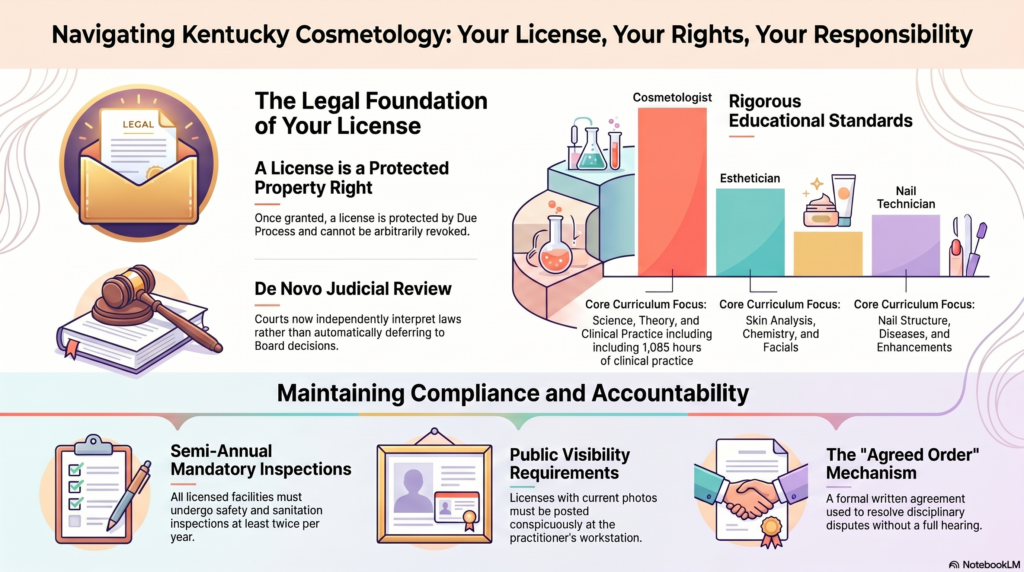
The legal status of a professional license has transitioned from a mere privilege to a recognized property interest under the Fourteenth Amendment’s Due Process Clause.2 When a state grants a license, it creates a vested interest that allows an individual to pursue a livelihood—an interest that cannot be revoked or suspended without adherence to fundamental fairness.2 Historically, the judiciary frequently scrutinized economic regulations that interfered with this right; however, the modern “rational basis” standard of review grants broad deference to state boards.2

Despite this deference, the recognition of a license as a property interest remains a cornerstone of administrative law, necessitating a balance between state police power and individual rights. The Mathews v. Eldridge balancing test provides the framework for this evaluation, weighing the private interest affected, the risk of erroneous deprivation through current procedures, and the government’s interest in fiscal and administrative efficiency.2 In the beauty industry, where practitioners are often self-employed or micro-business owners, the “private interest” represents their entire economic survival, while the “risk of error” is heightened by the lack of legal representation.2

2. Economic Reality vs. Legal Defense Cost

The viability of due process is inextricably linked to the cost of legal counsel.2 For the majority of beauty professionals, the economic barrier to justice is insurmountable.

A. Income Profiles of Personal Care Professionals

The personal care sector is characterized by modest earnings. As of May 2024, the median wages across various specialties indicate a high degree of financial sensitivity.

SpecialtyMedian HourlyMedian Annual10th Percentile90th Percentile
Manicurist/Pedicurist$16.66$34,660$27,260$48,080 7
Hairdresser/Cosmetologist$16.95$35,260$23,520$63,310 8
Skincare Specialist$19.98$41,560$27,160$77,330 24
Barber$18.73$38,960$27,770$78,440 8

These figures underscore that most beauty professionals fall into the low- to moderate-income brackets. Furthermore, many in the sector are independent contractors who do not receive employer-sponsored benefits, increasing their vulnerability to sudden legal expenses.26

B. The Cost of Administrative Adjudication

Legal defense in administrative law requires specialized expertise. National data from 2025 indicates that the average hourly rate for an administrative law attorney is approximately $328 to $329.9 In major markets like California, these rates frequently exceed $420 per hour.10

A standard administrative defense case involves several critical phases:

  1. Investigation and Discovery: 10–20 hours.
  2. Pleadings and Motions: 5–10 hours.
  3. Hearing Preparation and Witness Interviews: 15–20 hours.
  4. Formal Hearing Attendance: 8–16 hours.
  5. Post-Hearing Briefs: 5–10 hours.

Totaling between 43 and 76 hours of legal work, a typical contested case carries a price tag of $14,000 to $25,000.9 When compared to a median manicurist’s annual income of $34,660, the cost of defense can represent up to 72% of their total gross earnings.7

C. The Due Process Threshold

Access to justice is denied when the cost of defending a right exceeds a meaningful share of the interest’s value. This research defines the “Practical Due Process Accessibility Threshold” as a legal cost not exceeding 10% of annual income. Current market rates for legal defense exceed this threshold for over 90% of the beauty workforce.2 Consequently, due process is “theoretically available but practically inaccessible”.2

3. Structural Power Asymmetry: The Administrative State vs. The Individual

The power imbalance between a state regulatory board and a licensee is systemic and multi-dimensional.1 This phenomenon, defined as “Administrative Power Asymmetry,” ensures that the board almost always operates from a position of tactical superiority.

A. Institutional Advantages of the Board

State boards possess institutional continuity and the backing of the state’s legal apparatus.1 Boards have access to full-time legal counsel funded by taxpayer or license-fee revenue, allowing them to pursue enforcement actions without internalizing the marginal cost of litigation.2 They possess broad investigative powers, including the authority to conduct surprise inspections and issue administrative subpoenas for private records.11

B. Vulnerability of the Licensee

The average licensee is a small salon owner or employee with no formal legal training.2 The loss of a license constitutes an “existential risk,” as it immediately terminates their ability to earn a living.2 This high-stakes environment, combined with the licensee’s high marginal defense cost, creates a “coercive settlement environment”.2

FeatureRegulatory BoardIndividual Licensee
Legal RepresentationState-funded, specialized counsel 13Out-of-pocket, high-cost private counsel 9
Financial RiskMinimal; funded by fees/fines 12Catastrophic; livelihood at stake 2
InformationFull access to investigative files 11Limited access without expensive discovery
ContinuityInstitutional; immune to time pressureHighly sensitive to delays/closure 28

4. Agreed Orders as Default Enforcement: Functional Coercion

The administrative state relies heavily on “Agreed Orders” or settlements to maintain operational efficiency.2 While settlements are a legitimate part of the legal process, their use in the beauty industry often signals a failure of due process rather than a mutual agreement.

A. The Efficiency Trap

Enforcement statistics from states like Texas (TDLR) show that a significant majority of cases are resolved through agreed orders rather than formal hearings.29 For example, in the Texas Auctioneer program, 100% of final orders were agreed orders or defaults in 2023.29 Boards often include a “Notice of Alleged Violation” (NOAV) with a pre-calculated settlement offer.31 To an unrepresented licensee, this often feels like an ultimatum: pay a $1,000 fine now, or spend $10,000 in legal fees to fight it.2

B. The Cumulative Effect of Settlements

Agreed orders are not neutral. They include admissions of facts and create a permanent disciplinary history.2 Under the “Disciplinary Escalation Pathway,” a minor agreed order for a sanitation issue today can be used as a “prior violation” to justify license revocation or emergency closure tomorrow.11 This creates a “record-building” mechanism that allows boards to target disfavored practitioners over time.33

5. National Context: The Growing Burden of Occupational Licensing

The expansion of licensing into low-income occupations has created substantial economic barriers that reduce mobility and entrepreneurship.6

A. Disproportionate Training Requirements

The time required to enter beauty professions is frequently irrational when compared to higher-risk fields.3 National research highlights that the average cosmetologist must complete 342 days of training, while an EMT requires only 36 days.3

OccupationAvg. Training (Days)Avg. Fees
Cosmetologist342$209 36
Barber315$175 36
Makeup Artist128$173 36
EMT36$115 3

This disparity suggests that licensing requirements are driven by industry lobbying (rent-seeking) rather than public safety.1

B. Impact on Entrepreneurship and Inequality

Studies confirm a discernable connection between the density of licensing and lower rates of entrepreneurship among low-income populations.34 In states that license more than half of low-income occupations, the entrepreneurship rate is 11% lower than average.34 This burden falls most heavily on those with less access to financial capital or formal education, cementing existing economic inequalities.3

6. Vulnerable Populations Analysis

The enforcement burden of occupational licensing is not distributed equally. It disproportionately impacts immigrant entrepreneurs, rural operators, and minority business owners.1

A. Immigrant Communities and Language Barriers

In the nail salon sector, which has a high concentration of Vietnamese and Cambodian immigrants, single-language testing acts as a structural barrier.37 Advocacy groups in Kentucky have highlighted that the lack of multi-language exams prevents practitioners from demonstrating their competency in sanitation and safety, despite those tests being available nationally via PSI.37 This “linguistic exclusion” increases the risk of erroneous deprivation of livelihood for thousands of “New Americans”.37

B. Rural Schools and “Regulatory Deserts”

Administrative case studies from Kentucky indicate that aggressive enforcement has targeted rural beauty schools, which are often the sole vocational training providers in poverty-stricken counties.12 The closure of these institutions—often for minor, cure-able infractions—forces students to commute to larger cities, creating “regulatory deserts” and restricting economic mobility in underserved regions.12

7. Public Choice and System Design: The Problem of Regulatory Capture

The economic theory of regulation suggests that licensing boards are often “captured” by the industries they regulate.1 Small, well-organized groups of incumbent practitioners find it easier to lobby for restrictive rules that limit competition than the large, unorganized group of consumers who are harmed by higher prices.1

Evidence of capture includes:

  • Board Composition: Boards often consist entirely of industry incumbents with a vested interest in limiting new competition.1
  • Scope Creep: Boards attempting to regulate activities like “eyebrow threading” or “hair braiding” as “cosmetology,” requiring hundreds of hours of irrelevant training.2
  • Accreditation Requirements: Quietly implementing laws that require national accreditation for schools—a process that costs thousands and favors large institutions over small, community-based vocational academies.15

Part C: Kentucky Deep Dive: A Case Study in Administrative Failure

1. The Kentucky Board of Cosmetology (KBC) Scandals (2021–2024)

Kentucky provides a stark example of how a lack of oversight can lead to the systemic abuse of administrative power.12 A series of investigations by the Legislative Oversight and Investigations Committee (LOIC) and victims’ advocates have uncovered widespread misconduct.14

A. Unauthorized Legal Counsel and Ultra Vires Actions

One of the most serious structural violations uncovered was the unlawful appointment of Christopher Hunt as “General Counsel”.13 Under Kentucky law (KRS 12.211), only the Attorney General may represent or authorize the representation of state agencies.13 Evidence suggests that Hunt was hired directly by a board vote and acted without AG delegation for years.13 Because he lacked legal authority, every disciplinary notice, license revocation, and “Agreed Order” he authored may be considered void ab initio.13

B. The “Hyper-Fining” of Nail Salons

Administrative data from 2023–2024 revealed a shocking disparity in enforcement.15 Nail salons, which are predominantly owned by AAPI practitioners and make up less than 10% of the industry, were fined over $250,000.15 In contrast, hair salons were fined less than $4,000.15 This targeting suggests a pattern of “Asian Hate” manifested through government agency action rather than individual animosity.15

C. Fiscal Malfeasance: Direct Checks and Testing Fraud

KBC leadership allegedly operated a “shadow testing agency” to enrich specific employees.13 Despite having an exclusive contract with PSI Services for exam administration, the board allegedly rented rooms at KCTCS using restricted funds and paid its own staff direct checks of $1,000 to $2,000 per month to proctor exams—proctoring duties that were already paid for under the PSI contract.13 This duplication of costs drained the “Board of Cosmetology trust and agency fund” and circumvented state payroll and retirement systems.13

2. Procedural Safeguards and Their Erosion

The KBC has been accused of using “cowardly acts” to cover wrongdoings, such as pursuing criminal charges against school owners to halt administrative hearings where proof of curriculum and legal instructors was being presented.33 One instructor was allegedly denied a hearing for over a year while the board “laughed and name-called” her on recordings, stating they were closing her school before an audit had even occurred.33

3. Comparison with Peer States (2024-2025)

StateBoard StructureOversight MechanismEnforcement Pattern
KentuckyIndependent 14Legislative Audit (LRC)High agreed orders; targeting of AAPI 13
IndianaIntegrated (IPLA)Professional Licensing AgencyScreening by IPLA staff; 90-day order rule 39
TennesseeIntegrated (TDCI)Dept. of Commerce & Insurance12-day processing; 96% satisfaction 26
TexasIntegrated (TDLR)Commission oversight71% resolution in 6 months; NOAV-driven 29
CaliforniaIndependent 2Quadrennial Sunset ReviewHigh bureaucracy; high AG referrals 42

Part D: Due Process Accessibility Index (DPAI)

The DPAI is a measurable framework designed to rank occupational boards based on the feasibility of obtaining administrative justice.

1. Index Methodology

The DPAI scores boards from 0 to 100 based on six weighted metrics:

  • Cost-to-Income Ratio (30%): Weighted cost of defense vs. median income.
  • Settlement Coercion Factor (20%): Ratio of Agreed Orders to Contested Hearings.
  • Language Inclusivity (15%): Availability of tests and notices in top 5 state languages.
  • Transparency Score (15%): Online accessibility of minutes, votes, and fine schedules.
  • Oversight Integrity (10%): Use of independent (non-industry) review boards.
  • “Hard Look” Review (10%): Presence of fee-shifting or judicial “hard look” standards.

2. Most Burdensome Beauty Boards Ranking (Est. 2025)

RankState BoardDPAI ScoreKey Barrier
1Kentucky (Historical)12Systemic targeting, unauthorized counsel, $4M reserve 12
2California24Prohibitive legal costs ($420/hr); high bureaucracy 2
3Texas31NOAV-driven settlement pressure; high default rate 29
4Georgia38Extreme barriers for minor criminal records 44
5Illinois42High education days lost (350 days for Cosmo) 45

A higher DPAI score indicates better access to justice.

Part E: Policy and Legislative Solutions

1. Structural Fairness Reforms

A. Fee-Shifting for Prevailing Licensees

Legislatures should enact “Prevailing Licensee” statutes modeled after the federal Equal Access to Justice Act (EAJA).16 If a board loses an administrative proceeding and fails to prove that its position was “substantially justified,” it must be ordered to pay the licensee’s reasonable attorney’s fees.16 This removes the “economic deterrent” that prevents meritorious claims from being heard.

B. Income-Proportional Fining

Administrative fines should be capped relative to the practitioner’s income. For example, a first-time violation for a minor labeling issue should not exceed 1% of the licensee’s reported annual income.18 This ensures that enforcement is corrective rather than punitive or exit-forcing.

C. Mandatory Disclosure and “Brady” Rules

Boards must be statutorily required to disclose all exculpatory evidence to a respondent at least 14 days before a settlement offer can be signed.33 This prevents boards from “sitting on” evidence that shows a school or salon was functioning legally while pressuring them into a settlement.33

2. Due Process Accessibility Reforms

A. Right to “Low-Bono” or Public Defense

States should establish a fund—supported by a small percentage of license renewal fees—to provide subsidized administrative defense for low-income practitioners.2

B. Plain-Language Response Windows

Response windows for complaints should be extended to 30 calendar days, and all notices must be provided in plain language with a clear explanation of how to request a hearing and the potential consequences of signing an Agreed Order.2

C. Independent Enforcement Review Board

Final disciplinary authority should be removed from industry-dominated boards and placed in the hands of an independent review body composed of administrative law judges and members of the public.2

3. Economic Protection Provisions

A. Alternative Compliance Pathways

Boards should replace “immediate closure” orders for non-safety issues (like record-keeping discrepancies) with “Correction Orders” that allow a 30-day cure period before penalties are assessed.32

B. Elimination of Discriminatory Education Requirements

States should repeal high school diploma requirements for cosmetologists and barbers, as these requirements are not rationally related to sanitation or technical skills and act as barriers for immigrants and low-income adults.36

Part F: Kentucky Legislative Memo: Restoring Regulatory Integrity

TO: Kentucky General Assembly, Committee on Licensing, Occupations, and Administrative Regulations

FROM: Multidisciplinary Research Team

DATE: April 2026

RE: Emergency Remediation of the Kentucky Board of Cosmetology (KBC) Enforcement Actions

1. The Legal Nullity of 2021–2024 Administrative Orders

A critical legal crisis exists regarding the validity of KBC disciplinary actions taken between 2021 and 2024.13 Evidence indicates that Christopher Hunt acted as “General Counsel” and issued hundreds of disciplinary notices without the Attorney General delegation required by KRS 12.211.13 Under the “Doctrine of Nullity,” any administrative act performed by an unauthorized individual is void.13

Recommendation: The General Assembly should pass an emergency resolution directing the Cabinet for Public Protection to review and vacate all disciplinary orders signed by unauthorized counsel during this period and refund all associated fines to the “Board of Cosmetology trust and agency fund” victims.13

2. Abolishing the Industry Monopoly on Executive Leadership

Current statute KRS 317A.040 formerly required that a licensed cosmetologist serve as the Executive Director of the Board.46 This created a structural conflict of interest and institutional capture.

Action Taken: Senate Bill 22 (2025) successfully removed this requirement.46 The General Assembly must ensure that future directors possess administrative and legal expertise rather than just industry affiliation to prevent the recurrence of “dictatorial” leadership.12

3. Ending the “Shadow Agency” and Procurement Fraud

The LOIC findings regarding the KBC’s bypass of the PSI testing contract in favor of high-cost KCTCS room rentals and “direct check” proctoring represent a material weakness in state fiscal control.13

Recommendation: Legislation is required to mandate that all licensing exams be conducted strictly through competitive-bid third-party vendors (like PSI) and that no board staff shall receive compensation outside the state merit payroll system for proctoring duties.13

Part G: Public Education Report: Knowing Your Rights

1. What is an “Agreed Order”?

An “Agreed Order” is a legal contract between you and the Board. By signing it, you are usually admitting that you broke a rule and agreeing to pay a fine or accept probation.11 Once you sign it, you lose your right to a hearing.

2. The Trap of “Informal Warnings”

In Kentucky, you might receive a “written admonishment”.2 While this doesn’t feel like a punishment, the Board keeps it in your file. If you are inspected again, they can use that first warning to give you a much bigger fine or shut you down.2

3. Your Right to Everything in Writing

Under regulation 201 KAR 12:190, the Board cannot just give you a “verbal warning” or demand you pay a fine on the spot.47 You have a right to:

  • A written complaint signed by a real person (not anonymous).13
  • 30 days to respond in writing.2
  • A formal hearing before an administrative judge.2

4. The “Gold-Standard” Defense

The best way to protect your license is “Over-Compliance”.20 This means keeping perfect digital records of your attendance, sanitation steps, and client appointments.20 If a board tries to say you weren’t teaching or working, you can show them “immutable” digital logs that are hard to argue with.2

Part H: State-by-State Access to Justice Ranking (2025)

StateAccessibility GradeSettlement %Language SupportAppeal Difficulty
TennesseeA-62%HighLow (IPLA help)
IndianaB+68%ModerateModerate
TexasC-88%LowHigh (SOAH costs)
CaliforniaD84%ModerateVery High (Legal fees)
KentuckyF (Historic)94%Very LowImpossible (Retaliation) 12

Limits of Evidence

This analysis is subject to several evidentiary constraints:

  • Opacity of Board Records: Many boards, including the KBC, have been accused of refusing Open Records Requests (ORR) and hiding meeting minutes, making it difficult to fully quantify the scope of settlement coercion.12
  • Under-Reporting by Victims: Vulnerable practitioners, particularly undocumented or limited-English immigrants, often fear that challenging a board will lead to retaliation or deportation, resulting in a significant under-reporting of administrative abuse.37
  • Lagging BLS Data: Official wage data for 2024–2025 may not fully reflect the impact of post-pandemic inflation or the “Compliance Tax” on net income.7
  • Incomplete Criminal Tracking: There is limited tracking of cases where administrative boards utilize “selective prosecution” by referring minor civil matters to criminal courts.33

Final Objective: A Livelihood Protected by Law

The central research question of this report—to what extent licensing systems limit due process—is answered with a finding of systemic procedural failure.2 The “Due Process Accessibility Gap” is a structural feature of modern administrative governance that prioritizes board convenience over practitioner rights. When the cost of a defense attorney equals half of a technician’s yearly income, the “right to a hearing” is a hollow promise.2

Restoring the balance requires a fundamental shift in how the state views its power. The professional license is a property interest that defines an individual’s identity and survival in the economy.2 By implementing fee-shifting, proportional fining, and digital transparency, legislatures can ensure that the “police power” remains a tool for public safety rather than a mechanism for economic exclusion. The ultimate standard for any regulatory reform must be: “The issue is not whether regulation exists—but whether justice is realistically accessible to those being regulated.” 2

Works cited

  1. Breaking Down Barriers to Work for Low Income Families – Goldwater Institute, accessed April 15, 2026, https://www.goldwaterinstitute.org/policy-report/low-income-families/
  2. Occupational Licensing – The Institute for Justice, accessed April 15, 2026, https://ij.org/issues/economic-liberty/occupational-licensing/
  3. Thousands Free to Work – Goldwater Institute, accessed April 15, 2026, https://www.goldwaterinstitute.org/policy-report/universal-recognition-hb-2569/
  4. Manicurists and Pedicurists : Occupational Outlook Handbook – Bureau of Labor Statistics, accessed April 15, 2026, https://www.bls.gov/ooh/personal-care-and-service/manicurists-and-pedicurists.htm
  5. Barbers, Hairstylists, and Cosmetologists – Bureau of Labor Statistics, accessed April 15, 2026, https://www.bls.gov/ooh/personal-care-and-service/barbers-hairstylists-and-cosmetologists.htm
  6. Compare Average Lawyer Hourly Rate by State (2026 Data) | Clio, accessed April 15, 2026, https://www.clio.com/resources/legal-trends/compare-lawyer-rates/
  7. How Much Does a Lawyer Cost per Hour? Trends Chart (2026) – ConsumerShield, accessed April 15, 2026, https://www.consumershield.com/articles/how-much-lawyer-cost-per-hour
  8. Tag: cosmetology disciplinary process Kentucky – Louisville Beauty Academy, accessed April 15, 2026, https://louisvillebeautyacademy.net/tag/cosmetology-disciplinary-process-kentucky/
  9. Awards of Attorneys’ Fees by Federal Courts and Federal Agencies – EveryCRSReport.com, accessed April 15, 2026, https://www.everycrsreport.com/reports/94-970.html
  10. Maximizing Your Recovery in Fee-Shifting Cases | Illinois State Bar Association, accessed April 15, 2026, https://www.isba.org/ibj/2015/02/maximizingyourrecoveryinfeeshifting
  11. SUBMISSION STANDING COMMITTEE ON ENVIRONMENT AND PUBLIC AFFAIRS COMMISSIONER FOR EQUAL OPPORTUNITY MAY 2010 – Parliament of Western Australia, accessed April 15, 2026, https://www.parliament.wa.gov.au/Parliament/commit.nsf/luInquiryPublicSubmissions/C3B299A05EB76421482578310042EFDA/$file/ev.tdp.100531.sub032.Commissioner%20for%20Equal%20Opportunity.doc.pdf
  12. CONGRESSIONAL-EXECUTIVE COMMISSION ON CHINA ANNUAL REPORT 2015 – Department of Justice, accessed April 15, 2026, https://www.justice.gov/sites/default/files/pages/attachments/2016/10/17/2015report.pdf
  13. Manicurists and Pedicurists – Bureau of Labor Statistics, accessed April 15, 2026, https://www.bls.gov/oes/2023/may/oes395092.htm
  14. Hairdressers, Hairstylists, and Cosmetologists – Bureau of Labor Statistics, accessed April 15, 2026, https://www.bls.gov/oes/2023/may/oes395012.htm
  15. Esthetician Salary: Pay by State and City – Beauty Schools Directory, accessed April 15, 2026, https://www.beautyschoolsdirectory.com/careers/esthetician/salary
  16. Skincare Specialists : Occupational Outlook Handbook – Bureau of Labor Statistics, accessed April 15, 2026, https://www.bls.gov/ooh/personal-care-and-service/skincare-specialists.htm
  17. Tab 8 Cosmetology and Barbering Draft Report – TN.gov, accessed April 15, 2026, https://www.tn.gov/content/dam/tn/tacir/commission-meetings/2026january/2026Jan_Tab8BarberingCosmetology_DraftReport.pdf
  18. Average Hourly Rates for Lawyers by Practice Area and Geographic Location – MyCase, accessed April 15, 2026, https://www.mycase.com/blog/general/average-lawyer-hourly-rate/
  19. AUC Fiscal Year 2023 – TEXAS DEPARTMENT OF LICENSING & REGULATION | ENFORCEMENT DIVISION, accessed April 15, 2026, https://www.tdlr.texas.gov/enforcement/complaint-stats/2023/AUCComplaintStatisticsFY23.pdf
  20. TEXAS DEPARTMENT OF LICENSING & REGULATION | ENFORCEMENT DIVISION, accessed April 15, 2026, https://www.tdlr.texas.gov/enforcement/complaint-stats/2023/WWDComplaintStatisticsFY23.pdf
  21. How TDLR Handles Consumer Complaints – Texas Department of …, accessed April 15, 2026, https://www.tdlr.texas.gov/media/pdf/TDLR-Consumer-Complaints-at-a-Glance.pdf
  22. Category: Sanitation and Safety – Louisville Beauty Academy, accessed April 15, 2026, https://louisvillebeautyacademy.net/category/sanitation-and-safety/
  23. How State Occupational Licensing Hinders Low-Income Entrepreneurship – Goldwater Institute, accessed April 15, 2026, https://goldwaterinstitute.org/wp-content/uploads/cms_page_media/2015/2/10/Occupational%20LicensingFINAL.pdf
  24. Introduction – The Institute for Justice, accessed April 15, 2026, https://ij.org/report/license-to-work-2-backup/report/introduction/
  25. Questionable Burdens – The Institute for Justice, accessed April 15, 2026, https://ij.org/report/license-to-work-3/report/do-licensings-burdens-make-sense/questionable-burdens/
  26. Six Reforms to Occupational Licensing Laws to Increase Jobs and Lower Costs | Goldwater Institute, accessed April 15, 2026, https://goldwaterinstitute.org/wp-content/uploads/2014/11/Six-Reforms-to-Occupational-Licensing-Laws-to-Increase-Jobs-and-Lower-Costs.pdf
  27. PLA :: License Litigation – IN.gov, accessed April 15, 2026, https://www.in.gov/ai/appfiles/pla-litigation/
  28. Cosmetology & Barbers Board – PLA – IN.gov, accessed April 15, 2026, https://www.in.gov/pla/professions/cosmetology-and-barber-home/cosmetology-and-barber-board/
  29. Tennessee’s Regulatory Boards Division Reports Surge in Professional Licenses Processed Amid Enhanced Customer Service – WGNS Radio, accessed April 15, 2026, https://www.wgnsradio.com/article/91516/tennessees-regulatory-boards-division-reports-surge-in-professional-licenses-processed-amid-enhanced-customer-service
  30. Enforcement Statistical Overview – California Board of Barbering and …, accessed April 15, 2026, https://www.barbercosmo.ca.gov/enforcement/enf_stats.shtml
  31. Enforcement Stats Report Report run on, accessed April 15, 2026, https://www.barbercosmo.ca.gov/forms_pubs/qrtrpt_23_24.pdf
  32. Georgia forfeits essential workers because of outdated licensing law., accessed April 15, 2026, https://www.gjp.org/wp-content/uploads/2025/03/GJP-Occupational-License-Booklet-2025.03.10.pdf
  33. Illinois makes it tough for poor to become barbers, makeup artists, manicurists, accessed April 15, 2026, https://www.illinoispolicy.org/illinois-makes-it-tough-for-poor-to-become-barbers-makeup-artists-manicurists/
  34. record(8-1-2025).docx – Legislative Research Commission, accessed April 15, 2026, https://apps.legislature.ky.gov/record/25rs/record(8-1-2025).docx

Educational, Research & Public Information Notice
This publication is independent academic research developed by Di Tran University – College of Humanization and is based solely on publicly available sources. All research credit is attributed to Di Tran University.

Louisville Beauty Academy and Di Tran University do not assert, verify, or independently validate any claims, findings, or conclusions presented. All information is compiled, summarized, or interpreted from third-party public materials and is presented strictly for educational and informational purposes.

Neither Louisville Beauty Academy nor Di Tran University is affiliated with, endorsed by, or representative of the Kentucky Board of Cosmetology or any governmental authority. This content does not constitute legal, regulatory, or professional advice and is provided “as is” without representation, warranty, or guarantee of accuracy or completeness. Readers are solely responsible for independent verification and compliance with applicable laws and regulations.

No statements herein should be interpreted as allegations, findings of fact, or claims against any specific individual or entity, but solely as academic discussion of publicly reported information.
State Cosmetology and Barber Licensing Environments, Beauty School Ecosystems, and the Economic Impact of Salons and Spas Across the United States: A Comprehensive Analytical Report – RESEARCH & PODCAST SERIES 2026


Disclaimer: This research is authored exclusively by Di Tran University — The College of Humanization Research Team. Louisville Beauty Academy and affiliated organizations publish this material solely for educational and informational purposes and do not provide legal or regulatory interpretation. All licensing and compliance determinations are governed exclusively by the applicable state board. Information may change and should be independently verified.


The beauty and personal care industry represents a fundamental pillar of the United States economy, characterized by high rates of entrepreneurship, significant workforce diversity, and a complex regulatory landscape. This research paper provides an exhaustive analysis of the occupational licensing environments across all 50 states, the educational ecosystems that support them, and the resulting economic outcomes. By synthesizing data from the U.S. Census Bureau, the Bureau of Labor Statistics, and recent academic research, this analysis demonstrates how regulatory structures—ranging from training hour requirements to interstate reciprocity agreements—influence labor market dynamics and business formation. Central to this ecosystem is the beauty school, which serves as a workforce development engine. Using the Louisville Beauty Academy in Kentucky as a primary illustrative example, the report highlights the role of student-first, compliance-oriented institutions in fostering a professionalized workforce capable of navigating shifting state standards. Findings suggest that while the industry contributes over $308 billion to the national GDP, the efficiency of state boards and the rationality of licensing requirements vary significantly, impacting student debt, wage growth, and geographic mobility. The report concludes that supportive environments, characterized by transparent administrative processes and evidence-based training requirements, correlate with healthier small-business ecosystems and enhanced economic contributions.

Introduction and Research Questions

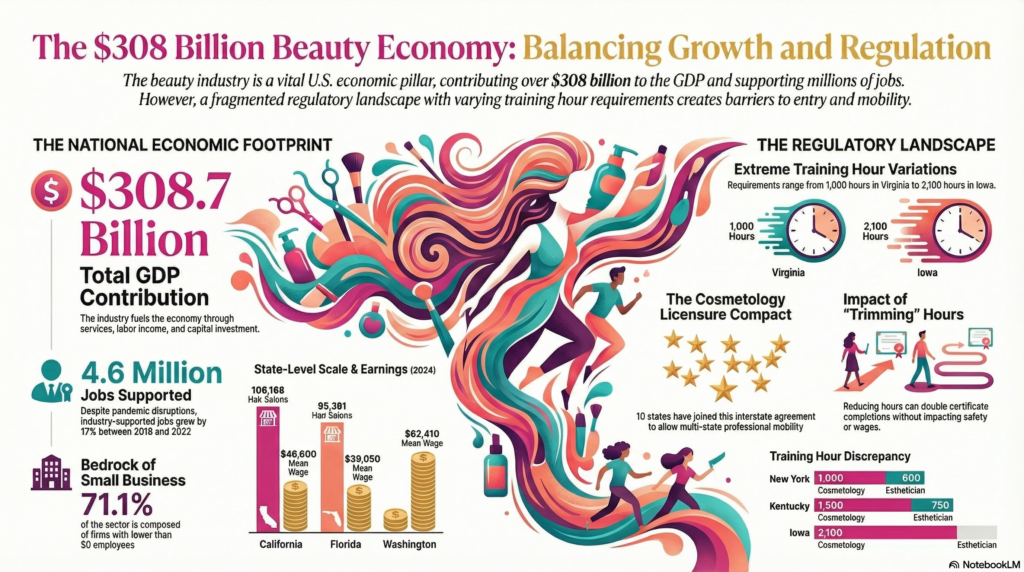
The professional beauty industry, encompassing hair, nail, skin care, and spa services, occupies a unique and often undervalued position within the American economic landscape. Far from being a mere luxury or discretionary sector, the personal care industry is an essential service provider that drives significant labor participation and capital investment. As of 2022, the industry was responsible for fueling the U.S. economy by directly and indirectly contributing $308.7 billion to the gross domestic product (GDP) and supporting 4.6 million jobs.1 Despite this massive scale, the sector remains deeply fragmented, composed primarily of small, independently owned businesses and a burgeoning class of “independent professionals” or “businesses of one”.2 This structural composition makes the industry highly sensitive to the regulatory environments established at the state level.

Occupational licensing serves as the primary gateway into this profession. In the United States, every state requires individuals to obtain a government-issued license to work as a cosmetologist, barber, esthetician, or nail technician.3 These requirements are designed to address potential market failures associated with asymmetric information—the idea that consumers cannot easily judge the health and safety competencies of a practitioner—and to mitigate negative externalities such as the spread of infections or chemical injuries.4 However, the specific standards for licensure—including training hours, examination protocols, and reciprocity rules—differ drastically across state lines. A student in New York may enter the cosmetology workforce after 1,000 hours of training, while their counterpart in Nebraska or Iowa may be required to complete 2,100 hours.3

This research paper investigates the ripple effects of these regulatory variations. Specifically, it seeks to answer: How do state-mandated training hours correlate with student debt and labor market entry? To what extent do state board administrative efficiencies—such as online application portals and transparent processing times—impact the density of beauty businesses? What is the role of beauty schools, particularly compliance-focused institutions like the Louisville Beauty Academy, in bridging the gap between state regulations and professional success? Finally, how does the emerging Cosmetology Licensure Compact represent a pivotal shift in professional mobility and state sovereignty? By addressing these questions, this report provides a fact-based framework for students, professionals, and policymakers to understand the interconnectedness of regulation, education, and economic prosperity in the beauty sector.

Background and Literature Review

The history of occupational licensing in the beauty industry is a reflection of broader labor market trends in the 20th and 21st centuries. In the early 1900s, the market for hair cutting was dominated by men, particularly in the barbering sector.6 As the economy shifted toward service-oriented sectors in the post-war era, the demographic makeup of the industry underwent a dramatic inversion. By 1980, women came to dominate the field, a transition facilitated by the rise of cosmetology as a distinct and broader profession than traditional barbering.6 Today, women hold nearly 80% of jobs in the sector and over half of all management positions, far exceeding national averages for workforce diversity.1

Academic literature on occupational licensing generally falls into two categories: the “public interest” perspective and the “economic theory of regulation” or “public choice” perspective. The public interest model posits that licensing is a necessary form of “human-capital quality control”.8 In a field where practitioners utilize sharp implements, high-heat tools, and complex chemical formulations, the state has a vested interest in ensuring a minimum skill level to prevent public harm.4 Proponents argue that without these standards, the market would suffer from a “race to the bottom” in quality, potentially leading to increased public health risks.

Conversely, the economic theory of regulation, often associated with Milton Friedman and George Stigler, argues that licensing acts as a barrier to entry that benefits incumbent workers at the expense of consumers and aspiring professionals.4 By restricting the supply of labor through long training hours and high fees, licensing can create “monopolistic rents,” driving up wages for those who are already licensed.4 Empirical studies have estimated that licensing can provide a wage premium of 11% to 18% for practitioners.8 However, recent research specific to cosmetology suggests that these premiums may be offset by the costs of entry.

A significant body of modern research highlights a disconnect between training hours and economic outcomes. Studies by the National Bureau of Economic Research (NBER) have found that higher licensing hour requirements are associated with higher levels of student debt but show no statistically significant correlation with higher post-graduation earnings.4 For instance, a cosmetologist in Iowa completes more training hours (2,100) than an Emergency Medical Technician (typically 132–150 hours), yet this additional training does not necessarily translate to a higher market value.4 This has led some researchers to characterize current licensing schemes as “irrational” and “disconnected from public health threats,” as seen in legal rulings regarding hair braiding in Utah.4

Furthermore, the literature identifies the “beauty school” as a critical institutional actor. Schools are not merely vendors of hours; they are workforce development centers that act as incubators for small business owners.1 The quality of these schools—measured by their focus on regulatory compliance, sanitation, and safety—is a primary determinant of a student’s ability to navigate the path to licensure and entrepreneurship.9 As the industry moves toward a “business of one” model, where professionals operate as independent contractors, the role of the school in providing business and regulatory literacy becomes increasingly vital.2

Methodology and Data Description

This research utilizes a secondary data analysis approach, synthesizing information from government agencies, industry associations, and academic repositories. The study is structured as a comparative analysis across all 50 U.S. states to map the regulatory and economic landscape of the beauty sector.

The regulatory data is drawn from state board of cosmetology and barbering statutes and administrative rules. This includes the documentation of training hour requirements for various license types (cosmetologist, barber, esthetician, nail technician, and instructor) as of 2024 and 2025.3 Administrative efficiency is gauged through observable “supportiveness” indicators, such as the presence of online application portals (e.g., California’s BreEZe or Georgia’s GOALS), the availability of comprehensive FAQs, and the transparency of license transfer protocols.12

The economic and demographic data is sourced from the following:

  1. U.S. Census Bureau: Data from the Statistics of U.S. Businesses (SUSB) and Business Formation Statistics (BFS) provides the counts of firms and establishments at the 6-digit NAICS level.14 Key codes analyzed include 812112 (Beauty Salons), 812111 (Barber Shops), 812113 (Nail Salons), and 611511 (Cosmetology and Barber Schools).16
  2. Bureau of Labor Statistics (BLS): The Occupational Employment and Wage Statistics (OEWS) provide state-level data on employment per thousand jobs, location quotients, and mean hourly/annual wages for practitioners.18
  3. Industry Reports: Financial multipliers and nationwide economic impact figures are derived from the 2024 Economic & Social Contributions Report by the Personal Care Products Council (PCPC) and the 2024 Community Report by the Professional Beauty Association (PBA).1
  4. Case Study Material: Publicly available information from the Louisville Beauty Academy (LBA) and the Kentucky Board of Cosmetology (KBC) provides an illustrative look at the practical application of these regulations in a specific regional ecosystem.19

The methodology also incorporates a conceptual framework that connects “licensing strictness” (measured by hours and fees) and “administrative supportiveness” (measured by process efficiency) to “economic outcomes” (measured by business density and labor income). This allows for a nuanced discussion of how policy choices facilitate or hinder the professional pipeline from student to salon owner.

Descriptive Overview of the 50-State Licensing Environment

The primary characteristic of the U.S. beauty licensing environment is its extreme heterogeneity. While all states mandate licensure, the path to obtaining that license is dictated by a complex set of variables that change frequently as legislatures respond to economic pressures.

Training Hour Variations for Cosmetology

The national average for cosmetology training is approximately 1,500 hours, which typically requires 9 to 18 months of full-time or part-time enrollment.3 However, the distribution around this mean is wide. On the lower end, states like California and Virginia have moved to a 1,000-hour requirement to lower the barriers to entry.22 On the higher end, states such as Idaho and Montana require 2,000 hours, while Iowa and Nebraska have historically set the bar at 2,100 hours.5

The following table provides a comprehensive overview of cosmetology school hours for selected states, highlighting the regional differences:

StateCosmetology Training HoursEsthetician HoursNail Technician Hours
Alabama1,5001,000750
Alaska1,650350120
California1,000600400
Colorado1,800600600
Florida1,200260240
Georgia1,5001,000525
Kentucky1,500750450
New York1,000600250
Texas1,500750600
Virginia1,000600150

Data compiled from.3

These hour requirements represent a significant investment of time and capital. In states with high hour mandates, students often accumulate more debt as they must pay for additional months of instruction before they can legally begin earning a wage.4 The “calendar days lost” metric developed by the Institute for Justice estimates that a student in Massachusetts may lose up to 963 days due to licensing requirements, whereas a student in New York might lose only 233 days.3 This discrepancy suggests that the regulatory environment significantly impacts the lifetime earning potential of a professional by delaying their entry into the workforce.

Board Administrative Efficiency and Support

Beyond the statutory hour requirements, the “supportiveness” of a licensing environment is often defined by the administrative ease of interacting with the state board. A supportive board is not necessarily one with the lowest requirements, but one that provides clear, stable, and predictable processes for its constituents.

Indicators of administrative support include:

  • Online Systems: Boards that utilize integrated portals for applications, renewals, and fee payments (e.g., California’s BreEZe or Kentucky’s Online Application Portal) reduce the administrative friction for practitioners.13
  • Processing Transparency: Some boards provide clear guidance on how long a license certification takes to process (e.g., California reports 2 weeks for processing and 4-6 weeks for total certification transfer).13
  • Accessibility: The availability of multiple communication channels (email, phone, and online chat) and detailed FAQs helps students and professionals avoid common mistakes, such as assuming reciprocity is automatic or prematurely enrolling in extra hours.12

The efficiency of these boards is a critical factor in business formation. In environments where the path from “passing exams” to “receiving a license” is delayed by bureaucratic backlog, the local economy suffers from a temporary shortage of labor and a delay in tax revenue generation.25

The Cosmetology Licensure Compact: A New Paradigm for Mobility

One of the most significant developments in the licensing environment is the creation of the Cosmetology Licensure Compact. Recognizing that the “patchwork” of state rules creates unnecessary barriers for mobile professionals—such as military spouses or individuals relocating for economic opportunities—the Council of State Governments developed an interstate agreement.26

The compact allows a cosmetologist who holds an active, unencumbered license in a member state to apply for a “multistate license.” This license functions similarly to a driver’s license, permitting the holder to practice in all other member states without the need for a separate license in each jurisdiction.27 As of mid-2025, ten states have enacted the compact: Alabama, Arizona, Colorado, Kansas, Kentucky, Maryland, Ohio, Tennessee, Virginia, and Washington.28 The compact reached its activation threshold of seven states in 2025 and is currently in the 18-24 month process of building the infrastructure necessary to issue licenses.27 This shift toward “multistate reciprocity” is expected to significantly reduce the administrative and financial burden on practitioners while preserving each state’s sovereignty to set its own initial licensing standards.27

Economic Footprint and Industry Density

The beauty industry is a primary driver of service-sector growth in the United States. Its economic footprint is defined not only by its total contribution to GDP but also by its role as a bedrock of small business stability and workforce inclusivity.

National Multipliers and Aggregate Contributions

In 2022, the personal care products industry accounted for $308.7 billion in total GDP contribution.1 This includes $203.3 billion in labor income, reflecting the industry’s role as a major employer of skilled professionals.1 The sector is highly resilient; despite the disruptions of the pandemic era, industry-supported jobs grew by 17% between 2018 and 2022.1

The industry is also a significant contributor to public coffers. Total tax payments at the federal, state, and local levels reached $82.3 billion in 2022.1 This tax revenue is generated through a combination of corporate taxes, payroll taxes, and the sales taxes collected on millions of personal care services and products. Furthermore, for every $1 million in revenue, personal care product manufacturers contribute approximately $1,500 to charitable causes, ranking third among all major industry sectors in charitable giving.7

State-Level Density and Business Formation

The density of beauty businesses is a key indicator of local economic health. California, Florida, and New York lead the nation in the absolute number of hair salons.29 As of 2024, California hosted over 106,000 hair salon businesses, followed by Florida with approximately 95,000 and New York with 95,000.29

However, the “density” of these services—measured by establishments per capita—varies. BLS data from 2023 shows that states like Pennsylvania have a high location quotient (1.66) for cosmetologists, meaning the occupation is significantly more concentrated there than in the nation as a whole.18 Other states with high employment of cosmetologists per thousand jobs include Massachusetts (2.71), Maine (1.76), and Colorado (2.32).18

The following table summarizes establishment and employment indicators for selected states:

StateNumber of Hair Salons (2024)Cosmetology Employment (BLS 2023)Annual Mean Wage (Practitioner)
California106,16620,450$46,600
Florida95,38121,820$39,050
New York95,33321,000$41,830
Texas25,540$38,050
Pennsylvania19,120$38,080
Washington6,680$62,410

Data from.18

The growth of the “medspa” and specialized esthetics sectors has outpaced traditional salons in recent years. The medical spa industry grew from 8,899 locations in 2022 to 10,488 in 2023, with an average annual revenue of nearly $1.4 million per location.30 This segment is particularly lucrative for practitioners and business owners, as it targets high-income consumers and benefits from a high rate of patient visits—averaging 245 visits per month per location.30

Small Business Formation Rates

The beauty industry is a leading sector for new business applications. Data from the Census Bureau’s Business Formation Statistics shows that during the post-pandemic recovery, states in the Sun Belt—such as New Mexico (+92.1%), South Carolina (+77.9%), Alabama (+72.2%), and Florida (+69.5%)—saw some of the highest increases in new business applications.31 In 2024, Florida alone saw over 56,000 new business formations in the month of June.32 Because the beauty industry is dominated by firms with fewer than 50 employees (71.1% of the sector), it serves as a critical engine for this entrepreneurial boom.1

Analytical Framework: Linking Regulation and Economic Outcomes

The central thesis of this report is that the regulatory environment is not a passive backdrop but an active participant in the economic health of the beauty sector. A supportive regulatory framework creates a “virtuous cycle” of professional development and economic growth.

The Professional Pipeline

The journey from a student to a successful salon owner can be conceptualized as a pipeline. In a supportive state:

  1. Student Entry: Training requirements are evidence-based (e.g., 1,000–1,500 hours), making education affordable and reducing the reliance on high-interest student loans.10
  2. Licensure: The state board provides a seamless transition from graduation to examination. Electronic authorizing systems allow students to schedule exams quickly (within 24–48 hours of authorization in some cases) and receive their licenses within days of passing.13
  3. Employment and Mobility: Professionals can move between states with clarity, thanks to “substantial equivalence” rules or membership in the Cosmetology Licensure Compact.23
  4. Entrepreneurship: Low administrative friction and clear salon-licensing rules encourage professionals to open their own establishments, becoming employers and tax-paying entities.11

The Impact of “Trimming” Hours

Academic evidence suggests that when states “trim” their hour requirements, the entire pipeline becomes more efficient. In the study “Cosmetology Gets a Trim,” researchers found that reducing hours led to a doubling of certificate completions without any detectable negative impact on wages or safety.10 By reducing the “barrier to entry,” the state allows more individuals to enter the formal, regulated market. This expands the tax base and reduces the prevalence of “under-the-table” services that bypass safety inspections and revenue reporting.

Administrative “Drag” vs. Support

Conversely, an unsupportive environment creates “administrative drag.” In states with high hour requirements, paper-only application processes, and ambiguous reciprocity rules, the pipeline is clogged with delays. Professionals may be forced to wait months for a license transfer, leading to lost income and a reduction in the state’s total labor contribution.3 This drag is particularly damaging for small businesses, which often operate on thin margins and cannot afford to have a chair sitting empty while a new hire waits for board approval.

A supportive environment, therefore, is defined by:

  • Rationality: Hours that match the actual health risks of the trade.
  • Predictability: Transparent timelines for all board actions.
  • Stability: Rules that do not change arbitrarily without industry input.
  • Reciprocity: Pathways that recognize the value of experience and out-of-state training.

Case Study: Louisville Beauty Academy and the Kentucky Ecosystem

The state of Kentucky, and specifically the Louisville Beauty Academy (LBA), provides a valuable illustrative case study of how a “center of excellence” can exist within a state that is actively modernizing its regulatory framework.

The Kentucky Regulatory Landscape

Kentucky currently requires 1,500 hours of training for a cosmetology license, with esthetics and nail technology recently reduced to 750 and 450 hours respectively.11 The Kentucky Board of Cosmetology (KBC) has moved toward modernization by implementing an online application portal and becoming an early adopter of the Cosmetology Licensure Compact.19

The state also employs a “2+ year experience rule,” which is a hallmark of a supportive reciprocity policy. Under this rule, out-of-state applicants who have been licensed and practicing for more than two years can have their hour deficiencies waived by the board.19 This recognizes that professional experience is an effective substitute for classroom hours, facilitating the entry of seasoned talent into the Kentucky market.

Louisville Beauty Academy as a “Center of Excellence”

In this ecosystem, Louisville Beauty Academy positions itself not through subjective rankings, but as a compliance-first institution that serves the interests of both students and the state. As an accredited school, LBA serves as a workforce engine by:

  • Educating on Compliance: LBA maintains a public library of research and guides that document state-by-state transfer rules. By explicitly stating that the board has final authority over licensing, the school ensures students have realistic expectations about the regulatory process.19
  • Prioritizing Safety: The school’s curriculum emphasizes sanitation and state-board preparation, ensuring that graduates meet the high safety standards required by the KBC.9
  • Fostering Entrepreneurship: LBA encourages students to see licensure as a “gateway to ownership.” By providing a foundation in the state’s salon-licensing laws, the school prepares graduates to open legitimate, tax-paying businesses in the region.11

LBA is an example of a school that does not merely teach technical skills but provides “regulatory literacy.” In an industry where a license is the most valuable asset a professional owns, this focus on compliance and professional mobility is essential for long-term career success.

Policy Implications and Recommendations

Based on the synthesis of 50-state data and economic impact studies, several policy recommendations emerge for state boards, legislatures, and industry stakeholders.

For State Legislatures: Evidence-Based Requirements

Legislatures should move toward a more uniform standard of 1,000 to 1,500 hours for cosmetology, as evidence shows that requirements exceeding 1,500 hours significantly increase student debt without a commensurate increase in public safety or wages.4 Furthermore, states should follow the lead of Virginia and Washington by joining the Cosmetology Licensure Compact.28 The compact is the most effective tool for promoting professional mobility while maintaining state control over health and safety standards.

For State Boards: Prioritize Digital Infrastructure

Boards should invest in integrated digital portals that offer real-time tracking of applications and certifications. Reducing the “administrative drag” of paper-based transfers is a low-cost, high-impact way to support small businesses. Boards should also adopt transparent “service level agreements,” such as guaranteeing a license verification within 10 business days, to provide predictability for the workforce.

For Schools and Industry Groups: Champion Professionalism

Beauty schools should emulate the “student-first” model by providing comprehensive information on interstate mobility and career pathways beyond just passing the state board exam. Industry groups like the PBA and PCPC should continue to advocate for the “Business of One” model, providing independent professionals with the tools they need for financial planning, insurance, and regulatory compliance.2

Limitations and Directions for Future Research

This report is based on a synthesis of publicly available data, which has inherent limitations. State board regulations change frequently, and there is often a lag between the passage of a law and the update of administrative manuals. Furthermore, while the NBER has provided excellent research on the impact of “trimming” hours, more longitudinal studies are needed to track the 10-year career trajectories of graduates from 1,000-hour programs versus 2,000-hour programs.

Future research should also investigate the specific impact of the “independent professional” trend on state tax revenues. As more practitioners move away from traditional employer-based salons toward booth rental and salon suites, states may need to adjust their licensing and tax collection mechanisms to ensure continued compliance and support for these micro-entrepreneurs.

Conclusion

The beauty and personal care industry is a dynamic, resilient, and essential component of the American economy. With an annual GDP contribution of over $308 billion and a workforce of 4.6 million people, the industry’s success is deeply intertwined with the regulatory choices made by the 50 states.1 This research has shown that a supportive licensing environment is characterized by evidence-based hour requirements, administrative transparency, and a commitment to professional mobility through initiatives like the Cosmetology Licensure Compact.

Schools like the Louisville Beauty Academy serve as the foundational infrastructure of this ecosystem, transforming students into compliant, safety-conscious professionals and entrepreneurs. When states reduce the unnecessary barriers to entry and provide efficient board operations, they do not merely help individual practitioners—they foster a thriving small-business landscape that creates jobs, builds local wealth, and contributes billions in tax revenue. As the industry continues to evolve toward more specialized services and independent business models, the need for a rational, transparent, and mobile regulatory framework has never been greater. By aligning policy with the empirical realities of the labor market, the United States can ensure that the beauty industry remains a premier pathway for economic opportunity and entrepreneurial success.

Works cited

  1. THE BEAUTY OF IMPACT – Personal Care Products Council, accessed March 24, 2026, https://www.personalcarecouncil.org/wp-content/uploads/2024/06/PCPC_EcoReport-2024_Full_Digital_single.pdf
  2. 2024 community report – ProBeauty.org, accessed March 24, 2026, https://www.probeauty.org/wp-content/uploads/2025/05/24_PBA_Community_Report_FINAL.pdf
  3. Cosmetology – Institute for Justice, accessed March 24, 2026, https://ij.org/issues/economic-liberty/cosmetology/
  4. Occupational Licensing and Student Outcomes – American University, accessed March 24, 2026, https://www.american.edu/spa/peer/upload/2022-2-17-peer-occupationa-licensing-final.pdf
  5. The Number of Cosmetology School Hours Required in Every State, accessed March 24, 2026, https://cosmetologyguru.com/cosmetology-school-hours-every-state/
  6. Regulating Beauty: The Licensing of Barbers and Beauticians in Alabama and the Nation | Enterprise & Society – Cambridge University Press & Assessment, accessed March 24, 2026, https://www.cambridge.org/core/journals/enterprise-and-society/article/regulating-beauty-the-licensing-of-barbers-and-beauticians-in-alabama-and-the-nation/69A7A5E320A13E01E7192699B6AC6E4E
  7. Economic And Social Impact – Personal Care Products Council, accessed March 24, 2026, https://www.personalcarecouncil.org/about/economic-and-social-impact/
  8. Stringency in Occupational Licensing Requirements: Explanations and Effects – Digital Commons @ UConn, accessed March 24, 2026, https://digitalcommons.lib.uconn.edu/cgi/viewcontent.cgi?article=1971&context=srhonors_theses
  9. Complete Guide to Cosmetology Licensing Requirements by State (2025), accessed March 24, 2026, https://www.gotopjs.com/blog/complete-guide-to-cosmetology-licensing-requirements-by-state-2025/
  10. Cosmetology Gets a Trim: The Impact of Reducing Licensing Hours …, accessed March 24, 2026, https://www.nber.org/system/files/working_papers/w33936/w33936.pdf
  11. FAQ (Frequently Asked Questions) – Louisville Beauty Academy, accessed March 24, 2026, https://louisvillebeautyacademy.net/faq/
  12. Georgia State Board of Cosmetology and Barbers FAQ, accessed March 24, 2026, https://sos.ga.gov/page/georgia-state-board-cosmetology-and-barbers-faq
  13. Frequently Asked Questions – California Board of Barbering and Cosmetology, accessed March 24, 2026, https://www.barbercosmo.ca.gov/forms_pubs/publications/faqs.shtml
  14. 2022 SUSB Annual Data Tables by Establishment Industry, accessed March 24, 2026, https://www.census.gov/data/tables/2022/econ/susb/2022-susb-annual.html
  15. Business Formation Statistics – Census Bureau, accessed March 24, 2026, https://www.census.gov/econ/bfs/index.html
  16. 812112 – NAICS Code Description, accessed March 24, 2026, https://www.naics.com/naics-code-description/?code=812112
  17. North American Industry Classification System (NAICS) U.S. Census Bureau, accessed March 24, 2026, https://www.census.gov/naics/?input=812&year=2022&details=812
  18. Hairdressers, Hairstylists, and Cosmetologists – BLS.gov, accessed March 24, 2026, https://www.bls.gov/oes/2023/may/oes395012.htm
  19. Tag: how to transfer cosmetology license to Kentucky – Louisville Beauty Academy, accessed March 24, 2026, https://louisvillebeautyacademy.net/tag/how-to-transfer-cosmetology-license-to-kentucky/
  20. Out of State Info – Kentucky Board of Cosmetology, accessed March 24, 2026, https://kbc.ky.gov/Licensure/Pages/Out-of-State-Info.aspx
  21. How to Transfer Your Cosmetology, Nail, or Esthetics License to Kentucky (2026 Step-by-Step Guide) – FEB 2026, accessed March 24, 2026, https://louisvillebeautyacademy.net/how-to-transfer-your-cosmetology-nail-or-esthetics-license-to-kentucky-2026-step-by-step-guide-feb-2026/
  22. Barber, Cosmetology, Nail, Wax, Tattooing, Permanent Cosmetic Tattooing, and Master Permanent Cosmetic Tattooing Curriculum Requirements | Virginia Department of Professional and Occupational Regulation, accessed March 24, 2026, https://www.dpor.virginia.gov/CosmetologyCurriculum
  23. State-by-State Cosmetology License Transfer Guide …, accessed March 24, 2026, https://louisvillebeautyacademy.net/state-by-state-cosmetology-license-transfer-guide-comprehensive-research-as-of-march-2025/
  24. State Board Info – Dermascope, accessed March 24, 2026, https://www.dermascope.com/state-board-requirements/
  25. TDLR how long to receive license? : r/Esthetics – Reddit, accessed March 24, 2026, https://www.reddit.com/r/Esthetics/comments/17n064b/tdlr_how_long_to_receive_license/
  26. The Cosmetology Compact – National Center for Interstate Compacts, accessed March 24, 2026, https://compacts.csg.org/compact-updates/cosmetology/
  27. Cosmetology Compact, accessed March 24, 2026, https://cosmetologycompact.gov/
  28. WASHINGTON BECOMES 10TH STATE TO ENACT COSMETOLOGY LICENSURE COMPACT, accessed March 24, 2026, https://cosmetologycompact.gov/2025/05/13/washington-becomes-10th-state-to-enact-cosmetology-licensure-compact/
  29. Hair Salons in the US – Number of Businesses – IBISWorld, accessed March 24, 2026, https://www.ibisworld.com/industry/statistics/businesses.aspx?entid=4410
  30. 2024 Medical Spa State of the Industry Executive Report Recap, accessed March 24, 2026, https://americanmedspa.org/blog/2024-medical-spa-state-of-the-industry-executive-report-recap
  31. Cities Experiencing a Surge in New Business Applications, accessed March 24, 2026, https://www.simplybusiness.com/resource/new-businesses-in-us-by-region/
  32. Business Formation Report | June 2025 – Registered Agents, Inc, accessed March 24, 2026, https://www.registeredagentsinc.com/business-filing-report/june-2025/
  33. Test Taker Support | Candidate FAQ – PSI Exams, accessed March 24, 2026, https://www.psiexams.com/test-takers/support/


