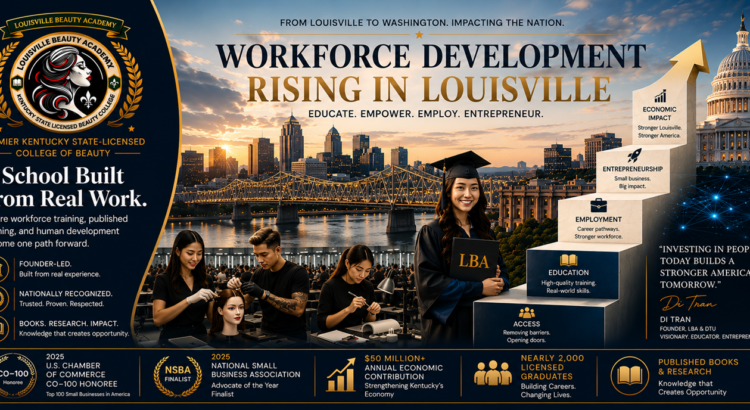
Louisville Beauty Academy: Our Direction Forward (2026 and Beyond)

Beginning in 2026, Louisville Beauty Academy (LBA) formally advances its role beyond education into national leadership in beauty industry standards, research, and public knowledge, powered by Di Tran University – College of Humanization.

LBA is no longer positioned solely as a place of instruction, but as an institutional contributor to how the beauty profession is educated, regulated, understood, and elevated at a national level.

Our mission is guided by four permanent pillars.


1️⃣ The Gold-Standard Model (Student-First, Compliance-First)

Louisville Beauty Academy operates under a Gold-Standard Education Model—placing students before profit, clarity before confusion, and long-term professional dignity before short-term licensing outcomes.

This model emphasizes:

  • Transparent tuition and institutional policies
  • Flexible, accessible pathways to licensure
  • Compliance-by-design education
  • Law, safety, ethics, and workforce literacy

LBA is proud to be the only beauty college to receive two national recognitions in a single month of one year, affirming its role as a benchmark institution within the beauty education sector.


2️⃣ The Public Library Model (Open Knowledge Infrastructure)

Louisville Beauty Academy functions as a public knowledge library for the beauty industry.

Research, policy analysis, safety education, and regulatory explanations are made openly accessible to students, licensees, salon owners, regulators, and the public. Knowledge is shared to elevate the entire profession, not to restrict access, gatekeep information, or create dependency.

This model reflects LBA’s belief that an informed industry is a safer, stronger, and more professional industry.


3️⃣ The 2026 Podcast & Video Research Series

Starting in 2026, LBA expands its Podcast & Video Research Series to provide structured, public-facing education on:

  • Law and regulation
  • Public health and sanitation
  • Workforce policy and tax literacy
  • Business models and compliance
  • Professional ethics and humanization

This series exists to translate complexity into clarity, serving students, licensees, and the public alike—without sensationalism, fear-based messaging, or commercial bias.


4️⃣ Research-Driven, Empirical, and Evidence-Based

All LBA publications are grounded in:

  • Empirical research
  • Legislative and regulatory text
  • Historical data
  • Verifiable public records

LBA writes to inform, not to persuade.
LBA publishes to educate, not to market.
LBA researches to raise the beauty industry to a national and institutional level comparable to leading academic and professional models.


Governance & Academic Integrity

Louisville Beauty Academy maintains internal academic review standards to ensure clarity, accuracy, and neutrality across all educational and research publications. Content is periodically reviewed for alignment with statutory language, regulatory updates, and public safety standards.

This governance structure exists to protect students, licensees, and the public, while preserving institutional independence, academic integrity, and intellectual freedom.


Outcomes & Public Impact

LBA’s research and public education initiatives are designed to:

  • Improve regulatory understanding among students and licensees
  • Reduce misinformation and compliance risk in the beauty industry
  • Support safer practices and informed business decisions
  • Elevate the professional standing of beauty education nationally

Impact is measured through student outcomes, public engagement, and adoption of best practices—not marketing metrics or promotional reach.


Access & Educational Equity

Louisville Beauty Academy is committed to educational access across language, cultural, and economic barriers. Public-facing resources are structured to support diverse learners, including English-language learners, nontraditional students, and first-generation professionals.

Equity is achieved through clarity, transparency, and access to information—not lowered standards or reduced expectations.


Institutional Disclaimer (Permanent & Required)

All content produced by Louisville Beauty Academy and its affiliated research entities—including articles, podcasts, videos, infographics, and white papers—is provided strictly for educational and informational purposes only.

Nothing published constitutes legal advice, tax advice, medical guidance, regulatory instruction, or professional consulting of any kind. Laws, regulations, interpretations, and enforcement practices may change at any time and vary by jurisdiction.

Louisville Beauty Academy assumes no liability for actions taken or decisions made based on this content. Individuals, businesses, and licensees are solely responsible for consulting appropriate licensed professionals, attorneys, accountants, healthcare providers, or regulatory authorities regarding their specific circumstances.

This disclaimer is intended to maintain academic independence, institutional neutrality, and legal protection, consistent with Ivy-level research and public scholarship standards.


Our Commitment

Louisville Beauty Academy exists to raise standards—not only for its students, but for the beauty profession nationally.

When knowledge is open, industries mature.
When education is humanized, dignity follows.

This is our direction.
This is our responsibility.
This is the Gold-Standard future of beauty education and research.

Louisville Beauty Academy: Kentucky’s Center of Excellence for Beauty Education and Legal Compliance

Understanding 201 KAR 12:082 — The Framework that Governs Beauty School Education and Administration in Kentucky


🌟 Introduction

Louisville Beauty Academy (LBA) proudly serves as Kentucky’s Center of Excellence for Beauty Education, a state-licensed and state-accredited college committed to compliance, education integrity, and licensing excellence.
Our mission extends beyond training — we actively promote awareness and understanding of the legal and administrative frameworks that govern Kentucky’s beauty industry.

One of the most important regulations every beauty school, instructor, and student should know is 201 KAR 12:082, an administrative law promulgated by the Kentucky Board of Cosmetology (KBC) under the authority of KRS Chapter 317A.

This article provides a simplified educational summary of the regulation to help learners and professionals understand its scope and importance.
(⚠️ Please read the full disclaimer at the end — this article is not legal advice and may be out of date.)


⚖️ The Purpose of 201 KAR 12:082

The regulation titled “Education Requirements and School Administration” establishes the educational standards, instructional hours, and administrative expectations for all licensed schools of:

  • Cosmetology
  • Esthetics (Skin Care)
  • Nail Technology
  • Blow-Dry Services
  • Apprentice Instructor Training

It defines what schools must teach, how many hours each program must include, and how schools must report, document, and supervise student training.


🧠 Education and Curriculum Requirements

Each beauty discipline has a clearly defined set of subject areas and required instructional hours, combining theory and clinical practice:

Cosmetology

  • Total: 1,500 hours minimum
  • Lecture (theory): 375 hours
  • Clinic (practice): 1,085 hours
  • Law and Regulations: 40 hours
  • Students may not perform chemical services until completing 250 hours of training.

Nail Technology

  • Total: 450 hours
  • Lecture (theory): 150 hours
  • Clinic (practice): 275 hours
  • Law and Regulations: 25 hours
  • No public services until 60 hours are completed.

Esthetics

  • Total: 750 hours
  • Lecture (theory): 250 hours
  • Clinic (practice): 465 hours
  • Law and Regulations: 35 hours
  • No public services until 115 hours are completed.

Apprentice Instructor

  • Total: 750 hours
  • Direct Student Contact: 425 hours minimum
  • Theory (in-person or online): 325 hours covering teaching techniques, psychology, classroom management, and lesson planning.
  • Apprentice instructors must work under direct supervision of a licensed instructor at all times.

Blow-Dry Services License

  • Total: 300 hours
  • Lecture (theory): 100 hours
  • Clinic (practice): 175 hours
  • Law and Regulations: 25 hours
  • No public services until 60 hours are completed.

🏫 School Operations and Student Administration

201 KAR 12:082 also governs how schools must operate to ensure fair, transparent, and auditable administration:

  1. Daily Attendance and Recordkeeping – Schools must maintain detailed, daily student records, attendance, and practical service logs for at least five years.
  2. Monthly Reporting – Every month, schools must submit digital certifications of all student hours to the KBC.
  3. Instructor Ratios – Schools must maintain at least 1 licensed instructor for every 20 students and 1 instructor for every 2 apprentice instructors.
  4. No Compensation – Students cannot be paid or guaranteed employment while enrolled.
  5. No Additional Fees – Schools cannot charge students beyond the contracted tuition amount.
  6. Display Requirement – All schools must display a public notice: “Work Done by Students Only” – with letters at least one inch high.
  7. Enrollment and Transfer Procedures – All enrollment data must be submitted digitally within 10 business days, matching official government-issued identification.
  8. Leave, Withdrawal, and Credit for Hours – All must be reported to the Board within 10 business days. Hours older than five (5) years are not transferable.

🧾 Student Rights and School Responsibilities

201 KAR 12:082 ensures educational integrity by requiring that every student receives a copy of:

  • KRS Chapter 317A, and
  • 201 KAR Chapter 12,
    upon enrollment.

It also affirms the right of any student to file a complaint with the Kentucky Board of Cosmetology under 201 KAR 12:190, ensuring accountability across all institutions.


💼 Business Skills and Professional Readiness

Every program must also include business education — covering topics such as career planning, professionalism, salon management, and licensure preparation — helping students transition confidently into licensed careers.


🌎 Louisville Beauty Academy’s Leadership Role

At Louisville Beauty Academy, these laws are not just compliance requirements — they are the foundation of excellence.
LBA trains students to understand why these standards exist: to protect public health, ensure professional consistency, and elevate Kentucky’s beauty industry.

Our internal policies, training systems, and recordkeeping platforms are built to exceed these requirements, ensuring audit readiness, full transparency, and 100% licensing success.

🏆 Nationally Recognized Excellence

  • U.S. Chamber of Commerce Top 100 Small Businesses in America (2025)
  • National Small Business Association Advocate of the Year Finalist (2025)

These honors reflect Louisville Beauty Academy’s deep commitment to legal integrity, student success, and industry advancement.


⚖️ Legal Disclaimer (Read Carefully)

This article and any accompanying video are provided solely for educational and informational purposes by Louisville Beauty Academy.
It does not constitute legal advice or an official interpretation of Kentucky law.
Kentucky statutes and administrative regulations — including 201 KAR 12:082 and KRS Chapter 317A — are subject to frequent updates and revisions.
Therefore, this information may be out of date as soon as it is posted.

For the most current and authoritative version of all Kentucky Board of Cosmetology laws and regulations, please refer directly to the official KBC website:
👉 https://kbc.ky.gov/Legal/Pages/default.aspx


🕊️ YES I CAN. I HAVE DONE IT.

Louisville Beauty Academy continues to stand as Kentucky’s model of compliance, education, and empowerment — shaping the next generation of licensed professionals with integrity, purpose, and pride.

