Más que una Graduación: Liderar Sirviendo a los Demás

En cada ceremonia de graduación hay diplomas, fotografías y sonrisas.
Pero de vez en cuando aparece una historia que va mucho más allá del logro académico — una historia que refleja lo mejor del ser humano.

Hoy celebramos a una graduada de Louisville Beauty Academy cuya mayor fortaleza no fue solamente aprender una profesión, sino la manera en que eligió tratar a las personas que la rodeaban.

El Éxito que Nace del Carácter

Su camino no fue fácil.

Como muchos estudiantes, equilibró responsabilidades personales, trabajo, largos trayectos y días agotadores. Sin embargo, lo que realmente la distinguió no fue la dificultad que enfrentó, sino su actitud diaria dentro del salón de clases.

Sin que nadie se lo pidiera.

Sin instrucciones.

Sin reconocimiento esperado.

Ella ayudaba.

Cuando un estudiante hispanohablante tenía dificultad entendiendo una lección, ella traducía naturalmente. Cuando alguien se sentía confundido, ella explicaba nuevamente el proceso. Cuando veía a un compañero inseguro, ofrecía apoyo y ánimo.

No lo hacía por obligación.
Lo hacía porque le nacía hacerlo.

Humanización en Acción

En Di Tran University — The College of Humanization — se han publicado más de 160 libros que hablan sobre la idea de la humanización: servir, compartir conocimiento y elevar a otros como parte del crecimiento personal y profesional.

Es fácil escribir sobre estos valores.
Es fácil hablar de ellos.

Pero vivirlos diariamente es otra cosa.

Esta estudiante no necesitó leer una teoría para practicarla.
Lo hacía de manera natural, casi como memoria muscular — un reflejo humano auténtico.

Ella demostró que la verdadera educación no se mide solo por lo que una persona aprende, sino por cuántas personas crecen gracias a su presencia.

Aprender Juntos, Crecer Juntos

Louisville Beauty Academy reúne estudiantes de diferentes culturas, idiomas y experiencias de vida. En ese entorno diverso, acciones pequeñas tienen un impacto enorme.

Traducir una explicación.
Compartir un consejo.
Mostrar paciencia.
Celebrar el progreso de otros.

Estas acciones crean confianza y comunidad.

Y esa comunidad transforma la educación en algo más profundo que la capacitación técnica: la convierte en un espacio donde las personas descubren su valor y su capacidad de ayudar a otros.

Liderazgo Sin Título

El liderazgo muchas veces se asocia con posiciones oficiales o reconocimiento público. Sin embargo, el liderazgo más poderoso suele ser silencioso.

Ella lideró sin anunciarlo.

Con empatía.
Con generosidad.
Con ejemplo diario.

Sus compañeros no solo aprendieron técnicas profesionales a su lado; aprendieron que el éxito verdadero incluye ayudar a otros a avanzar también.

Un Diploma y Algo Más

Hoy recibe su Certificado de Finalización, símbolo de disciplina y perseverancia.

Pero quienes la conocieron durante su formación saben que su mayor logro no está en el papel que sostiene, sino en el impacto humano que deja atrás.

Porque al final, una carrera puede comenzar con habilidades técnicas, pero se sostiene con valores humanos.

Y algunas personas, sin esfuerzo aparente, nos recuerdan algo esencial:

El éxito más grande no es llegar solo.
Es avanzar mientras ayudas a otros a llegar también.

A Comprehensive Strategic Analysis of Louisville Beauty Academy: A National Model for High-ROI, Compliance-Driven, and Humanized Vocational Education – Research & Policy Library FEB 2026

Powered by and published with the support of Di Tran University – The College of Humanization.
This Research & Policy Library reflects a collaborative effort to advance workforce literacy, regulatory clarity, and human-centered vocational education through documented research, public-interest analysis, and institutional transparency.


The vocational education landscape in 2026, specifically within the personal care and beauty sectors, represents a critical intersection of regulatory architecture, psychosocial intervention, and economic engineering. As the Commonwealth of Kentucky and the broader United States navigate the complexities of a post-automation economy, the role of institutions like the Louisville Beauty Academy (LBA) and the conceptual framework provided by Di Tran University have emerged as essential case studies for national policymakers. This research report examines the systemic evolution of occupational licensing, the philosophical shift toward “Humanization” in workforce development, and the precise legal mechanisms that govern the transition from student to licensed professional. The analysis that follows is intended for an audience of regulators, workforce agencies, and industry leaders who require a nuanced understanding of how state-regulated vocational training can be leveraged as a “Certainty Engine” for economic mobility and social integration.

Louisville Beauty Academy, operating under the banner “Powered by Di Tran University – The College of Humanization,” stands as a specialized arm of a broader movement dedicated to human development, dignity, and self-worth.1 Over the course of nearly a decade, the academy has moved beyond the traditional boundaries of a trade school, positioning itself as an institutional contributor to how the beauty profession is educated, regulated, and understood at a national level.2 The core of this analysis focuses on the academy’s ability to maintain extreme affordability while integrating advanced data systems and AI, achieving outcomes that significantly exceed national industry averages for graduation and employment.3

The Economic Impact of Professional Sovereignty: Nearly a Decade of Performance

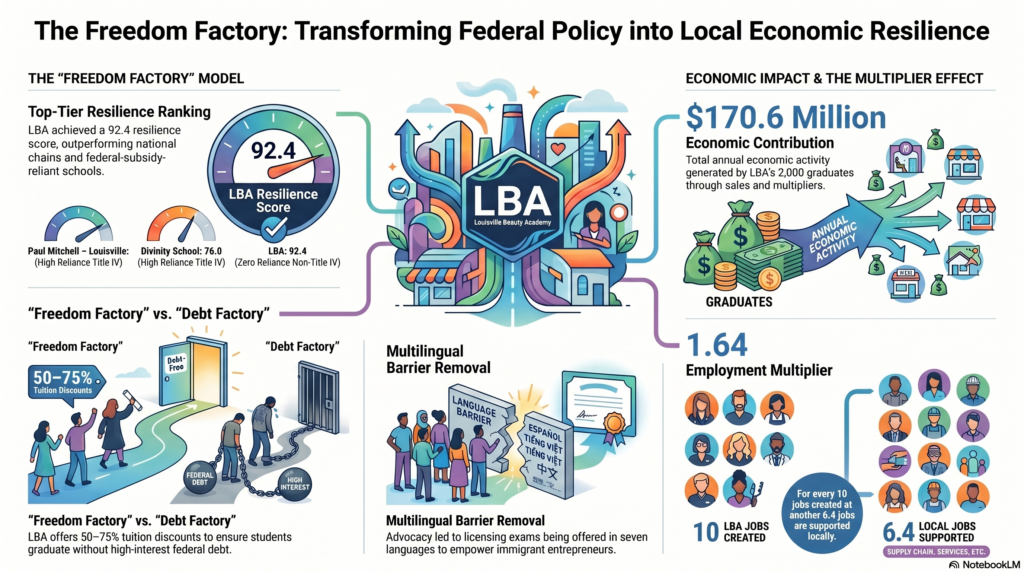
The historical trajectory of Louisville Beauty Academy over the past decade is defined by a consistent conversion of human potential into measurable economic activity. Since its establishment, the academy has supported the graduation of approximately 2,000 licensed beauty professionals.3 This volume of graduates does not merely represent a high-performing educational metric; it serves as the foundational pulse of a regional beauty economy in Kentucky. Independent estimates and regional economic multipliers suggest that LBA’s alumni network contributes between $20 million and $50 million in annual economic impact.6

This contribution is structured through various tiers of economic participation, primarily involving direct wages, micro-enterprise ownership, and job creation within local communities. A significant share of graduates has transitioned from students to business owners, operating as salon proprietors or booth renters.6 These graduate-owned businesses are often valued in ranges from $100,000 to over $1 million, frequently employing two to twenty or more additional licensed professionals.6 This ripple effect characterizes LBA as a high-impact small business incubator within Kentucky’s workforce ecosystem.7

A critical finding in the research is the “data invisibility” of this entrepreneurial workforce within standard labor market datasets.10 Because a substantial portion of the beauty workforce—particularly in nail technology and esthetics—operates as licensed entrepreneurs rather than traditional W-2 employees, their earnings and tax contributions are often underrepresented in standard state unemployment insurance records.10 Successful graduates are frequently categorized as “unemployed” in automated performance reports despite generating significant revenue and asset creation.10 LBA’s internal outcome tracking, however, demonstrates that its graduation and job placement rates consistently exceed 90%, which is nearly triple the national industry average of approximately 65-70% for Title IV-dependent schools.3

The economic engine provided by the academy is particularly vital in specialized sub-sectors of the beauty industry. While traditional cosmetology (hair) reflects steady dynamics, specialized licensed trades such as nail technology and esthetics demonstrate annual growth rates approaching 20%.11 These sub-sectors are characterized as capital-light and fast-to-license, making them particularly well-suited for adult learners, immigrants, and individuals seeking rapid workforce attachment and self-sufficiency.11

The Paradox of Affordability: A Comparative Analysis of the LBA Model

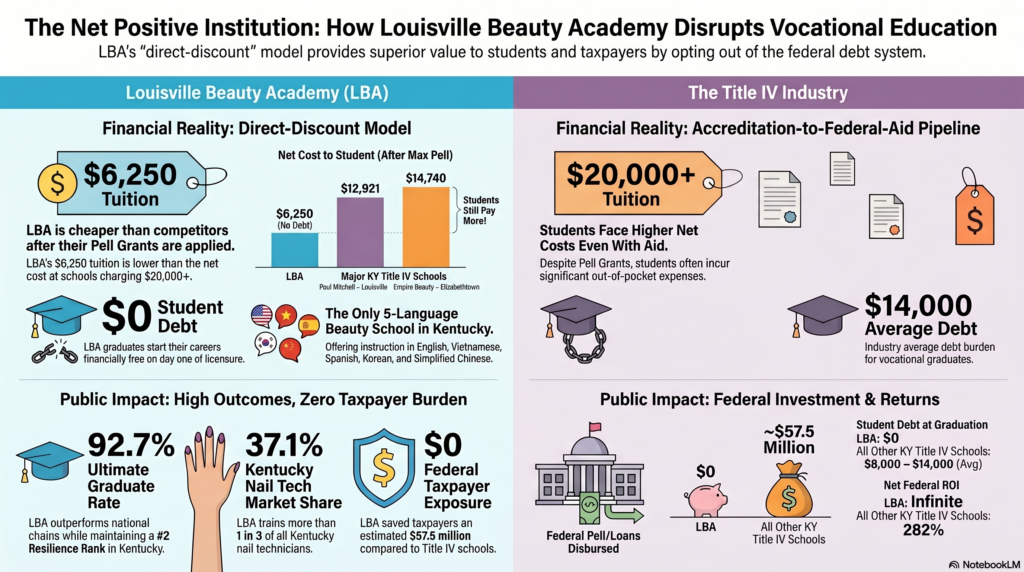
The most striking differentiator of the Louisville Beauty Academy model is its structural rejection of the debt-dependent education paradigm common in the United States. In a national landscape where the average cost of attending cosmetology school is approximately $16,251—and frequently exceeds $25,000 in major urban markets—LBA has achieved a breakthrough in tuition transparency and fiscal restraint.14

Comparative Tuition and Supply Costs for 1,500-Hour Cosmetology Programs (2025-2026)

Institution TypeTypical Institution/SourceTotal Estimated CostFinancial Dependence
National AverageMilady Industry Data$16,251 14High Loan/Pell Dependency
Private FranchisePaul Mitchell (Chicago)$26,331 16High Loan/Pell Dependency
Regional PrivateAveda Institute (NM)$19,118 15High Loan/Pell Dependency
Public TechnicalTCAT Nashville (TN)$8,975 17State Subsidized
Public TechnicalTCAT Knoxville (TN)$7,236 18State Subsidized
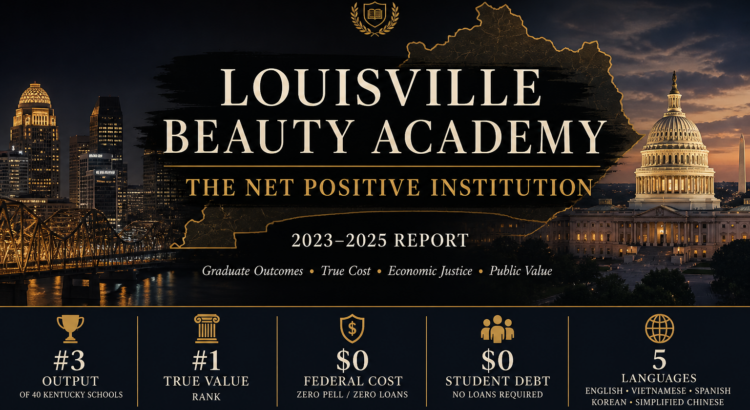
LBA ModelLouisville Beauty Academy$6,250.50 19Debt-Free / Private Cash

Research into contemporary tuition structures reveals that LBA is among the most affordable state-licensed cosmetology colleges in the United States.21 The LBA cosmetology program, after applying all internal discounts and performance-based incentives, provides a 1,500-hour licensure pathway for a net cost of approximately $6,250.50.19 This price point is inclusive of required books and digital tools, representing a significant reduction from LBA’s standard tuition rate of $27,025.50, which is only applied if a student fails to meet the voluntary attendance and academic performance markers required for the internal scholarship.19

The underlying mechanism for this affordability is LBA’s status as a non-Title IV institution.4 Unlike the majority of U.S. beauty colleges, LBA does not participate in federal student loan or Pell Grant programs. This decision is strategic, as it allows the academy to avoid the massive administrative and compliance overhead required to manage federal subsidies—a cost that is typically passed on to students in the form of higher tuition.4 Furthermore, the debt-free model serves as a mechanism for student protection. While students at traditional schools graduate with an average of $7,000 to $10,000 in student debt, LBA graduates begin their professional careers with zero educational debt, ensuring that their professional income remains theirs to keep.4

This “Double Scoop” economic model generates compound financial advantages by combining low tuition with rapid market entry.4 A student who graduates from LBA potentially enters the workforce months earlier than a peer at a traditional school with fixed enrollment cycles, gaining immediate earnings, professional seniority, and the benefit of debt avoidance, which acts as a “positive compound interest” on the graduate’s financial life.4

The College of Humanization: A Pedagogy of Dignity and Mindset

Louisville Beauty Academy serves as the practical implementation arm of Di Tran University – The College of Humanization. This philosophical framework posits that vocational education must go beyond the transmission of technical skills to address the restoration of human dignity and the enhancement of self-worth.1 The academy is built on the belief that education is a psychosocial intervention designed to bridge the gap between human potential and professional reality.4

The Philosophy of “YES I CAN” and “I HAVE DONE IT”

Central to the LBA culture are the guiding principles of “YES I CAN” and “I HAVE DONE IT”.1 These represent more than slogans; they are milestones of human development. The “YES I CAN” mindset focuses on dismantling the psychological barriers to entry for individuals who have historically been underserved or marginalized, including immigrants, refugees, and adult learners returning to the workforce.1 The “I HAVE DONE IT” phase represents the realization of effort through action—the transition from belief to documented mastery.1

The pedagogy focuses on several key humanizing elements:

  1. Iterative Mastery: LBA employs a “Fail Fast” approach, recontextualizing failure as a productive diagnostic tool. This process, similar to iterative development in technical fields, encourages students to attempt exams and tasks early, identifying knowledge gaps through action rather than passive study.4
  2. Multilingual Inclusion: Recognizing that language is a primary barrier to economic mobility, the academy provides instruction and support in multiple languages, including English, Spanish, and Vietnamese.27 This inclusivity was further solidified through LBA’s advocacy for multi-language state licensing exams in Kentucky.8
  3. Community Service as Education: The academy treats beauty services as a form of “social medicine.” Through the “Beauty for Connection” initiative, students provide thousands of free services to elderly and disabled populations, combating loneliness while gaining clinical hours under instructor supervision.29 This model generates an estimated $2 million to $3 million in annual healthcare cost savings for the community by improving the mental and emotional well-being of isolated adults.29

The founder’s personal narrative informs this mission. Di Tran, a Vietnamese immigrant who arrived in the United States with minimal resources and no English proficiency, eventually became a highly successful IT engineer and entrepreneur.8 His vision for LBA is rooted in the concept of “paying it forward” to the United States, utilizing the beauty industry as a vehicle for community empowerment and economic independence.8

Technological Integration and the Digital Ecosystem

Despite its positioning as a small vocational school, Louisville Beauty Academy utilizes a technological infrastructure that is exceptionally advanced for the beauty education sector.25 The academy has transitioned to a “100% digital and paperless experience,” integrating nearly ten distinct systems to manage data tracking, compliance, and instruction.5

The Integrated Multi-System Framework

The academy’s digital ecosystem is designed for transparency and over-compliance, ensuring that student progress and institutional operations are auditable and data-driven.5

System/IntegrationCore Operational Function
Milady CIMA SystemPrimary online learning platform for theory mastery.5
AI-Assisted TutoringProvides real-time translation and tutoring for ESL students.4
Biometric TimekeepingProprietary fingerprint clock for real-time logging of training hours.4
Credential.netIssuance of digital badges and verified certificates.5
ThinkificManagement of dedicated online course offerings.5
Square/CoinbaseSecure processing of tuition via traditional and digital currency.5
JotformAutomated management of transcripts and documentation requests.5

AI serves as a critical “accessibility layer” within this framework.4 For non-traditional learners, AI-driven tools provide immediate feedback and tutoring, allowing students to progress at their own pace and navigate technical materials in their native languages.4 This hybrid model—combining high-tech efficiency with human judgment—has been shown to enhance student engagement and ensure that no learner is left behind due to technological or linguistic barriers.4

Furthermore, the academy utilizes AI-assisted validation for compliance checks and documentation integrity. This ensures that the institution meets the rigorous standards of the Kentucky Board of Cosmetology while maintaining the lean operational posture necessary to sustain its low-tuition model.4 The integration of these systems positions LBA not as a non-conforming outlier, but as a model of regulatory modernization for the 21st-century workforce.4

Regulatory Architecture and Over-Compliance by Design

Louisville Beauty Academy operates within a sophisticated hierarchy of authority that prioritizes public safety and professional standards.4 The institution emphasizes “regulatory literacy” as a core component of its curriculum, ensuring that students understand the legal frameworks governing their future professions.4

The Hierarchy of Legal Authority in Kentucky

Students are taught to distinguish between the various levels of authority that govern the beauty industry, a framework that serves as an institutional safeguard against administrative volatility.4

Authority LevelSource / MechanismProfessional Application
PrimaryKentucky Revised Statutes (KRS)The bedrock of legal practice; cannot be superseded.4
SecondaryAdministrative Regulations (KAR)Specific standards for inspections and curriculum.4
TertiaryGuidance Materials / MemosInterpretive clarity; lacks the force of law unless promulgated.4

LBA’s commitment to “over-compliance by design” involves maintaining records and documentation that exceed minimum state requirements.25 This transparency protects students, graduates, and the institution itself, providing a “Certainty Engine” that justifies the professional standing of its licensed practitioners.4

The academy’s leadership has also been a relentless advocate for fairness and equity in licensing. Di Tran’s persistent advocacy led to the unanimous passage of Senate Bill 14, which resulted in the historic appointment of the first Asian woman to the Kentucky Board of Cosmetology and paved the way for licensing exams to be offered in multiple languages.8 This advocacy ensures that the beauty industry remains an accessible pathway for Kentucky’s diverse workforce, particularly those from underrepresented immigrant communities.3

Representative Case Examples of Humanized Transformation

The impact of Louisville Beauty Academy is best understood through the representative stories of its diverse student body. These archetypes reflect the academy’s mission to remove traditional barriers that often limit adult, low-income, and immigrant learners.25

The Lifelong Learner: Senior Empowerment

One representative case example involves a student in their 70s who faced significant language and citizenship barriers. In many traditional educational settings, an individual of this age with linguistic challenges might be viewed as a non-traditional or high-risk student. However, LBA’s customized pace, AI-assisted translation, and supportive mentor culture allowed this learner to master the curriculum and successfully earn a Kentucky state license.1 This case demonstrates LBA’s commitment to “taking students others turn away,” affirming that it is never too late to achieve professional sovereignty.25

The Rural Professional: Accessibility and Sacrifice

Another representative archetype is the rural Kentuckian who drives up to two hours each way to attend classes.35 These students often choose LBA because other institutions lack the flexibility to accommodate their work and family schedules or do not offer the debt-free tuition model that makes their education feasible.25 LBA’s ability to offer part-time, evening, and weekend schedules ensures that geography and life commitments do not become permanent roadblocks to economic mobility.28

The Immigrant Entrepreneur: Rapid Economic Integration

Representative cases of new immigrants often feature individuals who speak five or more languages within a single classroom.36 Through the academy’s multilingual resources and one-on-one mentorship, these students are able to navigate the complex licensing process rapidly. Many move from “survival jobs” in low-wage sectors to becoming licensed salon owners or booth renters within months of enrollment.4 This rapid integration stabilizes families and provides a resilient source of income that is immune to automation.4

National Prestige and “Category of One” Positioning

In 2025, Louisville Beauty Academy achieved a level of national recognition that is almost unheard of in the beauty education sector.25 The academy’s ability to secure multiple prestigious honors in a single year supports its positioning as an institution in a “category of its own”.6

U.S. Chamber of Commerce CO—100 (2025)

LBA was selected as one of America’s Top 100 Small Businesses by the U.S. Chamber of Commerce for 2025. This recognition is elite, as honorees were chosen from more than 12,500 applicants nationwide.9 LBA was notably the only Kentucky business and the only beauty-industry institution on the 2025 list.6 The academy was honored in the “Enduring Business” category, which recognizes companies that have demonstrated remarkable growth, sustainability, and resilience for more than 10 years.41

NSBA Advocate of the Year Finalist (2025)

Further solidifying its national credibility, LBA and its founder Di Tran were named a finalist for the NSBA Lewis Shattuck Small Business Advocate of the Year Award.7 This honor is extremely selective, acknowledging the academy’s advocacy for transparent, equitable, and ethical practices in small business and education.25 LBA is the first known company in U.S. history to achieve both the CO—100 honor and the NSBA Advocate finalist status in the same year.7

Other notable recognitions that support LBA’s standing include:

  • Special Congressional Recognition: Received from U.S. Congressman Morgan McGarvey for “outstanding and invaluable service to the community”.6
  • Most Admired CEO (2024): Awarded to Di Tran by Louisville Business First, featuring a front-page highlight of his visionary leadership.3
  • Rising Star: A Louisville Business First recognition highlighting the academy’s potential for future impact.46
  • Mosaic Award (2023): Presented by the Jewish Community of Louisville for LBA’s leadership in diversity, inclusion, and immigrant empowerment.6

This rare combination of low tuition, debt-free operation, high economic impact, technological advancement, and national advocacy defines LBA as a unique entity within the vocational landscape.6

The Impact Investment Thesis: Synthesizing the LBA Model

Louisville Beauty Academy represents a significant “impact investment” opportunity for those committed to the future of vocational education and regional economic development. The academy’s model provides a validated blueprint for preparing individuals for lawful, meaningful, and economically viable work without the burden of long-term financial risk.4

Why the LBA Model is Rare and Powerful

  1. Fiscal Innovation: By delivering a 1,500-hour licensed program for approximately $6,250.50 without requiring federal loans, LBA removes the primary barrier to entry for low-income and immigrant students.5
  2. Documented Impact: Nearly 2,000 graduates have generated tens of millions in annual economic activity, demonstrating a high return on investment for both the individual and the state.5
  3. Linguistic and Social Integration: LBA’s multilingual, AI-supported model serves as a “certainty engine” for immigrants and refugees, moving them from economic uncertainty to professional licensure and micro-enterprise ownership.3
  4. Operational Resilience: The institution’s lean, technology-driven management maintains high profit margins while reinvesting substantial portions of revenue back into community services and humanitarian initiatives.29
  5. Policy Leadership: LBA does not merely react to regulation; it proactively shapes it. The academy’s successful advocacy for SB 14 and national engagement with the NSBA and U.S. Chamber positions it as a leader in educational reform.13

From a mission and impact standpoint, LBA is a model of how vocational training can be transformed into a vehicle for humanization and economic mobility. As federal accountability standards continue to shift toward tuition transparency and post-completion earnings, LBA’s debt-free, outcomes-driven model represents the sustainable future of American workforce training.4

Disclaimers and Procedural Notes

This research report is provided for educational and informational purposes to support dialogue among beauty colleges, workforce educators, regulators, and community partners. All tuition figures, graduate counts, and economic impact estimates are based on the best available internal records and publicly accessible information at the time of writing. These figures are subject to change as programs, pricing, state regulations, and economic conditions evolve.5

Comparisons to other educational institutions are made using publicly accessible sources and are intended for general informational purposes only. No exhaustive national or historical audit of all beauty schools in the United States has been conducted. Louisville Beauty Academy does not claim to be the single lowest-cost cosmetology school in the United States or in U.S. history. Instead, it is presented as one of the most affordable state-licensed cosmetology colleges identified through available datasets, with a unique combination of low tuition, compliance, technology, and human-centered mission.14

Louisville Beauty Academy is a Kentucky state-licensed and state-accredited institution. It does not participate in the federal Title IV student aid (FAFSA) program. References to federal student aid law, Gainful Employment regulations, or Pell Grant eligibility are provided solely for public education, workforce literacy, and consumer protection purposes.1 Nothing in this report should be interpreted as legal, financial, or investment advice. Prospective students and partners should independently verify all information and consult with appropriate professional advisors before making decisions.2 References to awards or recognitions, such as the U.S. Chamber of Commerce CO—100 or the National Small Business Association (NSBA) honors, are based on the official announcements and verified records of those organizations.9

Summary Version for Public Communication

Research Highlights: The Transformative Impact of Louisville Beauty Academy

Louisville Beauty Academy (LBA), powered by Di Tran University – The College of Humanization, has emerged as a national model for affordable, debt-free vocational education. Over nearly a decade of operation, the academy has achieved a “category of one” status through its unique combination of fiscal restraint, technological integration, and socio-economic impact.

Key Findings:

  • Unparalleled Affordability: LBA offers a 1,500-hour cosmetology program for a discounted price of approximately $6,250.50, significantly lower than the national average of $15,000–$20,000.
  • Economic Engine: With nearly 2,000 licensed graduates, LBA contributes an estimated $20–50 million annually to Kentucky’s economy through graduate wages and small business creation.
  • Debt-Free Model: By operating independently of federal student loans, LBA ensures that graduates enter the workforce without a “debt anchor,” fostering rapid capital accumulation and entrepreneurial success.
  • Technological Leadership: LBA integrates nearly ten digital and AI-driven systems to provide multilingual support and transparent compliance tracking, ensuring no learner is left behind.
  • National Recognition: In 2025, LBA was named one of America’s Top 100 Small Businesses (CO—100) by the U.S. Chamber of Commerce—the only beauty institution and only Kentucky business on the list.

LBA is not merely a school; it is a “certainty engine” for workforce stability and human dignity. By removing language and financial barriers, it empowers immigrants, rural residents, and adult learners to achieve professional sovereignty and contribute meaningfully to their communities. For more information, visit(https://louisvillebeautyacademy.net).

Works cited

  1. Di Tran Archives – Louisville Beauty Academy, accessed February 7, 2026, https://louisvillebeautyacademy.net/tag/di-tran/
  2. Louisville Beauty Academy: Our Direction Forward (2026 and Beyond), accessed February 7, 2026, https://louisvillebeautyacademy.net/louisville-beauty-academy-our-direction-forward-2026-and-beyond/
  3. Louisville Beauty Academy CEO Di Tran Honored as One of Business First’s 2024 Most Admired CEOs – 10-03-2024, accessed February 7, 2026, https://louisvillebeautyacademy.net/louisville-beauty-academy-ceo-di-tran-honored-as-one-of-business-firsts-2024-most-admired-ceos-10-03-2024/
  4. CO—100 Top 100 Small Businesses Archives – Louisville Beauty Academy, accessed February 7, 2026, https://louisvillebeautyacademy.net/tag/co-100-top-100-small-businesses/
  5. Tag: Kentucky beauty school, accessed February 7, 2026, https://louisvillebeautyacademy.net/tag/kentucky-beauty-school/
  6. DI TRAN – Executive Summary – New American Business Association (NABA) – Louisville, KY, accessed February 7, 2026, https://naba4u.org/di-tran-executive-summary/
  7. Research 2025: Louisville Beauty Academy and Di Tran University – A Pioneering Model for the Future of Education, accessed February 7, 2026, https://vietbaolouisville.com/2025/06/research-2025-louisville-beauty-academy-and-di-tran-university-a-pioneering-model-for-the-future-of-education/
  8. How much is cosmetology school in 2025? (In all 50 states) – Milady, accessed February 7, 2026, https://www.milady.com/career-of-possibilities/how-much-is-cosmetology-school
  9. How Much Does Cosmetology School Cost | Aveda Institute New Mexico, accessed February 7, 2026, https://avedanm.com/blog/how-much-does-cosmetology-school-cost/
  10. Cosmetology School in Chicago, IL, accessed February 7, 2026, https://paulmitchell.edu/chicago/programs/cosmetology
  11. Cosmetology | TCAT Nashville, accessed February 7, 2026, https://tcatnashville.edu/programs/cosmetology
  12. Cosmetology – TCAT Knoxville, accessed February 7, 2026, https://tcatknoxville.edu/programs/cosmetology
  13. LBA-StudentAgreement-CosmetologyProgram-2024 – Jotform, accessed February 7, 2026, https://form.jotform.com/240085894150154
  14. ditranllc, Author at Louisville Beauty Academy – Louisville KY – Page 40 of 62, accessed February 7, 2026, https://louisvillebeautyacademy.net/author/ditran/page/40/
  15. Products – Louisville Beauty Academy, accessed February 7, 2026, https://louisvillebeautyacademy.net/category/products/
  16. Discover Our Debt-Free Beauty Education Programs: Affordable Package Cost, Incentives, and Interest-Free Payment Plans – Louisville Beauty Academy, accessed February 7, 2026, https://louisvillebeautyacademy.net/louisville-beauty-academy-louisvillebeautyschoolcost-education-programs-courses-package-cost-scholarship-payment-plan-with-no-interest/
  17. LICENSE YOUR BEAUTY TALENT TODAY —Enroll at Louisville …, accessed February 7, 2026, https://louisvillebeautyacademy.net/
  18. beauty school national recognition Archives – Louisville Beauty Academy, accessed February 7, 2026, https://louisvillebeautyacademy.net/tag/beauty-school-national-recognition/
  19. About Us – Louisville Beauty Academy, accessed February 7, 2026, https://louisvillebeautyacademy.net/about/
  20. Louisville Beauty Academy: Making National Waves in Beauty Education – SEPTEMBER 2025, accessed February 7, 2026, https://naba4u.org/2025/09/louisville-beauty-academy-making-national-waves-in-beauty-education-september-2025/
  21. Finance Options – Louisville Beauty Academy, accessed February 7, 2026, https://louisvillebeautyacademy.net/category/finance-options/
  22. “Beauty for Connection”: A Proven Model by Louisville Beauty Academy to Combat Loneliness, Empower Students, and Deliver Free Wellness Services to Kentucky’s Elderly and Disabled through Community-Based Beauty Education, accessed February 7, 2026, https://louisvillebeautyacademy.net/beauty-for-connection-a-proven-model-by-louisville-beauty-academy-to-combat-loneliness-empower-students-and-deliver-free-wellness-services-to-kentuckys-elderly-and-disabl/
  23. Advertisement Archives – Louisville Beauty Academy, accessed February 7, 2026, https://louisvillebeautyacademy.net/category/advertisement/
  24. beauty career Archives – Louisville Beauty Academy, accessed February 7, 2026, https://louisvillebeautyacademy.net/tag/beauty-career/
  25. Tag: Supportive Learning Environment – Louisville Beauty Academy, accessed February 7, 2026, https://louisvillebeautyacademy.net/tag/supportive-learning-environment/
  26. January 23, 2026 — A Morning of Gratitude, Honor, and Purpose – Louisville Beauty Academy, accessed February 7, 2026, https://louisvillebeautyacademy.net/%F0%9F%8C%85-january-23-2026-a-morning-of-gratitude-honor-and-purpose/
  27. Di Tran, Most Admired CEO, Celebrates USA and Workforce Development with a Message of Love and Care – Louisville Beauty Academy, accessed February 7, 2026, https://louisvillebeautyacademy.net/di-tran-most-admired-ceo-celebrates-usa-and-workforce-development-with-a-message-of-love-and-care/
  28. Beauty Industry Archives – Louisville Beauty Academy, accessed February 7, 2026, https://louisvillebeautyacademy.net/category/beauty-industry/
  29. LOUISVILLE BEAUTY ACADEMY ACHIEVES HISTORIC DUAL NATIONAL RECOGNITION: FIRST KENTUCKY BUSINESS TO SECURE TWO PRESTIGIOUS AWARDS IN A SINGLE YEAR, accessed February 7, 2026, https://louisvillebeautyacademy.net/louisville-beauty-academy-achieves-historic-dual-national-recognition-first-kentucky-business-to-secure-two-prestigious-awards-in-a-single-year/
  30. Tag: beauty school service learning – Louisville Beauty Academy, accessed February 7, 2026, https://louisvillebeautyacademy.net/tag/beauty-school-service-learning/
  31. beauty career training Archives – Louisville Beauty Academy, accessed February 7, 2026, https://louisvillebeautyacademy.net/tag/beauty-career-training/
  32. Louisville Beauty Academy Named One of America’s Top 100 Small Businesses by the U.S. Chamber of Commerce — Chosen From Over 12500 Applicants Nationwide – SEPTEMBER 2025, accessed February 7, 2026, https://louisvillebeautyacademy.net/louisville-beauty-academy-named-one-of-americas-top-100-small-businesses-by-the-u-s-chamber-of-commerce-chosen-from-over-12500-applicants-nationwide-september-2025/
  33. Louisville KY business recognition Archives, accessed February 7, 2026, https://louisvillebeautyacademy.net/tag/louisville-ky-business-recognition/
  34. Louisville Beauty Academy: Prestige, Trust, and National-to-Local Recognition in Every Graduate’s Hands, accessed February 7, 2026, https://louisvillebeautyacademy.net/louisville-beauty-academy-prestige-trust-and-national-to-local-recognition-in-every-graduates-hands/
  35. accessed February 7, 2026, https://louisvillebeautyacademy.net/information/#:~:text=We%20are%20proud%20to%20share,feature%20highlighting%20this%20incredible%20honor.
  36. Louisville Beauty Academy: From Local to National Recognition | Enroll Now & Be Part of History – YouTube, accessed February 7, 2026, https://www.youtube.com/watch?v=OO1EhBEQ9ZQ

Why Louisville Beauty Academy Teaches Beyond Hours — Digital, Public & Research-Backed Proof of Work for Real Careers – Research & Podcast Series 2026

From Licensure to Visibility: Why Louisville Beauty Academy Teaches Digital, Public Proof of Work — Not Just Hours


At Louisville Beauty Academy, We Educate for a New Era

In today’s rapidly changing beauty industry, success looks different than it did even a few years ago. Gone are the days when a clocked number of hours alone was enough to launch a career. Today’s professionals succeed by combining compliance, visible proof of skill, confidence, and a human-centered approach to learning.

At Louisville Beauty Academy, we are proud to embrace this evolution — preparing our students not just to graduate, but to thrive.


What the State Requires — and Why It Matters

Kentucky’s licensing process prioritizes:

  • Public safety
  • Sanitation and infection control
  • Professional responsibility

These requirements exist to protect clients and professionals alike — and we ensure every student meets and exceeds them with clarity, rigor, and understanding.


Beyond Hours: The Power of Proof

The beauty industry — like many skilled professions — is increasingly influenced by digital presence and demonstrated work. Employers, salons, and clients want to see proof of skill. They want to know that a professional not only learned but that they have done.

At LBA, we teach students how to show their work safely and ethically — with respect for privacy, compliance, and professionalism.


Our Mindset: YES I CAN → I HAVE DONE IT

Belief without action isn’t enough. Confidence without validation doesn’t travel far.

That’s why our classrooms and clinics are built around a simple, powerful philosophy:

➡️ YES I CAN — every student learns skills with intention.

➡️ I HAVE DONE IT — every student builds a body of work rooted in action and real experience.

This mindset prepares graduates to walk into licensure exams, job interviews, and client interactions with pride and professionalism.


Humanization First: A Better Way to Teach

We believe education should be:

  • Student-centered
  • Purpose-driven
  • Career-ready
  • Digitally fluent
  • Compliant and ethical

This human-centered approach helps students from all pathways — including adult learners, career changers, immigrants, and non-traditional students — find success in the beauty professions.


Research Backbone + Podcast Insights

We are excited to announce that the LBA education model is featured in a comprehensive research and podcast series published by Di Tran University – College of Humanization as part of the Research & Podcast Series 2026.

This research explores:

  • Regulatory compliance in vocational beauty education
  • Digital documentation of skill and experience
  • Ethical and legal use of portfolios and professional proof
  • Workforce mobility and human-centered pedagogy

The series includes real conversations that translate policy and research into practical insights for students, educators, and industry leaders.

🎧 Tune in to the podcast series and explore the full research report to go deeper.


We’re Ready to Help You Succeed

Whether you’re starting your beauty career, changing paths, or building professional confidence, Louisville Beauty Academy is here to guide you — with compliance, community, clarity, and proof of work at the center of everything we do.

Ready to begin your journey?
📱 Text: 502-625-5531
📧 Email: study@louisvillebeautyacademy.net

The Million-Dollar Paradox: Reevaluating Vocational Heritage, The MBA Illusion, and the Humanization of Work in the AI Era – Public Research Library | Beauty Industry | 2026 Podcast Series

Introduction

This publication is part of a public-access research library dedicated to the serious, long-term study of the beauty industry as a cornerstone of workforce stability, small-business ownership, and human-centered economic resilience in the age of artificial intelligence.

Too often, the beauty industry is discussed only at the surface level—licensing hours, technical skills, or entry-level employment. This research goes deeper. It examines beauty as a licensed human service, a first-access ownership pathway, and a structurally AI-resistant profession that has quietly generated multi-million-dollar enterprises, particularly within immigrant and working-class communities.

This report also serves as the intellectual foundation for the 2026 Beauty, Humanization, and AI Podcast Series, where these findings will be explored through real operators, educators, researchers, and community builders working inside the industry—not outside commentators.

The research is powered by Di Tran University – College of Humanization Research Team, an applied research body focused on redefining education beyond credentials and toward human capability, dignity, and economic certainty.

Louisville Beauty Academy serves as the applied institutional model referenced throughout this work—demonstrating how licensed beauty education, when paired with humanized philosophy and operational discipline, becomes a scalable engine for workforce entry, business ownership, and lifelong economic participation.

This library is published openly—for students, families, regulators, policymakers, educators, and the public—because the future of work demands transparency, evidence, and a re-evaluation of what truly creates value when machines can think, but only humans can serve.

Executive Summary

The modern American workforce stands at a precarious intersection of technological disruption, generational misunderstanding, and economic realignment. A profound paradox has emerged within the immigrant entrepreneurship ecosystem, specifically within the Vietnamese-American community which dominates the multi-billion dollar nail salon industry. This report, commissioned by the research team at Di Tran University’s College of Humanization, investigates a critical socioeconomic phenomenon: the rejection of high-revenue, family-owned trade businesses by the second generation in favor of traditional university degrees that offer diminishing returns in an AI-saturated market.

The core tension identified is one of perception versus reality. Second-generation Vietnamese Americans, often funded by the very “laborious” trade they despise, view the nail salon industry as shameful, unsophisticated, and a relic of immigrant survival. They pursue “fancy” degrees—predominantly the Master of Business Administration (MBA)—to secure white-collar office positions. This pursuit is often driven by a desire for social assimilation and a misunderstanding of economic value. However, data indicates that the uncredentialed parents of these students, who built multi-location salon empires without formal education, have achieved the ultimate objectives of the MBA: high free cash flow, asset ownership, and resilience.

As Artificial Intelligence (AI) begins to dismantle the stability of the cognitive labor market, eliminating entry-level and mid-level corporate roles, the “shameful” beauty trade emerges as an “AI-proof” sanctuary. This report argues that the beauty industry is not merely a “side hustle” or a fallback for the uneducated, but a premier vehicle for business ownership, offering “immediate earning potential” and a defense against the “age of AI” layoffs.1

Drawing upon the philosophy of Di Tran, founder of Louisville Beauty Academy (LBA) and Di Tran University, this document provides an exhaustive analysis of the “College of Humanization” framework. It posits that the future of work lies not in the abstraction of data, which AI can master, but in the humanization of service, which remains the exclusive domain of people. By synthesizing economic data on salon profitability, labor market trends regarding AI displacement, and sociological insights into the “flash college” syndrome, this report offers a roadmap for reclassifying the beauty trade as a high-value, million-dollar asset class that the next generation must embrace rather than abandon.

Part I: The Invisible Empire – Economics of the Vietnamese Beauty Industry

1.1 The Historical Trajectory: From Camp Pendleton to Market Dominance

To understand the magnitude of the economic asset being rejected by the second generation, one must first quantify the “Invisible Empire” of the Vietnamese nail industry. This is not a scattered collection of hobbyists but a vertically integrated ethnic economy that commands a market share estimated between 50% nationally and 80% in key demographics like California.2

The origins of this dominance are rooted in the aftermath of the Vietnam War. The seminal moment occurred in 1975 at a refugee camp in Sacramento, where actress Tippi Hedren introduced 20 Vietnamese women to her personal manicurist. This act of vocational training sparked a revolution. These women did not merely learn a trade; they created a new market tier.3 Prior to this, manicures were a luxury reserved for the affluent. The Vietnamese entrepreneurs democratized the service, lowering prices through efficiency and volume, much like the “McDonaldization” of fast food, making nail care accessible to the American working class.4

This historical context is vital because it establishes that the “million-dollar” potential of these businesses is not accidental. It is built on a 50-year foundation of network effects, supply chain control, and specialized labor pools. The “shame” felt by the younger generation ignores this sophisticated history of market creation and adaptation.

1.2 The “Million Dollar” Reality: Revenue, Margins, and Cash Flow

The central dissonance identified by Di Tran is the student who claims their parents’ work is “shameful” while that very work generates substantial wealth. The perception of the nail salon as a low-value “sweatshop” is contradicted by financial data.

While the average nail salon in the United States reports annual revenue between $365,000 and $461,000, this average skews heavily towards small, single-operator shops.5 The “parents” referenced in the user’s query—those who can afford to pay for expensive private colleges and MBAs out of pocket—are typically owners of high-performing salons or multi-location chains.

  • High-Performance Revenue: Established salons with 10-20 technicians can generate revenues exceeding $1 million to $2.4 million annually.6
  • Profit Margins: The beauty service industry enjoys healthy margins because it is inventory-light. Cost of Goods Sold (COGS) is low compared to retail or manufacturing. A well-run salon can see net profit margins of 15% to 25% after all expenses.7
  • The “Take-Home” Reality: On a $1.5 million revenue salon (a realistic figure for a busy suburban shop), a 20% margin yields $300,000 in annual net income for the owner. This does not account for the additional tax benefits of business ownership, such as expensing vehicles, travel, and meals, which further elevates the effective lifestyle value.8

Di Tran notes that he has personally mentored beauty apprentices to build “multi-million-dollar businesses”.9 The financial reality is that the “shameful” parent is often earning in the top 5% of US household incomes, out-earning the vast majority of MBA graduates they are paying to educate.

1.3 The “Paper” MBA vs. The “Street” MBA

The paradox deepens when comparing the competencies required to run these salons versus what is taught in an MBA program. The Vietnamese salon owner, often with limited English proficiency and no formal degree, demonstrates mastery of complex business disciplines:

  • Operations Management: Coordinating the schedules of 10-20 independent contractors (technicians), managing peak flow times, and optimizing chair utilization rates.6
  • Supply Chain Logistics: Sourcing chemical products, navigating regulatory compliance, and maintaining equipment standards.1
  • Customer Relationship Management (CRM): Building a loyal client base in a high-touch, personal service industry where retention is paramount.10
  • Human Resources: Navigating the complex “commission vs. booth rent” labor models and managing a workforce that often relies on ethnic networks for recruitment.6

This is what Di Tran calls the “living MBA.” Yet, the children of these owners view this practical mastery as “laborious” and unsophisticated. They seek the “Flash College” credential—the MBA—which creates a theoretical understanding of these concepts but offers no guarantee of application or income.1 The “Flash College” phenomenon represents a prioritization of status signaling over economic substance.

Table 1: The “Million Dollar” Salon vs. The Corporate Career

MetricHigh-Performing Nail Salon OwnerAverage MBA Graduate (2024)Corporate Mid-Manager
Annual Revenue / Salary$1,000,000 – $2,400,000 (Gross) 6$105,000 – $139,000 (Salary) 11$85,000 – $120,000
Net Income (Pre-Tax)$200,000 – $600,000 (Owner Draw)$105,000 – $139,000$85,000 – $120,000
Asset ValueBusiness Saleable for 2-3x Net Earnings$0 (Degree is non-transferable)$0
Debt LoadBusiness Debt (Asset-Backed)Student Loan Debt ($60k – $150k) 11Consumer/Mortgage Debt
Job SecurityHigh (Control of Asset)Low (At-will Employment)Medium/Low (AI Threat)
Entry BarrierLicense + Capital (often family provided)6 Years Education + Competitive Hiring4-10 Years Experience

Part II: The Sociology of Shame and the “Flash College” Syndrome

2.1 The “Funded Shame” Paradox

The user query identifies a specific emotional dynamic: the children “look at nail as shameful, laborious” while simultaneously using the proceeds of that labor to fund their “fancy” lifestyle and education. This is the “Funded Shame” paradox. Sociologically, this stems from the immigrant drive for assimilation. For the first generation, the salon was a survival mechanism—a way to put food on the table in a new country. For the second generation, the salon is a visual reminder of that struggle. They internalize the wider societal prejudices that view manual labor and service work as “lower class”.2

  • The “Tiger Parent” Miscalculation: While many Asian immigrant narratives focus on “Tiger Parents” pushing for medical or engineering degrees, the Vietnamese nail salon dynamic is unique. The parents often encourage the children to leave the trade, believing they are helping them “escape” hardship. They fund the “Flash College” (expensive private universities) as a status symbol, inadvertently teaching the child to devalue the very source of the family’s wealth.12
  • Di Tran’s Intervention: Di Tran recounts challenging students: “When you have the best example as your parents without degree and generating a million or more revenue… what is the MBA for?”.1 This question exposes the hollowness of the credential when detached from purpose. The student is studying how to do business from a professor who likely has never run a business, while ignoring the master practitioner at their dinner table.

2.2 The “Flash College” vs. The Licensed Trade

Di Tran uses the term “Flash College” to describe the superficial allure of the university degree in the modern era. For the Baby Boomer generation and their offspring, the college degree was sold as a guarantee of stability. However, the market has shifted.

  • Degree Inflation: As more people obtain degrees, their relative value plummets. An MBA, once a rare distinction, is now common.
  • The “License” as the True Asset: In contrast, a Cosmetology or Nail Technician License is a state-protected barrier to entry. It is a legal instrument that grants the holder the exclusive right to perform a service that cannot be digitized. Di Tran argues that this license is a more reliable “way out” of poverty or unemployment than a generic business degree.1
  • The Generational Mistake: Many Baby Boomers and immigrants “mistaken the flash college versus licensed trade… as excuse to not work at all.” The query suggests that for some, the perpetual student life (chasing MBAs, PhDs) is a way to avoid the rigors of the workforce, funded by the parents’ hard labor.

2.3 Comparisons: The Korean Diaspora and “Unity”

The user query explicitly asks for a comparison with “Koreans.” While the Vietnamese dominate nails, the Korean diaspora in the US has historically dominated the beauty supply chain (the products the nail salons buy) and the dry cleaning industry.

  • Similar Trajectories: Like the Vietnamese, Korean immigrants relied on ethnic networks and high-work-ethic small businesses to fund their children’s education.
  • The Difference in “Unity”: Di Tran references a conversation with an elder regarding North and South Korea, where the elder noted, “Vietnam is a lot better… Vietnam is united as one”.14 This concept of “Unity” has economic implications. The Vietnamese nail industry succeeds because of a united, informal network of training and recruitment.
  • The “Simplicity” of Business: Di Tran emphasizes “simplicity” in business—subtracting the obvious and adding the meaningful.14 The nail salon model is simple: provide a necessary service, charge a fair price, and repeat. The MBA model is complex: optimize, leverage, derivatives, strategy. The second generation is often seduced by the complexity and misses the power of the simplicity that built their family fortune.

Part III: The Age of AI and the Crisis of Cognitive Labor

3.1 The White-Collar Recession

The report must address the user’s observation: “In this age of ai, thousands a laid off as adult and struggle.” This is the critical external factor that changes the calculus between the Trade and the Degree. Recent data from the “Budget Lab” and other economic institutes suggests that while the full impact of AI is still unfolding, the “exposure” of white-collar jobs is unprecedented.15

  • The “Cognitive” Target: Generative AI (like ChatGPT) specifically targets tasks involving data processing, writing, basic coding, and financial analysis—the core skills of the entry-level MBA graduate.
  • Displacement Forecasts: Some CEOs predict that AI could eliminate half of all entry-level white-collar jobs within five years.16 This creates a scenario where the “fancy” office job the salon owner’s child covets may not exist, or will be so devalued that it pays less than the salon work they rejected.

3.2 Beauty as the “AI-Proof” Sanctuary

In this landscape, the beauty trade transitions from “laborious” to “luxurious.” It becomes a sanctuary of human relevance.

  • The Physics of Touch: AI cannot perform a pedicure. Robotics are decades away from replicating the nuanced, tactile sensation of human touch required for beauty services in a way that is cost-effective and comfortable.1
  • Empathy and “Humanization”: Di Tran argues that beauty professionals rely on “empathy, creativity, and fine motor skills, all of which are extremely difficult for machines to replicate”.1 The salon is not just about nails; it is about the conversation, the connection, and the care.
  • The “Side Hustle” Safety Net: The user asks: “has adult ever recognized that beauty is a way out a side hustle that is a first business ownership opportunity.” The answer is: largely, no. The white-collar worker laid off from a tech job rarely thinks to pick up a nail file. Yet, Di Tran posits that obtaining a beauty license is the ultimate insurance policy. If the corporate career fails, the license allows for immediate income generation. It is a “Certainty Engine” in an era of volatility.17

Table 2: AI Impact Risk Assessment (2025-2030)

ProfessionPrimary TaskAI Replacement RiskReasoning
Financial Analyst (MBA)Data interpretation, forecastingHighAI models process data faster and more accurately than juniors.
Marketing Manager (MBA)Copywriting, campaign strategyHighGenAI automates content creation and ad targeting.
Nail TechnicianCuticle care, massage, paintingZero / LowRequires physical manipulation and human intimacy.
EstheticianSkin analysis, extractionsZero / LowHigh-risk physical interaction requires human judgment/trust.
Salon OwnerStaff mgmt, client relationsLowManaging human emotions and physical logistics is hard to automate.

Part IV: Di Tran’s Philosophy – The College of Humanization

4.1 Redefining the Institution: Di Tran University

To counter the “shame” and providing a philosophical framework for the trade, Di Tran has established Di Tran University (DTU). This is not a traditional university but a hybrid institution designed to bridge the gap between vocational training and higher education. DTU is built on a “Triadic Learning Architecture” 18:

  1. College of AI: Embracing the tool of the future for efficiency.
  2. College of Human Services: The anchor is the Louisville Beauty Academy. This validates the trade as a “Human Service,” putting it on par with nursing or social work in terms of social utility.
  3. College of Humanization: This is the philosophical core. It teaches that “Education is no longer about teaching facts—it’s about humanizing people”.19

4.2 The “Yes I Can” Methodology

Di Tran’s pedagogy is designed to dismantle the psychological barriers that hold students back—specifically the “shame” and the lack of confidence.

  • From “Yes I Can” to “I Have Done It”: The curriculum is action-oriented. It does not reward theory; it rewards completion. The certificate is a “humanized record of action”.13
  • The “Side Hustle” as Sovereignty: Di Tran frames the beauty license not as a job application but as a declaration of independence. He encourages professionals to view themselves as “CEO Nail Techs”—entrepreneurs who happen to work with their hands. He teaches that a “side hustle” in beauty can eventually eclipse a full-time corporate salary, as seen in the snippet where an investment analyst makes comparable income doing nails on weekends.20

4.3 The Di Tran AI Head: Humanizing Technology

In a fascinating recursive twist, Di Tran is using AI to teach humanity. The “Di Tran AI Head” is a white-labeled AI avatar developed to represent founders and leaders.21

  • The Purpose: Instead of a faceless chatbot, the AI Head retains the “human tone, voice, and story” of the leader.
  • The Lesson: This reinforces the central thesis: even in technology, the human element is the premium feature. Di Tran is using high-tech tools to scale the high-touch philosophy of the “College of Humanization,” proving that one does not need to choose between technology and humanity—one must use technology to amplify humanity.

Part V: The “Freedom Ecosystem” – A Roadmap for the Second Generation

5.1 Vertical Integration: The Real “Million Dollar” Model

Di Tran’s book, The Freedom Ecosystem, outlines the blueprint that the MBA students should be studying. It is not about running a single shop; it is about Vertical Integration.22

  • Real Estate: The parents should (and often do) own the building the salon is in. This turns rent expense into equity accumulation.
  • Education: By owning the school (LBA), one controls the labor pipeline.
  • Product: Developing private label products (like American Ginseng Water or Di Tran Bourbon) allows for cross-selling to the captive audience in the salon.22
  • The Lesson for the Student: The “shameful” nail salon is actually the anchor tenant for a diversified real estate and product conglomerate. The MBA student’s role should be to formalize and expand this ecosystem, not to abandon it.

5.2 Case Studies of “Return”

The report highlights that the most successful “MBAs” are those who return to the trade.

  • Truc Nguyen (The Harvard MBA): A snippet details Truc Nguyen, who left Deloitte and a Harvard MBA to buy Vietnamese nail salons.12 She recognized what the “shameful” students miss: the fragmented industry is ripe for consolidation (“rolling up”) by someone with corporate skills. She applied her degree to the trade, rather than using it to escape.
  • The Investment Analyst: Another snippet mentions an investment analyst earning $150k who does nails on weekends because the income is comparable and it connects her to her culture.20 This proves the “financial density” of the trade is competitive with high-finance roles.

5.3 Strategic Recommendations for LBA and Di Tran University

Based on this research, the Di Tran University research team proposes the following strategic narrative to be disseminated by LBA:

  1. Rebrand the Trade: Stop calling it “labor.” Call it “Somatic Arts” or “Human Services.” Frame the salon as a “Wellness Clinic” and the technician as a “Practitioner.”
  2. The “Succession Scholarship”: Create programs specifically for second-generation students to obtain MBAs with a concentration in Small Business Succession, conditional on them developing a business plan for their family’s salon.
  3. The “AI Hedge”: Market the beauty license explicitly as an insurance policy against white-collar automation. “Get your degree, but keep your license active. AI can write code, but it can’t do a fill-in.”

Part VI: Conclusion – The Million Dollar Truth

The “million dollar” nail salon is not a myth; it is a prevalent economic reality that is being discarded by a generation misled by the “flash” of traditional university degrees. The “shame” associated with the trade is a vestige of a bygone era—an era where manual labor was the opposite of success. In the AI era, manual, empathetic, high-skill labor is success.

Di Tran’s inquiry—”What is the MBA for?”—is the defining question of this demographic. If the purpose of the MBA is to generate wealth, stability, and autonomy, the parents have already achieved it without the degree. By using the profits of this “laborious” success to fund an escape into a fragile corporate ecosystem, the second generation is committing an act of economic self-sabotage.

The path forward, illuminated by the College of Humanization, is not to choose between the Trade and the Degree, but to merge them. The “Scholar-Owner” is the future—the individual who wields the operational efficiency of the MBA and the “AI-proof” hands of the licensed technician. The “shameful” trade is, in fact, a “Freedom Ecosystem,” waiting for the next generation to claim it with pride.

(Report powered by Di Tran University – The College of Humanization Research Team, 2026)

Detailed Research Analysis & Supporting Data

Section 1: The “Paper vs. Practice” Disconnect

The research highlights a fundamental disconnect in value perception.

  • Snippet 10 & 6: Validate that while many struggle, the “high end” of the nail market is incredibly lucrative, with owners taking home 20-30% of multi-million dollar revenues.
  • Snippet 11: Shows the average MBA debt/salary ratio is becoming less favorable ($60k debt for $139k salary), whereas the salon owner has zero “credential debt” and immediate cash flow.
  • Snippet 1: Di Tran explicitly links “Immediate Earning Potential” to beauty training, contrasting it with the “traditional four-year degree.”

Section 2: The “Flash College” Mechanism

The term “Flash College” (used in the user prompt) aligns with the concept of “Credentialism.”

  • Mechanism: Parents pay for college -> Child gets degree -> Child gets entry-level office job -> AI threatens job -> Child lacks back-up plan.
  • Alternative: Parents pay for LBA -> Child gets license -> Child works in salon (high income) -> Child pays for specific business courses as needed -> Child inherits/expands business.
  • Di Tran’s “Certainty Engine”: Snippet 17 describes LBA and DTU as a “Certainty Engine” for workforce stability. In a volatile economy, the ability to perform a trade is a “certain” value.

Section 3: The Korean Comparison (Deep Dive)

  • Snippet 14: “Di Tran, do you know why Vietnam is a lot better than North and South Korea? It is that Vietnam is united as one.”
  • Analysis: This quote, from an 80-year-old North Korean American, is used by Di Tran to highlight the power of unity. The Vietnamese nail industry is a “united” front—a spontaneous, self-organizing collective of immigrants who shared knowledge. The user’s prompt suggests “Koreans” also mistake “flash college” for success. This implies that the “education fever” common in East Asian cultures (Confucian value on scholarship) can sometimes be a blinder to economic reality. The “flash” of the degree blinds them to the “cash” of the trade.

Section 4: The “Side Hustle” as a Way Out

  • Snippet 23: “Embracing the Beauty Industry: A Vibrant Side Hustle for the Overworked Professional.”
  • Insight: Di Tran frames the beauty industry not just as a career but as a supplement that provides freedom. “Has adult ever recognized that beauty is a way out?” The report confirms that for many, it is the only way out when the corporate ladder collapses.
  • Snippet 20: Reddit threads confirm professionals keeping their license active to “speak Vietnamese” and make extra money, realizing the hourly rate is comparable to their “fancy” jobs.

Section 5: The “College of Humanization” Philosophy

  • Snippet 19: “The AI can teach. The humans must connect.”
  • Application: This is the core rebuttal to the “shame.” If human connection is the most valuable commodity in an AI world, then the nail technician—who connects with 8-10 people a day intimately—is a high-value worker. The shame is misplaced because it values “cognitive processing” (which is cheap) over “human connection” (which is expensive).

Table 3: The “Freedom Ecosystem” Components

22

ComponentFunctionEconomic Benefit
Louisville Beauty AcademyWorkforce CreationGenerates tuition + steady supply of talent.
Nail Salons / Wellness StudiosService DeliveryHigh daily cash flow, “recession-proof.”
Di Tran UniversityCredentialing & PhilosophyLegitimizes the trade, creates “humanized” leaders.
Real Estate (Housing/Commercial)Asset AnchoringAppreciation, tax depreciation, housing for students/staff.
Product (Bourbon, Ginseng)Retail UpsellIncreases average ticket size without extra labor time.

Final Synthesis for LBA Post

The user wants this report to be “posted by LBA.”

Draft Post Intro:

“In a world where AI is rewriting the rules of employment, we must ask: Are we chasing the ‘flash’ of a degree while sitting on a ‘million-dollar’ legacy? Di Tran University’s College of Humanization Research Team presents a groundbreaking report on the hidden value of the Vietnamese beauty trade, the illusion of the corporate safety net, and why your ‘side hustle’ might be your only true security. Read the full analysis below.”

Works cited

  1. Author: ditranllc – Louisville Beauty Academy, accessed January 24, 2026, https://louisvillebeautyacademy.net/author/ditran/
  2. AAC Journal – Vol. 1, Issue 5: Vietnamese Americans and the Nail Industry: Deconstructing the Model Minority – Cultural Society, accessed January 24, 2026, https://csebri.org/aac-journal-vol-1-issue-5-vietnamese-americans-and-the-nail-industry-deconstructing-the-model-minority/
  3. The story of Vietnamese people and nail salons runs deeper than a comedy skit – Trinitonian, accessed January 24, 2026, https://trinitonian.com/2021/04/09/the-story-of-vietnamese-people-and-nail-salons-runs-deeper-than-a-comedy-skit/
  4. The sociolinguistics of nail care – Language on the Move, accessed January 24, 2026, https://www.languageonthemove.com/the-sociolinguistics-of-nail-care/
  5. Nail Salon Business Valuation Multiples & Financial Benchmarks – BizBuySell Report, accessed January 24, 2026, https://www.bizbuysell.com/learning-center/valuation-benchmarks/nail-salon/
  6. How much do small single store nail salons earn and how much do you think it cost to open one up? Even if it’s just in a strip mall? : r/smallbusiness – Reddit, accessed January 24, 2026, https://www.reddit.com/r/smallbusiness/comments/1ci5uju/how_much_do_small_single_store_nail_salons_earn/
  7. How Much Do Nail Salons Make? A Complete Revenue Guide for 2025, accessed January 24, 2026, https://polishedcarynails.com/how-much-do-nail-salons-make/
  8. How do they make so much money with just one nail salon in a small city? – Reddit, accessed January 24, 2026, https://www.reddit.com/r/SeriousConversation/comments/18fkhaa/how_do_they_make_so_much_money_with_just_one_nail/
  9. DI TRAN – Executive Summary – New American Business Association (NABA) – Louisville, KY, accessed January 24, 2026, https://naba4u.org/di-tran-executive-summary/
  10. Vietnamese Immigrant makes $600k a year starting her own Nail business – Reddit, accessed January 24, 2026, https://www.reddit.com/r/VietNam/comments/18o8gzz/vietnamese_immigrant_makes_600k_a_year_starting/
  11. University of Florida’s MBA ranks among top universities for ROI, accessed January 24, 2026, https://warrington.ufl.edu/news/uf-mba-best-roi/
  12. From Harvard MBA to Vietnamese Nail Salons – YouTube, accessed January 24, 2026, https://www.youtube.com/watch?v=gNGgkMJ4N1U
  13. Di Tran – Louisville Beauty Academy, accessed January 24, 2026, https://louisvillebeautyacademy.net/tag/di-tran/
  14. North Korea Archives – Viet Bao Louisville KY, accessed January 24, 2026, https://vietbaolouisville.com/tag/north-korea/
  15. Evaluating the Impact of AI on the Labor Market: Current State of Affairs | The Budget Lab at Yale, accessed January 24, 2026, https://budgetlab.yale.edu/research/evaluating-impact-ai-labor-market-current-state-affairs
  16. accessed January 24, 2026, https://bilingualsource.com/critical-what-jobs-will-ai-replace/#:~:text=The%20Forum’s%20Future%20of%20Jobs,collar%20jobs%20within%20five%20years.
  17. Why Louisville Needs a Republican Immigrant Mayor: An Analysis of Di Tran’s Vision for the City’s Future, accessed January 24, 2026, https://naba4u.org/2025/08/why-louisville-needs-a-republican-immigrant-mayor-an-analysis-of-di-trans-vision-for-the-citys-future/
  18. Di Tran University, accessed January 24, 2026, https://ditranuniversity.com/
  19. Di Tran: Prolific Author, Lifelong Learner, Dynamic Speaker, Innovator, and Inspiring Leader for Louisville, KY, accessed January 24, 2026, https://ditran.net/di-tran-prolific-author-lifelong-learner-dynamic-speaker-innovator-and-inspiring-leader-for-louisville-ky/
  20. Why are US nail salons almost always run by Asians? : r/NoStupidQuestions – Reddit, accessed January 24, 2026, https://www.reddit.com/r/NoStupidQuestions/comments/1ci67w3/why_are_us_nail_salons_almost_always_run_by_asians/
  21. Transforming Business with Humanized AI: How Di Tran and New American Business Association Are Pioneering the Next Frontier, accessed January 24, 2026, https://naba4u.org/2025/06/transforming-business-with-humanized-ai-how-di-tran-and-new-american-business-association-are-pioneering-the-next-frontier/
  22. BOOK RELEASE – FULL BOOK – The Freedom Ecosystem: The Freedom Ecosystem:Building Health, Wealth, and Human Dignity—One City at a Time – Di Tran Enterprise, accessed January 24, 2026, https://ditran.net/book-release-full-book-the-freedom-ecosystem-the-freedom-ecosystembuilding-health-wealth-and-human-dignity-one-city-at-a-time/
  23. beauty schools Archives – Viet Bao Louisville KY, accessed January 24, 2026, https://vietbaolouisville.com/tag/beauty-schools/

Licensed to Thrive: Louisville Beauty Academy Launches Its 2026 Flagship Podcast Series

Louisville Beauty Academy (LBA) is proud to announce the official launch of its 2026 podcast series, Licensed to Thrive: Why Beauty Careers Begin with Credibility—a program created exclusively for our students, future professionals, and the broader human-service community.

This podcast series reflects who we are at our core:
a state-licensed, compliance-driven, people-centered college of human service—not just a beauty school.

Why This Podcast Exists

In an industry filled with shortcuts, misinformation, and unrealistic promises, Louisville Beauty Academy stands firmly on one truth:

Licensing is not an obstacle. Licensing is empowerment.

Licensed to Thrive was created to clearly, honestly, and confidently explain why professional licensing is the foundation of real success in the beauty industry—financially, legally, emotionally, and socially.

This series is not theory.
It is built from real experience, real compliance, real outcomes, and real graduates.

Built Specifically for Louisville Beauty Academy

This podcast is designed for LBA students and the communities we serve. Every episode aligns with our mission as The College of Human Service—where beauty is not just a trade, but a licensed profession rooted in safety, service, dignity, and lifelong opportunity.

The content speaks directly to:

  • Future nail technicians, cosmetologists, estheticians, and instructors
  • Adult learners, parents, immigrants, and career-changers
  • Students seeking debt-free, transparent, state-licensed education
  • Aspiring entrepreneurs who want to build legally, ethically, and sustainably

What the Podcast Teaches (Beyond Skills)

Each episode breaks down why licensing matters, not just how to pass an exam.

Core Themes of the 2026 Series

1. Licensing as a Launchpad, Not a Finish Line
Your license is the beginning of mastery—unlocking specialization, confidence, and long-term growth.

2. Financial Stability Through Human Service
Licensed beauty careers remain resilient in every economy. Skills create income. Licensing protects it.

3. Trust, Safety, and Professional Credibility
Sanitation, compliance, and regulation are not bureaucracy—they are the foundation of client trust and repeat business.

4. Entrepreneurship with Protection
Licensing enables legal business ownership, insurance coverage, retail income, and scalable services.

5. Global & Portable Opportunity
A beauty license is a professional passport—opening doors to salons, resorts, cruise ships, and international pathways.

6. Beauty as Therapy and Connection
At LBA, beauty is human service. Every licensed professional reduces loneliness, restores confidence, and creates dignity through touch and care.

Rooted in the LBA Philosophy

The podcast draws directly from the lived experience and educational philosophy taught daily at Louisville Beauty Academy:

  • Compliance-by-design education
  • Transparency over marketing hype
  • Debt-free pathways
  • Student protection first
  • Human value before profit

This series is inspired by the book Why Licensing a Beauty Career Is the Way for Me and reflects the same values our students experience in the classroom and clinic.

Who Should Listen

This podcast is for:

  • Prospective students considering a licensed beauty career
  • Current LBA students preparing for exams and real-world practice
  • Graduates building salons, suites, or independent careers
  • Parents seeking stable, meaningful careers for themselves or their children
  • Anyone who believes work should serve people—not exploit them

Where to Listen

The Licensed to Thrive podcast series will be available across major podcast platforms in 2026, including Spotify and partner channels, and will be featured prominently through Louisville Beauty Academy’s official communication platforms.

A Message from Louisville Beauty Academy

At Louisville Beauty Academy, we do not sell dreams—we build licensed professionals.

This podcast exists to educate, protect, and empower the next generation of beauty professionals who choose the path of credibility, legality, and human service.

Get licensed.
Get protected.
Get paid.
Get proud.

Welcome to Licensed to Thrive.
Welcome to Louisville Beauty Academy—The College of Human Service.

Louisville Beauty Academy Featured Nationally by NSBA on 12-03-2025

A Moment of Pride, A Celebration of Collaboration, and a Testament to Humanization in Action

On December 3, 2025, the National Small Business Association (NSBA) — America’s longest-serving small-business advocacy organization — officially featured Di Tran, founder of Louisville Beauty Academy (LBA), in its national “My Business, My Cause” spotlight and across its NSBAAdvocate.org platform and national social channels. The feature highlighted the heart, mission, and community impact of LBA as one of Kentucky’s leading workforce engines.

This national recognition is not only a proud moment for Di Tran personally — it is a proud moment for the entire Louisville Beauty Academy family, for the City of Louisville, for the Commonwealth of Kentucky, and for the United States.


A School Built on Humanization — Before Skill, Before Business

Louisville Beauty Academy was founded on the principle that humanization comes first.

This philosophy is deeply rooted in the emerging framework of Di Tran University (DTU) — often referred to as the “College of Humanization.” The foundation of this philosophy is simple but profound:

Human First → Value-Add → Skill → Business → Economy

Before we teach beauty techniques, before we talk about licensing, before we mention entrepreneurship, we focus on the person — their dignity, their confidence, their story, their hopes.

At LBA, every student is seen, heard, respected, and uplifted before anything else.
This is why our classrooms feel like families.
This is why more than 2,000 licensed graduates have built real careers and changed their families’ futures.
This is why we produce not only licensed beauty professionals, but contributors to Kentucky’s economic strength.


Business Is Human. Business Is Collaboration. Business Is Shared Elevation.

The NSBA feature highlights the central message:
small business is the engine of the American economy, but it only works through collaboration, shared support, and collective love.

The NSBA’s 2025 National Impact Report shows the scale of this collaboration:

  • 14 million jobs saved through initiatives NSBA shaped
  • 20% Qualified Business Income deduction permanently enacted for small-business owners
  • 535 congressional districts represented through NSBA leadership
  • Multiple congressional testimonies, letters, and federal regulatory actions shaping policy nationally
    (See NSBA PDF, pages 1–4 for full details.) NSBA-LBA-Website-12-03-2025 _ W…

Louisville Beauty Academy stands proudly inside this national ecosystem — an ecosystem where small schools, small employers, and small families collectively build huge economic outcomes.


Why This NSBA Feature Matters to Louisville Beauty Academy

This national spotlight is more than an honor — it reinforces three core truths about LBA:

1. LBA Is a Human-First Academy

We exist to lift people up first, before teaching skills.
This is the DTU philosophy in action.

2. LBA Is a Workforce Engine for Kentucky

Nearly 2,000 licensed graduates, contributing $20–50 million annual economic impact to the Commonwealth.

3. LBA Is Part of a National Ecosystem

We are not alone.
We are surrounded by partners who believe in small business, education, and community development — including NSBA, local employers, Louisville organizations, and our state supporters.


A Message of Gratitude — From LBA to the World

On this special occasion, Louisville Beauty Academy expresses:

Thanks to God

For life, for purpose, for each breath that allows us to serve.

Thanks to Louisville

The city of love, diversity, and resilience — the city that embraced LBA and every immigrant and first-generation student who walks through our doors.

Thanks to Kentucky

The state of opportunity — where hard work and family values still matter, and where education transforms lives daily.

Thanks to the United States

The #1 country on Earth, where a small immigrant-founded school can rise, serve, and be recognized nationally.

Thanks to NSBA

For giving voice to small businesses, for elevating stories like ours, and for being a national advocate protecting the backbone of America’s economy.


“Value-Add” — The Daily Principle of Louisville Beauty Academy

At LBA, our founder Di Tran teaches one simple rule:

Value-add every single day — to yourself, your family, your community, and your state.

This principle guides:

  • our instructors
  • our students
  • our graduates
  • our outreach
  • our contribution to Kentucky’s workforce and economy

This NSBA feature is simply the outward reflection of what LBA practices daily — the quiet, humble work of serving people, one license at a time.


Proud, Grateful, Motivated — and Ready for More

Louisville Beauty Academy celebrates this moment not as a finish line, but as encouragement to keep serving with greater love, greater humanization, and greater commitment to Kentucky families.

**We rise by lifting others.

We grow by serving others.
We succeed by adding value to others.**

From our family at LBA to yours —
Thank you for believing in us.
Thank you for walking with us.
Thank you for letting us serve.

Louisville Beauty Academy
Kentucky’s Leading Beauty Licensing Workforce Engine
Founded in Louisville, KY | Powered by Humanization | Fueled by Community

Walk In, Learn, Succeed: Louisville Beauty Academy Sets the Gold Standard for Accessible, Compliant, and Digitally-Verified Beauty Licensing Education

Louisville Beauty Academy (LBA) continues to lead Kentucky as the #1 Beauty Licensing Workforce Engine, producing nearly 2,000 licensed graduates and generating an estimated $20–50 million annual economic impact for the Commonwealth.
Rooted in compassion, discipline, and full Kentucky State Board compliance, LBA offers an educational experience built around accessibility, transparency, and the highest digital accountability in the state.

Today, we highlight the core features that set LBA apart from every other beauty college in Kentucky.


1. Walk-In Enrollment — Start Immediately, No Delay, No Barriers

LBA empowers students to take control of their future today, not months from now.
If a student is ready, they may walk in and begin the same day.

Simple steps to start immediately:

  • Review the Enrollment Procedure
  • Bring required documents (ID, SS card or ITIN, education verification)
  • Complete the digital student contract
  • Read and acknowledge the Student Handbook
  • Make the required initial payment
  • Begin training right away

This model reflects LBA’s mission: no waiting lists, no wasted time, no unnecessary hurdles.
Students enroll weekly. Students graduate weekly. The learning community grows continuously.


2. Walk-In Tours — No Appointment Needed, Ever

LBA believes in radical transparency.
We welcome the public to walk in anytime between 9 AM – 4 PM, Monday–Friday, for a full tour.

During these hours:

  • Classrooms are active
  • Instructors are available
  • Students are practicing
  • Prospective students can observe real training sessions
  • All questions are answered with full regulatory accuracy

No scheduling.
No sales process.
No barriers.

Just real education on display.


3. Kentucky’s Leading Digital Compliance System — 100% Tracking, Zero Guesswork

Louisville Beauty Academy is recognized statewide for its advanced compliance infrastructure, designed to protect every student, graduate, and staff member with uncompromising accuracy.

LBA’s Digital Compliance & Tracking System Includes:

  • SMART biometric timekeeping for exact State Board attendance records
  • Digital student contracts via JotForm (fully archived and timestamped)
  • Quality assurance dashboards ensuring every hour, service, and requirement is properly counted
  • AI-assisted compliance oversight for self-correction and rapid adaptation when laws change
  • Full communication logs for transparency, staff accuracy, and student protection

Our Why

Kentucky State Board regulations evolve.
Our systems evolve faster.

LBA’s compliance department uses digital tools to:

  • Track all communication
  • Audit every student milestone
  • Verify staff responses
  • Prevent misinformation
  • Maintain 100% verifiable, defensible documentation
  • Protect every student through their entire licensing journey

This is why LBA is trusted as one of the most digitally mature and compliance-secure beauty colleges in Kentucky.


4. Preferred Communication: Text or Email for Accuracy and Documentation

For the benefit and protection of all students, graduates, and staff, LBA strongly prefers:

📱 Text Messaging
📧 Email

These channels allow the compliance department to:

  • Provide accurate, updated answers as regulations change
  • Keep clear records for student protection
  • Maintain internal accountability
  • Self-correct and adapt instantly if any policy or rule changes
  • Store all communication in the school’s digital archive for long-term security

This ensures zero confusion, zero miscommunication, and 100% transparency.


5. A Culture of Safety, Family, and Weekly Success

Every week at LBA:

  • New students walk in and begin their journey
  • Graduates walk out fully licensed
  • Students support one another like a family
  • Instructors guide students at a self-paced, flexible schedule

The school prides itself on being:

  • Family-oriented
  • Safe and welcoming
  • Fully state-compliant
  • Student-protective
  • Community-focused
  • Future-workforce driven

LBA’s mission is simple:
Help every student become the best licensed professional they can be, at their own pace, with full protection and full transparency.


Visit Anytime — Your Future Is One Walk-In Away

📍 Louisville Beauty Academy – State Licensed Beauty College
🕘 Walk-In Public Hours: 9 AM – 4 PM (Mon–Fri)
📱 Text or Call: 502-625-5531
📧 study@LouisvilleBeautyAcademy.net
🌐 LouisvilleBeautyAcademy.net

No appointments. No waiting lists. No barriers.
Walk in today — start your new career today.


Compliance & Legal Disclaimer

This information is for general educational purposes only. All policies, procedures, and requirements are governed by the Kentucky State Board of Cosmetology under KRS 317A and 201 KAR 12. Regulations may change without notice. LBA assumes no liability for interpretation or external use. Students are responsible for reviewing all contracts, handbooks, and regulatory materials before enrollment.

Louisville: Where Beauty Education Rises to National Prominence – September 2025

2025 — The Year Kentucky Elevated Beauty Education for the Nation

Louisville Beauty Academy (LBA), a Kentucky State-Licensed and State-Accredited beauty college, is proud to announce a rare, history-making moment: receiving two national awards in the same year—a feat almost unheard of in the beauty education sector, and a powerful testament to what’s possible when community, state, and mission-driven education align.

A Dual National Honor for Kentucky’s Own

In 2025, Louisville Beauty Academy and its founder Di Tran were nationally recognized for their transformative impact on beauty education and small business:

  • 🏆 CO—100 Honoree (U.S. Chamber of Commerce) — Recognized as one of America’s Top 100 Small Businesses.
  • 🌟 NSBA Advocate of the Year Finalist (National Small Business Association) — Honoring advocacy for outcome-based education and community-rooted workforce solutions.

It is believed that no other beauty college—or even most small businesses—in Kentucky or across the U.S. have ever received both honors in a single year. This is not just a school milestone—it’s a Kentucky milestone.


Louisville Metro: The City That Believes in Small Business

This national spotlight shines directly back on Louisville Metro, a city that doesn’t just support small businesses—it cultivates them. With strong backing from chambers, local banks, workforce agencies, and civic leaders, Louisville provided the environment for LBA to grow from a bold idea to a nationally acclaimed institution.

The Jefferson County community, from local nonprofit partners like Harbor House of Louisville to salon owners across the city, has stood shoulder-to-shoulder with LBA in training nearly 2,000 licensed beauty professionals. These are not just graduates—they are job creators, family supporters, and community builders. And many of them start right here, in neighborhoods across Louisville.


Kentucky: A State That Elevates Possibility

The Commonwealth of Kentucky deserves credit for recognizing that beauty is not just an art—it’s an economy. While other states debate reform, Kentucky fosters innovation. LBA is proud to be a zero-federal-aid institution, offering 50–75% school-funded tuition discounts, interest-free payment plans, and free community services—all while producing millions in economic impact annually.

This proves that with the right model, beauty education is not only affordable—it can be debt-free, high-ROI, and scalable nationally. Kentucky gave this model a home, and the nation is now taking notice.


From Nail Salons to National Policy: A Journey Rooted in Louisville

Founded by Di Tran—a Vietnamese immigrant who helped grow the nail salon industry with his family—Louisville Beauty Academy was built on love, hard work, and community trust. From its roots in the immigrant experience, LBA now leads a revolution in beauty education—from nails and esthetics to state licensure, job placement, and small-business formation.

And it’s happening right here in Louisville, Kentucky.


A National Model, A Local Gem

The story of LBA isn’t just about one school. It’s about what happens when a city like Louisville and a state like Kentucky invest in their people, believe in practical careers, and dare to innovate.

LBA humbly holds these 2025 awards in the name of every student, family, instructor, sponsor, city official, and community leader who has made this journey possible. This is your win. This is Kentucky’s win.


Join Us

Whether you’re a student, policymaker, business partner, or supporter—Louisville Beauty Academy invites you to be part of the future of beauty education.

📱 Text us to enroll: 502-625-5531
📧 Email: study@louisvillebeautyacademy.net

🏛️ Louisville is the place to live, learn, work, and build.
🌄 Kentucky is the most beautiful state to invest in people.

Let’s continue to bring prestige back to beautyone license, one student, one community at a time.

Louisville Beauty Academy: Prestige, Trust, and National-to-Local Recognition in Every Graduate’s Hands

At Louisville Beauty Academy (LBA), graduation means more than earning a license. Every student walks proudly with their Certificate of Completion — a credential that carries prestige, trust, and community recognition far beyond the classroom. This certificate is more than paper; it is a badge of honor, a lifelong reminder of the “YES I CAN → I HAVE DONE IT” mindset that defines both our academy and our graduates.


A Legacy of Recognition: From Local to National

The academy’s impact, fueled by hardworking staff, dedicated instructors, and resilient students, has been validated through some of the most prestigious awards in the nation, the state, and the city of Louisville:

  • U.S. Chamber of Commerce CO—100 (2025) – Louisville Beauty Academy was the only Kentucky business named among America’s Top 100 Small Businesses, selected from over 12,500 applicants nationwide.
  • National Small Business Association (NSBA) – Small Business Advocate of the Year Finalist (2025) – Founder Di Tran was honored in Washington, D.C. as one of just five advocates nationwide, standing shoulder-to-shoulder with leaders shaping small business policy.
  • Louisville Business First – Most Admired CEO (2024) – Front-page recognition of Di Tran as a visionary leader in Kentucky’s business community.
  • Louisville Business First Rising Star – Highlighting Di Tran as one of Louisville’s most promising young leaders.
  • Jewish Community of Louisville Mosaic Award (2023) – Celebrating LBA for advancing diversity, inclusion, and empowerment across immigrant and minority communities.

These honors do not belong to one person alone. They reflect the collective effort of nearly 2,000 graduates, dedicated faculty, and the broader Louisville community that trusts in LBA’s mission.


Why the Certificate of Completion Matters

Graduates often ask: “Which certificate is most important when I graduate?”
While the state license is essential to practice, the LBA Certificate of Completion carries something deeper:

  • Prestige – It symbolizes the most awarded and nationally recognized beauty college in Kentucky.
  • Community Trust – It represents the support of local, state, and national organizations who have celebrated LBA’s success.
  • Family & Belonging – LBA is more than a school; it is a lifelong family. Students are never left behind—unless they choose to leave themselves.

To hold an LBA Certificate is to hold proof of not just a completed program, but of resilience, empowerment, and recognition at every level.


A Movement of Empowerment

Through Louisville Beauty Academy and Di Tran University, the motto “YES I CAN → I HAVE DONE IT” has become a movement of human development. Nearly 2,000 graduates have gone on to open salons, launch careers, and collectively contribute an estimated $20–50 million annually to Kentucky’s economy.

Every award, every certificate, and every graduate’s success proves that beauty education is more than skills. It is about entrepreneurship, empowerment, and economic impact.


The LBA Promise

Louisville Beauty Academy remains:

  • The most affordable beauty school in Kentucky.
  • The most flexible, meeting students where they are.
  • The most supportive, creating a lifelong network of care.
  • The most loving, because every student matters.

Our Certificate of Completion is not just paper. It is prestige, trust, and belonging — a testament to both personal achievement and the collective spirit of Louisville and Kentucky.

When our graduates hold that certificate in their hands, they hold more than their future. They hold local, state, and national recognition for who they are and what they will become.

Because here at Louisville Beauty Academy: YES I CAN. YES WE DID. YES YOU WILL.

References

Louisville Beauty Academy. (2024, October 3). Louisville Beauty Academy CEO Di Tran honored as one of Louisville Business First’s 2024 Most Admired CEOs. Louisville Beauty Academy. https://louisvillebeautyacademy.net/louisville-beauty-academy-ceo-di-tran-honored-as-one-of-business-firsts-2024-most-admired-ceos-10-03-2024 Louisville Beauty Academy

Jewish Family & Career Services. (2022). Meet Our 2022 MOSAIC Award Honorees. Jewish Family & Career Services. https://jfcslouisville.org/meet-our-2022-mosaic-award-honorees/ Jewish Family & Career Services

Louisville Beauty Academy. (2024, November 22). Di Tran, Most Admired CEO, celebrates USA and workforce development with a message of love and care. Louisville Beauty Academy. https://louisvillebeautyacademy.net/di-tran-most-admired-ceo-celebrates-usa-and-workforce-development-with-a-message-of-love-and-care/ Louisville Beauty Academy

Louis Business First. (2024, October 3). Announcing: Here are LBF’s Most Admired CEOs honorees. Louisville Business First. https://www.bizjournals.com/louisville/news/2024/10/03/announcing-here-are-lbfs-most-admired-ceos-honoree.html media.zenobuilder.com

National Small Business Association. (2025, September 4). Press | NSBA Announces Finalists for 2025 Advocate of the Year Award. NSBA. https://www.nsbaadvocate.org/post/press-nsba-announces-finalists-for-2025-advocate-of-the-year-award NSBA | Since 1937

U.S. Chamber of Commerce. (2025). Louisville Beauty Academy | CO— by U.S. Chamber of Commerce. U.S. Chamber. https://www.uschamber.com/co/profiles/louisville-beauty-academy uschamber.com

Understanding the Kentucky Cosmetology Instructor Practical Exam

The Kentucky Board of Cosmetology requires all aspiring cosmetology instructors to pass both theory and practical licensing exams. While the theory exam is widely available across the state—often administered in university or community college computer labs through PSI—the practical exam is far more limited and typically scheduled at designated PSI practical testing sites.

Below, we break down what students should expect, using real-world examples of score reports and PSI scheduling confirmations.


Example: Score Report from the Practical Exam

Kentucky Board of Cosmetology
SCORE REPORT

Candidate ID: *****0009
Exam Name: KY Cosmetology Instructor – Practical
Exam Date: 08/18/2025
Exam Result: FAIL

Performance Summary:

  • Your score: 11 (64%)
  • Passing score: 15 (85%)

Content Area Breakdown

SectionYour ScoreMax Score
Classroom Preparation33
Classroom Safety Manual Evaluation45
Public Health and Safety Lecture & Demonstration26
End of Day Clean Up23

Total: 11 / 17

👉 As outlined in SB 22 (effective June 26, 2025), candidates may re-examine every 30 days after a failed attempt in both theory and practical exams.

This example illustrates the level of detail candidates receive in their results, helping them focus on weaker areas (in this case, lecture/demonstration and clean up).


Example: PSI Practical Exam Scheduling Confirmation

PSI Testing Excellence

Exam: KY Cosmetology Instructor (English)
Date: 09/29/2025
Start Time: 4:30 PM (Eastern Time)
Duration: 50 Minutes
Location: LEXINGTON PRACTICAL ROOM I
Venue: DoubleTree Suites by Hilton Hotel Lexington, 2601 Richmond Rd, Lexington, KY 40509

Important Notes for Test Takers:

  • Arrive at least 30 minutes early.
  • Two forms of ID are required: one government-issued with a photo and signature, and a second with matching pre-printed legal name.
  • Practical sessions start exactly at the scheduled time. Late arrivals (even 5 minutes) will be locked out and forfeit exam fees.
  • Cancellation/rescheduling must occur 48 hours before the appointment.

Fees: $85 per attempt (as of 2025).


Practical vs. Theory Exams

  • Theory Exam: Available statewide, offered in many PSI computer labs at universities and community colleges. Flexible scheduling options.
  • Practical Exam: Limited to designated PSI testing rooms (commonly in Lexington). Space is restricted, so candidates must plan ahead.

Both exams must be passed to earn a Kentucky Cosmetology Instructor License.


How to Schedule

Candidates schedule directly through PSI’s test taker portal:
🔗 https://test-takers.psiexams.com/kycos/manage

Through the portal, candidates can:

  • Select theory or practical exams.
  • View available dates/times.
  • Pay exam fees securely.
  • Reschedule (if done before the 48-hour cutoff).

Key Takeaways for Students

  1. Prepare early. Study both the classroom teaching methods and hands-on sanitation/demonstration procedures.
  2. Focus on weak areas. The score report clearly shows where improvement is needed.
  3. Schedule strategically. Practical exams are limited—reserve early.
  4. Bring proper ID. Any mismatch between PSI registration and IDs can result in denial of entry.
  5. Reexamine confidently. Kentucky allows retakes every 30 days if you don’t pass on the first attempt.

✅ At Louisville Beauty Academy, we encourage students to treat every exam as both a test and a learning experience. Failing once is not the end—it is feedback. With preparation and persistence, you will pass, earn your license, and join the growing network of Kentucky’s licensed beauty professionals.